Just International

Nicaragua’s Case against Germany Arming Israel

By Marjorie Cohn

Unlike Washington, Berlin — Israel’s second-largest arms supplier — has consented to full jurisdiction of the ICJ so it is an easier target for Nicaragua’s lawsuit.

18 Apr 2024 –  As Israel’s genocidal campaign against the Palestinians in Gaza — which has killed more than 33,000 Gazans — enters its seventh month, Nicaragua sued Germany in the International Court of Justice (ICJ, or World Court) for facilitating genocide.

Nicaragua charged that, “Germany has provided political, financial and military support to Israel fully aware at the time of authorization that the military equipment would be used in the commission of great breaches of international law,” adding,

“The military equipment provided by Germany enabling Israel to perpetrate genocidal acts and other atrocities, included supplies to the front line and warehouses, and assurances of future supplies such as ammunition, technology and diverse components necessary for the Israeli military.”

Nicaragua also cited Germany’s defunding of the United Nations Relief and Works Agency for Palestine Refugees in the Near East (UNRWA), which “provides essential support to the civilian population.”

Germany is the second-largest arms supplier to Israel, accounting for 30 percent of imports between 2019 and 2023. The United States, Israel’s chief enabler, provided it with 69 percent of its arms imports during the same period.

On Oct. 12, German Chancellor Olaf Scholz stated,

“At this moment, there is only one place for Germany: the place at the side of Israel. This is what we mean when we say that Israel’s security is a German raison d’État. Our own history, our responsibility arising from the Holocaust, makes it our perpetual duty to stand up for the existence and security of the State of Israel. This responsibility guides us.”

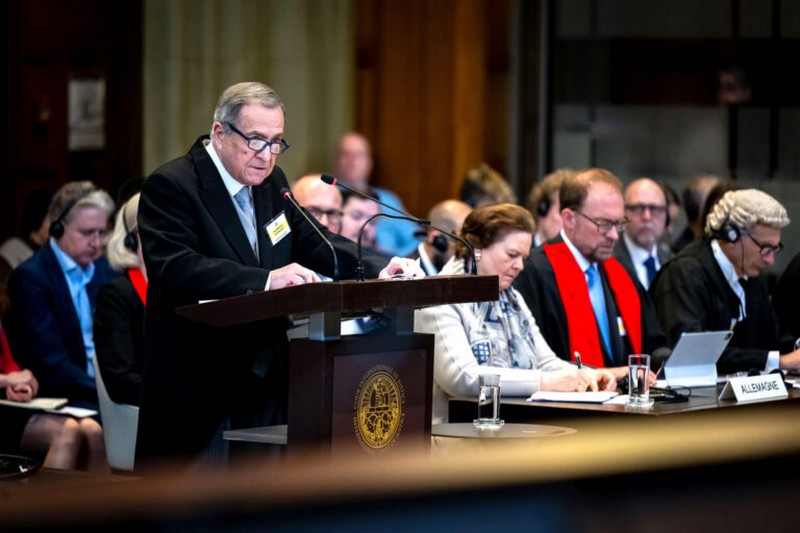
In a historic hearing on April 8 and 9, Nicaragua presented its case to the ICJ and Germany denied the charges. Nicaragua asked the World Court to order five provisional measures “as a matter of extreme urgency” for Germany’s alleged “participation in the ongoing plausible genocide and serious breaches of international humanitarian law and other peremptory norms of general international law occurring in the Gaza Strip.”

Daniel Müller, a lawyer on Nicaragua’s legal team, reminded the ICJ that 10 days prior, when the court ordered additional provisional measures against Israel in South Africa’s case, it called the living conditions in Gaza “catastrophic” and the recent developments “exceptionally grave.” The court found “an imminent risk of irreparable harm to ‘the right of the Palestinians in Gaza to be protected from acts of genocide’.”

“Nicaragua is acting not only on its own behalf on the basis of the rights and obligations conferred by the peremptory norms invoked, but also on behalf of the Palestinian people that is being subjected to one of the most destructive military actions in modern history,” Carlos José Argüello Gómez, Nicaragua’s ambassador to the Netherlands, told the court.

Gómez said that although Nicaragua hasn’t been subjected to as much inhuman treatment and destruction as the Palestinians have suffered for more than 75 years, “it has also been subject to intervention and military attacks for most of its existence and feels empathy for the Palestinian people.”

In the 1984 case of Military and Paramilitary Activities in and against Nicaragua (Nicar. v. U.S.), the ICJ ruled against U.S. intervention in Nicaragua, which included the mining of ports, the destruction of oil installations, and the training, arming and equipping of the Contras (who were trying to overthrow the Nicaraguan government).

Gómez stated the Israeli government “should not be confused and equated with the Jewish people,” noting that Jewish victims of the Holocaust “would feel sympathy and empathize with the more than 30,000 civilians, including 25,000 mothers and children massacred so far in Palestine, and the 20,000 children orphaned and the two mothers being killed every hour.”

Military Aid, Cuts to UNRWA as Genocide Unfolded

The Genocide Convention imposes on third parties the obligation to prevent genocide from the time they become aware that genocide might be committed. Gómez told the court “there can be no question” that Germany “was well aware and is well aware of at least the serious risk of genocide being committed, most certainly after your Order of 26 January [for provisional measures].”

Gómez argued that Germany was on notice of Israel’s international lawbreaking, citing 32 statements made from Oct. 9, 2023 to April 5, 2024, by hundreds of highly respected experts, authorities, organizations, legal scholars and practitioners accusing Israel of breaching or plausibly breaching the Genocide Convention.

“With all this undeniable knowledge of the situation,” Gómez declared, “Germany’s reaction was to increase its military assistance to Israel.” He also cited Germany’s announcement that it would intervene in favor of Israel in the case of South Africa v. Israel, which is pending in the ICJ.

And, Gómez said, in spite of the ICJ’s Jan. 26 finding that Israel was plausibly committing genocide, “Germany continued, and still continues to this day, to supply weapons and military assistance in general to Israel.”

For the year 2023, the German government authorized 326 million euros for exports of military equipment and weapons of war to Israel, Nicaragua’s attorney Müller told the court.

Export licenses for war weapons worth 20 million euros included “3,000 anti-tank weapons — which according to one manufacturer in Germany are ‘a complete toolbox of shoulder-launched infantry weapon[s]’ used against tanks, but also vehicles, structures and buildings, and persons — 500,000 rounds of machine gun ammunition, 44 propellant charges — a key component in artillery ammunition — and 239 ignition charges.”

Müller said these weapons are “built to and aimed at destroying and killing, or to quote from Germany’s own definition, ‘objects [and] substances . . . capable . . . of causing destruction or damage to persons or property and of serving as a means of using force in armed conflicts between States.’”

In spite of the Security Council resolution demanding an immediate ceasefire, Germany continues to provide military assistance to Israel. Germany is facilitating or improving the provision of humanitarian aid in Gaza. But, Müller argued,

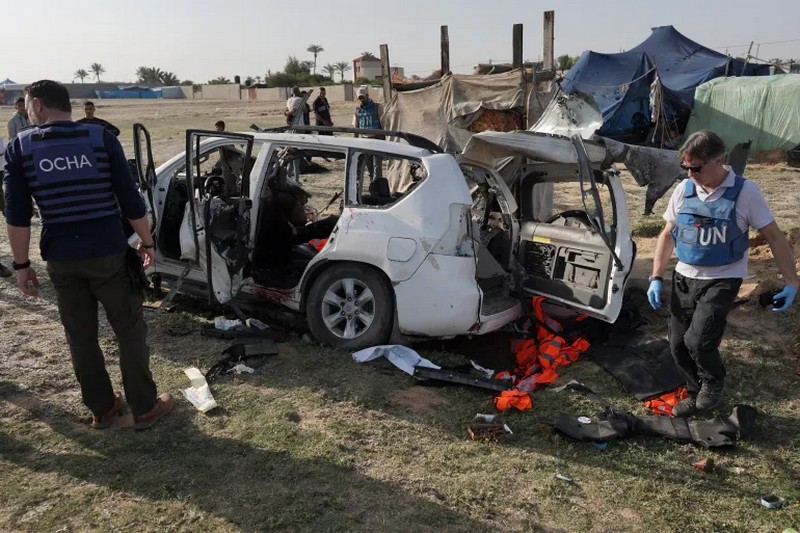
“It is indeed a pathetic excuse to the Palestinian children, women and men in Gaza to provide humanitarian aid, including through air drops, on the one hand, and to furnish the weapons and military equipment that are used to kill and annihilate them — and to kill also humanitarian aid workers as most recently evidenced by the missile attack against vehicles and workers of World Central Kitchen, on the other hand.”

Gómez noted the involvement of German companies in the military industry which “are directly profiting from the situation as they have seen their share prices rise since October and they have substantially increased the joint development contracts for weapons with their Israeli counterparts.”

Nicaragua also cited Germany’s suspension of funding for UNRWA in Gaza the day after the ICJ’s Jan. 26 order, “based on the sole say-so of the Israeli government,” as evidence of Germany’s facilitation of genocide. “UNRWA is the most important partner for providing assistance to the people in the Gaza Strip,” Germany’s federal minister admitted on Nov. 7, 2023. The suspension of funding deprived UNRWA of $450 million.

Debunked Self-Defense Argument

Nicaragua argued that Israel was confusing the right to protect its people with the right of self-defense under Article 51 of the UN Charter, citing the 2004 ICJ’s advisory opinion in Legal Consequences of the Construction of a Wall in the Occupied Palestinian Territory. In that case, the court held that Israel, as an occupying power, cannot claim self-defense in the territory it occupies. “Surprisingly,” Gómez stated, “Germany seems not to be able to differentiate between self-defense and genocide.”

Moreover, Nicaragua asserted that “the Palestinian people have the right to self-determination” which includes “the right to take up arms against alien occupation and against racist régimes in the exercise of their right of self-determination as enshrined in the [UN] Charter” and the Declaration on Principles of International Law concerning Friendly Relations and Cooperation among States.

Gómez noted that the events of Oct.  7 “did not occur in a void, on the spur of the moment, without any provocation.” He quoted UN Secretary-General António Guterres, who said on Oct. 24, “It is important to also recognize the attacks by Hamas did not happen in a vacuum. The Palestinian people have been subjected to 56 years of suffocating occupation.”

“If the actions of Israel continue unrestrained as they have since its birth as a State, and they continue to receive the indiscriminate support of States like Germany, then a new generation of Palestinians will rise up again in the near future,” Gómez predicted.

Seeking 5 Provisional Measures

Nicaragua asked the ICJ to order that Germany not make the situation in Gaza worse, by “providing or allowing the provision of munitions of war and other direct support for Israel at this juncture and by depriving UNRWA . . . of funding and of the ability to continue working in accordance with its mandate.”

These are the provisional measures that Nicaragua is requesting:

(1) Germany shall immediately suspend its aid to Israel, in particular its military assistance including military equipment, in so far as this aid may be used in the violation of the Genocide Convention, international humanitarian law or other peremptory norms of general international law such as the Palestinian People’s right to self-determination and to not be subject to a regime of apartheid;

(2) Germany must immediately make every effort to ensure that weapons already delivered to Israel are not used to commit genocide, contribute to acts of genocide or are used in such a way as to violate international humanitarian law;

(3) Germany must immediately do everything possible to comply with its obligations under humanitarian law;

(4) Germany must reverse its decision to suspend the funding of UNRWA as part of the compliance of its obligations to prevent genocide and acts of genocide and the violation of the humanitarian rights of the Palestinian People which also includes the obligation to do everything possible to ensure that humanitarian aid reaches the Palestinian people, more particularly in Gaza;

(5) Germany must cooperate to bring to an end the serious breaches of peremptory norms of international law by ceasing its support, including its supply of military equipment to Israel that may be used to commit serious crimes of international law and that it continue the support of the UNRWA on which this Organization has counted and based its activities.

Germany Claims It Can’t Be Held Responsible 

Germany’s legal team raised two main defenses. First, the ICJ has no jurisdiction in the case because Germany’s responsibility is dependent on a finding that Israel is committing genocide and Israel is not a party to this case. Second, Germany has a “robust legal framework” to assess on a case-by-case basis whether export licenses comport with its domestic and international obligations and most of its exports since October 2023 have not been “war weapons.”

Agent Tania von Uslar-Gleichen argued on behalf of Germany that Nicaragua’s accusations “have no basis in fact or law. They are dependent on an assessment of conduct of Israel, not a party to these proceedings.” She said the case was brought to the court “on the basis of the flimsiest of evidence.”

Samuel Wordsworth, also representing Germany, told the ICJ it had no jurisdiction to hear this case. He explained that Israel was not before the court and determinations about its conduct were a prerequisite to finding responsibility on the part of Germany. In South Africa v. Israel, the ICJ held it was “plausible” that Israel was committing genocide.

A final determination on the merits will take a number of years. Before determining whether Germany is breaching its international obligations, “the Court must first determine that Israel has committed genocide,” Wordsworth maintained.

“The responsibility of Germany is alleged, but in complete reliance on asserted wrongful acts of Israel.” Thus, he said, Israel is “an indispensable third party.”

But Anne Peters, another member of Germany’s legal team, admitted that if the court found it “plausible” that Israel is violating international law, it can then determine whether “plausible facts” establish “plausible violations” by Germany.

Germany Says Most Exports Aren’t ‘War Weapons’

Peters said that Nicaragua hasn’t presented any evidence that “military equipment from Germany could have made a significant contribution to an alleged genocide or to breaches of international humanitarian law” in light of “Germany’s stringent licensing standards.”

Von Uslar-Gleichen told the court that since Oct. 7, 2023, 98 percent of the licenses granted in Germany for exports to Israel were not for “war weapons,” but rather for “other military equipment.” Eighty percent of the volume approved for export was authorized in October 2023, she said.

Since October 2023,

“we see no artillery shells, no munitions. Nearly all exports involve what is known as ‘other military equipment,’ typically of a subordinate or defensive nature,” she stated. This generally includes “defense equipment against chemical hazards, protective gear such as helmets or body protection plates, communication equipment, camouflage paint and components, parts and other equipment of a subordinate character.”

Von Uslar-Gleichen admitted, however, that Germany did license the export of war weapons to Israel four times in the past six months. Two licenses for “training” (not combat) ammunition, including 500,000 pieces of ammunition, were approved in November, and an additional 1,000 pieces were approved in early 2024.

A third license was approved for propellant charge in connection with a joint project between German and Israeli industry but they were for test purposes. The fourth license was for the export of 3,000 portable anti-tank weapons “in the immediate context of Hamas massacres,” she said.

In 2023, Israel asked Germany for tank ammunition, but no license has yet been granted. One license has been granted for a submarine, but since it is a “war weapon” it requires two licenses for export so it has not yet been approved, Von Uslar-Gleichen told the ICJ. Nicaragua’s references to artillery shells and munitions to be used in Gaza “simply bear no relation to reality. Germany rejects them,” she stated.

Gómez argued on behalf of Nicaragua that “it does not matter if an artillery shell is delivered straight from Germany to an Israeli tank shelling a hospital” or replenishes Israel’s stockpiles.

“The fact is that the assurance of supplies and replacement of armaments is crucial to Israel’s pursuit of the attacks in Gaza,” he told the ICJ, adding that Germany is aware of “the serious risk of genocide being committed.”

Diplomatic & Organizing Tool

Although the United States is by far the largest provider of weapons to Israel, it hasn’t been sued in the ICJ because it won’t accept the court’s jurisdiction except in cases where the U.S. government explicitly consents. Germany has consented to full jurisdiction of the ICJ so it is an easier target than the U.S. for Nicaragua’s lawsuit.

“The ICJ is not going to end the war in Gaza, but it is a diplomatic tool that foreign policy uses to apply additional pressure on Israel,” Brian Finucane, senior adviser at the International Crisis Group, told The New York Times. “In the Nicaragua case, it further applies pressure on Germany.”

Civil society also stepped up the pressure to coincide with the ICJ hearing on Nicaragua’s case against Germany. CODEPINK delegations picketed, rallied and delivered petitions to German missions throughout the U.S.

These actions were part of an international campaign of solidarity with Palestinian Germans who risk beatings and arrest when they demonstrate against Germany’s complicity in Israel’s genocide.

The ICJ will issue a ruling on Nicaragua’s request for provisional measures in Nicaragua v. Germany in the next few weeks.

Marjorie Cohn is professor emerita at Thomas Jefferson School of Law, former president of the National Lawyers Guild, and a member of the national advisory boards of Assange Defense and Veterans for Peace, and the bureau of the International Association of Democratic Lawyers.

22 April 2024

Source: transcend.org
US & UK Again Fail Palestine

By Jeffrey D. Sachs and Sybil Fares

The Two Powers That Have Done the Most to Wreck the Middle East

18 Apr 2024 – This week, the U.S. and U.K. had the chance to correct decades of their blatant geopolitical errors in the Israel-Palestine conflict by welcoming Palestine as the 194th United Nations member state.

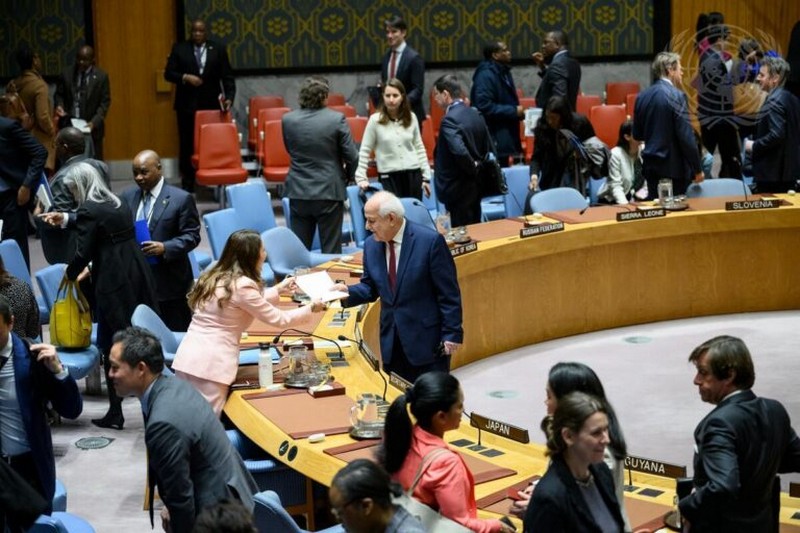
[On Thursday, however, the U.S. in the Security Council vetoed granting Palestinian Authority full membership  while the U.K and Switzerland abstained.]

More than any other countries, the U.S. and U.K. have wrecked the Middle East through their non-stop meddling and imperial arrogance. This week they had the chance to make some amends.

A total of 139 countries already recognize the State of Palestine, more than two-thirds of the U.N. member states. Several European states will soon join the list. Yet the U.S. has so far blocked Palestine’s membership in the U.N., with the U.K. always sticking close to the U.S. lead. Both have relentlessly backed Israel’s apartheid rule over Palestine and are currently actively backing Israel in its horrific destruction of Gaza.

Back in 2011, Palestine had the support of the U.N. Security Council for membership, except that the U.S. forced the Palestinians to accept “observer” status instead, promising that full membership would soon follow, yet another U.S. deception.

In a comparison of the wreckage by the U.S. and U.K. in the Middle East, the lead role certainly goes to Britain, whose imperial machinations in the region date to the 19th century and continue until today.

Britain kept Egypt under its thumb for decades, from the 1880s to the 1950s. It deceitfully promised overlapping parts of the Ottoman Middle East three times over during World War I: to the French (in the Sykes-Picot Agreement), to the Arabs (in the McMahon–Hussein Correspondence) and to the Zionists (in the Balfour Declaration), purporting to allocate what was not theirs in the first place.

After World War I, Britain took Palestine for itself under a so-called mandate of the newly created League of Nations, while France grabbed a mandate over Lebanon and Syria.

Britain left Palestine in shambles in 1947, but continued its relentless meddling by teaming up with France and Israel to invade Egypt in 1956. Britain’s meddling has also contributed to destruction and disarray in Yemen, Iraq and many more parts of the Middle East.

After World War II, the U.S. picked up where Britain left off, first joining Britain in the MI6-C.I.A. overthrow of Iranian Prime Minister Mohammad Mosaddegh in 1953, and then going on to a long career of C.I.A.-led regime-change operations including Afghanistan, Iraq, Syria and Libya, among others.

Throughout the entire postwar period, the U.S. has been the lead dishonest broker between Israel and Palestine, for example calling for the Palestinian legislative elections in 2006 but then boycotting and trying to overthrow Hamas when it won those elections.

In 2011, when Palestine applied for U.N. membership, and won the support of the U.N. Security Council membership committee, the U.S. leaned on Palestine to wait and to accept observer status instead, promising that full membership would soon follow. This was yet another lie.

Despite numerous U.N. Security Council resolutions over the years calling for a two-state solution of the Israel-Palestine conflict, the Israeli governments led by Benjamin Netanyahu have blatantly rejected an independent State of Palestine.

The current Netanyahu cabinet includes right-wing extremists such as Bezalel Smotrich and Itamar Ben-Gvir who openly call for ethnic cleansing of the West Bank and Gaza to create a Greater Israel from the Jordan River to the Mediterranean Sea.

Yet despite Israel’s relentless provocations, routine killing of Palestinians (known colloquially as “mowing the grass”), repeated violations of the U.N. Security Council and now the slaughter in Gaza, the U.S. and U.K. have remained steadfast in backing Israel and opposing Palestine as if nothing at all is amiss.

The question is whether the U.S. and U.K. have any sense and any shame at this point. They may think they are supporting Israel by blocking Palestine’s U.N. membership, but the fact is that Israel is more isolated and endangered than ever because of the Israeli government’s extremism, its shocking violence against the Palestinian people and its apartheid rule.

Since the start of the war last fall, 33,000 Palestinians are officially counted as dead, yet the actual death toll is vastly higher, with tens of thousands more still buried under the rubble or dead from extreme deprivations of food, water, and healthcare.

Alas, in recent days, the double standards and falsehoods of the U.S. and U.K. have been on full display.

The U.S. and U.K. adamantly refused to condemn Israel’s brazenly illegal bombing of Iran’s diplomatic compound in Damascus, Syria, on April 1, but then heatedly condemned Iran when it counter-attacked two weeks later. This absurd double-standard makes the U.S. and U.K. look like crass bullies in the eyes of the rest of the world.

After more than a century of U.K. and U.S. meddling in the Middle East, it’s time to be honest about the facts and the solutions. Most importantly, welcoming Palestine as a U.N. member state and implementing the two-state solution according to international law would have been the path to peace, justice, and security for both Israel and Palestine.

Jeffrey D. Sachs, Professor of Sustainable Development and Professor of Health Policy and Management at Columbia University, is Director of Columbia’s Center for Sustainable Development and the UN Sustainable Development Solutions Network.

Sybil Fares is a specialist and adviser in Middle East policy and sustainable development at SDSN.

22 April 2024

Source: transcend.org

In Gaza the Sniper Drones Are Crying like Babies

By Caitlin Johnstone

The drones play recordings of crying babies and women screaming in distress in order to lure people out into the open, and then shoot them.

22 Apr 2024 – They’re hunting civilians with armed quadcopters in Gaza.

The drones play recordings of crying babies and women screaming in distress in order to lure people out into the open, and then shoot them.

This is reportedly happening at the Nuseirat refugee camp in central Gaza, where people live in total darkness at night and have no connection to the outside world.

Other times the drones play the sounds of explosions and gunshots and rolling tanks, and sometimes songs in Hebrew or Arabic, all to terrorize these refugees hiding in the darkness afraid for their lives.

This is the sort of report that a critical thinker would normally dismiss as absurd atrocity propaganda if it was being made about any other military power, but this is the IDF we’re talking about, and this specific allegation is pretty well-supported now.

When the destruction of Gaza first began I used to read the jarring claims about the horrific things the IDF were doing and often think, “No, no way. That can’t be the whole story. It’s too cartoonishly evil. There must be some information missing.” Then a few days or weeks later confirmation would come out, showing it’s even worse than I thought before.

I don’t experience that kind of dubiousness when reading such stories anymore. There are only so many atrocities you can see documented, so many videos of IDF troops recording themselves gleefully behaving like monsters, so many hospitals you can see attacked, so many journalists you can see assassinated, before you read a new report about new unfathomable acts of depravity and find yourself saying “Yeah, that sounds about right.”

This baby-crying-sniper-drone story is something else, though. It’s like something out of a weird post-apocalyptic horror movie or something. It’s the kind of information that makes you sort of re-evaluate your previous assumptions about humanity, the world, and the kind of reality we’re experiencing here.

It is really astonishing, how cruel people can be. How cruel a whole nation of people can be made to be, if they’re indoctrinated just right. You spend your whole childhood being indoctrinated into the belief that one group of people are inferior to your own and don’t deserve the same rights and treatment your group receives, and before you know it you’re blockading aid trucks from bringing that group food, and playing recordings of crying babies on an assassination drone in order to murder civilians at a refugee camp.

That’s how Nazi Germany happened, it’s how the genocidal apartheid state of Israel has happened, and it’s how the murderous US-centralized empire has happened. It turns out it’s not all that hard to manipulate a population into supporting shocking abuses at mass scale with modern propaganda and indoctrination from early childhood. It turns out the human mind is a lot more hackable than we’d like to believe it is, and that this can be used to unleash living nightmares upon our world a lot more easily than we’re comfortable acknowledging.

This is how the entire western world has been manipulated into accepting nonstop war, militarism, nuclear brinkmanship, imperialism and exploitation as fine and normal, and into assuming that a better world isn’t possible. As long as the powerful are able to manipulate the way a sufficiently large percentage of the population thinks, speaks, acts and votes, we’re going to be stuck in this horrifying dystopia where the sky rains fire upon the innocent, where war profiteers reap vast fortunes from machines which rip apart human bodies, and where sniper drones cry like babies.

We can help weaken the empire’s propaganda machine by spreading awareness of what it’s doing and how it operates, because propaganda only works if you don’t know it’s happening to you. Help people to see the ways in which the mass media are deceiving them, point out all the signs that we live under an empire of lies, and help spread awareness of what’s really true and what’s really possible.

All positive changes in human behavior of any scale are always preceded by an expansion of consciousness. Spreading awareness is the first step toward a healthy world, and we can each do that in our own small way every single day.

Caitlin Johnstone is a rogue journalist, poet, and utopia prepper. Contact: admin@caitlinjohnstone.com

22 April 2024

Source: transcend.org

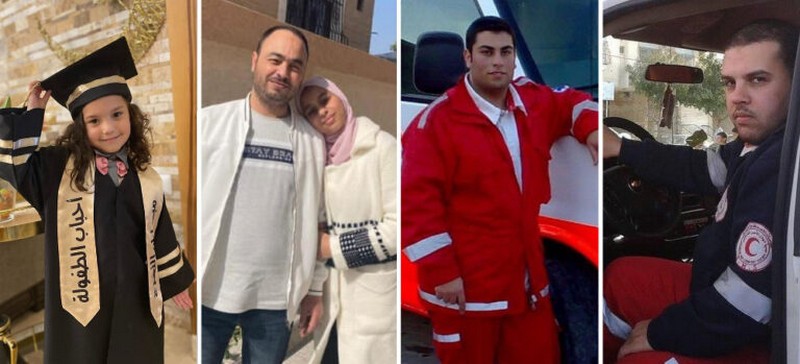
Palestinian Paramedics Said Israel Gave Them Safe Passage to Save a 6-Year-Old Girl in Gaza. They Were All Killed.

By Meg Kelly, et al.

16 Apr 2024 – For three-and-a-half long hours on Jan. 29, the cellphone in 6-year old Hind Rajab’s hands was the closest thing she had to a lifeline. Alone in the back seat of a car outside a Gaza City gas station, she was drifting in and out of consciousness, surrounded by bodies, as she told emergency dispatchers that Israeli tanks were rumbling closer.

From the operations room of the Palestine Red Crescent Society (PRCS), roughly 50 miles away in the city of Ramallah, the team on duty had done their best to save the child. Paramedics were on their way, the dispatchers kept telling her: Hold on.

The paramedics were driving to their deaths.

Twelve days later, when a Palestinian civil defense crew finally reached the area, they found Hind’s body in a car riddled with bullets, according to her uncle, Samir Hamada, who also arrived at the scene early that morning. The ambulance lay charred roughly 50 meters away (about 164 feet) from the car, its destruction consistent with the use of a round fired by Israeli tanks, according to six munitions experts.

In a statement, the Israel Defense Forces said they conducted a preliminary investigation and that its forces were “not present near the vehicle or within the firing range” of the Hamada family car. Nor, they said, had they been required to provide the ambulance permission to enter the area. The State Department said it has raised the case repeatedly with the Israelis. “The Israelis told us there had, in fact, been IDF units in the area, but the IDF had no knowledge of or involvement in the type of strike described,” said spokesman Matt Miller.

A Washington Post investigation found that Israeli armored vehicles were present in the area in the afternoon, and that gunfire was audible as Hind and her cousin Layan begged for help, as well as extensive damage caused to the ambulance, are consistent with Israeli weapons. The analysis is based on satellite imagery, contemporaneous dispatcher recordings, photos and videos of the aftermath, interviews with 13 dispatchers, family members and rescue workers, and more than a dozen military, satellite, munitions and audio experts who reviewed the evidence, as well as the IDF’s own statements.

After this story published, Miller said, “The death of Hind Rajab is an unspeakable tragedy – something that never should have occurred and never should occur…So what we are going to do is take the information that is contained in that Washington Post story, we’re going to go back to the government of Israel and ask them for further information. We would still welcome a full investigation into this matter, and how it occurred in the first place.”

PRCS as well as representatives from Euro-Med Human Rights Monitor and the Civil Defense who visited the scene on Feb. 10 provided visuals to The Post, which it verified by independently confirming the location using satellite imagery, open-source maps and eyewitness interviews.

The Post’s review also found that the ambulance was discovered along a route provided by COGAT, an arm of the Israeli Defense Ministry that generally coordinates safe passage for medical vehicles with the IDF. COGAT initially referred specific questions about the ambulance to the IDF. In mid-March, Elad Goren, head of Coordination and Liaison Administration at COGAT, told The Post that the agency “coordinated everything … including the ambulance that wanted to go and find Hind,” but said he was “not aware” of the specifics. COGAT did not respond to repeated requests to clarify.

The IDF denied that any coordination had taken place, repeating its assertion that its forces were not in the area. It did not comment on two detailed timelines of the incident, or on the expert findings, provided by The Washington Post.

It was not possible to reach Hamas’s military wing for comment on the incident.

Humanitarian officials have warned that a system of coordination with Israel’s military, designed to protect their aid deliveries and lifesaving ambulance maneuvers, is broken. Israeli strikes on a World Central Kitchen convoy that killed seven aid workers in Gaza on April 1 and stirred global outrage came after failed deconfliction efforts.

More than 33,000 Palestinians have been killed during Israeli military operations in Gaza, according to local health authorities. Amid a war of unyielding horror, Hind’s case touched a nerve around the world, in large part because her recorded cries for help offered a glimpse into the terrors faced by civilians.

9:32 a.m.

Generations of the Hamada family had lived on al-Wahda Street in the northern part of Gaza City for decades. Everything changed on Oct. 7, 2023, when Hamas militants stormed border communities in southern Israel, killing about 1,200 people, including civilians in their homes and young people at a concert, and taking about 240 hostages back to Gaza. The assault drew a punishing response from Israel which insists its campaign is necessary to destroy Hamas’s military capabilities.

More than 75 percent of Gaza’s 2.2 million population has been displaced by the fighting, many of them multiple times, according to the United Nations Office for the Coordination of Humanitarian Affairs (OCHA). The Hamada family fled their houses; some went south, while others sheltered closer to home, in the nearby Tel al-Hawa neighborhood in western Gaza City.

But late on Jan. 28, Israeli forces returned to western Gaza City in numbers. Posts on social media show heavy gunfire and airstrikes in that part of the city just after midnight local time. At 9:32 a.m., the IDF issued a call in Arabic on X, the social media platform formerly known as Twitter, asking residents in the west of Gaza City — including the Tel al-Hawa area — to evacuate immediately.

Hind’s uncle, Bashar, and his wife packed her into the car along with her four cousins, Bashar’s brother Samir said. They planned to drive north, out of the evacuation zone and back toward the family home in northern Gaza City.

The girl screamed, and the call dropped. “Hello,” Qam shouted. “Hello?”

While Qam spoke to Layan, 62 gunshots are audible over six seconds in two bursts of fire on a recording of the call, according to Earshot, a nonprofit that conducts investigations using audio evidence.

Steven Beck, an acoustic analyst who consulted with the FBI for more than a decade, examined the recording at the request of The Post, and found the number of rounds per minute fired was faster than an automatic AK-patterned rifle, which Hamas fighters often use. The rate, he said, was more akin to weapons commonly issued to Israeli forces. Earshot also found the rate of fire to be faster than an AK-patterned rifle.

The call, which began around 2:30 p.m., ended in less than a minute.

A satellite image captured by Planet Labs roughly an hour later, at 3:31 p.m., shows at least four Israeli armored vehicles around 300 meters up the road from the girls.

Will Goodhind, an imagery analyst with Contested Ground — an open-access satellite research group focused on military, humanitarian and international affairs — who examined the satellite imagery at the request of The Post, said the armored vehicles at the intersection closest to Hind are “tactically placed” and appear to provide a “prominent, visible presence to deter (and respond to) enemy attacks,” amid ongoing ground operations.

More than a dozen other Israeli armored vehicles are visible within a quarter-mile of the Hamada family car, the image shows.

The vehicles match the approximate size and have turret-like structures similar to at least four Israeli tracked vehicles, according to Goodhind. Of those, only the Merkava tank has been seen in action in Gaza, according to Sonny Butterworth, senior analyst with the defense intelligence firm Janes. The similarly sized Namer armored personnel carrier and Puma combat engineering vehicle have also been seen in action in Gaza, but lack the turret-like structure.

The Merkava, the Namer and the Puma all have 7.62 caliber machine guns, Butterworth said. The guns can fire at a rate consistent with what Beck and Earshot concluded was heard in the audio of Layan’s last call.

After Qam’s call with Layan ended, the PRCS operations room called back immediately and Hind answered. Layan was dead and tanks were moving toward the car, she told another dispatcher, Rana Faqih. Hind described the presence of tanks at least five more times throughout the call.

5:40 p.m.

The Palestine Red Crescent routinely coordinates the passage of its ambulances with Israeli authorities, in the hope of securing safe access to areas where the situation on the ground is potentially dangerous.

Fathi Abu Warda — a liaison between the Palestinian Authority’s health ministry in Ramallah and COGAT, an arm of the Israeli Defense Ministry that oversees the Palestinian territories — said that permission for an ambulance to proceed to Hind arrived in the form of a route map from COGAT. Abu Warda sent the map to the PRCS dispatch team on WhatsApp at 5:40 p.m., according to messages reviewed by The Post.

The map, reviewed by The Post, appears to have been made in Google Maps and has a clear blue line, instructing the ambulance drivers to follow an indirect route that avoided much of the evacuation area.

Ismail al-Ghoul, a correspondent with the Al Jazeera news agency, said he was sitting with the paramedics, Yousef Zeino and Ahmed al-Madhoun, at al-Ahli hospital, when they received the map. The paramedics headed out quickly to the location where Hind was trapped. It was roughly two miles away — down Beirut street, then right, and onto al-Majdal Street.

“The details were completely clear,” Ghoul said.

The green laser — known as a dazzler — would normally suggest that the ambulance was identified but not necessarily targeted by a ground unit operating ahead of the armed vehicles, according to Avihai Stollar, a researcher with Breaking the Silence, an advocacy group composed of Israeli army veterans that oppose the occupation that compiled testimonies from former soldiers.

The IDF, in response to questions from The Post, did not clarify if the green dazzler belonged to its forces and what signal it may have been intended to send.

Social media posts from 2018 suggest that Hamas and other Palestinian resistance groups have also used green dazzlers to obscure Israeli soldiers’ eyesight. Ashka Jhaveri, a researcher at the Institute for the Study of War, a group that closely monitors conflicts, said she had not observed the use of green dazzlers by either side in this conflict.

6 p.m.

As the call with the paramedics drops at 6 p.m., a bang is audible on the call with Hind.

But the call with the girl continued, suggesting that cellphone service was not cut.

Red Crescent dispatchers had managed to patch Hind’s mother, Wesam, into the call in the hope that it might calm the child.

When the bang echoed out through the phone line, Wesam cried out: “Hanood, are you okay?”

A moment later, Hind replied.

“Yes,” she said.

By this point, everyone on the call with Hind — her family, the dispatchers — were praying they would not lose her too. She was falling silent for long periods. The team did what they could to keep her talking, but it was clear that the child’s thoughts had begun to loop. She just kept saying, “Come get me, quickly.”

If the phone ran out of battery, Faqih told her, she was to stay in the car, where they could still find her. “If night comes and we don’t come, close your eyes so that you don’t see the tanks.”

They lost contact with her soon after 6 p.m., spokeswoman Nebal Farsakh recalled.

No one spoke much after that. The room felt muffled with shock. They tried to call Hind again and again, Farsakh said, but no one answered.

Twelve days later

The ambulance had come to a stop where a dark spot resembling a scorch mark first appeared in satellite imagery taken at 10:21 a.m. on Jan. 30 — the morning after contact with the paramedics and Hind were lost.

When the IDF withdrew from the area nearly two weeks later on Feb. 10, Palestinian residents, including Samir, Hind’s uncle, and a civil defense crew found a haunting scene.

The door and pieces of the hood of the family car had been torn off. Samir described his brother’s body as “dangling” from the driver’s seat. The stench of decomposing corpses clung to the vehicle. He struggled to look at the bodies of the five children sandwiched on the back seat. Hind sat to the right of Layan, who was behind the driver. A page from what looks like a coloring book was crumpled where their feet would have rested. The bodies were so decomposed that it was not possible immediately see where the gunshots had hit them, Samir said. “We were only able to deduce their identities,” he recalled.

Holes in the Hamada family car were probably made by a 7.62 caliber machine gun, a weapon fixed to the Merkava, Namer and Puma, said Andrew Galer, head of the land platform and weapons team at defense intelligence firm Janes, who examined photos and video of the aftermath.

Armored vehicles, including some that roughly match the size of those seen in the Jan. 29 satellite imagery, were also present in the same location multiple times in the following 12 days.

A fragment of a U.S.-made 120mm round, which can be fired by the Merkava, was visible in video and images after rescue crews searched the scenes.

The Post was not able to determine exactly where just north of the ambulance the fragment was originally found or if it was directly connected to the ambulance strike given the time elapsed and the ongoing fighting.

The ambulance was a burned-out shell, video shows, and almost nothing remained of the paramedics’ bodies. There was a hole approximately 300 millimeters in diameter adjacent to where the license plate would have been.

“The damage to the rear does look like the exit of a projectile,” Chris Cobb-Smith, a security consultant and former artillery officer in the British army, wrote in a message, noting that it appeared to be “targeted with a direct fire munition” and was “approximately the size of a tank shell.”

N.R. Jenzen-Jones, the director of Armament Research Services, added it appeared to exit “the vehicle relatively level to the ground,” which suggests it was “fired from ground level on a fairly flat trajectory, rather than an air-delivered or indirect-fire munition.”

A round fired by a tank is just one possibility, Jenzen-Jones and multiple other experts cautioned, noting that there is little data on craft-produced Hamas munitions and few tests have been done to predict what would happen if other munitions were used against a thin-skinned vehicle. Common rocket launchers used by Hamas are able to fire different antitank rounds, including the standard PG-7, which could not create the observed damage, according to munitions experts.

None of the six munitions experts interviewed by The Post could say definitively what munition caused the damage or killed the paramedics based on the ambulance alone because of the time elapsed and the complexity of urban combat. They agreed, however, the damage to the ambulance was consistent with the potential use of a round fired from Israeli tanks that match the vehicles captured in satellite imagery in the area that day.

The seven bodies of the Hamada family were buried at al-Shifa Hospital. There was no medical report, Samir said.

“All that mattered to us at that moment was to retrieve them and bury them in a decent way.”

_______________________________________________

Authors: Meg Kelly, Hajar Harb, Louisa Loveluck, Miriam Berger and Cate Brown

22 April 2024

Source: transcend.org

Israeli Settlers, Soldiers ‘Wiping Palestinian Communities Off the Map’ in the West Bank

By Jake Johnson

“While the attention of the world is focused on Gaza, abuses in the West Bank, fueled by decades of impunity and complacency among Israel’s allies, are soaring.”

17 Apr 2024 – Israeli soldiers have either passively watched or participated in the uprooting of at least seven communities in the West Bank since October of last year, Human Rights Watch said today in a new report documenting surging settler violence in the occupied Palestinian territory.

The rights group interviewed dozens of eyewitnesses and examined video footage showing harassment and other abuse of Palestinians in the West Bank “by men in Israeli military uniforms carrying M16 assault rifles.”

Following the Hamas-led October 7 attack on southern Israel, the Israeli military drafted more than 5,000 settlers into “regional defense” units in the West Bank, Haaretzreported earlier this year. The Israeli newspaper noted that “alongside this large-scale mobilization, the [Israel Defense Forces] has distributed some 7,000 weapons to the battalions as well as to settlers who were not recruited into the army but received them as civilians whom the army considers eligible to carry military arms.”

HRW’s investigation found that “armed settlers, with the active participation of army units, repeatedly cut off road access and raided Palestinian communities, detained, assaulted, and tortured residents, chased them out of their homes and off their lands at gunpoint or coerced them to leave with death threats, and blocked them from taking their belongings.”

“Israeli settlers and soldiers are literally wiping Palestinian communities off the map,” said Omar Shakir, HRW’s Israel and Palestine director.

“While the attention of the world is focused on Gaza, abuses in the West Bank, fueled by decades of impunity and complacency among Israel’s allies, are soaring.”

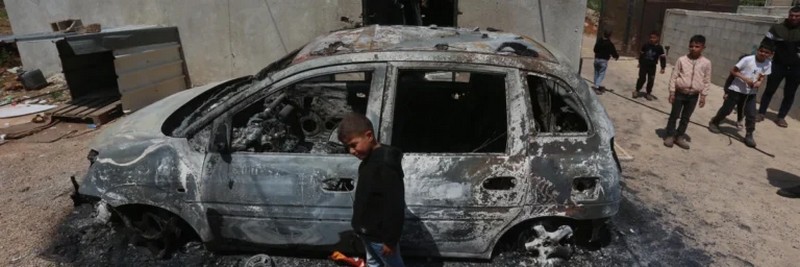
The new report comes days after Israeli settlers—escorted by IDF soldiers—went on their latest destructive and deadly rampage in the West Bank, killing at least two Palestinians, injuring dozens, and setting homes and vehicles ablaze. At least 20 households were displaced after Israeli settlers burned down their homes.

The wave of settler violence came after a missing 14-year-old Israeli boy was found dead in the area around the West Bank city of Ramallah. The Israeli military said the boy was killed in a “terrorist attack.”

Since October 7, according to the United Nations, Israeli settlers have launched more than 720 attacks on Palestinians in the West Bank, displacing at least 206 households comprised of 1,244 people—including 603 children. Israeli soldiers in uniform have been present at many of the attacks.

“Settlers and soldiers have displaced entire Palestinian communities, destroying every home, with the apparent backing of higher Israeli authorities,” Bill Van Esveld, associate children’s rights director at HRW, said in a statement Wednesday. “While the attention of the world is focused on Gaza, abuses in the West Bank, fueled by decades of impunity and complacency among Israel’s allies, are soaring.”

HRW’s new report examines five West Bank communities that have come under attack by Israeli settlers, including one in which uniformed Israeli men armed with assault rifles entered tents and destroyed or stole people’s belongings, abused residents, and threatened to kill them if they didn’t leave the area.

“One man in uniform kicked me in the back of my neck,” a Palestinian mother told HRW. “They said, ‘Go to the valley, and if you come back, we will kill you.’”

None of the families forcibly evicted from the five communities examined in the HRW report have been allowed to return home.

“Palestinian children have seen their families brutalized, and their homes and schools destroyed, and the Israeli authorities are ultimately to blame,” Van Esveld said Wednesday. “Senior state officials are fueling or failing to prevent these attacks, and Israel’s allies are not doing enough to stop that.”

Following the latest wave of settler violence in the West Bank this past weekend, a coalition of human rights organizations said in a joint statement Wednesday that “the international community must swiftly and decisively pressure the government of Israel to halt these attacks and urgently de-escalate the situation.”

“With international attention centered on Gaza, the government of Israel has not only allowed settler violence to spiral but also persisted in the expansion of Israeli settlements built on Palestinian land and unlawfully seized Palestinian territory by designating it as ‘state land,’ blatantly violating international law,” the groups noted. “Concerted efforts are needed to tackle the root cause of settler violence by permanently dismantling settlement outposts and ensuring the safe return of displaced Palestinians to their lands.”

Jake Johnson is a staff writer for Common Dreams.

22 April 2024

Source: transcend.org

Pivot to Iran? Decoding April 1st

By Richard Falk

18 Apr 2024 – This is a revised text published in Turkish, a contribution invited by Semin Gumusel on 14 Apr 2024; developments arising from the convergent incidents on 1 Apr continue to reverberate, making updating a high priority.

********************************

April 1st Pivot from Gaza: Damascus Massacre, Al Shifa Hospital, World Central Kitchen Attack, the Biden/Netanyahu Diplomatic Dance, and Iran’s Retaliation

Certain dates become iconic through being engraved in the public consciousness of an era. The 21st century has already had two such enduring occurrences: the 9/11 attacks on the World Trade Center and Pentagon in the United States, initiating ‘the war on terror’ and the Hamas cross-border attack on Israel prompting a genocidal response. April 1st has not yet such heightened significance. Yet the five events that arose from what took place on this single day in April exhibit the dangerous and both visible and secretive interactions affecting the political life of the Middle East. The fallout from April 1st that might come to be regarded as producing a cycle of responses of such magnitude as to mark  the end of the post-Cold War Era.

These five happenings associated April 1st are inter-connected developments that if considered together bring a sense of coherence to the long ordeal of the Gaza population of 2.3 million Palestinians. Each occurred during a slowly unfolding crisis throughout the Middle East that has heightened dangerously combustible regional global tensions.  As a result, attention, energies, and resources have been in recent months diverted from a series of urgent global challenges arising from climate change, regressive forms of nationalism, and failures of political leadership made worse by a weakening transnational populist engagement. Earlier it was hoped such engagement from below might exert sufficient pressures on governments and economic elites to produce needed regulations and reforms with respect to the seemingly distinct underlying problematic issues. Despite the dark skies now overhead, the confluence of these five events at the start of April might even induce shifts in policy priorities in ways that could influence regional and international behavior to enhance or further diminish prospects for ecological resilience and humane global governance.

Pivot to Iran: Temporary or Transformative?

The first of the April 1st events to be considered was the Israeli missile attack on a consular building within the Iranian embassy compound in Damascus. Twelve persons were killed, including seven members of the Iranian Iran’s Revolutionary Guard Corps who were apparently serving as military. Among these latter victims, presumably the Israeli targets, was General Mohammed Reza Zahedi, the highest ranking Iranian to be assassinated since the US Baghdad high-profile assassination of Gen. Qassem Suleimani, a popular political figure and military leader in Iran who was killed while he was on a diplomatic peace mission in January 2021 during the last days of the Trump presidency.

Carrying out such violent actions across international borders is itself an international crime, often treated as an act of war, and certainly a political provocation. In addition, in the present instance the assassinations of these Iranians were aggravated by being not only an unlawful use of force that violated Syrian territorial sovereignty but additionally involved the illegal targeting of a foreign diplomatic facility, which international law treats as a prohibited target area. Such attacks are forbidden in deference to the reciprocal interests of all sovereign states, even when relations between governments are strained, in the security of diplomacy and the safety of their diplomats.

The Supreme Guide of Iran, Ayatollah Ali Khamenei, was not wrong when he denounced the attack as equivalent to an assault on Iranian territory that was located in Syria. Iran’s leader vowed to retaliate for Israel’s allegedly evil acts by attacking Israeli territory. The Israeli government lost no time officially warning Tehran that any retaliation from Iran that causes harm on Israeli territory will result in an Israeli response intended to harm targets in Iran. Israel’s Foreign Minister, Israel Katz, and Prime Minister Netanyahu responded to Ayatollah Khamenei’s statement with their own escalatory threats in the form of policy statements—Israel harms any country or non-state actor that harms it, and given its past practice, it will do so disproportionately as it has against the entire Palestinian population in Gaza during the past six months in response to the October 7 Hamas attack. [Israeli reliance on disproportionate force has long been a feature of its national security practice. See Falk, “Dahiya Doctrine: Justifying Disproportionate Warfare—A Prelude To Genocide,” April 1, 2024, blog, richardfalk@wordpress.com]

This provocation of both Iran and Syria on April 1st somewhat surprisingly posed no acknowledged difficulties for Biden’s foreign policy, which remained steadfastly both anti-Iranian and anti-Syrian, despite the fact that this non-retaliatory Israeli attack flagrantly violated international law, caused death and destruction, and escalated risks of a wider war in the region if, as was expected, Iran carries out its threat of retaliation. Biden while lecturing Netanyahu on attacking and otherwise interfering with humanitarian aid for Palestinians in Gaza, went out of his way at the same time to reaffirm the US resolve to stand with Israel in any future eruption of violent struggle with Iran, Syria being left in limbo, but also without doubts about the willingness of America to side with Israel should Syria decide to retaliate or to join Iran in a joint response.

World Central Kitchen Attack

The second incident at the start of April caused a more immediate policy  impact. It consisted of an enraged Western response to the much publicized Israeli attack on a World Central Kitchen (WCK) well-marked foreign aid convoy of three vehicles delivering 100 tons of desperately needed food and medical supplies to starving and wounded Palestinians in northern Gaza, an attack that killed six aid workers and their driver. Similar atrocity incidents affecting the foreign delivery of equally needed aid to Gaza had occurred ever since the start of Israeli military operations in the days after October 7. Indeed many far worse incidents if measured by the deaths of innocent aid workers than this one had occurred ever since Israel started retaliating for the October 7 Hamas attack. What made WCK attack different from other attacks was the fact that the aid workers killed were nationals of Western countries supporting Israel rather than Palestinians or nationals of Global South states. From a moral and legal perspective the national identity of the victims should make no difference, but if assessed from a political perspective a different story emerges.

What followed the WCK attack was a flurry of high-profile media and governmental expressions of outrage directed at Israel’s presumed deliberate responsibility for such an attack, holding both Netanyahu and Biden responsible for such deliberate lethal violence directed at nationals of their allies. The fact that 2024 Biden’s reelection prospects have become clouded by growing criticism of his unconditionally pro-Israeli policy in the face of the Gaza genocide, which were further aggravated by this incident. It was clear that Israel had crossed a red line. The deliberate killing of Western aid workers by Israel was not acceptable and must not be repeated. What followed, was a sharp criticism of the WCK attack a warning to Israel that if such incidents were repeated it would lead to a revision of US willingness to give the same level of support to Israel. What immediately followed was directly responsive, Biden’s public criticism of Israel which until the WCK attack was as rare as Netanyahu’s apologies to the Western governments of the victims. Sometimes, words matter more than deeds!

Geopolitical Panic: Biden/Netanyahu Fence-Mending Diplomacy

This concurrence of April 1st happenings produced a geopolitical panic attack in both Tel Aviv and Washington, prompting an emergency fence-mending telephone conversation between Biden and Netanyahu a few days later with Blinken reportedly listening quietly on the line. Although the actual conversation took place on April 4, it was organically tied to the WCK attack three days earlier. Netanyahu was so backed into a corner that he felt the need to apologize in public to the governments of the WCK aid workers killed without seeming to be either weak or antagonistic in addressing the concerns of Israel’s chief backers, especially the US. Biden, in contrast, was walking a tightrope straddling contradictory domestic critics with one side pushing for the US Government to break with Israel by pushing harder for a ceasefire and the other side seeking reassurance that Israel would continue to enjoy Western support come what may.

What gave away this unusual double diplomatic game was the immediate public disclosure of a normally private conversation between two embattled leaders. This represented a sharp departure from diplomatic practice in international crisis situations suggesting that special considerations were present. The usual practice in similar circumstances is to regard such direct conversations between heads of state as highly confidential, at least for a decent interval, leaving the public and even the media to engage in conjectures as to the exchange, and to make their best unverified guess as to the presumed blend of anger, explanation, and regret. But because the main purpose of the Biden/Netanyahu conversation seemed to be to reassure Americans, and the West more generally that Israel was neither abandoned nor any longer assured of unconditional support unless it changed its ways of interfering with the international aid and humanitarian efforts of Western countries, it became expedient for both leaders to disclose the content of what was said.

On reflection it is far more acceptable in the West for Israel to attack the aid workers of the UN (so long as no Westerners are killed), especially those working heroically throughout the crisis within the confines of UNRWA to mitigate Palestinian suffering, enduring the loss of their own staff throughout the Gaza onslaught.

In this sense, the most dangerously irresponsible feature of this complex public relations initiative was to reveal a strong pledge of continuing US support for Israel’s anti-Iran approach, which plausibly could have the effect of heightening Netanyahu’s incentives to foment a direct encounter with Iran to hide his multiple failures–to destroy Hamas, to gain the release of October 7 hostages, to minimize a surging global backlash against Israeli legitimacy, and to win back his own popularity among Israelis. It also conveyed to the leadership in Iran the unwelcome news that Israel would be backed in relation to Iran even when Israel violated basic rules of international law. This renewed show of solidarity with Israel made a devastating wider war much more likely and was obviously intended to frighten Iran sufficiently to moderate the retaliatory response that it had warned would be forthcoming. To send such signals to Tehran and Tel Aviv was to reinforce the impression that the US remained dedicated to achieving regime-change in Iran and willing to give Netanyahu indirect encouragement to hide his failures in Gaza by widening the conflict zone to include Iran and those non-state actors in Syria, Iraq, Lebanon, and Yemen.

As could have been anticipated, and perhaps desired by the Netahyahu leadership, was Iran’s retaliation by military drones and missile programmed to hit targets within Israel. Most of the Iranian attack weapons were intercepted and destroyed by a combination of US military operations, the collaborative efforts of Jordan, Saudi Arabia, France, and the UK, as well by Israel’s formidable defense forces, and cause little damage within Israel. This attack occurred on April 13th, but as with the sharp shift in the tone of the Biden/Netanyahu relationship, the retaliation by Tehran was a direct consequence of the Damascus attack on April 1st. As suggested earlier, Netanyahu is fighting for his political life in Israel, making a wider war seemingly his tempting option to avoid facing the likely consequences of personal and national defeat. The recklessness of the Damascus attack makes little sense otherwise. The US involvement in Israel’s defense and Netanyahu’s initial reaction to the effect that Israel remains determined to attack Iran directly in view of its attempted military strike. Such a posture confirms Israel’s encouragement of a shift of attention away from Gaza, and in the direction of Iran with uncertain consequences. The reactions of other countries in the region, as well as China and Russia will determine just how wide this new phase of conflict becomes.

Atrocities at al-Shifa Hospital in Gaza City

The final noteworthy occurrence on April 1st took place when Israel withdrew its forces from devastated al-Shifa Hospital and surroundings in Gaza City. On that day Israel ended its two weeks of atrocity behavior at al-Shifa Hospital, where Palestinian patients confined to their beds were shot dead as were doctors who refused to abandon the hospital, and several hundred Palestinians killed in the course of the military operation. Hamas and Islamic Jihad suspects, often with no evidence of affiliation or even sympathies were killed on the spot after being seized. Of course, for this there was no apology from Netanyahu or pretense from Biden of issuing a warning to Israel to refrain from such behavior. If atrocity victims in military operations are Palestinian, whatever befalls them, no feathers are ruffled in Washington. For its own domestic reasons, the US Government wants to show that it supports humanitarian aid efforts without challenging Israel’s war-fighting methods or insisting that international law guidelines be respected in struggles with regional rivals even as here under conditions of occupation subject to the constraints of international humanitarian law. For such admonitions, only the voices of moral authority in the West, such as Pope Francis or UN Secretary General Guterres can hope to be heard by the peoples of the world. The views of dissenters from the grotesque ordeal of genocide in Gaza are shunted to the sidelines of general awareness and media reportage. Their online words, analysis, and appeals, while influential for those opposed to the genocide, especially as reaching eyes and ears unfiltered by the informal censorship of the main media platforms in the Global West. These pleas for peace and in denunciation of international crime seldom carry weight with governments and political elites unless compatible with strategic interests of major states. The silence of the West in the face of genocide is a complicity crime shamelessly accentuated by the material, intelligence, and diplomatic forms of active support given to Israel since October 7, deserving criminalization.

Reflections on Convergence and the Future of the Middle East

Recounting these events makes it evident that April 1 is a day worth reflecting upon to gain an appreciation of the criminal dimensions of Israel reaction of the October 7 attack and the overall response of the Western liberal democracies (former European colonial powers except Spain, and breakaway British colonies, particularly the US, Canada, and Australia). Whether these focal points will drift toward a devastating regional inter-civilizational clash or hasten the declaration of a much overdue ceasefire cannot be currently known. Obviously embarking upon a genuine peace process is the haunting question that overhangs the prior discussion. This lends abiding interest to how we come to perceive these five events, and how they play out in the weeks and months ahead, with the immediate preoccupation being the prospect of an Israel military strike against Iran. Whether this strike is symbolic or substantive may either avert the drift toward major warfare or accelerate it. Wiser heads do not often prevail in Israel, and so the fate of the region and world may depend on this being an exception.

The defense of Israel by military and intelligence cooperation of the Global West and several Sunni Arab governments suggests that containment of Iran, especially with respect to its nuclear program, has precedence over solidarity with the Palestinian people and their struggle. Whether the peoples of these countries will challenge these priorities of the governments who came to the defense Israel is a question that will be clarified in the years ahead. The policy choice in West between escalating hostility toward Iran and the renewal of normalization initiatives will remain relevant even if calm is eventually restored to Israel/Palestine relations, which itself can turn out to be delusional if Israel is faced with a combination of resistance activities and solidarity initiatives.

Prof. Richard Falk is a member of the TRANSCEND Network, Albert G. Milbank Professor Emeritus of International Law at Princeton University, Chair of Global Law, Faculty of Law, at Queen Mary University London, Research Associate the Orfalea Center of Global Studies at the University of California, Santa Barbara, and Fellow of the Tellus Institute.

22 April 2024

Source: transcend.org
Gaza Ceasefire Petition by International Lawyers

By Richard Falk

This petition offers international lawyers to show solidarity with the grave plight of the Palestinian civilian population of Gaza that is continuing to endure daily onslaught by Israel that causes widespread suffering so far supported to varying degrees by the leading liberal democracies of the West.

International Lawyers Calling for Ceasefire in Gaza and Respect for International Law

Why This Petition Matters – International Lawyers

Started on 4 Apr 2024 – We, a group of international lawyers and academics dedicated to resolving international disputes through peaceful means, cannot remain silent in the face of the acute humanitarian crisis in Gaza.

Due to the armed hostilities in Gaza over thirty thousand people have died, many of them children, and there have been significantly more casualties. According to representatives of the United Nations and various organisations attempting to provide relief, the humanitarian situation in Gaza is catastrophic. In its order of 28 March 2024 in the case of Application of the Convention on the Prevention and Punishment of the Crime of Genocide in the Gaza Strip (South Africa v. Israel), the International Court of Justice (“ICJ”) observed that the Palestinians in Gaza “are no longer facing only a risk of famine … but that famine is setting in” (see paragraph 21 of Order at https://www.icj-cij.org/node/203847

Guided by the principles of the rule of law, peaceful conflict resolution and the protection of the civilian population, we call for an immediate and durable ceasefire and full adherence to the rules of international law and specifically international humanitarian law. We also call for the immediate and unconditional release of all hostages. We specifically recall the UN Security Council Resolutions 2728 (2024), 2720 (2023), and 2712 (2023) as well as UN General Assembly Resolution A/ES-10/L.27 (2023).

We further call for Israel to comply with the ICJ Orders dated 26 January 2024 and 28 March 2024 and to take all necessary measures to ensure unhindered provision of humanitarian aid through international organisations, including through UNRWA.

We express our condolences and deepest sympathy to all those who are experiencing suffering and loss in Gaza and Israel.

We invite members of the international legal community, whether involved in dispute resolution or otherwise, to join us in calling for immediate ceasefire and the just and peaceful resolution to the current conflict by signing this petition.

Signatories as of 12 April 2024 include:

  • Taiwo Adeshina
  • Ali Al-Karim
  • Céline Aymé-Wauthier
  • Domitille Baizeau
  • Professor Ilias Bantekas
  • Sylvie Bebohi Ebongo
  • Mohammed Dele Belgore SAN
  • Professor George Bermann
  • Le Batonnier Joachim Bilé Aka
  • Professor Laurence Boisson de Chazournes
  • Juliet Blanch
  • Gabriel Bottini
  • Professor Ronald Brand
  • Judge Charles Brower
  • Professor Nael Bunni
  • Professor Peter Cameron
  • Yemi Candide-Johnson SAN
  • Eliséo Castineira
  • Dong Chungang
  • Professor Giuditta Cordero-Moss
  • Bernardo Cremades
  • Nadia Darwazeh
  •  Yves Derains
  • Diamana Diawara
  • Caroline Duclercq
  • Professor John Dugard SC
  • Bernd Ehle
  • Professor Richard Falk
  • Professor Maximin de Fontmichel
  • Julien Fouret
  • Teresa Giovannini
  • Nina Hall
  • Laura Halonen
  • George Hazboun
  • Professor Kaj Hobér
  • Jean-Christophe Honlet
  • Sami Houerbi
  • Vera van Houtte
  • Professor Hans van Houtte
  • Professor Gabrielle Kaufmann-Kohler
  • Fathi Kemicha
  • Gaston Kenfack
  • Ben Knowles
  • Gisela Knuts
  • Professor Stefan Kroll
  • Professor Nikos Lavranos
  • Philippe Leboulanger
  • Françoise Lefèvre
  • Carole Malinvaud
  • Samy Markbaoui
  • Professor Pierre Mayer
  • Professor Brian McGarry
  • David Méheut
  • Professor Loukas Mistelis
  • Yasmin Mohammad
  • Alexis Mourre
  • Sara Nadeau Seguin
  • Marina Papadatou
  • Wolfgang Peter
  • Pierre Pic
  • Noradèle Radjai
  • Mohamed Abdel Raouf
  • Hery Frédéric Ranjeva
  • Professor Catherine Rogers
  • José Rosell
  • Michael Schneider
  • Professor Thomas Schultz
  • Ronen Setty
  • Patricia Shaughnessy
  • Mohamed Shelbaya
  • Ana Stanič
  • Professor Attila Massimiliano Tanzi
  • Former President Danilo Türk
  • Professor Dorothy Ufot SAN
  • Christopher Vajda KC
  • Sun Wie
  • Karim Youssef
  • Roland Ziadé

_________________________________________

Prof. Richard Falk is a member of the TRANSCEND Network, Albert G. Milbank Professor Emeritus of International Law at Princeton University, Chair of Global Law, Faculty of Law, at Queen Mary University London, Research Associate the Orfalea Center of Global Studies at the University of California, Santa Barbara, and Fellow of the Tellus Institute.

22 April 2024

Source: transcend.org
Yale Students Launch Hunger Strike Over School’s Connection to Gaza

By Michael Arria

Student activists have been pushing the school to divest from Israeli human rights abuses for months, but the administration has ignored their demands.

15 Apr 2024 – Fourteen students at Yale University are on a hunger strike over the school’s connection to arms manufacturers currently supplying Israel with weaponry.The group sent Yale University Peter Salovey a letter declaring that their strike would begin if the school did not take immediate action on the issue.

“We here at Yale University have witnessed this ongoing genocide from the comforts of not only the heart of the empire that is funding the military conquest and colonization of Palestine, but from the distance and security provided by the investments of this University which profit from this mass ethnic cleansing,” it reads. “Our existence in this University and this country are ones defined by necropolitics. Our lives here exist as they do because of the investment in the deaths of Palestinians by Yale and the US government.”

“We now make a direct demand. With the death toll of the genocide climbing daily in Gaza and the invasion of Rafah set to cause catastrophe, it is your moral responsibility to remove our institution from the list of those supporting genocide,” the letter continues.” History will remember. We demand that by the morning of this Friday, 4/12/2024, you make a public statement committing to divest from all weapons manufacturing companies contributing to Israel’s assault on Palestine. We demand that at next Saturday’s Yale Corporation board meeting, you and the rest of the board discuss plans for divestment and release a public statement acknowledging that the board has done so.”

Some of the strikers also wrote their own letters to Salovey.

“You do not talk to the students because you know we are right,” reads one. “You know that you are on the wrong side of history. Years from now, you will apologize for your silence, which will be too late.”

The strike was organized to coincide with “Bulldog Days,” the week when prospective high school students visit the school to consider attending.

press release put out by the group notes that the school divested from companies connected to the Darfur genocide in 2006 but hasn’t made similar efforts in response to the situation in Gaza.

Students have been demanding that Yale divest from weapons manufacturers for years, but calls have increased since Israel’s assault on Gaza began last fall. In October 2023, hundreds of Yale students held a campus-wide walkout on the issue.

“By walking out, we are joining classmates and colleagues across the campus and across the world to demand an immediate end to Israel’s genocidal siege on Gaza, an end to U.S. funding for the occupation, and an end to the illegitimate Zionist occupation of Palestinian land,” wrote the student group Yalies4Palestine, in an Instagram post promoting the event. We demand an end to Yale University’s support of the Israeli war machine through its affiliation with weapons manufacturers such as Lockheed Martin.”

Yale isn’t the first university to see a hunger strike for Palestine on its campus. Brown University students completed an 8-day hunger strike in February, calling on the school to divest its endowment from companies that profit from Israeli atrocities. Last month students at the University of South Florida refused to eat for 17 days over their school’s investments with Israel.

University protests have exploded across the country since Israel began attacking Gaza. The boom in activism has led to campus crackdowns and a pervasive climate of suppression. In recent weeks four Columbia students were suspended and evicted from university housing for organizing an “unauthorized” pro-Palestine event, the group Palestine Legal filed a federal civil rights complaint over UNC-Chapel Hill’s “systemic pattern” of discriminatory treatment against Palestinian students, and Vanderbilt expelled four students for occupying a university hallway during a protest.

Michael Arria is the U.S. correspondent for Mondoweiss. His work has appeared in In These Times, The Appeal, and Truthout. He is the author of Medium Blue: The Politics of MSNBC.

22 April 2024

Source: transcend.org
Trials and Tribulations of Palestinian Refugees in Syria & Palestine/Iran/Israel

By Richard Falk

15 Apr 2024 – This series of questions was posed by Daniel Falcone for my consideration in late Mar 2024 and published by CounterPunch on 9 Apr under the title, “The Forgotten Palestinian Refugees in Syria.” I have revised somewhat my responses, partly because of the impact of developments in April, especially the bombing of Iran’s consular facility in Damascus on 1 Apr killing 12 persons, including 7 Iranian military advisors, which led Iran to abandon its practice of retaliating for attacks by indirect responses to US/Israel assets/military bases or to entrust retaliations to Iran’s regional non-state allies in the region, including Hezbollah, the Houthis, and possibly Hamas. On this occasion, Iran deliberately retaliated on 12 Apr, firing as many as 300 drones and missiles toward Israeli targets. Most were intercepted with the help of Israel’s Western supporters (and Jordan), yet Israel has called for an emergency meeting of the UN Security Council and threatens to retaliate, escalating the conflict. What will happen with this Israeli effort to get the US involved in a wider war directed at achieving regime-change in Iran remains uncertain, but raising doubts about the war-prevention capabilities, and even motivations, of the US and to a lesser extent, China and Russia.

**********************************

Interview with Daniel Falcone: Trials and Tribulations of Palestinian Refugees in Syria Prior to Israel’s 1 Apr Attack on the Iran Consular Building in Damascus

Daniel Falcone’s Introduction:

The Syrian Civil War was the longest and most complex geopolitical conflict to emerge out of the Arab Spring, thus creating a complicated legacy for leftist analysts to interrogate. In this interview, exclusive for CounterPunch, former United Nations special rapporteur, and international relations scholar Richard Falk, breaks down Palestine and Syria and the history and politics of that refugee crisis from the left. Often, this topic finds the center-right media attempting to focus on Syria, not in the interest of Palestinians, but to remove the attention away from US/Israeli aggression. Falk, a fierce critic of US and Israel foreign policies, highlights the complex circumstances of the Palestinians in Syria and points out how a host of domestic and foreign policies, and worldviews from the left and the right, both complicate and threaten Palestinian survival and their pursuit of liberation in the face of ongoing US-sponsored settler colonialism.

Daniel Falcone: How many Palestinians are in Syria, and how long have they been there?

Richard Falk: It is difficult to be very accurate about refugee and displacement statistics due to the prolonged internal Syrian turmoil over the course of more than a decade since 2011, and still are not fully resolved. Before the Syrian Civil War the number of Palestinian refugees registered by UNRWA in Syria was 526,744, the majority of whom came to Syria during the Nakba in 1947, fleeing especially from what was then northern Palestine, now Israel. A large proportion of the Palestinian refugees in Syria chose and were able to live outside the refugee camps, with no more than 111,000 of the more than a half million living in the nine official, and three unofficial camps, according to estimates in 2002.

Current estimates of the Syrian refugee population arrives at even smaller numbers due to the fact that many Syrians fled to neighboring countries and to Europe. It is now believed that correct current number of Syrian refugees within the borders of Syria is about 450,000. This experience of internal and external displacement of Palestinians in Syria during the civil war, exhibited the dangers of being vulnerable as a refugee in a combat zone during wartime, especially in the face of the growing enmity between the Syrian government and Palestinian refugees, greatly aggravated by their opposed alignments in the Syrian Civil War. Palestinians in Syria overwhelmingly supported the opposition to al-Assad regime in Damascus.

“Daniel: What kinds of social, political, and economic devastation do Palestinians living inside Syria experience? Stephen Zunes has indicated that reliable numbers for Palestinian civilians killed by Syrian military assaults is around 4,000.

Richard: Until the civil war began in 2011 relations between the Syrian government and the Palestinian refugees seemed positive, especially as compared to the negative features of Palestinian treatment and experience in several other Arab countries, particularly Jordan (‘Black September 1970’) which encouraged the voluntary displacement of Palestinians, departing from Syria, and seeking refuge elsewhere, especially in Turkey and Western Europe. Prior to the civil war Palestinian refugees enjoyed substantially equal rights in Syria as compared to the resident population, being allowed to own property, and work in almost all sectors of the economy.

After 2011, Syrians were viewed by the Damascus government as a hostile presence in view of their overall support for the anti-government political forces, which in part reflected the Shiite-dominated Damascus political leadership in a life-and-death struggle with the Sunni-dominated opposition forces. Among other developments was violent repression by Syria of the refugee camps in Syria, most prominently the Yarmouk Camp located on the outskirts of Damascus, resulting in many Palestinian deaths, forced and voluntary displacements, and widespread hunger in the period between 2011 and 2018.

Such conditions prompted many Palestinian refugees in the 12 Syrian camps to risk the increasingly dangerous migrant journey to Europe, a situation further aggravated when Trump’s defunded UNRWA in 2018. Prior to the civil war in Syria, Palestinian refugees were much more regulated and their economic, political, and social options restricted in Lebanon, with its delicate Muslim/Christian demographic balance, and in Jordan, where the sheer numbers of Palestinian refugees were seen by the government as posing a political threat of a demographic character as further reinforce by their suspected distrust of the Hashemite monarchy.

“Daniel: Is there a problem on the left in the United States in undermining the plight of Palestinians in Syria in relation to the left’s varying perspectives on the Syrian Civil War?

Richard: Yes, the hostility of the hard left to intervention against the regime of Bashar al-Assad, despite its oppressive tactics, autocratic governance, and outright atrocities seemed dogmatically based on siding with whatever political forces around the world validated their behavior by deploying anti-imperial rhetoric and slanted arguments against siding with the anti-Damascus insurgents, which were a hybrid coalition that included more humane and democratic elements than did the government, at least at the outset of the conflict. At the same time, complexities were present no matter which side was supported in the bitter civil strife due to the lack of coherence by either the government or its array of opponents.

Beyond this, at the outset of the Syrian civil strife the US and Turkey underestimated the capabilities and loyalties of Syrian armed forces, being too quick to think it would be as easy to get rid of the Assad regime as it had been for NATO in 2013 to induce anti-Qaddafi regime change in Libya. NATO also badly miscalculated the domestic effects of regime change in Libya. Instead of a successor regime friendly to the Global West, the situation in Libya deteriorated from one of autocratic stability to a condition of political chaos and civil strife among Libyan ethnic communities, in effect from autocracy to a chaotic form of anarchy.

This misleading analogy between Libya and Syria was a costly miscalculation, especially for Turkey, compounded by the emergence of some strange opportunistic alliances in the course of the internal struggle. Perhaps most notable was the mutual relations between ISIS and the anti-Damascus forces. seeming joining in a common cause the liberal opposition to Damascus with an organization previously treated by the West as a virulent form of terrorism.

On the side of the Syrian government again, for a mixture of geopolitical and ideological reasons, were Russia and Iran. The Syrian Civil War was the most complex and prolonged struggle to spiral out of the Arab Spring, and perhaps in modern times, considering the bewildering variety of actors and issues at stake internally, regionally, and globally as well as the mix between state and non-state actors and compounded by the internal antagonisms on both sides.

“Daniel: What are the differences and similarities for Palestinian refugees trying to survive across the Arab world?

Richard: Responding to this tangled issue of comparative treatment of Palestine refugees throughout the Arab World is a stretch for me. Responding broadly, there is agreement that attitudes toward Palestinians refugees varied through time and from country to country, influenced recently by Israeli/US diplomacy promoting normalization of Israeli/Arab relations during the final months of the Trump Presidency in the form of the now notorious Abraham Accords. Since October 2023 the Israeli genocidal onslaught in Gaza has made Arab countries more conscious of their own identities while becoming somewhat more engaged with the  Palestinian ordeal, including reacting with varying levels of concern to what is increasingly regarded by pro-Palestinian forces as ‘a second Nakba’, in effect a brutally forced evacuation being implemented with a genocidal ferocity that far exceeds the Palestinian catastrophe of 1948— that is creating humanitarian pressures for offering shelter to Palestinians outside of Occupied Palestine, highlighted by a situation of widespread starvation and disease in Gaza, grim realities further intensified by the Western defunding of UNRWA since late January 2024 in response to a dubious all out Israeli campaign to discredit UNRWA in a supreme instance of their mastery of the dark arts of deflection.

At present, in reaction to the humanitarian emergency in Rafah, and continuing Israeli threats to launch a military attack on the small city abutting the Egyptian border which is sheltering over a million helpless Palestinians in horrifying conditions even without taking account of the acute fears arising from Israel’s threatened military attack, Egypt has so far responding in two somewhat contrary ways: 1) by deploring the forced cross-border pressures on Palestinians to leave Gaza or die if they are so stubborn as to continue resisting and, 2) by preparing for a mass Palestinian exodus from Gaza by constructing a large walled-in temporary refugee facility in the Sinai Desert, which is part of Egypt. Whether Egypt will eventually be persuaded or bribed to accept a large new influx of Palestinian refugees is uncertain at this point.

The issue posed is tragic for Palestinians in Gaza who have stayed in their homeland despite hardship and abuse since its re-occupation by Israel in 1967, enduring periodic punitive large-scale military incursions from land, air, and sea in 2008-09, 2012, 2014, and 2021, reinforced by a crippling blockade since 2007. The role of Hamas in Gaza is complicated: it reportedly won internationally monitored elections in 2007 because it resisted Israeli abuses more credibly than did the Palestinian secular alternatives, and steadily gained legitimacy among Palestinians throughout the occupied Palestinian territories because it was not tainted by collaborationism or corruption to nearly the extent of the Ramallah-based Palestinian Authority, itself an outgrowth of the discredited Oslo diplomacy.

Since 2006 when it took over a governing role in Gaza, Hamas has been reduced to being a ‘terrorist’ entity by Israel, United States, and Germany. Its diplomacy was spurned over the years despite credibly proposing long-term ceasefires on several occasions. Israel made no secret of preferring to discourage Palestinian resistance by keeping Gazans on ‘a subsistence diet’ as supplemented by ‘mowing the lawn’ as needed, as well as using Gaza as a virtual free-fire zone to test weapons and tactics, and send a deterrence/Dahiya message to regional governments throughout the Middle East that Israel was not inhibited by law and morality when it came to dealing with its enemies, and disdained such widely accepted legal limitations on force as proportionality and discrimination (as to targets). Additionally, Israel’s presence in the Occupied Palestinian Territories is subject to the 4th Geneva Convention addressing issues of Belligerent Occupation, as well as the unanimous Security Resolutions 242  and 338, which projected an early Israel withdrawal to its 1967 borders after minor territorial adjustments.

The Syrian government’s relationship to the Palestine/Israel conflict seems contradictory in its central aspects. Syria alone among major Arab governments has been actively pro-Palestinian in its foreign policy since the 1948 War. Israel has engaged in various destabilizing moves toward Syria, most dramatically in the form of periodic air attacks at targets thought to be helping anti-Israeli forces in the region. Israel incorporated into Israel the occupied Syrian territory, known as the Golan Heights, under Israeli administrative control since the 1967 War, during the latter part of the Trump presidency. And now it has attacked the Iranian embassy compound in Damascus threatening to make the wider war a major source of intensifying conflict in the Middle East. In other words, despite its encounters with Palestinian refugees, Israel and Syria have a long history of mutual hostility, given dramatic focus from time to time by Israeli cross-border air strikes with target located in Syria.

This present engagement with Syria and Iran on one side and the Israel and the US, and most of NATO on the other side, points to a more dangerous phase in the Middle East conflict configuration that has evolved since the end of the Cold War.

Prof. Richard Falk is a member of the TRANSCEND Network, Albert G. Milbank Professor Emeritus of International Law at Princeton University, Chair of Global Law, Faculty of Law, at Queen Mary University London, Research Associate the Orfalea Center of Global Studies at the University of California, Santa Barbara, and Fellow of the Tellus Institute.

22 April 2024

Source: transcend.org
Arab Leadership Complicity to Support American-Israeli War on Gaza

By Dr. Mahboob A. Khawaja

Palestinains in Search of Humanity

Once a people or a nation colonized by European imperialists, it remains colonized and subjugated by the Masters forever. The contemporary oil-producing Arab world represents that historic reality. The Israeli planned onslaught on Gaza for over six months and its catastrophic consequences of crimes against humanity and alleged genocide – all have imprints of complicity of modern Arab -Muslim leaders.

Are the global institutions of peace, security and conflict management fast becoming obsolete in a real crisis situation? And global humanity is captive of the US-Israel’s intransigence and plans never experienced in history. Why should the global community allow arbitrary terror of killing and expulsion of 2.5 million people of Gaza? Philip Giraldi (Global Research: 2/21/24), “The United States Vetoes Yet Another UN Humanitarian Ceasefire Over Gaza” …. several interesting developments relating to Israel’s ongoing destruction of Gaza and its people, but one might well question the motives of at least one of the principal players in the drama, namely Joe Biden’s United States Government.

https://www.globalresearch.ca/united-states-vetoes-another-un-humanitarian-ceasefire-gaza/5850155:

How the War Dehumanized the Arab-Muslim World? The Arab-Muslim world is a world of bewildered fantasy – no strength, no power to think intelligently,no policies to defend Islam, dubious spectators watching Western military actions-reactions to assign a finished answer to the Palestinian movement for national freedom. If the people of Palestine had white anglo-saxon ethnicity like the Ukranians or the EU, the US-West European leaders would have rushed to help the victims and bomb the aggressor. Even drinking water, medicines, foods, shelters and clean oxygen are not allowed by the Israeli occupation forces. What is next after another inexplicable shocking cataclysm in the making seen on the political horizon?

Were Ancient Warriors More Civilized and Humane than Israel and America?

Those bombing and destroying the Earth and its life cycle are not normal human beings. Were the ancient people of stone-age more intelligent and responsible for not having destroyed the earth and environment in wars and kept mankind in safety and unity?

American supplied weaponry massacred more than 34,500 innocent people of Gaza, 14,000 children, 9,500 women; and Israel bombed and destroyed the habitats and its citizens for no other reason except intransigence and animosity against Arabs and Muslims.The Earth belongs to all humanity and is a living entityand rotates itself at a speed of 1000 miles per hour at equator and orbits Sun at average speed of 67062 MPH. Earth is a trust to humanity and trust includes accountability.The Earth sustains all forms of living things(known and unknown), the essential foundation of our very existence. Pathologically wicked leaders and nations claiming to be most powerful start acting like God to challenge the sanctity and limits of the Laws of God; historically, they become an object of unthinkable natural calamities- earthquakes, wildfires, floods, deaths and destruction. Say! Travel through the earth; And see what was the end of those who rejected Truth.” spell out the annals of human history. Those bombing and causing catastrophic events to destroy the planet Earth and mankind and all of its treasures and enrichments are not normal human beings.

There are No Arab-Muslim Leaders to Protect People of Gaza and Palestine

Steven Cook (“Arab Countries Have Israel’s Back—for Their Own Sake.” Foreign Policy: 4/18/24) explains that “Last weekend’s security cooperation in the Middle East doesn’t indicate a new future for the region.” Historically, wicked and aggressive people enjoin friendship and apathy for vicious plans against mankind. President Joe Biden pretended to support the Two States solution in the Middle East. He turned out to be an  imposter when vetoed Palestine full membership at the UNSC. Israelis friendly Arab leaders of Egypt, Saudi Arabia, UAE, Qatar and others were silent spectators, not challenging the wicked actions professed by the US diplomacy. They were submissive to the Master, not safeguarding the interest of their own people. Many Arab leaders including the Saudi and the UAE princes have investments in Israel via Jared Kushner- son-in-law of Donald Trump. America and Israel view all the Arab States as vulnerable to besiegement and political supremacy. Several centuries earlier, the Arabs were described as:

“Thus have We made of you

An Ummah justly balanced,that ye might be witnesses over other nations……to Those guided by God. (Quran: 2: 143)

Living in the fantasy of time and power, Arab-Muslim states have no armies or leaders to protect the on-going civilians bloodbath in Gaza and the national interest of Palestine.America and Israel have working plans to conquer more Arab lands -Jordan, Syria, Saudi Arabia and others to resettle the Palestinians and put a finished answer on Palestine as a future State. Would the Arab-Muslim leaders rethink outside the imperial box to plan for a navigational change in relationships with the US and its military hegemony? The time, history and future generations of conscientious people will curse the so-called tribal agents for their wickedness and greed to be kings and queens and princes and nothing else to make their presence in the global arena of emerging conflicts. Please see:“How Did Arab Leaders Betrayed Islam and Defied the Logic of Political Change, Peace and Security.” https://www.uncommonthought.com/mtblog/archives/2023/10/07/how-did-arab-leaders-betrayed-islam-and defied-the-logic-of-political-change-peace-and-security.php

While the Arab leaders make melodramatic and misleading claims of security and peace with Israel and the West, the region is a highly militarized and destabilized landscape of continuous conflicts. To subdue and humiliate the “camel jockeys” of the oil producing Arab world, now the US exports wars, weapons and poisonous thoughts to divide and conquer the Arabian Peninsula.To change the future, America and Israel needed a just and a strong political challenge to stop the war on Gaza but it was nowhere to be seen on the Arabian leadership horizon. For too long, Arab leaders breathe oxygen in moral and intellectual decadence and a delusional fantasy of oil-run economic prosperity. Israeli and the US strategic plans are working, while the Arab-Muslim leaders never thought of proactive critical thinking about the future except transitory oil-fed happiness and sports and erecting hi-rise buildings defying conventional wisdom.

Would the current so called Arabian princes, kings and ameers be

phased-out by the new young conscientious generations of political activists? The time and opportunities call for new Arab leadership of educated and honest people, rethinking and new ideas to reject violence and vengeance as contrary to the nature of humanity, peace and intellect. To avoid most dreadful tragedies in the making, the new educated and responsible generations of Arab-Muslim leaders would reject tyranny of war as a means to solve political problems and take a firm stand with moral and intellectual strength to persuasive communication and dialogue for peace, security and conflict resolution.

Dr. Mahboob A. Khawaja specializes in international affairs-global security, peace and conflict resolution with keen interests in Islamic-Western comparative cultures and civilizations, and author of several publications: One Humanity and the Remaking of Global Peace, Security and Conflict Resolution (2019); and a forthcoming book is entitled: Global Humanity, Peace and Conflict Resolution beyond the Lens of Human Consciousness.

22 April 2024

Source: countercurrents.org