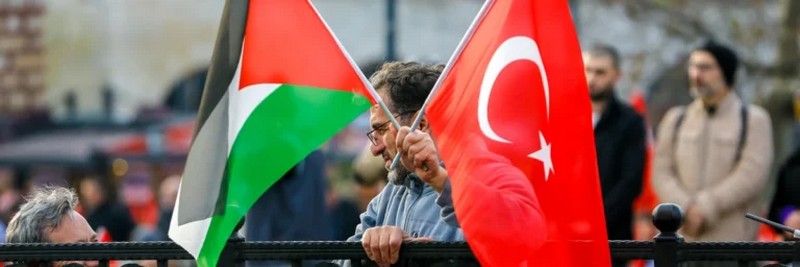
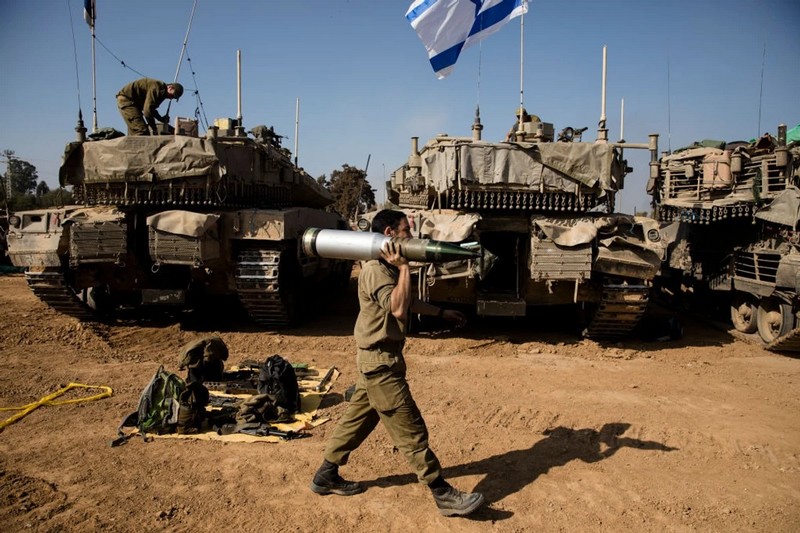
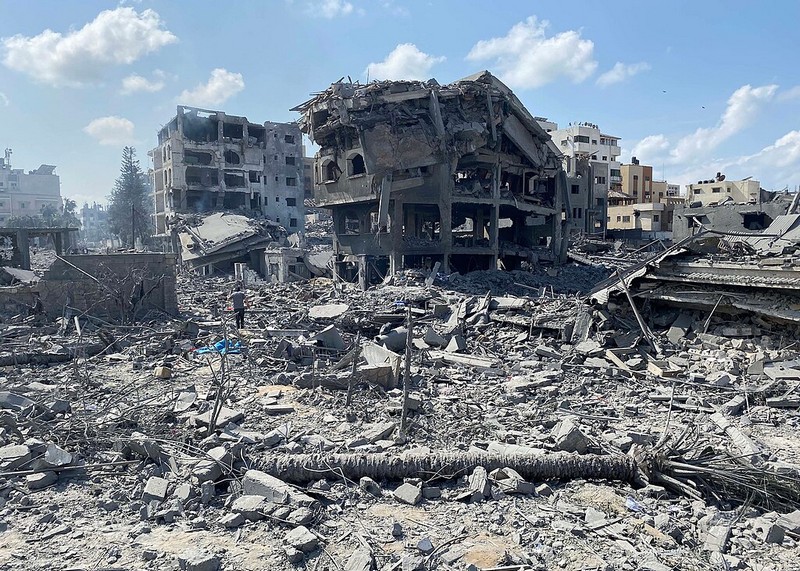
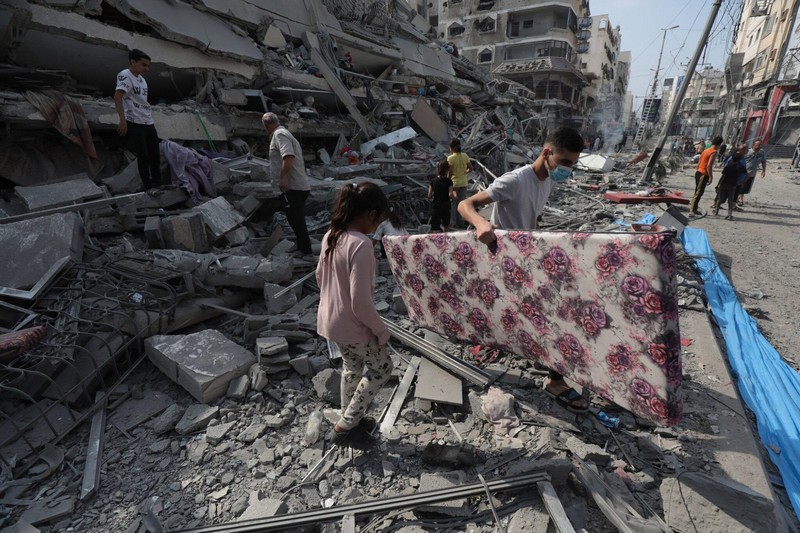
“Israel’s murder of more than 22,000 Palestinian civilians, the majority of whom were women and children, in Gaza for nearly three months should not go unpunished in any way,” said a Turkish spokesperson.
3 Jan 2024 – South Africa is no longer alone in bringing its claim of genocide by the Israeli government to the International Court of Justice, following announcements from the Turkish Foreign Ministry and the Malaysian Ministry of Foreign Affairs that they support the case.
Turkish Foreign Ministry spokesperson Oncu Keceli said Wednesday that those responsible for the killing of tens of thousands of Palestinians in Gaza since October 7 “must be held accountable before international law.”
“Israel’s murder of more than 22,000 Palestinian civilians, the majority of whom were women and children, in Gaza for nearly three months should not go unpunished in any way,” Keceli said. “We hope that the process will be completed as soon as possible.”
The ICJ is scheduled to hear the case on January 11-12. Israeli representatives are expected to appear at the hearing.
International rights groups issued a call on Wednesday for other countries to file Declarations of Intervention at the court, whose authority Israel recognizes, to bolster South Africa’s case.
The Turkish Foreign Ministry said it expects “that within the framework of this application, the ICJ will decide on provisional measures involving those to stop Israel’s attacks on Gaza.”
The Malaysia Ministry of Foreign Affairs said late Tuesday that it “welcomes the application by South Africa instituting proceedings against Israel… concerning the violations by Israel of its obligations under the 1948 Convention on the Prevention and Punishment of the Crime of Genocide in relation to Palestinians in the Gaza Strip.”
A spokesperson for the South African Foreign Ministry toldThe Jerusalem Post that it expects other countries to soon follow Turkey and Malaysia’s lead and back its case.
In its 84-page complaint, South Africa detailed the genocidal intent that’s been displayed in numerous public statements by Israeli Prime Minister Benjamin Netanyahu, President Isaac Herzog, and other top officials, as well as Israel’s bombardment of civilian targets and forced displacement of civilians.
The Israeli government argues that it is in a mortal fight for survival against Hamas, and therefore must take every measure, including the very destruction of Gaza, to survive. This is false.
1 Jan 2024 – When Congress returns in January, President Joe Biden will push the case to deepen U.S. complicity in Israel’s war in Gaza through another US armaments package for Israel. North Americans should raise their voice in a resounding no.
An arms package for Israel is not only against U.S. interests but also against Israel’s interests. The only path to real security for Israel is peace with Palestine. The US can help bring this about by ending the supply of munitions for Israel’s brutal war and by promoting the two-state solution as called for by international law.
I spelled out the diplomatic path to the two-state solution in a previous column for Common Dreams. That path remains open. It is actively promoted by the Arab and Islamic countries and supported by nearly the entire world.
Israel’s brutality in Gaza is becoming a true threat to Israel’s survival. Because of Israel’s extraordinary violence, the world is uniting against Israel, while Israel is suffering massive military losses. Incredibly, some Israeli leaders are now openly advocating an even wider war in the Middle East, one that could well spell utter disaster for Israel.
The surging global opposition to Israel’s policies is not antisemitic. It is anti-genocide. It is also pro-peace, pro-Israel, and pro-Palestine. If Israel ends the genocide, it will end the global opposition it now faces.
Defeating Hamas is not Israel’s real aim in Gaza
The Israeli government argues that it is in a mortal fight for survival against Hamas, and therefore must take every measure, including the very destruction of Gaza, to survive. This is false. There is no ethical, practical, legal or geopolitical case for destroying Gaza—killing tens of thousands of civilians, and uprooting 2 million people—to protect Israel against the kinds of preventable and controllable threats that Hamas actually poses.
During the years 2008-2022, Hamas and other militants killed around a dozen Israeli civilians per year, while Israel usually killed at least ten times more civilian Palestinians. There was a spike in 2014, when Israel invaded Gaza, with 19 Israeli civilians killed versus 1,760 Palestinian civilians. Hamas launches many rockets, but almost all are intercepted or cause little damage. Israel responds with periodic massacres (as in 2014) and with more regular airstrikes. The Israelis even have a cynical name for their periodic killing, called “mowing the grass.” It is common knowledge inside Israel that Hamas long served as a “low-cost” political prop used by Netanyahu to “prove” to Israelis that a two-state solution is impossible.
In all the years of Hamas rule in Gaza after 2007, Hamas has never captured Israeli territory, much less remotely threatened Israel’s existence or survival. Simply, it couldn’t do so even if it wanted. Hamas has around 30,000 fighters, compared with more than 600,000 active and reserve personnel in the IDF. Hamas lacks an air force, armored units, a military-industrial base, and any geographic maneuverability outside of Gaza.
On October 7, Hamas fighters made a surprise incursion into Israel that lasted that horrific day. This did not reflect a new super-ability of Hamas to invade Israel but rather a shocking failure of Israeli security. Israeli leaders had ignored extensive warnings of an upcoming Hamas attack and had inexplicably left the Gaza-Israel border severely under-manned. Even more astoundingly, they did so just days after Israeli extremists had stormed the al-Aqsa Mosque complex, one of the Islam’s holiest sites. Hamas exploited Israel’s astounding security lapse by breaching the border in an attack that led to around 1,100 Israeli civilian deaths, and Hamas’ taking of 240 hostages, with an unknown number of the Israeli civilian deaths that day caused by Israeli aerial bombing and crossfire in the IDF’s counterattack.
By re-fortifying the border with Gaza, Israel has stopped further ground incursions by Hamas. Netanyahu has ordered the destruction of Gaza not to protect Israel from Hamas, but to make Gaza uninhabitable and thereby to fulfill his longstanding intention to impose permanent Israeli rule over the territory. Netanyahu gets the added bonus of clinging to power despite his grievous other failures.
The Israeli government’s more basic objective is to solidify its total control over “Greater Israel,” meaning all of the land from the Jordan River to the Mediterranean Sea. Its objective with the incursion in Gaza is to push the population out of the territory. On October 10, Israel’s Defense Minister Yoav Gallant stated that “Gaza won’t return to what it was before. We will eliminate everything.” More recently, Netanyahu spoke of “voluntary emigration” of the Gazan population—voluntary, that is, after Gaza has been laid to waste and Gazans told to evacuate. Metula Mayor David Azoulai declared that “the whole Gaza Strip needs to be empty. Flattened. Just like in Auschwitz. Let it be a museum for all the world to see what Israel can do. Let no one reside in the Gaza Strip for all the world to see, because October 7 was in a way a second Holocaust.” He later clarified that he would like to see the Gaza population “relocated,” not murdered. Most recently, Finance Minister Bezalel Smotrich, a self-declared fascist, called for Gaza’s population to be cut to 100,000-200,000 from the current population of more than 2 million. Israel aimed from the start of its invasion of Gaza to push the Gazans into Egypt, but Egypt adamantly refused to be a party to ethnic cleansing.
In the 1970s, the aim of dominating Palestine to create Greater Israel as a Jewish state was a fringe belief. Now it rules Israeli policy, in part reflecting the enormous political weight of hundreds of thousands of Israeli settlers in the occupied West Bank and East Jerusalem.
“Greater Israel,” defined as Israel of pre-1967-War borders, plus Gaza, the West Bank, and East Jerusalem, is home to roughly seven million Jews and seven million Palestinian Muslims and Palestinian Christians. Israel can rule Greater Israel only by dominating seven million Palestinians, or by driving them out of their homes by war, violence, and extreme discrimination. The quest for Greater Israel in practice leads Israel to commit grave crimes against the people of Palestine. The ongoing crime is Apartheid rule, with its severe injustices and indignities. The graver crime is ethnic cleaning as Israel is attempting in Gaza. The gravest of all is genocide, witnessed in the thousands of deaths of innocent civilians occurring each week now in Gaza.
Israel’s turn towards extremism
The North American people need to understand that Israeli politics has become dominated by extremists who mix religious fervor with murderous violence against the Palestinians. This ultra-violent side of Israel is readily apparent in Israel but is still largely unknown to the U.S. public. Israeli brutality in Gaza comes as a surprise to many North Americans, yet it has become par for the course in Israel itself, although some Israelis are no doubt in denial of the facts on the ground in the Occupied Territories. The Grayzone has put together a shocking compilation of Israeli soldiers and leading personalities celebrating Palestinian deaths.
Israel’s genocidal violence towards the Palestinian people appeals to much of the Israeli public for several reasons. First, always lurking in the shadows in Israel is the memory of the Holocaust. Politicians like Netanyahu have long stoked the terror of the Holocaust to argue crudely and falsely that all Palestinians want to kill all the Jews, so that the violent suppression of the Palestinians is a matter of life and death for Israel. Of course, as in any spiral of hatred, there is a self-fulfilling prophecy to Netanyahu’s rhetoric and actions, leading to counter-actions and hatreds from the other side. Yet rather than trying to solve those through dialogue, interaction, diplomacy, and peacemaking, the cycle of hatred is stoked.
Second, orthodox rabbis have expanded upon the security narrative by insisting that Israel has a sacred right to Palestine because God gave all the land from the Jordan River to the Mediterranean to the Israelites.
Third, with 700,000 Israeli settlers living in the Palestinian lands conquered in 1967, Greater Israel has become a fait accompli for a large part of the Israeli people, with a large voice in Israeli politics. These settlers moved into conquered territory and now fervently insist on defending their settlements. The UN Security Council (UNSC Resolution 2334) has unequivocally declared Israel’s settlements in occupied Palestine to be in flagrant violation of international law, yet Smotrich himself, in the inner cabinet, is a leader of the settler movement.
The emergence of this violent strand of Judaism dates to the early 1970s, just after the 1967 Six-Day War. The policy question in Israel after 1967 was what to do with the newly occupied Palestinian land. Drawing on the proposals of Yigal Allon, a leading Israeli politician, Israeli leaders decided to keep East Jerusalem and to establish settlements in the occupied West Bank and Gaza to put “facts on the ground” to protect Israel’s security. From the start, Israeli governments defied UN Security Council Resolution 242 (1967), which rejected Israel’s acquisition of territory by war.
What happened next was momentous. Ultra-religious Jews took up the cause of Israeli settlements in the occupied territories as part of a messianic calling to make Israel the “Earthly support of the Lord’s throne,”(here p. 69). In 1974, Gush Emunim was launched as an ultra-nationalist religious settler movement by followers of the father-son rabbis Abraham Isaac Kook and Zvi Yehuda Kook, whose teachings combined the land claims of the Book of Joshua, Talmudic law, Chassidic mysticism, nationalism, and political activism.
The religious motivation of Greater Israel is that God gave the Jews all the land from the Jordan River to the Mediterranean Sea. In the Book of Joshua, probably completed in the 6th century BC, God instructs the Israelites arriving from Egypt after 40 years in the desert to annihilate the nations of Canaan in order to take the land for themselves. God promises the land extending “from the Negev wilderness in the south to the Lebanon mountains in the north, from the Euphrates River in the east to the Mediterranean Sea in the west, including all the land of the Hittites. (Joshua 1:4, New Living Translation). With God’s backing, Joshua’s armies commit a series of genocides to capture the land.
This extraordinarily violent text and related parts of the Bible (such as the annihilation of the Amalekites in the Book of Samuel), have become crucial points of reference for right-wing Israelis, both religious and secular. As a result, today’s Israel pursues a 6th century BC messianic vision of securing all of Palestine for the Jews. Supporters of Greater Israel often label the opponents of this ideology as anti-Semites, but this is wildly off the mark, as the former Executive Director of the Harvard Hillel has eloquently argued. The opponents of Greater Israel are against extremism and injustice, not against Judaism.
The Jewish settler movement led to a murderous disdain of the Palestinian. In his book Jewish Fundamentalism in Israel, Prof. Israel Shahak draws attention to the religious zealotry of Rabbi Eliezer Waldman, a leader of the West Bank settlers:
“Let us say clearly and strongly: we are not occupying foreign territories in Judea and Samaria [the West Bank]. This is our ancient home. And thank G-d that we have brought it back to life … Our responsibility to Jewish faith and redemption commands us to speak up in a strong and clear voice. The Divine Process of uniting our people and our Land must not be clouded and weakened by seeming logical concepts of “security” and “diplomacy.” They only distort the truth and weaken the justice of our cause, which is engraved in our exclusive national rights to our land. We are a people of faith. This is the essence of our eternal identity and the secret of our continued existence under all conditions.” [2002]
In Jewish History – Jewish Religion (2nd edition, 2008), Shahak quotes the Chief Chaplain of the Central Regional Command of the Israeli Army in 1973: “In war, when our forces storm the enemy, they are allowed and even enjoined by the Halakhah (Jewish law) to kill even good [Palestinian] civilians, that is, civilians who are ostensibly good” (p. 76).
The tactic of using violence to provoke mass Palestinian flight has been part of Israel’s playbook from its inception. On the eve of Israel’s independence, during 1947-8, Jewish militant groups used terror to provoke the mass departure of hundreds of thousands of Palestinians in a sordid process called nakba by the Palestinians (“catastrophe” in Arabic).
Netanyahu’s government aims to repeat the nakba in the Gaza war by forcing Gazans to flee to neighboring Egypt or other parts of the Arab Middle East. However, unlike in 1947-8, the world is watching in real-time, and is expressing outrage at Israel’s blatant attempt at ethnic cleansing. Egypt told Israel and the US in no uncertain terms that it would not be a party to Israel’s ethnic cleansing, and would not accept a flood of Gazan refugees.
The quest for Greater Israel is doomed to fail
Israel’s attempt to violently create a “Greater Israel” will fail. The Israeli Defense Forces are suffering massive losses in the brutal urban warfare in Gaza. While Israel has killed more than 20,000 Gazans, mostly women and children, it has not destroyed Hamas’s capacity to resist Israel’s invasion. IDF leaders say that the battle against Hamas will require many more months, but well before then, global opposition will likely become insurmountable.
In desperation, Israeli leaders such as Defense Minister Benny Gantz want to expand the war to Lebanon and probably to Iran. US hardliners such as Republican US Senator Lindsey Graham of South Carolina have dutifully and predictably chimed in, urging a US war with Iran. This Israeli gambit too will likely fail. The US is in no position to fight a wider Middle East war, after having drawn down its stockpile of munitions in Ukraine and Gaza. The North American people too strongly oppose another US war, and their opposition will be heard in an election year, even by a Congress in the pocket of the military-industrial complex.
Israel’s diplomatic setbacks, unless reversed, will prove devastating. Israel has hemorrhaged political support worldwide. In a recent UN General Assembly vote, 174 countries, with 94% of the world population, voted in favor of Palestinian political self-determination, while just 4 countries with 4% of the world population – Israel, the United States, Micronesia and Nauru – voted against (another 15 countries abstained or did not vote). Israel’s hardline militarism has united the world against it.
Israel counts entirely now on its one remaining supporter, the United States, but US support is also waning. By a huge margin, 59% for and 19% opposed, North Americans support a cease fire. North Americans support Israel’s security but not its extremism. Of course, the U.S. has its own Christian and Jewish zealots who base their politics on biblical literalism/orthodoxy, but they are a minority of public opinion. U.S. support for Israel depends on the two-state solution. Biden knows it and has reiterated US support for the two-state solution, even as the US supplies munitions for Israel’s war on Gaza.
While U.S. Jews generally support Israel, they do not support Israel’s religious messianism. In a 2020 Pew Survey only 30% of U.S. Jews believed that “God gave the land that is now Israel to the Jewish people.” 63% believed in the feasibility of peace between Israel and Palestine through the two-state solution. Only 33% believed as of 2020 that the Israeli government was making sincere efforts towards peace with the Palestinians.
Even Orthodox US Jews are divided on the question of Greater Israel. Some orthodox Jewish communities such as the Chabad are believers in the biblically motivated Greater Israel, while others such as the Satmar community (also known as Naturei Karta) are anti-Zionists and outspoken critics of Israel’s war on the Palestinian people stating that Judaism is a religion not a nation concept. The Satmar community believes that the revival of the Jewish homeland must follow God’s timeline, and not a Zionist timeline.
Supporting Israel’s extremism is not in U.S. interest
The US has been providing the munitions for Israel’s brutal war. This complicity has led to a lawsuit by Palestinian plaintiffs charging the US Government with violations of the Genocide Convention. As part of this legal effort, the US-based Center for Constitutional Rights has methodically documented the genocidal statements by Israeli leaders here and here.
The US is also facing severe and costly diplomatic isolation as it defends Israel’s indefensible actions. In recent votes of the US Security Council and the UN General Assembly, the US has stood almost alone in backing Israel’s hyper-violent and unjust actions. This is hurting the US in countless other areas of foreign policy and global economics.
The US federal budget is also under tremendous stress from military-related spending, which will reach around $1.5 trillion in total in 2024. The U.S. people have had enough of the bulging military spending, which has been a central factor in raising the public debt from around 35% of GDP in 2000 to around 100% of GDP today. With soaring debts and the rise in interest rates on mortgages and consumer loans, the public is resisting Biden’s calls for more deficit spending to fund the wars in Ukraine and Gaza, and will vociferously oppose a wider war in the Middle East, especially one that would draw the US into direct combat.
Of course, US open-ended support for Israel has seemed to be unstoppable in U.S. politics. The Israel lobby—a powerful constellation of Israel politicians and wealthy North Americans—has played a huge role in building this strong support. The Israel lobby gave $30 million in campaign contributions in the 2022 Congressional election cycle, and will give vastly more in 2024. Yet the lobby is up against the public’s growing opposition to Israel’s brutality in Gaza.
The two-state solution remains Israel’s true chance for peace and it’s security
Israeli leaders and diplomats have to stop shouting that critics are all anti-Semites and listen to what the world is actually saying: Israel and Palestine need to live side by side based on international law and mutual security. The support for a two-state solution is support for the peace and security of the Jewish people in the state of Israel, just as it is support for the peace and security of the Palestinian people in their own state. To the contrary, supporting Israel’s genocide in Gaza and inflaming anti-Israel (and anti-US) sentiment around the world, is antithetical to Israel’s long-term security and perhaps even its survival. The Arab and Islamic states have repeatedly declared their readiness to normalize relations with Israel within the context of the two-state solution. This goes back to the 2002 Arab Peace Initiative and includes the important Final statement of the extraordinary joint Arab Islamic Summit in Riyadh on November 11, 2023. The US and Arab countries should quickly agree on establishing a joint peacekeeping force to keep both sides safe in the context of implementing the two-state solution.
Many zealous religious settlers will strongly resist a Palestinian state, asserting their right to do so based on ancient biblical texts. Yet the point of Judaism is not to rule over millions of Palestinians or to ethnically cleanse them. The real point is not to provoke global opprobrium but to use reason and goodwill to find peace. As Hillel the Elder declared, “Whatever is hateful and distasteful to you, do not do to your fellow man. This is the entire Torah; the rest is commentary. Go learn.” The real point is to fulfill the ethical vision of the Prophet Isaiah (2:4), who prophesied that “nations shall beat their swords into plowshares, and their spears into pruninghooks: nation shall not lift up sword against nation, neither shall they learn war anymore.” So may it be.
Jeffrey D. Sachs, Professor of Sustainable Development and Professor of Health Policy and Management at Columbia University, is Director of Columbia’s Center for Sustainable Development and the UN Sustainable Development Solutions Network.
Violently coercing someone into doing something and ensuring that they’ll die if they don’t do it is the exact opposite of what the word “voluntary” means.
2 Jan 2024 – Israeli officials are now openly admitting that they’re working on “encouraging” the migration of Palestinians from Gaza, ridiculously claiming that this migration would be “voluntary” despite their having deliberately made the enclave uninhabitable over the last three months.
“Prime Minister Benjamin Netanyahu’s two senior far-right partners endorsed the rebuilding of settlements in the Gaza Strip and the encouraging of “voluntary emigration” of Palestinians on Monday, while hawkish opposition MK Avigdor Liberman called for Israel to reoccupy southern Lebanon.
“Speaking during their parties’ respective faction meetings in the Knesset, National Security Minister Itamar Ben Gvir and Finance Minister Bezalel Smotrich presented the migration of Palestinian civilians as a solution to the long-running conflict and as a prerequisite for securing the stability necessary to allow residents of southern Israel to return to their homes.
“The war presents an ‘opportunity to concentrate on encouraging the migration of the residents of Gaza,’ Ben Gvir told reporters and members of his far-right Otzma Yehudit party, calling such a policy ‘a correct, just, moral and humane solution.’
“‘We cannot withdraw from any territory we are in in the Gaza Strip. Not only do I not rule out Jewish settlement there, I believe it is also an important thing,’ he said.
“The ‘correct solution’ to the ongoing Israeli-Palestinian conflict is ‘to encourage the voluntary migration of Gaza’s residents to countries that will agree to take in the refugees,’ Smotrich told members of his Religious Zionism party, predicting that ‘Israel will permanently control the territory of the Gaza Strip,’ including through the establishment of settlements.”
This obviously makes the argument for the “voluntary migration” of Gazans completely nonsensical, since violently coercing someone into doing something and ensuring that they’ll die if they don’t do it is the exact opposite of what the word “voluntary” means.
But that’s the slogan we’re seeing pop up again and again as Israel draws closer to its final solution to the Palestinian problem in Gaza. Netanyahu and his cohorts have been repeatedly uttering phrases like “voluntary resettlement” and “voluntary migration” to describe the plan for Gaza’s Palestinian inhabitants to either move to refugee camps set up in the adjacent Sinai Peninsula in Egypt or to be taken in by other nations around the world.
Netanyahu has said that a team must be established to “ensure that those who want to leave Gaza to a third country can do so.” Iraq invader Tony Blair was reportedly being eyed as a potential leader of such a team by Israeli officials, though Blair has denied this.
Mitchell Plitnick wrote the following on the absurdity of the “voluntary migration” talking point in an article for Mondoweiss last month:
“The term ‘voluntary emigration’ is likely to be heard quite a lot in the coming weeks and months, and it is one of the most cynical, dishonest terms one can imagine. There is, of course, nothing voluntary about people leaving Gaza. Israel has made the place unlivable, and that was before the current bombardment.
“Now, they are essentially being forced to leave under the threat of imminent death. The people of Gaza did not suddenly lose their attachment to Palestine. They will die if they stay, as will their children. If you cut off water, electricity, food, and medical care, destroy all the shelter, and then ask a person, ‘Would you still like to stay?’ their decision to leave is obviously not voluntary.”
But that’s the narrative they’re going with apparently.
And it’s nothing new; Israel has been falsely claiming for generations that its violent forced expulsion of Palestinians known as the Nakba was voluntary as well. In 2000 Palestinian academic Ghada Karmi wrote that “The Israeli version of history — that the Palestinians left voluntarily or under orders from their leaders and that Israelis had no responsibility, material or moral, for their plight — has been successfully marketed to the world community for decades.”
The plot to relocate Palestinians from territories desired by Israel is also far from new. In a 2002 article for The Guardian titled “A new exodus for the Middle East?”, Israeli historian Benny Morris writes that the agenda to “transfer” Palestinians to other countries has existed for as long as modern Zionism:
“The idea of transfer is as old as modern Zionism and has accompanied its evolution and praxis during the past century. And driving it was an iron logic: There could be no viable Jewish state in all or part of Palestine unless there was a mass displacement of Arab inhabitants, who opposed its emergence and would constitute an active or potential fifth column in its midst. This logic was understood, and enunciated, before and during 1948, by Zionist, Arab and British leaders and officials.
“As early as 1895, Theodor Herzl, the prophet and founder of Zionism, wrote in his diary in anticipation of the establishment of the Jewish state: ‘We shall try to spirit the penniless [Arab] population across the border by procuring employment for it in the transit countries, while denying it any employment in our country … The removal of the poor must be carried out discreetly and circumspectly.’”
This is a very, very old agenda, being presented as something brand new that is only just occurring to Israeli officials just now. They didn’t just come up with this. It’s been fantasized about for as long as Israel was a twinkle in its founding fathers’ eyes.
This is the real objective in Gaza. Not the “elimination of Hamas” (whatever the hell you want to pretend that would look like in practice), but the ethnic cleansing of Palestinians from the Gaza Strip.
Hamas is not the target in Gaza. Hamas is just the excuse.
Caitlin Johnstone is a rogue journalist, poet, and utopia prepper.
4 Jan 2024 – I am writing to flag a truly important document that should be widely circulated and read carefully by anyone interested in the ongoing Gaza atrocities.
Specifically, I am referring to the 84-page “application” that South Africa filed with the International Court of Justice (ICJ) on 29 December 2023, accusing Israel of committing genocide against the Palestinians in Gaza.1 It maintains that Israel’s actions since the war began on 7 October 2023 “are intended to bring about the destruction of a substantial part of the Palestinian national, racial and ethnic … group in the Gaza Strip.” (1) That charge fits clearly under the definition of genocide in the Geneva Convention, to which Israel is a signatory.2
The application is a superb description of what Israel is doing in Gaza. It is comprehensive, well-written, well-argued, and thoroughly documented. The application has three main components.
First, it describes in detail the horrors that the IDF has inflicted on the Palestinians since 7 October 2023 and explains why much more death and destruction is in store for them.
Second, the application provides a substantial body of evidence showing that Israeli leaders have genocidal intent toward the Palestinians. (59-69) Indeed, the comments of Israeli leaders – all scrupulously documented – are shocking. One is reminded of how the Nazis talked about dealing with Jews when reading how Israelis in “positions of the highest responsibility” talk about dealing with the Palestinians. (59) In essence, the document argues that Israel’s actions in Gaza, combined with its leaders’ statements of intent, make it clear that Israeli policy is “calculated to bring about the physical destruction of Palestinians in Gaza.” (39)
Third, the document goes to considerable lengths to put the Gaza war in a broader historical context, making it clear that Israel has treated the Palestinians in Gaza like caged animals for many years. It quotes from numerous UN reports detailing Israel’s cruel treatment of the Palestinians. In short, the application makes clear that what the Israelis have done in Gaza since 7 October is a more extreme version of what they were doing well before 7 October.
There is no question that many of the facts described in the South African document have previously been reported in the media. What makes the application so important, however, is that it brings all those facts together in one place and provides an overarching and thoroughly supported description of the Israeli genocide. In other words, it provides the big picture while not neglecting the details.
Unsurprisingly, the Israeli government has labelled the charges a “blood libel” that “has no factual and judicial basis.” Moreover, Israel claims that “South Africa is collaborating with a terror group that calls for the destruction of the state of Israel.”3 A close reading of the document, however, makes it clear that there is no basis for these assertions. In fact, it is hard to see how Israel will be able to defend itself in a rational-legal way when the proceedings begin. After all, brute facts are hard to dispute.
Let me offer a few additional observations regarding the South African charges.
First, the document emphasizes that genocide Is distinct from other war crimes and crimes against humanity, although “there is often a close connection between all such acts.” (1) For example, targeting a civilian population to help win a war – as occurred when Britain and the United States bombed German and Japanese cities in World War II – is a war crime, but not genocide. Britain and the United States were not trying to destroy “a substantial part” of, or all the people in those targeted states. Ethnic cleansing underpinned by selective violence is also a war crime, although it is also not genocide, an action that Omer Bartov, the Israeli-born Holocaust expert, calls “the crime of all crimes.”4
For the record, I believed Israel was guilty of serious war crimes–but not genocide—during the first two months of the war, even though there was growing evidence of what Bartov has called “genocidal intent” on the part of Israeli leaders.5 But it became clear to me after the 24-30 November 2023 truce ended and Israel went back on the offensive, that Israeli leaders were in fact seeking to physically destroy a substantial portion of Gaza’s Palestinian population.
Second, even though the South African application focuses on Israel, it has huge implications for the United States, especially President Biden and his principal lieutenants. Why? Because there is little doubt that the Biden administration is complicitous in Israel’s genocide, which is also a punishable act according to the Genocide Convention. Despite his admission that Israel is engaged in “indiscriminate bombing,” President Biden has also stated that “we’re not going to do a damn thing other than protect Israel. Not a single thing.”6 He has been true to his word, going so far as to bypass Congress twice to quickly get additional armaments to Israel. Leaving aside the legal implications of his behavior, Biden’s name – and America’s name – will be forever associated with what is likely to become one of the textbook cases of attempted genocide.
Third, I never imagined I would see the day when Israel, a country filled with Holocaust survivors and their descendants, would face a serious charge of genocide. Regardless of how this case plays out in the ICJ – and here I am fully aware of the maneuvers that the United States and Israel will employ to avoid a fair trial – in the future Israel will be widely regarded as principally responsible for one of the canonical cases of genocide.
Fourth, the South African document emphasizes that there is no reason to think this genocide is going to end soon, unless the ICJ successfully intervenes. It twice quotes the words of Israeli Prime Minister Benjamin Netanyahu on 25 December 2023 to drive that point home: “We are not stopping, we are continuing to fight, and we are deepening the fighting in the coming days, and this will be a long battle and it is not close to being over.” (8, 82) Let us hope South Africa and the IJC bring a halt to the fighting, but in the final analysis the power of international courts to coerce countries like Israel and the United States is extremely limited.
Finally, the United States is a liberal democracy that is filled with intellectuals, newspaper editors, policymakers, pundits, and scholars who routinely proclaim their deep commitment to protecting human rights around the world. They tend to be highly vocal when countries commit war crimes, especially if the United States or any of its allies are involved. In the case of Israel’s genocide, however, most of the human rights mavens in the liberal mainstream have said little about Israel’s savage actions in Gaza or the genocidal rhetoric of its leaders. Hopefully, they will explain their disturbing silence at some point. Regardless, history will not be kind to them, as they said hardly a word while their country was complicit in a horrible crime, perpetrated right out in the open for all to see.
29 Dec 2023 – As the Russian musical Anna Karenina is set to be staged in Shanghai and Beijing this month, theatre director Alina Chevik hopes to see how it can connect the two peoples at a time when Russian artists have been shunned in Western markets.
The musical is one of several recently presented by Russian artists in China as the number of visiting Russian companies rises amid boycotts and sanctions in the West following Moscow’s invasion of Ukraine last year.
This year, the two countries have also repeatedly stressed the importance of boosting people-to-people exchanges ahead of the 75th anniversary of bilateral ties next year. Further, they have deemed 2024-25 as Russian-Chinese Years of Culture, with a view to putting on more events.
Analysts said this push for cultural exchange acknowledged how cultural diplomacy helped public opinion and perceptions that might show Russia in a more positive light in China.
Chevik sees up close how the two cultures interact as she tours Russian players in China. She also has experience directing Chinese performers on the production’s Chinese version.
“Working with Chinese actors was very interesting,” she said. “The way the actors were able to feel Russian history, the character of Russian people, suggests that art has no boundaries, a good story will be interesting and understandable to people of different cultures and nationalities.”
In late November, more than 100 representatives from both sides gathered in Beijing for the 14th Plenary Session of the China-Russia Friendship Committee for Peace and Development. They said the committee would “give full play to the role of the main channel of civil interaction and further promote people-to-people bonds”.
A day earlier, Chinese Vice-President Han Zheng met the representatives and hailed “increasingly solid public support” of China-Russia relations which had been viewed sceptically in the West since Russia invaded Ukraine.
As the Russian delegation visited Beijing, the Eifman Ballet of St Petersburg presented its show Eugene Onegin in the Chinese capital. In Shanghai, Russian ballet companies also scheduled Swan Lake and The Nutcracker performances through December.
Earlier in November, the St Petersburg Masterskaya Theatre presented its eight-hour stage play And Quiet Flows the Don in Shanghai as part of an international arts festival. The festival also hosted a performance featuring Chinese pianist Lang Lang and Russian conductor Valery Gergiev, who led the St Petersburg-based Mariinsky Theatre Orchestra in a concert on November 20.
Feng Qiu, a Beijing-based ballet teacher who viewed Eugene Onegin this month said he saw an apparent close cultural connection between the two countries that had not been affected much by the Ukraine war.
Qiu, who performed in Russia in 2019, said it was better to separate art from politics. A broad sanction that affected all Russian artists wrought “quite a loss for the public, for those who love ballet”, he said.
For university student Cui Di, the trickle of Russian shows was a chance for her to see a Russian ballet performance for the first time. She was among a full-house audience for a performance of Swan Lake on December 10 in Harbin, the capital city of northeast China’s Heilongjiang province.
The 19-year-old said she became familiar with and appreciated Russian culture and art while growing up in Heihe, a Chinese city on the border with Russia.
China and Russia have been stressing the need to boost cultural ties, with a joint statement signed in Moscow in March by Chinese President Xi Jinping and his counterpart Putin. It emphasised the promotion of exchanges between cultural institutions and noted that both sides opposed “the politicisation of international cooperation in the humanities”.
In late November, Putin told the St Petersburg International Cultural Forum that “building a comprehensive strategic partnership of coordination between Russia and China would be impossible without cultural exchanges and interpersonal bonds between the two peoples”.
Anna Kireeva, associate professor at the Moscow State Institute of International Relations, said the two countries viewed people-to-people exchanges as “an integral and important part” of their bilateral ties primarily because “without strong support from both societies no partnership has solid foundations only based on the contacts between elites”.
She said Russia saw the need to push more resources into building up cultural ties with a partner that would welcome them.
“This is especially true for Russia which used to enjoy much closer people-to-people ties, cultural, educational and scientific exchanges with the West but now, because of the sanctions and numerous restrictions, is no longer able to sustain them,” she said.
“China also increasingly needs alternative educational and scientific partners due to the restrictions by the US and more difficult relations with Australia and the EU.”
Zhang Chi, a postdoctoral researcher in international relations at the University of St Andrews in Scotland, said China and Russia’s emphasis on people-to-people exchanges could be seen as an extension of their soft-power strategies amid escalating geopolitical tensions.
Cultural diplomacy, which may not directly alter hard power dynamics, could significantly influence people’s attitudes and perceptions, she said.
“Both governments share the assumption that their portrayals within Western media are being misrepresented. Hence, they recognise the need to seize the reins of discursive power in order to reshape their image within the international arena,” she said.
Zhang said this goal required a concerted push in cultural diplomacy “to foster a more nuanced understanding of their cultural identities, values, and policies”.
“They aspire to cultivate a narrative that resonates more authentically with global audiences, countering the prevailing narratives that they perceive as skewed against them,” she said.
Russia considers it must retain influence or some discourse power in China to maintain its image to avoid “a very unfavourable situation” of global isolation, according to Wan Qingsong, an associate researcher at East China Normal University’s Centre for Russian Studies in Shanghai.
“One of the major driving forces behind this is the West’s cultural sanctions against Russia, so it needs to find a breakthrough,” he said. Wan said Russia sought to counter Western dominance in public opinion and information – what it considered “a stop-loss” for its image.
Wan said China and Russia also had common interests and motivations to boost cultural exchanges. Cooperation in areas such as the economy and security had already advanced but cultural ties remained relatively weak. He said many people in China understood Russia through its Soviet past but not as the country was today.
Zhang noted that cultural diplomacy was more effective when there was an existing affinity or resonance between cultures, and that public opinion shaped by cultural diplomacy could affect domestic and foreign policy stances.
“For example, the historical cultural ties between China and Russia serve as fertile ground for Russian cultural products to be positively received in China. This shared cultural background can evoke positive sentiments and familiarity, which may lead to a more sympathetic public stance towards a country’s broader policies or actions,” Zhang said.
“Past alliances or influences, such as the Soviet influence in China, can leave a lasting impact that extends into present-day cultural affinities. Despite past political rifts like the Sino-Soviet split, the appreciation for aspects of Russian culture such as classical music, art, ballet and literature remains influential among the older generation in China.”
As the 2024-25 Russian-Chinese Years of Culture approach, Russian theatre director Chevik said she looked forward to meeting Chinese dance and theatre troupes and taking part in joint projects in the next two years.
“It seems to me that we have something to share with each other in the field of culture and theatre. In Russia there is a very strong school of Russian drama theatre, classical ballet and classical music. I hope that the world of Russian culture will open up even more for Chinese viewers in these two years,” she said.
Pretoria is challenging the Israeli government’s claim to innocence, which for far too long has allowed it to act with impunity against the long-suffering Palestinians.
4 Jan 2024 – The collective West will forever stand disgraced and exposed due to its blind support of Israel’s genocidal slaughter of Palestinian civilians in Gaza since Oct. 7.
What passes for governance in Washington, Berlin, Paris, London et al. has forced us all to bear witness to infanticide, high crimes and war crimes without end these past few months. Said crimes have been committed not in the name of self-defence but rather in the name of ethno-nationalism, settler-colonialism and white supremacy.
Israel’s ability to act with impunity is a feature of the innocence it has claimed to enjoy as the national home of a Jewish people whom Hitler marked out for extermination in a European Judeocide that ranks as a crime of the ages.
The tragic aspect to this horrific episode in “European history” is the cynical fashion in which a Zionist movement, rooted in the ethnic cleansing of a people deemed to belong on a lower rung of a malign cultural ladder, manipulated it in order to achieve its aims.
The mantra of “never again!” has, ever since, been deployed as a sword against a people and region entirely innocent of the attempt to wipe European Jewry off the map, rather than a shield to ensure that the crime of genocide never re-occurs against any people, anywhere, and at any time again in human affairs.
Which brings us to the current government of the Republic of South Africa’s quite stunning intervention in bringing legal proceedings against the state of Israel to the International Court of Justice (ICJ) in The Hague, Netherlands, under the auspice of The Genocide Convention, brought into international law by a nascent United Nations in 1948.
Israel, predictably, has come out swinging against what it views as the temerity of any government to dare accuse it of genocide. The accusation of blood libel has been leveled at Pretoria, in other words anti-Jewish racism, along with a litany of baseless slurs.
Here, again, we are invited to adhere to a rendering of the Holocaust which holds that violence unleashed by the state of Israel is done so in the name of the dead of Auschwitz, and therefore comes anointed with the halo of impunity.
Crashing into this mythos was Israel Prime Minister Benjamin Netanyahu’s brazen and chilling biblical injunction, included in a speech he gave to his people at the start of Israel’s military operation in and against Gaza in October.
To wit:
“Remember what Amalek did to you (Deuteronomy 25:17).”
This particular Old Testament injunction sanctions the extermination of the ancient tribe, Amalek, by God in the name of his chosen people, the Jews, after they emerge from bondage in Egypt.
That Netanyahu, leader of a 21st century state, saw fit to include it in said speech at the outset of Israel’s ground invasion constitutes, does it not, a de facto case of genocidal intent?
Landmark Proceedings in The Hague
This, inter alia, forms the backbone of what will be landmark proceedings in front of the ICJ in The Hague, scheduled to take place on Jan. 11 and 12.
Black South Africa has long supported the Palestinian struggle. Famously, its most illustrious son, Nelson Mandela, once declared the following during a 1997 speech marking that year’s International Day of Solidarity with the Palestinian people:
“But we know too well that our freedom is incomplete without the freedom of the Palestinians.”
Just on the simple refrain that “it takes one to know one,” post-apartheid South Africa has never been in any doubt that Israel is an apartheid state. In this it has now been joined by Human Rights Watch, Amnesty International and all people of conscience and consciousness around the world.
That post-apartheid South Africa, with this legal case, now accuses Israel of being a genocidal state breaks new ground. Again, on a moral and historical level, it challenges the State of Israel’s claim to the innocence which for far too long has allowed it to act with impunity against the long-suffering Palestinians.
In this respect, it bears emphasizing that Hamas is a symptom rather than a cause. It is the product of structural oppression, apartheid, ethnic cleansing and the countless Oct. 7s endured and suffered by the Palestinians since 1948. It is not the cause.
In the last analysis, either international law applies everywhere or it applies nowhere. In bringing forward this case against the state of Israel, the Republic of South Africa stands tall. Where she goes others will hopefully now follow. [Turkey and Malaysia have expressed support for South Africa’s genocide case against Israel.]
John Wight, author of Gaza Weeps (2021), writes on politics, culture, sport.
4 Jan 2024 – Today, I would like to go a little deeper into the longer wave of history shaping our presently confused age by taking a look at the forgotten Jewish Kingdom of Khazaria (7-11th century CE).
Taking the time to investigate this important part of world history is additionally important as China’s New Silk Road currently represents the greatest hope for peace amongst various faiths and cultures not only in the Middle East, but globally. This is not the first time that the Silk Road ushered in a hope for a new age of reason amongst diverse cultures and as we shall soon see, the Kingdom of Khazaria played a major role in that endeavor which St Augustine called a City of God well over a millennium ago.
The Mystery of Khazaria in the Modern Era
Typically well informed readers who frequent alternative media either have never heard of the Jewish Khazar Kingdom that dominated central Europe, southern Russia and the Caucuses in the 7-10th century or IF THEY HAVE heard of it, they tend to believe that this Kingdom was the source of everything evil up until modern times. Many mainstream scholars tend to simply deny all evidence that this Jewish kingdom ever even existed.
I would like to take a novel approach to this anomalous matter of Khazaria and the broader role of Judaism in world history. Not only do I assert that bountiful evidence allows us to conclude that this Jewish Kingdom certainly did certainly exist, but all existent evidence points to the fact that it was the very opposite to a hotbed for “evil Ashkenazi Jewry” as so many lazy researchers have claimed. Instead, this report will attempt to prove that the forgotten kingdom was not only a beautiful phenomenon uniting all three major Abrahamic faiths under one ecumenical alliance of cooperation for well over a century, but also served as a keystone to the newly reborn Silk Road trade routes uniting Asia with Europe through the Confucian Tang Dynasty (618-912 CE).
Much of the following report was made possible by the pioneering work of historian Pierre Beaudry in his online book The Charlemagne Ecumenical Principle.
Under a primitive version of Samuel Huntington’s Clash of Civilizations doctrine, the Venetian Empire and the Ultramontane Church which were the heirs of the recently collapsed Roman oligarchy hated the rise of the Carolingian Empire under Charlemagne and the Augustinian humanist educational and economic reforms enacted during Charlemagne’s reign. More importantly, they hated the brilliant alliances Charlemagne oversaw alongside his co-thinker Harun al Rashid (Caliph of the Abassid Dynasty of Baghdad who ruled from 786-809 CE) and the new King Bulan of Khazaria who converted his kingdom to Judaism in the mid-8th century.
The Turkish Conversion to Judaism: The China Angle
Khazaria was first established in the mid-7th century by the western Turkish Kaghanate that had become independent from any obedience to the eastern Turkish parent empire when the later had been defeated militarily by the Taizong Emperor of the Tang Dynasty of China in 643 CE. With the Western Khaganate’s defeat, an important Chinese-Turkish Alliance was established that endured for another century.
With this 643 victory, the Chinese Emperor was made “Tengri Khagan” (Heavenly King), supreme authority over all Turks. 100 000 Turks then migrated to China’s vastly expanded realm and 10 000 Turkish elites settled in the capital. Letters from various Turkish leaders to the Tang court all the way until 741 CE continued to recognize China’s emperors as Heavenly Khagan.
Confucianism spread electrically across the entire Turkish Empire and the newly independent Turks of the west quickly established a highly developed centralized government in Khazaria whose economy would be based primarily upon fisheries, and agriculture. Khazaria became a keystone in the Silk Road with primary routes of the Steppe Silk Road going east-west over land from Uygur Territory in the east to western Crimea and export/import lines along the Dnieper, Don and Volga Rivers which fed into the Caspian and Black Seas. Khazaria also held the vital North-South trade route along the Volga from Scandinavia through Central Russia to Islamic Iran and Azerbaijan. Since Venetian steered-wars with Islam made Mediterranean trade impossible, and also made it unsafe for Christians or Muslim merchants to move through each other’s’ territories, this Khazarian route was vital and the role of Jews indispensable for trade.
Anomalies of Jewish Khazars
The fact that Khazaria was founded by Turks with a strong link to China cannot be ignored. When evaluating this fact, we must hold three important facts in mind:
1) Countless scholars have noted the strong Confucian philosophy embedded in the western Turkish Khaganate that established the Kingdom of Khazaria before King Bulan’s later conversion to Judaism sometime around 750CE. Even though they were shamanistic, the Confucian principle of the Mandate of Heaven was a core belief of the Khazarian turks.
2) The presence of Jews in China at this time was anomalously large with the first recorded influx of Jews occurring in 618 CE with the start of the Tang Dynasty. As the Tang emperor revived the Silk Road trade routes that had fallen apart after the fall of the Han Dynasty in the 200 CE, Buddhists, Hindus, Nestorian Christians, Zoroastrians, Muslims and Jews flocked to China. This was an especially positive breath of fresh air for Jews as Professor Pan Guang stated: “they could preserve their native customs and religious beliefs… In education, work, buying and selling of land, marriage and the right to move, they enjoyed the same rights and treatment as Han Chinese. They never faced discrimination”.
This tolerant Chinese policy stood in stark contrast to the persecution and forced conversions had run rampant across the west. Much of this persecution stemmed less from religious reasons and more from geopolitical ones as the earlier Jewish Himyaritic Kingdom’s conversion to Judaism in 380 CE destroyed Byzantium’s designs to take control of Arabia. Waves of violence descended upon Jews during this time and beyond Himyaria’s collapse in 525 CE as vengeance for resisting imperial hegemony.
3) The primary group in this early phase of the renewed Silk Road routes were Jewish Radhanite traders originating from the city of Radhan in Iraq. According to Persian scholar al Masudi (896-956), these Jewish traders spoke Arabic, Greek, Persian, Slavic, Spanish and Frankish and according to 9th century geographer Ibn Khurdabhe, there were four Radhanite trade routes linking Europe to China. The primary and most active corridor moving through the Middle East and to Europe was “the Steppe Silk Road” much of which under the jurisdiction of Khazaria.
The Ecumenical Jewish, Christian, Muslim, Confucian Alliance
Al Masudi reported his Meadows of Goldthat the Jewish Khazars had established an incredible military alliance with the Islamic Abbasid Dynasty who supplied an army of 10 000 Muslim soldiers to the Jewish Khazars under the condition that if any future Jewish leader were to declare war on Islam, that army would fight for Islam! This incredible safeguard was a creative flank which brought the self-interests of both cultures together in ways that made orchestrated imperial conflict nearly impossible.
Another distinguishing feature of Khazaria was its unique judicial system which wisely represented the diverse faiths which sought refuge in this Jewish land. Khazaria had become renowned for its tolerance and openness (the majority of the population were a mix of Christian, Muslim and Pagan though the King and his court were Jewish). 10th century Persian historian Abu al-Istakhri described the Khazarian Supreme Court of Justice whose judges comprised two Christians, two Muslims, two Jews and one Pagan stating: “The king has 7 judges [hukkan] from the Jews, Christians, Muslims and Idolators. When the people have a lawsuit, it is they who judge it. The parties do not approach the king himself but only these judges.”
The Abbasid Dynasty played another indispensable role in preserving the Silk Road and Confucian renaissance in conjunction with their alliance with Khazaria. At a decisive moment in 755 CE, the Tang Dynasty faced a terrible crisis known as the An-Shi Rebellionwhen a renegade General An Lushan declared himself emperor of the North threatening both civil war and the dissolution of the new Silk Road. Caliph al-Mahdi (grandfather of the great Harun al Rashid) sent 4000 Muslim soldiers to aid the Emperor in putting down the rebellion, preserving the ecumenical alliance!
It is unfortunate that the Tang Dynasty was never able to recover to its pre-Civil War prestige and the Silk Road lost valuable vitality just as the Christian-Jewish-Muslim alliance was attaining its apex.
Septimania: European Entry to the Silk Road
We have already noted many surprising and important ecumenical alliances around a higher concept of divine justice and common good in opposition to the policies of the 2nd Roman Empire which operated exclusively on “divide to rule” tactics. However we have left out another important creative alliance worth mentioning.
In 751, the Umayyad Caliphate in Spain lost a major territory called Septimania to the new Carolingian Dynasty of a Frankish King named Pepin the Short (father of Charlemagne) who ruled from 751-768. Septimania, a large area which hosts the strategic port city of Narbonne, had a large Jewish and Muslim population which Pepin and his son allied with against the intrigues of Venice. This area later became a leading renaissance zone reviving the study of Greek classics, astronomy, poetry and medicine under the Andalusian Renaissance centuries later.
Rather than fall into Jewish vs Christian vs Muslim conflicts which the oligarchy would have liked, Pepin instead called for a Jewish leader from Baghdad descended from the House of David named Natronai al Makhir (725-765) to become king of Septimania even giving his daughter Alda to Makhir as wife. Al Makhir in turn gave his Jewish daughter to King Charlemagne in marriage as part of a diplomatic flank against the war mongers in Rome.
Charlemagne ended the anti-Jewish policy dominant in Europe for centuries and even gave Jews rights to land ownership and titles unprecedented in that age. Whenever Charlemagne or his father established diplomatic embassies with the Muslim Abbasids, diplomatic envoys selected were always Jewish. Ultramontane Pope Stephen III who advocated a ‘clash of civilizations’ policy, attacked Charlemagne’s policy in 768 CE writing to the Archbishop Aribert:
“Christians work the vineyards and the fields of these Jews. Christian men and women live under the same roof as these prevaricators, listening to their blasphemous language, night and day; these miserable men and women always have to humiliate themselves before the demeaning display of dogs. What communion hath light with darkness and what concord hath Christ with Balial?”
Both Pepin and Charlemagne ignored the Vatican’s many demands to renounce their ecumenical program.
The governance of Septimania was later divided by Charlemagne with 1/3 under the authority of Archbishop Thomas of Normandy, 1/3 under the Islamic Viscount and 1/3 under Jewish governance ironically putting a Muslim territory under Jewish and Christian protection!
This policy of creative war avoidance and win-win collaboration tied into a Muslim-Christian agreement led by Harun al Rashid in 800 CE when he gave control of the Holy Land to Charlemagne declaring that the Christian leader’s land would be protected by Muslim rule. According to the records of the Monk Zacharias, this diplomatic entente was negotiated by Charlemagne’s Jewish Ambassador to Baghdad Isaac of Rachen.
Tying this alliance back to the international geopolitical stage, it is important to recall that Narbonne/Septimania was the key entry point for Silk Road goods to Europe, and its early collapse would have been devastating to the humanist cause. This ecumenical alliance was strong enough to last 90 years before collapsing under the later intrigues of Venice which had managed to get Charlemagne’s small-minded grandchildren to fall into civil war breaking the Carolingian Empire with the 842 Oath of Strasbourginto conflicting regions that later came to become the borders of modern Europe.
The Carolingian Renaissance
Without going into the details of Pepin and Charlemagne’s bold reforms centering on infrastructure (vast roads, bridges over the Rhine, canals, cathedrals and schools), their Irish monastery movement, and financial reforms which saw private financiers lose control as Charlemagne’s government took control of coinage and credit… it is enough for now to state that the Carolingian Renaissance earned its name for the right reasons. The philosophical basis for Charlemagne’s ability to break with anti-Jewish hate was found in the doctrine of Witness formulated by St. Augustine in the early 5th century and which asserted that Jews should no longer be slaughtered, but rather protected since their very existence and adherence to the Old Testament was a living testimony to Christian faith.
Historian Thomas MacDonald said of Augustine’s Doctrine: “His positions is that the Jews are under a divine order of physical protection, and that not only must they be protected, but they must be allowed to worship as Jews… His reason for this view is demeaning for Jews but it also informed centuries of theology and countless orders of protection of Jews living in Christian lands. When Jews were persecuted at the hands of Christians, it was in direct defiance of this doctrine, and when they were protected it was because of this influence.”
The Abbasid Renaissance
In Islam, Augustine’s doctrine found a parallel in the Doctrine of Dimi which asserted that Muslims must protect Jews because they had direct intercourse with the One God whom all Abrahamic faiths share in common.
It is also worth noting that the Abbasid Dynasty was known rightfully as the “Islamic Golden Age” which ushered in a parallel bureaucratic, monetary, and educational reform under the Confucian principle of the Mandate of Heaven (i.e.: A leader’s right to rule was valid only through his obedience to the laws of nature and the common good). This was an anti-oligarchical concept of governance shared by Charlemagne and Caliph al Rashid. Under the humanist leadership of Caliph Al Mahdi, his son Harun Al Rashid and grandson al Mamun, networks of humanist education centers were created called “Houses of Wisdom” which brought Muslim, Christian, and Jewish scholars together to translate ancient works of Greek and Latin, study astronomy, literature, medicine and engineering. Paper mills were established in 832 CE in Samarkand, Cairo, Damas and Baghdad applying Chinese technology to broaden humanity’s access to knowledge.
The Chinese Renaissance
In China, the Tang Dynasty (618-907) distinguished itself early on as an ecumenical safe haven for all cultures and saw influxes of Muslims, Jews and large groups of Nestorian Christians who all made China their home. During the 300 years of Tang Rule, the arts rose to new heights, and the Poet-statesman became an actualized ideal as the greatest poets and painters (such as Wang Wei, Li Bai and Du Fu) played major roles as political figures. Torture and death penalties were nearly done away with and public schools were built at record numbers. Unfortunately, wars with Muslims, Turks, and Tibetans did occur over the years and many internal struggles occurred from within weakening the Dynasty.
Physical evidence of the Khazar Kingdom were nearly all destroyed or suppressed leaving very little empirical evidence to work with for modern scholars (and leaving much room for speculative gossip led by such British Imperial assets like Arthur Koestler or lizard-man quackidoodle David Icke). Luckily, dozens of Christian and Muslim scholars of the 8-12 centuries have written extensively of its existence, and some of the 250 000 fragments discovered at the end of the 19th century in the Cairo Geniza are finally being made public- bringing direct evidence to light for the first time in millennia.
One question is still unanswered: Why did the Khazar Kingdom end by the 10th century and why were all traces of this golden age among Confucianism, Judaism, Christianity and Islam destroyed?
The Venetian Takeover and the Rise of ‘Jewish Bankers’
Here we must look to towards that ugly center of spiritual pus: The heirs of the Roman Oligarchy found in the Lagoons of Venice and Byzantine Empire (soon to be undone by the wilier Venetians in 1251 as outlined in my recent report The League of Cambrai and the BRICS Today and 2009 film The New Dark Age).
Although it took a couple hundred years of effort, the oligarchy was finally successful in breaking up Charlemagne’s unified kingdom into warring factions, and the Islamic Empire soon fell into its own internal and external discord. Finally in 1095, Venice and the Ultramontane Papacy were successful in launching the first Crusade against Islam turning the world upside down. It is noteworthy that all trade routes established by Rhadanite Jews were the first things destroyed in Europe by the Crusaders who then took over those routes, using this infrastructure to wage a most unholy war.
Whatever happened to cause the weakening and ultimate collapse of Khazaria under Kiev Rus invasions in 969 is not clear. What is clear is that anti-Jewish laws were imposed at unprecedented rates from the 11th-16th centuries of Venetian global dominance. In the late 10th century, Jews were cut off from Khazaria as all east-west trade routes were taken over by Genoa and Venice. Though other nations soon followed suite, Venice was the first to ban Jews from all international trade with the Venetian Senate passing a law in 945 CE forbidding any ship to Asia from carrying a Jew. Laws were soon passed across Europe on Venice’s direction forbidding Jews from owning land, joining trade guilds of weavers, dyers, carpenters or blacksmiths or owning any trade companies. Other laws like the 1181 English Assize Laws forbade Jews from owning weapons, serving in military or even farming.
The word Ghetto began in Venice as well, as Jews were here relegated to a small neighborhood called the Ghetto and were excluded from any normal form of profession being forced to either deal in old rags, pawn broking or money lending for (nominally) Christian oligarchical families who used them as HofJuden servants.
Historian Cecil Roth addressed this devastating situation saying: “The situation would have been an impossible one but for the presence of the Jew, who, precisely as he found himself excluded from other methods of gaining a livelihood, was forced into this most unhonoured profession. The non-Jewish capitalists lent to kings and magnates, under the cover of various devices (such as making out the bond for a larger amount than the sum lent, or euphemistically calling the interest by some other name). The more open, least lucrative, and most unpopular branches of the profession, such as lending on pledge for a short period to the artisan and tradesman, were forced upon the Jews. ”
“In Venice, for example, down to the close of the eighteenth century, the Jewish community was only tolerated on the express condition that it maintains in the Ghetto four loan-banks (a more polite term for pawn broking establishments)… The only other professions legally permitted there were old clothes dealing and the wholesale export trade to the Levant, which did not compete with Christian traders. The same was the case in the cities of the terra firme. This ignominious condition of affairs was sternly enforced, and any attempt on the part of the Jews to broaden their economic status, or to place it on a slightly more dignified plane, was the systematically blocked.”
This now opens the door to our next installment which will introduce a new perspective to Shakespeare’s Merchant of Venice.
Matthew Ehret is a member of the TRANSCEND Network for Peace Development Environment, a journalist, and co-founder of the Rising Tide Foundation.
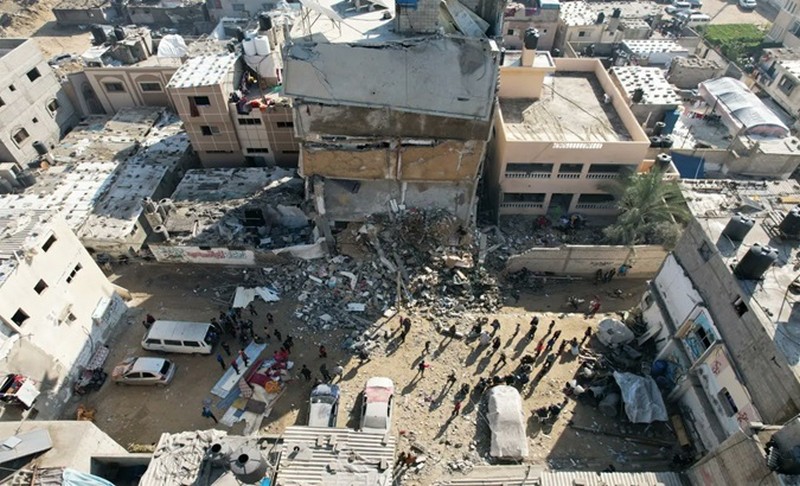
** Gazans have no means to rescue bodies from under the rubble of flattened buildings. Victims are left to die trapped under tons of dirt, making diseases practically inevitable. **
GAZA and WEST BANK, 8 Jan 2024
Up to 7 Jan 2024:
22,835+ killed* and 58,416 wounded in the Gaza Strip
380 Palestinians killed in the West Bank and East Jerusalem
Israel revises its estimated October 7 death toll down from 1,400 to 1,147
510 Israeli soldiers killed since October 7, and at least 2,193 injured
* Some rights groups put the death toll number closer to 30,000 when accounting for those presumed dead under the rubble.
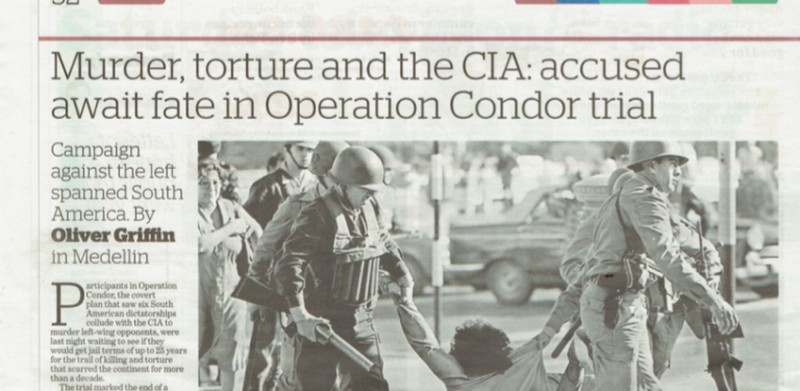
During the 1970s and 80s, eight US (Henry Kissinger)-backed right wing military dictatorships jointly plotted the cross-border kidnap, torture, rape and murder of hundreds of their left wing political opponents. Now some of the perpetrators are finally facing justice.
The last time Anatole Larrabeiti saw his parents, he was four years old. It was 26 September 1976, the day after his birthday. He remembers the shootout, the bright flashes of gunfire and the sight of his father lying on the ground, mortally wounded, outside their home in a suburb of Buenos Aires, Argentina, with his mother lying beside him. Then Larrabeiti remembers being taken away by armed police, along with his 18-month-old sister, Victoria Eva.
The two children became prisoners. At first, they were held in a grimy car repair garage that had been turned into a clandestine torture centre. That was in another part of Buenos Aires, the city that their parents had moved to in June 1973, joining thousands of leftwing militants and former guerrillas fleeing a military coup in their native Uruguay. The following month, in October 1976, Anatole and Victoria Eva were taken to Montevideo, the capital of Uruguay, and held at the military intelligence headquarters. A few days before Christmas, they were flown to a third country, Chile, in a small aircraft that climbed high above the Andes. Larrabeiti remembers looking down on snowy peaks from the plane.
Young children do not usually make epic journeys through three countries in as many months without parents or relatives. The closest thing they had to family was a jailer known as Aunt Mónica. It was probably Aunt Mónica who abandoned them in a large square, the Plaza O’Higgins, in the Chilean port city of Valparaíso, on 22 December 1976. Witnesses recall two young, well-dressed children stepping out of a black car with tinted windows. Larrabeiti wandered around the square, hand-in-hand with his sister, until the owner of a merry-go-round ride spotted them. He invited them to sit on the ride, expecting some panicked parents to appear, looking for their lost children. But nobody came, so he called the local police.
No one could understand how the two children, whose accents marked them as foreign, had got here. It was as if they had dropped from the sky. Anatole was too young to make sense of what had happened. How does a four-year-old who finds himself in Chile explain that he does not know where he is, that he lives in Argentina, but is really Uruguayan? All he knew was that he was in a strange place, where people spoke his language in a different way.
The next day, the children were taken to an orphanage, and from there they were sent on to separate foster homes. After a few months, they had a stroke of luck. A dental surgeon and his wife wanted to adopt, and when the magistrate in charge of the children asked the surgeon which sibling he wanted, he said both. “He said that we had to come together, because we were brother and sister,” Larrabeiti told me when we met earlier this year in Chile’s capital, Santiago.
Today, he is a trim, smartly suited 47-year-old public prosecutor with hazel eyes and a shaven head. “I have decided to live without hate,” he said. “But I want people to know.”
What Larrabeiti wants people to know is that his family were victims of one of the 20th century’s most sinister international state terror networks. It was called Operation Condor, after the broad-winged vulture that soars above the Andes, and it joined eight South American military dictatorships – Argentina, Chile, Uruguay, Bolivia, Paraguay, Brazil, Peru and Ecuador – into a single network that covered four-fifths of the continent.
It has taken decades to fully expose this system, which enabled governments to send death squads on to each other’s territory to kidnap, murder and torture enemies – real or suspected – among their emigrant and exile communities. Condor effectively integrated and expanded the state terror unleashed across South America during the cold war, after successive rightwing military coups, often encouraged by the US, erased democracy across the continent. Condor was the most complex and sophisticated element of a broad phenomenon in which tens of thousands of people across South America were murdered or disappeared by military governments in the 1970s and 80s.
Most Condor victims disappeared for ever. Hundreds were secretly disposed of – some of them tossed into the sea from planes or helicopters after being tied up, shackled to concrete blocks or drugged so that they could barely move. Larrabeiti’s mother, Victoria, who was last seen in an Argentinian torture centre in 1976, is one of them. His father, Mario, who was a leftwing militant, probably died in the shootout when they were snatched by the police. Enough victims have survived, however, to tell stories that, when matched against a growing volume of declassified documents, amount to a single, ghastly tale.
In the past two decades, Larrabeiti’s story has been told and retold in half a dozen courts and tribunals around the world. In the absence of a fully formed global criminal justice system, the perpetrators of Condor are being taken to court through a piecemeal process. “The trouble with borders is that it is easier to cross them to kill someone than it is to pursue a crime,” says Carlos Castresana, a prosecutor who has pursued Condor cases and the dictators behind them in Spain. Those seeking justice have had to rely on a judicial spider’s web of national laws, international treaties and rulings by human rights tribunals. The individuals they pursue are often decrepit and unrepentant old men, but a tenacious network of survivors, lawyers, investigators and academics, rather like the postwar Nazi-hunters, has taken up the challenge of ensuring that such international state terror does not go untried.
The process is painfully slow. The first major criminal investigation focusing on Condor – with victims and defendants from seven countries – began in Rome more than 20 years ago. It still has not ended. On a sweltering day in July 2019, a judge in the Rome case handed life sentences to a former president of Peru, a Uruguayan foreign minister, a Chilean military intelligence chief and 21 others for their role in a coordinated campaign of extermination and torture. The defendants are appealing, and a final verdict is due within a year.
Much of what we now know about Condor has been unearthed or pieced together in Rome, Buenos Aires and in dozens of court cases – large and small – in other countries. Further evidence comes from US intelligence papers dealing with Argentina that were declassified on the orders of Barack Obama. In 2019, the US completed its handover of 47,000 pages to Argentina. These documents show how much the US and European governments knew about what was happening across South America, and how little they cared.
When he was seven, Anatole Larrabeiti discovered his true identity, thanks to his tenacious paternal grandmother, Angélica, who tracked the siblings down. Stories had appeared in the Chilean press when they vanished in 1976, though headlines claimed they were abandoned by unidentified “red terrorist parents”. Over the next few years, word of the missing children’s whereabouts spread from one humanitarian organisation to another, before eventually reaching the Brazilian human rights group Clamor, which had activists in Valparaíso, the city in Chile where Larrabeiti and his sister were living. After a tipoff, the activists secretly photographed the children on their way to school and sent pictures to Angélica. She immediately recognised her grandchildren. “My sister was a replica of my mother as a child,” explained Larrabeiti. “And I have her lips.”
By agreement with their biological grandparents, the children remained with their adopted parents in Chile. When Victoria Eva turned nine, she was told about her true identity, and the children started to make family visits to Uruguay. “They were good parents,” said Larrabeiti, of the couple who adopted them. “They kept the links with Uruguay and we had psychological support, which I needed when I became a very angry adolescent.”
The crimes committed by Latin America’s military regimes during the cold war continue to haunt the continent. Only a perverse combination of power and paranoia can explain why these regimes awarded themselves the right not just to murder and torture, but also to steal children such as the Larrabeitis. The men perpetrating such crimes saw themselves as warriors in a messianic, frontierless war against the spread of armed revolution across Latin America.
Their fantasies were overblown, but not entirely baseless. In 1965, the Argentinian revolutionary Ernesto “Che” Guevara had waved an emotional goodbye to his comrade-in-arms Fidel Castro, leaving Cuba. He vowed to initiate a new phase of revolutionary activity, extending guerrilla warfare across Latin America. Che was killed while carrying out his mission in Bolivia in 1967, but the US by then viewed revolution in Latin America as an existential threat – recalling how Russian nuclear weapons had reached Cuban soil during the 1962 missile crisis. In a bid to strengthen anti-communist forces, the US pumped money and weapons to armed forces across the region, vastly increasing the power of the military within these states and eventually, as the American journalist John Dinges has written, ending up in an “intimate embrace with mass murderers running torture camps, body dumps, and crematoriums”. In the 70s, as rightwing military coups and state terror swept the continent, an attempt at coordinating an armed response was made via a loose network known as the Revolutionary Coordinating Junta (JCR). Formed by groups from Chile, Uruguay, Argentina and Bolivia in 1973, the JCR had grandiose plans to pursue Che’s continental uprising, but lacked funds, friends and firepower. Meanwhile, South America’s military regimes began to collaborate more closely, initially striking bilateral agreements that allowed operatives to carry out their work on foreign soil.
Aurora Meloni, a Uruguayan who had gone into exile in Argentina with her husband, Daniel Banfi, and two young daughters, was one of the first to suspect that South America’s violent right was plotting an international network of terror and rendition. At 3am on 13 September 1974, Meloni and Banfi were at home in a suburb of Buenos Aires when about half a dozen armed men burst through their door. Meloni, then aged 23, immediately recognised one of them as the notorious Uruguayan police inspector Hugo Campos Hermida. Back in Uruguay, Hermida had once questioned Meloni and Banfi – then students of literature and history respectively – after they had taken part in a demonstration back home in support of the leftwing Tupamaro guerrilla movement, to which Banfi belonged. “I remembered how he [Hermida] had hit me,” Meloni told me. “He was very aggressive.”
Meloni could not understand why Hermida was working freely in a foreign country. At that time, Argentina was still a democracy, with rule of law. (The military takeover came later, in March 1976.) Foreign policemen had no right to act there. After their apartment had been ransacked for clues as to the whereabouts of other exiled Tupamaros, Hermida took Banfi away. Aurora assumed she would soon discover which police station or jail he had been taken to, but there was silence.
In September 1974, this was still a bizarre event. “We had never heard of people disappearing in Argentina before. I was sure I would find him,” Meloni told me. Eventually she called a press conference. How could someone vanish like that? The answer came five weeks later, when three bodies bearing torture scars were discovered by police 75 miles away. Car headlights and a group of men had been seen in a remote spot at night, and pile of fresh earth had been left behind. Daniel Banfi was one of three murdered Uruguayans found in the hastily dug grave.
The following month, Meloni left Argentina, and eventually moved to Italy, where, since her father was Italian, she had dual nationality. She returned to Uruguay for three spells over the next 25 years, seeking justice. But, just as in Chile and Argentina, the price of ending dictatorship in Uruguay in 1985 was an amnesty, which ruled that state representatives could not be charged with crimes committed during the regime’s 12 years in power. It seemed nothing could be done.
It wasn’t until the end of the century that cracks in the legal status quo began to appear. In the late 90s, a Spanish judge named Baltasar Garzón began testing a previously ignored law that obliged Spain to pursue any alleged human rights abusers anywhere in the world, if their own countries refused to try them. Garzón and a group of progressive prosecutors opened investigations for genocide and terrorism against Argentina’s former military junta and Pinochet’s regime, and “a criminal conspiracy” between them.
Since the accused did not live in Spain, Garzón’s quest was viewed as quixotic. “People laughed at us,” the Spanish prosecutor who brought these cases, Carlos Castresana, told me in Madrid recently. On 16 October 1998, however, Pinochet was arrested by police at a London clinic after a minor hernia operation. He was a frequent visitor to the city, taking tea at Fortnum & Mason and popping in on his old friend and ally Margaret Thatcher.
Amid the headlines and the flurry of paperwork sent to London over the following days, few people noticed that the initial warrant for Pinochet’s arrest was based on a Condor case. It named a Chilean victim who disappeared in Argentina, Edgardo Enríquez, and stated that “there is evidence of a coordinated plan, known as Operation Condor, in which several countries took part”.
Pinochet was held for 17 months while Britain’s law lords twice approved extradition to Spain. Labour party home secretary Jack Straw stymied the extradition, instead sending Pinochet home to Chile on health grounds. On his return, the former dictator made a mockery of that justification by stepping out of his wheelchair to wave joyfully at supporters. Yet something major had changed, as prosecutors, judges and activists realised that South America’s dictators and their henchmen were no longer untouchable.
In 1999, inspired by Garzón, Aurora Meloni brought a murder case in Italy against Uruguayan security officials who were suspected of killing Banfi and others. Families of other Condor victims with Italian citizenship joined Meloni, and the case broadened to cover Condor crimes in several countries. From her home in Milan, Meloni – now aged 69 – has kept the case alive ever since. “It has taken a long time,” she told me. After last year’s sentencing in Rome, the plaintiffs were delighted, but Meloni points out that until we know the outcome of the appeals, the story isn’t over.
When Daniel Banfi was murdered in late 1974, Condor did not yet formally exist. His death can be seen as a precursor, or trial run. Hermida Campos was one of a handful of Uruguayan security officials who were secretly testing ways of hunting down exiles with their Argentinian counterparts.
Another of those preparing the rendition programme with Argentina, which would later be absorbed into Condor, was the Uruguayan navy lieutenant Jorge Tróccoli. Now a grey, jowly 73-year-old, Tróccoli was the only defendant present at the Rome trial. He had moved to Italy and was arrested in Salerno, near Naples, in 2007. In the 90s, Tróccoli wrote two semi-autobiographical novels about how Uruguay’s military had embraced torture, murder and repression. In La Hora del Depredador (The Predator’s Hour), a torturer who appears to act as a proxy for the author (though Tróccoli insists this is fiction) declares: “When this is over, we will have to make peace. And that won’t happen if we use methods like this … What’s more, you will begin to feel bad about it as the years go by.” Yet, in court, Tróccoli showed no remorse, claiming innocence. “He sat beside me one day,” Meloni told me. “He was angry, not ashamed.”
Most of what we know about Operation Condor only emerged years after it was over. Formal coordinating offices existed in several countries, and the network generated considerable paperwork as documents and encrypted cables were sent back and forth over a dedicated communications network called Condortel. But at the time the victims did not understand the scale of the international conspiracy.
For more than a decade, public knowledge of Operation Condor was largely limited to an obscure FBI note quoted in a book, published in 1980, by John Dinges and fellow journalist Saul Landau. They were investigating the murders of a former Chilean ambassador and his American assistant, who were killed in Washington DC in 1976 by Pinochet’s agents. In a cable sent shortly after the killings, an FBI officer wrote: “Operation Condor is the code name for the collection, exchange and storage of intelligence data concerning leftists, communists and Marxists which was recently established between the cooperating services in South America.” The note went on to mention “a more secret phase” of Condor, which “involves the formation of special teams from member countries who are to travel anywhere in the world to carry out sanctions, [including] assassinations”.
Beyond that, relatively little was known. It was in Paraguay where the first major breakthrough took place. In 1992, a young magistrate, José Agustín Fernández, received a tipoff on the whereabouts of the secret police archive of the country’s former strongman Gen Alfredo Stroessner, who grabbed power in 1954 and stayed until 1989. At dawn, three days before Christmas, Fernández made a surprise visit to a police station outside the capital city, Asunción. With a caravan of television cameras as company, but armed only with a warrant signed in his own hand, the magistrate forced Paraguay’s once-untouchable police to hand over the documents. “The journalists had to lend us a truck to take it all back to the court house,” Fernández told me. “Perhaps the most shocking thing were the photographs. They included people who were disappeared by Condor.”
Fernández’s haul became known as the Archive of Terror. Here, buried among half a million sheets of paper detailing three decades of domestic repression under Stroessner, was the story of how Operation Condor was created, and by whom. It was not what Fernández had originally sought, and he was shocked. “We had heard the stories about it, but here was written proof,” he told me.
The documents established that Condor was formally created in November 1975, when Pinochet’s spy chief, Manuel Contreras, invited 50 intelligence officers from Chile, Uruguay, Argentina, Paraguay, Bolivia and Brazil to the Army War Academy on La Alameda, Santiago’s central avenue. Pinochet welcomed them in person. “Subversion has developed a leadership structure that is intercontinental, continental, regional and sub-regional,” Contreras told them, referring to organised resistance from opponents of the continent’s military regimes. He proposed a sophisticated network linked by “telex, microfilm, computers, cryptography” to track down and eliminate enemies.
The club, with the first five countries as members, came into existence on 28 November. Brazil joined the next year, while Peru and Ecuador joined in 1978. At its height, Condor covered 10% of the world’s populated land mass, and formed what Francesca Lessa of Oxford University calls “a borderless area of terror and impunity”.
The Archive of Terror documents were revealing, but they were largely dry, bureaucratic records. Behind them lay a reality of the kidnap, torture, rape and murder of at least 763 people, according to a database that Lessa is building. Yet it was only after the archive was found – and especially after Condor was named in Garzón’s Pinochet case – that the disconnected stories of the victims began to cohere into a bigger story.
Laura Elgueta lives in a small house in La Reina, a tranquil suburb of Santiago where purple jacaranda trees blossom. She is one of Condor’s survivors. Her friend Odette Magnet – whose 27-year-old sister, María Cecilia, disappeared in Argentina in 1976 – lives a five-minute walk away. “When I was looking for somewhere to move to, I wanted to live near her,” Magnet explained as we made the walk to Elgueta’s home. Together, the two women have long shouldered the burden of explaining Condor to Chileans at human rights conferences and in the media.
Although Condor operatives hunted down targets in all member states, their work focused on Argentina in particular, which was a refuge for exiles escaping military dictatorships across the continent before it, too, fell under military control. Condor squads dispatched to Argentina from Uruguay and Chile used a series of makeshift jails and torture centres provided by their hosts. The first was the abandoned car repair garage, Automotores Orletti, where Anatole Larrabeiti was held and his mother Victoria was last seen alive. Larrabeiti still recalls seeing a jar of glittering metal in the garage, in which victims’ wedding rings were kept.
Later, Condor victims were taken to Club Atlético, a codename for the basement of a police warehouse in Buenos Aires. This is where a blindfolded, 18-year-old Laura Elgueta arrived in July 1977 with her sister-in-law, Sonia, after armed Chileans and Argentinians snatched them from her home nearby. At the time, Elgueta’s Chilean family – part of which was now exiled in Argentina – was still searching for her activist brother, Kiko, who had disappeared in Buenos Aires the previous July. “We knew he had been kidnapped, but that was all,” Elgueta told me.
In the car, the sexual, physical and verbal abuse began. It continued at Club Atlético – where the women were stripped, handcuffed, hooded and given their numbers, K52 and K53. “Whoever walked past would insult you, or beat you, or throw you to the ground,” Elgueta recalled. They could hear fellow prisoners walking in chains. The Chilean torturers made no attempt to disguise their nationality, and Elgueta and Sonia’s interrogation focused solely on Chile’s exile community in Argentina. The women were taken to the torture room by turns. Beatings, more sexual abuse and electric shocks followed. “They’d say: ‘Now the party can really start.’ Despite all we know and have read, you cannot imagine what human beings are capable of. It was a house of horrors,” Elgueta told me. “When my sister-in-law came out of one session, they had given her such strong electric shocks that she was still trembling.”
After eight hours, Elgueta and her sister-in-law were released. Their torturers had realised the two women knew nothing about Pinochet’s political or armed opponents. “As I left, the one [torturer] who had decided I was his girlfriend was there shouting: ‘Don’t take her away. I want to be with my girl!’” Elgueta was still blindfolded when she was driven away and dumped on a street corner near her home.
Although Elgueta and Magnet had campaigned for Operation Condor to be investigated in Chile for years, they say that the media and politicians there only became interested after Pinochet was arrested in London. “Countries did not want to recognise that they had allowed armed units from other countries to operate on their territory,” Elgueta told me. “The ignorance about Condor here was incredible.”
Awareness of Condor is now more widespread, and many deaths are finally being investigated by the courts, but that does not mean all Chileans think it was a bad idea. In fact, just as in Argentina, Uruguay and Brazil, a small but significant part of Chilean society defends the dictatorship and its enforcers.
One March afternoon in Santiago, I walked to La Alameda, the broad main avenue, which is officially called Avenida Libertador Bernardo O’Higgins, where daily battles were raging between rock-throwing protesters and teargas-armed police. Protests demanding reforms to the neoliberal state and constitution imposed by Pinochet had rumbled on since October 2019, reflecting broad anger at hangovers from that era – including allegations of police abuse under the conservative government of billionaire president Sebastián Piñera – the country’s fifth-richest man, whose brother served as a minister under Pinochet. Alleged victims, many of whom were demonstrators, talk of torture, rape, killings and attempted killings. “We never thought we would have to come back to Chile under these circumstances,” declared José Miguel Vivanco, of Human Rights Watch, when it presented a report that counted injuries to more than 11,000 people in protests up to November 2019. “We thought this was history.”
On the avenue, an empty teargas canister lying among freshly-hurled stones bore, by coincidence, the name “Condor” – a company that has long supplied the Chilean army and police. Protesters claimed these were being shot directly at people’s faces, helping account for more than 400 eye injuries. Piñera at first condemned protesters as being “at war against all good Chileans”, but has since ordered investigations and replaced his interior minister Andrés Chadwick (a former Pinochet supporter and cousin of Piñera), who was then punished by parliament with a ban from holding public office for five years. A referendum on constitutional change, which had been postponed because of Covid-19, is now scheduled for 25 October.
On the outskirts of the city, Magnet took me to Villa Grimaldi, a detention centre in a former restaurant complex where victims were sometimes locked for days inside tiny wooden boxes. It is now a museum that includes drawings by the English doctor Sheila Cassidy, who was tortured there after treating a wounded leader of the armed opposition to Pinochet. Cassidy later told of how women prisoners were given electric shocks to the vagina and raped, including by dogs. On display at Villa Grimaldi is one of the concrete beams to which victims were tied before they were taken to be dropped into the sea from helicopters.
Magnet and I looked for her sister María Cecilia’s name among the 188 small ceramic plaques set down beside rose bushes to commemorate each of Pinochet’s female victims. Magnet’s sister had been an active part of the exiled opposition. “Sometimes I wish she hadn’t been so brave, and had fled from Argentina before this happened, as others did,” said Magnet. Eventually we found María Cecilia’s plaque, beside a bush of pale yellow roses.
Although many of the men who carried out Operation Condor were alumni of the US army’s School of the Americas – a training camp in Panama for military from allied regimes across the continent – this was not a US-led operation. Recent revelations, however, show just how much western intelligence services knew about Condor.
Shortly before I travelled to Chile in March, startling news emerged about a Swiss company that had, for decades, supplied cryptography machines to military, police and spy agencies around the world. The company, the Washington Post revealed, had been secretly owned by the CIA and West Germany’s BND intelligence service. Any messages sent via its cryptography machines could, unbeknownst to the users, be read by the US and West Germany. Among the company’s clients were the regimes in Argentina, Brazil, Chile, Peru and Uruguay. As the Washington Post put it, the CIA “was, in effect, supplying rigged communications gear to some of South America’s most brutal regimes and, as a result, in [a] unique position to know the extent of their atrocities”.
The new information about the rigged cryptography machines follows the revelations, from a declassified document handed to Argentina by the US last year, that West German, British and French intelligence services even explored the possibility of copying at least part of the Condor method in Europe. A heavily redacted CIA cable from September 1977 is headed: “Visit of representatives of West German, French and British intelligence services to Argentina to discuss methods for establishment of an anti-subversive organization similar to Condor”. The visit coincided with cross-frontier terror campaigns by Germany’s Baader-Meinhof gang, Italy’s Red Brigades and the Irish Republican Army. According to the cable, the visitors explained that “the terrorist/subversive threat had reached such dangerous levels in Europe that they believed it best if they pooled their intelligence resources in a cooperative organization such as Condor”.
There is no evidence that this plan went any further, but we know that by that point, Condor countries were planning a Europe-wide assassination campaign. Chile had already independently carried out attacks in Europe, including an assassination attempt in Rome, in October 1975, on the exiled Chilean politician Bernardo Leighton. Now Condor teams were to kill people of any nationality living in Europe who they deemed terrorist leaders – though “non-terrorists also were reportedly candidates”, a CIA report from May 1977 reveals. The report states that “leaders of Amnesty Internation[al] were mentioned as targets”.
Fortunately for those on the hit list, the blustering nationalism of generals in different Latin American countries, who had spent much of their careers preparing to fight each other – rather than “subversives” at home – came to a head in 1978, when Chile and Argentina fell out over their maritime frontiers in the Beagle Channel. The quarrelling made military cooperation between them impossible, and eventually provoked the collapse of the wider Condor network, putting paid to the campaign in Europe. Just a few years later, Chile would secretly assist Britain in the Falklands war, which would, in turn, lead to the fall of Argentina’s military junta in 1983.
The dictatorships fell, one by one, during the 80s. In the wake of these upheavals, attempts to prosecute human rights abusers in Condor countries were either nonexistent, or easily stalled, amid widespread fear that the military would rebel and reimpose dictatorship. Argentina’s former junta leaders were tried and found guilty of human rights abuses in 1985, but soon pardoned – and an amnesty law introduced. In Uruguay, an amnesty was approved in 1986, hours before Condor officers and others were due in court for the first time. It seemed that some of the most heinous crimes of the 20th century were destined to go unpunished.
That began to change with Pinochet’s arrest in London. “It was Garzón who woke the world up to this,” Laura Elgueta told me. As Pinochet’s arrest highlighted, amnesty laws did not provide universal protection, and Condor was a weak spot. In retrospect, those who expected lifelong impunity for their involvement in Condor made three key mistakes. First of all, they stole children, a crime that even amnesties did not cover. Second, they wrongly assumed that amnesties would cover crimes committed on foreign soil. Finally, they hid their killings by making victims disappear – thereby turning those crimes into ongoing, unresolved kidnappings, which, unlike a murder where a body is found, cannot be covered by a statute of limitations or an amnesty for past events. These errors allowed a bold group of prosecutors and judges to bypass amnesty laws in a handful of carefully selected cases. These, in turn, revealed such ghastly truths that some governments were shamed into voiding the amnesty laws.
In Argentina, the trial of one of Elgueta’s Chilean kidnappers, for a separate assassination in 1974, produced a 2001 court ruling that statutes of limitations did not apply to crimes against humanity – which include torture, murder and kidnapping. As these were crimes routinely committed by a military regime that had “disappeared” more than 20,000 of its citizens during the so-called dirty war, this ruling undermined the Argentinian amnesty laws, and they were annulled in 2003. Uruguay’s amnesty law, meanwhile, was voided in 2011 at the behest of the Inter-American court of human rights in Costa Rica, after it had investigated the case of a kidnapped baby who had been held with Anatole Larrabeiti and his sister at the military intelligence headquarters in Montevideo.
Chile’s amnesty law still stands but, by 2002, a series of court decisions had left it almost toothless, declaring that it could not be applied to operations abroad, forced disappearances or cases with child victims. Of the major Condor countries, only Brazil conserves its amnesty law intact, and it remains the country where least progress has been made in pursuing crimes committed by its military dictatorship.
By 2011, with most amnesties cancelled or deemed largely inapplicable, Condor cases could finally be investigated more freely – and information began to flow between investigators in multiple countries. Two long-running cases – the one instigated by Aurora Meloni in Italy, along with another in Argentina – have come to sentencing in the past five years. In 2016, the trial in Argentina, which centred on 109 Condor victims from six countries, ended with 15 prison sentences – including for former junta president Reynaldo Bignone, who was then 87. Seven other accused men died during the three-year trial. The sentence was the first to recognise “a transnational, illegal conspiracy … dedicated to persecuting, kidnapping, forcefully repatriating, torturing and murdering political activists.” Argentina, it added, had become “a hunting ground”.
The Rome case extended the investigation to suspects from Peru, Bolivia and Chile. As in Argentina, it required unprecedented – if sluggish and sometimes failed – collaboration between countries, but the conclusion was the same: Condor was an illegal international network of state terror. Both sentences provided not only justice but, in their detailed investigation and description of what had happened, a telling of history as well.
Thanks also to dozens of smaller cases across eight countries, many Condor victims have had their day in court. Francesca Lessa has counted a total of 469 Condor victims during its most coordinated phase, between 1976 and 1978, and a further 296 in the years of more bilateral operations immediately prior to and after the main Condor period. They include 23 cases involving children, and at least 370 murders. Almost 60% of those cases have gone through court, or are in the process of doing so – with 94 people handed jail sentences (though often to men who can’t be extradited from their home countries to serve them).
By the standards of human rights investigations, where progress is often slow and halting, that is good work. Yet given the enormity of the crimes, it is hard to feel that justice has truly been served. Only a few dozen people – mostly elderly men who are already in jail – have been found guilty. Many others, such as Campos Hermida, died without having to justify their actions. No one has begged forgiveness or revealed where bodies are buried. “Nobody here has confessed,” said Uruguayan prosecutor Mirtha Guianze, whose country has the most victims but only a handful of convictions.
Fear of rightwing extremist violence still stalks South America, especially among survivors. Brazilian president Jair Bolsonaro’s defence of his county’s dictatorship is especially worrying. The idea that a network similar to Condor might one day reappear is not fanciful. The best shield against that is to ensure perpetrators of state terrorism go to jail, even if that takes decades. “It would be presumptuous to claim that tyranny will stop because of this,” Pablo Ouviña, the prosecutor who led the Buenos Aires trial, told me. “What we can show, however, is that if it does reappear, it will be probably be tried in court later on.” That is the gift victims of Operation Condor can leave for future generations.
Anatole Larrabeiti is nearing the end of his personal judicial marathon. “It has been continuous over almost my whole adult life,” he said. He and his sister first took their case to a civil court in Argentina in 1996, as a way of determining the truth of what had happened to them and receiving compensation. After two decades of fruitless attempts to find redress, and constant rebuffs from Argentinian courts, in 2019 their case was taken up by the Inter-American court of human rights – which can call on states to pay compensation and change laws. “I’m pretty sure we will win,” Larrabeiti said. The court’s decision could oblige Argentina to change the way it handles cases like this, and set precedent for other countries. It may also mean that Larrabeiti and his sister finally receive compensation. But that is not what matters most to him. “Up to now, the task of finding evidence has too often been on us. We want that changed,” he said.
As we finished talking, Larrabeiti admitted that he had felt his voice cracking while he delved through his memories, thinking of his parents or the other stolen children. “Did you notice? It was in my throat,” he said. “My sister was very young, and unlike me she has no concrete memories of our parents, but that does not mean there are no emotional scars.” Justice in court is important for preventing a repeat of the past, he believes, but so too is memory. “We can contribute to that,” he said.
Anatole himself has chosen to live without bitterness, swallowing down the rage that he once felt – even towards his biological parents and the dangers to which they exposed the family. “I was furious. Why did they have children? Then I realised – it was an act of faith,” he told me. “Just as it is an act of faith to talk about it now, even though people may think it impossible that something like this could ever have happened.”
In recent days the death of at least 22,000 people and enormous other distress including the displacement of a vast majority of the people of Gaza have been caused as a result of the highly disproportionate response of Israel to the terrible attack by Hamas on October 7, 2023.
While several aspects of this tragic situation have been widely discussed, perhaps one aspect which should have received more attention relates to the oil and gas reserves of the region as a motivating cause of this entire tragedy, just as oil and gas resources have been an important factor in several earlier tragedies of this region.
A study by the United Nations Conference on Trade and Development (UNCTAD) has provided very useful background information in this context and has been extensively quoted. This study is titled ‘The Economic Costs of the Israeli Occupation for the Palestinian People—The Unrealized Oil and Natural Gas Potential’. This study was made as a part of studies and technical papers on Palestine.
This study says—Geologists and natural resources economists have confirmed that the Occupied Palestinian Territory lies above sizeable reservoirs of oil and natural gas wealth, in Area C of the Occupied West Bank and the Mediterranean coast off the Gaza strip. However occupation continues to prevent Palestinians from developing their energy fields so as to exploit and benefit from such assets.
This study has stated that the accumulated losses resulting from this amount to billions of dollars.
Further this study states—the new discoveries of oil and natural gas in the Levant basin, amounting to 122 trillion cubic feet of natural gas at a net value of $453 billion (in 2017 prices) and 1.7 billion barrels of recoverable oil at a net value of about $71 billion, offer an opportunity to distribute and share a total of about $524 billion among the different parties.
So what this report is saying is not that the entire resources should belong only to Palestine, but on the basis of the principles of international law and sharing common pool of resources, these should be shared and used in a very fair way to end poverty and deprivation among the Palestinian people, in Gaza as well as in the West Bank.
However if the people of Gaza are displaced on a mass scale by bombing their land on a massive scale and to a large extent indiscriminately, then a situation may emerge in which the people of Gaza are no longer in place to claim their rights to these resources. This is precisely what appears to be happening in recent times.
More recently, reports in several newspapers of Israel and other neighboring countries have also appeared that the Israeli establishment are also considering the possibility of sending several people of Gaza to distant areas. In this context the transfer to the Congo has been particularly mentioned, with reports mentioning attempts being made to reach deals with this and other countries. To give an example The Times of Israel reported on January 3 in a report titled ‘Israel in talks with Congo and other countries on Gaza ‘voluntary migration’ plan’—Netanyahu told a faction of Likud Party “our problem is (finding) countries that are willing to absorb Gazans, and we are working on it.”
However there have been some denials too and the USA has stated that it does not support such displacement.
On the whole it is clear that there has been a big push in recent times by Israel to either move a big share of the people of Gaza towards the border with Egypt, or elsewhere.
A question that needs to be asked is—is this also part of a larger design to grab all benefits of gas and oil reserves while denying the due share to the Palestinians?
Here it may be added that after the Oslo accords the Palestinian Authority had gone ahead with the exploration and tapping work in terms of contract with a reputed company. However later due to increasing domination of Israel the commercial interests started inter-acting more and more with Israel.
With Europe’s need for gas increasing with the sanctions on Russia and the sabotaging of Nord Stream, the profits to be made from tapping the gas and oil reserves and exporting to Europe have increased considerably.
Could this be one of the factors behind the entire chain of recent tragic events, resulting in entirely avoidable loss of human lives among the Palestinians as well as Israelis?
As is well-known by now, there was such amazing neglect of repeated intelligence received from internal as well as external sources by the Israeli security establishment (including neglect of repeated reports sent by Israeli women surveillance officers regarding Hamas training camps close to the fence) that suspicions of deliberate neglect of received intelligence have arisen. Hence a possible sequence could have been—allowing a terrorist attack with the prior plan to use it as a pretext for such a disproportionate response that most people of Gaza are displaced in such a way that their rights to their resources are even more difficult to realize, while Israel can go ahead with using the oil and gas resources for its economic gain, including exports to Europe and elsewhere. This is only one of the several possible explanations of the extremely tragic events here which have thrown up several big questions. These need a fair and unbiased investigation for the truth to be known with certainty.
However the policy recommendation should be definitely only for justice-based sharing of resources for the common benefit of the people of Palestine and Israel. There should be only restrained exploitation of fossil fuels keeping in view the considerations of climate change, and whatever is tapped should be shared equitably, but with a somewhat higher share for the Palestinians keeping in view their higher levels of poverty and the enormous injustice suffered by them in the past at many levels. If only the forces of peace can assert on both sides, there is enough for everyone to share and live happily and peacefully with mutual cooperation, but the forces of aggression and grabbing are not allowing the people to live with peace and cooperation. As Mahatma Gandhi would have said, earth has enough for meeting the needs of all, but not for greed. Greed and grab only lead to aggression and war, as we have seen time and again.
Bharat Dogra is Honorary Convener, Campaign to Save Earth Now.