Just International

A Copper’s Skewed Logic: Politicising Palestinian Visas

By Dr Binoy Kampmark

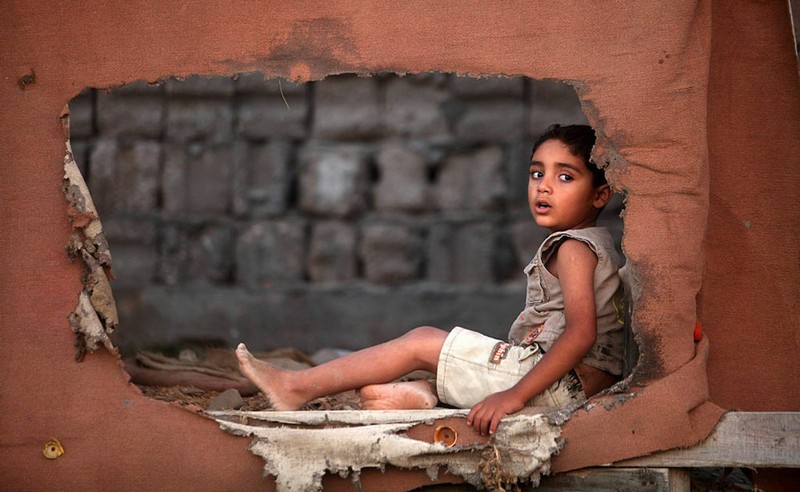
If only we could say that Peter Dutton, Australia’s federal opposition leader and curator of bigoted leanings, was unusual in assuming that granting humanitarian visas to Palestinians might be problematic.  But both he, and his skew-eyed spokesman on home affairs, James Patterson, have concluded that votes are in the offing.  Refugees may be accepted from the Ukrainian-Russian War, as long as they are Ukrainian, but anything so much as a whiff of a Palestinian fleeing the Israel-Hamas conflict is bound to be concerning.  Ukrainians are noble victims; the latter might be terrorist sympathisers or Hamas militants.

This view started being floated in November last year, when Dutton began warning the public that visitor visas for Palestinians could result in a calamity.  (At that point, 860 visas had been issued to Palestinians.)  “The inadequacy of these checks could result in a catastrophic outcome in our country,” he foamed.  “Taking people out of a war zone without conducting the checks, particularly those that are available to us in the US, is reckless.”

No concern was voiced about the possibility that Israelis, who had also been offered 1,793 visas, might pose a problem to the heavenly idyll of Australian security.  It is also worth mentioning that Dutton, when home affairs minister, approved over 500 visas a week to Syrians fleeing the civil war.  Ditto the granting of 5,000 visas to Afghans the month the Taliban resumed control of Kabul in the aftermath of retreating Western armies.

Dutton’s arithmetic is that of the typical copper: simple, direct, amateurish.  Among the Palestinians, “one person, or could be 10 people, I don’t know” might be of concern.  His concerns are feverishly listed: “Have interviews been conducted, do we know people’s ideologies, do we know their interest in the west, why they want to come to Australia.”  This template would be applicable to every group of visitors or migrants seeking to come to Australia at any one point.  No one is likely to say on their visa application: “I come to see your new country and hope to commit atrocities.”

Given the number of conflict zones on Planet Earth, Dutton was offering an obtuse statement calculated to boost flagging popularity.  It was also timed within a matter of hours after the declaration of a four-day ceasefire in Gaza.  While proving, at times, sketchy in her role as Home Affairs Minister, Clare O’Neil was close to the mark in stating that, “Dutton is a reckless politician who will do and say anything to score political points – even if it puts the national security of Australians at risk.”

But Dutton did not want to be dismissed as a paranoid former police officer who sees criminals everywhere and innocence as a constipated afterthought.  “The prime minister here needs to hit the pause button – I’m not saying people shouldn’t come at some point – but people should come when all the checks are conducted.”

Again, a strange sentiment, given that visa applicants tend to face a series of tests that are more demanding than most when seeking to visit the Down Under Paradise where perfection is assumed.  “If a visa applicant is assessed as posing a risk to the health, safety or good order of the Australian community, their visa may be considered for refusal,” were the dull words of a government spokesperson.

With the arrival of irregular migrants on the shores of Western Australia this month, cockeyed bigotry again assumed its role on the podium of Australian politics.  Seeking to tie the arrivals as connected with shoddy security credentials, the opposition fanned out the implications of granting up to 2,000 visas for Palestinians, a fact seen as particularly galling to the shadow home affairs minister.  “In the middle of an unprecedented antisemitism crisis, the government should be taking much greater care in granting visas to people from a war zone run by a terrorist organisation,” bleated Patterson.  “How can they possibly assure themselves there is not one Hamas supporter among them?  And how will it help social cohesion if they manage to slip through?”

By this logic, no one should ever leave a war zone, an area of devastation, a territory blighted by terror.  You just might be a regime supporter, a sympathiser, despite suffering possible harm, even death.  But there is an inadvertent slant coming through in Patterson’s mangled world view: Palestinians, having been maimed, murdered and traumatised, might wish to take out their grievance on a foreign power, possibly one sympathetic to Israel.  Ignore the survival imperative, the desire to find, rather than abandon, security; focus, instead, on the motivation for vengeance. Even this view suffers for one obvious point: those wishing to avenge their families and friends are bound to wish to stay in Gaza and the West Bank, rather than flee and plot from afar.

With the current arrivals from Gaza – some 340 or so have managed to drip themselves from the Palestinian territories – the bedwetting fantasies of terror being induced by the opposition seem absurd and callous.  But absurdity is a proven calculus for electoral success – at least sometimes.

Dr. Binoy Kampmark was a Commonwealth Scholar at Selwyn College, Cambridge.

25 February 2024

Source: countercurrents.org

10 Questions Corporate Media Isn’t Asking About Israel-Gaza But Should

By Ralph Nader

There has been so much reporting since October 7, but we are still missing answers for key issues.

Last October 27, I suggested subjects the mainstream media needed to cover relating to the saturation bombing of Gaza and its defenseless civilian families and infrastructure. Looking at these topics now, four months later, despite massive reporting, the attention to these subjects is still thin and more deserving of reporting than ever.

1. How did Hamas, with tiny Gaza surrounded by a 17-year Israeli blockade, subjected to unparalleled electronic surveillance, with spies and informants, and augmented by an overwhelming air, sea and land military presence, manage to get the weapons and associated technology for their October 7th surprise raid? Readers still do not know how and from where these weapons entered Gaza year after year.

2. What is the connection between the stunning failure of the Israeli government to protect its people on the border and the policy of P.M. Netanyahu? Recall the New York Times (October 22, 2023) article by prominent journalist, Roger Cohen, to wit: “All means were good to undo the notion of Palestinian statehood. In 2019, Mr. Netanyahu told a meeting of his center-right Likud party: ‘Those who want to thwart the possibility of a Palestinian state should support the strengthening of Hamas and the transfer of money to Hamas. This is part of our strategy.’” (Note: Israel and the U.S. fostered the rise of Islamic Hamas in 1987 to counter the secular Palestine Liberation Organization (PLO)). Readers still need more information about the context of Netanyahu’s declared support for Hamas over the years and his connection to the buildup of Hamas funding and weaponry.

3. Why is Congress preparing to appropriate over $14 billion to Israel in military and other aid without any public hearings and without any demonstrated fiscal need by Israel, a prosperous economic, technological and military superpower with a social safety net superior to that of the U.S.? USDA just reported over 44 million Americans struggled with hunger in 2022. This, in the midst of a childcare crisis. Should U.S. taxpayers be expected to pay for Netanyahu’s colossal intelligence/military collapse? As an elderly Holocaust survivor told the New York Times “It should never have happened” in the first place.

4. Why hasn’t the media reported on President Biden’s statement that the Gaza Health Ministry’s body count (now over 7000 fatalities) is exaggerated? Indications, however, are that it is a large undercount by Hamas to minimize its inability to protect its people. Israel has fired over 8,000 powerful precision munitions and bombs into Gaza so far. These have struck many thousands of inhabited buildings – homes, apartments buildings, over 120 health facilities, ambulances, crowded markets, fleeing refugees, schools, water and sewage systems, and electric networks – implementing Israeli military orders to cut off all food, water, fuel, medicine and electricity to this already impoverished densely packed area the size of Philadelphia. For those not directly slain, the deadly harm caused by no food, water, medicine, medical facilities and fuel will lead to even more deaths and serious injuries.

Note that over three-quarters of Gaza’s population consists of children and women. Soon there will be thousands of babies born to die in the rubble. Other Palestinians will perish from untreated diseases, injuries, dehydration, and from drinking contaminated water. With crumbled sanitation facilities, physicians are fearing a deadly cholera epidemic.

Israel bombed the Rafah crossing on the Gaza-Egypt border. Only a tiny trickle of trucks are now allowed there by Israel to carry food and water. Fuel for hospital generators still remains blocked.

The undercount of fatalities/injuries is far greater now. The official figure is about 30,000 lives lost, with hundreds dying every day under the rubble. There is too little media interest in more realistic estimates. Undercounting lessens the pressure on Washington officials’ co-belligerents in the White House to call for a permanent ceasefire.

5. Why can’t Biden even persuade Israel to let 600 desperate Americans out of the Gaza firestorm?

6. Why isn’t the mass media making a bigger issue out of Israel’s long-time practice of blocking journalists from entering Gaza, including European, American and Israeli journalists? The only television crews left are Gazan-residing Al Jazeera reporters. Israeli bombs have already killed 26 journalists in the Gaza Strip since October 7th. Is Israel targeting journalists’ families? The Gaza bureau chief of Al Jazeera, Wael Al-Dahdouh’s family was killed in an Israeli airstrike on Wednesday. Israeli commanders now have killed over 100 journalists in addition in some cases to their entire families and continue to block foreign journalists except for a few brief “guided tours” in Israeli armored vehicles.

7. Why isn’t the mainstream U.S. media giving adequate space and voice to groups advocating a ceasefire and humanitarian aid? The message of Israeli peace groups’ peaceful solutions are drowned out by the media’s addiction to interviews with military tacticians. Much time and space are being given to hawks pushing for a war that could flash outside of Gaza big time. Shouldn’t groups such as Jewish Voice for Peace, the Arab-American Institute, Veterans for Peace and associations of clergy have their views and activities reported? Still being underreported are the activities all over the country of the Veterans for Peace and large labor unions demanding a permanent ceasefire and humanitarian aid.

8. Why is the coverage of the war overlooking the Geneva Conventions, the United Nations Charter and the many provisions of international law that all the parties, including the U.S., have been violating? (See the October 24, 2023 letter to President Biden). Under international law, Biden has made the U.S. an active “co-belligerent,” of the Israeli government’s vocal demolition of the 2.3 million inhabitants in Gaza, who are mostly descendants of Palestinian refugees driven from their homes in 1948. (See, Convention on the Prevention and Punishment of the Crime of Genocide). Coverage has expanded to include the U.S. vetoes on the Security Council and to global reporting on the International Court of Justice proceedings on South Africa’s calling for the Court to address Israel’s genocide of Palestinians in the Gaza Strip.

9. What about revealing human-interest stories? For example: How do Israeli F-16 pilots feel about their daily bombing of the completely defenseless Gazan civilian population and its life-sustaining infrastructures? The reporting on the military orders given to Israeli soldiers in Gaza who are slaying indiscriminately thousands of innocents of all ages and snipers attacking people and children in hospitals is inadequate. Why are no Hamas fighters taken as prisoners of war? Is there an order of “take no prisoners” even after capture? What are the courageous Israeli human rights and refuseniks thinking and doing in a climate of serious repression of their views as a result of Netanyahu’s defense collapse on October 7th? The open letter to President Biden on December 13, 2023, by 16 Israeli human rights groups appeared as a paid notice in the New York Times but received very little notice to its clarion call to stop the catastrophe in Gaza. (See the letter here).

10. Where is the media attention on the statements from Israeli military commentators, who, for years have declared high-tech US-backed, nuclear-armed Israel to be more secure than at any time in its history? Israel is reasserting its overwhelming military domination of the Middle East region, fully backed by U.S. militarism. The Israeli government is putting ads in U.S. newspapers wildly exaggerating long-subdued Hamas as an “existential” threat. Without Netanyahu strangely failing to keep the border guarded on October 7, 2023, what followed would not have happened!

Historians remind us that in a grid-locked conflict over time, it is the most powerful party’s responsibility to lead the way to peace.

Establishing a two-state solution has been supported by many Palestinians. All the Arab nations, starting with the Arab League peace proposal in 2002, support this solution as well. It is up to Israel and the U.S., assuming annexation of what is left of Palestine is not Israel’s objective. (See, the March 29, 2002 New York Times article: Mideast Turmoil; Text of the Peace Proposals Backed by the Arab League).

More media attention on this subject matter is much needed.

Ralph Nader is a consumer advocate and the author of “The Seventeen Solutions: Bold Ideas for Our American Future” (2012).

25 February 2024

Source: countercurrents.org

Gaza becomes “death zone” as UN suspends humanitarian aid to hundreds of thousands in north

By Jordan Shilton

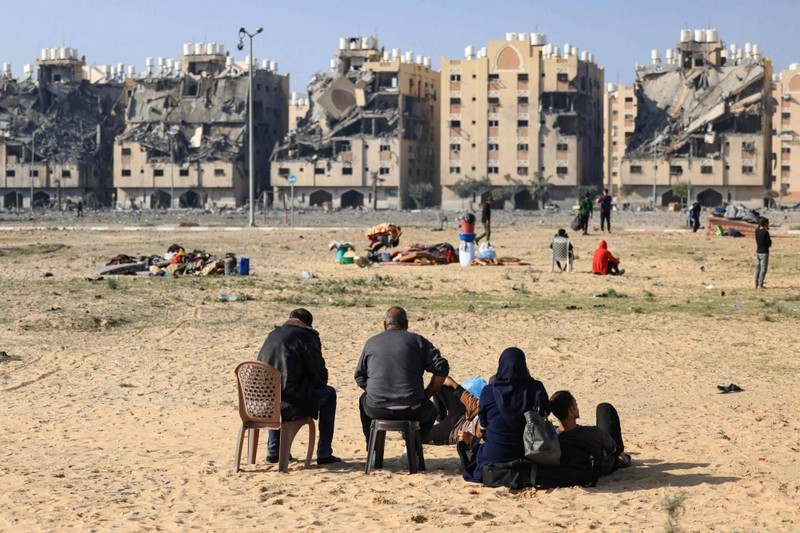
The United Nations World Food Programme (WFP) announced Tuesday the suspension of all humanitarian aid to the northern parts of the Gaza Strip. The estimated 400,000 people still languishing in Gaza City and the surrounding areas have barely received any aid for months due to Israel’s blockade. Reports have surfaced of families surviving on animal feed.

Deliveries only resumed Sunday after a three-week pause prompted by the bombing of an UNRWA truck by Israel. The WFP statement announcing the latest suspension observed, “The plan was to send 10 trucks of food for seven straight days, to help stem the tide of hunger and desperation and to begin building trust in communities that there would be enough food for all.

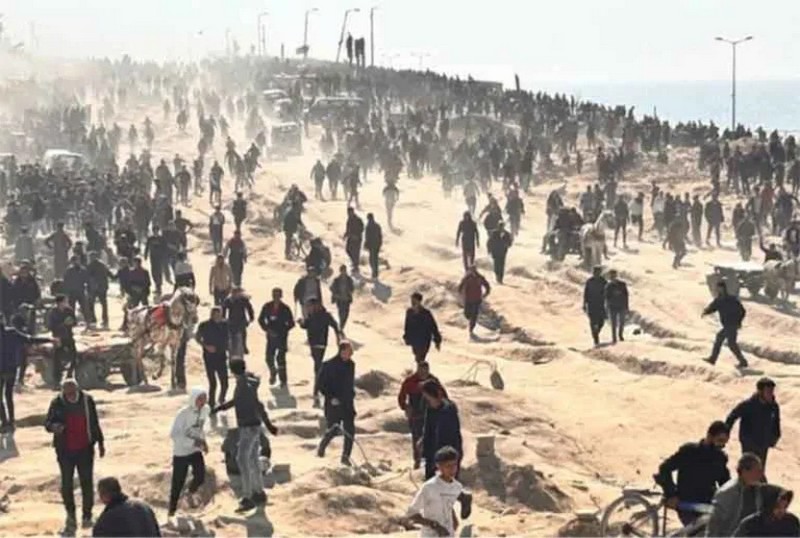
“On Sunday, as WFP started the route towards Gaza City, the convoy was surrounded by crowds of hungry people close to the Wadi Gaza checkpoint. First fending off multiple attempts by people trying to climb aboard our trucks, then facing gunfire once we entered Gaza City, our team was able to distribute a small quantity of the food along the way. On Monday, the second convoy’s journey north faced complete chaos and violence due to the collapse of civil order. Several trucks were looted between Khan Younes and Deir al Balah, and a truck driver was beaten. The remaining flour was spontaneously distributed off the trucks in Gaza City, amidst high tension and explosive anger.”

After predicting in December that inhabitants would face a famine by May if the situation did not radically improve, the agency reported “unprecedented levels of desperation” for residents in the north this week. A report released by the WFP and UNICEF Monday revealed that one in six children in the northern Gaza Strip under the age of two are acutely malnourished.

This horrendous situation is the deliberate outcome of Israel’s genocidal onslaught on Gaza, which has already claimed the lives of well over 30,000 people. The official death toll rose above 29,300 Wednesday, with another 7,000 people declared missing and presumed dead. Since the beginning of the bombardment last October, Israel has intentionally prevented aid from reaching Gaza, using food as a weapon of war.

In November, Giora Eiland, the former head of Israel’s National Security Council, published an article in which he advocated the use of starvation and disease to decimate the population. He wrote, “The international community warns us of a humanitarian disaster in Gaza and of severe epidemics. We must not shy away from this, as difficult as that may be. After all, severe epidemics in the south of the Gaza Strip will bring victory closer and reduce casualties among IDF soldiers.”

As the World Socialist Web Site noted at the time, this policy is akin to the strategy of the Nazis during World War II towards the Jews, who were left to rot in the ghettos, where many died of starvation and disease before the survivors were shipped to concentration camps.

While the levels of hunger and disease in the north are especially extreme, the situation facing Gaza’s entire population is horrific. World Health Organisation (WHO) Director General Tedros Adhanom Ghebreyesus described Gaza Wednesday as a “death zone.” He added, “The health and humanitarian situation in Gaza is inhumane and continues to deteriorate.”

UN Special Rapporteur Francesca Albanese referred to a “total collapse of civil order” across the enclave. Noting the WFP’s decision to suspend aid to the north, she added, “Imagine as a parent having to fight to get food for your child who is dying of hunger. … Shame on all of us for allowing this betrayal of humanity.”

Al-Jazeera spoke to a mother living in the playground of an UNRWA school in the Jabalia refugee camp in northern Gaza who is being forced to feed her eight-person family on fried pancakes made from ground animal feed. She said, “This food is insatiable. My little one wakes up at night screaming from hunger because only bread fills the children’s stomachs.

“Today I found this corn flour, and maybe I won’t find it tomorrow … the situation is getting worse day by day, our situation is very miserable.”

At the al-Nasser Hospital in Khan Younis, a joint mission by the UN’s Office for the Coordination of Humanitarian Affairs (OCHA), WHO and Palestinian Red Crescent uncovered “appalling conditions” while evacuating the most seriously injured patients after a weeks-long siege by the Israel Defence Forces (IDF). OCHA official Jonathan Whittall remarked, “There are 150 patients in one of these buildings. They have no food and water, no electricity. There’s very few doctors and nurses that are remaining inside this hospital…

“There are dead bodies in the corridors. Patients are in a desperate situation. This has become a place of death, not a place of healing.”

Amid this misery, Israel’s daily bombardments continue. A strike on a family home in Rafah Tuesday night killed a human rights lawyer with the Palestinian Centre for Human Rights, Nour Naser abu al-Nour, and seven members of her family. The organisation said she played a role in documenting human rights abuses and fighting injustice. Strikes on the Zeitoun neighbourhood of Gaza City and Nuseirat refugee camp in the central Gaza Strip killed at least 12 people Wednesday, including a journalist and his wife.

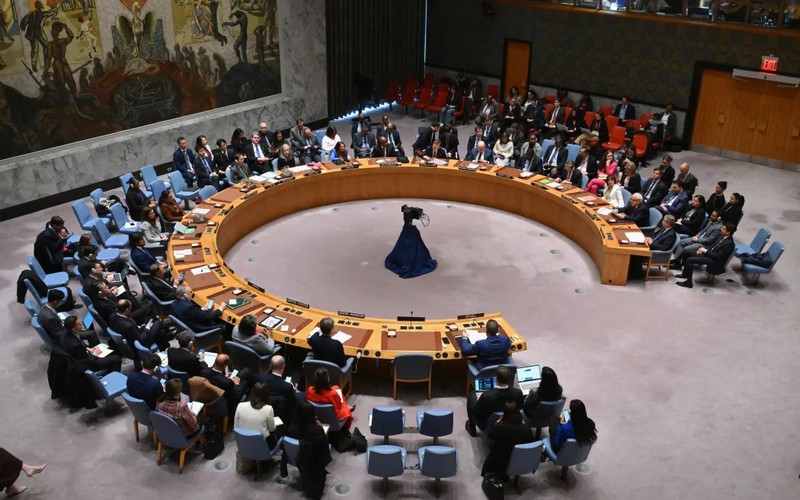
The catastrophe confronting the Palestinians in Gaza continues to worsen due to the unrestrained support extended to Israel by US imperialism and its European allies. On Tuesday, as the reports of mass starvation were pouring out of Gaza, Washington used its veto in the UN Security Council to block a resolution calling for a ceasefire. The vaguely worded text proposed by the US instead of the original text submitted by Algeria called for a ceasefire “as soon as is practicable,” i.e., at the discretion of Israel’s far-right government that has repeatedly declared its intent to conduct a genocide against the Palestinians.

War Cabinet Minister Benny Gantz reiterated Wednesday Israel’s readiness to launch an all-out offensive on Rafah during Ramadan. At least 1.4 million people are crammed into the city, which was home to just 280,000 prior to Israel’s bombardment. A ground offensive would force the Palestinians from their last refuge in Gaza, realising Israel’s plan to ethnically cleanse the enclave in order to establish Jewish settlements and direct security control.

The imperialist powers’ endorsement of this savagery is linked to their pursuit of a region-wide war targeting Iran and its allies. The Middle East is rapidly emerging as one front in the imperialist powers’ redivision of the world, which is being driven by the intractable contradictions of the capitalist profit system. Further US air strikes against the Houthis in Yemen were reported Wednesday, while Israel carried out a strike on Damascus that was allegedly aimed at a senior Hezbollah official. Washington is determined at all costs to consolidate its dominance over the energy-rich Middle East against its rivals, above all, China and Russia even at the cost of a regional bloodbath.

The only social force capable of bringing an end to the misery of Gaza’s population and stopping the descent of the Middle East into war is the international working class. Mobilising the mass opposition to Israel’s genocide that has been expressed by millions of people in demonstrations around the world over recent months, workers must fight to halt all military supplies and production destined for Israel. The urgent task is the building of an international anti-war movement to stop the genocide and the imperialists’ escalation of a third world war by advancing a socialist programme to put an end to crisis-ridden capitalism.

Originally published by WSWS.ORG

22 February 2024

Source: countercurrents.org

‘Two-State Solution’ as a Distraction – The Problem is Zionism

By Dr Ramzy Baroud

The problem is not the absence of a Palestinian state, but Zionism itself.

What is the use of a Palestinian state, if Zionism, as a racist, exclusivist ideology continues to define Israel, and impose that definition on the Palestinians?

This ideology calls for racial purity of Jews in Palestine, of course, at the expense of the native inhabitants of the land. To achieve this, millions of Palestinians had to be forced into exile, hundreds of thousands needed to be killed, wounded or incarcerated.

Neither two states, nor even one state is possible if Zionism is not entirely defeated – not revamped, not ‘fixed’, but eradicated.

As Palestinians are being killed in unprecedentedly large numbers in Gaza, western politicians are waking up to the necessity of a Palestinian state.

But why now? After all, it was these very politicians and their governments that either defended or remained silent as Israel thwarted every possibility of peaceful co-existence.

Theirs is not a moral awakening, but a distraction, to appear – at least before their own people – to be proactive, while Israel is systematically destroying the Palestinian people.

Former UNRWA official, Chris Gunnes, said about the Israeli war on Gaza that this is “the first genocide in the history of humanity that is livestreamed on television”.

The genocide is worsening now that Palestinians are starting to die from starvation, while an even larger number is dying from disease and polluted water, aside, of course, from those being blown up or shot by Israel.

For the likes of David Cameron, Britain’s Foreign Minister, to talk about the recognition of a Palestinian state as “absolutely vital” for “long-term peace”, is bewildering, to say the least. Those struggling to survive daily are hardly concerned about yet more empty western promises.

The genocide underway in Gaza tells us that the issue is not merely political, but an ideological one. And, while western leaders speak of ‘long-term peace’, Israel entrenches its system of violence and apartheid.

“There cannot be a situation in which children and women approach us from the wall. Anyone (…) must receive a bullet,” Israeli National Security Minister Itamar Ben-Gvir said on February 12.

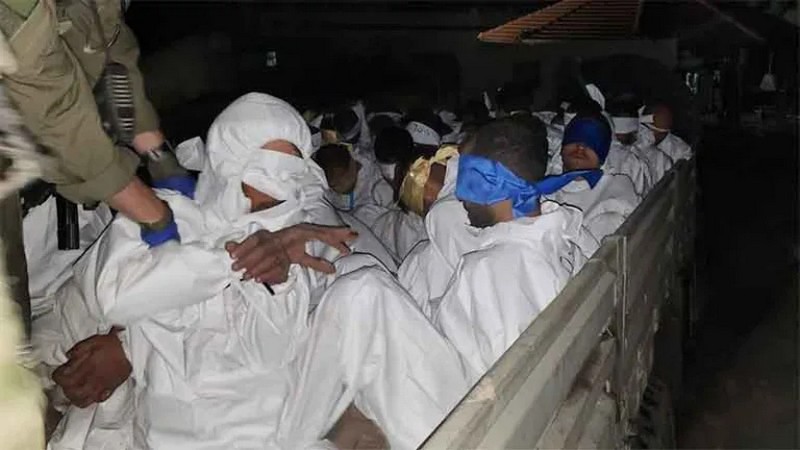
In Gaza, the violence is far more sickening. Euro-Med Monitor, a rights group, reported on February 12 that “groups of ten to twenty Israeli civilians at a time were permitted to watch and laughingly film Palestinian prisoners and detainees in their underwear” as they were tortured and abused by Israeli soldiers.

There can be no rational political justification for any of this.

All of this – the language of genocide, the genocide itself and the threats of committing a greater genocide – is rooted, not in a rational political theory, but in Zionism.

The problem keeps getting worse because we refuse to address it head-on. In fact, many are doing the exact opposite. For example, western governments have passed – or are passing – laws equating between criticism of Zionism and anti-Semitism. Even Facebook wants to ban the use of the term ‘Zionist’ if it is critical of Israel.

When Israeli Heritage Minister, Amichai Eliyahu, threatened, on November 5, to drop a nuclear bomb on Gaza, he was condemned by many merely for his inappropriate language, not the act itself. Some Israeli officials also criticized Eliyahu as well, only for damaging Israel’s international reputation.

The Israeli Minister, however, was not simply talking out of anger. He meant it, because Israel’s behavior in Gaza, since then, has demonstrated that such willingness to kill Palestinians en masse actually exists.

Zionists are ready to do anything to survive, and their survival is wholly dependent on the erasure of the perceived enemy; not ‘erasure’ in an intellectual, political, or even cultural sense, but the physical destruction of the Palestinians as well.

The ethnic cleansing of Palestine, known as the Nakba, in 1948, was a serious attempt at achieving that goal. But since the ‘enemy’, being the Palestinian nation, had survived and continues to resist and demand its collective rights, the ethnic cleansing of the Palestinian people is now back on the mainstream Israeli political agenda.

This ongoing Gaza war is the most serious attempt, to date, to destroy the Palestinian people. This is why Israeli Prime Minister, Benjamin Netanyahu, and his government want to carry on with the war. On the one hand, they want to ensure the continued slaughter, thus the extermination of the Palestinians and, on the other, they are also fully aware that this is a historic opportunity to finish a job that previous Zionist leaders did not complete, 75 years earlier.

Indeed, Israel sees the war on Gaza beyond the geographic confines of the tiny Gaza Strip. It is a war on the Palestinians everywhere. If Israel succeeds in subduing Gaza, it will turn its gaze immediately to the West Bank, then to the millions of Palestinians inside Israel.

It is important to recall that, before the current war, the Israeli incitement against Palestinians was focused mostly on the West Bank – with the declared aim of annexing over a third of that occupied region.

There was also a major official Israeli campaign to curtail the rights and incite hatred against Palestinian Arabs inside Israel. This campaign is rooted in history but has become far more apparent following the Unity Intifada (uprising) of May 2021.

It was then that Israel realized that the ‘division’ of the Palestinians was largely political, and that, as a nation, Palestinians remain strongly connected.

That is why Ben-Gvir lobbied, even before he claimed his ministerial position in December 2022, to have a National Guard tasked with “restoring governance where needed”.

If Gaza falls, all Palestinians in the rest of Palestine will become the new target for Israeli violence, ethnic cleansing and, if necessary, genocide.

Reducing all these issues to that of finding creative political solutions that would merely sell false hope to the Palestinian people is not only ignorant, or devious, but also a diversion from the real issue: Israel’s Zionist ideology.

Zionism, like all racist colonial ideologies, operates with a zero-sum approach to their relationship with the natives of colonized land: dominance through ethnic cleansing and genocide.

For ‘long-term peace’ to take place, Zionism must end.

Dr. Ramzy Baroud is a journalist, author and the Editor of The Palestine Chronicle.

22 February 2024

Source: countercurrents.org

Identifying Imperial Venality: Day One of Julian Assange’s High Court Appeal

By Dr Binoy Kampmark

On February 20, it was clear that things were not going to be made easy for Julian Assange, the WikiLeaks founder who infuriated the US imperium, the national security establishment, and a stable of journalists upset that he had cut their ill-tended lawns.  He was too ill to attend what may well be the final appeal against his extradition from the United Kingdom to the United States.  Were he to be sent to the US, he faces a possible sentence amounting to 175 years arising from 18 venally cobbled charges, 17 spliced from that archaic horror, the Espionage Act of 1917.

The appeal to the High Court, comprising Justice Jeremy Johnson and Dame Victoria Sharp, challenges the extradition order by the Home Secretary and the conclusions of District Judge Vanessa Baraitser who, despite ordering his release on risks posed to him on mental health grounds, fundamentally agreed with the prosecution.  He was, Varaitser scorned, not a true journalist.  (Absurdly, it would seem for the judge, journalists never publish leaked information.)  He had exposed the identities of informants.  He had engaged in attempts to hack computer systems.  In June 2023, High Court justice, Jonathan Swift, thought it inappropriate to rehear the substantive arguments of the trial case made by defence.

Assange’s attorneys had informed the court that he simply could not attend in person, though it would hardly have mattered.  His absence from the courtroom was decorous in its own way; he could avoid being displayed like a caged specimen reviled for his publishing feats.  The proceedings would be conducted in the manner of appropriate panto, with dress and procedure to boot.

Unfortunately, as things chugged along, the two judges were seemingly ill versed in the field they were adjudicating.  Their ignorance was telling on, for instance, the views of Mark Pompeo, whose bilious reaction to WikiLeaks when director of the Central Intelligence Agency involved rejecting the protections of the First Amendment of the US Constitution to non-US citizens.  (That view is also held by the US prosecutors.)  Such a perspective, argued Assange’s legal team, was a clear violation of Article 10 of the European Convention of Human Rights.

They were also surprised to be informed that further charges could be added to the indictment on his arrival to the United States, including those carrying the death penalty.  To this could be added other enlightening surprises for the judicial bench: the fact that rules of admissibility might be altered to consider material illegally obtained, for instance, through surveillance; that Assange might also be sentenced for an offence he was never actually tried for.

Examples of espionage case law were submitted as precedents to buttress the defence, with Edward Fitzgerald KC calling espionage a “pure political offence” which barred extradition in treaties Britain had signed with 158 nation states.

The case of David Shayler, who had been in the employ of the British domestic intelligence service MI5, saw the former employee prosecuted for passing classified documents to The Mail on Sunday in 1997 under the Official Secrets Act.  These included the names of various agents, that the agency kept dossiers on various UK politicians, including Labour ministers, and that the British foreign intelligence service, MI6, had conceived of a plan to assassinate Libya’s Colonel Muammar Gaddafi.  When the UK made its extradition request to the French authorities, they received a clear answer from the Cour d’Appel: the offence charged was found to be political in nature.

Mark Summers KC also emphasised the point that the “prosecution was motivated to punish and inhibit the exposure of American state-level crimes”, ample evidence of which was adduced during the extradition trial, yet ignored by both Baraitser and Swift.  Baraitser brazenly ignored evidence of discussions by US intelligence officials about a plot to kill or abduct Assange.

For Summers, chronology was telling: the initial absence of any prosecution effort by the Obama administration, despite empanelling a grand jury to investigate WikiLeaks; the announcement by the International Criminal Court that it would be investigating potential crimes committed by US combatants in Afghanistan in 2016, thereby lending gravity to Assange’s disclosures; and the desire to kill or seek the publisher’s extradition after the release of the Vault 7 files detailing various espionage tools of the CIA.

With Pompeo’s apoplectic declaration that WikiLeaks was a hostile, non-state intelligence service, the avenue was open for a covert targeting of Assange in the Ecuadorian embassy in London.  The duly hatched rendition plan led to the prosecution, which proved “selective” in avoiding, for instance, the targeting of newspaper outlets such as Freitag, or the website Cryptome.  In Summer’s view, “This is not a government acting on good faith pursuing a legal path.”

When it came to discussing the leaks, the judges revealed a deep-welled obliviousness about what Assange and WikiLeaks had actually done in releasing the US State Department cables.  For one thing, the old nonsense that the unredacted, or poorly redacted material had resulted in damage was skirted over, not to mention the fact that Assange had himself insisted on a firm redaction policy.   No inquiry has ever shown proof that harm came to any US informant, a central contention of the US Department of Justice.  Nor was it evident to the judges that the publication of the cables had first taken place in Cryptome, once it was discovered that reporters from The Guardian had injudiciously revealed the password to the unredacted files in their publication.

Two other points also emerged in the defence submission: the whistleblower angle, and that of foreseeability.  Consider, Summers argued hypothetically, the situation where Chelsea Manning, whose invaluable disclosures WikiLeaks published, had been considered by the European Court of Human Rights.  The European Union’s whistleblower regime, he contended, would have considered the effect of harm done by violating an undertaking of confidentiality with the exposure of abuses of state power.  Manning would have likely escaped conviction, while Assange, having not even signed any confidentiality agreements, would have had even better prospects for acquittal.

The issue of foreseeability, outlined in Article 7 of the ECHR, arose because Assange, his team further contends, could not have known that publishing the cables would have triggered a lawsuit under the Espionage Act.  That said, a grand jury had refused to indict the Chicago Times in 1942 for publishing an article citing US naval knowledge of Japanese plans to attack Midway Island.  Then came the Pentagon Papers case in 1971.  While Summers correctly notes that, “The New York Times was never prosecuted,” this was not for want for trying: a grand jury was empanelled with the purpose of indicting the Times reporter Neil Sheehan for his role in receiving classified government material.  Once revelations of government tapping of whistleblower Daniel Ellsberg was revealed, the case collapsed.  All that said, Article 7 could provide a further ground for barring extradition.

February 21 gave lawyers for the US the chance to reiterate the various, deeply flawed assertions about Assange’s publication activities connected with Cablegate (the “exposing informants” argument), his supposedly non-journalistic activities and the integrity of diplomatic assurances about his welfare were he to be extradited.  The stage for the obscene was duly set.

Dr. Binoy Kampmark was a Commonwealth Scholar at Selwyn College, Cambridge.

22 February 2024

Source: countercurrents.org

After Two Years of War in Ukraine, It’s Time for Peace

By Medea Benjamin and Nicolas J. S. Davies

As we mark two full years since Russia invaded Ukraine, Ukrainian government forces have withdrawn from Avdiivka, a town they first captured from the self-declared Donetsk People’s Republic (DPR) in July 2014. Situated only 10 miles from Donetsk city, Avdiivka gave Ukrainian government forces a base from which their artillery bombarded Donetsk for nearly ten years. From a pre-war population of about 31,000, the town has been depopulated and left in ruins.

The mass slaughter on both sides in this long battle was a measure of the strategic value of the city to both sides, but it is also emblematic of the shocking human cost of this war, which has degenerated into a brutal and bloody war of attrition along a nearly static front line. Neither side made significant territorial gains in the entire 2023 year of fighting, with a net gain to Russia of a mere 188 square miles, or 0.1% of Ukraine.

And while it is the Ukrainians and Russians fighting and dying in this war of attrition with over half a million casualties, it is the United States, with some its Western allies, that has stood in the way of peace talks. This was true of talks between Russia and Ukraine that took place in March 2022, one month after the Russian invasion, and it is true of talks that Russia tried to initiate with the United States as recently as January 2024.

In March 2022, Russia and Ukraine met in Turkey and negotiated a peace agreement that should have ended the war. Ukraine agreed to become a neutral country between east and west, on the model of Austria or Switzerland, giving up its controversial ambition for NATO membership. Territorial questions over Crimea and the self-declared republics of Donetsk and Luhansk would be resolved peacefully, based on self-determination for the people of those regions.

But then the U.S. and U.K. intervened to persuade Ukraine’s President Volodomyr Zelenskyy to abandon the neutrality agreement in favor of a long war to militarily drive Russia out of Ukraine and recover Crimea and Donbas by force. U.S. and U.K. leaders have never admitted to their own people what they did, nor tried to explain why they did it.

So it has been left to everyone else involved to reveal details of the agreement and the U.S. and U.K.’s roles in torpedoing it: President Zelenskyy’s advisers; Ukrainian negotiators; Turkish foreign minister Mevlüt Çavuşoğlu and Turkish diplomats; Israeli Prime Minister Naftali Bennett, who was another mediator; and former German Chancellor Gerhard Schroder, who mediated with Russian President Vladimir Putin for Ukraine.

The U.S. sabotage of peace talks should come as no surprise. So much of U.S. foreign policy follows what should by now be an easily recognizable and predictable pattern, in which our leaders systematically lie to us about their decisions and actions in crisis situations, and, by the time the truth is widely known, it is too late to reverse the catastrophic effects of those decisions. Thousands of people have paid with their lives, nobody is held accountable, and the world’s attention has moved on to the next crisis, the next series of lies and the next bloodbath, which in this case is Gaza.

But the war grinds on in Ukraine, whether we pay attention to it or not. Once the U.S. and U.K. succeeded in killing peace talks and prolonging the war, it fell into an intractable pattern common to many wars, in which Ukraine, the United States and the leading members of the NATO military alliance were encouraged, or we might say deluded, by limited successes at different times into continually prolonging and escalating the war and rejecting diplomacy, in spite of ever-mounting, appalling human costs for the people of Ukraine.

U.S. and NATO leaders have repeated ad nauseam that they are arming Ukraine to put it in a stronger position at the “negotiating table,” even as they keep rejecting negotiations. After Ukraine gained ground with its much celebrated offensives in the fall of 2022, U.S. Chairman of the Joint Chiefs of Staff General Mark Milley went public with a call to “seize the moment” and get back to the negotiating table from the position of strength that NATO leaders said they were waiting for. French and German military leaders were reportedly even more adamant that that moment would be short-lived if they failed to seize it.

They were right. President Biden rejected his military advisers’ calls for renewed diplomacy, and Ukraine’s failed 2023 offensive wasted its chance to negotiate from a position of strength, sacrificing many more lives to leave it weaker than before.

On February 13, 2024, Reuters Moscow bureau broke the story that the United States had recently rejected a new Russian proposal to reopen peace negotiations. Multiple Russian sources involved in the initiative told Reuters that Russia proposed direct talks with the United States to call a ceasefire along the current front lines of the war.

After Russia’s March 2022 peace agreement with Ukraine was vetoed by the U.S., this time Russia approached the United States directly before involving Ukraine. There was a meeting of intermediaries in Turkey, and a meeting between Secretary of State Blinken, CIA Director Burns and National Security Adviser Sullivan in Washington, but the result was a message from Sullivan that the U.S. was willing to discuss other aspects of U.S.-Russian relations, but not peace in Ukraine.

And so the war grinds on. Russia is still firing 10,000 artillery shells per day along the front line, while Ukraine can only fire 2,000. In a microcosm of the larger war, some Ukrainian gunners told reporters they were only allowed to fire 3 shells per night. As Sam Cranny-Evans of the U.K.’s RUSI military think-tank told the Guardian, “What that means is that Ukrainians can’t suppress Russian artillery any more, and if the Ukrainians can’t fire back, all they can do is try to survive.”

A March 2023 European initiative to produce a million shells for Ukraine in a year fell far short, only producing about 600,000. U.S. monthly shell production in October 2023 was 28,000 shells, with a target of 37,000 per month by April 2024. The United States plans to increase production to 100,000 shells per month, but that will take until October 2025.

Meanwhile, Russia is already producing 4.5 million artillery shells per year. After spending less than one tenth of the Pentagon budget over the past 20 years, how is Russia able to produce 5 times more artillery shells than the United States and its NATO allies combined?

RUSI’s Richard Connolly explained to the Guardian that, while Western countries privatized their weapons production and dismantled “surplus” productive capacity after the end of the Cold War in the interest of corporate profits, “The Russians have been… subsidizing the defense industry, and many would have said wasting money for the event that one day they need to be able to scale it up. So it was economically inefficient until 2022, and then suddenly it looks like a very shrewd bit of planning.”

President Biden has been anxious to send more money to Ukraine–a whopping $61 billion—but disagreements in the U.S. Congress between bipartisan Ukraine supporters and a Republican faction opposed to U.S. involvement have held up the funds. But even if Ukraine had endless infusions of Western weapons, it has a more serious problem: Many of the troops it recruited to fight this war in 2022 have been killed, wounded or captured, and its recruitment system has been plagued by corruption and a lack of enthusiasm for the war among most of its people.

In August 2023, the government fired the heads of military recruitment in all 24 regions of the country after it became widely known that they were systematically soliciting bribes to allow men to avoid recruitment and gain safe passage out of the country. The Open Ukraine Telegram channel reported, “The military registration and enlistment offices have never seen such money before, and the revenues are being evenly distributed vertically to the top.”

The Ukrainian parliament is debating a new conscription law, with an online registration system that includes people living abroad and with penalties for failure to register or enlist. Parliament already voted down a previous bill that members found too draconian, and many fear that forced conscription will lead to more widespread draft resistance, or even bring down the government.

Oleksiy Arestovych, President Zelenskyy’s former spokesman, told the Unherd website that the root of Ukraine’s recruitment problem is that only 20% of Ukrainians believe in the anti-Russian Ukrainian nationalism that has controlled Ukrainian governments since the overthrow of the Yanukovych government in 2014. “What about the remaining 80%?” the interviewer asked.

“I think for most of them, their idea is of a multinational and poly-cultural country,” Arestovych replied. “And when Zelenskyy came into power in 2019, they voted for this idea. He did not articulate it specifically but it was what he meant when he said, ‘I don’t see a difference in the Ukrainian-Russian language conflict, we are all Ukrainians even if we speak different languages.’”

“And you know,” Arestovych continued, “my great criticism of what has happened in Ukraine over the last years, during the emotional trauma of the war, is this idea of Ukrainian nationalism which has divided Ukraine into different people: the Ukrainian speakers and Russian speakers as a second class of people. It’s the main dangerous idea and a worse danger than Russian military aggression, because nobody from this 80% of people wants to die for a system in which they are people of a second class.”

If Ukrainians are reluctant to fight, imagine how Americans would resist being shipped off to fight in Ukraine. A 2023 U.S. Army War College study of “Lessons from Ukraine” found that the U.S. ground war with Russia that the United States is preparing to fight would involve an estimated 3,600 U.S. casualties per day, killing and maiming as many U.S. troops every two weeks as the wars in Afghanistan and Iraq did in twenty years. Echoing Ukraine’s military recruitment crisis, the authors concluded, “Large-scale combat operations troop requirements may well require a reconceptualization of the 1970s and 1980s volunteer force and a move toward partial conscription.”

U.S. war policy in Ukraine is predicated on just such a gradual escalation from proxy war to full-scale war between Russia and the United States, which is unavoidably overshadowed by the risk of nuclear war. This has not changed in two years, and it will not change unless and until our leaders take a radically different approach. That would involve serious diplomacy to end the war on terms on which Russia and Ukraine can agree, as they did on the March 2022 neutrality agreement.

Medea Benjamin and Nicolas J. S. Davies are the authors of War in Ukraine: Making Sense of a Senseless Conflict, published by OR Books in November 2022.

22 February 2024

Source: countercurrents.org

The Fates of Gaza and Julian Assange Are Sealed Together

By Jonathan Cook

23 Feb 2024 – Were they being properly reported, two critically important court hearings this week, in London and The Hague, would expose the US ‘rules-based order’ as a hollow sham.

Two legal cases posing globe-spanning threats to our most basic freedoms unfolded separately in Britain and the Netherlands this week. Neither received more than perfunctory coverage in western establishment media like the BBC.

One was the last-ditch appeal of Wikileaks founder Julian Assange in London against efforts by the United States to extradite him so he can be locked away for the rest of his life.

Assange’s crime, according to the Biden administration, is that he published leaks exposing the systematic war crimes signed off on by the US and British establishments in Iraq and Afghanistan. The British government, perhaps not surprisingly, has assented to his extradition.

The other case was heard by the International Court of Justice (ICJ) in The Hague. Weeks after the World Court judges deemed it plausible that Israel was carrying out genocide against Palestinians in Gaza, the US client state was back in the dock on a separate matter.

The judges have been asked by the United Nations General Assembly to provide an advisory opinion on whether Israel’s now-permanent occupation and colonisation of the Palestinian territories amounts to an illegal annexation of territory where it has established an apartheid regime.

Separately, Israel also has to report back on whether it has adhered to the court’s earlier ruling that it cease activities that might amount to genocide.

While the cases of Assange and Israel might appear to share little in common, they are, in fact, intimately connected – and in ways that have underscored the degree to which the West’s so-called “rules-based order” is being exposed as a hollow sham.

Media silence

One telling similarity is the limited media coverage each case has attracted despite the gravity of what is at stake. The BBC’s main evening news dedicated mere seconds to the first day of the Assange hearing, and near the end of its running order.

If the US gets its way, the courts would effectively hand the White House the power to seize any publisher who shines a light on US state crimes, and then disappear them into its draconian incarceration system.

The purpose of reclassifying investigative journalism as espionage is to further chill critical reporting and free speech. Any journalist contemplating taking on the US national security state would remember Assange’s cruel fate.

But in truth, much of the establishment media appears to need no such threats, as confirmed by the many years of obedient, near-non-existent reporting on Assange’s mistreatment by British and US authorities.

Meanwhile, if The Hague rules in its favour, Israel would be emboldened to accelerate its theft and colonisation of Palestinian land. The ethnic cleansing and oppression of Palestinians would deepen, with the risk that current regional tensions could further escalate into a wider war.

A win for Israel would rip up the legal framework written after the horrors of the Second World War and the Holocaust, stripping the weak and vulnerable of the protections supposed to be afforded to them by international humanitarian law. Conversely, it would signal to the strongest and most belligerent that they can do as they please.

The legal clock would be set back eight decades or more.

Stinging hypocrisy

Yet strangely, both of these momentous cases – critical to the preservation of a modern liberal democratic order and the rule of law – have received barely a fraction of the interest and media attention dedicated to the death of Alexei Navalny, a critic of Russian President Vladimir Putin.

In flaunting their concerns about Navalny, the western media have once again echoed rather than tackled the all-too-obvious hypocrisies of western governments.

US President Joe Biden this week announced sanctions against Moscow for the targeting of the Russian political dissident. That is the very same Biden seeking, at the same time, to lock a dissident Australian journalist, Assange, out of sight for up to 175 years for bringing to light US war crimes.

For years, the western media have paraded their horror over Navalny’s treatment and various attempts on his life, which they always ascribe to the Kremlin. But there has been barely an eyebrow raised over reported discussions by the CIA in 2017 plotting potential ways to abduct and assassinate Assange.

Few have highlighted the fact that Assange has already suffered a stroke amid his persecution and the 15-year confinement imposed on him by US and UK authorities. He was too unwell to attend this week’s court hearings or even to watch the proceedings via a digital link from the court.

The former UN special rapporteur on torture, Nils Melzer, has long warned that Assange is being slowly “crushed” through isolation and psychological torture, with grave consequences for his health.

Assange’s lawyers warned the High Court in London this week that there was a serious danger the US would add more charges once Assange was extradited, including ones warranting the death penalty. This threat to the life of a western journalist fell under the media radar.

According to medical experts, and accepted by the first judge to hear the extradition case, Assange is in danger of committing suicide should he end up in the strict isolation of a US super-max prison.

The media’s tears for Navalny sting with their hypocrisy.

Blank cheque

Another revealing similarity between the Assange and Israel cases is that both are in front of the courts only because Washington has dug in its heels and refused to resolve the legal issues, despite their deeply ominous implications.

Were the US to withdraw its extradition request, Assange could be set free immediately. The oppressive cloud hanging over the future of a free society, one that has the right and ability to hold its officials to account for wrongdoing, would instantly lift.

Basic freedoms, such as those enshrined in the First Amendment of the US Constitution, are being shredded only because a consensus reigns among the US political class – from Democrats to Republicans – to snuff out such rights.

Similarly, were the US to insist that the mass slaughter of children in Gaza stop – more than 12,000 have died so far – Israel’s guns would fall silent immediately.

Were it to demand that Israel bring to an end its occupation of the Palestinian territories and 17-year siege of Gaza, and were the US to take a genuinely even-handed approach to peace talks, the World Court could set aside its hearings against Israel. Its opinion would be superfluous.

Washington, whatever its protestations, has such power. It is the US and its allies supplying Israel with bombs and ammunition. It is the US and its allies providing the military aid and diplomatic cover that allows Israel to act as an attack dog in the oil-rich Middle East.

Israel’s intransigence, its hunger for others’ land, its dehumanisation of the Palestinian people, and its constant resort to military options would have to be abandoned, however unwillingly, were it not being written a blank cheque by the US.

Instead, the US cast a veto this week at the Security Council, blocking efforts to impose a ceasefire to end the genocide. The UK abstained.

Also this week, US officials told the World Court’s judges they should not call for Israel to end its occupation anytime soon. In Orwellian fashion, decades of violent oppression by Israel and the illegal settlement of Palestinian land were characterised by the US as “Israel’s very real security needs”.

Intimidation campaign

The cases are connected in yet another way.

In the Assange case, the US demands an absolute global legal jurisdiction to hound critics, those who wish to pull away the veil of secrecy that shields western officials from accountability for their crimes.

It wishes to silence those who would expose its lies, deceptions and hypocrisies. It hopes to be able to disappear into its prison system those seeking to enforce the West’s self-professed commitment to a democratic order and lawful behaviour.

In parallel, and for similar reasons, Washington demands the opposite for itself and client states such as Israel. It insists on absolute global legal immunity, whatever they do.

Its veto at the Security Council is wielded to that effect, and so is its campaign of intimidation against judicial authorities who entertain the fanciful notion that the same international law used to rein in enemies might constrain Washington and its allies.

When the ICJ’s sister court at The Hague, the International Criminal Court, sought to properly investigate the US for war crimes in Afghanistan, and Israel for atrocities in the occupied Palestinian territories, Washington went on a rampage.

It placed financial sanctions on leading figures of the ICC and blocked entry to its investigators so they could not carry out their duties. Israel has similarly barred a series of UN special rapporteurs from entering the occupied Palestinian territories to report on human rights abuses there.

Just as the persecution of Assange is meant to terrorise other journalists from considering holding US officials to account for their crimes, the bullying of the highest legal authorities on the planet is intended to send a clear message to national court systems. Certainly, that message appears to have been loudly received in London.

Information void

Another connection is perhaps the most significant. Assange once observed: “Nearly every war that has started in the past 50 years has been a result of media lies.”

It is only because of a void of real information – whether omitted by journalists for fear of upsetting powerful actors, or shielded from view by those same powerful actors’ self-serving secrecy policies – that states can persuade their publics to get behind wars and violent resource grabs.

The only people to gain from these wars are a tiny, wealthy elite at the top of society. All too often it is ordinary people who pay the price: either with their lives or through damage to the parts of the economy on which the public depends.

The continuing proxy war in Ukraine – a Nato-funded and armed war with Russia, using Ukraine as the battlefield – is a perfect illustration. It is ordinary Ukrainians and Russians who are dying.

Despite the West spurring on the bloodshed, European economies have been wrecked and further deindustrialised, while as a direct result of the fighting, yet another surge in consumer prices has hit the most vulnerable.

But a few – including major energy corporations and arms manufacturers, as well as their shareholders – have reaped a large windfall from the war. It has been precisely the same game plan in Gaza.

It is the job of the media to connect the dots for western publics by serving as a watchdog on power. But once again, they have failed in this, their most important professional and moral duty. The villains have yet again gotten away with their crimes.

It is the war criminals and genocide enablers in Washington who are free, while Assange is locked up in a dungeon and the people of Gaza are slowly being starved to death.

Assange’s project was designed to reverse all that. It was about bringing the war criminals in western capitals to book through truth-telling and transparency. It was about pulling back the veil.

Were Assange free, and were the whistleblowers and people of conscience in the corridors of power emboldened rather than terrorised by his treatment, we might live in a society where our leaders dared not arm a genocide; and dared not conspire in the starvation of two million people.

This is why the fates of the people of Gaza and Julian Assange are so tightly sealed together.

Jonathan Cook is an award-winning British journalist based in Nazareth, Israel, since 2001.

26 February 2024

Source: transcend.org

UN Experts Condemn ‘Credible’ Reports of Executions, Sexual Assault by Israeli Soldiers

By Nick Robertson

19 Feb 2024 – A group of United Nations human rights experts denounced the Israeli military today for “credible” allegations of execution and sexual assault against Palestinians in Gaza.

The independent experts affiliated with the U.N. Human Rights Council said the allegations constitute “egregious human rights violations,” adding to criticisms of the Israeli war effort in Gaza as its military reportedly prepares a ground invasion of Rafah.

Specifically, the experts said they were shocked by reports of the “deliberate targeting and extrajudicial killing” of Palestinian women and children in Gaza by Israeli soldiers, including those who were holding white cloth or fleeing.

They also condemned the “arbitrary detention” of hundreds of Palestinian women and children with “inhuman and degrading treatment,” including going without medical supplies and food.

“We are particularly distressed by reports that Palestinian women and girls in detention have also been subjected to multiple forms of sexual assault, such as being stripped naked and searched by male Israeli army officers,” the experts said. “At least two female Palestinian detainees were reportedly raped while others were reportedly threatened with rape and sexual violence.”

The release adds that some photographs of women in degrading circumstances had been distributed online by Israeli soldiers.

Additionally, the experts said they were made aware of the separation of Palestinian children from their parents, and at least one case of a Palestinian infant being transported to Israel away from its family.

“We remind the Government of Israel of its obligation to uphold the right to life, safety, health, and dignity of Palestinian women and girls and to ensure that no one is subjected to violence, torture, ill-treatment or degrading treatment, including sexual violence,” the experts said.

The group also demanded an independent probe into the allegations.

The experts included Reem Alsalem, the U.N.’s special rapporteur on violence against women and girls, its causes and consequences; Francesca Albanese, special rapporteur on the situation of human rights in the Palestinian territories occupied since 1967; and members of the U.N.’s working group on discrimination against women and girls.

Israel’s mission to the United Nations rejected the claims put forward by the group in a statement on Monday, claiming the experts had failed to show similar concern about claims of sexual violence by Hamas militants who invaded Israel on Oct. 7, killing some 1,200 people.

“It is clear that the co-signatories are motivated not by the truth but by their hatred for Israel and its people,” Israel’s statement said. “The State of Israel will continue to abide by its obligations under international law.”

The release warns that the allegations could constitute “grave violations of international human rights and humanitarian law” and result in criminal prosecutions for the perpetrators.

“Those responsible for these apparent crimes must be held accountable and victims and their families are entitled to full redress and justice,” the experts added.

U.N. bodies have alleged abuses against Palestinians at the hands of the Israeli military for decades, including claims of executions since the onset of the Israel-Hamas war in October. In December, a U.N. body demanded the Israeli government investigate allegations of a mass execution of 11 unarmed Palestinians in Gaza.

While the Biden administration continues to support Israel’s war on Hamas, it is urging the Israeli military to evacuate civilians from Rafah before any invasion of the area, which is temporarily home to more than a million displaced Palestinians.

More than 29,000 Palestinians have been killed in the conflict since October, according to the Gaza Health Ministry, and nearly the entirety of Gaza’s 2.3 million population has been displaced from their homes and faces food shortages, the U.N. said.

A U.S. proposal in the U.N. Security Council on Monday encouraged a short-term humanitarian cease-fire in the conflict to help aid reach civilians, and for Hamas to free remaining hostages; the group is still holding about 100 hostages out of some 240 captured during the October terrorist attack on Israel.

Israeli leaders have resisted calls for a cease-fire without the return of hostages, and talks in Cairo last week broke down. Israeli Prime Minister Benjamin Netanyahu has said an invasion of Gaza is absolutely necessary to the country’s aims of wiping out Hamas.

The International Court of Justice (ICJ), a U.N. body, said Friday that an Israeli invasion of Rafah would “‘exponentially increase’ what is already a humanitarian nightmare,” but declined to order Israel not to advance. The court is already investigating allegations that the Israeli military is committing a genocide of Palestinians in Gaza, a suit brought by South Africa last month.

The Hill has reached out to the Israeli Embassy in Washington for comment.

Nick Robertson is a breaking news reporter at The Hill. A Syracuse University graduate, he previously worked for the Las Vegas Review-Journal, the St. Louis Post-Dispatch and Cincinnati Public Radio.

26 February 2024

Source: transcend.org

I’m an American Doctor Who Went to Gaza: What I Saw Wasn’t War – It Was Annihilation

By Dr. Irfan Galaria

16 Feb 2024 – In late January, I left my home in Virginia, where I work as a plastic and reconstructive surgeon, and joined a group of physicians and nurses traveling to Egypt with the humanitarian aid group MedGlobal to volunteer in Gaza.

I have worked in other war zones. But what I witnessed during the next 10 days in Gaza was not war — it was annihilation. At least 28,000 Palestinians have been killed in Israel’s bombardment of Gaza. From Cairo, Egypt’s capital, we drove 12 hours east to the Rafah border. We passed miles of parked humanitarian aid trucks because they weren’t allowed into Gaza. Aside from my team and other envoy members from the United Nations and World Health Organization, there were very few others there.

Opinion: Gaza’s health system has collapsed, multiplying the war’s toll on children

Entering southern Gaza on Jan. 29, where many have fled from the north, felt like the first pages of a dystopian novel. Our ears were numb with the constant humming of what I was told were the surveillance drones that circled constantly. Our noses were consumed with the stench of 1 million displaced humans living in close proximity without adequate sanitation. Our eyes got lost in the sea of tents. We stayed at a guest house in Rafah. Our first night was cold, and many of us couldn’t sleep. We stood on the balcony listening to the bombs, and seeing the smoke rise from Khan Yunis.

Editorial: The U.S. cannot let Israel carry out a slaughter in Rafah

As we approached the European Gaza Hospital the next day, there were rows of tents that lined and blocked the streets. Many Palestinians gravitated toward this and other hospitals hoping it would represent a sanctuary from the violence — they were wrong.

People also spilled into the hospital: living in hallways, stairwell corridors and even storage closets. The once-wide walkways designed by the European Union to accommodate the busy traffic of medical staff, stretchers and equipment were now reduced to a single-file passageway. On either side, blankets hung from the ceiling to cordon off small areas for entire families, offering a sliver of privacy. A hospital designed to accommodate about 300 patients was now struggling to care for more than 1,000 patients and hundreds more seeking refuge.

Opinion: Why International Court of Justice ruling against Israel’s war in Gaza is a game-changer

There were a limited number of local surgeons available. We were told that many had been killed or arrested, their whereabouts or even their existence unknown. Others were trapped in occupied areas in the north or nearby places where it was too risky to travel to the hospital. There was only one local plastic surgeon left and he covered the hospital 24/7. His home had been destroyed, so he lived in the hospital, and was able to stuff all of his personal possessions into two small hand bags. This narrative became all too common among the remaining staff at the hospital. This surgeon was lucky, because his wife and daughter were still alive, although almost everyone else working in the hospital was mourning the loss of their loved ones.

I began work immediately, performing 10 to 12 surgeries a day, working 14 to 16 hours at a time. The operating room would often shake from the incessant bombings, sometimes as frequent as every 30 seconds. We operated in unsterile settings that would’ve been unthinkable in the United States. We had limited access to critical medical equipment: We performed amputations of arms and legs daily, using a Gigli saw, a Civil War-era tool, essentially a segment of barbed wire. Many amputations could’ve been avoided if we’d had access to standard medical equipment. It was a struggle trying to care for all the injured within the constructs of a healthcare system that has utterly collapsed.

Opinion: U.S. tax dollars should be funding humanitarian relief work in Gaza, not destroying it

I listened to my patients as they whispered their stories to me, as I wheeled them into the operating room for surgery. The majority had been sleeping in their homes, when they were bombed. I couldn’t help thinking that the lucky ones died instantaneously, either by the force of the explosion or being buried in the rubble. The survivors faced hours of surgery and multiple trips to the operating room, all while mourning the loss of their children and spouses. Their bodies were filled with shrapnel that had to be surgically pulled out of their flesh, one piece at a time.

I stopped keeping track of how many new orphans I had operated on. After surgery they would be filed somewhere in the hospital, I’m unsure of who will take care of them or how they will survive. On one occasion, a handful of children, all about ages 5 to 8, were carried to the emergency room by their parents. All had single sniper shots to the head. These families were returning to their homes in Khan Yunis, about 2.5 miles away from the hospital, after Israeli tanks had withdrawn. But the snipers apparently stayed behind. None of these children survived.

On my last day, as I returned to the guest house where locals knew foreigners were staying, a young boy ran up and handed me a small gift. It was a rock from the beach, with an Arabic inscription written with a marker: “From Gaza, With Love, Despite the Pain.” As I stood on the balcony looking out at Rafah for the last time, we could hear the drones, bombings and bursts of machine-gun fire, but something was different this time: The sounds were louder, the explosions were closer.

This week, Israeli forces raided another large hospital in Gaza, and they’re planning a ground offensive in Rafah. I feel incredibly guilty that I was able to leave while millions are forced to endure the nightmare in Gaza. As an American, I think of our tax dollars paying for the weapons that likely injured my patients there. Already driven from their homes, these people have nowhere else to turn.

Irfan Galaria is a physician with a plastic and reconstructive surgery practice in Chantilly, Va. USA.

26 February 2024

Source: transcend.org

Brazil’s Luiz Inácio Lula da Silva, Moral Leader of All Civilized Humanity

By Defend Democracy Press

Outspoken Lula Stands Ground, Asserts Israel Committing Genocide in Gaza

24 Feb 2024 – Brazil’s president repeats his recent assertion that the Israeli regime is committing genocide in Gaza, braving the repercussions that have come to affect his country’s ties with the Israeli regime and its main ally, the US.

“What…Israel is doing is not a war, it is genocide, because it is killing women and children,” Luiz Inacio Lula da Silva said at an event in Rio de Janeiro yesterday.

“It is a genocide. Thousands of children are dead and thousands are missing. Soldiers are not dying. Women and children are dying at the hospital,” he said. “If that’s not genocide, I don’t know what genocide is,” he exclaimed.

“I do not exchange my dignity for falsehood,” said Lula, who once again spoke in favor of the creation of a “free and sovereign” Palestinian state.

No earlier than on Sunday, Lula had unequivocally lambasted the Israeli regime’s savagery in its October-present military aggression against the coastal territory, which has so far killed more than 29,500 Palestinians, mostly women and children.

By raising his voice against Israel, Lula places Brazil at the forefront of movement that opposes massacres in Gaza

By raising his tone, President Luiz Inácio Lula da Silva puts Brazil in the leading role of the movement that opposes Israel’s actions against Palestinians. That’s the opinion of experts heard by Brasil de Fato about the political scenario and diplomatic clash between Brazil and Israel. They say Brazil’s stance may resonate among global South nations and encourage other countries to take a stance on the current war in the Middle East.

“At this moment, it’s possible that Lula will lead the movement with South Africa and other countries that have suspended diplomatic relations with Israel. This could be seen as a sign that Israel is losing support for its crime against humanity,” says historian Arlene Clemesha, director of the Center for Arab Studies at the University of São Paulo (USP, in Portuguese).

“Lula took a political position when he called the events in Gaza a genocide. For a long time now, accusations against Israel have been accumulating, and this is becoming normal. Lula raised his tone to call people’s attention, and [he] is in a very favorable context,” says Reginaldo Nasser, a professor of Foreign Affairs at the Pontifical Catholic University of São Paulo (PUC-SP, in Portuguese). The Brazilian president made the statement during the 37th African Union Summit.

26 February 2024

Source: transcend.org