I have by my desk a quote attributed to beloved Jewish writer and activist Grace Paley: “The only recognizable feature of hope is action.” For over a decade that has motivated my work to build a thriving moment of American Jews in solidarity with Palestinians. But where do you find hope in the midst of utter horror? My only hope in this moment is that my fellow Jewish Americans and people of conscience all across America will unite in a way we never have before to call for an end to genocide.
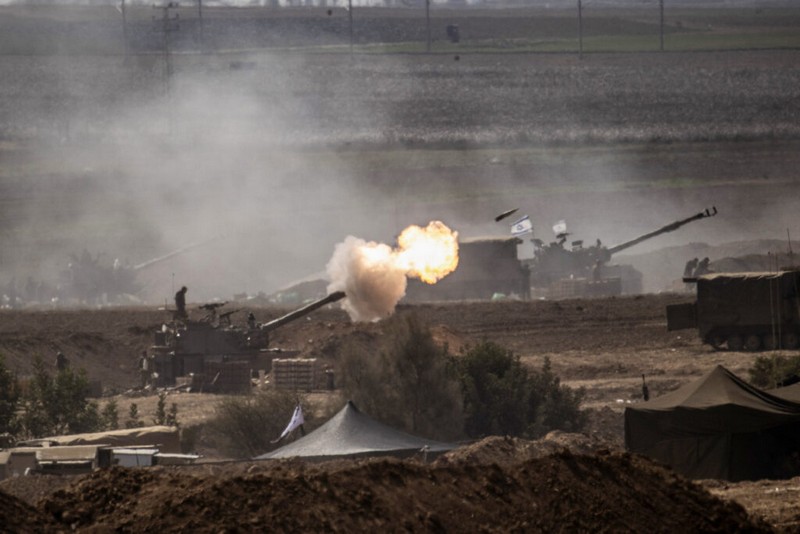
Israel has dropped more bombs on Palestinians in Gaza this week than the United States dropped on Afghanistan in a full year of the war. Last night the Israeli government issued an evacuation order for the entire northern Gaza Strip, telling residents to evacuate in twenty-four hours. This order forewarns a ground invasion. Israel’s intention is to try to absolve itself of responsibility for what will ultimately be massive casualties among untold thousands who are unable or unwilling to leave. The UN has already deemed this impossible in the narrow strip where for sixteen years Israel has imprisoned 2.2 million Palestinians—nearly half of them children—in a crushing siege of land, air, and sky.
This is genocide.
Text threads, from those who still have an hour or so of battery life on their phones, are full of panicked families trying to discern if they should try to flee. There is nowhere to go. Entire families—grandparents, baby nieces, uncles and aunts, siblings—have been annihilated. Boys are killed as they play soccer in front of a mosque; friends are searching for their families in rubble or getting calls that they were bombed in a crowded marketplace trying to buy food before Israel cut off the supply.
So many children will die who have never seen life outside of the walls of the ghetto that Israel has locked them in, as politicians here in the United States cheer on the carnage, claiming they are doing it to protect people of my own religion.
This is genocide.
Yes, on Saturday, Hamas militants broke out of the prison of Gaza and massacred 1,200 Israelis, including many civilians, taking more than 100 hostages. From the second I heard what was happening I have been overcome by a combination of grief and horror at the massacre itself, and also the sheer, unrelenting terror of knowing how the Israeli and American governments would weaponize these deaths.
And like clockwork, the loss of Israeli lives is being used by our government to justify the rush to genocide, to provide moral cover for the immoral push for more weapons and more death.
For Jews, the pain we feel is not ours alone. Since the founding of the state of Israel, the Zionist movement has positioned the domination and oppression of Palestinians and the colonization of Palestinian land as the answer to the very real question of Jewish safety. They have taken the very real pain and trauma that we as Jews carry and sharpened it into a deadly weapon. We desperately must understand that what is happening is not a cycle of violence. It is a system of violence. Everyone is caught in its teeth.
It is the system of settler colonial apartheid that the Israeli government has built and maintained over the past seventy-five years—with billions upon billions of dollars from the United States. Settler colonialism is a structure, a language, a culture, an ideology—an interlocking, totalizing, system of violence. It is a machine of war and dehumanization against Palestinians. It is this system that imperils the lives and safety of everyone.
While the vast majority of the violence of the apartheid regime lands on Palestinians, there is no safety for Israelis in a system rooted in such dehumanization and oppression. In the words of Holocaust survivor Hajo Meyer, “My great lesson from Auschwitz is: whoever wants to dehumanize any other must first be dehumanized himself. The oppressors are no longer really human, whatever uniform they wear.” The Israeli government has lost any semblance of humanity as they wage a genocide against the people living in Gaza.
It is not Palestinians who have chosen the language of violence for this land. It is the Israeli government and the United States government that have created a state of violence.
Palestinians have remained steadfast in seeking freedom against immeasurable violence. Tens of thousands of Palestinians protested in weekly grassroots nonviolent protests at Israel’s militarized border wall around Gaza during the Great March of Return in 2019, and the Israeli government sent military snipers to murder and maim hundreds of children, women, medics, and journalists. Palestinians launch boycott campaigns to win their rights, and the Israeli government opens an entire new ministry to combat the nonviolent movement. Palestinians work at human rights organizations to document the crimes against them, and they are called and treated as terrorists. Palestinians speak the language of freedom, and the Israeli government responds—every single time—with the language of violence.
The United States government has united to fully support the Israeli war machine. Already the United States sends more than $3 billion in aid to Israel every year. Now Senator Lindsey Graham said, “I am with Israel. Do whatever the hell you have to do to defend yourself. Level the place.” Make no mistake: Israel isn’t defending itself, it is committing mass murder. Biden says, “We’ll make sure Israel has what it needs to take care of itself.” Make no mistake: Israel is waging genocide.
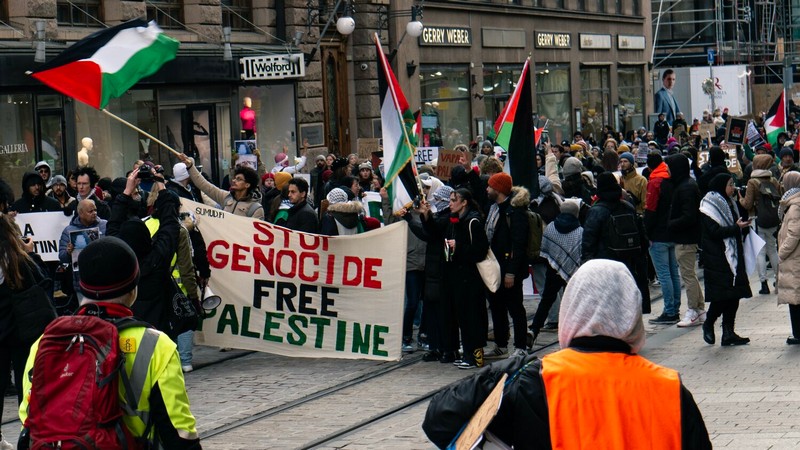
My dear ones in Palestine are saying that they have never experienced such destruction in seventy-five years of occupation. My dear ones are saying there is not a moment to wait. Do not sit back while Israel carries out a genocide fully enabled by the United States. Bring your full body, your spirit, your communities, your humanity, to meet this moment, to call your representatives, to the streets. “Never again” means standing up for Palestinian people. “Never again” means this very moment.
Stefanie Fox is Executive Director of Jewish Voice for Peace.
Genocide is a well defined legal term defined by the Convention for the Prevention and Punishment of the Crime of Genocide as any of the following acts committed with intent to destroy, in whole or in part, a national, ethnical, racial or religious group, as such:
(a) Killing members of the group;
(b) Causing serious bodily or mental harm to members of the group;
(c) Deliberately inflicting on the group conditions of life calculated to bring about its physical destruction in whole or in part”
“Intent” is usually the most difficult part to prove, but in the case of Palestine, intent is clearly expressed in the blatant statements by Israeli leaders, calling Palestinians in Gaza “human animals,” referring to Palestinians as “Amalek” (the tribe God commanded King Saul to destroy in the Old Testament), and declaring that there exist “no innocent Palestinians in Gaza,” which must be destroyed.
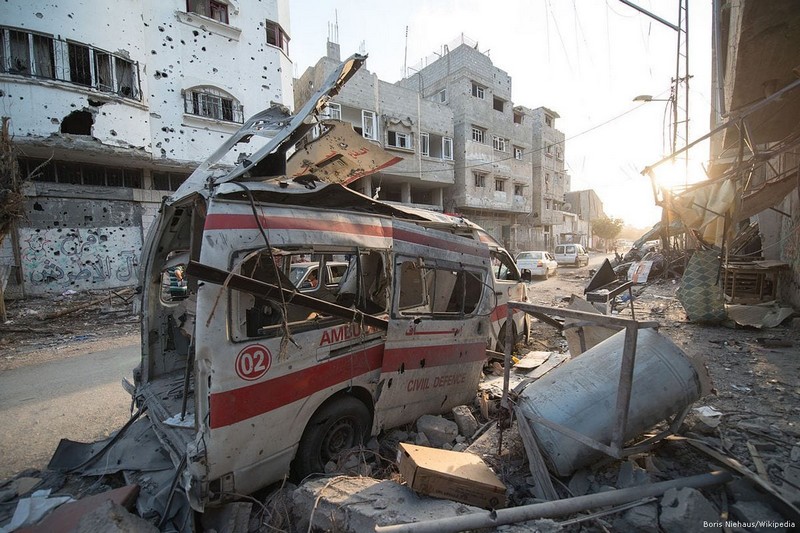
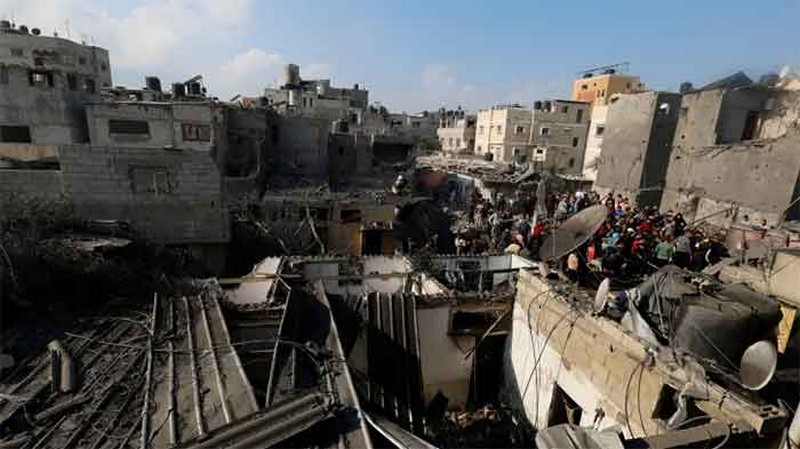
Never before has there been a case where such a genocide is being committed and reported on in real time on a daily basis, along with an openly declared policy of cutting off their water, food, electricity, and fuel, and subjecting them to massive bombardment , after ordering them to move from their homes, (with no safe place to go to) and while over 50% of their buildings are destroyed. 1.9 million individuals out of a population of 2.3 million are currently displaced, the scenes of destruction are apocalyptic, with the destruction affecting all hospitals, schools, UN facilities, churches, mosques, bakeries, libraries, court houses, municipalities and universities, and all public and private structures. No place is safe.
The images of huge craters in the midst of apartment buildings, of crowds huddled around food distribution centers, and of children pulled out from under the rubble are now compounded by scenes of masses of individuals, clearly civilian, stripped down to their underwear being humiliated, trucked to unknown locations, and paraded for sport are all over the internet. Meanwhile, despite the killing of local journalists (89 as of this writing) and a prohibition on foreign journalists from entering, the world is fully informed of these atrocities as Israel continues its massive bombing of a defenseless population with no end in sight.
How do we explain, in the face of this overwhelming evidence of an ongoing genocide, that the world, including the church, is largely silent with only mild, tepid pronouncements of concern, and where those who dare even speak of a ceasefire, or de-escalation on humanitarian grounds, are themselves attacked, silenced, and ridiculed as naive supporters of terrorism?
One explanation, apart from the clear complicity of those in power, is the abuse of the concept of anti-semitism. The Western world indeed has much to repent from in its racism, discrimination, and hatred of Jews and Judaism throughout history. Yet recognition of that guilt and of the sin of anti-jewish antisemitism should not be used to justify, condone, or permit complicity when the state of Israel, long practicing apartheid and Jewish supremacy, turns to engage in genocidal practices against its enemies. Yet charges of antisemitism are being effectively weaponized against Palestinians who had nothing to do with that Western phenomenon.
A second explanation lies in the power of narrative. From Day One (October 7) a particular narrative has been promulgated by Israel and uniformly copied by the corporate media in this country which takes the events of that day out of their historical context, viewing them as an unprovoked attack on a peaceful Israel by a demonic evil force named Hamas. The evil is of such a nature that it needs to be eliminated and eradicated, and any and every action needed to achieve that just goal is legitimate, and in fact it is righteous. Viewed through this lens, the entire history of Israeli occupation, settlement policies, fascist government control, and the ongoing oppression of Palestinians is irrelevant. International law and the rules of warfare are also beside the point. Massive civilian casualties and even actions amounting to genocide, as indicated above, are but unfortunate “collateral damage” that, if noted at all, is to be laid at the door of the evil Hamas which “started” the whole mess.
This narrative has obtained acceptance across the board, and it is reflected by the corporate media from the right to the left. From Fox News to MSNBC and CNN. Any discussion of the issue begins, usually, with a demand to condemn Hamas and its barbarous actions on October 7 to confirm that you do indeed accept the established narrative. The uniformity of the narrative across all media (with the exception of social media) reminds one of a totalitarian regime, not a country which purportedly values a free press. Those who have tried to present a more nuanced approach as to what happened on October 7, what led to it, or what is happening now in Gaza are viciously attacked as terrorist sympathizers or, at the very best, as “useful idiots” who are being exploited by that same evil force, Hamas.
At FOSNA, we must ask whether in fact the churches and most Christians in the West have not also been taken in by this narrative, swallowing it hook line and sinker. That would explain why even the mildest calls for an immediate ceasefire are viewed as “controversial,” are difficult to make, and require so much “courage.” In times like these, it behooves the church to consider the situation based on its own principles and ethics and not to follow slavishly the prevailing narrative.
This is all the more true when the US government is directly implicated in the ongoing genocide and that American Christians, living in a democracy, have some measure of responsibility for American Government complicity in this ongoing genocide, which is taking place with American weapons, American money, and under an American diplomatic umbrella that protects Israel and grants it the ability to act with impunity without worrying about the United Nations, world opinion, international law, or indeed common human morality. What distinguishes Christians should be that we live according to a different ethic, and according to the values of the Kingdom of God. While the world may prioritize violence and military power, the church should be preaching a different ethic of love, peace and nonviolence. The failure of the church to lead in challenging the logic of genocide is a serious testament of the condition of the church toady.
The well-known poet and author from Gaza was recently killed by the Israeli military. But Refaat’s spirit and his love for words continues to live on in many of his students.
By Yousef M. Aljamal
It is hard to write about Refaat Alareer, the person who instilled in me and so many other young people in Gaza, the love of the written word.
Now that I have to write this farewell article for him, I am lost for words. Oddly, I don’t feel he’s gone. It’s hard to believe that he’s just a memory now and accept that he’ll never show up in his classroom, share his wit and humour he was famous for.
For those of us who have known him over the years, Refaat is immortal — he’s an idea, and ideas don’t die. Refaat is a word and a story, Refaat is a pen and a pun. Refaat is our poet, storyteller and mentor.
Born in 1979, the son of Al Shujaiya neighborhood in Gaza city – he loved to introduce himself in this way – Refaat has been an inspiration to a whole generation, which has come of age under siege in Gaza, and who he guided and supported to become storytellers.
Refaat was so energetic and giving with his time that at times it seemed he could be present in two separate places at the same time.
He was universal in his teaching, teaching us about Malcolm X, John Donne, Shakespeare, Edgar Allan Poe along side the works of Palestinian author Edward Said.
Refaat told us that it was his grandmother, Kamla, who planted in him the love of storytelling. His grandfather would bribe him with gifts to stay with him but Refaat always chose the stories of his grandmother.
In a TEDx talk he gave in 2015, Refaat quoted a native Canadian asking colonisers, “if this is your land, where is your story?” The story he knew about Palestine and Gaza was Refaat’s way of proving his connection to the land of his ancestors.
Early in his life, Refaat was shot and injured three times. He survived and emerged stronger.
“I have never been caught in my life. I was shot three times with rubber-coated metal bullets and was beaten only when the soldiers stormed our home,” he wrote.
Refaat’s uncle, Tayseer Alareer, was killed by Israeli forces while he was working on his land in 2001 to the east of Al Shujaiya and his brother Hamada was also killed by Israel in 2014.
Around the same time, Refaat’s family house was also destroyed. When Israelis destroy a home, the occupants return after a while to collect valuables like jewlery or heirloom, Refaat dug into the heap of concrete and steel looking for writings of his students.
Refaat had a great love for literature, one of our classmates once joked that he keeps a copy of Hamlet under his pillow when he sleeps. Refaat laughed when he heard the joke. His humility and easy-going manner meant many of his students became his close friends. He could be tough with grades, but we still loved him as we knew that the impact of hard-earned grades will last longer.
Refaat’s connection with his students was not limited to the classroom. He would often invite us to have classes in the open air or near the beach, which is now under the occupation of Israeli forces. He would invite us for coffee and always checked on us and on our families.
Refaat edited an anthology in 2014 titled Gaza Writes Back.
Inspired by the Empire Writes Back, Refaat chose Gaza Writes Back as the title for his book, and he wanted it to be Gaza’s voice to the world.
Soon after the end of the 2008-9 Israeli war on Gaza, he asked his students, including me, to write short stories as part of our school assignment, and he chose some of these stories and published them.
Through this book, Refaat wanted to debunk claims about Palestinians in Gaza through literature, because he believed that literature is universal and timeless and could be read any time in the future as if it was written now. Gaza Writes Back was translated into Malay, Turkish, Italian, and Bengali.
Refaat believed that stories have a huge power of transcending ideas and people. He used to tell us that the Zionist movement didn’t colonise Palestine in one go – the Zionist worked for decades to build a narrative justifying occupation of Palestine. Zionism first created an imaginary homeland in the minds of its followers through mythology and stories.
Refaat said for Palestinians to keep their memory and cause alive, they have to carry on telling their side of the story. If we stop telling stories, we would betray our ancestors, he would remind us constantly.
In 2014, I travelled with Refaat Alareer and Rawan Yaghi, another contributor to his anthology, to the United States to talk about Gaza and Palestine’s storytelling culture.
Refaat always left a huge impact on people he met. We toured seven states together, talking about churches, unions, community centres and schools, and Refaat used his knowledge and sense of humor to tell Gaza’s tale effectively.
Refaat’s wife and kids were at another location when he was killed. He would always speak about his children and what they meant to him.
Refaat had a sense of dark humor and language was his game. He was quick to make jokes or pun, entertaining those around him. He had multiple skills and was active on social media tweeting about Gaza in English.
Once, he assigned his students the task to create an X account and tweet in English to plant in them the seed of storytelling. His use of social media is how many people around the world came to know Refaat.
I happened to be on the same flight as Refaat in 2013. We both were heading for postgraduate studies in Malaysia. Refaat for his PhD and I for my Masters. He asked me if I had a place to stay at to which I answered no. He invited me to stay at his place until I found a place. He was so kind to me, but his dark humor was always there. After I left, I had dinner at another’s friend place, and I posted that I can finally say that I had dinner. He called me “ungrateful,” and demanded that I buy a watermelon – a fruit we Palestinians love – and visit him to show remorse, and so I did.
Refaat was a threat to the Israeli narrative and that’s why the Israeli intelligence called him and told him that they will get him and that they knew he was taking shelter at a school. Refaat chose to leave the school and headed to his sister’s house where he was killed by an Israeli airstrike at 6:00 pm on December 6.
In his introduction to the Gaza Writes Back, Refaat quoted Chinua Achebe, writing, “storytellers are a threat. They threaten all champions of control. They frighten usurpers of the right to freedom of the human spirit.”
“There is a Palestine inside all of us, a Palestine that needs to be rescued where all people regardless of color, race and religion could co-exist…Palestine is a martyr away, a missile away, a tear a way or a whimper away, Palestine is a story away,” he wrote.
Refaat’s stories always brought us closer to our homeland and we remember Refaat carrying a book in his hand and rushing to yet another appointment, always multitasking. As Refaat wanted us to do in a poem titled “If I must die,” he wrote in 2011, but pinned to his timeline in November 2023, we will turn your story into a tale.
Refaat told a close friend a day before he was killed that he feels tired after 60 days, because he was looking after dozens of people who needed food and medicine to survive.
He walked miles everyday to have access to the internet to report on what was happening in Gaza. He wrote to me on Sunday that he has seen destruction in western Gaza City similar to World War Two.
As Refaat wanted his killing to be hope for the Palestinians, people around the world should too. Seeing all these translations of his poem and pictures in dozens of protests and vigils across the globe is what Refaat wanted, for his message to get across to as many people as possible. Refaat didn’t die, he multiplied, as Palestinian writer Susan Abulhawa says, because Refaat is an idea and ideas don’t die.
Yousef M. Aljamal is a researcher in Middle Eastern Studies and the author and translator of a number of books.
(This is a Position Paper issued by Indo Palestine Solidarity Network, India, a network of like- minded people drawn from all parts of India committed to solidarity with the Palestinians in their struggle for justice and liberation.)
IPSN expresses appreciation to its author, Rev. Roger Gaekwad, an ordained minister of the Presbyterian Church of India. Mizoram Synod. He has served in Aizawl Theological College, Mizoram and was eventually Principal of the College. Gaekwad also served as Director of the Senate Centre for Extension & Pastoral Theological Research of the Senate of Serampore College for over 6 years. He was later elected as General Secretary of National Council of Churches in India for 8 years. He currently serves as Mentor, Dinbandhu Ministries, Nagpur.)
_______________________________________
Lives of the Palestinians in Gaza do not seem to matter! Buildings (whether they housed families, hospitals, educational institutions, or any other facilities), the flora and fauna and the land of Gaza are being razed to the ground, reduced to rubble and dust in the ongoing war! Gaza O Gaza!
As Fr. David Neuhaus, S.J., a Jesuit priest, and an Israeli citizen, has stated, “The belief that victory is attainable by defeating the enemy in pitiless warfare is at the heart of the rhetoric of war. This is perhaps the most venomous myth in any conflict.” Gaza, along with the West Bank, is bearing the brunt of this inhuman ideology. The promotors and perpetuators of such cruel violence have not learnt from the lessons of history, or from the teachings on love, justice and peace of their scriptures.
Apartheidic Injustice and Violence
Gaza is experiencing yet another devastating round of the ongoing apartheid in their land since 1948, when Israel was made a nation state by the powers of that time. Apartheid, as Dr. Jerry Pillay[1] said in 2016 in an article on apartheid in the Holy Land, comes from an Afrikaans word meaning ‘apartness’ or ‘separateness’. “It is a policy or practice of separating or segregating groups. This policy separated white and non-white people in South Africa from 1948 to 1994. Black people had to carry special papers or have permission to live and work in particular areas. Many laws were made that prevented mixed marriages, and black people could not own land in white areas, vote or use the same public facilities as white people. Public toilets, parks, beaches and recreational facilities were restricted in certain areas for white people only; black people would be arrested if they tried to use these facilities.”
While there are differences in the South African and the Israel-Palestinian contexts, by and large, we see similar expressions of disrespect and disregard for human dignity and rights, the same use of the law to demonize and brand others as ‘terrorists’, and the same denial of people’s rights to adequate economic and educational opportunities.
Since the past 75 years:
Whether it’s a child imprisoned by a military court or shot unjustifiably, or a house demolished for lack of an elusive permit, or checkpoints where only settlers are allowed to pass, few Palestinians have escaped serious rights abuses, and have been subject to humiliation and psychological, political and economic oppression.
During these past 75 years,
The erection of the Wall in the name of securityfor Israelis has ultimatelystolen land, and separated Israelis and Palestinians from each other.
During the past 75 years,
Israeli settlements in Palestinian territories are in direct violation of international law, depriving Palestinians of land, natural resources and freedom.,
During the past 75 years,
the economic impact of the occupation is seen in the following: businesses abandoned because of the wall and blockages, the doors of shops wielded and closed, olive fields destroyed, restrictions on movement and the emergence of ghost towns in what used to be thriving communities.
II
During the past 75 years,
Gaza has been subject to unimaginable torment:
(i) During the Nakba (“catastrophe”) of 1948 which witnessed the mass displacement and dispossession of Palestinians at the hands of the marauding Israelites, tens of thousands of Palestinians took refuge in Gaza. The invading Egyptian army seized a narrow coastal strip 25 miles (40 km) long, which ran from the Sinai to just south of Ashkelon. The influx of refugees saw Gaza’s population triple to around 200,000.Gaza O Gaza!
(ii) In the Six-Day War of June 1967, the Gaza Strip was again taken by Israel, which occupied the region for the next quarter century. In December 1987, rioting and violent street clashes between Gaza’s Palestinians and occupying Israeli troops marked the birth of an uprising that came to be known as the intifada (“shaking off”).Gaza O Gaza!
(iii) In autumn 2007, Israel declared the Gaza Strip under Hamas, a hostile entity, and approved a series of sanctions that included power cuts, heavily restricted imports, and border closures. Gaza O Gaza!
(iv) In January 2008, facing sustained rocket assaults into its southern settlements, Israel broadened its sanctions, completely sealing its border with the Gaza Strip and temporarily preventing fuel imports.Gaza O Gaza!
(v) Beginning on November 14, 2012, Israel launched a series of air strikes in Gaza, in response to, what the Israeli government said, an increase in the number of rockets fired from Gaza into Israeli territory over the previous nine months.Gaza O Gaza!
(vi) In June 2014 three Israeli teenagers were allegedly kidnapped; Israel conducted a massive crackdown in the West Bank and increased air strikes in the Gaza Strip, prompting retaliatory rocket fire from Hamas. As fighting continued to escalate, Israel launched a 50-day offensive into the Gaza Strip on July 8. Some 2,100 Palestinians and more than 70 Israelis were killed in the ensuing conflict, with about 5,000 targets hit in the Gaza Strip.Gaza O Gaza!
(vii) In the spring of 2018 a series of protests along the border with Israel, which included attempts to cross the border and flying flaming kites, was met with a violent response from Israel. Both the protests and the violence reached a peak on May 14 when about 40,000 Gazans attended the protests. When many of them tried to cross the border at once, Israeli troops opened fire, killing about 60 people and wounding 2,700 others. The violence escalated into military strikes from Israel and rocket fire from Hamas and continued for several months. Gaza O Gaza!
(viii) In May 2021, in response to the demonstrations in Sheikh Jarrah of Palestinian families, protesting against Israel’s plan to forcibly evict them from their homes to make way for Jewish settlers. thousands of Palestinians across Israel and the Occupied Palestinian Territories (OPT) held their own protests in support of the families. Confrontations between Israeli police and Palestinian demonstrators prompted Hamas to launch rockets into Jerusalem and parts of southern Israel; Israel responded with air strikes in the Gaza Strip.Gaza O Gaza!
(ix) And now we behold this year, a full-scale war, through which the Israeli government has vowed to exterminate Hamas, and in fact all Palestinians, from Gaza. Gaza o Gaza!
The Elephant and the Ants
There is this story of a lost baby elephant, which was transported by its sympathizers to asmall enclosure in a national park, where it could grow in safety. Several ant colonies also resided in that enclosure. As the elephant grew bigger and bigger, he started to drive out the ants from what the elephant called his “space.”Time and again he used to spurtwater on them with his trunk. The sympathizers, who had originally placed the elephant in the enclosure, marveled at his growth and applauded his show of strength.
One day, when a small ant from one ant colony in the southernmost corner of the enclosure, questioned him about what he was doing, the elephant told him to be quiet and threatened to finish him off!Later that night, the ant crept into the elephant’s trunk and started biting him. He bit it till the elephant experienced intense pain. With all the strength he could muster, he blew out the ant from his trunk. Then in his uncontrollable rage, he screamed, “You Terrorist! How dare you attack me! I will finish you off!” and he began stamping on the entire southernmost ant hill …
Though not a perfect allegory, the story highlights the plight of Gaza. Gaza O Gaza!
IV VOICES
One can hear a 21st Century Jeremiah lament over Gaza:
For the brokenness of the daughter of my people I am broken,
I mourn, and horror has seized me.
Is there no balm in Gilead?
Is there no physician there?
Why then has the health of the daughter of my people
not been restored?
O that my head were a spring of water
and my eyes a fountain of tears,
so that I might weep day and night
for the slain of the daughter of my people! (Jer. 8:21-9:1)
So also, one can visualize a 21st century Habakkuk crying out from Gaza,
O Lord, how long shall I cry for help,
and you will not listen?
Or cry to you “Violence!”
and you will not save?
Why do you make me see wrongdoing
and look at trouble?
Destruction and violence are before me;
strife and contention arise.
So the law becomes slack,
and justice never prevails. (Hab.1:2-3)
Another aggrieved person from Gaza questions God: “Why are people quoting words of judgement against Gaza as the fulfillment of your prophecy in our times?”
Thus says the Lord:
For three transgressions of Gaza,
and for four, I will not revoke the punishment,[a]
because they carried into exile entire communities,
to hand them over to Edom.
So I will send a fire on the wall of Gaza,
and it shall devour its strongholds (Amos 1:6-7)
How quickly such people forget that God the Lord has also declared divine judgement against Judah and Israel as well through the same prophet: Amos 2: 4-11.
Similarly, when some people are quoting Zephaniah 2:4-7 highlighting God’s destructive judgement of Gaza and Ashkelon, claiming that the same is now coming to be fulfilled in 2023, they forget that Zephaniah began with a prophecy against Judah (1:2-2:3). These prophesies of Zephaniah were already fulfilled when countries along the eastern Mediterranean Coast suffered under the military campaigns of the Egyptian and Babylonian armies.
Likewise, the prophesies against Gaza, Ashkelon and other cities, in Zechariah chapter 9, trace Alexander’s march through the eastern Mediterranean coast cities in 332-331 B.C. E.
Then again, one hears another voice of anguish, “O Lord, why should the Israelites consider themselves to be ‘your chosen people’ exclusively? Did you not say through Amos to the Israelites,
Are you not like the Ethiopians to me,
O people of Israel? says the lord.
Did I not bring Israel from the land of Egypt,
and the Philistines from Caphtor and
the Arameans from Kir (Amos 9:7)?”
God’sWord clearly asserts to the Israelites thatthe Ethiopians, a “people of color”, were equally beloved to God, thereby challenging the exclusionary self-understanding of Israel.Furthermore,in the book of Amos, it is stated quite explicitly that,in history, God engaged actively not only in the liberation of the Israelites from bondage in Egypt, but also in the “bringing up”, that is, liberating, the Philistines from Caphtor, and the Arameans (Syrians) fromKir.” (Am.9:7)Thesewere two foreign peoples that were at different times Israel’s most threatening enemies, yet God engaged in their liberation.
Indeed, God enacts “Exoduses” for Israel’s enemies. God’s emancipatory power extends to other peoples who are not commonly taken to be “chosen.” God exposes Israel’s claim to the exclusionary love and justice of God, and insists that in universal scope YHWH’s emancipatory reach extends everywhere, at many times, and in many places, bringing emancipation for those not yet liberated.
Then again, in God’s vision of the future of the nations, in Isaiah 19:24-25, it is stated:
On that day Israel will be the third party with Egypt and Assyria, a blessing in the midst of the earth, whom the Lord of hosts has blessed, saying, “Blessed be Egypt my people and Assyria the work of my hands and Israel my heritage.”In all three cases the prophet is using titles —God’s people, the work of God’s hands, God’s heritage—which are applied to the “chosen people”.
Another bereaved Gazan mother cries out in agony, “O Lord how can the government of a people who went through the unforgettable experience of the Holocaust duringWorld War II, be so cruelly malicious to us?”
18,000 people have already been killed in Gaza, most of them being women and children. Over 49,229 are reportedly injured. Many more people are missing, presumably under the rubble, waiting for rescue or recovery. At least 6,000 buildings have been damaged and about a third of them destroyed. Up to 80% of the population may have been forced to flee their homes. According to the World Health Organization (WHO), 22 hospitals and 36 health facilities have been damaged since the war in Gaza began on October 7, 2023. Among the buildings destroyed or partially destroyed are the main Palestinian court, known as the Justice Palace, the Palestinian Legislative Council complex, 339 education facilities and 167 places of worship.
In Deut. 24: 17-18, God says to the Israelites, “Do not deny justice to a resident alien or fatherless child, and do not take a widow’s garment as security.Remember that you were a slave in Egypt, and the Lord your God redeemed you from there. Therefore, I am commanding you to do this.” In the case of the Palestinians, they are not resident aliens but rightful residents of Palestine.
God had also said to the Israelites,“Remember, that you were a slave in the land of Egypt, and the Lord your God brought you out from there with a mighty hand and an outstretched arm; therefore, the Lord your God commanded you to keep the Sabbath day.” (Deut.5:15). The implication of this weekly remembrance for the Israelites was that they should recall the hardships they underwent under the reign of the stone-hearted Pharaoh; therefore, they would have to be compassionate to, and just in their relationships with their neighbors.
The voices of a group of Palestinian Christians articulated through theKairos Document: A Moment of Truthon 11 December 2009 continue to reverberate again and again
2.3.2 Our presence in this land, as Christian and Muslim Palestinians, is not accidental but rather deeply rooted in the history and geography of this land, resonant with the connectedness of any other people to the land it lives in. It was an injustice when we were driven out.
2.3.4 Our connectedness to this land is a natural right. It is not an ideological or a theological question only. It is a matter of life and death. . . We suffer from the occupation of our land because we are Palestinians. And as Christian Palestinians we suffer from the wrong interpretation of some theologians.
2.5 We also declare that the Israeli occupation of Palestinian land is a sin against God and humanity because it deprives the Palestinians of their basic human rights, bestowed by God. It distorts the image of God in the Israeli who has become an occupier just as it distorts this image in the Palestinian living under occupation.
4.2.1 Love is seeing the face of God in every human being. Every person is my brother or my sister. However, seeing the face of God in everyone does not mean accepting evil or aggression on their part. Rather, this love seeks to correct the evil and stop the aggression.
The aggression against the Palestinian people which is the Israeli occupation, is an evil that must be resisted. It is an evil and a sin that must be resisted and removed. Primary responsibility for this rests with the Palestinians themselves suffering occupation.
4.2.4 Christ our Lord has left us an example we must imitate. We must resist evil but he taught us that we cannot resist evil with evil. This is a difficult commandment, particularly when the enemy is determined to impose himself and deny our right to remain here in our land.
5.1 We all face, today, a way that is blocked and a future that promises only woe. . . We place our hope in God, who will grant us relief in His own time. At the same time, we continue to act in concord with God and God’s will, building, resisting evil and bringing closer the day of justice and peace.
And so
May our Palestinian children, sisters and brothers in Gaza be comforted by the concluding words of Dr. Daniel Migliore in his book, Faith Seeking Understanding, “God is present as co-sufferer with all the wretched of the earth, whether in cancer wards or in concentration camps.”
May our Palestinian children, sisters and brothers in Gaza hear words of hope from our Compassionate Just God saying, “I have observed the misery of my people who are in Gaza; I have heard their cry on account of their oppressors. Indeed, I know their sufferings, and I have come down to deliver them from their oppressors.”
Gaza O Gaza!
_________________________
“There may be times when we are powerless to prevent injustice, but there must never be a time when we fail to protest.”
Despite the differences in goals, interests and strengths, Myanmar’s disparate armed organizations ultimately share the unequivocal rejection of both the military and its coup regime.
Eleven days into the Operation 1027, the senior most leadership of the regime – Min Aung Hlaing and his senior ex-General Myint Swe, the former vice president under the National League for Democracy (NLD) government of Aung San Suu Kyi, held an emergency National Defence and Security Council meeting in Naypyidaw on Nov. 9 and reportedly discussed the prospects for “national disintegration.”
The regime media Global New Light of Myanmar quoted Myint Swe telling the meeting attendees, “if the government does not effectively manage the incidents happening in the border region, the country will be split into various parts.”
After the military unprecedented defeats in northern Shan State, the Straits Times ran an opinion editorial flagging this “balkanization” warning. The Japan Times editorial on Dec. 1 was even more shrill about what it projects as “chaos” and the process of Myanmar state failures, now that more than half-the-country has fallen into the hands of “ethnic insurgent” organizations, fighting for the rights of their own populations (as opposed to all of Myanmar as a country).
Japan’s primary concern is in the event of such a state collapse, its adversary, China, would openly intervene in a country which has been run – and ruined – by the World War II Japan-fathered national military. Successive military regimes since the coup of 1962 have used the discourse of “national disintegration” as an ideological magic wand to rally the historically ethno-nationalist majoritarian Burmese public behind their acts of usurpation.
In his Dec. 2 interview with The Irrawaddy, the Kokang Myanmar National Democratic Alliance Army (MNDAA) spokesperson Li Kyar Win pointed out that the embattled Min Aung Hlaing reportedly used the word “foreign invasion” to describe the Brotherhood Alliance’s successful military operations against regime troops.
This had a clear intent to mobilize the country’s xenophobic Burman nationalist majority. Alas, this time neither the military’s scaremongering propaganda mantra of “national disintegration” nor “foreign invasion” secured any buy-in from the country’s Burman ethnic nationality.
Debunking the view that non-Bamar ethnic resistance movements have only narrowly defined self-interests, for instance, minority rights, the same MNDAA spokesperson stated that the Brotherhood’s politico-military objective is ultimately “to eradicate the military dictatorship.”
In January, the leaders of another cluster of Ethnic Resistance Organizations (EROs), including the Karen National Union (KNU), the Karenni National Progressive Party (KNPP), and the Chin National Front (CNF/CNA), who have territorial control over vast swathes of Myanmar spelled out their Big Tent (inclusive) federalist vision with democratic and basic human rights for all groups and individuals.
“The military leadership knows that our ethnic resistance organizations are fighting for a federal system of power-sharing with the majority Burmans — not for secession or independence. It has deliberately mis-framed us as ethno-nationalist secessionists bent on disintegrating the Union of Myanmar in an attempt to pit us against the Burman majority, but its misinformation campaign is no longer working,” the EROs published in Nikkei Asia.
However, even in a few places where there exist ethno-nationalist contests within intra-minority populations, the contests are more about elite territorial ambitions and economic interests than the kind one observes in the Balkans where Serbian Orthodox Christians, Croatian Catholics, and Muslims of Bosnia have perpetrated atrocity crimes against one another over a long and sustained period. Precisely because of this crucial difference, I for one do not buy into the alarmist warnings of “Myanmar’s balkanization.”
Besides, the “balkanization” as such involved the birth or rebirth of new states out of a federated political system such as Marshal Tito’s Yugoslavia, with mass atrocities as byproducts. There were external actors such as the military alliance NATO, or post-USSR Russia, whose meddlesome geopolitics in the Balkans made the already poisoned regional politics of race and faith worse.
Sandwiched among stable and populous neighbours including such global powers as China and India, redrawing Myanmar’s external boundaries is simply inconceivable. For none of the immediate neighbours would stomach the idea, let alone, the potentially violent realities with spill-over cross-border impact, of the disintegration of Myanmar as a political state.
With the exception of the ethnic Burman-controlled National Unity Government (NUG), run by the Burmese exiles in Washington and other Western capitals, who have been egged on by Western actors as “future leaders”, none of Myanmar’s EROs on-the-ground will undertake any act, military or political, that will breach the security concerns of Bangladesh, or Thailand, not to mention China and India.
However, what is unprecedented, ideologically and historically, is the generally anti-Chinese, and to a lesser extent, anti-Rakhine, majoritarian Burmese public are now rooting for the Brotherhood Alliance – and any other non-Burman EROs as they attempt to “eradicate the military dictatorship.”
The significance of Shan State and Operation 1027
Of all the ethnic regions, Shan State is the largest in the country’s physical geography, bordering on both China and Thailand, which form informal trade corridors. The state’s rich ethnic tapestry of Shan, Kachin, Wa, Pao, Ta’ ang (or Palaung), Intha, is also a source of intra-group conflicts, and historical grievances, The territorial aspirations, and commercial interests in the state are thoroughly embedded in the web of interlocking resource-based and cross-border informal economies.
A high 64 percent of the state’s population is in the 15-64 age group, labeled “economically productive”, in the 2014 Myanmar census. In other words, Shan State has a high proportion of “fighting age” people, both men and women.
Because the Shan of Myanmar, the co-founders of the post-colonial Union of Burma alongside the Burman majoritarian leadership of the martyred Aung San, were granted the constitutional right of secession in 1947. Myanmar’s ruling elite, both political and military leaderships of the late Prime Minister U Nu and General Ne Win, built military bases in this vast mountainous state as early as 1953.
The Defence Services Academy was originally built in the purpose-built military town of Bahtoo, before it was subsequently relocated to Pyin Oo Lwin where it has remained since. To date, Shan State houses more than 200 battalions, the largest number established in an ethnically defined state in the country, according to a Shan researcher colleague of mine. The reported low morale and the understaffing of these units are related and significant matters.
That is why, the news of the stunning military victories by the Brotherhood Alliance’s Operation 1027 on Oct. 27 in northern Shan State precipitated a media and policy buzz around the military’s pending collapse and the need to prepare the NUG as the future government of Myanmar.
The Brotherhood Alliance
A word about the background of these groups is in order. The Brotherhood Alliance is made up of the three ethnic armed organizations.
The Myanmar National Democratic Alliance Army (or MNDAA) leadership and rank and file are drawn from the Han Chinese minority known as the Kokang. The Myanmar military had, in the 1960-70’s, used the earlier incarnation of Kokang armed group as a counterforce or local militia against the armed resistance movements by the pro-independence Shan nationalists in exchange for lucrative commercial opportunities for the typically illicit trade, including narcotics.
Along with half-dozen other ethnic territories, the Kokang region has been established as a “Self-Administered Zone” by the reformist quasi-democratic government of President Thein Sein.
One of the relatively new armed organizations, the Arakan Army (AA) is led by Buddhist Rakhine political elite with their unconcealed aspirations for the reclamation of their ancient kingdom’s sovereignty lost to the rival Burmese based in the upcountry plains around Mandalay, several years after the French Revolution of 1789.
Out of geopolitical pragmatism, the AA leaders have indicated that they would be content with “internal sovereignty”. That is, Rakhine will remain a part of a post-military Myanmar which the AA leaders envisage as a loose confederation of politically autonomous regions.
Rakhine nationalists were the very first in Myanmar who revolted, without success, against the central government in Rangoon even before the actual ceremony for the transfer of sovereignty from Britain to the first independence government of Burma on Jan. 4, 1948.
Subsequently, Rakhine leaders led by the likes of Indian Civil Service (ICS) member and MP Kyaw Min waged their liberation struggle in the emerging parliamentary space, openly pushing for “internal sovereignty” in the 1950’s.
The central Burman-controlled government resorted to divide and rule, exploiting the emerging ethnic and religious divisions between predominantly Muslim Rohingyas and Buddhist Rakhine, alternating favours between the two rival claimants to indigeneity of the coastal state with a short 270-mile borders with Bangladesh.
The Ta’ang National Liberation Army (or TNLA, ethnic Palaung or Ta’ ang people) has evolved over the last 30 years since its inception as an armed organization fighting for the self-determination of the Ta’ ang people. The reformist-military government in 2010 created the Palaung Self-Administered Zone with its own territorial capital in northern Shan State. It is one of Myanmar’s least developed sub-regions.
The conventional wisdom – evidenced by foreign experts, for instance, the International Crisis Group (ICG) – is that these three groups have stayed “aloof” in the broader armed resistance made up of hundreds of pro-democracy People’s Defence Forces (PDFs) which are generally pro-democracy and supported Aung San Suu Kyi’s NLD government.
But this “expert” opinion is based evidently on shoddy research. As early as March this year, The Irrawaddy was reporting on the Kokang group’s training and provisions of arms to the anti-military resistance groups in the Dry Zone Burman heartlands.
Everyone knows that the country’s most important ethnic resistance organizations such as the Kachin Independence Organization (KIO/KIA) in the north, the KNPP in the east, the KNU in the southeast and south, and the CNF/CNA in the West have provided these new generation armed resisters, most significantly from the Burmese majority heartlands, sanctuary, military training and arms. Resisters come from all walks of life from across Myanmar.
As a sign of a radical departure from the past discriminatory attitude – racist and internally colonial really – which the dominant Burman had displayed towards their fellow co-habitants, there is a widespread revolution in popular spirit: the Burman majoritarian public are profoundly appreciative of this invaluable collaboration and material assistance offered by the non-Burman ethnic resistance communities.
This bodes well for a country where the majoritarian Burman “Big Brother” racism had historically been mobilized and manipulated by the repressive central military for its own sinister ends. This is often overlooked by Myanmar watchers who focus on military statistics (for instance, troop strengths, cities captured or controlled, etc.)
What is less noted is the China-linked Brotherhood Alliance has also made its share of contributions to the growth of anti-military armed resistance organizations in terms of arms, training and even funding.
Even the United Wa State Army (UWSA) which is wholly dependent on China and hence seen as Beijing’s proxy is known a source of arms and ammunition to all anti-military forces throughout the country, despite the organization’s official “adherence” to the ceasefire with the Naypyidaw.
The AA is known to be the main trainer of the anti-military Bamar People’s Liberation Army (BPLA) while the KNU has offered them sanctuary. The BPLA has been an integral resistance force that has joined the Brotherhood Alliance in its historic Operation 1027 in northern Shan state.
According to Asian diplomats who participated in the so-called 1.5 Track meeting on the post-coup Myanmar held in India last April, Dr. Yin Yin Nwe, a key Shan-Myanmar adviser to Myanmar’s regime and ex-daughter-in-law of the late dictator Ne Win, accused Thailand of allowing Myanmar exiles to smuggle arms and ammunition to Myanmar’s growing armed resistance.
This was without any evidence. The meeting attendees included representatives of India, China, Thailand, Laos, Bangladesh, Cambodia and Indonesia, as well as state-linked think tanks from Myanmar’s neighbours.
The fact of the matter is various armed organizations along the 1,500-long China-Myanmar border, from the UWSA to the KIA to the Brotherhood Alliance have played a vital role as “enablers” – of Myanmar’s nationwide armed resistance – not Thailand and its military with economic ties to Myanmar’s regime.
To be sure, the respective ultimate aims of different armed organizations are not necessarily identical: some are for “internal sovereignty”, some for the administrative control of expanded territories and populations, some for majoritarian democracy, and still some for an ethnically-defined federalist state.
But what is clear is that these disparate organizations, all armed and gaining significant battlefield experiences, share the common rejection of the regime, and the military.
Most importantly, all these groups envisage a future Myanmar, without this repressive national institution.
In short, the Myanmar military as the most repressive and murderous organization has no political role in a future Myanmar. Certainly, not without significant and fundamental institutional reforms.
To put it bluntly, the regime and its military are no longer seen as “a stakeholder” in any dialogue about the political future of Myanmar as a multi-ethnic political state, a fundamental departure from the ASEAN failed policy discourse of an “All-Inclusive Dialogue.”
—
Maung Zarni is a UK-exiled scholar and revolutionary from Burma with 35 years of direct political involvement in Burmese affairs.
Eight months after Myanmar’s genocidal violence in 2017, which saw more than a million Rohingyas driven into Bangladesh, 55-year-old Rafique (not his real name) welcomed me into his shelter in a busy section of the refugee camp. He served me tea and asked me to wait – he wanted to show me something important that would explain ‘everything I wanted to know’ about Rohingya statelessness in Myanmar.
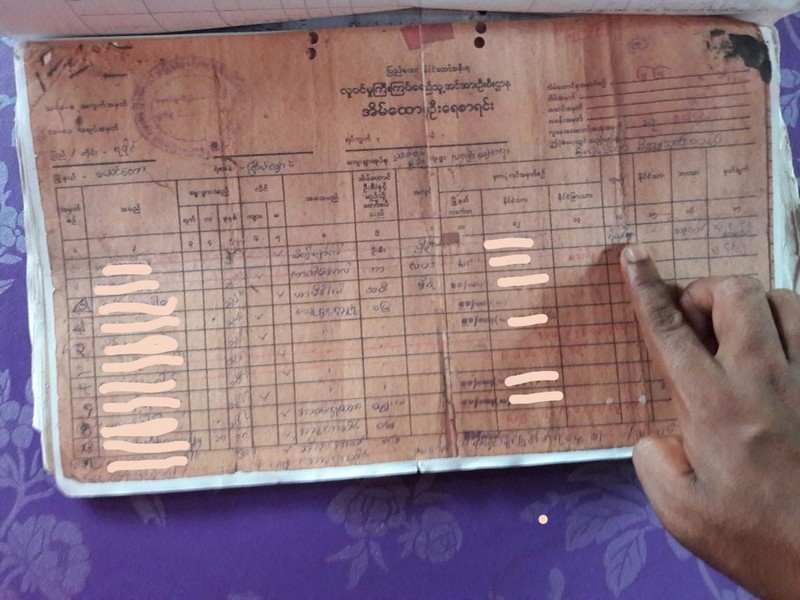
After some time, he emerged from behind the blanket that had been hung as a make-shift wall. He placed a metal cash box on the bamboo floor. Opening it with a key, he revealed a stack of papers, cards and photos – tattered ones, faded ones and plastic covered ones. Very carefully, he unfolded and displayed the contents across the length of the floor in front of me and my young Rohingya ‘fixer’. Methodically, he placed them in date order with the oldest closest to him. There were ID cards from his parents, grandparents, uncles, aunties and children – fraying blue and pink ones from the 1950s, white ones for the 1990s and one new turquoise one; registration documents listing every family member from the 1970s to the 2010s complete with crossings out, alterations and comments added by officials; joint-mugshots of the family holding a board with their registration number; repatriation documents from the 1970s and 1990s; and piles of land registration papers going back to the early years of independence in the 1950s.
‘But Uncle,’ said my fixer in amazement, ‘This must be one of the most complete collections in the whole camp! How on earth did you manage to keep hold of all these documents?’
Other Rohingya refugees had told us how their documents had been confiscated, seized, destroyed and burnt by state officials. Rafique explained how he would wrap the papers and cards in plastic, secure them in a metal box and bury them deep underground. Each year for almost 30 years, he would dig them up, rewrap them and bury them somewhere else. His brother was well connected; when authorities demanded he relinquish old ID cards, he would say they were lost and offered bribes of food, farm produce, favours or money.
Pointing to the documents in turn, Rafique explained – over three hours – how successive regimes in Myanmar had slowly destroyed Rohingya identity as a group belonging to the Rakhine region of the country. He kept the papers, he said, to evidence Rohingya history in Myanmar. He re-told the stories of belonging of his relatives; three mass expulsions and forced repatriations since independence; slow denationalisation; violent encounters with state authorities. Finally, he talked about his determination to resist the current state ID scheme, which ‘makes Rohingya into foreigners’. Group resistance, he reasoned, was intricately connected to the mass violence, killings and expulsions that had landed him in this refugee camp in 2017. Myanmar, he said, would not be a safe place to return to until Rohingyas were ‘given back’ their citizenship.
Invisible people or invisible states?
At a global level, citizenship has been compared to a giant filing system. Each individual human is assigned at least one nationality and filed ‘according to their return address’ or where they can be deported to. From a statist point of view, stateless people – or people without any legal citizenship – are an aberration in that filing system. They have no return address, so cannot be formally deported or expelled.
Human rights advocates take a different view. Those un-filed people are an ‘anomaly’ in an international rights system that is supposed to apply universally to all humans. It’s impossible for people to realise their rights if no state is responsible for protecting or providing for them. As such, stateless people are often described as legally and administratively ‘invisible’. They struggle to access legal protections, education, healthcare, work and financial services. Further, they are unable to benefit from international development and aid interventions.
Though statist concerns over deportability and human rights concerns over rightlessness seem to be ideologically opposed to one another, proposed solutions to the problems of statelessness often align. Administrative invisibility is generally tackled by proposing more state registration, more documentation, more efficiency, more digitisation and more biometrics. Sustainable Development Goal 16.9, which commits to providing a ‘legal identity for all’ by 2030, has become a rallying cry for international development organisations, refugee and migration management agencies, multinational tech companies and NGOs alike.
Yet, these approaches to statelessness by-pass fundamental issues relating to state abuses of power. State authorities consolidate their power through identification technologies and ID schemes, and can misuse these powers to exclude and expel. Few people in the world are actually completely undocumented. More people lack the right documents to be able to live legally in their homes, move freely within their own country, find regulated work or use banking systems. Other people are wrongly documented/registered by state authorities as foreign. The wrong kinds of registration can make things worse.
Despite being hailed as the harbingers of social inclusion, digital ID schemes can harden the boundaries of citizenship, excluding minorities and making it more difficult for people of uncertain citizenship to function in society. As Rafique’s account shows, the implementation of ID systems can be intricately linked to citizenship stripping and mass atrocities. Analysis of how power functions (differently) in particular states and societies, and how it functions through citizenship regimes and ID systems, is absent in ‘one-size-fits-all’ approaches to delivering ‘legal identities for all’. ID schemes are often misconceived as neutral processes in which sets of biological and/or biographical facts about individuals are recorded. In fact, they are imbued with power and profoundly impact social relations.
In initiatives to lift ‘stateless people’ out of a state of invisibility – to count them and document them – we fail to look properly at the perpetrating states. States are not identical containers that will function once filled up with international policy recommendations, capacity development and technical advice. Rafique’s oral history, which covered a period of 30 years of UN presence in his homelands, tells a story not of the invisibility of stateless Rohingya, but of how international actors have failed to look at the criminal intent of the state relating to their ID schemes and registration processes.
Statelessness studies often grapple with how to research ‘invisible’ populations. It’s equally important to grapple with how and why state violence has been invisibilised in anti-statelessness work. The very best starting point is to listen properly to survivors of state violence. Rafique’s account is just one of many. Rohingyas and many other stateless people are not really ‘invisible’. It’s just that if we look for them through state-tinted lenses, we tend to look right through the structures that were built to incarcerate them.
Natalie Brinham is an ESRC Post-Doctoral Fellow at the University of Bristol, working with MMB and the School of Sociology, Politics and International Studies.
The statement issued by Washington-based World Kashmir Awareness Forum
December 11, 2023
The supreme court of India upholds the decision of the Modi Government to strip the occupied Jammu & Kashmir of special status. The verdict though disappointing does not come as a surprise. This is the same court that confirmed the death sentence on Afzal Guru, notwithstanding the fact (own admission of the chief justice) that evidence for the alleged crime was not conclusive. The judgment came “to satisfy the collective conscience of the nation.” The same court few years ago issued a judgment giving the Hindu majority a right to build a temple in place of Barbari Mosque. This decision came as a shock to legal luminaries who cast aspersion on the acumen of the judges of the highest court of the land. Any single or group of individuals expecting a fair judgment from Indian courts is exhibiting his/her naivety as rule of law has been buried under BJP Hindutva rubble by the Indian government.
It is evident that the decisions regarding these cases are made within the precincts of establishment and all that is left for the judges is to narrate the judgment. Although very much expected this pronouncement is a slap on the face of freedom seeking nations and institutions of the world that eloquently expostulate for peaceful and amicable resolution of Kashmir issue. India, especially the present government has expansionist ambitions that can be detrimental, disastrous, and devastating for the whole region that includes three nuclear powered states. The appalling judgment passed today should leave no doubt in anybody’s mind that peaceful resolution of the protracted problem of Kashmir is not a part of the Indian agenda. Thus, onus is on the world bodies like United Nations to marshal all their resources to dissuade India from embarking in her nefarious designs. It must be emphasized here that today’s Supreme Court decision contravenes UN resolutions #122 and #126 adopted on January 24, 1957, and December 2, 1957, respectively. These resolutions prohibit any unilateral action targeted at changing the disputed nature of the State of Jammu and Kashmir.
Today’s decision in no way will dampen the spirit of Kashmiris to attain freedom from Indian occupation. The torch of liberty, peace and justice will continue to burn in the hearts of enslaved people of Jammu & Kashmir and will not be doused by these horrendous decisions.
With this final destructive blow, the moral fabric of the Indian judiciary lies in tatters. The rule of law and the system of justice has been abdicated from the country and what remains is a jungle roaming with hyenas. Indian authorities are living in a fool’s paradise if they believe that by their foolish antics and cowardly decisions the voices of freedom can be subdued. The nation of Kashmir has sacrificed over 100,000 youth and the honor of over 11,000 sisters and under no circumstances they will give up their peaceful struggle for freedom and justice. As a matter of fact, the struggle will be invigorated, and the people of Indian occupied Kashmir will spare no efforts to lead it to its logical conclusion. It is for the world to decide if they prefer a cataclysmic outcome of this struggle or will they restrain India to ensure peace, tranquility, and justice in Kashmir. The world powers do remember what Antonio Guterres, the Secretary General of the United Nations said on August 10, 20219 that “the position of the United Nations on this region (Kashmir) is governed by the Charter of the United Nations and applicable United Nations Security Council resolutions.”
“Thin” the Palestinian population “to a minimum.”1
“I am for compulsory transfer; I do not see anything immoral in it. “2
Can you guess who said which one? Which is Ben-Gurion, Israel’s first Prime Minister, in 1938, and which is Netanyahu this week referring to Gaza? Well, the first one is the more recent, but you can see that the plan has not changed. And Netanyahu’s appointees say much the same. His finance Minister, Bezalel Smotrich, said last March that “Palestinians don’t exist” and called for more “sterile” – Palestinian free – zones in the West Bank (WB). Others have said it is now Gaza Nakba 2023, referring to the mass expulsions of five out of seven Palestinians from Israel as it became a state in 1948.2a On October 13, +972 Magazine published an Israeli intelligence document which concludes:
The evacuation of the civilian population from Gaza to Sinai…will yield positive, long-term strategic outcomes for Israel, and is an executable option. It requires determination from the political echelon in the face of international pressure, with an emphasis on harnessing the support of the United States.
And the idea goes even farther back than these examples. Theodor Herzl, the founder of the Zionist movement, said in 1895: “We shall try to spirit the penniless population across the border…while denying it any employment in our country….Both the process of expropriation and the removal of the poor must be carried out discreetly and circumspectly.”3
Many other Israeli politicians have also asserted the necessity of removing all Palestinians. Prime Minister Ariel Sharon’s Housing Minister Eitam said in 1950: “We’ll have to expel the overwhelming majority of West Bank Arabs from here.” In 1980 Israel published the Drobles Plan, which stated that the goal was to “remove any trace of doubt about our intention to control to control Judea and Samaria (what Israel calls the WB) forever.” Netanyahu’s opponent, Avigdor Lieberman, said in 2009 that Israel’s Palestinian citizens should be stripped of their citizenship unless they pledged loyalty to a Jewish state. In polls from 2015-7 that asked Israelis if Israeli Arabs and West Bank Palestinians should be expelled from Israel, 32-58% said yes.4
By winning the Jews of Israel to focus all their anger and frustration on Palestinians, discontent is deflected from the ruling elite of Israel. Israel itself is a highly ineqalitarian capitalist society with a small ruling elite. The nationalist antipathy towards Israel serves the same function in the West Bank and Gaza, which are also capitalist societies, all of which is discussed in several articles on the multiracialunity.org blog. (see appendix)
Ethnic Cleansing and Genocide
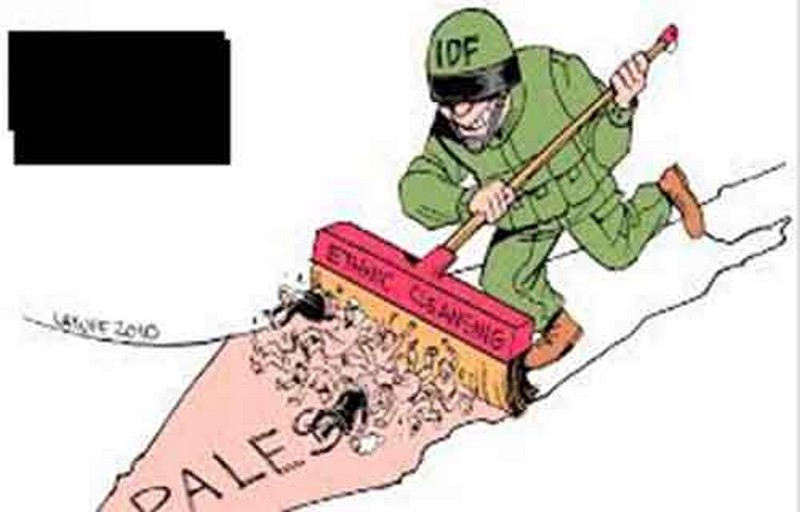
Ethnic cleansing is defined as forcefully homogenizing an ethnically mixed population of a region by any means at the expeller’s disposal. In the case of the Israeli war on Palestinians, the term genocide is also applicable, defined as the deliberate killing of a large number of people from a particular nation or ethnic group with the aim of destroying that nation or group. Israeli Jews, who had recently been the victims of the mass Nazi extermination campaign, carried out such a plan against Palestinians in 1947-8 and are doing so again today. In his landmark 2006 book The Ethnic Cleansing of Palestine, Israeli historian Ilan Pappe said, when talking about the Nakba: “Ethnic cleansing is a crime against humanity, and the people who perpetrate it today are considered criminals to be brought before special tribunals.”5 But there are no legal proceedings. The US is funding Israel’s war with an extra $14.3 billion in aid, while other nations just look on in silence, even as millions around the world protest.
Before the recent seven day “humanitarian pause” in the war on Gaza, at least 15,000 Palestinians had been killed, many more wounded, and the northern half of the Gaza strip completely destroyed. Now Israel has declared that the South, to which survivors had fled, will be treated the same way. The death toll has risen by over 1000 as of today as central Gaza is destroyed. There is no place to go to escape the bombing, no hospital beds or medicines to treat the sick and wounded, and an almost complete lack of food, water and fuel. Those who are not blown up will suffer the slower death of thirst, starvation or disease.
The justification for this slaughter is the Hamas incursion into Israel on October 7, in which 1200 Israelis were killed. And there is no justification for this murder of civilians. However, there is a caveat to this story. It has recently been revealed that Israeli intelligence knew about Hamas’ plan a year in advance, but claims that the leading politicians were never told.6 This seems highly unlikely, less likely than that they welcomed an excuse to enact their genocidal plan.
The Oppressed Become the Oppressors
There is no doubt that anti-Semitism had a long and virulent history in Europe, and for centuries Jews lived in ghetto communities and suffered severe persecution. With the growth of European nationalism in the 19th century, many Jews also conceived of a national home. Episodes like the false accusation of treason against a Jewish French military officer, Alfred Dreyfus, and anti-Semitic pogroms in Russia in the 1880s stimulated the movement. Herzl, a secular middle-class Hungarian-born Austrian, concluded that assimilation was impossible and founded the World Zionist Organization in 1897, which aimed to create a Jewish homeland in Palestine.
Although some Jews believed the lie that Palestine was unoccupied and some that only very primitive peoples lived there, many understood that the 400,000 Arab inhabitants would have to be displaced. Zionist leader Leo Motzkin spelled this out in 1917: “Our thought is that the colonization of Palestine has to go in two directions: Jewish settlement in Eretz Israel [Jewish religious name for Palestine] and the resettlement of the Arabs of Eretz Israel in areas outside the country.”4 By emphasizing the biblical role of Palestine, the Zionists convinced many Jews that Palestinians were strangers or intruders who needed to be removed so they could reclaim their homeland. Others saw it as a European missionary project to bring advancement to a primitive people. Some, especially those from socialist backgrounds, wished to live in harmony with Arab neighbors, but this minority view did not prevail.
Jews had been immigrating to Palestine in small numbers before World War I, but the real possibility of a Jewish state only emerged when Britain promised as much in 1917 with the Balfour declaration. A relationship of antagonism between Arabs and Jews was born out of what had been peaceful coexistence with a Jewish minority of about 5%. The Jewish newcomers primarily set out to buy Arab land through the Jewish national Fund (JNF). By 1928, the Jews made up 10-20% of the population, but the British attempted to establish a system giving so-called equal representation to Jews and Arabs. Although Palestinians were disadvantaged by the arrangement, their offer to negotiate was refused, which led to an uprising in 1929 and a larger one in 1936. Their defeated leaders were exiled, armed units disbanded and many arrested. In 1937, the British Peel Commission recommended partitioning the land into two states, but by 1942 the Zionists were demanding the whole of Palestine for themselves.
In case the whole territory was not awarded to them, the Zionists began preparations for taking it by force. The paramilitary Hagana was transformed into a potent force with training by the British during the 1936 Arab revolt and by fighting alongside Britain in World War II. Once the Nazis were defeated, the British hoped for a settlement in Palestine that acknowledged all parties. The Zionists fought back with terrorist attacks, the most famous being bombing the British headquarters at the King David hotel in Jerusalem. By 1946 The Zionist leader Ben-Gurion was ready to settle for 80% of the land.
In preparation for seizing what land they wanted, the Zionists in the 1940s had the JNF begin mapping every Palestinian village and all its sociological data. This data paved the way for the later efficient attacks on villages and their leaders. The first Zionist plan was Plan C devised in 1946, which included:
“Killing the Palestinian political leadership, killing Palestinian inciters and their financial supporters, killing Palestinians who acted against Jews,killing senior Palestinian officers and officials, damaging Palestinian transportation, damaging the sources of Palestinian livelihoods: water wells,mills, etc., attacking nearby Palestinian villages likely to assist in future attacks, and attacking Palestinian clubs, coffee houses, meeting places, etc.”
However, within a few months, this plan was superseded by Plan D, which called for the systematic and complete expulsion of all Palestinians.7
By the late 1940’s, The British had decided to solve their Palestinian problem by turning it over to the UN, which came up with a partition plan awarding 56% of the land to the Jews, including the most fertile areas, even though they then comprised 30% of the population and owned only 6% of the land. The Palestinians boycotted the proceedings, but the resolution was adopted in November, 1947, and a month later the methodical ethnic cleansing began. Despite some Palestinian resistance, Plan D was completed in about 6 months. 530 villages were destroyed, nearly 800,000 Palestinians were expelled, and untold numbers were massacred. Others were killed by tactics like poisoning the water of Acra with typhus. Israeli history to this day portrays this catastrophe as a voluntary exodus to make way for invading Arab armies or as the result of anti-Semitism.
The Evolution of Apartheid
The Palestinian refugees of 1948 settled in what is now the West Bank and Gaza in camps that persist to this day or in neighboring countries. The 3-5000 who tried to return to their homes were killed. About 160,000 Palestinians remained within the Israeli state, and they were driven from their homes into three concentrated areas. In 1967, Israel launched a war to claim control of the West Bank and Gaza, which had been run by Jordan, Egypt and Syria. The Six Day War was won by Israel, which resulted in the expulsion of 3-400,000 more Palestinians into Jordan, and the illegal military occupation of these areas began.
Since 1967, Israel has seized about a quarter of what remained of the West Bank by calling it State Land even though much of it was privately owned by Palestinians. On this they have built settlements and infrastructure for now over 600,000 Israeli settlers. Within Israel 19% of the population is Palestinian, but they are confined to 3% of the land. In the Negev desert, Israel refuses to recognize 35 Bedouin villages and demolished more than 10,000 Bedouin homes in the Negev between 2013 and 2019.8 From 1967-94, Israeli policies that prevented Palestinians who left the West Bank and Gaza Strip from returning forced roughly 9,000 Palestinians per year into permanent exile.
In the last couple of years Israel has accelerated its policy of killing and displacing Palestinians in the West Bank. Many WB residents have deeds from the Ottoman or pre-1967 eras that Israel does not recognize are threatened with dispossession. Attacks by the illegal settlers have been accelerating for the last two years. Eleven Palestinian communities were abandoned this year, hundreds of olive trees destroyed and 1100 residents fled. Over 400 Palestinians have been killed in 2023 by settlers, often protected by Israeli soldiers.9 Since October 7, 130 have been killed, including 43 children, 1700 arrested, and 1000 forced from their homes.10
Palestinian resistance movements, both civil and militaristic, developed early on, mostly on a nationalistic basis. The Palestine Liberation Organization (PLO) lost whatever militancy it once had by forging relations with corrupt rulers of Arab nations and collaborating with US and Israeli leaders, culminating in the Oslo accords of 1993, that ceded direct control of 60% of the West Bank to Israel. Hamas was formed in 1987 with the aid of Israel, who thought a fundamentalist religious group would reduce support for the secular PLittle anger or energy remains to face the internal problems of Israeli society. Racism and nationalism have turned Jews into Nazis, much against their own interests.
Racism and Nationalism Have Captured Israel
Thus we can see that Israeli leaders have had a plan from the beginning to drive as many Arabs as possible from all of historic Palestine, from the Jordan River to the sea. They have won the majority of Jewish Israelis to support them by inculcating every Jew with the idea that Arabs are inferior and have an inborn hatred of Jews. With every child raised on the idea that another Holocaust is waiting to happen, most are anxious to reign violence down on Palestinians. Only a few object. By allowing the recent Hamas raid to go forward and by exaggerating its horrors with stories of beheaded babies and the like, the Israeli population has been won to applauding a brutal genocide. Little anger or energy remains to face the internal problems of Israeli society. Racism and nationalism have turned too many Israeli Jews into Nazis, much against their own interests.
Ellen Isaacs is a physician, anti-racist and anti-capitalist activist and co-editor of multiracialunity.org. She can be reached at eisaacs66@gmail.com.
One way of understanding the ongoing bloodbath pitting Israel against Hamas is to see it as just the latest chapter in an existential struggle dating back to the founding of the Jewish state in 1948. While the appalling scope, destructiveness, and duration of the fighting in Gaza may outstrip previous episodes, this latest go-around serves chiefly to reaffirm the remarkable intractability of the underlying Arab-Israeli conflict.
Although the shape of that war has changed over time, certain constants remain. Neither side, for instance, seems capable of achieving its ultimate political goals through violence. And each side adamantly refuses to concede to the core demands of its adversary. In truth, while the actual fighting may ebb and flow, pause and resume, the Holy Land has become the site of what is effectively permanent conflict.
For several decades, the United States sought to keep its distance from that war by casting itself in the role of regional arbiter. While providing Israel with arms and diplomatic cover, successive administrations have simultaneously sought to position the U.S. as an “honest broker,” committed to advancing the larger cause of Middle Eastern peace and stability. Of course, a generous dose of cynicism has always informed this “peace process.”
On that score, however, the present moment has let the cat fully out of the bag. The Biden administration responded to the gruesome terrorist attack on October 7th by unequivocally endorsing and underwriting Israeli efforts to annihilate Hamas, with Gazans thereby subjected to a World War II-style obliteration bombing campaign. Meanwhile, ignoring tepid Biden administration protests, Israeli settlers continue to expel Palestinians from parts of the West Bank where they have lived for generations. If Hamas’s October assault was a tragedy, proponents of a Greater Israel also saw it as a unique opportunity that they’ve seized with alacrity. As for the peace process, already on life support, it now seems altogether defunct. Prospects of reviving it anytime soon appear remote.
More or less offstage, the fighting is having this ancillary effect: as Israeli Defense Forces (IDF) employ U.S.-provided weapons and munitions to turn Gaza into rubble, the “rules-based international order” touted by the Biden administration as the latest organizing principle of American statecraft has forfeited whatever slight credibility it might have possessed. Russia’s assault on Ukraine appears almost measured and humane by comparison.
As if to emphasize Washington’s own limited fealty to that rules-based order, President Biden’s immediate response to the events of October 7th focused on unilateral military action, bolstering U.S. naval and air forces in the Middle East while shoveling even more weapons to Israel. Ostensibly tasked with checking any further spread of violence, American forces in the region have instead been steadily edging toward becoming full-fledged combatants.
In recent weeks, U.S. forces have sustained dozens of casualty-producing attacks, primarily from rockets and armed drones. Attributing those attacks to “Iran-affiliated groups,” the U.S. has responded with air strikes targeting warehouses, training facilities, and command posts in Syria and Iraq.
According to a Pentagon spokesman, the overall purpose of American military action in the region is “to message very strongly to Iran and their affiliated groups to stop.” Thus far, the impact of such messaging has been ambiguous at best. Certainly, U.S. retaliatory efforts haven’t dissuaded Iran from pursuing its proxy war against American military outposts in the region. On the other hand, the scale of those Iran-supported attacks remains modest. Notably, no U.S. troops have been killed — yet.
For the moment at least, that fact may well be the administration’s operative definition of success. As long as no flag-draped coffins show up at Dover Air Force Base in Delaware, Joe Biden may find it perfectly tolerable for the U.S.-Iran subset of the Israel-Hamas war to simmer indefinitely on the back burner.
This pattern of tit-for-tat violence has received, at best, sporadic public attention. Where (if anywhere) it will lead remains uncertain. Even so, the U.S. is at risk of effectively opening up a new front in what used to be called the Global War on Terror. That war is now nearly dormant, or at least hidden from public view. The very real possibility of either side misinterpreting or willfully ignoring the other’s “messaging” could reignite it, with an expanded war that directly pits the U.S. against Iran making the Israel-Gaza war look like a petty squabble.
Then there are the potential domestic implications. No doubt President Biden’s political advisers are alive to the possibility of a major war affecting the outcome of the 2024 elections (and not necessarily to the incumbent’s benefit either). One can easily imagine Donald Trump seizing on even a handful of U.S. military fatalities in Middle East skirmishing as definitive proof of presidential ineptitude, akin to the bungled withdrawal from Kabul, Afghanistan, during Biden’s first year in office.
Two Wars Converge
Understanding the larger implications of these developments requires putting them in a broader context. In Gaza in the last two months, two protracted meta-conflicts that had unfolded on parallel tracks for decades have finally converged. That is likely to have profound implications for basic U.S. national security policy, even if few in Washington appear aware of the potential implications.
On the one track, dating from 1948 (although its preliminaries occurred decades earlier) is the Arab-Israeli conflict. Enshrined among Israelis as the War for Independence, for Arabs the events of 1948 are seen as the Nakba, or “Catastrophe.” Subsequent eruptions of violence have ensued from time to time, as Arab nations vented their anger at the Jewish state and Israel pursued opportunities to create a strategically more coherent and more economically viable, not to mention biblically endorsed, “Greater Israel.”
Initially intent on steering clear of the Arab-Israeli conflict — occasionally even denouncing Israeli misbehavior — American officials allowed themselves over time to be incrementally drawn into becoming Israel’s closest ally. Yet under the terms of the relationship as it evolved, the Israeli leaders insisted on retaining a large measure of strategic autonomy. Over Washington’s vociferous objections, for example, it acquired a robust nuclear arsenal. To guarantee their security, Israelis placed paramount emphasis on their own military capabilities, not those of the United States.
Meanwhile, on the other track, dating from the promulgation of President Jimmy Carter’s Carter Doctrine in 1980, U.S. forces have had their hands full in the region. With Israel exacerbating or fending off threats to its own security, successive American administrations undertook a series of new military commitments, interventions, and occupations across the Greater Middle East that had little or nothing to do with protecting Israel.
In the Persian Gulf, the Levant, the Horn of Africa, the Balkans, and Central Asia, the Pentagon dealt with problems of its own as those regions became venues for hosting American forces engaged in operations intended to protect, punish, or even “liberate.” Such military exertions and the presence of U.S. forces became commonplace throughout the Middle East — except in Israel. In the wake of the 9/11 attacks, Washington’s military actions reached their apotheosis when President George W. Bush embarked on a global campaign with the aim of eliminating evil.
Meanwhile, the various engagements undertaken by Israeli forces from the 1950s into the present century achieved mixed results. On the one hand, the Jewish state persists and has even expanded — a minimalist definition of “success.” On the other hand, recent events affirm that threats to Israel’s existence also persist.
In comparison, the U.S.-led Global War on Terror proved an outright failure, even if strikingly few ordinary Americans (and even fewer members of the political establishment) appear willing to acknowledge that fact.
Once the U.S.-supported regime in Kabul collapsed in 2021, it appeared American military misadventures in the Greater Middle East might be petering out. The humiliating result of Operation Enduring Freedom in Afghanistan in the wake of the disappointing outcome of Operation Iraqi Freedom had seemingly exhausted Washington’s appetite for remaking the region. Besides, there was Russia to tend to — and China. Strategic priorities seemed to be shifting.
Alarm Bells, American-Style
Now, however, in the wake of the atrocities committed on October 7th and Washington’s tacit acquiescence in Israel’s maximalist war aims, the dubious notion that vital American interests are still at stake in the Greater Middle East has taken on new life. Dating from the 1980s, Washington had cycled through a variety of arguments for why that part of the world was worthy of spending American blood and treasure: the threat of Soviet aggression, U.S. reliance on foreign oil, radical Arab dictators, Islamic jihadism, weapons of mass destruction falling into hostile hands, potential ethnic cleansing and genocide. All of those were pressed into service at one time or another to justify continuing to treat the Middle East as a strategic U.S. priority.
In truth, though, none of them has stood the test of time. Each has proven to be fallacious. Indeed, efforts to cure the sources of dysfunction afflicting the region proved to be a fool’s errand that has cost the United States dearly in money and lives while yielding little of value.
For that reason, allowing Israel’s conflict with Hamas to draw the United States into a new Middle Eastern crusade would be the height of folly. In fact, however, with little public attention and even less congressional oversight, that is precisely what may be happening. The Global War on Terror seems on the verge of absorbing the Gaza War into its current configuration.
In recent years, a shift in Pentagon priorities to the Indo-Pacific and to a future face-off with China has left only about 2,500 U.S. troops in Iraq and 900 more in Syria. The nominal mission of such modestly sized garrisons is to carry on the fight against the remnants of ISIS.
White House officials have, however, never gone out of their way to explain what those troops are really doing there. In practice, they have effectively become inviting stationary targets. As a consequence and not for the first time, “protecting the troops” has emerged as a convenient pretext for mounting a broader punitive response.
With Congress accepting claims that the Authorization for Use of Military Force (AUMF) enacted in response to 9/11 suffices to cover whatever U.S. forces in the region may be up to 22 years later, the Biden administration functionally has a free hand to act as it wishes. The course it has chosen is to use Israel’s war in Gaza as a rationale for reversing course in the Middle East and once again making violence and threats of violence the basis of U.S. policy there. On that score, the fact that some Americanforces are now covertly operating in Israel itself should set off alarm bells.
The Gaza War will change Israel in ways that may be difficult to foresee. The failure of its vaunted military and intelligence establishments to anticipate and thwart the worst terrorist attack in that country’s history leaves Jewish Israelis with a sense of unprecedented vulnerability. It will hardly be surprising if they look to Washington for protection, in which case Israel’s survival could become an American responsibility.
The invitation is one that the United States would do well to refuse. Accepting it will confront Americans with challenges they are ill-equipped to meet and with obligations they can ill afford. Deepening the Pentagon’s involvement in the Greater Middle East will only compound the failures to which the Carter Doctrine has already subjected this nation, while scrambling U.S. strategic priorities in ways sure to prove counterproductive.
In 1796, George Washington warned his countrymen of the dangers of allowing a “passionate attachment” to another nation to affect policy. That warning remains relevant today. The Gaza War is not and should not become America’s war.
Andrew Bacevich, a TomDispatch regular, is chairman and co-founder of the Quincy Institute for Responsible Statecraft.
Militant groups are increasingly threatening Myanmar’s military government. But other non-state actors, as well as China, are playing powerful roles in the divided country.
Myanmar’s stability has eroded significantly since the 2021 military coup. But the coordinated attack by multiple separatist and pro-democracy groups in October and November 2023 has seen military outposts, villages, border crossings, and other infrastructure overrun. While the Tatmadaw, Myanmar’s military, clings to control in central and coastal regions populated by the country’s ethnic majority, much of the country’s border areas are increasingly slipping into anti-government control.
This current turbulence is not an aberration but deeply rooted in Myanmar’s history. Since gaining independence from British rule in 1948, the country has grappled with what is commonly described as the world’s longest-running civil war. Initial experiments with democracy witnessed limited clashes between Myanmar’s central government and Ethnic Armed Organizations (EAOs.) Following a military coup in 1962 that established the junta, more EAOs emerged to challenge government power.
Infighting and splintering among EAOs, coupled with their growing antagonism toward the Burma Communist Party (BCP), itself waging a war on the central government, allowed the junta to implement fragile ceasefires in exchange for limited autonomy. By the end of the Cold War, democratic protests in 1988, the collapse of the BCP in 1989, and free elections in 1990 all suggested Myanmar was cautiously embracing a peaceful future.
Despite losing the elections in 1990, however, the junta did not relinquish power, drawing international condemnation. EAOs and other groups like the Myanmar National Democratic Alliance Army (MNDAA), which split from the BCP, then continued their struggle for two decades until the junta ceded some powers to a civilian administration in 2011. Elections in 2015 and 2020 saw landslide victories for the National League for Democracy (NLD), as well as some progress toward reconciliation.
But in 2021, the Tatmadaw reestablished the junta and plunged the country back into destabilization, culminating in the 2023 autumn offensive by anti-junta forces. In addition to EOAs and a reorganized BCP, the junta has also been forced to contend with People’s Defense Forces (PDFs), loose armed organizations backed by the National Unity Government (NUG), set up by lawmakers and politicians in the aftermath of the coup. Additionally, the role of the Burman ethnic majority and grassroots civil defense forces in opposing the junta has also complicated its response to unrest.
The junta has proven adept at managing its restive elements before, and can also rely on its Border Guard Forces (BGFs) and other pro-government militia groups. But the broad swathes of Myanmar’s society fighting against it have made the junta’s traditional policy of divide and rule far less effective. Myanmar’s Acting President Myint Swe has said the country could “split into various parts”, prompting Myanmar military officials to retreat to the capital, Naypyidaw, a planned city completed in 2012 that effectively serves as a fortress located near the most restive regions.
China’s role in Myanmar has undergone significant shifts since the latter’s independence. Despite Chinese support for the BCP and other communist groups, Myanmar grew closer to China after its isolation from the West in the 1990s. Beijing supported the junta to stabilize Myanmar and prevent adversaries from establishing a foothold on China’s southern border. Other interests included maintaining access to Myanmar’s raw materials and natural resources, as well as infrastructure development to turn Myanmar into a strategic gateway to the Bay of Bengal through the China-Myanmar Economic Corridor (CMEC), part of China’s Belt and Road Initiative (BRI).
China maintained ties to the junta, democracy advocates, and ethnic groups from 2011 to 2021. However, the 2021 coup disrupted development projects and led to attacks on Chinese-run facilities by rebel groups, and the junta’s inability to protect infrastructure exacerbated historical tension between it and Beijing. Four Chinese civilians were killed in 2015 after a Myanmar military airstrike hit across the border into Yunnan, while the junta burned down a Chinese-owned factory and killed Chinese and Myanmar civilians in 2021.
China’s ongoing support to some militia groups, such as the United Wa State Army (UWSA) and MNDAA, provides Beijing leverage over the junta and a say in the ceasefire processes. Chinese firms also often work with armed groups in “special economic zones” near the border, and some of the anti-junta groups regularly cross the border to China to escape the junta and its proxy forces. Beijing’s tacit approval of their activities may also be partially fueled by wariness that rebel groups were becoming closer to the U.S. prior to the new offensive.
Beijing has nonetheless attempted to sustain a balancing act, arresting a UWSA deputy military chief in October 2023 and initially ignoring calls for assistance from the rebels after the launch of their offensive. But following the steady string of defeats suffered by the junta, China has since altered its outlook. China’s affiliates now form some of the most powerful groups operating in Myanmar, and China’s foreign ministry has called for a ceasefire.
Myanmar’s porous borders have not only allowed armed groups to flourish but also facilitated the expansion of organized crime networks. Increased cooperation between militant and criminal groups in recent decades, known as the terror-crime nexus, has elevated the power of these groups worldwide.
American efforts to counter communism inadvertently helped develop drug networks in Myanmar during the early Cold War, while transnational organized crime in Southeast Asia burgeoned in the 21st Century. The COVID-19 pandemic further established Myanmar as a hub of criminal activity, expanding the funding networks available to the country’s armed groups. Both local and international criminal networks operate in Myanmar’s special economic zones, engaging in human and wildlife trafficking, slavery, cybercrimes, money laundering, communication fraud, illegal casinos, and online gambling centers.
China, while entangled in Myanmar’s criminal underworld, has grown steadily more concerned with rising illicit activity on its border with Myanmar and the willing and unwilling participation of Chinese citizens. China’s signals to the junta to address the forced-labor networks since May 2023 went unheeded, leading to China issuing arrest warrants for junta allies and the UWSA to raid online scam compounds and trafficked labor centers in border regions.
However, the resilience of regional criminal groups became evident after the NLD failed to disrupt their activities during the decade of partial democratic rule from 2011 to 2021, and they have only grown financially stronger since. And despite their interweaving with regional elites, criminal networks and their militant partners have developed newfound agency and an ability to act independently from governments since the 2021 coup.
Additionally, while the junta styles its current campaign as a counterinsurgency, Myanmar’s armed groups possess significant military capabilities. Minority groups such as those belonging to the Karen ethnic group were prominent in Myanmar’s armed forces during the British colonial administration, gaining valuable experience. As in Ethiopia, certain ethnic groups have developed and maintained well-equipped forces capable of both insurgency and conventional warfare.
Like other anti-government forces around the world, Myanmar rebel groups have also embraced new technologies and strategies in recent years. This includes crowdfunding initiatives, which have expanded significantly since 2021, to offset the junta’s control over the central bank and other national economic levers. Large-scale application of drone warfare has also made a marked difference on the battlefield, even before the current offensive by the rebels.
Myanmar’s militant groups have also worked with European criminal groups to obtain weapons, and groups like the UWSA have proven capable of manufacturing weapons since 2008. The use of 3D-printed guns by Myanmar rebel groups, just ten years after the first 3D-printed gun was produced, also marks a distinctive feature of the current conflict. The NUG has meanwhile been busily setting up local civic administration and public services and People’s Administrative Teams (PATs) in PDF-controlled or contested areas, indicative of their state-building capabilities.
Hindered by international isolation, increasingly powerful rebel groups, and a growing dependence on a Chinese leadership willing to support multiple sides, the junta’s outlook appears bleak. But it does maintain some other allies abroad. Russia grew closer to the junta throughout the 2010s and despite being tied down in Ukraine, Moscow has offered more support for Myanmar since the coup, including the first ever Russia-Myanmar joint naval exercise in November 2023. Bordering states Laos and Thailand also maintain friendly ties to the junta, and Laos, holding the chairmanship of ASEAN since September 2023, has shielded Myanmar from greater institutional isolation.
Myanmar’s other neighbors, India and Bangladesh, are also wary of additional instability and the potential emergence of a failed state on their borders. India has already seen tens of thousands of refugees (as well as soldiers from the junta) cross the border since 2021, while Bangladesh has seen close to one million Rohingya refugees enter the country since 2016, and India has recently shown it is still willing to engage with the junta despite its vulnerability.
Efforts to further unite anti-government forces meanwhile face obstacles due to differences in strategies, objectives, and allegiances. Several organizations have been set up to encourage greater coordination, but infighting is still common. Some EAOs, like the Restoration Council of Shan State (RCSS), are still open to adhering to the Nationwide Ceasefire Agreement (NCA) while others consider a federal system a viable alternative to complete independence. Perceived indifference to the Rohingya crisis in 2017 on behalf of the democratic government at the time also reveals the persistent ethnic tensions among Myanmar’s population despite alternative leadership.
Convincing criminal and militant groups to give up their lucrative illicit networks, as well as untangling their links to the junta-dominated economy, will also prove challenging. And with the U.S. diplomatically tied down in Ukraine and Israel and ASEAN’s divided approach to the crisis, China enjoys relative freedom to manipulate the situation on its border. Yet despite positive relations across Myanmar’s political spectrum, Beijing’s reluctance to intervene more directly only amplifies the persistent uncertainty surrounding Myanmar’s future.
John P. Ruehl is an Australian-American journalist living in Washington, D.C., and a world affairs correspondent for the Independent Media Institute.