Just International

Israel expands law that allows villages and towns to ‘reject Palestinians’

By Lubna Masarwa and Elis Gjevori

The Israeli parliament has been accused of passing a “racist” piece of legislation that would see Palestinian citizens of Israel screened from living in almost half of the country’s small villages and towns.

The so-called “admissions committees” law passed on Tuesday would strengthen a controversial 2011 piece of legislation that allows those same panels – made up of members of the local community – to screen applicants for housing units and plots of land in hundreds of Jewish Israeli “community towns” built on state land.

Human rights campaigners have stressed that this is aimed at giving small Jewish communities the power to prevent Palestinians from buying or renting homes. There are almost two million Palestinian citizens of Israel, who are estimated to make up 20 percent of the country’s population.

The law does not officially allow the committees to reject residential candidates for reasons of race, religion, gender, nationality, disability, class, age, parentage, sexual orientation, country of origin, views or party political affiliation.

However, the wording of the 2011 law allows committees to reject candidates who they deem to be “inappropriate for the social and cultural fabric” of the community.

“In practice, this power has led to the exclusion of Palestinian citizens of Israel from these communities, which are built on state-controlled land,” said Adalah, the Legal Center for Arab Minority Rights in Israel, in a statement after the legislation was passed.

Hassan Jabareen, Adalah’s founder, is worried by the latest piece of admissions committee legislation and Israel’s judicial reform plans, which are set to open the court to political interference.

“We are now in a very critical situation,” Jabareen told Middle East Eye, adding that there is now a “climate in which Arabs can be easily discriminated against”.

‘Apartheid in Israel’

In 2012, Adalah took the Israeli government to court, arguing that the admissions committees law was a racist piece of legislation that mainly targeted Palestinians.

Four members of Israel’s supreme court agreed, while five members thought it was too soon to rule on the matter.

With the Israeli parliament now expanding the number of towns that can screen who lives in their community, “we are talking about almost half of the towns in the country” that are potentially off limits to Palestinians, Jabareen said.

To date, the law, which previously applied only to the Galilee in northern Israel and the Negev (Naqab) in the south of the country, allowed Jewish communities with up to 400 households to run admissions committees and select who could live in the communities.

The newly passed expansion raises that limit to communities with up to 700 households, and after five years the minister of economy and industry will be able to increase the number of admissions committees to towns with more than 700 households.

It also expands the areas in which the law will be applied beyond the Galilee and the Negev to areas designated as having a national priority regarding housing.

“The area north of Haifa and up to the Galilee, which covers 241 towns or 80 percent of the towns in the north” could now be denied to Palestinians, according to Jabareen.

In the south of the country, in the Negev region, 89 percent of towns could also be considered off-limits to Palestinians.

With a high concentration of Palestinians living in the north and south of the country, it’s hard not to conclude that the law is being carefully targeted to demographically engineer Jewish supremacy.

“We are clearly talking about a country that has decided to be an apartheid state inside the greenline,” Jabareen said, referring to Israel’s pre-1967 borders. “A huge part of this country won’t be allowed for Arab citizens.”

“What’s strange is that this law passed yesterday without any media or public attention [in Israel]. It’s becoming easier to infringe on the rights of Arabs,” Jabareen added.

‘Palestinians have the right to build homes’

Aside from politicians representing the two Arab parties in parliament, only two opposition Labour parliamentarians voted against the legislation, with all others voting in favour.

Ahmad Tibi, a Palestinian member of the Israeli parliament who voted against the law, told MEE that while Jewish communities continue to receive preferential treatment in housing and land allocation, “a new Arab village has never been established in the Galilee or for that matter any part of Israel”.

“The building planning process in Israel is Zionist and ideological, and thus it alienates and is hostile to the Arab population,” Tibi said.

Over the years Israel has used a number of different instruments to prevent Palestinians from expanding their communities, according to Tibi.

The Kaminitz Law was passed in 2017. It imposed strict penalties on construction work it deemed illegal, but campaigners saw it as penalising the country’s Palestinians, who rarely get permission to expand their homes.

“Arab towns have the right to plan for their future,” Tibi said. “There is a shortage of land for young couples and plots of land are not being made available.”

“Some of the young Arabs go to other towns, mixed cities or Jewish Israeli towns, but this admissions committees law prevents them from entering hundreds of towns and villages with national priority,” he added.

“I am afraid that this ban will be further expanded to mixed cities and there will be Jewish neighbourhoods that ban Arabs.”

Lubna Masarwa is a journalist and Middle East Eye’s Palestine and Israel bureau chief, based in Jerusalem.

Elis Gjevori is a journalist based in Istanbul. He focuses on the Balkans, Turkey and the Middle East.

27 July 2023

Source: middleeasteye.net

Let Them Eat Bugs: Challenging the WEF’s Corporate-Driven Food Reset

By Colin Todhunter

The prevailing globalised agrifood model is built on unjust trade policies, the leveraging of sovereign debt, population displacement and land dispossession. It fuels commodity monocropping and food insecurity as well as soil and environmental degradation.  

It is responsible for increasing rates of illness, nutrient-deficient diets, a narrowing of the range of food crops, water shortages, chemical runoffs, increasing levels of farmer indebtedness, the undermining and destruction of local communities and the eradication of biodiversity.

The model relies on a policy paradigm that privileges urbanisation, global markets, long supply chains, external proprietary inputs, highly processed food and market (corporate) dependency at the expense of rural communities, small independent enterprises and smallholder farms, local markets, short supply chains, on-farm resources, diverse agroecological cropping, nutrient dense diets and food sovereignty.

It is clear that there are huge environmental, social and health issues that stem from how much of our food is currently produced and consumed and that a paradigm shift is required.

So, some optimists – or wishful thinkers – might have hoped for genuine solutions to the problems and challenges outlined above during the second edition of the United Nations Food Systems Summit (UNFSS) that took place last week in Rome.

The UNFSS has claimed that it aims to deliver the latest evidence-based, scientific approaches from around the world, launch a set of fresh commitments through coalitions of action and mobilise new financing and partnerships. These ‘coalitions of action’ revolve around implementing a ‘food transition’ that is more sustainable, efficient and environmentally friendly.

Founded on a partnership between the UN and the World Economic Forum (WEF), the UNFSS is, however, disproportionately influenced by corporate actors, lacks transparency and accountability and diverts energy and financial resources away from the real solutions needed to tackle the multiple hunger, environmental and health crises.

According to a recent article on The Canary website, key multi-stakeholder initiatives (MSIs) appearing at the 2023 summit included the WEF, the Consultative Group on International Agricultural Research, EAT (EAT Forum, EAT Foundation and EAT-Lancet Commission on Sustainable Healthy Food Systems), the World Business Council on Sustainable Development and the Alliance for a Green Revolution in Africa.

The global corporate agrifood sector, including Coca-Cola, Danone, Kelloggs, Nestlé, PepsiCo, Tyson Foods, Unilever, Bayer and Syngenta, were also out in force along with Dutch Rabobank, the Mastercard Foundation, the Bill and Melinda Gates Foundation and the Rockefeller Foundation.

Through its “strategic partnership” with the UN, the WEF regards MSIs as key to achieving its vision of a ‘great reset’ – in this case, a food transition. The summit comprises a powerful alliance of global corporations, influential foundations and rich countries that are attempting to capture the narrative of ‘food systems transformation’. These interests aim to secure greater corporate concentration and agribusiness leverage over public institutions.

Hannah Sharland, the author of the piece in The Canary, writes:

“… the UN is knowingly giving the very corporations sponsoring the destruction of the planet prime seats at the table. It is precisely these corporations who already shape the state of global food systems.”

She concludes that the solutions to a burgeoning world crisis cannot be found in the corporate capitalist system that manufactured it.

During a press conference on 17 July 2023, representatives from the People’s Autonomous Response to the UNFSS highlighted the urgent, coordinated actions required to address global hunger. The response came in the form of a statement from those representing food justice movements, small-scale food producer organisations and indigenous peoples.

The statement denounced the United Nations’ approach. Saúl Vicente from the International Indian Treaty Council said that the summit’s organisers aimed to sell their corporate and industrial project as ‘transformation’.

The movements and organisations opposing the summit call for a rapid shift away from corporate-driven industrial models towards biodiverse, agroecological, community-led food systems that prioritise the public interest over profit making. This entails guaranteeing the rights of peoples to access and control land and productive resources while promoting agroecological production and peasant seeds.

The response to the summit adds that, despite the increasing recognition that industrial food systems are failing on so many fronts, agribusiness and food corporations continue to try to maintain their control. They are deploying digitalization, artificial intelligence and other information and communication technologies to promote a new wave of farmer dependency or displacement, resource grabbing, wealth extraction and labour exploitation and to re-structure food systems towards a greater concentration of power and ever more globalised value chains.

Shalmali Guttal, from Focus on the Global South, says:

“… people from all over the world have presented concrete, effective strategies… food sovereignty, agroecology, revitalisation of biodiversity, territorial markets and a solidarity-based economy. The evidence is overwhelming – the solutions devised by small-scale food producers and Indigenous Peoples not only feed the world but also advance gender, social, economic justice, youth empowerment, workers’ rights and real resilience to crises.”

Guttal asks “why are policy makers not listening to this and providing adequate support?”

That’s easily answered. The UN has climbed into bed with the WEF and unaccountable corporate agrifood and big data giants, which have no time for democratic governance.

A new report by FIAN International was released in parallel to the statement from the People’s Autonomous Response. The report – Food Systems Transformation – In which direction?  – calls for an urgent overhaul of the global food governance architecture to guarantee decision making that prioritises the public good and the right to food for all.

Sofia Monsalve, secretary general of FIAN International, says:

“The main stumbling block for taking effective action towards more resilient, diversified, localized and agroecological food systems are the economic interests of those who advance and benefit from corporate-driven industrial food systems.”

These interests are promoting multistakeholderism: a process that involves corporations and their front groups and armies of lobbyists co-opting public bodies to act on their behalf in the name of ‘feeding the world’ and ‘sustainability’.

A process that places powerful private interests in the driving seat, steering policy makers to facilitate corporate needs while sidelining the strong concerns and solutions being forwarded by many civil society, small-scale food producers’ and workers’ organisations and indigenous peoples as well as prominent academics.

The very corporations that are responsible for the problems of the prevailing food system. They offer more of the same, this time packaged in a biosynthetic, genetically-engineered, bug-eating, ecomodernist, fake-green wrapping (see the online article From net zero to glyphosate: agritech’s greenwashed corporate power grab’).

While more than 800 million people go to bed hungry under the current food regime, these corporations and their wealthy investors continue to hunger for ever more profit and control. The economic system ensures they are not driven by food justice or any kind of justice. They are compelled to maximise profit, not least, for instance, by assigning an economic market value to all aspects of nature and social practices, whether knowledge, land, data, water, seeds or systems of resource exchange.

By cleverly (and cynically) ensuring that the needs of global markets (that is, the needs of corporate supply chains and their profit-seeking strategies) have become synonymous with the needs of modern agriculture, these corporations have secured a self-serving hegemonic policy paradigm among decision makers that is deeply embedded.

It is for good reason that the People’s Autonomous Response to the UNFSS calls for a mass mobilisation to challenge the power that major corporate interests wield:

“[This power] must be dismantled so that the common good is privileged before corporate interests. It is time to connect our struggles and fight together for a better world based on mutual respect, social justice, equity, solidarity and harmony with our Mother Earth.”

This may seem like a tall order, especially given the financialization of the food and agriculture sector, which has developed in tandem with the neoliberal agenda and the overall financialization of the global economy. It means that extremely powerful firms like BlackRock – which holds shares in a number of the world’s largest food and agribusiness companies – have a lot riding on further entrenching the existing system.

But hope prevails. In 2021, the ETC Group and the International Panel of Experts on Sustainable Food Systems released the report A Long Food Movement: Transforming Food Systems by 2045. It calls for grassroots organisations, international NGOs, farmers’ and fishers’ groups, cooperatives and unions to collaborate more closely to transform financial flows and food systems from the ground up.

The report’s lead author, Pat Mooney, says that civil society can fight back and develop healthy and equitable agroecological production systems, build short (community-based) supply chains and restructure and democratise governance structures.

*

Colin Todhunter specialises in development, food and agriculture. He is a Research Associate of the Centre for Research on Globalization (CRG) in Montreal.

31 July 2023

Source: globalresearch.ca

“The Chips War”: The West versus China

By Peter Koenig

Ever since the Biden Administration, alias the Globalists, took power in Washington, China was bombarded with threats and sanctions; foremost with attempts of “chips-strangulation”, meaning, being blocked for the chip production, and by supply chain disruptions of electronics, notably semiconductors.

The entire car industry could be paralyzed. While that would be great for the Global Warming / Climate Change freaks, not only the car industry, but also to a large extent the Military Industrial Complex (MIC) would suffer, as it also depends on such fast-evolving chips. A good thing as well!

The drawback with a production / supply interruption would be a slack in new chip-technology development which is subject to constant scientific research and trials.

You may call it the Chips War – West versus China. It had begun already some three years ago. At some point in 2022 rumors emerged that Mr. Biden was to blackmail Americans working in the Chinese chip-industry by taking their US citizenship away, if they would not quit their jobs immediately.

Of course, this is complete nonsense and would be totally unconstitutional. Not even King Biden could get away with acting on such a menace.

So far nothing happened, other than the US prohibiting Taiwan, the main producer of such valuable chips, to supply them to mainland China, and asking Taipei’s main chip manufacturer, Taiwan Semiconductor Manufacturing Co. (TSMC) to build with urgency a chip manufacturing facility in Arizona that should become operational in 2024.

TSMC chairman Mark Liu said, however, that the plant faced a shortage of workers with the “specialized expertise required for equipment installation in a semiconductor-grade facility.” Therefore, the TSMC chip plant in Arizona will have to postpone production until 2025, instead of 2024, as expected by the Biden Administration.

So much for Washington’s attempt to outpace Beijing in the global chip race by economically closely collaborating with Taiwan. Not to forget, Taiwan is seen by Beijing as an integral part of mainland China. See this for more details, see this.

What is the semi-conductor industry? For what are semiconductors used?

It is the industry in which companies conceive, design, and manufacture an electronic device, called semiconductors, a fundamental component of modern electronics, such as cell phones, televisions, and computers. As the world is becoming increasingly all-digitized, it will ever-more depend on computers and electronics to enhance the capabilities of devices ranging from doorbells to motor vehicles – and, not to forget the MIC. The semiconductor field is dominated by a handful of countries, though the field is growing and expanding rapidly.

According to the White House, the US currently produces roughly 10% of global semiconductor manufacturing, and China about 15%. However, the picture is much more complex.

Understanding the semiconductor manufacturing and user markets, let’s look at the world’s largest semiconductor producers.

Taiwan’s diplomatic status is part of mainland China. Only 12 countries recognize Taiwan as a sovereign nation. That is 6% of the tiniest of UN members. For all practical purposes, despite the US (which does not recognize Taiwan either as an autonomous and sovereign country), Taiwan must be considered as part of Mainland China. Thus, de facto, Taiwan’s production is part of China’s production. More on this later.

Taiwan Semiconductor Manufacturing Co. (TSMC) singlehandedly manufactures roughly 50% of the world’s semiconductors. Unlike semiconductor manufacturers such as Samsung or Intel, which produce semiconductors for use in their own products, TSMC manufactures semiconductors for many other companies, including Apple, Advanced Micro Devices (AMD), California, and more. This is known as the foundry model of business.

Taiwan’s success in the production of semiconductors emanates from a robust end-to-end semiconductor supply chain. Taiwan is home to thousands of semiconductor-related companies, which can collectively handle every aspect of the semiconductor manufacturing process, from designing the circuit to fabricating, manufacturing, and testing the final product. Taiwan is also home to many state-of-the-art manufacturing facilities, some of which can produce semiconductors that cannot be manufactured anywhere else in the world.

These traits make the Taiwanese semiconductor industry an ideal choice for companies which require semiconductors for their products, but which lack the funding and / or desire to build their own fabrication plant, which could cost a billion US-dollars, or more. On the downside, Taiwan’s notable success also means that if something goes wrong with semiconductor manufacturing in Taiwan, the entire world may feel the impact.  

South Korea – multinational Samsung Electronics corporation is one of the world’s largest technology companies in terms of revenue as well as one of the largest single semiconductor-producing companies in the world. Samsung functions as both an Integrated Devices Manufacturer (IDM), making semiconductors for use in its own products, as well as a foundry, producing semiconductors for other companies. Semiconductors produced by Samsung and other companies (such as SK Hynix) in the country’s 70-plus fabrication plants, are South Korea’s largest export, and comprised 15% of the country’s total exports in 2021.

Japan – one of the world’s most technologically advanced countries is home to more than 100 semiconductor fabrication plants, most of which are owned by Japanese, American, or Taiwanese firms. As in other leading semiconductor manufacturing nations, the Japanese government is working to expand the country’s semiconductor manufacturing capabilities.

United States – possessed approximately 12% of the world’s global chip manufacturing capacity as of 2021. This is a notably lower percentage of global capacity than the US enjoyed just a few decades previously (37% in 1990), before countries such as Taiwan and China ramped up their semiconductor production capabilities. Nevertheless, the US semiconductor industry remains quite lucrative.

According to the Semiconductor Industry Association (SIA), semiconductors exports added US$62 billion to the US economy in 2021, more than any product other than refined oil, aircraft, crude oil, and natural gas. Many of the exported chips return to the US in the form of finished consumer electronics.

Despite holding just 12% of the manufacturing capacity, US-based companies held more than 45% of the total semiconductor market share. This apparent discrepancy may be explained by both the dollar value of imported US semiconductors, and the fact that many US-based companies own and operate semiconductor fabrication plants in other countries, such as Japan.

China – one of the world’s primary manufacturing hubs, is another country in the process of expanding its semiconductor manufacturing capacity. China is the world’s largest market for semiconductors, thanks in part to its massive electronics manufacturing sector. Nonetheless, the Chinese government has set out to expand the country’s manufacturing capabilities to the point that China becomes self-reliant, producing the required number of semiconductors domestically, with no need for imports. China is expected to produce up to 25% of the world’s semiconductors by the year 2030.

Other semiconductor producers with growing capacity include Israel, the Netherlands, Malaysia, the UK and Germany.

Semiconductor production and supply chain disruptions. The COVID-19 plandemic caused a severe slowdown in the manufacture of semiconductors, as well as in the transport of both raw materials and finished semiconductors, triggering a worldwide shortage. The US is now working to actively expand the country’s domestic semiconductor manufacturing capabilities.

For more details, see this.

Given this background, it may appear a bit naïve for the Biden Administration to declare that China should be barred from receiving new and updated semiconductor technologies and from exporting semiconductors. As the above overview indicates, many of the semiconductor manufacturer are to some extent interlinked, especially Mainland China and Taiwan.

In the semiconductor science and production, Mainland China and Taiwan have long been collaborating, meaning that Taiwan, mainly TSMC, has set up several manufacturing facilities in Mainland China. Electronics scientists and researchers as well as employees from Mainland China have been working for years in manufacturing, plants in Taiwan and vice-versa. There is also a semiconductor capital investments exchange between the two Chinese entities. See this for more details.

For this and other reasons it would be quite ingenuous for Biden’s people and the rest of the western world believing that China could be “strangled” – sanctioned, to use one of Washington favorite terms – through the semiconductor channel. If anything, by barring semiconductor exports from China, the west, mainly the US and by association, Europe, would merely shoot themselves in the foot – or higher; taking a further step to committing economic suicide. But maybe that is on the west’s agenda…

On a recent trip to China, when this topic came up, the Chinese counterparts insinuated that this issue is not new for them, that they had plenty of time to prepare for it (ever since the Globalist Washington Administration came to power and bragged about “sanctioning” China with semiconductors).

They added, if the west does not want Chinese semiconductors, no problem. There is a huge fast developing Asian market out there. They referred especially to the RCEP Free Trade Agreement which became effective on 1 January 2022.

RCEP stands for Regional Comprehensive Economic Partnership. It is a is a free trade agreement among the Asia-Pacific nations of Australia, Brunei, Cambodia, China, Indonesia, Japan, South Korea, Laos, Malaysia, Myanmar, New Zealand, the Philippines, Singapore, Thailand, and Vietnam. It is often referred to as “ASEAN plus Four”. RCEP is expected by 2030 to become the globe’s largest free trade agreement, exceeding the total of all other trade agreements in the world.

Finally, the Chinese hinted very realistically at the fact, that ultimately Taiwan and Mainland China are ONE country – meaning ONE semiconductor manufacturing nation. They added, that many if not most Taiwanese are tired of their “in-between” role, the stress related to a potential war fueled by Washington, and they would prefer to integrate into mainland China, the sooner the better.

It is a question of divided families and the understanding, of an already existing close cooperation, and an intense interchange of technology, capital, and scientific research between the two Chinese units, so that in the long run this is going to be the only peaceful solution for a prosperous cohabitation.

Now – who is winning and who is losing the “chip war”?

Peter Koenig is a geopolitical analyst and a former Senior Economist at the World Bank and the World Health Organization (WHO), where he worked for over 30 years around the world.

30 July 2023

Source: globalresearch.ca

Italy: US Pressure to Exit the Chinese “Belt and Road”. To Stay or Not to Stay in the BRI?

By Peter Koenig

Background of Italian Recent Politics

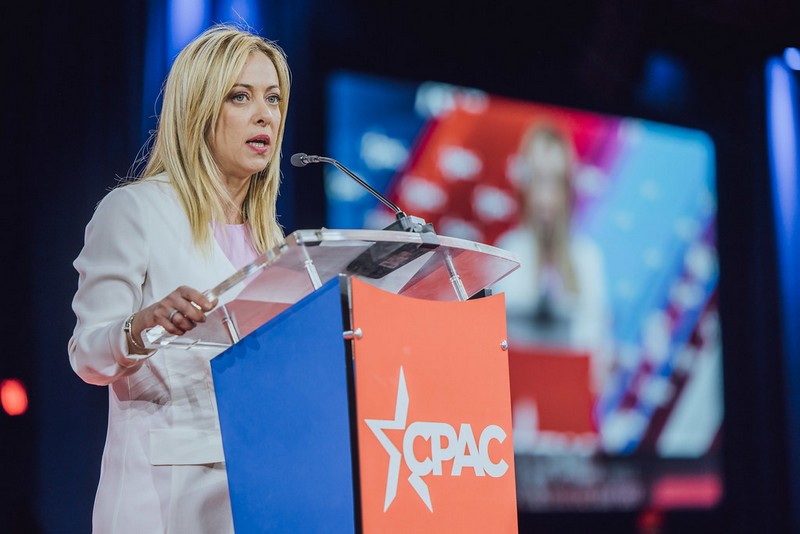
In October 2022 Ms. Giorgia Meloni, became Prime Minister of Italy. Her extreme right-wing party, Brothers of Italy (Fratelli d’Italia), won the September 2022 elections with 26% of the vote, even though it had polled only 4.3% four years earlier. Ms. Meloni co-founded the party in 2012 and led it since 2014. See this.

Such an increase in voters meant that Italians were sick and tired from the so-called “democratic” neoliberalism coming out of the EU in Brussels, notably out of the non-elected dictatorial European Commission (EC), known to most serious analyst to be but a lackey of Washington’s.

But Italians had also enough of the steady NATO influence of Italian politics. Italy is currently arguably the country in Europe with most US / NATO military bases. Most Italians are strong NATO opponents.

In brief, Italians welcomed the promising “new wind” coming out of the newly elected right-wing party – expecting a departure from the ongoing US / EU – submissive neoliberal Italian politics.

In October 2022, Italian President Mattarella appointed Giorgia Meloni as Italy’s first female Prime Minister, following the resignation of Mario Draghi amidst a government crisis and as a result of the September 2022 general election. Messrs. Mattarella as well as Draghi are affiliated to the “Independent” party. Mr. Draghi is a former president of the European Central Banks, and a close ally of the WEF’s CEO, Klaus Schwab.

Sergio Mattarella OMRI, an academic and lawyer, has served as President of Italy since 2015. The attribute OMRI stands for Order of Merit of the Italian Republic and might be considered the Italian equivalent of knighthood.

Back to Giorgia Meloni

A clue to her priorities came in an animated speech she gave in Spain last June.

“Yes to the natural family, no to the LGBT lobby, yes to sexual identity, no to gender ideology… no to Islamist violence, yes to secure borders, no to mass migration… no to big international finance… no to the bureaucrats of Brussels!”

In another well-quoted speech from 2019 she said: “I am Giorgia, I’m a woman, I’m a mother… I’m Christian.”

For the role of Italy’s new family and birth rate minister, she has picked Eugenia Roccella who has spoken out against abortion and threatened to reverse recently agreed rights for same-sex parents.

Nevertheless, Ms. Meloni has promised to govern “for everyone”. She had to assure Italy’s allies in both NATO and the EU that there will be no change in direction in foreign policy. This is an important point, as both her coalition partners, Matteo Salvini, heading the League and the late Silvio Berlusconi’s center-right party, Forza Italia, have been strong supporters of Russia’s Vladimir Putin.

“Giorgia Meloni comes from a post-fascist cultural background but recently she’s taken a very moderate position and stated she won’t change [predecessor Mario] Draghi’s policy on Ukraine,” Italian political scientist Prof. Roberto D’Alimonte told the BBC. “She did this because she had to build her credentials to be a legitimate candidate for prime minister.”

Recent – Italy-China Relations

On February 17, 2023, President Mattarella met with China’s Mr. Wang Yi, in Rome. Mr. Wang Yi is a member of the Political Bureau of China’s Communist Party (CPC) Central Committee. He is Director of the Office of the Central Commission for Foreign Affairs, basically acting as Foreign Minister.

It was a most cordial and what looked like a constructive and productive meeting. They were talking about strengthening their relations through BRI (Memorandum of Understanding [MOU) signed in 2019) and jointly promoting multilateralism.

Conveying President Xi Jinping’s warm greetings to President Mattarella, Wang Yi said that China will bring new opportunities for China-Italy cooperation. He noted that China and Italy should resume exchanges at all levels in an all-round manner, and promote mutually beneficial cooperation across the board. Wang Yi stressed China and Italy are natural partners in Belt and Road, a strong impetus for further development of their bilateral relations.

This left a positive signal for strengthening China-Italian BRI relations – Italy being the only EU and G-7 member as part of the BRI.

Peter Koenig is a geopolitical analyst and a former Senior Economist at the World Bank and the World Health Organization (WHO), where he worked for over 30 years around the world.

Recent Events

At the recent NATO summit in Vilnius, Lithuania (11/12 July 2023), Ms. Meloni confirmed in a press conference from Vilnius, that at the invitation of President Biden she will travel to Washington to meet with the US President on 27 July 2023.

The Italian PM highlighted Rome’s support to the NATO Alliance and to Kyiv’s accession to NATO. She praised NATO’s “important steps forward [towards Ukraine’s] future accession to the Alliance. She stressed this point by mentioning Italy’s leadership in 2024 of the G7. “NATO mustn’t lose focus on its Southern Flank and the Global South.”

Ms. Meloni went even further in supporting the warrior alliance, NATO, saying that “Our freedom has a cost. What we invest in defense comes back tenfold in terms of defending our national interests.”

She further argued for increased cooperation among NATO Allies, a drive that must extend to Indo-Pacific matters and, most notably, China, noting the importance of tackling the “systemic rival” holistically – i.e., considering issues such as supply chain security, especially in the field of critical raw materials, and safeguarding technological advantage.

These considerations come as her government tends to dropping out of China’s BRI, a matter that will certainly come up in her forthcoming Washington visit. For more details see this (12 July 2023).

This is a 180-degree turn-around from Ms. Meloni’s earlier position on NATO and from President Mattarella’s discussion in February 2023 with Mr. Wang Yi from China. It also demonstrates the US / EU pressure the Italian Government is under.

Clearly, Ms. Meloni is not free to follow her campaign promises and even her party’s ideology – of cooperation for multilateralism, a departure from the neoliberal globalist dominance exerted by Washington, EU, the WEF and the entire bought and corrupted UN system throughout the world.

Italian freedom, national sovereignty – has been flushed down the drain, like that of so many other nations – and that against the will of most of the concerned nations’ people.

To Stay or Not to Stay in the BRI

Ms. Meloni’s government under pressure from the US, but also from the EU, is leaning towards exiting the Belt and Road. In a recent article by the Chinese state-owned Global Times, Beijing expresses its concern about Italy’s abandoning the BRI cooperation agreement with China.

The BRI-Agreement is based on a Memorandum of Understanding (MOU) of 2019 which is set to be auto-renewed in March 2024, unless one of the parties resigns from the agreement three months prior to the deadline.

This gives Ms. Meloni enough time to present the case to the Italian Parliament, to transfer this decision and responsibility to the presumably democratic parliamentary body.

When putting this possibility forward, Ms. Meloni also said that one could have “excellent relations with China without being part of a strategic plan” such as the BRI.

To add fuel to the fire, Italy’s Enterprise Minister Adolfo Urso told Radio24 that the Meloni government “is not being pressured by the US, nor China, on the [BRI] Memorandum.” But he added that since the MOU was signed, “our trade with China has worsened considerably, in contrast to what has happened with France or Germany, which have instead implemented [new] business with China. This should give us pause for thought.”

In the meantime, China is seeking alternative means to promote commercial and cooperation opportunities directly with the Italian business community.

For more details, see this (30 June 2023).

Taking BRI to the Italian Parliament

Senator Stefania Craxi, member of the governing coalition party Forza Italia and chairwoman of the Foreign Affairs and Defense Committee, said she would support the full involvement of Parliament on the BRI decision.

She praised PM Meloni’s “institutional” approach, “which recalls the need to involve Parliament on a sensitive issue such as the BRI MOU, whose approval at the time impacted on the dynamics of our country’s strategic alliances”. She remarked that the MOU was not presented to Parliament for approval before signing.

Senator Craxi added that the BRI “clearly doesn’t only have commercial implications” – as some had depicted it when it was signed in 2019. Proof of this is the fact that despite being the only Western European country to have signed it, Italy’s trade with China is less that of other EU nations.” She implied that signing it was a mistake, as it brought only negative consequences.

When PM Meloni recently spoke to Parliament, she reiterated that Italy could have “excellent relations with China, “without being part of a strategic plan”, meaning BRI. But she also said, the decision had not yet been made, that evaluations are under way – and that the final say would be that of the people, “seeking solutions in view of our interests”.

With a significant Parliamentary mandate of her party, Ms. Meloni – leaning towards exiting BRI – would make the decision as one of the Italian people.

For more details, see this (29 June 2023).

In the five months before the deadline to decide on the ceasing or continuing the BRI-MOU, it is time now for the Chinese business community to enter into direct contact with the Italian Business community to either lobby for staying in the BRI, or to establish solid commercial and business relations with Italian entrepreneurs outside of BRI.

Peter Koenig is a geopolitical analyst and a former Senior Economist at the World Bank and the World Health Organization (WHO), where he worked for over 30 years around the world.

25 July 2023

Source: globalresearch.ca

Uniform Civil Code Will Disrupt, Destroy India’s Pluralism

By Dr Ranjan Solomon

When ruling dispensations run out of viable ideas on political playoffs, they almost always resort to the politics of compulsion. By contrast, responsible governments which are committed to social progress use politics as an instrument to advance development, via progressive political agendas.

They recognise that programs of public benefit veer towards enhancing social-economic-cultural-welfare value. Politics where schemes are ideologically self-centred tend to approximate proxy agendas that segregate and carve up social dissection.

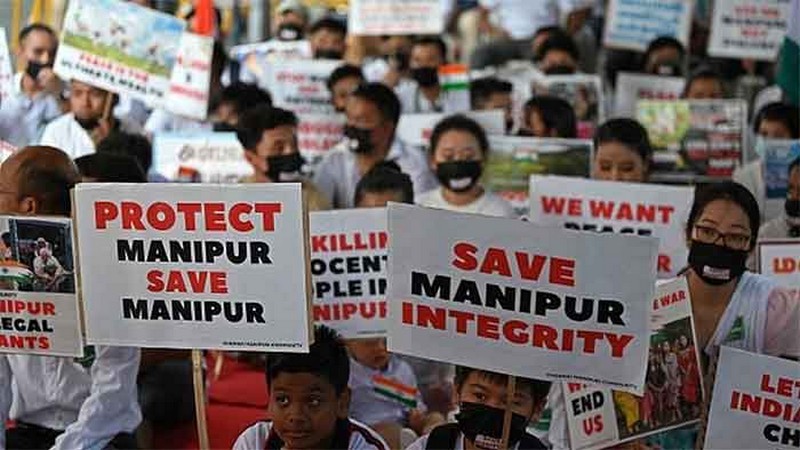
These proxy agendas often tend to garner votes using political camouflages. They tend towards populist tendencies, even though they are irrelevant. In the current political season, there are two levels at which political stakes are being played out. There is Manipur which is played out largely in the realm of conflict-crisis politics which has evolved into a colossal catastrophe. On Wednesday, July 19, a video emerged on social media, showing three women of the Kuki community who were stripped naked and paraded in public. They were also being sexually molested by some among the mob of men.

Appallingly, the Government of the day has consumed a concoction of political opium and set aside Manipur almost as if it did not even exist. The Prime Minister showed his back on the people of Manipur, even taking on two international travels that should have awaited a resolution in the state. In this process, the government in the State and the centre has tacitly consented to the victimisation of people. The turmoil persists until today. The consequences are glaringly perilous, yet the government in its dwarfed vision will not act.

The government has now come up with a previously constructed agenda to prepare for upcoming futures that will not merely confiscate Manipur from ongoing memory, but also create political hassles that are a blotch in the country within and overseas. The European Parliament even passed a strongly worded resolution on the Manipur crisis. It will probably fall on deaf ears unless the EU, as a whole, resorts to a boycott-divestment-sanctions strategy that could threaten Indian economic interests. This, of course, is a highly unlikely scenario.

The Uniform Civil Code (UCC) is the new political opiate introduced by the Bharatiya Janata Party (BJP to attract huge debate in wide sections of the polity. Given its timing and time table, the attempt to push through the UCC prior to the 2024 General Elections seems the ideal ploy to divert attention from the multiple failures of the government and its bit-by-bit diminishing fortunes. The BJP has marked it as an agenda to bring closure to a long-pending national question. Long imminent as it may have been, the government has never quite known where it should take the UCC.

To the BJP, the UCC is a non-starter. It is not proactively engaged in any kind of pro-active attempt to bring commonality to the country’s civil code. In fact, there is no ready-made reconciliatory-oriented instrument that will bond the various religio-cultural entities within the country. Non-Indic faiths already find the UCC threatening and suspect they are at the receiving end of what seems to be a political conspiracy to snatch their distinct identities and relegate them to subservient categories by enforcing traditions and customs that have survived the centuries without posing risks to national integrity.

These same arguments would apply to the millions upon millions of indigenous people in various parts of the country for whom customary laws will be snatched away under the guise of the UCC. Nor will it produce the gender justice that it pledges to pave the way for, the latter being a core question when it comes to evolving the UCC. True, the country cannot remain static on matters as crucial as an integrated civil code. That is not to say that a civil code has to be uniform. Integration can straddle multiplicity of intents that have non-competing facets. Uniformity is based on the intent to create and assert conformity to majoritarianism. Critics of UCC have already disregarded a ‘one-size-fits-all’ formula.

They are asking why the UCC cannot have a pluralistic approach to a Civil Code. There are widespread anxieties over what the Uniform Civil Code will do to disrupt and destroy India’s pluralism. Is the proposed UCC feasible for the nation’s integrity and concord? Will it set some communities aside and plunge them in the margins? Will the ruling party and its alliance partners segregate the nation while a common code is developed minus consensus?

The risks are huge in a country where differentiation and dissections are already being thrust upon people by political compulsions in other arenas. In fact, there are strongly expressed qualms that UCC as it is likely to be developed might actually be in contravention of the idea of India itself. This is not guess work. Political patterns we have witnessed have illustrated just how dominant ideas of one section of the polity can suppress many others based on a brute majority. For now, the Government seems to be certain of just one fact – that it wants a UCC to come into force. The contents of that are unclear.

The Opposition has asked for clarity, sometimes asking for even a single idea that the UCC will pursue. Either, the government has a plan in mind and would rather not divulge it. Or, it is clueless in so far as details are concerned. Will an inadequate UCC get approved with the brute majority that the ruling party has access to in the Parliament, meet the same fate of the CAA? The CAA remains a law that has no rules framed four years after its passing. Or, for that matter, the failed political goals of the removal of Article 370 and Article 36 in Jammu and Kashmir? Unless, the UCC is built around a political pact punctuated by consensus, it could easily be socially destructive, and be one more nail in the coffin of Indian democracy.

As important as political consensus is a democratic obligation, civil society must also be permitted to play its role and enable the shaping of the political formula that should emerge. As far back as 1947, Jawaharlal Nehru hastened the progression of reforming religious laws through a common code. That was confined just to the Hindu community, with the single view of modernising Hindu society and creating national unity. Soon enough, the code embraced Jains, Buddhists and Sikhs. It could be argued that Nehru’s strategy left the non-Indic religions out in the cold. In the zeal that characterised Independence, there were several actions that could have piggy-backed on the momentum that Independence itself brought to the fore.

Gripped by a positive sense of nationalism, the force of dialogue and nation-building and national integration may just have allowed for evolving a dialogue-based common set of working principles through which a UCC could have been set in motion. This government could well adopt the lessons of history and act, delayed as it may be, to come to a common understanding of what the essence and extent of a common civil code could resemble. Where do we begin?

Can we rule in options for dialogue and rule out those that are irresolvable? The Indian Constitution, which came into effect in 1950, was unequivocal. The State shall not legislate nor could courts enforce the UCC. The Constitution insisted on a dialogical approach that obliged the government to “endeavour to secure for all citizens a Uniform Civil Code.” These included laws that apply to everyone in India, replacing religion-based personal laws governing matters such as marriage, divorce, inheritance, adoption and succession. But the Constitution clarified that UCC was non-enforceable through courts.

In the 1950s, the Nehru government overcame opposition and arrived at agreement on several laws to codify and reform Hindu personal laws, a process which was started during the British rule of India. These included the Hindu Marriage Act, Hindu Succession Act, Hindu Minority and Guardianship Act, and Hindu Adoptions and Maintenance Act. Within the purview of all these, the UCC could still mystify settled questions such as the Hindu undivided family (HUF). Prime Minister Narendra Modi has argued for the implementation of a Uniform Civil Code (UCC) in India, stating that India cannot function efficiently with a system of “separate laws for separate communities”.

At this juncture in our history, this could be described as a simplistic dismissal of the pluralistic character of the nation which, in itself, is a composite nation within nations. It is the fusion of the many cultures that make India a unique country sanctified by multiple traditions/mores, religions, language, and ethnicities. Several key questions of justice underline the relevance of the UCC. For the UCC to be unifying there must be a plurality of approaches in addressing the challenges. There cannot be a hierarchy in terms of what comes first. One step at a time is the way to go but a comprehensive vision is needed to allow for a fusion of these steps.

If the UCC is to serve as a fundamental step in the direction of gender justice and social equality in India, its formulation must assure all citizens equal rights and opportunities under the law setting aside specific religion or cultural affiliations. Intricate concerns and interests of all rights holders including religious communities, women, and other marginalised groups must be factored in. This government which is habituated to pushing through legislations in unilateral ways must recognize the far-reaching nature of the UCC and adopt highest parliamentary standards.

Civil society claims and contentions that assume primacy in the formulation of the UCC must be factored in. In the final analysis laws are about people and a government that rides roughshod over people’s interests and aspirations will easily get the laws wrong. This has been proven on more occasions than one. When it comes to Personal Laws in India, in the contemporary context, not only Muslims but also Hindus, Jains, Buddhists, Sikhs, Parsis, and Jews are governed by their own personal laws. Personal laws have, in their roots, the thought of religious identity.

In fact, even the reformed Hindu Personal Law still integrates specific customary practices. Issues and discrepancies emerge when Hindus and Muslims marry under the Special Marriage Act, where Hindus continue to be governed by Hindu Personal Law, but Muslims are not. Yet, there is a narrow focus on recasting the Muslim Personal Law and its provisions on marriage and what it sanctions? A National Family Health Survey (NFHS) 2019 puts the occurrence of polygamy among Hindus at 1.3 per cent against 1.9 per cent among Muslims. The previous Union law minister Kiren Rijiju had vowed that the government would place the issue of UCC before the 22nd Law Commission of India.

This contradicts what the 21st Law Commission had stated namely that such a code was neither necessary nor desirable at this stage” in the country. The question arises, why is there a tearing hurry to fast-track the UCC? Faizur Rahman, secretary general, Islamic Forum for the Promotion of Moderate Thought, recently said, “in so far as marriages are concerned, the Special Marriage Act which allows interfaith couples to marry is the UCC as envisioned by the Constitution framers.” In many ways, it is a rejection of personal laws governing marriage.

To repeat the claim I have made at the start of this article, there is no blueprint for a UCC with the government. Until there is a blueprint and a political process set in place, the Opposition and social movements/civil society should sternly oppose the move. The BJP has left the UCC as a private members bill ostensibly to avoid a backlash should things go awry preceding a general election. If ever the BJP were to introduce the bill, they would assess the momentum and then take a call. Opponents of the BJP’s UCC moves can take some solace at seeing the diffidence here. In fact, even BJP allies including the Shiromani Akali Dal, AIADMK, Mizo National Front have put brakes on the BJP’s subtle attempt to squeeze it in.

The opposition from several BJP allies is fierce and unshakable and rooted in the claim of religious rights and identities of minorities – religious and ethnic. They are sworn not to allow an erasure of customary laws across faiths and tribes. Tribal communities are equally peeved by the attempted back-door stab of the UCC by the BJP. Tribals know better that the UCC will nibble into their customary rights and traditions. The people of North Eastern States have written to the Law Commission that they reject any attempt to dilute the provisions of Article 371 A of the Constitution. From Meghalaya came a warning from a BJP leader warning the Government from interfering with the matrilineal societies of the state.

When it comes to marriage in India, personal laws single out queer people in general and, more so, heterosexual women. The UCC under the BJP is hardly likely to conciliate either of these two groups of people, even though the BJP pretends it stands for advancing women’s social and political rights in India. The BJP has shown notoriously political duplicity on issues such as Triple Talaq and marital rape. The BJP has vociferously supported repealing Triple Talaq citing “gender justice and equality” for not just Muslim women, but in fact for all “humanity”.

However, the same government took a dubiously opposite platform when it opposed pleas seeking to criminalise marital rape in India. The BJP argued that marital rape could not be treated as a criminal offence in India on the insubstantial grounds that “it could become a phenomenon which may destabilise the institution of marriage and an easy tool for harassing the husbands”. The BJP also chose rather obscure arguments to oppose the legalisation of same-sex marriage in India. The question arises: If the Uniform Civil Code is introduced, how would uniformity get manifested for people of different religions, castes, genders, and sexualities?

The fear is that a Hindutva version of the UCC may be worse for women, notably for heterosexual women, and the queer community, especially sexual minorities. A BJP adaptation of fail-safe equal gender and sexual rights to all Indians seems quite remote when it comes to justice. The legalisation of same-sex marriages in India would be equally, or even more, complicated. The Prime Minister has adopted a populist, simplistic tactic. He reportedly asked a public gathering if a unitary family could afford to have different regulations and codes of conduct within the family.

The orchestrated chorus had been tuned to affirm a vociferous NO. Those who live in families know too well that no two children actually resemble each other in traits unless under acute disciplinary circumstances. The plank that the BJP is building may not survive, if only civil society sets the agenda, and other political parties unite to oppose the UCC. To win the vote in Parliament and to lose it on the street would be futile socially and politically.

The anti-CAA protests, the Farmers Movement, and a string of micro struggles all around the country should convey to the government the risks of overt anti-people laws. Resistance is mounting. The Opposition is readying itself to give the BJP a tough fight and the BJP can either dismiss their mobilisation or shift to democratic ways. The suspicion is that the BJP will use the UCC as a worn-out colonial era polarising tactic, set as a potential time bomb for the 2024 election. After having used up almost all its communal weapons, the BJP cannot call back issues of beef, hijab, and Ram Temple. They are not marketable and their shelf life has expired. Responsible citizens and the Opposition must offer insistent alternatives. Perhaps, this is a testing moment and the people must prevail in the interests of justice.

Ranjan Solomon is a political commentator, writer, and human rights activist.

25 July 2023

Source: countercurrents.org

How It May Have Been Possible to Avoid Ukraine Invasion?

By Bharat Dogra

Several persons whose commitment to peace and justice is well-established have argued that while the USA and its western allies were obviously wrong in taking several provocative actions against Russia, nevertheless Russia should have avoided the invasion of Ukraine.

These analysts agree that western steps such as constantly pushing NATO eastwards in breach of previous promises, assisting the 2014 coup in Ukraine, instigating and arming neo–Nazi groups to attack Russian language speaking citizens of Ukraine and accentuating such provocative actions in 2021-22 were wrong and provocative, but despite this Russia should not have attacked Ukraine, as this further damaged world peace, and instead Russia should have explored and adopted other policy options.

Now what could have been these other policy options? Unfortunately the analysts who have argued for this have been generally short of making specific suggestions that could have effectively protected essential Russian security interests as well. Nevertheless this question of alternative possibilities is an important one for world peace, and hence should be explored. Such discussion can be fruitful for suggesting alternative course of action in future conflict situations also.

One stand that can be taken is to just make a sweeping statement that in present day conditions of a very troubled world, no war or invasion is justified. This can be called a very noble statement, and if Mahatma Gandhi was in a leadership role he would have opted for this, regardless of consequences. But in a more practical world, this question should be posed in a somewhat different way—could Russia have protected its most essential and legitimate security interests without invading Ukraine, regardless of past and continuing provocations of USA/UK/NATO/Ukrainian neo-Nazis?

In order to increase these possibilities of addressing its essential concerns without even thinking of an invasion, Russia would have needed more favorable international conditions compared to what is the present day unfortunate reality.

Russia made repeated efforts in the past to draw wider attention to the various provocations and to the fact that certain red lines exist which should not be crossed in order to avoid wider and dangerous escalation. However these did not receive adequate attention, either from the involved governments, or from the UNO or even from the media.

If adequate attention had been given and remedial actions had been taken, then there would have been no need of any invasion and in probability there would have been no invasion.

However as provocative actions in breach of past promises were continuing, Russia faced the prospect that attacks on Russian speaking citizens would intensify further, Ukraine with its long border with Russia would become a NATO member and would remain in a condition of increasingly high hostility with Russia with highly destructive NATO weapons being placed here quite close to Moscow. The question is how long Russia should have just lived quietly with this, whether this would have been acceptable to the people of Russia and whether this would be in their best interests? The leaders of Russia are after all elected by their people to protect their interests and cannot segregate themselves from this responsibility.

All these factors should be considered while trying to get an honest answer to the question—was the invasion avoidable?

The Minsk Accords were the most discussed step to sort out the problems before these became too serious. However very senior western leaders have stated openly that through these accords they were just giving Ukraine adequate time to be better armed. Where does this leave Russia? Whom should it trust in its quest for protecting its interests?

So what we can say is that while the option of entirely avoiding invasion is certainly the most noble option for world peace, in order for this to become practical, effective and more likely, the international community, the UNO and media also need to improve significantly in their commitment to peace and justice to address serious problems and concerns at an early stage.

Without justifying the invasion in any way, it can be stated certainly that if some genuine concerns of Russia repeatedly voiced had been addressed at an early stage, the invasion is unlikely to have taken place.

So instead of the one-sided discourse on this issue which dominates western countries and demonizes Russia endlessly, there should be more discussion on how legitimate concerns of Russia were irrationally and arrogantly ignored by the west, leading to accentuation of problems, something which has been very convincingly argued by several western diplomats and experts as well.

This would be helped also by a more sympathetic assessment of what has been happening in Russia in recent years. Instead of only talking of autocracy or adverse news, for a change why not ask if Russia has achieved something positive. Many people will be surprised to see the UN data which tells us that for the latest year 2021 the child mortality rate was 5.1 in the Russian federation, while it was 6.2 in the USA. Hence Russia has been able to achieve a lower child mortality rate despite being confronted with very difficult conditions.

If we see this data for the period 2000-2021, then in the USA this declined from 8 in year 2000 to 6.2 in 2021, while in Russia this declined from 20 to 5.1, a very significant reduction. In the case of infant mortality (or mortality under 1 year of age per 1000 births), according to Macrotrends data, the infant mortality in Russia declined in a big way from 19 in 2000 to 4.8 in 2023, while during the same period infant mortality in the USA declined from 7.2 to 5.4, so that Russia which had been far behind the USA surged ahead of it.

In the case of maternal mortality rate or MMR (reported per 100,000 births), according to UN data, from year 2000 to 2020, this declined very significantly in Russia from 52 to 14, while that of the USA actually increased from 12 to 21. Thus during this period, according to UN data, Russia was recording a very big decline of 6.66% per year while the USA was recording not a decline, but instead an increase of 2.88% per year in maternal mortality rate.

According to Macrotrends data, from 2000 to 2017, the maternal mortality rate of the Russian Federation declined from 56 to 17, while this rate increased in the context of the USA from 12 to 19.

During 2000-2019 according to UN data the life-expectancy in the Russian Federation increased significantly from 65.3 years to 73.2 years. According to Macrotrends data, this increase was from 65.4 in 2000 to 72.98 in 2023.

The increase of income or GNI per capita in Russia during this period was very significant—from $1710 in year 2000 to $4450 in 2005 to $9980 in 2010 to $11,610 in 2021. On the contrary when the Russian economy was acting much under western influence earlier during year 1991 to year 2000, there was a huge decline from $3440 to $1710.

The literacy rate for the Russian federation is over 99% while that for the USA is lower.

The Human Development Index of Russia has improved from 720 in 2000 to 822 in 2021.

Thus as far as the welfare and progress of the people of the Russian Federation is concerned, the progress of Russia during the last two decades has been quite remarkable, although much more remains to be done for democracy and human rights, for environment protection and peace, for reducing inequalities in a big way and improving the overall development model.

Without ignoring the real problems, if a more sympathetic and informed understanding of Russia and its concerns is attempted by the people of western countries in particular, this would be helpful to reduce misunderstandings caused by irrational demonization, in turn paving the way for friendship and better understanding and ultimately for peace. As President John Kennedy had stated, trying to understand the perspective of your adversary improves the prospects of peace. In the present context if people of western countries have a better understanding of the genuine security concerns of the people of Russia as well as what they have been trying to achieve in the middle of many difficulties and hurdles, this will certainly contribute to better understanding.

Bharat Dogra is Honorary Convener, Campaign to Save Earth Now.

25 July 2023

Source: countercurrents.org

Netanyahu’s coalition rams through judicial coup law in Israel

By Jean Shaoul

On Monday, just before the Knesset’s summer recess, Prime Minister Benjamin Netanyahu’s coalition, of his right-wing Likud Party, ultra-religious parties and fascist parties based on settlers on the West Bank, rammed through the first in a series of laws aimed at curtailing the powers of the Supreme Court.

The bill passed 64-0 after the opposition boycotted the vote in protest and stormed out of the chamber chanting “shame.” There are 56 members in the various opposition parties, so Netanyahu’s bid for absolute power by ending judicial oversight of his government is based on a narrow majority.

The law, enacted as a Basic Law that is the nearest Israel has to a constitution, ends the Court’s power to strike down the decisions of elected officials on the grounds of “unreasonableness,” by granting the Knesset the power to overturn the Court’s ruling with a simple majority.

It will enable Netanyahu to reappoint his key ally, Shas party leader Aryeh Deri, as head of the Health and Interior Ministries, an action the Supreme Court overturned as being “unreasonable” due to Deri’s multiple convictions for fraud, bribery and tax evasion, as well as his pledge as part of a plea bargain not to seek public office again.

Even more importantly, the legislation will enable Netanyahu to press ahead with other dictatorial measures secure in the knowledge that the Court—the only state institution that is able to hold Israel’s single-chamber parliament to account and which his right-wing cabal does not control—will be unable to overturn them. It would also facilitate legal moves that would enable Netanyahu, currently on trial on corruption charges that could put him behind bars for years, to evade conviction or see his case dismissed.

Netanyahu’s fascistic coalition partners are openly bragging about their power to do whatever they like. They have long railed against the Court for its occasional restrictions on the settler outposts, deemed illegal even under Israeli law. Speaking to reporters after the bill became law, National Security Minister Itamar Ben Gvir, a settler leader who heads the fascistic Jewish Power, said the passage of the law was “only the beginning” and that “There are many more laws we need to pass as part of the judicial overhaul.”

Netanyahu has pledged to defy international law and annex the West Bank, illegally occupied by Israel since the 1967 war with its Arab neighbours. This land seizure is in pursuit of his coalition’s twin aims of establishing a Jewish-supremacist state in both Israel and the occupied Palestinian territories and increasing the power of the religious authorities over everyday life.

Far-right ministers have called for laws banning Arab parties from participating in elections and discriminating against Israel’s own Palestinian citizens, as well as gay and non-religious people, and enforcing gender separation in public places. Their next step is legislation granting the government greater power in appointing the judiciary.

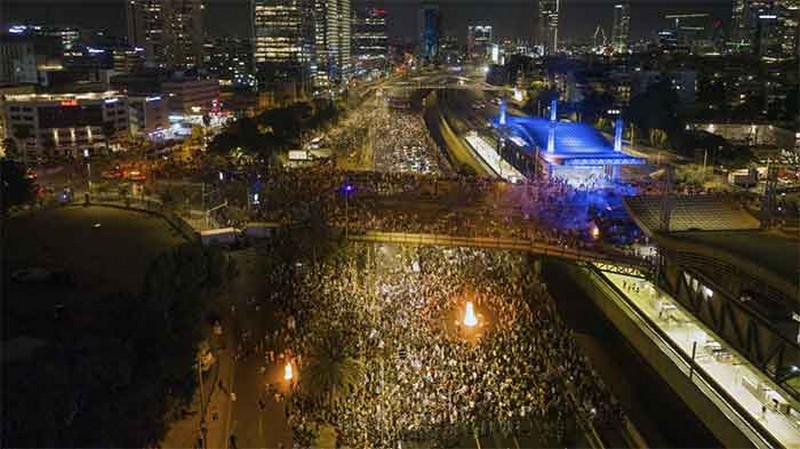
Monday’s passage of the “reasonableness override” law took place in the face of the largest demonstrations on Saturday and Sunday that Israel has ever seen, a movement that Netanyahu says is endangering Israel’s democratic system.

Tens of thousands took part in a five-day march from Tel Aviv to Jerusalem in scorching heat to protest outside the Knesset on Saturday, while more than 100,000 people flocked to Tel Aviv on Saturday evening for the 29th consecutive week of demonstrations, and similar numbers took part in rallies in towns and cities across the country. Israel’s doctors went on a two-hour strike in protest, while tens of thousands of protesters shut down roads and infrastructure, sparking fears of violent confrontations between protesters and the government’s far-right supporters.

More than 10,000 army reservists—including hundreds of air force pilots, cyber warfare experts, and commanders of elite units upon which the IDF depends—have announced they will refuse to serve if the judicial coup goes ahead, saying they are unwilling to continue risking their lives for a government that is no longer democratic. Netanyahu has lambasted them for “crossing a red line” when Israel faces external threats and depends upon a reservist army. Security and defence officials have written to the government warning that this could have a significant impact on the air force and its operational readiness.

The unprecedented opposition to the Netanyahu government’s abandonment of bourgeois-democratic norms is fuelled as well by the widespread economic hardships produced by the soaring cost of living, including the sky-high cost of housing, as well as deepening concerns over failing public services, such as education, health and transport, and the increasing role of ultra-orthodox religious groups over everyday life. No less important are the deep fears that the US-NATO-led war in Ukraine against Russia will escalate into a far broader conflagration, even as the government stokes war against the Palestinians, Iran and its allies in the region.

It is expected that the Supreme Court will review the legislation and strike it down, leading to a constitutional showdown with the government and a broader political crisis that commentators fear could escalate into civil war.

The Movement for Quality Government argues that the law is unconstitutional, as “it fundamentally changes the basic structure of Israeli parliamentary democracy and the nature of the regime, while de facto abolishing the judiciary and seriously damaging the delicate fabric of the separation of powers and the system of checks and balances in the State of Israel.” It has petitioned the Court to rule against the law, saying, “The government of destruction has raised its malicious hand against the State of Israel; now it’s the Supreme Court’s turn to step up and prevent this legislation.”

Mass rallies against the bill continued on Monday, with protesters blocking roads, to which the police responded by using water cannon to disperse them and arresting at least 20 people. Israel’s Medical Association has announced a 24-hour hospital strike for Tuesday.

The self-proclaimed opposition leaders, including former ministers, generals and security and intelligence officials, many of whom have served under Netanyahu, have pledged to continue the anti-government demonstrations and rallies. They have no fundamental policy differences with the government, but fear that Netanyahu is going too far in establishing a personalist dictatorship based on fascist and ultra-religious groups, which will destabilize the country politically and socially. Israel is one of the most unequal countries in the world, with enormous wealth accumulated by a handful of super-rich families, while most Israeli workers, Jewish and Arab alike, struggle to survive.

Like former Prime Minister Yair Lapid and Defence Minister Benny Gantz, they are no less committed than Israel’s far-right government to the Zionist state and its oppression of the Palestinian people. They have drowned the mass rallies in a sea of Israeli flags and refused to make any appeal to Israel’s Palestinian citizens, much less to the Palestinians in the occupied territories, who have long suffered under Israel’s savage military repression and brazen vigilante and settler violence—all upheld by the Supreme Court and reinforced by the protest “leaders” when they were in office.

These opposition leaders sought to “negotiate” with Netanyahu—fruitlessly as it turned out–after he agreed to “pause” the legislation at the end of March in the face of the largest outpouring of popular opposition in Israel’s history, which included massive street protests and a full-scale walkout by large sections of the Israeli working class.

Lapid and Gantz duly fell in line and gave Netanyahu their full-throated support when he used the “pause” to mount a series of criminal provocations against the Palestinians in the West Bank, which Israel has illegally occupied for 56 years. They also backed his military operations against Iran, Syria and Lebanon, whose aim was to deflect tensions outwards and create a sense of national unity.

Now Lapid has promised to petition the High Court against the new law, calling it an abuse of power, while urging military reservists to wait before pulling out of military service, saying, “Don’t stop serving, while we still don’t know the High Court of Justice’s ruling.”

The working class has the power to bring down Netanyahu’s far-right coalition through a general strike, which would have the support of the majority of the Israeli population. However, a major obstacle has been the corporatist Histadrut trade union federation that has from its establishment been committed to the Zionist project. It has refused to mobilise its members against the government, pushing frantically for some kind of “mediation” or compromise. The only time in the last seven months of mass weekly protests that Histadrut chief Arnon Bar-David called a general strike was in response to Netanyahu’s sacking of his defence minister Yoav Gallant after Gallant had called on him to abandon the plan to neuter the judiciary because the political conflict over it was splitting the Israel Defence Forces (IDF).

Now Bar-David, who is coming under increasing pressure to call a strike, is preparing a token stoppage to allow his members to let off steam. He declared, “From this moment on any unilateral advancement of the reform will have grave consequences, up to and including a full strike” of workers’ unions throughout the country. No trust can be placed in this faithful servant of the Israeli bourgeoisie.

It poses the urgent necessity of breaking the stranglehold of the reactionary Zionist leadership of the protest movement and fighting to unite Arab and Jewish workers, along with workers internationally, in a common struggle to defend jobs, living standards and democratic rights, including those of the Palestinian people. This can only be done based on the programme and perspective of international socialism.

25 July 2023

Source: countercurrents.org

A Distressing Reality: Looming Threat of a Second Nakba!

By Ranjan Solomon

Despite having their home stolen and constantly facing dehumanization, the Sub Laban family remains unbreakable. This Palestinian family in Jerusalem set up an impromptu exhibition yesterday morning on top of the remains of their furniture, a powerful testament to the ongoing Nakba. We are in awe of their steadfastness and resilience.

The Ghaith-Sub Laban family constructed a living exhibition of the Nakba using pieces of furniture thrown to the street by the Israeli settlers who displaced them from their home in occupied East Jerusalem’s Old City two weeks ago. Despite the challenges they face, the family courageously displayed their history and the injustice they have endured. In a distressing turn of events, Rafat Sub Laban, the son of Nora and Mustafa Sub Laban and one Israeli solidarity activist were arrested by Israeli occupation forces during this time. It is heart-wrenching to witness the relentless oppression and injustice faced by this family.

The forced eviction of the Sub Laban family from their home in the Muslim Quarter of the Old City of Jerusalem, where 68-year-old Nora, the mother, was born, is a grave injustice not only against her and her husband Mustafa (72) but also part of a long-standing effort to ethnically cleanse the Old City and Jerusalem as a whole, reflecting the ongoing Nakba across the country.

During the 1948 war, a significant portion of the al-Quds (Jerusalem) area was subjected to ethnic cleansing, including neighbourhoods in West Jerusalem like Talbiya, Qatamon, and Baq’a. The Palestinian inhabitants, including the Ghaith family, Nora Sub Laban’s parents, were forcibly displaced from their homes, which were subsequently destroyed, expropriated by the Israeli regime, or given to Jewish immigrants.

Many of the Nakba refugees sought refuge in East Jerusalem, which came under Jordanian rule. However, in 1967, Israel occupied East Jerusalem, bringing these refugees under its rule. In a blatant violation of international law designed to protect civilians under occupation, Israel annexed East Jerusalem and has since been actively involved in Judaizing the city, essentially cleansing it of its Palestinian residents.

One example of this is the 1970 Legal and Administrative Matters Law, allowing properties owned by Jews before 1948 to be returned to them through the Custodian General, despite the fact that Jews forced out of their homes during the 1948 war had already been compensated by the state, some by repossessing Palestinian homes. Comparing this law to the 1950 Absentee Property Law, which transferred all properties of uprooted Palestinians to state ownership, highlights a clear example of an apartheid regime, applying different legal systems to individuals of different ethno-nationalities.

The ethnic cleansing of Palestinians from East Jerusalem has been pursued gradually and piecemeal since 1967, utilizing a creative array of bureaucratic pretexts. However, recent developments indicate acceleration in this policy, with a sharp rise in house demolitions this year, accompanied by an increase in construction for Jews only. The Sub Laban family is just the latest victims of this unjust policy. Throughout their prolonged struggle, the Sub Laban family has welcomed hundreds of activists, supporters, and reporters into their home and even the walls of the house have become a statement of belonging and steadfastness, adorned with political art. Hours after their forced eviction, Jewish settlers have already entered the house, draping it with the flags of the colonialist regime. An elected member of the Jerusalem city council posted a photo of himself inside the house with the words: “Nakba now”.

In the face of this crushing abuse and dehumanization, the Sub Laban family shows us a glimpse of a different future, supported by Israeli, Palestinian, and other activists. While another house has fallen victim to insatiable colonialist greed, it has also given us hope for a potential future of connection instead of separation, partnership and solidarity instead of supremacism and uprooting. It is time for more of us to join the struggle for this future, envisioning a return to justice and freedom for all.

27 July 2023

Mass Petition to President of India to Intervene in Manipur

By National Alliance of People’s Movements

23rd July, 2023: National Alliance of People’s Movements (NAPM), along with over 3,200 + activists, academics, artists, retired bureaucrats and concerned citizens, many representing hundreds of movements and organizations from across the country issued a fervent and urgent Appeal to Madam Draupadi Murmu, Hon’ble President of India, seeking her immediate intervention, in the very grave circumstances of Manipur, requesting her to visit the state and assure justice to all the violated people, in particular the Kuki Zo women who have faced immense sexual, physical and mental violence.

Some of the signatories to the Appeal include Dr. Roop Rekha Verma, Medha Patkar, Harsh Mander, Prof. Virginius Xaxa, Ruth Manorama, Meena Kandasamy, Dr. Gabriele Dietrich, Prafulla Samantara, Elina Horo, SR Darapuri, Prof. Sandeep Pandey, Agnes Kharshiing, Holiram Terang, Prof. Rama Melkote, Jitendra Paswan, Ramarao Dora, Anant Phadke, Kalyani Menon Sen, Kavitha Kuruganti, Ulka Mahajan, Deepa Pawar, Diana, Tavers, Dr. Maroona Murmu, Nalini Nayak, Tshering Chopel Lepcha, Gautam Mody, Henri Tiphagne, Sugathakumari, Romita Reang, Madhu Bhushan, Steffi Lawbei, Manshi Asher, Aquila Khan, Priyanka Samy, Lalita Ramdas, Nandita Narain, Shaktiman Ghosh, Abhirami, Raina, Syed Ali Nadeem and many others.

The Appeal decried the role of the Central and State Government, which has not only failed to restore normalcy to the burning state since 3 months, but has infact been complicit in deepening ethnic tensions and enabling majoritarian violence, leading to gross human rights abuses. It called for a comprehensive and time-bound judicial inquiry to ensure due legal process and accountability of violators and authorities, not only in the ‘viral’ case of sexual violence and murders, but in hundreds of other cases, as admitted by the Chief Minister Mr. Biren Singh, himself. The signatories felt that given their colossal failure, the Union Home Minister and the Chief Minister of Manipur must be asked to immediately step down, owning moral and legal responsibility.

Amongst other things, the Appeal also urges the President to uphold the rights and safety of all vulnerable sections, especially the tribal women and ensure that there is no unconstitutional and unfair change in the list of Scheduled Tribes. The President has also been requested to hold back assent to regressive amendments to forest laws that would have far-reaching adverse impact on forest cover and forest-dwelling communities, in North-East and across India.

Issued by: National Alliance of People’s Movements (NAPM)

24 July 2023

Source: countercurrents.org

Meaning of Solidarity in the Time of a New Palestine

By Dr Ramzy Baroud

[Along with other intellectuals, I was asked by a New Zealand solidarity group to share a few ideas on what meaningful solidarity with Palestine entails. This talk inspired the article below.]

It is a new era in Palestine.

This new era is taking shape before our very eyes, through the blood, tears and sacrifices of a brave generation that is fighting on two fronts – against the Israeli military occupation, on the one hand, and collaborating Palestinians masquerading as a ‘leadership’, on the other.

But how do we, in Palestine solidarity communities around the world, respond to the changes underway, to the new language and to the actual unity – wihdat al-Sahat – which are reanimating the Palestinian body politic?

First, I believe that we must insist on the centrality of the Palestinian voice to any solidarity action pertaining to Palestinian freedom anywhere.

Not any ‘Palestinian voice’ suffices, however; only voices that truly epitomize and capture the aspiration of the Palestinian people; voices that do not speak factional language or represent powerful classes with financial and other interests.

Second, solidarity groups, especially in the West, must know how and when, if at all, to engage with smear campaigns and fraudulent ‘dialogues’ on multi-faithism, racism and anti-Semitism.

This cannot be the centerpiece of conversations on Palestine or the solidarity movement. Numerous experiences in the past have taught us that allocating most of our energies to fight smear campaigns is a losing battle, which will ultimately have little impact on raising awareness of the struggle for justice in Palestine itself, or the championing of the Palestinian cause.

Indeed, the main task of solidarity is just that – solidarity, as in adopting and advocating moral positions with the hope of achieving future political shifts in support of oppressed and/or freedom-seeking peoples in Palestine and anywhere injustices may be found.

Third, we must remember that solidarity is not speaking on behalf of anyone; rather, it is the creation of spaces and platforms, and the navigation of margins that would allow others to represent their own struggles – while rendering and advocating these positions in one’s own local and national settings.

In other words, it is the localization of international struggles. It is doing our part to ensure our local representatives, regional/state parliaments and, ultimately, national governments shift their position from supporting Israeli apartheid in Palestine to adopting positions that are consistent, partly or wholly, with the aspirations of the Palestinian people.

How to achieve this differs from one political and social context to another. Local activists must assess their own surroundings and opportunities and make that decision for themselves.

Fourth, I believe that a foundational step in any successful advocacy campaign must always start with enlarging solidarity circles to include workers’ unions, student and religious groups and people from all walks of life and backgrounds to collectively serve as a strong base for effective political advocacy.

Fifth, for an organic and effective solidarity to flourish, activists must avoid playing the role of judges and should confine their position on the type of collective struggle or resistance chosen by the Palestinian people to that of mere personal position. In other words, solidarity cannot be pre-conditioned.

Frankly, this is more relevant in the West than in the Global South. Since the latter category has much in common with Palestinians in terms of shared anti-colonial and anti-apartheid struggles, they can guide Palestinians in terms of what works and what does not.

However, those in the West, many of whom are direct beneficiaries of colonialism, imperialism and apartheid, must simply take responsibility for that sordid past, by holding their governments accountable for the present. Past crimes cannot be undone, but their harmful impact can be challenged and, indeed, through concerted efforts, even reversed.

Sixth, we must be wary of self-seeking activism. There are those, even within the Palestine community, who try to use international solidarity for political gains, factional rivalry and the like.

To prevent this, solidarity groups must adhere to a certain degree of democratic process, to liberate our communities from the influence of individuals with personal agendas and to accentuate the role of the collective.

Indeed, all solidarity compasses must constantly and directly point to the collective struggle of the Palestinian people in Palestine, and Palestinian refugee communities anywhere else in the world.

Seventh, intersectionality is key. Intersectionality is a strategy and can be a winning strategy, if utilized correctly.

Of course, morality lies at the heart of intersectional solidarity, but we must be careful not to insist on imposing our unique moral values, which are driven by distinctive cultural, political, social, historical and even religious priorities and experiences, on everyone else if we truly want to create a global movement for Palestine.

For illustration, since identity politics was not as predominant in the past as it is today, past intersectional struggles for the liberation of many countries in the Global South – mostly among nations in the Global South – did not set pre-conditions that all these nations had to adhere, for example, to a social code that is acceptable by all.

Palestine must not be subjected to any kind of insistence on global conformity to a single set of ideas, ideologies or self-definitions.

The recent success of the BDS movement can be, in part, attributed to its appeal as a global movement advocating basic, universal human rights such as equality, freedom, justice and so on, for all Palestinians. It has done so while tailoring its messages and language to fit historical, political and even social frames of reference to many social and political settings.

And, finally, we are at the cusp of a major transition in Palestine; a new generation is trying to take the helm of the Palestinian cause. They have earned this right through their sacrifices, courage and unified action.

We must make the right choice of joining them, and abandon old, tired and cliched references to a bygone era of Oslo, peace process and all the rest.

It is time to listen to Palestinian voices and to voices that genuinely represent them, and support them through strategic mobilization, establishing of media alternatives, holding corporate media accountable and through direct political pressures.

This is how solidarity can translate well-intentioned, morally driven ideas into making a tangible difference on the ground.

All the creeks and streams of this success will eventually flow into a single, raging river, ultimately creating the paradigm shift that we have long fought for and desperately coveted.

Dr. Ramzy Baroud is a journalist, author and the Editor of The Palestine Chronicle.

24 July 2023

Source: countercurrents.org