Just International

Climate Change Crime – Depopulation In the Name of Human Rights

By Peter Koenig

About a week ago, the UN Human Rights Czar in Geneva issued a stern warning – “Up to 80 million people will be plunged into hunger if climate targets are not met”.

These are the words of Volker Turk, the head of the UN Human Rights Council in Geneva, Switzerland. He spoke at a Human Rights event, and highlighted as principal cause for this coming calamity – what else – “climate change”. He said,

“extreme weather events were having a significant negative impact on crops, herds and ecosystems, prompting further concerns about global food availability.”

This is immediately proven by never-before-in-history extreme floods in Vermont, USA, by extreme droughts in Europe and Central – Western USA and by enormous, never-before experienced – forest fires in Canada. More is already announced – extreme Monsoon rains in India, and possibly Bangladesh. What a coincidence. Except, there are no coincidences. Droughts and gigantic flashfloods, in calculated interchange. No coincidences.

Most people of this globe just simply cannot believe how evil some non-people are. The Covid crime and the vaccination genocide was not enough to open their eyes, that their governments cannot be trusted, that they are sold, either by money or by threats, to an extreme evil power, a Depopulation, a Eugenics Cult which is behind it all.

Mr. Turk went on claiming,

“More than 828 million people faced hunger in 2021, and climate change is projected to place up to 80 million more people at risk of hunger by the middle of this century.”

Further contributing to the drama, he added, “Our environment is burning. It’s melting. It’s depleting. It’s drying. It’s dying”; and that these factors will combine to lead humanity towards a “dystopian future” unless urgent and immediate action is taken by environmental policymakers.

And then came the MUST reference to the 2015 (COP) Paris Agreement often referred to as the Paris Climate Accords, which were adopted by 196 parties at the time. COP means “Conference of the Parties”. Adding to the confusion of UN jargons, it refers to the UN Framework Convention on Climate Change (UNFCCC), whose signatories agreed to cap global warming below 2 degrees celsius above the 1850-1900 levels – or to 1.5 degrees celsius if possible. Does anyone understand the language to carry out this easy task?

Such an arrogant statement – humans making the weather with their sheer lifestyles – should already ring a strong bell in a clear-thinking mind of normal humans, but it doesn’t, because our pineal gland for logical thinking and perception of emotions has been gradually dumbed, reduced, even killed in some people with chemicals we eat regularly und imperceptibly in our daily food, chemicals sprayed from the air via chemtrails, “disinfectant” chemicals in the water, the uncountable PCR tests, with absolutely scientifically proven unnecessary sticks up the nose, to the thin separation between nose and brain – and pineal gland — and more.

To dull our sentiments and perception is a long-term goal that “our Masters” have been working on for the last at least hundred years – or longer.

Dulled minds are easier to manipulate. Add to this DARPA’s MK-Ultra and Monarch mind-manipulation program and we know why we are where we are.

Our mental desensitization is the product of a long-term plan, namely precisely the plan that is currently being implemented by the WEF’s Great Reset and the UN Agenda 2030. That just shows that the UN is totally compromised by a “deep state” system, or Diabolical Cult that is way stronger than all our international agencies together.

Incidentally, Bill Gates said once in an interview that even should he “disappear”, the system goes on; it had been prepared for a century or more. You won’t find this reference anymore anywhere on internet. But this is the level of well-planned evil that we are facing NOW – The Great Reset, the UN Agenda 2030, and the all-digitizing 4th Industrial Revolution. All executed by the World Economic Forum (WEF), the United Nations, and the World Health Organization (WHO).

They are the willing forefront of an enormously powerful financial behemoth which wants to stay in the dark, both literally and figuratively. Those who work the buttons for the Monster, have been promised “paradise”, or being part of the elite. Enough to buy their soul.

This financial elite system is controlling every sector of production, of food supply, of energy availability, and, indeed, of “climate change”. Yes, man-made climate change, but not the type that is supposedly carbon-based and depending on the human carbon footprint.

We are talking about highly sophisticated Environmental Modification Techniques (ENMOD), that are and have been causing extreme monsoons in Pakistan last year, this year already announced in India and possibly Bangladesh, and wherever an unruly population needs to be reined in, and where basic infrastructure and housing, as well as food crops must be destroyed, in order to create human misery, famine and death – and as a byproduct human obedience.

Would anybody like to pretend that Mr. Human Rights, Mr. Turk, when he speaks at the Human Rights Council in Geneva, does not know the facts? He is betraying the very people he has been mandated to defend and protect.

Massive depopulation, meaning, worldwide genocide, never seen before in human history – currently ongoing – it is Number One of the REAL 17 Sustainable Development Goals (SDG), i.e. UN Agenda 2030. What the 17 SDGs say on the surface is but a smoke screen. The real meaning is reflected in this depiction – in Spanish – from Thereal2030.org – see this.

What Mr. Turk, Human Rights advocate, is saying goes exactly in the opposite direction of Human Rights. Mr. Turk, as the UN defender of Human Rights, the world’s highest Human Rights Officer, instead of protecting humans, he is sending them to death with the “climate change” narrative, with the false pretense that climate change will create and increase massive famine and death, if humanity and their leaders will not adhere to the 2015 Paris Climate Agreements.

This narrative is correct when applied to the since the 1940’s scientifically developed, today highly sophisticated ENMOD technologies. But people do not know, they are on purpose being indoctrinated that the “climate change” which they live is the result of humanities excessive carbon footprint. That is an absolute lie.

Mr. Turk, like all those who order him to help reduce humanity rather than protect humanity, knows very well that humans cannot change the climate by reducing the carbon footprint, because the human carbon footprint has an absolute minimal impact on what is called “global warming” or “climate change”.

Even if humanity would reach a “net zero carbon emission”, the climate would keep changing as it did for the about 4 billion years Mother Earth exists. The earth, like all the planets in the universe are dynamic beings, lives, if you will.

The climate is not influenced by humans, but to more than 97% by the sun, by sun movements. This is attested by any serious scientist – and more and more of those come to the fore to confront the ever-growing climate crime. And these sun-influenced dynamic changes are slow processes, over thousands of years, not noticeable within the extremely short time span of a human life.

Today, the world’s total energy use is still based to about 85% on hydrocarbons, and unless the world economy is made to completely collapse by the infamous slogan of “net zero carbon use”, or there is a sudden breakthrough in converting the endless sun energy by photo synthesis to energy, what the plants do, humanity’s survival depends on hydrocarbons for many more years to come.

Dear Mr. Turk, Defender of Huma Rights – you must know this, in the high position you are honored to hold, don’t you?

Where is your conscience, Mr. Turk, when you ring the alarm bell on innocent, already deprived people with famine, with a rapid increase of famine, and consequently with a rapid increase of death resulting from famine, when YOU know that the only man-made climate change is the one nobody talks about, the one emanating from the man-made ENMOD technologies.

The science of ENMOD, including HAARP (High Frequency Active Auroral Research Program) is being weaponized, has been gradually weaponized for years. The science is known since the 1940’s and has been perfected to sophistication since then. It can even trigger earthquakes – has done so already on several occasions – killing thousands of people, leaving the masses under the impression that they became victims of a “natural event”.

ENMOD is weaponizing the climate.

The technologies of environmental modification can be and are applied clandestinely, most people have no clue what happens, when for example western summers are hot and dry like never before, when forests burn – put aflame by paid arsonists – and pollute the air for weeks and over thousands of square kilometers, when sudden, mighty thunderstorms bring flash-floods to overheated and dried out soil to slam down the final stroke to food crop destruction.

The media tells them: Claim it on “climate change” and help reduce your carbon foot print, do not eat meat, do not drive cars, do not fly, stay home, adapt to a modern lockdown. The new 15-minute cities are ideal for you, the commons.

Have you noticed how commercial flying is gradually becoming unaffordable for the common people, while of course, the rich and famous, the all-commanding elite couldn’t care less and keep using all the more their private jets to roam around the globe. Their carbon footprint is immaterial.

They laugh at the commons whose brains, and especially pineal glands, have been dulled by 5G ultra-microwaves, chemtrail-chemicals, water disinfectants – and more – so that the majority still falls for their governments lies that they better follow the rules, the “rules-based order” that replaced constitutional laws, or else.

Has anybody noticed? Nations’ constitutional laws are being ignored. No judge in the world would uphold them against the elite-led order.

Mr. Turk, in your recent Human Rights advocacy speech in Geneva, you did not address the latest craziness and ultimate crime on humanity, the Washington and EU idea to block out the sunlight to cool down the earth. For the sake of saving humanity from “climate change”.

See this and this.

Scientists have warned of devastating effects of climate “geoengineering”. Yet, the Human Rights Council has not brought it up. It is an unspeakable crime on Human Rights – as such weather and climate manipulation would abridge every Human Right.

Can you imagine what that would mean? Of course, instead of having a cooling effect to preserve the earth’s temperature within the 2015 Paris Accord – an absurdity in the first place — it would have a disastrous killer effect. Every life form needs the sun and dies without it.

Blocking out the sunlight would be the ultimate killing machine to reach the Number One SDG drastically reduce the world population. You missed that one, Mr. Human Rights.

How can you sleep at night, Mr. Turk, scaring already desperately poor and undernourished people with more famine, because they and their governments do not follow the 2015 Paris climate rules, so they may face death?

Maybe your pineal gland, Mr. Turk, has also been killed and you have no longer any feelings for Human Rights, reason enough for having been placed into the position of the Human Rights czar.

The UN Human Rights Council’s 53rd session ends on July 14. Thus, there are still a couple of days left to right your wrongs, Mr. Turk and your HR Council colleagues.

If not, We, the People, will do everything in our peaceful and spiritual minds to stop this climate crime, including divulging the real agenda behind the 17 SDGs and behind the illegal UN Agenda 2030, the WEF’s Great Reset. We will be a critical mass to bring back decency and harmony to human life.

Peter Koenig is a geopolitical analyst and a former Senior Economist at the World Bank and the World Health Organization (WHO), where he worked for over 30 years around the world.

13 July 2023

Source: globalresearch.ca

China And Russia Should Lead Global Governance Reform, Suggests Xi

By Countercurrents Collective

Moscow and Beijing should “lead the correct direction of global governance reform,” said Chinese President Xi Jinping.

Xi underlined that the development of the bilateral ties between China and Russia has become “a strategic choice made by both countries based on their own national and people’s fundamental interests.”

Xi added that the importance of developing ties within such multinational groups as the Shanghai Cooperation Organization (SCO) and BRICS.

The Chinese President was hosting Valentina Matvienko, the speaker of Russia’s upper chamber of parliament, on Monday.

Valentina Matvienko was visiting Beijing for talks.

The high-profile negotiations revolved around strengthening ties between the two nations, as well as their joint multinational projects.

“China is ready to continue to work with Russia to develop a new era of comprehensive strategic cooperative partnership that is mutually supportive, deeply integrated, pioneering and innovative, and mutually beneficial to help rejuvenate the two countries and promote a prosperous, stable, fair and just world,” Xi said during the meeting, which involved multiple senior officials from the two countries.

During the meeting, Matvienko relayed a “spoken message” from Russian President Vladimir Putin to Xi.

She said Russia-China ties have in recent years reached their highest-ever point and they will continue to improve even further. “This is the key role of the leaders of the two states. Such cooperation is in the best interests of our countries,” she said.

Speaking to reporters after the talks, Matvienko stated that Moscow can always rely on “a firm and reliable friendly shoulder in China,” hailing the country as a “very responsible serious state.”

“The main thing that I learned from all the meetings and conversations is that China will consistently and persistently continue cooperation with Russia, preserving the friendship that exists between our countries and peoples,” she said.

The Russian delegation, led by Matvienko, is set to remain in China until Wednesday.

West Pushes Neocolonial Agenda On World Stage, Says Lavrov

The U.S. and its allies are attempting to cling onto world hegemony against the tide of multipolar international order, Russian Foreign Minister Sergey Lavrov said on Tuesday.

“We do not define the currents phase of international relations as a new Cold War,” Lavrov told the Indonesian outlet Kompas.

“The issue at hand is about something different, namely, the formation of a multipolar international order. This is an objective process. Everyone can see that new globally meaningful decision-making centers are growing stronger in Eurasia, the Asia-Pacific region, the Middle East, Africa, and Latin America.”

These countries and their associations are seeing success because they promote “values such as national interests, independence, sovereignty, cultural and civilizational identity and international cooperation,” in line with the global development trends, Lavrov explained.

Meanwhile, the U.S.-led “collective West” is trying to slow or reverse this process, the Russian diplomat said.

He said: “Their goal is not to strengthen global security or engage in joint development, but to maintain their hegemony in international affairs and to keep pursuing their neocolonial agenda, or in simpler terms, to continue to address their own problems at the expense of others, as they are accustomed to doing.”

Lavrov pointed to economic sanctions imposed by Western countries against Russia in response to its military operation in Ukraine, as well as “overall selfish foreign policy,” which he said had undermined global food and energy security and made life difficult for developing countries.

The Ukraine conflict will continue “until the West gives up its plan to preserve its domination and overcome its obsessive desire to inflict on Russia a strategic defeat at the hands of its Kiev puppets,” Lavrov added, noting that there are no signs of that happening at this time.

Instead, he said, “the Americans and their vassals continue feverishly pumping Ukraine full of arms and pushing Vladimir Zelensky to continue hostilities,”

Lavrov said it is telling that the West is ignoring the initiatives of the developing nations, for instance, the proposals by Indonesian President Joko Widodo.

“During his visit to Moscow on June 30, 2022, he spoke about the need for ceasefire, humanitarian assistance and food security and expressed willingness to ‘develop communication’ between the leaders of Russia and Ukraine,” the minister said. On June 3 of this year, Defence Minister of Indonesia Prabowo Subianto also spoke about settlement of the crisis in Ukraine. But Kiev instantly rejected his idea by saying that it needed no mediators right now.”

Lavrov said the so-called “peace formula” suggested by Zelensky is a symptom of the aggressive mood of Kiev and its external patrons.

“They are trying to push it through as the only possible option for settlement. In effect, it consists of a package of ultimatums for Russia: a demand to stage a trial of its military-political leadership and take off its material assets in the form of reparations. To legitimize these demands that have nothing to do with seeking a real settlement, they are trying to convene some ‘peace summit’ in the near future, to which they are inviting developing nations. I am sure the Indonesians understand perfectly well the harmful motive behind these plans and will not yield to the false rhetoric of those that stand for fighting to the last Ukrainian,” he said.

NATO’s Military Aid To Ukraine Brings World War Three Closer, Says Medvedev

A Reuters report said on July 12, 2023:

Dmitry Medvedev, the deputy secretary of Russia’s powerful Security Council chaired by President Vladimir Putin, said late on Tuesday that the increase in military assistance to Ukraine by the NATO alliance brings World War Three closer.

Commenting on the first day of the summit of the U.S.-led alliance in Lithuania, where a number of countries pledged more weaponry and financial support, Medvedev said the aid would not deter Russia from achieving its goals in Ukraine.

“The completely crazy West could not come up with anything else … In fact, it is a dead end. World War Three is getting closer,” Medvedev wrote on the Telegram messaging app.

Diplomats say Medvedev’s comments give an indication of thinking at the top levels of the Kremlin elite.

He also advocated on Tuesday for using the “inhuman weapon” that is cluster munitions after what he said were reports of Ukraine already using it.

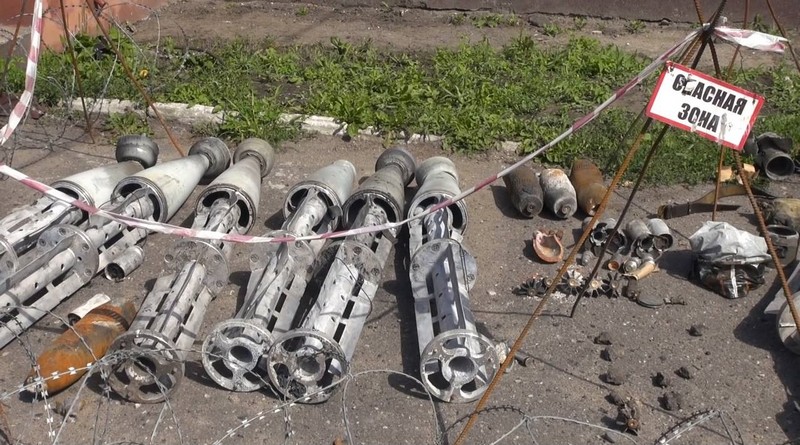
The U.S. announced it would supply Kyiv with cluster munitions that typically release large numbers of small bomblets over a wide area and are banned by many countries.

Russian Defence Minister Sergei Shoigu said that Moscow would be forced to use “similar” weapons if the U.S. supplied cluster bombs to Ukraine.

Russia and Ukraine have previously accused each other of already using cluster munitions in the 500-day war.

Other media reports said:

Russia’s special military operation in Ukraine will continue and its goals will remain unchanged, including Kiev’s rejection of NATO membership, said Medvedev.

Commenting on the early results of the NATO summit in Vilnius, the Russian security official emphasized that NATO made the decision to eventually admit Ukraine, albeit “nobody knows when and on what conditions” and to boost its military assistance to Ukraine.

“What does it mean for us? It is crystal clear. The special military operation will continue with its goals unchanged. One of them is the rejection of NATO membership by the Kiev-based neo-Nazi group,” he said.

“We insisted on that from the very outset, but it is impossible, and, therefore, this group has to be eliminated. This is possible and necessary,” Medvedev wrote.

US, Europeans Depleted Their Weapons Stockpile Fighting Russia In Ukraine

U.S. President Joe Biden has taken flak over an explanation justifying the deployment of cluster munitions to Ukraine in which he admitted both Kiev and Washington are running out of ordinary 155-millimeter howitzer shells.

“This is a war relating to munitions. And they’re running out of that ammunition, and we’re low on it,” Biden said in a televised Friday interview, shortly after Washington’s announcement on the expedited delivery of M864 Dual-Purpose Improved Conventional Munition (DPICM) cluster bombs to Ukraine.

“And so, what I finally did, took the recommendation of the Defense Department, to not permanently, but to allow for, in this transition period, where we have more 155 weapons, these shells for Ukrainians, to provide them with something that has a very low dud rate,” Biden said.

The president’s comments were echoed by National Security Council spokesman John Kirby, who said in a Sunday chat show that the U.S. was running low on howitzer rounds.

The Ukrainians “are using artillery at a very accelerated rate, many thousands of rounds per day. This is literally a gun fight all along – from the Donbass all the way down towards Zaporozhye and Kherson. And so they’re running out of inventory,” Kirby said.

“We are trying to ramp up our production of the kind of artillery shells that they’re using most. But that production rate is still not where we want it to be. So we’re going to send these additional artillery shells that have cluster bomblets in them to help bridge the gap as we ramp up production of the normal 155 artillery shells,” the spokesman added.

Under Secretary of Defense for Policy Colin Kahl made a similar point on Friday, telling reporters Washington was looking to “bridge” a gap that exists between Ukrainian artillery round consumption and US and European production using cluster rounds.

“Vladimir Putin has a theory of victory, okay? His theory of victory is that he will outlast everybody. He will outlast the Ukrainians, he will outlast the United States, he will outlast the Europeans,” a flustered Kahl said. “That’s why President Biden has been clear that we are going to be with Ukraine as long as it takes and why we are signaling that we will continue to provide Ukraine with the capabilities that will keep them in the fight.”

Dedollarization Progress In Russia-China Trade

Media reports said:

Russia-China trade and economic cooperation is expanding, with over 80% of settlements between the two nations currently made in rubles and yuan, President Vladimir Putin has revealed.

The Russian leader was addressing a virtual summit of the Shanghai Cooperation Organization (SCO) on Tuesday via videolink from Moscow. The 23rd SCO summit is being chaired by Indian Prime Minister Narendra Modi.

According to Putin, the volume of trade between Russia and fellow SCO member states reached a record $263 billion in 2022. The figure was up 35% in the first four months of this year, he noted. The share of the ruble in Russia’s settlements with the SCO countries exceeded 40%, Putin said.

Trade between Russia and China has continued to accelerate after hitting a historic high of $190.3 billion in annual terms in 2022. Exports and imports have surged at double-digit pace since the beginning of the year. According to customs data, bilateral trade soared to $93.8 billion in January-May, marking a 40.7% increase compared with a year ago. Russian Finance Minister Anton Siluanov recently said that bilateral trade is on track to surpass the target of $200 billion a year earlier than anticipated.

Economic ties have been bolstered by the mutual decision to conduct the majority of transactions in national currencies instead of the US dollar.

Countercurrents is answerable only to our readers. Support honest journalism because we have no PLANET B.

12 July 2023

Source: countercurrents.org

Jenin attacks rank as collective punishment

Palestine Updates 646

Ranjan Solomon

Jenin attacks rank as collective punishment

Israeli and Palestinian human rights organizations have criticized punitive measures taken by the Israeli government against Palestinians as fears grow of escalation after the deadliest unrest for years in Jerusalem and the West Bank. The Ministry of Foreign Affairs called the arrests a gross violation of international law and the Geneva Convention, adding that the collective punishment was an extension of the occupation policy aimed at removing the Palestinian presence from Jerusalem. Various groups said the Israeli action amounted to collective punishment and is illegal under international law. Shawan Jabarin, director of Al-Haq Palestinian Human Rights organization, told Arab News: “These collective punishments are war crimes that the Israeli government takes against the Palestinians, as it punishes people who have nothing to do with those who carry out attacks against the Israeli occupiers. The Israeli government is fully responsible for the deterioration of conditions and massacres perpetrated by Israeli forces in the occupied Palestinian territories. The decision of the Israeli Cabinet to distribute more weapons to settlers in the occupied West Bank, including Jerusalem, and to call on the occupation police to take up arms, constituted a green light for Jewish terrorist organizations – which take settlements and outposts as safe havens under the protection of the occupation army – to commit more crimes. Israeli HaMoked human rights organization, said that members of Israel’s Cabinet were threatening a range of measures, all of which constituted collective punishment against innocent people.

Meanwhile Workers World made a shocking compelling report on the insidious role of Human Rights Watch. The U.S. not only had weapons to ship and diplomatic support to provide, but also well-financed organizations that could speak hypocritically in the name of human rights. In every global crisis, these organizations will step forward to issue reports of political assistance to support U.S. imperialist aims. In 2002, international bodies and United Nations bodies resoundingly called for a war crimes investigation of the Zionist massacre in Jenin. There was a world outcry. The U.S. government used Human Rights Watch (HRW), a notorious NGO funded by the U.S. Congress through the National Endowment for Democracy, to divert and railroad the call for an international inquiry.The Israeli military conveniently lifted the total lockdown of Jenin’s desperate civilian population to give HRW investigators a special opportunity to gain entrance into the barricaded Jenin refugee camp. In the confusion of the continuing military lockdown and bulldozers plowing up roads, electric lines and plumbing. Workers World reports how HRW opened spaces to allow them to pass Israeli checkpoints and patrols along with the HRW delegation. It became obvious to Workers World that their report and photos they provided were sharply different from the sanitized report from HRW. Bertrand Russell once posed this pertinent question: “How much longer is the world willing to endure this spectacle of wanton cruelty?”(Bertrand Russell)

13 July 2023

Analysis: Jenin attack created 4,000 new refugees, part of the endless cycle of displacement

“The attack on Jenin may have now ended, but there is no bigger resolution in sight – and no sign that the continual rounds of Palestinian displacement will end any time soon,” writes Dr Anne Irfan (UCL Arts and Sciences) in The Conversation examining Palestine-Israel.

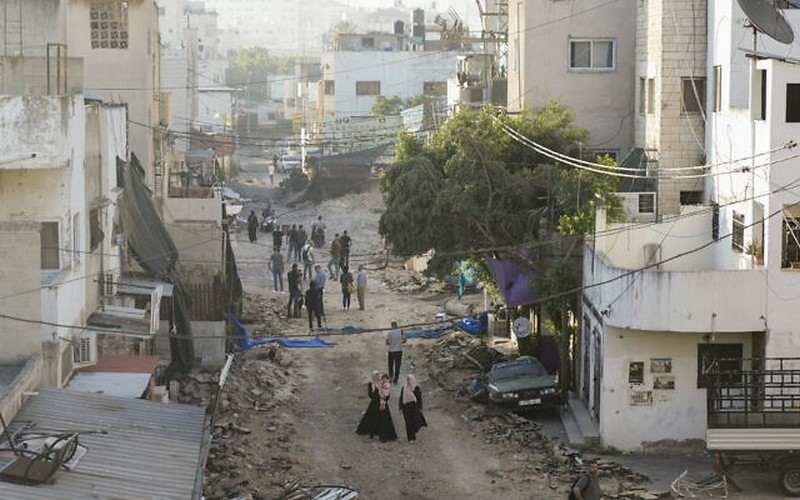
The Israeli army’s recent attack on Jenin refugee camp resulted in 13 deaths (12 Palestinians, including four children, and one Israeli soldier killed by suspected friendly fire). An additional 143 Palestinians were injured, with 20 in critical condition, and up to 4,000 displaced.

While this mass displacement has received less media attention than other aspects of the Israeli operation, it is central to understanding the region’s politics.

Forced migration has always been core to the dynamics of modern Palestine and Israel. Most Palestinians are refugees, and Israel’s occupation of the West Bank and Gaza Strip is organised around control of movement.

While often framed as a fight over religion and ideology, this is ultimately a struggle around demographics, displacement and mobility.

Much of the social media rhetoric on Jenin this week has asked why there is a refugee camp in the West Bank. It’s a question that reflects widespread historical ignorance both in Israel and across the west. In fact, there are 19 refugee camps in the West Bank, and eight in the Gaza Strip. More than 2 million Palestinians across the two territories are registered by the United Nations (UN) as refugees – and their original dispossession goes to the heart of the violence today.

When the state of Israel was established in 1948, it took over 78% of Palestine (much more than the 55% that the UN had originally allocated to the nascent Jewish state). Around three-quarters of the Palestinian population – 750,000 people – became refugees, expelled directly by Zionist militias or fleeing to escape massacres and other violence.

These events are known by Palestinians as the Nakba (“the catastrophe”), and are commemorated annually by refugee communities across the Middle East.

In the immediate aftermath of the Nakba, the refugees sought shelter in the neighbouring Arab states and the two areas of Palestine that did not become part of Israel: the West Bank (including East Jerusalem) and the Gaza Strip. Camps were built to house those with nowhere else to go. Jenin was one such camp, predominantly sheltering refugees from Haifa and Nazareth.

At the end of 1948, the UN passed Resolution 194, calling for the refugees to be allowed to return to their homes at the earliest opportunity. Successive Israeli governments consistently opposed this, and with no resolution, the refugees have remained in exile and in limbo.

Fast forward to 2023 and Jenin has now sheltered more than three generations of refugees. It is home to more than 14,000 people, surviving on less than half a square kilometre of land. When up to 4,000 Palestinians were displaced from the camp this week, they became refugees twice over. This is not the first time this has happened – Israel’s previous attack on Jenin in 2002 also displaced 4,000 people, more than a quarter of the camp’s population at the time.

The displacement of Palestinians did not end in 1948 but has continued for 75 years. In 1967, the Israeli army occupied the two parts of Palestine not subsumed in 1948: the West Bank and the Gaza Strip (known thereafter as the Occupied Palestinian Territories or OPT). As a result, nearly 400,000 Palestinians became refugees, more than half for the second time. Jordan established six new refugee camps to house them.

The Israeli occupation places millions of civilians under martial law. Displacement and immobility are core features of the regime. The construction of illegal Israeli settlements often entails both, uprooting existing Palestinian communities and curtailing their freedom of movement by seizing land across the territory.

In addition to land grab, other Israeli measures that cause continual Palestinian displacement include forcible evictions, house demolitions, denial of residency rights, and discriminatory planning and zoning. This means that Palestinians must live with the constant threat of displacement hanging over them, and no protection of their civil rights as a population under occupation.

In all cases, Palestinians across the occupied territories struggle to negotiate their rights without the claims of citizenship. Recent high-profile cases of forcible displacement include Israeli eviction orders against Palestinians in the East Jerusalem neighbourhood of Sheikh Jarrah to make room for Israeli settlers. In the southern West Bank, Palestinian communities in Masafer Yaffa are facing expulsion as Israel appropriates the land for military training.

Meanwhile, Palestinians in Gaza face displacement of a different kind. Although Israel withdrew its settlements from the Gaza Strip in 2005, Palestinians there have continued to lose their homes due to ongoing waves of violence. Some 72,000 were displaced during the 2021 air attack on Gaza, as 2,200 homes were destroyed and another 37,000 damaged.

As around 70% of the Gaza population are refugees, this figure is a stark reminder of the continual nature of Palestinian forced migration. Many Palestinians now speak of “ongoing Nakba” to reflect this reality.

All this is possible because the Palestinians’ statelessness deprives them of basic rights. While discussions about the peace process is often framed in terms of conflict resolution and security, for many Palestinians the real priority is ending their dispersal and displacement.

The attack on Jenin may have now ended, but there is no bigger resolution in sight – and no sign that the continual rounds of Palestinian displacement will end any time soon.

7 July 2023

Source: ucl.ac.uk

Jenin residents worry international reconstruction aid may be misappropriated by PA

The Destruction of This Palestinian Community Was Green-Lighted by Israel’s Supreme Court

By Basel Adra and Yuval Abraham

So’ed Od, a 13-year-old girl, is one of around 1,000 Palestinian residents of the eight villages in Masafer Yatta—a small region of rugged hills at the southern edge of the occupied West Bank. So’ed now spends her days helping her mother look after their flock of sheep and make cheese in the small village of Sfay, whose name comes from the Arabic word for “pure.”

So’ed stopped attending class after Israeli bulldozers crushed the village school. That day, So’ed told us, she helped young children, the students of lower grades, to escape through the windows. “We were in English class,” she said. “I saw a Jeep approaching through the window. The teacher stopped the class. Soldiers arrived with two bulldozers. They closed the doors on us. We were stuck in the classrooms. Then we escaped through the windows. And they destroyed the school.”

The destruction of the elementary school took place in November 2022 and was documented on video. Children in the first, second, and third grades can be seen in one of the classrooms, screaming and sobbing. Israeli soldiers surrounded the school, where 23 students were enrolled, and threw stun grenades at villagers who were attempting to block the path of the bulldozers. The sound of the explosions terrified the trapped students even more. In the videos, mothers can be seen pulling children out through the classroom windows. Representatives from the Israeli Civil Administration, the arm of the military that governs the occupied territories, entered the emptied school, removed the tables, chairs, and boards from the classrooms, and loaded them onto a truck, confiscating the items. The Civil Administration did not respond to our request for comment.

In 1980, the army had declared 30,000 dunams (nearly 7,500 acres) of the residents’ land to be a “firing zone”; the stated purpose was to remove Palestinians from the area, which Israel designated for Jewish settlement because of its strategic proximity to the Green Line marking the border. In May of last year, a three-judge panel of the Supreme Court rejected the residents’ appeal against the firing zone, effectively giving the army permission to continue to displace the Palestinians from their land. The judge who wrote the controversial ruling, David Mintz, lives in a West Bank settlement called Dolev, about a 20-minute drive from Ramallah.

The mass expulsion of Masafer Yatta’s residents has not yet been carried out, but the lives of all the people of these villages have changed beyond recognition in the months since the ruling. Soldiers have begun detaining children at impromptu checkpoints they’ve erected in the middle of the desert under the cover of night; families watch as bulldozers raze their homes with increasing frequency; and, right next to the villages designated for expulsion and demolition, soldiers are already training with live fire, racing tanks, and detonating mines.

Army officials have stated that plans to carry out the expulsion order have already been presented to politicians. This year, with the most right-wing government in Israel’s history in power––and with its ministers openly calling for mass population transfers and the erasure of Palestinian villages––it’s very likely that the mass expulsion will actually take place. If it does, it will be the largest single act of population transfer carried out in the West Bank since Israel expelled thousands of Palestinians in 1967, in the early days of the occupation.

Both of us have witnessed the struggle in Masafer Yatta from up close. Basel, a journalist and activist, was born in one of the villages there. His mother started taking him to demonstrations against the expulsion when he was 5. He grew up without electricity in his home because the military ordered a blanket ban on construction and access to infrastructure for Palestinians in the area. Over the past decade, he has been documenting the erasure of his community on video, and his posts have reached millions of people around the world.

Yuval was born in the city of Be’er Sheva, a 30-minute drive from Basel’s house, on the Israeli side of the Green Line. For the past five years, he has been reporting on the expulsion and apartheid in both Hebrew and English. The two of us work as a team, mostly for +972 Magazine and the news site Local Call, and this article is a product of our collaboration.

Since the court’s ruling last May, Israel has made the lives of the families in Masafer Yatta even more unbearable, to the point that it’s unclear whether they will be able to survive there. This process, however, has been going on for more than four decades—in what can best be described as a slow-moving expulsion. The primary tool Israel uses is the systematic denial of building permits. Because Palestinian residents cannot possibly live in a village without houses and other basic infrastructure—and because anything they build is deemed “illegal” and summarily demolished—over time this policy has forced the residents to leave their land.

Seven days after the ruling, the military razed the homes of nine families in Masafer Yatta; 45 people were left homeless. “It was one of the worst acts of destruction I have ever seen,” said Eid Hadlin, a local activist who lives in a house that has no running water or electricity and is facing a demolition order.

The bulldozers arrived at Al-Merkaz, one of the villages designated for expulsion. The soldiers let the residents clear out their homes. The women carried their personal belongings outside and gathered them into a pile: mattresses, backpacks, underwear and shirts, shampoo bottles. An inspector in the Civil Administration looked on until the houses were emptied. Then he gave the go-ahead, and the bulldozers wrecked it all.

Najati, a young teenager, sat with his grandmother next to the pile of debris that was once their home. He was furious. “The officer told me, as he was demolishing our house: ‘Why bother building? That’s it, finished—this area is now the army’s for training,’” he said.

One morning, the residents of his village discovered that soldiers had posted warning signs on their houses overnight. “You are in a firing zone,” the signs read, in Arabic that was so riddled with errors that they seemed to have been written with the help of Google Translate. “Entrance is forbidden. Anyone breaking the law can be arrested, fined, lose their vehicle, which will be confiscated, or can face any other punishment deemed fitting.” In the following weeks, soldiers built a checkpoint between the villages and confiscated vehicles that passed through it, under the pretext that driving through a firing zone is prohibited. And so, gradually, most of the residents were deprived of their ability to move freely.

Najati said his family slept outside that night, under the open sky, and the next day they cleared the debris and took out a loan to build another house, in the same spot. “I’ve lived in Masafer Yatta my whole life, herding sheep,” said Safa Al-Najar, Najati’s grandmother, her voice slightly hoarse but her smile that of a young woman. Her home was demolished that same day as well. And so, she said, she’ll sleep in the family’s cave.

“At first, my husband and I lived in this cave,” she said. “This was our bedroom, and living room, and kitchen—everything together. The sheep lived next to us in the second cave. But 20 years ago, when my children were grown, we built a house for them. Everything we built—destroyed.”

According to data from the Israeli human rights group B’Tselem, since 2016, soldiers have demolished the homes of 121 families in Masafer Yatta and have left around 384 people without shelter, many of them children. And it’s not only houses that are at risk, but all buildings and infrastructure. Pens for the sheep were also destroyed, water pipes cut, trees felled; even the access roads, which connect the villages to one another, were destroyed by a huge bulldozer.

At a time when two separate legal proceedings are being brought against Israel at The Hague—in the International Criminal Court and the International Court of Justice—Israel seems eager to avoid the harsh international condemnation that would inevitably follow from a brazen population transfer. By expelling the residents of Masafer Yatta house by house, Israel can achieve the same goal at a much smaller cost to its image.

Since the destruction of their school, children in Sfay have been attending class in a crumbling trailer parked on the outskirts of the village. There are holes in the roof through which rainwater leaks, and the bathroom door is a piece of curtain. The army has forbidden any renovation of the trailer—or the building of a new school.

So’ed’s village is fairly typical for Masafer Yatta. Most of its residents are farmers and shepherds who plant wheat, barley, and olive trees, make goat cheese, and wake up early in the morning to bake bread. The area is full of ancient caves, carved out of the soft white rocks in the hilly desert by residents many generations ago. So’ed’s parents lived in the caves, but they eventually built a house for her and her siblings.

Families whose homes are demolished by military bulldozers are forced to live in the caves, which quickly become overcrowded and suffocating. Yet the residents are also forbidden from renovating the caves, some of which are already uninhabitable.

“We want to build regular houses, to live aboveground. Sleeping in a cave is like sleeping in a grave,” said Fares Al-Najar, a resident of Al-Merkaz. Families who don’t have a cave or who refuse to accept such living conditions are forced to either leave their community and lose their land—or build a new house that will inevitably be demolished. “It’s an unending cycle,” Fares said.

Both the scope and the frequency of such demolitions have increased since the Supreme Court’s decision, which made it much easier for Israeli judges to deny the appeals submitted by the families’ lawyers. And while those appeals, too, were often denied in the past, the legal proceedings went on for years, buying the residents time to remain in their villages and organize their community struggle.

Masafer Yatta is part of Area C, a designation under the Oslo Accords, which covers 61 percent of the West Bank and is under full Israeli military and civil control. Out of the hundreds of requests for building permits the army received between 2000 and 2020, it has denied over 99 percent of requests in Area C, according to data provided by the Israeli NGO Bimkom—Planners for Planning Rights.

In the 15 months since the Supreme Court ruling, the army has imposed a curfew on Jinba, the village where Nidal was born. Soldiers built two checkpoints next to the village: At one, there is a black tent; at the other, a tank. Both are used to detain residents, to confiscate their vehicles, and to block visitors from entering the village.

The court’s ruling in May “cut us off from the other villages,” Nidal said. “Every time we want to leave, to visit our family members, to go shopping, the soldiers detain us for at least two hours. That’s the best case-scenario. One time, they held me up for seven hours.”

People are afraid to drive to the villages for fear of losing their vehicles. In recent months, residents testify, soldiers have confiscated the cars of humanitarian workers, schoolteachers, and lawyers providing legal assistance to the residents. This policy also has a chilling effect on journalists, who are less able to come and report on the region. Cutting Masafer Yatta off from other communities is expected to make it easier for the army to carry out the population transfer with as few witnesses as possible.

The day before the start of school last year, soldiers refused to let the teachers of Jinba’s elementary school enter the village to prepare the classrooms. The soldiers at the checkpoint confiscated their car, explaining that they were in a firing zone. These decisions are made arbitrarily: The following day, the soldiers let the teachers through.

Royda Abu Aram, from the village of Al-Halawah, is a student in 12th grade, the year students take the tawjihi exams—the Palestinian equivalent of the SATs. “Yesterday I missed all my classes because there was no way for me to get there without a car or transportation,” she said. “My friend Bisan, who tried to get to school by car, was delayed by the soldiers for an hour and a half, in the sun.”

In a video recording of the checkpoint from August, a soldier, his hand resting on his gun and a large tank behind him, explains to a group of several adults and school-age children, backpacks slung across their shoulders, that “this area is designated as a firing zone, the army closed this area, and we are conducting searches here.”

Every school in Masafer Yatta has received a demolition order. “I really want to work in education. I’m interested in studying at university and becoming a language and English teacher,” Bisan, also a 12th grader, said. “But I’m worried I won’t do well on the tawjihi exam in these circumstances. It’s hard to learn when you know that you may wake up tomorrow and bulldozers will come to demolish your school.”

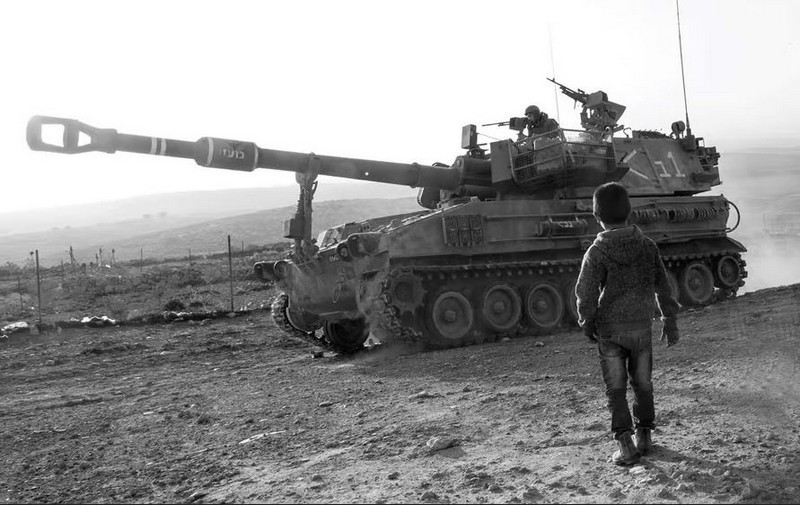
The Supreme Court ruling also granted permission to the Israeli military to start training with live fire in the area. Tanks have been roaring through the area between the villages while soldiers fire live rounds and detonate explosives; helicopters have been practicing landing and taking off. All these loud noises join the buzzing of the drones that the soldiers, and sometimes the nearby settlers, use to monitor whether residents are building new houses after their homes have been destroyed.

“Our entire village went outside to look at them,” said Jinba resident Issa Younis, after a day of tank training that took place next to the village last June. “The noise of the tanks was deafening. The mine detonations started before sunrise, right by our houses. All the walls shook, like we were in an earthquake.”

During one of these training sessions, in the village of Al-Majaz, soldiers placed targets on the windows of the houses, on a tractor, and on a car. Jabar, a 15-year-old boy, left his house to see what was going on. A sand cloud swirled around him—the result of a tank driving through the desert region. “The soldiers hung targets on the window of our house and on the haystacks,” Jabar said. “They wrote that they would be returning soon to shoot, but I took the targets down.”

The military promised the court that it would take precautionary measures when conducting any exercises with live fire, and that the soldiers would not endanger the lives of the residents. The reality has been different. In July 2022, Leila Dababsa was sitting in her home when she heard an explosion above her. The ceiling began to crumble. “The living room was filled with the sound of gunfire, and my daughter screamed,” she said, pointing to the holes in the tin roof. Most of the houses are built from cheap materials, out of fear that they will be destroyed. Leila and her daughter escaped and hid in a nearby cave.

“A second before they shot our house, I was picking tomatoes in the garden,” said Sa’ud Dababsa, whose house was targeted. “This is the first time that a bullet entered our home, into the living room. Before, we were in danger of being expelled. Now my family and I are in danger of being killed.”

Historically, the expulsion process in Masafer Yatta can largely be traced back to two men: Ariel Sharon and Ehud Barak, both of whom were senior military figures who later became Israeli prime ministers. They represent competing camps in Israeli politics: Sharon headed the Likud party, which is identified with the Zionist right, and Barak led the Labor Party, which is affiliated with the Zionist left. But on issues related to Masafer Yatta, the two worked together in harmony.

After leading the conquest of the West Bank in 1967, Sharon, then a military official, began the process of declaring various areas as military firing zones, first in the Jordan Valley and later in Masafer Yatta. “As one of the people who initiated the firing zones in 1967, everyone was aware of one goal: to enable Jewish settlement in the area,” Sharon testified in 1979. “Back then, I sketched out these firing zones, reserving our land for settlement.”

The locations of the firing zones weren’t chosen randomly. They perfectly matched the Allon Plan, which was submitted to the Israeli government a month after the occupation began by Yigal Allon, another future prime minister, and which determined that the areas should be permanently kept under full Israeli control. With their relatively arid climate, these areas had few Palestinian villages compared to the crowded northern West Bank, which made them appealing for Jewish settlement.

A map commissioned by the state in 1977 designates part of the Masafer Yatta region for such settlement. Three years later, in 1980, firing zones were declared in the same area.

In a secret meeting of the Ministerial Committee for Settlement Affairs held in July 1981, Sharon offered the army the firing zone that was declared in Masafer Yatta and reaffirmed that his goal was to remove Palestinians from the area, according to the official transcript. “We have a great interest in being there, given the phenomenon of Arabs from the villages spreading toward the desert [in the south],” he explained to the army chief of staff.

During the same period, the Israeli government worked to establish Jewish settlements in the region. Settlements like Susya, Ma’on, and Carmel were part of the state’s policy of cutting off the Palestinian population in the Negev, which is inside Israel, from the Palestinian population in the southern West Bank, like the residents of Masafer Yatta.

“For many years, there was a physical connection between the Arab population of the Negev with the Arab population in the Hebron hills. A situation was created in which the border extends inside our territory,” Sharon told the settlement committee. “We must quickly create a buffer strip of [Jewish] settlement, which will distinguish and separate the Hebron hills from Jewish settlement in the Negev. To drive a wedge between the bedouins in the Negev and the Arabs in Hebron.”

Sharon’s words are particularly relevant today, as not only the residents of Masafer Yatta but also the Bedouins in the Negev are being dispossessed of their land through the systematic denial of building permits and the declaration of military firing zones.

In 1999, Ehud Barak was elected prime minister. These were the days of the Oslo Accords, four years after Yitzhak Rabin’s assassination—when there was still hope among Israelis and Palestinians that a peace deal might come. But Barak’s government decided to permanently remove the residents of Masafer Yatta. Under his watch, in November 1999, soldiers moved through all the villages, loaded 700 people into trucks, and expelled them. They became refugees in nearby villages.

“I remember that day vividly,” said Safa Al-Najar, now 70. “Soldiers came inside, while outside there were two big trucks waiting. They lifted us onto them by force, with all of our belongings. The sheep escaped on foot. They threw us into another village.”

Barak’s ethnic cleansing, carried out by a government that included the left-wing Meretz party, inspired protests in Israel led by intellectuals, among them famous authors like David Grossman. The protesters met with the general of the Central Command to express opposition to the operation, but they were told that it had to be carried out because, in preparation for further negotiations with the Palestine Liberation Organization, Israel had a major interest in keeping the region part of its sovereign territory.

The talks between Israel and the PLO for a final peace resolution, which took place in 2000 at Camp David, apparently led Barak to accelerate the dispossession efforts in Masafer Yatta. The thinking was that if there were no Palestinians living there, it would be more likely that the region would ultimately remain under Israeli control.

This is one reason why the “peace process” in the 1990s was in fact deeply destructive for many Palestinians: It galvanized rather than tamed Israeli colonialism. In those years, the number of Palestinian home demolitions grew significantly, while Jewish settlements were quickly populated and roads leading to them were rapidly paved.

A few months after Barak ordered their displacement, the residents of Masafer Yatta petitioned the Israeli Supreme Court against the firing zone. Palestinians living in the West Bank are subject to military law––they don’t have the right to vote and so are unable to influence the legal system that rules over them—and the Supreme Court has expanded its jurisdiction to encompass the occupied territories.

Their petition remained before the court for more than 22 years. Instead of making a decision, the judges issued an interim order allowing the displaced Palestinians to temporarily return to their homes. In 2012, while Barak was defense minister, the state declared in court that its demand for forced transfer was still active, and that the army was prepared to allow residents access to work their land only during Israeli holidays and on the weekends, when no military exercises took place.

Even this temporary reprieve came to an end last May, when the judges finally rejected the residents’ petition. In the ruling by Justice David Mintz, the court accepted the state’s claims that when the firing zone was declared over 40 years ago, the people of Masafer Yatta were not “permanent residents” of the area, but rather “seasonal residents.” That is, they used to move between two places, depending on the shepherding season: They had one house in a village in Masafer Yatta and another in the city. According to the letter of the military law, the declaration of a firing zone does not apply to permanent residents in the territory, but since, as the state claimed, the residents of Masafer Yatta were only “seasonal,” their expulsion should be permitted. The Supreme Court agreed.

Such legal arguments don’t impress halima, who was born in a cave in Al-Merkaz in 1948 and has lived there her whole life. “That’s their court, not ours,” she said, “and they use the law in order to expel us.”

The names of the Masafer Yatta villages are all over old maps that predate the Israeli state, including one by British surveyors from 1879. Another can be found in a 1931 book by a geographer named Nathan Shalem, who visited homes in Jinba and noted that human settlement there “had never ceased.” Aerial photographs from 1945 testify to the existence of the villages. Even the official documentation of the State of Israel shows that in 1966, the Israeli military blew up 15 stone structures in Jinba, then under the control of Jordan, later compensating the residents through the International Red Cross.

The Supreme Court rejected this historical evidence, which was attached to the residents’ petition. “The existence of the stone houses in the ruins of Jinba, in 1966, has nothing to teach us about the situation of things in 1980,” Mintz explained in his ruling. He gave evidentiary weight only to the area’s status in the year in which the military’s firing zone was declared.

In their decision, the judges relied on the work of an Israeli anthropologist, Ya’akov Habakkuk, who lived in the region in the 1980s, for their claim of “seasonality.” Habakkuk wrote that during the grazing season, in winter and spring, the families lived in Masafer Yatta, but in the dry months of summer, they lived in the adjacent city of Yatta. This describes the lifestyle of many families living in the region in the past, though not all of them.

Habakkuk himself is adamantly opposed to the court’s interpretation of his work. He told us he had no idea his research was being used to justify the expulsion. “It was obvious to everyone around that this is their village,” he said. “The families came there consistently, always to the same cave, and when they weren’t here, no one else would enter.”

International law explicitly forbids population transfers in occupied territory, with almost no exceptions. But in their ruling, the judges claimed that if there is a conflict between international law and Israeli law, “Israeli law decides.” In the decision, they wrote that the section of the Geneva Conventions forbidding population transfers is intended “only to prevent acts of mass expulsion of a population in occupied territory in order to destroy it, to perform forced labor, or to achieve other policy goals,” and therefore there is no connection with the Masafer Yatta displacement, which was only ordered so that the military could train there.

The ban on population transfers is found in the Fourth Geneva Convention, in Section 49: “Deportations of protected persons from occupied territory to the territory of the Occupying Power or to that of any other country, occupied or not, are prohibited, regardless of their motive” (emphasis ours).

The story of Masafer Yatta thus represents the cornerstone of Israeli settler colonialism throughout Israel-Palestine. On both sides of the Green Line, Palestinian displacement is largely achieved by way of the law: the systematic denial of building permits, the denial of Palestinian ownership rights to the land in question, the declaration of expansive firing zones, the designation of national parks, and the establishment of new Jewish settlements to “drive a wedge” and cut villages off from one another.

“Everything that lies behind the process is the theft of our land and the expulsion of our communities,” said Nidal Abu Younis, the head of the Masafer Yatta village council. “Destroying our homes, confiscating our vehicles, destroying our roads and schools––it’s all one massive crime. They can expel us at any moment. Now more than ever, we are in need of international solidarity.”

Basel Adra is a reporter for +972 Magazine and Local Call.

Yuval Abraham is a reporter for +972 Magazine and Local Call.

10 July 2023

Source: thenation.com

How Israel’s environmental violations sustain its apartheid regime

By Hala Yacoub

The Israeli government recently released over a million documents from their state archives, revealing part of Israel’s plans to create a new stage of Israel’s settler colonial enterprise. This strategy depends on the slow ethnic cleansing of Palestinians in order to build settlements in the West Bank.

These documents show minutes from meetings held by the Israeli military’s Judea and Samaria Division which depict the stages of the settlement project in the West Bank. According to the documents, the first step would be dispossessing Palestinians from their lands using the legal cover of ‘firing zones’, and if they refuse to leave their homes, they will face oppressive consequences, including the destruction of crops.

The documents also catalogue the Israeli colonisation of Aqraba, a village in the north of the West Bank, and the building of the Gitit settlement on the land. They detail the stages of creating a coercive environment in order to forcibly dispossess Palestinians from the village, as previous tactics failed – including declaring the land a closed military area.

”It is clear that Israel treats the West Bank as its private ‘sacrifice zone’ because it is much cheaper to pollute the area than to responsibly process or reduce waste. However, it would be naïve to wait for an environmentally responsible approach from an apartheid regime which exists to serve a larger settler-colonial enterprise – especially when the continued violations help advance this project.”

In order to achieve their goal, Israeli authorities, including the occupying military, the settlement department at the Jewish Agency and the Custodian of Absentee Property, admitted to employing “a crop duster” in order to spread toxic chemicals which are “lethal for animals and dangerous for humans”. They served to also drastically deter the growth of crops on the land.

This poisoning of the land tactic has been a new revelation provided by the documents released.

Similarly to the case of Aqraba in the 1970s, today Masafer Yatta and the Jordan Valley are also facing policies aiming to displace and cleanse Palestinians from their lands. This starts with Israel creating military training areas which serve as a legal cover, and subsequently developing a coercive environment by systematically attacking Palestinian presence in the targeted areas.

Sacrificing Palestinians

The crime of crop dusting has in fact been ongoing since 1972. Little has changed throughout the decades, today’s practices and yesterday’s policies prove that when all else fails, Israel will easily resort to attacking the Palestinian ecosystem using toxins in order to feed its settler-colonial enterprise and apartheid regime.

Palestinian land is also used as a colossal sacrifice zone by Israel which places open waste dumps belonging to its illegal settlements, in the occupied Palestinian territories [oPt].

Today, there are at least 15 documented Israeli dumping sites in the West Bank that are located near Palestinian villages that are negatively impacting the communities’ well-being, agriculture, and security. Some involve the burying of raw waste and others are used to treat recycled waste – a hazardous process.

In the Jordan Valley, the soil is reported to absorb 60% of toxic sludge resulting in Israeli wastewater treatment. Furthermore, the largest Israeli dumping site created for medical waste treatment is located in the illegal Maale Ephraim settlement in northern West Bank.

To make matters worse, several industries and landfills have been closer to the green line or inside the West Bank where the environmental repercussions would only fall on Palestinians. For example, the Geshuri and Sons Factories, which produce a range of products, mainly pesticides, were moved from their previous location – which was considered too harmful for Israelis – to the Nitzanei Shalom industrial settlement in the city of Tulkarm.

The Kfar Saba pesticide factory was also moved to the Tulkarm area, as was the Dixon Gas company’s industrial gas factory which required open air to freely burn its solid waste produce. Both of the factories produce dangerous pollutants which are harmful to Palestinians.

Ecocide for apartheid

For Israel, the West Bank is populated by ‘non environmental rights deserving’ Palestinians who are consequently forced to suffer through increasing rates of cancer, optical and respiratory diseases. This is certainly the case in Tulkarm where, according to research by professor Mazen Salman from the agriculture faculty at Khudouri University, most of the optical and respiratory diseases in the area are located in the surroundings of the Israeli factories.

Not to mention, the acres of Palestinian crops that have been destroyed including citrus farms in Wadi Qana and olive tree groves in Qaryut (found in the Salfit governorate).

How Germany’s history of antisemitism is used to silence pro-Palestine activism

It is clear that Israel treats the West Bank as its private ‘sacrifice zone’ because it is much cheaper to pollute the area than to responsibly process or reduce waste. However, it would be naïve to wait for an environmentally responsible approach from an apartheid regime which exists to serve a larger settler-colonial enterprise – especially when the continued violations help advance this project.

By placing hazardous landfills in the oPt, Israel not only the generates a coercive environment in order to displace Palestinians, but also the de facto annexation of the lands that host the landfills – which is a violation of the 4th Geneva Convention.

The relationship between Israel’s environmental violations and its apartheid regime are inescapable. Using waste dumps in the oPt in order to efficiently maintain the economy of Jewish settlers, annexing and displacing Palestinians to empower Israel’s settler colonialism, imposing impossible living conditions on Palestinians, systematically sacrificing a zone and its population for the sake of another, are all apartheid practices. After all, the Apartheid Convention (1973) highlights in its definition the “imposition of living conditions calculated to cause its physical destruction”.

Indeed, Israel’s violations are not merely environmental, neither in intent nor effect. Sacrifice zones, as a global phenomenon, serve imperialist interests. This not only highlights that the Palestinian struggle is an environmental one, but also that environmental justice is incomplete without the fight for decolonizing Palestine.

Hala Yacoub is a 24-year-old trainee lawyer at Al-Jubran Law Firm and a legal researcher at the Justida Legal Research Centre in Palestine.

13 July 2023

Source: newarab.com

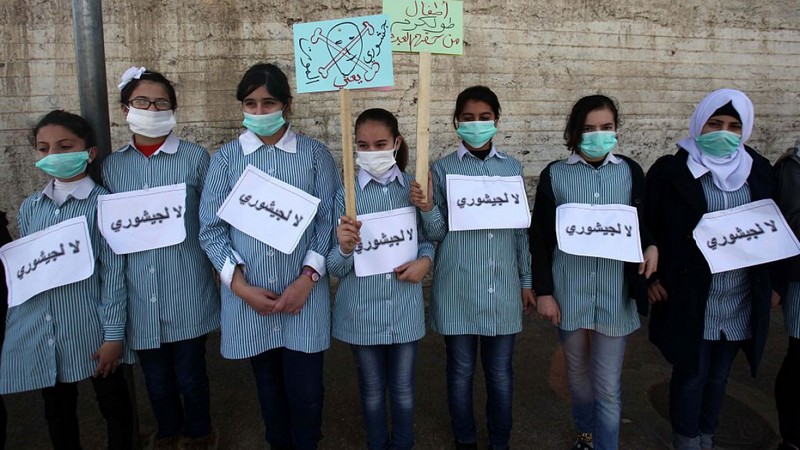
Jenin’s children need urgent psychological care after Israeli attack, say social workers

By Qassam Muaddi

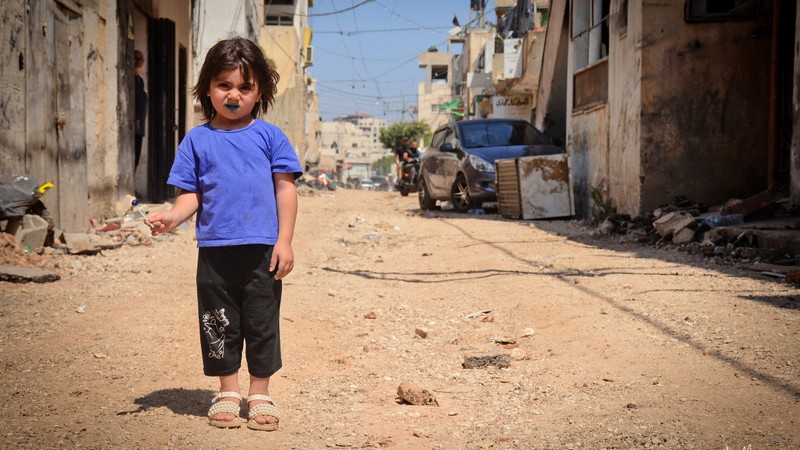
Children in the Jenin refugee camp need urgent treatment for the trauma caused by repeated Israeli attacks on the camp, families and social workers said to The New Arab.

Since the beginning of this year, Israeli forces have killed 64 Palestinians in Jenin during military raids on the city and its refugee camp. Among those killed by Israel are at least 13 children.

Last week, Israeli forces conducted a 48-hour-long attack on the camp, killing 12 Palestinians and wounding 100, destroying most of the infrastructure and causing at least 3,000 Palestinians to leave their homes.

Psychological impact on children is greater than we expected, and it doesn’t only come from the killing of fellow age-peers or family members, but from the constant violent atmosphere that imposes itself on life in the camp, including in between raids,” Najat Abu Butmeh, director of the children’s centre in the camp, told TNA.

Many of the families who left the camp on the second night of the latest attack, fleeing drone strikes, came back to find their homes destroyed, which immensely impacts children,” said Butmeh.

The general destruction in the camp’s streets continues to traumatise children, which is why we need to take them out of the streets and away from their destroyed homes,” she said. “We have been forced to reorganise our summer activities to be able to welcome hundreds of children more, for more hours during the day, and we lack resources.”

“Our therapy activities include expression through drawing, and we notice that all children draw army vehicles, guns, killed people, arrests, and resistance symbols,” noted Butmeh.

“It has been years since we saw a child above the age of five drawing a flower or a cloud,” she added.

At the Abu Karam family in the camp, the mother described the impact of the latest Israeli attack on the camp. “As drone strikes hit parts of the camp, we felt the sound of explosions very close and loud, and my middle son, Aboud, who is only three years old, broke into crying and screaming at each explosion,” she said.

“My youngest son took fever out of fear, and he couldn’t eat anything the next day,” continued the mother. “We left our house on the second night, and although we came back two days ago, Aboud keeps asking me if the Israelis bombed our house and if we no longer have a house, and I have to remind him that we are in our house each time.”

Basimah Abu Tabikh, director of the women’s work centre, states that the need for trauma treatment also includes women, to which the children’s centre is affiliated.

Women, especially mothers in the camp, bear the heaviest burden of the situation, as they are the ones who directly have to maintain a safe atmosphere in the households during the raids, especially if their husbands are killed or arrested,” explained Abu Tabikh.

“The biggest burden is the upbringing of children under these conditions, especially that the entire young-adult generation that includes resistance fighters in the camp, were children who grew up under the trauma of the 2002 occupation attack on Jenin,” she noted. “We know the pattern, and we know that the occupation violence makes it impossible to offer a safe place for children to grow up”.

“Although we have specialised professionals to treat traumas in our centre, we are women and mothers ourselves,” she added. “In a way, organising activities for children and fellow women is, in a way, a kind of self-therapy for us.”

According to the Defence of Children International – Palestine human rights group, four of the 12 Palestinians killed in last week’s Israeli attack on Jenin were children. DCI-P’s also documented 33 Palestinian children killed by Israeli forces in 2023, including 13 in Jenin alone.

Qassam Muaddi is TNA’s correspondent in the West Bank. He is a Palestinian journalist and writer who has covered Palestinian social, political and cultural developments in Arabic, French and English since 2014.

11 July 2023

Source: newarab.com

The pogroms deliver: Another Palestinian community was forcibly transferred yesterday

Dozens more shepherding communities live under the threat of expulsion

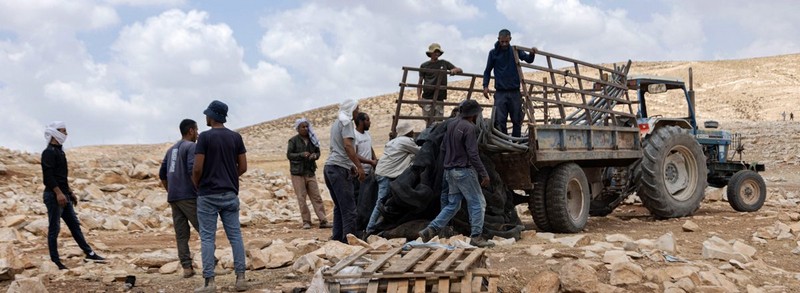
Yesterday (Monday, 10 July 2023), the Bedouin shepherding community of al-Baq’ah was forcibly transferred from its seat east of Ramallah. In recent weeks, the community has suffered daily settler attacks originating from a nearby settler outpost, one of the seven new ones established after the Turmusaya pogrom on 21 June 2023. Last Friday, a home in the community was torched. The family was out at the time for fear of exactly such violence.

The community has a total population of 33, including 21 minors. The residents who dismantled the community’s homes and animal enclosures yesterday told B’Tselem field researchers they had no choice but to leave as they were afraid for their lives and had no one to protect them.

The Palestinian community of al-Baq’ah forcibly transferred 10/7/23

Al-Baq’ah joins the nearby communities of Ras a-Tin and ‘Ein Samia, which have already been driven off their lands over the past year under the same circumstances: Israel’s policy creates oppressive, unreasonable living conditions that leave residents of these communities with no choice but to abandon them. Relying on more official means (settlement building, extreme restrictions on Palestinian construction, a prohibition on infrastructure and demolitions), and on less official ones (settler violence against Palestinians), the policy has one goal: taking over more and more Palestinian lands and handing them over to Jewish hands, and it is applied against other communities still living in the area.

Forcible transfer is a war crime, even if the state perpetrates it not by forcing people onto trucks but by putting so much pressure on them that their lives become unbearable and they cannot help but leave their homes and lands.

11 July 2023

Source: btselem.org

Stop Biden from Sending Cluster Bombs to Ukraine

By Medea Benjamin and Marcy Winograd

President Biden may have crossed a new red line for the Democratic Party when he announced he would send banned cluster munitions to shore up Ukraine’s slow counter-offensive against Russian troops. 

On Friday, 19 House Democrats, led by Congressional Progressive Caucus Chair Pramila Jayapal (D-WA-7), signed a letter to Biden warning that his decision to send cluster munitions to Ukraine “severely undermines our moral leadership.”

This time it’s not just left-leaning activists in CODEPINK and the Peace in Ukraine Coalition who recoil in horror at Biden’s escalation in Ukraine, but congressional Democrats who previously stood by their President. These are the same Democrats who voted to approve over $100 billion in Ukraine spending, an estimated half for weapons and military assistance for which there is no accountability.

Rep. Betty McCollum (D-MN-4),  ranking member of the House Defense Appropriations Subcommittee, told Politico:

“The decision by the Biden administration to transfer cluster munitions to Ukraine is unnecessary and a terrible mistake …The legacy of cluster bombs is misery, death and expensive cleanup generations after their use.”

On Sunday other prominent Democrats took to the airwaves, with Senator Tim Kaine (D-VA), a former Vice Presidential candidate, telling Fox News he had “real qualms” about the President’s decision, and Congresswoman Barbara Lee (D-CA-13), Chair of the House Appropriations Subcommittee on Foreign Operations and US Senate candidate, telling CNN, “Cluster bombs should never be used. That’s crossing a line.” Senator Jeff Merkley (D-OR) and former Senator Patrick Leahy of Vermont, who visited Vietnam following the US withdrawal, joined the chorus with a Washington Post OpEd explaining how they had witnessed firsthand the “devastating and long-lasting effects these weapons have had on civilians.”

Even before the official White House cluster bomb announcement, House Democrats Sara Jacobs (D-San Diego) and Ilhan Omar (D-Mpls) introduced an amendment to the 2024 military budget to ban the issuance of export licenses for cluster munitions.

Congressman Jim McGovern (D-MA), the ranking member of the House Rules Committee, was one of the first to co-sponsor the bill. McGovern told the New York Times that cluster munitions, “disperse hundreds of bomblets, which can travel far beyond military targets and injure, maim and kill civilians — often long after a conflict is over.”

The amendment, however, will need overwhelming bipartisan support to pass–as well as a President who will obey the law should the ayes have it.

In greenlighting cluster munitions, Biden thumbed his nose at 18 NATO partners that joined with over 100 other state parties to sign the 2008 UN Convention on Cluster Munitions. As Biden headed to Vilnius, Lithuania, for the NATO summit this week, Newsweek reported representatives of the UK, Canada, New Zealand and Spain were not on board for cluster bombs.

Biden also chooses to bypass current US law that restricts the use of cluster munitions to only those with a failure to detonate rate of less than one percent. In its last publicly available estimate, the Pentagon estimated a “dud rate” of 6%, meaning that at least four of the 72 submunitions from each shell failed to explode when unleashed.

With a bow to hawkish Republicans, such as Alabama’s Tom Cotton on the Senate Armed Services Committee, Biden invokes the exception to the rule embedded in the statute against the use of cluster munitions. This exception allows for shipment of cluster munitions in the interest of vital national security.

Who controls eastern Ukraine’s Donbas region, the Russian army or the Ukrainian army, is hardly a US national security interest on par with mitigating the threat of climate catastrophe or providing clean water to those with lead in their pipes or investing in housing for the unsheltered living under freeway overpasses.

Nonetheless, the same President Biden who a year ago warned of the risk of nuclear Armageddon, has reversed himself yet again to up the ante. Biden first said no, then flip flopped on a host of weapons: Stinger missiles, HIMARS rocket launchers, advanced missile defense systems, M1 Abrams tanks, F-16 fighter jets. Each one of these has been a kind of Russian roulette, testing Putin’s “red lines.”

With Biden’s latest decision to send cluster bombs to Ukraine, anti-nuclear activists wonder if the President–whose Nuclear Posture Review approves of “first use”– might also cross the nuclear red line, even though it’s Putin who has issued veiled nuclear threats–and Biden and Putin in June of 2021 signed a statement that said, “Nuclear war cannot be won and must never be fought.”

The impetus for the 2008 landmark UN Convention on Cluster Munitions came precisely from the indiscriminate U.S. use of these weapons in Southeast Asia in the 1960s and 1970s. In Laos, the U.S. military blanketed the country with almost 300 million bomblets, many that failed to immediately detonate, only to later–after the US withdrew from Southeast Asia– maim adults and children who accidentally stepped on the cluster bombs or picked up the shiny balls thinking they were toys.

Both Ukraine and Russia have already used cluster bombs in Ukraine, a development roundly condemned by human rights groups documenting the resulting  deaths and serious injuries of civilians. The hundreds of thousands of rounds that Biden is planning to send would significantly increase the use of these banned weapons.

Biden’s appalling decision to send cluster bombs can be seen as a sign of desperation in the face of Ukraine’s failing counteroffensive in southern and eastern Ukraine. Biden told CNN it was a “difficult decision” but Ukraine is “running out of ammunition.” The truth is that adding this new indiscriminate weapon will not miraculously break the stalemate to achieve “military victory” but  guarantee the unexploded bombs eventually kill and wound Ukrainian civilians for years to come while encouraging other countries to also violate the cluster munitions ban.

In the next week or so, the House may consider Jacobs and Omar’s NDAA amendment as Congress tackles a $920 billion military budget. Now is a critical time for constituents to click on CODEPINK’s action alert requesting  House representatives co-sponsor the amendment to ban the export license for cluster munitions. While skeptics may question whether Biden would respect any law limiting his power to wage war, only loud and vigorous opposition can pull the political levers that control our destiny.

Rather than escalating an arms race to risk nuclear war, the Biden administration should promote a ceasefire and negotiations without preconditions. Instead of breaking international law, the U.S. should break the military stalemate by joining the global call for a diplomatic resolution to the conflict.

Medea Benjamin is cofounder of CODEPINK for Peace, and author of several books, including Peace in Ukraine: Making Sense of a Senseless Conflict.

Marcy Winograd serves as the Co-Chair of the Peace in Ukraine Coalition and Coordinator of CODEPINK Congress.

11 July 2023

Source: globalresearch.ca