Just International

Protest In Middle East Countries Following Gaza Hospital Strike Killing More Than 600

By Countercurrents Collective

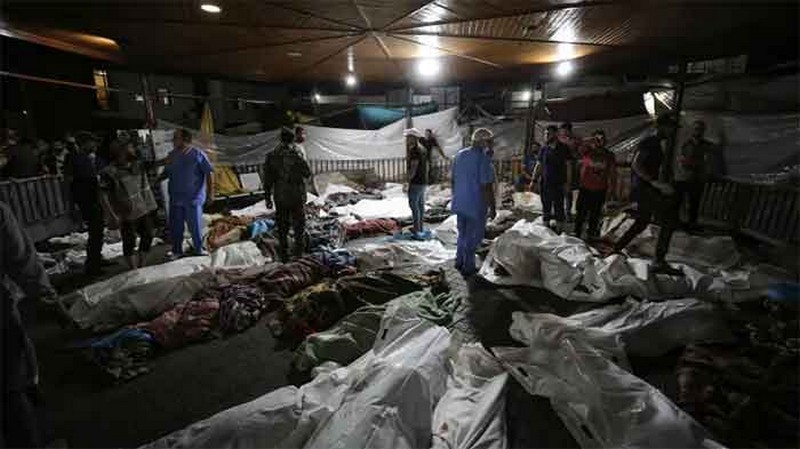
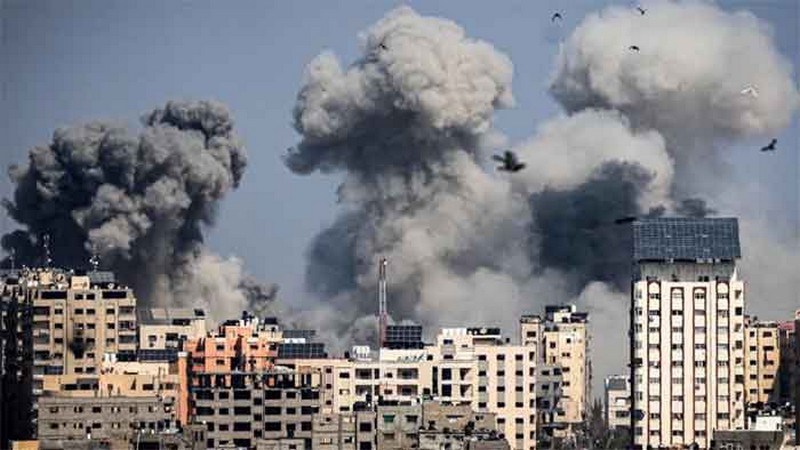
The strike on a Gaza Strip hospital that killed more than 600 Palestinians has sparked protests and riots in several Muslim-majority countries on Tuesday night, including Lebanon, Jordan, and Türkiye.

Beirut

In Beirut, where the pro-Palestinian militant group Hezbollah has called for “a day of unprecedented anger,” protesters gathered in front of the U.S. embassy building in the Awkar neighborhood.

They threw stones at the security fence and attempted to scale it. Police responded by firing volleys of tear gas and used water cannons to contain the mob, according to the Lebanese news channel MTV.

Protesters also reportedly attempted to break into the office of the UN Economic and Social Commission for Western Asia (ESCWA) in downtown Beirut.

Amman

Similar scenes unfolded in Jordan’s capital Amman, where an angry crowd burned Israeli flags and tried to storm the Israeli embassy. An AFP correspondent reported that they broke through the first security barrier, but were later pushed back by the police, which used tear gas.

“Police handled and drove a group of protesters who grouped near an embassy in an attempt to reach the building,” Jordan’s Public Security Directorate said, as quoted by Roya News.

Amman was to host a summit of the leaders of the U.S., Jordan, Egypt, and the Palestinian Authority on Wednesday. The Jordanian authorities have since canceled the event in solidarity with the victims in Gaza.

Turkish Cities

Rallies were held in multiple Turkish cities, including Istanbul, Malatya, Gaziantep, and Kayseri.

In Istanbul, Türkiye’s largest city, a huge crowd gathered outside the Israeli consulate, with some protesters launching fireworks, scaling the security fence, and attempting to set the building on fire. Others threw stones and set a US flag on fire, local media reported.

Police intervened, dispersing the rioters. Fahrettin Altun, spokesman for President Recep Tayyip Erdogan, urged those wanting to express “justified anger” over the deaths in Gaza to respect the law and “preserve common sense.”

The Palestinian authorities blamed Israel for the strike on the Al-Ahli Arab Hospital in Gaza City that claimed more than 600 lives on Tuesday.

The Israeli army and Prime Minister Benjamin Netanyahu, however, said that the hospital was hit by a rocket that was launched by one of the Palestinian militant groups and had veered off course. Israeli officials previously accused Hamas, a group that governs Gaza, of using hospitals, schools, and mosques as a cover for its operatives.

The Israel Defense Forces have been conducting retaliatory strikes on Gaza after Hamas and allied militants launched a surprise attack on Israeli cities on October 7.

Hundreds Dead In Gaza Hospital Bombing

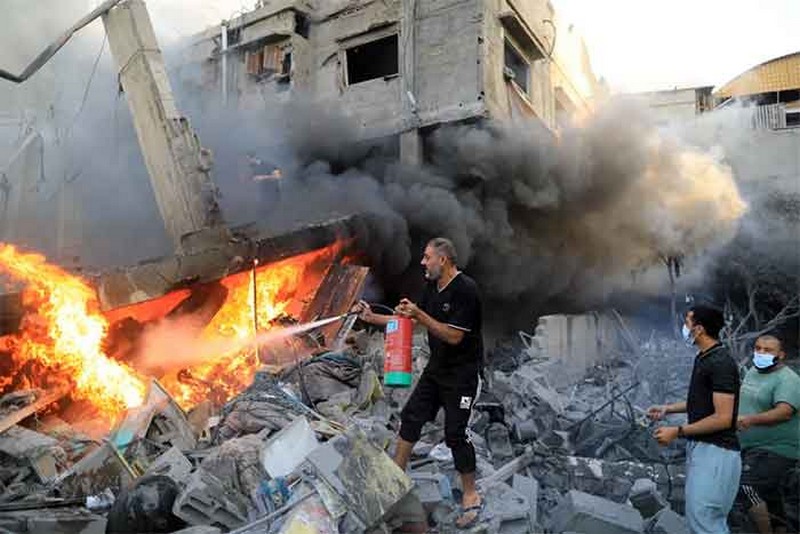
More than 600 people have been reported dead and over 900 wounded after a missile struck the Al-Ahli Arab Hospital in Gaza. Hundreds of Palestinians were sheltering in the building, as well as patients receiving treatment, and there are fears the death toll will grow higher. Israel, which is bombarding Gaza following a bloody incursion by Hamas, has denied responsibility for the strike and accused Palestinian Islamic Jihad of hitting the facility.

A Palestinian Red Crescent representative on Tuesday described the destruction of the Baptist Hospital in Gaza City as a war crime and genocide, while a local doctor called it a massacre.

According to a source, the final death toll could easily reach more than 1,000.

Al-Ahli hospital is run by the Episcopal Diocese of Jerusalem, an Anglican Christian denomination.

Its destruction was denounced by the World Health Organization, Egypt, Qatar and Türkiye, among others.

Hamas leader Ismail Haniyeh insisted that such “brutality” by Israel confirmed its “defeat” on October 7, and said the U.S. was ultimately to blame.

He also called for Palestinians in the West Bank to rise up against Israel.

Within minutes of Haniyeh’s statement, a riot broke out in Ramallah, as hundreds of Palestinians protested against President Mahmoud Abbas’ decision to meet with U.S. President Joe Biden on Wednesday. Abbas has reportedly canceled those plans since, citing the hospital attack.

Russia and the United Arab Emirates have called for an emergency session of the UN Security Council on Wednesday, to discuss the Gaza hospital attack.

Israel And Palestinians Trade Blame For Deadly Hospital Strike

Another media report said:

Israel has denied striking the Al-Ahli Arab Hospital in Gaza on Tuesday, alleging that a Palestinian Islamic Jihad misfire was to blame. PIJ has accused Israel of trying to cover their “massacre” while Hamas has argued the U.S. is ultimately to blame.

Israel has denied striking the hospital, however. IDF spokesman Daniel Hagari said that “an enemy rocket barrage was carried out towards Israel, which passed through the vicinity of the hospital when it was hit.”

“According to intelligence information, from several sources we have, the Islamic Jihad terrorist organization is responsible for the failed shooting that hit the hospital,” Hagari added. The same claim was echoed by Prime Minister Benjamin Netanyahu shortly afterwards.

Israeli PM Benjamin Netanyahu reposted the IDF claim.

“The entire world should know: It was barbaric terrorists in Gaza that attacked the hospital in Gaza, and not the IDF. Those who brutally murder our children also murder their own children,” Netanyahu added later.

A spokesman for PIJ responded by calling the Israeli claims “completely incorrect” and accusing the IDF of “trying to cover for the horrifying crime and massacre they committed against civilians.”

One Palestinian doctor in Gaza described the attack to Al Jazeera as a “massacre,” while a Red Crescent representative in the West Bank called it “genocide” and “a war crime.”

Israel declared “war” on Gaza after the October 7 incursion by Hamas militants that has claimed the lives of more than 1,300 Israelis. Hamas leader Ismail Haniyeh told reporters on Tuesday evening that the hospital attack “confirms the enemy’s brutality and the extent of his feeling of defeat,” dubbing it “a new turning point” in the conflict.

Russia and the UAE have called for an emergency UN Security Council session about the incident.

WHO Condemns Gaza Hospital Attack

The World Health Organization (WHO) has denounced the attack on a Gaza hospital, calling for immediate” protection of civilians in the Palestinian territory. Israel has denied responsibility for the strike and blamed Hamas.

The ‘Israel War Room’ account on X, formerly Twitter, said there was “no air activity” by the Israel Defense Force (IDF) at the time of the explosion, and that it “coincided with a salvo of rockets launched at Israel.”

Palestinian President Mahmoud Abbas has cited the hospital strike to back out of a planned meeting with U.S. President Joe Biden, who is expected to visit Israel and Jordan on Wednesday.

Countercurrents is answerable only to our readers. Support honest journalism because we have no PLANET B.

18 October 2023

Source: countercurrents.org

The Hegemonic UN-WEF-NATO Triad: U.N. “Sustainable Development” (SDG 2030) = Endless Wars, Poverty and Famine Worldwide

By Michel Chossudovsky

“Those of us who do understand the nefariousness of the empire, and the ever-increasing danger it represents, must be clear that the effective defense of life on planet Earth, including that of the human species itself, inexorably demands the existence of an independent and democratic world forum for a genuine and effective defense of the rights of Mother Earth and of humanity.

That is why we insist, repeat and say time and again that the United Nations as it exists today is useless, inoperative, dysfunctional and an instrument of the empire. That is why it no longer enjoys any confidence or credibility whatsoever.”

—Miguel d’Escoto Brockmann.  Managua, 28 February 2011

This article is dedicated to the memory of my mentor and lifelong friend Padre Miguel D’Escoto Brockmann.

In 2019, the National University of Nicaragua (UNAN) established the Centro de Desarrollo Miguel d’Escoto Brockman (CEDMEB).

Padre Miguel d’Escoto’s legacy will live forever. 

_______________________________________

Introduction 

The UN system has over the years become of an instrument of U.S. hegemony. In the words of Miguel d’Escoto Brockmann:

We must wrest it from those who have usurped it so that we, the truly concerned for the future of the Earth, can inject new life, relevance and effectiveness into our world Organization.”

Appointed by Washington, UN Secretary General Antonio Guterres has more than usurped our trust. He is the epitome of ambiguity and DoubleSpeak, particularly in relation to the dramatic social and economic crisis affecting the Global South.

“Poverty is increasing and hunger is growing… the conclusion is clear, the world is failing developing countries,” said UNSG General Antonio Guterres in his opening presentation at the September 2023 G77 Conference Venue in Havana.

Global poverty has become part of a convenient political “narrative.” What has Guterres done to reverse the tide of global poverty? Nothing!

“Guterres got the UN job only because he is gullible and corruptible. He is drumming the drums of the ruling elite’s narrative – be it covid, climate or the energy crisis; or whatever else may hit the crisis-board. Fossil fuel causing climate change is a scientifically proven lie. No trillion dollars can undo it.” (Peter Koenig)

Guterres is not only an instrument of the White House, his 2030 UN Sustainable Development Project is being carried out in coordination with Klaus Schwab and the World Economic Forum (WEF), which represents the interests of the global financial establishment. Needless to say, Big Money call the shots. 

The UN-WEF Partnership

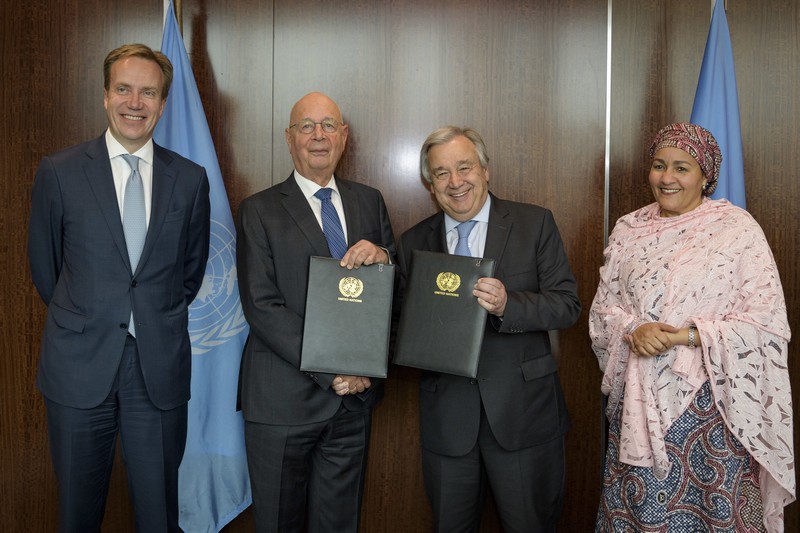
A strategic partnership was signed in 2019 at a meeting held at UN headquarters between UN Secretary-General António Guterres and WEF Executive Chairman Klaus Schwab “to accelerate the implementation of the 2030 Agenda for Sustainable Development.”

The 2030 UN Sustainable Development Project is the WEF’s “Great Reset” by another name. 

This partnership is in blatant violation of the UN Charter. The UNSG is in conflict of interest. He has provided a Green Light to the implementation of the WEF’s Agenda on behalf of powerful financial interests and corrupt politicians, which essentially consists in impoverishing the entire planet. 

What should have been debated by the G77 in Havana in September 2023 is the nature of this insidious WEF-UN partnership. It’s a neoliberal agenda to the nth degree on behalf of “Big Money”, to the obvious detriment of the Global South. It is part and parcel of the WEF’s “Great Reset”:

“The UN-Forum partnership will focus on aligning financial systems and accelerating finance flows toward the 2030 Agenda and the Sustainable Development Goals.

Collaboration will seek to build a shared understanding of sustainable investing, especially in small island developing States, least developed countries and landlocked developing countries, and identify and take forward solutions to increase SDG investments” (emphasis added)

To consult the text of the UN-WEF partnership, click here.

“Aligning Financial Systems”

While Guterres refers rhetorically to the failed  “global systems and structures”, he is visibly involved in “aligning financial systems” to the detriment of heavily indebted developing countries, which are the victims of U.S. dollarization.

While the IMF-World Bank Structural Adjustment Program (SAP) launched in the early 1980s prevails, the Neoliberal chessboard has become increasingly complex.

Aligning financial systems” goes far beyond the imposition of “IMF economic medicine”, which historically has triggered mass poverty throughout the Global South.

While the dollar denominated external debt remains the instrument of economic subservience, “Aligning financial systems” is intent upon opening the door to privatization on a large scale affecting entire sectors and regions of both developing countries and the West.

The large portfolio investment funds including BlackRock, State Street and Vanguard (coupled with Wall Street’s banking cartels) are the driving force. “Their holdings are colossal. BlackRock manages nearly $10 trillion in investments. Vanguard has $8 trillion, and State Street has $4 trillion.” (NYT)

“BlackRock Owns the World”

The portfolio companies have strategic investments in all major regions of the World.

BlackRock operates Worldwide with 70 offices in 38 countries. 

“These oligarchs are accompanied by some super-giant financial institutions, like BlackRock, Vanguard, State Street, Fidelity and more which control an estimated 25 trillion dollars-equivalent in assets, giving them a leverage power of well-over a 100 trillion dollars, as compared to the world’s GDP of some 90 trillion dollars. In other words, they can manipulate, control and pressure every government on Mother Earth to do their bidding.” (Peter Koenig)

Video: BlackRock, the Company that Owns the World

Below are three major BlackRock initiatives.

In the case of Ukraine, the levels of indebtedness are beyond description. The agreement with BlackRock is tantamount to the privatization of an entire country.

BlackRock in Brazil’s Amazon Rainforest

The amounts invested in the Amazon are colossal under the auspices of the three portfolio investment giants:

The 20 institutional investors plowed a combined $54.1 billion into nine mining conglomerates … “Of that amount, $14.8 billion came from just three U.S. firms — BlackRock, Capital Group [a US Financial Services Company] and Vanguard — with BlackRock alone pouring $6.2 billion into the mining companies.” (Mongabay)

BlackRock in Kenya

“BlackRock Alternatives’ public-private finance vehicle, Climate Finance Partnership (CFP), has acquired a 31.25% stake in Lake Turkana Wind Power (LTWP), the largest wind farm in Africa. The stake was purchased from Vestas, Finnfund, and the Investment Fund for Developing Countries for an undisclosed sum.” (Kenya Wallstreet Journal)

Ukraine Is Being Bought Up by BlackRock and JPMorgan

In recent developments, BlackRock together with JPMorgan “have  come to the rescue of Ukraine”, whose external dollar denominated debt is beyond description. (See Michel Chossudovsky, Global Research, August 2023)

The stated objective is “to attract billions of dollars in private investment to assist rebuilding projects in a war-torn country”. (FT, June 19, 2023)

The Privatization of Ukraine was launched in November 2022 in liaison  with BlackRock’s  consulting company McKinsey, a public relations firm which has largely been responsible for co-opting corrupt politicians and officials Worldwide not to mention scientists and intellectuals on behalf of powerful financial interests.

In late December 2022, president Zelensky and BlackRock’s CEO Larry Fink agreed on an investment strategy.

The Hegemonic Triad: UN-WEF-NATO

UN-NATO “Cooperation”

In parallel with the UN-WEF Partnership, the United Nations under Secretary General Guterres has developed a strategic relationship with NATO.

While it is described as a dialogue, NATO is increasingly embedded in the UN system, allegedly endorsing “peace support and crisis management”. The realities are otherwise — the UN is endorsing the US-NATO hegemonic agenda of Global Warfare:

“The complexity of today’s security challenges has required a broader dialogue between NATO and the UN. This has led to reinforced cooperation and liaison arrangements between the staff of the two organisations, as well as UN specialised agencies.” (NATO, July 2023)

NATO and the United Nations: partners in global peace and security

The UN Secretary General’s “Public Relations Ploy”

Providing a “Human Face” to Global Capitalism

UNSG Antonio Guterres has launched a stereotyped public relation’s ploy which is intent upon presenting the UN-WEF-NATO Agenda as a means to resolving the climate crisis, eliminating poverty as well as instating “World Peace.” It’s a lie.

In 2021, in preparation of the 76th UN General Assembly, the UNSG appointed  “advocates” to endorse the Sustainable Development Goals.

In September 2021, the UN Secretary-General appointed four new advocates of the SDGs as part of a reprehensible public relations ploy:

  • the 2014 Nobel Peace Prize, Kailash Satyarthi;
  • the president of Microsoft, Brad Smith;
  • the k-pop superstars BLACKPINK
  • Chile’s STEM activist – science, technology, Valentina Muñoz. (Chica Rosadita)

This is how public opinion and media coverage is manipulated at the UN General Assembly.

Censorship is applied. Independent analysts are not invited.

I have high regard and admiration for the k-pop singers, but for UNSG Antonio Guterres to have invited them to present a carefully prepared script (on his behalf) to the 76th UN General Assembly was improper and unbefitting.

BLACKPINK (Secretary-General’s Advocates) at the SDG Moment 2022

Also in 2021, Valentina Munoz (La Chica Rosadita), 19 years old, was invited by Guterres to endorse the UN Agenda 2030 in an address to the UN General Assembly:

Why China’s New Map of Its Borders Has Stirred Regional Tensions

By John P Ruehl

In the waning days of August 2023, closely following a BRICS summit and mere days ahead of the Association of Southeast Asian Nations (ASEAN) and G20 meetings, Beijing revealed its latest seemingly innocuous “standard” map. Having been released regularly since at least 2006, China’s standard maps are aimed to eliminate “problem maps” that do not affirm China’s territorial integrity. But the 2023 edition invited ripples of condemnation throughout China’s near abroad and beyond, as it repeated Beijing’s claims on divisive territorial disputes with its neighbors—including the Philippines, which has seen its struggle with China over a small shoal in the South China Sea escalate significantly over recent weeks.

The release of China’s map, coupled with its aggressive border strategies, has created enormous uncertainty across the Indo-Pacific. In a rapidly evolving geopolitical landscape, various actors are wrestling with how to effectively counter China’s actions.

China’s perception of maritime and international laws as products of Western customs has underpinned its level of adherence to them. “Stealthy compliance” allows China to ambiguously accept international law while interpreting it flexibly to advance its territorial claims. Beijing will also explicitly reject international law, exemplified by its dismissal of a tribunal in The Hague that challenged China’s assertions in the South China Sea in 2016. Regularly publishing maps helps assert China’s claims to domestic and international audiences, without putting Beijing in a position where it has to enforce them simultaneously.

Beijing’s strategy has effectively thwarted regional and Western responses and prevented the outbreak of major conflict. Inflaming territorial disputes serves as a bargaining chip in bilateral negotiations and lays the groundwork for potential future claims as China’s strength is expected to increase. Channeling nationalist sentiment outward has also bolstered the Chinese government’s domestic legitimacy and diverted attention from contentious issues like Tibet, Xinjiang, and Hong Kong.

However, the response to China’s 2023 map reveals growing backlash to Beijing’s approach to its border issues and questions over its long-term sustainability.

China has periodically unveiled its nine-dash line map for decades, delineating its claims in the South China Sea. The mystery shrouding whether these claims pertain to water rights, land features, or both, has kept the region on edge. Regardless, they symbolize China’s desire to reduce U.S. control over regional shipping lanes, secure rights over natural resources, and project power beyond its first island chain into the expansive Pacific.

China’s latest map took a bold step by reintroducing a tenth dash east of Taiwan—a largely dormant claim since 2013. The move not only reaffirmed China’s ownership of Taiwan but also extended China’s reach beyond Taiwan’s recognized territorial waters, a direct challenge to the United Nations Convention on the Law of the Sea (UNCLOS). Reasserting this claim may point to growing confidence in Beijing of being able to impose its various claims in the region. China’s map also continued to emphasize China’s rights to the Senkaku Islands, disputed with Japan. Both Taipei and Tokyo vehemently criticized China for the map’s release.

China and ASEAN had meanwhile been negotiating a code of conduct for the South China Sea, reaching an agreement in July to accelerate the process. The release of the 2023 map just days before the ASEAN summit in Indonesia naturally triggered swift rejection from member states such as Malaysia, the Philippines, and Vietnam, which have longstanding wariness of Chinese maritime territorial ambitions.

China occupied the Paracel Islands, contested by Vietnam, in 1974 and engaged in a brief skirmish with Vietnam over the Johnson South Reef in 1988. The Philippines was meanwhile forced to concede Mischief Reef to China in 1995 but later stranded a warship on the Second Thomas Shoal in 1999 to enforce its claims there. Chinese forces steadily took control over the Spratly Islands (including by creating artificial islands) over the last decade, while the 2012 Scarborough Shoal standoff saw China gain effective control over a shoal against the Philippines. Malaysia has also seen increasing naval confrontations with China in recent years.

Under former Filipino President Rodrigo Duterte, Manila pursued a more hospitable approach to China and its territorial claims. But since 2022 under President Bongbong Marcos, the Philippines has taken a renewed confrontational strategy in confronting China, including blocking Chinese attempts in recent weeks to deny resupply efforts to the Filipino warship on the Second Thomas Shoal. Vietnam has also drawn closer to the U.S. in recent years, largely in response to China, and the 2023 map may also convince Malaysia to do so as well.

However, not all ASEAN states are willing to coordinate with the U.S. and confront Beijing. Indonesian officials downplayed the 2023 map’s significance, and days later inaugurated a China-backed high-speed rail project. Similarly, Brunei raised limited objections to the map, reflecting its pledge with China made in July 2023 for greater cooperation. Many other ASEAN member states maintain substantial trade ties with China, tempering their willingness to take a firm stance even amid the release of another provocative Chinese map.

China’s coast guard, navy (now the world’s largest), and militarized fishing fleets also deter countries from escalating disputes in the South China Sea. However, resisting China’s territorial claims is complicated because many countries are also embroiled in disagreements with one another. Taiwan, for instance, claims Japan’s Senkaku Islands, while Malaysia, Vietnam, Brunei, Indonesia, and the Philippines have their own disputes. By inflaming its own border disputes, China often exacerbates other existing conflicts, and other countries may opt to avoid involvement because they fear it could lead to more tension with their other neighbors.

China’s land border disputes were also thrust into the spotlight with the unveiling of its 2023 map. Longstanding border issues with ASEAN member Myanmar persist, but Myanmar’s internal strife and economic reliance on China have rendered moot any serious opposition to Chinese border policies.

Instead, China’s most serious border dispute is with India, involving a poorly defined 2,100-mile international border that was never demarcated. China and India both claim sovereignty over Aksai Chin and Arunachal Pradesh. In 2020, the two countries had their first deadly skirmish in 45 years, with another violent clash in 2022. Beijing and New Delhi have also authorized infrastructure projects in the disputed regions to solidify their claims and ease logistical issues. India lodged an official diplomatic protest against China for its 2023 map, extinguishing any hopes for a potential thaw in India-China relations that had been suggested after the BRICS summit in South Africa in August.

India has also supported Bhutan in its territorial disputes with China. Bhutan requested and received Indian assistance in 2017 to repel Chinese troops and construction workers that had entered Bhutan, while China made new territorial claims in Bhutan in 2020. But in a surprising turn of events in April 2023, Bhutan appeared to partially acquiesce to China and explore concessions by agreeing to a joint technical team with China to address their territorial issues.

India’s attempt to rally regional opposition against China has also been complicated by Nepal, which has territorial disputes with both China and India. Nepal’s protest against China’s 2023 map also criticized the inclusion of several territories as part of India which it claims as its own. Beijing has consistently accused India of encroaching on Nepalese territory to undermine New Delhi’s territorial claims and take away attention from its own dispute with Nepal.

China’s 2023 map further stirred controversy by reviving a settled dispute with Russia. Although both countries resolved longstanding border disputes in the 1990s and 2000s, China’s latest edition claimed a small island that was divided between the two countries in 2005. Russian officials dismissed the map’s claims, stating the issue had already been resolved.

Marking the island as such may have been a retaliatory gesture by China in response to a Russian map from 2022 showing Aksai Lachin and Arunachal Pradesh in India. It also likely appealed to nationalist elements within China critical of Russia’s territorial gains from unequal treaties during the 19th and 20th centuries. But China’s assertiveness also serves as a signal to Russia as its dependence on China has grown since its invasion of Ukraine. The Kremlin’s tepid response reflected its increasing unwillingness to confront Beijing.

Barely three weeks after the release of China’s map, China and Syria, an important Russian ally, announced the formation of a strategic partnership. Together with competing Chinese and Russian interests in Central Asia, the 2023 map marks another subtle but notable test for the Sino-Russian no-limits partnership announced in February 2022.

China’s assertions are also bolstered by the United States’ historical wavering on international law. The U.S. was accused of breaking international law by the International Court of Justice by mining Nicaraguan harbors and supporting rebels in the country in the 1980s. Furthermore, the U.S. has yet to ratify the UNCLOS, a significant maritime framework. Washington’s inability to mediate the 2012 dispute between the Philippines and China encouraged Beijing to test the United States’ willingness to defend the region. As the U.S. seeks to rally countries into conducting freedom of navigation exercises in the region, China will increasingly aim to disrupt them and establish squatter’s rights.

Concordantly, Beijing will continue to block attempts to “internationalize” its territorial disputes, opting for multilateral or bilateral talks where it can leverage its strengths. Keeping these disputes ongoing (or reigniting them) puts pressure on its neighbors and fuels nationalist sentiment in China, with claims likely to escalate if Beijing perceives its position as stronger.

However, China’s increasingly aggressive foreign policy under President Xi Jinping runs the risk of turning the country into a regional antagonist. Central Asian states, which also solved their territorial disputes with China, are also likely increasingly nervous. The riots in China against Japanese businesses during heightened tension over the Senkaku Islands in 2012 serve as a stark reminder of how exploiting nationalist sentiment can spiral out of control and damage China’s reputation as an attractive place for investment. For the U.S., successfully rallying the region becomes much easier when it can highlight China’s self-interested actions.

China’s enigmatic and assertive border strategies have far-reaching implications for regional and global stability. While its tactics have yielded short-term benefits, they carry the risk of escalating disputes into conflicts and generating significant international backlash. The current geopolitical landscape remains dynamic, with major powers and smaller countries grappling to find an effective response to Chinese calculations.

John P. Ruehl is an Australian-American journalist living in Washington, D.C., and a world affairs correspondent for the Independent Media Institute.

17 October 2023

Source: countercurrents.org

Not Hamas-Israeli Conflict: The Palestinian Cause Belongs to the World

By Dr Ramzy Baroud

At one time, the ‘Arab-Israeli Conflict’ was Arab and Israeli. Over the course of many years, however, it was rebranded. The media is now telling us it is a ‘Hamas-Israeli conflict’.

But what went wrong? Israel simply became too powerful.

The supposedly astounding Israeli victories over the years against Arab armies have emboldened Israel to the extent that it came to view itself, not as a regional superpower, but as a global power as well. Israel, per its own definition, became ‘invincible’.

Such terminology was not a mere scare tactic aimed at breaking the spirit of Palestinians and Arabs alike. Israel believed this.

The ‘Israeli miracle victory’ against Arab armies in 1967 was a watershed moment. Then, Israeli ambassador to the United Nations, Abba Eban, declared in a speech that “from the podium of the UN, I proclaimed the glorious triumph of the IDF and the redemption of Jerusalem.”

This, in his thinking, could only mean one thing: “Never before has Israel stood more honored and revered by the nations of the world.”

The sentiment in Eban’s words echoed throughout Israel. Even those who doubted their government’s ability to completely prevail over the Arabs, joined the chorus: Israel is unvanquishable.

Little rational discussion took place back then, about the actual reasons why Israel had won, and if that victory would have been possible without Washington’s complete backing and the West’s willingness to support Israel at any cost.

Israel was never a graceful winner. As the size of territories controlled by the triumphant little state increased by three-fold, Israel began entrenching its military occupation over whatever remained of historic Palestine. It even began building settlements in newly occupied Arab territories, in Sinai, the Golan Heights and all the rest.

Fifty years ago, in October 1973, Arab armies attempted to reverse Israel’s massive gains by launching a surprise attack. They initially succeeded, then failed when the US moved quickly to bolster Israeli defenses and intelligence.

It was not a complete victory for the Arabs, nor a total defeat for Israel. The latter was badly bruised, though. But Tel Aviv remained convinced that the fundamental relationship it had established with the Arabs in 1967 had not been altered.

And, with time, the ‘conflict’ became less Arab-Israeli and more Palestinian-Israeli. Other Arab countries, like Lebanon, paid a heavy price for the fragmentation of the Arab front.

This changing reality meant that Israel could invade South Lebanon in March 1978, and then sign the Camp David Peace Accords with Egypt, six months later.

While the Israeli occupation of Palestine grew more violent, with an insatiable appetite for more land, the west turned the Palestinian struggle for freedom into a ‘conflict’ to be managed by words, never by deeds.

Many Palestinian intellectuals make a point of arguing that “this is not a conflict”, that military occupation is not a political dispute, but governed by clearly defined international laws and boundaries. And that it must be resolved according to international justice.

That is yet to happen. Neither was justice delivered, nor an inch of Palestine was retrieved, despite the countless international conferences, resolutions, statements, investigations, recommendations, and special reports. Without real enforcement, international law is mere ink.

But did the Arab people abandon Palestine? The anger, the anguish, and the passionate chants by endless streams of people who took to the streets throughout the Middle East to protest the annihilation of Gaza by the Israeli army, did not seem to think that Palestine is alone – or, at least, should be left fighting on its own.

The isolation of Palestine from its regional context has proven disastrous.

When the ‘conflict’ is only with the Palestinians, then Israel determines the context and scope of the so-called conflict, what is allowed at the ‘negotiations table’, and what is to be excluded. This is how the Oslo Accords squandered Palestinian rights.

The more Israel succeeds in isolating Palestinians from their regional environs, the more it invests in their division.

It is even more dangerous when the conflict becomes between Hamas and Israel. The outcome is a whole different conversation that is superimposed on the truly urgent understanding of what is taking place in Gaza, in the whole of Palestine at the moment.

In Israel’s version of events, the war began on October 7, when Hamas fighters attacked Israeli military bases, settlements, and towns in the south of Israel.

No other date or event prior to the Hamas attack seems to matter to Israel, to the West and to corporate media covering the war with so much concern for the plight of Israelis, and complete disregard to the Gaza inferno.

No other context is allowed to spoil the perfect Israeli narrative of ISIS-like Palestinians disturbing the peace and tranquility of Israel and its people.

Palestinian voices that insist on discussing the Gaza war within proper historical contexts – the ethnic cleansing of Palestine in 1948, the occupation of Jerusalem, the West Bank and Gaza in 1967, the siege on Gaza in 2007, all the bloody wars before and after – are simply denied platforms.

The pro-Israel media simply does not want to listen. Even if Israel did not go as far as making unfounded claims about decapitated babies, the media would have remained committed to the Israeli narrative, anyway.

Yet, if Israel continues to define the narratives of war, historical contexts of ‘conflicts’, and the political discourses that shape the West’s view of Palestine and the Middle East, it will continue to obtain all the blank checks necessary to remain committed to its military occupation of Palestine.

In turn, this will fuel yet more conflicts, more wars and more deception regarding the roots of the violence.

For this vicious cycle to break, Palestine must, once more, become an issue that concerns all Arabs, the whole region. The Israeli narrative must be countered, western bias confronted, and a new, collective strategy formed.

In other words, Palestine cannot be left alone anymore.

Dr. Ramzy Baroud is a journalist, author and the Editor of The Palestine Chronicle.

17 October 2023

Source: countercurrents.org

Saudi Crown Prince Keeps Blinken Waiting

By Countercurrents Collective

Two recent incidents in the area of geopolitics have attracted notice. One is related to the U.S Secretary of State Antony Blinken and the other is related to Russian President Vladimir Putin.

Antony Blinken

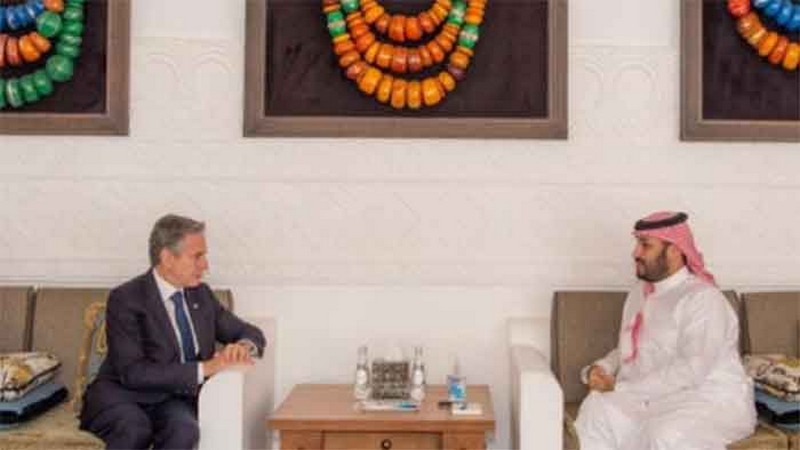
According to a report by The Washington Post, Saudi’s crown prince snubbed the U.S. Secretary of State by making him wait hours for a meeting before postponing it.

Saudi Arabia’s ruler kept the U.S. Secretary of State, Antony Blinken, waiting for hours for a meeting, then did not show up until the next day, in an astonishing snub to the U.S.’ top diplomat, The Washington Post said. 

The report said:

In the wake of the Hamas terror attacks in Israel, Blinken last week visited several U.S. allies in the Middle East in a bid to rally them around the U.S.’ position, including Mohamed bin Salman.

The core goal of the trip was to persuade the leaders to condemn Hamas’ brutal violence, and try and tamp down unrest in their countries sparked by the new fighting.

But Blinken reportedly got a cold reception in Riyadh, where key differences between the U.S. and Saudis emerged.

Blinken had expected to meet Mohamed bin Salman in the evening after touching down on Saturday, but was kept waiting for hours, with the crown prince eventually showing up the next morning, the report said.

In the meeting, the crown prince reportedly called for Israel to halt military operations “that claimed the lives of innocent people,” after Israel bombarded the densely populated Gaza strip, and imposed a blockade on food, fuel, and other supplies. He also reportedly called for the conflict to be de-escalated.

The Saudi position is in contrast to that taken by the Biden administration. The U.S. president has backed Israel’s bid to eliminate Hamas in the wake of the terror attacks, but has called for civilian lives to be protected.

The report said:

Blinken’s attempts to find common ground with Egypt’s President Abdel Fattah el-Sisi, another U.S. regional ally, also met with little success.

There were signs in recent weeks that Saudi Arabia and Israel were on the verge of a historic agreement, that would’ve seen relations between them normalized. Analysts believe that among Hamas’ core aims in launching the October 7 attacks was ruining the talks.

Saudi Arabia has long been among the U.S.’ key regional allies, but in recent years its ruler has sought to steer a more independent course for the kingdom, forming closer ties with U.S. rival China. Last year, the Saudis snubbed the Biden administration and refused to increase oil production.

The Washington Post said (Blinken meets resistance in courtship of Egypt and Saudi Arabia on Gaza war):

U.S. Secretary of State Antony Blinken faced stiff resistance from the Arab world’s most powerful strongmen on Sunday, trying to convince Egypt’s Abdel Fatah El-Sisi and Saudi Arabian Crown Prince Mohammed bin Salman to embrace Washington’s view of the Israel-Hamas conflict, despite deep public sympathies for the Palestinian cause in the respective countries.

Putin

Russia no longer trusts the U.S. on anything, while China has been reliably delivering on its promises, Russian President Vladimir Putin has said.

He contrasted the trustworthiness of the two nations in an interview with political correspondent Wang Guan, published in full on Monday. The journalist spoke to the Russian leader on behalf of the China Media Group.

U.S. Cannot Be Trusted

Washington has a habit of discarding previous agreements depending on political whims, as seen with its exit from the multilateral agreement on the Iranian nuclear program, Putin said, adding that the Ukraine conflict is rooted in the same problem.

The Russian president said: “We were told as far back as 1991 – by the then-U.S. administration – that NATO would not expand further east. Since then, there have been five waves of NATO expansion.”

He asked: “How can we agree on anything if every new administration starts from scratch?”

Rules-based Order Is Nonsense

The U.S.-promoted concept of a ‘rules-based order’ is colonialism in disguise, Putin argued, as Washington decides on what those rules are on a case-by-case basis.

The Russian president said: “How can one talk about order based on rules that no one has ever seen? In terms of common sense, it is nonsense. But it is beneficial to those who promote this approach.”

Colonial powers of the past claimed they were “bringing enlightenment” and “benefits of civilization” to the territories they held, the Russian president said. U.S. exceptionalism implies that Americans perceive the rest of the world as “second-rate people,” just like the colonialists of history.

Moscow rejects this approach and strives for a fair multipolar world, where all nations are treated as equals, according to the president.

The Western-promoted “rules-based order” is merely a cover for colonialism, as the presumed rules have never been agreed-on by anyone and are ever-shifting from one case to another, Russian President Vladimir Putin has said.

The president made the remarks in an exclusive interview with state-run broadcaster China Central Television (CCTV) that was aired on Monday.

“Have you ever seen these rules? No, because no one has ever written them, and no one has ever agreed to them with anyone. How can we talk about order based on rules that no one has seen?” Putin stated.

“If no one has ever seen these rules, it means that those who talk about themselves come up with these rules from case to case in a way that suits their own interests. This is the essence of the colonial approach,” Putin noted.

Colonialism has always been based on supremacist ideas, segregating people into different “classes.”

“Colonial countries have always believed themselves to be first-class people. After all, they always said that they bring enlightenment to their colonies, that they are civilized people and bring the benefits of civilization to other peoples, who are considered to be second-class,” Putin stressed.

The colonial mindset remains strong, he noted, with all the U.S. talk of its “exceptionalism,” for instance, stemming precisely from it. “That is, when they say that they are exceptional in the United States, it means that there are other people, people of some other second class. How can one perceive this? These are the rudiments of the colonial mindset, nothing else,” he added.

The approach exhibited by Russia and China is entirely different from that shown by the West, with Moscow and Beijing both believing that treating all nations equally is the cornerstone of the emerging multipolar world and the basis of cooperation between the two nations themselves, Putin stressed.

“We proceed from the fact that all people are equal, everyone has the same rights, the rights and freedoms of one country and one people end where the rights and freedoms of another person or of an entire state start. This is how multipolar world should gradually be born,” the president explained.

Multipolarity Is Inevitable

A new global arrangement is coming, one way or another, Putin predicted. He said: “We can speed up this process or someone can try to slow it down and maybe even achieve some kind of reduction in the pace of building a multipolar world. Anyway, its creation is inevitable.

This year’s expansion of the BRICS group of leading non-Western economies was a major step in that direction, Putin believes. With the inclusion of six new members, it has surpassed the West’s G7 club in economic strength, he noted.

He said: “No one wants to play second fiddle to some sovereign, everyone wants equal rights. And when they join BRICS, they see that we can achieve this goal.”

Kiev’s Battlefield Losses

Putin outlined the history of Russia’s hostilities with its neighbor, from the 2008 NATO pledge to make Ukraine a member, to the Western-backed 2014 armed coup in Kiev and the conflict in Donbass, to the refusal of the Ukrainian government to implement a roadmap for reconciliation with rebels, and its decision last year to reject a draft truce in favor of a hoped-for military victory against Moscow.

“They launched in June an active military operation, the so-called counter-offensive,” the president said of the latest phase of the confrontation. He said: “No results achieved so far, only massive losses. The losses are simply huge, at a ratio of one to eight.”

Russia wants the conflict to be resolved and believes that China’s proposal may serve as a basis, the president noted – but it is up to Ukraine to make talks possible, as it has passed a law banning negotiations with Putin.

Xi’s Word Is His Bond

A large portion of the interview was dedicated to Russian-Chinese cooperation, and Putin’s friendship with Chinese President Xi Jinping, which he believes has contributed to the rapid development of ties between the nations over the past 15 years.

The Russian leader called his Chinese counterpart “attentive to detail, cool-headed, business-minded and a reliable partner,” stressing that he especially values Xi’s trustworthiness.

Xi’s strategic approach to governance distinguishes him from “people whom we call ‘time servers’ who are there for a brief moment just to show off on the international stage, and then they are gone,” Putin said.

Countercurrents is answerable only to our readers. Support honest journalism because we have no PLANET B.

17 October 2023

Source: countercurrents.org

Israeli Military Has Killed 1 Child in Gaza Every 15 Minutes: Rights Group

A man carries a child injured by an Israeli airstrike at a hospital in Rafah, Gaza on October 13, 2023.
(Photo by Abed Rahim Khatib/Anadolu via Getty Images)

By Jake Johnson

Israel’s relentless bombing campaign in the occupied Gaza Strip has killed more than 1,000 Palestinian children—roughly one every 15 minutes—since it began on October 7, according to the latest tally from Defense for Children International–Palestine.

Children have faced some of the most horrific impacts of Israel’s ongoing assault on Gaza, where roughly half of the population is under the age of 18. Israel has dropped more than 6,000 bombs on Gaza—home to 2.3 million people—in the wake of Hamas’ deadly attack.

Mohammad Abu Rukbeh, senior Gaza field researcher at DCIP, said in a statement Tuesday that “the repercussions of this war will not only affect the victims we have lost, some of which are still trapped under the rubble of their homes, and not only the residential areas that have been completely destroyed, including our own homes, but the psychological impact on us civilians and our children will be catastrophic.”

Research released before Israel’s latest bombardment of Gaza found that four out of five children in the Gaza Strip reported living with depression, grief, and fear amid a yearslong Israeli blockade and frequent outbreaks of deadly violence.

Israel’s current military campaign in Gaza is its deadliest to date, and the unlawful total blockade it has imposed on the strip has further deprived children and the rest of the civilian population of food, fuel, electricity, and clean water. Some Gazans have resorted to drinking seawater and water contaminated by sewage, and hospital staff have reportedly had to drink from IV solution bags.

“Israeli authorities cut water supply to Gaza on October 9, and since then, all three water desalination plants in Gaza have been forced to cease operations,” DCIP noted Tuesday, citing the United Nations. “Even though Israeli authorities claimed to resume water supply to southern Gaza yesterday, there is no electricity to operate water pumps, Israeli airstrikes have damaged many water lines, and very little water in Gaza is drinkable in the first place.”

GAZA UPDATE: More than 1,000 Palestinian children in Gaza have been killed by Israeli attacks. Additional children are unaccounted for and missing under the rubble of destroyed buildings, indicating the true death toll is much higher.

Our Oct 16 report: https://t.co/gRv7fQ4cut pic.twitter.com/TJOlXAPgaM

— Defense for Children (@DCIPalestine) October 16, 2023

U.S. Secretary of State Antony Blinken said late Monday that Israel has agreed to develop a plan to let desperately needed humanitarian aid reach Gazans, but Israel has continued its destructive bombing campaign and refused to allow a ceasefire as civilians struggle to find safety in the besieged enclave.

Al Jazeerareported that more than 70 people were killed in their homes on Tuesday “after Israel conducted air raids on Gaza’s Khan Younis, Rafah, and Deir el-Balah.”

Last week, the Israeli military ordered the entire population of northern Gaza to evacuate to the south ahead of an expected ground invasion and was subsequently accused of bombing supposed “safe routes” that civilians were using to flee.

Ravina Shamdasani, a spokesperson for the U.N. high commissioner for human rights, said in a statement Tuesday that “appalling reports that civilians attempting to relocate to southern Gaza were struck and killed by an explosive weapon must be independently and thoroughly investigated, as must all allegations of serious violations of international humanitarian law.”

“Those who managed to comply with the Israeli authorities’ order to evacuate are now trapped in the south of the Gaza Strip, with scant shelter, fast-depleting food supplies, little or no access to clean water, sanitation, medicine, and other basic needs,” said Shamdasani. “We echo the U.N. call for a humanitarian pause to enable aid delivery and to prevent further suffering and deaths of the already much beleaguered civilian population of Gaza. Urgent immediate, unimpeded humanitarian access needs to be ensured.”

Jake Johnson is a senior editor and staff writer for Common Dreams.

17 October 2023

Source: countercurrents.org

INDO PALESTINE SOLIDARITY NETWORK (IPSN) CONDEMNS ISRAEL’S WAR CRIMES ON THE PEOPLE OF GAZA

On October 7, 2023 Hamas launched an unprecedented multi-faceted and sustained assault on Israel from Gaza Strip. Since then, Israel has launched a brutal and vicious attack on about 1.1 million Gazan population who had already been living under a brutal military siege. At the time of writing this statement, there were credible reports in the media suggesting that Israel had cut off electricity, water and food supply for an already traumatized population. It had ordered northern Gaza residents to flee to the South. To make matters worse, Egypt has also closed its sides of the border.

Most residents of Gaza are descendants of refugees of the Nakba. This might be the second biggest act of population transfer and ethnic cleansing in Palestine’s history with multiple episodes of the same. Israel has been bombarding Gaza relentlessly with credible reports suggesting the use of white phosphorus. If that was not enough, there is also a sustained disinformation campaign that has been waged against Hamas and Palestinians on social media.

India which had a long history of supporting Palestinian people shamefully sided with the Occupying forces within hours of attack by Hamas. There were no statements issued to condemn the longest military Occupation in modern history and the siege that made a million people live in an open-air prison. After public outcry and a better assessment of sentiments in the Global South, the Indian government did walk back on its initial statement with an oft-repeated but now meaningless statement of supporting an independent Palestine. The anchors of the mainstream Indian media who could not move out of their studios to cover the ongoing ethnic violence in the north-eastern state which now enters its fifth month, travelled to Israel and are shamefully presenting an ongoing genocide as nothing but a turf-war. The Western media is no better.

One may ask what exactly would it take for these media houses to get an education in international law, history, or even common decency? The streets might teach them more than any Ivy League college ever did. And the streets have spoken for Palestinians in an unprecedented support for Palestinian lives. The information about what had happened with Palestinians and  what is happening with them is easily available on the internet. Ignorance is not a condition. It is a choice.

Settler colonialism itself is a war. Siege is a war. Israel had been waging a brutal war against Palestinian people since its very inception. Hamas’ attack proves that the Occupation and siege are unsustainable. It asks people of conscience to take a hard long look at how their brethren in another part of the world are being treated. It asks to hold ourselves accountable.

The Indo-Palestine Solidarity Network (IPSN) of likeminded people drawn from all parts of the country is committed to justice and freedom for Palestine. We seek an end to the racist- colonialist- apartheid politics of Israel through which Israel’s Occupation of Palestinians and their lands have continued for the last 56 years. At this time of the brutal and unconscionable war on the suffering people of Gaza who are being bombed mercilessly with nowhere to go, and at the same time having food, water, fuel and power cut off we reiterate our commitment to the long-suffering but resilient Palestinian people. IPSN demands the indictment of Israel by theInternational Community for attempted genocide in addition to the other war crimes.

We also, at this critical time, urge the Indian government to revisit its official stand with respect to the hundred-year war on Palestine. It needs to reaffirm the historical stand that it maintained during the Non-Alignment Movement where it maintained a morally righteous decision of denouncing Israel’s many war crimes and siding with the Palestinian people. We once again urge the International community to come together in pressuring Israel to stop its onslaught on Gaza, and end its military occupation and siege.

7 October 2023

Video: Is It A False Flag? “Wiping Gaza Off the Map”. The Dangers of Military Escalation

By Prof Michel Chossudovsky and Caroline Mailloux

The Hamas Partnership is confirmed by Netanyahu

“The Cat is Out of the Bag”

“Anyone who wants to thwart the establishment of a Palestinian state has to support bolstering Hamas and transferring money to Hamas,” he [Netanyahu] told a meeting of his Likud party’s Knesset members in March 2019. “This is part of our strategy – to isolate the Palestinians in Gaza from the Palestinians in the West Bank.” (Haaretz, October 9, 2023, emphasis added)

Does this statement not suggest that Netanyahu and his military-intelligence apparatus are responsible for the killings of innocent Israeli civilians? 

“Support” and “Money” for Hamas. 

“Transferring Money to Hamas” on behalf of Netanyahu is confirmed by a Times of Israel October 8, 2023 Report:

“Hamas was treated as a partner to the detriment of the Palestinian Authority to prevent Abbas from moving towards creating a Palestinian State. Hamas was promoted from a terrorist group to an organization with which Israel conducted negotiations through Egypt, and which was allowed to receive suitcases containing millions of dollars from Qatar through the Gaza crossings.” (emphasis added)

The Dangers of Military Escalation

Let us be under no illusions, this “false flag” operation is a complex military-intelligence undertaking, carefully planned over several years, in liaison and  coordination with US intelligence, the Pentagon and NATO.

In turn, this action against Palestine is already conducive to a process of military escalation which potentially could engulf a large part of Middle East.

Michel Chossudovsky: Interview with Caroline Mailloux

Video

MICHEL CHOSSUDOVSKY – FALSE FLAG: ERADICATING GAZA FROM THE MAP

To leave a comment or access the Lux Media Rumble page, click the lower right hand corner of the Screen 

***

17 October 2023

Source: globalresearch.ca

Humanitarian Calamities That Aren’t on the World’s Agenda

By Priti Gulati Cox and Stan Cox

Various versions of the aphorism “War is God’s way of teaching Americans geography” have been making the rounds ever since the rise of U.S. imperialism in the late 1800s. The quip (which, despite legend, appears not to be attributable to Mark Twain, Ambrose Bierce, or any other famous person) has proven all too accurate when the war in question directly involves American troops. When, however, non-U.S. combatants and civilians suffer and die from conflicts relatively unrelated to Washington’s “strategic interests,” our media outlets tend to avert their eyes, aid agencies get stingy, and Americans learn no geography whatsoever. Oh, and given this country’s power and position on this planet, millions suffer the consequences of that neglect.

Terror Days in Khartoum

Let’s start with Sudan. A civil war between the Sudanese Armed Forces and a paramilitary group called the Rapid Support Force (RSF) is now dragging into its seventh month with no end in sight. Since the conflict erupted, Washington has issued only a few token calls for the fighting there to end, while providing insufficient aid to desperate millions of Sudanese. The assistance that did go out has proven microscopic compared to the vast quantities of humanitarian, economic, and military aid our government has poured into similarly war-torn Ukraine.

In the first five months of brutal fighting in Sudan, 5,000 civilian deaths and injuries to at least 12,000 more were reported — and those were both considered significant underestimates. Meanwhile, more than a million people have fled that country, while a staggering 7.1 million have been displaced in their own land. According to the International Office of Migration, that represents “the highest [number] of any internally displaced population in the world, including Syria, Ukraine, and the Democratic Republic of Congo.” Human Rights Watch reports that “over 20 million people, 42% of Sudan’s population, face acute food insecurity and 6 million are just a step away from famine.”

Try to take that in for a moment and wonder, while you’re at it, why you’ve heard so desperately little (or nothing at all!) about such an immense human tragedy. Worse yet, the Sudanese people are hardly the only ones being treated shabbily by Uncle Sam and other governments of the rich North while suffering deadly deprivation. Sudan is, in fact, at the center of a region stretching from the Middle East deep into Africa in which countries suffering some of the world’s worst humanitarian emergencies are largely being ignored by the Global North.

Given the near vacuum of news on the Sudan conflict in our media, we contacted Hadeel Mohamed, an educator we know who fled Sudan for neighboring Egypt, but is still in frequent contact with her neighbors who stayed behind in the capital city, Khartoum. We asked her for an update on what people still living there were telling her they were enduring after six months of unending civil war.

Every house in their neighborhood, she’s heard, has been looted by combatants. In the process, her friends and neighbors say that they’ve experienced “terror days when their houses were being invaded or even re-invaded to see if there’s anything left.”

“When it starts to get dark outside,” she told us, “that’s scariest, because you never know who’s going to come in and attack.” If female household members are there, what grim fates are they likely to suffer? And she adds, “If you have males in the house, are they going to be abducted and what’s going to happen to them?”

We asked whether atrocities were being committed by both the Sudanese Army and the RSF? “Yeah, both sides,” she responded. “Listen, I’m not validating any side, but when you’re in war, you really don’t know who’s coming at you or who’s a threat to you. So, everyone is seen as a threat.” And that, she adds, leads the combatants to act violently toward the civilians who’ve stayed behind.

Food is especially scarce in Khartoum, because travel in and out of the city is so dangerous for the usual suppliers and, as Hadeel points out, “Most of the stores have been looted, but in certain areas, some bread and other food is available for a few hours per day per week. There’s no fixed schedule, though.” Worse yet, wherever there’s active fighting, electricity and water supplies are normally cut off. “Some people can have electricity for weeks, while others will not have it for weeks.” Some engineers have bravely remained in Khartoum trying to keep power and water supplies flowing, but it’s often a hopeless task.

“People are on such unstable ground,” Hadeel concludes. “They really don’t know when their next food supplies are going to come in or when they’re going to be able to refill their water.” They have to watch for opportunities to slip outside in relative safety to “find something to keep them and their neighbors going.”

And what exactly has been Washington’s response to this ongoing horror? Well, the State Department issued a toothless admonishment that the army and RSF “must comply with their obligations under international humanitarian law, including obligations related to the protection of civilians.” And that was about it, other than ineffective sanctions applied to the leader of the RSF. Meanwhile, international efforts to negotiate an end to the fighting have collapsed, and humanitarian aid efforts have been hopelessly bogged down. Anyway, who has time for Sudan when arming and backing the Ukrainians has the attention of everyone who matters in the United States?

“Severe, Extreme, or Catastrophic Conditions”

Mind you, that paucity of interest is anything but unique to the crisis in Sudan. For example, U.N. World Food Program (WFP) Director Cindy McCain recently told ABC’s This Week that there isn’t enough food-assistance money for desperate Afghanistan, filled with starving people, to “even get through October.” In addition, the WFP has had to cut food aid to other countries in desperate need, including Bangladesh, the Democratic Republic of Congo, Haiti, Jordan, Palestine, South Sudan, Somalia, and Syria. As for explaining that shortfall, McCain was blunt, blaming the rush of rich nations of the Global North to support Ukraine which, she says, “has sucked the oxygen out of the room.”

Typically, the U.N. Office for the Coordination of Humanitarian Affairs (OCHA) reports that its famine-prevention program for war-ravaged Yemen is now receiving just 30% of the funds it needs, putting millions of Yemenis at risk. OCHA points to the peril facing Fatima, a 60-year-old woman living in the village of Al-Juranah. The program supplies her family with wheat, peas, and oil, but delivery is sporadic, a reality about which Fatima is all too matter-of-fact. “We receive a sack of wheat,” she says, “and sometimes we get only half a sack. They also give us roasted peas and oil. If this support stops, we will starve to death.” And sadly enough, that support is now anything but guaranteed.

Two years after a ceasefire in that brutal civil war fed by Saudi Arabia (with U.S. support), a conflict that received only the scantiest media coverage in this country, more than half of Yemenis — 17 million people — are food insecure. U.N. forecasters predict that without massive intervention, a quarter of those people will experience “acute food insecurity” by year’s end, with three-quarters of them reaching “crisis levels of hunger.” Such massive intervention is decidedly not in the cards, however, and the continuing neglect is having horrific consequences. National Public Radio’s Fatma Tanis did, in fact, report on this from a Yemeni hospital in August:

“We head next to the intensive care unit for newborns, often born with complications because of malnutrition. As we enter, a nurse pulls a sheet over a baby who just died. The parents aren’t here. Often, families use all their resources to bring their child to the hospital but can’t afford to return again. So the hospital has to take care of burials too, without them.”

The people of Syria are similarly striving to recover from the civil war that erupted in 2011 and was finally put on hold with a 2020 ceasefire, but only after a full decade of ferocious warfare and terrible suffering. Like the Sudanese and Yemenis, they remain largely unnoticed and uncovered these days in the American media. In addition to extreme water shortages, a catastrophic 55% of Syrians are officially in the crisis phase of acute food insecurity. In late 2022, OCHA reported that “severe, extreme, or catastrophic conditions” were affecting 69% — yes, you read that right! — of the country’s population. Furthermore,

“Basic services and other critical infrastructure are on the brink of collapse… Over 58 percent of households interviewed reported accessing only between three to eight hours of electricity per day, while almost seven million people only had access to their primary water source between two and seven days per month in June.”

Is the world paying attention? In one respect, Syria is more fortunate than Sudan or Yemen, enjoying its very own annual conference of donor nations. At this June’s conference, hosted by the European Union, donors pledged an increase in total aid, but the amount still fell $800 million short of what the U.N. was seeking for that country. Worse yet, just before the conference kicked off, the World Food Program announced that it would cut food aid to almost half of Syria’s 5.5 million current recipients just when they’re most in need.

The Democratic Republic of Congo, another country in deep distress, finds itself in the global spotlight, but not for the suffering its people are experiencing. Its huge deposits of cobalt, copper, and other mineral elements essential to future renewable-energy economies have finally brought it some attention. However, the Global North, transfixed by those priceless minerals, has remained remarkably blind to the wave of human misery now sweeping the Congo.

Last month, Jan Egeland, Secretary General of the Norwegian Refugee Council, just back from a trip there, told Democracy Now, “It’s the worst hunger catastrophe on Earth. Nowhere else in the world is there more than 25 million people experiencing violence, hunger, disease, neglect. And nowhere in the world is there such a small international response to help, to aid, to end all of this suffering.”

As in Sudan, Syria, and Yemen, hunger and war have gone hand-in-hand in the Congo. Today, Egelend said, an almost unbelievable 150 or so armed groups vie for power in the cobalt-rich eastern part of the country. In the early 2000s, cobalt was valued for its role in mobile phones and laptops. The stakes are far higher now, with vastly larger quantities required to produce the lithium-ion batteries essential to the development of sprawling new power grids and a vast global fleet of electric vehicles.

Collateral damage radiating from the Congo’s ongoing violence includes a hunger crisis, an epidemic of sexual assault by combatants on tens of thousands of civilian women, and so much more. The U.N. sought $2.3 billion in humanitarian assistance for the Congo in 2023. It has, however, only received a measly one-third of that sum, enough to help just one of every 18 people now in desperate need.

On Democracy Now!, Egeland put his finger on the terrible calculations of global economics and diplomacy: “Congo is not ignored by those who want to extract the riches of that place. It is ignored by the rest of the world… As humanity, we’re really, really failing Congo now, because it’s not Ukraine, it’s not the Middle East.”

As a refugee from Sudan, Hadeel Mohamed worries every day about these kinds of terrible calculations being made in the North. As she puts it,

“This war has really opened our eyes to a lot of things. Although we saw the news of what’s happening in Yemen and Syria, and all these countries where wars erupted, we never really understood the depth of it. A worry of ours is that what’s happening to Syrian refugees is going to happen to Sudanese refugees… where your prospects are not going to mean anything… where you’re limited in your work transactions, you’re limited in your educational abilities.”

Because organizations like the U.N. and the International Red Cross were activated “quite late” in Sudan, she points out, some who fled the country, especially youth, “started forming groups to help people cross borders to get out, to find jobs, and to raise funds for food and water aid for those still in Sudan.” Hadeel herself is involved in such efforts. “But progress is a bit slow, because we’re still trying to rebuild our own lives in parallel.”

“If the war is not contained in Khartoum,” she adds, “the chances of it spreading are very high and we’ve seen a lot of spreading recently, whether it’s in Port Sudan or Madani or surrounding cities.” Violence has been raging for months in the Darfur region of western Sudan as well. The conflict could also be significantly prolonged by the desire of both sides to control northeastern Sudan’s vast gold deposits, which play a role analogous to that of cobalt in the Congo.

With no relief in sight, says Hadeel, the people of Khartoum, understand that lacking true humanitarian aid, “you really come back to more of community-based aid. With our limited resources, with our limited abilities, we still find people rising up to take care of each other.” Nevertheless, for refugees, “there are only two possible outcomes here: either you go back and fight for your country and potentially die or you go on living and establishing yourself outside of Sudan.”

Meanwhile, on the Outskirts of Democracy…

Tyranny, civil war, systemic breakdown — it can’t happen here, right? Or can it? We privileged folk in the United States may still think we live in a democracy, but so many of us don’t. In truth, the 140 million poor and low-wage folks, Black, Latino, Asian, Pacific Islander, and Indigenous, along with about one-third of White people, live on the outskirts of our “democracy.” Like the people of Sudan, Syria, and Yemen, they dream of being in a country where there’s equality and justice, and where democracy, while not complete, is at least not dying.

The United States never was, and by the looks of it, now has little chance of becoming a truly pluralistic, multiracial democratic system. If we were, we’d be spending every free hour raising hell to make sure the possibility of democracy doesn’t die in next year’s election. The media are replete with dystopian scenarios of its end and the rise of Trumpistan. We’re scared shirtless about that, too, and it’s a gut punch to realize that, if we had a truly functioning democracy, there’d be no way it could be toppled by a single guy like Donald Trump.

Ask a Sudanese or a Syrian or an Egyptian or an Afghan what it’s like to live under autocracy. Then ask marginalized Americans what it’s like to live on the outskirts of democracy. For the latter, democracy is like Sudan’s gold and the Congo’s cobalt. There may be a lot of it, but very few get any.

Priti Gulati Cox, (@PritiGCox), a TomDispatch regular, is an artist and writer.

Stan Cox, a TomDispatch regular, is the author of The Path to a Livable Future: A New Politics to Fight Climate Change, Racism, and the Next Pandemic, The Green New Deal and Beyond: Ending the Climate Emergency While We Still Can.

13 October 2023

Source: countercurrents.org

Islamophobia is what explains Indian media’s love for the colonial state of Israel

By Abdul Moid

Secretary-General of the of the United Nations, António Guterres tweeted on X(formerly twitter) “This most recent violence does not come in a vacuum. The reality is that it grows out of a long-standing conflict, with a 56-year long occupation and no political end in sight. It’s time to end this vicious circle.”

This is precisely the understanding lacking among the most liberal journalists in India and around the globe. Their arguments do not extend beyond the tragic event of Israeli civilians being killed in an attack carried out by Hamas. They are quite stuck there or, alternatively, they are amplifying the colonial Israeli government’s narratives. They do not dare to ask fundamental questions such as why this occurred because doing so would inevitably provide no space but to question on Israel’s 56-year illegal occupation of Palestinian land.

The world and Indian media rightly condemned Hamas’ killing of Israeli innocent civilians. But they forget conveniently and willfully as always to ask the right questions and deliberate on the root cause of the occurrence of such abhorrent incidents. I am confident that they will never raise questions on the root cause of the problem because if do, like many of us, the loss of innocent civilians killed by Hamas militants will squarely fall on the colonial state of Israel. If the illegal state of Israel is dismantled and the rights of the Palestinians are fulfilled by upholding the international law as repeated by UN and many international human rights organizations, there will remain no material circumstances responsible for the emergence of militant organizations like Hamas or Hezbollah. Instead, they are acting like an offshoot of Zionist media and demonizing the entire Palestinians by peddling fake news like baby killing and what not. They should get relived that such an incident did not happen. But they quite agitated when questioned on peddling such a fake news amid a raging war where millions of innocent lives are at stake.

A famous liberal Indian journalist Barkha Dutt was quite insistent on the happening of such an incident despite clarifications both from the US government and Israeli army and many pro-Israel International News channels like CNN. This is almost the case of every liberal journalist right now (lest not talk about the rightwing media ecosystem which is making genocidal appeals and peddling fake propaganda against Palestinians) doing clickbait journalism instead of asking genuine questions on why this happened or happening. Their continuous refusal to do so conveniently leaving out any mention of Israel’s structurally entrenched occupation and daily humiliation and subjugation of Palestinians altogether can only be explained by their disdain for Muslims and islamophobia and nothing else. As in the normal days, they give lecture in oxford that the British owes us Billions of pounds in reparation and the violence and racism were the reality of the colonial experience.

The deafening silence of the media on Israel’s bombardment on an unprecedented level and scale killing innocent Palestinian civilians – including children is criminal. These same media and liberal journalists’ argument on the moral objection to the ‘killing of innocent civilians no matter the context’ undergoes a transformation and twist to become Israel’s staunchest defenders by justifying it under “self-defense” by repeatedly touting ‘Israel has the right to defend itself. This is certainly a hypocrisy of the highest level. This is the same hypocrisy that labels one criminal a terrorist and another a regular criminal for committing the same crime in normal days.

Their silence regarding Israeli missile strikes that are killing innocent Palestinians destroying their homes, schools, hospitals, media offices is nothing but their innate hate for Muslims lives. This hypocrisy not borne of ignorance but willful duplicity by those who internalized Zionist propaganda that Palestinian blood who are mainly Muslims is expendable, bodies dispensable and their pleas irrelevant in keeping up the status quo.

Their silence and refusal to deliberate on the root cause of the problem is loaded with an attempt to omit the core truth that this is a fight between the military of an occupying colonial power and a captive occupied population made stateless and rendered devoid of basic rights by Israel’s apartheid policies. The Indian media echo chamber consistently erases the historical and contemporary realities that shape Palestinian resistance while amplifying Israel’s security considerations as uniquely paramount, effectively justifying its use of disproportionate force against civilians.

Indian media is at the forefront right now advocating the Israeli narrative that claims it has the right to maintain Palestine as an open-air concentration camp and bomb its captive population. From primetime TV anchors to liberal commentators, India’s media landscape is viciously defending and amplifying this view.

Loss of life and livelihood for Palestinians is being seen as inevitable while relatively few Israeli casualties as shown by UN and many international Human rights organization are mourned as tragic events. I am in no way justifying the killing of any innocent lives either of an Israeli or Palestinian. I am just trying to expose this criminal hypocrisy and double standards of the liberal media and journalists that help to perpetuate this vicious cycle of violence and killing with no permanent solution. This plays out atrociously whenever Gaza or Westbank comes under Israel’s fire – with only a token measure of concern shown for Palestinians usually couched as “both sides”, suggesting there should be equal treatment between a militarily dominant occupying power and captive population occupants.

Indian media’s proclamations of this as an equal conflict is indicative of its inherent Zionism and islamophobia which seeks to whitewash Israel’s structural violence while demonizing Palestinian resistance as “irrational terrorism.” They conveniently ignore that this clash between an army engaged in ethnic cleansing and an illegally besieged people with virtually no shelter from bombs raining down upon them is far more unequal in scale than many imagine. This pro-Israel narrative by the Indian media is largely driven by hate for Muslims everywhere rather than supported by our historical legacy and commitment to anti-colonialism.

It is ironic and intellectually perplexing that a nation which has historically endured colonial oppression finds itself in a situation where a significant portion of its population today, including individuals with liberal leanings, are advocating for the recognition of a colonial state’s right  to defend itself ,bombard and kill  the colonized , primarily due to the fact that the majority of the colonized people  happen to be adherents of the Islamic faith.

Abdul Moid is a PhD Scholar at Maulana Azad National Urdu University in the Department of Political Science.

13 October 2023

Source: countercurrents.org