Just International

“The War Is Worth Waging”: Afghanistan’s Vast Reserves of Minerals and Natural Gas

By Michel Chossudovsky

Author’s Note and Update

US-NATO forces invaded Afghanistan more than 20 years ago on October 7, 2001. It’s has been a continuous war marked by US military occupation.

In the wake of the withdrawal of US troops, Afghanistan’s assets were confiscated:

“Exactly a year after the Taliban seized control of Afghanistan’s government, the Biden administration said it would not return any of the $7 billion in Afghan central bank assets that it commandeered earlier this year, despite pleas from both human rights groups and economists to help pull the impoverished country out of its economic crisis.”

A once prosperous country has been precipitated into extreme poverty and despair. It’s a crime against humanity.

According to the UN, Afghanistan is currently experiencing extensive food shortages and famine.

It should be understood that this war started more than 40 years ago in 1979 with the CIA recruitment of jihadist mercenaries (Al Qaeda) funded by the trade in narcotics.

The endgame was to destroy Afghanistan as a progressive and independent nation state committed to education, culture and women’s rights.

Unknown to Americans, in the 1970s and early 1980s, Kabul was “a cosmopolitan city. Artists and hippies flocked to the capital. Women studied agriculture, engineering and business at the city’s university. Afghan women held government jobs.”

All of this was destroyed by continuous US-NATO and CIA interventions going back to 1979. It is a criminal undertaking, it’s the destruction of an entire country. 

And today at the time of writing [September 2023], the October 2001 war on Afghanistan continues to be heralded as a humanitarian endeavour, a “Just War” in retribution for the 9/11 attacks against the American people. What utter nonsense!

The legal argument used by Washington and NATO to invade and occupy Afghanistan under “the doctrine of collective security” (Article 5 of the Washington Treaty) was that the September 11 2001 attacks constituted an undeclared “armed attack” “from abroad” by an unnamed foreign power, namely Afghanistan.

Yet there were no Afghan fighter planes in the skies of New York on the morning of September 11, 2001. Ironically, Osama bin Laden who had been recruited by the CIA is the early 1980s was held responsible for the 9/11 attacks.

The article below, first published in June 2010, points to the “real economic reasons” underlying the US-NATO invasion of Afghanistan four weeks after the September 11, 2001 attacks.

There are geopolitical and strategic dimensions as well as an economic agenda. In addition to its vast mineral and gas reserves including lithium as well as iron, copper, cobalt and gold, Afghanistan produces more than 80 percent of the World’s supply of opium which is used to produce grade 4 heroin, morphine as well as pharmaceutical opioids.

Despite the “formal withdrawal” of US troops in late August 2021, Washington is intent upon retaining its control over the multibillion narcotics trade.  See below:

Washington is also intent upon blocking Afghanistan’s relationship with China and its Belt and Road Initiative.

The balance of power has shifted.

The geopolitics has changed dramatically since the official withdrawal of US troops in August 2021.

Will the U.S. be able to exert and maintain its control over the Taliban government? Will it be able to maintain its control over the multibillion dollar trade in opioids?

China for several years has been playing a key strategic role in the development of Afghanistan’s vast mineral resources as well as its transport infrastructure.

A highway linking Afghanistan’s North-East Badakhshan province via the historic “Wakhan Corridor” to China’s Xinjiang Province (Uyghur Autonomous Region) is contemplated.

-Michel Chossudovsky, September 3, 2023

____________________________________________________

“The War Is Worth Waging”: Afghanistan’s Vast Reserves of Minerals and Natural Gas

The War on Afghanistan Is a Profit-driven “Resource War”.

October 2010

The 2001 bombing and invasion of Afghanistan has been presented to World public opinion as a “Just War”, a war directed against the Taliban and Al Qaeda, a war to eliminate “Islamic terrorism” and instate Western style democracy.

The economic dimensions of  the “Global War on Terrorism” (GWOT) are rarely mentioned. The post 9/11 “counter-terrorism campaign” has served to obfuscate the real objectives of the US-NATO war.

The war on Afghanistan is part of a profit driven agenda: a war of economic conquest and plunder,  “a resource war”.

While Afghanistan is acknowledged as a strategic hub in Central Asia, bordering on the former Soviet Union, China and Iran, at the crossroads of pipeline routes and major oil and gas reserves, its huge mineral wealth as well as its untapped natural gas reserves have remained, until June 2010, totally unknown to the American public.

According to a joint report by the Pentagon, the US Geological Survey (USGS) and USAID, Afghanistan is now said to possess “previously unknown” and untapped mineral reserves, estimated authoritatively to be of the order of one trillion dollars (New York Times, U.S. Identifies Vast Mineral Riches in Afghanistan – NYTimes.com, June 14, 2010, See also BBC, 14 June 2010).

The previously unknown deposits — including huge veins of iron, copper, cobalt, gold and critical industrial metals like lithium — are so big and include so many minerals that are essential to modern industry that Afghanistan could eventually be transformed into one of the most important mining centers in the world, the United States officials believe.

An internal Pentagon memo, for example, states that Afghanistan could become the “Saudi Arabia of lithium,” a key raw material in the manufacture of batteries for laptops and BlackBerrys.

The vast scale of Afghanistan’s mineral wealth was discovered by a small team of Pentagon officials and American geologists. The Afghan government and President Hamid Karzai were recently briefed, American officials said.

While it could take many years to develop a mining industry, the potential is so great that officials and executives in the industry believe it could attract heavy investment even before mines are profitable, providing the possibility of jobs that could distract from generations of war.

“There is stunning potential here,” Gen. David H. Petraeus, commander of the United States Central Command, said… “There are a lot of ifs, of course, but I think potentially it is hugely significant.”

The value of the newly discovered mineral deposits dwarfs the size of Afghanistan’s existing war-bedraggled economy, which is based largely on opium production and narcotics trafficking as well as aid from the United States and other industrialized countries. Afghanistan’s gross domestic product is only about $12 billion.

“This will become the backbone of the Afghan economy,” said Jalil Jumriany, an adviser to the Afghan minister of mines. (New York Times,op. cit.)

Afghanistan could become, according to The New York Times “the Saudi Arabia of lithium”.

“Lithium is an increasingly vital resource, used in batteries for everything from mobile phones to laptops and key to the future of the electric car.”

At present Chile, Australia, China and Argentina are the main suppliers of lithium to the world market.

Bolivia and Chile are the countries with the largest known reserves of lithium. The Pentagon has been conducting ground surveys in western Afghanistan.

“Pentagon officials said that their initial analysis at one location in Ghazni province showed the potential for lithium deposits as large as those of Bolivia” (U.S. Identifies Vast Mineral Riches in Afghanistan – NYTimes.com, June 14, 2010, see also Lithium – Wikipedia, the free encyclopedia)

“Previously Unknown Deposits” of Minerals in Afghanistan

The Pentagon’s near one trillion dollar “estimate” of previously “unknown deposits” is a useful smokescreen. The Pentagon one trillion dollar figure is more a trumped up number rather than an estimate:  “We took a look at what we knew to be there, and asked what would it be worth now in terms of today’s dollars. The trillion dollar figure seemed to be newsworthy.” (The Sunday Times, London, June 15 2010, emphasis added)

Moreover, the results of a US Geological Survey study (quoted in the Pentagon memo) on Afghanistan’s mineral wealth were revealed three years back, at a 2007 Conference organized by the Afghan-American Chamber of Commerce. The matter of Afghanistan’s mineral riches, however, was not considered newsworthy at the time.

The US Administration’s acknowledgment that it first took cognizance of Afghanistan’s vast mineral wealth  following the release of the USGS 2007 report is an obvious red herring. Afghanistan’s mineral wealth and energy resources (including natural gas) were known to both America’s business elites and the US government prior to the US sponsored “Soviet-Afghan war” (1979-1988).

Geological surveys conducted by the Soviet Union in the 1970s and early 1980s confirm the existence of  vast reserves of copper (among the largest in Eurasia), iron, high grade chrome ore, uranium, beryl, barite, lead, zinc, fluorspar, bauxite, lithium, tantalum, emeralds, gold and silver.(Afghanistan, Mining Annual Review, The Mining Journal,  June, 1984).

These surveys suggest that the actual value of these reserves could indeed be substantially larger than the one trillion dollars “estimate” intimated by the Pentagon-USCG-USAID study.

More recently, in a 2002 report, the Kremlin confirmed what was already known: “It’s no secret that Afghanistan possesses rich reserves, in particular of copper at the Aynak deposit, iron ore in Khojagek, uranium, polymetalic ore, oil and gas,” (RIA Novosti, January 6, 2002):

“Afghanistan has never been anyone’s colony – no foreigner had ever “dug” here before the 1950s. The Hindu Kush mountains, stretching, together with their foothills, over a vast area in Afghanistan, are where the minerals lie. Over the past 40 years, several dozen deposits have been discovered in Afghanistan, and most of these discoveries were sensational. They were kept secret, however, but even so certain facts have recently become known.

It turns out that Afghanistan possesses reserves of nonferrous and ferrous metals and precious stones, and, if exploited, they would possibly be able to cover even the earnings from the drug industry. The copper deposit in Aynak in the southern Afghan Helmand Province is said to be the largest in the Eurasian continent, and its location (40 km from Kabul) makes it cheap to develop. The iron ore deposit at Hajigak in the central Bamian Province yields ore of an extraordinarily high quality, the reserves of which are estimated to be 500m tonnes. A coal deposit has also been discovered not far from there.

Afghanistan is spoken of as a transit country for oil and gas. However, only a very few people know that Soviet specialists discovered huge gas reserves there in the 1960s and built the first gas pipeline in the country to supply gas to Uzbekistan. At that time, the Soviet Union used to receive 2.5 bn cubic metres of Afghan gas annually. During the same period, large deposits of gold, fluorite, barytes and marble onyxes that have a very rare pattern were found.

However, the pegmatite fields discovered to the east of Kabul are a real sensation. Rubies, beryllium, emeralds and kunzites and hiddenites that cannot be found anywhere else – the deposits of these precious stones stretch for hundreds of kilometres. Also, the rocks containing the rare metals beryllium, thorium, lithium and tantalum are of strategic importance (they are used in air and spacecraft construction).

The war is worth waging. … (Olga Borisova, “Afghanistan – the Emerald Country”, Karavan, Almaty, original Russian, translated by BBC News Services, Apr 26, 2002. p. 10, emphasis added.)

While public opinion was fed images of a war torn resourceless developing country, the realities are otherwise: Afghanstan is a rich country as confirmed by Soviet era geological surveys.

The issue of “previously unknown deposits” sustains a falsehood. It excludes Afghanstan’s vast mineral wealth as a justifiable casus belli. It says that the Pentagon only recently became aware that Afghanistan was among the World’s most wealthy mineral economies, comparable to The Democratic Republic of the Congo or former Zaire of the Mobutu era. The Soviet geopolitical reports were known. During the Cold War, all this information was known in minute detail:

… Extensive Soviet exploration produced superb geological maps and reports that listed more than 1,400 mineral outcroppings, along with about 70 commercially viable deposits … The Soviet Union subsequently committed more than $650 million for resource exploration and development in Afghanistan, with proposed projects including an oil refinery capable of producing a half-million tons per annum, as well as a smelting complex for the Ainak deposit that was to have produced 1.5 million tons of copper per year. In the wake of the Soviet withdrawal a subsequent World Bank analysis projected that the Ainak copper production alone could eventually capture as much as 2 percent of the annual world market. The country is also blessed with massive coal deposits, one of which, the Hajigak iron deposit, in the Hindu Kush mountain range west of Kabul, is assessed as one of the largest high-grade deposits in the world. (John C. K. Daly,  Analysis: Afghanistan’s untapped energy, UPI Energy, October 24, 2008, emphasis added)

Afghanistan’s Natural Gas

Afghanistan is a land bridge. The 2001 U.S. led invasion and occupation of Afghanistan has been analysed by critics of US foreign policy as a means to securing control  over the strategic trans-Afghan transport corridor which links the Caspian sea basin to the Arabian sea.

Several trans-Afghan oil and gas pipeline projects have been contemplated including the planned $8.0 billion TAPI pipeline project (Turkmenistan, Afghanistan, Pakistan, India) of 1900 km., which would transport Turkmen natural gas across Afghanistan in what is described as a “crucial transit corridor”. (See Gary Olson, Afghanistan has never been the ‘good and necessary’ war; it’s about control of oil, The Morning Call, October 1, 2009).

Military escalation under the extended Af-Pak war bears a relationship to TAPI. Turkmenistan possesses third largest natural gas reserves after Russia and Iran. Strategic control over the transport routes out of Turkmenistan have been part of Washington’s agenda since the collapse of the Soviet union in 1991.

What was rarely contemplated in pipeline geopolitics, however, is that Afghanistan is not only adjacent to countries which are rich in oil and natural gas (e.g Turkmenistan), it also possesses within its territory sizeable untapped reserves of natural gas, coal  and oil. Soviet estimates of the 1970s placed “Afghanistan’s ‘explored’ (proved plus probable) gas reserves at about 5  trillion cubic feet. The Hodja-Gugerdag’s initial reserves were placed at slightly more than 2 tcf.” (See, The Soviet Union to retain influence in Afghanistan, Oil & Gas Journal, May 2, 1988).

The U.S. Energy Information Administration (EIA) acknowledged in 2008 that Afghanistan’s natural gas reserves are “substantial”:

“As northern Afghanistan is a ‘southward extension of Central Asia’s highly prolific, natural gas-prone Amu Darya Basin,’ Afghanistan ‘has proven, probable and possible natural gas reserves of about 5 trillion cubic feet.’ (UPI, John C.K. Daly, Analysis: Afghanistan’s untapped energy, October 24, 2008)

From the outset of the Soviet-Afghan war in 1979, Washington’s objective has been to sustain a geopolitical foothold in Central Asia.

The Golden Crescent Drug Trade

America’s covert war, namely its support to the Mujahideen “Freedom fighters” (aka Al Qaeda) was also geared towards the development of the Golden Crescent trade in opiates, which was used by US intelligence to fund the insurgency directed against the Soviets.1

Instated at the outset of the Soviet-Afghan war and protected by the CIA, the drug trade developed over the years into a highly lucrative multibillion undertaking. It was the cornerstone of America’s covert war in the 1980s. Today, under US-NATO military occupation, the drug trade generates cash earnings in Western markets in excess of $200 billion dollars a year. (See Michel Chossudovsky, America’s War on Terrorism, Global Research, Montreal, 2005, see also Michel Chossudovsky, Heroin is “Good for Your Health”: Occupation Forces support Afghan Narcotics Trade, Global Research, April 29, 2007)

Towards an Economy of Plunder

The US media, in chorus, has upheld the “recent discovery” of Afghanistan’s mineral wealth as “a solution” to the development of the country’s war torn economy as well as a means to eliminating poverty. The 2001 US-NATO invasion and occupation has set the stage for their appropriation by Western mining and energy conglomerates.

The war on Afghanistan is  a profit driven “resource war”.

Under US and allied occupation, this mineral wealth is slated to be plundered, once the country has been pacified, by a handful of multinational mining conglomerates. According to Olga Borisova, writing in the months following the October 2001 invasion, the US-led “war on terrorism [will be transformed] into a colonial policy of influencing a fabulously wealthy country.” (Borisova, op cit).

Part of the US-NATO agenda is also to eventually take possession of Afghanistan’s reserves of natural gas, as well as prevent the development of competing Russian, Iranian and Chinese energy interests in Afghanistan.

***

Note

1. The Golden Crescent trade in opiates constitutes, at present, the centerpiece of Afghanistan’s export economy. The heroin trade, instated at the outset of the Soviet-Afghan war in 1979 and protected by the CIA, generates cash earnings in Western markets in excess of $200 billion dollars a year.

Since the 2001 invasion, narcotics production in Afghanistan  has increased more than 35 times. In 2009, opium production stood at 6900 tons, compared to less than 200 tons in 2001. In this regard, the multibillion dollar earnings resulting from the Afghan opium production largely occur outside Afghanistan. According to United Nations data, the revenues of the drug trade accruing to the local economy are of the order of 2-3 billion annually. In contrast with the Worldwide sales of heroin resulting from the trade in Afghan opiates, in excess of $200 billion. (See Michel Chossudovsky, America’s War on Terrorism”, Global Research, Montreal, 2005)

Thanks for reading Michel Chossudovsky! Subscribe for free to receive new posts and support my work.

6 September 2023

Source: michelchossudovsky.substack.com

Chinese Grey Zone Acts and Mapping in the Light of Upcoming G-20 Summit in India

By Dr Mohit K Gupta

China and India both are the capable nuclear weapons’ States and since their respective unification and emergence have been at loggerheads due to border disagreements and disputes. Keeping trade and commerce aside, it is now, as it palpably seems because of so called media hyped ‘Chinese superiority Complex’ which is not letting the peoples of both the nations create goodwill and mutual trust and confidence. However, not achieving status quo ante bellum to 1962 battle is the root cause of this antipathy against each other. Its continuous existence is what may be called ‘plainly lethal’ to the existence of human civilization which farsighted strategist may clearly underscore.

Chinese Defiance

In the last three years after the Galwan incident the relations between both the States have not returned to steward humanity to absoluteness which third world States aspire for. The relationship between both had untrammeled low tides since Dok-lam crisis of 2017 between Bhutan and China. This is the high time of G-20 Summit wherein, India wants to usher in its success through its recently risen global activism by uniting two emerging rivals the United States (US) and China, but China seems to defy its (G-20) success and risen global diplomatic status and standards for India and is apparently seen opposed to any formal yield resulting from the first G-20 Summit in India.

Border that zooms Chinese Grey Zone Acts

China has not been able to settle its borders with most of the neighboring States with whom it shares its borders including marine mainland and hinterland borders. It is to note here that recent Chinese map also shows resolved and erstwhile disputed Russian island in Chinese map. China realizes and is conscious of the fact that now is the high time for herself to erect a mandarin wall in the form of persistent objector rule of international law. A State when persistently rejects another State’s map and to justify its own, does not however, create a rule of law in its favour unless such rule of law exists as such.

Without delving into complexities of international law on the border issues one can say that it is propitiously wrong in the twenty first century, of so deeply interconnected world to remain unpredictable for long. The recent conduct of China in so lately confirming the absence of Xi in G-20 Summit is hackneyed Chinese policy deployed repeatedly. It is furthered and believed by the Chinese strategic community that China is simultaneously capable to settle all her disputes with anachronistic carrot and stick policy. The so-called policy has never been successful against the States like India. Even the most high-powered State of the times (US) could not cow India down, but this neighboring State’s acumen is far backsliding and harmful to its nascent rise. Chinese territorial claims on its periphery aren’t new, yet under Xi China has employed its growing hard power to consolidate its unrealistic ambitions particularly with respect to Taiwan and South China Sea. China is continuously engaged in ripening that all through its grey zone activities without indulging in rule book battles like 1962 that it engaged with India or with Soviet Union (1969). However, barely a month back both China and India had agreed to intensify efforts towards ‘expeditious disengagement and de-escalation’ along the Line of Actual Control.

Continuous Deployment of Grey Zone Activities

Chinese have particularly, in the President Xi Jinping’s times aimed to dissuade and deter (vacating Houston Consulate) capitulate (Dok-lam border with Bhutan), and mitigate its rival’s competitive advantages (Australia) and concerns and have sought to build pressure not only against India or Taiwan or any other neighboring State but even the US in the latest status of it, and also many other east and southeast Asian States based on its current areas of diplomatic interests. Prof. Swarn Singh, one of the international relations experts from Jawaharlal Nehru University, New Delhi is of the opinion that southeast Asian States are not crumbling to Chinese pressure in recent times and in fact their proclivity towards India is increasingly rising to oppose Chinese stance. Number of these States along with India are extant in their opposition to Chinese non-adherence to the South China Sea judgment delivered by Tribunal of the existing oldest international Court in the world.

The Indian Ministry of External Affairs (MEA) has issued statement in response to a question that “We have …..lodged a strong protest through diplomatic channels with the Chinese side on the so-called 2023 ‘standard map’ of China that lays claim to India’s territory.” The MEA rejected these Chinese mapping claims as they “have no basis”. The steps like these by the Chinese government “only complicate the resolution of the boundary question,” between India and China the MEA further added.

In the response to India of its sovereign mapping rights question China further tried to play grey zone act with respect to G-20 summit and responded to MEA’s reaction and to India’s diplomatic protest through Chinese Foreign Ministry spokesman Wang Wenbin who told a media briefing that “on August 23, the Ministry of National Resources of China released the 2023 edition of the standard map”. And further added that “It is a routine practice in China’s exercise of sovereignty in accordance with the law. We hope relevant sides can stay objective and calm, and refrain from over-interpreting the issue.” Mr. Wang is reportedly quoted in numerous dailies across the globe for the grey zone activism displayed on part of China. And, instead of declaring about Chinese willingness or unwillingness to participate in the Summit through its Head of the State (HoS) preferred to keep its Prime Minister Li Qiang for the Summit.

Rising India, a nail in Chinese Tooth

India’s rising stature in the space, particularly after low-cost lunar mission and maiden success in Martian-Solar missions and indigenous development of kinetic kill space technology (2019) and more so after India United States Civil Nuclear Cooperation Agreement, the abundant availability of Uranium pellets: have all been a source of consternation in Chinese strategic community. India’s stature as an strategic power has continuously risen in the twenty first century and more so in the last decade. India has also seen growth in its universal support frame and recently India has had membership in the Security Council of the United Nations (As non-permanent Member) where through its own initiatives it made her presence felt as a rising power.

Mapping Cauldron

It is to be noted that China has not for the first time issued new map in which it has included number of areas that fall in the Indian territory or the territories of other States, it has done this mundane exercise at numerous other times since 1974, however this time its pre-set synchronization raises a question of international law. The much more anticipated last (fourth) and final Sherpa meeting of the G20 Summit commenced yesterday (Sept.3) in Haryana’s Mewat and is likely to continue until 7th September. This is said to be a pivotal gathering and is expected to commit the final agenda and the consensus document for the upcoming G20 Summit wherein China has reportedly objected to Indian language in number of provisions particularly, in use of the terms like vasudhev kutumbkam. By doing so preceding a global summit in which China itself is an important Party along with other leading world economies, it wants to accentuate its grey zone activities which no other nation employs to the extent as it does.  The so-called grey zone activities enunciated at this crucial hour is a poor diplomacy on Chinese part and raises a question to nascent Chinese rise in the international order.

Mohit K. Gupta, Asst. Prof. of Law, UPES, Dehradun, India

5 September 2023

Source: countercurrents.org
The Collective West vs. Russia: Towards the End of a Pax Americana?

By Dr VladislavB Sotirovic

Preface

A peaceful dissolution of the USSR according to the agreement between Mikhail Gorbachev and Ronald Reagan in 1988 in Reykjavik brought a new dimension of global geopolitics in which up to 2008 Russia, as a legal successor state of the USSR, was playing an inferior role in global politics when an American Neocon concept of Pax Americana became the fundamental framework in international relations. Therefore, for instance, Boris Yeltsin’s Russia capitulated in 1995 to the American design regarding a final outcome of the USA/EU policy of the destruction of ex-Yugoslavia in November 1995 (the Dayton Agreement) followed by even worse political capitulation in the case of Washington’s Kosovo policy that became ultimately implemented in June 1999 (the Kumanovo Agreement). Russia was in the 1990s geopolitically humiliated by the USA and its West European clients (Collective West) to such an extent that we can call the period of Boris Yeltsin’s servile policy toward the West a Dark Time of the history of Russian international relations when the main losers became the Serbs who were and still are extremely demonized by the Western corporative mass-media and academic institutions.[1]

Russia between the West and herself

An ideological-political background of Boris Yeltsin’s foreign policy of Russia was Atlanticism – an orientation in foreign policy that stresses the fundamental need to cooperate (at any price) with the West, especially in the area of the politics and economy. In other words, the integration with the West and its economic-political standards became for Boris Yeltsin’s Russia, governed by the Russian liberals, an order of the day. This trend in Russia’s foreign policy in the 1990s had roots in the 19th-century geopolitical and cultural orientation of the Russian society by the so-called Russian „Westerners“ who became the opponents to the Russian „Slavenophiles“ for whom the ultimate aim of the Russian foreign policy was to create a Pan-Slavonic Commonwealth with the leadership of Russia.

The actual outcome of the Russian liberals:

„in the years following Yeltsin’s election were catastrophic as, for instance, Russia’s industrial production dropped by nearly 40%, over 80% of Russians experienced a reduction in their living standards, health care disintegrated, life expectancy fell along with the birth rate, and morale overall collapsed“.[2]

However, the political influence of the Russian liberals became drastically weakened by Vladimir Putin’s taking power in Russia from 2000 onward and especially from 2004. A new global course of Russia’s foreign policy after 2004 became directed toward the creation of a multipolar world but not unipolar Pax Americana one as the American Neocons wanted and fought for using all means. Therefore, the Caucasus, Ukraine, and Syria became directly exposed to the Russian-American geopolitical struggle while Kosovo is up to now still left to the exclusive US sphere of geostrategic interest and economic exploitation. Nevertheless, it was expected in the nearest future that post-Yeltsin’s Russia would take decisive geopolitical steps with regard to Kosovo as from the year 2000 the Russian exterior policy is constantly becoming more and more imbued with the neo-Slavophile geopolitical orientation advocated by Aleksandar Solzhenitsyn (1918−2008) as a part of a more global Eurasian geopolitical course of the post-Yeltsin’s Russian Federation supported by many Russian Slavophile intellectuals like a philosopher Aleksandar Dugin.

Ivan L. Solonevich, probably, gave one of the best explanations of Russia’s geopolitical situation and peculiarity in comparison to those of the USA and the UK focusing his research on the comparative analysis of geography, climate, and levels of individual freedoms between these countries:

„The American liberties, as well as American wealth are determined by American geography. Our [Russia’s] freedom and our wealth are determined by Russian geography. Thus, we’ll never have the same freedoms as the British and Americans have, because their security is guaranteed by the seas and oceans, but ours could only be guaranteed by military conscription“.[3]

Samuel P. Huntington was quite clear and correct in his opinion that the foundation of every civilization is based on religion.[4] Huntington’s warnings about the future development of global politics that can take the form of a direct clash of different cultures (in fact, separate and antagonistic civilizations) are unfortunately already on the agenda of international relations. Here, we came to the crux of the matter in regard to Western relations with Russia from both historical and contemporary perspectives: Western civilization, as based on the Western type of Christianity (Roman Catholicism and all Protestant denominations) has traditional animosity and hostility toward all nations and states of the East Christian (Orthodox) confession. As Russia was and is the biggest and most powerful Christian Orthodox country, the Eurasian geopolitical conflicts between the West and Russia started from the time when the Roman Catholic common state of the Kingdom of Poland and the Grand Duchy of Lithuania launched its confessional-civilizational imperialistic wars against the Grand Duchy of Moscow at the very end of the 14th century; i.e., when (in 1385) Poland and Lithuania became united as a personal union of two sovereign states. The present-day territories of Ukraine (which at that time did not exist under this name) and Belarus (White Russia) became the first victims of Vatican policy to proselytize the Eastern Slavs. Therefore, the biggest part of present-day Ukraine was occupied and annexed by Lithuania till 1569[5] and after the Lublin Union in 1569 by Poland. In the period from 1522 to 1569, there were 63% of the East Slavs on the territory of the Grand Duchy of Lithuania out of her total population.[6] However, from the Russian perspective, an aggressive Vatican policy of re-conversion of the Christian Orthodox population and their denationalization could be prevented only by military counter-attacks to liberate the occupied territories. Nonetheless, when it happened from the mid-17th century till the end of the 18th century a huge number of the former Christian Orthodox population already become Roman Catholics, and the Uniates with lost their original national identity (today, they are the most fervent Russophobes).

A conversion to Roman Catholicism and making the Union with the Vatican on the territories occupied by the Polish-Lithuanian common state (Commonwealth of Two Nations) till the end of the 18th century divided the Russian national body into two parts: the Christian Orthodox, who remained to be the Russians and the pro-Western oriented converts who, basically, lost their initial ethnonational identity. This is especially true in Ukraine – a country with the biggest number of Uniates in the world due to the forcible Brest Union in 1596 with the Vatican under the umbrella of the Polish-Lithuanian common state (union). The Uniate Church in (the West) Ukraine openly collaborated with the Nazi regime during WWII and for that reason, it was banned from 1945 till 1989. Nevertheless, it was exactly the Uniate Church in Ukraine that propagated an ideology that the „Ukrainians“ were not (Little) Russians but were a separate nation that had no ethnolinguistic and confessional connection with the Russians. Therefore, it opened the way to the successful Ukrainization of the Little Russians, Ruthenians, and Carpatho-Russians during the Soviet (anti-Russian) rule. After the dissolution (in fact, peaceful dismemberment) of the USSR, the Ukrainians became an instrument of the realization of the Western anti-Russian geopolitical interests in East Europe.[7]

The unscrupulous Jesuits became the fundamental West European anti-Russian and anti-Christian Orthodox hawks to propagate the idea that a Christian Orthodox Russia is not belonging to a real (Western) Europe. Due to such Vatican propaganda activity, the West gradually became antagonistic to Russia, and her culture was seen as inferior, i.e. barbaric as a continuation of the Byzantine Christian Orthodox (anti)civilization. Unfortunately, such a negative attitude toward Russia and East Christianity is accepted by a contemporary US-led Collective West for whom Russophobia became an ideological foundation for its geopolitical projects and ambitions[8] (today, especially within the borders of the Soviet Ukraine, Poland, the Baltic States, or Moldova). Therefore, all real or potential Russian supporters became geopolitical enemies of a Pax Americana like the Serbs, Armenians, Greeks, Byelorussians, etc.

A new moment in the West-Russia geopolitical struggles started when Protestant Sweden became directly involved in the Western confessional-imperialistic wars against Russia in 1700 (the Great Northern War of 1700−1721) which Sweden lost after the Battle of Poltava in 1709 when Russia finally became a member of the concert of the Great European Powers.[9] A century later, that was Napoleonic France took a role in the historical process of „Eurocivilizing“ of „schismatic“ Russia in 1812 also finished by the West European fiasco[10], similar to Pan-Germanic warmongers during both world wars. However, after 1945 up to the present, the „civilizational“ role of the Westernization of Russia is assumed by NATO and the EU. Collective West immediately after the dismemberment of the USSR, by imposing its client satellite Boris Yeltsin as a President of Russia, achieved an enormous geopolitical achievement around Russia, especially on the territories of the ex-Soviet Union and the Balkans.

Nevertheless, the West started to experience a Russian geopolitical blowback from 2001 onward when B. Yeltsin’s time of pro-Western political clients were gradually removed from the decision-making positions in Russia’s governmental structures. What a new Russian political establishment correctly understood is that a Westernization policy of Russia is nothing else but an ideological mask for the economic-political transformation of the country into a colony of the Western imperialistic planners led by the US Neocon administration[11] alongside with the task of the US/EU to externalize their own values and norms permanently. This „externalization policy“ is grounded on the thesis of The End of History by Francis Fukuyama:[12]

„that the philosophy of economic and political liberalism has triumphed throughout the world, ending the contest between market democracies and centrally planned governance“.[13]

The theories of IR

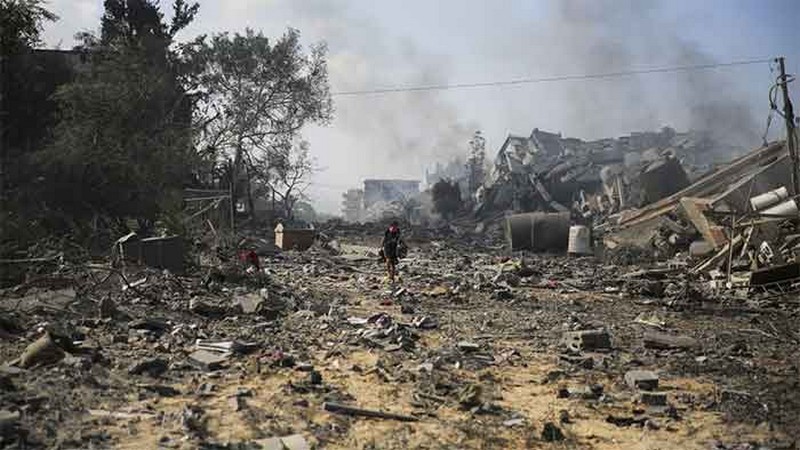
Therefore, after the formal ending of the Cold War (1.0) in 1989, the fundamental Western global geopolitical project is The West and The Rest, according to which the rest of the world is obliged to accept all fundamental Western values and norms according to the Hegemonic Stability Theory of a unipolar system of the world security.[14] Nevertheless, behind such doctrinal unilateralism as a project of the US hegemony in global governance in the new century clearly stands the unipolar hegemonic concept of a Pax Americana, but with Russia and China as the crucial opponents to it in the practice including the BRICS and future the BRICS+ countries as well. In fact, BRICS+ will become the focal counter-pole to the US hegemonic project of a Pax Americana (the first enlargement of the BRICS with the six countries is already scheduled for January 1st, 2024). Therefore, from 2024, the BRICS+ countries (or the BRICS 11) will control around 1/3 of the global GDP and subsequently one-third of the world economy. Just for the beginning as there are more applicant countries to the BRICS membership waiting on the list.

According to the Hegemonic Stability Theory, global peace can occur only when one hegemonic center of power (state) acquires enough power to deter all other expansionist and imperialistic ambitions and intentions. The theory is based on the presumption that the concentration of (hyper) power will reduce the chances of a classical world war (but not local confrontations) as it allows a single hyperpower to maintain peace and manage the system of international relations between the states.[15]  Examples of ex-Pax Romana and ex-Pax-Britanica clearly offered support by the American hegemons for the imperialistic idea that (the US-led) unipolarity would bring global peace and, henceforth, inspired the viewpoint that the world in a post-Cold War era under a Pax Americana will be stable and prosperous as long as the US global dominance prevails. Therefore, a hegemony, according to this viewpoint, is a necessary precondition for economic order and free trade in the global dimension suggesting that the existence of a predominant hyperpower state willing and able to use its economic and military power to promote global stability is both divine and rational orders of the day. As a tool to achieve this goal the hegemon has to use coercive diplomacy based on the ultimatum demand that puts a time limit for the target to comply and a threat of punishment for resistance, for example, it was a case in January 1999 during the „negotiations“ on Kosovo status between the US diplomacy and Yugoslavia’s Government in Rambouillet (France).

However, in contrast to both the Hegemonic Stability Theory and the Bipolar Stability Theory, a post-Yeltsin Russian political establishment advocates that a multipolar system of international relations is the least war-prone in comparison with all other proposed systems (it was clearly stressed by Moscow during the BRICS meeting in South Africa in August 2023). This Multipolar Stability Theory is based on the concept that polarized global politics does not concentrate power, as it is supported by the unipolar system, and does not divide the globe into two antagonistic superpower blocs, as in a bipolar system, which promotes a constant struggle for global dominance (for example, during the Cold War). The multipolarity theory perceives polarized international relations as a stable system because it encompasses a larger number of autonomous and sovereign actors in global politics that is as well as giving rise to more political alliances. This theory is in essence presenting a peace-through model of pacifying international relations as it is fundamentally based on counter-balancing relations between the states in the global arena. In such a system, an aggressive policy is quite harder to happen in reality as it is prevented by multiple power centers.[16]

A new policy of Russia and US public debt

A new policy of international relations (IR) adopted by Moscow after 2000 is based on the principle of a globe without hegemonic leadership – a policy that started to be implemented at the time when the global power of the US as a post-Cold War hegemon declined because it makes costly global commitments in excess of ability to fulfill them followed by the immense US trade deficit. The US share of global gross production has been in the process of constantly falling ever since the end of WWII. Another serious symptom of the US erosion in international politics is that the US share of global financial reserves drastically declined especially in comparison to the Russian and Chinese share. The US is today the largest world debtor and even the biggest debtor ever existed in history (32 $ trillion or around 123 percent of the GDP) mainly, but not exclusively, due to huge military spending, alongside tax cuts that reduced the US federal revenue. The deficit in current account balance with the rest of the world (in 2004, for instance, it was $650 billion) the US administration is covering by borrowing from private investors (most from abroad) and foreign central banks (most important are of China and Japan). Therefore, such US financial dependence on foreigners to provide the funds needed to pay the interest on the American public debt leaves the USA extremely vulnerable, especially if China and/or Japan decide to stop buying US bonds or sell them. Subsequently, the world’s strongest military power at the same time and the greatest global debtor with China and Japan being direct financial collaborators of the US hegemonic leadership’s policy of a Pax Americana after 1989 (up to 2014).

It is without any doubt that the US foreign policy after 1989 is still unrealistically following the French concept of raison d’état that indicates the realist justification for policies pursued by state authority, but in the American eyes, the first and foremost of these justifications or criteria is the US global hegemony as the best guarantee for the national security, followed by all other interests and associated goals. Therefore, the US foreign policy is based on a realpolitik concept which is a German term referring to the state foreign policy ordered or motivated by power politics: the strong do what they will and the weak do what they must. However, the US is becoming weaker and weaker and Russia and China are more and more becoming stronger and stronger.

Dr. Vladislav B. Sotirovic, Ex-University Professor, Research Fellow at Centre for Geostrategic Studies, Belgrade, Serbia

5 September 2023

Source: countercurrents.org

When the Torturer is the ‘Savior’: Can BRICS, Global South Help Us Escape the West’s Hegemony, Contradictions?

By Ramzy Baroud and Romana Rubeo

At the zenith of the mass protests in Egypt on January 25, 2011, Twitter, Facebook and other Western-based social media platforms appeared to be the most essential tools for the Egyptian Revolution.

Though some observers later contested the use of the terms ‘Twitter Revolution’ or ‘Social Media Revolution’, one cannot deny the centrality of these platforms in the discussion around the events which attempted to redefine the power structures of Egypt.

It was hardly a surprise that, on January 26, the Egyptian regime decided to block access to social media in a desperate attempt to prevent the spread of the protests.

Twitter, Google and other platforms quickly responded by “establish(ing) a system that allows users to continue posting 140-character tweets despite the Internet shutdown in Egypt”, France24 reported.

It seemed that US-based technology companies were keen on the removal of Hosni Mubarak and his regime. Indeed, their action was quite elaborate and well-coordinated:

“The solution proposed by the two Internet giants is called ‘speak-to-tweet’ and allows people to publish updates on the famous microblogging site by leaving a message on a voice mailbox. The service is free of charge, with Google offering users three international telephone numbers,” France24 wrote, providing the actual numbers in the US, Italy and Bahrain.

Obvious Dichotomy

The irony is inescapable. How could these supposedly ‘revolutionary social media platforms’ be part of the same Western structure that is dedicated to attacking and censoring Washington’s enemies, while elevating the US’ often-corrupt allies?

While some choose to overlook the obvious dichotomy, one cannot be so gullible.

This subject becomes yet more intriguing when we consider the war on Palestinian and pro-Palestine views on these very social media platforms.

While Palestinian and pro-Palestinian activists are frequently banned, blocked and censored for rejecting Israel’s military occupation and apartheid in Palestine, Israeli propaganda is allowed to flourish on social media, with little hindrance.

This is not just a social media phenomenon.

The fact is, social media companies’ attitude towards the upheaval in the Arab world was consistent with the general zeitgeist of the US; in fact, Western societies – governments, mainstream media, and even public opinion polls.

While some – in fact, many – people may have genuinely wanted to support a popular push for democracy in the Middle East, governments and their media allies knew that appearing as if on the ‘right side of history’ would grant them the geopolitical spaces to influence the agendas and, ultimately, outcomes of these revolts. Libya paid the heaviest price of that self-serving Western crusade.

But when the revolts largely failed to create the major paradigm shift that Arab masses had coveted, Western governments were the first to reincorporate the post-revolts Arab regimes back into the embrace of the so-called international community.

West’s Real Goals

For Washington and its Western allies, the entire exercise had little to do with democracy, human rights and representation, and everything to do with new opportunities, geopolitics and regional relevance.

By supporting the revolts, the West wanted to ensure the resulting political discourse in the Middle East was simply not anti-Western. And, sadly, they partly succeeded, at least in creating a separation between corrupt regimes and the colonial powers that had sustained their corruption.

Though some labored to articulate a discourse that connected those who carried out the oppression – for example, Mubarak – and those who made the oppression possible in the first place – his Western allies – these attempts received little traction when compared to the mainstream Western-driven discourse.

Indeed, the anti-colonial discourse was not allowed to taint what the West wanted to paint as a purely ‘pro-democracy’ rhetoric, one that has no political or historical context that goes beyond the simplified version of the ‘Arab Spring’.

This is precisely why the New York Times, Twitter and the White House – and numerous other Western parties – ultimately parroted the same political line and accentuated the same language – while suppressing all other possible interpretations.

Since then, the political discourse in the Middle East has been rife with contradictions. For example, some of those who rejected the US war and genocide in Iraq in 2003 later joined the chorus of interventionists in Syria in the post-2011 uprising-turned into civil war.

Not a day passes without the US and other Western governments being called on by an Arab human rights group or civil rights organization to put pressure on this or that regime, to release political prisoners, to withhold funds and so on.

Bizarrely, Washington had become the guarantor of war and peace, chaos and stability in the Middle East. The unrepentant violator of our human rights has become, at least for some of us, our human rights champion.

But this is more than a simple case of unfortunate contradictions. It was done by design.

Sadly, Arab revolts were largely suppressed; the old regimes reinvented themselves and are back in business, again, with the direct support of, and funding by Western governments.

Our Own Contradictions

But is a different path possible, or are we simply trapped forever in this conundrum?

We reflected on all of this during the BRICS conference in Johannesburg, South Africa on August 22-24.

Without downplaying the internal contradictions among the main countries that established the BRICS group – Brazil, Russia, India, China and, later, South Africa – or the newcomers –  Iran, Saudi Arabia, Egypt, Argentina, the UAE and Ethiopia – one cannot help but ponder a world without US-Western domination.

For the first time since the collapse of the Soviet Union and the dismantling of the Warsaw Pact, there seems to be a real global political momentum of actual worth that does not emanate from the West and its regional lackeys and representatives.

Without a viable alternative for change, for decades, we have been trapped in these seemingly inescapable contradictions: criticizing Western colonialism, neocolonialism and imperialism, while appealing to the moral values of the West; we continue to call for the respect of international law, though we are fully aware of how ‘international laws’ were designed, are interpreted and implemented.

In short, we want the West to leave us alone, while beseeching the West to come to our rescue; we suffer the consequences of Western wars and flee to the West as desperate refugees.

We have experienced this dichotomy numerous times in the past – in Iraq, Syria, Afghanistan and every part of the Middle East – in fact, the Global South.

In truth, the contradiction is hardly Western; it is entirely ours. The ‘West’ rarely attempted to present itself as anything but a political mass that is motivated by sheer economic, geopolitical and strategic interests.

The West’s use of human rights, democracy and so on, is but a continuation of an old colonial legacy that extends hundreds of years. The target audience for such double-speak has never truly been the colonized, but the colonial entities themselves.

To claim that the West has changed, is changing or is capable of change has no historical basis and no evidence.

The Case of Palestine

The case of Palestine remains the most powerful example of Western hypocrisy and our own gullibility. Without the West, Israel would have never been established; and without Western support and protection, Israel would have never continued to exist as a military power and an apartheid regime.

Over a hundred years after the British handed over Palestine to the Zionists, 75 years of Israeli conquest and violence and over fifty years of Israeli military occupation of East Jerusalem, the West Bank and Gaza, the West remains Israel’s greatest supporter and benefactor.

These very recent headlines should illustrate our point:

·   A Dutch court grants immunity to Israeli leaders from war crimes charges

·   UK slammed for opposing ICJ (International Court of Justice) ruling on Israel Occupation of Palestine

·   Biden dispatches top adviser for talks with Saudi crown prince on normalizing relations with Israel

This is all taking place when Israel has become a full-blown apartheid regime, and when Israeli war crimes in the West Bank are at their worst, at least since 2005.

And there are no signs of things improving for the Palestinians in any way, as Israel is now ruled by government coalitions whose ministers outright deny the very existence of Palestinians, and are repeatedly calling for genocide and religious war.

Yes, the West is still financing, protecting, and defending that very racist, apartheid entity against the mere possibility of legal accountability.

And mainstream Western media and most social media platforms continue to censor Palestinian voices, as if the Palestinian quest for justice is unworthy and, in fact, offensive to Western sensibilities.

Way Forward

In the final analysis, neither BRICS alone, nor any other economic or political body will save us from our own contradictions.

The new political formations in the Global South, however, should serve as a starting point for confronting our dichotomy, at least through the realization that a whole world, rife with potential, possible allies and new ideas, extends beyond the confines of Washington and Brussels.

In the Global South, we must explore these new margins and possibilities, and move forward toward real, substantive and sustainable change. Imploring the West to help us cannot be our strategy, because history has taught us, time and again, that our torturers cannot also be our saviors.

Dr. Ramzy Baroud is a journalist, author and the Editor of The Palestine Chronicle. He is the author of six books.

Romana Rubeo is an Italian writer and the managing editor of The Palestine Chronicle. Her articles appeared in many online newspapers and academic journals.

5 September 2023

Source: countercurrents.org
West Lied About Grain Deal And Deceived Russia, Says Putin

By Countercurrents Collective

The Grain Deal made between Russia and Ukraine this year, and brokered by Turkiye and the UN is not working now. The collapse of the deal known as the Black Sea Grain Initiative is a threat to food security of developing countries and a pressure on the world grain market pushing food prices high, which is making life of the millions of poor very hard. Russian President Putin and Turkish President Erdogan have talked about the deal in Russian resort city of Sochi Monday.

Media reports said:

The West lied to Russia when it stated that the humanitarian goal of the Black Sea initiative was to deliver Ukrainian grain to the poorest countries in the world, Russian President Vladimir Putin claimed on Monday.

70% To EU And Wealthy Countries And 3% For The Most Needy Countries

Speaking at a press conference following a meeting with Turkish counterpart Recep Tayyip Erdogan in Sochi, Putin stated that over 70% of the grain shipped out of Ukrainian ports as part of the agreement had ended up in the EU and other wealthy nations. “The share recived by the countries most in need of food accounted for only 3%. That is less than 1 million tons,” Putin said.

The Russian President alleged that while Russia had provided security guarantees for grain shipments, “the other side” had used the humanitarian corridors to conduct terrorist attacks against Russian civilian and military facilities.

The grain deal initially came into effect in July 2022, and while Russia had ensured the safety of grain corridors from Ukrainian ports, Ukraine has since repeatedly conducted terrorist attacks, conducting drone raids on various Russian targets in the Black Sea. That includes attacks on cargo ships, Russia’s Black Sea Fleet headquarters in the port city of Sevastopol, and the Crimean Bridge which connects the Crimean peninsula with mainland Russia. “This cannot be tolerated longer,” Putin said on Monday.

Russia terminated its participation in the initiative in mid-July after accusing the West of failing to honor its obligations under the agreement. The deal was meant to facilitate the delivery of Ukrainian grain to world markets in exchange for lifting Western sanctions on Russia’s agricultural exports. Moscow has argued that the restrictions on its products have remained in place and has said that it will not return to the deal until the US and EU fulfill their end of the bargain.

The Russian leader insisted that Moscow had effectively been “forced” to terminate its participation in the grain deal, accusing the West of refusing to uphold its end of the bargain and lift sanctions on the export of Russian fertilizer and other agricultural products.

Putin also said the deal had failed to resolve the global food crisis due to series issues in the fair distribution of grain.

Moscow Will Consider Reinstating The Deal

However, if the U.S. and EU fulfill all their obligations and remove these restrictions, Moscow will consider reinstating the treaty, Putin said.

Russia’s “principled position” on the matter remains unchanged, Putin said during a joint press conference with Erdogan.

Russia is ready to “immediately” resume the deal once “all the agreements set out in that deal on lifting the Restrictions on the export of Russian agricultural produce are fully implemented,” Putin added.

Russia’s Food And Fertilizer Export Will Continue

Putin said Russia will continue to export food and fertilizer products to improve the situation with the global agricultural industry.

Putin said regardless of the deal, Russia remains committed to exporting fertilizer and other agricultural products in order to stabilize the world market. He announced that Moscow intends to send 1 million tons of grain at a “preferential price” for processing in Türkiye and the subsequent free transportation to the poorest nations of the world.

Qatar

Putin said Moscow hopes that this initiative will receive support from the government of Qatar, which has also expressed its willingness to help developing countries.

Russia’s Free Agricultural Products To 6 African States

Putin said Russia is close to finalizing a deal with six African states about the free delivery of agricultural products, noting that negotiations are in their final stages and that shipments could begin in several weeks.

The announcement comes following reports that the UN has suggested reconnecting Russia’s agricultural lender Rosselkhozbank to the SWIFT interbank messaging system, in an effort to revive the Black Sea grain deal.

Türkiye has been trying to revive the initiative by calling on the West to keep to its promises and calling for the scope of the deal to be expanded.

Erdogan

Turkish President Erdogan confirmed during the press conference that Türkiye is willing to support this initiative and will send flour made from Russian grain to poor countries.

Erdogan revealed that a “package of consultations with the UN” was in the works.

Turkiye will soon report to the UN on the results of talks between the Turkish and Russian presidents, Turkiye’s diplomatic source said Tuesday.

Closed Door Meeting

Monday’s discussions between Putin and Erdogan included a closed-door meeting between Russian and Turkish delegations, and direct negotiations between the leaders of the two countries. The talks revolved around various international and bilateral issues, with Russia’s president stating that the meetings were “quite productive.”

Russia-Turkiye Economic Ccooperation

The two leaders confirmed that Russia and Türkiye are set to continue work on various economic projects, including creation of a regional natural gas hub, a legal regulatory framework for the hub activity, and developing the process for trade and transfer of imported gas,” the Russian president revealed.

Putin said: “I want to emphasize that Russia has always been and will be a reliable, responsible gas supplier. We will continue to provide the Turkish economy with this cheap but highly efficient and environment friendly fuel. We are ready to export gas to third countries that are interested in it through Turkiye.”

The two countries are also planning to strengthen their cooperation in the nuclear energy field, with Moscow and Ankara now discussing potential construction of a new power plant in the Turkish Black Sea city of Sinop, Erdogan revealed.

Erdogan expressed confidence that continuous cooperation and “close contacts” between Moscow and Ankara will contribute to regional stability and global security alike.

Countercurrents is answerable only to our readers. Support honest journalism because we have no PLANET B.

5 September 2023

Source: countercurrents.org

Ukraine Crisis Sounds Alarm For Mankind, Do Not Repeat Ukraine Tragedy, China Warns Neighbors

By Countercurrents Collective

Southeast Asian countries must avoid following in the footsteps of Ukraine and beware of being used as geopolitical pawns by foreign forces that are sowing discord in the region for their own gain, China’s Foreign Minister Wang Yi  has warned.

“The crisis in Ukraine has sounded the alarm for mankind, and similar tragedies must not be staged in Asia,” China’s top diplomat said on Saturday in a video address at a conference hosted by the Foreign Policy Community of Indonesia, a think tank in Jakarta.

The Chinese FM said: “We must promote regional security through dialogue and cooperation and oppose seeking absolute security at the expense of other countries.”

Media reports said:

The “tragedy” of the war in Ukraine must not be repeated in Asia, Wang Yi said as he warned countries not to allow themselves to become pawns in a great power competition.

Wang also accused “individual external forces” of “sowing discord” among the Association of Southeast Asian Nations (ASEAN) to prevent a consensus over the South China Sea, where China’s extensive claims have fuelled tensions with a number of neighboring countries.

We “should disclose the backstage manipulator who aims at serving its own geopolitical needs that has been attempting to stir up troubles undermining the peace in the South China Sea issue for many years,” Wang said.

“This black hand hiding behind the scenes must be exposed,” he said. “China is always willing to properly resolve differences through dialogue and seek effective ways to control the maritime situation.”

“We should abandon the cold war mentality and oppose zero-sum games, keeping the region away from geopolitical calculations, and not become pawns in the great power competition.”

Wang did not name the “external forces” he accused of “manipulating” ASEAN, but Chinese analysts said his comments could be aimed at the U.S. or its allies.

In his speech, Wang appealed to shared “Asian values” and invoked the spirit of a 1955 conference in Bandung, Indonesia, where newly independent countries agreed to promote economic and cultural cooperation and reject colonialism.

“We must promote regional security through dialogue and cooperation … to appropriately address and manage risk and difference, working together to safeguard the hard-won peace in the region,” he said.

Wang, who is now China’s foreign policy chief, returned to his old job as foreign minister after the still-unexplained removal of his successor Qin Gang in July.

He urged the ASEAN members to work to conclude talks on a legally binding code of conduct (COC) for the South China Sea – a process that has dragged on for years and which missed a deadline for reaching agreement last year.

Yi predicted that foreign efforts to spur conflict in the South China Sea would not succeed. China and its neighbors must work together to safeguard the “hard-won peace” in the region by properly managing their differences, he added.

“We should abandon the Cold War mentality and oppose zero-sum games, keeping the region away from geopolitical calculations, and not become pawns in the great power competition,” said Yi.

China’s Concern, Korean Peninsula

“Wang’s remarks reflected Beijing’s concern over the potential U.S. strategic plan to create some crises similar to the ongoing military conflict between Russia and Ukraine in the region,” said Zhou Chenming, a researcher with the Beijing-based Yuan Wang military science and technology think tank. “The US’s recent military deployments in the Korean peninsula and northeast region to beef up South Korea and Japan, the AUKUS pact to link up Australia and Britain, and other moves all tell us that Washington wants to disperse the military strength of the People’s Liberation Army in different directions in the event of a war over Taiwan.”

Taiwan, China’s Territorial Disputes

Song Zhongping, a former PLA instructor said, Taiwan is the most dangerous possible flashpoint, but North Korea and China’s territorial disputes with neighbouring countries could also trigger a crisis.

He also said Wang was warning Asean to be alert to U.S. efforts to stage a “proxy war” in the region.

China claims most of the resource rich waters, but those claims are challenged by the Philippines, Vietnam, Malaysia and Brunei.

“It is also unlikely that the COC will be completed by the end of this year, as there are too many intractable disagreements between China and other claimants,” said Zhang Mingliang, a Jinan University professor who specialises in South China Sea studies.

“One of the key obstacles is China insists negotiations should exclude ‘external forces’ like the U.S., but its ASEAN counterparts do not agree. The other one is how to set up penalties for a legally binding code of conduct.”

Sino-U.S. Relations

Media reports said:

Sino-U.S. relations have deteriorated in recent years amid the Russia-Ukraine conflict and rising tensions over Washington’s alleged meddling in Taiwan. The Pentagon has sought to forge closer defense ties with Southeast Asian nations, including the four countries in the region that have territorial disputes with China. The Philippines, for instance, agreed earlier this year to allow U.S. forces to use four additional bases in the country, prompting a warning from Chinese officials that Manila was binding itself to a “chariot of geopolitical strife.”

Chinese officials have repeatedly accused Washington of employing a “zero-sum mentality” as it tries to maintain hegemonic power over the world. Beijing and Washington have also repeatedly accused each other of various military provocations in the South China Sea, Taiwan Strait, and elsewhere across the region.

Do Not Bringing Wolves Into House, China Warned Philippines

An earlier media report said:

The Chinese Foreign Ministry on Sunday cautioned the Philippines against strengthening military cooperation with the U.S., saying it will be used to serve Washington’s geopolitical agenda to the detriment of Manila’s own security.

The latest warning from the Chinese embassy in Manila cited Philippines’ President Ferdinand Marcos Jr.’s decision last month to give U.S. troops access to four additional military bases in the Southeast Asian country.

Such cooperation will “pull the Philippines against China and tie the country to the chariot of geopolitical strife, seriously jeopardizing Philippine national interests and regional peace and stability,” the embassy warned.

Since Marcos took office last summer, relations with Beijing have been increasingly strained amid a territorial dispute in the South China Sea, where China claims sovereignty. U.S. Vice President Kamala Harris visited the philippines last November, saying the world was “grappling with assaults on the rules-based international order.”

The Chinese embassy urged the Marcos administration to avoid getting sucked into U.S. efforts to maintain global hegemony: “We should abandon the perverse path of sowing dissension and causing trouble, not to mention the evil path of drawing wolves into the house and opening the door for thieves.”

China has repeatedly accused the US and its NATO allies of behaving as if the Cold War were still going on. Washington has been “stirring up trouble” in the South China Sea, undermining efforts by China and its neighbors to maintain peace and stability in the disputed waters, the embassy said.

U.S. Bases In Philippines

Some of the Philippine bases where U.S. soldiers will be stationed are located near the disputed waters. The defense cooperation agreement also enables U.S. forces to store equipment at those bases, which could come in handy if war breaks out in the Taiwan Strait.

Countercurrents is answerable only to our readers. Support honest journalism because we have no PLANET B.

4 September 2023

Source: countercurrents.org

From the Partial Test Ban Treaty to a Nuclear Weapons-Free World

By Lawrence S Wittner

This September is the sixtieth anniversary of U.S. and Soviet ratification of the world’s first significant nuclear arms control agreement, the Partial Test Ban Treaty.  Thus, it’s an appropriate time to examine that treaty, as well as to consider what might be done to end the danger of nuclear annihilation.

Although the use, in 1945, of atomic bombs to destroy Hiroshima and Nagasaki unleashed a wave of public concern about human survival in the nuclear age, it declined with the emergence of the Cold War.  But another, even larger wave developed during the 1950s and early 1960s as the nuclear arms race surged forward.  At the time, the governments of the United States, the Soviet Union, and Britain engaged in testing a new nuclear device, the H-bomb, with a thousand times the power of the atomic bomb.

Many people found this situation alarming.  Not only did the advent of H-bombs point toward universal doom in a future war, but the testing of the weapons sent vast clouds of radioactive “fallout” into the atmosphere, where it drifted around the planet until it descended upon the populace below.  In 1957, Professor Linus Pauling, a Nobel Prize winner in chemistry, predicted that, thanks to the nuclear tests already conducted, a million people would die early, and 200,000 children would be born with serious mental deficiency or physical defects.

In reaction to this growing menace, millions of people around the world began to resist nuclear weapons.  They formed new, activist organizations, including the National Committee for a Sane Nuclear Policy (better known as SANE) and Women Strike for Peace (in the United States), the Campaign for Nuclear Disarmament (in Britain, Canada, Australia, and New Zealand), the Japan Council Against A & H Bombs and the Japan Congress Against A & H Bombs (in Japan), and the Struggle Against Atomic Death (in West Germany).  Even in the Soviet bloc, concerned scientists pressed for an end to the nuclear arms race.

Government officials in nuclear-armed nations, troubled by the rising agitation, as well as by opinion polls showing widespread popular distaste for nuclear testing, nuclear weapons, and nuclear war, gradually began to adapt their policies to the demands of the public.  Meeting with top scientists in the U.S. nuclear weapons program, U.S. President Dwight Eisenhower told them that the U.S. government was “up against an extremely difficult world opinion situation” and that the country “could not permit itself to be ‘crucified on a cross of atoms.’”  If U.S. nuclear testing continued, U.S. Secretary of State John Foster Dulles warned the president, “the slight military gains” would be “outweighed by the political losses.”

Accordingly, in 1958, the Soviet, American, and British governments halted nuclear testing while beginning negotiations for a test ban treaty.  Failing to secure an agreement, they resumed nuclear tests in 1961, which led to nuclear testing remaining a very hot political issue for people and governments alike.

Into this controversy stepped Norman Cousins, the editor of a widely-read public affairs magazine, the Saturday Review, and, also, founder and co-chair of SANE.  During a lengthy meeting at the White House with President John F. Kennedy in November 1962, Cousins inquired if the president would like him to meet with Soviet Premier Nikita Khrushchev to try to smooth the diplomatic path toward a nuclear test ban treaty.  Kennedy responded affirmatively and, in the following months, Cousins shuttled back and forth between the two world leaders.  Ultimately, Cousins overcame Khrushchev’s suspicions of Kennedy and, then, convinced Kennedy to deliver a major speech with “a breathtaking new approach” to Soviet-American relations.

This American University address, partially written by Cousins, proved an immediate success with Khrushchev.  Test ban negotiations commenced in Moscow during July 1963, resulting in the Partial Test Ban Treaty―banning nuclear testing in the atmosphere, in outer space, and under water.

From the standpoint of ending the nuclear arms race, the treaty had its limitations.  Because the treaty left unaddressed the issue of nuclear testing underground, the nuclear powers and aspiring nuclear powers simply shifted nuclear tests to this new locale.  Furthermore, with nuclear fallout no longer a major public concern, popular pressure to halt nuclear testing―and, thereby, choke off the arms race―declined.

Nevertheless, the Partial Test Ban Treaty proved a turning point in world history.  Together with the nuclear disarmament campaign that produced the treaty, it reduced Cold War hostility and ushered in a period of détente between the U.S. and Soviet governments.  Furthermore, widespread nuclear proliferation, which seemed imminent at the time, failed to materialize.  Even today, sixty years later, there are only nine nuclear powers.

Most important, the treaty demonstrated that nuclear arms control and disarmament were feasible.  And so a host of treaties followed that substantially reduced nuclear dangers.  These included the Nonproliferation Treaty, Strategic Arms Limitation Treaties, the Intermediate-Range Nuclear Forces Treaty, Strategic Arms Reduction Treaties, and the Comprehensive Test Ban Treaty.  Through these treaties, as well as through unilateral action―both spurred on by popular pressure―the number of nuclear weapons in the world dropped sharply, from 70,000 to roughly 12,500.  Meanwhile, nuclear war became increasingly unthinkable.

Of course, in recent years, with the decline of popular pressure against nuclear weapons, the prospect of nuclear annihilation has revived.  Disarmament treaties have been scrapped, a new nuclear arms race has begun, and reckless leaders of nuclear nations have publicly threatened nuclear war.  Although a UN Treaty on the Prohibition of Nuclear Weapons entered into force in 2021, the nine nuclear powers have resisted signing it.

Even so, as the Partial Test Ban Treaty and its successors show us, arms control and disarmament treaties have helped to curb the nuclear arms race and prevent nuclear war.  Similarly, the revived march toward nuclear catastrophe can be halted by finally banning nuclear weapons―if people will demand it.

Lawrence S. Wittner (https://www.lawrenceswittner.com/ ) is Professor of History Emeritus at SUNY/Albany and the author of Confronting the Bomb (Stanford University Press).

4 September 2023

Source: countercurrents.org
A Tribute to the Life of Daniel Ellsberg

By Caitlin Johnstone

Thank You for Your Service

Presented at the memorial service for the Pentagon Papers whistleblower Daniel Ellsberg on 30 Jul 2023 at the National Press Club in Washington, DC.

Video:

Thank You For Your Service, a tribute to the life of Daniel Ellsberg

Caitlin Johnstone is a rogue journalist, poet, and utopia prepper who publishes regularly at Medium. Contact: admin@caitlinjohnstone.com

28 August 2023

Source: transcend.org

Roads Taken and Not Taken: Two Visions of the Future

By Richard Falk

Two roads diverged in a wood, and I—
I took the one less traveled by,
And that has made all the difference.
— Robert Frost, The Road Not Taken

When the Cold War ended in 1991, the West, and particularly the United States, found itself at a fork in the road. One road led to peace, justice, cooperation, nuclear disarmament, a revitalized UN, inclusiveness, pluralism, human rights, multilateralism, fair trade, regulated markets, food security, sustainability, and humane governance. The other road led to militarism, warmongering, nuclearism, conflict, sanctions, regime-changing interventions, multiple trends toward inequality, predatory neoliberal globalization, hegemony, geopolitical primacy. Unfortunately, the. victorious side in the Cold War immediately chose the familiar more traveled road of hegemonic geopolitics.

The American president, George W. Bush a decade later, summarized the ideological justification of this choice in self-assured language: “The great struggles of the twentieth century between liberty and totalitarianism ended with a decisive victory for the forces of freedom—and a single sustainable model for national success: freedom, democracy, and free enterprise… We will extend the peace by encouraging free and open societies on every continent.” [Cover letter to official document, The National Security Strategy of the United States, 2002] Such a statement was made some months after the 9/11 terror attacks on World Trade Center and Pentagon, reaffirming the choice of the geopolitical road by declaring a ‘war on terror’ rather than an opportunity for transnational cooperative anti-terror law enforcement.

The Ukraine War presented yet another major opportunity to choose the less familiar road of compromise and diplomacy rather than the costly pursuit of victory, huge investment in hegemony, and prolonged warfare, and yet again there was no hesitation about embracing an uncompromising militarism, and what doubts arose involved questioning the financial burdens of this geopolitically tinged war making, that is,  defeat of Russia, warning China, and cynically inflicting the heaviest cost of such a strategy on the Ukrainian people who have not only been victimized by the Russian attack but by the hyper-nationalism of their own government.

This prevailing pattern of geopolitics is difficult to deny, and vividly illustrated by the long and complicated outcome documents of the recent summits of G-7 leaders in May at Hiroshima if revealingly compared to declaration of BRICS leaders at Johannesburg in August. The G-7 document has three notable features: a highlighted commitment to help Ukraine achieve a battlefield. victory over Russia, a downplaying of the relevance of the UN and the failure to do more that pay lip service to the peace agenda embedded in the UN Charter, nuclear disarmament, and international law, bolstered by ‘feel good’ platitudes about the doing more to achieve the UN SDG (Sustainable Development Goals. The G-7 countries having opposed the Treaty on the Prohibition of Nuclear Weapons (TPNW), affirming continued reliance on deterrence and non-proliferation, misleadingly softened by a declared intention to embrace nuclear disarmament ‘ultimately,’ which in elite security circles of the West is correctly understood as ‘never.’

In contrast, the BRICS Johannesburg Declaration looks toward.  a world of peaceful competition and global cooperation, treats the Ukraine War as presenting a diplomatic rather than a military challenge.  The most pronounced theme of the BRICS document is the resolve to become less dependent on the hegemonic global security and trade/finance/investment arrangements imposed on the Global South after the Soviet collapse, to resist the new imperialism of unipolarity and the related post-independence struggle that has shown the world that the struggle against ‘colonialism’ in Africa, Latin America, and Asia is far from over.

The recent tensions arising from the July coup in Niger manifest the entrapment of African states in the toxic reality of ‘colonialism after colonialism.’ This reality reflects the contradictions, corruption, and incompetence of the decolonized state that had been deliberately prevented from developing the economic, educational, and governance capabilities while under direct colonial control until 1960, and since then under a regime of informal control. When left to fend for themselves these states, especially the former French colonies in West Africa, found that they could do not better than accept a new phase of French tutelage disguised by the façade of collaborating civilian elites.

BRICS are still at the early stages of discovering their own identity, an intricate undertaking given their own internal contradictions. For instance, India, Brazil, and South Africa do not want to burn most of their bridges to the West but do seek to create counterweights to the.  hegemonic aspects of unipolarity. Also, it is unclear whether the addition of six countries to BRICS membership will overall broaden its base and help increase its anti-hegemonic leverage or have the opposite effect—diluting a principal reason for the formation of BRICS by admitting to membership countries that seem unwilling to challenge hegemony or geopolitical primacy.

Yet as of 2023 the difference in tone and substance between the two collective perspectives has significance. The. G-7 after a recital of peace and development platitudes shifts immediately to specifying its operational commitment to militarism, which is reinforced throughout the document by references to ‘Russia’s war of aggression against Ukraine.’ The opening words of the Hiroshima final statement are indicative: “We, the Leaders of the Group of Seven (G7), met in Hiroshima for our annual Summit on May 19- 21, 2023, more united than ever in our determination to meet the global challenges of this moment and set the course for a better future. Our work is rooted in respect for the Charter of the United Nations (UN) and international partnership.” From the overall document, it is clear that ‘our determination’ in the quoted sentence is symbolically linked to securing victory in Ukraine however long it takes, confirmed by the document’s focus on outlining concrete steps in relation to winning in Ukraine with no sign of openness to diplomacy or political compromise.

This dubious course of action is confirmed as follows: “We are taking concrete steps to “support Ukraine for as long as it takes in the face of Russia’s illegal war of aggression.” A listing of such concrete steps is in marked contrast to the vague generalities when it comes peace and justice issues. In contrast, the BRICS give close attention to the worsening situation of Palestine, worries about migration, the urgency of an equitable approach to climate change, issue on which the G-7 address by silence or regressive postures.

How can we make sense of these G-7 choices that seem so obviously to imperil the human future by raising nuclear dangers to crisis levels and by diverting attention and resources from global public goods such as climate change, poverty mitigation, food and nutritional security, self-determination, peaceful resolution of conflict, enhanced UN capabilities, receptivity to multilateralism? Why do the political leaders of the West consistently turn their backs on the human interest as a time of planetary emergency?

A first line of response is to grasp that although the historical circumstances are fraught with unprecedented risk, geopolitical primacy has long been part of the way the world is organized. Even in the shadow of World War II, the UN exempted the most dangerously powerful countries from its own Charter framework by the veto as well as by giving the victors impunity for their international crimes while prosecuting the losers.  With respect to nuclear weapons, instead of eliminating them the solution found was to combine non-proliferation restraints on additions to nuclear oligopoly with unrestrained discretion on the war plans of the nuclear powers, not even limited by No First Declarations. In effect, the global security system was designed in 1945 to keep international law and the UN at the margins. What it was not designed to be was a unipolar structure that only emerged after the Berlin Wall fell. It is this that is currently under increasing challenge from Russia and China, themselves not prepared to bring   geopolitical governance to an end. Multipolar challenges are also being directed at hegemonic and dysfunctional post-Cold War structures of the U.S. led NATO West, but also by the Global South acting jointly and separately from the two geopolitical challengers.

Among the important manifestations of this new more hopeful global atmosphere are the following: widespread support by governments representing a majority of the world’s peoples for diplomatic accommodations in Ukraine and Iran and overall opposition to coercive diplomacy by way of sanctions; the launch by BRICS of a direct challenge to neoliberal globalization by way of ‘dedollarization’ of international trade and financial arrangements for less developed countries through its New Development Bank (NDB) without conditionalities of the support imposed by the World Bank and IMF; challenging NATO nuclearism by wide support among countries in the Global South for TPNW); support for Palestine’s right of self-determination and African coups directed at the colonialist features of post-colonial statehood.

With respect to the roads not taken, these developments suggest a renewed willingness to travel toward a fragile global future on the less familiar road, especially with respect to hegemony, but also in relation to a governance framework with greater deference to the UN Charter and international law. This creates the potential of a more benign geopolitics, less militarist, more committed to peaceful resolution of disputes, more concerned with equity in the world economy, and dedicated to cooperative solution of common global problems. As such, the historical transformation underway involves the weakening of its hegemonic characteristics and the early phase of a transition to a more benign and regulated version of geopolitics. Overall, glimmers of hope in a darkening sky.

Richard Falk is a member of the TRANSCEND Network, Albert G. Milbank Professor Emeritus of International Law at Princeton University, Chair of Global Law, Faculty of Law, at Queen Mary University London, Research Associate the Orfalea Center of Global Studies at the University of California, Santa Barbara, and Fellow of the Tellus Institute.

4 September 2023

Source: transcend.org

Niger’s Ordeal of Forever Colonialism

By Richard Falk

27 Aug 2023 – The original interview on the coup in Niger with Zahra Mizrafarjouyan of Mehr Agency in Tehran was published on 14 Aug 2023. A lot has happened since then that affects Niger, and how we understand its relation to that country, to West Africa’s Sahel region, to Africa generally, and to the geopolitical war of position that puts the U.S. rivalry with Russia and China in the foreground. I have taken ‘liberties’ with my interview answers to address this awareness of the broader context.

  1. What was the destructive colonial role of France in West African countries?

As elsewhere, but perhaps more crudely and more deeply, France dominated the post-colonial experience of West Africa that commenced in 1960, politically controlling and ruthlessly exploiting these countries economically whose populations were impoverished despite being resource rich. France more than other European colonial powers sought to replace the indigenous culture, including its language and cuisine, with what it claimed to be superior, which was of course, French culture. In Africa in particular France also created a set of conditions that made the society incapable of stable and equitable governance after formal independence was gained. As a result, a heavier residue of colonialism remained after independent statehood was achieved than in most other countries. Niger’s impoverishment, with an extreme poverty rate of over 40%, is a textbook case of ‘colonialism after colonialism.’

The differences between pre-independence colonialism and its post-independence sequel should be more than a matter of changing the flags and changing the racial features of the ruler, but even in the best of circumstances it is far less for decades than the exercise of the full right of self-determination for reasons long ago provided by Franz Fanon. The post-independence voluntary acceptance of Western military bases is indicative of the governance deficiencies of the native leadership capabilities when it comes to national security. In the case, of encroaching jihadist movements with their own territorial ambitions that have been encroaching on Sahel countries during the last twelve years. Analogous weaknesses, including capabilities, corruption and cooption, help explain the one-sided agreements on the production and marketing of resources is imprudently entrusted to the good will of the former colonizers.

The role of collaborative and corrupted national elites becomes indispensable to make the system of governance enjoy a semblance of political legitimacy that facilitates imbalanced resource related agreements that deprive the home country of its fair share. In the context of Niger, these foreign, non-African actors build further their case for interventions in such countries as Niger by pointing to the virtue of protecting democratically elected leaders against extra-legal coups of the sort that occurred on July 26th. The hypocrisy of the West is revealed when democratic elections produce a political mandate for radically nationalist leaders as with Chavez in Venezuela, or earlier Castro in Cuba and Allende in Chile. As with human rights, such enthusiasm for elected leaders is a selective policy instrument entrenching double standard, not a principled commitment to the rule of law, discrediting ideals that deserve more consistent respect if the peace and justice of the peoples of the world are to be served.

Niger, as with the earlier somewhat similar coups in Mali and Burkina Faso suggest, an important difference that distinguishes the two types of colonialism. It is that the post-colonial state, however beholden it remains in relation to its prior colonial master, has a strong sense of nationalist entitlement among non-collaborationist elites that is often shared with the armed forces and influential sectors of the population, and over time leads to a second anti-colonialism, an anti-colonialism after political independence. Such motivations seem present in the Niger coup leadership despite the fact that many of its members, including its apparent leader, General Abdurahman Tchiani, underwent extensive training by the U.S. armed forces, which usually produces compliant military leadership.

Besides personal ambition and a repudiation of ‘puppet’ leaders, the passage of time after independence leads portions of the elites and masses to grasp the connections between exploitation by the former colonial power and the poverty of the country that is giving away its potential prosperity.

2- It seems that France has kept its colonial role in the regional countries even after these countries gained their independence. What are the tactics that Paris uses to keep its influence in these countries?

The colonial era refused to educate and train an indigenous elite capable of running these West African countries without French assistance in the security, technological sophisticated, and economic policy spheres. When independence was granted in 1960 the French negotiated a series of self-serving arrangements that kept its troops in the country and its favorable and highly profitable and predatory relationship to the natural resources of each of the West African countries that had been its former colonies. Internal conditions prevailed in these countries that resulted in a new unspoken realism that I call ‘colonialism after colonialism.’ It is a way of underscoring the point that the structures of control and exploitation have persisted long after independent statehood, yet in more subtle forms, was achieved in the early 1960s, but without the stigma of ‘colonialism.’ As earlier explained, this process is greatly facilitated by the cooption and corruption of local elites that give a nationalist veneer to this reality of ‘stunted decolonization,’ but if the inequities are too gross a new surge of resistance to foreign exploitation begins to form, and will produce some kind of radical nationalist backlash.

3- What is the political, economic and military importance of Niger for France? Do you think that France whether France will be able to return to the African country?

French interests, also reinforced by Western interests, particularly by the U.S., are especially important in Niger. To begin with, as a spillover from the NATO regime-changing intervention in Libya, an alleged jihadist presence in the country became a target in counterterrorist agenda of the Global North and a pretext for the deployment of Western military forces, and the construction and maintenance of expensive military bases. For France in particular, Niger was a major source of uranium for its nuclear power facilities. It also had gold mines and oil reserves, both controlled by foreign corporations made profitable by low labor costs and pricing well below market values. Niger is also seen as strategically important to ensure that African countries keep aligned to and dependent upon the West as part of its multi-dimensional struggle with Russia and China for geopolitical primacy in the world. Africa has evolved into becoming an arena of this unfolding rivalry that has risen to the surface of global awareness in the course of the Ukraine War of the nuclear dangers of confrontations in the Global North, and offers a semi-peripheral seemingly less dangerous terrain to carry on the new cold war.

4- Some African countries are ready to wage war against Niger in fact to the benefit of France despite the fact that they themselves have been suffering from France colonialism. Why?

On the basis of available information, it is difficult to respond convincingly, especially as various African countries have distinct national motivations in such a complex situation and belatedly faced the fact they lacked the capability to ensure their own territorial security much less take part in an intervention of a sister African country. At the same time seems that many African states have grown worried about their own stability, and do not want to create another precedent of a successful West African coup as occurred in Mali, Burkina Faso. In addition, corrupted elites are fearful of their own vulnerability resulting from the spread of these expressions of anti-Western national radicalism. Part of the reality of colonialism after colonialism are habits of dependence that are difficult to break, especially if intertwined with corrupting incentives and threats to collaborating national elites that act as bonding ties to the former colonial power.

There is also issues arising from non-African interventions by external actors if Africa does not act to reverse the outcome of the coup. There is a growing fear that Africa could become a battleground for the geopolitical rivalry involving the U.S., Russia, and China if a second cold war continues to unfold. As observed, Ukraine War has raised concerns in the Global North about dangers of nuclear war that seem to be giving rise to temptations to shift armed struggles to the Global South as was the case in the Cold War.

So far, various states have acted with caution, with Russia taking the lead in urging non-intervention. The United States seemed at first ready to condemn the coup and suspend economic aid, but later has been sending mixed messages, including refraining

from calling the July 26 takeover of the government a coup despite have the features of a coup. If declared a coup then by legislative mandate, economic assistance would be suspended until civilian government is restored. It raises the question, ‘when is a coup not a coup?’ The answer is simple, a coup is not a coup if strategic interests so dictate.

Such a moderation of pressures may also reflect the position of the new Nigerien leadership which has sent signals that it is receptive to diplomacy and wants a renegotiation not a rupture with France.

5- Do you think that war will be waged in the region?

It is hard to tell, and partly depends on the type of pressure exerted by the U.S. and Europe, and the flexibility of the new civilian leader of Niger, a former Finance Minister, Ali Mawawan Lamine Zeine and the junta. And partly about how worried other African governments are about the danger of coups in their own country or already threatened by extremist insurgencies. Neighboring Nigeria that has been leading the effort to reverse the outcome in Niger is key to whether a diplomatic compromise can be negotiated, or a war erupts.

A central issue is whether foreign troops will be allowed to remain in Niger. A major outcome of the earlier similar recent coups in Bukina Faso, Mali, and Guinea each development provoked by the presence of foreign troops of France and the U.S. Each of these coups resulted in the demands for the removal from the country. At present, there are French, U.S. and Italian bases and detachments of armed personnel in Niger. it may be seen as a victory for the national military that launched this latest coup if these foreign forces are removed, and a humiliating setback if they are allowed to stay, or it may not if national forces are unable to contain the extremist group already occupying national territory.

The deposed President of Niger, Mohamed Bazoumi, is lauded in the West as the first democratically elected president in the country and condemned by the coup leadership as massively corrupt and coopted. There is no doubt that a war in Niger would be a tragedy for the country and the region, given its already impoverished population and the overall low rankings for these Sahel West African countries on the Human Development Index.

6- In case of a war what will be Russia’s reaction? As you know, many Russian Wagner forces are stationed there.

The Wagner Group’s role and response is part of the overall uncertainty, greatly accentuated by the death of its leader Prigozhin in a plane crash. So far Russia’s official position have in general supported the coup and opposed intervention from without. Whether the Wagner Group even with a mission of defending Niger possesses sufficient capabilities to alter the relation of forces in Niger or West Africa is unknown. There is a danger of a proxy war, which would prolong the combat and raise the stakes of winning and losing, with dire consequences for the people of Niger, and elsewhere in the region.

Whether the coup in Niger represents the last stage of decolonization or is just one more chapter in the under-narrated story of colonialism after colonialism remains to be seen.

Richard Falk is a member of the TRANSCEND Network, Albert G. Milbank Professor Emeritus of International Law at Princeton University, Chair of Global Law, Faculty of Law, at Queen Mary University London, Research Associate the Orfalea Center of Global Studies at the University of California, Santa Barbara, and Fellow of the Tellus Institute.

4 September 2023

Source: transcend.org