By Dr Gideon Polya
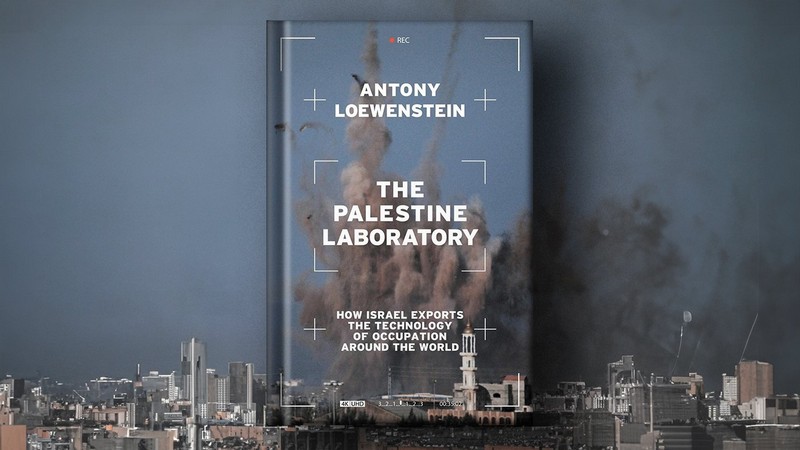
Anti-racist Jewish Australian writer Antony Loewenstein’s latest book “The Palestine Laboratory” describes how genocidally racist Apartheid Israel mercilessly uses high technology weapons, fences, and comprehensive surveillance to comprehensively control the 5.5 million sorely oppressed Occupied Palestinians, and how it exports this obscene technology of neo-Nazi occupation to countries around the World, from the EU and Anglosphere democracies to brutal dictatorships.
Antony Loewenstein’s chilling book “The Palestine Laboratory. How Israel exports the technology of occupation to the world” [1] is a horrifying dissection of violent and genocidal perversion in Occupied Palestine and the Developing World. This book is addressed to a wide audience who, because of sustained lying about Palestine by Western Mainstream journalist, editor, politician, academic, and commentariat presstitutes, are unaware of the awful dimensions of the ongoing, century-long Palestinian Genocide and gross human rights abuses in Palestine. The author, Antony Loewenstein, has an outstanding record as an anti-racist Jewish Australian writer of exposing the evils of Zionist settler-colonialism to the Mainstream.
Antony Loewenstein devotes this important book to demonstrating how high technology Israeli militarism, confinement, and highly invasive surveillance used against the subjugated Palestinians is being sold “pre-tested” around the world, and is increasingly impacting people from impoverished, strife-torn Global South military dictatorships to rich Global North democracies. This book should be in every school, university, institutional and state library around the world because it exposes a huge threat to all of Humanity, not just in vulnerable countries of the Global South but also to those in the rich democracies of the Global North.
Several years ago Danish writer, activist and publisher Soren Korsgaard warned of the looming menace of the Surveillance State and Digital Dictatorship [2, 3], but Information Technology (IT), Artificial Intelligence (AI), and high technology mass surveillance are presently making this already a global reality, with Quantum Computing advancing in the wings to potentially add quantum leaps to the computational power of AI. Rapidly advancing AI can deliver huge benefits for Humanity but there are well-grounded fears of IT and AI in the wrong hands, and indeed of rapidly evolving AI itself and of possible conscious and self-aware AI [4-9]. Fears of abuse of IT and AI have already become a horrible reality for 5.5 million Occupied Palestinians subject to high technology imprisonment and surveillance, and indeed for all Subjects of Apartheid Israel (over 50% being Indigenous Palestinians). Genocidally racist , neo-Nazi Apartheid Israel is now exporting high technology mass physical subjugation and mass surveillance across the World to “nice” countries and to brutal dictatorships alike. “We are all Palestinians” is transmuting from a noble statement of human rights solidarity to a worsening high technology mass surveillance reality for all of Humanity.
(A). Summary of the ongoing Palestinian Genocide and the appalling circumstances of the 15.5 million horribly abused Indigenous Palestinians.
Before reviewing the book in detail it is necessary to briefly summarize the appalling dimensions of Apartheid Israel’s ongoing, horrendous and utterly intolerable abuse of the Indigenous Palestinians. Unfortunately, for sensible focus reasons most of the following statistics were not presented in the book. They should be noted here because Western Mainstream media resolutely ignore these horrible realities that would simply not be tolerated if applied just for 1 day to nice, White folks in nice, rich, internally peaceful and democratic Western countries with all equal rights for all. The century-long and ongoing Palestinian Genocide (egregiously murderous anti-Arab anti-Semitism) has been associated with the following (for detailed and documented analyses see [10-27]) :
(a). In 1880 after 4 centuries under the benign Ottoman Caliphate there were 0.5 million Indigenous Palestinians in Palestine, 90% Muslim and 10% Christians, plus 25,000 Jews (half of them immigrants) [10].
(b). Due to racist UK-backed Zionist colonization after 1917, by 1948 there were about 2.0 million people in Palestine, 1.4 million being Indigenous Palestinians and 0.6 million being Jewish Zionist settlers, but in the 1948 Nakba (Catastrophe) 800,000 Palestinians (57% of the Indigenous Palestinian population) were expelled by the UK-backed, UK-armed and UK-trained Zionists, this being associated with 530 villages emptied, 70 massacres, 15,000 Palestinians killed, and Zionist seizure of 78% of Palestine. In the 1967 Naksa (Setback) the genocidally racist Zionists seized all of Palestine plus parts of Egypt, Lebanon, Jordan and Syria and expelled a further 400,000 Arabs [28, 29].
(c). Today of 15.5 million mostly impoverished Palestinians, about 7 million are Exiled Palestinians (illegally prevented from return to the land continuously inhabited by their forebears for millennia), 5.5 million Occupied Palestinians (3.3 million in the West Bank, and 2.2 million in the blockaded and bombed Gaza Concentration Camp, and all deprived of the human rights specified by the 30 Articles of the Universal Declaration of Human Rights under violent and highly abusive military occupation for 56 years), and 2.0 million Israeli Palestinians (able to vote for the government ruling them, albeit as Third Class citizens subject to 60 Nazi-style, race-based discriminatory laws, persecutions, exclusions, extensive home demolitions, and the endlessly publicly-repeated threat of mass ethnic cleansing) [10].
(d). The GDP per capita is a deadly $3,500 for Occupied Palestine versus $55,500 for Apartheid Israel [30]. About 44% of Occupied Palestinians are children and 70% are women and children. Israeli Apartheid involves massive abuse of children, mothers and women.
(e). Indigenous Palestinians represent over 50% of the Subjects of Apartheid Israel, and Jewish Israelis 47%, but the 5.5 million Occupied Palestinians (73% of the 7.5 million Indigenous Palestinian Subjects) cannot vote for the government ruling them i.e. they are subject to egregious Apartheid as recognized by major human rights groups, numerous eminent scholars, heroes in the fight against neo-Nazi Apartheid in South Africa, and billions of decent, informed people around the world [31-33].
(f.). The ongoing, century-long Palestinian Genocide (the term is not actually used in the book) has been associated with 2 mass population expulsion atrocities, about 0.1 million violent deaths and over 2 million avoidable deaths from violently-imposed deprivation since the British imperialists invaded the Middle East in 1914 for oil and imperial hegemony. The genocidal intent of the Zionist settler-colonial project has been clearly stated by Zionist leaders from genocidally psychopathic founder of Zionism, Theodor Herzl (“We shall try to spirit the penniless population across the border by procuring employment for it in the transit countries, while denying it employment in our country”) to present serial war criminal Israeli PM Benjamin Netanyahu (“Israel should have exploited the repression of the demonstrations in China, when world attention focused on that country, to carry out mass expulsions among the Arabs of the territories”). Total expulsion of the Indigenous Palestinians is presently publicly articulated by the racist psychopaths of the present far right, neo-Nazi Apartheid Israeli government [28, 29, 34].
(g). Presently the Zionists violently kill about 500 Palestinians each year, and a further 4,000 die avoidably each year from imposed deprivation (denial of proper shelter, sustenance and medical services in violation of the Fourth Geneva Convention). In the last 20 years about 10,000 Palestinians have been killed violently, scores of thousands have been wounded, and about 80,000 have died from imposed deprivation. In contrast, about 5,000 invading Zionists have been killed by Palestinians since 1920. In the last 20 years only about 50 Israelis have been killed by home-made Gaza rockets, whereas about 4,000 Israelis have been murdered by fellow Israelis. Terrorism is as terrorism does, but the violently racist West regards the mass murdering Zionists as civilized Europeans and the Indigenous Palestinians as “terrorists”, this being the justification for Apartheid Israel’s horrendous militarization, acquisition of 90 nuclear weapons and development of a deadly militarized economy [35].
(h). Not set out explicitly in “The Palestine Laboratory”, Apartheid Israel egregiously violates numerous International Laws and Conventions including the UN Charter, the UN Convention on the Prevention and Punishment of the Crime of Genocide (UN Genocide Convention), the Rights of the Child Convention (United Nations Convention on the Rights of the Child ), the UN Refugee Convention (the UN Convention Relating to the Status of Refugees), the Geneva Conventions, the International Criminal Court, the Declaration on the Rights of Indigenous People, the International Convention on the Suppression and Punishment of the Crime of Apartheid, the Treaty on the Prohibition of Nuclear Weapons (TPNW), the International Covenant on Civil and Political Rights, numerous UNGA and UNSC Resolutions, the Universal Declaration of Human Rights, the International Convention on the Elimination of All Forms of Racial Discrimination, the 1926 Slavery Convention or the Convention to Suppress the Slave Trade and Slavery, the 2015 Paris Climate Agreement, and numerous UNGA and UNSC Resolutions [10].
(i). In particular and further to (h) above, Apartheid Israel grossly violates Articles 55 and 56 of the Fourth Geneva Convention that demand that an Occupier is obliged to provide its Conquered Subjects with life-sustaining food and medical requisites “to the fullest extent of the means available to it” [36]. While Apartheid Israel prospers hugely from the export of highly advanced killing, imprisoning and surveillance technology, it deliberately keeps 5.5 million Occupied Palestinians at a deadly level of bare existence that passively kills about 4,000 Occupied Palestinians each year [10].
(j) Finally, the Elephant in the Room reality not mentioned in “The Palestine Laboratory” is that the Ashkenazi Jews (Eastern European Jews) who run all of Israel/Palestine (and US foreign policy) descend from non-Semitic, Turkic Khazar converts to Judaism in abut the 8th- 9th centuries CE. Indeed I come from a very famous Ashkenazi Jewish Hungarian family (ask any surgeon or mathematician) but DNA analysis says that it was overwhelmingly Ashkenazi Jewish with zero Middle Eastern (i.e. zero Semitic) contribution. Indeed the genetic descendants today of the Jewish and non-Jewish Palestinians at the time of Jesus are the sorely oppressed Indigenous Palestinians, whereas most Jewish Israelis descend from Khazar, Berber and Yemeni converts to Judaism in the first millennium CE [37-45]. The Ashkenazi Jewish history is real and variously rich and tragic but the claim of the genocidally racist Zionists to Palestine is religious fantasy transmuted into genocidally racist neo-Nazi settler-colonialism after the fashion of 16th – 20th century genocidal Western settler-colonialism .
(B). Detailed analysis of “The Palestine Laboratory”.
Numbers matter and hopefully the above summary will fill out the quantitative dimension of the ongoing Zionist atrocity in Palestine that is largely absent from “The Palestine Laboratory”. In the following brief summation of the various chapters of the book I will concentrate on the numbers.
The Introduction outlines the major themes in the book and Zionist militarization from the time of the Indigenous Palestinian rebellion in the 1930s (not mentioned in the book is that in the1930s Arab Revolt 10% of the adult male Palestinians were killed by the British and by British-armed and British-trained Zionist terrorist militias [46-48]). The extraordinary silence of the West over the horrendous ethnic cleansing and subjugation of the Palestinians derives from Zionist subversion and perversion of the West that is dominated by Zionist-subverted America. Further, neo-Nazi Apartheid Israel egregiously censors media. Thus Loewenstein: “All media outlets in Israel, along with publishers and authors, must submit stories related to foreign affairs and security to the Israeli Defense Force (IDF) chief military censor before publication” (p3 [1]).
The Introduction sketches key issues such as (a) increasing Jewish acknowledgment of Israeli Apartheid, (b) huge Israeli sales of state-of-the-art war, control and surveillance technology (pre-tested on Palestinians) to dictatorships and amoral democracies around the world, and (c) the fervent pro-Zionism of the Zionist-subverted, US-dominated West and of White Supremacist neo-Nazis. No doubt cognizant of its wider audience and the requirement for “respectful conversation” (self-censorship) in the West, the book stops short of declaring the horrible reality that Zionism is genocidal racism and Nazism without gas chambers and industrial mass murder but with mass population expulsions, active and passive large-scale killing, and comprehensive subjugation of the Indigenous Palestinians population by one of the world’s biggest high technology militaries [35] with about 90 nuclear weapons and delivery systems. Also missing from the book is the plight of about 7 million Exiled Palestinians forbidden on pain of death from returning to the Land continuously inhabited by their forebears to the very dawn of the Agrarian Revolution 10,000 years ago.
Chapter 1 , “Selling Weapons to Anybody Who Wants Them”, details how the high technology Israeli arms industry from the 1930s onwards has advanced from use in the genocide and subjugation of Palestine and repeated defeat of its impoverished neighbours to huge global sales of high technology military weapons (drones, missiles, anti-missiles, guns, warships, planes and ordnance) to the West and to dictatorships in the Global South. Apartheid Israel (variously independently or as a dirty tricks agent of the US) has been variously assisting horrendous and genocidal military violence in many countries including Chile, Colombia, Guatemala (the Mayan Indian Genocide), Iran (under the Shah) , Indonesia (under Suharto), Romania (under Ceausescu), Haiti (under Duvalier), Paraguay (an unsuccessful scheme to get rid of Gaza Palestinians), Argentina, Lebanon, Afghanistan, Nicaragua (the Iran Contra Affair), Sudan and South Sudan (civil wars), Myanmar (Rohingya Genocide) and Sri Lanka (Tamil Genocide) and elsewhere in Central America, Africa and Asia [49]. Loewenstein: “The sheer number of dictatorships with whom Israel has had relations is staggering (p34 [1]). Loewenstein details later in the book Israeli involvement in the Sudan, South Sudan, the Myanmar Rohingya Genocide and the Sri Lankan Tamil Genocide.
The horrendous “Body Count” of deaths from violence and war-imposed deprivation in the “death zones” of the Global South is missing from the book (that is after all to be mostly read by squeamish, personally gentle Western folk). Thus as estimated in 2007 avoidable deaths totalled 24 million (1950-2005) in countries variously occupied by Apartheid Israel (Egypt, Palestine, Jordan, Lebanon and Syria) [24], a huge total that puts Apartheid Israel into the Nazi Germany category of evil [21]. Of course these terrible realities are resolutely not reported in the ostensibly democratic but neo-Nazi, racist and pro-Zionist West, and any criticisms of Apartheid Israel by anti-racist Jews and non-Jews alike are falsely labelled “anti-Semitic” by the endlessly mendacious Zionists and their racist supporters.
Chapter 2, “September 11 was Good for Business”, shows how from the 1990s onward “Israel moved to become more militarily autonomous from Washington” (p45 [1]). What is not stated is that since Israeli acquisition of nuclear weapons (with US, UK and French help) by the middle 1960s, the US became progressively more Zionist beholden. Indeed today 30% of the Biden Administration are Jewish Zionists and the remainder are “moderate” Christian Zionists (as opposed to the fanatical, Biblical literalist Pentecostal Christian Zionist Trump supporters) [50]. The only strong opponents in Congress of Apartheid Israel’s war criminal excesses are the 6 members of the so-called Squad of decent, anti-racist Democrat women. Nevertheless neo-Nazi Apartheid Israel went from US aid being 10% of the economy in 1981 to about $4 billion or about 1% of the economy by 2020 (p46 [1]). The Israeli economy increasingly involved military and surveillance technologies. Through supply of modern weapons Apartheid Israel was involved in the 1994 onwards Rwandan Genocide (1 million Rwandans massacred) , the Colombian civil war, and dictatorship in Equatorial Guinea. The Apartheid Israeli economy was increasingly involved in cyber technology. Israel company Any Vision developed a system for mass surveillance of Palestinians, and now operates in over 40 countries, including Russia, China (Hong Kong), and the US (p63 [1]).
Of course as a Western Mainstream-published book nothing is said about almost certain US involvement (and hence very likely Israeli involvement) in the 9/11 atrocity (3,000 mostly Americans killed) that was used as the “excuse” for the US Alliance to invade the Muslim World from Libya to the Philippines in the US War on Terror. It was estimated in 2015 that 32 million Muslims died from violence (5 million) and deprivation (27 million) in 20 countries invaded by the neo-Nazi US Alliance since the US Government’s 9/11 false flag atrocity [51, 52]. Numerous science, engineering, architecture, aviation, military and intelligence experts have concluded that the US Government did 9/11 with some arguing for Israeli involvement. Critical evidence for this alternative hypothesis to the lying Bush “official US version of 9/11” (the US version is accepted by only a minority of Humanity) is the endless mendacity of US and Israeli governments, low temperature fires in the Twin Towers, the sheer implausibility that men barely trained on single-engine light aircraft could fly passenger jets into precise building targets, and the rapid collapse of 3 skyscrapers (in about 10 seconds in “perfect” examples of explosive demolition). Indeed application of the latest chemical physics technologies has revealed unexploded nanothermite high explosive in the World Trade Center (WTC) dust. Further, US engineers have reported that the collapse of WTC Building 7 (WTC7) was due to simultaneous loss of all key structural support elements (i.e. due to explosive demolition). The closest the US Government has come to recognition of the Big Lie has been former President Donald Trump and former Vice President Al Gore roundly condemning the huge intelligence failure that enabled 9/11 to happen [52-59].
Loewenstein does report on how 9/11 enormously helped the Israeli war business. Israeli PM Netanyahu questioned about 9/11 on US TV stated: “It’s very good,. Well, not very good, but it will generate immediate sympathy” (p48 [1]). The Zionist-subverted West continues to swallow the lying Bush “official US version of 9/11” and ignores the stark difference between about 3,000 Americans killed on 9/11 and over 30 million Muslims killed in the ongoing US War on Terror (aka the US War on Muslims) [51, 52]. Loewenstein: “In 2020, Israel spent US$22 billion on its military and was the twelfth biggest military supplier in the world, with sales of more than US$345 million” (p51 [1]). However he also states: “Global public opinion in the US toward Israel has taken a nosedive since 2001… 34 per cent of [US] Jews agreed that “Israel’s treatment of Palestinians is similar to racism in the United States”, 25 per cent agreed that “Israel is an apartheid state”, and 22 per cent agreed that “Israel is committing genocide against the Palestinians” (p51 [1]). Loewenstein concludes that “Israel has thus fully embraced the “war on terror” and richly profited from it” (p52 [1]), and describes key Israeli involvement in the Sri Lankan Tamil Genocide, the Rwandan Genocide, the Myanmar Rohingya Genocide, the South Sudan civil war, and violent despotism in Equatorial Guinea (pp 52-54 [1]).
Finally Loewenstein describes extraordinarily extensive use of facial recognition technology that has made the Occupied Palestinians electronic prisoners of Apartheid Israel. And now this Israeli technology is being sold to neo-Nazi regimes and ostensible democracies alike across the World.
Chapter 3, “Preventing an Outbreak of Peace”, commences with a description of horrible sophisticated electronic targeting of Palestinians so that “Killing or injuring Palestinians should be as easy as ordering a pizza” (p61 [1]). It goes on to describe the genocidal racism of Israeli leaders and the succession of mass expulsions, Gaza massacres, and proposed total ethnic cleansing of Indigenous Palestinians (for an alphabetically-organized compendium of genocidal Zionist statements over 130 years see [34]). Loewenstein describes the chilling Israeli Unit 8200 involved in highly intrusive mass surveillance of Occupied Palestinians. The information garnered includes information on illicit affairs and homosexuality that is used to blackmail Palestinians into collaboration with the neo-Nazi Occupiers. This technology is being sold to the World – and thus we are all becoming Palestinians.
Loewenstein: “The Covid-19 pandemic was the perfect opportunity for Israeli surveillance firms to attract business; arresting the spread of the disease required effective contact tracing and Israeli companies promoted themselves as the best in the world” (p91 [1]). However Orthodox Jews objected to control measures, this resulting in the community of Bnei Brek being sealed off. Loewenstein comments: “For some sections of the Israeli public there’s more hatred towards Orthodox communities than Palestinians (p96 [1]). Not mentioned in the book is that true Orthodox Judaism is intrinsically anti-Zionist by holding that Jews cannot return to Zion (Jerusalem) until the Messiah arrives to declare the glory of the Lord to the whole world [60].
Chapter 4, “Selling Israeli Occupation to the World”, describes the horrible use of Israeli technology to keep Africans out of Israel (by a high technology fence along the Israel-Egypt border) and to keep desperate refugees from reaching Europe (by Israeli drones used by the EU Frontier agency for locating but then ignoring refugees headed for the neo-Nazi EU and who thence drowned at sea). Loewenstein: “[Humanitarian] Sea-Watch cannot compete with this surveillance capability and is woefully outmatched by the Frontier infrastructure” (p100 [1]). Loewenstein castigates cooperation between Greece and the EU in general in this obscene and deadly violation of refugee human rights.
Loewenstein takes a disturbing look at Germany-Israel relations. Apparently driven by guilt over the WW2 Jewish Holocaust (but probably also driven by innate racism and neo-Nazism as reflected in election results) German reparations enabled the militarization of Apartheid Israel. Germany buys Israeli weaponry pre-tested on Occupied Palestinians, and German authorities are threatening and censoring anti-racist public demonstrations in favour of Palestinian human rights. Germany supplied Apartheid Israel with 6 submarines as launch vehicles for Israeli nuclear weapons. Germany and all the nations that collaborated with Nazi Germany in WW2 belong to the anti-Semitic and holocaust-denying International Holocaust Remembrance Alliance (IHRA). The IHRA is anti-Jewish anti-Semitic and anti-Arab anti-Semitic (by falsely defaming anti-racist Jewish, Palestinian, Arab and Muslim critics of Apartheid Israel as anti-Semitic) and holocaust ignoring (by ignoring all WW2 holocausts other than the WW2 Jewish Holocaust (5-6 million deaths), and indeed ignoring some 70 holocaust and genocide atrocities. The WW2 holocausts ignored by the IHRA include (deaths from violence and deprivation in brackets) the WW2 Polish Holocaust (6 million), the European Holocaust (30 million Slavs, Jews and Gypsies killed by the German Nazis), the Soviet Holocaust (27 million killed by the Nazis), the WW2 Chinese Holocaust (35-40 million Chinese killed under the Japanese), and the WW2 Bengali Holocaust (WW2 Indian Holocaust, WW2 Bengal Famine; 6-7 million Indians deliberately starved to death for strategic reasons by the British with food-denying Australian complicity) [24-26]. All but 3 IHRA member countries shockingly voted No to the annual UNGA Anti-Nazi Resolution in 2022 that condemns Nazism, neo-Nazism and related racist obscenities [45].
This chapter concludes with a disturbing account of rising anti-Jewish anti-Semitism in Europe, in addition to the horrendously deadly, post-9/11, hysteria-driven US Islamophobia (anti-Arab anti-Semitism). One must reiterate what the Zionist-subverted Western Mainstream ignores, that while Palestinians and Arabs are ethnically Semitic, the dominant European Ashkenazi Jews (such as myself) are not Semitic and derive from non-Semitic Turkic Khazar converts to Judaism in about the 8th – 9th centuries CE [37-44].
Chapter 5, “The Enduring Appeal of Israeli Domination”, describes initial African support for an independent Israel, and how this has dramatically changed since 1990 as the genocidal racism of Apartheid Israel and its Western backers became increasingly apparent. Genocidally racist Apartheid Israel found an ideological, ethnonationalist partner in Apartheid South Africa. Neo-Nazi Afrikaaner White Supremacists had been imprisoned during WW2 for Nazi sympathies but in 1948 their National Party was elected (Whites only suffrage) and began installing neo-Nazi Apartheid. Apartheid Israel assisted Apartheid South Africa creating an arms industry, developing nuclear weapons, and overcoming global anti-Apartheid sanctions [24]. The book admits that South Africa permitted Apartheid Israel to test nuclear weapons but incorrectly implies that South Africa did not actually acquire nuclear weapons. South Africa acquired 6 nuclear bombs but eventually dismantled them after the fall of Apartheid. The architect of South African Apartheid, Dr Hendrik Verwoerd, declared (1961): “Israel, like South Africa, is an apartheid state” [61, 62]. Neo-Nazi Apartheid Israel was involved with Apartheid South African Bantustans and has applied the same model to check-point entry and exit West Bank “Bantustans” and the bombed and blockaded Gaza Concentration Camp [63].
While India under Congress lead the non-aligned and socialist world in boycotting and sanctioning Apartheid South Africa (and banned Israel arms sales over corruption issues), under the right-wing and Hindu nationalist Bharatya Janata Party (BJP; Indian People’s Party) led by Narendra Modi Indian ethnonationalism and Islamophobia have found a common party with ethnonationalist and anti-Arab anti-Semitic Apartheid Israel and Zionism. India is applying harsh Israeli tactics and technology to disputed Kashmir.
In relation to China, Loewenstein comments: “Chinese ethno-authoritarianism scares the West” (p133 [1]) and quotes Human Rights Watch’s comparisons between the Occupied Palestinians and the 12 million Uyghurs in Xinjiang (about half the population). However while China has been heavy-handed in Xinjiang to prevent disastrous insurgency, claims by the serial war criminal and genocidal US Alliance of a “Uyghur Genocide” are utterly false and utterly hypocritical when one considers the horrendous ethnic cleansing of Palestine. Loewenstein’s analysis of Xinjiang is flawed and derives from a US-imposed Mainstream Western anti-China stance. Indeed the health and education statistics for Xinjiang and Tibet are vastly better than in neighbouring Afghanistan that suffered 20 years of US-imposed war and in which avoidable deaths from deprivation in 2001-2021 totalled an appalling 6 million, evidence of horrendous violation of Articles 55 and 56 of the Fourth Geneva Convention by the neo-Nazi and war-criminal US Alliance [24-27, 64-66]. China supports human rights for Palestinians that are denied by US-, Australia-, UK- and EU-backed Apartheid Israel. Loewenstein asks: “But if Chinese technology and its ideology is a threat [to] the world, why is [Apartheid] Israel not viewed in the same way?” (p135 [1]).
Loewenstein also writes about the US-Mexico border as a major site of Israeli security and surveillance companies employing technologies also used against the Occupied Palestinians. This has been associated with a huge spike in refugee deaths at the border (p137 [1]), with this also impacting Indigenous Americans. Loewenstein: “Over seven thousand bodies have been found on the US/Mexico border since the 1990s” (p137 [1]) and “It was therefore not surprising that autonomous surveillance robots started appearing on both the Israel/Gaza border and the US/Mexico border in 2021 and 2022” (p141 [1]).
Chapter 6, “Israeli Mass Surveillance in the Brain of Your Phone”, deals with the Israeli NGO Pegasus spyware system that can hack into mobile phones, spy on conversations and even insert material enabling criminal prosecution of the innocent users. Loewenstein states: “Israel’s surveillance apparatus is a competitor and ally of Washington’s National Security Agency (NSA), the most powerful eavesdropping network in the world. While outmatched in terms of manpower, Israel has a long history of spying on its closest ally, a fact that does not appear to bother the superpower” (p143 [1]). Israeli Pegasus and similar systems have been used to identify, arrest, torture and kill dissidents in the Middle East and is being adopted by India and indeed throughout the world. Another Israeli company Celebrite is widely used around the world to target political opponents and activists. Israeli Black Cube is an espionage-for-hire system being used in Africa, Europe and the US. Apartheid Israel has monetized the imprisonment and surveillance technology oppressing 5.5 million Occupied Palestinians by selling these systems to democracies and dictatorships alike around the World. Thanks to neo-Nazi Apartheid Israel the total control, galactic fascist state of the BBC outer space science fiction TV series “Blake’s 7” is well on the way to being realized on Earth [67].
Chapter 7, “Social Media Companies Don’t like Palestinians”, describes how US media giants like Google, Twitter (now X), YouTube, and Facebook censor material critical of neo-Nazi Apartheid Israel. Notwithstanding the freedom of speech First Amendment of the US Constitution (that permits flagrant religion-based lying to children i.e. massive intellectual child abuse), Facebook has over 15,000 content moderators (censors). The examples given in the this chapter suggest that criticism of Israeli Apartheid, including that by a growing number of anti-racist Jews, is being falsely regarded as “hate speech” and “anti-Semitism”, the 2 favourite canards of the genocidally racist and remorselessly mendacious neo-Nazi Zionists (Zionazis).
Not quoted in the book, the CEO of YouTube boasted of having diverted 70% of viewers away from “concerning sites” to “approved sites” [2, 3]. The World Socialist Web Site (WSWS) has reported that Google (or the Google-directed robot) greatly reduced the visibility of socialist articles on Google Searches, noting that about 95% of searchers don’t bother going beyond the first 20 search results [68]. Bing Searches are vastly better, and hence people are advised to “Bing it!” [69-71]. All this is very daunting. On a personal note, I found that a Wikipedia entry about me was removed (notwithstanding that I have authored 8 huge books, and hundreds of carefully researched humanitarian articles, as well as over 100 scientific papers in a half-century scientific career). I was recently removed from Twitter (X). A resolute critic of the appalling crimes against Humanity by Apartheid Israel, I have found that that some of my key articles have effectively disappeared from Google Searches by being relegated well down in the search results. In the last dozen years I have been falsely defamed by Zionists and coincidentally effectively removed from Mainstream visibility in Zionist-subverted and Zionist-perverted Australia.
A detailed 2018 analysis of major media companies found that a significant part of the explanation for huge Zionist media censorship is that the American 60% of the world’s 30 biggest media companies have a disproportionately high Jewish Board membership. Jews and females represent 2% and 51%, respectively, of the US population but average 33% and 19%, respectively, of Board members of the top 18 US media companies. It is a reasonable assumption that extremely wealthy Jews would be very likely to be pro-Zionist, in contrast to poor Jews or modestly prosperous intellectual Jews who would be more likely in comparison to be anti-racist and thus anti-Zionist. By way of comparison with Alphabet (owner of Google) that is #1 in the global Mainstream media, Microsoft ($4.58 billion annual revenue) is #17 in the world Mainstream media. Among other things Microsoft owns the search engine Bing and has an 18% Jewish Board and an 18% female Board as compared to a 46% Jewish Board and 23% female Board for Alphabet. However a notable difference is that Bing Searches reveal humane websites variously rendered effectively invisible by Google [71].
These astounding disparities were not in the book. However Loewenstein notes that Facebook established an Oversight Board that “included Emi Palmor, the former director general of Israel’s [In]Justice Ministry. Palestinians are not currently represented on the Board” (p202 [1]). Further, Loewenstein notes the rightful Western indignation over the war criminal Russian invasion of Ukraine as compared to the massive Western silence over the US-backed Apartheid Israeli invasion and 56-year subjugation of the Occupied Palestinians (and indeed the US invasion of over 50 countries since the defeat of German Nazism in 1945 [72-79]).
The Conclusion of the book comments that “The worst-case scenario, long-feared but never [totally] realized, is ethnic cleansing against occupied Palestinians or population transfer, forcible expulsion under guise of national security” (page 211 [1]). This mass expulsion has been explicitly advocated by Zionist leaders from Theodor Herzl (the genocidally racist founder of Zionism) to present Apartheid Israeli PM Benjamin Netanyahu and his genocidally racist and fascist colleagues today (for a catalogue of appalling genocidal Zionist statements see [34]). 2 mass expulsions have already occurred (800,000 in 1948 and 400,000 in 1967). Indeed Tom Pickering, a former US ambassador to Apartheid Israel and the UN, has predicted eventual complete ethnic cleansing of the Occupied Palestinian Territories [34].
Only the presently racist West recovering some semblance of decency and supporting Indigenous Palestinian human rights can stop such further genocidal atrocities. Indeed in so doing the West can also protect itself from the ongoing subversion and perversion by the neo-Nazi Zionist state and its traitorous and racist supporters. One notes that Australia is second only to the US as a supporter of Apartheid Israel but there is egregious violation of Australians, Australian institutions and Australia by Apartheid Israel and its traitorous agents [80, 81]. Thus, for example, the US supplies raw intelligence on Australians to Apartheid Israel [82], and the Zionist-subverted and US lackey Australian Labor Government has an extraordinary record of egregious and blatant lying in support of Apartheid Israel [83].
Final comments.
Antony Loewenstein’s “The Palestine Laboratory” is a powerful and humane book that should be in every library. Anti-Apartheid and world hero Nelson Mandela famously stated that “The UN took a strong stand against apartheid; and over the years, an international consensus was built, which helped to bring an end to this iniquitous system. But we know too well that our freedom is incomplete without the freedom of the Palestinians” [33]. “The Palestine Laboratory” describes how Apartheid Israel is hugely profiting by exporting the high technology instruments of violent subjugation, mass incarceration and surveillance to the rest of the world. We are all set to become Palestinians.
What can decent people do? Decent people must (a) inform everyone they can (reading “The Palestine Laboratory” would be a useful start), (b) urge and apply Boycotts Divestment and Sanctions (BDS) against Apartheid Israel and all people, politicians, parties, collectives, corporations and countries supporting Apartheid Israel (and hence the vile crime of Apartheid), and (c) expose and oppose the globally entrenching Surveillance State that is remorselessly expanding based on technology pre-tested upon Indigenous Palestinians in neo-Nazi Apartheid Israel’s “Palestine Laboratory”.
References.
[1]. Antony Loewenstein, “The Palestine Laboratory. How Israel exports the technology of occupation to the world”, Scribe 2023.
[2]. Soren Korsgaard , “One World Digital Dictatorship”, Crime & Power, 5 January 2020: https://www.crimeandpower.com/2020/01/05/one-world-digital-dictatorship/ .
[3]. Gideon Polya, “Review: “One World Digital Dictatorship” by Soren Korsgaard – Digital Nightmare”, Countercurrents, 23 January 2020: https://countercurrents.org/2020/01/review-one-world-digital-dictatorship-by-soren-korsgaard-digital-nightmare/ .
[4]. Yuval Noah Harari, “Homo Deus. A brief history of tomorrow”, Vintage, London, 2017.
[5]. Gideon Polya, “Review: “Homo Deus” By Yuval Harari – Palestinian Genocide & Climate Genocide Ignored”, Countercurrents, 6 November 2021: https://countercurrents.org/2019/11/review-homo-deus-by-yuval-harari-palestinian-genocide-climate-genocide-ignored/ .
[6]. Max Tegmark, “Life 3.0. Being Human in the Age of Artificial Intelligence”, Penguin, 2017.
[7]. Stanislas Dehaene, Hakwan Lau and Sid Kouider, “What is consciousness , and could machines have it?”, Science, Vol. 358, Issue 6362, pp. 486-492, 27 October 2017: https://science.sciencemag.org/content/358/6362/486.full .
[8]. “Artificial Intelligence. A selection of our stories on AI”, The Economist: https://www.economist.com/artificial-intelligence .
[9]. “How to worry wisely about Artificial Intelligence”, The Economist, 22 April 2023: https://www.economist.com/leaders/2023/04/20/how-to-worry-wisely-about-artificial-intelligence .
[10]. Gideon Polya, “Australia must stop Zionist subversion and join the World in comprehensive Boycotts, Divestment and Sanctions (BDS) against Apartheid Israel and all its supporters”, Subversion of Australia, 15 April 2021: https://sites.google.com/site/subversionofaustralia/2021-04-15 .
[11]. “The genocide of the Palestinian people: an international law and human rights perspective”, Center for Constitutional Rights, 25 August 2016: https://ccrjustice.org/genocide-palestinian-people-international-law-and-human-rights-perspective
[12]. Gideon Polya, “Refutation Of Mainstream-Accepted Racist Zionist Lies Behind Israel ‘s Gaza Massacres And Palestinian Genocide”, Countercurrents, 26 July, 2014: https://www.countercurrents.org/polya260714.htm .
[13]. Gideon Polya, “Israeli-Palestinian & Middle East conflict – from oil to climate genocide”, Countercurrents, 21 August 2017: https://countercurrents.org/2017/08/21/israeli-palestinian-middle-east-conflict-from-oil-to-climate-genocide/ .
[14]. Gideon Polya, “End 50 Years Of Genocidal Occupation & Human Rights Abuse By US-Backed Apartheid Israel”, Countercurrents, 9 June 2017: https://countercurrents.org/2017/06/09/end-50-years-of-genocidal-occupation-human-rights-abuse-by-us-backed-apartheid-israel/ .
[15]. Gideon Polya, “Universal Declaration of Human Rights & Palestinians. Apartheid Israel violates ALL Palestinian Human Rights”, Palestine Genocide Essays, 24 January 2009: https://sites.google.com/site/palestinegenocideessays/universal-declaration-of-human-rights-palestinians .
[16]. Gideon Polya, “70th anniversary of Apartheid Israel & commencement of large-scale Palestinian Genocide”, Countercurrents, 11 May 2018: https://countercurrents.org/2018/05/11/70th-anniversary-of-apartheid-israel-commencement-of-large-scale-palestinian-genocide/ .
[17]. Gideon Polya, “Apartheid Israel’s Palestinian Genocide & Australia’s Aboriginal Genocide compared”, Countercurrents, 20 February 2018: https://countercurrents.org/2018/02/20/apartheid-israels-palestinian-genocide-australias-aboriginal-genocide-compared/ .
[18]. Gideon Polya, “Israelis kill 10 times more Israelis in Apartheid Israel than do terrorists”, Countercurrents, 1 March 2017: https://countercurrents.org/2017/03/01/israelis-kill-ten-times-more-israelis-in-apartheid-israel-than-do-terrorists/ .
[19]. Gideon Polya, “Israeli Jewish Nation-State Law enshrines Apartheid and genocidal racism”, Countercurrents, 24 July 2018: https://countercurrents.org/2018/07/24/israeli-jewish-nation-state-law-enshrines-apartheid-and-genocidal-racism/ .
[20]. Gideon Polya, “Submission To National Anti-Corruption Commission: Australian Labor Government’s Lying For Apartheid Israel”, Countercurrents, 22 July 2023: https://countercurrents.org/2023/07/submission-to-national-anti-corruption-commission-australian-labor-governments-lying-for-apartheid-israel/ .
[21]. Gideon Polya, “A Shocking List of 52 Zionist- & Apartheid Israeli-Nazi Germany Comparisons”, Countercurrents, 7 August 2021: https://countercurrents.org/2021/08/a-shocking-list-of-52-zionist-apartheid-israeli-nazi-germany-comparisons/ .
[22]. Gideon Polya, “Review: “The Plight Of The Palestinians. A Long History Of Destruction”, Countercurrents, 17 June, 2012: https://countercurrents.org/polya170612.htm .
[23]. William A. Cook , editor, “The Plight of the Palestinians. A Long History of Destruction”, Palgrave Macmillan, London , 2010.
[24]. . Gideon Polya, “Body Count. Global avoidable mortality since 1950”, Korsgaard Publishing, Germany, 2020.
[25]. Gideon Polya, “Jane Austen and the Black Hole of British History. Colonial rapacity, holocaust denial and the crisis in biological sustainability”, 3rd edition Korsgaard Publishing, Germany, 2022.
[26]. Gideon Polya, “US-imposed Post-9/11 Muslim Holocaust & Muslim Genocide”, Korsgaard Publishing, Germany, 2020.
[27]. Gideon Polya in Soren Korsgaard, editor, “The Most Dangerous Book Ever Published: Deadly Deception Exposed”, Korsgaard Publishing, Germany, 272020.
[28]. “Palestinian Genocide”: https://sites.google.com/site/palestiniangenocide/ .
[29]. “2023, 75th Nakba Anniversary: 1948 Nakba (Catastrophe) & Palestinian Genocide”: https://sites.google.com/site/palestiniangenocide/1948-nakba-catastrophe-palestinian-genocide .
[30]. “List of countries by GDP (nominal) per capita”, Wikipedia: https://en.wikipedia.org/wiki/List_of_countries_by_GDP_(nominal)_per_capita .
[31]. BDS – Boycott Apartheid Israel: https://sites.google.com/view/bdsopinions/home .
[32]. “Jews Against Racist Zionism”: https://sites.google.com/site/jewsagainstracistzionism/ .
[33]. “Non-Jews Against Racist Zionism”: https://sites.google.com/site/nonjewsagainstracistzionism/ .
[34]. “Zionist quotes re racism and Palestinian Genocide”, Palestinian Genocide : https://sites.google.com/site/palestiniangenocide/zionist-quotes .
[35]. Gideon Polya, “Apartheid Israel Among World’s Leading Countries For Militarization, Violence, Abuse And Genocide”, Countercurrents, 16 May 2023: https://countercurrents.org/2023/05/apartheid-israel-among-worlds-leading-countries-for-militarization-violence-abuse-and-genocide/ .
[36]. “Fourth Geneva Convention”: https://www.un.org/en/genocideprevention/documents/atrocity-crimes/Doc.33_GC-IV-EN.pdf .
[37]. “Khazars”, McGill: https://cs.mcgill.ca/~rwest/wikispeedia/wpcd/wp/k/Khazars.htm .
[38]. Palestine Maps, “Jews of Khazaria, brief history and other resources”: https://www.palestineremembered.com/Acre/Maps/Story800.html .
[39]. Gideon Polya, “Refutation Of Mainstream –Accepted Racist Zionist Lies Behind Israel ‘s Gaza Massacres And Palestinian Genocide”, Countercurrents, 26 July 2014: https://www.countercurrents.org/polya260714.htm .
[40]. Eran Elhaik,”Ashkenazic Jews’ mysterious origins unravelled by scientists thanks to ancient DNA”, The Conversation, 5 September 2018: https://theconversation.com/ashkenazic-jews-mysterious-origins-unravelled-by-scientists-thanks-to-ancient-dna-97962 .
[41]. Eran Elhaik, “Uncovering ancient Ashkenaz – the birthplace of Yiddish speakers”, The Conversation, 6 May 2016: https://theconversation.com/uncovering-ancient-ashkenaz-the-birthplace-of-yiddish-speakers-58355 .
[42]. Arthur Koestler, “The Thirteenth Tribe: The Khazar Empire and its Heritage”, Hutchinson, 1976.
[43]. Shlomo Sand, “The Invention of the Jewish People”, Verso, London, 2009.
[44]. Marta D. Costa et al, “A substantial prehistoric European ancestry amongst Ashkenazi maternal lineages”, Nature, 2013: http://www.nature.com/ncomms/2013/131008/ncomms3543/full/ncomms3543.html .
[45].Gideon Polya, “Melbourne University Adopts Anti-Semitic & Holocaust-Ignoring IHRA Definition Of Anti-Semitism”, Countercurrents, 5 February 2023: https://countercurrents.org/2023/02/melbourne-university-adopts-anti-semitic-holocaust-ignoring-ihra-definition-of-anti-semitism/ .
[46]. “Gideon Goes To War: The Story of Major-General Orde C. Wingate”, Scribner, 1955.,
[47]. Gordon Thomas, “Gideon’s Spies. The Secret History of the Mossad”, Pan Books, 1999.
[48]. “The Palestinian Arab Revolt, 1936-1939”, The Palestinian History Tapestry: https://www.palestinianhistorytapestry.org/tapestry/0450-kuyffiyeh-1936-arab-revolt/ .
[49]. Apartheid Israeli state terrorism: (A) individuals exposing Apartheid Israeli state terrorism, and (B) countries subject to Apartheid Israeli state terrorism”: https://sites.google.com/site/palestiniangenocide/apartheid-israeli-state-terrorism .
[50]. Gideon Polya, “Zionist-subverted America: Jewish Zionists Are One Third Of The Biden Cabinet”, Countercurrents, 27 January 2022: https://countercurrents.org/2022/01/zionist-subverted-america-jewish-zionists-are-one-third-of-the-biden-cabinet/ .
[51]. Gideon Polya, “Paris Atrocity Context: 27 Million Muslim Avoidable Deaths From Imposed Deprivation In 20 Countries Violated By US Alliance Since 9-11”, Countercurrents, 22 November, 2015: http://www.countercurrents.org/polya221115.htm .
[52]. “Experts: US did 9-11”: https://sites.google.com/site/expertsusdid911/ .
[53]. Gideon Polya, “Lying Mainstream Media Ignore Expert New 9/11 WTC7 Demolition Report”, Countercurrents, 22 August 2022: https://countercurrents.org/2020/08/lying-mainstream-media-ignore-expert-new-9-11-wtc7-demolition-report/ .
[54]. Dr. J. Leroy Hulsey, Dr. Zhili Quan, and Professor Feng Xiao (Institute of Northern Engineering, University of Alaska Fairbanks) , Final Report. “A structural reevaluation of the collapse of World Trade Center 7”, March 2020: https://files.wtc7report.org/file/public-download/A-Structural-Reevaluation-of-the-Collapse-of-World-Trade-Center-7-March2020.pdf .
[55]. Feng Xiao and Zhili Quan, “A structural reevaluation of the collapse of World Trade Center 7”, Institute of Northern Engineering, University of Alaska Fairbanks, March 2020: http://ine.uaf.edu/wtc7 .
[56]. David Ray Griffin, “The Mysterious Collapse of World Trade Center 7: Why the Final Official Report about 9/11 is Unscientific and False”, Olive Branch Press, 2012: https://www.amazon.com.au/Mysterious-Collapse-World-Trade-Center-ebook/dp/B00APDAZZ2 .
[57]. 911Truth.org, “The 40 top reasons to doubt the official story”, 911Truth.org, 16 May 2006: http://www.911truth.org/the-top-40-reasons-to-doubt-the-offical-story/ .
[58]. Niels H. Harrit, Jeffrey Farrer, Steven E. Jones, Kevin R. Ryan, Frank M. Legge, Daniel Farnsworth, Gregg Roberts, James R. Gourley, Bradley R. Larsen, “Active Thermitic Material Discovered in Dust from the 9/11 World Trade Center [32].
[59]. Paul Craig Roberts, “9/11: finally the truth comes out?”, Foreign Policy Journal, 4 January 2019: https://www.foreignpolicyjournal.com/2019/01/04/9-11-finally-the-truth-comes-out/ . Catastrophe, The Open Chemical Physics Journals, vol.2, pp.7-31 (25), 2009: http://www.bentham-open.org/pages/content.php?TOCPJ/2009/00000002/00000001/7TOCPJ.SGM .
[60]. Neturei Karta, “Israeli Independence Day”: http://www.nkusa.org/activities/Statements/20090429IID.cfm .
[61]. “BDS – Boycott Apartheid Israel”: [17]. BDS – Boycott Apartheid Israel: https://sites.google.com/view/bdsopinions/home . .
[62]. “Non-Jews Against Racist Zionism”: https://sites.google.com/site/nonjewsagainstracistzionism/ .
[63]. “Gaza Concentration Camp”: https://sites.google.com/site/palestiniangenocide/gaza-concentration .
[64]. Gideon Polya, “Submission To Australian National Anti-Corruption Commission Over Huge But Ignored Australian War Crimes”, Countercurrents, 2 August 2023: https://countercurrents.org/2023/08/submission-to-australian-national-anti-corruption-commission-over-huge-but-ignored-australian-war-crimes/
[65]. “Afghan Holocaust, Afghan Genocide”: https://sites.google.com/site/afghanholocaustafghangenocide/ .
[66]. “Muslim Holocaust Muslim Genocide”: https://sites.google.com/site/muslimholocaustmuslimgenocide/ .
[67]. Martin Belam, “Blake’s 7: 40 years on, the dystopian sci-fi drama still packs a punch”, Guardian, 3 January 2018: https://www.theguardian.com/tv-and-radio/tvandradioblog/2018/jan/03/blakes-7-40-years-on-the-dystopian-sci-fi-drama-still-packs-a-punch .
[68]. WSWS, “Google’s new search protocol is restricting access to 13 leading socialist, progressive and anti-war sites”, WSWS, 2 August 2017: http://www.wsws.org/en/articles/2017/08/02/pers-a02.html .
[69]. Gideon Polya, “Google Censorship & Zionist Constraint On Effective Free Speech Threaten Planet”, Countercurrents, 9 August 2017: https://countercurrents.org/2017/08/google-censorship-zionist-constraint-on-effective-free-speech-threaten-planet/ .
[70]. Gideon Polya, “Do Bing Searches To Circumvent Mendacious Pro-Zionist Google Censorship – Bing It!”, Countercurrents, 30 April 2018: https://countercurrents.org/2018/04/do-bing-searches-to-circumvent-mendacious-pro-zionist-google-censorship-bing-it/ .
[71]. Gideon Polya, “Zionist subversion, Mainstream media censorship”, Countercurrents, 9 March 2018: https://countercurrents.org/2018/03/zionist-subversion-mainstream-media-censorship/ .
[72]. Gideon Polya, “Why Australia Should Quit Military Links With Serial War Criminal America”, Countercurrents, 28 January 2023: https://countercurrents.org/2023/01/why-australia-should-quit-military-links-with-serial-war-criminal-america/ .
[73]. Gideon Polya, “The US Has Invaded 70 Nations Since 1776 – Make 4 July Independence From America Day”, Countercurrents, 5 July, 2013: http://www.countercurrents.org/polya050713.htm .
[74]. William Blum, “Rogue State: A guide to the world’s only superpower”, Common Courage Press, 2005.
[75]. Dr Zoltan Grossman, “From Wounded Knee to Libya : a century of U.S. military interventions”, ” http://academic.evergreen.edu/g/grossmaz/interventions.html . .
[76]. Benjamin Norton, “US launched 251 military interventions since 1991, and 469 since 1798”, Multipolista, 13 September 2022: https://multipolarista.com/2022/09/13/us-251-military-interventions-1991/ .
[77]. Congressional Research Service, “Instances of use of United States armed forces abroad, 1798-2022”, 22 March 2022: https://crsreports.congress.gov/product/pdf/R/R42738 .
[78]. David Vine, “Where in the world is the U.S. military?”, Politico, July/August 2015: https://www.politico.com/magazine/story/2015/06/us-military-bases-around-the-world-119321/ .
[79]. “Stop state terrorism”: https://sites.google.com/site/stopstateterrorism/ .
[80]. Gideon Polya, “Racist Zionism and Israeli State Terrorism threats to Australia and Humanity”, Palestinian Genocide, 2010: https://sites.google.com/site/palestiniangenocide/racist-zionism-and-israeli .
[81]. Gideon Polya, “50 Ways Australian Intelligence Spies On Australia And The World For UK , Israeli And US State Terrorism”, Countercurrents, 11 December, 2013: https://countercurrents.org/polya111213.htm .
[82]. Philip Dorling, “US shares raw intelligence on Australians with Israel”, Sydney Morning Herald, 12 September 2013: https://www.smh.com.au/national/us-shares-raw-intelligence-on-australians-with-israel-20130912-2tllm.html .
[83]. Gideon Polya, “Submission To National Anti-Corruption Commission: Australian Labor Government’s Lying For Apartheid Israel”, Countercurrents, 22 July 2023: https://countercurrents.org/2023/07/submission-to-national-anti-corruption-commission-australian-labor-governments-lying-for-apartheid-israel/ .
Dr Gideon Polya taught science students at La Trobe University, Melbourne, Australia over 4 decades.
29 August 2023
Source: countercurrents.org