Just International

The Destruction of This Palestinian Community Was Green-Lighted by Israel’s Supreme Court

By Basel Adra and Yuval Abraham

So’ed Od, a 13-year-old girl, is one of around 1,000 Palestinian residents of the eight villages in Masafer Yatta—a small region of rugged hills at the southern edge of the occupied West Bank. So’ed now spends her days helping her mother look after their flock of sheep and make cheese in the small village of Sfay, whose name comes from the Arabic word for “pure.”

So’ed stopped attending class after Israeli bulldozers crushed the village school. That day, So’ed told us, she helped young children, the students of lower grades, to escape through the windows. “We were in English class,” she said. “I saw a Jeep approaching through the window. The teacher stopped the class. Soldiers arrived with two bulldozers. They closed the doors on us. We were stuck in the classrooms. Then we escaped through the windows. And they destroyed the school.”

The destruction of the elementary school took place in November 2022 and was documented on video. Children in the first, second, and third grades can be seen in one of the classrooms, screaming and sobbing. Israeli soldiers surrounded the school, where 23 students were enrolled, and threw stun grenades at villagers who were attempting to block the path of the bulldozers. The sound of the explosions terrified the trapped students even more. In the videos, mothers can be seen pulling children out through the classroom windows. Representatives from the Israeli Civil Administration, the arm of the military that governs the occupied territories, entered the emptied school, removed the tables, chairs, and boards from the classrooms, and loaded them onto a truck, confiscating the items. The Civil Administration did not respond to our request for comment.

In 1980, the army had declared 30,000 dunams (nearly 7,500 acres) of the residents’ land to be a “firing zone”; the stated purpose was to remove Palestinians from the area, which Israel designated for Jewish settlement because of its strategic proximity to the Green Line marking the border. In May of last year, a three-judge panel of the Supreme Court rejected the residents’ appeal against the firing zone, effectively giving the army permission to continue to displace the Palestinians from their land. The judge who wrote the controversial ruling, David Mintz, lives in a West Bank settlement called Dolev, about a 20-minute drive from Ramallah.

The mass expulsion of Masafer Yatta’s residents has not yet been carried out, but the lives of all the people of these villages have changed beyond recognition in the months since the ruling. Soldiers have begun detaining children at impromptu checkpoints they’ve erected in the middle of the desert under the cover of night; families watch as bulldozers raze their homes with increasing frequency; and, right next to the villages designated for expulsion and demolition, soldiers are already training with live fire, racing tanks, and detonating mines.

Army officials have stated that plans to carry out the expulsion order have already been presented to politicians. This year, with the most right-wing government in Israel’s history in power––and with its ministers openly calling for mass population transfers and the erasure of Palestinian villages––it’s very likely that the mass expulsion will actually take place. If it does, it will be the largest single act of population transfer carried out in the West Bank since Israel expelled thousands of Palestinians in 1967, in the early days of the occupation.

Both of us have witnessed the struggle in Masafer Yatta from up close. Basel, a journalist and activist, was born in one of the villages there. His mother started taking him to demonstrations against the expulsion when he was 5. He grew up without electricity in his home because the military ordered a blanket ban on construction and access to infrastructure for Palestinians in the area. Over the past decade, he has been documenting the erasure of his community on video, and his posts have reached millions of people around the world.

Yuval was born in the city of Be’er Sheva, a 30-minute drive from Basel’s house, on the Israeli side of the Green Line. For the past five years, he has been reporting on the expulsion and apartheid in both Hebrew and English. The two of us work as a team, mostly for +972 Magazine and the news site Local Call, and this article is a product of our collaboration.

Since the court’s ruling last May, Israel has made the lives of the families in Masafer Yatta even more unbearable, to the point that it’s unclear whether they will be able to survive there. This process, however, has been going on for more than four decades—in what can best be described as a slow-moving expulsion. The primary tool Israel uses is the systematic denial of building permits. Because Palestinian residents cannot possibly live in a village without houses and other basic infrastructure—and because anything they build is deemed “illegal” and summarily demolished—over time this policy has forced the residents to leave their land.

Seven days after the ruling, the military razed the homes of nine families in Masafer Yatta; 45 people were left homeless. “It was one of the worst acts of destruction I have ever seen,” said Eid Hadlin, a local activist who lives in a house that has no running water or electricity and is facing a demolition order.

The bulldozers arrived at Al-Merkaz, one of the villages designated for expulsion. The soldiers let the residents clear out their homes. The women carried their personal belongings outside and gathered them into a pile: mattresses, backpacks, underwear and shirts, shampoo bottles. An inspector in the Civil Administration looked on until the houses were emptied. Then he gave the go-ahead, and the bulldozers wrecked it all.

Najati, a young teenager, sat with his grandmother next to the pile of debris that was once their home. He was furious. “The officer told me, as he was demolishing our house: ‘Why bother building? That’s it, finished—this area is now the army’s for training,’” he said.

One morning, the residents of his village discovered that soldiers had posted warning signs on their houses overnight. “You are in a firing zone,” the signs read, in Arabic that was so riddled with errors that they seemed to have been written with the help of Google Translate. “Entrance is forbidden. Anyone breaking the law can be arrested, fined, lose their vehicle, which will be confiscated, or can face any other punishment deemed fitting.” In the following weeks, soldiers built a checkpoint between the villages and confiscated vehicles that passed through it, under the pretext that driving through a firing zone is prohibited. And so, gradually, most of the residents were deprived of their ability to move freely.

Najati said his family slept outside that night, under the open sky, and the next day they cleared the debris and took out a loan to build another house, in the same spot. “I’ve lived in Masafer Yatta my whole life, herding sheep,” said Safa Al-Najar, Najati’s grandmother, her voice slightly hoarse but her smile that of a young woman. Her home was demolished that same day as well. And so, she said, she’ll sleep in the family’s cave.

“At first, my husband and I lived in this cave,” she said. “This was our bedroom, and living room, and kitchen—everything together. The sheep lived next to us in the second cave. But 20 years ago, when my children were grown, we built a house for them. Everything we built—destroyed.”

According to data from the Israeli human rights group B’Tselem, since 2016, soldiers have demolished the homes of 121 families in Masafer Yatta and have left around 384 people without shelter, many of them children. And it’s not only houses that are at risk, but all buildings and infrastructure. Pens for the sheep were also destroyed, water pipes cut, trees felled; even the access roads, which connect the villages to one another, were destroyed by a huge bulldozer.

At a time when two separate legal proceedings are being brought against Israel at The Hague—in the International Criminal Court and the International Court of Justice—Israel seems eager to avoid the harsh international condemnation that would inevitably follow from a brazen population transfer. By expelling the residents of Masafer Yatta house by house, Israel can achieve the same goal at a much smaller cost to its image.

Since the destruction of their school, children in Sfay have been attending class in a crumbling trailer parked on the outskirts of the village. There are holes in the roof through which rainwater leaks, and the bathroom door is a piece of curtain. The army has forbidden any renovation of the trailer—or the building of a new school.

So’ed’s village is fairly typical for Masafer Yatta. Most of its residents are farmers and shepherds who plant wheat, barley, and olive trees, make goat cheese, and wake up early in the morning to bake bread. The area is full of ancient caves, carved out of the soft white rocks in the hilly desert by residents many generations ago. So’ed’s parents lived in the caves, but they eventually built a house for her and her siblings.

Families whose homes are demolished by military bulldozers are forced to live in the caves, which quickly become overcrowded and suffocating. Yet the residents are also forbidden from renovating the caves, some of which are already uninhabitable.

“We want to build regular houses, to live aboveground. Sleeping in a cave is like sleeping in a grave,” said Fares Al-Najar, a resident of Al-Merkaz. Families who don’t have a cave or who refuse to accept such living conditions are forced to either leave their community and lose their land—or build a new house that will inevitably be demolished. “It’s an unending cycle,” Fares said.

Both the scope and the frequency of such demolitions have increased since the Supreme Court’s decision, which made it much easier for Israeli judges to deny the appeals submitted by the families’ lawyers. And while those appeals, too, were often denied in the past, the legal proceedings went on for years, buying the residents time to remain in their villages and organize their community struggle.

Masafer Yatta is part of Area C, a designation under the Oslo Accords, which covers 61 percent of the West Bank and is under full Israeli military and civil control. Out of the hundreds of requests for building permits the army received between 2000 and 2020, it has denied over 99 percent of requests in Area C, according to data provided by the Israeli NGO Bimkom—Planners for Planning Rights.

In the 15 months since the Supreme Court ruling, the army has imposed a curfew on Jinba, the village where Nidal was born. Soldiers built two checkpoints next to the village: At one, there is a black tent; at the other, a tank. Both are used to detain residents, to confiscate their vehicles, and to block visitors from entering the village.

The court’s ruling in May “cut us off from the other villages,” Nidal said. “Every time we want to leave, to visit our family members, to go shopping, the soldiers detain us for at least two hours. That’s the best case-scenario. One time, they held me up for seven hours.”

People are afraid to drive to the villages for fear of losing their vehicles. In recent months, residents testify, soldiers have confiscated the cars of humanitarian workers, schoolteachers, and lawyers providing legal assistance to the residents. This policy also has a chilling effect on journalists, who are less able to come and report on the region. Cutting Masafer Yatta off from other communities is expected to make it easier for the army to carry out the population transfer with as few witnesses as possible.

The day before the start of school last year, soldiers refused to let the teachers of Jinba’s elementary school enter the village to prepare the classrooms. The soldiers at the checkpoint confiscated their car, explaining that they were in a firing zone. These decisions are made arbitrarily: The following day, the soldiers let the teachers through.

Royda Abu Aram, from the village of Al-Halawah, is a student in 12th grade, the year students take the tawjihi exams—the Palestinian equivalent of the SATs. “Yesterday I missed all my classes because there was no way for me to get there without a car or transportation,” she said. “My friend Bisan, who tried to get to school by car, was delayed by the soldiers for an hour and a half, in the sun.”

In a video recording of the checkpoint from August, a soldier, his hand resting on his gun and a large tank behind him, explains to a group of several adults and school-age children, backpacks slung across their shoulders, that “this area is designated as a firing zone, the army closed this area, and we are conducting searches here.”

Every school in Masafer Yatta has received a demolition order. “I really want to work in education. I’m interested in studying at university and becoming a language and English teacher,” Bisan, also a 12th grader, said. “But I’m worried I won’t do well on the tawjihi exam in these circumstances. It’s hard to learn when you know that you may wake up tomorrow and bulldozers will come to demolish your school.”

The Supreme Court ruling also granted permission to the Israeli military to start training with live fire in the area. Tanks have been roaring through the area between the villages while soldiers fire live rounds and detonate explosives; helicopters have been practicing landing and taking off. All these loud noises join the buzzing of the drones that the soldiers, and sometimes the nearby settlers, use to monitor whether residents are building new houses after their homes have been destroyed.

“Our entire village went outside to look at them,” said Jinba resident Issa Younis, after a day of tank training that took place next to the village last June. “The noise of the tanks was deafening. The mine detonations started before sunrise, right by our houses. All the walls shook, like we were in an earthquake.”

During one of these training sessions, in the village of Al-Majaz, soldiers placed targets on the windows of the houses, on a tractor, and on a car. Jabar, a 15-year-old boy, left his house to see what was going on. A sand cloud swirled around him—the result of a tank driving through the desert region. “The soldiers hung targets on the window of our house and on the haystacks,” Jabar said. “They wrote that they would be returning soon to shoot, but I took the targets down.”

The military promised the court that it would take precautionary measures when conducting any exercises with live fire, and that the soldiers would not endanger the lives of the residents. The reality has been different. In July 2022, Leila Dababsa was sitting in her home when she heard an explosion above her. The ceiling began to crumble. “The living room was filled with the sound of gunfire, and my daughter screamed,” she said, pointing to the holes in the tin roof. Most of the houses are built from cheap materials, out of fear that they will be destroyed. Leila and her daughter escaped and hid in a nearby cave.

“A second before they shot our house, I was picking tomatoes in the garden,” said Sa’ud Dababsa, whose house was targeted. “This is the first time that a bullet entered our home, into the living room. Before, we were in danger of being expelled. Now my family and I are in danger of being killed.”

Historically, the expulsion process in Masafer Yatta can largely be traced back to two men: Ariel Sharon and Ehud Barak, both of whom were senior military figures who later became Israeli prime ministers. They represent competing camps in Israeli politics: Sharon headed the Likud party, which is identified with the Zionist right, and Barak led the Labor Party, which is affiliated with the Zionist left. But on issues related to Masafer Yatta, the two worked together in harmony.

After leading the conquest of the West Bank in 1967, Sharon, then a military official, began the process of declaring various areas as military firing zones, first in the Jordan Valley and later in Masafer Yatta. “As one of the people who initiated the firing zones in 1967, everyone was aware of one goal: to enable Jewish settlement in the area,” Sharon testified in 1979. “Back then, I sketched out these firing zones, reserving our land for settlement.”

The locations of the firing zones weren’t chosen randomly. They perfectly matched the Allon Plan, which was submitted to the Israeli government a month after the occupation began by Yigal Allon, another future prime minister, and which determined that the areas should be permanently kept under full Israeli control. With their relatively arid climate, these areas had few Palestinian villages compared to the crowded northern West Bank, which made them appealing for Jewish settlement.

A map commissioned by the state in 1977 designates part of the Masafer Yatta region for such settlement. Three years later, in 1980, firing zones were declared in the same area.

In a secret meeting of the Ministerial Committee for Settlement Affairs held in July 1981, Sharon offered the army the firing zone that was declared in Masafer Yatta and reaffirmed that his goal was to remove Palestinians from the area, according to the official transcript. “We have a great interest in being there, given the phenomenon of Arabs from the villages spreading toward the desert [in the south],” he explained to the army chief of staff.

During the same period, the Israeli government worked to establish Jewish settlements in the region. Settlements like Susya, Ma’on, and Carmel were part of the state’s policy of cutting off the Palestinian population in the Negev, which is inside Israel, from the Palestinian population in the southern West Bank, like the residents of Masafer Yatta.

“For many years, there was a physical connection between the Arab population of the Negev with the Arab population in the Hebron hills. A situation was created in which the border extends inside our territory,” Sharon told the settlement committee. “We must quickly create a buffer strip of [Jewish] settlement, which will distinguish and separate the Hebron hills from Jewish settlement in the Negev. To drive a wedge between the bedouins in the Negev and the Arabs in Hebron.”

Sharon’s words are particularly relevant today, as not only the residents of Masafer Yatta but also the Bedouins in the Negev are being dispossessed of their land through the systematic denial of building permits and the declaration of military firing zones.

In 1999, Ehud Barak was elected prime minister. These were the days of the Oslo Accords, four years after Yitzhak Rabin’s assassination—when there was still hope among Israelis and Palestinians that a peace deal might come. But Barak’s government decided to permanently remove the residents of Masafer Yatta. Under his watch, in November 1999, soldiers moved through all the villages, loaded 700 people into trucks, and expelled them. They became refugees in nearby villages.

“I remember that day vividly,” said Safa Al-Najar, now 70. “Soldiers came inside, while outside there were two big trucks waiting. They lifted us onto them by force, with all of our belongings. The sheep escaped on foot. They threw us into another village.”

Barak’s ethnic cleansing, carried out by a government that included the left-wing Meretz party, inspired protests in Israel led by intellectuals, among them famous authors like David Grossman. The protesters met with the general of the Central Command to express opposition to the operation, but they were told that it had to be carried out because, in preparation for further negotiations with the Palestine Liberation Organization, Israel had a major interest in keeping the region part of its sovereign territory.

The talks between Israel and the PLO for a final peace resolution, which took place in 2000 at Camp David, apparently led Barak to accelerate the dispossession efforts in Masafer Yatta. The thinking was that if there were no Palestinians living there, it would be more likely that the region would ultimately remain under Israeli control.

This is one reason why the “peace process” in the 1990s was in fact deeply destructive for many Palestinians: It galvanized rather than tamed Israeli colonialism. In those years, the number of Palestinian home demolitions grew significantly, while Jewish settlements were quickly populated and roads leading to them were rapidly paved.

A few months after Barak ordered their displacement, the residents of Masafer Yatta petitioned the Israeli Supreme Court against the firing zone. Palestinians living in the West Bank are subject to military law––they don’t have the right to vote and so are unable to influence the legal system that rules over them—and the Supreme Court has expanded its jurisdiction to encompass the occupied territories.

Their petition remained before the court for more than 22 years. Instead of making a decision, the judges issued an interim order allowing the displaced Palestinians to temporarily return to their homes. In 2012, while Barak was defense minister, the state declared in court that its demand for forced transfer was still active, and that the army was prepared to allow residents access to work their land only during Israeli holidays and on the weekends, when no military exercises took place.

Even this temporary reprieve came to an end last May, when the judges finally rejected the residents’ petition. In the ruling by Justice David Mintz, the court accepted the state’s claims that when the firing zone was declared over 40 years ago, the people of Masafer Yatta were not “permanent residents” of the area, but rather “seasonal residents.” That is, they used to move between two places, depending on the shepherding season: They had one house in a village in Masafer Yatta and another in the city. According to the letter of the military law, the declaration of a firing zone does not apply to permanent residents in the territory, but since, as the state claimed, the residents of Masafer Yatta were only “seasonal,” their expulsion should be permitted. The Supreme Court agreed.

Such legal arguments don’t impress halima, who was born in a cave in Al-Merkaz in 1948 and has lived there her whole life. “That’s their court, not ours,” she said, “and they use the law in order to expel us.”

The names of the Masafer Yatta villages are all over old maps that predate the Israeli state, including one by British surveyors from 1879. Another can be found in a 1931 book by a geographer named Nathan Shalem, who visited homes in Jinba and noted that human settlement there “had never ceased.” Aerial photographs from 1945 testify to the existence of the villages. Even the official documentation of the State of Israel shows that in 1966, the Israeli military blew up 15 stone structures in Jinba, then under the control of Jordan, later compensating the residents through the International Red Cross.

The Supreme Court rejected this historical evidence, which was attached to the residents’ petition. “The existence of the stone houses in the ruins of Jinba, in 1966, has nothing to teach us about the situation of things in 1980,” Mintz explained in his ruling. He gave evidentiary weight only to the area’s status in the year in which the military’s firing zone was declared.

In their decision, the judges relied on the work of an Israeli anthropologist, Ya’akov Habakkuk, who lived in the region in the 1980s, for their claim of “seasonality.” Habakkuk wrote that during the grazing season, in winter and spring, the families lived in Masafer Yatta, but in the dry months of summer, they lived in the adjacent city of Yatta. This describes the lifestyle of many families living in the region in the past, though not all of them.

Habakkuk himself is adamantly opposed to the court’s interpretation of his work. He told us he had no idea his research was being used to justify the expulsion. “It was obvious to everyone around that this is their village,” he said. “The families came there consistently, always to the same cave, and when they weren’t here, no one else would enter.”

International law explicitly forbids population transfers in occupied territory, with almost no exceptions. But in their ruling, the judges claimed that if there is a conflict between international law and Israeli law, “Israeli law decides.” In the decision, they wrote that the section of the Geneva Conventions forbidding population transfers is intended “only to prevent acts of mass expulsion of a population in occupied territory in order to destroy it, to perform forced labor, or to achieve other policy goals,” and therefore there is no connection with the Masafer Yatta displacement, which was only ordered so that the military could train there.

The ban on population transfers is found in the Fourth Geneva Convention, in Section 49: “Deportations of protected persons from occupied territory to the territory of the Occupying Power or to that of any other country, occupied or not, are prohibited, regardless of their motive” (emphasis ours).

The story of Masafer Yatta thus represents the cornerstone of Israeli settler colonialism throughout Israel-Palestine. On both sides of the Green Line, Palestinian displacement is largely achieved by way of the law: the systematic denial of building permits, the denial of Palestinian ownership rights to the land in question, the declaration of expansive firing zones, the designation of national parks, and the establishment of new Jewish settlements to “drive a wedge” and cut villages off from one another.

“Everything that lies behind the process is the theft of our land and the expulsion of our communities,” said Nidal Abu Younis, the head of the Masafer Yatta village council. “Destroying our homes, confiscating our vehicles, destroying our roads and schools––it’s all one massive crime. They can expel us at any moment. Now more than ever, we are in need of international solidarity.”

Basel Adra is a reporter for +972 Magazine and Local Call.

Yuval Abraham is a reporter for +972 Magazine and Local Call.

10 July 2023

Source: thenation.com

How Israel’s environmental violations sustain its apartheid regime

By Hala Yacoub

The Israeli government recently released over a million documents from their state archives, revealing part of Israel’s plans to create a new stage of Israel’s settler colonial enterprise. This strategy depends on the slow ethnic cleansing of Palestinians in order to build settlements in the West Bank.

These documents show minutes from meetings held by the Israeli military’s Judea and Samaria Division which depict the stages of the settlement project in the West Bank. According to the documents, the first step would be dispossessing Palestinians from their lands using the legal cover of ‘firing zones’, and if they refuse to leave their homes, they will face oppressive consequences, including the destruction of crops.

The documents also catalogue the Israeli colonisation of Aqraba, a village in the north of the West Bank, and the building of the Gitit settlement on the land. They detail the stages of creating a coercive environment in order to forcibly dispossess Palestinians from the village, as previous tactics failed – including declaring the land a closed military area.

”It is clear that Israel treats the West Bank as its private ‘sacrifice zone’ because it is much cheaper to pollute the area than to responsibly process or reduce waste. However, it would be naïve to wait for an environmentally responsible approach from an apartheid regime which exists to serve a larger settler-colonial enterprise – especially when the continued violations help advance this project.”

In order to achieve their goal, Israeli authorities, including the occupying military, the settlement department at the Jewish Agency and the Custodian of Absentee Property, admitted to employing “a crop duster” in order to spread toxic chemicals which are “lethal for animals and dangerous for humans”. They served to also drastically deter the growth of crops on the land.

This poisoning of the land tactic has been a new revelation provided by the documents released.

Similarly to the case of Aqraba in the 1970s, today Masafer Yatta and the Jordan Valley are also facing policies aiming to displace and cleanse Palestinians from their lands. This starts with Israel creating military training areas which serve as a legal cover, and subsequently developing a coercive environment by systematically attacking Palestinian presence in the targeted areas.

Sacrificing Palestinians

The crime of crop dusting has in fact been ongoing since 1972. Little has changed throughout the decades, today’s practices and yesterday’s policies prove that when all else fails, Israel will easily resort to attacking the Palestinian ecosystem using toxins in order to feed its settler-colonial enterprise and apartheid regime.

Palestinian land is also used as a colossal sacrifice zone by Israel which places open waste dumps belonging to its illegal settlements, in the occupied Palestinian territories [oPt].

Today, there are at least 15 documented Israeli dumping sites in the West Bank that are located near Palestinian villages that are negatively impacting the communities’ well-being, agriculture, and security. Some involve the burying of raw waste and others are used to treat recycled waste – a hazardous process.

In the Jordan Valley, the soil is reported to absorb 60% of toxic sludge resulting in Israeli wastewater treatment. Furthermore, the largest Israeli dumping site created for medical waste treatment is located in the illegal Maale Ephraim settlement in northern West Bank.

To make matters worse, several industries and landfills have been closer to the green line or inside the West Bank where the environmental repercussions would only fall on Palestinians. For example, the Geshuri and Sons Factories, which produce a range of products, mainly pesticides, were moved from their previous location – which was considered too harmful for Israelis – to the Nitzanei Shalom industrial settlement in the city of Tulkarm.

The Kfar Saba pesticide factory was also moved to the Tulkarm area, as was the Dixon Gas company’s industrial gas factory which required open air to freely burn its solid waste produce. Both of the factories produce dangerous pollutants which are harmful to Palestinians.

Ecocide for apartheid

For Israel, the West Bank is populated by ‘non environmental rights deserving’ Palestinians who are consequently forced to suffer through increasing rates of cancer, optical and respiratory diseases. This is certainly the case in Tulkarm where, according to research by professor Mazen Salman from the agriculture faculty at Khudouri University, most of the optical and respiratory diseases in the area are located in the surroundings of the Israeli factories.

Not to mention, the acres of Palestinian crops that have been destroyed including citrus farms in Wadi Qana and olive tree groves in Qaryut (found in the Salfit governorate).

How Germany’s history of antisemitism is used to silence pro-Palestine activism

It is clear that Israel treats the West Bank as its private ‘sacrifice zone’ because it is much cheaper to pollute the area than to responsibly process or reduce waste. However, it would be naïve to wait for an environmentally responsible approach from an apartheid regime which exists to serve a larger settler-colonial enterprise – especially when the continued violations help advance this project.

By placing hazardous landfills in the oPt, Israel not only the generates a coercive environment in order to displace Palestinians, but also the de facto annexation of the lands that host the landfills – which is a violation of the 4th Geneva Convention.

The relationship between Israel’s environmental violations and its apartheid regime are inescapable. Using waste dumps in the oPt in order to efficiently maintain the economy of Jewish settlers, annexing and displacing Palestinians to empower Israel’s settler colonialism, imposing impossible living conditions on Palestinians, systematically sacrificing a zone and its population for the sake of another, are all apartheid practices. After all, the Apartheid Convention (1973) highlights in its definition the “imposition of living conditions calculated to cause its physical destruction”.

Indeed, Israel’s violations are not merely environmental, neither in intent nor effect. Sacrifice zones, as a global phenomenon, serve imperialist interests. This not only highlights that the Palestinian struggle is an environmental one, but also that environmental justice is incomplete without the fight for decolonizing Palestine.

Hala Yacoub is a 24-year-old trainee lawyer at Al-Jubran Law Firm and a legal researcher at the Justida Legal Research Centre in Palestine.

13 July 2023

Source: newarab.com

Jenin’s children need urgent psychological care after Israeli attack, say social workers

By Qassam Muaddi

Children in the Jenin refugee camp need urgent treatment for the trauma caused by repeated Israeli attacks on the camp, families and social workers said to The New Arab.

Since the beginning of this year, Israeli forces have killed 64 Palestinians in Jenin during military raids on the city and its refugee camp. Among those killed by Israel are at least 13 children.

Last week, Israeli forces conducted a 48-hour-long attack on the camp, killing 12 Palestinians and wounding 100, destroying most of the infrastructure and causing at least 3,000 Palestinians to leave their homes.

Psychological impact on children is greater than we expected, and it doesn’t only come from the killing of fellow age-peers or family members, but from the constant violent atmosphere that imposes itself on life in the camp, including in between raids,” Najat Abu Butmeh, director of the children’s centre in the camp, told TNA.

Many of the families who left the camp on the second night of the latest attack, fleeing drone strikes, came back to find their homes destroyed, which immensely impacts children,” said Butmeh.

The general destruction in the camp’s streets continues to traumatise children, which is why we need to take them out of the streets and away from their destroyed homes,” she said. “We have been forced to reorganise our summer activities to be able to welcome hundreds of children more, for more hours during the day, and we lack resources.”

“Our therapy activities include expression through drawing, and we notice that all children draw army vehicles, guns, killed people, arrests, and resistance symbols,” noted Butmeh.

“It has been years since we saw a child above the age of five drawing a flower or a cloud,” she added.

At the Abu Karam family in the camp, the mother described the impact of the latest Israeli attack on the camp. “As drone strikes hit parts of the camp, we felt the sound of explosions very close and loud, and my middle son, Aboud, who is only three years old, broke into crying and screaming at each explosion,” she said.

“My youngest son took fever out of fear, and he couldn’t eat anything the next day,” continued the mother. “We left our house on the second night, and although we came back two days ago, Aboud keeps asking me if the Israelis bombed our house and if we no longer have a house, and I have to remind him that we are in our house each time.”

Basimah Abu Tabikh, director of the women’s work centre, states that the need for trauma treatment also includes women, to which the children’s centre is affiliated.

Women, especially mothers in the camp, bear the heaviest burden of the situation, as they are the ones who directly have to maintain a safe atmosphere in the households during the raids, especially if their husbands are killed or arrested,” explained Abu Tabikh.

“The biggest burden is the upbringing of children under these conditions, especially that the entire young-adult generation that includes resistance fighters in the camp, were children who grew up under the trauma of the 2002 occupation attack on Jenin,” she noted. “We know the pattern, and we know that the occupation violence makes it impossible to offer a safe place for children to grow up”.

“Although we have specialised professionals to treat traumas in our centre, we are women and mothers ourselves,” she added. “In a way, organising activities for children and fellow women is, in a way, a kind of self-therapy for us.”

According to the Defence of Children International – Palestine human rights group, four of the 12 Palestinians killed in last week’s Israeli attack on Jenin were children. DCI-P’s also documented 33 Palestinian children killed by Israeli forces in 2023, including 13 in Jenin alone.

Qassam Muaddi is TNA’s correspondent in the West Bank. He is a Palestinian journalist and writer who has covered Palestinian social, political and cultural developments in Arabic, French and English since 2014.

11 July 2023

Source: newarab.com

The pogroms deliver: Another Palestinian community was forcibly transferred yesterday

Dozens more shepherding communities live under the threat of expulsion

Yesterday (Monday, 10 July 2023), the Bedouin shepherding community of al-Baq’ah was forcibly transferred from its seat east of Ramallah. In recent weeks, the community has suffered daily settler attacks originating from a nearby settler outpost, one of the seven new ones established after the Turmusaya pogrom on 21 June 2023. Last Friday, a home in the community was torched. The family was out at the time for fear of exactly such violence.

The community has a total population of 33, including 21 minors. The residents who dismantled the community’s homes and animal enclosures yesterday told B’Tselem field researchers they had no choice but to leave as they were afraid for their lives and had no one to protect them.

The Palestinian community of al-Baq’ah forcibly transferred 10/7/23

Al-Baq’ah joins the nearby communities of Ras a-Tin and ‘Ein Samia, which have already been driven off their lands over the past year under the same circumstances: Israel’s policy creates oppressive, unreasonable living conditions that leave residents of these communities with no choice but to abandon them. Relying on more official means (settlement building, extreme restrictions on Palestinian construction, a prohibition on infrastructure and demolitions), and on less official ones (settler violence against Palestinians), the policy has one goal: taking over more and more Palestinian lands and handing them over to Jewish hands, and it is applied against other communities still living in the area.

Forcible transfer is a war crime, even if the state perpetrates it not by forcing people onto trucks but by putting so much pressure on them that their lives become unbearable and they cannot help but leave their homes and lands.

11 July 2023

Source: btselem.org

Stop Biden from Sending Cluster Bombs to Ukraine

By Medea Benjamin and Marcy Winograd

President Biden may have crossed a new red line for the Democratic Party when he announced he would send banned cluster munitions to shore up Ukraine’s slow counter-offensive against Russian troops. 

On Friday, 19 House Democrats, led by Congressional Progressive Caucus Chair Pramila Jayapal (D-WA-7), signed a letter to Biden warning that his decision to send cluster munitions to Ukraine “severely undermines our moral leadership.”

This time it’s not just left-leaning activists in CODEPINK and the Peace in Ukraine Coalition who recoil in horror at Biden’s escalation in Ukraine, but congressional Democrats who previously stood by their President. These are the same Democrats who voted to approve over $100 billion in Ukraine spending, an estimated half for weapons and military assistance for which there is no accountability.

Rep. Betty McCollum (D-MN-4),  ranking member of the House Defense Appropriations Subcommittee, told Politico:

“The decision by the Biden administration to transfer cluster munitions to Ukraine is unnecessary and a terrible mistake …The legacy of cluster bombs is misery, death and expensive cleanup generations after their use.”

On Sunday other prominent Democrats took to the airwaves, with Senator Tim Kaine (D-VA), a former Vice Presidential candidate, telling Fox News he had “real qualms” about the President’s decision, and Congresswoman Barbara Lee (D-CA-13), Chair of the House Appropriations Subcommittee on Foreign Operations and US Senate candidate, telling CNN, “Cluster bombs should never be used. That’s crossing a line.” Senator Jeff Merkley (D-OR) and former Senator Patrick Leahy of Vermont, who visited Vietnam following the US withdrawal, joined the chorus with a Washington Post OpEd explaining how they had witnessed firsthand the “devastating and long-lasting effects these weapons have had on civilians.”

Even before the official White House cluster bomb announcement, House Democrats Sara Jacobs (D-San Diego) and Ilhan Omar (D-Mpls) introduced an amendment to the 2024 military budget to ban the issuance of export licenses for cluster munitions.

Congressman Jim McGovern (D-MA), the ranking member of the House Rules Committee, was one of the first to co-sponsor the bill. McGovern told the New York Times that cluster munitions, “disperse hundreds of bomblets, which can travel far beyond military targets and injure, maim and kill civilians — often long after a conflict is over.”

The amendment, however, will need overwhelming bipartisan support to pass–as well as a President who will obey the law should the ayes have it.

In greenlighting cluster munitions, Biden thumbed his nose at 18 NATO partners that joined with over 100 other state parties to sign the 2008 UN Convention on Cluster Munitions. As Biden headed to Vilnius, Lithuania, for the NATO summit this week, Newsweek reported representatives of the UK, Canada, New Zealand and Spain were not on board for cluster bombs.

Biden also chooses to bypass current US law that restricts the use of cluster munitions to only those with a failure to detonate rate of less than one percent. In its last publicly available estimate, the Pentagon estimated a “dud rate” of 6%, meaning that at least four of the 72 submunitions from each shell failed to explode when unleashed.

With a bow to hawkish Republicans, such as Alabama’s Tom Cotton on the Senate Armed Services Committee, Biden invokes the exception to the rule embedded in the statute against the use of cluster munitions. This exception allows for shipment of cluster munitions in the interest of vital national security.

Who controls eastern Ukraine’s Donbas region, the Russian army or the Ukrainian army, is hardly a US national security interest on par with mitigating the threat of climate catastrophe or providing clean water to those with lead in their pipes or investing in housing for the unsheltered living under freeway overpasses.

Nonetheless, the same President Biden who a year ago warned of the risk of nuclear Armageddon, has reversed himself yet again to up the ante. Biden first said no, then flip flopped on a host of weapons: Stinger missiles, HIMARS rocket launchers, advanced missile defense systems, M1 Abrams tanks, F-16 fighter jets. Each one of these has been a kind of Russian roulette, testing Putin’s “red lines.”

With Biden’s latest decision to send cluster bombs to Ukraine, anti-nuclear activists wonder if the President–whose Nuclear Posture Review approves of “first use”– might also cross the nuclear red line, even though it’s Putin who has issued veiled nuclear threats–and Biden and Putin in June of 2021 signed a statement that said, “Nuclear war cannot be won and must never be fought.”

The impetus for the 2008 landmark UN Convention on Cluster Munitions came precisely from the indiscriminate U.S. use of these weapons in Southeast Asia in the 1960s and 1970s. In Laos, the U.S. military blanketed the country with almost 300 million bomblets, many that failed to immediately detonate, only to later–after the US withdrew from Southeast Asia– maim adults and children who accidentally stepped on the cluster bombs or picked up the shiny balls thinking they were toys.

Both Ukraine and Russia have already used cluster bombs in Ukraine, a development roundly condemned by human rights groups documenting the resulting  deaths and serious injuries of civilians. The hundreds of thousands of rounds that Biden is planning to send would significantly increase the use of these banned weapons.

Biden’s appalling decision to send cluster bombs can be seen as a sign of desperation in the face of Ukraine’s failing counteroffensive in southern and eastern Ukraine. Biden told CNN it was a “difficult decision” but Ukraine is “running out of ammunition.” The truth is that adding this new indiscriminate weapon will not miraculously break the stalemate to achieve “military victory” but  guarantee the unexploded bombs eventually kill and wound Ukrainian civilians for years to come while encouraging other countries to also violate the cluster munitions ban.

In the next week or so, the House may consider Jacobs and Omar’s NDAA amendment as Congress tackles a $920 billion military budget. Now is a critical time for constituents to click on CODEPINK’s action alert requesting  House representatives co-sponsor the amendment to ban the export license for cluster munitions. While skeptics may question whether Biden would respect any law limiting his power to wage war, only loud and vigorous opposition can pull the political levers that control our destiny.

Rather than escalating an arms race to risk nuclear war, the Biden administration should promote a ceasefire and negotiations without preconditions. Instead of breaking international law, the U.S. should break the military stalemate by joining the global call for a diplomatic resolution to the conflict.

Medea Benjamin is cofounder of CODEPINK for Peace, and author of several books, including Peace in Ukraine: Making Sense of a Senseless Conflict.

Marcy Winograd serves as the Co-Chair of the Peace in Ukraine Coalition and Coordinator of CODEPINK Congress.

11 July 2023

Source: globalresearch.ca

No to NATO (Music Video of the Week)

By Mistahi Corkill

This song goes out to all peace loving people who are taking a courageous stand against US empire building and expansion of the aggressive, warmongering military alliance, NATO.

Music Video: No to NATO

LYRICS:
Hear the warmongers speak, “NATO must expand to the East”,
“Trust us”, they say, “Russia and China are enemies”,
“They won’t get down on their knees!”,
But we know who’s to blame, For the path to WWIII,
We say no, we say no NATO!

Right before our eyes, US/NATO commits heinous war crimes,
Empire leaders of the day try to hide their crimes away, War in the name of peace,
But we know what to blame, Their bloody crusades,
We say no, we say no NATO!

They spread fear – lies – and hate, To justify regime change,
World control is their aim – state terror on display, Violence is their only way,
And we know who’s to blame, as the war machine gets paid,
We say no, we say no NATO!

Defend the rights of all, Don’t let them demonize the world,
Disband NATO, Bring the troops home, It’s the only way to peace,
‘Cause we know who’s to blame, So raise up your fist and sing,
We say no, we say no NATO!

10 July 2023

Source: transcend.org

UN Forcefully Hits at US Blockade of Cuba and Prison in Guantanamo

By W.T. Whitney Jr.

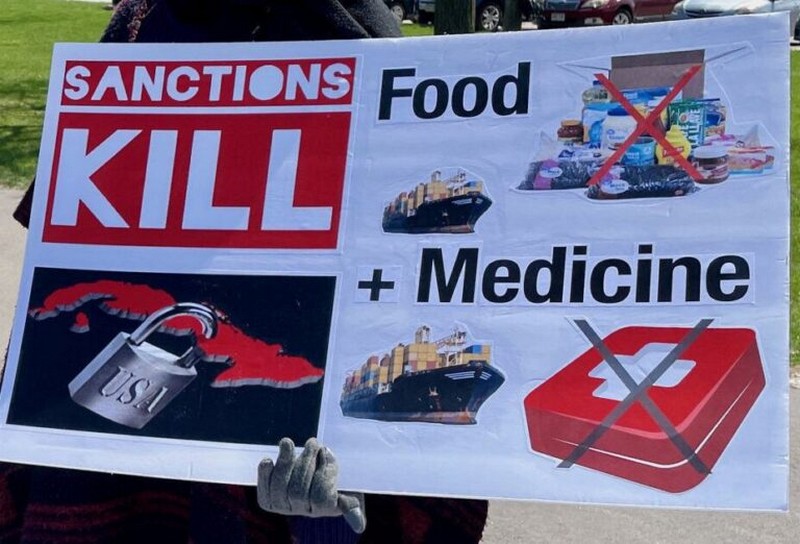
5 July 2023 – Nothing on the horizon now threatens the end of the U.S. economic blockade of Cuba. Critical voices inside the United States and beyond fall flat; nothing is in the works, it seems. Recently, however, the United Nations put forth a denunciation that carries unusual force, mainly because of the UN’s legal authority and its practical experience in Cuba.

Criticism of U.S. policies on Cuba from within the United States is usually brushed aside due in large measure to the low priority Washington officials assign to Cuban affairs. Coalitions of nations that condemn the blockade may lack staying power and surely have no means for enforcement. The anti-blockade opinions of nations or individuals, alone or together, are useful mainly for consciousness-raising.

The United Nations is different on account of its institutional capacity. It’s on display when the UN General Assembly annually votes on a Cuban resolution calling for an end to the blockade. Every year word of its overwhelming and inevitable approval goes worldwide, because of the UN connection.

The United Nations is unique on account of its Charter, which took effect on October 24, 1945. This founding instrument outlines purposes as to peace, no war, and human rights. It is legally binding on participating nations, like a treaty. Additionally, the history and expectations associated with the United Nations endow that organization with institutional power. That’s something that neither NGOs operating in Cuba or the time-limited projects of various governments on the scene there can claim.

Another element emerges. The United Nations works within Cuba and participates in Cuban affairs. On that account, UN complaints about U.S. all-but-war against Cuba take on special authority.

On the ground

UN workers and technical specialists since 2015 have been implementing the UN’s “National Plan[s] for Sustainable Economic and Social Development” in dozens of countries since 2015, including Cuba.

Work is carried out inside countries and territories in order to fulfill a “Development Agenda [for] 2030.” The main goals are: government efficiency, transformation of production, protecting natural resources and the environment, and human development with equity.

The Cuba section of the so-called “United Nations System” consists of 22 “agencies, funds, and programs,” 11 of which are physically present on the island. That section recently issued a report on its activities in 2022.

Francisco Pichón is a Colombia native serving as the UN program’s “resident coordinator.” In comments to the Cuban News Agency, Pichón noted that in Cuba his teams participated with Cubans in dealing with disaster situations and introducing developmental assistance. Collaboration was impaired, he observed, by the “the economic, commercial, and financial blockade imposed by the United States.”

Pichón testified to the constant necessity for making adjustments. What with the impact of Covid-19; the increase of prices of food, sources of energy, and more; and the war in Ukraine, his associates had to “circumvent U.S. economic sanctions” and work around Cuba’s exclusion from “international financing mechanisms”. UN personnel found it necessary to divert funds in order to mount special assistance programs after Hurricane Ian and in response to problems in Pinar del Rio.

He indicated that “pre-positioning of essential resources for emergency situations” was essential in order to mount quick and efficient responses. That was helpful in reacting to the Hotel Santiago explosion in Havana and the terrible fire at an oil storage facility in Matanzas.

Pichón highlighted the complexity of making any kind of payments, especially because costs go up when resources are imported from far-distant countries and because Cuba is excluded from international lending agencies and banking services.

Guantanamo

The idea that the United Nations is a potentially capable partner in warding off U.S. aggression against Cuba gains additional strength following the recently concluded visit to Cuba of the UN Special Rapporteur on Human Rights and Counterterrorism. Through her visit and report, the United Nations was asserting legal norms.

Law professor Fionnuala Ni Aolain examined the plight of prisoners at the U.S. naval base in Guantanamo in Cuba. The U.S. government occupied land there as a condition of its approval in 1902 of a constitution for newly-independent Cuba. Cuba’s government denounces the occupation as violating international law.

Of the almost 800 men imprisoned there at one time or another since 2002, 30 prisoners remain, of whom 16 have been cleared for release and represent no danger.

In an interview, Aolain testified to U.S. violation of human rights: “Men are shackled as they move within the facility. They were shackled when they met me.” She referred to “enormous deficits … in health care, in the standard operating procedures … [Men] are called by numbers, not by name.

She added that, “Those who tortured betrayed the rights of victims … [W]hat they ensured is that you couldn’t have [a] fair trial … [And therefore] it would be impossible for the victims of terrorism to redeem their rights.” And, “let me be clear. Torture is the most egregious and heinous of crimes.”

Quoted in a Cuban news report, Aolain referred to “cumulative aggravating effects on the dignity, freedom and fundamental rights of each detainee, which I think amounts to cruel, inhuman and degrading treatment, according to international law”.

W.T. Whitney Jr. is a retired pediatrician and political journalist living in Maine, USA.

10 July 2023

Source: transcend.org

Conditions for Guantanamo Detainees Are Cruel, Inhuman and Degrading, UN Investigator Says

By Edith M. Lederer

26 Jun 2023 – The first U.N. independent investigator to visit the U.S. detention center at Guantanamo Bay said today the 30 men held there are subject “to ongoing cruel, inhuman and degrading treatment under international law.”

The investigator, Irish law professor Fionnuala Ní Aoláin, said at a news conference releasing her 23-page report to the U.N. Human Rights Council that the 2001 attacks in New York, Washington and Pennsylvania that killed nearly 3,000 people were “crimes against humanity.” But she said the U.S. use of torture and rendition against alleged perpetrators and their associates in the years right after the attacks violated international human rights law — and in many cases deprived the victims and survivors of justice because information obtained by torture cannot be used at trials.

Ní Aoláin said her visit marked the first time a U.S, administration has allowed a U.N. investigator to visit the facility, which opened in 2002.

She praised the Biden administration for leading by example by opening up Guantanamo and “being prepared to address the hardest human rights issues,” and urged other countries that have barred U.N. access to detention facilities to follow suit. And she said she was given access to everything she asked for, including holding meetings at the facility in Cuba with “high value” and “non-high value” detainees.

The United States said in a submission to the Human Rights Council on the report that the special investigator’s findings “are solely her own” and “the United States disagrees in significant respects with many factual and legal assertions” in her report.

Ní Aoláin said “significant improvements” have been made to the confinement of detainees but expressed “serious concerns” about the continued detention of 30 men, who she said face severe insecurity, suffering and anxiety. She cited examples including near constant surveillance, forced removal from their cells and unjust use of restraints.

“I observed that after two decades of custody, the suffering of those detained is profound, and it’s ongoing,” the U.N. special rapporteur on the promotion and protection of human rights and fundamental freedoms while countering terrorism said. “Every single detainee I met with lives with the unrelenting harms that follow from systematic practices of rendition, torture and arbitrary detention.

Ní Aoláin, concurrently a professor at the University of Minnesota and at Queens University in Belfast, Northern Ireland, said there was “a heartfelt response” by many detainees to seeing someone who was neither a lawyer nor associated with the detention center, some for the first time in 20 years. During the visit, she said, she and her team scrutinized every aspect of Guantanamo.

Ní Aoláin said many detainees she met showed evidence of “deep psychological harm and distress – including profound anxiety, helplessness, hopelessness, stress and depression, and dependency.”

She expressed grave concern at the failure of the U.S. government to provide torture rehabilitation programs to the detainees and said the specialist care and facilities at Guantanamo “are not adequate to meet the complex and urgent mental and physical health issues of detainees” ranging from permanent disabilities and traumatic brain injuries to chronic pain, gastrointestinal and urinary issues.

Many also suffer from the deprivation of support from their families and community “while living in a detention environment without trial for some, and without charge for others, for 21 years, hunger striking and force-feeding, self-harm and suicidal ideation (ideas), and accelerated aging,” she said.

Ní Aoláin expressed “profound concern” that 19 of the 30 men remaining at Guantanamo have never been charged with a single crime, some after 20 years in U.S. custody, and that the continuing detention of some of them “follows from the unwillingness of the authorities to face the consequences of the torture and other ill-treatment to which the detainees were subjected and not from any ongoing threat they are believed to pose.” She stressed repeatedly that using information obtained by torture at a trial is prohibited and she said the United States has committed to not using such information.

She also found “fundamental fair trial and due process deficiencies in the military commission system,” expressed concern at the extent of secrecy in all judicial and administrative proceedings, and concluded the U.S. failed to promote fundamental fair trial guarantees.

Ní Aoláin made a long series of recommendations and said the prison at Guantanamo Bay should be immediately closed, a goal of the Biden administration.

Among her key recommendations to the U.S. government were to provide specialized rehabilitation from torture and trauma to detainees, ensure that all detainees whether they are “high-value” or “non-high value” are provided with at least one phone call every month with their family, and guaranteed equal access to legal counsel to all detainees.

The U.S. response, submitted by the American ambassador to the Human Rights Council, Michele Taylor, said Ní Aoláin was the first U.N. special rapporteur to visit Guantanamo and had been given “unprecedented access” with “the confidence that the conditions of confinement at Guantanamo Bay are humane and reflect the United States’ respect for and protection of human rights for all who are within our custody.”

“Detainees live communally and prepare meals together; receive specialized medical and psychiatric care; are given full access to legal counsel; and communicate regularly with family members,” the U.S. statement said.

“We are nonetheless carefully reviewing the (special rapporteur’s) recommendations and will take any appropriate actions, as warranted,” it said.

The United States said the Biden administration has made “significant progress” toward closing Guantanamo, transferring 10 detainees from the facility, it said, adding that it is looking to find suitable locations for the remaining detainees eligible for transfer.

The report also covers the rights of the 9/11 victims and the rights of the detainees released from Guantanamo who have been repatriated to their home country or resettled.

Ní Aoláin stressed that victims of terrorism have a right to justice, and called it “a betrayal” that the U.S. use of torture would prevent many from seeing the perpetrators and their collaborators in court. She also said children whose families accepted compensation in the immediate aftermath of 9/11 and waived their rights should be able to pursue compensation and health care.

As for the 741 men who have been released from Guantanamo, she said, many were left on their own, lacking a legal identity, education and job training, adequate physical and mental health care, and continue to experience “sustained human rights violations,” poverty, social exclusion and stigma.

The special rapporteur stressed that the United States has international law obligations before, during and after the transfer of detainees and must provide “fair and adequate compensation and as full rehabilitation as possible to the men who were detained at Guantanamo.”

10 July 2023

Source: transcend.org

Mainstream Media Colludes with U.S. Government to Conceal Source of Syria’s Heartbreaking Humanitarian Crisis

By Jeremy Kuzmarov

Illegal U.S. bombing raids, brutal economic sanctions, and incredibly brazen theft by U.S. forces of 66,000 barrels of Syrian oil per day (80% of its total output) have visited a biblical-scale tragedy upon the Syrian people that has battered them virtually back to the stone age.

30 Jun 2023 – Following a devastating earthquake in February that displaced thousands of people and compounded the suffering of 13 years of war, UNICEF issued a warning that millions of children in Syria were at a heightened risk of malnutrition.

According to UNICEF, close to 13,000 children have been killed or injured in the Syrian conflict.

More than 609,000 children under the age of five are stunted from chronic undernutrition; 12 million Syrians do not have enough food to meet daily dietary needs; 6.9 million people are internally displaced, and 90% of Syrians are estimated to be living in poverty.

The U.S. media blame the biblical-scale catastrophe on Syria’s President Bashar al-Assad.

It claims that Assad started a war against his own people to preserve his family’s ruling dynasty, committed large-scale war crimes against his own people with Vladimir Putin’s support, and then stole relief aid following the earthquake and deprived people of needed medical assistance in order to punish those who did not support him.

In an April 60 Minutes segment, host Scott Pelley accused Assad of launching chemical-weapon and barrel-bomb attacks on his own people and reported that a hospital in a rebel-controlled area in northwest Syria had to be built underground so it could not be bombed by Assad.

Pelley interviewed a Chicago doctor who accused Assad of chemical-weapon attacks, and he interviewed members of the White Helmets, a humanitarian aid group exposed as an intelligence front, who claimed that Assad cruelly bombed rebel targets in the northwest just days after the earthquake.

Crimes Against Syria

60 Minutes’ narrative about Syria is contradicted by a new documentary, Crimes Against Syria, produced by Mark Taliano,[1] which draws more on Syrian perspectives.

See the documentary here.

The film begins with an encounter between a BBC reporter and a Syrian man who tells her that she is “not telling the truth about Syria” and that Syrians “love our President [Assad]” and “support [him].”

The film goes on to detail the suppressed history in the West about how the uprising that triggered the war was initiated by jihadist terrorists supported by the U.S., Jordan, Turkey, Saudi Arabia and Qatar who attacked Syrian security forces, many of whom were armed only with sticks, while burning shops and cars.

Their aim was to weaken and destabilize Syria, overthrow Assad, and trigger a full-scale U.S. military invasion.

Crimes Against Syria includes footage of an interview with General Wesley Clark, who talks about visiting with a high-ranking general after 9/11 who told him of Donald Rumsfeld and Dick Cheney’s plan to invade and overthrow seven Arab governments starting with Syria.[2]

The neo-conservatives picked Syria because Assad was a secular nationalist who stood up to the Israelis and U.S. regional designs. His popularity stemmed from the fact that his regime provided the Syrian people with free health care and education and protected Syria’s sovereignty.[3]

Independent journalists Eva Bartlett and Vanessa Beeley are featured in the film, providing pictures of vast NATO weapon supplies that ISIS forces left behind in their headquarters after territory that they took was liberated by the Syrian Army.

The Obama administration had told the U.S. public that the U.S. was arming only “moderate [anti-Assad] rebels,” when there were no moderate rebels—they were all part of ISIS, al-Nusra and other al-Qaeda affiliates in Syria.

When an American living in Latakia saw a false report in the Los Angeles Times about how the Syrian uprising began, she contacted the journalist who wrote the story. The journalist admitted that she lived in Lebanon and based her report only on rumors supplied by anti-Assad forces.

The woman then tried to contact a Times editor whose information she had been provided, but the editor never emailed her back.

The media similarly misled Americans when it came to the chemical-weapon attack in eastern Ghoutta, Douma and other locations that were used as a pretext for the U.S. bombing of Syria.

A key source for the claims were the White Helmets—an al-Qaeda affiliate whose founder was a British intelligence agent.

A man interviewed in the film said that he lived in Douma where one of the chemical attacks was supposed to have taken place and never saw evidence of it; he thinks it was a play or show—a lie that never happened.

How was it possible, he asked, that people were walking around the area openly—without getting sick or killed when these chemicals were supposed to be deadly? And why would Assad use these weapons on his own people when he had liberated most of the country without them?

Other Syrians testified in the film to the widespread revulsion in the country for the foreign-backed jihadists who committed horrific atrocities, ranging from torture to beheadings to the seizing of medicine and food aid to the converting of hospitals into jails.

The Syrian Army—which included all ethnic groups in the country—was heralded for protecting the people from the terrorists and restoring law and order in areas they took back.

Russian troops were also looked upon favorably by Syrians for assisting Assad in freeing the country from foreign aggression.

The main pretext for the application of U.S. sanctions was the testimony of an alleged Syrian defector named “Caesar” who displayed images of tortured and mutilated Syrians, many of whom were actually Syrian Army soldiers.

When he appeared before Congress, Caesar wore a hood over his face to mask his identity and was brought there by his “case officer,” implying that he was working for the CIA.

“U.S. Sanctions Have Brought Syria Back to the Stone Age”

60 Minutes’ narrative about Syria was further debunked in March by the testimony of Syrian doctors before the International People’s Tribunal on U.S. Imperialism, which aims to spotlight the pernicious impact of U.S. sanctions on countries around the world.

These doctors emphasized the cruelty of U.S. sanctions on Syria, which have deprived its people of needed medicines and crippled its already war-ravaged economy.

Comparison was made with Iraq in the 1990s, where sanctions that were applied following the bombing of Iraq’s infrastructure in the first Persian Gulf War resulted in the deaths of half a million Iraqi children, according to Secretary of State Madeleine Albright.

Counter to what 60 Minutes claimed, the doctors said that it was jihadist rebels who had shelled Syrian hospitals and murdered other doctors, and destroyed pharmaceutical factories—which is what has made the country ill-equipped to deal with the on-going humanitarian crisis.

Dr. Hizla al-Assad said that the U.S. war and sanctions had threatened to turn life in Syria back to the Stone Age.

Electricity in the country was now sporadic and basic social services—excellent before the war—were severely reduced. Living standards were miserable and social cohesion was coming undone.

People had to endure long food lines, public transport was lacking and students could not study because their schools had been destroyed. Goods can no longer get in because of restrictions on Syrian airplanes and imports and exports are way down.

Much of the country’s oil had also been stolen, taken to Iraq and Turkey.

This was all part of the U.S. plan of intentionally impoverishing a country that was part of an axis of resistance against Western imperialism.

According to Hizla al-Assad, the earthquake in Syria showed the inhumanity of the Americans who prevented the delivery of needed medical and humanitarian aid into the country.

That inhumanity was also evident in the behavior of American occupying troops in the northwest, who kidnapped Syrian youths and dragged them unconscious for the crime of possessing a picture of Bashar al-Assad.

Trying to Destroy a Proud Anti-Colonial Tradition

The first speaker at the International People’s Tribunal on U.S. Imperialism, Patrick Higgins, a Ph.D. student at the University of Houston, emphasized Syria’s proud history as a center of Arab nationalist movements going back to the 19th century, when it provided a base of resistance for the overthrow of the Ottoman-Turkish Empire.

In 1948, Syria sent troops to confront the Zionist colonizers of Palestine and then, in the early 1950s, supported the Algerian struggle for independence against France, under the leadership of Shukri al-Quwatli, who was overthrown in a 1949 CIA-backed coup but won presidential elections in 1955 (the CIA then again tried to overthrow him but failed).

Bashar al-Assad’s father, Hafez, who ruled Syria from 1970 to 2000, supported many Arab and Third World liberationist movements and allied closely with the Soviet Union.

Bashar continued his father’s legacy by establishing Syria as a main conduit for Iran, Lebanese and Palestinian resistance movements fighting against Western imperialism and proxies like Israel.

In the 1950s, the U.S. and Israel developed the Johnston Plan—named after Special U.S. Ambassador Eric Johnston—which redirected water in Syria and Jordan to Israeli settlements and Israeli military development.

Syria resisted the plan and was attacked accordingly, with Israel stealing the Golan Heights during the closing stages of the 1967 Six-Day War.

That Israel is the foundation for U.S. imperial power in the Middle East, and Syria is in Israel’s crosshairs, helps account for the long U.S. subversion campaign.

The latter’s deadly consequences are childishly blamed by the U.S. ruling establishment and media on a leader who is respected in Syria as an heir to the country’s proud anti-colonial tradition which in part, and ironically, mirrors America’s own.

NOTES:

  1. Taliano is a retired teacher from Ontario who previously authored the book Voices from Syria, while a Second Edition of Voices from Syria was co-authored with Syrian Basma Qaddour.
  2. The other six were: Iraq, Lebanon, Libya, Somalia, Sudan and Iran.
  3. The film acknowledges some grievances against Assad and that some of the original protesters were peaceful but emphasizes that the protest movement was hijacked by violent extremists backed by foreign interests bent on destroying Syria.

Jeremy Kuzmarov is Managing Editor of CovertAction Magazine and author of four books on U.S. foreign policy, including Obama’s Unending Wars (Clarity Press, 2019) and The Russians Are Coming, Again, with John Marciano (Monthly Review Press, 2018).

10 July 2023

Source: transcend.org

Israel’s Bloodcurdling ‘Poison Policy’ to Replace Palestinians with Jewish Settlers

By Kit Klarenberg

To vacate Palestinian lands for incoming Jewish settlements, Israel greenlit covert crop-dusting operations to spray toxic chemicals that would drive out the local population.

4 July 2023 – A shocking document last September revealed that, during the 1948 Nakba, Zionist militias engaged in a wide-ranging chemical and biological warfare campaign to expel indigenous Palestinian communities from their lands, slow the advance of intervening Arab armies, and poison citizens of neighboring states.

This unconscionable use of biological weapons on civilian targets, which sought to infect the local Palestinian population with typhoid, dysentery, malaria, and other diseases by contaminating local water supplies, was subject to a concerted coverup at the time – one that was maintained by the Zionist state for decades thereafter.

Even after its exposure, the Israeli academics who helped break the story were at pains to diminish its significance, unconvincingly arguing it was a failed strategy promptly jettisoned and forgotten about as a result.

But newly declassified Israeli Defense Forces (IDF) files starkly underline this narrative to be an abject lie. Released by the Jewish Settlements Archival Project, an initiative of New York University’s Taub Center for Israel Studies, they amply show that the Israeli occupiers employed much the same tactics in order to purge Palestinian areas to make way for illegal settlements in the West Bank, and elsewhere.

Facts on the ground

In 1967, Tel Aviv emerged victorious in the Six Day War and effectively annexed significant swaths of surrounding territory from neighboring Arab states.

Israel’s occupation of these areas, and indeed the construction of settlements for Jewish colonists, was and remains absolutely illegal under international law and has been repeatedly condemned by the United Nations. Initially, successive Israeli governments claimed the settlements were the work of individual settlers and non-governmental entities such as the Jewish Agency and World Zionist Organization, and insisted that the state neither approved of nor could prevent their expansion.

Again, the newly-released papers starkly demonstrate this to be a deliberate deception. The trail begins in January 1971, when the cabinet of then-Israeli prime minister Golda Meir met to discuss the forthcoming construction of settlements. The need for unfailing public secrecy about what was about to happen was considered paramount. At the start of the summit, the premier requested:

“Before we move forward with our discussion, there’s something I’d like to ask. It was our habit that for anything that has to do with settlements, outposts, land expropriations, and so on, we simply do and do not talk [about it]…Lately, this … has broken down, and I’m asking ministers for the sake of our homeland to hold back, talk less, and do as much as possible. But the main thing, as much as possible, is to talk less.”

This extended to Meir demanding ministers not attend settlement opening ceremonies, and avoid being seen by the media anywhere near the sites. In April 1972, this oath of silence remained very much in force, with minister without portfolio Yisrael Galili reminding his cabinet confederates at a meeting to “refrain from dealing with the matter in the press, as it could cause damage.”

Around this time, the Israelis began constructing the first illegal Jewish settlement, Gitit, in the West Bank. Kickstarting the criminal enterprise required displacing Palestinians from the nearby village of Aqraba. This was first attempted by brute force, with IDF soldiers demanding they vacate the area to make way for a new military training zone.

The Palestinians ignored them, and continued cultivating the land, prompting Israeli forces to damage their tools. When they still refused to budge, the IDF was ordered to use vehicles to destroy crops, and dispossess the indigenous population. Soldiers struck upon a radical, bloodcurdling solution: a crop duster would rain down toxic chemicals, lethal to animals and dangerous for humans, to precipitate their departure.

Still, Aqraba’s population refused to budge, prompting the IDF to up its devilish campaign’s ante quite considerably. In April 1972, the military’s Central Command met with representatives of the Jewish Agency’s settlements department. They established “responsibility and schedule for the spraying,” at such a density that it would preclude humans from inhabiting the area for several days “for fear of stomach poisoning” and animals for a full week.

The Jewish Agency was given the job of obtaining the plane, which it did from Chemair, a local crop-dusting company. The explicit aim was to “destroy the harvest” of the Palestinians, and forcibly expel them from the area in perpetuity.

The next month, the destruction was so severe that Aqraba’s mayor wrote to Defense Minister Moshe Dayan. They stated the village had 4,000 residents, who until recently had cultivated “145,000 dunams of agricultural land.” Now, after “the authorities” had burned wheat and confiscated land, the Palestinians were left with just 25,000 dunams.

“The damage is unbearable … how will we be able to provide for ourselves?” the mayor despaired.

Israeli occupation forces finally took over the land in May 1973. Tel Aviv was asked for permission to “seize the land for the purpose of establishing a settlement,” which was granted. Three months later, construction commenced.

‘Get cover for it’

While Israeli governments covertly encouraged and facilitated the creation of illegal settlements, it is clear there was some internal dissent on the issue at various times.

In 1974, the head of the Israel Lands Administration began steps to establish another Jewish settlement in the West Bank, Ma’aleh Adumim, before the government had made a formal decision on the matter. Former IDF general turned Knesset representative Meir “Zarro” Zorea actively lobbied the Jewish Agency to allocate an appropriate budget for the effort, suggesting the organization “funnel money to settlement activity and get cover for it after a while, when I request budget approval.”

At a subsequent cabinet meeting however, then-Housing Minister Yehoshua Rabinovitz was dismayed, declaring, “this has no budget, and I don’t know how work is being started without sitting down with us.” Prime Minister Yitzhak Rabin attempted to calm him, stating, “that’s what we’re meeting about right now.”

“There might be room for clarifying this issue, but I wouldn’t suggest going into it today. I know it may not be following the neatest definitions, but I’m in favor of them starting to carry out this infrastructure work,” he added.

Later on, the aforementioned Yisrael Galili pressed ministers to define Ma’aleh Adumim as “an A-class area,” thereby granting it and its Jewish settler population greater benefits from the government, despite the fact it would lie in illegally occupied territory. The Israeli government officially granting the settlement this classification would, by definition, amount to a de facto endorsement, in contradiction to its official public stance.

“I’m surprised that you don’t understand that this whole subject is one of the ingenious methods to alleviate a process that could be very dangerous internally in Israel,” Galili explained.

These shocking communications remained concealed for half a century before the Jewish Settlements Archival Project released them to the world. It is almost inevitable that a great many more incriminating documents remain sealed in the IDF’s vaults. The project’s archives end in summer of 1977, and as of January 2023, there are 144 illegal Jewish settlements in the West Bank, including 12 in East Jerusalem, housing 450,000 colonizers.

Stealing that much land, and displacing so many people in the process, was a vast undertaking that frequently met bitter local resistance, which continues today. Given the efficacy of chemical and biological warfare in stealing Palestinian land over so many years, there is no reason to think this heinous approach wasn’t employed again and again over the years.

Kit Klarenberg is an investigative journalist exploring the role of intelligence services in shaping politics and perceptions.

10 July 2023

Source: transcend.org