Just International

Ukraine: The Tunnel at the End of the Light

By Robert Freeman

26 Feb 2023 – The U.S. abused its providential anointment as the exceptional nation. That abuse has been recognized, called out and is now being acted against by most of the other nations of the world.  

China’s Belt and Road Initiative is a dizzyingly ambitious plan to connect Asia and more than 100 nations with 21st Century economic infrastructure, everything from highways and high-speed rail lines to power generation, energy pipelines, communication systems, cities, ports, and more.

“Light at the end of the tunnel” was an iconic phrase used by the warmongers who kept the U.S. in Vietnam long after the War had been lost. The implication was that insiders could see through the fog of war and know that things were getting better. It was a lie.

In January 1966, long before the military height of the War, Secretary of Defense Robert McNamara told President Johnson that the U.S. had a one-out-of-three chance of winning on the battlefield. But Johnson, like Eisenhower and Kennedy before him, and Nixon after him, didn’t want to be the first American president to lose a war. So, he ginned up a simplistic lie and “soldiered on.”

The lie was blown by the Tet Offensive in January 1968. More than 100 U.S. military installations were attacked in a simultaneous nationwide assault that stunned the U.S. The broadcaster, Walter Cronkite, then “the most trusted man in America,” bellowed on national television, “I thought we were supposed to be winning this damned thing.” It was the beginning of the end of the U.S.’ murderous and failed occupation.

We’re now facing another light-and-tunnel event, this time in Ukraine. Only now, it’s not the light at the end of the tunnel. It’s the tunnel at the end of the light. What do we mean by that?

Until now, it’s been all light. Remember when the scrappy Ukrainian forces were kicking the barbarian Russian hordes’ asses? When every development betrayed the Russians’ clod-footed strategy, its soldiers’ bad morale, its army’s poor provisioning and worse leadership, and the perilous political situation for Putin back home? The testosterone was flowing. The bravado was intoxicating. The exceptionalism was sublimely seductive. It was only a matter of time and pluck and determination before Ukraine would bloody the bully’s nose and show it what the West was made of.

Remember?

No more.

You can prosecute a war for only so long on the strength of smoke and mirrors, delusions and illusions, lies and press releases. Eventually, however, reality catches up with you. The thuggishly propagandized American citizenry couldn’t know it, but that catching up began in the first weeks of the War and has only accelerated since.

Within the first week of the War, Russia had destroyed Ukraine’s air force and air defenses. By the second week, it had taken out most of Ukraine’s armories and weapons depots. Over following weeks and months, it systematically demolished artillery shipped in from former Warsaw Pact, now NATO, countries in Eastern Europe. It dismantled the country’s transportation and fuel supply systems. It has recently taken out most of the country’s electrical infrastructure.

The Ukrainian army has lost an estimated 150,000 troops, a pace more than 140 times the rate of U.S. losses in Vietnam. This, at a time when 10 million of its formerly 36 million people have fled the country. The military is down to dragooning 16-year-old boys and 60-year-old men to man the barricades. It cannot get replacement ammunition. Russia has knocked out some 90% of Ukraine’s drones, leaving it largely sightless. Delivery times for the tanks that are the hoped-for “game changer” are running into months and years. Not that that will matter.

Remember all the other failed “game changers”? The M777 howitzers and the Stryker armored fighting vehicles? The HIMARS multiple rocket launchers and the PATRIOT air defense systems? All were going to turn the tide at one time. All have proven impotent to stop Russia from seizing 20% of Ukraine’s territory and annexing it and its people to Russia.

The U.S. lost the economic war, as well. Remember Joe Biden’s delusional prediction that the U.S. would see that “the ruble will be reduced to rubble”? And that “the most stringent sanctions regime in history” was going to “weaken” Russia, perhaps even leading to Putin’s overthrow? Most of it backfired, badly. Last year, the ruble reached its highest exchange rate in history. Russia’s 2022 trade surplus of $227 billion was up 86% from 2021. The U.S.’ trade deficit over the same period rose 12.2%, and is approaching $1 trillion.

As a result of all of the above and more, the tide of insider opinion has turned against the War. Senior officials in Europe are talking openly about how the losses are unsustainable and they need to get back to security architectures that prevailed before the poisoned CIA-supported coup in Maidan in 2014. Mark Milley, Chairman of the Joint Chiefs of Staff, recently let slip that “It will be very, very difficult to eject the Russians from all of occupied Ukraine in the next year. The Washington Post warned recently that Ukraine faced a “critical moment” in the war, belaboring the fact that U.S. support was not limitless and would soon be reached. Hint. Hint.

The Rand Corporation, one of the U.S.’ best-connected strategic whisperers, just published a report stating that “The consequences of a long war far outweigh the benefits.” It explicitly states that the U.S. needs to husband its resources for its more important upcoming conflict with China. Newsweek headlined that “Joe Biden Offered Vladimir Putin 20 Percent of Ukraine to End War.” It also revealed that “Nearly 90 percent of the world isn’t following us on Ukraine.” Vast swaths of Latin American, Africa, and Asia refuse to support the U.S. in its demand for sanctions against Russia.

These are not “Light at the end of the tunnel” divinations. Quite the contrary. If there’s a common thread running through it all it is the sickening recognition that the war is lost, militarily, economically, and diplomatically, that there is no plausible scenario in which those losses will be turned around by soldiering on, and that what is needed now is a hide-the-loss, get-out-any-way-you-can, face-saving exit strategy.

That will not be available, either. That’s where the tunnel at the end of the light comes into play.

Even before the U.S. and its NATO puppets undertook the War, the rest of the world—and that means most of the world—was congealing itself into an anti-Western economic and security bloc. Led by China and its strategic ally, Russia, that bloc includes more than a dozen trade and security organizations. Those include the BRICS confederation of Brazil, Russia, India, China, and South Africa, working explicitly to devise multi-polar institutions to stand up to the U.S.’ unipolar hegemonic model.

It includes the Shanghai Cooperation Organization, a security compact made up of leading nations from east, central, and south Asia, including China, Russia, India, and soon, Iran, Turkey, and Saudi Arabia. It is explicitly working to devise measures to prevent the kind of predatory military assaults the U.S. carried out against Iraq, Libya, Somalia, Yemen, and Afghanistan.

The organizing economic engine behind these efforts it is China’s Belt and Road Initiative. BRI is a dizzyingly ambitious plan to connect Asia and more than 100 nations with 21st Century economic infrastructure, everything from highways and high-speed rail lines, to power generation, energy pipelines, communication systems, cities, ports, and more. It is critical to understand why BRI poses such daunting challenges to U.S. supremacy in the world.

Infrastructure is so powerful because it spins off a vast, unimaginable array of secondary, and tertiary economic benefits. It was the railroads in the nineteenth century that bound the U.S. together as the world’s first continental-scale market. Manufacturers could produce for a larger market, and, therefore, at larger scale, and, therefore, at lower cost, than could producers anywhere else on earth.

The railroads made the U.S. the largest market in the world for iron, steel, machine tools, grading equipment, farm equipment, and scores of other commercial and industrial products essential to a modern industrial economy. The U.S. began the 1800s with 1.5% of the world’s GDP. It ended the century with 19% of a four-times larger number, making it the largest economy in the world.

Similarly, automobiles. People think it was Henry Ford and mass production that made the Twentieth Century “The American Century.” In fact, it was the build-out of millions of miles of roads and, later, interstates, without which automobiles would have remained expensive playthings of the wealthy. Those roads stitched the country together into an asphalt network that allowed individual mobility, by virtually anybody, anywhere, down to every street address in the country. The world had never seen anything like it.

The secondary and tertiary economic effects were astounding, everything from the world’s largest markets for steel, glass, plastics, and rubber, to gasoline, diesel, highway construction on a continental scale, repair shops and drive-ins, to the entire panoply of culture we know of as suburbia. The Twentieth Century was the Century of the Automobile. The infrastructure the U.S. built to make it possible was the major reason—at least economically—that the U.S. led the world for most of that century.

China is now proposing to do the same for Asia in the Twenty-First Century, but on a much larger scale. It is leading an infrastructure build-out that will dwarf Eisenhower’s Interstate highway system. It will serve most of the five billion people in Eurasia, thirty TIMES more than the 150 million people Eisenhower’s project helped.

Wisely, China has ensured that all of the 100+ nations joining BRI are enriched by their participation, whether building themselves up domestically, or extending their reach internationally. It is the largest, most compelling, geographically extensive, nationally inclusive, mutually enriching economic enterprise in the history of the world. The U.S. is not part of it.

Finally, there is the matter of the dollar. Since the Bretton Woods Agreement of 1944, the global economy has used the dollar as the primary currency of international trade. This has given the U.S. an “exorbitant privilege” in that it can essentially write an unlimited stream of hot checks to the world, because countries need dollars to be able to conduct international commerce. The U.S. “sells” them dollars by issuing Treasury debt, which is a universally fungible international medium of exchange.

One of the consequences of this arrangement is that it has allowed the U.S. to spend far beyond its means, running up $32 trillion of debt since 1980, when its national debt stood at a mere $1 trillion. The U.S. uses this debt to, among other things, fund its gargantuan military with its 800 military bases around the world, which it uses to do things like destroy Serbia, Libya, Iraq, Afghanistan, Syria, Somalia, and a host of lesser predations on other countries. All the world sees this and is repulsed by it.

The world sees how dollar hegemony underwrites the U.S.’ ability to carry out or attempt coups in Honduras, Venezuela, Peru, Bolivia, Kazakhstan, Pakistan, Myanmar, Belarus, Egypt, Syria, and, of course, Ukraine, among others. And these are just those in the past two decades.

The same dollar hegemony underwrote U.S. predations in the latter part of the Twentieth Century against Iran, the Dominican Republic, Guatemala, Vietnam, Nicaragua, Cuba, Chile, Congo, Brazil, Indonesia, and dozens of other countries. Again, the rest of the world sees this. U.S. citizens, rapturously oblivious in their hermetically sealed media bubble, do not.

The world saw how the U.S. stole $300 billion of Russian funds that were held in Western banks, part of its sanctions regime against Russia for its role in the Ukraine war. They’ve seen how the U.S. has carried out similar thefts against dollar-denominated funds of Venezuela, Afghanistan, and Iran. It sees how the Federal Reserve’s raising of interest rates to take care of U.S. needs makes capital flow out of other countries, and how it makes their currencies fall, forcing inflation on them. Not a single country in the world is left untouched.

The cumulative impact of these facts is that many countries would rather not be held hostage to the implicit and explicit negative consequences of dollar hegemony. They also want to remove the “exorbitant privilege” that they believe the U.S. has abused to their individual and collective detriment.

They have begun—again, led by Russia and China—to build an international finance and trading system that doesn’t rely on dollars, that uses countries’ local currencies, gold, oil, or other assets to trade. This received special impetus last year when Saudi Arabia announced it would begin accepting Chinese yuan in exchange for its oil. Oil is the world’s most valued internationally-traded commodity, so the perception is that a dam is beginning to break.

It will take years before an equally functional substitute for the dollar is devised but what began a few years ago as a trickle has gained momentum and urgency as a consequence of U.S. actions in Ukraine. When the dollar is no longer the world’s international reserve currency and nations don’t need dollars to trade with each other, the U.S. will no longer be able to fund its massive budget and trade deficits by writing hot checks. The withdrawal will be agonizing and will greatly circumscribe the U.S.’ role as global hegemon.

U.S. actions in Ukraine have driven together its two greatest adversaries, Russia and China. They, joined by India, Turkey, Saudi Arabia, Iran and dozens of other countries, are carrying out a Mackinder-feared Eurasian integration that will leave the U.S. outside of the world’s largest and most dynamic trading bloc.

The U.S.’ military failure has advertised, once again (after Iraq and Afghanistan), the relative impotence of U.S. military solutions. Yes, it can still destroy small, defenseless countries like Serbia, Libya, Afghanistan, and Iraq. But against a peer competitor that has chosen to stand up to it, the U.S. has, frankly, been handed its ass. All the world can see it.

Events have shown the hollowness of U.S.-led economic and financial systems, as well, especially compared to China. China’s economic performance has far surpassed that of the U.S. It has lifted more people out of poverty more quickly than any country in the history of the world. Its growth has made it the largest economy in the world in purchasing power parity terms. While average inflation-adjusted incomes in the U.S. are little higher than they were 50 years ago, incomes in China are up more than 10 TIMES over the same period. And it has done this without brutalizing and pillaging other nations that refuse to bend to its hegemonic will.

And, the War has betrayed, as nothing else possibly could, the diplomatic isolation of the U.S., with the vast majority of the world’s people refusing to implement U.S.-demanded sanctions against Russia. Its destruction of the Nord Stream gas pipeline is recognized as the greatest act of state-sponsored terrorism in history, easily surpassing 911 in terms of the hundreds of millions of people it will hurt. And this, to one of its putative allies, Europe. Imagine what happens to its enemies.

This is the tunnel at the end of the light, a multi-polar as opposed to a unipolar world. It means increasing isolation of the U.S. from the rest of the world, the closing in of options, the narrowing of opportunities, the loss of strategic primacy that once graced the greatest power in the history of the world. It will mean dramatically reduced power and influence vis-à-vis the U.S.’ strategic adversaries, and markedly constrained ability to operate militarily, economically and financially in the world, what with the hot checkbook soon to be taken away.

In twenty or thirty years, the U.S. will still be a substantial regional power, perhaps like Brazil in South America, Iran in West Asia, or Nigeria in Africa. But it will not be the global hegemon it once was, able to project and inflict power in the world as it has done for the last century. The U.S. abused its providential anointment as the exceptional nation. That abuse has been recognized, called out, and is now being acted against by most of the other nations of the world. The future will be very different for the U.S. than it has been for the past 80 years, since the end of World War II when it towered over the rest of the world like a giant among pygmies. Ukraine will prove to have been the turning point in this transformation, the tunnel at the end of the light.

___________________________________________

Robert Freeman is Founder and Executive Director of The Global Uplift Project which builds small-scale infrastructure projects in the developing world to improve humanity’s capacity for self-development.

6 March 2023

Source: www.transcend.org
Analyses, Comments and Opinion Pieces in Various Chinese Media

By Jan Oberg, Ph.D.

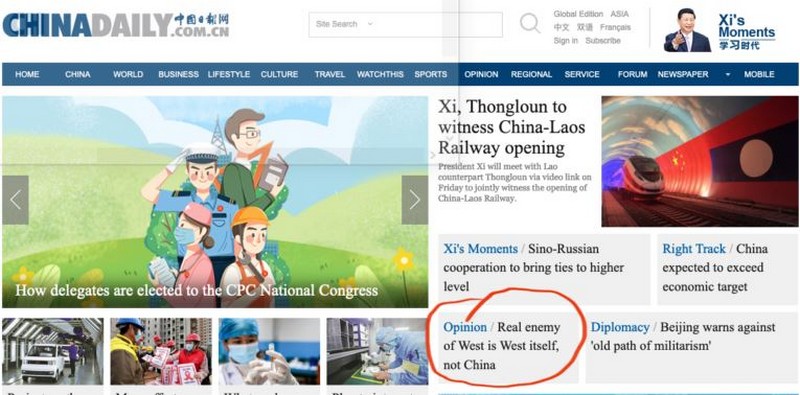
17 Feb 2023 – I’m happy to announce that from December 2021, I serve as a monthly contributor of opinion pieces to China Daily. It has more than 52 million clicks online daily and about 40 million followers on social media – according to the latest (2016) data. It serves more than 330 million readers all over the world and is a default choice for people who read about China in English.

Here is Wikipedia about China Daily with some background and facts but then producing the obligatory boring list of Western accusations of CD doing what we once believed that Western media would surely never do…

I encourage you to go visit China Daily and see for yourself. We need to be curious and learn. Ignorant condemnations – particularly by people who have never studied or visited China – is wrong. Period.

I accepted the invitation to be a contributing writer because I believe in dialogue and diversity.

When you read my articles on China Daily you’ll look around and learn about China and surely see what you never see in Western media about China and many other matters. And you’ll see lots of materials about the West. Likewise, when the readers of my articles see who I am and are directed to my home here, they get the opportunity to look around and visit The Transnational that I edit and TFF of which I am the director.

That’s how, with an open mind, we connect and learn about each other globally. And make friends. If we want to.

Over about 20 years, I have – once a week – disseminated TFF Associates’ and my own research and public education articles to, among others, thousands of Western media people and editorial offices. No one picked up any of it or invited me to contribute articles to them on a regular basis.

Since I know that some will think or ask: So, you are now on the payroll of the Chinese government? – the answer is: “Yes, I am – China Daily is state-owned and says it will pay me US$ 100-150 for each article of about 1000 words.”

Finally, now and then, I contribute – alone or with my dear colleagues – also to other Chinese media.

Prof. Jan Oberg, Ph.D. is director of the Transnational Foundation for Peace and Future Research, TFF and a member of the TRANSCEND Network for Peace Development Environment. CV: https://transnational.live/jan-oberg
https://transnational.live

6 March 2023

Source: www.transcend.org
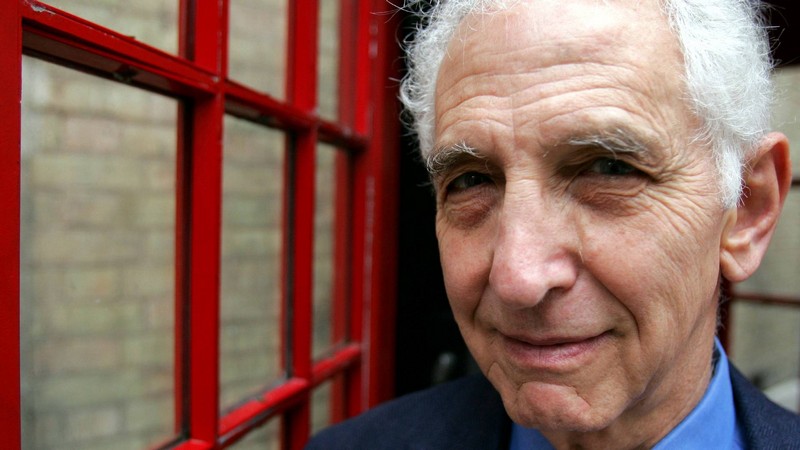
Activist Dan Ellsberg, Pentagon Papers Whistleblower, Has Terminal Cancer

By Daniel Ellsberg

2 Mar 2023 – I wrote this letter recently to my friends in the antiwar and anti-nuclear movements. I see it’s being circulated, so I’ve decided to share it here. For all of you working on these issues, thank you, and please keep going!

https://twitter.com/DanielEllsberg/status/1631381696661827584/photo/1

Daniel Ellsberg is a former US military analyst who in 1971 leaked the Pentagon Papers, which revealed how the US public had been misled about the Vietnam War.

6 March 2023

Source: www.transcend.org
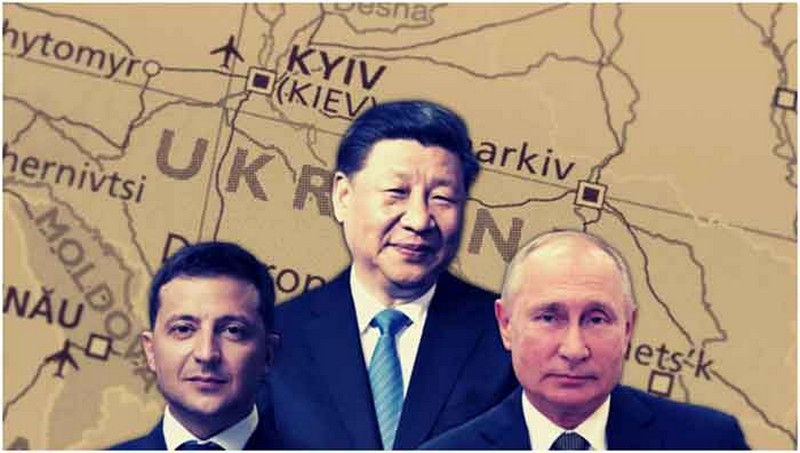
Why Biden Snubbed China’s Ukraine Peace Plan

By Medea Benjamin, Marcy Winograd and Wei Yu

There’s something irrational about President Biden’s knee-jerk dismissal of China’s 12-point peace proposal titled “China’s Position on the Political Settlement of the Ukraine Crisis.”

“Not rational” is how Biden described the plan that calls for de-escalation toward a ceasefire, respect for national sovereignty, establishment of humanitarian corridors and resumption of peace talks.

“Dialogue and negotiation are the only viable solution to the Ukraine crisis,” reads the plan. “All efforts conducive to the peaceful settlement of the crisis must be encouraged and supported.”

Biden turned thumbs down.

“I’ve seen nothing in the plan that would indicate that there is something that would be beneficial to anyone other than Russia if the Chinese plan were followed,” Biden told the press.

In a brutal conflict that has left thousands of dead Ukrainian civilians, hundreds of thousands of dead soldiers, eight million Ukrainians displaced from their homes, contamination of land, air and water, increased greenhouse gasses and disruption of the global food supply, China’s call for de-escalation would surely benefit someone in Ukraine.

Other points in China’s plan, which is really more a set of principles rather than a detailed proposal, call for protection for prisoners of war, cessation of attacks on civilians, safeguards for nuclear power plants and facilitation of grain exports.

“The idea that China is going to be negotiating the outcome of a war that’s a totally unjust war for Ukraine is just not rational,” said Biden.

Instead of engaging China–a country of 1.5 billion people, the world’s largest exporter, the owner of a trillion dollars in US debt and an industrial giant–in negotiating an end to the crisis in Ukraine, the Biden administration prefers to wag its finger and bark at China, warning it not to arm Russia in the conflict.

Psychologists might call this finger-wagging projection–the old pot calling the kettle black routine. It is the US, not China, that is fueling the conflict with at least $45 billion dollars in ammunition, drones, tanks and rockets in a proxy war that risks–with one miscalculation–turning the world to ash in a nuclear holocaust.

It is the US, not China, that has provoked this crisis by encouraging Ukraine to join NATO, a hostile military alliance that targets Russia in mock nuclear strikes, and by backing a 2014 coup of Ukraine’s democratically elected Russia-friendly president Viktor Yanukovych, thus triggering a civil war between Ukrainian nationalists and ethnic Russians in eastern Ukraine, regions Russia has more recently annexed.

Biden’s sour attitude toward the Chinese peace framework hardly comes as a surprise. After all, even former Israeli Prime Minister Naftali Bennett candidly acknowledged in a five-hour interview on YouTube that it was the West that last March blocked a near-peace deal he had mediated between Ukraine and Russia.

Why did the US block a peace deal? Why won’t President Biden provide a serious response to the Chinese peace plan, let alone engage the Chinese at a negotiating table?

President Biden and his coterie of neo-conservatives, among them Undersecretary of State Victoria Nuland, have no interest in peace if it means the US concedes hegemonic power to a multi-polar world untethered from the all-mighty dollar.

What may have gotten Biden unnerved—besides the possibility that China might emerge the hero in this bloody saga—is China’s call for the lifting of unilateral sanctions. The US imposes unilateral sanctions on officials and companies from Russia, China and Iran. It imposes sanctions on whole countries, too, like Cuba, where a cruel 60-year embargo, plus assignment to the State Sponsor of Terrorism list, made it difficult for Cuba to obtain syringes to administer its own vaccines during the COVID pandemic. Oh, and let’s not forget Syria, where after an earthquake killed tens of thousands and left hundreds of thousands homeless, the country struggles to receive medicine and blankets due to US sanctions that discourage humanitarian aid workers from operating inside Syria.

Despite China’s insistence it is not considering weapons shipments to Russia, Reuters reports the Biden administration is taking the pulse of G-7 countries to see if they would approve new sanctions against China if that country provides Russia with military support.

The idea that China could play a positive role was also dismissed by NATO Secretary General Jens Stoltenberg, who said, “China doesn’t have much credibility because they have not been able to condemn the illegal invasion of Ukraine.”

Ditto from US Secretary of State Antony Blinken, who told ABC’s Good Morning America, “China has been trying to have it both ways: It’s on the one hand trying to present itself publicly as neutral and seeking peace, while at the same time it is talking up Russia’s false narrative about the war.”

False narrative or different perspective?

In August of 2022, China’s ambassador to Moscow charged that the United States was the “main instigator”of the Ukraine war, provoking Russia with NATO expansion to Russia’s borders.

This is not an uncommon perspective and is one shared by economist Jeffrey Sachs who, in a February 25, 2023  video directed at thousands of anti-war protesters in Berlin, said the war in Ukraine did not start a year ago, but nine years ago when the US backed the coup that overthrew Yanukovych after he preferred Russia’s loan terms to the European Union’s offer.

Shortly after China released its peace framework, the Kremlin responded cautiously, lauding the Chinese effort to help but adding that the details “need to be painstakingly analyzed taking into account the interests of all the different sides.” As for Ukraine, President Zelinsky hopes to meet soon with Chinese President Xi Jinping to explore China’s peace proposal and dissuade China from supplying weapons to Russia.

The peace proposal garnered more positive response from countries neighboring the warring states. Putin’s ally in Belarus, leader Alexander Lukashenko, said his country “fully supports” the Beijing plan. Kazakhstan approved of China’s peace framework in a statement describing it as “worthy of support.” Prime Minister of Hungary Viktor Orbán–who wants his country to stay out of the war– also showed support for the proposal.

China’s call for a peaceful solution stands in stark contrast to US warmongering this past year, when Secretary of Defense Lloyd Austin, a former Raytheon board member, said the US aims to weaken Russia, presumably for regime change–a strategy that failed miserably in Afghanistan where a near 20-year US occupation left the country broke and starving.

China’s support for de-escalation is consistent with its long-standing opposition to US/NATO expansion, now extending into the Pacific with hundreds of US bases encircling China, including a new base in Guam to house 5,000 marines. From China’s perspective, US militarism jeopardizes the peaceful reunification of the People’s Republic of China with its break-away province of Taiwan. For China, Taiwan is unfinished business, left over from the civil war 70 years ago.

In provocations reminiscent of US meddling in Ukraine, a hawkish Congress last year approved $10 billion in weapons and military training for Taiwan, while House leader Nancy Pelosi flew to Taipei – over protests from her constituents–to whip up tension in a move that brought US-China climate cooperation to a halt.

A US willingness to work with China on a peace plan for Ukraine might not only help stop the daily loss of lives in Ukraine and prevent a nuclear confrontation, but also pave the way for cooperation with China on all kinds of other issues–from medicine to education to climate–that would benefit the entire globe.

Medea Benjamin is cofounder of CODEPINK, and author of several books, including War in Ukraine: Making Sense of a Senseless Conflict.

Marcy Winograd serves as Co-Chair of the Peace in Ukraine Coalition, which calls for a ceasefire, diplomacy and an end to weapons shipments that escalate the war in Ukraine.

Wei Yu is the China Is Not Our Enemy campaign coordinator for CODEPINK.

3 March 2023

Source: countercurrents.org

At the Brink of War in the Pacific? The Nightmare of Great Power Rivalry Over Taiwan

By Alfred W McCoy

While the world has been distracted, even amused, by the diplomatic tussle around China’s recent high-altitude balloon flights across North America, there are signs that Beijing and Washington are preparing for something so much more serious: armed conflict over Taiwan. Reviewing recent developments in the Asia-Pacific region raises a tried-and-true historical lesson that bears repeating at this dangerous moment in history: when nations prepare for war, they are far more likely to go to war.

In The Guns of August, her magisterial account of another conflict nobody wanted, Barbara Tuchman attributed the start of World War I in 1914 to French and German plans already in place. “Appalled upon the brink,” she wrote, “the chiefs of state who would be ultimately responsible for their country’s fate attempted to back away, but the pull of military schedules dragged them forward.” In a similar fashion, Beijing and Washington have been making military, diplomatic, and semi-secretive moves that could drag us into a calamitous conflict that, once again, nobody wants.

At the apex of power, national leaders in Beijing and Washington have staked out starkly contrasting positions on Taiwan’s future. For nearly a year now, President Joe Biden has been trying to resolve the underlying ambiguity in previous U.S. policy toward that island by stating repeatedly that he would indeed defend it from any mainland attack. In May of last year, in response to a reporter’s question about a possible Chinese invasion of Taiwan, he said, “Yes,” the U.S. would intervene militarily. He then added: “We agree with the One China policy. We signed on to it and all the attendant agreements made from there, but the idea that it can be taken by force, just taken by force, is [just not] appropriate.”

As Biden acknowledged, by extending diplomatic recognition to Beijing in 1979, Washington had indeed accepted China’s future sovereignty over Taiwan. For the next 40 years, presidents from both parties made public statements opposing Taiwan’s independence. In effect, they conceded that the island was a Chinese province and its fate a domestic matter (even if they opposed the People’s Republic doing anything about it in the immediate future).

Nonetheless, Biden has persisted in his aggressive rhetoric. He told CBS News last September, for instance, that he would indeed send U.S. troops to defend Taiwan “if, in fact, there was an unprecedented attack.” Then, in a significant break with longstanding U.S. policy, he added: “Taiwan makes their own judgments about their independence… That’s their decision.”

Within weeks, at a Communist Party Congress, Chinese President Xi Jinping responded with a strong personal commitment to the unification of Taiwan — by force if necessary. “We insist on striving for the prospect of peaceful reunification,” he said, “but we will never promise to give up the use of force and reserve the option to take all necessary measures.”

After a long burst of applause from the 2,000 party officials massed in Beijing’s Great Hall of the People, he then invoked the inevitability of Marxian dialectical forces that would insure the victory he was promising. “The historical wheels of national reunification and national rejuvenation are rolling forward,” he said, “and the complete reunification of the motherland must be achieved.”

As the political philosopher Hannah Arendt once reminded us, a sense of historical inevitability is a dangerous ideological trigger that can plunge authoritarian states like China into otherwise unthinkable wars or unimaginable mass slaughter.

War Preparations Move Down the Chain of Command

Not surprisingly, the forceful statements of Biden and Xi have been working their way down the chain of command in both countries. In January, a four-star U.S. Air Force general, Mike Minihan, sent a formal memo to his massive Air Mobility Command of 500 aircraft and 50,000 troops, ordering them to ramp up their training for war with China. “My gut tells me,” he concluded, that “we will fight in 2025.” Instead of repudiating the general’s statement, a Pentagon spokesman simply added, “The National Defense Strategy makes clear that China is the pacing challenge for the Department of Defense.”

Nor is General Minihan even the first senior officer to have made such foreboding statements. As early as March 2021, the head of the Indo-Pacific Command, Admiral Philip Davidson, warned Congress that China was planning to invade the island by 2027: “Taiwan is clearly one of their ambitions… And I think the threat is manifest during this decade, in fact, in the next six years.”

Unlike their American opposites, China’s service chiefs have been publicly silent on the subject, but their aircraft have been eloquent indeed. After President Biden signed a defense appropriation bill last December with $10 billion in military aid for Taiwan, an unprecedented armada of 71 Chinese aircraft and many more military drones swarmed that island’s air defenses in a single 24-hour period.

As such tit-for-tat escalation only increases, Washington has matched China’s aggression with major diplomatic and military initiatives. Indeed, the assistant defense secretary for the Indo-Pacific, Ely Ratner, has promised, ominously enough, that “2023 is likely to stand as the most transformative year in U.S. force posture in the region in a generation.”

During a recent tour of Asian allies, Secretary of Defense Lloyd Austin claimed some significant strategic gains. On a stopover in Seoul, he and his South Korean counterpart announced that the U.S. would deploy aircraft carriers and additional jets for expanded live-fire exercises — a distinctly escalatory move after the curtailment of such joint operations during the Trump years.

Moving on to Manila, Austin revealed that the Philippines had just granted U.S. troops access to four more military bases, several facing Taiwan across a narrow strait. These were needed, he said, because “the People’s Republic of China continues to advance its illegitimate claims” in the South China Sea.

China’s Foreign Ministry seemed stung by the news. After a successful diplomatic courtship of the previous Philippine president, Rodrigo Duterte, that had checked U.S. influence while accepting the Chinese occupation of islands in Philippine waters, Beijing could now do little more than condemn Washington’s access to those bases for “endangering regional peace and stability.” Although some Filipino nationalists objected that an American presence might invite a nuclear attack, according to reliable polling, 84% of Filipinos felt that their country should cooperate with the United States to defend their territorial waters from China.

Both of those announcements were dividends from months of diplomacy and down payments on major military deployments to come. The annual U.S. “defense” bill for 2023 is funding the construction of military installations across the Pacific. And even as Japan is doubling its defense budget, in part to protect its southern Islands from China, U.S. Marines in Okinawa plan to trade their tanks and heavy artillery for agile drones and shoulder-fired missiles as they form “littoral regiments” capable of rapid deployment to the smallest of islands in the region.

Secret Strategies

In contrast to those public statements, semi-secret strategies on both sides of the Pacific have generally escaped much notice. If the U.S. military commitment to Taiwan remains at least somewhat ambiguous, this country’s economic dependence on that island’s computer-chip production is almost absolute. As the epicenter of a global supply chain, Taiwan manufactures 90% of the world’s advanced chips and 65% of all semiconductors. (In comparison, China’s share of chips is 5% and the U.S. slice only 10%.) As the world’s top producer of the most critical component in everything from consumer cell phones to military missiles, the Taiwan Semiconductor Manufacturing Company (TSMC) is the leading innovator, supplying Apple and other U.S. tech firms.

Now, American officials are moving to change that. Having overseen the breaking of ground for a $12 billion TSMC chip-production factory in Phoenix in 2020, only two years later, Arizona’s governor announced that “TSMC has completed construction of its main facility.” Last August, just before President Biden signed the $52 billion CHIPS and Science Act, Secretary of Commerce Gina Raimondo insisted that “our dependence on Taiwan for chips is untenable and unsafe.”

Only three months later, TSMC reached for a large slice of those federal funds by investing $28 billion in a second Phoenix factory that, when opened in 2026, will produce what the New York Times has called “more advanced — though not the most advanced — chip-making technology.” At a ceremony featuring President Biden last December, Apple’s CEO Tim Cook proclaimed, “This is an incredibly significant moment.”

That might be true, but the focus on Phoenix obscured equally significant chip factory projects being put in place by Samsung in Texas, Intel in Ohio, and Micron Technology in New York. Add it all up and the U.S. is already about halfway to the “minimum of three years and a $350 billion investment… to replace the Taiwanese [chip] foundries,” according to the Semiconductor Industry Association.

In other words, if Beijing did decide to invade Taiwan after 2026, TSMC’s intellectual capital, in the form of its top computer scientists, would undoubtedly be on outbound flights for Phoenix, leaving little more than a few concrete shells and some sabotaged equipment behind. The global supply chain for silicon chips involving Dutch machines (for extreme ultraviolet lithography), American designs, and Taiwanese production would probably continue without much of a hitch in the United States, Japan, and Europe, leaving the People’s Republic of China with little more than its minimalist 5% of the world’s $570 billion semiconductor industry.

China’s secret calculus over an invasion of Taiwan is undoubtedly more complex. In mid-February at Munich, Secretary of State Antony Blinken charged that Beijing was considering giving Moscow “lethal support” for its war in Ukraine, adding that “we’ve made very clear to them that that would cause a serious problem for… our relationship.”

But China is faced with a far more difficult choice than Blinken’s blithe rhetoric suggests. From its impressive arsenal, Beijing could readily supply Moscow with enough of its Hong Niao cruise missiles to destroy most of Ukraine’s armored vehicles (with plenty left over to demolish Kyiv’s faltering electrical infrastructure).

Bleeding NATO in that way would, however, pay limited dividends for any possible future Chinese plans vis-a-vis Taiwan. In contrast, the types of ground-warfare armaments Washington and its allies continue to pour into Ukraine would do little to strain the U.S. naval capacity in the Western Pacific.

Moreover, the diplomatic and economic price Beijing would pay for a significant involvement in the Ukraine War might well prove prohibitive. As the world’s largest consumer of imported cheap oil and wheat, which Russia exports in abundance, China needs a humbled Putin, desperate for markets and compliant with its designs for greater dominion over Eurasia. A triumphant Putin, bending the will of timorous states in Eastern Europe and Central Asia while negotiating ever-tougher deals for his exports, is hardly in Beijing’s interest.

Ignoring the existential threat Putin’s war poses for the European Union would also cost Beijing decades of diplomacy and billions in infrastructure funds already invested to knit all of Eurasia, from the North Sea to the South China Sea, into an integrated economy. In addition, siding with a distinctly secondary power that has blatantly violated the core principle of the international order — which bars the acquisition of territory by armed conquest — is hardly likely to advance Beijing’s sustained bid for global leadership.

Vladimir Putin might indeed try to equate China’s claim to a breakaway province in Taiwan with his own bid for former Soviet territory in Ukraine, but the analogy is anathema to Beijing. “Taiwan is not Ukraine,” the Chinese Foreign Ministry announced last year, the day before Putin invaded Ukraine. “Taiwan has always been an inalienable part of China. This is an indisputable legal and historical fact.”

The Costs of War

With both Beijing and Washington contemplating a possible future war over Taiwan, it’s important (especially in light of Ukraine) to consider the likely costs of such a conflict. In November 2021, the venerable Reuters News Agency compiled a series of credible scenarios for a China-U.S. war over Taiwan. If the United States decided to fight for the island, said Reuters, “there is no guarantee it would defeat an increasingly powerful PLA [People’s Liberation Army].”

In its least violent scenario, Reuters speculated that Beijing could use its navy to impose a “customs quarantine” around Taiwan, while announcing an Air Defense Identification Zone over the island and warning the world not to violate its sovereignty. Then, to tighten the noose, it could move to a full blockade, laying mines at major ports and cutting underwater cables. Should Washington decide to intervene, its submarines would undoubtedly sink numerous PLA warships, while its surface vessels could launch aircraft and missiles as well. But China’s powerful air-defense system would undoubtedly fire thousands of its own missiles, inflicting “heavy losses” on the U.S. Navy. Rather than attempting a difficult amphibious invasion, Beijing might complete this staged escalation with saturation missile attacks on Taiwan’s cities until its leaders capitulated.

In the Reuters scenario for all-out war, Beijing decides “to mount the biggest and most complex amphibious and airborne landing ever attempted,” seeking to “overwhelm the island before the United States and its allies can respond.” To hold off a U.S. counterattack, the PLA might fire missiles at American bases in Japan and Guam. While Taiwan launched jets and missiles to deter the invasion fleet, U.S. carrier battle groups would steam toward the island and, “within hours, a major war [would be] raging in East Asia.”

In August 2022, the Brookings Institution released more precise estimates of likely losses from various scenarios in such a war. Although China’s “recent and dramatic military modernizations have sharply reduced America’s ability to defend the island,” the complexities of such a clash, wrote the Brookings analyst, make “the outcome… inherently unknowable.” Only one thing would be certain: the losses on both sides (including in Taiwan itself) would be devastating.

In Brookings’ first scenario involving “a maritime fight centered on submarines,” Beijing would impose a blockade and Washington would respond with naval convoys to sustain the island. If the United States were to knock out Beijing’s communications, the U.S. Navy would lose just 12 warships, while sinking all 60 of China’s subs. If, by contrast, China maintained its communications, it could possibly sink 100 vessels, mostly U.S. warships, while losing only 29 subs.

In Brookings’ second scenario for “a broader subregional war,” both sides would use jets and missiles in a struggle that would engulf southeastern China, Taiwan, and U.S. bases in Japan, Okinawa, and Guam. If China’s attacks proved successful, it might destroy 40 to 80 U.S. and Taiwanese warships at a cost of some 400 Chinese aircraft. If the U.S. got the upper hand, it could destroy “much of China’s military in southeastern China,” while shooting down more than 400 PLA aircraft, even as it suffered heavy losses of its own jets.

By focusing largely on military losses, which are chilling enough, both studies grossly underestimate the real costs and potential devastation to Taiwan and much of East Asia. My own instinct tells me that, should China impose a customs blockade on the island, Washington would blink hard at the thought of losing hundreds of aircraft and dozens of warships, including an aircraft carrier or two, and retreat to its longstanding policy of regarding Taiwan as China’s territory. If the U.S. did challenge that customs interdiction zone, however, it would have to attack the Chinese blockade and might, in the eyes of much of the world, become the aggressor — a real disincentive from Washington’s point of view.

Should China launch an all-out invasion, however, Taiwan would likely succumb within a few days once its air force of just 470 combat aircraft was overwhelmed by the PLA’s 2,900 jet fighters, 2,100 supersonic missiles, and its massive navy, now the world’s largest. Reflecting China’s clear strategic advantage of simple proximity to Taiwan, the island’s occupation might well be a fait accompli before the U.S. Navy ships could arrive from Japan and Hawaii in sufficient numbers to challenge the massive Chinese armada.

If Beijing and Washington somehow let the pull of policy and planning drag them into such an ever-widening war, however, the damage could still prove incalculable — with cities devastated, untold thousands dead, and the global economy, with its epicenter in Asia, left in ruins. Let us only hope that today’s leaders in both Washington and Beijing prove more restrained than did their counterparts in Berlin and Paris in August 1914 when plans for victory unleashed a war that would leave 20 million dead in its wake.

Alfred W. McCoy, a TomDispatch regular, is the Harrington professor of history at the University of Wisconsin-Madison.

3 March 2023

Source: countercurrents.org

An Open Call For Genocide In Palestine

By Jafar M Ramini

Some might think that state genocide is a new phenomenon in Israeli occupied Palestine. I can assure you that this is the very essence of Zionism. The point was, and still is, to occupy the land, get rid of the people by any and every means, and change the topography and the demography of Palestine to favour Jewish supremacy.

The founder of Zionism, Theodore Herzl back in 1895 was clear in his vision for a Jewish State in Palestine.

“We shall have to spirit the penniless population across the border … while denying it any employment in our country…Both the process of expropriation and the removal of the poor must be carried out discreetly and circumspectly.” (Source: Theodore Herzl Complete Diaries, June 12, 1895)

Joseph Weitz, Director of the Jewish National Fund went even further.

“It must be clear that there is no room in the country for both peoples … If the Arabs leave it, the country will become wide and spacious for us. The only solution is a Land of Israel … without Arabs.”

(Source: Benny Morris, The Birth of the Palestine Refugee Problem, 1947-1949, p. 27).

This call for ethnic cleansing and genocide of the people of Palestine was made official policy in March 10th 1948, when Zionist political and military leaders, including Ben-Gurion, met in Tel Aviv and formally adopted Plan Dalet (or Plan D). It specified which particular Palestinian villages should be targeted and destroyed and it laid out in detail a blueprint for their forcible depopulation and destruction.

They went about deploying Plan Dalet with a vicious savagery that resulted in the depopulation and destruction of over 500 Palestinian villages and towns and created 750,000 refugees. This kind of wanton destruction was referred to by General Moshe Dayan, no less, who, when addressing the Israel Institute of Technology in Haifa (as quoted by Haaretz on April 4 1969), said “Jewish villages were built in the place of Arab villages. You do not even know the names of these Arab villages, and I do not blame you because geography books no longer exist, not only do the books not exist, the Arab villages are not there either… There is not one single place built in this country that did not have a former Arab population.”

Yet, Prime Minister, Golda Meir, while visiting London in June the same year, was quoted in the press, “It was not as if there was a Palestinian people in Palestine and we came and threw them out and took their country away from them. They did not exist.” ..

Sunday Times, June 15th 1969.

Twenty-one years earlier, founding father of Israel and its first Prime Minister, had his own way of dealing with the problem.

“We must use terror, assassination, intimidation, land confiscation and the cutting of all social services to rid the Galilee of its Arab population.”

May 1948 to the General Staff. From ‘Ben Gurion” by Michael Ben Zohar, New York 1978.

This theme of killing, displacement and removal continued throughout the short history of the State of Israel and was encouraged by their leaders. There have been many occasions when the extremists in Israel have marched against us Palestinians, carrying aloft signs saying ‘Kill Them All’.

As a matter of course, successive Israeli governments attend so-called ‘peace conferences’ from time to time with the Palestinians. They pretend to agree to certain conditions that would ease the ongoing violence in the occupied territories and to pacify the situation, only to contradict them moments later, before the ink is dry on the paper they are written on.

On February 22nd this year, Israeli Occupation Forces invaded the Palestinian city of Nablus in broad daylight, killing 11 people and injuring a further one hundred plus, on the pretext of looking for suspects. Jordan, in an effort to de-escalate the situation, prior to the beginning of the Holy Month of Ramadan called a five party conference in Aqaba just four days later on February 26th.

Attendees were the Jordanians, the Egyptians, the Palestinians, the Americans and the Israelis. They all agreed to freeze the building of further settlements in the Israeli-occupied West Bank for a period of four months. The delegates barely had time to back their bags and go home before Minister of Finance, and a senior member of the Defence Ministry in charge of civilian affairs in the West Bank, Bezalel Smotrich, himself a illegal settler, tweeted,”I have no idea what they spoke about or not in Jordan, But one thing I do know: there will not be a freeze on the building and development in settlements, not even for one day (it is under my authority).”

Prime Minister, Benjamin Netanyahu was equally vehement.

“Construction and arrangement in Judea and Samaria (the Jewish name for the occupied West Bank) will continue, according to the original planning and schedule without any changes. There is not and will not be any freezing.”

On the eve of the conference in Aqaba around 400 heavily armed illegal settlers attacked the village of Huwara near Nablus. Incensed by the killing of two of their own by Palestinian resistance fighters from the village, they torched cars, homes, mosques, everything they came upon. This ‘pogrom’ over Huwara was not only applauded by Mr Smotrich, but he called for the total destruction of the entire village of 6000 people. “The Palestinian village of Huwara should be wiped off the earth,” he said. “The Israeli government needs to do it and not private citizens.”

In the meantime, Mr Netanyahu, called upon the settlers not to take the law into their own hands.

To add even more wood to the fire, the Israeli Knesset (parliament) just approved this week the first reading of a bill that calls for the death penalty for any Palestinian who kills an Israeli citizen. Or commits a crime against the state of Israel.

In the land of Israel, self determination is an exclusively Jewish privilege. While the death penalty is exclusive to the Palestinians under its occupation.

Jafar M Ramini is a Palestinian writer and political analyst.

3 March 2023

Source: countercurrents.org

Racist and ruthless

Palestine Update 631
Comment

Racist and ruthless
In the New Arab, we read how “collective punishment imposed on Palestinians through the medical permit system and multiple other avenues, is not justifiable by any measure, legally or ethically”. Israel uses its openly racist political lines and ruthless measures of governance to use the permit system as a mechanism of control. Some of the worst oppressive tactics that tyrannical governments have adopted pale in comparison to the Israeli governments methods. Barbarity is the word that fits closest.

Even a sedate source, The State Department’s 2021 report on terrorism, admonishes the Israeli strategy by asserting that Israeli security forces often did not prevent violent attacks by settlers against Palestinians in the occupied West Bank and almost never held violent settlers accountable. “This is the most serious determination made in an official and public State Department report regarding the issue of settler violence against Palestinian civilians”. It is acts such as this that prompted Sen. Bernie Sanders to describe Israeli democracy as one in peril in Israel. He calls on the US to “revisit the conditions under which it offers financial assistance to the country”.

Meanwhile Israel has created a bunch of ‘fake critics”. They provide a façade from the perspective of largely retired Jewish establishment leaders and a few center-right commentators as newly minted critics of the Israeli government signifies less than it might seem. Their critique is clandestinely in support of the apartheid regime. They hold their “rhetoric within carefully circumscribed boundaries”. They fail to threaten any action to hold Israel accountable.” Counterfeit democracy, you could call it.

Zionist judiciary is co-opted beyond all possible boundaries. The decision of the “Zionist court” to release terrorist settlers demonstrates that the judicial system and courts in the enemy state are an integral part of the enemy’s system itself, and chooses to conceal the  “heinous crime of settlers and provide them with legal protection, which encourages elements of Jewish terrorism to commit more crimes against Palestinian citizens”.

The only bit of good news is that the US State Department is considering whether to deny Israeli Finance Minister Bezalel Smotrich a visa ahead of his expected visit to the U.S. next week after he called for the Israeli government to “wipe out” the Palestinian village of Hawara. If the U.S. denies Smotrich — a senior minister in the Israeli government — a visa, it would be an unprecedented move in the U.S.-Israel relationship. Fingers crossed.

On behalf of MLN Palestine Updates

Ranjan Solomon

_________________________________________________

Israel restricting medical permits for Palestinians is a mechanism of oppression
“The collective punishment imposed on Palestinians through the medical permit system and multiple other avenues, is not justifiable by any measure, legally or ethically. Evidence suggests instead, that Israel uses the permit system as a mechanism of control, and to apply pressure on groups like Hamas. It is also used as a means to force individual Palestinians to inform on others…The medical permit system is part of a broader structure of oppression that, because it is bureaucratic rather than overtly violent, often goes ignored by the international bodies that might otherwise moderately criticise or at least question bombing campaigns or raids. This “mechanism of oppression,” however, causes untold harm, including premature mortality, in ways that are harder to measure than those that come from military violence, but are just as destructive.”
Read more in The New Arab

U.S. report: Israel often did not prevent settler attacks against Palestinians in 2021
“The State Department’s 2021 report on terrorism, published on Monday, concludes that Israeli security forces often did not prevent violent attacks by settlers against Palestinians in the occupied West Bank and almost never held violent settlers accountable. Why it matters: This is the most serious determination made in an official and public State Department report regarding the issue of settler violence against Palestinian civilians. The report says that according to UN monitoring data and also according to the Israeli Shin Bet intelligence agency, there was a significant increase in the number, scale, severity and geographical scope in 2021…According to the report, the characteristics of the attacks also changed. In prior years, attacks were sporadic and conducted by individuals or small groups of four to five settlers, but attacks in 2021 were conducted by big groups of several dozen settlers “indicating that attacks were likely pre-planned.”
Read more from Axios.com

Sanders: Israeli democracy is in peril
“Sen. Bernie Sanders said that he thinks that democracy is in peril in Israel and that the U.S. should revisit the conditions under which it offers financial assistance to the country…Sanders said on Sunday the U.S., which is one of the closest allies of Israel and provides it with billions of dollars of support each year, should add conditions to that assistance. “I think the United States gives billions of dollars in aid to Israel,” Sanders said. “And I think we’ve got to put some strings attached to that and say you cannot run a racist government. You cannot turn your back on a two-state solution. You cannot demean the Palestinian people there. You just can’t do it and then come to America and ask for money.”

Read more from The Hill

Empty gestures
“Yet the emergence of largely retired Jewish establishment leaders and a few center-right commentators as newly minted critics of the Israeli government signifies less than it might seem. While many of these figures are speaking out in uncharacteristic ways, they have kept their rhetoric within carefully circumscribed boundaries. The message of the communal leaders’ joint statement is one of loyalty, not combativeness: It does not threaten any action to hold Israel accountable.”
For more see Jewish currents

Releasing terrorist settlers proves Zionist judiciary is part of system occupation
The Palestinian Ministry of Foreign Affairs denounced the decision of the “Zionist Court” to release the terrorist settlers who were arrested in the attacks on the town of Hawara, south of Nablus, claiming that there was no evidence. It considered that the Zionist judiciary is part of the enemy’s own system. The decision of the “Zionist court” is further evidence that the judicial system and courts in the enemy state are an integral part of the enemy’s system itself, and new proof of its involvement and the Zionist government. In covering up this heinous crime, its perpetrators, and providing them with legal protection, which encourages elements of Jewish terrorism to commit more crimes against Palestinian citizens.The ministry emphasized that the decision of the “Zionist court” is discriminatory and racist par excellence, “If the accused was a Palestinian, they would have invented all the charges for him and forged all the evidence against him in order to prove his accusation even if he was innocent, and in the event that the accused is a Zionist, and with the presence of all the proofs, evidence, pictures and videos, as happened in Hawara, but the Zionist court releases him on the pretext of lack of sufficient evidence.
Read more from Saba.Ei

U.S. may deny Israeli minister visa after call to “wipe out” Hawara
“The State Department held internal consultations on whether to deny Israeli Finance Minister Bezalel Smotrich a visa ahead of his expected visit to the U.S. next week after he called for the Israeli government to “wipe out” the Palestinian village of Hawara, one U.S. and one Israeli confirmed. If the U.S. denies Smotrich — a senior minister in the Israeli government — a visa, it would be an unprecedented move in the U.S.-Israel relationship. Smotrich, who holds a diplomatic passport, is expected in Washington next week for a conference hosted by the Israel Bonds organization.State Department spokesperson Ned Price on Wednesday condemned Smotrich’s remarks on Hawara, calling them “irresponsible, disgusting and repugnant.” The State Department then began discussing whether to grant Smotrich a visa, the U.S. and Israeli officials said. The officials stressed that no decision has been made. A senior Israeli official told Axios that State Department officials in recent days have “hinted” to Israeli diplomats that they would be happy if Smotrich decided to cancel his trip. A U.S. official said that even if Smotrich decides to visit the U.S., no Biden administration officials will meet him. He has not requested any meetings”.
Read more in Axios.com

5 March 2023

Source: nakbaliberation.com

China’s Turn. America’s Hyper-Financialized Economic System Is No Match for China’s Government-Directed Investment Model.

Regrettably, China’s Explosive Growth Is Pushing a Desperate Washington Closer to War.

By Mike Whitney

Ukraine is the first flashpoint in a great power struggle between the United States and China. After years of shifting its industries to low-wage locations around the world, the US finds itself steadily losing market-share to a faster-growing and more resourceful China. By most estimates, China’s economy will overtake the United States by 2035 at which point, Beijing will be in a much better position to shape international trade relations in a way that promotes its own interests. With growth comes power, and that rule will certainly apply to China as well.

China has emerged as an industrial powerhouse that sits at the very epicenter of the most populous and fastest growing region in the world. It is for that reason that the United States has initiated a series of provocations on the island of Taiwan and in the South China Sea. The US has abandoned all hope of prevailing over China through conventional free market competition. Instead, the US plans to engage China militarily in a desperate attempt to drain its resources, garner broader support for economic sanctions and isolate isolate China from its regional trading partners. It is a risky and disruptive plan that could backfire spectacularly, but Washington is moving forward regardless. US foreign policy mandarins and their globalist allies will not accept an outcome in which China is the world’s biggest and most powerful economy. This is from an article at China Macro Economy:

Although the pace of China’s economic rise has slowed in recent years, it appears on track to end the United States’ lengthy run as the world’s largest economy by around 2035, according to the latest projection by economists at Goldman Sachs.

The new estimate is 10 years later than the investment bank had predicted in 2011. But economists Kevin Daly and Tadas Gedminas said that potential growth in China still remains significantly higher than in the US.

“China has already closed most of the gap with US GDP,” they said in a report published on Tuesday, adding that China’s gross domestic product has risen from 12 per cent of the US’ in 2000 to a little under 80 per cent.

China’s annual economic growth will be around 4 per cent from 2024 to 2029, compared with 1.9 per cent in the US, according to the report, which projects what the global economy will look like through 2075….

The US dollar’s exceptional strength over the past 10 years is another reason for the 10-year revision in when China’s economy will become No 1, Daly added… But the US dollar’s strength versus the Chinese yuan is likely to diminish over the coming decade,providing more ground for China to overtake the US, according to the report.

The report also projected that the weight of global GDP will shift more towards Asia over the next 30 years, and that the world’s five largest economies in 2050 will be China, the United States, India, Indonesia and Germany.” (“China GDP to surpass US around 2035, years later than previously expected, Goldman Sachs predicts”, China Macro Economy)

Naturally, the financialization of the US economy has greatly impacted America’s prospects for the future. The rise of Wall Street has led to a myriad of debt-leveraging scams that have enriched a handfull of wealthy bankers while diverting trillions in capital to unproductive activities. At the same time, the absence of any coherent industrial policy has triggered the flight of tens of thousands of businesses and factories that relocated to countries that offer an endless supply of low-wage labor. The problem, of course, is that mounting policy errors eventually lead to a drop-off in productivity which allows other, more ambitious countries to fill the void. In short, the Chinese Miracle is largely attributable to financialization and the short-sighted policies that allowed US corporations to move their industries elsewhere rather than provide incentives for them to stay in America. Bottom line: China’s economy is overtaking the US and there is nothing short of nuclear war that can reverse that situation.

In recent weeks, there has been a steady uptick in negative coverage of China in the media along with the predictable attacks on President Xi Jinping. Americans have seen this show many times before and should have a clear understanding of what it means. The demonization of foreign leaders is always the first step towards war. The media led the charge against Saddam, Qaddafi, Milosevic, Putin and countless others. Now China’s Jinping is in the imperial crosshairs. The names change, but the process remains the same. Already, the provocations, sanctions and slanders have begun to pile-up even while brainwashed Americans are led by-the-nose to another bloody conflict.

If there is a war between the two countries, the economic fallout is likely to be catastrophic. Consider, for a minute, how many American and European companies would be severely impacted by a US-China conflict. Here’s an excerpt from an article at Registration China:

By the end of 2020, a total of 1,040,480 foreign companies were registered in Mainland China, the Official data was provided by the Ministry of Commerce (MOFCOM)…. According to the official data, China had established a total of 961,000 Foreign-Invested Enterprises (FIE) until the end of 2018, with the actual use of foreign capital of US $2.1 trillion…. The results show that the number of foreign-invested enterprises is keep on increasing in 2021… (“How many Foreign Companies in China?”, GWBMA

1 million foreign-owned companies in China? That is simply astonishing.

And how do these companies generate their profits?

They generate profits by selling their products to the people back home. Check out this excerpt from an older article at NBC News which explains how it works:

“If the United States does decide to impose tariffs on China, Chen said, American companies operating in China, which account for more than 60 percent of China’s exports to the United States, would surely be hurt the most. ‘In the end,’ Chen said, ‘America is the one that needs to adjust.’

“While some analysts have predicted that China would soon start to let the yuan appreciate, Chen’s interview illustrated the fact that there is a strong lobby in China opposing revaluation. One reason why a revaluation would be dangerous for China, Chen said, is that profit margins for Chinese exporters are tiny — ranging from 1.7 to two percentage points.” (“China’s commerce minister: U.S. has the most to lose in a trade war” NBC News)

“American companies… account for more than 60 percent of China’s exports to the United States”? Is that possible? In other words, US companies that moved to their businesses to China are making money off many of the same people they laid off in order to generate bigger profits.

And, at the same time, the profits for the host-nation (China) are a measly 1.7 percent; hardly enough to make it worth their while. The multinationals are making the windfall, not China. So why is China blamed for America’s shrinking share of global output? As Carolyn Bartholomew said in The American Prospect some years ago:

“China policy has, over the past two decades, been driven by the interests of the multinational corporations, and those global firms have benefited from many of China’s policies.Starting several decades ago, it was a handful of the exporting elite — Boeing, Motorola, and GE among them — who argued persuasively to the Bush, Clinton, and Bush administrations that U.S. economic interests would be served if only these companies had access to the Chinese consumer…… Today, of course, we see the result of that sort of thinking. With the global economic crisis, American workers have ended up without jobs and without pension funds.

“….At the behest of U.S. based multinationals, Washington has championed the causes of corporate interests masquerading as free trade.” (“The Great Industrial Wall of China”, Carolyn Bartholomew, The American Prospect)

So, the question is: Aren’t we blaming China for policies that were pushed through by powerful corporations and their plutocrat bosses?

It certainly looks that way. And, if that is the case, then we can assume that Washington’s drive to war is not fueled by anxiety over which country’s economy will be bigger than the others, but by the Chinese government’s resistence to the political meddling and machinations of foreign oligarchs. That’s what’s really going on. Billionaire elites want to insinuate themselves into the political apparatus just like they have nations across the west, but the Communist government won’t allow it. Take a look at this excerpt from an article that author Ron Unz wrote more than ten years ago:

The rise of China surely ranks among the most important world developments of the last 100 years…. and the Chinese economy poised to surpass our own before the end of this decade...

During the three decades to 2010, China achieved perhaps the most rapid sustained rate of economic development in the history of the human species, with its real economy growing almost 40-fold between 1978 and 2010. In 1978, America’s economy was 15 times larger, but according to most international estimates, China is now set to surpass America’s total economic output within just another few years….

Furthermore, the vast majority of China’s newly created economic wealth has flowed to ordinary Chinese workers, who have moved from oxen and bicycles to the verge of automobiles in just a single generation. While median American incomes have been stagnant for almost forty years, those in China have nearly doubled every decade, with the real wages of workers outside the farm-sector rising about 150 percent over the last ten years alone....

A World Bank report recently highlighted the huge drop in global poverty rates from 1980 to 2008, but critics noted that over 100 percent of that decline came from China alone: the number of Chinese living in dire poverty fell by a remarkable 662 million, while the impoverished population in the rest of the world actually rose by 13 million. ..

Over the last decade alone, China quadrupled its industrial output, which is now comparable to that of the U.S…

Against the backdrop of remarkable Chinese progress, America mostly presents a very gloomy picture. …Over the last 40 years, a large majority of American workers have seen their real incomes stagnate or decline. ...

Decay of Constitutional Democracy

The central theme of Why Nations Fail is that political institutions and the behavior of ruling elites largely determine the economic success or failure of countries. If most Americans have experienced virtually no economic gains for decades, perhaps we should cast our gaze at these factors in our own society….

Our Extractive Elites

When parasitic elites govern a society along “extractive” lines, a central feature is the massive upward flow of extracted wealth, regardless of any contrary laws or regulations. Certainly America has experienced an enormous growth of officially tolerated corruption as our political system has increasingly consolidated into a one-party state controlled by a unified media-plutocracy….

A society’s media and academic organs constitute the sensory apparatus and central nervous system of its body politic, and if the information these provide is seriously misleading, looming dangers may fester and grow. A media and academy that are highly corrupt or dishonest constitute a deadly national peril…. America’s own societal information system is vastly more skilled and experienced in shaping reality to meet the needs of business and government leaders, and this very success does tremendous damage to our country….

… we must admit that Richard Lynn, a prominent British scholar, has been correct in predicting for a decade or longer that the global dominance of the European-derived peoples is rapidly drawing to its end and within the foreseeable future the torch of human progress and world leadership will inevitably pass into Chinese hands.” (“China’s Rise, America’s Fall; Which superpower is more threatened by its “extractive elites”?, Ron Unz, The American Conservative

Prescient words, indeed, but not entirely unexpected given the deep polarization and political dysfunction in the western democracies. If similar divisions exist in China, they certainly aren’t apparent to the outsider. What an objective critic sees is a long-repressed country whose explosive energy has been skillfully harnassed by a ruling body that has raised nearly 800 million people out of poverty (an unprecedented and historic achievement) while– at the same time– creating a socially-unifying goal (The Belt and Road Initiative) that serves as the shared vision for the future.

The Biden administration is commited to containing China in a bid to maintain its predominance in the global order. But Washington has no grand multi trillion-dollar infrastructure plan that would serve as a substitute for China’s Belt and Road project. In fact, Washington has no vision for the future at all. What Washington offers is another century of sanctions, regime change and war. It would be far better for the world if China was allowed to move ahead with its massive global-integration project without the threat of US intervention, meddling or violence. Unfortunately, the Biden team has other things in mind.

*

Michael Whitney is a renowned geopolitical and social analyst based in Washington State.

3 March 2023

Source: www.globalresearch.ca

Israel mounts a glut of cruelties on Palestinians

Palestine Update 630
Comment

Israel mounts a glut of cruelties on Palestinians
The U.N. Security Council unanimously approved a watered-down statement strongly opposing Israel’s continued construction and expansion of settlements Monday. The vote came after high-stakes negotiations by the Biden administration succeeded in derailing a legally binding resolution that would have demanded a halt to Israeli settlement activity. The deal averted a potential diplomatic crisis, with the U.S. almost certainly vetoing the resolution, which would have angered Palestinian supporters at a time when the U.S. and its Western allies are trying to gain international support against Russia for its war with Ukraine. But U.S. support for the presidential statement angered Israeli Prime Minister Benjamin Netanyahu.Meanwhile Palestinians face the heat of Israeli malice. Palestinians in the West Bank town of Huwara were left to deal with burned-out buildings and cars after hundreds of settlers ran riot while soldiers protected them. The attack by the settlers was billed as an act of revenge after a Palestinian gunman opened fire at a traffic junction near Huwara, killing two brothers who lived in a nearby Jewish settlement. That assault itself was likely retaliation for an Israeli military raid on the city of Nablus last week that saw 11 Palestinians – including militants and civilians killed. Elsewhere, Israeli forces killed at least 11 Palestinians and wounded more than 100 Wednesday in a daytime raid in the West Bank city of Nablus, Palestinian officials said. The operation, the deadliest such raid in years, left Nablus’s Old City riddled with bullets and was another escalation in counterterrorism tactics by Israel under its new far-right government. Israeli police violently dispersed protesters on as thousands marched in different cities to protest against a controversial government plan to overhaul the judicial system, amid growing political turmoil. Protesters warn that Israeli headlines have begun to read like a manual for future autocracies, with ministers seemingly handpicked to undermine the departments they run. The new justice minister intends to strip away the judiciary’s power.Palestinians living in East Jerusalem have for decades seethed under Israeli restrictions designed, residents say, to push them out of the disputed city. Palestinians living in East Jerusalem have for decades seethed under Israeli restrictions designed, residents say, to push them out of the disputed city. Since 1967, an estimated 58,000 settler homes have been built on the city’s east side compared to just 600 Palestinian dwellings, according to Daniel Seidman, an Israeli lawyer specializing in Jerusalem.

On behalf of MLN Palestine Updates

Ranjan Solomon

______________________________________

Huwara reels after night of settler terror under army’s watch

Palestinians in the West Bank town were left to deal with burned-out buildings and cars after hundreds of settlers ran riot while soldiers protected them.

“By Monday morning, Huwara, a centrally located town through which thousands of Palestinians and settlers travel every day, looked like a battlefield. The town council reported that settlers had torched eight homes, broken windows in 35 others, and set fire to 250 vehicles. More than 120 people were wounded, including one Palestinian with a serious head wound who is currently hospitalized in Nablus. An Israeli shot and killed Sami Aktash, 37, from the nearby village of Za’atara. It is still unclear whether he was gunned down by settlers or soldiers. Immediately following the murders of the two Israelis, which took place early Sunday afternoon, the army closed Tapuah Junction, a major traffic artery nearby, as well as the entrance to Huwara used by Israelis living in the Yitzhar settlement, just northwest of the town. However, despite these closures, numerous eyewitnesses reported that the army allowed settlers to enter Huwara on foot, while preventing journalists, medics, and Palestinian aid workers from doing the same. On Monday morning, after the rampage had ended, the roads were strewn with stones, tear gas grenades, and burned tires, which the settlers reportedly used to set homes on fire. Residents said they could not remember any comparable event ever taking place in their town.”
Read more in 972 Mag

Israel’s far-right government at the heart of a surge in violence

 “The attack by the settlers was billed as an act of revenge after a Palestinian gunman opened fire at a traffic junction near Huwara, killing two brothers who lived in a nearby Jewish settlement. That assault itself was likely retaliation for an Israeli military raid on the city of Nablus last week that saw 11 Palestinians — including militants and civilians — killed. On Monday, there were reports of new Palestinian attacks on Israeli-owned vehicles in the West Bank. The bloody wheel turns, the cycle of violence continues. But such logic obscures more immediate forces at play. The installation of the most right-wing government in Israel’s history at the beginning of the year has been accompanied by the marked rise in violence. Since the start of the year, Israeli soldiers and settlers have killed at least 61 Palestinians — civilians and militants. A new wave of militancy is stirring in the West Bank, which analysts say is fueled by anger at the Israeli military occupation and mounting settler violence as well as disillusionment with the prevailing political status quo represented by the deeply unpopular Palestinian Authority.”
Read more in Washington Post

11 Palestinians killed, 100 wounded in Israeli West Bank raid

 “Israeli forces killed at least 11 Palestinians and wounded more than 100 Wednesday in a daytime raid in the West Bank city of Nablus, Palestinian officials said. The operation, the deadliest such raid in years, left Nablus’s Old City riddled with bullets and was another escalation in counterterrorism tactics by Israel under its new far-right government. Among those killed were a 72-year-old man, a 16-year-old boy and a 66-year-old man who died of tear gas inhalation, the Palestinian Ministry of Health said. Palestinian armed groups said at least six of the dead were members of recently formed, loosely organized militant groups, including the Lion’s Den, the Nablus Brigade and the Balata Brigade, based in a neighboring refugee camp.”
Read more in Washington Post

Israel: Police assault protesters during anti-government marches
Demonstrators launch ‘national day of disruption’ as government presses on with controversial judicial overhaul

  “Israeli police violently dispersed protesters on Wednesday [3/1/23] as thousands marched in different cities to protest against a controversial government plan to overhaul the judicial system, amid growing political turmoil….Protesters declared Wednesday a “national day of disruption”, blocking vital roads and burning tyres on highways. Marches were set to culminate in a large demonstration in Tel Aviv and in front of the residence of Prime Minister Benjamin Netanyahu in Jerusalem. Police have used stun grenades, water cannons and mounted officers to disperse demonstrators.”
Read more in Middle East Eye

Itamar Ben-Gvir, Israel’s Minister of Chaos

 “Protesters warn that Israeli headlines have begun to read like a manual for future autocracies, with ministers seemingly handpicked to undermine the departments they run. The new justice minister intends to strip away the judiciary’s power. The communications minister has threatened to defund Israel’s public broadcaster, reportedly hoping to funnel money to a channel favorable to Netanyahu. The minister of heritage has called organizations representing Reform Jews an “active danger” to Jewish identity. No one, however, offends liberal and centrist Israelis quite like Itamar Ben-Gvir. Ben-Gvir, who entered parliament in 2021, leads a far-right party called Otzma Yehudit, or Jewish Power. His role model and ideological wellspring has long been Meir Kahane, a Brooklyn rabbi who moved to Israel in 1971 and…argued that “the idea of a democratic Jewish state is nonsense.” In his view, demographic trends would inevitably turn Israel’s non-Jews into a majority, and so the ideal solution was “the immediate transfer of the Arabs.”…His party, Kach (Thus), was finally barred from parliament in 1988. Jewish Power is an ideological offshoot of Kach; Ben-Gvir served as a Kach youth leader and has called Kahane a “saint.” Ben-Gvir, who is forty-six, has been convicted on at least eight charges, including supporting a terrorist organization and incitement to racism…”

Read more in the New Yorker.com

Jerusalem demolitions gain pace under Netanyahu, enraging Palestinians

 “Palestinians living in East Jerusalem have for decades seethed under Israeli restrictions designed, residents say, to push them out of the disputed city. But for Mohammed Bashir, 25, life has now hit “below zero” as Israel’s new far-right government and especially its Minister of National Security Itamar Ben Gvir have stepped up house demolitions and expulsions that could ignite the city just as violence is spreading in the surrounding occupied Palestinian territories… Earlier this month, Ben Gvir, who first made a name for himself in the extremist settler movement, announced a “Bring Back Order” campaign in East Jerusalem targeting buildings constructed without permits, which are almost impossible for Palestinians to obtain — even while settlers are allowed to build freely… Since 1967, an estimated 58,000 settler homes have been built on the city’s east side compared to just 600 Palestinian dwellings, according to Daniel Seidman, an Israeli lawyer specializing in Jerusalem… Already in 2023, the rate of home and building demolitions is the highest in years, with 39 structures toppled just in the last month, according to data from the United Nation’s humanitarian agency.” “Palestinians living in East Jerusalem have for decades seethed under Israeli restrictions designed, residents say, to push them out of the disputed city. But for Mohammed Bashir, 25, life has now hit “below zero” as Israel’s new far-right government and especially its Minister of National Security Itamar Ben Gvir have stepped up house demolitions and expulsions that could ignite the city just as violence is spreading in the surrounding occupied Palestinian territories… Earlier this month, Ben Gvir, who first made a name for himself in the extremist settler movement, announced a “Bring Back Order” campaign in East Jerusalem targeting buildings constructed without permits, which are almost impossible for Palestinians to obtain — even while settlers are allowed to build freely… Since 1967, an estimated 58,000 settler homes have been built on the city’s east side compared to just 600 Palestinian dwellings, according to Daniel Seidman, an Israeli lawyer specializing in Jerusalem…
Read more in Washington Post

4 March 2023

Source: nakbaliberation.com

‘Buildup for War’: US Spins COVID Lab Leak Narrative to ‘Pin Blame on China’

By Emanuel Pastreich

Sputnik: What is your personal assessment of the new leaks concerning the origins of COVID-19? Specifically, we are referring to the Wall Street Journal article reporting US intelligence sources suspect a leak from a Chinese bio lab. Why this? Why now? Do you see anything special about the timing of these allegations? 

Emanuel Pastreich: There are several issues at play here. The first is that the entire COVID-19 project, and the medical and general policy enacted in the United States and around the world using COVID-19 as an excuse is increasingly subject to question. A lot of the policies are now being criticized, and all sorts of legal actions are being taken.

There’s a need to try and pin this mess on somebody. And China, the “rising threat” in Washington establishment chatter, is a perfect place to pin it on.

The second factor is what is happening in Ukraine and the numerous reports about US- funded bio labs. I’m not expert enough to judge the accuracy of those reports, but Russia has released considerable information concerning bio labs in Ukraine that they have captured.

There’s been a lot of discussion out there, the information is not classified, about DARPA (Defense Advanced Research Projects Agency) and other private corporations developing both viruses and vaccines, as well as working together, in a corrupt manner, with the World Health Organization and with multinational drug companies.

So clearly there is an incentive to try and pin all of this mess, this transnational global finance mess spilling over from the pandemic, to pin it all on China, and specifically on the Chinese Communist Party.

Sputnik: Michael Gordon played a central role in disseminating false allegations that Iraq possessed the weapons of mass destruction in 2003. Why might it be that the intelligence community turns to him this time again? And how trustworthy, in your view, is his reporting?

Emanuel Pastreich: I am not all that interested in individual operatives. Most of them don’t write the material that they put out. The larger question should be what exactly is this “intelligence community?”

I think there has been some transformation since the Iraq Invasion in 2003. Intelligence is increasingly privatized, run for the profit of multinationals.

Anyone with deep pockets these days can get these organizations to promote their storyline, and they’re extremely closely connected with the media now, even more deeply than was the case before. Intelligence represents multinational pharmaceutical companies and weapons manufacturers, etc.

What specifically was Gordon pushing here? I think there were two goals. To take attention away from the central role of multinational corporations, the World Health Organization, the United Nations, and the United States government in the push for a corona pandemic.

Blaming China is now a popular approach. There’s a recent discussion by Mike Gallagher, a Republican from Wisconsin who sits on the House Intelligence Committee. He wrote at length about how this intelligence report must be credible, that somehow COVID-19 came out of a lab in China, i.e. China is an aggressive power attacking the United States,  the leader of democracy.

There is a problem with this argument. I don’t rule out the possibility that China was involved at some level. There’s corruption in China, as there is in the United States, and around the world. But, it’s clear that the push for mandates, for lockdowns, for vaccines, and for masks did not come from China, although China followed the guidelines.

Clearly the United States, led by the nose by the global capital and technology nexus, was at the core of this operation.

I think we can look at Gordon as being the one selected to convey the message.

I wouldn’t blame him personally, but this move is similar, as you suggested, to the buildup for the war with Iraq. They want to create a false narrative.

They express this narrative in every possible media format. Perhaps in the back of the minds of those people deep in DARPA, in DoD, and at Lockheed Martin, General Dynamics, and military intelligence contractors, they’re thinking they’ll use this as the lead up for some sort of major confrontation with China, which will allow them to kill two birds with one stone.

On the one hand, they will be able to pin all this stuff which originated with American-flavored multinational corporations, private equity, and multinational banks on China.

The second point is use it as a means to create some sort of new Cold War, or even some sort of actual military conflict, with China, which will allow them to stimulate the economy by creating demand for weapons, and that will save the asses of all these people who are potentially risk for how they tore the United States apart, by shifting to a military economy.

Sputnik: Jake Sullivan said on Sunday that there are a variety of views in the U.S. intelligence community about whether or not the virus originated naturally, or in the lab, and that he can’t confirm or deny according to The Wall Street Journal report. What do you think that “variety” could mean?

Why was he so reluctant here, do you think?

Emanuel Pastreich: There’s a variety of these “intelligence” organizations that have been radically privatized over the last 15 years. So, increasingly, it’s not the government that’s engaged in the collection of information, the analysis of the information, and the pushing of information (propaganda).

It’s a for-profit process in most cases. That said, within the larger intelligence community, including the Department of Energy in this case (which is what was quoted by Sullivan), there are individuals, or even groups, who are honestly trying to give an accurate story.

I would not dismiss all intelligence reports as being inaccurate. Sometimes people bravely state truths that have to be said and they can be more accurate than the media.

Not in this case. In this case, I think the “variety” is not a variety of interpretations, but a variety of propaganda strategies.

Different people are thinking, how are we going to solve this problem?

But the “problem” is what to do if the responsibility for the  COVID-19 pandemic might ultimately be pinned on American-affiliated multinational corporations and wealthy individuals. So they’re trying to come up with some storyline, but they can’t agree on it.

I think one of the major reasons is that the intelligence community, or the American military, is itself split. We have some Republicans who hate China and push for war with China. We have Democrats who hate Russia and are pushing for war with Russia.

And then we have all sorts of people in between, and people who are at war with everybody. They all have different interests.

I think there’s clearly a split within the establishment, the military defense establishment, as to how to deal with this COVID-19 crisis.

Those looking for a solution ranges from those who want to pin it on the Chinese Communist Party, or who prop up the experts who say we need even more vaccines. And there are other people who are saying on the inside that this story is just not going to hold, that it has come time to clean house.

All of this is going on beneath the surface. There are internal struggles taking place within the Pentagon and the CIA, and elsewhere, that we can’t really see directly.

Sputnik: The intel community is manipulating the public both here and abroad. Who knows what to believe anymore?

Emanuel Pastreich: The first thing I would say to people is be skeptical of everything. I would say that, for that matter, about the alternative media too.

We must be very skeptical about reports from the United States. But the same, about European sources and, for that matter, about Chinese, Russian or Iranian sources. They may be a little bit better, but each one of them has their own biases.

I recommend waiting to make any judgments about what’s an accurate story. I think that the scale of the deception that has taken place, and has involved all national governments in the world, is so large that moving to the next stage of sorting through the facts and finding out what really took place will be extremely difficult for us.

I think there is good reason to believe that there was an initial conspiracy between the United States and China to push in the COVID-19 narrative.

There is a “New Cold War” narrative presented in the media that is not without basis. But, at a higher level, between certain corrupt parts of sort of military industrial complex in the United States and in China, there is collaboration taking place that that is based not on national interest, but on class interest, on the interests of the super-rich and the small groups invested in private equity firms who want to make a fortune and to create a totalitarian system wherein these seemingly legitimate global organizations like the World Health Organization will be able to dictate medical practice for everyone in the entire world.

I think what we’re seeing is that this bid, that incredibly ambitious bid to take over the entire medical system and to corrupt it, although it was remarkably successful the first few years, ultimately was not successful. We are seeing some real push back now.

So Jake Sullivan and that whole team, are running around trying to find something to patch over the extremely high risk position they find themselves in.

There have been several reports out about bio labs found in the Ukraine disclosed. We do not know the details, but the possibility that this “Corona Pandemic” will ultimately come back to bite the United States itself, and for that matter, Israel, the U.K., and other affiliated countries, is quite real.

It’s best to see this move as a proactive attempt to cut off the possibility of a critique of, and investigation of, the United States and its allies, multinational corporations, and multinational global governance organizations. The best way to cut off that possibility is to go on the attack first.

*

Emanuel Pastreich served as the president of the Asia Institute, a think tank with offices in Washington DC, Seoul, Tokyo and Hanoi.

3 March 2023

Source: www.globalresearch.ca