Just International

Interview Of Seymour Hersh: Nord Stream Blast Story Was Not Hard To Find 

By Countercurrents Collective

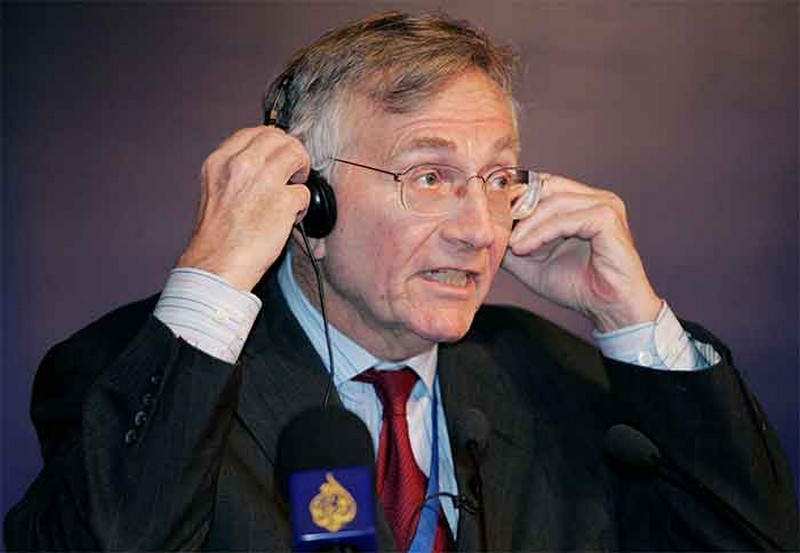
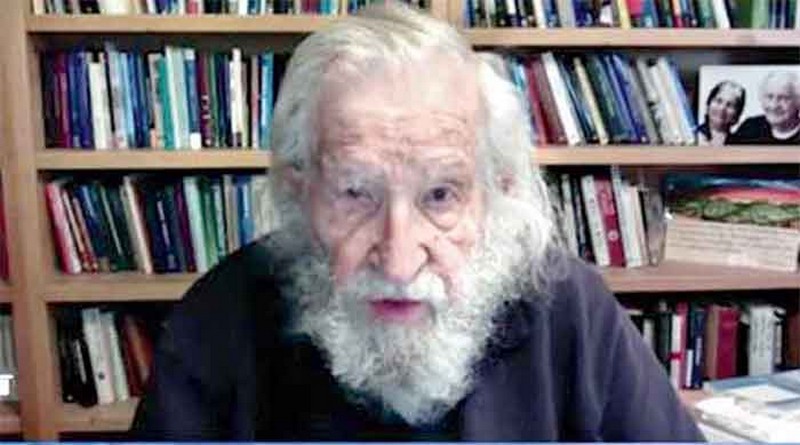
Legendary investigative journalist Seymour Hersh claimed on Saturday that his latest exposure report that suggests the CIA was responsible for the destruction of the Nord Stream pipelines in September, was not a hard story to find. It was obvious that there was more to the issue than was being reported by most media outlets, Hersh said.

In his first interview, (Radio War Nerd EP #366 — Seymour Hersh on US Bombing Nord Stream Pipelines, https://www.patreon.com/posts/radio-war-nerd-78596220), since he published the story on Substack last Wednesday, the Pulitzer-prize winning journalist was asked by Radio War Nerd to comment on his source for the story, who still remains anonymous.

Hersh refused to expose any details about who he spoke to and noted that it was his job to protect his sources and take the heat when a story went live. But those within the media who criticize him for using anonymous sources should “understand the business a little better,” the journalist suggested.

“The problem is, it has all been cheapened. Because now the New York Times and the Washington Post think an unnamed source can be a press guy, a press secretary, that whispers something to them on the side. I do not know, they do not seem to have anyone inside,” Hersh said.

He also noted that major news outlets are failing to report a lot of things about the ongoing conflict between Moscow and Kiev. “The war I know about is not the war you are reading about,” Hersh observed.

“It is amazing to me how they feel in line, my colleagues,” he added, lamenting that many outlets such as the New York Times, Washington Post, CNN and MSN have become a front for the White House and the Biden administration.

As for the Nord Stream expose, Hersh insisted it was “not a hard story to find” and that it was obvious that some NATO country was involved, especially after top US officials, including President Joe Biden, issued clear threats that the Russian-German project would be stopped “one way or another” if Moscow chose to send troops to Ukraine back in February 2022.

Hersh also pointed out that the entire international pipeline industry knew “who did what” and that this was a reality that “nobody thinks about.”

He concluded, “But I did, so there you are.”

The White House, as well as officials from the CIA and State Department, have all vehemently dismissed Hersh’s report since it was published. Moscow, meanwhile, has called for an open international investigation into the attack, saying it was “impossible to leave this without finding the perpetrators and punish them.”

Seymour Hersh’s Report: How America Took Out The Nord Stream Pipeline

Following is Seymour Hersh’s report in Substack (https://seymourhersh.substack.com/p/how-america-took-out-the-nord-stream, Feb 8):

The U.S. Navy’s Diving and Salvage Center can be found in a location as obscure as its name — down what was once a country lane in rural Panama City, a now-booming resort city in the southwestern panhandle of Florida, 70 miles south of the Alabama border. The center’s complex is as nondescript as its location — a drab concrete post-World War II structure that has the look of a vocational high school on the west side of Chicago. A coin-operated laundromat and a dance school are across what is now a four-lane road.

The center has been training highly skilled deep-water divers for decades who, once assigned to American military units worldwide, are capable of technical diving to do the good — using C4 explosives to clear harbors and beaches of debris and unexploded ordinance — as well as the bad, like blowing up foreign oil rigs, fouling intake valves for undersea power plants, destroying locks on crucial shipping canals. The Panama City center, which boasts the second largest indoor pool in America, was the perfect place to recruit the best, and most taciturn, graduates of the diving school who successfully did last summer what they had been authorized to do 260 feet under the surface of the Baltic Sea.

Last June, the Navy divers, operating under the cover of a widely publicized mid-summer NATO exercise known as BALTOPS 22, planted the remotely triggered explosives that, three months later, destroyed three of the four Nord Stream pipelines, according to a source with direct knowledge of the operational planning.

Two of the pipelines, which were known collectively as Nord Stream 1, had been providing Germany and much of Western Europe with cheap Russian natural gas for more than a decade. A second pair of pipelines, called Nord Stream 2, had been built but were not yet operational. Now, with Russian troops massing on the Ukrainian border and the bloodiest war in Europe since 1945 looming, President Joseph Biden saw the pipelines as a vehicle for Vladimir Putin to weaponize natural gas for his political and territorial ambitions.

Asked for comment, Adrienne Watson, a White House spokesperson, said in an email, “This is false and complete fiction.” Tammy Thorp, a spokesperson for the Central Intelligence Agency, similarly wrote: “This claim is completely and utterly false.”

Biden’s decision to sabotage the pipelines came after more than nine months of highly secret back and forth debate inside Washington’s national security community about how to best achieve that goal. For much of that time, the issue was not whether to do the mission, but how to get it done with no overt clue as to who was responsible.

There was a vital bureaucratic reason for relying on the graduates of the center’s hardcore diving school in Panama City. The divers were Navy only, and not members of America’s Special Operations Command, whose covert operations must be reported to Congress and briefed in advance to the Senate and House leadership—the so-called Gang of Eight. The Biden Administration was doing everything possible to avoid leaks as the planning took place late in 2021 and into the first months of 2022.

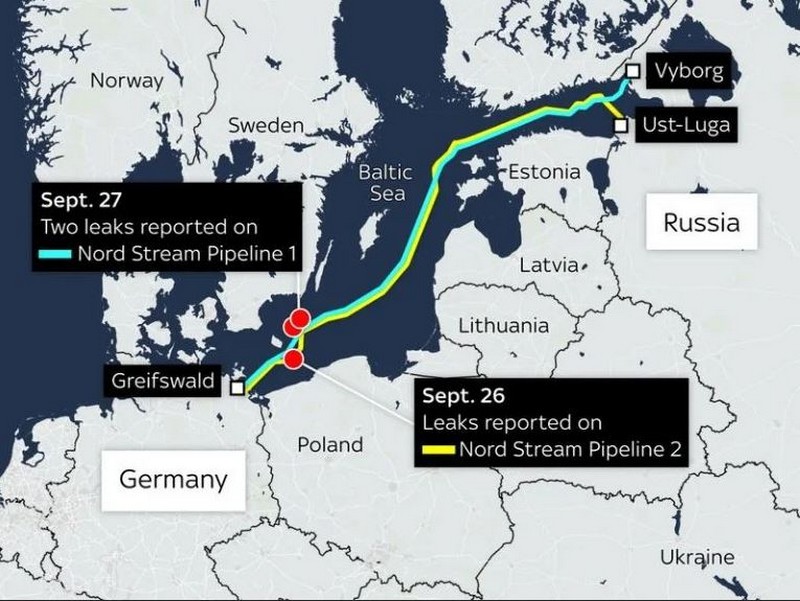
President Biden and his foreign policy team — National Security Adviser Jake Sullivan, Secretary of State Tony Blinken, and Victoria Nuland, the Undersecretary of State for Policy — had been vocal and consistent in their hostility to the two pipelines, which ran side by side for 750 miles under the Baltic Sea from two different ports in northeastern Russia near the Estonian border, passing close to the Danish island of Bornholm before ending in northern Germany.

The direct route, which bypassed any need to transit Ukraine, had been a boon for the German economy, which enjoyed an abundance of cheap Russian natural gas — enough to run its factories and heat its homes while enabling German distributors to sell excess gas, at a profit, throughout Western Europe. Action that could be traced to the administration would violate US promises to minimize direct conflict with Russia. Secrecy was essential.

From its earliest days, Nord Stream 1 was seen by Washington and its anti-Russian NATO partners as a threat to western dominance. The holding company behind it, Nord Stream AG, was incorporated in Switzerland in 2005 in partnership with Gazprom, a publicly traded Russian company producing enormous profits for shareholders which is dominated by oligarchs known to be in the thrall of Putin. Gazprom controlled 51 percent of the company, with four European energy firms — one in France, one in the Netherlands and two in Germany — sharing the remaining 49 percent of stock, and having the right to control downstream sales of the inexpensive natural gas to local distributors in Germany and Western Europe. Gazprom’s profits were shared with the Russian government, and state gas and oil revenues were estimated in some years to amount to as much as 45 percent of Russia’s annual budget.

America’s political fears were real: Putin would now have an additional and much-needed major source of income, and Germany and the rest of Western Europe would become addicted to low-cost natural gas supplied by Russia — while diminishing European reliance on America. In fact, that’s exactly what happened. Many Germans saw Nord Stream 1 as part of the deliverance of former Chancellor Willy Brandt’s famed Ostpolitik theory, which would enable postwar Germany to rehabilitate itself and other European nations destroyed in World War II by, among other initiatives, utilizing cheap Russian gas to fuel a prosperous Western European market and trading economy.

Nord Stream 1 was dangerous enough, in the view of NATO and Washington, but Nord Stream 2, whose construction was completed in September of 2021, would, if approved by German regulators, double the amount of cheap gas that would be available to Germany and Western Europe. The second pipeline also would provide enough gas for more than 50 percent of Germany’s annual consumption. Tensions were constantly escalating between Russia and NATO, backed by the aggressive foreign policy of the Biden Administration.

Opposition to Nord Stream 2 flared on the eve of the Biden inauguration in January 2021, when Senate Republicans, led by Ted Cruz of Texas, repeatedly raised the political threat of cheap Russian natural gas during the confirmation hearing of Blinken as Secretary of State. By then a unified Senate had successfully passed a law that, as Cruz told Blinken, “halted [the pipeline] in its tracks.” There would be enormous political and economic pressure from the German government, then headed by Angela Merkel, to get the second pipeline online.

Would Biden stand up to the Germans? Blinken said yes, but added that he had not discussed the specifics of the incoming President’s views. “I know his strong conviction that this is a bad idea, the Nord Stream 2,” he said. “I know that he would have us use every persuasive tool that we have to convince our friends and partners, including Germany, not to move forward with it.”

A few months later, as the construction of the second pipeline neared completion, Biden blinked. That May, in a stunning turnaround, the administration waived sanctions against Nord Stream AG, with a State Department official conceding that trying to stop the pipeline through sanctions and diplomacy had “always been a long shot.” Behind the scenes, administration officials reportedly urged Ukrainian President Volodymyr Zelensky, by then facing a threat of Russian invasion, not to criticize the move.

There were immediate consequences. Senate Republicans, led by Cruz, announced an immediate blockade of all of Biden’s foreign policy nominees and delayed passage of the annual defense bill for months, deep into the fall. Politico later depicted Biden’s turnabout on the second Russian pipeline as “the one decision, arguably more than the chaotic military withdrawal from Afghanistan, that has imperiled Biden’s agenda.”

The administration was floundering, despite getting a reprieve on the crisis in mid-November, when Germany’s energy regulators suspended approval of the second Nord Stream pipeline. Natural gas prices surged 8% within days, amid growing fears in Germany and Europe that the pipeline suspension and the growing possibility of a war between Russia and Ukraine would lead to a very much unwanted cold winter. It was not clear to Washington just where Olaf Scholz, Germany’s newly appointed chancellor, stood. Months earlier, after the fall of Afghanistan, Scholtz had publicly endorsed French President Emmanuel Macron’s call for a more autonomous European foreign policy in a speech in Prague—clearly suggesting less reliance on Washington and its mercurial actions.

Throughout all of this, Russian troops had been steadily and ominously building up on the borders of Ukraine, and by the end of December more than 100,000 soldiers were in position to strike from Belarus and Crimea. Alarm was growing in Washington, including an assessment from Blinken that those troop numbers could be “doubled in short order.”

The administration’s attention once again was focused on Nord Stream. As long as Europe remained dependent on the pipelines for cheap natural gas, Washington was afraid that countries like Germany would be reluctant to supply Ukraine with the money and weapons it needed to defeat Russia.

It was at this unsettled moment that Biden authorized Jake Sullivan to bring together an interagency group to come up with a plan.

All options were to be on the table. But only one would emerge.

PLANNING

In December of 2021, two months before the first Russian tanks rolled into Ukraine, Jake Sullivan convened a meeting of a newly formed task force — men and women from the Joint Chiefs of Staff, the CIA, and the State and Treasury Departments — and asked for recommendations about how to respond to Putin’s impending invasion.

It would be the first of a series of top-secret meetings, in a secure room on a top floor of the Old Executive Office Building, adjacent to the White House, that was also the home of the President’s Foreign Intelligence Advisory Board (PFIAB). There was the usual back and forth chatter that eventually led to a crucial preliminary question: Would the recommendation forwarded by the group to the President be reversible — such as another layer of sanctions and currency restrictions — or irreversible — that is, kinetic actions, which could not be undone?

What became clear to participants, according to the source with direct knowledge of the process, is that Sullivan intended for the group to come up with a plan for the destruction of the two Nord Stream pipelines — and that he was delivering on the desires of the President.

THE PLAYERS Left to right: Victoria Nuland, Anthony Blinken, Jake Sullivan.

Over the next several meetings, the participants debated options for an attack. The Navy proposed using a newly commissioned submarine to assault the pipeline directly. The Air Force discussed dropping bombs with delayed fuses that could be set off remotely. The CIA argued that whatever was done, it would have to be covert. Everyone involved understood the stakes. “This is not kiddie stuff,” the source said. If the attack were traceable to the United States, “It’s an act of war.”

At the time, the CIA was directed by William Burns, a mild-mannered former ambassador to Russia who had served as deputy secretary of state in the Obama Administration. Burns quickly authorized an Agency working group whose ad hoc members included — by chance — someone who was familiar with the capabilities of the Navy’s deep-sea divers in Panama City. Over the next few weeks, members of the CIA’s working group began to craft a plan for a covert operation that would use deep-sea divers to trigger an explosion along the pipeline.

Something like this had been done before. In 1971, the American intelligence community learned from still undisclosed sources that two important units of the Russian Navy were communicating via an undersea cable buried in the Sea of Okhotsk, on Russia’s Far East Coast. The cable linked a regional Navy command to the mainland headquarters at Vladivostok.

A hand-picked team of Central Intelligence Agency and National Security Agency operatives was assembled somewhere in the Washington area, under deep cover, and worked out a plan, using Navy divers, modified submarines and a deep-submarine rescue vehicle, that succeeded, after much trial and error, in locating the Russian cable. The divers planted a sophisticated listening device on the cable that successfully intercepted the Russian traffic and recorded it on a taping system.

The NSA learned that senior Russian navy officers, convinced of the security of their communication link, chatted away with their peers without encryption. The recording device and its tape had to be replaced monthly and the project rolled on merrily for a decade until it was compromised by a forty-four-year-old civilian NSA technician named Ronald Pelton who was fluent in Russian. Pelton was betrayed by a Russian defector in 1985 and sentenced to prison. He was paid just $5,000 by the Russians for his revelations about the operation, along with $35,000 for other Russian operational data he provided that was never made public.

That underwater success, codenamed Ivy Bells, was innovative and risky, and produced invaluable intelligence about the Russian Navy’s intentions and planning.

Still, the interagency group was initially skeptical of the CIA’s enthusiasm for a covert deep-sea attack. There were too many unanswered questions. The waters of the Baltic Sea were heavily patrolled by the Russian navy, and there were no oil rigs that could be used as cover for a diving operation. Would the divers have to go to Estonia, right across the border from Russia’s natural gas loading docks, to train for the mission? “It would be a goat fuck,” the Agency was told.

Throughout “all of this scheming,” the source said, “some working guys in the CIA and the State Department were saying, ‘Don’t do this. It’s stupid and will be a political nightmare if it comes out.’”

Nevertheless, in early 2022, the CIA working group reported back to Sullivan’s interagency group: “We have a way to blow up the pipelines.”

What came next was stunning. On February 7, less than three weeks before the seemingly inevitable Russian invasion of Ukraine, Biden met in his White House office with German Chancellor Olaf Scholz, who, after some wobbling, was now firmly on the American team. At the press briefing that followed, Biden defiantly said, “If Russia invades . . . there will be no longer a Nord Stream 2. We will bring an end to it.”

Twenty days earlier, Undersecretary Nuland had delivered essentially the same message at a State Department briefing, with little press coverage. “I want to be very clear to you today,” she said in response to a question. “If Russia invades Ukraine, one way or another Nord Stream 2 will not move forward.”

Several of those involved in planning the pipeline mission were dismayed by what they viewed as indirect references to the attack.

“It was like putting an atomic bomb on the ground in Tokyo and telling the Japanese that we are going to detonate it,” the source said. “The plan was for the options to be executed post invasion and not advertised publicly. Biden simply didn’t get it or ignored it.”

Biden’s and Nuland’s indiscretion, if that is what it was, might have frustrated some of the planners. But it also created an opportunity. According to the source, some of the senior officials of the CIA determined that blowing up the pipeline “no longer could be considered a covert option because the President just announced that we knew how to do it.”

The plan to blow up Nord Stream 1 and 2 was suddenly downgraded from a covert operation requiring that Congress be informed to one that was deemed as a highly classified intelligence operation with U.S. military support. Under the law, the source explained, “There was no longer a legal requirement to report the operation to Congress. All they had to do now is just do it — but it still had to be secret. The Russians have superlative surveillance of the Baltic Sea.”

The Agency working group members had no direct contact with the White House, and were eager to find out if the President meant what he’d said — that is, if the mission was now a go. The source recalled, “Bill Burns comes back and says, ‘Do it.’”

“The Norwegian navy was quick to find the right spot, in the shallow water a few miles off Denmark’s Bornholm Island . . .”

THE OPERATION 

Norway was the perfect place to base the mission.

In the past few years of East-West crisis, the U.S. military has vastly expanded its presence inside Norway, whose western border runs 1,400 miles along the north Atlantic Ocean and merges above the Arctic Circle with Russia. The Pentagon has created high paying jobs and contracts, amid some local controversy, by investing hundreds of millions of dollars to upgrade and expand American Navy and Air Force facilities in Norway. The new works included, most importantly, an advanced synthetic aperture radar far up north that was capable of penetrating deep into Russia and came online just as the American intelligence community lost access to a series of long-range listening sites inside China.

A newly refurbished American submarine base, which had been under construction for years, had become operational and more American submarines were now able to work closely with their Norwegian colleagues to monitor and spy on a major Russian nuclear redoubt 250 miles to the east, on the Kola Peninsula. America also has vastly expanded a Norwegian air base in the north and delivered to the Norwegian air force a fleet of Boeing-built P8 Poseidon patrol planes to bolster its long-range spying on all things Russia.

In return, the Norwegian government angered liberals and some moderates in its parliament last November by passing the Supplementary Defense Cooperation Agreement (SDCA). Under the new deal, the U.S. legal system would have jurisdiction in certain “agreed areas” in the North over American soldiers accused of crimes off base, as well as over those Norwegian citizens accused or suspected of interfering with the work at the base.

Norway was one of the original signatories of the NATO Treaty in 1949, in the early days of the Cold War. Today, the supreme commander of NATO is Jens Stoltenberg, a committed anti-communist, who served as Norway’s prime minister for eight years before moving to his high NATO post, with American backing, in 2014. He was a hardliner on all things Putin and Russia who had cooperated with the American intelligence community since the Vietnam War. He has been trusted completely since. “He is the glove that fits the American hand,” the source said.

Back in Washington, planners knew they had to go to Norway. “They hated the Russians, and the Norwegian navy was full of superb sailors and divers who had generations of experience in highly profitable deep-sea oil and gas exploration,” the source said. They also could be trusted to keep the mission secret. (The Norwegians may have had other interests as well. The destruction of Nord Stream — if the Americans could pull it off — would allow Norway to sell vastly more of its own natural gas to Europe.)

Sometime in March, a few members of the team flew to Norway to meet with the Norwegian Secret Service and Navy. One of the key questions was where exactly in the Baltic Sea was the best place to plant the explosives. Nord Stream 1 and 2, each with two sets of pipelines, were separated much of the way by little more than a mile as they made their run to the port of Greifswald in the far northeast of Germany.

The Norwegian navy was quick to find the right spot, in the shallow waters of the Baltic sea a few miles off Denmark’s Bornholm Island. The pipelines ran more than a mile apart along a seafloor that was only 260 feet deep. That would be well within the range of the divers, who, operating from a Norwegian Alta class mine hunter, would dive with a mixture of oxygen, nitrogen and helium streaming from their tanks, and plant shaped C4 charges on the four pipelines with concrete protective covers. It would be tedious, time consuming and dangerous work, but the waters off Bornholm had another advantage: there were no major tidal currents, which would have made the task of diving much more difficult.

After a bit of research, the Americans were all in.

At this point, the Navy’s obscure deep-diving group in Panama City once again came into play. The deep-sea schools at Panama City, whose trainees participated in Ivy Bells, are seen as an unwanted backwater by the elite graduates of the Naval Academy in Annapolis, who typically seek the glory of being assigned as a Seal, fighter pilot, or submariner. If one must become a “Black Shoe”—that is, a member of the less desirable surface ship command — there is always at least duty on a destroyer, cruiser or amphibious ship. The least glamorous of all is mine warfare. Its divers never appear in Hollywood movies, or on the cover of popular magazines.

“The best divers with deep diving qualifications are a tight community, and only the very best are recruited for the operation and told to be prepared to be summoned to the CIA in Washington,” the source said.

The Norwegians and Americans had a location and the operatives, but there was another concern: any unusual underwater activity in the waters off Bornholm might draw the attention of the Swedish or Danish navies, which could report it.

Denmark had also been one of the original NATO signatories and was known in the intelligence community for its special ties to the United Kingdom. Sweden had applied for membership into NATO, and had demonstrated its great skill in managing its underwater sound and magnetic sensor systems that successfully tracked Russian submarines that would occasionally show up in remote waters of the Swedish archipelago and be forced to the surface.

The Norwegians joined the Americans in insisting that some senior officials in Denmark and Sweden had to be briefed in general terms about possible diving activity in the area. In that way, someone higher up could intervene and keep a report out of the chain of command, thus insulating the pipeline operation. “What they were told and what they knew were purposely different,” the source told me. (The Norwegian embassy, asked to comment on this story, did not respond.)

The Norwegians were key to solving other hurdles. The Russian navy was known to possess surveillance technology capable of spotting, and triggering, underwater mines. The American explosive devices needed to be camouflaged in a way that would make them appear to the Russian system as part of the natural background — something that required adapting to the specific salinity of the water. The Norwegians had a fix.

The Norwegians also had a solution to the crucial question of when the operation should take place. Every June, for the past 21 years, the American Sixth Fleet, whose flagship is based in Gaeta, Italy, south of Rome, has sponsored a major NATO exercise in the Baltic Sea involving scores of allied ships throughout the region. The current exercise, held in June, would be known as Baltic Operations 22, or BALTOPS 22. The Norwegians proposed this would be the ideal cover to plant the mines.

The Americans provided one vital element: they convinced the Sixth Fleet planners to add a research and development exercise to the program. The exercise, as made public by the Navy, involved the Sixth Fleet in collaboration with the Navy’s “research and warfare centers.” The at-sea event would be held off the coast of Bornholm Island and involve NATO teams of divers planting mines, with competing teams using the latest underwater technology to find and destroy them.

It was both a useful exercise and ingenious cover. The Panama City boys would do their thing and the C4 explosives would be in place by the end of BALTOPS22, with a 48-hour timer attached. All of the Americans and Norwegians would be long gone by the first explosion.

The days were counting down. “The clock was ticking, and we were nearing mission accomplished,” the source said.

And then: Washington had second thoughts. The bombs would still be planted during BALTOPS, but the White House worried that a two-day window for their detonation would be too close to the end of the exercise, and it would be obvious that America had been involved.

Instead, the White House had a new request: “Can the guys in the field come up with some way to blow the pipelines later on command?”

Some members of the planning team were angered and frustrated by the President’s seeming indecision. The Panama City divers had repeatedly practiced planting the C4 on pipelines, as they would during BALTOPS, but now the team in Norway had to come up with a way to give Biden what he wanted — the ability to issue a successful execution order at a time of his choosing.

Being tasked with an arbitrary, last-minute change was something the CIA was accustomed to managing. But it also renewed the concerns some shared over the necessity, and legality, of the entire operation.

The President’s secret orders also evoked the CIA’s dilemma in the Vietnam War days, when President Johnson, confronted by growing anti-Vietnam War sentiment, ordered the Agency to violate its charter — which specifically barred it from operating inside America — by spying on antiwar leaders to determine whether they were being controlled by Communist Russia.

The agency ultimately acquiesced, and throughout the 1970s it became clear just how far it had been willing to go. There were subsequent newspaper revelations in the aftermath of the Watergate scandals about the Agency’s spying on American citizens, its involvement in the assassination of foreign leaders and its undermining of the socialist government of Salvador Allende.

Those revelations led to a dramatic series of hearings in the mid-1970s in the Senate, led by Frank Church of Idaho, that made it clear that Richard Helms, the Agency director at the time, accepted that he had an obligation to do what the President wanted, even if it meant violating the law.

In unpublished, closed-door testimony, Helms ruefully explained that “you almost have an Immaculate Conception when you do something” under secret orders from a President. “Whether it’s right that you should have it, or wrong that you shall have it, [the CIA] works under different rules and ground rules than any other part of the government.” He was essentially telling the Senators that he, as head of the CIA, understood that he had been working for the Crown, and not the Constitution.

The Americans at work in Norway operated under the same dynamic, and dutifully began working on the new problem — how to remotely detonate the C4 explosives on Biden’s order. It was a much more demanding assignment than those in Washington understood. There was no way for the team in Norway to know when the President might push the button. Would it be in a few weeks, in many months or in half a year or longer?

The C4 attached to the pipelines would be triggered by a sonar buoy dropped by a plane on short notice, but the procedure involved the most advanced signal processing technology. Once in place, the delayed timing devices attached to any of the four pipelines could be accidentally triggered by the complex mix of ocean background noises throughout the heavily trafficked Baltic Sea — from near and distant ships, underwater drilling, seismic events, waves and even sea creatures. To avoid this, the sonar buoy, once in place, would emit a sequence of unique low frequency tonal sounds — much like those emitted by a flute or a piano — that would be recognized by the timing device and, after a pre-set hours of delay, trigger the explosives. (“You want a signal that is robust enough so that no other signal could accidentally send a pulse that detonated the explosives,” I was told by Dr. Theodore Postol, professor emeritus of science, technology and national security policy at MIT. Postol, who has served as the science adviser to the Pentagon’s Chief of Naval Operations, said the issue facing the group in Norway because of Biden’s delay was one of chance: “The longer the explosives are in the water the greater risk there would be of a random signal that would launch the bombs.”)

On September 26, 2022, a Norwegian Navy P8 surveillance plane made a seemingly routine flight and dropped a sonar buoy. The signal spread underwater, initially to Nord Stream 2 and then on to Nord Stream 1. A few hours later, the high-powered C4 explosives were triggered and three of the four pipelines were put out of commission. Within a few minutes, pools of methane gas that remained in the shuttered pipelines could be seen spreading on the water’s surface and the world learned that something irreversible had taken place.

FALLOUT

In the immediate aftermath of the pipeline bombing, the American media treated it like an unsolved mystery. Russia was repeatedly cited as a likely culprit, spurred on by calculated leaks from the White House — but without ever establishing a clear motive for such an act of self-sabotage, beyond simple retribution. A few months later, when it emerged that Russian authorities had been quietly getting estimates for the cost to repair the pipelines, the New York Times described the news as “complicating theories about who was behind” the attack. No major American newspaper dug into the earlier threats to the pipelines made by Biden and Undersecretary of State Nuland.

While it was never clear why Russia would seek to destroy its own lucrative pipeline, a more telling rationale for the President’s action came from Secretary of State Blinken.

Asked at a press conference last September about the consequences of the worsening energy crisis in Western Europe, Blinken described the moment as a potentially good one:

“It’s a tremendous opportunity to once and for all remove the dependence on Russian energy and thus to take away from Vladimir Putin the weaponization of energy as a means of advancing his imperial designs. That’s very significant and that offers tremendous strategic opportunity for the years to come, but meanwhile we’re determined to do everything we possibly can to make sure the consequences of all of this are not borne by citizens in our countries or, for that matter, around the world.”

More recently, Victoria Nuland expressed satisfaction at the demise of the newest of the pipelines. Testifying at a Senate Foreign Relations Committee hearing in late January she told Senator Ted Cruz, “​Like you, I am, and I think the Administration is, very gratified to know that Nord Stream 2 is now, as you like to say, a hunk of metal at the bottom of the sea.”

The source had a much more streetwise view of Biden’s decision to sabotage more than 1500 miles of Gazprom pipeline as winter approached. “Well,” he said, speaking of the President, “I gotta admit the guy has a pair of balls.  He said he was going to do it, and he did.”

Asked why he thought the Russians failed to respond, he said cynically, “Maybe they want the capability to do the same things the U.S. did.

“It was a beautiful cover story,” he went on. “Behind it was a covert operation that placed experts in the field and equipment that operated on a covert signal.

“The only flaw was the decision to do it.”
Countercurrents is answerable only to our readers. Support honest journalism because we have no PLANET B.

14 February 2023

Source: countercurrents.org

Chomsky and Prashad: Cuba Is Not a State Sponsor of Terrorism

By Noam Chomsky and Vijay Prashad

Cuba, a country of 11 million people, has been under an illegal embargo by the United States government for over six decades.

Despite this embargo, Cuba’s people have been able to transcend the indignities of hunger, ill health, and illiteracy, all three being social plagues that continue to trouble much of the world.

Due to its innovations in health care delivery, for instance, Cuba has been able to send its medical workers to other countries, including during the pandemic, to provide vital assistance. Cuba exports its medical workers, not terrorism.

In the last days of the Trump administration, the U.S. government returned Cuba to its state sponsors of terrorism list.

This was a vindictive act. Trump said it was because Cuba played host to guerrilla groups from Colombia, which was actually part of Cuba’s role as host of the peace talks.

Cuba played a key role in bringing peace in Colombia, a country that has been wracked by a terrible civil war since 1948 that claimed the lives of hundreds of thousands of people. For two years, the Biden administration has maintained Trump’s vindictive policy, one that punishes Cuba not for terrorism but for the promotion of peace.

Biden can remove Cuba from this list with a stroke of his pen. It’s as simple as that. When he was running for the presidency, Biden said he would even reverse the harsher of Trump’s sanctions. But he has not done so. He must do so now.

Noam Chomsky is a linguist, philosopher, and political activist.

Vijay Prashad is an Indian historian, editor, and journalist.

14 February 2023

Source: countercurrents.org

How Spin and Lies Fuel a Bloody War of Attrition in Ukraine 

By Medea Benjamin and Nicolas J. S. Davie

In a recent column, military analyst William Astore wrote, “[Congressman] George Santos is a symptom of a much larger disease: a lack of honor, a lack of shame, in America. Honor, truth, integrity, simply don’t seem to matter, or matter much, in America today… But how do you have a democracy where there is no truth?”

Astore went on to compare America’s political and military leaders to the disgraced Congressman Santos. “U.S. military leaders appeared before Congress to testify the Iraq War was being won,” Astore wrote. “They appeared before Congress to testify the Afghan War was being won. They talked of “progress,” of corners being turned, of Iraqi and Afghan forces being successfully trained and ready to assume their duties as U.S. forces withdrew. As events showed, it was all spin. All lies.”

Now America is at war again, in Ukraine, and the spin continues. This war involves Russia, Ukraine, the United States and its NATO allies. No party to this conflict has leveled with its own people to honestly explain what it is fighting for, what it really hopes to achieve and how it plans to achieve it. All sides claim to be fighting for noble causes and insist that it is the other side that refuses to negotiate a peaceful resolution. They are all manipulating and lying, and compliant media (on all sides) trumpet their lies.

It is a truism that the first casualty of war is the truth. But spinning and lying has real-world impacts in a war in which hundreds of thousands of real people are fighting and dying, while their homes, on both sides of the front lines, are reduced to rubble by hundreds of thousands of howitzer shells.

Yves Smith, the editor of Naked Capitalism, explored this insidious linkage between the information war and the real one in an article titled, “What if Russia won the Ukraine War, but the Western press didn’t notice?” He observed that Ukraine’s total dependence on the supply of weapons and money from its Western allies has given a life of its own to a triumphalist narrative that Ukraine is defeating Russia, and will keep scoring victories as long as the West keeps sending it more money and increasingly powerful and deadly weapons.

But the need to keep recreating the illusion that Ukraine is winning by hyping limited gains on the battlefield has forced Ukraine to keep sacrificing its forces in extremely bloody battles, like its counter-offensive around Kherson and the Russian sieges of Bakhmut and Soledar. Lt. Col. Alexander Vershinin, a retired U.S. tank commander, wrote on Harvard’s Russia Matters website, “In some ways, Ukraine has no choice but to launch attacks no matter the human and material cost.”

Objective analyses of the war in Ukraine are hard to come by through the thick fog of war propaganda. But we should pay attention when a series of senior Western military leaders, active and retired, make urgent calls for diplomacy to reopen peace negotiations, and warn that prolonging and escalating the war is risking a full-scale war between Russia and the United States that could escalate into nuclear war.

General Erich Vad, who was German Chancellor Angela Merkel’s senior military adviser for seven years, recently spoke to Emma, a German news website. He called the war in Ukraine a “war of attrition,” and compared it to the First World War, and to the Battle of Verdun in particular, in which hundreds of thousands of French and German soldiers were killed with no major gain for either side.

Vad asked the same persistent unanswered question that the New York Times editorial board asked of President Biden last May. What are the U.S. and NATO’s real war aims?

“Do you want to achieve a willingness to negotiate with the deliveries of the tanks? Do you want to reconquer Donbas or Crimea? Or do you want to defeat Russia completely?” asked General Vad.

He concluded, “There is no realistic end state definition. And without an overall political and strategic concept, arms deliveries are pure militarism. We have a militarily operational stalemate, which we cannot solve militarily. Incidentally, this is also the opinion of the American Chief of Staff Mark Milley. He said that Ukraine’s military victory is not to be expected and that negotiations are the only possible way. Anything else is a senseless waste of human life.”

Whenever Western officials are put on the spot by these unanswered questions, they are forced to reply, as Biden did to the Times eight months ago, that they are sending weapons to help Ukraine defend itself and to put it in a stronger position at the negotiating table. But what would this “stronger position” look like?

When Ukrainian forces were advancing toward Kherson in November, NATO officials agreed that the fall of Kherson would give Ukraine an opportunity to reopen negotiations from a position of strength. But when Russia withdrew from Kherson, no negotiations ensued, and both sides are now planning new offensives.

The U.S. media keep repeating the narrative that Russia will never negotiate in good faith, and it has hidden from the public the fruitful negotiations that began soon after the Russian invasion but were quashed by the United States and United Kingdom. Few outlets reported the recent revelations by former Israeli Prime Minister Naftali Bennett about the ceasefire negotiations between Russia and Ukraine in Turkey that he helped to mediate in March 2022. Bennett said explicitly that the West “blocked” or “stopped” (depending on the translation) the negotiations.

Bennett confirmed what has been reported by other sources since April 21, 2022, when Turkish Foreign Minister Mevlut Cavusoglu, one of the other mediators, told CNN Turk after a NATO foreign ministers’ meeting, “There are countries within NATO who want the war to continue… They want Russia to become weaker.”

Advisers to Prime Minister Zelenskyy provided the details of Boris Johnson’s April 9 visit to Kyiv that were published in Ukrayinska Pravda on May 5th. They said Johnson delivered two messages. The first was that Putin and Russia “should be pressured, not negotiated with.” The second was that, even if Ukraine completed an agreement with Russia, the “collective West,” who Johnson claimed to represent, would take no part in it.

The Western corporate media has generally only weighed in on these early negotiations to cast doubt on this story or smear any who repeat it as Putin apologists, despite multiple-source confirmation by Ukrainian officials, Turkish diplomats and now the former Israeli prime minister.

The propaganda frame that Western establishment politicians and media use to explain the war in Ukraine to their own publics is a classic “white hats vs black hats” narrative, in which Russia’s guilt for the invasion doubles as proof of the West’s innocence and righteousness. The growing mountain of evidence that the U.S. and its allies share responsibility for many aspects of this crisis is swept under the proverbial carpet, which looks more and more like The Little Prince’s drawing of a boa constrictor that swallowed an elephant.

Western media and officials were even more ridiculous when they tried to blame Russia for blowing up its own pipelines, the Nord Stream underwater natural gas pipelines that channeled Russian gas to Germany. According to NATO, the explosions that released half a million tons of methane into the atmosphere were “deliberate, reckless, and irresponsible acts of sabotage.” The Washington Post, in what could be considered journalistic malpractice, quoted an anonymous “senior European environmental official” saying, “No one on the European side of the ocean is thinking this is anything other than Russian sabotage.”

It took former New York Times investigative reporter Seymour Hersh to break the silence. He published, in a blog post on his own Substack, a spectacular whistleblower’s account of how U.S. Navy divers teamed up with the Norwegian navy to plant the explosives under cover of a NATO naval exercise, and how they were detonated by a sophisticated signal from a buoy dropped by a Norwegian surveillance plane. According to Hersh, President Biden took an active role in the plan, and amended it to include the use of the signaling buoy so that he could personally dictate the precise timing of the operation, three months after the explosives were planted.

The White House predictably dismissed Hersh’s report as “utterly false and complete fiction”, but has never offered any reasonable explanation for this historic act of environmental terrorism.

President Eisenhower famously said that only an “alert and knowledgeable citizenry” can “guard against the acquisition of unwarranted influence, whether sought or unsought, by the military-industrial complex. The potential for the disastrous rise of misplaced power exists and will persist.”

So what should an alert and knowledgeable American citizenry know about the role our government has played in fomenting the crisis in Ukraine, a role that the corporate media has swept under the rug? That is one of the main questions we have tried to answer in our book War in Ukraine: Making Sense of a Senseless Conflict. The answers include:

–        The U.S. broke its promises not to expand NATO into Eastern Europe. In 1997, before Americans had ever heard of Vladimir Putin, 50 former senators, retired military officers, diplomats and academics wrote to President Clinton to oppose NATO expansion, calling it a policy error of “historic proportions.” Elder statesman George Kennan condemned it as “the beginning of a new cold war.”

–        NATO provoked Russia by its open-ended promise to Ukraine in 2008 that it would become a member of NATO. William Burns, who was then the U.S. Ambassador to Moscow and is now the CIA Director, warned in a State Department memo, “Ukrainian entry into NATO is the brightest of all red-lines for the Russian elite (not just Putin).”

–        The U.S.backed a coup in Ukraine in 2014 that installed a government that only half its people recognized as legitimate, causing the disintegration of Ukraine and a civil war that killed 14,000 people.

–        The 2015 Minsk II peace accord achieved a stable ceasefire line and steady reductions in casualties, but Ukraine failed to grant autonomy to Donetsk and Luhansk as agreed. Angela Merkel and Francois Hollande now admit that Western leaders only supported Minsk II to buy time for NATO to arm and train Ukraine’s military to recover Donbas by force.

–        During the week before the invasion, OSCE monitors in Donbas documented a huge escalation in explosions around the ceasefire line. Most of the 4,093 explosions in four days were in rebel-held territory, indicating incoming shell-fire by Ukrainian government forces. U.S. and U.K. officials claimed these were “false flag” attacks, as if Donetsk and Luhansk’s forces were shelling themselves, just as they later suggested that Russia blew up its own pipelines.

–        After the invasion, instead of supporting Ukraine’s efforts to make peace, the United States and the United Kingdom blocked or stopped them in their tracks. The U.K.’s Boris Johnson said they saw a chance to “press” Russia and wanted to make the most of it, and U.S. Defense Secretary Austin said their goal was to “weaken” Russia.

What would an alert and knowledgeable citizenry make of all this? We would clearly condemn Russia for invading Ukraine. But then what? Surely we would also demand that U.S. political and military leaders tell us the truth about this horrific war and our country’s role in it, and demand that the media transmit the truth to the public. An “alert and knowledgeable citizenry” would surely then demand that our government stop fueling this war and instead support immediate peace negotiations.

Medea Benjamin and Nicolas J. S. Davies are the authors of War in Ukraine: Making Sense of a Senseless Conflict, published by OR Books.

14 February 2023

Source: countercurrents.org

While we’re laughing about a balloon; Biden paves a path to war

By Melissa Garriga

There is reason to be alarmed by the recent China balloon. However, that reason is not the alleged China aggression but the very calculated aggression towards China by the Obama, Trump and Biden administrations. This hate and the manufactured reasons for it have been layering on for years. We’ve seen this playbook. It’s the same game plan that  led us to the war on Iraq.

The U.S. is trying to contain and control China’s growth as a world power by using its military and economic powers. Just as it wanted to control the oil in the middle east.

There are 4 main reasons why the U.S. is doing this: First, it wants to prevent China from becoming an economic superpower that could rival America; Second, it wants the Asian market for itself at any cost; Third, it wants to exacerbate tensions between other countries that have disputes with China over resources in order to isolate Beijing on all sides; Fourth, it believes that such actions will increase American influence over Southeast Asia as well as its political leverage against Russia and Iran.

In other words, the U.S. wants to dominate the whole world even if that means burning it down to its core.

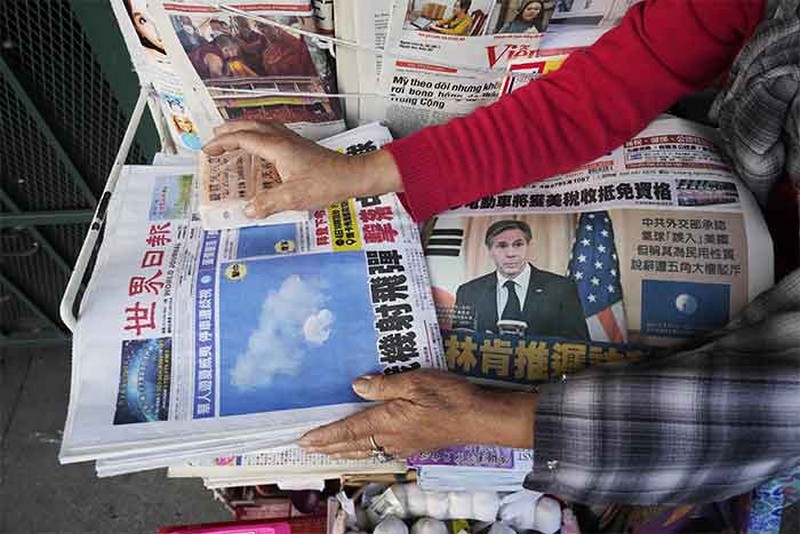
So how do you go to war with a country that is not an eminent threat to our nation’s safety and security? Enter the Chinese “spy” balloon. Before the words “chinese spy balloon” ever became a known phrase in every American household, Secretary of State Anthony Blinken had plans to travel to China to meet with his counterpart, Chinese Foreign Minister Qin Gang. The meeting would have been a diplomatic approach to resolving issues between the two countries and could have been the beginning of working towards cooperation. It also would have been in line with Biden’s promise to Xi in November that we would “keep the lines of communication open.” That was until a high altitude balloon from China drifted into U.S airspace last week.

Suddenly a relatively harmless balloon from China became the latest small cache of weapons becoming earth-dooming weapons of mass destruction. Regardless of the fact that balloons have accidentally entered US airspace before or that it happened three times during the Trump administration, the Pentagon created mass hype and hysteria in this newest attempt to manufacture consent. In fact, just last year during the Biden administration, a balloon crashed near Hawaii without making a splash. This balloon turned into a spectacle because the U.S. is relentless in its aim to ramp up aggression towards China. Those drums don’t beat themselves.

This is evidenced by Blicken’s immediate response by canceling his diplomatic trip to Beijing; essentially closing the lines for diplomacy. Meanwhile during the State of the Union Address on Tuesday, President Biden made reference to the balloon by vowing to protect the US “sovereignty.” He called out Xi by name, “Name me one world leader who’d change places with Xi Jinping. Name me one!” yelling out a threat against a world leader on national television amidst the roaring drums.

Biden and Congress are using the idea of competition with China as a thinly painted veil for what they really want – war. A war they have been setting up for years.

Over the past decade, the United States has increased its military presence in the Pacific at an alarming rate. The U.S. military has acquired access to four new bases in the Philippines, and increased its presence in Southeast Asia by half-a-million troops since 2002. However, the increased military presence doesn’t just stop and end with the Philippines. On January 1, 2020, U.S. Marine Corps opened a new base in Guam to monitor and conduct military operations in the South China Sea. This new base came to much of the dismay of the locals.

Having a base there means that the United States has more power to control China’s maritime rights under international law. In addition, there are also rumors that this new military base will be used as a “military outpost” against China by the U.S., so that they can more easily attack Chinese territory.

Then on November 29, 2022, the USS Chancellorsville sailed into the South China Sea without permission of the Chinese government. The move was seen as a provocation by many experts, who believe that it may bring about a military conflict between China and the United States. Notably its last participation in a war was when the United States illegally invaded Iraq after lying and misleading the public. Today, it is one of the most advanced warships in America’s arsenal. Sailing the USS Chancellorsville into the South China Sea was a clear threat to China and an act of provocation by the United States.

If that alone is not enough to convince you of major U.S. aggression towards China, then just listen to the words of General Mike Miniha, general in the United States Air Force, who wrote in a leaked memo “My gut tells me we will fight in 2025.” That memo that was leaked to NBC News. There is no indication whatsoever that China wants a war with the United States or any other country. Likewise, Admiral John Aquilino, recently warned the Senate Armed Services Committee that China invading Taiwan is  “much closer to us than most think.” All of these are eerily similar to the bloodlust U.S. military leaders expressed prior to their war of deceit in Iraq.

It is clear that U.S. aggression towards China is calculated and deliberate. The United States has been trying to contain China since the end of World War II, but its efforts have intensified over the past few years as China has become more powerful on the global stage. Our government’s reckless rhetoric towards Beijing shows that Washington will not hesitate to use military force against China if they can manufacture enough consent to make it seem necessary–even though such an action would cause catastrophic consequences for both nations’ economies as well as international stability in the Asia Pacific region. We’ve heard this same drum beat before. We cannot allow murder of millions of people to happen again under the name of American imperialism.

We cannot go to war over greed. We must push for cooperation over competition. It is up to us to stop this escalation now, for the safety and security of all people and the planet.

Melissa Garriga is the communications and media analysis manager for CODEPINK. She writes about the intersection of militarism and the human cost of war.

18 February 2023

Source: countercurrents.org

Seymour Hersh Responds to His Critics

By Eric Zuesse

The cover-up by the U.S.-and-allied ‘news’-media of Seymour Hersh’s blockbuster self-published February 8th investigative-news report that Joe Biden himself had ordered the destruction of the Nord Stream gas pipelines, wasn’t only the virtually total blackout of it that was engaged in by almost all ‘news’-media in The West — their failing to report that Hersh had issued any such news-report — but was ALSO the denigration of it by the very few that did mention it. Almost only non-mainstream news-media in The West DID report about it, and the four mainstream ones that did were treating it casually and briefly.

One of the four even had the nerve to describe Hersh — the world’s most celebrated and famous investigative news-reporter — under their headline “The claim by a discredited journalist that the US secretly blew up the Nord Stream pipeline is proving a gift to Putin”, which headline had nothing to do with his report’s truthfulness but was only a smear against Hersh, like Joseph R. McCarthy had infamously done against American progressives back in the 1950s as being ‘communists’ — as-if an investigative reporter ought to consider politics even before considering truth (if considering truth at all). That outright smear-job against Hersh cited a string of U.S.-UK-Netherlands-Government backed-and-financed sources (such as Eliot Higgins’s BellingCat) in order to charge that “In recent decades, he [Hersh] has come under criticism by those who call it [“it” referring to his articles that were published after the neoconservative New Yorker magazine effectively fired him] poorly-sourced, conspiratorial, and over-reliant on anonymous sources.” The New Yorker editor who virtually fired him as a reporter on controversial issues — after which Hersh was no longer able to get employed again as an investigative reporter on the top international matters — was David Remnick, the anti-Palestinian, anti-Russian, anti-Syrian, pro-U.S.-empire (i.e., neoconservative) liberal Editor-in-Chief of that magazine, who, for example, wrote in his magazine on 26 January 2003 headlining “MAKING A CASE” to invade Iraq (he said his purpose in the article was “furthering, and deepening, his [President George W. Bush’s] case for the use of force in Iraq.”), and citing there no facts, but only opinions, from other Democratic Party neoconservatives, such as Kenneth Pollack of the Democratic Party’s Brookings Institution (and now of the Republican Party’s American Enterprise Institute) to support invading Iraq — all of it on the basis of what were, even at that time, clear-cut lies, demonstrably false assertions of fact, whose falseness was systematically being hidden by the press from the public — but Remnick virtually forced out the world’s leading investigative jounalist. (Subsequently, at a 3 March 2009 “Seymour M. Hersh in conversation with David Remnick – The New Yorker Festival”, Remnick introduced Hersh by saying, “Sy Hersh is, quite simply, THE greatest investigative journalist of his era.” In 2001 Remnick had called him “talent at the highest level”. Even Remnick never said otherwise. People who do say otherwise aren’t even close to that level, and Hersh always has a credible (if not always quite convincing) answer to their objections. The question about Hersh’s Nord-Stream-bombings article isn’t whether it contains every truth, but whether it is entirely true — and the burden of anyone who would allege something in it to be false would be to prove the given allegation in it to be false, which no one has thus far done. And yet: the article is banned from publication or republication by all mainstream news-media in The West.

So, Hersh now is fighting back. On February 15th, Jacobin magazine headlined “Seymour Hersh: The US Destroyed the Nord Stream Pipeline: AN INTERVIEW WITH SEYMOUR HERSH”, and also Hersh separately posted at his blog-site, his self-defense as an investigative journalist, “The Crap on the Wall”.

In the interview, here are excerpts:

SEYMOUR HERSH

What I’ve done is simply explain the obvious. It was just a story that was begging to be told. In late September of 2022, eight bombs were supposed to go off; six went off under the water near the island of Bornholm in the Baltic Sea, in the area where it is rather shallow. They destroyed three of the four major pipelines in the Nord Stream 1 and 2.

Nord Stream 1 has been feeding gas fuel [to Germany] for many years at very low prices. And then both pipelines were blown up, and the question was why, and who did it. On February 7, 2022, in the buildup to the war in Ukraine, the president of the United States, Joe Biden, at a press conference at the White House with German chancellor Olaf Scholz, said that we can stop Nord Stream.

FABIAN SCHEIDLER

The exact wording from Joe Biden was “If Russia invades, there will be no longer a Nord Stream 2, we will bring an end to it.” And when a reporter asked how exactly he intended to do it, given that the project was within the control of Germany, Biden just said, “I promise we will be able to do it.”

SEYMOUR HERSH

His under secretary of state, Victoria Nuland, who was deeply involved in what they call the Maidan Revolution in 2014, used similar language a couple of weeks earlier.

FABIAN SCHEIDLER

You say that the decision to take out the pipeline was taken even earlier by President Biden. You lay out the story from the beginning, chronologically from December 2021, when the national security advisor Jake Sullivan convened, according to your piece, a meeting of the newly formed task force from the Joint Chiefs of Staff, the CIA, the State and the Treasury departments. You write, “Sullivan intended for the group to come up with a plan for the destruction of the two Nord Stream pipelines.”

SEYMOUR HERSH

This group initially was convened in December to study the problem. They brought in the CIA and so on; they were meeting in a very secret office. Right next door to the White House, there’s an office building that’s called the Executive Office Building. It is connected underground through a tunnel. And at the top of it is a meeting place for a secret group, an outside group of advisors called the President’s Intelligence Advisory Board. I only reported that to let the people in the White House know that I do know something.

The meeting was convened to study the problem: What are we going to do if Russia is going to war? This is three months before the war, before Christmas of 2022. It was a high-level group; it probably had a different name, I just called it the “interagency group” — I don’t know the formal name, if there was one. It was the CIA and the National Security Agency, which monitors and intercepts communications; the State Department and the Treasury Department, which supplies money; and probably a few other groups that were involved. The Joint Chiefs of Staff had representation as well. …

FABIAN SCHEIDLER

What role did Norway play in the operation?

SEYMOUR HERSH

Well, Norway is a great seaman nation, and they have underground energy. They’re also very anxious to increase the amount of natural gas they can sell to Western Europe and Germany. And they have done that, they’ve increased their export. So, for economic reasons, why not join with the United States? They also have a residual dislike of Russia. …

To do this mission, the Norwegians had to find the right place. The divers that were being trained in Panama City could go to three hundred feet underwater without a heavy diving tank, only a mixture of oxygen and nitrogen and helium.

The Norwegians found us a place off Bornholm island in the Baltic that was only 260-feet deep so they could operate. They would have to return slowly. There was a decompression chamber, and we used the Norwegian submarine hunter. Only two divers were used for the four pipelines.

One problem was how to deal with those people who monitor the Baltic Sea. It is very thoroughly monitored, and there’s a great deal of openly available information, so we took care of this; there were three or four different people for that. And what we then did is really simple. Every summer for twenty-one years, our navy Sixth Fleet, which has control of the Mediterranean and also the Baltic Sea, has an exercise for NATO navies in the Baltic (BALTOPS). And we’d bring a navy carrier or large ships around. It was a very open thing. The Russians certainly knew about it. We did publicity. And in this one, for the first time in history, the Baltic Sea NATO operation had a new program. It was going to have an exercise in dropping mines and finding mines for ten or twelve days.

Several nations sent out mining teams, and one group would drop the mine and another mining group from their country would go hunt and blow it up. So you had a period where there are things blowing up, and in that time the Norwegians could recover deep-sea divers. The two pipelines run about a mile apart; they’re under the dirt a little but they’re not hard to get to, and they had practiced this. It didn’t take more than a few hours to plant the bombs. …

They did it around ten days into June, at the end of the exercise, but at the last minute the White House got nervous. The president said he’s afraid of doing it. He changed his mind and gave them the order that he wanted the right to bomb anytime, to set the bombs off anytime remotely by us. You do it with just a regular sonar, actually a Raytheon build. You fly over and drop a cylinder down. It sends a low-frequency signal — you can describe it as a flute sound tone, you can make different frequencies. But the worry was that one of the bombs, if left in the water too long, would not work, and two did not — they only got three of the four pipelines. So there was a panic inside the group to find the right means, and we actually had to go to other intelligence agencies that I didn’t write about. …

Joe Biden decided not to blow them up. It was in early June, five months into the war, but then, in September, he decided to do it.

I’ll tell you something. The operational people, the people who do kinetic things for the United States, they do what the president says, and they initially thought this was a useful weapon that he could use in negotiations.

But at some point, once the Russians went in, and then when the operation was done, this became increasingly odious to the people who did it. These are well-trained people; they are in the highest level of secret intelligence agencies. They turned on the project. They thought this was an insane thing to do. And within a week, or three or four days after the bombing, after they did what they were ordered to, there was a lot of anger and hostility. This is obviously reflected in the fact that I’m learning so much about it.

And I’ll tell you something else. The people in America and Europe who build pipelines know what happened. I’m telling you something important. The people who own companies that build pipelines know the story. I didn’t get the story from them but I learned quickly they know.

I think that the reason they decided to do it then was that the war wasn’t going well for the West, and they were afraid with winter coming. The Nord Stream 2 has been sanctioned by Germany, and the United States was afraid that Germany would lift the sanctions because of a bad winter. …

I don’t think they thought it through. I know this sounds strange. I don’t think that Blinken and some others in the administration are deep thinkers. There certainly are people in the American economy who like the idea of us being more competitive. We’re selling LNG, liquefied gas, at extremely big profits; we’re making a lot of money on it. I’m sure there were some people thinking, boy, this is going to be a long-time boost for the American economy. …

FABIAN SCHEIDLER

How do you think this war could end?

SEYMOUR HERSH

It doesn’t matter what I think. What I know is there’s no way this war is going to turn out the way we want, and I don’t know what we’re going to do as we go further down the line. It scares me if the president was willing to do this.

And the people who did this mission believed that the president did realize what he was doing to the people of Germany, that he was punishing them for a war that wasn’t going well. And in the long run, this is going to be very detrimental not only to his reputation as the president but politically too. It’s going to be a stigma for America. …

FABIAN SCHEIDLER

Your story was reported in Western media with some restraint and criticism. Some attacked your reputation or said that you have only one anonymous source, and that’s not reliable.

SEYMOUR HERSH

How could I possibly talk about a source? I’ve written many stories based on unnamed sources. If I named somebody, they’d be fired, or, worse, jailed. The law is so strict. I’ve never had anybody exposed, and of course when I write I say, as I did in this article, it’s a source, period. And over the years, the stories I’ve written have always been accepted. I have used for this story the same caliber of skilled fact-checkers as had worked with me at the New Yorker magazine. Of course, there are many ways to verify obscure information told to me.

And, you know, a personal attack on me doesn’t get to the point. The point is that Biden chose to keep Germany cold this winter. The president of the United States would rather see Germany cold [because of energy shortages] than Germany possibly not supportive in the Ukraine war, and that, to me, is going to be a devastating thing for this White House. For me, and I think also for the people on the mission, it was appalling. …

I can tell you that the people involved in the operation saw the president as choosing to keep Germany cold for his short-range political goals, and that horrified them. I’m talking about American people that are intensely loyal to the United States. In the CIA, it’s understood that, as I put it in my article, they work for the Crown, they don’t work for the Constitution.

The one virtue of the CIA is that a president, who can’t get his agenda through Congress and nobody listens to him, can take a walk in the backyard of the Rose Garden of the White House with the CIA director and somebody can get hurt eight thousand miles away. That’s always been the selling point of the CIA, which I have problems with. But even that community is appalled. …

Here is from Hersh’s February 15th article at his blogsite, which is paywalled and this is only the article’s opening, which isn’t paywalled:

“The Crap on the Wall”

15 February 2023

This a brief combat report from the battlefield here and abroad in the aftermath of the release last Wednesday of my story about Joe Biden’s decision to blow up the Nord Stream pipelines.

First, many thanks for your interest in what the pipeline story was all about: a very dangerous Presidential decision. You are careful readers.

I’m an old hand at dropping bombshell stories that are based on the disclosures of sources I do not, and cannot, name. There is a pattern to the response by the mainstream media. It dates back to my breakthrough story: the My Lai massacre revelation. That story was published in five installments, over five weeks in 1969, by the underground media group Dispatch News. I had tried to get the two most important magazines in America, Life and Look, to publish the story, with no success. Editors at both publications had earlier invited me to do some freelance writing for them, but they wanted nothing to do with a story about a massacre committed by American soldiers.

It was a frightening time for me, in terms of my faith in the profession I had chosen. I was allowed to read and copy by hand much of the Army’s original charge sheet accusing a sad sack 2nd Lieutenant named William L. Calley Jr. of the premeditated murder of 109 “Oriental” human beings. I also had tracked Calley, the Army’s only suspect, and interviewed him at a base in Georgia—he was tucked away—and gotten his assertion that he was merely doing what he was ordered to do. Given all this, I was more than a little rattled—make that terrified—by the failure of senior editors at prominent magazines to jump at a story that would get international attention, especially when those editors professed to deplore the war and want it to end. …

Also on February 15th, the very fine investigative journalist Alan MacLeod headlined online, “MEDIA IGNORE SEYMOUR HERSH BOMBSHELL REPORT OF US DESTROYING NORD STREAM II”, and he opened:

It has now been one week since Seymour Hersh published an in-depth report claiming that the Biden administration deliberately blew up the Nord Stream II gas pipeline without Germany’s consent or even knowledge – an operation which began planning long before the Russian invasion of Ukraine.

Based on interviews with national security insiders, Hersh – the journalist who broke the stories of the My Lai Massacre, the CIA spying program and the Abu Ghraib torture scandal – claims that in June, U.S. Navy divers traveled to the Baltic Sea and attached C4 explosive charges to the pipeline. By September, President Biden himself ordered its destruction. According to Hersh, all understood the stakes and the gravity of what they were doing, acknowledging that, if caught, it would be seen as a flagrant “act of war” against their allies.

Despite this, corporate media have overwhelmingly ignored the Pulitzer Prize-winning reporter’s bombshell. A MintPress News study analyzed the 20 most influential publications in the United States, according to analytics company Similar Web, and found only four mentions of the report between them.

The entirety of the corporate media’s attention given to the story consisted of:

A 166-word mini report in Bloomberg;

One five-minute segment on “Tucker Carlson Tonight” (Fox News);

One 600-word round up in The New York Post;

A shrill Business Insider attack article, whose headline labels Hersh a “discredited journalist” that has given a “gift to Putin”. [That headline is “The claim by a discredited journalist that the US secretly blew up the Nord Stream pipeline is proving a gift to Putin”.]

The 20 outlets studied are, in alphabetical order:

ABC News; Bloomberg News; Business Insider; BuzzFeed; CBS News; CNBC; CNN; Forbes; Fox News; The Huffington Post; MSNBC; NBC News; The New York Post; The New York Times; NPR; People Magazine; Politico; USA Today, The Wall Street Journal and The Washington Post.

Searches for “Seymour Hersh” and “Nord Stream” were carried out on the websites of each outlet, and were then checked against precise Google searches and results from the Dow Jones Factiva news database.

This lack of interest cannot be explained due to the report’s irrelevance. If the Biden administration really did work closely with the Norwegian government to blow up Nord Stream II, causing billions of dollars worth of immediate damage and plunging an entire region of the world into a freezing winter without sufficient energy, it ranks as one of the worst terrorist attacks in history; a flagrant act of aggression against a supposed ally.

Therefore, if Biden did indeed order this attack, it is barely possible to think of a more consequential piece of news. Indeed, according to Hersh, all those involved – from Biden, Under Secretary of State for Political Affairs Victoria Nuland, Secretary of State Anthony Blinken to National Security Advisor Jake Sullivan – understood that what they were doing was “an act of war.”

America now is at war not only against Russia, and not only against China, and not only against Iran, and not only against Venezuela, and not only against North Korea, and not only against Syria, and not only against Cuba, but also against Europe. America is the terrorist internationally dictatorial power that endangers peace everywhere and especially against the other two major nuclear powers (Russia and China) — thus endangering the entire world with World War Three. And the U.S.-and-allied ‘news’-media are its essential accomplices by hiding this reality. And that is the significance of their news-suppression against Hersh’s Nord-Stream-bombings article. It is being done in order to hide from Europeans that their enemy isn’t Russia but America (and including  all European leaders who trumpet the converse).

Investigative historian Eric Zuesse’s new book, AMERICA’S EMPIRE OF EVIL: Hitler’s Posthumous Victory, and Why the Social Sciences Need to Change, is about how America took over the world after World War II in order to enslave it to U.S.-and-allied billionaires.

17 February 2023

Source: countercurrents.org

Nord Stream Sabotage Is The Dumbest U.S. Act In Years, Says Seymour Hersh

By Countercurrents Collective

Seymour Hersh, the famous investigative journalist, has slammed U.S.’s alleged involvement in bombing the Nord Stream gas lines as one of the “dumbest” decisions taken in years, warning that the move will have “horrific” consequences for Europeans and further undercut the already “supremely useless” NATO alliance.

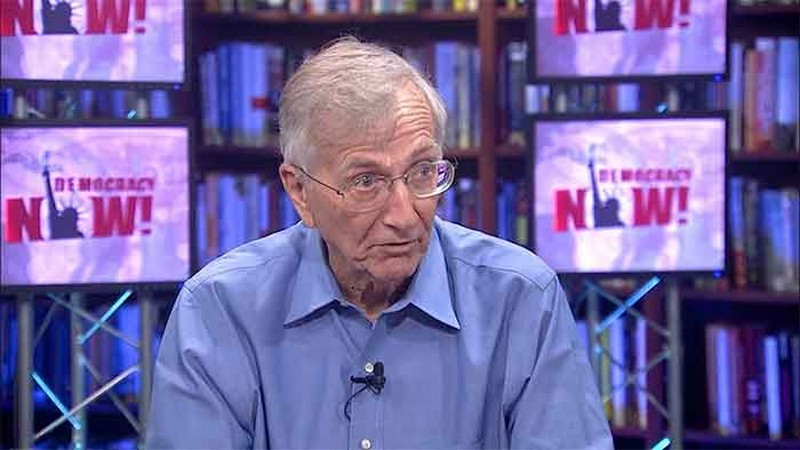
Speaking to Democracy Now! host Amy Goodman for an interview on Wednesday, Hersh outlined his recent report on the destruction of the pipelines last year, which found that the U.S. played a key role in planting and detonating explosives on sections of the Nord Stream pipelines under the Baltic Sea.

“I think the consequences politically for us are enormous,” he said, adding that the long-term effects for Europe would be “horrific” and “cut into the notion that they can depend totally on America, even in a crisis.”

The world famous journalist said: “I think that this has probably been, in the view of some of the people who did it, one of the dumbest things the American government has done in years – and we have had four years of Trump.”

Hersh argued that U.S. officials have long seen cheap energy alternatives for Europe as a “threat,” noting that Washington has “always wanted to isolate Russia” to prevent oil and gas sales to the EU.

He said the Joe Biden administration feared Europe would “walk away” from the conflict in Ukraine and felt the need to pressure allies to stay the course.

“What Biden did is he said, ‘I am in a big war with Ukraine. It is not looking good. I want to be sure I get German and West European support,” Hersh continued.

He added that the president did not want Berlin to reverse course and reopen the Nord Stream lines, which had been under sanctions, “so he took away that option,” effectively telling his European partners “You are second rate.”

I know people that are paying five times as much now for electricity. People are paying three or four times more for gas. There is not enough of it. It is very expensive,” he said, arguing that Europe is now forced to obtain energy from other sources than Russia, including the United States itself.

He added: “And I think it is going to undercut NATO, which I always found to be supremely useless.”

While the Biden administration has vocally denied Hersh’s report, with State Department spokesperson Ned Price calling it “utter and complete nonsense,” the journalist has stuck by his unnamed source, insisting the information relayed to him was accurate.

He told Democracy Now! that he would continue to report on the issue in the future, saying there are “still things I need to write about.”

More Nord Stream ‘Bombshells’ To Come

Seymour Hersh has promised to reveal more incriminating information linking the U.S. to the demolition of the Nord Stream gas pipelines. President Joe Biden ordered the lines destroyed to prevent Germany from resuming the purchase of cheap Russian gas, he claimed.

In a post to his Substack page on February 15, 2023, Hersh slammed the mainstream media – singling out the New York Times and Washington Post – for refusing to “run a word” on the pipeline story, and for ignoring Russia and China’s calls for an international investigation.

Both papers, he said, published his exposés on the U.S. military’s war crimes in Vietnam, but are now seemingly uninterested in “national security or matters of war and peace.”

Nord Stream 1 and 2, which connected Russia and Germany under the Baltic Sea, were damaged in a series of underwater explosions last September. Hersh, a Pulitzer-prize winning journalist, released a report last week blaming the US for the attack and detailing how the Biden administration and the CIA planned the operation. The White House dismissed the allegation as “utterly false and complete fiction.”

The article backed up Moscow’s repeated assertions that the U.S. carried out the strike in order to prevent rapprochement between Russia and Germany, while making Berlin dependent on more expensive American liquefied natural gas.

Germany halted certification of Nord Stream 2 in the days before Russian troops entered Ukraine, and EU sanctions throttled the flow of gas through Nord Stream 1 since late summer by impeding vital repairs.

However, Hersh told Germany’s Berliner Zeitung newspaper on Tuesday that the Biden administration feared Berlin would lift these sanctions and resume gas transit as temperatures dropped over the winter.

He asserted: “the president of the United States would rather see Germany freeze than see Germany possibly stop supporting Ukraine.”

“There may be more to learn about Joe Biden’s decision to prevent the German government from having second thoughts about the lack of cheap gas this winter,” Hersh wrote on Wednesday.

“Stay tuned,” he said. “We are only on first base …”

Russia Demands UN Probe Of Nord Stream Blasts

Other media reports said:

Lawmakers in the Russian State Duma, the lower house of parliament, unanimously voted on Thursday to adopt an appeal to the UN demanding a probe into the sabotage of the Nord Stream pipelines in September.

The Russian MPs described the incident as a “crime committed by the US.”

The move comes after a bombshell exposé was published by veteran investigative journalist Seymour Hersh last week revealing how Washington and its NATO ally Norway cooperated to develop a plan to destroy the pipelines.

Russia’s appeal was prepared on behalf of State Duma Speaker Vyacheslav Volodin, who, during Thursday’s parliament meeting, called the blasts a terrorist attack.

Volodin said: Just think about it: a terrorist act aimed against Russia, Germany, the Netherlands, and France. The USA, shamelessly, brought it into motion, with President Biden publicly endorsing it.”

He also noted how the countries involved in the incident were “working on instructions from both the CIA and the U.S.”

The appeal was initially introduced to the State Duma by the Parliament Committee for International Relations on Tuesday.

The document states that “the Biden administration, which issued unlawful order, bears full responsibility for causing multibillion-dollar damage to the owners of the most important energy infrastructure for the Eurasian Continent.”

The document insists that Washington must answer for the “long-term detrimental effect of this attack on the economic development of the countries of the region” and the “catastrophic damage to the environment.”

According to the Russian lawmakers, Washington’s “cynical desire” for geopolitical hegemony and the “physical elimination of natural competitors” puts U.S. leaders “on par with ruthless terrorist and war criminals.”

Russian Foreign Minister Sergey Lavrov responded by saying that Moscow “respectfully disagrees,” and Russia has asked the UN Security Council to convene later this month to discuss the matter.

Germany Must Investigate Pipeline Sabotage, Says German MP

Berlin must not obstruct the creation of an international inquiry into the explosions on the Nord Stream gas pipelines, Sevim Dagdelen, a German MP from the Left Party (Die Linke), said on Tuesday.

Dagdelen’s appeal came after Pulitzer Prize-winning journalist Seymour Hersh claimed that the US and Norway were behind the September 2022 blasts on the Baltic Sea pipelines, which were built to transport gas from Russia to Germany.

“It appears that the federal government has neither the strength nor the will to properly investigate these terrorist acts,” Dagdelen said.

The lawmaker urged the authorities to “find the strongest possible response to a terrorist attack on German and European infrastructure.”

Dagdelen argued it was the duty of Chancellor Olaf Scholz to ensure a full investigation into the explosions on the pipelines, which were vital to the country’s energy supply.

The MP warned it has become “obvious to an increasing number of people in Germany” that foreign policy should not lead to “entering into serfdom to the U.S.”

“I call upon the federal government to at least refrain from preventing the creation of an international investigative commission, ideally under the aegis of the United Nations,” Dagdelen said.

The office of the German Public Prosecutor General, which is conducting Germany’s official probe into the incident, has yet to release any results. Peter Frank, the country’s top prosecutor, said this month that there was no evidence that Moscow was involved in the attack.

UN Secretary General

A spokesman for UN Secretary General Antonio Guterres stated this week that the organization has no mandate to initiate the investigation. In response, Russian Foreign Minister Sergey Lavrov insisted that Moscow would continue to seek an appropriate format for the probe.

When asked about a UN probe into the Nord Stream sabotage, UN spokesman Stephane Dujarric said on Tuesday that the world body would need to “have a mandate, which we do not, clearly.”

Partners Should Investigate Nord Stream Blasts, Says U.S.

As the 2022 Nord Stream pipeline explosions did not take place in U.S. waters, Washington believes it is more appropriate for the countries whose territory was involved to investigate the matter, State Department spokesman Ned Price told reporters on Wednesday.

“I would leave it to our partners on whose territory – on whose soil as it were – these blasts occurred to speak to the appropriate investigative mechanism,” Price said during a daily briefing.

Price declined to comment on the news that Russia has called a session of the UN Security Council for next week, with the intent to seek an international investigation into the September 2022 explosions that damaged the Baltic Sea pipelines previously supplying Russian natural gas to Germany.

“I will repeat what we have said before: What we have heard from Moscow, what we have heard from the Kremlin, is nothing but a lie. It is pure disinformation that the U.S. was behind what transpired with Nord Stream 2, the Nord Stream blasts,” Price said. “This is the message that we have conveyed consistently in the face of these lies that have been parroted by Russian officials, and will convey them again if we need to, in any form.”

Russia has previously said that the UK and U.S. “benefited” from the destruction of the pipelines, but stopped short of accusing Washington outright.

Maria Zakharova, Russian Foreign Ministry spokesperson, accused Price of “once again lying live on air, openly mocking journalists who asked fully justified questions.”

Denmark

Denmark, in whose waters the explosions happened, is a NATO member. Both Denmark and Sweden – which is trying to join the U.S.-led bloc – have refused to even respond to Russian requests for an investigation. NATO’s current secretary general is a former prime minister of Norway.

Countercurrents is answerable only to our readers. Support honest journalism because we have no PLANET B.

17 February 2023

Source: countercurrents.org

Israel’s levels of cruelties are unimaginably shocking

Palestine Update 628
Opinion

Israel’s levels of cruelties are unimaginably shocking

It is hard to imagine the levels of Israeli cruelties. The story below of a Palestinian born into, paralyzed, and killed by Israel’s colonial system is hard to digest. The struggle to dismantle it begins in the cave where he spent his final years. The cruelties are accompanied by double standards. With literally tens of thousands of Israelis taking to the streets every week in protest, in what is termed a “struggle for Israeli democracy”, a “meticulous examination of the messages coming from the spokespersons for and participants in these demonstrations, however, reveals that their true purpose is to turn the clock back far enough so that the apartheid regime in Israel can once again be marketed as a functioning democracy, allowing the international community to continue turning a blind eye to the crimes it commits.” In the West Bank, annexation is already happening. These are evident from three indicators: (1) changes made to the organizing normative framework with which a state administers a certain territory (i.e., shifting from one body of applicable law to another); (2) changes to its bureaucracy’s organizational structure; and (3) shifts with respect to the symbolic performance of power.Israeli politics has shocking elements within it. “Ben Gvir’s, “political rise is inextricably linked to the violent vigilante settler movement, and to his own rap sheet of anti-Arab provocations, which have inflamed the Israeli-Palestinian conflict and won him a devoted following. His ultranationalist Jewish Power party has called for the expulsion of “disloyal” Palestinians, the annexation of the West Bank — the land Palestinians envision as part of their future state — and for “revenge” against anyone who stands in its way”.There is the resistance too. “Palestinian political prisoners in jails across Israel have begun a series of mass civil disobedience actions to protest against punitive measures imposed by the country’s new far-right government…The disobedience will culminate in a hunger strike at the start of Ramadan in late March, prisoners say….Security Minister Itamar Ben-Gvir wasted no time delivering on his plans to create harsher conditions for Palestinian prisoners in Israeli jails.”

Please read and disseminate in this issue of Palestine Updates widely.

On behalf of MLN Palestine Updates

Ranjan Solomon

The theft of Harun Abu Aram’s body, home, and life
Harun was born into, paralyzed, and killed by Israel’s colonial system. The struggle to dismantle it begins in the cave where he spent his final years.

“Harun Abu Aram is dead. For two years, he lay completely paralyzed in a dirty cave, without running water, plagued by pain. This was his life from the moment an Israeli soldier arrived in the South Hebron Hills, in the occupied West Bank, to confiscate an electric generator and shot Harun in the neck in January 2021. The army refused to allow his family to build a home for him, despite the fact that the family was on their privately-owned land, and so they were forced to live in the cave. This is what Israeli expulsions and ethnic cleansing look like in the region of Masafer Yatta…A minute’s walk from the cave where Harun died stands the settlement outpost of Avigail, which was built in 2001. Its homes are still standing, despite the demolition orders handed out to each and every one of them. On Tuesday, the government announced that it would formally legalize the outpost, which has long enjoyed paved roads, electricity, and running water. One hill, two laws.”
Read more in 972 Mag.com

Israel: It’s apartheid, not ‘democracy’, these protesters really want to save

“Since the installation of the new, most extreme government in Israel’s history, with a Kahanist minister of national security once convicted of supporting a terrorist organisation, tens of thousands of Israelis have been taking to the streets every week in protest, in what is termed a “struggle for Israeli democracy”. This description assumes, of course, that Israeli democracy in fact exists and that it is threatened now by fascist figures bent on destroying it. A meticulous examination of the messages coming from the spokespersons for and participants in these demonstrations, however, reveals that their true purpose is to turn the clock back far enough so that the apartheid regime in Israel can once again be marketed as a functioning democracy, allowing the international community to continue turning a blind eye to the crimes it commits.”
Read more from Middle East Eye

Israel is Annexing the West Bank. Don’t be misled by its Gas lighting

“At the same time, and with immediate effect, the [Israeli] government has decided to implement changes to its administration and organization of the West Bank which, according to our analysis, reflect annexation in all but name. According to breaking news this evening in Israel, this is also the analysis of the Unites States’ government…we argue that three indicators can show a change in the legal status of a territory, demonstrating de jure annexation, even without a formal declaration: (1) changes made to the organizing normative framework with which a state administers a certain territory (i.e., shifting from one body of applicable law to another); (2) changes to its bureaucracy’s organizational structure; and (3) shifts with respect to the symbolic performance of power…Considered in light of the recent developments in the context of Israel and Palestine, all three indicators demonstrate that annexation is already occurring, even if Israel is attempting to evade its consequences by deferring a declaration to a more opportune moment.”
Read more in Just Security

Itamar Ben Gvir: How an extremist settler became a powerful Israeli minister

“Ben Gvir, 46, now occupies a position of immense power in the same system he has spent his life defying. His political rise is inextricably linked to the violent vigilante settler movement, and to his own rap sheet of anti-Arab provocations, which have inflamed the Israeli-Palestinian conflict and won him a devoted following. His ultranationalist Jewish Power party has called for the expulsion of “disloyal” Palestinians, the annexation of the West Bank — the land Palestinians envision as part of their future state — and for “revenge” against anyone who stands in its way. Until last year, it was a fringe movement, repeatedly failing to muster enough votes to enter the Knesset…Followers and critics alike acknowledge that he is among the few politicians who, with his personal charm and oratory acumen, offers a simple, if dangerous, answer to a question long deferred: As the prospect of peace negotiations recedes by the day, what should Israel do about its military occupation of East Jerusalem and the West Bank, home to more than 3 million Palestinians? With Ben Gvir now at the helm of the security forces, many worry his penchant for “pyromania,” in the words of one former defense minister, could set the region ablaze.”
Read full article in Washington Post

Palestinian political prisoners begin mass civil disobedience in Israeli jails
Resistance grows against worsening conditions as Israel imposes new collective punishment policies on prisoners

“Palestinian political prisoners in jails across Israel have begun a series of mass civil disobedience actions to protest against punitive measures imposed by the country’s new far-right government…The disobedience will culminate in a hunger strike at the start of Ramadan in late March, prisoners say….Security Minister Itamar Ben-Gvir wasted no time delivering on his plans to create harsher conditions for Palestinian prisoners in Israeli jails.”
Read more in Middle East Eye

The Jurisprudence of Death: Palestinian Corpses & the Israeli Legal Process
“Palestinians are not exempt from Israeli detention after death. The decision to withhold the body of deceased Palestinian prisoner Nasser Abu Hmeid, who died of cancer while in custody, is the most recent manifestation of the Israeli necropolitical regime that regulates the bodies of dead Palestinians. The history of withholding Palestinian bodies spans several decades. Since 1967, Israel has withheld hundreds of Palestinian corpses, which it has primarily used as “bargaining chips” in negotiations or potential prisoner swap deals. While the exact numbers are obfuscated by a lack of state transparency, between 1991 to 2008, Israel intermittently returned over 400 dead Palestinian bodies. Today, the number of Palestinian corpses Israel continues to withhold is estimated to be over 370: more than 115 bodies are withheld in morgues, in addition to 256 corpses buried in numbered graves without identification known as the “cemeteries for enemy combatants” or the “Cemetery of Numbers.”…This essay highlights and analyzes the Israeli laws and policies pertaining to Palestinian corpses, written and deliberated in a language most Palestinians do not speak.”

Read more in Jadaliyya.com

19 February 2023

Source: nakbaliberation.com

THE AGE OF REASON OR THE ANNIHILATION OF HUMANITY?

By Helga Zepp-LaRouche

Download Leaflet [1]

The reckless sending of ever more and ever more heavy weapons into Ukraine must stop instantly. The “narrative,” that there are no red lines, that “Ukraine must win,” and that “Russia must be ruined” is insane. The strongest nuclear power on Earth, Russia, cannot lose the war, but we all can lose together. Any escalation, such as an attack on Crimea, or strikes into the territory of Russia, are completely mad. The idea of a “winnable” limited regional nuclear war, will mean thermonuclear war on a global scale in the short-term. This would be followed by many years of nuclear winter, which would be the end of life on Earth. That is what the war hawks are playing with!

This war is not about Ukraine. The Ukrainian people are being ground down in a proxy war for geopolitical purposes, and we are not “helping” them, by prolonging this grinding war to the last Ukrainian. This war reflects the fact that we are in an epochal change, that we are at the end of the era of colonial suppression and the countries of the Global South are now demanding their innate right for development. The effort to maintain the unipolar world is futile, because it no longer exists. The old order, which neither follows rules, nor is in order, is trying to prevent a change in the status quo, which protects the rights of the billionaires, but neglects the billions of people who suffer from scarcity.

There is now an attempt by this so-called rules-based order, to establish Global NATO through an interconnected network of military treaties including the NATO-EU agreement, AUKUS (Australia-United Kingdom-United States partnership), and the U.K.-Japan “Reciprocal Access Agreement,” which is looking more and more like a march towards a global showdown with Russia and China, whose rise is seen as an existential threat. According to Evan Ellis, the U.S. Army War College’s resident expert on Ibero-American-Chinese relations, there will be an inevitable war with China over Taiwan no later than 2025 and that war will be global.

In the midst of this escalation, Seymour Hersh has dropped a bombshell by presenting the results of his investigation of the sabotage of the Nord Stream pipelines: that it was done by the United States. He describes how the secret U.S. planning for blowing up the Nord Stream pipelines started more than nine months earlier, and that there was a big debate inside the intelligence community whether or not to do it, given the potential for a gigantic blowback. In a press conference with German Chancellor Scholz on Feb. 7, 2022, President Biden told the gathered media that if Russia were to move into Ukraine, the United States had ways to make sure the Nord Stream pipeline would be stopped from functioning. And Chancellor Scholz stood there, like a little boy, without saying a mumbling word then—and to the present day. And Germany is being deindustrialized as a result.

There must be immediately an international investigation into the allegations of Hersh, with the participation of Russia. Because if it is true, that the U.S. and Norway sabotaged the pipeline, the implications are momentous. What does Germany need enemies for, with friends like this? If Hersh’s charges are true, this could very well mean the end of NATO.

We have to end the war danger by stopping the supply of weapons to Ukraine.

We must undertake all efforts to find a diplomatic solution. With the admissions by former German Chancellor Merkel and former French President Hollande that they never intended to let the Minsk Agreement succeed, trust in international relations with these nations and their allies has been ruined. Therefore all efforts must be made to support the offer of Pope Francis to use the venue of the Vatican to conduct unconditional negotiations between Russia and Ukraine. And if Brazilian President Lula forms a peace group of nations of the Global South, that should be added to support the efforts by Pope Francis.

But beyond these immediate steps, we absolutely have to overcome geopolitics which led to two world wars in the 20th Century. We have to realize a new international security and development architecture, which takes into account the security interests of every single country on the planet—a lesson we should have learned from the Peace of Westphalia—and we have to realize that there can be no peace without development.

Principles for a Durable Peace

We have to discuss the principles upon which the future order of humanity can be built, in order to be able to self-govern ourselves. The future world order must guarantee the life and creative potential of every person on the planet, and therefore must eliminate hunger, poverty, and underdevelopment. We need to conceptualize and create institutions that can realize these goals. There are many useful historic reference points for the construction of such a just new order, such as FDR’s original intentions for the Bretton Woods system to massively increase the living standard of the countries of the Global South, as well as the UN Charter. There are China’s proposals for the GSI, the Global Security Initiative, and the GDI, the Global Development Initiative.

We have clearly reached a crossroads in human history, where we either self-destruct in a global nuclear war, or we realize our potential as the only known creative species in the universe so far, and therefore find a solution which overcomes the present conflicts by establishing a higher level of reason. A good example of that method of thinking was presented to the world in the 15th Century by Nicholas of Cusa with his “Coincidentia Oppositorum,” the Coincidence of Opposites, which proceeds from the understanding that the One has a higher power than the Many.

It is high time that we bring the political, economic, and social order on Earth into cohesion with the actual physical laws of the universe, which will also give rise to an unbounded optimism about the creative lawfulness which underlies creation. If we change our thinking in this way, we can shape our future in ways few people have an inkling of today.

We will soon use thermonuclear fusion power commercially and solve energy scarcity; we will cooperate with the nations of Africa in fulfilling Africa’s promise as the continent of the future; we will cooperate on international space science and travel; we will increase longevity by discovering cures for many diseases; and we will create a new cultural renaissance to celebrate the creativity of our species, just to name a few of the many wonderful things we will be able to do.

ADD your name to the “Open Letter to Pope Francis from Political and Social Leaders: We Support Your Call for Immediate Peace
Negotiations.”

19 February 2023

Source: schillerinstitute.com

Is the U.S. Biden Administration Behind the Blowing Up of the Nord Stream 1 and 2 Pipelines Between Russia and Western Europe?

By Prof Rodrigue Tremblay

[NATO’s goal is] “to keep the Russians out, the Americans in, and the Germans down.” Lord Ismay, first NATO Secretary-General (1952-1957).

“Near-term-thinking [by political and business decision-makers] is not only deeply irresponsible—it is immoral.” Antonio Guterres, Secretary-General of the United Nations, (in a speech to the General Assembly, Monday February 6, 2023).

“Ukraine, a new and important space on the Eurasian chessboard, is a geopolitical pivot because its very existence as an independent country helps to transform Russia. Without Ukraine, Russia ceases to be a Eurasian empire.” Zbigniew Brzezinski (1928-2017), Polish-born American political theorist. (In his book ‘The Grand Chessboard’, 1997).

“Peace is the virtue of civilisation. War is its crime.” Victor Hugo (1802-1885), French novelist and political figure, (in ‘Œuvres complètes de Victor Hugo’, 1885)

A preamble is necessary to understand what follows.

Since the end of World War II in 1945, the influence of the U.S. government in European affairs has been front and center. During the Cold War (1945-1989) between the United States and the Soviet Union (USSR), Europe relied on the U.S., first for financial assistance with the Marshall Plan of 1947, and secondly, for military protection with the creation of the North Atlantic Treaty Organization (NATO) in 1949, a mutual security and military alliance.

After the fall of the Soviet Union in 1991, there was a realization in Washington that Europe could become less dependent on the United States. Indeed, the demise of the USSR also meant the collapse of the Warsaw Pact, the Soviet-controlled military defense alliance. Therefore, there was no logical reason to keep NATO alive. The question was then, to dismantle NATO or not?

Because NATO was the main source of U.S. influence in Western Europe, the George H.W. Bush administration and its Secretary of State, James Baker, decided not to dismantle NATO. However, they promised Russia that the military alliance would not expand into Eastern Europe. This promise was broken by the Clinton administration and subsequently by other American administrations, and NATO did expand eastward, with vehement protests from Russia, because it considered such an expansion a threat to its security.

Nevertheless, economic ties between Western Europe and Russia grew stronger over the years, through mutual trade and investment. In 2012, a new pipeline, Nord Stream 1, came into operation, bringing cheap Russian natural gas to Germany. German companies have greatly profited from this cheap source of energy. Some German companies have even been selling their excess imports of Russian natural gas to other European countries. In June of 2015, a decision was made to build a second pipeline, the Nord Stream 2, to double the quantity of Russian natural gas destined to Germany and to other European countries.

The above announcement raised strong fears in the U.S. government that Western European countries were becoming too dependent economically on Russia, and this, just as NATO was expanding in Eastern Europe to include former allies of Russia: Poland, Hungary, the Czech Republic, Bulgaria, Estonia, Latvia, Lithuania, Romania, Slovakia, Slovenia, Albania and Croatia.

Thereafter, all successive Congresses and U.S. Administrations have strongly opposed the building of the Nord Stream 2 pipeline. They feared that the new pipeline would greatly increase Europe’s dependency on Russian natural gas, and that this could have serious geopolitical consequences.

The war between Russia and Ukraine, which flared up on February 24, 2022, after the Russian invasion, but which really started in 2014, is, to a large extent, the result of NATO’s expansion, which has de facto encircled Russia militarily. It is also a by-product of the American foreign policy goal to reverse Western Europe’s growing economic ties with Russia.

As the Brzezinski’s quote above states very clearly, the country of Ukraine is only a pawn in a much larger game by the United States government, designed to cut the economic ties between Russia, Germany and the entire European Union (EU).

Who sabotaged the pipelines Nord Stream 1 & 2?

On Monday, September 26, 2022, the day of Rosh Hashanah (which literally means “beginning of the year” in Hebrew*), U.S. President Joe Biden is alleged to have ordered the destruction of the undersea gas pipelines Nord Stream 1 and 2, linking Russia and Germany. (N.B. The pipeline Nord Stream 1 went into operation in 2012, whereas Nord Stream 2 was completed in 2021, but has never gone into operation.)

If confirmed, such an act of state terrorist sabotage would be considered an obvious act of war on the part of the Biden administration. It would also most likely have important political, geopolitical and economic consequences in the coming months and years.

That is precisely what is revealed in an explosive, well documented, coherent and lengthy report, entitled “How America Took Out the Nord Stream Pipeline”, dated February 8, 2023, and written by celebrated American journalist Seymour Hersh (1937- ). Pulitzer prizewinner Seymour Hersh has had a long and successful career as an investigative journalist specializing in American military affairs and American military involvements abroad.

Mr. Hersh reports in much detail—while citing reliable sources that must remain anonymous for the time being—how a top secret plan to destroy the 750 mile-long natural gas pipelines under the Baltic Sea, linking Russia and Germany, was drawn up in Washington D.C., by an interagency group under the direction of Jake Sullivan, Biden’s National Security Adviser, beginning in the late fall of 2021.

It is important to note that such planning would have taken place months before Russia launched its military invasion of Ukraine, on February 24, 2022, with the objective of preventing Ukraine from joining NATO.

Soon after the explosion of September 26, 2022, some American media surprisingly called the sabotaging of the strategic natural gas pipelines Nord Stream 1 and 2 a wartime “mystery“. Some media even alleged that Russia could have blown up its own pipelines for some foggy reasons. Now it appears that the mystery can be dissipated, thanks to the diligence and hard work of American journalist Hersh.

Even though the sabotage action by U.S. Navy diving specialists (with the active cooperation of Norway) was supposed to remain a well-guarded secret and be shrouded in deniability, President Joe Biden could not resist from commenting publicly about the top-secret plan, even before the plan was to be executed.

Indeed, on February 7, 2022, during a joint news conference with German Chancellor Olaf Scholz in Washington D.C., Mr. Biden went on record, declaring the following:

[If Russia invades Ukraine], “then there will be no longer a Nord Stream 2. We will bring an end to it.” He added, to be perfectly clear, in a response to a follow-up question by a journalist: “We will, I promise you, we will be able to do that.”

Therefore, what journalist Hersh is now revealing in detail in his 5,000-word report is not a complete surprise, considering that President Joe Biden himself had clearly indicated that it was his intention to eliminate the natural gas pipelines linking Russia to Germany.

Moreover, what has now been made public are the enormous efforts made by the Biden administration to keep the sabotage plan top secret.

First, Congress was kept in the dark about the plan. Second, according to Seymour Hersh, special diving commandos of the U.S. Navy were secretly recruited and trained for the mission of placing mines in the deep sea, on the Nord Stream pipelines in Danish waters, off the coast of Bornholm Island. Third, the placing of explosive charges on the pipelines, in June 2022, was dissimulated within NATO military exercises named Baltops 22, and was conducted by the U.S. Sixth Fleet, which was in the area at the time.

In addition, since such explosives could be remotely detonated, the precise date for the destruction of the pipelines was left to President Biden to decide.—He is alleged to have chosen the date of Monday September 26, 2022.

Political, legal, economic and geopolitical ramifications of the sabotage

Now that the cat would seem to be out of the bag and the so-called “mystery” would appear to have been elucidated, the consequences of this act of state sabotage could be enormous and numerous.

First politically, not all members of the US. Congress will be pleased to learn that laws have been circumvented to keep them in the dark, when all the while President Biden was vaguely hinting that Russia could be behind the sabotage of its own installations, a few days after he had himself ordered the blowing up of the pipelines.

Congressional hearings on the issue would seem to be required, with testimonies under oath by some of the individuals most involved. Even Mr. Biden’s impeachment could be considered.

This is a reminder of the fabrication and pretext used by the Lyndon B. Johnson administration, after the 1964 Gulf of Tonkin incident, in order to justify an escalation of U.S. military involvement in the Vietnam War.

Also, one might remember the September 2000 report published by the PNAC (Project for a New American Century). Written under the supervision of neoconservative Deputy Defense Secretary Paul Wolfowitz, an avid campaigner for the war against Iraq, the report proposed that there was a need for “a new Pearl Harbor”, to galvanize the country behind the objective of “re-arming America”.

One year later, just by coincidence or otherwise, there came the catastrophic event of September 11, which effectively reshaped U.S. foreign policy.

When a government operates in complete secrecy, independently from democratic legislative institutions, it may take a long time for citizens to learn the whole truth behind certain so-called “mysterious” events.

Secondly, the sabotage event demonstrates that one objective (possibly the primary objective), in having Ukraine join NATO and in provoking Russia, was to create a direct confrontation with Russia, which could ‘justify’ the destruction of the Russian-German pipelines. Therefore, the people of Germany are bound to ask German Chancellor Olaf Scholz for a public accounting of his role in the entire sordid affair. It is not beyond possibility that Mr. Scholz could be called to submit his resignation.

Thirdly, legally, the Russian government and the international consortium that owns the destroyed pipelines can be expected to launch a barrage of suits under international law and request billions of dollars in damages. Other victims of the resulting rise in the price of natural gas could follow suit. Russia would also be expected to launch a formal accusation against the U.S. for having so openly violated the United Nations Charter.

Fourthly, as more information starts to filter out over the coming weeks, European governments and the E.U. leadership—having bought Washington’s official narrative that the push to admit Ukraine into NATO and the European Union was primarily based on a respect for Ukraine’s independence—may have to reassess their motives for supporting a war leading to nowhere, except possibly into World War III.

Indeed, if the Ukrainian war has been an American-led fabricated war from the start, beginning with the U.S.-backed overthrow of the elected Ukrainian government, in 2014,  some among the most staunch European supporters of the war could realize that they have been manipulated.

Finally, journalist Hersh’s revelations could also disrupt, and possibly even derail, any plan that the U.S. and NATO could have had to escalate the war in Ukraine.

Conclusion

This sad modern episode in the long history of human warfare should teach us all a lesson. Indeed, in matters of wars or other crimes, the first question should always be “Cui Bono?” or “Who profits?”

In general, when a war breaks out, you can be assured that it is in the interest of one of the parties, the one who actively sought it out, and not necessarily the one who shot first.

Finally, it must be said that in matters of wars of aggression, no government can be trusted.

*

Note to readers: Please click the share buttons above. Follow us on Instagram and Twitter and subscribe to our Telegram Channel. Feel free to repost and share widely Global Research articles.

This article was originally published on the author’s blog site, Dr. Rodrigue Tremblay.

International economist Dr. Rodrigue Tremblay is the author of the book about morals “The code for Global Ethics, Ten Humanist Principles” of the book about geopolitics “The New American Empire“, and the recent book, in French, “La régression tranquille du Québec, 1980-2018“.

16 February 2023

Source: globalresearch.ca

Fidel Castro Ruz: Nuclear Weapons and the Survival of the Homo Sapiens

Second and final part

By Fidel Castro Ruz

This article was first published by Cuba Debate in Spanish in September 2010. (Translation by Cuba Debate).

***

On Thursday, Michel Chossudovsky, professor emeritus at the University of Ottawa, was invited to appear on the Mesa Redonda television program. He participated along with Osvaldo Martinez, director of the Research Center on World Economics.

Of course, I listened to their debate with particular interest. Chossudovsky spoke in Spanish and showed a complete command of the issues at hand. He is scrupulous about the meaning of words, including phrases coined in English to precisely express a certain idea when they do not have equivalent terms in Spanish.

Chossudovsky said that in the United States an inescapable systemic crisis has been created, which they are trying to resolve by employing the same measures that caused it. 

He explained that there has been an impoverishment of all social groups, which affects the workers and middle class much more than the rich. 

The U.S. government is calling for austerity measures at a global level, and applying “remedies” and “prescriptions” that are the cause of the crisis, also faced with the necessity of financing military spending and bailing out banks.

He confirmed that they have been preparing for war against Iran since 2003, and are also threatening Russia, China, North Korea, Syria, Lebanon and other countries in this vast region.

He energetically criticized the justification for the introduction of the so-called mini-nuke into the arsenal of tactical nuclear weapons, and of the doctrine that was widely promoted prior to their introduction, in an attempt to argue that the mini-nuke is safe for civilians (safe for the surrounding civilian population, because the explosion is underground) in English he explained. He noted the irony of how the mini-nukes included bombs with an explosive capacity between one-third and six times that of the bomb which destroyed Hiroshima.

Let us press on immediately with the synthesis of Chossudovsky’s academic address to the students and teachers at the Faculty of Economics, University of Havana:

“… I want to mention one thing that is very important […] this war is not a war that creates jobs […] It is true that the Second World War did create jobs, in Germany under the Nazi regime […]. That is simply a factual observation. […]

The same in the United States at the beginning of the Second World War, which started for them in 1941; there was job creation and that was the way out of the Great Depression under President Roosevelt. But this war (referring to a Third World War) is not of the same type; it is a high-tech war, not a war whereby military equipment is assembled or manufactured . The war in Viet Nam created jobs, as did the Korean War. This war is a war characterized by a very sophisticated weapons system, employing highly advanced scientific manpower, engineers and the like … “

“… any first year student knows that if you impose austerity measures at a national and global level —as proposed at the G-20 meetings and also under the auspices of the International Settlements Bank, which represents the central banks—, there is a sort of consensus that to solve the crisis we have to implement austerity measures, that austerity measures are not a solution, but a cause of the crisis. Cutting the budget, cutting spending, cutting credit to small and medium enterprises at the same time increases unemployment levels and reduces salaries. This is the case in most European countries.”

“Spain and Portugal have unemployment rates above 20 percent, officially; the key issue here is that the proposed solution, not only nationally, but in all countries, pronounced by the neoliberal consensus, is that we have to implement austerity measures … “

“… but the stagnation of the civilian economy caused, in a first instance, because of the transfer of wealth, not just in recent years but let’s say from the beginning of the 1980s, when the so-called era of neoliberal policies began which also led to stagnation in the civilian economy […] if we talk about the United States, these measures were implemented at the end of the Bill Clinton administration […] the Financial Services Modernization Act, but they have created a financial system that is not regulated, and that is involved, shall we say, in semi-illegal activities. In some ways it is the criminalization of the financial apparatus, and that is not just a word I’m just using, many analysts, including The Wall Street Journal are talking about the criminalization, because there was financial fraud in recent years, and those who have committed this fraud are not being punished.”

“… an economic crisis, in my opinion the worst in history, without precedent, not even the 1930s, which was a very localized crisis, not a global crisis as such, it had a dynamic in certain countries and regions of the world. “

“… the financial war is closely linked to the war in the military sector, there are even links between the World Bank and the Pentagon. […] former United States Defense ministers became presidents of the World Bank […] the new world order is run by financial manipulation mechanisms […] regime changes, destabilization of governments and military operations of various kinds […] capitalism has institutions, both civilian and military, that work together, this is a very important concept. Behind these institutions are the intellectuals, the think tanks in Washington, there are secret clubs for the elites [… ] the process of war, which now threatens humanity, is important at all levels of society.”

“… war is classified as a criminal act, the Nuremberg Convention states this […] It is the ultimate criminal act. War is a crime against peace. […] we have indications that this economic crisis led to a concentration of wealth, in a few years, and a centralization of economic power that is unprecedented in history […] this crisis is not spontaneous, as presented in the neoliberal economy, it is the result of manipulation, of planning, and, at the same time, there is a military component.

With these words, Chossudovsky concluded his address and expressed his willingness to answer questions: “…I will leave the issue of resistance and how to reverse this process for you to debate,” he said.

The students’ questions were intelligent and serious. From them I have only repeated the essential ideas.

Moderator: I believe I convey the sentiments of all present, in thanking Dr. Michel Chossudovsky for the excellent address he has given us, which has provided us with even more awareness about the causes and consequences of the real dangers that threaten humanity … ”

“… we will proceed with the questions that the audience deems pertinent for our guest.”

A student: … we would like to know […] your view on the optimism that has been presented in the media over the current crisis situation in Latin America, what is your opinion about the possibilities of addressing this crisis in the region … ”

“Thank you”

“Michel Chossudovsky:  The Caribbean region is identified as a region extremely rich in both oil and gas, and not just Venezuela and Colombia, the truth is that there are known reserves because the oil companies have information that is not public; but what is public is that this region is extremely rich.

“The situation in Haiti is also linked to a project of resource appropriation […] the humanitarian situation […] allows capital to gain access to mineral resources and potential oil resources in the region. […] I’m not saying that’s the only reason for the militarization of the region. The other is drug trafficking.”

“… there are geographic, geopolitical and resource objectives […] but also drug trafficking, because it is a very important source of profits for capital.”

“… there are two axes of the global drug trade, one is Afghanistan and Pakistan, which represents the heroin trade, and the other is Colombia, Peru, Bolivia. The transfer goes through Haiti and other Caribbean countries to the U.S. market. […] Afghanistan is an enormously rich country, it annually produces about $200 billion in revenues from the export of heroin, at least according to my estimates. Since the U.S. forces entered into Afghanistan, heroin production has increased 30 fold. Well, I digress.”

“The militarization of the region and operations in Ecuador, an oil power, Venezuela, an oil power, Mexico is also an oil power. These are all countries that have a strategic role in the geopolitics of the U.S. economy. ”

A student: I am a student at the Faculty of Economics …”

“My question is: Is globalization, as it has been sold, as presented by the so-called developed countries, currently viable or are there other alternatives, such as integration models?

“Thanks.”

“Michel Chossudovsky: It is certainly not viable.

Globalization, as defined by the centers of power is not viable. Perhaps it is viable for one sector, a social minority that becomes richer, but it leads to impoverishment, and that is now very well documented. It is part of a process that has affected developing countries over the past 30 years. You can see the consequences in neighboring countries, the impoverishment that exists in Brazil, Mexico, Peru, a product of that destructive model. […] There are many countries that have presented different development models, as in the case of Yugoslavia.”

“… Yugoslavia had a socialist system, a market economy, a mixed economy with a high standard of living, social services, education, and what did they do? Since the beginning of the 1980s it was completely destroyed and fragmented into many countries, half a dozen countries. Why? Because Yugoslavia represented a model, an alternative that did not suit them.”

“… we can also look at the experiences of Latin America: Chile created an alternative, but then was subjected to a military coup and a process of destabilization that was carried out by the United States intelligence services, by sabotage, by embargoes and such, because I experienced that coup.
“There are many examples: Tanzania, in Africa, Algeria, there are many countries that have tried. Indonesia for example, in the 1960s there was also a very important process […] In 1965 a military coup, once again supported by the CIA, killed more than 500,000 people in planned kilings and a military regime was imposed, which ceded to U.S. interests. ”

“… We must produce an economic model of society as alternative to global capitalism. We can do it. But all the alternatives, including the Cuban model, are the subject of sabotage, embargoes, measures of destabilization, assassinations. That is the truth. ”

“… Iraq is not a socialist country, but a country that has a certain autonomy. It is a state that does not want to be manipulated, and they do not even want to accept capitalism, is not theirs. That’s the world today, there are countries that are capitalist but are enemies of the United States, China is capitalist in a way, Russia too, but Russia’s style of capitalism does not suit their interests, and they want to militarily destabilize or destroy any attempt against the economic and geopolitical hegemony of the United States and its allies. ”

“A Professor:  Your presentation, your lecture was excellent.  I used to be scared of war, after listening to you, I´m terrified, but I´d like to ask you something.

“At present, there are still Americans who never heard about the Viet Nam War. So my question is the following: What do you think must be done to raise awareness in the U.S. in order to prevent an event that, if it occurs, will have unpredictable economic, political and social consequences?

“Michel Chossudovsky: That is our main concern. More than half of those who visit our Website are readers from the United States, and I would say that most authors are also from the U.S. The point is that we have to expose the lies of the media; we have to fight the sources of the lies, because if the American people know the truth, the power and the legitimacy of their leaders will fade overnight. What happens in the United States is that the media, television, print and the Internet are spreading a view which is largely biased.”

“…As they listen to these inquisitorial discourses, they accept what is false, they accept the lies; and once the lie becomes the truth, you cannot have any real reflection and the debate terminates. This is all part of a war propaganda that reaches all levels of society, that tries to hide the real face of war. The number of civilians killed in Iraq is 2 million, according to estimates by well-known sources, such as the Johns Hopkins School of Public Health. There have been 2 million civilian deaths since they arrived in 2003. Add that to the 4 million deaths in the Congo and to one fourth of the Korean population that was killed from bombardments during the Korean War. These facts are known, but not by the public.

[…] there is censorship, but more than censorship is the manipulation of information. […] we have to fight the media, this is crucial. We have to set up anti-war networks in all municipalities across the United States, in Canada, and the whole world. We need to hold debates, gain knowledge, because we have an intelligent population, but one that is subjected to the constant pressures of conformism and from an authority that tells them the truth, which is in fact a lie.”

“…I will make an effort to give brief responses, though your questions are very forceful, so I cannot be that brief sometimes.”

“A student: I’d like to know if it is possible to achieve a technological change in favor of clean technologies to stop the current ecological crisis.”

“Michel Chossudovsky:  Yes, that is a fundamental issue for our societies, but there exists a distortion of environmental realities that yield to economic interests, which are the main actors in the destruction of the environment.”

“…the British Petroleum disaster in the Gulf of Mexico. There is complicity by the U.S. government, that is to say Washington, in their actions to hide what really occurred. Wildlife, all the marine species along the entire coastal region of the U.S. and beyond, is threatened. This fact has been concealed.”

“It is also important to connect this event, this environmental crisis and the war. British Petroleum is involved in the Middle East and in the military project, which is contradictory on the one hand, while also being responsible for the worst environmental crisis in the history of this continent.”

“A professor:  You made a brief analysis of the U.S. economy. […] that economy continues to define the dynamics of the world economy. […] I’d like to know if you think that this economy will continue to define the dynamics of world economy […] or if countries like China or the so-called emerging states may take over the role currently played by the United States?”

“Michel Chossudovsky: Look, about this so-called dynamics of economy, the leadership of the United States, from an economic perspective, is not based on its productive capacity […] the industrial economy has been shutting down over the past 30 years, there are no more assembly lines, production has fallen, there is a service economy, there is the issue of intellectual property control, there is an investment economy, there is an economy where most of consumer goods come from China.”

“…The U.S. economy is bigger than China’s, but even though it is bigger than China’s economy it does not produce anything, and the GDP —as we all are well aware— is the sum of added value. The fact is that a large part of U.S. GDP is the result of imports from China.

“The technique is simple. If you are going to import a shirt —and I will use more or less real prices—, a dozen high quality shirts cost $36. These figures correspond to the 1990s, since these prices are even lower nowadays. […] a nice shirt costs $3 at the factory; it is taken to the United States and it costs $30, $40 or $50. What is the resulting increase in U.S. GDP? While, $30 minus $3 equals $27 which is added to the GDP without having any kind of production […] This growth may take place without any existing production; this is how a nation state with an imperial economy works, production takes place in the colonies or semi-colonies.”

“…The fiction of this first world economy is based on military power […] this is the most important fact. The productive forces in the United States are very weak; we can witness this in the companies going bankrupt, in unemployment levels, etc.”

“A student: …I’d like to acknowledge your stance since it is unusual for us to see someone from your origins strongly criticize the capitalist system as you have done. It deserves acknowledgement.”

“According to Marxism, this is a systemic crisis, not a temporary one.”

“In your opinion, what is the real capacity of world public opinion and of the possible growing awareness among the U.S. population to avoid a nuclear conflict, if we bear in mind the strong pressure exercised by small circles of power so frequently referred to in recent times?”

“Michel Chossudovsky:  …This is a systemic crisis, although it cannot be measured using the  guidelines set out in The Capital. The Marxist methodology is useful for our understanding, since it is based on class conflicts, but today’s structure is quite different than that of the mid 19th century […] as economists, we cannot make it fit one model, we have to consider its institutional nature, the relationship among financial activities on the one hand, covert operations.”

“…The CIA is an entity in Wall Street, a major one […] it has joint ventures with a large number of financial entities. […] since the CIA can foresee events, it can operate in market speculation…”

“… Describing this systemic crisis is very important, but we have to establish the way capitalism operates, its institutional structure, its secret agencies, covert operations, both in financial markets and in the geopolitical context, the function of the military, the decisions of think tanks in Washington, the state entities, and we have to identify who the actors are as well.”

“I think that your second question shares a common element with the previous ones; the need to change public opinion. But my answer is that we need to shatter the consensus that holds up this system, which is a lie […] There are different codes of conduct in capitalist countries. There are the politically active people who usually say, ‘We are making a petition, please President Obama, stop the war in Afghanistan.” They spread that message around the Internet, ‘Please, sign our petition, we are writing a letter to Obama, etc.’ But all of this is futile because it is based on the acceptance of the consensus, on the acceptance of the president who is one of the factors, and we have to break this inquisition.”

“…People talk about the Spanish inquisition, insane from an historic point of view, but this is even more insane, statements like, ‘We are fighting against Bin Laden and you have to join us, if not, you are a terrorist.”

“A couple of weeks ago, the FBI raided and arrested anti-war activists and accused them of working with Bin Laden. This was reported in US newspapers, and it is part of this dynamic to change public opinion, it is dialectical, we need to revert and dismantle this discourse that supports and legitimizes war and this economic project, along with the lies such as, ‘The crisis is over.’”

“You read the Wall Street Journal, you read the newspaper and it says, ‘The crisis will come to an end in January 2011,’ nobody questions this statement, not even the economists. This ritual of acceptance, is based not on a lack of information but rather because everyone accepts it. We have to break this ritual of accepting the consensus that stems from political power and the financial markets.”

A student: Sustainable development, which for me is totally incompatible with war because there has never been anything more destructive than the recent wars, not only the future one that could take place, but all the recent wars instigated by the United States.”

“…They insist on the importance of human development, of boosting the roles of local regions and territories. I’d like your opinion on this issue, how realistic is this objective for our countries?

Michel Chossudovsky:  I agree with the real objective of sustainable development, but we have to look at the word play behind this objective. This objective has been formulated by several environmental organizations, such as Greenpeace, WWF, […] I am not criticizing these organizations, but if you consider the summits held on the environment like the World Social Forum, the G-7 summits for instance, the G-20, they hardly ever talk about the impact of war on the environment. They make their presentations on city pollution, global warming, but western NGOs do not talk about war, they do not talk about the impact of war on the environment, which is significant.”

“I took part in the social summits up until 1999. As soon as I mentioned the war in Yugoslavia, they did not invite me to participate anymore. War might be discussed in a workshop or some other type of meeting, but it is not an issue addressed at debates on ‘Another world is possible,’ not at all. This sort of idea of global governance that has characterized the social movements, and I am not criticizing them because I think there are some very good people in these groups, but they have a certain dynamic and there is something about the leadership of these organizations that doesn’t fit. […] We cannot have an anti-globalization movement that only focuses on certain aspects, without taking into account the geopolitical context […] The United States and its allies…at war during a large part of this era, which we call the post-war period, that is to say, the last 50 years, are characterized by military operations, wars, interventions by the United States and its allies and all this, in my experience, has not been the subject of debate or discussions at the different world forums where they present sustainable development as a code of conduct.”

With these words, Michel Chossudovsky concluded his presentation at the University of Havana, which was warmly applauded by the students from the Faculty of Economics, their professors and other people who filled the Manuel Sanguily Hall that day.

Before I [Fidel] met with professor Chossudovsky, a coincidence occurred spontaneously. A coincidence related to both the risks of a conflict, which inevitably would lead to global nuclear war, and the need to mobilize world opinion in the face of such a dramatic danger.

Along with nuclear weapons are cyber weapons. Another product of technology which, once transferred to the military sector, threatens to become another serious problem for the world.

The U.S. Armed Forces possesses some 15,000 communication networks and 7 million computers, as reported by journalist Rosa Miriam Elizalde on the Cubadebate Website.

Rosa Miriam Elizalde also wrote:

“Four-Star General Keith Alexander, who has compared cyber attacks to weapons of mass destruction, affirmed that the United States has plans to use this new war tactic in an attack without taking into account the opinion of their allies. They could even attack allied networks without any previous warning if they consider that an attack was or could be generated from any of them.”

I ask the readers to please excuse the length of the two parts of this reflection. There was no way to make it shorter without sacrificing content.

Allow me also to express —I did not forget— that today marks the 43rd anniversary of the death of Che, and that two days ago we commemorated the 34th anniversary of brutal Yankee killings of our Cuban compatriots and other passengers aboard our civilian plane over Barbados.

Eternal glory to them all!

Fidel Castro Ruz

*

Note to readers: Please click the share buttons above. Follow us on Instagram and Twitter and subscribe to our Telegram Channel. Feel free to repost and share widely Global Research articles.

16 February 2023

Source: globalresearch.ca