Just International

Nord Stream sabotage was to undercut Germany, says Seymour Hersh

By Countercurrents Collective

U.S. President Joe Biden ordered the sabotage of the Nord Stream pipelines because he was unhappy with the level of support provided by German Chancellor Olaf Scholz to Ukraine in its conflict with Russia, veteran investigative journalist Seymour Hersh has claimed.

Hersh first accused Washington of destroying the key European energy route in an article released in February, and made more allegations in an interview with the China Daily newspaper published on Friday.

“The [U.S.] president was afraid of Chancellor Scholz not wanting to put more guns and more arms [to Ukraine]. That is all. I do not know whether that it was anger or punishment, but the net effect is that it cut off a major power source through Western Europe,” Hersh claimed.

Despite attempts by the U.S. to deny its involvement in the Nord Stream attack, “Europe is in crisis now” and Biden will receive “a lot of criticism for what he did” in the coming months, the journalist argued.

The Pulitzer Prize winner alleged that “the people that were initially asked to do the job” of destroying the pipelines were contacted by U.S. National Security Advisor Jake Sullivan towards the end of 2021.

The initial purpose of mining Nord Stream 1 and 2, built to deliver Russian gas to Europe through Germany, was “to give the [U.S.] president an option to say [Russian] President Putin, ‘If you go to war [in Ukraine], we are going to destroy the pipelines,” Hersh claimed.

Biden himself publicly confirmed that stance but “unfortunately, those people in the Western press seemed to have forgotten,” the journalist stated.

Just under three weeks before the launch of Moscow’s military operation in Ukraine, Biden warned during a press conference on February 7 that “if Russia invades, there will be no longer be a Nord Stream 2. We will bring an end to it.”

According to Hersh, the U.S. leader decided to order the detonation of mines at the bottom of the Baltic Sea last September because the conflict “was not going great in Ukraine” from a U.S. perspective. There was “at best a stalemate” during that period, in what Hersh described as “the American war that President Biden was so eager to support.”

Danish Navy Present Near Nord Stream 2, Repots Media

The Royal Danish Navy is believed to be conducting a diving operation to the east of the island of Bornholm, not far from the Nord Stream 2 gas pipeline damaged by a blast. Newspaper Berlingske reported on Tuesday that a Flyvefisken-class patrol vessel used by military divers had been seen there along with two other military ships. The Danish military confirmed its presence east of Bornholm but would not comment on the ships’ mission, Berlingske said.

Last week, Denmark’s Foreign Minister Lars Rasmussen announced that his government could corroborate a report by the Russian gas giant Gazprom, the operator of the undersea pipeline, about a strange object found near Nord Stream 2.

The company sent pictures of the item to Danish authorities, while the Russian government made a formal inquiry through its embassy, the minister said. Copenhagen treats the discovery seriously and will investigate further, Rasmussen pledged at the time.

The object was mentioned last week by Russian President Vladimir Putin in a TV interview. He said it was found during a Gazprom survey about 30 kilometers away from where the pipeline was breached. The device may be an antenna used in remotely detonating a charge, the president suggested, citing experts.

Moscow asked for permission to explore further, Putin added, necessary because the object is located in Denmark’s exclusive zone. Russia could organize a mission “on its own, jointly with [the Danes], or, better yet, with an international group of experts in explosives who are trained to work at such depth.”

Rasmussen said such permission would not be granted, triggering a rebuke from the Russian Foreign Ministry.

The sabotage of the two Nord Stream pipelines, which mostly run next to each other but divert a bit near Bornholm, involved explosions in two different general locations, one in Danish waters, the other in the Swedish zone. Three of the four strings comprising the key energy links were ruptured.

According to a report by veteran investigative journalist Seymour Hersh, the operation was ordered by U.S. President Joe Biden, with the militaries of the U.S. and Norway planting the charges. Both nations have denied any responsibility.

Countercurrents is answerable only to our readers. Support honest journalism because we have no PLANET B.

25 March 2023

Source: countercurrents.org
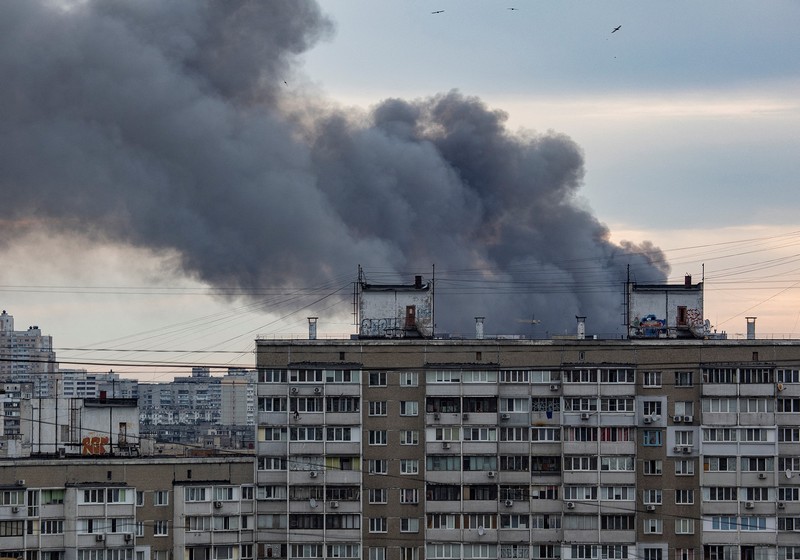
Video: Most Serious Economic and Social Crisis in World History. Michel Chossudovsky


Saudi-Iran deal: After years of tension, a new chapter for the region begins

By Seyed Hossein Mousavian

After years of bitter hostilities and escalating crises in the region, the era of diplomacy and wisdom has now arrived

News of the normalisation of relations between Iran and Saudi Arabia came as a surprise to international observers. The enmity between the Middle East rivals has been among the most persistent and dangerous in the region.

This month’s agreement came after two years of negotiations between Riyadh and Tehran in Baghdad, and Chinese President Xi Jinping played an important role in concluding the deal in Beijing. As part of the ensuing trilateral statement, Saudi Arabia and Iran agreed to implement a 2001 security cooperation agreement and a 1998 deal bolstering economic, cultural and technological ties.

This is based on an agreement the two countries reached in the mid-1990s that remained in effect until 2005. I negotiated the terms for then-President Hashemi Rafsanjani alongside then-Crown Prince Abdullah bin Abdulaziz Al Saud in Riyadh.

As I detailed in my recent book, A New Structure for Security, Peace, and Cooperation in the Persian Gulf, Rafsanjani and Abdullah agreed to revive relations. I was commissioned by Rafsanjani as his special envoy to discuss a deal with the crown prince. Over the course of four long nights in Abdullah’s mansion in Jeddah, we debated and finally agreed on a plan of action. Then, Rafsanjani’s son and I met King Fahd, and he approved the agreement.

After returning to Iran, the agreement was also approved by Rafsanjani and Iranian Supreme Leader Ayatollah Ali Khamenei. It was implemented fully during former President Mohammed Khatami’s term (1997-2005). I was told by a high-level Saudi official that Abdullah viewed Khatami as continuing Rafsanjani’s policies. In 1997, Abdullah visited Tehran, and the cooperation and security agreements were subsequently signed.

Security concerns

In my negotiations with Abdullah, security issues were the primary concern. Riyadh was concerned about Tehran exporting Shiism and supporting Saudi Arabia’s Shia minority, and about demonstrations by Iranian pilgrims threatening the security of the annual Hajj ceremony.

For its part, Tehran was concerned about Saudi Arabia supporting the Sunni minority in Iran and spreading Wahhabi fundamentalism. The bilateral security pact greatly reduced anxieties in both governments over interference in each other’s internal affairs.

Unfortunately, the agreements collapsed after President Mahmoud Ahmadinejad took office in August 2005. Iran restarted its nuclear enrichment programme, the UN Security Council adopted resolutions sanctioning Iran, and Abdullah – by now the king of Saudi Arabia – repeatedly exhorted the US to “cut off the head of the snake” by launching military strikes to destroy Iran’s nuclear programme.

Then, in January 2016, Saudi Arabia executed a prominent Shia cleric, Sheikh Nimr al-Nimr, along with 46 other Shia dissidents. Nimr’s execution triggered protests in front of Saudi Arabia’s embassy in Tehran.

The proxy war between Iran and Saudi Arabia escalated in Yemen, as the Houthis used drones and missiles to attack Saudi oil installations. In ever, and Iran supported Syrian President Bashar al-Assad against internal and external efforts to overthrow him. Assad’s efforts to normalise his regime have made considerable progress during the past year.

Meanwhile, Saudi Arabia welcomed former US President Donald Trump’s decision to withdraw from the Iran nuclear deal, and supported reinstating economic sanctions on Iran – only to see it now enriching uranium to near weapons-grade levels.

Trump’s maximum pressure and sanctions campaign against Iran has been devastating. Ordinary Iranians have been confronted with skyrocketing prices and a greatly devalued currency. Last autumn, a wave of anti-government protests swept the country after the death of Mahsa Amini in police custody. Iran’s government responded by strengthening its military and political alliance with Russia, as evidenced by Iran’s supply of drones to Russia amid its invasion of Ukraine.

Serious distrust

The upshot of these developments was a lose-lose for both Riyadh and Tehran, demonstrating that their confrontation would have no winner. The recent agreement in Beijing shows that Iran’s conservative government, led by President Ebrahim Raisi, has restored relations with Saudi Arabia based on the two agreements formulated during the moderate government of Rafsanjani and implemented by the “reformist” government of Khatami.

The distrust between Tehran and Riyadh is both deep and serious. Both governments, however, have committed to observe the principles of the UN Charter, including respect for national sovereignty and non-interference in each other’s internal affairs. This is necessary, but not sufficient on its own. The agreement must be supplemented with additional commitments to ensure sustainable, friendly relations between Tehran and Riyadh.

As the most powerful regional and Islamic states, they should commit to regarding each other’s security as an integral part of their own; put an end to illusions about “regional hegemony” and work to create a system of cooperation and collective security among the eight countries bordering the Gulf; and convert their unhealthy competition in crisis-ridden countries such as Yemen, Syria and Iraq into a constructive partnership.

In addition, they should join forces to foster effective regional and international cooperation against weapons of mass destruction, extremism and terrorism; treat the members of their religious minorities as full citizens; and work to de-escalate tensions between Washington and Tehran.

Finally, with Iran and Israel in a quasi-war situation, Beijing – which has strong diplomatic relations with both states – could potentially mediate a ceasefire.

Iran’s Supreme National Security Council secretary, Ali Shamkhani, just held talks with the crown prince of Abu Dhabi. Qatar and Oman have been actively mediating to revive the Iran nuclear deal and secure the exchange of prisoners between Iran and the US. Iran’s deputy foreign minister recently visited Oman, and China is planning to host an unprecedented summit later this year, attended by Iran and its six Arab neighbours in the Gulf Cooperation Council.

After years of bitter hostilities and escalating crises in the region, the era of diplomacy and wisdom has now arrived. It is time for Iran, Iraq and the Gulf states to embrace and cooperate, to collectively create a powerful region.

The views expressed in this article belong to the author and do not necessarily reflect the editorial policy of Middle East Eye.

Seyed Hossein Mousavian is Middle East Security and Nuclear Policy Specialist at Princeton University, and a former Chief of Iran’s National Security Foreign Relations Committee.

20 March 2023

Source: www.middleeasteye.net

America’s Wars

By John Scales Avery

Over 300 wars!

As documented in the Wikipedia timeline of U.S. wars,

https://en.wikipedia.org/wiki/Timeline_of_United_States_military_operations

and in the Wikipedia list of wars involving the United States,

https://en.wikipedia.org/wiki/List_of_wars_involving_the_United_States

the United States of America has been more or less continuously at war ever since the American Revolutionary war of 1775-1783, which established the United States as a nation. Often several wars took place simultaneously. Many of America’s early wars were aimed at eliminating the First People, the native inhabitants of the country, and were thus genocidal in nature.

Global hegemony through military force

In recent years, the United States has aimed at “full spectrum dominance”, military dominance over all other nations, global hegemony through military force, and the construction of an empire. We should remember that the threat or use of military force violates both the United Nations Charter and the Nuremberg Principles.

Incredibly bloated military budgets

The United States Military-Industrial Complex seems to have a hold over both Republicans and Democrats. With almost no dissenting voices, both parties recently voted to give roughly a trillion dollars for weapons and other military purposes

Militarism is the US national religion

Here are some quotations from an article by William Astore:

“We believe in wars. We may no longer believe in formal declarations of war… but that sure hasn’t stopped us from waging them. From Korea to Vietnam, Afghanistan to Iraq, the Cold War to the War on Terror, and so many military interventions in between, including Grenada, Panama and Somalia, Americans are always fighting somewhere, as if we saw great utility in thumbing our noses at the Prince of Peace (that’s Jesus Christ, if I remember my Catholic Catechism correctly)

“We believe in weaponry, the more expensive the better. The underperforming F-35 stealth fighter may cost $1.45 trillion over its lifetime. An updated nuclear triad (land-based missiles, nuclear submarines, and strategic bombers) may cost that already mentioned $1.7 trillion. New (and malfunctioning) aircraft carriers cost us more than $10 billion each. And all such weaponry requests get funded, with few questions asked, despite a history of their redundancy, ridiculously high price, regular cost overruns, and mediocre performance. Meanwhile, Americans squabble bitterly over a few hundred million dollars for the arts and humanities…”

The U.S.-led invasion of Iraq

March 20, 2023 marked the 20th anniversary of the criminal invasion of Iraq. It was based on a lie, which asserted that Sadam Hussein possessed weapons of mass destruction. When Iraq was invaded, no such nuclear, biological or chemical weapons were ever found. However, as documented in the following article, the invasion ultimately resulted in more than 5 million Iraqi deaths.

https://countercurrents.org/2023/03/iraq-invasion-20th-anniversary-5-million-dead-in-iraqi-holocaust/?swcfpc=1

Many of those who died were children, deprived of food and medicines by postwar sanctions.

War has become prohibitively dangerous

War was always madness, always immoral, always the cause of unspeakable suffering, economic waste and widespread destruction, and always a source of poverty, hate, barbarism and endless cycles of revenge and counter-revenge. It has always been a crime for soldiers to kill people, just as it is a crime for murderers in civil society to kill people. No flag has ever been wide enough to cover up the atrocities of war.

But today, the development of all-destroying thermonuclear weapons has put war completely beyond the bounds of sanity and elementary humanity.

Today, the existing nuclear weapons have half a million times the power of the bombs that devastated Hiroshima and Nagasaki. A thermonuclear war would destroy human civilization, together with most of the plants and animals with which we share the gift of life.

Research has shown that fire-storms produced by a nuclear war would send vast quantities of smoke into the atmosphere, blocking sunlight, and blocking the hydrological cycle. The climate would become very cold for a period of about ten years. Human agriculture would fail. Plants and animals would also be killed by the nuclear winter.

Can we not rid ourselves of both nuclear weapons and the institution of war itself?

We must act quickly and resolutely before our beautiful world is reduced to radioactive ashes, together with everything that we love.

Many of my freely downloadable books can be found at the following web addresses:

https://www.johnavery.info/

http://eacpe.org/about-john-scales-avery/

John Scales Avery is a theoretical chemist at the University of Copenhagen. He is noted for his books and research publications in quantum chemistry, thermodynamics, evolution, and history of science.

20 March 2023

Source: countercurrents.org
To prevent a civil war that is about to happen in Pakistan

By Prof Abdul Jabbar

This idea is based on the distinguished journalist Irfan Hashmi’s suggestion to prevent the imminent civil war and loss of millions of lives in Pakistan, including lives of those in power now who are violating the country’s laws and subjecting Pakistan’s people to unprecedented cruelty. What is the fault of the country’s 80% population? They are supporting Imran Khan. Why do those in power now want to kill him? Because he keeps on winning every election. The ruling junta, 65% of whom are on bail for one crime or another, are so used to be in power that they cannot tolerate anyone else to replace them. Now that they know they cannot win the elections, they want to kill Imran Khan. There have been many attempts to kill him. He barely and miraculously survived an attempt on his life in which he was severely injured.

To Imran Khan:

“Your enemies have decided that there will be no elections. They are bent on killing you and have almost succeeded twice, as you yourself said in your latest address to the nation today, March 19, 2023. Please request the Supreme Court Chief Justice to apply the law that calls for restoration of the provincial governments that were in power when the assemblies were dissolved if provincial elections are not held within 90 days after the dissolution. It is evident that the current government and Establishment are focused on arresting and killing you, not on elections, which they know they will lose. Legally mandated restoration of Punjab and Khyber Pakhtunkhwa governments is the only way to save you from murder and prevent civil war and bloodshed in Pakistan that is inevitable if the current criminal government assassinates you. Your courage and fearlessness has no parallel, but the nation would like to continue benefiting from your leadership, which can happen only if you are alive. Your supporters prevented you from surrendering to the police when the police unlawfully and in defiance of the Lahore High Court’s orders attacked your house and rained down tear gas shells on your house. You wanted to surrender voluntarily just to prevent bloodshed, even though you knew well that you might be killed if you surrendered. Your supporters prevented you from surrendering because they do not want to lose you.

The criminal police mafia’s latest action was in the form of an attack on your house and family when they knew you were on your way to appear before the High Court in Islamabad. They terrorized your wife, beat up your domestic helpers and guards, and ransacked your house. This cowardly and shameful action has no precedent in Pakistan’s history. Since you are truly concerned about Pakistan and its people, please accept the fact that you cannot fight the corrupt and power-wielding elements in the government, in the army, and all bureaucratic machinery. With your government in Punjab and KP restored in accordance with the law, you can continue your mission of having fair elections and can drive out the cowardly criminals at least from those two provinces.”

Prof. Abdul Jabbar is the first and longest-serving Pakistani-American academic in the United States, having taught Literature, Isam, and Globa Politics for more than half a century.

20 March 2023

Source: countercurrents.org
Massive White House Protest Against Endless Wars

By Phil Pasquini

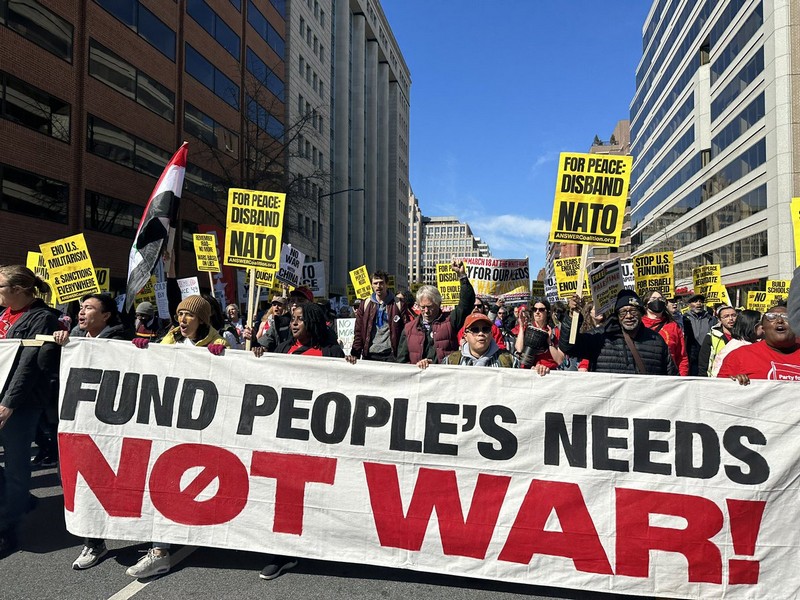
WASHINGTON (03-20) – Anti-war protesters demonstrated across the country yesterday on the 20th anniversary of the invasion of Iraq and the ensuing war. Across from the White House in Lafayette Square protesters heard speakers condemning America’s “eternal wars” and called for a reduction in the Pentagon budget, an end to the war in Ukraine through negotiations and cautioning against a war with Iran and China.

The devastating war in Iraq resulted in a more fragmented sectarian society divided in political ideology and religious differences, a growing ground for ISIS and environmental damage that will devastate the country for decades to come. In the end the net gain for Iraq in replacing Saddam Hussein and his Baathist Party has bred more corruption and violence and less of the hoped for democracy the war was supposed to install to the benefit of the Iraqi people. Instead, the fight over oil has set the country back decades in its development while driving masses into poverty.

As one speaker noted, “Two decades later, here we are, rallying around the country working to stop yet another terrible and senseless war.” And frighteningly the risk of a catastrophic nuclear war resulting by a tiny miscalculation or seemingly minor incident between the US, Russia or China is now more probable now than any time since the Cuban Missile Crisis of 1962.

“We need negotiations. We need sane, diplomatic, ‘rules-based,’ resolution of conflicts. We need sustainable self-governance free from imperial agendas” was the common demand from organizers of the protest. The Answer Coalition, the People’s Forum, Code Pink and World Beyond War all resonated in their calling for, “… a ceasefire and No War in China.”

After hearing from several speakers, protesters carrying six coffins representing victims from countries that the US has had recent conflicts in, marched a short distance to the White House where they called on President Biden to end the endless wars. Signs held aloft called for an end of the NATO alliance along with those critical of military weapons manufactures and other war profiteers. Included too were the banks that continually have funded and profiteered from war at the expense of raising the national debt and causing ongoing inflation. Other signs called for negotiating peace in Ukraine and echoing the common theme of No War with China.

The large group’s next stop on their march was at the headquarters of the Washington Post Building that they referred to as “The Pentagon Post” for the paper’s “unwavering support for war.” This they also accused of mainstream media as well for their lack of questioning the need to continually use military might rather than negotiations and diplomacy in avoiding conflict.

At the Post building protesters blocked the entrance with the coffins to shut the building down while a speaker enumerated their views of the paper along with its editorial staff challenging them to report on their demonstration. Also addressed was the mainstream media’s drumbeat to war with Iraq twenty years ago by reflecting on their “outright lie” fed to them by the Pentagon that Saddam had WMDs and portable biological labs capable of changing the very nature of conflict that ultimately proved to be untrue. Or as one protester who was quoted in a press release reflected, “As a new anti-war activist,… I was sitting on my couch eating Cheetos and even I knew Bush and Powell were lying.”

It may well be remembered too that the then well-known and respected New York Time reporter Judith Miller was fired from the paper that according to an article in the Daily Beast from 2015 occurred after she admitted that her “WMD stories were ‘totally wrong.’” She furthered with characterizing herself, “albeit unavoidably so—mistakes committed in good faith by a truth-seeking journalist working hard to do her best.” Her response “…was demonized by critics and enemies, inside and outside the Times, as an influential cheerleader for an unjustified and ultimately ruinous war conducted under false pretenses.”

After departing the Post building the protesters marched off to the New York Avenue Presbyterian Church near the White House where the rally ended.

Report and photos by Phil Pasquini

20 March 2023

Source: countercurrents.org

Algeria’s Gas vs. Rightwing Ideology: Will Italy Change Its Position on Jerusalem?

By Romana Rubeo and Ramzy Baroud

When Israeli Prime Minister Benjamin Netanyahu left Tel Aviv for Rome on March 9, he was flown to Ben Gurion airport in Tel Aviv by a helicopter because anti-government protesters blocked all the roads around it.

Netanyahu’s visit was not met with much enthusiasm in Italy, either. A sit-in was organized by pro-Palestine activists in downtown Rome under the slogan, ‘Non sei il benvenuto’ – ‘You Are Not Welcome’. An Italian translator, Olga Dalia Padoa, also refused to translate his speech at a Rome synagogue, which was scheduled for March 9.

Even Noemi Di Segni, President of the Union of Italian Jewish Communities, though unsurprisingly reiterating her love and support for Israel, expressed her concern for Israeli state institutions.

Back in Tel Aviv, Netanyahu’s trip to Italy was slammed by Israeli opposition leader Yair Lapid as “a wasteful and unnecessary weekend on the country’s dime”. But Netanyahu’s trip to Italy had other goals, aside from spending a weekend in Rome or distracting from the ongoing protests in Israel.

In an interview with the Italian newspaper La Repubblica, published on March 9, the Israeli prime minister explained the lofty objectives behind his trip to Italy. “I would like to see more economic cooperation,” he said. “We have natural gas: we have plenty of it and I would like to talk about how to bring it to Italy to support its economic growth.”

In recent weeks, Italian Prime Minister Giorgia Meloni has shuttled between several countries in search of lucrative gas contracts. Not only does Meloni want to secure her country’s need for energy following the Russia-Ukraine crisis, but she wants Rome to be a major European hub for gas imports and exports. Israel knows this, and is particularly wary that Italy’s major gas deals in Algeria on January 23 could undermine Israel’s economic and political position in Italy, as Algeria continues to serve as a bulwark of Palestinian solidarity throughout the Middle East and Africa.

Netanyahu had other issues on his mind, aside from gas. “On the strategic front, we will discuss Iran. We must prevent it from going nuclear because its missiles could reach many countries, including Europe, and no one wants to be taken hostage by a fundamentalist regime with a nuclear weapon,” Netanyahu said with the usual fear-mongering and stereotypical language pertaining to his enemies in the Middle East.

Netanyahu has two main demands from Italy: not to vote against Israel at the United Nations and, more importantly, to recognize Jerusalem as the capital of Israel. Though East Jerusalem is recognized by the international community as an occupied Palestinian city, Netanyahu wants Rome to change its position, which is consistent with international law, based on the flimsy logic of the “strong and ancient tradition between Rome and Jerusalem”.

Using the same logic, that of natural resources and arms exports in exchange for political allegiance to Israel at the UN, Netanyahu has achieved much success in normalizing ties between his country and many African nations. Now, he is applying the same modus operandi to Italy, a European power and the world’s ninth-largest economy.

Whether this strategy is an outcome of the growing subservience of Europe to Washington and Tel Aviv, or Netanyahu’s own failure to appreciate the changing geopolitical dynamics around the world, is a different matter. But what is clear is that Netanyahu has perceived Italy as a country in desperate need of Israeli help. During the meeting with Meloni, Netanyahu promised to make Italy a gas hub for Europe and help Rome solve its water issues, while Meloni, for her part, reiterated that “Israel is a fundamental partner in the Middle East and at a global level”.

The most enthusiastic response to Netanyahu’s visit, however, came from far-right Italian Minister of Infrastructure, Matteo Salvini, who strongly backed the Israeli call to recognize Jerusalem as its capital “in the name of peace, history and truth”. This response, although inconsistent with Italian foreign policy, was hardly a surprise. The leader of the La Lega party has often been criticized for his racist language in the past. Salvini, however, was ‘reformed’ in recent years, especially following a visit to Israel in 2018, where he declared his love for Israel and criticism of Palestinians. It was then that Salvini began rising in the mainstream, as opposed to regional, Italian politics.

But this is not Salvni’s position alone. The Italian government welcomed Netanyahu’s visit without making a single criticism of his far-right government’s extremist policies carried out in Occupied Palestine. While this position is in line with Italian foreign policy, it is hardly surprising from an ideological point of view, as well.

Although Italian politics, in the past, showed great solidarity with the Palestinian people’s struggle for liberation and right of self-determination – thanks to the revolutionary forces that had a tremendous impact on shaping the Italian political discourse during World War II and the country’s subsequent liberation from fascism – that position shifted throughout the years. As Italy’s own politics itself reared towards the Right, its foreign policy agenda in Palestine and Israel completely moved towards a pro-Israel stance. Those now perceived to be pro-Palestine in the Italian government are a few, and are often branded as radical politicians.

However, despite the official pro-Israel discourse in Italy, things for Netanyahu are not as easy as they may appear, especially when it comes to recognizing Jerusalem as Israel’s capital.

Indeed, Meloni did not express an outright commitment to the Israeli demand. To the contrary, in an interview with Reuters last August, even before becoming Italy’s prime minister, Meloni seemed cautious, merely stating that this is “a diplomatic matter and should be evaluated together with the foreign ministry”.

There is a reason behind Meloni’s hesitation. Italy’s recognition of Jerusalem as Israel’s capital would place Rome outside the consensus of international law. In an open letter to Meloni, United Nations Special Rapporteur, Francesca Albanese, reminded the Italian government that the recognition of Jerusalem as Israel’s capital would constitute a stark violation of international law.

Italy’s foreign policy is also accountable to the collective policies of the European Union, of which Rome is an integral member. The EU supports the UN’s position that East Jerusalem is an occupied Palestinian city and that Israel’s annexation of the city in 1980 is illegal.

Moreover, Italy’s recent landmark deal with Algeria’s state-owned gas company, Sonatrach, in January, makes it particularly difficult for Rome to take an extreme position in support of Israel. The delicate geopolitical balances resulting from the gas crisis, itself a direct outcome of the Russia-Ukraine war, make any shifts in Italian foreign policy on Palestine and Israel akin to an act of self-harm.

For Italy, at least for now, Arab gas is far more important than anything that Netanyahu could possibly offer. The new Rome-Algiers deal would grant Italy 9bn cubic meters of gas, in addition to the gas supply already flowing through the TransMed pipeline, ‘BNE Intellinews’ reported. This vital infrastructure connects Algeria to Italy via Sicily which, in turn, flows through pipelines under the Mediterranean Sea. “The expansion of these vital routes has already been planned, aiming to augment the current capacity of 33.5 bcm per year,” the business news website added.

Meloni, although a far-right politician with no particular affinity or respect for established international norms, understands that economic interests trump ideology. “Today Algeria is our first gas supplier”, Meloni said in a press conference in Algiers after signing the agreement. The deal, she said, would supply the country with “an energy mix that could shield Italy from the ongoing energy crisis”.

Such a fact would make it impossible for Italy to deviate, at least for now, from its current position regarding Jerusalem, and the illegality of the Israeli occupation of Palestine. While Israel would find it difficult to persuade Italy to change its position, Algeria, Tunisia and other Arab countries might finally find an opening to dissuade Italy from its blind support of Israel.

Romana Rubeo is an Italian writer and the managing editor of The Palestine Chronicle. Her articles appeared in many online newspapers and academic journals.

Dr. Ramzy Baroud is a journalist, author and the Editor of The Palestine Chronicle. He is the author of six books.

21 March 2023

Source: countercurrents.org

Paul Keating’s criticism of Australia’s AUKUS deal is damming but not “astonishing”, – in fact, timely!

By M Adil Khan

On March 14, 2023 Australian Prime Minister Anthony Albanese stood side by side with the British Prime Minister Rishi Sunak and the US President Joe Biden at a Naval base in San Diego, USA and signed off the next phase of AUKUS deal, where Australia will purchase three nuclear powered submarines.  which would be based in Australia. According to the Australian government press release three leaders affirmed that the “trilaterally-developed submarine based on the United Kingdom’s next-generation design that incorporates technology from all three nations, including cutting edge U.S. submarine technologies.” is “a new security partnership [between Australia, UK and USA] that will promote a free and open Indo-Pacific that is secure and stable.”[1]

Following the above announcement, Australia’s former Labor government Prime Minister, Mr. Paul Keating strongly criticised the deal at a press briefing held on March 15, 2023, at the National Press Club in Canberra, Australia implying that the deal would do more harm than good to Australia.[2]

One of Australia’s leading media outlets, the SBS news, has termed Mr. Keating’s criticisms of AUKUS, “astonishing.”[3]

The Prince of Denmark

True, Mr. Keating’s response to the AUKUS, a deal which has been endorsed by the Australia’s Labor Party (ALP) government and a deal which was inked by its predecessor, the Liberal/National Party (the LNP) government, Labor’s supposed ideological rival, has indeed been scathing, but by no means, “astonishing.”

A deal, such as that of AUKUS, which has significant security and economic ramifications for Australia should have been discussed in much greater detail, within and outside the parliament, before it was inked. But was not.

By dissecting the deal in terms in of its security and economic implications and by the way, in a globalized economic system security and economic dimensions are interlinked, and by exposing the deal’s pros and cons for Australia, mostly cons, Mr. Keating in fact, has done Australia a favour. Mr. Keating played the Prince of Denmark, “be cruel to be kind”.

“Anglosphere” affinities

Australia, a country which happens to be in an ethnically varied and demographically daunting neighbourhood and a region from which it derives most of its economic benefits, needed to carefully weigh its foreign and security policies and in a manner that responded more practically and sensitively to the changing geoeconomics and geopolitics.

After all, the world is on the move where the old unipolar order is fracturing, giving way to a new multipolar world. If we can’t see it we are either doping or cerebrally challenged.

Mr. Keating, a man of exceptional vision is among few in Australia who has had the crystal ball in hand, who clearly saw these changes decades ago and acted to bring Australia closer to the region and not push it away. Thus he is fully aware of the danger the AUKUS deal poses to Australia, a deal which according to him fulfills the agenda of the “old colonial masters” and not Australia’s and a deal which is likely to be viewed by the Australia’s neighbours especially by China, an important trading partner, as “..an arms race in the Indo-Pacific, with a Cold War mentality” and a return “…to our former colonial master, Britain.”

To many in the Asia/Pacific region where Australia is physically located, the AUKUS deal revives bad memories. They see AUKUS, an initiative that seeks “security in and within the Anglosphere”, as revival of a hegemonic nexus that once colonised, waged wars and devasted their countries.

It was not that long ago that Australia, partnered with the US in all of wars for example, in Vietnam, Korea, Iraq, Syria, and Afghanistan – all illegal and immoral wars and all contributed to massacre of hundreds and thousands of their people, men, women and children and destroyed their countries.

However, The Albanese government defends AUKUS by saying “a really exciting opportunity for Australia” which do not pose threats to none let alone China and assures that AUKUS is a deterrent against future threats and not for attacking anyone.

However, Mr. Keating has trashed Labor government’s justification for the submarines as “rubbish” and warned of the dangera of installing a military facility in Australia that has the potential to intimidate, the “mighty” China, the unannounced but the real target of the submarines.

“Mighty” China

We all know and should know by now that China is no more Seventy’s impoverished poverty-stricken China that we once were familiar with. Nor is China, what we see in our China Towns – a great place to have cheap noodle soup, served by petit and polite waitresses!

China has progressed vastly – economically, technologically and military and reportedly, has outpaced the West, in certain aspects, apparently, in military arsenals.

Until recently, and thanks to Mr. Keating’s pro-China interventions during his time as the Treasurer and later as the Prime Minister of Australia, China became a major trading partner of Australia. AUKUS may be changing all that because China views the initiative a “path of error and danger.”

Gazing at the mirror

Several decades ago, during the Keating era especially at a time when Mr. Keating was aggressively promoting the idea that Australia is a part of Asia, mainly to benefit from Asia’s rising wealth, he apparently drew a map of Asia where he showed Australia as Asia’s part.

Around this time an Australian journalist who was based in Kuala Lumpur showed the map to Dr. Mahathir Muhammad, then the Prime Minister of Malaysia, to convince him that despite his contrary thoughts, Australia sees itself as part of Asia. However, typical of Mr. Mahathir who never missed an opportunity to insult Australia, retorted by saying, “To find out whether you Australians are Asians or not, do not look at the map, look at the mirror.”

Despite such antagonisms from some of the Asian leaders who refused to accept Australia as part of Asia Mr. Keating continued to persist with success, his mission of integrating Australia with Asia and the result has been that all parties gained, Australia more – two thirds of Australia’s exports go to Asia, bulk of it to China.

Sadly, the current political bunch, both LNP and Labor, don’t seem to see the picture and by embracing AUKUS seem to have embraced Mr. Mahathir’s advice – they are making policies by gazing at the mirror and not at the map, nor the economic and geopolitical realities of the day.

“Run by the military”

Mr. Keating also suspects that Australia’s sudden shift towards “Anglospheric” hegemonic security policy may be because presently, Australia’s foreign policy is “run by the military” and not by the foreign office. If true, this is ominous.

A story from the Indian sub-continent may explain better the harm the control of national policies, foreign or otherwise, by the military causes to a nation.

In 1974, in the aftermath of the 1971 Pakistan army’s defeat at the hands of the Indian Army and the Bangladesh liberation forces that led to the dismemberment of Pakistan and emergence of its erstwhile eastern wing into Bangladesh as an independent state, Mr. Tariq Ali, the Pakistan born-British political activist conducted an interview of Mrs. Indira Gandhi, the then Prime Minister of India at her office in New Delhi.[4]

During the interview Mr. Tariq Ali while reflecting on how the arrogant and myopic policies of the Pakistan army who at the time ran the country, contributed to a civil conflict, and led to the break-up of Pakistan, told Mrs. Gandhi that “Pakistan’s problem is that our Generals are stupid.” To this Mrs. Gandhi apparently replied saying, “Mr. Ali, how about I share one of my own experiences of an encounter with one of our Generals. You see, in 1971 when Pakistan army surrendered and East Pakistan was gone, our Chief of Army Staff, General Sam Manekshaw came up to me and said, ‘Madam Prime Minister, East Pakistan is gone, and we are also deeply inside in several parts of West Pakistan. If you order we can march into Islamabad, Pakistan’s capital city in 24 hours and take over rest of Pakistan.” After listening to General Manekshaw’s ambitious idea, Mrs. Gandhi told the General “General, why don’t you give me 24 hours to make the decision.” Mrs. Gandhi then called an emergency cabinet meeting and informed her cabinet colleagues of General’s idea. The Cabinet was unanimous in their response, “absolutely not”.  Mrs. Gandhi then turned to Tariq Ali and said, “you see when it comes to stupidity our Generals and your Generals are not different, they are all stupid. The only difference is that unlike Pakistan, Generals in India do not make policies.”

If Mr. Keating’s suspicion is correct that Australia’s military has taken over the running of the Australia’s foreign policy and in the process, weaponizing diplomacy, then it indeed is deeply concerning.

Given China’s formidable military might and its readiness to act in “self-defence” an attack or even a threat, is likely to be greeted with vicious venom. China is likely to respond with its newly acquired arsenals which most certainly would rain on Australia, the AUKUS bloke and not on those who would have had the cheque in their hands by then and thousands of kilometres away relaxing with the, “the band playing!”

“Dig two graves” – Confucius

Finally, since AUKUS is aimed at China (regardless of official denials, let us not kid ourselves – the target of submarines is China), it may also not be a bad idea to take a lesson or two from China itself to prepare against repercussions.

Confucius, one of China’s wisest men once said, “if you are planning for a revenge against an enemy, dig two graves – one for the enemy and one for yourself.”

Since China never considered Australia as an enemy and thus have no need to dig a grave. However as Australia has made China its target, it may need one and given that the AUKUS deal, the submarines, would cost Australian taxpayers $368.0 billion upfront to procure and billions annually to maintain including the costs and hazards of storage of fuel wastes and furthermore, as the deal would most certainly wreak the decades-long vital trade and investment ties between the two countries which most certainly would hurt Australia more than China, it is conceivable that Australia has already commenced digging its grave!

The author is a Professor (Adjunct) at the School of Social Sciences, University of Queensland, Australia, and former senior policy manager of the United Nations

[1] https://www.pm.gov.au/media/joint-leaders-statement-aukus

[2] https://www.youtube.com/watch?v=VmgxAoa1n-8

[3] https://www.sbs.com.au/news/article/former-colonial-master-paul-keating-launches-astonishing-attack-on-labor-aukus-deal/we38qsi9s

[4] Can Pakistan Survive?: The Death of a State (1983). ISBN 978-0-8052-7194-2; (1991) ISBN 978-0-86091-260-6

21 March 2023

Source: countercurrents.org

From Balloons to AUKUS: The War Drive Against China

By Dr Binoy Kampmark

When will this hate-filled nonsense stop?  Surveillance balloons treated like evocations of Satan and his card-carrying followers; other innumerable unidentified phenomena that, nonetheless, remain attributable in origin, despite their designation; and then the issue of spying cranes.  In the meantime, there has been much finger pointing on the culprit of COVID-19 and the global pandemic.  Behold the China Threat, the Sino Monster, the Yellow Terror.

In this atmosphere, the hawkish disposition of media outlets in a number of countries in shrieking for war is becoming palpable.  The Fairfax press in Australia gave a less than admirable example of this in their absurd Red Alert series, crowned by crowing warmongers warning Australia to get ready for the imminent confrontation.  The publications were timed to soften the public for the inevitable, scandalous and possibly even treasonous announcement that the Australian government would be spending A$368 billion in local currency on needless submarines against a garishly dressed-up threat backed by ill-motivated allies.

For days, the Australian press demonstrated a zombie-like adherence to the war line that had been fed by deskbound generals no doubt suffering from piles and deranged civilian strategists desperate to justify their supper.  It is a line that always assumes the virtue of war; that going into battle, much like US President Theodore Roosevelt thought, will always outdo the tedium of peace in a haze of phosphorescent glory.  It is only in the morgues and the crowded cemeteries that we find a worthy patriotism.  Go out and kill, you noble sons and daughters.  Do your nation proud, however stupidly.

The desperation of such a measure is also a reflection of how public opinion rejects the war drive.  In a 2022 poll by the Lowy Institute think tank, 51% of Australians said they preferred their country to remain “neutral” in a conflict between the US and China over Taiwan.  This was not a bad return, given the repetitious insistence by various Australian government ministers that joining a war with the United States over Taiwan was simply assumed.

In the US, the Wall Street Journal was also doing much the same thing, plumping for great power competitions that can only end badly, rather than great power cooperation which, when it goes well, spares us the body bags, the funerals and the flag fluttering.

The introductory note of one article in that Rupert Murdoch-owned organ was not encouraging.  “Since 2018, the [US] military has shifted to focus on China and Russia after decades fighting insurgencies, but it still faces challenges to produce weapons and come up with new ways of waging war.”

The obsession with war scenarios rather than diplomatic ones is hardening.  It elevates the game to level pegging with peace overtures.  In fact, it goes further, suggesting that such measures are to be frowned upon, if not abandoned in their entirety.  Rather than considering discussions with China, for instance, on whether some rules of accommodation and observance can be made, the attitude from Washington and its satellites is one of excoriation, taking issue with any restrictions on the growth of the US defence complex.  Acid observations are reserved for the Budget Control Act of 2011, which supposedly “hampered initiatives to transform the military, including on artificial intelligence, robotics, autonomous systems and advanced manufacturing.”

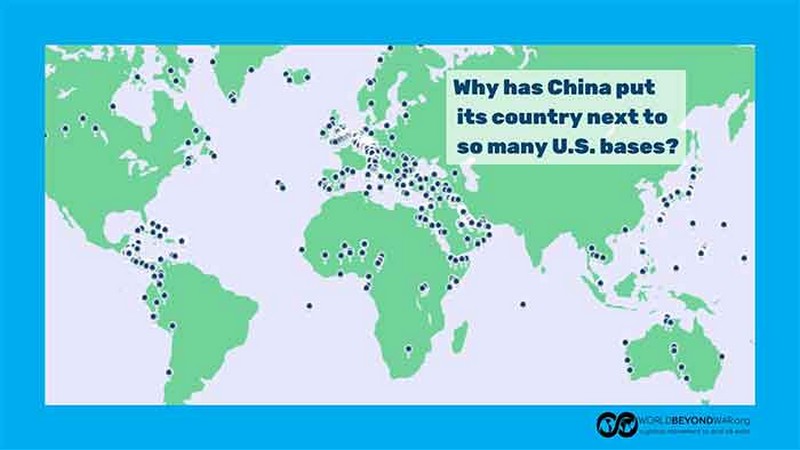
As defence analyst William Hartung writes, the Pentagon has never been short of cash in its pursuits, though it has been more than wasteful, obsessed with maintaining a global military presence spanning 750 bases and 170,000 overseas troops, not to mention the madness of shovelling $2 billion into developing a new generation of nuclear weapons.  Far from encouraging deterrence, this is bound to “accelerate a dangerous and costly arms race.”

The same must be said of AUKUS, the triumvirate alliance that is already terrifying several powers in the Indo-Pacific into joining the regional arms race.  Here we see, yet again, the Anglosphere enthralled by protecting their possessions and routes of access, directly or indirectly held.

In the red mist of war, lucid voices can be found.  Singaporean diplomat and foreign policy intellectual Kishore Mahbubani is one to offer a bracing analysis in observing that China is hardly going to undermine the very order that has benefitted it. The Chinese, far from wishing to upend the rules-based system with thuggish glee, saw it as a gift of Western legal engineering.  “So the paradox about the world today is that even though the global rules based order is a gift of the west, China embraces it.”

He also has this to say about the US-China relationship. “China has been around for 5,000 years. The United States has been around for 250 years. And it’s not surprising that a juvenile like the United States would have difficulty dealing with a wiser, older civilisation”.

Mahbubani, ever wily but also penetratingly sharp, also offers a valuable point: that the notion of a remarkable weapon (the nuclear-propelled submarine is not so much remarkable as cumbersomely draining and costly) must surely come a distant second to the attainment of economic prosperity.  “Submarines are stealthy, but trade is stealthier,” he writes with a touch of serene sagacity. Both provide security, in a fashion: the former in terms of raw deterrence; the latter in terms of interdependence – but the kind of security created by trade, he is adamant, “lasts longer”.  To date, that realisation seems to have bypassed the AUKUS troika.

Dr. Binoy Kampmark was a Commonwealth Scholar at Selwyn College, Cambridge.  He currently lectures at RMIT University.

21 March 2023

Source: countercurrents.org

In memory of 20th anniversary of the Iraq War

By Harsh Thakor

Invasion of Iraq and Crisis of American capitalism

The War of Iraq by the United States is an event that will be inscribed in black letters forever. Hundreds of millions of people in every part of the world revolted to the bloodbath of a merciless military power shattering a small and defenceless country. The invasion of Iraq was an imperialist war in the classic sense of the term: a barbaric act of aggression that manifested the interests of the most reactionary and predatory sections of the financial and corporate oligarchy in the United States. Its immediate purpose was s the establishment of monopoly over Iraq’s vast oil resources and converting that long-oppressed country to an American colonial protectorate.

Not since the 1930s—when the fascist regimes of Hitler and Mussolini were at the height  of their power and madness—was  the world faced with such International level of barbarism.  . The goal of the American military to harbour an onslaught   of thousands of missiles and bombs on the city of Baghdad is part of a conscious strategy to break the backs the Iraqi people. What the Pentagon referred to as the strategy of “Shock and Awe” drew its inspiration from the methods deployed by the Nazi Wehrmacht at the opening of World War II.

The purpose of this war was to eliminate Iraq’s so-called “weapons of mass destruction. Other major allegations, relating to the use of aluminium tubes for nuclear purposes and the existence of mobile laboratories producing chemical-biological weapons, were also investigated to be fabricated..

The second major justification for war against Iraq—that the Ba’athist regime of Saddam Hussein collaborated with Al Qaeda terrorists—is another false invention upon which the Bush administration depended upon , as the findings of the United Nations’ inspection team dispelled  claims of weapons of mass destruction.

The regime of Saddam Hussein is itself a creature of the nefarious efforts of the United States, throughout the 1950s, 1960s and even into the 1970s, to eradicate the socialist workers’ movement that once represented a significant political force in the Middle East. The coup d’etat of February 8, 1963 that overthrew the left nationalist Qasim regime and brought the Ba’athists to power for the first time was organized with the support of the CIA.

It was in such bloody operations that Saddam Hussein first sparkled as a major figure in the Ba’ath movement. Later in his career the United States supported his bloody purge of Iraqi Communists in 1979 that played a crucial role in his consolidation of power. Hussein’s decision to go to war against Iran in 1980 was encouraged by the United States, which provided him with material and logistical support for the next eight years. Much of the stockpile of biological agents that Hussein built up in the 1980s was provided by an American company, the American Type Culture Collection of Manassas, Virginia. This was done with the explicit approval of the Reagan-Bush administration. “ATCC could never have shipped these samples to Iraq without the Department of Commerce’s approval for all requests,” said Nancy J. Wysocki, vice president for human resources and public relations at the American Type Culture Collection, a nonprofit organization that is one of the world’s leading biological supply houses. “They were sent for legitimate research purposes.”[iii]

The attempt to champion democratic ideals as an excuse for attacking Iraq ignores one l democratic principle: that of national self-determination. The invasion and conquest of the country, and establishment of a military protectorate under would-be Generalissimo Tommy Franks, represent a gross te violation of Iraq’s national sovereignty.

.The vociferous glorification of war as a legitimate weapon of global imperialist realpolitik represents a political and moral regression. A significant body of international law was contrived on the basis of the bloodshed of the first half of the twentieth century. The carnage of World War I between 1914 and 1918, which killed tens of millions of people, led to a furious controversy over responsibility for the outbreak of hostilities—the question of “war guilt.” The issue of “war guilt” took an even more sinister form at the end of World War II. The undoubted responsibility of the Third Reich for the outbreak of war in 1939 led to the decision of the Allied powers, of which the United States was the most powerful representative, to place the former leaders of the German state on trial.

. The principal objective of the war was to capture control of Iraq’s oil resources. No other natural resources have played such a central role in shaping the political and economic objectives of American imperialism over the last century as oil and natural gas. Involved in this central preoccupation is not only the profits of American-owned oil conglomerates, with the  stability of America’s financial-monetary structure and its dominant world position being all dependent upon the vast oil resources of the Persian Gulf and, more recently, the Caspian Basin.

To recognize the centrality of oil in the geo-political calculations of the United States does not mean, however, that it provides an accurate explanation of the war against Iraq and the general embrace of militarism. The manner in which the United States, or another capitalist country, chalks out  its critical interests, and the means by which it seeks to obtain them, , are basically designed  by the entire structure and internal dynamics of the given society. This invasion of Iraq was a  manifestation of intensifying social and political contradictions in the American body politic.

There is no impenetrable barrier that separates domestic and foreign policy. They represent interdependent components of the class policy elaborated by the dominant strata of the ruling elite. While subject to the continuous pressure of global economic forces, the foreign policy pursued by the ruling elite reflects, complements and projects its essential domestic interests.

. The aggressive policies of American imperialism were responsible for   living standards of the working class either stagnating or deteriorating in America; and within the so-called “Third World” a terrifying deterioration in the conditions of hundreds of millions of people. For the ruling class and the wealthiest sections of the upper-middle class, these policies were an absolute blessing.

Mass Demonstrations before the War

The mass demonstrations that erupted simultaneously to engulf the globe on the weekend of February 15-16, 2003, preceding the American attack on Iraq, will shimmer forever in history. They were an unparalleled manifestation of international human solidarity against war. In the face of the militaristic frenzy of the most ruthless imperialist regime in the world, more than 10,000,000 people had raised the fists against the plans for an invasion of Iraq.

These demonstrations marked a turning point in world politics. From North and South America, through Europe and Asia to Australia and Africa, the mass and largely spontaneous popular mobilizations of February 15-16 in the very heart of the body unfolded the deep and unbreakable political, social and moral chasm that divides the ruling elites and their media propagandists from the people.

In the aftermath of these powerful demonstrations, all pretence of democratic political legitimacy for the war policies of the Bush administration in the United States and the Blair regime in Britain were shattered. to the core. The demonstration of more than one million people in London and Glasgow was a stunning repudiation of Blair’s attempt to revive, through an alliance with Washington, the colonialist aspirations of British imperialism.

The marches held in cities engulfing many regions the United States were, if anything, even more intense. There, in the very egg of world imperialism, the mass demonstrations demonstrated that the American people are repulsed were enraged by the war frenzy of the Bush administration and the militaristic propaganda of the establishment media.

Without hesitation we should appreciate the significance of the massive outpouring of humanity in Barcelona, Rome, Paris and Berlin. In these great cities, the bitter experience of fascist barbarism—represented by the regimes of Franco, Mussolini, Pétain and Hitler—lives in the consciousness of the populace. The working people of Spain, Italy, France and Germany instinctively grasp the reactionary menace posed by the war-mongering of the Bush administration.

The demonstrations of February 15-16 were, not only an expression of massive popular opposition to an invasion of Iraq. What was witnessed and participated was the birth of a new international social movement of opposition to imperialism. Crystallising this development are profound objective processes. The global merging of capitalist production, spearheaded by transnational corporations knit the basis for the global integration of social struggles of the working class.

Just as the unparalleled development of world economy transcends the barriers of the national state, the class struggle as an objective historical process tends naturally to sweep across national borders. With consciousness brimming at an unprecedented level, the working class will define itself in international rather than national terms. It is precisely this tendency that found expression on Saturday, when 3,000 Jewish and Arab workers marched together against war in the streets of Tel Aviv.

Recommended Readings

Without fail readers should study the ‘Aspects of India’s Economy 33-34 ’, publication of Research Unit for Political economy on the Iraq War, published 20 years ago. It is one of the finest, most accurate, methodical and illustrative research or documents undertaken projecting the actual truth and happenings or what was concealed beneath the surface. With figures it tabulates how America wished to strangulate the oil resources because of it’s dwindling economy and ho w imperialism was an integral part of the war. Even non Marxists o Liberals, classed it as one of the most productive research .A classic work, in it’s own right.

It delves into the history unfolding Iraq from colony to semi-colony, Towards Nationalisation, The Iran-Iraq War: Serving American Interests ,. The Torment of Iraq , Return of Imperialist Occupation. . It analyses The Current Strategic Agenda of the United States,.Home Front in Shambles and   Military Solution to an Economic Crisis.

Setbacks

In important ways the Iraqi resistance have powerful echoes of previous anti imperialist wars. Unfortunately Iraq like Vietnam in the late 1960’s and mid 1970’s received no aid from a foreign country, as there was no superpower or Socialist country to offer it moral support.

Factional rivalries divided a united guerrilla resistance for over a decade after the Iraqi attack at the hands of United States of America. At the international level the anti imperialist movement was generally weak. Globalisation played an important role in sponsoring the American attack. Ironically and fittingly America had to retreat or lost, because it’s resources were exhausted and it’s economy in shambles. The USA economy received a mortal blow after the war, and heightened political consciousness of the people. Sadly progressive forces could not capitalise on it to build a class conscious movement against capitalism linked with imperialism.

Harsh Thakor is freelance journalist who has extensively studied imperialist wars .Thanks information from ‘Aspects 33-34’ and World Socialist Web Site.

21 March 2023

Source: countercurrents.org