Just International

What Losing the Iran Deal Could Mean for the Region

By Seyed Hossein Mousavian

If President Joe Biden is seeking to restore sustainable peace and security in the region, he has to start with reviving the JCPOA

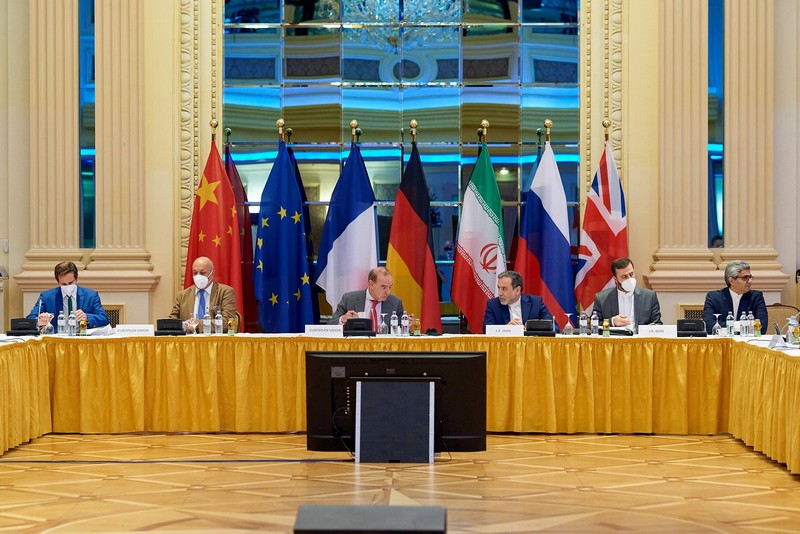
Iran’s nuclear crisis has been at the center of Middle East and international politics for the past two decades and continues to impact the dynamics of regional and international politics. However, the current phase of the crisis surfaced a little over a decade ago, when Iran and the P5+1 (the five permanent members of the United Nations Security Council—China, France, Russia, the United Kingdom, the United States—plus Germany) signed the Joint Comprehensive Plan of Action (JCPOA) in 2015, which was endorsed by UN Security Council Resolution 2231. While the Iranians fully held to their side of the deal, the United States later withdrew under the Trump administration, and the European Union subsequently failed to fulfill its responsibilities under the agreement. The upshot of the U.S. withdrawal and European complacency was a revival of sanctions at a pace and intensity unprecedented over the past forty years.

The JCPOA, and its abandonment, has altered the geopolitics of the Middle East. The deal would have laid the foundation for a nuclear-weapons-free world because of the strong regime of inspection that was put in place to make sure Iran complied with the laws and regulations of the Non-Proliferation Treaty (NPT). By withdrawing from the JCPOA, the Trump administration dashed all prospects of a resolution of tensions between Iran and the United States. Just as its abrogation led to more insecurity on the international stage, its revival can lead to more peace and security, both in the Middle East and across the world.

The Nuclear Crisis: A Brief History
As part of U.S. President Dwight Eisenhower’s Atoms for Peace program, Iran began its nuclear program under Mohamed Reza Shah’s rule in 1957. Soon after the United States and Iran agreed to a civilian nuclear cooperation arrangement—known as “Cooperation Concerning Civil Uses of Atoms”— the Shah established the Tehran Nuclear Research Center (TNRC) under U.S. supervision. He then began to negotiate with and press the United States to provide Iran with nuclear technology and materials until his downfall in the 1979 Revolution.

The revolution changed the trajectory of the country’s nuclear program. Iran, which was seriously pursuing nuclear technology, decided to curb these ambitions. Failing to honor their commitments based on the deal that the Iranian government had with the West during the Shah’s rule, the United States and other Western countries including Germany withdrew from their agreements. Germany stopped supplying fuel rods to the Tehran Research Reactor and reneged on its contract to build a nuclear power plant in the southern city of Bushehr, while France canceled an agreement with Iran signed in 1973 to enrich its uranium. At the time, Iran had no plans to pursue uranium-enrichment or heavy water activities on its own soil.

The double-standard policy of the United States and its Western allies forced Iran to proceed with efforts to develop its own nuclear capacities. After the revolution, the United States turned its back on Iran, now no longer considered a Washington ally. As a result, Iran failed to acquire the fuel necessary to power facilities. Moreover, the United States and its Western allies supported the late Iraqi President Saddam Hussein in his 1980 invasion of Iran. This greatly impacted Iran’s security calculations; Tehran saw how the Western world had no hesitation in supplying Saddam with chemical weapons while Iran struggled to access conventional weaponry.

Iran’s nuclear program truly came to the fore in the summer of 2003, when the International Atomic Energy Agency (IAEA) issued a report revealing that the country had obtained enrichment capability but still remained compliant with the NPT. A few months later, however, another report was released that noted trace amounts of high-enriched uranium at the Natanz nuclear power plant. As a result, the IAEA Board of Governors passed a resolution demanding that Iran suspend enrichment and all related activities for an indefinite period, as well as implement the Additional Protocol to its safeguards agreement. The Additional Protocol entailed the highest level of transparency measures ever devised by the agency. In October 2003, Iran’s Supreme Leader, Ayatollah Ali Khamenei, decreed his fatwa prohibiting the production and use of all weapons of mass destruction, including nuclear weapons. To be sure, Iran, both before and after the 1979 Revolution, supported the initiative to establish a Nuclear-Weapons-Free Zone (NWFZ) in the region. That is to say, both the late Shah and the current Ayatollah expressed strong opposition to the development of nuclear weapons.

It is important to note that NPT member states are allowed to acquire nuclear capabilities for peaceful purposes. Iran is no exception. Since 2003, there have been numerous rounds of negotiations to resolve Iran’s nuclear crisis. On October 21, 2003, Iran and a number of European countries signed the Tehran Declaration through which it voluntarily agreed to halve its introduction of gas into centrifuges and to implement the Additional Protocol. In return, the Europeans agreed to recognize Iran’s legitimate right to peaceful nuclear technology, remove the nuclear file from the IAEA’s board agenda, and expand political and economic relations with the country. The Iran–EU3 (France, Germany, and the UK) negotiations lasted through 2005. Despite various proposals submitted by Hassan Rouhani, Iran’s lead negotiator at the time, the negotiations did not lead to a lasting and sustainable resolution to the crisis.

In 2005, Iran made an offer to the EU3 and was prepared to limit enrichment to 5 percent and export all low-enriched uranium beyond domestic needs or convert it into fuel rods, among other things. The main purpose of the proposal was to ensure that Iran’s civil enrichment program could not be weaponized while also recognizing its right to enrichment under the NPT.

In exchange for these commitments, the IAEA would view Iran’s nuclear activities with a more neutral eye and the European Union would pursue broader political, economic, and security cooperation with Tehran, which would include ending trade and economic sanctions. However, although England, France, and Germany favored the offer, the George W. Bush administration spurned it and insisted on its maximalist demand of “zero enrichment” in Iran.

The failure of the nuclear talks, despite Iran’s attempts to operate exclusively for peaceful purposes, gave rise to right-wing populism in Iran represented by former President Mahmoud Ahmadinejad. Indeed, most analysts believe that the breakdown in the 2003–2005 nuclear negotiations during former President Mohammad Khatami’s tenure contributed to Ahmadinejad’s victory in Iran’s June 2005 presidential election.

Once Ahmadinejad was in office, Iran restarted its uranium conversion facilities in Isfahan, and on September 24, 2005, the IAEA board of governors found Iran to be in noncompliance with its safeguards agreement. On January 10, 2006, Iran resumed enrichment activities at its Natanz plant, and on February 4, the IAEA voted to refer the file to the UN Security Council. Between 2006 and 2009, the United Nations Security Council passed resolutions 1696, 1737, 1803, and 1835, imposing sanctions while demanding full suspension of enrichment and heavy water activities in Iran. In October 2009, a meeting was held between Iran, Germany, and the UN Security Council (UNSC) permanent representative in Geneva to discuss the possible transfer of Iran’s stockpile of low-enriched uranium out of the country in exchange for reactor fuel for the Tehran Research Reactor. As part of the swap negotiations, Iran’s lead nuclear negotiator, Saeed Jalili, and U.S. Under Secretary of State William Burns, held the highest level of direct talks in thirty years. In the end, this round of negotiations also failed, though at a later stage, Brazil and Turkey intervened to mediate the process.

On May 17, 2010, an agreement was reached to transfer 1,200 kilograms of Iranian low-enriched uranium to Turkey, in return for which Iran would receive the 20 percent enriched uranium fuel required for operating the Tehran Research Reactor. However, U.S. and European officials rejected the deal. Instead, the UNSC immediately passed Resolution 1929, which included an arms embargo and tightened restrictions on financial and shipping enterprises. During Barack Obama’s first term in office, Iranian nuclear facilities came under cyberattacks and several of its nuclear scientists were assassinated. According to media reports, the cyberattacks were jointly operated by the United States and Israel and the assassinations were carried out by Israel. Tehran’s overtures seeking a mutually acceptable deal went nowhere, primarily because the United States maintained that there should not be even a single centrifuge in Iran. The United States’ total denial of Iran’s right to enrichment and its blocking of efforts to have fuel rods for its reactor sent clear signals that the United States was not interested in resolving the nuclear issue. During his visit to New York for the UN General Assembly in 2011, Ahmadinejad announced that Iran had mastered 20 percent enrichment and was stockpiling 20 percent enriched uranium, but he proposed ceasing its 20 percent enrichment in exchange for Western-provided fuel rods for the Tehran Research Reactor. Moreover, as a show of goodwill toward the United States, Ahmadinejad announced the release of two Americans imprisoned in Iran under suspicion of espionage. The United States turned down Iran’s offers, which some analysts believe was done as a pretext to intensify economic sanctions.

In Fall 2011, the United States and the EU imposed an oil embargo on Iran, sanctioned its central bank, and introduced two UN resolutions condemning its record on human rights and terrorism. At the same time, IAEA Director General Yukiya Amano publicly expressed that the IAEA “remains unable to confirm that all nuclear material is in peaceful activities”.

On August 3, 2013, President Hassan Rouhani took office in Tehran. His moderate stance on foreign policy allowed him to succeed in pushing for a deal. As noted already, under its terms and conditions, Iran agreed to limit much of its nuclear program and open its facilities to the highest transparency measures ever accepted by a sovereign state in exchange for sanctions relief. It must be noted that the JCPOA was achieved because President Obama changed the U.S. policy from “Zero Enrichment” to “Zero Nuclear Bomb” in Iran.

The Impact of JCPOA on the Region’s Geopolitics
The policies that the West has implemented toward Iran—particularly as regards its nuclear program and the JCPOA—have had serious consequences for the geopolitics of the region. The following is a list of fourteen such consequences.

First, shortly after the 1979 Revolution, Iran decided to forgo all ambitious nuclear projects, including a U.S.-devised plan to build twenty nuclear plants. Iran had no choice but to maintain the Tehran Research Reactor built by the United States in 1967, simply because it needed to produce isotopes for medical purposes and cancer treatment. Indeed, Iran had no plan to develop any domestic enrichment plant or heavy water on its land, but was forced to after many failed attempts at importing the necessary resources from Western countries. Indeed, regional geopolitics would have been very different if the United States and its Western allies had welcomed the policy of providing fuel for Iran’s nuclear program. Iran would have continued to receive its nuclear fuels from the United States without having to develop its own capabilities.

Second, when negotiations between Iran and the EU3 began in 2003, both parties were in a position to hammer out a deal, but the United States stood in the way of reaching an agreement. Jack Straw, the then-UK foreign minister, testified to this:

All of us accepted Iran’s right to a civil nuclear program. I personally accepted Iran’s right to run some centrifuges for its low enrichment program. We gained the interim agreement in October 2003 that was agreed in Tehran, and we had two more agreements in Paris and Brussels. But we were very close to final agreement; and when I saw Dr. Zarif at the beginning of 2014, on a Parliamentary delegation, he acknowledged that what stopped the deal in 2005 was not about centrifuges; it was our inability to get agreement from the Americans for concessions like aircraft spare parts.

Hence, an agreement back in early 2000s would have fundamentally shaped the region differently if the United States had agreed to a nuclear deal in 2005 rather than 2015. Such an agreement would have primarily impacted the course of the Iranian presidential election in 2005. The election of the conservative Ahmadinejad, at least in part, was a response to President Bush’s hostile policies against Iran despite President’s Khatami’s earlier rapprochement policy with the West. Moreover, the region’s 2011 uprisings and their aftermath in Yemen, Syria, and the rise of ISIS could have been averted were it not for the previous failures in Iran’s relations with the West.

Third, by mobilizing international attention, often through providing misinformation on Iran’s nuclear program, Israel distorted the realities of nonproliferation in the Middle East. Despite its rhetoric against Iran, Israel is the only state in the Middle East region that possesses nuclear weapons, is not a member of the NPT, and holds an estimated volume of 80 and 400 nuclear warheads. Iran, on the other hand, is a member of the NPT, does not possess a single nuclear weapon, and has accepted the world’s most intrusive regime of inspection concerning nuclear-related activities. This has significantly delayed the process of establishing a nuclear-weapons-free zone in the Middle East, which was formally introduced by Iran and Egypt in 1974.

Fourth, since the collapse of JCPOA, concerns over nuclear competition in the Middle East have intensified. For instance, when the JCPOA restrictions were in place, the United States predicted in 2015 that it would take Iran twelve months to produce enough nuclear fuel for a bomb should it decide to abandon the deal and seek a workable weapon. Today, that estimate has shrunk to about one month as Tehran has installed more advanced centrifuges in its nuclear centers, enriched uranium of a far higher grade than allowed under the original nuclear pact, and restricted international inspectors’ access to Iranian nuclear facilities. Iran has thus achieved enrichment and heavy water capabilities, posing a new challenge to Israel’s nuclear monopoly in the Middle East. Now other countries such as Saudi Arabia, Egypt, the United Arab Emirates (UAE), and Turkey are seeking to increase their nuclear power capabilities.

Fifth, by propagating the idea that Iran is a threat, Israel has aligned itself with countries such as Saudi Arabia and the UAE, among others. On August 13, 2020, UAE Minister of State for Foreign Affairs Anwar Gargash announced an agreement to normalize relations with Israel, saying that his country wanted to deal with the threats facing the two-state solution, specifically annexation of the Palestinian territories. “This new architecture—the shared capabilities we are building—intimidates and deters our common enemies, first and foremost Iran and its proxies,” Israeli Foreign Minister Yair Lapid said. Hence, an alliance of four countries—the United States (the Trump administration), Israel (Natanyahu’s government), Saudi Arabia (Crown Prince Mohammad Bin Salman) and the United Arab Emirates (President Mohammed bin Zayed)— emerged against Iran.

Sixth, the long-lasting conflict in the Middle East—the illegal occupation of Palestinian territories—was completely pushed to the margins. Trump went on to formally recognize Jerusalem as the capital of Israel, reversing nearly seven decades of a failed American foreign policy and moving the United States Embassy from Tel Aviv to Jerusalem. “Today we finally acknowledge the obvious: that Jerusalem is Israel’s capital,” Trump thundered from the White House.

Seventh, the effects of U.S. withdrawal from the deal in May 2018 were detrimental to ordinary Iranian civilians. After the United States enforced unilateral sanctions, the European Union was unable to resist U.S. pressure. The complex set of unilateral sanctions against Iran, compounded by zero-risk policies by European businesses and financial institutions, worsened existing humanitarian and economic challenges and negatively affected the lives of the people, in particular low-income and working-class Iranians. Accessing certain types of medicine has been particularly challenging.

Eighth, Iran negotiated and signed the world’s most comprehensive nuclear deal with the West—particularly the United States—but was not able to bear the fruit of this agreement by expanding its trade and economic ties with the United States. As a result, Iran was forced to resort to seriously expanding its ties with China and Russia with a sweeping long-term political, economic, and security agreement known as the Iran–China 25-year Cooperation Program, which would facilitate hundreds of billions of dollars of investments in the Iranian economy. State managers in Tehran simply view the agreements with the major powers in the East as a necessary means of combating U.S. hegemony and hostility. Iran’s new policy of pivoting to the East has gained all the more credibility among Iranian officials after the United States’ ill-advised move to renege on the JCPOA.

Ninth, due to Trump’s withdrawal from the deal, Iran has actually become a nuclear threshold state. Under the terms of the 2015 agreement, Iran was permitted to stockpile up to 300 kilograms of low-enriched uranium and operate just over 5,000 1st-generation centrifuges at the Natanz Fuel Enrichment Plant. Iran did not enrich to more than a 3.67 percent concentration of uranium. Indeed, since the U.S. withdrawal from the nuclear pact, Iran has been steadily enriching uranium at higher levels. In July 2019, Iran began enriching up to 5 percent, and then to 20 percent in January 2021 and 60 percent in April 2021. Hence, withdrawal from the JCPOA significantly accelerated Iran’s enrichment program, and this will surely have huge impacts on regional diplomacy and geopolitics.

Tenth, the JCPOA had provided an opportunity for Iran and the United States to hold direct talks at the ministerial level for the first time since the 1979 Iranian Revolution. Indeed, the highest executive powers in both Iran and the United States directly communicated with each other in a phone conversation. Obama reiterated that the nuclear deal prevents the most serious threat from happening, which is Iran obtaining a nuclear weapon. Thus, negotiations between 2013 and 2015 demonstrated that agreement between the United States and Iran is in fact possible, and that such a challenging issue can be negotiated and agreed upon. By withdrawing from the deal, the United States destroyed the trust it had built with Iran. After Trump’s withdrawal from the JCPOA, Khamenei declined the Trump administration’s offer for unconditional talks, reiterating that “the U.S.

withdrawal from the 2015 nuclear deal was clear proof that Washington cannot be trusted”. That’s why Iran has only agreed to negotiate with the United States through an EU mediator in an attempt to revive the nuclear deal. The deepened Washington–Tehran mistrust has led to more bilateral, regional, and international animosities.

Eleventh, Khamenei announced Iran’s official strategy of “No War, No Peace with the United States” after Trump’s withdrawal from the JCPOA. Even if Iran chooses to negotiate on regional issues to resolve their differences, it is not certain whether the United States will abide by any agreement reached. But if the United States commits itself to its international obligations and other potential major agreements that would bear on regional geopolitics—such as terrorism and extremism as well as issues related to the long-term security of the Persian Gulf—such agreements could lead to the betterment of many issues of concern for both countries.

Twelfth, the JCPOA provided the ground for regionalization of the most comprehensive inspection regime to prevent the proliferation of nuclear weapons. This is a tremendous step toward denuclearization of the Middle East. Amid heightened tensions in the region, Iran presented its Hormuz Peace Endeavor (HOPE) plan—the first concerted effort to ensure that the Persian Gulf remained free of nuclear weapons—at the September 2019 UN General Assembly. Iran’s invitation for all Persian Gulf littoral states—namely, Bahrain, Iraq, Saudi Arabia, Oman, and the United Arab Emirates—to join HOPE elucidated a series of objectives and principles as well as a concrete roadmap for peace and security in the Middle East. HOPE was inspired by the JCPOA, and aimed at building a nuclear-weapons-free zone in the Middle East. Had Trump not withdrawn from the JCPOA, HOPE would likely not have been agreed upon.

Thirteenth, Israel’s opposition to the deal from the start is likely to spill over into a regional war. Netanyahu, for example, pushed Trump to withdraw from the JCPOA, impose a “maximum pressure” policy, designate the Iranian Revolutionary Guards Corps as a terrorist organization, assassinate Iranian nuclear scientists, and sabotage the country’s nuclear facilities, including through cyber-attacks. The Israelis also encouraged the United States to assassinate Islamic Revolutionary Guard Corps General Qasem Soleimani, who was killed in Baghdad on January 3, 2020.

As part of a greater alliance to confront Iran covertly, Israel and the United States established the Abraham Accord, which could ultimately expand into all-out war. The years-long Arab–Israeli conflict is now being converted into an Arab–Iranian conflict.

Fourteenth, the nuclear deal would have ensured a safer world had it been concluded. A recent UN report confirmed that Iran has enough uranium to produce nuclear weapons. As a result of Israel’s pressure for Trump to withdraw from the JCPOA, Iran’s stock of 60-percent-enriched uranium is now estimated to be 55.6 kg, allowing it to produce enough material for a bomb if it decides to. In the absence of the JCPOA’s revival, the world should live with Iran as a new nuclear threshold state, which would have a dramatic impact on geopolitics and the balance of power in the region.

This list of consequences of Trump’s withdrawal from the JCPOA is not exhaustive. One could go on. For example, Mohammad Bin Salman has vowed that “if Iran developed a nuclear bomb, we would do the same”. The JCPOA provided a perfect opportunity for the IAEA to contain the proliferation of nuclear weapons in the region while simultaneously monitoring Iran’s nuclear activities, but the United States simply decided not to take advantage of such an opportunity.

The Only Path Forward
No sustainable peace can be achieved without Iran’s participation in a regional agreement. It has been fallaciously argued that a joint agreement normalizing Arab–Israeli relations may help stabilize the region, but the reality proves otherwise as tensions in the Middle East show no signs of subsiding anytime soon. If President Joe Biden is seeking to restore sustainable peace and security in the region, he has to start with reviving the JCPOA as a stepping stone.

In the absence of the JCPOA, Iran will still remain a member of the NPT. But the absence of the JCPOA also means that Iran would withdraw from the Additional Protocol and Subsidiary Arrangement. Iran’s potential withdrawal from the NPT would limit the IAEA’s ability to provide technical verifications since its access to Iran’s facilities will be severely curtailed. Moreover, Iran will also disregard all of the limits imposed within the JCPOA such as limited stockpiling and enrichment below 5 percent. In effect, the absence of the JCPOA could translate into Iran’s ability to enrich uranium up to 90 percent, which is the breakout level and a step to producing a nuclear bomb.

It is important to note that according to the NPT, short of a nuclear bomb, all the above activities are legitimate. Still, the European Union has the snapback at its disposal. If the EU uses the snapback procedure and refers the Iranian nuclear file to the UNSC in order to reinstate sanctions, Iran will likely withdraw from the NPT. And in the event of potential U.S. or Israeli military attacks, Iran will likely start building a nuclear bomb.

To avoid all these potentially disastrous outcomes, there remains a safer and less costly option through the JCPOA. That is, if the United States provides assurances that it will not withdraw from the JCPOA again if it is reinstated. Indeed, a bipartisan congressional legislation can provide such an assurance. Reviving the JCPOA would prevent future conflicts in the region.

Seyed Hossein Mousavian is a Middle East Security and Nuclear Policy specialist at the Program on Science and Global Security in the Woodrow Wilson School of Public and International Affairs at Princeton University.

Source: thecairoreview.com

Japan Reenlists as Washington’s Spear-Carrier

By Patrick Lawrence

21 Jan 2023 – It is always the same when Japanese premiers travel to Washington to summit at the White House. Nothing seems to happen and nobody pays much attention even when important things happen, when we should all pay attention, and, when we do pay passing attention, we usually get it wrong. In January 1960, when Premier Nobusuke Kishi visited Washington, President Eisenhower blessed the war criminal and signed a security treaty the Japanese public vigorously opposed. That week Newsweek marked Kishi down as “that friendly, savvy Japanese salesman.”

Kishi proved a salesman, all right. Three years later he used armed police to clear the Diet of opposition legislators and force ratification of the Anpo treaty, as the Japanese call it, with members of his Liberal Democratic Party (LDP) the only ones present to vote on it. “A 134–pound body packed with pride, power and passion—a perfect embodiment of his country’s amazing resurgence,” TIME wrote of the man who ought to have been hanged a decade earlier.

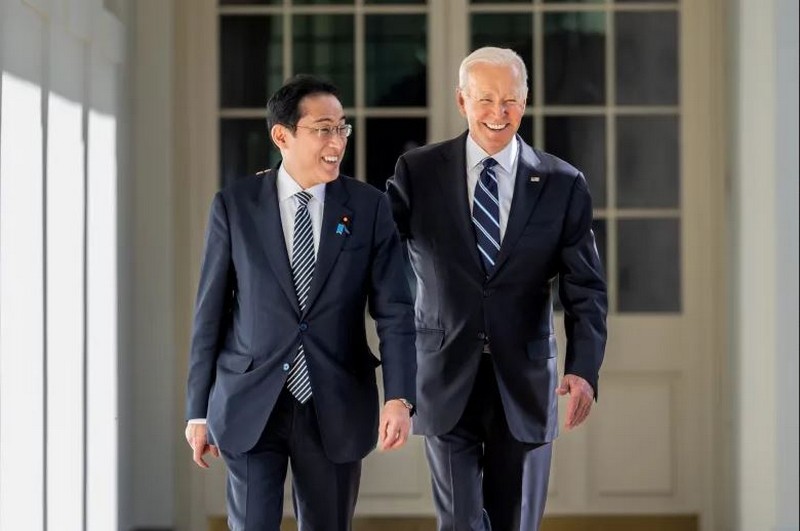
Now we have Premier Fumio Kishida, who summited with our asleep-at-the-wheel president in the Oval Office a week ago. I do not know how much Kishida weighs or how proud of himself or his nation he is, but, in an uncanny echo of the Kishi–Eisenhower summit, Joe Biden blessed his radical turn toward the militarism Japan’s pacifist constitution forbids.

There is a long history here. American New Dealers wrote Japan’s pacifist constitution shortly after the August 1945 surrender. But since the Truman administration set the Cold War in motion in 1947, Washington has incessantly, diabolically pressed the Japanese to breach it. “Do more” was the common exhortation during my years in Tokyo. Now Kishida obliges. If he is the perfect embodiment of anything, it is the obsequious pandering with which Japan’s conservative and nationalist political cliques have conducted relations with the U.S. since the August 1945 defeat.

I read in the hours Kishida spent at the White House the further polarization of the planet as the U.S. insists on compelling it and the capitulation of yet another nation previously capable of a mediating role between East and West, between Global South and Global North, between the U.S. imperium and its designated enemies, China and Russia chief among them. Sweden, Finland and Germany have already abandoned this admirable place in the global order in the name of supporting the regime in Ukraine. Japan now follows suit.

There is a simple chronology leading to the Kishida–Biden summit, and it is useful to follow it. Biden traveled to Tokyo last May to meet with the recently elected Kishida, and the two made a great show of committing to “continually modernize the alliance, evolve bilateral roles and missions, and strengthen joint capabilities, including by aligning strategies and prioritizing goals together.” A month ago the Kishida government announced that it would raise the 2023 defense budget by $7.3 billion, the biggest increase in postwar Japanese history, and that it would double defense expenditure, to 2 percent of gross domestic product, over the next five years. Tokyo has for decades held defense spending to 1 percent of GDP.

Prior to his arrival in Washington last week, Kishida made a grand tour through Europe, stopping in every Group of 7 capital except Berlin. In each the topic was the same: Tokyo will now count itself a fully committed member of the Western alliance, signing on to all that animates it. In London, Kishida concluded a mutual-access defense accord permitting each to station troops on the other’s soil. This followed by a few months a Tokyo–London–Rome agreement jointly to develop a new fighter jet.

And now the Oval Office summit, during which the two leaders pledged, as the government-supervised New York Times put it, “to work together to transform Japan into a potent military power to help counterbalance China and to bolster the alliance between the two nations so that it becomes the linchpin for their security interests in Asia.” The artless Biden, who seems to delight in putting his foot in his mouth, had to add to his official statement, “The more difficult job is trying to figure out how and where we disagree.” Indeed, Joe, a 78-year-old truth, bitter as they come.

This is a very big deal, and, yes, I mean to equate its significance to the Kishi–Eisenhower doings at the height of Cold War I. The ruling LDP, which has tried and failed severally to alter the pacifist constitution to release the Self-Defense Forces from the “no war” Article 9, has periodically “reinterpreted” it—stretched it like a rubber band—for many years. Shinzo Abe, the nationalist premier who was assassinated last year after leaving office two years earlier, forced legislation through the Diet allowing the SDF to engage in overseas combat missions.

That was in 2015. Kishida has now gone further, and in a more highly charged context. He has turned what had been by and large a domestic question concerning the constitution into a global commitment. He has also set Japan on course to become the world’s third-largest military power after the U.S. and China and ahead of France. A lot of the new spending on defense will go to missile systems and warships that will project Japanese power far beyond the home islands and maritime zones over which Tokyo claims jurisdiction. The missiles, which are to include U.S.–made Tomahawks, will be capable of hitting targets on the Chinese mainland.

Kishida, like Kishi 60–odd years ago, must now get his new “defense strategy” through the Diet. I cannot predict his political chances but stand with those many Japanese who hope he either fails or faces a vigorous fight that shakes the Japanese and the rest of us awake to what Tokyo’s ruling cliques are attempting. Japan is not, by law and national sentiment, supposed to be “a potent military power,” as The Times approvingly put it. Japan has sought, with difficulty, a new purpose for itself since the Cold War’s end and its achievement of economic equality with the West. Reenlisting as Washington’s principal spear-carrier in the western Pacific is nothing more than weak-minded recidivism.

It could not be clearer that Tokyo has just elected to stand with Washington in the latter’s campaign of hostility and provocation against the Chinese People’s Republic. It is equally the case that the five Chinese missiles that landed in Japan’s territorial waters following Nancy Pelosi’s grandiose visit to Taiwan last summer weighed on Kishida’s course of action—if only by way of giving him a political opportunity.

But Tokyo would have handled this matter differently in years past. There would have been a diplomatic contretemps, and maybe some temporary sanctions against Chinese-made products the Japanese can do well enough without. But Japan would have maintained its delicate balancing act between the U.S. and the mainland. Of this I am certain. Neither would a premier visiting Washington sound off about the conflict in Ukraine, as Kishida has taken to doing. This, too.

I fail to see any way Japan’s new declaration of allegiance more secure, and let us not speak of the rest of East Asia. Washington desires above all to raise tensions in the Pacific. Kishida has inadvisedly–with plenty of precedent–to cooperate in this cultivation of anti-Chinese belligerence.

There is a history here, too. The Japanese have nursed a pronounced ambivalence as to their place in the world since they began making themselves modern in the 1870s. Yukichi Fukuzawa, a prominent Meiji-era intellectual, published an essay in 1885 called “Datsu–A ron,” “On Departure from Asia.” In our time there have been numerous refinements on the thought. We have datsu–A, nu–O, leaving Asia, joining the West, and datsu–A, nu–Bei, leaving Asia, joining America. More recently: nu–A, datsu–O, joining Asia, departing from the West; nu–A, nu–O, joining Asia and the West both, and nu–A, shin–O, joining Asia and being merely friendly with the West.

I find zai–A, shin–O, which translates as being Asian, being merely friendly with the West, the most curious of these variations: Being Asian, or “existing in Asia” (another translation), is a considerable leap after more than a century of confusion as to the national identity. Kishida has just tossed out this notion in favor of the old “leaving Asia,” impossible as this may be.

It is well enough, you could argue, to transcend an enduring confusion. But the Kishida government has done so in the worst kind of way. Japan’s proper place resembles Germany’s: Its destiny is to stand between West and East, and there need be no confusion about this.

All gone now. I have no idea how Japan will fit in the Western security alliance, but I am pretty certain it will be other than an equal partner. Since Theodore Roosevelt’s day the U.S. has never looked straight across the Pacific at eye level. Subtly or otherwise, it knows only how to look down.

If Shinzo Abe was an out-of-the-closet militarist and nationalist—Nobusuke Kishi was his grandfather—Fumio Kishida’s background makes him a less-than-obvious read for the direction he now takes. He has long been a senior figure in the LDP’s Kōchikai faction, among the party’s oldest and, by tradition, comprised of foreign policy doves who favor diplomatic engagement and who defend Article 9 of the constitution. On the other hand, he served as Abe’s foreign minister from 2012 until the latter left office eight years later. When he was elected premier last year, Kishida immediately came out against China’s supposed aggressions, as Washington incessantly cites them, and I wish someone would at last give us a list of these, as I cannot think of any.

There is a tradition among Japanese conservatives, and certainly its mainstream nationalists, that we cannot leave out. It is subtle, a paradox, and I used to find it difficult to explain to my foreign editors. However vigorous the nationalism of Japanese nationalists, they always turn out to be putty in Washington’s hands. Nobusuke Kishi was an excellent example of the phenomenon. I think this reflects some respect for the victor long lodged in the consciousness of precisely those most inclined to defend Japan and “Japanness” against the crude intrusions of “round eyes.”

As Washington loved Kishi for his abuses of Japan’s citizenry, Washington loved Abe for his effort to revise outright the constitution American wrote and the Japanese treasure. Even if he failed, Abe gave the question a new legitimacy. Now Washington loves Fumio Kishida, who knows enough to leave the constitution alone and oblige Washington with another of the LDP’s reinterpretations. It is a loss for Japan, for Asia, for the rest of us.

Patrick Lawrence, a correspondent abroad for many years, chiefly for the International Herald Tribune, is a columnist, essayist, author and lecturer.

23 January 2023

Source: transcend.org

The Occident Is Now Militarising Itself to Death for a Second Time

By Jan Oberg

May Others Learn to Avoid That Fate

The first Cold War played out between the East and the Western Occident and the East lost with the demise of the Soviet Union and the Warsaw Pact. Both built – more or less faithfully – on Western mechanical thinking, one on Marx and other socialist/communist philosophers, the other on twisting moral philosopher Adam Smith into a God’s hand individualist utility market prophet and pair him with various types of liberal, parliamentary democracy thinking.

The Soviet and East European system had come to the end of its history, but what about the twin Occidental brother, the US-EU system? The latter had not only survived or ”won,” it had also forced the Soviet Union to spend an unsustainable proportion of its resources on the military.

And now the Second West is destined to follow suit.

The point I shall make is that the West – US-EU-based system to put it crudely – is now falling into the same fateful trap leading to civilian and cultural decline and soon fall. It happens because of its own unwise, confrontational and arms- addicted thinking, arrogance and global full-spectrum dominance aims which is all out of sync with the emerging real world. The Occident is not threatened in any vital way by anybody else, it’s all psycho-political projection, paranoia and indicative of a deep, perhaps unconscious, manifest irrational destiny.

To be number one in a system is, without exception, always dangerous. You get obsessed with teaching and mastering, avoiding to learn and be humble vis-a-vis the achievements of others, rely on groupthink – we cannot possibly be wrong – and end up overdoing the sphere where you may still think that you have a comparative advantage: Ever-growing militarism and war-planning (although the wars have been lost). A permanent warrior mentality coupled with the incremental implementation of a war economy. Brilliant scholar Michael Klare called his 1972 book, War Without End. I have, for decades, called it MIMAC – the Military-Industrial-Media-Academic Complex – leading to militarism without end.

But there is much much more to militarism than weapons. They – and warfare – are always only symptoms of the deep-lying conflicts and full-spectrum civilisational malaise which is something the militarists, the media and politics as well as most of the peace movement has never really appreciated. And from a peace-making point of view, this is as effective as a doctor who mistakes the symptoms for the causes.

In 1978, with the guidance of Johan Galtung, then at the Chair of Peace and Conflict Research at Oslo University, I published a small theoretical book with the long title, ”The New International Military Order – The Real Threat to Human Security. An Essay on Global Armament, Structural Militarism and Alternative Security.” (To be digitalised shortly. See also Fischer, Nolte and Oberg, Winning Peace. Strategies and Ethics for a Nuclear-Free World, 1989).

I went through virtually all existing theories about militarism from Alfred Vagts and onwards and decided to define militarism in four components:

  • Increasing isomorphism between the civilian and the military spheres of society, whether symmetric or a-symmetric integration. The civilian sphere is influenced more and more by the military – that can be employed to handle refugees, human rights, change other governments to be like us, etc – and the military sphere that employs more and more civilian techniques in, say, management, communication and way of arguing its interest policy.
  • Radical monopoly of the military – inspired by Ivan Illic’s concept of radical monopoly in which elites (here MIMAC elites) deprive people of initiative and genuine security by offering their professional ’services’ which, de facto, serves themselves rather than the citizenry.
  • Social vulnerability of all other sectors than those that can be defended by the military – take a modern example, the Corona pandemic: There was nbo defence and security when it happened since security is defined basically by what can be met with military means – which climate, health, social issues and cultural challenges can not.
  • Manifest insecurity as a result of all this, of national military, deterrence-based thinking instead of individual-global civilian, common security-based and peace-oriented thinking. Or, perhaps, a civil-military defensive defence in which the two components are never mixed by separated in time and space.
    And what does perceived insecurity lead to? A call for and acceptance of even more weaponry based, of course, on a permanent production of more or less invented ’enemies’. In short, the perfect perpetuum mobile that leads society deeper down into unstoppable addiction, health decline and final self-destruction.

Contemporary militarism is a rather sophisticated, multi-dimensional and -levelled social phenomenon that virtually nobody does research on. Long gone are the days when it was defined by excessive use of weapons, code of honour, duels, marches, uniforms and parades on the central square of capitals.

Perhaps today’s best metaphor today would be a cancer with metastases in the social body and not easy to detect by the untrained, innocent eye?

So out of the normal does the regional and global ramifications of what is associated with the catchword ”Ukraine” – the de facto NATO-Russia War from 2022 – seem to me that we need to talk about it in completely different ways from those employed since the war broke out.

Gone from virtually all Western decision-makers and the large majority of citizens seem most of the characteristics of what we used to be proud of in so-called Western culture: a fair hearing of all sides, self-criticism, analysis/diagnosis, impact assessment, rationality, human rights (e.g. vis-a-vis the Russian innocent citizens who are met with collective punishment), balanced media reporting with competing interpretations promoting debate, political prudence, the anti-militarism of political parties from the left-social democracies to the Left, normal decency, and condemnation of public and political lying.

Further, we witness a mind-boggling construction of demonstrably false narratives, emotionalist politics, lack of vision and foresight of the consequences of one’s own actions on even a two-week time horizon; blue and yellow clothes and flags and other symbol politics replacing every substance, mainstream/maelstrom media going pro-war and pro-armament against every public service criteria – the list could be longer.

It’s taken about a year only to destroy large parts of the core way of thinking of the Western Occident. 85% of the world’s people live in countries that do not support the West’s policies. It’s increasingly self-isolating but still believes it speaks for the ’international community.’

Tragically beyond words is that today’s West lives on hatred and warfare as its main, if not only, socio-political glue.  (Yes, it may fragment when people have suffered enough economically and begin to understand how much they have been fooled by their media and politicians). Other – much more important – issues for the West itself and humanity are cancelled to mobilise the resources demanded by the militarist society, the garrison state. No leader or government operates on a vision of the good society, the desirable future – instead, it’s 24/7 militarist muddling through and make believe.

There is much more to say. I am sharing only my deep worries and grappling thoughts on how possibly to understand the times we live in. At this moment I am grateful for Buddhist thinker and TFF Associate, David Loy, who has suggested that people in our culture are haunted by some kind of deep feeling of void, of lack of meaning and understanding – and, in that situation, choose militarism as a new secularised religion – the standing together about at least something rather than nothingness.

When I listen to Western leaders defying every negotiated solution and diplomacy and stating that war is the road to peace, I believe it cannot be understood intellectually-analytically but only as a belief. And thus, that NATO is the new church and the media, politicians, researchers and citizens who believe in militarism at all costs even to ourselves make up the congregation with God’s own country as the saviour on their side in the struggle to finally get rid of the other Western – evil – brother and thereby gather imagined/dystopian strength to take on China and other non-West.

I am not a believer. My analysis and intuition lead me to believe that Ukraine is that militarist religion’s Waterloo and spells the end of the Western-dominated world. If we survive the demise of the global US Empire and concomitantly of NATO, a new much more balanced, multipolar, cooperative and peaceful world becomes thinkable, desirable and possible.

It can’t be excluded that 2023 will show which way it goes.

Prof. Jan Oberg, Ph.D. is director of the Transnational Foundation for Peace and Future Research, TFF and a member of the TRANSCEND Network for Peace Development Environment.

23 January 2023

Source: transcend.org

Macron Wants to Double French Military Spending

By David William

Armaments: France wants to increase military spending to 400 billion.

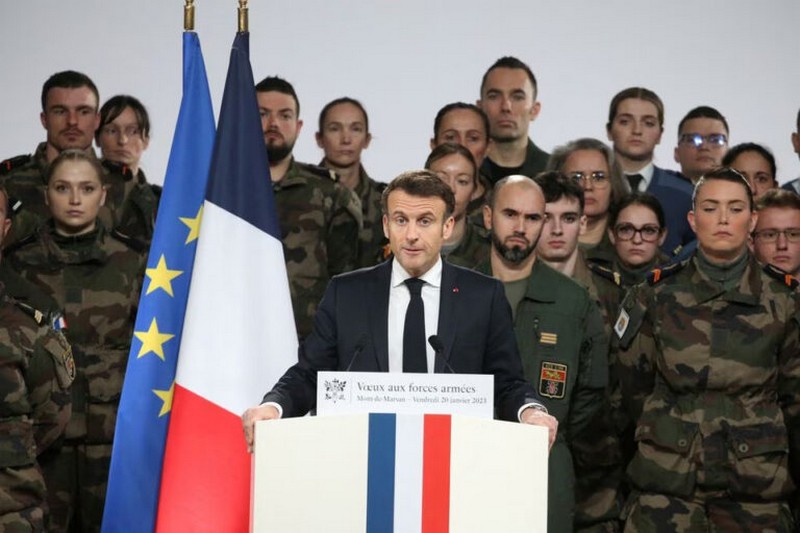
20 Jan 2023 – Emmanuel Macron wants to significantly increase defense spending. In addition to investments in defense against cyber attacks, he also addresses nuclear deterrence.

President Emmanuel Macron wants to drastically increase France’s military spending. From 2024 to 2030, the army’s budget should increase to 400 billion euros, Macron said at the air base in Mont-de-Marsan. Factoring in increases since 2019, it means a doubling of France’s military spending and the biggest defense effort in 50 years. The army must be able to react faster and gain strength quickly, he said.

With a view to the war in Ukraine, France will also increase its nuclear deterrence, Macron said. “There is no more peace dividend after the attack on Ukraine launched by Russia.”

In order to ensure the defense of Europe and its allies, more military material and increased responsiveness are needed. The President announced increased investments in reconnaissance, defense against cyber attacks and new aircraft carriers and drone systems.

The common European defense policy must be further strengthened, said Macron. In addition to the technical integration of the armed forces and a common strategy, it is about the European ability to jointly lead a large military operation. For France, this means being able to provide up to 20,000 soldiers.

Franco-German meeting on economy and defense

At the Franco-German ministerial meeting this Sunday in Paris, the topics of economy and energy, security and defense as well as European policy will be the focus. This was announced in Berlin from government circles. The meeting begins at 11 a.m. with a ceremony at the Sorbonne University, at which representatives of both parliaments come together and the governments are invited as guests. In addition to the respective presidents of the parliament, French President Emmanuel Macron and Chancellor Olaf Scholz (SPD) want to give speeches.

The so-called Franco-German Council of Ministers, which brings together the cabinets of both sides, meets in the afternoon. A joint declaration is planned. The question of further military support for Ukraine, which is being attacked by Russia, will be one of the topics in a round with Scholz, Macron and the foreign and defense ministers of both sides. Cooperation in the EU and NATO will also be discussed.

23 January 2023

Source: transcend.org

Peru’s Natural Resources: CIA-linked US Ambassador Meets with Mining and Energy Ministers to Talk ‘Investments’

By Ben Norton

Peru has large reserves of copper, gold, zinc, silver, lead, iron, and natural gas. After a coup overthrew left-wing President Pedro Castillo on 7 Dec 2022, the US ambassador, CIA veteran Lisa Kenna, met with mining and energy ministers to discuss “investments”. Europe is importing Peruvian LNG to replace Russian energy.

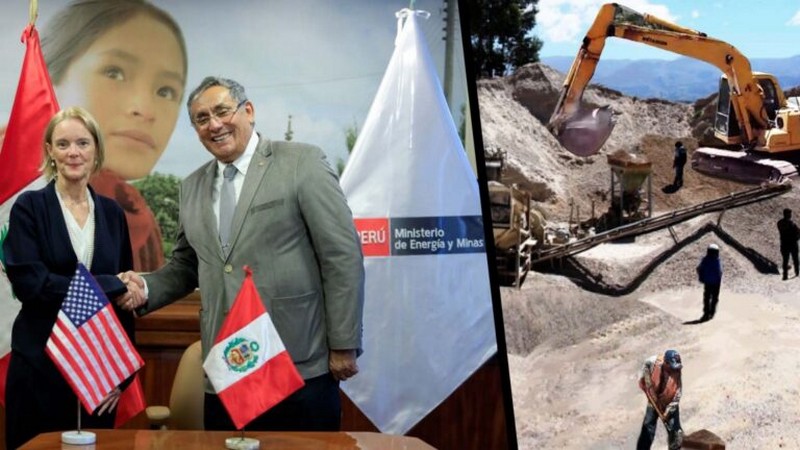
20 Jan 2023 – The US ambassador in Peru, Lisa Kenna, is a CIA veteran who supported a parliamentary coup in December 2022 that overthrew the South American nation’s democratically elected left-wing president, Pedro Castillo.

Castillo was subsequently imprisoned for 18 months without due process, setting off massive protests across Peru. The unelected government responded with extreme violence, killing approximately 50 protesters in just over a month.

One day before the December 7 coup, the former CIA officer turned US ambassador met with Peru’s defense minister, who then told the country’s powerful military to turn against President Castillo.

Peru resource battle: CIA-linked US ambassador talks ‘investments’ with mining/energy ministers

Since then, Kenna has been quite busy, regularly meeting with top officials in Peru’s coup government, including unelected President Dina Boluarte and her ministers.

On January 18, the US ambassador sat down with Peru’s minister of energy and mining, as well as its vice minister of hydrocarbons and vice minister of mining.

Peru’s Ministry of Energy and Mines boasted that they discussed “investment” opportunities and plans to “develop” and “expand” the extractive industries.

Peru is a country rich in natural resources, especially minerals. Spanish colonialists exploited the South American nation’s substantial silver and gold reserves, and today transnational corporations see it as a very profitable resource hub.

One of Earth’s top producers of copper, lead, zinc, tin, silver, and gold, Peru’s economy relies heavily on the mining sector, which represents more than half of total national exports and over 10% of GDP.

The world’s three largest transnational mining corporations – BHP, Rio Tinto, and Glencore – are heavily invested in Peru, along with other prominent companies from Canada, Brazil, Switzerland, Britain, the US, Japan, and Australia.

Peru is the planet’s second-biggest copper producer (after its neighbor Chile), meaning it will become increasingly important in the global shift toward renewable energy technologies.

US investment banking giant Goldman Sachs stated in 2022 that “copper is the new oil”, writing: “The critical role copper will play in achieving the Paris climate goals cannot be overstated… As the most cost-effective conductive material, copper sits at the heart of capturing, storing and transporting these new sources of energy”.

Peru is also a significant producer of liquified natural gas (LNG). Its LNG exports are largely overseen by foreign corporations like Shell.

Europe became the top importer of Peruvian LNG in 2022, after the European Union boycotted Russian energy over the proxy war in Ukraine.

While natural resources are not the only reason for these coups in Latin America, they are a significant factor.

Following the violent putsch in Peru’s mineral-rich neighbor Bolivia in 2019, a critic wrote to billionaire Elon Musk on Twitter, “You know what wasn’t in the best interest of people? The US government organizing a coup against Evo Morales in Bolivia so you could obtain the lithium there”.

Musk replied, “We will coup whoever we want! Deal with it”.

Peru’s President Castillo: ‘We want our natural resources to directly benefit the people’

When he ran for office in 2021, left-wing presidential candidate Pedro Castillo had made one of the central themes of his campaign the need to reassert popular control over Peru’s natural resources.

Condemning foreign companies for “pillaging” the country, he called to renegotiate contracts to ensure that 70% of all proceeds from mining went to the state, to fund social programs.

A few weeks before the presidential elections, Castillo said, “Let’s be clear: these decades of betrayal, corruption, and cynicism are the symptoms of this neoliberal system dedicated exclusively to the exploitation of our people and natural resources for the benefit of a few scoundrels”.

When he entered office, Castillo was very limited in what he could do politically. The right-wing opposition had a majority in the congress, and they were hellbent on destabilizing and eventually removing him with a presidential “vacancy”. They used Peru’s legislature and the heavily politicized and corrupt judiciary to launch constant attacks against Castillo, as part of a campaign of systematic persecution and lawfare.

But Castillo did what he could. The president announced a “second agrarian reform” and declared, “We are rescuing the resources of the country for all Peruvians”. He explained his goal: “We want our natural resources to directly benefit the people“.

Castillo’s government made plans with left-wing President Gustavo Petro in neighboring Colombia to develop gas infrastructure in Peru and expand internal use.

This was part of Castillo’s progressive economic model of import substitution industrialization, which aimed to grow local industry and boost domestic consumption, so Peru would not rely exclusively on low value-added exports.

Immediately after ousting Castillo, however, Peru’s coup regime returned to the neoliberal economic model of the Washington Consensus, prioritizing foreign corporate investment over internal development.

The Ministry of Energy and Mines tweeted on January 18 that it had just conducted a “high-level institutional dialogue between Peru and the United States, which addressed themes of development of the mining sector”.

US Ambassador Kenna met with Peru’s minister of energy and mining, Óscar Vera Gargurevich; vice minister of hydrocarbons, Enrique Bisetti Solari; and vice minister of mining, Jaime Chávez Riva.

The ministry said they discussed “themes linked to the expansion of natural gas, mining investments, and the development of renewable energies in our country”.

It added that “Minister Vera was grateful for the support from the North American government in mining-energy issues, and he reiterated the will of the national government, whose priority is the expansion of natural gas, energy security, and the petrochemical development of the south of the country”.

Mining dominates Peru’s economy

Benjamin Norton is an investigative journalist, analyst, writer and filmmaker.

23 January 2023

Source: transcend.org

Time for Action is Now: What Will Happen after the ICJ Delegitimizes Israel’s Occupation of Palestine

By Ramzy Baroud

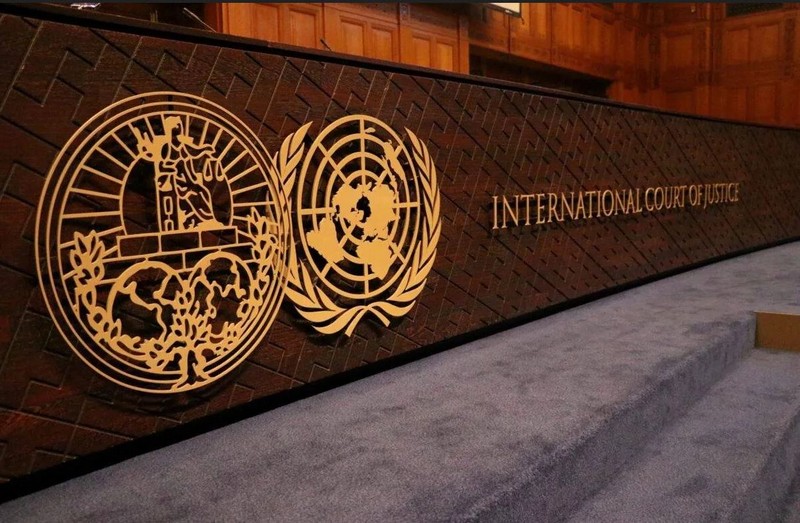
11 Jan 2023 – Once more, the International Court of Justice (ICJ) will offer a legal opinion on the consequences of the Israeli Occupation of Palestine.

A historic United Nations vote on December 31 called on the ICJ to look at the Israeli Occupation in terms of legal consequences, the rights of the Palestinian people to self-determination and the responsibility of all UN Member States in bringing the protracted Israeli Occupation to an end. A special emphasis will be placed on the “demographic composition, character and status” of Occupied Jerusalem.

The last time the ICJ was asked to offer a legal opinion on the matter was in 2004. However, back then, the opinion was largely centered around the “legal consequences arising from the construction of the (Israeli Apartheid) wall.”

While it is true that the ICJ concluded that the totality of the Israeli actions in the Occupied Palestinian Territories are unlawful under international law – the Fourth Geneva Convention, the relevant provision of the earlier Hague Regulations and, of course, the numerous UN General Assembly and Security Council Resolutions – this time around the ICJ is offering its view on Israel’s attempt at making what is meant to be a temporary military Occupation, a permanent one.

In other words, the ICJ could – and most likely will – delegitimize every single Israeli action taken in Occupied Palestine since 1967. This time around, the consequences will not be symbolic, as is often the case in UN-related decisions on Palestine.

Israeli Prime Minister Benjamin Netanyahu, who has done more than any other Israeli leader to ‘normalize’ the Israeli Occupation of Palestine, was understandably angry following the UN vote, describing it as ‘despicable’.

His other coalition partners were equally intransigent.

The Israeli “Occupation of (the) West Bank is permanent and Israel has the right to annex it,” said Knesset Member Zvika Fogel, during an interview on January 1 with Israeli Radio 103FM.

More than anything else, Fogel’s words encapsulate the new reality in Israel and Palestine. Gone are the days of political ambiguity regarding Israel’s ultimate motives in the Occupied Territories.

Indeed, Israel is now trying to manage a whole new phase of its colonial project in Palestine, an endeavor that began in earnest in 1947-48 and, in Israel’s own calculation, is about to end with the total colonization of Palestine – Israel’s version of a ‘one-state solution’ that is predicated on apartheid and racial discrimination.

Fogel, whose party, Otzma Yehudit, is an important member of Netanyahu’s new rightwing coalition, does not reflect his personal views or those of his ideological camp alone.

The new government, packed with extremists, the likes of Bezalel Smotrich, Itamar Ben-Gvir and Yoav Galant, among others, is now committed to an anti-peace agenda as a matter of policy. As soon as the new government was sworn in on December 28, it announced that “the government will advance and develop settlements in all parts of Israel”.

Ben-Gvir, whose raid of Al-Aqsa Mosque in Occupied East Jerusalem raised much criticism worldwide, is sending clear messages to Palestinians and the international community at large: as far as Israel is concerned, no international law is relevant, nothing is sacred and no inch of Palestine is off limits.

This time, however, it is not business as usual.

Yes, Israel’s territorial expansion at the expense of Occupied Palestine has been the common denominator among all Israeli governments in the last 75 years; but various Israeli governments, including that of Netanyahu’s early cabinets, found indirect ways to justify illegal settlement constructions. So-called ‘natural expansion’ and ‘security’ needs were some of the many pretexts furnished by Israel to justify its constant push for land acquisition by force.

Practically, none of this would have been possible if it were not for the inexhaustible United States support of Israel – financially, militarily and politically. Moreover, US vetoes at the UNSC and the relentless pressure on UNGA members allowed Israel to circumvent international law unscathed. The outcome is today’s tragic reality.

According to the official UN news website, there are currently nearly 700,000 illegal Jewish settlers. The Israeli NGO ‘Peace Now’ says that these Jewish settlers live in 145 illegal colonies in the Occupied West Bank, in addition to 140 settlement outposts, many of which are likely to be made official by the new government.

In fact, the Netanyahu-led alliance has been formulated with the understanding that the outposts would be legalized in the future, thus receiving official government funding. This should not pose a major political problem for Netanyahu, who, in 2020, had succeeded in selling the idea to the Israeli Knesset of annexing much of the West Bank and is now determined to carry out a process of ‘soft annexation’ – a de-facto annexation that is likely to become legalized as a de jure annexation later on.

Nor would the full colonization of Palestine prove to be a legal problem. Israel’s Nation-State Law of 2018 has already provided the legal cover for Tel Aviv to flaunt international law and to do as it pleases in terms of colonizing all of Palestine and marginalizing all of the Palestinian rights. According to Israel’s new Basic Law, “the State of Israel is the nation-state of the Jewish People in which it realizes its natural, cultural, religious and historical right to self-determination”. It was this particular reference that was cited in the new government’s statement on December 29.

And there are not many in Israel who are protesting this. In a recent article in the Palestine Chronicle, Israeli historian Ilan Pappe explains how the current socio-political formations of Israeli society make it nearly impossible for alternative mainstream politics to emerge, aside from the three dominant rightwing and extremist currents at work in the Netanyahu coalition: Ultra-Orthodox Jews, National Religious Jews and Likud’s secular Jews.

This means that change in Israel could never come from Israel itself. While Palestinians continue to resist, Arab and Muslim governments, and the international community at large must confront Israel, using all means available to end this travesty.

The ICJ’s opinion is very important, but without meaningful action, a legal opinion alone will not reverse the sinister reality on the ground in Palestine, especially when this reality is bankrolled, supported and sustained by Washington and Israel’s other western allies.

Dr. Ramzy Baroud is a journalist, author and editor of The Palestine Chronicle.

23 January 2023

Source: transcend.org

Lies, Damn Lies, and Climate Change

By Amy Goodman and Denis Moynihan

19 Jan 2023 – Swedish climate activist Greta Thunberg is getting carried away. Literally. She joined thousands in the village of Lützerath, Germany, to oppose the expansion of an open-pit lignite mine, one of the dirtiest forms of coal. Police in riot gear hauled her away as the mass arrests progressed. Greta wrote on Twitter, “Yesterday I was part of a group that peacefully protested the expansion of a coal mine…We were kettled by police and then detained but were let go later that evening. Climate protection is not a crime.”

As Greta was being detained, thousands of the global elite were arriving in Davos, Switzerland for the 53rd annual meeting of the World Economic Forum. The WEF is touted as a place for leaders to engage in peer-to-peer dialogue to address the world’s most pressing problems. Hundreds arrive by private jet, which, on a per-passenger basis, is the most heavily polluting mode of transport.

This gathering of high carbon emitters heard from United Nations Secretary-General António Guterres. “We are flirting with climate disaster. Every week brings a new climate horror story,” he said. “The consequences will be devastating. Several parts of our planet will be uninhabitable. For many, this is a death sentence, but it is not a surprise. The science has been clear for decades…We learned last week that certain fossil fuel producers were fully aware in the 1970s that their core product was baking our planet.”

Guterres was referencing a study published in Science further proving that fossil fuel companies long knew greenhouse gasses intensified human-induced climate change. This study followed a December report issued by the U.S. House Oversight and Reform Committee documenting decades of greenwashing and climate change disinformation by ExxonMobil, Chevron, Shell, BP, the American Petroleum Institute and the U.S. Chamber of Commerce.

“Exxon, Chevron and other big oil companies knew that when they were burning fossil fuels in the 1970s, it was causing climate change and that this was going to be a major problem for humanity,” Democratic Congressmember Ro Khanna, who helped lead the investigation, said on the Democracy Now! news hour. “They had the best scientists. And yet their CEOs, their executives went out for decades and lied to the American public, did not disclose their own science. As a result, we never started the transition, and we are in the world of pain that we are in today.”

The “world of pain” he referenced has descended on Khanna’s home state of California, battered over the past two weeks by climate-fueled rain and snow storms, landslides and mudslides, driven by what climate scientist David Swain described on Democracy Now! as “atmospheric rivers…corridors of highly concentrated atmospheric water vapor moving quickly through the atmosphere.” In addition to billions of dollars in damages, these unprecedented storms have claimed 22 lives to date.

Congressman Khanna blames the massively profitable fossil fuel companies. “They should be held accountable like Big Tobacco was held accountable.”

While Davos is buzzing with World Economic Forum activities “to drive tangible, system-positive change for the long term” and spur “proactive, vision-driven policies and business strategies,” the Alps, in which the resort town is nestled, are suffering a climate crisis of their own. An unseasonably warm winter has left much of the huge mountain range barren of snow, with the multi-billion dollar ski and winter snow sports industry in a crisis.

In 2019, Greta Thunberg, then 16 years old, told the World Economic Forum, “I don’t want you to be hopeful. I want you to panic. I want you to feel the fear I feel every day. And then I want you to act…as if the house is on fire. Because it is.”

Three years later, she is back in Davos, fresh from the coal protests in Lützerath, with other youth climate leaders including Vanessa Nakate from Uganda, Helena Gualinga from Ecuador, and Luisa Neubauer from Germany. They have issued a letter to the CEOs of fossil fuel corporations, that reads in part, “This Cease and Desist Notice is to demand that you immediately stop opening any new oil, gas, or coal extraction sites, and stop blocking the clean energy transition we all so urgently need…If you fail to act immediately, be advised that citizens around the world will consider taking any and all legal action to hold you accountable. And we will keep protesting in the streets in huge numbers.”

The World Economic Forum has been discussing world problems for just about as long as ExxonMobil has been lying about climate change. Scientists revealed this week that Greenland just had its hottest decade in 1,000 years and that its massive ice sheet is rapidly melting, causing more sea level rise. Catastrophic climate disruption is here, and disruptors like Greta Thunberg are clearly not the ones who should be arrested.

Amy Goodman is the host of “Democracy Now!” a daily international TV/radio news hour airing on more than 900 stations in North America.

Denis Moynihan is the co-founder of Democracy Now! Since 2002, he has participated in the organization’s worldwide distribution, infrastructure development, and the coordination of complex live broadcasts from many continents.

23 January 2023

Source: transcend.org

US Installs New Nukes in Europe: As Destructive as 83 Hiroshima Bombs

By Baher Kamal

20 Jan 2023 – As if the 100 billion dollars that the United States has so far provided to Ukraine in both weapons and aid were not enough, the US has now started to install in Europe its brand new, more destructive nuclear warheads.

The US 100 billion dollars are to be added to all the weapons and aid that 40 Washington’s ‘allies’ –Europe in particular– have been sending to Ukraine since it was invaded by Russia in February 2022.

The US spending on the Ukrainian war in less than a year amounts to the desperately needed funding that the United Nations require to partially alleviate some of the horrifying suffering of over one billion human beings over two long years.In a further escalation, the United States began in December 2022 to ship new nuclear warheads to Europe: “the B61-12 warhead is a more advanced warhead from the ones currently deployed in Belgium, Germany, Italy, the Netherlands and Turkey,” according to the International Campaign to Abolish Nuclear Weapons (ICAN).

Boeing designed the bomb’s new guided-tail kit, giving it additional manoeuvrability and the appearance of more precision.But, it’s a nuclear weapon, and has different yields, from 0.3kt to 50kt, ICAN reports.

Much more destructive

“These bombs can detonate beneath the Earth’s surface, increasing their destructiveness against underground targets to the equivalent of a surface-burst weapon with a yield of 1,250 kilotons––the equivalent of 83 Hiroshima bombs.”

Even if the bombs are American and the US retains launch authority, they would most likely be dropped by Europeans. If the US decides to use its nuclear weapons located in Germany, the warheads are loaded onto German planes and a German pilot drops them, ICAN furtherexplains.

This Geneva-based coalition of 652 non-governmental partner organisations in 107 countries, promoting adherence to and implementation of the UN Treaty on the Prohibition of Nuclear Weapons, received the 2017 Nobel Peace Prize.

The ‘brutal struggle for power’

The production, testing, and use of nukes is one of the reasons why the biggest powers are now pushing the world into the abyss of lawlessness. In fact, the UN chief has once more sounded the alarm bell.

“From illegally developing nuclear weapons to non-sanctioned use of force, States continue to flout international law with impunity”, said the UN Secretary-General, António Guterres.

The rule of law stands between peace and ‘brutal struggle for power,’ he warned in his 12 January message to the UN Security Council – where five countries: US, Russia, China, UK and France– hold a self attributed authority to override the well of over 190 states, members of the UN.

‘Grave risk’ of lawlessness

The UN chief painted a grim picture of civilians around the world suffering from devastating conflicts, rising poverty, and surging hunger, warning that “we are at grave risk of the Rule of Lawlessness”.

The rule of law “protects the vulnerable; prevents discrimination; bolsters trust in institutions; supports inclusive economies and societies; and is the first line of defence against atrocity crimes.”

Guterres cited Russia’s invasion of Ukraine; unlawful killings of both Palestinians and Israelis; gender-based apartheid in Afghanistan; the Democratic People’s Republic of Korea’s unlawful nuclear weapons programme; violence and severe human rights violations in Myanmar; and a deep institutional crisis in Haiti.

Meanwhile…

Meanwhile, the world is falling apart, witnessing an “ongoing collision of crises for which traditional response and recovery are not enough,” warns the UN Development Programme (UNDP).

“Our future is at stake, as wars, epidemics, the climate emergency and economic upheaval leave almost no country untouched.

From the war in Ukraine that sparked a global cost of living crisis to the climate emergency, the floods in Pakistan, the global pandemic, hunger in the Horn of Africa, to the crisis in Yemen — we face never before seen challenges to our future, adds UNDP.

Developing economies accounting for more than half of the world’s poorest people need urgent debt relief as a result of “cascading global crises. Without action, poverty will spiral and desperately needed investments in climate adaptation and mitigation will not happen.”

Also meanwhile, millions of children under armed conflicts

The UN Children Fund (UNICEF) reports that more than 400 million children live in areas under conflict; an estimated 1 billion children – nearly half the world’s children – live in countries at extreme vulnerability to the impacts of climate change…

… And at least 36.5 million children have been displaced from their homes; and 8 million children under age 5 across 15 crisis-hit countries are at risk of death from severe wasting.

Today, there are more children in need of humanitarian assistance than at any other time since the Second World War. Across the globe, “children are facing a historic confluence of crises – from conflict and displacement to infectious disease outbreaks and soaring rates of malnutrition.”

UNICEF has appealed for 10.3 billion US dollars to reach more than 110 million children with humanitarian assistance across 155 countries and territories.

Baher Kamal, a member of the TRANSCEND Network for Peace Development Environment, is an Egyptian-born, Spanish national, secular journalist, with over 45 years of professional experience — from reporter to special envoy to chief editor of national dailies and an international news agency.

23 January 2023

Source: transcend.org

Israel’s crimes-after-crimes ignore international law

Palestine Update 622
Comment

Israel’s crimes-after-crimes ignore international law

Israel’s pogrom to obliterate the Palestinians from the land is ongoing with a vigor and revenge that is picking political momentum. Whether that will work in its intent is another question.

Domination, suppression and control are the strategies that Israel is employing. In a new position paper, Adalah, an Israeli human rights organization, lays out how the guiding principles and coalition agreements of the new Israeli government intend to deepen Jewish supremacy and racial segregation as the underlying principles of the Israeli regime. Adalah proposes that Israel’s initiatives and policies necessitate urgent intervention by international bodies, including by the International Criminal Court (ICC) and the International Court of Justice (ICJ), and the reconstitution of the UN Special Committee against Apartheid.

At the level of civil society, we read reports of tens of thousands of Israelis taking to the streets of Tel Aviv and other cities to protest what they see as an erosion of their country’s democracy. But this huge protest and rally is not about ending apartheid and colonialism in Palestine.  Israelis are not demonstrating for justice. Democracy in Israel would mean an end to apartheid. That is not what the Israeli protesters want.

In yet other shocking conditions, we read how the Israeli army promised to avoid arresting kids at night. It never ever happened. Despite committing to new procedures to reduce the practice, the army is still using night arrests as a default against Palestinian children. It only gets worse.

Read on. A study shows that 57 percent of Israelis opposed blocking the Supreme Court’s authority in halting legislation from the Knesset, as proposed by Israel’s new government, if the essence of those laws is anti-democratic.

Some consolation, if this is deemed as such –  “The Harvard Kennedy School reversed its decision and said it would offer a fellowship to a leading human rights advocate it had previously rejected, after news of the decision touched off a public outcry over academic freedom, donor influence and the boundaries of criticism of Israel.” Only goes to show global advocacy works. Another success story: “More than 90 countries have expressed “deep concern” at Israel’s punitive measures against the Palestinian people, leadership and civil society following a U.N. request for an advisory opinion by the International Court of Justice on the legality of Israeli policies in the occupied West Bank and east Jerusalem. More positive news: From Brazil to Chile, Palestinians have good reason to be excited for left-wing victories. But the new governments’ many challenges may temper those hopes.

Read and disseminate widely

In solidarity,

On behalf of MLN Palestine Updates

Ranjan Solomon

_____________________________________

Domination, Suppression, & Control: The Old & New Policies of the Current Israeli Government (Podcast)

In this episode of Occupied Thoughts, FMEP’s Lara Friedman speaks to Francesca Albanese — international legal expert and the UN’s Special Rapporteur on the situation of human rights in the Palestinian Territory occupied since 1967 — on ongoing and escalating actions by Israel to forcibly eject more than 1200 Palestinians from their homes in the West Bank region known as Masafer Yatta, located in the South Hebron Hills.
Watch podcast

Adalah: New Israeli Government’s Policy Guidelines Indicate Officials’ Intent to Commit Crimes under Intl. Law

The Legal Center for Arab Minority Rights in Israel, published a position paper on the legal implications of the guiding principles and coalition agreements of the 37th Israeli government, which was sworn in on 29 December 2022. The position paper analyzes the policy and ideological commitments made by the new government, led by Prime Minister Benjamin Netanyahu, which deepen and expand the regime of systematic discrimination, segregation, and repression against Palestinians in all areas under Israeli control. In its conclusions, Adalah enumerates the violations of the absolute prohibitions enshrined in international law regarding the stated government policies, including the Convention against the Crime of Apartheid and the Rome Statute governing the International Criminal Court.
CLICK HERE to read Adalah’s position paper [English].

Israelis are not demonstrating for democracy

Democracy in Israel would mean an end to apartheid. That is not what the Israeli protesters want “Over the weekend, tens of thousands of Israelis took to the streets of Tel Aviv and other cities to protest what they see as an erosion of their country’s democracy. The demonstrations were sparked by legislation announced by Prime Minister Benjamin Netanyahu’s government that – if passed by the Knesset – would overhaul the Israeli judicial system. The move is seen by many as an attempt by the prime minister, who is being prosecuted on corruption charges, to rein in the judiciary and dodge prison time….But to single him out as a “crime minister” and his government as the one “destroying Israeli democracy” is quite a stretch. There has been no Israeli prime minister that hasn’t been a criminal with hands stained with the blood of Palestinians, and there has been no Israeli government that has actually upheld democracy. The Israeli “democratic state” is and always has been a myth, an illusion built to sustain the oppression of the Palestinian people and continue their dispossession.”
Source:

The Israeli army promised to avoid arresting kids at night. It never even tried

Despite committing to new procedures to reduce the practice, the army is still using night arrests as a default against Palestinian children, says rights group.  “In 2020, HaMoked submitted a petition to the Israeli High Court against the army’s longtime practice of arresting Palestinian minors in the West Bank from their homes at night. In response, before the court hearing, the army produced a new procedure in August 2021 according to which it would summon Palestinian minors for interrogation as an alternative to night raids. But data collected by HaMoked for 2021 made clear that this procedure was not implemented and new data for 2022 shows that this trend is only continuing. Over the course of last year, 294 Palestinian families contacted HaMoked asking them to locate a child who was arrested by the army. Among these cases, 138 were arrested from their homes in premeditated operations, of which 125 were taken during the night. According to HaMoked, not a single one of minors arrested at night ever received a summons for interrogation.”
Read more in 972mag.com

About Half of Israelis Believe Jews Should Have More Rights than Arabs,Study Shows

The annual index of some 20,000 people also found that 57 percent of Israelis opposed blocking the Supreme Court’s authority in halting legislation from the Knesset, as proposed by Israel’s new government, if the essence of those laws is anti-democratic.

“Around half of Jewish Israelis believe that they should have more rights than their Arab compatriots, a new survey released on Sunday from Israel Democracy Institute found. Forty-nine percent of respondents believed that Jews should be afforded special rights in Israel, an increase of 12 percent from the previous annual survey. Among those who identified as right-wing, the statement enjoyed 66 percent support, while only 11 percent of respondents identifying as left-wing supported the notion. However, 80 percent believed that fateful decisions regarding the country’s future should be made by a Jewish majority.”
Read more in Haaretz

Harvard Reverses Course on Human Rights Advocate Who Criticized Israel 

“The Harvard Kennedy School reversed course on Thursday and said it would offer a fellowship to a leading human rights advocate it had previously rejected, after news of the decision touched off a public outcry over academic freedom, donor influence and the boundaries of criticism of Israel.” See also this statement from Ken Roth: “I remain worried about academic freedom…I was able to shine an intense spotlight on Dean Elmendorf’s decision, but what about others? The problem of people penalized for criticizing Israel is not limited to me, and most scholars and students have no comparable capacity to mobilize public attention. How is the Kennedy School, and Harvard, going to ensure that this episode conveys a renewed commitment to academic freedom rather than just exceptional treatment for one well known individual?”
Read more from New York Times

Nations express ‘deep concern’ at Israeli punitive measures

“More than 90 countries have expressed “deep concern” at Israel’s punitive measures against the Palestinian people, leadership and civil society following a U.N. request for an advisory opinion by the International Court of Justice on the legality of Israeli policies in the occupied West Bank and east Jerusalem. In a statement released Monday by the Palestinians, the signatories called for a reversal of the Israeli measures, saying regardless of their position on the General Assembly’s resolution, “we reject punitive measures in response to a request for an advisory opinion by the International Court of Justice.” The 193-member General Assembly voted 87-26 with 53 abstentions on Dec. 30 in favor of the resolution which was promoted by the Palestinians and opposed vehemently by Israel…The statement released Monday was signed by representatives of Arab nations and the 57-member Organization of Islamic Cooperation and 37 other countries — 27 of them from Europe, including Germany, France and Italy, as well as Japan, South Korea, Brazil, Mexico and South Africa.”
Read Washington Post for more

What does Latin America’s leftist tide have in store for Palestine?

From Brazil to Chile, Palestinians have good reason to be excited for left-wing victories. But the new governments’ many challenges may temper those hopes.

“From Brazil to Chile, Palestinians have good reason to be excited for left-wing victories. But the new governments’ many challenges may temper those hopes.” Lula has consistently cited his support for the Palestinian cause and, in the run-up to the October election, met with members of Brazil’s Palestinian community to reaffirm his commitment. Lula’s party, the “Partido dos Trabalhadores,” or PT, is also firmly supportive of Palestine; during the government of Dilma Rousseff, Lula’s political protegee and successor, she famously refused to accept the nomination of Israeli ambassador Dani Dayan due to his links to the settler movement. In his previous stint in office, Lula exerted Brazilian diplomacy on Middle Eastern geopolitics, including by helping to broker the Iranian nuclear agreement. He is expected to pursue a similarly proactive policy in the region, looking to break the relative isolationism of the Bolsonaro years.
Read more in 972 mag.com

Palestine Updates from Movement for Liberation from Nakba is a clearing house for historical and current information about happenings in the colonised Palestinian territories.

22 January 2023

Source: nakbaliberation.com


Saudi Arabia Is Ready To Discuss Ditching Dollar In Trade

By Countercurrents Collective

According to a Bloomberg report, Saudi Arabia is ready to discuss trading in currencies other than the US dollar, according to Saudi Arabia’s finance minister Mohammed Al-Jadaan.

Al-Jadaan’s comments come a month after China’s President Xi Jinping said that Beijing is ready to make energy purchases in yuan instead of the US dollar in trade exchanges with members of the Gulf Cooperation Council (GCC). China’s leader highlighted the necessity of the shift while speaking at a Chinese-Arab summit hosted by Saudi Arabia earlier this week.

“There are no issues with discussing how we settle our trade arrangements, whether it is in U.S. dollar, in euro or in Saudi riyal,” Al-Jadaan said on Tuesday during an interview with Bloomberg in Davos, Switzerland.

The oil-rich kingdom is seeking to deepen its ties with vital trade partners, including China. The readiness for talks on the issue expressed by Riyadh may signal that the world’s biggest oil exporter is open to diversifying away from the U.S. dollar after decades of pricing crude exports in the U.S. currency. The riyal, the Saudi national currency, has been pegged to the greenback, too.

The trend towards the shift to national currencies that is recently being observed among the major participants in global trade chains is partially attributed to the policies of secondary sanctions that Washington is pursuing. Initially, the steps towards ditching the U.S. currency in trade, particularly in the energy sector, were intensified in the wake of the sweeping sanctions introduced by Western nations against Russia, one of the world’s major energy producers and exporters, over the military operation in Ukraine.

China Setting New World Energy Order

The global energy order is being reshaped as deepening energy ties between China and the Middle East signifies the rise of the petroyuan, which could challenge the petrodollar, the Financial Times reported on Wednesday, citing Credit Suisse analyst Zoltan Pozsar.

According to Pozsar, China has been boosting purchases of crude and liquefied natural gas (LNG) from Iran, Venezuela, Russia, and some African nations using its national currency. However, President Xi Jinping’s meeting with the member states of the Gulf Cooperation Council (GCC) in December marked “the birth of the petroyuan,” he said in a note to clients.

At the summit, the Chinese leader confirmed that Beijing is ready to make energy purchases in yuan instead of the U.S. dollar with GCC countries.

“China wants to rewrite the rules of the global energy market,” Pozsar said, adding that the move to de-dollarize the oil and gas trade is backed members of the BRICS alliance (Brazil, Russia, India, China, and South Africa).

According to the Credit Suisse analyst, the steps towards ditching the greenback in the energy trade have intensified in the wake of the sweeping sanctions imposed by Western nations on Russia, one of the world’s major energy producers and exporters, in response to the military operation in Ukraine. Pozsar added that dollar foreign exchange reserves were militarized in the sanctions war, making the use of the currency unsafe for major exporters and importers of oil, gas, and other commodities.

Cooperation between China and the GCC may potentially involve joint exploration and production in places such as the South China Sea, as well as investment in refineries, chemicals, and plastics.

Pozsar said that implementing all of these projects in the yuan would mark a massive shift in the global energy trade. He added that even if it does not replace the dollar as a reserve currency, trading in the petroyuan will nevertheless come with significant economic and financial implications for policymakers and investors.

Countercurrents is answerable only to our readers. Support honest journalism because we have no PLANET B.

19 January 2023

Source: countercurrents.org