Just International

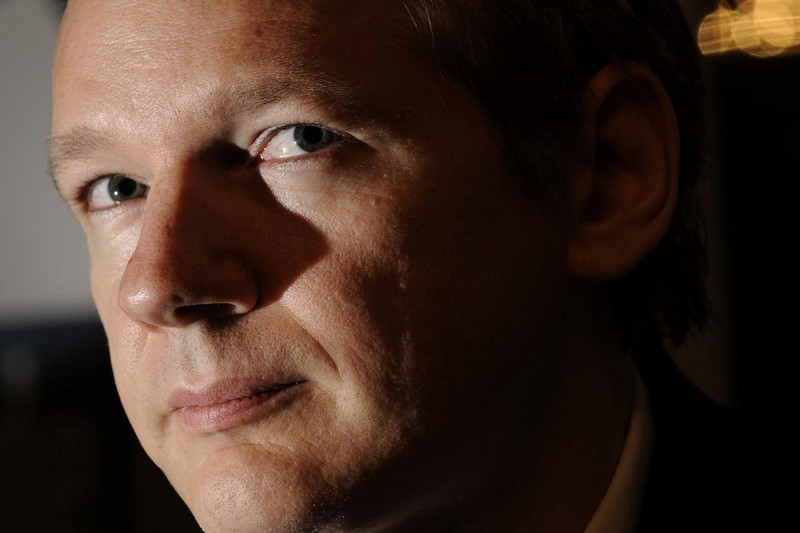
Time Mustn’t Be Allowed to Run out on Julian Assange

By Kim Petersen

Review of Guilty of Journalism by Kevin Gosztola

Despite whatever charges Julian Assange may be accused of, it is well known that the WikiLeaks publisher was targeted for exposing the war crimes of the US government. In an upside-down Bizarro World, the screws are being ever so gradually tightened on Assange by the war criminals and their criminal accomplices. It is, in fact, a slow-motion assassination being played out before the open and closed eyes of the world.

— “The Slow-motion Assassination of Julian Assange

The above was written in 2020. Little has changed. In the foreword to Guilty of Journalism by Kevin Gosztola, American journalist Abby Martin writes, “Assange was only publishing the leaks. He never committed any crime. He only published evidence of the crimes.” (p xiii)

Assange’s “crime” is exposing the crimes of the US; especially revelatory was the Collateral Murder video where US troops in an Apache helicopter gleefully gunned dead 12 civilians on a street in New Baghdad. The murderers remain scot-free. For exposing war crimes, Assange and Chelsea Manning have been punished.

Kevin Gosztola who has followed much of the judicial proceedings against Manning and Assange presents his knowledge of the cases, in particular that of Assange, in Guilty of Journalism: The Political Case against Julian Assange (Seven Stories Press, 2023).

What is readily apparent is that the releases by WikiLeaks triggered a tsunamic vendetta. This has resulted in a brazen miscarriage of justice manipulated by a red-faced United States with the connivance of allied nation states such as Australia; Sweden; Britain; after a change of presidents, Ecuador; and the bystander nations of the world.

The US seeks to try Assange under the Espionage Act, a relic from WWI designed to control the release of information (see chapter 4). Yet, such a prosecution of Assange is hampered by the US Constitution, as the First Amendment protects the freedom of the press. Prosecuting a publisher/journalist would entail grave implications for journalism and publishing in the US.

The book’s title, Guilty of Journalism, is apt. It speaks to the legal perturbations to eliminate a perceived threat to the US’s full-spectrum hegemony. For a hegemon to operate unhindered, it must control the medium and its messages. Thus, the US asserts that Assange is not a journalist, this despite Assange being recognized as a journalist by the US-based Committee to Protect Journalists, being a member of the International Federation of Journalists, being published in several media around the world, and having been awarded several prizes for his journalism. It is akin to blithely stating someone is not a lawyer despite having a law degree from a recognized law school, having passed the bar exam, having worked as a lawyer for several years, and having been celebrated for her accomplishments as a lawyer. It is patently a non sequitur to reject evidence purely on someone’s say-so.

The US government prefers to keep its sordid business in some dark corner under wraps. Assange and WikiLeaks, however, cast a light on the inner workings of governments. Many people hold a principle that states the people have a right to know what their governments are doing in their name.

The US persists in its claim that Assange is not a journalist. He is depicted variously as an anarchist or a hacker posing as a journalist. Ponder this: if a teacher hacks computer systems at home in the evening, is she no longer a teacher? Nonetheless, WikiLeaks publishes journalism and the monopoly media (Gosztola uses the term “prestige media” in his book) has even indulged in publication of the WikiLeaks‘s releases.

The US also holds that Assange is guilty of “aiding the enemy” and asserts that the information published by WikiLeaks would be used by enemies such as Al Qaeda.

Gosztola quotes Assange’s civilian defense attorney David Coombs: “No case has ever been prosecuted under this type of theory, that an individual by nature of giving information to a journalistic organization would then be subject to [aiding the enemy].” (p 51)

There seems to be a causal link missing in the chain of the US legal strategy: if the US personnel had not been committing undeniable war crimes, then there would have been no story to be published about it in the media. No war crimes, no story, then no need to fear alleged succor being provided to an enemy. A question then: who is primarily culpable in this chain of events?

Harvard professor Yochai Benkler found that there was no evidence “that any enemy had, in fact, used WikiLeaks.” (p 57) Nonetheless, Gosztola noted that judge Colleen Kollar-Kotelly had eased the burden of proof for prosecutors with her ruling that they need not show that information could potentially damage the US. (p 66)

Gosztola writes, “It does not matter who received the information. It does not matter if damage occurred as a result of the disclosure or publication of the information. It is all the same to DOJ prosecutors.” (p 79)

WikiLeaks was branded a “non-state hostile intelligence service” by then director of the Central Intelligence Agency Mike Pompeo. (p 87) One ought to consider the nature of the organization previously headed by Pompeo vis-à-vis WikiLeaks. Douglas Valentine wrote a book that lays out what the CIA is: The CIA as Organized Crime: How Illegal Operations Corrupt America and the World. Sounds an awful lot like the pot calling the kettle black; except WikiLeaks is no kettle. “WikiLeaks has a perfect in document authentication and resistance to all censorship attempts.”

Besides, some might consider any claims by a character such as Pompeo to be rich given that he once chuckled: “I was the CIA director. We lied, we cheated, we stole.”

A question: “Who to Believe: The CIA and Corporate Media or WikiLeaks?

The criminality of the US government is such that its intelligence services considered assassinating Assange; spied on him while in asylum; relied on the testimony of a sociopath — Sigudur Ingi Thordarson, known for engaging in sex with underage boys — to fraudulently smear Assange; subpoenaed witnesses to appear before the fishing expeditions of a grand jury (for which Chelsea Manning was again imprisoned and fined daily for refusing to testify). They even deprived Assange of his razor so that when he was hauled out of the Ecuadorian embassy he appeared with an unkempt beard. (p 107)

If only stolen razors were the extent of the criminality of the US authorities, but Gosztola brings to light additional crimes in chapter 9: “Retaliation for Exposing Torture, Rendition, and War Crimes.” Guilty of Journalism seamlessly segues into the next chapter detailing what happens to those brave souls who expose the rampant criminality of the state. The US prison system, to be generous, is sorely lacking in decency for the humanity, health, and sanity of those housed within its walls.

Gosztola examines the behavior of the moneyed media and its lies of omission and commission. Assange and WikiLeaks were heavily criticized for putting lives at risk, but: “Notably, WikiLeaks never called attention to any names in the war logs, but prestige media did so, as they helped the US government stir panic, which distracted from the contents of the historical records.” (p 206)

Media allegations lacked evidence, and later the entire fiasco would morph into the prestige media’s discredited Russiagate conspiracy. (ch 13)

Currently, Assange finds himself still incarcerated in the maximum security Belmarsh Prison in southeast London awaiting the outcome of an appeal against extradition to the US, where the deck will be stacked against him should he be sent there. In the US, Assange will be charged under the Espionage Act which, in actuality, is a contrived criminal indictment for exposing criminal acts.

Assange is one man, one man who has had the might of the American government and the supporting machinery of several nation states, who feel aggrieved and antagonized by the media exposures in WikiLeaks, arrayed against him. Assange is not alone. He is beloved by family and friends; he is backed by colleagues in WikiLeaks; he is vital to the readers of WikiLeaks missives; and he is supported by many independent media, attested to by Guilty of Journalism.

The irony and perversity of the vicious web in which Assange is entangled is laid bare in Guilty of Journalism. People who care about access to information, who want their governments to honor their constitutions and operate transparently, and who care about justice ought to read Guilty of Journalism, become further informed, and add their voices to justice for Julian Assange and to all the others who have sacrificed themselves to bring to light the corruption and crimes of governmental nexuses and the complicit prestige media.

Kim Petersen is an independent writer.

22 April 2023

Source: countercurrents.org
Leaks Reveal Reality Behind U.S. Propaganda in Ukraine

By Medea Benjamin and Nicolas J. S. Davies

The U.S. corporate media’s first response to the leaking of secret documents about the war in Ukraine was to throw some mud in the water, declare “nothing to see here,” and cover it as a depoliticized crime story about a 21-year-old Air National Guardsman who published secret documents to impress his friends. President Biden dismissed the leaks as revealing nothing of “great consequence.”

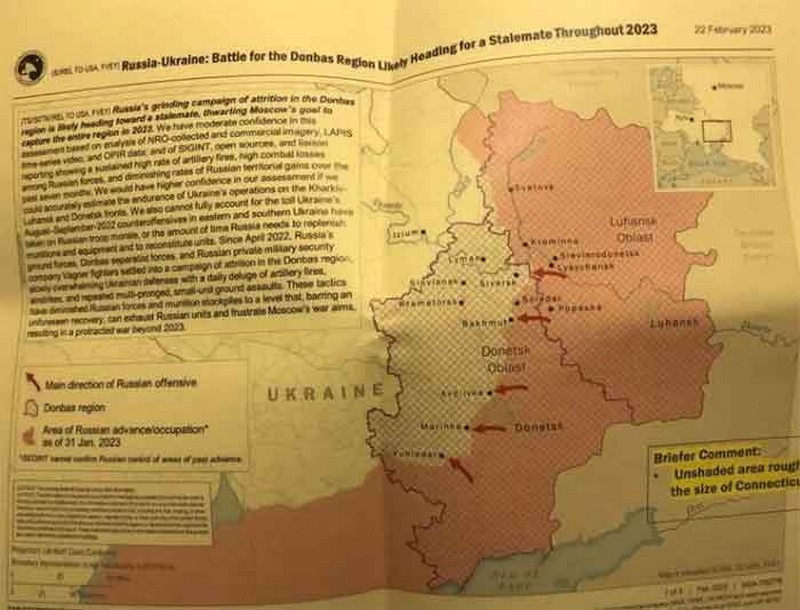
What these documents reveal, however, is that the war is going worse for Ukraine than our political leaders have admitted to us, while going badly for Russia too, so that neither side is likely to break the stalemate this year, and this will lead to “a protracted war beyond 2023,” as one of the documents says.

The publication of these assessments should lead to renewed calls for our government to level with the public about what it realistically hopes to achieve by prolonging the bloodshed, and why it continues to reject the resumption of the promising peace negotiations it blocked in April 2022.

We believe that blocking those talks was a dreadful mistake, in which the Biden administration capitulated to the warmongering, since-disgraced U.K. Prime Minister Boris Johnson, and that current U.S. policy is compounding that mistake at the cost of tens of thousands more Ukrainian lives and the destruction of even more of their country.

In most wars, while the warring parties strenuously suppress the reporting of civilian casualties for which they are responsible, professional militaries generally treat accurate reporting of their own military casualties as a basic responsibility. But in the virulent propaganda surrounding the war in Ukraine, all sides have treated military casualty figures as fair game, systematically exaggerating enemy casualties and understating their own.

Publicly available U.S. estimates have supported the idea that many more Russians are being killed than Ukrainians, deliberately skewing public perceptions to support the notion that Ukraine can somehow win the war, as long as we just keep sending more weapons.

The leaked documents provide internal U.S. military intelligence assessments of casualties on both sides. But different documents, and different copies of the documents circulating online, show conflicting numbers, so the propaganda war rages on despite the leak.

The most detailed assessment of attrition rates of troops says explicitly that U.S. military intelligence has “low confidence” in the attrition rates it cites. It attributes that partly to “potential bias” in Ukraine’s information sharing, and notes that casualty assessments “fluctuate according to the source.”

So, despite denials by the Pentagon, a document that shows a higher death toll on the Ukrainian side may be correct, since it has been widely reported that Russia has been firing several times the number of artillery shells as Ukraine, in a bloody war of attrition in which artillery appears to be the main instrument of death. Altogether, some of the documents estimate a total death toll on both sides approaching 100,000 and total casualties, killed and wounded, of up to 350,000.

Another document reveals that, after using up the stocks sent by NATO countries, Ukraine is running out of missiles for the S-300 and BUK systems that make up 89% of its air defenses. By May or June, Ukraine will therefore be vulnerable, for the first time, to the full strength of the Russian air force, which has until now been limited mainly to long-range missile strikes and drone attacks.

Recent Western arms shipments have been justified to the public by predictions that Ukraine will soon be able to launch new counter-offensives to take back territory from Russia. Twelve brigades, or up to 60,000 troops, were assembled to train on newly delivered Western tanks for this “spring offensive,” with three brigades in Ukraine and nine more in Poland, Romania and Slovenia.

But a leaked document from the end of February reveals that the nine brigades being equipped and trained abroad had less than half their equipment and, on average, were only 15% trained. Meanwhile, Ukraine faced a stark choice to either send reinforcements to Bakhmut or withdraw from the town entirely, and it chose to sacrifice some of its “spring offensive” forces to prevent the imminent fall of Bakhmut.

Ever since the U.S. and NATO started training Ukrainian forces to fight in Donbas in 2015, and while it has been training them in other countries since the Russian invasion, NATO has provided six-month training courses to bring Ukraine’s forces up to basic NATO standards. On this basis, it appears that many of the forces being assembled for the “spring offensive” would not be fully trained and equipped before July or August.

But another document says the offensive will begin around April 30th, meaning that many troops may be thrown into combat less than fully trained, by NATO standards, even as they have to contend with more severe shortages of ammunition and a whole new scale of Russian airstrikes. The incredibly bloody fighting that has already decimated Ukrainian forces will surely be even more brutal than before.

The leaked documents conclude that “enduring Ukrainian deficiencies in training and munitions supplies probably will strain progress and exacerbate casualties during the offensive,” and that the most likely outcome remains only modest territorial gains.

The documents also reveal serious deficiencies on the Russian side, deficiencies revealed by the failure of their winter offensive to take much ground. The fighting in Bakhmut has raged on for months, leaving thousands of fallen soldiers on both sides and a burned out city still not 100% controlled by Russia.

The inability of either side to decisively defeat the other in the ruins of Bakhmut and other front-line towns in Donbas is why one of the most important documents predicted that the war was locked in a “grinding campaign of attrition” and was “likely heading toward a stalemate.”

Adding to the concerns about where this conflict is headed is the revelation in the leaked documents about the presence of 97 special forces from NATO countries, including from the U.K. and the U.S. This is in addition to previous reports about the presence of CIA personnel, trainers and Pentagon contractors, and the unexplained deployment of 20,000 troops from the 82nd and 101st Airborne Brigades near the border between Poland and Ukraine.

Worried about the ever-increasing direct U.S. military involvement, Republican Congressman Matt Gaetz has introduced a Privileged Resolution of Inquiry to force President Biden to notify the House of the exact number of U.S. military personnel inside Ukraine and precise U.S. plans to assist Ukraine militarily.

We can’t help wondering what President Biden’s plan could be, or if he even has one. But it turns out that we’re not alone. In what amounts to a second leak that the corporate media have studiously ignored, U.S. intelligence sources have told veteran investigative reporter Seymour Hersh that they are asking the same questions, and they describe a “total breakdown” between the White House and the U.S. intelligence community.

Hersh’s sources describe a pattern that echoes the use of fabricated and unvetted intelligence to justify U.S. aggression against Iraq in 2003, in which Secretary of State Antony Blinken and National Security Advisor Sullivan are by-passing regular intelligence analysis and procedures and running the Ukraine War as their own private fiefdom. They reportedly smear all criticism of President Zelenskyy as “pro-Putin,” and leave U.S. intelligence agencies out in the cold trying to understand a policy that makes no sense to them.

What U.S. intelligence officials know, but the White House is doggedly ignoring, is that, as in Afghanistan and Iraq, top Ukrainian officials running this endemically corrupt country are making fortunes skimming money from the over $100 billion in aid and weapons that America has sent them.

According to Hersh’s report, the CIA assesses that Ukrainian officials, including President Zelenskyy, have embezzled $400 million from money the United States sent Ukraine to buy diesel fuel for its war effort, in a scheme that involves buying cheap, discounted fuel from Russia. Meanwhile, Hersh says, Ukrainian government ministries literally compete with each other to sell weapons paid for by U.S. taxpayers to private arms dealers in Poland, the Czech Republic and around the world.

Hersh writes that, in January 2023, after the CIA heard from Ukrainian generals that they were angry with Zelenskyy for taking a larger share of the rake-off from these schemes than his generals, CIA Director William Burns went to Kyiv to meet with him. Burns allegedly told Zelenskyy he was taking too much of the “skim money,” and handed him a list of 35 generals and senior officials the CIA knew were involved in this corrupt scheme.

Zelenskyy fired about ten of those officials, but failed to alter his own behavior. Hersh’s sources tell him that the White House’s lack of interest in doing anything about these goings-on is a major factor in the breakdown of trust between the White House and the intelligence community.

First-hand reporting from inside Ukraine by New Cold War has described the same systematic pyramid of corruption as Hersh. A member of parliament, formerly in Zelenskyy’s party, told New Cold War that Zelenskyy and other officials skimmed 170 million euros from money that was supposed to pay for Bulgarian artillery shells.

The corruption reportedly extends to bribes to avoid conscription. The Open Ukraine Telegram channel was told by a military recruitment office that it could get the son of one of its writers released from the front line in Bakhmut and sent out of the country for $32,000.

As has happened in Vietnam, Iraq, Afghanistan and all the wars the United States has been involved in for many decades, the longer the war goes on, the more the web of corruption, lies and distortions unravels.

The torpedoing of peace talks, the Nord Stream sabotage, the hiding of corruption, the politicization of casualty figures, and the suppressed history of broken promises and prescient warnings about the danger of NATO expansion are all examples of how our leaders have distorted the truth to shore up U.S. public support for perpetuating an unwinnable war that is killing a generation of young Ukrainians.

These leaks and investigative reports are not the first, nor will they be the last, to shine a light through the veil of propaganda that permits these wars to destroy young people’s lives in faraway places, so that oligarchs in Russia, Ukraine and the United States can amass wealth and power.

The only way this will stop is if more and more people get active in opposing those companies and individuals that profit from war–who Pope Francis calls the Merchants of Death–and boot out the politicians who do their bidding, before they make an even more fatal misstep and start a nuclear war.

Medea Benjamin and Nicolas J. S. Davies are the authors of War in Ukraine: Making Sense of a Senseless Conflict, published by OR Books in November 2022.

20 April 2023

Source: countercurrents.org
U.S. Dollar Losing Reserve Status At Stunning Pace, Says Eurizon CEO

By Countercurrents Collective

Western sanctions against Russia have accelerated the move away from the U.S. dollar worldwide, Stephen Jen, the CEO of London-based asset management company Eurizon, warned on Tuesday.

The dollar’s share in global reserves fell ten times faster last year than over the past two decades, Jen said, as cited by Bloomberg. The process began as some countries started to look for alternatives after seeing Russia’s assets frozen abroad and the country cut off from the global financial messaging system known as SWIFT, according to Jen.

Adjusting for “wild” exchange rate fluctuations last year, the U.S. dollar has lost roughly 11% of its market share since 2016 and double that amount since 2008, Jen and his Eurizon colleague Joana Freire wrote in a note.

“The dollar suffered a stunning collapse in 2022 its market share as a reserve currency, presumably due to its muscular use of sanctions,” the note reads. “Exceptional actions taken by the U.S. and its allies against Russia have startled large reserve-holding countries,” most of which are emerging economies, Jen and Freire explained.

The greenback now represents about 58% of total global reserves, down from 73% in 2001 when it was the “indisputable hegemonic reserve” the experts said.

China and India are working to use their own currencies to settle international trade, while Russia started to accept payments for its exports from a number of countries in rubles and Chinese yuan.

Earlier this week, Brazilian President Luiz Inacio Lula da Silva called on developing nations to move away from the U.S. dollar in favor of their own currencies.

Following Lula’s comments, U.S. Secretary of the Treasury Janet Yellen admitted that the role of the U.S. dollar as the world reserve currency could diminish due to Washington using its leverage over the global financial system to pursue its geopolitical goals through sanctions.

Biden Is Willing To Damage U.S. Economy To Counter China, Says Yellen

Media reports including a report by Barron’s (April 20, 2023,  https://www.barrons.com/articles/yellen-china-speech-xi-biden-4cde3450?siteid=yhoof2)  said:

U.S. President Joe Biden will stop at nothing to protect the U.S. against security threats posed by China, even if the actions he must take damage his own nation’s economy, U.S. Treasury Secretary Janet Yellen has claimed.

“National security is of paramount importance in our relationship with China,” Yellen said on Wednesday in a speech in Washington. She gave the example of blocking China from obtaining certain technologies, adding, “We will not compromise on those concerns, even when they force trade-offs with our economic interests.”

Yellen accused China of “unfair” economic practices and of “taking a more confrontational posture” toward the U.S. and its allies in recent years. Washington has a “broad set of tools” to deal with security threats from China, she added, such as export controls and sanctions against entities that provide support to the People’s Liberation Army (PLA).

“The Treasury Department has sanctions authorities to address threats related to cybersecurity and China’s military-civil fusion,” Yellen said. “We also carefully review foreign investments in the United States for national security risks and take necessary actions to address any such risks. And we are considering a program to restrict certain U.S. outbound investments in specific sensitive technologies with significant national security implications.”

The Biden administration has already taken steps to block Chinese companies from securing advanced semiconductor technologies, such as restricting exports of chip-making equipment. Yellen insisted that Washington doesn’t take such actions to gain an economic advantage or to stifle China’s growth and modernization.

Yellen also scolded China for alleged human rights abuses and alleged “no limits” support for Russia amid the Ukraine crisis. She warned that consequences would be severe if China provided material support or helped Russia evade sanctions, and she added that the U.S. would use its “tools” to deter human rights abuses.

Beijing has balked at U.S. accusations, suggesting that Washington should “make more efforts in solving its own human rights problems.” Chinese leaders also have faulted Washington for a “Cold War mentality” in which Beijing is demonized as a security threat as Biden’s administration tries to contain its economic progress.

“Containment and suppression will not make America great again, nor will it stop China from moving towards national rejuvenation,” Chinese Foreign Minister Qin Gang told reporters last month.

Yellen admitted earlier this week that Washington’s use of its leverage over the global financial system to sanction other countries could diminish the role of the US dollar as the world’s reserve currency. Asked about “weaponization” of the U.S. currency, she told CNN that such tactics “could undermine the hegemony of the dollar.”

Treasury Secretary Janet Yellen is set to confirm what investors have increasingly feared: The U.S. is viewing its relationship with China through a national security lens — and that may come with some economic costs.

Yellen’s speech takes a hawkish tone.

Yellen’s comments were delivered in a set-piece speech on U.S.-China economic relations at Johns Hopkins University’s School of Advanced International Studies.

Yellen did manage to strike a delicate balance between national security and economic concerns, hitting all the familiar talking points from defending U.S. national interests and supporting human rights, to an openness for greater economic cooperation. She reiterated the primacy of national security in economic affairs, and stated that proposals to limit specific U.S. foreign investment in China were being considered.

The high point of her speech to potentially reignite better relations came when she said the goal was “not to use these tools to gain competitive economic advantage.”

Yellen’s speech also lacked any concrete new initiatives. She had no new vision of a future in which countries with such wildly divergent worldviews could find a way toward compromise. And her emphasis on limiting only a narrow range of economic activity on national security grounds, chip technology for example, is unlikely to be viewed as less offensive than restricting a range of trade and investment.

Yellen said she plans to travel to China “at the appropriate time,” without offering details.

U.S. Debt Default A Matter Of Time, Says Musk

Tesla and Twitter chief executive Elon Musk, who has been calling for U.S. government spending reductions, said on Wednesday that a debt default was just a question of time.

“Given federal expenditure, it is a matter of when, not if, we default,” Musk wrote responding to a Twitter post by the White House that the Republican plan may be to default on U.S. debt.

Earlier this week, US House of Representatives Speaker Kevin McCarthy warned in a speech at the New York Stock Exchange that the U.S. debt is unsustainable and poses a threat to the nation. He said that Republicans would not allow the country to default on its debt, taking a jab at President Biden for refusing to negotiate on cost-cutting measures.

McCarthy added that the House of Representatives would soon vote on a bill to raise the debt ceiling through 2023.

U.S. President Joe Biden urged the Republicans to first release their proposed budget, with the White House stressing it would not negotiate the debt ceiling until the GOP releases its counterproposal to the administration’s budget plan, which was put out in March.

In January, the U.S. Treasury Department notified Congress of the start of “extraordinary measures” until June 5 in order to continue paying the government’s obligations as the US has reached its $31.4 trillion debt limit. Treasury Secretary Janet Yellen then called on lawmakers to “act promptly” to increase borrowing limits in order to avoid a default.

EU Done With Russia Sanctions, Say Officials

The European Union has exhausted its options for further economic restrictions against Russia, the Financial Times (FT) reported on Thursday, citing EU officials.

The bloc has so far adopted ten rounds of sanctions in response to the Ukraine conflict and is currently working on an eleventh package of punitive measures against Moscow. Meetings between the European Commission and member state officials to informally discuss new actions will start on Friday, FT wrote.

Officials working on further sanctions told the outlet that they are likely to be limited to expanding the list of individuals subject to asset freezes and travel bans, as well as steps to scale up existing measures by closing loopholes.

Most officials reportedly admitted that those parts of the Russian economy that were left unsanctioned are parts that one or more EU member states “cannot live without,” and thus measures targeting them would be vetoed.

“We are done,” one of the officials told FT, adding: “If we do more sanctions, there will be more exemptions than measures.”

New restrictions could reportedly target Russia’s nuclear fuel and services exports, but those would be opposed by some member-states, such as France, Hungary, and others.

Sweeping EU sanctions have targeted various sectors of the Russian economy as well as individuals and entities.

According to FT, almost 1,500 people and more than 200 entities are currently subject to asset freezes and travel bans. The report indicated that the bloc’s restrictive measures have banned bilateral trade flows worth more than €135 billion ($148 billion), including energy imports from Russia, as well as exports of technology, machinery, and electronic goods. Some €21.5 billion worth of assets belonging to sanctioned individuals and entities has been frozen, alongside €300 billion of Russian central bank reserves.

Many economists and politicians, however, have argued that the embargos harm the West more than Moscow.

Hungarian President Viktor Orban has repeatedly called for “the failed policy of Brussels” to be changed, noting that the sanctions “did not fulfill the hopes were pinned on them,” while Europe is “slowly bleeding.”

Meanwhile, Russian President Vladimir Putin has likened the bloc’s attempts to cut itself off from Russian fossil fuels to economic “suicide.”

Countercurrents is answerable only to our readers. Support honest journalism because we have no PLANET B.

21 April 2023

Source: countercurrents.org
Hunger Profiteers, Granny Killers and Skin-Deep Morality

By Colin Todhunter

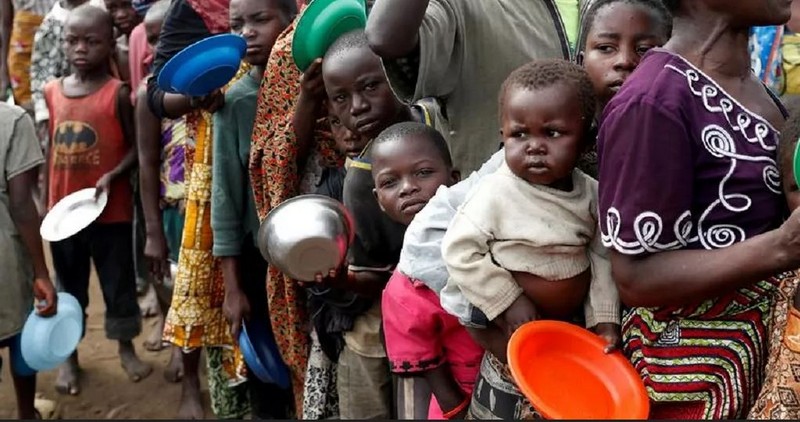
Today, a fifth (278 million) of the African population are undernourished, and 55 million of that continent’s children under the age of five are stunted due to severe malnutrition.  

In 2021, an Oxfam review of IMF COVID-19 loans showed that 33 African countries were encouraged to pursue austerity policies. Oxfam and Development Finance International also revealed that 43 out of 55 African Union member states face public expenditure cuts totalling $183 billion over the next few years.

As a result, almost three-quarters of Africa’s governments have reduced their agricultural budgets since 2019, and more than 20 million people have been pushed into severe hunger. In addition, the world’s poorest countries were due to pay $43 billion in debt repayments in 2022, which could otherwise cover the costs of their food imports.

Last year, Oxfam International Executive Director Gabriela Bucher stated that there was a terrifying prospect that in excess of a quarter of a billion more people would fall into extreme levels of poverty in 2022 alone. That year, food inflation rose by double digits in most African countries.

By September 2022, some 345 million people across the world were experiencing acute hunger, a number that has more than doubled since 2019. Moreover, one person is dying of hunger every four seconds. From 2019 to 2022, the number of undernourished people grew by 150 million.

Billions of dollars’ worth of arms continue to pour into Ukraine from the NATO countries as US neocons pursue their goal of regime change in Russia and balkanisation of that country.

Yet people in those NATO countries are experiencing increasing levels of hardship. The US has sent almost 80 billion dollars to Ukraine, while 30 million low-income people across the US are on the edge of a ‘hunger cliff’ as a portion of their federal food assistance is taken away. In 2021, it was estimated that one in eight children were going hungry in the US. In England, 100,000 children have been frozen out of free school meals.

Due to the disruptive supply chain effects of the conflict in Ukraine, speculative trading that drives up food prices, the impact of closing down the global economy under the guise of COVID and the inflationary impacts of pumping trillions of dollars into the financial system between September 2019 and March 2020, people are being driven into poverty and denied access to sufficient food.

Matters are not helped by issues that have long plagued the global food system: cutbacks in public subsidies to agriculture, WTO rules that facilitate cheap, subsidised imports which undermine or wipe out indigenous agriculture in poorer countries and loan conditionalities, resulting in countries ‘structurally adjusting’ their agri sectors thereby eradicating food security and self-sufficiency – consider that Africa has been transformed from a net food exporter in the 1960s to a net food importer today.

Great game food geopolitics continue and result in elite interests playing with the lives of hundreds of millions who are regarded as collateral damage. Policies, underpinned by neoliberal dogma masquerading as economic science and necessity, which are designed to create dependency and benefit a handful of multi-billionaires and global agribusiness corporations who, ably assisted by the World Bank, IMF and WTO, now preside over an increasingly centralised food regime.

Many of these corporations have engaged in rampant profiteering at a time when people across the world are experiencing rising food inflation. For instance, 20 corporations in the grain, fertiliser, meat and dairy sectors delivered $53.5 billion to shareholders in the fiscal years 2020 and 2021. At the same time, the UN estimates that $51.5 billion would be enough to provide food, shelter and lifesaving support for the world’s 230 million most vulnerable people.

As a paper in the journal Frontiers noted in 2021, these corporations form part of a powerful alliance of multinational corporations, philanthropies and export-oriented countries who are subverting multilateral institutions of food governance. Many who are involved in this alliance are co-opting the narrative of ‘food systems transformation’ as they anticipate new investment opportunities and seek total control of the global food system.

This type of ‘transformation’ is more of the same wrapped in a climate emergency narrative in an attempt to move food and farming further towards an ecomodernist techno-dystopia controlled by big agribusiness and big tech, as described in the article The Netherlands: Template for Ecomodernism’s Brave New World.

A ‘brave new world’ where a concoction of genetically engineered items, synthetic food and ultra-processed products will do more harm than good – but will certainly boost the bottom line of the pharmaceutical corporations.

While securing further dominance over the global food system and undermining food security in the process, global agribusiness frames this as ‘feeding the world’.

The model these corporations promote not only creates food insecurity but also produces death and illness.

Former Professor of Medicine Dr Paul Marik recently stated:

“If you believe the narrative, Type 2 diabetes is a progressive metabolic disease that’ll result in cardiac complications. You’re going to lose your legs. You’re going to have kidney disease, and the only treatment is expensive pharma drugs. That is completely false. It’s a lie.”

It is projected that by the end of this decade half of the world’s population are going to be obese and over 20% to 25% will have Type 2 diabetes.

According to Marik, the bottom line is Type 2 diabetes is a metabolic disease due to bad lifestyle and really bad eating habits:

“We eat all the time. We snack all the time. This is part of the food industry’s goal. Processed food, starch, becomes an addiction. Most of us are glucose addicted and it’s, in fact, more addictive than cocaine. It creates this vicious cycle of insulin resistance.”

He adds that if you’re insulin resistant, this prevents leptin and the other hormones acting on your brain, so you’re continually hungry:

“If you are continually hungry, you eat more, which causes more insulin resistance. It causes this vicious cycle of overeating carbohydrates…”

This is the nature of the modern food system. Cheap processed ingredients, low-nutrient value, highly addictive and maximum profits. A system that is being imposed or has already been imposed on countries whose populations once had healthy, unadulterated diets (see Obesity, malnutrition and the globalisation of bad food – theecologist.org).

Over the past 60 years in Western nations, there have been fundamental changes in the quality of food. In 2007, nutritional therapist David Thomas in ‘A Review of the 6th Edition of McCance and Widdowson’s the Mineral Depletion of Foods Available to Us as a Nation’ noted a precipitous change towards convenience and pre-prepared foods containing saturated fats, highly processed meats and refined carbohydrates, often devoid of vital micronutrients yet packed with a cocktail of chemical additives including colourings, flavourings and preservatives.

Aside from the negative impacts of Green Revolution cropping systems and practices, Thomas proposed that these changes are significant contributors to rising levels of diet-induced ill health. He added that ongoing research clearly demonstrates a significant relationship between deficiencies in micronutrients and physical and mental ill health.

Increasing prevalence of diabetes, childhood leukaemia, childhood obesity, cardiovascular disorders, infertility, osteoporosis and rheumatoid arthritis, mental illnesses and so on have all been shown to have some direct relationship to diet, specifically micronutrient deficiency, and pesticide use.

It is clear that we have a deeply unjust and unsustainable food system that causes environmental devastation, illness and malnutrition, among other things. People often ask: So, what’s the solution? The solutions have been made clear time and again and involve a genuine food transition towards agroecology.

Unlike the co-opted version of ‘food transition’ being promoted, agroecology offers concrete, practical solutions to many of the world’s problems that move beyond (but which are linked to) agriculture. Agroecology challenges the prevailing moribund doctrinaire economics of a neoliberalism that drives a failing system. Well-known academics like Raj Patel and Eric Holtz-Gimenez have written extensively on the potential of agroecology. And its benefits are clear.

In finishing, let us consider the skin-deep morality pedalled throughout the COVID period. During COVID, the official narrative was underpinned by emotive slogans like ‘protect lives’ and ‘keep safe’. Those who refused the COVID jab were labelled ‘granny killers’ and ‘irresponsible’. All presided over by government politicians who too often failed to obey their own COVID rules.

Meanwhile, while having terrorised the public with a health crisis narrative, they continue to collude with powerful agrifood corporations that destroy health courtesy of their practices. They continue to facilitate a system that serves the needs of global agricapital and ruthless investors like BlackRock’s Larry Fink who secure massive profits from a monopolistic food system (Fink also invests in the pharma sector – one of the biggest beneficiaries of a sickening global food regime) that by its very nature creates illness, malnutrition and hunger.

The COVID narrative was imbued with the notion of moral responsibility. The people who sold it to the masses have no morality. Like the UK’s former health minister and COVID rule breaker Matt Hancock (see Matt Hancock’s Car Crash Interview), they are willing to sell their soul (or influence) to the highest bidder – in Hancock’s case, a £10,000 wage demandfor a day’s ‘consultancy’ as a sitting politician or a few hundred thousand to bolster his ego, bank balance and image on a celebrity TV programme.

In a corrupted and corrupting society, the rewards could be even higher for the likes of Hancock when he leaves office (a health minister who helped traumatise the population while doing nothing to hold the health-damaging agribusiness corporations to account). But with a long line of well-rewarded fraudsters to choose from, we already know that.

*

Renowned author Colin Todhunter specialises in development, food and agriculture.

20 April 2023

Source: www.globalresearch.ca

A new paradigm of justice is urgent

Palestine Update 641
Comment

A new paradigm of justice is urgent
In 2014, 60% of Palestinians said the final goal of their national movement should be “to work toward reclaiming all of historic Palestine from the river to the sea”. A poll published in 2021 by the Palestinian Center for Policy and Survey Research revealed that only 39% of Palestinians support the two-state solution. Another report published in 2021 by the RAND Corporation found that Israelis across the political spectrum opposed a two-state solution.

There have been many diplomatic efforts to realize a two-state solution, starting from the 1991 Madrid Conference. There followed the 1993 Oslo Accords and the failed 2000 Camp David Summit followed by the Taba negotiations in early 2001. In 2002, the Arab League proposed the Arab Peace Initiative. The latest initiative, which also failed, was the 2013–14 peace talks. A 2021 survey of experts found that 52 percent believe that the two-state solution is no longer achievable. 77 percent believe that if not achieved, the result would be a “one-state reality akin to apartheid“. According to a 2021 PCPSR poll, support for a two-state solution among Palestinians and Israeli Jews, as of 2021, has declined to 43 percent and 42 percent, respectively. According to Middle East experts David Pollock and Catherine Cleveland, as of 2021, the majority of Palestinians say they want to reclaim all of historic Palestine, including pre-1967 Israel. A one-state solution with equal rights for Arabs and Jews is ranked second.

In this context, China’s emergence as a political influence in Middle East politics must be taken more seriously especially after the West has both failed and betrayed the Palestinians with their one-sided political manipulations. China has declared its intent to  play an “active role” in encouraging peace between Israelis and Palestinians. This was stated by the Chinese Foreign Minister, Qin gang, at the end of a telephone conversation with the counterpart of the Palestinian National Authority (PNA), Riyadh al-Maliki, held a few hours after a telephone conversation with the head of Israeli diplomacy, Eli Cohen, during which he urged Israelis and Palestinians to re-launch peace negotiations. These are declarations with which Beijing demonstrates, for the second time in a few months, its willingness to act as a peace broker in a region, the Middle East, characterized by long-standing tensions and alliances.

China has demonstrated its intent to change the political contours of the Middle East when it brokered a deal between Saudi Arabia and Iran, who, after years of hostilities have decided to put an end to their diplomatic rift. “This historic deal has the potential to transform the Middle East by realigning its major powers, replacing the current Arab-Iranian divide with a complex web of relationships, and interweaving the region with China’s global ambitions. For Beijing, the announcement was a big leap forward in its rivalry with Washington”, highlighted the US magazine “Foreign Affairs”.

The many-sided reports in this issue of Palestine Updates illustrates why even fermenting peace should be viewed as urgent. The West cannot and will not pursue a just solution. Guilt from the holocaust times, and racial prejudices are two factors which will never allow them to be facilitators of justice for the Palestinians. They have not just lost the trust of the Palestinians but also the political capacity to be honest mediators.

On behalf of MLN Palestine Updates

Ranjan Solomon

———————————————————————————-

Israel’s One-State Reality: It’s Time to give up on the Two-State Solution

“The temporary status of “occupation” of the Palestinian territories is now a permanent condition in which one state ruled by one group of people rules over another group of people. The promise of a two-state solution made sense as an alternative future in the years around the 1993 Oslo accords, when there were constituencies for compromise on both the Israeli and the Palestinian sides and when tangible if fleeting progress was made toward building the institutions of a hypothetical Palestinian state. But that period ended long ago. Today, it makes little sense to let fantastical visions for the future obscure deeply embedded existing arrangements.

It is past time to grapple with what a one-state reality means for policy, politics, and analysis. Palestine is not a state in waiting, and Israel is not a democratic state incidentally occupying Palestinian territory. All the territory west of the Jordan River has long constituted a single state under Israeli rule, where the land and the people are subject to radically different legal regimes, and Palestinians are permanently treated as a lower caste. Policymakers and analysts who ignore this one-state reality will be condemned to failure and irrelevance, doing little beyond providing a smokescreen for the entrenchment of the status quo.”
Read more from Foreign Affairs

Could Israel Carry Out Another Nakba?
Peter Beinart
“In mainstream American political discourse, such a prospect seems unthinkable. US government officials don’t acknowledge Palestinian fears of another Nakba. They more often treat Palestinians as a people that would be on route to independence if only they avoided “unhelpful” actions—like demanding international pressure on Israel— that leave them “further away from a two-state solution.” But when Palestinians claim that Israel’s long term goal is not Palestinian statehood but Palestinian expulsion, they aren’t hallucinating. Expulsion is deeply rooted in Zionist history, and the sentiment pervades Israel today, including among politicians and commentators generally viewed as centrists. Israel’s current defense minister, national security advisor, and agriculture minister—members of Benjamin Netanyahu’s center-right Likud party—have all alluded to removing Palestinians from the country. While the pace of Palestinian expulsion has waxed and waned in the 75 years since Israel’s war of independence, there is reason to worry that the radicalism of Israel’s current government, combined with rising violence in the West Bank, could turn the current trickle into a flood. Another Nakba is possible. By pretending it isn’t, American officials conveniently avoid an uncomfortable but vital question: What would they do to try and stop it?”
Read full article in Jewish currents

Over 100 rights groups lobby UN to not adopt IHRA antisemitism definition
Organizations claim formula could be abused to impact freedom of speech, prevent criticism of Israel, and block advocacy for Palestinian rights 
“Over 100 human and civil rights organizations have signed a letter urging the United Nations not to adopt the International Holocaust Remembrance Alliance working definition of antisemitism, warning it could impact freedom of speech and curtail criticism of Israel, Human Rights Watch said Thursday…The letter was first sent to UN Secretary-General António Guterres on April 3 with 60 signatures and since then dozens more have added their names to it, HRW said in a statement, putting the current total at 104.”

“Over 100 human and civil rights organizations have signed a letter urging the United Nations not to adopt the International Holocaust Remembrance Alliance working definition of antisemitism, warning it could impact freedom of speech and curtail criticism of Israel, Human Rights Watch said Thursday…The letter was first sent to UN Secretary-General António Guterres on April 3 with 60 signatures and since then dozens more have added their names to it, HRW said in a statement, putting the current total at 104.”
Source:

The Israeli right’s most dangerous anti-Palestinian smear
The Jewish far right has been calling Palestinians ‘Nazis’ for almost 80 years, casting them as an irredeemable enemy in an eternal war.
“Yom HaShoah, or Holocaust Remembrance Day, is a solemn occasion in Israel and across the Jewish diaspora. Memorial ceremonies are held, often attended by survivors; testimonies about the horrors of the Nazi regime are disseminated across social media and in the press; and, in Israel, two-minute air-raid siren blares, bringing much of the country to a halt. The occasion is also, however, an opportunity for hasbarists to share one of their favorite, and most repugnant, smears: that the Palestinian people are, in fact, Nazis…But the broadest, most dangerous function of the smear is in the latitude it is intended to grant Israel in its abuses, thus contributing to the larger project of obscuring the root causes of violence in Israel-Palestine. Describing one’s victims using the internationally-recognized shorthand for pure evil makes the ugly business of colonization and occupation not just permissible, but a moral imperative. Under this rubric, forced displacement, mass incarceration, extrajudicial killings, and home demolitions are not war crimes or human rights abuses, but rather necessary tools in a desperate, existential struggle against an irredeemable enemy.”
Read more from 972 Mag

Israeli Police Violently Beat Several Holy Fire Worshippers Trying to Defy Capacity Limits
Angry pilgrims and clergy jostled to get through while Israeli police struggled to hold them back, allowing only a trickle of ticketed visitors and local residents inside

“Tens of thousands of Christians took part in the Holy Fire ceremony on Saturday, an annual Orthodox Christian ceremony held in Jerusalem’s Church of the Holy Sepulchre, amid tension between police and Christian worshipers over Israel’s decision to place limits on the number of participants for the third year in a row. Thousands of clergy, police, diplomats and pilgrims huddled inside the church, while thousands more huddles in the surrounding alleys, where police clashed and in some cases violently beat worshipers trying to make their way through their barricades.”
Read more from Haaretz

China offers itself as a peace broker in the Middle East, a new slap in the face for the US
Only on March 10 Beijing achieved an important diplomatic result by negotiating the agreement between Saudi Arabia and Iran

La in China it is willing to play an “active role” in encouraging peace between Israelis and Palestinians. This was stated by the Chinese Foreign Minister, Qin gang, at the end of a telephone conversation with the counterpart of the Palestinian National Authority (PNA), Riyadh al-Maliki, held a few hours after a telephone conversation with the head of Israeli diplomacy, Eli Cohen, during which he urged Israelis and Palestinians to relaunch peace negotiations. These are declarations with which Beijing demonstrates, for the second time in a few months, its willingness to act as a peace broker in a region, the Middle East, characterized by long-standing tensions and alliances. Only on March 10, China achieved an important diplomatic result, brokering the deal between Saudi Arabia and Iran, who, after years of hostilities that have fueled conflicts throughout the region, have decided to put an end to their diplomatic rift. “This historic deal has the potential to transform the Middle East by realigning its major powers, replacing the current Arab-Iranian divide with a complex web of relationships, and interweaving the region with China’s global ambitions. For Beijing, the announcement was a big leap forward in its rivalry with Washington”, highlighted the US magazine “Foreign Affairs”.

Source:

22 April 2023

Source: nakbaliberation.com

China’s Pivot to World Markets, Washington’s Pivot to World Wars…

By Prof. James Petras

China and the United States are moving in polar opposite directions: Beijing is rapidly becoming the center of overseas investments in high tech industries, including robotics, nuclear energy and advanced machinery with collaboration from centers of technological excellence, like Germany.

In contrast, Washington is pursuing a predatory military pivot to the least productive regions with collaboration from its most barbaric allies, like Saudi Arabia.

China is advancing to global economic superiority by borrowing and innovating the most advance methods of production, while the US degrades and debases its past immense productive achievements to promote wars of destruction.

China’s growing prominence is the result of a cumulative process that advanced in a systematic way, combining step-by-step growth of productivity and innovation with sudden jumps up the ladder of cutting edge technology.

China’s Stages of Growth and Success

China has moved from a country, highly dependent on foreign investment in consumer industries for exports, to an economy, based on joint public-private investments in higher value exports.

China’s early growth was based on cheap labor, low taxes and few regulations on multi-national capital.  Foreign capital and local billionaires stimulated growth, based on high rates of profit.  As the economy grew, China’s economy shifted toward increasing its indigenous technological expertise and demanding greater ‘local content’ for manufactured goods.

By the beginning of the new millennium China was developing high-end industries, based on local patents and engineering skills, channeling a high percentage of investments into civilian infrastructure, transportation and education.

Massive apprenticeship programs created a skilled labor force that raised productive capacity.  Massive enrollment in science, math, computer science and engineering universities provided a large influx of high-end innovators, many of whom had gained expertise in the advanced technology of overseas competitors.

China’s strategy has been based on the practice of borrowing, learning, upgrading and competing with the most advanced economics of Europe and the US.

By the end of the last decade of the 20th century, China was in a position to move overseas. The accumulation process provided China with the financial resources to capture dynamic overseas enterprises.

China was no longer confined to investing in overseas minerals and agriculture in Third World countries.  China is looking to conquer high-end technological sectors in advanced economics.

By the second decade of the 21st century Chinese investors moved into Germany, Europe’s most advanced industrial giant.  During the first 6 months of 2016 Chinese investors acquired 37 German companies, compared with 39 in all of 2015.  China’s total investments in Germany for 2016 may double to over $22 billion dollars.

In 2016, China successfully bought out KOKA, Germany’s most innovative engineering company.  China’s strategy is to gain superiority in the digital future of industry.

China is rapidly moving to automate its industries, with plans to double the robot density of the US by the year 2020.

Chinese and Austrian scientists successfully launched the first quantum-enabled satellite communication system which is reportedly ‘hack proof’, ensuring China’s communications security.

While China’s global investments proceed to dominate world markets, the US, England and Australia have been trying to impose investment barriers. By relying on phony ‘security threats’, Britain’s Prime Minister Theresa May blocked a multi-billion dollar Chinese investment-heavy nuclear plant (Hinckley Point C). The pretext was the spurious claim that China would use its stake to “engage in energy blackmail, threatening to turn off the power in the event of international crises”.

The US Committee on Foreign Investment has blocked several multi-billion dollar Chinese investments in high tech industries.

In August 2016 Australia blocked an $8 billion-dollar purchase of a controlling stake in its biggest electricity distribution network on specious claims of ‘national security’.

The Anglo-American and German empires are on the defensive.  They increasingly cannot compete economically with China, even in defending their own innovative industries.

In large part this is the result of their failed policies.  Western economic elite have increasingly relied on short-term speculation in finance, real estate and insurance, while neglecting their industrial base.

Led by the US, their reliance on military conquests (militaristic empire-building) absorb public resources, while China has directed its domestic resources toward innovative and advanced technology.

To counter China’s economic advance, the Obama regime has implemented a policy of building economic walls at home, trade restrictions abroad and military confrontation in the South China Sea – China’s strategic trade routes.

US officials have ratcheted up their restrictions on Chinese investments in high tech US enterprises including a $3.8 billion investment in Western Digital and Philips attempt to sell its lighting business.  The US blocked ‘Chen China’s planned $44 billion takeover of Swiss chemical group ‘Syngenta’.

US officials are doing everything possible to stop innovative billion dollar deals that include China as a strategic partner.

Accompanying its domestic wall, the US has been mobilizing an overseas blockade of China via its Trans-Pacific-Partnership, which proposes to exclude Beijing from participating in the ‘free trade zone’ with a dozen North America, Latin American and Asian members.  Nevertheless, not a single member-nation of the TPP has cut back its trade with China.  On the contrary, they are increasing ties with China – an eloquent comment on Obama’s skill at ‘pivoting’.

While the ‘domestic economic wall’ has had some negative impacts on particular Chinese investors, Washington has failed to dent China’s exports to US markets.  Washington’s failure to block China’s trade has been even more damaging to Washington’s effort to encircle China in Asia and Latin America, Oceana and Asia.

Australia, New Zealand, Peru, Chile, Taiwan, Cambodia and South Korea depend on Chinese markets far more than on the US to survive and grow.

While Germany, faced with China’s dynamic growth, has chosen to ‘partner’ and share, up-scale productive investments, Washington has opted to form military alliances to confront China.

The US bellicose military alliance with Japan has not intimidated China.  Rather it has downgraded their domestic economies and economic influence in Asia.

Moreover, Washington’s “military pivot” has deepened and expanded China’s strategic links to Russia’s energy sources and military technology.

While the US spends hundreds of billions in military alliances with the backward Baltic client-regimes and the parasitical Middle Eastern states, (Saudi Arabia, Israel), China accumulates strategic expertise from its economic ties with Germany, resources from Russia and market shares among Washington’s ‘partners’ in Asia and Latin America.

There is no question that China, following the technological and productive path of Germany, will win out over the US’s economic isolationist and global militarist strategy.

If the US has failed to learn from the successful economic strategy of China, the same failure can explain the demise of the progressive regimes in Latin America.

China’s Success and the Latin American Retreat

After more than a decade of growth and stability, Latin America’s progressive regimes have retreated and declined.  Why has China continued on the path of stability and growth while their Latin American partners retreated and suffered defeats?

Brazil, Argentina, Venezuela, Uruguay, Paraguay, Bolivia and Ecuador, for over a decade, served as Latin America’s center-left success story.  Their economies grew, social spending increased, poverty and unemployment were reduced and worker incomes expanded.

Subsequently their economies went into crisis, social discontent grew and the center-left regimes fell.

In contrast to China, the Latin American center-left regimes did not diversify their economies:  they remained heavily dependent on the commodity boom for growth and stability.

The Latin American elites borrowed and depended on foreign investment, and financial capital, while China engaged in public investments in industry, infrastructure, technology and education.

Latin American progressives joined with foreign capitalist and local speculators in non-productive real estate speculation and consumption, while China invested in innovative industries at home and abroad.  While China consolidated political rulership, the Latin American progressives “allied” with strategic domestic and overseas multi-national adversaries to ‘share power’, which were, in fact, eagerly prepared to oust their “left” allies.

When the Latin commodity based economy collapsed, so did the political links with their elite partners.  In contrast, China’s industries benefited from the lower global commodity prices, while Latin America’s left suffered.  Faced with widespread corruption, China launched a major campaign purging over 200,000 officials.  In Latin America, the Left ignored corrupt officials, allowing the opposition to exploit the scandals to oust center-left officials.

While Latin America imported machinery and parts from the West; China bought the entire Western companies producing the machines and their technology – and then implemented Chinese technological improvements.

China successfully outgrew the crisis, defeated its adversaries and proceeded to expand local consumption and stabilized rulership.

Latin America’s center-left suffered political defeats in Brazil, Argentina and Paraguay, lost elections in Venezuela and Bolivia and retreated in Uruguay.

Conclusion

China’s political economic model has outperformed the imperialist West and leftist Latin America.   While the US has spent billions in the Middle East for wars on behalf of Israel, China has invested similar amounts in Germany for advanced technology, robotics and digital innovations.

While President Obama and Secretary of State Hillary Clinton’s “pivot to Asia” has been largely a wasteful military strategy to encircle and intimidate China, Beijing’s “pivot to markets” has successfully enhanced its economic competitiveness.  As a result, over the past decade, China’s growth rate is three times that of the US; and in the next decade China will double the US in ‘robotizing’ its productive economy.

The US ‘pivot to Asia’, with its heavy dependence on military threats and intimidation has cost billions of dollars in lost markets and investments.  China’s ‘pivot to advanced technology demonstrates that the future lies in Asia not the West. China’s experience offers lessons for future Latin American leftist governments.

First and foremost, China emphasizes the necessity of balanced economic growth, over and above short-term benefits resulting from commodity booms and consumerist strategies.

Secondly, China demonstrates the importance of professional and worker technical education for technological innovation, over and above  business school and non-productive ‘speculative’ education so heavily emphasized in the US.

Thirdly, China balances its social spending with investment in core productive activity; competitiveness and social services are combined.

China’s enhanced growth and social stability, its commitment to learning and surpassing advanced economies has important limitations, especially in the areas of social equality and popular power.  Here China can learn from the experience of Latin America’s Left.  The social gains under Venezuela’s President Chavez are worthy of study and emulation; the popular movements in Bolivia, Ecuador and Argentina, which ousted neo-liberals from power, could enhance efforts in China to overcome the business- state nexus of pillage and capital flight.

China, despite its socio-political and economic limitations, has successfully resisted US military pressures and even ‘turned the tables’ by advancing on the West.

In the final analysis, China’s model of growth and stability certainly offers an approach that is far superior to the recent debacle of the Latin American Left and the political chaos resulting from Washington’s quest for global military supremacy.

18 April 2023

Source: www.globalresearch.ca

Loneliness and Rachel

By Mazin Qumsiyeh

10 Apr 2023 – On this day, Rachel Corrie’s Birthday, I reflected on her message which mentions loneliness (see message below). In my 65 years on this earth I talked to more than 120,000 people and I continue to find difficulty understanding connectivity and loneliness. The Beatles’ song “look at all the lonely people” plays in my head with every encounter. “We feel alone, and in this we are connected” said Leo Babauta. In other words, everyone at some level is lonely. While many are reluctant to admit it: we are lonely even when we are surrounded by friends, a lover, and family.As a biologist and at an intellectual level, I can understand that.

While we (Homo sapiens) evolved as a social species, our genome and chromosomes produce variations and characters that ensure uniqueness and individuality. This is both a blessing and a curse. Of course there are variations among people in behaviours and even in levels of feeling lonely. How different people react to their circumstances is also shaped by their background and upbringing. Being adored or being popular does not free you from loneliness. Stars and celebrities all feel loneliness and their mind may react to it in different ways generating behaviours ranging from self-destruction to charity.

How many stars went down the path of self destruction (Elvis Pressly, Marilyn Monroe etc.)? On the other end of the spectrum we find people like Danny Thomas (“make room for Daddy”)  who went on to establish St Jude Children Research Hospital (where I worked in cancer research for two years meeting him three times before he died and old and happy man.  My conversations with him as with Edward Said and many other “famous” people taught me that the most important aspect is to remain humble, to remain curious, to remain a student of life. This does not save you from loneliness. It does shed a new light on loneliness.

Recognizing that we humans have a biological need for acceptance and validation, our mind and attitude can deal with this and manage it by inward reflection. The Buddhist philosophy says to mediate and be still. Be like water which seeks the lowest places yet can erode and shape rocks. But even when we feel pain, our Buddhist friends tell us: embrace it and do not fight it. It is part of you. Many religions even encourage followers to endure pain (such as pain of hunger when fasting) by keeping an eye for the goal. But we do not have to believe in heaven and hell (carrots and sticks) to do what all know is right (and not do what is wrong).

Loneliness is not the same as being alone or solitude. Loneliness can be turned around. It has to do with choice. You can take time alone (whether because you choose or because you are forced ) to learn from books, reading poems, reflecting on what you want to do next, and even to forgive yourself (we all have our sins to atone for including the sin of wasting time vegetating and being sorrowful!). Getting out of depressive loneliness like any other negative emotion (fear, hate, guilt) requires practice and mind “management.”

The only minds we can actually (& thankfully) control are our own minds. When I visited Mumbai many years ago I saw thousands of people in abject poverty on the streets. One image still etched in my mind: a family, father, mother, two children sprawled at 11 PM semi naked on card boads on a street with a cell phone that they were watching and laughing (their own TV). The sound of that laughter never leaves me. It is the same laughter I heard from Children at a Palestinian refugee camp who invited me to share a meager meal with them (hummus, zait and zaatar and bread).

It was the jokes and laughter I heard from Palestinian prisoners sharing a cell with them (even though it was for one night, and I feld crushed to leave them). When I am tempted to feel sorry for myself, I need to remember those times and places where hope, kindness, love, and camaraderie was shown. Those memories sustain us when we are alone (by choice or not) and certainly can pull us out of the loneliness (even that which happens when we are surrounded by people).  I end with the words of our friend Rachel Corrie who wrote in January 2003 (two months before she was murdered by the Israeli occupation army):

“We are all born and someday we’ll all die. Most likely to some degree alone. What if our aloneness isn’t a tragedy? What if our aloneness is what allows us to speak the truth without being afraid? What if our aloneness is what allows us to adventure – to experience the world as a dynamic presence – as a changeable, interactive thing? If I lived in Bosnia or Rwanda or who knows where else, needless death wouldn’t be a distant symbol to me, it wouldn’t be a metaphor, it would be a reality. And I have no right to this metaphor. But I use it to console myself. To give a fraction of meaning to something enormous and needless. This realization. This realization that I will live my life in this world where I have privileges. I can’t cool boiling waters in Russia. I can’t be Picasso. I can’t be Jesus. I can’t save the planet single-handedly. I can wash dishes….”

Rachel changed millions of minds and hearts… that is something to celebrate on her birthday (she would have been 44 today) …..

The rose that grew from concrete: Palestinian refugees in Jordan ‘green’ their camps to resist

American held by Israeli occupation

Occupation 101- Voices of the Silenced Majority:

Occupation 101- Voices of the Silenced Majority (2006) Leg Pt-Br

Mazin Qumsiyeh, associate professor of genetics and director of cytogenetic services at Yale University School of Medicine, is founder and president of the Holy Land Conservation Foundation and ex-president of the Middle East Genetics Association.

17 April 2023

Source: www.transcend.org

Finland’s NATO Move Leaves Others to Carry On the “Helsinki Spirit”

By Medea Benjamin and Nicolas J. S. Davies

11 Apr 2023 – On April 4, 2023, Finland officially became the 31st member of the NATO military alliance. The 830-mile border between Finland and Russia is now by far the longest border between any NATO country and Russia, which otherwise borders only Norway, Latvia, Estonia, and short stretches of the Polish and Lithuanian borders where they encircle Kaliningrad.

In the context of the not-so-cold war between the United States, NATO and Russia, any of these borders is a potentially dangerous flashpoint that could trigger a new crisis, or even a world war. But a key difference with the Finnish border is that it comes within about 100 miles of Severomorsk, where Russia’s Northern Fleet and 13 of its 23 nuclear-armed submarines are based. This could well be where World War III will begin, if it has not already started in Ukraine.

In Europe today, only Switzerland, Austria, Ireland and a handful of other small countries remain outside NATO. For 75 years, Finland was a model of successful neutrality, but it is far from demilitarized. Like Switzerland, it has a large military, and young Finns are required to perform at least six months of military training after they turn 18. Its active and reserve military forces make up over 4% of the population – compared with only 0.6% in the U.S. – and 83% of Finns say they would take part in armed resistance if Finland were invaded.

Only 20 to 30% of Finns have historically supported joining NATO, while the majority have consistently and proudly supported its policy of neutrality. In late 2021, a Finnish opinion poll measured popular support for NATO membership at 26%. But after the Russian invasion of Ukraine in February 2022, that jumped to 60% within weeks and, by November 2022, 78% of Finns said they supported joining NATO.

As in the United States and other NATO countries, Finland’s political leaders have been more pro-NATO than the general public. Despite long-standing public support for neutrality, Finland joined NATO’s Partnership for Peace program in 1997. Its government sent 200 troops to Afghanistan as part of the UN-authorized International Security Assistance Force after the 2001 U.S. invasion, and they remained there after NATO took command of this force in 2003. Finnish troops did not leave Afghanistan until all Western forces withdrew in 2021, after a total of 2,500 Finnish troops and 140 civilian officials had been deployed there, and two Finns had been killed.

A December 2022 review of Finland’s role in Afghanistan by the Finnish Institute of International Affairs found that the Finnish troops “repeatedly engaged in combat as part of the military operation that was now led by NATO, and had become a party in the conflict,” and that Finland’s proclaimed objective, which was “to stabilize and support Afghanistan to enhance international peace and security” was outweighed by “its desire to maintain and strengthen its foreign and security policy relations with the U.S. and other international partners, as well as its effort to deepen its collaboration with NATO.”

In other words, like other small NATO-allied countries, Finland was unable, in the midst of an escalating war, to uphold its own priorities and values, and instead allowed its desire “to deepen its collaboration” with the United States and NATO to take precedence over its original aim of trying to help the people of Afghanistan to recover peace and stability. As a result of these confused and conflicting priorities, Finnish forces were drawn into the pattern of reflexive escalation and use of overwhelming destructive force that have characterized U.S. military operations in all its recent wars.

As a small new NATO member, Finland will be just as impotent as it was in Afghanistan to affect the momentum of the NATO war machine’s rising conflict with Russia. Finland will find that its tragic choice to abandon a policy of neutrality that brought it 75 years of peace and look to NATO for protection, will leave it, like Ukraine, dangerously exposed on the front lines of a war directed from Moscow, Washington and Brussels that it can neither win, nor independently resolve, nor prevent from escalating into World War III.

Finland’s success as a neutral and liberal democratic country during and since the Cold War has created a popular culture in which the public are more trusting of their leaders and representatives than people in most Western countries, and less likely to question the wisdom of their decisions. So the near unanimity of the political class to join NATO in the wake of the Russian invasion of Ukraine faced little public opposition. In May 2022, Finland’s parliament approved joining NATO by an overwhelming 188 votes to eight.

But why have Finland’s political leaders been so keen to “strengthen its foreign and security policy relations with the U.S. and other international partners,” as the Finland in Afghanistan report said? As an independent, neutral, but strongly armed military nation, Finland already meets the NATO goal of spending 2% of its GDP on the military. It also has a substantial arms industry, which builds its own modern warships, artillery, assault rifles and other weapons.

NATO membership will integrate Finland’s arms industry into NATO’s lucrative arms market, boosting sales of Finnish weapons, while also providing a context to buy more of the latest U.S. and allied weaponry for its own military and to collaborate on joint weapons projects with firms in larger NATO countries. With NATO military budgets increasing, and likely to keep increasing, Finland’s government clearly faces pressures from the arms industry and other interests. In effect, its own small military-industrial complex doesn’t want to be left out.

Since it began its NATO accession, Finland has already committed $10 billion to buy American F-35 fighters to replace its three squadrons of F-18s. It has also been taking bids for new missile defense systems, and is reportedly trying to choose between the Indian-Israeli Barak 8 surface-to-air missile system and the U.S.-Israeli David’s Sling system, built by Israel’s Raphael and the U.S.’s Raytheon.

Finnish law prohibits the country from possessing nuclear weapons or allowing them in the country, unlike the five NATO countries that store stockpiles of U.S. nuclear weapons on their soil – Germany, Italy, Belgium, Holland and Turkey. But Finland submitted its NATO accession documents without the exceptions that Denmark and Norway have insisted on to allow them to prohibit nuclear weapons. This leaves Finland’s nuclear posture uniquely ambiguous, despite President Sauli Niinistö’s promise that “Finland has no intention of bringing nuclear weapons onto our soil.”

The lack of discussion about the implications of Finland joining an explicitly nuclear military alliance is troubling, and has been attributed to an overly hasty accession process in the context of the war in Ukraine, as well as to Finland’s tradition of unquestioning popular trust in its national government.

Perhaps most regrettable is that Finland’s membership in NATO marks the end of the nation’s admirable tradition as a global peacemaker. Former Finnish President Urho Kekkonen, an architect of the policy of cooperation with the neighboring Soviet Union and a champion of world peace, helped craft the Helsinki Accords, a historic agreement signed in 1975 by the United States, the Soviet Union, Canada and every European nation (except Albania) to improve detente between the Soviet Union and the West.

Finnish President Martti Ahtisaari continued the peacemaking tradition and was awarded the Nobel Peace Prize in 2008 for his critical efforts to resolve international conflicts from Namibia to Aceh in Indonesia to Kosovo (which was bombed by NATO).

Speaking at the UN in September 2021, Finnish President Sauli Niinistö seemed anxious to follow this legacy. “A willingness of adversaries and competitors to engage in dialogue, to build trust, and to seek common denominators – that was the essence of the Helsinki Spirit. It is precisely that kind of a spirit that the entire world, and the United Nations, urgently needs,” he said. “I am convinced that the more we speak about the Helsinki Spirit, the closer we get to rekindling it – and to making it come true.”

Of course, it was Russia’s decision to invade Ukraine that drove Finland to abandon the “Helsinki Spirit” in favor of joining NATO. But if Finland had resisted the pressures on it to rush into NATO membership, it could instead now be joining the “Peace Club” being formed by Brazilian President Lula to revive negotiations to end the war in Ukraine. Sadly for Finland and the world, it looks like the Helsinki Spirit will have to move forward–without Helsinki.

Medea Benjamin and Nicolas J. S. Davies are the authors of War in Ukraine: Making Sense of a Senseless Conflict, available from OR Books in November 2022.

17 April 2023

Source: www.transcend.org

All Roads Lead to Beijing

By Pepe Escobar

This is the tale of two pilgrims following the road that really matters in the young 21st century.

15 Apr 2023 – This is the tale of two pilgrims following the road that really matters in the young 21st century; one coming from NATOstan and another one from BRICS.

Let’s start with Le Petit Roi, Emmanuel Macron. Picture him with a plastic grin in his face strolling alongside Xi Jinping in Guangzhou. Following the – long and gentle – sound of classic “High Mountain and Flowing Water”, they enter the Baiyun Hall  to listen to it played by the 1000-year-old Guqin (a beautiful instrument). They taste the fragrance of 1000-year-old tea – and muse on the rise and fall of great powers in the new millennium.

And what does Xi tell Le Petit Roi? He explains that when you hear this eternal music played by this eternal instrument, you expect to be in the company of a bosom friend; you are in synch as much as the high mountain and the flowing water. That’s the deeper meaning of the ancient tale of musicians Yu Boya and Zhong Ziqi, 25 centuries ago in the Kingdom of Chu: bosom friendship. Only bosom friends can understand the music.

And with that, as Chinese scholars explained, Xi brought up the concept of Zhiyin. After Zhong Ziqi died, Yu Boya broke his Guqin: he thought that no one else could understand his music. Their story imprinted the term “Zhiyin”: someone who understands music, with the added meaning of close friends that can completely understand each other.

All bets are off on whether a narcissist puppet like Macron would ever be cultured enough to understand Xi’s subtle, sophisticated message: those that get it are true soul mates. Moreover, Macron was not dispatched to Beijing and Guangzhou by his masters to do soul mating, but to try to bend Xi towards NATO on Russia/Ukraine.

His body language is a dead giveaway – complete with crossing his arms demonstrating boredom. He may at first have been impervious to the notion that true friendship requires mutual understanding and appreciation.

But then something extraordinary happened. Xi’s message may have touched a key spot in the tortured inner depths of the narcissist Petit Roi. What if, in international relations, mutual understanding and appreciation is the key for nations to find common ground and work together towards common goals?

What a revolutionary notion; not exactly the Hegemon-imposed “rules-based international order”.

Are you a true Sovereign?

By inviting Le Petit Roi to China, and personally spending no less than 6 hours with his guest, Xi enacted millenniums-old diplomacy at its best. He reminded his guest of the turbulent history between France and the Anglo-Saxon powers; and he talked about sovereignty.

The key subtle sub-plot: “Europe” better think hard about being subservient to the Hegemon and minimize as best as possible the massive economic turbulence when Confrontation Day with the U.S. arrives. Implied is Beijing’s priority of breaking up growing U.S. attempts to encircle China.

So Xi treated France as a potential true Sovereign even under the EU; or somewhat splitting from EU dogma.

Of course another key message was implied under this Confucian invitation to epistemological growth. For those not willing to be friendly to China because of complex geopolitical layers, it will never be too late for Beijing to show the less “friendly” side of the Chinese state – if the situation arises.

Translation: if the West goes for Total Machiavelli, China will apply Total Sun Tzu. Even if Beijing would rather go for international relations under the aegis of Beauty, Goodness and Truth rather than “you’re with us or against us”, war of terror and sanctions dementia.

So did Petit Roi have a “road to Damascus” moment? The verdict is open. He literally freaked the Hegemon out with his outburst that Europe must resist pressure to become “America’s followers”. That’s pretty much in synch with the 51 points agreed upon by Beijing and Paris, with emphasis on “legitimate security concerns of all parties”.

The Americans got even more spooked when Macron asserted that Europe should become an independent “third superpower”. Le Petit Roi even advanced some baby steps in favor of de-dollarization (certainly under supervision of his financial masters) and not in favor of Forever Wars.

So the Americans, in panic, had to send German 5th column Annalena “360 Degrees” Bearbock in a hurry to Beijing to try to undo Le Petit Roi’s outbursts – and reaffirm the Washington Dictates Brussels official script. No one, anywhere, paid the slightest attention.

That came on top of the most glaring subplot of the whole tale: how European Commission dominatrix Ursula von der Leyen was treated by Beijing as worse than irrelevant. A Chinese scholar scathingly described her as “just the mouthpiece of a canine organization with no teeth. Even her bark sounds like whimpering from a terminally ill dog that is about to be euthanized.”

The “terminally ill dog” had to go through passport control and customs (“Anything to declare”?) No diplomatic status. No official invitation. No sovereignty. And no, you cannot take the special high-speed train alongside Macron to go to Guangzhou. So here’s another message – this one quite graphic: Don’t mess with the 3,000-old Middle Kingdom ethos.

Lula and “Zhiyin”

Top Chinese scholars were absolutely riveted by Xi applying diplomatic stratagems that had been so useful 25 centuries ago, now re-enacted on the road-to-multipolarity global stage.

Some are calling for a new “Strategies for the Warring States” rewritten for the 21st century. The massive round table set up by Chinese protocol with the “jungle” in the middle and Macron and von der Leyen positioned as if for a job interview was a monster hit on Weibo and We Chat. That led to endless discussions on how China is now finally able to “drive a wedge among the barbarians”.

Compared to all this hoopla, the tale of Brazilian President Lula coming to Shanghai and Beijing reads like a graphic illustration of Zhiyin.

Lula went for the jugular right from the start, during the inauguration of former President Dilma Rousseff  as the new president of the NDB, the BRICS bank.

In simple, direct language that anyone from Sahara to Siberia can understand, Lula said, “Every night I ask myself why should every country need to be tied to the dollar for trade? Why can’t we trade in our own currencies? And why don’t we have the commitment to innovate?”

Directly implied is the fact that the expanding BRICS+ should design and promote its own currency (the long, complex process has already started), on top of allowing trade in national currencies.

Lula’s powerful message was addressed to the whole Global South. A Brazilian example is China’s ICBC setting up a clearing house in Brazil allowing direct yuan-real exchange.

It’s no wonder that the CIA official rag, the Washington Post, foaming at the mouth, immediately issued the Deep State verdict: Lula is not obeying the “rules-based international order” diktat.

That means the Deep State will come after Lula and his government – all over again, and will go no holds barred to destabilize it. Because what Lula said is exactly what Saddam Hussein and Colonel Gadaffi said – and tried to implement – in the past.

So Lula will need all the help he can get. Enter, once again, “Zhiyin”.

This is how Xi officially welcomed Lula in Beijing. Very few people around the world, non-Chinese, understand that when someone of Xi’s stature tells you, right in front of you, that you are “an old friend of China”, this is it.

All doors are open. They trust you, embrace you, protect you, listen to you, help you in times of need and will always do their best to keep the friendship close to their hearts.

And that ends, for now, our tale of “bosom friends” taking the road to Beijing. The BRICS friend certainly understood all there is to know. As for the NATOstan Little King dreaming of becoming a true sovereign leader, the moment of truth is knocking at his door.

Pepe Escobar, born in Brazil, is a correspondent and editor-at-large at Asia Times and columnist for Consortium News and Strategic Culture in Moscow.

17 April 2023

Source: www.transcend.org

BRICS Bank De-dollarizing, New Chief Dilma Rousseff Says

By Ben Norton

The new chief of the BRICS bloc’s New Development Bank, Brazil’s leftist ex-President Dilma Rousseff, revealed they are gradually moving away from the US dollar, promising at least 30% of loans in local currencies of members.

16 Apr 2023 – The new president of the BRICS Bank has revealed that the Global South-led bloc is advancing toward de-dollarization, gradually moving away from use of the US dollar.

The New Development Bank plans to give nearly one-third (30%) of its loans in the local currencies of the financial institution’s members.

Dilma Rousseff, the left-wing former president of Brazil, took over the leadership of the Shanghai, China-based New Development Bank (NDB) this March.

The NDB was created in 2014, by the BRICS bloc of Brazil, Russia, India, China, and South Africa, as a Global South-oriented alternative to the US-dominated World Bank, which is infamous for imposing neoliberal economic reforms on impoverished countries, which hinder their development.

In an interview with China’s major media outlet CGTN on April 14, Rousseff explained, “It is necessary to find ways to avoid foreign exchange risk and other issues, such as being dependent on a single currency, such as the US dollar”.

BRICS Bank is de-dollarizing, promises loans in local currencies to help Global South develop

“The good news is that we are seeing many countries choosing to trade using their own currencies. China and Brazil, for instance, are agreeing to exchange with RMB (renminbi) and the Brazilian real”, she said.

“At the NDB, we have committed to it in our strategy. For the period from 2022 to 2026, the NDB has to lend 30% in local currencies, so 30% of our loan book will be financed in the currencies of our member countries”, Rousseff added.

“That will be extremely important to help our countries avoid exchange rate risks and shortages in finance that hinder long-term investments”, the new NDB president stressed.

Members of the NDB not only include the founders of the BRICS but also Bangladesh, the UAE, and Egypt. Uruguay is likewise in the process of joining, and many other countries have expressed interest.

Argentina, Iran, and Algeria have formally applied to join the extended BRICS+ bloc, and according to the foreign minister of Russia, Sergei Lavrov, other nations that are interested “include Egypt, Turkey, Saudi Arabia, the United Arab Emirates, Indonesia, Argentina, Mexico, and a number of African nations”.

South Africa’s foreign minister, Naledi Pandor, revealed in January that BRICS plans to “develop a fairer system of monetary exchange” in order to weaken the “dominance of the dollar”.

“The systems currently in place tend to privilege very wealthy countries and tend to be really a challenge for countries, such as ourselves, which have to make payments in dollars, which costs much more in terms of our various currencies”, she said.

“So I do think a fairer system has to be developed, and it’s something we’re discussing with the BRICS ministers in the economic sector discussions”, Pandor added.

This April, Brazil’s current president, Lula da Silva, a fellow member of Dilma’s leftist Workers’ Party, took a historic trip to China, where he called to challenge US dollar dominance.

While in Shanghai, Lula was the first head of state to visit the NDB headquarters, where he attended the swearing in ceremony for Dilma.

Lula said the NDB’s goal is “creating a world with less poverty, less inequality, and more sustainability”.

He added that the bank should play a “leading role in achieving a better world, without poverty or hunger”.

Dilma also commented, “As a former president of Brazil, I know the importance of the work of multilateral banks to support developing countries, particularly NDB, in addressing their economic, social, and environmental needs”.

“Becoming the president of the NDB is undoubtedly a great opportunity to do more for the BRICS, the emerging markets, and developing countries”, she said.

In her interview with CGTN, Rousseff explained her goals with the BRICS Bank:

It is very important to me that New Development Bank, the bank of the BRICS, acts as the tool to support the development priorities of the BRICS and other developing countries.

We need to invest in projects that contribute to three fundamental areas:

First, we need to support the countries with regards to climate change and sustainable development goals.

Second, we should promote social inclusion at every opportunity we have.

And I believe we should finance their most critical and strategic infrastructure projects.

That said, we want to promote quality development.

Developing countries still don’t have the necessary infrastructure. They don’t have enough ports, airports, and highways to meet their needs. And many times, the ones they have are not adequate.

They still have to build alternatives and more modern models of transportation, for instance.

I see China, a country that has developed capability for alternative transportation at the scale and quality it needs.

NDB has to support the other countries to also build their quality infrastructure as well, like high-speed trains.

It is very important to invest in technology and innovation, invest in universities for example.

Our countries will not overcome extreme poverty if we don’t invest in education, science, and technology.

When asked what challenges the BRICS and NDB face, Rousseff replied:

The world now is under the threat of high inflation and restrictive monetary policy, particularly in developed countries.

Such monetary policy means a higher interest rate, and therefore a higher probability of reduction in growth and a higher probability of recession.

This presents an important question for the BRICS. We need a mechanism, a so-called anti-crisis mechanism, which must be counter-cyclical and support stabilization.

It is necessary to find ways to avoid foreign exchange risk and other issues, such as being dependent on a single currency, such as the US dollar.

The good news is that we are seeing many countries choosing to trade using their own currencies.

China and Brazil, for instance, are agreeing to exchange with RMB (renminbi) and the Brazilian real.

At the NDB, we have committed to it in our strategy. For the period from 2022 to 2026, the NDB has to lend 30% in local currencies, so 30% of our loan book will be financed in the currencies of our member countries.

That will be extremely important to help our countries avoid exchange rate risks and shortages in finance that hinder long-term investments.

Benjamin Norton is an investigative journalist, analyst, writer and filmmaker.

17 April 2023

Source: www.transcend.org