Just International

South Africans Are Fighting for Crumbs: A Conversation With Trade Union Leader Irvin Jim

By Vijay Prashad and Zoe Alexandra

In mid-December, the African National Congress (ANC) held its national conference where South Africa’s President Cyril Ramaphosa was reelected as leader of his party, which means that he will lead the ANC into the 2024 general elections. A few delegates at the Johannesburg Expo Center in Nasrec, Gauteng—where the party conference was held—shouted at Ramaphosa asking him to resign because of a scandal called Farmgate (Ramaphosa survived a parliamentary vote against his impeachment following the scandal).

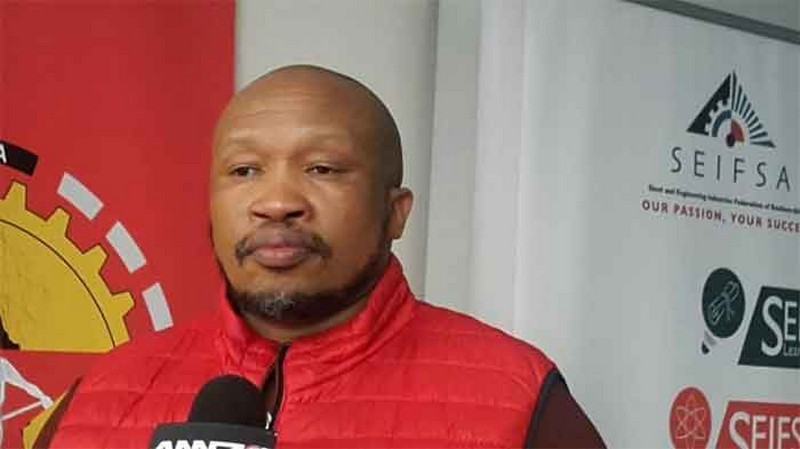
Irvin Jim, the general secretary of the National Union of Metalworkers of South Africa (NUMSA), told us that his country “is sitting on a tinderbox.” A series of crises are wracking South Africa presently: an unemployment crisis, an electricity crisis, and a crisis of xenophobia. The context behind the ANC national conference is stark. “The situation is brutal and harsh,” Irvin Jim said. “The social illness that people experience each day is terrible. The rate of crime has become very high. The gender-based violence experienced by women is very high. The statistics show us that basically people are fighting for crumbs.”

At the ANC conference, five of the top seven posts—from the president to treasurer general—went to Ramaphosa’s supporters. With the Ramaphosa team in place, and with Ramaphosa himself to be the presidential candidate in 2024, it is unlikely that the ANC will propose dramatic changes to its policy orientation or provide a new outlook for the country’s future to the South African people. The ANC has governed the country for almost 30 years beginning in 1994 after apartheid ended, and the party has won a commanding 62.65 percent of the total vote share since then before the 2014 general elections. In the last general election in 2019, Ramaphosa won with 57.5 percent of the vote, still ahead of any of its opponents. This grip on electoral power has created a sense of complacency in the upper ranks of the ANC. However, at the grassroots, there is anxiety. In the municipal elections of 2021, the ANC support fell below 50 percent for the first time. A national opinion poll in August 2022 showed that the ANC would get 42 percent of the vote in the 2024 elections if they were held then.

Negotiated Settlement

Irvin Jim is no stranger to the ANC. Born in South Africa’s Eastern Cape in 1968, Jim threw himself into the anti-apartheid movement as a young man. Forced by poverty to leave his education, he worked at Firestone Tire in Port Elizabeth. In 1991, Jim became a NUMSA union shop steward. As part of the communist movement and the ANC, Jim observed that the new government led by former South African President Nelson Mandela agreed to a “negotiated settlement” with the old apartheid elite. This “settlement,” Irvin Jim argued, “left intact the structure of white monopoly capital,” which included their private ownership of the country’s minerals and energy as well as finance. The South African Reserve Bank committed itself, he told us, “to protect the value of white wealth.” In the new South Africa, he said, “Africans can go to the beach. They can take their children to the school of their choice. They can choose where to live. But access to these rights is determined by their economic position in society. If you have no access to economic power, then you have none of these liberties.”

In 1996, the ANC did make changes to the economic structure, but without harming the “negotiated settlement.” The policy known as GEAR (Growth, Employment, and Redistribution) created growth for the owners of wealth, but failed to create a long-term process of employment and redistribution. Due to the ANC’s failure to address the problem of unemployment—catastrophically the unemployment rate was 63.9 percent during the first quarter of 2022 for those between the ages of 15 and 24—the social distress being faced by South Africans has further been aggravated. The ANC, Irvin Jim said, “has exposed the country to serious vulnerability.”

Solidarity Not Hate

Even if the ANC wins less than 50 percent of the vote in the next general elections, it will still be able to form a government since no other party will attract even comparable support (in the 2019 elections, the Democratic Alliance won merely 20.77 percent of the vote). Irvin Jim told us that there is a need for progressive forces in South Africa to fight and “revisit the negotiated settlement” and create a new policy outline for South Africa. The 2013 National Development Plan 2030 is a pale shadow of the kind of policy required to define South Africa’s future. “It barely talked about jobs,” Jim said. “The only jobs it talked about were window office cleaning and hairdressing. There was no drive to champion manufacturing and industrialization.”

A new program—which would revitalize the freedom agenda in South Africa—must seek “economic power alongside political power,” said Jim. This means that “there is a genuine need to take ownership and control of all the commanding heights of the economy.” South Africa’s non-energy mineral reserves are estimated to be worth $2.4 trillion to $3 trillion. The country is the world’s largest producer of chrome, manganese, platinum, vanadium, and vermiculite, as well as one of the largest producers of gold, iron ore, and uranium. How a country with so much wealth can be so poor is answered by the lack of public control South Africa has over its metals and minerals. “South Africa needs to take public ownership of these minerals and metals, develop the processing of these through industrialization, and provide the benefits to the marginalized, landless, and dispossessed South Africans, most of whom are Black,” said Jim.

No program like this will be taken seriously if the working class and the urban poor remain fragmented and powerless. Jim told us that his union—NUMSA—is working with others to link “shop floor struggles with community struggles,” the “employed with the unemployed,” and are building an atmosphere of “solidarity rather than the spirit of hate.” The answers for South Africa will have to come from these struggles, says the veteran trade union leader. “The people,” he said, “have to lead the leaders.”

Vijay Prashad is an Indian historian, editor, and journalist. He is a writing fellow and chief correspondent at Globetrotter.

Zoe Alexandra is a journalist and co-editor of Peoples Dispatch.

23 December 2022

Source: countercurrents.org

Scrapping Maulana Azad Fellowship: Blow to Educational Handicaps of Muslims

By Dr Ram Puniyani

Sachar Committee which was appointed by UPA I in 2005 released its report in 2006. It observed that the condition of Muslim community in all areas of social and political life has been sliding down. Faced with the insecurity due to violence against them, its representation in social-political life has been going down for a free fall. UPA in all its wisdom decided to work on this nagging social political issue. One of the steps taken by it was institution of Maualana Azad National Fellowship. This was meant for higher education and research for the minority students. It had provisions for scholars from all religious minorities, Muslims, Christians, Sikhs, Jains and Buddhist. Still as the number of Muslim minority is much higher from among the 1000 fellowships lately 733 were awarded to Muslims.

Among Muslims the status of education worsened after Independence due to the intimidating atmosphere, poverty and lack of any affirmative action. As the level of education went up the number of Muslim students enrolled fell down steeply. Above 17 years of age educational attainment of Muslim students is abysmally low. As per Ministry of education data the national average for Matriculation is 17% for Muslims while the national average is 22%. The literacy rate stands at 57.3% as against the national average of 73.4%. The overall illiteracy among Muslims is higher than among other religious minorities. Similarly their enrollment in higher echelons of education and research is much lower. This is where MANF came in as a small boost for higher education among Muslims. As against 14.2% of their population only 5.5% Muslims reach higher education. As per 2011 census data Graduates among Hindus were 5.98 and amongst Muslims was 2.76%.

On similar lines Pre Matric scholarship for Muslims has been restricted only to 9th and 10th standard students only. The pre-matric scholarship was launched in 2008 and was definitely of great help to Muslim students in secondary education. Even at that time with Modi as Chief Minister of Gujarat argued in Supreme Court that Center cannot force Gujarat to implement it as it is based on Religion! The central contribution for the scheme was returned by the Gujarat state. In tune with this the Central Government has now restricted the scope of Pre Matric scholarship only to 9th and 10th standard students as per a notification in November 2022.

The MANF has been stopped from this December as per proclamation by the minority’s affairs minter Ms Smriti Irani on 8th December 2022. There have been protests against this high handed policy of the Government and many Congress and other MPs have also raised the issue in Parliament. The argument of Ms Irani is that this scheme overlaps with other similar schemes for which Muslims students are entitled, the ones for OBCs. She forgets that one cannot get two scholarships at the same time.

As per research scholar Abdulla Khan (Muslim Mirror) “The enrollment of Muslims in higher education, as per maulanAll India Survey on Higher Education Reports (AISHE) (conducted by MHRD, GOI) revealed that the representation in higher education has also been lowest from other communities such as SCs, STs and OBCs…”

It is very clear that the present Government is out to undo whatever little affirmative action directed ‘Equal Opportunity’ exists. At political level we have witnessed the communal forces targeting the Muslim minorities in different ways. We have recently witnessed the angle of love Jihad being highlighted in cases like Shraddha-Aftab. This is being projected in communal angle while the core reason is anti women violence in our patriarchal society. We have witnesses many such cases of violence against women by Hindu men being underplayed with a political agenda.

Undoubtedly education is the key to social progress for any community. The Saeed Mirza classic ‘Salim Langade pe Mat ro’ brought this forward in a very perceptive way. The recent survey conducted by Mumbai based human rights group, Bebak Collective’ points out that Muslim youth are suffering due to social conditions prevailing currently,

Unfortunately in India the dominance of divisive politics has affected the lives of Muslim minorities in diverse ways. Even when not in power they put immense pressure on semi secular parties not to undertake any affirmative action in favor of Muslim and Christian minorities in particular. With new education policy and ruthless privatization of education, the poor and marginalized will be the big victims.

The ruling party has a majority in the parliament and the opposition to such decisions of the Government is not going to change its pro-elite and anti-Minority stance. The powerful electoral machinery of the divisive party is going to come in the way of a coalition at center which can undertake the issues of marginalized sections in a sensitive way. Still a way has to be thought of as to how in prevalent adverse circumstances how to pull out the intimidated community from being left behind in the march to progress for a healthy society with concern for all sections of society, irrespective of their religion, caste and language.

The present Government has a different agenda. Those who have been behind ‘Youth for Equality’ type movements cannot understand the values of affirmative action or ‘Equal opportunity’ in an unequal society. The minority community will recall with pain the attack on Jamia and AMU students. On parallel grounds when the same Ms Irani was MHRD minster we painfully witnessed the plight of Dalits in the form of suicide of Rohith Vemula.

So where do we go from here? Can Muslim community philanthropes, those controlling Waqf and other community resources come forward to fill the massive gap left by the withdrawal of MANF or restricting pre-matric scholarship only to 9th and 10 standard students. It’s a tall order but it has to be done if the demand for reversal of these orders by the Government are not yielded to by the ruling Government, which at present is out to implant its anti Minority agenda with full force. The students in the middle of their higher education and those aspiring for such education need to be helped in all the ways possible.

22 December 2022

Source: countercurrents.org

Russia’s Doctrine of “Peaceful Coexistence”

By Evgeny Chossudovsky

The doctrine of peaceful coexistence was first formulated in the wake of the 1918-1920 war against Soviet Russia.

It was presented to the Genoa Conference in 1923.

The “unspoken” 1918-20 war against Russia (barely acknowledged by historians) was launched two months after the November 7, 1917 Revolution on January 12 1918.

It was an outright “NATO style” invasion consisting of the deployment of more than 200,000 troops of which 11,000 were from the US, 59,000 from the UK. 15,000 from France. Japan which was an Ally of Britain and America during World War I dispatched 70,000 troops.

The article below entitled Genoa Revisted: Russia and Coexistence was written by my late father Evgeny Chossudovsky in 1972. It was published in Foreign Affairs.

At the height of the Cold War, the article was the object of a “constructive debate” in the corridors of the Council on Foreign Relations (CFR). According to the NYT:

Mr. Chossudovsky wants a United Nations Decade of Peaceful Coexistence, a new Treaty Organization for European Security and Cooperation which would embrace all Europe, and comprehensive bilateral and multilateral cooperation in everything from production and trade to protection of health and environment and “strengthening of common cultural values.” …

Skeptics, of course, can point out that Mr. Chossudovsky’s argument; has lots of holes in it, not least in his strained efforts to prove that peaceful coexistence has always been Soviet policy. Nevertheless, he has made such a refreshing and needed contribution to the East‐West dialogue that it would be neither gracious nor appropriate to answer him with traditional types of debating ploys.

Unquestionably, East‐West cooperation in all the fields he mentions is very desirable, and so is East‐West cooperation in other fields he doesn’t mention such as space. And he is pushing an open door when he laments the colossal burdens of the arms race. (Harry Schwarz, The Chossudovsky Plan, New York Times, March 20, 1972)

Flash Forward to 2022

The world is at a dangerous crossroads. In the post Cold War Era, East-West Dialogue has been scrapped.

Is “Peaceful Coexistence” and Diplomacy between Russia and the U.S. an Option? 

Constructive Debate and Dialogue is crucial.

Can East-West Dialogue be Restored as a Means to Avoiding a Third World War?

There is a sense of urgency. Military escalation could potentially lead humanity into nuclear war.

The first priority is to restore dialogue and diplomatic channels.

We call upon the U.S., the member states of the European Union and the Russian Federation to jointly endorse a policy of “Peaceful Coexistence”, with a view to reaching meaningful peace negotiations in regards to the war in Ukraine.

***

My father’s family left Russia in 1921. He was seven years old. In 1934 he started his studies in economics in Scotland (Ph.D) at the University of Edinburgh, the alma mater of Adam Smith.

In 1947 he joined the United Nations secretariat in Geneva. In 1972 at the time of writing of this article he was a senior official of the United Nations Conference for Trade and Development (UNCTAD).

The following article on “Peaceful Coexistence” is part of the legacy of my late father, Dr. Evgeny Chossudovsky

Michel Chossudovsky, Global Research, December 22, 2022

***

Genoa Revisited: Russia and Coexistence
by Evgeny Chossudovsky

Foreign Affairs, April 1972

Half a century ago, on April 10, 1922, Luigi Facta, Prime Minister of Italy, solemnly opened the International Economic Conference at Genoa. Lloyd George, the prime mover of the Conference, was among the first speakers. He called it “the greatest gathering of European nations which has ever assembled,” aimed at seeking in common “the best methods of restoring the shattered prosperity of this continent.”

Though this rather remote event has by now been forgotten by many, the evocation of it is justified. For a study of Soviet attitudes at that Conference throws light on the origins and evolution of the notion of the peaceful coexistence between countries having different economic and social systems, a major concept of Soviet foreign policy which no serious student of international affairs can nowadays afford to ignore.

Therefore, to look at Genoa afresh from this particular angle may perhaps add to the understanding of Soviet foreign policy and economic diplomacy, including their more recent manifestations. The author was also anxious to assess the relevance of this first multilateral encounter between Soviet Russia and the Western world to current efforts, a half-century after Genoa, aimed at promoting cooperation across the dividing line. To undertake the task in these pages is not unfitting: the first issue of Foreign Affairs, published only a few months after the Conference, carried a then anonymous article by “K” entitled “Russian After Genoa and The Hague,” written in masterly fashion by the review’s first Editor, Professor Archibald Cary Coolidge. I am grateful for having the privilege, on the eve of the golden jubilee of Foreign Affairs, to revert to this early theme, even if from a different standpoint and at a more comfortable historic distance.

The Genoa Conference was convened as a result of a set of resolutions passed by the Supreme Council of the Allied Powers meeting at Cannes in January 1922. The principal among these was Mr. Lloyd George’s Resolution.

In the form in which the draft was adopted on January 6, it provided for the summoning of an Economic and Financial Conference “as an urgent and essential step towards the economic reconstruction of Central and Eastern Europe.” All European states, including the former Central Powers, were asked to attend.

Special decisions were adopted to invite Russia and the United States. Russia replied in the affirmative. Indeed, the young Soviet Republic accepted this call with eagerness and alacrity for reasons which will become apparent as we proceed. On the other hand, we are told that Secretary of State Charles E. Hughes informed the Italian Ambassador in Washington on March 8 that, since the Conference appeared to be mainly political rather than economic in character, the United States government would not be represented. However, the U.S. Ambassador in Rome, R. W. Child, was appointed observer.

American oil and other business interests were represented by F. A. Vanderlip. In the opinion of Soviet historians, the U.S. refusal to take part was motivated mainly by hostility toward Soviet Russia and fear that Genoa might strengthen that country’s international position. The United States at the time was adhering firmly to the policy of economic blockade and nonrecognition of the new Bolshevik regime. On May 7, 1922, Ambassador Child wrote to the State Department that he considered his main function as observer at Genoa would be to “keep in closest possible touch with delegations so as to prevent Soviet Russia from entering any agreements by which our rights would be impaired.”

Russia was to have been represented by Lenin himself in his capacity as Chairman of the Council of People’s Commissars. Lenin had closely supervised all the preparations and undoubtedly intended to go to Genoa. He stated publicly that he expected to discuss personally with Lloyd George the need for equitable trade relations between Russia and the capitalist countries.

But in naming Lenin as its chief delegate, the Soviet government entered a proviso that “should circumstances exclude the possibility of Comrade Lenin himself attending the Conference,” Georgy Vassilievich Chicherin, People’s Commissar for Foreign Affairs, the deputy head of the delegation, would be vested with all requisite powers.

In the end, public concern over Lenin’s personal safety, pressing affairs of state requiring his attention, and the deterioration of his health, made it undesirable for him to leave Moscow. However, he retained the chairmanship of the Russian delegation and directed its activity through almost daily contact. (The New York Times entitled its leader on the opening of the Conference “Lenin in Genoa!”) Chicherin serving as acting head of the delegation was aided by such outstanding Soviet diplomats and statesmen as Krassin, Litvinov, Yoffe, Vorovsky and Rudzutak, who together formed the “Bureau” of the delegation.

All eyes turned with curiosity on the People’s Commissar when he took the floor, after star performers such as Lloyd George and Barthou had made their inaugural speeches. In keeping with the diplomatic etiquette of those days, he wore tails. Issue of the Russian nobility and for some years archivist in the Tsarist Foreign Ministry, Chicherin as a young man had broken with his past and espoused the cause of revolution, ultimately siding with Lenin and the Bolsheviks. Un homme genial and a diplomat of consummate professional skill, he combined wide knowledge of world affairs, sophisticated erudition and artistic sensitivity with burning faith in communism and a single-minded dedication to the defense of the interests of the Soviet state. Having spoken in excellent French for some twenty minutes, he proceeded, to the surprise and spontaneous applause of the meeting, to interpret his speech into English.

Though Chicherin had hardly looked at his notes during delivery, his statement had been most carefully prepared. Lenin himself had approved the text, had weighed each word, formulation and nuance. Chicherin’s declaration was the first made by a Soviet representative at a major international conference on the agenda of which the “Russian question” loomed large and to which the Soviet Republic had been invited. It was truly a historic moment.

Chicherin told the Conference that “whilst themselves preserving the point of view of Communist principles, the Russian delegation recognizes that in the actual period of history which permits of the parallel existence of the ancient social order and of the new order now being born, economic collaboration between the States representing the two systems of property is imperatively necessary for the general economic reconstruction.” He added that

“the Russian delegation has come here … in order to engage in practical relations with Governments and commercial and industrial circles of all countries on the basis of reciprocity, equality of rights and full recognition. The problem of world-wide economic reconstruction is, under present conditions, so immense and colossal that it can only be solved if all countries, both European and non-European, have the sincere desire to coordinate their efforts… The economic reconstruction of Russia appears as an indispensable condition of world-wide economic reconstruction.” (emphasis added)

A number of concrete offers (combined with proposals for a general limitation of armaments) accompanied this enunciation of policy, such as the readiness of the Russian government “to open its frontier consciously and voluntarily” for the creation of international traffic routes; to release for cultivation millions of acres of the most fertile land in the world; and to grant forest and mining concessions, particularly in Siberia.

Chicherin urged that collaboration should be established between the industry of the West on the one hand and the agriculture and industry of Siberia on the other, so as to enlarge the raw materials, grain and fuel base of European industry. He declared, moreover, his government’s willingness to adopt as a point of departure the old agreements with the Powers which regulated international relations, subject to some necessary modifications. Chicherin also suggested that the world economic crises could be combated by the redistribution of the existing gold reserves among all the countries in the same proportions as before the war, by means of long-term loans. Such a redistribution “should be combined with a rational redistribution of the products of industry and commercial activity, and with a distribution of fuel (naphtha, coal, etc.) according to a settled plan.”

Such was, in essence, the first considered presentation by Soviet Russia of what came to be termed the policy of peaceful coexistence between the capitalist and socialist systems, linked with a specific program of practical action, made in an intergovernmental forum. But the genesis of the concept goes back much further.

As long ago as 1915, Lenin, in the midst of the First World War, which to him was above all a clash of rival imperialist powers, in a celebrated article entitled “On the Slogan for a United States of Europe,” had foreseen the possibility of the victory of socialism in one country. In so doing he proceeded from an “absolute law” of the uneven economic and political development of capitalism, especially during its imperialist phase.

Lenin came to the related conclusion that the “imperialist chain” might first snap at its weakest link, e.g. in a relatively backward country like Tsarist Russia with a small but concentrated and rapidly expanding capitalist sector, a desperately poor peasantry and a compact and politically conscious working class pitted against a decaying ruling elite. Though the break in the chain would set in motion a process of revolution, that might take time, possibly decades to unfold, depending on the specific conditions obtaining in each country. The socialist state, meanwhile, would have to exist in a capitalist environment, to “cohabit” with it for a more or less prolonged period, peacefully or nonpeacefully. In another article dealing with the “Military Programme of the Proletarian Revolution,” published in the autumn of 1916, Lenin developed this theme further by concluding that socialism could not achieve victory simultaneously in all countries. It would most probably first be established in one country, or in a few countries, “whilst the others will for some time remain bourgeois or pre-bourgeois.”

The weakest link did break, as Lenin had foreseen, in Russia, though the tide of revolution was also mounting in other parts of Europe, impelled by the desperate desire of the peoples to end the war. Indeed, at one time it looked as if a socialist upheaval was about to triumph in Germany. It is hardly surprising that Lenin, the revolutionary leader, openly hailed this prospect, though he was resolutely opposed to the manipulating and artificial pushing or “driving forward” of any revolution from the outside, since for him this was essentially an inexorable social phenomenon ultimately shaped by internal forces. As E. H. Carr has observed, “it was the action of the western Powers toward the end of the year 1918 which contributed quite as much as of the Soviet government which had forced the international situation into a revolutionary setting.”

Yet, being a realist, Lenin did not omit to stress from November 1917 onwards that it would be wrong and irresponsible for the young Soviet Republic to count on revolutions in other countries. They might or might not occur at the time one wished them to happen. There was no question either, as he said again and again, of trying to “export” the Russian Revolution.

While maintaining its belief in the ultimate victory of socialism in other countries, the young Soviet Republic had, meantime, to be prepared to stand on its own feet and to defend its own interests as a state. Not only had the forces of the White Guards and the interventionists to be defeated, but steps had to be taken to conclude peace with the capitalist countries and to prepare, under certain conditions and safeguards, for cooperation with them. Exploratory moves for the resumption of trade and economic relations with the Allied and Central Powers, as well as with neutral countries, had begun immediately after the conclusion of the Treaty of Brest-Litovsk. As early as May 1918, for instance, the Soviet government made, through the good offices of Colonel Raymond Robins (the representative of the American Red Cross in Petrograd) detailed and far-reaching offers to the United States of long-term economic relations, including the granting of concessions to private businessmen for the exploitation, subject to state control, of Russia’s vast and untapped raw material resources. These offers were reiterated a year later through William Bullitt. There was no response.

Military intrusion and economic harassment from the outside (the latter going to such lengths as “the gold blockade,” i.e. the refusal to accept gold for desperately needed imports) continued, forcing the Soviet government, as Lenin put it, to “go to greater lengths in our urgent Communist measures than would otherwise have been the case.” But the option of “peaceful cohabitation” with the capitalist world, based on normal economic, trade and diplomatic relations, was kept open nonetheless throughout this entire phase.

This emerges clearly from the writings and utterances of Lenin and the documents on Soviet foreign policy during the pre-NEP period. Indeed, one of the most incisive and farsighted definitions of the concept of peaceful coexistence dates back to the early summer of 1920 when, in a report on the foreign political situation of the Soviet Republic, the People’s Commissar for Foreign Affairs proclaimed that

“Our slogan was and remains the same: peaceful coexistence (mirnoye sosushchestvovaniye) with other Governments whoever they might be. Reality itself has led … to the need for establishing durable relations between the Government of the peasants and workers and capitalist Governments. . . . Economic reality calls for an exchange of goods, the entering into continuing and regulated relations with the whole world, and the same economic reality demands the same of the other Governments also.”

Thus, the Soviet policy of peaceful coexistence has deep roots in the early history of the Russian Revolution and was most assuredly not something concocted on the spur of the moment for tactical use at Genoa.

26 December 2022

Source: www.globalresearch.ca

Millions of Afghans Are Starving as US Stalls on Returning Central Bank Funds

By Sarah Lazare

In September, the U.S. created a foundation that was supposed to unfreeze Afghanistan’s foreign assets. Yet, interviews with trustees reveal that, in three months, no funds have been disbursed—or concrete plans made—to help the Afghan people.

The Taliban seized power in Afghanistan in August 2021 and, in response, Europe, the United Arab Emirates and the United States froze the Afghan central bank’s roughly $9 billion in foreign assets—$7 billion of which was under control of the United States.

Without access to these funds—alongside a lattice of sanctions, a decline in humanitarian aid and harsh political turmoil under Taliban rule—Afghanistan has been led into an economic collapse with a dramatic uptick in poverty; 6 million Afghans are facing the immediate risk of starvation. According to calculations from the Center for Economic and Policy Research (CEPR), a left-leaning think tank, U.S. sanctions on Afghanistan (including the freezing of these central bank assets) could kill more people than 20 years of U.S. war and occupation.

In September, the Biden administration placed half of the U.S.-controlled assets into a private foundation, trusteed by just four people, ​”to be used for the benefit of the people of Afghanistan while keeping them out of the hands of the Taliban and other malign actors,” according to a joint statement from the departments of Treasury and State.

But interviews with two of those four trustees reveal that no funds have yet been disbursed to help the Afghan people and there are no policies in place to do so immediately. One trustee underscored that it is unlikely the foundation will be a vehicle to quickly return the assets to Afghanistan’s central bank while the Taliban is maintaining oppressive rule.

This lack of progress raises concerns that the Biden administration is on course to worsen the rapidly spiraling humanitarian crisis. ​”Who pays the price,” asks Basir Bita, an Afghan activist who works with the Afghan refugee community in Canada and who has family in Afghanistan, ​”for the U.S. freezing the funds? The public. The people who live in Afghanistan.”

Creation of a foundation

The United States froze the Afghan central bank’s assets amid public outcry over the U.S. military’s withdrawal from Afghanistan. The Biden administration depicted the move as a refusal to legitimize Taliban rule.

Yet, according to Andrés Arauz, a senior research fellow at the CEPR, ​”The reality is that central banks don’t just hold government money—they also and mostly hold commercial banks’ money. They are not only banks of governments; they are also banks of banks. It was important for the working of Afghanistan’s financial system, and therefore its economy, that their banks have access to money that was seized by the United States.”

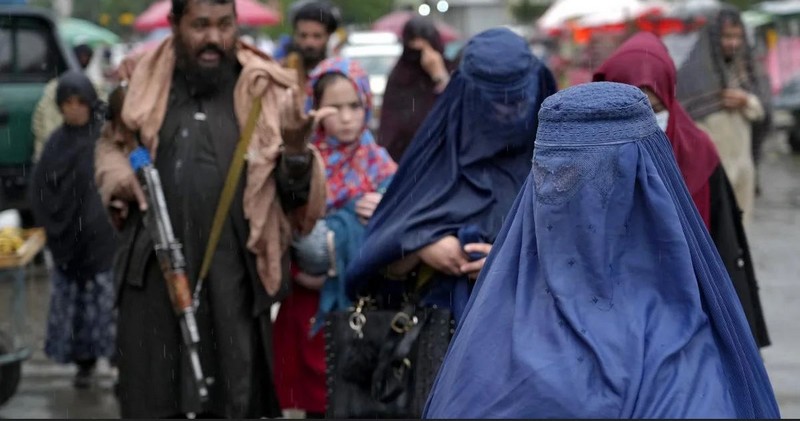
The freezing of the assets plunged Afghanistan into a liquidity crisis, in which people are unable to access their cash and perform essential transactions. Alongside the liquidity crisis is hyper-inflation, which has worsened the acute and widespread problem of hunger. Between June 2021 and July 2022, the price of wheat flour in Afghanistan skyrocketed 68% and cooking oil jumped 55%, according to the International Committee of the Red Cross. Seventy percent of homes are ​”unable to meet basic food and non-food needs,” the International Federation of Red Cross and Red Crescent Societies warned in June. Reports have emerged of Afghans selling their daughters, and their kidneys, in an effort to survive hunger and rising debt.

Citing the deepening catastrophe, some activists and lawmakers have been calling for the Biden administration to take a less collectively punitive approach and return the assets to Afghanistan’s central bank. In January, the New York Times editorial board published an op-ed warning against a policy of letting the Afghan central bank fall apart, titled, ​”Let Innocent Afghans Have Their Money.”

In the midst of all of this, in February, the Biden administration issued an executive order to set aside $3.5 billion of the U.S.-held central bank assets for victims of the attacks of September 11, 2001 (though lawyers and lobbyists stand to profit handsomely). This move was widely criticized by United Nations experts and some 9/11 families for its disastrous humanitarian consequences for Afghans.

On September 14, the U.S. departments of Treasury and State announced the other half of the U.S.-controlled reserves of the Afghan central bank—another $3.5 billion—would be placed under the control of a Swiss foundation called the Afghan Fund. The Afghan Fund would ​”maintain its account” with the Bank for International Settlements, which is a global financial institution, based in Switzerland, that provides banking services for central banks.

Afghan men carrying a sack of flour in January as the UN World Food Program distributes monthly food rations in an area south of Kabul. Between June 2021 and July 2022, the price of wheat flour in Afghanistan skyrocketed 68%. (Photo by Scott Peterson/Getty Images)

According to a statement from the Bank for International Settlements, its role ​”is limited to providing banking services” and it plays no part in the decision-making of the Afghan Fund.

In the short term, the Afghan Fund’s board of trustees ​”will have the ability to authorize targeted disbursements to promote monetary and macroeconomic stability and benefit the Afghan people,” according to the joint statement from Treasury and State. The foundation could, for example, use the assets to pay for ​”critical imports like electricity,” or to pay for ​”Afghanistan’s arrears at international financial institutions to preserve their eligibility for financial support.” The Afghan Fund’s long-term goal is to return the funds to the Afghan central bank, but only if key assessments and ​”counter-terrorism” controls are implemented, the statement indicates.

Some activists and members of the U.S. Congress cautiously supported the creation of the Afghan Fund, hoping it marked a step toward the United States unfreezing the assets. ​”The fund has the potential to create a vital pathway to a functioning financial system, returning desperately needed assets to Afghanistan that could alleviate major price spikes of food and other essentials,” Rep. Pramila Jayapal (D-Wash.), chair of the Congressional Progressive Caucus, wrote in a September 15 statement.

The press coverage surrounding the Afghan Fund intimated a major unlocking of the assets could be just around the corner. ​”Setting up the new fund will enable the funds to flow quickly,” Kylie Atwood wrote for CNN.

But now, three months later, no money has been distributed and two of the Afghan Fund’s trustees say there is no immediate plan to return assets to the Afghan central bank.

Four trustees

The Afghan Fund has four trustees who make its decisions. Of the two born in Afghanistan, the first is Anwar-ul-Haq Ahady, former head of the Afghan central bank and Afghanistan’s former minister of finance. The second is Shah Mehrabi, a professor at Montgomery College in Maryland, who also serves on the Afghan central bank’s Supreme Council.

Mehrabi and Ahady each confirmed to Workday Magazine and In These Times that, in the three months since it was created, the Afghan Fund has not disbursed any funds—neither directly to the Afghan central bank, nor to meet any immediate needs for economic stabilization—and has no immediate plans to make significant disbursements to the central bank.

At the first meeting of the Afghan Fund trustees in Geneva on November 21, ​”potential disbursement issues were addressed but no policy and procedures or options were elaborated or finalized,” Mehrabi explains. There is another meeting scheduled for January, he says, but ​”release of these funds to the central bank most likely will not occur in January.” Ahady confirmed the Afghan Fund has not yet reached agreement on a policy to disburse funds.

According to Mehrabi and Ahady, among the trustees at the November 21 meeting was Andrew Baukol, the U.S. Treasury’s acting undersecretary for international affairs, who replaced Scott Miller, U.S. ambassador to Switzerland, as a trustee. (The U.S. Embassy in Switzerland confirmed that Miller had been replaced, and ​”the U.S. representative is now based at Treasury.”) The swap-in of Baukol, who has also worked in the CIA and the U.S. office of the International Monetary Fund, suggests a larger role for the Treasury Department.

The fourth trustee is Alexandra Baumann, a Swiss foreign ministry official.

For any decision to go through, it must have the unanimous backing of the foundation’s four trustees, Ahady explains. Given the Treasury Department’s representation, ​”If the U.S. government disagrees, no decision will be made,” he says.

Mehrabi’s position on the board was a win for advocates of unfreezing the Afghan central bank funds, as he is an outspoken proponent of unlocking the assets and restoring them to the central bank. Mehrabi explains over WhatsApp that he would like to see a ​”limited, monitored release” of funds to the Afghan central bank, ranging from $80 million to $100 million per month, ​”depending on the demand and stabilization of currency and stable prices.” (He has previously called for $150 million a month.)

Mehrabi’s proposal is relatively moderate compared with others who have issued less qualified calls to fully unfreeze the Afghan central bank assets and revive the institution. But for those who are anxious to welcome any amount of disbursement to Afghanistan’s central bank, Mehrabi stands out for supporting the direct flow of funds.

When asked whether other trustees agree the funds should be returned to the Afghan central bank, Mehrabi replies, ​”The issue of disbursement has not been fully discussed yet and finalized.”

A Treasury Department readout from the November 21 meeting says the trustees of the Afghan Fund agreed on operational matters, like ​”hiring an external auditor” and ​”developing compliance controls and foundational corporate governance documents.” But the readout contains no mention of what will happen with the actual assets.

When asked about the prospect of unlocking the assets for the Afghan central bank, Mehrabi explains: ​”The U.S. government’s position has been not to release funds to the central bank unless capacity building and AML/CFT issues [anti-money laundering and counter-financing control measures] are resolved. How long will this take? There is an immediate need to tackle higher prices that people are suffering from, and lack of funds has prevented businesses from paying for imports. If funds are not released soon, the suffering of Afghans will continue.”

Ahady says over the phone that, due to the position of the United States, the Afghan Fund will be unlikely to return any significant portion of the assets to the Afghan central bank while the Taliban ​”is declining U.S. requests for more inclusive government and women’s rights.”

Some funds may be disbursed for key items that circumvent the central bank in the public interest, Ahady says, such as printing new bank notes or passports. But the primary purpose of the Afghan Fund ​”is really to keep this money so that, one day, when the situation becomes normal, this is the capital of the Afghan central bank. So at least the central bank will have capital to work with. So the main idea is not so much disbursement, unless it’s strictly needed, but to manage the fund that’s under sanction.”

Ahady declined to comment on whether he supports this orientation to the frozen assets.

Such an approach would differ from the standards laid out in the joint statement from the departments of Treasury and State, which highlights three conditions for unfreezing the assets: that the central bank ​”demonstrates its independence from political influence and interference”; ​”demonstrates it has instituted adequate anti-money laundering and countering-the-financing-of-terrorism (AML/CFT) controls”; and ​”completes a third-party needs assessment and onboards a reputable third-party monitor.”

According to Cavan Kharrazian, a progressive foreign policy advocate for Demand Progress, any delay will most greatly harm those who are already vulnerable and oppressed under Taliban rule. ​”For the foreseeable future, the Taliban will be in charge of the government of Afghanistan,” Kharrazian says. ​”While they have a deplorable human rights record, especially towards women, there is also a severe economic and humanitarian crisis in the country that needs immediate attention. This crisis affects the most vulnerable segments of society the worst.”

Kharrazian adds: ​”The U.S. just spent 20 years and trillions of dollars attempting to eradicate and replace the Taliban and its oppressive rule. It didn’t work. But the U.S. does have the ability to facilitate the unfreezing of funds that can benefit millions of people facing humanitarian disaster in Afghanistan.”

Afghan activist Bita implores that ​”the funds need to be released right now, because people are struggling. So many people lost their lives, so many people sold their kids on the streets, so many forced their daughters to marry a man because of the economic situation. So it has to be right now.”

Arauz, from the CEPR, says it would be a profound mistake on the part of the United States to withhold assets from the Afghan central bank in order to punish the Taliban. ​”The central bank funds are not government funds,” he emphasizes. ​”They are commingled with commercial banks’ funds, which ultimately belong to depositors, which are human beings and businesses. It would not be returning the funds to the Taliban—it would be returning funds to the commercial system and depositors of the Afghan economy.”

The clock is ticking and activists warn that each day without the unfreezing of the funds brings more hardship for Afghans. ​”When the fund was created, every major humanitarian institution, the United Nations, etc., were already pretty clear that the whole country faced a giant humanitarian crisis that needed to be addressed as soon as possible,” Kharrazian says. ​”There was already a sense of urgency.

“They’ve waited three months to deliberate over sending small portions over what should have been fully unfrozen funds. If it was urgent in September, it’s especially urgent now, with winter arriving.”

Many children in Afghanistan cannot stand on their own feet because of hunger and malnutrition. Here, children are seen with their mothers in Kabul in January. (Photo by Sayed Khodaiberdi Sadat/Anadolu Agency via Getty Images)

Ahady’s position is that unlocking the Afghan central bank assets would not be a magic wand. He says that ​”the objective of sanctions is to make things difficult, and have these sanctions contributed to the slowdown of economic activities in Afghanistan? Yes.” But, he contends, a number of factors are to blame, including dependency on foreign assistance, the imposition of sanctions, and poor economic management. ​”I think that, even if the U.S. government were to release this fund, this is not going to solve Afghanistan’s economic problems,” he says. ​”It might help a little bit. Just a little bit.”

Afghan Fund trustee Baumann did not respond to a request for an interview, but she has emphasized caution in previous statements to the press. ​”The [Afghan central bank], in its current form, is not a fit place for this money,” she said in an October article from SWI swiss​in​fo​.ch, a media service of the Swiss Broadcasting Corporation. ​”We do not have any guarantee that if the money goes back right now that it will be effectively used for the benefit of the Afghan people.”

The U.S. Treasury Department also did not return a request for comment.

With no clear timetable for disbursing funds, Erik Sperling, executive director of advocacy organization Just Foreign Policy, expresses frustration. ​”Given U.S. Treasury’s continued veto and dominance over the Swiss Fund,” he says, ​”U.S. officials like Janet Yellen, Adewale O. Adeyemo and, ultimately, President Biden are responsible for destroying [the Afghan] economy and knowingly plunging tens of millions of Afghans into crisis.”

According to Bita, ​”The way the U.S. government has taken hostage of the funds—that is one way of dehumanizing the people of Afghanistan.”

“With this money,” Bita adds, ​”you could save the lives of so many people.”

Sarah Lazare is web editor at In These Times. She is a former Staff Writer at Common Dreams.

21 December 2022

Source: countercurrents.org

The Nakba Day Triumph: How the UN Is Correcting a Historical Wrong

By Dr Ramzy Baroud

The next Nakba Day will be officially commemorated by the United Nations General Assembly on May 15, 2023. The decision by the world’s largest democratic institution is significant, if not a game changer.

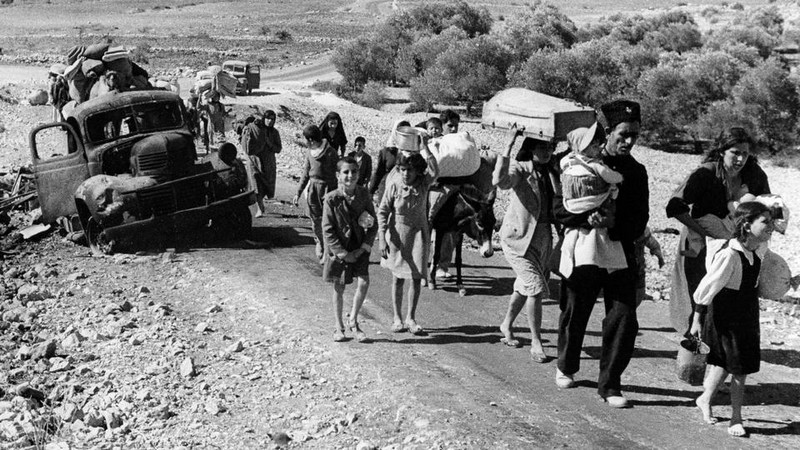
For nearly 75 years, the Palestinian Nakba, the ‘Catastrophe’ wrought by the ethnic cleansing of Palestine by Zionist militias in 1947-48, has served as the epicenter of the Palestinian tragedy as well as the collective Palestinian struggle for freedom.

Three decades ago, namely after the signing of the Oslo Accords between Israel and the Palestinian leadership in 1993, the Nakba practically ceased to exist as a relevant political variable. Palestinians were urged to move past that date, and to invest their energies and political capital in an alternative and more ‘practical’ goal, a return to the 1967 borders.

In June 1967, Israel occupied the rest of historic Palestine – East Jerusalem, the West Bank and Gaza – igniting yet another wave of ethnic cleansing.

Based on these two dates, Western cheerleaders of Oslo divided Palestinians into two camps: the ‘extremists’ who insisted on the centrality of the 1948 Nakba, and the ‘moderates’ who agreed to shift the center of gravity of Palestinian history and politics to 1967.

Such historical revisionism impacted every aspect of the Palestinian struggle: it splintered Palestinians ideologically and politically; relegated the Right of Return for Palestinian refugees, which is enshrined in UN Resolution 194; spared Israel the legal and moral accountability of its violent establishment on the ruins of Palestine, and more.

Leading Palestinian Nakba historian, Salman Abu Sitta, explained in an interview a few years ago the difference between the so-called pragmatic politics of Oslo and the collective struggle of Palestinians as the difference between ‘aims’ and ‘rights’. Palestinians “don’t have ‘aims’ … (but) rights,” he said. “… These rights are inalienable, they represent the bottom red line beyond which no concession is possible. Because doing so will destroy their life.”

Indeed, shifting the historical centrality of the narrative away from the Nakba was equivalent to the very destruction of the lives of Palestinian refugees as it has been tragically apparent in Gaza, Lebanon and Syria in recent years.

While politicians from all relevant sides continued to bemoan the ‘stagnant’ or even ‘dead’ peace process – often blaming one another for that supposed calamity – a different kind of conflict was taking place. On the one hand, ordinary Palestinians along with their historians and intellectuals fought to reassert the importance of the Nakba, while Israelis continued to almost completely ignore the earth-shattering event, as if it is of no consequence to the equally tragic present.

Gaza’s ‘Great March of Return‘ (2018-2019) was possibly the most significant collective and sustainable Palestinian action that attempted to reorient the new generation around the starting date of the Palestinian tragedy.

Over 300 people, mostly from third or fourth post-Nakba generations, were killed by Israeli snipers at the Gaza fence for demanding their Right of Return. The bloody events of those years were enough to tell us that Palestinians have not forgotten the roots of their struggle, as it also illustrated Israel’s fear of Palestinian memory.

The work of Rosemary Sayigh on the exclusion of the Nakba from the trauma genre, and also that of Samah Sabawi, demonstrate, not only the complexity of the Nakba’s impact on the Palestinian collective awareness, but also the ongoing denial – if not erasure – of the Nakba from academic and historical discourses.

“The most significant traumatic event in Palestinian history is absent from the ‘trauma genre’,” Sabawi wrote in the recently-published volume, Our Vision for Liberation.

Sayigh argued that “the loss of recognition of (the Palestinian refugees’) rights to people- and state- hood created by the Nakba has led to an exceptional vulnerability to violence,” with Syria being the latest example.

Israel was always aware of this. When Israeli leaders agreed to the Oslo political paradigm, they understood that removing the Nakba from the political discourse of the Palestinian leadership constituted a major victory for the Israeli narrative.

Thanks to ordinary Palestinians, those who have held on to the keys and deeds to their original homes and land in historic Palestine, history is finally being rewritten, back to its original and accurate form.

By passing Resolution A/77/L.24, which declared May 15, 2023, as ‘Nakba Day’, the UNGA has corrected a historical wrong.

Israel’s Ambassador to the UN, Gilad Erdan, rightly understood the UN’s decision as a major step towards the delegitimization of Israel as a military occupier of Palestine. “Try to imagine the international community commemorating your country’s Independence Day by calling it a disaster. What a disgrace,” he said.

Absent from Erdan’s remarks and other responses by the Israeli officials is the mere hint of political or even moral accountability for the ethnic cleansing of over 530 Palestinian towns and villages, and the expulsion of over 750,000 Palestinians, whose descendants are now numbered in millions of refugees.

Not only did Israel invest decades in canceling and erasing the Nakba, it also criminalized it by passing what is now known as the Nakba Law of 2011.

But the more Israel engages in this form of historical negationism, the harder Palestinians fight to reclaim their historical rights.

May 15, 2023, UN Nakba Day represents the triumph of the Palestinian narrative over that of Israeli negationists. This means that the blood spilled during Gaza’s March of Return was not in vain, as the Nakba and the Right of Return are now back at the center of the Palestinian story.

Dr. Ramzy Baroud is a journalist, author and the Editor of The Palestine Chronicle.

15 December 2022

Source: countercurrents.org

And the winner of the World Cup is…… Qatar!

By Dr Ranjan Solomon

Palestine won too without even playing!

Since the historical decision when Qatar was awarded the FIFA hosting rights in 2010, it has constructed seven gigantic stadiums and refurbished Stadium 974, named after the country’s international dialing code. This stadium has more than normal stadium value. It is a port-side structure with more than 40,000 seats built also from recycled shipping containers and steel. A virtual city will house the stadium where the final match will be held. Qatar has also constructed state-of-the-art infrastructure, a new airport, a metro system, a series of roads and 100 new hotels. No other Muslim nation has hosted such a sizeable global event. Players, fans, sports administrators, and social media alike have declared it as the “Best World Cup ever”.

The western media had audaciously labeled Qatar with racial-colonial stereotypes and were iniquitous in the reportage of the buildup. BBC irrationally boycotted the opening ceremonies. Their loss, it turned out to be. English fans at home watched the ceremonies nevertheless. Qatar chose to chip away with dogged determination, and created the architecture of the perfect preparatory plan to harness human expertise, and financial investment. They have now altered the story line and fans are loudly singing songs of praise. .

ITV’s Mark Pougatch splashed a pertinent observation: Qatar gave fans from Africa and the Middle East centre stage, and a generally soother milieu “without the hostility and aggro associated with alcohol”. Europeans arrived internalized with prejudice about the alcohol ban. This ban has harvested safety and freedom for people, especially women, to roam the streets late into the night safe and secure. Budweisser sales were set to skyrocket during the 29-day tournament. You could have alcohol in the hotels but not on the grounds. Result? Hooliganism banned!

Ellie Molloson, a campaigner for better match-day experiences for women stated: “… coming here has been a real shock to my system… no catcalls, wolf whistles or sexism of any kind.” The World Cup ripped apart negative of myths about Arabs and Muslims. It has served as the fulcrum of friendliness, respect and hospitality associated with visiting a Muslim country. During the opening ceremony of the World Cup, Morgan Freeman, and Ghanem Al-Moftah, a Qatari YouTuber and philanthropist with caudal regression syndrome conveyed a shared moment of reflection on how Islam’s message is one of unity and understanding. Biased impressions underwent a 180 degree transition. Instances of large conversions to Islam left people pleasantly surprised. Listening to the Azan sung from a remote controlled earphone was sobering and peace-giving. Visitors visited Masjids and encountered the rich Qatari culture. 700 camels joined an animal pageant with a $2.25 million prize money tag – a taste of local culture and numerous ground-breaking episodes.

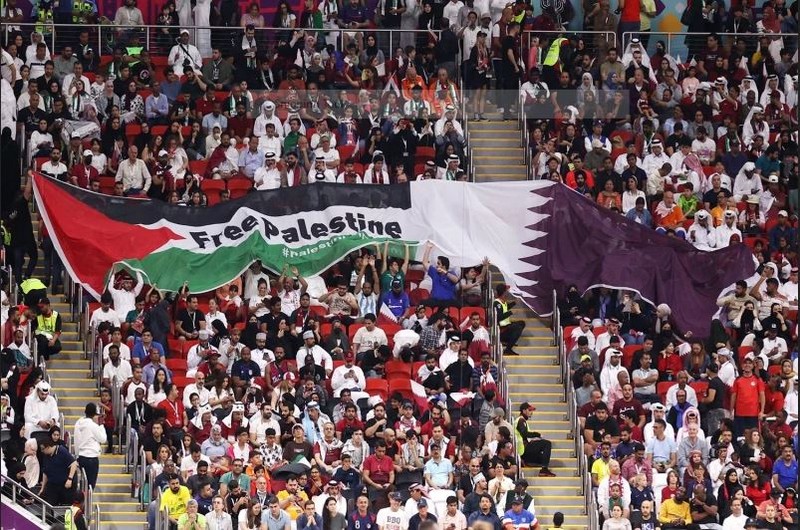
Fans brought into centre-stage their urgency for a just world. Celebration of Palestine and the Palestinian flag at the Qatar World Cup 2022 by millions of Arab fans were compelling reasons to rethink assumptions on Arab people’s relationship with Palestine. European fans also sloganeered, “Free Palestine” and waved Palestinian flags. Israelis on the grounds were shunned when their media traversed the grounds insensitive to what Israel was doing in the Palestinian Territories through cruel battering, land theft, and refusing to end apartheid politics. Clearly Arab people remain steadfast in their allegiance to the Palestinian struggle for freedom. Israelis were baffled and even fuming as they sought to manipulate and only ended failing to make the link between Israel’s apartheid and military occupation in Palestine. Moroccan fans draped in harmonizing outfits, sang songs, chanted and danced with fervor. They wore Palestinian kuffiyas with the colours of the Palestinian flag. Moroccans equivocally claimed: ‘The love for Palestine runs in our veins.”

Now on not only the uniquely rich white countries host the World Cup anymore. A Muslim country hosts the FIFA tournament in its magnificent eight stadiums, and the doors are pushed open for Muslim nations to be equal partners with imperialist nations. Qatar is making FIFA history because it is the smallest country ever to host the world’s biggest sporting event. Qatar has added to its national stock hotels and stadiums – future Qatar treasures. Most crucially, Qatar has created an image make-over.

The most tangible example transformation was in the treatment of migrant workers. An investigation by the International Trade Union Confederation (ITUC) in 2013 prompted global outrage when it claimed that thousands of laborers from countries such as India, Bangladesh and Nepal were being forced to adhere to the ‘kafala’ system of employment in order to build Qatar’s World Cup infrastructure. Qatar reformed its kafala system. ITUC General Secretary, Burrows, one of Qatar’s most strident critics, has since lauded the emirate as a role model for migrant worker’s standards. Strident changes dot the arena of women’s sports. Striking evidence suggests that the World Cup has acted as a catalyst for gender-inclusivity.

The myth of the Arab as the ‘other’, an uncivilized, non-Christian, exotic and inferior entity whose social order is utterly opposed to modern values of the West lies shattered. Qatar deconstructed these myths and now the world has a model – non-western, and possibly superior to what the West offers. Qatar built a new identity as an emerging model of a modern monarchy-state that succeeded in finding the right balance between modern efficiency, symbolized in the efficient management of mega-sport projects, and the authenticity of Arab culture.

Goa could learn a thing or two from Qatar. Upgraded plans laid for hosting BRICS in Goa lie incomplete six years on. The Colva road broadening is finally being sorted; Attal Settu lies incomplete as do multiple across-the-board projects and infrastructure in disrepair. Panjim is in shambles. White elephants galore are closeted in the political cabinet!

An array of international events is on the anvil in Goa. It is a gripping urgency to shun rhetoric, and get work done. Goa could learn a few things from Qatar. Political willpower alone is the way.

Ranjan Solomon is a political commentator

14 December 2022

Source: countercurrents.org

Protesting People In Peru Demand Dissolution Of The Congress, 6 Dead

By Countercurrents Collective

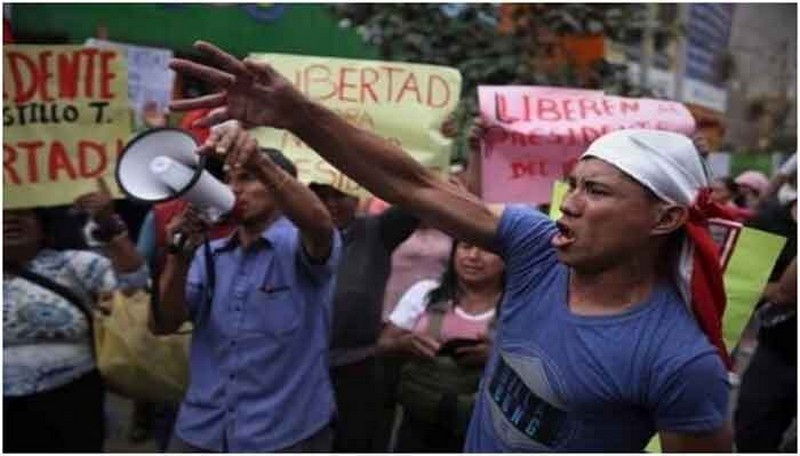
People’s mobilizations in Peru continued Tuesday in many areas. The protesting people reiterated the demand for the closure of Congress, the release of former President Pedro Castillo, resignation of acting President Dina Boluarte and the holding of new elections.

Citing community media, a teleSUR report said:

Protests that have taken place in Peru included Plaza San Martin, downtown Lima (capital), Lambayeque, Cusco, Ica, Tacna, and other regions.

The Ombudsman’s Office rectified the number of deaths after the National Police repression of the demonstrations. It indicated that a total of six deaths had been confirmed so far.

“The Ombudsman’s Office wishes to inform the public that there are six and not seven people dead in the context of the protests taking place in the country,” the agency said, adding that among the victims are two teenagers.

During the last days of demonstrations, many sections of the people have denounced police repression against peaceful protests.

teleSUR’s correspondent in Jaime Herrera, Peru reported:

The Plaza San Martin, an emblematic venue during demonstrations, “has been taken over by the Police.”

“More than 2,000 police officers are preventing the people who are gathered here from being able to meet inside this square,” he said.

On this day, the Peruvian Judiciary also announced that the Permanent Criminal Chamber of the Supreme Court rejected the appeal presented by former president Castillo against the preliminary detention issued against him for the alleged crime of rebellion.

The crisis in Peru has increased after Congress approved, last December 7, Castillo’s vacancy and swore in Dina Boluarte as the new president.

The measure was executed after Castillo declared the temporary dissolution of Congress, called elections for its renewal, decreed the establishment of an emergency government and a national curfew.

Peru’s President Castillo Says He Will Be Released Wednesday, Even After Judge Denies Appeal

An optimistic statement by Peru’s imprisoned president is likely to give hope to the tens of thousands of largely indigenous demonstrators who’ve taken to the streets since the leader was detained by security forces after attempting to dissolve the country’s extraordinarily unpopular legislature.

The embattled President of Peru, Pedro Castillo, issued a statement insisting he’ll be released Wednesday, even after a judge denied his appeal and demanded the head of state remain in detention amid what’s being widely characterized as a parliamentary coup.

“Compatriots: tomorrow, Wednesday, December 14, seven days have passed since an unjust and abusive detention,” Castillo wrote in a statement published on his Twitter page. “Seven days in which the people have shown me their solidarity and commitment in defense of our government and its future. Tomorrow at 1:42 p.m. I will go free.”

Peru has been rocked by massive demonstrations this week calling for Castillo to be released from jail and for the dissolution of Congress, which currently holds an approval rating of just 10%.

Tensions in the Andean nation continue to grow, with thousands of largely-indigenous protesters having seized major highways – as well as the airport in Arequipa, the second-most populous city in the country.

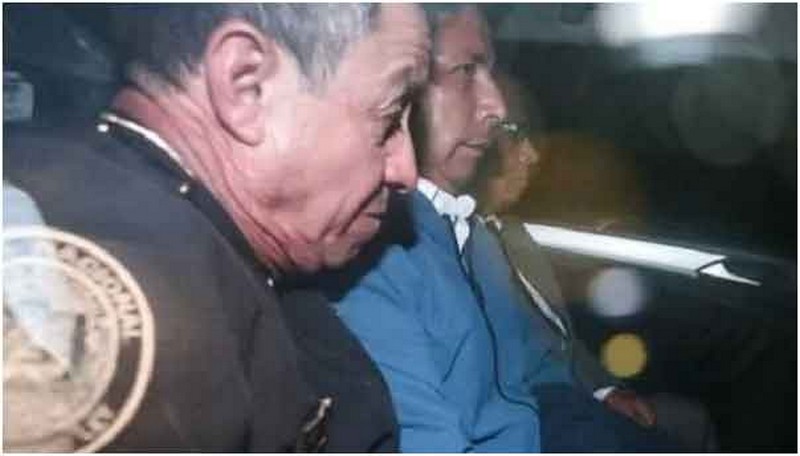
Prosecutors are seeking to sentence Castillo to three years in prison for “the alleged crime of rebellion.” He’s been kept under lock and key since security forces detained him on Dec. 7 after he attempted to head off a third congressional impeachment attempt by dissolving the historically-unpopular legislative body.

The armed forces and police of Peru initially issued an ambiguous statement but subsequently moved to detain Castillo, who was reportedly handed over by his driver to a SWAT team as he sought political asylum at the Mexican embassy.

The U.S. State Department immediately leapt to the defense of the new regime, with Assistant Secretary for Western Hemisphere Affairs Brian A. Nichols writing just a day later that “we applaud Peruvians as they unite in support of their democracy,” and that “the U.S. welcomes President Boluarte and looks forward to working with her administration to achieve a more democratic, prosperous, and secure region.”

But neighboring governments in Argentina, Colombia, Bolivia and Mexico are insisting that Castillo be released, describing the Peruvian president as the victim of “anti-democratic persecution.” On Tuesday, they issued a joint statement expressing their “deep concern” regarding the situation, which they described as an effort to “reverse the popular will expressed with free suffrage.”

The governments called for Castillo’s human rights to be respected, and reiterated that they continue to recognize Castillo as the legitimate president of Peru.

The government of Honduras also expressed alarm at the “serious constitutional breach.” Hours after Castillo was arrested, the Honduran foreign ministry conveyed its “strong condemnation of the coup d’état that took place in Peru,” which it said is “the result of a series of events to erode democracy.”

Police Repression Leaves 7 Peruvians Dead

Another teleSUR report said:

On Monday, the Peruvian police harshly repressed massive protests against President Dina Boluarte and the Congress, leaving seven dead and hundreds injured.

“These have been two very unfortunate days with a balance of seven people dead… two of them were minors. All died as a result of shots,” said Eliana Revollar, the Ombudsman.

“We are asking for the investigation of these cases, which are really useless deaths because this would not have happened if the decisions had been made in due time,” she added, emphasizing that the Peruvian crisis needs a political solution.

The most violent clashes are taking place in the south of the country, specifically in the departments of Arequipa and Apurimac, which have become the epicenter of protests.

In Andahuaylas, the demonstrators attacked 14 police stations and one police headquarters, where the troops were attacked with hunt-made explosives.

In Lima, citizens attacked the headquarters of the Public Ministry and the facilities of the America and Panamericana television channels.

In an attempt to control the social upheaval, Boluarte decreed a 60-day state of emergency on Monday in seven provinces of Apurimac. Her decision suspends constitutional rights related to the inviolability of the home, freedom of transit through the territory, freedom of assembly, and personal freedom and security.

The protests began on Dec. 7 when Congress appointed Boluarte as president after removing Pedro Castillo, who is being held in a prison accused of rebellion and conspiracy.

Farmers, Indigenous peoples, and students announced a national strike that will begin on Tuesday to demand the closure of Congress and the start of a constituent process.

Only 10% of Peruvians Approve The Congress An earlier report said:

On November 27, the results of the Institute of Peruvian Studies (IEP) show: 86% of the people in Peru disapprove performance of the Congress of the Republic. This means that only 10% approve and the rest do not know or have an opinion.

In addition, it was learned that José Williams, president of Parliament, also surpasses Pedro Castillo in negative perception. 68% of the country disapproves of his performance. Only 14% approve.

A few weeks ago, parliamentarian  Norma Yarrow  spoke loud and clear about her position and indicated to the media that she agrees that new presidential elections should be held in Peru.

“We want there to be new elections, for everyone to leave with the changes to the Constitution that there must be and new elections. We need peace in this country,” the legislator told RPP Noticias.

Map Of The Roads And Highways Blocked By The Protesters

The main roads of Peru have been taken over by protesters demanding new general elections. The north, center and south of Peru have registered one of the biggest traffic blockades of the year and the Peruvian National Police (PNP) shared an official report for the country’s residents.

These are more than 8 cities in which road blockades have been registered. In the case of some regions there are up to 10 routes taken by the strikers.

In this sense, Alberto Otárola , Minister of Defense, reported that the National Road Network is declared in emergency  , to ensure the free transit of all Peruvians and so that they can adequately exercise the rights that the constitution guarantees them.

The south of the country is the one with the greatest number of roads intercepted by protesters. Know what they are:

Arequipa

– km. 51 Via Arequipa – Puno.

– km. 617 Chala Caraveli Arequipa.

– km. 900 at the height of Vaso Regulador de Agua, crossing with San Camilo.

– km. 921 and KM 925 from Alto Ingreso to Pedregal.

– km. 966 South Pan-American Highway, intersection with La Joya.

– km. 969 South Pan-American Highway at the height of Leche Gloria.

– KM.782 South Pan-American Highway (Ocoña Bridge).

– km. 907 Majes junction on the Panamericana Sur.

Map of roads blocked in Peru due to strike. (PNP)

The protesters have not only taken the roads , but have also taken over and looted some establishments such as the Gloria Milk Plant. In addition, they set fire to part of the dairy company’s facilities. The same thing happened with a bank branch in Arequipa.

4 Countries’ Joint Statement On The Situation In Peru

Following is the joint statement of the government s of Argentina, Bolivia, Colombia and Mexico:

The governments of the Argentine Republic, the Republic of Colombia, the United Mexican States and the Plurinational State of Bolivia express their deep concern over the recent events that resulted in the removal and detention of José Pedro Castillo Terrones, President of the Republic of Peru.

It is not news to the world that President Castillo Terrones, from the day of his election, was the victim of undemocratic harassment, in violation of Article 23 of the American Convention on Human Rights, “Costa Rica Pact”, approved on November 22 of 1969, to later be subject to judicial treatment in the same way, in violation of article 25 of the aforementioned convention.

Our governments call on all the actors involved in the previous process to prioritize the will of the citizens that was pronounced at the polls. It is the way of interpreting the scope and meanings of the notion of democracy contained in the Inter-American System of Human Rights. We urge those who make up the institutions to refrain from reversing the popular will expressed with free suffrage.

We request that the authorities fully respect the human rights of President Pedro Castillo and that he be guaranteed judicial protection under the terms enshrined in the last cited article.

Countercurrents is answerable only to our readers. Support honest journalism because we have no PLANET B.

14 December 2022

Source: countercurrents.org

The U.S. Egged on the Coup in Peru

By Vijay Prashad and José Carlos Llerena Robles

On December 7, 2022, Pedro Castillo sat in his office on what would be the last day of his presidency of Peru. His lawyers went over spreadsheets that showed Castillo would triumph over a motion in Congress to remove him. This was going to be the third time that Castillo faced a challenge from the Congress, but his lawyers and advisers—including former Prime Minister Anibal Torres—told him that he held an advantage over the Congress in opinion polls (his approval rating had risen to 31 percent, while that of the Congress was just about 10 percent).

Castillo had been under immense pressure for the past year from an oligarchy that disliked this former teacher. In a surprise move, he announced to the press on December 7 that he was going to “temporarily dissolve the Congress” and “[establish] an exceptional emergency government.” This measure sealed his fate. Castillo and his family rushed toward the Mexican Embassy but were arrested by the military along Avenida España before they could get there.

Why did Pedro Castillo take the fatal step of trying to dissolve Congress when it was clear to his advisers—such as Luis Alberto Mendieta—that he would prevail in the afternoon vote?

The pressure got to Castillo, despite the evidence. Ever since his election in July 2021, his opponent in the presidential election, Keiko Fujimori, and her associates have tried to block his ascension to the presidency. She worked with men who have close ties with the U.S. government and its intelligence agencies. A member of Fujimori’s team, Fernando Rospigliosi, for instance, had in 2005 tried to involve the U.S. Embassy in Lima against Ollanta Humala, who contested in the 2006 Peruvian presidential election. Vladimiro Montesinos, a former CIA asset who is serving time in a prison in Peru, sent messages to Pedro Rejas, a former commander in Peru’s army, to go “to the U.S. Embassy and talk with the embassy intelligence officer,.” to try and influence the 2021 Peruvian presidential election. Just before the election, the United States sent a former CIA agent, Lisa Kenna, as its ambassador to Lima. She met Peru’s Minister of Defense Gustavo Bobbio on December 6 and sent a denunciatory tweet against Castillo’s move to dissolve Congress the next day (on December 8, the U.S. government—through Ambassador Kenna—recognized Peru’s new government after Castillo’s removal).

A key figure in the pressure campaign appears to have been Mariano Alvarado, operations officer of the Military Assistance and Advisory Group (MAAG), who functions effectively as the U.S. Defense attaché. We are told that officials such as Alvarado, who are in close contact with the Peruvian military generals, gave them the greenlight to move against Castillo. It is being said that the last phone call that Castillo took before he left the presidential palace came from the U.S. Embassy. It is likely he was warned to flee to the embassy of a friendly power, which made him appear weak.

Vijay Prashad is an Indian historian, editor, and journalist.

José Carlos Llerena Robles is a popular educator, member of the Peruvian organization La Junta, and representative of the Peruvian chapter of Alba Movimientos.

14 December 2022

Source: countercurrents.org

Messi’s Goals Are Many and Life Saving

By Dr César Chelala

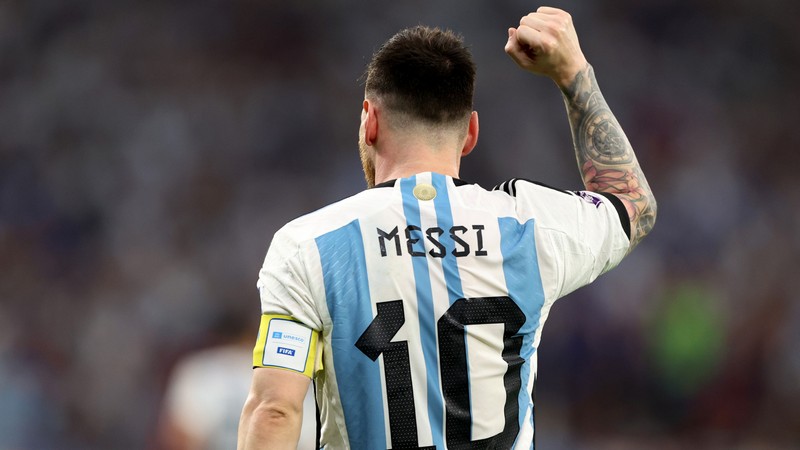
When he was a child in his hometown of Rosario, Argentina, Lionel Messi was nicknamed “La Pulga” (the flea) because of his short stature. This didn’t stop him from starting to play soccer since he was five years old. In 2004, when Kobe Bryant, the famous basketball player visited his friend Ronaldinho, considered one of the best soccer players in the world, he told Bryant, “Kobe, I want you to meet the player who is going to be the greatest soccer player who ever lived.” He didn’t know that his words would be prophetic.

In 1998, when he was eleven, Messi was diagnosed with Growth Hormone deficiency, a treatment that his parents couldn’t afford. Carles Rexach, sporting director of FC Barcelona, saw him play in Argentina and immediately offered to pay all his medical bills if he and his family would to start a new life in Barcelona. Messi traveled to Barcelona, Spain, with his father, leaving his mother in Rosario, Argentina, to take care of his brothers.

It wasn’t easy for Messi to adapt to this new environment, where he felt isolated from his teammates who made fun of him for being so short and not speaking Catalan, the language of Barcelona. “My teammates were big, rough and kind of assholes. They didn’t really pay attention to me, they would speak Catalan among themselves,” he said in the TV series Sin Cassette. “I cried a lot. I would lock myself in my room and cry my eyes out in secret. I didn’t want my dad to find out,” quoted Guillem Balagué, author of “Messi: The Biography”.

Despite these initial problems, he gradually adjusted, becoming the most successful player in his club’s history. And these childhood adversarial events not only strengthened his resolve to become a very good player, but also to devote part of his earning to improve children’s lives.

In 2007, he established the Leo Messi Foundation based in Rosario, a charity aimed at helping children in crisis situations to gain access to better health and education. It is his way of expressing gratitude for overcoming his own childhood health problems. During an interview Messi said, “Being a bit famous now gives me the opportunity to help people who really need it, particularly children.”

Messi’s foundation supports sick Argentine children by allowing them to get paid for treatment in Spain, covering hospital, round-trip transportation from Argentina and recovery costs. He also pays for Argentinian doctors to be trained in Spain in special fields of research and donates money to pay doctors’ salaries and to rebuild a children’s hospital in Rosario.

Since 2004, he has been collaborating with UNICEF (United Nations Children’s Fund). In March 2010, Messi became its Goodwill Ambassador, where he has continued his work in support of vulnerable children. Four months after becoming that organization’s ambassador, he carried out a mission to Haiti, where he helped raise public awareness to the plight of that country’s children, after a devastating earthquake that ravaged the country. In addition, he has participated in UNICEF’s campaigns to prevent HIV/AIDS, and promote education and the social inclusion of disabled children.

As a result of the war in Syria more than a million children were out of school and millions more were at risk of dropping out. The Messi foundation collaborated with UNICEF in building fully furnished classrooms so that 1,600 children affected by the war in Syria could continue their educational activities.

The work of the foundation in Mozambique is also remarkable. Mozambique is one of the poorest countries in the world. On health-related missions to that country, I was able to see that children in remote areas often have high rates of malnutrition and must walk several miles to attend school, where they arrive hungry. Through a program called “Programa de Desayuno Escolar” (School Breakfast Program) funded by Messi’s foundation, children are fed when they arrive at school and before they go to class. This also lowers the rate of absenteeism, which is elevated in some rural areas, and is often caused by children being weak by lack of food.

The program started in three schools, but there are now 40 schools receiving aid, plus three kindergartens and three orphanages, benefiting 15,000 children. Pregnant women and some sick adults unable to eat solid food have been added to the program. As a result, more children are now coming to school from deprived areas which have been negatively affected by climate change. Thanks to Messi’s program, children not only are better fed, but they also have improved physical growth and intellectual development.

In addition to other projects, the Lionel Messi Foundation and the Stavros Niarchos Foundation funded the creation of the Pediatric Center at Sant Joan de Déu Children’s Hospital in Barcelona, which was inaugurated on June 16, 2022. The Center treats children and adolescents with cancer, while at the same time conducts research to find more effective treatment for them through an integration of its research and medical teams.

Throughout his professional career Messi has proven to be a remarkable person. Considered by many experts as the best soccer player in history, he is not only the most recognizable face of soccer worldwide. He is a kind man whose humanitarian work improves health and brings food and hope to thousands of disadvantaged children.

Dr. César Chelala is an international public health consultant, co-winner of an Overseas Press Club of America award and two national journalism awards from Argentina.

13 December 2022

Source: countercurrents.org

How British Colonialism Killed 100 Million Indians in 40 Years

By Dylan Sullivan and Jason Hickel

Recent years have seen a resurgence in nostalgia for the British empire. High-profile books such as Niall Ferguson’s Empire: How Britain Made the Modern World, and Bruce Gilley’s The Last Imperialist, have claimed that British colonialism brought prosperity and development to India and other colonies. Two years ago, a YouGov poll found that 32 percent of people in Britain are actively proud of the nation’s colonial history.

This rosy picture of colonialism conflicts dramatically with the historical record. According to research by the economic historian Robert C Allen, extreme poverty in India increased under British rule, from 23 percent in 1810 to more than 50 percent in the mid-20th century. Real wages declined during the British colonial period, reaching a nadir in the 19th century, while famines became more frequent and more deadly. Far from benefitting the Indian people, colonialism was a human tragedy with few parallels in recorded history.

Experts agree that the period from 1880 to 1920 – the height of Britain’s imperial power – was particularly devastating for India. Comprehensive population censuses carried out by the colonial regime beginning in the 1880s reveal that the death rate increased considerably during this period, from 37.2 deaths per 1,000 people in the 1880s to 44.2 in the 1910s. Life expectancy declined from 26.7 years to 21.9 years.

In a recent paper in the journal World Development, we used census data to estimate the number of people killed by British imperial policies during these four brutal decades. Robust data on mortality rates in India only exists from the 1880s. If we use this as the baseline for “normal” mortality, we find that some 50 million excess deaths occurred under the aegis of British colonialism during the period from 1891 to 1920.

Fifty million deaths is a staggering figure, and yet this is a conservative estimate. Data on real wages indicates that by 1880, living standards in colonial India had already declined dramatically from their previous levels. Allen and other scholars argue that prior to colonialism, Indian living standards may have been “on a par with the developing parts of Western Europe.” We do not know for sure what India’s pre-colonial mortality rate was, but if we assume it was similar to that of England in the 16th and 17th centuries (27.18 deaths per 1,000 people), we find that 165 million excess deaths occurred in India during the period from 1881 to 1920.

While the precise number of deaths is sensitive to the assumptions we make about baseline mortality, it is clear that somewhere in the vicinity of 100 million people died prematurely at the height of British colonialism. This is among the largest policy-induced mortality crises in human history. It is larger than the combined number of deaths that occurred during all famines in the Soviet Union, Maoist China, North Korea, Pol Pot’s Cambodia, and Mengistu’s Ethiopia.

How did British rule cause this tremendous loss of life? There were several mechanisms. For one, Britain effectively destroyed India’s manufacturing sector. Prior to colonisation, India was one of the largest industrial producers in the world, exporting high-quality textiles to all corners of the globe. The tawdry cloth produced in England simply could not compete. This began to change, however, when the British East India Company assumed control of Bengal in 1757.

According to the historian Madhusree Mukerjee, the colonial regime practically eliminated Indian tariffs, allowing British goods to flood the domestic market, but created a system of exorbitant taxes and internal duties that prevented Indians from selling cloth within their own country, let alone exporting it.

This unequal trade regime crushed Indian manufacturers and effectively de-industrialised the country. As the chairman of East India and China Association boasted to the English parliament in 1840: “This company has succeeded in converting India from a manufacturing country into a country exporting raw produce.” English manufacturers gained a tremendous advantage, while India was reduced to poverty and its people were made vulnerable to hunger and disease.

To make matters worse, British colonisers established a system of legal plunder, known to contemporaries as the “drain of wealth.” Britain taxed the Indian population and then used the revenues to buy Indian products – indigo, grain, cotton, and opium – thus obtaining these goods for free. These goods were then either consumed within Britain or re-exported abroad, with the revenues pocketed by the British state and used to finance the industrial development of Britain and its settler colonies – the United States, Canada and Australia.

This system drained India of goods worth trillions of dollars in today’s money. The British were merciless in imposing the drain, forcing India to export food even when drought or floods threatened local food security. Historians have established that tens of millions of Indians died of starvation during several considerable policy-induced famines in the late 19th century, as their resources were syphoned off to Britain and its settler colonies.

Colonial administrators were fully aware of the consequences of their policies. They watched as millions starved and yet they did not change course. They continued to knowingly deprive people of resources necessary for survival. The extraordinary mortality crisis of the late Victorian period was no accident. The historian Mike Davis argues that Britain’s imperial policies “were often the exact moral equivalents of bombs dropped from 18,000 feet.”

Our research finds that Britain’s exploitative policies were associated with approximately 100 million excess deaths during the 1881-1920 period. This is a straightforward case for reparations, with strong precedent in international law. Following World War II, Germany signed reparations agreements to compensate the victims of the Holocaust and more recently agreed to pay reparations to Namibia for colonial crimes perpetrated there in the early 1900s. In the wake of apartheid, South Africa paid reparations to people who had been terrorised by the white-minority government.

History cannot be changed, and the crimes of the British empire cannot be erased. But reparations can help address the legacy of deprivation and inequity that colonialism produced. It is a critical step towards justice and healing.

Dylan Sullivan Adjunct Fellow in the School of Social Sciences, Macquarie University

Jason Hickel Professor at the Institute for Environmental Science and Technology (ICTA-UAB) and Fellow of the Royal Society of Arts

19 December 2022

Source: www.transcend.org