Just International

In memory of Shadia Abu Ghazaleh on 75th birth anniversary who was first female martyr of Popular Front for the Liberation of Palestine

By Harsh Thakor

Shadia Abu Ghazaleh was born in Nablus on January 8, 1948, and educated in Nablus. She joined George Habash’s Arab Nationalist Movement as a young woman in 1964, in pursuit of the liberation of Palestine and the Arab homeland. We commemorated her 75th birthday 5 days ago.

The tenacity and death defying courage in the life of Shadia Abu Ghazaleh is an illustration of the resistance and relentless spirit of Palestinian women. Abu Ghazaleh studied at Ein Shams University in Cairo before returning to Nablus following the occupation of the West Bank in the 1967 six day war. There, she joined a local branch of the Popular Front for the Liberation of Palestine becoming one of the original members after the organisation was founded in 1967. (The PFLP was founded on December 11, 1967 from the Arab Nationalist Movement).

Abu Ghazaleh organised and led women’s military units and was one of the first Palestinian women to participate in military resistance after the 1967 occupation. She was also deeply devoted to education and political struggle treating it as an integral part of revolution. She had firm conviction in collective and organised work and emphasised the role of culture, politics, and strategy in directing armed struggle. She knitted together and led women’s military units and was one of the first Palestinian women to participate in military resistance after the 1967 occupation. Shadia Abu Ghazaleh succumbed on November 28, 1968 as she prepared a bomb in her home for a military operation against the occupation.

She became the first female martyr of the Popular Front for the Liberation of Palestine.

Today, her name is permanently embedded in the annals as a struggler, a pioneering women leader, and a fighter in the history of the Palestinian people and the people of the world. Her spirit still shimmers, like an inextinguishable flame. She manifested what distinguished a revolutionary from an ordinary person. People like her have to be reborn when Zionism is posing the most mortal threat to mankind .Her spark still shimmers to plant seeds for new lotuses to bloom to liberate the Palestinian people. Today in times of greater adversity, it is all the more challenging a task to confront the poisonous weeds or enemy.

Two schools have been named in her memory: the Shadia Abu Ghazaleh School for Girls in Gaza and the Shadia Abu Ghazaleh High School for Boys in Jabalia.

Women have long been in the vanguard of this century of resistance, flinging rocks at tanks in the ‘intifada’ uprisings, forming groups like the Palestinian Federation of Women’s Action Committee, commandeering commercial planes like Leila Khaled and Therese Halasa, slapping soldiers like Ahed Tamimi after her cousin was shot by Israeli forces. The decades long struggle of the Palestinian liberation poses a challenge not only Israel occupation and racism, but British imperialist ambitions to divide, exploit and occupy the Middle East.

Historical Background

For over 100 years, the Palestinian people have resisted imperialism and Zionism. The 1916 Sykes-Picot accord drawn up between Britain and France divided the Middle East between the two imperialist powers and allowed Britain ‘definite and exclusive control over Palestine’. The Balfour declaration of 1917 saw British Foreign Secretary, Arthur Balfour, sign a letter addressed to Lord Rothschild, a leader of the Zionist Federation in Britain, expressing support for the establishment in Palestine of a Zionist homeland. In 1920, the League of Nations granted Britain a mandate over Palestine. Britain agreed to allow 16,500 settlers to enter Palestine each year, implementing an economic system of ethnic cleansing and apartheid. Britain mercilessly suppressed the Great Palestinian Uprising and General Strike of 1936 to 1939 with bombs, dynamite and raids.  A British Settlement Police was formed which was morally a Zionist militia, armed and trained by the British. The settlement police formed the core of today’s Israeli army. When Israel was officially created in 1948 on 72% of the historic land of Palestine, over half of the Palestinian population were forced to flee to Jordan, Lebanon and beyond.

Today, British and US political, social and economic support, patronise the Israeli state. Britain exports over £220million worth of arms to Israel in its occupation of Palestine, whilst buying significant military technology from Israel that has been ‘battle tested’ on the Gaza strip. Imperialist Britain has spearheaded the attack on the Palestinian right to self-determination.

Abbas Fatah message

Abbas’s Fatah movement sent Abu Ghazaleh the movement’s “love” and called her a “heroine.” Marking the 50th anniversary of her death, Fatah stated that she is among those whoguide our path,” and honoured her for being an “uncompromising and merciful young woman, who sacrificed herself for her great family”:

Fatah’s posted text:Shadia took part in a bombing operation of an Israeli bus, and also took part in and even led a number of military operations. However, fate desired that when our heroine was at her home preparing a bomb to detonate on the occupation in Tal Al-Rabia ) it blew up in her hands and she died as a martyr (Shahida) …

Today, we send all of our love to Shadia, who would repeat: ‘If I fall, take my place, my comrade in the struggle’ … She and those like her guide our path… who sacrificed herself for her great family at the expense of the childhood dreams that were within her, in order to tell us: ‘Continue.’ ” In honouring the terrorist bomb-maker, Fatah is following the Palestinian Authority Ministry of Education, who thinks so highly of Abu Ghazaleh that it has named two schools after her.

Palastenian Media Watch has documented that young girls who studied in one of the schools named after Abu Ghazaleh viewed her as their idol or role model.

Q and  A of TV  Interview

PA TV host: “What do you know about Shadia Abu Ghazaleh, you study in a school named after her?”

Girl 1: “Shadia Abu Ghazaleh is a model of the patriotic woman ”

Girl 2: “She was a model of the wonderful female Palestinian fighter. We follow her path in this school.”

Girl 3: “We’re happy that our school is named after a very well-known Martyr, who played a role and who did something great.”

Girl 4: “The school is named after her to commemorate her … and encourage people to be like her.”

Girl 5: “Shadia was a model for us and will remain a model for us and we will follow her path.” [Official P.A. TV, Dec. 5, 2013, rebroadcast on Dec. 9, 2013]

The students are certain that they are upholding a bomb-maker as their role model, because a mural with Abu Ghazaleh’s face and biography appears prominently on a school wall

Harsh Thakor is a freelance journalist

13 January 2023

Source: countercurrents.org

Time for Action is Now: What Will Happen after the ICJ Delegitimizes Israel’s Occupation of Palestine

By Dr Ramzy Baroud

Once more, the International Court of Justice (ICJ) will offer a legal opinion on the consequences of the Israeli Occupation of Palestine.

A historic United Nations vote on December 31 called on the ICJ to look at the Israeli Occupation in terms of legal consequences, the rights of the Palestinian people to self-determination and the responsibility of all UN Member States in bringing the protracted Israeli Occupation to an end. A special emphasis will be placed on the “demographic composition, character and status” of Occupied Jerusalem.

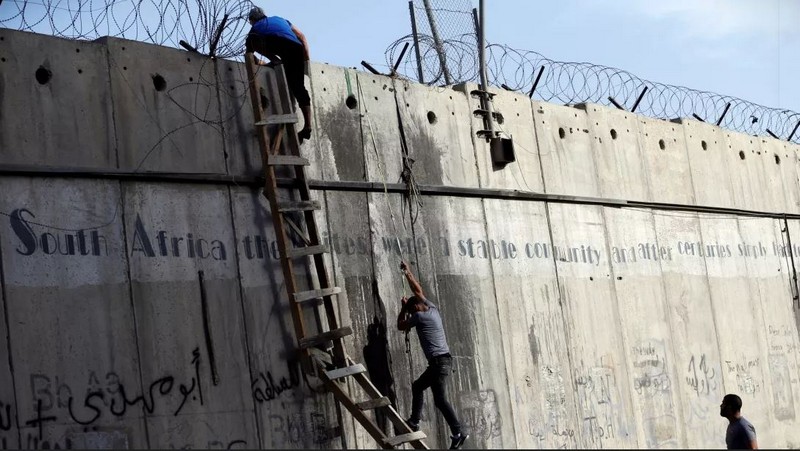
The last time the ICJ was asked to offer a legal opinion on the matter was in 2004. However, back then, the opinion was largely centered around the “legal consequences arising from the construction of the (Israeli Apartheid) wall.”

While it is true that the ICJ concluded that the totality of the Israeli actions in the Occupied Palestinian Territories are unlawful under international law – the Fourth Geneva Convention, the relevant provision of the earlier Hague Regulations and, of course, the numerous UN General Assembly and Security Council Resolutions – this time around the ICJ is offering its view on Israel’s attempt at making what is meant to be a temporary military Occupation, a permanent one.

In other words, the ICJ could – and most likely will – delegitimize every single Israeli action taken in Occupied Palestine since 1967. This time around, the consequences will not be symbolic, as is often the case in UN-related decisions on Palestine.

Israeli Prime Minister Benjamin Netanyahu, who has done more than any other Israeli leader to ‘normalize’ the Israeli Occupation of Palestine, was understandably angry following the UN vote, describing it as ‘despicable’.

His other coalition partners were equally intransigent.

The Israeli “Occupation of (the) West Bank is permanent and Israel has the right to annex it,” said Knesset Member Zvika Fogel, during an interview on January 1 with Israeli Radio 103FM.

More than anything else, Fogel’s words encapsulate the new reality in Israel and Palestine. Gone are the days of political ambiguity regarding Israel’s ultimate motives in the Occupied Territories.

Indeed, Israel is now trying to manage a whole new phase of its colonial project in Palestine, an endeavor that began in earnest in 1947-48 and, in Israel’s own calculation, is about to end with the total colonization of Palestine – Israel’s version of a ‘one-state solution’ that is predicated on apartheid and racial discrimination.

Fogel, whose party, Otzma Yehudit, is an important member of Netanyahu’s new rightwing coalition, does not reflect his personal views or those of his ideological camp alone.

The new government, packed with extremists, the likes of Bezalel Smotrich, Itamar Ben-Gvir and Yoav Galant, among others, is now committed to an anti-peace agenda as a matter of policy. As soon as the new government was sworn in on December 28, it announced that “the government will advance and develop settlements in all parts of Israel”.

Ben-Gvir, whose raid of Al-Aqsa Mosque in Occupied East Jerusalem raised much criticism worldwide, is sending clear messages to Palestinians and the international community at large: as far as Israel is concerned, no international law is relevant, nothing is sacred and no inch of Palestine is off limits.

This time, however, it is not business as usual.

Yes, Israel’s territorial expansion at the expense of Occupied Palestine has been the common denominator among all Israeli governments in the last 75 years; but various Israeli governments, including that of Netanyahu’s early cabinets, found indirect ways to justify illegal settlement constructions. So-called ‘natural expansion’ and ‘security’ needs were some of the many pretexts furnished by Israel to justify its constant push for land acquisition by force.

Practically, none of this would have been possible if it were not for the inexhaustible United States support of Israel – financially, militarily and politically. Moreover, US vetoes at the UNSC and the relentless pressure on UNGA members allowed Israel to circumvent international law unscathed. The outcome is today’s tragic reality.

According to the official UN news website, there are currently nearly 700,000 illegal Jewish settlers. The Israeli NGO ‘Peace Now’ says that these Jewish settlers live in 145 illegal colonies in the Occupied West Bank, in addition to 140 settlement outposts, many of which are likely to be made official by the new government.

In fact, the Netanyahu-led alliance has been formulated with the understanding that the outposts would be legalized in the future, thus receiving official government funding. This should not pose a major political problem for Netanyahu, who, in 2020, had succeeded in selling the idea to the Israeli Knesset of annexing much of the West Bank and is now determined to carry out a process of ‘soft annexation’ – a de-facto annexation that is likely to become legalized as a de jure annexation later on.

Nor would the full colonization of Palestine prove to be a legal problem. Israel’s Nation-State Law of 2018 has already provided the legal cover for Tel Aviv to flaunt international law and to do as it pleases in terms of colonizing all of Palestine and marginalizing all of the Palestinian rights. According to Israel’s new Basic Law, “the State of Israel is the nation-state of the Jewish People in which it realizes its natural, cultural, religious and historical right to self-determination”. It was this particular reference that was cited in the new government’s statement on December 29.

And there are not many in Israel who are protesting this. In a recent article in the Palestine Chronicle, Israeli historian Ilan Pappe explains how the current socio-political formations of Israeli society make it nearly impossible for alternative mainstream politics to emerge, aside from the three dominant rightwing and extremist currents at work in the Netanyahu coalition: Ultra-Orthodox Jews, National Religious Jews and Likud’s secular Jews.

This means that change in Israel could never come from Israel itself. While Palestinians continue to resist, Arab and Muslim governments, and the international community at large must confront Israel, using all means available to end this travesty.

The ICJ’s opinion is very important, but without meaningful action, a legal opinion alone will not reverse the sinister reality on the ground in Palestine, especially when this reality is bankrolled, supported and sustained by Washington and Israel’s other western allies.

Dr. Ramzy Baroud is a journalist, author and the Editor of The Palestine Chronicle.

12 January 2023

Source: countercurrents.org

Beyond Geopolitics: Re-Examining Russia’s BRICS Relationship

By Lucas Dias Rodrigues dos Santos

20 Dec 2022 – Despite frequent skepticism, the BRICS have come a long way. From a loose label given by investment bankers to four emerging economies in 2001 (Brazil, Russia, India and China), to a semi-formal group (adding South Africa in 2010). True, the differences between these five states have often hindered them from acting in concert; but they have still deepened their relationship with regular meetings at all levels (from leaders’ summits to scientific cooperation), and jointly-run institutions (such as a multilateral development bank, the NDB). This year a variety of countries, from Argentina to Iran, applied to join. But what does Russia get out of it – especially now?

Economic ties between its members have certainly increased, but still remain modest; so the explanation is often attributed to geopolitical clout. Bobo Lo, for example, argued in 2015 that “what is most important to the Kremlin is the imagery of BRICS summitry.” This is because , first, “[it reaffirms] – to the leadership, the Russian public, and a wider international audience – that Russia naturally belongs to the global elite”; and, second, it “[conveys] that Russia is part of the dynamic group of ascendant powers, in contrast to a decaying and discredited West.” This is a common thread in the literature, with Alexander Sergunin terming this a “soft power” strategy, and André Gerrits a “brand-strengthening” one. This certainly was observable as this last June’s BRICS Summit, which a major Indian outlet remarked “was the first meeting of such a grouping including Russian President Vladimir Putin since the invasion of Ukraine – giving the message that Russia is not isolated” – a framing echoed by the Wall Street Journal, among others.

Such a view endorses one side of a scholarly and policy debate – that Russia’s overall behavior is motivated more by status-assertion than security-maximizing. The latter refers to a more rationalist and materially-grounded conception of safeguarding territorial integrity, and the survival of the Russian polity itself. This is not an abstract distinction, and has direct policy implications, as Olivier Schmitt argues: security motivations can be assuaged through “cooperation mechanisms . . . from exchanges of information to arms control agreements”; meanwhile, “status concerns are relational and often satisfied at the expense of other actors.”

This point is all the more relevant now, as policymakers still struggle to decide how best to handle relations with Russia as its war on Ukraine impacts the entire world. In this sense, Russia’s continued and firm commitment to the BRICS project reinforces the status-seeking thesis, and can help states calibrate their approach to this area accordingly. Yet, however useful this distinction might be, stopping one’s analysis here leaves too many potentially crucial factors on the table. A fundamental point cited by Lo above, “the Russian public,” hints at a world of further possibility—but it is left undeveloped.

This is all the more relevant because, if status-asserting abroad is Russia’s chief aim with the BRICS, then its success is highly debatable. The aforementioned Summit might have signalled Russia’s relative non-isolation, but its outcome document still did not explicitly mention the US nor its sanctions regime, as Vladimir Putin and Xi Jinping’s speeches had days before; which can be read as a sign that other members pushed to water it down. Regarding sanctions, even Chinese and Indian banks, as well as the China-led Asian Infrastructure Investment Bank and the BRICS’ own NDB, have suspended lending to Russia. Similarly, the BRICS’ reserve-pooling mechanism, the Contingency Reserve Agreement, has not come to Russia’s aid.

It is true that, in March, India, China and South Africa abstained on a UN General Assembly resolution condemning Russia’s invasion of Ukraine, with only Brazil voting in favor. But this is still less support than Russia saw from them in 2014, when all the other BRICS abstained from UN votes condemning its annexation of Crimea, and used much more direct and more supportive language on the matter. Even China, the BRICS member with the least equivocal (but still less than full-throated) rhetoric toward Russia, has still shown a willingness to express “questions and concerns” to Putin about the conflict, as he admitted.

Thus, rather than gaining status, Russia’s own peculiar decisions (such as invading Ukraine) are tied to its decreasing reputational dividends even among this relatively friendly group. Must it be so? Rachel Salzman’s 2019 book BRICS and the Disruption of Global Order adds to the discussion by historicizing it – that is, Russia’s BRICS strategy has significantly varied over time. Salzman argues that Russia used the group first as a “bridge” to the West, then, more recently, as a “bulwark” against it. The “bridge” phase was a part of the country’s relative turn to the West during Dmitri Medvedev’s presidency (2008–12), “nested within a firm argument that Russia is an integral part of the Euro-Atlantic world.”

This began to change when Putin returned to the presidency, and even more so after 2014. Such a dimension helps to avoid the sort of essentialism that can affect both a rational security-maximizing and status-sensitive approach, if overly focused on external, geopolitical forces. However, Salzman claims that Putin’s rationale for choosing more West-friendly Medvedev as president “remains unknown.” This returns us to the importance of the domestic sphere in shaping status concerns in the first place.

Alexei Tsygankov’s theory of Russian foreign policy, for one, is centered on the interplay between such foreign and domestic dynamics. It holds that the prism which is consistent across all Russian foreign policy regimes is the country’s relationship to the West – identifying with it, defining itself against it – but always something related to it. For example, Tsygankov presents the Mikhail Gorbachev (1985–91) and Medvedev (2008–12) governments, as well as Boris Yeltsin’s first term (1991–96), as periods of relative rapprochement with the West, due to domestic political conjunctures whereby those favoring that approach prevailed in government. In the latter case, Tsygankov argues that the Medvedev pivot was a reaction to the global financial crisis’ impact on the Russian economy, discrediting the ruling orthodoxy and requiring an olive branch to the West. This trans-historical through-line vindicates and reinforces Salzman’s evolutionary argument, and can serve to harmonize the aforementioned status vs security dichotomy – that is, the dominant logic varies over time, depending on the Russian political situation as well as external factors.

Jeanne L. Wilson, in 2019 article on the Russia-China relationship concludes, for example, that “the relationship with China contributes to Russia’s self-identified status as a great power, which functions as a pillar of regime legitimacy for the Putin government.” But Wilson’s more fundamental insight is that “the regime’s commitment to project Russia as a great power to its citizens can often take precedence over tangible foreign policy goals.” Indeed, relying on Russian scholars, media outlets and polls (the latter showing, for example, that 82% of Russians believe preserving their country’s great power status should be a priority), she argues:

The Kremlin’s claim that Russia is a great power, irrespective of international recognition, or a more traditional display of conventional power capabilities, suggests that the projection of great power status to the Russian citizenry is in many ways more important than international recognition.

While Wilson focuses only on one of the BRICS, it is not a stretch to apply this framework to Russia’s relations to its other members, especially considering the aforementioned existing literature’s emphasis on the scarce material as opposed to reputational gains it reaps therefrom. Such an argument deserves engagement, as it turns the usual terms of said literature on their head, and can greatly complement its analysis.

Acknowledging the crucial role of reputational concerns in Russia’s foreign policy has been a significant step in the scholarship, but it can be taken further by historicizing the variations in this behavior, as well as incorporating the multiple layers and audiences that mold it. Doing so also allows scholars and practitioners to gain insights into the vast body of work on Russian politics and society – largely obscured by an overly geopolitical framing. This also has direct policy implications, such as regarding the current war. Conflict scholar Hein Goemans, for example, already makes a probing domestic-foreign connection by arguing that the often-proposed “off-ramp” for Putin to deescalate and potentially cease hostilities neglects audience costs that could involve his own assassination.

As to the BRICS, given that the group is not going away anytime soon (especially with the return of Lula to Brazil’s presidency), and that Russia’s reliance on the group will only increase as this war drags on, anyone wishing to understand this relationship, let alone engage with it, would benefit from this more expansive analytical starting point.

Lucas Dias Rodrigues dos Santos is a PhD candidate at the Geneva Graduate Institute.

16 January 2023

Source: transcend.org

US Threatens African Countries, Demanding to End Relations with Russia

By Lucas Leiroz de Almeida

11 Jan 2023 – Even with the emerging countries several times making clear their solid position of not supporting the sanctions against Russia, the US remains with an absolutely interventionist foreign policy, threatening the states that maintain relations with “blacklisted” nations. Now, South African authorities report that they are being blackmailed by the US because of business that the country maintains with Moscow. More than that, it is reported that across the African continent there are many cases of anti-Russian intimidation, which reveals the high levels of interventionism on the part of Washington.

On January 9th, the Wall Street Journal (WSJ) reported that relations between US and South Africa are tense. The reason for the diplomatic instability would be the fact that last month a South African naval base received a Russian cargo ship sanctioned by Washington, with no public information about the contents inside the vessel. US authorities demand that their African counterparts report details on the cargo contained on the ship, demanding a kind of “justification” for the fact that the country maintains relations with sanctioned Russian companies.

“[Washington is] concerned by the support the South African Armed Forces provided to the ‘Lady R’ (…) There is no publicly available information on the source of the containers that were loaded onto the ‘Lady R’ “, a senior US official told the WSJ – “Lady R” being the term used to refer to the Russian ship.

The lack of information about the ship’s contents makes it difficult to ascertain whether it was bringing Russian products to Africa or transporting African products to Russia. Obviously, the greatest fear of US officials is that Russia and South Africa are strengthening ties of military cooperation. In a statement issued by the South African Minister of Defense Thandi Modise it was said that “whatever contents this vessel was getting were ordered long before Covid”.

Darren Olivier, a consultant at African Defense Review, commented to the WSJ that “South Africa’s defense industry does not generally produce armaments and complete systems that are used by the Russian military”. He claims it is possible that Russia eventually becomes interested in some South African military products such as optics and guidance systems for combat drones, but this does not appear to be the case about the latest “Lady R” expedition.

Olivier believes that most likely the ship was carrying to South Africa some tons of Russian ammunition that had previously been ordered by Pretoria. In 2020, South Africa signed a contract with Russian suppliers valued at more than 500,000 dollars to acquire ammunition. Considering the information that the ship’s contents referred to contracts signed “before Covid”, as the minister said, so it is likely that this was the cargo in December.

Commenting on the topic, Minister Modisa also expressed dissatisfaction with the way in which the US operates its relations with South Africa and other states on the continent. According to her, Washington “threatens Africa, not just South Africa, of having anything that is even smelling of Russia”. Indeed, the US does not seem willing to respect the sovereign foreign policy of African nations, simply ignoring the fact that there is real desire for cooperation with Russia on the part of these states.

In the specific case of South Africa, the American posture is even more serious, since Pretoria and Moscow are both members of the BRICS, maintaining a fundamental strategic alliance that cannot be vulnerable to the decisions taken by the American politicians. The posture of US diplomats in Pretoria in the “Lady R” case shows how Washington still conducts its diplomacy based on coercion. American officials called on the South African authorities to expose the ship’s cargo, simply because in Washington such ship is “blacklisted”.

In fact, American legislation itself allows this type of anti-diplomatic maneuver. There is a law in the US that permits the country to impose sanctions on any entities around the world that contract the services of blacklisted ships, which explains Pretoria’s stance on not disclosing details on the matter. The US wants to find out which South African entities are involved in the transaction in order to impose sanctions on them, which is why the South African state correctly omits the data to protect its domestic entities.

This shows how threat and coercion are not efficient diplomatic mechanisms. The American authorities seem connected to a belligerent logic according to which it is possible to obtain any kind of advantage through violence and blackmail. But the contemporary world goes in another direction. There is a process of transition towards geopolitical multipolarity that cannot be stopped through blackmail.

South Africa did not comply with the anti-Moscow sanctions because they were against its strategic interests. Currently, pragmatism, and not the “need” to please the US, is the parameter that guides the decisions of the states.

Lucas Leiroz de Almeida, researcher in Social Sciences at the Rural Federal University of Rio de Janeiro; geopolitical consultant.

16 January 2023

Source: transcend.org

Israeli Settler Colonialism and Apartheid: Poised for Victory or Defeat?

By Richard Falk

“These are the basic lines of the national government headed by me: The Jewish people have an exclusive and unquestionable right to all areas of the Land of Israel. The government will promote and develop settlement in all parts of the Land of Israel–in the Galilee, the Negev, the Golan, Judea and Samaria.”

— Benjamin Netanyahu, 30 Dec 2022

13 Jan 2023 – Anyone with but half eye open during the last several decades should by now be aware of the existence of an undisclosed Zionist Long Game that preceded the establishment of Israel in 1948,  and remains currently very much alive. It aims at extending Israeli sovereignty over the whole of Occupied Palestine, with the probable exception of Gaza, excluded for demographic and biblical reasons. The significance of Netanyahu’s public affirmation of this previously secretive long game is that it may be reaching its final phase, with him presiding over the far right governing coalition that is poised to pursue closure.

Should it matter that Netanyahu’s claim of exclusive Israel’s supremacy on behalf of the Jewish people over the whole of the promised land is in direct defiance of international law? Additionally, Netanyahu’s statement is also perversely at odds with Biden’s stubborn insistence, however farfetched, on reaffirming U.S. Government support for a two-state solution. This zombie approach to resolving the Israel/Palestine struggle has dominated international diplomacy for years, usefully allowing the UN and its Western members to maintain their embrace of Israel without seeming to throw the Palestinian people under the bus while doing just that. Netanyahu’s brazen avowal of Israeli unilateral expansionism foregoes these earlier diplomatic charades to placate world public opinion to put Israel’s intentions of unilaterally finishing the Zionist Project.

Such a forthright approach challenges the UN, the Palestinian Authority, the Palestinian people, governments around the world, and transnational civil society to open both eyes and finally acknowledge that the two-state solution is dead. This does not mean giving up on a peaceful solution based on political compromise, but it does suggest shifting such hopes from two-state proposals to a single unified confederal, secular state with coexisting dual homelands for the two peoples based on equality of ethnic entitlements to Palestine as often conceived from ‘the river to the sea.’ Such a state would have a single governance structure upholding the fused sovereign rights of a post-Zionist, presumably renamed, state premised upon equal citizenship and human rights for Jews and Palestinians.

In fairness, it is true that this Zionist Long Game has only recently become fully apparent to all but the closest observers of the struggle. Throughout the 20th century this design of progressive expansionism was hidden from public view by a combination of Israeli control over the public narrative and U.S. complicity, which deceived especially diaspora Zionists by assuming that Israel was open to a political and territorial compromises and that it was the Palestinians who were mainly responsible for the failures to accept reasonable diplomatic proposals prefiguring Palestinian statehood. Such an interpretation of the stalemate was always deeply mistaken because it underestimated Israel underlying ambitions.

The Zionist Project from its very beginnings, more than a century ago, proceeded by stages to accept as final whatever was politically attainable at any given time, before moving quietly and quickly on to the next stage in fulfillment of its long-range colonization plans. Zionism never convincingly gave up its guiding commitment to establish a Jewish state that exercised sovereign control over the whole of ‘the whole of the promised land,’ itself a misleadingly precise reading of Judaic biblical tradition that could be concretized in any way that the Israeli leadership preferred.

This pattern of expansionist priorities should have become evident in the periods following the Balfour Declaration of 2017 and after World War II. The infamous colonial Declaration had pledged British support for ‘a national home for the Jewish people’ in Palestine. This pledge was made credible during the British mandatory period by accommodating ballooning Jewish immigration, which coincided with the rise of antisemitic fascism, most visibly in Nazi Germany, but extending to much of the rest of Europe.

After World War II came the UN partition resolution (UNGA Res. 181, 1947), which not only ignored Palestinian rights of self-determination by partitioning the country without a prior referendum, changing the status of the Jewish presence from ‘national home’ within the state of Palestine to a sovereign Jewish state on fully half of Palestinian territory, and then failing to take effective responsibility for implementing the portions of the UN proposals more favorable to Palestinians. This internationally devised ‘solution’ was greeted positively at each stage by the Zionist formal leadership, but rejected by representatives of the Palestinian people and by neighboring Arab governments.

This regional rejectionism led directly to the 1948 War, which resulted in the catastrophic dispossession of an estimated 750,000 Palestinians, known to its victims as the nakba, ending with a ceasefire that increased Israel’s share of Palestine from 55% to 78%. The dispossession of such a large number of Palestinians was integral to the Zionist commitment to make Israel not only Jewish but democratic.

It was understandably thought insecure to suppose that Israel could remain an ethnic democracy without a substantial Jewish demographic margin, and this could not be obtained except by dispossession, by coercive means to the extent necessary. From early on, Zionist zealots believed it desirable for security and nation-building to work toward a Jewish Only state, and that goal may resurface in the months ahead, not only to achieve ethnic purity, but to quell worries about Palestinian ‘demographic bomb.’

The next step in carrying forward the Zionist Project resulted from Israell’s victory in the 1967 War, which drove Jordan out of the West Bank and East Jerusalem (and Egypt from Gaza). II also dispossessed another large number of indigenous Palestinians, a course of events known among Palestinian as the naksa. The 1967 War also resulted in Israel’s prolonged occupation of the territories occupied during the short war, and it was the beginning of an Israeli version of ‘triumphalism,’ which also made converts among foreign political elites in Washington previously worried that full support for Israel would alienate the Gulf oil producers.

The occupation by law and political consensus at the time was expected to be temporary (a matter of a few years at most) but the establishment of many unlawful Jewish settlements encroaching on what had been projected as a coexisting Palestinian state in the West Bank and East Jerusalem strongly suggested that all along Israel’s leadership envisioned permanent arrangements with an end game in mind that did not include viable Palestinian statehood encompassing the West Bank heartland. Israel stalled over the years by complicated demands for border adjustments being agreed upon prior to any withdrawal. And somewhat later on, with a show of temerity, Israel contended that the West Bank was ‘disputed territory’ rather than ‘occupied territory.’

Another strong straw in the wind back in 1967 was Israel immediate declaration and enactment of a sovereign claim over the whole of an enlarged Jerusalem as the ‘eternal capital’ of the Jewish state, signaling its unwillingness to trust an outcome of post-1948 diplomatic negotiations (or to uphold the Jerusalem portion of the UN Partition Plan), which had originally envisioned East Jerusalem as the capital of the co-equal Palestinian state, before backpedaling and accepting the idea of the holy city being divided between the two peoples. This incorporation of Jerusalem into Israel proper was repeatedly rejected by overwhelming votes in the General Assembly, duly ignored by the Israeli government, but again Israel found that it would suffer no adverse consequences by defying international law and General Assembly majorities.

There were many lesser displays of virtuoso salami slicing by Israel of Palestinian rights and expectations in the subsequent 55 years. The Oslo diplomatic process lingered and languished for more than 20 years after the 1993 hyped handshake between Rabin and Arafat on the White House lawn, which was the most notable stunt by Israel along these lines designed to show the world that Israel remained open to achieving a negotiated sustainable peace.

With the benefit of hindsight, it seems clear that in the Israeli strategic imaginary ‘peace’ was never what Oslo was about. The real basis of Israeli support for Oslo, besides satisfying international pressure to manifest a willingness to engage in some semblance of negotiations, was to gain the needed time to make the Jewish settlement movement large and territorially diffuse enough to become irreversible. Such an obvious assault on the two-state mantra should then have sounded the death knell of two-state duplicity, although it was overdue by 40-50 years. Yet the curtain was not lifted then or since.

The continuing international avowal of adherence to a two-state solution, until the present, was mutually convenient for both the Israeli and Palestinian leadership and for friendly foreign governments, and even for the UN that was far too weak to insist on Israeli compliance with international law in the face of Euro-American unwavering refusal to authorize any pushback in the UN Security Council.

Israel’s 2018 Basic Law proclaiming the supremacy of Jews in ‘the promised land of Israel,’ including the whole of the West Bank, moved a giant step closer to revealing the integral goals of the Zionist Project as openly endorsed by Netanyahu to coincide with the swearing in of his fourth go at being the Prime Minister. As argued here, the essential elements of such a project had preceded its public endorsement by more than a century, but for an Israeli head of state to dramatize the commitment as openly was new, and politically of great significance.

Yet, despite this series of monumental successes of this Zionist Long Game is from some perspectives more problematic of completion than it has ever been, strange as such assertions might be regarded from a purely materialist view of politics. The Palestinian people have held firm in their commitment to self-determination throughout, while enduring a century of being tested by large-scale Israeli settler encroachments, as aggravated by Palestinian disunity and inadequate representation at the international level by the quasi-collaborative leadership provided by the Palestinian Authority. The spirit of resistance and struggle has been sustained by a Palestinian deep culture of steadfastness of sumud as reinforced by global solidarity initiatives and a generally supportive global public opinion, as well as by Palestinian resistance and global solidarity, which although sporadic never disappeared.

Additionally, the weight of evolving historical circumstances has enabled the Palestinians to achieve important victories in The Legitimacy War being waged by the two peoples for the control of symbolic and normative spaces in the wider struggle, against all odds, is being won by the Palestinians. Over the course of the last decade the international political discourse has increasingly accepted the Palestinian narrative of Israel as ‘a settler colonial state,’ a damaging assessment in an era where colonialism elsewhere was being dismantled by the weaker side militarily, suggesting the unrecognized leverage of law, morality, global solidarity, and nationalist mobilization in out maneuvering a militarily superior adversary.

My previous comments on this latest, possibly terminal phase, of the Zionist Project, is further illuminated if interpreted through the lens of settler colonialism. As Patrick Wolfe, the leading academic expositor of the concept, and others point out, a settler colonialist undertaking eventually falters and collapses unless it manages to eliminate or at least permanently and radically marginalize and pacify the native population. Settler colonial successes in Canada, the U.S., Australia, and New Zealand confirm this hypothesis as do the most prominent instances of failure, South Africa, and less clearly, Algeria. Given this historical record, I anticipate feverish Israeli attempts in the near future to achieve a further massive dispossession of the Palestinian people. In an important sense, the nakba should be understood as a process rather than an event back in 1948, to be culminated during the 2020s by a new surge of dispossession tactical moves.

Beyond allegations of settler colonialism, and more carefully documented, the accusation of apartheid directed at the Israeli state, which had long dismissed as the irresponsible screams of those that wanted to destroy the Israeli state, became validated by an emergent civil society consensus. Over the course of the last six years exhaustive reports prepared under the auspices the UN (ESCWA), Human Rights Watch, Amnesty International, and even the fiercely independent Israeli NGO, B’Tselem issued reports documenting with care and professional skill the apartheid allegations. As memories of the Holocaust faded and wrongdoing toward Palestinian rights became harder to shove under the rug, world public opinion especially in the West, became somewhat more sympathetic to and convinced by the Palestinian narrative, and as significantly, by the relevance of the South African precedent that became harder to ignore.

Further symbolic Palestinian victories included widespread diplomatic recognition of Palestinian statehood by many governments in the Global South, admission of Palestine to non-voting membership in the UN, access as a state party to the International Criminal Court and its 2021 judgment authorizing the investigation of Palestinian allegations of international crimes in Occupied Palestine after 2014, and at the end of 2022, approval by a wide margin of a General Assembly Resolution requesting an Advisory Opinion from the World Court in The Hague on the prolonged unlawful occupation of Palestinian territories amounting to a deprivation of the Palestinian right of self-determination. T

he 2022 HRC appointment of a high-level Commission of Inquiry with a broad mandate to investigate Israel wrongdoing was also a revealing UN turn in favor of the Palestinians. Such challenges to Israeli administration of the Occupied Palestinian Territories only occurred after decades of UN frustrations arising from Israeli non-compliance with international humanitarian law in the OPT as set forth in the 4th Geneva Convention devoted to belligerent and refusal to cooperate with UNHRC Special Rapporteurs.

Israeli and its puppet NGOs, UN Watch and NGO Monitor, recognized the gravity of these largely symbolic delegitimizing developments, as did the Israeli government. Israel was intelligently responsive to the risks to its own viability as a Jewish Supremacy state by the collapse of the apartheid regime in South Africa due to pressures brought about by a blend of resistance, symbolic delegitimization, and global solidarity initiatives. Accordingly, Israel and its militants fought back, with total support of the U.S. Government, but not substantively, recognizing the costs of bringing about further scrutiny of the substance of Israel’s policies, practices, and racist ideology. Instead, the Israeli push-back focused on attacking the critics and their institutional venues, including even the UN, as antisemitic, and in the process smearing conscientious legal experts and even international civil servants and the institutions themselves.

This has created a sufficient diversionary smokescreen to enable Biden and top EU bureaucrats to keep faith with both sides by championing the hollow prospect of ‘two states for two peoples’ when even they must know by this time that such a policy is moribund, and no longer is of much use as a public relations tactic. This assessment is truer than ever now that an apparently cocky Netanyahu has publicly told foreign political leaders to their faces that Israel no longer is interested enough in the two-state ploy to underpin its credibility. This leaves Israel’s most ardent supporters out in the cold with no place to hide their formerly respectable pro-Israel one-sidedness.

Given this line of interpretation, contrary to media commentary, Netanyahu, rather than being burdened, is likely pleased that his governing coalition is heavily dependent upon the rightest extremism of the Religious Zionism (RZ) and Jewish Power bloc. In the present context RZ, led by Bezalel Smotrich and Itamar Ben-Gvar seems useful, if not natural allies of Likud in launching this culminating phase of the Zionist Project. This last phase involves territorial consolidation over the whole of the promised land and likely moves to inflict further dispossession of Palestinians—on the scale of a second (or intensified) Nakba—from their native lands. Seen in this way, the Netanyahu declaration above amounts to a virtual road map, hopefully from his point of view with RZ taking most of the heat for its inflammatory, openly racist, and likely violent implementation.

Given this background, the present context should be understood differently than the prevailing mode of reporting that stresses the difficulties for Netanyahu of heading the most right-wing and extremist government in the history of Israel. Mainstream journalism remains sympathetic with Netanyahu’s situation of supposedly being forced to rely on a coalition that gives dangerous influence to RZ. In opposition to such thinking, I believe having RZ entrenched in his governing structure actually strengthens the hand Netanyahu wants to play.

It is instructive to notice that most of the regrets up to now expressed in the U.S. about the extremist successes  in the 2022 Israeli elections are devoted to their possibly negative impact on support for Israel in the liberal democracies, especially, among the predominantly secular dominant communities that largely shape  attitudes toward Israel in the European and U.S. Jewish diaspora. The probability of intensifying suffering inflicted on the Palestinians hardly ever is mentioned, and almost never evokes Western empathy. Such slanted presemtations has always slighted the successive stages of the Palestinian collective trauma that has obscured their Orientalist erasures throughout the struggle.

Biden’s undoubtedly unconscious embrace of such Orientalist insensitivity to Palestinian rights, much less acknowledging Palestinian legitimate aspirations should have been expected. The evasive wording of Biden’s statement congratulating Netanyahu, warrants scrutiny: “I look forward to working with Prime Minister Netanyahu, who has been my friend for decades, to jointly address the many challenges and opportunities facing Israel and the Middle East region, including threats from Iran.”

In the same text, the American president asserts that “the United States will continue to support the two-state solution and to oppose policies that endanger its viability or contradict our mutual interests and values.” What struck me most, although by now I should have known better, was the absence of even a small gesture of recognition that these developments might have a negative relevance to Palestinian wellbeing. Often silences convey meanings better than do words of explanation with the hope of winning approval.

Despite all, most pro-Israeli commentary analyzing the shift to the right on the part of the Israeli voting public attributes the extremist outcome in the November elections to some combination of the perceived absence of ‘a partner’ in the search for peace, the Israeli security-first response to Palestinian ‘terrorism,’ the rising influence of the religious right within Israel, the emboldening effects on Israel of the normalization agreements (so-call Abraham Accords) reached in 2020 during the last months of the Trump presidency, and even Iran’s threat to Israel. Undoubtedly, these contextual factors were influential in persuading a larger segment of Israeli voters to swallow their dislike of a governing coalition that gave strong influence to RZ, interpreted in some circles as the foretaste of a now plausible Jewish theocratically-tinged fascism.

Overall, it seems enough Israelis gave priority to their hopes for a unilaterally imposed Israeli ‘victory’ scenario to the hypocritical uncertainties of the diplomatic status quo that is disinterested in negotiating a political compromise with its Palestinian counterpart. My main point here is that the shift to the right was opportunistic and pragmatic rather than reactive, resulting in most media accounts missing the relevance of the commitment of the Israeli religious right to the completion of the Zionist Project in the near future.

My own encounters with liberal Zionist opinions in America emphasized a belief that Israeli good will with respect to a political deal with the Palestinian had run into a brick wall of Palestinian hard line opposition, an indirect validation of the ‘no partner’ excuse, or at best, blaming both sides for diplomatic failure in an asymmetric situation where one side was the oppressor and the other the oppressed. This view was accentuated by the entirely unreasonable, accompanying insistence that Israeli’s closest ally and geopolitical source of security serve as intermediary in all ‘peace’ negotiations. Nothing exhibited Palestinian weakness or lack of strategic judgment more dramatically than this willingness to rely on such a flawed diplomatic process for their prospects of realizing such basic national rights as self-determination.

While these factors have been endlessly analyzed in piecing together a coherent, exoteric or public narrative, the real story—the deep roots of these developments—is in my view yet to be told. This is because the true account of the evolution of the Zionist Project before and since the establishment of Israel is bound up with an esoteric or secret Zionist narrative that links the successive stages of Israeli expansionism to an overarching vision.

This esoteric narrative centered on a strategic plan for the ideologically coherent and steady unfolding story of Israeli expansionism, which involved a pragmatic suppression of disclosing the utopian character of Zionist Project of recovering all of Palestine during a period when such ultimate goals seemed hopelessly out of reach due to the prevalence of rampant nationalism and the widespread decline in the geopolitical leverage and political acceptance of colonialism.

Richard Falk is a member of the TRANSCEND Network, Albert G. Milbank Professor Emeritus of International Law at Princeton University, Chair of Global Law, Faculty of Law, at Queen Mary University London, Research Associate the Orfalea Center of Global Studies at the University of California, Santa Barbara, and Fellow of the Tellus Institute.

16 January 2023

Source: transcend.org

Russia-Ukraine War: How the US Paved the Way to Moscow’s Invasion

By Jonathan Cook

Nearly a year after Russia’s invasion, the western narrative of an ‘unprovoked’ attack has become impossible to sustain.

10 Jan 2023 – Hindsight is a particularly powerful tool for analysing the Ukraine war, nearly a year after Russia’s invasion.

Last February, it sounded at least superficially plausible to characterise Russian President Vladimir Putin’s decision to send troops and tanks into his neighbour as nothing less than an “unprovoked act of aggression”.

Putin was either a madman or a megalomaniac, trying to revive the imperial, expansionist agenda of the Soviet Union. Were his invasion to go unchallenged, he would pose a threat to the rest of Europe.

Plucky, democratic Ukraine needed the West’s unreserved support – and a near-limitless supply of weapons – to hold the line against a rogue dictator.

But that narrative looks increasingly threadbare, at least if one reads beyond the establishment media – a media that has never sounded quite so monotone, so determined to beat the drum of war, so amnesiac and so irresponsible.

Anyone demurring from the past 11 months of relentless efforts to escalate the conflict – resulting in untold deaths and suffering, causing energy prices to skyrocket, leading to global food shortages, and ultimately risking a nuclear exchange – is viewed as betraying Ukraine, and dismissed as an apologist for Putin.

No dissent is tolerated.

Putin is Hitler, the time is 1938, and anyone seeking to turn down the heat is no different from Britain’s appeasing prime minister, Neville Chamberlain.

Or so we have been told. But context is everything.

End to ‘forever wars’

Barely six months before Putin invaded Ukraine, President Joe Biden pulled the US military out of Afghanistan after a two-decade occupation. It was the apparent fulfilment of a pledge to end Washington’s “forever wars” that, he warned, “have cost us untold blood and treasure”.

The implicit promise was that the Biden administration was going not only to bring home US troops from the Middle East “quagmires” of Afghanistan and Iraq, but also to make sure US taxes stopped flooding abroad to line the pockets of military contractors, arms makers and corrupt foreign officials. US dollars would be spent at home, on solving homegrown problems.

But since Russia’s invasion, that assumption has unravelled. Ten months on, it looks fanciful that it was ever considered Biden’s intention.

Last month, the US Congress approved a mammoth top-up of largely military “support” for Ukraine, bringing the official total to some $100bn in less than a year, with doubtless much more of the costs hidden from public view. That is far in excess of Russia’s total annual military budget of £65bn.

Washington and Europe have been pouring weapons, including ever more offensive ones, into Ukraine. Emboldened, Kyiv has been shifting the field of battle ever deeper into Russian territory.

US officials, like their Ukrainian counterparts, speak of the fight against Russia continuing until Moscow is “defeated” or Putin toppled, turning this into another “forever war” of the very kind Biden had just forsworn – this one in Europe rather than the Middle East.

At the weekend, in the Washington Post, Condoleezza Rice and Robert Gates, two former US secretaries of state, called on Biden to “urgently provide Ukraine with a dramatic increase in military supplies and capability… It is better to stop [Putin] now, before more is demanded of the United States and Nato.”

Last month, the head of Nato, Jens Stoltenberg, warned that a direct war between the western military alliance and Russia was a “real possibility“.

Days later, Ukraine’s president, Volodymyr Zelensky, was given a hero’s welcome during a “surprise” visit to Washington. The US Vice-President Kamala Harris and House Speaker Nancy Pelosi unfurled a large Ukrainian flag behind their guest, like two starstruck cheerleaders, as he addressed Congress.

US legislators greeted Zelensky with a three-minute standing ovation – even longer than that awarded to that other well-known “man of peace” and defender of democracy, Israel’s Benjamin Netanyahu. The Ukrainian president echoed the US wartime president, Franklin D Roosevelt, in calling for “absolute victory”.

All of this only underscored the fact that Biden has rapidly appropriated the Ukraine war, exploiting Russia’s “unprovoked” invasion to wage a US proxy war. Ukraine has supplied the battlefield on which Washington can revisit the unfinished business of the Cold War.

Given the timing, a cynic might wonder whether Biden pulled out of Afghanistan not to finally focus on fixing the US, but to prepare for a new arena of confrontation, to breathe new life into the same old US script of full-spectrum military dominance.

Did Afghanistan need to be “abandoned” so that Washington’s treasure could be invested in a war on Russia instead, but without the US body bags?

Hostile intent

The rejoinder, of course, is that Biden and his officials could not have known Putin was about to invade Ukraine. It was the Russian leader’s decision, not Washington’s. Except…

Senior US policymakers and experts on US-Russia relations – from George Kennan and William Burns, currently Biden’s CIA director, to John Mearsheimer and the late Stephen Cohen – had been warning for years that the US-led expansion of Nato onto Russia’s doorstep was bound to provoke a Russian military response.

Putin had warned of the dangerous consequences back in 2008, when Nato first proposed that Ukraine and Georgia – two former Soviet states on Russia’s border – were in line for membership. He left no room for doubt by almost immediately invading, if briefly, Georgia.

It was that very “unprovoked” reaction that presumably delayed Nato carrying through its plan. Nonetheless, in June 2021, the alliance reaffirmed its intention to award Ukraine Nato membership. Weeks later, the US signed separate pacts on defence and strategic partnership with Kyiv, effectively giving Ukraine many of the benefits of belonging to Nato without officially declaring it a member.

Between the two Nato declarations, in 2008 and 2021, the US repeatedly signalled its hostile intent to Moscow, and how Ukraine might assist its aggressive, geostrategic posturing in the region.

Back in 2001, shortly after Nato began expanding towards Russia’s borders, the US unilaterally withdrew from the 1972 Anti-Ballistic Missile (ABM) Treaty, intended to avoid an arms race between the two historic enemies.

Unencumbered by the treaty, the US then built ABM sites in Nato’s expanded zone, in Romania in 2016 and Poland in 2022. The cover story was that these were purely defensive, to intercept any missiles fired from Iran.

But Moscow could not ignore the fact that these weapons systems were capable of operating offensively too, and that nuclear-tipped Cruise missiles could for the first time be launched at short notice towards Russia.

Compounding Moscow’s concerns, in 2019 President Donald Trump unilaterally withdrew from the 1987 Treaty on Intermediate-Range Nuclear Forces. That opened the door to the US launching a potential first strike on Russia, using missiles stationed in newly admitted Nato members.

As Nato flirted once again with Ukraine in the summer of 2021, the danger of the US being able, with Kyiv’s help, to launch a preemptive strike – destroying Moscow’s ability to retaliate effectively, and upending its nuclear deterrent – must have weighed heavily on Russian policymakers’ minds.

US fingerprints

It did not end there. Post-Soviet Ukraine was deeply divided geographically and electorally over whether it should look to Russia or to Nato and the European Union for its security and trade. Close-run elections swung between these two poles. Ukraine was a country mired in permanent political crisis, as well as profound corruption.

That was the context for a coup/revolution in 2014 that overthrew a government in Kyiv elected to preserve ties with Moscow. Installed in its place was one that was openly anti-Russian. Washington’s fingerprints – disguised as “democracy promotion” – were all over the sudden change of government to one tightly aligned with US geostrategic goals in the region.

Many Russian-speaking communities in Ukraine – concentrated in the east, south and the Crimea peninsula – were incensed by this takeover. Worried that the new hostile government in Kyiv would try to sever its historic control of Crimea, the site of Russia’s only warm-water naval port, Moscow annexed the peninsula.

According to a subsequent referendum, the local population overwhelmingly backed the move. Western media widely reported the result as fraudulent, but later western polling suggested Crimeans believed it fairly represented their will.

But it was the eastern Donbas region that would serve as the touch-paper for Russia’s invasion last February. A civil war quickly erupted in 2014 that pitted Russian-speaking communities there against ultra-nationalist, anti-Russian fighters mostly from western Ukraine, including unabashed neo-Nazis. Many thousands died in the eight years of fighting.

While Germany and France brokered the so-called Minsk accords, with Russia’s help, to stop the slaughter in the Donbas by promising the region greater autonomy, Washington looked to be incentivising the bloodshed.

It poured money and arms into Ukraine. It gave Ukraine’s ultra-nationalist forces training, and worked to integrate the Ukrainian military into Nato through what it termed “interoperability”. In July 2021, as tensions heightened, the US held a joint naval exercise with Ukraine in the Black Sea, Operation Sea Breeze, that led to Russia firing warning shots at a British naval destroyer that entered Crimea’s territorial waters.

By winter 2021, as Russian Foreign Minister Sergey Lavrov noted, Moscow had “reached our boiling point”. Russian troops massed on Ukraine’s border in unprecedented numbers – in an unmistakable sign that Moscow’s patience was running out over Ukraine’s collusion with these US-engineered provocations.

President Zelensky, who had been elected on a promise to make peace in the Donbas but appeared to be unable to subdue the far-right elements within his own military, pushed in precisely the opposite direction.

Ultra-nationalist Ukrainian forces intensified the shelling of the Donbas in the weeks before the invasion. At the same time, Zelensky shuttered critical media outlets, and would soon be banning opposition political parties and requiring Ukrainian media to implement a “unified information policy”. As tensions mounted, the Ukrainian president threatened to develop nuclear weapons and seek a fast-track Nato membership that would further mire the West in the slaughter in the Donbas and risk engagement with Russia directly.

Turning off the lights

It was then, after 14 years of US meddling on Russia’s borders, that Moscow sent in its soldiers – “unprovoked”.

Putin’s initial goal, whatever the western media narrative said, appeared to be as light a touch as possible given Russia was launching an illegal invasion. From the outset, Russia could have carried out its current, devastating attacks on Ukrainian civilian infrastructure, closing transport links and turning the lights off in much of the country. But it appeared to consciously avoid a US-style shock-and-awe campaign.

Instead it initially concentrated on a show of force. Moscow mistakenly seems to have assumed Zelensky would accept Kyiv had overplayed its hand, realise that the US – thousands of miles away – could not serve as a guarantor of its security, and be pressured into disarming the ultra-nationalists who had been targeting Russian communities in the east for eight years.

That is not how things played out. Seen from Moscow’s perspective, Putin’s error looks less like he launched an unprovoked war against Ukraine than that he delayed too long in invading. Ukraine’s military “interoperability” with Nato was far more advanced than Russian planners seem to have appreciated.

In a recent interview, former German Chancellor Angela Merkel, who oversaw the Minsk negotiations to end the Donbas slaughter, appeared – if inadvertently – to echo this view: the talks had provided cover while Nato readied Ukraine for a war against Russia.

Rather than a quick victory and an agreement on new regional security arrangements, Russia is now engaged in a protracted proxy war against the US and Nato, with Ukrainians serving as cannon fodder. The fighting, and killing, could continue indefinitely.

With the West resolved against peacemaking, and shipping in armaments as fast as they can be made, the outcome looks bleak: either a further grinding, bloody territorial division of Ukraine into pro-Russia and anti-Russia blocs through force of arms, or escalation to a nuclear confrontation.

Without prolonged US intervention, the reality is that Ukraine would have had to come to an accommodation many years ago with its much larger, stronger neighbour – just as Mexico and Canada have had to do with the US. Invasion would have been avoided. Now Ukraine’s fate is largely out of its hands. It has become another pawn on the chessboard of superpower intrigues.

Washington cares less about Ukraine’s future than it does about depleting Russia’s military strength and isolating it from China, apparently the next target in US sights as it seeks to achieve full-spectrum dominance.

At the same time, Washington has scored wider goals, smashing apart any hope of a security accommodation between Europe and Russia; deepening European dependency on the US, both militarily and economically; and driving Europe into colluding with its new “forever wars” against Russia and China.

Much more treasure will be spent, and more blood spilled. There will be no winners apart from the neoconservative foreign policy hawks who dominate Washington and the war industry lobbyists who profit from the West’s endless military adventures.

Jonathan Cook is an award-winning British journalist based in Nazareth, Israel, since 2001.

16 January 2023

Source: transcend.org

Seeing Is Believing: What the Data Reveal about Deaths Following COVID Vaccine Rollouts around the World

By Gavin de Becker

Why would so many countries big and small, rich and poor, in different parts of the world, some with congested cities, some sparsely populated, cold weather or hot weather, tropical or desert, high altitude or low altitude, small islands or landlocked — why would they all see increases in COVID-19 deaths after mass vaccination?

9 Jan 2023 – I asked Ed Dowd if I could have space in his book, “‘Cause Unknown’: The Epidemic of Sudden Deaths in 2021 and 2022,” for an article about what we saw around the world as mass vaccination commenced.

In light of Dowd’s stunning analysis, it is particularly instructive to look at data for those countries that did not have high numbers of COVID-19 deaths prior to mass vaccination, because they afford the simplest comparison:

1. They had very low rates of death attributed to COVID-19.
2. Then they commenced mass vaccination.
3. Then they experienced huge increases in deaths attributed to COVID-19.

South Korea gives us a fast example among many: Prior to the country’s wide rollout of mRNA vaccines, Korea had almost no COVID-19 deaths. You see that nearly all their COVID-19 deaths occurred after mass vaccination.

Due to frequent supply problems, South Korea’s mass vaccination program really took off after the third quarter of 2021 when they borrowed hundreds of thousands of Pfizer doses from Israel. Their COVID-19 deaths soon followed. That wasn’t supposed to happen.

In November 2021, President Moon began a massive campaign to push boosters: “The vaccination can be completed only after receiving the third jab.” His citizens complied, reaching more than 90% of adults fully vaccinated — the chart shows the COVID-19 deaths that followed.

The same pattern repeats all over the world, and since seeing is believing, I’ll pause here and resume in more detail after some quick sample charts …

Israel was the world’s poster child for Pfizer’s vaccine product: Like all these countries, Israel had the majority of its COVID-19 deaths after mass vaccination.

And finally, Vietnam: They began mass vaccination in March 2021, purchasing five different vaccine products from around the world — and they saw no jump in COVID-19 deaths.

However, in early July 2021, the U.S. government began donating millions of Pfizer and Moderna mRNA vaccines — and that’s exactly when Vietnam experienced the massive spike in COVID-19 deaths you see in the chart.

Any way you think about it, those charts should not look like that if vaccination was effective.

Why would so many countries big and small, rich and poor, in different parts of the world, some with congested cities, some sparsely populated, cold weather or hot weather, tropical or desert, high altitude or low altitude, small islands or landlocked — why would they all see increases in COVID-19 deaths after mass vaccination?

That’s a question one imagines public health officials and media would be motivated to carefully analyze and answer. Instead, they’ve been united in keeping such facts out of public discourse.

The reality displayed on the graphs you’ve seen is undeniable, cannot be unseen and is available to anyone more interested and more industrious than media and government have been.

For curious minds, one explanation to consider is revealed through extensive pre-COVID-19 research establishing that people’s immune systems are weakened by some vaccines. Just a few examples among many:

  • 2011 study: Annual vaccination for influenza “may render young children who have not previously been infected with influenza more susceptible to infection with a pandemic influenza virus of a novel subtype.”
  • 2013 study: Vaccination may make flu worse if exposed to a second strain [as has been the case with COVID-19 for billions of people].
  • 2018 study: Acute respiratory infections increase following vaccination. This study compared vaccinated people to unvaccinated people.

More recently, a Danish study of healthcare workers showed a massive increase in COVID-19 infection in the two weeks after the first shot.

Aware of this Danish study, The BMJ published a letter calling for an urgent investigation:

“Given the evidence of white cell depletion after COVID vaccination and the evidence of increased COVID infection rates shortly after vaccination, the possibility that the two are causally related needs urgent investigation.”

The Danish study showed “a 40% increase in infections in the first two weeks after Pfizer-BioNTech vaccination, despite not vaccinating in homes with recent outbreaks,” meaning they knew it wasn’t because people happened to already be infected at the time they were vaccinated.

The 40% number comes up again, in The BMJ letter:

“The original Pfizer trial demonstrated a statistically significant 40% increase in suspected COVID.”

Looking for a more comfortable answer to the sad riddle, some people might speculate that the deaths you’ve seen on all those graphs occurred because people became less cautious after vaccination.

The BMJ considered and discounted that theory, citing several studies that show increased infections in the weeks after vaccination, and pointing out the example of care home residents, who actually shielded more after vaccination:

“No one is suggesting there was a change of behaviour within care homes. However, care homes in every corner of the country saw outbreaks from December. What changed?”

Excellent question. Obvious answer.

If these new Pharma products had been bound by the same laws as all other Pharma products, their TV commercials would have to end with the familiar announcer hurriedly rushing through side effects:

COVID-19 vaccines will leave some people more vulnerable to infection and sickness. Some people will experience side effects including cardiac arrest, blood clots, stroke and sudden death.

It wouldn’t make for a very good sales pitch.

Of course, Pfizer and Moderna didn’t need any sales pitch for these vaccines — since the products were developed, ordered, purchased, promoted, defended, indemnified and even mandated by our own government.

Gavin de Becker – Best-selling author, “The Gift of Fear”

16 January 2023

Source: transcend.org

The Resurrection of Palestinian Cinema?

By Yousef M. Aljamal

Palestinian cinema was among the first to emerge in the Middle East and North Africa along with Egyptian and Syrian cinemas. Egyptian cinema started production in 1923, followed by Syrian cinema in 1928 and Palestinian cinema in 1935. However, at the time, it was barely possible to separate Palestinian and Syrian national identities, which only emerged after the division of the region by imperial powers. Before then, Palestine was known as “Southern Syria” and was part of Greater Syria, which included today’s Syria, Lebanon, and Palestine.

Yet, with the start of the British mandate in Palestine in 1917 and the French mandate in Syria in 1920, national identities gained a strong meaning. This translated into political, social, economic, and military actions against the imperial powers of the time that acted as if the region was theirs, dividing it in a humiliating manner into chunks of land.

The film industry in Palestine, which in a period of a few years saw a mass displacement of its people, was among the political, economic, and social changes taking place in the region. This mass displacement was reflected in a series of films that addressed the injustice against the Palestinian people alongside their life prior to the Nakba.

The first Palestinian movie theater was established in Jerusalem in 1908 and was known as “Cinematographe Oracle,” showing films on Saturday and Sunday nights. In 1912, a silent movie theater was established in the city, known as the “Cinema International,” where shows were organized based on ticket sales. At the time, these shows were mostly attended by male audiences who came from elite backgrounds.

In 1927, a law regulating movie theaters came to light in Palestine, which established the conditions under which the British mandate authorities were to control the sector. he first Palestinian filmmaker was Ibrahim Hassan Sarhan, who shot a 20-minute short film of the visit of Saudi King Saud Bin Abdilaziz to Palestine in 1935. Other prominent Palestinians in the field included Ahmad Hilmi Alkilani who graduated from Cairo in 1945, and Muhammad Saleh Al-Kayali, who upon returning from his studies in Italy, established a cinema studio in Jaffa in 1940. He collaborated with the League of Arab Nations in 1945 to produce a film on Palestine.

Although the number of Palestinian films produced before 1948 was limited, the content of these films varied and provided important documentation of life before the Nakba. Such films include Realized Dreams, Studio Palestine, Ahmad Hilmi Pasha, and The Eid’s Night. Palestinian-Egyptian filmmaker Salaheddin Bardakhan produced the film A Night’s Dream in 1946, which was shown in Jerusalem, Jaffa, Amman, and Cairo at the time.

The impact of the Nakba on the film industry in Palestine

Following the Nakba and the establishment of the Palestine Liberation Organization (PLO) in 1965, more Palestinian films saw the light. The first Palestinian film that was shot under PLO supervision was No to Peaceful Settlement in 1968. At the time, all production units were factional, where the Fatah movement, for example, had its own production unit. The Palestine Film Unit, which was part of the PLO’s research center, published a 12-minute short film about Israel’s occupation of the Gaza Strip in 1967 and its impact on the Palestinian people there. Leftist Palestinian groups such as the PFLP and DFLP had their own production units, and produced films at the time such as The Path in 1973 by Rafiq Hajjar and Our Little Houses in 1974.

A dozen films unfolded carrying titles such as Why We Take Arms, Why We Plant Flowers, and Palestine in the Eye. Arab producers also contributed to the Palestinian film industry at the time; for example, Iraqi producer Muhammed Tawfik who produced dozens of films such as the Child and the Toy (1986), and Syrian Muhammed Malas who produced The Dream of the City in 1983.

With the establishment of the Palestinian Authority (PA) in 1993, the Media and Culture Department of the PLO was converted into the Palestinian Ministry of Culture. In light of limited contributions, the Palestinian “Revolution films” could be considered dead today, as film productions by Palestinian factions outside the PLO are different in their approach and content from the productions of the Palestinian Revolution Cinema, including those produced by Islamic parties.

Emergence of Palestinian Cinema?

The last decade has seen an emergence of Palestinian cinema which had lost momentum in the 1990s and 2010s. Palestinian filmmaker Elia Suleiman is among the top contributors to the Palestinian film industry with his masterpiece It Must Be Heaven (2019). In 2022, a storm of pressure on the film platform Netflix was launched after it published Farha, a Palestinian film that narrates the story of a 12-year-old Palestinian child during the events of the Nakba, which saw the displacement of 750,000 Palestinians from their homes prior to the establishment of Israel in 1948.

In the film, Farha’s father hides her in a room to protect her, promising to be back. He is unable to return, and from her room, Farha sees the horrors of the Nakba unfolding in front of her eyes: a Palestinian family is executed in the backyard of her family’s house by a group of Jewish soldiers. The film reveals a snippet of what Palestinian refugees had to endure, while the implications of the Nakba are still very present today. Today, as Israeli politicians who threaten Palestinians with a second Nakba are becoming ministers in Netanyahu’s new government, films like Farha seem even more ominous.

Farha and other Palestinian films send a message that the Palestinian film industry is coming back into the spotlight after decades of being almost inactive. The second generation of Palestinian refugees educated itself and the third generation is now taking action, supported by the fine education it has received, which will translate into more Palestinian films and novels in the coming years. The cultural war between Palestinians and Israel seems to be taking a new turn, and it will only become more heated in the coming years.

The fact that Farha is among the top 10 films on Netflix, shows that the Israeli counter-campaign to defame it has failed. As the impact of the Palestinian film and cinema industry increases, more Palestinian films are likely to be made, creating more pressure on platforms by pro-Israeli groups. Yet, the message of Farha has resonated loud and clear: the Palestinian narrative cannot be stopped.

Yousef M. Aljamal is a researcher in Middle Eastern Studies and the author and translator of a number of books.

15 January 2023

Source: politicstoday.org

Why China’s Belt and Road Initiative (BRI) Is Back with a Bang

As Beijing’s Belt and Road Initiative enters its 10th year, a strong Sino-Russian geostrategic partnership has revitalized the BRI across the Global South.

By Pepe Escobar

The year 2022 ended with a Zoom call to end all Zoom calls: Presidents Vladimir Putin and Xi Jinping discussing all aspects of the Russia-China strategic partnership in an exclusive video call.

Putin told Xi how “Russia and China managed to ensure record high growth rates of mutual trade,” meaning “we will be able to reach our target of $200 billion by 2024 ahead of schedule.”

On their coordination to “form a just world order based on international law,” Putin emphasized how “we share the same views on the causes, course, and logic of the ongoing transformation of the global geopolitical landscape.”

Facing “unprecedented pressure and provocations from the west,” Putin noted how Russia-China are not only defending their own interests “but also all those who stand for a truly democratic world order and the right of countries to freely determine their own destiny.”

Earlier, Xi had announced that Beijing will hold the 3rd Belt and Road Forum in 2023. This has been confirmed, off the record, by diplomatic sources. The forum was initially designed to be bi-annual, first held in 2017 and then 2019. 2021 didn’t happen because of Covid-19.

The return of the forum signals not only a renewed drive but an extremely significant landmark as the Belt and Road Initiative (BRI), launched in Astana and then Jakarta in 2013, will be celebrating its 10th anniversary.

BRI version 2.0

That set the tone for 2023 across the whole geopolitical and geoeconomic spectrum. In parallel to its geoconomic breadth and reach, BRI has been conceived as China’s overarching foreign policy concept up to the mid-century. Now it’s time to tweak things. BRI 2.0 projects, along its several connectivity corridors, are bound to be re-dimensioned to adapt to the post-Covid environment, the reverberations of the war in Ukraine, and a deeply debt-distressed world.

And then there’s the interlocking of the connectivity drive via BRI with the connectivity drive via the International North South Transportation Corridor (INTSC), whose main players are Russia, Iran and India.

Expanding on the geoeconomic drive of the Russia-China partnership as discussed by Putin and Xi, the fact that Russia, China, Iran and India are developing interlocking trade partnerships should establish that BRICS members Russia, India and China, plus Iran as one of the upcoming members of the expanded BRICS+, are the ‘Quad’ that really matter across Eurasia.

The new Politburo Standing Committee in Beijing, which are totally aligned with Xi’s priorities, will be keenly focused on solidifying concentric spheres of geoeconomic influence across the Global South.

How China plays ‘strategic ambiguity’

This has nothing to do with balance of power, which is a western concept that additionally does not connect with China’s five millennia of history. Neither is this another inflection of “unity of the center” – the geopolitical representation according to which no nation is able to threaten the center, China, as long as it is able to maintain order.

These cultural factors that in the past may have prevented China from accepting an alliance under the concept of parity have now vanished when it comes to the Russia-China strategic partnership.

Back in February 2022, days before the events that led to Russia’s Special Military Operation (SMO) in Ukraine, Putin and Xi, in person, had announced that their partnership had “no limits” – even if they hold different approaches on how Moscow should deal with a Kiev lethally instrumentalized by the west to threaten Russia.

In a nutshell: Beijing will not “abandon” Moscow because of Ukraine – as much as it will not openly show support. The Chinese are playing their very own subtle interpretation of what Russians define as “strategic ambiguity.”

So here we have heavily US-sanctioned Iran profiting simultaneously from BRI, INSTC and the EAEU free trade deal. The three critical BRICS members – India, China, Russia – will be particularly interested in the development of the trans-Iranian transit corridor – which happens to be the shortest route between most of the EU and South and Southeast Asia, and will provide faster, cheaper transportation.

Add to this the groundbreaking planned Russia-Transcaucasia-Iran electric power corridor, which could become the definitive connectivity link capable of smashing the antagonism between Azerbaijan and Armenia.

In the Arab world, Xi has already rearranged the chessboard. Xi’s December trip to Saudi Arabia should be the diplomatic blueprint on how to rapidly establish a post-modern quid pro quo between two ancient, proud civilizations to facilitate a New Silk Road revival.

Rise of the Petro-yuan

Beijing may have lost huge export markets within the collective west – so a replacement was needed. The Arab leaders who lined up in Riyadh to meet Xi saw ten thousand sharpened (western) knives suddenly approaching and calculated it was time to strike a new balance.

That means, among other things, that Saudi Crown Prince Mohammad bin Salman (MbS) has adopted a more multipolar agenda: no more weaponizing of Salafi-Jihadism across Eurasia, and a door wide open to the Russia-China strategic partnership. Hubris strikes hard at the heart of the Hegemon.

Credit Suisse strategist Zoltan Pozsar, in two striking successive newsletters, titled War and Commodity Encumbrance (December 27) and War and Currency Statecraft (December 29), pointed out the writing on the wall.

Pozsar fully understood what Xi meant when he said China is “ready to work with the GCC” to set up a “new paradigm of all-dimensional energy cooperation” within a timeline of “three to five years.”

China will continue to import a lot of crude, long-term, from GCC nations, and way more Liquified Natural Gas (LNG). Beijing will “strengthen our cooperation in the upstream sector, engineering services, as well as [downstream] storage, transportation, and refinery. The Shanghai Petroleum and Natural Gas Exchange platform will be fully utilized for RMB settlement in oil and gas trade…and we could start currency swap cooperation.”

Pozsar summed it all up, thus: “GCC oil flowing East + renminbi invoicing = the dawn of the petroyuan.”

And not only that. In parallel, the BRI gets a renewed drive, because the previous model – oil for weapons – will be replaced with oil for sustainable development (construction of factories, new job opportunities).

And that’s how BRI meets MbS’s Vision 2030.

Apart from Michael Hudson, Poszar may be the only western economic analyst who understands the global shift in power: “The multipolar world order,” he says,” is being built not by G7 heads of state but by the ‘G7 of the East’ (the BRICS heads of state), which is a G5 really.” Because of the move toward an expanded BRICS+, he took the liberty to round up the number.

And the rising global powers know how to balance their relations too. In West Asia, China is playing slightly different strands of the same BRI trade/connectivity strategy, one for Iran and another for the Persian Gulf monarchies.

China’s Comprehensive Strategic Partnership with Iran is a 25-year deal under which China invests $400 billion into Iran’s economy in exchange for a steady supply of Iranian oil at a steep discount. While at his summit with the GCC, Xi emphasized “investments in downstream petrochemical projects, manufacturing, and infrastructure” in exchange for paying for energy in yuan.

How to play the New Great Game

BRI 2.0 was also already on a roll during a series of Southeast Asian summits in November. When Xi met with Thai Prime Minister Prayut Chan-o-cha at the APEC (Asia-Pacific Economic Cooperation) Summit in Bangkok, they pledged to finally connect the up-and-running China-Laos high-speed railway to the Thai railway system. This is a 600km-long project, linking Bangkok to Nong Khai on the border with Laos, to be completed by 2028.

And in an extra BRI push, Beijing and Bangkok agreed to coordinate the development of China’s Shenzhen-Zhuhai-Hong Kong Greater Bay Area and the Yangtze River Delta with Thailand’s Eastern Economic Corridor (EEC).

In the long run, China essentially aims to replicate in West Asia its strategy across Southeast Asia. Beijing trades more with the ASEAN than with either Europe or the US. The ongoing, painful slow motion crash of the collective west may ruffle a few feathers in a civilization that has seen, from afar, the rise and fall of Greeks, Romans, Parthians, Arabs, Ottomans, Spanish, Dutch, British. The Hegemon after all is just the latest in a long list.

In practical terms, BRI 2.0 projects will now be subjected to more scrutiny: This will be the end of impractical proposals and sunk costs, with lifelines extended to an array of debt-distressed nations. BRI will be placed at the heart of BRICS+ expansion – building on a consultation panel in May 2022 attended by foreign ministers and representatives from South America, Africa and Asia that showed, in practice, the global range of possible candidate countries.

Implications for the Global South

Xi’s fresh mandate from the 20th Communist Party Congress has signaled the irreversible institutionalization of BRI, which happens to be his signature policy. The Global South is fast drawing serious conclusions, especially in contrast with the glaring politicization of the G20 that was visible at its November summit in Bali.

So Poszar is a rare gem: a western analyst who understands that the BRICS are the new G5 that matter, and that they’re leading the road towards BRICS+. He also gets that the Quad that really matters is the three main BRICS-plus-Iran.

Acute supply chain decoupling, the crescendo of western hysteria over Beijing’s position on the war in Ukraine, and serious setbacks on Chinese investments in the west all play on the development of BRI 2.0. Beijing will be focusing simultaneously on several nodes of the Global South, especially neighbors in ASEAN and across Eurasia.

Think, for instance, the Beijing-funded Jakarta-Bandung high-speed railway, Southeast Asia’s first: a BRI project opening this year as Indonesia hosts the rotating ASEAN chairmanship. China is also building the East Coast Rail Link in Malaysia and has renewed negotiations with the Philippines for three railway projects.

Then there are the superposed interconnections. The EAEU will clinch a free trade zone deal with Thailand. On the sidelines of the epic return of Luiz Inácio Lula da Silva to power in Brazil, this past Sunday, officials of Iran and Saudi Arabia met amid smiles to discuss – what else – BRICS+. Excellent choice of venue: Brazil is regarded by virtually every geopolitical player as prime neutral territory.

From Beijing’s point of view, the stakes could not be higher, as the drive behind BRI 2.0 across the Global South is not to allow China to be dependent on western markets. Evidence of this is in its combined approach towards Iran and the Arab world.

China losing both US and EU market demand, simultaneously, may end up being just a bump in the (multipolar) road, even as the crash of the collective west may seem suspiciously timed to take China down.

The year 2023 will proceed with China playing the New Great Game deep inside, crafting a globalization 2.0 that is institutionally supported by a network encompassing BRI, BRICS+, the SCO, and with the help of its Russian strategic partner, the EAEU and OPEC+ too. No wonder the usual suspects are dazed and confused.

Pepe Escobar, born in Brazil, is a correspondent and editor-at-large at Asia Times and columnist for Consortium News and Strategic Culture.

9 January 2023

Source: globalresearch.ca

Before the Bombs Drop, the Platitudes Fall

By Robert Koehler

Planet Earth is in desperate need of an honest discussion about the elimination of nuclear weapons and, God help us, ultimately transcending war.

What is democracy but platitudes and dog whistles? The national direction is quietly predetermined — it’s not up for debate. The president’s role is to sell it to the public; you might say he’s the public-relations director in chief:

“. . . my Administration will seize this decisive decade to advance America’s vital interests, position the United States to outmaneuver our geopolitical competitors, tackle shared challenges, and set our world firmly on a path toward a brighter and more hopeful tomorrow. . . . We will not leave our future vulnerable to the whims of those who do not share our vision for a world that is free, open, prosperous, and secure.”

These are the words of President Biden, in his introduction to the National Security Strategy, which lays out America’s geopolitical plans for the coming decade. Sounds almost plausible, until you ponder the stuff that isn’t up for public discussion, such as, for instance:

The national defense budget, recently set for 2023 at $858 billion and, as ever, larger than the rest of the world’s military budget combined. And, oh yeah, the modernization — the rebuilding — of the nation’s nuclear weapons over the next three decades at an estimated cost of nearly $2 trillion. As Nuclear Watch put it: “It is, in short, a program of nuclear weapons forever.”

And the latter, of course, will go forward despite the fact that in 2017 the countries of the world — well, most of them (the vote in the United Nations was 122-1) — approved the Treaty on the Prohibition of Nuclear Weapons, which flat-out bans the use, development and possession of nuclear weapons. Fifty countries ratified the treaty by January 2021, making it a global reality; two years later, a total of 68 countries have ratified it, with 23 more in the process of doing so. Not only that, as H. Patricia Hynes points out, the mayors of more than 8,000 cities all across the planet are calling for the abolition of nuclear weapons.

I mention this to put Biden’s words in perspective. Does “a brighter and more hopeful tomorrow” ignore the demands of most of the world and include the presence of thousands of nuclear weapons, many still on hair-trigger alert? Does it mean the ever-present possibility of war and the ongoing manufacture and sale of every imaginable weapon of war? Is a near-trillion-dollar annual “defense” budget the primary way we intend to “outmaneuver our geopolitical competitors”?

And here’s another flicker of reality that’s missing from Biden’s words: the non-monetary cost of war, which is to say, the “collateral damage.” For some reason, the president fails to mention how many civilians’ deaths — how many children’s deaths — will be necessary to secure a brighter and more hopeful tomorrow. How many hospitals might it be necessary, for instance, for us to accidentally bomb in coming years, as we bombed the hospital in Kunduz, Afghanistan in 2015, killing 42 people, 24 of whom were patients?

Public relations platitudes do not seem to have room to acknowledge videos of U.S.-inflicted carnage, such as Kathy Kelly’s description of a video of the Kunduz bombing, which showed the president of Doctors Without Borders (a.k.a., Médecins Sans Frontières) walking through the wreckage a short while later and speaking, with “nearly unutterable sadness,” to the family of a child who had just died.

“Doctors had helped the young girl recover,” Kelly writes, “but because war was raging outside the hospital, administrators recommended that the family come the next day. ‘She’s safer here,’ they said.

“The child was among those killed by the U.S. attacks, which recurred at fifteen-minute intervals, for an hour and a half, even though MSF had already issued desperate pleas begging the United States and NATO forces to stop bombing the hospital.”

Those who believe in the necessity of war — such as the president — may well feel shock and sadness when a child, for instance, is unintentionally killed by U.S. military action, but the concept of war comes complete with flowers of regret: It’s the fault of the enemy. And we will not be vulnerable to his whims.

Indeed, the dog whistle in Biden’s brief quote above is the calm acknowledgement of U.S. intention to stand up to the dark forces on the planet, the autocrats, who do not share our vision of freedom for all (except little girls in bombed hospitals). Those who, for whatever reason, believe in the necessity, and even the glory, of war, will feel the pulse of the U.S. military budget coursing through his positive, happy words.

When public relations circumvents reality, an honest discussion is impossible. And Planet Earth is in desperate need of an honest discussion about the elimination of nuclear weapons and, God help us, ultimately transcending war.

As Hynes writes: “If the U.S. could once again replace its masculinist power with creative foreign policy and reach out to Russia and China with the purpose of dismantling nuclear weapons and ending war, life on Earth would have a heightened chance.”

How can this become a country with a creative foreign policy? How can the American public move beyond being spectators and consumers and become actual, literal participants in U.S. foreign policy? Here’s one way: the Merchants of Death War Crimes Tribunal, an online event scheduled for November 10-13, 2023.

As Kelly, one of the organizers, describes it: “The Tribunal intends to collect evidence about crimes against humanity committed by those who develop, store, sell, and use weapons to commit crimes against humanity. Testimony is being sought from people who’ve borne the brunt of modern wars, the survivors of wars in Afghanistan, Iraq, Yemen, Gaza, and Somalia, to name but a few of the places where U.S. weapons have terrified people who’ve meant us no harm.”

Victims of war will be interviewed. Those who wage war, and those who profit from it, will be held accountable to the world. My God, this sounds like real democracy! Is this the level at which truth shatters the platitudes of war?

Robert Koehler is an award-winning, Chicago-based journalist and nationally syndicated writer.

6 January 2023

Source: countercurrents.org