Just International

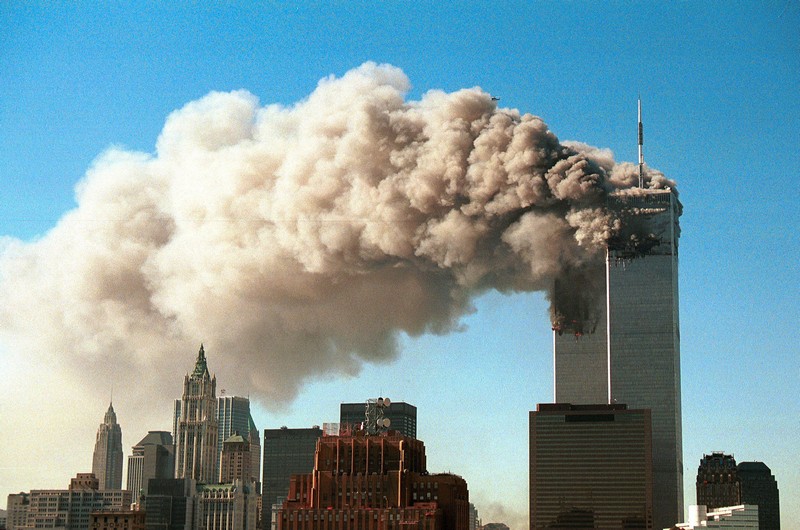
The Triumph of the Official Narrative: How the TV Networks Hid the Twin Towers’ Explosive Demolition on 9/11

By Prof. Graeme MacQueen and Ted Walter

This article is the second installment of a two-part research project we began in July 2020 with the article “How 36 Reporters Brought Us the Twin Towers’ Explosive Demolition on 9/11.”

In that article, our goal was to determine the prevalence, among television reporters on 9/11, of the hypothesis that explosions had brought down the Twin Towers. Through careful review of approximately 70 hours of news coverage on 11 different channels, we found that the explosion hypothesis was not only common among reporters but was, in fact, the dominant hypothesis.

Our second question, which we set aside for the present article, was to determine how, despite its prevalence, the explosion hypothesis was supplanted by the hypothesis of fire-induced collapse.

In this article, we shall concentrate not on reporters in the field, as in Part 1, but on the news anchors and their guests who were tasked with discovering and making sense of what was happening. As we trace the supplanting of the explosion hypothesis with the fire-induced collapse hypothesis, we witness the great shift toward what quickly became the Official Narrative.

We do not see our task as trying to discover whether the Official Narrative of 9/11 is true or false. In the 21 years since the attacks took place, it has been proven beyond all reasonable doubt, we believe, that the Official Narrative is false.

While we support and participate in the further accumulation of evidence for this position, as well as the presentation of this evidence to the public, we believe it is also important to look into how the triumph of the Official Narrative was accomplished. If we are able to discover this, we will greatly advance our understanding of the psychological operation conducted on September 11, 2001 — and, thus, our understanding of how other psychological operations are perpetrated on the public.

Our Argument

Our argument is that two strategies were employed to accomplish the triumph of the Official Narrative:

(a) Where news anchors were sincerely dedicated to discovering the facts of the situation, Strategy One was employed. This strategy involved directly confronting the news anchor of the relevant network with an “expert” who would explain that the destruction of the Twin Towers was caused by structural failure induced by the airplane impact and the ensuing fires. This would allay concerns about reports of explosions in the towers and would domesticate the news anchor so that he or she would stop raising problematic questions. Of course, as we can see clearly today, these experts could not possibly have known what they so confidently proclaimed. In fact, we can now see that their explanations were simply wrong. But their interviews seem to have accomplished their goals on 9/11. To illustrate this strategy, we shall choose as our chief examples CNBC and CNN, whose anchors showed the most interest in the explosion hypothesis, and we will also look at CBS and NBC.

(b) Strategy Two was used on all networks, regardless of the stance of the news anchors. This strategy involved developing two related narratives — two engaging, emotionally charged stories — that appeared to explain the day’s horrors and offered viewers a set of active responses. They were not scientific hypotheses and were not directly related to the destruction of the Twin Towers, but indirectly they appeared to favor the fire-induced collapse hypothesis more than the explosion hypothesis. By the end of the day, they had silenced the explosion hypothesis.

The first of these two stories is what we shall call the War on Terror narrative. This grand narrative, resonant with older storied events, explained how the righteous, the civilized, the United States had been subjected to an act of war from the evil, the uncivilized, the terrorists supported by nations in the Middle East and Central Asia; and how American leaders must respond to this aggression with an initiative that was warlike on many levels. This narrative was articulated early (before noon on 9/11) and was repeated throughout the day. It established the foundations of the Global War on Terror.

The second story is the Bin Laden narrative, which nested within the wider War on Terror narrative and was used to transform myth into plausible history. According to this narrative, an evil Saudi national based in Afghanistan had masterminded the attacks.

It is extremely important to grasp the relationship between these two narratives and what may seem as detailed — even esoteric — facts about the destruction of the Twin Towers. If the buildings were destroyed by pre-planted explosives — as we believe has been demonstrated through years of research — the two narratives, however rational and moral they appeared to be to many television viewers, are profoundly misleading in their political analysis and profoundly immoral in their prescriptions.

Numerical Analysis of Statements by News Anchors and Experts Articulating the Explosion Hypothesis

To understand how the explosion hypothesis was supplanted by the fire-induced collapse hypothesis, it is first important to establish whether, and to what degree, the explosion hypothesis was considered by news anchors, their guests, and others at the television networks.

As we showed in Part 1, the great majority of reporters who witnessed the destruction of the Twin Towers either perceived an explosion or perceived the towers as exploding. This hypothesis of how the Twin Towers were destroyed then continued to be prevalent among reporters on the ground, who essentially viewed the destruction of the towers as an explosion-based attack subsequent to the airplane strikes.

Given what the reporters were communicating to the rest of the world, how did their colleagues in the studios absorb this information and make sense of what had happened for the viewing public?

As in Part 1, to answer this question, we reviewed approximately 70 hours of continuous news coverage from 11 different networks, cable news channels, and local network affiliates.

Table 1 below shows the news coverage we compiled and reviewed. (For further description of our data collection, see Part 1 of the series.) Table 2 lists the mentions of the explosion hypothesis by network. Table 3 lists the mentions of the explosion hypothesis by the time they occurred.

Videos and transcripts of every mention of the explosion hypothesis are shown in Appendix A.

Table 1: Television Coverage Compiled

Table 2: Explosion Hypothesis Mentions by Network

Table 3: Explosion Hypothesis Mentions by Time

In total, when we include seven ambiguous mentions of the explosion hypothesis — which we defined as an anchor describing the occurrence of an explosion in conjunction with the collapse of either tower but not implying that the explosion necessarily caused the collapse — we found that the explosion hypothesis was mentioned 70 times across all 11 channels.

To our great interest, we found that news anchors or guest experts on every channel, with the exception of Fox News, at some point in the day believed, considered, or at least articulated the possibility that explosions had caused the Twin Towers’ destruction. In addition, several channels, including Fox News, displayed banners or captions or crawls in their lower thirds stating that explosions had caused the Twin Towers’ destruction.

The explosion hypothesis was first mentioned by several anchors on several different channels within minutes of the South Tower’s destruction at 9:59 AM and — within our pool of television coverage — was mentioned for the final time by NBC’s Tom Brokaw at 4:48 PM. It is noteworthy that more than half of the mentions of the explosion hypothesis occurred in the first 31 minutes after the South Tower’s destruction. As we shall discuss below, on some channels the explosion hypothesis was eventually explicitly discarded while on other channels it simply stopped being mentioned.

In some cases, discussion of the explosion hypothesis was driven by the anchors’ own observation and intuition while in other cases it was driven by information provided by reporters on the ground (and, in some cases, both). In a few cases, especially in the lower third captions, mention of the explosion hypothesis appears to have been driven by information circulated on the newswire.

Altogether, the data reflect that the explosion hypothesis was broadly, though in most cases fleetingly, considered by news anchors, their guests, and others at the networks.

The one notable exception was on Fox News, where the anchor, Jon Scott, assertively pushed the fire-induced collapse hypothesis while fabricating the War on Terror and Bin Laden narratives before our eyes. All the while, he seemed uniquely unsurprised and unbothered by the events, as compared to other anchors who exhibited varying degrees of shock, disbelief, and horror. Although Fox News reporters on the ground, like those of other networks, were describing explosions, Scott went out of his way to correct their impressions of what they had witnessed and make the fire-induced collapse hypothesis seem credible to viewers. Because of Scott, no experts were needed to establish the Official Narrative on Fox News. There was only one hypothesis in the foreground, and this hypothesis was so quickly solidified that by noon on 9/11, all of the major elements of the coming Global War on Terror had been set forth.

However, for the anchors who were sincerely dedicated to discovering the facts, Strategy One was employed.

Strategy One for Accomplishing the Triumph of the Official Narrative: An “Expert” Visits a News Anchor

In discussing Strategy One we shall use CNBC and CNN as our chief examples and also look briefly at CBS and NBC.

CNBC

CNBC saw, perhaps, the most notable rise and fall of the explosion hypothesis.

CNBC’s consideration of the explosion hypothesis started at 10:01 AM with news anchor Mark Haines hearing from witnesses on the street that a third airplane had crashed into the South Tower. He surmised that this third airplane impact was responsible for the South Tower’s total destruction.

In a discussion with CNBC reporter Maria Bartiromo, who was on the ground at the New York Stock Exchange, Haines’ suspicion of a third airplane causing the South Tower’s destruction was reinforced by Bartiromo’s repeated reference to “the explosion,” which Bartiromo deduced was “just the actual collapse of the building” but that Haines suggested was a third airplane impact.

After about 15 minutes, Haines was informed that the Associated Press was reporting only two airplane strikes. As Haines began to accept that there was no third airplane strike, he and another anchor (we were unable to determine this person’s name) agreed that some sort of explosion must have caused the South Tower’s destruction. At around 10:21 AM, Haines looked closely at footage of the South Tower’s destruction and began to analyze it with an accuracy and clarity that was unique among news anchors:

“But here you see an enormous explosion about midway up in the South Tower, and the entire structure collapses. It just disappears. . . . Now that’s interesting from a forensic point of view. The explosion that leveled the South Tower came, it seemed, roughly halfway up. And yet it took the entire tower out.”

Minutes later, Haines reacted in horror as he watched the destruction of the North Tower in real time, exclaiming:

“We have an enormous explosion in the remaining World Trade Tower Center!”

Haines then went on to analyze the destruction as he had done before with the following series of comments:

“It happened the same way. The explosion started high in the building and worked its way down.”

“There you see — I don’t understand, and I would be very anxious to hear in the future some, the forensics of this situation.”

“This is — there you see the building imploding. It, it — do you see what’s happening? Now, what would cause that I don’t know.”

In response to Haines’ comments, his co-anchor, Bill Griffeth, acknowledged the possibility of what Haines was suggesting, stating:

“Certainly, the structure had been weakened by the impact. But you’d have to wonder if there was something else there. But we just don’t know at this point.”

Haines responded with his opinion that the destruction of both towers could not have been accidental:

“I don’t think . . . I think we’re safe — here I think I’m on safe ground, Bill. I don’t think — This was clearly, the way the structure is collapsing, this was the result of something that was planned. This is not — it’s not accidental that the first tower just happened to collapse and then the second tower just happened to collapse in exactly the same way. How they accomplished this, we don’t know. But clearly this is what they wanted to accomplish.”

A few minutes later, at around 10:34 AM, Haines left the studio, apparently in shock, and did not return for the day. We can only wonder how aggressively Haines might have continued to pursue the explosion hypothesis had he remained in the newsroom. (Sadly, Haines died of congestive heart failure in 2011.)

At 11:07 AM, co-anchor Griffeth brought structural engineer Eric Gass into the studio for an interview, asking him “whether it would be necessary for a further attack upon the buildings before they would collapse.” Gass happened to be working on the construction of a nearby building for CNBC at the time.

Over the course of his interview, Gass extinguished any remaining suspicion Griffeth and others may have had, making a number of unfounded assertions about the inability of the buildings to withstand the airplane impacts and fires.

Bill Griffeth: “Which is something I wanna get into here, Sue, because there’s been all kinds of speculation about how that would happen, whether it would be necessary for a further attack upon the buildings before they would collapse. And as it happens we have with us in studio here is a structural engineer, Eric Gass, who happens to be in the process of building a building that we’re putting together here at CNBC down the road. And you would have some sense since you’ve been a part of the construction of buildings of this magnitude, Eric, to give us some insight of what would happen with the kind of damage that was done with the jet attacks on the buildings and whether that’s enough to bring those buildings down by themselves.”

Eric Gass: “Well, I think you’ve a got a couple of issues that are going on here. One is, these are concrete reinforced structures. And concrete is a compressive material. So as you can see, especially from the second attack, as it comes in, it appears to shear into the side of the building.”

Herrera: “The plane.”

Griffeth: “Right.”

Gass: “Absolutely. So you have a couple of issues. One, it probably has taken all the concrete away from the steel.”

Herrera: “And now you’re seeing that second plane.”

Gass: “Absolutely. So this structure, and I think as you see as it will collapse later on, it begins to tilt to that side. It has taken all of the concrete and put it into tensile property.”

Herrera: “And these are large planes.”

Gass: “Absolutely. If we’re dealing with a Boeing 767, you’re not just dealing with a large plane, you’re dealing with a large plane that’s coming in at over 500 mph. So you have all of the impact going in to those members. There is no building that I’m aware of that can take this kind of impact.”

Griffeth: “So as we watch the first of the towers collapsing there, it was enough from the initial attack by the jet to bring the tower down eventually. Is that your understanding?”

Gass: “I would say so. Especially the second thing you would have going on, of course, is the airplane’s going to have a great deal of fuel, and the fire is going to be working against that structural steel, which of course is why the fire codes are so stringent in this country. So then you’re going to have a problem with once the fire takes place it’s going to work against the structural strength of that steel and begin to collapse.”

Griffeth: “So you’re not surprised that these would go down just based on the jet crashing into the buildings here, Eric?

Gass: “No. As a matter of act, as we were seeing the explosion the first time, that was the first thing that occurred to us, is that there would be an immediate weakening on that side of the building. I think if you look at the second tower that collapsed, you will see that it begins to collapse straight down, which as it appears from what happened in the impact, it impacted much more into the center of the building. Again, you would have gotten rid of all of the ability for fire protection to have gotten rid of some of the fire and the flames, which apparently is why it took longer. The other point too is that you have 15 floors of extremely heavy material bearing down on this situation. It would be impossible to see why it would be able to hold up.”

Griffeth: “The terrorist bombing of some years ago against the World Trade Center, which occurred essentially in the parking structure below the building, why didn’t that bring that down at the time?”

Gass: “Well, I think you’re dealing with a different issue. One, you’re dealing with a static explosion, where someone pulls a small truck underneath so you have all of the concrete not only keeping both of the floors above and below. But you’re dealing with the biggest structural strength of that building is sitting underground. Of course, New York is pure bedrock. So that would have been the worst place to attack it. Clearly it did not do that much damage, enough structurally to make major structural problems with the design, as I understand it. Here, you have a much larger vehicle, with much more speed, and literally shearing any of its structural capacity in those particular areas.”

Hours later, at around 2:25 PM, Griffeth repeated Gass’s unfounded assertions.

Griffeth: “We were witness to this horrifying spectacle of the Twin Towers just disintegrating to the ground. And we had heard from this structural engineer that we interviewed earlier that once these towers had been struck by these jets — I mean, these are structures that are built mainly, of course with steel, but with concrete. The concrete essentially was liquefied. Not to that degree, but it just was very suspect in the structure. And according to him it was only a matter of time before it came down. And course that is exactly what happened after the crashes.”

To summarize, engineer Eric Gass, the “expert,” was able to put a stop to the legitimate questioning of Mark Haines and Bill Griffeth. Although we know now that Gass’s hypothesis is false, it would have seemed plausible at the time both to news anchors and the viewing public.

CNN

Shortly after 9:59 AM, news anchor Aaron Brown was standing on a roof in New York City about 30 blocks from the World Trade Center. He was looking directly at the South Tower as it was destroyed. He was, therefore, not just a journalist and not just a news anchor: He was an eyewitness.

He immediately interrupted a journalist who was reporting live on the Pentagon:

“Wow! Jamie. Jamie, I need you to stop for a second. There has just been a huge explosion…we can see a billowing smoke rising…and I can’t…I’ll tell you that I can’t see that second Tower. But there was a cascade of sparks and fire and now this…it looks almost like a mushroom cloud, explosion, this huge, billowing smoke in the second Tower…”

Having reported honestly what he saw with his own eyes, Brown next did exactly what he should have done as a responsible news anchor. He let his audience know that, while he did not know what had happened, it was clear that there were two hypotheses in play, the explosion hypothesis and the fire-induced collapse hypothesis. And then he went to his reporters on the scene, as well as to authorities, to try and sort out which hypothesis was correct.

Here are examples of his setting forth — after the first building was destroyed and again after the second was destroyed — the rival hypotheses:

At 10:03 AM: “…and then just in the last several minutes there has been a second explosion or, at least, perhaps not an explosion, perhaps part of the building simply collapsed. And that’s what we saw and that’s what we’re looking at.”

At 10:04 AM: “This is just a few minutes ago…we don’t know if…something happened, another explosion, or if the building was so weakened…it just collapsed.”

At 10:29 AM: “[W]e believe now that we can say that both, that portions of both towers of the World Trade Center, have collapsed. Whether there were second explosions, that is to say, explosions other than the planes hitting them, that caused this to happen we cannot tell you.”

At 11:17 AM: “Our reporters in the area say they heard loud noises when that happened. It is unclear to them and to us whether those were explosions going on in the building or if that was simply the sound of the collapse of the buildings as they collapsed, making these huge noises as they came down.”

Brown’s honest reporting of his perceptions was balanced repeatedly by his caution. Here is an example:

At 10:53 AM: “…it almost looks…it almost looks like one of those implosions of buildings that you see, except there is nothing controlled about this…this is devastation.”

His next move, having set forth the two hypotheses, was to ask his reporters on the scene, who were choking on pulverized debris and witnessing gruesome scenes, what they perceived.

Reporter Brian Palmer said honestly that he was not in a position to resolve the issue.

Brown at 10:41 AM: “Was there…Brian, did it sound like there was an explosion before the second collapse, or was the noise the collapse itself?”

Palmer: “Well, from our distance…I was not able to distinguish between an explosion and the collapse. We were several hundred yards away. But we clearly saw the building come down. I heard your report of a fourth explosion: I can’t confirm that. But we heard some ‘boom’ and then the building fold in on itself.”

Two other reporters were more definite about what they perceived.

Brown at 10:29 AM: “Rose, whadya got?”

Rose Arce: “I’m about a block away. And there were several people that were hanging out the windows right below where the plane crashed, when suddenly you saw the top of the building start to shake, and people began leaping from the windows in the north side of the building. You saw two people at first plummet and then a third one, and then the entire top of the building just blew up…”

Brown at 10:57 AM: “Who do we have on the phone, guys? Just help me out here. Patty, are you there?”

Patty Sabga: “Yes, I am here.”

Brown: “Whaddya got?”

Sabga: “About an hour ago I was on the corner of Broadway and Park Place — that’s about a thousand yards from the World Trade Center — when the first tower collapsed. It was a massive explosion. At the time the police were trying desperately to evacuate people from the area. When that explosion occurred, it was like a scene out of a horror film.”

Clearly, the explosion hypothesis was flourishing on CNN. In what is striking to read today, even the news caption at the bottom of the screen at 10:03 AM, shortly after the destruction of the South Tower, was dramatically articulating the explosion hypothesis:

“THIRD EXPLOSION SHATTERS WORLD TRADE CENTER IN NEW YORK”

After checking with his reporters, Brown continued to explore his two hypotheses, this time by consulting authorities.

First Brown consulted a political authority. He got the mayor of New York City on the line.

Brown at 12:31 PM: “Sir, do you believe that…was there another set of explosions that caused the buildings to collapse, or was it the structural damage caused by the planes?”

Giuliani: “I don’t, I don’t know, I, uh, I, uh…I, I saw the first collapse and heard the second ‘cause I was in a building when the second took place. I think it was structural but I cannot be sure.”

Later in the afternoon, Giuliani had more confidence in his script. At a press conference that aired on nearly every channel, he ruled out the explosion hypothesis when a reporter asked him, “Do you know anything about the cause of the explosions that brought down the two buildings yet?”

Finally, at 4:20 PM, Brown was visited by an engineer, Jim DeStefano, who we were told was with the National Council of Structural Engineers (the actual name of DeStefano’s organization is the National Council of Structural Engineers Associations). His brief comments put an end to Brown’s explosion hypothesis and rendered CNN’s news coverage safe for public consumption.

Brown: “Jim DeStefano is a structural engineer. He knows about big buildings and what happens in these sorts of catastrophic moments. He joins us from Deerfield, Connecticut on the phone. Jim, the plane hits…what…and I hope this isn’t a terribly oversimplified question, but what happens to the building itself?”

DeStefano: “…It’s a tremendous impact that’s applied to the building when a collision like this occurs. And it’s clear that that impact was sufficient to do damage to the columns and the bracing system supporting the building. That coupled with the fire raging and the high temperatures softening the structural steel then precipitated a destabilization of the columns and clearly the columns buckled at the lower floors causing the building to collapse.”

DeStefano, surely, had a right to make a guess, but he had no right to claim that he knew what had happened. He did not say, “Here is one hypothesis.” He said, in effect, “This is what happened.” But there had been no photographic or video analysis of the buildings’ destruction, no analysis of the physical remains, no cataloguing of eyewitnesses, no examination of seismic or thermal evidence, and so on. He was shooting in the dark, and he was silencing a journalist who was sincerely trying to discover the truth.

As we have discovered since that day, DeStefano’s confidence was misplaced and his hypothesis was wrong. But his explanation appears to have succeeded in ending Aaron Brown’s interest in the explosion hypothesis.

CBS and ABC

The deployment of Strategy One was not unique to CNBC and CNN. Dan Rather, Peter Jennings and Tom Brokaw, the evening news anchors for CBS, ABC and NBC, respectively, all considered the explosion hypothesis at various points during the course of the day. Two of them, Rather and Jennings, were met with experts who apparently put an end to their curiosity.

In Rather’s case, he was visited by a government official named Jerome Hauer. On 9/11, Hauer was director of the federal Office of Public Health Preparedness and was senior advisor to the Secretary for National Security and Emergency Management. In January 2001, Hauer had been hired to run a new crisis management group at Kroll Associates, the security consulting firm that had designed the security system for the World Trade Center complex in response to the 1993 bombing. And before that, from 1996 to 2000, he was director of the New York City Office of Emergency Management (OEM), where he was chiefly — and controversially — responsible for installing the OEM’s Emergency Operations Center on the 23rd floor of World Trade Center Building 7, which would also collapse later that day.

A little after 12:00 PM on 9/11, Rather and Hauer had this exchange:

Rather: “Is this massive destruction of the World Trade Center — based on what you know, and I recognize we’re dealing with so few facts — is it possible that just plane crash could have collapsed these buildings? Or would it have required the sort of prior positioning of other explosives in the building? What do you think?”

Hauer: “No, my sense is that just, one, the velocity of the plane, and the fact that you have a plane filled with fuel hitting that building that burned. The velocity of the plane certainly had an impact on the structure itself. And then the fact that it burned and you had that intense heat probably weakened the structure as well. I think it was simply the planes hitting the building and causing the collapse.”

One would expect a national security official, especially one working for a company responsible for security at the World Trade Center, to be pursuing all possibilities. Indeed, we know that officials at the FDNY, the NYPD, and the FBI suspected that explosives had brought down the towers. Hauer’s confidence that explosives had nothing to do with the towers’ destruction, less than two hours after it had happened, is at best grossly irresponsible.

In the case of Jennings, he interviewed a structural engineer by the name of Jon Magnusson, who on 9/11 was a partner at the structural engineering firm that had designed the Twin Towers. Magnusson would go on to be a member of the FEMA Building Performance Study, the first official investigation into the Twin Towers’ and Building 7’s destruction.

Earlier that morning, upon learning that the South Tower had completely collapsed, Jennings remarked:

“We have no idea what caused this. If you wish to bring — anybody who’s ever watched a building being demolished on purpose knows that if you’re going to do this you have to get at the under infrastructure of a building and bring it down.”

Twenty minutes later, apparently having trouble accepting NBC reporter Don Dahler’s interpretation that the building had simply collapsed from the airplane impact and fires, Jennings said:

“I’m still desperately confused, John, about what may have caused the building to collapse.”

To our knowledge, Jennings did not articulate the explosion hypothesis after that point. Nevertheless, later in the day, Magnusson was brought on to explain to Jennings and millions of viewers why the buildings had collapsed. Magnusson’s interview on ABC was preceded by a pre-recorded piece that put forth the fire-induced collapse hypothesis, basing its claims on advice from engineers at Magnusson’s firm. Once the piece ended, Jennings began his interview with Magnusson.

Jennings: “This is the second time from Robert Krulwich and also from some architect engineers we talked with a little bit earlier that say it was the heat which caused the building to collapse, because the steel at the top of the building would maybe have only been able to sustain an hour, hour-and-a-half of intense fire, and then the steel begins — as Robert points out so clearly — collapse upon itself all the way down to the bottom.

“I think we have with us, on the phone or in person, from Seattle, Jon Magnusson, who is an engineer — Jon, are you there? — Jon Mangusson, who is with the company that actually built the World Trade Center towers. Jon, have you heard our two laymen explanations tonight of what it was we think collapsed the building? And do you agree or disagree?”

Magnusson: “I agree. . . . The description of the fact that steel, when it gets up to 1,500, 1600°F, that it loses its strength is accurate. The buildings actually survived the impact of both the planes. And it was really the fire that created the disaster.”

Jennings: “And the upper floor fell on the next floor down, which fell on the next floor, and the sheer accumulation of weight just forced the whole building to collapse on itself?”

Magnusson: “Right. From the videotape — and I can only go from what I’ve seen on television — but the videotape showed that several of the upper floors fell onto the next lower floor that was still intact. And once that happens, there’s going to be an instant overload situation. And then it will fail. And then that will drop down to the next floor, into another instant overload situation. And so the floors just progressively collapsed down all the way to the bottom.”

Magnusson was somewhat more cautious in his explanation than Gass, DeStefano and Hauer. At the same time, he was arguably the most equipped to recognize that the towers had possibly been destroyed with explosives, yet he advocated solely for the fire-induced collapse hypothesis. As a partner at the very firm that had designed the Twin Towers, his early endorsement of the fire-induced collapse hypothesis was essential in supplanting the explosion hypothesis.

Was it chance that led a series of “experts” to disarm these independent-minded news anchors with one false hypothesis after another? We think that is unlikely.

Consider that many building professionals and technical experts are known to have immediately suspected that explosives were responsible for the Twin Towers’ destruction. Notable examples of experts who first suspected explosives but then quickly changed their position include Van Romero, an explosives expert from New Mexico Tech, and Ronald Hamburger, a structural engineer who went on to work on the FEMA Building Performance Study and later on the NIST World Trade Center investigation. On 9/11, Romero told the Albuquerque Journal:

“The collapse of the buildings was ‘too methodical’ to be the chance result of airplanes colliding with the structures…. ‘My opinion is, based on the videotapes, that after the airplanes hit the World Trade Center there were some explosive devices inside the buildings that caused the towers to collapse.’”

On September 19, 2001, Hamburger told the Wall Street Journal:

“‘It appeared to me that charges had been placed in the building,’…Upon learning that no bombs had been detonated, ‘I was very surprised.’”

Much like these experts, Dr. Leroy Hulsey, a professor emeritus of civil engineering at the University of Alaska Fairbanks who conducted a four-year computer modeling of Building 7’s collapse, has said that he told his students the week after 9/11 that the Twin Towers could not have collapsed in the way they did due to the airplane impacts and ensuing fires. Similarly, Dr. Fadil Al-Kazily, a civil engineering professor from Sacramento State, once commented to this author (Ted Walter) that he was not aware of a single colleague of his who believed the fire-induced collapse hypothesis.

So, how is it that every “expert” who appeared on national television that day advocated the fire-induced collapse hypothesis when there were so many who favored the explosion hypothesis?

Although it cannot be proven, we suspect that intentionality, coordination, and deception are on display in these interviews. We shall see even more of this in the deployment of Strategy Two.

Strategy Two for Accomplishing the Triumph of the Official Narrative: The War on Terror and Bin Laden Narratives

“We tell ourselves stories in order to live, or to justify taking lives…tell ourselves stories that save us and stories that are the quicksand in which we thrash and the well in which we drown.” — Rebecca Solnit, The Faraway Nearby

On 9/11, the power of narrative to evoke horror, anger and a call-to-arms was drawn on by one prominent television guest after another. Genuine evidence, such as was produced early in the day by eyewitnesses, was pushed aside by the two narratives outlined below — the quasi-metaphysical War on Terror narrative and the Bin Laden narrative, which nested within the wider War on Terror narrative.

To the extent that these narratives were convincingly conveyed to viewers, no further argument against the explosion hypothesis was necessary. The foreign evildoers had crashed airplanes into the buildings and the buildings had come down, and that was all one needed to know.

The process of sowing these two narratives relied in part on a propaganda technique visible throughout the day’s coverage. It may be called “normalizing the abnormal.”

A good example of this technique can be seen later in the day. Both before and after World Trade Center Building 7 came down, the television audience was led to believe that such an event was normal. After all, the building was on fire, so of course it might come down! This was exemplified by the captions that began running on CNN around 4:10 PM — “BUILDING 7 AT WORLD TRADE CTR. ON FIRE, MAY COLLAPSE” — and on Fox News around 4:13 PM — “TRADE CENTER BLDG 7 ON FIRE, MAY COLLAPSE” — both more than an hour before the building came down. Of course, no such building had ever come down from fire in a way remotely similar to Building 7. Nevertheless, the television networks portrayed this event as perfectly normal, to the point of being utterly predictable.

In the case of the War on Terror and Bin Laden narratives that were imposed on the attacks as a whole, viewers received a large dose of “normalizing the abnormal.” This massive, complex operation was almost immediately blamed on a relatively small and poorly funded non-state organization based far away in one of the poorest countries of the world. It would have been far more “normal” for the operation to have been carried out by a well-funded military-intelligence apparatus. To exclude this more normal scenario in favor of a much more abnormal scenario required quickly setting forth the non-state terrorism hypothesis, almost immediately offering Osama bin Laden as the prime suspect, and choreographing the repetition of these ideas by various authorities.

As documented below, many claims were made about Osama bin Laden by the prominent television guests. On 9/11, these would have been seen by many as plausible, much like the statements by the building professionals brought on as experts. Many of us expected at the time that the claims made by these guests would soon be supported by actual, usable evidence. But this did not happen.

As this author (MacQueen) wrote in The 2001 Anthrax Deception (p. 31) of the period when the U.S. was making preparations for the invasion of Afghanistan:

“Secretary of State Colin Powell stated that the U.S. would soon be preparing, for the edification of the world, a document detailing evidence of Bin Laden’s guilt. When no such document was produced, the government of the United Kingdom stepped forward. The British document of October 4 [2001] was, however, astonishingly weak. The preamble noted that, ‘this document does not purport to provide a prosecutable case against Osama Bin Laden in the court of law’ even as it was purporting to provide something of much greater import: a casus belli. Indeed, the document consisted mainly of unverifiable claims from intelligence agencies, the evidence seldom rising to the level of circumstantial. Anthony Scrivener, Q.C., noted in The Times that, ‘it is a sobering thought that better evidence is required to prosecute a shoplifter than is needed to commence a world war [the War on Terror].’”

When the 9/11 Commission later produced its report in 2004, it was unable to support its central narrative with solid evidence and resorted repeatedly to using statements obtained under torture.

In other words, on 9/11, actual evidence usable in a court of law (eyewitness evidence of explosions) was defeated by claims that, however dramatically appealing, would not be admissible in a court of law.

(a) The War on Terror Narrative

The story of the War on Terror, as publicly set forth on television on 9/11, is a story of evil and aggression, a story that extends into the future as the righteous take up the sword of justice and vengeance. This very broad narrative, of mythical dimensions, includes the following eight elements. (Not all speakers include all eight elements, but by the end of the day all eight had been articulated.)

    1. Those who carried out the 9/11 operation were evil, a threat to all of civilization.
    1. These “terror thugs” have carried out an act of war against the U.S., so the U.S. should recognize and accept that a state of war now exists.
    1. States that support the terror thugs (for example, Afghanistan, allegedly supporting Bin Laden) are as responsible as the terrorists themselves for the evil deeds done, so the condition of war must extend to such supporting states.
    1. Not only the 9/11 terrorists and their supporters but all terrorists who have expressed evil intentions against the U.S., together with their supporters — most of whom are explicitly named — are, from 9/11 onward, to be regarded as at war with the U.S.
    1. This new and comprehensive war, known as the “War on Terror” or “War Against Terror,” is a metaphorical war (a vigorous striving, using all means, such as economic, political, and cultural), a spiritual war, and a literal war, waged with all military methods and technologies. The terrorists and their supporters, being evil, must be eliminated.
    1. The righteous must not wait for the evil doers and their supporters to strike out but must take whatever actions are necessary to strike first.
    1. All countries in the world must commit themselves to action within this global conflict framework. They must make a choice whether they will be on the side of the righteous or the side of the evil — there will be no middle ground.
    1. Parties at one time enemies of the righteous (Russia, China, and “moderate” Arab states) should be permitted to join in the War on Terror.

Although Bush administration officials gave voice to these principles in various public speeches and policy statements over a period of time after 9/11, the principles were articulated publicly on television on the day of 9/11 itself and in some cases before noon.

Presented below are three examples of the development of this narrative on 9/11: one on Fox News (by Newt Gingrich, the former speaker of the U.S. House of Representatives), one on BBC (by Ehud Barak, the former prime minister of Israel), and one on CNN (by Richard Holbrooke, a former U.S. diplomat and assistant secretary of state).

Other speakers — whose words can be found in Appendix B, which contains statements setting forth the Bin Laden narrative — also articulated the elements of the War on Terror narrative.

Note: Although elsewhere in this study we have not used BBC footage, by a stroke of fortune Ehud Barak was in London on 9/11 and was able to spend time in the BBC studio. We include his remarks as useful expressions of this narrative by a very prominent political player.

Videos of the Newt Gingrich and Richard Holbrooke interviews are presented below along with their transcripts. Videos of Ehud Barak appearing on BBC can be found in the Internet Archive’s “Understanding 9/11” archive.

(i) Newt Gingrich, Fox News

11:32 AM: Newt Gingrich Speaking to Jon Scott

Prof. Graeme MacQueen, renowned author and distinguished professor of religious studies.

Ted Walter is the director of strategy and development for AE911Truth.

8 September 2022

Source: www.globalresearch.ca
Peace Talks Essential as War Rages on in Ukraine

By Medea Benjamin and Nicolas J.S. Davies

Six months ago, Russia invaded Ukraine. The United States, NATO and the European Union (EU) wrapped themselves in the Ukrainian flag, shelled out billions for arms shipments, and imposed draconian sanctions intended to severely punish Russia for its aggression.

Since then, the people of Ukraine have been paying a price for this war that few of their supporters in the West can possibly imagine. Wars do not follow scripts, and Russia, Ukraine, the United States, NATO and the European Union have all encountered unexpected setbacks.

Western sanctions have had mixed results, inflicting severe economic damage on Europe as well as on Russia, while the invasion and the West’s response to it have combined to trigger a food crisis across the Global South. As winter approaches, the prospect of another six months of war and sanctions threatens to plunge Europe into a serious energy crisis and poorer countries into famine. So it is in the interest of all involved to urgently reassess the possibilities of ending this protracted conflict.

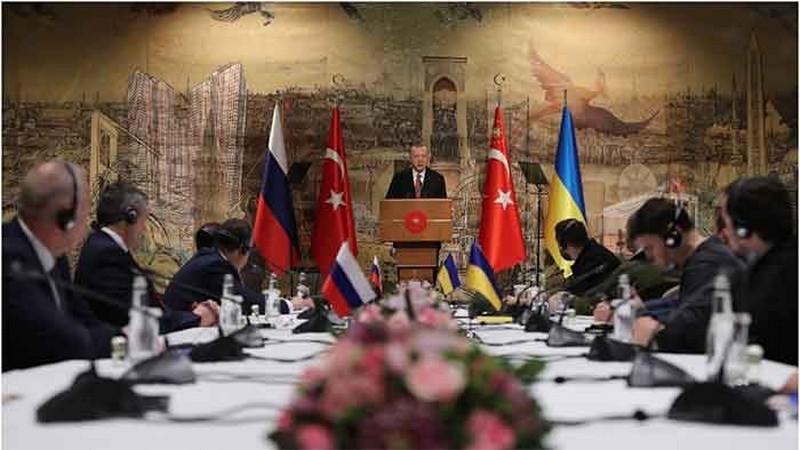
For those who say negotiations are impossible, we have only to look at the talks that took place during the first month after the Russian invasion, when Russia and Ukraine tentatively agreed to a fifteen-point peace plan in talks mediated by Turkey. Details still had to be worked out, but the framework and the political will were there.

Russia was ready to withdraw from all of Ukraine, except for Crimea and the self-declared republics in Donbas. Ukraine was ready to renounce future membership in NATO and adopt a position of neutrality between Russia and NATO.

The agreed framework provided for political transitions in Crimea and Donbas that both sides would accept and recognize, based on self-determination for the people of those regions. The future security of Ukraine was to be guaranteed by a group of other countries, but Ukraine would not host foreign military bases on its territory.

On March 27, President Zelenskyy told a national TV audience, “Our goal is obvious—peace and the restoration of normal life in our native state as soon as possible.” He laid out his “red lines” for the negotiations on TV to reassure his people he would not concede too much, and he promised them a referendum on the neutrality agreement before it would take effect.

Such early success for a peace initiative was no surprise to conflict resolution specialists. The best chance for a negotiated peace settlement is generally during the first months of a war. Each month that a war rages on offers reduced chances for peace, as each side highlights the atrocities of the other, hostility becomes entrenched and positions harden.

The abandonment of that early peace initiative stands as one of the great tragedies of this conflict, and the full scale of that tragedy will only become clear over time as the war rages on and its dreadful consequences accumulate.

Ukrainian and Turkish sources have revealed that the U.K. and U.S. governments played decisive roles in torpedoing those early prospects for peace. During U.K. Prime Minister Boris Johnson’s “surprise visit” to Kyiv on April 9th, he reportedly told Prime Minister Zelenskyy that the U.K. was “in it for the long run,” that it would not be party to any agreement between Russia and Ukraine, and that the “collective West” saw a chance to “press” Russia and was determined to make the most of it.

The same message was reiterated by U.S. Defense Secretary Austin, who followed Johnson to Kyiv on April 25th and made it clear that the U.S. and NATO were no longer just trying to help Ukraine defend itself but were now committed to using the war to “weaken” Russia. Turkish diplomats told retired British diplomat Craig Murray that these messages from the United States and United Kingdom killed their otherwise promising efforts to mediate a ceasefire and a diplomatic resolution.

In response to the invasion, much of the public in Western countries accepted the moral imperative of supporting Ukraine as a victim of Russian aggression. But the decision by the U.S. and British governments to kill peace talks and prolong the war, with all the horror, pain and misery that entails for the people of Ukraine, has neither been explained to the public, nor endorsed by a consensus of NATO countries. Johnson claimed to be speaking for the “collective West,” but in May, the leaders of France, Germany and Italy all made public statements that contradicted his claim.

Addressing the European Parliament on May 9, French President Emmanuel Macron declared, “We are not at war with Russia,” and that Europe’s duty was “to stand with Ukraine to achieve the cease-fire, then build peace.”

Meeting with President Biden at the White House on May 10, Italian Prime Minister Mario Draghi told reporters, “People… want to think about the possibility of bringing a cease-fire and starting again some credible negotiations. That’s the situation right now. I think that we have to think deeply about how to address this.”

After speaking by phone with President Putin on May 13, German Chancellor Olaf Scholz tweeted that he told Putin, “There must be a cease-fire in Ukraine as quickly as possible.”

But American and British officials continued to pour cold water on talk of renewed peace negotiations. The policy shift in April appears to have involved a commitment by Zelenskyy that Ukraine, like the U.K. and U.S., was “in it for the long run” and would fight on, possibly for many years, in exchange for the promise of tens of billions of dollars worth of weapons shipments, military training, satellite intelligence and Western covert operations.

As the implications of this fateful agreement became clearer, dissent began to emerge, even within the U.S. business and media establishment. On May 19, the very day that Congress appropriated $40 billion for Ukraine, including $19 billion for new weapons shipments, with not a single dissenting Democratic vote, The New York Times editorial board penned a lead editorial titled, “The war in Ukraine is getting complicated, and America isn’t ready.”

The Times asked serious unanswered questions about U.S. goals in Ukraine, and tried to reel back unrealistic expectations built up by three months of one-sided Western propaganda, not least from its own pages. The board acknowledged, “A decisive military victory for Ukraine over Russia, in which Ukraine regains all the territory Russia has seized since 2014, is not a realistic goal.… Unrealistic expectations could draw [the United States and NATO] ever deeper into a costly, drawn-out war.”

More recently, warhawk Henry Kissinger, of all people, publicly questioned the entire U.S. policy of reviving its Cold War with Russia and China and the absence of a clear purpose or endgame short of World War III. “We are at the edge of war with Russia and China on issues which we partly created, without any concept of how this is going to end or what it’s supposed to lead to,” Kissinger told The Wall Street Journal.

U.S. leaders have inflated the danger that Russia poses to its neighbors and the West, deliberately treating it as an enemy with whom diplomacy or cooperation would be futile, rather than as a neighbor raising understandable defensive concerns over NATO expansion and its gradual encirclement by U.S. and allied military forces.

Far from aiming to deter Russia from dangerous or destabilizing actions, successive administrations of both parties have sought every means available to “overextend and unbalance” Russia, all the while misleading the American public into supporting an ever-escalating and unthinkably dangerous conflict between our two countries, which together possess more than 90% of the world’s nuclear weapons.

After six months of a U.S. and NATO proxy war with Russia in Ukraine, we are at a crossroads. Further escalation should be unthinkable, but so should a long war of endless crushing artillery barrages and brutal urban and trench warfare that slowly and agonizingly destroys Ukraine, killing hundreds of Ukrainians with each day that passes.

The only realistic alternative to this endless slaughter is a return to peace talks to bring the fighting to an end, find reasonable political solutions to Ukraine’s political divisions, and seek a peaceful framework for the underlying geopolitical competition between the United States, Russia and China.

Campaigns to demonize, threaten and pressure our enemies can only serve to cement hostility and set the stage for war. People of good will can bridge even the most entrenched divisions and overcome existential dangers, as long as they are willing to talk – and listen – to their adversaries.

Medea Benjamin and Nicolas J. S. Davies are the authors of War in Ukraine: Making Sense of a Senseless Conflict, which will be available from OR Books in October/November 2022.

Medea Benjamin is the cofounder of CODEPINK for Peace, and the author of several books, including Inside Iran: The Real History and Politics of the Islamic Republic of Iran.

Nicolas J. S. Davies is an independent journalist, a researcher with CODEPINK and the author of Blood on Our Hands: The American Invasion and Destruction of Iraq.

6 September 2022

Source: countercurrents.org

Free Speech Doesn’t Matter if Propagandists Determine What People Say

By Caitlin Johnstone

29 Aug 2022 – None are more hopelessly enslaved than those who falsely believe they are free.

None are more hopelessly ignorant than those who falsely believe they’re informed.

None are more hopelessly propagandized than those who don’t know they are propagandized.

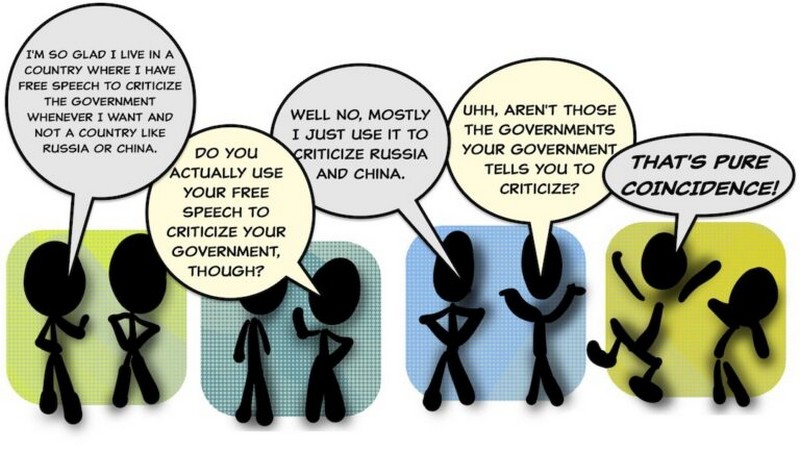
Living in a liberal western democracy means having the freedom to criticize the tyranny of your government, but instead spending your time criticizing the tyranny of foreign governments who your government doesn’t like.

Free speech in a liberal western democracy means you have the freedom to say whatever you want about the abuses of your government, and the press has the freedom to hammer you with propaganda to ensure that you never do.

In a liberal western democracy you are free to criticize your government, but instead you are propagandized into criticizing the impotent puppets who get rotated in and out of office while your government continues doing all the same evil things regardless of who gets elected.

In liberal western democracies you are free to call the president “Drumpf” or “Brandon”, but you are not free to know who’s actually calling the shots in your country underneath the official government.

In liberal western democracies people say, “I’m so glad I don’t live in a country like Russia or China where people are forbidden to criticize their government. I live in the west, where I’m free to criticize Russia and China all I want.”

It doesn’t matter if you have freedom of speech if those in power can control what you will say. And in liberal western democracies, this is exactly what happens.

We grow up saturated with US empire propaganda in the west. We marinate in it. It pervades our consciousness. But because it’s all we’ve ever known, most of us don’t even notice it.

We think it’s normal that we’re always told our government is on the good and righteous side of every international conflict. We think it’s normal that we hear constantly about the tyranny of foreign governments while only occasionally hearing about bad things our own government did years ago (but it was an innocent mistake and it’ll never happen again).

“If we were being propagandized, I’m sure we’d have heard about it in the news,” we tell ourselves.

But the news is the propaganda. And it will never report on that bombshell story.

Propaganda is the single most overlooked and underappreciated aspect of our society. In controls how the public thinks, acts, votes and behaves, but hardly anyone ever talks about it. Because the sources they’ve been trained to look to for information never say anything about it.

So people say what’s on their mind, after what’s on their mind has been carefully curated by the imperial narrative managers who are responsible for controlling what information goes into their mind.

And they say it with complete freedom. Sure if what they’re saying goes against the interests of the western empire they won’t be allowed to speak on any large platforms where they might infect the mainstream herd with wrongthink, and sure if what they’re saying is really inconvenient they might get banned from even speaking on any of the major online platforms, but they still get to speak. Alone, where no one can hear them. Preferably into a hole in the ground.

And everyone else gets to ingest the mainstream swill. The authorized narratives that get amplified on traditional media and by the algorithms of Silicon Valley. The authorized narratives which mask the abuses of their own government — foreign and domestic — while magnifying and exaggerating the abuses of empire-targeted governments.

That’s why when some people hear my objections to the empire, they say “Well at least where I live we’re allowed to criticize our government!”

And that’s why I reply to them, “Okay. But you don’t.”

If speech wasn’t free people would realize they’re being oppressed, but if people started using their speech to voice real grievances about real power, they would swiftly discover that their speech is being ignored and power is doing as it likes. So inconvenient speech is curtailed by propaganda, by censorship, by algorithm manipulation and by media marginalization.

People are kept hopelessly enslaved by giving them the illusion that they are free, and any voice which interrupts that illusion is silenced by whatever means necessary.

That’s what free speech means in a liberal western democracy. You can say whatever you like, as long as it’s what they like.

Caitlin Johnstone is a rogue journalist, poet, and utopia prepper who publishes regularly at Medium.

5 September 2022

Source: www.transcend.org

Getting It Wrong on Ukraine

By Scott Ritter

Newsweek’s William Arkin is a prisoner of his sources, a problem that pervades Western reporting on the conflict in Ukraine.

1 Sep 2022 – Six months into Russia’s “Special Military Operation,” fact-challenged reporting that constitutes Western media’s approach to covering the conflict in Ukraine has become apparent to any discerning audience. Less understood is why anyone would sacrifice their integrity to participate in such a travesty. The story of William Arkin is a case in point.

On March 30 (a little more than a month into the war), Arkin penned an article which began with the following sentence: “Russia’s armed forces are reaching a state of exhaustion, stalemated on the battlefield and unable to make additional gains, while Ukraine is slowly pushing them back, continuing to inflict destruction on the invaders.”

Arkin went on to quote a “high-level officer of the Defense Intelligence Agency,” who spoke on condition of anonymity, who declared that “The war in Ukraine is over.”

A little less than three months later, on June 14, Arkin wrote a piece for Newsweek with the headline: “Russia Is Losing the Ukraine War. Don’t Be Fooled by What Happened in Severodonetsk.”

Apparently neither Arkin nor his editorial bosses at Newsweek felt any need to explain how Russia could be losing the war twice.

Anyone who has been following what I’ve been writing and saying since the beginning of Russia’s “Special Military Operation” in Ukraine knows I hold the exact opposite view. Russia, I maintain, is winning the Ukraine conflict, in decisive fashion.

But I don’t write for Newsweek.

William Arkin does.

Arkin proclaims that Russia is losing though it had, at the time the article was published, just taken the strategic city of Severdonetsk, killing and capturing thousands of Ukrainian forces, and rendering thousands more combat ineffective since they had to abandon their equipment to flee for their lives. (Russia has since captured all of the territory encompassing the Lugansk People’s Republic, including the city of Lysychansk, inflicting thousands of additional casualties on the Ukrainian military.)

“The Russian army’s so-called victory,” Arkin proclaimed at the time, “is the latest installment in its humiliating military display and comes with a crushing human cost.”

The humiliating display instead is Arkin’s lack of acumen in conducting an independent assessment of the military situation on the ground in Ukraine.

This was again reinforced last week when Arkin penned another article in which he helps disseminate the outlandish claims of his Pentagon sources.

“[F]rom late February through August, with only a moderate infusion of weapons from the West, some supportive declarations from Western leaders and a smattering of ‘We Stand with Ukraine’ signs on U.S. lawns,” Arkin writes, Ukraine has been able to “hold at bay the mighty Russian military,” something apparently none thought it could do.

Ignore the jaw-dropping contention by Arkin that the tens of billions of dollars in military assistance provided by the U.S. and its NATO and European allies constitutes but “a moderate infusion of weapons.” No, don’t ignore it — focus on it. This is the signature style of Arkin and his Pentagon handlers, a sort of Orwellian double-speak where one can rest assured whatever bold statement is made, the truth is the exact opposite.

Arkin quotes “U.S. intelligence officials who have been watching the war,” writing that “Russian troops have had to contend with bad battlefield leaders, inferior weapons and an unworkable supply chain.”

Anyone who has been tracking the events in Ukraine might have thought that this was the situation as it applies to the Ukrainian military. Not so, says Arkin and his source. Moreover, it is not Ukraine’s President Volodymyr Zelensky who has been interfering with his Ministry of Defense, but Russian President Vladimir Putin with his. These same Russian troops, Arkin declares, have “also been hobbled by Putin himself,” who has “ignored, overruled and fired his own generals.”

This is baseless fiction, written by a man who seems determined to cement himself in the annals of the Russian-Ukraine conflict as an unabashed Ukraine partisan and vehicle for Pentagon information warriors. Arkin’s narrative of the war to date is so far removed from the factual record it belongs in The Onion.

What Arkin writes cannot even be called propaganda, because for propaganda to be effective it needs to be both believable at the moment of consumption, and able to sustain a narrative over time. Arkin’s work fulfills neither criterion.

His Sources

Like most erstwhile journalists covering the conflict for western media outlets, Arkin appears to be a prisoner to his sources, which in this case are a combination of anonymous U.S. defense intelligence personnel and pro-Ukrainian propagandists.

I used the term “erstwhile” in describing Western journalists because normal journalistic standards dictate that one seeks to report a story — any story — from a position of dispassionate neutrality, drawing on sources which reflect all sides of the story.

There is nothing wrong about drawing conclusions from such reporting, even assigning weight when it comes to which aspects of the coverage are deemed more credible than others. But before such conclusions can be made, foundational reporting needs to take place. Simply parroting what you’re being told from sources exclusively drawn from one part of the story is stenography.

In the interests of full disclosure, Arkin and I were colleagues for a brief period in late 1998-early 1999, when we were both contracted to NBC News as “on air talent” to talk about the situation in Iraq. Arkin apparently did not hold my analysis in high regard then. I have no idea what he thinks today — Consortium News has reached out for an answer, but as of publication has not received a reply.

Arkin did not respond to an invitation to debate me on Ukraine on a weekly podcast I do with Jeff Norman.

I’ll let our respective track records speak for themselves, especially when it comes to Iraq and the threat posed by weapons of mass destruction. Arkin says he is “proud to say that I also was one of the few to report that there weren’t any WMD in Iraq and remember fondly presenting that conclusion to an incredulous NBC editorial board.”

I’m pretty sure I was saying something similar to an equally incredulous Congress and to the entire mainstream U.S. media (NBC included), as well as the international press corps.

Congratulations, Bill — we once were on the same page.

But no more.

Arkin’s Achievements

Arkin is no run-of-the mill journalist. He’s a smart guy. He got accepted to New York University, although he dropped out to join the Army, claiming NYU “wasn’t for me.” While stationed in Berlin, he completed his undergraduate studies, getting a bachelor’s degree in government and politics. After leaving the Army he got a master’s degree in National Security Studies from Georgetown University.

For the next 40 years, Arkin worked for numerous employers, specializing in nuclear issues and military affairs, before landing his current gig as Newsweeks‘ senior editor for intelligence.

For The Washington Post in 2010, after a two-year investigation, he wrote a ground-breaking story with Dana Priest about the vast and until then little-understood explosive growth of the national security state post 9/11.

Arkin then showed integrity when he resigned from MSNBC and NBC News in 2019. His reasons for leaving, spelled out here, include how he was “especially disheartened to watch NBC and much of the rest of the news media somehow become a defender of Washington and the system.”

In March this year he wrote a startling story that questioned the dominant Western reporting that Russia was committing repeated war crimes by wantonly slaughtering huge numbers of civilians just for the hell of it.

“As destructive as the Ukraine war is, Russia is causing less damage and killing fewer civilians than it could, U.S. intelligence experts say. Russia’s conduct in the brutal war tells a different story than the widely accepted view that Vladimir Putin is intent on demolishing Ukraine and inflicting maximum civilian damage,” he wrote.

The article corroborated what Russia had been saying all along, which until that point was dismissed in the West as propaganda.

So how does Arkin transition from debunking Ukrainian and Western propaganda about Moscow deliberately killing huge numbers of civilians, to embracing the fanciful notion that Russia is losing the war? (Further underscoring Arkin’s assessment of Russia’s battlefield performance is the uninterrupted string of battlefield successes by Russia in the Donbass since that June article was published, further undermining his argument.)

It’s not a lack of education that has led Arkin down the path so many of his colleagues in mainstream media have stumbled down; there is no doubting the man is not only well educated, but also innately intelligent, something that doesn’t necessarily follow the other.

Military ‘Expertise’

Arkin can be said to be a victim of his own CV, which is light on relevant military experience for someone selling himself as an expert in military affairs based on his time in the U.S. Army.

Arkin purports to be one of the foremost military analysts of our times, a man whose track record in military affairs dates to his time as a junior enlisted soldier in the U.S. Army where, from 1974 to 1978, he served in occupied West Berlin as an intelligence analyst working for the Deputy Chief of Staff Intelligence (DCSI), U.S. Commander Berlin (USCOB).

On his WordPress page, Arkin writes that in the army he “rose to be senior intelligence analyst for the Berlin military occupation authorities and served under civilian cover as part of a number of clandestine human and technical intelligence collection efforts.”

In Berlin, Arkin adds in his LinkIn bio, “I worked on a number of clandestine projects and was an analyst of Soviet and East German activities in East Germany.”

He was not just any military analyst, mind you, but someone who, according to himself, “was once one of the world’s leading experts on two military forces that don’t even exist anymore.” I worked closely with military officers who were in fact the foremost experts on both the Soviet and East German militaries during the time Arkin served. This Newsweek senior editor has engaged in more than a little self-promotion.

That someone of the rank of specialist or sergeant (I have no idea what rank Arkin achieved, but four years’ time in service is a self-limiting reality when it comes to advancement) being the “senior intelligence analyst” in all of Berlin on matters pertaining to the Soviet military is patently absurd; Berlin was home to numerous specialized intelligence units and organizations, any one of which would have been staffed with personnel far more senior and, as such, experienced, in intelligence analysis on the Soviet and East German target than Arkin. Simply put, Arkin was not, nor has he ever been, one of the world’s leading experts on the Soviet military.

Not even close.

Arkin was never involved in combat arms, nor did he serve in combat. Without that experience he cannot understand the military realities of war — logistics, communications, maneuvering, fire support, etc. Berlin was, from everything I’ve heard, a fascinating place to serve — but it wasn’t combat.

Not even close.

As Arkin has no combat experience, his military analysis is held hostage to his sources within the Defense Intelligence Agency who pass along such cutting-edge insights as the notion that Russia is suffering ten casualties for every Ukrainian soldier lost since the Donbass offensive began in April.

Arkin seemed unaware of documents alleged to have been leaked from the Ukrainian Ministry of Defense, dated April 21, which state that Ukraine had, as of the date, suffered 191,000 combined killed and wounded. According to Arkin’s math, this would mean Russia has suffered nearly 2 million casualties of its own.

Despite the absurdity, Arkin keeps parroting what his Defense Intelligence Agency sources tell him.

He repeats, without hesitation, his intelligence source’s assessment of Ukraine’s “greater morale and motivation, better training and leadership, superior knowledge and use of the terrain, better maintained and more reliable equipment, and even greater accuracy.”

It doesn’t matter that literally every assertion made by Arkin’s intelligence source is demonstrably false. If Arkin knew about artillery (the ongoing conflict between Russia and Ukraine is primarily an extended artillery duel), he would understand the concepts of probability of hit and probability of kill, and how the volume of artillery fired increases both.

He might then understand how absurd it is to think that an artillery duel where one side fires 6,000 rounds and the other 60,000 rounds could produce an outcome where the side firing 10 times fewer rounds achieves a 10-fold advantage in lethality.

Any expert on Soviet/Russian military affairs would have known that artillery was going to be a major factor in any large-scale combat operation involving Russian forces. By way of example, three days before the Russian operation began, I tweeted (when I could still tweet):

“If you haven’t done a schedule of fires for at least three artillery battalions in the field using live rounds while maneuvering, I’m probably not interested in your military opinion about Ukraine.”

Arkin, to the best of my knowledge, has never done a schedule of fires for multiple battalions of artillery. His apparent lack of knowledge of artillery shows when he repeats verbatim the dreck fed him by his intelligence sources.

Arkin’s has to be aware that NBC News reported about the deliberate declassification and release by the U.S. intelligence community of intelligence information that intelligence officials knew was not true. And yet, Arkin still relies on these types of sources to provide the fodder for his headline-grabbing tales. The question of Arkin’s motives in writing such stories now remains.

That someone with Arkin’s background would allow a lifetime of diligent work to be squandered by serving as little more than a shill for U.S. intelligence is one thing. That media outlets like Newsweek keep printing it is another. Together, these twin phenomena represent what I call “The Arkin Effect,” which is nothing less than the total debasement of journalism in the U.S. when it comes to Russia’s war in Ukraine.

Six months into Russia’s “Special Military Operation”, most military analysts admit that Russia enjoys the upper hand on the battlefield, despite the billions of dollars in military aid that has been sent to Ukraine by the U.S. and its European allies.

But not Bill Arkin and his employers at Newsweek. They seem to be content with serving as the Defense Intelligence Agency’s stenographers, putting out stories which have not, and will not, stand the test of time.

Scott Ritter was a US Marine Corps intelligence officer for 12 years. As a chief weapons inspector for the UN Special Commission in Iraq, he was labeled a hero by some, a maverick by others and a spy by the Iraqi government.

5 September 2022

Source: www.transcend.org

Is It Time to Stop Bullying Iran? Washington Should Restore the Nuclear Program Agreement with Iran Now

By Richard Falk

A somewhat modified text originally published by CounterPunch on 2 Sep 2022. I recommend CP highly for anyone seeking to follow the best quality progressive commentary on global issues; also, follow Transcend Media Service (TMS) for a more global, academic, and cultural orientation heavily influenced by the pioneering work of Johan Galtung in the area of Peace Studies broadly conceived.

4 Sep 2022 – In the post below I call particular attention to the fact that the relevance of Israel’s nuclear weapons unregulated weapons capabilities and regional militarism has been totally overlooked in assessing the negotiations on whether the U.S. should rejoin the JCPOA, which Trump unilaterally withdrew from in 2018, reviving the agreement. Israel’s influence on the nature of the bargain reached for renewal and the side benefits that it will receive as ‘compensation’ for overriding its faux opposition to the agreement as articulated by its leading political figures. It illustrates the distortion of global policy debates whenever the domestic politics of the U.S. are entangled with the way an issue is resolved even sometimes, as here, at the cost of maximizing national interests.

**********************

To Renew or Not to Renew the 2015 Iran Nuclear Agreement, That Is the Question

The Road Not Taken

After two weeks in Iran during latter part of January 1979, the height of the revolutionary movement against the dynastic, autocratic rule of Mohammed Reza Ayatollah, I had the opportunity for an extended conversation with Ayatollah Ruhollah Khomeini in his tent where he received foreign visitors and journalists during his final days in Paris. This was the individual who would serve as uncontested Iranian leader, officially the Supreme Guide of the Islamic Republic of Iran until his death in 1989.

I was accompanied at the meeting by Ramsey Clark, former U.S. Attorney General and major progressive personality at the time in the United States and Don Luce, a prominent and courageous anti-war religiously oriented activist who gained worldwide fame in 1970 by departing from a prescribed tour route to expose a visiting delegation of U.S. Congress members to the notorious ‘tiger cages’ in Con Son Prison in Saigon, a major facility in South Vietnam that had become a repeated focus of severe torture allegations. During our time together in Iran we met many religious leaders and secular supporters of the popular uprising, individuals who would soon be running the government. We witnessed extraordinary displays of mass popular excitement in the country and anxious sighs of disbelief that greeted the news that the Shah had abdicated the Peacock Throne, and as it turned out, leaving Iran never to return.

There are many aspects of this meeting that are worth recalling but one stands out for me as having current relevance more than 43 years later. Immediately after greetings were exchanged, Ayatollah Khomeini carefully posed a question to us that seemed uppermost in his mind, more so than any of the topics covered in the ensuing two hours or so of questions and answers, with the three of us raising most of the questions. But the Ayatollah’s question came first, and it turned out to be the one where our words of response earned the full attention of this religious leader: “Do we think that the U.S. Government will repeat its intervention of 1953 that overthrew a popularly elected government and restored the Shah as Iran’s dynastic leader?” Later Ayatollah Khomeini confided that he had “only entered politics because there was a river of blood between the ruler and the people of Iran.”

We each responded along these lines: “Of course, we could not know for sure how Washington will act, but we believed the U.S. had learned some lessons from the past, including the awkwardness of supporting coups that brought to power repressive leaders while professing to lead ‘the free world’ against Communism and Soviet expansionism. We also stressed the recent failure of intervention in Vietnam and the apparent strength and unity of the movement that overthrew the Shah, as well as our impressions of the Iranian military as beset by divided loyalties, as well as institutionally weakened by the Shah’s own distrust of the leadership of the armed forces.”

We also called to the attention of the Ayatollah, on the basis of our meeting a few days earlier in Tehran with the American Ambassador in Iran, William Sullivan, who told us that he had forwarded repeated similar assessments to the White House, and a supposedly liberal president, Jimmy Carter, that the movement against the Shah’s government enjoyed the overwhelming support of the Iranian people and that even the leadership of the Iranian armed force was resigned to the acceptance of the political outcome. On this basis, Sullivan recommended an immediate and urgent U.S. Government effort to reassure the leaders of the Iranian revolutionary movement that it sought normal and positive relations with whatever government emerged in Iran during the ensuing weeks.

Ayatollah Khomeini was a formidable presence, pondered our comments, and slowly responded in almost these exact words, “If what you are telling us is accurate, and comes to pass, then we have no objection to the Shah coming to the U.S. or elsewhere for medical treatment, and we can have normal relations with your country.” Of course, this road was not the path taken by either country, which has resulted in enormous adverse consequences for Iran and the Middle East as a whole, with distorting effects that have been playing out over the intervening decades, which are shamelessly generating skepticism and propaganda about the U.S. rejoining the JCPOA, thus setting the stage for another phase of dangerous outcomes whether the Iran Nuclear Agreement is restored or not in 2022.

There were already present some worrisome signs back in 1979 that made such an exploratory attempt to accept this dramatic internal display of the human rights of all peoples to self-determination unlikely to materialize without generating geopolitical friction. The U.S. National Security Advisor at the time, Zbigniew Brzezinski, strongly favored a commitment to once again restore the Shah to his throne, and had a strong influence on President Carter’s thinking, which was given priority over Sullivan’s strong advice based on his direct knowledge of the realities in Iran.

Meanwhile, in Iran there were some strong words being uttered by militants about the revolutionary intentions of Iran extending to the whole of the Islamic world, and especially the Gulf monarchies, which sent strategic chills down the backs of Western foreign policy elites extremely sensitive in those days to any further strategic threats to Gulf oil reserves. In the background was Israel aware of the pro-Palestinian, anti-Zionist leadership emerging in Tehran, which set off loud alarms in reaction to some anti-Zionist rhetoric of the more militant leaders in the early period of the Islamic Republic. In any event, normalization between the two countries was not to be, however much sense it made with respect to peace, security, and self-determination back then and now.

Lines from a much quoted poem by Robert Frost are worth reflecting upon given this exchange of views more than 43 years ago.

Two roads diverged in a wood, and I—
I took the one less traveled by,
And that has made all the difference.

Recontextualizing Nonproliferation for Some, Nuclearism for Others

Restoring JCPOA through Negotiations

It needs to be emphasized that Trump unilaterally withdrew from the 2015 JCPOA and reimposed punitive sanctions (‘maximum pressure’) on Iran that inflicted many hardships on the civilian population despite the fact that Iran had been in full compliance with the terms of the agreement up through 2018 as confirmed by IAEA periodic inspections. It appears that Trump was induced by his ardent Zionist son-in-law, Jared Kushner, and leaders in Israel, especially the Prime Minister at the time, Bibi Netanyahu. Trump seemed thus persuaded to denounce the agreement as a terrible deal from a security perspective, providing a justification for U.S. withdrawal, but seemed no more than a pragmatic rationalization to cover a calculated political move. Not irrelevant, although further in the background is the powerful Iranian expatriate presence in the United States that has not given up on restoring secular rule in Iran, and views any kind of normalizing of relations with Iran to be ‘appeasement.’ Consider the recent shrill declaration to this effect by the eldest son of the autocratic Shah:

“This shift to appeasement was never going to solve any of the world’s issues with the Islamic Republic. The regime’s problem with the West is the West’s very existence, which obstructs its path to a global caliphate.”

— Reza Pahlavi, eldest son of Shah Mohammad Reza Pahlavi, Wall Street Journal, August 8, 2022

In the drawn-out Vienna negotiations on restoring the agreement the U.S. has been under constant public pressure from Israel and the Gulf monarchies to extract concessions from Iran bearing on matters outside the scope of the nuclear agreement. It would seem more plausible for the U.S. Government to have been confronted by demands from Iran for reparations for the harm it experienced by restoring, and intensifying, the sanctions since 2018. This bad faith behavior of the U.S. sets a dreadful precedent for the reliability of non-treaty international commitments. The fact that Iran has been prepared to go along with such a one-sided negotiating format undoubtedly reflects their motivation to gain relief from sanctions, and may also reinforce the sincerity of Iran’s continuing declared intention never to acquire nuclear weapons. Building trust in international relations presupposes mutual good faith adherence to carefully negotiated arrangements. At the very least, Biden should have humbly apologized to Iran for the disruptive 2018 withdrawal, and despite his legal inability to bind future presidents, he might have regained some higher ground by pledging to respect the agreements for as long as he remains president, and more rapidly moved to end sanctions once the agreement was restored.

It is worth comparing the extravagant language of the August 14th Biden-Lapid Joint Jerusalem Declaration of Strategic Partnership in which Biden not only affirmed a long-term U.S. commitment, audaciously proclaiming it as ‘bipartisan’ even ‘sacrosanct.’ The following language deserves scrutiny in light of the Vienna impasse:

“Consistent with the longstanding security relationship between the United States and Israel and the unshakable U.S. commitment to Israel’s security, and especially to the maintenance of its qualitative military edge, the United States reiterates its steadfast commitment to preserve and strengthen Israel’s capability to deter its enemies and to defend itself by itself against any threat or combination of threats. The United States further reiterates that these commitments are bipartisan and sacrosanct, and that they are not only moral commitments, but also strategic commitments that are vitally important to the national security of the United States itself.”

Confirming Israel’s Nuclear Hegemony in the Middle East

It has been completely ignored by the Western media that Iran has made a huge concession when it entered the Obama promoted Nuclear Agreement in 2015 (JCPOA) without an insistence that Israel simultaneously commit to destroying its arsenal of nuclear weapons. As the agreement was negotiated, at least in public, there were no assurances required of Israel, not even something as intangible as requiring Israel to issue a No First Use Declaration. It was to be expected that Israel and the United States would remain silent about solidifying Western control of the region, and especially the signature feature of the ‘strategic partnership,’ the. crux of which is retaining sole possession of the ultimate weapon of destructive violence. Yet Israel, in particular, seems empowered enough to insist on receiving firm assurances that the U.S. would prevent Iran from ever acquiring nuclear weapons by all means necessary (again without drawing into question Israel’s retention of such weapons without any disclosure of its intentions with respect to threat or use). The language of commitment in the Jerusalem Declaration puts the U.S. in the position of committing itself to a use of force without any hint of or apparent need for a further legal authorization. Again the language of the Jerusalem Declaration is important:

“The United States stresses that integral to this pledge is the commitment never to allow Iran to acquire a nuclear weapon, and that it is prepared to use all elements of its national power to ensure that outcome.”

Even this was apparently not enough for Israeli security hawks who wanted the pledge to pertain to any perceived steps toward acquisition.

Such an explicit bilateral strategic commitment as contained in the Jerusalem Declaration seems to overlook Iran’s completely valid legal and political option, if it wishes to rely upon it, to withdraw from the NPT, which it is entitled to do under Article X(1) of the treaty:

“1. Each Party shall in exercising its national sovereignty have the right to withdraw from the Treaty if it decides that extraordinary events, related to the subject matter of this Treaty, have jeopardized the supreme interests of its country. It shall give notice of such withdrawal to all other parties to the Treaty and to the United Nations Security Council three months in advance. Such notice shall include a statement of the extraordinary events it regards as having jeopardized its supreme interests.”

Given Israel’s threats, its nuclear capabilities, its strategic partnership with the U.S., withdrawal would seem an entirely reasonable course of action for Iran to take. If deterrence can serve as a security justification under the NPT, it would seem few states in the world could make as strong a case as Iran.

Taking Nonproliferation Seriously

There is a further consideration. If the United States were taking the ethos of nonproliferation seriously it would be concentrating on denuclearizing the Middle East as a region rather than acting to preserve Israel nuclear hegemony. The obvious way to achieve such a result would be to support the negotiation of a Middle East Nuclear Free Zone together with a non-aggression security framework. All states except for Israel have supported such an initiative, including Iran and Saudi Arabia. It would be a breakthrough for peace and security, besides freeing billions for more constructive uses.

The NPT regime is not the best path to non-use of the weaponry in a state-centric world. The NPT, however, it may be best path if the true geopolitical objective is to retain oligopolistic control over nuclear weapons. Phased disarmament within a treaty framework is the only promising path if the overriding objective is to achieve a world free from this infernal weaponry.

A start in this benevolent direction has been made in the Treaty of Prohibition of Nuclear Weapons (TPNW) negotiated under UN auspices and coming into force in 2021. But to gain political traction sufficient to provide a post-nuclear security framework it require to receive the support of the current nine nuclear weapons states. None have so far become Parties to TPNW, and the three NATO nuclear weapons states, the U.S., France, and the UK, along with Russia have issued statements expressing their principled opposition and unconditional rejection of a disarmament approach, despite its promise of total nonproliferation.

A Concluding Remark

If we are destined to live with nuclear weapons, we may have to endure the nuclear hegemony of the P-5, but to use the NPT ethos to justify discriminatory treatment of a non-nuclear state such as Iran seem to be an extremely regressive geopolitical undertaking. For this reason alone, people of good will should hope for the unconditional renewal of the JCPOA. It is time for the morally attuned public to awake to the reality that a nuclear Israel has neither a security justification nor political grounds for its posture of continuing bullying of Iran. To complain about Iran’s political solidarity with some movements in the region as Israel does is gross hypocrisy. It pales in its gravity compared if fairly to the U.S. and Israel’s discretionary bombing, political assassinations, interventions, and violations of the basic sovereign rights of countries in the Middle East.

Richard Falk is a member of the TRANSCEND Network, Albert G. Milbank Professor Emeritus of International Law at Princeton University, Chair of Global Law, Faculty of Law, at Queen Mary University London, Research Associate the Orfalea Center of Global Studies at the University of California, Santa Barbara, and Fellow of the Tellus Institute.

5 September 2022

Source: www.transcend.org

RIP Mikhail Gorbachev, Nobel Peace Laureate

By Mairead Maguire

31 Aug 2022 – I am sad to learn of the death of Mikhail Gorbachev on Tue, 30 Aug 2022.

I had the honour of meeting him on several occasions at the Gorbachev Nobel Peace Summits.

I never had the honour of meeting his beloved wife Raisa who died some years ago and who President Gorbachev missed and loved tenderly. I send my condolences to his daughter Irina, and family and friends and the Russian peoples, on the loss of Mikhail Gorbachev. President Gorbachev was a warmhearted and kind man with a vision of peace and nuclear disarmament and a belief that the cold war between the west and Russia could be changed by talking and friendship.

He won the Nobel Peace Prize for his work in building dialogue and encouraging America to sign important agreements to start dismantling nuclear weapons and end the arms race. Gorbachev took risks for peace and he gave hope to many of us when he met with President Regan and worked to end the cold war and the arms race.

It is to the shame of the West that the promises given to President Gorbachev were broken and US/NATO instead of keeping to its promises not to advance one inch towards Russia surrounded it with NATO bases and partners and continues to militarize and arm the world.

Gorbachev’s vision of an end to Cold war politics, a world built on peaceful solutions and an end to nuclear weapons and war is not a utopian dream, it is possible, and for those who had the honour of knowing Mikhail Gorbachev our best tribute to him is to begin again the quest for a disarmed peaceful world where our humanity comes first and ending poverty, the arms race, and war takes top priority for each of us.

May we all be inspired by the spirit of the late Mikhail Gorbachev for his courage, integrity and vision of Nuclear Disarmament and Peace for Russia, the West and the World.

Mairead Corrigan Maguire, co-founder of Peace People, is a member of the TRANSCEND Network for Peace Development Environment.

5 September 2022

Source: www.transcend.org

CO2 Levels Are the Highest in a Million Years as Extreme Weather and Flooding Rage Across the Globe

By Juan Cole

CNN reports that satellite photos show that the overflowing Indus has created a new body of water in southern Pakistan some 62 miles (100km) wide. It will take days or weeks for the water to recede, and in the meantime millions are left homeless and over all, 33 million people have been affected by the worst monsoon floods in recorded history. CNN quotes Pakistan’s Climate Minister Sherry Rahman as saying “That parts of the country ‘resemble a small ocean,’ and that ‘by the time this is over, we could well have one-quarter or one-third of Pakistan under water.’”

Because of our burning of fossil fuels to drive cars and heat and cool buildings, the world is heating up. But the Indian Ocean is heating up a third faster than the rest of the world. Very warm waters in the Bay of Bengal are helping create more destructive cyclones and flooding. The air over warming waters contains more moisture than the 20th century average. Warming waters also make the winds that blow over them more erratic, and wayward winds from the Arabian Sea helped push the heavy monsoon rains farther north than they usually extend.

We don’t have to look far for the culprits. J. Blunden, and T. Boyer, Eds., 2022: “State of the Climate in 2021” Bull. Amer. Meteor. Soc., 103 (8), Si–S465, https://doi.org/10.1175/2022BAMSStateoftheClimate provides a state of the climate report for 2021.

It isn’t good news. The concentration in the atmosphere of carbon dioxide increased another 2.6 parts per million, to a year-long average of 414.7 parts per million of CO2. We should be trying to get to zero increases of carbon dioxide, not increasing it. Arctic snow cores show that there hasn’t been that much CO2 in the atmosphere for at least 800,000 years, i.e. nearly a million years. It turns out that if you go back to “1 million Years B.C.” you don’t find Raquel Welch, you find a steaming tropics of a world. The growth rate for methane was the highest on record. Methane is 25 times more potent than carbon dioxide as a heat-trapping gas, and CO2 isn’t any slouch itself. Methane, though, dissipates quickly if you don’t keep adding to it in the stratosphere, in as little as nine years. If you put carbon dioxide up there, though, it can last thousands and thousands of years. It is gradually absorbed by the oceans or igneous rocks, but he ocean may reach its capacity for absorption of CO2 in only 15 years, after which the stuff will just stay up there, making earth hot.

The report says that Death Valley, California, reached 54.4°C (130.46 F.) for the second time since records have been kept. Across the global ice concentrations or “cryosphere,” glaciers lost ice mass for the 34th consecutive year. Now the BBC is predicting that in the near future the glacier ice lost will become so great that it will threaten the water supplies of Switzerland and other European countries.

And in horrific news for Bangladesh and Egypt, the report says, “Across the world’s oceans, global mean sea level was record high for the 10th consecutive year, reaching 97.0 mm above the 1993 average when satellite measurements began, an increase of 4.9 mm over 2020.”

Seas rising, carbon dioxide concentrations in the atmosphere rising to best a million-year-old-record, super-monsoons. We can change all this, but we have to hurry to shut down CO2 emissions quickly.

Juan Cole teaches Middle Eastern and South Asian history at the University of Michigan.

2 September 2022

Source: countercurrents.org

The holocaust and the Nakba

By Dr Ranjan Solomon

Israel and Germany are prolonging their fuss over Mahmoud Abbas’ comment on the ‘holocausts’ committed by Israel on the Palestinian people. Abbas cannot reverse facts even if he pulls back his statement. Abbas is no political saint. But he has on this occasion spoken out with courage and truthfully. Germany cannot stomach it because the term sticks on them because of what happened from 1941-45.

Paulo Friere, the widely known Brazilian educator and philosopher famously stated in his book ‘Pedagogy of the Oppressed’ that the oppressed tend to ‘internalize the image of the oppressor’ and hence duplicate the behaviour of the latter when the opportunity arises. In his understanding post-trauma education must propel transformative values which reject replicating the ways of the oppressor. In the tearing hurry to rehabilitate the victims of what happened to the Jews in Europe, the world set out to wash their hands off the problem and dump it on the Palestinians. Balfour’s United Kingdom adopted their practiced colonial inanity of a political legacy where confusions and conflict reined. They left the Palestinians and Israelis at war that later led to ‘The Nakba’.

In his article The Holocaust and the Nakba: Memory, National Identity and Jewish-Arab Partnership, Alon Confino, an Israeli cultural historian and Director of the Institute for Holocaust, Genocide, and Memory Studies, wrote: “The link between the Holocaust and the Nakba is probably the most charged for both Jews and Palestinians. To Jews, the Holocaust is a foundational past, and some would say a unique one, and thus to discuss it in conjunction with any other event may appear to banalize the extermination of the Jews and even to present a moral and political threat. To Palestinians, the Nakba is a foundational past, and since the Jews invoke the Holocaust to justify Zionism and Israel’s actions, to many Palestinians recognition of the Holocaust is tantamount to legitimizing the injustices of the Nakba and the iniquities that Israel continues to wreak upon them. To Germans as well, the juxtaposition of these two events is a sensitive matter, since they feel particularly responsible for the memory of the Holocaust”.

Rather than dwell in polemics, Germany and Israel may want to indulge in solemn futuristic thinking and action by which a political blueprint can be arrived at with a sense of urgency and a new political practice restores a just and peaceful life for the Palestinians. That will happen to be a political space inside which a value-based mutual co-existence is forged and the asymmetry that now undergirds Israel’s colonialist-apartheid State are abandoned. There are no two ways about this option.

A recent statement on behalf of the European Commission affirms: “Past allegations of misuse of EU funds in relation to certain Palestinian Civil Society Organisations have not been substantiated.” The EU also reiterated its ongoing support for such organisations because “they play a crucial role in promoting international law, human rights and democratic values.”

But Ramona Wadi, independent researcher, freelance journalist, book reviewer and blogger is scathing in her assessment of the double-speak by the EU. She disputes the EU’s ‘Pretty words’. In her appraisal, “the significance has greater impact in terms of allowing Israel to continue with its violations unchecked. Primarily, the EU’s praise of such organisations also highlights its own ineptitude. Undoubtedly, civil society and human rights organisations are indispensable, but they have also been made so due to governments’ reliance on violations of international law. The fact that the EU finances civil society organisations in Palestine and will continue to do so is only part of a bigger equation that sees the bloc in a duplicitous role of funding both the oppressor and, to a much lesser extent, the oppressed. Hence, the EU maintains the imbalance in favour of Israeli violence, while Palestinian civil society organisations are restricted in terms of lesser funding in comparison with the magnitude of violations that Israel commits”.

Ranjan Solomon is a human rights activist, political commentator who believes that peoples’ power is a non-negotiable instrument to further democracy and justice.

24 August 2022

Source: countercurrents.org

UK sued by Africans over colonial-era abuses

By Countercurrents Collective

A group of Kenyan activists filed a case against the UK to the European Court of Human Rights (ECHR) on Tuesday.

Lawyers representing peoples forced off their land in Kenya’s Rift Valley argue the UK has violated the European Convention of Human Rights, to which it is a signatory, by consistently ignoring complaints lodged by the victims of colonial rule.

“The UK government has ducked and dived, and sadly avoided every possible avenue of redress,” Joel Kimutai Bosek, representing the Kipsigis and Talai peoples, has said. “We have no choice but to proceed to court for our clients so that history can be righted.”

The British Empire ruled Kenya between the late 19th century till 1962. The peoples living in the Rift Valley were forced off their lands in the early 20th century. Today, the area around Kericho, the biggest town in the Valley, is a major tea-growing region farmed by multinational majors.

“Today, some of the world’s most prosperous tea companies, like Unilever, Williamson Tea, Finlay’s, and Lipton occupy and farm these lands and continue to use them to generate considerable profits,” the plaintiffs said in a statement.

Previously, the Kipsigis and Talai took their cause to the UN, where a special investigative panel expressed “serious concern” last year over London’s failure to acknowledge its share of responsibility or issue an apology for colonial-era abuses. The complaint to the UN was signed by more than 100,000 people who suffered from colonial rule or their descendants, demanding an apology and reparations for their land being ceded to white settlers.

Filing the case with the ECHR has been praised by the outgoing governor of Kericho County, Paul Chepkwony, who said it was “a historic day” for the whole region.

“We have taken all reasonable and dignified steps. But the UK government has given us the cold shoulder. We hope for those who have suffered for too long that their dignity will be restored,” Chepkwony stated.

UK Waged ‘Dirty’ Propaganda Operation In Africa

An earlier report said:

A covert unit within the British Foreign Office targeted Kenya’s first vice president, Oginga Odinga, in the 1960s as part of a “black propaganda” campaign, The Guardian reported, citing newly declassified documents. After Kenyan independence from the UK in 1963, London perceived the left-wing politician as a threat to its interests, according to the papers.

Odinga is said to have been subjected to a three-year campaign by the Information Research Department (IRD), a clandestine unit initially established by the post-WWII Labour government to spread anti-Communist views. The effort was led by the Special Editorial Unit (SEU), a highly secretive “dirty tricks section” of the IRD, the report says.

After Kenya broke free from British rule in 1963, London apparently viewed President Jomo Kenyatta as the preferred leader of the country. However, the UK seemed to have been worried that the vice president, Odinga, a left-wing figure who was open to relations with the Soviet-led bloc and communist China, could somehow replace Kenyatta in the future. These apprehensions led the British ‘black ops’ units to scramble to undermine Odinga, despite British diplomats recognizing that he was not actually a communist, the report says.

The declassified files detail four campaigns to smear Odinga, according to The Guardian. In September 1965, the Daily Telegraph reported on a pamphlet issued by a fictitious organization called the ‘People’s Front of East Africa’ that branded Kenyatta’s government as “reactionary, fascist and dishonest” while touting Odinga as “a great revolutionary leader” who would ascend to power with the help of a new socialist party, the outlet says.

However, this was, apparently, a sophisticated propaganda ploy meant to arouse suspicion that Odinga was in league with communist China. The IRD is said to have distributed the pamphlet among “leading personalities and the press.” The story gained significant traction in Kenya and successfully convinced many of the country’s ministers that the pamphlet was genuine.

According to historian Dr. Poppy Cullen of Loughborough University, as quoted by The Guardian, all of this “clearly shows that Odinga was considered the main threat to British interests.” It also demonstrates the lengths to which the British were prepared to go to undermine him, he added.

However, the Kenyan vice president smelt trouble, the report says. In 1964, he accused the British press of a “a spate of vilification and facile criticism,” decrying the allegations in their reports that he was plotting against Kenyatta.

In another instance, the SEU reportedly created a leaflet from what was called the ‘Loyal African Brothers’ that castigated Odinga as “a tool of the Chinese” communists.

Although this organization never really existed and was merely the creation of British propagandists, over nearly ten years the fictitious group produced 37 leaflets claiming to want “to free Africa of all forms of foreign interference.”

In April 1964, Kenyatta voiced suspicions that Odinga might attempt to overthrow him, which, The Guardian says, prompted plans for British military intervention should a coup take place. In the aftermath of these propaganda efforts, the homes of Odinga and his supporters were raided, but no evidence that a coup was being prepared was found, and the vice president kept his post, at least for the time being.

In 1966, Odinga resigned and established his own leftist party, the Kenya People’s Union. In 1969, the party was banned, and Odinga was placed under detention and later jailed by Kenyatta’s successor, Daniel arap Moi. Nonetheless, Odinga’s son, Raila Odinga, is set to take part in Kenya’s upcoming presidential election.

“The story of the British propaganda operations in Kenya is a reminder that the days of a declining empire were not as much pomp and circumstance as deception, disinformation and dirty tricks,” Professor Scott Lucas, a specialist in British foreign policy at the University of Birmingham, told The Guardian.

In May, The Guardian revealed how, from the 1950s to the 1970s, London sought to drive a wedge between Moscow, Beijing, the Arab world, and Africa through disinformation in an attempt to undermine their global influence.

Documents declassified back in 2021 and seen by the newspaper also showed that the British propaganda campaign had played a role in the mass slaughter of communists in Indonesia in the 1960s. Although the propaganda unit was officially disbanded in 1977, similar efforts allegedly continued for nearly another decade, according to the outlet.

24 August 2022

Source: countercurrents.org

Pakistan’s Generals Want To Muzzle Imran Khan. It May Backfire

By Charlie Campbell

Deaths From flooding in Pakistan Near 1,000: Officials

Imran Khan has been dialing up the invective since even before his ouster as Pakistan’s Prime Minister in a parliamentary no-confidence vote on Apr. 9. In the weeks prior to that, and seeing the end was near, Khan took to mass, highly-produced rallies for his centrist Pakistan Tehreek-e-Insaf (PTI) party to rail against political opponents, whom he accused of hatching a U.S.-backed coup to unseat him. These demonstrations have only grown larger and more vitriolic in recent weeks as the cricketing icon turned his ire on the military establishment that aided his political rise before deserting him.

Things came to a head Sunday when police charged Khan under anti-terror legislation over a speech he gave in Islamabad on Saturday, in which he vowed to sue police officers and a female judge over the arrest and alleged torture of a close aide.

So far, Khan remains free and his supporters have threatened to stage mass demonstrations should he be taken into custody. “If Khan is actually arrested, all bets would be off and the country could see heightened risks of political violence in major cities,” says Michael Kugelman, the deputy director of the Asia Program at the Woodrow Wilson Center. “Khan enjoys backing from a rabid support base that would not sit quietly.”

The controversy centers around Shahbaz Gill, a former Cabinet minister and special assistant to Khan, who earlier this month urged soldiers to disobey “illegal orders” from their military leaders in a televised address. Gill was charged with sedition—a crime which carries the death penalty—and claims he was tortured under interrogation. (One senior PTI figure provided photos of bruises Gill allegedly suffered during detention, though TIME was unable to independently verify the contents.)

Khan came to the defense of his friend by criticizing the inspector-general of Pakistan’s police force and the judge deemed responsible for Gill’s arrest. “You also get ready for it, we will also take action against you,” Khan reportedly said. “All of you must be ashamed.”

Pakistan’s judiciary subsequently deemed those comments—and threats to sue the police and the judge—an explicit threat and filed charges against him. However, the Islamabad High Court granted Khan “protective bail” until Thursday, which blocks his potential arrest for now.

In any case, Khan’s speeches have been banned from live satellite television broadcasts inside Pakistan after the national regulator accused him of leveling “baseless allegations” against the state and “spreading hate speech.” The order has been met with pushback from across the political divide. “Banishing completely a political leader from the media is not the best policy,” tweeted former Pakistani Senator Farhatullah Babar of the opposition center-left Pakistan Peoples Party (PPP). “It risks making someone bigger than life unwittingly and undeservingly.”

It’s also not clear how effective such a ban would be. Khan has over 17 million followers on Twitter, which is higher than the ratings of many top nightly news shows in Pakistan. On Sunday, access to YouTube was reportedly disrupted across the country in an apparent attempt to restrict a live speech he was giving in the northern city of Rawalpindi.

Certainly, Khan’s predicament is only the latest salvo as nuclear-armed Pakistan lurches from crisis to crisis, with potentially grave implications for regional and global security. On top of a hyper-polarized political environment, the nation of 230 million people is blighted by runaway inflation that reached 24.9% in July and a government that has been unable to improve the economy and heavy-handed with opponents. On Aug. 29, the IMF is due to meet to negotiate yet another bailout. But the specter of political unrest risks wobbling an already precarious economic tightrope. “No matter how you slice it, it’s a very uneasy and volatile moment for Pakistan,” says Kugelman.

Is Pakistan’s military getting ready to act?

Despite an often tetchy relationship, Pakistan is an invaluable security partner for the U.S. regarding neighboring Afghanistan, where the Taliban have been back in power for a year.

Instability gripping Pakistan—including rumors of splits between pro- and anti-Khan factions in the military—undermines this invaluable security apparatus. On Aug. 10, the Pakistani Taliban claimed it had regained control of a part of Swat district in the country’s far north. It’s a precarious time for Pakistan’s military to be divided and distracted.

For Samina Yasmeen, director of the Centre for Muslim States and Societies at the University of Western Australia, the new government of Prime Minister Shahbaz Sharif of the center-right PML-N party—brother of Khan’s longtime nemesis Nawaz Sharif—has made the mistake of allowing Khan to “whip up hysteria” but now faces “even more instability” by clumsily cracking down. “It’s not simply the fact that Pakistan is a nuclear state,” she says. “It’s that this state has a lot of people in it. If there are clashes, then you really don’t know where it’s going to go.”

Tellingly, Khan has toned down his anti-U.S. broadsides in recent weeks, presumably leaving the door open to mend relations with Washington should he engineer a miraculous return to power. Instead, he’s dialed up attacks against the military, which he sardonically dubbed “neutrals” in response to statements from brass hats insisting they don’t meddle in politics. Even the figures in the ruling PML-N have now adopted the quip, hammering home the fact that the generals who have ruled Pakistan for half its 75-year history remain kingmakers today.

The charges against Khan have in particular galvanized his supporters’ enmity against Pakistan Army chief General Qamar Javed Bajwa, who they believe was a big driver of the 69-year-old Khan’s ouster. “Bajwa’s transformation in the eyes of Khan’s supporters from revered to reviled … is one of the most striking takeaways from this ongoing saga,” says Kugelman.

The reality is, of course, that Khan’s path to power was possible because the military backed him and then he lost power when they withdrew their support. Overall, the reputation of the generals has taken a hit across the political spectrum. When six senior army officers including a top general died in a helicopter crash in early August, the overwhelming reaction on social media was far from sympathetic, with many mockingly expressing condolences for the aircraft rather than the lives lost.

Pakistani society has rarely been so polarized, with half the country treating Khan as a savior and half as the devil incarnate. “Effectively, what he’s done is divided the country,” says Yasmeen. “It’s very much like Trump [in the U.S.]. And if the United States hasn’t fully recovered yet, how can a country like Pakistan recover?”

The question is whether the generals will sit back if widespread protests erupt amid a brewing economic catastrophe. Pakistan’s military has willingly seized power when they thought things were spiraling out of control, most recently in 1999. But the generals worked out that they preferred to pull the strings from the shadows. The question is whether this view has changed. “I can’t see the military taking over,” says Yasmeen, “But then part of me thinks, it’s gone so bad, could there be some [in the army] who think it would be the right thing?”

Charlie Campbell

East Asia Correspondent for TIME

22 August 2022

Source: time.com