Just International

Former Bolivian President Evo Morales Calls for a Global Campaign to Eliminate NATO

By Jeremy Kuzmarov

30 Jul 2022 – In interview with British journalist, Morales says the U.S. uses NATO to provoke wars and sell weapons. U.S./UK-backed coup against him in 2019 was undertaken for lithium and because his government advanced an alternative economic model to the neoliberal “Washington Consensus”

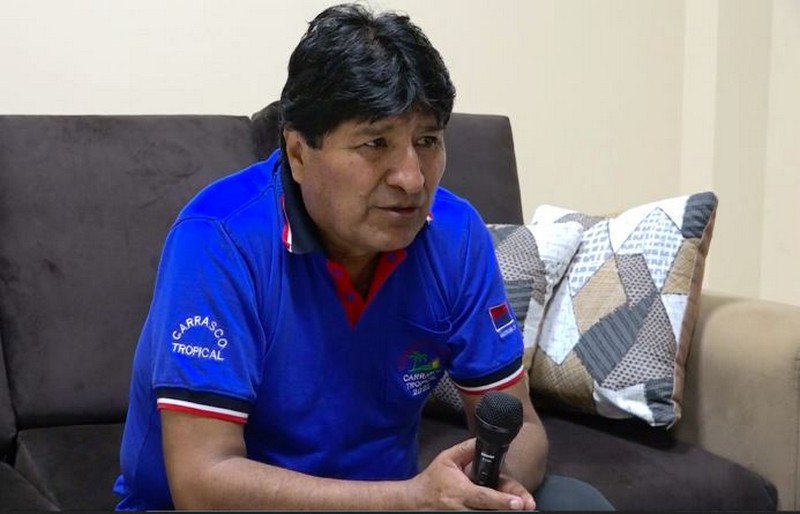
In an interview with British journalist Matt Kennard at his home in El Trópico, a small town four hours from Cochabamba in the heart of the Amazon rain forest, former Bolivian president Evo Morales (2006-2019) called for an international campaign to eliminate NATO [the North Atlantic Treaty Organization].

According to Morales, this campaign should explain to people worldwide that “NATO is—ultimately—the United States. It is not a guarantee for humanity or for life. I do not accept—in fact, I condemn—how they can exclude Russia from the UN Human Rights Council. When the U.S. has intervened in Iraq, in Libya, in so many countries in recent years, why have they not been expelled from the Human Rights Council? Why was that never questioned?”

Morales continued: “We [in the Movimiento al Socialismo, MAS] have profound ideological differences with the politics implemented by the United States using NATO, which are based on interventionism and militarism. Between Russia and Ukraine they want to reach an agreement and [the U.S.] keeps provoking war, the U.S. military industry, which is able to live thanks to war, and they provoke wars in order to sell their weapons. That’s the other reality we live in.”

Coup Against Alternative Economic Model

Morales is one of the most successful presidents in Latin American history who closed down a U.S. military base in Bolivia, expelled the CIA and DEA, and helped reverse half a millennium of colonial history by helping Bolivia to industrialize its economy.

In November 2019, Morales was ousted in a U.S./UK-backed coup that culminated with the army’s massacre of anti-coup protesters. Morales survived an assassination attempt only because Mexico’s president, Andrés Manuel López Obrador, sent a plane to rescue him.

The beneficiary of the coup, Jeanine Áñez—a conservative Christian who lost the October 2020 election to Luis Arce of MAS—was sentenced to 10 years in prison in June after being convicted of terrorism and sedition.

Morales—who returned to Bolivia after Arce’s election in October 2020—believes that the coup was prompted by his move to nationalize Bolivia’s oil and gas reserves.

Morales told Matt Kennard that “I continue to be convinced that the empire, capitalism, imperialism, do not accept that there is an economic model that is better than neoliberalism. The coup was against our economic model…we showed that another Bolivia is possible.”

“All For Lithium”

In 2021, the British Foreign Office released documents which showed that the British embassy in Bolivia had paid an Oxford-based company to optimize “exploitation” of Bolivia’s lithium deposits the month after Morales fled the country after being ousted in the coup.

The documents also showed the UK embassy in La Paz acted as “strategic partner” to Áñez’ coup regime and organized an international mining event in Bolivia four months after democracy was overthrown.

Bolivia possesses the world’s second largest reserves of lithium, a metal used to make batteries, which has been increasingly coveted due to the burgeoning electric-car industry.

Under the traditional imperial dynamic which had kept Bolivia poor, rich countries extract raw materials, send them to Europe to be made into products, and then sell them back to Third World countries like Bolivia as finished products at a mark-up.

With Bolivia’s lithium deposits, Morales was adamant this system was finished. Bolivia would not just extract the lithium; it would build the batteries too. He told Kennard that:

“We started with a laboratory, obviously with international experts that we hired. Then we moved on to a pilot plant. We invested around $20 million, and now it’s working. Every year it produces about 200 tonnes of lithium carbonate, and lithium batteries, in Potosí [the capital of the Spanish empire where the Spanish had undertaken silver mining in the 17th, 18th and early 19th centuries.]”

Bolivian state firm YLB’s plant is seen at the Salar de Uyuni, a vast white salt flat at the center of a global resource race for the battery metal lithium, outside of Uyuni, Bolivia, March 26, 2022. [Source: learningenglish.voanews.com]

Morales continued: “We had a plan to install 42 new [lithium] plants by 2029. It was estimated that profits would be five billion dollars. Profits! That’s when the coup came. The U.S. says China’s presence is not permitted but…having a market in China is very important. Also in Germany. The next step was with Russia, and then came the coup. Just last year, we found out that England had also participated in the coup—all for lithium.”

Colonial Mentality

When Kennard told Morales that the UK Foreign office had denied that a coup took place, Morales responded that this was hard to comprehend and reflected “a totally colonial mindset. They think that some countries are the property of other nations. They think God put them there, so the world belongs to the U.S. and the UK. That’s why the rebellions and the uprisings will continue.”

With the People or the Evil Empire?

Morales has great admiration for Julian Assange whose detention, he said, “represents an escalation, an intimidation so that all the crimes against humanity committed by the different governments of the United States are never revealed. So many interventions, so many invasions, so much looting.”

Currently, Morales is working on building independent media in Bolivia, where he says that most of the media “belong to the empire or the right-wing.”

Optimistic about the recent victory of left-wing political forces in Peru, Chile and Colombia and Lula’s expected return to the presidency in Brazil, Morales told Kennard that, “in politics we must ask ourselves: Are we with the people or are we with the empire? If we are with the people, we make a country; if we are with the empire, we make money. If we are with the people, we fight for life, for humanity; if we are with the empire, we are with the politics of death, the culture of death, interventions, and pillaging of the people. That is what we ask ourselves as humans, as leaders: ‘Are we at the service of our people?’”

Jeremy Kuzmarov is Managing Editor of CovertAction Magazine and author of four books on U.S. foreign policy, including Obama’s Unending Wars (Clarity Press, 2019) and The Russians Are Coming, Again, with John Marciano (Monthly Review Press, 2018).

1 August 2022

Source: www.transcend.org

For Those about to Rock, NAM 2.0 Salutes You

By Pepe Escobar

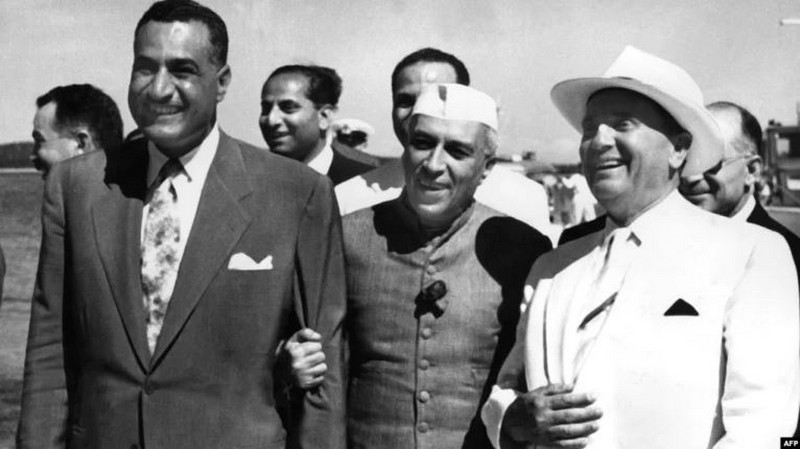
22 Jul 2022 – Those were the days, in 1955, at the legendary Bandung conference in Indonesia, when the newly emancipated Global South started dreaming of building a new world, via what became configured later in 1961 in Belgrade as the Non-Aligned Movement (NAM).

The Empire of Chaos – and Lies – would never allow a starring role for NAM. So it played dirty: everything from hardcore subversion and bribing to military coups and proto-color revolutions.

Yet now, the Spirit of Bandung lives again, via a sort of NAM 2.0 on steroids: a Newly Aligned Movement, with the leaders of Eurasian integration at the vanguard.

We just had a taste of which way the geopolitical wind is blowing at the gathering of a new power troika in Tehran. Unlike Stalin, Roosevelt and Churchill in 1943, Putin, Raisi and Erdogan did not meet to carve up the world. They met essentially to discuss how another world is possible – through bilaterals, trilaterals, multilaterals and an enhanced role for an array of relatively new geopolitical and geoeconomic institutions.

Russia – and China – have been on the forefront of all recent key decisions. Their diplomacy has brought Iran to join the SCO as a full member. Their pull is attracting key Global South players to join BRICS+. Russia has all but convinced Turkey to join BRICS+, the SCO and the EAEU, and facilitated the re-approximation of Tehran and Ankara as well as Tehran and Riyadh. Russia has largely influenced the remake/remodel process across West Asia.

This NAM 2.0 drive – of which China is a key player – stands in stark opposition to how the Empire of Chaos – and Lies – wove its toxic net, via the war on terror, since the start of the millennium. The Empire tried to subdue what it described as MENA (Middle East-Northern Africa) on the basis of two invasions/occupations (Afghanistan-Iraq); a total devastation (Libya); and a protracted proxy war (Syria). All eventually failed.

And that brings us to the stunning contrast between these two foreign policy approaches, graphically illustrated by the spectacular failure of the teleprompter-reading “leader of the free world” in his visit to Jeddah – he was not even allowed to go to Riyadh – compared to Putin’s performance in Tehran.

Not only we are witnessing the lineaments of a Russia/Iran/Turkey informal alliance; we are witnessing the alliance reading a soft riot act to the Empire: leave Syria, before you suffer yet another humiliation. And with a Kurd-directed corollary: keep away from the Americans and recognize the authority of Damascus before it’s too late.

Ankara could never admit it in public, but the fact is Sultan Erdogan – as much against US troops in Syria as Putin and Raisi – even seems to have swiftly calibrated his previous designs on Syrian sovereign territory.

The much-debated Turkish military operation in northern Syria in the end may be restricted to taming the YPG Kurds. The heart of the action will in fact revolve around how the Russia/Iran/Turkey/Syria alliance will make like impossible for Americans stealing Syrian oil.

As Russia is now on “take no prisoners” mode when facing the collective West – the mantra in every intervention by Putin, Lavrov, Medvedev, Patrushev – and on top of it firmly aligned with China and Iran, it’s inevitable that every other player across West Asia and beyond is giving undivided attention to the new game in town.

Go Caspian, Young Man

Interconnecting West Asia and Central Asia, the Caspian Sea has finally reached the geopolitical and geoeconomic limelight – complete with the groundbreaking consensus reached by the five littoral states at the Caspian Summit in late June to officially ban NATO from these waters.

Moreover, the leadership in Tehran in no time realized how the Caspian is the perfect, cost-conscious corridor from Iran to the heart of Russia along the Volga.

So it’s no wonder that Putin himself, in Tehran, proposed the construction of a key stretch of highway on the St Petersburg-Persian Gulf route, much to the delight of the Iranians. Cue to the nostalgic Great Game crowd in that former “rule the waves” island getting serial heart attacks: they could never imagine the Russian “empire” finally having full access to the warm waters of the Persian Gulf.

So we’re back to the absolutely crucial re-engineering of the International North South Transportation Corridor (INTSC) – which will play for Russia and Iran a parallel role the Belt and Road Initiative (BRI) plays for China. In both cases, it’s all about multimodal Eurasia-wide trade and development corridors immune from interference by the imperial Navy.

And here we see the renewed importance of the hyper-strategic liberation of Mariupol and Kherson by the Russian and DPR forces. The Sea of Azov is now configured as a de facto Russian lake – and the same will eventually happen to what is bound to remain of the (currently Ukrainian) Black Sea coast, Odessa included.

So we have the ultra-strategic Caspian-Black Sea maritime corridor – via the Volga-Don canal – seamlessly connected to the Black Sea-Mediterranean, and up north, all the way to the Baltic and the fast developing Atlantic-Pacific connector, the Northern Sea Route. Call it the Russian Heartland Water Roads.

The NATO/Five Eyes/Intermarium combo has absolutely nothing to counteract these (overland) facts on the (Heartland) ground except to throw a pile of HIMARS into the Ukrainian black hole. And of course, keep de-industrializing Europe. In contrast, those across the Global South with a keen sense of history – as in the grand debate of ideas in a Hegelian sense – and also versed in geography and trade relations are busy getting ready to hit (and profit from) the new groove.

Have strategic ambiguity, will travel

As much as it’s a blast to survey all the instances of Russia playing strategic ambiguity to levels capable of baffling the entire, bloated “Western intel” apparatus, what is coming to the forefront is how Putin – and Patrushev – are now willfully turning up the pain dial to tactically exhaust not only the Ukrainian black hole but the whole of NATOstan.

Western governments are collapsing. Sanctions are being ditched – practically in secret. A Deep Freeze winter is a given. And then there’s the incoming economic/financial crisis, the Definitive Monster from Hell, as Martin Armstrong has made it quite clear: “There is no way they can get out of this other than default. If they default, they are worried about millions of people storming the parliaments of Europe…This is really a tremendous financial crisis that we are facing. They have been borrowing year after year since WWII with zero intention of paying anything back.”

Meanwhile, Moscow may be revving up the turbines to launch – this coming Fall? In the middle of Winter? Next Spring? – a multi-spectrum Mother of All Offensives, capitalizing on a rolling series of interconnected strategies that have already rendered dazed and confused every NATOstan “analyst” in sight.

That would explain Putin looking like he’s cheerfully whistling JJ Cale’s Call Me the Breeze in most of his public appearances. In his crucial intervention at the Strong Ideas for a New Time forum, he enthusiastically promoted the advent of “truly revolutionary” and “enormous” changes that would lead to the creation of a new, “harmonious, fairer and more community-focused and safe” world order.

Yet that’s not for everyone: “only truly sovereign states can ensure high growth dynamics.” What that implies is that the unipolar world order, followed by states in the collective West which are hardly sovereign, is condemned to fail, as it’s “becoming a brake on the development of our civilization.”

Only a self-confident sovereign who does not expect anything constructive from the collective West can get away with describing it as “racist and neo-colonial”, bearing an ideology that “is becoming increasingly more like totalitarianism.” In the old NAM days these words would be met with an assassination.

So will the “rules-based international order” be preserved? Not a chance, argues Putin: the changes are “irreversible.” For those about to rock, NAM 2.0 salutes you.

Pepe Escobar, born in Brazil, is a correspondent and editor-at-large at Asia Times and columnist for Consortium News and Strategic Culture in Moscow.

1 August 2022

Source: www.transcend.org

When the Just Go to Prison

By Chris Hedges

31 Jul 2022 – Daniel Hale, dressed in a khaki uniform, his hair cut short and sporting a long, neatly groomed brown beard, is seated behind a plexiglass screen, speaking into a telephone receiver at the federal prison in Marion, Illinois. I hold a receiver on the other side of the plexiglass and listen as he describes his journey from working for the National Security Agency and the Joint Special Operations Task Force at Bagram Air Base in Afghanistan to becoming federal prisoner 26069-07.

Hale, a 34-year-old former Air Force signals intelligence analyst, is serving a 45 month prison sentence, following his conviction under the Espionage Act for disclosing classified documents about the U.S. military’s drone assassination program and its high civilian death toll. The documents are believed to be the source material for “The Drone Papers” published by The Intercept, on October 15, 2015.

These documents revealed that between January 2012 and February 2013, U.S. special operations drone airstrikes killed more than 200 people — of which only 35 were the intended targets. According to the documents, over one five-month period of the operation, nearly 90 percent of the people killed in airstrikes were not the intended targets. The civilian dead, usually innocent bystanders, were routinely classified as “enemies killed in action.”

You can see my interview with Hale’s attorney, Jesselyn Radack, here.

The terrorizing and widespread killing of thousands, perhaps tens of thousands, of civilians was a potent recruiting tool for the Taliban and Iraqi insurgents. The aerial attacks created far more hostile fighters than they eliminated and enraged many in the Muslim world.

Hale is composed, articulate and physically fit from his self-imposed regime of daily exercise. We discuss books he has recently read, including John Steinbeck’s novel East of Eden and Nicholson Baker’s Baseless: My Search for Secrets in the Ruins of the Freedom of Information Act, which explores whether the U.S. used biological weapons on China and Korea during World War II and the Korean War.

Hale is currently housed in the Communications Management Unit (CMU), a special unit that severely restricts and heavily monitors communications, including our conversation, and visitations. The decision by The Bureau of Prisons to lock Hale up in the most restrictive wing of a supermax prison ignores the recommendation of the sentencing Judge Liam O’Grady, who suggested that he be placed in a low-security prison hospital facility in Butner, North Carolina, where he could get treatment for his PTSD.

Hale is one of a few dozen people of conscience who have sacrificed their careers and their freedom to inform the public about government crimes, fraud and lies. Rather than investigate the crimes that are exposed and hold those who carried them out to account, the two ruling parties wage war on all who speak out.

These men and women of conscience are the lifeblood of journalism. Reporters cannot document abuses of power without them. The silence on the part of the press over Hale’s imprisonment, as well as the persecution and imprisonment of other champions of an open society, such as Julian Assange, is stunningly shortsighted. If our most important public servants, those with the courage to inform the public, continue to be criminalized at this rate, we will cement in place total censorship, resulting in a world where the abuses and crimes of the powerful are shrouded in darkness.

Barack Obama weaponized the Espionage Act to prosecute those who provided classified information to the press. The Obama White House, whose assault on civil liberties was worse than those of the Bush administration, used the 1917 Act, designed to prosecute spies, against eight people who leaked information to the media including Assange — although he is not a U.S. citizen, and WikiLeaks is not a U.S.-based publication — along with Edward Snowden, Thomas Drake, Chelsea Manning, Jeffrey Sterling and John Kiriakou, who spent two-and-a-half years in prison for exposing the routine torture of suspects held in black sites.

Also under The Espionage Act, Joshua Schulte, a former CIA software engineer, was convicted on July 13, 2022 of the so-called Vault 7 leak, published by WikiLeaks in 2017, which revealed how the CIA hacked Apple and Android smartphones and turned internet-connected televisions into listening devices. He faces up to 80 years in prison.

Obama used the Espionage Act against those who provided information to the media more than all previous administrations combined. He set a terrifying legal precedent, equating informing the public with spying for a hostile power. I published classified material when I was a reporter at The New York Times, but we are fast approaching the day when the mere possession of such material, along with its publication, will be illegal, as is already law in the U.K. It is a short step from criminalizing journalism to the imprisonment and murder of reporters, such as Jamal Khashoggi in the Saudi consulate in 2018 in Istanbul. While Assange was sheltering in the Ecuadorian Embassy in London, the CIA discussed kidnapping and assassinating him following the release of the Vault 7 documents.

The Espionage Act has been abused in the past. President Woodrow Wilson used it to throw socialists, including Eugene V. Debs, in prison for opposing America’s participation in World War I. But not until the Obama administration was it systematically turned on the press.

Wholesale government surveillance, about which many charged under the Espionage Act tried to warn the public, includes surveillance of journalists. The surveillance of the press, along with those who attempt to inform the public by providing information to reporters, has largely shut down investigations into the machinery of power. The price of telling the truth is too costly.

Hale, trained in the army as a Mandarin linguist, was uneasy the moment he began working in the secretive drone program.

“I needed a paycheck,” he says of his work in the Air Force and later as a private contractor in the drone program, “I was homeless. I had nowhere else to go. But I knew it was wrong.”

While stationed at Fort Bragg, North Carolina, he took a week off in October 2011 to camp out in New York’s Zuccotti Park during the Occupy Wall Street movement. He wore his uniform — a gutsy act of open defiance for someone on active duty— and held up a sign that read, “Free Bradley Manning,” who had not yet announced her transition.

“I slept in the park,” he says. “I was there the morning [Mayor] Bloomberg and his girlfriend made the first attempt to clear the occupiers. I stood with thousands of protestors, including Teamsters and communications workers, who ringed the park. The police backed down. I learned later that while I was in the park, Obama ordered a drone strike in Yemen that killed Abdulrahman Anwar al-Awlaki, the 16-year-old son of the radicalized cleric Anwar al-Awlaki, killed by a drone strike two weeks earlier.”

Hale was deployed a few months later to Afghanistan’s Bagram Air Force Base.

He described his work in a letter to the judge:

In my capacity as a signals intelligence analyst stationed at Bagram Airbase, I was made to track down the geographic location of handset cell phone devices believed to be in the possession of so-called enemy combatants. To accomplish this mission required access to a complex chain of globe-spanning satellites capable of maintaining an unbroken connection with remotely piloted aircraft, commonly referred to as drones. Once a steady connection is made and a targeted cell phone device is acquired, an imagery analyst in the U.S., in coordination with a drone pilot and camera operator, would take over using information I provided to surveil everything that occurred within the drone’s field of vision. This was done, most often, to document the day-to-day lives of suspected militants. Sometimes, under the right conditions, an attempt at capture would be made. Other times, a decision to strike and kill them where they stood would be weighed.

The first time that I witnessed a drone strike came within days of my arrival to Afghanistan. Early that morning, before dawn, a group of men had gathered together in the mountain ranges of Patika province around a campfire carrying weapons and brewing tea. That they carried weapons with them would not have been considered out of the ordinary in the place I grew up, much less within the virtually lawless tribal territories outside the control of the Afghan authorities. Except that among them was a suspected member of the Taliban, given away by the targeted cell phone device in his pocket. As for the remaining individuals, to be armed, of military age, and sitting in the presence of an alleged enemy combatant was enough evidence to place them under suspicion as well. Despite having peacefully assembled, posing no threat, the fate of the now tea drinking men had all but been fulfilled. I could only look on as I sat by and watched through a computer monitor when a sudden, terrifying flurry of hellfire missiles came crashing down, splattering purple-colored crystal guts on the side of the morning mountain.

Since that time and to this day, I continue to recall several such scenes of graphic violence carried out from the cold comfort of a computer chair. Not a day goes by that I don’t question the justification for my actions. By the rules of engagement, it may have been permissible for me to have helped to kill those men — whose language I did not speak, whose customs I did not understand, and whose crimes I could not identify — in the gruesome manner that I did. Watch them die. But how could it be considered honorable of me to continuously have laid in wait for the next opportunity to kill unsuspecting persons, who, more often than not, are posing no danger to me or any other person at the time. Nevermind honorable, how could it be that any thinking person continued to believe that it was necessary for the protection of the United States of America to be in Afghanistan and killing people, not one of whom present was responsible for the September 11th attacks on our nation. Notwithstanding, in 2012, a full year after the demise of Osama bin Laden in Pakistan, I was a part of killing misguided young men who were but mere children on the day of 9/11.

Hale drifted after leaving the Air Force, dropped out of the New School where he had been attending college, and was lured back into operating drones in 2013 by the private defense contractor National Geospatial-Intelligence Agency where he worked as a political geography analyst between December 2013 and August 2014.

“I was making $ 80,000 a year,” he says into the receiver. “I had friends with college degrees who could not make that kind of money.”

Inspired by peace activist David Dellinger, Hale decided to become a “traitor” to “the American way of death.” He would make amends for his complicity in the killings, even at the cost of his freedom. He leaked 17 classified documents that exposed the high number of civilian deaths from drone strikes. He became an outspoken and prominent critic of the drone program.

Because Hale was charged under the Espionage Act, he was not permitted to explain his motivations to the court. He was also forbidden from providing evidence to the court that the drone assassination program killed and wounded large numbers of noncombatants, including children.

“Evidence of the defendant’s views of military and intelligence procedures would needlessly distract the jury from the question of whether he had illegally retained and transmitted classified documents, and instead convert the trail into an inquest of U.S. military and intelligence procedures,” government attorneys said in a motion at Hale’s trial.

“The defendant may wish for his criminal trial to become a forum on something other than his guilt, but those debates cannot and do not inform the core questions in this case: whether the defendant illegally retained and transferred the documents he stole,” the government motion continued.

Drones often fire Hellfire missiles equipped with an explosive warhead weighing about 20 pounds. A Hellfire variant, known as the R9X, carries an inert warhead. Instead of exploding, it hurls about 100 pounds of metal through a vehicle. The missile’s other feature includes six long blades tucked inside which deploy seconds before impact, shredding anything in front of it — including people.

Drones hover 24 hours a day in the skies over countries including Iraq, Somalia, Yemen, Pakistan, Syria and, before our defeat, Afghanistan. Operated remotely from Air Force bases as far away from the target sites as Nevada, drones fire ordinance that instantly and without warning obliterates homes and vehicles or kills clusters of people. Hale found the jocularity of the young drone operators, who treated the killings as if they were an enhanced video game, disturbing. Child victims of drone attacks were dismissed as “fun-sized terrorists.”

Those who survive drone strikes are often badly maimed, losing limbs, suffering severe burns and shrapnel wounds, and losing their vision and hearing.

In a statement he read at his sentencing on July 27, 2021, Hale said:“I think of the farmers in their poppy fields whose daily harvest will gain them safe passage from the warlords, who will, in turn, trade it for weapons before it is synthesized, repackaged, and re-sold dozens of times before it finds its way into this country and into the broken veins of our nation’s next opioid victim. I think of the women who, despite living their entire lives never once allowed to make so much as a choice for themselves, are treated as pawns in a ruthless game politicians play when they need a justification to further the killing of their sons & husbands. And I think of the children, whose bright-eyed, dirty faces look to the sky and hope to see clouds of gray, afraid of the clear blue days that beckon drones to come carrying eager death notes for their fathers.”

“As one drone operator put it,” he read in court, “‘Do you ever step on ants and never give it another thought?’ That’s what you’re made to think of the targets. They deserved it, they chose their side. You had to kill a part of your conscience to keep doing your job — ignoring the voice inside telling you this wasn’t right. I, too, ignored the voice inside as I continued walking blindly towards the edge of an abyss. And when I found myself at the brink, ready to give in, the voice said to me, ‘You, who had been a hunter of men, are no longer. By the grace of God you’ve been saved. Now go forth and be a fisher of men so that others might know the truth.’”

It was, ironically, the election of Obama that encouraged Hale to join the Air Force.

“I thought Obama, who as a candidate opposed the war in Iraq, would end the wars and lawlessness of the Bush administration,” he says.

However, a few weeks after he took office, Obama approved the deployment of an additional 17,000 troops to Afghanistan, where 36,000 U.S. troops and 32,000 NATO troops were already deployed. By the end of the year, Obama increased troop levels in Afghanistan again by 30,000, doubling U.S. casualties. He also massively expanded the drone program, raising the number of drone strikes from several dozen the year before he took office to 117 by his second year in office. By the time he left office, Obama had presided over 563 drone strikes that killed approximately 3,797 people, many of whom were civilians.

Obama authorized “signature strikes” allowing the CIA to carry out drone attacks against groups of suspected militants without getting positive identification. His administration approved “follow-up” or “double-tap” drone strikes, which deployed drones to strike anyone who assisted those injured in the initial drone strike. The Bureau of Investigative Journalists reported in 2012 that “at least 50 civilians were killed in follow-up strikes when they had gone to help victims,” during Obama’s first three years in office. Additionally, “more than 20 civilians have also been attacked in deliberate strikes on funerals and mourners” the report read. Obama expanded the footprint of the drone program in Pakistan, Somalia and Yemen, and established drone bases in Saudi Arabia and Turkey.

“There are several such lists, used to target individuals for different reasons,” Hale writes in an essay titled, “Why I Leaked the Watchlist Documents,” originally published anonymously in May 2016 in the book The Assassination Complex: Inside the Government’s Secret Drone Warfare Program by Jeremy Scahill and the staff of The Intercept.

“Some lists are closely kept; others span multiple intelligence and local law enforcement agencies,” Hale writes in the essay. “There are lists used to kill or capture supposed ‘high-value targets, ’ and others intended to threaten, coerce, or simply monitor a person’s activity. However, all the lists, whether to kill or silence, originate from the Terrorist Identities Datamart Environment (TIDE), and are maintained by the Terrorist Screening Center at the National Counterterrorism Center. The existence of TIDE is unclassified, yet details about how it functions in our government are completely unknown to the public. In August 2013 the database reached a milestone of one million entries. Today, it is thousands of entries larger and is growing faster than it has since its inception in 2003.”

The Terrorist Screening Center, he writes, not only stores names, dates of birth, and other identifying information of potential targets but also stores “medical records, transcripts, and passport data; license plate numbers, email, and cell-phone numbers (along with the phone’s International Mobile Subscriber Identity and International Mobile Station Equipment Identity numbers); your bank account numbers and purchases; and other sensitive information, including DNA and photographs capable of identifying you using facial recognition software.”

Suspects’ data is collected and pooled by the intelligence alliance formed by Australia, Canada, New Zealand, the United Kingdom and the United States, known as the Five Eyes. Each person on the list is assigned a TIDE personal number, or TPN.

“From Osama bin Laden (TPN 1063599) to Abdulrahman Awlaki (TPN 26350617), the American son of Anwar al Awlaki, anyone who has ever been the target of a covert operation was first assigned a TPN and closely monitored by all agencies who follow that TPN long before they were eventually put on a separate list and extrajudicially sentenced to death,” Hale wrote.

As Hale exposed in the leaked documents, the more than one million entries in the TIDE database include about 21,000 U.S. citizens.

“When the President gets up in front of the nation and says they are doing everything they can to ensure there is near certainty there will be no civilians killed, he is saying that because he can’t say otherwise, because anytime an action is taken to finish a target there is a certain amount of guesswork in that action,” Hale says in the award-winning documentary “National Bird,” a film about whistleblowers in the U.S. drone program who suffered moral injury and PTSD. “It’s only in the aftermath of any kind of ordinance being dropped that you know how much actual damage was done. Oftentimes, the intelligence community is reliant, the Joint Special Operations Command, the CIA included, is reliant on intelligence coming afterwards that confirms that who they were targeting was killed in the strike, or that they weren’t killed in that strike.”

“The people who defend drones, and the way they are used, say they protect American lives by not putting them in harm’s way,” he says in the film. “What they really do is embolden decision makers because there is no threat, there is no immediate consequence. They can do this strike. They can potentially kill this person they are so desperate to eliminate because of how potentially dangerous they could be to the U.S. But if it just so happens that they don’t kill that person, or some other people involved in the strike get killed as well, there are no consequences for it. When it comes to high-value targets, [in] every mission you go after one person at a time, but anybody else killed in that strike is blankly assumed to be an associate of the targeted individual. So as long as they can reasonably identify that all of the people in the field view of the camera are military-aged males, meaning anybody who is believed to be age 16 or older, they are a legitimate target under the rules of engagement. If that strike occurs and kills all of them, they just say they got them all.”

Drones, he says, make remote killing “easy and convenient.”

On August 8, 2014, the FBI raided Hale’s home. It was his last day of work for the private contractor. Two FBI agents, one male and one female, shoved their badges in his face when he opened the door. About two dozen agents, pistols drawn, many wearing body armor, followed behind. They photographed and ransacked every room. They confiscated all his electronics, including his phone.

He spent the next five years in limbo. He struggled to find work, fought off depression and contemplated suicide. In 2019, the Trump administration indicted Hale on four counts of violating the Espionage Act and one count of theft of government property. As part of a plea deal, he pled guilty to one count of violating the Espionage Act.

“I am here to answer for my own crimes and not that of another person,” he said at his sentencing. “And it would appear that I am here today to answer for the crime of stealing papers, for which I expect to spend some portion of my life in prison. But what I am really here for is having stolen something that was never mine to take: precious human life. For which I was well-compensated and given a medal. I couldn’t keep living in a world in which people pretended things weren’t happening that were. My consequential decision to share classified information about the drone program with the public was a gesture not taken lightly, nor one I would have taken at all if I believed such a decision had the possibility of harming anyone but myself. I acted not for the sake of self-aggrandizement but that I might some day humbly ask forgiveness.”

I know a few Daniel Hales. They made my most important reporting possible. They enabled truths to be told. They held the powerful accountable. They gave a voice to the victims. They informed the public. They called for the rule of law.

I sit across from Hale and wonder if this is the end, if he, and others like him, will be completely silenced.

Hale’s imprisonment is a microcosm of the vast gulag being constructed for all of us.

Chris Hedges is a Pulitzer Prize–winning journalist who was a foreign correspondent for fifteen years for The New York Times, where he served as the Middle East Bureau Chief and Balkan Bureau Chief.

1 August 2022

Source: www.transcend.org

Penal Assassination: The Gradual Effort to Kill Assange

By Dr Binoy Kampmark

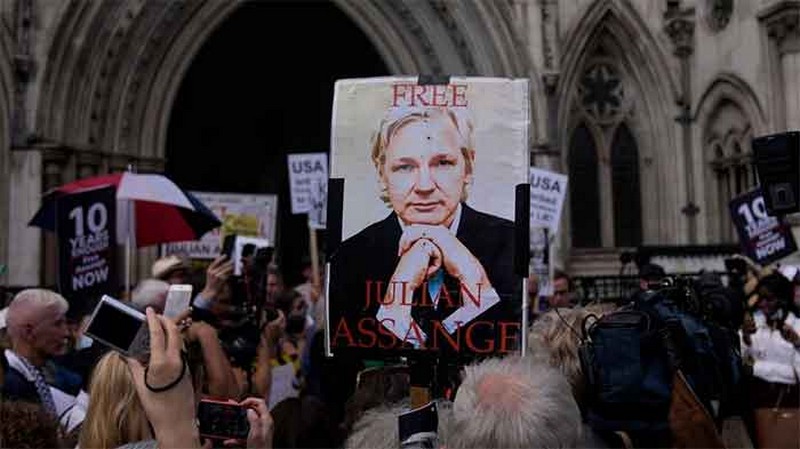
They really do want to kill him. Perhaps it is high time that his detractors and sceptics, proven wrong essentially from the outset, admit that the US imperium, along with its client states, is willing to see Julian Assange perish in prison. The locality and venue, for the purposes of this exercise, are not relevant. Like the Inquisition, the Catholic Church was never keen on soiling its hands, preferring the employ of non-church figures to torture their victims.

In the context of Assange, Britain has been a willing jailor from the start, guided by the good offices of Washington and none too keen in seeing this spiller of secrets released into the world. Bail has been repeatedly, and inexcusably, refused, despite the threats posed by COVID-19, the publisher’s own deteriorating health, and restrictions upon access, at regular intervals, to legal advice from his team. Just as some banks are deemed too large to fail, Assange is considered too large a target to escape. Let loose again, he might do what he does best: reveal government venalities in war and peace and prove the social contract a gross deception and mockery of our sensibilities.

The UK legal system has been the ideal forum to execute the wishes of Washington. Each legal branch that has examined the extradition case has assiduously avoided the bigger picture: the attack on press freedom, exposing war crimes, illegal surveillance of a political asylee in an embassy compound, the breaches of privacy and legal confidentiality, the encroachments upon family life, the evidence on proposed abduction and assassination, the questionable conflicts of interest by some judicial members, the collusion of State authorities.

Instead, the courts, from the outside, have taken a blade to cut away the meatiest, most solid of arguments, focusing on a sliver that would be, in due course, defeated. The sole decision that favoured Assange only did so by essentially regarding him as an individual whose mental fragility would compromise him in a US prison facility. In such a case, suicide would be virtually impossible to prevent. District Judge Vanessa Baraitser, who made the ruling, thought little of the publisher’s credentials, heartily agreeing with the prosecution that no journalist would have ever exposed the names of informants. (This farcical interpretation was rebutted convincingly in the Old Bailey trial proceedings.)

The rest has been a grotesque show of gargantuan proportions, with the High Court and the Supreme Court showing themselves to be political dunces or, which is not much better, dupes. Believing a number of diplomatic assurances by US prosecutors on Assange’s post-extradition fate, made after the original trial, seemed awfully close to a form of legal match-fixing. We all know that court cases and the law can be analogised as betting and having a punt, the outcome never clear till it arrives, but this was positively ludicrous.

To anyone following the trial and knowing the feeble nature of reassurances made by a State power, especially one with the heft of the United States, promises about more commodious accommodation, not being subject to brutal special administrative measures, and also being allowed to apply for a return to Australia to serve the balance of the term, was pure, stenchy balderdash.

Amnesty International is unequivocal on this point: diplomatic assurances are used by governments to “circumvent” various human rights conventions, and the very fact that they are sought to begin with creates its own dangers. “The mere fact that States need to seek diplomatic assurances against torture and other cruel, inhuman or degrading treatment or punishment (other ill-treatment) is indicative of a risk of torture.”

The US prosecuting authorities have even gone so far as to weaken their own position, making their undertakings conditional. Typically, they shift the focus back on Assange, suggesting that he might influence matters by his own mischievous conduct. All in all, nothing said was binding, and the glue holding the promises together might, at any given moment, dissolve.

Admirably, Assange continues to have some fiercely dedicated followers who wish him well and wish him out. Independent Australian MP Andrew Wilkie has the sort of certitude that can pulverise the attitudes of bleak sceptics, though even he must nurse a few doubts. In his address to supporters of Assange in Canberra, delivered on the lawns of the Australian Parliament, he was confident that keeping “the pressure up” would eventually lead to justice for the publisher.

In a crisp summation, Wilkie distilled the case. “The US wants to get even and for so long the UK and Australia have been happy to go along for the ride because they’ve put bilateral relationships with Washington ahead of the rights of a decent man.” Keep maintaining the rage, he urged his audience.

The matter is considered so urgent that Australian Doctors For Assange have warned that death may be peeking around the corner. “Medical examinations of Julian Assange in Belmarsh prison in the UK,” stated spokesman Robert Marr, “have revealed that he is suffering from severe life-threatening cardiovascular and stress-related medical conditions, including having a mini-stroke as a result of his imprisonment and psychological torture.”

The organisation has written to US Ambassador Carolyn Kenney “requesting she urgently ask President Biden to stop the US persecution of Australian citizen Julian Assange for merely publishing information provided to him and stop the US attempt to extradite him from the UK.”

From the Australian perspective, we can already see that there is a go-slow, cautious approach to Assange’s fate, which also serves the lethal agenda being pursued by the US prosecutors. Despite a change of the guard in Canberra, the status quo on power relations between the two countries remains unaltered. Everyone, bar Assange, seems to have time to wait. But in terms of life and health, the time in question is almost done.

Dr. Binoy Kampmark was a Commonwealth Scholar at Selwyn College, Cambridge. He currently lectures at RMIT University.

31 July 2022

Source: countercurrents.org

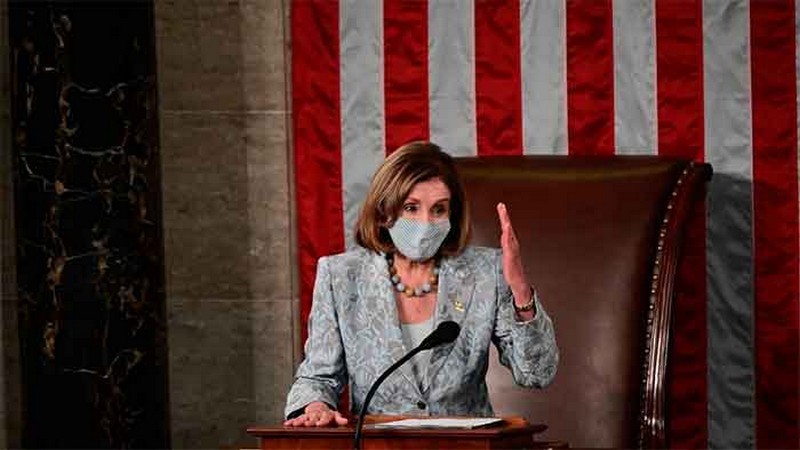
US carrier group heads toward Taiwan as Pelosi flies to Asia

By Mike Head

The American aircraft carrier USS Ronald Reagan and its strike group, including a guided missile destroyer and cruiser, set out from Singapore on Monday heading toward the South China Sea and Taiwan.

This deployment, clearly linked to the planned highly provocative visit by US House Speaker Nancy Pelosi to Taiwan, greatly heightens US military and political tensions with China, which threaten to trigger a potentially catastrophic nuclear war.

“It is clear from this for everyone to see who is the biggest threat to the South China Sea and the Asian region’s peace and stability,” Chinese foreign ministry spokesman Zhao Lijian told a briefing on Thursday.

Despite warnings from Beijing, including by President Xi Jinping, and public statements of reservation by the White House, Pelosi and other congressional representatives began an East Asian tour yesterday, deliberately leaving open the option of landing in Taiwan.

According to the itinerary of Pelosi’s Asia mission, as reported by US media outlets, it includes Japan, South Korea, Malaysia and Singapore, all seen as US allies against China, with Taiwan listed as “tentative.”

To fuel speculation, Pelosi has refused to answer reporters’ inquiries about her Taiwan plans, saying on Wednesday: “I never talk about my travel. It’s a danger to me.” That remark literally accuses China of being prepared to attack her mission.

Regardless of White House claims that it has no jurisdiction over Pelosi’s decision to fly to Taiwan in a military aircraft, the US chairman of the Joint Chiefs of Staff, General Mark Milley declared this week that America’s armed forces were ready to intervene against any Chinese response.

“We will do what is necessary to ensure a safe, safe conduct of their visit. And I’ll just leave it at that,” Milley told reporters at the end of the 24th Indo-Pacific Chiefs of Defense Conference held in Sydney for two days this week.

With reckless disregard for the danger of provoking a military conflict, Milley added: “So what that results in, we’ll have to wait and see.”

Associated Press reported on Wednesday that Pentagon officials had said such US military engagement would include aircraft carriers, fighter jets and “surveillance assets” to protect Pelosi on her flights to and out of Taiwan as well as on the ground.

Whether or not the Pelosi visit to Taiwan goes ahead, such incendiary comments fuel tensions by declaring US intent to take military action against China in or around the island, which China regards as a breakaway province, and which lies just 160 kilometres (100 miles) off the mainland.

Xi has tersely opposed a visit by Pelosi, the second in line to the US presidency, to the island, which would be a further violation of the One China policy, by which the US has not recognised Taiwan a country since 1979.

During a reported two-hour phone call with US President Joe Biden on Thursday, China’s state news agency reported that Xi told Biden: “Public opinion shall not be violated, and if you play with fire you get burned. I hope the US side can see this clearly.”

The brief White House readout of the call pointedly made no mention of the escalating confrontation. It said Biden had told Xi that US policy on Taiwan had not changed, and Washington “strongly opposed” unilateral efforts to change the status quo or undermine peace and stability across the Taiwan Strait.

In reality, successive US administrations, from Obama and Trump to Biden, have deliberately undermined the One China policy, including by sending troops, increasing arms sales and dispatching officials and delegations to Taiwan. The Biden administration has approved four large arms sales to Taiwan, and a fifth, worth $108 million, is scheduled for imminent congressional approval.

Pelosi would be the first sitting US House Speaker to visit Taiwan since the far-right Republican Newt Gingrich went there in 1997. This threatened trip occurs under much more inflammatory conditions, as part of escalating moves by Washington to repudiate the One China policy.

In Sydney, in a transparent bid to blame any clash on Beijing, and thus justify a war, Milley said he had ordered a study of China’s actions in the South China Sea and other areas of the Pacific region, that found a significant increase in “aggressive” actions. Asked for details, Milley said the report was classified—thus hidden from public scrutiny. Nevertheless, he insisted that China’s activity “seems to imply that they want to bully or dominate” other nations.

Speaking at the Center for Strategic and International Studies in Washington, senior Pentagon official Ely Ratner echoed Milley’s characterisation of China’s “irresponsible behavior” and said it was “only a matter of time” before China caused a “major” incident.

Those comments present a conflict with China as inevitable. They follow three public statements by Biden since taking office that the US would go to war to defend Taiwan if it were purportedly attacked by China. Biden’s comments overturn the longstanding US policy of “strategic ambiguity”—not committing the US to defend Taiwan under all circumstances was aimed blocking a provocative declaration of Taiwanese independence and conflict with China.

Pelosi’s plans are proceeding despite warnings issued by Chinese defence officials. “If the US insists on taking its own course, the Chinese military will never sit idly by, and it will definitely take strong actions to thwart any external force’s interference,” Senior Colonel Tan Kefei, a Chinese Ministry of Defense spokesperson said.

To send an aircraft carrier group through the narrow Taiwan Strait between the island and the mainland would itself be provocative. In 1995, President Bill Clinton sent the USS Nimitz aircraft carrier into the strait after China conducted missile tests near Taiwanese-claimed territory.

The USS Kitty Hawk appears to be the last US carrier to have transited the strait, in 2007, but other US warships have done so on a monthly basis. The USS Benfold transited the Taiwan Strait on July 19, after sailing near the disputed Spratly Islands on July 16 and the Paracel Islands on July 13.

Liu Pengyu, spokesperson of the Chinese Embassy in the US, has underlined Beijing’s concerns over Pelosi’s trip. “On the Taiwan question, we have made our stance loud and clear,” Liu said. “The embassy is making all our efforts to prevent the peace and stability across the Taiwan Strait and the stability of China-US relations being damaged by the potential visit of House Speaker Nancy Pelosi to Taiwan.”

Other Chinese figures, particularly those associated with the Global Times, a hawkish state-run outlet, have warned of military reactions. Hu Xijin, former chief editor of the Global Times, called Pelosi’s planned visit an “invasion.”

China long warned that it would forcibly reunify Taiwan with the mainland if the island declared independence which Washington’s actions are now encouraging. Last month, Chinese Defense Minister Wei Fenghe told US officials at the Shangri-La Dialogue in Singapore: “If anyone dares to secede Taiwan from China, we will not hesitate to fight, and we will fight at all costs.”

Under these conditions, both Democrats and Republicans in the US Congress, as well as the American corporate media, have urged Pelosi to travel to Taiwan. These figures include prominent ex-generals and members of Donald Trump’s fascistic Republican leadership.

The Democratic chairman of the House Armed Services Committee, Adam Smith, declared: “I don’t think we should let China dictate something like this. Nancy Pelosi is the speaker of the House, she’s the most powerful person in the country. If she wants to go visit Taiwan, she ought to be able to do that.”

The US is recklessly provoking conflict with Beijing both because it regards China as the chief threat to its global hegemony and as a means channelling working-class discontent amid a profound economic and social crisis at home against a supposed foreign enemy.

US military planners regard Taiwan as a key strategic platform for an assault on China. It is also a key economic asset, producing an estimated 92 percent of the world’s advanced semiconductor chips.

Just as Washington for years built up the Ukrainian military as a bastion against Russia with the aim of provoking the current disastrous war, the US is strengthening the Taiwanese military and seeking to goad China into military action in a bid to weaken and destabilise its rival.

30 July 2022

Source: countercurrents.org

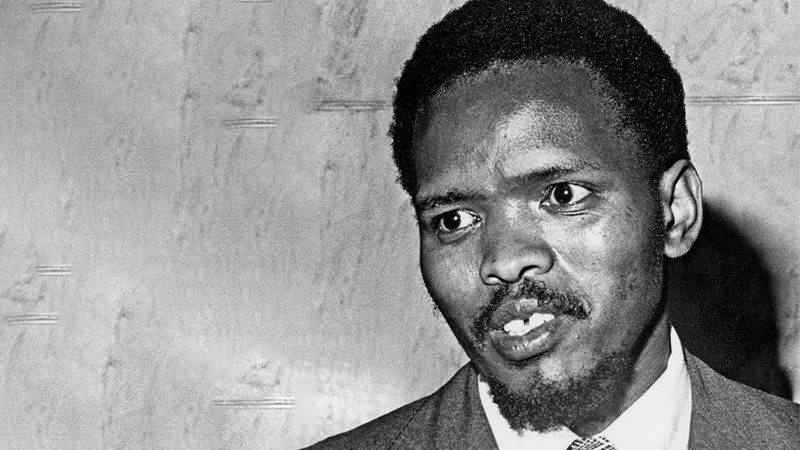
The Martyrs of Apartheid in pre-1994 South Africa: Steve Biko (Part 3)

By Prof Hoosen Vawda

The Targeted, Severe Torture and Brutal Murder of Political Activists by the Agents of the South African Apartheid Regime [i]

23 Jul 2022In Part 2 of this series, the author discussed the untimely, unsolved death of Dr Neil Hudson Aggett on 06th October 1983, while in security police detention in Johannesburg, South Africa.[1] This paper examines the life of another apartheid martyr, Bantu Stephen Biko, born on 18th  December 1946 into a Xhosa family in King William’s Town, Eastern Cape, South Africa and brutally killed while in South African security police detention on 12th September  1977. In the wake of the urban revolt of 1976 and with prospects of a national revolution becoming apparent, security police detained Biko, the outspoken student leader, on 18th  August 1977. He was thirty years old and was reportedly extremely fit when arrested. He was detained in Port Elizabeth and on 11th September moved to Pretoria Central Prison, Transvaal (now Gauteng)[2].  His untimely demise began in a Pretoria prison cell for his anti-apartheid stance against the white minority government of that era in South Africa. He died in detention, the 20th  person to have died in detention in the preceding eighteen months.[3]  A post-mortem was conducted the day after Biko’s death, at which his family was present. The explanation given by the Minister of Justice and Police, Jimmy Kruger[4], was that Biko died while on a hunger strike.[5]  A number of South African newspapers did their own private investigations and learned that Biko died from brain injuries. Their investigations also revealed that Biko was assaulted before he was transported to Pretoria without any medical attention. Three South African newspapers carried reports that Biko did not die as a result of a hunger strike.[6]

The night of 12th September 1977, in South Africa, was a warm balmy, late autumn evening, which began for Steve Biko in a small prion cell in the morning, in Pretoria, the capital of South Africa when he was brutally assaulted on the left side of his head, by the apartheid interrogators resulting in a brain haemorrhage.  He was then placed in the back of a non-white police van ,  without any medical support, let alone a mattress,  while frothing at his mouth and made to endure a 700-mile-long journey, in a mortally injured condition to eventually die on arrival at a state prison hospital for Blacks, that night.  The night is also a religiously significant night for Muslims, called the “Night of Power” in the Islamic, lunar calendar which is approximately ten days shorter than the Gregorian system of counting the days. Steve Biko died on a night that Muslims consider better than a thousand months. Some today, like yesterday, may begin to wonder, “ do Black Lives Matter to God?” The Night of Power is a pivotal, holy night, according to Muslims, in which angels repeatedly descend from heaven seeking to bestow blessings of Divine intervention for those standing on earth imploring God’s help. God describes this night as qualitatively better than a thousand months, which is greater than a lifetime. This night can be described as pivotal for two reasons: The first is that this intervention changes the course of history as when God first sent the Angel Gabriel with the Holy Qur’an on his last mission to mankind. The second is that in this way the hosts of angels coming to earth are on a spiritual intervention for believers, creating in them an internal peace in an oppressive period of time. In the chapter called The Night of Power, both these pivotal purposes are explained:  “We sent it down on the Night of Power. What will explain to you what that Night of Power is? The Night of Power is better than a thousand months; on that night the angels and the Spirit descend again and again with their Lord’s permission on every task. Peace it is until the rising of the dawn.” (Qur’an 97: 1–5)

One of those difficult moments of pivotal convergence was the night Steve Biko was violently martyred. In the Islamic calendar, Steve Biko’s death  was caused on the 27th  night of Ramadan in the year of 1397, after the migration of the Messenger of God, the Prophet Muhammad , from Mecca where he was persecuted by the people of his own tribe for spreading a relatively new religion of Islam, to Medina, where his doctrine was well received.  This is the beginning of the Islamic calendar. The Night of Power, which incidentally fell on September 12, 1977, when Steve Biko died.  The question which is often raised by Islamic Scholars is “How can such a disruption of peace and injustice take place on the Night of Power when the angels are descending granting peace until the rising of the dawn?“  Biko’s brutal murder created a theodicy question that would lead some to form a negative opinion about God and the value of Black lives to God. Muslim theology teaches that God has the prerogative to take what belongs to Him, and one of those angels that descended was the angel of death who was commanded to take the soul of Steve Biko. Despite the evil of a thousand blows that night that White supremacy thought it was killing a Black man in attempt to silence the voice that yelled the loudest that Black Lives Matter, to believers in God’s eternal power, this night was still better than a thousand months. It was a pivotal moment in the anti-apartheid movement which ended the life of the struggle in South Africa. Steve Biko was beaten to death while in Police custody, a familiar dark and brutal reality yesterday and even in the 21st century, if the person is of African origins, today, globally.[7]

Until this late autumn night in 1977, Biko was an outspoken leader of the South African Liberation Movement against apartheid in the decades after the former, first democratically elected President Nelson Mandela’s imprisonment, in Robben Island off the shoreline of the beautifully scemic coast of the Southern tip of South Sfrica. For almost 27, long years.  Steve Biko spoke about the ambiguous nature of life and death and what a good life meant to him: “You are either alive and proud or you are dead, and when you are dead, you can’t care anyway.” Although Steve Biko is physically gone, he is alive and victorious because he lived caring for his fellow South Africans, repelling evil with good. The Muslims believe by the power of God that all martyrs live beyond their mortal life and  are commanded not to refer to those slain while fighting for peace and justice as dead.[8] The Quran,  Holy Book of Islamic faith categorically states that: “Do not say that those who are killed in God’s cause are dead; they are alive, though you do not realize it.” Qur’an 2:154.[9]

Bantu Stephen Biko was a South African anti-apartheid activist. Ideologically an African nationalist and African socialist, he was at the forefront of a grassroots anti-apartheid campaign known as the Black Consciousness Movement during the late 1960s and 1970s. His ideas were articulated in a series of articles published under the pseudonym Frank Talk.

Raised in a poor Xhosa family, Biko grew up in Ginsberg township in the Eastern Cape. In 1966, he began studying medicine at the University of Natal, where he joined the National Union of South African Students (NUSAS). Strongly opposed to the apartheid system of racial segregation and white-minority rule in South Africa, Biko was frustrated that NUSAS and other anti-apartheid groups were dominated by white liberals, rather than by the blacks who were most affected by apartheid. He believed that well-intentioned white liberals failed to comprehend the black experience and often acted in a paternalistic manner. He developed the view that to avoid white domination, black people had to organise independently, and to this end he became a leading figure in the creation of the South African Students’ Organisation [10](SASO) in 1968. Membership was open only to “blacks”, a term that Biko used in reference not just to Bantu-speaking Africans but a[11]lso to Coloureds and Indians. He was careful to keep his movement independent of white liberals, but opposed anti-white hatred and had white friends. The white-minority National Party government were initially supportive, seeing SASO’s creation as a victory for apartheid’s ethos of racial separatism.

Influenced by the Martinican philosopher Frantz Fanon and the African-American Black Power movement, Biko and his compatriots developed Black Consciousness as SASO’s official ideology. The movement campaigned for an end to apartheid and the transition of South Africa toward universal suffrage and a socialist economy. It organised Black Community Programmes (BCPs) and focused on the psychological empowerment of black people. Biko believed that black people needed to rid themselves of any sense of racial inferiority, an idea he expressed by popularizing the slogan “black is beautiful”. In 1972, he was involved in founding the Black People’s Convention (BPC) to promote Black Consciousness ideas among the wider population. The government came to see Biko as a subversive threat and placed him under a banning order in 1973, severely restricting his activities. He remained politically active, helping organise BCPs such as a healthcare centre and a crèche in the Ginsberg area. During his ban he received repeated anonymous threats, and was detained by state security services on several occasions. Following his arrest in August 1977, Biko was beaten to death by state security officers. Over 20,000 people attended his funeral.

During his life, Biko had many unhappy experiences which defined his future strategy in the fight for racial equality.  One incident is notewortyhy of mention. NUSAS officially opposed apartheid, but it moderated its opposition in order to maintain the support of conservative white students.[12] Biko and several other black African NUSAS members were frustrated when it organised parties in white dormitories, which black Africans were forbidden to enter.[13] In July 1967, a NUSAS conference was held at Rhodes University in Grahamstown. After the student delegations arrived, they found that dormitory accommodation had been arranged for the white and Indian delegates, but not the black Africans, who were told that they could sleep in a local church. Biko and other black African delegates walked out of the conference in anger.[14] Biko later related that this event forced him to rethink his belief in the multi-racial approach to political activism.[15]  Biko expressed the following sentiments. “I realised that for a long time I had been holding onto this whole dogma of nonracism, almost like a religion, But in the course of that debate I began to feel there was a lot lacking in the proponents of the nonracist idea, they had this problem, you know, of superiority, and they tended to take us for granted and wanted us to accept things that were second-class. They could not see why we could not consider staying in that church, and I began to feel that our understanding of our own situation in this country was not coincidental with that of these liberal whites.[16]

“Black”, said Biko, “is not a colour; Black is an experience. If you are oppressed, you are Black. In the South African context, this was truly revolutionary. Biko’s subsidiary message was that the unity of the oppressed could not be achieved through clandestine armed struggle; it had to be achieved in the open, through a peaceful but militant struggle.”[17]

Biko hoped that a future socialist South Africa could become a completely non-racial society, with people of all ethnic backgrounds living peacefully together in a “joint culture” that combined the best of all communities.[18] He did not support guarantees of minority rights, believing that doing so would continue to recognise divisions along racial lines.[19] Instead he supported a one person, one vote system.[20] Initially arguing that one-party states were appropriate for Africa, he developed a more positive view of multi-party systems after conversations with Woods.[21] He saw individual liberty as desirable, but regarded it as a lesser priority than access to food, employment, and social security.[22]  Dr Saths Cooper, a former Vice-Chacellor of the University of Durban-Westville, a tertiary, apartheid institute, specfically built for Indian students, was also a good friend of Steve Biko, as a ploitcal activist.[23]

Biko’s fame spread posthumously. He became the subject of numerous songs and works of art, while a 1978 biography by his friend Donald Woods formed the basis for the 1987 film Cry Freedom. During Biko’s life, the government alleged that he hated whites, various anti-apartheid activists accused him of sexism, and African racial nationalists criticised his united front with Coloureds and Indians. Nonetheless, Biko became one of the earliest icons of the movement against apartheid, and is regarded as a political martyr and the “Father of Black Consciousness”. His political legacy remains a matter of contention, amongst the academic and plitical fraternities not only in South Africa, but globally.

Following apartheid’s collapse, in 1994, Donald Woods[24] a South African journalist and anti-apartheid activist, raised funds to commission a bronze statue of Biko from Naomi Jacobson[25]. It was erected outside the front door of city hall in East London on the Eastern cape, opposite a statue commemorating British soldiers killed in the Second Boer War.[26] Over 10,000 people attended the monument’s unveiling in September 1997.[27] In the following months it was vandalised several times; in one instance it was daubed with the letters “AWB”, an acronym of the Afrikaner Weerstandsbeweging, a far-right Afrikaner paramilitary group.[28] In 1997, the cemetery where Biko was buried was renamed the Steve Biko Garden of Remembrance.[29] The District Six Museum also held an exhibition of artwork marking the 20th anniversary of his death by examining his legacy.[30]

Also in September 1997, Biko’s family established the Steve Biko Foundation.[31] The Ford Foundation donated money to the group to establish a Steve Biko Centre in Ginsberg,[32] opened in 2012.[33] The Foundation launched its annual Steve Biko Memorial Lecture in 2000, each given by a prominent black intellectual.[34] The first speaker was Njabulo Ndebele; later speakers included Zakes Mda, Chinua Achebe, Ngũgĩ wa Thiong’o, and Mandela.[35]

Buildings, institutes and public spaces around the world have been named after Biko, such as the Steve Bikoplein in Amsterdam.[36] In 2008, the Pretoria Academic Hospital was renamed the Steve Biko Hospital.[37] The University of the Witwatersrand has a Steve Biko Centre for Bioethics.[38] In Salvador, Bahia, a Steve Biko Institute was established to promote educational attainment among poor Afro-Brazilians.[39] In 2012, the Google Cultural Institute published an online archive containing documents and photographs owned by the Steve Biko Foundation.[40] On 18 December 2016, Google marked what would have been Biko’s 70th birthday with a Google Doodle.[41]  The University of KawaZulu-Natal, Nelson R. Mamdela School of Medicine, in Durban, eponymously named only a lecture theatre as the “Steve Biko Lecture Theatre, noting that Steve Biko was a medical student there, pior to his arrest and death.[42]

Amid the dismantling of apartheid in the early 1990s, various political parties competed over Biko’s legacy, with several saying they were the party that Biko would support if he were still alive.[43] AZAPO[44] in particular claimed exclusive ownership over Black Consciousness.[45] In 1994, the ANC issued a campaign poster suggesting that Biko had been a member of their party, which was untrue.[46] Following the end of apartheid when the ANC formed the government, they were accused of appropriating his legacy. In 2002, AZAPO issued a statement declaring that “Biko was not a neutral, apolitical and mythical icon” and that the ANC was “scandalously” using Biko’s image to legitimise their “weak” government. Members of the ANC have also criticised AZAPO’s attitude to Biko; in 1997, Mandela said that “Biko belongs to us all, not just AZAPO.” On the anniversary of Biko’s death in 2015, delegations from both the ANC and the Economic Freedom Fighters independently visited his grave.[280] In March 2017, the South African President Jacob Zuma laid a wreath at Biko’s grave to mark Human Rights Day.[47]

Bantu Stephen Biko, one of South Africa’s most famous anti-apartheid sons, was martyred at the hands of White, South Africa security police. Soon after, an autopsy was conducted and photographs were taken. Images from this report were leaked to the South African press and appeared in newspapers on 20th September 1977. When journalists received the official autopsy report on 26th October 1977, South Africans as well as the rest of the humane global community, had evidence-based confirmation of their speculations: Mr. Biko died of a massive brain hemorrhage due to blunt trauma on the left side of his head. Images from Biko’s autopsy were periodically printed in South African news media, through the last quarter of 1977 as the state conducted an inquiry into his death. Over the next eight years, these pictures sometimes accompanied reports on efforts to censure state pathologists for their handling of Biko’s medical needs prior to his death. Thus, through popular reproduction over a lengthy period, Biko’s postmortem portraits reached a large and unquantifiable audience, nationally in South Africa, as well as the global media, creating an awareness of the appalling human rights abuses in South Africa by the White, governing minority, against the Black majority.[49]

Like portraits made while he lived, images of Biko’s corpse have become potent symbols for wider cultural notions about changing power relations, order and disorder, and conceptions of self within the society. Julia Kristeva defines the corpse as the utmost of abjection.[50] She famously wrote that it is “not lack of cleanliness or health that causes abjection but what disturbs identity, system, and order. What does not respect boundaries, positions, or roles. The in-between, the ambiguous, the composite”. Since autopsies are performed when the cause of death is questioned, abjection, in all of its uncertainty, is inherent to the practice and its representation. When the pathologist’s record images of an important political activist who died at the hands of the State, viewers are compelled to explore personal notions of self and nation.

Steve Biko’s, most graphic autopsy pictures have been displayed and extensively printed over a period of twenty years, between 1977 to 1997 and even continue to make periodic appearances in the liberated South Africa in the 21st century.  It underwent periods of internal censure, states of emergency, international boycott, and increased collective organisation of anti-apartheid bodies, among other things. In 1994, the nation changed from widespread disenfranchisement to democracy, and a period of concerted reflection was undertaken through the work of the Truth and Reconciliation Commission (TRC). Popularly reproduced and artistically appropriated throughout this time, Biko’s postmortem portraits have terrifically extended their meaning beyond that of forensic inquiry. Often they can be read as both an emblem of State abuse and as forceful resistance to it. Sometimes their appropriation affirms the ongoing life of Black Consciousness, the very bedrock of Biko’s identity and the philosophic principles for which he died. Works by five South African artists, the like of Paul Stopforth[51], a self-exiled South African political activist, artist, who emigrated to the United states in 1988, Ezrom Legae[52], a South African sculptor and draughtsman, Sam Nhlengthewa[53], a South African, creative collage artist, Professor Colin Richards[54], a fine artist and academic and David Koloane, considered to have been “an influential artist and writer of the apartheid years” in South Africa. [55],  are analysed collectively, in an effort to understand how Biko’s death has affected South Africans’ sense of self and nation during a period of significant violence and political change.  It is also to be noted that while Steve Biko was not given the due dignity in death, by the leaking and widespread dissemination of the graphic photographs in the media, of his battered corpse violating the fundamental principles of ethics, the transgression may be justified in exposing how even the white medical profession at the time as well as the so called reputable South African Medical Journal colluded with the apartheid state oppression apparatus to medically cover up the heinous crimes of their masters.   This is a serious indictment on the so-called civilized whites in South Africa, who looked upon the “natives” as “barbaric sub-humans”, who could be disposed of like animals, with absolutely no respect for their dignity, nor personal human rights of the Black people.  A similar philosophy exists in Israel, against the Palestinians.  This policy, is deeply entrenched as a philosophical ideology , even today, not only in white South African, but also in the United States, Britain, France and even in the war-torn Ukraine, where Black South African students were discriminated against, during the evacuation of civilians, following the Russian invasion, at the beginning of the war.

The Bottom Line is that like the death of George Floyd, the South African activist Steve Biko’s death galvanized a global movement against racism. His extrajudicial killing embarrassed Apartheid South Africa on the global stage, much the way Floyd’s death has embarrassed the United States. Although Biko was an activist and George Floyd a citizen, in one crucial way their deaths were quite similar: two Black people whose deaths were contested at the point of inquest and autopsy. Bantu Stephen Biko founded the Black Consciousness Movement in South Africa as a medical student at the University of Natal, Medical School, specifically created by the Nationalist government of South Africa for the training of Black Medical Students, by a decree in 1950, during his brief period of training there, in the suburb of Umbilo, Durban, South Africa.

The answer to God’s rhetorical question becomes timely for those who wrestle with the theodicy of Black suffering and for those who ask how something like the evil of White Supremacy could win and how the death of Steve Biko could have taken place on such a holy night of power in the Islamic calendar? A night God describes as, “better than a thousand months.” We can understand, that on that night it was decreed by divine power, just as the exodus of Moses and the children of Israel from the tyranny of the Pharaoh in Egypt to the promised land, across the sea, for Steve Biko to be martyred. It can also be appreciated, that the All-Powerful divine, began to restrict and control White Power on that night in the angelic realm. It can also be understood that the powerful system of apartheid in South Africa pre 1994, which was thought to be indefatigable was now determined to fail despite being supported by Western powers, including Britain and the United States of America, because surely God is Able. It can be also appreciated that it was decreed that White supremacy’s plot was being undone with exact due measure by the Best of Plotters, the Divine.  It can also be understood that Steve Biko’s life on earth reached its pre-destined, decreed time and his blood paid the price for a new era of liberation in South Africa.

It is also interesting to note that followers of the Islamic faith, the Muslims have the privileged opportunity to annually experience both the historic and religiously pivotal night of power, every Ramadan, the fasting month in the Islamic calendar, as well as the night of power,  wherein the death of the iconic anti-apartheid activist was caused by the racist white oppressors, like the present day oppressors and killers of Palestinians.  The white regime is no more enforcing its supremacy on the majority of the indigenous people of South Africa, whose land they expropriated with the arrival of the first white man, of European descent in 1652.  Similarly, the killings and oppression of the indigenous people of Palestine whose land the displaced Jewish people expropriated by British decree will come to an end in the seventh decade as prophesised.  Serious concern is expressed by orthodox Jews in Israel, at present, about the future of Israel.

This end of systemic oppression is inevitable, for is cannot be propagated eternally.  At the rising of the dawn after Steve Biko was murdered, very few South Africans, let alone the global community, would have believed, way back in 1977, that Steve Biko’s death was actually the death blow to White supremacy in South Africa. In just a decade Nelson Mandela would be freed from prison and elected President of South Africa. Who would have believed you if you had said that last night angels descended as they do annually as decreed to fulfil God’s command to restore justice, so do not fear nor should one grieve. God is undoubtedly able to exact justice over all things. We communally stand and implore God believing that He is surely Able, All Powerful to affirmatively answer, at this pivotal moment in time the rhetorical question: do Black lives matter to God?  The answer is an unequivocal yes!  Peace shall prevail and in the Divine, humanoids must place their complete trust, for the Pharaonic oppression against the people of Moses, the Roman tyranny against Christendom, the Mongol butchery in Eastern Europe, the tyranny of the Persian Empire, the Colonial oppression in Africa, India and the East, the Nazi epigenetic engineering and quest for world supremacy, are all no more.  Surely the bigoted supremacy, as well as the war mongering, of the present-day western powers will be no more, very soon.

_____________________

READ: PART 1PART 2PART 4

Professor G. Hoosen M. Vawda (Bsc; MBChB; PhD.Wits) is a member of the TRANSCEND Network for Peace Development Environment.

25 July 2022

Source: www.transcend.org
Biden’s Middle East Visit: An Orgy of Cynicism, Hypocrisy, and Erasures

By Richard Falk

A stylistically modified version of this post was published a few days ago in CounterPunch. It criticizes the dual tracks of Biden’s ill-executed trip in mid-July to Israel and Saudi Arabia. It faults Biden for the extreme cynicism of pursuing a realpolitik approach in Riyadh and an approach in Israel that mixed silences about apartheid, Shireen Abu Akleh, and the Palestinian ordeal with fanciful claims about shared values and democratic affinities.

Shared Values and Fist Pump Geopolitics

21 Jul 2022 – The U.S. Government at the highest level criticized Michelle Bachelet, the UN High Commissioner for Human Rights, because she went to China on a mission to develop opportunities for cooperation with respect to the protection of human rights, which I found appalling at the time. The mission had been carefully several weeks earlier by UN staff that had visited China and negotiated the itinerary of the visit, which took occurred in May of this year. The whole experience seemed a win/win breakthrough as a major country opening itself up to a high degree of independent international scrutiny with respect to its human rights record, an exposure the U.S. has resisted and opposed. High officials in Washington let it be known in advance that they considered the trip ‘a mistake,’ and expressed consternation that its hyped allegations of ‘genocide’ associated with the treatment of the Uyghur minority in Xinjiang were not confirmed by Bachelet, although human rights violations in the province were duly noted by the High Commissioner in her report on the visit.

Western policy-minded China experts pointed to the supposed ‘danger’ of legitimating China’s narrative by the visit and contributing “an important milestone in China’s normative power.” [see Patrizia Zoguo and Lukian Da Bono, “The Steep Cost of Bachelet’s Visit to China,” The Diplomat,June 13, 2022] Critics even observed that such a visit so effectively whitewashed China’s wrongdoing that rather than improve prospects for its compliance with human rights the mission would likely have the perverse effect of emboldening China to commit even grosser violations in the future, and this despite China having agreed to establish a variety of continuing interactions and periodic consultations with the Geneva-based Office of the High Commissioner, connections no other geopolitical actor has seen fit to negotiate, and yet the critics failed to draw any such comparisons such was there resolve to prove it wrong for any part of the UN System to cooperate with China.

I regard China’s effort to enhance its image as a legitimate state to be a positive development not deserving the hostile reaction that it received in many sectors of the West, but especially in those quarters that were intent on a new cold war to blunt the competitive edge that China was gaining, especially in the world economy and on many technological frontiers of special relevance in the digital age. To seize upon this Chinese initiative, even granting that it was partly motivated by quite nomal soft power ambitions of sovereign states, is to denigrate most attempts to develop an international culture of respect for human rights as an essential foundation for indispensable cooperation in a variety of functional areas, including trade, climate change, migration, and environmental protection.

And we should not overlook American class-based arrogance in relation to human rights, given its refusal to accord economic and social rights the normative status they deserve, and of which China is proud, and justly so, given its remarkable record of poverty alleviation over the course of the last half century. This acute societal shortcoming in the United States is exhibited to the world and visible to all in the form of large-scale urban homelessness in the cities of the United States, and accented by less visible unavailability of affordable health care and nutritious food to millions of its own citizens; as well, constitutionally validated gross violations of the right to life arising from permissive rules governing access to assault weaponry for anyone with the money to make the purchase. A surge of civic violence, including mass school and mall shootings that keep blindsiding governing institutions at all levels of society who remain willing to pander to the interests of the munitions industry and the toxic populism of gun culture. Should not we, as Americans, have long ago interrogated our distinctive vulnerability to such a pattern of negative exceptionalism.

It is with these considerations in the background that we should assess the Biden mid-July visit to Israel and Saudi Arabia. If the critical reaction to Bachelet’s mission reflected establishment resentment to this breach in the geopolitical wall of hostility that had been constructed during the last years of the Trump presidency to justify coercive diplomacy directed at China. In contrast, Biden’s visit to the Middle East dramatized the extent to which human rights are buried far underground when perceived to clash with strategic interests being pursued in foreign policy as abetted by the domestic incentives to treat certain flagrant violators of human rights as if they are upholding the highest standards of a model democracy. Of course, it is of relevance to note that overlooking Saudi Arabia dreadful record, which includes blood dripping from the hands of the de facto head of state, Crown Prince Mohammed bin Salmon (MBS), did bring Biden and the normally compliant media visible discomfort and occasioned some retreat from Biden’s fist pump greeting in Saudi Arabia.

Perhaps embarrassed, Biden made clear that it was only national security interests prevented him from fulfilling his 2020 campaign pledge to treat Saudi Arabia as a ‘pariah’ state. Biden somewhat surprisingly affirmed, considering his good will diplomatic goals, that he still believed in the rightness of his pledge when it came to Saudi human rights. Even more provocatively, Biden rejected MBS’s insistence that he had nothing to do with the murder of Jamal Khashoggi back in 2018. In view of his praise of Israel’s democratic credentials, Biden made himself vulnerable to MBS’s clever taunt—you seem to care much more about Jamal Khashoggi than Shireen Abu Akleh. Rather than implicate Israel, the U.S. official investigation of the murder of its own citizen, seems constructed to share the grief of Akleh’s surviving family instead of accepting the political costs of seeking accountability of the sort that might protect future journalists covering dangerous hotspots in Israel and elsewhere.

When it came to Israel, not only were human rights issues off the table, but Israel was praised extravagantly and unreservedly as an ally with shared values whose behavior could not be judged negatively. Biden displayed his affection for Israel by unnecessarily declaring himself to be a non-Jewish Zionist as if race was not a factor in the implementation of the Zionist vision in Israel. On another level, such a flourish seemed to express Biden’s view that disregarding the plight of the Palestinians was not a sufficient demonstration that U.S. partisanship was underpinned by a ideological identity.

Pro-Palestinians had anticipated this one-sidedness, [See statement of the Global Network on the Question of Palestine, “Biden’s Upcoming Visit to the Middle East: A Recipe for Violence not Peace,” July 12, 2022] and predicted its refusal to take note of such developments as the condemnation of the most internationally respected human rights NGOs in Israel and Occupied Palestine were branded as ‘terrorist’ organizations months ago by the Israeli Secretary of Defense and currently aspiring prime minister, Benny Gantz.

Even nine of the most important EU members (including France, Germany, Spain, and Italy) issued a joint statement on July 12th repudiating this cynical branding by the Israeli government evidently designed to inhibit international funding as well as destroy the domestic viability of these key civil society actors. In the same spirit, although much more serious from a human rights perspective, Biden and Western media kept completely silent about the glaring reality of Israel apartheid despite the strong mainstream human rights NGOs in the West and even in Israel concluding that Israel was guilty of committing the continuing international crime of apartheid.[See 2001 reports of B’Tselem, Human Rights Watch, and 2022 of Amnesty International, as well as 2017 UN report of the Economic and Social Council of West Asia).

Unlike the visit to Riyadh if Biden had raised these concerns even politely if would have undoubtedly produced a negative reaction among Jewish lobbying groups in the U.S., with repercussions for fundraising and the 2022 and 2024 elections. Despite Biden groveling at the feet of Yair Lapid, the Israeli caretaker prime minister, Trump remains the American leader of choice for the majority of Israelis according to recent public opinion polls. Trump doesn’t bother to pretend that he favors Palestinian statehood in a meaningful form, while Biden is apparently eager to retain membership in the liberal Zionist camp by way of rhetoric that falls short when it comes to policy.

The visit to Israel ended with the so-called The Jerusalem U.S.-Israel Strategic Partnership Joint Declaration signed by the two leaders on July 14, 2022. The opening sentences of the Declaration set the tone, which unlike the national interests justifications for the diplomatic visit to Saudi Arabia, the prior Israel visit is affirmed as a virtual pilgrimage, far exceeding the proprieties of alliance statecraft or the pursuit of common national policy agendas. The extravagant language used is worth noticing, and especially as it implicit vindicated the marginalization of the Palestinian quest for justice and a shared war-mongering tone toward Iran:

“The United States and Israel reaffirm the unbreakable bonds between our two countries and the enduring commitment of the United States to Israel’s security. Our countries further reaffirm that the strategic U.S.-Israel partnership is based on a bedrock of shared values, shared interests, and true friendship. Furthermore, the United States and Israel affirm that among the values the countries share is an unwavering commitment to democracy, the rule of law, and the calling of “Tikkun Olam,” repairing the world.”

The Declaration went on to attack the UN and even the ICC as giving way to anti-Semitism, all because it was a venue for well-evidenced criticisms of Israel’s state practices and policies. This love fest even agreed to join forces to oppose the BDS Campaign and indeed any effort regarded as delegitimizing Israel as a state. There were, as well, imprudently phrased commitments in the Declaration especially with reference to Iran, the language of which is provocative:

“The United States stresses that integral to this pledge is the commitment never to allow Iran to acquire a nuclear weapon, and that it is prepared to use all elements of its national power to ensure that outcome. The United States further affirms the commitment to work together with other partners to confront Iran’s aggression and destabilizing activities, whether advanced directly or through proxies and terrorist organizations such as Hezbollah, Hamas, and Palestinian Islamic Jihad.” [emphasis in the original}

Of course, among the revealing and dangerous silences associated with the Biden visit was the failure to mention Israel’s arsenal of nuclear weaponry and resulting strategic hegemony throughout the region. From any kind of detached perspective dedicated to peace and stability a nuclear free zone for the Middle East would be the optimal way to promote the true interests of the United States in the region, including energy production increases. When in history has a dominant state enacted its own policies in ways that ran against its national interests in response to pressures from a small state that it heavily subsidizes, including with weapons?

To end on a constructive note, the White House might considering entrusting future international political travel plans to American Express rather than the State Department. Its time to shed Blinken’s blinkered ‘rule-governed’ geopolitical fairy tale if we want to live together with others on the planet in ways that work. If this bit of unsolicited advice is followed, it might lead to real foreign policy gain!

Richard Falk is a member of the TRANSCEND Network, Albert G. Milbank Professor Emeritus of International Law at Princeton University, Chair of Global Law, Faculty of Law, at Queen Mary University London, Research Associate the Orfalea Center of Global Studies at the University of California, Santa Barbara, and Fellow of the Tellus Institute.

25 July 2022

Source: www.transcend.org
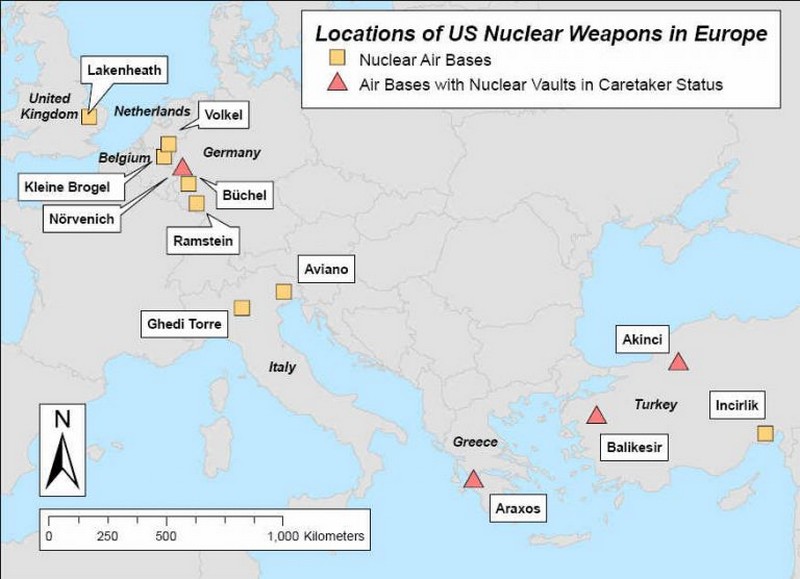
Sowing Hunger, Reaping Profits – A Food Crisis by Design

By Vandana Shiva

14 Jul 2022 – Since the Russian invasion of Ukraine, headlines have been dominated by the warnings of risk in global food supply shortages and rising global food prices, all due to the conflict. But, according to many international groups, there is currently no risk of global food supply shortages. So why are so many countries now facing an increased risk of food insecurity, and in worst cases famine?

What is crucially being overlooked by most diagnoses of the current food crisis is how the problem does not lie in a lack of supply, or lack of market integration, but instead in how the food system is structured around power.

Detailed in this new report by Navdanya International, is how, in fact, we have already been facing a food and malnutrition crisis long before the current conflict.

From the colonial era, which saw the beginning of extraction and exploitation of small farmers, to the advent of the Green Revolution, and the concretizing of the globalized free trade regime, we have seen the deliberate destruction of small farmers and food sovereignty in favor of corporate power.

Therefore, it is no coincidence that today we are witnessing the third major food crisis in the last 15 years.

What the Russian-Ukrainian conflict has once again laid bare is just how fragile globalized food systems are. The current globalized, industrial agrifood system is a food system that creates hunger by design.

Worst of all, international institutions, governments and corporate actors are using the current crisis, as they have used every crisis: to further consolidate this failed model. False solutions and the redundant calls for failed approaches abound in headlines and international responses.

The current crisis should be a wake up call to the imperative of building resilience in food systems through agroecology, local food chains and by strengthening small farmers. Now more than ever will a food systems transformation toward Food Sovereignty, based on agroecology and increasing biodiversity, help act as a lasting solution to hunger. All over the world, many are following the path of Poison-free Food and Farming, and are transitioning to an ecological and democratic path, putting the food system in the hands of communities, women, farmers, and consumers. Only through local, agroecological food systems will systemic dependence on fertilizers, commodity farming, import dependencies, and systematic poverty be challenged. This is the most powerful means to regain our agriculture, our territories, our food, our natural environment, and our future.

Download Pdf

Call to Action

From the 2nd to the 16th of October (and beyond…), we invite you to join people and communities around the globe, and work together to launch a Campaign for Our Bread, Our Freedom, to take back our Seed, Food, Democracy and Freedom, and celebrate our seeds, our soils, our land, our territories, to create an Earth Democracy based on Living Seed, Living Soil, healthy communities and living economies of care.

CALL TO ACTION – for an Ecological Transformation of our Food Systems

Also read

New GMO Wheat Banned in Province of Buenos Aires, Argentina

Navdanya and the Navdanya movement were created by Dr. Vandana Shiva 30 years ago in India to defend Seed and Food sovereignty and small farmers around the world.

25 July 2022

Source: www.transcend.org
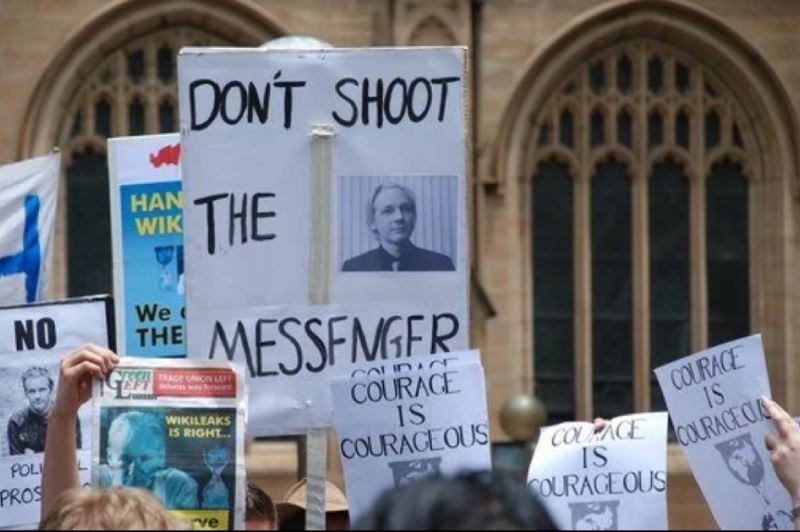
Nuclear Strategy and Ending the War in Ukraine

By NOBEL LAUREATES

19 Jul 2022 – It is time for bolder efforts to make peace in Ukraine.

War, like fire, can spread out of control, and as President Putin keeps reminding us, this particular conflagration has the potential to start a nuclear war.

At a recent joint news conference with the President of Belarus, Putin announced that Russia would transfer Iskander M missiles to Belarus. Those missiles can carry nuclear warheads, and the move is apparently intended to mirror nuclear sharing arrangements the United States has with five NATO allies — Belgium, the Netherlands, Germany, Italy, and Turkey.

U.S. nuclear weapons were introduced into Europe in the 1950s as a stopgap measure to defend NATO democracies whose conventional forces were weak. The number of nuclear weapons in those five countries peaked around 7,300 warheads in the 1960s, then dwindled to about 150 today, reflecting NATO’s growing conventional strength and its diminishing estimation of the military usefulness of nuclear weapons. But even 150 nuclear weapons could be more than sufficient to touch off a dangerous confrontation with Russia.

The world is as close to the nuclear abyss today as it was during the Cuban Missile Crisis. In fact, contemporary nuclear risks may actually be worse. Whereas Cuban Missile Crisis lasted just 13 days, the fighting in Ukraine will likely continue and tempt fate for many months to come.

Negotiations are therefore essential to defuse nuclear tensions. Even though it has no direct role in the Ukraine war, it’s appropriate for NATO to have a role in encouraging negotiations to end it.

Since NATO is an enormously strong military force — stronger even than Putin’s Russia — and since President Putin has said that the war in Ukraine is in part a response to NATO’s actions, NATO calling for peace negotiations would be fitting and carry some weight.

It would also be in keeping with NATO member states’ obligations under the Nuclear Non-Proliferation Treaty. NATO leaders meeting in Madrid recently reaffirmed that “The Nuclear Non-Proliferation Treaty is the essential bulwark against the spread of nuclear weapons and we remain strongly committed to its full implementation, including Article VI [the article that commits nuclear-armed states to pursuing nuclear disarmament].” This commitment includes, according to the Non-Proliferation Treaty’s 2000 Review Conference report, “a diminishing role for nuclear weapons in security policies to minimize the risk that these weapons ever be used and to facilitate the process of their total elimination.”

NATO traditionally maintains strong deterrence and defense, while it has also led the way toward detente and dialogue. NATO’s current commitment to deterrence and defense is clear. But to restart conversations, NATO must now also find a way to encourage détente and dialogue.

Bringing both sides back into dialogue will require a dramatic gesture. Therefore, we propose NATO plan and prepare for withdrawal of all U.S. nuclear warheads from Europe and Turkey, preliminary to negotiations. Withdrawal would be carried out once peace terms are agreed between Ukraine and Russia. Such a proposal would get Putin’s attention and might bring him to the negotiating table.

Removing U.S. nuclear weapons from Europe and Turkey would not weaken NATO militarily, since nuclear weapons have little or no actual usefulness on the battlefield. If they are truly weapons of last resort, there is no need to deploy them so close to Russia’s border. Under this proposal, France, the United Kingdom, and the United States would retain their national nuclear arsenals, and if the worst happened, they could still use them on NATO’s behalf.

Despite 70 years without a major war, it is not possible for nuclear deterrence to last forever. It only works as long as human beings make the right choices. Yet we know humans are flawed, and we all make mistakes.

Therefore we concur with UN Secretary General Guterres, who said, “These weapons offer false promises of security and deterrence — while guaranteeing only destruction, death, and endless brinksmanship,” and with Pope Francis, who said, “[Nuclear weapons] exist in the service of a mentality of fear that affects not only the parties in conflict, but the entire human race.,” as well as with the late U.S. Senator Alan Cranston who simply said, “Nuclear weapons are unworthy of civilization.”

NATO’s nuclear arsenal failed to deter Russia’s invasion of Ukraine and has almost no utility as a weapon of war. But NATO’s nuclear weapons can still be put to good use, not by threatening to launch them and escalate the war, but by withdrawing them to make room for new negotiations and eventual peace.

1987 Nobel Peace Laureate Oscar Arias was the President of Costa Rica from 1986 to 1990 and 2006 to 2010.

Jonathan Granoff is President of the Global Security Institute, and a Nobel Peace Prize nominee.

25 July 2022

Source: www.transcend.org

Why the European Union Is Passive in the Extradition Case Against Julian Assange

By Jezile Torculas

Introduction

Julian Assange through WikiLeaks rose to fame in 2010 after his publication of classified military information pertaining to US war crimes and human rights violations in the course of the Iraq and Afghan wars. Of particular importance, one that predicated Assange’s controversial arrest in Britain is an incriminating footage of American soldiers shooting blankly at Iraqi civilians and Reuters news staff in 2007.

WikiLeaks famously dubbed the video as “Collateral Murder” essentially because the deliberate killing of a wounded civilian being separated from a targeted van is downright murder[1].

Following the publication of US war logs, Assange received both compliments and vitriol — one for imperiling personal security and reputation for the sake of truthful journalism, and the other for allegedly risking other people’s safety and endangering national security. The debate concerning the nature of Assange’s activities surfaced, raising questions of whether he is a journalist, a whistleblower or a hacker, and whether or not he should be extradited to the United States to face criminal charges.

The case of Julian Assange is one that is far more complex and controversial than is imaginable. While the topic per se is arguably more legal than political, the centrality of the political motivation behind the extradition request from the US simply cannot be undermined. In 2017, former CIA Director and Secretary of State Mike Pompeo blasted WikiLeaks as a “non-state, hostile intelligence service often abetted by state actors” and called Assange as “darling of terrorist groups”[2]. Further, then Vice President Joe Biden branded him as a “high-tech terrorist”[3]. Another former CIA Director Leon Panetta revealed in an interview that the US prosecution of Assange is a way of sending a “threatening message to whistleblowers and journalists” who expose dirty secrets of the US government[4]. In this respect, the legal underpinnings of the case are of lesser significance in this essay than its political aspect.

Assange’s extradition has both personal and global ramifications vis-à-vis human rights and democracy, particularly on press freedom. The European Union has a key role in the obstruction of the American pursuit of Assange and should therefore play its part as a legitimate institution whose raison d’etre is the promotion and preservation of global norms. While several international human rights organizations[5], civil society groups[6], individual authorities[7] and even the Council of Europe[8] stood for Assange and criticized the extradition case as a crackdown on investigative journalism, the EU as a collective entity could have employed a variety of its human rights instruments to interfere in the criminal proceedings but nevertheless remains mum and passive. The EU and US have long history of diplomatic relations that date back to 1953. Theirs is “one of the most important bilateral relationships in the world”[9]. Against this background, this essay argues that the EU as a rational actor has goals, interests and strategies of its own; the silence surrounding Assange’s extradition case represents a double standard in its commitment, or the lack thereof, to the protection of human rights and democracy that instead of being comprehensively integrated into its external service, in actuality it is just a variable. Realpolitik precedes any normative standard in international relations (IR) insofar as the EU, US and Assange are concerned.

Assange and his extradition

Julian Assange is an Australian citizen, residing and working in the United Kingdom. In 2006, he founded WikiLeaks, an anti-secrecy website that “specializes in the analysis and publication of large datasets of censored or otherwise restricted official materials involving war, spying and corruption.”[10] The ongoing detention of Assange involves three states: Sweden, the United Kingdom and the United States. However, the present uproar — and the crux of this essay — relates more importantly to the imminent extradition case involving the UK and the US.

Since the 2010 WikiLeaks publication of massive classified documents dumped by a US military personnel later known to be Chelsea Manning (formerly Bradley Manning), Assange has been in the crosshairs of the US government. Fearing US extradition[11], he took refuge at the Ecuadorean embassy in London after granted political asylum in 2012 by then Ecuadorean President Rafael Correa. Changes in the Ecuadorean government (new President Lenin Moreno) prompted his arrest[12] and transfer to Belmarsh Maximum Security Prison in London in 2019 where he has since been detained unjustly. According to a thorough medical assessment, Assange showed symptoms such as “extreme stress, chronic anxiety, and intense psychological trauma” which are “cumulative effects of what can only be described as psychological torture”[13]. Additionally, calls for medical attention concerning his physical ailments have gone unheeded[14]. His mental health has also deteriorated over a long period of solitary confinement[15].

The US extradition request is based on the said publication whereby Assange faces 17 counts under the Espionage Act and one count of conspiracy, allegedly assisting Manning to hack a US Department of Defense computer[16]. His extradition has serious human rights implications that go beyond his individual case. Apart from potential violation of the European Convention on Human Rights (ECHR), particularly Article 3[17], 5[18], 6[19], and 7[20], the US indictment has a chilling effect on press freedom which is in violation of Article 10[21]. It should be noted that the information leaked by Manning is of public interest and should therefore be taken with absolute transparency and democratic accountability. It is the public’s right to be informed of government wrongdoing. This is the cornerstone of media freedom[22]. Assange through WikiLeaks has been fulfilling this endeavor for more than a decade and has in fact received numerous international awards for its crucial contribution to journalism[23]. For the purpose of this essay, it is worth iterating that the extradition case is politically motivated[24]. Deciding on the request based on ‘humanitarian’ promises of Assange’s fair and just treatment downplays the mendacity of the US government as revealed by historical precedents[25].

The EU and human rights and democracy

The protection of human rights and democracy is the EU’s raison d’etre. The integration of human rights norms and democratic values into its external relations demonstrates what constructivists call as “moral proselytizing”[26]. It strategically partners with local NGOs in an effort to promote the localization of these norms in third countries[27]. Its bilateral relations with foreign states are ostensibly predicated on these norms, in such a way that either the EU withdraws from the cooperation or that states conform. These endeavors, however, are futile without institutions and legal rules to enforce and facilitate.

The EU’s institutional architecture vis-à-vis its external relations is comprised of the EU Parliament, European Commission, European External Action Service (EEAS) and the EU DevCo[28][29][30]. Nakanishi (2018) has added the European Council (EC) to the active organs that oversee the promotion of human rights and democracy in its external relations[31]. These formal EU institutions are compounded with regimes that facilitate the enforcement of norms and values; among them are global human rights sanctions regime[32] and trade regime[33].

Members of the EU are legally bound by the European Convention on Human Rights (ECHR) which is consistent with the Universal Declaration of Human Rights (UDHR). ECHR is enforceable by the European Court of Human Rights (ECtHR).

EU-US relations

According to the European Parliament[34], the EU and the US “share the values of democracy, human rights, the rule of law, and economic and political freedom, and have overlapping foreign policy and security concerns”. On the one hand, they have established the Transatlantic Legislators’ Dialogue or the collaboration between the European Parliament (EP) and the US Congress narrowly defined. Members of the EP and the US House of Representatives meet biannually to discuss matters of mutual concern. This interparliamentary process dates back to 1972. On the other hand, the EU and the US are each other’s largest investors and valuable trading partners[35]. The US was the EU’s primary goods export destination in 2020 and second largest goods import partner[36]. They enjoy one of the lowest average tariffs (under 3%) in the world[37]. Moreover, US investment in the EU is “three times higher than in the whole of Asia” and the EU investment in the US is “eight times higher than in India and China combined”[38]. Essentially, the EU and US investments are the real driver of the transatlantic relationship[39].

Furthermore, in 2020 the EU through the European Commission and High Representative/Vice President for Foreign Affairs and Security Policy had a renewed vigor vis-à-vis the EU-US relations. It drafted a proposal for a new, forward-looking transatlantic agenda that is centered on COVID-19, climate change, technology, trade and standards, but also on democracy and security. The EU vows to work closely with the US in fighting corruption, authoritarianism, and human rights abuses around the world.

The EU in the extradition case of Assange

The case of Julian Assange is a strong representation of the kind of (Western) democracy that prevails in the world today — one that is characterized by secrecy, impunity and a weak justice system being easily overtaken by powerful interests; or that rule of law is undermined, narrowly defined. Humanitarian concerns surrounding the extradition case raise serious questions over the credibility of the EU as an advocate for human rights and democracy. What has the regional institution as a collective entity done that demonstrates its commitment to normative values?

In 2012, credit card companies that processed donations for WikiLeaks introduced a blockade that resulted in a major blow to the organization’s revenue and fund[40]. The European Commission simply affirmed the move by suggesting that it has not violated EU anti-trust rules. As a representative of 27 sovereign states, the EU has not issued a communique announcing its opinion on the Assange case. A group of Members of Parliament called on the European Commission to “intervene and stop the extradition”[41] but due to the insufficient number of signatories, the request fell on deaf ears. In what is referred to as a landmark law, the EU Parliament passed in 2019 an EU-wide directive that mandates the protection of whistleblowers in response to recent events such as the bombshell revelations of Edward Snowden. Two years on, the directive has hardly any implication in the Assange case albeit “no European prosecution agency charged Assange with breaking any European law”[42].

The lack of any definitive measures from the EU that push back the extradition request is a display of “powerlessness” but also of the supremacy of strategic interests to the detriment of normative values. This is illustrated by a contrast in the EU’s response between the case of Snowden and Assange. The European Parliament expressed outrage over the reported surveillance by the US as leaked by Snowden and warned of repercussions for the EU-US relations[43]. As a rational actor — one that is akin to a sovereign state in the international system —, the EU acts on its national interest and security. Apparent acquiescence in Assange’s extradition zeroes in on the perceived absence of threat to its national security and more on the vitality of the transatlantic relationship. Why can’t the EU apply trade sanctions or conditionalities to the US in the same way as Cambodia and the Philippines? The answer brings us back to the principle of strategic interest — the US has the upper hand in the bilateral relationship, and should the EU leverage its established indispensability to the US’s economy, the consequences would hurt the EU more than the US. The IR concept of ‘bandwagoning’ best explains the decision of the EU to remain mum and passive despite its capacity in the face of a hegemon so that no matter the egregious war crimes and gross human rights abuses, the US enjoys impunity and continues to derail the rules-based international order.

Conclusion and Recommendation

The exemplary case of Julian Assange informs us that the Western concept of democracy is twisted and that protection of human rights is contingent on national interest and security.

The European Union’s silence on the Assange case reinforces the neorealist assumption that states operate in a self-help system where each of them has the power to inflict harm on its neighbors. As a self-interested rational actor, the EU ‘cooperates’ with the hegemon to maintain the status quo, both domestically and internationally.

*

Jezile Torculas has a bachelor’s degree in Political Science.

Notes

[1] Julian Assange in an interview with Al Jazeera in 2010.

[2] Jeff Seldin. “New CIA Director Labels WikiLeaks ‘Non-state Hostile Intelligence Service,’ VOA, April 13, 2017, https://www.voanews.com/a/cia-wikileaks-nonstate-hostile-intelligence-service/3809868.html

[3] Robert Mahoney. “For the sake of press freedom, Julian Assange must be defended”, CPJ, December 11, 2019, https://cpj.org/2019/12/press-freedom-julian-assange-wikileaks-defend/

[4] Oscar Grenfell. “Former CIA director Leon Panetta: We are prosecuting Assange to intimidate others,” World Socialist Web Site, September 18, 2020, https://www.wsws.org/en/articles/2020/09/18/assa-s18.html

[5] Human Rights Watch and Amnesty International expressed concern over violation of Assange’s human rights when extradited to the US.

[6] Reporters Without Borders, Committee to Protect Journalists, independent journalists and media organizations, among others, show solidarity with Assange and lambasted his indictment as travesty of justice.

[7] German Commissioner on Human Rights Barbel Kofler urged the UK to adhere to human rights in the extradition proceedings. UN Special Rapporteur on Torture Nils Melzer urged the UK to drop the extradition appeal.

[8] The Parliamentary Assembly of the Council of Europe (PACE) voted to oppose the extradition of Assange and called for his immediate release.

[9] Taken from the European Parliament, Liaison office in Washington DC website. https://www.europarl.europa.eu/unitedstates/en/eu-us-relations

[10] It has published more than 10 million documents and associated analysis. Taken from the WikiLeaks website:  https://wikileaks.org/What-is-WikiLeaks.html

[11] Harald Schumann. “Jailing of Assange: An attack on press freedom”, Investigate Europe, December 17, 2019. https://www.investigate-europe.eu/en/2019/jailing-of-assange-an-attack-on-press-freedom/

[12] He was charged with 50 weeks in prison for skipping bail following a European Arrest Warrant from a Swedish court for rape allegations. Although this is beyond the scope of this paper, this event needs mentioning to inform the rationale for his detention at Belmarsh Prison. https://www.cnbc.com/2021/01/06/julian-assange-wikileaks-boss-goes-from-journalist-to-confinement.html

[13] United Nations Human Rights, Office of the High Commissioner. “UN expert says “collective persecution” of Julian Assange must end now”, OHCHR, May 31, 2019. https://www.ohchr.org/EN/NewsEvents/Pages/DisplayNews.aspx?NewsID=24665

[14] Harald Schumann. “Jailing of Assange: An attack on press freedom”, Investigate Europe, December 17, 2019. https://www.investigate-europe.eu/en/2019/jailing-of-assange-an-attack-on-press-freedom/

[15] Holly Cullen. “Julian Assange’s extradition case is finally heading to court – here’s what to expect”, The Conversation, February 24, 2020. https://theconversation.com/julian-assanges-extradition-case-is-finally-heading-to-court-heres-what-to-expect-132089

[16] US Department of Justice file. https://www.justice.gov/opa/press-release/file/1165556/download

[17] Article 3: Prohibition of torture

[18] Article 5: Right to liberty and security

[19] Article 6: Right to a fair trial

[20] Article 7: No punishment without law

[21] Article 10: Freedom of expression

[22] Amnesty International. “US/UK: “Travesty of justice” as extradition appeal fails to recognise that it would be unsafe for Julian Assange to be sent to the US”, Amnesty International, December 10, 2021. https://www.amnesty.org/en/latest/news/2021/12/us-uk-travesty-of-justice-as-extradition-appeal-fails-to-recognise-that-it-would-be-unsafe-for-julian-assange-to-be-sent-to-the-us/

[23] See this: https://wikileaks.org/What-is-WikiLeaks.html

[24] Holly Cullen. “Julian Assange’s extradition case is finally heading to court – here’s what to expect”, The Conversation, February 24, 2020. https://theconversation.com/julian-assanges-extradition-case-is-finally-heading-to-court-heres-what-to-expect-132089

[25] Azeezah Kanji. “Assange and the assurances of ‘civilized’ torturers”, Al Jazeera, November 30, 2021. https://www.aljazeera.com/opinions/2021/11/30/assange-and-the-assurances-of-civilised-torturers

[26] Nadelmann (1990) as cited in Sikkink (1998) equated the desire to convert others to an advocacy to moral proselytizing. This involves promoting norms that govern the way states treat individuals or how individuals treat each other.

[27] Cristina Churruca Muguruza, “Human Rights and Democracy at the heart of the EU’s foreign

policy?” in EU Human Rights and Democratization Policies: Achievements and Challenges, ed. Felipe Gomez Isa et al. (New York, NY: Routledge, 2018), 49-71.

[28] Jennifer Sterling-Folker, “Neoliberalism” in International Relations Theory. Discipline and Diversity 3rd Edition, ed. Tim Dunne et al. (Oxford, UK: Oxford University Press, 2013), 114-131.

[29] United Nations Human Rights Office of the High Commissioner. The European Union: Human Rights and the Fight Against Discrimination. https://www.ohchr.org/Documents/Publications/GuideMinorities14en.pdf

[30] Samantha Velluti, “The Promotion and Integration of Human Rights in EU External Trade Relations.” Utrecht Journal of International and European Law 32, no. 83 (2016): 41-68.

[31] Yumiko Nakanishi, “Mechanisms to Protect Human Rights in the EU’s External Relations.” in Contemporary Issues in Human Rights Law, ed. Yumiko Nakanishi (Singapore: Springer Singapore, 2018), 3-21.

[32] The European Commission defines EU sanctions as “a foreign policy tool which helps to achieve key EU objectives such as preserving peace, strengthening international security, and consolidating and supporting democracy, international law and human rights.” https://ec.europa.eu/commission/presscorner/detail/pt/ip_20_2419

[33] European Parliament, “Trade regimes applicable to developing countries.” https://www.europarl.europa.eu/factsheets/en/sheet/162/trade-regimes-applicable-to-developing-countries

[34] See this: https://www.europarl.europa.eu/factsheets/en/sheet/174/transatlantic-relations-the-usa-and-canada

[35] See this: https://www.europarl.europa.eu/factsheets/en/sheet/174/transatlantic-relations-the-usa-and-canada

[36] Ibid.

[37] See this: https://ec.europa.eu/trade/policy/countries-and-regions/countries/united-states/

[38] Ibid.

[39] See this: https://ec.europa.eu/trade/policy/countries-and-regions/countries/united-states/

[40] Press Association. “Julian Assange expresses surprise over EU Wikileaks decision”, The Guardian, November 27, 2012. https://www.theguardian.com/media/2012/nov/27/julian-assange-eu-wikileaks-decision

[41] The Left in the European Parliament https://left.eu/meps-urge-commission-to-halt-assange-extradition-to-us/

[42] Dick Roche. “The perturbing silence surrounding the case of Julian Assange”, Euractiv, November 8, 2021. https://www.euractiv.com/section/digital/opinion/the-perturbing-silence-surrounding-the-case-of-julian-assange/

[43] Thierry Balzacq and Benjamin Puybareau, “The economy of secrecy: security, information control, and EU-US relations.” West European Politics 41, no. 4 (2018): 890-913.

27 July 2022

Source: www.globalresearch.ca