Just International

‘Gods of War’: How the US Weaponized Ukraine Against Russia

By T.J. Coles

Since the US-engineered 2013-14 coup in Ukraine, American forces have taught Ukrainians, including neo-Nazi units, how to fight in urban and other civilian areas. Weaponizing Ukraine is part of Washington’s quest for what the Pentagon calls “full spectrum dominance.”

“[I]f you can learn all modalities of war, then you can be the god of war,” so said a Ukrainian artillery commander in 2016 while receiving training from the US Army.

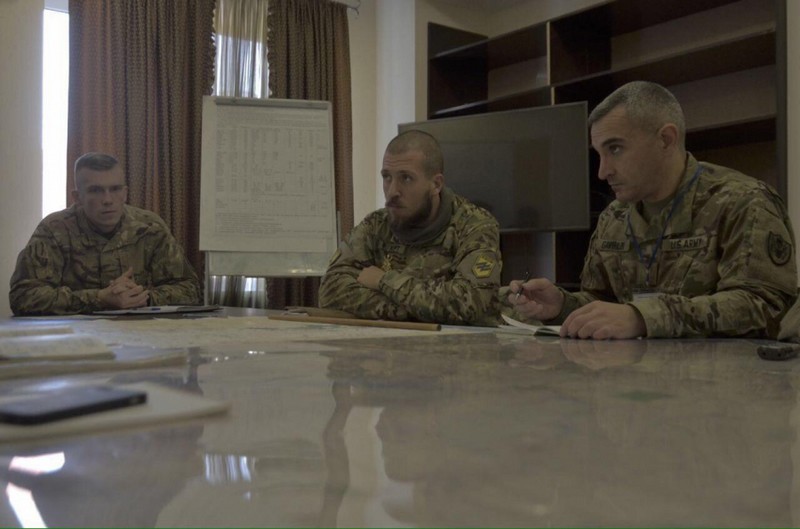
The unnamed commander was quoted by Lt. Claire Vanderberg, a mortar platoon leader training soldiers as part of the Pentagon’s Joint Multinational Training Group-Ukraine. The training has taken place at the absurdly named International Peacekeeping and Security Center, which sits close to the border with Poland near the Ukrainian town of Yavoriv. Western media reported Russia’s recent cruise missile attack on the base, but chose not to mention what has taken place inside.

The relationship described above is a snapshot of a decades-long US-NATO effort to not only pull Ukraine from Russia’s orbit, but to actively weaponize the country against Moscow.

US national security state acknowledges “Russia is pushing back,” not pushing first

In their internal documents, the Pentagon and other arms of the US national security state reiterate the same arguments the anti-war left does when it explains how Ukraine has been used to provoke Russia into a military escalation. The principal difference is that the Pentagon speaks from an unabashedly imperialist perspective in which such provocations are seen as an important component of US power projection.

Recently, the US Director of National Intelligence’s Annual Threat Assessment reported: “Russia is pushing back against Washington where it can—locally and globally—employing techniques up to and including the use of force.” Note: Russia is “pushing back,” not pushing first.

A report from 2021 by the National Intelligence Council concedes of Russia and China: “Neither has felt secure in an international order designed for and dominated by democratic powers,” with “democratic” meaning the US and friends. Both Russia and China “have promoted a sovereignty-based international order that protects their absolute authority within their borders and geographic areas of influence.”

In October 2017, US Army Field Artillery School Assistant Commandant, Col. Heyward Hutson, who is responsible for training Ukrainians, explained: “Ukraine wants to become a NATO nation, but Russia doesn’t want them to be a NATO nation. Russia wants to have a buffer zone.” He added that another “problem is a lot of Eastern Ukraine is pro-Russia so the civilian population there is divided.” A 2016 US Army War College report reiterated: “Russia’s basic national security strategy is to keep its ‘neighboring belt stable’, NATO weak, China close, and the United States focused elsewhere.”

Another, from 2007, explains that the “pro-reform forces in power since the Orange Revolution” (read: pro-US forces) “would like to move Ukraine squarely into the Euro-Atlantic community with only limited deference to Russia.”

The document goes on to note that, at the time, the “Ukrainian political and military leadership has remained divided over the question of whether Ukraine should pursue a collective security approach or retain its neutral status.” It concluded that, while “[m]ost senior [Ukrainian] commanders have pro-reform credentials… there are still large numbers of senior leaders within the Main Defense Forces who have no or only limited exposure to Western training and operations.”

The US-sponsored coup of 2013-14 enabled Washington to smooth over that contradiction by launching an extensive program to train units of the Ukrainian Armed Forces.

NATO is “not an exercise in diplomacy and deterrence as before”

When the Soviet Union collapsed, so too did its military alliance, the Warsaw Pact. But the West not only refused to disband its alliance—the North Atlantic Treaty Organization (NATO)—it expanded up to Russia’s borders.

NATO’s own records state that in 1992:

“Just four months after Ukraine’s declaration of independence” from the USSR, “NATO invited its representative to an extraordinary meeting of the North Atlantic Cooperation Council, the body set up to shape cooperation between NATO and the states of the former Warsaw Pact.”

Russia did not propose a similar pact with America’s neighbors.

In 1994, Ukraine joined the so-called Partnership for Peace (PFP). Citing the UN Charter, the PFP states that signatories agree “to refrain from the threat or use of force against the territorial integrity or political independence of any State, to respect existing borders and to settle disputes by peaceful means.” A US State Department primer reveals that the PFP had an ulterior motive. Its real aim was not neutrality but to move Ukraine and other signatories closer to NATO.

“Participation in PFP does not guarantee entry into NATO, but it is the best preparation for states interested in becoming NATO members.”

The primer also lists the 52 actual and planned military exercises in which PFP members initially engaged on or near Russia’s borders.

Bill Clinton-era policymakers explained that “NATO is not merely an exercise in preventive diplomacy and deterrence as before.” NATO expansion had a political agenda. They considered “NATO enlargement [a]s a democratization policy.” As above, “democratization” means pro-US. Citing President Clinton’s 1996 campaign speeches, the report notes that in their minds NATO “will provide the stability needed for greater economic development in Central and Eastern Europe.” In other words, post-USSR NATO was designed, in part, to guarantee US led-“free markets” (which are often neither free nor markets, but monopolies,) in ex-Soviet nations where state-ownership of businesses was the norm.

In 1997, NATO and Ukraine signed the Charter on a Distinctive Partnership. The Charter was a prima facie violation of the PFP in that it compromised Ukraine’s political independence. It proposed several areas of NATO-Ukraine cooperation, “including civil emergency planning, military training and environmental security.” NATO brags: “cooperation between NATO and Ukraine quickly developed” in the form of “retraining for former military officers … and invit[ing] Ukraine to participate in NATO-led exercises.”

Making Ukraine a “military partner of the US”

The US Army says: “Ukraine has been a military partner of the U.S. dating back to the mid 1990s.” In 1998, America’s Special Operations Command Europe hosted a Special Operations Forces (SOF) conference in Stuttgart, Germany. The US Army reports: “This benchmark even brought military personnel from Moldova, Georgia, and the Ukraine together to view U.S. SOF demonstrations and discuss opportunities for future Joint Combined Exchange Training (JCET) and Joint Contact Team Program (JCTP) events.”

In June 2000, the US Marines reported that the Navy’s amphibious warship, the USS Trenton, had sailed from the Aegean to the Black Sea and had docked in Odessa (Ukraine). The 24th Marine Expeditionary Unit (MEU) “got to experience some of Odessa’s history first hand when they climbed the Prymorsky, or ‘Maritime’, Stairs.” In addition to the pleasantries, “the focus for MEU personnel and USS Trenton crew [was] NATO’s next exercise – Cooperative Partner 2000 (CP00) – of which Ukraine is the host nation.”

In addition to Ukraine’s participation in the US-led NATO training and exercises, Ukrainian soldiers fought in American-led wars. After 9/11, they participated in the occupation of Afghanistan via NATO’s so-called International Security Assistance Force. Ukrainian troops also aided the US-British-occupation of Iraq. In 2008, the Army lauded their comrades: “More than 5,000 Ukrainian troops have served in Iraq during Ukraine’s five years of service in support of Operation Iraqi Freedom.”

After backing 2014 coup, US provides “lethal security assistance”

Established in 2014 during the US-backed coup, the Ukraine component of the US State Department and Pentagon’s Global Security Contingency Fund (GSCF) provides tens of millions of dollars-worth of training and equipment to “develop the tactical, operational, and institutional training capacities of its Ministry of Defense and National Guard.” The State Department says: “The GSCF has also supported Ukrainian Special Operations Forces in developing tactical and institutional capabilities that are compatible with Western models.”

According to one Pentagon-linked journal: “Arsen Avakov, the Minister of Internal Affairs from 2014 to 2021[, …] enabled the expansion and later integration of paramilitary forces into the National Guard,” including the nazi Azov Battalion.

From 2015, the Pentagon’s European Command oversaw the Joint Multinational Task Force-Ukraine (JMTF-U), in which the US Army and National Guard trains the Ukrainian Armed Forces. In addition, officers were trained in the US through the International Military Education and Training program. The Congressional Research Service reports that, “[s]eparately, U.S. Special Operations Forces have trained and advised Ukrainian special forces.” In addition, the US participates in the annual NATO Partnership for Peace exercise, Rapid Trident.

In November 2015, supposedly at the request of the new pro-US regime, the Obama administration sent two AN/TPQ radar systems to Ukraine. “President Petro Poroshenko had the opportunity to review the equipment, and was briefed by U.S. military personnel on its capabilities.”

The US Army later revealed that the radar system was not purely defensive. A team from US Army Europe, Fort Sill’s Fires Center of Excellence (FCoE), and the Army Security Assistance Training Management Organization (SATMO) “conducted four weeks of operator training.”

Since the initial delivery, “Ukraine received four additional Q-36 radars … and training by U.S. Army Communications-Electronics Command with support from the FCoE and USSATMO.” The publication quoted one trainer as saying that “the U.S. team showed their brigade, battalion and platoon commanders how to tactically employ the radar system to support fire and maneuver efforts.”

Since 2016, SATMO’s Doctrine Education Advisory Group (DEAG) “has advised Ukrainian Security Forces at the operational level to revise doctrine, improve professional military education, enhance NATO interoperability and increase combat readiness.” In January this year, DEAG brought the first load of $200m-worth of “lethal security assistance, including ammunition for the frontline defenders of Ukraine.”

US trains Ukrainians to “blend into the local populace” waging warfare in civilian-heavy areas

One of the more immoral US actions in Ukraine has been the training of armed forces to fight in civilian areas, goading Russia to fight in densely-populated locations with the effect of scoring anti-Russia propaganda points when Russians kill Ukrainian civilians.

In 2015, the US Marines implied that American service personnel would travel to Ukraine to fight. “Unofficial travel (leave or liberty) to any country in Africa or the following European countries [including Ukraine and its neighbors] requires command O-6 level approval … The countries are subject to change based on the Foreign Clearance Guide (FCG), Department of State (DOS), Combatant Command, and/or Intelligence threat notifications.” This suggests preparation for “irregular” warfare.

An undated document published by the US Special Operations Center of Excellence (SOCE), apparently from around 2017, states that “the United States should learn from the Chechnya rebels’ reaction” to Russia’s invasion of Chechnya in the ‘90s. It explains that the “rebels” engaged in “decentralized operations,” using social media to “blend into the local populace.” Russia’s enemies used “misinformation” to manipulate Russians into killing the rebels’ enemies.

The SOCE paper goes on to note that the Army Special Operation Forces “are trained to thrive in these environments.” The document explicitly advocates for the US to train irregular forces to provoke Russia: “The United States should form an interagency working group with the Department of State, members of the intelligence community and SOCOM,” the Special Operations Command, which would “serv[e] as the DoD lead/representative.” It suggests that such a working group “understand that SOCOM actions will need to be unconventional and irregular in order to compete with Russian modern warfare tactics.”

By bolstering Ukraine’s armed forces and goading Russia, US elites have openly used Ukrainian civilians as pawns. For many years, Ukrainian forces were trained in urban combat by US personnel: i.e., to fight Russians in densely-populated civilian areas. “Task Force Illini” is comprised of 150 soldiers from the 33rd Infantry Brigade Combat Team of the Illinois Army National Guard.

In September 2020, the US Army reported that Armed Forces Ukraine soldiers “honed their urban operations skills as Task Force Illini advisors lent their expertise at Combat Training Center in Yavoriv” – the Western Ukrainian de facto NATO base near Poland’s border.

“Thunderbirds” train Ukrainian in full-scale vehicular combat

The Oklahoma-based “Thunderbirds” have gone through several incarnations over the last century. The army unit was originally known as the 45th Infantry Division and is now the 45th Infantry Brigade Combat Team. By early-2017, the JMTG-U mission fell under the 7th Army Training Command and US Army Europe, which paired Thunderbirds from the 1st Battalion, 179th Infantry Regiment with soldiers from the Ukrainian 28th Mechanized Brigade and 79th Airborne Brigade. Their goal was to prepare Ukrainians for full-on vehicular combat.

Putin claims that Ukraine is a pawn of NATO. US propaganda rejects the notion, attempting to prove it by publicly ruling out Ukraine’s membership in the Alliance. But in April 2017, the US Army admitted that under the JMTG-U, the Thunderbirds’ mission was “to train the Ukrainian army to NATO standards, develop their noncommissioned officer corps, and help them to establish a combat training center, so that in the future, they can continue to train themselves.” So, if the Ukrainian military is trained to NATO standards and is overseen by a US puppet president, it might as well be part of NATO, minus the US obligation to come to its defense.

The proposed center became the Yavoriv Combat Training Center. The US Army reported that in October 2017, “a new grenade range was opened. Maj. Montana Dugger said: “We’ve helped them build long-range maintenance plans so they’ll be able to use these facilities for the next 20, 30-plus years.”

Seemingly ignorant of the comical doublespeak, the US Army also explained that Ukrainian’s Combat Training Center “is being established at the International Peacekeeping and Security Center near Yavoriv.” Also ironic is that while the Thunderbirds train a military incorporating neo-Nazi units to fight Russians in Ukraine, its pre-1930s insignia was a swastika, which its Oklahoma-based museum describes as “an Ancient American Indian symbol of good luck.”

CIA covert operations’ goal: “kill Russians”

In addition to the overt but under- or non-reported events outlined above, the US Central Intelligence Agency (CIA) has run a covert, eight-year training program. Why the need for covert ops in the face of extensive overt projects? The CIA specializes in assassination, proxy warfare, psychological operations, and false flags. This suggests that their efforts include tactics prohibited by the Geneva Conventions.

Yahoo! News reported that in 2014, under a doctrine called “covert action funding,” “a small, select group of veteran CIA paramilitaries made their first secret trips to the frontlines to meet with Ukrainian counterparts.” The training was conducted by the CIA’s Special Activities Center, which suggests that even if the officers were “ex-CIA” and Special Forces, they were given access to Langley at high-levels, making it a de facto official mission.

One operative is quoted as saying that the officers attempted to Talibanize the Ukrainian paramilitaries in the sense that the Afghan Taliban had no sophisticated hardware that was vulnerable to enemy blinding. Ergo, basic, non-tech warfare training was required. The report says that the trainers:

“taught their Ukrainian counterparts sniper techniques; how to operate U.S.-supplied Javelin anti-tank missiles and other equipment; how to evade digital tracking the Russians used to pinpoint the location of Ukrainian troops, which had left them vulnerable to attacks by artillery; how to use covert communications tools; and how to remain undetected in the war zone while also drawing out Russian and insurgent forces from their positions, among other skills, according to former officials.”

In addition, one former senior source said (paraphrased by the reporter): “The agency needed to determine the ‘backbone’ of the Ukrainians … The question was, ‘Are they going to get rolled, or are going to stand up and fight?”

So who tends to have “backbone,” i.e., a ruthless and psychopathic fighting spirit? Fascists and ultra-nationalists. Indeed, it has been widely reported by even US corporate media that the Ukrainian Armed Forces and paramilitary units were infested with Nazis. Today, the same media refer to the Nazis as mere nationalists.

Beginning 2015, the CIA’s Ground Department arranged for Ukrainians to be trained in the US south. The operations continue to the present and have been expanded under the Biden administration. “The multiweek, U.S.-based CIA program has included training in firearms, camouflage techniques, land navigation, tactics like ‘cover and move,’ intelligence and other areas.” One senior officer is quoted as saying: “The United States is training an insurgency … to kill Russians.”

In February this year, shortly before the Russian invasion, it was reported that the CIA had been “preparing Ukrainians to mount an insurgency against a Russian occupation.” Against an occupation? Or an insurgency to provoke an occupation?

In addition to the CIA, the US military has its own covert operations. Under the Resistance Operating Concept started in 2018, the Pentagon appears to have been training territorial defense units comprised of Ukrainian civilians. This seems to have led to the creation by Ukraine’s Special Operations Forces creating a National Resistance Center that teaches civilians guerrilla tactics.

Ukraine military build-up brings the world to the brink

After Russia annexed Crimea in 2014, pro-Russian eastern protests erupted in Donetsk and Luhansk. The Congressional Research Service (CRS) noted: “The government in Kyiv responded with military force and employed local militias to help push back the separatists.” The CRS added that the US leads Britain, Canada, and Lithuania in the Multinational Joint Commission on Defense Reform and Security Cooperation. The Pentagon’s European Command had a European Reassurance Initiative at the time, which is now called the European Deterrence Initiative. Under this program, dozens of Ukrainians were trained in Huntsville, Alabama, in RQ-11B, hand-launched Raven drone operations. Seventy-two drones were sent to Ukraine in 2016.

A January 2016 UK House of Commons Library research briefing states: “Fighting between Ukrainian government forces and Russian-backed separatists has killed more than 9,000 people since April 2014 and injured more than 20,000.” The briefing goes on to note that after the UN Security Council-backed Minsk II agreement, which called for a ceasefire and the withdrawal of frontline forces on both sides, the Ukrainian parliament granted special status and enhanced autonomy to parts of the Luhansk and Donetsk regions.

The Royal United Services Institute is a UK Ministry of Defense-linked think-tank. One of its reports concedes that Russia had a largely “defensive policy” when it came to Ukraine. It says: “Russian officials have become alarmed by expanding and overlapping Western alliances from an enlarged NATO and EU, to AUKUS and the Coalition of Democracies promoted by both the US and the UK.”

Part of Russia’s strategy has its roots in the US-led destruction of Libya in 2011, the report explains. The NATO bombing of Libya and overthrow of Muammar Gaddafi “underscored how strong Western alliances were able to bypass or manipulate the [UN Security Council] UNSC, essentially circumventing a forum where Russian interests could be protected.”

Indeed, on February 27th, 2022, the UNSC adopted Resolution 2623, which states: “the lack of unanimity of its permanent members at the 8979th meeting has prevented it from exercising its primary responsibility for the maintenance of international peace and security.”

The absence of international diplomacy, the weakness of a domestic anti-war movement in the US, and the cheerleading for war by many leftists and liberals under the doctrine that Putin is an evil villain has pushed the world as close to terminal nuclear disaster as it has been since the 1962 Cuban missile crisis; perhaps even closer. Many Russians have taken to the streets to clamor for a ceasefire. After looking the other way as their leaders spent the past 8 years weaponizing Ukraine against Russia, Western publics have yet to demand the same.

*

Note to readers: Please click the share buttons above or below. Follow us on Instagram, Twitter and Facebook. Feel free to repost and share widely Global Research articles.

T.J. Coles is a postdoctoral researcher at Plymouth University’s Cognition Institute and the author of several books, the latest being We’ll Tell You What to Think: Wikipedia, Propaganda and the Making of Liberal Consensus.

6 April 2022

Source: www.globalresearch.ca
Ukrainian Soldiers Film Themselves Calling Up Mothers of Russian Soldiers Killed in Action and Mocking Them

By Paul Joseph Watson

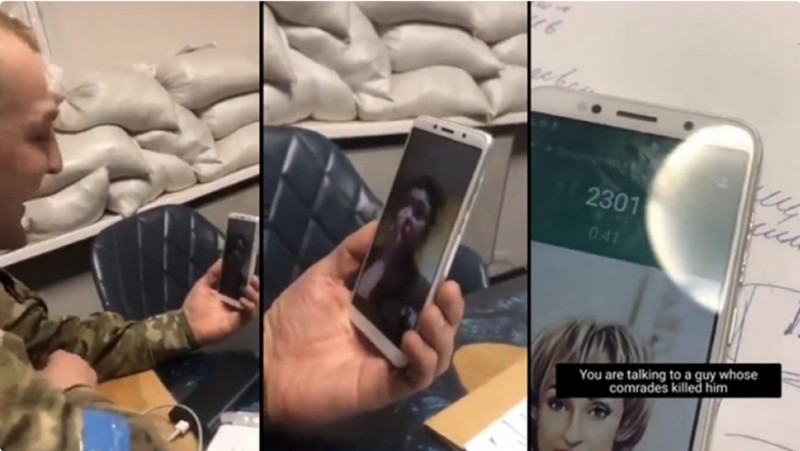
Footage posted to Twitter shows what appears to be Ukrainian soldiers calling up the mothers of dead Russian soldiers killed in action and mocking them over their loss.

Yes, really.

“Pro-Ukraine accounts on Twitter translated the videos and celebrated the heinous acts with glee,” writes Chris Menahan.

A translation of the exchange reveals that the soldier tells the mother “this fucking moron is no more,” informing her that all that was left of him was “his ass and a leg.”

The Ukrainian appeared to be using the phone that belonged to the dead Russian to call his mother.

An alleged neo-nazi Azov Battalion member named Ivan Zaliznyak uploaded the video and five others to his Telegram channel.

The clips hardly do much to bolster the narrative, relentlessly amplified by the legacy media, that the Ukrainians are the ‘good guys’.

Over the weekend, horrific footage emerged of Ukrainian fighters committing literal war crimes by shooting captured Russian soldiers in the knees and watching them die in agony.

However, that doesn’t seem to have deterred the ‘Ukrainian flag in my Twitter bio’ crowd, who seem more hopped up on signaling their virtue than ever before.

*

Note to readers: Please click the share buttons above or below. Follow us on Instagram, Twitter and Facebook. Feel free to repost and share widely Global Research articles.

6 April 2022

Source: www.globalresearch.ca
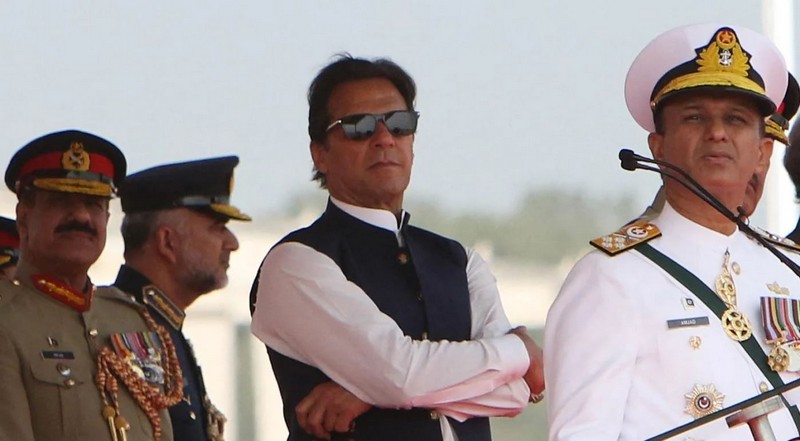
Pakistan political crisis: Why Imran Khan’s enemies want him out

By Peter Oborne

Prime Minister Imran Khan’s decision to dissolve the Pakistani parliament to head off a vote of no-confidence has been greeted by global shock and bemusement.

That bemusement is misplaced. I’ve covered Pakistani politics over two decades. As a long-term student (and admirer) of the country, I can state with confidence that the real shock is not that Pakistan has been struck by political crisis; it’s that it has taken so long.

Few democratically elected leaders of Pakistan last long. Indeed, not one of Khan’s predecessors has survived a full term since the country’s founding 75 years ago.

And Khan is no ordinary prime minister. Showing exceptional courage, he challenged vested interests. He tried to root out corruption. He forged a new, independent foreign policy. To his immense credit, he even jeopardised his rule by refusing point-blank to be a pawn of the US. Above all, Khan broke the mould of the stinking, corrupt and rotten two-party system that dominated Pakistan’s democratic politics for decades.

That has meant making enemies – plenty of them. Some are internal and others external. And now, they have come for him.

But before analysing the current standoff, it’s important to grasp that Khan has been vulnerable to attack ever since the party he founded, Pakistan Tehreek-i-Insaf (PTI, translated as Movement for Justice), secured power in 2018. PTI did not win the majority that Khan had yearned for, meaning that from the start, he was obliged to cobble together a coalition government.

Imran Khan: Pakistan’s Prime Minister on the Taliban, China and world cricket

In recent months, that precarious coalition has crumbled, as fair-weather supporters have succumbed to the entreaties of enemies – and, according to some reports, bribery or the covert encouragement of US diplomats.

Abiding weakness

Khan has many strengths as a politician, but in the context of Pakistani politics, one abiding weakness. True to his own nature and the precepts of his deep Islamic faith, he is not corrupt. This quality is not simply unusual in Pakistani politics; it’s a crippling drawback.

Khan’s honesty makes him fundamentally unsuited to the debased methods that are second nature to many successful Pakistani politicians. Last weekend, when Khan’s enemies thought they were about to destroy him, the embattled prime minister simply dissolved parliament, paving the way for elections. This decision has left Khan’s opponents in the Pakistan Muslim League (Nawaz) and the Pakistan Peoples Party (PPP) clutching their pearls in horror.

How outrageous, they are in effect now saying, that the future of Pakistan should be decided by the democratic will of the people, rather than sordid deals struck in darkened rooms. I have been racking my brain to think of a precedent, not just in Pakistan but any country, for Khan’s decision to go to the country at a time of deep crisis. I’ve failed.

In Britain, my own country, how much better would it have been if, back in 1990 (when Khan was still captain of the Pakistani cricket team), Tory party plotters had chosen an election, rather than conspiring in smoke-filled rooms behind closed doors to destroy Margaret Thatcher, one of the greatest prime ministers in British history.

It would have been the right thing to do, and so much more democratic. That’s, of course, why the plotters didn’t want an election. They secretly feared that Thatcher was more popular than them, and I dare say they were right.

I have seen neither Bilawal Bhutto Zardari nor Shehbaz Sharif, the leaders of the two main opposition parties aiming to force Khan out, attempt to explain what’s wrong with a popular vote. Both men know that Khan will fight on his record – and that it’s stronger than they admit.

Economic disaster

Sharif especially knows that Khan inherited an economic mess when he took office four years ago – the legacy of egregious mismanagement by his own party, the Pakistan Muslim League. A highly intelligent and gifted man, Sharif must be agonisingly aware in private that his party was the architect of the massive debt and gross economic incompetence that Khan has struggled to confront since taking office.

The new leader inherited a virtually empty Treasury, a broken tax system and barely two months’ worth of foreign exchange reserves. To deal with Pakistan’s external debts, the Khan government hiked up the prices of power and fuel, bearing most heavily on the poor. Popular anger was inevitable, and Khan has certainly not solved all the country’s problems.

But he has done reasonably well given the need to deal (alongside every other world leader) with the Covid-19 pandemic. It is especially invidious, as his opponents have done, to blame Khan for the raging inflation that is a feature of the general global economy, and not only of Pakistan’s.

Yet, amid these difficulties, Khan has brought optimism and confidence to his high office. He has a more commanding presence on the international stage than any Pakistani leader since Zulfikar Ali Bhutto, the brilliant and charismatic founder of the PPP (and grandfather of Khan’s current opponent, PPP chief Zardari).

Like Ali Bhutto, Khan has worked to shape Pakistan as an independent nation. Ali Bhutto turned Pakistan away from the craven dependence on the US that characterised the long dictatorship of Mohammad Ayub Khan. Imran Khan has sought to do the same, building alliances with China and Russia, while also reaching out to Muslim states such as Iran, Malaysia and Turkey. Even supporters must acknowledge this policy has enjoyed only mixed success.

Saudi influence

Pakistan’s economic predicament has left it dependent on its creditors, especially Saudi Arabia and China, two regimes with ruling principles far different from its own. This dependence is the main reason why Khan has not spoken out publicly against Chinese maltreatment of Uyghur Muslims in Xinjiang. Khan has also been silent on the ongoing tragedy in Yemen, where hundreds of thousands of people have died as a direct or indirect result of the Saudi-led war.

The fact that Saudi Crown Prince Mohammed bin Salman (MBS) is for all intents and purposes Khan’s bank manager restrains him from speaking out – and not just over Yemen. When Khan wanted to join Malaysia and Turkey in an Islamic alliance, MBS intervened.

It is also important to note that Khan has disappointed onetime supporters who saw him as a fierce defender of human rights. They now accuse him of sanctioning attacks on journalists and the free press, allowing himself to become a willing tool of the Pakistani military.

Nevertheless, Khan has shown statesmanship over Kashmir, where his efforts to make peace have been thwarted by Indian Prime Minister Narendra Modi.

Khan has also struck an independent line over Afghanistan. Since the fall of Kabul last August, there has been tension with Washington about US overflights of Pakistan. More importantly, Khan and the US have been at odds over Afghan state assets frozen by Washington, at a time when the funds are desperately needed to relieve starvation and poverty in Afghanistan.

Crucially, as with Ali Bhutto, this independence has infuriated Washington, which since its military defeat in Afghanistan has an even greater need for Pakistan to resume its traditional role as a US client state.

Vassal state

From my perspective here in London, I have no idea whether Khan’s claims that the US has been working to undermine him are true. But anyone with more than a passing familiarity with Pakistani history knows they are not, to put it mildly, absurd.

The US has treated Pakistan like a vassal state since its independence in 1947. The CIA engineered the coup that brought to an end to 11 years of civilian rule in 1958, and installed Pakistan’s first military dictator in the shape of the brutal Ayub Khan. With indecent alacrity, former President Dwight Eisenhower signalled US approval of the dictatorial regime by visiting Pakistan not long afterwards.

It is telling that only five US presidents have ever visited Pakistan – Eisenhower, Lyndon Johnson, Richard Nixon, Bill Clinton and George W Bush – and never during periods of civilian rule. US aid to Pakistan always skyrockets during military dictatorships, making a mockery of US claims to support democratic institutions.

As for President Joe Biden, Imran Khan told David Hearst and me, when we interviewed him for Middle East Eye last autumn, that the US leader had never so much as rung him up. Incredible, given the crisis in Afghanistan – and punishment, beyond doubt, for not taking the US line.

Do not forget that Khan first made his reputation as a highly principled critic of the US role in Pakistan, and in particular, his country’s acquiescence to American drone strikes against suspected Taliban leaders.

Overcoming the odds

It is also highly relevant that Khan’s foreign minister, Shah Mahmood Qureshi, is equally as principled, displaying this a decade earlier when serving as foreign minister in the government of Asif Ali Zardari, father of the current PPP leader.

In 2011, then-CIA contractor Raymond Davis shot two Pakistanis in the back in the streets of Lahore, and then claimed diplomatic immunity. Rather than ensuring he faced justice, Zardari shamefully allowed the US to smuggle Davis out of the country. I was in Pakistan at the time and vividly remember the national sense of shame, and even moral horror, at Zardari’s craven supplication to US criminality.

Qureshi shared it. He resigned from Zardari’s government and joined Khan’s PTI shortly afterwards.

Khan’s critics, both in Pakistan and overseas, have made light of his claims that the US could be responsible for his current political troubles. This attitude reflects either naivety, ignorance or disingenuousness. While the facts are still obscure and may never be fully known, history shows that Khan is entirely reasonable in fearing US interference in the country he governs.

Thirty years ago, Khan famously told his Pakistani cricket team that they needed to fight like “cornered tigers” when all appeared lost in the 1992 Cricket World Cup.

The task that faces Khan is yet more awesome today – but don’t write him off just yet. He overcame immense odds to win that World Cup.

I believe he deserves the chance to finish the task he began three and a half years ago, when he won the 2018 election. Or at the very least, to defend his record in a fresh set of elections.

The views expressed in this article belong to the author and do not necessarily reflect the editorial policy of Middle East Eye.

Peter Oborne won best commentary/blogging in 2017 and was named freelancer of the year in 2016 at the Online Media Awards for articles he wrote for Middle East Eye.

6 April 2022

Source: www.middleeasteye.net

Foreign Cash Flow into Russia to Hit Record Despite Sanctions

By Paul Antonopoulos

The Institute of International Finance believes that Russia’s current account surplus is likely to reach $200-240 billion this year. Experts note that Moscow’s balance of payments has historically been determined by the export of energy resources, raw materials and import of goods. Considering the price levels, especially for oil, Russia’s revenue from oil sales in March reached historic highs, something that was not expected when the West launched its economic war against Moscow. None-the-less, it appears that the yuan, China’s currency, will be the biggest winner during this crisis between Russia and the West.

Banks are now asking customers to open accounts in China’s national currency and this trend is being observed not only in Russia, but across the world. As early as 2019, Moscow and Beijing adopted the decision to gradually abandon the dollar in trading with each other. But, at the time, these were just the intentions and the first step: overall, Chinese banks still have large reserves of American dollars.

Now, China’s Foreign Ministry has raised the topic of switching to payments with Russia to the ruble or yuan. Discussions about transferring payments in the national currency of energy commodities are already underway. Beijing is pushing for a similar strategy in Southeast Asia and in its dealings with Arab countries. For example, Saudi Arabia is unhappy with Washington’s policies and calls the dollar a black hole. As a result, Riyadh and Beijing could change the payment currency of oil from dollars to yuan

Ten years ago, China began promoting the use of the yuan internationally and has achieved some limited success. It is recalled that Federal Reserve Chairman Jerome Powell said that events in Ukraine could change China’s financial trajectory and that Beijing can take advantage of the situation and start expanding the yuan.

According to the IMF, the yuan is the fifth largest reserve currency in the world, with central banks holding the equivalent of about $319 billion in reserves. Within the global economy, this figure is not so large: the yuan accounts for only about 2.5% of the total reserves of central banks. By comparison, the dollar accounts for more than 50% of reserves and the euro 19%. At the beginning of the year, Bloomberg reported that the Chinese currency had become the fourth most popular means of payment in the world.

Currently the yuan is used as a reserve currency in about 75 countries. The yuan could become the new international currency because China has a strong economy and the country produces everything from simple goods to high tech weapons.

In effect, it is Western policies that led Russia to expand trade with the East. For example, India and Russia are discussing the creation of a payment mechanism in rubles and rupees.

One way or another, Russia-China bilateral trade will quickly grow under the current circumstances. China has one of the largest reserves of rubles, with the Russian currency accounting for 13.8% of its foreign exchange reserves. In addition, China is Russia’s main trading partner, with the volume of transactions between the two countries exceeding $148 billion last year.

However, on a number of important issues – for example, the supply of parts for aircraft, Beijing has so far not adopted a specific decision. According to Reuters, China has reportedly recommended that its four largest oil and gas companies reduce their participation in Russian projects. China’s Foreign Ministry denied the report.

Although experts say the reason the yuan is so unpopular in international trade is because the Chinese government does not have a positive global image, this ignores the fact that China’s multilateralization and diversification of economic relations are still underdeveloped. In this way, so long as China’s economy goes strength to strength, the Russian economy and ruble will be able to weather the full effects of the West’s economic siege, something that was unlikely anticipated when sanctions were enthusiastically imposed.

For a long time, the maintenance of a cheap national currency was beneficial to Beijing thanks to the large volume of exports of goods valued in US dollars. However, the role of the Chinese currency in foreign trade with Russia will depend on its will and most importantly on Beijing’s ability to operate independently and autonomously from the West. Both Russia and China appear to be on the correct and accelerated path towards de-Dollarization.

*

Paul Antonopoulos is an independent geopolitical analyst.

5 April 2022

Source: www.globalresearch.ca
Falsification of Images, Incoherent Information? Russia Willing to Investigate Bucha’s Tragedy

By Lucas Leiroz de Almeida

The alleged massacre of civilians in Bucha is one of the most talked about topics around the world in recent hours. Russia has been repeatedly accused by Western governments and mainstream media, and there are already calls for Russian President Vladimir Putin to be prosecuted for war crimes and human rights violations. However, there is a series of controversies in the case, from possible falsifications in the images released by Ukrainian forces to incoherent information about the dates of the massacre, which demands a deep investigation.

According to the official Kremlin’s position, the Russian government categorically denies any involvement by its forces in operations that killed civilians in Bucha. Spokesperson Dmistry Peskov stated on Monday, April 4, about the case, making it clear that Moscow, in addition to denying participation in the massacre, supports the immediate launch of high-level investigations on the occurrence. The Russian authorities also committed to take the discussion forward to the UN Security Council in order conduct an international investigation in the grave tragedy.

Furthermore, Peskov made it clear that the Russian government does not trust the veracity of all the information contained in the videos and photos of dead civilians released by the Ukrainian government. There are reports from Russian experts pointing out possible forgeries and frauds in the content of the videos.

Other Russian officials also commented on the case, pointing out that there is evidence that the videos were forged or performed. Russian Foreign Minister Sergei Lavrov, for example, claimed during a meeting with UN Under-Secretary-General for Humanitarian Affairs Martin Griffiths that the Ukrainian press had released fake videos about Russian operations in Bucha, and that there had been a staging organized by Kiev’s forces in the region days after the departure of Russian troops.

In the same vein, the official representative of the Russian Ministry of Foreign Affairs, Maria Zakharova, said that the videos and photos released by the Ukrainian press and the Western statements about them appear to be a “custom-made story”. Defense Minister Sergei Shoigu also spoke out, claiming that the case is a production by the Kiev regime for Western media that sounds like a provocation against Russia. Finally, the head of the Russian Investigative Committee, Alexander Bastrykin, also expressed distrust about the veracity of the material released by Kiev and requested a procedural assessment on the possible massacre of civilians.

Despite the distrust, which seems justified in the face of a long history of fake news and information warfare on the part of the NATO-Kiev axis, Moscow seems open to hearing contrary opinions, which is precisely why the government seems so interested in launching an investigation, both using its official experts and international agents convoked by the UNSC. It is possible that, in addition to the obviously fake and staged videos, there is also real material, with actual images of dead people. The Kremlin’s main point is that, regardless of whether the videos and photos are real or not, there is no Russian involvement in cases of massacre of civilians.

Considering the evident victory of the Special Operation in Bucha region, there would be no strategic advantage for the Russian military to shoot civilians, which would cause unnecessary harm to the country. Now, Zelensky, Biden and other Western leaders are calling for Putin to be condemned by international courts and planning an increase in sanctions. So, it does not seem at all reasonable that Russian forces would have deliberately planned and carried out a massacre of civilians, considering that these would be the obvious consequences of such acts.

Another point that needs to be mentioned is that there is an evident time lapse in the case. The Russians withdrew from Bucha on 30 March. The Ukrainians entered Bucha on March 31, and the “retake” of the city was announced by the mayor on the same day. Azov’s paramilitaries entered the city only on April 1. So how were the “bodies in the streets” found only on April 3?

If international society is really interested in the truth, it must heed the Russian request for an investigation at the UNSC. If Western governments refuse to cooperate with the investigation, it will be possible to conclude that they have something to hide. The UN must remain neutral and commit itself to the search for the truth of the facts, even if this truth is unpleasant for the West.

*

Lucas Leiroz is a researcher in Social Sciences at the Rural Federal University of Rio de Janeiro; geopolitical consultant.

6 April 2022

Source: www.globalresearch.ca
Is the US on a Course to Replace Putin and Crash the Russian Economy? Biden, Zelensky and the Neocons

By Philip Giraldi

There are many backstories surfacing from what is going on in Ukraine and Washington that have been largely ignored amid the drumbeat of casualty counts combined with claims and counter-claims from the two sides. Two stories that I believe have received insufficient attention are the US government’s three decades long obsession with weakening and de facto destroying the Russian state and the dominant neocon plus associate liberal democracy promoter role in what has become American foreign policy.

To be sure, anyone who doubts that the US is currently on a course to not only replace President Vladimir Putin but also to crash the Russian economy is delusional. Washington has been trying to deconstruct the former Soviet Union ever since 1991, beginning with President Bill Clinton’s expansion of NATO into Eastern Europe in spite of a pledge not to do so and his unleashing the oligarchs who looted the country’s natural resources under President Boris Yeltsin. The pressure continued under the beatified President Barack Obama, who appointed as Ambassador Michael McFaul, who saw his mission as connecting with dissidents and opposition forces inside Russia, a role incompatible with his promotion of US interests and protecting US persons.

And then we had the redoubtable President Donald Trump undoing confidence building agreements with Russia followed by the current disaster that is unfolding before our very eyes. One should not ignore the fact that the fighting in Ukraine came about largely because the Biden Administration refused to negotiate seriously regarding the mostly reasonable demands that the Kremlin was making to enhance its own security. Former US arms inspector Scott Ritter cites a reported comment by a senior Biden Administration official which sums up the current policy, such as it is:

“The only end game now is the end of Putin regime. Until then, all the time Putin stays, [Russia] will be a pariah state that will never be welcomed back into the community of nations.”

Indeed, President Joe Biden’s recent disastrous trip to Europe can likely be characterized as one wishes to see it and the media has certainly done considerable spinning, but Biden left behind a legacy of various gaffes and lapsus linguae that made clear that the US is in the game to defeat Russia however long it will take to play out. And Biden has considerable support from brain dead congressmen like Republican Senator Lindsey Graham who has called for someone to murder Putin, lamenting “Is there a Brutus in Russia?”

On his trip, Biden revealed that he expects US combat troops to go to Ukraine’s assistance and he has also taken delight in denouncing Putin as a “killer,” a “thug,” a “murderous dictator” and a “man who cannot remain in power.” In so doing, he has openly called for Putin’s removal from office, i.e. regime change, while also opening the door to an obvious false flag operation in his unwillingness to reveal when questioned by a reporter how the US might respond if Russia were to use chemical weapons in Ukraine. That he has taken those positions means that it will be impossible to restore manageable relations with Moscow post Ukraine. It is a heavy price to pay for something that is little more than posturing.

The chemical weapon issue is particularly important as President Donald Trump bombed Syria with cruise missiles in the wake of a fabricated report that Bashar al-Assad had used such weapons in an attack on Khan Shaykhun in 2017. It turned out that the anti-regime terrorists who were occupying the city at the time had themselves staged the attack and deliberately blamed it on the Syrian government to produce an expected US response.

Based on what I am seeing and hearing, I would conclude that the neoconservatives and their liberal democracy promoting friends are working hard from the inside to make something like a war with Russia happen. Note in particular that we are talking about war with shooting and deaths, not just a reincarnation or extension of the Cold War of yore. News on April 1st, admittedly April Fools’ Day, suggests that Ukraine has staged helicopter launched missile attacks on a fuel storage depot inside Russia, which, if true, could produce a massive escalation from the Kremlin. It would be a typical neocon maneuver to dramatically increase the level of the fighting and draw the United States into the conflict.

In addition to that, I know I am not the only one who has noticed the pace and focus of Ukrainian President Volodymyr Zelenskys’ widely promoted appeals to groups and world governments to come to his country’s aid, to include establishment of a no-fly zone. The appeals are slick, convincing and carefully focused, with Zelensky being framed as a “hero” fighting valiantly against savage invaders. To put it mildly they are way beyond the capabilities and experience level of a former comedian, whose performances featured erotic dancing and playing a piano with his penis, corruptly placed on the presidential hotseat by a billionaire oligarch Israeli citizen.

The US media is, of course, lavishly praising Zelensky, but I would bet that he has a cadre of American and possibly Israeli neoconservatives working diligently behind him to get it right, coaching him on what to say and do. There might be US government players also in on the act, to include NED (National Endowment for Democracy), CIA information specialists, State Department media consultants and observers from the National Security Council. Indeed, there is as much a war going on over the airwaves and internet to influence thinking internationally as there is fighting taking place on the ground.

One should conclude that the CIA is playing the central role in the “Russia Project” because of its ability to shield what it is doing from scrutiny. Based on previous operations to overthrow governments in various places, one might assume that the so-called covert action approach is multi-level. It consists of media placements that are intended to sway opinion both inside and outside Russia and produce unrest, the identification and recruitment of Russian government officials when they travel overseas, and the support of dissidents both internally and externally who share a negative view of Moscow and its policies. A major component in the approach is to obtain Western liberal support for harsh sanctions and other repressive measures against the Kremlin based on the fraudulent proposition that Putin and his associates are out to destroy “democracy” and “freedom.” Ironically, Americans are less “free” and also poorer because of the actions of their own government since 2001, not because of Vladimir Putin.

As was the case with Iraq, Afghanistan and the long list of American interventions, it is the neocons who are in front demanding a powerful military response, both to Russia and, inevitably, to Iran. What is particularly noticeable is how the neocons and their liberal democracy promoting counterparts have in several areas dominated the foreign policies of both parties. Leading neocon Bill Kristol, who called the Biden speech “a historic call to action on par with Ronald Reagan[‘s] ‘Mr. Gorbachev, tear down this wall speech,’” recently also contributed “There would be no real prospect of an awakening in the United States and Europe were it not for the stand the Ukrainians have made. We would still be denying the threats we face. We would still be turning away from the urgency of the task we face. We would even, I daresay, still fail to appreciate the preciousness of the freedom and decency we have the obligation—and the honor—to defend. It is the Ukrainians who have shown us what free men and women can do, and what they are sometimes required to do, in defense of that freedom. It is the Ukrainians who have shown the world that we are in a new period of consequences. It is the Ukrainians who have given us the example of what it means today to fight back against brutality, and to fight for freedom.”

Kristol is, as so often, full of flag waving, chest puffing nonsense, peddling the notion that the United States has an obligation to police the world. Another leading neocon and regular Washington Post and The Atlantic contributor Anne Applebaum puts it this way and in so doing expands the playing field to include much of the world: “Unless democracies defend themselves together, the forces of autocracy will destroy them. I am using the word forces, in the plural, deliberately. Many American politicians would understandably prefer to focus on the long-term competition with China. But as long as Russia is ruled by Putin, then Russia is at war with us too. So are Belarus, North Korea, Venezuela, Iran, Nicaragua, Hungary, and potentially many others.”

It would be nice, for a change, to end an article on a high note, but high notes are hard to find these days. If there is anything beyond Ukraine to demonstrate the insanity of US foreign policy it would have to be, inevitably, recent news out of Israel. US Secretary of State Tony Blinken was recently in Israel trying in part to sell the possibility that the Biden Administration might actually come to a non-proliferation agreement with Iran over its nuclear program. Israel strongly opposes any such move and its lobby in the US led by various neocon think tanks has been working hard to kill any deal. So, what did Blinken do? He asked Israeli Prime Minister Naftali Bennett for suggestions of what might be done in lieu of an actual agreement. Naftali reportedly suggested harsher sanctions on Iran. Cut it any way you want, but the renewal of 2015’s Joint Comprehensive Plan of Action (JCPOA) is beneficial for both the United States and all of Iran’s neighbors, and here the US senior-most representative involved in the negotiations is asking the head of a foreign government to tell him what to do. Something is very wrong in Washington.

*

Note to readers: Please click the share buttons above or below. Follow us on Instagram, Twitter and Facebook. Feel free to repost and share widely Global Research articles.

This article was originally published on The Unz Review.

Philip M. Giraldi, Ph.D., is Executive Director of the Council for the National Interest, a 501(c)3 tax deductible educational foundation (Federal ID Number #52-1739023) that seeks a more interests-based U.S. foreign policy in the Middle East.

6 April 2022

Source: www.globalresearch.ca
Massacre in Bucha. Was it a False Flag?

By Jens Bernert

According to CNN:

“Lviv, Ukraine (CNN) The lifeless bodies of at least 20 civilian men line a single street in the town of Bucha near the Ukrainian capital. Some lie face down on the pavement while others are collapsed on their backs, mouths open in a tragic testament to the horrors of Russian occupation.

.
The hands of one man are tied behind his back with a piece of white cloth. Another man lies alone, tangled up in a bicycle by a grassy bank. A third man lies in the middle of the road, near the charred remains of a burned-out car.
The shocking images of the carnage in Bucha were captured by Agence France-Presse on Saturday, the same day Ukraine declared the town liberated from Russian troops. Accounts of alleged Russian atrocities are emerging as its forces retreat from areas near Kyiv following a failed bid to encircle the capital.
.

***

In contrast, the following report points to a false flag, which is yet to be verified.

At this stage the matter requires further investigation as to what actually happened.

***

Civilians were shot in Bucha, Ukraine, as reported by the Kiev government on April 3, 2022. The Russian army had withdrawn from the village on March 30. On March 31, the mayor of Bucha had reported joyfully and good-humoredly about the Russians‘ withdrawal in a video. There was no talk of deaths yet. They came later.

Video, Youtube (Upload 1. April 2022): „The mayor of Bucha, Anatoliy Fedoruk, confirmed the city’s liberation from Russian troops on March 31.“

Many of those killed wore white armbands, like those apparently worn by the Russian soldiers who occupied the site as a distinguishing mark.

It is speculated that many of those killed were people who had put on a white armband in solidarity with these Russian soldiers. Some of the people may also have been specifically branded as “traitors“ with an armband during the massacre, which was apparently perpetrated by Ukrainian units.

The murdered people were then abused on April 3 as part of a false flag operation by attributing their deaths to the Russians who had previously occupied this place. That the massacre was carried out only after the Russians had left, by Kiev-Ukrainian units, is shown by the already mentioned video with the mayor, who was in a good mood one day after the Russian withdrawal and had no dead to mourn in his place.

The fact that “traitors“ in Ukraine are going down the tubes, unfortunately, was already known a month ago by the BILD journalist Julian Röpcke, a great supporter of the Kiev government as well as a friend of the Azov battalion, from Ukraine. The propaganda with the dead themselves is reminiscent of the approach in the Syrian war.

Translation of Bild’s Journalist’s Statement:

“Phew … what can I say … Ukrainians do gruesome things with captured Russian soldiers & traitors. But I won’t post that here. It’s fundamentally wrong, but it happens and anyone who criticizes it should ask themselves what they would do in such a situation.“

Addendum:

A video released by the Ukrainian National Police (April 2, 6:52 p.m.) purported to show the “cleansing of the city from the occupiers.“

Russian troops had already left by that time (compare also the March 31 video of the mayor mentioned above).

There are no civilian corpses in this video.

One would expect the (alleged) Russian atrocities announced on April 3 to be shown or addressed there.

5 April 2022

Source: www.globalresearch.ca
How Sri Lanka’s booming economy ended in the worst crisis in its history

By Ziaul Hoque

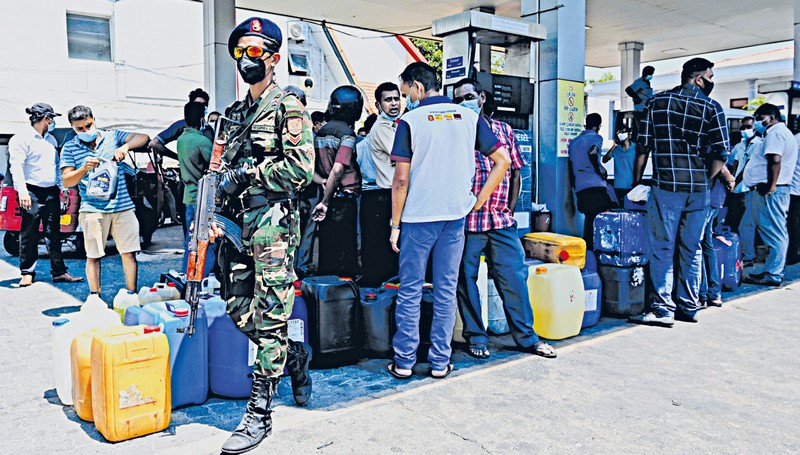
An unprecedented economic crisis is disrupting life across Sri Lanka. The government is running out of dollars to buy essentials. Mass protests are building against acute shortages of food and fuel. Multiple power plants are down, causing rolling power cuts disrupting life and production of key industries. Exams in schools are being suspended due to shortages of paper. Newspapers are either being forced to shut down, or cut their pages to stay afloat. Cooking gas shortages are forcing most bakeries and restaurants to close businesses. People even reportedly died while waiting in line for essentials.

The government has closed embassies abroad. The central bank is printing rupees and hoarding dollars, sending inflation to a record high of 17.5 percent in February. The finance minister is begging neighbours for credit lines to buy fuel and essentials.

The situation is alarming to say the least.

The crisis in the country, which has been in economic emergency since 2021, this year reached an extent where President Gotabaya Rajapaksa called in the army to manage the crisis.

This is in complete contrast with projections made only a few years back. Despite a 30-year-old civil war that ended in 2009, the country was heading towards the status of an upper-middle-income nation. The tourism-based economy was thriving, bringing in more jobs and billions of dollars, and middle class comforts: high-end eateries and cafes, imported cars, and upscale malls.

But how did the situation in the country, outperforming its neighbours not so long ago, sink so low and so fast?

Experts blame the crisis on a number of economic missteps by successive governments and also on misfortunes. The country’s enormous debt load, badly-timed tax cuts, the Covid-19 pandemic, which pummelled the tourism industry and foreign remittances, and, most recently, the war in Europe have wreaked havoc on the economy.

A 70 percent drop in foreign exchange reserves since January 2020 has left Sri Lanka struggling to pay for essential imports. The country is left with foreign reserves of only around $2.31 billion as of February, even as it faces debt payments of about $6.9 billion through the rest of the year.

In comparison, Bangladesh’s foreign reserves, as of March 2022, stand at $44.2 billion, which has increased despite the pandemic.

Sri Lanka’s foreign debt is at a staggering $51 billion.

After winning the election in 2019, Gotabaya Rajapaksa made good on a campaign promise to slash taxes. The move, which included a near-halving of value added tax, blindsided some top central bank executives.

The case against the move was that reducing potential revenues when obligations were high was risky and it undermined a 2019 debt management plan that hinged on a narrowing fiscal deficit.

The economic argument for the cuts was simple — to free up spending and boost Sri Lanka’s ailing finances. A similar move in 2009 by an administration led by Gotabaya’s elder brother Mahinda Rajapaksa had helped drive the country’s economic recovery after the civil war.

That time the bet paid off as Sri Lankan economy grew around 12 percent in 2012. But this time, the country was unprepared for what came next.

Not long after the move, the pandemic struck, inflicting deadly blows to the two main sources of foreign revenue for the island nation – tourism and remittance. According to World Bank estimates, half a million out of 22 million people in Sri Lanka fell below the poverty line since the pandemic struck.

The pandemic has sapped the flow of dollars from the island’s tourism sector, which in 2018, its best year on record, generated more than $4 billion. Foreign workers’ remittances slumped 22.7 percent to $5.5 billion in 2021, according to Reuters.

Economists say Sri Lanka’s debt spiral was already on an unsustainable path even before the pandemic dried up the tourism fund, which accounts for 10 percent of the country’s GDP.

And the misfortunes continued. The ongoing Russia-Ukraine conflict has contributed to the downfall as Russia is one of the top buyers for the Sri Lankan tea industry. The conflict has also hiked fuel prices.

Apart from the debt crisis, the government’s decision to ban chemical fertilisers to make agriculture 100 percent organic had a negative impact on the economy too. Experts say organic farming reduces production by half.

Sri Lanka’s high dependency on imports for its essential items such as sugar, pulses, cereals and pharmaceuticals has only added to the troubles.

Experts said that successive Sri Lankan governments have been issuing sovereign bonds since 2007 without any plan to repay the loans. Further, reserves were built by borrowing foreign funds rather than a high earning through export services. This only exacerbated the foreign debts of the country.

During his 2005 to 2015 rule, Mahinda Rajapaksa, now the prime minister, opened the door to Chinese lenders. He borrowed heavily from China, eying to turn the country into another Singapore by building ambitious infrastructure projects, some of which ended up as white elephants.

From 2010 till 2015, Rajapaksa’s final years in office, China poured $4.8 billion worth of loans into building the Hambantota port, a new airport, a coal-fired power plant and highways. By 2016, Chinese had loaned Sri Lanka $6 billion, fueling an infrastructure-building spree.

As a bitter lesson of this ill-planned drive, Sri Lanka, unable to repay a $1.4b loan, had to lease the Hambantota port to a Chinese company for 99 years in 2017.

The debt crisis has also dogged the coalition government of president Maithripala Sirisena, who ruled from 2015-2018. Political instability during this period didn’t help the country either. After the highs of 12 percent economic growth in 2012, the country’s growth hovered around 3-5 percent in subsequent years, only to take a plunge since 2019.

But it’s not only the Chinese loan that Sri Lanka has to pay. The largest slice of debt that will mature in the next couple of years predates the Chinese lending boom. Those are from multilateral institutions like the World Bank and the Asian Development Bank.

Chinese lenders hold 10 percent of this $51 billion debt total, Japan accounts for 12 percent, the Asian Development Bank 14 percent and the World Bank 11 percent.

At a time when Sri Lanka badly needed access to international capital markets to keep its debt management programme on track, a series of downgrades by rating agencies in the wake of the pandemic in 2020 effectively locked it out.

The government has responded to the ratings agency downgrades with a mix of indignation, disbelief and denial.

Government officials believe the country can still manage to come out of this crisis betting on a huge upturn in tourism. In fact, the country’s Department of Census and Statistics announced on Tuesday (March 29) that Sri Lanka’s gross domestic product (GDP) grew by 3.7 percent in 2021 after contracting 3.6 percent in 2020.

In a sign of recovery, the main economic activities of the economy — agriculture, industry and services — grew by 2 percent, 5.3 percent and 3 percent respectively, the department said.

But are those figures enough to rescue the country?

After initially refusing to budge, Sri Lanka last week said it will seek World Bank assistance to stave off the crisis in addition to an International Monetary Fund (IMF) rescue plan.

It has sought help from its neighbours too. The government has raised swaps and credit lines worth $1.9 billion from India, and two more are under negotiation with Pakistan and Australia. Bangladesh has also provided $250 million loan assistance in August 2021 through currency swap.

Sri Lanka also received a $1.5 billion Yuan swap in December and the last tranche of a $1.3 billion syndicated loan from China arrived in September 2021. It has also asked for another $2.5 billion loan package from Beijing.

The Central Bank of Sri Lanka (CBSL) this month said in a statement that the economy was in a better shape than some reports suggested. The CBSL said that it was committed to meeting all debt obligations and that suggestions Sri Lanka was close to default were wrong.

“The Sri Lankan authorities are pursuing a carefully thought-out plan which will ensure Sri Lanka’s debt sustainability and economic revival,” the Bank said.

Some analysts and opposition politicians, however, fear Sri Lanka may default this year.

“Sri Lanka’s economy is experiencing multiple organ failures, and sepsis has set in,” said Murtaza Jafferjee, chairman of the Advocata Institute, a think tank in Colombo, to The New York Times.

2 April 2022

Source: www.thedailystar.net

Press Release: ‘A NEW SECURITY AND DEVELOPMENT ARCHITECTURE FOR ALL NATIONS’

Press Release: ‘A NEW SECURITY AND DEVELOPMENT ARCHITECTURE FOR ALL NATIONS’

The international Schiller Institute is releasing this program outline for the April 9 conference, with leading speakers from around the world, to establish “A New Security and Development Architecture for all Nations. Click here for more information and to register.

I. PLENARY SESSION

1) Helga Zepp-LaRouche; Founder, Schiller Institute: Welcome and Keynote, “The Need for a New Paradigm”
2) Amb. Anatoly Antonov, H.E. Ambassador Anatoly Antonov, Ambassador of The Russian Federation to the United States: “Prospects for Building a New International Security Architecture”
3) Sam Pitroda; Innovator, Entrepreneur and Policy-Maker; U.S./India: “The Need to Redesign the World”
4) Jay Naidoo; Cabinet Minister under President Nelson Mandela, South Africa: “The African Perspective”
5) Chen Xiaohan, Chinese People’s Association for Peace and Disarmament: “Shared Future of Mankind”
6) Alessia Ruggeri; Spokeswoman of the Comitato per la Repubblica, trade unionist (Italy): “For a Europe of the Fatherlands with the Peace of Westphalia”
7) P.S. Raghavan, Former Indian Ambassador to Russia: “The Indian Perspective”

Discussion among the panelists

II. ECONOMY

1) Dennis Small; Ibero-American Editor, EIR: “The New Architecture: A Program to Prevent the Starvation of One Billion People Due to the Sanctions”
2) Prof. Justin Yifu Lin; Dean, Institute of New Structural Economics; Dean, Institute of South-South Cooperation and Development; Honorary Dean, School of National Development, Peking University: “China’s BRI: The Rationale and Likely Impacts”
3) Diogène Senny; President of the Pan African League UMOJA Congo, Republic of Congo: “What Africa Expects from the World”
4) Fraydique Alexander Gaitán, President of USCTRAB trade union confederation of Colombia; and Pedro Rubio, Colombian trade union leader: “South America and the New Development Architecture”

Public discussion

BREAK: 45 Minutes

III. SECURITY

1) Jacques Cheminade; President, S&P, France: “The Peace of Westphalia to Escape the Thucydides Trap”
2) Dr. George Koo; retired Business Consultant; Chairman, Burlingame Foundation: “U.S. Sanctions on Russia and China Are Suicide for the Dollar”
3) Mike Callicrate; Kansas cattleman, policy advocate and the founder and owner of Ranch Foods Direct: “The Cartel Era Is Over – More Sovereign Farmers, Food for All – Double World Food Production”

Public discussion

IV. DEVELOPMENT

1) Dennis Speed; Committee for the Coincidence of Opposites, author and long-time leader of the LaRouche movement; “The Urgent Need for a World Health System”
2) Helga Zepp-LaRouche: “Operation Ibn Sina”, Dipl. Ing. Daud Azimi – Board Member Peace National Front of Afghanistan: “Afghanistan: Today’s Urgent Economic and Political Imperatives”
3) Princy Mthombeni; Communication Specialist, Africa4Nuclear Founder, South Africa: “Energy Security for Africa”
4) Saeed Naqvi; senior Indian journalist, television commentator and interviewer: “Media Role and Responsibility”

Public discussion

Concluding Remarks: Helga Zepp-LaRouche and Sam Pitroda

3 April 2022

Europe’s Suicide on the Altar of War: Increased Military Spending and Rising Energy Prices

By Manlio Dinucci

Prime Minister Draghi pulls straight on increasing military spending, with the full support of the President of the Republic. For Italy, this means going from the current 26 billion euros a year to at least 38 billion a year, or from 70 to over 100 million euros a day spent on public money.

The decision was actually taken not in Rome but in Brussels, at the NATO Summit of Heads of State and Government. The increase in NATO military expenditure is driven by the United States: the Pentagon budget is increased by 10% to 773 billion dollars, to which other military expenditures are added, bringing the total to over 1.000 billion dollars annually.

NATO under US command is intensifying its military escalation in Europe, following the same strategy that provoked the Russian response with the military operation in Ukraine. To the four battle groups already deployed in Poland and the three Baltic republics, NATO is adding four more in Bulgaria, Hungary, Romania and Slovakia. Their function is not only against Russia, however.

In Bulgaria, the defense minister, deemed untrustworthy, was deposed by NATO order and replaced by Bulgaria’s ambassador to NATO. In Hungary, where general elections are held on April 3rd, Prime Minister Orbán opposes the country’s involvement in the escalation of war against Russia, refusing to supply arms to Ukraine, and declares that Hungary wants to increase imports of Russian gas. Conversely, the left declares that, if it goes to government, it will adopt sanctions on Russian gas supplies and send arms to Ukraine.

Meanwhile, the U.S. and the European Union have formed a joint task force to reduce Russian gas supplies to Europe and replace it with U.S.-supplied liquefied natural gas. However, this is much more expensive than Russian gas and has very volatile prices. Hence the colossal increase in energy expenditure in Italy and Europe, which prepares for a disastrous economic crisis.

Manlio Dinucci, award winning author, geopolitical analyst and geographer, Pisa, Italy. He is a Research Associate of the Centre for Research on Globalization (CRG).

3 April 2022

Source: www.globalresearch.ca