Just International

“Shrink the World’s Population”: Secret 2009 Meeting of Billionaires “Good Club”

By Prof Michel Chossudovsky

For more than ten years, meetings have been held by billionaires described as philanthropists to Reduce the Size of the World’s Population culminating with the 2020-2022 Covid crisis.

Recent developments suggest that “Depopulation” is an integral part of the so-called Covid mandates including the lockdown policies and the mRNA “vaccine”.

Flash back to 2009. According to the Wall Street Journal: “Billionaires Try to Shrink World’s Population”.

In May 2009, the Billionaire philanthropists met behind closed doors at the home of the president of The Rockefeller University in Manhattan.

This Secret Gathering was sponsored by Bill Gates. They called themselves “The Good Club”.

Among the participants were the late David Rockefeller, Warren Buffett, George Soros, Michael Bloomberg Ted Turner, Oprah Winfrey and many more.

In May 2009, the WSJ as well as the Sunday Times reported: (John Harlow, Los Angeles) that

“Some of America’s leading billionaires have met secretly to consider how their wealth could be used to slow the growth of the world’s population and speed up improvements in health and education.”

The emphasis was not on population growth (i.e Planned Parenthood) but on “Depopulation”, i.e,. the reduction in the absolute size of the World’s population.

To read complete WSJ article click here.

According to the Sunday Times report :

The philanthropists who attended a summit convened on the initiative of Bill Gates, the Microsoft co-founder, discussed joining forces to overcome political and religious obstacles to change.

Stacy Palmer, editor of the Chronicle of Philanthropy, said the summit was unprecedented. “We only learnt about it afterwards, by accident. Normally these people are happy to talk good causes, but this is different – maybe because they don’t want to be seen as a global cabal,” he said.

Another guest said there was “nothing as crude as a vote” but a consensus emerged that they would back a strategy in which population growth would be tackled as a potentially disastrous environmental, social and industrial threat.

“This is something so nightmarish that everyone in this group agreed it needs big-brain answers,” said the guest. …

Why all the secrecy? “They wanted to speak rich to rich without worrying anything they said would end up in the newspapers, painting them as an alternative world government,” he said.(Sunday Times)

Shrinking The World’s Population

The media reports on the May 5, 2009 secret gathering focussed on the commitment of “The Good Club” to “slowing down” the growth of the World’s population.

“Shrink the World Population” (the WSJ Title) goes beyond Planned Parenthood which consists in “Reducing the Growth of World Population”. It consists in “Depopulation”, namely reducing the absolute size of the World’s Population, which ultimately requires reducing the rate of birth (which would include reduced fertility) coupled with a significant increase in the death rate.

Secret Meeting: At the Height of the H1N1 Pandemic

On April 25, 2009, the World Health Organization (WHO) headed by Margaret Chan declared a Public Health Emergency of International Concern (PHEIC). And a couple of weeks later, the “Good Club” met in NYC at the height of the H1N1 swine flu pandemic which turned out to be a scam.

It is also worth noting that at very outset of the H1N1 crisis in April 2009, Professor Neil Ferguson of Imperial College, London was advising Bill Gates and the WHO: “40 per cent of people in the UK could be infected [with H1N1] within the next six months if the country was hit by a pandemic.”

Sounds familiar? That was the same Neil Ferguson (generously supported by the Gates Foundation) who designed the coronavirus Lockdown Model (launched on March 11, 2020). As we recall, that March 2020 mathematical model was based on “predictions” of 600,000 deaths in the UK.

And now (Summer- Autumn 2021) a third authoritative “mathematical model” by the same “scientist” (Ferguson) was formulated to justify a “Fourth Wave Lockdown”.

Saving Lives to Achieve “Depopulation”

Was an absolute “reduction” in World population contemplated at that May 2009 secret meeting?

A few months later, Bill Gates in his TED presentation (February 2010) pertaining to vaccination, confirmed the following;

“And if we do a really great job on new vaccines, health care, reproductive health services, we could lower that [the world population] by 10 or 15 percent”.

According to Gates’ statement, this would represent an absolute reduction of the World’s population (2010) of the order 680 million to 1.02 billion.

(See quotation on Video starting at 04.21. See also screenshot of Transcript of quotation)

TED Talk at 04:21:

Bill Gates Innovating to zero!

“The Good Club” Then and Now

The same group of billionaires who met at the May 2009 secret venue at the Rockefeller University in Manhattan, have been actively involved from the outset of the Covid crisis in designing the lockdown policies applied Worldwide including the mRNA vaccine and the WEF’s “Great Reset”.

The mRNA vaccine is not a project of a UN intergovernmental body (WHO) on behalf the member states of the UN: It’s a private initiative. The billionaire elites which fund and enforce the Vaccine Project Worldwide are Eugenists committed to Depopulation.

15 October 2022

Source: www.globalresearch.ca
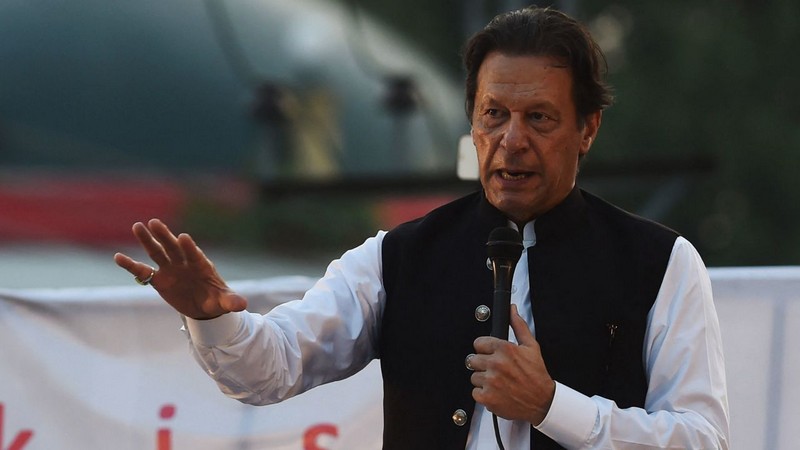
Imran Khan disqualified from holding office for five years, Pakistan’s election commission rules

By Sophia Saifi, Rhea Mogul and Azaz Syed, CNN

Islamabad, Pakistan CNN —

Pakistan’s former Prime Minister Imran Khan will be disqualified from holding political office for five years, the Election Commission of Pakistan (ECP) ruled on Friday, a move likely to further inflame political tensions in the country.

While reading out the recommendation, ECP chief Sikandar Sultan Raja stated that Khan was disqualified for being involved in “corrupt practices.”

The commission said its decision was based on the grounds that Khan had “made false statements” regarding the declaration of the sale of gifts sent to him by the leaders of Saudi Arabia and Dubai while in office – an offense that is illegal under the country’s constitution.

There had been a heavy police presence outside the election commission’s office in the capital Islamabad on Friday, in anticipation of protests by Khan’s supporters. Paramilitary troops have been deployed across the city and the Red Zone, which encases major government buildings, including the election commission, has been mostly sealed off to traffic.

At a press conference right after the announcement by the ECP, leaders from Khan’s party, Pakistan Tehreek-e-insaf (PTI), have said that they will take the matter to the Islamabad High Court, claiming that the ECP’s decision was “biased.”

PTI leader Fawad Chaudhry said Friday this was the “beginning of a revolution” and called for supporters to “come out of their homes and take to the streets to uphold the constitution.”

Widespread popularity
The announcement raises the prospect of Khan being unable to stand in the next general election, expected in 2023. CNN has reached out to Khan’s lawyer for comment.

The commission’s ruling is the latest in a series of setbacks for Khan, who was dramatically removed from office in a vote of no confidence in April.

The Pakistan Democratic Movement political party, which is part of the country’s ruling coalition that ousted Khan from power, had pushed for the commission’s investigation.

However, the cricketer-turned-populist leader maintains widespread popularity.

He has repeatedly claimed that his removal from office was the result of a US-led conspiracy against him. He has also alleged the current Prime Minister Shehbaz Sharif and the Pakistani military were behind his ousting.

His claims have struck a chord with a young population in a country where anger and disillusionment with the political and military establishment is being fueled by a rising cost-of-living crisis and anti-American sentiment is common.

The US, the ruling coalition and the Pakistani military have all denied Khan’s allegations.

His enduring popularity has translated to recent provincial election victories for his party and he has repeatedly called for a new parliamentary vote at mass rallies held since his ouster.

Khan has repeatedly called for early elections and has said he will lead his supporters in a long march to Islamabad.

21 October 2022

Source: cnn.com

Pakistan: Criticizing Chief Of Army Staff = “Inciting Mutiny”, But Wanting to Hang the Former Prime Minister = “Free Speech”

By Andrew Korybko

“Something’s rotten in the state of Pakistan”, and it’s that the country’s institutions have been captured by American proxies through a post-modern coup, after which they began aggressively waging “lawfare” on all their critics.

To paraphrase Shakespeare’s famous line from Hamlet, “something is rotten in the state of Pakistan” when criticizing Chief Of Army Staff (COAS) Qamar Javed Bajwa is equivalent to “inciting mutiny” while wanting to hang former Prime Minister Imran Khan is supposedly just “free speech”. PTI Senator Azam Swati was arrested on Thursday for sarcastically tweeting his congratulations to COAS Bajwa after the acquittal of incumbent Prime Minister Shehbaz Sharif – who replaced his predecessor after a US-orchestrated post-modern coup – and his son Hamza in a money laundering case, which the First Information Report (FIR) registered by the Federal Investigation Agency’s Cyber Crime Reporting Centre claimed was intended to incite mutiny, among other charges.

By contrast, Interior Minister Rana Sanaullah has yet to have charges filed against him at the time of this article’s publication despite threatening former Prime Minister Khan that “We will hang him upside down” if he commences his promised Absolute Freedom March on the capital of Islamabad and PTI demanding that the Pakistan Electronic Media Regulatory Agency (PEMRA) take action. Quite clearly, criticizing COAS – who many regard as personally responsible for the US-orchestrated post-modern coup against the former premier as punishment for his independent foreign policy (and especially its Russian dimension) – runs the risk of criminal charges while threatening to publicly execute the country’s former leader can be done with impunity, at least if the one doing so is a top security official.

As could be expected, America almost certainly won’t criticize its newly restored vassal since it tacitly approves of these undemocratic double standards that are implemented out of desperation to prevent a peaceful people’s revolution against its local puppets. It also plans to exploit the emerging regional processes that were unleashed by its latest regime change there to complete the grand strategic reorientation of South Asia, though there’s also speculation that it might be considering the possibility of former Prime Minister Khan returning to office, hence why he and the US have reportedly entered into some sort of contact with each other. It remains to be seen whether anything tangible will come from those reports, but they’re still intriguing to consider.

In any case and however it happens, “The Power Of The Pakistani People Will Defeat Their Unpopular Imported Government” sooner or later, but it would of course be best if the then-former coup regime doesn’t fully discredit the country beforehand. After all, it’s already exploited anti-terrorist legislation to previously charge the former premier for related crimes after he publicly announced his intention to file court cases against the ruling authorities over their allegedly inhumane treatment of his chief advisor. Now, the entire world sees that even serving Senators can’t publicly criticize COAS without fear of being punished on similar trump-up pretexts while the Interior Minister can threaten to publicly execute former Prime Minister Khan without getting in trouble (at least at the time of this article’s publication).

Returning back to the famous passage that was referenced in the introduction, “something’s rotten in the state of Pakistan”, and it’s that the country’s institutions have been captured by American proxies through a post-modern coup, after which they began aggressively waging “lawfare” on all their critics. They’re not just making an example out of Senator Swati, but are inadvertently suggesting that average Pakistanis are also persecuted for expressing similar “politically incorrect” opinions, though their trials and tribulations obviously don’t get any media coverage because they’re not public figures like he is. Likewise, just like Sanarullah threatened to publicly execute the former premier for related reasons, it can’t be discounted that he won’t order the security services to execute average folks too.

With these observations in mind, it should be abundantly clear that the latest example of undemocratic double standards in Pakistan is actually the worst such instance yet. Those watching everything play out from afar should shudder to think what life is like for those average Pakistanis who are displeased with their US-installed post-modern coup regime. They risk imprisonment or worse just like Swati and former Prime Minister Khan respectively if they publicly express similar dissent, though few would probably ever learn of their persecution considering the fact that they aren’t public figures like those two. Nevertheless, those abroad who truly support democracy, free speech, and human rights should raise their voices on those people’s behalf in order to inform the world about what’s happening in Pakistan.

*

Andrew Korybko is an American Moscow-based political analyst specializing in the relationship between the US strategy in Afro-Eurasia, China’s One Belt One Road global vision of New Silk Road connectivity, and Hybrid Warfare.

17 October 2022

Source: www.globalresearch.ca
Upon encountering Israeli Jews in Dubai: “I’m a Zionist, but I don’t hate”

By Rima Najjar

Caption: The logo on my t-shirt on the left says, “Anti-Zionist Vibes Only”; on the right, the Arabic on top of the map of Palestine says, “Inch by Inch”

In preparing for a trip to Dubai with my brothers earlier this month, I was full of apprehension. As Palestinians, we are furious about the now-open complicity of the government of Dubai with the Zionist project and feel betrayed by the diplomacy between Dubai, where many young Palestinians find good work opportunities and raise families, and the apartheid, colonial regime in occupied Palestine.

To add to our anxiety, we had been hearing stories circulating on social media about Palestinians accosted by Israeli tourists who were offended by the looks and remarks thrown their way by Palestinian or other Arab residents and were blamed for incitement, rather than aided, by mall security. Such stories may not have been true, but could have been deliberately circulated as a deterrent and to invite self-censorship.

In a post on Facebook, Ilan Pappé recently wrote, “it is so difficult to understand the self-censorship on Palestine exercised by progressive, reasonable, well educated, knowledgeable people. I am talking about those who cannot be touched, those that nothing whatsoever is going to happen to them if they say what they believe in when it comes to Palestine, and yet again and again this immune people are afraid, of what precisely is not very clear!”

But I do understand the pressure on anti-Zionists to be careful with their words, both on Meta and in Dubai. What exactly was I anxious about in preparing for my trip to Dubai? I had the same feeling about Dubai as I had during my years of working and teaching in the West Bank. I wanted to be able to express what I believed in about occupied Palestine — to the border police, to the soldiers at the many checkpoints where I often was detained for speaking up against the rude and rough treatment of Palestinians I witnessed, to the “settlers” dancing on Palestinian hilltops and draining their sewage on us in the valleys below. I simply wanted to speak out.

In going to Dubai, I felt compelled to find a way to express my beliefs and hit on the idea of wearing my t-shirts with pro-Palestinian and anti-Zionist slogans while there. Like many Palestinians I own, not only a kaffiyeh and a thobe, but also several t-shirts with slogans in both Arabic and English. I did so with a little trepidation and succeeded in expressing my views visually to a number of Israeli tourists who passed by me and my t-shirts. I also had the following conversation, as I posted it on Facebook, with an Israeli couple:

Framed
So, I met an Israeli couple in #dubai, in the lift of the Frame, and here is the conversation we had.I was wearing my black t-shirt with the logo that says, “Anti-Zionist Vibes Only” and the silver necklace of Palestine. The woman was right next to me and began by saying hi, I noticed the logo because we are from Israel. The man pointed to the necklace and I said:- I am Palestinian: to me, it’s Palestine.The woman expressed discomfort with the logo, and I said, this may not be addressed to you if you are a Jewish Israeli but not a Zionist. She said:- I am a Zionist but I don’t hate.She wished for peace and extended her hand for me to shake and I took it.Then I asked them where they were living and explained about my family. I asked where they came from and the woman said, because of the Holocaust they had nobody, no connections elsewhere. She said her name was Miriam Offer, a Ph.D. in history and teaches the history of the Holocaust at Western Galilee College in Akko. I said, Akka? My maternal grandmother comes from there and I am a Ph.D. too, in English literature and I taught at Al-Quds University. She said half her students learning about the Holocaust were “Arabs.” She asked how I liked Dubai in a tone of voice full of admiration and wonder. I said not much. By that time we were in the viewing room at the top. The man (who was born in Tel Aviv and studied in Haifa) took the following picture of us. He asked, where do you live now? I said the US and he nodded.

My account on Facebook is restricted (see why in the link), but I managed to reach a few friends who enriched the post above with insightful comments worth a wider readership:

  • Benay Blend: I’m searching for the right words. You were very generous in the conversation but as always stood your ground. How can you be a Zionist and not hate? It automatically consigns another group of people as inferior.
  • Rima Najjar: Benay, what I felt during the conversation was absolutely no empathy and only entitlement on her part, probably because of the Holocaust, because she mentioned that right off the bat, as though that were the clincher of any argument.
  • Benay Blend: Well, yes, not to make light of the Holocaust. I sometimes mention my relatives with numbers on their arms to establish some sort of credibility. Like I’m really Jewish, and I have a right not to want the occupation to be done in my name. But she did that to establish her right to be a Zionist, though the two have nothing to do with each other.
  • Rima Najjar: “She did that to establish her right to be a Zionist, though the two have nothing to do with each other.” Exactly, Benay.
  • Ian Wellens: Precisely. The whole point of it is discrimination. So is she saying: “look, I think your group should forever be discriminated against and be permanently kept out of power, but hey — I’m a nice person! I don’t hate anybody!” Actually, I’m sure that IS what she’s saying. This is liberal zionism all over, isn’t it?
  • Dee Ní Thaidgh: Locv, Rima Najjar.
  • Rima Najjar: Dee Ní Thaidgh, “Loss of Connectivity Verification”? I had to look it up. Very apt and clever.
  • Lena Bloch: It is an interesting statement “I am a Zionist but I don’t hate”. Zionism is hatred in action, not hatred in feelings. They feel they are doing Palestine a favor, “civilizing” and “democratizing” it — but in fact they are enacting hate and destruction of what has been built there for many hundreds of years, if not thousands. Something that seeks to destroy what is already there, is always hate.
  • Abed Amra: She did not admit that she is Jewish, she is zionist and she knows what she means, but I did not believe when she said I am zionist but I do not hate. Zionism means hidden and clear hatred for Palestine and Palestinians. Their actions are more honest than their feeling and words. We are not naive or idiot to believe her speech. The experience that we passed through in our life makes us to be enough mature not to believe their allegations or the image that they want draw in our mind. Nothing will erase their indelible criminal deeds from our memories.
  • Déborah B. Santana: Reminds me of Peter Lorre and Humphrey Bogart in Casablanca:
    Lorre: you hate me.
    Bogart: if I thought about you, I would.
  • Noor Aelia: I don’t trust anyone who says they’re still Zionists after 7 decades of occupation.
  • Zeina Akka: Saying Akko is hate. It is Akka.
  • Ali Sublaban: Zeina Akka, Akko is also its name, and it’s a كنعاني name.
  • Ian Wellens: ‘We took your land … but we don’t hate you.’ Is that meant to make it ok?
  • Iyas AlQasem: “I am a Zionist but I don’t hate”. I support a system for forcefully taking land and lives from others, but I don’t hate them. That is most generous of her!

Reader Sivan Tal made a perceptive comment after reading this blog post. I am now including most of it below for better visibility. Tal wrote:

I’m wondering what the “but” in that sentence [“I am a Zionist but I don’t hate”] referred to. One way to look at it is admission that Zionism involves hatred. Like, even though I’m Zionist, and Zionists are generally haters, I don’t hate — I’m not a typical Zionist.
The other (and more likely) meaning is that Zionists don’t hate Palestinians, in contrary to Palestinians who always hate Zionist. We Zionists come in peace and with open heart, but Palestinians always hate us (some say because we are Jewish).
In any case, the fact that an offender doesn’t hate their victim doesn’t make the offence right. It’s like the Euro-Americans that didn’t hate the native Americans, they just has to fight to get them out of the land they needed to use for their aspirations. Or Euro-Australians that didn’t hate the natives but nevertheless expelled them and killed them…
“I don’t hate” is a typical Zionist cynical slogan. It’s empty propagandist message just like “Israel has the right to defend itself”. But I’ll let Dr. Offer benefit from the doubt and assume she meant the first option

I am waiting for the day when Professor Miriam Offer would acquire a multidisciplinary perspective and teach the Nakba to her “Arab” students in Palestine and join me in the march for Return and Liberation taking place in Brussels, Belgium, on 29 October 2022 (From the River to the Sea, Palestine will be Free). And to quote Professor Pappé again: “What a conundrum it is that Palestine can be exempted from a reasonable, basic, humanist discussion by people who should know, and they know, better.”

Rima Najjar is a Palestinian whose father’s side of the family comes from the forcibly depopulated village of Lifta on the western outskirts of Jerusalem and whose mother’s side of the family is from Ijzim, south of Haifa.

16 October 2022

Source: countercurrents.org

Post-Cold War Era Is Over, Still China, Russia Main Threats: Says New U.S. Security Strategy

By Countercurrents Collective

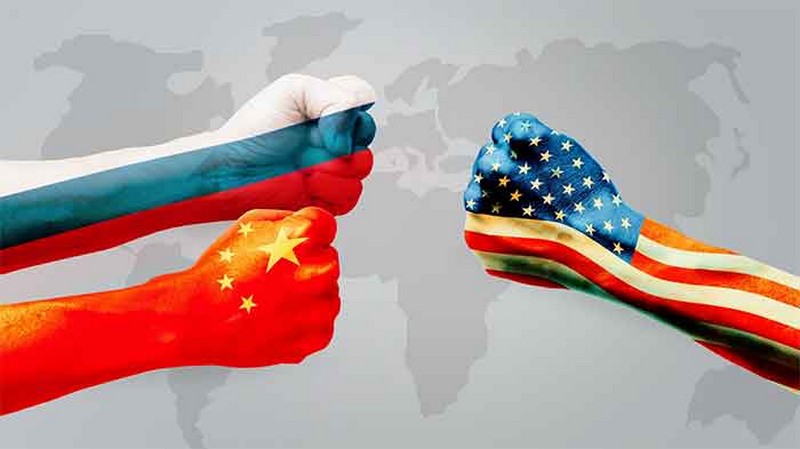
The post-Cold War era is “definitively over,” the Biden administration declared in a new national security strategy, describing its intention to compete ferociously against China and Russia — while also collaborating with them on global threats like climate change.

The long-awaited U.S. National Security Strategy, delayed by the invasion of Ukraine, serves as a reference point for Biden administration officials to coordinate policies across the government.

The congressionally mandated document encapsulates U.S. President Biden’s thinking on the state of the world and how his administration will navigate challenges to the homeland and global order.

In a foreword, Biden calls this the “decisive decade to advance America’s vital interests.”

The U.S. will do so in three ways before time runs out, according to the document: investing at home to strengthen the local economy, society and defenses; growing coalitions and alliances; and modernizing and strengthening the military.

That will allow the U.S. the take on the most pressing problem, per the strategy: “powers that layer authoritarian governance with a revisionist foreign policy” — that is, China and Russia.

That will require complicated maneuvering on the part of the administration, which also said in the strategy that it plans to simultaneously work with China, Russia and allies to curb pandemics, slow climate change and boost food and energy security. That is how the administration hopes to break with the Cold War paradigm of “with us or against us” even in a new age of great-power rivalry: The countries with which the U.S. will steadfastly compete can still be engaged as partners in solving global problems.

China “is the only competitor with both the intent to reshape the international order and, increasingly, the economic, diplomatic, military and technological power to do it,” the administration declares in the strategy. To win that competition, the Biden administration says it will help countries meet their needs without the reciprocation China typically expects, work to maintain peace between China and Taiwan, align a diplomatic approach toward China with allies, and work with Beijing on areas where U.S. and Chinese interests align.

“We cannot let the disagreements that divide us stop us from moving forward on the priorities that demand that we work together, for the good of our people and for the good of the world,” the document reads.

As for Russia, which the document says “has chosen to pursue an imperialist foreign policy with the goal of overturning key elements of the international order,” the U.S. will proceed to punish the country for the invasion of Ukraine. But, just like with China, the Biden administration is open to working with Russia in areas where a partnership can be “mutually beneficial.”

The language in the new document echoes the Trump administration’s national security strategy, which asserted “great power competition returned,” and the second Obama-era iteration, which emphasized the need to revitalize democracy at home while partnering with allies on global issues.

It makes sense, as Biden, Sullivan, and Secretary of State Antony Blinken have spoken repeatedly in both Trumpian and Obamian terms on world affairs, sometimes in the same sentence.

The focus on China and Russia, though, can’t distract from the transnational threats facing the U.S. and many other nations. The administration identified key ones in the strategy: climate change; pandemics and biodefense; food insecurity; arms control and non-proliferation; and terrorism. Terrorism’s relatively low listing in the order of the global threats shows how far the U.S. has come from the days of the so-called war on terror, when the U.S. government after the attacks of September 11, 2001 reoriented itself for an ill-fated attempt to eradicate terrorism as a practice.

To take these challenges on, the administration said it will pursue “two simultaneous tracks: one where the U.S. works with “all countries and institutions” to solve the problem, and another where Washington aims to “deepen” ties to like-minded partners.

Other media reports said:

The U.S. sees strategic competition as global but will avoid temptation to view world solely through competitive lens, as per the country’s new national security strategy document.

“Strategic competition is global, but we will avoid the temptation to view the world solely through a competitive lens, and engage countries on their own terms,” the White House said.

The White House’s new national security strategy views China as the “most consequential geopolitical challenge” to the U.S., even more so than Russia.

The strategy recognizes that “the PRC presents America’s most consequential geopolitical challenge,” National Security Council Jake Sullivan said in a press conference.

The document added that “Russia poses an immediate and ongoing threat to the regional security order in Europe and it is a source of disruption and instability globally but it lacks the across the spectrum capabilities of the PRC.”

At the same time, the U.S. believes it is possible to coexist peacefully with China and jointly contribute to human progress

“It is possible for the United States and the PRC [People’s Republic of China] to coexist peacefully, and share in and contribute to human progress together,” the White House said in its new National Security Strategy.

China plays central role in the global economy and has a significant impact on shared challenges, particularly climate change and global public health, the new National Security Strategy read.

Introducing the National Security Strategy document on Wednesday, Jake Sullivan described the “decisive decade” to come embodying two “fundamental” challenges: competing to “shape the future of the international order” and addressing “transnational challenges” like terrorism, climate change, and pandemics.

In his remarks to reporters, Sullivan attempted to reframe the increasingly-strained great power rivalry as friendly, insisting “we are not seeking competition to tip over into confrontation or a new Cold War.”

The administration acknowledges that it has “broken down the dividing line between domestic and foreign policy,” suggesting its own authority to “defend our homeland our allies, partners and interests overseas, and our values across the globe” supersedes that of local governments. However, the policy stresses that “our alliances and partnerships around the world are our most important strategic asset” and pledges to deepen those by injecting “more democracy” into its foreign relations.

While the document makes repeated references to strengthening, modernizing, and otherwise expanding the U.S. military, the administration hints at battle fatigue in the Middle East, pledging to “empower our allies and partners [to] advance regional peace and prosperity, while reducing the resource demands the region makes on the United States over the long term.”

The U.S. has an interest in maintaining peace and security across the Taiwan Strait, and remains committed to both the One China policy and the Taiwan Relations Act.

“We have an abiding interest in maintaining peace and stability across the Taiwan Strait, which is critical to regional and global security and prosperity and a matter of international concern and attention. We oppose any unilateral changes to the status quo from either side, and do not support Taiwan independence,” the White House said in its new National Security Strategy.

The U.S. plans to deepen its cooperation with Arctic allies and partners and maintain regional institutions such as the Arctic Council despite the challenges posed by Russia’s operation in Ukraine, according to its new national security strategy document.

“We will deepen our cooperation with our Arctic allies and partners and work with them to sustain the Arctic Council and other Arctic institutions despite the challenges to Arctic cooperation posed by Russia’s war in Ukraine,” the document stated. It noted that Russia had made significant military investments in the Arctic over the last decade, “creating new risks of unintended conflict and hindering cooperation.”

Countercurrents is answerable only to our readers. Support honest journalism because we have no PLANET B.

13 October 2022

Source: countercurrents.org

Biden’s Broken Promise to Avoid War with Russia May Kill Us All

By Medea Benjamin and Nicolas J. S. Davies

11 Oct 2022 – On 11 Mar 2022, President Biden reassured the American public and the world that the United States and its NATO allies were not at war with Russia. “We will not fight a war with Russia in Ukraine,” said Biden. “Direct conflict between NATO and Russia is World War III, something we must strive to prevent.”

It is widely acknowledged that U.S. and NATO officers are now fully involved in Ukraine’s operational war planning, aided by a broad range of U.S. intelligence gathering and analysis to exploit Russia’s military vulnerabilities, while Ukrainian forces are armed with U.S. and NATO weapons and trained up to the standards of other NATO countries.

On October 5, Nikolay Patrushev, the head of Russia’s Security Council, recognized that Russia is now fighting NATO in Ukraine. Meanwhile, President Putin has reminded the world that Russia has nuclear weapons and is prepared to use them “when the very existence of the state is put under threat,” as Russia’s official nuclear weapons doctrine declared in June 2020.

It seems likely that, under that doctrine, Russia’s leaders would interpret losing a war to the United States and NATO on their own borders as meeting the threshold for the use of nuclear weapons.

President Biden acknowledged on October 6 that Putin is “not joking” and that it would be difficult for Russia to use a “tactical” nuclear weapon “and not end up with Armageddon.” Biden assessed the danger of a full-scale nuclear war as higher than at any time since the Cuban missile crisis in 1962.

Yet despite voicing the possibility of an existential threat to our survival, Biden was not issuing a public warning to the American people and the world, nor announcing any change in U.S. policy. Bizarrely, the president was instead discussing the prospect of nuclear war with his political party’s financial backers during an election fundraiser at the home of media mogul James Murdoch, with surprised corporate media reporters listening in.

In an NPR report about the danger of nuclear war over Ukraine, Matthew Bunn, a nuclear weapons expert at Harvard University, estimated the chance of Russia using a nuclear weapon at 10 to 20 percent.

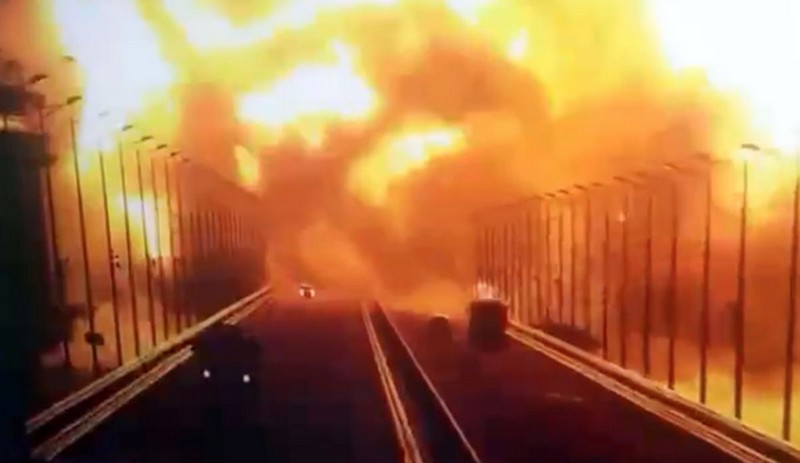
How have we gone from ruling out direct U.S. and NATO involvement in the war to U.S. involvement in all aspects of the war except for the bleeding and dying, with an estimated 10 to 20 percent chance of nuclear war? Bunn made that estimate shortly before the sabotage of the Kerch Strait Bridge to Crimea. What odds will he project a few months from now if both sides keep matching each other’s escalations with further escalation?

The irresolvable dilemma facing Western leaders is that this is a no-win situation. How can they militarily defeat Russia, when it possesses 6,000 nuclear warheads and its military doctrine explicitly states that it will use them before it will accept an existential military defeat?

And yet that is what the intensifying Western role in Ukraine now explicitly aims to achieve. This leaves U.S. and NATO policy, and thus our very existence, hanging by a thin thread: the hope that Putin is bluffing, despite explicit warnings that he is not. CIA Director William Burns, Director of National Intelligence Avril Haines and the director of the DIA (Defense Intelligence Agency), Lieutenant General Scott Berrier, have all warned that we should not take this danger lightly.

The danger of relentless escalation toward Armageddon is what both sides faced throughout the Cold War, which is why, after the wake-up call of the Cuban missile crisis in 1962, dangerous brinkmanship gave way to a framework of nuclear arms control agreements and safeguard mechanisms to prevent proxy wars and military alliances spiraling into a world-ending nuclear war. Even with those safeguards in place, there were still many close calls – but without them, we would probably not be here to write about it.

Today, the situation is made more dangerous by the dismantling of those nuclear arms treaties and safeguards. It is also exacerbated, whether either side intends it or not, by the twelve-to-one imbalance between U.S. and Russian military spending, which leaves Russia with more limited conventional military options and a greater reliance on nuclear ones.

But there have always been alternatives to the relentless escalation of this war by both sides that has brought us to this pass. In April, Western officials took a fateful step when they persuaded President Zelenskyy to abandon Turkish- and Israeli-brokered negotiations with Russia that had produced a promising 15-point framework for a ceasefire, a Russian withdrawal and a neutral future for Ukraine.

That agreement would have required Western countries to provide security guarantees to Ukraine, but they refused to be party to it and instead promised Ukraine military support for a long war to try to decisively defeat Russia and recover all the territory Ukraine had lost since 2014.

U.S. Defense Secretary Austin declared that the West’s goal in the war was now to “weaken” Russia to the point that it would no longer have the military power to invade Ukraine again. But if the United States and its allies ever came close to achieving that goal, Russia would surely see such a total military defeat as putting “the very existence of the state under threat,” triggering the use of nuclear weapons under its publicly stated nuclear doctrine.

On May 23rd, the very day that Congress passed a $40 billion aid package for Ukraine, including $24 billion in new military spending, the contradictions and dangers of the new U.S.-NATO war policy in Ukraine finally spurred a critical response from The New York Times Editorial Board. A Times editorial, titled “The Ukraine War is Getting Complicated, and America Is Not Ready,” asked serious, probing questions about the new U.S. policy:

“Is the United States, for example, trying to help bring an end to this conflict, through a settlement that would allow for a sovereign Ukraine and some kind of relationship between the United States and Russia? Or is the United States now trying to weaken Russia permanently? Has the administration’s goal shifted to destabilizing Putin or having him removed? Does the United States intend to hold Putin accountable as a war criminal? Or is the goal to try to avoid a wider war…? Without clarity on these questions, the White House…jeopardizes long-term peace and security on the European continent.”

The NYT editors went on to voice what many have thought but few have dared to say in such a politicized media environment, that the goal of recovering all the territory Ukraine has lost since 2014 is not realistic, and that a war to do so will “inflict untold destruction on Ukraine.” They called on Biden to talk honestly with Zelenskyy about “how much more destruction Ukraine can sustain” and the “limit to how far the United States and NATO will confront Russia.”

A week later, Biden replied to the Times in an Op-Ed titled “What America Will and Will Not Do in Ukraine.” He quoted Zelenskyy saying that the war “will only definitively end through diplomacy,” and wrote that the United States was sending weapons and ammunition so that Ukraine “can fight on the battlefield and be in the strongest possible position at the negotiating table.”

Biden wrote, “We do not seek a war between NATO and Russia.…the United States will not try to bring about [Putin’s] ouster in Moscow.” But he went on to pledge virtually unlimited U.S. support for Ukraine, and he did not answer the more difficult questions the Times asked about the U.S. endgame in Ukraine, the limits to U.S. involvement in the war or how much more devastation Ukraine could sustain.

As the war escalates and the danger of nuclear war increases, these questions remain unanswered. Calls for a speedy end to the war echoed around the UN General Assembly in New York in September, where 66 countries, representing most of the world’s population, urgently called on all sides to restart peace talks.

The greatest danger we face is that their calls will be ignored, and that the U.S. military-industrial complex’s overpaid minions will keep finding ways to incrementally turn up the pressure on Russia, calling its bluff and ignoring its “red lines” as they have since 1991, until they cross the most critical “red line” of all.

If the world’s calls for peace are heard before it is too late and we survive this crisis, the United States and Russia must renew their commitments to arms control and nuclear disarmament, and negotiate how they and other nuclear armed states will destroy their weapons of mass destruction and accede to the Treaty for the Prohibition of Nuclear Weapons, so that we can finally lift this unthinkable and unacceptable danger hanging over our heads.

Medea Benjamin and Nicolas J. S. Davies are the authors of War in Ukraine: Making Sense of a Senseless Conflict, available from OR Books in November 2022.

17 October 2022

Source: www.transcend.org

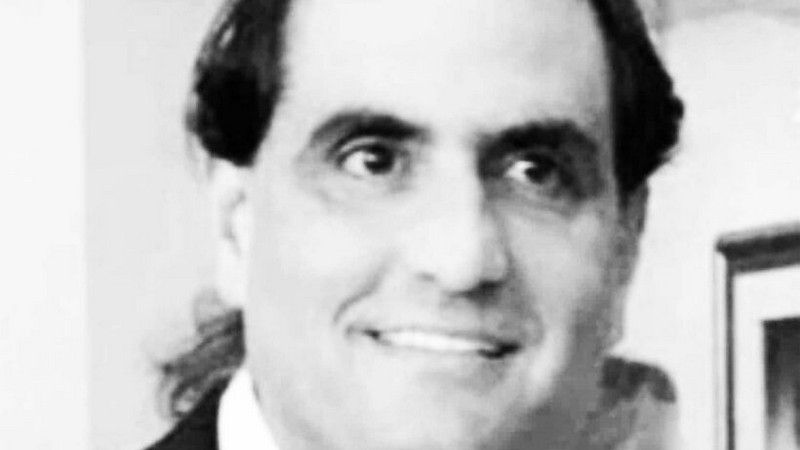
Why the US Imprisoned Venezuelan Diplomat Alex Saab

By Roger D. Harris

A year ago, October 16, the long arm of US extra-territorial judicial overreach abducted Alex Saab and threw him into prison in Miami, where the Venezuelan diplomat has languished ever since.

15 Oct 2022 – The official narrative is that Saab had bilked the Venezuelans in a “vast corruption network” and the US as the world’s self-appointed cop was simply enforcing good business practices. However, commentary by Washington insiders corroborates that Saab’s “crime” was trying to obtain humanitarian supplies in legalinternational trade but in circumvention of the illegal US sanctions on Venezuela.

Cabo Verde captivity

Back on June 12, 2021, Mr. Saab was on a humanitarian mission to procure needed food, fuel, and medicine for the people of Venezuela who had been suffering from an unconscionable blockade of their country. The US had imposed unilateral coercive measures – a form of collective punishment and illegal under international law – on Venezuela explicitly to make conditions so unbearable that the people would turn against their democratically elected government, which had fallen into disfavor with Washington.

Alex Saab’s flight from Caracas to Tehran was diverted to Cabo Verde off the coast of west Africa for a fuel stop. He was seized and has been imprisoned ever since.

Not only had the US-initiated Interpol “red alert” warrant been issued a day after the arrest, but as a credentialed special envoy and deputy ambassador to the African Union, Mr. Saab had protection from apprehension. Under the Vienna Convention on Diplomatic Relations, he was immune from arrest and detention, even in the time of war. The US is a party to the Vienna Convention.

Alex Saab was imprisoned under squalid conditions, including torture. Cabo Verde, under pressure from the US, twice disregarded orders from the regional Economic Community of West African States Court of Justice to free the diplomat, even though it was supposedly bound by the court’s jurisdiction. Likewise, appeals from the United Nations Committee on Human Rights to free him were ignored.

US charges against Alex Saab

Then a year ago, the diplomat was again kidnapped from where he was held captive and flown to Miami, without notifying his legal team or family.

Cabo Verde did not have an extradition treaty with the US and Alex Saab had not exhausted his legal appeals to the country’s courts. The timing of his forcible removal was telling, because the next day the opposition party in Cabo Verde won the national elections on a platform that included Saab’s release.

While the US initially charged Mr. Saab with seven counts of money laundering, these were dropped. Switzerland, where the crime was allegedly perpetrated, found no evidence of wrongdoing after an exhaustive three-year investigation. The nebulous and hard to disprove “conspiracy” to money launder is the one remaining charge.

Washington insiders reveal the back story on the US prosecution of Saab

Speakers at a forum held six months before Saab was abducted to the US revealed why the diplomat was such a high value target. Michael Nadler, a former US federal prosecutor with the Department of Justice who had signed the July 2019 indictment in the Saab case, told the forum: “I would tell you at the beginning, we didn’t have any idea just how big Alex Saab was going to become and has become.”

In a clear admission that the US was behind Saab’s detention in Cabo Verde, Nadler recalled: “Alex Saab’s flight to Iran was a last-minute discovery. And a lot of pieces fell into place perfectly to be able to stop him and have him arrested.”

Ryan Berg, the other main speaker at the forum, is a specialist on Latin America with the rightwing American Enterprise Institute. He explained why the US targeted Alex Saab: “The strong US interest in his extradition from Cape Verde to the US is that he knows a lot.” Berg elaborated: “He’s involved in a lot of these transactions to skirt US sanctions and US sanctions architecture. And therefore, the US has a strong interest in him because of everything that he knows.”

Role of sanctions in the US hybrid war against Venezuela

In short, Saab facilitated the “Maduro regime’s attempts to circumvent US sanctions,” according to no more authoritative source than former US Treasury Secretary Mnuchin. Further, Saab had close working relations with Russia, Iran, and China, which are states, Nadler acknowledged, that “… remain critical in their support for the [Venezuela] regime as well as their ability to skirt US sanctions.”

The sanctions are a form of hybrid warfare. Nadler explained how this warfare is conducted:

Most banks have correspondent relationships because they do deal in dollars and then they send money throughout the world. Even if you have a local bank in Columbia, what they will essentially do if you become a designated or sanctioned individual is they will cut you a check for the full amount in your bank account, but you’ll never be able to cash that check because almost now every bank or financial institution in the world is connected to the US financial institution. And nobody wants to risk being sanctioned because the sanctions can be significant based on each and every dollar transaction or each and every financial transaction that’s conducted.

Nadler continued on the impact of US sanctions: “Many actors in the region consider and quite frankly fear, the unilateral or asymmetric ability of the US government to sanction them…something that’s seriously circumscribes their ability to maneuver. And so, it is something that…a country like Venezuela fear[s].”

He concluded that sanctions are “…the main tool of the US government in bringing pressure against the Maduro regime,” which is why Saab has been so central.” Sanctions, he spelled out, are “the primary driver or the primary tool of the US government to limit the room for operations from the Venezuelan regime.”

Alex Saab – the jewel of negotiations with the US

The US is now negotiating with Venezuela through backdoor channels over the related issues of prisoner exchanges and easing oil sanctions. According to the opposition aligned El Diario de las Americas: “Alex Saab is the jewel of negotiations with the US.”

Former US Defense Secretary Mark Esper wrote that Saab is a key asset: “It was important to get custody of him. This could provide a real roadmap for the US government to unravel the Venezuelan government’s illicit plans and bring them to justice.”

Prisoner-exchange negotiations between the US and Venezuela have been taking place behind the scenes. On October 1, five dual national US-Venezuelan citizens, two native-born Americans, and a lawful permanent US resident were released from Venezuela in return for two Venezuelans imprisoned in the US. Although freeing political prisoner Alex Saab is a national priority for Venezuela and a key point in its negotiations with the US, he was not included in this exchange.

As his wife Camila Fabri Saab explains: “The kidnapping of Alex Saab is part of an attack against Venezuela and seeks to teach a lesson against anyone who has the courage to defend their country’s sovereignty.”

Roger D. Harris is a member of the TRANSCEND Network, associate editor at Council on Hemispheric Affairs (COHA), and the immediate past president of the Task Force on the Americas, a 33-year-old human rights organization in solidarity with the social justice movements of Latin America and the Caribbean.

17 October 2022

Source: www.transcend.org

Westerners Live in Denial Convinced They’re the Good Guys

By Jonathan Cook

Stark contradictions in West’s treatment of the Ukraine war and the occupation and siege of Palestine should serve as a wake-up call.

14 Oct 2022 – No one took responsibility for the explosion over the weekend that ripped through a section of the Kerch Bridge that links Russia to Crimea and was built by Moscow after it annexed the peninsula back in 2014.

But it was not just Kyiv’s gleeful celebrations that indicated the main suspect. Within hours, the Ukrainian authorities had released a set of commemorative stamps depicting the destruction.

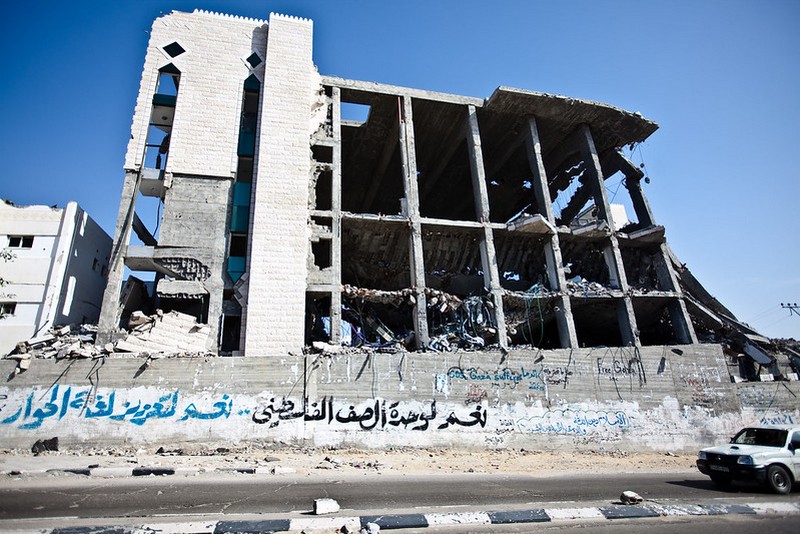
Russian President Vladimir Putin was under no illusions either. On Monday [10 Oct], he struck out with a torrent of missiles that hit major Ukrainian cities such as Kyiv and Lviv. It was a pale, Slavic echo of Israel’s intermittent bombardments of Gaza, which are expressly intended to send the Palestinian enclave “back to the Stone Age”.

If the scenes looked familiar – an attack by one party, followed by a massive retaliatory strike from the other – the mood and language that greeted the Ukrainian attack and the Russian counter-attack felt noticeably different from what passes for normal western commentary about Israel and Palestine.

The blast on the Kerch Bridge was welcomed with barely concealed excitement from western journalists, politicians and analysts, while Moscow’s strikes on Kyiv were uniformly denounced as Russian brutality and state terrorism. That is not the way things work when Israel and Palestinian factions engage in their own rounds of fighting.

Had the Palestinians openly celebrated blowing up a bridge in East Jerusalem, a territory illegally annexed by Israel in the 1960s, and killed Israeli civilians as collateral damage in the process, who can really imagine western media reports being similarly supportive?

Nor would western academics have lined up, as they did for Ukraine, to explain in detail why destroying a bridge was a proportionate act and fully in accordance with the rights in international law of a people under belligerent occupation to resist.

Instead, there would have been thunderous denunciations of Palestinian savagery and “terrorism”.

In reality, Palestinian resistance nowadays is far more modest – and yet still receives western censure. Palestinians need only to fire a home-made rocket, or launch an “incendiary balloon”, usually ineffectually out of their cage in Gaza – where they have been besieged for years by their Israeli persecutors – to incur the wrath of Israel and the western powers that claim to constitute the “international community”.

Even more perversely, when Palestinians solely target Israeli soldiers, as they are unambiguously entitled to do under international law, they are similarly reviled as criminals.

Regular rampages

But the double standards do not end there. Western media and politicians were unreservedly appalled by Moscow’s retaliatory strikes on the Ukrainian capital. Despite the media’s emphasis on Russia’s targeting of civilian infrastructure, the number of civilians killed across Ukraine by the wave of missile hits on Monday was reported to be low.

Jonathan Cook is an award-winning British journalist based in Nazareth, Israel, since 2001.

17 October 2022

Source: www.transcend.org

Will Saudi Leadership of OPEC Clash with U.S. Strategic Partnership?

By Richard Falk

14 Oct 2022 – This is an updated version of my responses to Iranian journalist Javad Arabshirazi on 12 Oct 2022.

********************************
Reevaluating US Relations with Saudi Arabia after OPEC+ Oil Production Cut

#1: The White House says that President Joe Biden is re-evaluating the US relationship with Saudi Arabia after the Organization of the Petroleum Exporting Countries and allies (OPEC+), in which Riyadh is a top producer, announced last week it would cut oil production. What is your take on this?

Biden and the U.S. swallowed a lot of harsh criticism for maintaining such a friendly relationship with Saudi Arabia in the aftermath of the 2018 brazen murder in the Saudi Consulate in Istanbul of the respected journalist, Jamal Khashoggi, who was long a Washington resident. Also, such a positive relationship had long been criticized as disregarding Biden’s supposed primary commitments to democratic values and human rights, given that Saudi Arabia has a worst record on gender issues than Iran and yet gets a pass. Furthermore, criticism had long been leveled at the U.S. military and diplomatic support for the unlawful and inhumane Saudi military intervention in Yemen mainly in the form of air attacks that have frequently struck civilian targets.

In this sense, Saudi Arabia and Mohammed bin Salmon, like Israel, had been shielded from official censure either by the U.S or at the UN, being considered a strategic partner and a key player when it comes to world energy markets and regional security in the Middle East. That being said, it is also true that Saudi Arabia never dreamed of having the extraordinary policy leverage in the U.S. enjoyed by Israel, lacking its lobbying prowess and willingness to use its influence when necessary to sway American voters. In addition, Biden’s visit in July of this year in the face of mounting liberal criticism was rumored to be compensated by a private Saudi commitments to maintain oil production levels and accept lower per barrel princes at least until December, that is, after the U.S. upcoming November elections at which higher gap pump prices would hurt Democratic Party prospects. In addition, it was believed that any production cuts by OPEC would aid Russian energy export marketing.

In this sense, the Saudi-led OPEC+ (13 OPEC members + 23 cooperating governments of oil exporting countries; significantly, Saudi Arabia and Russia co-chair OPEC+!) production cuts were seen as undercutting both U.S. domestic anti-inflation and foreign anti-Russian policy, which was determined to reduce Europe’s dependence on imported Russian gas. Although not publicly commented upon, this turn toward Russia in the strategic context of energy must have outraged, or at least disillusioned, those Washington insiders who have pragmatically encouraged a human rights blindfold and a tight embrace.

To consider this production/price move from a Saudi perspective makes it seem mainly motivated by its national interest in protecting the value of their principal trading asset, as well as not wanting their compliance with Washington wishes to be taken for granted or cancel other relationship as with Russia in OPEC+. With a global recession widely anticipated in coming months, principally as a consequence of the prolonged Ukraine crisis, oil demand is predicted to fall sharply, if possibly briefly, exerting a downward pressure on the world prices of oil and gas. Thus, from an economistic perspective an OPEC adjustment by way of temporarily reduced production seemed sensible. The Saudis undoubtedly felt that to remain a trustworthy leader of the OPEC and especially OPEC+ required that their influence not be distracted by U.S. political pressures and this depended on setting production quotas responsive only to energy market factors. Saudi Arabia formally confirmed this line of interpretation in their public written reaction to complaints from Biden, ant threats to reevaluate the bilateral relationship in manner than would be punitive toward Riyadh.

Also, at stake was the idea that a country like Saudi Arabia should demonstrate its political independence, especially when purporting to administer such an important form of multilateralism as is involved in OPEC+ operations. To manifest such independence on such a crucial issue as production levels meant avoiding any impression of subservience to the regional hegemony claimed by any non-OPEC or OPEC+ external actor. In this sense, what the Saudis are doing is somewhat similar in spirit to what Turkey has been doing in recent years, which has caused some friction within the NATO alliance framework but gained wide international respect for Turkey as an independent political actor. This is also what Israel has done in its own more provocative manner by not at all hiding its sharp differences with the U.S. on important questions, perhaps most notably through various disruptive expressions of its intense opposition to the 5+ 1 Nuclear Agreement of 2015 (also known as JCPOA) with Iran and currently by way of its opposition to the revival of the agreement by way of a U.S. return as a party, which is what Biden pledged when campaigning to be president in 2016. Israel has vigorously obstructed this major diplomatic and security effort without encountering any sort of push back by way of adverse ‘consequences’ that the Saudis are now being warned about. I would venture the opinion that absent Israel’s opposition, JCPOA would have been by now long restored, providing greater stability to the Middle East while at the same time gradually lifting the harsh and unjustifiable Trump sanctions that have brought great suffering to the people of Iran.

#2: President has warned of the consequences. What consequences this could have?

Biden has been deliberately vague about the nature of such consequences, although he spoken publicly about reevaluating the entire U.S./Saudi relationship. It may indicate that such a public show of displeasure, also reflecting some Congressional and public pressure to rethink whether closeness to Saudi Arabia sufficiently serves American interests to offset the clash with U,S. proclaimed values relating to human rights and democracy. I believe that it is helpful at this stage to consider this flareup as a temporary kafuffle between long-term allies joined at the hip. If this is true this incident will eventuate in nothing more consequential than a warning and a signal of disappointment, at most conveying an implicit threat that if such diplomatic defiance is shown in the future by Riyadh it might then indeed have ‘consequences,’ but even that might be a stretch unless Israel also turns away from soliciting normalization of relations with Saudi Arabia. If Republicans regain the White House in 2024, there will be even less willingness to rethink in any serious way, u.S./Saudi relations.

More concrete options are of course presently possible and have been proposed in the U.S. media and the Congress including an embargo on arms and legal action against the OPEC oil cartel. I find it somewhat doubtful at this stage that such drastic steps would be taken, and if they were, I would predict a boomerang effect. I suspect that the foreign policy establishment in Washington is inhibited by the fear that in the event of a tangible push back, Saudi Arabia might become tempted by the opportunity to shift its alignment in a direction more in line with China and Russia, an outcome running directly counter to the regional policies of both Israel and Egypt and quite disturbing for Europe, and of course the United States.

#3: An important question here is why and on what basis Riyadh has decided to do this. Is Riyadh going to partner with another country?

It is probable that Saudi Arabia’s leaders are also hoping that the storm will pass, and that it can reestablish close security ties with the U.S.. once having made its point about the autonomy of its approach to oil and OPEC+. There is little reason to think that the Saudis are ready to risk the loss of U.S. support for the security of Kingdom against internal and external adversaries. This has been the overriding Saudi goal long before MBS became the face of Saudi Arabia, and this support has critically extended to the management of its regional rivalry with Iran.

It may take some accommodating steps by Riyadh to restore rapidly pre-crisis normalcy such as voting with the U.S. in the UN to condemn the Russian annexation of four areas of Ukraine following the sham referenda that Moscow insisted exhibited a popular preference for reintegration with Russia. It has been rumored that the Saudis have given secret reassurances that current OPEC oil production quotas will be reconsidered at the next cartel meeting in light of any changes in the world economic situation that might lead increased oil production by OPEC members.

I would think that both the U.S. and Saudi Arabia will downplay the apparent tensions of the moment, and nothing concrete will happen to diminish the strategic level of mutual cooperation between these two countries. I further assume that behind the scenes, Israel is exerting strong pressure encouraging such an approach for the sake of its regional ambitions and to undergird its continuing efforts to confront and destabilize Iran. Nevertheless, it is a turbulent time in international relations, and anything is possible. So what seems most plausible at this moment may look quite different in a month or two.

Richard Falk is a member of the TRANSCEND Network, Albert G. Milbank Professor Emeritus of International Law at Princeton University, Chair of Global Law, Faculty of Law, at Queen Mary University London, Research Associate the Orfalea Center of Global Studies at the University of California, Santa Barbara, and Fellow of the Tellus Institute.

17 October 2022

Source: www.transcend.org

Ukraine War: Climbing the Escalation Ladder to Oblivion

By Richard Falk

Disdaining Diplomacy, Seeking Victory

Ever since the Ukraine War started on 24 Feb 2022, the NATO response, mainly articulated and materially implemented by the U.S., has been to pour vast quantities of oil on the flames of conflict, increasing the scale of violence, the magnitude of human suffering, and dangerously increasing the risk of a disastrous outcome.

Not only did Washington mobilize the world to denounce Russia’s ‘aggression,’ but supplied advanced weaponry in great quantities to the Ukrainians to resist the Russian attack, and did all it could at the UN and elsewhere to build a punitive coalition hostile to Russia but coupled this with a variety of sanctions and the demonization of Putin as a notorious war criminal unfit to govern. This perspective of state propaganda was faithfully conveyed by a self-censoring Western media filter that graphically portrayed on a daily basis the horrors of the war experienced by the Ukrainian civilian population and a newly West-oriented enthusiasm for the ICC gathering as much evidence as possible of Russian war crimes.

Such a posture contradicted its intense past opposition to ICC efforts to gather evidence for an investigation of war crimes by non-signatories in relation to the U.S. role in Afghanistan or Israel’s role in occupied Palestine.-To some degree such one-sidedness of presentation was to be expected, but its intensity in relation to Ukraine has been dangerously irresponsible and amateurish with respect to the wider human interests at stake, and in a profound sense, the wellbeing of Ukraine and its people.

Even Stephen Walt, an influential commentator on U.S. foreign policy, who is a prudent critic of the Biden failure to do his best to shift the bloody encounter in Ukraine from the battlefield to diplomatic domains, nevertheless joins the war-mongering chorus by misleadingly asserting without qualification that “Russia’s invasion of Ukraine is illegal, immoral, and unjustifiable.” [Walt, “Why Washington Should Take Russian Nuclear Threats Seriously,” Foreign Policy, May 5, 2022] It is not that such a characterization is incorrect as such, but unless softened by explanations of context it lends credibility to the war-oriented, self-righteous mentality displayed by the Biden presidency. Perhaps Walt and others of similar persuasion were striking this posture of going along with this public portrayal of the Ukraine Crisis as part of striking a Faustian Bargain to gain a seat at the table so that their message of caution could be effectively delivered.

To be clear, even if it can be argued that Russia/Putin have launched a war that is unlawful, immoral, and unjustified, context is important if peace is to be restored and catastrophe avoided. For one thing, the Russian attack may be all of those things alleged, and yet form part of a geopolitical pattern of established behavior that the U.S. has itself established in a series of wars starting with the Vietnam War, and notably more recently with the Kosovo War, Afghanistan War, and the Iraq War. None of these wars were legal, moral, and justifiable, although each enjoyed a geopolitical rationale that made them persuasive with U.S. foreign policy elites and its closest alliance partners. Of course, two wrongs do not make a right, but in a world where geopolitical actors enjoy a license to pursue their strategic interests, it is not objectively defensible to so self-righteously condemn Russia without taking account of what the U.S. has been doing around the world for several decades.

In a somewhat insightful fit of frustration, George W. Bush after a failure to gain UN Security Council authorization in 2003 for the use of regime-changing force against Iraq, declared that the UN would lose its ‘relevance’ if it failed to go along with the American imperial plan of action, and so it did. The ambiguity as to international law arises from the UN Charter own equivocation, asserting that all non-defensive uses of force are prohibited, a position reinforced by the amended Rome Statute governing the International Criminal Court by declaring ‘aggression’ as a crime against the peace, while conferring a conferring a right of veto.

How can this right of veto be conferred on the five permanent members of the Security Council, which has the effect of precluding any decision that clashes with their strategic interests, be reconciled with the prohibition on aggression.

Such a right of exception is complemented by the experience of international criminal law, which from Nuremberg to the present has exempted from accountability dominant geopolitical actors, even for such incredible acts as dropping atomic bombs on overwhelmingly civilian targets at the end of World War II.

This gray zone separating law from power is further reinforced by the existence of spheres of influence claimed and dominated by geopolitical actors, which if territorially proximate and identified as such, tend to be respected by adversaries. Such compromised sovereignty of these borderland countries is descriptive of the mutual tolerance exhibited during the Cold War of the division of Europe, showing forbearance even in the face of ‘unlawful’ violent interventions. In this sense, Ukraine finds itself in the unenviable position of Mexico. Long ago the great Mexican cultural figure, Octavio Paz, proclaimed the tragedy of his country ‘to be so far from God and so close to the United States.’

These considerations are mentioned here not to defend, much less exonerate Russia, but to show that the world order context of the Ukraine War is deeply problematic in relation to normative authority, especially when invoked in such a partisan manner. In contemporary geopolitical relations, as distinct from normal state-to-state or international relations, precedent takes the place of norms and rule-governed behavior. Antony Blinken has muddied the waters of international discourse by falsely claiming that the U.S., unlike adversaries China and Russia, is as observant of rule-governed behavior as are ‘normal states’ in relation to peace and security.

In this sense, it is appropriate to look back at NATO’s clearly unlawful war of 1999 that fragmented Serbia by granting Kosovo political independence and territorial sovereignty before uncritically condemning the Russian annexation of four parts of eastern Ukraine after admittedly dubious referenda. Again, it is important to recognize that there may be cases where the fragmentation of existing states is justifiable on humanitarian grounds and others where it is not, but to claim that Russia overstepped the limits of law in a context where power has shaped behavior and political outcomes in similar cases is to prepare the public for a wider war rather than leading it to seek and be pragmatically receptive to a diplomatic compromise.

This contextual understanding of the Ukraine War is in my judgment highly relevant as it makes the current fashion of mounting legal, moral, and political arguments of condemnation distract from following an otherwise rational, prudent, and pragmatic courses of action, which from the beginning strongly supported an all-out effort to encourage an immediate ceasefire followed by negotiations aiming at a durable political arrangement not only between Russia and Ukraine, but also NATO/U.S. and Russia. That the U.S. Government never to this day has indicated any interest, much less a commitment to stopping the killing and encouraging diplomacy, despite the mounting costs and risks of prolonged warfare in Ukraine should be shocking to the conscience of peace-minded persons and patriots of humanity everywhere.

Beyond this, catastrophic costs are presently being borne by many vulnerable societies throughout the world from the spillover effects of anti-Russian sanctions and their impact on food and energy supplies and pricing. Such a deplorable situation, likely to get worse as the war is prolonged and intensified, is now also bringing closer to reality growing risks of the use of nuclear weapons as Putin’s alternatives may be narrowing to acknowledging defeat or personally falling from power. While not relenting a bit on implementing an aggressive approach to gaining Ukraine’s ambitions of victory, Biden himself acknowledges that any use of even a tactical nuclear weapon in Ukraine would with near certitude lead to Armageddon. This duality of assessment (combining escalating the war and anxiety as to where it might lead) seems like an embrace of geopolitical insanity rather than a recognition of the somber realities at stake.

As always actions speak louder than words. Blinken facing a rising public clamor for negotiations responds with his usual feckless evasions. In this instance, contending that since Ukraine is the victim of Russian aggression it alone has the authority to seek a diplomatic resolution and the U.S. will continue to support Ukraine’s maximal war aims, including even their extension to Crimea, which has been part of Russia since 2014.

Context also matters in relation to the conduct of the war. Its major escalation within the month of the sabotage of Nord Stream gas pipeline to Europe, which Blinken again confounded by calling it ‘a tremendous opportunity’ to make weaken Russia and lead to greater European energy independence. Such an operation initially implausibly attributed to Russia, yet later more or less acknowledges as part of the expansion of the war by reliance on ‘terrorist’ tactics of combat.

Its latest expression is the suicide bombing of the strategic Kerch Bridge on October 7th, connecting Crimea and Russia, a major infrastructure achievement of the Putin period of Russian leadership and supply line for Russian troops in Southern parts of Ukraine. These operations contain the fingerprints of the CIA and seem designed as encouragement to the Ukrainian resolve to go all out for a decisive victory, sending Putin unmistakable signals that the U.S. remains unreceptive to a responsible geopolitics of compromise. The U.S. anger directed at Saudi Arabia for cutting its oil production is one more sign a commitment to a victory scenario in Ukraine as well as a reaction against the Saudi resistance to U.S. hegemonic geopolitics. With such provocations, it is hardly surprising, although highly unlawful and immoral, for Russia to retaliate by unleashing its version of ‘shock and awe’ against the civilian centers of ten Ukrainian cities. Such is the vicious escalation!

Always lurking in the background, and at Ukraine’s and the world’s expense, is Washington’s geopolitical opportunism, that is, seeking to defeat Russia and deter China from daring to challenge the hegemonic unipolarity achieved after the Soviet disintegration in 1992. It this huge investment in its militarist identity as the sole ‘global state’ that alone explains this cowboy approach to nuclear risk-taking and the tens of billions expended to empower Ukraine.

Such a tragic political drama unfolds as the peoples of the world and their governments, along with the United Nations, watch this horrendous spectacle unfold, seemingly helpless witnesses not only to the carnage but to their own national destinies.

Richard Falk is a member of the TRANSCEND Network, Albert G. Milbank Professor Emeritus of International Law at Princeton University, Chair of Global Law, Faculty of Law, at Queen Mary University London, Research Associate the Orfalea Center of Global Studies at the University of California, Santa Barbara, and Fellow of the Tellus Institute.

17 October 2022

Source: www.transcend.org