Just International

Ukraine Update: Saudi Arabia and UAE leaders ‘decline calls with Biden’

By Countercurrents Collective

Incidents following the Ukraine Crisis are developing dramatically. The world markets are also bearing the Crisis’ brunt.

A report by The New York Times said:

A digital barricade went up between Russia and the world. Both Russian authorities and multinational internet companies built the wall with breathtaking speed. And the moves have ruptured an open internet. TikTok and Netflix are suspending their services in the country. Facebook has been blocked. Twitter has been partially blocked and YouTube’s future is in doubt. Apple, Samsung, Microsoft, Oracle, Cisco and others have pulled back or withdrawn entirely from Russia. Even online video games like Minecraft are no longer available.

A Reuters report said:

Russia warned the West on Wednesday that it was working on a broad response to sanctions that would be swift and felt in the West’s most sensitive areas.

“Russia’s reaction will be swift, thoughtful and sensitive for those it addresses,” Dmitry Birichevsky, the director of the foreign ministry’s department for economic cooperation, was quoted as saying by the RIA news agency.

Media reports said:

The de-facto leaders of Saudi Arabia and the United Arab Emirates (UAE) have declined to arrange calls with US president Joe Biden in recent weeks as the U.S. and its allies have sought to contain a surge in energy prices caused by the Ukraine Crisis.

According to the Wall Street Journal, citing Middle East and U.S. officials, both Saudi Crown Prince Mohammed bin Salman and the UAE’s Sheikh Mohammed bin Zayed al Nahyan have been unavailable to Biden after US requests were made for discussions.

“There was some expectation of a phone call, but it didn’t happen,” a U.S. official said of a plan for Saudi Prince Mohammed and Biden to speak. “It was part of turning on the spigot [of Saudi oil].”

Reports of frigid communications come as the Biden administration seeks to increase oil supply after formally banning Russian oil imports on Tuesday, pushing oil prices to $130 a barrel, the highest level in 14 years.

Relations between the U.S. and Saudi Arabia have chilled during the Biden administration over American policy in the Gulf region.

Issues include the revival of the Iran nuclear deal; lack of US support for Saudi intervention in Yemen’s civil war and its refusal to add Houthis to its list of terrorist groups; US help with a Saudi civilian nuclear program; and legal immunity for Prince Mohammed, who is facing lawsuits over the murder of Saudi journalist Jamal Khashoggi by a Saudi hit-team in its Istanbul consulate four years ago.

During Biden’s election campaign he vowed to treat the kingdom as a “pariah” state, saying there is “very little social redeeming value in the present government in Saudi Arabia.”

Earlier this week, White House spokesperson Jen Psaki said there were no plans for the Biden and Prince Mohammed to talk soon, and no plans for the president to travel to Riyadh.

Yousef Al Otaiba, the UAE ambassador to the U.S., confirmed strained relations between the two countries. “Today, we are going through a stress test, but I am confident that we will get out of it and get to a better place,” Al Otaiba predicted.

The two Gulf nations are regarded as the only global suppliers with capacity to pump more oil to ease the price surge.

Senior U.S. officials with the national security council and state department had reported travelled to Riyadh and Abu Dhabi in recent weeks to make direct U.S. representations.

The Journal, however, reported that Biden had spoken with Prince Mohammed’s 86-year-old father, King Salman, on 9 February. On the call they affirmed their countries’ strategic and economic partnership. The UAE’s ministry of foreign affairs said Biden and Sheikh Mohammed call would be rescheduled.

Oil extends rally after U.S. bans Russian imports

A Reuters report said:

Oil prices rose on Wednesday as the U.S. ban on Russian oil imports and Britain’s plan to phase them out by year end raised concerns of tighter global supply.

Brent crude futures were up $2.17, or 1.7%, at $130.15 a barrel at 0133 GMT, after jumping 3.9% the previous day.

U.S. West Texas Intermediate (WTI) crude futures were up $1.57, or 1.3%, at $125.27 a barrel, after also surging 3.6% on Tuesday.

U.S. President Joe Biden on Tuesday imposed an immediate ban on Russian oil and other energy imports and Britain said it would phase out Russian oil imports through the end of 2022.

“On top of the U.S. and Britain’s announcement effects, fears of further disruptions of supply from Russia due to intensifying sanctions on Moscow prompted fresh buying,” said Hiroyuki Kikukawa, general manager of research at Nissan Securities.

“But Monday’s highs will likely become a ceiling for the short term as speculative buying is expected to slow down soon and countries in the northern hemisphere are headed to spring when fuel demand drops,” he said.

Oil prices jumped on Monday to their highest levels since July 2008, with Brent hitting $139.13 a barrel and WTI $130.50.

Behind the rally was also expectations that an imminent return of Iranian crude to global markets was unlikely, as talks on Iran’s nuclear program have slowed between Tehran and world powers.

Analysts at Oslo-based consultancy Rystad Energy said on Tuesday that global oil prices could rise to $200 a barrel if Europe and the U.S. ban imports of Russian oil.

Russia provides little of US oil imports

The U.S. imported roughly 6.1 million barrels a day last year, which accounted for 40% of the crude processed at American refineries. The biggest share of imports came from Canada (61%) followed by Mexico (10%), Saudi Arabia (6%) and Russia (3%), according to the trade association. Colombia, Iraq and Ecuador follow Russia. In 2021, the U.S. imported an average of 209,000 barrels per day of crude oil from Russia, according to the American Fuel & Petrochemical Manufacturers.

Derrick Morgan, a senior vice president for the fuel group, said oil and gasoline are globally traded commodities and banning imports from Russia to the U.S. would affect countries around the world.

“Taking any oil off globally will have an impact,” he said.

Gas Prices Are Now The Most Expensive In U.S. History

After days of dramatically rising gas prices, the national average for a gallon of gas is now the highest in U.S. history, breaking the record that stood for nearly 14 years. As of Tuesday morning, the cost of regular gas in the U.S. is $4.17, according to AAA, up from $4.06 on Monday. Last week, the average cost was $3.60.

The previous national average high was $4.11, set on July 17, 2008, according to AAA.

“Americans have never seen gasoline prices this high, nor have we seen the pace of increases so fast and furious,” Patrick De Haan, head of petroleum analysis at fuel-savings app GasBuddy, said in a statement on Monday.

U.S. Ban on Russian Oil Expected to Unleash Hell on Consumers

“Putting an embargo on Russian oil will be a nightmare for U.S. consumers as it will send the oil price skyrocketing,” says Nafis Alam, professor of finance and head of the School of Business at Monash University Malaysia. “Russia is the world’s top exporter of crude and oil products combined, with exports of around 7 million barrels per day (bpd), or 7-7.5% of global supply. Additionally, any embargo will be counterproductive for Russia, as higher oil and gas prices will lead to more profitability for Russian oil firms means more funding to continue the war.”

“Any disruption in oil supply due to the embargo on Russian oil and gas will push the prices, which will be painful for the U.S. consumers,” says Alam. “Not only a higher fuel price, but it can also push inflation in the U.S. market. As the global economy is still reeling from the Covid pandemic, any increase in oil prices will damage the U.S. and global economies.

The academic does not rule out that rising oil prices due to the US embargo on Russian crude could pose a significant risk for Biden and the Democrats at the upcoming midterm elections. Gasoline prices have always played a significant role in US politics, and no sitting president will chance making their voters unhappy, according to Alam.

The EU Is Unlikely to Join Washington’s Russia Oil Sanctions

According to global analysts, the prices are likely to surge even further. Thus, Goldman Sachs raised its Brent forecast for 2022 to $135 from $98 and its 2023 outlook to $115 a barrel from $105, expecting the “largest energy supply shocks ever” because of Russia’s key role. For its part, Oslo-based consultancy Rystad Energy said that if the EU follows the U.S.’ lead and bans Russian oil, crude prices may easily jump to $200 a barrel.

Is it impossible to maintain the same oil supply levels globally without Russia, according to Thierry Bros, professor at the Paris Institute of Political Studies and a contributor to Natural Gas World.

While the EU has not yet jumped on the Russian oil embargo bandwagon, the UK is due to phase out Russian crude imports and oil products by the end of 2022, as Prime Minister Boris Johnson said on Tuesday.

For his part, German Chancellor Olaf Scholz on 7 March pushed back against calls from Washington and Kiev for a ban on imports of Russian gas and oil within the framework of broader sanctions on Moscow.

“Europe has deliberately exempted energy supplies from Russia from sanctions,” Scholz said in a statement, as quoted by Politico. “At the moment, Europe’s supply of energy for heat generation, mobility, power supply and industry cannot be secured in any other way. It is therefore of essential importance for the provision of public services and the daily lives of our citizens.”

Germany is against the gas and oil embargo, since it has no alternative to Russian energy supplies, explains Dr. Pierre-Emmanuel Thomann, a geopolitical expert. Earlier, Berlin announced the freezing of the certification of Russia’s Nord Stream 2 project which, coupled with sweeping anti-Russia restrictions, has resulted in an unprecedented spike in gas prices. The price of gas on the stock exchange in Europe surpassed $3,600 per 1,000 cubic meters on Monday.

“Germany in particular is opposed to any embargo on Russian gas, on which it is highly dependent, while the United States imports little Russian crude,” says Thomann. “Such a ban on gas and oil imports from Russia ‘would threaten social peace’ in Germany, said Friday Green Minister of Economy Robert Habeck. Germany imports 55% of its gas, 42% of its oil and coal from Russia. The EU depends on Russia for 40% of its natural gas and a quarter of its oil imports.”

Gold Near 19-Month High as Ban on Russian Oil Drives Flight to Safety

A Bloomberg report said:

Gold held near a 19-month high following a ban on Russian oil imports, as mounting concerns over inflation and economic growth boost demand for the haven asset.

Bullion has gained 12% in 2022 and is closing in on a record as investors seek a store of value amid the threat of an inflationary shock to the global economy. Holdings in gold-backed exchange-traded funds have climbed to the highest since March 2021, with inflows of about 152 tons this year, according to initial data compiled by Bloomberg.

The impact of the war in Ukraine and sanctions on Russia have reverberated across the globe, driving commodities higher on supply woes.

“The ban on Russian oil by the U.S. is causing more inflation jitters,” said Howie Lee, an economist at Oversea-Chinese Banking Corp. “We all saw that coming, but still, it feels like a roller coaster drop moment. With this ban, oil is easily expected to trade at new records. By that correlation, it is not difficult to see why gold may also be trading at a new record high soon.”

Spot gold dropped 0.2% to $2,047.05 an ounce at 10:24 a.m. in Singapore. Prices touched $2,070.44 on Tuesday, just $5 short of an all-time high reached in August 2020.

Nominal gold prices should breach $2,125 over the next three months and trade in a higher range for the rest of 2022 as “financial markets grapple with surging headline inflation, geopolitical uncertainty, and recession tail risks,” Citigroup Inc. analysts including Aakash Doshi, said in a report dated March 8.

Palladium advanced 3% on concerns over potential supply disruptions as Russia produces about 40% of the metal mined globally. Silver and platinum both traded near June highs.

Silver and Gold Explode

The run in commodities has been stunning. It’s not just silver and gold feeling the love, but oil, wheat, aluminum, nickel, soybeans, corn and others.

We’ve been in a supply-shocked super-cycle for this space and the bulls have reaped the rewards.

But the one that suffers from all of it? The consumer.

Rising oil prices impact gas prices. Rising food costs raise the grocery bill. Rising energy prices raise heating costs. It all circles back to the economy as the burden to bear inflation, which is not good for the global economy.

This morning, silver and gold prices were ripping higher, along with many other commodities.

At today’s high, gold was up more than $80 an ounce and topped out at $2,078.80. That’s just shy of the 2020 high and all-time high up at $2,089.20.

If gold can maintain momentum, this is obviously the next upside level.

Silver has not performed quite as well as gold, but nonetheless has moved quite nicely lately for the bulls.

The move sent silver to the 61.8% retracement of the recent range, but now it’s struggling.

A move and close above today’s high could open the door to $28.50, then eventually the recent high up at $30.35.

If silver can’t push through the 61.8%, then bulls want to see $25.50 hold as support, along with the 10-day moving average. Below these measures could put the 21-day and 200-day moving averages on the table.

Bank of America Issues Dire Prediction For Global Economy

The global economy is set to experience uncertainty, sky-high energy prices, and slowing growth as tough Russia sanctions put pressure on markets over the coming months, according to the global research team at Bank of America (BofA).

In a Tuesday note to clients, the bank’s analysts warned that “there is no clear off-ramp for Russia” in the Ukraine conflict, and admitted that trying to pin down an exact economic forecast following Russia’s invasion has been like “catching a falling knife.”

“Expert opinion has been repeatedly wrong about the course of events. If we believe the experts, Putin would have never invaded, Ukraine would have offered weak resistance and sanctions would be limited,” the analysts wrote.

The team at BofA lowered their 2022 gross domestic product (GDP) forecasts for the U.S. from 3.6% to 3.3% over the past week, and they now see Euro Area GDP growth falling to just 2.8% this year, compared to 3.5% in previous estimates. The analysts also bumped their 2022 inflation expectations for the U.S. and Euro Area to 7% and 6%, respectively.

They believe Americans should expect lower growth and higher inflation than was previously anticipated in a rough year ahead.

Europe Eyes GM Grains Import Waiver, Says Spain

Another Bloomberg report said:

The EU could consider temporarily lifting a ban on imports of genetically modified (GM) grains from the U.S. and South America to help farmers struggling with supply disruptions caused by the war in Ukraine, according to Spain’s Agriculture Minister Luis Planas.

Spain and France have also proposed a waiver on agricultural goods with traces of herbicide to increase stocks and seek alternative suppliers of mainly corn, which is key for the production of animal feed.

“This is a warning call for us to think about having the capacity to provide food security to our 450 million citizens,” said Planas in an interview with Bloomberg News. “We need the European Union to add flexibility to grain import rules.”

If adopted, the measures could mark a shift from the bloc’s “Farm to Fork” strategy that included objectives to increase organic production and cut pesticide use. That strategy has raised concerns it could ultimately curb crop production in one of the world’s biggest producers of agri-food products.

Any additional imports of genetically modified grains would still need approval by EU’s authorities, and members states could decide whether to take them or not, he said.

Planas said the EU should add targets for the production of vegetable protein and fertilizers as part of its long-term strategy.

Spain is also proposing bolstering grain production by limiting crop rotation and using fallow land, Planas said.

Imports, however, are key as it will take years for Europe to achieve self-sufficiency in the supply of vegetable protein, Planas said. The U.S. and Argentina are not the only markets that may help underpin Europe’s current needs, said Planas, adding the situation is evolving positively.

Ukraine is the main supplier of corn and sunflower oil to Spain, providing almost 30% and 62% of imports respectively, according to the ministry. Planas said the country has already imported around 1.9 million tonnes of corn to supply its meat industries for at least 45 days and can make up for a drop in sunflower oil with local olive oil output.

Imports from other destinations and the substitution of oil with local output will likely further increase food prices in a country struggling with 33-year high inflation.

Spain also fulfills internally about half of its nitrogenous fertilizer demand, which is being affected by the surge in gas prices, so the government “is not worried.”

2 Million Have Fled Ukraine

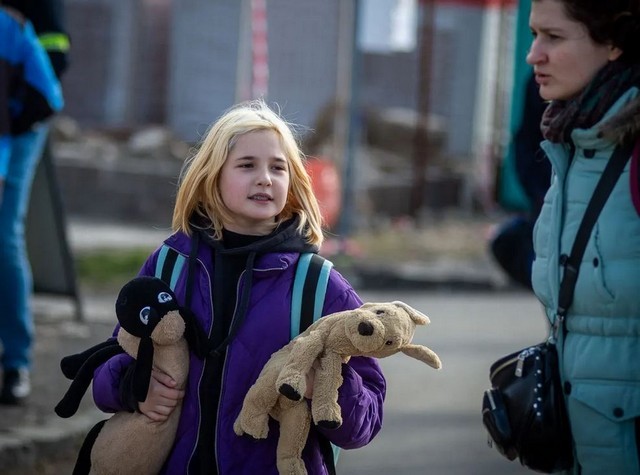
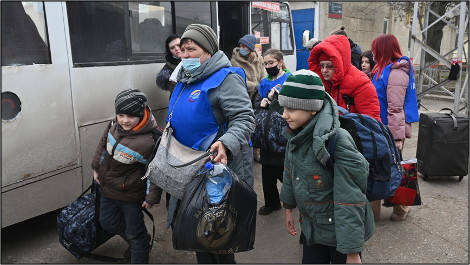
The number of refugees fleeing Ukraine reached 2 million on Tuesday, according to the UN, the fastest exodus Europe has seen since World War II.

“Today the outflow of refugees from Ukraine reaches 2 million people. Two million,” Filippo Grandi, the UN High Commissioner for Refugees, wrote on Twitter. Michelle Bachelet, the UN high commissioner for human rights, said she is “deeply concerned about civilians trapped in active hostilities in numerous areas.”

Poland has been the escape point for more than 1.2 million of the refugees. Several hundred thousand have fled to other European nations, including about 100,000 to Russia. More than 15% of the country of 45 million people are ethnic Russians.

Brazil Will Not Take Sides

A Reuters report said:

Brazil will not take sides over Russia’s invasion of Ukraine, Foreign Minister Carlos Franca said on Tuesday, adding its stance was one of “impartiality”, not “indifference”, and that it sought peace.

“Brazil’s position is clear… We are on the side of world peace,” Franca told a news conference in Lisbon when asked if he condemned the invasion. “We think we can reach that (peace)… by helping to find a way out (of the war), not by taking sides.”

Brazilian President Jair Bolsonaro, who visited Russian President Vladimir Putin in Moscow shortly before the invasion, angered Western allies by saying he was “in solidarity with Russia” without elaborating.

Bolsonaro, a far-right populist, has also noted that Russian fertilizers are crucial for Brazil’s giant agribusiness sector.

Last month he scolded his Vice President Hamilton Mourao for condemning Russia’s invasion and said that in Brazil only the president could speak about a crisis in eastern Europe.

Venezuela Announces ’Vigorous Reactivation’ of Dialogue With U.S.

Venezuelan President Nicolas Maduro announced a ‘vigorous reactivation’ of discussions with the country’s opposition in remarks given Monday on public TV.

In an apparent sign of the early success of talks between the Maduro administration and the U.S., his announcement was quickly followed by news of the release of U.S. citizens Gustavo Cardenas, one of six Exxon executives detained in Venezuela on corruption and embezzlement charges since 2017, and Jorge Alberto Fernández, a Cuban-American detained on terrorism charges.

Dialogue between the Venezuelan government and opposition factions was suspended in October following the ‘kidnapping’ of diplomat Alex Saab by Cape Verde authorities working with US officials. The announcement came on the heels of the revelation that a high-level U.S. delegation flew to Caracas to meet with Pres. Maduro in an effort to secure access to Venezuela’s oil and weaken the country’s ties with Russia.

Describing the meeting as “respectful, cordial, very diplomatic,” Maduro explained that if Caracas wants to “ask the world for dialogue” in Ukraine, then it must lead by “example.”

The hardline faction of the opposition led by self-declared ‘interim president’ Juan Guaido appeared to be completely caught off-guard by the news that Biden had sent envoys to Venezuela for the first time since the US broke off relations following the 2019 attempted coup by Guaido. After President Maduro confirmed the talks, Senator Marco Rubio (R-FL)–described by the New York Times at the time of the attempted coup in 2019 as its “de facto spokesman”–immediately unleashed a flurry of angry missives on social media.

“The White House offered to abandon those seeking freedom from #Venezuela in exchange for an insignificant amount of oil,” he seethed in one particularly indignant post.

Nonetheless, Republican politicians and right-leaning outlets have reacted with outrage to moves towards rapprochement with a government that the U.S. and corporate media outlets have largely sought to paint as being led by anti-democratic despots since the election of socialist Hugo Chavez in 1998.

“Joe Biden using #Russia as an excuse to do the deal they always wanted to do anyway with the #MaduroRegime,” tweeted Florida Republican Senator Marco Rubio. “Rather than produce more American oil he wants to replace the oil we buy from one murderous dictator with oil from another murderous dictator.”

Instagram Warns Users Who Share Russian State Media

Instagram announced Tuesday that it would implement steps to dampen Russian government propaganda and protect the privacy of users across Ukraine and Russia.

The company will begin downranking posts from Russian state-affiliated media, placing any stories from those outlets below other content from other sources. Users who go to share stories originating with any of these accounts will now see a pop-up message cautioning them against spreading “Russia state-controlled media.”

“Instagram believes the account that created this post may be partially or wholly under the editorial control of the Russian government,” the message reads.

Users who share stories with link stickers pointing to domains associated with Russian state media will get the same treatment. Content from Russian state-linked accounts will also no longer appear in Instagram’s algorithmically populated discovery areas, like Reels and the discovery tab, and Instagram says that it also won’t show up as readily in search either.

Instagram’s efforts to stem the flow of state-backed disinformation about the Russian invasion of Ukraine follows Facebook’s own parallel efforts. Facebook announced last week that it would similarly attempt to bury Russian state media through the use of warning labels and downranking. At the time, Meta Head of Security Policy Nathaniel Gleicher said the labels were on the way “in the days ahead.”

Instagram is also adding a new privacy measure for some users based in Ukraine and Russia. Now, private accounts based in those countries will have their following and follower lists private and their mutual friend lists hidden, adding a layer of protection that obscures real-life social connections.

Instagram and Facebook parent company Meta previously announced that it would make encrypted DMs available to all adult users in Ukraine and Russia and make it easy for accounts in those countries to bulk delete content and activity.

Chinese Companies That Aid Russia Could Face U.S. Repercussions

Gina Raimondo, the secretary of commerce, issued a stern warning Tuesday to Chinese companies that might defy U.S. restrictions against exporting to Russia, saying the United States would cut them off from American equipment and software they need to make their products.

The Biden administration could “essentially shut” down Semiconductor Manufacturing International Corporation or any Chinese companies that defy U.S. sanctions by continuing to supply chips and other advanced technology to Russia, Ms. Raimondo said in an interview with The New York Times.

The U.S., the EU and other governments have issued sweeping sanctions and export controls. The export controls prohibit the sale of certain high-tech products, including advanced semiconductors, to Russia and Belarus.

The U.S. export controls apply not just to American companies, but to companies anywhere in the world that use American software or technology to manufacture their products, which include many Chinese companies.

China does not have the ability to make the world’s most advanced semiconductors, Ms. Raimondo said, and Chinese companies that continue to supply Russia would face harsh penalties.

Russia “is certainly going to be courting other countries to do an end run around our sanctions and export controls,” Ms. Raimondo said. But if the U.S. were to find that a company like the Semiconductor Manufacturing International Corporation, in Shanghai, was selling its chips to Russia, “we could essentially shut SMIC down because we prevent them from using our equipment and our software,” she said.

“They have their own self-interest to not supply this stuff to Russia. So they’re not doing it out of the goodness of their heart. It would be devastating to China’s ability to produce these chips,” Ms. Raimondo added.

German Industrial Output: Conflict Darkens Outlook

A media report said:

German industrial production rose again in January, official figures showed, but the positive picture was likely to be upended by the impact of the war in Ukraine.

Production was up 2.7 percent on the previous month, according to seasonally adjusted figures from the federal statistics agency Destatis, after rising by 1.1 percent in December.

It follows the publication a day earlier of figures showing incoming orders for industry had also risen by 1.8 percent.

The data showed how “the German economic rebound could have looked,” said Carsten Brzeski head of macro at the bank ING, as Europe’s largest economy looked to shake off the drag caused by widespread supply bottlenecks and coronavirus-related restrictions.

The two together caused the economy to shrink by 0.3 percent in the last three months of 2021.
But the Russian invasion of Ukraine at the end of February “has changed everything” for the economic outlook, Brzeski said.

With Germany’s high dependence on imports of Russian gas, the rise in energy prices caused by the conflict could “shave off one percentage point of GDP growth this year,” Brzeski said.

The additional upheaval in supply chains “will weigh on industrial production” too, he said, with the impact felt particularly hard by the flagship automotive sector, which has a significant network of suppliers in Ukraine.

The war would “slow” the rebound, with the strength of the impact “currently unclear,” the economy ministry said in a statement.

While the production figures in January were 1.8 percent above the same month last year, they still trailed the pre-pandemic level by three percent, according to Destatis.

Ukraine Crisis Threatening Steel Industry In Turkey

The war in Ukraine is threatening the free trade agreement signed between the country and Turkey, said Ekol Demir Celik, chairwoman of Elif Tulay.

The agreement was signed last month to increase bilateral trade to $10 billion. But now the Turkish steel industry needs protection, Demiroren News Agency quoted her.

“Due to its close geographical position, we have close export and import ties with Ukraine. We have been procuring most of the raw materials for the iron and steel industry from this country,” she said.

The Ukrainian market is particularly important for high-quality steel, she added.

Turkey was the world’s eighth-largest crude steel producer after China, India, Japan, the U.S., Russia, South Korea and Germany.

Shell Is Already Backtracking On Its Boycott Of Russian Oil

On Tuesday, March 1, Shell was lauded for cutting ties with Russian firms Gazprom and Salym Petroleum, and for ending its involvement in the Nord Stream 2 gas pipeline. “We are shocked by the loss of life in Ukraine, which we deplore, resulting from a senseless act of military aggression which threatens European security,” Shell CEO Ben van Beurden said at the time. “Our decision to exit is one we take with conviction.”

That conviction lasted less than a week. By Friday (March 4), as the price spread widened between Russia’s Urals crude and Brent crude, the international benchmark for oil prices, Shell bought 100,000 metric tons at a record discount of $28.50 per barrel, according to a report from the Wall Street Journal.

On Twitter, Shell confirmed that it would continue to buy Russian oil, citing a tight market and few alternatives for sourcing crude.

Dmytro Kuleba, Ukraine’s foreign minister, expressed his disappointment.

Shell’s purchase of Russian crude—the first since companies began cutting ties—could signal to the rest of the market that buying Russian oil at a record discount is worth any moral about-face, according to Bloomberg.

Countercurrents is answerable only to our readers. Support honest journalism because we have no PLANET B.

6 March 2022

Source: countercurrents.org
Evidence that Ukraine Has Been Run by Nazis Since February 2014

By Eric Zuesse

On 12 March 2014 a historic 10-minute video was uploaded to youtube that acquired over a million hits since then, and that presented and truthfully explained a compendium of video-clips which had been uploaded to the Web during the 2014 overthrow and replacement of Ukraine’s democratically elected President,

Ukraine Crisis – What You’re Not Being Told

Viktor Yanukovych, who had been called to the White House right after his 2010 electoral win and was asked by Obama to help to push his country toward joining NATO (though all of the opinion polls that had been taken of the Ukrainian public showed that the vast majority of Ukrainians viewed NATO to be their enemy, no friend of Ukraine).

Yanukovych said no, and the Obama Administration began by no later than 2011 to organize their coup to take down and replace Yanukovych so as to get Ukraine into NATO in order for America to become able to place its missiles only a five-minute striking-distance away from Moscow, for a retaliation-prohibiting blitz nuclear first-strike attack.

During 2003-2009, only around 20% of Ukrainians wanted NATO membership, while around 55% opposed it.

In 2010, Gallup found that whereas 17% of Ukrainians considered NATO to mean “protection of your country,” 40% said it’s “a threat to your country.”

Ukrainians predominantly saw NATO as an enemy, not a friend. But after Obama’s February 2014 Ukrainian coup, “Ukraine’s NATO membership would get 53.4% of the votes, one third of Ukrainians (33.6%) would oppose it.”

The 2014 coup in Ukraine was about two things: getting Ukraine into NATO, and seizing Russia’s biggest naval base, which ever since 1783 has been in Crimea, which (Crimea) the Soviet dictator had transferred to Ukraine in 1954 while still continuing Crimea as the Soviet Union’s biggest naval base. Obama, already by no later than June 2013, was planning to grab that naval base and turn it into yet another U.S. naval base.

However, in order to get that coup-installed new regime to last as being a ‘democracy’, Obama needed to be sure that Crimea, which had voted 75% for Yanukovych, and that Donbass, which had voted more than 90% for Yanukovych, be ethnically cleansed of those especially favorable-toward-Russia voters.

So, promptly as soon as the Obama-installed government received the reins of power in Ukraine, Ukraine’s top generals were replaced by rabidly anti-Russian ones, who planned this ethnic-cleansing of those ‘terrorists’, in what they called their “Anti-Terrorist Operation” or “ATO,” in, especially, Donbass. (Donbass is the farthest-east part of Ukraine’s “East” as shown in slide 26 here, and you can see there that ONLY Crimea was even more anti-U.S. than was Ukraine’s “East.”

Donbass was the most pro-Russian part of that “East.” Those were therefore the two regions where Obama especially needed the ethnic cleansing, the “ATO.”) But it also was done in Odessa, and in other Ukrainian cities that had voted heavily for Yanukovych. This would be the ‘democratic’ way to produce a permanently nazi-controlled Ukraine.

The Obama Administration was demanding that Ukraine quickly conquer Donbass; and, since the only air power over that region was Ukraine’s Air Force, Ukraine relentlessly bombed Donbass. One of their bombers got shot down, but that was only a minor loss for the U.S.-installed regime. Overall, the bombings caused massive devastation in Donbass.

Nonetheless, the U.S. Government’s hopes for a military conquest of Donbass were not fulfilled; and this got us to the current situation.

When, on 15 February 2022, the U.S. Government closed its Embassy in Kiev and relocated it to Lviv (which is the Ukrainian city that was the most ardently pro-Hitler during WW II), it scrubbed from its computers, and from the Web, its correspondences concerning the secret joint U.S.-Ukrainian bioweapons labs that have been built in Ukraine since the Obama coup. (Fortunately, at that link, one can find archived versions of those destroyed documents.) The U.S. Government likewise had established secret Pentagon bioweapons labs in Georgia.

The U.S. Government not only allows Ukraine to firebomb Donbass, but America’s think tanks that have discussed those firebombings have said the Ukrainian Government needs to do more of it.

Ukraine’s nazis also target school buses, so as to kill children, in parts of Ukraine that had voted heavily for Yanukovych.

Furthermore, in the more rightwing parts of Ukraine, nazis are invited into classrooms in order to spread anti-Russia hate and provide literature encouraging the students to join their movement.

This was the situation before Russia invaded Ukraine on 24 February 2022.

6 March 2022

Source: www.globalresearch.ca

Ukraine, It Was All Written in the Rand Corp Plan

By Manlio Dinucci

Today, the dangers of military escalation are beyond description.

What is now happening in Ukraine has serious geopolitical implications. It could lead us into a World War III scenario.

It is important that a peace process be initiated with a view to preventing escalation.

Global Research condemns Russia’s invasion of Ukraine.

A Bilateral Peace Agreement is required.

The strategic plan of the United States against Russia was elaborated three years ago by the Rand Corporation (the manifesto, Rand Corp: how to bring down Russia, May 21, 2019). The Rand Corporation, headquartered in Washington, DC, is “a global research organization developing solutions to policy challenges”: it has an army of 1,800 researchers and other specialists recruited from 50 countries, speaking 75 languages, spread across offices and other locations in North America, Europe, Australia, and the Persian Gulf. Rand’s U.S. personnel live and work in more than 25 countries.

The Rand Corporation, which describes itself as a “nonprofit, nonpartisan organization,” is officially funded by the Pentagon, the U.S. Army and Air Force, national security agencies (CIA and others), agencies in other countries, and powerful non-governmental organizations.

The Rand Corp. prides itself on having helped devise the strategy that enabled the United States to emerge victorious from the Cold War, forcing the Soviet Union to consume its resources in a grueling military confrontation. This model has inspired the new plan elaborated in 2019: “Overextending and Unbalancing Russia”, i.e. forcing the adversary to overextend itself in order to unbalance and knock it down.

These are the main lines of attack outlined in the Rand plan, on which the United States has actually moved in recent years.

First of all – the plan establishes – Russia must be attacked on the most vulnerable side, that of its economy strongly dependent on gas and oil exports: for this purpose commercial and financial sanctions must be used and, at the same time, Europe must be made to decrease the importation of Russian natural gas, replacing it with US liquefied natural gas.

In the ideological and informational field, it is necessary to encourage internal protests and at the same time undermine the image of Russia outside.

In the military field, it is necessary to operate so that European NATO countries increase their forces in an anti-Russian function. The US can have high probability of success and high benefits with moderate risks by investing more in strategic bombers and long-range attack missiles directed against Russia. Deploying new intermediate-range nuclear missiles in Europe aimed at Russia assures them a high probability of success, but also carries high risks.

By calibrating each option to obtain the desired effect – Rand concludes – Russia will end up paying the highest price in the confrontation with the US, but the latter and their allies will have to invest large resources to divert them from other purposes.

As part of that strategy – the Rand Corporation’s 2019 plan predicted – “providing lethal aid to Ukraine would exploit Russia’s greatest point of external vulnerability, but any increase in U.S.-provided weapons and military advice to Ukraine would have to be carefully calibrated to increase costs to Russia without provoking a much larger conflict in which Russia, because of proximity, would have significant advantages.”

It is precisely here – at what the Rand Corporation called “Russia’s greatest external vulnerability point,” exploitable by arming Ukraine in a manner “calibrated to increase costs to Russia without provoking a much larger conflict” – that the rupture occurred. Caught in the political, economic and military stranglehold that the US and NATO increasingly tightened, ignoring Moscow’s repeated warnings and proposals for negotiation, Russia reacted with the military operation that destroyed more than 2,000 military facilities in Ukraine that were actually built and controlled not by Kiev’s rulers but by US-NATO commands.

The article that three years ago reported the Rand Corporation’s plan ended with these words: “The options in the plan are really only variants of the same war strategy, the price of which in terms of sacrifices and risks is paid by all of us”. We European people are paying it now, and we will pay it more and more dearly, if we continue to be expendable pawns in the US-NATO strategy.

Manlio Dinucci, award winning author, geopolitical analyst and geographer, Pisa, Italy.

12 March 2022

Source: www.globalresearch.ca

Militarism Is Never the Answer

By Mairead Maguire

Press Release

3 Mar 2022 – Although we all condemn President Putin`s action in entering Ukraine we must now consider what steps can be taken to de-escalate the situation. Although some low level talks have been held we must consider the best options to not stroke or escalate a war in Europe. Both sides need assurances of their own safety with Russia requesting that Ukraine remaining non-NATO/neutral state. This is very important to the Russians. Before the break-up of USSR, NATO promised never to move east into ex-soviet countries. They now have missiles and bases in most ex-soviet countries.

The Ukrainians also need guarantees of their own security. There would have to be a full withdrawal of Russian troops and possibly a UN Monitoring body along borders of Donbas region, to prevent ongoing war that has been carried out along the borders of Donbas where thousands of civilians have been killed following the 2014 uprising. It is my belief that the escalation will continue if we go on weaponizing the region by UK/USA/EU.

We are running the risk of creating an all-out battlefield, which could end up dragging neighbouring countries into the conflict. The West has always demonized Russia and ignored its concern over its border security. The US has successfully stoked another War. The NATO war machine always needs an enemy – Iraq, Afghanistan, Libya, Syria, – and NATO have now turned their sights back to Russia. It will be the Europeans who reap the fall out of another US/NATO folly. Refugees will not flee to America. The economic fallout will also hit Europe hardest.

With sanctions put on by EU / UK etc, millions of people, particularly children in Russia and the Ukraine will be affected (over half million Children under 5 died painfully in Iraq by sanctions put on Iraq by West). Unfortunately as in all wars the poor will pay the highest price. The wealthy and elites will orchestrate the deals to be had, and the opportunity that coincide with every war. NATO/US is not an honest broker.

We must look for strong Leadership in Europe to de-escalate the situation. The consequences in Europe and many other countries and continents will be devastating, as we are now looking at an arms race with Russia. Instead of Demilitarizing Europe we are militarizing Europe at the behest of a US led NATO. We must all use our common sense to stand up against militarism and war, because it is always the poor who pay the price.

Mairead Corrigan Maguire, co-founder of Peace People, is a member of the TRANSCEND Network for Peace Development Environment.

7 March 2022

Source: www.transcend.org

How the U.S. Started a Cold War with Russia and Left Ukraine to Fight It

By Medea Benjamin and Nicolas J. S. Davies

28 Feb 2022 – The defenders of Ukraine are bravely resisting Russian aggression, shaming the rest of the world and the UN Security Council for its failure to protect them. It is an encouraging sign that the Russians and Ukrainians are holding talks in Belarus that may lead to a ceasefire. All efforts must be made to bring an end to this war before the Russian war machine kills thousands more of Ukraine’s defenders and civilians, and forces hundreds of thousands more to flee.

But there is a more insidious reality at work beneath the surface of this classic morality play, and that is the role of the United States and NATO in setting the stage for this crisis.

President Biden has called the Russian invasion “unprovoked,” but that is far from the truth. In the four days leading up to the invasion, ceasefire monitors from the Organization for Security and Cooperation in Europe (OSCE) documented a dangerous increase in ceasefire violations in Eastern Ukraine, with 5,667 violations and 4,093 explosions.

Most were inside the de facto borders of the Donetsk (DPR) and Luhansk (LPR) People’s Republics, consistent with incoming shell-fire by Ukraine government forces. With nearly 700 OSCE ceasefire monitors on the ground, it is not credible that these were all “false flag” incidents staged by separatist forces, as U.S. and British officials claimed.

Whether the shell-fire was just another escalation in the long-running civil war or the opening salvos of a new government offensive, it was certainly a provocation. But the Russian invasion has far exceeded any proportionate action to defend the DPR and LPR from those attacks, making it disproportionate and illegal.

In the larger context though, Ukraine has become an unwitting victim and proxy in the resurgent U.S. Cold War against Russia and China, in which the United States has surrounded both countries with military forces and offensive weapons, withdrawn from a whole series of arms control treaties, and refused to negotiate resolutions to rational security concerns raised by Russia.

In December 2021, after a summit between Presidents Biden and Putin, Russia submitted a draft proposal for a new mutual security treaty between Russia and NATO, with 9 articles to be negotiated. They represented a reasonable basis for a serious exchange. The most pertinent to the crisis in Ukraine was simply to agree that NATO would not accept Ukraine as a new member, which is not on the table in the foreseeable future in any case. But the Biden administration brushed off Russia’s entire proposal as a nonstarter, not even a basis for negotiations.

So why was negotiating a mutual security treaty so unacceptable that Biden was ready to risk thousands of Ukrainian lives, although not a single American life, rather than attempt to find common ground? What does that say about the relative value that Biden and his colleagues place on American versus Ukrainian lives? And what is this strange position that the United States occupies in today’s world that permits an American president to risk so many Ukrainian lives without asking Americans to share their pain and sacrifice?

The breakdown in U.S. relations with Russia and the failure of Biden’s inflexible brinkmanship precipitated this war, and yet Biden’s policy “externalizes” all the pain and suffering so that Americans can, as another wartime president once said, “go about their business” and keep shopping. America’s European allies, who must now house hundreds of thousands of refugees and face spiraling energy prices, should be wary of falling in line behind this kind of “leadership” before they, too, end up on the front line.

At the end of the Cold War, the Warsaw Pact, NATO’s Eastern European counterpart, was dissolved, and NATO should have been as well, since it had achieved the purpose it was built to serve. Instead, NATO has lived on as a dangerous, out-of-control military alliance dedicated mainly to expanding its sphere of operations and justifying its own existence. It has expanded from 16 countries in 1991 to a total of 30 countries today, incorporating most of Eastern Europe, at the same time as it has committed aggression, bombings of civilians and other war crimes.

In 1999, NATO launched an illegal war to militarily carve out an independent Kosovo from the remnants of Yugoslavia. NATO airstrikes during the Kosovo War killed hundreds of civilians, and its leading ally in the war, Kosovo President Hashim Thaci, is now on trial at The Hague for the appalling war crimes he committed under the cover of NATO bombing, including cold-blooded murders of hundreds of prisoners to sell their internal organs on the international transplant market.

Far from the North Atlantic, NATO joined the United States in its 20-year war in Afghanistan, and then attacked and destroyed Libya in 2011, leaving behind a failed state, a continuing refugee crisis and violence and chaos across the region.

In 1991, as part of a Soviet agreement to accept the reunification of East and West Germany, Western leaders assured their Soviet counterparts that they would not expand NATO any closer to Russia than the border of a united Germany. U.S. Secretary of State James Baker promised that NATO would not advance “one inch” beyond the German border. The West’s broken promises are spelled out for all to see in 30 declassified documents published on the National Security Archive website.

After expanding across Eastern Europe and waging wars in Afghanistan and Libya, NATO has predictably come full circle to once again view Russia as its principal enemy. U.S. nuclear weapons are now based in five NATO countries in Europe: Germany, Italy, the Netherlands, Belgium and Turkey, while France and the U.K. already have their own nuclear arsenals. U.S. “missile defense” systems, which could be converted to fire offensive nuclear missiles, are based in Poland and Romania, including at a base in Poland only 100 miles from the Russian border.

Another Russian request in its December proposal was for the United States to simply rejoin the 1988 INF Treaty (Intermediate-Range Nuclear Forces Treaty), under which both sides agreed not to deploy short- or intermediate-range nuclear missiles in Europe. Trump withdrew from the treaty in 2019 on the advice of his National Security Adviser, John Bolton, who also has the scalps of the 1972 ABM Treaty, the 2015 JCPOA with Iran and the 1994 Agreed Framework with North Korea dangling from his gun-belt.

None of this can justify Russia’s invasion of Ukraine, but the world should take Russia seriously when it says that its conditions for ending the war and returning to diplomacy are Ukrainian neutrality and disarmament. While no country can be expected to completely disarm in today’s armed-to-the-teeth world, neutrality could be a serious long-term option for Ukraine.

There are many successful precedents, like Switzerland, Austria, Ireland, Finland and Costa Rica. Or take the case of Vietnam. It has a common border and serious maritime disputes with China, but Vietnam has resisted U.S. efforts to embroil it in its Cold War with China, and remains committed to its long-standing “Four Nos” policy: no military alliances; no affiliation with one country against another; no foreign military bases; and no threats or uses of force.

The world must do whatever it takes to obtain a ceasefire in Ukraine and make it stick. Maybe UN Secretary General Guterres or a UN special representative could act as a mediator, possibly with a peacekeeping role for the UN. This will not be easy – one of the still unlearned lessons of other wars is that it is easier to prevent war through serious diplomacy and a genuine commitment to peace than to end a war once it has started.

If and when there is a ceasefire, all parties must be prepared to start afresh to negotiate lasting diplomatic solutions that will allow all the people of Donbas, Ukraine, Russia, the United States and other NATO members to live in peace. Security is not a zero-sum game, and no country or group of countries can achieve lasting security by undermining the security of others.

The United States and Russia must also finally assume the responsibility that comes with stockpiling over 90% of the world’s nuclear weapons, and agree on a plan to start dismantling them, in compliance with the Non-Proliferation Treaty (NPT) and the new UN Treaty on the Prohibition of Nuclear Weapons (TPNW).

Lastly, as Americans condemn Russia’s aggression, it would be the epitome of hypocrisy to forget or ignore the many recent wars in which the United States and its allies have been the aggressors: in Kosovo, Afghanistan, Iraq, Haiti, Somalia, Palestine, Pakistan, Libya, Syria and Yemen.

We sincerely hope that Russia will end its illegal, brutal invasion of Ukraine long before it commits a fraction of the massive killing and destruction that the United States has committed in its illegal wars.

Medea Benjamin is cofounder of CODEPINK for Peace, and author of several books, including Inside Iran: The Real History and Politics of the Islamic Republic of Iran.

Nicolas J. S. Davies is an independent journalist, a researcher with CODEPINK and the author of Blood on Our Hands: The American Invasion and Destruction of Iraq.

7 March 2022

Source: www.transcend.org

Ukraine and the Orwellian “Ministry of Truth”: The Attack Was Launched by NATO Eight Years Ago

By Manlio Dinucci

1 Mar 2022 – Today, the dangers of military escalation are beyond description.

* What is now happening in Ukraine has serious geopolitical implications. It could lead us into a World War III scenario.

* It is important that a peace process be initiated with a view to preventing escalation.

* A Bilateral Peace Agreement is required.

Commissioner Ursula von der Leyen announced that the EU is banning the Russian news agency Sputnik and the Russia Today channel so that “they can no longer spread their lies to justify Putin’s war with their toxic disinformation in Europe”.

The EU thus officially establishes the Orwellian Ministry of Truth, which by erasing memory rewrites history. Anyone who does not repeat the Truth transmitted by the Voice of America, the official agency of the U.S. government, which accuses Russia of “horrible, completely unprovoked and unprovoked attack against Ukraine” is outlawed. Outlawing myself, I report here in extreme synthesis the history of the last thirty years erased from memory.

In 1991, as the Cold War ended with the dissolution of the Warsaw Pact and the Soviet Union itself, the United States unleashed the first post-Cold War war in the Gulf, announcing to the world that “there is no substitute for the leadership of the United States, which remains the only state with global strength and influence”.

Three years later, in 1994, NATO under U.S. command carried out in Bosnia its first direct action of war and in 1999 attacked Yugoslavia: for 78 days, taking off mainly from Italian bases, 1,100 aircraft carried out 38,000 sorties, dropping 23,000 bombs and missiles that destroyed bridges and industries in Serbia, causing victims especially among civilians.

While demolishing Yugoslavia with the war, NATO, betraying the promise made to Russia “not to enlarge an inch to the East”, began its expansion to the East more and more close to Russia, which would lead in twenty years to expand from 16 to 30 members, incorporating countries of the former Warsaw Pact, the former USSR and the former Yugoslavia, preparing to officially include Ukraine, Georgia and Bosnia Herzegovina, which were already part of NATO (Il Manifesto, Che cos’è e perché è perico-loso l’ampliamento a Est della NATO, 22 February 2022),

Passing from war to war, the US and NATO attacked and invaded Afghanistan in 2001 and Iraq in 2003, demolished the Libyan State with war in 2011 and began the same operation in Syria through Isis, partly blocked four years later by Russian intervention. In Iraq alone, the two wars and the embargo directly killed about 2 million people, including half a million children.

In February 2014, NATO, which had seized key positions in Ukraine since 1991, carried out through specially trained and armed neo-Nazi-steal formations the coup d’état that overthrew the duly elected president of Ukraine. It was orchestrated according to a precise strategy: to attack the Russian populations of Ukraine in order to provoke a response from Russia and thus open a deep rift in Europe. When the Crimean Russians decided in a referendum to rejoin Russia, of which they had previously been a part, and the Russians in the Donbass (bombed by Kiev with white phosphorus) entrenched themselves in the two republics, NATO’s escalation of the war against Russia began. It was supported by the EU, in which 21 of the 27 member countries belong to NATO under US command.

In these eight years, US-NATO forces and bases with nuclear attack capabilities have been deployed in Europe closer and closer to Russia, ignoring Moscow’s repeated warnings. On December 15, 2021 the Russian Federation handed over to the United States of America an articulated draft treaty to defuse this explosive situation (The Manifesto, Russian “Aggressive Move”: Moscow Proposes Peace, December 21, 2021). Not only was it rejected but, at the same time, the deployment of Ukrainian forces began, under US-NATO command, for a large-scale attack on the Russians in the Donbass.

Hence Moscow’s decision to put a stop to the aggressive US-NATO escalation with the military operation in Ukraine.

Demonstrating against the war by erasing history, means to contribute consciously or not to the frantic US-NATO-EU campaign that brands Russia as a dangerous enemy, that splits Europe for imperial designs of power, dragging us to catastrophe.

Manlio Dinucci is a research associate of the Centre for Research on Globalization, a geographer, and geopolitical scientist.

Source: www.transcend.org

Navigating our Humanity: Ilan Pappé on the Four Lessons from Ukraine

By Ilan Pappé

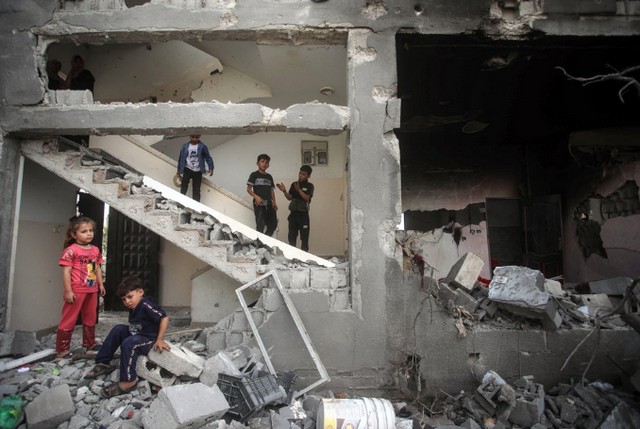
4 Mar 2022 – The USA Today reported that a photo that went viral about a high-rise in the Ukraine being hit by Russian bombing turned out to be a high-rise from the Gaza Strip, demolished by the Israeli Air Force in May 2021. A few days before that, the Ukrainian Foreign Minister complained to the Israeli ambassador in Kiev that “you’re treating us like Gaza”; he was furious that Israel did not condemn the Russian invasion and was only interested in evicting Israeli citizens from the state (Haaretz, February 17, 2022). It was a mixture of reference to the Ukrainian evacuation of Ukrainian spouses of Palestinian men from the Gaza Strip in May 2021, as well as a reminder to Israel of the Ukrainian president’s full support for Israel’s assault on the Gaza Strip in that month (I will return to that support towards the end of this piece).

Israel’s assaults on Gaza should, indeed, be mentioned and considered when evaluating the present crisis in the Ukraine. It is not a coincidence that photos are being confused – there are not many high-rises that were toppled in the Ukraine, but there is an abundance of ruined high-rises in the Gaza Strip. However, it is not only the hypocrisy about Palestine that emerges when we consider the Ukraine crisis in a wider context; it is the overall Western double standards that should be scrutinized, without, for one moment, being indifferent to news and images coming to us from the war zone in the Ukraine: traumatized children, streams of refugees, sights of buildings ruined by bombing and the looming danger that this is only the beginning of a human catastrophe at the heart of Europe.

At the same time, those of us experiencing, reporting and digesting the human catastrophes in Palestine cannot escape the hypocrisy of the West and we can point to it without belittling, for a moment, our human solidarity and empathy with victims of any war. We need to do this, since the moral dishonesty underwriting the deceitful agenda set by the Western political elites and media will once more allow them to hide their own racism and impunity as it will continue to provide immunity for Israel and its oppression of the Palestinians. I detected four false assumptions which are at the heart of the Western elite’s engagement with the Ukraine crisis, so far, and have framed them as four lessons.

Lesson One: White Refugees are Welcome; Others Less So

The unprecedented collective EU decision to open up its borders to the Ukrainian refugees, followed by a more guarded policy by Britain, cannot go unnoticed in comparison to the closure of most of the European gates to the refugees coming from the Arab world and Africa since 2015. The clear racist prioritization, distinguishing between life seekers on the basis of color, religion and ethnicity is abhorrent, but unlikely to change very soon. Some European leaders are not even ashamed to broadcast their racism publicly as does the Bulgarian Prime Minister, Kiril Petkov:

“These [the Ukrainian refugees] are not the refugees we are used to … these people are Europeans. These people are intelligent, they are educated people. … This is not the refugee wave we have been used to, people we were not sure about their identity, people with unclear pasts, who could have been even terrorists…”

He is not alone. The Western media talks about “our kind of refugees” all the time, and this racism is manifested clearly on the border crossings between the Ukraine and its European neighbours. This racist attitude, with strong Islamophobic undertones, is not going to change, since the European leadership is still denying the multi-ethnic and multicultural fabric of societies all over the continent. A human reality created by years of European colonialism and imperialism that the current European governments deny and ignore and, at the same time, these governments pursue immigration policies that are based on the very same racism that permeated the colonialism and imperialism of the past.

Lesson Two: You Can Invade Iraq but not the Ukraine

The Western media’s unwillingness to contextualize the Russian decision to invade within a wider – and obvious – analysis of how the rules of the international game changed in 2003 is quite bewildering. It is difficult to find any analysis that points to the fact that the US and Britain violated international law on a state’s sovereignty when their armies, with a coalition of Western countries, invaded Afghanistan and Iraq. Occupying a whole country for the sake of political ends was not invented in this century by Vladimir Putin; it was introduced as a justified tool of policy by the West.

Lesson Three: Sometimes Neo-Nazism Can Be Tolerated

The analysis also fails to highlight some of Putin’s valid points about the Ukraine; which by no means justify the invasion, but need our attention even during the invasion. Up to the present crisis, the progressive Western media outlets, such as The Nation, the Guardian, the Washington Post etc., warned us about the growing power of neo-Nazi groups in the Ukraine that could impact the future of Europe and beyond. The same outlets today dismiss the significance of neo-Nazism in the Ukraine.

The Nation on February 22, 2019 reported:

“Today, increasing reports of far-right violence, ultra nationalism and erosion of basic freedoms are giving the lie to the West’s initial euphoria. There are neo-Nazi pogroms against the Roma, rampant attacks on feminists and LGBT groups, book bans, and state-sponsored glorification of Nazi collaborators.”

Two years earlier, the Washington Post (June 15, 2017) warned, very perceptively, that a Ukrainian clash with Russia should not allow us to forget about the power of neo-Nazism in the Ukraine:

“As Ukraine’s fight against Russian-supported separatists continues, Kiev faces another threat to its long-term sovereignty: powerful right-wing ultra-nationalist groups. These groups are not shy about using violence to achieve their goals, which are certainly at odds with the tolerant Western-oriented democracy Kiev ostensibly seeks to become.”

However, today, the Washington Post adopts a dismissive attitude and calls such a description as a “false accusation”:

“Operating in Ukraine are several nationalist paramilitary groups, such as the Azov movement and Right Sector, that espouse neo-Nazi ideology. While high-profile, they appear to have little public support. Only one far-right party, Svoboda, is represented in Ukraine’s parliament, and only holds one seat.”

The previous warnings of an outlet such as The Hill (November 9, 2017), the largest independent news site in the USA, are forgotten:

“There are, indeed, neo-Nazi formations in Ukraine. This has been overwhelmingly confirmed by nearly every major Western outlet. The fact that analysts are able to dismiss it as propaganda disseminated by Moscow is profoundly disturbing. It is especially disturbing given the current surge of neo-Nazis and white supremacists across the globe.”

Lesson Four: Hitting High-rises is only a War Crime in Europe

The Ukrainian establishment does not only have a connection with these neo-Nazi groups and armies, it is also disturbingly and embarrassingly pro-Israeli. One of President Volodymyr Zelensky’s first acts was to withdraw the Ukraine from the United Nations Committee on the Exercise of the Inalienable Rights of the Palestinian People – the only international tribunal that makes sure the Nakba is not denied or forgotten.

The decision was initiated by the Ukrainian President; he had no sympathy for the plight of the Palestinian refugees, nor did he consider them to be victims of any crime. In his interviews after the last barbaric Israeli bombardment of the Gaza Strip in May 2021, he stated that the only tragedy in Gaza was the one suffered by the Israelis. If this is so, than it is only the Russians who suffer in the Ukraine.

But Zelensky is not alone. When it comes to Palestine, the hypocrisy reaches a new level. One empty high-rise hit in the Ukraine dominated the news and prompted deep analysis about human brutality, Putin and inhumanity. These bombings should be condemned, of course, but it seems that those leading the condemnation among world leaders were silent when Israel flattened the town of Jenin in 2000, the Al-Dahaya neighborhood in Beirut in 2006 and the city of Gaza in one brutal wave after the other, over the past fifteen years. No sanctions, whatsoever, were even discussed, let alone imposed, on Israel for its war crimes in 1948 and ever since. In fact, in most of the Western countries which are leading the sanctions against Russia today, even mentioning the possibility of imposing sanctions against Israel is illegal and framed as anti-Semitic.

Even when genuine human solidarity in the West is justly expressed with the Ukraine, we cannot overlook its racist context and Europe-centric bias. The massive solidarity of the West is reserved for whoever is willing to join its bloc and sphere of influence. This official empathy is nowhere to be found when similar, and worse, violence is directed against non-Europeans, in general, and towards the Palestinians, in particular.

We can navigate as conscientious persons between our responses to calamities and our responsibility to point out hypocrisy that in many ways paved the way for such catastrophes. Legitimizing internationally the invasion of sovereign countries and licensing the continued colonization and oppression of others, such as Palestine and its people, will lead to more tragedies, such as the Ukrainian one, in the future, and everywhere on our planet.

Professor Ilan Pappé was born in Haifa, Israel in 1954.

7 March 2022

Source: www.transcend.org

On Humiliation

By Michael Brenner

28 Feb 2022 – The Mafia is not known for its creative use of language beyond terms like ‘hitman,’ ‘go to the mattresses,” ‘living with the fishes’ and suchlike. There are, though, a few pithy sayings that carry enduring wisdom. One concerns honor and revenge: ‘If you are going to humiliate someone publicly in a really crass manner, make sure that he doesn’t survive to take his inevitable revenge.” Violate it at your peril. That enduring truth has been demonstrated by Russia’s actions in the Ukraine which, to a great extent – are the culmination of the numerous humiliations that the West, under American instigation, has inflicted on Russia’s rulers and the country as a whole over the past 30 years.

They have been treated as a sinner sentenced to accept the role of a penitent who clad in sackcloth, marked with ashes, is expected to appear among the nations with head bowed forever. No right to have its own interests, its own security concerns or even its own opinions. Few in the West questioned the viability of such a prescription for a country of 160 million, territorially the biggest in the world, possessing vast resources of critical value to other industrial nations, technologically sophisticated and custodian of 3,000 + nuclear weapons. No mafia don would have been that obtuse. But our rulers are cut from a different cloth even if their strut and conceit often matches that of the capos in important respects.

This is not to say that Russia’s political class has been bent on revenge for a decade or two – like France after its humiliation by Prussia in 1871, like Germany after its humiliation in 1918-1919, or like ‘Bennie from the Bronx’ beaten up in front of his girlfriend by Al Pacino in Carlito’s Way. Quite the opposite, for almost a decade Boris Yeltsin was content to play Falstaff to any American President who came along just for the sake of being accepted into his company (and allowing himself to be robbed blind in the process – economically and diplomatically). The West nostalgically celebrates the Yeltsin years as the Golden Age of Russian Democracy – an age when life expectancy dropped sharply, when alcoholism rose and mental health declined, when the tanking economy threw millions into poverty, when criminality of every kind ravaged society, when celebrity oligarchs strutted their stuff, when the Presidential chauffeur was the most influential man in the country, and when everyone was free to declaim since nobody else heard him in the din of their own voices. You can’t make an omelet without breaking a few eggs – to coin a phrase.

Vladimir Putin, of course, was made of sterner stuff. He put an end to the buffoonery, successfully took on the Herculean task of reconstituting Russia as a viable state, and presented himself as ruler of an equal sovereign in cultivating relations with his neighbors. In addition, he insisted that the civil rights and culture of Russians stranded in the Near Abroad be respected.

Still, he gave no sign by word or deed that he contemplated using coercive means to restore the integration of Russian and Ukraine that had existed for more than 300 years. True, he opposed Western attempts to sever the ties between the two by incorporating Ukraine into their collective institutions – most notably the NATO declaration of 2008 stating that Ukraine (along with Georgia) were in the alliance’s antechamber being readied for entrance. Putin’s restraint contrasted with the audacity of Washington and its European subordinates who instigated the Maidan coup toppling the democratically elected President and promoting an American puppet in his place. In effect, the United States has been Ukraine’s overseer ever since – a sort of absentee landlord.

Putin’s views about the preferred principles of organization and conduct that should govern inter-state relations have been elaborated in a series of speeches and articles over the years. The picture it draws is far different from the cartoonish distortion created and disseminated in the West. It clearly delineates ways and means to constrain and limit the element of conflict, above all military conflict, the requirement for rules-of-the-road that should serve as the systems software, the necessity of recognizing that the future will be more multipolar – yet more multilateral – than it has been since 1991. At the same time, he stresses that every state has its legitimate national interests and the right to promote them as a sovereign entity so long as it does not endanger world peace and stability. Russia has that right on an equal basis with every other state. It also has the right to order its public life as it deems best suits its circumstances.

Western leaders and political class generally, have not accepted those propositions. Nor have they ever shown a modicum of interest in accepting Moscow’s repeated, open invitation to discuss them. Rather, every attempt by Russia to act in accordance with that logic has been viewed through a glass darkly – interpreted as confirmation of Russia as an outlaw state whose dictatorial leader is bent on restoring a malign Russian influence dedicated to undermining the good works of the Western democracies.

This attitude has progressively lowered the bar on accusation and insult directed at Russia and Putin personally. For Hillary Clinton he was “a new Hitler” as far back as 2016, for Joe Biden he was a ‘killer,’ for Congress members a Satan using a bag of diabolical instruments to corrupt and destroy American democracy. For all of them, a tyrant turning Russia back to the political dark ages after the glowing democratic spring of the Yeltsin years, an assassin – albeit an inept one whose targeted victims somehow survived in unnatural numbers, for the Pentagon a growing menace who moved rapidly up the enemies list – displacing Islamic terrorism by 2017 and vying with China for the top spot ever since.

The obsession with Putin the Evil spread as Washington pushed its allies hard to join in the denunciation. It became the fashion. The grossness of their personal attacks on Putin matched the ever-expanding scope of the accusations. In recent years, no election could be held in Europe without the leveling of charges that the Kremlin was ‘interfering’ by some unspecified means or other – and at Putin’s personal direction. The absence of evidence was irrelevant. Russia became the pinata there to be bashed whenever one felt the urge or saw a domestic political advantage.

None of the above discussion is meant to suggest that Russia’s foreign policy, in particular the invasion of Ukraine, can be personalized or reduced to the level of feelings and emotions. Putin himself constantly displays an exceptional emotional and intellectual discipline. Putin is not a ‘Benny from the Bronx.’ He does not act on impulse nor does he allow his judgment to be clouded by considerations of a purely individual nature. Russia had tangible grounds for concerns about the implications of developments in Ukraine and trends in Eastern Europe generally that jeopardized the country’s security interests. The thinking of Putin and his associates about how to deal with them expressed carefully thought-out analyses and strategies – as surely did the eventual decision to take military action.

Revenge per se was less significant than what Western treatment of Russia since 1991 augured for the future. In other words, the constant reinforcement of hostile images and intentions, as felt by Moscow, via the steady barrage of attacks and accusations colored the way that Russian leaders assayed the prospects for alleviating the threats they saw in Western actions – including their conduct throughout 2022.

Conclusion

The West had a variety of options for addressing the Russia question after 1991. One was to take advantage of its weakness to the fullest and to treat the country as a second-class nation in the American directed world system. That was the strategy we chose. It inescapably meant humiliation. What we didn’t recognize is that in doing so we were planting the seeds of future hostility. Over the years, every sign of a Russia rising from the ashes fed latent, if inchoate, fears of the bear coming out of hibernation. Instead of recognizing that the post-Yeltsin political elite resented the decade of disparagement and humiliation, and taking steps to compensate for it (e.g. carving out a place for Russia in Europe’s post-Cold War political configuration), anxiety led the West down the exact opposite course. Putin’s Russia was painted in ever more frightening caricatures while shunning became the order of the day.

Demonstrations of Russia’s growing self-confidence, and unwillingness to be pushed around – as in southern Ossetia in 2008 and then more stunningly in Syria in 2015, quickly evoked all the old Cold War images and set the pre-primed alarm bells ringing. Ignorance of Russian realities, coupled with the demonization of Putin whose actual thoughts didn’t interest them, Western leaders and pundits fretted that their master plan for an American overseen global system was being jeopardized. Now from the old enemy – Russia, and the new enemy – China. One set of anxieties reinforces the other.

Back in the 1990s, the humiliation of Russia logically could have been followed by the traditional mafia act of termination. Forestall any form of retaliation by killing off the victim. Of course, it is a lot harder to liquidate a country than an individual and his close associates. It has been done, though. Think of Rome razing Carthage. After victory in the Second Punic War, the Romans were in a position to act on Cato’s admonition: “Carthage must die !” Legend has it that they sowed the fields with salt. That, of course, is nonsense – the Romans were not that dumb. The Carthogenian lands became one of the empire’s two great granaries. They reconstituted the state and put in place a security apparatus that served their practical interests. (Rome didn’t even have to repopulate the place since most of the inhabitants were partially ‘Punicized’ ethnic Berbers who gradually became partially Romanized Berbers. As, today, Maghrebis are Arabized Berbers for the most part). Roman pragmatism, in this respect, can be contrasted with Germany’s readiness to cut itself off from vitally needed Russian natural gas supplies; admittedly, the Romans were not obeying orders from a United States that doesn’t rely on energy resources from Russia.

Genghis Khan and the Golden Horde, too, acted in accordance with their version of the liquidation strategy. It worked. The Abbasid dynasty and all the other states they destroyed never were in a position to wreak revenge. The Mongols and their Turkic auxiliaries avoided retribution and suffering at the vengeful hands of the countries they ravaged.

There are other methods as well for permanently eliminating a foe. Genocide is the most extreme – as implemented by Belgium in the Congo, the Germans in Namibia and the European occupiers of North America. Dismemberment is another. The tripartite division and annexation of Poland is the outstanding example. The total breakup of Ottoman Turkey as envisaged at Versailles is another.

A few people in Washington did promote the idea of executing a similar strategy against the Soviet Union/Russia. Beyond enlarging NATO so as to render prospects for a Russian revival as a European power nugatory, they envisaged breaking up the country into a number of fragmented parts. The Polish-born Zbigniew Brzezinski is the best known of these radical advocates of territorial mutilation. Washington’s unrelenting efforts to build an permanent wall between Ukraine and Russia grows out of this soil; so, too, assiduous efforts to provide aid and comfort to anti-Russian elements in Georgia, Azerbaijan, Belarus and Kazakhstan (as recent events in the last three signify).

The Western approach toward post-Soviet Russia which entailed marginalization and attendant humiliation was favored for a number of reasons, as summarized above. We should add that there was an additional, facilitating factor at work. The chosen strategy was much easier to implement – intellectually and diplomatically. Its simplicity appealed to Western leaders sorely lacking in the attributes of astute statesmanship. That disability skews their attitudes and policies to this day.

Michael Brenner is professor of international affairs at the University of Pittsburgh; a senior fellow at the Center for Transatlantic Relations, SAIS-Johns Hopkins (Washington, D.C.), contributor to research and consulting projects on Euro-American security and economic issues.

7 March 2022

Source: www.transcend.org

They Are ‘Civilized’ and ‘Look Like Us’: The Racist Coverage of Ukraine

By Moustafa Bayoumi

Are Ukrainians more deserving of sympathy than Afghans and Iraqis? Many seem to think so.

2 Mar 2022 – While on air, CBS News senior foreign correspondent Charlie D’Agata stated last week that Ukraine “isn’t a place, with all due respect, like Iraq or Afghanistan, that has seen conflict raging for decades. This is a relatively civilized, relatively European – I have to choose those words carefully, too – city, one where you wouldn’t expect that, or hope that it’s going to happen”.

If this is D’Agata choosing his words carefully, I shudder to think about his impromptu utterances. After all, by describing Ukraine as “civilized”, isn’t he really telling us that Ukrainians, unlike Afghans and Iraqis, are more deserving of our sympathy than Iraqis or Afghans?

Righteous outrage immediately mounted online, as it should have in this case, and the veteran correspondent quickly apologized, but since Russia began its large-scale invasion on 24 February, D’Agata has hardly been the only journalist to see the plight of Ukrainians in decidedly chauvinistic terms.

The BBC interviewed a former deputy prosecutor general of Ukraine, who told the network: “It’s very emotional for me because I see European people with blue eyes and blond hair … being killed every day.” Rather than question or challenge the comment, the BBC host flatly replied, “I understand and respect the emotion.” On France’s BFM TV, journalist Phillipe Corbé stated this about Ukraine: “We’re not talking here about Syrians fleeing the bombing of the Syrian regime backed by Putin. We’re talking about Europeans leaving in cars that look like ours to save their lives.”

In other words, not only do Ukrainians look like “us”; even their cars look like “our” cars. And that trite observation is seriously being trotted out as a reason for why we should care about Ukrainians.

There’s more, unfortunately. An ITV journalist reporting from Poland said: “Now the unthinkable has happened to them. And this is not a developing, third world nation. This is Europe!” As if war is always and forever an ordinary routine limited to developing, third world nations. (By the way, there’s also been a hot war in Ukraine since 2014. Also, the first world war and second world war.) Referring to refugee seekers, an Al Jazeera anchor chimed in with this: “Looking at them, the way they are dressed, these are prosperous … I’m loath to use the expression … middle-class people. These are not obviously refugees looking to get away from areas in the Middle East that are still in a big state of war. These are not people trying to get away from areas in North Africa. They look like any.” Apparently looking “middle class” equals “the European family living next door”.

And writing in the Telegraph, Daniel Hannan explained: “They seem so like us. That is what makes it so shocking. Ukraine is a European country. Its people watch Netflix and have Instagram accounts, vote in free elections and read uncensored newspapers. War is no longer something visited upon impoverished and remote populations.”

What all these petty, superficial differences – from owning cars and clothes to having Netflix and Instagram accounts – add up to is not real human solidarity for an oppressed people. In fact, it’s the opposite. It’s tribalism. These comments point to a pernicious racism that permeates today’s war coverage and seeps into its fabric like a stain that won’t go away. The implication is clear: war is a natural state for people of color, while white people naturally gravitate toward peace.

It’s not just me who found these clips disturbing. The US-based Arab and Middle Eastern Journalists Association was also deeply troubled by the coverage, recently issuing a statement on the matter: “Ameja condemns and categorically rejects orientalist and racist implications that any population or country is ‘uncivilized’ or bears economic factors that make it worthy of conflict,” reads the statement. “This type of commentary reflects the pervasive mentality in western journalism of normalizing tragedy in parts of the world such as the Middle East, Africa, south Asia, and Latin America.” Such coverage, the report correctly noted, “dehumanizes and renders their experience with war as somehow normal and expected”.

More troubling still is that this kind of slanted and racist media coverage extends beyond our screens and newspapers and easily bleeds and blends into our politics. Consider how Ukraine’s neighbors are now opening their doors to refugee flows, after demonizing and abusing refugees, especially Muslim and African refugees, for years. “Anyone fleeing from bombs, from Russian rifles, can count on the support of the Polish state,” the Polish interior minister, Mariusz Kaminski, recently stated. Meanwhile, however, Nigeria has complained that African students are being obstructed within Ukraine from reaching Polish border crossings; some have also encountered problems on the Polish side of the frontier.

In Austria, Chancellor Karl Nehammer stated that “of course we will take in refugees, if necessary”. Meanwhile, just last fall and in his then-role as interior minister, Nehammer was known as a hardliner against resettling Afghan refugees in Austria and as a politician who insisted on Austria’s right to forcibly deport rejected Afghan asylum seekers, even if that meant returning them to the Taliban. “It’s different in Ukraine than in countries like Afghanistan,” he told Austrian TV. “We’re talking about neighborhood help.”

Yes, that makes sense, you might say. Neighbor helping neighbor. But what these journalists and politicians all seem to want to miss is that the very concept of providing refuge is not and should not be based on factors such as physical proximity or skin color, and for a very good reason. If our sympathy is activated only for welcoming people who look like us or pray like us, then we are doomed to replicate the very sort of narrow, ignorant nationalism that war promotes in the first place.

The idea of granting asylum, of providing someone with a life free from political persecution, must never be founded on anything but helping innocent people who need protection. That’s where the core principle of asylum is located. Today, Ukrainians are living under a credible threat of violence and death coming directly from Russia’s criminal invasion, and we absolutely should be providing Ukrainians with life-saving security wherever and whenever we can. (Though let’s also recognize that it’s always easier to provide asylum to people who are victims of another’s aggression rather than of our own policies.)

But if we decide to help Ukrainians in their desperate time of need because they happen to look like “us” or dress like “us” or pray like “us,” or if we reserve our help exclusively for them while denying the same help to others, then we have not only chosen the wrong reasons to support another human being. We have also, and I’m choosing these words carefully, shown ourselves as giving up on civilization and opting for barbarism instead.

Moustafa Bayoumi is the author of the award-winning books How Does It Feel To Be a Problem?: Being Young and Arab in America and This Muslim American Life: Dispatches from the War on Terror.

7 March 2022

Source: www.transcend.org

Ukraine: Getting it Right: A Revolutionary Pan-African Perspective

by Gerald A. Perreira

“The White House hysteria is more revealing than ever. The Anglo-Saxons need a war at any cost. Provocation, misinformation and threats are a favourite method of solving their own problems. The American military-political machine is ready to steamroll through people’s lives again.”
Maria Zakharova, Spokesperson for the Russian Foreign Ministry

In the Caribbean we have a saying, “monkey know what limb to jump on”. Or at least, monkey should know. Usually this is the case with the US Empire and its criminal creature, NATO (North Atlantic Tribes Organization). They pick on countries that cannot stand up to them in terms of military might. But this time, not so. They met their match in the Russian Federation, when Vladimir Putin called their bluff.

US President, Joe Biden, UK Prime Minister, Boris Johnson, NATO General Secretary Jens Stoltenberg and European Commission President, Ursula von der Leyen, have been talking big over the past months. But it was all bluff. On the other hand, President Vladimir Putin was not bluffing. The Russian people know only too well what it means to have fascists at their door. The then Soviet Union led the fight against Nazi Germany and on February 24th, 2022, Russia was forced to take military action again against Anglo-Saxon fascists at its door, this time, Ukrainian neo-fascist militias, such as the Azov Battalion, and other extreme right-wing elements in the Ukrainian military. Since the 2014 coup in Ukraine, orchestrated by the US and backed by its NATO allies, Russia has withstood provocation after provocation, but the war mongers are restless, in desperate need of a war, and their reckless actions forced Russia into a position where it had no choice but to take action.

The Azov Battalion and the Fascist International
The far-right Azov Battalion, which has its genesis in the Organization of Ukrainian Nationalists. Throughout the Cold War and up to today, US imperialism and the intelligence agencies of other Western imperial powers provided financial and other support to the Organization of Ukrainian Nationalists (OUN) and later to its offshoot, the Azov Battalion. Membership of the various fascist groups in the Ukraine is estimated to be over 60,000. Volodymyr Zelensky’s government, which describes itself as ‘centrist’, has been infiltrated at all levels, including the State security apparatus, by these fascist organizations. Moscow is well aware of this and the very real danger it poses, not only to Russia, but to Europe and the world. Already the fascists in Ukraine are saying they will sabotage any peace talks. These fascist groups constitute an international body with branches and supporters in many countries, including Hungary, Poland, Germany, France, the UK, Denmark, Sweden, Norway, the US, Brazil, Peru and Venezuela, where they have been at the forefront of the attempt to destabilize and overthrow the Maduro government, infiltrating a number of political formations such as ‘Democratic Action’ and ‘Popular Will’ that are part of what is known as the ‘Unitary Platform’. They even have a presence in countries as far away as Australia and New Zealand. In fact, it the White supremacist who slaughtered 51 Muslims in the 2019 terrorist attack in two mosques in Christchurch, New Zealand, was connected to a branch of this international neo-Nazi formation.

Another US Backed Coup
Back in 2014, the US orchestrated a pseudo revolution in the Ukraine, which they called the ‘Revolution of Dignity’. Through violent street protests, they overthrew the democratically elected government of Victor Yanukovych. Prior to this coup, war-monger, John McCain had visited the Ukraine and addressed large crowds, instigating them against the Moscow-friendly government led by Yanukovych. Neo-Nazis from across Europe and the US journeyed to Ukraine to train and fight alongside the Azov Battalion and other far-right paramilitary formations. All the while, Victoria Nuland, ‘point person’ for the pseudo ‘Revolution of Dignity’ during Obama’s presidency, and now Under-Secretary of State for Political Affairs in the Biden administration, boasted about spending 5 billion USD on the Ukraine project. Under her guidance, Ukraine was flooded with NGOs, training and social programmes geared at spreading anti-Moscow sentiment. In a leaked telephone conversation between Victoria Nuland and then US Ambassador to Ukraine, Geoffrey Pyatt, on February 6th, 2014, eleven days prior to the US orchestrated coup, the transcript of which can be found online, Nuland and Pyatt openly discuss who will be in the new Ukraine government. All of this on Russia’s border. Imagine if Russia had done the same in Canada or Mexico.

The United States Fascist Friends
The US and their intelligence agencies have a long track record of recruiting, coopting and working with fascists. Bradley W. Hart, in his well-researched book, Hitler’s American Friends: The Third Reich’s Supporters in the United States wrote, “General Motors had a German division of its own and manufactured aircraft parts for the Luftwaffe.” In an article in The Guardian (25/09/2004), Ben Aris and Duncan Campbell exposed George Bush Snr’s father, US Senator Prescott Bush’s extensive financial dealings with Nazi Germany. And when Nazi Germany collapsed, the CIA recruited as many Nazi intelligence operatives as they could, settling most of them in South America, in Bolivia, Chile, Argentina, Paraguay and Brazil. The US utilized these fascists throughout the years to undermine and destabilize progressive and revolutionary regimes, via the front organizations they created. The US Embassy in Bolivia worked closely with the infamous Klaus Barbie, known as the ‘Butcher of Lyon’. Barbie was given the rank of colonel in the Bolivian Army and boasted about leading the team that targeted and tracked down Che Guevara.

Zelensky Facilitates Programme of Ethnic Cleansing and Genocide
On February 24th, in a further act of provocation, Kiev escalated their eight year war against the People’s Republics of Donetsk and Luhansk. These republics declared their autonomy following the 2014 coup, refusing to live under the anti-Russian, pro-NATO regime of Volodymyr Zelensky, who although described as a ‘centrist’ has allowed ethnic Russians in these territories to be targeted and attacked by various neo-fascist militias, resulting in thousands of civilian casualties and deaths. Zelensky stands accused of facilitating a programme of ethnic cleansing and genocide. The people of Eastern Ukraine, the Donbas region, where Donetsk and Luhansk are situated, are Russian speaking and want to be a part of the Russian Federation. The Ukrainian Soviet Socialist Republic was a founding member of the Soviet Union in 1922, and so Russia and Ukraine were part of the same country once. Zelensky, with the tacit support of his Anglo-Saxon handlers, had no intention of implementing the Minsk Agreement, which contains a blueprint for a peaceful and diplomatic solution to the Ukraine situation and is supported by the breakaway territories and Russia. He, along with his Western allies, were intent on only one thing, provoking a conflict with Russia.

In a televised address on February 24th, President Putin announced that in response to an appeal from leaders in the Donbass Republics (Donetsk and Luhansk), he had taken a decision to carry out a special military operation in order to protect the people in these territories “who have been suffering from abuse and genocide by the Kiev regime for eight years.” Thousands of refugees from Donetsk and Luhansk poured across the Russian border. The labelling of this as an ‘invasion’ of Ukraine by Russia is a misnomer. Putin has been very clear that Russia has no interest in occupying Ukraine. However, he is adamant about preventing NATO’s expansion to countries sharing a border with Russia for obvious reasons. How can Russia allow a hostile war machine such as NATO to deploy weapons of mass destruction including ballistic missile on its border? Can we imagine Russia deploying nuclear weapons and missiles in a country that shares a border with the US or in what the US refers to as their “backyard”? This is exactly what sparked the Cuban Missile crisis in 1962.

NATO – the North Atlantic Tribe’s Lethal War Machine
NATO was formed in 1949, ostensibly as a deterrent to Soviet and Communist expansion into Western Europe. The Soviet Bloc formed the Warsaw Pact as a counter to NATO’s military complex. When the Soviet Union and the Eastern Bloc were dissolved, the Warsaw Pact was disbanded. The Reagan administration promised Mikhail Gorbachev that NATO would not expand into Eastern Europe. Many years later, in an interview in the German newspaper Bild, Gorbachev declared that Moscow had been tricked. He said, “Many people in the West were secretly rubbing their hands and felt something like a flush of victory — including those who had promised that they would will not move one centimeter further east”. As we now know, NATO did move east, right up to Russia’s border, which has brought us to the current conflict. Instead of disbanding, since its alleged reason-for-being no longer existed, NATO morphed into an aggressive and destructive leviathan, armed with the most sophisticated weapons known to humankind. Commanded by the US Empire, NATO now engages in wars worldwide, with the aim of increasing and reinforcing Anglo-Saxon dominance, and is responsible for the wanton destruction of countries such as Afghanistan, Iraq and Libya and the death of literally millions of civilians. They have expanded as far into Eastern Europe as they can, and are now trying to complete the encirclement of Russia, leaving Russia in a situation where it would not be able to defend its territorial integrity and sovereignty. This is understandably unacceptable to Russia under any circumstance, but especially in the current political environment where the anti-Russian hysteria is being whipped up to levels reminiscent of the Cold War era.

Follow the Money and Resources
It is important to note that US foreign policy shaper, Zbigniew Brzezinski, in his book titled, The Grand Chessboard wrote, “A power that dominates Eurasia would control two thirds of the world’s three most advanced and economically productive regions. A mere glance at the map also suggests that control over Eurasia would almost automatically entail Africa’s subordination…about 75% of the world’s people live in Eurasia, and most of the world’s physical wealth is there as well, both in its enterprise and underneath its soil. Eurasia accounts for 60 percent of the world’s GNP and about three–fourths of the world’s known energy resources.”

Renowned Bilderberg Group researcher, Daniel Estulin, points out that human history has “always shown that controlling the heart of Eurasia was the key to controlling the entire known world”.

World War Already Raging
One of many absurd ideas that has taken hold in a world governed by White supremacy is that the world is only at war when Anglo-Saxons launch offensives in Europe. Even now, as every step of this current European dispute is followed around the globe with rapt attention, once again the headlines are screaming about the prospect of World War III.

On the same day as the Russians went to the aid of the Donbas Republics, and finally took action against the neo-fascists embedded in Ukraine, the US bombed Somalia via AFRICOM, and US surrogate, Saudi Arabia, bombed Yemen, killing more women and children. Not to be left out of the action, the racist and criminal entity known as Israel attacked Syria. If you live in Palestine, Iraq, Afghanistan, Somalia, Libya, Syria, or Yemen, you know you have been, and continue to be in a protracted world war. And those are just some of the hotspots. We can look back at Korea, Vietnam, Grenada, Panama, the former Yugoslavia and the list goes on. And all this was and is orchestrated, fueled and perpetuated by Anglo-US and its Anglo-Saxon allies, the very same forces that are provoking Russia. Of the 248 armed conflicts that occurred in 153 regions across the world from 1945 to 2001, 201 were initiated by the US, accounting for 81% of the total number.

In truth, the entire Global South is in a state of permanent war and holocaust. Those of us who reside in the Global South, in the trenches of this dirty war, know that we have been in a relentless world war for as long as we can remember. The US has built an entire economy dependent on arms sales – a military industrial complex. For this reason, they must continue to manufacture wars and unrest, because weapons of mass destruction, their main export, do not sell well in a world of peaceful co-existence. But it is more complex than just economics. Fact is, the Anglo-Saxon tribes have been at war ever since they first emerged in Europe. They have mastered the art and technology of warfare in a way that no other people ever have. They are the quintessential warlords, despite the fact that they love to attribute this term to non-European leaders, especially Africans. There is no civilization on the face of this earth that has waged war more relentlessly and permanently than the Anglo-Saxon tribes. This is not opinion, it is an indisputable historical fact.

European Tribal Wars
There was the Hundred-Year’s War (1337–1453), a European tribal war primarily between the French and the English, with various other European tribes supporting either side. This war claimed the lives of an estimated 3.5 million people. Then, there was the Thirty Year’s War (1618–1848) involving the majority of European nations. Military historians estimate the death-toll to be at least 8 million. Then there was so-called World War I and World War II, both European wars, in which the colonized were pressed into fighting alongside the various North Atlantic Tribes. Sadly today, too many of us are still defending or fighting on the side of the various North Atlantic Tribes, furthering the aims of the Empire, and in the process, subjugating and destroying our own people.

Russians Know this Enemy
The Russians are experienced when it comes to fighting Western Europe’s most notorious fascists. An accurate reading of history shows us that it was the Soviets who led the defeat of Nazi Germany. It is estimated that they lost more than 26 million citizens. The Soviets did not reveal the true extent of their losses at the time, since they could not afford to expose any weaknesses due to the prevailing anti-Soviet sentiment. Before the dust had settled, the Anglo-Saxon devils, Churchill and Chamberlain, met in secret to figure out a way that they could extend the war in order to destroy the Soviet Union. It is said that they abandoned their plan because they realized that they could not get their soldiers to turn on Soviet soldiers, since they had just fought alongside the Red Army and witnessed their incredible courage and the huge sacrifice they had made to rid Europe of Hitler’s onslaught.

Fast Forward to Ukraine, 2022, and the Information War
If you know this history, then you will know that Vladimir Putin was not bluffing when he warned that any interference from other countries would lead to “consequences you have never seen in history”. Finally, someone stood up to the arrogance and hypocrisy of the global hegemon. And of course, the internet is ablaze with confusion from those who don’t know, those who should know better, and those with a pro-imperialist agenda, who are deliberately spreading disinformation.

The “two sides to every story” narrative is being pushed, along with empty slogans such as “No to all wars and military aggression” and “No to Putin, No to war”. Thanks to the corporate media and the Silicon Valley cheerleaders for US imperialism, in many quarters, Zelensky and the Azov Battalion are being hailed as heroes, while Russian TV is banned. Those who are falling for these false narratives need to do their research or shut up. Such positions on the situation in Ukraine are simply not grounded in concrete reality. They lack rigorous historical analysis and perpetuate a total misunderstanding of the dynamics at work. As I write this article, footage is circulating showing Ukrainian army personnel refusing to allow African students in Ukraine onto the trains and buses evacuating civilians. There are reports of African, Asian and Caribbean citizens facing discrimination and in some cases violent attacks by members of the Ukrainian armed forces who are refusing to allow them to join the queues at the Ukraine/Polish border, and if they do manage to join keep pushing them to the back of the queue.

Many are afraid of calling a spade a spade. Neo-colonial regimes in the Global South dare not challenge the imperial hegemon. They are after all, simply managing their respective countries on behalf of the imperialists and this entails toeing the imperialist line and regurgitating their lies. For example, here in Guyana, both the Government and the official parliamentary opposition have adopted the US-NATO line, despite the fact that many of them know it is a lie. I can’t remember a time when they agreed on anything, but sure enough they agree on this, bullied into taking a position that completely negates the reality. They maybe in ‘office’ but they have no power. Our political formation, Organization for the Victory of the People (OVP) may not be in ’office’, but we have more power than all the tongue-tied politicians who occupy a space in our national assembly. Our power lies in our ability to speak the truth. CARCOM too has found it necessary to back the Anglo-Saxon version of events, despite so many in its ranks knowing better. Such is the control exercised and fear of retribution perpetrated by the Empire. Even as I am writing this article people are warning me about the fact that airing the views contained here will have serious consequences. This is the way the hegemon holds the world to ransom.

The Demise of Anglo-Saxon Global Domination
Those who are trying to equate Putin and Russia with the US and NATO on an equal footing, in terms of level of threat to world peace, either do not know the facts or are engaging in vulgar political opportunism, intellectual dishonesty and crude historical revisionism. Many, including neo-colonial regimes, liberal pundits, neo-Trotskyites, some ivory tower Marxists and social democrats are spreading this disinformation and creating mass confusion. There are multiple battlefronts open to those who are ready to join the global resistance to the US Empire and its NATO allies. One strategic battlefront is the battle of ideas. We must raise our voices wherever we are, thereby challenging the cleverly orchestrated deceptive agenda of the Empire. Theirs was once a dominant narrative, however it is surely crumbling as more and more people wake up to their games and lies. The battle to resist and finally end Anglo-Saxon global domination/White Supremacy has been raging ever since it raised its ugly head. All Empire’s fall and the US Empire and its Western allies are no exception. We are at a very critical historical juncture in the battle to rid ourselves of the Western/Anglo-Saxon scourge on this earth – there is no turning back and it is clear that the ushering in of a new era cannot be stopped. This is why it is very important for us as Africans to be clear about what is actually taking place and understand the history, characteristics, and agendas of the various players. NATO is an illegitimate entity and must be forced to disband.

Argentinian political analyst, Adrian Salbuchi, points out “In recent times…Russia is increasingly acting on Western hegemonic ambitions, notably in Syria and Iran. In November 2011 and February 2012, Russia vetoed two US/UK/French sponsored UN Resolutions against Syria, which if passed, would have had the same devastating effect on Syria as UN Resolution1973 had on Libya…Russia has dispatched credible dissuasive military forces to counteract NATO’s militarization of the Persian Gulf and the Mediterranean.”

Russia in Africa
In addition, Russia, dating back to the days of the Soviet Union and before, has assisted liberation struggles throughout Africa. As far back as 1895, it was Russia that provided Ethiopia with weapons during the first Italian-Ethiopian war. During the Soviet era, they provided assistance, including funding, thousands of scholarships and military training to numerous African liberation movements. This was done at a time when the US and its Western allies were supporting the racist Anglo-Saxon Boers during the Apartheid era. Presently, Russia is assisting Mali in its just struggle to root out heretical, pseudo-Islamic groups causing havoc in the Sahel. These groups, such as ISIS, Boko Haram, and Al Qaeda in the Islamic Maghreb, are aided and abetted by the US, Israel and their allies. NATO has used these fake jihadists as foot soldiers in many of its wars to overthrow non-compliant regimes, and is now using them to create mayhem on the continent and justify AFRICOM’s presence throughout Africa. Mali has expelled the French because they finally realized that the French are not serious about assisting them in their war with the various so-called jihadist groups and that their presence in Mali is simply to further France’s economic interests. They have appealed to the Russians for assistance, after witnessing the way in which Russian forces contributed tremendously to the flushing out of the bogus Jihadists in Syria, and Russia has answered Mali’s call. In fact, Vladimir Putin himself, in his capacity as a Soviet military advisor, spent four years (1973-77) in Tanzania training African freedom fighters from various liberation movements.

As Pan-African historian, Walter Rodney pointed out, Slavic Russia did not participate in the trade of captured Africans to build their country. Neither did they colonize countries in Africa or other parts of the Global South. The invasion, destruction and colonization of Africa, the Americas and the Caribbean was fundamentally an Anglo-Saxon/West European imperial project and still is.

Activism and Organization are the Anchor for Ideas
To all the purists, who remain in observer/commentator positions at their keyboards, let me quote revolutionary Pan-Africanist, Kwame Ture, who warned us over and over again about having these conversations with anyone who is not active, on the ground, in an organization. Why? Because they are out of necessity living in their heads. Activism and organization are the anchor for ideas. I am not negating the downside and contradictions that arise with all superpowers, of course there are many. I was deeply disappointed with both Russia and China’s response or lack of response to the Libyan crisis and the way they allowed the US and NATO to destroy the Libyan Jamahiriya. Libya’s destruction was a huge blow to the Pan-African movement, however, as a revolutionary I cannot allow this grave era on their part to influence my ability to make an accurate analysis of the current situation. If as revolutionaries we allowed disappointments to prevent us from taking principled positions, all resistance would have ceased a long time ago. What I am saying is that if we are genuinely interested in ending White supremacy, to be more specific, Anglo-Saxon global domination and terrorism, then given the challenges facing us, we must recognize that all superpowers are not the same. To see them as all the same is not only simplistic, but is actually completely removed from both the historical and unfolding reality before us. I know for certain that Muammar Qaddafi, regardless of Russia’s misjudgment regarding NATO’s invasion of Libya, would most definitely want us, as revolutionary Pan-Africanists, to stand by Russia and against NATO at this time.

In fact, the destruction of Africa’s most prosperous nation-state, the Libyan Jamahiriya, in 2011 clearly demonstrated that complete non-alignment, although ideologically sound and ideal, is not advisable in the current global political environment. Russia has given oxygen to progressive and revolutionary oriented regimes, helping them to survive the hostility of the Anglo-Saxon bullies. Truth is that without Russia’s timely intervention, Syria would have suffered the same fate as Libya. We live and learn many painful lessons in this struggle. It is only through organization and activism on the ground, wherever we are, that we can effectively resist, and in the process learn about and gain an understanding of the real world. In this way, we advance our struggles. Thankfully, the dynamics are shifting and the Ukrainian crisis has accelerated this shift, because it has shown the weakness of the US Empire and its NATO allies. As Mao Zedong said decades ago, “the US Empire is a paper tiger”.

Hypocrisy and Doublespeak
European Commission President, Ursula von der Leyen, and NATO Secretary General, Jens Stoltenberg, described Russia’s defense of these republics as a “barbaric” attack on an independent country. According to Stoltenberg, Russia is threatening “the stability in Europe and the whole of the international peace order.” International peace order? Did we miss something?

Von der Leyen said in a recent outburst that Russia and China are seeking to “replace the existing international rules and that they prefer the rule of the strongest to the rule of law, preferring intimidation instead of self-determination”. And “war is peace, slavery is freedom and ignorance is strength” Ms. Von der Leyen. In a clear act of doublespeak, she attributes the “rule of the strongest” mindset, and a preference for intimidation instead of a respect for self-determination to Russia and China, when in fact, it is her very own EU who backs NATO’s enforcement of such values.

Meanwhile, Volodymyr Zelensky was left with egg on his face as the saying goes. Having been led down a rabbit hole by the US and their allies, Zelensky found himself asking, is no one going to fight alongside Ukraine? As I write this article, Russia is neutralizing Ukrainian fascists, and the liberation of the independent territories of Donetsk and Luhansk from the Ukrainian neo-fascists, after an eight year war, is well under way.

The ratcheting up of the Ukraine situation by political morons Joe Biden and Boris Johnson has served to strengthen the relationship between Russia and China which can only escalate the already disintegrating Anglo-Saxon Empire. Putin and the Russian Federation have exposed these imperialists as the bullies, hypocrites and criminals they are.

Those of us who are forced to confront the harsh realities of the global political landscape will always be mired in contradictions. Whatever the contradictions we face we must heed Mao Zedong’s now famous guidelines concerning the correct handling of contradictions, that is, recognizing the important difference between primary and secondary contradictions. The primary contradiction here is between Western Anglo-Saxon imperialism and domination of the globe and those nations who refuse to accept their hegemony. The battle to extinguish Anglo-Saxon supremacy and domination of this planet is at fever pitch. The question for each of us is: what side of history will we find ourselves on?

1 March 2022

Gerald A. Perreira is a writer, educator, theologian and political activist. He is chairperson of Organization for the Victory of the People (OVP) based in Guyana and an executive member of the Caribbean Pan African Network (CPAN). He lived in the Libyan Jamahiriya for many years and was a founding member of the World Mathaba, based in Tripoli, Libya. He can be reached at mojadi94@gmail.com.