Just International

‘Thank You for Hearing Our Afghan Pain’

People in the United States must recognize the suffering their country continues inflicting in Afghanistan.

By Kathy Kelly

During visits to Kabul, Afghanistan, over the past decade, I particularly relished lingering over breakfasts on chilly winter mornings with my young hosts who were on their winter break from school. Seated on the floor, wearing coats and hats and draped with blankets, we’d sip piping hot green tea as we shared fresh, warm wheels of bread purchased from the nearest baker.

But this winter, for desperate millions of Afghans, the bread isn’t there. The decades-long U.S. assault on Afghanistan’s people has now taken the vengeful form of freezing their shattered, starving country’s assets.

When I was in Afghanistan, our rented spaces, like most homes in the working class area where we lived, lacked central heating, refrigerators, flush toilets, and clean tap water. My Afghan friends lived quite simply, yet they energetically tried to share resources with people who were even less well-off.

They helped impoverished mothers earn a living wage by manufacturing heavy, life-saving blankets and then distributed the blankets in refugee camps where people had no money to buy fuel. They also organized a school for child laborers, working out ways to give the children’s families food rations in compensation for time spent studying rather than working as street vendors in Kabul.

Some of my young friends had conversations with me and with others in our group who had, between 1996 and 2003, traveled to Iraq where we witnessed the consequences of U.S.-led economic sanctions that directly contributed to the deaths of an estimated half million Iraqi children under the age of five. I remember the young Afghans I told this to shaking their heads, confused. They wondered why any country would want to punish infants and children who couldn’t possibly control a government.

After visiting Afghanistan late last year, Dominik Stillhart, head of the International Committee of the Red Cross, said he felt livid over the collective punishment being imposed on Afghans through the freezing of the country’s assets. Referring to $9.5 billion dollars of Afghan assets presently frozen by the United States, he recently emphasized that economic sanctions “meant to punish those in power in Kabul are instead freezing millions of people across Afghanistan out of the basics they need to survive.” The myopic effort to punish the Taliban by freezing Afghan assets has left the country on the brink of starvation.

These $9.5 billion of frozen assets belong to the Afghan people, including those going without income and farmers who can no longer feed their livestock or cultivate their land. This money belongs to people who are freezing and going hungry, and who are being deprived of education and health care while the Afghan economy collapses under the weight of U.S. sanctions.

Recently, I received an email from a young friend in Kabul:

“Living conditions are very difficult for people who do not have bread to eat and fuel to heat their homes,” the young friend wrote. “A child died from cold in a house near me, and several families came to my house today to help them with money. One of them cried and told me that they had not eaten for forty-eight hours and that their two children were unconscious from the cold and hunger. She had no money to treat and feed them. I wanted to share my heartache with you.”

Forty-eight members of Congress have written to U.S. President Joe Biden calling for the unfreezing of Afghanistan’s assets. “By denying international reserves to Afghanistan’s private sector—including more than $7 billion belonging to Afghanistan and deposited at the [U.S.] Federal Reserve—the U.S. government is impacting the general population.”

The Congressmembers added, “We fear, as aid groups do, that maintaining this policy could cause more civilian deaths in the coming year than were lost in twenty years of war.”

For two decades, the United States’ support for puppet regimes in Afghanistan made that country dependent on foreign assistance as though it were on life support. 95% of the population, more than three-quarters of whom are women and children, remained below the poverty line while corruption, mismanagement, embezzlement, waste and fraud benefited numerous warlords, including U.S. military contractors.

After the United States invaded their country and embroiled them in a pointless twenty-year nightmare, what the United States owes the Afghan people is reparations, not starvation.

The eminent human rights advocate and international law professor Richard Falk recently emailed U.S. peace activists encouraging an upcoming February 14 Valentine Day’s initiative, which calls for the unfreezing of Afghan assets, lifting any residual sanctions, and opposing their maintenance. Professor Falk acknowledges that the disastrous U.S. mission in Afghanistan amounted to “twenty years of expensive, bloody, destructive futility that has left the country in a shambles with bleak future prospects.”

“After the experience of the past twenty years,” Falk writes in the email, “it seems time for the Afghans to be allowed to solve their problems without outside interference. I am sure many people of good will tried to help Afghanistan achieve more humane results than were on the agenda of the Taliban, but foreign interference particularly by the United States is not the way to achieve positive state-building goals.”

Several friends and I were able to send a small amount of money to the friend who wrote and shared with us her heartache over being unable to help needy neighbors. “Thank you for hearing our Afghan pain,” she and her spouse responded.

Now is a crucial time to listen and not to look away.

Kathy Kelly, (Kathy.vcnv@gmail.com) co-coordinates the BanKillerDrones.org campaign (bankillerdrones.org) and serves on World Beyond War’s advisory board.

11 February 2022

An Inconvenient Truth: The Peasant Food Web Feeds the World

By Colin Todhunter

In October 2020, CropLife International said that its new strategic partnership with the United Nations Food and Agriculture Organization (FAO) would contribute to sustainable food systems. It added that it was a first for the industry and the FAO and demonstrates the determination of the plant science sector to work constructively in a partnership where common goals are shared.

A powerful trade and lobby association, CropLife International counts among its members the world’s largest agricultural biotechnology and pesticide businesses: Bayer, BASF, Syngenta, FMC, Corteva and Sumitoma Chemical. Under the guise of promoting plant science technology, the association first and foremost looks after the interests (bottom line) of its member corporations.

Not long after the CropLife-FAO partnership was announced, PAN (Pesticide Action Network) Asia Pacific along with 350 organisations wrote a letter to FAO Director-General Qu Dongyu urging him to stop the collaboration and for good reason.

A 2020 joint investigation by Unearthed (Greenpeace) and Public Eye (a human rights NGO) revealed that BASF, Corteva, Bayer, FMC and Syngenta bring in billions of dollars by selling toxic chemicals found by regulatory authorities to pose serious health hazards.

It also found more than a billion dollars of their sales came from chemicals – some now banned in European markets – that are highly toxic to bees. Over two thirds of these sales were made in low- and middle-income countries like Brazil and India.

The Political Declaration of the People’s Autonomous Response to the UN Food Systems Summit in 2021 stated that global corporations are increasingly infiltrating multilateral spaces to co-opt the narrative of sustainability to secure further industrialisation, the extraction of wealth and labour from rural communities and the concentration of corporate power.

With this in mind, a major concern is that CropLife International will now seek to derail the FAO’s commitment to agroecology and push for the further corporate colonisation of food systems.

The July 2019 UN FAO High Level Panel of Experts Report concluded that agroecology provides greatly improved food security and nutritional, gender, environmental and yield benefits compared to industrial agriculture. This report formed part of the FAO’s ongoing commitment to agroecology.

But agroecology represents a direct challenge to the interests of CropLife members. With the emphasis on localisation and on-farm inputs, agroecology does not require dependency on proprietary chemicals, seeds and knowledge nor the long-line global supply chains dominated by transnational agrifood corporations.

There does now appear to be an ideological assault from within the FAO on alternative development and agrifood models that threaten CropLife International’s member interests.

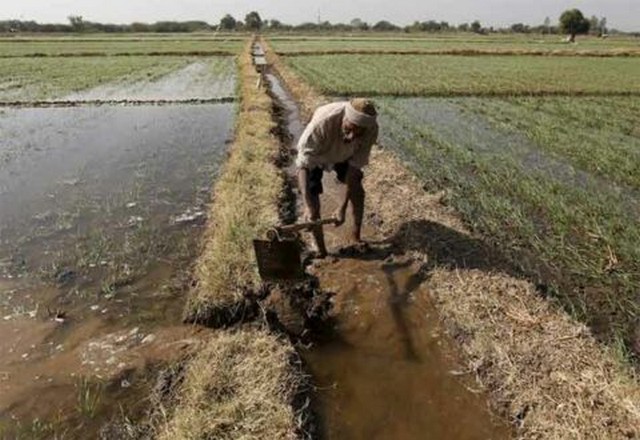
In the report ‘Who Will Feed Us? The Industrial Food Chain vs the Peasant Food Web (ETC Group, 2017), it was shown that a diverse network of small-scale producers (the peasant food web) actually feeds 70% of the world, including the most hungry and marginalised.

The flagship report indicated that only 24% of the food produced by the industrial food chain actually reaches people. Furthermore, it was shown that industrial food costs us more: for every dollar spent on industrial food, it costs another two dollars to clean up the mess.

However, two prominent papers have since claimed that small farms feed only 35% of the global population.

One of the papers is ‘How much of our world’s food do smallholders produce?’ (Ricciardi et al, 2018).

The other is an FAO report, ‘Which farms feed the world and has farmland become more concentrated? (Lowder et al, 2021).

Eight key organisations have just written to the FAO sharply criticising the Lowder paper which reverses a number of well-established positions held by the organisation. The letter is signed by the Oakland Institute, Landworkers Alliance, ETC Group, A Growing Culture, Alliance for Food Sovereignty in Africa, GRAIN, Groundswell International and the Institute for Agriculture and Trade Policy.

The open letter calls on the FAO to reaffirm that peasants (including small farmers, artisanal fishers, pastoralists, hunters and gatherers and urban producers) provide more food with fewer resources and are the primary source of nourishment for at least 70% of the world population.

ETC Group has also published the 16-page report ‘Small-scale Farmers and Peasants Still Feed the World‘ in response to the two papers, indicating how the authors indulged in methodological and conceptual gymnastics and certain important omissions to arrive at the 35% figure – not least by changing the definition of ‘family farmer’ and by defining a ‘small farm’ as less than 2 ha. This contradicts the FAO’s own decision in 2018 to reject a universal land area threshold for describing small farms in favour of more sensitive country-specific definitions.

The Lowder et al paper also contradicts recent FAO and other reports that state peasant farms produce more food and more nutritious food per hectare than large farms. It maintains that policy makers are wrongly focused on peasant production and should give greater attention to larger production units.

The signatories of the open letter to the FAO strongly disagree with the Lowder study’s assumption that food production is a proxy for food consumption and that the commercial value of food in the marketplace can be equated with the nutritional value of the food consumed.

The paper feeds into an agribusiness narrative that attempts to undermine the effectiveness of peasant production in order to promote its proprietary technologies and agrifood model.

Smallholder peasant farming is regarded by these conglomerates as an impediment. Their vision is fixated on a narrow yield-output paradigm based on the bulk production of commodities that is unwilling to grasp an integrated social-cultural-economic-agronomic systems approach that accounts for the likes of food sovereignty and diverse nutrition production per acre.

This systems approach also serves to boost rural and regional development based on thriving, self-sustaining local communities rather than eradicating them and subordinating whoever remains to the needs of global supply chains and global markets. Industry lobbyists like to promote the latter as ‘responding to the needs of modern agriculture’ rather than calling it for what it is: corporate imperialism.

The FAO paper concludes that the world small farms only produce 35% of the world’s food using 12% of agricultural land. But ETC Group says that by working with the FAO’s normal or comparable databases, it is apparent that peasants nourish at least 70% of the world’s people with less than one third of the agricultural land and resources.

But even if 35% of food is produced on 12% of land, does that not suggest we should be investing in small, family and peasant farming rather than large-scale chemical-intensive agriculture?

While not all small farms might be practising agroecology or chemical-free agriculture, they are more likely to be integral to local markets and networks, short supply chains, food sovereignty, more diverse cropping systems and healthier diets. And they tend to serve the food requirements of communities rather than those of external business interests, institutional investors and shareholders half a world away.

When the corporate capture a body occurs, too often the first casualty is truth.

Colin Todhunter is a Research Associate of the Centre for Research on Globalization

5 February 2022

Source: countercurrents.org

The Blockade Against Cuba Turns 60

By Rosa Miriam Elizalde

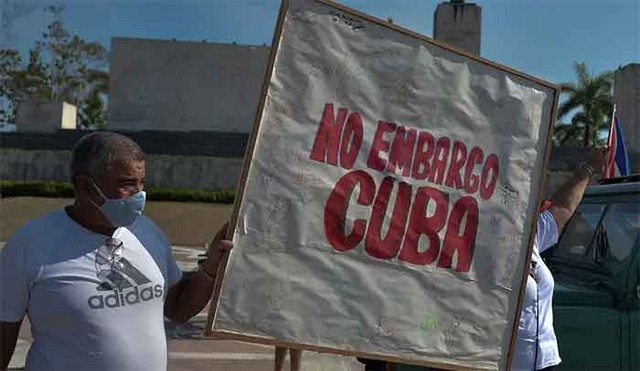
It’s easy to say, but it’s been six very hard decades that began with disconcerting lightness and the belief that the United States government’s blockade of Cuba would not last long—a couple of years, maybe.

On February 2, 1962, U.S. President John F. Kennedy called his press secretary, Pierre Salinger, and gave him an urgent task: “I need a lot of [Cuban] cigars.” “How many, Mr. President?” “About a thousand,” Kennedy replied. Salinger visited the best-stocked stores in Washington and got 1,200 H. Upmann Petit Corona cigars rolled by hand in the fertile plains of Pinar del Río, at the western end of the island.

“The next morning, I walked into my White House office at about 8 a.m., and the direct line from the President’s office was already ringing,” Salinger told Cigar Aficionado magazine years later. “‘How did you do, Pierre?’ he asked, as I walked through the door. ‘Very well,’ I answered. … Kennedy smiled, and opened up his desk. He took out a long paper which he immediately signed. It was the decree banning all Cuban products from the United States. Cuban cigars were now illegal in our country.”

The media outlets of the time reported quite accurately what that decision meant. The Nation wrote: “Cuba’s economy… depended on the United States for such essential items as trucks, buses, bulldozers, telephone and electrical equipment, industrial chemicals, medicine, raw cotton, detergents, lard, potatoes, poultry, butter, a large assortment of canned goods, and half of such staple items in the Cuban diet as rice and black beans. … A nation which had been an economic appendage of the United States was suddenly cut adrift; it was as if Florida had been isolated from the rest of the country, unable to sell oranges and cattle or to bring in tourists, gasoline, automobile parts, or Cape Canaveral rockets.”

There were 657 days between February 3, 1962—when Kennedy issued a blockade on trade between the U.S. and Cuba—and November 22, 1963, when he was assassinated.

Kennedy was killed before he could burn his arsenal of Cuban cigars one by one and before the negotiation agenda was finalized to perhaps reverse or ease the blockade, a process that was underway at the time of the Dallas assassination.

Two key factors that determined the start of negotiations were the failure of the Bay of Pigs invasion of Cuba in April 1961—the invaders had to be exchanged for food and tractors—and the 1962 October missile crisis that involved the U.S., the USSR and Cuba. A memorandum sent by Gordon Chase, National Security Council specialist for Latin American affairs, to McGeorge Bundy, national security adviser to President Kennedy, on April 11, 1963, cynically recommended: “If the sweet approach [to Castro] turned out to be feasible and, in turn, successful, the benefits would be substantial.”

Kennedy’s attempts at rectification were of no use, nor were the calls, not just for elementary justice, but for pragmatism. Dozens of analysts, officials and even former U.S. presidents have since demanded sanity to prevail in order to prevent the punishment imposed on the Cuban people from these continuing embargoes, which are based on the sadistic drive, inertia or simply on the arrogance of a bunch of politicians. But Washington has continued to show vital signs of not backing down. Wayne Smith, who was head of the U.S. Interests Section in Havana and one of the strongest voices against the blockade imposed unilaterally by his country, concluded that Cuba seems to have “the same effect on American administrations that the full moon has on werewolves.”

Those who were born when Kennedy, with his hidden reasons and a secret stash of cigars, signed Executive Order 3447, which decreed a total blockade on Cuba, now have grandchildren and even great-grandchildren. Some of those Cubans have died and many will die without knowing how a country works under normal conditions—the old one or the new one with COVID-19, it no longer matters. They will never understand how it has been possible for the U.S. to act against millions of people for so long and with so much hatred, a hatred without limits or rational explanation.

Rosa Miriam Elizalde is a Cuban journalist and founder of the site Cubadebate.

4 February 2022

Source: countercurrents.org

Wanted: A UN Resolution on Nakba Denial

By Rima Najjar

Sivan Tal has proposed on Twitter a UN resolution on Nakba denial similar to the Israeli-sponsored resolution approved by the UN General Assembly in January of this year condemning any denial of the Holocaust and urging all nations and social media companies “to take active measures to combat antisemitism and Holocaust denial or distortion.”

The resolution would set out a definition of Nakba denial as an expression of racism that includes attempts to distort historical facts:

  • Intentional efforts to excuse or minimize the impact of the Nakba and ongoing Zionist crimes against the Palestinian people.
  • Denial of 4,000 years of Palestine’s history in contradiction to reliable sources.
  • Attempts to blame Palestinians for causing their own genocide.
  • Statements that cast the Nakba as a positive historical event or excuse it by referencing the Holocaust.
  • Attempts to blur the responsibility for Zionist crimes by putting blame on other nations or ethnic groups.

With such a definition, blame shifting, like that expressed by Gideon Levy in Haaretz, would be recognized as racist. Gideon wrote, “Without the Holocaust they [Palestinians] would not have lost their land, and would not be imprisoned today in a gigantic concentration camp in Gaza or living under a brutal military occupation in the West Bank.”

The Holocaust did speed up Jewish immigration to Palestine from Europe and was exploited by both the Zionists and the British to bring the Balfour Declaration to fruition. But Jewish immigration to Palestine, even in such great numbers, is not the cause of the Nakba and would not have necessarily established a Jewish state there (violently through the Palestinian Nakba or Catastrophe) against the will of the native Arab population but for Zionist planning (long in the making — the First Zionist Congress dates back to 1897), determination, money, connections, machination, terror and violence (See A State of Terror by Tom Suarez and Against Our Better Judgment by Alison Weir). Norman Finkelstein’s book The Holocaust Industry: Reflections on the Exploitation of Jewish Sufferings demonstrates how Israel continues to exploit the Holocaust to whitewash its crimes.

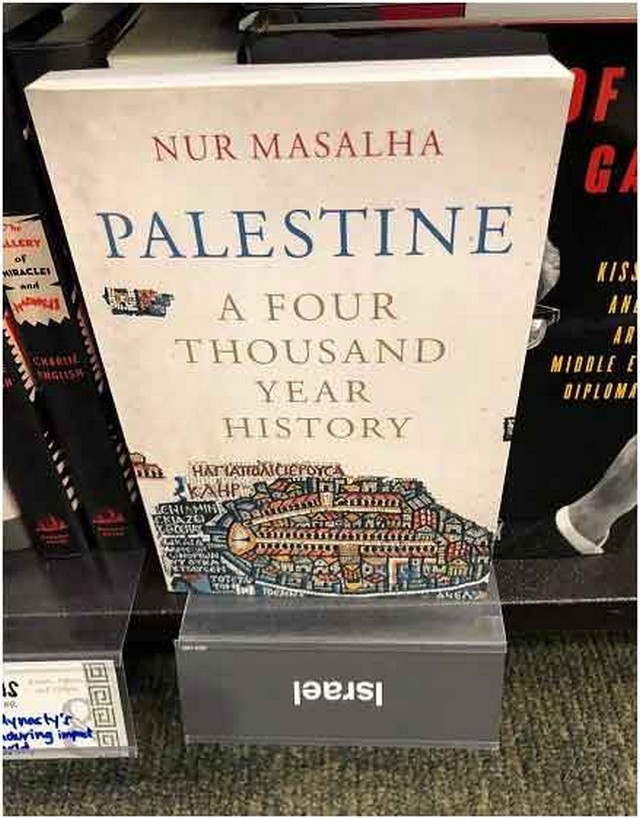
With a UN resolution addressing Nakba denial, Facebook and other social media platforms would take active measures to combat information distortion or fake news on Palestine. For example, memes of historian Nur Masalha’s book Palestine: A Four Thousand Year History (such as that published in One km to Palestine) would not attract hordes of trolls on Facebook denying the history of Palestine with impunity.

The resolution would help the experts who review and update Facebook standards. With the definition above in mind, consider how the following exchange on Facebook might be viewed differently:

James Freestone, it’s up to you to get educated … or not.”

The above comment from a thread in a group called Crimes of Israel was flagged by Facebook as going against its community standards. My account is now restricted because of this utterance.

I wrote the comment as a response to Nakba denial observations made by Freestone, a Zionist troll, who was dismissing, as “Jew hate,” my defense of the academic persecution of UK Palestinian student Shahd Abusalama and the call by the British Society for Middle Eastern Studies (BRISMES) to rescind the use of the IHRA definition of antisemitism as a tool in complaints and disciplinary procedures.”
The troll went on to retort:

“Educated on your propaganda?
I will pass and also remind you of a few facts that you face daily….
1. There will never be a Palestine.
2. There will never be ROR [right of return for Palestinian refugees].
3. 1948 humiliation is eternal.”

Educating a troll was not my objective in participating in this Facebook group with 11k members. I agree with David Spero’s argument in “Israel’s On-line Army: Don’t feed the trolls, they’re fighting a war.” Rather, it was to reach its members with information on Israeli crimes. However, now I realize the group itself was either taken over by pro-Israel propagandists or was founded on purpose by them in order to create a “showcase” of “anti-Semitism” in social media. (The group’s “about” section cites the following broken url http://israevil.com/) [Note: There are two other groups with the same name on Facebook that seem to be legitimate.]

No matter what information you threw at him, the troll responded with a variation of “You Jew haters be it in UK or USA don’t get to define how we feel and what we hear.” He then posted the url of a smear blog ala Canary Mission (called stopantisemitism.org) featuring me as “antisemite-of-the-week-rima-najjar-the-hateful-blogger” that interprets my writing on Medium as antisemitic with the comment: “Just as I thought….just a petty Jew hater.”

Nakba denial goes hand-in-hand on Facebook with Islamophobia as well as racism (Arabophobia) and the Jewish supremacy narrative.

Rima Najjar is a Palestinian whose father’s side of the family comes from the forcibly depopulated village of Lifta on the western outskirts of Jerusalem and whose mother’s side of the family is from Ijzim, south of Haifa. She is an activist, researcher and retired professor of English literature, Al-Quds University, occupied West Bank.

31 January 2022

Source: countercurrents.org


Islamophobia and the Capitol Insurrection

By Juan Cole

How the FBI Ignored White Radicals While Spying 24/7 on Muslim Americans

Fox News anchor Tucker Carlson excused one of the leaders of the extremist Oath Keepers organization implicated in the January 6th insurrection by describing him as “a devout Christian.” It’s safe to surmise that he wouldn’t have offered a similar defense for a Muslim American. Since September 11th, and even before that ominous date, they have suffered bitterly from discrimination and hate crimes in this country, while their religion has been demonized. During the first year of the Trump administration, about half of Muslim Americans polled said that they had personally experienced some type of discrimination.

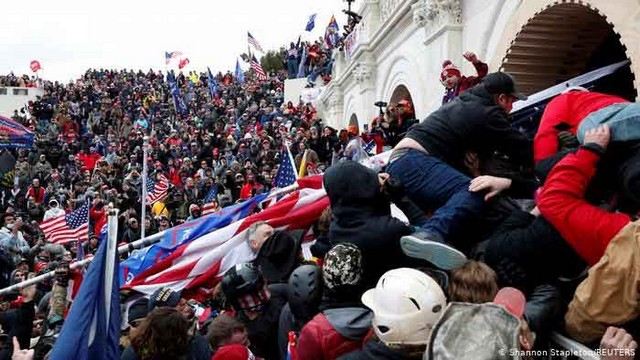
No matter that this group resides comfortably in the American mainstream, it remains under intensive, often unconstitutional, surveillance. In contrast, during the past two decades, the Department of Justice for the most part gave a pass to violent white supremacists. No matter that they generated more terrorist attacks on U.S. soil than any other group. The benign insouciance of the white American elite toward such dangerous fanatics also allowed them to organize freely for the January 6th assault on the Capitol and the potential violent overthrow of the government.

Donell Harvin was the chief of homeland security and intelligence for the government of the District of Columbia in the period leading up to January 6th. He assured NBC News’s Ken Dilanian that the FBI and the Department of Homeland Security seemed completely oblivious about the plans of white supremacist hate groups to violently halt the certification of Joe Biden’s presidential victory, despite plentiful evidence on social media that they were preparing to bring weaponry to the Capitol.

Consider now the treatment that the very same agencies offered distinctly inoffensive Muslim Americans. Rutgers law professor Sahar Aziz has argued that many white Americans see Muslims not merely as a religious group but as a racial one and have placed them on the nethermost rung of this country’s ethnic hierarchy. Muslim Americans are regularly, for instance, profiled at airports and subjected to long interrogations. Over many years, the New York City Police Department gathered intelligence on more than 250 mosques and student groups. The FBI even put field officers in mosques not only to spy on, but also to entrap worshipers who, alarmed by their wild talk, sometimes reported them to… the FBI.

Aziz notes that Donald Trump campaigned in 2016 to register all Muslim Americans in a database, institute widespread surveillance of mosques, and possibly exclude Muslims from the country. Even non-governmental far-right groups like discredited ex-journalist Steve Emerson’s “Investigative Project on Terrorism” have spied on Muslim Americans. As with everything else in the contemporary U.S., a partisan divide has emerged regarding them, with 72% of Republicans holding the self-evidently false belief that Muslims are more likely to commit violence than adherents of other faiths, while only 32% of Democrats say this.

Apparently, though, our concern over the potential commission of violence in this country should actually focus on Republicans. A recent Washington Post-University of Maryland poll found that 34% of Americans now believe that violence against the government is sometimes justified, a statistic that rises to an alarming 40% among Republicans. In other words, this country’s worries about violence should be focused most on the right-wing extremist fringe, exemplified by groups like the Oath Keepers, 11 of whose leaders were arrested by the FBI in mid-January for “seditious conspiracy” in their paramilitary invasion of the Capitol in 2021. More people have perished in political killings in the past 20 years here at the hands of far-right radicals than those of any other group, including extremists of Muslim heritage. Still, this country’s security agencies continue their laser focus on monitoring Muslim Americans, even as they grossly underestimate the threat from white supremacists.

Collectively Punishing Muslim Americans

What most characterizes the American Muslim community, which at nearly four million strong makes up more than 1% of the population, is diversity. It includes white and Hispanic converts, African Americans, Arab Americans, and South-Asian Americans whose families hailed from the Indian subcontinent. Three American Muslims are serving in Congress and even President Trump appointed a Moroccan-born American immunologist, Moncef Slaoui, to head Operation Warp Speed that produced the Moderna vaccine for Covid-19. Last summer saw the confirmation of the first Muslim-American federal judge and President Biden has just nominated the first Muslim-American woman to the federal bench. There are also striking numbers of Muslim-American peace activists, either with their own organizations or involved at interfaith centers, as well as many environmentalists and community organizers, but the media and academics seldom focus on this dimension of the religion.

Polling supports her findings, with 69% of Muslim-American respondents saying that working for justice forms an essential part of their identity, nearly the same as the 72% who say that loving the Prophet Muhammad is essential to being a Muslim. In addition, 62% see protecting the natural environment as a key to Muslim identity. The majority of them, in other words, are religiously open-minded. Some 56% of Muslim Americans, for instance, believe that other religions can be a path to salvation. In contrast, only a third of evangelical Christians take a similar position when it comes to religions outside the Judeo-Christian tradition.

And here’s a seldom-recognized reality in this country: Muslims form a longstanding and important thread in the American tapestry, having been in North America for centuries. Rabbinical Judaism, Christianity, and Islam all arose on the fringes of the Roman Empire between the first and seventh centuries of the common era. All believe in the one God of Abraham, as well as in the biblical patriarchs and prophets. All forbid murder, robbery, and other violent crimes. There are no objective grounds for a United States that recognizes the first two to deny legitimacy to the third.

Muslim-American numbers have increased dramatically since, in 1965, Congress changed formerly racist immigration laws to abolish country quotas that favored northern Europeans. Some 75% of the Muslim Americans here are now citizens. The 9/11 attacks, however, turbocharged hatred of this group, unfairly associating them in the minds of many Americans with violence and terrorism, even though all the hijackers were foreigners and differed starkly in their political and ethnic backgrounds from those of most Muslim Americans. Unlike whites, who suffer no reputational damage from being of the same race as violent white supremacists, Muslim Americans have been collectively punished for bad behavior by any of them or even by foreign coreligionists. While a small number of Muslim Americans have succumbed to the blandishments of radical Muslim ideologies, it has been vigorously rejected by all but a few.

The same cannot be said of white nationalists for whom radicalism stands at the core of their identity, while a disturbing strain of poisonous racism runs through their activities. The 11 leaders of the Oath Keepers arrested in mid-January for seditious conspiracy had stockpiled heavy weapons and coordinated with rapid-response teams pre-positioned outside Washington, D.C., whom they hoped to call on, apparently after they invaded the halls of Congress. According to the indictment, the leader of that 5,000-strong organization, Elmer “Stewart” Rhodes, wrote on its website on December 23, 2020, “Tens of thousands of patriot Americans, both veterans and non-veterans, will already be in Washington, D.C., and many of us will have our mission-critical gear stowed nearby, just outside D.C.”

Rhodes, who spent thousands of dollars on weaponry in December and January, said in an open letter that he and others may have to “take to arms in defense of our God given liberty.” Oath Keeper chapters around the country conducted military training exercises with rifles. Indicted Alabaman Oath Keeper Joshua James, 33, texted on the Signal messaging app, “We have a shitload of QRF [Quick Reaction Forces] on standby with an arsenal.” They were concerned, though, that during the planned civil disturbance, authorities could close the bridges from Virginia (where they had holed up in motels with their assault rifles) into D.C. A QRF team leader from North Carolina wrote, “My sources DC working on procuring Boat transportation as we speak.” Kelly Meggs of Florida, another Oath Keeper leader, sent messages worrying about running out of ammunition: “Ammo situation. I am checking on as far as what they will have for us if SHTF [the shit hits the fan]. I’m gonna have a few thousand just in case. If you’ve got it doesn’t hurt to have it. No one ever said shit I brought too much.”

On the morning of January 6th, one of the organization’s leaders, 63-year-old Edward Vallejo of Phoenix, Arizona, discussed the possibility of “armed conflict” and “guerrilla war” on a podcast. On the day itself, members of the Oath Keepers formed paramilitary “stacks” in front of the Capitol to invade it in formation. They were, however, foiled when some Capitol police delayed them by holding the line against thousands of angry, determined fanatics, while others whisked most members of Congress away to secure locations inaccessible to the mob. Before they were rescued, some representatives lay on the floor, weeping or praying. In other words, the American far right came much closer to overthrowing the U.S. government than al-Qaeda ever did and, at the same time, resembles al-Qaeda far more than Republican lawmakers are ever likely to admit.

Ignoring White Nationalists

The Oath Keepers, like the Boogaloo Bois and other far-right groups central to the insurrection, do not so much have an ideology as a mental cesspool of conspiracy theories and imaginary grievances. Typically, in December 2018, according to the Southern Poverty Law Center, Oath Keeper founder Stewart Rhodes spoke of asylum-seekers at the border with Mexico as a “military invasion” by “cartels” and part of a “political coup” by the domestic Marxist left. He also managed to blame Muslims and the late Senator John McCain for provoking crises that would leave this country’s borders “undefended.”

Extremists on the white nationalist right have been a known quantity to American law enforcement for decades and have committed horrific acts of violence like Timothy McVeigh’s 1995 truck-bombing of the Murrah Federal building in Oklahoma City, which killed 168 people and wounded more than 800. Unlike Muslim Americans, however, they have been cut remarkable slack.

The Republican Party has had a longstanding and chillingly effective policy of downplaying the dangers of extremist white nationalists. No surprise there, since the GOP depends on the far-right vote in elections and on financial contributions from well-off white supremacists who hate the multiracial Democrats. In 2009, analyst Daryl Johnson of the Department of Homeland Security in the newly installed Obama administration produced a confidential report for law enforcement suggesting that right-wing extremism posed the biggest domestic threat of terrorism to this country. Republicans in Congress leaked it and then, along with right-wing media like Fox News, went ballistic.

House minority leader John Boehner (R-OH) said at the time:

“[T]he Secretary of Homeland Security owes the American people an explanation for why she has abandoned using the term ‘terrorist’ to describe those, such as al-Qaeda, who are plotting overseas to kill innocent Americans, while her own Department is using the same term to describe American citizens who disagree with the direction Washington Democrats are taking our nation.”

According to Johnson, the Obama administration caved to this campaign:

“Work related to violent right-wing extremism was halted. Law enforcement training also stopped. My unit was disbanded. And, one-by-one, my team of analysts left for other employment. By 2010, there were no intelligence analysts at DHS working domestic terrorism threats.”

One can imagine that under Trump such groups received even less government scrutiny, since one of their fellow travelers had ascended to the White House.

The refusal of the Washington establishment to take the menace of far-right white nationalist movements seriously has been among the biggest security failures in this country’s history. The collusion of mainstream Republicans who have, in essence, run interference for such dangerous, well-armed conspiracy theorists has stained the party of Lincoln indelibly, while the participation of active-duty military and police personnel in these groups poses a dire threat to the Republic.

At the same time, this country’s security agencies failed epically in their treatment of Muslim Americans after the 9/11 attacks by infringing on their civil liberties, while abridging or disregarding constitutional protections for millions of innocent people. Faiza Patel, co-director of the Brennan Center for Justice’s Liberty and National Security Program, points to congressional reports that question the value of all this monitoring of an American minority, not to speak of the absurdities it has entailed. As she put it, “Often, the reports singled out Muslims engaged in normal activities for suspicion: a [Department of Homeland Security] officer flagged as suspicious a seminar on marriage held at a mosque, while a north Texas fusion center advised keeping an eye out for Muslim civil liberties groups and sympathetic individuals and organizations.” In such a world, even Muslim Americans active in peace centers become inherently suspicious, but heavily armed white nationalists in motels just outside Washington aren’t.

Juan Cole, a TomDispatch regular, is the Richard P. Mitchell collegiate professor of history at the University of Michigan.

31 January 2022

Source: countercurrents.org

The Rising Spectre of Muslim Genocide in Modi’s India; How serious is it?

By Muhammed Mahmood

Gregory Stanton the founding President of Genocide Watch who predicted the Tutsi genocide in Rwanda years before it took place in 1994, has in recent times, raised an alarm that a genocide of 200 million Muslims in India is very much on its way. He asked “the US Congress to pass a resolution that warns genocide should not be allowed to occur in India”.

Targeted anti-Muslim policies

I predicted Rwandan Genocide & I Warn Same Could Repeat in India: Dr. Gregory Stanton

Stanton cited the revocation of the special autonomous status of Indian occupied Kashmir in 2019 which stripped Kashmiris of the special status that was granted by the UN in 1949 and was duly incorporated in the Indian constitution on 17 October 1949 (Article 370 which allowed Kashmir to have its own constitution) has now been annulled by the Modi government. This as well as the Citizenship Amendment Act in the same year that granted citizenship to religious minorities, but excluded Muslims are initiatives that as per Gregory Stanton are blatantly discriminatory and marginalising for the Muslims in India.

In fact, Genocide Watch began warning of an impending Muslim genocide in India in 2002, when a three day period of anti-Muslim violence in the state of Gujrat (Prime Minister Modi was chief minister of the state at that time) led to the massacre of more than 1000 Muslims including a Muslim member of the federal parliament.

Stanton points out that Modi did nothing to stop the massacre and said “In fact there is a lot of evidence that he (Modi) actually encouraged those massacres”.

There are credible evidence that tend to suggest since its inception as an independent state in 1947 with a significant Hindu majority state, often promotes the environment to provoke violence against Muslims and remarkably, the law enforcement agencies do little or nothing to stop these violence against Muslims. That was the case in Gujrat in 2002 and in Delhi in 2020 during the anti-Muslim riots in these places.

In fact, during the 2020 violence against Muslims in Delhi, Delhi police did the opposite, arrested hundreds of Muslims, the victims in Delhi violence and much worse charged some of them of violence against themselves.

Such police actions, Stanton, describes as the “denial”, the last stage in a genocide process. He then added that “Denial is the tenth (i.e. the last) stage of every genocide. That is what going on when they are charging Muslims with, would you believe it! killing themselves? I do not believe it! And I don’t think anybody should believe it”.

Stanton also mentioned that the demolition of Babri mosque and the construction of a Hindu temple there as “important in the development of cultural underpinnings for genocide”. It is to be noted that in the 1980s the BJP became the political voice for the destruction of Babri mosque to be replaced with a Hindu temple at Ayodhya.

Also, language used by Indian government against Muslims terming them as “terrorists” (and a term popularised by the US around the world since 9/11), separatists and criminals give further legitimacy and reinforce the hatred against Muslims in India even more.

In fact, the US sponsored term “terrorist” for “Muslims” has been earnestly embraced by Hindu supremacists in India so much so that in 2016, the BJP Minister of State for Skill Development and Entrepreneurship Shri Rajeev Chandrasekhar once said “ as long as there is Islam in the world, there will be terrorism. Until we uproot Islam, we can’t remove terrorism”.

Stanton compared the situation in India under Prime Minister Narendra Modi with the ethnic violence in Myanmar and Rwanda. He also emphasised that genocide is not an event but a process. In the context of Muslim persecution in India Stanton points out that there are early signs and processes of genocide that are clearly visible in India in general and more particularly, in the state of Assam and Indian occupied Kashmir.

He also said “what we have now though, an actual member of the RSS– this extremist, Hindutva oriented group – Mr Modi as prime minister of India. So, what we have here is an extremist who has taken over the government of India”. But Modi now commands enormous political support for his policies at home. In recent times in a global leadership popularity poll, Modi who has come out as the most popular leader of all among the Indians at a time when the economy is faltering, and hundreds and thousands are getting infected and dying from COVID 19 due to mismanagement. Modi is also failing measurably to control corruption which is widespread and rampant. In the backdrop of these failures Modi’s resounding popularity among his citizens which implies that in India Hindutva is winning, while ignoring his poor statecraft in favour of his anti-Muslim policies. This is ominous.

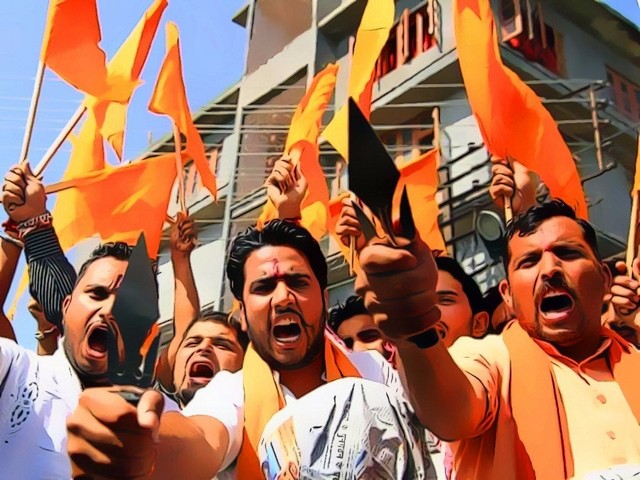
In the vanguard of the anti-Muslim crusade in India is the RSS, a Hindu supremacist organisation which was established in 1925 to establish a Hindu nation in India. Articulated in 1923 by its chief, V.D. Savarkar, RSS espouses an extremist ideology called Hindutva – a Hindu only state for India. Most alarmingly, both the BJP and its main arm RSS were inspired by both Hitler’s Nazi Germany and Mussolini’s fascist ideologies in Italy, respectively. Savarkar openly expressed his great admirations for both Hitler and Mussolini.

Shadvi Annapurna, who is affectionately called by her followers Maa (mother) is the general secretary of Hindu Mahasabha, – founded in 1915), another Hindu supremacist outfit – has been the central figure at the recent Haridwar event labelled as “Dharma Sansad” (Religious Parliament) where they gave open call to kill Muslims. The Hindu Mahasabha’s vision according to its official website is to make India the “National Home of Hindus”. The website also says that if it comes to power, it will not hesitate to force Muslims out of India.

Since Modi and his BJP ascended to power in Delhi and his Hindutva agenda emboldening other Hindu extremist groups like the Hindu Mahasabha, are now openly threatening, and posing extreme danger to the Muslims in India. Lack of any response from the law enforcement agencies for previous hate speeches and vitriols against Muslims was taken as tacit support of the government that have made these threats far more dangerous and brazen as has been reflected in the call for Muslim genocide at the Haridwar meeting last month – at the Haridwar gathering, among the saffron robed Sadhus (Hindu term for saints), Maa (Mother) Sadhvi Annapurna has been the most vitriolic and specific in the call for genocide against the Muslims.

While Genocide Watch does not rank countries, but the US Holocaust Memorial believes that India is the second most likely country for a genocide to take place among 162 countries on its list. The US Commission for International Religious Freedom which has for last two years asked the US State Department to place India on the list of Countries of Particular Concern.

Concerns within India Teesta Setalvad, a well-known human rights activist in India also believes that violence against Muslims worsens their socio-economic conditions and enables genocidal targeting. Aakar Patel, the former head of Amnesty International in India told Al Jazeera that the recoded history of civic violence in India showed that either the state did something that provoked the violence against Muslims or did not do enough to stop it.

Stanton in an interview with Karan Thapar of WIRE referred to the 10 stages genocide as developed by Genocide Watch and said that several of them had been fulfilled in India such as distinguishing between people as us and them and othering them, symbolisation (i.e. clothing and calling Muslims as Abbajaan), discrimination ( the list would be very long to record here but just one example is the Citizenship Amendment Act), dehumanisation (such as calling Muslims as termites) and polarisation (accusing them of love jihad and laws forbidding inter-faith marriage). Above all, he further added that there have been actual calls for genocide (i.e. Hardwar religious conference held in December 2021).

Commenting on Prime Minister Modi’s silence on the call for Muslim genocide at the Haridwar religious conference, he quoted Martin Luther King Jr, who said “We will know who is against us not by what they are saying but by their silence”. He also made an ominous prediction that if genocide happens “It won’t be the state and mobs that will carry it out”. In fact, since Modi came to power in 2014, all anti-Muslim violence have been carried out by the lynch mob aided by the law enforcement agencies, police in particular.

US-sponsored Islamophobia, a fillip to Modi’s Hindutva policy?

Modi’s open and brazen Hindutva policy – a crusade of a sort against Indian Muslims – cannot be looked at and understood without the US sponsored anti-Muslim hate campaign contributed to, with popular and legal endorsements, attacks on Muslims around the world including arbitrary arrests and harassments of Muslims and widespread surveillance of Muslim population and their places of worships in the US itself. Such Islamophobic policies and rhetoric of the US have significantly emboldened bigots like Modi and his cohorts in India and given much fillip to their own brand of Islamophobia with genocidal intent which until then was less open.

It is generally argued that Islamophobia in the context of contemporary India and other Asian countries like Myanmar and others in general arose out of the post-colonial struggle of these countries with the economic and cultural challenges adapting to globalisation but most failing to face those challenges proactively.

India’s priority should be poverty alleviation and not persecution of Muslims

India is a stark example of that failure to address and take advantage of globalization and as a result, with a per capita income of US$2,191 in nominal terms (in 2021) India also recorded the highest poverty increase in the world during 2020-2021.

Among other things, Modi government’s obsession with anti-Muslim Hindutva policy seems to be detracting the regime’s attention away from where it is due – tackling poverty in India.

Islamophobia in India, the home to the largest number of poor in the world today (28% of global total), is a convenient way to distract attention away from poverty and squalor that pervade the country despite Modi’s promises of economic prosperity for his people just by feeding them with the most extreme form of anti-Muslim bigotry. Also, Faisal Devji, Professor of History at Oxford University observes that “Islamophobia’s brutality is most readily seen in Asia, a continent awaiting its recognition as capitalism’s new home”.

While “othering” of Indian Muslims has been the mainstay of Indian politics since the middle of the 19th century, has now become more pronounced especially since 1947 when India, a British colonial construct, got its independence and emerged as a Hindu majority state in the sub-continent.

The rise of the BJP to power in India simply and more brazenly furthered political marginalisation of Muslims in India, a process that had simmered since 1947. Currently, emboldened by the US-sponsored Islamophobia, othering and persecution of Muslims in India has become more audacious and sadly, popular as well.

Indeed, the plight of the Indian Muslims under the Modi regime’s populist anti-Muslim policies and actions have reached a stage which if something very urgent not done to ebb and completely reverse the policies that are deepening and expanding the spectre of persecution of Muslims, a genocide of Muslims in India, as predicted by Gregory Stanton, seems like a real possibility and this is deeply worrying.

Indeed, the World simply cannot stand by and look the other way, and watch unfolding of a man-made human disaster that may not just cause unimaginable sufferings to the Muslims in India and fracture India but may throw the entire region into an ocean of communal bloodbath!

Muhammed Mahmood is a retired Professor of Victoria University, Melbourne, Australia.

31 January 2022

Source: countercurrents.org
What makes Amnesty’s apartheid report different?

Palestine Update 524

What makes Amnesty’s apartheid report different?
What makes Amnesty International’s new report determining that Israel practices the crime of apartheid against Palestinians any different from those that came before it? Certainly, Israel’s “hysterical” reaction – (in the words of one Haaretz headline) – to the Amnesty study is notably different from its relatively understated response to similar reports recently issued by B’Tselem, a human rights group in Israel, and the New York-based Human Rights Watch. Palestinian human rights groups like Al-Haq, Adalah and Al Mezan have been advancing an apartheid framework for far longer and the reports from the above-mentioned Israeli and international groups build on their work.

Amnesty, Human Rights Watch and B’Tselem examined Israel’s system of control throughout historic Palestine that privileges Israeli Jews and marginalizes Palestinians and violates their rights by varying degrees, largely depending on where they live. And in contrast to the analyses published by Palestinian groups, those three reports, welcomed as groundbreaking and paradigm-shifting, fall short of placing Israel’s system of apartheid in the context of settler-colonialism. (A keyword search of Amnesty’s report yields three results for the terms “colonialism” and “colonial” – found in the titles of works cited in the footnotes.)

Amnesty repeatedly stresses Israel’s “intent to maintain this system of oppression and domination” without making the explicit point that apartheid is a means towards the end of settler colonization: removing Palestinians from the land so that they may be replaced with foreign settlers. The rights group does state that “since its establishment in 1948, Israel has pursued an explicit policy of establishing and maintaining a Jewish demographic hegemony and maximizing its control over land to benefit Jewish Israelis while minimizing the number of Palestinians and restricting their rights and obstructing their ability to challenge this dispossession.”

Credit where credit’s due: Amnesty blasts away Israel’s foundational mythology, acknowledging that it was racist from the beginning – a departure from the typical liberal attitude that Israel strayed from its ideals somewhere along the way. Amnesty even points out that “many elements of Israel’s repressive military system in the OPT [West Bank and Gaza] originate in Israel’s 18-year-long military rule over Palestinian citizens of Israel,” beginning in 1948, “and that the dispossession of Palestinians in Israel continues today.”

Amnesty also acknowledges that “in 1948, Jewish individuals and institutions owned around 6.5 percent of Mandate Palestine, while Palestinians owned about 90 percent of the privately owned land there,” referring to all of historic Palestine prior to the establishment of the state of Israel.
Source:

Why doesn’t the West accept that Israel is an ‘apartheid’ state?
Amnesty International released the findings of a detailed investigation on Wednesday, which has been conducted over the past four years. It concluded that the occupation state imposes “a system of oppression and domination against Palestinians” across all of the Palestinian territories under its control, those occupied in 1948 as well as those occupied in 1967.

The London-based human rights group stated that Israel does this “in order to benefit Jewish Israelis”, and pointed out that “this amounts to apartheid as prohibited in international law.” Amnesty is the third major human rights organisation after B’Tselem and Human Rights Watch to allege Israeli apartheid since January last year. “Laws, policies and practices which are intended to maintain a cruel system of control over Palestinians, have left them fragmented geographically and politically, frequently impoverished, and in a constant state of fear and insecurity,” said Amnesty.

Introducing the findings at a press conference in Jerusalem, Amnesty’s Secretary General, Agnès Callamard, said: “Whether they live in Gaza, East Jerusalem and the rest of the West Bank, or Israel itself [the parts of Palestine occupied in 1948], Palestinians are treated as an inferior racial group and systematically deprived of their rights. Israel’s cruel policies of segregation, dispossession and exclusion across all territories under its control clearly amount to apartheid.”
Read more

Why BBC insists on whitewashing Israeli crimes against Palestinians?

Early this week, the BBC published an article about a twitter campaign carried out by a group of Palestinians living abroad who are critical of the Palestinian Islamic Movement, Hamas, which is the de facto government in the Gaza Strip. The twitter campaign was under the heading “They Kidnapped Gaza”, a reference to the Hamas leadership. According to the BBC, “Hundreds of Palestinian activists have been taking part in a rare online event strongly criticising Hamas governance of the Gaza Strip.”

 I live and work in the Gaza Strip, and I believe that the aim of the campaign was clearly to whitewash Israeli crimes and blame Hamas for the “dire” living conditions. The BBC seems to have adopted this narrative, given that contentious claims by the online activists weren’t challenged. A Twitter post by the now Belgium-based Mahmoud Nashwan was quoted by the BBC: “Imagine your one-month-old son dies because of the cold. Imagine your son dying because there is no electricity, no money, no wages and no home.” The root cause of these problems, the Israeli occupation and, over the past 15 years, the siege imposed by Israel and its supporters, weren’t mentioned. The impression given is that Hamas is responsible; nobody else. And this impression looks very deliberate.
Source:

Washington ignores Amnesty Israel ‘apartheid’ report at its peril

Not holding partners to account for human rights abuses makes them burdens rather than assets to the U.S.
By blatantly ignoring the findings of human rights abuses against Palestinians as the United States did this week upon the release of a seminal report by Amnesty International, Washington is ultimately emboldening bad behavior while further entrenching itself in Middle East security crises. Here’s why.

Amnesty’s latest assessment on Israel’s treatment of the Palestinaians, deemed a “crime of apartheid,” stems from a five-year analysis of Israeli civilian and military law. The organization reached the same conclusion as Human Rights Watch and Israel’s own main human rights organization, B’Tselem (Israeli Information Center for Human Rights in the Occupied Territories). The Israeli government has presented no counter argument to these findings, except false accusations of antisemitism.

The 274-page report has also further embarrassed the United States, which also rejected Amnesty’s report, all the while regularly citing Amnesty and HRW when those organizations issue reports on the human rights abuses of countries not aligned with Washington. This episode further highlights two ways in which this approach undermines U.S. national security.

First, the United States loses further credibility on human rights when it applies it selectively. Some rules are for our partners — and an entirely different standard for our adversaries. This selectivity instrumentalizes and undermines the very concept of human rights. It is not a value to be upheld but a stick to use against those we don’t like, while turning a blind eye to partners such as Saudi Arabia, Israel, and other systematic human rights abusers. Second, Biden’s Mideast strategy is increasingly defined by the goal of “strengthening alliances.” Biden views America’s security partnerships as a critical asset in the competition against China. But two negative and mutually reinforcing developments follow from this approach:

To begin with, U.S. partners will behave increasingly recklessly and in contrast to American values as they correctly perceive Washington as having given them a permanent carte blanche, and because they calculate that the U.S. — because of the China competition — cannot afford to be tough on them.  Case in point: Israel’s de facto annexation of Palestinian territory and elimination of any viable two-state solution is partly the result of decades of American deference to Israel even though the U.S. itself has defined a two-state solution as central to American interests.

Moreover, Washington will be forced to more frequently defend the worsening  behavior of its partners. Whatever double standards we saw in the past, it is likely to get substantially worse going forward. Forget the rhetoric about centering human rights or pursuing more prudent goals.Ironically, it is difficult to see how this approach, which fuels recklessness among U.S. partners and makes them even greater burdens rather than assets to Washington, ultimately strengthens America’s position vis-a-vis China. Rather, this will further entangle the United States in the problems and conflicts these partners have started or are embroiled in. The day America will come home from the Middle East is being pushed further and further away.
Source:

Amnesty International Defends Report on Israeli Apartheid, Rejecting Criticism from U.S. & Israel

Amnesty International has become the third major human rights organization to accuse Israel of committing the crime of apartheid against Palestinians in a new report released on Tuesday. Amnesty finds Israel’s system of apartheid dates back to the country’s founding in 1948 and has materialized in abuses including massive seizures of Palestinian land and property, unlawful killings, forcible transfer, drastic movement restrictions, and the denial of nationality and citizenship to Palestinians — all of which constitute apartheid under international law. We speak with Amnesty International USA’s executive director Paul O’Brien, who calls on the United States to “put pressure on the Israeli government to dismantle this system of apartheid,” despite both the Biden administration and the Israeli government rejecting the report’s findings.

Source

4 February 2022

Source: palestineupdates.com

Press Stunned as Ukraine President Zelensky Points Finger at West

By Nury Vittachi

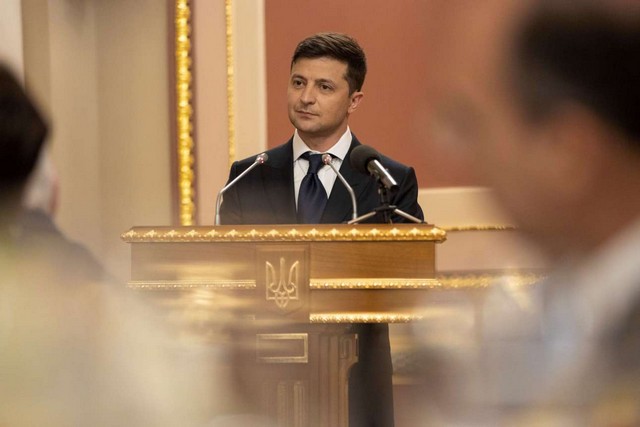
In a stunning and unexpected outburst this week, Ukrainian President Volodymyr Zelensky said that his country’s current problems came from the west rather than the east.

The fears of a looming war were built on news stories that Russia had troops on the border it shares with the country—but this was not unusual, and there had been a similar assembly of soldiers a year ago, he said.

The truth was that threat level had not changed, he told a press conference this week.

Furthermore, the real threat to Ukraine was not Russia, but the “destabilisation of the situation inside the country” he told journalists.

The cause of the panic was the press itself, Zelensky said.

Correspondents at the event were discomfited. The event was “a slightly surreal encounter” said the BBC’s Sarah Rainsford.

The Ukrainian leader went on to slam the US, British and other Western diplomats who were fleeing the country, as if the much-described war was actually real.

He denied that Ukraine was a sinking ship, but even if they saw it that way, “diplomats are like captains. They should be the last to leave a sinking ship.”

What’s Really Happening?

The Western powers appear to be repeating their Taiwan strategy in the Ukraine.

  • Step one is to travel to someone’s territory and alter the status quo until the neighbors react.
  • Step two is to angrily accuse the neighbors of being aggressive and expansionist—even though they literally haven’t left their own territory (unlike the accusers).
  • Step three is to work with the press to mislead the world about which side is destabilizing the situation, and thus justify military expansion.

Ultimately, the aim is to push NATO borders eastwards, justify increased spending on the military, and attempt to further unite the world against communities which the West feels need to be “contained”.

It’s Working

The plan is working. Russia is being universally painted as the aggressor, and military activity from the west is rising. The UK government is sending weapons and troops to Ukraine, and calling on other NATO members to “unite”. The US says it has 8,500 troops ready to go.

On the media front, the message is virtually identical in every outlet: Russia is suddenly being threatening, so the good guys are being forced to respond. US Defence Secretary Lloyd Austin said the US was committed to helping Ukraine “defend itself”.

The BBC rolled out politician Tobias Ellwood to explain that all the problems are Russia’s fault. (The same man is used by the media as a source of negative comments on China.) The BBC newsroom always “forgets” to mention Ellwood’s background. He served as part of the 77th Brigade, a British army propaganda unit focused on psychological warfare, media operations, and “special influence methods”.

How differently viewers would see the news if they knew the full story: “We are the media, and we are about to showcase the views of a person trained in spreading disinformation via the media.”

Problems with the Narrative

Just as the carefully balanced relationship between Taiwan and mainland China has been in place for years, with alternating periods of calm and tension, the same has been true in Ukraine. Russia has regularly placed troops on its border with Ukraine, and vice versa.

As Ukrainian President Volodymyr Zelensky said, the military tensions were a long-term fact of life between the two countries, and the threat level had not changed, despite every Western media outlet saying that it had.

But the underlying issue is this: NATO promised not to expand eastwards. It has done so repeatedly. It is never called out for this.

Yet those exact promises are well documented in history books – in the west as well as the east, as all students of recent European history know. Let’s look at them below.

After the Quake

In 1989 and 1990, Europe went through a massive political earthquake, with the fall of the Berlin Wall and numerous related events. The Western powers and the Soviet Union held a series of meetings to reassure the other that they would not take advantage of the shake-up for purposes of aggressive expansionism.

The Russian side, represented by Mikhail Gorbachev, had to play it straight. The country had large numbers of other urgent issues on its plate, so his argument was simple: Moscow would not move westward – as long as the west would not move eastward. Let the countries in between be.

The Famous Inch

The buzzphrase that emerged from those discussions was just three words long: “Not one inch.” It came, originally, from the mouth of the US Secretary of State James Baker, on February 9, 1990. NATO, he told Gorbachev, would move “not one inch eastward”.

NATO should rule out an “expansion of its territory towards the east, i.e. moving it closer to the Soviet borders”, the US Embassy in Bonn declared.

America’s national security archive, housed at George Washington University, sums up the meeting thus:

Not once, but three times, Baker tried out the “not one inch eastward” formula with Gorbachev in the February 9, 1990, meeting. He agreed with Gorbachev’s statement in response to the assurances that “NATO expansion is unacceptable.” Baker assured Gorbachev that “neither the President nor I intend to extract any unilateral advantages from the processes that are taking place,” and that the Americans understood that “not only for the Soviet Union but for other European countries as well it is important to have guarantees that if the United States keeps its presence in Germany within the framework of NATO, not an inch of NATO’s present military jurisdiction will spread in an eastern direction.

The following day, the West German Chancellor Helmut Kohl made a similar promise to Gorbachev: “We believe that NATO should not expand the sphere of its activity.”

Douglas Hurd, the British Foreign Secretary, declared his country would be party to the same promise. In June of that year, his boss Margaret Thatcher, the UK’s “Iron Lady” Prime Minister, made the same pledge to Moscow: “We must find ways to give the Soviet Union confidence that its security would be assured.”

A Promise Ignored

Fast forward to the present day: NATO has spent years declaring itself a “defensive” rather than “expansionist” force, while its actions show itself doing precisely the opposite, year after year.

This diagram published this week by the BBC shows just some of the eastward expansion of NATO since that time.

The “not one inch” promised has been disregarded, with Western diplomats saying that it was never intended to be lasting, and was never put down on paper, anyway.

Russia’s Requests

Coming back to the present day, what is Russia asking for?

  • It is calling on NATO to halt its program of building missile bases in countries bordering or close to Russia’s territory.
  • It is asking NATO to withdraw troops in Poland, Estonia, Lithuania and Latvia.
  • It is urging NATO to make it clear that Ukraine is not being groomed to join, thus further damaging the 1990 agreement.
Putin Can’t Win

Like China, Russia will be painted as the aggressor whatever it does. The western powers will be portrayed as the defenders, whatever they do. But while the press is taking a sharply pro-western angle, academics and the public have a much wider range of views.

“You asserted that ‘NATO is a defensive alliance’. It is not perceived that way in Russia,” wrote Robert Morley, a former staff member of the US National Security Council in a letter to the Economist published today. “Our decision to expand into areas previously dominated by the Soviet Union reinforced the perception that NATO is aggressively pursuing policies detrimental to Russia’s political and security interests.”

Russia’s response “is relatively moderate when compared with the American reaction to Moscow’s effort to establish a military presence in Cuba during the 1960s,” he added.

But while there is little hope that the mainstream media will ever lose its pro-NATO bias, the growth of independent media around the world gives hope that a more diverse, more inclusive set of voices will eventually be heard.

In the meantime, the Western hawks are once more banging the drums of war, but the East, so far, has always shown more patience than expected.

*

29 January 2022

Source: www.globalresearch.ca

Yair Golan Is Not the First Retired Israeli General to Become a Peacenik, Nor Will He be the Last

By Michael Jansen

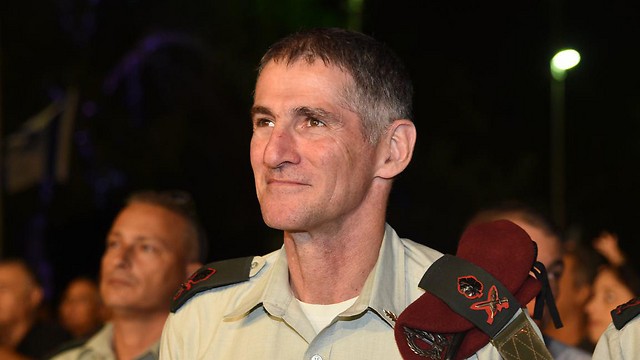
Yair Golan is not the first retired Israeli general to become a peacenik, nor will he be the last. This has become a pattern among Israel’s generals, a pattern set by generals, like Matti Peled and Motta Gur, regarded by Israelis as heroes during their military careers.

As a former deputy military chief and commander in the West Bank defending Israeli colonies, Golan is now a Knesset member for the dovish Meretz party, which favours Palestinian statehood, and speaks out against colonist attacks on Palestinians. He recently referred to violent colonists as “subhuman,” eliciting sharp criticism from colleagues in the right-leaning coalition and complaints from other quarters. Frankness is nothing new. As deputy military chief, he voiced concerns that Israel was becoming fascistic and compared it to Nazi Germany. This is also not a new approach as such terms were adopted decades ago by Israeli scientist and dedicated human rights activist, Israel Shahak, a survivor of Nazi death camps in Poland.

In an interview with the Associated Press Golan stated, “You can’t have a free and democratic state so long as we are controlling people who don’t want to be controlled by us. What kind of democracy are we building here long term?”

He argued that separating from the Palestinians is the only way Israel can remain democratic and based on Jewish values. This is also old hat. Even former Likud Prime Minister Ehud Olmert in 2007 urged Israel to negotiate a separation deal with the Palestinians in order to avoid becoming an “apartheid” state like South Africa.

While serving in the West Bank, Golan focused on combatting Palestinians resisting the occupation and continues to argue that most of the 650,000 colonists living illegally in the occupied territories are law-abiding. His favourable view of the colonists whose presence prevents the emergence of a viable Palestinian state contradicts his contention that Israelis and Palestinians should live separately.

Breaking the Silence, a group of former Israeli soldiers who oppose Israel’s occupation policies, responded to his stance by saying, “Yair Golan knows full well what settler violence looks like and what our violent control over the Palestinian people looks like. That is why his criticism is valuable, but it is not enough.” Indeed, fine words have never been enough to halt the late 19th century Zionist project of colonising the whole of Palestine and any other territory conquered by Israel.

The most high- profile general to break with Israel’s policy of ethnically cleansing or ruling Palestinians was Matti Peled who fought in Israel’s 1948-1949, 1956 and 1967 wars. Having played a role in the conquest of Palestine, Peled served as governor of conquered Gaza for six months after the tripartite Israeli, British and French aggression against Egypt. Unable to speak Arabic and having no knowledge of Palestinian history and customs, Peled found himself at a loss to deal with the hundreds of thousands of Palestinians in the strip until US President Dwight Eisenhower ended the occupation in 1957. He was the last US president who dared to tackle Israel and its US friends and allies.

Peled was among the hawkish generals who pressed Israeli Prime Minister Levi Eshkol to wage a preemptive attack against Egypt in the spring of 1967. This led to the seizure of East Jerusalem, the West Bank and Gaza and the strategic colonisation of these areas to deny Palestinians their state.

He retired from the military in 1968 and continued to study Arabic which he had begun while in the army. He co-founded the Arabic Literature department at Tel Aviv University, was recognised as a scholar in this field, and gradually drifted left-wards.

In 1975, Peled helped establish the Israeli Council for Israeli-Palestinian Peace and in 1977 became a founder of the Left Camp. In 1982, Peled supported reserve army officers who refused to fight in Israel’s war on Lebanon which galvanised the Israeli peace camp and led to the creation of the Jewish, Palestinian Progressive List for Peace. Peled was elected a Knesset member in 1984 and helped form the Gush Shalom, peace bloc, which played a key role in the period following the 1982 Israeli war in Lebanon and led to the Norwegian-brokered negotiations with the Palestinians in 1992-93.

Paratrooper general Mordechai “Motta” Gur became another hard-line military man to oppose Israeli policies after retirement. He did not become a peacenik like Peled but, like him, took a stand against the 1982 campaign in Lebanon at a time the Israeli peace camp was strongly supported by military officers and frontline soldiers as well as centrist and leftist civilians. The peace option survived for more than a decade.

Gur joined the Zionist underground army in 1946, fought in the 1948-49 war of establishment and the 1956 war in Sinai. He commanded the 55th Paratroopers Brigade which seized East Jerusalem in 1967, served in Gaza and the northern front with Syria and commanded the 1978 Israeli occupation of portions of southern Lebanon. He was appointed lieutenant general and in 1974 became army chief-of-staff. After leaving the military, he was elected to the Knesset as a Labour party member, served as minister of health and on the Knesset’s foreign affairs committee. After Labour, under former General Yitzak Rabin, who was not a peacenik, won the 1992 election on a peace platform, Gur was appointed defence minister and worked closely with Rabin who was under popular pressure to pursue accords with both Palestinians and Syrians.

Spurred to end the conflict with the Palestinians by the First Intifada (1987-1993) Foreign Minister Shimon Peres’ deputy Yossi Beilin supervised the Israeli team negotiating a secret peace deal with the Palestinians in Norway.

In September 1993, Rabin and Palestinian Liberation Organisation chairman Yasser Arafat agreed to the Oslo Accord which was meant to lead to the creation of a Palestinian state but failed due to Rabin’s refusal to halt Israeli colonisation and negotiate on Palestinian refugees, Israeli colonies, Jerusalem and other key issues. He was murdered in November 1995 by an Israeli extremist who believed, wrongly, Rabin was in the process of handing over occupied territory to the Palestinians.

26 January 2022

Source: www.globalresearch.ca

Europe in the Trenches Against the “Invented Enemy”

By Manlio Dinucci

The State Department, “as a precautionary measure against a possible Russian invasion of Ukraine”, ordered the evacuation of family members and part of the staff from the U.S. Embassy in Kiev, which with 900 officials is among the largest in Europe, and raised to level 4 of risk, the maximum, the warning to U.S. citizens not to go to Ukraine. Immediately afterwards the Foreign Office announced, with the same motivation, the withdrawal of staff from the British Embassy in Kiev. These operations of psychological warfare, aimed at creating alarm about an imminent Russian invasion of Ukraine and the three Baltic republics, prepare for a further and even more dangerous US-NATO escalation against Russia.

The White House announced that President Biden is considering “deploying several thousand U.S. troops, warships and aircraft to NATO countries in the Baltics and Eastern Europe.” Initially, 5,500 U.S. troops are expected to arrive, joining the 4,000 already in Poland and followed by thousands more, extending their permanent deployment to the Baltic, as Latvia has requested. Special rail convoys are already transporting U.S. tanks from Poland to Ukraine, whose armed forces have been trained for years, and in fact commanded by hundreds of U.S. military advisers and instructors flanked by others from NATO. Washington, which last year provided Kiev with weapons for the official amount of 650 million dollars, has authorized Estonia, Latvia and Lithuania to transfer to Ukraine US weapons in their possession, in particular Javelin missiles. Other armaments are provided by Great Britain and the Czech Republic.

NATO informs that the European countries of the Alliance are putting their armed forces in a state of operational readiness and sending other warships and fighter planes to the Eastern Europe deployments. Italy, with Eurofighter fighter-bombers, has taken command of NATO’s “enhanced air policing” mission in Romania. France is ready to send troops to Romania under NATO command. Spain is sending warships in NATO naval forces and fighter-bombers to Bulgaria. The Netherlands is preparing to send F-35 fighters to Bulgaria. Denmark is sending F-16 fighters to Lithuania. Yesterday began in the Mediterranean Sea the great NATO naval exercise Neptune Strike ’22 under the command of Vice Admiral Eugene Black, commander of the Sixth Fleet with headquarters in Naples Capodichino and base in Gaeta. The exercise, which lasts 12 days, involves the US nuclear aircraft carrier Harry Truman with its battle group, including 5 missile launchers ready for nuclear attack to “reassure the European Allies especially on the eastern front threatened by Russia”.

Immediately after the NATO Neptune Strike ’22, the exercise Mission Clemenceau 22 will take place in February. It will involve, in an “Operation of three aircraft carriers”, the French nuclear-powered Charles de Gaulle with its battle group, including a nuclear attack submarine, which will enter the Adriatic; the Harry Truman with its battle group and the Italian aircraft carrier Cavour with the F-35 on board. This exercise, of course, is also directed against Russia.

While NATO enjoins Russia to “de-escalate”, warning that “any further aggression will involve a high cost for Moscow”, the foreign ministers of the European Union – meeting in Brussels and connected by teleconference with the US Secretary of State Blinken – have decreed yesterday other measures against Russia. The European Union of 27, of which 21 belong to NATO under US command, echoes NATO’s warning to Russia, declaring that “any further military aggression against Ukraine would have very serious consequences for Russia”. In this way the EU participates in the strategy of tension, through which the U.S. create fractures in Europe to keep it under their influence.

*
Manlio Dinucci, award winning author, geopolitical analyst and geographer, Pisa, Italy.

25 January 2022

Source: www.globalresearch.ca