Just International

The West Spins A “Humanitarian” Tale, China Speaks at Human Rights Council of War Crimes in Afghanistan

By Kalinga Seneviratne

SYDNEY (IDN) — To cover up America and its allies humiliating defeat in Afghanistan, the Anglo-American media is spinning tales of a great “humanitarian” airlift to save Afghani women from assumed brutality when Taliban consolidate their power across Afghanistan. But, at the United Nations Human Rights Council (UNHRC) in Geneva on August 24 the Chinese changed the narrative calling for the US, UK, Australia and other NATO countries to be held accountable for violations of human rights committed during the two-decade-long war in Afghanistan.

“Under the banner of democracy and human rights the US and other countries carry out military interventions in other sovereign states and impose their own model on countries with vastly different history, culture and national conditions (which has) brought severe disasters to their people,” China’s ambassador in Geneva Cheng Xu told the council.

“United States, the United Kingdom and Australia must be held accountable for their violations of human rights in Afghanistan, and the resolution of this Special Session should cover this issue,” he added.

Amnesty International and a host of other civil society speakers have also called for the creation of a robust investigative mechanism that would allow for monitoring and reporting on human rights violations and abuses, including grave crimes under international law, and to assist in holding those suspected of criminal responsibility to justice in fair trials.

However, they were looking at the future rather than the past. The UNHRC member states, adopted by consensus a resolution which merely requests further reports and an update by the UN High Commissioner for Human Rights in March 2022.

China was extraordinarily critical of Australia in May this year when the so-called ‘Brereton Report’ was released by the Australian government into a four-year investigation of possible war crimes in Afghanistan by Australian forces. The findings revealed that some of Australia’s most elite soldiers in the SAS (Special Air Services) have been involved in unlawful killing, blood lust, a warrior culture and cover-up of their alleged atrocities.

It came as a surprise to an Australian public, who believe that Australian military engagement in Afghanistan was designed to keep the world safe from terrorists. Today, Australians and the rest of the world are fed by a news narrative that the West saved Afghani women from the brutality of the Islamic fundamentalist Taliban regime, and now they need to be airlifted by western forces to save them from falling into the hands of the Taliban again.

Rather than airlifting Afghans out of the country, China’s ambassador Xu told UNHRC “we (China) will continue developing a good neighbourly, friendly and cooperative relationship with Afghanistan and continue our constructive role in its process of peace and reconstruction”.

Reporting this, Yahoo Australia pointed out that Afghanistan is sitting on precious mineral deposits estimated to be worth $1 trillion and the country also has vast supplies of iron ore, copper and gold and is believed to be home to one of the world’s largest deposits of lithium. It was suggested in the report that China is eyeing these resources.

However, such suspicions should not come in the way of calling for the West to be accountable for its war crimes in Afghanistan, which have been well documented even by such organisations like Amnesty International and Human Rights Watch. The UNHRC has not taken up these issues so far, fearing US retaliation.

Speaking on Sri Lankan Sirasa TV’s Pathikade program, Professor Prathiba Mahanamahewa, former member of the Sri Lankan Human Rights Commission who went to Afghanistan on a fact-finding mission on the invitation of the Afghanistan Human Rights Commission in 2014 argued that Western nations have been instrumental in creating terrorist groups around the world like the Taliban to destabilize governing systems in countries.

“At the core of the Taliban is the idea of spreading Islamic fundamentalism and they have inspired similar movements in the region; thus, it is a big threat to countries in Asia, especially in South Asia,” argues Prof Mahanamahewa. “There are parties that pump a lot of funds to the Taliban.”

He said that in 2018, Sri Lanka (with several other countries) fought at the UNHRC to come up with a treaty to stop these financial flows to terrorist groups. “Until today, nothing has been done,” says Prof Mahanamahewa. He adds that Afghanistan is a large producer of opium and hashish, and the West is a big market for it, thus “Talibans would obviously like to have some form of relations with the West”.

In April 2019, the International Criminal Court (ICC) rejected its prosecutor Fatou Bensouda’s November 2017 request to open an investigation into possible war crimes and crimes against humanity during Afghanistan’s brutal armed conflict. Such an investigation would have investigated war crimes and brutality of both the Taliban and the US-led forces and activities of the CIA (Central Intelligence Agency). The panel of judges concluded that since the countries concerned have not taken any action with regards to perpetrators of possible “war crimes”, ICC could not act, because it is a court of last resort.

In March 2011, the Rolling Stones magazine carried a lengthy investigative report on how war crimes by US forces were covered up by the Pentagon. After extensive interviews with members of a group within the US forces called Bravo Company, they described how they were focused on killings Afghan civilians like going to the forests to hunt animals, and how these killings of innocent villages who were sometimes working in the fields were camouflaged as a terror attack by Taliban.

The soldiers involved were not disciplined or punished and US army aggressively moved to frame the incidents as the work of a “rogue unit”. The Pentagon clamped down on information about these killings, and soldiers in the Bravo Company were barred from speaking to the media.

While the US occupation continued, many human rights organisations have documented incidents like these and called for independent international investigations, which have met with lukewarm response. Only a few were punished with light sentences that did not reflect the gravity of the crime. After losing the elections, in November 2020 President Trump pardoned two US army officials who were accused and jailed for war crimes in Afghanistan. While some Pentagon leaders expressed concern that this action will damage military disciple, Trump tweeted “we train our boys to be killing machines, then persecute them when they kill”.

It is perhaps now time that the US indulged in some soul-searching about their culture of killing, rather than using a narrative of “saving Afghani women” to cover up barbaric killing the US led forces were involved in Afghanistan.

Pratap Bhanu Mehta, President, of one of India’s top think-tanks, Centre Policy Research, writing in the Indian Express argued that terrorist groups like Taliban or ISIS are “products of modern imperial politics” that is unsettling local societies, encouraging violence, supports fundamentalism, thus breaking up state structures. He listed 7 sins of the US Empire that contributed to the debacle in Afghanistan. These include corruption that drives war; self-deception like what happened in Vietnam and now Afghanistan; lack of morality where the empire drives lawlessness; and hypocrisy, a cult of violence and racism.

It is interesting that the Rolling Stones feature reflected the last two points in the way the Bravo Company went about picking up innocent villages for killing. But Mehta argues that “the modality of US withdrawal exuded the fundamental sin of empire. Its reinforcement of race and hierarchy”. he notes. “Suddenly, the pretext of common humanity, and universal liberation, which was the pretext of empire, turned into the worst kind of cultural essentialism. It is their culture, these medieval tribalists who are incapable of liberty”.

Hamid Dabashi, Professor of Iranian Studies and Comparative Literature at Columbia University writing in the Al Jazeera website asks: “What can the Taliban do to Afghanistan that it and the US, and their European allies have already not done to it?” He describes the Doha deal between the US and the Taliban as a deal to hand over Afghanistan back to the Taliban.

“As for Afghan women and girls, they are far better off fighting the fanaticism and stupidity of the Taliban on their own and not under the shadow of US military barracks,” argues Prof Dabashi. “Iranian, Pakistani, Turkish and Arab women have been fighting similar, if not identical, patriarchal thuggery right in their neighbourhood, so will Afghan women.”

28 August 2021

Source: www.indepthnews.net
Of Western wars and Muslim women

If Western wars are meant to ‘liberate’ Muslim women, why did centuries of Western military intervention fail to do so?

By Marwan Bishara

Author’s note: Twenty years ago, the United States and the United Kingdom exploited the cause of women and girls in Afghanistan and the rest of the Muslim world to justify their invasion, occupation and other forms of intervention in Muslim nations. Their leaders enlisted their wives, Laura Bush and Cherie Blair, in the propaganda war to “lift the veil” on the Taliban, well after the group retreated under fire.

In the following years, more women entered the workforce and more girls went to school, but Afghans continued to suffer from widespread poverty, illiteracy, and patriarchy compounded by violence, repression and war, hurting women first and foremost. Afghanistan became the “forgotten war” and the cause of its women disremembered until recently when the Trump administration basically handed Afghanistan back to the Taliban and the Biden administration withdrew US forces rather humiliatingly from the country.

Editor’s note: The article below first appeared on Al Jazeera’s website on August 5, 2010, under the title Western wars vs Muslim women.

Western media is awash with reports about Taliban mistreatment of women in Afghanistan and Pakistan that feature countless voices in support of the war to secure a “brighter future for women’s rights”. This week’s Time magazine cover story is a case in point.

If Western wars “liberated” Eastern women, Muslim women would be – after centuries of Western military interventions – the most ‘liberated’ in the world. They are not, and will not be, especially when liberty is associated with Western hegemony.

Afghanistan has had its share of British, Russian and American military intervention to no avail. In fact, reports from credible women’s groups there signal worsening conditions for Afghan women since the US invasion a decade ago.

The Taliban’s social norms might be an affront to modern values, but they cannot be replaced summarily with Western values, let alone by force.

If, as General Petreaus insists, US soldiers should “live” with Afghans in order to defeat the “insurgency”, expect more hostility towards the foreign invaders and their values.

White man’s burden

The same Orientalist civilising rationale that was used over centuries to justify bloody colonial wars is being used nowadays to manipulate a war-averse public into supporting military escalation in Central Asia.

Western man’s long-held fantasy of “rescuing” veiled women from their repressive captors is being exploited to promote the idea that war can free women from the wrath of the “bearded terrorists”, as it “liberates America” from their terrorism.

In light of such a heavy dose of surplus morality, it was particularly embarrassing for US leaders that their allies were making amends with the same shunned illiberal groups and practices.

Last year, the Obama administration publicly scolded Asif Ali Zardari, the Pakistani president, for recognising Sharia in the tiny Swat Valley as an “abdication” to the Taliban and rebuked Hamid Karzai, Afghanistan’s president, for signing a law that reportedly permits rape in marriage among the country’s Shia minority. Never mind that until recently, marital rape was legal in the UK and US, where it is still not treated as ordinary rape in a number of states.

Those who seek military solutions to social problems fail to make the distinction between Islam and the Taliban or between the cultural and religious aspects of life in Central Asia. Furthermore, they fail to explain why or how women’s rights can be attained by military means.

After all, the great majority of Pakistanis and Afghans have already voted against the Taliban – and in the case of Pakistan, in favour of a secular party headed by a Westernised woman, the late Benazir Bhutto, who was allegedly assassinated by the Taliban. Indeed the founders of Pakistan were no less secular than many of their Western counterparts.

Recent months have shown that the Pakistani government is capable of confronting the Taliban when necessary. And when Pakistani television showed the public flogging of a 17-year-old girl, it led to widespread outrage among the more than 170 million Pakistanis.

For decades, Pakistanis and Afghans were the victims of the medieval-styled Taliban, Mujahideen and warlords who were backed and armed by the US through the Pakistani and Saudi intelligence services.

In fact, for much of the 20th century, Western-led or supported military interventions in the greater Middle East have, intended or otherwise, targeted mostly the national secular regimes in the region – from Iran’s Musaddeq to Egypt’s Nasser through Iraq’s Hussein, not to speak of Afghanistan’s Soviet-installed Najibullah.

White woman’s burden

The irony escapes the likes of conservative British politician Cyril Townsend, who wrote in the Saudi owned pan-Arab newspaper Al-Hayat – under the headline Women’s Rights in Afghanistan – that British female soldiers are fighting for women’s rights to be realised there.

No explanation has been offered as to why, 18 years after the deployment of half a million US and British troops to liberate Kuwait and defend their ally Saudi Arabia, Saudi women still cannot vote or drive.

Similar cheering was expressed in 2001 by Laura Bush and Cherie Blair in support of the “war to liberate the women of Afghanistan” when in reality they were promoting their men’s war, not women’s rights.

Time magazine joined the war choir this week with a plea not to forget the plight of Afghan women. Richard Stengel, the magazine’s managing editor, wrote that he did not run this story or show this image “either in support of the US war effort or in opposition to it”. Perhaps, but the cover story contributes to justifying the war on humanitarian “civilising” grounds instead of criticising it on those same grounds.

A century after English poet Rudyard Kipling first invoked the “White Man’s Burden” to explain the US’s invasion and occupation of the Philippines, Washington and London continue to justify their military interventions and occupation, on more of the same debunked falsehoods.

It is scandalous that after the sham of the “White Man’s Burden” was exposed with the blood of millions, more of the same violence is justified under the pretext of a “White Man and Woman’s Burden”.

This is especially the case when many advocate the bombing of other cultures into social parity or cultural affinity with the West. Such dangerous eschatology that hopes to build on destruction will end up destroying entire Muslim societies for the charade of attaining women’s liberty as the West fancies it.

Victims of the ultimate power abuse, wars

As the foremost victims of the abuse of power, Western women are uniquely positioned to reject the most patriarchal and destructive of all power abuses: Wars.

As for Muslim women, there is no room in this war for what they stand for, their hopes or aspirations. Their voice is progressively silenced by the deafening sound of bombs and explosions.

Eastern women have been the first civilian casualty of wars. How many mourning widows, mothers, sisters and daughters will it take to reject wars of choice and expose their alleged civilising mission? After decades of war, Iraq and Afghanistan are now nations of widows – five million and counting, according to some reports.

Remember that the mistreatment of women stops at no cultural or geographic borders. Paradoxically, in the US, violence against women in war veteran families is three to five times higher than in average families. This is literally a “White Woman’s Burden”.

Many women enlist in the military to attain equality with men, and more of them have fought in Iraq and Afghanistan than ever before. But I agree with those who seek to undo a man-made world of wars altogether.

At any rate, men do not go to war to save women. Rather, according to war historian Martin Van Creveld, men go to war to run away from their wives and families in search of ecstasy. Not exactly a woman’s cause now, is it?

Marwan Bishara is an author who writes extensively on global politics and is widely regarded as a leading authority on US foreign policy, the Middle East and international strategic affairs.

2 September 2021

Source: www.aljazeera.com

Catastrophe in Afghanistan: U.S. Wrecks another Country Thinking It’s Playing the ‘Great Game’

By John Pilger

24 Aug 2021 – ​​As a tsunami of crocodile tears engulfs Western politicians, history is suppressed. More than a generation ago, Afghanistan won its freedom, which the United States, Britain and their “allies” destroyed.

In 1978, a liberation movement led by the People’s Democratic Party of Afghanistan (PDPA) overthrew the dictatorship of Mohammad Daoud, the cousin of King Zahir Shar. It was an immensely popular revolution that took the British and Americans by surprise.

Foreign journalists in Kabul, reported the New York Times, were surprised to find that “nearly every Afghan they interviewed said [they were] delighted with the coup.” The Wall Street Journal reported that “150,000 persons… marched to honor the new flag… the participants appeared genuinely enthusiastic.”

The Washington Post reported that “Afghan loyalty to the government can scarcely be questioned.” Secular, modernist and, to a considerable degree, socialist, the government declared a program of visionary reforms that included equal rights for women and minorities. Political prisoners were freed and police files publicly burned.

Under the monarchy, life expectancy was 35; one in three children died in infancy. Ninety percent of the population was illiterate. The new government introduced free medical care. A mass literacy campaign was launched.

For women, the gains had no precedent; by the late 1980s, half the university students were women, and women made up 40 percent of Afghanistan’s doctors, 70 percent of its teachers and 30 percent of its civil servants.

So radical were the changes that they remain vivid in the memories of those who benefited. Saira Noorani, a female surgeon who fled Afghanistan in 2001, recalled:

“Every girl could go to high school and university. We could go where we wanted and wear what we liked… We used to go to cafes and the cinema to see the latest Indian films on a Friday… it all started to go wrong when the mujahedin started winning… these were the people the West supported.”

For the United States, the problem with the PDPA government was that it was supported by the Soviet Union. Yet it was never the “puppet” derided in the West, neither was the coup against the monarchy “Soviet backed,” as the American and British press claimed at the time.

President Jimmy Carter’s secretary of state, Cyrus Vance, later wrote in his memoirs: “We had no evidence of any Soviet complicity in the coup.”

In the same administration was Zbigniew Brzezinski, Carter’s national security adviser, a Polish émigré and fanatical anti-communist and moral extremist whose enduring influence on American presidents expired only with his death in 2017.

On July 3, 1979, unknown to the American people and Congress, Carter authorized a $500 million “covert action” program to overthrow Afghanistan’s first secular, progressive government. This was code-named by the CIA Operation Cyclone.

The $500 million bought, bribed and armed a group of tribal and religious zealots known as the mujahedin. In his semi-official history, Washington Post reporter Bob Woodward wrote that the CIA spent $70 million on bribes alone. He describes a meeting between a CIA agent known as “Gary” and a warlord called Amniat-Melli:

“Gary placed a bundle of cash on the table: $500,000 in one-foot stacks of $100 bills. He believed it would be more impressive than the usual $200,000, the best way to say we’re here, we’re serious, here’s money, we know you need it… Gary would soon ask CIA headquarters for and receive $10 million in cash.”

Recruited from all over the Muslim world, America’s secret army was trained in camps in Pakistan run by Pakistani intelligence, the CIA and Britain’s MI6. Others were recruited at an Islamic college in Brooklyn, New York—within sight of the doomed Twin Towers. One of the recruits was a Saudi engineer called Osama bin Laden.

The aim was to spread Islamic fundamentalism in Central Asia and destabilize and eventually destroy the Soviet Union.

In August 1979, the U.S. Embassy in Kabul reported that “the United States’ larger interests… would be served by the demise of the PDPA government, despite whatever setbacks this might mean for future social and economic reforms in Afghanistan.”

Read again the words above I have italicized. It is not often that such cynical intent is spelled out as clearly. The United States was saying that a genuinely progressive Afghan government and the rights of Afghan women could go to hell.

Six months later, the Soviets made their fatal move into Afghanistan in response to the American-created jihadist threat on their doorstep. Armed with CIA-supplied Stinger missiles and celebrated as “freedom fighters” by Margaret Thatcher, the mujahedin eventually drove the Red Army out of Afghanistan.

Calling themselves the Northern Alliance, the mujahedin were dominated by warlords who controlled the heroin trade and terrorized rural women. The Taliban were an ultra-puritanical faction, whose mullahs wore black and punished banditry, rape and murder but banished women from public life.

In the 1980s, I made contact with the Revolutionary Association of the Women of Afghanistan, known as RAWA, which had tried to alert the world to the suffering of Afghan women. During the Taliban time they concealed cameras beneath their burqas to film evidence of atrocities, and did the same to expose the brutality of the Western-backed mujahedin. “Marina” of RAWA told me, “We took the videotape to all the main media groups, but they didn’t want to know. …”

In 1996, the enlightened PDPA government was overrun. The president, Mohammad Najibullah, had gone to the United Nations to appeal for help. On his return, he was hanged from a streetlight.

“I confess that [countries] are pieces on a chessboard,” said Lord Curzon in 1898, “upon which is being played out a great game for the domination of the world.”

The viceroy of India was referring in particular to Afghanistan. A century later, Prime Minister Tony Blair used slightly different words.

“This is a moment to seize,” he said following 9/11. “The kaleidoscope has been shaken. The pieces are in flux. Soon they will settle again. Before they do, let us reorder this world around us.”

On Afghanistan, he added this: “We will not walk away [but ensure] some way out of the poverty that is your miserable existence.”

Blair echoed his mentor, President George W. Bush, who spoke to the victims of his bombs from the Oval Office: “The oppressed people of Afghanistan will know the generosity of America. … As we strike military targets, we will also drop food, medicine and supplies to the starving and suffering…”

Almost every word was false. Their declarations of concern were cruel illusions for an imperial savagery “we” in the West rarely recognize as such.

In 2001, Afghanistan was stricken and depended on emergency relief convoys from Pakistan. As the journalist Jonathan Steele reported, the invasion indirectly caused the deaths of some 20,000 people as supplies to drought victims stopped and people fled their homes.

Eighteen months later, I found unexploded American cluster bombs in the rubble of Kabul which were often mistaken for yellow relief packages dropped from the air. They blew the limbs off foraging, hungry children.

In the village of Bibi Maru, I watched a woman called Orifa kneel at the graves of her husband, Gul Ahmed, a carpet weaver, and seven other members of her family, including six children, and two children who were killed next door.

An American F-16 aircraft had come out of a clear blue sky and dropped an Mk 82 500-pound bomb on Orifa’s mud, stone and straw house. Orifa was away at the time. When she returned, she gathered the body parts.

Months later, a group of Americans came from Kabul and gave her an envelope with 15 notes: a total of $15. “Two dollars for each of my family killed,” she said.

The invasion of Afghanistan was a fraud. In the wake of 9/11, the Taliban sought to distance themselves from Osama bin Laden. They were, in many respects, an American client with which the administration of Bill Clinton had done a series of secret deals to allow the building of a $3 billion natural gas pipeline by a U.S. oil company consortium.

In high secrecy, Taliban leaders had been invited to the United States and entertained by the CEO of the Unocal company in his Texas mansion and by the CIA at its headquarters in Virginia. One of the deal-makers was Dick Cheney, later George W. Bush’s vice president.

In 2010, I was in Washington and arranged to interview the mastermind of Afghanistan’s modern era of suffering, Zbigniew Brzezinski. I quoted to him his autobiography in which he admitted that his grand scheme for drawing the Soviets into Afghanistan had created “a few stirred-up Muslims.”

“Do you have any regrets?” I asked.

“Regrets! Regrets! What regrets?”

When we watch the current scenes of panic at Kabul’s main international airport, and listen to journalists and generals in distant TV studios bewailing the withdrawal of “our protection,” isn’t it time to heed the truth of the past so that all this suffering never happens again?

John Pilger has won an Emmy and a BAFTA for his documentaries, which have also won numerous US and European awards.

30 August 2021

Source: www.transcend.org

I Was a Marine in Afghanistan. We Sacrificed Lives for a Lie.

By Timothy Kudo

16 Aug 2021 – The Afghan cities fall in rapid succession, like men caught in enfilade fire. First Zaranj, Kunduz a few days later, then Kandahar and Lashkar Gah. Next is Mazar-i-Sharif. And finally, the Taliban begin their move to swiftly and decisively take Kabul.

I watch this news, and at first I feel nothing. But at night I return once more to Afghanistan. There is a nightmare: The enemy and I are in each other’s sights. Who will shoot first? I squeeze, but the trigger freezes. The Taliban fighter’s finger curls. I wake. I have had this dream for 10 years, ever since returning from Afghanistan, but now it feels as though it has become real.

Decades of war are dissolved in weeks. The Taliban advance with a speed that reminds me of the American conquest of Baghdad. There are other similarities: Taliban troops enter the gilded compounds of our corrupt Afghan allies and marvel at the evidence of years of American aid stolen by their former government leaders.

During the day my thoughts become preoccupied by the past. I hear a squad on the other end of the radio pinned down, a report about a Marine hit, the crack of fear in the sergeant’s voice, clock ticking as the blood pours from the 19-year-old’s neck; we race to send the helicopter that will arrive too late.

I see a report that the American Embassy will destroy its American flags to deny the Taliban a propaganda victory. I think of the star-spangled banner that flew over my old patrol base, called Habib, Arabic for “beloved.” Five men died under that flag, for what?

The hawks still circle and screech. The voices from the past 20 years who prodded us forward into battle return to the evening news to sell us on staying. “It’s not too late,” the former generals, secretaries and ambassadors say. “More troops can hold the line. Victory is just around the corner.”

But the speed of the Taliban’s advance makes clear that this outcome was always inevitable. The enemy had no reason to negotiate and no reputation for restraint. The only question before President Biden was how many American troops should die before it happened. But if leaving now was the right decision for America, it is a catastrophe for the Afghan people whom we have betrayed.

The Afghans are forced back into living under religious tyranny, an existence made all the more painful by their brief experience with freedom. Now they see the light from the far end of a dark tunnel. The school doors will close for girls, and the boys will return to their religious studies. For them, the arc of the moral universe will bend backward and break.

It’s my old unit, First Battalion, Eighth Marines, that is sent in to secure the airport in Kabul. I am jealous. I would give anything to return right now, to give what last full measure remains. But that is impossible. Soon I learn that there is a fallback embassy at the airport, that our position is collapsing, that talk of weeks has turned to days and finally hours, 36 of them, to evacuate the Americans who remain.

As all this unfolds, there is much fanfare over the celebrities at Barack Obama’s 60th birthday party, a celebration held as the war he expanded during his presidency ends in infamy. But he is not alone. Our other commanders in chief also bear responsibility for what has occurred. And there is no celebrating for those of us who ache each day wondering how we could have given the best parts of our lives to such a lie.

The collapse has been sudden, our exit too ill planned to evacuate the vulnerable Afghans who worked with us. We’re desperate for the allied nations that went to war with us to take them in on our behalf. A few thousand here, a few thousand there. I look across the New York Harbor to the Statue of Liberty and wonder why we are not lifting our own lamp for those abandoned by this war. Is our new Colossus dead, or will she rise to repay her debt?

In my mind I see the Huey helicopter teetering above the American Embassy in Saigon, but rest assured, they say, the end of Afghanistan will be different from 1975. Still, our fathers, and our grandfathers, fought and lost this battle before and know better, even if we did not. Will our own children suffer the same?

There is more than enough blame to go around. After all, without those of us who volunteered, there’d be nobody to fight these wars. I long to appear before the young man I was, slap his face and tell him to take a different course. “You’re going to die over there,” I want to say. “Not in body, but in spirit.” But he is gone, and I will spend the rest of my life staring at his shadow.

And finally, there are my fellow Americans — Republicans, Democrats and independents alike — who voted repeatedly over 20 years for those presidents and members of Congress to mislead and mismanage us to defeat. This national shame is a millstone around all our necks.

Suddenly, reality snaps into focus. It’s the entire nation of Afghanistan that is pinned down. I can hear her people screaming. And I will hear her death rattle before long.

Here at home, the Manhattan skyline is clear, the Freedom Tower glistens, and our nation lumbers onward. This American tragedy has reached its final act. Now we wait for the curtain to fall.

Timothy Kudo (@KudoTim), a former Marine captain who served in Iraq and Afghanistan, is working on a novel about the Afghanistan war.

30 August 2021

Source: www.transcend.org

Debacle in Afghanistan

By Tariq Ali

16 Aug 2021 – The fall of Kabul to the Taliban on 15 August 2021 is a major political and ideological defeat for the American Empire. The crowded helicopters carrying US Embassy staff to Kabul airport were startlingly reminiscent of the scenes in Saigon – now Ho Chi Minh City – in April 1975. The speed with which Taliban forces stormed the country was astonishing; their strategic acumen remarkable. A week-long offensive ended triumphantly in Kabul. The 300,000-strong Afghan army crumbled. Many refused to fight. In fact, thousands of them went over to the Taliban, who immediately demanded the unconditional surrender of the puppet government. President Ashraf Ghani, a favourite of the US media, fled the country and sought refuge in Oman. The flag of the revived Emirate is now fluttering over his Presidential palace. In some respects, the closest analogy is not Saigon but nineteenth-century Sudan, when the forces of the Mahdi swept into Khartoum and martyred General Gordon. William Morris celebrated the Mahdi’s victory as a setback for the British Empire. Yet while the Sudanese insurgents killed an entire garrison, Kabul changed hands with little bloodshed. The Taliban did not even attempt to take the US embassy, let alone target American personnel.

The twentieth anniversary of the ‘War on Terror’ thus ended in predictable and predicted defeat for the US, NATO and others who clambered on the bandwagon. However one regards the Taliban’s policies – I have been a stern critic for many years – their achievement cannot be denied. In a period when the US has wrecked one Arab country after another, no resistance that could challenge the occupiers ever emerged. This defeat may well be a turning point. That is why European politicians are whinging. They backed the US unconditionally in Afghanistan, and they too have suffered a humiliation – none more so than Britain.

Biden was left with no choice. The United States had announced it would withdraw from Afghanistan in September 2021 without fulfilling any of its ‘liberationist’ aims: freedom and democracy, equal rights for women, and the destruction of the Taliban. Though it may be undefeated militarily, the tears being shed by embittered liberals confirm the deeper extent of its loss. Most of them – Frederick Kagan in the NYT, Gideon Rachman in the FT – believe that the drawdown should have been delayed to keep the Taliban at bay. But Biden was simply ratifying the peace process initiated by Trump, with Pentagon backing, which saw an agreement reached in February 2020 in the presence of the US, Taliban, India, China and Pakistan. The American security establishment knew that the invasion had failed: the Taliban could not be subdued no matter how long they stayed. The notion that Biden’s hasty withdrawal has somehow strengthened the militants is poppycock.

The fact is that over twenty years, the US has failed to build anything that might redeem its mission. The brilliantly lit Green Zone was always surrounded by a darkness that the Zoners could not fathom. In one of the poorest countries of the world, billions were spent annually on air-conditioning the barracks that housed US soldiers and officers, while food and clothing were regularly flown in from bases in Qatar, Saudi Arabia and Kuwait. It was hardly a surprise that a huge slum grew on the fringes of Kabul, as the poor assembled to search for pickings in dustbins. The low wages paid to Afghan security services could not convince them to fight against their countrymen. The army, built up over two decades, had been infiltrated at an early stage by Taliban supporters, who received free training in the use of modern military equipment and acted as spies for the Afghan resistance.

This was the miserable reality of ‘humanitarian intervention’. Though credit where credit is due: the country has witnessed a huge rise in exports. During the Taliban years, opium production was strictly monitored. Since the US invasion it has increased dramatically, and now accounts for 90% of the global heroin market – making one wonder whether this protracted conflict should be seen, partially at least, as a new opium war. Trillions have been made in profits and shared between the Afghan sectors that serviced the occupation. Western officers were handsomely paid off to enable the trade. One in ten young Afghans are now opium addicts. Figures for NATO forces are unavailable.

As for the status of women, nothing much has changed. There has been little social progress outside the NGO-infested Green Zone. One of the country’s leading feminists in exile remarked that Afghan women had three enemies: the Western occupation, the Taliban and the Northern Alliance. With the departure of the United States, she said, they will have two. (At the time of writing this can perhaps be amended to one, as the Taliban’s advances in the north saw off key factions of the Alliance before Kabul was captured). Despite repeated requests from journalists and campaigners, no reliable figures have been released on the sex-work industry that grew to service the occupying armies. Nor are there credible rape statistics – although US soldiers frequently used sexual violence against ‘terror suspects’, raped Afghan civilians and green-lighted child abuse by allied militias. During the Yugoslav civil war, prostitution multiplied and the region became a centre for sex trafficking. UN involvement in this profitable business was well-documented. In Afghanistan, the full details are yet to emerge.

Over 775,000 US troops have fought in Afghanistan since 2001. Of those, 2,448 were killed, along with almost 4,000 US contractors. Approximately 20,589 were wounded in action according to the Defense Department. Afghan casualty figures are difficult to calculate, since ‘enemy deaths’ that include civilians are not counted. Carl Conetta of the Project on Defense Alternatives estimated that at least 4,200–4,500 civilians were killed by mid-January 2002 as a consequence of the US assault, both directly as casualties of the aerial bombing campaign and indirectly in the humanitarian crisis that ensued. By 2021, the Associated Press were reporting that 47,245 civilians had perished because of the occupation. Afghan civil rights activists gave a higher total, insisting that 100,000 Afghans (many of them non-combatants) had died, and three times that number had been wounded.

In 2019, the Washington Post published a 2,000-page internal report commissioned by the US federal government to anatomise the failures of its longest war: ‘The Afghanistan Papers’. It was based on a series of interviews with US Generals (retired and serving), political advisers, diplomats, aid workers and so on. Their combined assessment was damning. General Douglas Lute, the ‘Afghan war czar’ under Bush and Obama, confessed that ‘We were devoid of a fundamental understanding of Afghanistan – we didn’t know what we were doing…We didn’t have the foggiest notion of what we’re undertaking…If the American people knew the magnitude of this dysfunction.’ Another witness, Jeffrey Eggers, a retired Navy Seal and a White House staffer under Bush and Obama, highlighted the vast waste of resources: ‘What did we get for this $1 trillion effort? Was it worth $1 trillion? … After the killing of Osama bin Laden, I said that Osama was probably laughing in his watery grave considering how much we have spent on Afghanistan.’ He could have added: ‘And we still lost’.

Who was the enemy? The Taliban, Pakistan, all Afghans? A long-serving US soldier was convinced that at least one-third of Afghan police were addicted to drugs and another sizeable chunk were Taliban supporters. This posed a major problem for US soldiers, as an unnamed Special Forces honcho testified in 2017: ‘They thought I was going to come to them with a map to show them where the good guys and bad guys live…It took several conversations for them to understand that I did not have that information in my hands. At first, they just kept asking: “But who are the bad guys, where are they?”’.

Donald Rumsfeld expressed the same sentiment back in 2003. ‘I have no visibility into who the bad guys are in Afghanistan or Iraq’, he wrote. ‘I read all the intel from the community, and it sounds as though we know a great deal, but in fact, when you push at it, you find out we haven’t got anything that is actionable. We are woefully deficient in human intelligence.’ The inability to distinguish between a friend and an enemy is a serious issue – not just on a Schmittean level, but on a practical one. If you can’t tell the difference between allies and adversaries after an IED attack in a crowded city market, you respond by lashing out at everyone, and create more enemies in the process.

Colonel Christopher Kolenda, an adviser to three serving Generals, pointed to another problem with the US mission. Corruption was rampant from the beginning, he said; the Karzai government was ‘self-organised into a kleptocracy.’ That undermined the post-2002 strategy of building a state that could outlast the occupation. ‘Petty corruption is like skin cancer, there are ways to deal with it and you’ll probably be just fine. Corruption within the ministries, higher level, is like colon cancer; it’s worse, but if you catch it in time, you’re probably okay. Kleptocracy, however, is like brain cancer; it’s fatal.’ Of course, the Pakistani state – where kleptocracy is embedded at every level – has survived for decades. But things weren’t so easy in Afghanistan, where nation-building efforts were led by an occupying army and the central government had scant popular support.

What of the fake reports that the Taliban were routed, never to return? A senior figure in the National Security Council reflected on the lies broadcast by his colleagues: ‘It was their explanations. For example, [Taliban] attacks are getting worse? “That’s because there are more targets for them to fire at, so more attacks are a false indicator of instability.” Then, three months later, attacks are still getting worse? “It’s because the Taliban are getting desperate, so it’s actually an indicator that we’re winning”…And this went on and on for two reasons, to make everyone involved look good, and to make it look like the troops and resources were having the kind of effect where removing them would cause the country to deteriorate.’

All this was an open secret in the chanceries and defence ministries of NATO Europe. In October 2014, the British Defence Secretary Michael Fallon admitted that ‘Mistakes were made militarily, mistakes were made by the politicians at the time and this goes back 10, 13 years…We’re not going to send combat troops back into Afghanistan, under any circumstances.’ Four years later, Prime Minister Theresa May redeployed British troops to Afghanistan, doubling its fighters ‘to help tackle the fragile security situation’. Now the UK media is echoing the Foreign Office and criticising Biden for having made the wrong move at the wrong time, with the head of the British armed forces Sir Nick Carter suggesting a new invasion might be necessary. Tory backbenchers, colonial nostalgists, stooge-journalists and Blair-toadies are lining up to call for a permanent British presence in the war-torn state.

What’s astonishing is that neither General Carter nor his relays appear to have acknowledged the scale of the crisis confronted by the US war machine, as set out in ‘The Afghanistan Papers’. While American military planners have slowly woken up to reality, their British counterparts still cling to a fantasy image of Afghanistan. Some argue that the withdrawal will put Europe’s security at risk, as al-Qaeda regroups under the new Islamic Emirate. But these forecasts are disingenuous. The US and UK have spent years arming and assisting al-Qaeda in Syria, as they did in Bosnia and in Libya. Such fearmongering can only function in a swamp of ignorance. For the British public, at least, it does not seem to have cut through. History sometimes presses urgent truths on a country through a vivid demonstration of facts or an exposure of elites. The current withdrawal is likely to be one such moment. Britons, already hostile to the War on Terror, could harden in their opposition to future military conquests.

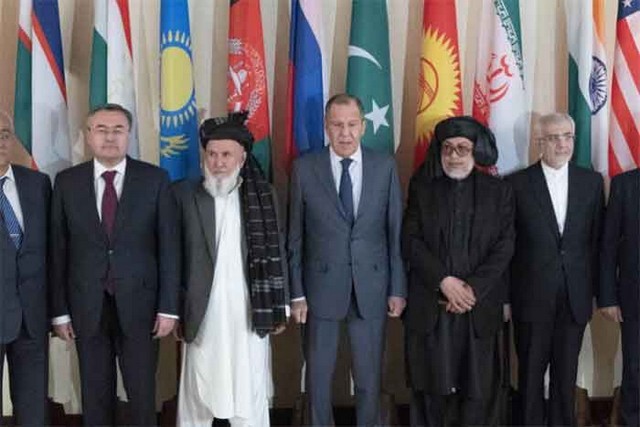
What does the future hold? Replicating the model developed for Iraq and Syria, the US has announced a permanent special military unit, staffed by 2,500 troops, to be stationed at a Kuwaiti base, ready to fly to Afghanistan and bomb, kill and maim should it become necessary. Meanwhile, a high-powered Taliban delegation visited China last July, pledging that their country would never again be used as a launch pad for attacks on other states. Cordial discussions were held with the Chinese Foreign Minister, reportedly covering trade and economic ties. The summit recalled similar meetings between Afghan mujahideen and Western leaders during the 1980s: the former appearing with their Wahhabi costumes and regulation beard-cuts against the spectacular backdrop of the White House or 10 Downing Street. But now, with NATO in retreat, the key players are China, Russia, Iran and Pakistan (which has undoubtedly provided strategic assistance to the Taliban, and for whom this is a huge politico-military triumph). None of them wants a new civil war, in polar contrast to the US and its allies after the Soviet withdrawal. China’s close relations with Tehran and Moscow might enable it to work towards securing some fragile peace for the citizens of this traumatised country, aided by continuing Russian influence in the north.

Much emphasis has been placed on the average age in Afghanistan: 18, in a population of 40 million. On its own this means nothing. But there is hope that young Afghans will strive for a better life after the forty-year conflict. For Afghan women the struggle is by no means over, even if only a single enemy remains. In Britain and elsewhere, all those who want to fight on must shift their focus to the refugees who will soon be knocking on NATO’s door. At the very least, refuge is what the West owes them: a minor reparation for an unnecessary war.

Tariq Ali is a British political activist, writer, journalist, historian, filmmaker, and public intellectual. He has been a leading figure of the international left since the 60s and a political commentator published on every continent.

30 August 2021

Source: www.transcend.org

Who Profits from the Kabul Suicide Bombing?

By Pepe Escobar

ISIS-Khorasan aims to prove to Afghans and to the outside world that the Taliban cannot secure the capital.

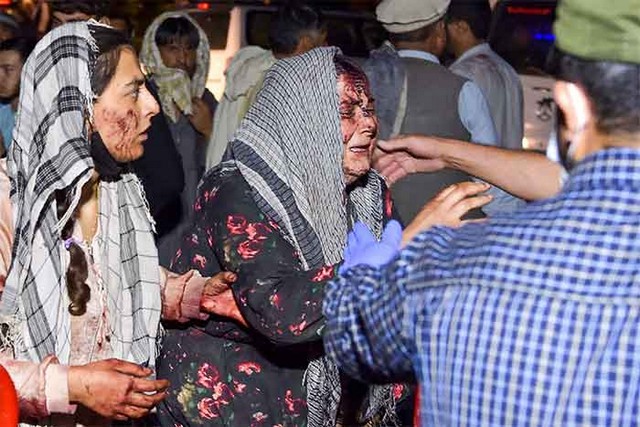
27 Aug 2021 – The horrific Kabul suicide bombing introduces an extra vector in an already incandescent situation: It aims to prove, to Afghans and to the outside world, that the nascent Islamic Emirate of Afghanistan is incapable of securing the capital.As it stands, at least 103 people – 90 Afghans (including at least 28 Taliban) and 13 American servicemen – were killed and at least 1,300 injured, according to the Afghan Health Ministry.

Responsibility for the bombing came via a statement on the Telegram channel of Amaq Media, the official Islamic State (ISIS) news agency. This means it came from centralized ISIS command, even as the perpetrators were members of ISIS-Khorasan, or ISIS-K.

Presuming to inherit the historical and cultural weight of ancient Central Asian lands that from the time of imperial Persia stretched all the way to the western Himalayas, that spin-off defiles the name of Khorasan.

The suicide bomber who carried out “the martyrdom operation near Kabul airport” was identified as one Abdul Rahman al-Logari. That would suggest he’s an Afghan, from nearby Logar province. And that would also suggest that the bombing may have been organized by an ISIS-Khorasan sleeper cell. Sophisticated electronic analysis of their communications would be able to prove it – tools that the Taliban don’t have.

The way social media-savvy ISIS chose to spin the carnage deserves careful scrutiny. The statement on Amaq Media blasts the Taliban for being “in a partnership” with the US military in the evacuation of “spies.”

It mocks the “security measures imposed by the American forces and the Taliban militia in the capital Kabul,” as its “martyr” was able to reach “a distance of no less than five meters from the American forces, who were supervising the procedures.”

So it’s clear that the newly reborn Islamic Emirate of Afghanistan and the former occupying power are facing the same enemy. ISIS-Khorasan comprises a bunch of fanatics, termed takfiris because they define fellow Muslims – in this case the Taliban – as “apostates.”

Founded in 2015 by emigré jihadis dispatched to southwest Pakistan, ISIS-K is a dodgy beast. Its current head is one Shahab al-Mujahir, who was a mid-level commander of the Haqqani network headquartered in North Waziristan in the Pakistani tribal areas, itself a collection of disparate mujahideen and would-be jihadis under the family umbrella.

Washington branded the Haqqani network as a terrorist organization way back in 2010, and treats several members as global terrorists, including Sirajuddin Haqqani, the head of the family after the death of the founder Jalaluddin.

Up to now, Sirajuddin was the Taliban deputy leader for the eastern provinces – on the same level with Mullah Baradar, the head of the political office in Doha, who was actually released from Guantanamo in 2014.

Crucially, Sirajuddin’s uncle, Khalil Haqqani, formerly in charge of the network’s foreign financing, is now in charge of Kabul security and working as a diplomat 24/7.

The previous ISIS-K leaders were snuffed out by US airstrikes in 2015 and 2016. ISIS-K started to become a real destabilizing force in 2020 when the regrouped band attacked Kabul University, a Doctor Without Borders maternity ward, the Presidential palace and the airport.

NATO intel picked up by a UN report attributes a maximum of 2,200 jihadis to ISIS-K, split into small cells. Significantly, the absolute majority are non-Afghans: Iraqis, Saudis, Kuwaitis, Pakistanis, Uzbeks, Chechens and Uighurs.

The real danger is that ISIS-K works as a sort of magnet for all manners of disgruntled former Taliban or discombobulated regional warlords with nowhere to go.

The perfect soft target

The civilian commotion these past few days around Kabul airport was the perfect soft target for trademark ISIS carnage.

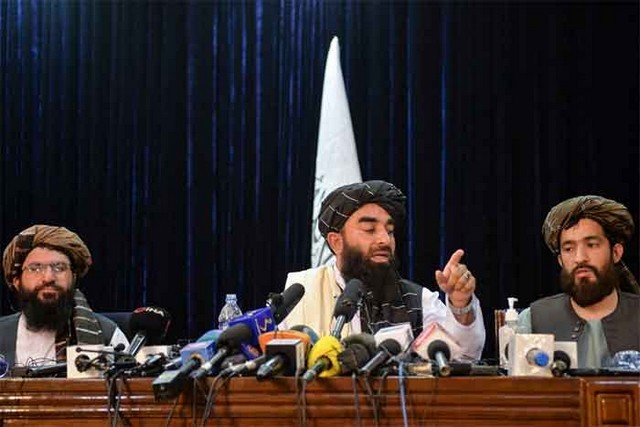
Zabihullah Mujahid – the new Taliban minister of information in Kabul, who in that capacity talks to global media every day – is the one who actually warned NATO members about an imminent ISIS-K suicide bombing. Brussels diplomats confirmed it.

In parallel, it’s no secret among intel circles in Eurasia that ISIS-K has become disproportionally more powerful since 2020 because of a transportation ratline from Idlib, in Syria, to eastern Afghanistan, informally known in spook talk as Daesh Airlines.

Moscow and Tehran, even at very high diplomatic levels, have squarely blamed the US-UK axis as the key facilitators. Even the BBC reported in late 2017 on hundreds of ISIS jihadis given safe passage out of Raqqa, and out of Syria, right in front of the Americans.

The Kabul bombing took place after two very significant events.

The first one was Mujahid’s claim during an American NBC News interview earlier this week that there is “no proof” Osama bin Laden was behind 9/11 – an argument that I had already hinted was coming in this podcast the previous week.

This means the Taliban have already started a campaign to disconnect themselves from the “terrorist” label associated with 9/11. The next step may involve arguing that the execution of 9/11 was set up in Hamburg, the operational details coordinated from two apartments in New Jersey.

Nothing to do with Afghans. And everything staying within the parameters of the official narrative – but that’s another immensely complicated story.

The Taliban will need to show that “terrorism” has been all about their lethal enemy, ISIS, and way beyond old school al-Qaeda, which they harbored up to 2001. But why should they be shy about making such claims? After all, the United States rehabilitated Jabhat Al-Nusra – or al-Qaeda in Syria – as “moderate rebels.”

The origin of ISIS is incandescent material. ISIS was spawned in Iraq prison camps, its core made of Iraqis, their military skills derived from ex-officers in Saddam’s army, a wild bunch fired way back in 2003 by Paul Bremmer, the head of the Coalition Provisional Authority.

ISIS-K duly carries the work of ISIS from Southwest Asia to the crossroads of Central and South Asia in Afghanistan. There’s no credible evidence that ISIS-K has ties with Pakistani military intel.

On the contrary: ISIS-K is loosely aligned with the Tehreek-e-Taliban (TTP), also known as the Pakistani Taliban, Islamabad’s mortal enemy. TTP’s agenda has nothing to do with the moderate Mullah Baradar-led Afghan Taliban who participated in the Doha process.

SCO to the rescue

The other significant event tied to the Kabul bombing was that it took place only one day after yet another phone call between Presidents Vladimir Putin and Xi Jinping.

The Kremlin stressed the pair’s “readiness to step up efforts to combat threats of terrorism and drug trafficking coming from the territory of Afghanistan”; the “importance of establishing peace”; and “preventing the spread of instability to adjacent regions.”

And that led to the clincher: They jointly committed to “make the most of the potential” of the Shanghai Cooperation Organization (SCO), which was founded 20 years ago as the “Shanghai Five”, even before 9/11, to fight “terrorism, separatism and extremism.”

The SCO summit is next month in Dushanbe – when Iran, most certainly, will be admitted as a full member. The Kabul bombing offers the SCO the opportunity to forcefully step up.

Whichever complex tribal coalition is formed to govern the Islamic Emirate of Afghanistan, it will be intertwined with the full apparatus of regional economic and security cooperation, led by the three main actors of Eurasia integration: Russia, China and Iran.

The record shows Moscow has all that it takes to help the Islamic Emirate against ISIS-K in Afghanistan. After all, the Russians flushed ISIS out of all significant parts of Syria and confined them to the Idlib cauldron.

In the end, no one aside from ISIS wants a terrorized Afghanistan, just as no one wants a civil war in Afghanistan. So the order of business indicates not only an SCO-led frontal fight against existing ISIS-K terror cells in Afghanistan but also an integrated campaign to drain any potential social base for the takfiris in Central and South Asia.

Pepe Escobar is a Brazilian independent geopolitical analyst. He is a frequent contributor to websites and radio and TV shows ranging from the US to East Asia.

30 August 2021

Source: www.transcend.org

India reaches out to Russia to break out of regional isolation over Afghanistan

By M K Bhadrakumar

The Indian establishment media hyped up Prime Minister Narendra Modi’s call with Russian President Vladimir Putin on August 24 in a desperate attempt to distract attention from Delhi’s abject isolation over the Afghanistan situation.

The desperation to clutch at any straw stems out of the complete breakdown of India’s Afghan policy. The government’s narrative on Afghanistan stands exposed as deeply flawed.

Putin has acceded to Modi’s request for establishing “a two-way channel for permanent consultations” on the Afghan issue. (here) Russia has always been open to such cooperation with India but Modi government prioritised India’s partnership with the US.

The spin doctors in Delhi have planted a story in the media that Putin will accord recognition to a Taliban government only in tandem with Modi. Putin also agreed, apparently, with Modi’s assessment that Pakistan will exploit the Taliban’s ascendance in Kabul to fuel terrorism in the region. read more

This is clearly a case of spin going overboard. Indian officials may have seriously embarrassed the Kremlin by spreading canards even if the motive might have been to impress an all-party meeting with the opposition on Friday.

Moscow takes a ‘de-hyphenated’ approach toward relations with India and Pakistan. In the Russian calculus, Pakistan figures as a serious partner with the potential to help advance some of Russia’s core interests in the Eurasian region in a way that India never can or will, given its quasi-alliance with the US. This is one thing.

Second, India’s policies increasingly grate against Russia’s vital interests and core concerns. India is travelling in the Quad vehicle although that platform is a template of the US’ dual containment strategy toward China and Russia.

The Russian leadership at the highest level repeatedly cautioned Delhi that Moscow is unhappy with the US’ efforts to create a bloc of countries in the ‘Indo-Pacific’ to contain China and Russia. But Russia’s concerns not only fell on deaf ears but Modi government is openly ecstatic that the Quad is getting institutionalised with regular summit level meetings.

Now, despite the troubled history of Russia’s relations with Pakistan, Islamabad has been overly keen to foster close ties with Moscow. When it comes to Afghanistan, Pakistan unhesitatingly facilitated contacts between Russian and Taliban officials, which now stand Moscow in good stead.

Whereas Delhi remains transfixed on the dated notions that the Taliban is only a Pakistani proxy, Moscow sees the Taliban as an authentic Afghan entity with a legitimate role to play in that country’s mainstream politics. Thus, engagement with the Taliban is a centrepiece of Russia’s Afghan policy today.

Suffice to say, this contradiction cannot be glossed over even if Modi were to make half a dozen phone calls to Putin. Put differently, Russia will not be deterred on its tracks because Modi government has become a laggard on the Afghan question.

Interestingly, Putin had a call with Pakistan Prime Minister Imran Khan regarding the Afghan situation only a day after his conversation with Modi. The Russian readout shows a high degree of convergence between Moscow and Islamabad on the way forward in Afghanistan.

The readout says both leaders “stressed the importance of maintaining peace and security” in Afghanistan, “preventing violence and establishing an inter-Afghan dialogue that would facilitate the formation of an inclusive government that takes into account the interests of all segments of the population.”

Putin and Imran Khan “agreed to coordinate approaches to the Afghan issue both in bilateral and multilateral formats” and to “use the capabilities of the Shanghai Cooperation Organisation in ensuring regional stability and the fight against terrorism and the drug threat.”

The SCO being a code word of sorts for China’s regional role, this is a significant point of reference. (The readout on Modi-Putin conversation made no such reference to the SCO role in Afghanistan.)

The Russian readout concluded by underscoring that “Russian-Pakistani contacts at various levels will be intensified.” Clearly, the Kremlin attaches high importance to cooperation with Pakistan in the period ahead. Conceivably, Afghan reconstruction and the CPEC will open up huge opportunities for Russian business and industry.

Recent Chinese commentaries have flagged that “China’s close coordination and shared interests with Russia will also play a major role in potential rebuilding efforts in Afghanistan… In the Afghanistan situation, China and Russia have maintained close communication and have shared interests in peace and development in Afghanistan, which makes the two countries the main players and partners in Afghanistan’s rebuilding efforts, in stark contrast to the US’ intention to sow chaos in the country…”

“While China can play the leading role in carrying out specific projects with its building capabilities and funding sources, Russia can offer crucial support in such projects with its massive influence in both Afghanistan and the region in ensuring stability and security in the region. Experts said that China and Russia are among the countries that most sincerely want peace and development in Afghanistan, even as the US and some other Western countries continue to seek to undermine that.” read more

Yet another Chinese commentary this week entitled Afghan reconstruction may boost de-dollarization push wrote: “As the US seeks to impose sanctions against Afghanistan and stop much-needed global assistance to the country, the already-emerging global de-dollarization push could further accelerate with countries increasingly adopting alternatives to the US dollar… If Afghanistan’s reconstruction sets the stage for the increased presence and usage of other currencies like the euro and the yuan, the dollar’s status could be further diminished. In fact, the de-dollarization trend has already emerged in a number of countries and regions including Russia and Saudi Arabia.”

The flawed Indian policy toward Afghanistan is missing the woods for the trees. Modi government doesn’t have a “big picture”. Its zero-sum mindset is obsessed with rolling back the influence of China and Pakistan, its archetypal enemies, in Afghanistan. Whereas, all serious regional states are approaching the Afghan situation with a fulsome agenda of geoeconomics, especially Russia.

Delhi pinned high hopes on the US to rev up the great game in Afghanistan with an eye on Xinjiang and Pakistan, but, as it turned out, Washington dumped Delhi and began pursuing a renewed relationship with the Taliban.

Modi’s call with Putin was a desperate attempt to mitigate India’s regional isolation. Putin understood and played his part, while sequestering Russia’s deepening ties with Pakistan.

Posted in his blog, Indianpunchline

Ambassador M K Bhadrakumar introduces about himself thus: “Roughly half of the 3 decades of my diplomatic career was devoted to assignments on the territories of the former Soviet Union and to Pakistan, Iran and Afghanistan.

28 August 2021

Source: countercurrents.org

Terror bombs, gunfire kill at least 72 in Afghanistan capital

By Patrick Martin

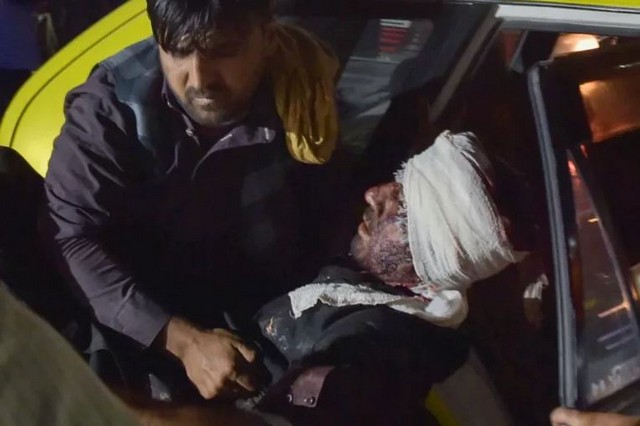
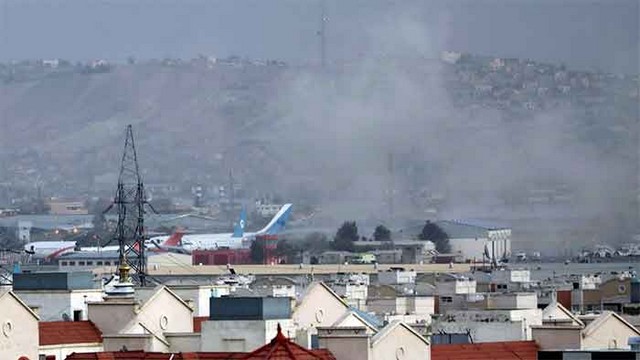
In what the US military described as a “complex attack,” several terrorists attacked a screening checkpoint at a gate into the Kabul airport and a nearby hotel on Thursday, inflicting a horrific toll of death and destruction.

Unnamed Afghan health officials told the media that at least 60 Afghan citizens were killed and another 140 wounded. The Pentagon said that 12 US Marines were killed and 15 wounded. Many of the wounded civilians and soldiers were in critical condition and the death toll could rise significantly.

At least two suicide bombers were believed to have detonated explosive-laden vests while awaiting or actually undergoing screening by US Marines at the Abbey Gate to the airport. Another suicide bomber, or perhaps a car bomb, exploded outside the Baron Hotel about 100 yards away. At the same time, gunmen opened fire on the crowd assembled outside the gate seeking to gain admittance to the airport and board evacuation flights.

US soldiers opened fire after the bombs were detonated, in order to clear the area in front of the gate. It was not clear whether any of the casualties were the result of that gunfire.

A group calling itself Islamic State-Khorasan, or ISIS-K, released a statement claiming responsibility for the attack. Allegedly a regional branch of ISIS, the group takes its title from the ancient name for the region of Central Asia of which Afghanistan is part.

The Taliban, which the Biden administration calls a “bitter enemy” of the Islamic State, denounced the attack. “The Islamic Emirate strongly condemns the bombing of civilians at Kabul airport, which took place in an area where US forces are responsible for security,” Taliban spokesman Suhail Shaheen said on Twitter.

A Taliban official told the Washington Post that the group has “launched an investigation to know the nature of the blasts and why it happened.”

The day before the attack, the US Embassy in Kabul, which has relocated to the airport, issued an official warning to Americans to stay away from the airport unless they had a scheduled flight to board, and calling on any US citizens near the airport gates to “leave immediately,” citing the imminent danger of a terrorist attack.

The 12 Marines were the first deaths among US troops in Afghanistan since February 2020, after the Trump administration signed a peace deal with the Taliban in which the Islamic group agreed to halt attacks on US forces in return for a commitment that US troops would be withdrawn by May 1, 2021.

President Biden has repeatedly cited that agreement as compelling him to choose between completing the pullout or tearing up the deal and resuming a full-scale war in Afghanistan.

This pullout was largely completed by late July, with a formal handover of Bagram airbase and other US facilities to the Afghan government, but the regime collapsed in the face of a Taliban offensive that culminated in the fall of Kabul on August 15. US troops were then rushed back into the country, using the Kabul airport as a point of entry and as a collection point for evacuations.

The bloodbath at the airport caused political shock waves throughout official Washington. Only 15 minutes before Biden was to meet with Naftali Bennett, the new prime minister of Israel, the White House announced the meeting had been delayed until Friday, and a series of other meetings were canceled as top US national security officials dealt with the crisis.

Biden finally appeared before television cameras at 5 p.m. Washington time. He denounced the attack and said that evacuation flights would continue undeterred. Just over 100,000 people have left Afghanistan since the flights began August 14, and 7,000 more flew out of the airport on Thursday, he said.

Biden rejected calls from Republican congressmen that he drop the August 31 deadline for the removal of US troops, or that he send more troops to the airport and expand their scope of operations, either into Kabul or to seize Bagram airbase, the huge complex north of the capital city that was long the US military headquarters in Afghanistan.

He defended a policy of relying on the Taliban forces to provide security outside the US perimeter at the airfield, saying that there was no alternative, and that the Taliban and ISIS had a long history of conflict. He threatened military action against ISIS, declaring, “We will respond with force and precision at our time, at the place we choose and the moment of our choosing.”

At an earlier press briefing, General Frank McKenzie, head of the US Central Command and in overall command of operations at the Kabul airport, said that terrorist attacks were expected in the remaining four days before all US forces are to be pulled out August 31.

He elaborated on the US military’s de facto alliance with the Taliban, saying US commanders were in regular contact with Islamic group, which was “actually providing the outer security of the airfield … and we will coordinate with them as they go forward.”

He said the face-to-face searches at the three gates to the airport were essential for the security of the airfield and especially of airplanes carrying out the evacuation flights. “You don’t want to let somebody on an airplane carrying a bomb, that could result in massive loss of life if an airplane were to get hit,” he explained.

Other dangers at the airport included rocket attacks, he said, noting that the US military forces “have pretty good protection against that, we have anti-rocket gun systems that have been out there, they are effective against—we feel we would be in good shape for that kind of attack to occur.”

Asked directly—by a reporter for the right-wing Wall Street Journal —whether the Taliban had allowed the bomber to go through to the US checkpoint, McKenzie replied flatly, “I don’t think there is anything to convince me that they let it happen.”

He also indicated that the evacuation flights would begin to include American troops as well and American and Afghan civilians, so that the August 31 withdrawal date would be met. The military planning was complex because it was “designed to maximize evacuees even as we begin to draw down the force on the ground. We recognize there is a need to balance the two.”

In a comment which underscored the precarious character of the US deployment at the airport, McKenzie said US military intelligence was focused on “any sign of something that might pose a threat to aircraft” because “aircraft is the only way we are going to get out of there.”

While the American media uncritically parrots the official claims that the attack was carried out by ISIS-K, the actual circumstances of the bombings are extremely murky. ISIS-K allegedly emerged in Afghanistan over the past few years as an avowed enemy of the Taliban, carrying out attacks that actually benefited the US-backed puppet government.

ISIS itself, initially a split-off from Al Qaeda, received assistance from US allies Saudi Arabia and Qatar to fight against the Syrian government of Bashar al-Assad, before it came into conflict with the US military after crossing the Iraq-Syria border and threatening the US-installed regime in Baghdad.

All of the Islamic fundamentalist terrorist and militia organizations have their origins in the US-backed guerrilla war in Afghanistan from 1979 to 1987, directed against the Soviet-backed government in Kabul. That is where Osama bin Laden formed Al Qaeda, and, after the Soviet pullout, where the Taliban originated, backed by US ally Pakistan.

Because of these deep-rooted connections and switching alliances, it is impossible to say definitely who are the actual perpetrators of Thursday’s bombing and who are their paymasters and masterminds. But the atrocity is one more contribution to the geyser of blood and suffering produced by American imperialism in an oppressed country torn by war and foreign intervention for more than 40 years.

Originally published in WSWS.org

Countercurrents is answerable only to our readers. Support honest journalism because we have no PLANET B.

27 August 2021

Source: countercurrents.org

Terrorist strikes in Kabul: A political windfall for Taliban

By M K Bhadrakumar

The horrific terrorist strikes in Kabul on Thursday which killed at least 12 US servicemen and dozens of civilians will lead to a higher level of cooperation between the US and the Taliban.

The commander of CENTCOM Gen. Kenneth McKenzie disclosed to journalists on Thursday that the US was already sharing information on terror threats in Afghanistan with Taliban. As he put it, “We share versions of this information with the Taliban so that they actually make searches… We think they’ve thwarted some.”

The US is finally coming round to the Russian view that the real terrorist threat in Afghanistan stems from the Islamic State and not the Taliban — and, more importantly, Taliban can be a useful partner in the fight against the ISIS.

The Kremlin spokesman Dmitry Peskov said on Thursday that a communications mechanism between Russia and the US on Afghanistan has been established, and contacts are likely to continue. This follows a phone conversation earlier this week between Russian Security Council Secretary Nikolai Patrushev and the US National Security Advisor Jake Sullivan to discuss the situation in Afghanistan.

The Taliban’s victory march into Kabul stunned the Biden administration. The immediate task at hand was to launch the evacuation of American citizens and thousands of Afghan nationals out of Kabul airport. The daunting security operation necessitated a working relationship with the Taliban — even as, on a parallel track, the Biden Administration began turning the screws to punish the victorious insurgents by cutting off their access to funds.

On its part, the Taliban has remained largely cooperative. With the comfort level rising, President Biden deputed the CIA director William Burns to travel to Kabul on Monday to meet the Taliban’s political chief Mullah Abdul Ghani Baradar. In retrospect, Burns’ mission would have been partly at least to sensitise Baradar about intelligence reports regarding an imminent terrorist threat to Kabul.

Indeed, President Biden himself said more than once in the recent days that the Taliban is an inveterate enemy of the ISIS — and vice versa. Biden probably signalled to the Taliban about a limited convergence of interests in working together.

Already, in remarks to the press in Washington on August 25, Secretary of State Antony Blinken admitted that when it came to dealing with the Taliban government, America’s self-interests came first. In Blinken’s words, “Going forward, we will judge our engagement with any Taliban-led government in Afghanistan based on one simple proposition: our interests, and does it help us advance them or not.”

Blinken added, “As a practical matter, it advances our interests” to engage with the Taliban, saying that an Afghan government that keeps its commitments to renouncing terrorism, protecting human rights, and allowing people to leave is “a government we can work with.”

Thus, it is to be expected that the terrorist attacks in Kabul will prompt a major rethink in Washington’s approach to the Taliban. What direction it will take remains to be seen. But at any rate, a deeper engagement with the Taliban has become a necessity for Washington for the simple reason that they are the compelling reality in Kabul and they control almost the entire Afghanistan — and happen to be implacably opposed to the ISIS and sundry other terrorist groups.

Biden’s message was loud and clear when he threatened the ISIS from the White House yesterday: “We will not forgive. We will not forget. We will hunt you down and make you pay.” It means that ostracisation of the Taliban government in Kabul is no longer a viable option for the Biden Administration.

At issue will be the terms of engagement. To be sure, the US will need a strong intelligence presence in Kabul. Thus, the reopening of the US embassy in Kabul may become unavoidable sooner rather than later.

The Taliban are pragmatic. They’ll be positive toward the US overtures for engagement, as it can open the pathway for recognition of their government, enhanced international legitimacy, and, most important, access to blocked funds, and resumption of assistance by the international financial institutions such as World Bank and IMF as well as the UN agencies.

An enhanced level of relationship with the US will go a long way to help the Taliban to consolidate its government and focus on governance. Clearly, there isn’t going to be space for any anti-Taliban resistance movement within Afghanistan. The Panjshiris will be smart enough to sense this.

Suffice to say, the paradox is that the horrific events in Kabul on Thursday may turn out to be a political windfall for the Taliban. Afghanistan will remain a frontline state for Washington for a foreseeable future in terms of the potential threats to the US national security from terrorist groups.

And counterterrorism will be the leitmotif of the new relationship between the US and Taliban. Of course, the quality of that relationship will depend increasingly on how far the Taliban government is receptive to the US expectations and demands on the security front.

The human rights issues will inevitably get relegated to the back burner. Already, there is grudging acceptance in the West that a democratic transformation of Afghanistan is not to be expected and that prescriptive western values have few takers in that country.

The question henceforth will be not whether Taliban has changed from the 1990s but rather how much it is willing to change. Taliban’s strategic autonomy as a manifestation of political Islam will be bolstered. The best hope would be that as time passes, and Taliban gathers experience in statecraft, it may assume some characteristics of the Muslim Brotherhood with whose ideologues based in Doha it would have had chance encounters in the recent years.

However, for Biden himself, the Afghan debacle has seen a dramatic decrease in his approval rating from voters. As of now, polls show that a majority of Americans would prefer Biden to sit out the 2024 White House run. Meanwhile, any serious reverse in the mid-term elections next year would mean loss of control over Congress, which could cripple the presidency.

There is a serious political crisis at home that Biden has to grapple with. To be sure, the recent events in Afghanistan will seriously affect the Biden administration’s attention span and capability to counter the challenge from China and Russia on the global stage. In fact, the Iran nuclear issue looms large as a huge challenge in immediate terms.

America’s credentials to lead its transatlantic allies are already under questioning. The G7 Leaders meeting on Tuesday exposed the fault lines. Two days later, the limits to US power were on full display in Kabul.

Originally published in Indian Punchline

Ambassador M K Bhadrakumar introduces about himself thus: “Roughly half of the 3 decades of my diplomatic career was devoted to assignments on the territories of the former Soviet Union and to Pakistan, Iran and Afghanistan.

27 August 2021

Source: countercurrents.org

New Taliban, New Afghanistan?

By M Adil Khan

After 20 years of US/NATO/Afghan Puppet Army’s brutal and illegal occupation of Afghanistan, Kabul, the capital city finally fell on August 15, 2021, at the hands of the reclusive but a defiant new Taliban.

The Fall has turned all military calculus upside down – world’s mightiest have been defeated by the world’s smallest, a jungle army, the new Taliban!

Pundits have put down the cause of the defeat to – new Taliban’s undeterred fighting spirit and their superior local level battle tactic, which reported to been bolstered further by the support of the ordinary Afghans who were angry with the US/NATO/Afghan Puppet Army’s indiscriminate bombings, murder of civilians, kidnappings and rapes and corruption which also contributed to their low morale and depleted occupying Army’s willingness to fight, triggering collapse.

However, soon the US/NATO/Afghan Puppet Army retreated, scenes of chaos at the Kabul’s Hamid Karzai airport of fleeing troops, expatriates and their local collaborators filled the TV screens and the print media. At the same time, hegemon’s corporate media worked overtime and went into their usual troves, predicting dooms day scenario – dangers of imminent “terrorism”, “human rights violence”, “loss of democracy and freedom”, “erosion of rights of women” etc. etc. in the ensuing new Taliban-run Afghanistan, while conveniently forgetting that “in 2019, the U.S. and Afghan forces killed more civilians than the Taliban. Or that U.S. and Afghan forces are under investigation by the International Criminal Court for war crimes, including rape and torture. Or that a staggering number of deaths and injuries have been inflicted by U.S. drone operations and airstrikes throughout the region. Or that the National Security Agency had been spying on virtually every Afghan with a cell phone.”

Let us not waste our time on West’s morality depraved corporate media rants. Instead, let us pay attention to the new Taliban and their thoughts and ideas for a new Afghanistan.

‘Inclusive Islamic Governance System’

The new Taliban have declared general amnesty and announced that inclusion and rebuilding Afghanistan and not revenge is their main mission. These ideas are a welcome shift. However, the new Taliban leadership are yet to ensure that these ideas have reached the rank-and-file Taliban, as well.

The new Taliban have also indicated that they would be guided by Shariah and at the same time they have also explicitly rejected ‘democracy’ especially West’s representative democracy as their governing model.

They have announced that they would govern through some sort of an Inclusive Islamic Governance System (IIGS).

However, at this stage, the new Taliban have not quite defined in concrete terms the key tenets of the proposed IIGS nor have they explained whether their notion of ‘inclusion’ is limited to ethnic minorities only; or whether the proposed system would go beyond ethnicity and include religious, class and gender dimensions of inclusion and furthermore, whether the Sharia Law, their guiding tenet of governance would be conducive to and/or compatible with the internationally agreed human rights stipulations especially the rights of women?

These are important questions and soon the new Taliban clarify these better it is.

Furthermore, as the new Taliban is not trained in legislative processes of governance, situating the proposed IIGS within the legislative processes both at central and at local levels would be challenging but not insurmountable.

Why, no ‘democracy’?

As mentioned before, the new Taliban have been quite explicit in rejecting ‘representative democracy’. Their aversion to the representative democracy seems to have come from the US/NATO’s application of the system in Afghanistan during 2001-2020 occupation period – the experience has been anything but inspiring.

The model deepened divisions among different ethnic groups, made election fraud a routine affair and in the process, institutionalised, in the name of democracy, a system that consistently produced governments that were outright plunderers, looters and killers.

Indeed, West’s model of democracy, the representative democracy, does not seem to have worked in many parts of the world, either. For example, in countries that are ethnically, and religiously diverse, the model: (i) has promoted if not legitimised majoritarian sectarianism and racism, contributing to suppression, oppression, marginalization and brutalization of the minorities (as in India, Israel); (ii) in countries where election fraud occur with impunity, and where governments pass laws to legalise suppression and repression of dissents, has produced ‘electoral autocracy’ (as in several Asian, Middle Eastern, Latin American and African countries) and (iii) yet in others, the representative multi-party democracy has divided people along ethnic/tribal affiliations, fomenting conflict, deprivations and tensions in these countries (as in many African countries).

Therefore, representative democracy’s claim that it enhances representation, empowers citizens, and ensures their participation in decision-making processes of the state equitably is not true, not in every situation.

This is not to say that democracy is not important. On the contrary, democracy is important, but the concept should be treated more as a means and not an end, meaning that operational arrangements of democracy should be linked to the social and cultural context of a society and secondly, designed to suit a country’s desired outcomes and not the other way round. For example, China, a country that has lifted 1.0 billion people out of poverty in just three decades, has designed their governance and decision-making processes such that it is tied to the fixed objective of guaranteeing basic needs (food, shelter, clothing, health, education, jobs etc.) of all its citizens, equitably and accountably and the processes of decision-making have been designed accordingly – voices of cross-section of citizens have been incorporated into the policy and budgetary processes of the state. Chinese call their system, ‘participatory democracy’.

In other words, when it comes to democracy, goals must drive the processes and each country must choose its own model of democracy to suit its own situation. Just the way one-size shoes do not fit all, one model of democracy may not suit all conditions – after all, “democracy is not Coco Cola that it must taste same everywhere”.

Afghanistan which is a multi-ethnic country where majoritarian representative democracy has the risk of excluding the minorities from the legislative processes is certainly not the best model of democracy to adopt.

Inclusive democracy is key to Afghanistan’s equitable and accountable development and more importantly, in promoting unity and stability.

Therefore, new Taliban’s idea of an inclusive governance process where citizens would be empowered to engage cross-sectionally in shaping policies is indeed innovative. Hopefully, they would also incorporate within the IIGS, Islam’s key underpinning in governance, “Insaaf” (justness), to guide the processes.

However, implementation of the IIGS in a half literate country like Afghanistan where ethnic relations are dictated more by rivalry than by mutual trust may not be easy. The new Talban must use great deal of patience, empathy, and organizational skills to implement their proposed new system.

Women

Another issue that worries the West is Taliban’s misogynist treatment of women and given its past record, the concern is legitimate.

The old Taliban confined women in homes, curtailed their rights and treated them with disrespect and cruelty and stifled their access to education and jobs.

The new Taliban seems to harbour a different attitude towards women. They have announced that women would be allowed to pursue education and jobs but “they would have to conduct themselves within the tenets of Sharia”. However, the new Taliban have not specified what this means though Mr. Balkhi, foreign spokesperson of current Taliban has stated that “Islamic law is known to everyone and there are no ambiguities about the rights of women…. hopefully during the consultations there will be clarifications about what those rights are.”

It is important that the proposed ‘open consultations’ take place soon and rights of women are articulated and upheld fully.

Economy

Afghanistan’s economy is in shambles. It is worse than what it used to be in mid-eighties. Currently, close to 50% Afghans live in poverty and its GDP growth rate stands at -0.48% and with “…the US refusing to hand over Kabul’s dollar reserves, the Afghan currency is likely to collapse in value, sparking a price spiral”.

In other words, the situation is dire, a scenario that no one let alone the cash-strapped inexperienced new Taliban would like to be confronted with.

Furthermore, threats of rebellion and international meddling and fomenting of factional strife within Afghanistan loom large. Recent IS bombing in Kabul airport that killed and injured many is a reminder that violence in Afghanistan is far from over. On the contrary, the United States, India, Pakistan, Saudi Arabia, Iran, China, Russia, and Uzbekistan have their own agenda in Afghanistan, and each wants their own slice of the cake and therefore, chances of Afghanistan returning to peace remains as elusive as ever.

Hopefully good sense would prevail, and all parties would appreciate that a violent Afghanistan is bad for everyone.

Going forward

Although the new Taliban looks different and that their ideas are noble, neither time nor experience is on their side.

Moreover, the new Taliban would have to appreciate that if they are to function as a part of the international community and not as a pariah state, they will need to incorporate within the proposed Inclusive Islamic Governance System the universally agreed human rights stipulations including the rights of women meaning that the new administration would have to do great deal of consensus building within its own ranks and the good news is that the new Taliban leadership are aware of this and taking necessary steps to build consensus, within.

Clearly, the path ahead is challenging and if the recent rise of IS and their suicide attacks in Kabul airport and for that matter the US/NATO coalition’s 20-year long fight are any guide, bringing peace and abating violence in this fractious and violent nation is anything but easy.

Therefore, the new Taliban need to be patient and cautious and given the cultural sensitivities and mutual suspicion that dictate this war-torn country’s social relations, they would need to invest huge in trust building and more importantly, initiate changes incrementally and not hurry.

The international community especially US and Afghanistan’s immediate neighbours need to be aware of these difficulties and be sensitive. Alarmingly, there are war mongers in the US who argue that Mr. Biden’s decision to withdraw all U.S. forces “…destroyed an affordable status quo that could have lasted indefinitely at a minimum cost in blood and treasure” without explaining to what effect. This is imperialistic arrogance at its worst.

Let this be known that it is in the best interest of all parties that the international community deal with the new Taliban with respect and come forward and provide economic, security and humanitarian assistance urgently and help building institutions to operationalize the new Taliban’s proposed inclusive Islamic governance system and, in the process, bring peace and prosperity in the new Afghanistan for, the alternative is too horrific to fathom.

Afghans have suffered much too long, they deserve better!

M Adil Khan is an academic and former senior policy manager of the UN

27 August 2021

Source: countercurrents.org