Just International

Billionaires increased wealth by $3.6 trillion in 2020, as millions died from global pandemic

By Trévon Austin

The World Inequality Report 2022, released by the global research initiative World Inequality Lab, found that the COVID-19 pandemic has widened the financial gap between the rich and poor to a degree not seen since the rosy days of world imperialism at the turn of the 20th century.

The world’s billionaires enjoyed the steepest increase in their share of wealth last year since the World Inequality Lab began keeping records in 1995, according to the study released Tuesday. Billionaires saw their net worth grow by more than $3.6 trillion in 2020 alone, increasing their share of global wealth to 3.5 percent. Meanwhile, the pandemic has pushed approximately 100 million people into extreme poverty, boosting the global total to 711 million in 2021.

“Global inequalities seem to be about as great today as they were at the peak of western imperialism in the early 20th century,” the report said. “Indeed, the share of income presently captured by the poorest half of the world’s people is about half what it was in 1820, before the great divergence between western countries and their colonies.”

The report showed the wealthiest 10 percent of the world’s population takes 52 percent of global income, compared to the 8 percent share of the poorest half. On average, an individual in the top decile earns $122,100 (€87,200) per year, while a person from the poorest half of global earners makes $3,920 (€2,800) a year.

Global wealth inequality is even more pronounced than income inequality. The poorest half of the world’s population only possess 2 percent of the total wealth. In contrast, the wealthiest 10 percent own 76 percent of all wealth, with $771,300 (€550,900) on average.

The ultra-rich have siphoned a disproportionate share of global wealth growth over the last few decades. The top 1 percent took 38 percent of all additional wealth generated since 1995, whereas the bottom 50 percent have only captured 2 percent of it. The wealth of the richest individuals has grown between 6 to 9 percent per year since the mid-1990s, compared to the global 3.2 percent average.

Inequality levels vary across the regions. In Europe, the top decile takes about 36 percent of income share, while it holds 58 percent in the Middle East and North Africa. However, inequalities between countries have declined in the last two decades, whereas inequality within “rich” countries has risen sharply. In the United States, the top 1 percent owned 35 percent of the country’s wealth, approaching Gilded Age levels of inequality.

This massive accumulation of capital has come at the expense of public wealth over the last four decades. The share of wealth held by public actors is close to zero or negative in “rich” countries, indicating that the totality of wealth is privately owned, a trend exacerbated by the coronavirus pandemic.

The report also studied connections between wealth inequality and inequalities in contributions to climate change, showing the top 10 percent of emitters are responsible for close to 50 percent of all greenhouse gas emissions, while the bottom half produces 12 percent of the total. This disparity is also seen within nominally rich countries. The bottom half of the population in Europe, East Asia, and North America is responsible for an average of 3 to 9 metric tons of emissions per person a year. This contrasts sharply with the emissions of the top 10 percent in these regions: 29 metric tons in Europe, 39 in East Asia, and 73 in North America.

Given this diverse and severe inequity, the authors of the report propose a series of “modern progressive taxes” on wealth used to invest in education, health, and ecological restoration.

But such a path is a dead end; All the official and semi-official institutions of government are subordinated to the interests of the financial aristocracy and serve to constrain and block any measure that threatens their hoards of wealth.

This is demonstrated by the disastrous response to the COVID-19 pandemic, with governments around the world declaring the pandemic over and eliminating remaining protective measures. Rather than being driven by concern for public health, the actions of governments have been driven by the effort to protect the wealth and privileges of the upper echelons of society.

The glaring contradiction between the world’s richest people and the precarious circumstances billions are living in is fueling a growing wave of working class militancy. The working class must demand the massive amount of wealth and resources hoarded by the wealthiest layers be seized and directed to fight the global pandemic.

The chief obstacle to solving the world’s burning social questions—whether the devastating impact of COVID-19 or the widespread growth of inequality—is the private profit interests of the capitalist ruling class. To save lives and avert even further disaster, workers must build an international socialist movement based on the interests of the working class.

Originally published by WSWS.org

9 December 2021

Source: countercurrents.org

Behind “The Great Reset” and “The Green Pass” Is Big Finance: Plan for Power Consolidation and Social Control

By Manlio Dinucci

The BlackRock, Vanguard and State Street Investment Giants

25 Nov 2021 – The main vaccines used in Italy in the “Covid-19 vaccine plan” are produced by three U.S. pharmaceutical companies – Pfizer, Moderna and Johnson & Johnson – owned and controlled by the three largest U.S. investment companies: BlackRock, the largest in the world, Vanguard and State Street. These three financial firms also own and control the U.S. pharmaceutical company Merck, which first produced the “anti-Covid pill.”

BlackRock, headed by Larry Fink, has thousands of companies from all sectors in its portfolio. The capital it manages has grown in the last ten years from 3,500 to 9,500 billion dollars (more than 5 times the GDP of Italy) and is increasing further. In this way, BlackRock, Vanguard and State Street have a decision-making voice in the boards of directors of the major multinationals and banks, including central banks. The largest U.S. investment bank, Goldman Sachs (of which Mario Draghi was vice-president), is owned and controlled by the same “Big Three”. The same is true of Standard & Poor Global, the rating agency that monitors the world’s economies, failing or promoting them.

These facts show that behind the Great Reset there is Big Finance, which is implementing a plan to centralize power and social control with tools such as the “green pass”.

To these are now added others that leverage, in addition to the “pandemic risk”, the “climate risk”. As BlackRock states, “climate risk will fundamentally reshape finance and drive a significant reallocation of capital.”

To that end, while making a spectacle of global warming by announcing imminent catastrophe, they ignore the continuing deterioration of air quality, which, according to the European Environment Agency’s 2021 report, causes about 65,000 deaths per year in Italy, roughly the same number attributed to Covid-19.

Manlio Dinucci is a research associate of the Centre for Research on Globalization, a geographer, and geopolitical scientist.

29 November 2021

Source: www.transcend.org

The High Stakes of the U.S.-Russia Confrontation over Ukraine

By Medea Benjamin and Nicolas J. S. Davies

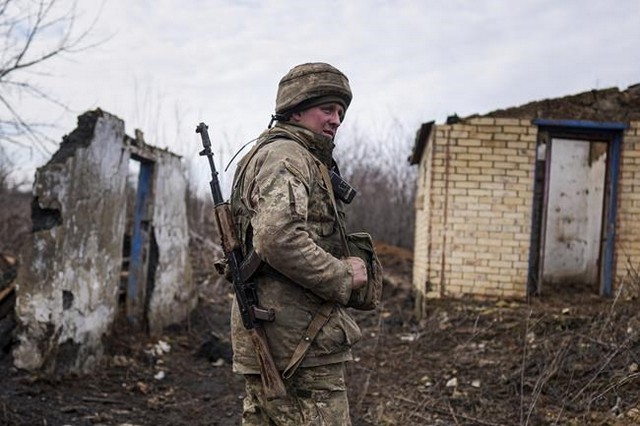
22 Nov 2021 – A report in Covert Action Magazine from the self-declared Donetsk People’s Republic in Eastern Ukraine describes grave fears of a new offensive by Ukrainian government forces, after increased shelling, a drone strike by a Turkish-built drone and an attack on Staromaryevka, a village inside the buffer zone established by the 2014-15 Minsk Accords.

The People’s Republics of Donetsk (DPR) and Luhansk (LPR), which declared independence in response to the U.S.-backed coup in Ukraine in 2014, have once again become flashpoints in the intensifying Cold War between the United States and Russia. The U.S. and NATO appear to be fully supporting a new government offensive against these Russian-backed enclaves, which could quickly escalate into a full-blown international military conflict.

The last time this area became an international tinderbox was in April, when the anti-Russian government of Ukraine threatened an offensive against Donetsk and Luhansk, and Russia assembled thousands of troops along Ukraine’s eastern border.

On that occasion, Ukraine and NATO blinked and called off the offensive. This time around, Russia has again assembled an estimated 90,000 troops near its border with Ukraine. Will Russia once more deter an escalation of the war, or are Ukraine, the United States and NATO seriously preparing to press ahead at the risk of war with Russia?

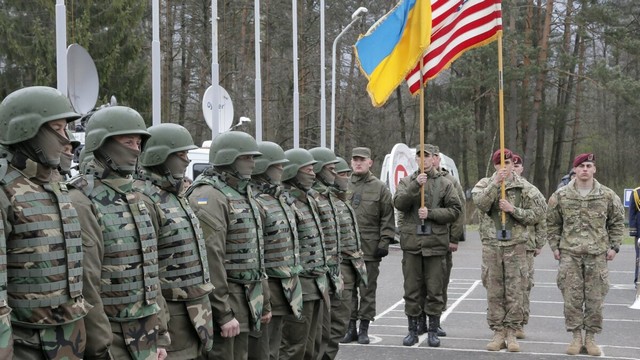
Since April, the U.S. and its allies have been stepping up their military support for Ukraine. After a March announcement of $125 million in military aid, including armed coastal patrol boats and radar equipment, the U.S. then gave Ukraine another $150 million package in June. This included radar, communications and electronic warfare equipment for the Ukrainian Air Force, bringing total military aid to Ukraine since the U.S.-backed coup in 2014 to $2.5 billion. This latest package appears to include deploying U.S. training personnel to Ukrainian air bases.

Turkey is supplying Ukraine with the same drones it provided to Azerbaijan for its war with Armenia over the disputed territory of Nagorno-Karabakh in 2020. That war killed at least 6,000 people and has recently flared up again, one year after a Russian-brokered ceasefire. Turkish drones wreaked havoc on Armenian troops and civilians alike in Nagorno-Karabakh, and their use in Ukraine would be a horrific escalation of violence against the people of Donetsk and Luhansk.

The ratcheting up of U.S. and NATO support for government forces in Ukraine’s civil war is having ever-worsening diplomatic consequences. At the beginning of October, NATO expelled eight Russian liaison officers from NATO Headquarters in Brussels, accusing them of spying. Under Secretary of State Victoria Nuland, the manager of the 2014 coup in Ukraine, was dispatched to Moscow in October, ostensibly to calm tensions. Nuland failed so spectacularly that, only a week later, Russia ended 30 years of engagement with NATO, and ordered NATO’s office in Moscow closed.

Nuland reportedly tried to reassure Moscow that the United States and NATO were still committed to the 2014 and 2015 Minsk Accords on Ukraine, which include a ban on offensive military operations and a promise of greater autonomy for Donetsk and Luhansk within Ukraine. But her assurances were belied by Defense Secretary Austin when he met with Ukraine’s President Zelensky in Kiev on October 18, reiterating U.S. support for Ukraine’s future membership in NATO, promising further military support and blaming Russia for “perpetuating the war in Eastern Ukraine.”

More extraordinary, but hopefully more successful, was CIA Director William Burns’s visit to Moscow on November 2nd and 3rd, during which he met with senior Russian military and intelligence officials and spoke by phone with President Putin.

A mission like this is not usually part of the CIA Director’s duties. But after Biden promised a new era of American diplomacy, his foreign policy team is now widely acknowledged to have instead brought U.S. relations with Russia and China to all-time lows.

Judging from the March meeting of Secretary of State Blinken and National Security Advisor Sullivan with Chinese officials in Alaska, Biden’s meeting with Putin in Vienna in June, and Under Secretary Nuland’s recent visit to Moscow, U.S. officials have reduced their encounters with Russian and Chinese officials to mutual recriminations designed for domestic consumption instead of seriously trying to resolve policy differences. In Nuland’s case, she also misled the Russians about the U.S. commitment, or lack of it, to the Minsk Accords. So who could Biden send to Moscow for a serious diplomatic dialogue with the Russians about Ukraine?

In 2002, as Under Secretary of State for Near Eastern Affairs, William Burns wrote a prescient but unheeded 10-page memo to Secretary of State Powell, warning him of the many ways that a U.S. invasion of Iraq could “unravel” and create a “perfect storm” for American interests. Burns is a career diplomat and a former U.S. ambassador to Moscow, and may be the only member of this administration with the diplomatic skills and experience to actually listen to the Russians and engage seriously with them.

The Russians presumably told Burns what they have said in public: that U.S. policy is in danger of crossing “red lines” that would trigger decisive and irrevocable Russian responses. Russia has long warned that one red line would be NATO membership for Ukraine and/or Georgia.

But there are clearly other red lines in the creeping U.S. and NATO military presence in and around Ukraine and in the increasing U.S. military support for the Ukrainian government forces assaulting Donetsk and Luhansk. Putin has warned against the build-up of NATO’s military infrastructure in Ukraine and has accused both Ukraine and NATO of destabilizing actions, including in the Black Sea.

With Russian troops amassed at Ukraine’s border for a second time this year, a new Ukrainian offensive that threatens the existence of the DPR and LPR would surely cross another red line, while increasing U.S. and NATO military support for Ukraine may be dangerously close to crossing yet another one.

So did Burns come back from Moscow with a clearer picture of exactly what Russia’s red lines are? We had better hope so. Even U.S. military websites acknowledge that U.S. policy in Ukraine is “backfiring.”

Russia expert Andrew Weiss, who worked under William Burns at the Carnegie Endowment for International Peace, acknowledged to Michael Crowley of The New York Times that Russia has “escalation dominance” in Ukraine and that, if push comes to shove, Ukraine is simply more important to Russia than to the United States. It therefore makes no sense for the United States to risk triggering World War III over Ukraine, unless it actually wants to trigger World War III.

During the Cold War, both sides developed clear understandings of each other’s “red lines.” Along with a large helping of dumb luck, we can thank those understandings for our continued existence. What makes today’s world even more dangerous than the world of the 1950s or the 1980s is that recent U.S. leaders have cavalierly jettisoned the bilateral nuclear treaties and vital diplomatic relationships that their grandparents forged to stop the Cold War from turning into a hot one.

Presidents Eisenhower and Kennedy, with the help of Under Secretary of State Averell Harriman and others, conducted negotiations that spanned two administrations, between 1958 and 1963, to achieve a partial Nuclear Test Ban Treaty that was the first of a series of bilateral arms control treaties. By contrast, all that Trump, Biden and Under Secretary Victoria Nuland seem to have in common is a startling lack of imagination that blinds them to any possible future beyond a zero-sum, non-negotiable, and yet still unattainable “U.S. Uber Alles” global hegemony.

But Americans should beware of romanticizing the “old” Cold War as a time of peace, simply because we somehow managed to dodge a world-ending nuclear holocaust. U.S. Korean and Vietnam War veterans know better, as do the people in countries across the global South that became bloody battlefields in the ideological struggle between the United States and the U.S.S.R.

Three decades after declaring victory in the Cold War, and after the self-inflicted chaos of the U.S. “Global War on Terror,” U.S. military planners have settled on a new Cold War as the most persuasive pretext to perpetuate their trillion dollar war machine and their unattainable ambition to dominate the entire planet. Instead of asking the U.S. military to adapt to more new challenges it is clearly not up for, U.S. leaders decided to revert to their old conflict with Russia and China to justify the existence and ridiculous expense of their ineffective but profitable war machine.

But the very nature of a Cold War is that it involves the threat and use of force, overt and covert, to contest the political allegiances and economic structures of countries across the world. In our relief at the U.S. withdrawal from Afghanistan, which both Trump and Biden have used to symbolize the “end of endless war,” we should have no illusions that either of them is offering us a new age of peace.

Quite the contrary. What we are watching in Ukraine, Syria, Taiwan and the South China Sea are the opening salvos of an age of more ideological wars that may well be just as futile, deadly and self-defeating as the “war on terror,” and much more dangerous to the United States.

A war with Russia or China would risk escalating into World War III. As Andrew Weiss told the Times on Ukraine, Russia and China would have conventional “escalation dominance,” as well as simply more at stake in wars on their own borders than the United States does.

So what would the United States do if it were losing a major war with Russia or China? U.S. nuclear weapons policy has always kept a “first strike” option open in case of precisely this scenario.

The current U.S. $1.7 trillion plan for a whole range of new nuclear weapons therefore seems to be a response to the reality that the United States cannot expect to defeat Russia and China in conventional wars on their own borders.

But the paradox of nuclear weapons is that the most powerful weapons ever created have no practical value as actual weapons of war, since there can be no winner in a war that kills everybody. Any use of nuclear weapons would quickly trigger a massive use of them by one side or the other, and the war would soon be over for all of us. The only winners would be a few species of radiation-resistant insects and other very small creatures.

Neither Obama, Trump nor Biden has dared to present their reasons for risking World War III over Ukraine or Taiwan to the American public, because there is no good reason. Risking a nuclear holocaust to appease the military-industrial complex is as insane as destroying the climate and the natural world to appease the fossil fuel industry.

So we had better hope that CIA DIrector Burns not only came back from Moscow with a clear picture of Russia’s “red lines,” but that President Biden and his colleagues understand what Burns told them and what is at stake in Ukraine. They must step back from the brink of a U.S.-Russia war, and then from the larger Cold War with China and Russia that they have so blindly and foolishly stumbled into.

Medea Benjamin is cofounder of CODEPINK for Peace, and author of several books, including Inside Iran: The Real History and Politics of the Islamic Republic of Iran.

Nicolas J. S. Davies is an independent journalist, a researcher with CODEPINK and the author of Blood on Our Hands: The American Invasion and Destruction of Iraq.

29 November 2021

Source: www.transcend.org

Expert Censored after Demonstrating That a Gas Attack in Syria Was a False-Flag Operation by U.S.-Funded Terrorists

By Jeremy Kuzmarov

22 Nov 2021 – Fearful editors and CIA-connected hacks ganged up to defame top MIT scientist who refused to echo government propaganda and had article exposing truth about alleged Syrian chemical weapons attacks pulled by prestigious scientific journal. Instead, he quit his 30-year job on principle.

Theodore Postol is one of the world’s leading authorities on warfare and weaponry. A physicist with a Ph.D. in nuclear engineering, he is Professor Emeritus of Science, Technology, and International Security at the Massachusetts Institute of Technology (MIT) and a former top policy adviser to the chief of naval operations.

During a career full of honors, he received the Leo Szilard Prize from the American Physical Society for “incisive technical analysis of national security issues vital for informing the public policy debate”; the Hilliard Roderick Prize from the American Association for the Advancement of Science; the Norbert Wiener Award from Computer Professionals for Social Responsibility for “uncovering numerous and important false claims about missile defenses”; and the Richard L. Garwin Award from the Federation of American Scientists “that recognizes an individual who, through exceptional achievement in science and technology, has made an outstanding contribution toward the benefit of mankind.”

Professor Postol was also a senior editorial board member of the Princeton-based Science & Global Security journal for more than 30 years—until he quit in protest over the journal’s refusal to publish an article he wrote that embarrassed the CIA and the U.S. government.

The article provided incontrovertible evidence that the murderous April 4, 2017, sarin gas attack on Syrian civilians was not the work of the Assad government but a false-flag operation by U.S.-funded jihadists designed to make it look like Assad was to blame.

As the professor said in his letter of resignation

To keep Postol’s article from being published, a campaign of character assassination was mounted against Professor Postol to destroy his credibility and smear his reputation. Pressure to refuse the article was exerted on the journal’s editors (many of whom Postol had mentored) by select members of the scientific and academic community—who had long suckled at the government teat, and therefore obediently ganged up on their former colleague with defamatory articles and scandalous letters circulated secretly behind his back.

Bizarrely, in one of these cowardly letters, Gregory D. Koblentz, a Fellow of the Council on Foreign Relations (CFR), even compared Postol to a Holocaust denier.

But Professor Postol was no stranger to controversy, or to confronting and exposing U.S. government lies about its military “triumphs” and “successes.”

Following the 1991 First Persian Gulf War, Postol published an article in Science & Global Security debunking U.S. government claims about the efficacy of the Patriot missile defense system, which had reputedly shot down Scud missiles launched by Iraq over Israel.

The article prompted a congressional investigation and Postol became a minor scientific celebrity with a strong reputation for integrity.

Nearly 30 years later, Postol is still doing what he does best: debunking governmental narratives through cutting-edge scientific research and analysis.

However, the political landscape in America has changed—dramatically for the worse.

Not only can Postol no longer get his research published in leading scientific journals; he is now also forced to endure slanderous personal attacks in which he is labeled as a mental basket case, conspiracy theorist and crank.

In an interview with CAM, Postol said “I could not do the stuff with the Patriot missiles I did today. Nobody has the courage to publish things anymore that go against conventional wisdom on certain key topics related to national security.”

Postol added that “universities and university journals are no longer a source of truth…There is a lack of independence of thought and ability to referee exposés of this nature carefully and a betrayal of the fundamental moral obligation of scientists and academics to society to investigate and then present the truth on important matters—even when it makes people in positions of power uncomfortable.”
Report on Chemical Weapons Use in Khan Shaykhun, Syria

Postol made people in positions of power uncomfortable through his dissection of the official government narrative on chemical weapons attacks in Syria.

An article that he wrote with Goong Chen, a mathematician from Texas A&M University, and five other scientists, “Computational Forensics for the Alleged Syrian Sarin Chemical Attack on April 4, 2017: What Actually Happened?” used forensic computer simulations and three-dimensional image analysis to model the crater that was identified as the source of sarin allegedly released at Khan Shaykhun, an al-Nusra front controlled town in the Idlib province.

The alleged attack served as a pretext for the Trump administration to launch 59 cruise missiles against the Syrian government’s airbase at Shayrat.

Postol and his co-authors determined that the crater and related fragments were almost certainly caused by a vehicle-launched improvised rocket-propelled artillery round with a high-explosive warhead—which the rebels could have possessed—and not an aerial bomb from a Syrian airplane.

No fragments characteristic of an aerial bomb such as tail fins were observed and the size of the crater was too small to be caused by a bomb.

This finding—which was confirmed by a senior intelligence official with experience assessing bomb damage—called into question the scenario of attack described by the U.S. intelligence community, and the UN’s Organization for the Prohibition of Chemical Weapons (OPCW) Joint Investigative Mechanism (JIM).

According to Postol’s team, there was extensive tampering with the crater and debris, which led to misreporting in the media.

A dead goat was found at the scene displaying symptoms of sarin inhalation; however, tracks were found indicating that the goat had been dragged to the scene along with a rope around its neck. Dead birds were also found that appeared to have been very recently released from a cage.

Postol and his team determined that there was no physical evidence of any sarin-containing vessel at the scene.

A pipe was inaccurately identified by the OPCW as a container filled with sarin; in truth it was the casing of the rocket motor that propelled the warhead to the location of the explosion.

Chemical weapons generally do not make large craters in the ground and since no workers sent to clean up the scene were exposed to sarin or died—when any contact with the asphalt around the crater would have been highly lethal in the wake of an attack—it is unlikely sarin was actually used.

According to journalist Seymour Hersh, the impression that sarin had been used was created by a toxic cloud that resulted from the bombing of an agricultural supply depot near the crater possessing fertilizers, disinfectants and other goods whose release caused neurotoxic effects similar to those of sarin.
The Truth Is Suppressed

Postol, Chen et al.’s article “Computational Forensics for the Alleged Syrian Sarin Chemical Attack on April 4, 2017: What Actually Happened?” was published in the Global Journal of Forensic Science and Medicine in November 2020, and was featured by Tulsi Gabbard on her website when she was running for president.

However, the article was withdrawn from publication by the more prestigious journal Science & Global Security one year earlier after the article had initially been accepted and was circulated at the page proof stage.

Postol had served for more than 30 years on the editorial board of Science & Global Security and mentored the three main editors who ultimately blocked publication of his piece.

These editors were a) Pavel Podvig, an affiliate at the Center for International Security and Cooperation at Stanford University; b) Zia Mian, a senior research fellow and Co-Director of Princeton’s Program in Science and Global Security; and c) Alex Glaser, an associate professor in the School of Public and International Affairs at Princeton and in the Department of Mechanical and Aerospace Engineering.

In a letter to Goong Chen obtained by CAM dated December 27, 2019, Podvig, Mian and Glaser said that they had decided to withdraw publication of his and Postol’s article because of their “identification of a number of concerns with the editorial process,” including “concerns about the competence of the reviews and editorial judgments being used as a substitute for a decision by the reviewers to determine if their concerns had been reasonably addressed.”

The editors went on to state that they “accepted responsibility for mishandling the process in this case,” noting that their “discovery of inadvertent mistakes [in the review process] should have come earlier….Given these editorial mistakes, our decision was to return the manuscript to the authors without prejudice. At no point have we suggested that the manuscript has been rejected or retracted.”

This explanation is hollow because if the editors—who admitted to poor judgment—screwed up the review process, they were obliged to find a fair-minded reviewer.

The insinuation that the article was never rejected is also false because it was returned to the authors and never published.
Crank Reviewer and Bellingcat Disinformation

According to Postol, the main peer reviewer selected by Science & Global Security’s editors was a “crank” and “clown.” He was either a member of Bellingcat or closely associated with the organization.

Dubbed “an intelligence agency for the people,” Bellingcat puts out reports that advance U.S. and UK government disinformation about countries targeted for regime change like Russia and Syria.

Supported by the National Endowment for Democracy (NED)—a CIA offshoot—its staff includes former U.S. and UK military and intelligence officers.

Eliot Higgins, Bellingcat’s founder, attacked Postol in a September 13, 2019, blog entitled: “Simulations, Craters and Lies: Postol’s Latest Attempt to Undermine the Last Vestiges of his Reputation.”
Eliot Higgins (C), founder of online investigation group Bellingcat, addresses a press conference on findings in research on Malaysia Airlines flight MH17 in Scheveningen, The Netherlands, on May 25, 2018.

Higgins is a college drop-out who never set foot in the Middle East and, according to Postol, “has no scientific training, knows no science, and is not interested in learning any science.”

Before the Arab Spring, Higgins admitted that he “knew no more about weapons than the average Xbox owners; any knowledge he had came from Arnold Schwarzenegger and Rambo.”

In his blog, Higgins suggested that Postol was a Russian agent who had tried to pass the results of his research to the Russian delegation at the UN.

In fact, Postol and his team sent letters about their findings to all five permanent members of the UN Security Council—China, Russia, France, the United Kingdom and United States—and to the Acting President of the Security Council—Germany—because of their important implications.

According to Higgins, Postol’s study was flawed because the crater simulated in the computer models did not match the one in Khan Shaykhun or look like real-world craters formed by 122-mm artillery rockets.

However, Postol told CAM that the comparisons Higgins offered were flawed and he could not have replicated his team’s supercomputer calculation. The positions of the casings made clear the crater was caused by an artillery rocket, which was confirmed by military manuals.

Higgins’s blog was misleading, furthermore, because it analyzed photos that did not show the original crater and debris on the site at Khan Shaykhun, but ones that were taken after the scene had been tampered with. Also, it analyzed the wrong end of the rocket motor which had been turned upside down.

As such, Postol wrote that Higgins’s forensic analysis was “no more relevant to the truth than DNA evidence would be from the wrong blood samples at a murder trial.”
Breach of Confidentiality and Conflict of Interest

According to Goong Chen, Science & Global Security’s editors were informed in October 2019 that the referee for Chen and Postol’s article had breached confidentiality by divulging the contents of his report to Higgins who told Postol about it during a public panel discussion in London.

Pavel Podvig’s own conflict of interest was apparent in his job as an adviser to the UN Secretary General.

Postol’s article provided science-based evidence that the OPCW has been falsifying reports to the UN Security Council related to chemical gas attacks in Syria—a charge corroborated by OPCW whistleblower Ian Henderson.

Slander by CFR Fellow

Gregory Koblentz, director of the biodefense graduate program at George Mason University’s Schor School of Public Policy and a CFR fellow, was one of the pseudo-experts quoted frequently in Bellingcat’s reports on Syria.

Koblentz obtained his Ph.D. in MIT’s security studies program in 2004 and took classes on nuclear weapons and missile defense from Postol and participated in WMD-related events that he organized.

Koblentz said that “the Ted Postol writing about Syria and chemical weapons is not the Ted Postol I knew back then [at MIT].”

In an attempt to block publication of Postol’s Khan Shaykhun article, Koblentz wrote confidential letters to members of the editorial board and editors of Science & Global Security—which became known when Frank von Hippel, who helped found the journal in 1989, shared his letter with Postol.

Koblentz in the letter—sent on September 27, 2019—never refuted the science in Postol’s article, but rather replicated Higgins’s efforts to smear him. He wrote that he had spent the last two weeks trying to “educate the editors” of Science & Global Security and its editorial board about Postol’s “conspiratorial views about chemical weapon use in Syria,” which in his view had been “debunked by the open-source investigative site Bellingcat.”

Koblentz charged that, if Science & Global Security went ahead and published Postol’s piece, the journal’s “prestige and connection to Princeton University would be used by conspiracy theorists, right-wing extremists, Russian disinformation peddlers, and Assad apologists to whitewash the regime’s most heinous war crimes.”

Koblentz said that Postol’s analysis of chemical-weapons use in Syria exhibited a “pattern of unfounded, unscientific, and illogical assumptions about the world,” a “classic sign of conspiracy theory.”

This conspiracy theory was “quite popular among CW truthers, which include those who deny the Holocaust occurred or that Al Qaeda was responsible for 9/11, as well as among individuals and organizations who support the Syrian and Russian narratives that Syria has not gassed its own people.”

According to Koblentz, “publishing Ted’s latest theory in Science & Global Security is akin to letting Andrew Wakefield publish an article about vaccines and autism in JAMA [Journal of the American Medical Association], Alex Jones to opine about media coverage of the mass shooting of Sandy Hook in the Columbia Journalism Review, or allowing a known climate change denialist to publish an article on global cooling in Science: these are all discredited conspiracy theorists who are best viewed as charlatans, despite any degrees they hold or honors they’ve received.”

Rejection and Dress-Down

After receiving Koblentz’s letter, he, Mian and Glaser consulted other scientists, like Princeton’s Robert H. Socolow, who encouraged them to withdraw Postol’s article from publication.

Mian and Glaser then met with Postol in a one-hour session in which Mian did all the talking. According to Postol, Mian was “very uppity in the meeting though showed signs he had not actually read his paper.” Postol said he felt at the meeting like he was “some South Asian servant being dressed down by a British imperialist in 1965.”
Resignation

Afterwards, Postol resigned from the editorial board of Science & Global Society, on which he had served for 30 years.

He stated that it was “anathema for him to be part of an organization that would intentionally or not seek to suppress or misrepresent valid scientific findings that have implications for international law and the future viability of the chemical weapons convention.”

In an exclusive interview with CAM, Postol said that the whole matter was very emotional for him because of his long friendship and association with the editors of Science & Global Security whom he mentored, helped get papers published and even helped get jobs. He feels that they betrayed him and the scientific community and made a grievous mistake by “failing to stand for their own scientific judgment.”

On October 25, 2019, Postol wrote to congratulate the three editors for allowing a “technically illiterate, third-class political scientist [Koblentz] to stop publication of a careful and comprehensively documented scientific analysis. Great job!”
Academic Cowardice at George Mason University

In November 2019, Postol lodged a formal complaint of academic misconduct against Koblentz with Mark Rozell, Dean of the School of Government and Public Policy at George Mason University where Koblentz teaches.

Postol said that Professor Koblentz has been “misrepresenting himself as an expert on a matter where he demonstrably has no knowledge and he is using his false claims of knowledge to engage in slanderous allegations against me and my colleagues.”

In response to the letter, George Mason Provost S. David Wu (now president of Baruch College) carried out an investigation which determined that, while some of Koblentz’s statements were “undiplomatic,” he had not misrepresented his credentials and that accusations of slander should be handled in the courts.

The investigating committee concluded that “statements some may characterize as undiplomatic or disparaging nevertheless can be part of a discourse conducted within the bounds of academic freedom.”

Postol responded by writing a letter to George Mason University Rector Tom Davis, a former Republican Congressman, in which he reiterated that Koblentz had no scientific expertise to challenge his findings and said that there was no discourse between him and Koblentz that could fall within the boundaries of academic freedom since the letters he sent were secret. Koblentz never sought to debate any questions about his work with him—rather, he posted information that was false to his colleagues without his knowledge.

Postol further alleged that George Mason’s investigation was unprofessional and inadequate. Postol himself was never interviewed and never provided any information about who the panel members were and whether they possessed the requisite expertise to assess Postol’s research and whether it was professionally carried out.

Postol wrote:

I was excluded by a process that appears to have been designed from the beginning to exclude the addition of clarifying evidence or the raising of questions about the accuracy of statements that Koblentz may have made in his defense. In short, the procedure may or may not have been rigged, but they were certainly not constructed so as to get a balanced and comprehensive picture of the situation.

Postol asked for Davis to rectify the problem, but he received no reply to his letter. When CAM tried to contact him, he was impossible to reach.
2013 Chemical Attacks in East Ghouta

Postol wrote another important article debunking official government claims about alleged chemical-weapon attacks in Syria: in Eastern Ghouta, a suburb of Damascus, on August 13, 2013.

The latter attacks provided a pretext for threatened U.S. air strikes, which the Obama administration was poised to launch but held back on because of a lack of public support.

On August 20, 2013, Secretary of State John Kerry gave a dramatic press conference affirming the intelligence community’s conclusion that sarin chemical-weapon attacks had been carried out from “the heart of regime territory.”

Secretary of State John Kerry gives dramatic performance at press conference on August 20, 2013, blaming Bashir al-Assad for sarin gas attacks in Eastern Ghouta seven days earlier. Kerry’s statements were false. [Source: washingtonpost.com]

Seymour Hersh quoted an intelligence officer at the time who suggested that the charade was a false-flag equivalent to the Gulf of Tonkin incident that resulted in the massive U.S. expansion of its war in South Vietnam.

The Obama administration used the attacks to justify Operation Timber Sycamore, a $1 billion program supplying arms to jihadist rebels seeking to overthrow Assad, and to push for air strikes which were called off because congress and the public made clear they did not want them.

Postol’s article is entitled “The 2013 Nerve Agent Attack in Damascus, Syria: A Potentially Disastrous National Intelligence Failure.” As of yet, it has not been published. In one journal to which Postol submitted it, the editor waited five months to give him the peer review after he had received it—an unheard of time-lag.

Postol’s paper demonstrated that the artillery rocket motors which delivered the sarin gas in Eastern Ghouta were sufficiently powerful to propel each heavy sarin-filled steel barrel to a range of 2 to 2.5 km (about 1.5 miles).

Inspection of the map issued with the White House intelligence report showed that the attack could only have come from Syrian government-controlled areas if the rockets had a range of more than 10 km—which they did not.

Human Rights Watch, and The New York Times and other mainstream media outlets echoed the official U.S. government view that the attacks were carried out in Syrian government-controlled territory, which was impossible based on the laws of physics.

The New York Times published the above graphic across its front page on September 17, 2013, thereby bolstering the public misperception that the report issued by U.S. intelligence agencies was correct. The assumption implicitly made by The New York Times author and editors was that the rockets could travel 6 to 10 miles to various impact points in Ghouta. In fact, the rockets could only travel about 1.5 miles. When The New York Times was provided by Theodore Postol with information that showed that its front-page headline story was wrong, it published a short misleading article that did not refer to the seriously flawed headline story, misreporting a much longer range for the rockets allegedly launched from Syrian government territory. In addition, The New York Times author and editors left uncorrected their earlier reported false conclusion that the intelligence data showed the attack had come from Syrian government-controlled territory. [Source: Theodore Postol]

After Postol’s article was written, a UN inspection team corroborated many of its findings. At a press conference on December 16, 2013, Åke Sellström, the Head of Mission of the UN Mission to Investigate Allegations of the Use of Chemical Weapons in the Syrian Arab Republic, said that a 2-km range for the rockets that delivered the nerve agent was a “fair guess.”

Sellström’s conclusion was omitted from the OPCW report and UN leadership never corrected U.S., British and French assertions about the attacks that were false.

James Clapper, the U.S. Director of National Intelligence, additionally never corrected the false intelligence report that was used by the Obama administration to sell war.

New Evidence

After the attacks, a video surfaced which depicted fighters wearing gas masks—identified as members of the opposition faction Liwa Al Islam—launching sarin-filled Volcano rockets on August 21, the night of the attack.

The video was ignored in the media at the time, and dismissed as a fake, though a June 2021 study by Rootclaim—a website founded by tech entrepreneur Saar Wilf—pointed to several landmarks visible in the video that matched with footage from satellite photos.

The video combined with the satellite imagery helped the authors of the Rootclaim article, Michael Kobs and Adam Larson, to locate the launch site to a small field in rebel-held Qaboun with two rows of trees, low vegetation, and a paved platform.

Eliot Higgins suggested that the Syrian army launched the chemical rockets from an area of a military base south of the Air Force Intelligence Branch. However, the Rootclaim study shows it could not have been the source, as the angle was off and a rocket shot from there would have penetrated the northern wall of the target building, not the western wall, the actual one struck.

Three days after the Ghouta attack, as Syrian army forces entered the area, they were attacked by sarin, just 200 meters from the field where the Ghouta attack was thought to have been launched.

This attack was detailed in a UN report that Higgins, Koblentz and Bellingcat not surprisingly ignored.

Their agenda is clear in trying to poison the debate about Syria and defame dedicated scientists like Postol whose research casts important light on the deceptions underlying U.S. policy.

Jeremy Kuzmarov is Managing Editor of CovertAction Magazine and author of four books on U.S.

29 November 2021

Source: www.transcend.org

On the Collective Will of the Human Species to Survive

By Richard Falk

23 Nov 2021 – The human will to survive is often uncritically taken for granted, which was of little consequence prior to the advent of the nuclear age in 1945. That the first atomic explosion was the event chosen by the scientific community agreed to signal the advent of the age of the Anthropocene is of added significance. The general understanding of the Anthropocene is that of human activity that is impactful on the basic equilibrium of the planetary ecosystem. Subsequent developments associated with the relationship between greenhouse gas emissions and global warming have confirmed the alarming extent of reckless human agency with respect to the ecological equilibrium of the planet.

The inverse effects of the Anthropocene have received less attention, that is, of the ecological backlash that imperils the survival of the human species. For the first time in world history the intentional activities of the human species endanger its own existence and future, as well as various global, regional, and local ecosystems that have collapsed or are collapsing. Of course, throughout world history species in particular locales have behaved in ways that brought about their collective destruction, and this certainly includes the human species. In the past, there have been waves of non-human extinction that have altered the biodiversity of the planet. {see Collapse; Elizabeth Kolbert, The Sixth Extinction: The Unnatural History (2014)]. The scale of past threats to human existence were all at the sub-species level, affecting the destinies of imperiled society or civilization. [See Jared Diamond, Collapse: How Societies Choose to Fail or Succeed (2004)].

What is unique about the present historical conjunction of circumstances is that the dominant threats so far posed in this century are directed toward the species as a whole. This threat is compounded by the realities of human experience that have been organized so as to promote sub-species survival, especially, at the level of the territorial sovereign state. This fundamental organizational feature of world order in strongly reinforced by ideologies of nationalism that rely on sub-species optics of appraisal, and unreflectively solidify sub-species loyalty as the loftiest aspiration of a fragmented species. Extra-nationalist identities do exist, sometimes strongly, in the form or religious affiliation, civilizational sentiments of belonging, ethnic, ideological, and gender bonding of various sorts. What does not exist with sufficient strength to counter the tyranny of sub-species primacy are mechanisms of sufficient capability to protect the distinctly human interest in species survival or the global interest in essential forms of inter-species coexistence.

After the major wars of the prior century, there were let loose strong bio-political impulses on the part of publics and leaders of victorious powers to regulate and even institutionalize the human interest. The Just War Doctrine had earlier tried to give a religious and quasi-legal underpinning of universal justice to recourse to and conduct of war, but its interpretation was subordinated to the interpretive manipulations and geopolitical ambitions of leaders of sovereign states especially in the West, making clear that sub-species priorities prevail over international law whenever they clash. The historical disruptions of the major 20th century wars gave rise a widespread sense of human jeopardy in the West that led to the establishment of global institutions.

The carnage of World War I led to the establishment of the League of Nations and the atom bomb imparted a sense of urgency after World War II to the prevention of a feared World War III. Yet the outcomes of these institutional strivings did not seriously challenge sub-species dominance, and provided convenient venues for global communication and cooperative arrangements that served the reciprocal and mutual interests of sovereign states while leaving global hierarchies intact. Despite the rhetoric of globalism, the heavy lifting of war prevention was self-consciously attached to the nationalist mechanisms of sub-species management of statist and alliance security systems that featured deterrence and crisis management. The UN has proved to be valuable in many contexts, despite being designed to fail when it came to the protection of species well-being as distinct from promoting the interests of one category of sub-species political actors, that is, dominant sovereign states.

This deliberate dynamic is signaled in the case of the UN by giving the most dangerous states a generalized veto power that indirectly confers impunity and non-accountability. UN deference to geopolitics was also expressed by leaving funding under the control of the member governments, and by curtailing the authority of the chief executive officer, the Secretary General. This shortcoming of the UN was more telling than the earlier experience with the League as the atomic bomb forewarned of an unprecedented apocalyptic menace to the entire species, a new reality in human experience, perhaps not entirely new, given earlier experiences with pandemics that created political imaginaries of the end of the world and the acknowledged possibility that a giant meteor might crash into the planet changing its orbit and habitability.

Europe has experimented since after World War II with efforts to overcome the dangers of sub-species conflict at the level of the region, with mixed results. Its achievements include almost totally avoiding intra-regional warfare of the sort that had ravaged Europe for centuries, as well as defending Western Europe against real or imagined threats posed by feared Soviet aggression (a result achieved with the help of the American-led NATO alliance). Europe also established a common currency that allowed European economies to flourish over a period of seven decades, and also facilitated trade and travel with Europe.

At the same time, regional identity never took root, and most Europeans continued to define themselves by reference to their country, a dynamic manifested most clearly by the BREXIT withdrawal of the United Kingdom from European Union membership despite the material benefits of belonging. Even if the EU manages to fulfill most of the dreams of its supporters it would still be a sub-species actor, perhaps with a more enlightened outlook, but still subject to the priorities and worldview associated with sub-species perspectives on the formation of global policy. If there were any doubts about this, they were removed in recent years by the hostile receptions accorded to migrants from combat zones in the Middle East and African countries most victimized by global warming.

Even if nuclearism as security posture and near catastrophe didn’t tip the balance in the direction of species due to its abstract character and the coherence of the sub-species regimes set up to exert allegedly rational control under geopolitical auspices, I would have supposed that climate change would do the necessary job of reconstructing in globalist directions the way we think, feel, and act. [See Martin J. Sherwin, Gambling with Armageddon: Nuclear Roulette from Hiroshima to the Cuban Missile Crisis (2020)] Unlike recourse to nuclear war, which stimulated a genre of dystopian literature and scenarios of doom, the climate change threats were confirmed as virtual certainties by a strong consensus prevailing among those climate experts, and presented to the world by a host of reliable interpreters, including the UN Panel on Intergovernmental Panel on Climate Change (IPCC) [See especially dire warnings, Sixth Assessment Report 2021: The Physical Basis (on climate system and climate change)].

In other words, the knowledge paradigm that was associated with modernity, which was supposedly based on science, rationality, empirical observation, data, and experimental validation, would have led to transformative energies that gave emergency backing to a species-scale imperative to transcend national interests in favor of human and global interests.[Naomi Oreskes & Erik W. Conway, Merchants of Doubt: How a Handful of Scientists Obscured the Truth on Issues from Tobacco Smoke to Global Warming (2004)] Yet despite the evidence, the sub-species framework for problem-solving remains unchallenged except by civil society activists. [Robert C. Johansen, Where the Evidence Leads: A Realistic Strategy for Peace and Human Security (2021)]

There is a widespread recognition that the COP-26 Glasgow Climate Change Summit was a major disappointment. Not only was the sub-species architecture entrusted with responding to the multiple challenges, but disparities of national circumstances precluded meaningful levels of sub-species cooperative arrangements and left the commitments that were made in the aspirational language of pledges and voluntary undertakings.

Entrenched interests exerted far too much influence, as did embedded notions of ‘political realism,’ which continued to link security of people to governmental protection against military threats and geopolitical rivalry and paid far too little attention to the critical challenge of a looming bio-ecological-ethical-political-spiritual crisis that cannot be overcome without the emergence of robust collective will of the human species to survive, which implies a radical transformation of what makes life worth living for most human inhabitants of the planet.

Richard Falk is a member of the TRANSCEND Network, an international relations scholar, professor emeritus of international law at Princeton University, Distinguished Research Fellow, Orfalea Center of Global Studies, UCSB, author, co-author or editor of 60 books, and a speaker and activist on world affairs.

29 November 2021

Source: www.transcend.org

Destitute and Desperate Asylum Seekers and Migrants

By Mairead Maguire

25 Nov 2021 – It was with deep sadness that on Wed 23 Nov 2021 the world watched in horror the news that 27 people had drowned in the English Channel when their flimsy dinghy overturned in the sea in an attempted crossing from Calais to Dover. I am sorry and I ask the forgiveness of migrants and refugees who have been forced to flee their lands and seek a place of refuge in any country who would give them a place to lay their heads. I send my condolences to the families at the loss of their beloved ones in a cold watery tragedy far away from their homes.

Over the last twenty years, NATO (led by USA/UK) has cruelly carried out sanctions, wars, invasions and occupations over many countries. I visited many of these countries (Afghanistan, Iraq, Syria,) and was shocked at the way in which western governments’ policies have made these countries unstable by their foreign policies.

Arms manufacturers and dealers ferment violence and wars contributing to geopolitical games which cost the lives of millions displaced and millions dead. We have witnessed that when guns come into play in any situation, fear sets in and people flee in the thousands to save their lives, their children. We have to STOP the madness of militarism and weapons and end governments’ and elites’ profiting from the arms industry and wars.

Migrants/refugees who come to Europe come to us because we have bombed their countries and there is no hope for them to find jobs and safety there anymore. Every act has a consequence, and we are now witnessing the results of our governments’ unjust policies that keep destabilizing so many countries.

The militarization of Europe is a waste of peoples’ money and will not provide human security.

Imposing unilateral sanctions on countries (as I witnessed in Iraq and now in Iran) creates reactive violence and destroys vital infrastructure such as schools, roads, hospitals, life itself.

A more compassionate approach to asylum seekers would be to open safe channels through which they could come into the UK. Politicians must be honest and admit, ‘we are where we are,’ and we have a duty to do and to do it with love. We caused the problems and we have a responsibility to help find solutions that are humane and compassionate.

Many asylum seekers come to the UK because they have relatives in Britain, they can speak English, or they feel links to the UK Commonwealth. All have brains, courage and hope and will make good contributions wherever they go…. Let’s welcome them and show them our warmheartedness as their brothers and sisters.

Mairead Corrigan Maguire, co-founder of Peace People, is a member of the TRANSCEND Network for Peace Development Environment.

29 November 2021

Source: www.transcend.org

History haunts Israel with persistence

Palestine Update 512
Comment

History haunts Israel with persistence
There is precious little that Israel can do which will obliterate the 1948 massacres of Palestinians. They will return to haunt them until there is restorative justice. In a classic piece of investigative reporting, important Israeli institutions have unearthed classified documents which surface the planning and execution of extensive operations that brought ruin to thousands upon thousands of Palestinians.

History is returning to revisit in other ways and the Nakba is the ghost that never ceases to haunt Israel. Israel cannot live down or deny its guilt. A British lawyer is now acting to slap a lawsuit that holds Britain complicit for the situation in the Palestinian territories immediately prior to the creation of Israel in 1948. It brings back political facts and instigations that happened when British forces held command during that period. It must be recalled that it was then that apartheid was installed although it has taken until recent times when more peoples around the world have begun to designate Israel as an apartheid State. In its imprudence, Israel keeps inflicting cruelties that reinforce the ‘war criminal’ tag on the Zionists. In Sheikh Jarrah they have started building on a piece of stolen land. Moral sense tells us that it will return one day- sooner than later- it will come back to the rightful owner – the Palestinian. They may pull down entire Palestinian colonies to build settlements, but they must contend with the fear of being barracked. It is said “Once a thief, always a threat from the law and from ethical questions”. The truth has been documented since 1948 and continues to be recorded in different ways. Human Rights Watch has gathered evidence and “geo-localization of several video clips filmed between May 10 and 14” that find their place in social media. Acts of offensive policing are coming to light. Israel can run. It cannot hide forever. Discrimination leaves footprints and stains that lead to the hard truth. Israel invents every ploy in its armor to suppress the Palestinians. Israel, only recently, completed the Wall around Gaza. The intent was to quell the Hamas resistance. But Hamas has now acquired rockets that can reach every nook and corner of Israel. No amount of military sting and scheming will crush the resilience of the people.

In solidarity
Ranjan Solomon

——————————————————————————————————

Details of 1948 massacres against Palestinians revealed in classified Israeli documents
Israeli government discussions on the massacres perpetrated by Israeli soldiers in 1948 were declassified for the first time this week in an investigative report published by the Israeli newspaper Haaretz and the Akevot Institute for Israeli-Palestinian Conflict Research.

Entitled, ‘Classified Docs Reveal Massacres of Palestinians in ’48 – and What Israeli Leaders Knew’, the report exposes two large-scale operations launched by the Israeli army in October 1948, one based in the south, known as Operation Yoav, which opened a road to the Negev; and another in the north, Operation Hiram. As part of the latter, within 30 hours, Israeli soldiers attacked dozens of Palestinian villages, forcefully expelling tens of thousands of Palestinian residents, while thousands of others fled.

British Palestinians to sue UK over Balfour Declaration
Members of the Association of the Palestinian Community in the UK (APCUK) are to launch a legal case to compel the British government to apologise for the 1917 Balfour Declaration that promised the creation of a Jewish homeland in historic Palestine. British lawyer Ben Emmerson, who was officially entrusted by senior representatives of the Palestinian community, presented some evidence on which he will base the lawsuit, including Britain’s direct responsibility for the situation in the Palestinian territories during the period prior to the establishment of the Israeli state in 1948, when British forces were in charge of the country’s administration. The meeting was opened by the Palestinian ambassador to London, Husam Zomlot, who pointed out that the Palestinian Nakba (“catastrophe”) led to the displacement of many families and to the establishment of an apartheid state, and this state that practices crimes and violations against the Palestinians is receiving support from Britain until now.

The Balfour Declaration was issued on 2 November 1917 by the then British foreign secretary, Arthur Balfour, and stated that Britain pledged to facilitate the establishment of a “national home for the Jews in the land of Palestine”.

Will Israeli wall around Gaza stop Palestinian resistance?
Israel announced, last week, the completion of the highly technological security wall on its side of the occupied and besieged Gaza Strip. This sensor-equipped underground wall, Israel claims, is a counter-measure developed to prevent Palestinian resistance in Gaza from digging tunnels that they use to carry out resistance attacks against Israeli soldiers during wars. During the 51-day Israeli offensive on Gaza carried out in 2014, when Israel killed more than 2,260 Palestinians and wounded more than 11,000 others, the Palestinian resistance used the tunnels to infiltrate into the military sites of the Israeli occupation soldiers and clashed with them, killing a number of them.

The Israeli occupation raised the issue of the wall in 2016, noting that it consists of an above-ground fence and subterranean barricade, includes a naval barrier, radar systems, hundreds of cameras, sensors, remote-controlled weapons system and command and control rooms. Benny Gantz, said: “The barrier, which is an innovative and technologically advanced project, deprives Hamas of one of the capabilities [defence tunnels] it tried to develop. [It] places an ‘iron wall’, sensors and concrete between the terror organisation and the residents of Israel’s south.

Will this NIS3.5 billion ($1.1 billion) wall, which is 40-miles (65-kilometer) long, prevent Hamas and the other Palestinian resistance factions from reaching out to the Israeli occupation soldiers during any Israeli offensive?

“Israel begins work on seized Palestinian-owned plot of land in Jerusalem’s Sheikh Jarrah neighborhood”
The Israeli municipality of West Jerusalem today began work on a plot of Palestinian-owned land at the entrance to Sheikh Jarrah neighborhood in the occupied city of Jerusalem, which was seized under the pretext of “public interest.” The municipality crews and bulldozers began the bulldozing work on the land, which has an area of about 4,700 square meters owned by four Palestinian families and was used as a parking lot and carwash.

The Israeli Supreme Court allowed at the end of October the takeover of the land by the Israeli municipality with the aim of establishing a garden serving settlers, claiming its close proximity to the so-called Shimon HaTzedik shrine. The municipality issued a decision to seize the land in 2016 after several failed attempts in light of the opposition of the takeover by the four families, who fought the takeover in Israeli courts. One of the tenants of a facility said that the municipality handed them yesterday an immediate eviction order, otherwise, they will be heavily fined. “We began to dismantle the car wash and a parking lot used by more than 40 buses and three containers that served as offices, and today, since the early morning hours, the municipality began to raze the land,” he said.

Israel demolishes Palestinian houses in Jerusalem
The Israeli occupation authorities today demolished two Palestinian houses in the occupied city of Jerusalem, sources confirmed. Israeli police and municipal staff stormed al-Shayyah area in the East Jerusalem neighborhood of al-Tur, where a bulldozer they escorted tore down the remaining poles and foundations of al-Burqan family’s house, which was self-demolished a month ago. “This morning, we were surprised to see the Israeli occupation bulldozers proceeding with the demolition of the foundations of our two-storey house, which we were forced to self-demolish last November, to avoid a fine of 400,000 shekels for demolition costs,” said Um EyadBurqan. “But the occupation returned to demolish its foundations, to force us to pay the costs…As if demolishing our house and displacing 20 people, my four sons and their children isn’t enough. They [the Israeli occupation authorities] want to fine us the costs of the demolition, by fabricating false pretexts.”

Meanwhile, Israeli bulldozers tore down a house belonging to al-Heleisy family near Jerusalem’s Dung Gate, reducing it to rubble. Both structures were demolished purportedly for being built without licenses. Using the pretext of illegal building, Israel demolishes houses on a regular basis to restrict Palestinian expansion in occupied Jerusalem. At the same time, the municipality and government build tens of thousands of housing units in illegal settlements in East Jerusalem for Jews with a goal to offset the demographic balance in favor of the Jewish settlers in the occupied city.

Israel: Abusive Policing in Lod during May Hostilities
Israeli law enforcement agencies used excessive force to disperse peaceful protests by Palestinians in Lod (al-Lydd) during civil unrest in the city in May 2021, Human Rights Watch said today. At times the police appeared to act half-heartedly and unevenly to violence against Palestinian citizens of Israel committed by Jewish ultra-nationalists. Public statements by senior Israeli officials appeared to encourage discriminatory responses by authorities and the judiciary.

The police response in Lod took place amid systematic discrimination that the Israeli government practices against Palestinian citizens of Israel in many other aspects of their lives. “Israeli authorities responded to the May events in Lod by forcibly dispersing Palestinians protesting peacefully while using inflammatory rhetoric and failing to act even-handedly as Jewish ultra-nationalists attacked Palestinians,” said Omar Shakir, Israel and Palestine director at Human Rights Watch. “This apparent discriminatory response underscores the reality that the Israeli state apparatus privileges Jewish Israelis at the expense of Palestinians, wherever they live and irrespective of their legal status.”

Human Rights Watch in July and October interviewed 10 Lod residents in person, including a current and a former city councilor, relatives of victims, and two Jewish witnesses. Human Rights Watch also conducted analysis and geo-localization of several video clips filmed between May 10 and 14 and published on social media. The evidence indicated that the authorities responded to the events in an apparently discriminatory manner.

21 December 2021

Source: palestineupdates.com

Summary of joint report between the Israeli Information Center for Human Rights in the Occupied Territories (B’Tselem), and the Palestinian Centre for Human Rights (PCHR), December 2021

Palestine Update 510

Summary of joint report between the Israeli Information Center for Human Rights in the Occupied Territories (B’Tselem), and the Palestinian Centre for Human Rights (PCHR), December 2021

Israel’s conduct regarding the investigation of the Gaza protests is neither new nor surprising. It is endemic to Israel’s law enforcement system, as seen, for instance, after the fighting in Operation Cast Lead in January 2009 and in Operation Protective Edge in August 2014. Then, too, Israel flouted international law, refused to reform its policy despite the lethal outcomes, and deflected criticism by promising to investigate its conduct. Then, too – nothing came of this promise. Barring a handful of non-representative cases, no one was held accountable for the horrifying results of an unlawful and immoral open-fire policy.

True policy change will come about only when Israel is forced to pay a price for its conduct, actions and policies. When the smokescreen of domestic investigations is lifted and Israel is forced to reckon with its human rights abuses and breaches of international law, it will have to decide: openly admit that it does not recognize Palestinians as having political rights and as deserving of protection, and therefore has no interest in accountability for violating Palestinians’ human rights – or change its policy.

Israel’s conduct regarding the investigation of the Gaza protests is neither new nor surprising. It is endemic to Israel’s law enforcement system, as seen, for instance, after the fighting in Operation Cast Lead in January 2009 and in Operation Protective Edge in August 2014. Then, too, Israel flouted international law, refused to reform its policy despite the lethal outcomes, and deflected criticism by promising to investigate its conduct. Then, too – nothing came of this promise. Barring a handful of non-representative cases, no one was held accountable for the horrifying results of an unlawful and immoral open-fire policy.

True policy change will come about only when Israel is forced to pay a price for its conduct, actions and policies. When the smokescreen of domestic investigations is lifted and Israel is forced to reckon with its human rights abuses and breaches of international law, it will have to decide: openly admit that it does not recognize Palestinians as having political rights and as deserving of protection, and therefore has no interest in accountability for violating Palestinians’ human rights – or change its policy.

On 30 March 2018 – Land Day – Palestinians in the Gaza Strip began to hold regular protests along the perimeter fence, demanding an end to the blockade Israel has imposed on the Strip since 2007 and fulfillment of the right of return. The protests, held mostly on Fridays with tens of thousands participating, included children, women and seniors, continued until the end of 2019.

Israel was quick to frame the protests as illegitimate even before they began. It made various attempts to prevent the demonstrations and declared in advance it would violently disperse the protesters. The military deployed dozens of snipers along the fence, and various officials clarified that the open-fire regulations would permit lethal fire against anyone attempting to approach the fence or damage it. When Gaza residents went ahead with the demonstrations regardless, Israel made good on its threats and its open-fire regulations permitted use of live fire against unarmed protestors. As a result, 223 Palestinians, 46 of them under the age of 18, were killed and some 8,000 injured. The vast majority of the persons killed or injured were unarmed and posed no threat to the well-armored soldiers standing on the other side of the fence.

Israel responded to international criticism of the casualty toll by saying it would investigate the incidents. Yet today, more than forty months after the first demonstration, it is clear that the military’s investigations in relation to the Gaza protests were never intended to ensure justice for the victims or to deter troops from similar action. These investigations – much like the investigations conducted by the military law enforcement system in other cases in which soldiers have harmed Palestinians – are part of Israel’s whitewashing mechanism, and their main purpose remains to silence external criticism, so that Israel can continue to implement its policy unchanged.

The main flaw: Not investigating the open-fire policy

The responsibility for determining the open-fire policy, for giving soldiers illegal orders, and for the resulting lethal outcomes, lies with the policymakers. However, the persons primarily responsible for the events and for determining the policy – the government-level officials who shaped, backed and encouraged it, and the Attorney General who confirmed its legality – were never investigated. The investigations have not looked into the regulations and policies employed during the protests, but have focused entirely on isolated cases considered “exceptional.”

State officials have admitted that one of the reasons for Israel’s speedy announcement that investigations would be conducted lies in the proceedings that were – and still are – being conducted against it in the International Criminal Court in The Hague. One of the guiding principles for the ICC’s work is complementarity, meaning the ICC will assert jurisdiction only when the state in question is “unwilling or unable” to carry out its own investigation. Once a state has investigated the incidents, the ICC will not intervene.

However, declaring an investigation is underway is not enough to stave off intervention by the ICC. The investigation must be effective and must look into the responsibility of the higher-ranking officials who devised the policy, and possibly lead to action against them where necessary. Israel’s investigations in relation to the Gaza protests do not meet these requirements: They consist entirely of the military investigating its own conduct. They focus exclusively on lower-ranking soldiers, and investigators are given a narrow mandate limited to clarifying whether the regulations have been breached, while completely ignoring the question of their lawfulness and of the open-fire policy itself.

Nor can it be argued – as Israeli officials have – that the open-fire policy has been upheld by Israel’s Supreme Court, which heard petitions filed against them. The justices may have dismissed the petitions and allowed the military to continue employing the policy, but the court did not uphold the regulations implemented on the ground – as they were never presented to the justices. The court did approve the regulations that the state claimed the military was following, but did so while ignoring the glaring disparity between the information presented to the justices and reality on the ground – a gap that was apparent in real time, as the court was hearing the petition.

What does Israel say is being investigated?

The investigations were entrusted to the Military Advocate General’s Corps (the MAG Corps), with the assistance of a special General Staff mechanism introduced after Operation Protective Edge (the FFA Mechanism). This mechanism was charged with a limited mission: investigating isolated incidents in which soldiers were suspected of breaching their orders. The investigations focused on low-ranking soldiers on the ground. In these circumstances, even if the system had excelled in its investigative work and performed its mission successfully – the contribution to law enforcement would have been limited. Yet a review of the system’s operations shows that it does not strive to meet even this limited goal.

The military has only investigated cases in which Palestinians were killed by security forces, despite the large number of injuries, including ones that left victims paralyzed or forced to undergo amputations. A total of more than 13,000 Palestinians were injured in the protests: some 8,000 by live fire, about 2,400 by rubber-coated metal bullets, and almost 3,000 by tear gas canisters that hit them directly. Of the persons wounded, 156 lost limbs. None of these cases were investigated.

The investigations that have taken place were not independent, as they were conducted entirely by the military, without civilian involvement. Moreover, both the Mag and the FFA Mechanism work extremely slowly. According to figures supplied by the IDF Spokesperson to B’Tselem, as of 25 April 2021, the FFA Mechanism had received 234 cases in which Palestinians were killed. This figure includes Palestinians who were killed during the period in which the protests were held, but with no connection to them. The Mechanism completed its review in 143 of these cases and transferred them to the MAG Corps. The MAG ordered the Military Police Investigation Unit (MPIU) to investigate 33 of the cases, as well as three other cases not handled by the FFA Mechanism. In four cases the investigation was closed with no action taken. In one more MPIU investigation – into the killing of 14-year-old ‘Othman Hiles – that was completed, a soldier was charged with abuse of authority to the point of endangering life or health and sentenced to one month’s military community service. The MAG opted not to criminally investigate 95 cases in which the FFA Mechanism had completed its review, and closed the files with no further action. All other cases transferred to the MAG are under review.

6 December 2021

Source: palestineupdates.com

The Nobel Peace Prize to Julian Assange Would Have Given Hope for Saving Global Democracy

By Kalinga Seneviratne

SYDNEY (IDN) — In the early 1980s when I was studying mass communications in Australia, our journalism lecturer told us that as journalists we will have to hold governments to account, and to do that sometimes we may need to depend on leaks from government officials. “You should not hesitate to use that information, while ensuring that you do not disclose the source,” he instructed us, adding, “if anyone asks you (for the source) tell them it fell off the back of a truck”.

What founder of WikiLeaks, Australian journalist Julian Assange did 20 years later was exactly that, and in the Internet age, instead of using some paper documents leaked by a government official, he used electronic documents leaked to him via computer by a US government intelligence analyst Chelsea Manning.

If this year’s Nobel Peace Prize is about promoting “Press Freedom” the Norwegian Nobel Committee has missed a golden opportunity to make a powerful statement at a time when such freedom is under threat in the very countries that have traditionally claimed a patent on it.

Assange held under torturous conditions in a high-security British prison awaiting possible extradition to the US, should have been given the 2021 Nobel Peace Prize.

The UN’s Special Rapporteur on Torture, Nils Melzer has accused the British government of torturing Assange. “The purpose of what has been done to Julian Assange is not to punish or coerce him, but to silence him and to do so in broad daylight, making visible to the entire world that those who expose the misconduct of the powerful no longer enjoy the protection of the law,” he said in media statement before his trial began.

Assange has paid a heavy price for exposing US war crimes in Iraq and Afghanistan with the help of Manning. He is now facing 19 espionage charges for activities related to the publication of leaked classified US government information. If convicted he faces a maximum of 175 years in a US jail.

US authorities have accused the 50-year-old WikiLeaks founder of conspiring to hack government computers and of violating an espionage law in connection with the release of confidential cables by WikiLeaks in 2010-2011.

“Julian Assange committed the crime of letting the general population know things that they have a right to know and that powerful states don’t want them to know,” noted renowned American media critic Noam Chomsky in an interview on Russia’s RT channel last year.

In announcing this year’s Nobel Peace Prize to Filipino journalist Maria Ressa and Russian newspaper editor Dmitry Muratov, the Nobel Committee said that it was awarded “for their efforts to safeguard freedom of expression, which is a precondition for democracy and lasting peace”. They added that the two of them have fought a courageous battle for freedom of expression in the Philippines and Russia.

It is true that they have waged a courageous battle against their own governments. But these are regimes, which are not subservient to the West. Both of them, are alleged to be heavily funded by western “donor” agencies, thus, a reason for their governments cracking down heavily on both, seeing their activities as a form of espionage and a security threat.

The question that needs to be asked from the Nobel Committee is why is Ressa’s and Muratov’s activities seen as far more important to achieving world peace, than the courageous battle of Assange to exposed far more serious crimes that have far greater impact on world peace?

If charges against Assange were brought before the US courts for his publishing activity, he would be found not guilty due to the US First Amendment constitutional protections for free speech. Thus, the US security apparatus arguing that Assange’s actions compromised the safety of its personnel around the world, has defined WikiLeaks as a “non-state hostile intelligence service”. Basically their claim to be a publisher and journalist were struck down, so that espionage charges could be laid.

Amnesty International’s Secretary-General Agnes Callamard in a statement released on October 27 called on US authorities to drop the charges against Assange, and UK courts to release him immediately. “It is a damning indictment that nearly 20 years on, virtually no one responsible for alleged US war crimes committed in the course of the Afghanistan and Iraq wars has been held accountable, let alone prosecuted, and yet a publisher who exposed such crimes is potentially facing a lifetime in jail,” she said.

In January this year, a British court ruled that Assange could not be extradition to the US due to fears of psychological torture in the US prison system. But, he remains in British custody because the Biden administration has appealed against it. A two-day hearing on the appeal was heard on October 27-28 and the verdict is due in the new year.

In a statement following the January verdict, Australia’s journalists’ union MEAA said “journalists everywhere should be concerned at the hostile manner in which the court dismissed all defence arguments related to press freedom” and added “Julian has suffered a 10-year ordeal for trying to bring information of public interest to the light of day, and it has had an immense impact on his mental and physical health”.

“Julian Assange is a truth-teller who has committed no crime but revealed government crimes and lies on a vast scale and so performed one of the great public services of my lifetime,” noted fellow Australian journalist John Pilger writing in Global Research after the latest court case in London. Pointing out that the case was ignored by the mainstream media, he adds, “most people would not know that a court in the heart of London had sat in judgment on their right to know: their right to question and dissent”.

Former UK’s Daily Telegraph chief political writer Peter Oborne in a recent commentary for Press Gazzete warned that, “future generations of journalists would not forgive us if we do not fight extradition (of Assange)”. He pointed out that there has been a deafening silence on Assange’s plight in the mainstream media in the UK.

Oborne argues that if it’s a case of a foreign journalist held in Britain’s Belmarch Prison charged with suppose espionage offences by the Chinese authorities, for exposing war crimes of the Chinese troops, and the Chinese were putting pressure on the British government to extradite him to China, where he could face up to 175 years in jail, “the outrage from the British press would be deafening”.

“There would be calls for protests outside the prison, solemn leaders in the broadsheet newspapers, debates on primetime news programmes, alongside a rush of questions in parliament,” he noted, adding that the situation of Assange is identical to this scenario. “Yet there has been scarcely a word in the British mainstream media in his defense.”

If the UK courts agree to extradite Assange to the US, it would send a chilling message to journalists everywhere that fascism has arrived at the doorstep of the so-called “free world” and “watchdog” journalism is dead. In the meantime, President Biden and his allies will be trumpeting “free speech” at the democracy summit he has called for December 9 and 10. [IDN-InDepthNews – 08 December 2021]

Source: www.indepthnews.net

Covering Up Failure: Ignoring the Record of Regime-Changing Interventions

By Richard Falk

6 Dec 2021 – Modified text of a keynote presentation at Fifth International Conference in Public Administration, Sofia University, Kliment Ohridski: “Public Governance after 2020: What We Know When We Know Nothing?” The title of my remarks was “The Record of American Military Intervention Since Vietnam: Why Knowledge Rarely Matters.” My central claim is that the militarized U.S. political class rejects the record of failure with respect to regime-changing interventions since suffering defeat in the Vietnam War, which ended in 1975.


My remarks may seem somewhat almost irrelevant to the conference theme of “public governance.” In actuality, I think this inquiry is uncomfortably on point, provided we treat law, morality, knowledge as vital components of public governance. The central question being asked is ‘why American foreign policy persists in carrying out regime-changing interventions in countries of the Global South when the performative record has been so consistently dismal since 1975. These interventions have proved to be costly failures ever since Vietnam, and include Iraq and indirectly Libya, and most recently Afghanistan. With such a record surely the members of the U.S. political class, generally intelligent and well-educated, can be assumed to have become aware that under 21st century conditions such political/military undertakings do not work. This was not a welcome message in Washington, and was not allowed to influence American foreign policy, excepts in marginal respects.

It would seem that knowledge of failure doesn’t fundamentally reshape policy when strong bureaucratic and private special interests oppose a major substantive adjustment that challenges entrenched power. The negative assessment by the public of the lost war was dubbed in establishment circles as the ‘the Vietnam syndrome,’ suggesting a medical disorder in the body politic that was having the effect of irrationally constraining U.S. threats and uses of military force in light of the Vietnam experience. At first, some tactical adjustments were made by strategic planners in Washington that were hoped to serve as a cure for what had gone wrong in Vietnam without rejecting the viability of military intervention if future geopolitical challenges arise.

These adjustments included professionalizing the U.S. armed forces (and eliminating the draft of ordinary citizens that sparked the anti-war movement as casualties accumulated), embedding media representative with combat units as well as not showing on TV returning servicemen and women in coffins, and refashioning counterinsurgency doctrine to stress bonding with the national population. Such changes helped restore the viability of regime-change, quickly restoring credibility of such undertakings in elite circles.

These adjustments while well received in government circles, but were not sufficient to convince the American public that it was desirable for the country to get back in the intervention business. It took the First Gulf War of 1991 to achieve this result, a quick battlefield victory in a war with widespread regional and international support, which showed to advantage American superior weaponry and had the added of largely being financed by allies of the US. It was left to President George H.W. Bush to run the victory lap: “By God, we’ve kicked the Vietnam Syndrome once and for all.” Sadly, Bush’s comment was vindicated by revived U.S. militarism and foreign intervention, especially in the Middle East.

The victory achieved against Iraq’s inferior military forces was projected as an impressive instance of the decisive relevance of military superiority, but its relevance to the Vietnam-type experience was misinterpreted, possibly deliberately. The First Gulf War in 1991 was essentially a conventional war, a typical undertaking of collective self-defense resolved by encounters between opposed military force, and having the single goal of reversing Iraq’s prior conquest, occupation, and annexation of Kuwait.

The war against Saddam Hussein’s Iraq did not involve intervention for regime-change or interference with the post-war political orientation of Kuwait. In fact, regime change in Baghdad was explicitly rejected as a goal by the American president. On the contrary, Kuwait’s sovereignty and independence was restored, while Iraq’s sovereignty and independence was respected, although the Iraqi people were seriously victimized by the imposition of post-war sanctions.

Despite the character of the First Gulf War, it proved possible to sell the victory to the American people as providing renewed confidence in U.S. capabilities to wage again cost effective warfare, especially on missions calling for regime change and occupation. In effect, the bad memories of Vietnam were erased prematurely. This shift in strategic outlook and the public mood paved the way to the notable failures of subsequent years in Iraq, Libya, and Afghanistan.

True these failures were politically mild as compared to Vietnam largely by the political effect of shifting battlefield tactics away from land warfare, by relying on weapons and tactical innovations that produced many fewer American casualties and what deaths did occur were those of professional soldiers that assumed such risk by their own volition, and by privatizing war-making through contract arrangements with new commercial undertakings of a mercenary nature. These features of subsequent interventions in the Global South had the net effect of weakening anti-war activism in the United States despite the fact that the Iraq War of 2003 replicated the experience of the Vietnam, completely failing in its political objectives, including securing a friendly reception from the targeted society.

The larger dynamic involves the public management of unwelcome knowledge. An awkward challenge faced the foreign policy elite in the U.S.–What should we do when we know something we would rather not know? A condition of radical uncertainty pertains to the future of international relations. Governments are confronting increasingly problematic relations of knowledge, policy, and behavior with respect to public governance.

I believe this reflects the pressures exerted by an unprecedented bio-ethical-political-ecological crisis for which there is no diagnosis—as in the Asian acknowledgement of helplessness: ‘disease unknown, cure unknown.’ The knowledge foundations of modernity resting on science, rationality, empirical observation, open debate has been subverted. ‘Why do nothing when we know something’ (versus What We Know When We Know Nothing) With a mobilized political will governments have the tools, know-how, and capability to address climate change even if unable to reach consensus as to the underlying malaise

Why intervention has not been a successful policy option for militarily strong states seeking to retain entrenched colonial possessions or pursue hegemonic/geopolitical ambitions in the world since the end of WW II? During the Cold War this observation applied to both the Soviet Union and the U.S.? The Soviet experience in Eastern Europe and later in Afghanistan strengthened impression of widespread illegitimacy and impotence of these forms of militarist geopolitics, inducing persevering forms of national resistance and leading to an eventual successful assertion of national self-determination that produced political failure for the intervening side of the struggle.

The U.S. experience was somewhat more ambiguous but also bloodier than that of its closest allies, the main European colonial powers were encountering historical forces that were part of a worldwide decolonizing momentum. Israel was the most important exception to such a transformative global trend. For distinctive reasons the Zionist movement managed to establish a settler colonial state in Palestine at a time when the historical flow was strongly favorable to anti-colonial aspirations due to the weakening of Europe by the two world wars, rising nationalism elsewhere, a favorable normative climate for European decolonization associated with Soviet opposition to colonialism and US ambivalence.

The American War in Vietnam was a sequel to the lost French colonial war in Indochina. It was a war fought at the interface between the colonial era and the Cold War epoch. signaling the hazards of large-scale external military intervention seeking to control the political future of a formerly colonized country in the Global South. The outcome exhibited the failure of intervention despite being backed by overwhelming military superiority. This bewildering reality was confirmed over and over again in subsequent years. It should have demonstrated to the political class in the Global North that enjoying an edge on the battlefield was no match for determined resistance especially if bolstered by external assistance, skilled tactics of resistance, and sustained by the deep roots of nationalism.

We are left with some questions. Why has this repeated experience of defeat insufficiently convincing to discourage intervention? How was China able to learn to satisfy its geopolitical ambitions outside its immediate region and border areas by non-military means? Is this learning disparity the key factor that explains U.S. decline and China’s rise? Or is it more a matter of state-guided capitalism being superior to market-driven capitalism, at least against the background of Asian political culture? Or are the economistic benefits of authoritarian order, including the distribution of material benefits, a large part of the story of the rise and fall of great powers under contemporary conditions?

What we should know by now is that imperial reliance by the Global North on hard power to control societies in the Global South is a costly, prolonged undertaking, prone to failure and is a major reason for the power shifts from West to East during the last half century. Whether the West, led by the U.S. will continue to rely on militarist geopolitics to confront the challenge of China, and the East, still remains an open question.

As does the complementary question as to how China and others will respond, whether by geopolitical realignment or by a reflexive geopolitics that confronts Western militarization with its own versions of militarized postures in foreign policy and at home. Not far in the background are the ecological challenges associated with climate change that may make traditional geopolitics, including the diversion of energies and resources associated with arms races and war, a fatal indulgence for the human species.

Richard Falk is a member of the TRANSCEND Network, an international relations scholar, professor emeritus of international law at Princeton University, Distinguished Research Fellow, Orfalea Center of Global Studies, UCSB, author, co-author or editor of 60 books, and a speaker and activist on world affairs.

13 December 2021

Source: www.transcend.org