Just International

America and its allies helped the Taliban on the road to victory

By Yvonne Ridley

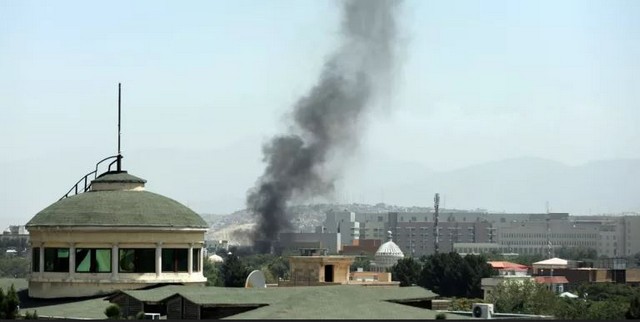
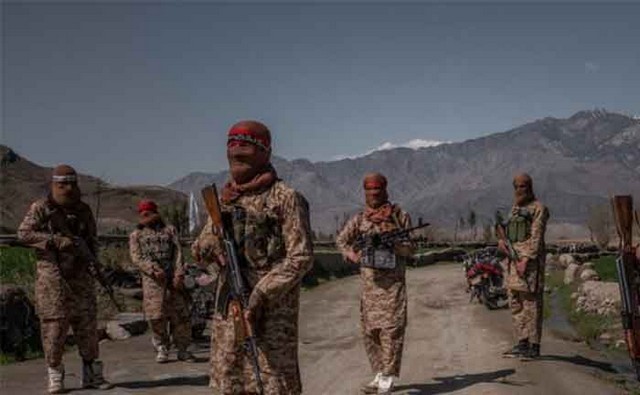
Most Western media outlets are carrying headlines and hype about the return of the Taliban to Afghanistan after the fighting force swept through the country at a blistering pace which has left military strategists gasping. Within 24 hours of making his “I am staying” speech, President Ashraf Ghani fled from Kabul when the Taliban entered the city. Apparently, he has gone to Tajikstan while an interim government headed by Taliban commander Mullah Abdul Ghani Baradar takes over.

Ghani didn’t want to stay and fight. Happily, the Afghan National Army agreed, probably because he and his corrupt government weren’t worth defending; the troops gave little or no resistance when Baradar arrived.

In less than a week, the Taliban has seized ten provincial capitals, including the movement’s spiritual home of Kandahar. On Saturday morning, its forces surrounded the capital.

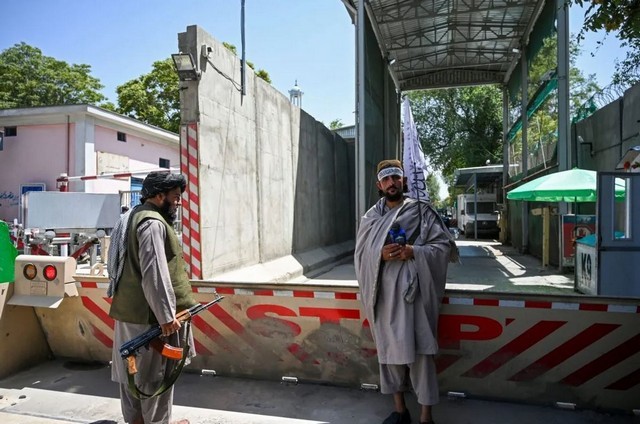
Since Western governments and media have spent three decades demonising the Taliban, the headlines over recent days were entirely predictable. “Return to the Dark Ages”, screamed one alongside the face of an Afghan girl looking incredibly frightened and bewildered. I felt frightened for her, even though most of the emerging descriptions and scare stories lack real substance. Not only are Western media outlets selling the public short they’re managing to scare the hell out of everyone else with stories of rape, forced marriage, and schools being closed, as well as the usual tropes such as kite flying being banned.

What is absent in all of the hysteria is any meaningful analysis, insight, or even simple facts about how the Taliban forces have managed to sweep through Afghanistan taking strategic cities such as Herat, Kandahar, and Pul-e-Alam, the capital of Logar province, in just a few days.

Yes, there is carnage on the ground; and, yes, there have been atrocities, but they are happening on all sides. That is what war looks like. The bodies of the children pulled out of the rubble in Kabul when the US and Britain fired cruise missiles against the Afghans in the city at the start of this conflict in 2001 look no different to the bodies of innocents caught up in last week’s crossfire. The only difference is that no one bothered to count the dead and wounded back then if they weren’t American, British or other NATO soldiers.

How has the Taliban managed to seize control of Afghanistan? For a start, it’s worth reminding ourselves that, despite what we read in the media, the movement is not a small band of insurrectionists who have recently re-emerged like some pop-up army after the US announced the surprise pull out of its troops. The Taliban is made up of Afghans with popular support in many parts of the country; it never really went away. These are people fighting in and for their own country, not interlopers.

Although some of the original Taliban are still in its ranks, the movement is quite different from that which fled from Kabul in 2001. The key strategists and decision-makers have not ditched or compromised their Islamic beliefs. They have, though, matured and developed and embraced a more pragmatic outlook on global politics.

Just as the then would-be president Hamid Karzai spent much of 2001 sneaking in and out of Afghanistan making strategic alliances with regional power holders and tribal leaders, ever since 9/11 the Taliban leaders have done exactly the same. However, instead of relying solely on support from within the country, the Taliban negotiating team has also realised that alliances with neighbours and regional powers are equally important, especially when it comes to trade and creating jobs and wealth.

According to my sources — and they’ve not let me down so far — top-level meetings have already taken place with China, Russia, Turkey, Pakistan, Iran, and other neighbouring states. I’m told that the meetings have all been productive and positive.

There could be very practical reasons for this. Tehran, for example, does not need any more problems to deal with, especially along its rugged 950km border with Afghanistan. Given the tough geographical conditions in the region, it’s nigh on impossible to secure. Iran already has plenty to contend with further afield, as Israel keeps threatening to attack and is goading the US into action against the government in Tehran. The Israelis are already embroiled in a so-called shadow war with Iran in the Gulf.

Similarly, Pakistan has a massive job policing its 2,640km border with Afghanistan while keeping an eye on its potentially hostile nuclear-armed neighbour India in occupied Kashmir. China has much bigger problems to contend with as an emerging superpower, so it too will not want to be distracted by events in the Wakhan Corridor, a sliver of land 350km long but less than 15km wide, ending in Afghanistan’s shortest border of just 75km.

Russia also has its own problems and doesn’t want to be sucked into sorting out Afghanistan’s. Moscow has already been down that route as we all know; the old USSR invaded Afghanistan in 1979 until 1989, leading to a 10-year war and occupation, and the emergence of Al-Qaeda. Soviet involvement was as disastrous as the American and British military misadventure in the “graveyard of empires”.

The fact that the Sunni Taliban have been talking with Shia Iran is a sign that toxic sectarian issues could finally be resolved. Not everyone will be happy at this, not least Israel’s new best friends and strategic partners in the Gulf, including Saudi Arabia. The two have a mutual loathing for Shia-dominated Iran, as does the kingdom’s influential Wahhabi religious establishment.

Turkey could prove to be a good ally since it is already making its weight felt in the Muslim world with its troops in Syria, Libya, and Qatar, where the Taliban’s negotiating team is based. The Qataris are already promoting themselves as partners for peace in other arenas; again, its rivals in Riyadh are not happy.

Taking all of this into consideration, it is highly unlikely that Afghanistan will become a playground for jihadists or a magnet for terrorists. Far from being isolated, Afghanistan could once again become a key trading route with significant business partners. The key thing, as I wrote a couple of weeks ago, is that “The time has come for the West to take a giant step back and stop interfering in Afghanistan other than to provide no-strings humanitarian aid and support to make up for 20 years of devastation.” I stand by this claim.

I remember asking my Taliban interrogators during my well-documented captivity in Afghanistan in 2001 about the movement’s relationship with Al Qaeda. “They came in as our guests and now act as our masters,” they replied bluntly. If that was representative of the general feeling back then, I think that the Taliban leadership may be more selective over who it hosts in the future.

Bearing in mind that the Taliban has never exported terrorism or carried out military strikes beyond its own country, I think it’s highly unlikely it will tolerate those with plans to export terrorism to the West. It’s worth repeating that there were no Taliban fighters on board any of the hijacked aircraft on 9/11, something which many Americans forget; the terrorists were nearly all Saudis.

This will come as a surprise to some journalists who are incapable of viewing the Taliban as anything other than “terrorists”. They see the beards, turbans, and distinct clothing and lazy journalism results; Islamophobia and racism follow.

I suspect that the Taliban’s priorities will include expunging any traces of Daesh from its territory. If any politicians and journalists cannot — or will not — distinguish between the two groups, they need to consider if they are in the right job. As they give this some thought, let them also consider the fact that Western efforts to prop up one of the most corrupt governments in the world helped the Taliban considerably.

The US has thrown three trillion dollars at its failed military campaign in Afghanistan; billions more have been given as aid, much of which has been siphoned off by unsavoury elements within Ashraf Ghani’s regime. Now a lot of the American weapons and equipment supplied to the Afghan National Army and other forces are in the hands of the Taliban. Britain and the EU have also spent huge amounts of money in Afghanistan.

Astonishingly, Europe has threatened to isolate Afghanistan on the international stage if the Taliban takes power again. Why? It was a disaster the last time round and by isolating the Taliban, the EU created even more fertile conditions for Al-Qaeda and other groups to flourish. It has been said that the definition of madness is to do the same thing over and over again and expect different results. European racism is clouding its judgment.

Perhaps the most shocking reaction of all has come from US President Joe Biden, who dropped a bombshell before heading off to his Camp David retreat for the weekend. The Afghan people, he told journalists, have to “fight for themselves” and “fight for their nation.”

Let this be a lesson to all who look to America to police the world. The US message is clear: We bombed, invaded, and occupied your country and now we have quit, leaving someone else to sort out the mess that we made. What a propaganda tool for the Taliban. Is it any wonder that the movement has encountered little resistance on the road to Kabul?

I said many years ago that America and its allies were not the solutions for Afghanistan, but the problem. Post-captivity I’ve been back to Afghanistan many times and I can tell you that moving around the country in the all-enveloping blue burqa enabled me to observe America’s arrogant imperialism at close quarters. It was repugnant.

As we look at what is happening now, let’s remember this: It’s not the rapid withdrawal of the US forces that enabled the Taliban’s speedy power grab, it was their presence in Afghanistan in the first place.

British journalist and author Yvonne Ridley provides political analysis on affairs related to the Middle East, Asia and the Global War on Terror.

16 August 2021

Source: www.middleeastmonitor.com
The US Legacy in Afghanistan

By Maya Evans

15 Aug 2021 – The Taliban take all major cities in Afghanistan ~ The Presidential Palace has fallen ~ President Ghani flees the country ~ US pledge to redeploy 5,000 troops ~ All embassy staff leave the country ~ We are now looking at a Taliban led Government ~ The Taliban say they want to take power without violence.

The war in Afghanistan can be summed up as chaotic and disastrous.

Nearly twenty years ago, just one month after 9/11, the US led the coalition that invaded Afghanistan. Its stated aims were to topple the Taliban, liberate women and capture Osama Bin Laden.

Twenty years later, the US have installed a corrupt puppet government. Rights have improved for some women, but they are not included or safeguarded in the ‘peace deal’. It took 10 years to capture Bin Laden, but not in Afghanistan: he was hiding in Pakistan.

Under the peace agreement, the Taliban are supposed to share power with the Afghan government, and promise to never accommodate terrorist organisations in Afghanistan. It hasn’t, perhaps deliberately, been well documented that theTaliban were not close allies of Bin Laden and Al Qaeda; the international terrorist group were in fact merely tolerated by Mullah Omar. In the early days of the 2001 invasion, the Taliban had in fact impounded Bin Laden and were willing to hand him over to a third-party country, if the US could prove his connection with 9/11. The Bush administration chose to ignore diplomacy and negotiation and instead, perhaps unknowingly, committed themselves to the longest war in their history.

The prospects for power-sharing with the Afghan government were never great. The Taliban still see the current regime as a US-installed ‘illegitimate puppet government’. The Afghan Government is known for its corruption, with politicians who included notorious warlords with blood on their hands from the 1990s civil war.

The Taliban wanted the lion’s share of power and were confident they would win out. In the last two years, they have made gains across the country, taking most rural districts. Today Kabul fell to the Taliban, joining all the other major cities which have been taken over the last few weeks.

Throughout the talks, the Taliban continued to carry out attacks on civilian buildings, while the US regularly undertook airstrikes. The violence running up to the withdrawal date has been intensifying. There are also reports of units of the Afghan Army readily surrendering, while the Taliban seize huge weapon stores left by the US. Meanwhile some rural villagers are taking up arms and vowing to defend themselves, while others opt to flee to the mountain tops.

The position of women has not featured much during the talks. Representatives of women’s organisations were rarely invited and their contributions not taken that seriously. Although a well-lauded justification for invading in 2001, women’s rights are not part of the peace deal.

It is important to acknowledge that women’s rights in Afghanistan have improved for some women, with better access to education, healthcare and employment. However, it should be noted that not all women have been afforded these rights: many girls in the rural villages were not able to attend school due to societal pressure to stay home. The benefits of accessing healthcare are perhaps eclipsed by the impacts of US/ NATO aerial bombing or being caught up in Taliban suicide bomb attacks and other conflict-related injuries. Unemployment for 2021is expected to reach 12.7%, with an eye-watering 47.3% of the population now living below the poverty line.

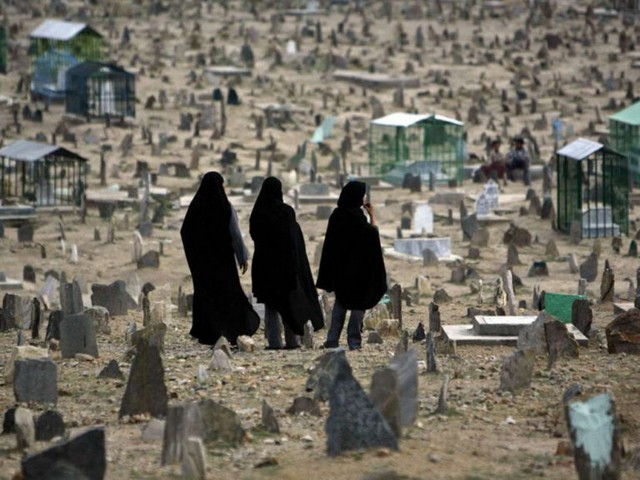
Was the government ever serious about women’s rights? It certainly didn’t enshrine enough legislation to protect women: for example, the 2009 Elimination of Violence Against Women Law, created to provide women and girls with protection against domestic violence, has never properly been implemented. While in 2014 the Afghan Government tabled Article 26, potential legislation which forbad family members from testifying against alleged perpetrators of domestic violence. Today, Afghan women are understandably worried about the few hard-earned rights they have won disappearing, and being thrust back into the dark days of the Taliban.

But the continued occupation of US and NATO troops is not the answer. Kabul resident Zainab, age 26, says,

“The Afghan people don’t know what the US troops are doing here. Every day there are killings by explosions, drones, weapons. The US troops have just made a land of conflict so they can bring more guns and kill people in different ways. They have made [Afghanistan into] a poor country whose people are so tired of what is going on, and given more power to the Taliban. I think they should know that this country needs life, health, education and childcare. Women are so tired of military solutions. Also, they should know that here we need peace.

“I am a woman who hasn’t seen any change after these years. Still, we lose our families in war .I think only Afghans can bring peace to Afghanistan. I am very worried about women. When the Taliban get more involved and gain power, women will lose their rights, especially to education, and will go back to wearing the burqa. We will see more violence, we will not be able to get food or any basic needs. No one will hear women’s voices.”

Another Kabul resident, Naji, age 24, added:

“The current government might last for a while but many will still lose their lives, as people do these days. The impact of irresponsible withdrawal might be another civil war. Women won’t be treated as humans, schools and universities will close, people will migrate, and civil society organisations will vanish. On top of that, climate change will add to the problems. People already face a shortage of clean water.”

The idea that the NATO operation has tried to win ‘hearts and minds’ is completely disingenuous. There have been airstrikes and drone attacks, which are notorious for killing civilians – in 2019 aerial operations killed 700 Afghan civilians, while it has been found a drone strike is 10 times more likely to kill a civilian. Afghans fear US night raids, the torture centre at Bagram, the deliberate targeting and bombing of wedding parties, the bombing of hospitalssuch as the 2015 bombing of Médecins Sans Frontières in Kunduz, the ‘Mother of all bombs’ in Nangarhar… The list of war atrocities could go on and on. 20 years spent on violence and war, rather than peace and education.

One of my young Afghan friends calls me on WhatsApp: Gul Jamal, aged 25. I’ve known him for around 10 years: “Maya Jan, I am afraid my life will be taken, what do you think about me leaving the country, where should I go?” Another friend messages me; he and his young family have been lucky enough to get visas for the US. Meanwhile, our friends in a youth peace group in Kabul want to Skype to discuss chances of international scholarships and asylum. An email lands in my inbox: colleagues in the US have been contacted by another dear Afghan friend. He has asked for $6,000 so that he and his wife can flee to Turkey. Another young Afghan friend contacts me via Facebook: formerly a street kid in Kabul, now aged 15, he is living in India and in desperate need of employment.

Afghanistan has been the US’s longest war. The cost has been $2.26 trillion, of which $143bn has been spent on reconstruction. There have been 71,000 civilian deaths as a direct result of the war. The military fatalities are 69,000 Afghan troops, 3,500 US and allied NATO troops, 3,800 private security contractors and 84,000 Taliban and other militia.

Today Afghanistan is one of the worst countries in the world for almost every quality of life index. There are 4 million internally displaced persons. There is a major water crisis, with only 27% of people having access to clean water. Due to climate change, snows are failing. The pumping of water for opium production also has a negative effect.

Around 10% of the population are addicted to opium. Some 90% of the world’s supply comes from Afghanistan.

The UN estimate 55% of children are malnourished. 68% of the population suffer from depression. The list could go on.

But still there is hope. My two friends Amir and Gulzar run peace projects in Bamiyan. They operate a peace art project and in the winter they run a street kids school and distribute solar pots so that poor people can cook food using solar power.

This is where the international funding should go, not to the ghost hospitals and schools which are the result of US contracts, or to the ineffective multi-million dollar Aid industry which saw 40% of the supposed Aid to Afghanistan go back to the donor countries in corporate profits and consultancy salaries, while in-country aid workers often never venture out of the heavily secured ‘green-zone’ in Kabul, a heavily secured bubble reserved for international workers.

The US and NATO are pulling out of Afghanistan, but they are not entirely leaving. Afghanistan remains important for geopolitical reasons, both for neighbouring China, as well as Iran and Pakistan. The country also contains at least a trillion dollars’ worth of rare earth metals.

The leverage the US will have over the Taliban to co-operate around these key interests will be in the form of drone strikes and aid-giving. One thing is for certain, the Afghan people will suffer further.

No doubt, after September 11th Afghanistan will drop out of the news and people will think it’s all over, but it won’t be. Continue to follow Afghanistan, and above all, campaign for reparations to be given to the people of Afghanistan.

_______________________________________

Maya (Anne) Evans is a British peace campaigner who was arrested in October 2005 opposite the Cenotaph war memorial in London, for refusing to stop reading aloud the names of British soldiers who had been killed in Iraq following the 2003 Iraq war.

16 August 2021

Source: www.transcend.org

The Fall of Kabul

By Nick Turse

Joe Biden claimed “zero” parallels between U.S. withdrawals from Afghanistan and Vietnam. As the Taliban take Kabul, he’s proved wrong.

15 Aug 2021 – Last month, President Joe Biden announced that America’s “military mission in Afghanistan will conclude on August 31st.” In the time since the July 8 statement, a Taliban offensive has overrun city after city across the country. Today, the militant group entered the Afghan capital of Kabul, and several countries, including the United States, began to evacuate their embassies. As reports emerged that the Taliban had seized the presidential palace, Afghan president Ashraf Ghani fled the country.

“We, of course, are saddened indeed by the events. … But these events, tragic as they are, portend neither the end of the world nor of America’s leadership in the world,” said the U.S. president.

But that president wasn’t Biden. It was Gerald Ford on April 23, 1975, as North Vietnamese forces rolled toward Saigon, the capital of South Vietnam.

A two-decade American effort to turn South Vietnam into a noncommunist bulwark in Southeast Asia had failed. A million-man army long advised, financed, trained, and equipped by the United States was crumbling as South Vietnamese soldiers fled the front lines. They stripped off their uniforms and attempted to disappear into the civilian population.

“We can and we should help others to help themselves,” said Ford. “But the fate of responsible men and women everywhere, in the final decision, rests in their own hands, not in ours.”

Last month, Biden echoed the same sentiments, putting the fate of Afghanistan squarely on the shoulders of the Afghan government and military. It is, he said, “the right and the responsibility of the Afghan people alone to decide their future and how they want to run their country.”

While the United States and its allies had propped up the Afghan government for the better part of two decades and had spent at least $83 billion to build, advise, train, and equip its faltering armed forces, Biden seemingly washed his and the rest of the U.S.’s hands of further responsibility. “We provided our Afghan partners with all the tools — let me emphasize: all the tools, training, and equipment of any modern military. We provided advanced weaponry,” he said.

The case was the same in South Vietnam. The United States had provided billions in high-tech weapons, but it hardly mattered as North Vietnamese forces rolled toward Saigon. The U.S.-backed “puppet troops,” as they were called by the North, melted away.

A week after Ford made his speech, South Vietnam ceased to exist. The United States’s military efforts in neighboring Cambodia and Laos fared no better. “Some tend to feel that if we do not succeed in everything everywhere, then we have succeeded in nothing anywhere. I reject categorically such polarized thinking,” Ford told the crowd at Tulane University. “America’s future depends upon Americans — especially your generation, which is now equipping itself to assume the challenges of the future, to help write the agenda for America.”

That new agenda could have included a complete reevaluation of U.S. foreign policy and a rejection of the ruinous national security strategy and reckless foreign interventions that led to America’s embarrassing defeats in Southeast Asia. Ford had demanded that “we accept the responsibilities of leadership as a good neighbor to all peoples and the enemy of none.” But in a few short years, the United States began a massive effort to saddle the Soviet Union with its own Vietnam War. It was one of the most aggressive campaigns ever mounted by the CIA, aiding guerrillas in Afghanistan and setting the stage for 9/11, the forever wars, and today’s Afghan collapse.

The years since have been typified by U.S. military interventions that yielded little, like the ruinous 1983 deployment of U.S. Marines to Beirut, the 1986 bombing of Libya, and, more recently, military setbacks, stalemates, and defeats from Iraq to Burkina Faso, Somalia to Libya, Mali to, again, Afghanistan. Victories, such as they are, have been confined to efforts in places like Grenada and Panama.

As he concluded his July 8 speech, Biden, like Ford before him, attempted to turn the page. “We have to defeat Covid-19 at home and around the world … [and] take concerted action to fight existential threats of climate change,” he asserted. The rapid rise in Covid-19 infections and deaths in the United States, paired with the devastating report by the Intergovernmental Panel on Climate Change, suggests that meeting these challenges may be far more difficult than those the U.S. faced and failed in Afghanistan.

Taking questions from the press in July, Biden was asked if he saw “any parallels between this withdrawal and what happened in Vietnam.”

“None whatsoever. Zero,” he replied.

He was, in some way, right. The Afghan collapse was far more precipitous than that of the South Vietnamese armed forces. But Biden ignores the clear parallels between that past moment of defeat and the current one at his own peril and that of the United States as a whole. Ford’s 1975 speech was loaded with absurd rhetoric about the future, lacking any real attempt at redefining American foreign policy. Without a true reevaluation this time around, the U.S. risks falling into well-worn patterns that may, one day, make the military debacles in Southeast and Southwest Asia look terribly small.

Nick Turse is a contributing writer for The Intercept, reporting on national security and foreign policy.

16 August 2021

Source: www.transcend.org

How Myanmar Fits into China’s New Silk Roads

By Pepe Escobar

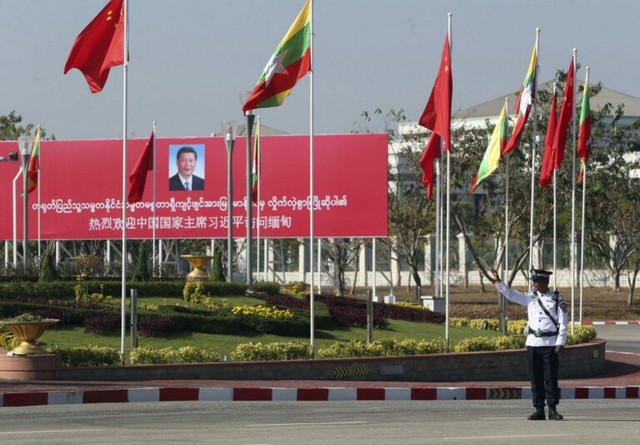
4 Aug 2021 – You don’t argue with the Tatmadaw – the Myanmar Armed Forces. It’s always their way, or the highway. Since the mid-20th century, the Chinese have come to understand it quite well.

How Beijing approaches the Myanmar maze is conditioned by four variables: natural gas; water; the drug trade; and the fractious clashes between the Tatmadaw and a dizzying patchwork of over 135 ethnic minorities.

Each Myanmar ethnic group exhibits its own peculiar history, culture and language. They control vast territories, whole industries and serious militias. Myanmar’s two-third majority is represented by the Bamar – also known as the Lowland Burmese. The Tatmadaw is largely a Lowland Burmese army – in perennial conflict with that large ethnic jigsaw puzzle.

The ethnic minorities live mostly in the hills and along Myanmar’s porous jungle borders. Myanmar is divided into seven states – named after the seven largest ethnic groups: Kachin, Chin, Karenni, Karen, Mon, Shan and Rakhine. Alliances tend to be quite fragile, but historically the Chinese have been inclined to support a few of them in their fight against the Tatmadaw.

Drug trade in Myanmar is a virtually impenetrable matryoshka – with most of these groups connected across the Golden Triangle to partners in China, Thailand and Laos, and on top of it competing against each other.

The Shan traditionally have used huge profits in the drug trade to buy an array of weapons. There is a wealth of competing Shan groups, among them the army of the late, notoriously flamboyant drug lord Khun Sa, known as “The Opium King of Burma”; the former headhunters that compose the Wa tribe; and a bunch of Kokang Chinese who form the eastern Shan State army.

The opium/heroin business – and much of the ya ba (amphetamine) trafficking – in the Golden Triangle is now largely controlled by the much feared United Wa State Army: a 20,000-strong ultra-hardcore militia, one of the most powerful on the planet, complete with their private collection of surface-to-air missiles.

And that brings us to the Chinese angle – because many of these ethnic potentates, from Khun Sa to Kyi Myint, a.k.a. Zhang Zhiming, a former head of the Communist Party of Burma, have forged very close relations with Chinese Triads.

Yet what does the central government in Myanmar have to do with the heart of the action in the Golden Triangle? Not much. The Tatmadaw may strike the odd peace deal with these unruly actors, but they usually don’t last long.

What the Tatmadaw did over these past decades was a crash course on business – learning the ropes about post-Mao China. That’s how they evolved into a major corporate empire – much more than an army.

Myanmar was already on the front line when sections of the People’s Liberation Army (PL) in China got into business. For instance, Yunnan province in southern China was the operating base for the top three heroin Triad families. So the first step was Burma linked to the Chinese triads as the logistical arm of the Golden Triangle drug trade. The next step featured China building railways to link Yunnan to Burma/Myanmar.

Oil and gas star as the next piece of the puzzle. As France’s Total started to expand their initial oil and gas exploits off Rakhine – formerly known as Arakan state – the Chinese had the foresight to invest in a long oil and gas pipeline linking it to Yunnan. From Beijing’s point of view, what really matters is this Sino-Myanmar oil and gas pipeline from the Bay of Bengal to southern China – with the Tatmadaw in charge of security.

While China invests in copper mines and dams, but arguably its key investment in Myanmar is a new deep-water port on the Bay of Bengal, with the accompanying Kyaukphyu Special Free Trade Zone. The port and the pipeline interconnect, representing the Myanmar backbone of the vitally important Belt and Road Initiative (BRI) Southeast Asia corridor.

And that brings us to the intractable Rohingya problem.

China’s absolute priority is to protect the new port plus the Special Free Trade Zone being built in Rakhine.

For quite a while the Myanmar government’s income – now controlled by the Tatmadaw – has depended on the oil/gas from onshore and offshore operations in Rakhine as well as the rail/road connectivity.

The Chinese for their part are in close touch with the Kachin Army and the Kokang ethnic group. If the going gets tough, the plan is to use them as well as the Arakan Army, active in the region, to manage the Tatmadaw in case they start having funny ideas. The only thing that matters for the Chinese is the BRI corridor and the Rohingya find themselves caught in the middle of this serious power play.

The Myanmar puzzle is made even more complex by the issue of water. The Beijing leadership knows very well how strategic Myanmar is in terms of solving China’s critical water imbalance. China, with 20% of the world’s population, can count on only 7% of the world’s fresh water. And 80% of China’s water is in the south, while over 700 million Chinese and two-thirds of its farmland are in the north.

The solution has been to build 11 of the world’s largest hydroelectric dams on the key rivers which flow towards China’s neighbors. And this has given rise to dramatic problems, especially in the case of the Mekong, where every region below the dams, in Myanmar, Laos, Thailand, Cambodia, and Vietnam, has been extremely handicapped. And the issue is far from over: 11 more dams will be built in the lower Mekong, in Laos and Cambodia.

The relationship between Beijing and the Tatmadaw was never a bed of roses. Overall, the Chinese were seen with much suspicion at the Ministry of Foreign Relations level during the NLD years, while most Tatmadaw Generals admire China’s economic power. Beijing’s immutable diplomatic law amounts to non-interference in the domestic policies of its partners – so it has refrained from weighing in on whether the military coup earlier this year was actually not really a coup, as the Tadmadaw argues.

Facts on the ground spell out the Tatdadaw making a lot of money over the years by collecting fees and owning shares in Chinese deals struck in the ethnic regions. At the same time the Tatmadaw know that the Chinese, even indirectly, provide military support to quite a few militias. And drug kingpins are only able to operate smoothly across the Golden Triangle because the Chinese allow it.

So, the relationship is undoubtedly an uneasy one. A great deal of Chinese influence in Myanmar was somewhat restricted during the NLD government. Now the whole situation is in limbo. Yet Beijing never takes its eyes off the Big Prize: BRI corridor projects should never be in danger, and Myanmar will always be an inextricable part of the New Silk Roads.

Pepe Escobar is a Brazilian independent geopolitical analyst. He is a frequent contributor to websites and radio and TV shows ranging from the US to East Asia.

16 August 2021

Source: www.transcend.org

What the West Must Learn from China

By Marshall Auerback

10 Aug 2021 – The Chinese government has made an existential choice: rather than surviving by betting on the markets, it is going to produce stuff instead. It wants a nation full of engineers, not financial engineers; computer chips, rather than chocolate chips; innovation over financial experimentation. Beijing also wants an education system that actually educates, rather than creating a cottage industry of “progressive” credentialism that engenders a self-perpetuating upper class, rich both in terms of capital and diplomas but provides little in the way of genuine scholarship.

Needless to say, this is not the conventional reading of China’s recent attacks on fin-tech, internet monopolies and private education companies. Take Stephen Roach, former chief economist at Morgan Stanley, who recently decried Beijing’s actions “as a tipping point for the economy”. He goes on to lament the heavy-handed use of regulation “to strangle the business models and financing capacity of the economy’s most dynamic sector”.

As the proverbial expression goes, you can take the boy out of Morgan Stanley, but you can’t take Morgan Stanley out of the boy. Roach still retains a Wall Street-centric bias in a country — the United States — where the stock market remains the ultimate arbiter of the American experience. Indeed, if one were to assess America’s “entrepreneurial spirit” via stock market metrics, then that would suggest that US has been stunningly successful. As economist David Goldman has noted, “in 2010, the five biggest tech companies accounted for just 11% of the market capitalisation of the S&P 500”. Today, however, “ten companies in the S&P 500 hold two-fifths of all the cash balances of index members, and all but one is a tech giant… The top three cash holders in the S&P — Microsoft, Apple, and Google — hold a fifth of all the cash held by index companies”.

But as Goldman observes, these companies’ profits have increasingly been the product of oligopolistic rents, rather than product innovation: “Apple is so cash-rich that it has bought back $327 billion of its stock since 2012. That explains why its stock price has risen by 82% in the past six years even though its operating income has barely changed.”

Far from deploying cash toward productive R&D investment, Apple’s behaviour provides a case study of precisely the kind of situation that Beijing is seeking to avoid: companies deploying cashflow toward stock buybacks, rather than investing in stateside facilities to enhance the nation’s productive investment and employment capabilities.

How many times do we find ourselves in an elevator, in an airplane terminal or at home, looking at a screen with stock numbers whizzing by, and people fretting over whether America is about to disintegrate because of a 5% swing in Apple’s share price? How did we get to point where our national economic conversation is dominated by chatter on the stock gyrations of GameStop, when this just an economic irrelevance for most of the 330 million people who live in America, and are struggling to sustain a modicum of economic security?

We ban the use of Chinese 5G equipment in US networks, but few ponder the question as to why there are no longer any American telecom equipment companies. After all, in the 1970s the two largest telecom equipment manufacturers were US companies: Western Electric and ITT. With this story of increasing manufacturing irrelevance as our backdrop, is it really fair to suggest that China is on the road to economic perdition because its government decries the “spiritual opium” of computer games?

A harsh charge, especially when one considers China’s own tragic history pertaining to opium addiction. Yet it seems there is some moral force to the Government’s argument which pressured China’s largest gaming company, Tencent, to announce new restrictions to limit gaming time for children under 12 to just one hour a day and two hours a day during holidays.

Here in the United States, we lost our way decades ago, when we decided that the only social responsibility of a corporation was to increase its profits, community considerations and employees be damned. This laid the groundwork for economist Milton Friedman’s “stockholder theory”: the idea that shareholders, being the owners and the main risk-bearing participants, ought therefore to receive the biggest rewards.

But while tying corporate decision-making and stock price to innovation and production may have sounded superficially attractive, the champions of this theory, including Friedman himself, never bothered to show how these outcomes could be achieved in the real world. In fact, the historical experience has been abysmal.

Boeing and GE, to cite two prominent examples, were once poster boys for the success of American capitalism. Today they are but a shell of their former glory. With its Max 8 737 plane, and the 787 Dreamliner, Boeing has become synonymous with airplane crashes and shoddy engineering, whilst GE, once a byword for thriving manufacturing and innovation, suffered the indignity of being yet another target of Harry Markopolos, the accounting expert who first raised red flags about Bernie Madoff’s Ponzi scheme.

Both managements are now focused on financial engineering rather than manufacturing, much of which has been sold off, or outsourced to China. In doing so, they reflect an ethos that prioritises finance above all else in an economy increasingly characterised the layering of debt on top of debt. It means a greater share of GDP going to the financial system, going to interest rather than profit, and away from a goods-producing economy.

Beijing has been paying attention as it increasingly bets on real innovation, and targets various companies as strate­gic components within a broader industrial ecosystem to promote national development. True, the Government has fought to protect and promote its own companies within this sector. But what has been caricatured in the West as governments incompetently picking winners and losers has in fact created world-class companies such as Huawei.

At the same time, American “free market” solutions have resulted in a hollowing out of companies that were once world-class innovators, and a corresponding degradation of economic know-how and social capital as highly skilled jobs have been outsourced.

This is the context in which we should understand Beijing’s recent crackdowns. What Stephen Roach and others characterise as Beijing’s politically motivated attacks on big tech behemoths such as Jack Ma’s Alibaba, could more accurately been seen reining in Ma’s attempt to convert his company into bank, all the while seeking to circumvent increased banking regulation. In other words, regulatory arbitrage.

Likewise, China’s State Administration for Market Regulation has been criticised for its fines on Alibaba Group, Tencent, and SF Holdings. But a closer look at the situations shows that these firms were singled out for what China’s chief regulator called “monopolistic corporate behaviour”, and the fines were levied “to protect consumer interests”. That sounds like the sort of thing that we are used to in the US, before our tech behemoths — Apple, Google, Facebook, Microsoft — gobbled up smaller competitors and began stifling competition and actively suppressing competitive innovation. These days, Beijing appears to believe in market competition more than we do.

Similarly, the crackdown on private education companies should be seen as an attempt to curb a credential arms race as we have in the US. Attacks on cramming factories such as TAL Education Group and Gaotu Group are not an attack on education, but a deterrent to the need to furnish students with worthless diplomas while businesses lament a skills deficit.

It’s not as though Beijing’s authorities are saying mathematics is Western and needs to be replaced with Han math or Confucian physics — which would be the real equivalent of what we are currently doing in many of our universities, where the extremes of progressive ideology mean that medical school professors are forced apologise for referring to a patient’s biological sex on the grounds that “acknowledging biological sex can be considered transphobic”.

In America, among the biggest beneficiaries of the current economic system are not entrepreneurs or innovators, but parasites who owe their wealth to rigged markets or government subsidies. But they are merely a symptom of the bigger problem: a newfound scepticism in the ability of American capitalism to deliver on its economic promise of prosperity.

That is precisely the kind of thing that China is seeking to avoid. Stock market investors may be unhappy, but far from destroying consumer confidence, the measures now being undertaken by Beijing might have precisely the opposite effect.

As Chinese fund manager Yuan Yuwei has argued, “housing, medical and education costs were the ‘three big mountains’ suffocating Chinese families and crowding out their consumption”. Yuan went on to describe these measures as “the most forceful reform I’ve seen over many years, and the most populist one. It benefits the masses at the cost of the richest and the elite groups.”

Unlike America’s Federal Reserve, whose increasing tolerance and support of financial bubbles continues to engender profound systemic fragility in the American economy, Beijing is prioritising social cohesion above the narrow interests of financial rentiers. If only American policymakers had demonstrated such foresight in decades past.

Marshall Auerback is a market commentator and a research associate for the Levy Institute at Bard College.

16 August 2021

Source: www.transcend.org

Does China’s Rise Really Threaten the U.S.—Or Just Its Sociopathic Power Elite, Who Want to Keep Ruling the World Even If It Drags Us into WW III?

By Dee Knight

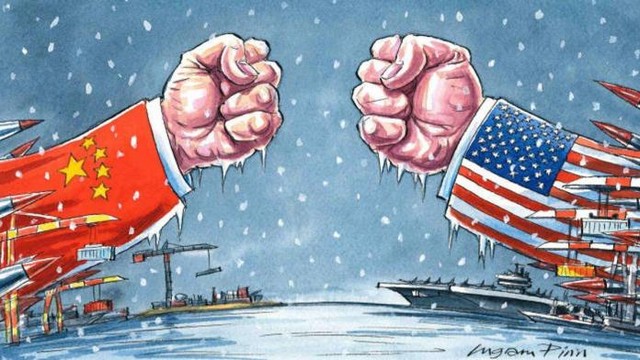
14 Aug 2021 – Government-sponsored “fake news” is brainwashing the public into accepting a new U.S./NATO-sponsored Cold War with China.

A massive blitz of Western propaganda is behind the escalating U.S. cold war against China.

President Biden and most of the U.S. Congress say China has become a serious threat that must be countered in every way and in every corner of the globe. The U.S.-led cold war against China has escalated quickly and dramatically. President Biden is trying to harness the G7 and NATO to isolate China, and Congress is fast-tracking bills to counter China’s Belt and Road Initiative and punish China for alleged human rights violations.

This escalation is not new. Barack Obama launched the U.S. “pivot to Asia.” Now the seas around China bristle with U.S. aircraft carriers and nuclear submarines; missiles and super-bombers are aimed at China from Japan, Korea, Thailand, the Philippines, Indonesia and Australia, with tens of thousands of troops.

The U.S. recently forged the “Quad Alliance” with Japan, India and Australia, to further challenge China. But it is not enough. Biden wants all U.S. allies to join sides against China.

There is a problem with this strategy. A NY Times report of June 16 said “Not all countries in NATO or the Group of 7 share Mr. Biden’s zeal to isolate China.” Germany, France, Italy, Greece, and several other European countries have major economic ties with China. French President Emmanuel Macron told Politico “NATO is an organization that concerns the North Atlantic. China has little to do with the North Atlantic.”

The people of Europe do not want war. A survey by the European Council on Foreign Affairs in January found that most Europeans want to remain neutral. Only 22% would want to take the U.S. side in a war on China, and just 23% in a war on Russia. The Alliance of Democracies Foundation (ADF), in Europe, conducted a poll of 50,000 people in 53 countries between February and April 2021, and found that more people around the world (44%) see the United States as a threat to democracy in their countries than China (38%) or Russia (28%).

That makes it hard for the U.S. to justify war in the name of democracy. In a larger poll of 124,000 people ADF conducted in 2020, countries where large majorities saw the United States as a danger to democracy included China, but also Germany, Austria, Denmark, Ireland, France, Greece, Belgium, Sweden and Canada.

ADF also studied the disparity between those who believe in democracy and those who think they live in one. This chart shows 73% of Chinese think their country is democratic, while just 49% in the U.S. believe their country is democratic.

Another report—from Harvard University’s Ash Center for Democratic Governance and Innovation – finds that more than 90% of the Chinese people like their government, and “rate it as more capable and effective than ever before.”

“Interestingly, more marginalized groups in poorer, inland regions are actually comparatively more likely to report increases in satisfaction.” It says Chinese people’s attitudes “appear to respond to real changes in their material well-being.” Elevating 800 million people out of extreme poverty probably helped.

This contrasts with people’s attitudes in the United States, which are polarized politically, racially and economically. Public trust in government is in crisis. This could be a reason for politicians to whip up a cold-war fever—and an urgent reason to take the danger seriously. There are very real human rights concerns at home, where police killings, homelessness and mass incarceration are at pandemic proportions.

In the U.S. Congress, there has been bipartisan support for the Innovation and Competition Act, which demonizes China’s economic successes across the globe. Charges fly that China favors its companies, both private and state-owned, in China and elsewhere, through subsidies and special financing, while subjecting Western trade partners to forced technology transfer, theft of intellectual property, and more.

The proposed response is for the U.S. government to do much the same. In Europe Biden announced a “build back better” Western version of global infrastructure development, but when and whether it will happen are unclear.

Bernie Sanders wrote in Foreign Affairs in June that “a fast-growing consensus is emerging in Washington that views the U.S.-Chinese relationship as a zero-sum economic and military struggle …”

Sanders also stated that “the rush to confront China has a very recent precedent: the global ‘war on terror.’ In the wake of the 9/11 attacks, the [U.S.] political establishment quickly concluded that antiterrorism had to become the overriding focus of U.S. foreign policy. Almost two decades and $6 trillion later, it’s become clear that national unity was exploited to launch a series of endless wars that proved enormously costly in human, economic, and strategic terms and that gave rise to xenophobia and bigotry in U.S. politics—the brunt of it borne by American Muslim and Arab communities. It is no surprise that today, in a climate of relentless fearmongering about China, the country is experiencing an increase in anti-Asian hate crimes.”

Media Bias and Human Rights Part 1: Hong Kong

The media’s demonization of China has been apparent in biased coverage of the 2019 Hong Kong protests where the norm has been to present the protesters heroically as champions of human rights and democracy and police and pro-Chinese government authorities as adherents of an authoritarian social order.

Missing from this assessment, among other things, is the influence of the United States.

Hong Kong native Julie Tang, now a retired judge of the San Francisco Superior Court, said recently that the 2019 riots began as a political protest against the extradition of a confessed murderer, but were supported by “a shadow power” – the National Endowment for Democracy (NED), a CIA offshoot–in an attempt to destabilize China through destruction and violence.

In 2018, the NED gave $155,000 to the anti-Beijing solidarity center in Hong Kong which helped instigate the protests and $200,000 to the National Democratic Institute and Hong Kong Human Rights Monitor.

Rioters killed a 70-year-old man by hitting him with a brick, and doused another with gasoline and burned him. They broke into the parliament building—much like the January 6, 2021, fascist riot in Washington, D.C.

Tang observes that Hong Kong ranks in the top three on the Fraser Human Freedoms Index, while the United States is in 17th place. She quotes Hong Kong journalist Nury Vittachi that “Hong Kong’s civil unrest was the most reported news story of 2019 – yet every salient detail presented was incorrect … The city’s freedoms had not been removed … Police killed no one … Agents from a global superpower were intimately involved, but it wasn’t China.” (The Other Side of the Story: A Secret War in Hong Kong, 2020, ASIN)

A key dimension of the media’s bias was its parroting of the rioters claims about police brutality—when the Hong Kong police had often displayed restraint in the face of violent protests and could be compared favorably to U.S. police (unlike U.S. police, Hong Kong police do not carry side arms).

A good example of the media bias was a December 2019 CNN report on Hong Kong entitled “A Generation Criminalized.”

Amidst a backdrop of photos pointing to the brutal suppression of the riots and tally of the number of protesters arrested and hospitalized and rounds of tear gas expended by the police, authors James Griffiths and Jessie Yeung quoted from a protester, Ivan, who said that “we seriously need to win this to say to whoever has the power that you cannot do this, you cannot do this to protesters or people fighting for their lives or their own freedom and values.”

Showing which side they were on, the authors lamented “an entire generation criminalized, in a fight for their future which could end up costing them just that.”

Left out was the fact that many of the protesters had engaged in criminal activity, along with the hidden hand of the NED.

The Hong Kong riots ultimately failed. Judge Tang says: “Now there is peace in Hong Kong, but there is a proposed U.S. law to devote $300 million to anti-China propaganda.”

Belatedly, though, some honest reporting has come out. A CNN story on July 10, 2021, for example, was headlined “Some Hong Kongers are glorifying a man who knifed a cop, showing the city’s problems are far from over.”

It detailed how Hong Kong protesters established a memorial filled with flowers for a man who knifed a cop on July 1st and then committed suicide. The student union of prestigious Hong Kong University passed a motion to say they “appreciated his sacrifice.” This is the same university where many of the protesters—heralded as great champions of democracy on CNN and other media a year earlier—came from.

Media Bias—Part II: The Myth of Uyghur Genocide

Besides Hong Kong, the media bias about China has been exemplified by the barrage of stories in mainstream outlets broadcasting the plight of the Uyghurs, many of which echoed U.S. government claims that China was committing genocide.

While human rights abuses had taken place, the genocide claims were unfounded. The use of the term concentration camps to describe detention facilities has also been dubious—these facilities function as re-education centers where Uyghurs who were involved in Islamic terrorist activities are provided vocational skills, recreational activities, medical services and a host of other benefits, and allowed to return home regularly.

The U.S. media coverage failed to address the strategic importance of Xinjiang and U.S. support for separatists and Islamic terrorist movements there.

Independent Canadian reporter Daniel Dumbrill reports that the East Turkestan Islamic Movement (ETIM), which has claimed responsibility for attacks in Xinjiang and elsewhere in China, has been identified as a terrorist organization by the governments of China, Kazakhstan, Pakistan, Turkey and the United States.

The U.S. government removed ETIM from its list of terrorist organizations in October 2020 and has since provided funds to it through NED. Following explosive incidents of terrorist violence by ETIM, the Chinese government responded with repression. How much repression, and for how long, are matters of controversy.

When Noam Chomsky was asked in an April 2021 New York Times podcast interview whether the situation of the Uyghurs was worse than the people of Gaza, he said “no. The Uyghurs were not having their power plants destroyed, their sewage plants destroyed” and were “not subjected to regular bombing.”

The exact number of Uyghurs placed in education camps is not known in the West. China has called the camps a large-scale job training program, as part of its national anti-poverty crusade. On a personal visit to Xinjiang, Dumbrill found that a very small minority of Uyghurs were repressed, and a large portion benefited from job training.

Responding to official U.S. charges of forced labor and genocide, Zhun Xu, an associate professor of economics at John Jay College in New York, says “if [China] has engaged in forced assimilation and eventual erasure of a vulnerable ethnic and religious minority group,” there should be a decrease in the Uyghur population and increase in the Han.

But Xinjiang’s Uyghur population increased by 24.9 percent from 2010 to 2018, while the Han population in Xinjiang grew by only 2.2 percent. (Cited by Reese Ehrlich, from Zhun Xu’s upcoming book, Sanctions as War.)

Right-wing religious extremist Adrian Zenz, who states he is “led by God” on a “mission against China,” is the main source for U.S. government and media criticism of Xinjiang conditions. He is also funded by The Jamestown Foundation, an arch-conservative defense policy think tank in Washington, D.C., which was co-founded by William Casey, Reagan’s CIA director. Other important sources are the World Uyghur Congress, the International Uyghur Human Rights and Democracy Foundation, and the Uyghur American Association—all of which receive substantial NED funding.

Other sources include the Australian Strategic Policy Institute (ASPI) and the D.C.-based Center for Strategic and International Studies (CSIS)—both militaristic think tanks funded by U.S. and Western governments and weapons manufacturers. ASPI and CSIS successfully spearheaded a campaign against “forced labor” in Xinjiang, stimulating moves in Congress to ban U.S. imports from Xinjiang.

Professor Kenneth Hammond of New Mexico State University recently explained the two main aspects of Chinese government policy toward ethnic and religious minorities: first, preservation and respect for their language and culture and, second, inclusion and opportunity through education, health care and job training. Improved health care programs in Xinjiang have contributed to life expectancy increasing there from 31 years in 1949 to 72 currently.

In 1949 there were 54 medical centers in Xinjiang; now there are more than 7,300 health care facilities and more than 1,600 hospitals. Literacy has increased from 10% to more than 90% in the same period. Average income in Xinjiang has increased more than 10% since 2017.

Tens of millions of Chinese people practice the Islamic faith. Of China’s 55 officially recognized minority peoples, ten are Sunni Muslim. There are more Islamic mosques in China than the United States. Uyghurs are the second largest group, after the Hui.

Most Uyghurs practice a moderate form of Islam called Sufism, which promotes an ascetic lifestyle and shuns material wants. Sufism is incompatible with radical Islamic fundamentalism and Wahhabism, extremist beliefs which have been associated with terrorism in recent decades. The overwhelming majority of Uyghurs are not militant or extremist in outlook.

Washington Backs Separatism and Terror to Try to Undermine One Belt, One Road

Over the past generation Washington and the CIA have provided ongoing support to Uyghur separatist organizations, and terrorist groups such as the Turkistan Islamic Party (TIP), led by Abdul Haq al-Turkistani. The TIP, originally calling itself the East Turkestan Islamic Movement, received direct CIA funding and sponsorship.

Abdul Haq has served on al-Qaeda’s executive leadership council. He calls for jihad (holy war) against China to attain the TIP’s separatist goals. Prior to the 2008 Summer Olympic Games in Beijing, Abdul Haq ordered the TIP to unleash terrorist attacks against a number of cities in mainland China. Almost all of them were foiled. Following China’s clampdown in Xinjiang starting in 2017, no terrorist acts have taken place in the province.

Reports from first-hand delegations to Xinjiang, from countries and organizations including Egypt, Pakistan, Afghanistan, India, Indonesia, Russia, Kazakhstan, Kyrgyzstan, Thailand, Malaysia, the Organisation of Islamic Cooperation, and even the World Bank, have testified that neither genocide nor slavery accurately describes the reality of Xinjiang. At two separate convenings of the UN Human Rights Council in 2019 and 2020, letters condemning Chinese conduct in Xinjiang were outvoted, 22-50 and 27-46—essentially the U.S. and its allies vs. non-aligned countries.

Why would the United States back separatism and terror in Xinjiang? CodePink points to “a concerted attempt by the U.S. in recent decades to balkanize China by delegitimizing, or creating disruption, in Hong Kong, Taiwan, the South China Sea, Tibet and Xinjiang. Dismembering China has been a long-term goal of the U.S. government since 1949. Now Xinjiang is the linchpin of China’s Belt and Road Initiative (BRI), and a rich resource, producing 85% of China’s cotton and 25% of its oil.

Xinjiang’s largest cities, Urumqi and Kashgar, are main hubs on the BRI’s “Silk Road economic belt,” with rail links from Kashgar through Pakistan to the Indian Ocean, and from Urumqi through Central Asia to Teheran, Istanbul, Moscow, and Western Europe.

It is the biggest infrastructure project in human history, linking China across Eurasia and parts of Africa – 65 countries and more than 4 billion.

people. This may be why the U.S. considers the BRI a threat. If it could cut Xinjiang away from China, it might stop Belt and Road.

The Most Dangerous Place on Earth

Meanwhile in the Taiwan Straits, there is a buildup of war danger. During the Trump years the U.S. broke from recognizing the “one China policy” agreed to by Nixon in 1972, sending cabinet-level officials to meet with Taiwanese leaders, and openly engaging in military cooperation. This continues under Biden, backed by U.S. nuclear-armed warships, just like 1958, when a crisis threatened to escalate into nuclear holocaust.

Warning signs were recently issued by The Economist Magazine which called the Taiwan straits the “most dangerous place in earth.”

The Biden administration inflamed the situation in early August by approving sale of 40 155mm M109A6 Medium Self-Propelled Howitzer artillery systems to Taiwan in a deal valued at up to $750 million.

The progressive forces in the U.S. need to stop the impending war with China before it starts.

“What would happen to the world,” Judge Julie Tang asks, “if the United States and China were to go to war? The price of war would be calamitous. We need to aim for peace, not war. China is not our enemy.”
______________________

Dee Knight is a member of the DSA International Committee’s Anti-War Subcommittee.

16 August 2021

Source: www.transcend.org

A Day in the Death of British Justice

By John Pilger

I sat in Court 4 in the Royal Courts of Justice in London yesterday with Stella Moris, Julian Assange’s partner. I have known Stella for as long as I have known Julian. She, too, is a voice of freedom, coming from a family that fought the fascism of Apartheid. Today, her name was uttered in court by a barrister and a judge, forgettable people were it not for the power of their endowed privilege.

The barrister, Clair Dobbin, is in the pay of the regime in Washington, first Trump’s then Biden’s. She is America’s hired gun, or “silk”, as she would prefer. Her target is Julian Assange, who has committed no crime and has performed an historic public service by exposing the criminal actions and secrets on which governments, especially those claiming to be democracies, base their authority.

For those who may have forgotten, WikiLeaks, of which Assange is founder and publisher, exposed the secrets and lies that led to the invasion of Iraq, Syria and Yemen, the murderous role of the Pentagon in dozens of countries, the blueprint for the 20-year catastrophe in Afghanistan, the attempts by Washington to overthrow elected governments, such as Venezuela’s, the collusion between nominal political opponents (Bush and Obama) to stifle a torture investigation and the CIA’s Vault 7 campaign that turned your mobile phone, even your TV set, into a spy in your midst.

WikiLeaks released almost a million documents from Russia which allowed Russian citizens to stand up for their rights. It revealed the Australian government had colluded with the US against its own citizen, Assange. It named those Australian politicians who have “informed” for the US. It made the connection between the Clinton Foundation and the rise of jihadism in American-armed states in the Gulf.

There is more: WikiLeaks disclosed the US campaign to suppress wages in sweatshop countries like Haiti, India’s campaign of torture in Kashmir, the British government’s secret agreement to shield “US interests” in its official Iraq inquiry and the British Foreign Office’s plan to create a fake “marine protection zone” in the Indian Ocean to cheat the Chagos islanders out of their right of return.

In other words, WikiLeaks has given us real news about those who govern us and take us to war, not the preordained, repetitive spin that fills newspapers and television screens. This is real journalism; and for the crime of real journalism, Assange has spent most of the past decade in one form of incarceration or another, including Belmarsh prison, a horrific place.

Diagnosed with Asperger’s syndrome, he is a gentle, intellectual visionary driven by his belief that a democracy is not a democracy unless it is transparent, and accountable.

Yesterday, the United States sought the approval of Britain’s High Court to extend the terms of its appeal against a decision by a district judge, Vanessa Baraitser, in January to bar Assange’s extradition. Baraitser accepted the deeply disturbing evidence of a number of experts that Assange would be at great risk if he were incarcerated in the US’s infamous prison system.

Professor Michael Kopelman, a world authority on neuro-psychiatry, had said Assange would find a way to take his own life — the direct result of what Professor Nils Melzer, the United Nations Rapporteur on Torture, described as the craven “mobbing” of Assange by governments – and their media echoes.

Those of us who were in the Old Bailey last September to hear Kopelman’s evidence were shocked and moved. I sat with Julian’s father, John Shipton, whose head was in his hands. The court was also told about the discovery of a razor blade in Julian’s Belmarsh cell and that he had made desperate calls to the Samaritans and written notes and much else that filled us with more than sadness.

Watching the lead barrister acting for Washington, John Lewis — a man from a military background who deploys a cringingly theatrical “aha!” formula with defence witnesses — reduce these facts to “malingering” and smearing witnesses, especially Kopelman, we were heartened by Kopelman’s revealing response that Lewis’s abuse was “a bit rich” as Lewis himself had sought to hire Kopelman’s expertise in another case.

Lewis’s sidekick is Clair Dobbin, and yesterday was her day. Completing the smearing of Professor Kopelman was down to her. An American with some authority sat behind her in court.

Dobbin said Kopelman had “misled” Judge Baraister in September because he had not disclosed that Julian Assange and Stella Moris were partners, and their two young children, Gabriel and Max, were conceived during the period Assange had taken refuge in the Ecuadorean embassy in London.

The implication was that this somehow lessened Kopelman’s medical diagnosis: that Julian, locked up in solitary in Belmarsh prison and facing extradition to the US on bogus “espionage” charges, had suffered severe psychotic depression and had planned, if he had not already attempted, to take his own life.

For her part, Judge Baraitser saw no contradiction. The full nature of the relationship between Stella and Julian had been explained to her in March 2020, and Professor Kopelman had made full reference to it in his report in August 2020. So the judge and the court knew all about it before the main extradition hearing last September. In her judgement in January, Baraitser said this:

[Professor Kopelman] assessed Mr. Assange during the period May to December 2019 and was best placed to consider at first-hand his symptoms. He has taken great care to provide an informed account of Mr. Assange background and psychiatric history. He has given close attention to the prison medical notes and provided a detailed summary annexed to his December report. He is an experienced clinician and he was well aware of the possibility of exaggeration and malingering. I had no reason to doubt his clinical opinion.

She added that she had “not been misled” by the exclusion in Kopelman’s first report of the Stella-Julian relationship and that she understood that Kopelman was protecting the privacy of Stella and her two young children.

In fact, as I know well, the family’s safety was under constant threat to the point when an embassy security guard confessed he had been told to steal one of the baby’s nappies so that a CIA-contracted company could analyse its DNA. There has been a stream of unpublicised threats against Stella and her children.

For the US and its legal hirelings in London, damaging the credibility of a renowned expert by suggesting he withheld this information was a way, they no doubt reckoned, to rescue their crumbling case against Assange. In June, the Icelandic newspaper Stundin reported that a key prosecution witness against Assange has admitted fabricating his evidence. The one “hacking” charge the Americans hoped to bring against Assange if they could get their hands on him depended on this source and witness, Sigurdur Thordarson, an FBI informant.

Thordarson had worked as a volunteer for WikiLeaks in Iceland between 2010 and 2011. In 2011, as several criminal charges were brought against him, he contacted the FBI and offered to become an informant in return for immunity from all prosecution. It emerged that he was a convicted fraudster who embezzled $55,000 from WikiLeaks, and served two years in prison. In 2015, he was sentenced to three years for sex offenses against teenage boys. The Washington Post described Thordarson’s credibility as the “core” of the case against Assange.

Yesterday, Lord Chief Justice Holroyde made no mention of this witness. His concern was that it was “arguable” that Judge Baraitser had attached too much weight to the evidence of Professor Kopelman, a man revered in his field. He said it was “very unusual” for an appeal court to have to reconsider evidence from an expert accepted by a lower court, but he agreed with Ms. Dobbin it was “misleading” even though he accepted Kopelman’s “understandable human response” to protect the privacy of Stella and the children.

If you can unravel the arcane logic of this, you have a better grasp than I who have sat through this case from the beginning. It is clear Kopelman misled nobody. Judge Baraitser – whose hostility to Assange personally was a presence in her court – said that she was not misled; it was not an issue; it did not matter. So why had Lord Chief Chief Justice Holroyde spun the language with its weasel legalise and sent Julian back to his cell and its nightmares? There, he now waits for the High Court’s final decision in October – for Julian Assange, a life or death decision.

And why did Holroyde send Stella from the court trembling with anguish? Why is this case “unusual”? Why did he throw the gang of prosecutor-thugs at the Department of Justice in Washington – — who got their big chance under Trump, having been rejected by Obama – a life raft as their rotting, corrupt case against a principled journalist sunk as surely as Titantic?

This does not necessarily mean that in October the full bench of the High Court will order Julian to be extradited. In the upper reaches of the masonry that is the British judiciary there are, I understand, still those who believe in real law and real justice from which the term “British justice” takes its sanctified reputation in the land of the Magna Carta. It now rests on their ermined shoulders whether that history lives on or dies.

I sat with Stella in the court’s colonnade while she drafted words to say to the crowd of media and well-wishers outside in the sunshine. Clip-clopping along came Clair Dobbin, spruced, ponytail swinging, bearing her carton of files: a figure of certainty: she who said Julian Assange was “not so ill” that he would consider suicide. How does she know?

Has Ms. Dobbin worked her way through the medieval maze at Belmarsh to sit with Julian in his yellow arm band, as Professors Koppelman and Melzer have done, and Stella has done, and I have done? Never mind. The Americans have now “promised” not to put him in a hellhole, just as they “promised” not to torture Chelsea Manning, just as they promised.

And has she read the WikiLeaks’ leak of a Pentagon document dated 15 March, 2009? This foretold the current war on journalism. US intelligence, it said, intended to destroy WikiLeaks’ and Julian Assange’s “centre of gravity” with threats and “criminal prosecution”. Read all 32 pages and you are left in no doubt that silencing and criminalising independent journalism was the aim, smear the method.

I tried to catch Ms. Dobbin’s gaze, but she was on her way: job done.

Outside, Stella struggled to contain her emotion. This is one brave woman, as indeed her man is an exemplar of courage. “What has not been discussed today,” said Stella, “is why I feared for my safety and the safety of our children and for Julian’s life. The constant threats and intimidation we endured for years, which has been terrorising us and has been terrorising Julian for 10 years. We have a right to live, we have a right to exist and we have a right for this nightmare to come to an end once and for all.”

John Pilger can be reached through his website: www.johnpilger.com

15 August 2021

Source: countercurrents.org

US troops return to Afghanistan as regime disintegrates

By Bill Van Auken

The first of some 3,000 US soldiers and Marines ordered by the Biden administration back into Afghanistan began arriving at Kabul’s international airport Friday as six more of Afghanistan’s provincial capitals were overrun by the Taliban, bringing the total to 18 that have fallen to the insurgency.

Another 4,000 US troops are being sent to Kuwait for a possible rapid deployment to Afghanistan. Meanwhile, Britain is dispatching 600 of its own soldiers.

The ostensible purpose of these operations is the evacuation of US and British personnel from Afghanistan, what the Pentagon classified as a “Noncombatant Evacuation Operation” or NOE. How long they will remain deployed in the war-torn country has not been disclosed. Their mission, however, is undoubtedly part of a desperate bid to forestall, at least temporarily, the Taliban’s taking of Kabul.

Certainly, the rescue of US personnel from supposed threats has been invoked before as the pretext for launching wars and regime-change operations, as was the case in Grenada and Panama in the 1980s. And the deployment comes on top of the US launching airstrikes against the Taliban’s advance using B-52 strategic bombers, drones, AC-130 gunships and aircraft carrier-based fighter jets, inflicting heavy casualties among fighters and civilians alike.

US officials, meanwhile, are repeatedly warning the Taliban that any “government imposed by force will be a pariah state.” What hypocrisy! As if the puppet regime in Kabul was not imposed by overwhelming US military force.

Whatever tactics are being advocated by the US military and intelligence apparatus, US imperialism’s reconquest of Afghanistan would require far more than a few thousand troops, and would entail a bloodbath that would eclipse the mass killing of the past 20 years.

Washington is face-to-face with a staggering historic debacle on a scale not seen since the fall of Saigon in 1975 sent the last Americans in Vietnam climbing into helicopters on the US embassy roof. Reports from the US Embassy in Kabul indicate that staff there are shredding documents and destroying computers.

The comparison to Vietnam is being made increasingly within the US ruling establishment. US Senate Republican leader Mitch McConnell declared Thursday, “Biden’s decisions have us hurtling toward an even worse sequel to the humiliating fall of Saigon in 1975.”

There has also been an increasing drumbeat in the media for a renewal of the US intervention. The Washington Post editorialized Friday that “Biden’s precipitous withdrawal, as well as his refusal to offer more meaningful assistance to Afghanistan’s government, risks disaster.”

This followed a column by the Post’s Max Boot, a fanatic for US imperialist war everywhere, insisting that “The only thing that can avert an even greater calamity is a willingness by Biden to rethink his bad decision and send U.S. aircraft and advisers back to Afghanistan to bolster the government forces before Kabul falls.”

Foreign Policy, meanwhile, carried an article stating that, “The U.S. withdrawal from Afghanistan should continue. But a new military engagement should begin.” This can be achieved, it argues, by Washington “simply shifting its narrative about the purpose of military action” from counterinsurgency to a “humanitarian” intervention to protect civilians.

Right-wing Republicans, pro-war Democrats and the corporate media have all joined together to cast the key question posed in Afghanistan as the rights of women, in a country where the vast majority of women are struggling to find enough food to sustain themselves and their children each day.

The prescriptions for yet another military “surge” and the cynical attempts in Washington to launch a “who lost Afghanistan” campaign cannot conceal the scale of the humiliating defeat suffered by US imperialism.

The past weeks have witnessed the unmitigated collapse of Afghan regime security forces that the Pentagon spent 20 years and nearly $90 billion organizing, training and arming, and which were supposed to pursue the decades-old counterinsurgency war after the US withdrawal, which is to formally conclude on August 31.

The security forces have surrendered one city after another without a fight, with Afghan troops either surrendering, stripping off their uniforms and melting into the civilian population or, in some cases, joining the insurgency.

US officials have cast the problem as a lack of “will” on the part of Afghan security forces and their leaders. “They’ve got to fight for themselves, fight for their nation,” Biden declared earlier this week.

What has become abundantly clear is that masses of Afghans, including soldiers and police who have gone unpaid, unfed and unsupplied as politicians and their commanders stole their salaries and supplies, have concluded that the Afghanistan bequeathed to them by the US occupation is not “their nation.”

Twenty years of occupation and the expenditure of well over a trillion dollars have left Afghanistan impoverished, undeveloped and riven by extreme levels of social inequality. At least 70 percent of the population is living on a dollar or less a day, while a few hundred families connected to the government have grown immensely wealthy off of embezzled aid money and lucrative military contracts. Three-quarters of the population is rural, barely surviving from subsistence agriculture. The hatred among these dispossessed masses for the crimes of the US occupation and for the millionaires and US puppets in Kabul provided the Taliban an unending source of young recruits, no matter how many of them were killed by the US military.

The Kabul regime is led by corrupt exile politicians with more than one passport in their pockets, some of them incapable of speaking either Pashto or Dari, the country’s main languages. President Ashraf Ghani and his cohorts owe their positions to rigged elections in which a fraction of the population participated, and the backing of Washington.

Afghanistan, like Vietnam before it, has proven US imperialism incapable of killing its way to victory in a war that claimed at least a quarter of a million victims. Launched under the pretense of a “war on terrorism” after the September 11, 2001, attacks on New York City and Washington, within months the US intervention shifted from a hunt for Al Qaeda, a Frankenstein’s monster created with the aid of the CIA in the 1980s, into a war against the population, in which anyone perceived as a threat to the US occupation was dealt with as a “terrorist,” imprisoned, tortured and summarily executed.

The debacle in Afghanistan signals the failure not just of Washington’s longest war, but of an entire global policy pursued by US imperialism for over three decades.

In the wake of the Moscow Stalinist bureaucracy’s dissolution of the Soviet Union in 1991, the US ruling elite concluded that there was nothing standing in the way of Washington’s use of overwhelming military superiority to assert its domination over strategic regions of the globe: in the first instance Afghanistan, at the center of the Eurasian continent and on the doorstep of the Caspian Basin and its massive energy reserves, and then Iraq, with the world’s fifth-largest oil reserves.

The underlying conception was that through a policy of preemptive war and unrestrained militarism, American capitalism could reverse the long-term decline of its global economic hegemony. Its initial military victories in Afghanistan and Iraq have proven pyrrhic at best. Through the expenditure of trillions of dollars, the sacrifice of the lives of more than 7,000 US troops and the slaughter of over a million Afghans and Iraqis, Washington succeeded in neither country in imposing a regime that could secure its interests.

In 1989, when Soviet forces left Afghanistan after a decade of war that claimed the lives of 15,000 Red Army soldiers, Washington counted it as a victory and later celebrated it as contributing to the collapse of the Soviet Union.

Zbigniew Brzezinski, the fanatically anti-communist national security adviser to President Jimmy Carter, had in 1978 initiated the policy of fomenting an Islamist insurgency against the Soviet-backed regime in Kabul in order to inflict upon Moscow what he described as its “own Vietnam.”

In 1998, after a civil war in Afghanistan that claimed the lives of up to 2 million people, Brzezinski told an interviewer he had no regrets: “What’s more important to the history of the world? The Taliban or the collapse of the Soviet empire? Some stirred-up Muslims or the liberation of Central Europe and the end of the Cold War?”

Washington celebrated the defeat suffered by the Red Army in Afghanistan—known as the “graveyard of empires”—as a contributor to the demise of the Soviet Union. There has been no attempt by the US media, however, to analyze the debacle suffered by US imperialism in the same country from a similar standpoint.

It has laid bare the bankruptcy of not merely the regime in Kabul, but the one in Washington as well. Two decades after the invasion of Afghanistan, US society is characterized by staggering levels of social inequality, the advanced decay of democratic forms of rule, which found violent expression in the attempted coup of January 6, and a homicidal policy of the US ruling elite in response to the COVID-19 pandemic that has killed more than 600,000 Americans. Decades of uninterrupted war and the anti-democratic measures imposed under the pretext of the “war on terrorism” have created the scaffolding for a police state dictatorship.

History has shown that the defeat of an imperialist power in war opens the gates to social revolution. While the response of US imperialism to the events in Afghanistan will be one of intensifying its preparations for far more dangerous wars, including against nuclear-armed China and Russia, the Afghan debacle and its discrediting of the policy of both Democrats and Republicans will only strengthen the growing movement of the American working class.

The decisive question is that of building a new revolutionary leadership that can mobilize the working class in the United States and internationally in a revolutionary struggle against war and the capitalist system that is its source.

Bill Van Auken is the Latin American editor of the World Socialist Web Site and a member of the National Committee of the Socialist Equality Party in the United States.

14 August 2021

Source: countercurrents.org

US intelligence warns Kabul could fall within one month

By Bill Van Auken

The collapse of US-backed Afghan security forces in the face of a nationwide offensive by the Taliban insurgency has led US military and intelligence officials to warn that the fall of Kabul could come within one month to 90 days, the Washington Post reported Wednesday.

The new estimate represents a change in the already grim projection that the US-backed puppet regime of President Ashraf Ghani could be brought down in six to 12 months after the withdrawal of US and NATO troops, which is to be formally concluded within less than three weeks.

“Everything is moving in the wrong direction,” a “person familiar with the military’s new intelligence assessment,” told the Post .

The report of the new assessment came as the Taliban increased to nine the number of provincial capitals under its control. According to Western estimates, in addition to now holding more than one-quarter of the country’s capitals, the insurgency controls 65 percent of its land mass. Taliban forces are already besieging and occupying areas of major cities, including Kandahar and Lashkar Gah in the south, Ghazni in the east and Herat in the west.

On Wednesday, the insurgency captured Faizabad, the capital of Badakhshan province in the far northeast of the country. The province, which shares Afghanistan’s 57-mile border with China, was the only one that the Taliban failed to conquer when the Islamist movement ruled the country from 1996 to 2001. The fall of Faizabad brings seven of Afghanistan’s nine northern provinces under Taliban control.

In the most important of these capitals, Kunduz, with a population of nearly 375,000, remaining Afghan government forces, which were still holding a fortified base near the airport outside the city, surrendered en masse Wednesday. The surrender deal had been brokered with Afghan army commanders by local elders, who asked them not to resist the Taliban.

At least 2,000 Afghan government troops were at the base, the headquarters of the 217th Pamir Army Corps, one of seven army corps in the country, which was responsible for security in the country’s north. The Taliban captured large stocks of US-supplied weapons and Humvee armored vehicles, as well as a helicopter in the surrender.

The continuing rout of the Afghan national security forces came as US-backed President Ghani made an emergency trip to Mazar-i-Sharif, a city of half a million that is one of the last areas still under government control in the north. Ghani used the trip to promote his government’s desperate policy of banking on the arming of so-called “uprising forces,” comprised of militias loyal to local and regional warlords.

In Mazar-i-Sharif, Ghani held meetings with infamous Uzbek warlord Abdul Rashid Dostum and Tajik warlord Atta Muhammed Noor. While the two men fought each other in the bloody civil war that followed the CIA-orchestrated war in the 1980s against the Moscow-backed government and Soviet forces in Afghanistan, they united in the so-called Northern Alliance that opposed the Taliban after it took power in 1997. Dostum, who carried out some of the worst war crimes during the civil war, was a key US ally following the October 2001 invasion of Afghanistan. Together with US special forces, he organized the massacre of some 2,000 Taliban prisoners, who were suffocated or shot to death after being stuffed into metal shipping containers near Kunduz.

Ghani had previously attempted to sideline figures like Dostum and Noor, both because of their bloody history and the challenge they posed to his government’s authority. Now that he is appealing to them to mobilize forces to defend his regime against the Taliban, it is by no means clear that they can do so.

Both Dostum and Noor have become immensely wealthy off the corruption that is the lifeblood of the Afghan regime. While they had based their authority on their records as “mujaheddin” leaders in the US-backed war against the Soviet-backed government and Soviet troops in the 1980s, they are now seen as collaborators with the US occupation.

The Taliban’s ability to consolidate control over much of the country’s north, which was the center of opposition to their rule in the late 1990s, is a measure of the overwhelming popular hostility to the puppet regime in Kabul and its masters in Washington.

Among the defections to the Islamist insurgency over the past week was that of Asif Azimi, a former senator from Samangan and a major warlord in Jamiat-e-Islami, a predominantly Takij party that was the backbone of the Northern Alliance led by Ahmad Shah Massoud, who was assassinated in 2001.

Explaining his decision to support the Taliban, Azimi told the Wall Street Journal, “We want an Islamic government. This government is a puppet of America. Anyone who stands against it, we will support it.”

The terminal crisis of the puppet government headed by Ghani has found expression in a wholesale reshuffling of the command of its security forces and the sudden resignation Wednesday and flight from the country of its acting Finance Minister Khalid Payenda. He deserted his post as the regime faced the cutoff of fully 50 percent of its revenues as a result of the Taliban seizing control of the majority of the country’s border crossings, taking over the collection of taxes and customs duties. Payenda has also been charged with unreported foreign income, emblematic of the pervasive corruption of the US-backed regime.

Nearly 390,000 Afghans have been internally displaced by the fighting since the beginning of the year, with many of them fleeing to the already seriously overcrowded capital of Kabul. Encampments of these internal refugees have proliferated in parks and city streets, while Kabul’s mosques have been converted into shelters. Refugees have charged that the government has failed to provide them with food and other vital assistance.

The growing crisis in Kabul could lead to social unrest, Qais Mohammadi, a lecturer in economics at Kardan University, told Foreign Policy, pointing to the breakdown of essential services, including electricity, and an inflation rate of between 10 and 20 percent, with gasoline prices doubling since May.

Speaking to reporters in Washington on Tuesday, US President Joe Biden said he did “not regret” his order to withdraw all US troops from Afghanistan by the end of the month.

“We spent over a trillion dollars over 20 years, we trained and equipped with modern equipment over 300,000 Afghan forces, and Afghan leaders have to come together. We lost thousands … of American personnel,” Biden said.

Why the trillion dollars—the training and equipping of 300,000 Afghan troops (a vastly inflated number, given wholesale desertions and commanders’ listing of “ghost soldiers” whose salaries could be pocketed) and the blood spilt by US forces, not to mention the killing of hundreds of thousands of Afghans—have yielded the worst debacle for US imperialism since the fall of Saigon 46 years ago, Biden made no attempt to explain.

Originally published in WSWS.org

Countercurrents is answerable only to our readers. Support honest journalism because we have no PLANET B.

12 August 2021

Source: countercurrents.org

Hiroshima-Nagasaki: The Story They Want Us to Forget

By Bruce Gagnon

5 Aug 2021 – The world’s first nuclear explosion occurred on July 16, 1945, when a plutonium implosion device was tested at a site located 210 miles south of Los Alamos, New Mexico, on the barren plains of the Alamogordo Bombing Range, known as the Jornada del Muerto (day of the dead).

US President Harry Truman ordered the first atomic bomb to be dropped on Hiroshima, Japan on August 6, 1945. Days later (August 9) Washington dropped a second bomb on Nagasaki.

Official figures of those killed by the atomic bombs is well over 150,000 from the two cities. More than 100,000 were injured with most likely dying. Then over the years many thousands have died from the initial radiation poisoning.

Trip to Hiroshima and Nagasaki

On a trip to Japan for memorial events at Hiroshima and Nagasaki in 1984 I met many Hibakusha (survivors of the US bombing attacks in 1945). One told the story that after the bomb was dropped the US military would not initially allow medical personnel to come tend the injured. Instead US radiological teams came in to study the effects of the bombing on the people. Arms and legs were cut off and taken back to the US. Photos were taken. Skin samples and blood were taken. The Japanese people were lab rats for the Americans to study.

When I returned home to Orlando, Florida where I was working for the Florida Coalition for Peace & Justice I decided that I had to share this story with the larger community. The Orlando Sentinel newspaper had a regular column called ‘My Word’ so I sent in a piece about what the Hibakusha told me. The paper refused to print it saying that I could not prove what I had written.

We’ve been dealing with this same kind of censorship ever since.

A soldier’s story

In 1997, while still working for the Florida Coalition, we were organizing a campaign to stop NASA’s launch of 72 pounds of deadly plutonium-238 to be used for on-board heat and power on a deep space mission called Cassini. Prior to the launch we were holding a rally at Cape Canaveral (now called Cape Canaveral Space Force Station) and before we began an older man walked up to me and asked to speak. I asked him what he wanted to say.

He said that when the first a-bomb was exploded at Alamogordo in 1945 he was just a new recruit in the Army. He was a paratrooper. His unit was put on a transport plane and dropped into the mushroom cloud. The troopers were then medically tested and put on a train for a long trip around the country. While on the train every now and then it would stop and the GI’s would be medically tested again.

He said it wasn’t until years later he learned that at each stop was a Department of Energy (DoE) nuclear lab that helped work on the bomb program. The GI’s were tested for time, space, longitude, latitude and other key variables. This man told me he was dying of cancer. His daughter had cancer. He was the only member of his unit that chuted into the toxic bomb cloud still alive.

Needless to say I invited him to speak and listened closely as he warned us never to trust NASA safety claims when they launch nuclear devices into space.

This is a history Washington wants us to forget

I recently heard Vladimir Putin say that some number of young people in Japan these days think it was Russia that dropped the atomic bombs on Hiroshima and Nagasaki. This mis-education is being done to turn the Japanese people into an uncritical US ally as the US-NATO make their aggressive military moves on China and Russia.

We can’t let the world ever forget the true story of August 6 & 9, 1945.

What kind of nation would do these terrible things?

Never forget!

Bruce K. Gagnon, coordinator of the Global Network Against Weapons & Nuclear Power in Space.

9 August 2021

Source: www.transcend.org