Just International

Afghanistan, the US Plan for a New Catastrophe

By Manlio Dinucci

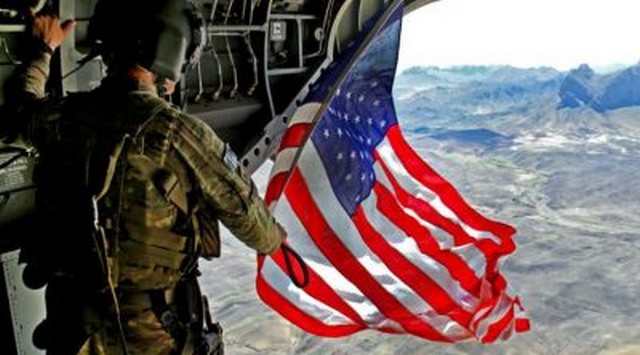
General Scott Miller, US and allied forces commander in Afghanistan, announced on April 25 the beginning of foreign troops withdrawal that should be completed by September 11, according to President Biden’s decision. Is the US ending the war waged for almost twenty years? In order to understand this communication, it is first of all necessary to consider the results of the war.

The toll in human lives is largely unquantifiable: the “direct deaths” among the US military would amount to about 2,500, and the seriously injured soldiers are over 20,000. The contractors (US mercenaries) killed would be about 4,000, plus an unknown number of wounded men. Losses among the Afghan military would amount to around 60,000. Civilian deaths are in fact incalculable: according to the United Nations, they would have been around 100,000 in just ten years. It is impossible to determine the “indirect deaths” from poverty and disease, caused by the social and economic consequences of the war.

The economic balance is relatively quantifiable. For the war – the New York Times documented on the basis of data compiled by Brown University – the US spent over 2,000 billion dollars, plus over 500 billion for medical assistance to veterans. The war operations cost $ 1,500 billion, but the exact amount remains “opaque“. Training and arming the Afghan government forces (over 300,000 men) cost 87 billion. 54 billion dollars were spent on “economic aid and reconstruction”, largely wasted because of corruption and inefficiency, to “build hospitals that never treated patients and schools that did not educate any student, and sometimes they didn’t even exist”. 10 billion dollars have been spent on drug fight with the following result: the opium cultivated acreage has quadrupled, so much so that it has become the main economic activity in Afghanistan, and today supplies 80% of opium illegally produced in the world.

The United States has become heavily in debt to finance the war in Afghanistan: so far, it had to pay 500 billion dollars, again with public money and it will rise to over 600 billion dollars in 2023. Furthermore, 350 billion have been spent so far for the US military who have suffered serious injuries and disabilities in the wars in Afghanistan and Iraq, and it will rise to 1,000 billion in the next decades, more than half of this expense due to the consequences of the war in Afghanistan.

The political-military balance of the war, that shed rivers of blood and burned enormous resources, is catastrophic for the United States, except for the military-industrial complex which made enormous profits with it. “The Taliban, who have grown stronger, control or contend much of the country,” wrote the New York Times. At this point, Secretary of State Blinken and others propose that the United States officially recognize and finance the Taliban, since thus “they might govern less harshly than feared after taking partial or full power — in order to win recognition and financial support from world powers”.

At the same time, the New York Times reported, “the Pentagon, American spy agencies and Western allies are refining plans to deploy a less visible but still potent force in the region, including drones, long-range bombers, and spy networks.” According to Biden’s order the US is withdrawing its 2,500 soldiers, the New York Times reported, “but the Pentagon actually has about 1,000 more troops on the ground there than it has publicly acknowledged, belonging to special forces under both Pentagon and CIA ”, in addition to over 16,000 US contractors that could be used to train Afghan government forces.

The official purpose of the new strategic plan is “to prevent Afghanistan from re-emerging as a terrorist base to threaten the United States”. The real purpose remains the same as twenty years ago: to have a strong military presence in this area at the crossroads among the Middle East, Central, Southern and Eastern Asia. It is an area of primary strategic importance especially towards Russia and China.

*

Note to readers: please click the share buttons above or below. Forward this article to your email lists. Crosspost on your blog site, internet forums. etc.

This article was originally published in Italian on Il Manifesto.

Manlio Dinucci is a Research Associate of the Centre for Research on Globalization.

27 April 2021

Source: www.globalresearch.ca

Rich countries drained 152 trillion from the global South since 1960

Imperialism never ended, it just changed form.

By Jason Hickel,Dylan Sullivan and Huzaifa Zoomkawala

We have long known that the industrial rise of rich countries depended on extraction from the global South during the colonial era. Europe’s industrial revolution relied in large part on cotton and sugar, which were grown on land stolen from Indigenous Americans, with forced labour from enslaved Africans. Extraction from Asia and Africa was used to pay for infrastructure, public buildings, and welfare states in Europe – all the markers of modern development. The costs to the South, meanwhile, were catastrophic: genocide, dispossession, famine and mass impoverishment.
Imperial powers finally withdrew most of their flags and armies from the South in the mid-20th century. But over the following decades, economists and historians associated with “dependency theory” argued that the underlying patterns of colonial appropriation remained in place and continued to define the global economy. Imperialism never ended, they argued – it just changed form.

They were right. Recent research demonstrates that rich countries continue to rely on a large net appropriation from the global South, including tens of billions of tonnes of raw materials and hundreds of billions of hours of human labour per year – embodied not only in primary commodities, but also in high-tech industrial goods like smartphones, laptops, computer chips and cars, which over the past few decades have come to be overwhelmingly manufactured in the South.

This flow of net appropriation occurs because prices are systematically lower in the South than in the North. For instance, wages paid to Southern workers are on average one-fifth the level of Northern wages. This means that for every unit of embodied labour and resources that the South imports from the North, they have to export many more units to pay for it.

Economists Samir Amin and Arghiri Emmanuel described this as a “hidden transfer of value” from the South, which sustains high levels of income and consumption in the North. The drain takes place subtly and almost invisibly, without the overt violence of colonial occupation and therefore without provoking protest and moral outrage.

In a recent paper published in the journal New Political Economy, we built on the work of Amin and others to quantify the scale of drain through unequal exchange in the post-colonial era. We found that the drain increased dramatically during the 1980s and 1990s, as neoliberal structural adjustment programmes were imposed across the global South. Today, the global North drains from the South commodities worth $2.2 trillion per year, in Northern prices. For perspective, that amount of money would be enough to end extreme poverty, globally, fifteen times over.

Over the whole period from 1960 to today, the drain totalled $62 trillion in real terms. If this value had been retained by the South and contributed to Southern growth, tracking with the South’s growth rates over this period, it would be worth $152 trillion today.

These are extraordinary sums. For the global North (and here we mean the US, Canada, Australia, New Zealand, Israel, Japan, Korea, and the rich economies of Europe), the gains are so large that, for the past couple of decades, they have outstripped the rate of economic growth. In other words, net growth in the North relies on appropriation from the rest of the world.

For the South, the losses outstrip foreign aid transfers by a wide margin. For every dollar of aid the South receives, they lose $14 in drain through unequal exchange alone, not counting other kinds of losses like illicit financial outflows and profit repatriation. Of course, the ratio varies by country – higher for some than others – but in all cases, the discourse of aid obscures a darker reality of plunder. Poor countries are developing rich countries, not the other way around.

Neoclassical economists tend to see low wages in the South as “natural” – a kind of neutral market outcome. But Amin and other economists from the global South argued that wage inequalities are artefacts of political power.

Rich countries have a monopoly on decision-making in the World Bank and IMF, they hold most of the bargaining power in the World Trade Organization, they use their power as creditors to dictate economic policy in debtor nations, and they control 97 percent of the world’s patents. Northern states and corporations leverage this power to cheapen the prices of labour and resources in the global South, which allows them to achieve a net appropriation through trade.

During the 1980s and 1990s, IMF structural adjustment programmes cut public sector wages and employment, while rolling back labour rights and other protective regulations, all of which cheapened labour and resources. Today, poor countries are structurally dependent on foreign investment and have no choice but to compete with one another to offer cheap labour and resources in order to please the barons of international finance. This ensures a steady flow of disposable gadgets and fast fashion to affluent Northern consumers, but at extraordinary cost to human lives and ecosystems in the South.

There are several ways to fix this problem. One would be to democratise the institutions of global economic governance, so that poor countries have a fairer say in setting the terms of trade and finance. Another step would be to ensure that poor countries have the right to use tariffs, subsidies and other industrial policies to build sovereign economic capacity. We could also take steps toward a global living wage system and an international framework for environmental regulations, which would put a floor on labour and resource prices.

All of this would enable the South to capture a fairer share of income from international trade and free its countries to mobilise their resources around ending poverty and meeting human needs. But achieving these goals will not be easy; it will require an organised front among social movements toward a fairer world, against those who profit so prodigiously from the status quo.

The views expressed in this article are the author’s own and do not necessarily reflect Al Jazeera’s editorial stance.

6 May 2021

Dr Jason Hickel is an academic at the University of London and a Fellow of the Royal Society of Arts. His most recent book is “The Divide: A Brief Guide to Global Inequality and its Solutions,” published by Penguin in May 2017.

Dylan Sullivan
Graduate student in the Department of Political Economy at the University of Sydney.

Huzaifa Zoomkawala
Independent scholar and data analyst based in Karachi.

Source: https://www.aljazeera.com/opinions/2021/5/6/rich-countries-drained-152tn-from-the-global-south-since-1960

War in 1971 — But on 50th Anniversary, Who Owns that History?

By Abdullah Al-Ahsan

“With the Creation of Bangladesh, a Longstanding Dream of the RSS Was Achieved” claims Seshadri Chari. According to Wikipedia, Seshadri Ramanujan Chari “is a veteran swayamsevak of the Rashtriya Swayamsevak Sangh (RSS). Chari currently serves on the National Executive Committee of the Bharatiya Janata Party (BJP) and formerly served as head of the Foreign Affairs Cell at BJP headquarters.” RSS is a Hindu nationalist, paramilitary volunteer organization that originated in the 1920s and ideologically very close to while supremacists, as one author has put it, “Trump and Modi: birds of the same feather,” The creation of Bangladesh, according to the RSS and BJP, was part of India’s nationalist agenda.

Not only for the RSS, the year 1971 was special for most Indians. “1971: The Year India Felt Good About Itself,” asserted one of the founding editors of The Wire – a well-respected Indian news and opinion website. For India “The year 1971 was marked with several ‘big victories’ – in politics, cricket and in war – all of which had long term implications for India. The national mood was buoyant, even if the country continued to struggle with endemic problems.” However, the feeling was not the same in Bangladesh and Pakistan. A 2019 Aljazeera article on the subject aptly observed that:
“Close to 50 years after the war, 1971 remains poignant both at the people’s level and the state level in Bangladesh, India and Pakistan. It continues to shape the lives of those who suffered and witnessed the war while also remaining central to each state’s national project. 1971 reinforces distinct narratives, emphasising liberation in Bangladesh, victory in India, and loss in Pakistan. All three countries hold on tightly to their war story and frame their images of themselves and the other through the lens of that fateful year. 1971 has left a lasting legacy across all three children of Partition.”

1971 was the year of Bangladesh’s independence. Bangladeshis fought a nine-month long war with the then Pakistani rulers and established their independent nation. India, however, views this war as just another war against its archrival Pakistan. For Pakistan, the year 1971 was a year of disaster – the year that witnessed its dismemberment and brought disgrace. After half a century of the humiliating defeat with India, two institutions of higher education – one public and another private – both prestigious in the Pakistani context, attempted to organize a five-day conference entitled “Commemorating 50 years of the 1971 War: War, Violence and Memory” from March 23 to 27. However, according to Indian and Bangladeshi sources, the event was cancelled without any explanation. This provided the Indian and Bangladeshi sources yet with another evidence of suppression of intellectual freedom in the country. In our view, cancellation of the event is not just the suppression of scholarly discussion on the subject; for Pakistan, it is a denial of a soul-searching effort.

RSS devotee Mr. Chari wrote the article on Bangladesh’s 50th anniversary of the declaration of independence highlighting BJP’s contribution to this achievement. He wrote:
According to the Organiser, “Vajpayee had welcomed Bangabandu Sheikh Mujibur Rehman’s historic declaration of independence and called upon the government of India to recognise the government of Bangladesh and provide necessary assistance to the freedom fighters.”
He was referring to an event of 2015 when the government of Bangladesh conferred an “Award of Liberation War Honour on Atal Bihari Vajpayee” for “his ‘active role’ in its independence struggle and consolidating friendship with India.” For me as a student of history, it is difficult to accept Mr. Chari’s claim, and this demands some reflections on some specific events at the time of Bangladesh’s independence. Did Sheikh Mujibur Rahman make the declaration of Bangladesh’s independence? No. He was arrested on the night of March 25, 1971 and was transferred to West Pakistan. Earlier, the Sheikh had led an election campaign and won landslide from East Pakistan and majority seats in Pakistan’s national assembly. He was poised to form the government in Pakistan, but the West Pakistani establishment prevented him from doing so. Some politicians ganged up with the military establishment to deny the elected representative from political power. Instead, they imposed military rule in East Pakistan. As a result, some Bengali speaking officers of the armed forces revolted and (Major) Ziaur Rahman, who later became president, declared independence of Bangladesh on March 26, 1971.

The Bangladeshi critique of the cancellation of the event in Pakistan believes that, “Although it was of no surprise that reference to genocide was missing, the unfounded narratives were a revelation to me.” By genocide, the author is perhaps referring to the indiscriminate killing of Bengali civilians by the army. Numerous authors have underscored this episode, but hardly any sound work academically describes the Pakistan side of the story. Definitely, the army killed many people and committed atrocities, but the figures have been heavily exaggerated. The story that the current Bangladeshi author conveniently forgets is the story of the killing of the Bihari community (those who migrated to former East Pakistan from the Indian state of Bihar after the creation of Pakistan) and other Urdu speaking population of East Pakistan at the time. A recently published autobiographical sketch of a former banker who lost most family members illustrate the story well. In fact, there is a direct connection between the killings of Biharis by Bengali armed groups and killings by the army. The Bihari killings started weeks earlier and in many cases, Bihari dead bodies were left open before the advancing army. If the term genocide means eliminating a specific group of people, it would apply more to the Bihari population than to Bengalis. The author thinks, “History has been murdered in Pakistan” but does not realize how partisan and distorted Bangladesh’s official version of history is!

I have not found any discussion on the cancellation of the event in the mainstream Pakistani press except for some scattered mention in the social media. One of the organizers tweeted announcing the conference and it seems, names and topics of some participants provoked reactions among certain elements that felt threatened and as a result, the conference was cancelled. However, quoting a tweet by an academic belonging to one of the organizing institutions, an Indian paper reported that, “According to Hassan Javid, a professor of politics at the university, there were concerns raised over scheduling the conference on 23 March, which was also the day when Pakistan officially adopted its first constitution and became a republic in 1956.” Why should the date provoke reaction to such a conference? In fact the date was most relevant because it this date that a Bengali leader proposed the establishment of Pakistan 80 years ago in 1940. Wouldn’t it be most pertinent asking questions such as why Bengalis demanded a separate nation while only quarter of a century ago they fought most passionately to achieve Pakistan? Were not the Bengalis at the forefront of the Pakistan Movement? Did the Bengalis enjoy their legitimate share in governing the country since independence in 1947? Weren’t these questions relevant to raise on this occasion?

One should raise a more fundamental question in this regard: How does one address the problem of narratives? Historian E.H. Carr had once suggested, “Study the historian before you begin to study the facts.” However, a rational historian must go beyond nationalistic rhetoric and manipulation of facts. Rational philosopher Immanuel Kant upheld the “Idea for a Universal History with a Cosmopolitan Purpose” as opposed to Johann Gottfried Herder’s narrow Volk spirit oriented culture and history. Kant’s approach is more important now when fake news and disinformation activities have become normal both in white supremacist and caste-tainted media and in academia. In this context, one may mention Brussels based EU Disinfo Lab that exposed a pro-Indian network engaged in disseminating fake news mainly targeting Pakistan.

Since Pakistan has suffered most in 1971, it is in Pakistan’s interest to act immediately and effectively. The general trend in Pakistan in this regard seems blaming foreign conspirators for breaking the country, but such approach will only thwart the issue. Pakistan’s founding principles demand that Pakistani historians examine the extent of their guilt in the episode. Why did the Bengalis revolt against the state of Pakistan even though they fought tooth and nail to achieve Pakistan only a quarter of a century ago? Weren’t the Bengalis pushed to the wall? Why was the power not transferred to elected representatives following the 1970 elections? What would be the approximate number of people that Pakistan’s armed forces killed, how many civilians did the revolting Bengali elements kill? What was the extent of propaganda in the whole affair? Was the military alone responsible for this debacle? Who were the civilian political actors that ganged up with the military leadership? Why was its own Supreme Court Chief Justice’s report on the subject suppressed for decades? Why even half a century later almost half a million non-Bengalis who claim to be Pakistanis are still stranded in camps in Bangladesh? It is Pakistan’s moral responsibility to address this acute humanitarian crisis. This is a soul-searching issue for Pakistan. Moreover, as the Bangladeshi critic has pointed out, Pakistan must repair its textbooks on the subject. If it is not addressed, it will constantly haunt the Pakistani conscience.

Authorities in Bangladesh too must come up with an acceptable figure of both military and civilian casualties in the conflict. How many of them were Bengalis and how many were non-Bengalis? How many were killed by the Pakistan armed forces and how many by Bengali speaking militias? The most important question that Bangladeshi historians must answer as to why the whole nation has come under severe Indian domination after fifty years of independence while the same population fought most passionately against Hindu dominance a century ago? How has the current fascist government eliminated all opposition voices in the country? In this regard, 2009 Bangladesh’s para-military force BDR revolt is noteworthy. During this two-day mayhem, more military officers were killed than the number of military officers killed in its nine-month long war against Pakistan armed forces. It tried more than 800 soldiers for the bloody mutiny amidst reports of torture and custodial death. Was India behind this event? This question arises because following this event the current government has slowly tightened its grip on power and Indian sources suggest that following the 2009 Bangladesh mutiny, India rallied support for Hasina. Yes, the two events, 1971 war and 2009 mutiny, are comparable: One retired officer of the Bangladeshi armed forces has recently commented:
“Nothing can cause us to forget the brutal massacre, however. Just think, we lost 47 officers during the entire nine months of the Liberation War in 1971. Between February 25 and 26 in 2009, we lost 57 gems. Some of the family members of the officers were also subjected to disgrace and ignominy. The bestiality of the perpetrators defies description, as much as the inability to react appropriately resists rational explanation.”
Yes, Bangladeshi historians must re-examine the two events and find rational explanation for both events, because one may find Indian connection in both. There are evidences of Indian infiltrators in 1971 participating in provoking Bengalis in killing Biharis and leaving dead bodies in front of the advancing army.

It is also noteworthy that after coming to power with Indian support the current government in Bangladesh has been crushing the opposition since 2009. It first targeted those who supported united Pakistan idea in 1971 and then started politics of abduction and disappearance against all opposing voices. The US State Department has just released its 2020 country report with a long list of crimes. Historians of Bangladesh need to address these questions and Bangladesh too needs to incorporate them in textbooks in order to establish itself on a solid ground.

India also needs to conduct some soul-searching on its “achievements” of 1971. It is not only the BJP; the Indian National Congress leaders too hardly accepted the establishment of Pakistan. Indian nationalist leaders have always blamed Pakistan’s founding fathers Iqbal and Jinnah for diving the British India, but they never realized that their caste-ridden mindset will eventually compromise human dignity and thus real democratic value and that is why they seemed to have felt that there was no other alternative for British Indian Muslims but to have a separate nation. Indian leaders have conveniently forgotten that benevolent Jinnah got B R Ambedkar, the father of India’s constitution, elected to the Indian Constituent Assembly in 1946 through Bengal Muslim League. Jinnah wanted well for India, but Indian leaders continued with their conspiracy to break up Pakistan. They trapped Pakistan and unfortunately Pakistani leaders continued to fall into those traps. However, after half a century since 1971, the situation has changed. India has fallen into its own trap: the Hindutva ideology now has already isolated minority Dalits, Muslims, Sikhs, Christians – in fact, all minorities from political participation. In Pakistan, military dictators suppressed dissent opinion and minorities and in India Hitler-style, democratic forces are performing the same job. If India continues to pursue the same scheme, it will soon impact the mainstream and India will encounter the same fate as did Pakistan in 1971.

17 April 2021

Dr. Abdullah Al-Ahsan is a professor of Political Science and International Relations at Istanbul Şehir University.

Making Yemen Bleed

By Yanis Iqbal

On April 12, 2021, a meeting was held in Germany between US Special Envoy for Yemen Tim Lenderking, German Foreign Minister Heiko Maas and UN Special Envoy for Yemen Martin Griffiths. In a press statement following the meeting, Griffiths said: “The war in Yemen has lasted over six years. In these six years Yemenis have increasingly and appallingly, lacked access to food and medicine; more than six years with no basic services; with restriction of movement in, around and out of the country; and over six years of the children of Yemen being deprived of schooling, and being deprived of their future. A generation has been lost.”

Griffith’s lamentation of Yemen’s tragedy occurred against a backdrop of intensifying conflict in the city of Marib – the last governorate under the control of Abdrabbuh Mansur Hadi’s government. The spokesman for the International Committee of the Red Cross in Yemen, Basheer Omar, told a news outlet, “If the looming battle continues and reaches the city centre, then 350,000 residents will flee.” “Civilians in Marib have been suffering a lot…They need life-saving aid and medical assistance.” “We urge the conflict parties to agree to a ceasefire to allow our teams, along with the teams of the Yemen Red Crescent Society to get access to these areas to help provide humanitarian help to those in need and to retrieve the dead bodies.” Why is Yemen bleeding so profusely?

The Rise of Houthis

Houthis are one of the central actors in Yemen’s ongoing conflict, fighting against imperialist aggressions. They belong to a religious movement within the Zaydi branch of Shi‘i Islam. The Zaydis name their sect after Zayd ibn Ali, a descendant of the Prophet Muhammad who was martyred in the year 740, while leading a rebellion against the Umayyad monarchy. It is important to note that Zaydism has few theological or practical differences with Shafi‘ Sunni Islam, which is dominant in most of the rest of Yemen. Their beliefs and rituals are so close that people of both groups pray together in the same mosques.

Houthis rose to prominence in the early years of the 21st century. In 2000, Riyadh signed the Treaty of Jeddah which “resolved” the boundary disputes dating back to Saudi border claims made in 1934. The Saudi border regions of Asir, Najran, and Jizan were originally Yemeni regions annexed by Saudi Arabia with British support following the defeat of Imam Yahya-ruled Kingdom of Yemen in 1934. They contain Shiite Zaydi tribes whose allegiance may lie more favorably with the Houthi movement than with the Saudi government.

With the signing of the Treaty, a program to separate the countries with walls, fences, and security posts began. Those who moved back and forth across these lands for all their lives were now required to obtain visas to pass through newly fenced areas. A former member of parliament, Husain al-Houthi emphasized the right of local communities in Sa’ada to use sources of water and grazing lands increasingly rendered inaccessible by expanded Saudi border patrols and the privatization of some key tracks of lands as per International Monetary Fund (IMF) “structural adjustment” demands.

Houthi-led resistance resulted in six cycles of fighting in Sa’ada between 2004 and 2010. The first lasted from June 22 to September 10 2004; the second lasted from March 19 to April 11 2005; the third lasted from November 30 2005 to February 23 2006; the fourth lasted from February 16 to June 17 2007; the fifth lasted from May 2 2008 to July 17 2008; the sixth lasted from August 11 2009 to February 11 2010.

In its campaign of orchestrated violence against the Houthis, Yemen’s government of Ali Abdullah Saleh enlisted the support of al-Qaida sympathizers and Salafi jihadists. The latter’s presence was the outcome of a long and toxic process. Sa’ada played host to a network of Salafi madrasas, sponsored in part by money from the Saudis, who established a religious footprint throughout Yemen from the 1980s onwards.

Many viewed the spread of Saudi-sponsored Salafism as an attempt to weaken Zaydi socio-political influence. This, in turn, spurred the foundation of a Zaydi educational trust, called the Youthful Believers, and disputes with the authorities over the Youthful Believers’ educational curriculum, coupled with allegations that the government was replacing Zaydi imams with Salafi preachers, contributed to the complex development of the battles in Sa’ada.

Waging War

In September 2014, Houthi rebels situated in Sa’ada took over the capital city of Sana’a in alliance with ousted Saleh’s Republican Guards. The Houthis were disappointed with the undemocratic character of the National Dialogue Conference (NDC). The NDC was initiated during the 2011 Arab Spring agitations in Yemen when most of the members of Saleh government came out openly against his rule and demanded his resignation. Street protests and internal opposition within the government led by figures like Ali Mohsen al-Ahmar and Sadiq al-Ahmar led to Saleh’s resignation in 2012.

The transitional government was headed by Saleh’s vice president Hadi. The mandate of the NDC was to involve all the stakeholders in Yemen and come up with a new constitution. However, the proceedings of the NDC were marred by frequent Gulf interventions due to which most of the parties, including the Houthis, had suspicions regarding its operations. After the assassination of two of its delegates during the proceedings of the NDC, the Houthis demanded greater representation in the transitional government and questioned its right to take central policy decisions.

The dominance of pro-Saudi Islah Party members in the transitional government was also problematic for the Houthis. Established in 1990, the Islah Party combines Sunni Islamism of the Muslim Brotherhood, a more extremist faction led by al-Zindani, and a third one composed of northern tribesmen, mostly from the Hashed confederation (led by al-Ahmar family).

With Houthis’ entry into Sana’a, Hadi fled to Aden and appealed to Riyadh and Abu Dhabi for military assistance. Saudis and Emiratis assembled an alliance of Middle Eastern and African states – Bahrain, Egypt, Jordan, Kuwait, Qatar, Eritrea, Morocco, Senegal, Somalia and Sudan – acting in the name of Hadi’s government – exiled in Riyadh. The first Saudi air strikes were launched on 26 March, 2015. Bombing of Yemen by lackeys of imperialism did not defeat the Houthis.

Houthis succeeded in capturing the crucial port city of Hodeida in the Red Sea after a lengthy war. This city is the entry point for most of the crucial food and other imports and a major export hub for Yemeni goods. It is estimated that Hodeida is a gateway for almost 80% of goods trade to the country. Given its strategic significance, the Hadi government and the Saudi-led alliance wanted to take control of the port. The control over the city would have strengthened the Saudi alliance’s bargaining power vis-à-vis Houthis, in the United Nations (UN)-led negotiations. The Houthis, however, established firm control over the city.

Ending the Genocide

No significant efforts have been made toward ending the genocide in Yemen. On February 4, 2021, President Joe Biden announced that he was ending US participation in “offensive” attacks and “relevant” weapons shipments. He did not clarify the exact meaning of “offensive operations” and “relevant arms sales”. On February 24, 2021, a letter from 41 Congress Members asked him what he meant by his vaguely-worded statement and inquired whether he would support Congress ending the war. The letter requested a response before March 25, 2021. There seems to have been none.

Since the start of the war in 2015, USA has provided full backing to the Saudi-led coalition, including technical support, training fighter jet pilots, targeting assistance, selling arms, and supplying military hardware. The same is the case of UK and France. Western powers will keep making Yemen bleed until they extract unconditional surrender from Houthis. Yemen’s location on the southern coast of Arabian Sea and eastern cost of the Red Sea has geo-political significance. The Red Sea is crucial for international trade. It connects the Suez Canal. Around 8% of the worlds’ trade happens through the Suez Canal. Imperialist countries will never allow a neo-colony as significant as Yemen from slipping out of their hands.

Yanis Iqbal is a student and freelance writer based in Aligarh, India and can be contacted at yanisiqbal@gmail.com.

14 April 2021

Source: countercurrents.org

Impact of Social Media on Our Attention Span and its Drastic Aftermath

By V A Mohamad Ashrof

The quantity of information that we are exposed to every single day is astounding: we now in 2021 take in five times more information than we did in 1986. With our attention spans eroded to approximately eight seconds in our digital landscape, we have learned that to consume is to skim. Most of the text content is forced to be skipped. The American Press Institute found in 2014 that six in 10 people reported not reading beyond the headline in the past week.

About 73% of Americans report feeling certain degree of information overload, yet we continue to interface with it on a variety of devices and media, both professional and social. 1 It is estimated that the average millennial picks up the smartphone 150 times a day. This is purely technology addiction. In 2008, a statistical study conducted at Scotland’s Dundee University found that adults over the age of 55 who grew up in a household with a black-and-white TV set were more likely to dream in black and white. However, younger participants, who grew up in the age of Technicolor, nearly always experienced their dreams in color. 2 This shows the etching impact of the media over the mind.

The American Psychological Association supported these findings in 2011. Over-usage of technology harms the brain systems connecting emotional processing, attention and decision-making. Another study links anxiety, severe depression, suicide attempts and suicide with the rise in use of smartphones, tablets and other devices.3

Fear of Missing Out (FOMO) is defined by The New York Times as “the blend of anxiety, inadequacy and irritation that can flare up while skimming social media”. Social media is blasted with pictures and posts of scrumptious dinners, raging parties and enviable travel check-ins.4

Phantom Vibration Syndrome is the perception that one’s mobile is vibrating or ringing when it is not; it is branded as a tactile hallucination since the brain perceives a sensation that is not present.5

The study also confirmed generational differences for mobile use; for example, 77% of people aged 18 to 24 responded “yes” when asked, “When nothing is occupying my attention, the first thing I do is reach for my phone,” paralleled with only 10% of those over the age of 65.

Bulk of cell phone users reported the experiencing of phantom vibrations, with reported rates ranging from 27.4% to 89%. The relentless use of technology has shortened our attention span. People who are online an average of 5 hours a day has suffering remembering people’s names. The incessant stimulation from electronics makes our brain accustom to “popping”, fast-paced stream of information that we find on the internet.

The internet age has changed the general attention span. Technology has also altered human physiology. It affects our memory, attention spans and sleep cycles. This is generally attributed to a phenomenon known as neuroplasticity, which is the brain’s ability to alter its behavior based on new experiences. Technological addiction may be lead to another risk factor for alcohol and other drug abuse. People who misuse technology develop similar brain chemistry and neural patterning to those who are addicted to substances; brain scans of people with tech addiction disorder are very similar to those people with addictions to alcohol and cannabis.

Decreasing Attention Span

Attention span is the amount of time spent focused on a task before becoming distracted. Distractibility occurs when attention is irrepressibly diverted to another activity or sensation. Most educators and psychologists agree that the ability to focus and sustain attention is critical for a person to achieve their goals. Attention training is said to be part of education, particularly in the way students are skilled to remain focused on a topic of observation or discussion for extended periods, developing listening and analytical skills in the process.

Earlier, it was found that older children are capable of longer periods of attention than younger children. The average attention span in children is: 7 minutes for 2-year-olds; 9 minutes for 3-year-olds; 12 minutes for 4-year-olds; and, 14 minutes for 5-year-olds. Common estimates for continued attention to a freely chosen task range from about 5 minutes for a two-year-old child, to a maximum of around 20 minutes in older children and adults. 6

Attention span peaks in humans early 40’s then gradually declines in old age. 7 One study involving of 2600 children found that early exposure to television is associated with later attention problems such as inattention, impulsiveness, disorganization, and distractibility at age seven. 8

Many working professionals suffer from attention discrepancies; a number of physical and mental health issues can contribute to abbreviated attention spans, including poor diet, lack of exercise, and conditions such as depression and attention deficit hyperactivity disorder (ADHD).

It is to be taken account that the type of activity used in the test affects the results, as people are generally capable of a longer attention span when they are doing something that they find enjoyable or intrinsically motivating. 9

According to scientific research, our attention span has markedly decreased in just 15 years. In 2000, it was 12 seconds; 15 years later, it’s shrunk significantly to 8.25 seconds. According to a new study from Microsoft Corporation, people now generally lose concentration after eight seconds, highlighting the effects of an increasingly digitalized lifestyle on the brain. Microsoft found that since the year 2000 (the year when the mobile revolution surged) the average attention span dropped from 12 seconds to eight seconds. In fact, scientists reckon we now have shorter attention spans than goldfish, which are able to focus on a task or object for 9 seconds.

Human beings are very forgetful; 25% of teens forget major details of close friends and relatives. 7% of people forget their own birthday from time to time, and studies suggest that each week, 39% of Americans will forget one basic piece of information or lose one every day item. Moreover, we’re also easily distracted! An average office worker will check their email in box 30 times every hour and will pick up their phones more than 1,500 times per week amounting to 3 hours and 16 minutes a day. This is all the more unnecessary thing, but all have taken this abnormal behavior as normal.

When we’re browsing online, on the average web page, users will read at most 28% of the words during a visit, with 20% a more likely expectation. Research shows that the average page visit lasts less than a minute and users often leave web pages in just 10-20 seconds. Further, 59% of senior executives would prefer to watch video than read text where both were available.

“Heavy multi-screeners find it difficult to filter out irrelevant stimuli — they’re more easily distracted by multiple streams of media,” the study shows.

Effect of Decreased Attention Span

Listening is much deeper than reading. Human beings are only been reading for a few centuries, but have talked and told stories for millennia. It is well worth the effort to learn the art. Humans are most complex animals living in a complex environment. Researchers from the University of Oxford in the United Kingdom found that: “Although people have a remarkable inclination to engage in pro-social behaviors, there are substantial differences between individuals. Empathy, the capacity to vicariously experience and understand another person’s feelings has been put forward as a critical motivator of pro-social behaviors, but we wanted to test why and how they might be linked.” 10

Empathy implies a shared interpersonal experience and is implicated in many aspects of social cognition and morality. Cognitive scientist Herbert Simon (1916-2001) made this observation: “What information consumes is attention. A wealth of information means a poverty of attention.” To examine developmental changes associated with empathy, Decety and Michalska collected fMRI and behavioral data from a group of 57 participants ranging from 7 to 40 years of age while they were exposed to short video clips depicting people accidentally in pain or intentionally harmed by another individual. Results at the whole-group level showed that attending to painful situations caused by accident was associated with activation of the pain matrix including the anterior medial cingulate cortex, insula, periaqueductal gray and somatosensory cortex. 11

The ability to see how our actions impact others every day is essential to a healthy society. In 2010, a University of Michigan study found college students were 40% less empathetic than they were in the late 70s and early 80s, and that students were less likely to endorse statements like “I often have tender, concerned feelings for people less fortunate than me,” or “I sometimes try to understand my friends better by imagining how things look from their perspective.” As narcissism increases empathy levels fall. 12

Constant attention galloping compels “multitasking”; which demand rapid switching from one thing to the other.As the late Clifford Nass, a Stanford professor, put it, multitaskers are “suckers for irrelevancy,” which hampers not just concentration but also analytic understanding and empathy. Everybody know that mindfulness improved concentration and lessened mind-wandering. Attention is critical for working memory; if we aren’t paying attention, those digits won’t register in the first place. Emotional intelligence requires self-awareness—awareness of our own minds and emotions—as well as empathy, both of which can be cultivated by honing our skills of attention.

People with a short attention span may encounter problems for any length of time without being easily distracted.

A lesser attention span can have several negative effects, including:

  • Poor performance at work or school
  • Missing significant details or information
  • Communication difficulties in relationships
  • Data wouldn’t emerge as knowledge, as the data is being bombarded haphazardly.
  • Empathy and the kindness it sparks are essential human traits. Decrease in attention span decreases empathy.
  • Big picture is lost, and easily carried out by propaganda.

Storytelling to Improve Attention Capacity

Storytelling is one of the ancient methods of communicating ideas and images. In the traditional societies, young children were told stories by their parents, grandparents, uncles and aunts.  As young people progress through their early years, listening skills become increasingly imperative, and there’s no better way to improve attention span and listening skills than by telling stories to keep them focused. Listening to a story told will often lock it in one’s mind almost automatically. Storytelling is an outstanding means of introducing children to the wonderful world of books while building positive attitudes for reading. The exposure to oral language patterns helps increasing children’s listening skills.

– Storytelling allows the child to create images in her imagination, it evokes the students’ imagination, listening to story encourages students to use their imaginations that empowers students to consider new ideas. As a result it builds self-confidence and personal inspiration.

– Storytelling can change the difficult ideas into easy ones and make the abstract language, in a teachable way.

– Listening to stories improves listening skills and many language skills, such as vocabulary, comprehension, sequencing and story recall.

-Storytelling is effective in augmenting communicative skills. Activities such as learning how to tell a story by writing it down, talking about it, and learning to actively listen to someone else’s story teach vital language skills in meaningful contexts. The more we know the art of story-telling, the better will be able to teach.

Storytelling humanizes learning. Stories affect our emotions and make us laugh, cry, fear, and get angry. Storytelling can instigate students to explore their unique expressiveness and can heighten a student’s ability to communicate thoughts and feelings in an articulate, lucid manner. When a habit of listening to stories is inculcated in children, they learn to become better listeners. It offers them the necessary training to listen and understand more, instead of talking.

Bibliography

  1. Julie Gurner, Time magazine, November 13, 2015
  2. Jonathan Gabay, Brand Psychology, London: Kogan Page, 2015, p.207
  3. Nasrin Izadinia et al, ScienceDirect, Procedia Social and Behavioral Sciences 5 (2010) 1515–1519
  4. Jenna Wortham, The New York Times, April 9, 2011
  5. Tim Locke, Do You Have ‘Phantom Vibration Syndrome’? Webmd, January 11, 2016
  6. Charles Schaefer, Howard Millman, How to Help Children with Common Problems, Northvale, NJ: Jason Aronson Inc, 1994, p.18
  7. Francesca C Fortenbaugh et al; “Sustained Attention Across the Life Span in a Sample of 10,000”, Psychological Science, 2015, 26 (9): 1497–1510
  8. Christakis, D.A et al, “Early television exposure and subsequent attentional problems in children”, April 2004, Pediatrics. 113 (4): 708–713
  9. David Cornish, Dianne Dukette, The Essential 20: Twenty Components of an Excellent Health Care Team, Pittsburgh, PA: RoseDog Books, 2009, p.72–73
  10. Patricia L. Lockwood et al, “Neuro-computational mechanisms of pro-social learning and links to empathy,” August 15 2016 doi:10.1073/pnas.1603198113
  11. Decety J, Michalska KJ, Neurodevelopmental changes in the circuits underlying empathy and sympathy from childhood to adulthood. Dev Sci. 2010
  12. Kevin Mcspadden, You Now Have a Shorter Attention Span than a Goldfish, Time magazine, May 14, 2015

V.A. Mohamad Ashrof is one among the Muslim scholars of Kerala who is regularly publishing articles and papers dealing with Islam and Contemporary Affairs.

12 April 2021

Source: countercurrents.org
 

The Secret Wars of Africa’s Sahel: What Is Behind Mali’s Ongoing Strife

By Dr Ramzy Baroud

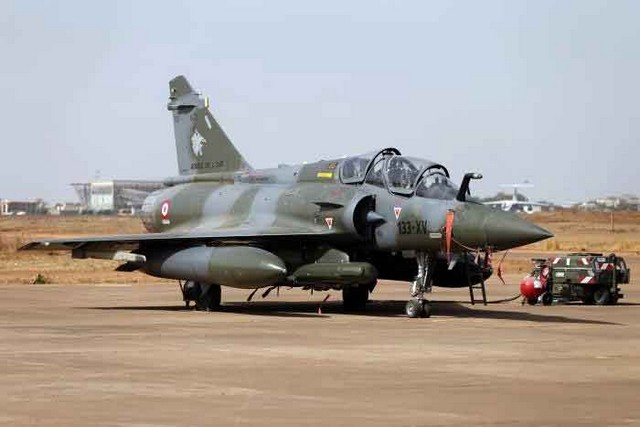
In a recent report, the United Nations Mission in Mali, known as MINUSMA, concluded that, on January 3, French warplanes had struck a crowd attending a wedding in the remote village of Bounti, killing 22 of the guests.

According to the findings, based on a thorough investigation and interviews with hundreds of eyewitnesses, 19 of the guests were unarmed civilians whose killing constitutes a war crime.

Unlike the US invasion of Iraq in 2003, the wars in Afghanistan, Syria, Libya and other countries, the French war in Mali receives little media coverage outside the limited scope of French-speaking media, which has successfully branded this war as one against Islamic militants.

What is interesting about the Mali story is the fact that, despite its centrality to the geopolitics of the Sahel region in Africa, it is framed within disconnected narratives that rarely overlap.

However, the story has less to do with Islamic militancy and much to do with foreign interventions. Anti-French sentiment in Mali goes back over a century when, in 1892, France colonized that once-thriving African kingdom, exploiting its resources and reordering its territories as a way to weaken its population and to break down its social structures.

The formal end of French colonialism of Mali in 1960 was merely the end of a chapter, but definitely not the story itself. France remained present in Mali, in the Sahel and throughout Africa, defending its interests, exploiting the ample resources and working jointly with corrupt elites to maintain its dominance.

Fast forward to March 2012 when Captain Amadou Sanogo overthrew the nominally democratic government of Amadou Toumani Touré. He used the flimsy excuse of protesting Bamako’s failure to rein in the militancy of the National Movement for the Liberation of Azawad (MNLA) in the north.

Sanogo’s pretense was quite clever, though, as it fit neatly into a grand narrative designed by various Western governments, lead among them France and the United States, who saw Islamic militancy as the greatest danger facing many parts of Africa, especially in the Sahel.

Interestingly but not surprisingly, Sanogo’s coup, which angered African governments, but was somehow accommodated by Western powers, made matters much worse. In the following months, northern militants managed to seize much of the impoverished northern regions, continuing their march towards Bamako itself.

The army coup was never truly reversed but, at the behest of France and other influential governments, was simply streamlined into a transitional government, still largely influenced by Sanogo’s supporters.

On December 20, 2012, the United Nations Security Council passed Resolution 2085, which authorized the deployment of the African-led International Support Mission to Mali. Armed with what was understood to be a UN mandate, France launched its war in Mali, under the title of ‘Operation Serval’.

It is worth mentioning here that the Mali scenario had just transpired in Libya when, on March 17, 2011, the UNSC passed Resolution 1973, which was conveniently and immediately translated into a declaration of war.

Both scenarios proved costly for the two African countries. Instead of ‘saving’ these countries, the interventions allowed violence to spiral even further, leading to yet more foreign interventions and proxy wars.

On July 15, 2014, France declared that ‘Operation Serval’ was successfully accomplished, providing its own list of casualties on both sides, again, with very little international monitoring. Yet, almost immediately, on August 1, 2014, it declared another military mission, this time an open-ended war, ‘Operation Barkhane’.

Barkhane was spearheaded by France and included Paris’ own ‘coalition of the willing’, dubbed ‘G5 Sahel’. All former French colonies, the new coalition consisted of Burkina Faso, Chad, Mali, Mauritania and Niger. The declared goal of France’s indefinite intervention in the Sahel is to provide material support and training to the ‘G5 Sahel’ forces in their ‘war on terror’.

However, according to Deutsche Welle, the ‘optimism’ that accompanied ‘Operation Serval’ completely vanished with ‘Operation Barkhane’. “The security situation has worsened, not only (in the) the north but (in) central Mali as well”, the German news agency recently reported, conveying a sense of chaos, with farmers fleeing their land and with “self-defense militias” carrying out their own operations to satisfy “their own agendas”, and so on.

In truth, the chaos in the streets merely reflected the chaos in government. Even with a heavy French military presence, instability continued to plague Mali. The latest coup in the country took place in August 2020. Worse still, the various Tuareg forces, which have long challenged the foreign exploitation of the country, are now unifying under a single banner. The future of Mali is hardly promising.

So what was the point of the intervention, anyway? Certainly not to ‘restore democracy’ or ‘stabilize’ the country. Karen Jayes elaborates. “France’s interests in the region are primarily economic,” she wrote in a recent article. “Their military actions protect their access to oil and uranium in the region.”

To appreciate this claim more fully, one only needs a single example of how Mali’s wealth of natural resources is central to France’s economy. “An incredible 75 percent of France’s electric power is generated by nuclear plants that are mostly fueled by uranium extracted on Mali’s border region of Kidal,” in the northern parts of the country. Therefore, it is unsurprising that France was ready to go to war as soon as militants proclaimed the Kidal region to be part of their independent nation-state of Azawad in April 2012.

As for the bombing of the Bounti wedding, the French military denied any wrong-doing, claiming that all of the victims were ‘jihadists’. The story is meant to end here, but it will not – as long as Mali is exploited by outsiders, as long as poverty and inequality will continue to exist, leading to insurrections, rebellions and military coups.

Ramzy Baroud is a journalist and the Editor of The Palestine Chronicle.

12 April 2021

Source: countercurrents.org
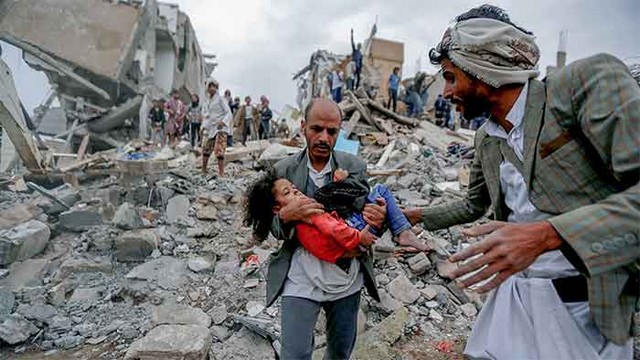
Hunting in Yemen

By Kathy Kelly

“It’s not normal for people to live like this,” says Iman Saleh, now on her twelfth day of a hunger strike demanding an end to war in Yemen.

April 10, 2021: Since March 29th, in Washington, D.C., Iman Saleh, age 26, has been on a hunger strike to demand an end to the war in Yemen. She is joined by five others from her  group, The Yemeni Liberation Movement. The hunger strikers point out that enforcement of the Saudi Coalition led blockade relies substantially on U.S. weaponry.

Saleh decries the prevention of fuel from entering a key port in Yemen’s northern region.

“When people think of famine, they wouldn’t consider fuel as contributing to that, but when you’re blocking fuel from entering the main port of a country, you’re essentially crippling the entire infrastructure,” said Saleh  “You can’t transport food, you can’t power homes, you can’t run hospitals without fuel.”

Saleh worries people have become desensitized to suffering Yemenis face. Through fasting, she herself feels far more sensitive to the fatigue and strain that accompanies hunger. She hopes the fast will help others overcome indifference,  recognize that the conditions Yemenis face are horribly abnormal, and demand governmental policy changes.

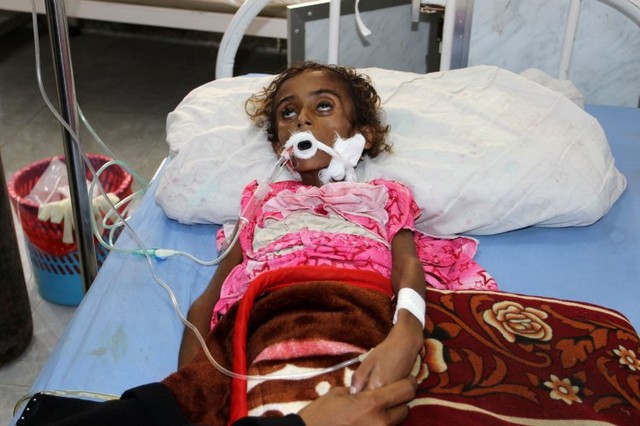
According to UNICEF, 2.3 million children under the age of 5 in Yemen are projected to suffer from acute malnutrition in 2021.

“It’s not normal for people to live like this,” says Saleh.

Her words and actions have already touched people taking an online course began with a focus on Yemen.

As the teacher, I asked students to read about the warring parties in Yemen with a special focus on the complicity of the U.S. and of other countries supplying weapons, training, intelligence, and diplomatic cover to the Saudi-led coalition now convulsing  Yemen in devastating war.

Last week, we briefly examined an email exchange between two U.S. generals planning the  January, 2017 night raid  by U.S. Navy Seals in the rural Yemeni town of Al Ghayyal. The Special Forces operation sought to capture an alleged AQAP (Al Qaeda in the Arab Peninsula) leader. General Dunford told General Votel that all the needed approvals were in place. Before signing off, he wrote: “Good hunting.”

The “hunting” went horribly wrong. Hearing the commotion as U.S. forces raided a village home, other villagers ran to assist. They soon disabled the U.S. Navy Seals’ helicopter. One of the Navy Seals, Ryan Owen, was killed during the first minutes of the fighting. In the ensuing battle, the U.S. forces called for air support. U.S. helicopter gunships arrived and U.S. warplanes started indiscriminately firing  missiles into huts. Fahim Mohsen, age 30, huddled in one home along with 12 children and another mother. After a missile tore into their hut, Fahim had to decide whether to remain inside or venture out into the darkness. She chose the latter, holding her infant child and clutching the hand of her five-year old son, Sinan. Sinan says his mother was killed by a bullet shot from the helicopter gunship behind them. Her infant miraculously survived. That night, in Al Ghayyal, ten children under age 10 were killed. Eight-year-old Nawar Al-Awlaki died by bleeding to death after being shot. “She was hit with a bullet in her neck and suffered for two hours,” her grandfather said. “Why kill children?” he asked.

Mwatana, a Yemeni human rights group, found that the raid killed at least 15 civilians and wounded at least five civilians—all children. Interviewees told Mwatana that women and children, the majority of those killed and wounded, had tried to run away and that they had not engaged in fighting.

Mwatana found no credible information suggesting that the 20 civilians killed or wounded were directly participating in hostilities with AQAP or IS-Y. Of the 15 civilians killed, only one was an adult male, and residents said he was too old, at 65, to fight, and in any case had lost his hearing before the raid.

Carolyn Coe, a course participant, read the names of the children killed that night:

Asma al Ameri, 3 months; Aisha al Ameri, 4 years; Halima al Ameri, 5 years; Hussein al Ameri, 5 years; Mursil al Ameri, 6 years; Khadija al Ameri, 7 years; Nawar al Awlaki, 8 years; Ahmed al Dhahab, 11 years; Nasser al Dhahab, 13 years

In response, Coe wrote:

ee cummings writes of Maggie and Milly and Molly and May coming out to play one day. As I read the children’s names, I hear the family connections in their common surnames. I imagine how lively the home must have been with so many young children together. Or maybe instead, the home was surprisingly quiet if the children were very hungry, too weak to even cry. I’m sad that these children cannot realize their unique lives as in the ee cummings poem. Neither Aisha nor Halima, Hussein nor Mursil, none of these children can ever come out again to play.

Dave Maciewski, another course participant, mentioned how history seemed to be repeating itself, remembering his experiences visiting mothers and children in Iraq where hundreds of thousands of tiny children couldn’t survive the lethally punitive US/UN economic sanctions.

While UN agencies struggle to distribute desperately needed supplies of food, medicine and fuel, the UN Security Council continues to enforce a resolution, Resolution 2216, which facilitates the blockade and inhibits negotiation. Jamal Benomar, who was  United Nations special envoy for Yemen from 2011-2015,  says that this resolution,  passed in 2015, had been  drafted by the Saudis themselves. “Demanding the surrender of the advancing Houthis to a government living in chic hotel-exile in Riyadh was preposterous,” says Benomar, “but irrelevant.”

Waleed Al Hariri heads the New York office of the Sana’a Center for Strategic Studies and is also a fellow-in-residence at Columbia Law School Human Rights Institute.

“The council demanded the Houthis surrender all territory seized, including Sana’a, fully disarm, and allow President Abdo Rabbu Mansour Hadi’s government to resume its responsibilities,” Al Hariri writes. “In essence, it insisted on surrender. That failed, but the same reasons that allowed the UNSC to make clear, forceful demands in 2015 have kept it from trying anything new in the five years since.”

Does the UNSC realistically expect the Ansarallah (informally called the Houthi) to surrender and disarm after maintaining the upper hand in a prolonged war? The Saudi negotiators say nothing about lifting the crippling blockade. The UN Security Council should scrap Resolution 2216 and work hard to create a resolution relevant to the facts on the ground. The new resolution must insist that survival of Yemeni children who are being starved is the number one priority.

Now, in the seventh year of grotesque war, international diplomatic efforts should heed the young Yemeni-Americans fasting in Washington, D.C. We all have a responsibility to listen for the screams of children gunned down from behind as they flee in the darkness from the rubble of their homes. We all have a responsibility to listen for the gasps of little children breathing their last because starvation causes them to die from asphyxiation. The U.S. is complying with a coalition using starvation and disease to wage war. With 400,000 children’s lives in the balance, with a Yemeni child dying once every 75 seconds, what U.S. interests could possibly justify our further hesitation in insisting the blockade must be lifted? The war must end.

Kathy Kelly, (Kathy.vcnv@gmail.com) is a peace activist whose efforts have at times led her into war zones and U.S. prisons.

10 April 2021

Source: countercurrents.org

Yemen Is a Public Health Catastrophe

By Dr César Chelala

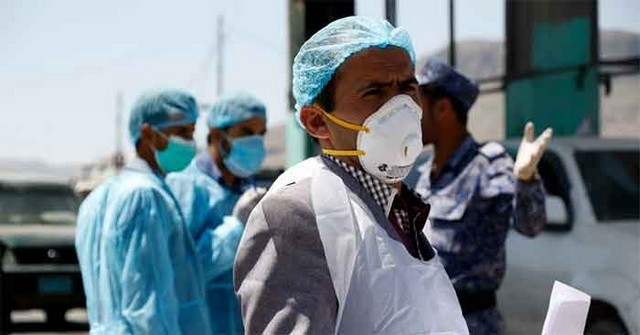
The war in Yemen—the Arab world’s poorest country—has reached new heights of sickness and death by the spreading of the coronavirus pandemic in a vulnerable and fragile population. The death toll from the coronavirus pandemic could be greater than the combined toll of war, disease and hunger over the last five years, according to Lise Grande, the U.N.’s head of humanitarian operations in Yemen.

The country’s civilians have been the unwilling participants in a proxy war that has cost hundreds of thousands of lives and has left the public health system in shambles. Last December, the United Nations Office for the Coordination of Humanitarian Affairs (OCHA) stated that the conflict in Yemen has claimed over 233,000 lives over the last six years, either directly due to the conflict or for causes related to it, calling this number “unfortunate and unacceptable.”

The conflict started in 2014 when Iranian-backed Houthi fighters seized Sana’a, Yemen’s capital, and much of the north of the country. The Houthis were confronted by a U.S.-backed Arab coalition led by Saudi Arabia and the United Arab Emirates (UAE) in a bid to bring back Yemeni President Abed Rabu Mansour Hadi (who had been forced to resign) to power, without success. Since 2017, Hadi has reportedly been living in Saudi Arabia.

The effects of the war on the civilian population have been deepened by floods that have ravaged huge areas across the country, facilitating the spread of cholera and other waterborne diseases. Since January 2019 there have been over 2,500,000 cholera cases, 12-15 percent of them severe. As the medical situation further deteriorates, the humanitarian response has become more difficult.

Children have been the most affected by the conflict. For the past three years, 25 percent of civilian casualties have been children, according to statistics from Save the Children. What makes this situation even more dire is that children die either directly from the conflict or from entirely preventable causes.

The Saudi-Emirati-led coalition has placed severe obstacles to medical imports, depriving the Houthi-run public health system of critical medicines. This has proved deadly for patients on emergency care who rely on life-saving medical supplies. Houthi forces have been accused of stopping humanitarian cargo trucks, and holding them for days before allowing them to continue.

Public health personnel and hospital facilities have been attacked, leading to the closure of health facilities. This has further hindered the proper delivery of health care. Physicians for Human Rights (PHR) has consistently denounced those abuses. To make matters worse, 92-95 percent of medical equipment in Yemeni hospitals and health facilities no longer functions, according to that organization.

The situation is particularly dire in rural areas, which already lack the essential resources minimally available in the cities. UNICEF reports 20 million out of the country’s 30 million people currently rely on food assistance. However, the coronavirus pandemic has made the delivery of food even more problematic.

Countries from both sides of the conflict (Iran on one side and the United States, UK, France, Saudi Arabia and the UAE on the other) have the humanitarian responsibility to redress this situation. In 2018, U.N. Secretary General António Guterres called it “the worst humanitarian crisis in the world.”

There is something wrong when the richest Arab countries team up with leading democracies to bomb thousands of civilians and ravage the poorest country in the Middle East. Horrified by the loss of 323 young Argentinean lives during the sinking of the Belgrano cruiser by the British during the Malvinas/Falklands war, Bruce Chatwin wrote, “I cling to the archaic idea that unjustifiable killing in peace or war eventually rebounds on the killer. The dead do haunt the living. There is such thing as blood guilt.” The same words could be applied to those responsible for the war in Yemen today.

Dr. César Chelala is an international public health consultant, co-winner of an Overseas Press Club of America award and two national journalism awards from Argentina.

10 April 2021

Source: countercurrents.org
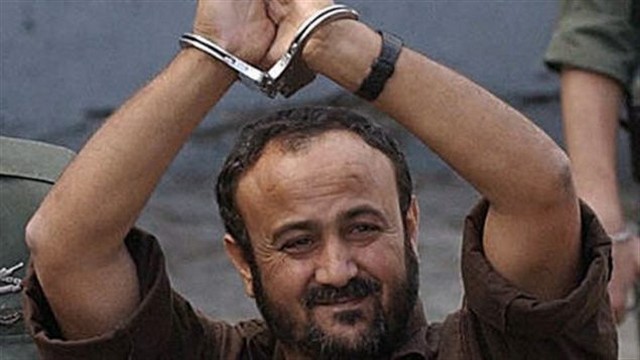
From His Solitary Confinement, Marwan Barghouti Holds the Key to Fatah’s Future

By Dr Ramzy Baroud

If imprisoned Palestinian leader, Marwan Barghouti, becomes the President of the Palestinian Authority (PA), the status quo will change substantially. For Israel, as well as for the current PA President, Mahmoud Abbas, such a scenario is more dangerous than another strong Hamas showing in the upcoming Palestinian parliamentary elections.

The long-delayed elections, now scheduled for May 22 and July 31 respectively, will not only represent a watershed moment for the fractured Palestinian body politic, but also for the Fatah Movement which has dominated the PA since its inception in 1994. The once revolutionary Movement has become a shell of its former self under the leadership of Abbas, whose only claim to legitimacy was a poorly contested election in January 2005, following the death of former Fatah leader and PA President, Yasser Arafat.

Though his mandate expired in January 2009, Abbas continued to ‘lead’ Palestinians. Corruption and nepotism increased significantly during his tenure and, not only did he fail to secure an independent Palestinian State, but the Israeli military occupation and illegal settlements have deepened and grown exponentially.

Abbas’ rivals from within the Fatah Movement were sidelined, imprisoned or exiled. A far more popular Fatah leader, Marwan Barghouti, was silenced by Israel as he was thrown into an Israeli prison in April 2002, after a military court found him guilty of involvement in Palestinian resistance operations during the uprising of 2000. This arrangement suited Abbas, for he continued to doubly benefit: from Barghouti’s popularity, on the one hand, and his absence, on the other.

When, in January, Abbas declared that he would hold three successive rounds of elections – legislative elections on May 22, presidential elections on July 31 and Palestinian National Council (PNC) elections on August 31 – he could not have anticipated that his decree, which followed intense Fatah-Hamas talks, could potentially trigger the implosion of his own party.

Fatah-Hamas rivalry has been decades’ long, but intensified in January 2006 when the latter won the legislative elections in the Occupied Territories. Hamas’ victory was partly attributed to Fatah’s own corruption, but internal rivalry also splintered Fatah’s vote.

Although it was Fatah’s structural weaknesses that partly boosted Hamas’ popularity, it was, oddly, the subsequent rivalry with Hamas that kept Fatah somehow limping forward. Indeed, the anti-Hamas sentiment served as a point of unity among the various Fatah branches. With money pouring in from donor countries, Fatah used its largesse to keep dissent at minimum and, when necessary, to punish those who refused to toe the pro-Abbas line. This strategy was successfully put to the test in 2010 when Mohammed Dahlan, Fatah’s ‘strong man’ in Gaza prior to 2006, was dismissed from Fatah’s central committee and banished from the West Bank, as he was banished from Gaza four years earlier.

But that convenient paradigm could not be sustained. Israel is entrenching its military occupation, increasing its illegal settlement activities and is rapidly annexing Palestinian land in the West Bank and Jerusalem. The Gaza siege, though deadly and tragic, has become routine and no longer an international priority. A new Palestinian generation in the Occupied Territories cannot relate to Abbas and his old guard, and is openly dissatisfied with the tribal, regional politics through which the PA, under Abbas, continues to govern occupied and oppressed Palestinians.

Possessing no strategies or answers, Abbas is now left with no more political lifelines and few allies.

With dwindling financial resources and faced by the inescapable fact that 85-year-old Abbas must engineer a transition within the movement to prevent its collapse in case of his death, Fatah was forced to contend with an unpleasant reality: without new elections the PA would lose the little political legitimacy with which it ruled over Palestinians.

Abbas was not worried about another setback, as that of 2006, when Hamas won majority of the Palestinian Legislative Council (PLC)’s seats. Until recently, most opinion polls indicated that the pro-Abbas Fatah list would lead by a comfortable margin in May, and that Abbas would be re-elected President in July. With his powers intact, Abbas could then expand his legitimacy by allowing Hamas and others into the PLO’s Palestinian National Council – Palestine’s parliament in the Diaspora. Not only would Abbas renew faith in his Authority, but he could also go down in history as the man who united Palestinians.

But things didn’t go as planned and the problem, this time, did not come from Hamas, but from Fatah itself – although Abbas did anticipate internal challenges. However, the removal of Dahlan, the repeated purges of the party’s influential committees and the marginalization of any dissenting Fatah members throughout the years must have infused Abbas with confidence to advance with his plans.

The first challenge emerged on March 11, when Nasser al-Qidwa, a well-respected former diplomat and a nephew of Yasser Arafat, was expelled from the movement’s Central Committee for daring to challenge Abbas’ dominance. On March 4, Qidwa decided to lock horns with Abbas by running in the elections in a separate list.

The second and bigger surprise came on March 31, just one hour before the closing of the Central Election Commission’s registration deadline, when Qidwa’s list was expanded to include supporters of Marwan Barghouti, under the leadership of his wife, Fadwa.

Opinion polls are now suggesting that a Barghouti-Qidwa list, not only would divide the Fatah Movement but would actually win more seats, defeating both the traditional Fatah list and even Hamas. If this happens, Palestinian politics would turn on its head.

Moreover, the fact that Marwan Barghouti’s name was not on the list keeps alive the possibility that the imprisoned Fatah leader could still contest in the presidential elections in July. If that, too, transpires, Barghouti will effortlessly beat and oust Abbas.

The PA President is now in an unenviable position. Canceling the elections would lead to strife, if not violence. Moving forward means the imminent demise of Abbas and his small but powerful clique of Palestinians who benefited greatly from the cozy political arrangement they created for themselves.

As it stands, the key to the future of Fatah is now held by a Palestinian prisoner, Marwan Barghouti, who has been kept by Israel, largely in solitary confinement, since 2002.

Ramzy Baroud is a journalist and the Editor of The Palestine Chronicle.

8 April 2021

Source: countercurrents.org
The Assassination and Resurrection of Martin Luther King, Jr.

By Edward Curtin

I don’t believe in death without resurrection. If they kill me, I will rise again in the Salvadorian people…”  – Archbishop Oscar Romero, martyred, 24 March 1980

Whether we are aware of it or not, we live by stories. We live by others’ stories while we tell our lives by how we live.  Our actions tell our stories.  Then when we die, others tell our stories as they wish.

This is the spiritual thread that links the meanings of our lives.  It is the way we pass over to other lives and return to our own. But without truth, we end up in the wrong place, living the wrong stories.

And don’t the stories of certain special people inspire us to carry on their legacies because their spirits are far stronger than death?  Their courage contagious?   Their witness the triumph of life over death?  Love over hate?

Don’t they challenge us to imitate them, to kindle in us the fire of their resurrected spirits?

For Christians, Holy Week is the time for deep reflection on the story of the death and resurrection of Jesus and what they mean for us today.  This year, the anniversary of the murder of the Christian prophet and martyr, Martin Luther King, Jr., falls on Easter Sunday, April 4, which gives rise to doubly deeper thoughts that cross religious boundaries where people of all faiths or none can unite in the spirit of non-violent resistance to the forces of war, poverty, racism, and materialism – violence in all its forms.  Everything that stands in the way of what King called “the Beloved Community.”

That Jesus met violence with non-violent love and voluntarily entered the darkness of death and abandonment is at the heart of the Christian faith.  So too his Resurrection.  If the Jewish radical Jesus had not been executed by the Roman state occupiers of Palestine, if all hope for his followers had not seemingly been lost, then his Resurrection could not have given birth to hope in his followers to carry on his spirit of love for the poor, the downtrodden, and the outcasts – his resistance to violence.

Like Oscar Romero in El Salvador, gunned down by U.S. trained death squads at the altar while offering Mass and subsequently named a saint by the Roman Catholic Church, Martin Luther King, Jr.’s witness and the truth about his death should be a central meditative focus this year. For the convergence of King’s death on April 4, 1968 with Easter this April 4th and the last day of Passover offers us a way to contemplate what is now demanded of all people who yearn for the end to hatred, violence, and injustice, and the creation of a beloved world community where love and kindness reign.

The spirit of all the prophets and martyrs is about now, not then; about us, not them; it confronts us with the challenge to interrogate ourselves.

Shall we turn away from their witness?  What truly animates our souls?  Where do we stand?  Do we support the state’s power to kill and wage war, to deny people freedom, to discriminate, to oppress the poor?

It is always about now; the living truth is now.

To contemplate the lives of the prophets takes us very deep into the darkness where we encounter the murders of Jesus, King, Romero, and all those who have died trying to make peace and justice a reality.  But only if we go into the darkest truths will we be able to see the light that leads us to accept the resurrected spirit of their resistance to evil.

Another prophet of our broken world, the Hindu Mohandas Gandhi, soul brother to King, echoed the words that many have heard, that “God chose what is weak in the world to shame the strong,” when, in crossing over to the Christian tradition, he told us: “We dare not think of birth without death on the cross.  Living Christ means a Living Cross, without it life is a living death.[1]

So what do we need to know about MLK, and why does it matter?

King’s True Story

Very few Americans are aware of the truth behind the assassination of Dr. Martin Luther King, Jr., the United States’ celebrated civil rights icon.  Few books have been written about it, unlike other significant assassinations, especially JFK’s. For more than fifty years there has been a media blackout supported by government disinformation to hide the truth.  And few people, in a massive act of self-deception, have chosen to question the official explanation, choosing, rather, to embrace a mythic fabrication intended to sugarcoat the bitter fruit that has resulted from the murder of one man capable of leading a mass movement for transformative change in the United States.  Today we are eating the fruit of our denial as racial discrimination, poverty, and police violence garner the headlines.

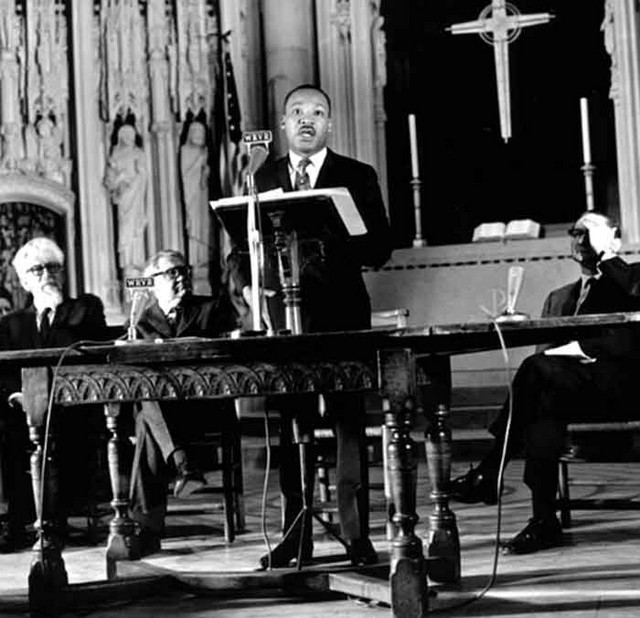
After more than a decade as America’s best-known and most respected civil rights leader, by 1968 Reverend Martin Luther King, Jr. had increasingly focused on poverty issues and publicly declared his intense opposition to the U.S. war against Vietnam in a famous speech – “Beyond Vietnam: The Time To Break the Silence” – at New York’s Riverside Church on April 4, 1967, one year to the day before he was assassinated.[2]

Having won the Nobel Peace Prize in 1964, he emerged in the mid-1960s as an international figure, whose opinions on human and economic rights and peaceful coexistence were influential world-wide. Shortly before his assassination, he was organizing the Poor People’s Campaign that would involve hundreds of thousands of Americans who would encamp in Washington, D.C to demand the end to economic inequality, racism, and war.

At the same time, Reverend King was hated by an array of racists throughout America, especially in the American South. Among his greatest declared enemies was FBI Director J. Edgar Hoover, who seemed convinced that King’s backers were Communists out to damage America’s interests. In the late 1960s, the FBI’s COINTELPRO program created a network of informants and agent provocateurs to undermine the civil rights and anti-war movements with a special focus on King.[3]

After King’s “I Have a Dream” speech in 1963, William Sullivan, the head of the FBI’s domestic intelligence division, wrote in a post-speech memo:

Personally, I believe in the light of King’s powerful, demagogic speech that he stands head and shoulders over all other Negro leaders put together when it comes to influencing great masses. We must mark him now, if we have not done so before, as the most dangerous Negro of the future in this Nation from the standpoint of communism, the Negro and national security.[4]

The FBI, after extensive eavesdropping on King, subsequently sent him an anonymous letter urging him to kill himself or else his extramarital sex life would be exposed.  The FBI’s and its Director J Edgar Hoover’s hatred for King was so great that nothing was too low for them.[5]

This history is common knowledge as reported in the Washington Post, The New York Times, etc.

During the Senate Church Committee hearings in the mid-1970s, a parallel group within the CIA, code-named CHAOS, was uncovered.  Despite its charter disallowing it from operating inside the United States, the CIA similarly used illegal means to disrupt the civil rights and anti-war movements.

Because MLK, in his Riverside Church speech, spoke clearly to what he identified there as “the greatest purveyor of violence in the world today – my own government” and continued to relentlessly confront his own government on its criminal war against Vietnam, he was universally condemned by the mass media and the government that later – once he was long and safely dead and no longer a threat – praised him to the heavens.  This has continued to the present day of historical amnesia.

Today Martin Luther King’s birthday is celebrated with a national holiday, but his death day disappears down the memory hole.  Across the country – in response to the King Holiday and Service Act passed by Congress and signed by President Bill Clinton in 1994 – people are encouraged to make the day one of service (from Latin, servus = slave).  Etymological irony aside, such service does not include King’s commitment to protesting a decadent system of racial and economic injustice or non-violently resisting the warfare state that is the United States. Government sponsored service is cultural neo-liberalism at its finest.

The word service is a loaded word; it has become a smiley face and vogue word over the past thirty-five years.  It’s use for MLK Day is clear: individuals are encouraged to volunteer for activities such as tutoring children, painting senior centers, delivering meals to the elderly, etc., activities that are good in themselves but far less good when used to conceal an American prophet’s message.  After all, Martin Luther King’s work was not volunteering at the local food pantry with Oprah Winfrey cheering him on.

But service without truth is slavery.  It is propaganda aimed at convincing decent people into thinking that they are serving the essence of MLK’s message while they are following a message of misdirection.

Educating people about who killed King, and why, and why it matters today, is the greatest service we can render to his memory.

What exactly is the relationship between King’s saying that “the greatest purveyor of violence in the world today – my own government” and his murder?

Let’s look at the facts.

When Ray, under extraordinary pressure, coercion, and a payoff from his lawyer to take a plea, pleaded guilty (only a few days later to request a trial that was denied) and was sentenced to 99 years in prison, the case seemed to be closed, and was dismissed from public consciousness. Another hate-filled lone assassin, as the government also termed Lee Harvey Oswald and Sirhan Sirhan, had committed a despicable deed.Martin Luther King, Jr. was assassinated on April 4, 1968, at 6:01 PM as he stood on the balcony of the Lorraine Motel in Memphis, Tennessee. He was shot in the lower right side of his face by one rifle bullet that shattered his jaw, damaged his upper spine, and came to rest below his left shoulder blade. The U.S. government claimed the assassin was a racist loner named James Earl Ray, who had escaped from the Missouri State Penitentiary on April 23, 1967. Ray was alleged to have fired the fatal shot from a second-floor bathroom window of a rooming house above the rear of Jim’s Grill across the street. Running to his rented room, Ray allegedly gathered his belongings, including the rifle, in a bedspread-wrapped bundle, rushed out the front door onto the adjoining street, and in a panic dropped the bundle in the doorway of the Canipe Amusement Company a few doors down. He was then said to have jumped into his white Mustang and to have driven to Atlanta where he abandoned the car. From there he fled to Canada and then to England and then to Portugal and back to England where he was eventually arrested at Heathrow Airport on June 8, 1968, and extradited to the U.S. The state claims that the money Ray needed to purchase the car and for all his travel was secured through various robberies and a bank heist. Ray’s alleged motive was racism and that he was a bitter and dangerous loner.

Ray had received erroneous advice from his attorney, Percy Foreman. Foreman had a long history representing government, corporate, intelligence, and mafia figures, including Jack Ruby, in cases where the government wanted to keep people silent. Ray was told that the government would go after Ray’s father and brother, Jerry, and that he’d get the electric chair if he didn’t plead guilty,

Ray initially acquiesced. He entered what is known as an Alford plea before Judge Preston Battle. In making his plea, Ray did not admit to any criminal act and asserted his innocence. The following day, he fired Percy Foreman, who, by offering money to induce a guilty plea, had committed a criminal offense. Foreman had also lied to Judge Battle about his contract with Ray. And, the transcript of Ray’s testimony was doctored to help support the government’s case. Ray was sentenced to life in prison. After three days, Ray tried to retract his plea and maintained his innocence for almost 30 years until his death.

The United State government’s case against James Earl Ray was extremely weak from the start, and in the intervening years has grown so weak that it is no longer believable. A vast body of evidence has accumulated that renders it patently false.

But before examining such evidence, it is important to point out that MLK, Jr, his father, Rev. M. L. King, Sr, and his maternal grandfather, Rev. A.D. Williams, all pastors of Atlanta’s Ebenezer Baptist Church, were spied on by Army Intelligence and the FBI since 1917.[6] All were considered dangerous because of their espousal of racial and economic equality. None of this had to do with war or foreign policy, but such spying was connected to their religious opposition to racist and economic policies that stretched back to slavery, realities that have been officially acknowledged today. But when MLK, Jr. forcefully denounced unjust and immoral war-making as well, especially the Vietnam war, and announced his Poor People’s Campaign and intent to lead a massive peaceful encampment of hundreds of thousands in Washington, D.C., he set off panic in the inner sanctums of the government.  Seventy-five years of spying on black religious leaders here found its ultimate “justification.”

The corporate mass media has for more than fifty years echoed the government’s version of the King assassination. Here and there, however, mainly through the alternative media, and also through the monumental work and persistence of the King family lawyer, William Pepper, the truth about the assassination has surfaced. Through decades of research, a TV trial, a jury trial, and three meticulously researched books, Pepper has documented the parts played in the assassination by F.B.I. Director J. Edgar Hoover, the F.B.I., Army Intelligence, Memphis Police, and southern Mafia figures.  In his last two booksAn Act of State (2003)  and later The Plot to Kill King (2016), Pepper presents his comprehensive case.

William Pepper’s decades-long investigation not only refutes the flimsy case against James Earl Ray, but definitively proves that King was killed by a government conspiracy led by J. Edgar Hoover and the FBI, Army Intelligence, and Memphis Police, assisted by southern Mafia figures.  He is right to assert that “we have probably acquired more detailed knowledge about this political assassination than we have ever had about any previous historical event.” This makes the silence around this case even more shocking.

This shock is accentuated when one is reminded (or told for the first time) that in 1999 a Memphis jury, after a thirty-day trial with over seventy witnesses, found the U.S. government guilty in the killing of MLK.

In that 1999 Memphis civil trial (see complete transcript) brought by the King family, the jury found that King was murdered by a conspiracy that included governmental agencies.[7]   The corporate media, when they reported it at all, dismissed the jury’s verdict and those who accepted it, including the entire King family led by Coretta Scott King[8], as delusional. Time magazine called the verdict a confirmation of the King family’s “lurid fantasies.”  The Washington Post compared those who believed it with those who claimed that Hitler was unfairly accused of genocide.  A smear campaign ensued that has continued to the present day and then the fact that a trial ever occurred disappeared down the memory hole so that today most people never heard of it and assume MLK was killed by a crazy white racist, James Earl Ray, if they know even that.

The civil trial was the King family’s last resort to get a public hearing to disclose the truth of the assassination. They and Pepper knew, and proved, that Ray was an innocent pawn, but Ray had died in prison in 1998 after trying for thirty years to get a trial and prove his innocence. During all these years, Ray had maintained that he had been manipulated by a shadowy figure named Raul, who supplied him with money and his white Mustang and coordinated all his complicated travels, including having him buy a rifle and come to Jim’s Grill and the boarding house on the day of the assassination to give it to Raul.  The government has always denied Raul existed.  Pepper proved that that was a lie.

Slowly, however, glimmers of light have been shed on that trial and truth of the assassination.

On March 30, 2018, The Washington Post’s crime reporter, Tom Jackman, published a four-column front-page article, “Who killed Martin Luther King Jr.?  His family believes James Earl Ray was framed.”  While not close to an endorsement of the trial’s conclusions, it is a far cry from past nasty dismissals of those who agreed with the jury’s verdict as conspiracy nuts or Hitler supporters.  After decades of clouding over the truth of MLK’s assassination, some rays of truth have come peeping through, and on the front page of the WP at that.

Jackman makes it very clear that all the surviving King family members – Bernice, Dexter, and Martin III – are in full agreement that James Earl Ray, the accused assassin, did not kill their father, and that there was and continues to be a conspiracy to cover up the truth.  He adds to that the words of the highly respected civil rights icon and now deceased U.S. Congressman from Georgia, Rep. John Lewis (D-Ga.), who said:

I think there was a major conspiracy to remove Dr. King from the American scene,

and former U.N. ambassador and Atlanta mayor Andrew Young, who was with King at the Lorraine Motel when he was shot, who concurs:

I would not accept the fact that James Earl Ray pulled the trigger, and that is all that matters.

Additionally, Jackman adds that Andrew Young emphasized that the assassination of King came after that of President Kennedy, Malcolm X, and a few months before that of Senator Robert Kennedy.

“We were living in a period of assassinations,” he quotes Young as saying, a statement clearly intimating their linkages and coming from a widely respected and honorable man.

In the years leading up to Pepper’s 1978 involvement in the MLK case, only a few lonely voices expressed doubts about the government’s case, such as, Harold Weisberg’s Frame Up in 1971 and Mark Lane’s and Dick Gregory’s Code Name “Zorro” in 1977.  While other lonely researchers dug deeper, most of the country put themselves and the case to sleep.

As with the assassinations of President Kennedy and his brother, Robert (two months after MLK), all evidence points to the construction of scapegoats to take the blame for government executions.  Ray, Oswald, and Sirhan Sirhan all bear striking resemblances in the ways they were chosen and moved as pawns over long periods of time into positions where their only reactions could be stunned surprise when they were accused of the murders.

It took Pepper many years to piece together the essential truths, once he and Reverend Ralph Abernathy, Dr. King’s associate, interviewed Ray in prison in 1978.  The first giveaway that something was seriously amiss came with the 1979 House Select Committee on Assassinations’ report on the King assassination.  Led by Robert Blakey, suspect in his conduct of the other assassination inquiries, who had replaced Richard Sprague, who was deemed to be too independent, “this multi-million-dollar investigation ignored or denied all evidence that raised the possibility that James Earl Ray was innocent,” and that government forces might be involved.  Pepper lists in his book over twenty such omissions that rival the absurdities of the magical thinking of the Warren Commission. The HSCA report became the template “for all subsequent disinformation in print and visual examinations of this case” for the past forty-two years.

Blocked at every turn by the authorities and unable to get Ray a trial, Pepper arranged an unscripted, mock TV trial that aired on April 4, 1993, the twenty-fifth anniversary of the assassination.  Jurors were selected from a pool of U.S. citizens, a former U.S. Attorney and a federal judge served as prosecutor and judge, with Pepper serving as defense attorney.  He presented extensive evidence clearly showing that authorities had withdrawn all security for King; that the state’s chief witness was falling down drunk; that the alleged bathroom sniper’s nest was empty right before the shot was fired; that three eyewitnesses, including the New York Times’ Earl Caldwell, said that the shot came from the bushes behind the rooming house; and that two eyewitnesses saw Ray drive away in his white Mustang before the shooting, etc.  The prosecution’s feeble case was rejected by the jury that found Ray not guilty.

As with all Pepper’s work on the case, the mainstream media responded with silence.  And though this was only a TV trial, increasing evidence emerged that the owner of Jim’s Grill, Loyd Jowers, was deeply involved in the assassination.  Pepper dug deeper, and on December 16, 1993, Loyd Jowers appeared on ABC’s Primetime Live that aired nationwide.  Pepper writes:

Loyd Jowers cleared James Earl Ray, saying that he did not shoot MLK but that he, Jowers, had hired a shooter after he was approached by Memphis produce man Frank Liberto and paid $100,000 to facilitate the assassination.  He also said that he had been visited by a man named Raul who delivered a rifle and asked him to hold it until arrangements were finalized …. The morning after the Primetime Live broadcast there was no coverage of the previous night’s program, not even on ABC …. Here was a confession, on prime-time television, to involvement in one of the most heinous crimes in the history of the Republic, and virtually no American mass-media coverage.

In the twenty-eight years since that confession, Pepper has worked tirelessly on the case and has uncovered a plethora of additional evidence that refutes the government’s claims and indicts it and the media for a continuing cover-up.  The evidence he has gathered, detailed and documented in An Act of State and  The Plot to Kill King, proves that Martin Luther King was killed by a conspiracy masterminded by the U.S. government.  The foundation of his case proving that was presented at the 1999 trial, while other supporting documentation was subsequently discovered.

Since the names and details involved make clear that, as with the murders of JFK and RFK, the conspiracy was very sophisticated with many moving parts organized at the highest level, I will just highlight a few of his findings in what follows.

  • Pepper refutes the government and proves, through multiple witnesses, telephonic, and photographic evidence, that Raul existed; that his full name is Raul Coelho and that he was James Earl Ray’s intelligence handler, who provided him with money and instructions from their first meeting in the Neptune Bar in Montreal, where Ray had fled in 1967 after his prison escape, until the day of the assassination.  It was Raul who instructed Ray to return from Canada to the U.S. (an act that makes no sense for an escaped prisoner who had fled the country), gave him money for the white Mustang, helped him attain travel documents, and moved him around the country like a pawn on a chess board. The parallels to Lee Harvey Oswald are startling.
  • He presents the case of Donald Wilson, a former FBI agent working out of the Atlanta office in 1968, who went with a senior colleague to check out an abandoned white Mustang with Alabama plates (Ray’s car, to which Raul had a set of keys) and opened the passenger door to find that an envelope and some papers fell out onto the ground. Thinking he may have disturbed a crime scene, the nervous Wilson pocketed them.  Later, when he read them, their explosive content intuitively told him that if he gave them to his superiors they would be destroyed.  One piece was a torn-out page from a 1963 Dallas telephone directory with the name Raul written at the top, and the letter “J” with a Dallas telephone number for a club run by Jack Ruby, Oswald’s killer. The page was for the letter H and had numerous phone numbers for H. L. Hunt, Dallas oil billionaire and a friend of FBI Director J. Edgar Hoover.  Both men hated MLK. The second sheet contained Raul’s name and a list of names and sums and dates for payment.  On the third sheet was written the telephone number and extension for the Atlanta FBI office. (Read James W. Douglass’s important interview with Donald Wilson in The Assassinations, pp.479-491.)
  • Pepper shows that the alias Ray was given and used from July 1967 until April 4, 1968 – Eric Galt – was the name of a Toronto U.S. Army Intelligence operative, Eric St. Vincent Galt, who worked for Union Carbide with Top Secret clearance. The warehouse at the Canadian Union Carbide Plant in Toronto that Galt supervised “housed a top-secret munitions project funded jointly by the CIA, the U.S. Naval Surface Weapons Center, and the Army Electronics Research and Development Command …. In August 1967, Galt met with Major Robert M. Collins, a top aide to the head of the 902nd Military Intelligence Group (MIG), Colonel John Downie.”  Downie selected four members for an Alpha 184 Sniper Unit that was sent to Memphis to back up the primary assassin of MLK.  Meanwhile, Ray, set up as the scapegoat, was able to move about freely since he was protected by the pseudonymous NSA clearance for Eric Galt.
  • To refute the government’s claim that Ray and his brother robbed the Alton, Illinois Bank to finance his travels and car purchase (therefore no Raul existed), Pepper “called the sheriff in Alton and the president of the bank; they gave the same statement. The Ray brothers had nothing to do with the robbery.  No one from the HSCA, the FBI, or The New York Times had sought their opinion.”  CNN later reiterated the media falsehood that became part of the official false story.
  • Pepper shows that the fatal shot came from the bushes behind Jim’s Grill and the rooming house, not from the bathroom window. He presents overwhelming evidence for this, showing that the government’s claim, based on the testimony on a severely drunk Charlie Stephens, was absurd. His evidence includes the testimony of numerous eyewitnesses and that of Loyd Jowers (a nine-and-a-half-hour deposition), the owner of Jim’s Grill, who said he joined another person in the bushes, and after the shot was fired to kill King, he brought the rifle back into the Grill through the back door. Thus, Ray was not the assassin.
  • He presents conclusive evidence that the bushes were cut down the morning after the assassination in an attempt to corrupt the crime scene. The order to do so came from Memphis Police Department Inspector Sam Evans to Maynard Stiles, a senior administrator of the Memphis Department of Public Works.
  • He shows how King’s room was moved from a safe interior room, 201, to balcony room, 306, on the upper floor; how King was conveniently positioned alone on the balcony by members of his own entourage for the easy mortal head shot from the bushes across the street. (Many people only remember the iconic photograph taken after-the-fact with Jesse Jackson, Andrew Young, et al., standing over the fallen King and pointing across the street.)  He uncovers the role of black Memphis Police Department Domestic Intelligence and military intelligence agent Marrell McCollough, attached to the 111th MIG, within the entourage.  McCollough can be seen kneeling over the fallen King, checking to see if he’s dead.  McCollough officially joined the CIA in 1974 (see Douglass Valentine’s “Deconstructing Kowalski: The DOJ’s Strange MLK Report”)
  • Pepper confirms that all of this, including that the assassin in the bushes was dutifully photographed by Army Intelligence agents situated on the nearby Fire House roof.
  • He presents evidence that all security for Dr. King was withdrawn from the area by the Memphis Police Department, including a special security unit of black officers, and four tactical police units. A black detective at the nearby fire station, Ed Redditt, was withdrawn from his post on the afternoon of April 4th, allegedly because of a death threat against him.  And the only two black firemen at Fire Station No. 2 were transferred to another station.
  • He confirms the presence of “Operation Detachment Alpha 184 team,” a Special Forces sniper team in civilian disguise at locations high above the Lorraine Motel balcony, and he names one soldier, John D. Hill, as part of Alpha 184 and another military team, Selma Twentieth SFG, that was in Memphis.
  • He explains the use of two white mustangs in the operation to frame Ray.
  • He proves that Ray had driven off before the shooting; that Lloyd Jowers took the rifle from the shooter who was in the bushes; that the Memphis police were working in close collaboration with the FBI, Army Intelligence, and the “Dixie Mafia,” particularly local produce dealer Frank Liberto and his New Orleans associate Carlos Marcello; and that every aspect of the government’s case was filled with holes that any person familiar with the details and possessing elementary logical abilities could refute.
  • So importantly, Pepper shows how the mainstream media and government flacks have spent years covering up the truth of MLK’s murder through lies and disinformation, just as they have done with the Kennedy and Malcom X assassinations that are of a piece with this one.

There is such a mass of evidence through depositions, documents, interviews, photographs, etc. in Pepper’s An Act of State and The Plot to Kill King that makes it abundantly clear that the official explanation that James Earl Ray killed Martin Luther King is false and that there was a conspiracy to assassinate him that involved the FBI and other government agencies. Only those inoculated against the truth can ignore such evidence and continue to believe the official version.

Martin Luther King was a transmitter of a radical non-violent spiritual and political energy so plenipotent that his very existence was a threat to an established order based on institutionalized violence, racism, and economic exploitation. He was a very dangerous man to the U.S. government and all the institutional and deep state forces armed against him.

Revolutionaries are, of course, anathema to the power elites who, with all their might, resist such rebels’ efforts to transform society. If they can’t buy them off, they knock them off. Fifty-three years after King’s assassination, the causes he fought for – civil rights, the end to U.S. wars of aggression, and economic justice for all – remain not only unfulfilled, but have worsened in so many respects.

They will not be resolved until this nation decides to confront the truth of why and by whom he was killed.

For the government that honors Dr. King with a national holiday killed him. This is the suppressed truth behind the highly promoted MLK Day of service. It is what you are not supposed to know.

But it is what we need to know in order to resurrect his spirit in us, so we can carry on his mission and emulate his witness.

The time is now.

__________________________________________

Notes

[1] As quoted in James W. Douglass, The Non-Violent Cross, New York, 1968, p. 57

[2] See “50 Years Ago: Riverside Church and MLK’s Final Year of Experiments With Truth,” David Ratcliffe, rat haus reality press, 4 April 2017
A significant moment in Dr. King’s odyssey occurred on 14 January 1967 when he first saw a photographic essay by William Pepper about the children of Vietnam. Initially, while he hadn’t had a chance to read the text, it was the photographs that stopped him. Bernard Lee, who was present at the time, never forgot Martin King’s shock as he looked at photographs of young napalm victims: “Martin had known about the [Vietnam] war before then, of course, and had spoken out against it. But it was then that he decided to commit himself to oppose it.” The truth force in these photographs led directly to Dr. King’s Riverside Church exhortation in April.
See “The Truth of The Children of Vietnam: A Way of Liberation – How Will We Challenge Militarism, Racism, and Extreme Materialism?, David Ratcliffe, rat haus reality press, 30 November 2017

[3] Dr. Martin Luther King, Jr., Case Study, US Senate, Select Committee to Study Governmental Operations with Respect to Intelligence Activities (“Church Committee”), Final Report – Book III: Supplementary Detailed Staff Reports on Intelligence Activities and the Rights of Americans, 23 April 1976, pp. 79-184

[4] “MLK’s speech attracted FBI’s intense attention,” Tony Capaccio, Washington Post, 27 August 2013

[5] “What an Uncensored Letter to M.L.K. Reveals,” Beverly Gage, New York Times, 11 November 2014

[6] “Army feared King, secretly watched him, Spying on blacks started 75 years ago,” Stephen G. Tompkins, The Commercial Appeal, 21 March 1993

[7] An overview of the trial with links back into the court transcript is “The Martin Luther King Conspiracy Exposed in Memphis,” Jim Douglass, Probe Magazine, Spring 2000. Apart from the courtroom participants, Douglass was one of only two people who attended the entire thirty-day trial.

[8] See Transcript of the King Family Press Conference on the Martin Luther King Assassination Conspiracy Trial Verdict, Atlanta, Georgia, 9 December 1999

Many thanks to my good friends Dave Ratcliffe and Jim Douglass for all their help.

Edward Curtin is an independent writer whose work has appeared widely over many years.

4 April 2021

Source: countercurrents.org