Just International

A Coup in Burma: Did Military Seize Power to Avoid ICC Prosecution for Rohingya Genocide?

By Maung Zarni

We speak with a Burmese dissident about the military coup underway in Burma as de facto leader Aung San Suu Kyi has been arrested. The coup unfolded hours before lawmakers were to take their seats in the opening of parliament, following a November election in which Aung San Suu Kyi’s party won over 80% of the contested seats in the Burmese parliament and the military made unsubstantiated claims of fraud. Hundreds of lawmakers, activists and human rights defenders have also been detained since the coup, and telecommunications have been cut in parts of Burma, which the military calls Myanmar. “The military decided that they could no longer play this democracy game with Aung San Suu Kyi,” says Maung Zarni, co-founder of the Free Rohingya Coalition and the Forces of Renewal for Southeast Asia. “The military is completely outfoxed legally, as well as at the polls. That’s why the military decided to wreck the game.” He says the coup could also worsen the outlook for members of the Rohingya Muslim community, who have faced mass detention, killings and expulsion from Burma in a campaign widely recognized as genocide.

Transcript

This is a rush transcript. Copy may not be in its final form.

AMY GOODMAN: We begin today’s show in Burma, where the military seized power Monday in a coup, ousting the de facto leader Aung San Suu Kyi. Earlier today, Burmese police charged the former Nobel Peace Prize laureate, as well as Burma’s deposed president, Win Myint. Hundreds of lawmakers, activists and human rights defenders have also been detained since Monday’s coup. Telecommunications have been cut in parts of Burma, which the military calls Myanmar.

On Tuesday night, opponents of the coup protested by banging pots and pans outside their windows in Yangon.

PROTESTERS: [banging pots and pans]

AMY GOODMAN: Reuters reports staff at 70 hospitals and medical departments in 30 towns across Burma stopped work today to protest the military.

On Tuesday, the Biden administration formally declared the military’s action to be a coup, prompting a review of U.S. foreign assistance to Burma.

Monday’s coup unfolded hours before lawmakers were to take their seats in the opening of parliament, following a November election in which the military made unsubstantiated claims of fraud. In the election, Aung San Suu Kyi’s party won over 80% of the contested seats in the Burmese parliament.

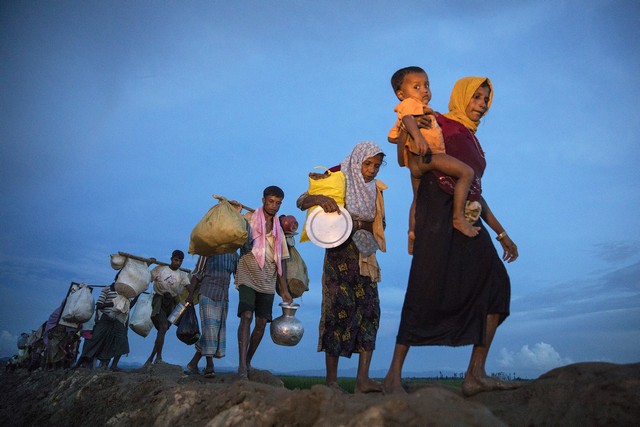
Aung San Suu Kyi spent years fighting against the Burmese military, winning the Nobel Peace Prize in 1991 for her efforts. She spent 15 years under house arrest before becoming Burma’s de facto civilian leader in 2016. But in recent years, she’s been condemned for presiding over a campaign of violence by Burma’s military against the minority Rohingya Muslim community, which saw over 1 million Rohingya flee to neighboring Bangladesh. Many displaced Rohingya fear the coup will make it impossible for them to return home. This is Mohammed Salam speaking from the refugee camp in Cox’s Bazar.

MOHAMMED SALAM: [translated] Now in Myanmar the military have declared a one-year state of emergency. That announcement is not good for the Rohingya people, too, because the military, together with the Rakhine people, tortured us a lot and carried out genocide. Then they made us homeless. We are now away from our home, in Bangladesh, living under tents. Where is our children’s education? There is nothing here for us. Now their military governs again. There are no benefits for us. They have arrested the democratic leader with military force. The fact they arrested such a leader will not be good for the Rohingya people there.

AMY GOODMAN: To talk more about the coup in Burma, we’re joined by Maung Zarni, a Burmese scholar, dissident and human rights activist living in exile in Britain. He’s co-founder of the Free Rohingya Coalition, as well as the Forces of Renewal for Southeast Asia, or FORSEA, a grassroots network of pro-democracy scholars and human rights activists across Southeast Asia.

Maung Zarni, thanks so much for being with us. Start off by talking about what happened this week. Talk about what unfolded in Burma, the country that the military calls Myanmar.

MAUNG ZARNI: Well, the military decided that they could no longer play this democracy game with Aung San Suu Kyi, after two election cycles, starting 2015 and November 2022, and expect to beat Aung San Suu Kyi. So, basically, what happened was that the military is, you know, completely outfoxed legally, as well as at the poll. So that’s why the military decided to wreck the game.

And what is interesting is what — you know, there are personal factors that trigger this coup on Monday. The commander-in-chief, Min Aung Hlaing, has a price tag on his head, because he is named one of the — basically, number one criminal against humanity with respect to Rohingya genocide. And so, that’s one reason.

And the other one is, of course, you know, they saw what happened on January 6, the storming of the U.S. Capitol, and they saw what is going on in China, Russia. The ideological climate moving toward the far right around the world emboldened the generals that this is the time to end this democracy game with Aung San Suu Kyi.

AMY GOODMAN: So, can you talk about the U.S. response? You have President Biden issuing a statement where he refers to Burma, not Myanmar, as President Obama also did, referred to Burma, and the issue of whether to call it a coup d’état. On Monday, Biden said the U.S. is, quote, “taking note of those who stand with the people of Burma in this difficult hour,” and urged the international community to pressure the Burmese military to relinquish power, lift restrictions on communications and free all officials and activists who have been detained. He also suggested the U.S. may again impose sanctions on Burma. And, of course, if they call it a coup d’état, it would require that they cut off aid to Burma.

MAUNG ZARNI: Yes. I think the call — designating the coup as coup, as it should be, obviously, automatically trigger immediate freezing of aid. But it’s not a lot, I think like over $100 U.S. million in development or civil society aid or humanitarian aid to Burma.

But I think we should also not forget the fact that the United States has in some ways contributed to this situation. You know, in 2010, when the Burmese military decided to play ball with the Western democracies, they brought in this, essentially, very limited form of democracy, where the military generals play regents to the civilian democrats. And so, the last 10 years, we have lived with this — basically, the big lie that we are democratizing and that this is a fragile transition with Suu Kyi at its helm. Well, on Monday, the military itself killed and buried that lie.

AMY GOODMAN: So, talk about Aung San Suu Kyi’s role. She’s been arrested. The president has been arrested. Now, today, the latest news is they’re being charged — I think she for having, they said, illegal radios, you know, gotten from abroad, finding that in her home. But the role that she has played? I mean, she was considered a freedom fighter for so long, won the Nobel Peace Prize, under house arrest for so many years by the military, its chief critic. Then she became its chief spokesperson and justified what happened to the Rohingya Muslims that were forced, ultimately — about a million of them — into neighboring Bangladesh. Now they have turned on her, the woman who has defended them for all these past few years?

MAUNG ZARNI: Well, you know, Amy, as you know, I was a foot soldier supporting her and campaigning for her release and then the divestment and boycott campaign in the U.S. for the longest time. And I saw her, actually, at the International Court of Justice, in a different room, when she was actually defending the military and denying the charges of genocide. And so, it’s really painful as a dissident to see, you know, really, the metamorphosis of Aung San Suu Kyi from this human rights defender, a democrat dissident, to becoming the military’s defender, the spokesperson.

Two things happened. One was she miscalculated that if she kept on placating the military, which her father founded some 75 years ago, calling the military generals her brothers, because she considered them her father’s sons, she thought that the military would cooperate with her to truly democratize the country and then return to the barracks. Well, that proved to be wrong. I have always said that this will not work. I came from an extended military family. The military has no interest in democratizing the country and no commitment to democratic values whatsoever.

The second reason is, she herself is an anti-Muslim racist. She shares the view that Rohingya Muslims do not belong in Burma. That’s a view the Army has institutionalized and the public has embraced. So, because of the —

AMY GOODMAN: Zarni, I wanted to go to Aung San Suu Kyi in her own words.

MAUNG ZARNI: Yeah.

AMY GOODMAN: This was back at The Hague in 2019, defending the Burmese military’s treatment of the Rohingya.

AUNG SAN SUU KYI: Regrettably, the Gambia has placed before the court an incomplete and misleading factual picture of the situation in Rakhine State in Myanmar. Yet, it is of the utmost importance that the court assess the situation obtaining on the ground in Rakhine dispassionately and accurately.

AMY GOODMAN: The significance of this case in The Hague, Zarni, and then what will happen to the Rohingya now with the military seizing power?

MAUNG ZARNI: Well, I think the military has institutionalized the genocidal persecution of Rohingyas since 1970s. And, you know, there are far more Rohingyas dispersed across the world than Rohingyas in the country. There are about half a million Rohingyas in open-air prison camps in western Myanmar, about 120,000 in what the German officials call concentration camps. The rest are in these forest villages from where they cannot leave. There is 1 million Rohingyas in Bangladesh waiting to be repatriated.

We cannot expect the perpetrators of genocide to welcome back the survivors of genocide. It is like telling the Rohingya to go back to Auschwitz — you know, telling the victims of the Nazi SS to go back to Auschwitz because you’ve got new bathrooms and, you know, new paint. So, the repatriation is completely off the table.

AMY GOODMAN: Well, I want to thank you, Maung Zarni, for joining us, Burmese scholar, dissident, human rights activist — we’ll continue to follow what unfolds — co-founder of the Free Rohingya Coalition, as well as the Forces of Renewal for Southeast Asia, known as FORSEA, this grassroots network of pro-democracy scholars and human rights activists across Southeast Asia.

When we come back, President Biden has halted deportations, he said, of immigrants, and yet hundreds and hundreds of immigrants have been deported in the last days under the new administration. Stay with us.

[break]

AMY GOODMAN: Rohingya musician Mohammed Alom, recorded in 2018 in Bangladesh as part of the Music in Exile project.

________________

Maung Zarni Burmese scholar, dissident and human rights activist who co-founded the Free Rohingya Coalition.

3 February 2021

Source: www.democracynow.org
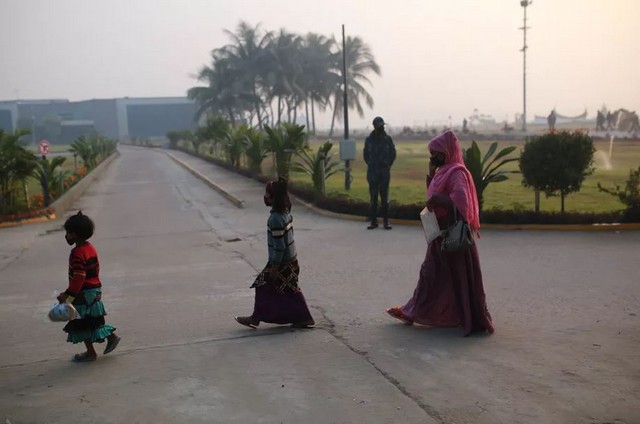
What Myanmar’s coup could mean for the Rohingya and other persecuted minorities

By Jen Kirby

The Myanmar military overthrew its civilian government in a coup on Monday, ending the facade of democratic rule and creating an even more uncertain future for human rights in the country — especially the persecuted Rohingya and other ethnic minorities.

The aftermath of the coup is still unfolding, but human rights advocates and experts told me they are increasingly fearful of what might happen to anyone who challenges the regime.

“The options available to the Burmese people are very, very limited because I don’t think there’s much influence inside the country,” Mabrur Ahmed, founder and director of Restless Beings, a UK-based human rights group, told me. (Burma is the country’s former name; the military junta changed it to Myanmar in 1989, but many, especially those in the pro-democracy movement, still use the older name.) There is not much people can do besides protest, Ahmed said — though any protests, he added, would likely be met with violence from the military.

The plight of the Rohingya and other ethnic and religious minorities in the Buddhist-majority country may be even more precarious amid this political turmoil.

Many of Myanmar’s minority groups remained seriously marginalized by the government throughout the country’s stilted move toward democracy, which began more than a decade ago. Isolated politically and economically, Myanmar’s military leaders put forward a new constitution in 2008 that took some responsibilities away from the military, though it still retained much of the real power. In 2015, Myanmar’s pro-democracy champion Aung San Suu Kyi and the party she led won in a landslide election, and Suu Kyi became the “state counselor,” a de facto civilian leader, the following year.

But ethnic and religious minorities, including the Rohingya, were largely excluded from the 2015 vote. Ahead of the November elections that preceded this coup, many minority groups — about 1.5 million voters — were again disqualified from participating at all.

The state has also continued to engage in outright violence against some groups, most notably the Rohingya, a Muslim minority group in Rakhine State. More than 750,000 Rohingya have fled to neighboring Bangladesh since 2017, when the military escalated a brutal campaign against the group, burning villages and committing murder and gang rapes with what a United Nations human rights report termed “genocidal intent.”

The military has targeted ethnic and religious minorities in other places, as well, including in Kachin and Shan states. An independent fact-finding report commissioned by the UN Human Rights Council and published in 2019 found that “Myanmar’s ethnic groups have a common — but not identical — experience of marginalization, discrimination and brutality at the hands of the Myanmar armed forces, the Tatmadaw.”

Maung Zarni, a Burmese activist and the co-founder and general secretary of Forsea, an advocacy group that campaigns for democracy and human rights in Southeast Asia, said he thinks the human rights situation may worsen in the coup’s aftermath.

“The different minority communities, they’re in between a rock and a hard place,” Zarni told me. “If they just lie back and take it, they lose. Then if they try to be proactive and try to activate any human rights mechanisms outside of Burma, the army will single them out in an increase of repression.”

And that army is now fully in charge of the government. Gen. Min Aung Hlaing, head of the Tatmadaw, has been credibly accused of genocide and war crimes. The US sanctioned Hlaing in 2019 for human rights abuses against the Rohingya.

“The military is responsible for genocide against the Rohingya and other severe human rights abuses against other ethnic minorities, including the Rakhine, Kachin, [and] Shan,” Daniel P. Sullivan, a senior advocate for human rights at Refugees International who focuses on Myanmar, told me. “The idea of them now being in control just feeds the impunity that they’ve been able to enjoy for so long.”

Human rights did not improve during Suu Kyi’s leadership

Atrocities against the Rohingya and others happened during Myanmar’s flirtation with democracy, during the tenure of Aung San Suu Kyi. Suu Kyi was Myanmar’s champion for democracy, the famous daughter of the man who helped win the country’s independence. For her activism, the military placed her under house arrest in the late 1980s until 2010. She won the Nobel Peace Prize in 1991 for her pro-democracy efforts, and as the country took steps toward democratization, she became its de facto civilian leader in 2015.

Those steps were tentative, however, and incomplete. Once in her role, Suu Kyi deferred to the military, which retained significant power under the new arrangement. As the crackdown against the Rohingya intensified, she received international criticism for her silence. She has referred to evidence of atrocities as “fake news” and framed the crackdown as operations against terrorism. In 2019, she defended Myanmar against charges of genocide at the International Court of Justice in the Hague, Netherlands.

Suu Kyi was — and is — extraordinarily popular within Myanmar, but her refusal to condemn specifically the treatment of the Rohingya showed the fault lines in Myanmar’s democratic experiment.

About 30 percent of Myanmar’s population are ethnic minorities — some 130 groups, according to the Washington Post. Some of these groups have armed wings, and Myanmar has some of the world’s longest-running civil wars, which began after the country gained independence in 1948.

“That is the level of discontent and fear on the part of ethnic groups, and they don’t trust the military. They also feel Suu Kyi is colonialistic,” Zarni said. “Sui Kyi and the military — they differ only in degrees, not in kind, in terms of their perspective or sentiments toward non-Burmese Buddhist minorities.”

The military has now detained Suu Kyi and the party’s civilian leadership as part of its takeover. Some critics say it makes no difference, particularly for the Rohingya. It was bad before and will remain so.

“For us, the civilian government and the military regime are the same, so for us nothing will change,” Nay San Lwin, co-founder of the Free Rohingya Coalition, told me. “They can’t do more than what they are doing now.”

Experts and human rights activists said the coup, in a way, revealed how hollow Myanmar’s democratization really was. As Zarni put it, “The coup has killed the biggest lie.”

“Even though Myanmar always had the veneer of democracy, it was never a new democracy in any sense,” Azeem Ibrahim, director at the Center for Global Policy in Washington, DC, and author of The Rohingyas: Inside Myanmar’s Hidden Genocide, told me. “The military still held all the cards. They had, essentially, power without any accountability whatsoever.”

There are legitimate concerns the situation may worsen and that an unaccountable military may be even more emboldened after the coup.

“A moment like this, where the perpetrators of those atrocities have taken as a power grab, really raises the concerns and the risks of further atrocities happening to groups like, particularly, the Rohingya,” Sullivan of Refugees International said.

Even a nominal civilian government served as, if not a check on, then it at least sometimes slowed down the worst of the military’s impulses. The motions of democracy — setting up committees, having to get approval for measures — took time. Now, even that is gone.

“What I can say,” Ahmed, the human rights activist, told me, “is that any sort of pebbles that might have been on the path have now been removed.”

Activists see the coup as an opportunity to hold Myanmar accountable

Sullivan said his group has urged the Biden administration to designate what’s happening to the Rohingya a “genocide.” Biden’s State Department is reviewing the designation, which advocates believe will help rally international pressure to the Rohingya’s cause.

Meanwhile, the Biden administration has already officially declared the takeover in Myanmar a coup. “The United States removed sanctions on Burma over the past decade based on progress toward democracy,” Biden said in a statement Monday. “The reversal of that progress will necessitate an immediate review of our sanction laws and authorities, followed by appropriate action.”

The State Department said Tuesday that the administration will review reimposing economic sanctions on Myanmar that had been removed in 2016 as Myanmar moved toward democratization.

“We will take action against those responsible, including through a careful review of our current sanctions posture, as it relates to Burma’s military leaders and companies associated with them,” a State Department official told reporters on a conference call Tuesday, using the country’s former name. “Most importantly, we will continue to stand with the people of Burma.”

Experts and advocates said the military coup gives the new Biden administration and international partners an opportunity to put renewed pressure on Myanmar, especially when it comes to its human rights abuses and atrocities against the Rohingya.

Countries condemned the violence against the Rohingya, and the United States used tools like targeted sanctions to punish individual figures within Myanmar’s military. But experts told me that some governments were reluctant to push too hard because they feared too much pressure might upset Myanmar’s fragile, if imperfect, democracy.

“All of that has now been uprooted,” Ibrahim said of the coup. “It was very clear who’s running the show. There is no more facade, or veneer, of democracy.”

The United Nations Security Council met Tuesday to discuss the political situation in Myanmar. Some humanitarian groups had called on the Security Council to impose sanctions, including on members of the military, or a global arms embargo. But the Security Council failed to even agree on a statement to condemn the coup.

“The military coup has been conducted by the same military who were accused of committing genocide or crimes against humanity,” Wai Wai Nu, founder of the Women’s Peace Network, which advocates for human rights in Myanmar, told me. “This impunity that has been given to this military must end. The world must hold accountable the military, not only for the coup, but especially for the crimes of genocide.”

But some advocates warned that too much international pressure on Myanmar, especially if linked to the Rohingya, might create the unintended consequence of angering the Myanmarese military and provoking a backlash — one they might take out on the Rohingya.

“I’m just echoing the voices of the Rohingya that I know and I’ve spoken to do, who fear they are going to be number one, front and center, of the Burma military showing its power,” Ahmed said. He said his Rohingya contacts did not want to speak after the coup because they are fearful and don’t know what is going to come next.

All of this has made Myanmar’s future look grim, for its minorities and for any democratic future. “The entire country is going to suffer for years,” Nay San Lwin said. “We don’t know how long.”

Jen Kirby

Foreign and National Security Reporter

2 February 201

Source: www.vox.com

OPINION – Myanmar military and its coup

By Maung Zarni

LONDON

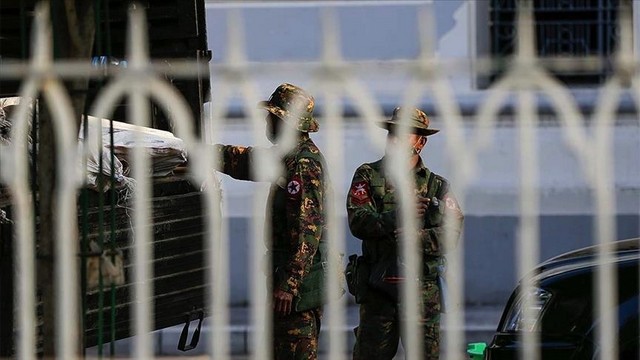
Myanmar’s military staged a coup, detaining the country’s de facto leader Aung San Suu Kyi and President U Win Myint early Monday, just hours before the scheduled start of the first session of the new parliament.

The military also declared that it has taken control of the country for one year under a state of emergency.

Last week, a flurry of speculation about the likelihood of a military coup against Aung San Suu Kyi’s civilian government in the capital city Naypyidaw intensified. Tanks and armored vehicles were moving about in Yangon, Mandalay and other cities in full view of the public, while there were reports of the increased presence of security troops in Naypyidaw and pro-military street protests.

These developments triggered the release of alarmist statements from various quarters including the US, Australia, the EU and the Office of the UN Secretary-General, as well as Myanmar’s official governing board of Sangha or Buddhist Order.

On Jan. 28, the UN Secretary General’s spokesperson Stephane Dujarric issued a statement attributable to Antonio Guterres urging “all [Myanmar] actors to desist from any form of incitement or provocation, demonstrate leadership, adhere to democratic norms and respect the outcome of the Nov. 8 general election. All electoral disputes should be resolved through the established legal mechanisms.”

The following day, the 14-monk Myanmar Governing Board overseeing the country’s half a million Buddhist monks and nuns held a virtual meeting and issued “a statement of the appeal” to resolve any disputes arising from the November election peacefully and in accordance with the existing laws and regulations of the land.

On Saturday morning, amid local anxieties and statements of concern about the speculated coup against the Aung San Suu Kyi government, the Office of the Commander-in-Chief Min Aung Hlaing issued a bilingual Burmese and English statement of clarification. The statement dismissed the coup speculations and blamed unscrupulous organizations for distorting the senior general’s video conference addressed to the National Defense College class on Jan. 27. In it, Min Aung Hlaing reportedly attributed the National League for Democracy’s (NLD) crushing defeat of the military-backed Union Solidarity and Development Party (USDP) to the widespread electoral fraud of 8 million irregular votes and floated the idea of abolishing the 2008 Constitution.

“The election laws and regulations are violated [by the re-elected NLD party and its Myanmar Electoral Commission],” he stated.

The same morning, echoing the statement from the Office of the Commander-in-Chief, the military’s mouthpiece Myawaddy News drew a parallel between past election frauds, corruption and political violence which it (the military) attributed to civilian political parties, particularly the Anti-Fascist People’s Freedom League, or AFPFL. Co-founded by Ms. Suu Kyi’s father the late Aung San as a revolutionary front against Japanese fascist occupation during WWII and subsequently the mass political movement against the returning British colonial administration, the AFPFL was the equivalent of today’s NLD in that it had near-total dominance in the parliamentary system.

The Commander-in-Chief’s statement portrayed the military and its leaders as honest, corruption-free, above-the-fray patriotic guardians of the Union of Burma (or today Myanmar), in sharp contrast to the selfish, greedy, corrupt politicians and their parties of the post-independence parliamentary era in the 1950s and 1960s, the era that came to a crushing and abrupt end with the 1962 coup.

A cursory glance at the military and its abysmal record in anything that could qualify as “nation-building” will puncture this self-congratulatory self-perception of the military and its leaders.

Following the Nov. 8 elections, there has been a running dispute between the Myanmar Election Commission which was set up by and answers to Suu Kyi’s puppet nominal President Win Myint and the military-backed USDP, made up largely of ex-generals and other ranks, as well as the military-bred and associates.

Myanmar voters went to the polls on Nov. 8. They gave Suu Kyi and the NLD the most decisive re-election mandate in the country’s post-independence history.

The NLD’s clear victory in effect crushed the military-proxy USDP: out of 476 seats in the Parliament, the ex-generals secured only 33 seats, while the NLD took 396.

Apparently, this gave the NLD near-total control over the legislature, something which the military now says is one-party anti-democratic rule contrary to the spirit and aims of the military framers of the 2008 Constitution. But this is Orwellian and opportunistic because the Burmese military leaders never internalized democratic values nor worked to build any system that is worthy of the term democracy.

Here one can see a Trumpian parallel between the overwhelming majority of US President Donald Trump’s grassroots supporters and 70% of his backers in US Congress and the ways in which Myanmar military men, in-service or veterans, see themselves vis-à-vis the respective election winners – Biden and his voters and the NLD and its nationwide supporters.

Despite the verified and verifiably free, transparent and fair elections in the US and Myanmar in 2020, both Trump (and Republicans) and the Burmese military-backed USDP party succumb to the false view that they were the injured party which lost the election only because of the other side’s widespread alleged voter fraud. But this is where the parallel ends.

Unlike the US, Myanmar’s democratic transition and democracy are at best fragile and at worse a total farce. This is in addition to belaboring the obvious – that the US has 200+ years of continuously expanding, if at times turbulent democratic culture and a political system of checks and balances.

Six years ago, the world succumbed to political euphoria – nothing short of extraordinary madness around Myanmar’s election outcome. It prematurely – and without any empirical justifications – celebrated “the victory lap” of Suu Kyi as her party was swept into a landslide victory over the generals’ USDP, with Suu Kyi herself having been crowned “Myanmar State Counsellor,” the “above-the-president” political office from which she has been playing the puppet-master to her yo-yo presidents, first Htin Kyaw and later Win Myint.

Against this tide of extraordinary delusions of global and Burmese elites and hysteria of the masses, I argued that the ultimate winners of the 2015 election landslide were the Burmese generals. For the country’s military leaders, who run the most powerful institution, were never compelled, either from below domestically or from western powers who backed Suu Kyi, to make any real concessions. They were practically given a free pass in exchange for strategic and economic access to the country while the West and the rest were trumpeting a “Myanmar Spring.”

This was how the farce of Myanmar’s democracy gained international legitimacy and in-country acceptance. The Constitution that pre-emptively legalizes any future military coup is the basis of what is billed as “fragile democracy.” The inconvenient fact is Burmese generals, young or old, retired or in-service, have never felt compelled to give up their effective control over levers of the state, in any way, shape or form.

In 2008, the generals created and adopted the Constitution of, for and by the military as the real-power-holders. It was designed specifically to enable the military to control all crucial levers of power such as the security ministries of Home, Border Affairs and Defense, the veto power – via its 25% bloc of unelected but allotted MP seats – over any significant constitutional amendments that will tip the balance of power in favor of We the People, the firm grip on the amendments General Administration Department which exercise state’s administrative control over populations down to the smallest hamlets and neighborhood wards and exclusive control of a large share of the national economy via its economic conglomerates.

Besides, Suu Kyi, the most trusted Burmese politician, will never be allowed to assume the country’s presidency under the military’s Constitution.

In light of the military’s primacy and dominance in the country’s reform process, I was as perplexed as anyone upon seeing the images of the tanks on the streets of my hometown of Mandalay and former capital Yangon and reading the news of Commander-in-Chief Min Aung Hlaing blatantly floating the possibility of the abolition of the 2008 Constitution – the military’s proverbial Golden Swan which lays an egg a day without fail – and the military spokesperson Brigadier Zin Min Htun effectively fueling the popular speculation that the tanks on the streets are sure-fire signals of the coming coup.

Three decades ago, the San Francisco Chronicle (16 May 1990) carried a 734-word news analysis entitled “Vote will change nothing: Military Pledges to Retain Power after May 27 Exercise” by James Goldstein where the astute American journalist wrote: “If you ever needed proof that elections do not by themselves ensure that a government is protecting the human rights of its citizens, Burma is it.” Indeed, the vote has changed nothing fundamental in terms of the power equation in Myanmar.

It is way past time the UN, the EU, the US and the global media shed their mainstreamed farcical tales about Myanmar’s “fragile democratic transition” under Nobel laureate Aung San Suu Kyi. Painfully, Suu Kyi has shown her true colors as a racist Rohingya genocide-defending autocrat while her partners-in-crimes, the Burmese generals, just paraded their tanks. The military’s message to the overwhelmingly pro-NLD public is loud and clear: the military remains the real boss, despite the trappings and spins of democracy.

– The writer is a Burmese coordinator of the Free Rohingya Coalition and a fellow of the Genocide Documentation Center in Cambodia

*Opinions expressed in this article are the author’s own and do not necessarily reflect the editorial policy of Anadolu Agency.

1 February 2021

Source: www.aa.com.tr

FORSEA Condemns Military Coup in Myanmar

By FORSEA

FORSEA, a grassroots network of scholars and activists across Southeast Asia, unequivocally condemns Myanmar military’s coup and the detention of NLD leaders and MP-elects.

Like Thai Royal Armed Forces, Myanmar military has been acting without any restraint or consideration for the protection of civil and political rights, nor human rights.

As a matter of fact, the predawn coup in Myanmar has only exposed a two-fold lie – that Myanmar generals are undertaking top-down democratic reforms, and that Aung San Suu Kyi was leading this “fragile transition”. The plain truth is Myanmar military had carved out a position as the permanent power-holder in its Constitution of 2008. Under the cover of this Big Lie of “fragile democracy”, all external actors with their own agendas and interests – including international investors, western governments, Japan, India, the United Nations, the Association of South East Asian Nations (ASEAN), the World Bank, Asian Development Bank and the IMF – chose not to act when the hybrid regime of the military and Aung San Suu Kyi proceeded to commit genocidal purges against Rohingya Muslims or launched vicious military attacks against other national minorities of Myanmar such as Kachin Christians, Karen, Rakhine, Ta’ang, and Shan peoples.

The coup is couched in Orwellian language – Aung San Suu Kyi and NLD MPs are power-mad anti-democrats who attempted to proceed to hold a new parliament, despite widespread fraud of 10.5 million vote irregularities, mirroring the Trumpian “stop the steal” discourse in the USA. It is also Orwellian in that the coup is an act to safeguard the democratic transition, prevent national disintegration potentially triggered by Aung San Suu Kyi.

FORSEA urges all international media outlets and commentators to stop pedalling this “fragile democracy” lie.

Additionally, we urge all international governments and agencies to review their “pro-democracy” and “pro-development” policies and put a moratorium on foreign aid to Myanmar except humanitarian relief.

No political transition or system or government that is committing a genocide against one national minority and waging vicious wars against other minorities cannot be labelled “democratic”, fragile or not.

1 February 2021

Source: forsea.co

Will Biden End America’s Global War on Children?

By Medea Benjamin and Nicolas J. S. Davies

Most people regard Trump’s treatment of immigrant children as among his most shocking crimes as president. Images of hundreds of children stolen from their families and imprisoned in chain-link cages are an unforgettable disgrace that President Biden must move quickly to remedy with humane immigration policies and a program to quickly find the children’s families and reunite them, wherever they may be.

A less publicized Trump policy that actually killed children was the fulfilment of his campaign promises to “bomb the shit out of” America’s enemies and “take out their families.” Trump escalated Obama’s bombing campaigns against the Taliban in Afghanistan and the Islamic State in Iraq and Syria, and loosened U.S. rules of engagement regarding airstrikes that were predictably going to kill civilians.
After devastating U.S. bombardments that killed tens of thousands of civilians and left major cities in ruins, the United States’ Iraqi allies fulfilled the most shocking of Trump’s threats and massacred the survivors – men, women and children – in Mosul.

But the killing of civilians in America’s post-9/11 wars did not begin with Trump. And it will not end, or even diminish, under Biden, unless the public demands that America’s systematic slaughter of children and other civilians must end.
The Stop the War on Children campaign, run by the British charity Save the Children, publishes graphic reports on the harms that the United States and other warring parties inflict on children around the world.

Its 2020 report, Killed and Maimed: a generation of violations against children in conflict, reported 250,000 UN-documented human rights violations against children in war zones since 2005, including over 100,000 incidents in which children were killed or maimed. It found that a staggering 426,000,000 children now live in conflict zones, the second highest number ever, and that, “…the trends over recent years are of increasing violations, increasing numbers of children affected by conflict and increasingly protracted crises.”
Many of the injuries to children come from explosive weapons such as bombs, missiles, grenades, mortars and IEDs. In 2019, another Stop the War on Children study, on explosive blast injuries, found that these weapons that are designed to inflict maximum damage on military targets are especially destructive to the small bodies of children, and inflict more devastating injuries on children than on adults. Among pediatric blast patients, 80% suffer penetrating head injuries, compared with only 31% of adult blast patients, and wounded children are 10 times more likely to suffer traumatic brain injuries than adults.

In the wars in Afghanistan, Iraq, Syria and Yemen, U.S. and allied forces are armed with highly destructive explosive weapons and rely heavily on airstrikes, with the result that blast injuries account for nearly three-quarters of injuries to children, double the proportion found in other wars. The U.S. reliance on airstrikes also leads to widespread destruction of homes and civilian infrastructure, leaving children more exposed to all the humanitarian impacts of war, from hunger and starvation to otherwise preventable or curable diseases.

Image on the right: Iraqi children are seen in a town of Mosul after the village was retaken by Peshmerga forces from Daesh on 31 October, 2016 [Ahmet Izgi/Anadolu]

The immediate solution to this international crisis is for the United States to end its current wars and stop selling weapons to allies who wage war on their neighbors or kill civilians. Withdrawing U.S. occupation forces and ending U.S. airstrikes will allow the UN and the rest of the world to mobilize legitimate, impartial support programs to help America’s victims rebuild their lives and their societies. President Biden should offer generous U.S. war reparations to finance these programs, including the rebuilding of Mosul, Raqqa and other cities destroyed by American bombardment.

To prevent new U.S. wars, the Biden administration should commit to participate and comply with the rules of international law, which are supposed to be binding on all countries, even the most wealthy and powerful.
While paying lip service to the rule of law and a “rules-based international order”, the United States has in practice been recognizing only the law of the jungle and “might makes right,” as if the UN Charter’s prohibition against the threat or use of force did not exist and the protected status of civilians under the Geneva Conventions was subject to the discretion of unaccountable U.S. government lawyers. This murderous charade must end.

Despite U.S. non-participation and disdain, the rest of the world has continued to develop effective treaties to strengthen the rules of international law. For instance, treaties to ban land-mines and cluster munitions have successfully ended their use by the countries that have ratified them.
Banning land mines has saved tens of thousands of children’s lives, and no country that is a party to the cluster munitions treaty has used them since its adoption in 2008, reducing the number of unexploded bomblets lying in wait to kill and maim unsuspecting children. The Biden administration should sign, ratify and comply with these treaties, along with more than forty other multilateral treaties the U.S. has failed to ratify.

Americans should also support the International Network on Explosive Weapons (INEW), which is calling for a UN declaration to outlaw the use of heavy explosive weapons in urban areas, where 90% of casualties are civilians and many are children. As Save the Children’s Blast Injuries report says, “Explosive weapons, including aircraft bombs, rockets and artillery, were designed for use in open battlefields, and are completely inappropriate for use in towns and cities and among the civilian population.”
A global initiative with tremendous grassroots support and potential to save the world from mass extinction is the Treaty to Prohibit Nuclear Weapons (TPNW), which just came into force on January 22 after Honduras became the 50th nation to ratify it. The growing international consensus that these suicide weapons must simply be abolished and prohibited will put pressure on the U.S. and other nuclear weapons states at the August 2021 Review Conference of the NPT (Nuclear Non-Proliferation Treaty).

Since the United States and Russia still possess 90% of the nuclear weapons in the world, the main onus for their elimination lies on Presidents Biden and Putin. The five-year extension to the New START Treaty that Biden and Putin have agreed on is welcome news. The United States and Russia should use the treaty extension and the NPT Review as catalysts for further reductions in their stockpiles and real diplomacy to explicitly move forward on abolition.
The United States does not just wage war on children with bombs, missiles and bullets. It also wages economic war in ways that disproportionately affect children, preventing countries like Iran, Venezuela, Cuba and North Korea from importing essential food and medicines or obtaining the resources they need to buy them.

These sanctions are a brutal form of economic warfare and collective punishment that leave children dying from hunger and preventable diseases, especially during this pandemic. UN officials have called for the International Criminal Court to investigate unilateral U.S. sanctions as crimes against humanity. The Biden administration should immediately lift all unilateral economic sanctions.
Will President Joe Biden act to protect the children of the world from America’s most tragic and indefensible war crimes? Nothing in his long record in public life suggests that he will, unless the American public and the rest of the world act collectively and effectively to insist that America must end its war on children and finally become a responsible, law-abiding member of the human family.

*

Medea Benjamin is cofounder of CODEPINK for Peace, and author of several books, including Inside Iran: The Real History and Politics of the Islamic Republic of Iran.

Nicolas J. S. Davies is an independent journalist, a researcher with CODEPINK and the author of Blood On Our Hands: the American Invasion and Destruction of Iraq.

28 January 2021

Source: www.globalresearch.ca

B’Tselem’s Historic Declaration: Israel’s Open War on Its Own Civil Society

“A Regime of Jewish Supremacy from the Jordan River to the Mediterranean Sea: This is Apartheid,” was the title of a January 12 report by the Israeli rights group B’Tselem. No matter how one is to interpret B’Tselem’s findings, the report is earth-shattering. The official Israeli response merely confirmed what B’Tselem has stated in no uncertain terms. Those of us who repeatedly claimed that Israel is not democratic, governed by an apartheid regime and systematically discriminates against its ethnic and racial minorities, in favor of the country’s Jewish majority, purportedly have nothing to learn from B’Tselem’s declaration. Thus, it may seem that the report, which highlighted racial discrimination in four major areas – land, citizenship, freedom of movement and political participation – merely, restated the obvious. In actuality, it went much further.

B’Tselem is a credible Israeli human rights organization. However, like other Israeli rights groups, it rarely went far enough in challenging the Israeli state’s basic definition of itself as a democratic state. Yes, on numerous occasions it rightly accused the Israeli government and military of undemocratic practices, rampant human rights violations and so on. But to demolish the very raison d’etre, the basic premise that gives Israel its legitimacy in the eyes of its Jewish citizens, and many more around the world, is a whole different story. “B’Tselem rejects the perception of Israel as a democracy (inside the Green Line) that simultaneously upholds a temporary military occupation (beyond it),” the Israeli rights group concluded based on the fact that the “bar for defining the Israeli regime as an apartheid regime has been met after considering the accumulation of policies and laws that Israel devised to entrench its control over Palestinians.”

Israel’s leading human rights organization was not arguing that Israel was turning into an apartheid state or that it was acting contrary to the spirit of democracy or that Israel is an undemocratic apartheid regime only within the geographic confines of the occupied Palestinian territories. None of this. According to B’tselem, which has for decades diligently documented numerous facets of Israeli government practices in the realm of politics, military, land-ownership, water distribution, health, education, and much more, Israel is, now, wholly an apartheid, undemocratic regime.

B’Tselem’s assessment is most welcomed, not as a belated admission of a self-evident reality but as an important step that could allow both Israelis and Palestinians to establish a common narrative on their relationship, political position and collective action in order to dismantle this Israeli apartheid.

29 January 2021

Source: palestineupdates.com

Truth never damages a cause that is just

By Ranjan Solomon

B’Tselem is one of Israel’s foremost human rights organizations. But it is the first time that it has challenged Israel’s claim to being a democratic state. In a report titled “A Regime of Jewish Supremacy from the Jordan River to the Mediterranean Sea: This is Apartheid,” B’Tselem challenges ‘the common perception in public, political, legal and media discourse is that two separate regimes operate side by side in this area, separated by the Green Line’. One regime, inside the borders of the sovereign State of Israel, is a permanent democracy with a population of about nine million, all Israeli citizens. The other regime, in the territories Israel took over in 1967, whose final status is supposed to be determined in future negotiations’. The report highlights racial discrimination in the areas of land, citizenship, freedom of movement and political participation. It goes even deeper and those who are on the side of seeking a just peace hope that the report will serve as an important step that opens spaces for Israelis and Palestinians to create a widespread account “on their relationship, political position and collective action in order to dismantle this Israeli apartheid”.

Palestinian general elections for 2021 have been announced at long last. They will include legislative elections on 22 May 2021, presidential elections on 31 July and the Palestinian National Council elections on 31 August 2021. About two million Palestinians in Jerusalem, the West Bank, and Gaza Strip are eligible to vote. The UN and the EU welcomed the development. The absence of democracy for well over a decade in the Palestinian territories meant that there was neither accountability nor people’s participation in political affairs. Hence, this is a welcome development. The announcement that imprisoned Palestinian leader Marwan Barghouti will run for president in these elections has stirred huge interest and optimism. As a leader with a mass base and charisma, his chances are rated as being very high because of his mass base and the fact that he has been jailed for nearly two decades. With political changes in the USA, the outcome of the elections will be keenly watched. Of equally keen interest is the question of how Hamas will fare in the elections. Should Hamas win, what will the response of the international community be?

In parallel to the prospects of elections, there are other worries too. “…Palestinians are worried that Israel might block this year’s polls in East Jerusalem after the US recognition of the city as Israel’s capital in 2017 and amid preparations for the Israeli elections on March 22. Abbas has repeatedly said that the Palestinian elections will not be held without Jerusalem. Israeli intelligence services have started to warn Hamas officials in the occupied West Bank not to participate in the upcoming Palestinian elections. Israelis first summoned a senior Hamas official Sheikh Omar Al-Barghouti to the Ofer Detention Centre and instructed him not to take part in the presidential, legislative and National Council elections. Al-Bargouthi was released just recently. He is not the only one to receive such a warning.

Meanwhile, Israel continues to further weaken democracy by prohibiting even peaceful resistance. There is a huge chorus of protest against the persecution and intimidation’ of Palestinian anti-settlement activist Issa Amro. Amro is the founder of the Hebron-based group Youth Against Settlements, saying they feared he would spend time behind bars. The UN officials have condemned his prosecution and termed it as being politically motivated. A senior UN official has observed that “rather than prosecuting human rights defenders, Israel should be listening to them and correcting its own human rights conduct.”
Meanwhile the world watches with curiosity, and a degree of hope mixed with uncertainty, as to how the Biden administration will fare in ironing out the discord between Palestinians and Israel on the future. What chances will democracy really have as the future unfolds? Will Biden show courage and open up spaces for a just settlement? Will the powers that manage the backroom of US politics give him the leeway to do what it takes for a just and durable resolution?
The US does not have a credible track record of steering Israel and Palestine towards a convincing peace. Zionist lobbies have controlled and dictated US policy. And, for most part, that policy has camouflaged truth. Gandhi once said: “Truth never damages a cause that is just”. The question before us is: Will Biden create history and change the content of US policy to forge a new day in which the pursuit of truth and justice bring peace to both peoples?

Ranjan Solomon is a widely experienced civil society/human rights/GO leader with varied experiences in organizational transformation and creating social change through advocacy, communications, and issues of education.

29 January 2021

Source: palestineupdates.com

The ring has finally arrived!

By Shobha Shukla

You guessed it right. I am talking about the dapivirine vaginal ring (DPV-VR), which is one of the top advances happening in the field of microbicides. It is the first long acting prevention product whose Phase-3 randomised controlled studies have shown that using the dapivirine vaginal ring reduced the risk of HIV infection in women and long-term use was well-tolerated.

The World Health Organization (WHO) has just recommended it as a new prevention choice for women at substantial risk of HIV infection as part of combination prevention approaches. The European Medicine Agency has already given a positive scientific opinion on its use, and it has been submitted for regulatory approvals in many countries of Africa and in the USA.

Patriarchal norms have long forced women’s sexual health needs to remain on the blind spot. The economic, social and cultural barriers faced by women often disempower them to exercise their right to negotiate use of prevention options for HIV (and other STIs and unintended pregnancy) with their partners. If we are to end AIDS and achieve zero new HIV infection goal, then it is vital to have more women initiated methods to prevent transmission of all STIs including HIV, and unintended pregnancies. That is why dapivirine vaginal ring provides the much needed ray of hope.

What is the ring?

The dapivirine vaginal ring is a female-initiated option to reduce the risk of HIV infection. It is a silicon ring impregnated with 25mg of the drug dapivirine (a non-nucleoside reverse transcriptase inhibitor). It is easy to bend and insert in the vagina, where it must be worn for a period of 28 days, after which it should be replaced by a new ring. The ring works by releasing the antiretroviral drug dapivirine from the ring into the vagina slowly over a period of 28 days.

This is indeed a revolution in the field of new innovations for HIV prevention, which is now more than just distribution of condoms and pills. And this is just the beginning, with newer technologies in the offing.

“In my own view this is going to be a product that could have real utility because it is extremely safe and because it is such a tiny amount of drug so it would not require a lot of medical monitoring. So it is not going to be very medicalized. All you really need is a rapid test and a dispensation”, said Dr Sharon Hillier, Professor, Department of Obstetrics, Gynaecology & Reproductive Sciences and Microbiology and Molecular Genetics, University of Pittsburgh, during an interaction with a group of select global journalists ahead of the ongoing virtual 4th HIV Research for Prevention (HIVR4P) International Conference.

“When the ring is rolled out, it will be critically important to figure out where to promote it most efficiently. For example, as very little drug comes out of the ring, it might make it a very attractive choice for a woman who is breastfeeding as not much drug will get into the breastmilk. We are doing a study of testing this vaginal ring in breastfeeding women which will be over by September 2021. Another study is also currently underway on pregnant women”, she shared.

Prof Hillier also spoke about next generation rings and approaches to new formulations of delivering drugs for HIV prevention.

The next generation ring (currently under research) has 200mg of dapivirine and can be left in the vagina for 3 months at a time. The first studies, showing that it is safe, have been completed.

Multipurpose prevention technology

There is also a 90 day multipurpose dapivirine vaginal ring currently-under-research that aims to provide dual protection against both HIV and unwanted pregnancy. It contains 200mg of dapivirine and 320mg of levonorgestrel to allow for extended release of the two drugs over 3 months. Results of phase-1 clinical studies, presented at the ongoing fourth HIVR4P Conference, show that it is safe and delivers sustained levels of each drug when used continuously for 90 days- levels likely sufficient to serve its dual purpose for protecting against both HIV and unintended pregnancy. This is going to be a game changer by giving a woman a simple and very safe product in her hands that she can insert in her vagina that could provide both family planning and HIV prevention.

Acceptability and access

There has been great progress in getting HIV prevention products into women’s hands and in having more sustained delivery options. If we create a broad menu of options, people can choose what works best for them, said Prof Hillier. However she concedes that more community education and understanding has to be generated around the utility and use of the dapivirine ring. She said that while a lot of acceptability work has been done in many African countries and in USA, less work has been done in Asia and South America. It was basically designed to address women’s needs in Africa and has been highly acceptable to women there.

Agrees Dr Nyaradzo Mgodi, senior clinical pathologist who is also a part of Scientific Leadership Group of University of Zimbabwe’s Clinical Trials Research Centre, and a lead investigator in Harare for several HIV Prevention Trials Network (HPTN) and Microbicide Trials Network (MTN) studies, including the one on the dapivirine vaginal ring. “This is a very discreet and beautiful intervention, and women, especially in sub-Saharan Africa, like it. It does not interfere with sexual intercourse and does not fall out even when women do manual labour in the fields or lift heavy loads.”

Mgodi is confident that there will be no equity and access issues for delivering the ring even in remote areas of her country Zimbabwe, more so as it does not require cold chain maintenance and has been liked by women once they know how to use it. Her advice is to integrate it with sexual and reproductive health services to speed up its roll-out.

No one silver bullet for preventing HIV

No single prevention product is a silver bullet. There is no single approach that is going to be right for everybody, and at all times. Important insights came from Dr Linda Gail Bekker, Co-Chair of the HIVR4P conference; past President of International AIDS Society (IAS); and Deputy Director of the Desmond Tutu HIV Centre at the Institute of Infectious Disease and Molecular Medicine, University of Cape Town: prevention is relevant only when we actually get it to the people who need it, and they use it. It is not only about the product that works and is available, but also about which product is best for whom, and when is the right time for people to use which product over the course of their lifespan. The bigger is the basket of choices available for HIV prevention, the better it would be.

Shobha Shukla is the award-winning founding Managing Editor and Executive Director of CNS (Citizen News Service) and is a feminist, health and development justice advocate.

28 January 2021

Source: countercurrents.org

Why Attempts to Build a New Anti-China Alliance Will Fail

By Kishore Mahbubani

Australia, India, Japan, and the United States have perfectly legitimate concerns about China. It will be uncomfortable living with a more powerful China. And it’s equally legitimate for them to hedge by cooperating in the Quadrilateral Security Dialogue, informally known as the Quad. Unfortunately, the Quad will not alter the course of Asian history for two simple reasons: First, the four countries have different geopolitical interests and vulnerabilities. Second, and more fundamentally, they are in the wrong game. The big strategic game in Asia isn’t military but economic.

Australia is the most vulnerable. Its economy is highly dependent on China. Australians have been proud of their remarkable three decades of recession-free growth. That happened only because Australia became, functionally, an economic province of China: In 2018-2019, 33 percent of its exports went to China, whereas only 5 percent went to the United States.

This is why it was unwise for Australia to slap China in the face publicly by calling for an international inquiry on China and COVID-19. It would have been wiser and more prudent to make such a call privately. Now Australia has dug itself into a hole. All of Asia is watching intently to see who will blink in the current Australia-China standoff. In many ways, the outcome is pre-determined. If Beijing blinks, other countries may follow Australia in humiliating China. Hence, effectively, Australia has blocked it into a corner.

And China can afford to wait. As the Australian scholar Hugh White said: “The problem for Canberra is that China holds most of the cards. Power in international relations lies with the country that can impose high costs on another country at a low cost to itself. This is what China can do to Australia, but [Australian Prime Minister] Scott Morrison and his colleagues do not seem to understand that.” Significantly, in November 2019, former Prime Minister Paul Keating warned his fellow Australians that the Quad would not work. “More broadly, the so-called ‘Quadrilateral’ is not taking off,” he told the Australian Strategic Forum. “India remains ambivalent about the U.S. agenda on China and will hedge in any activism against China. A rapprochement between Japan and China is also in evidence … so Japan is not signing up to any program of containment of China.” While India has clearly hardened its position on China since Keating spoke in 2019, it is unlikely to become a clear U.S. ally.

Japan is also vulnerable but in a different way. Australia is fortunate to have friendly neighbors in the Association of Southeast Asian Nations. Japan only has unfriendly neighbors: China, Russia, and South Korea. It has difficult, even tense, relations with all three. It can manage difficult relations with Russia and South Korea; both have smaller economies. But the Japanese are acutely aware that they now have to adjust to a much more powerful China again. Yet this is not a new phenomenon. With the exception of the first half of the 20th century, Japan has almost always lived in peace with its more powerful neighbor, China.

As the East Asia scholar Ezra Vogel wrote in 2019, “No countries can compare with China and Japan in terms of the length of their historical contact: 1,500 years.” As he observed in his book China and Japan, the two countries maintained deep cultural ties throughout much of their past, but China, with its great civilization and resources, had the upper hand. If, for most of 1,500 years, Japan could live in peace with China, it can revert to that pattern again for the next 1,000 years. However, as in the famously slow Kabuki plays in Japan, the changes in the relationship will be very slight and incremental, with both sides moving gradually and subtly into a new modus vivendi. They will not become friends anytime soon, but Japan will signal subtly that it understands China’s core interests. Yes, there will be bumps along the way, but China and Japan will adjust slowly and steadily.

India and China have the opposite problem. As two old civilizations, they have also lived side by side over millenniums. However, they had few direct contacts, effectively kept apart by the Himalayas. Unfortunately, modern technology has no longer made the Himalayas insurmountable. Hence, the increasing number of face-to-face encounters between Chinese and Indian soldiers. Such encounters always lead to accidents, one of which happened in June 2020. Since then, a tsunami of anti-China sentiment has swept across India. Over the next few years, relations will go downhill. The avalanche has been triggered.

Yet China will be patient because time is working in its favor. In 1980, the economies of China and India were the same size. By 2020, China’s had grown five times larger. The longer-term relationship between two powers always depends, in the long run, on the relative size of the two economies. The Soviet Union lost the Cold War because the U.S. economy could vastly outspend it. Similarly, just as the United States presented China with a major geopolitical gift by withdrawing from the Trans-Pacific Partnership (TPP) trade agreement in 2017, India did China a major geopolitical favor by not joining the Regional Comprehensive Economic Partnership (RCEP). Economics is where the big game is playing. With the United States staying out of TPP and India out of RCEP, a massive economic ecosystem centered on China is evolving in the region. Here’s one statistic to ponder on: In 2009, the size of the retail goods market in China was $1.8 trillion compared with $4 trillion for that market in the United States. Ten years later, the respective numbers were $6 trillion and $5.5 trillion. China’s total imports in the coming decade will likely exceed $22 trillion. Just as the massive U.S. consumer market in the 1970s and 1980s defeated the Soviet Union, the massive and growing Chinese consumer market will be the ultimate decider of the big geopolitical game.

This is why the Quad’s naval exercises in the Indian Ocean will not move the needle of Asian history. Over time, the different economic interests and historical vulnerabilities of the four countries will make the rationale for the Quad less and less tenable. Here’s one leading indicator: No other Asian country—not even the staunchest U.S. ally, South Korea—is rushing to join the Quad. The future of Asia will be written in four letters, RCEP, and not the four letters in Quad.

Kishore Mahbubani, a distinguished fellow at the National University of Singapore’s Asia Research Institute, is the author of Has China Won? The Chinese Challenge to American Primacy.

27 January 2021

Source: foreignpolicy.com

Kashmir and passivity of the world powers

By Dr Ghulam Nabi Fai

“Kashmiris are not enemies of India or hold any grudge against its inhabitants. We are desirous of a strong India and Pakistan and it is only possible when Kashmir issue is resolved to pave the way for peace, prosperity and development in the region.” Syed Ali Geelani, Veteran charismatic leader of Jammu & Kashmir

“It is never too late to defend the right of self-determination and UN jurisprudence on Kashmir.” Dr. Syed Nazir Gilani, President, JKCHR

On India’s Republic Day, the people of Jammu & Kashmir extend their warm felicitation to the people of India. It is on January 26 that India celebrates its Republic Day to honor the date on which the Indian Constitution came into force. Kashmiris, however, voice deep regret over betrayal of Indian Government — not the people of India — of her high-minded ideals in Kashmir that marked its entry into the family of nations after long years under the British raj: shocking human rights violations, contempt for international law and binding self-determination resolutions of the United Nations Security Council.

The Kashmir question is one of the oldest unresolved international problems pending on the agenda of the Security Council.. There are certain characteristics of the situation in Kashmir, which distinguish it from all other deplorable human rights situations around the world.

  1. It prevails in what is recognized – under international law – as a disputed territory. According to the international agreements between India and Pakistan, negotiated by the United Nations and endorsed by the Security Council, the territory’s status is to be determined by the free vote of its people under U.N. supervision.
  2. It represents a Government’s repression not of a secessionist or separatist movement but of an uprising against foreign occupation, an occupation that was expected to end under determinations made by the United Nations. The Kashmiris are not and cannot be called separatists because they cannot secede from a country to which they have never acceded to in the first place.
  3. It has been met with studied unconcern by the United Nations. This has given a sense of total impunity to India. It has also created the impression that the United Nations is invidiously selective about the application of the principles of human rights and democracy.  There is a glaring contrast between the outcry over the massacres in certain areas, on the one side, and the official silence (barring some faint murmurs of disapproval) over the killing and maiming of a vastly greater number of civilians in Kashmir and the systematic violation of the 1949 Geneva Convention.
  4. It is a paradoxical case of the United Nations being deactivated and rendered unable to address a situation to which it had devoted a number of resolutions and in which it had established a presence, though with a limited mandate. The United Nations Military Observers Group in India and Pakistan (UNMOGIP) is one of the oldest peacekeeping operations of the U.N.; the force is stationed in Kashmir to observe the cease-fire between India and Pakistan.
  5. Kashmir is the only international dispute where the solution of the conflict – right to self-determination — was suggested by the parties themselves, India and Pakistan.
  6. Kashmir is the only region which shares its borders with three nuclear powers of the world – India, Pakistan & China. The potential of nuclear war has always been there between India and Pakistan, now because of the Chinese element that potential is now real. The uncertainty over Kashmir will lead not only India and Pakistan to disaster but it will also destroy any possibility of bringing peace and stability to Afghanistan.

All these peculiarities of the Kashmir situation become more baffling in view of the fact that the mediatory initiative which would halt the violations of human rights and set the stage for a solution would entail no deployment of United Nations forces, no financial outlays and no adversarial relations with India.

In this context, the following considerations are most pertinent for an assessment of the dispute by the world powers.

When the Kashmir dispute erupted in 1947-1948, the United States, Great Britain, China, France, Canada, Argentina, Belgium, Columbia, championed the stand that the future status of Kashmir must be ascertained in accordance with the wishes and aspirations of the people of the territory. The U.S. was a principal sponsor of the resolution # 47 which was adopted by the Security Council on 21 April 1948 and which was based on that unchallenged principle. The basic formula for settlement was incorporated in the resolutions of the United Nations Commission for India and Pakistan (UNCIP) adopted on 13 August 1948 and 5 January 1949.

These are not resolutions in the routine sense of the term. Their provisions were negotiated in detail by the UN Commission with India and Pakistan and it was only after the consent of both Governments was explicitly obtained that they were endorsed by the Security Council. They thus constitute a binding and solemn international agreement about the settlement of the Kashmir dispute.

We are dismayed by the lack of action by the world powers to help stop the carnage in Kashmir and by their virtual indifference to the situation in our land. The disparity between their inaction and their repeated assertion that the protection of human rights and encouragement of democratic solutions are their major foreign policy goals is hard for us to understand. Nevertheless, we still have confidence that they will realize that what is at stake in the dispute is not only the survival of the people of Kashmir , but peace in the populous region of South Asia and also the basis of a civilized worldview.

Currently the policy of world powers has led the Indian Government to believe that all it needs is some political maneuvering to dissipate foreign concern over the appalling situation in Kashmir. Dr. Syed NazirGilani said it best, “We should pull down the heavens and roof of the United Nations, alert our friends all over the world, point out that the notification on 35A was a serious violation of UN Resolutions on Kashmir, a violation of the agreement between Government of India with the people of Kashmir and a violation of the agreements between India and Pakistan.”

Without reservation, it can be said that if anybody becomes instrumental in resolving the Kashmir dispute – the bone of contention between the two very potentially dangerous countries – deserves not only the Nobel Peace Prize but also a special place in history. The resolution of the dispute will bring unparalleled honour to the one who help to achieve it. That honour could be of President Joseph R. Biden if he gets involved in resolving the Kashmir dispute. His involvement should not be seen to favour India or Pakistan but to advance the cause of freedom, democracy and human rights. Biden’s election is on record to have said: “In Kashmir, the Indian government should take all necessary steps to restore rights for all the people of Kashmir?” And Vice President Kamala Harris went one step further, “We have to remind Kashmiris that they are not alone in the world.” Let us keep reminding Biden Administration that after all a promise is a promise.

Dr. Fai is the Secretary General of Washington-based World Kashmir Awareness and can be reached at: gnfai2003@yahoo.com

26 January 2021