Just International

Syria: Six Million Displaced People Have Returned Home

By teleSUR

The authorities reported that they have repaired more than 19.000 houses while supporting waste recycling projects that aim at securing an estimated 18.000 job positions.

22 Oct 2020 – Syrian authorities announced today that six million displaced people had returned home to different parts of the country.

The Minister of Municipal Administration and Environment, Hussein Makhlouf, said to the People´s Assembly that one million refugees had returned to Syria, and 5 million internally displaced people were back at their homes.

The official said that this achievement was possible after the rehabilitation of infrastructure and roads, collecting and deporting 4 million cubic meters of waste and debris from them.

Moreover, the authorities reported that they had repaired more than 19.000 houses while supporting waste recycling projects to secure 18.000 job positions.

As the country tries to overcome aggression and sanctions from the U.S. and the European Union, the government plans to create more homes and announces that 11 new artisanal zones were established in Tartous, Quneitra, Homs, and Hama provinces. Also, with China’s support is has imported transportation, including buses and 708 vehicles for the cleaning sector.

26 October 2020

Source: www.transcend.org

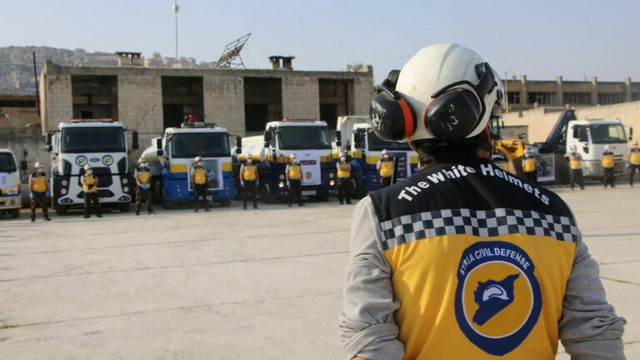
BBC’s Upcoming White Helmets ‘Documentary’ Gears Up to Be a Character Assassination of Those Who Challenge Syria War Narratives

By Vanessa Beeley

24 Oct 2020 – The BBC is preparing an attack against journalists, former diplomats, academics and scientists who challenge the dominant pro-war narratives against Syria underpinned by the pseudo-humanitarian White Helmets.

The British public broadcaster has sent out requests for comments to those who have dared to expose the role the UK government and its intelligence agencies have played in the destabilization of Syria, which look more like neo-McCarthyist charge sheets. The producer of an upcoming Radio 4 documentary series had been in email and telephone conversation with the author of this article, as well as Peter Ford, former UK ambassador to Syria, and members of the Working Group on Syria, Media and Propaganda (WGSMP) since June 2020. The result of those conversations, during which the evidence emanating from serious scientific research and on-the-ground testimony was presented to the producer, was a familiar list of accusations of “conspiracy theorism” and suggestions of “incentivized” Russian or Syrian bias.

Fellow independent journalist Eva Bartlett has spent long periods of time inside Syria, reporting from many of the most high-risk areas during the Syrian Arab Army allied campaigns to liberate swathes of Syrian territory from the US coalition-proxy occupation. She had this to say about the email she received a few days ago:

“The questions emailed to me by the BBC evidence a predetermined intent to character assassination. This approach shows an utter lack of journalistic integrity on the part of the BBC.

The BBC’s hostile insinuations against me arrogantly infer that neither I nor the Syrians I interview think for ourselves, but are puppets of the Syrian and Russian governments. My journalism dates back to 2007 and is quite extensive, with 13 years of on the ground experience, from Palestine and Syria, to Venezuela and eastern Ukraine, and elsewhere.

My focuses have been on giving voice to Syrians disappeared by corporate media, highlighting the terrorism they endured by terrorist groups which the West dubs “rebels,” and highlighting war propaganda by outlets such as the BBC.”

It was clear from the BBC’s line of questioning that this was not a genuine investigation into the life and times of White Helmets founder, and former British military intelligence officer, James Le Mesurier. It is effectively a damage limitation exercise designed to discredit the evidence that points to the White Helmets being a propaganda construct with extremist connections funded by the US/UK coalition to vilify the Syrian government and allies, thus justifying military intervention by proxy and aggression against a sovereign nation. The aggression includes economic sanctions that have devastated the Syrian economy and caused widespread poverty and food insecurity among the Syrian people.

The upcoming BBC programme – ‘Mayday’ – appears to be an attempt to whitewash British intelligence operations inside Syria. Operations that were recently further exposed following the leak of alleged UK Foreign Office documents, reported by Grayzone, which detailed the extent to which the UK government provided media and PR support to the armed groups in Syria. Those groups effectively include Al Qaeda and Islamic State (IS, formerly ISIS) affiliates such as Jaysh Al-Islam and Ahrar Al-Sham, who are responsible for the horrific bloodshed and devastation of infrastructure in the areas they invaded and occupied.

The UK and EU government-funded Mayday Rescue organisation was established by Le Mesurier to provide an intermediary management of the funds the UK government was providing to the White Helmets as they embedded themselves with armed groups in extremist-controlled areas throughout Syria, more recently exclusively in Idlib, the last remaining and “largest Al Qaeda haven since 9/11.” Le Mesurier died in November 2019 having fallen from the balcony of his Istanbul home which he shared with his third wife, Emma Winberg. Three days before his death, which was ruled a suicide, Le Mesurier had reportedly admitted to defrauding Mayday Rescue of funds provided by UK and European governments.

It is also worth a reminder that the Dutch government had withdrawn funding from Mayday Rescue in 2018 following an extensive investigation that had concluded a lack of assurances that funds were not being hijacked by the armed groups in Syria, including Al Qaeda.

The BBC pins its arguments on the view that the White Helmets are a “humanitarian” organisation – an Oscar-winning illusion that has been dismantled by some of the most acclaimed independent journalists and researchers of our time, including Cory Morningstar, Rick Sterling, Eva Bartlett, Stephen Kinzer, Robert Parry, John Pilger, Gareth Porter, Ray McGovern, Phillip Giraldi, Craig Murray and former UN weapons inspector Scott Ritter, to name just a few.

The former UK ambassador to Syria, Peter Ford, also received the BBC bill of indictment and he issued this statement in response:

“The BBC have systematically tried to suppress views on Syria which run counter to the standard one-sided narrative. This programme’s efforts to smear dissenters takes BBC conduct to a new low. By alleging conspiracy theorising where there is only evidence-based reporting and analysis, the BBC is showing its frustration at being unable to stifle truth-telling.

The only conspiracy here is whatever coordination has taken place between the BBC and British authorities responsible for failing to achieve regime change in Syria despite throwing many millions of taxpayer money at the effort. Why is the BBC not drawing attention to the biggest failure of British foreign policy since Suez, as judged by its self-proclaimed objective of removing Assad, rather than busying itself with trying to take down unsupported individual dissenters who have ranged against them the vast wealth and resources of the establishment?

The charge of biggest failure since Suez as judged by its own objective of regime change is stinging because palpably true, and will with luck get some play in the follow up. It’s an angle that has been largely lost in the welter of detail.”

On October 5, the US and UK envoys to the UN Security Council (UNSC) led the campaign to ban the former Organisation for the Prohibition of Chemical Weapons (OPCW) director general, Jose Bustani, from briefing the UNSC meeting presided over by Russian Ambassador Vassily Nebenzia. Nebenzia accused the US/UK-led truth-suppressors of bringing the UNSC into disrepute. One week later, the BBC, a de facto UK-state-media outlet, kicked off its attack on the individuals responsible for highlighting the corruption of the OPCW and the fraud that was the final report on the alleged Douma chemical attack in April 2018.

One member of the WGSMP, Paul McKeigue, has published his conversations with the producer. Regarding the Douma incident, McKeigue informs us that “a reader of this correspondence could reasonably conclude that [..]Raed Saleh (White Helmets leader) has something to hide, and further that [the BBC producer] is, for some reason, colluding with him by helping him to avoid having to respond” to questions regarding the whereabouts of the bodies of the alleged chemical weapon attack victims. Part of my response to the BBC also alludes to the apparent suppression of evidence:

“A BBC producer, Riam Dalati, has stated publicly that the Douma hospital scenes, the site of the alleged chemical weapon attack in Syria, 2018, were staged. As has been pointed out repeatedly to Riam Dalati and the BBC, if the hospital scenes at Douma were staged so too were the films of the deceased in the Douma apartment block. The BBC have never reported this information, nor has it passed the information obtained by its producer to either the OPCW FFM or the IIT. It is extraordinary and completely unjustifiable that the BBC should be withholding this vital information from a UN linked organisation.”

Dr. Piers Robinson, the co-founder of the WGSMP, accused the BBC of suppressing truth:

“The BBC is also attempting to smear academics researching alleged chemical weapons attacks in Syria as ‘conspiracy theorists’, even though their work has been supported by the leading chemical and biological weapons expert the late Julian Perry Robinson and vindicated by whistleblowers and leaks from the OPCW itself. The BBC is not engaging in journalism but rather suppression of the truth.”

In conclusion, the BBC is not an honest broker. Our work as journalists and researchers is to mine for the truth. The BBC’s output, especially with regards to foreign affairs, is produced in lock-step with UK foreign policy objectives. In the context of the war against Syria, this has resulted in a pattern of omission and censorship that has underpinned UK FCO efforts to foment conflict within Syria and to overthrow the internationally recognised Syrian government.

The result has been an illegal war that has caused death and suffering for millions of Syrian people. Regarding the UK/US intelligence-incubated, Al Qaeda-linked, White Helmets, the BBC could be considered complicit in manufacturing consent for another “humanitarian war” through their lack of “rigorous journalism” and omission of the facts surrounding this UK state-client-propaganda-manufacturer. Just as the BBC defended the WMD “dodgy dossier” that decimated Iraq and led to the deaths of millions of Iraqis, we now see the BBC rallying around the chemical weapon “dodgy dossier” that has enabled the prolongation of the barbaric war against the Syrian people.

___________________________________________________

Editor’s note: RT has reached out to the BBC producer for comment on issues raised in Vanessa’s article. A BBC spokesperson gave this response:

“The BBC’s journalism is rigorous, independent and impartial, and that will be evident to anyone who listens to this new series.”

Vanessa Beeley is an independent journalist and photographer who has worked extensively in the Middle East – on the ground in Syria, Egypt, Iraq and Palestine, while also covering the conflict in Yemen since 2015.

26 October 2020

Source: www.transcend.org
The 2020 youth uprising in Thailand

By Junya Yimprasert

Note: From a pro-democracy stand-point, this article attempts to provide some basic background for people who might not know much about Thai politics and who may be confused or alarmed by the current wave of protest that is confronting the Thai government (junta) and also the Monarchy itself. The aim is thus to increase understanding around the world that, right now, the people’s struggle for democracy in Thailand needs the support and solidarity of the International Community and people everywhere.

Thailand in brief

With a population of around 67 million, which includes some 40 ethnic groups and languages, the success of the decades long struggle for fully representative democracy in the Kingdom of Thailand is of vital importance to not only the health and aspirations of the peoples of Thailand itself, but also for the future of the ASEAN.

During the USA-Indochina War of 1950 – 1975 more-or-less the whole of Thailand was used by the USA as a military facility. From 1947 onwards the US military presence in Thailand functioned to bolster the Monarchy and Royal Thai Army, enhancing the ability of both to operate in tandem to successfully block the democratic process, as clearly evidenced by the succession of no less than 12 monarcho-military coups. The current wave of protest across Thailand is attempting to say that the time has come to end this succession.

After the most recent military coup in 2014, the leader of the coup and Commander-in-Chief of the Royal Thai Army, General Prayuth Chan-o-cha, appointed himself Prime Minister, and continues today (mid-October 2020) as a pathetic royalist dictator attempting to cling to power by refusing to countenance in any meaningful way the reasons why he is being confronted with massive protest.

In October 2016, after the passing of old King Bhumibol (Rama 9, 1946 – 2016), Crown Prince Vajiralongkorn was enthroned as Thailand’s new King, as Rama 10, the tenth king of the Chakri Dynasty. The Chakri Dynasty came into existence in 1782, when Rama 1 terminated the Taksin Dynasty by executing King Taksin and most of his relatives and their families.

238 years under the Chakri has meant that Thailand remains one of the very few countries in the world that has been unable to liberate itself from the brutality of feudal monarchism. Today Rama 10, King Maha Vajiralongkorn (68), Thailand’s Head of State, the richest monarch in the world, untouchable by law in Thailand, appears to have only one abiding interest: his own interest.

Alongside the fundamental, determined, violent rejection of the concept of equal rights, the survival of the Chakri Dynasty depends in part on ensuring that its diplomatic service is served exclusively by royalists that present, north, south, east and west, to Europe, the USA and China, a sweetly acquiescent impression of the good intentions of the good Kingdom.

Thai democracy in Brief

Stirrings to establish a constitution for Siam began some 120 years ago during the reign of Rama 5. The Palace was successful in suppressing this early attempt and 30 years were to pass before, at the hour of dawn on 24 June 1932, a lightning, bloodless coup d’état brought 150 years of absolute rule under Chakri monarchs to a sudden stop. The coup was led by a group of young scholars and military officers. Calling themselves Khana Ratsadon, the People’s Party, they did aim to open the road to democracy for Siam (Thailand), but the journey has been and remains painful.

Khana Ratsadon consisted of a rather elite group of civilians, government officials, aristocrats and military officers who had met and begun planning the coup as students in France in the 1920s. Pridi Phanomyong, a farmer’s son, led the political wing and Lieutenant-Colonel Phibunsongkhram the military wing. On that early morning in 1932, completely unknown to the people, within the space of a few hours, Siam was changed from an absolute monarchy to a constitutional monarchy.

The new Government of Siam was still dominated by the military but it did at least aim at some kind of democracy: the 1932 Constitution did state that the people of Siam (not yet Thailand) held sovereign power. Nonetheless the continuous, systematic refusal of the Palace, royalists and military elite to accept universal suffrage and the sovereign authority of an elected Parliament has meant that, still today, after 88 years, such a state has yet to be achieved.

Monarcho-militarism versus democracy

The first royalist coup against Thailand’s fledgling movement for democracy came in 1933. Despite being fed with money by Rama 7 it failed. The royalist elite made a second attempt in January 1939 against the government of Phibunsongkhram, now Prime Minister and also Field-Marshal. This attempted coup also failed and resulted, by order of Phibun, in the execution of 18 leaders, life imprisonment for several and long sentences for others

Prince Chainart, the uncle of King Ananda (and Prince Bhumibol), received a life sentence. The Palace placed PM Phibun under enormous pressure to release Chainart, but Phibun stuck to his guns. It was not until after the withdrawal of Japanese troops, when Field-Marshal Phibun was pushed from power, that Prince Chainart was pardoned, in September 1944. As the last remaining son of Rama 5, Prince Chainart returned to being the most influential person in Palace politics.

On 9 June 1946 King Ananda was found in bed with a bullet through his head. Prince Chainart stepped in as Regent on 16 June and took over the Chairmanship of the Supreme Council of State the following year. Prince Bhumibol, Ananda’s brother, having recently returned from Switzerland to permanent residence in the Palace, became King Bhumibol, Rama 9. Suspicion that he was somehow involved in his brother’s death still hangs in the air. His public coronation took place on 5 May 1950, a date that can be seen as marking the beginning of systematic efforts to re-establish the power of the monarchy.

70 years of oppression and suppression

The roots of Thailand’s political chaos, and of the widespread discontent and massive protests of today, are found in the last 70 years of extreme, royalist propaganda. For Thai children born after 1946 “Killing communists for nation, religion and King” was standard fare.

Below are just a few of the horrific happenings that punctuate the history of the Land of Smiles after Bhumibol became king.

  • 25-28 April 1948. Hundreds of Royal Thai police and army in Narathivat Province surrounded the village of Dusongdor and murdered about 400 villagers.
  • 28 Feb – 01 March 1949. By order of Field-Marshall Phibun, chief of the military junta, 5 members of the Pridi Alliance for Democracy were assassinated. After being arrested and handcuffed, four of them, all Members of Parliament, were riddled with bullets in the back of a van, and the fifth, the Chief of Police Intelligence, was shot dead in the street.
  • 13 December By order of the Chief of the Royal Thai Police, the Leader of the Labour Party, Tieng Sirikhan, a former MP from Sakon Nakhon Province, was brutally murdered in Bangkok together with four friends. Their bodies were taken to be burnt in Kanchanaburi Province, 200 km from the scene of the crime.
  • 1971-1973. During this period of ‘killing communists for nation and king’, in Pattalung Province alone around 3,000 villagers were brutally murdered by the Royal Thai Army. Some were burnt alive in drums of oil, some pushed into sacks to be dropped down the side of a mountain or pushed out of helicopters.
  • 14-15 October 1973. Monarcho-military crackdown on students and working-class people protesting on the streets of Bangkok. 77 people were killed, most by military gunfire. 847 were wounded.
  • 6 October 1976. Monarcho-military crackdown on student protest. According to official government records, 41 students were killed by a mixed-force of Royal Thai Army, Royal Thai Border Guard and para-military ‘Protect the Monarchy’ thugs. 30 bodies were identified, 10 were too damaged to identify. 26 male and 4 female bodies were returned to their families by the Police for cremation. Hundreds were injured. 3,154 students were arrested. Thousands of people went into hiding, most fleeing to the forest. In anger over the brutality of the oppression many did join the Communist Party of Thailand, and remained in hiding until granted immunity after the Communist Party was dissolved in 1980.
  • 17 – 19 May 1992. Monarcho-military crackdown. This ‘Bloody May’ witnessed about 45 killed on the streets of Bangkok, about 38 by bullets from the Royal Thai Army. Reports indicate that about 70 people ‘disappeared’.
  • April-May 2010. Monarcho-military crackdown under Prime Minister Abhisit (‘Democrat Party’), who declared a ‘Live firing zone’, in other words issued elite troops with license to kill Thai civilians. 99 people were killed on the streets of Bangkok, almost all by military snipers. About 2000 were wounded. 470 were arrested. When official records say ‘wounded’ or ‘died on the spot’ they forget to add ‘from a military bullet to the back of the head’.

From the few records that are available, the death-toll from political oppression and extrajudicial killings since 1946 adds-up to somewhere over 13,000, but this figure in no way speaks of the actual number of people that have died as a result of political oppression and military crackdowns.

Coups and Kings

From the beginning, all of the Chakri Ramas have refused to respect or recognise the democratic aspirations of the peoples of Thailand.

Up until the last, King Bhumibol (Rama 9) argued that the people are not ready for democracy. He presented himself as a king god-sent to care for the people, with, naturally, the mercifully god-sent assistance of the commanders of the Royal Thai Army, the US military and 12 military coups.

All of the governments that came from the 28 general elections held during Bhumibol’s reign were prevented by one means or another from completing even one 4-year term, all except one, that of Thaksin Shinnawatra from 2004 to 2008.

The Thaksin governments were brought to office and power through land-slide elections and twice brought down by monarcho-military coups, in 2006 and 2014.

The 2014 coup was conducted for one purpose alone: to ensure the transition from Rama 9 to Rama 10 be kept under the control and management of a military commander trusted by the Palace, in other words to ensure yet again that the critical concerns and interests of the people could be flattened-out and kept harmless.

Dictator Prayuth

The leader of the 2014 coup, General Prayuth Chan-o-cha, Commander-in-Chief of the Royal Thai Army, disbanded all elements of the elected government, tore-up the Constitution and set-up a military junta calling itself the National Council of Peace and Order (NCPO) and presented the country with a National Legislative Assembly (NLA). Half of the 220 seats of this ‘legislative assembly’ were filled with people hand-picked by the NCP and half were military officers. The function of the NLA was to rubber-stamp the dictates of the NCPO.

After slipping out of uniform and appointing himself Prime Minister in August 2014 and by heading-up both his NCPO and NLA set-ups, Prayuth, honouring his many predecessors, slid from Royal Army Commander-in-Chief to Thailand’s Royal Dictator-in-Chief, and proceeded, as did all his predecessors, to drafting yet another Constitution (Thailand’s 20th since 1932), and to employing all possible ways and means to delay the demand of the furious majority for a general election, in order to give his junta as much time as possible to consolidate power over the electorate.

After a full year allocated to the official, national mourning for King Bhumibol, Crown Prince Vajiralongkorn was crowned in 2016. His very first move as Head of State was the issuance of orders to amend the junta’s 2017 Constitution even further in his favour: to increase his personal freedom, to greatly increase his personal military power and to massively increase his personal wealth. All of this passed, the public aghast, completely unopposed.

Nonetheless, with the world watching and public demand for a general election growing and EU sanctions causing Thailand humiliation if not pain, Prayuth could not delay a general election forever.

After several bluff start-ups for the purpose of generating further delay, the junta did eventually grant the population a General Election on 24 March 2019, but not without engaging all the tricks in the royalist playbook, all financed by the national budget, to ensure that the opposition could not win. The 2017 Constitution stipulated that it was to be the 250 members of the reconvened Senate, who were all junta-appointed, that voted in a new Prime Minister. Furthermore, the judges of the so-called Constitutional Court, which was a product of the 1997 People’s Constitution, were by now (after the coups of 2006 and 2014) all junta-appointed judges quite at ease with disqualifying and dissolving any opposition parties and parliamentary candidatures that they deemed unsuitable. In all ways the 2019 General Election was rigged to make it impossible for the opposition to win.

These royalist game-plays are well-understood and extremely wearisome for the majority of Thai people, because they know simultaneously that they have only two options: to submit or protest.

Protest began gaining momentum after the Constitutional Court had the temerity to dissolve the largest opposition party, the Future Forward Party, that had won 80 of the 220 seats of the NLA in the 2019 election.

King Maha Vajiralongkorn

Old King Bhumibol (1946 – 2019) was surely vaguely aware that his son Crown Prince Vajiralongkorn had an infamous reputation as a sex-addict with a mafia-like life-style, but he did not want to break with royal precedent. When Bhumibol passed away on 13 October 2016, Vajiralongkorn was named king. His 3-day public coronation was staged in May 2019 at a cost of around 32 million USD.

Thailand’s new king, now 68, abandoned and humiliated his first wife soon after they were married. In 1996 he banished his second wife and the four sons he had with her. In 2014 he placed his third wife under house arrest and imprisoned her parents, three brothers, a sister, her uncle and several other relatives. He married his fourth wife in 2019.

According to the 2014 Constitution, as amended by Vajiralongkorn himself, the Thai king’s status is now closer to that of an absolute monarch than to that of a constitutional monarch.

As noted above, before the people could blink, their new King had taken some major steps to strengthen his position, by increasing his direct personal command, by some tens of thousands, of the 80 000 strong Royal Guard, and by providing himself with direct personal access to the vast wealth of the Crown Property Bureau, to which his father had only limited access. As the wealthiest monarch in the world, with something in the region of 50 – 60 billion Euro at his disposal, he still demands a vast sum from Thai taxpayers, not less that one billion Euro, to finance his personal expenses, many palaces and the so-called ‘royal projects’.

The future of this king is already severely haunted by overwhelming evidence that, since 2016, nine democracy activists, who had sought refuge from the military junta outside Thailand, have been hunted-down and murdered by his agents – assassination squads.

In true medieval style, this King is also famous for casting anybody who displeases him into his own dungeons, to be tortured. The stories are many and bad. One place, the Thawee Watthana Prison in the grounds of the Thawee Watthana Palace in western Bangkok has a very dark reputation: those who don’t come out alive are reported as having died by suicide and so on.

At the present time Thailand’s Head of State has been spending by far the greater part of his time with his harem at the Grand Hotel Sonnenbichl in Bavaria, Germany, supported by 100 or so servants and body guards. There are women and servants in his entourage that exist solely as royal prisoners. It is said that even here those who displease the king are also abused and beaten, and made too afraid to approach the German police, terrified that their families in Thailand will face retribution.

In Thailand the King can do and does as he pleases with complete impunity. Nobody can bring charges against him, he lives completely above the law. Most Thais are to some extent aware that their new king is cruel and somehow criminal, but until now their thoughts and feelings have been silenced by the draconian laws of the military junta, in particular the laws of lès majesté and the so-called computer crime laws, which can cause anybody to find themselves in jail for many years for any indication or accusation of disrespect, true or false, towards His Majesty or his His Majesty’s relations, affairs, interests or projects.

Nonetheless, the fact that, as Covid-19 exasperates existing destitution everywhere, this King chooses to live a life of luxury in Germany, abusing women, wasting vast sums of taxpayer’s money and sending out agents to kill popular dissidents, has finally stirred-up open expression of disgust in Thailand itself.

Does this King of Thailand also think himself above and beyond the laws of Germany and the European Union? Does he imagine that he is not subject to the Universal Declaration of Human Rights, that his kingship is beyond the reach of the International Criminal Court? Apparently he does, but increasing numbers of people. including most of the youth of Thailand, are starting to find him guilty on all counts.

2020 Youth Uprising

It was early in 2020 when students first started appearing on the streets of Bangkok in large numbers – to protest the dissolution, by the judges of the Constitutional Court, of the Future Forward Party, the main opposition to the Prayuth junta.

The arrival of Covid-19 gave Prayuth a defensible but also convenient reason to declare a State of Emergency and stifle protest. Nonetheless, by this time the majority of Thai people had become deeply tired of their Dictator and what he said or didn’t say or did or didn’t do began to feel somewhat irrelvant. Youthful Thailand was coming to a common understanding, a consensus, that it was time to inform General Prayuth that his illegitimate regime was illegal and his modus operandi impossible to tolerate any longer.

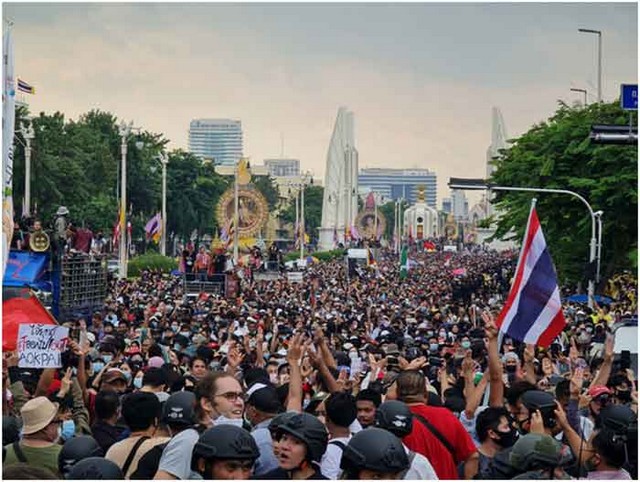
On 18 July the youth of Thailand, from secondary schools to universities – from all across Thailand, rose up in protest against the military-enforced status-quo. The broad, red-hot dynamism of the demands of the students, demands that range all the way from removing militant disciplinary codes in schools to radical reform of the Monarchy itself, began to electrify the whole country.

WHERE is JUSTICE?

Thailand has arrived at a long-predicted, dangerous but inescapable juncture. In facing the potentially ruthless, implacable monarcho-military establishment, youthful Thailand needs, right now, the understanding, support and solidarity of the International Community.

How can the logical, common-sense, standard, decent, normal and natural aims and demands of this youth-led uprising against autocratic rule be supported?

For many years there has been a broad convergence of analysis and common opinion and a gathering of momentum around recognition that there is no way for Thai people, for the population at large, to move from the past to the future, to be able to engage with full hearts, minds and full power with local, regional and global matters, issues and crises, while a patronising, monarcho-military alliance hovers over them, assuming right to own or disown their every thought, hope, wish, desire, invention, movement and action.

King Vajiralongkorn, Head of State, is a well-known abuser of human rights, an abuser of the privileges afforded to him by birth, a pathological abuser of women, a vile executioner, an owner of some 10 000 slaves, some of them trafficked, and, for the youth of Thailand and of the world, the worst possible example of a human-being, let alone Head of State.

Since people in Thailand have zero resort to meaningful justice – or appeal, at the start of 2020 ACT4DEM joined forces with PixelHELPER in Germany to bring the crimes of King Vajiralongkorn directly to courts of justice in Europe.

General Prayuth is a puppet of the Chakri monarchy and powerless without it, thus our work at present is focused on bringing the attention of the Germany Bundestag, European Union, United Nations and all people around the world who love Thailand, to the extreme degrees of corruption and cruelty exhibited by King Vajiralongkorn.

We aim to ensure that King Vajiralongkorn will be forevermore prevented from beating, torturing and murdering any more people, as well as being prevented from throwing any more desperately needed, hard-earned public money down the drain of his own selfish desires.

Together we can end this reign of fear before it gets worse.

Together we will ensure that justice prevails.

Further reading in https://act4dem.net/

Voter’s Upraising (2009), https://act4dem.net/?p=661

Why I don’t Love the King (2010), https://act4dem.net/?p=653

Overcoming fear of Monarchy (2011) https://act4dem.net/?p=732

and

Understanding the fog shrouding Thai vision (2015) https://act4dem.net/?p=677

Junya Yimprasert is a labour and human rights activist and former director of the Thai Labour Campaign (TLC).

25 October 2020

Source: countercurrents.org

We return: Evo will return to Bolivia

By Farooque Chowdhury

The Bolivia-victory says: We return. We, the people, return crossing ages, foiling frontiers, crushing conspiracies the Empire and its gang of imperialists hatch.

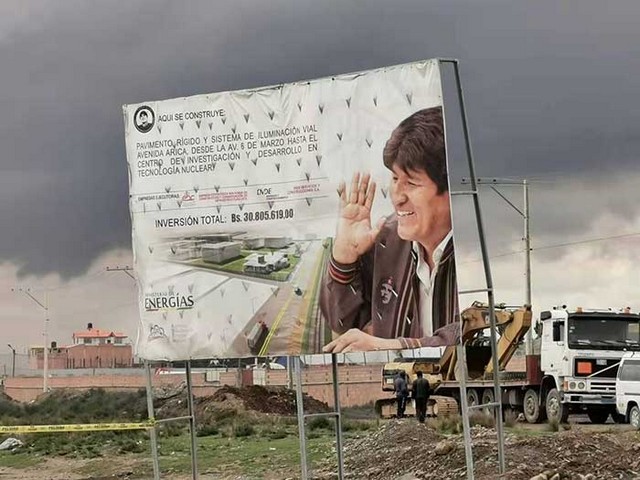
Following the latest Bolivia-election-victory Evo Morales, the guerrilla turned lead fighter in a bourgeois-electoral arena, has vowed: “We’re going to return to Bolivia; that’s not in debate.”

The former president of Bolivia announced: My great desire is to return to Bolivia and enter my region. It’s a matter of time.”

The vow, the announcement Evo has made, the electoral victory the people of Bolivia has achieved foiling rightist-imperialist murders and persecutions ring and resound the vow Spartacus made: We shall return, we shall return in millions. On an earlier occasion, after the victory, Evo said: “We have become millions.”

This is the path people tread trampling conspiracies, murders, armed violence, and confusion petty “progressives” seed among people. This is the march mass line produces. Thus is the march a reliance on people, instead of conspiratorial work and hobnobbing with the rightist-imperialist clique, a group of petty “progressives” is practicing in countries, advances through.

Evo, exiled since the rightists with backing from the Empire and the military, an armed wing of the old state machine, toppled him and seized power, made the announcement of returning to Bolivia after his socialist ally Luis Arce thumped a decisive victory in the just concluded presidential election in Bolivia. Evo was speaking at a press conference in Buenos Aires on October 19. In the Congress, the MAS’ victory is also sound.

Luis Arce, the Movement for Socialism (MAS) candidate, led the victory. It’s a victory against the Empire, as the Empire’s black footprints were visible from the day one of the rightist coup organized against Evo. It’s a victory of the people of Bolivia, and of all the peoples in countries standing against the Empire – the chieftain of the imperialist gang. It’s a victory against the OAS bosses, persons in the payroll of the Empire, as those persons invalidated Evo’s electoral victory. They, the bourgeois gentlemen, and the “democracy”-gentlemen from Europe, nullified the Bolivian people’s democratic verdict – Evo’s electoral victory – months ago. These “democracy”-hawkers from Europe teach “democracy” in other countries also; and they gather disciples!

The imperialist gentlemen’ dirty and nasty act – nullifying Evo’s electoral win – is a tombstone of imperialist lie and propaganda-power, a historical heinous act by the imperialist-bourgeois power. It was another example of their power demolishing people’s democratic practice. Even, after this anti-democratic act by the Empire, groups of pseudo “progressives” in some countries hobnob, enter into alliance with these gentlemen, plead with these gentlemen for attaining “democracy”. Bolivia, thus, stands as a historic lesson for all fighting imperialism, fighting exploitative system.

It’s a lesson that imperialist intrigues, interferences, proxies and contras, money- , murder- and propaganda-power and imperialism can be pushed aside, can be defeated. It’s lesson that painstaking political and organizational work among the masses is the path to victory. It’s a lesson that adventurous slogan mongering is not the path. It’s a lesson that Mao’s teaching – imperialism is a paper tiger – shouldn’t be forgotten.

This is victory of people power. It’s so powerful that the Jeanine Áñez, the president of the coup-government run by military officers, and their dear friend Mesa, the contesting candidate in the election, had to accept the defeat, had to express their “belief in democracy”.

This victory has made Alberto Fernandez and Andres Manuel Lopez Obrador, presidents of Argentina and Mexico respectively, happy. They played very crucial role in saving Evo from the murderous military officers of Bolivia after the henchmen of imperialism staged the coup to oust Evo. Today, after this electoral victory, Evo’s plane-path from Bolivia to safety may sound a gossip. But that plane journey was charged with high tension and diplomatic efforts by governments friendly to Evo. And, Cuba has gained another friend. Cuba’s President has written: “Cuba shares joy for the triumph of Luis Arce. The Bolivarian ideal is reborn. Our Indigenous Chief of the South @evoespueblo Jallalla Bolivia!”

This victory strengthens struggle of the anti-imperialist people in Latin America and the Caribbean. It signifies: Struggles don’t go in vain, imperialism doesn’t control the time, imperialism doesn’t determine everything, all outcomes.

Now, the path in front is crucial. Conspiracies are there as there’s the old state machine. Bolivian comrades will chalk out the path to higher victory – recreating the Bolivian Miracle, taming and dismantling the military bosses’ clique, achieving political unity. These are a few of the challenges. Evo, during his tenure, achieved many gains. The rightists, since staging the coup, bloodied the society to deprive the people of those gains. As hands of clock don’t sleep, so does imperialism with its conspiracies, money and butchers. It’s – imperialism – a challenge to the Bolivian people.

Luis Arce has already said: “We will govern for all, we will redirect the change without hate. We will restore unity in our country, and we will recover the economy, step by step.”

Arce has also said about the first measure he will take: Give anti-hunger bonds to the poor. The beneficiaries will be Bolivians residing in the country and are over 18 years old by September 16, 2020, groups of women, visually impaired people.

The economic model the new government plans to follow is to strengthen internal economic demand. Arce said: “This is a central issue. For our model, it is important to strengthen internal demand through bonds and transfers. At the same time, we are going to start rebuilding production”.

The US-backed coup-government has hardly hit the part of production since usurping power. That murderous government fatally hit organizations the Bolivian people built up as part of their struggle. These organizations are to be strengthened. The Plurinational Revolution in Bolivia will move forward with compañero Evo Morales. The moves will be easier with a strong mandate and the experience gathered since the Empire-backed coup.

The most important lesson of this electoral victory is political – in the areas related to imperialism, the exploiting classes, the classes fighting imperialism and exploiters, organizations of people, political education. The incidents in some Latin American countries that were identified by some scholars as the White Tide sweeping Cuba-allies seem ebbing.

In Bolivia, the counter-revolutionary campaign is so short-lived that anyone concerned with people’s politics will analyze the entire episode – class equation, people’s organization and power, power of the reactionary forces, imperialism’s limit, plays within economy and its reaction in politics. However, the question of organization of people will never be considered as less significant. Without organization, the Bolivian people wouldn’t have achieved today’s victory. And, organizations don’t crop up overnight, don’t turn functional without long, repetitive, persistent and painstaking work, and without making those organizations superb than the organizations imperialism builds up with its proxies. Among other lessons, the organizational question is one of the most important; and organizations don’t grow with slogan mongering.

Farooque Chowdhury writes from Dhaka, Bangladesh.

20 October 2020

Source: countercurrents.org

How Biden Flubbed Town Hall Foreign Policy Question

Co-Written by Medea Benjamin and Nicolas J. S. Davies

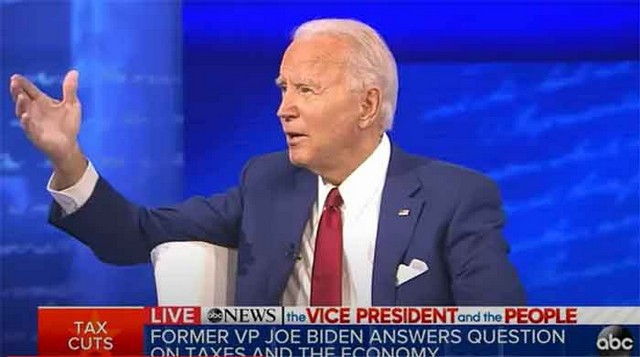
Toward the end of Joe Biden’s October 15 town hall session, a Trump supporter asked Biden the only foreign policy question of the night. “So peace is breaking out all over the world,” the questioner claimed. “Our troops are coming home. Serbia is talking to Kosovo. And the Arabs and Israelis are talking peace, which I believe is a modern-day miracle, what’s going on. Does President Trump’s foreign policy deserve some credit?”

This question encapsulated all the smoke and mirrors that Trump has used to confuse the public and obscure his broken promises to end America’s wars, bring our troops home and build a more peaceful world. This was a fantastic opportunity for Biden to clarify the reality of Trump’s abysmal record and explain what he would do instead. But he didn’t. Instead he endorsed some of the most deceptive elements of Trump’s propaganda, dropped some clangers of his own and, in a classic Freudian slip, laid bare his own enduring commitment to American imperialism.

In response to the questioner’s designation of Israel’s deal with the UAE and Bahrain as a “modern-day miracle,” Biden simply rolled over and said, “I complement the president on the deal with Israel.” What he should have said was something like this:

“The UAE and Bahrain are ruled by dictators with absolute, despotic power who represent neither their own people nor the Arab world, let alone the people of Palestine—who gained nothing from these deals. Since these countries were not at war with Israel to begin with, these accords have nothing to do with peace. They are more about flooding the Middle East with even more U.S. weapons and forming new military alliances against Iran. Yes, we need peace deals between Israel and its Arab neighbors, but they must be deals that truly bring peace, end Israel’s illegal military occupations and advance the equal rights of Palestinians and Israelis.”

Biden didn’t respond to the mention of the White House meeting between Serbia and Kosovo, but he could have explained that it had to be postponed when President Hashim Thaci of Kosovo was indicted for war crimes by an international court at The Hague. Thaci is charged with organizing the killing of hundreds of Serbian prisoners of war to sell their internal organs on the international transplant market under cover of NATO bombing in 1999. When the indictment was unveiled in June 2020, Thaci was literally in his plane on the way to meet Serbian leaders at the White House, and had to make a U-turn over the Atlantic to return to Kosovo.

Twenty-one years after NATO dropped 23,000 bombs on Serbia and illegally annexed Kosovo, neither Serbia nor nearly half the countries in the world have recognized Kosovo’s independence from Serbia. Biden could have pointed to this as a case study in why the U.S. must stop waging regime change wars, organizing coups in other countries, and installing CIA-backed gangsters and war criminals like Thaci to rule them.

As for the critically important statement by the town hall questioner that “Our troops are coming home,” Biden claimed that there are more troops in Afghanistan now than when he and Obama left office. That appears to be incorrect, since there were 11,000 troops there in December 2016 and 8,600 U.S. troops as of September 22nd, despite the lack of confirmation from the Pentagon on further reductions that Trump had promised.

However, Biden could have simply compared the number of troops brought home by Obama and Trump, which would have been an impressive comparison. Obama reduced U.S. troop levels abroad from 483,670 in December 2008, just before he took office, to 275,850 by December 2016. If the latest figures from the Trump administration are correct, there are still over 238,000 U.S. military personnel overseas.

So Obama reduced the U.S.’s overseas military presence by 43%, while Trump has reduced it by no more than another 14%. With Trump claiming he is “bringing our troops home” in every stump speech, why on Earth is Biden not trumpeting the fact that he and Obama brought home five times more troops than Trump has? Why is Biden running from that record? Is he planning to reverse that trend if elected? Millions of American voters would like to know.

A disappointing aspect of Biden’s response was his habitual readiness to take the low road, smearing China’s President Xi Jinping, criticizing Trump for even trying to make peace with North Korea, and repeating an unsubstantiated story about Russia paying “bounties” to the Taliban for killing U.S. troops. A better response from Biden would have been to fault Trump for not following through on the peace initiative with North Korea and for stirring up new Cold Wars with Russia and China, when the American people want their leaders to focus on existing threats like the pandemic, our devastated economy and the climate crisis.

But perhaps the most revealing moment of the evening was Biden’s Freudian slip about the imperial character of America’s relations with its allies and the rest of the world:

“You know, we’ve always ruled – (corrects himself) we’ve been most effective as a world leader, in my humble opinion – not just by the exercise of our power – we’re the most powerful nation in the world – but the power of our example. That’s what’s led the rest of the world to follow us, on almost anything.”

The U.S. did indeed rule an empire in the twentieth century, albeit a neocolonial empire in an anti-colonial and post-colonial world that had to be sustained by a whole web of myths and lies. But now we are standing at a crossroads in American and world history. America’s history of war, militarism and international coercion has reached its final stage in the terminal decline of an increasingly corrupt and decadent American empire. Yet most of our leaders are still hell-bent on preserving America’s imperial power at any cost: endless wars, climate catastrophe, mass extinctions, and the terrifying risk of a final, apocalyptic mass-casualty war – most likely a nuclear war.

But there is another path leading away from this crossroads, one that Joe Biden should embrace, which involves redirecting our country’s resources and energies away from unsustainable imperial power through a peaceful transition to a sustainable, prosperous post-imperial future.

It would have been inspiring to hear Biden say that his goals would be to put an end to U.S. efforts at regime change; to significantly reduce the threat of nuclear war and join the UN Treaty on the Abolition of Nuclear Weapons; to free up hundreds of billions of dollars per year for domestic needs by right-sizing the Pentagon budget; and to put peaceful diplomacy front and center.

That would have been a paradigm-changing answer that would have motivated millions of Americans across the political spectrum—from leftists to anti-imperialist Republicans and libertarians—who long to live in a peaceful, just and sustainable world.

Medea Benjamin is the cofounder of CODEPINK for Peace, and the author of several books, including Kingdom of the Unjust: Behind the US-Saudi Connection and Inside Iran: the Real History and Politics of the Islamic Republic of Iran.

Nicolas J. S. Davies is an independent journalist, a researcher with CODEPINK, and the author of Blood On Our Hands: the American Invasion and Destruction of Iraq.

20 October 2020

Source: countercurrents.org

Zimbabwe seeks US investment by strengthening relations with Israel

By Afro-Middle East

Zimbabwe is set to become the latest African country to embrace Israel as it seeks to get off the US sanctions list. Zimbabwe’s president, Emmerson Mnangagwa, vowed to get the embattled country out of the economic turmoil it had faced under the former president, Robert Mugabe, since the late 2000s, and ending US sanctions on the country would be a good start.

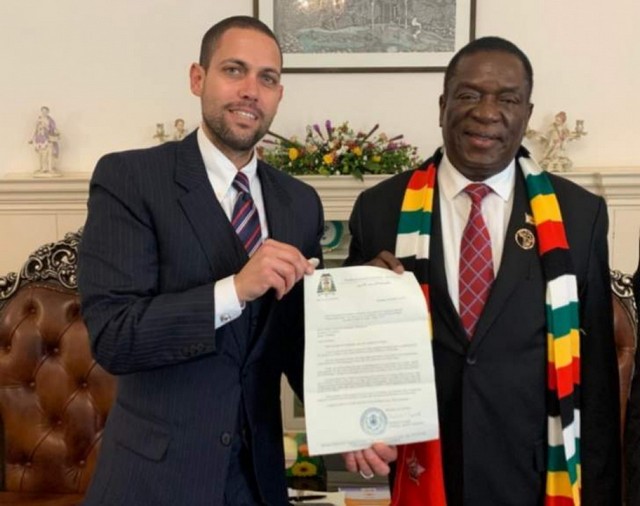
In August, Mnangagwa appointed Israeli citizen Ronny Levi Musan as Zimbabwe’s honorary consul in Israel. This signalled strengthened relations between the two countries, and a move away from longstanding support expressed for Palestinians by the ruling Zimbabwe African National Union – Patriotic Front (ZANU-PF). Musan is alleged to have links with the controversial Nikuv International Projects Company that was accused of engineering Robert Mugabe’s win in the 2013 Zimbabwean elections. He is also the CEO of the Ashelroi Group, which describes itself as aiming to connect companies, organisations, diplomats, leaders and churches from all over the world to Israel.

Mnangagwa hopes to enlist Israel’s military intelligence to train Zimbabwe’s security forces and to establish a defence academy in Harare, which will be run by Israelis.

Zimbabwe’s relations with Israel began in the early 1990s under Mugabe, who deployed Israeli riot control equipment to suppress political opposition, especially before the 2008 elections when there was a heavy clampdown on the opposition, particularly supporters of the Movement for Democratic Change (MDC). The former president was also instrumental in Nikuv obtaining a stake in Zimbabwe’sdiamond mines in Mutare through a contract that has since been characterised by widespread corruption. After Mnangagwa took power from Mugabe in a military takeover in November 2017, the relationship with Israel has continued, and, more recently, seems set to improve. Mnangagwa has been on a drive to attract investment into the embattled Zimbabwean economy, and to find a way to re-engage western countries to lobby for the lifting of sanctions against the country; Israel seems to be the gateway.

In October 2019, Mnangagwa met then-Israeli foreign minister, Israel Katz, on the sidelines of the UN General Assembly. Earlier, in April 2018, Mnangagwa accepted the credentials of Gershon Kedar as the non-resident ambassador to Zimbabwe, but based in Israel. Kedar brought representatives of a number of Israeli companies to Zimbabwe, including Michael Biniashvili, who is associated with former Israeli Defense Forces (IDF) general Gal Hirsch, a controversial businessperson who had been accused of bribery and money laundering while heading the Defensive Shield Holdings Company in which Biniashvili is a partner. Defensive Shield Holdings was accused of tax evasion in Israel and of bribingthe Georgian defence minister, Davit Kezerashvili, to secure military training contracts in 2007 and 2008. Another unsavoury businessperson that Kedar has pushed into Zimbabwe is Yaron Yamin, who owns 262 claims on sixty-two gold mines in the southern African country.

These initiatives, with Mnangagwa’s blessing, signal the president’s desperate attempts to appease the West, notably the USA, Israel’s biggest ally. Musan has set plans into motion for Mnangagwa’s official visit to Israel. His activities in Zimbabwe include collaboration with Pentecostal churches to push for Christian support for Israel. Zimbabwe’s honorary consul is also pushing for Israeli businesses to invest in Zimbabwe’s agricultural sector, and he recently announced the intention to open an Israeli academy of agriculture in Zimbabwe.

On the diplomatic front, Israel hopes that Mnangagwa will follow the example of his Malawian counterpart, Lazarus Chakwera, who announced plans to open an embassy in Jerusalem, thus legitimising Israel’s claim of Jerusalem as its capital city, a claim not recognised under international law. Chakwera, an Evangelical Christian who staunchly supports Israel, is on a drive to promote Israel on the continent. His visit to Harare last month likely included discussions with Mnangagwa about relations with Israel and the USA.

Donald Trump’s White House is increasingly doing Israel’s bidding on the African continent, and is pushing for African states to normalise relations with Israel as a means of unlocking US aid and investment. Sudan, for example, is being lobbied to recognise Israel in exchange for being removed from the US list of state sponsors of terrorism. The USA has also lobbied Kenya, which already has strong relations with Israel – including in security and intelligence, to publicly support Israel and push for Israel to get observer status in the African Union (AU). Others countries, such as Chad, have also used relations with Israel as a means of receiving western arms, which are being used to suppress domestic dissent.

Like many other African and Arab states, Zimbabwe has long had secret relations with Israel; these are now coming to light through Mnangagwa’s rigorous attempts to attract investment into the Zimbabwean economy, despite ZANU-PF’s supposed support for the Palestinians.

17 October, 2020

Source: www.amec.org.za

Discord Around the Abraham Accords

By Dr. Alaa Tartir

Alliances have been shifting since Israel started signing a number of so-called peace accords with the United Arab Emirates and Bahrain this summer. Hailed as beacons of peace by the US, who brokered these meetings, the Abraham Accords bypass an important actor in the equation of peace in the Middle East: Palestine. In order to understand the implications of these alliances on Palestine, as well as the geopolitical motivations behind them, we asked Palestinian researcher, Dr. Alaa Tartir, three questions.

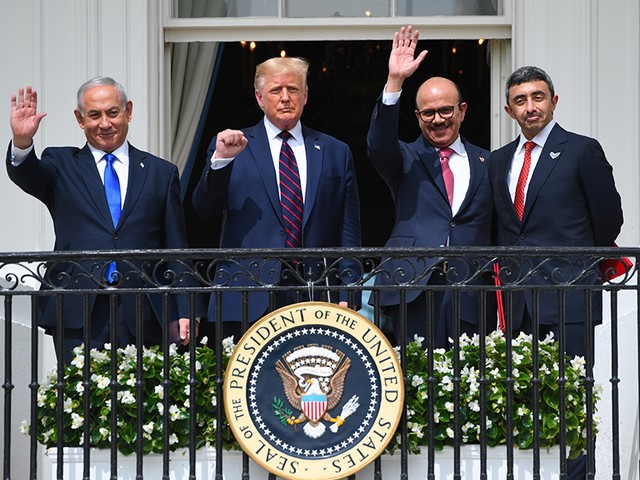
Under the auspices of the US, Israel, Bahrain and the UAE signed the Abraham accords on September 15, agreeing to normalize relations. What does this normalization mean in the context of countries who are not at war with each other?

The so-called Abraham Accords are neither peace agreements nor historic breakthroughs, as is hailed by many observers. They are rather a prime example of the distortion of the very meaning of peace. At best, on one hand, they are a set of economic and diplomatic arrangements between a number of regional actors in response to a mutual interest. On the other hand, they are an expression of the formation of an alliance to face what is perceived as a common threat.

Hence, they are narrow and self-serving arrangements designed to reap benefits from a mutual interest and to face a perceived common threat. They are formulated through a top-down, elitist approach that is meant to serve the ruling class and the “leaders-in-trouble” in the concerned countries. The emergence of these Accords was neither due to the aspirations of the people (who are the real guarantors of any lasting peace), nor in response to a bottom-up incremental approach that aims to create a positive peace. Therefore, it would be absolutely delusional, misleading, dangerous, and irresponsible to think about the so-called Abraham Accords as a form of meaningful “peace” or even a formula for a genuine stability or security.

So, within this contextual understanding, normalization of relations between Israel and other Arab countries such as Bahrain and the UAE, operationally means “doing joint business without being shy or embarrassed”. Politically, it means transforming the “under-the-table” diplomacy into “over-the-table diplomacy”. Economically, it implies capitalizing on the existing security arrangements and intelligence cooperation, to ensure the prosperity of security -driven economic deals (and their industrial complexes) between the signatories. Socially, especially in the post-Covid-19 era, we will witness some social media influencers, celebrities, and possibly religious actors enjoying the trivial trappings of “peace-building”, for the sake of impacting public perceptions, pleasing the ruling elites, and financially benefiting from this emerging “peace industry”. These multi-dimensional consequences are some selected reflections of the short-sighted strategy that we could see in the near future. However, these manifestations are largely dependent on the continuation of the current administrations and polity in the ruling offices. A test to the strength or fragility of these “normalization deals” will occur the day after Trump and Netanyahu leave their political offices.

Additionally, it is crucial to remember that these “normalization deals” violated the “Arab consensus” around the Palestinian cause, and effectively declared the end of the much-totted Saudi-led Arab Peace Initiative (API) as we know it (a future modified version of the API remains a strong possibility). Therefore, they further fragmented the “Arab bloc”, which has always been an Israeli-American objective that is now potentially fulfilled. Consequently, these “normalization deals” offer the Palestinian political leadership a reality check concerning whom they can depend on.

The failure of the Arab League to confront Bahrain and the UAE for their violation of the “Arab consensus”, and its failure in performing its basic political mission, testified to the Palestinian leadership that if they don’t ensure dignity, independence, and self-determination in their political actions, no one will.

Since the agreement, it seems that Israel is putting aside its plans to annex the West Bank. What are the actual implications of these alliances for Israel-Palestine?

It is a myth to think that the so-called Abraham Accords stopped, or waseven linked to, the Israeli annexation plan of Palestinian West Bank territories. The Israeli Prime Minister and the US Ambassador to Israel made it very clear that Israel’s annexation plan is still on the table. On September 14, The Israeli government approved the construction of a thousand new units in settlements and colonies, that are illegal according to international law. The Israeli annexation of Palestinian territories has been an on-going process since Israel was established in 1948, and therefore this annexation dimension should not be treated as “breaking news”; it is what a settler colonial project is all about as it is embedded in its DNA. Thefact that we are even discussing it testifies to our collective failure at the international level to tackle the root causes of the Palestinian-Israeli “conflict”. If anything, the Israeli annexation plan, as it is currently unfolding, is directly linked to intra-Israeli politics and dynamics, and a stark violation of international law and even a violation of the obsolete Oslo Accords of 1993.

The US-backed Israel-Bahrain-UAE alliance offers the Israeli leadership, and its settlers in the occupied West Bank, an additional source of power and strength. In turn, that translates into more coercive physical and non-physical forms of violence. It is no surprise that over the past two months, the Israeli violence and settler terrorism have increased vis-à-vis the Palestinian people. These immediate implications of the Israeli-Bahraini-Emirati alliance are also accompanied with longer term effects, depending on how the different actors will be instrumentalizing them at the local, regional, and international levels, and also if they will lead to new additional “normalization deals”. The implicit and explicit roles of Saudi Arabia are the most critical in this regard. But meanwhile, Israel is equipped with an additional card, thanks to the notion of Arab weakness and “sell-out”. It will not spare in abusing that card, by establishing new facts on the ground that will only solidify the one-state reality: the state, system, and structures of apartheid.
Palestine was not part of the deal, and Palestinian Foreign Minister Riyad al-Maliki announced the decision to quit the presidency of the Council of the Arab League as a sign of protest. What are the prospects of the Palestinian people and Palestinian leadership under these regional shifts?

The unfolding regional shifts and transformations can be seen as a double-edged sword, as far as the Palestinians are concerned. They can make the grim future prospects even grimmer, but they can also offer the Palestinian leadership another opportunity to shift gears and engage in a seriouss process of reforming the Palestinian national project.

Reacting to the US-Israeli-Bahraini-Emirati alliance by convening a leadership meeting to read and narrate empty slogans and rhetoric, or by announcing a nominal unity between Fatah and Hamas, or even calling (once again) for democratic elections, are not the panacea for this grand challenge and existential threat. These approaches are well-trodden and have failed multiple times before, and it is time to move beyond the tactically dysfunctional and short-sighted strategies, and indeed move beyond the existing obsolete political framework that the current Palestinian political leadership is fixated to. More meetings, declarations, committees and promises to unite are not what the Palestinian people are waiting for, nor are they satisfied with the old tactics, approaches, and failed strategies. Clear, operational, and tangible action plans to sufficiently address the question, “what to do?” are what the Palestinian people are waiting for and working hard towards achieving. Certainly, there are multiple constraints and obstacles along the way. But who said the road to achieving freedom, justice, equality, self-determination, and lasting peace is a smooth ride?

Dr. Alaa Tartir is a Researcher and Academic Coordinator at the Graduate Institute of International and Development Studies (IHEID) in Geneva.

14 October 2020

Source: www.institutmontaigne.org

Footsteps – A Poem by Mu’in Bseiso

By Muin Bseiso

(Translated by May Jayyusi and Naomi Shihab Nye)

Brother! If they should sharpen the sword on my neck,
I would not kneel, even if their whips lashed
my bloodied mouth
If dawn is so close to coming
I shall not retreat.
I will rise from the land that feeds our furious storm!

Brother! If the executioner should drag me to the slaughterhouse
before your eyes to make you kneel,
so you might beg him to relent,
I’d call again, Brother! Raise your proud head
and watch as they murder me!
Witness my executioner, sword dripping with my blood!
What shall expose the murderer, but our innocent bleeding?

At night their guns kidnapped him from his trench.
The hero was flung into the cells’ darkness
where, like a banner flutter above chains, he stayed.
The chains became flaming torches,
burning the ashes which coat our shining future.
Now the hero lives, his footsteps ringing triumphantly
within the closed walls of every prison.

Mu’in Bseiso is one of Palestine’s most renowned poets. Bseiso received his basic education in the Gaza Strip, and later his university degree in Egypt.

15 October 2020

Source: www.palestinechronicle.com

Socialist Luis Arce Wins The Bolivia Election

By Countercurrents Collective

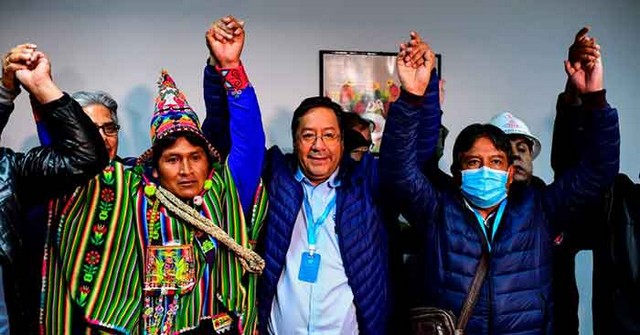
A year after former Bolivian president Evo Morales was ousted in a military coup that installed a far-right regime, Morales ally Luis Arce declared victory after exit polls showed the socialist candidate with a large advantage over his two main competitors.

“Democracy has won,” Arce, who served as Morales’ finance minister, said in an address to the nation after one exit poll showed him leading the race with 52.4% of the vote and former president Carlos Mesa in a distant second with 31.5%. Right-wing candidate Luis Camacho—an ally of unelected interim President Jeanine Añez—won just 14.1% of the vote, according to the survey.

Arce characterized his apparently decisive victory, which even Añez was forced to acknowledge, as a mandate to continue the policies of the Morales government, which lifted millions of Bolivians out of poverty and expanded the nation’s economy.

“I think the Bolivian people want to retake the path we were on,” Arce said Monday.

Twice postponed due to the coronavirus pandemic, Sunday’s election was a do-over of last year’s presidential contest, which was thrown into chaos after the U.S.-dominated Organization of American States (OAS) leveled baseless allegations of “fraud” by Morales, who was eventually forced to resign and flee the country under threat by Bolivia’s military.

The coup against Morales sparked a wave of Indigenous-led protests that were violently repressed by the Bolivian military and police forces, which were granted sweeping immunity from prosecution by the anti-Indigenous Añez government.

From exile in Argentina, Morales on Monday celebrated Arce’s apparent victory as a “great triumph of the people.”

“Brothers and sisters: the will of the people has been asserted,” Morales tweeted. “This is an overwhelming victory… We are going to give dignity and liberty back to the people.”

19 October 2020

Source: countercurrents.org

On the Coming Decline and Fall of the US Empire

By Prof. Johan Galtung

Paper written in 2015

1. Definitions and Hypotheses: An Overview

Definition: An empire is a transborder Center-Periphery system, in macro-space and in macro-time, with a culture legitimizing a structure of unequal exchange between center and periphery:

  • economically, between exploiters and exploited, as inequity;
  • militarily,   between killers and victims, as enforcement;
  • politically,  between dominators and dominated, as repression;
  • culturally,   between alienators and alienated, as conditioning.

Empires have different profiles. The US Empire has a complete configuration, articulated in a statement by a Pentagon planner:

“The de facto role of the United States Armed Forces will be to keep the world safe for our economy and open to our cultural assault. To those ends, we will do a fair amount of killing”.[1]

In other words, direct violence to protect structural violence legitimized by cultural violence.[2] The Center is continental USA and the Periphery much of the world. Like any system it has a life-cycle reminiscent of an organism, with conception, gestation, birth, infancy, childhood, adolescence, adulthood, senescence and death. Seeded by the British Empire, the maturing colonies honed their imperial skills on indigenous populations, ventured abroad in military interventions defining zones of interest, took over the Spanish Empire, expanding with world, even space hegemony as goal, now in the aging phase with overwhelming control tasks quickly overtaking the expansion tasks.

Decline and fall is to be expected as for anything human; the question is what-why-how-when-where-by whom-against whom. Answers:

  • what: the four unequal, non-sustainable, exchange patterns above;
  • why:  because they cause unbearable suffering and resentment;
  • how:  through the synergies in the synchronic maturation of 14 contradictions, followed by demoralization of system elites;
  • when: within a time frame of, say, 20 years, counting from Y2000;
  • where:   depending on the maturation level of the contradictions.
  • by whom: the exploited/bereaved/dominated/alienated, the solidary,           and those who fight the US Empire to set up their own.
  • against whom:  the exploiters/killers/dominators/alienators, and  those who support the US Empire because of perceived benefits.

The hypothesis is not that the fall and decline of the US Empire implies a fall and decline of the US Republic (continental USA).  To the contrary, relief from the burden of Empire control and maintenance when it outstrips the gains from unequal exchange, and expansion increases rather than decreases the deficit, could lead to a blossoming of the US Republic. This author admits an anti-Empire bias because of enormous periphery suffering outside and inside the Republic; and a pro-US Republic bias because of the creative genius and generosity of the USA. “Anti-American” makes no such distinction between the US Republic and the US Empire.[3]

There is no dearth of predictions of economic disaster for the US Republic in the wake of decline and fall of the system “to keep the world safe for our economy and open to our cultural assault”, also from Marxists who (still) believe that Empire-building can be reduced to economic greed satisfied by flagrant inequity.  But this is only one component in a complete imperial syndrome with components attracting and repelling different niches in societies and persons. Economists blind to externalities design theories legitimizing inequity, unrealistic “realists” enforce “order”, liberals guide and dominate political choices of others, and missionaries, religious and secular, try to convert anybody.  All together an enormous drain of resources.

The case of England indicates that an empire can be a burden. The decline of the Empire started long before, but the fall of the crown jewel, India, due to a combination of nonviolent (Gandhi) and violent struggle, and the incompatibility of imperialism with the Atlantic Charter, was decisive.  The Empire unraveled very quickly over a period of 15 years from 1947, obviously unstable.

And England? Today richer than ever in history. Welcome, USA.

2. The US Empire: A Bird’s-eye View

Right after the mass murder in New York and Washington on September 11 2001 Zoltan Grossman circulated a list, based on Congressional Records and The Library of Congress Congressional Research Service, with 133 American military interventions during 111 years, from 1890-2001, from the brutal murder of the indigenous population at Wounded Knee in Dakota to the punishment expedition to Afghanistan. Six of them are the First and Second World Wars, and the Korea, Vietnam, Gulf and Yugoslavian wars: Democrats started five of them (Bush senior and junior are the exceptions among isolationist Republicans who usually focus more on the exploitation of their own population). The average per year is 1.15 before, and 1.29 after, the Second World War, in other words an increase. And after the Cold War, from late 1989, a heavy increase up to 2.0, compatible with the hypothesis that wars increase as empires grow, with more privileges to protect; more unrest to quell, revolts to crush.

William Blum has 300 pages of solid documentation in his Rogue State: A Guide to the World’s Only Superpower (Monroe MA: Common Courage Press, 2000). The total suffering is enormous: the victims, the bereaved, the damaged nature, structure (through verticalization) and culture (through brutalization, myths of revenge and honor). Most of it fits into one single pattern: building a US Empire based on economic exploitation of other countries and other peoples, using direct violence and indirect violence, open (Pentagon) and overt (CIA); with open and covert support from US allies. The result is the international class structure with increasing gaps between the poor and rich countries, and between poor and rich people.

There is no sign of any clash of civilizations, nor any sign of territorial expansion. But there is enormous missionary zeal and enormous self-righteousness. And the rhetoric changes: containment of Soviet expansion, fight against Communism, drugs, intervention for democracy and human rights, against terrorism. Blum’s list of interventions up to the year 2000 covers 67 cases since 1945(Grossman has 56, the criteria differ somewhat):

China 45-51, France 47, Marshall Islands 46-58, Italy 47-70s, Greece 47-49, Philippines 45-53, Korea 45-53, Albania 49-53, Eastern Europe 48-56, Germany 50s, Iran 53, Guatemala 53-90s, Costa Rica 50s, 70-71, Middle East 56-58, Indonesia 57-58, Haiti 59, Western Europe 50s-60s, British Guiana 53-64, Iraq 58-63, Soviet Union 40s-60s, Vietnam 45-73, Cambodia 55-73, Laos 57-73, Thailand 65-73, Ecuador 60-63, Congo-Zaire 77-78, France-Algeria 60s, Brazil 61-63, Peru 65, Dominican Republic 63-65, Cuba 59-, Indonesia 65, Ghana 66, Uruguay 69-72, Chile 64-73, Greece 67-74, South Africa 60s-80s, Bolivia 64-75, Australia 72-75, Iraq 72-75, Portugal 74-76, East Timor 75-99, Angola 75-80s, Jamaica 76, Honduras 80s, Nicaragua 78-90s, Philippines 70s, Seychelles 79-81, South Yemen 79-84, South Korea 80, Chad 81-2, Grenada 79-83, Suriname 82-84, Libya 81-89, Fiji 87, Panama 89, Afghanistan 79-92, El Salvador 80-92, Haiti 87-94, Bulgaria 90-91, Albania 91-92, Somalia 93, Iraq 90s, Peru 90s, Mexico 90s, Colombia 90s, Yugoslavia 95-99.

There was bombing in 25 cases (for details, read the book):

China 45-46, Korea/China 50-53, Guatemala 54, Indonesia 58, Cuba 60-61, Guatemala 60, Vietnam 61-73, Congo 64, Peru 65, Laos 64-73, Cambodia 69-70, Guatemala 67-69, Grenada 83, Lebanon-Syria 83-84, Libya 86, El Salvador 80s, Nicaragua 80s, Iran 87, Panama 89, Iraq 91-, Kuwait 91, Somalia 93, Sudan 98, Afghanistan 98, Yugoslavia 99.

Assassination of foreign leaders, among them heads of state, was attempted in 35 countries, and assistance with torture in 11 countries:  Greece, Iran, Germany, Vietnam, Bolivia, Uruguay, Brazil, Guatemala, El Salvador, Honduras, Panama

On top of this come 23 countries where the United States has intervened in elections or has prevented elections:

Italy 48-70s, Lebanon 50s, Indonesia 55, Vietnam 55, Guayana 53-64, Japan 58-70s, Nepal 59, Laos 60, Brazil 62, Dominican Republic 62, Guatemala 63, Bolivia 66, Chile 64-70, Portugal 74-5, Australia 74-5, Jamaica 76, Panama 84, 89, Nicaragua 84,90, Haiti 87-88, Bulgaria 91-92, Russia 96, Mongolia 96, Bosnia 98.

35 (attempted) assassinations + 11 countries with torture + 25 bombings + 67 interventions + 23 interferences with other people’s elections give 161 forms of aggravated political violence only since the Second World War.  A world record.

Increase over time comes with shift in civilization target:

Phase I:

Eastern Asia         Confucian-Buddhist

Phase II:    

Eastern Europe  Orthodox Christian

Phase III:

Latin America      Catholic Christian

Phase IV:

Western Asia       Islam

The phases overlap, but this is the general picture.

In the first phase the focus was above all on people in Korea, south and north, wanting reunification of their nation, and on poor peasants in Viêt Nam wanting independence.  In the second phase there was the Cold, not Hot, War for containment of communism. In the third phase the targets were poor people, small and indigenous populations supported by “Maoist” students. And in the fourth phase, which is dominating the picture today, the focus was on Islamic countries and movements, Palestinians being an important example.

All the time we find that the USA supports those who favor US business and growth, and works against those who give higher priority to distribution and basic needs of the most needy.[4] They die, 100,000 per day, underfed, underclothed, undersheltered, undercared, underschooled; jobless, hopeless and futureless.

Satisfiers for their needs cannot be bought with the money they do not have, and cannot be bought with labor because that requires jobs or land (seeds, water, manure) they do not have. A cruel world built on a world trade headed by the USA, supported by US dominated military and allied governments, and often populations who benefit from cheap resources and food products.

What is new in the fourth phase has something to do with religion.  Islam is just as concerned with sin and guilt and expiation, with crime and punishment, as Christianity.  But they do not place God and his country, and particularly “God’s Own Country”, the USA, higher than Allah and his countries, particularly not Allah’s own holy country, Saudi Arabia.

A United Nations Security Council with a nucleus of four Christian and one Confucian country has little authority in Islam, as opposed to the authority enjoyed in the Christian countries in Eastern Europe and Latin America. And Buddhist, East Asian countries are perhaps more inclined to change a bad joint karma than to issue certificates of guilt to the USA.

In other words, the real resistance had to come in the fourth phase with a new Pearl Harbor that many see as the introduction to a long-lasting Third World War.

Of that we should not be so certain.  But one thing is clear: Anybody who was the least bit surprised 11 September was ignorant, naive or both. The bottomless, limitless state terrorism of the United States got a very unsurprising answer: terrorism against the United States.  With an estimated 12-16 million killed, and an average of 10 bereaved for each one, with pain and sorrow, lust for revenge and revanche growing, no act of revenge would be inconceivable.  But the deeper roots lie not in the never-ending chain of “blow-back” violence. They are in the numerous unresolved conflicts built into the US Empire. The way to solution for sure passes through US Empire dissolution.

The Pentagon planner’s “to those ends we will do a fair amount of killing” reflects imperial reality.  The when-where- against whom has just been explored.  And then what?

3. On the Decline and Fall of Empires: The Soviet Empire Case

In a comparative study of the decline (of ten) and fall (of nine, No. 10 is the US Empire) in 1995 [5], with an economic focus, the conclusion was that no single factor, but a combination of factors in a syndrome was the general cause:

  • a division of labor whereby foreign countries, and/or foreigners inside one’s own country, take over the most challenging and interesting and developing tasks, given the historical situation;
  • a deficit in creativity related to a deficit in technology and good management, including foresight and innovation;
  • one or several sectors of the economy neglected or lagging;
  • and, at the same time, expansionism as ideology/cosmology, exploiting foreign countries and/or one’s own people inviting negative, destructive reactions.

The syndrome idea came from an earlier study of the decline and fall of the Roman Empire[6] where many authors have come up with many single-factor theories.  The idea was then applied to the Soviet Empire in 1980 [7], focusing on five factors referred to as contradictions, tensions, like the four points above:

In the society:

  • a top-heavy, centralized, non-participatory society run by the Russian nation controlling other nations,
  • the city controlling the countryside,
  • the socialist bourgeoisie the socialist proletariat,
  • the socialist bourgeoisie having nothing to buy because the processing level was too low;

In the world:

A confrontational foreign policy run by the Soviet Union controlling and intervening in satellite countries.

The prediction, made many times by this author in 1980, was that the Soviet Empire would crumble not because of any single factor but because of “synchronic maturation of contradictions, followed by demoralization of Center and Periphery elites”, with the Berlin Wall crumbling in an early phase, within 10 years.

The mechanism was not the big bang of war, but the whimper of demoralized elites who after lashing out violently become corrupt, alcoholized, overfed, sometimes charming, ego-maniacs.

4. On the Contradictions of the US Empire.

The prediction of the decline and fall of the Soviet Empire was based on the synergy of five contradictions, and the time span for the contradictions to work their way through decline to fall was estimated at 10 years in 1980.  Sometimes I added a No. 5: between myth, the massive Soviet propaganda, and reality – to some extent dissolved in marvelous jokes.

The prediction of the decline and fall of the US Empire is based on the synergy of 14 contradictions, and the time span for the contradictions to work their way through decline to fall was estimated at 25 years in the year 2000.  There are more contradictions because the US Empire is more complex, and the time span is longer also because it is more sophisticated.  After the first months of President George W. Bush (selected) the time span was reduced to 20 years because of the way in which he sharpened so many of the contradictions posited the year before, and because his extreme singlemindedness made him blind to the negative, complex synergies. He just continued.

President William J. Clinton (elected, twice) was seen in a different light. Confronted with a pattern of contradictions, no doubt with significant differences in terminology and numbers, his violence was an intervention in Somalia that he canceled, a war against Serbia of which he evidenced heavy doubts and never any enthusiasm, and a couple of missiles fired in anger. Being super intelligent, demoralization in high places, and sex in strange places, might have been the consequences.  Hypothesis: they tried to impeach him not so much for the latter as for the former – using the latter as pretext.  The effort misfired, but a highly non-demoralized George Bush captured the US Presidency.

Here is the list of 14 contradictions posited in 2000:

  • Economic Contradictions (US‑led system WB/IMF/WTO‑NYSE‑Pentagon)
    • 1. between growth and distribution: overproduction relative to demand, 1.4 billion below $ 1/day, 100.000 die/day, 1/4 of hunger
    • 2. between productive and finance economy (currency, stocks,bonds) overvalued, hence crashes, unemployment, contract work
    • 3. between production/distribution/consumption and nature: ecocrisis, depletion/pollution, global warming
  • Military Contradictions (US‑led system NATO/TIAP/USA-Japan)
    • 4. between US state terrorism and terrorism: Blowback
    • 5. between US and allies (except UK, D, Japan), saying enough
    • 6. between US hegemony in Eurasia and the Russia‑India‑China triangle, with 40% of humanity
    • 7. between US‑led NATO and EU army: The Tindemans follow-up
  • Political Contradictions (US Exceptionalism under God)
    • 8. between USA and the UN: The UN hitting back
    • 9. between USA and the EU: vying for Orthodox/Muslim support
  • Cultural Contradictions (US Triumphant Plebeian Culture)
    • 10. between US Judeo-Christianity and Islam (25% of humanity; UNSC nucleus has four Christian and none of the 56 Muslim countries).
    • 11. between US and the oldest civilizations (Chinese, Indian, Mesopotamian, Aztec/Inca/Maya)
    • 12. between US and European elite culture: France, Germany, etc.
  • Social Contradictions (US‑led World Elites vs the Rest: World Economic Forum, Davos vs World Social Forum, Porto Alegre)
    • 13. between state‑corporate elites and working classes of unemployed and contract workers. The middle classes?
    • 14. between older generation and youth: Seattle, Washington, Praha, Genova and ever younger youth. The middle generation?
    • 15. To this could be added: between myth and reality.

The list was a simple reading of the US Empire situation.  More sophisticated discourses are certainly possible, keeping the key ideas of syndromes, synergies and demoralization.

5. The Maturation of Contradictions: An Update after 3 Years

We shall use the same formulations as above, drop the small explanatory remarks in the above list, and add some kind of, hopefully informed, running commentary on contemporary affairs.

Obviously, the US Empire as a functioning, dynamic reality, not as a static structure, with the 14 contradictions in its wake is a very complex system.  In such systems linearities are rare, causal chains split and unite; loops, spirals, any curve shape, are ubiquitous.  Quantum jumps when two factors are strongly coupled, one changes and the other remains constant, will be frequent.  But the prediction is that within twenty years the four types of unequal exchange with the USA in the Center will wither away, whether what comes is more equal exchange or less exchange, in other words isolation. Or both.

  • Economic Contradictions
    • 1. Between Growth and Distribution:

generally growth is sluggish with the possible exception of China, and the distribution often worsening, both between and within countries.  However, the basic concern is with livelihood at the bottom of world society, the preventable mortality and the suffering due to near-death morbidity from hunger or easily preventable/curable diseases.  That syndrome is with us, and the analysis in terms of overproduction leading to unemployment leading to under-demand leading oversupply leading to more unemployment etc. stands.  At the same time monetization of land/seeds/water/manure impedes the conversion of labor into food by tilling one’s own land. The US Empire pursues growth but neglects and prevents distribution, thereby undercutting itself since a key aspect of growth in increased demand, meaning increased consumption, all over.

    • 2. Between Productive and Finance Economy:

Domestic and global market turnover being high even if the growth is sluggish in the productive economy in many countries, and distribution being low there will be heavy accumulation of liquidity high up searching for an outlet.  Luxury consumption and productive investment being limited the obvious outlet is buying and selling in the finance economy, also known as speculation.  The productive economy responds by putting up bogus, virtual enterprises like ENRON and WORLDCOM that the growth in the finance economy quickly gets out of synch with growth in the productive economy. Thus, the 2001 sharpening of his contradiction into a crash for some stocks and depreciation of the US dollar was as expected, indicative of a chronic pathology. One basic cure for that pathology is the distribution that the US Empire, through its use of the WB/IMF/WTO‑NYSE‑Pentagon system is impeding. As that cure is at present unavailable the underlying pathology will produce new increases in financial goods values and new crashes.

    • 3. Between Production/Distribution/Consumption and Nature:

The Bush administration’s unilateral exit from the Kyoto Protocol sharpened this contradiction considerably and was a key factor behind the banner at the 2002 summit in South Africa: Thank you, Mr. Bush, you have made the world hate America.  The explanation given was that the Protocol impeded US economic growth (meaning unacceptable to powerful corporations).  This move endangers the planet and is an expression of contempt for global regimes based on negotiating ratifiable treaties.  The USA could have demanded re-negotiation.  But the US Empire had other priorities and mobilized millions in the movement for sustainable development against the USA.

  • Military Contradictions
    • 4. Between US State Terrorism and Terrorism:

This contradiction underwent a quantum jump on 11 September 2001 although the number killed was less than the number killed in the aftermath of the other 11 September, in 1973, the USA supported coup against the socialist government of Salvador Allende (one of the now 68 interventions after the Second World War, counting Iraq).  Highly predictable, as predictable as its repetition unless the US Empire itself exits from the cycle of violence and decides to understand “that the enemy may be us/US”.  But the US Empire now talks about interventions in more than 60 countries, lasting more than a life time.  A heavy price for the failure to try to, or the effort to avoid to, solve conflicts/contradictions.

At this point an obvious remark:  an effort to explain 9/11, for instance as a “reaction to the US Empire by hitting two major instruments for economic and military operation”, or the short-hand as “revenge” and “unresolved conflict” in no way justifies the gruesome act.  Nor is the US intervention in Afghanistan and Iraq justified.  But like Kosovo they can both be partly explained as efforts to maintain and expand the US Empire, for more control of the world oil market, and “to keep the world safe for our economy” by establishing military bases.

Violence hits the Empire at their strongest point, is as wrong, ineffective and counterproductive as the US violence and mobilizes against the perpetrators.  Ruling out explanation as justification runs against Enlightenment rationality: solve problems by identifying causal chains, then removing causes like violence cycles and unresolved conflicts.  But the US Empire stands in the way and will ultimately have to yield.

    • 5. Between US and Allies:

Very fluid.  The US Empire does not want to be seen as the US Empire but as something generally supported by “advanced societies”, “civilized” as against “evil”, “chaotic” and “terrorist”.  Washington builds coalitions with Allies in the NATO/TIAP/US-Japan systems, and others.

This contradiction (and many others) has never surfaced so clearly as in connection with the war against Iraq, but there were also tensions budding in connection with the Yugoslavia and Afghanistan operations.  Public opinion is not an important variable here.  Washington deals with governments and for that reason is very concerned with who are the members.  The three ways of exercising power, persuasion, bargaining and threats, are best exercised behind closed doors so as not to be exposed to anything like the German Foreign Minister’s devastating remark to the US Secretary of Defense in München February 2003:  “In a democracy you have to present arguments for your position, and your arguments are not convincing.”  If the public knew what goes on behind closed door, like supporting an attack on Iraq in return for having somebody inscribed on the US list of terrorist organization, the opposition would increase.

In 2000 UK, Germany and Japan were seen as reliable allies.  This failed to predict the German position, linked to the Social Democratic Party having been pressed already against its inner conviction over Yugoslavia and Afghanistan.  Australia, however, was highly predictable as an Anglo-Saxon country[8], and Japan behaved as predicted.  The cost-benefit analysis of the countries varies, but the trend is against unconditional support for the US Empire. A very sensitive contradiction that will sharpen if people exercise much more pressure on governments.

    • 6. Between US Hegemony in Eurasia and Russia‑India‑China:

These are enormous countries, unconquerable so the USA has approached them through their fear of Muslim populations, in Chechnya, in Kashmir (and all over) and Xinjiang respectively.  After the NATO expansion eastward and the USA-Japan alliance (with Taiwan and South Korea as de facto members) expansion westward from 1995, the three countries resolved most of their problems, came closer together (although not in a formal alliance).  But those moves were temporarily stopped by the USA aligning them against Islamic terrorism, meaning Muslims fighting for more autonomy/independence in the three places mentioned.  The attack on Iraq seems to have sharpened the contradiction again as they do not participate in the occupation (knowing something about Islamic guerrillas).  But the USA still has considerable market access and investment economic clout with all three governments.

  • 7. between USA‑led NATO and an EU Army:

This is not the same as the two preceding points which are more about abstaining from support, and countries feeling the pincer movement of the US Empire, possibly creating an alliance.  Here we are dealing with a new multinational army of a potential superpower, creating identity problems for some members.  The question, “why do they need this army when they have NATO?” has an answer in dualist logic: “this shows they are not entirely with us, hence they are against us.”

There will be much maneuvering behind closed doors concerning this contradiction.  But the general move will be in the direction of an EU Army for some members, building on the present Eurocorps, with a line of command that does not end in Washington, nor passes through washington except for some exchange of information.  For defensive purposes or a coming EU Empire?  To take over the spoils?

  • Political Contradictions
    • 8. between USA and the UN:

The most powerful country in the world also uses the veto in the Security Council most frequently and has close to a de facto economic veto by withholding or withdrawing support for programs not to their liking, in addition to the US Empire clout on many UN members, like changing the conditions for loans according to voting pattern. That this behavior is resented stands to reason and that resentment came out in the open when the Anglo-Saxon USA/UK alliance failed to get their second resolution on Iraq accepted by the UNSC.  However, very energetic US diplomacy and again US Empire clout prevented what Washington was afraid of using the Uniting for Peace resolution to lift an issue that has gotten stuck in the UNSC into the General Assembly.  A UNGA debate and vote would make the limited support for an attack on Iraq rather than the French-German approach of deep UN inspection clear.

    • 9. between USA and the EU:

This goes far beyond EU army vs NATO.  The EU has today 15 members, by May 2004 there will be 25, with more to come.  If the EU, very much in their own interest, decided to bridge the basic fault-lines in the whole European construction, between Orthodox and Catholic/Protestant Christianity, and between Islam and Christianity (from 1054 and 1095 respectively) by opening the EU for Russian and Turkish membership, well, then the USA would be very far behind indeed. We would be talking of 750 million+ inhabitants.  The process of membership might have to be gradual, like X% increase per year in access to EU labor market against X% increase per year in access to resources.   The relation to East Asia may be problematic, but the EU is also doing good work on this fault-line.And a giant EU could only gain from abstaining from any imitation of the US Empire, signing up for UN support instead.

  • Cultural Contradictions
    • 10. between US Judeo-Christianity and Islam:

These are the Abrahamitic religions, and the expression Judeo-Christianity, so frequent in the USA, draws a wedge among them.  With the recent fundamentalist alliance based on the idea that Armageddon is near and that the first coming of the Messiah and the second coming of Christ could be the same person, this contradiction has become very sharp indeed.  But Islam is expanding very quickly, Christianity is not and the Jews are a small minority.  This rift will mark clear borders against US Empire penetration.  The young Saudi Wahhabite perpetrators on 9/11 may have acted more than they dreamt of on behalf of 1.3 billion Muslims, and not only 300 million Arabs. And this warlike relation will limit US Empire expansion considerably.

    • 11. between US and the Oldest Civilizations:

When people talk of fundamentalism they usually mean the religious articulation of old cultures.  But cultures are many-dimensional, including language and other forms of expression, and sacred times and sacred places in history and geography, anything.  There are awakenings all over the world, seeing ancient non-Western cultures not as exotic museum objects to be observed but not lived.  The destruction of artifacts from Sumer/Babylon in Iraq was seen as an effort to make the Iraqis governable by destroying other foci of identification.  A typical example of a contradiction in an early, infant stage, but filled with potential for rapid maturation and powerful articulation.

    • 12. between US and European Elite Culture:

The world, or so the West thinks, has four major geo-cultural Centers: the USA, the UK, France and Germany. Others can learn to imitate or produce exotica. France and Germany continue the struggle for cultural prevalence relative to the USA, with Anglo-Saxon UK being somewhere in-between.

  • Social Contradictions
    • 13. between state‑corporate elites and working classes of unemployed and contract workers:

The powerful US trade union complex, the AFL/CIO, voted for the first time against a war: Iraq.  But the working classes are today kept in line by the threat of unemployment and the inferiority of contract work relative to that vanishing category, the real position, with security.  The state-corporate elites are better organized and at making themselves insubstitutable.  They can make hire and fire become easy, with the ultimate threat of automation (“modernization”) settling issues.

The postmodern economy can do without workers, but not without customers.  Firing workers they fire customers by reducing their acquisitive power.  The world middle classes can join by boycotting the products of the US Empire, like oil from Iraq, Boeing aircraft (one of the major death factories in the world); in general boycotting US consumer goods, capital goods and financial goods, like US dollars, stock and bonds – but keeping personal contacts.

    • 14. Between Older Generation and Youth:

Younger than ever, not only college students against the Viêt Nam war but high school students, easily mobilized through the Internet as long as that lasts.  Maybe an element of myth versus reality in this: they have been served propaganda that seems very remote from reality.  The same may apply to women, but here Washington has played the cards well: “homeland security” drives the issue home and women into the ranks defending the defenders of the home and the family.  But the other nations in the USA, the Inuits, Hawai’ians, First Nations, Chicanos, African Americans, could be pitted against the Anglo-Saxon, Southern Baptist, militarized Deep South, now in command.  Hopefully they will not create an emergency to cancel elections they may not win.

6. And the Decline and Fall?

Have a look at the 14 contradictions, and then a look at the definition of an empire.  The way of solving these contradictions eating at the heart of the system is very simple:

  • For the 3 economic contradictions: reduce, even stop exploiting!
  • For the 4 military contradictions: reduce, even stop killing!
  • For the 2 political contradictions: reduce, even stop dominating!
  • For the 3 cultural contradictions: reduce, even stop alienating!
  • For the 2 social contradictions: reduce, even stop all the above!

For each reduction, the US Empire is, by definition, declining.  For each stop the US Empire is falling.  Stop all four, and the US Empire is gone, although some may survive in residual forms like the Russian Empire in Chechnya and the British Empire in Iraq.  The most dramatic recent example is possibly the dissolution of the French Empire: de Gaulle had the incredible personal grandeur to terminate the whole empire (except for the Pacific and some other places) and like for the Soviet and British Empires a number of independent countries were born.  Global capitalism, however, has a tendency to recreate transborder exploitation, and there are, as mentioned, residuals.  A new world was born, however, in the 1960s from the Western empires, in the 1990s from the Soviet Empire.

Only the naive will assume that new world to be paradise on earth.  New systems emerge with their contradictions.  The rulers of the British, French and Soviet empires had concluded that the costs by far outrun the gains.  Some others sometimes come to the conclusion that the costs of the fall, including for the Periphery, by far outrun the gains.  That, of course, depends on the successor system, the alternative.  This author favors United Nations global governance, and not an EU Empire.[9]  But that is another story.

The British and French empires were based on “overseas” colonies, the Soviet empire on contiguous, Czarist/Bolshevik, “union”, and the US Empire is based on what the Pentagon planner said, with the non-US Periphery being “independent” countries.  This confuses some whose empire concept is linked to “colonies” and not to independent countries; and others whose concept is linked to “overseas”, not to contiguous territory.  Still others got confused because three of these Centers are Western democracies, beyond the suspicion of ever committing major wrongs.  The definition opening this essay is based on a relation of unequal exchange between Center and Periphery, not on Periphery geography or Center polity.

That unequal exchange, divided into four components, is the root contradiction of the empire as a system.  From the four deep contradictions flow the fourteen surface contradictions, visible to everybody, the subject of journalism.  The deep contradictions almost never are.  So the basic model explored so far is:

Four Deep Contradictions Imply 14 Surface Contradictions

As the 14 mature, synchronize and synergize the Center may loosen the grip on the Periphery in one conscious, enlightened act (de Gaulle) or see the Empire dissolve, slowly (UK) or quickly (the Soviet Union).  USA, the choice is yours.

But the USA now behaves like a wounded elephant, lashing out in all directions.  This is the boiling stage of demoralization, with emotions impeding rational thinking about is and ought, to be followed by a frozen stage, a “let go”, more like the Soviet Union, or Clinton. Demoralization is oscillating before it stabilizes. Like individual pathologies, healing is related to the ability to come on top of the pathology rather than the other way round.  Like now, with the USA driven by a conflict mainly of its own making.

The Model Above Can Now Be Expanded:

[4] implies [14] implies Demoralization implies -[4] implies -[14]

The 4 deep lead to 14 surface contradictions and demoralization which leads to a let go of Empire and the dissolution of the 14.

However: the 4 may have deeper roots.

Thus, where does the inequity come from?  From an unfettered capitalism so inequitable that it needs some military protection.  But where does capitalism come from?  And all that violence? The cultural superiority complex with missionary right and duty, and no duty to understand other cultures, may be related to the sense of exceptionalism as God’s Chosen People and Country.  But where does that idea come from? And so on and so forth. The 4 defining the US Empire are not uncaused, not unconditioned.  But the focus here is on their removal and not on removing even deeper, but very evasive causes. This can happen through negative feedback loops via waning faith in the viability of the Empire as a system, in other words demoralization.

The 14 may have other roots.

The economic contradictions come from capitalism; the USA was violent before the US Empire; some EU members may hate the US Empire because it stands in the way of their own ambitions; the same applies to competitive cultures such as an Islam that wants an expanding dar-al-Islam, the abode of Islam, as successor to the battlefield, the dar-al-harb.  But the world is better off under USA than under EU or Islam, some say.

There is some truth to all of that.  But the problem is not only the US share of the world capitalist pie but how it implies killing, domination and alienation.  This has to decline, fall and go, while paying attention to all the other contradictions.

There will be class, generation, gender, nation struggle also without the US Empire.  True, but today that is the major problem.

The 14 may strengthen the resolve to maintain the 4.

In the beginning, and one at the time, yes.  Cosmetics may be applied, bland compromises entered, people articulating the contradictions silenced, ridiculed, persecuted, killed.  It is the synergy of several contradictions that leads to demoralization and ultimate decline. Contradictions between dominant and dominated nations within a country tend to bounce back and find new outlets. The dominated face brutal force but not nagging doubts about viability. Their national home is a dream untested by contradictions whereas the empire has been tested and found nonviable at any speed.

Demoralization may not negate the 4.

What we are talking about is decreasing faith in the viability; even decreasing faith in the legitimacy, of the Empire, with boiling anger at first, then a frozen let go, with the possibility of an autonomous let go. Either the Center deliberately looses the grip, or the Periphery slips out its clammy, feeble claws.  Either way, decline and fall.

However, after a phase of demoralization a new political class may decide not to let go but just the contrary, to strengthen the grip, like the USA is trying right now.  Given the obvious, the impermanence of everything, this will only postpone the inevitable.

Negating the 4 may not negate the 14.

This is certainly more true than untrue.  As explored below, we may even talk about an objective contradiction having lost, or even crushed, its subject in search of a new subject.  There are many other roots for many of the contradictions.  That one contradiction (syndrome) may conceal another, the latter blossoming when the former is wilting, is clear. But that daoist insight will not stop contradictions from maturing.  As to the US Empire, there is light at the end of a long and twisting tunnel.  But after that tunnel there are new tunnels–

7.  On Contradictions in General

The concept itself harbors contradictions in the sense of tensions among meanings.  The common factor seems to be a whole, a holon, a system, with at least two forces operating. The tension is between the forces. There is no assumption of only two forces, nor that they are exactly opposite, nor that are they of the same size.  Newton’s Third Law is written that way, expressing a contradiction.  But that is a special case and should not distort our ideas of social systems.  We need a more general discourse.

Before two or more forces let us explore the cases of 0 or 1.

Even with the vagueness of “force” it is not unreasonable to attribute the property “dead” to a system with no force, no movement, tendency, inclination.  The objection may be that much happens to a buried corpse: “to” yes, but not “in”. The forces are exogenous to the system, not endogenous, like in a live organism.

Introduce one force, like running.  The body spends energy. And the counterforce is not slow in announcing itself as fatigue, trying to change a motion into a non-motion referred to as “rest”.  The mechanical analogue brings up the idea of R, a dynamically changing resultant force that reflects magnitude and direction of all forces.  The system will move or rest with the resultant. R>0 means move, R=0 means equilibrium, R<0 means rest deficit.

Is a force always accompanied by a counterforce?  Is there always a reactio with an actio?  And in systems with foresight, could there even be a proactio for any expected actio?  And a pro-proactio?  I find this a very useful an axiom in the analysis of social and personal systems.  But I see no reason to assume that reactio and proactio are necessarily opposed. They could also be aligned with actio and, at least to start with, reinforce actio.

The idea of force-counterforce twins might lead us to an even number of forces as they come in pairs.  We do not say that one is producing or generating the other since that leads to an infinite number.  Rather, we assume synchronicity; they are “co-arising” as Buddhist epistemology will have it rather than one force generating the next, generating the next, etc.  And there is no reason to land on an even number.  Another metaphor might be a bundle of forces somehow accounting for the tensions in the system.

Let us move from general talk about “systems” and “forces” to more specific social and personal systems.  In the conceptual neighborhood is the idea of “conflict” as tension in goal-seeking systems because of incompatibility between the goals.  Goals are then associated with life even when attributed metaphorically to non-life as in “mountains striving upward”.  If incompatible goals are in the same system we have a dilemma, if in different systems we have a dispute.  A goal-holder conscious of the goal is an actor, if not conscious a party.  And that brings in the major distinction between subjective and objective contradictions.

A subjective contradiction passes through and is reflected by the human brain; as thought/consciousness, as speech/articulation as action/mobilization.  But not necessarily in that order, intellectualized like a philosopher who first reflects, then writes and then – maybe does nothing.  We could just as well assume the opposite order, the actor mobilizing for action out of old habit, then saying what he feels he thinks and thinking what he feels. Or any other sequence.  But sooner or later there is consciousness.

With two goals we get two goal-seeking forces, A and B, and three possibilities for the resultant: R=A (A wins), R=B (B wins) or R=0, an in-between equilibrium, also known as a compromise.

At that point the mechanical analogy breaks down.  The three cases do not exhaust the possibilities.  Moreover, they do not eliminate the contradiction.  A or B wins does not mean that the dissatisfied loser no longer has the same or some other goal incompatible with the winner’s goal.  The contradiction is still there, under the lid of the boiling cauldron of a defeat. And a compromise may leave both of them semi-dissatisfied.  If we use the term “sharp” to describe the contradiction as it was, “blunt” may apply to a compromise.  But how do we transcend the contradiction?

Since the three possibilities exhaust the logic of opposing forces within a system, the answer is “by changing the system”. This is what Gorbachev faced in the contradiction between the Soviet Empire and the social forces wanting basic change in the DDR: he let the DDR go. The contradiction now being between people and party elites in the DDR, the latter then yielded to West Germany, BRD, eventually to be absorbed by them.  As a result the Soviet Empire declined and fell and BRD absorbed DDR. The contradiction is still there, but finds other articulations.

And this is what Gorbachev’s successors never managed to do with Chechnya.  All they could do was to prevent them from winning, not to transcend the contradiction.  For that to happen they would have to let Chechnya go, which will happen sooner or later anyhow.

For the contradiction to be transcended, and the tension to be released, system change is needed, and more so the deeper the contradiction is in the system. An empire is not changed by suppressing, winning, over some party or even actor; that only makes the empire more imperial.  An empire is changed by becoming less imperial.  And that is also known as a decline from the empire’s point of view.  At the end of that road is its fall.

The Stages in the Contradiction Life-Cycle Can Be Summarized:

[0] Objective contradiction independent of consciousness

[1] Consciousness-formation through THOUGHT (intrasubjective)

[2] Articulation through SPEECH (intersubjective)

[3] Mobilization through ACTION (private and/or public)

[4] Struggle among mobilized actors

– violent or nonviolent

– quick or slow

– without or with outside parties mediating

– with less or more polarization = decoupling

[5]  Outcomes of struggle

[a] prevalence or compromise – back to [0]-[4]

[b] transcendence = a new reality

– negative transcendence under a new actor

– positive transcendence as new coupling

Through the [1]-[2]-[3] sequence a party becomes an actor pursuing goals by more or less adequate tactics chosen from [4].

[5a] does not end the lifecycle of a contradiction, only a lid on it or a blunting of it, as has been argued above.

[5b], transcendence, is the end of that contradiction lifecycle.  This does not mean the end/death of the system as it may harbor other contradictions at various lifecycle stages.

Transcendence, going beyond, is the creation of a new reality:

  • negative transcendence, neither-nor; goals not achieved
  • positive transcendence, both-and; goals achieved, with a twist.

Take the Ecuador-Peru conflict over where to draw the border in a contested 500km2 zone up in the Andes, with three wars to settle the issue. Military victory for one of them, annexing the zone to their national territory, is “prevalence”. Drawing a border, for instance along a ceasefire line, is “compromise”. Negative transcendence could be to give the zone to the UN or the OEA, creating a new social reality.  And positive transcendence could be a binational zone, owning it together, with the twist that neither country has monopoly. A new reality.  And both new realities, systems, would in turn produce their own contradictions.

Time has then come to explore the problematic relations between objective and subjective contradictions.

A social system comes with differences between categories– like genders, generations, races, classes, nations, territories– which then become relations in an interaction system; which then become fault-lines, usually because the interaction is on unequal terms; which then may lead to polarization and a structure of discrimination accompanied by a culture of prejudice.  All known societies harbor more or less of these inequalities and inequities.

An empire uses such structures and cultures as building blocks, and can be seen as a two (or multi-)tier system linking domestic and global faultlines. There is a Center and a Periphery in the global system of countries.  Inside the Center, and inside the Periphery, there is also a center and a periphery.  All three systems may be based on the logic of quadruple inequity (for killers-killed sometimes substitute the softer guards-prisoners).

The linchpin in the system is the harmony between the center in the Center and the center in the Periphery.[10]  The USA is right now (Summer 2003) trying to construct an Iraqi center in harmony of interest with the USA state/corporate center. The Iraqi center must do the four jobs locally and deliver the fruits of unequal exchange such as economic value, wanted terrorists, obedience, conditioning to the center in the (USA/UK) Center, keeping a commission.  They are rewarded with material living standard at a US elite level.

What has just been described is a simple empire linking three systems of unequal exchange, two domestic and one global. The US empire is complex; being a world hegemon no domestic system is entirely delinked from that empire. The EU empire links 15 (soon 25) Center countries to 100+ Periphery countries, but softly so.

There are also other divisions than the faultlines in domestic and global society, like among political parties in more or less democratic societies, and groups of countries in an undemocratic global system.  Social movements, the subjective contradictions, more or less conscious, articulated and mobilized across some primordial or newly created dividing lines, pre-polarize the system, and are ready for [4], struggle.  But for what?

Ideally for the objective contradiction, with an unresolved issue at the center which then has to become the cause of the movement.  And that gives rise to basic problem of adequacy in the coupling between subjective and objective contradictions, between the causes and the issues.  Both are parts of social reality.  But the movements may have an inadequate consciousness and cut the issues wrongly.  And the issue may be an orphan, waiting to be picked up by a movement with adequate consciousness.  There may be a contradiction between movement contradiction and issue contradiction.  And the result is bad, derailed politics.

Thus, the subjective contradiction in Myanmar/Burma between the autocratic military government SLORC and the pro-democracy movement headed by a woman, identified with one nation in a multi-national society, one upper/middle class in a very poor society, married to a Westerner in a country developing its own identity, may be inadequate for the objective contradictions of the country. From a Western point of view the basic contradictions are autocracy vs. (Western) democracy and closure vs. openness of the country to economic and cultural penetration. The subjective contradiction is adequate for those issues.  But there are other issues.  Inadequacy may derail the process.  The objective and the subjective must somehow mirror each other.

Thus, Gandhi had literally speaking to divest himself of his Westernness and his high caste paraphernalia, become very Hindu and share the living conditions of the lower castes and untouchables before he could lead Indian masses toward freedom and democracy.  The leader of Free India, however, Jawaharlal Nehru, was very Western, very high caste, very secular and steered India exactly in that direction.  Gandhi wanted an India based on the “oceanic circles” of autonomous, self-reliant villages; Nehru a modern, secular, industrial, socialist India.  The subjective matters.

Liberals tend to study the subjective movements and Marxists the objective issues.  The argument here is for both-and, and more particularly for the contradiction between the two contradictions.

An example from Norway: the objective contradiction a century ago between the “well conditioned” and the majority “populace”, in steep livelihood gradients, and the subjective contradictions in the party system.  The populace lived on farming, fishing, hunting, and as employees; the well conditioned from fortune, as employers or self-employed.  There were grey zones.  The Labor Party, through an act of political genius, created an alliance of farmers, fishermen and industrial workers, very adequately posited against the well conditioned.  They won the elections, prevailed for two generations, and created a new social reality, the welfare state.

That society had its own objective contradictions, positing a minority of aged-women-frail/handicapped-foreign workers against the rest.  Uncarried by adequate subjective contradictions the objective contradiction deepens in the midst of plenty.  The Labor Party was totally inadequate.  And the issue remains unsolved.

Movements against the US Empire: social reality is complex.

Only when cause and issue coincide will the movements be adequate.

NOTES:

[1]. From Susan George, “The Corporate Utopian Dream”, The WTO and the Global War System, Seattle, November 1999.  He is missing the political dimension and might have added “a fair amount of bullying” or “arm-twisting” after killing.

[2].  For this way of seeing reality, see Johan Galtung, Peace by Peaceful Means, London:  SAGE, 1996, chapter 2.

[3].  That not very intelligent term obscures the difference between those who are against both Republic and Empire (americaphobia?; very few, it seems) and those who are against one but not the other.  Unconditional love for both, (americaphilia?) is quite frequent.  It should be noted that “America” actually refers to the whole hemisphere, making the term “anti-American” also a sign of geographical confusion.

[4].  Many pairs come to mind, we just pick five as examples:

  1. Mossadegh was intervened, the Shah’s dictatorship not;
  2. Very much has been done to overthrow Castro, not Batista;
  3. very much was done to overthrow the Sandinistas, not Somoza;
  4. very much is being done to overthrow Chavez, not Jimenez;
  5. Lumumba was intervened and killed, not Mobutu.

The basic criterion is “free trade”, not democracy/dictatorship.

[5]. Johan Galtung, The Decline and Fall of Empires: A Theory of De-development, Geneva: UNRISD, 1995 (but not published by them), see www.transcend.org.

[6]. Johan Galtung, with Tore Heiestad and Erik Rudeng, On the decline and fall of empires: the Roman empire and Western      imperialism compared. Oslo: University of Oslo, Chair in      Conflict and Peace Research, 71 pp. (Trends in Western      civilization program, 15), (Oslo Papers, 75). Also published at: Tokyo: UN University, 1979, 71 pp (HSDRGPID‑l/UNUP‑53), and in Immanuel Wallerstein (ed.) Review. New York: Research Foundation of the State University of New York, IV, 1980, 1, pp. 91‑154. Condensed version in: Comprendre: revue de politique de la culture, XLIII/XLIV, (1977/78), pp. 50‑59.

[7].  Johan Galtung, with Dag Poleszynski and Erik Rudeng, Norge foran 1980‑årene (Norway facing the 1980s). Oslo: Gyldendal, 1980,  p. 85.

[8].  But Canada and New Zealand, also Anglo-Saxon dominated, did not follow suit.  Because they are more diverse, with non-Anglos like the French-speaking and First Canadians in Canada, and the Maoris in New Zealand to take into account?  clearly, there is no longer a massive Anglo-Saxon bloc.

[9].  In the USA the alternative is often seen in terms of a Chinese Empire, in line with the old Anglo-Saxon tradition of seeing the relation between No. 1 and No. 2 in power as zero sum game.  For England, the country allegedly with no permanent friends, no permanent enemies but permanent interests, this used to be France, but after the country was beaten by united Germany in 1870-71 and displayed its industrial prowess the Germany was appointed enemy. China as enemy disregards thousands of years of Chinese history with no imperial systems outside the borders of the Himalayas, the Gobi, the Tundra and the Sea.  China is self-centered in its development/modernization and still tends to see the world outside those borders as South, West, North and East Barbarians.

[10].  Thus, the author’s “A Structural Theory of Imperialism” (in Essays in Peace Research, Volume IV, Copenhagen: Ejlers, 1980, pp. 437-91) is underlying the development of the theory of imperialism into its decline and fall in this essay.

Johan Galtung, a professor of peace studies, dr hc mult, is founder of TRANSCEND International and rector of TRANSCEND Peace University.

19 October 2020

Source: www.transcend.org