Just International

Israel’s Impunity: Is The Tide Changing?

By Jafar M Ramini

I think it is. The tide of international dissent against Israel’s impunity is becoming a torrent since the introduction by the IHRA, International Holocaust Remembrance Alliance of what they have defined as ‘Antisemitism’.

This new definition has been interpreted and used as a weapon to bash, intimidate and silence any voices of criticism against the government of Israel. Even the man who drafted it, Kenneth Stern, has admitted that this is not what he had in mind. According to Stern it had originally been designed as a ”working definition” for the purpose of trying to standardise data collection about the incidence of antisemitic hate crime in different countries. It had never been intended that it be used as legal or regulatory device to curb academic or political free speech.

Antisemitism, Islamophobia, racism, discrimination and denial of rights against any person or persons is abhorrent. But legitimate criticism and condemnation of regimes and political doctrines are a must if we are to keep those regimes and political movements under check. After all, this is what democracy and free speech are all about.

Not, it seems, when it comes to Israel. Every time any one of us opens his or her mouth and speaks of Israel with anything other than complete approval and admiration is automatically labelled ‘antisemite’.

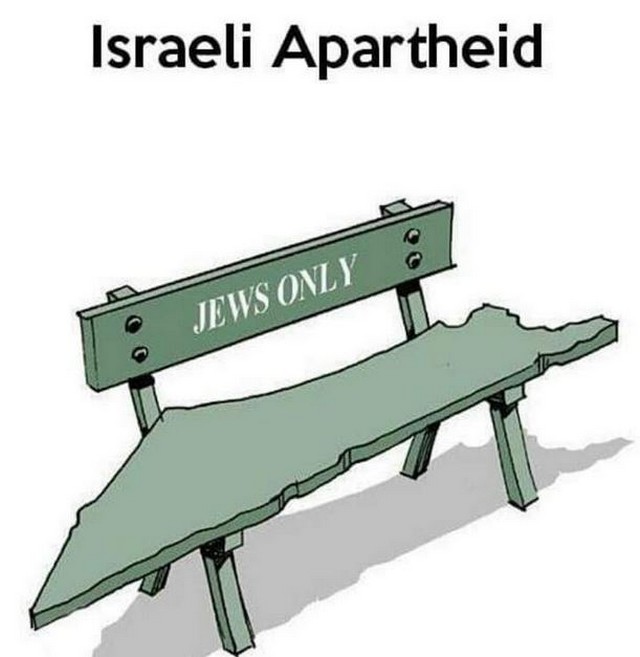
Why am I saying this at this time? Because recently anti semitism has been used, not only to silence freedom of speech, but to damage and destroy the careers and livelihoods of many a political activist who seeks peace and justice and equal rights for all. For those of you who might like to challenge these assertions you need go no further than the recent proclamation by B’Tselem, the Jewish human rights organisation based in Israel, stating clearly that Israel is an apartheid state.

As Hagai El Ad, the director of B’Tselem said, “Calling things by their proper name — apartheid — is not a moment of despair; rather it is moment of moral clarity, a step on a long walk inspired by hope. See the reality for what it is, name it without flinching — and help bring about the realisation of a just future. We can and must bring about a just future for Palestinians and Jews. “

Yes, the tide is turning, and the people of the world, especially young Jews, are saying it out loud. “Not in my name!” and “If not now, then when?” Within Israel itself there is a growing group of dissenters within the Israeli army. They call themselves ‘Breaking The Silence’ and they are doing just that. Speaking up about their experiences of brutality and savagery against the Palestinian people, which they were trained and ordered to do under military command.

Even within the corridors of power in the west there is growing dissent. Politicians are calling on their colleagues to stop using antisemitism as a battering ram against those who defend the legitimate rights of the Palestinians.

Here is one good example, which happened only this week here is Australia, in Parliament House, Canberra, when Senator Anne Urquhart of Tasmania challenged a fellow senator to come out from under the protection of parliamentary privilege and repeat his accusations of anti semitism against a former parliamentarian, Ms Melissa Parke. Here is the text.

Senator URQUHART (Tasmania—Opposition Whip in the Senate) (20:13):

“I rise tonight to reject a statement made recently in this place by Queensland Senator Scarr, who cynically used the protection of parliament to impugn the integrity of a former parliamentarian, with no basis in fact…He accused her of uttering a vile lie, of spreading vile misinformation and, by direct implication, of being an anti-Semite. His false accusations relate to events that occurred when Melissa worked as a lawyer for the United Nations in Gaza in 2003. One of those events involved a well-documented case of a Palestinian refugee woman being forced by an Israeli soldier to drink a bleach-like cleaning fluid.

“We must engage with what is occurring here. The senator is using parliamentary privilege to defame Melissa Parke. He’s using parliamentary privilege in an effort to silence criticism of the Israeli government for the human rights abuses it has perpetuated and continues to perpetuate against Palestinian citizens.

“I challenge Senator Scarr to reiterate his assertions that Melissa Parke has spread a vile lie and a vile misinformation and that she is an anti-Semite outside the walls of this place…

I put it to my colleagues in this place that the cynical use of the slur of anti-Semitism as a tool to silence critics of Israel for that state’s exhaustively documented human rights abuses against Palestinians must stop. Equally, this place must not be used as a refuge from reality from which false accusations can be hurled against people of greater integrity than their accusers.”

Yes, the tide is turning. Good on you, Senator Urquhart. Ms Parke, I hope that very soon you will get the respect you so richly deserve.

Meanwhile, just a few days ago, as was published in ‘Truth Out’, Rabbi Walt, who grew up in South Africa and knows what apartheid looks like was calling on his fellow Jews to recognise Israel for what it is, an Apartheid state. For years he had hesitated to use the ‘A’ word for fear of alienating fellow Jews, but his moment of truth arrived while in Hebron in 2008 when the street they were walking down, Shuhada Street, was described as ‘a sterile street’. No Palestinians are allowed to use it. Only Jews and tourists. Not even in South Africa, says Rabbi Walt, were there ‘sterile streets’.

“As a student at the University of Cape Town,”he writes, “ I had fought against Apartheid…and throughout my anti-Apartheid activism, Israel was always a central part of my Jewish identity: I was a committed, progressive Zionist.

“But, over decades, in tours and activism on the West Bank I had witnessed disturbing realities that impacted me profoundly: the demolition of Palestinian homes, the expropriation of Palestinian land for Jewish settlements, olive orchards uprooted by settlers, and Palestinians evicted from homes in Jerusalem that they had owned for generations.

“These experiences were so shocking that, if I hadn’t seen them with my own eyes, I would never have believed they were true. They reminded me of very similar injustices that I had seen in South Africa.

But, it was the “sterile street” that pushed me over the edge.

At that very moment, when I walked down a street stripped of Palestinians, I decided that I would never again avoid using the word “apartheid” to describe Israel’s policies against Palestinians. I know what apartheid is, and I was seeing it in front of me.

Rabbi Walt is no longer alone. Young, thoughtful American Jews are no longer alone. To quote B’Tselem:

“It is a commitment to the foundational principle of Judaism, that every human being is of infinite value, deserving of dignity, freedom, equality and justice. It is time to commit ourselves to the fulfilment of this core Jewish moral value for all people between the Mediterranean Sea and the Jordan River.”

Even inside the Israeli Parliament, the Knesset itself, there are voices which are, at last, calling it as it is. MK Ofer Cassif, while taking part on Al Jazeera’s Inside Story programme last week had this to say.

“Israel is the occupier… I want to mention two things… One, is the Nation State bill, the Basic Law, which actually turned Israel into an apartheid state. The second is the policy, practically speaking, of Netanyahu, especially in the last five years or so, that actually has been pursuing an ethnic cleansing in the Occupied Palestinian Territories.”

As I said, the tide is turning.

Jafar M Ramini is a Palestinian writer and political analyst, based in London.

19 February 2021

Soure: countercurrents.org

‘A humanitarian crisis’: Cold and snow put millions in danger in Texas: 38 dead

By Countercurrents Collective

Texas’s freeze entered a sixth day on Thursday. At least 31 people have died as of Wednesday afternoon as a result of the severe weather in Texas. But some media reports said, days of glacial weather have left at least 38 people dead in the U.S. The snow made many roads impassable, disrupted coronavirus vaccine distribution and blanketed nearly three-quarters of the continental U.S. And that number is expected to climb with no end to the Texas nightmare in sight.

Media reports from the U.S. said:

More than 3 million Texans were without power. But some media reports put the number to more than 4 millions. Some have gone four days without electricity after a rare winter storm slammed the U.S. state and created bitterly cold and unlivable conditions. All of the water pipes in many homes are frozen.

Many Texans are fearful for what the near future looks like, some elected officials appear to care less.

Twitter blew up Thursday morning with accusations that Republican Sen. Ted Cuz and his family flew to Cancun to stay at a resort, and Associated Press later confirmed the news.

Meanwhile, tens of thousands of Texans don’t know when they will get their lights back on or access to running water.

Additionally, on social media, viral videos show apartment complex pools frozen over, water rushing into homes from burst pipes, long lines for grocery stores and cars idling in the streets, unable to get to their destinations.

Power grid operators in Texas say they cannot predict when the outages might end, according to the Electric Reliability Council of Texas, or ERCOT, the agency that oversees the grid.

In an effort to avoid a total blackout, ERCOT is instructing utility companies to cut power to customers.

“We needed to step in and make sure that we were not going to end up with Texas in a blackout, which could keep folks without power — not just some people without power but everyone in our region without power — for much, much longer than we believe this event is going to last, as long and as difficult as this event is right now,” ERCOT CEO Bill Magness said.

Local and federal leaders have left many Texans confused and frustrated with their reluctance to take responsibility for the crisis.

Texas Gov. Greg Abbott, a Republican, blamed ERCOT on Tuesday, saying the utility “has been anything but reliable over the past 48 hours.”

He then appeared on cable news that evening to argue that the fiasco is due to green energy, specifically frozen wind turbines.

“This shows how the Green New Deal would be a deadly deal for the United States of America,” Abbott said to Fox News host Sean Hannity. “Our wind and our solar got shut down, and they were collectively more than 10 percent of our power grid, and that thrust Texas into a situation where it was lacking power on a statewide basis. … It just shows that fossil fuel is necessary.”

The power grid in Texas is unique in that it does not cross state lines and therefore is not under the oversight of the Federal Energy Regulatory Commission. In the early 2000s, Republican leaders in the state pushed to deregulate the state’s power market and allow power companies to determine when and how to build and maintain power plants. Now this setup and its flaws are coming back to haunt the state.

The mayor of the west Texas town of Colorado City recently resigned from backlash after saying it was not the government’s responsibility to help those suffering.

“No one owes you or your family anything; nor is it the local government’s responsibility to support you during trying times like this!” Tim Boyd wrote on Facebook, based on screenshots from local CBS affiliate KTAB. “Sink or swim, it’s your choice! The City and County, along with power providers or any other service owes you NOTHING!”

For residents going through the blackouts and below freezing temperatures in their homes, the pointing of fingers from elected officials is doing nothing for them in their most desperate time of need.

Thomas Black, 29, from Dallas, posted images of the devastation on his Twitter page that have now gone viral. In one photo he took in the hallway of his apartment complex, 4-foot icicles hang from an indoor ceiling fan.

“Texans just aren’t used to this sort of thing, so of course there’s going to be panic just like there was at the beginning of COVID,” Black told. “If you go to the grocery store right now, the entire meat section is gone, the whole entire produce section has gone. I’m sure a lot of the nonperishables are gone at this point, and I’m sure the toilet paper’s gone again.”

“The leadership has failed us on all fronts,” he added. “It certainly is worrisome.”

“We are in the middle of a humanitarian crisis and it’s going to take people stepping up from our leadership team to really make a difference in what the future looks like for us,” he said.

Erica Gittens of San Marcus has been couch surfing since Sunday, when water came rushing into her apartment while she was talking to her roommate.

“We first thought like, maybe it was the air conditioning starting up,” Gittens said. “And then it’s like, ‘psych, no it’s waterfall.’ Our ceiling started to cave in on us.”

Gittens, who has apartment insurance, says she is unable to get the immediate help she needs because her apartment complex’s corporate office also flooded and the insurance company cannot send or receive the documents that they need. She started a GoFundMe campaign to help stay afloat in the meantime and said, “It’s going to be weeks” before anything begins to work itself out. For now, she has to depend on friends and strangers.

Gittens says that despite her unfortunate situation, there are others who are doing much worse.

“People may have machines that they have to be hooked up to at night,” she said. “I’m thinking about my residents and how some places may not even be able to have generators due to the freezing. You never know what may happen.”

“This isn’t something that we’re used to. … We just need to pray for Texas as a whole,” she said.

Water Crisis Deepens Misery

Amid widespread power losses, millions of Texans were also advised to boil their water for safety.

The power crisis spurred by the massive winter storm hobbling Texas has also become a water crisis, with hundreds of thousands of homes and businesses dealing with burst pipes or ordered to boil water, as water utilities suffer from frozen wells and treatment plants run on backup power.

In Harris County, which includes Houston, the nation’s fourth-largest city, more than one million people have been affected by local water systems either that have issued boil-water notices or that cannot deliver water at all, said Brian Murray, a spokesperson for the county emergency management agency.

Residents in the Texas capital, Austin, were also told to boil water because of a power failure at the city’s largest water-treatment facility.

The city of Kyle, south of Austin, asked residents on Wednesday to suspend their water use until further notice because of a shortage.

“Water should only be used to sustain life at this point,” officials of the city of 48,000 said in an advisory. “We are close to running out of water supply in Kyle.”

At St. David’s South Austin Medical Center, officials were trying Wednesday night to fix a heating system that was failing because of low water pressure. They were forced to seek portable toilets and distribute bottles of water to patients and employees so they could wash their hands.

In San Antonio, Jesse Singh, 58, a Shell gas station owner, said that his father, Ram Singh, 80, was turned away from regularly scheduled dialysis treatments Tuesday and Thursday because his clinic was having water issues.

“It’s a dangerous situation,” the younger Mr. Singh said.

His other problems Thursday were indicative of the broader troubles still facing Texas. He said he had low water pressure at his house. His gas station had no fuel to sell and was running out of food at its convenience store because deliveries hadn’t arrived.

Thursday’s winter storm brought freezing rain, snow and temperatures that were “much below average,” a gut punch for Texans who have resorted to stoves, barbecue grills, gasoline generators and their vehicles to keep themselves warm.

There were also reasons for hope on Thursday morning. The state had just under 500,000 customers without power, down from millions in recent days.

Houston’s William P. Hobby Airport, which had been forced to shut down on Wednesday because of water supply issues, announced early Thursday morning that it had restored water in a limited capacity, and that flights would resume.

Of the 12.5 million utility customers in the state, 490,456 remained without power Thursday morning, according to PowerOutage.us, which records and aggregates live power outage data from utilities.

Feed fireplaces

Even fireplaces have to be fed. To keep two parents, two daughters and two grandmothers from freezing, one person had to spend hours in the afternoon scouring the neighborhood for fallen trees and rotten wood.

The Federal Emergency Management Agency (FEMA) is sending generators and other supplies to Texas to help the state cope with power outages after a severe winter storm.

FEMA is also supplying Texas with water, meal and blankets.

Record-low temperatures in Texas and elsewhere have strained power grids and forced millions to reconsider how to stay warm. Now, days after that arctic blast chilled parts of the Central and Southern parts of the U.S., a new problem is emerging: finding water.

For water, some in Texas have turned to a once-unthinkable source: snow.

From Mississippi to New York

The winter storm that swept through Texas has moved to the northeast, causing power outages and slick driving conditions from Mississippi to New York.

Nearly 200,000 Mississippi customers were without power as of Thursday morning, according to PowerOutage.us, and tens of thousands more were without electricity in Louisiana, Alabama, Kentucky, West Virginia and Virginia.

The Carolinas are also bracing for power outages from wind and fallen trees.

The utility company Duke Energy predicted a million customers in the Carolinas could lose power for several days from the storm.

Gov. Roy Cooper issued a state of emergency Wednesday and encouraged people to plan ahead.

“People need to be ready to stay home and be prepared to lose power for a while, especially in the northern, western and Piedmont counties,” he said in a statement.

Winter storm warnings and advisories are in place for parts of New York, New Jersey and Connecticut through Friday night, and heavy snow was already falling in New York City Thursday morning. The city is expected to see several inches of snow.

Weather Delays Opening of 2 N.Y.C. Vaccine Sites

New York mayor Bill de Blasio of New York said city vaccine sites would stay open through Thursday’s snowfall, but the planned opening of two new distribution sites would be pushed back due to nationwide shipping delays.

However, wind power was not chiefly to blame for the Texas blackouts. The main problem was frigid temperatures that stalled natural gas production, which is responsible for the majority of Texas’ power supply.

Science suggests the effects of a warming world have something to do with these sudden bursts of Arctic cold, as well. The cold air at the top of the world, the polar vortex, is usually held in place by the circulating jet stream. The Northern Hemisphere’s warming appears to be weakening the jet stream, and when sudden blasts of heat in the stratosphere punch into the vortex, that Arctic air can spill down into the middle latitudes.

There is also fascinating research that links a warming Arctic to increased frequency of the broad range of extreme winter weather in parts of the United States. It is known as “warm-Arctic/cold-continents pattern,” a phenomenon that’s still being studied.

Cold and Hungry

James F. McIngvale, a Houston furniture store owner known as “Mattress Mack,” saw his fellow Texans cold and hungry, with little shelter from the winter storm that has ravaged the state and knocked out power to millions.

Mr. McIngvale, 70, opened his doors, and the people came. Since Tuesday, thousands have made the trip to Mr. McIngvale’s Gallery Furniture, spending a few hours on armchairs and couches to warm up, or sleeping on their choice of beds intended. As many as 500 people have chosen to spend the night for the past two nights, he said.

At this impromptu shelter, those in need can eat donated meals or food paid for by Mr. McIngvale.

Texans are also struggling with a lack of clean drinking water.

Rosie May Williams, 48, who said she is homeless, tried to take shelter at a convention center earlier this week but was told it was over capacity. She was transported by bus to the furniture store, and has slept for the past two nights on a recliner, eating smothered chicken for dinner on one of those nights.

Come Up with Own Plans to Survive

The former mayor of Colorado City in Texas said that residents who are dealing with electricity and water problems because of the winter storm need to “sink or swim” and to come up with their own plans on how to survive, local media stations reported.

“If you don’t have electricity, you step up and come up with a game plan to keep your family warm and safe,” the former mayor, Tim Boyd, wrote in a post on his Facebook page on Tuesday.

“The City and County, along with power providers or any other service owes you NOTHING!” he wrote.

The post was later deleted but KTXS and local media stations and newspapers republished it.

The posts struck a nerve in a state where hundreds of thousands of people have been without power and water in freezing temperatures for days because of the winter storm.

An Old Lady Crossed 6 Miles of Snow

Last weekend was one of Seattle’s snowiest on record. But Frances H. Goldman had struggled for weeks to book a coronavirus vaccination, so when she got a Sunday appointment, she did not intend to miss it — even if it meant braving the elements alone.

It was too snowy to drive, so Ms. Goldman, 90, ended up walking a total of six miles through the snow to get the vaccine.

It was a quiet walk, Ms. Goldman said. People were scarce. She caught glimpses of Lake Washington through falling snow. It would have been more difficult, she said, had she not gotten a bad hip replaced last year.

At the hospital, about three miles and an hour from home, she got the jab. Then she bundled up again and walked back the way she had come.

It was an extraordinary effort — but that was not the extent of it. Ms. Goldman, who became eligible for a vaccine last month, had already tried everything she could think of to secure an appointment. She had made repeated phone calls and fruitless visits to the websites of local pharmacies, hospitals and government health departments. She enlisted a daughter in New York and a friend in Arizona to help her find an appointment.

Finally, on Friday, a visit to the Seattle Children’s Hospital website yielded results.

Into Mexico

As the largest energy producing, state in the U.S. Texas grappled with massive refining outages and oil and gas shut-ins that rippled beyond its borders into neighboring Mexico.

The deep freeze has shut in about one-fifth of the nation’s refining capacity and closed oil and natural gas production across the state.

The outages in Texas also affected power generation in Mexico, with exports of natural gas via pipeline dropping off by about 75% over the last week, according to preliminary Refinitiv Eikon data. Texas Governor Greg Abbott directed the state’s natural gas providers not to ship outside Texas and asked state regulators to enforce that ban, prompting reviews.

Abbott’s request to the Texas Railroad Commission, the state’s oil and gas regulator, set up a game of political football, according to a person familiar with the matter, between groups that do not have the authority to interfere with interstate commerce.

Texas exports gas via pipeline to Mexico and via ships carrying liquefied natural gas (LNG) from terminals in Freeport and Corpus Christi. It also supplies numerous regions of the country, including the U.S. Midwest and Northeast.

The ban prompted a response from officials in Mexico, as U.S. gas pipeline exports to Mexico fell to 3.8 billion cubic feet per day on Wednesday, down from an average over the past 30 days of 5.7 billion, according to data from Refinitiv.

The Mexican government called the top U.S. representative in Mexico on Wednesday to press for natural gas supplies.

Power cuts have hit millions in northern Mexico. Major automobile manufacturers shut operations temporarily because they did not have natural gas needed to operate plants.

About 4 million barrels of daily refining capacity has been shuttered and at least 1 million barrels per day of oil production is out.

The state accounts for roughly one-quarter of U.S. natural gas production. As of Feb. 10, Texas was producing about 7.9 billion cubic feet per day, but that fell to 1.9 billion on Wednesday, according to preliminary data from Refinitiv Eikon.

Several Texas ports, including Houston, Galveston and key LNG exporting sites at Freeport and Sabine Pass were closed due to weather, according to U.S. Coast Guard Petty Officer Jonathan Lally.

From Canada

The freeze has also sent Canadian natural gas exports to the United States soaring to levels last seen in 2010, said IHS Markit analyst Ian Archer.

Net Canadian exports have jumped above 7.5 bcf a day for the last couple of days and Archer estimated they were close to 8 bcf per day on Wednesday.

A family with one piece of firewood to keep warm

A grandmother and three children in Sugar Land, Texas, died in a house fire in an attempt to keep warm.

Massive power outages due to a winter storm has left Texans pleading for help on social media, including one father who revealed his family only had a single piece of firewood left.

Chester Jones shared on TikTok, under the account name @checkjones, on Tuesday a video of his four children asleep underneath blankets in one room of their home in Dallas, Texas.

In a caption, Mr Jones revealed that the power was off in their home and it was freezing temperatures outside. The family was left with just one piece of firewood to keep them warm through the night.

“Please help me,” he said to other TikTok users.

The video went viral online, giving users a glimpse into what Texans have suffered this week after a massive winter storm brought snow and freezing temperatures to the state.

Mr. Chester’s post about his family’s situation has garnered more than 6.6 million views, as of Thursday morning. The Red Cross commented on the TikTok, saying, “Please stay safe! If you need somewhere to go for warmth, visit www.redcross.org/shelter to find an open shelter or warming centre near you.”

He later updated his followers that several people who saw his TikTok reached out and donated more firewood for his family to use in order to stay warm.

19 February 2021

Source: countercurrents.org

The WEF Agenda Behind Modi Farm Reform

By F William Engdahl

In September 2021 the UN will hold a Food Systems Summit. The aim will be to reshape world agriculture and food production in the context of the Malthusian UN Agenda 2030 “sustainable agriculture” goals. The recent radical farm laws from the government of Narenda Modi in India are part of the same global agenda, and it’s all not good.

In Modi’s India, farmers have been in massive protest since three new farm laws were rushed through Parliament last September. The Modi reforms were motivated by a well-organized effort of the World Economic Forum (WEF) and its New Vision for Agriculture, part of Klaus Schwab’s Great Reset, the corporate side of the UN Agenda 2030.

Modi Shock Therapy

In September, 2020 in a rushed Parliamentary voice vote, rather than a duly-registered formal vote, and reportedly with no prior consultation with Indian farmer unions or organizations, the government of Prime Minister Narenda Modi passed three new laws radically deregulating India’s agriculture. That has sparked months of national farmer protest and nationwide strikes.The protests which are spreading across all India, demands repeal of the three laws.

In effect the laws end restrictions on large corporations’ buying land and stockpiling commodities to control farmer prices. They also allow large multinational businesses to bypass local or regional state markets where farmers’ produce is normally sold at guaranteed prices, and allows business to strike direct deals with farmers. This all will result in the ruin of an estimated tens millions of marginal or smallholder farmers and small middlemen in India’s fragile food chain.

The new Modi laws are measures the IMF and World Bank have been demanding since the early 1990s to bring Indian agriculture and farming into the corporate agribusiness model pioneered in the USA by the Rockefeller Foundation decades ago.Until now no Indian government has been willing to attack the farmers, the country’s largest population group, many of whom are on tiny plots or bare subsistence. Modi’s argument is that by changing the present system, Indian farmers could “double” income by 2022, an unproven,dubious claim. It allows corporations to buy farm land for the first time nationally so large companies, food processing firms, and exporters can invest in the farm sector.Against them a small farmer has no chance. Who’s behind the radical push? Here we find the WEF and the Gates Foundation’s radical globalized agriculture agenda.

WEF and the Corporativists

The laws are a direct result of several years’ effort of the World Economic Forum and its New Vision for Agriculture (NVA) initiative. For more than 12 years the WEF and its NVA has pushed a corporate model in Africa, Latin America and Asia. The “big target” has been India, where resistance to corporate takeover of agriculture has been fierce ever since the failed 1960’s Green Revolution of the Rockefeller Foundation. For the WEF Great Reset, better known as the UN Agenda 2030 for “sustainable agriculture,” India’s traditional farm and food system must be broken. Its smallholder family farmers must be forced to sell to large agribusiness conglomerates and regional or state-level protections for those farmers eliminated. It will be “sustainable,” not for the small farmers, but rather the giant agribusiness groups.

To advance that agenda the WEF created a powerful group of corporate and government interests called the NVA India Business Council. Its website at the homepage of the WEF states, “The NVA India Business Council serves as an informal, high-level leadership group to champion private sector collaboration and investment to drive sustainable agricultural growth in India.” An idea what they mean by “sustainable”is found in their membership.

The WEF’s NVA India Business Council in 2017 included Bayer CropScience, one of the world’s largest purveyors of agriculture pesticides and now,of Monsanto GMO seeds; Cargill India Pvt.of the giant US grain company; Dow AgroSciences, GMO seed and pesticide producer;GMO and agrichemical firm DuPont;grain cartel giant Louis Dreyfus Company; Wal-Mart India; India Mahindra & Mahindra (world’s largest tractor maker); Nestle India Ltd; PepsiCo India; Rabobank International; State Bank of India; Swiss Re Services, the world’s largest re-insurer; India Private Limited, a chemicals maker;and the Adani Group of Gautam Adani,the second richest man in India and major financier of Modi’s BJP party. Notice the absence of any Indian farmer organizations.

In addition to top Modi backer Guatam Adani on the WEF NVA India Business Council, MukeshAmbani, sits on the Board of Directors of Klaus Schwab’s World Economic Forum. Ambani, another top Modi backer, is Chairman and Managing Director of India’s largest conglomerate, Reliance Industries, and Asia’s second wealthiest person worth some $74 billion. Ambani is a strong advocate of the radical farm reform as Reliance stands to reap huge gains.

In December farmers in Punjab burned effigies of Prime Minister Modi, along with Reliance Industries chairman Mukesh Ambani, and Adani Group chairman Gautam Adani, accusing them of being behind the new laws of Modi.

For anyone with even a slight idea of these corporate behemoths, it is clear that the interests and welfare of India’s estimated 650 million farmers are not the priority. Notably, IMF’s Chief Economist Gita Gopinath, an Indian now in USA,has endorsed the laws, and has said that India’s recently-enacted agriculture laws have the “potential” to increase farmers’ income.

On 26 November a nationwide general strike began that involved approximately 250 million people in support of the farmers. Transport unions representing over 14 million truck drivers have come out in support of the farmer unions. This is the biggest challenge to the BJP Modi regime to date. The fact the government refuses to back down suggests it will be a bitter battle.

For the Agenda 2030, or Great Reset to transform the global food and agricultural industries as Klaus Schwab prefers to call it, to succeed, it is highest priority that India, with the world’s largest population,be brought into the globalist web of corporate agribusiness control. Clearly the timing of the Modi deregulation has in mind the UN 2021 Food Systems Summit.

AGRA and the UN Food Systems Summit

Indication of the agenda in store for India’s farmers is the upcoming September UN Food Systems Summit. UN Secretary General Antonio Guterres in 2019 announced the UN will host Food Systems Summit in 2021 with the aim of maximizing the benefits of a “food systems approach” consistent with UN 2030 Sustainable Development Goals. He named Agnes Kalibata of Rwanda as his Special Envoy for the 2021 Food Systems Summit. The summit’s founding statement pushes “precision farming” such as GPS, Big Data and robotics, and GMO, as solutions.

Kalibata, former Minister of Agriculture in war-torn Rwanda,is also the President of AGRA, the Alliance for a Green Revolution in Africa. AGRA was created by the Gates and Rockefeller Foundations to introduce GMO patented seeds and related chemical pesticides into African agriculture. A key person Gates put in charge of the AGRA, Robert Horsch, spent 25 years as a senior Monsanto executive. The Bill & Melinda Gates Foundation is also a “Contributing Partner” of the WEF.

After nearly 15 years and some $1 billion in funds from Gates, Rockefeller and other large donors, AGRA has failed to lift farmers into a better wellbeing. Farmers are forced by their governments to buy seeds from commercial suppliers, often tied to Monsanto and other GMO companies, as well as commercial fertilizer. The result is debt and often bankruptcy. The farmers are forbidden to reuse the commercial seeds and are forced to abandon traditional seeds which they could reuse. AGRA’s focus on “market-oriented” means the global export market controlled by Cargill and other major grain cartel giants. In the 1990s, under pressure from Washington and agribusiness, the World Bank demanded African and other governments in developing countries end their agriculture subsidies. That, while the USA and EU agriculture remains heavily subsidized. The cheap subsidized EU and OECD imports drive local farmers bankrupt. That’s intended.

A 2020 report on AGRA, False Promises, concluded, “yield increases for key staple crops in the years before AGRA were just as low as during AGRA. Instead of halving hunger, the situation in the 13 focus countries has worsened since AGRA was launched. The number of people going hungry has increased by 30 percent during the AGRA years… affecting 130 million people in the 13 AGRA focus countries.” Gates’ AGRA has made African food production more globalized and dependent than ever on the will of global multinationals whose aim is cheap inputs. It forces farmers into debt and demands specific “cash crops” like GMO corn or soya, be grown for export.

Gates Foundation’s confidential Agricultural Development Strategy 2008-2011 outlined its strategy:

“Smallholders with the potential to produce a surplus can create a market-oriented agricultural system… to exit poverty…The vision of success involves market-oriented farmers operating profitable farms…this will require some degree of land mobility and a lower percentage of total employment involved in direct agricultural production.” (emphasis added)

In 2008 Rajiv Shah was the Gates Foundation’s Director of Agricultural Development, and led the Foundation’s creation of the AGRA together with the Rockefeller Foundation. Today Shah is President of Rockefeller Foundation,Gates’ partner in AGRA, which foundation also financed the creation of GMO patented seeds back in the 1970s, the creation of CGIAR seed banks with the World Bank and India’s 1960’s failed Green Revolution.Rajiv Shah is also an Agenda Contributor at the World Economic Forum. Small world.

The fact that the President of AGRA is heading the September 2021 UN Food Systems Summit (note the use of “food systems”) exposes the seamless links between the UN, the Gates and Rockefeller Foundations, the World Economic Forum and their web of global corporate mega companies.

India, with 1.4 billion people, perhaps half in agriculture, is the last bastion where global agribusiness has been unable to dominate the production of food. The OECD has been globalized by industrial agribusiness since decades and the deterioration in food quality and nutrition confirms it. China has opened up and is a major player in the GMO world with Syngenta, as well as the world largest producer of glyphosate. China industrial pork factory farms such as Smithfield Farms, where the recent African Swine Fever is believed to have originated, are on the way to wipe out small-scale farmers there.The central role of the Gates-Rockefeller AGRA in the UN 2021 Food Systems Summit, the major role of the WEF in the world “food systems” reset, and the pressures in recent months on the Modi government to implement the same corporate agenda in India as in Africa, are all no accident. It sets the world up for catastrophic harvest failures and worse.

F. William Engdahl is strategic risk consultant and lecturer, he holds a degree in politics from Princeton University and is a best-selling author on oil and geopolitics, exclusively for the online magazine “New Eastern Outlook”

17 February 2021

Source: countercurrents.org
The United States has no real sense of itself

By Susan Abulhawa

The author of this essay is a Palestinian writer, whose latest novel is “Against the Loveless World,” Atria, 2020.

Memes abounded on the internet in response to President-elect Biden’s remark during the Jan. 6 attempted right-wing coup. “This is not who we are,” he had said.

One of the most salient of memes was a graphic of six panels, one for each word in that sentence, each depicting an era in U.S. history: from slavery, lynchings and burning crosses to Jim Crow, police murders, mass incarceration and separation of immigrant families.

Biden’s sentiments were echoed across a nation looking on in horror at its Capitol building. It is difficult to know if Americans are ignorant of our history and reality or simply unwilling to have a hard look in the mirror. But it is clear that this country has no real sense of itself, clinging instead to notions of exceptionalism and eternal goodness.

Rather than engage in much needed national self-reflection, lawmakers and journalists doubled down, suggesting that the scenes in Washington were something foreign and un-American. Another popular phrase repeated ad nauseam was that the Capitol “looked like Baghdad.”

In fact, the Baghdad of my youth was a vibrant and beautiful tapestry of a high-functioning ancient society with deep cultural traditions, acclaimed literary and artistic outputs, self-sufficiency and strength — even after the CIA had engineered a coup that ultimately brought Saddam Hussein to power.

Even under her tyrants, Baghdad remained an oasis of intellectual exchange, high literacy, towering libraries and socialist ideals that met the people’s basic needs. It was only after the U.S. decimated and looted Iraq that Baghdad became what it is in the American imagination. In reality, the American image of Baghdad is simply Baghdad à la U.S. invasion.

Likewise, Libya. Once one of the most prosperous African and Arab nations, with high literacy, free health care, no homelessness, free education, free electricity and zero national debt — a U.S. invasion made Libya one of the most dangerous places in the world, where slavery, illiteracy, abuse and chaos have taken hold with no reprieve in sight.

The U.S. has sowed chaos, fear, food and water insecurity, crime and terror throughout the Global South. Those of us who know and understand this history, and present, do not see the Jan. 6 coup attempt as an aberration. It is most certainly not “like Baghdad” or like Libya or Sudan, or any other nation of Black and Brown societies unfortunate enough to have natural resources the U.S. wanted for itself.

To be clear, what happened in Washington, D.C., was wholly American. It looked like the United States that all of the Global South knows good and well. It was, and is, indeed who we are.

16 February 2021

Source: palestineupdates.com

Why Politicians and Doctors Keep Ignoring the Medical Research on Vitamin D and Covid

By Jonathan Cook

15 Feb 2021 – It is probably not a good idea to write while in the grip of anger. But I am struggling to suppress my emotions about a wasted year, during which politicians and many doctors have ignored a growing body of evidence suggesting that Vitamin D can play a critically important role in the prevention and treatment of Covid-19.

It is time to speak out forcefully now that a new, large-scale Spanish study demonstrates not a just a correlation but a causal relationship between high-dose Vitamin D treatment of hospitalised Covid patients and significantly improved outcomes for their health.

The pre-print paper in the Lancet shows there was an 80 per cent reduction in admission to intensive care units among hospitalised patients who were treated with large doses of Vitamin D, and a 64 per cent reduction in death. The possibility of these being chance findings are infinitesimally small, note the researchers. And to boot, the study found no side-effects even when these mega-doses were given short term to the hospitalised patients.

Spain, convincing therapeutic evidence

Those are astounding figures that deserve to be on front pages, especially at a time when politicians and doctors are uncertain whether they can ever find a single magic-bullet vaccine against Covid as new variants pop up like spring daffodils.

If Vitamin D can approximate a cure for many of those hospitalised with Covid, one can infer that it should prove even more effective when used as a prophylactic. Most people in northern latitudes ought to be taking Vitamin D through much of the year in significant doses – well above the current, outdated 400IU recommended by governments like the UK’s.

This is a very important study on vitamin D and Covid-19. Its findings are incredibly clear. An 80% reduction in need for ICU and a 60% reduction in deaths, simply by giving a very cheap and very safe therapy – calcifediol, or activated vitamin D. [https://t.co/lB7sYxDQfn]

— David Davis (@DavidDavisMP) February 13, 2021

Knee-jerk dismissals

This new study ought to finally silence the naysayers, though doubtless it won’t. So far it has attracted little media attention. What has been most troubling over the past year is that every time I and others have gently drawn attention to each new study that showed the dramatic benefits of Vitamin D, we were greeted with knee-jerk dismissals that the studies showed only a correlation, not a causal link.

That was a deeply irresponsible response, especially in the midst of a global pandemic for which effective treatments are urgently needed. The never-satisfied have engaged in the worst kind of blame-shifting, implicitly maligning medical researchers for the fact that they could only organise small-scale, improvised studies because governments were not supporting and funding the larger-scale research needed to prove conclusively whether Vitamin D was effective.

Further, the naysayers wilfully ignored the fact that all the separate studies showed very similar correlations, as well as the fact that hospitalised patients were invariably deficient, or very deficient, in Vitamin D. The cumulative effect of those studies should have been persuasive in themselves. And more to the point, they should have led to a concerted campaign pressuring governments to fund the necessary research. Instead much of the medical community has wasted valuable time either ignoring the research or nitpicking it into oblivion.

The evidence grows ever more overwhelming that good Vit D levels offer significant protection against Covid with little risk of adverse effects, experts tell Haaretz, Israel’s version of the NYT [https://t.co/zep2HPh8iq]

— Jonathan Cook (@Jonathan_K_Cook) October 9, 2020

There should have come a point – especially when a treatment like Vitamin D is very cheap and almost entirely safe – at which the precautionary principle kicked in. It was not only foolhardy but criminally negligent to be demanding 100 per cent proof before approving the use of Vitamin D on seriously ill patients. There was no risk in treating them with Vitamin D, unlike most other proposed drugs, and potentially much to gain.

Stuck in old paradigm

Already the usual voices have dismissed the new Barcelona study, saying it has yet to be peer-reviewed. That ignores the fact that it is an expansion on, and confirmation of, an earlier, much smaller study in Cordoba that has been peer-reviewed and that similarly showed dramatic, beneficial outcomes for patients.

In addition to the earlier studies and the new one showing a causal link, there is plenty of circumstantial evidence to bolster the case for using Vitamin D against Covid.

For many years, limited studies – ones that Big Pharma showed no interest in expanding – had indicated that Vitamin D was useful both in warding off respiratory infections and in treating a wide variety of chronic auto-immune diseases such as diabetes and multiple sclerosis by damping down inflammatory responses of the kind that often overwhelm hospitalised Covid patients.

But many doctors and politicians were stuck in an old paradigm – one rooted in the 1950s that viewed Vitamin D exclusively in terms of bone health.

The role of Vitamin D – produced in the skin by sunlight – should have been at the forefront of medical research for Covid anyway, given that the prevalence of the disease, as with other respiratory infections, appears to slump through the sunny, summer months, and spikes in the winter.

And while the media preferred to focus exclusively on poverty and racism as “correlative” explanations for the disproportionate number of deaths among BAME doctors and members of the public, Vitamin D seemed an equally, if not more plausible, candidate. Dark skins in cloud-covered northern latitudes make production of Vitamin D harder and deficiency more likely.

Magic bullet preferred

We should not be surprised that Big Pharma had no interest in promoting a vitamin freely available through much of the year and one they cannot license. They would, of course, rather patent an expensive magic bullet that offers the hope of enriching company directors and shareholders.

TO CONTINUE READING Go to Original – jonathan-cook.net

Jonathan Cook is an award-winning British journalist based in Nazareth, Israel, since 2001.

15 February 2021

Source: www.transcend.org

Don’t Stop at Big Tech — We Need to Break Up Big Food Monopolies, Too

By Rob Larew and Dr. Diana Moss

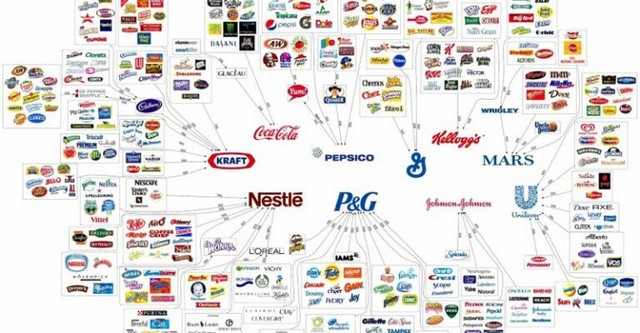
Some of the largest players in the food and agriculture sectors have been allowed to engage in anticompetitive mergers and practices that are as serious, if not more so, than those of which Big Tech stands accused. A wave of consolidation has given a few large companies control of proprietary, multi-level systems of traits, seeds, agrochemicals and digital technology.

3 Feb 2021 – Amid Congressional investigation and federal, state and private antitrust cases, all eyes are on Big Tech. The step up in antitrust enforcement against the digital technology behemoths and their alleged abuses of market power is, by all accounts, good news. Successful cases could restore competition, which would benefit smaller businesses and American consumers alike.

And after decades of under-enforcement of the antitrust laws in the U.S., these cases could deliver some base hits — and even home runs — for a critical area of law enforcement.

But the outsized media, political and social attention paid to the tech industry has diverted focus from other important sectors. There are monopolies and domestic cartels elsewhere — in healthcare, pharmaceuticals, media and communications, as well as food and agriculture. These industries produce goods and services that are essential to the health, safety and well-being of consumers, and even to our national security, which is why antitrust laws must be enforced against violations in these sectors, too.

The food system has been particularly fertile ground for rising concentration, the emergence of dominant firms and formation of domestic cartels. Some of the largest players have been allowed to engage in anticompetitive mergers and practices that are as serious, if not more so, than those of which Big Tech stands accused.

Much like their counterparts in the tech sector, many of the largest food and agriculture corporations have acquired their way to dominance by gobbling up rival businesses. This has occurred across the food system, including digital farming startups, biotechnology firms, food manufacturers, flour millers, farm machinery manufacturers and grocery store chains. But nowhere has it been more pronounced than agricultural inputs.

In acquiring competitors both small and large, the six biggest agricultural biotechnology firms collapsed rapidly into the Big Three — Bayer, DuPont and ChemChina. This wave of consolidation, which was met with little resistance from antitrust authorities, gave these corporations control of proprietary, multi-level systems of traits, seeds, agrochemicals and digital technology that limit farmers’ choices and lock them into limited cropping systems.

But some parts of the agricultural sector are rife with other damaging antitrust violations that we haven’t seen in Big Tech. This includes alleged conspiracies to fix prices and allocate markets — practices that are made possible by high levels of consolidation and concentration.

One of the most notable examples of this is in beef packing, where the top four firms now control about 85% of the national market. Given the market power that the packers possess, it comes as no surprise that they have allegedly abused it: On multiple occasions, these packers have been accused of colluding to pay ranchers less for cattle and charge consumers more for beef.

However, this behavior isn’t unique to the beef-packing sector. Similar allegations of price fixing have been leveled against tuna, chicken, turkey, egg, pork and peanut producers, among others. These cartels are especially egregious because processors allegedly collude on both the sell and buy sides, hurting both farmers and consumers — including independent restaurants and grocery stores.

Beyond anticompetitive practices, rising concentration has implications for our national food security. Concentration-driven bottlenecks along the supply chain make the entire food system vulnerable to disruption, a fact that has become painfully obvious during the pandemic.

Following a rash of COVID-19 outbreaks at meatpacking plants, national meat processing capacity declined by nearly half, resulting in supply chain breakdowns and price gouging that affected millions of Americans — many of whom were already experiencing food insecurity.

If disruption in the food supply system weren’t enough, the communities that support our food system are also at risk. Foreign companies now own a non-trivial portion of the United States’ farmland and food system. These entities not only resist food labeling and regulations that protect and inform consumers, they also take jobs and resources out of rural communities, accelerating social and economic decline and suppressing the growth of independent businesses that would contribute to revitalization.

Kudos to antitrust enforcers for finally taking aim at Big Tech. Monopolization cases — if they produce meaningful results — will improve the welfare of hundreds of millions of people that engage in online search, social networking and shopping. But we should not stop there. Americans depend on a safe, functional and resilient food system at least as much as they depend on their social media networks or ability to search the internet. Antitrust enforcers must turn their attention there next.

Watch here as Robert Reich of Inequality Media, explains
“The Monopolization of America”

_________________________________________________

Rob Larew is president of National Farmers Union, which represents 200,000 family farmers and ranchers across the country.

Dr. Diana Moss is the president of the American Antitrust Institute, which is devoted to promoting competition that protects consumers, businesses and society.

15 February 2021

Source: www.transcend.org

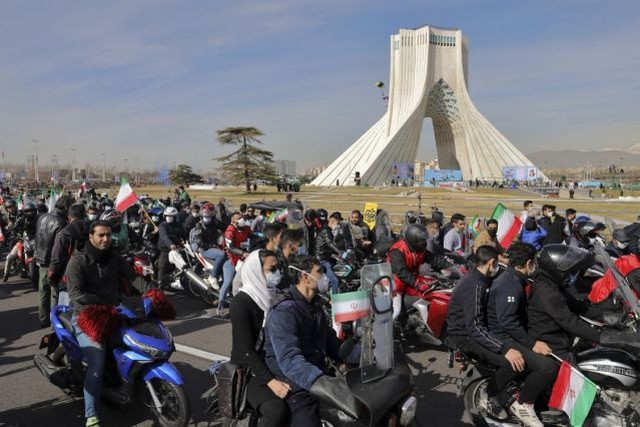
Iran’s Islamic Republic Celebrates Its 42nd Anniversary

By Richard Falk

Introduction

9 Feb 2021 – Iran is in the process of celebrating the 42nd Anniversary of the Islamic Revolution that led to the downfall of the Shah of Iran’s dynastic rule and its replacement by the Islamic Republic of Iran, which has defied the odds by resisting successfully a variety of attempts to restore the old established order either by an Iraqi encouraged war in the 1980s, destabilization efforts all along pushed by the U.S. and Israel, and an undisguised goal of regime change. It should also be remembered that the U.S. helped restore the Shah to his imperial crown in 1953 by helping to engineer a coup against the democratically elected Mohamad Mosaddeq. Months after the Shah abdicated and revolutionary supporters took over the Iranian government, Iranian students seized control of the American Embassy in Tehran and held the staff, including diplomats, hostage for more than a year. Such an event escalated the confrontation between Iran and the United States, which has risen to war-threatening heights at times, and veered toward normalization at other times. With a new American president in the White House who seems eager to promote a more moderate atmosphere in the Middle East there were widespread hopes for accommodation, but so far there are as many signs of continuity with the Trump years as indications of seeking accommodation based on equality and respect.

I am aware that it is ‘politically correct’ in the West to comment favorably on this anniversary occasion, but I continue to view Iran as practicing the politics of post-colonial self-determination that has made it a target for hostile forces in the Middle East and elsewhere, and that hopes for a peaceful regional future rest on the further dewesternization of liberal secular criteria of governmental and behavioral legitimacy. I would not minimize Iran’s bad record when it comes to human rights, but its emphasis in the Western media is more a matter of geopolitics than empathy for victims, especially if compared with the silence about much worse infractions by regional allies of the West, and taking account of the tendencies of even the purist of democracies to become paranoid and repressive when threatened by intervention and a counterrevolutionary crusade. Surely, maintaining comprehensive sanctions on Iran by the United States despite humanitarian appeals for their suspension during the COVID pandemic because of the massive harm done to the Iranian people should also be taken into account.

**************************

Q. 1: The anniversary of the victory of the Islamic Revolution in Iran is coming up. Many argue that the Iranian revolution, besides having internal effects, has affected the region and the international community. If you are positive with this viewpoint, what are its major international effects?

It is difficult to draw firm conclusions about cause and effect in international relations as there are many factors interacting at that same time. It seemed clear that the Islamic Revolution posed a challenge to Western vital strategic and economic interests that were tied closely to the Shah’s regime. It should be remembered that Henry Kissinger reminded the world that the Shah was “that rarest of things, an unconditional ally.” More broadly, the Islamic Revolution created the perception that the U.S. had a new adversary in the Middle East additional to, and perhaps more threatening, than the Soviet Union and the ideology of Marxism/Leninism. Its regional policies had previously emphasized, other than the containment of Soviet influence, access to oil at affordable prices and the security of Israel. This belief in Iran as a strategic threat was interpreted in the West as an ideological threat, as well, giving rise to Islamophobia that reached its peak in the United States after the 9/11 attacks in 2001 on the World Trade Center and Pentagon, primary symbols of American economic and military power.

Imam Khomeini reinforced Western and regional anxieties by his insistence that the transformation of Iran was an ‘Islamic Revolution,’ nor a ‘Iranian Revolution’ or a ‘Sunni Revolution,’ implying strong concerns beyond the borders of Iran. Such a sentiment had an electrifying and mobilizing effect on Islamic thought and action throughout the Arab world, and recreated the idea that territorial states within enclosed borders were a European conception of community imposed on the Middle East after World War I, and the collapse of the Ottoman Empire. Nationalist thinking and organization inauthentically displaced the primary existential community of shared adherence to Islamic beliefs, the umma. Such an interpretation of community undermined the legitimacy of many governments in the Arab/Islamic context that relied on nationalist and secular sources of legitimacy while actually serving the interests of the West.

The Western views of the Khomeini impact were highlighted by such phrases as regarding Islamic countries as the new ‘arc of crisis,’ or more memorably as ‘the clash of civilizations,’ the sequel to the Cold War, and the basis for a new phase of ideological and geopolitical confrontation.

The Israeli dimension of the effects of the Islamic Revolution in Iran should not be overlooked. Israel was regarded as an alien force in the region, anti-Islamic, secular, and a lingering remnant of the colonial era. For the West it was an outpost of enlightenment, modernity, and shared goals, and after the fall of the Shah the became the leading strategic ally of the United States, a relationship that continues to haunt the region with intervention and political violence, as well as the denial of basic rights to the Palestinian people in their own homeland.

Q. 2: Imam Khomeini, as the founder of the Islamic Revolution, unified the Muslim community towards certain causes, while before the Iranian revolution, there was not a dynamic wave of the Muslim community. What reasons caused that situation before the revolution?

Before the Iranian developments in 1978-79, the Middle East in particular was governed by authoritarian regimes that were on one side or the other of the Cold War rivalry between the U.S. and the Soviet Union. Many regional leaders in the Islamic world were fearful of the Islamic orientation of their own people, portraying Islam as anti-modern and an enemy of progress, and potentially threatening to the economic elites bonded with international capitalism. The Shah’s Iran typified this orientation and exhibited an acute form of civilizational alienation.

Imam Khomeini arrived on the political scene with a different vision of a political community animated by the resurgence of Islam as tradition and the foundation of ethically grounded governance. Because Iran faced counterrevolutionary threats from within and without, the governing challenges in Iran gave priority to protecting the revolution from its enemies, with a harshness often relied upon by the West to contend that the Islamic Revolution was a regressive development, a view encouraged by many of the Iranians who fled the country for various reasons. It is notable that these harsh tactics allowed the Islamic Revolution to survive and evolve, and contrasts with the experience of other efforts to achieve transformation, even reform, in Islamic countries, for instance, Egypt. The achievement of the Islamic Revolution is to persist in such a hostile environment suggests the skills of its leaders and the support of the great majority of its people.

Q. 3: Experts on the Palestinian issue argue that the Islamic Revolution changed the direction of fights against Israel. What is your opinion about this matter?

In a few words, whereas before the Islamic Revolution support for the Palestinian struggle was pragmatic and opportunistic, while afterwards identification with Palestine became a matter of fundamental principle and a source of authentic identity. The Islamic Republic of Iran, no matter what pressures it was subjected to during the last four decades, has never wavered in support for the rights of the Palestinian people.

Such speculation is difficult to be sure about as many forces were at work, but certainly the Islamic Revolution was one factor that altered the character of the struggle over the future of Palestine. From an Israeli perspective, Iran posed an increasing threat not only to its internal security and nationalist claims of legitimacy, but also to its regional and expansionist ambitions. At the same time, Iranian hostility to Israel reinforced Western hostility to the Islamic Republic. It also had the effect of leading the Gulf countries, with the exception of Qatar, to believe that their own legitimacy and stability was more threatened by the Islamic Republic than by Israel. These regimes, led by Saudi Arabia, also emphasized sectarian identities, insisting that only Sunni Islam was the true faith and that Shi’ia Islam was a deviation. At the same time, these Arab elites became persuaded that their rivalry throughout the Middle East with Iran was their primary concern, shared with Israel (and the United States), and that tensions and opposition to Israel no longer served governmental interests despite the persisting identification of their citizens with the Palestinian struggle. The climax of this revision of priorities became evident when the anti-Iran diplomacy was recently signaled to the world by the normalization agreements reached with several Arab countries, encouraged by others, and celebrated as a triumph of Trump’s pro-Israel foreign policy.

The Palestinian movement for self-determination was always viewed as problematic, and potentially dangerous, by the top-down governing processes in Iran and throughout the Arab world. Any bottom-up popular democratizing movement, epitomized by the Islamic Revolution in Iran and later by the rise to power of the Muslim Brotherhood in Egypt, was opposed by these repressive government scared of their own people. The Palestinian movement was deemed threatening in two of its dimensions—as putting forth political demands from below (a polar opposite from dynastic claims to rule from above, and so condition the role of Islam) and as challenging the links to the West to sustain internal security through weaponry and counterinsurgent tactics.

Q. 4: Was Imam Khomeini, as a spiritual leader, effective in changing the status of the Palestinian issue?

I think Imam Khomeini did give the Palestinian struggle a higher status than it had earlier possessed, particularly within the region, it became a matter of ethics, not just politics. His emphasis on Palestinian self-determination, the illegitimacy of the Zionist Project, was treated as a fundamental commitment of the Islamic Republic from its inception, and Israel was viewed as a distinctly Western challenge to the prevalence of his sense of the Islamic community of peoples. In the course of my meeting with Imam Khomeini he made very clear that in his view of the illegitimacy of a Jewish state based on claims of ethnic superiority coincided with his great respect for Judaism as an authentic religion. He expressed his hope at that time in 1979, that the Jewish minority in Iran would disentangle itself from identification with and support for Israel and the Zionist Project, and if this happened, he declared his view that it would be a tragedy for Iran if Jews did not remain in the country after the revolution.

This distinction between Israel and Judaism is crucial, and is the opposite of what the Israeli leadership and its more militant followers want the world to believe, which is that Israel, Jewishness, and Zionism are one, and that any criticism of Israel necessarily exhibits a form of anti-Semitism. Recently, the world respected Israeli human rights NGO issued a report that confirmed the view that Israel was an apartheid stated, premised on the efforts to make Israel ‘a Jewish supremacy state.’ As apartheid in any form is an international crime, listed as a Crime Against Humanity, in Article 7(j) of the Rome Statute governing the framework of the International Criminal Court in The Hague, the views of Imam Khomeini accord with basic principles of law and justice on this crucial matter of distinguishing between the State of Israel and the Jewish people.

Q. 5: It is widely believed that Iran’s resistance against international pressures has shifted the international order and has created a new resistance force against world powers. Can we connect this process to the current undermined position of the United States?

I believe it is correct that the failure of the United States to overcome Iranian resistance to its destabilization and counterrevolutionary efforts is viewed as one dimension of American imperial decline. Military intervention and even coercive diplomacy by way of sanctions and threats is far less effective than in the colonial era, and is unable to control the political outcomes of many internal struggles for the control of States. It has contributed to what is generally viewed as a much more multipolar world. New patterns of alignment are emerging globally and regionally. The Biden presidency will try to restore the Cold War Euro-centric pattern of alliances, with China as the new principal rival, with Russia also on the outside looking in. There are many uncertainties in all domains of international life that will reshape world order in coming years. Of especial importance will be the management of climate change, health hazards, and global economic policy. There are several lines of uncertainty, including whether a new form of ideological tension arises and inhibits global cooperative problem-solving. There is a need for stronger institutional mechanisms at all levels of political interaction to safeguard and promote the global public good. The United Nations could be reformed to play a more central role in moderating diversities of interests and values, while protecting the sovereign rights of States and extending a greater effort to impose UN Charter Principles on the five Permanent Members of the Security Council. The UN would benefit for greater funding independence and less tolerance for geopolitical impunity.

__________________________________________

Richard Falk is a member of the TRANSCEND Network, an international relations scholar, professor emeritus of international law at Princeton University, Distinguished Research Fellow, Orfalea Center of Global Studies, UCSB, author, co-author or editor of 60 books, and a speaker and activist on world affairs.

15 February 2021

Source: www.transcend.org

A Palestinian Balance Sheet: Normative Victories, Geopolitical Disappointments

By Richard Falk

Winning the Long Game

In recent weeks the Palestinian people have scored major victories that would have has immediate dire consequences for Israel if law and morality were allowed to govern political destiny. Instead, the Palestinian people are confronted by adverse geopolitical developments as a result of the Biden presidency, which have accepted some of the most regressive features of Trump’s hyper-partisanship with respect to Israel/Palestine. Law and morality alter reputations, bear on the legitimacy of contested policies, while geopolitics bear on behavior, the difference is one between legitimacy and hegemony. My unprovable hypothesis and firm belief is that hegemony wins out today, but legitimacy triumphs tomorrow.

There is a tendency to dismiss legitimacy gains should as what seems to matter in people’s lives seems remains frozen. In the long game of social change, especially in the course of the last 75 years, the winner of a Legitimacy War waged for the high legal and moral ground has more often than not eventually controlled the political outcome of a struggle, outlasting geopolitical dominance and military superiority along the way. The anti-colonial wars, it should not be forgotten, were won by the far weaker side militarily, which endured ordeals of desecration along their path to victory. This is the lesson such inspirational figures as Gandhi and Martin Luther King, Jr. gave their life to teach the world, so far with mixed results.

The Palestinian struggle continues, and offers the world of a paradigm of a colonial war carried on in a post-colonial era, in which cruel geopolitical tactics are required to swim against the strong liberation tides of history. Israel has proved to be a resourceful settler colonial state that has carried almost to completion the Zionist Project, moving forward toward its goals by stages, and always with the help of the geopolitical muscle of the West. Only recently has Israel lost control of the normative discourse that earlier it had dominated by highlighting the ghastly persecution of Jews who after the Holocaust deserved a secure sanctuary, a dismissal of nativist Palestinian claims to assert control over their own homeland, and cleverly arranging deceptive publicity portrays of the replacement of dirty backward Arab stagnancy by a dynamic modern, innovative, and flourishing Jewish society that sang and danced while the world slept. Israel later on made itself a valued Western foothold in a region coveted for its energy reserves and increasingly feared because of its anti-Western extremism and Islamic resurgence.

As with other anti-colonial struggles, the fate of the Palestinians will turn on whether the people can finally overcome a ruthlessly repressive state, given more leeway when linked, as is Israel, by regional and global strategic affinities with geopolitical actors. Can the Palestinian people secure their basic rights through their own distinctive blend of internal/external forces, resistance from within, global solidarity campaigns from without? This is the nature of the Palestinian Long Game. At present, this trajectory is hidden among the mysteries of unfolding national, regional, and global history.

Palestinian Normative Victories

Five years ago, no sensible person would have anticipated either that Israel’s most respected NGO, B’Tselem, would issue a report declaring that Israel had established an apartheid state that governed a single territory that stretched from the Jordan River to the Mediterranean Sea, that is, encompassing not only Occupied Palestine but Israel itself. With careful analysis the report showed that Israeli policies and practices with respect to immigration, land rights, residency, and mobility are administered in accordance within an overriding framework of Jewish supremacy, and by this logic, Palestinian (more accurately non-Jewish, including Druze and non-Arabic Christians) subjugation. Such a discriminatory and exploitative political arrangement is descriptive of apartheid, as initially established in South Africa and then generalized as an international crime in the 1973 International Convention on the Suppression and Punishment of the Crime of Apartheid. This idea of apartheid criminality was carried forward in the Rome Statute that provides the framework within which the International Criminal Court (ICC) in The Hague carries on its activities. Article 7 of the Statute enumerates the various Crimes Against Humanity over which the ICC asserts its jurisdictional authority. Apartheid is classified as such a crime in Article 7(j), although without a definition

Then came the much anticipated decision of the Pre-Trial Chamber of the ICC on February 5, 2021. By a 2-1 vote the Chamber’s decision affirmed the authority of Fatou Bensouda, the ICC Prosecutor, to proceed with an investigation of Israeli war crimes committed in Palestine since 2014, as geographically defined by its provisional 1967 borders. To reach this outcome the decision had to make two important pronouncements: first, that Palestine, although lacking many of the attributes of sovereignty, did qualify as a State for purposes of this ICC proceeding, having become a Party to the Rome Statute in 2014 after being recognized by the General Assembly on November 29, 2012 as a ‘non-member Observer State.’(Res. 67/19); and secondly, that the jurisdiction of ICC to investigate crimes committed on the territory of Palestine was authoritatively identified as the West Bank, East Jerusalem, and Gaza, that is, the territories occupied by Israel during the 1967 War.

It should be observed that this Pre-Trial proceeding had attracted unusually widespread interest in the world both because of the identity of the parties and the intriguing character of the issues. Jurists have long been intrigued by defining statehood in relation to different legal settings and by settling jurisdictional disputes addressing issues arising in territories that lack permanently established international borders. Signaling the high stakes of this legal proceeding, unprecedented 43 amicus curiae briefs were submitted, including by prominent figures on both sides of the controversy. Israel was not a Party to the Rome Statute, and declined to participate in the proceedings directly or be bound by the outcome, and yet was infuriated by the outcome, apparently sensing that it was losing control over the international minds and hearts.

This decision was promising beyond its strictly legal issues from a Palestinian point of view as a Preliminary Investigation conducted by the Prosecutor over the prior six years had already concluded that there was ample reason to support the conclusion that crimes had been committed by Israel and by Hamas in Palestine, specifically referencing three settings:

1. The massive IDF attack on Gaza in 2014, known as Operation Protective Edge;

2. the disproportionate uses of force by the IDF in responding to the Right of Return Gaza protests during 2018-19;

3. settlement activity in the West Bank and East Jerusalem.

It is now established that the Prosecutor can go forward, but all that glitters is not gold! Ms. Bensouda is schedule to leave the ICC in June when her term expires, and so far her replacement has not been selected. It is possible that a new prosecutor could use her or his discretion to discontinue the investigation, which reportedly is shaping the politics surrounding the appointment. It will become evident at that point as to whether the ICC gains a needed boost in its own efforts to disengage from the geopolitical architects of world order, or sinks back into its earlier ‘Africa Only’ image of international criminality.

Geopolitical Disappointments

It was reasonable, but maybe not realistic, for Palestine to hope that a more moderate Biden presidency would reverse the most damaging moves taken by Trump that had so overtly rejected international law and UN authority. The Biden Secretary of State, Antony Blinken, sent signals on the most significant issues that appeared to ratify rather than reverse or modify the Trump diplomacy. Blinken affirmed, what Biden had implied, to support the shift of the U.S. Embassy from Tel Aviv to Jerusalem, joining Trump in defying UNGA Resolution that enjoyed overwhelming support in 2017, declaring the Embassy move as ‘void’ and without legal effect. Blinken has also indicated U.S. support for Israel’s territorial incorporation of the Golan Heights, again defying international law and the UN, which had stood by a firm principle, earlier endorsed with respect to Israel’s occupation of Palestinian territories after the 1967 War in iconic Security Resolution 242, that territory could not be lawfully acquired by forcible conquest.

Assessing Gains and Losses

So far Israeli the significance of Israel’s setback in the Legitimacy War far outweighs Palestinian predictable geopolitical disappointments. Palestinian reactions to these disappointments have been muted as compared to Israeli apoplectic reaction to the ICC decision.

The fuming response of Netanyahu was replicated across by every leading Israeli politicians. In Netanyahu’s outrageous calumny against the ICC:

“When the ICC investigates Israel for fake war crimes, this is pure anti-Semitism,” adding, “We will fight this perversion of justice with all our might.”

Intemperate as are these remarks, they do show that Israel cares deeply about legitimacy issues, and rightly so. International law and morality can be defied but it is deeply wrong to suppose that they do not matter. South Africa learned that losing the Legitimacy War forced the dismantling of apartheid. Maybe Israeli leaders are beginning see the writing on the wall. In decades to come the ICC decision may turn out to be a turning point not unlike the 1960 Sharpeville Massacre. Before dawn, the night is darkest. The African majority waited more than 30 years for their emancipation from apartheid. The Palestinian people have already endured the hardships and humiliations of racist subjugation and Jewish supremacy for more than 70 years. When will it end, and how?

__________________________________________

Richard Falk is a member of the TRANSCEND Network, an international relations scholar, professor emeritus of international law at Princeton University, Distinguished Research Fellow, Orfalea Center of Global Studies, UCSB, author, co-author or editor of 60 books, and a speaker and activist on world affairs.

15 February 2021

Source: www.transcend.org

Chandra Singh Garhwali—World Peace Movement Will Never Forget the Soldier Who Refused to Fire on Unarmed Protestors

By Bharat Dogra

It was a tense day in Peshawar in 1930.The freedom movement under the guidance of Badshah Khan and the overall national leadership of Mahatma Gandhi was progressing from strength to strength. The Khudai Khidmatgars ( literally those who have committed themselves to serving God through service to humanity ) organized by the Badshah ( literally king, so called as he ruled the hearts of Pathans and others, although he personally lived the most frugal and simple life) had proven themselves to be true to their name. In terms of their commitment to non-violence these Pathans, who were earlier known for their violent feuds and revenges, had proved themselves closest to the ideals of non-violence as proclaimed by Mahatma Gandhi.

While the colonial regime sent soldiers armed by the latest weapons to curb them, the Khudai Khidmatgar protestors stood up bravely to them, unarmed and with prayers and freedom slogans on their lips.

Several Indian soldiers who had been brought to suppress them were from Garhwal. They were known as very brave and hardy soldiers from Garhwal region of Himalayas . They had proven themselves capable of winning several tough battles. But here when they were being asked to fire on their own unarmed brothers , they were becoming distressed and tense. How long can this go on ? During holidays when they went to their villages, they heard about the great freedom movement progressing under the leadership of Mahatma Gandhi and they felt happy and proud about this. But here they had been brought, as soldiers known for their loyalty, to suppress the same freedom movement in which their family members took pride and which attracted them too with its nobility and well justified demands. What should they do ?

So the freedom fighters who were clear about their mission and were ready for sacrifice and hence were not as tense as the soldiers were. The freedom fighters were happy with what they were planning to do ( despite all its risks ) but the soldiers were not at all happy with what were they being asked to do.

One unit of the soldiers was led by Chandra Singh Garhwali, a thoughtful soldier who had risen in ranks due to his skills , bravery and leadership qualities. The soldiers placed a lot of their faith and trust in him, and looked up to him to guide them in situations of uncertainty such as the one they faced now. Chandra Singh had been discussing the fast developing situation with his Garhwali soldiers, and while no firm decisions had been made yet, enough words had been exchanged to convince Chandra Singh that many other soldiers of his unit were as almost as disturbed and distressed as he was about the possibility of being asked to fire on unarmed, non-violent protestors and freedom fighters.

Finally the moment of reckoning came. The unarmed protestors stood before the soldiers bravely and calmly while the British commander gave the soldiers the order to fire. Chandra Singh Garhwali was supposed to repeat this order but instead he shouted—Do not fire. Cease fire. The soldiers followed the command of Chandra Singh and not of the much more senior British officer. The news spread like wild fire and brought unprecedented new hope to the freedom movement.

Chandra Singh had no intention of a full-scale rebellion. He knew that his handful of soldiers stood no chance against the huge colonial force. He and his unit soldiers were content with their very important decision to refuse to fire on unarmed, peaceful protestors. Chandra Singh told the British commander very firmly that even if you blow us with your guns and cannons we will not fire on unarmed peaceful protestors.

Needless to add, Chandra Singh and his mates all got very long and stringent imprisonments, even though his case was keenly contested by capable lawyers to avoid death sentence, and later a further reduction of prison sentence could be worked out after a lot of efforts. After his release Chandra Singh involved himself in diverse struggles and constructive activities. He also spent some time with Mahatma Gandhi in his ashram and later participated in Quit India Movement as well, leading to another prison sentence.

After independence he was also involved with the communist movement for some time. A postage stamp was issued in his name . In his last days he was involved in preparing a people-based development plan for a part of the Himalayan region. He had to endure a lot of economic hardships. He died after a life of many struggles and constructive activities in 1979 at the age of 88 following illness.

He and his fellow soldiers will be always remembered by the world peace movement for their courage and sacrifice in refusing to fire on peaceful protesters offering non-violent resistance. Thereby a new and glorious chapter was added and a new dimension was given to the history of non-violent struggles against injustice.

As he and his soldiers were Hindus and the overwhelming majority of the protesters were Pathan Muslims, Chandra Singh and his soldier mates also became a powerful symbol of communal harmony, and remain so to this day.

Rahul Sanskrityayan has written a detailed and great biography of Chandra Singh Garhwali in Hindi. Still his noble sacrifice is not as well known at world level as it deserves to be known, and his story should be told to a larger world audience.

Bharat Dogra is a veteran journalist and author.

12 February 2021

Source: countercurrents.org

Beyond Donald Trump

By Andrew Bacevich

When Martin Luther King preached his famous sermon “Beyond Vietnam” at Riverside Church in New York City in April 1967, I don’t recall giving his words a second thought. Although at the time I was just up the Hudson River attending West Point, his call for a “radical revolution in values” did not resonate with me. By upbringing and given my status as a soldier-in-the-making, radical revolutions were not my thing. To grasp the profound significance of the “the giant triplets of racism, extreme materialism, and militarism” to which he called his listeners’ attention was beyond my intellectual capacity. I didn’t even try to unpack their meaning.

In that regard, the ensuing decades have filled a void in my education. I long ago concluded that Dr. King was then offering the essential interpretive key to understanding our contemporary American dilemma. The predicament in which we find ourselves today stems from our reluctance to admit to the crippling interaction among the components of the giant triplets he described in that speech. True, racism, extreme materialism, and militarism each deserve — and separately sometimes receive — condemnation. But it’s the way that the three of them sustain one another that accounts for our nation’s present parlous condition.

Let me suggest that King’s prescription remains as valid today as when he issued it more than half a century ago — hence, my excuse for returning to it so soon after citing it in a previous TomDispatch. Sadly, however, neither the American people nor the American ruling class seem any more inclined to take that prescription seriously today than I was in 1967. We persist in rejecting Dr. King’s message.

Martin Luther King is enshrined in American memory as a great civil rights leader and rightly so. Yet as his Riverside Church Address made plain, his life’s mission went far beyond fighting racial discrimination. His real purpose was to save America’s soul, a self-assigned mission that was either wildly presumptuous or deeply prophetic.

In either case, his Riverside Church presentation was not well received at the time. Even in quarters generally supportive of the civil rights movement, press criticism was widespread. King’s detractors chastised him for straying out of his lane. “To divert the energies of the civil rights movement to the Vietnam issue is both wasteful and self-defeating,” the New York Times insisted. Its editorial board assured their readers that racism and the ongoing war were distinct and unrelated: “Linking these hard, complex problems will lead not to solutions but to deeper confusion.” King needed to stick to race and let others more qualified tend to war.

The Washington Post agreed. King’s ill-timed and ill-tempered presentation had “diminished his usefulness to his cause, to his country, and to his people.” According to the Post’s editorial board, King had “done a grave injury to those who are his natural allies” and “an even greater injury to himself.” His reputation had suffered permanent damage. “Many who have listened to him with respect will never again accord him the same respect.”

Life magazine weighed in with its own editorial slap on the wrist. To suggest any connection between the war in Vietnam and the condition of Black citizens at home, according to Life, was little more than “demagogic slander.” The ongoing conflict in Southeast Asia had “nothing to do with the legitimate battle for equal rights here in America.”

How could King not have seen that? In retrospect, we may wonder how ostensibly sophisticated observers could have overlooked the connection between racism, war, and a perverse value system that obsessively elevated and celebrated the acquisition and consumption of mere things.

More Than the Sum of Its Parts

In recent months, more than a few stressed-out observers of the American scene have described 2020 as this nation’s Worst. Year. Ever. Only those with exceedingly short memories will buy such hyperbole.

As recently as the 1960s, dissent and disorder occurred on a far larger scale and a more sustained basis than anything that Americans have endured of late. No doubt Covid-19 and Donald Trump collaborated to make 2020 a year of genuine misery and death, with last month’s assault on the Capitol adding a disconcerting exclamation point to the nightmare.

But recall the headline events following King’s Riverside Church presentation. The year 1968 began with the Tet Offensive in Vietnam, which obliterated official claims that the United States was “winning” the war there. Next came North Korea’s audacious seizure of a U.S. Navy ship, the USS Pueblo, a national humiliation. Soon after, President Lyndon Johnson’s surprise decision not to run for reelection turned the race for the presidency upside down.

In April, an assassin murdered Dr. King, an event that triggered rioting on a scale dwarfing 2020’s disturbances in Minneapolis, Minnesota, Portland, Oregon, and Kenosha, Wisconsin. (Mere days after the assassination, as I arrived in Washington for — of all things — a rugby tournament, fires were still burning and the skies were still black with smoke.) That June, not five years after his brother was shot and killed, Senator Robert Kennedy, his effort to win the Democratic presidential nomination just then gaining momentum, fell to an assassin’s bullet, his death stunning the nation and the world. The chaotic and violent Democratic National Convention, held in Chicago that August and broadcast live, suggested that the country was on the verge of coming apart at the seams. By year’s end, Richard Nixon, back from the political wilderness, was preparing to assume the reins as president — a prospect that left intact the anger and division that had been accumulating over the preceding 12 months.

True enough, the total number of American deaths caused by Covid-19 in 2020 greatly exceeds those from a distant war and domestic violence in 1968. Even so — and even without the menacing presence of Donald Trump looming over the political scene — the stress to which the nation was subjected in 1968 was at least as great as what occurred last year.

The point of making such a been-there/done-that comparison is not to suggest that, with Trump exiled to Mar-a-Lago, Americans can finally begin to relax, counting on Joe Biden to “build back better” and restore a semblance of normalcy to the country. Rather the point is that the evils afflicting our nation are deep-seated, persistent, and lie beyond the power of any mere president to remedy.

America’s Twenty-First-Century Racist Wars

A devotion to life, liberty, and the pursuit of happiness defines the essence of the American way of life. So the Founders declared and so we are schooled to believe. Well, yes, replied Dr. King in 1967, but racism, materialism, and militarism have likewise woven themselves into the fabric of American life. As much as we may prefer to pretend otherwise, those giant triplets define who we are as much as Jefferson’s Declaration or the Framers’ Constitution do.

For various reasons, Donald Trump not least among them, racism today again ranks atop the hierarchy of issues commanding national attention. Political progressives, champions of diversity, cultural elites, and even multinational corporations attentive to the bottom line profess their commitment to ending racism (as they define it) finally and forever. Some not-trivial portion of the rest of the population — the white nationalists chanting “You will not replace us,” for example — hold to another view. The elimination of racism, assuming such a goal is even plausible, will surely entail a further protracted struggle.

By 1967, King had concluded that winning that fight required expanding the scope of analysis. Hence, the imperative of speaking out against the Vietnam War, which until that moment he had hesitated to do. For King, it had become “incandescently clear” that the ongoing war was poisoning “America’s soul.” Racism and war were intertwined. They fed upon one another.

By now, it should be incandescently clear that our own forever wars of the twenty-first century, fought on a distinctly lesser scale than Vietnam, though over an even longer period of time, have had a similar effect. The places that the United States bombs, invades, and/or occupies typically fall into the category of what President Trump once disparaged as “shithole countries.” The inhabitants tend to be impoverished, non-white, non-English speaking, and, by American standards, often not especially well-educated. They subscribe to customs and religious traditions that many Americans view as primitive if not altogether alien.

That the average G.I. should deem the lives of Afghans or Iraqis of lesser value than the life of an American may be regrettable, but given our history it can hardly be surprising. A persistent theme of American wars going back to the colonial era is that, once the shooting starts, difference signifies inferiority.

Although no high-ranking government official and no senior military officer will admit it, racism permeates our post-9/11 wars. And as is so often the case, poisons generated abroad have a curious knack for finding their way home.

With few exceptions, Americans prefer to ignore this reality. Implicit in the thank-you-for-your-service air kisses so regularly lofted toward the troops is an illusion that wartime service correlates with virtue, as if combat were a great builder of character. Last month’s assault on the Capitol should finally have made it impossible to sustain that illusion.

In fact, as a consequence of our post-9/11 “forever wars,” the virus of militarism has infected many quarters of American society, perhaps even more so in our day than in King’s. Among the evident results: the spread of racist and extreme right-wing ideologies within the ranks of the armed services; the conversion of police forces into quasi-military entities with a penchant for using excessive force against people of color; and the emergence of well-armed militia groups posing as “patriots” while conspiring to overturn the constitutional order.

It’s important, of course, not to paint such a picture with too broad a brush. Not every soldier is a neo-Nazi — not even close. Not every cop is a shoot-first, then-knock racist thug. Not every defender of the Second Amendment conspires to “stop the steal” and reinstall Donald Trump in the Oval Office. But bad soldiers, bad cops, and traitors who wrap themselves in the flag exist in disturbingly large numbers. Certainly, were he alive today, Martin Luther King would not flinch from pointing out that the American penchant for war in recent decades has yielded a host of perverse results here at home.

Then there’s King’s third triplet, hidden in plain sight: the “extreme materialism” of a people intent on satisfying appetites that are quite literally limitless in a society that has become ever more economically unequal. Americans have always been the people of more. Enough is never enough. True in 1776, this remains true today.

A nation in which “machines and computers, profit motives and property rights” take precedence over people, King warned in 1967, courts something akin to spiritual death. King’s primary concern was not the distribution of material wealth, but the obsessive importance attributed to accumulating and possessing it.

Embracing equity as a major theme, the Biden administration holds to a different view. Its stated aim is to enable the “underserved and left behind” to catch up, with priority attention given to “communities of color and other underserved Americans.” In short: more for some, but not for others.

Such an effort will inevitably produce a backlash. Given a culture that deems billionaires the ultimate fulfillment of the American dream, the only politically acceptable program is one that holds out the promise of more for all. Since its very first days, the purpose of the American Experiment has been to satisfy this demand for more, even if perpetuating that effort today inflicts untold damage on the natural environment.

Prophetic Deficit

In his Riverside Church sermon, King mused that “the world now demands a maturity of America that we may not be able to achieve.” In the decades since, has our nation “matured” in any meaningful sense? Or have the habits of consumption that defined our way of life in 1967 only become more entrenched, even as Information Age manipulations to which Americans willingly submit reinforce those habits further?

Maturity suggests wisdom and judgment. It implies experience put to good use. Does that describe the America of our time? Again, it’s important to avoid painting with too broad a brushstroke. But ours is a country in which 74 million Americans voted to give Donald Trump a second term, a larger total than any prior presidential candidate ever received. And ours is a country in which millions believe that a cabal of Satan-worshiping pedophiles controls the apparatus of government.

Whether wittingly or not, when Joe Biden committed himself in 2020 to saving “the soul of America,” he was echoing Martin Luther King in 1967. But saving the nation’s soul requires more than simply replacing Trump in the Oval Office, issuing a steady stream of executive orders, and reciting speeches off a teleprompter (something that Biden does with evident difficulty).

Saving that soul requires moral imagination, a quality not commonly found in American politics. George Washington probably possessed it. Abraham Lincoln surely did. For a brief moment when delivering his Farewell Address, President Dwight D. Eisenhower spoke in a prophetic voice. So, too, did Jimmy Carter in his widely derided but enduringly profound “Malaise Speech” of 1979. But as this mere handful of examples suggests, the rough and tumble of political life only rarely accommodates prophets.

While Joe Biden may be a decent enough fellow, at no point in his long but not especially distinguished political career has he ever been mistaken for possessing prophetic gifts. Much the same can be said about the highly credentialed political veterans with whom he has surrounded himself: Kamala Harris, Antony Blinken, Lloyd Austin, Jake Sullivan, Janet Yellen, and the rest. When it comes to diversity, they check all the necessary boxes. Yet none of them gives even the slightest indication of grasping the plight of a nation held in the grip of King’s giant triplets.

As a devout Christian and a preacher of surpassing eloquence, King knew that salvation begins with an admission of sinfulness, followed by repentance. Only then does redemption become a possibility.

Only by acknowledging the evil caused by the simultaneous presence of racism and materialism and militarism at the heart of this country will it be remotely possible for the United States to take even the first few halting steps toward redemption. We await the prophetic voice that will awaken the American people to this imperative.

Andrew Bacevich, a TomDispatch regular, is president of the Quincy Institute for Responsible Statecraft.

12 February 2021

Source: countercurrents.org