Just International

An Open Letter to The Most Reverend David Malloy, Bishop of Rockford, Illinois, Chair United States Conference of Catholic Bishops Committee on International Justice and Peace

They have treated the wound of my people carelessly,
saying, “Peace, peace,” when there is no peace.

Jeremiah 8:11

Jerusalem September 8th, 2020

Your Excellency,

We read your statement (August 13) that shows your satisfaction with the peace agreement between Israel and the UAE. We would like, as Christian Palestinian movements for justice and peace, to send you some of our observations on this issue.

People who think that any mutual recognition between an Arab country and the state of Israel is a step forward towards peace are mistaken. It would be a step towards peace if this accord were accompanied by the resolution of the core of the conflict: the Israeli military occupation of the Palestinian land.

Establishing peace relations between Israel and Arab states starts by ending the Israeli occupation and granting the Palestinians their rights, including the right to self-determination. Any other path is a false way to peace. Isolating then cornering the “poor” to kneel before the powerful is surrender, not peace. Moreover, if the Arab regimes will recognize Israel, their peoples will refuse to normalize with the Israelis, as long as the Palestinians remain under oppression. True peace doesn’t start with forging peace agreements with Arab countries but rather with the Palestinians. True peace should start in the hearts of the Palestinians, and this is in the hands of Israel to recognize a Palestinian state on the 22% left from historic Palestinian land. It is a question of the equality between peoples, all of whom have been created equal by God.

You condone the agreement because it delayed the annexation of more than 30% of what is left of Palestinian land. But this delay is in words only. In fact, on the ground de facto annexation is an ongoing process, day after day, through daily cruel and destructive actions of the army and the settlers against Palestinian farmers, including the constant stealing of Palestinian land and building of settlements. Netanyahu himself declared that the annexation was not cancelled but postponed.

Some people call this accord the Abraham agreement. Here we say, enough exploiting of God and God’s prophets to side with the powerful. If we call on God and the prophets in this matter, we must then observe God’s commandments and the equality God has given to all peoples—including Israelis and Palestinians. Justice to all. Now on the ground, as the “powerful” take what is theirs and what is others, they are even supported by many churches. The weak are deprived of their rights while the powerful and the churches respond with words, but no action.

You speak about direct negotiations. They took place for 30 years and Israel kept saying “no” to the minimum requirements of the Palestinians. Going back to negotiations with the same disposition of the powerful is insane. But if the powerful show more equity towards the other party (regarding Jerusalem and acknowledging the equality of all), negotiations will make sense.

Finally, Palestinians rejected Trump’s deal of the century because it did not answer to the minimal requirements of the Palestinians described in UN resolutions and international laws. Trump’s plan has declared Jerusalem only as Israel’s capital. His plan has taken away what belongs to the Palestinians and given it to Israel. It is a perpetuation of the long injustice imposed by the Israelis upon the Palestinian people.

Real peace is to support the “poor” and to say “no” to the injustice inflicted by the “powerful” on the weak. In this way, churches should lobby their governments to put an end to this prolonged tragedy of the peoples of the Holy Land.

With our best fraternal wishes and regards.

  • H.B. Michel Sabbah, Patriarch Emeritus
  • Mr. Rifat Kassis, Coordinator of Kairos Palestine
  • Mr. Fuad Giacaman, Coordinator of NCCOP & Director of Arab Educational Institute
  • Rev. Dr. Mitri Raheb, President, DIYAR
  • Mr. Omar Harami, Sabeel Ecumenical Liberation Theology Center
  • Mr. Nader Abu Amsha, The East Jerusalem Rehab. Program & Beit Sahour YMCA
  • Professor Mazin Qumsiyeh, Director, Palestine Institute for Biodiversity and Sustainability,  Bethlehem University
  • Rev. Dr. Munther Isaac, Director of Christ at the Checkpoint conference
  • Mr. Nidal Abu Zuluf, Joint Advocacy Initiative (JAI)

Source: palestineupdates.com


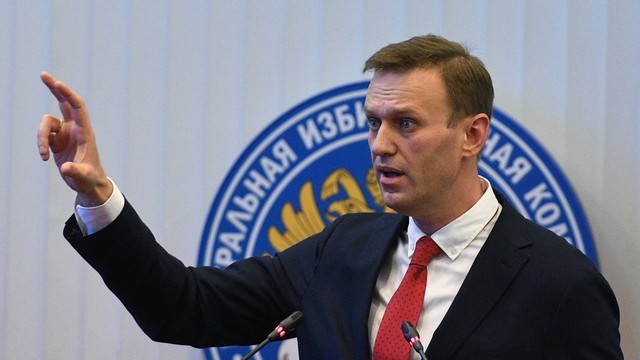
Craig Murray: Opposition figure Navalny may possibly have been targeted by Russian state, but Western narrative doesn’t add up

Craig Murray is an author, broadcaster and human rights activist. He was British Ambassador to Uzbekistan from August 2002 to October 2004 and Rector of the University of Dundee from 2007 to 2010.

Once Russian anti-corruption campaigner Alexey Navalny was in Berlin it was only a matter of time before it was declared that he was poisoned with Novichok. The Russophobes are delighted.

This of course eliminates all vestiges of doubt about what happened to the Skripals, and proves that Russia must be isolated and sanctioned to death and we, in the West, must spend untold billions on weapons and security services. We must also increase domestic surveillance and crack down on dissenting online opinion. It also proves that Donald Trump is a Russian puppet and Brexit is a Russian plot.

I am going to prove beyond all doubt that I am a Russian troll by asking the question Cui Bono?, brilliantly identified by the Integrity Initiative’s Ben Nimmo as a sure sign of Russian influence.

I should state that I have no difficulty at all with the notion that a powerful oligarch or an organ of the Russian state may have tried to assassinate Navalny. He is a minor irritant, not remotely as politically important in Russia as he is portrayed by the Western press, but not being a major threat does not protect you against political assassination in Russia.

What I do have difficulty with is the notion that if Putin, or other very powerful Russian actors, wanted Navalny dead, and had attacked him while he was in Siberia, he would not be alive in Germany today. If Putin wanted him dead, he would be dead.

Let us first take the weapon of attack. One thing we know about a “Novichok” for sure is that it appears not to be very good at assassination. Poor Dawn Sturgess is the only person ever to have allegedly died from “Novichok,” accidentally, according to the official narrative. “Novichok” did not kill the Skripals, the actual target. If Putin wanted Navalny dead, he would try something that works. Like a bullet to the head, or an actually deadly poison.

“Novichok” is not a specific chemical. It is a class of chemical weapon designed to be improvised in the field from common domestic or industrial precursors. It makes some sense to use on foreign soil as you are not carrying around the actual nerve agent, and may be able to buy the ingredients locally. But it makes no sense at all in your own country, where the FSB or GRU can swan around with any deadly weapon they wish, to be making homemade nerve agents in the sink. Why would you do that?

Further we are expected to believe that, having poisoned Navalny, the Russian state then allowed the airplane he was traveling in, on a domestic flight, to divert to another airport, and make an emergency landing, so he could be rushed to hospital. If the Russian secret services had poisoned Navalny at the airport before takeoff as alleged, why would they not insist the plane stick to its original flight plan and let him die on the plane? They would have foreseen what would happen to the victim during the flight.

Next, we are supposed to believe that the Russian state, having poisoned Navalny, was not able to contrive his death in the intensive care unit of a Russian state hospital. We are supposed to believe that the evil Russian state was able to falsify all his toxicology tests and prevent doctors telling the truth about his poisoning, but the evil Russian state lacked the power to switch off the ventilator for a few minutes or slip something into his drip. In a Russian state hospital.

Next we are supposed to believe that Putin, having poisoned Navalny with novichok, allowed him to be flown to Germany to be saved, making it certain the novichok would be discovered. And that Putin did this because he was worried Merkel was angry, not realising she might be still more angry when she discovered Putin had poisoned him with novichok.

There are a whole stream of utterly unbelievable points there, every single one of which you have to believe to go along with the western narrative. Personally I do not buy a single one of them, but then I am a notorious Russophile traitor.

The United States is very keen indeed to stop Germany completing the Nord Stream 2 pipeline, which will supply Russian gas to Germany on a massive scale, sufficient for about 40 percent of its electricity generation. Personally I am opposed to Nord Stream 2 myself, on both environmental and strategic grounds. I would much rather Germany put its formidable industrial might into renewables and self-sufficiency. But my reasons are very different from those of the USA, which is concerned about the market for liquefied gas to Europe for US producers and for the Gulf allies of the US. Key decisions on the completion of Nord Stream 2 are now in train in Germany.

The US and Saudi Arabia have every reason to instigate a split between Germany and Russia at this time. Navalny is certainly a victim of international politics. That he is a victim of Putin I tend to doubt.

Republished with permission of the author. This article originally appeared here.

6 September 2020

Source: www.rt.com

Peace Is Endangered Not by Chinese Military Expansion but by a Declining US Viewing It as an Existential Threat

By Scott Ritter

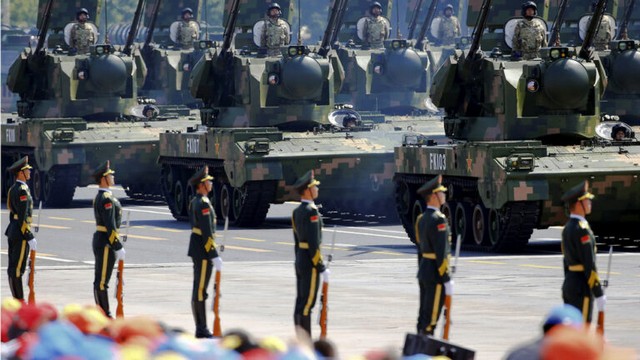
2 Sep 2020 – A report from the US Department of Defense paints China as a rising military power capable of challenging America for global superiority. The reality is that the report is a product of Washington’s nervous psychological state.

The US Department of Defense has released a sobering assessment of Chinese military capability which throws into question the viability of any ‘Pacific pivot’ as the US undergoes its own military restructuring, designed in part to meet the challenges posed by a Beijing increasingly comfortable with its expanded role in global affairs.

The 173-page report, titled ‘Military and Security Developments Involving the People’s Republic of China’, attaches relevance to nearly every aspect of the country’s military expansion, from nuclear weapons to naval ships, and couches them exclusively as examples of a projection of military that might be designed to challenge the US as a leader on the global stage.

Missing from this assessment is any reflection on the role played by the US in triggering this Chinese military buildup. For example, there is no mention of the cause and effect relationship between America’s abandonment of the Intermediate Nuclear Forces (INF) treaty, or its insistence on trilateral negotiations involving China when it comes to the extension of the bilateral US-Russian New START treaty, and China’s decision to modernize and expand its own arsenal of nuclear weapons (from 200 to 400, inclusive of strategic and intermediate weapons – a paltry sum when compared to the 1,550 strategic nuclear weapons the US maintains).

Likewise, at a time when China is aggressively pursuing its disputed territorial claims in the South China Sea, the decisions by the US to project its own naval power in response, in the form of aircraft carrier battlegroups, could logically explain China’s expansion of its own naval capabilities.

This does not mean that China is not a rising global force possessing international interests deemed vital to its own national security, which it requires the projection of its military power to secure.

It has also been engaged in a massive expansion of its global economic reach, known as the Belt and Road Initiative. Since its unveiling in 2013, this has morphed into two separate but complementary programs: the land-based Silk Road Economic Belt, comprising six ‘development corridors’, and the ‘21st Century Maritime Silk Road’, which links China with South Asia, Africa, the Middle East and Europe.

While the initiative is exclusively economic, the new reality created by China’s expansive global economic presence has prompted China to establish military bases in Africa and elsewhere, designed to secure the vital lines of communication necessary for the success and survival of the plan.

For 75 years, the United States has pursued policies linked to a post-World War Two “rules-based order” promoting a framework of liberal political and economic rules sustained by a network of international organizations and regulations, all tied to the notion of unchallenged US leadership. This “rules-based order” has underpinned US relations with Europe, through the trans-Atlantic partnership embodied by NATO, and in the Pacific, in terms of the post-war relationships the US maintains with Japan, South Korea and Australia.

The idea of a liberal “rules-based order” could be defended during the period of the Cold War, where the US and its allies faced off against the Soviet Union and Communist China in a bi-polar ideological battle for global influence. This model, though, built as it was on the principle of American exceptionalism, has proven more difficult to justify and sustain in the years following the collapse of the Soviet Union.

The notion of all-powerful American unilateralism floundered in the face of a multi-polar global reality and the disastrous post-9/11 military interventions in Afghanistan and Iraq. In short, US leadership has been wanting for some time, and where vacuums were created, nations like China were all too willing to fill them – not out of any desire to confront Washington, but rather as the natural development of a global community not longer tied to the singularity of American economic and military dominance.

The US today is a nation in decline. This does not mean that it is going the way of the dinosaur – far from it. The US is, and will continue to be for the foreseeable future, a major power with unmatched global reach. But the day of guaranteed American supremacy has gone.

Indeed, this decline has been hastened by the impact of the global Covid-19 pandemic, which has found America wanting in terms of both a domestic and international response. Serious social inequities in terms of race relations, health care failures, and economic fundamentals have manifested themselves in a divisive domestic political reality that further encumbers the US in terms of projecting leadership abroad.

The gloomy assessment contained in the ‘Military and Security Developments Involving the People’s Republic of China’ report is causally linked to this decline. There is a psychological disorder known as ‘projection’, which refers to the unconscious act of taking emotions or traits one finds disagreeable about themselves, and attributing them to someone else. The Department of Defense is guilty of this psychological projection when it comes to its assessment of China.

As a nation in decline, the US is unable and/or unwilling to accept this new reality, and as such is incapable of carrying out the kind of self-diagnosis necessary to slow or halt this decline. As other nations, such as China, step into the breach created by a US power in retrograde, American policy makers – rather than attribute the Chinese actions as a logical cause-effect manifestation of reality – instead project onto China the very behavioral traits about the US that have helped bring about its shrinking global reach and influence.

The truism that one cannot solve a problem that is not properly defined applies in full here. By projecting its own failed global ambitions onto China, the Department of Defense is failing to address the real reasons behind China’s military expansion.

While in a purely academic environment such a disconnect would provide fodder for further study, in the real world it can lead to the kind of miscalculations that lead to confrontations that might otherwise be avoided. Seen in this light, this new report exposes the fact that the real threat to global peace and security is not Chinese military expansion, but US psychological projection which defines Beijing’s actions as an existential threat that must be confronted.

Scott Ritter was a US Marine Corps intelligence officer for 12 years.

7 September 2020

Source: www.transcend.org

The U.S. Is Determined to Make Julian Assange Pay for Exposing the Cruelty of Its War on Iraq

By Vijay Prashad

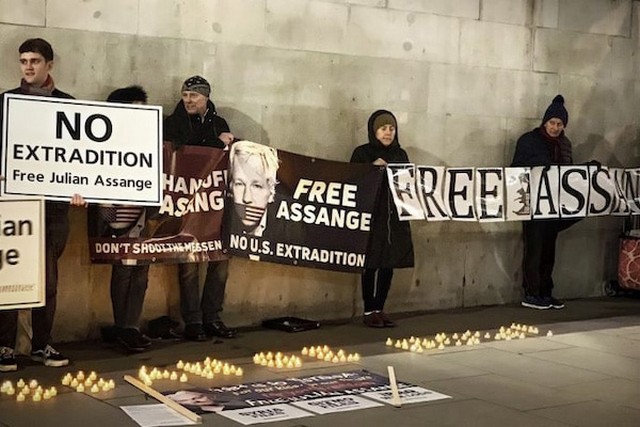
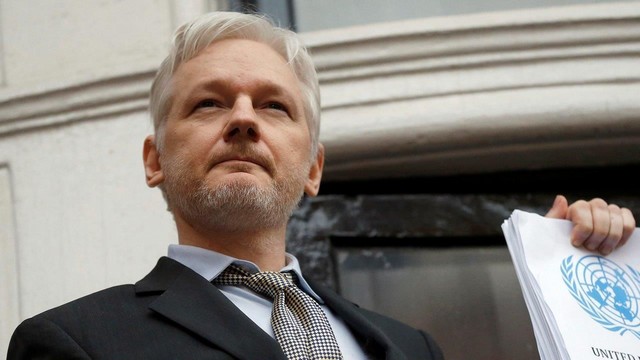
2 Sep 2020 – On September 7, 2020, Julian Assange will leave his cell in Belmarsh Prison in London and attend a hearing that will determine his fate. After a long period of isolation, he was finally able to meet his partner—Stella Moris—and see their two sons—Gabriel (age three) and Max (age one)—on August 25. After the visit, Moris said that he looked to be in “a lot of pain.”

The hearing that Assange will face has nothing to do with the reasons for his arrest from the embassy of Ecuador in London on April 11, 2019. He was arrested that day for his failure to surrender in 2012 to the British authorities, who would have extradited him to Sweden; in Sweden, at that time, there were accusations of sexual offenses against Assange that were dropped in November 2019. Indeed, after the Swedish authorities decided not to pursue Assange, he should have been released by the UK government. But he was not.

The true reason for the arrest was never the charge in Sweden; it was the desire of the U.S. government to have him brought to the United States on a range of charges. On April 11, 2019, the UK Home Office spokesperson said,

“We can confirm that Julian Assange was arrested in relation to a provisional extradition request from the United States of America. He is accused in the United States of America of computer-related offenses.”

Manning

The day after Assange’s arrest, the campaign group Article 19 published a statement that said that while the UK authorities had “originally” said they wanted to arrest Assange for fleeing bail in 2012 toward the Swedish extradition request, it had now become clear that the arrest was due to a U.S. Justice Department claim on him. The U.S. wanted Assange on a “federal charge of conspiracy to commit computer intrusion for agreeing to break a password to a classified U.S. government computer.” Assange was accused of helping whistleblower Chelsea Manning in 2010 when Manning passed WikiLeaks—led by Assange—an explosive trove of classified information from the U.S. government that contained clear evidence of war crimes. Manning spent seven years in prison before her sentence was commuted by former U.S. President Barack Obama.

While Assange was in the Ecuadorian embassy and now as he languishes in Belmarsh Prison, the U.S. government has attempted to create an air-tight case against him. The U.S. Justice Department indicted Assange on at least 18 charges, including the publication of classified documents and a charge that he helped Manning crack a password and hack into a computer at the Pentagon. One of the indictments—from 2018—makes the case against Assange clearly.

The charge that Assange published the documents is not the central one, since the documents were also published by a range of media outlets such as the New York Times and the Guardian. The key charge is that Assange “actively encouraged Manning to provide more information and agreed to crack a password hash stored on U.S. Department of Defense computers connected to the Secret Internet Protocol Network (SIPRNet), a United States government network used for classified documents and communications. Assange is also charged with conspiracy to commit computer intrusion for agreeing to crack that password hash.” The problem here is that it appears that the U.S. government has no evidence that Assange colluded with Manning to break into the U.S. system.

Manning does not deny that she broke into the system, downloaded the materials, and sent them to WikiLeaks. Once she had done this, WikiLeaks, like the other media outlets, published the materials. Manning had a very trying seven years in prison for her role in the transmission of the materials. Because of the lack of evidence against Assange, Manning was asked to testify against him before a grand jury. She refused and now is once more in prison; the U.S. authorities are using her imprisonment as a way to compel her to testify against Assange.

What Manning Sent to Assange

On January 8, 2010, WikiLeaks announced that it had “encrypted videos of U.S. bomb strikes on civilians.” The video, later released as “Collateral Murder,” showed in cold-blooded detail how on July 12, 2007, U.S. AH-64 Apache helicopters fired 30-millimeter guns at a group of Iraqis in New Baghdad; among those killed were Reuters photographer Namir Noor-Eldeen and his driver Saeed Chmagh. Reuters immediately asked for information about the killing; they were fed the official story and told that there was no video, but Reuters futilely persisted.

In 2009, Washington Post reporter David Finkel published The Good Soldiers, based on his time embedded with the 2-16 battalion of the U.S. military. Finkel was with the U.S. soldiers in the Al-Amin neighborhood when they heard the Apache helicopters firing. For his book, Finkel had watched the tape (this is evident from pages 96 to 104); he defends the U.S. military, saying that “the Apache crew had followed the rules of engagement” and that “everyone had acted appropriately.” The soldiers, he wrote, were “good soldiers, and the time had come for dinner.” Finkel had made it clear that a video existed, even though the U.S. government denied its existence to Reuters.

The video is horrifying. It shows the callousness of the pilots. The people on the ground were not shooting at anyone. The pilots fire indiscriminately. “Look at those dead bastards,” one of them says, while another says, “Nice,” after they fire at the civilians. A van pulls up at the carnage, and a person gets out to help the injured—including Saeed Chmagh. The pilots request permission to fire at the van, get permission rapidly, and shoot at the van. Army Specialist Ethan McCord—part of the 2-16 battalion that had Finkel embedded with them—surveyed the scene from the ground minutes later. In 2010, McCord told Wired’s Kim Zetter what he saw:

“I have never seen anybody being shot by a 30-millimeter round before. It didn’t seem real, in the sense that it didn’t look like human beings. They were destroyed.”

In the van, McCord and other soldiers found badly injured Sajad Mutashar (age 10) and Doaha Mutashar (age five); their father, Saleh—who had tried to rescue Saeed Chmagh—was dead on the ground. In the video, the pilot saw that there were children in the van; “Well, it’s their fault for bringing their kids into a battle,” he says callously.

Robert Gibbs, the press secretary for President Barack Obama, said in April 2010 that the events on the video were “extremely tragic.” But the cat was out of the bag. This video showed the world the actual character of the U.S. war on Iraq, which the United Nations Secretary-General Kofi Annan had called “illegal.” The release of the video by Assange and WikiLeaks embarrassed the United States government. All its claims of humanitarian warfare had no credibility.

The campaign to destroy Assange begins at that point. The United States government has made it clear that it wants to try Assange for everything up to treason. People who reveal the dark side of U.S. power, such as Assange and Edward Snowden, are given no quarter. There is a long list of people—such as Manning, Jeffrey Sterling, James Hitselberger, John Kiriakou, and Reality Winner—who, if they lived in countries being targeted by the United States, would be called dissidents. Manning is a hero for exposing war crimes; Assange, who merely assisted her, is being persecuted in plain daylight.

On January 28, 2007, a few months before he was killed by the U.S. military, Namir Noor-Eldeen took a photograph in Baghdad of a young boy with a soccer ball under his arm steps around a pool of blood. Beside the bright red blood lie a few rumpled schoolbooks. It was Noor-Eldeen’s humane eye that went for that photograph, with the boy walking around the danger as if it were nothing more than garbage on the sidewalk. This is what the U.S. “illegal” war had done to his country.

All these years later, that war remains alive and well in a courtroom in London; there Julian Assange—who revealed the truth of the killing—will struggle against being one more casualty of the U.S. war on Iraq.

Vijay Prashad is an Indian historian, editor and journalist.

7 September 2020

Source: www.transcend.org

The OAS Accusation of Electoral Fraud against Evo Morales Is Bullshit — and Now We Have the Data to Prove It

By David Rosnick

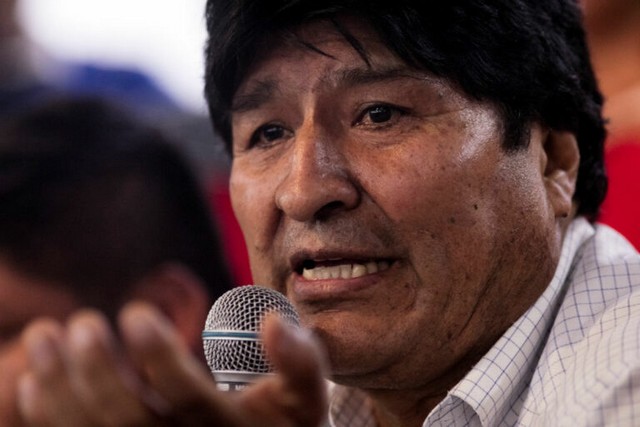
The day after the Bolivian election, the Organization of American States suggested the result was fraudulent — then took months to provide any proof. Last month, it finally released its data — and researchers at the Center for Economic and Policy Research found a basic coding error that destroys the OAS’s case against Morales.

5 Sep 2020 – August 20 was a day that shook a small world of scientists that had all but given up — short of legal threats — on getting a glimpse into the data and methods behind the analyses that took down the Bolivian government. Slowed by stonewalling and gaslighting, researchers had managed to re-create some — but not all — of the results presented by the Organization of American States (OAS) in its case against the legitimacy of Evo Morales’s reelection last October 20.
The OAS had alleged, the day after the vote, that the preliminary count contained an “inexplicable change in trend” of the preliminary results — drastically skewing in Morales’s favor. But its claim was dubious to begin with. As early as October 22, we began raising serious questions suggesting the “inexplicable change” was quite predictable.The OAS would later support its allegation by claiming that the official count also contained a late break for Morales that “cannot be easily explained away” by Morales’s generally rural support specifically because the official count “data do not reflect the time the results were reported to the TSE [Tribunal Supremo Electoral].” This premise is entirely wrong; votes from the main cities were much more likely to be counted early, because the official count required hand delivery (rather than electronic transmission) of electoral materials to TSE offices.Faulty reasoning aside, the OAS results were irreproducible.

Ten months later came the revelation that some of the OAS’s previously baffling conclusions are explained by a coding error. It had ordered the time stamps on the tally sheets alphabetically rather than chronologically — thus destroying its narrative of a sudden change in the official count.

Unjustly Forced Out

The damage, of course, had already been done. On November 11, 2019, Bolivia’s president, Evo Morales — his term not yet complete — stepped down from the presidency amid allegations of fraud. Decisive was the report from the OAS, which had just presented its preliminary findings in a binding audit of the October 20 election. These findings were not favorable to Morales, questioning his official first-round victory.

Members of the opposition, some of whom had been saying all along that Morales and his Movement Toward Socialism (MAS-IPSP) party would attempt fraud to stay in power, took to the streets in violent protest. Though Morales agreed to annul the election, the head of the military told him he should step down. He resigned and embarked on a dramatic flight from Bolivia to Mexico — barely making it out alive, according to the Mexican foreign minister.

This isn’t the first time the OAS has deployed poor statistics to overturn election results. In 2010, the OAS intervened in Haiti, demanding that the third-place candidate be permitted to participate in a runoff election with the first-place candidate — leaving the runner-up, who just happened to be the only non-right-wing candidate, out in the cold.

To be sure, security surrounding Bolivia’s election was insufficient. At the risk of whataboutism, the same could be said of most any election in the United States. However, the OAS’s findings presented in November were otherwise full of insinuation and short on detail. The OAS presented no actual evidence that even a single vote was altered. Instead, it offered a statistical analysis that statistician Andrew Gelman characterizes as “a joke.”

Convenient Conclusions, Dodgy Assumptions

Even if the approach was dubious and the results were irreproducible, at least it presented something. The OAS press release the day after the vote had presented no such analysis — though it certainly did raise the volume of opposition protests. Amid cries of “fraud,” prominent members of Morales’s party and their families were assaulted or threatened with murder. Jeanine Áñez’s “interim” government — still in power today, having three times delayed new elections— would later cite the OAS reports as its near-exclusive evidence in its campaign to dismantle MAS.

Despite repeated requests, the OAS offered no justification for their claims. This, even though the results seemed in line with pre-election polls. With the preliminary count 84 percent complete, Morales had received more than 45 percent of the valid votes in a nine-way race. Yet under Bolivian electoral law, this would not be enough to win the race outright: only if he had an absolute majority, or a 10-point lead over runner-up Carlos Mesa, would Morales avoid a second-round runoff.

Morales’s lead increased steadily as the preliminary count had progressed. This offered no particular reason to think anything was odd. Rather, tally sheets from areas supportive of Morales have tended to be counted later than tally sheets from areas favorable to the opposition, and that was the case in this election. Imagine first counting votes from Los Angeles, New York City, Chicago, and Washington, DC, before considering rural Texas, Tennessee, or Alabama. Nobody would be surprised that the inclusion of Republican areas in the count would steadily chip away at the early Democratic lead.

Shortly before the announcement of partial, unofficial, preliminary results on the evening of October 20, there was a surge of votes counted from Santa Cruz — a hotbed of anti-Morales sentiment that dented the nearly constant good news for the incumbent president. In any case, the tally sheets that remained to be counted were coming from areas that had already shown, on balance, a strong preference for Morales. When the rapid count paused with 84 percent of votes counted, Morales’s lead over Mesa was only about 8 percentage points. Yet when the preliminary results were next reported, a day later, with another 9 percent of the vote, Morales had (tentatively) a 10-point lead — and his first-round victory.

Was this victory inexplicable — constructed in the darkness — as the OAS suggested? Was it a change of fate, or inevitable? My colleague Jake Johnston quickly put together an analysis of the results in the capital city of Cochabamba, where the swing was particularly visible. Breaking down the results by precinct, Jake showed that there was very little change in Morales’s support before and after the interruption of the count; in large part, Morales performed better, late, in Cochabamba, because precincts more favorable to the incumbent were — for whatever reason — counted later. A more rigorous approach over the entire election suggested by John Newman would show likewise: in the locality of Cochabamba, Morales actually underperformed late when the mix of precincts is taken into account.

So it went for the whole election. Consistently, studies have shown that once the different composition of precincts before and after the interruption is accounted for, Morales’s victory was predictable.

The OAS Final Audit

The OAS analyses have been notable for a steadfast refusal to consider such intra-geographic differences, presuming — contrary to all evidence — that a candidate’s support should be more or less uniform throughout the count.

The OAS final audit report on December 4 was explicitly biased in casting doubt on Morales’s first-round victory. The audit team expressly looked for irregularities on tally sheets that heavily favored Morales — justifying this selective search based on alleged statistical evidence that Morales’s victory was “inexplicable.” However, the statistical evidence presented in the OAS audit was not merely unconvincing; the analysis was completely wrong. The analysis boiled down to two points.

First, the OAS argued that the last 5 percent of the vote in the unofficial, preliminary count showed “a striking upward trend . . . that is quite different.” However, it is not unusual for late swings in a count to prove decisive. As noted in an open letter by economists and statisticians:

It is not uncommon for election results to be skewed by location, which means that results can change depending on when different areas’ votes get counted. No one argued that there was fraud in Louisiana’s 16 November gubernatorial election, when the Democratic candidate John Bel Edwards, pulled out a 2.6% point victory, after being behind all night, because he won 90% of the vote in Orleans county, which came in at the end of the count.

The order in which preliminary results were reported publicly was slightly different than the order in which Irfan Nooruddin (the author of the OAS statistical analyses) considers them. Many tally sheets throughout the count were transcribed but set aside for later approval. Those approved at the end tended to be much more representative of the entire election— even unfavorable to Morales. Regardless, the upward trend in Nooruddin’s data was predictable based on the earlier data, because his late tally sheets came from areas that had overwhelmingly shown strong support for Morales.

Second, Nooruddin argued that this finding is bolstered by the fact that the last 5 percent of the vote in the official count was also inconsistent with the previous 95 percent and again the penultimate 5 percent. Specifically, the OAS presented graphs showing that Morales’s vote share increased sharply after the 95 percent mark, while Mesa’s plummeted.

But these results were completely irreproducible. Until August 19.

Breakthrough

For weeks following the release of the OAS report, researchers had tried unsuccessfully to replicate these findings using publicly available data. The OAS ignored requests for its data and explanation of its methods, but there were two red flags suggesting that its analysis suffered from serious errors. First, the OAS concluded its audit with the results of an “internal analysis” that directly contradicted the graphs. That table implied that Morales performed better — not worse — over the penultimate 5 percent than the last 5. Second, the table above it broke down results by select departments (equivalent to states in the United States). None of these numbers seemed to make sense.

This was not a simple difference between public and official, internal data. On May 25, I finally received data direct from the TSE; again, Cochabamba was counted entirely before the 95 percent mark.

The breakthrough came only on August 19. That was when Nooruddin posted his data set to a Harvard repository. Sorting tally sheets by this progress variable, everything looks fine to start with. But the transition from the October 20 to October 21 stands out.

Shortly before Nooruddin claims the count reaches 11 percent, the time stamps jump from 11:59 p.m. to 01:00 a.m. Was it possible there was an hour break? No. There were tally sheets time-stamped at 12:00 a.m. on the 21st, but they were far down the list — just past the 61 percent mark, immediately between those time-stamped 11:59 p.m. and the tally sheets time-stamped 12:00 p.m.

It was clear what Nooruddin had done. His time stamps were formatted as strings — letters and numbers; when he sorted his tally sheets, he did so alphabetically and not chronologically. Nooruddin had each day starting at 01:00 a.m., proceeding to 01:00 p.m., 01:01 a.m., and so forth until 12:59 a.m. and finally concluding at 12:59 p.m.

The OAS’s claims against the legitimacy of the election results originally centered on what it considered to be an inexplicable change in the trend of the votes over time. But Nooruddin’s analyses reflect no real-world understanding of the order in which tally sheets were counted. His “first 95 percent” included tally sheets as late as 10:55 p.m. on October 22, but his “last 5 percent” included tally sheets as early as 12:19 a.m. — hours earlier. Sorting tally sheets chronologically, Nooruddin’s progress variable is all over the place.

Resisting Scrutiny

The fact is, the OAS still is not used to this kind of scrutiny, since it usually breezes through it with an air of authority. Like others empowered by this false sense of security, the OAS again doubled down on its defense of the study. On Twitter, Gerardo de Icaza — director of OAS election observations — praised Nooruddin as “one of the best electoral statisticians in the world” and insisted falsely that his results held.

Such has been the consistent pattern of the OAS in response to any criticism of their report: when data fails them, they simply ignore the evidence and lash out. When the New York Times arranged for several academics to evaluate the statistical evidence and published their finding that Nooruddin’s presentation was erroneous, secretary general of the OAS Luis Almagro dispatched a wild attack on the NYT. Others with influence inside the Washington, DC, beltway, such as the International Crisis Group and Human Rights Watch’s Americas director, José Miguel Vivanco, have taken notice of Almagro’s increasingly erratic behavior.

The OAS secretary general has caught even the attention of the Washington Office on Latin America, which has long been critical of many of Latin America’s left-leaning governments. Almagro recently undermined the independence of the Inter-American Commission on Human Rights — the OAS’s autonomous human rights arm — by unilaterally standing in the way of the continuation of Paulo Abrão’s term as executive secretary. The Commission has been critical of the de facto regime in Bolivia for its abuses — a regime which likely would not hold power but for the OAS’s intervention in the election.

It is clear the rot is thorough. This was not just a data slip. Not just an indefensible statistical analysis, officially delegitimizing an election. Not just an audit. This was not an objective, scientific investigation into the election, but a way of defending an indefensible analysis cooked up in advance. The OAS under Almagro is now visibly out of control. Its ostensible mission is to support the international order. It could start by dropping the United States’ two-century-old business of meddling in the Western Hemisphere.

David Rosnick is an economist at the Center for Economic and Policy Research (cepr.net).

7 September 2020

Source: www.transcend.org

For years, journalists cheered Assange’s abuse. Now they’ve paved his path to a US gulag

By Jonathan Cook

Court hearings in Britain over the US administration’s extradition case against Julian Assange begin in earnest next week. The decade-long saga that brought us to this point should appall anyone who cares about our increasingly fragile freedoms.

A journalist and publisher has been deprived of his liberty for 10 years. According to UN experts, he has been arbitrarily detained and tortured for much of that time through intense physical confinement and endless psychological pressure. He has been bugged and spied on by the CIA during his time in political asylum, in Ecuador’s London embassy, in ways that violated his most fundamental legal rights. The judge overseeing his hearings has a serious conflict of interest – with her family embedded in the UK security services – that she did not declare and which should have required her to recuse herself from the case.

All indications are that Assange will be extradited to the US to face a rigged grand jury trial meant to ensure he sees out his days in a maximum-security prison, serving a sentence of up to 175 years.

None of this happened in some Third-World, tinpot dictatorship. It happened right under our noses, in a major western capital, and in a state that claims to protect the rights of a free press. It happened not in the blink of an eye but in slow motion – day after day, week after week, month after month, year after year.

And once we strip out a sophisticated campaign of character assassination against Assange by western governments and a compliant media, the sole justification for this relentless attack on press freedom is that a 49-year-old man published documents exposing US war crimes. That is the reason – and the only reason – that the US is seeking his extradition and why he has been languishing in what amounts to solitary confinement in Belmarsh high-security prison during the Covid-19 pandemic. His lawyers’ appeals for bail have been refused.

Severed head on a pike

While the press corps abandoned Assange a decade ago, echoing official talking points that pilloried him over toilet hygiene and his treatment of his cat, Assange is today exactly where he originally predicted he would be if western governments got their way. What awaits him is rendition to the US so he can be locked out of sight for the rest of his life.

There were two goals the US and UK set out to achieve through the visible persecution, confinement and torture of Assange.

First, he and Wikileaks, the transparency organisation he co-founded, needed to be disabled. Engaging with Wikileaks had to be made too risky to contemplate for potential whistleblowers. That is why Chelsea Manning – the US soldier who passed on documents relating to US war crimes in Iraq and Afghanistan for which Assange now faces extradition – was similarly subjected to harsh imprisonment. She later faced punitive daily fines while in jail to pressure her into testifying against Assange.

The aim has been to discredit Wikileaks and similar organisations and stop them from publishing additional revelatory documents – of the kind that show western governments are not the “good guys” managing world affairs for the benefit of mankind, but are in fact highly militarised, global bullies advancing the same ruthless colonial policies of war, destruction and pillage they always pursued.

And second, Assange had to be made to suffer horribly and in public – to be made an example of – to deter other journalists from ever following in his footsteps. He is the modern equivalent of a severed head on a pike displayed at the city gates.

The very obvious fact – confirmed by the media coverage of his case – is that this strategy, advanced chiefly by the US and UK (with Sweden playing a lesser role), has been wildly successful. Most corporate media journalists are still enthusiastically colluding in the vilification of Assange – mainly at this stage by ignoring his awful plight.

Story hiding in plain sight

When he hurried into Ecuador’s embassy back in 2012, seeking political asylum, journalists from every corporate media outlet ridiculed his claim – now, of course, fully vindicated – that he was evading US efforts to extradite him and lock him away for good. The media continued with their mockery even as evidence mounted that a grand jury had been secretly convened to draw up espionage charges against him and that it was located in the eastern district of Virginia, where the major US security and intelligence services are headquartered. Any jury there is dominated by US security personnel and their families. His hope of a fair trial was non-existent.

https://video.emergeheart.info/videos/embed/f2467447-f5a8-45c9-8d08-804d6a2d4747]

Instead we have endured eight years of misdirection by the corporate media and its willing complicity in his character assassination, which has laid the ground for the current public indifference to Assange’s extradition and widespread ignorance of its horrendous implications.

Corporate journalists have accepted, entirely at face value, a series of rationalisations for why the interests of justice have been served by locking Assange away indefinitely – even before his extradition – and trampling his most basic legal rights. The other side of the story – Assange’s, the story hiding in plain sight – has invariably been missing from the coverage, whether it has been CNN, the New York Times, the BBC or the Guardian.

From Sweden to Clinton

First, it was claimed that Assange had fled questioning over sexual assault allegations in Sweden, even though it was the Swedish authorities who allowed him to leave; even though the original Swedish prosecutor, Eva Finne, dismissed the investigation against him, saying “There is no suspicion of any crime whatsoever”, before it was picked up by a different prosecutor for barely concealed, politicised reasons; and even though Assange later invited Swedish prosectors to question him where he was (in the embassy), an option they regularly agreed to in other cases but resolutely refused in his.

It was not just that none of these points was ever provided as context for the Sweden story by the corporate media. Or that much else in Assange’s favour was simply ignored, such as tampered evidence in the case of one of the two women who alleged sexual assault and the refusal of the other to sign the rape statement drawn up for her by police.

The story was also grossly and continuously misreported as relating to “rape charges” when Assange was wanted simply for questioning. No charges were ever laid against him because the second Swedish prosecutor, Marianne Ny – and her British counterparts, including Sir Keir Starmer, then head of the prosecution service and now leader of the Labour party – seemingly wished to avoid testing the credibility of their allegations by actually questioning Assange. Leaving him to rot in a small room in the embassy served their purposes much better.

When the Sweden case fizzled out – when it became clear that the original prosecutor had been right to conclude that there was no evidence to justify further questioning, let alone charges – the political and media class shifted tack.

Suddenly Assange’s confinement was implicitly justified for entirely different, political reasons – because he had supposedly aided Donald Trump’s presidential election campaign in 2016 by publishing emails, allegedly “hacked” by Russia, from the Democratic party’s servers. The content of those emails, obscured in the coverage at the time and largely forgotten now, revealed corruption by Hillary Clinton’s camp and efforts to sabotage the party’s primaries to undermine her rival for the presidential nomination, Bernie Sanders.

Guardian fabricates a smear

Those on the authoritarian right have shown little concern over Assange’s lengthy confinement in the embassy, and later jailing in Belmarsh, for his exposure of US war crimes, which is why little effort has been expended on winning them over. The demonisation campaign against Assange has focused instead on issues that are likely to trigger liberals and the left, who might otherwise have qualms about jettisoning the First Amendment and locking people up for doing journalism.

Just as the Swedish allegations, despite their non-investigation, tapped into the worst kind of kneejerk identity politics on the left, the “hacked” emails story was designed to alienate the Democratic party base. Extraordinarily, the claim of Russian hacking persists even though years later – and after a major “Russiagate” inquiry by Robert Mueller – it still cannot be stood up with any actual evidence. In fact, some of those closest to the matter, such as former UK ambassador Craig Murray, have insisted all along that the emails were not hacked by Russia but were leaked by a disenchanted Democratic party insider.

An even more important point, however, is that a transparency organisation like Wikileaks had no choice, after it was handed those documents, but to expose abuses by the Democratic party – whoever was the source.

The reason that Assange and Wikileaks became entwined in the Russiagate fiasco – which wasted the energies of Democratic party supporters on a campaign against Trump that actually strengthened rather than weakened him – was because of the credulous coverage, once again, of the issue by almost the entire corporate media. Liberal outlets like the Guardian newspaper even went so far as to openly fabricate a story – in which it falsely reported that a Trump aide, Paul Manafort, and unnamed “Russians” secretly visited Assange in the embassy – without repercussion or retraction.

Assange’s torture ignored

All of this made possible what has happened since. After the Swedish case evaporated and there were no reasonable grounds left for not letting Assange walk free from the embassy, the media suddenly decided in chorus that a technical bail violation was grounds enough for his continuing confinement in the embassy – or, better still, his arrest and jailing. That breach of bail, of course, related to Assange’s decision to seek asylum in the embassy, based on a correct assessment that the US planned to demand his extradition and imprisonment.

None of these well-paid journalists seemed to remember that, in British law, failure to meet bail conditions is permitted if there is “reasonable cause” – and fleeing political persecution is very obviously just such a reasonable cause.

Similarly, the media wilfully ignored the conclusions of a report by Nils Melzer, a Swiss scholar of international law and the United Nations’ expert on torture, that the UK, US and Sweden had not only denied Assange his basic legal rights but had colluded in subjecting him to years of psychological torture – a form of torture, Melzer has pointed out, that was refined by the Nazis because it was found to be crueller and more effective at breaking victims than physical torture.

Assange has been blighted by deteriorating health and cognitive decline as a result, and has lost significant weight. None of that has been deemed worthy by the corporate media of more than a passing mention – specifically when Assange’s poor health made him incapable of attending a court hearing. Instead Melzer’s repeated warnings about the abusive treatment of Assange and its effects on him have fallen on deaf ears. The media has simply ignored Melzer’s findings, as though they were never published, that Assange has been, and is being, tortured. We need only pause and imagine how much coverage Melzer’s report would have received had it concerned the treatment of a dissident in an official enemy state like Russia or China.

A power-worshipping media

Last year British police, in coordination with an Ecuador now led by a president, Lenin Moreno, who craved closer ties with Washington, stormed the embassy to drag Assange out and lock him up in Belmarsh prison. In their coverage of these events, journalists again played dumb.

They had spent years first professing the need to “believe women” in the Assange case, even if it meant ignoring evidence, and then proclaiming the sanctity of bail conditions, even if they were used simply as a pretext for political persecution. Now that was all swept aside in an instant. Suddenly Assange’s nine years of confinement over a non-existent sexual assault investigation and a minor bail infraction were narratively replaced by an espionage case. And the media lined up against him once again.

A few years ago the idea that Assange could be extradited to the US and locked up for the rest of his life, his journalism recast as “espionage”, was mocked as so improbable, so outrageously unlawful that no “mainstream” journalist was prepared to countenance it as the genuine reason for his seeking asylum in the embassy. It was derided as a figment of the fevered, paranoid imaginations of Assange and his supporters, and as a self-serving cover for him to avoid facing the investigation in Sweden.

But when British police invaded the embassy in April last year and arrested him for extradition to the US on precisely the espionage charges Assange had always warned were going to be used against him, journalists reported these developments as though they were oblivious to this backstory. The media erased this context not least because it would have made them look like willing dupes of US propaganda, like apologists for US exceptionalism and lawlessness, and because it would have proved Assange right once more. It would have demonstrated that he is the real journalist, in contrast to their pacified, complacent, power-worshipping corporate journalism.

The death of journalism

Right now every journalist in the world ought to be up in arms, protesting at the abuses Assange is suffering, and has suffered, and the fate he will endure if extradition is approved. They should be protesting on front pages and in TV news shows against the endless and blatant abuses of legal process at Assange’s hearings in the British courts, including the gross conflict of interest of Lady Emma Arbuthnot, the judge overseeing his case.

They should be in uproar at the surveillance the CIA illegally arranged inside the Ecuadorian embassy while Assange was confined there, nullifying the already dishonest US case against him by violating his client-lawyer privilege. They should be expressing outrage at Washington’s manoeuvres, accorded a thin veneer of due process by the British courts, designed to extradite him on espionage charges for doing work that lies at the very heart of what journalism claims to be – holding the powerful to account.

Journalists do not need to care about Assange or like him. They have to speak out in protest because approval of his extradition will mark the official death of journalism. It will mean that any journalist in the world who unearths embarrassing truths about the US, who discovers its darkest secrets, will need to keep quiet or risk being jailed for the rest of their lives.

That ought to terrify every journalist. But it has had no such effect.

Careers and status, not truth

The vast majority of western journalists, of course, never uncover one significant secret from the centres of power in their entire professional careers – even those ostensibly monitoring those power centres. These journalists repackage press releases and lobby briefings, they tap sources inside government who use them as a conduit to the large audiences they command, and they relay gossip and sniping from inside the corridors of power.

That is the reality of access journalism that constitutes 99 per cent of what we call political news.

Nonetheless, Assange’s abandonment by journalists – the complete lack of solidarity as one of their number is persecuted as flagrantly as dissidents once sent to the gulags – should depress us. It means not only that journalists have abandoned any pretence that they do real journalism, but that they have also renounced the aspiration that it be done by anyone at all.

It means that corporate journalists are ready to be viewed with even greater disdain by their audiences than is already the case. Because through their complicity and silence, they have sided with governments to ensure that anyone who truly holds power to account, like Assange, will end up behind bars. Their own freedom brands them as a captured elite – irrefutable evidence that they serve power, they do not confront it.

The only conclusion to be drawn is that corporate journalists care less about the truth than they do about their careers, their salaries, their status, and their access to the rich and powerful. As Ed Herman and Noam Chomsky explained long ago in their book Manufacturing Consent, journalists join a media class after lengthy education and training processes designed to weed out those not reliably in sympathy with the ideological interests of their corporate employers.

A sacrificial offering

Briefly, Assange raised the stakes for all journalists by renouncing their god – “access” – and their modus operandi of revealing occasional glimpses of very partial truths offered up by “friendly”, and invariably anonymous, sources who use the media to settle scores with rivals in the centres of power.

Instead, through whistleblowers, Assange rooted out the unguarded, unvarnished, full-spectrum truth whose exposure helped no one in power – only us, the public, as we tried to understand what was being done, and had been done, in our names. For the first time, we could see just how ugly, and often criminal, the behaviour of our leaders was.

Assange did not just expose the political class, he exposed the media class too – for their feebleness, for their hypocrisy, for their dependence on the centres of power, for their inability to criticise a corporate system in which they were embedded.

Few of them can forgive Assange that crime. Which is why they will be there cheering on his extradition, if only through their silence.  A few liberal writers will wait till it is too late for Assange, till he has been packaged up for rendition, to voice half-hearted, mealy-mouthed or agonised columns arguing that, unpleasant as Assange supposedly is, he did not deserve the treatment the US has in store for him.

But that will be far too little, far too late. Assange needed solidarity from journalists and their media organisations long ago, as well as full-throated denunciations of his oppressors. He and Wikileaks were on the front line of a war to remake journalism, to rebuild it as a true check on the runaway power of our governments. Journalists had a chance to join him in that struggle. Instead they fled the battlefield, leaving him as a sacrificial offering to their corporate masters.

This essay first appeared on Jonathan Cook’s blog: https://www.jonathan-cook.net/blog/

Jonathan Cook won the Martha Gellhorn Special Prize for Journalism.

3 September 2020

Source: countercurrents.org

Pakistan’s Choice for an Islamicate Counter-Hegemony

By Junaid S Ahmad

The rapidly shifting geopolitical realities, every new emerging international security situation, and (especially) current circumstances in South Asia behoove Pakistan to treat the Kashmir issue as its top priority – and thankfully Islamabad is doing that. The recent statement by Pakistan’s Foreign Minister, Shah Mahmood Qureshi, concerning the establishment of an alternative Muslim bloc to deal with the Kashmir issue – in the face of Saudi opposition to raising it within the OIC – is certainly historic.

Not for the past half century has Islamabad issued any statement even remotely close to as ‘confrontational’ as this one. There are of course a variety of factors at play, which have led to the culmination of the audacity of the current Pakistani government to be so publicly explicit and candid with the House of Saud.

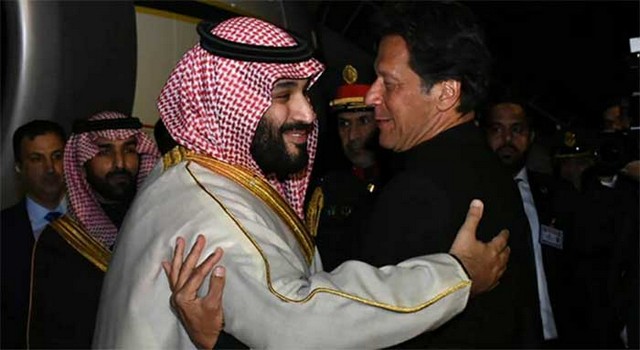
Prime Minister Imran Khan’s incredibly vocal and relentless pursuit of justice for Kashmiris in the face of Indian annexation and ongoing settler-colonial brutality in the region (driven by BJP’s Nazi ideology) – and the House of Saud’s immediate blessing of India’s inhumane action is one such factor. The humiliation that the Prime Minister personally felt when MBS vomited all potential threats to Imran and to Pakistan to prevent him from attending the KL Summit proved to be a good lesson of what kind of a ‘friend’ MBS is to him (and to Pakistan).

Simultaneously, there are larger geopolitical tectonic shifts taking place, albeit gradually, that are increasingly enabling Islamabad to commit to affirming its sovereignty, autonomy, and to a process of deepening decolonization.

Certain changes in the international political economic arena have provided Pakistan with a position where interests and future plans of the world’s two most formidable superpowers, both U.S. and China, are completely dependent on Islamabad. The US, in its typical transactional and opportunistic way, is completely dependent on Islamabad to have some type of withdrawal from Afghanistan. The U.S. National Security establishment is becoming very nervous about Pakistan’s indifference to Washington because of the former’s strengthening relations with China. China, on the other hand, is effectively encircled by American naval ships and bases dead set on some form of confrontation with Beijing at some point – making Pakistan’s Gwadar port literally a lifeline for China to continue its incredible need for energy as well as its preponderant role in global trade and supply lines.

In addition, it is becoming clear that there is something remarkably different about the current political dispensation in Pakistan itself. Both the civilian leadership of Imran Khan and the dominant sections of the military high command are in agreement about much of the foreign policy and national security objectives of Pakistan at this critical historical juncture. Something that many ‘Westoxicated’ liberals in Pakistan aren’t happy with.

Islamabad no longer seems to be handicapped by either the old Cold War framework or the ‘War on Terror’ era that kept Pakistan subordinated and entrapped within the needs of Washington.

The Pakistani historian Ayesha Jalal has a predilection to highlight issues of self and sovereignty in post-colonial states such as Pakistan. Now is the right time to reimagine an Islamicate reconstruction embodied in the Pakistani polity.

And crucially, it is at this time when the weaknesses, not the strengths, of global and regional Zionism are on full display. Both Muslims throughout the world as well as the millions upon millions in the Global South and Global North who have been in solidarity with the Palestinians, the Kashmiris, and with oppressed peoples everywhere, see the blatant contradictions by countries like the House of Saud, the UAE, and Egypt. These nations not only refrain from calling out these crimes against humanities that Israel and India are perpetrating but, on the contrary, opt to bestow awards on them (to Modi) and/or legitimize the atrocities (by recognizing Israel in its post-1967 form).

These contradictions can no longer be concealed. Leaders like Imran and Erdogan realize that this is the moment where meaningful Islamicate integration between Muslim nations and societies, seriously committed to social justice, could finally lead to the demise of what many analysts call the curse of Saudi Wahhabi hegemony.

As it is well-understood, this is no easy or small geopolitical maneuvering taking place. It may very well take some time. But the signs are there. The effective enslavement of Islamabad to Riyadh due to economic matters may one day see its pleasant end when Pakistan’s leadership starts taking more trips to Doha than to Riyadh.

It’s a choice that Islamabad needs to make. Having disentangled itself from various humiliating forms of subordination to outside powers, it seems pretty clear that this dynamic of subordination has one remaining irritant left for Pakistanis: that of the House of Saud.

Fortunately, the Pakistani leadership has the choice to be more independent and affirm its own dignity in deepening its integration and cooperation with other Islamicate countries such as Turkey, Iran, Qatar, and Malaysia, as well as with other nations from the Global South. That seems to be the only way forward to deepening decolonization for a real, meaningful independence.

Zooming out we can see a trend of shifting alliances in the world, especially in the Eastern hemisphere. China is leading a bloc joined by Russia and Iran. Turkey and Malaysia are mobilizing too, and it will not be a surprise if they try to jump in as well. Pakistan in such a situation finds itself in a very favorable position both geopolitically and economically. If addressed well, this is arguably the most critical juncture in the country’s history for Islamabad to take advantage of.

Dr. Junaid S. Ahmad is Professor of Religion and Global Politics in Islamabad, Pakistan, and is a Research Fellow at the Center for Islam and Global Affairs (CIGA) in Istanbul.

3 September 2020

Source: countercurrents.org

Can the U.S. Democracy Be Fixed?

By Richard Falk

I share the view that the 2020 election in the United States is above all a referendum on fascism, and for this and many other reasons I wish it produces a Biden landslide followed by a smooth transfer of political power. From the perspective of the present, this kind of benign political scenario seems unlikely to materialize. Instead, we can more realistically expect a close election, which means that if Trump wins the fascist threat grows, while if he loses, he will refuse to accept the result, charging fraud, clinging to the presidency, provoking a constitutional crisis and possibly the first coup in American history, and again fascism will thrive.

Even in the unlikely event that all goes well procedurally, it is no time to gloat about the vindication of the American version of democracy. Should Trump upset present expectations, and win in November, he will almost certainly again have the perverse peculiarities of the Electoral College to thank. Trump will have little trouble putting out of mind the awkward fact that he won although he once again as in 2016 won fewer votes than his defeated opponent. In 2020 there is absolutely no justification for counting a vote in Idaho or Montana as more valuable than a vote in California or New York due to the fact that the winner in each state gets the whole of its Electoral College vote whether the margin of victory is one vote or one million votes. Democracy as a political system loses legitimacy whenever it cannot dislodge the anachronistic quirks of its electoral system, and the real mandate of a majority of citizens is denied the fruits of victory.

As others have observed, Biden will need much more than a simple majority to win the election. He will need a landslide that overcomes not just the impacts of the Electoral College, but also that cancels the effects of Republican gerrymandering and several voter suppression practices designed especially to keep as many persons of color from voting as possible.

There are further reasons for humility about the functioning of democracy in the United States that extend beyond the electoral system. The most glaring shortcomings are associated with the absence of alternative approaches made available to the voting public on the most crucial issues confronting society. It relates to the failure of the two-party system if neither party possesses the will to advocate overcoming the distortions being wrought by plutocracy, militarism, predatory capitalism, and systemic racism.

The current American version of two-party democracy has steadily decayed due to the embedded bipartisan consensus that was originally a natural feature of the political landscape during World War II when the country was united in support of an anti-fascist war. This consensus became substantially and more dubiously reconstituted as an anti-Communist global crusade during the long Cold War. Among the harmful effects of this two-party consensus was curtailing mainstream political debate, making the outcome of national elections count for far less, making a war economy and militarized state permanent fixtures of governance, and undermining respect for international law and the authority of the UN.

It might have been hoped that the fall of the Berlin Wall in 1989, and the Soviet collapse a few years later would have encouraged taking stock and a national turn toward peace. Nothing of the sort occurred during the 1990s, a wasted decade of world order opportunity.

First, attention was redirected to the plutocratic benefits accruing from the absence of an ideological alternative to market-driven economic policy. Accordingly, with the support of both political parties, the U.S. Government focused its attention on making the world safe for predatory capitalism, a set of policy priorities reflecting what became known as either ‘the Washington consensus’ or more politely, ‘neoliberal globalization.’ This economistic orientation, in effect, a capitalist version of Marxist materialism, encouraged consumerist orgies but was not satisfactory for the militarists who also wanted, and maybe required, an enemy to make the case for continuing with wartime military budgets and for restoring their self-esteem as guardians of national and global security.

The first candidate to be a post-Communist enemy was Japan, with its disciplined work force and booming economy, but it was too hard a sell as the country was the principal U.S. ally in the Pacific region. Next came Islam, and ‘the clash of civilizations,’ given temporary credibility by the 9/11 attacks, which did have the galvanizing effect of re-securitizing American foreign policy with a special emphasis on the Middle East where the energy future of the world seemed to be at stake. What ensued were disastrous military interventions ending with geopolitical setbacks, and a series of countries ending up in shambles.

Now comes China, which doesn’t challenge the West militarily or ideologically, but seems to be winning the competition for markets, economic expansionism, and technological innovativeness, and is now being cast by both wings of the American political establishment as a geopolitical adversary worth confronting. Not surprisingly, the Biden people seem as ready as the Trump autocracy to confront China and Iran, although maybe in a more measured manner, but also one that may be more disposed to invite a serious long-term engagement reinforced by a hypocritical solidarity with Hong Kong protesters and Uighur struggles for human rights. An America disgraced by its terrible performance in response to the COVID-19 challenge, is a wounded animal that has never been more at odds with the wellbeing of humanity, which urgently requires refocusing on human security, which needs to be concretized by reference to climate change, nuclear weaponry, global migration, food and worker security, demilitarization, and strengthened procedures for global cooperation. This can only happen if the militarist/plutocratic consensus is challenged from outside the party framework, by a movement rather than a political party.

The persistence of this dysfunctional consensus represents a breakdown of the social contract that shapes state/society relations in a legitimate democracy. It is a political and moral scandal that a considerable fraction of the citizenry lacks health care, affordable higher education and housing, and the society as a whole endures acute inequalities, unjust taxation, infrastructure decay, and climate change without mounting a serious challenge withing the two-party framework. Bernie Sander bravely tried twice to push the Democratic Party beyond the bipartisan consensus, but in the end both in 2016 and 2020 he was bloodied by the DNC establishment that refused to be pushed over the brink.

The Trump phenomenon is an extreme example of the global populist drift away from democracy by alienated citizenries around the world who cast their votes for demagogues who are taking advantage of democratic procedures and institutions to hollow out democracy so as to move the society toward autocracy. Such a drift reflects particular national narratives as well as a certain set of global conditions that reflect alienation from what democracy bestowed, creating a frightening receptivity to blaming the stranger or the other for the unfairness being experienced in the forms of inequality and erosion of national identity.

A final concern involves the disenfranchisement of the peoples of the world. I would maintain that a legitimate U.S. democracy in the 21st century should heed the political will of those who reside beyond the territorial boundaries of the country and owe their primary allegiance to another country. These foreigners are deeply affected by the extra-national influence exerted by the United States on their lives and livelihood, and yet are without representation or any means to register formal approval or disapproval. The U.S. by virtue of its global reach, mainly through a network of military bases, naval forces patrolling the high seas, and claims based on cyber and space security, often has more impact on foreign societies than their own government.

Should not consideration be given to some form of non-territorial enfranchisement (not necessarily a full and equal vote) that is more congruent with the realities of a networked, digital world than is the territorial sovereign state? It is time that we deploy our moral and political imagination to envision non-territorial democracy that takes account of geopolitical configurations of power as well as ecosystems that cannot function properly if subject to no source of governance with precedence over the claims of national sovereignty. The territoriality of life on the planet has declined to the point where only multi-leveled democratic governance can hope to address humanely the multiple and diverse challenges directed at humanity as a whole.

In essence, we cannot be hopeful about the future unless we commit ourselves to the hard work of deterritorializing democracy, demilitarizing the state, pacifying geopolitics, and empowering the United Nations and international law.

Richard Falk is a member of the TRANSCEND Network, an international relations scholar, professor emeritus of international law at Princeton University, Distinguished Research Fellow, Orfalea Center of Global Studies, UCSB, author, co-author or editor of 60 books, and a speaker and activist on world affairs.

31 August 2020

Source: www.transcend.org

How Corporate Tyranny Works

By Chris Hedges

Those, like environmental lawyer Steven Donziger, who fight the corporate control of our society on behalf of the vulnerable, find that the institutions of power unite to crucify them.

25 Aug 2020 – The persecution of the attorney Steven Donziger is a grim illustration of what happens when we confront the real centers of power, masked and unacknowledged by the divisive cant from the Trump White House or the sentimental drivel of the Democratic Party. Those, like Donziger, who name and fight the corporate control of our society on behalf of the vulnerable see the judiciary, the press and the institutions of government unite to crucify them.“It’s been a long battle, 27 years,” Donziger said when I reached him by phone in his apartment in Manhattan.

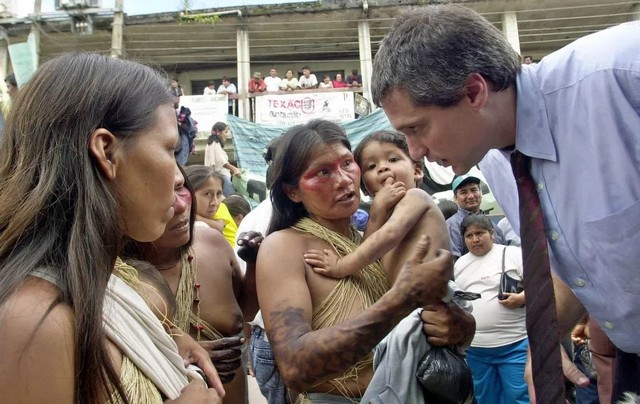
Donziger, who has been fighting polluting American oil companies for nearly three decades on behalf of indigenous communities and peasant farmers in Ecuador, has been under house arrest in Manhattan for a year. He will go to trial in federal court in New York on September 9 on contempt of court charges, which could see him jailed for six months. Ever since he won a multibillion-dollar judgment in 2011 against the oil giant Chevron, the multinational has come after him personally through litigation that threatens to destroy him economically, professionally and personally.

“Our L-T [long-term] strategy is to demonize Donziger,” Chevron wrote in an internal memo in 2009, as reviewed by Courthouse News.

“It started when Texaco went into Ecuador in the Amazon in the 1960s and cut a sweetheart deal with the military government then ruling Ecuador,” Donziger told me. “Over the next 25 years, Texaco was the exclusive operator of a very large area of the Amazon that had several oil fields within this area, 1500 square miles. They drilled hundreds of wells. They created thousands of open-air, unlined toxic waste pits where they dumped the heavy metals and toxins that came up from the ground when they drilled. They ran pipes from the pits into rivers and streams that local people relied on for their drinking water, their fishing and their sustenance. They poisoned this pristine ecosystem, in which lived five indigenous peoples, as well as a lot of other nonindigenous rural communities. There was a mass industrial poisoning.”

“By the time I went down there in the early 1990s, many people had died, cancer rates were skyrocketing according to several independent health evaluations, people were really hurting. There was zero regard for the lives of the local people by Texaco. I was a very young lawyer back in 1993 when I first went to Ecuador. It was like looking at an apocalyptic scene. There was oil on the roads. People were living in abject poverty. They had no shoes. They would get oil on their feet when they walked along the roads. The oil pollution had permeated every aspect of daily life. It was in the food supply. It was in the water supply. It was in the air. The average person there would get exposed multiple times a day to very harmful, cancer-causing toxins, with foreseeable results.”

“I, with other lawyers, filed a lawsuit in New York against Texaco. The reason we filed in New York was because Texaco’s headquarters were in New York in 1993. The decisions to pollute in Ecuador, to play God to the people of Ecuador, were made in New York. We sued in New York. Texaco tried to get the case back to Ecuador where they had never been held accountable, where they knew the indigenous peoples had no money or resources to find lawyers.”

“They thought it would just go away,” said Donziger. “Over a 10-year period, we battled to get a jury trial in the United States. Ultimately, they won that part of the battle. It went down to Ecuador.”

“We started working with a team of Ecuadoran lawyers in the early 2000s. We went forward with the lawsuit. We produced voluminous scientific and testimonial evidence, showing that they caused probably the world’s worst oil pollution. It was called the ‘Amazon Chernobyl’ by locals and experts. They dumped 16 billion gallons of toxic waste. They did it deliberately to save money. This was unlike the BP spill in the Gulf of Mexico, which was a terrible accident, even though it was a product of horrendous negligence by BP. This was done by design to pollute, knowing that people would die, and that indigenous groups would be decimated, and that this beautiful part of the Amazon would be destroyed.”

The refusal to abide by even minimal environmental regulations saved Texaco an estimated $3 on every barrel of oil produced over 26 years (1964-1992), according to Amazon Watch, or an estimated extra $5 billion in revenue. The hundreds of waste pits the company eventually abandoned in Ecuador, on average, contain 200 times the contamination allowed by typical global standards.

“They tried to grind us down using classic corporate defense tactics,” Donziger said of the legal war. “They filed thousands of motions. We stood strong. We had a great legal team of Ecuadorian lawyers.”

In the end, they won a stunning victory, a rare moment of accountability for first-world conglomerates who rape the environment of developing nations by exploiting weak, corrupt governments.

“The verdict came down, about $18 billion in favor of the affected communities, which is what it would take at a minimum to clean up the actual damage and compensate the people for some of their injuries. That eventually got reduced on appeal in Ecuador to $9.5 billion, but it was affirmed by three appellate courts, including the highest court of Ecuador. It was affirmed by the Canadian Supreme Court, where the Ecuadorians went to enforce their judgment in a unanimous opinion in 2015.”

Chevron, as the evidence mounted against it, sold their assets in Ecuador and left the country. The corporation threatened the plaintiffs with a “lifetime of litigation” if they attempted to collect, and, according to internal Chevron memos, launched a legal and media campaign that has cost an estimated $2 billion to prevent payment of the settlement and to demonize and destroy Donziger.

Donziger came to his epic battle against Chevron through journalism. “I was a journalist on my college newspaper,” he said of his time as a history major at American University. “My first job out of college was as a journalist with [United Press International]. I worked for UPI in Washington. They were strong in Latin America. I traveled to Managua in 1983 or 1984, I don’t remember exactly, and found work in the UPI bureau. I was 23 years old. I worked in the UPI bureau in Managua during the Sandinista era.”

He left UPI after a year in Managua but stayed on in Nicaragua to work as a freelance journalist for newspapers such as The Fort Lauderdale News, The Toronto Star and The Atlanta Constitution. He spent about three years as a reporter before going to Harvard Law School. When he graduated from Harvard Law School in 1991, he worked as a public defender in Washington, D.C. He documented Iraqi civilian casualties in Iraq following the first Gulf War that became a report adopted by the United Nations.

A classmate at law school was from Ecuador. His classmate’s father organized a trip in April 1993 for lawyers and medical professionals to look at the contamination caused by the oil extraction in the Amazon. That trip, which Donziger joined, spawned the suit against Texaco. He would make more than 250 trips to Ecuador over the next two decades.

“Journalism significantly shaped my views and skill set,” he said. “It was vital to allowing my work to be successful. From the beginning this was a unique litigation, for many reasons, but one of the reasons was we, as a team, decided to work across multiple platforms. If we only saw this case as a lawsuit we would never win.”

“Chevron controlled the legal system in Ecuador with their influence. We needed to operate across different platforms, including engaging with the media and carrying out significant public education. Most Ecuadoreans, other than those who lived in the region, knew nothing about the pollution that had been happening in their country. We carried out zealous advocacy in the public arena. We realized that the indigenous people would never get a fair trial in Ecuador if they did not illuminate what had happened to them and get public support.”

“The fact that I am detained shows how far we’ve come and how much risk Chevron feels. It’s not a sign we lost. It’s the opposite.”
— Steven Donziger

Both the judge who oversaw its lawsuit against Donziger for “racketeering” and Chevron itself “claim that this type of activity is wrong,” he said. “The irony is that what we were doing is what the big oil companies have always done. They always operate in the public relations domain, lobbying Congress to pass legislation to extinguish various legal claims, meeting political leaders behind the scenes. They operate across every platform they can find to exercise their power. We were smart enough to meet them toe-to-toe wherever they were operating and neutralize their ability to undermine the fairness of the trial. That’s how they operate. They try to control court systems.”

“My journalism [experience] sensitized me to injustice. It allowed me to understand the media. I knew how to write press releases, which matters when you do a public case like this. I knew how to work across different platforms to mobilize positive energy around the case. Human rights work involves, first and foremost, justice for victims. But equally important is accountability for the perpetrators. The fact that I am detained shows how far we’ve come and how much risk Chevron feels. It’s not a sign we lost. It’s the opposite.”

Chevron, which had left Ecuador, went back to the New York court, where Donziger had originally filed the lawsuit before Chevron got a change of venue to Ecuador, and sued him, using a civil courts portion of the federal law famous for breaking the New York Mafia in the 1970s, the Racketeer Influenced and Corrupt Organizations Act.

In effect, “They sued me as a civil racketeer, under a civil RICO statute for $60 billion,” he said. “That was the largest amount of money an American individual ever had been sued for. This began a ten-year campaign to demonize me by Chevron and by its judicial allies.”

Chevron, which has more than $260 billion in assets, has hired an estimated 2,000 lawyers from 60 law firms to carry out its campaign, according to court documents. The oil giant dropped its demand for financial damages weeks before the RICO trial, which would have necessitated a jury trial. Judge Lewis A. Kaplan, a former lawyer for the tobacco industry who had undisclosed investments in funds with Chevron holdings, according to his public financial disclosure statement, decided the RICO case alone. He found credible a witness named Alberto Guerra, relocated to the US by Chevron at a cost of some $2 million, who claimed the verdict in Ecuador was the product of a bribe. Kaplan used Guerra’s testimony as primary evidence for the racketeering charge, although Guerra, a former judge, later admitted to an international tribunal that he had falsified his testimony.

“[Kaplan] wouldn’t allow me to bring in any environmental evidence that the Ecuadorian courts had used to find Chevron liable,” Donziger said. “He wouldn’t let me testify on my own behalf on direct. He allowed Chevron to use secret witnesses whose identities he wouldn’t reveal to me. He tried to treat it like a national-security kind of case to try to demonize me. Because Chevron’s whole strategy is to demonize [me] as a way to distract attention from its environmental crimes in Ecuador. And Judge Kaplan, who knows all the tricks in the books because he used to work for [tobacco company] Brown & Williamson, when he was [an attorney with the law firm of] Paul, Weiss. He knows the tobacco industry playbook that they used for years and years and continue to use. And he worked with the Chevron lawyers at Gibson, Dunn & Crutcher to implement them against me without a jury. And there was nothing I could do about it.”

(Paul, Weiss is a large law firm that currently advises Chevron on its $13 billion purchase of another energy company.)

John Keker, one of Donziger’s lawyers on that case, said he was up against 160 lawyers for Chevron and during the trial he felt “like a goat tethered to a stake.” He called the court proceedings under Kaplan “a Dickensian farce” and a “show trial.” In the end, Kaplan ruled that the judgment in the Ecuadorean court against Chevron was the result of fraud.

He also ordered Donziger to turn over decades of all client communication to Chevron, in effect eradicating attorney-client privilege, a backbone of the Anglo-American legal system with roots dating to ancient Rome. Donziger appealed what was, according to legal experts following the case, an unprecedented and illegal order. While Donziger’s appeal was pending, Kaplan charged him with criminal contempt for this principled stance, as well as his refusal to turn over his passport, his personal electronics and to refrain from seeking the collection of the original award against Chevron.

When his criminal contempt charges against the environmental lawyer were ignored by the U.S. attorney’s office for over five years, Judge Kaplan, using an exceedingly rare judicial maneuver, appointed the private law firm of Seward & Kissel, to act in the name of the government to prosecute Donziger. Neither the judge nor the law firm disclosed that Chevron has been a client of Seward & Kissel.

Kaplan also violated the established random case assignment protocol to personally assign Loretta Preska, a member of the right-wing Federalist Society, to hear the case. Chevron is a major donor to the Federalist Society. Preska, in a show of bias, already has said the charges against Donziger appear to be “very strong,” according to Courthouse News. In May, she disallowed him from having his charges heard by a jury.

“The last thing any of them wants is for a group of ordinary citizens to see what has happened to Steven Donziger,” Rick Friedman, one of Donziger’s attorneys, said of Chevron.

“The last thing any of them wants is for a group of ordinary citizens to see what has happened to Steven Donziger.”
–Rick Friedman, attorney

Preska’s fealty to corporate power was previously on public display in 2013 when she imposed a 10-year sentence, the maximum allowed under a plea deal, on Jeremy Hammond, the activist who hacked into Stratfor, a private security firm. Hammond made public a barrage of damning internal emails and exposed the email address and password of an account used for business by Preska’s husband, Thomas Kavaler, a partner at the law firm Cahill Gordon & Reindel. Preska, despite the conflict of interest, refused to recuse herself. The 10-year sentence was one of the longest in U.S. history for hacking.

Kaplan had Preska demand Donziger post an $800,000 bond on a misdemeanor charge. Preska placed him under house arrest and confiscated his passport which he has used to meet with attorneys around the world attempting to enforce the judgment against Chevron. Kaplan managed to have Donziger disbarred. He allowed Chevron to freeze Donziger’s bank accounts, slapped Donziger with millions in fines without allowing him a jury, forced him to wear an ankle monitor 24 hours a day and effectively shut down his ability to earn a living. Kaplan allowed Chevron to impose a lien on Donziger’s apartment in Manhattan where he lives with his wife and teenage son.

Donziger is scheduled to go to trial without a jury on September 9 in New York City for contempt. Preska will preside over the trial. There has not been a criminal trial in Manhattan federal court since March because of the pandemic. Donziger’s trial would be the first, although hundreds of other defendants facing far more serious felony charges are waiting in jails, infested with COVID-19, for a trial date. Donziger’s four pro bono lawyers said they do not want to risk their lives by traveling to New York during the pandemic for what is a misdemeanor offense.

“The judgment against Chevron Corporation in Ecuador was the product of fraud, bribery and corruption,” Sean Comey, Senior Advisor – External Affairs Chevron Corporation said when I asked the corporation to comment on the case. “Steven Donziger is a proven liar and an adjudicated racketeer. He committed criminal acts in the U.S. and abroad in pursuit of his extortion scheme in the Ecuadorian courts. Donziger’s continuing lawlessness is now a matter for prosecutors and the U.S. courts to decide. Chevron is not involved in Donziger’s criminal prosecution.”

The flagrant corruption and misuse of the legal system to abjectly serve corporate interests in the Donziger case illustrates the deep decay within our judiciary and democratic institutions, one that was abetted by Democratic administrations that stacked the courts with corporate lawyers – Kaplan was appointed by Bill Clinton – and Donald Trump, who has elevated ideologues selected by the Federalist Society to the federal bench. Ruling after ruling in Donziger’s case has ignored or grossly distorted the law on behalf of Chevron to ensure that Donziger will be prosecuted, sent to prison and remain in debt for life – all while the $9.5 billion settlement is never paid to aid the people harmed in Ecuador.

The International Association of Democratic Lawyers and the international committee of the National Lawyers Guild issued a letter signed by more than 70 organizations calling the persecution of Donziger an “attack on the rule of law.” The letter said his house arrest was “unprecedented” and charged that he was being targeted for what it called “one of the most important corporate accountability and human rights cases of our time.” The letter accused Kaplan of “violating basic notions of fairness in the judicial process that lie at the core of the rule of law.”

“We cannot allow the rule of law to be upended by corporate interests and a highly biased federal judge seeking to destroy the willpower of one lawyer who has already withstood decades of brutal litigation and scathing personal and professional attacks,” the letter read.

Chevron has also used its clout and advertising dollars to keep the story from being reported in numerous media outlets.

“Based on where this story is trending, we have launched a full offensive to kill it or redirect it,” an August 10, 2010 internal memo from Chevron reads concerning a potential report on the case being done by the Fox News bureau in Miami.

“In addition to working through the Miami bureau, we have reached out to more senior news folks at Fox News, both in NY (through Dana) and in WDC (through Greg Mueller). So, we are trying to attack this story on multiple fronts. To this end, Kent is set to talk to John Stack and Sean Smith who both reside at Fox News in NY at 1:30 today. Finally, if need be, I think we may need to pull the JSW card with Roger Ailes. We have checked John’s availability to place a call to Roger, but his first availability is tomorrow afternoon.”

From 2010 to 2018, John S. Watson was the CEO and chairman of the Chevron Corporation.

The story was killed.

Another internal memo lays out the steps, also ultimately successful, to prevent a similar story from appearing in GQ magazine. The memo suggests that Chevron work “with the Columbia Journalism Review (that ran the rebuke of 60 minutes) and the Media Research Center to expose any degree of bias by GQ and raise alerts about the reporting techniques prior to the story’s publication.”

The memo recommends letting the magazine know that it will face legal action if the story runs and calls on Chevron investigators to “conduct further due diligence on reporter.” Chevron has also hired reporters to produce fake pieces of journalism that peddle the corporation’s propaganda on fake news sites it runs.

The New York Times magazine earlier this year considered a story about Donziger and then dropped it. The newspaper runs its own ad agency called T Brand Studio. Chevron is a major client, meaning The New York Times, through T Brand Studio, produces ads for Chevron.

Jake Silverstein, editor of the magazine, when asked to comment said by email: “It was one of several stories William [Langewiesche] considered writing for us in the past year, one that ultimately we decided not to assign. Many factors go into our decisions about what to assign, and none of them ever include who is or is not a client of T Brand Studio or any other part of the paper’s advertising business.”

Dean Baquet, the newspaper’s executive editor, said, when I reached him by email, that the idea that the magazine piece on Donziger was killed because Chevron is a major advertiser is “a ridiculous claim.” He added, “I didn’t even know Chevron worked with T Brand [Studio].”

But that Chevron has invested tremendous resources to kill stories about this case is indisputable given the detailed campaigns to block coverage outlined in its own internal memos.

“I’ve experienced this multiple times with media over the past 10 to 15 years,” Donziger said. “An entity will start writing the story, spend a lot of time on it, then the reporter disappears. The story doesn’t run.”

While The Nation, The Intercept and Courthouse News Service have reported on Donziger’s current legal battle, no major mainstream publication has touched it.

“Corporate influence over our federal judiciary has increased dramatically in recent years,” Donziger said. “This firm [Chevron] has captured an element of power from the government and deployed it against a human rights activist.”

Front Line Defenders issued a report in 2019 that found that 300 human rights activists had been murdered in 31 countries, more than two-thirds in Latin America. Of those killed, 40 percent fought for land rights, indigenous peoples and environmental justice.

“What’s shocking to a lot of people is that this is now happening in the United States,” Donziger said. “I don’t mean murder, but death by a thousand cuts. Chevron does not want me to be a lawyer anymore, at a minimum. They don’t want me advocating even as a nonlawyer. They want to silence me. They want to kill every story they can. They’d rather have no story about this case than even a positive story about their side. They don’t want people to know about it. They want to erase it from people’s thought process.

“I cannot get a fair trial with a judge appointed by Judge Kaplan rather than though the random assignment process,” he lamented. “I cannot get a fair trial with a prosecutor whose law firm [has worked] for Chevron. These are egregious conflicts of interest. It’s misconduct on a grand scale. I’ve been locked up four times as long as the longest sentence ever imposed on a lawyer for criminal contempt in New York. Anyone who cares about the rule of law should be appalled.”

Chris Hedges is a Pulitzer Prize–winning journalist who was a foreign correspondent for fifteen years for The New York Times, where he served as the Middle East Bureau Chief and Balkan Bureau Chief for the paper.

31 August 2020

Source: www.transcend.org

Judaism, the Israeli-Palestinian Conflict and Me

By Gershon Baskin

26 Aug 2020 – I am very ambivalent toward religion in general and toward Judaism in particular. There is a direct connection between my attitude toward Judaism and religious Jews and their treatment (in general) of the Israeli-Palestinian conflict, Arabs, the Land of Israel, democracy, human rights including freedom of religion and freedom from religion, and their attitude toward me as a non-believing Jew.

As we move away from the possibility of a peace agreement between us and the Palestinians, as Israeli control of the West Bank deepens, I have moved further away from the feeling that we all belong to the same people. This makes me very sad.

I immigrated to Israel from the United States at the age of 22 out of a strong Zionist feeling and a belief in belonging to the Jewish people and the Land of Israel.

Since I was very young, I have heard stories about my great grandfather, Rabbi Yehuda Rosenblatt, who immigrated to Israel in the 1920s in order to die in the Holy Land. He was a haredi (ultra-Orthodox) rabbi who left family and home to live the end of his life in the Land of Israel. He is buried in Nahalat Yitzhak in Tel Aviv.

Since I came here 42 years ago, I have been working for peace between us and our Palestinian neighbors. In 1981, I created a position for myself in the Education Ministry with the support of education minister Zevulun Hammer and with the full consent of prime minister Menachem Begin. My job was to coordinate educational activities between the Jewish and Arab sectors in Israel.

My first achievement in the position was the publication in the director general’s circular of the ministry in which the he introduced me to the entire educational system, and a call I authored encouraging schools in Israel to participate in educational meetings between schools in both sectors. As soon as it was published, the director of the Department of Religious Schools, Rabbi Yaakov Hadani, issued an official statement that the Jewish religious schools were exempt from participating in meetings with “gentiles.”

I spoke with the director general, Eliezer Shmueli, he arranged a meeting between me and Rabbi Hadani who asserted that meetings between Jewish high school students and Arab high school students would threaten the students’ Jewish identity and lead to intermarriage.

I was amazed at the lack of confidence of the head of religious schools in his students and in the education they receive under his supervision.

I also checked with the Central Bureau of Statistics to see what was the degree of “danger” of intermarriage between Jews and Arabs in Israel. In that year (1982), 0.04% of all couples marrying in Israel were between Jews and Arabs.

MANY YEARS LATER, at the Israel Palestine Center for Research and Information (IPCRI), which I co-directed with a Palestinian colleague for 24 years, I conducted training on peace education for headmasters of yeshiva high schools. In the opening discussion I tried to answer the question: What is peace education?

I said that peace education begins with critical thinking, the importance of putting a question mark at the end of a sentence and not an exclamation mark. Immediately there was a commotion in the room. A number of rabbis revolted and said very loudly, “In our education we teach our students to put an exclamation mark and not a question mark. We don’t allow to question matters of faith and halacha [Jewish law].”

I understand their position, but I come from another world. I am a stranger in their world and they are strangers in mine. The connection between us seems to belong solely to our past and not to the present.

I have demonstrated for peace and against the occupation for over 40 years. One of the very noticeable things is the lack of kippah-wearers in these demonstrations. This is something that still amazes me even though there is no reason that I should be surprised. Demonstrations by occupation supporters and settlers have almost no heads without kippot.

For years I have witnessed very violent behavior by settlers and soldiers toward Palestinians in the West Bank. The most violent of these acts were committed by religious settlers. They wear kippot and their hatred is burning in their eyes toward Palestinians, and even more toward Jews who come to show solidarity or protect Palestinians. These behaviors push me to move even further away from Judaism.

The Judaism I know is “You were a stranger in the land of Egypt,” “Love your neighbor as yourself,” “We were all created b’Tselem – in God’s image,” and so on. The religious settlers and the violent soldiers full of hatred call me a traitor.

I feel much more loyal to Judaism when I defend the human rights and the lives of others. I feel disdain toward those who, in the name of Judaism, believe that it is kosher to cut down Palestinian olive trees or to expel a shepherd and his flocks from pasture land. Is this Judaism?

In the early 1990’s, Rabbi Ovadia Yosef issued a ruling that the sanctity of the people and the sanctity of life precede the sanctity of the land, and if the evacuation of territories preserves human life (Jews of course) then it is pikuach nefesh (saving lives). This ruling allowed Shas Knesset members to vote in favor of the Oslo Accords. Many religious Jews refer to God’s promise to give the Land of Israel to the Jewish people as a real estate deed. Perhaps in the Court of ma’aleh (in heaven) it has value, but in the reality of life itself, it has no legal validity and it is highly doubtful whether it has moral validity.

ONE OF THE surprises of my life was the big hug I received from the ultra-Orthodox world after many became aware of my part in the release of Gilad Schalit through the direct connection I developed with the leaders of Hamas. The ultra-Orthodox press conducted in-depth interviews with me that appeared in the weekend newspapers and I received many expressions of support from them. To this day, nine years later, people still approach me, mostly ultra-Orthodox who remember me.

On the other hand, Rabbi Moshe Gafni, several years ago at the Haaretz conference, said that he was willing to sit with the leaders of Hamas, with our greatest enemies, but was not willing to sit with a Reform Jew. I am not a Reform Jew but I helped establish a synagogue belonging to the Reform movement in Jerusalem: Kol Haneshema.

I helped establish it because I believe there must be places in Israel where every Jew can pray and feel comfortable; an egalitarian, spiritual and creative place where non-Orthodox Jews can feel at home.

How am I supposed to feel toward a representative of official ultra-Orthodox Judaism in Israel when he says such a sentence? His words ring in my ears to this day.

In the reality of our lives that the more religious you are, the more you link your Israeliness to your Judaism, the less likely you are to support compromise with the Palestinians. Of course, this is not true for everyone and there are exceptions.

Today the ultra-Orthodox public is right wing, and its positions on the Palestinian issue are much more similar to the settlement supporters of the religious-Zionist public than ever before. My tolerance and my connection to Judaism and religious Jews are closely linked to political positions and from my point of view, these positions represent a whole set of values that prove how foreign we are to each other.

This discovery should not shock anyone, but it does require us to be honest with each other and requires us to seek mutual understanding. That does not mean that I have to compromise on my values, because that will not happen. I admit that I feel anti-religious. Despite this I am ready to fight for everyone’s right to live with dignity, to have full equality, and to be a desirable part of this country. Our life together in Israel requires us to know each other, to respect each other, and to live and let live without coercion and without violence.

The writer is a political and social entrepreneur who has dedicated his life to the State of Israel and to peace between Israel and her neighbors.

31 August 2020

Source: www.transcend.org