Just International

China beat the coronavirus with science and strong public health measures, not just with authoritarianism

By Elanah Uretsky

I live in a democracy. But as Thanksgiving approached, I found myself longing for the type of freedom I am seeing in China.

People in China are able to move around freely right now. Many Americans may believe that the Chinese are able to enjoy this freedom because of China’s authoritarian regime. As a scholar of public health in China, I think the answers go beyond that.

My research suggests that the control of the virus in China is not the result of authoritarian policy, but of a national prioritization of health. China learned a tough lesson with SARS, the first coronavirus pandemic of the 21st century.

How China flattened its curve

Barely less than a year ago, a novel coronavirus emerged in Wuhan, China, with 80,000 cases identified within three months, killing 3,000 people.

In late January 2020, the Chinese government decided to lock down this city of 11 million people. All transportation to and from the city was stopped. Officials further locked down several other cities in Hubei Province, eventually quarantining over 50 million people.

By the beginning of April, the Chinese government limited the spread of the virus to the point where they felt comfortable opening up Wuhan once again.

Seven months later, China has confirmed 9,100 additional cases and recorded 1,407 more deaths due to the coronavirus. People in China travel, eat in restaurants and go into theaters, and kids go to school without much concern for their health. Juxtapose that to what we are experiencing in the U.S. To date, we have confirmed over 11 million cases, with the last 1 million recorded in just the last one week alone.

In September and October, friends from China sent me pictures of food from all over the country as they traveled around to visit friends and family for the mid-autumn festival and then the seven-day National Day vacation week. I envied them then and envy them even more now as Americans prepare and wonder how we will celebrate the holidays this year.

Ten years on, the SARS outbreak that changed HK

What China learned from SARS

We Americans are told that the freedoms Chinese now enjoy come at the expense of being subject to a set of draconian public health policies that can be instituted only by an authoritarian government. But they also have the experience of living through a similar epidemic.

SARS broke out in November of 2002 and ended in May of 2003, and China was anything but prepared for its emergence. It didn’t have the public health infrastructure in place to detect or control such a disease, and initially decided to prioritize politics and economy over health by covering up the epidemic. This didn’t work with such a virulent disease that started spreading around the world.

After being forced to come to terms with SARS, China’s leaders eventually did enforce quarantine in Beijing and canceled the week-long May Day holiday of 2003. This helped to end the pandemic within a few short months, with minimal impact. SARS infected approximately 8,000 worldwide and killed about 800, 65% of which occurred in China and Hong Kong.

The Chinese government learned from SARS the important role public health plays in protecting the nation. Following SARS, the government improved training of public health professionals and developed one of the most sophisticated disease surveillance systems in the world. While caught off guard for this next big coronavirus outbreak in December 2019, the country quickly mobilized its resources to bring the epidemic almost to a halt inside its borders within three months.

What can the US learn from China?

Knowing that there were no safe or proven treatments or an effective vaccine, China relied on proven nonpharmaceutical interventions to conquer the epidemic. First and foremost was containing the virus through controlling the sources of infection and blocking transmission. This was accomplished through early detection (testing), isolation, treatment and tracing the close contacts of any infected individual.

This strategy was aided by the three field hospitals (fancang) the government built to isolate patients with mild to moderate symptoms from their families. Strict quarantine measures were also central to preventing the spread of this epidemic, as it was with the SARS epidemic in 2003. This was paired with compulsory mask-wearing, promotion of personal hygiene (hand-washing, home disinfection, ventilation), self-monitoring of body temperature, universal compulsory stay-at-home orders for all residents, and universal symptom surveys conducted by community workers and volunteers.

What else could the US have done to be prepared?

SARS exposed serious weaknesses in China’s public health system and prompted its government to reinvent its public health system. COVID-19 has exposed similar shortcomings in the U.S. public health system. To date, however, the current administration has taken the exact opposite approach, devastating our public health system.

The Trump administration made major cuts to the budgets of the National Institutes of Health and Centers for Disease Control and Prevention. The last budget submitted by the Trump administration in February 2020, as the pandemic was beginning, called for an additional reduction of US$693 million to the CDC budget.

This affected our ability to prepare for a pandemic outbreak. In the past, this preparation included international partnerships to help detect disease before it reached our shores. For example, the CDC built up partnerships with China following the SARS epidemic, to help contain the emergence of infectious disease coming from the region. At one point the CDC had 10 American experts working on the ground in China and 40 local Chinese staff, who mostly concentrated on infectious disease. Trump started slashing these positions shortly after taking office, and by the time COVID-19 broke out, those programs were whittled down to a skeleton staff of one or two.

[Research into coronavirus and other news from science Subscribe to The Conversation’s new science newsletter.]

The Declaration of Alma Ata guaranteed health for all, and not just health for people governed under a specific type of bureaucratic system. The U.S. has been, and can be, just as dedicated to protecting the health of its people as China under its authoritarian government. We demonstrated this during the Ebola epidemic, with the launch of a whole government effort coordinated by Ron Klain, who has been appointed White House chief of staff under President-elect Biden.

This effort, which included a coordinated response with both African nations and China, improved preparedness within the U.S. and ultimately helped to save hundreds of thousands of lives around the world. A reduction in funding for our public health infrastructure, under the Trump administration, was a divestment in the health of the American people and should not have happened. A new administration that places public health at the helm, once again, will I hope prove to us that health is not just something that can be protected under an authoritarian government, but is in fact a right for all.

Elanah Uretsky

Associate Professor of International and Global Studies,

23 novembre 2020

Source: theconversation.com

Anniversary UN Partition Plan Torching of Palestine – Albert Einstein Running Commentary

By Jay Janson

An Archetypical Anglo-American Colonial Crime Against Humanity! In order to militarily penetrate the oil rich Middle East, a courageous and noble socialist Zionism and despised Holocaust survivors, denied refugee status, were used by an Anglo-American colonial business elite that was anti-Semitic in outlook, coldly indifferent and even complicit, during the Holocaust its investments in rearming Germany made possible.

An Archetypical Anglo-American Colonial Crime Against Humanity!

In order to militarily penetrate the oil rich Middle East, a courageous and noble socialist Zionism and despised Holocaust survivors, denied refugee status, were used by an Anglo-American colonial business elite that was anti-Semitic in outlook, coldly indifferent and even complicit, during the Holocaust its investments in rearming Germany made possible.

Until the United Nations plan for the partition of Palestine is recognized as having been intended to torch British Palestine while British forces were withdrawing as a prearranged stratagem of an Archetypal Colonial Powers crime against humanity, the same genocide and misery that was calculated and expected will continue and spread. The Wall Street led economic and military facilitation of the Second World War and the multinational Holocaust is the immediate history of the murderous founding of the modern and as yet incomplete state of Israel at the cost of Arab and Jewish lives and what could have been a Jewish and Arab led vibrant and dynamic mixed society in Palestine. The British Empire colonization of Palestine for the Empire’s own benefit is its ugly pre-history.

Background

Regarding The Continued Post War Persecution of the Jews of Europe, Survivors of the Holocaust

A REAFFIRMING OF THE BARE TRUTH:

If no rearming of a weak economically prostate totally disarmed Nazi Germany by USA’s largest corporations breeching the Versailles Treaty’s prohibitions of German rearmament in collusion with Colonial Powers Britain and France …

then no Second World War

If no Second World War,

then no multination Holocaust of nearly six million Jews

If no multination genocide of Jews,      then no 250,000 displaced Jewish survivors refused refuge even in the spacious United States of America (where, by the way, most survivors wished to go).

What uncomfortable realization of the enormity of American and European society’s complicity in the Holocaust there was, formed a backdrop for additional basic business considerations entertained by many of the same influential U.S. politicians beholden to Wall Street’s avarice and economic crime in rearming Germany. Highly placed villainous capitalist gangsters saw an imperialist opportunity to make racist use of the plight of a quarter million ‘undesirable’ Jewish Holocaust survivors to create a client colony of armed Europeans in the midst of oil rich Muslim countries.

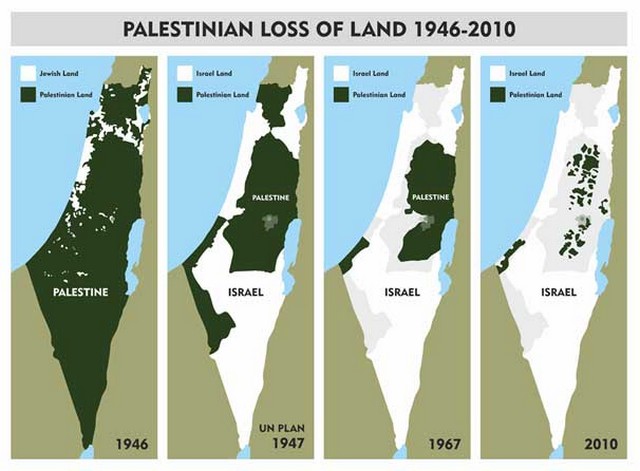
AngloAmerican power over an incipient United Nations of only 57 nations, produced a genocidal stratagem of torching the Holy Land with a phony, never expected nor intended to be implemented resolution for a crazy quilt partition of Palestine into seven noncontiguous areas; the Arab areas entirely noncontiguous; the Jewish areas contiguous by a thread, its major area containing more Arabs than Jews [see UN provided map of recommended partition.] meant to provoke a civil war prepared for and expected by the Colonial Powers supported revisionist Zionists leadership. From Wikipedia, Map of the UN resolution for partition:

[https://mfa.gov.il/MFA/AboutIsrael/Maps/Maps/UN-Partition-Plan.jpg]

The above United Nations Recommended Partition Plan for Palestine Resolution was approved by the UN General Assembly on November 29, 1947 after voting down the recommendation for independence.

More than a year before this civil war producing vote, Albert Einstein made headlines in the New York Times of February 15, 1946, EINSTEIN URGES UNITED NATIONS RUN PALESTINE.

A government in Palestine under the UN’s direct control and a constitution assuring Jews’ and Arab’ security against being outvoted by each other would solve the Jewish-Arab difficulties.” 

During the debate within the UN Ad Hoc Committee on Palestine, before the voting in the UN General Assembly, Dr. Mohamed Hussein Heykal Pasha of Egypt warned members of the seriousness of the decision to be taken by the Committee, and asked them not to overlook the fact that one of the plans, partition, “would, to say the least, result in bloodshed.” “If the United Nations decides to amputate a part of Palestine in order to establish a Jewish state, no force on earth could prevent blood from flowing there…Moreover…once such bloodshed has commenced, no force on earth can confine it to the borders of Palestine itself.” Mahmoud Bey Fawzi, (also Egypt) then took the floor to comment on the proposals now before the Committee. said his delegation and several others considered the legal issues to be “at the heart of” this entire matter, yet, in his view, they had been largely ignored and by-passed. This hasty procedure now being urged, he said, threatened to undermine the very foundations of the United Nations.

The Representative of Egypt asked for an advisory opinion on the legal issues from the International Court of Justice.  His delegation denied that the General Assembly had any power to decree the partition of Palestine, and described the partition plan as “shameless illegality,” contrary to the principle of self-determination for the overwhelming majority of the people of Palestine.  The establishment of a unitary, independent state, said Mr. Fawzi, was much more practicable, and would not require the machinery of the United Nations Security Council.

If the alternate UN plan for an independent and democratic Palestine would have not been suffocated by colonial power politicking, Jews would have had the access to the entire Mandate of Palestine. In this kind of imagined format, how easy it might have been for Yehudi Menuhin’s “only possible solution” to have developed, namely, the kind of federated republic that is French-German Switzerland (the Italian part could be thought of as comparable to autonomous areas for the Druze and Bedouin population).

‘Have your cake and eat it ‘two.’ ‘One state solution and two state solution at the same time.’ With all the intellectual prowess that immigrating Jews were bringing as engineers, doctors, scientists and workers knowledgeable in advanced technology, and the international financial connections available to their leaders, both sides might have opted to stay mixed, legislating  a great degree of regard for cultural, religious and distinctions that would see Jews sharing economic social benefits with Arabs in a Israel-Palestine smack in a sea of Arab nations accepting a Jewish lead in the affairs of a prospering single unique mixed Jewish-Arab state.

During the debate of two UN plans for Palestine, Mr. Fawzi noted an aim “to establish military bases for the benefit of Powers that wanted to gain a strong hold in the Middle East.”

In the name of humanity, the reader might want to spend the minute or two needed to read this short and to the point uncomplicated entirely and obviously just appeal for the International Courts intervention to prevent a genocidal civil war. The reader will recognize no logic, no legality, no responsibility, no humanity and no justice in the General Assembly rejection of the Draft Resolution Referring Certain Legal Questions to the International Court of Justice just prior to the voting on the resolutions concerning single state or partition. Below are reprinted the resolution and the eight questions to be put to the International Court.

The General Assembly of the United Nations resolves to request the International Court of Justice to give an advisory opinion under Article 96 of the Charter and Chapter IV of the Statute of the Court on the following questions:

(i) Whether the indigenous population of Palestine has not an inherent right to Palestine and to determine its future constitution and government;

(ii) Whether the pledges and assurances given by Great Britain to the Arabs during the first World War (including the Anglo-French Declaration of 1918) concerning the independence and future of Arab countries at the end of the war did not include Palestine;

(iii)Whether the Balfour Declaration, which was made without the knowledge or consent of the indigenous population of Palestine, was valid and binding on the people of Palestine, or consistent with the earlier and subsequent pledges and assurances given to the Arabs;

(iv) Whether the provisions of the Mandate for Palestine regarding the establishment of a Jewish National Home in Palestine are in conformity or consistent with the objectives and provisions of the Covenant of the League of Nations (in particular Article 22), or are compatible with the provisions of the Mandate relating to the development of self-government and the preservation of the rights and position of the Arabs of Palestine;

(v) Whether the legal basis for the Mandate for Palestine has not disappeared with the dissolution of the League of Nations, and whether it is not the duty of the Mandatory Power to hand over power and administration to a Government of Palestine representing the rightful people of Palestine;

(vi) Whether a plan to partition Palestine without the consent of the majority of its people is consistent with the objectives of the Covenant of the League of Nations, and with the provisions of the Mandate for Palestine;

(vii) Whether the United Nations is competent to recommend either of the two plans and recommendations of the majority or minority of the United Nations Special Committee on Palestine, or any other solution involving partition of the territory of Palestine, or a permanent trusteeship over any city or part of Palestine, without the consent of the majority of the people of Palestine;

(viii) Whether the United Nations, or any of its Member States, is competent to enforce or recommend the enforcement of any proposal concerning the Constitution and future Government of Palestine, in particular, any plan of partition which is contrary to the wishes, or adopted without the consent of, the inhabitants of Palestine.

Reprinted in Yearbook of the United Nations 1947–1948. UN Doc. 1949.I.13 (31 December, 1948).

Your author has not been able to retrieve how the individual nations voted

In rejecting providing for reference to the International Court of Justice for an advisory opinion on eight legal questions connected wither arising from the Palestine problem.

United Nations General Assembly, November 25, 1947

REPORT OF THE AD HOC COMMITTEE ON THE PALESTINIAN QUESTION

Rapporteur: Mr. Thor THORS (Iceland)

At the beginning of the thirty-second meeting, the Chairman put to the vote the first draft resolution proposed by Sub-Committee 2, providing for the reference to the International Court of Justice for an advisory opinion of eight legal questions connected with or arising from the Palestine problem. At the request of the representative of France, two votes were taken, one on the first seven questions, the other on the eighth question which read as follows:

“Whether the United Nations, or any of its Member States, is competent to enforce, or recommend the enforcement of, any proposal concerning the constitution and future government of Palestine, in particular, any plan of partition which is contrary to the wishes, or adopted without the consent, of the inhabitants of Palestine”.

The proposal to refer to the International Court of Justice the first seven questions was rejected by a vote of eighteen in favour, twenty-five against, with eleven abstentions. The proposal to refer to the Court the eighth question was rejected by a vote of twenty in favour, twenty-one against, with thirteen abstentions. By one vote was rejected “Whether the United Nations, or any of its Member States, is competent to enforce or recommend the enforcement of any proposal concerning the Constitution and future Government of Palestine, in particular, any plan of partition which is contrary to the wishes, or adopted without the consent of, the inhabitants of Palestine.”

The amended draft resolution embodying the Plan of Partition (as shown on the map provided above) with Economic Union was adopted by a vote of twenty-five in favour, thirteen against, with seventeen abstentions, (25 in favor versus 32 against, abstaining or absent) as follows:

In favour: Australia, Bolivia, Brazil, Byelorussian Soviet Socialist Republic, Canada, Chile, Costa Rica, Czechoslovakia, Denmark, Dominican Republic, Ecuador, Guatemala, Iceland, Nicaragua, Norway, Panama, Peru, Poland, Sweden, Ukrainian Soviet Socialist Republic, Union of South Africa, Union of Soviet Socialist Republics, United States of America, Uruguay and Venezuela.

Against: Afghanistan, Cuba, Egypt, India, Iran, Iraq, Lebanon, Pakistan, Saudi Arabia, Siam, Syria, Turkey and Yemen.

Abstentions: Argentina, Belgium, China, Colombia, El Salvador, Ethiopia, France, Greece, Haiti, Honduras, Liberia, Luxembourg, Mexico, Netherlands, New Zealand, United Kingdom and Yugoslavia.

Absent: Paraguay and Philippines.

[https://unispal.un.org/DPA/DPR/unispal.nsf/0/CB265C939B5A551F802564B40053D359]

=================================

Turning a page back in the history of Palestine, during the end of the nineteenth century, when the terrible pogroms in the newly absorbed Polish and Lithuanian areas of Russia had begun to bring heavy Jewish immigration into Palestine. The heavy immigration had occasioned problems and some good deal of strife and violence before Albert Einstein visited the British Mandate in 1923. However, in 1927, in “The Jews and Palestine, in ”About Zionism,” Einstein had written referring to his experience during his visit, “At no time did I get the impression that the Arab problem might threaten the development of the Palestine project. I believe rather that, among the working classes especially, Jew and Arab on the whole get on excellently together.” 

The tiny size of the total Jewish population in Palestine in 1923 is well elucidated by Albert Einstein writing in regard to his joy in participating in fund raising for a Hebrew University there. “I firmly believe that the Jews, given the smallness and  dependence of their colony in Palestine, will be immune from the folly of power.”[Letter of Maurice Solovine, March 8, 1921]

Four months later Einstein tempered his joy with his first apprehension about Zionist organizing. “I am very glad to have followed Weizmann’s invitation. In several places, however, a high-tensioned Jewish nationalism shows itself that threatens to degenerate into intolerance and bigotry, but hopefully this is only an infantile disorder.”[Letter to Paul Ehrenfest, June18, 1921]

After Einstein’s stay in Palestine in 1923, he wrote in his ‘My Impressions of Palestine’ article in New Palestine Magazine, “A remarkable tribute to the real power of Palestine is the fact that the Jewish elements which have been resident in the country for decades stand distinctly higher, both in the matter of culture and in their display of energy, than those elements which have only recently arrived.”

(An observation that would reflect itself as a Revisionist conquering attitude  eventually replaced the original Labor Zionists international socialist philosophy, which was shared by Einstein.)

“Among the Jewish ‘sights’

none struck me more pleasantly than did the school of arts and crafts, Bezalel, and the Jewish workingmen’s groups….To me their was something wonderful in the spirit of self-sacrifice displayed by our workers on the land. … in the face of their difficulties from debts to malaria. In comparison with these two evils, the Arab question becomes as nothing. And in regard to the last, I must remark that I have myself seen more than once insurance of friendly relations between Jewish and Arab workers. I believe that most of the difficulty comes from the intellectuals and, at that, not from the Arab intellectual alone.”[“My Impression of Palestine,” in New Palestine]

Two years later,  Einstein said he would not remain associated with the Zionist movement unless it tried to make peace with the Arabs, in deed as well as in word. “The Jews should form committees with the Arab peasants and workers, and not try to negotiate only with the leaders.” [Clark, Einstein, p.482, citing Bentwich, My 77 years, p.99]

On November 25, 1929, Einstein wrote to Chaim Weizmann – the future first President of Israel – stating

“If we do not succeed in finding the path of honest cooperation and coming to terms with the Arabs, we will not have learned anything from our two thousand year old ordeal and will deserve the fate which will beset us.”

Since our study of the history of the Second World War encompasses the clashes  between differing economic systems, namely racist colonial capitalism, fascism and communist party run socialism, it seems appropriate to point out the international socialist origins of Zionism, for it continued to be the philosophy of the great majority of the refugees of the Holocaust entering Palestine, even after the founding of the state of Israel. Even today, the Kibbutzim, which began as utopian collective agricultural communities combining socialism and Zionism, remain a proud symbol of a young Israel.

Moses (Moshe) Hess, born in 1812, was a socialist German-French-Jewish philosopher, a friend and collaborator of Karl Marx and Friedrich Engels (all three wrote for the now famous German revolutionary Rheinische Zeitung), was both one of the earliest proponents of socialism and a precursor to what would later be called Zionism.  In his seminal, Rome and Jerusalem: The Last National Question (1862)  Hess argued for the Jews to return to Palestine, and proposed a socialist country in which the Jews would become agrarianised through a process of “redemption of the soil” in the modern world.  Hess’s contribution became important in retrospect, as the Zionist movement began to crystallize and to generate an audience in the late nineteenth century as a movement within international socialist ideals.

When Theodor Herzl, who is referred to as the spiritual father of the Jewish State in the Israeli declaration of independence,  first read Rome and Jerusalem, a generation in time after it was written, Herzl wrote, “Since Spinosa, Jewry had no bigger thinker than this forgotten Moses Hess”[Moses Hess

By Lawrencebush, Jewdayo Grid, 1/20/2011][Exhibit Highlights Zionism’s German Roots, January 29, 2016 BY ANNA ISAACS, Jewish Political Voices Zoomars] and that he would not have written Der Judenstaat (The Jewish State) if he had known Hess’s ‘Rome and Jerusalem’ beforehand.

Einstein, a strong and outspoken socialist, see his ‘Why Socialism,’ [https://monthlyreview.org/2009/05/01/why-socialism/] followed the progress of Jewish settlement in the British Mandate, and when, in the 1930s, international socialist Zionism came under pressure from the political right, he wrote, “Under the guise of nationalist propaganda Revisionism seeks to support the destructive speculation in land; it seeks to exploit the people and derive them of their rights,” [in JEWISH-ARAB AMITY URGED BY EINSTEIN, New York Times. April 20, 1935]

In an Address by Einstein at the Manhattan Opera House to the National Labor Committee for Palestine, on January 11, 1946, Einstein spoke of what he saw as the basic human problem in Palestine, namely, colonialism, British Empire colonialism.

“I wish to explain why I believe the difficulties in Palestine exist.  First, the difficulties between the Jews and Arabs are artificially created, and are created by the English…Of course the English had two interests. First was to have raw materials for their industry. Also the oil in those countries. I find everywhere there are big landowners who are exploiters of that race of people. …The British are always in a passive alliance with those land possessing owners which suppress the work of the people in the different trades. It is my impression that Palestine is a kind of small model of India… Now how can I explain otherwise that national troublemaking is a British enterprise? I believe that the Palestinian people, under severe influence of the United Nations, will be able to create a better state of affairs. But with the British rule as it is, I believe it is impossible to find a real remedy. … The Irishmen have for a long time suffered under their rule. … The state idea is not according to my heart. I cannot understand why it is needed. It is connected to many difficulties and a narrow-mindedness. I believe it is bad… If people are united with each other and they come to the idea that they do not need the foreign rule, then they want to make themselves independent.”

Einstein Hits British Rule Testifying before the AngloAmerican inquiry commission on Palestine 

Jewish Telegraphic Agency WASHINGTON January 18, 1946 Prof. Albert Einstein charges that British colonial rule was responsible for the trouble between the Arabs and Jews. Accuses Great Britain Of Double Dealing Prof. Albert Einstein, testifying before the Anglo-American Inquiry Commission, said he was against a Jewish State…He urged, however, that the bulk of the Jewish refugees in Europe be brought to Palestine. Emphasizing that he believes there will be no peace between Jews and Arabs as long as the British rule Palestine, Prof. Einstein charged Britain with violating the basic responsibilities undertaken in the Balfour Declaration. Asked by British members of the committee whether the Americans should take over Palestine from the British, Prof. Einstein replied that the administration of Palestine should be international. He emphasized that he holds Americans responsible for what the British are doing in Palestine. Artificial Difficulties Difficulties between Jews and Arabs were largely artificially created by the British, he declared. He criticized the British colonial policy as based on the principle of “divide and rule,” and charged the British administration with using the ex-Mufti of Jerusalem to foment trouble. Queried by Dr. Frank Aydelotte, one of the American members of the committee, as to what he would do if Arabs resisted the immigration of Jews from Europe into Palestine, Prof. Einstein replied that »“this will not be the case if they are not incited.” Questioned by Dr. Aydelotte concerning political versus cultural Zionism, he stated: “I was never for a political state.”

A few days later, Einstein again made his position clear, “I am in favor of Palestine being developed as a Jewish Homeland but not as a separate state. It seems to me a matter of simple common sense that we cannot ask to be given political rule over Palestine where two thirds of the population are not Jewish.” [January 19, 1946  Letter to Maurice Dunay]

In August 1945, Einstein was publicly sharply critical of the Jewish underground paramilitary groups, such as the Irgun and the Stern Group. In his words, “I regard it [the Irgun] as a disaster”( Interview with I. Z. David). Also “I am not willing to see anyone associated with those misled and criminal people.” [letter to Shepard Rifkin).

[https://www.nytimes.com/1982/11/21/magazine/the-partition-of-palestine-35-years-ago.html]

THE PARTITION OF PALESTINE 35 YEARS AGO

By Peter Grose

Nov. 21, 1982 New York Times

Peter Grose, a senior fellow at the Council on Foreign Relations, adapted this article from his forthcoming book on American attitudes toward Israel, to be published next autumn by Alfred A. Knopf.

Some 30 Jewish military commanders huddled around a wireless set in their clandestine Jerusalem hideout, straining to hear through the static the votes of diplomats gathered half a world away at a gray old skating rink in Flushing Meadows, across the river from Manhattan.

It was the week of Thanksgiving 1947, and at its tempo-rary home in the New York World’s Fair grounds, the new United Nations General Assembly was deciding whether to offer Jews and Arabs sovereign states of their own in Palestine.

Whatever the outcome, the soldiers in Jerusalem were prepared for trouble. ”If the vote is positive, the Arabs will make war on us,” said Yitzhak Sadeh, a leader of the Jewish defense forces. ”And if the vote is negative, then it is we who will make war on the Arabs.”

On Nov. 29, 1947, the United Nations General Assembly passed the resolution calling for Mandatory Palestine to be partitioned between Arabs and Jews in seven parts with Jerusalem being transferred to UN trusteeship. Part I of the Plan stipulated that the Mandate would be terminated as soon as possible and the United Kingdom would withdraw no later than 1 August 1948. The divisions were to take effect on the date of British withdrawal not later than August 1948. (In May of 1947 after Acre prison break and British soldiers hanged in retaliation for Irgun fighters hanged, the British had notified the U.N. of their intent to terminate the mandate not later than 1 August 1948) [Herzog, Chaim and Gazit, Shlomo: The Arab-Israeli Wars: War and Peace in the Middle East from the 1948 War of Independence to the Present, p. 46]) Mandates were intended to end with the independence of the Mandated territory. The British government had taken the position that there was nothing in law to prevent termination due to frustration of purpose.[“Termination of the British Mandate for Palestine”. The International Law Quarterly2 (1): 57–60. 1948.]

Britain announced that it would accept the partition plan, but refused to enforce it, arguing it was not accepted by the Arabs. Britain also refused to share the administration of Palestine with the UN Palestine Commission during the transitional period, and requested the UN Palestine Commission not to enter Palestine until two weeks before the British withdrawal.

The United Nations Palestine Commission was created by United Nations Resolution 181 which recommended partition.[1] It was to be responsible for implementing the UN Partition Plan of Palestine and act  as the Provisional Government of Palestine.[2] The 1947–1948 Civil War in Mandatory Palestine and a refusal by the British government to impose a scheme which was not acceptable to both Arabs and Jews in Palestine prevented the Commission from fulfilling its responsibilities.… The Commission’s five members were:

  • Mr. Karel Lisicky (Chairman) from Czechoslovakia
  • Mr. Raul Diez de Medina (Vice-Chairman) from Bolivia
  • Mr. Per Federspiel from Denmark
  • Dr. Eduardo Morgan from Panama
  • Senator Vicente J. Francisco from the Philippines [https://unispal.un.org/DPA/DPR/unispal.nsf/0/CB265C939B5A551F802564B40053D359

How quaint this establishing a commission of five individuals with no army. It received no recognition, nor was it taken seriously by all the factions which were precipitated into a brutal and deadly civil war.

With the announcement of the partition resolution, the Jewish and Arab communities of British Mandate Palestine immediately began to clash in violence.  After the partition resolution, the British, again unilaterally, brought the date of the end of its mandate forward to May 14.The violence became more and more deadly, while the British organized their withdrawal and intervened only on an occasional basis. In the first two months of the Civil War, around 1,000 people were killed and 2,000 people injured,[44] and by the end of March, the figure had risen to 2,000 dead and 4,000 wounded [Yoav Gelber, Palestine 1948, Sussex Academic Press, Brighton, 2006, ISBN 978-1-84519-075-0] Yoav Gelber is a professor of history at the University of Haifa, and was formerly a visiting professor at The University of Texas at Austin.]

The UN General Assembly by its charter was and still is only granted the power to make recommendations, therefore, UN General Assembly Resolution 181 was actually not legally binding, but there was no significant expression of doubt about the de facto power of the UN resolution and its having torched Palestine.

Supposedly in response to the civil war already raging, or making it look like in response, President Harry S. Truman made a statement on 25 March proposing UN trusteeship rather than partition. This dissimulating statement, clearly so woefully belated, to have any effect, by a US president who had overseen all his administration’s threats and arm twisting machinations to accrue the votes needed for the passing of the partition resolution which brought the deadly violence about, must be seen as pure window dressing – a pretending that a civil war had not been contemplated by the plainly absurd UN resolution, plan, announcement or whatever anyone wants to call it, was not intended, was not expected to explode the Holy Land into an already planned and prepared for civil war. It was the kind of preposterous ‘statement of concern‘ America’s close ally and parent colonial power, pompous Great Britain, was famous for. In this case to make the US look innocent of the carnage already underway, and fully expected to continue. No further action was taken nor even discussed by anyone anywhere. So much for ‘looking good’ aimed consumption by a monopolized Wall Street investor controlled and cooperating press.

As the last British were leaving on May 14 ending the Mandate, in Tel Aviv, Jewish Agency Chairman David Ben-Gurion proclaimed the State of Israel.

At this point, it seems appropriate to quote Albert Einstein and others deploring fascism’s rise among at least some important militants, who immigrated to Palestine some time before the multitude of survivors of the Holocaust.

Letter to the New York Times, December 4, 1948, from Albert Einstein and other prominent Jews, denouncing Menachem Begin, a future prime minister of Israel.

“Among the most disturbing political phenomena of our times is the emergence in the newly created state of Israel of the “”Freedom Party”” (Tnuat Haherut), a political party closely akin in its organization, methods, political philosophy and social appeal to the Nazi and Fascist parties. It was formed out of the membership and following of the former Irgun Zvai Leumi, a terrorist, right-wing, chauvinist organization in Palestine.

The current visit of Menachem Begin, leader of this party, to the United States is obviously calculated to give the impression of American support for his party in the coming Israeli elections, and to cement political ties with conservative Zionist elements in the United States. Several Americans of national repute have lent their names to welcome his visit. It is inconceivable that those who oppose fascism throughout the world, if correctly informed as to Mr. Begin’s political record and perspectives, could add their names and support to the movement he represents.

Before irreparable damage is done by way of financial contributions, public manifestations in Begin’’s behalf, and the creation in Palestine of the impression that a large segment of America supports Fascist elements in Israel, the American public must be informed as to the record and objectives of Mr. Begin and his movement.

The public avowals of Begin’’s party are no guide whatever to its actual character. Today they speak of freedom, democracy and anti-imperialism, whereas until recently they openly preached the doctrine of the Fascist state. It is in its actions that the terrorist party betrays its real character; from its past actions we can judge what it may be expected to do in the future.

Attack on Arab Village

A shocking example was their behavior in the Arab village of Deir Yassin. This village, off the main roads and surrounded by Jewish lands, had taken no part in the war, and had even fought off Arab bands who wanted to use the village as their base. On April 9 (THE NEW YORK TIMES), terrorist bands attacked this peaceful village, which was not a military objective in the fighting, killed most of its inhabitants —— 240 men, women, and children —— and kept a few of them alive to parade as captives through the streets of Jerusalem. Most of the Jewish community was horrified at the deed, and the Jewish Agency sent a telegram of apology to King Abdullah of Trans-Jordan. But the terrorists, far from being ashamed of their act, were proud of this massacre, publicized it widely, and invited all the foreign correspondents present in the country to view the heaped corpses and the general havoc at Deir Yassin.

The Deir Yassin incident exemplifies the character and actions of the Freedom Party.

Within the Jewish community they have preached an admixture of ultranationalism, religious mysticism, and racial superiority. Like other Fascist parties they have been used to break strikes, and have themselves pressed for the destruction of free trade unions. In their stead they have proposed corporate unions on the Italian Fascist model.

During the last years of sporadic anti-British violence, the IZL and Stern groups inaugurated a reign of terror in the Palestine Jewish community. Teachers were beaten up for speaking against them, adults were shot for not letting their children join them. By gangster methods, beatings, window-smashing, and wide-spread robberies, the terrorists intimidated the population and exacted a heavy tribute.

The people of the Freedom Party have had no part in the constructive achievements in Palestine. They have reclaimed no land, built no settlements, and only detracted from the Jewish defense activity. Their much-publicized immigration endeavors were minute, and devoted mainly to bringing in Fascist compatriots.

Discrepancies Seen

The discrepancies between the bold claims now being made by Begin and his party, and their record of past performance in Palestine bear the imprint of no ordinary political party. This is the unmistakable stamp of a Fascist party for whom terrorism (against Jews, Arabs, and British alike), and misrepresentation are means, and a “”Leader State”” is the goal.

In the light of the foregoing considerations, it is imperative that the truth about Mr. Begin and his movement be made known in this country. It is all the more tragic that the top leadership of American Zionism has refused to campaign against Begin’’s efforts, or even to expose to its own constituents the dangers to Israel from support to Begin.”

The undersigned therefore take this means of publicly presenting a few salient facts concerning Begin and his party; and of urging all concerned not to support this latest manifestation of fascism.”

(signed) Albert Einstein and twenty-seven other prominent Jews in New York, Dec. 2, 1948

(After the death of the first president of Israel in 1952, the Israeli government offered the post of president to Einstein. He declined the offer.)

In spite of Einstein’s efforts, the Palestinians Arabs, while still suffering British military occupation as a colony since the end of the First World War in spite of having been promised independence, became re-colonized after the Second World War by another group of Europeans through a genocidal civil war openly planned and provoked by Anglo-American machinations.

Ever since then, Israel has been in bed with a US business elite that once heavily invested in Hitler, was itself anti-Semitic in outlook, coldly indifferent and even complicit during the Holocaust its investments had made possible.

A popular quip in Yiddish goes, ‘with such friends, who needs enemies?’ Arabs saved Jews from Christian mortal persecutions in 637, 1187, and 1492. Since the end of the First World War, Christians have been militarily persecuting Arabs. One could imagine that Jewish-Arab Semitic solidarity is sorely needed and would be mercifully appropriate, the current Israeli-Christian alliance notwithstanding.

See author’s US Economic Facilitation of Holocaust and Middle East Destabilizing Partition, 1. History 2. Deception 3. Imagining, Minority Perspective, Birmingham, UK, 12/6/2012.] [ https://minorityperspective.co.uk/2012/12/06/us-economic-facilitation-of-holocaust-and-middle-east-destabilizing-partition/ ]

In 1991, Yehudi Menuhin, the world renowned virtuoso violinist, upon being awarded the prestigious Wolf Prize by the Israeli Government, addressed the Israeli Knesset in his acceptance speech:

“This wasteful governing by fear, by contempt for the basic dignities of life, this steady asphyxiation of a dependent people, should be the very last means to be adopted by those who themselves know too well the awful significance, the unforgettable suffering, of such an existence. It is unworthy of my great people, the Jews, who have striven to abide by a code of moral rectitude for some 5,000 years, who can create and achieve a society for themselves such as we see around us but can yet deny the sharing of its great qualities and benefits to those dwelling amongst them.”

“We as Jews gathered together in Israel should recognize our supreme destiny to heal and help.”

In the 2006 released EMI Classics music documentary film The Violin of the Century, Menuhin, looking into the camera, reminisces,

“Of the Israelis. I admired them for their courage. I realized what they were trying to build against thousands of years of persecution. I didn’t, I wasn’t one with their attitude toward the native Arabs – they should have shared everything, everything! – and um so, but they weren’t in that mood at that time – it was too early, very very tragic.

It was the Jewish Holocaust; they never spoke of the Slav Holocaust, the Gypsy Holocaust; Gypsies lost five hundred thousand people in the gas chambers.

If the Jews had acted together with all those others on a human basis and tried to find out why it is that a civilized people like the Germans could indulge in genocide – which is happening today all over the place. It’s a human phenomenon. It happens – might happen to you and me – but instead of joining with the others in steadiness, they kept it on a Jewish basis and tried to make the most of it. Well, at the end of thirty years they had used up the world’s sympathy.

The only solution is keep intact the territory and create a federated union, allow people to live where they were, together, apart, schools apart or together – what ever they want – with Jerusalem capital of both like Bern is the capital of German Switzerland and French Switzerland and each president is there for a year and no one knows his name – that is the only solution, otherwise there’ll always be war.”

These are not the words and sentiments of an accusing President Ahmadinejad, or of a defiant Hezbollah, Hamas or other Palestinian spokesperson, but the words of a sensitive, soft spoken, understanding, internationally beloved and Israeli prize awarded musician whose very given name, Yehudi, means “the Jew” in Hebrew, his first language.

Menuhin, who died in 1999, had insisted that a single federated state “is the the only solution possible,” echoed the statements of Albert Einstein, Martin Buber, Eric Fromm and so many other Jewish intellectuals and a good many orthodox rabbis who had warned against partition before it became a fact more than sixty years ago.

If Menuhin was right that a single federated state is the only possible solution, then it would seem to be just a matter of time before those who presently wield power, or those who follow them, come around to effecting its realization – strict interpretations of Zionism and U.S. foreign policy goals notwithstanding.

“Israel’s mission is no longer that of a Promised Land for a persecuted people. That’s over,” the celebrated Jewish violinist told the French daily Le Figaro during a brief visit to Paris in January of 1998.

For seventy-three years, the same colonial powers, who forced through passage of the criminal United Nations Partition Plan for Palestine with intention to bring about civil war in British ruled and occupied Holy Land, have kept up  a murderously deceitful pretense of trying to bring peace to Palestine and the oil rich Middle East.  A quick glance at the provisions of the proposed partition that were fully expected and obviously intended to incite violence and create deadly conflict, permanent hostilities, destabilization and facilitate Western imperialist penetration, exposes this pretending to search for a peace which that financial element that rules the United States and Wall St has never wanted.

Given the seventy years of criminal media falsification, deception and public opinion manipulation, to be sure, not a few readers will be thinking, that what happened in Palestine to Palestinians and incoming European Jewish refugees was because of the Holocaust, and no fault of the British and Americans. This argument is put to rest firstly, by proving through irrefutable documentation that traces the long history of how the Holocaust was not only allowed to happen, but how much of the Holocaust was facilitated by the colonial powers, which benefitted to some degree from the Holocaust financially. Secondly, that when the Holocaust reached mega horrific proportions with massacres of tens of thousands, these genocidal events went unreported or reported in the back pages of only a few newspapers in the United States and England and basically ignored by the press and radio in most of Europe and the rest of the Western dominated world. Thirdly, that after the war ended, the poor and desperate Holocaust survivors were treated inhumanely and as undesirables refused refuge in the United States and then were most cruelly used by the elite of the Anglo-American world ruling financial cabal in a devilishly and merciless typical colonial crime against humanity in which they were forced to fight for their lives in what had been British occupied and ruled Palestine as British troops withdrew.

The UN genocide provoking partition plan, which never by any stretch of imagination could have ever been expected or intended to be implemented, was nefariously forced through the UN General Assembly. See delegates testimony regarding US pressure and threats following a calculated vote postponement:

UNITED NATIONS PALESTINE COMMISSION

Statement of 6 February 1948 Communicated to the Secretary-General by Mr. Isa Nakhleh, Representative
of the Arab Higher Committee

The following communication has been addressed to the Secretary-General by Mr. Isa Nakhleh, Representative of the Arab Higher Committee.

The Delegation of the

Arab Higher Committee for Palestine

4512 Empire State Building

New York 1, New York

Subject: Palestine Your Excellency:

With reference to Your Excellency’s telegram dated the 9th of January inviting the Arab Higher Committee to appoint a representative “to be available to the Palestine Commission for such authoritative information and other assistance as the commission may require,” and with reference to my telegram dated the 18th of January in which I communicated to Your Excellency the decision of the Arab Higher Committee, I have the honor to submit the following reasons for such decision:

1.The Arab Higher Committee maintains that the partition recommendation does not represent the sentiments of the United Nations. We cannot forget that the resolution of partition in the Ad Hoc Committee secured 25 votes only. When the matter was referred to the General Assembly on the 26th of November, there were 17 nations opposing partition. Had voting taken place on that date the partition proposal would not have obtained the required two-third majority. The Arab Higher Committee cannot forget the maneuvers made by the President of the Assembly and some delegates supporting partition in order to postpone taking votes on that day when they realized that their proposal might be defeated.

2.The pressure put by the United States Delegation and Government on certain nations, whether at Lake Success or in these nations’ capitals, is nothing short of political blackmail. The following represent only a few instances:

(a) The delegate of Siam was accepted in the Ad Hoc Committee as a vice chairman until he showed his intention to vote against partition. Then he was threatened that his credentials would be refused. As a consequence he was forced not to attend.(b) The delegate of Haiti on Wednesday made a very strong speech against partition, on instructions from his Government. On Saturday he circulated a note to Delegations explaining that he is voting for partition in accordance with fresh instructions from his Government. The Haitian Delegate did not find words to describe his shame and he was seen in tears in the lobby and Delegates’ lounge. Being a sincere and noble man, he could not hide the fact that his Government surrendered to pressure and was forced into changing its instructions to him.
(c) General Carlos P. Romulo, Head of the Philippines delegation, on Wednesday made a very strong and courageous speech denouncing partition declaring: “At the behest of my Government, the Philippine Republic regrets its inability to approve of or participate in a solution of the Palestine problem that would involve the encouragement of political disunion and the enforcement of measures that would amount to the territorial mutilation of the Holy Land.’
But on Saturday and in the absence of General Romulo there were two Philippines Delegates, each claiming different instructions — one to vote against partition as instructed by the head of his delegation, the other supporting partition according to fresh instructions from his Government. It is an established fact that strong pressure was put on the Philippines Government by the United States Government and, according to reliable information, the United States Government threatened the Philippines Government that it will not grant it the loan it is asking for if its delegation fails to support partition. In this way the Arabs lost the Philippines vote.
(d) The Liberian delegate on the Ad Hoc Committee, Mrs. Ellen Scarborough, on the 25th of November abstained from voting although it was known that the Liberian Delegates intended to vote against partition in the Assembly. Thereupon the Jewish Agency and its pressure squads threatened her with actual physical violence which caused her to ask for police protection. On Saturday, the 29th of November, due to heavy pressure on the said Government, the Liberian Delegation voted for partition.

3.This undue pressure was not limited to the aforementioned delegations, but to every other delegation and its Government abroad. The following quotations from speeches of delegates prove this point:

(a) Dr. Ernesto Dihigo of Cuba, in his speech in the Assembly on November 28th said: “Having formed and given our view, we feel that we have to express our view through our vote, in the maintenance of consistency, in spite of pressure which has been brought to bear upon us.”(b) Dr. Alfredo Lopez, Head of the Colombia Delegation, in his speech in the Assembly on the 28th of November, said: “Partition here may eventually be adopted, but we submit that reluctant votes, recruited with irrelevant eleventh hour appeals, will not improve its position in the opinion of the outside world.”

[https://unispal.un.org/DPA/DPR/unispal.nsf/0/B9EE848FD989E7AF85256FB00075C092]

November 29 is the infamous anniversary date for the intentional  torching of Palestine by a United Nations vote.

This heinous war and death intended incendiary stratagem would bring about a common British colonial crime against humanity, towards the end become Anglo-American planned, prepared and committed most obviously with future profits from hegemony over the region’s mega massive petroleum reserves in mind.

Until the United Nations plan for the partition of Palestine is recognized as having been intended to torch British Palestine while British forces were withdrawing as a prearranged stratagem of an Archetypal Colonial Powers crime against humanity, the same genocide and misery that was calculated and expected will continue and spread.

Jay Janson is an archival research peoples historian activist, musician and writer; has lived and worked on all continents; articles on media published in China, Italy, UK, India and in the US by Greanville Post, Dissident Voice, Global Research; Information Clearing House; Counter Currents, Minority Perspective, UK and others; now resides in NYC; First effort was a series of articles on deadly cultural pollution endangering seven areas of life emanating from Western corporate owned commercial media published in Hong Kong’s Window Magazine 1993; Howard Zinn lent his name to various projects of his; Weekly column, South China Morning Post, 1986-87; reviews for Ta Kung Bao; article China Daily, 1989.

29 November 2020

Source: countercurrents.org

Expansion and Mass Eviction: Israel ‘Takes Advantage’ of Trump’s Remaining Days in Office

By Ramzy Baroud

In a few words, a close associate of Israeli Prime Minister, Benjamin Netanyahu summed up the logic behind the ongoing frenzy to expand illegal Jewish settlements in Israel. ‘These days are an irreplaceable opportunity to establish our hold on the Land of Israel, and I’m sure that our friend, President Trump and Prime Minister Netanyahu will be able to take advantage,’ Miki Zohar, a member of the Likud Party was quoted as saying.

By ‘these days’, Zohar was referring to the remaining few weeks of Trump’s term in office. The US president was trounced by his Democratic Party rival, Joe Biden, in the presidential elections held on 3 November. Trump’s defeat ignited fears in Tel Aviv, and heated debates in the Israeli Knesset, that the new US administration might challenge Israel’s unhindered settlement expansion policies. Indeed, not only was Israel allowed to expand old settlements and build new ones throughout Trump’s term, but it was actually encouraged by US officials to do so with a great sense of urgency.

The US ambassador to Israel, David Friedman, is an ardent supporter of rapid Israeli expansion, and was handpicked for his role, not because of his diplomatic experience – he has none – but to help facilitate US support for Israel’s colonial expansion. In doing so, the USA violated international consensus on the issue, and reversed earlier US positions that perceived Israel’s illegal settlements as ‘obstacles to peace’.

Friedman was entrusted with communicating the ominous new American agenda regarding Israel’s illegal action in the occupied Palestinian territories and in the Syrian Golan Heights to Israelis. In June 2019 Friedman, rather clumsily, articulated a new American position on the illegal Jewish settlements when he said in an interview with the New York Times, ‘Israel has the right to retain some, but unlikely all, of the West Bank.’ The green light to Netanyahu was translated by Israel in January 2020 into an announcement that it intended to formally annex nearly a third of the West Bank within a few months.

The illegal annexation was set to take place on 1 July. Just prior to that date, Friedman resurfaced, this time with a less coded message: that Netanyahu’s annexation had the full backing of the US government. He told the Israeli newspaper Israel Hayom that Washington was preparing to acknowledge the Israeli move to apply sovereignty in ‘Judea and Samaria’, using the biblical term to refer to the West Bank. The expected massive annexation did not, however, materialise as grandly as expected. Instead, the Netanyahu government opted to cement its de facto annexation of Palestinian land by announcing plans to build more settlements, barring Palestinian farmers from reaching their land, and accelerating the policy of home demolitions.

Months before Biden was announced as the president-elect of the USA, Israel seemed to be preparing for the possibility that the Trump administration might not be re-elected. Certainly, while a Biden presidency is bound to remain unconditionally supportive of Israel, the new administration is likely to return to old policies pertaining to the ‘peace process’ and the ‘two-state solution’. Netanyahu has long been averse to such rhetoric as, in his view, such unnecessary delays will cost Israel precious time that could be invested in building yet more settlements. Politically, the mere discussion of a return to negotiations could, potentially, splinter Israel’s powerful yet fractious pro-settlement right-wing alliance.

Immediately that it became clear that Trump had lost the race, Netanyahu begrudgingly congratulated Biden. Even the Israeli leader’s belated acknowledgement of Trump’s defeat did not spare him the political ambush that awaited him. Many Knesset members attacked the Israeli prime minister for losing Israel’s bipartisan support in Washington by allying himself with the Republican Party and the Trump administration. Leading the charge was Israel’s opposition leader from Yesh Atid-Telem, Yair Lapid, who had previously criticised Netanyahu’s ‘Republican First’ approach to US politics. His views were shared by many Israelis in the Knesset and media.

Reversing course in Trump’s last weeks in office is not an easy task, especially as the Trump administration remains committed to help Israel achieve its objectives to the very end. On 19 November, US Secretary of State Mike Pompeo became the first top US official to visit an illegal Jewish settlement in the occupied West Bank. During his visit to a winery in the Psagot settlement, Pompeo gave Netanyahu more good news. He announced that, for the USA, products from illegal Jewish settlements could now be labelled ‘Made in Israel’, and that the global Boycott, Divestment and Sanctions (BDS) movement would be declared ‘anti-Semitic’ by the US State Department.

The latter announcement will give Israel the legal capital required to prosecute and silence any US civil society opposition to Israel’s illegal occupation. Israel is counting on the fact that Biden is unlikely to dare to contest or reverse such policies of Trump due to the sensitivity of the subject of anti-Semitism – whether real, alleged or imagined – in US politics. The same rationale applies to the settlement-building frenzy throughout occupied East Jerusalem and the West Bank.

On 20 November, Israeli authorities announced that eighty Palestinian families would be evicted from their homes in the neighbourhood of Sheikh Jarrah in East Jerusalem. These homes would be handed over to illegal Israeli Jewish settlers. The news of the mass evictions came only a few days after the government’s announcements that the illegal settlements of Givat Hamatos and Ramat Shlomo, both located in East Jerusalem, were set for major expansion. The massive development in Givat Hamatos, according to the Israeli group Peace Now, ‘will severely hamper the prospect of a two-State solution because it will ultimately block the possibility of territorial contiguity between East Jerusalem’ and major urban centres in the West Bank.

These announcements were strategically timed, as they carried the unmistakable political message that Israel does not intend to reverse its settlement policies, regardless of who occupies the White House. The coming weeks are likely to witness even more coordinated Israeli-US moves, with the Trump administration seeking to fulfil Netanyahu’s political wish list, thus leaving Biden with little political margin to manoeuvre, and denying his government the self-proclaimed, undeserved title of the ‘honest peace broker’.

Dr Ramzy Baroud is a journalist and the Editor of The Palestine Chronicle, and is a Non-resident Senior Research Fellow at the Afro-Middle East Centre (AMEC)

27 November 2020

Source: www.amec.org.za

Salute to Comrade Diego Maradona

By Vidya Bhushan Rawat

A portrait size painting of Diego Maradona was on display at certain ruins in war torn Syria where people were mourning the death of the legend. In the entire Latin American world, people are pouring their respect to Maradona who died in Buenos Aires, the Argentine Capital where his dead body is kept at the presidential palace as people continue to flock in to pay their last respect to the legend. The Argentine President has declared a three day moaning. Tributes are pouring in the world over whether it is nations or sports federations or political activists who Maradona supported through their causes.

On his passing away, we need to ponder this question as what separates giants like Diego Maradona or Mohammad Ali from rest of the sports icons who might have been hugely successful financially but the grief and outpouring of their passing away will never be the same. Ofcourse, we know, in our own country, there are cricketers who we worship but except for endorsing commercial brands and that too for their own purposes, they remain quiet. Most of the film stars and sports persons who join politics rarely take a stand except the official lines of their ‘parties’. Many of these wortheis who become members of parliament, don’t even attend the parliament.

So in such a scenario, we look at the outpouring of grief world over for the passing away of Maradona who definitely was an extraordinary player but there are many and it is not that he won Argentina many world cup. That glory is for the year 1986.

In the Western World, Maradona was a ‘cheater’ and he fell from grace in the cases of ‘drug addiction’ where he was denied admission in the hospital in his own country and it was Cuba which gave him shelter and brought him back to life after deep depression. Latin America has been hugely influenced by revolutionary Fidel Castro, the leader who built Cuba a great nation, a model for all the smaller countries to follow. Again, the same ‘liberal’ ‘independent’ western media would often call Castro a Mafia of Miami. For Maradona, the 1986 World Cup victory against England was far more satisfying because the way Britain used its power to control Falkland Island which Argentina claimed as their territory and British took it by their force.

Maradona’s political thoughts made him far superior to other players who rarely spoke. That makes him a superhero in the company of Mohammad Ali, who never let his stardom forget his community and the racial crimes that the Blacks in the United States have faced. It is not that persons from the marginalised background don’t reach the heights but soon the establishment capture them and use their successes as the success of ‘their model’. Most of these icons become part of the commercial interest which serves the power elite of the world. That is why, I say, the work done by Maradona or Mohammad Ali remain far powerful and world over people remember them for the cause they fought for.

Maradona used to call Fidel Castro his ‘second father’. On Castro’s death, it is reported, Maradona wept uncontrollably. We need to understand what are these qualities in these legends which set them apart. Fidel Castro was a treat to listen and read. A man of bigger ideas who could stand up to a mighty American empire that wanted to swallow the tiny nation of Cuba. Despite western world’s vilification, Fidel Castro not only influenced the culture and politics of Cuba but other nations. The way Cuba helped other countries and gave them self respect was unprecedented. Che Guevara was an Argentine international who along with Fidel Castro became iconic among all those nations victims of colonialism. Definitely, a person like Diego Maradona would not have grown up in his country without listening to the folklores of the political legends.

When Maradona was recuperating in Cuba, it is said that Fidel Castro would invite him for a morning walk and discuss various political issues. Later, Maradona organised a talk show and interviewed Fidel Castro. That political understanding made Maradona a believer in socialism and secularism. He decried the Vatican and pope once upon a time. He was aware how neoliberalism was a process of recolonisation of the poorer nations and therefore stood with all the leaders of the Latin American countries who were resisting the American interventions in their countries. Whether it was Evan Moralis of Bolivia or Hugo Chavez of Venezuela, the legend of Football, always stood with their cause.

Maradona never forgot his roots and he realised that even when he got stardom, it is time, this stardom is used to spread the political ideology which he felt would bring true socialism and restore rights to the people. This feeling of International solidarity made him speak in support of the cause Palestine. ‘ I am a Palestinaian by heart’, he said once and wanted to even coach their football team.

This internationalism took Che Guevara to various parts of the world to make people aware of their rights and inspire the young minds to work for the betterment of the world. And this was visible in Diego Maradona when he could stand with Evan Morales and Hugo Chavez to condemn George Bush’s effort to bully Venezuela.

And yes, he was not ‘contesting’ elections as happens in our part of the world. A sports star will keep quiet on important public issues and when want to join a political party will speak about ‘issues’ and keep quiet. That is why Mohammad Ali remains a legend as he never succumbed to this publicity of the capitalist media. He remain grounded to his identity and the discrimination done to it by the system of white suprmacy. The same was true about Maradona. Fortunately, Maradona’s political thoughts matured with guidance and advice of Fidel Castro and he became an internationalist.

Life of Maradona as well as Mohammad Ali shows us that sports icons can use their superstardom to encourage and promote progressive ideas and fight against injustices. They can be true heros of humanity if they use their stardom for undoing historic wrongs and raising uncomfortable questions. Unlike the new found love of ‘charity’ that the ‘stars’ do and promote their stardom, taking a political stand on important issues that impact us, remain the most important and it is here both Maradona and Mohammad Ali have left their contemporaries far behind.

Maradona will be remembered not merely for his golden goals but also for uncompromising stand against colonialism and exploitation by the mighty powers of the world. Hope sports icons will learn a few things from you that merely earning huge money will not make their lives worth remembering but standing for a cause makes you different from them. Every condolence and outpouring of grief that is coming from different parts of the world is an indication that not all of them would have known your sports skills, a large number of people are pained becauses they know an international hero is gone, who stood with the rights of the oppressed.

Salute to Comrade Diego Maradona.

Vidya Bhushan Rawat is a social activist. Twitter @freetohumanity

27 November 2020

Source: countercurrents.org

250 Million Workers And Farmers Strike Nationwide In India

By Countercurrents Collective

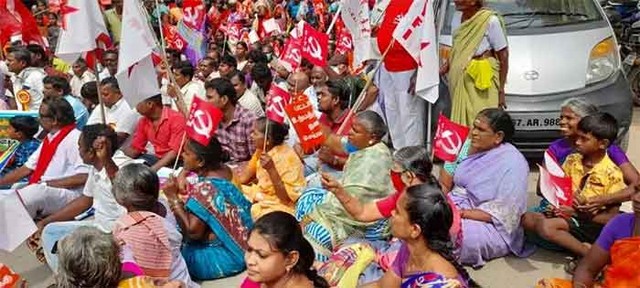
India saw one of the biggest nationwide strikes by workers, joined by protesting farmers today. Several states saw a complete shutdown. Over 250 million workers across sectors participated in the strike, called by 10 central trade unions and hundreds of worker associations and federations.

Kerala, Puducherry, Odisha, Assam and Telangana witnessed a complete shutdown while normal life was partially affected in several other states as workers struck work and took to the streets, protesting against the “anti-worker” and pro-corporate policies and labour laws as well as the new farm laws brought in by the Narendra Modi-led Bharatiya Janata party government, among other demands.

“The states of Kerala, Puducherry, Odisha, Assam and Telangana have reported complete shut down. Tamil Nadu reported complete shut down in 13 districts, while the industrial strike continues in the rest of the districts. Punjab and Haryana have reported that the state road transport buses have not left their depots in the morning,” a joint statement issued by the trade unions said.

Jharkhand and Chhattisgarh reported 100% strike, including at BALCO, the statement said.

The joint platform incudes Indian National Trade Union Congress (INTUC), All India Trade Union Congress (AITUC), Hind Mazdoor Sabha (HMS), Centre of Indian Trade Unions (CITU), All India United Trade Union Centre (AIUTUC), Trade Union Co-ordination Centre (TUCC) and Self-Employed Women’s Association (SEWA), All India Central Council of Trade Unions (AICCTU) , Labour Progressive Federation (LPF) and United Trade Union Congress (UTUC).

The strike saw stoppage of work in banks, financial services, various government services, transport, steel units, port and docks, telecommunication services, plantations, power generating units, coal and other mines, oil and natural gas production units, and millions of other miscellaneous industries. Government offices, railways, post and telegraph services and scores of other government offices are also likely to be affected as employees will hold solidarity demonstrations. Several lakh women working as Anganwadi workers/helpers, healthcare workers, mid-day meal cooks and those employed in other government run schemes have also gone on strike.

“Reports of successful strike in coal and copper mines, including other mineral resource mines, have been received. The employees of postal, telecom and steel sector were also in action and gramin dak sevaks observed 100 per cent strike,” the statement said.

Farmers from across the country also marched to Delhi in protest against the new corporate-friendly farm laws and in solidarity with workers, braving arrests, teargas, water cannons and numerous barricades on the way, especially in Haryana, Uttar Pradesh and Madhya Pradesh .

Almost five million labours from different sections including local government, union government, port, private companies, railway, anganwadi, banks in Maharashtra participated in the strike. This was the biggest strike in recent times.

Work in factories, refineries, banks, transport sector in Assam came to a standstill as workers, including in several tea gardens in Upper Assam participated in the strike. In Jorhat district, Jogibheta tea garden, Hindubari tea garden, Monomoi tea garden and Damayanti tea garden, workers organised protests and PM Modi’s effigy burning.

Among the places where picketing was reported since early morning were Digboi refinery, Guwahati refinery, India Carbon, Assam Carbon, Assam Asbestos etc. The Noonmati area, which has over 3,000 workers, joined the strike. Massive protests were also seen in Brahmaputra Cracker and Polymer Limited, ONGC Silchar and other small scale industries in Assam. – Sandipan Talukdar

In Tamil Nadu the strike was near complete in banking, insurance, BSNL, Salem Steel Plant BHEL, Thoothukudi VOC Port and Bharat Petroleum bottling plant. Government employees, employees of cooperative societies, local administration department and anganwadi workers participated in large numbers in the strike and demonstrations.

G Sukumaran, general secretary of Tamil Nadu unit of CITU said, “The strike saw massive participation from workers across various sectors against the policies pursued by the BJP government. More than 50,000 people were detained across the state with huge participation of women workers as well”.

Narendra Rao, general secretary of Water Transport Workers Federation of India (WTWFI) said, “The workers of major ports across the country took part in the strike while we withdrew the strike in Chennai port. We reiterate our demands on scrapping the Major Ports Act, 2020, withdrawal of New Stevedoring policy and the new pension scheme”.

Work in Salem Steel Plant came to a standstill as 98% of the employees participated in the strike. Panneer Selvam, president of SPEU said, “The employees of the SSP have resolved to defeat all privatisation moves carried out by the Union government.” –Neelambaran A

Andhra Pradesh and Telangana saw massive campaigns among workers across sectors against the new labour laws.

Saibabu, Telangana state general secretary of CITU said there was complete strike in public sector units, including Bharat Electronics Limited, Bharat Dynamics Ltd, Electronics Corporation of India Ltd, Defence Research and Development Laboratory, Bharat Petroleum Corporation Ltd, Indian Oil Corporation Ltd and Hindustan Petroleum Corporation Ltd among others.

“Among private entities, industries located around Hyderabad across Patancheru, Cherlapalli, Medchal and Sangareddy saw thousands of organised sector workers boycotting work and joined protest demonstrations,” he said.

Over 40,000 coal workers across units of the Singareni Collieries Company Ltd in Kothagudem, Bellampalli and Ramagundam too joined the strike, including contract and outsourced workers.

In the construction sector, “about 3 lakh construction workers, 2.5 lakh hamalis (loading and unloading workers) and about three lakh beedi workers have stopped work on Thursday,” said Paladugu Bashkar of CITU.

In Andhra Pradesh, despite Cyclone Nivar causing heavy rainfall, “response to the general strike has been overwhelming,” CH Narasinga Rao, Andhra Pradesh CITU president said.

PSUs in Visakhapatnam including steel plant, shipyard, Bharat Heavy Electronics Limited, Hindustan Petroleum Corporation Ltd, Visakha Port, Dockyards, Indian Oil Corporation, Dredging Corporation of India, National Thermal Power Corporation, Bharat Petroleum Corporation Limited and Bharat Sanchar Nigam Limited were completely shut down except for essential purposes. “Over 90% workers in Adani Group’s Krishnapatnam port in Nellore stopped their work as part of the general strike,” said Rao. – Prudhviraj Rupawat

Thousands of people took to streets and staged protests in Bihar during the nationwide general. Employees of banks, insurance, income tax ,BSNL along with contractual employees of the health,e ducation and other department of the state government participated in the strike that badly hit the work in offices and in the field.

Employees of about 5,127 bank branches sans SBI in Bihar remained on strike.

“It was a complete strike in banks as employees of Bihar Gramin banks and Cooperative banks also joined us.We have protested against privatisation of public sector banks by the centre”, D N Trivedi,a leader of All India Bank Officers Association said.

More than 15 million workers in Kerala along with farmers took part in the nationwide strike affecting normal life, barring essential services.

“Few states have proposed 12-hour work day. The government wants to reinstate enchained working system,” said state CITU president Anathalavattam Anandan, adding that the workers won’t allow the governments to exploit them.

The general strike saw participation of unions and associations from all sections including banking, insurance, public sector undertakings, scheme workers- including ASHAs, Anganwadi Workers- plantation, motor vehicle, unorganized sectors etc.

The employees from private finances and non-banking sectors, also joined under the banner of Non-Banking and Private finance Employees Association. The employees from BPCL, Manappuram Finance, Muthoot finance and other firms also held protests.

The strike witnessed a significant support among the workers in the satellite cities of the national capital; Noida, Greater Noida, Ghaziabad and Faridabad.

The workers of the industrial units in Noida marched in Sector-2 and 8, Botanical Garden, Hosiery complex, Eco Third area and peacefully dispersed following the coronavirus guidelines.

Gangeshwar Dutt Sharma, Secretary, Noida CITU, said “trade unions, for long, have been demanding a liveable salary for factory workers. Currently, factory workers in Noida are being paid only Rs 8,400 as minimum salary.”

Sharma said workers’ anger was also against rampant privatisation of public sector undertaking that was snatching away employment.

Narendra Nath Pandey, Treasurer, Rehri Patri Karmakar Union affiliated to CITU, in Greater Noida said workers are being consistently fired from jobs after the nationwide lockdown was announced.

Roma Sharma, a street vendor at the March said that she has lost her confidence in the central government after it passed labour codes without consulting workers or their organisations. “We had no other option but to hit the street and we did it today.”

CITU West Bengal Committee secretary Anadi Sahoo and INTUC State President Kamrujjmann said 90% of Central government employees joined the strike while 60 -70% state government employees participated.

In military engineering services, 85% workers participated and ordinance factories saw only 20% attendance .

There was ‘huge ‘response in the jute, tea, coal steel and small and medium iron-based industries, too, the unions said.

The strike was also effective in Kolkata Port, cement, banking, wholesale markets and among medical representatives.

About 70% of vehicular traffic in Kolkata was off roads and picketing and blockades on suburban Railway lines were reported.

In Dumdum and Garia there were reports of skirmishes with police as well as in Jadavpur too.

The Police and administration had taken tough measures to foil the strike as the ruling Trinamool Congress did not supporting the workers and farmers strike, while backing the issues raised. – Sandip Chakraborty

Owing to the imposition of Section 144 in the various districts of State in a view of COVID-19 guidelines and cancellation of permission for rallies and processions, the nation-wide general strike got a lukewarm response in Madhya Pradesh.

Out of 52 districts, the strike got support in nearly 25-30 districts including Bhopal, Indore, Jabalpur, Sagar, Damoh, Dhar in various sectors and workers and labourers of the various trade unions and factories registered their disappointment and boycotted the work for the first couple of hours.

Madhya Pradesh farmers who were on their way to Delhi to picket Parliament have also been stopped on Agra-Delhi National Highway 2. Social activist Medha Patkar, CPI(M) leader Jaswinder Singh who were marching towards Delhi with the farmer’s convoy had been stopped from entering Delhi.

The strike was effective in banks, coal mines of of Singrauli, Anupur, Shahdol, Umaria, Baitul and Chhindwara districts and Cement plants of Rewa and Satna districts where 65-70 % of the workers either remain absent or boycotted the half-day work.

In nearly 20 districts including Sagar, Damoh, Panna, Chhattarpur, Indore the private buses and loading trucks were off the road till 12 pm, claimed trade unions.

Various factories of Special Economic Zones including Govindpura Industrial Area, Mandideep, Malanpur, Pithampura and Defense factories of Jabalpur and Itarsi remain closed for half-day in support of the strike. Aganwadi, ASHA-USHA workers, Krishi Upaj Mandis labourers and medical representatives also extended their support and carried out protests despite the imposition of section 144.—Kashif Kakvi

Jammu and Kashmir saw a huge participation of workers in support of the national general strike called jointly by 10 central trade unions. Hundreds of workers gathered in protest at Press Clubs, of Jammu division and Kashmir division, respectively.

Raja, a migrant labourer from Bihar in Jammu, who works as a casual labourer with Border Roads Organisation said since 2016, they are working even on Sundays with no payment for extra work.

“Are these good days that Modi ji had promised? By keeping us empty stomach,” he said.

Slogans like Inqilab Zindabad, Lal Jab Aayega, Inqalab Laayega, Hamari Maange Poori Karo, rent the air as Anganwadi workers joined the strike, too.

In Chenab valley including Kishtwar, Doda, Ramban, workers had picketed outside their work stations. Jai Lal Parihar, CITU leader from Kishtwar, said the primary demand of workers were minimum wages.

26 November 2020

Source: countercurrents.org
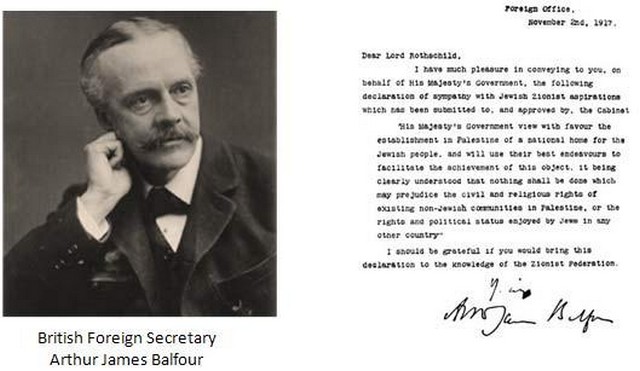
United Nations panel calls for end of Israeli occupation of Palestinian territory

By Abdus Sattar Ghazali

The United Nations has overwhelmingly approved a resolution calling for Palestinian self-determination and end to Israeli occupation of Palestinian territory since 1967. The resolution was approved on Thursday by the UN General Assembly’s Third Committee — the committee that deals with human rights and humanitarian affairs. It was passed 163 to 5, with 10 abstentions.

Those who voted against were: the United States, Israel, the Marshall Islands, Micronesia and Nauru also voted against the resolution.

Australia, Cameroon, Guatemala, Honduras, Kiribati, Palau, Papa New Guinea, Rwanda, Togo and Tonga all abstained.

The resolution emphasized “the right of the Palestinian people to self-determination, including the right to their independent State of Palestine” and “stressed the urgency of achieving without delay an end to the Israeli occupation that began in 1967 and a just, lasting and comprehensive peace settlement between the Palestinian and Israeli sides,” based on a two-state solution.

It is part of a large package of 20 pro-Palestinian resolutions that are passed by the General Assembly every year.

Palestinian Representative

The Palestinian representative thanked those countries that supported their right to self-determination. He pushed back at the charge that such UN resolutions were problematic.

“Support for this resolution is the only possible option for any country that believes in international law. The right to self-determination was enshrined in the UN charter,” he said.

Many UN countries have also been victims of colonialism and thus have an affinity with the Palestinian cause, he continued, adding: “The problem is not UN resolutions: The problem is their lack of implementation,” he said.

“A two-state solution based on the pre-1967 lines is a critical element for peace with Israel, and therefore all countries have an obligation not to support Israeli actions over the pre-1967 lines,” he said adding: “There is no doubt that the last day of Israel’s occupation of our land will be the first day of peace for all.”

UN resolution reaffirms peoples’ self-determination right

Meanwhile, the United Nations General Assembly’s (UNGA) Third Committee which deals with social, humanitarian and cultural issues Saturday unanimously a passed resolution on the right to self-determination of all people.

Co-sponsored by 71 countries, the resolution, submitted by Pakistan, was adopted without a vote in the 193-member Assembly’s Third Committee. The resolution, which Pakistan has been sponsoring since 1981, serves to focus the world’s attention on the struggle by peoples still struggling for their inalienable right to self-determination, including those in Kashmir and Palestine.

The resolution also declared the General Assembly’s firm opposition to acts of foreign military intervention, aggression and occupation, since these have resulted in the suppression of the right of peoples to self-determination and other human rights in certain parts of the world.

It called on those states responsible to cease immediately their military intervention in and occupation of foreign countries and territories, as well as all acts of repression, discrimination, exploitation and maltreatment. The resolution also deplored the plight of millions of refugees and displaced persons who have been uprooted as a result of these acts and reaffirms their right to return to their homes voluntarily in safety and honor.

It urges the Human Rights Council to give special attention to the violation of human rights, especially the right to self-determination, resulting from foreign military intervention, aggression or occupation. It also requests the Secretary-General to report to the next Session of the General Assembly on this question.

Abdus Sattar Ghazali is the Chief Editor of the Journal of America (www.journalofamerica.net) email: asghazali2011 (@) gmail.com

26 November 2020

Source: countercurrents.org
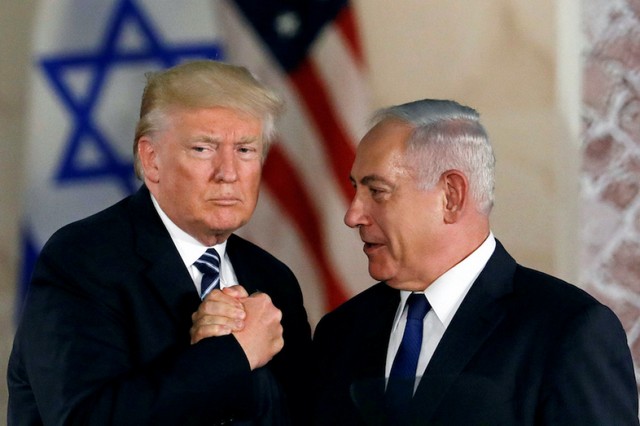
Allegations of War Crimes by Australian Forces in Afghanistan Shock the Nation

By Kalinga Seneviratne

SYDNEY (IDN) – The release of a report into a landmark four-year investigation into the behaviour of Australians special forces known as the SAS (Special Air Service) in Afghanistan, seem to have shocked the nation, judging from newspaper headlines on November 20. Yet, for many who opposed Australia’s involvement in the Afghanistan war, this is not surprising and such a report came too late. A whistle blower who leaked information to the media in 2018 of these atrocities is facing criminal charges for stealing state secrets.

Pip Hinman, of the Sydney ‘Stop The War Coalition’ is not too surprised by the findings. “The nearly 20-year war has been largely hidden (from the Australia public),” she told IDN.

“The media has not been able to go to Afghanistan unless they were embedded with the Australian Defence Force (ADF). Only a handful of independent journalists have managed to get in, and they too would only want to report on the good soldiers because otherwise they would never get back.”

Hinman added: “The federal government has and is actively trying to stop army whistle blowers. Thanks to those brave people, Australians have been getting a better understanding of the nature of this war and Australia’s role there.”

For the last four years, the Inspector-General of the ADF has been looking into such whistle blowing that Australian elite forces in Afghanistan were committing war crimes. The inquiry has now handed down its final report, completed by New South Wales Justice Paul Brereton, who is also a Major General in the Army Reserve.

The findings reveal that some of Australia’s most elite soldiers in the SAS have been involved in unlawful killing, blood lust, a warrior culture and cover-up of their alleged atrocities. It comes as a surprise to an Australian public, who believe that Australian military engagement in Afghanistan was designed to keep the world safe from terrorists. Australia first committed military personnel to Afghanistan in October 2001 to support US’s ‘war on terror’ campaign.

Alex Bainbridge, of the Socialist Alliance, which is opposed to Australia’s involvement in “imperialist wars” in foreign countries believes that the report could help to debunk a myth. “The government tries to pretend that the Australian military is ‘professional’ and only fights for noble causes, but this is a propaganda myth to win public support for unjust wars,” he told IDN.

The report’s most staggering revelation is that 39 Afghans were allegedly murdered by Australian special forces in 23 incidents. None of the alleged victims were combatants. Brereton said that the circumstances of each, were they to be eventually accepted by a jury, would constitute the war crime of murder.

The report has described a process, where young special forces soldiers would be instructed by their patrol commander to execute a detainee. Weapons or radios, known as “throwdowns”, were placed on the body and a cover story allegedly created to mask the crime and deflect any scrutiny. Operational reports were allegedly sanitized to make it appear as though special forces were complying with the laws of engagement.

Some of these incidents took place in 2009 and 2010, with the majority occurring in 2012 and 2013. ADF Chief General Angus Campbell has expressed shocked by the revelations, saying that it is damaging to the moral authority of the military force. “I would never have conceived an Australian would be doing this in the modern era,” he told a media briefing.

This is not the first time that such activities have come into the public domain. In 2018, David McBride, a former Australian Army lawyer, leaked ADF documents on activities of the SAS in Afghanistan to the Australian Broadcasting Corporation (ABC) which did a series of 7 stories based on these. In response to these stories, Australian Federal Police (AFP) raided the offices of the national broadcaster in Sydney in June 2019 and spent some 8 hours going through computers and confiscating all document related to the matter.

In June 2020, AFP instructed the Office of the Commonwealth Director of Public Prosecutor to lay charges against journalist Dan Oakes. But, last month (October), the office announced that though they may succeed in obtaining a conviction on several charges, they will not proceed with the case.

McBride, who is facing charges on theft of Commonwealth (Government) property, in a tweet on Thursday said “ a thorough examination of unit command and delegated authority is vital, extending to the very top. This includes the actions of those highly decorated senior officers who provided command during the Afghanistan campaign.”

But, despite these mechanisms being put in place, there are still serious questions about how potential criminal prosecutions would work, argues Professor David Letts, director of the Centre for Military and Security Law at the Australian National University.

“Investigating and prosecuting alleged crimes of this nature is incredibly difficult due to the passage of time, fading memories and inconsistency of witnesses. There are also practical challenges obtaining evidence in a country with a fragile security situation,” he notes in a commentary published by Canberra Times.

He also adds that the standard of proof required to convict an individual “beyond a reasonable doubt” in a criminal trial is quite high, meaning any successful prosecution might require stronger evidence than what has been included in the inquiry report.

Dr Rateb Jneid, President of the Australian Federation of Islamic Councils believes that Australia has made the right decision to investigate these crimes. But, this should be the start of a process where “we make a solemn commitment to stop invading other nations and we must stop supporting invaders and occupiers’ of other nations,” he said in a statement given to IDN.

“We must own up to our crimes and proceed with fair and just persecutions against the perpetrators and those who ordered them to commit such atrocious murders.”

But, the military may see the issue differently. “Our SAS fight against an enemy that wears no uniform and who can easily conceal weapons under the folds of their peasant garbs. Telling friend from foe is nigh impossible and split-second decisions are often needed to counter possible threats,” argues retired Lieutenant Colonel Derek Gogh, in a letter published by Canberra Times on November 20.

“Many of our soldiers have already been murdered by traitorous Afghani soldiers and our SAS troopers also have to cope with frequent roadside bombs and IEDs (improvised explosive devices). They constantly operate under extreme stress, not likely to be appreciated by those who have not walked in their shoes.”

But Bainbridge argues that the need of the hour is a fundamental change in the military thinking to “curtail their capacity to wage wars of aggression abroad”. “The people of Afghanistan have never threatened Australia,” adds Hinman. “They have told us they can handle their own despots and regimes (like Taliban) themselves, but the very presence of occupying Western forces, which helped ferment new terrorist gangs like the IS (Islamic State), made that struggle (to fight terror) even harder.”

Bainbridge believes that every exposure of imperialist war crimes and human rights abuses makes it easier to make an anti-war argument. “A million people protested against the Iraq war in February 2003 and around half the population were opposed to that war,” he points out. “So it is definitely possible to build a strong and successful anti-war movement in this country.”

Photo: Two Australian soldiers during the Shah Wali Kot Offensive in Afghanistan. CC BY 2.0

IDN is flagship agency of the Non-profit International Press Syndicate.

20 November 2020

Source: www.indepthnews.net

Richard Falk, a Citizen Pilgrim in Search of Justice and Peace, Turns 90

By Jan Oberg

13 Nov 2020 – We are blessed by having a number of peace and future scholars, world-leading in their professions, who have followed world events over many decades and continue to be committed to world order change and public education.

I say “blessed” because I assume that the reader share my reverence for high age and the sharing of long life experience as well as the wisdom that may accompany it in the midst of the youth-worshiping which characterises the ageing and increasingly grumpy West itself – also sometimes called age discrimination.

Last month we celebrated Johan Galtung at 90. And today, Richard Falk at 90 – both world-renowned mega-productive scholars restlessly seeking ways to make the world a more peaceful place. And both TFF Associates, mentors and friends of the founders even before we set up TFF in 1985.

As a student of sociology, peace and world affairs in the 1970s, I had been drawn to Falk’s pioneering writings and textbooks – and the “relevantly utopian” World Order Models Project, WOMP, that he participated in. I then met him in Lisbon for that project’s meeting in 1980 and have benefited ever since from his academic/law perspectives, peace thinking as well as from his sophisticated, elegantly complex style of writing.

To write this heart- and brain-felt homage, I went back first to TFF Associate’s “Treasures” section 1998-2005 and found 43 articles by Richard. Then on to TFF’s homepage – 2006-2012 and found 46 articles by him. Continuing to TFF Associates’ blog 2012-2017, I find that we published no less than 243 articles by Richard during those five years. And finally to our present site, The Transnational from 2018 where there are some 50.

In sum, more than 380 pieces of theory, visions, commentaries, analyses and debate articles. Although this is only a fraction of his total production, I allow myself to interpret this publication result as a modest token of my deep gratitude and my joy of paying back a little of what he has so generously given TFF and me personally during all these years – not the least, I may add, by reading and editing all these articles before I posted them!

It isn’t easy, perhaps actually impossible, to pin down who Richard Falk is, incessantly writing and speaking around the world, over so many years. But it suffices here to just celebrate the incredible diversity. Richard’s lifelong engagement with the Palestinian people stands out – as do critical analyses of USand NATO militarism and interventionism; Middle Eastern developments and wars, of course; international law and the UN in particular – we share a big heart for its basic idea and role in the world – as well as nonviolence and peace and analysis of topical issues such as this from just a couple of days ago. . .

Richard Falk is Jewish and explains what this identity means to him and, in passing, why he cannot in spite of his critical attitude to Zionism be categorized as he has been, as a self-hating Jew. He speaks rather from an ecumenical perspective – of great significance for world peace thinking:

“In a more fundamental respect my own evolution has always been suspicious of those who give priority to tribalist or sectarian identities. In other words, it is fine to affirm being Jewish, but it should not take precedence over being human or being open and receptive to the insight and wisdom of other traditions. We have reached a point in the political and cultural evolution that our future flourishing as a species vitally depends upon the spread of a more ecumenical ethos. We have expressed this embrace of otherness in relation to food, with the rise of ‘fusion’ cuisines, and with regard to popular culture, particularly music, where all kinds of borrowing and synthesis are perceived as exciting, authentic, valuable.”

And…

“In my experience what is most appropriate in our historical circumstances is an ecumenical and inclusive spiritual identity, and associated ethical and political commitments. In effect, what would awaken the collective sensibilities of the peoples of the earth to the challenges confronting humanity is a movement of spiritual and ethical globalization that approaches the universal through an immersion in a variety of particularities.

In this sense, I want to say, yes I am Jewish, and proud of it, but I am equally indigenous, Sufi, Hindu, Buddhist, Muslim, and Christian to the extent that I allow myself to participate in their rituals, partake of their sacred texts, and seek and avail myself of the opportunity to sit at the feet of their masters. Many persons living deprived lives do not have or desire such ecumenical opportunities, and can best approach this universal ideal, by seeking out the inclusive potentialities of their own religious and cultural reality.”

Of course, like many other experts critical of Israel’s policies in general and policies vis-a-vis the Palestinians, he has been accused of anti-Semitism. In this short video from autumn 2019, you’ll see how he – careful with formulations around the complexity of the issue – explains how Zionism’s rejection/diversion of all criticism as anti-Semitism has more dimensions and purposes than we may have thought of. Indeed, this short sequence a pearl of pedagogics.

Richard Falk on Zionism and anti-Semitism

Richard’s style of writing has literary qualities way beyond the normal academic text – and without losing its precision and attempted rational reasoning. That may very well have to do with his reading of fiction and his own writing of poetry.

You’ll see in Memoir sketch – Championing lost causes how literary-philosophical classics such as Albert Camus influences his thinking, not only about external academic issues and the world but what it means to be an intellectual acting responsibly into that world and – even in dark times – avoid the traps of losing hope and being overtaken by fear.

In this article he pays tribute to one of his dearest friends, literature professor Edward Said (1935-2003) taking as his point of departure Said’s 1997 essay “On lost causes”, something which he elaborates further on in this 2014 article in The Nation about the future of Palestine.

It wasn’t before he turned 80 that Falk started his personal blog, Global Justice in the 21st Century which contains posts of a fascinating diversity and in a quantity that makes you wonder whether the man ever sleeps (he maintains that he does but gives the impression that to him sleep is an unfortunate, necessary waste of time; it’s a feeling we share).

Not to be missed, throughout this blog, he explores directly and indirectly what it means to be what he calls a citizens pilgrim. He defines that as

an identity shaped through an appreciative reference to ‘the citizen pilgrim,’ that is, to the citizen whose conscience is directed at others without heeding boundaries of space or time, or such contingent features of identity as nationality, ethnicity, race, religion, gender, class. The citizen pilgrim has embarked upon what is essentially a spiritual journey or pilgrimage, seeking an inspirational future that seems neither feasible nor impossible. Such an inspirational dedication also minimizes the imaginative foreclosures of mortality, making the certainty of death a part of life, and accepting this destiny without seeking the comfort of metaphysical fictions, and thus not deeply disconcerted by ‘the dying of the light.’

As I’ve hinted above, parallel with his academic and political production, Richard has consistently grappled with what it means to be a responsible intellectual – over the moral aspects of his lifelong project and its meandering path. “Responsible scholarship in dark times” from 2007 is but one of many such thoughtful pieces – rare in the academic world – with the greatest relevance for today’s – no less dark – world in which true knowledge, not to mention wisdom, seems to have lost out to the fast market’s banality-driven timespan-contracting and impulsive clicking fad that gives priority to fast, smart opinions rather than the slower knowledge-building – in short, a new illiteracy.

The world as a whole and as we experience it today in a macro-historical perspective has not progressed to the better, towards what he has struggled and hoped for. But is he frustrated?

Anti-war and pro-peace

This little tribute to one of the most prolific and elegantly-reasoning social scientists of our time cannot be anything but kaleidoscopic. The reader is advised to explore the Falk universe and its enlightenment on their own, perhaps through some of the links provided in this article.

Of particular importance for our relations with him is, naturally, his deep belief in and advocacy of using all the civilian means at humanity’s disposal and only use violence as the last resort, completely in unison with the UN Charter’s Article 1 – the promotion of which is TFF’s mission.

An example. Already in September 2002 – about half a year before the U.S. invasion and destruction of Iraq with its allies under Goerge W. Bush, Falk pulled the entire project apart, intellectually, legally, politically and morally in this short article on TFF – “A roadmap to war: A flawed debate.”

Falk stated his factual and intuitive pre-war criticism succinctly as did other TFF Associates such as Hans von Sponeck, Johan Galtung, Brian Martin, David Krieger, Burns Weston, Birgitte Rahbek, Else Hammerich and myself to mention some of the more vocal anti-intervention voices at the time.

It’s noteworthy that all TFF Associates who advised strongly against that war before it started also predicted its catastrophic consequences it would have in Iraq as well as for the possibility of a new and more benign world order that had been made possible by the demise of the Soviet Union and the Warsaw Pact. But few politicians and media in the US and NATO countries had any wish or capacity to listen. Today the consequences of that insensitive and self-destructive militarism causes the decline of the US and NATO itself.

Falk’s devotion to Gandhi, to eclecticist nonviolent thinking and policies, can be enjoyed in this article on TFF’s homepage “Mahatma Gandhi and the revival of nonviolent politics at the end of the 20th century” – as early as 1998.

If a Nobel Peace Prize should, for the first time, be awarded to a peace and conflict scholar, Richard Falk would be on top of the shortlist. Fortunately, he is on the list of the Nobel Peace Prize Watch. Here you may read the motivation for his nomination, every year over the last 12.

However, like Johan Galtung and the other qualified people on that list, Falk is probably too central to the essential peace concerns as Alfred Nobel expressed them in his will to ever even be considered – not that I think it bothers him the slightest.

My wife and co-founder Christina – and many other TFF Associates – join you today to say thank you, dear Richard, for your friendship, mentorship and TFF Associateship over more than 40 years.

As we look forward, we wish you and you wife Hilal Elver everything good in years to come, good health in particular so you can continue happily your citizen’s pilgrimage which will, beyond a doubt, continue to inspire way beyond your own time and space. And do continue your daily ping-pong matches too…

You may congratulate Richard Falk by Joining the Discussion below or write him at either falk@global.ucsb.edu or rfalk@princeton.edu

Richard Falk is a member of the TRANSCEND Network, an international relations scholar, professor emeritus of international law at Princeton University, Distinguished Research Fellow, Orfalea Center of Global Studies, UCSB, author, co-author or editor of 60 books, and a speaker and activist on world affairs.

Prof. Jan Oberg, Ph.D. is director of the Transnational Foundation for Peace and Future Research, TFF and a member of the TRANSCEND Network for Peace Development Environment.

16 November 2020

Source: www.transcend.org

Interpreting the U.S. Election Results: Preliminary Observations

By Richard Falk

9 Nov 2020 – The victory by the Biden/Harris ticket in the 2020 American National Elections is basically good news for the country and the world, although not as good as expected (by pollsters or enthusiasts) or nearly as decisive as desirable given the dreadfully regressive behavior of Trump and the Republican Party over the past four years. And there is some bad news, as well, lurking just beneath the surface. Not only the strength of Trumpism in America, but the likely drift toward the center-right of the Biden presidency.

Why Good News?

Above all, Trump’s reelection would have meant a tighter embrace of an American version of fascism with constitutionalism, the rule of law, and human rights repudiated, and an autocratic/plutocratic style of leadership consolidated around an ideology of chauvinistic or nativist nationalism.

The vote was not as one-sided as anti-fascists might have hoped, but the Biden ticket did prevail in the popular vote by an almost 5 million margin, and won the electoral college by a comfortable margin. This achievement is even greater than the statistical results if account is taken of the various Republican voter suppression efforts.

In policy terms, the result seems clearly beneficial with respect to the short-term domestic agenda. The CORONA pandemic is likely to be immediately handled in accord with guidelines by health specialists rather than by the macho whims of the Trump White House, which means that the virus is likely to be brought under control as rapidly and humanely as possible, assuming that the inauguration of Biden occurs on January 20th. Beyond this, presuming some Congressional flexibility, a stimulus package beneficial to the poor and unemployed, as well as to small businesses is likely to be quickly forthcoming. Such policies should pave the way to a broader, more sustainable and fairer economic recovery, although the second wave COVID spike in Europe warrants caution as to what the future will bring.

Looking beyond these immediate challenges, it would seem reasonable to expect improvements in health care, public education, judicial appointments, racial and gender equality from the Biden presidency, with a realistic prospect of progress toward realizing such goals, especially if the two Georgia runoff elections on January 5th go the Democratic Party way, which seems possible, but not yet probable.

Internationally, the Biden victory will be greeted by world leaders around the world with a huge sigh of relief. It will have, additionally, some positive impacts on global problem-solving, giving rise overall to a more cooperative atmosphere. A revived posture of U.S. global activism is certain to be welcomed at first raising hopes of crafting compromise solutions to common problems. It seems also like to produce some increased appreciation of the role of the United Nations and international law, highlighted by reactivating membership in and refunding of the WHO. This kind of participation by the United States is likely to a partial renewal of the global leadership role that the U.S. played in the decades after the end of World War II, although in a more muted manner, due to preoccupations with domestic challenges, and in a spirit more related to functional concerns, above all, climate change and health, than to ideologically adversary geopolitical relations.

Now, the Bad News

While the referendum on Trump as leader and fascism as ideology were formally repudiated, the threats posed remain existentially viral, likely to become entrenched in some kind of organizational Trumpist format that will stalk the future of governance and quality of political life in the United States during the years ahead. It is chastening to acknowledge that if the pandemic had not struck the country so hard or Trump had handled it more prudently, he likely would have been reelected. The stock market would have attained a record high, while unemployment would have remained at record lows. As it was, as Republicans gleefully point out, their party won the 2020 elections except for the presidency—so far holding their Senate majority, even picking up several seats in the House of Representatives, gaining in Federal contexts, meaning greater influence among the legislatures and leadership in the 50 states. I can only imagine the dire morning after had there been no health crisis, no economic downturn, and no crazy leader in the White House!

Less obvious, but no less serious, the Biden victory is also a victory for the American deep state, which has presided over the implementation of an evolving bipartisan consensus that has shaped American foreign policy ever since the wartime unity governments of 1941-1945. This foreign policy consensus can be identified with four overlapping dimensions:

1. a global military security system consisting of hundreds of overseas military bases, all-oceans naval presences, operational intelligence capabilities in every strategically important country in the world, and a hegemonic control of nuclear weaponry;

2. a string of formal and informal alliances and special relationships that connect U.S. diplomacy and geopolitical muscle with strategic priorities such as the defense of Europe, Taiwan, and Israel;

3. a shifting continuing need to identify sufficient global security threats and interest to satisfy private sector arms sales interests and to ensure Congressional support for high defense budgets; the promotion of such goals tend to magnify security threats and induce geopolitical confrontations;

4. a support structure for a market-driven world economy premised on ‘Neoliberal Globalization,’ premised on facilitating transnational capital investments and beneficial trading frameworks, and backed up by international economic institutions (World Bank, IMF, World Trade Organization), and supplemented as necessary by various hostile responses by the U.S. Government in reaction to displays of foreign economic nationalism, including reliance on sanctions, covert interventions, and coercive diplomacy.

It is notable that the bureaucratic managers of the deep state, retirees from the CIA and Pentagon, were not comfortable with the Trump presidency because its leadership lacked a disciplined adherence to these four dimensions of the deep state consensus that had managed the transitions from World War II to the Cold War, from the Cold War to the War of Terror, and hopes perhaps for a new transition that generates tensions with Russia and/or China. It is not that Trump defied the consensus at the level of policy, but that he led with an unsteady hand less responsive to the nuances of geopolitical management of an increasingly complex global setting. With Biden the deep state has a reliable veteran adherent of the deep state consensus, someone who can be trusted to follow its signals as to policy initiatives, especially in the domains of foreign economic and security policy. In the present setting, Biden has almost total freedom to opt for the center-right on foreign policy as the political mood is currently dominated by how he delivers on the home front.

Finally, on the domestic scene, there is now a probable surfacing of post-Trump strife among the Democratic winners in the recent elections. The issue is one of policy influence as reflected by high profile appointments, policy priorities, and presidential tone. Will the progressive wing of the Democratic Party that preferred Bernie Sanders over Joe Biden as the anti-Trump candidate be given its due or will it be boxed in by the center-right leadership that blames the center-left for its setbacks in the 2020 elections? These self-styled Democratic moderates insist that progressive advocacy of the Green New Deal, Medicare for All, debt forgiveness for student loans were ‘socialist’ or hard left proposals that drove many Independents to vote Republican except for Biden/Harris. It seems doubtful that ‘the center will hold’ as Democrats on the left and right vie for influence, and it is quite possible that The Squad will go it alone, championing movement politics, while almost giving up on the two-party approach to American politics. We already finding the two wings each claiming credit for the Biden victory. The center-right contending that only a candidate of Biden’s conservative record could have won, and all other Democrat alternatives would have gone down to defeat. The center-left counters with the claim that without the progressive ground game and mobilization of voter turnout among minorities and youth, Biden/Harris would have been beaten by Trump/Pence.

Leading Where?

Too many uncertainties exist to support any confident assessment as to how these clashing tendencies will play out. What seems clear is that there were two outcomes of the American elections: Trump was beaten, but Trumpism was not, garnering the support under the most unfavorable circumstances of over 70 million voters and a heightened sense of militancy under circumstances of higher political stakes. Will Trumpists, and the Republican leadership, interpret the election as a defeat because Trump lost or as a mandate because Republican conservative policy positions despite the adverse presidential tide made gains at the Congressional and federal levels of government.

One unknowable issue is whether Trumpism can flourish without Trump in the White House, and closely related, whether Trump after returning to private life will seek to lead the movement he inspired or resume his life as freewheeling business magnate.

Another area of uncertainty is whether the deep state will opt for a geopolitical confrontation with China or will be content to promote economic growth and political stability at least for an interim period during which the U.S. recovers its geopolitical composure. It seems safe to assume that Biden will govern in light of a new articulation of a deep state consensus responsive to its reading of the global scene, but how that will be weighted is far from clear at this time.

Biden’s clarion call has been to bring civility, if not a spirit of unity, back to the ebb and flow of American politics. This is an understandable response to the slash and burn presidency of Trump, but if it persists, it could lead to some discrediting compromises, with respect to stimulus, health care, immigration, unlikely to appease Trumpists or even non-Trump Republicans, and foster an image of the Biden presidency as out of touch with the harsh realities of American politics in their present configuration. Obama made this mistake, and was outmaneuvered by Republicans who took all they could get without giving away anything in return. It will be important to watch closely Biden’s attempts to induce a more cooperative atmosphere and, especially, how he handles a non-responsive Republican Senate. Indications remain strong that the last thing Trump-oriented Republicans want is compromise. Forgetting that it takes two to tango could quickly alter the welcome image of Biden the unifier into that of Biden the dangerous fool who fails to understand the ethics and politics of polarization. Unless a presently unseen and almost unimaginable will emerges on the political right to seek some level of reconciliation with the Democratic establishment, wasting energy on finding common ground is like looking for sunlight deep inside a cave.

Richard Falk is a member of the TRANSCEND Network, an international relations scholar, professor emeritus of international law at Princeton University, Distinguished Research Fellow, Orfalea Center of Global Studies, UCSB, author, co-author or editor of 60 books, and a speaker and activist on world affairs.

16 November 2020

Source: www.transcend.org

Making Sense of Hunger Strikes and Symbolic Politics

By Richard Falk

12 Nov 2020 – What follows is my contribution to a forthcoming publication bearing the title Shared Struggle: Stories of Palestinian and Irish Hunger Strikers. This is an important collection of writing prepared by Norma Hashim and Yousef M. Aljami. It appeared by way of exclusive arrangement on October 27, 2020 in the online magazine Politics Today. My essay speaks to the hunger strikes as political resistance of a sublime character, and at the same time to the selective silence of the Western media when it comes to heroic moments in the Palestinian struggle. Just days ago Maher Al-Akhras ended his 103 day hunger strike when Israel finally agreed to his release from prison after repeated confinement without charges under colonialist ‘administrative detention’ rulings.

Desperate circumstances give rise to desperate behavior. If by states, extreme violent behavior tends to be rationalized as ‘self-defense,’ ‘military necessity,’ or ‘counterterrorism,’ and claims of legal authorization are treated as appropriate. If even nonviolent acts of resistance by individuals associated with dissident movements, then the established order and its supportive media will routinely describe such acts as ‘terrorism,’ ‘criminality,’ and ‘fanaticism,’ and the behavior is criminalized, or at best exposed to scorn by the established order of sovereign states. Statist forms of combat almost always rely on violence to crush an enemy, while the desperation of resistance sometimes takes the form of inflicting hurt upon the self so as to shame an oppressor to relent or eventually even surrender, not due to empathy or a change of heart, but because fearful of alienating public opinion, intensifying resistance, losing international legitimacy, facing sanctions. It is against such an overall background that we should understand the role of the hunger strike in the wider context of resistance against all forms of oppressive, exploitative, and cruel governance. The long struggles in Northern Ireland and Palestine are among the most poignant instances of such political encounters that gripped the moral imagination of many persons of conscience in the years since the middle of the prior century.

Those jailed activists who have recourse to a hunger strike, either singly or in collaboration, are keenly aware that they are choosing an option of last resort, which exhibits a willingness to sacrifice their body and even life itself for goals deemed more important. These goals usually involve either safeguarding dignity or honor of subjugated people or mobilizing support for a collective struggle on behalf of freedom, rights, and equality. A hunger strike is an ultimate form of non-violence, comparable only to politically motivated acts of self-immolation, physically harmful only to the self, yet possessing in certain circumstances unlimited symbolic potential to change behavior and give rise to massive displays of discontent by a population believed to be successfully suppressed. Such desperate tactics have been integral to the struggles for basic rights and resistance to oppressive conditions in both Palestine and Northern Ireland.

An unacknowledged, yet vital, truth of recent history is that symbolic politics have often eventually controlled the outcomes of prolonged struggles against oppressive state actors that wield dominant control over combat zones and uncontested superiority in relation to weapons and military capabilities. And yet despite these hard power advantages thought decisive in such conflict, they go on in the end to endure political defeat. It may be helpful to remember that it was the self-immolation of Buddhist monks in Saigon during the 1960s was considered a scream of the culture in reaction to the American led military intervention. It led Vietnamese scholars to interpret these extreme acts of solitary individuals, endowed with the highest civilizational authority, as actually shifting the balance of forces in Vietnam in ways that then and there doomed the seemingly irresistible American military resolve to control the political future of Vietnam. These acts didn’t end the war, but to those with insight into Vietnamese culture it did signal an outcome contrary to what the war planners in Washington expected. Tragically before acknowledging defeat, the Vietnam war persisted for a decade, ravaging the land and bringing great suffering to the people of Vietnam. Self-immolation, setting oneself on fire as an irreversible instance of self-sacrifice, carries the logic of a hunger strike to its conclusion. Depending on the actor and context, self-immolation can be interpreted either as an expression of hopeless despair or as a desperate appeal for a just peace.

It was the self-immolation of a simple fruit and vegetable vendor, Mohamed Bouazizi in the Tunisian town of Sidi Bouzid on December 17, 2010 that called attention to the plight of the Tunisian people, igniting a nationwide uprising that drove a corrupt dictator, Ben Ali, from power. Bouazizi, without political motivation or spiritual authority of the Buddhist monks, sparked populist mobilizations that swept across the Arab world in 2011. Somehow Bouazizi’s entire personal self-immolation set the region ablaze. Such a reaction could not have been predicted and was not planned, yet afterwards it was interpreted as somehow generating revolutionary responses to intolerable underlying conditions.

Without doubt, the supreme example of triumphant symbolic politics in modern times was the extraordinary resistance and liberation movement led by Gandhi that merged his individual hunger strikes unto death with spectacular nonviolent forms of collective action (for instance, ‘the salt march’ of 1930), accomplishing what seemed impossible at the time, bringing the British Empire to its knees, and by so doing, restoring independent statehood and sovereignty to India.

Both the oppressed and the oppressors learn from past successes and failures of symbolic politics. The oppressed view it as an ultimate and ennobling approach to resistance and liberation. Oppressors learn that wars are often not decided by who wins on the battlefield but by the side that gains a decisive advantage symbolically in what I have previously called ‘legitimacy wars.’ With this knowledge of their vulnerability, oppressors fight back, defame and use violence to destroy by any means the will of the oppressed to resist, especially if the stakes involve giving up the high moral and legal ground. The Israeli leadership learned, especially, from the collapse of South African apartheid not to take symbolic politics lightly. Israel has been particularly unscrupulous in its responses to symbolic challenges to its abusive apartheid regime of control. Israel, with U.S. support, has mounted a worldwide defamatory pushback against criticism at the UN or from human rights defenders around the world, shamelessly playing ‘the anti-Semitic card’ in its effort to destroy nonviolent solidarity efforts such as the pro-Palestinian BDS Campaign modeled on an initiative that had mobilized worldwide opposition to South African apartheid. Notably, in the South African case, the BDS tactic was questioned for effectiveness and appropriateness, but its organizers and most militant supporters were never defamed, much less criminalized. This recognition of the potency of symbolic politics by Israel has obstructed the Palestinian liberation struggles despite what would seem to be the advantageous realities of the post-colonial setting.

Israel’s version of an apartheid regime evolved as a necessary side effect of establishing an exclusivist Jewish state in a non-Jewish state. This Zionist project required that the Palestinian people become victims of colonialist displacement in their own homeland. Israel learned from the South African experience techniques of racist hierarchy and repression, but they were also aware of the vulnerabilities of oppressors to sustained forms of non-violence that validated the persevering resistance of those oppressed. Israel is determined not to repeat the collapse of South African apartheid, and to do so requires not only repression of resistors but the demoralization of supporters.

A similar reality existed in Northern Ireland where the memories of colonies lost to weaker adversaries slowly taught the UK lessons of accommodation and compromise, which led the leaders in London to shift their focus from counterterrorism to diplomacy, with the dramatic climax of the Good Friday Agreement in 1998. Israel is not the UK, and the Irish are not the Palestinians. Israel shows no willingness to grant the Palestinian people their most basic rights, yet even Israel does not want to be humiliated in ways that can arouse international public opinion to move beyond the rhetoric of censure in the direction of sanctions. The Israeli Prison Service doesn’t want Palestinian hunger strikers to die while in captivity, not because of empathy, but to avoid bad publicity. To prevent such outcomes, Israeli prison authorities will make concessions, including even release, when a hunger striker is feared at the brink of death, and earlier attempts at force feeding have failed. Palestinian prospects are more dependent than ever on waging and winning victories in the domain of symbolic politics, and Israel, with the help of the United States, will go to any length to hide defeat in this longest of legitimacy wars.

It is against such a background that Palestinian and Irish contributions came to surface to underscore the essential similarity of these two epic anti-colonial struggles. What gives the stories of Palestinian and Irish hunger strikers the authority and persuasive power is the authenticity derived from words of those brave men and women who chose to undertake hunger strikes in situations of desperation and experienced not only their own spirit-enhancing ordeal but the pain of loss of martyred fallen comrades, grieving families, and their common effort to engage the wider struggles for rights and freedom being carried on outside the prison walls. Despite the vast differences in their respective struggles against oppression, the similarities of response created the deepest of bonds, especially of the Irish toward the Palestinians whose oppressive reality was more severe, and has proved more enduring, although the dreams of the Irish hunger strikers remain largely unrealized. At the same time, the inspirational example of the Irish hunger strikers who did not abandon their quest for elemental justice at the doorstep of death was not lost on the Palestinians.

Richard Falk is a member of the TRANSCEND Network, an international relations scholar, professor emeritus of international law at Princeton University, Distinguished Research Fellow, Orfalea Center of Global Studies, UCSB, author, co-author or editor of 60 books, and a speaker and activist on world affairs.

16 November 2020

Source: www.transcend.org