By Glenn Greenwald
An attempt to assess the importance of the known evidence, and a critique of media lies to protect their favored candidate, could not be published at The Intercept.
29 Oct 2020 – I am posting here the most recent draft of my article about Joe and Hunter Biden — the last one seen by Intercept editors before telling me that they refuse to publish it absent major structural changes involving the removal of all sections critical of Joe Biden, leaving only a narrow article critiquing media outlets. I will also, in a separate post, publish all communications I had with Intercept editors surrounding this article so you can see the censorship in action and, given the Intercept’s denials, decide for yourselves (this is the kind of transparency responsible journalists provide, and which the Intercept refuses to this day to provide regarding their conduct in the Reality Winner story). This draft obviously would have gone through one more round of proof-reading and editing by me — to shorten it, fix typos, etc — but it’s important for the integrity of the claims to publish the draft in unchanged form that Intercept editors last saw, and announced that they would not “edit” but completely gut as a condition to publication.
**********************************
TITLE: The Real Scandal: US Media Uses Falsehoods to Defend Joe Biden From Hunter’s Emails
Publication by the New York Post two weeks ago of emails from Hunter Biden’s laptop, relating to Vice President Joe Biden’s work in Ukraine, and subsequent articles from other outlets concerning the Biden family’s pursuit of business opportunities in China, provoked extraordinary efforts by a de facto union of media outlets, Silicon Valley giants and the intelligence community to suppress these stories.
One outcome is that the Biden campaign concluded, rationally, that there is no need for the front-running presidential candidate to address even the most basic and relevant questions raised by these materials. Rather than condemn Biden for ignoring these questions — the natural instinct of a healthy press when it comes to a presidential election — journalists have instead led the way in concocting excuses to justify his silence.
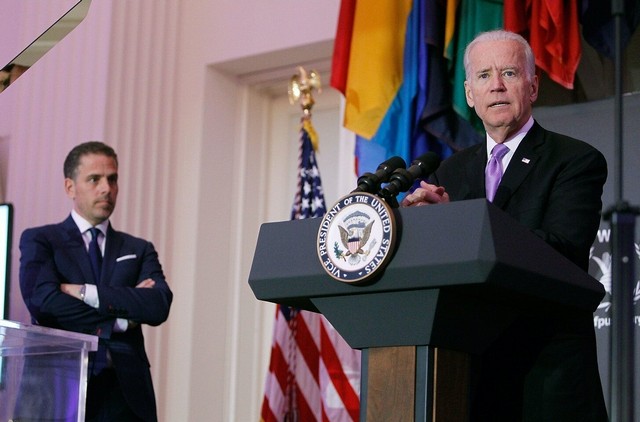
After the Post’s first article, both that newspaper and other news outlets have published numerous other emails and texts purportedly written to and from Hunter reflecting his efforts to induce his father to take actions as Vice President beneficial to the Ukrainian energy company Burisma, on whose board of directors Hunter sat for a monthly payment of $50,000, as well as proposals for lucrative business deals in China that traded on his influence with his father.
Individuals included in some of the email chains have confirmed the contents’ authenticity. One of Hunter’s former business partners, Tony Bubolinski, has stepped forward on the record to confirm the authenticity of many of the emails and to insist that Hunter along with Joe Biden’s brother Jim were planning on including the former Vice President in at least one deal in China. And GOP pollster Frank Luntz, who appeared in one of the published email chains, appeared to confirm the authenticity as well, though he refused to answer follow-up questions about it.
Thus far, no proof has been offered by Bubolinski that Biden ever consummated his participation in any of those discussed deals. The Wall Street Journal says that it found no corporate records reflecting that a deal was finalized and that “text messages and emails related to the venture that were provided to the Journal by Mr. Bobulinski, mainly from the spring and summer of 2017, don’t show either Hunter Biden or James Biden discussing a role for Joe Biden in the venture.”
But nobody claimed that any such deals had been consummated — so the conclusion that one had not been does not negate the story. Moreover, some texts and emails whose authenticity has not been disputed state that Hunter was adamant that any discussions about the involvement of the Vice President be held only verbally and never put in writing.
Beyond that, the Journal’s columnist Kimberly Strassel reviewed a stash of documents and “found correspondence corroborates and expands on emails recently published by the New York Post,” including ones where Hunter was insisting that it was his connection to his father that was the greatest asset sought by the Chinese conglomerate with whom they were negotiating. The New York Times on Sunday reached a similar conclusion: while no documents prove that such a deal was consummated, “records produced by Mr. Bobulinski show that in 2017, Hunter Biden and James Biden were involved in negotiations about a joint venture with a Chinese energy and finance company called CEFC China Energy,” and “make clear that Hunter Biden saw the family name as a valuable asset, angrily citing his ‘family’s brand’ as a reason he is valuable to the proposed venture.”
These documents also demonstrate, reported the Times, “that the countries that Hunter Biden, James Biden and their associates planned to target for deals overlapped with nations where Joe Biden had previously been involved as vice president.” Strassel noted that “a May 2017 ‘expectations’ document shows Hunter receiving 20% of the equity in the venture and holding another 10% for ‘the big guy’—who Mr. Bobulinski attests is Joe Biden.” And the independent journalist Matt Taibbi published an article on Sunday with ample documentation suggesting that Biden’s attempt to replace a Ukranian prosecutor in 2015 benefited Burisma.
All of these new materials, the authenticity of which has never been disputed by Hunter Biden or the Biden campaign, raise important questions about whether the former Vice President and current front-running presidential candidate was aware of efforts by his son to peddle influence with the Vice President for profit, and also whether the Vice President ever took actions in his official capacity with the intention, at least in part, of benefitting his son’s business associates. But in the two weeks since the Post published its initial story, a union of the nation’s most powerful entities, including its news media, have taken extraordinary steps to obscure and bury these questions rather than try to provide answers to them.
The initial documents, claimed the New York Post, were obtained when the laptops containing them were left at a Delaware repair shop with water damage and never picked up, allowing the owner to access its contents and then turn them over to both the FBI and a lawyer for Trump advisor Rudy Giuliani. The repair store owner confirmed this narrative in interviews with news outlets and then (under penalty of prosecution) to a Senate Committee; he also provided the receipt purportedly signed by Hunter. Neither Hunter nor the Biden campaign has denied these claims.
Publication of that initial New York Post story provoked a highly unusual censorship campaign by Facebook and Twitter. Facebook, through a long-time former Democratic Party operative, vowed to suppress the story pending its “fact-check,” one that has as of yet produced no public conclusions. And while Twitter CEO Jack Dorsey apologized for Twitter’s handling of the censorship and reversed the policy that led to the blocking of all links the story, the New York Post, the nation’s fourth-largest newspaper, continues to be locked out of its Twitter account, unable to post as the election approaches, for almost two weeks.
After that initial censorship burst from Silicon Valley, whose workforce and oligarchs have donated almost entirely to the Biden campaign, it was the nation’s media outlets and former CIA and other intelligence officials who took the lead in constructing reasons why the story should be dismissed, or at least treated with scorn. As usual for the Trump era, the theme that took center stage to accomplish this goal was an unsubstantiated claim about the Kremlin responsibility for the story.
Numerous news outlets, including the Intercept, quickly cited a public letter signed by former CIA officials and other agents of the security state claiming that the documents have the “classic trademarks” of a “Russian disinformation” plot. But, as media outlets and even intelligence agencies are now slowly admitting, no evidence has ever been presented to corroborate this assertion. On Friday, the New York Times reported that “no concrete evidence has emerged that the laptop contains Russian disinformation” and the paper said even the FBI has “acknowledged that it had not found any Russian disinformation on the laptop.”
The Washington Post on Sunday published an op-ed — by Thomas Rid, one of those centrists establishmentarian professors whom media outlets routinely use to provide the facade of expert approval for deranged conspiracy theories — that contained this extraordinary proclamation: “We must treat the Hunter Biden leaks as if they were a foreign intelligence operation — even if they probably aren’t.”
Even the letter from the former intelligence officials cited by The Intercept and other outlets to insinuate that this was all part of some “Russian disinformation” scheme explicitly admitted that “we do not have evidence of Russian involvement,” though many media outlets omitted that crucial acknowledgement when citing the letter in order to disparage the story as a Kremlin plot:
Despite this complete lack of evidence, the Biden campaign adopted this phrase used by intelligence officials and media outlets as its mantra for why the materials should not be discussed and why they would not answer basic questions about them. “I think we need to be very, very clear that what he’s doing here is amplifying Russian misinformation,” said Biden Deputy Campaign Manager Kate Bedingfield about the possibility that Trump would raise the Biden emails at Thursday night’s debate. Biden’s senior advisor Symone Sanders similarly warned on MSNBC: “if the president decides to amplify these latest smears against the vice president and his only living son, that is Russian disinformation.”
The few mainstream journalists who tried merely to discuss these materials have been vilified. For the crime of simply noting it on Twitter that first day, New York Times reporter Maggie Haberman had her name trend all morning along with the derogatory nickname “MAGA Haberman.” CBS News’ Bo Erickson was widely attacked even by his some in the media simply for asking Biden what his response to the story was. And Biden himself refused to answer, accusing Erickson of spreading a “smear.”
That it is irresponsible and even unethical to mention these documents became a pervasive view in mainstream journalism. The NPR Public Editor, in an anazing statement representative of much of the prevailing media mentality, explicitly justified NPR’s refusal to cover the story on the ground that “we do not want to waste our time on stories that are not really stories . . . [or] waste the readers’ and listeners’ time on stories that are just pure distractions.”
[https://twitter.com/NPRpubliceditor/status/1319281101223940096/photo/1]
To justify her own show’s failure to cover the story, 60 Minutes’ Leslie Stahl resorted to an entirely different justification. “It can’t be verified,” the CBS reporter claimed when confronted by President Trump in an interview about her program’s failure to cover the Hunter Biden documents. When Trump insisted there were multiple ways to verify the materials on the laptop, Stahl simply repeated the same phrase: “it can’t be verified.”
After the final presidential debate on Thursday night, a CNN panel mocked the story as too complex and obscure for anyone to follow — a self-fulfilling prophecy given that, as the network’s media reporter Brian Stelter noted with pride, the story has barely been mentioned either on CNN or MSNBC. As the New York Times noted on Friday: “most viewers of CNN and MSNBC would not have heard much about the unconfirmed Hunter Biden emails…. CNN’s mentions of “Hunter” peaked at 20 seconds and MSNBC’s at 24 seconds one day last week.”
On Sunday, CNN’s Christiane Amanpour barely pretended to be interested in any journalism surrounding the story, scoffing during an interview at requests from the RNC’s Elizabeth Harrington to cover the story and verify the documents by telling her: “We’re not going to do your work for you.” Watch how the U.S.’s most mainstream journalists are openly announcing their refusal to even consider what these documents might reflect about the Democratic front-runner:
CNN/Hunter Biden emails
These journalists are desperate not to know. As Taibbi wrote on Sunday about this tawdry press spectacle: ” The least curious people in the country right now appear to be the credentialed news media, a situation normally unique to tinpot authoritarian societies.”
All of those excuses and pretexts — emanating largely from a national media that is all but explicit in their eagerness for Biden to win — served for the first week or more after the Post story to create a cone of silence around this story and, to this very day, a protective shield for Biden. As a result, the front-running presidential candidate knows that he does not have to answer even the most basic questions about these documents because most of the national press has already signaled that they will not press him to do so; to the contrary, they will concoct defenses on his behalf to avoid discussing it.
The relevant questions for Biden raised by this new reporting are as glaring as they are important. Yet Biden has had to answer very few of them yet because he has not been asked and, when he has, media outlets have justified his refusal to answer rather than demand that he do so. We submitted nine questions to his campaign about these documents that the public has the absolute right to know, including:
- whether he claims any the emails or texts are fabricated (and, if so, which specific ones);
- whether he knows if Hunter did indeed drop off laptops at the Delaware repair store;
- whether Hunter ever asked him to meet with Burisma executives or whether he in fact did so;
- whether Biden ever knew about business proposals in Ukraine or China being pursued by his son and brother in which Biden was a proposed participant and,
- how Biden could justify expending so much energy as Vice President demanding that the Ukrainian General Prosecutor be fired, and why the replacement — Yuriy Lutsenko, someone who had no experience in law; was a crony of Ukrainian President Petro Poroshenko; and himself had a history of corruption allegations — was acceptable if Biden’s goal really was to fight corruption in Ukraine rather than benefit Burisma or control Ukrainian internal affairs for some other objective.
Though the Biden campaign indicated that they would respond to the Intercept’s questions, they have not done so. A statement they released to other outlets contains no answers to any of these questions except to claim that Biden “has never even considered being involved in business with his family, nor in any business overseas.” To date, even as the Biden campaign echoes the baseless claims of media outlets that anyone discussing this story is “amplifying Russian disinformation,” neither Hunter Biden nor the Biden campaign have even said whether they claim the emails and other documents — which they and the press continue to label “Russian disinformation” — are forgeries or whether they are authentic.
The Biden campaign clearly believes it has no need to answer any of these questions by virtue of a panoply of media excuses offered on its behalf that collapse upon the most minimal scrutiny:
First, the claim that the material is of suspect authenticity or cannot be verified — the excuse used on behalf of Biden by Leslie Stahl and Christiane Amanpour, among others — is blatantly false for numerous reasons. As someone who has reported similar large archives in partnership with numerous media outlets around the world (including the Snowden archive in 2014 and the Intercept’s Brazil Archive over the last year showing corruption by high-level Bolsonaro officials), and who also covered the reporting of similar archives by other outlets (the Panama Papers, the WikiLeaks war logs of 2010 and DNC/Podesta emails of 2016), it is clear to me that the trove of documents from Hunter Biden’s emails has been verified in ways quite similar to those.
With an archive of this size, one can never independently authenticate every word in every last document unless the subject of the reporting voluntarily confirms it in advance, which they rarely do. What has been done with similar archives is journalists obtain enough verification to create high levels of journalistic confidence in the materials. Some of the materials provided by the source can be independently confirmed, proving genuine access by the source to a hard drive, a telephone, or a database. Other parties in email chains can confirm the authenticity of the email or text conversations in which they participated. One investigates non-public facts contained in the documents to determine that they conform to what the documents reflect. Technology specialists can examine the materials to ensure no signs of forgeries are detected.
This is the process that enabled the largest and most established media outlets around the world to report similar large archives obtained without authorization. In those other cases, no media outlet was able to verify every word of every document prior to publication. There was no way to prove the negative that the source or someone else had not altered or forged some of the material. That level of verification is both unattainable and unnecessary. What is needed is substantial evidence to create high confidence in the authentication process.
The Hunter Biden documents have at least as much verification as those other archives that were widely reported. There are sources in the email chains who have verified that the published emails are accurate. The archive contains private photos and videos of Hunter whose authenticity is not in doubt. A former business partner of Hunter has stated, unequivocally and on the record, that not only are the emails authentic but they describe events accurately, including proposed participation by the former Vice President in at least one deal Hunter and Jim Biden were pursuing in China. And, most importantly of all, neither Hunter Biden nor the Biden campaign has even suggested, let alone claimed, that a single email or text is fake.
Why is the failure of the Bidens to claim that these emails are forged so significant? Because when journalists report on a massive archive, they know that the most important event in the reporting’s authentication process comes when the subjects of the reporting have an opportunity to deny that the materials are genuine. Of course that is what someone would do if major media outlets were preparing to publish, or in fact were publishing, fabricated or forged materials in their names; they would say so in order to sow doubt about the materials if not kill the credibility of the reporting.
The silence of the Bidens may not be dispositive on the question of the material’s authenticity, but when added to the mountain of other authentication evidence, it is quite convincing: at least equal to the authentication evidence in other reporting on similarly large archives.
Second, the oft-repeated claim from news outlets and CIA operatives that the published emails and texts were “Russian disinformation” was, from the start, obviously baseless and reckless. No evidence — literally none — has been presented to suggest involvement by any Russians in the dissemination of these materials, let alone that it was part of some official plot by Moscow. As always, anything is possible — when one does not know for certain what the provenance of materials is, nothing can be ruled out — but in journalism, evidence is required before news outlets can validly start blaming some foreign government for the release of information. And none has ever been presented. Yet the claim that this was “Russian disinformation” was published in countless news outlets, television broadcasts, and the social media accounts of journalists, typically by pointing to the evidence-free claims of ex-CIA officials.
Worse is the “disinformation” part of the media’s equation. How can these materials constitute “disinformation” if they are authentic emails and texts actually sent to and from Hunter Biden? The ease with which news outlets that are supposed to be skeptical of evidence-free pronouncements by the intelligence community instead printed their assertions about “Russian disinformation” is alarming in the extreme. But they did it because they instinctively wanted to find a reason to justify ignoring the contents of these emails, so claiming that Russia was behind it, and that the materials were “disinformation,” became their placeholder until they could figure out what else they should say to justify ignoring these documents.
Third, the media rush to exonerate Biden on the question of whether he engaged in corruption vis-a-vis Ukraine and Burisma rested on what are, at best, factually dubious defenses of the former Vice President. Much of this controversy centers on Biden’s aggressive efforts while Vice President in late 2015 to force the Ukrainian government to fire its Chief Prosecutor, Viktor Shokhin, and replace him with someone acceptable to the U.S., which turned out to be Yuriy Lutsenko. These events are undisputed by virtue of a video of Biden boasting in front of an audience of how he flew to Kiev and forced the Ukrainians to fire Shokhin, upon pain of losing $1 billion in aid.
But two towering questions have long been prompted by these events, and the recently published emails make them more urgent than ever: 1) was the firing of the Ukrainian General Prosecutor such a high priority for Biden as Vice President of the U.S. because of his son’s highly lucrative role on the board of Burisma, and 2) if that was not the motive, why was it so important for Biden to dictate who the chief prosecutor of Ukraine was?
The standard answer to the question about Biden’s motive — offered both by Biden and his media defenders — is that he, along with the IMF and EU, wanted Shokhin fired because the U.S. and its allies were eager to clean up Ukraine, and they viewed Shokhin as insufficiently vigilant in fighting corruption.
“Biden’s brief was to sweet-talk and jawbone Poroshenko into making reforms that Ukraine’s Western benefactors wanted to see as,” wrote the Washington Post’s Glenn Kessler in what the Post calls a “fact-check.” Kessler also endorsed the key defense of Biden: that the firing of Shokhin was bad for Burima, not good for it. “The United States viewed [Shokhin] as ineffective and beholden to Poroshenko and Ukraine’s corrupt oligarchs. In particular, Shokin had failed to pursue an investigation of the founder of Burisma, Mykola Zlochevsky,” Kessler claims.
But that claim does not even pass the laugh test. The U.S. and its European allies are not opposed to corruption by their puppet regimes. They are allies with the most corrupt regimes on the planet, from Riyadh to Cairo, and always have been. Since when does the U.S. devote itself to ensuring good government in the nations it is trying to control? If anything, allowing corruption to flourish has been a key tool in enabling the U.S. to exert power in other countries and to open up their markets to U.S. companies.
Beyond that, if increasing prosecutorial independence and strengthening anti-corruption vigilance were really Biden’s goal in working to demand the firing of the Ukrainian chief prosecutor, why would the successor to Shokhin, Yuriy Lutsenko, possibly be acceptable? Lutsenko, after all, had “no legal background as general prosecutor,” was principally known only as a lackey of Ukrainian President Petro Poroshenko, was forced in 2009 to “resign as interior minister after being detained by police at Frankfurt airport for being drunk and disorderly,” and “was subsequently jailed for embezzlement and abuse of office, though his defenders said the sentence was politically motivated.”
Is it remotely convincing to you that Biden would have accepted someone like Lutsenko if his motive really were to fortify anti-corruption prosecutions in Ukraine? Yet that’s exactly what Biden did: he personally told Poroshenko that Lutsenko was an acceptable alternative and promptly released the $1 billion after his appointment was announced. Whatever Biden’s motive was in using his power as U.S. Vice President to change the prosecutor in Ukraine, his acceptance of someone like Lutsenko strongly suggests that combatting Ukrainian corruption was not it.
As for the other claim on which Biden and his media allies have heavily relied — that firing Shokhin was not a favor for Burisma because Shokhin was not pursuing any investigations against Burisma — the evidence does not justify that assertion.
It is true that no evidence, including these new emails, constitute proof that Biden’s motive in demanding Shokhin’s termination was to benefit Burisma. But nothing demonstrates that Shokhin was impeding investigations into Burisma. Indeed, the New York Times in 2019 published one of the most comprehensive investigations to date of the claims made in defense of Biden when it comes to Ukraine and the firing of this prosecutor, and, while noting that “no evidence has surfaced that the former vice president intentionally tried to help his son by pressing for the prosecutor general’s dismissal,” this is what its reporters concluded about Shokhin and Burisma:
[Biden’s] pressure campaign eventually worked. The prosecutor general, long a target of criticism from other Western nations and international lenders, was voted out months later by the Ukrainian Parliament.Among those who had a stake in the outcome was Hunter Biden, Mr. Biden’s younger son, who at the time was on the board of an energy company owned by a Ukrainian oligarch who had been in the sights of the fired prosecutor general.
The Times added: “Mr. Shokhin’s office had oversight of investigations into [Burisma’s billionaire founder] Zlochevsky and his businesses, including Burisma.” By contrast, they said, Lutsenko, the replacement approved by Vice President Biden, “initially continued investigating Mr. Zlochevsky and Burisma, but cleared him of all charges within 10 months of taking office.”
So whether or not it was Biden’s intention to confer benefits on Burisma by demanding Shokhin’s firing, it ended up quite favorable for Burisma given that the utterly inexperienced Lutesenko “cleared [Burisma’s founder] of all charges within 10 months of taking office.”
The new comprehensive report from journalist Taibbi on Sunday also strongly supports the view that there were clear antagonisms between Shokhin and Burisma, such that firing the Ukrainian prosecutor would have been beneficial for Burisma. Taibbi, who reported for many years while based in Russia and remains very well-sourced in the region, detailed:
For all the negative press about Shokhin, there’s no doubt that there were multiple active cases involving Zlochevsky/Burisma during his short tenure. This was even once admitted by American reporters, before it became taboo to describe such cases untethered to words like “dormant.” Here’s how Ken Vogel at the New York Times put it in May of 2019:
“When Mr. Shokhin became prosecutor general in February 2015, he inherited several investigations into the company and Mr. Zlochevsky, including for suspicion of tax evasion and money laundering. Mr. Shokin also opened an investigation into the granting of lucrative gas licenses to companies owned by Mr. Zlochevsky when he was the head of the Ukrainian Ministry of Ecology and Natural Resources.”
Ukrainian officials I reached this week confirmed that multiple cases were active during that time.
“There were different numbers, but from 7 to 14,” says Serhii Horbatiuk, former head of the special investigations department for the Prosecutor General’s Office, when asked how many Burisma cases there were.
“There may have been two to three episodes combined, and some have already been closed, so I don’t know the exact amount.” But, Horbatiuk insists, there were many cases, most of them technically started under Yarema, but at least active under Shokin.
The numbers quoted by Horbatiuk gibe with those offered by more recent General Prosecutor Rulsan Ryaboshapka, who last year said there were at one time or another “13 or 14” cases in existence involving Burisma or Zlochevsky.
Taibbi reviews real-time reporting in both Ukraine and the U.S. to document several other pending investigations against Burisma and Zlochevsky that was overseen by the prosecutor whose firing Biden demanded. He notes that Shokhin himself has repeatedly said he was pursuing several investigations against Zlochevsky at the time Biden demanded his firing. In sum, Taibbi concludes, “one can’t say there’s no evidence of active Burisma cases even during the last days of Shokin, who says that it was the February, 2016 seizure order [against Zlochevsky’s assets] that got him fired.”
And, Taibbi notes, “the story looks even odder when one wonders why the United States would exercise so much foreign policy muscle to get Shokin fired, only to allow in a replacement — Yuri Lutsenko — who by all accounts was a spectacularly bigger failure in the battle against corruption in general, and Zlochevsky in particular.” In sum: “it’s unquestionable that the cases against Burisma were all closed by Shokin’s successor, chosen in consultation with Joe Biden, whose son remained on the board of said company for three more years, earning upwards of $50,000 per month.”
The publicly known facts, augmented by the recent emails, texts and on-the-record accounts, suggest serious sleaze by Joe Biden’s son Hunter in trying to peddle his influence with the Vice President for profit. But they also raise real questions about whether Joe Biden knew about and even himself engaged in a form of legalized corruption. Specifically, these newly revealed information suggest Biden was using his power to benefit his son’s business Ukrainian associates, and allowing his name to be traded on while Vice President for his son and brother to pursue business opportunities in China. These are questions which a minimally healthy press would want answered, not buried — regardless of how many similar or worse scandals the Trump family has.
But the real scandal that has been proven is not the former Vice President’s misconduct but that of his supporters and allies in the U.S. media. As Taibbi’s headline put it: “With the Hunter Biden Exposé, Suppression is a Bigger Scandal Than the Actual Story.”
Taibbi
The reality is the U.S. press has been planning for this moment for four years — cooking up justifications for refusing to report on newsworthy material that might help Donald Trump get re-elected. One major factor is the undeniable truth that journalists with national outlets based in New York, Washington and West Coast cities overwhelmingly not just favor Joe Biden but are desperate to see Donald Trump defeated.
It takes an enormous amount of gullibility to believe that any humans are capable of separating such an intense partisan preference from their journalistic judgment. Many barely even bother to pretend: critiques of Joe Biden are often attacked first not by Biden campaign operatives but by political reporters at national news outlets who make little secret of their eagerness to help Biden win.
But much of this has to do with the fallout from the 2016 election. During that campaign, news outlets, including The Intercept, did their jobs as journalists by reporting on the contents of newsworthy, authentic documents: namely, the emails published by WikiLeaks from the John Podesta and DNC inboxes which, among other things, revealed corruption so severe that it forced the resignation of the top five officials of the DNC. That the materials were hacked, and that intelligence agencies were suggesting Russia was responsible, not negate the newsworthiness of the documents, which is why media outlets across the country repeatedly reported on their contents.
Nonetheless, journalists have spent four years being attacked as Trump enablers in their overwhelmingly Democratic and liberal cultural circles: the cities in which they live are overwhelmingly Democratic, and their demographic — large-city, college-educated professionals — has vanishingly little Trump support. A New York Times survey of campaign data from Monday tells just a part of this story of cultural insularity and homogeniety:
Joe Biden has outraised President Trump on the strength of some of the wealthiest and most educated ZIP codes in the United States, running up the fund-raising score in cities and suburbs so resoundingly that he collected more money than Mr. Trump on all but two days in the last two months….It is not just that much of Mr. Biden’s strongest support comes overwhelmingly from the two coasts, which it does…. [U]nder Mr. Trump, Republicans have hemorrhaged support from white voters with college degrees. In ZIP codes with a median household income of at least $100,000, Mr. Biden smashed Mr. Trump in fund-raising, $486 million to only $167 million — accounting for almost his entire financial edge….One Upper West Side ZIP code — 10024 — accounted for more than $8 million for Mr. Biden, and New York City in total delivered $85.6 million for him — more than he raised in every state other than California….
The median household in the United States was $68,703 in 2019. In ZIP codes above that level, Mr. Biden outraised Mr. Trump by $389.1 million. Below that level, Mr. Trump was actually ahead by $53.4 million.
Wanting to avoid a repeat of feeling scorn and shunning in their own extremely pro-Democratic, anti-Trump circles, national media outlets have spent four years inventing standards for election-year reporting on hacked materials that never previously existed and that are utterly anathema to the core journalistic function. The Washington Post’s Executive Editor Marty Baron, for instance, issued a memo full of cautions about how Post reporters should, or should not, discuss hacked materials even if their authenticity is not in doubt.
That a media outlet should even consider refraining from reporting on materials they know to be authentic and in the public interest because of questions about their provenance is the opposite of how journalism has been practiced. In the days before the 2016 election, for instance, the New York Times received by mail one year of Donald Trump’s tax returns and — despite having no idea who sent it to them or how that person obtained it: was is stolen or hacked by a foreign power? — the Times reported on its contents.
When asked by NPR why they would report on documents when they do not know the source let alone the source’s motives in providing them, two-time Pulitzer Prize winner David Barstow compellingly explained what had always been the core principle of journalism: namely, a journalist only cares about two questions — (1) are documents authentic and (2) are they in the public interest? — but does not care about what motives a source has in providing the documents or how they were obtained when deciding whether to reporting them:
[https://twitter.com/mikiebarb/status/783379164409847808]
The U.S. media often laments that people have lost faith in its pronouncements, that they are increasingly viewed as untrustworthy and that many people view Fake News sites are more reliable than established news outlets. They are good at complaining about this, but very bad at asking whether any of their own conduct is responsible for it.
A media outlet that renounces its core function — pursuing answers to relevant questions about powerful people — is one that deserves to lose the public’s faith and confidence. And that is exactly what the U.S. media, with some exceptions, attempted to do with this story: they took the lead not in investigating these documents but in concocting excuses for why they should be ignored.
As my colleague Lee Fang put it on Sunday: “The partisan double standards in the media are mind boggling this year, and much of the supposedly left independent media is just as cowardly and conformist as the mainstream corporate media. Everyone is reading the room and acting out of fear.” Discussing his story from Sunday, Taibbi summed up the most important point this way: “The whole point is that the press loses its way when it cares more about who benefits from information than whether it’s true.”
______________________________________________
Glenn Greenwald is one of three co-founding editors of The Intercept. He is a journalist, constitutional lawyer, and author of four New York Times best-selling books on politics and law.
9 November 2020
Source: www.transcend.org