Just International

Socialist Luis Arce Wins The Bolivia Election

By Countercurrents Collective

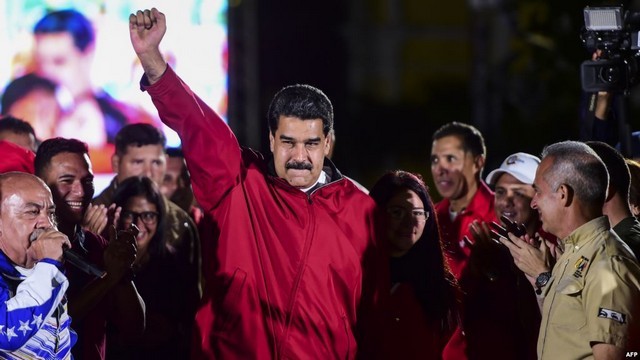
A year after former Bolivian president Evo Morales was ousted in a military coup that installed a far-right regime, Morales ally Luis Arce declared victory after exit polls showed the socialist candidate with a large advantage over his two main competitors.

“Democracy has won,” Arce, who served as Morales’ finance minister, said in an address to the nation after one exit poll showed him leading the race with 52.4% of the vote and former president Carlos Mesa in a distant second with 31.5%. Right-wing candidate Luis Camacho—an ally of unelected interim President Jeanine Añez—won just 14.1% of the vote, according to the survey.

Arce characterized his apparently decisive victory, which even Añez was forced to acknowledge, as a mandate to continue the policies of the Morales government, which lifted millions of Bolivians out of poverty and expanded the nation’s economy.

“I think the Bolivian people want to retake the path we were on,” Arce said Monday.

Twice postponed due to the coronavirus pandemic, Sunday’s election was a do-over of last year’s presidential contest, which was thrown into chaos after the U.S.-dominated Organization of American States (OAS) leveled baseless allegations of “fraud” by Morales, who was eventually forced to resign and flee the country under threat by Bolivia’s military.

The coup against Morales sparked a wave of Indigenous-led protests that were violently repressed by the Bolivian military and police forces, which were granted sweeping immunity from prosecution by the anti-Indigenous Añez government.

From exile in Argentina, Morales on Monday celebrated Arce’s apparent victory as a “great triumph of the people.”

“Brothers and sisters: the will of the people has been asserted,” Morales tweeted. “This is an overwhelming victory… We are going to give dignity and liberty back to the people.”

19 October 2020

Source: countercurrents.org
On the Coming Decline and Fall of the US Empire

By Prof. Johan Galtung

Paper written in 2015

1. Definitions and Hypotheses: An Overview

Definition: An empire is a transborder Center-Periphery system, in macro-space and in macro-time, with a culture legitimizing a structure of unequal exchange between center and periphery:

  • economically, between exploiters and exploited, as inequity;
  • militarily,   between killers and victims, as enforcement;
  • politically,  between dominators and dominated, as repression;
  • culturally,   between alienators and alienated, as conditioning.

Empires have different profiles. The US Empire has a complete configuration, articulated in a statement by a Pentagon planner:

“The de facto role of the United States Armed Forces will be to keep the world safe for our economy and open to our cultural assault. To those ends, we will do a fair amount of killing”.[1]

In other words, direct violence to protect structural violence legitimized by cultural violence.[2] The Center is continental USA and the Periphery much of the world. Like any system it has a life-cycle reminiscent of an organism, with conception, gestation, birth, infancy, childhood, adolescence, adulthood, senescence and death. Seeded by the British Empire, the maturing colonies honed their imperial skills on indigenous populations, ventured abroad in military interventions defining zones of interest, took over the Spanish Empire, expanding with world, even space hegemony as goal, now in the aging phase with overwhelming control tasks quickly overtaking the expansion tasks.

Decline and fall is to be expected as for anything human; the question is what-why-how-when-where-by whom-against whom. Answers:

  • what: the four unequal, non-sustainable, exchange patterns above;
  • why:  because they cause unbearable suffering and resentment;
  • how:  through the synergies in the synchronic maturation of 14 contradictions, followed by demoralization of system elites;
  • when: within a time frame of, say, 20 years, counting from Y2000;
  • where:   depending on the maturation level of the contradictions.
  • by whom: the exploited/bereaved/dominated/alienated, the solidary,           and those who fight the US Empire to set up their own.
  • against whom:  the exploiters/killers/dominators/alienators, and  those who support the US Empire because of perceived benefits.

The hypothesis is not that the fall and decline of the US Empire implies a fall and decline of the US Republic (continental USA).  To the contrary, relief from the burden of Empire control and maintenance when it outstrips the gains from unequal exchange, and expansion increases rather than decreases the deficit, could lead to a blossoming of the US Republic. This author admits an anti-Empire bias because of enormous periphery suffering outside and inside the Republic; and a pro-US Republic bias because of the creative genius and generosity of the USA. “Anti-American” makes no such distinction between the US Republic and the US Empire.[3]

There is no dearth of predictions of economic disaster for the US Republic in the wake of decline and fall of the system “to keep the world safe for our economy and open to our cultural assault”, also from Marxists who (still) believe that Empire-building can be reduced to economic greed satisfied by flagrant inequity.  But this is only one component in a complete imperial syndrome with components attracting and repelling different niches in societies and persons. Economists blind to externalities design theories legitimizing inequity, unrealistic “realists” enforce “order”, liberals guide and dominate political choices of others, and missionaries, religious and secular, try to convert anybody.  All together an enormous drain of resources.

The case of England indicates that an empire can be a burden. The decline of the Empire started long before, but the fall of the crown jewel, India, due to a combination of nonviolent (Gandhi) and violent struggle, and the incompatibility of imperialism with the Atlantic Charter, was decisive.  The Empire unraveled very quickly over a period of 15 years from 1947, obviously unstable.

And England? Today richer than ever in history. Welcome, USA.

2. The US Empire: A Bird’s-eye View

Right after the mass murder in New York and Washington on September 11 2001 Zoltan Grossman circulated a list, based on Congressional Records and The Library of Congress Congressional Research Service, with 133 American military interventions during 111 years, from 1890-2001, from the brutal murder of the indigenous population at Wounded Knee in Dakota to the punishment expedition to Afghanistan. Six of them are the First and Second World Wars, and the Korea, Vietnam, Gulf and Yugoslavian wars: Democrats started five of them (Bush senior and junior are the exceptions among isolationist Republicans who usually focus more on the exploitation of their own population). The average per year is 1.15 before, and 1.29 after, the Second World War, in other words an increase. And after the Cold War, from late 1989, a heavy increase up to 2.0, compatible with the hypothesis that wars increase as empires grow, with more privileges to protect; more unrest to quell, revolts to crush.

William Blum has 300 pages of solid documentation in his Rogue State: A Guide to the World’s Only Superpower (Monroe MA: Common Courage Press, 2000). The total suffering is enormous: the victims, the bereaved, the damaged nature, structure (through verticalization) and culture (through brutalization, myths of revenge and honor). Most of it fits into one single pattern: building a US Empire based on economic exploitation of other countries and other peoples, using direct violence and indirect violence, open (Pentagon) and overt (CIA); with open and covert support from US allies. The result is the international class structure with increasing gaps between the poor and rich countries, and between poor and rich people.

There is no sign of any clash of civilizations, nor any sign of territorial expansion. But there is enormous missionary zeal and enormous self-righteousness. And the rhetoric changes: containment of Soviet expansion, fight against Communism, drugs, intervention for democracy and human rights, against terrorism. Blum’s list of interventions up to the year 2000 covers 67 cases since 1945(Grossman has 56, the criteria differ somewhat):

China 45-51, France 47, Marshall Islands 46-58, Italy 47-70s, Greece 47-49, Philippines 45-53, Korea 45-53, Albania 49-53, Eastern Europe 48-56, Germany 50s, Iran 53, Guatemala 53-90s, Costa Rica 50s, 70-71, Middle East 56-58, Indonesia 57-58, Haiti 59, Western Europe 50s-60s, British Guiana 53-64, Iraq 58-63, Soviet Union 40s-60s, Vietnam 45-73, Cambodia 55-73, Laos 57-73, Thailand 65-73, Ecuador 60-63, Congo-Zaire 77-78, France-Algeria 60s, Brazil 61-63, Peru 65, Dominican Republic 63-65, Cuba 59-, Indonesia 65, Ghana 66, Uruguay 69-72, Chile 64-73, Greece 67-74, South Africa 60s-80s, Bolivia 64-75, Australia 72-75, Iraq 72-75, Portugal 74-76, East Timor 75-99, Angola 75-80s, Jamaica 76, Honduras 80s, Nicaragua 78-90s, Philippines 70s, Seychelles 79-81, South Yemen 79-84, South Korea 80, Chad 81-2, Grenada 79-83, Suriname 82-84, Libya 81-89, Fiji 87, Panama 89, Afghanistan 79-92, El Salvador 80-92, Haiti 87-94, Bulgaria 90-91, Albania 91-92, Somalia 93, Iraq 90s, Peru 90s, Mexico 90s, Colombia 90s, Yugoslavia 95-99.

There was bombing in 25 cases (for details, read the book):

China 45-46, Korea/China 50-53, Guatemala 54, Indonesia 58, Cuba 60-61, Guatemala 60, Vietnam 61-73, Congo 64, Peru 65, Laos 64-73, Cambodia 69-70, Guatemala 67-69, Grenada 83, Lebanon-Syria 83-84, Libya 86, El Salvador 80s, Nicaragua 80s, Iran 87, Panama 89, Iraq 91-, Kuwait 91, Somalia 93, Sudan 98, Afghanistan 98, Yugoslavia 99.

Assassination of foreign leaders, among them heads of state, was attempted in 35 countries, and assistance with torture in 11 countries:  Greece, Iran, Germany, Vietnam, Bolivia, Uruguay, Brazil, Guatemala, El Salvador, Honduras, Panama

On top of this come 23 countries where the United States has intervened in elections or has prevented elections:

Italy 48-70s, Lebanon 50s, Indonesia 55, Vietnam 55, Guayana 53-64, Japan 58-70s, Nepal 59, Laos 60, Brazil 62, Dominican Republic 62, Guatemala 63, Bolivia 66, Chile 64-70, Portugal 74-5, Australia 74-5, Jamaica 76, Panama 84, 89, Nicaragua 84,90, Haiti 87-88, Bulgaria 91-92, Russia 96, Mongolia 96, Bosnia 98.

35 (attempted) assassinations + 11 countries with torture + 25 bombings + 67 interventions + 23 interferences with other people’s elections give 161 forms of aggravated political violence only since the Second World War.  A world record.

Increase over time comes with shift in civilization target:

Phase I:

Eastern Asia         Confucian-Buddhist

Phase II:    

Eastern Europe  Orthodox Christian

Phase III:

Latin America      Catholic Christian

Phase IV:

Western Asia       Islam

The phases overlap, but this is the general picture.

In the first phase the focus was above all on people in Korea, south and north, wanting reunification of their nation, and on poor peasants in Viêt Nam wanting independence.  In the second phase there was the Cold, not Hot, War for containment of communism. In the third phase the targets were poor people, small and indigenous populations supported by “Maoist” students. And in the fourth phase, which is dominating the picture today, the focus was on Islamic countries and movements, Palestinians being an important example.

All the time we find that the USA supports those who favor US business and growth, and works against those who give higher priority to distribution and basic needs of the most needy.[4] They die, 100,000 per day, underfed, underclothed, undersheltered, undercared, underschooled; jobless, hopeless and futureless.

Satisfiers for their needs cannot be bought with the money they do not have, and cannot be bought with labor because that requires jobs or land (seeds, water, manure) they do not have. A cruel world built on a world trade headed by the USA, supported by US dominated military and allied governments, and often populations who benefit from cheap resources and food products.

What is new in the fourth phase has something to do with religion.  Islam is just as concerned with sin and guilt and expiation, with crime and punishment, as Christianity.  But they do not place God and his country, and particularly “God’s Own Country”, the USA, higher than Allah and his countries, particularly not Allah’s own holy country, Saudi Arabia.

A United Nations Security Council with a nucleus of four Christian and one Confucian country has little authority in Islam, as opposed to the authority enjoyed in the Christian countries in Eastern Europe and Latin America. And Buddhist, East Asian countries are perhaps more inclined to change a bad joint karma than to issue certificates of guilt to the USA.

In other words, the real resistance had to come in the fourth phase with a new Pearl Harbor that many see as the introduction to a long-lasting Third World War.

Of that we should not be so certain.  But one thing is clear: Anybody who was the least bit surprised 11 September was ignorant, naive or both. The bottomless, limitless state terrorism of the United States got a very unsurprising answer: terrorism against the United States.  With an estimated 12-16 million killed, and an average of 10 bereaved for each one, with pain and sorrow, lust for revenge and revanche growing, no act of revenge would be inconceivable.  But the deeper roots lie not in the never-ending chain of “blow-back” violence. They are in the numerous unresolved conflicts built into the US Empire. The way to solution for sure passes through US Empire dissolution.

The Pentagon planner’s “to those ends we will do a fair amount of killing” reflects imperial reality.  The when-where- against whom has just been explored.  And then what?

3. On the Decline and Fall of Empires: The Soviet Empire Case

In a comparative study of the decline (of ten) and fall (of nine, No. 10 is the US Empire) in 1995 [5], with an economic focus, the conclusion was that no single factor, but a combination of factors in a syndrome was the general cause:

  • a division of labor whereby foreign countries, and/or foreigners inside one’s own country, take over the most challenging and interesting and developing tasks, given the historical situation;
  • a deficit in creativity related to a deficit in technology and good management, including foresight and innovation;
  • one or several sectors of the economy neglected or lagging;
  • and, at the same time, expansionism as ideology/cosmology, exploiting foreign countries and/or one’s own people inviting negative, destructive reactions.

The syndrome idea came from an earlier study of the decline and fall of the Roman Empire[6] where many authors have come up with many single-factor theories.  The idea was then applied to the Soviet Empire in 1980 [7], focusing on five factors referred to as contradictions, tensions, like the four points above:

In the society:

  • a top-heavy, centralized, non-participatory society run by the Russian nation controlling other nations,
  • the city controlling the countryside,
  • the socialist bourgeoisie the socialist proletariat,
  • the socialist bourgeoisie having nothing to buy because the processing level was too low;

In the world:

A confrontational foreign policy run by the Soviet Union controlling and intervening in satellite countries.

The prediction, made many times by this author in 1980, was that the Soviet Empire would crumble not because of any single factor but because of “synchronic maturation of contradictions, followed by demoralization of Center and Periphery elites”, with the Berlin Wall crumbling in an early phase, within 10 years.

The mechanism was not the big bang of war, but the whimper of demoralized elites who after lashing out violently become corrupt, alcoholized, overfed, sometimes charming, ego-maniacs.

4. On the Contradictions of the US Empire.

The prediction of the decline and fall of the Soviet Empire was based on the synergy of five contradictions, and the time span for the contradictions to work their way through decline to fall was estimated at 10 years in 1980.  Sometimes I added a No. 5: between myth, the massive Soviet propaganda, and reality – to some extent dissolved in marvelous jokes.

The prediction of the decline and fall of the US Empire is based on the synergy of 14 contradictions, and the time span for the contradictions to work their way through decline to fall was estimated at 25 years in the year 2000.  There are more contradictions because the US Empire is more complex, and the time span is longer also because it is more sophisticated.  After the first months of President George W. Bush (selected) the time span was reduced to 20 years because of the way in which he sharpened so many of the contradictions posited the year before, and because his extreme singlemindedness made him blind to the negative, complex synergies. He just continued.

President William J. Clinton (elected, twice) was seen in a different light. Confronted with a pattern of contradictions, no doubt with significant differences in terminology and numbers, his violence was an intervention in Somalia that he canceled, a war against Serbia of which he evidenced heavy doubts and never any enthusiasm, and a couple of missiles fired in anger. Being super intelligent, demoralization in high places, and sex in strange places, might have been the consequences.  Hypothesis: they tried to impeach him not so much for the latter as for the former – using the latter as pretext.  The effort misfired, but a highly non-demoralized George Bush captured the US Presidency.

Here is the list of 14 contradictions posited in 2000:

  • Economic Contradictions (US‑led system WB/IMF/WTO‑NYSE‑Pentagon)
    • 1. between growth and distribution: overproduction relative to demand, 1.4 billion below $ 1/day, 100.000 die/day, 1/4 of hunger
    • 2. between productive and finance economy (currency, stocks,bonds) overvalued, hence crashes, unemployment, contract work
    • 3. between production/distribution/consumption and nature: ecocrisis, depletion/pollution, global warming
  • Military Contradictions (US‑led system NATO/TIAP/USA-Japan)
    • 4. between US state terrorism and terrorism: Blowback
    • 5. between US and allies (except UK, D, Japan), saying enough
    • 6. between US hegemony in Eurasia and the Russia‑India‑China triangle, with 40% of humanity
    • 7. between US‑led NATO and EU army: The Tindemans follow-up
  • Political Contradictions (US Exceptionalism under God)
    • 8. between USA and the UN: The UN hitting back
    • 9. between USA and the EU: vying for Orthodox/Muslim support
  • Cultural Contradictions (US Triumphant Plebeian Culture)
    • 10. between US Judeo-Christianity and Islam (25% of humanity; UNSC nucleus has four Christian and none of the 56 Muslim countries).
    • 11. between US and the oldest civilizations (Chinese, Indian, Mesopotamian, Aztec/Inca/Maya)
    • 12. between US and European elite culture: France, Germany, etc.
  • Social Contradictions (US‑led World Elites vs the Rest: World Economic Forum, Davos vs World Social Forum, Porto Alegre)
    • 13. between state‑corporate elites and working classes of unemployed and contract workers. The middle classes?
    • 14. between older generation and youth: Seattle, Washington, Praha, Genova and ever younger youth. The middle generation?
    • 15. To this could be added: between myth and reality.

The list was a simple reading of the US Empire situation.  More sophisticated discourses are certainly possible, keeping the key ideas of syndromes, synergies and demoralization.

5. The Maturation of Contradictions: An Update after 3 Years

We shall use the same formulations as above, drop the small explanatory remarks in the above list, and add some kind of, hopefully informed, running commentary on contemporary affairs.

Obviously, the US Empire as a functioning, dynamic reality, not as a static structure, with the 14 contradictions in its wake is a very complex system.  In such systems linearities are rare, causal chains split and unite; loops, spirals, any curve shape, are ubiquitous.  Quantum jumps when two factors are strongly coupled, one changes and the other remains constant, will be frequent.  But the prediction is that within twenty years the four types of unequal exchange with the USA in the Center will wither away, whether what comes is more equal exchange or less exchange, in other words isolation. Or both.

  • Economic Contradictions
    • 1. Between Growth and Distribution:

generally growth is sluggish with the possible exception of China, and the distribution often worsening, both between and within countries.  However, the basic concern is with livelihood at the bottom of world society, the preventable mortality and the suffering due to near-death morbidity from hunger or easily preventable/curable diseases.  That syndrome is with us, and the analysis in terms of overproduction leading to unemployment leading to under-demand leading oversupply leading to more unemployment etc. stands.  At the same time monetization of land/seeds/water/manure impedes the conversion of labor into food by tilling one’s own land. The US Empire pursues growth but neglects and prevents distribution, thereby undercutting itself since a key aspect of growth in increased demand, meaning increased consumption, all over.

    • 2. Between Productive and Finance Economy:

Domestic and global market turnover being high even if the growth is sluggish in the productive economy in many countries, and distribution being low there will be heavy accumulation of liquidity high up searching for an outlet.  Luxury consumption and productive investment being limited the obvious outlet is buying and selling in the finance economy, also known as speculation.  The productive economy responds by putting up bogus, virtual enterprises like ENRON and WORLDCOM that the growth in the finance economy quickly gets out of synch with growth in the productive economy. Thus, the 2001 sharpening of his contradiction into a crash for some stocks and depreciation of the US dollar was as expected, indicative of a chronic pathology. One basic cure for that pathology is the distribution that the US Empire, through its use of the WB/IMF/WTO‑NYSE‑Pentagon system is impeding. As that cure is at present unavailable the underlying pathology will produce new increases in financial goods values and new crashes.

    • 3. Between Production/Distribution/Consumption and Nature:

The Bush administration’s unilateral exit from the Kyoto Protocol sharpened this contradiction considerably and was a key factor behind the banner at the 2002 summit in South Africa: Thank you, Mr. Bush, you have made the world hate America.  The explanation given was that the Protocol impeded US economic growth (meaning unacceptable to powerful corporations).  This move endangers the planet and is an expression of contempt for global regimes based on negotiating ratifiable treaties.  The USA could have demanded re-negotiation.  But the US Empire had other priorities and mobilized millions in the movement for sustainable development against the USA.

  • Military Contradictions
    • 4. Between US State Terrorism and Terrorism:

This contradiction underwent a quantum jump on 11 September 2001 although the number killed was less than the number killed in the aftermath of the other 11 September, in 1973, the USA supported coup against the socialist government of Salvador Allende (one of the now 68 interventions after the Second World War, counting Iraq).  Highly predictable, as predictable as its repetition unless the US Empire itself exits from the cycle of violence and decides to understand “that the enemy may be us/US”.  But the US Empire now talks about interventions in more than 60 countries, lasting more than a life time.  A heavy price for the failure to try to, or the effort to avoid to, solve conflicts/contradictions.

At this point an obvious remark:  an effort to explain 9/11, for instance as a “reaction to the US Empire by hitting two major instruments for economic and military operation”, or the short-hand as “revenge” and “unresolved conflict” in no way justifies the gruesome act.  Nor is the US intervention in Afghanistan and Iraq justified.  But like Kosovo they can both be partly explained as efforts to maintain and expand the US Empire, for more control of the world oil market, and “to keep the world safe for our economy” by establishing military bases.

Violence hits the Empire at their strongest point, is as wrong, ineffective and counterproductive as the US violence and mobilizes against the perpetrators.  Ruling out explanation as justification runs against Enlightenment rationality: solve problems by identifying causal chains, then removing causes like violence cycles and unresolved conflicts.  But the US Empire stands in the way and will ultimately have to yield.

    • 5. Between US and Allies:

Very fluid.  The US Empire does not want to be seen as the US Empire but as something generally supported by “advanced societies”, “civilized” as against “evil”, “chaotic” and “terrorist”.  Washington builds coalitions with Allies in the NATO/TIAP/US-Japan systems, and others.

This contradiction (and many others) has never surfaced so clearly as in connection with the war against Iraq, but there were also tensions budding in connection with the Yugoslavia and Afghanistan operations.  Public opinion is not an important variable here.  Washington deals with governments and for that reason is very concerned with who are the members.  The three ways of exercising power, persuasion, bargaining and threats, are best exercised behind closed doors so as not to be exposed to anything like the German Foreign Minister’s devastating remark to the US Secretary of Defense in München February 2003:  “In a democracy you have to present arguments for your position, and your arguments are not convincing.”  If the public knew what goes on behind closed door, like supporting an attack on Iraq in return for having somebody inscribed on the US list of terrorist organization, the opposition would increase.

In 2000 UK, Germany and Japan were seen as reliable allies.  This failed to predict the German position, linked to the Social Democratic Party having been pressed already against its inner conviction over Yugoslavia and Afghanistan.  Australia, however, was highly predictable as an Anglo-Saxon country[8], and Japan behaved as predicted.  The cost-benefit analysis of the countries varies, but the trend is against unconditional support for the US Empire. A very sensitive contradiction that will sharpen if people exercise much more pressure on governments.

    • 6. Between US Hegemony in Eurasia and Russia‑India‑China:

These are enormous countries, unconquerable so the USA has approached them through their fear of Muslim populations, in Chechnya, in Kashmir (and all over) and Xinjiang respectively.  After the NATO expansion eastward and the USA-Japan alliance (with Taiwan and South Korea as de facto members) expansion westward from 1995, the three countries resolved most of their problems, came closer together (although not in a formal alliance).  But those moves were temporarily stopped by the USA aligning them against Islamic terrorism, meaning Muslims fighting for more autonomy/independence in the three places mentioned.  The attack on Iraq seems to have sharpened the contradiction again as they do not participate in the occupation (knowing something about Islamic guerrillas).  But the USA still has considerable market access and investment economic clout with all three governments.

  • 7. between USA‑led NATO and an EU Army:

This is not the same as the two preceding points which are more about abstaining from support, and countries feeling the pincer movement of the US Empire, possibly creating an alliance.  Here we are dealing with a new multinational army of a potential superpower, creating identity problems for some members.  The question, “why do they need this army when they have NATO?” has an answer in dualist logic: “this shows they are not entirely with us, hence they are against us.”

There will be much maneuvering behind closed doors concerning this contradiction.  But the general move will be in the direction of an EU Army for some members, building on the present Eurocorps, with a line of command that does not end in Washington, nor passes through washington except for some exchange of information.  For defensive purposes or a coming EU Empire?  To take over the spoils?

  • Political Contradictions
    • 8. between USA and the UN:

The most powerful country in the world also uses the veto in the Security Council most frequently and has close to a de facto economic veto by withholding or withdrawing support for programs not to their liking, in addition to the US Empire clout on many UN members, like changing the conditions for loans according to voting pattern. That this behavior is resented stands to reason and that resentment came out in the open when the Anglo-Saxon USA/UK alliance failed to get their second resolution on Iraq accepted by the UNSC.  However, very energetic US diplomacy and again US Empire clout prevented what Washington was afraid of using the Uniting for Peace resolution to lift an issue that has gotten stuck in the UNSC into the General Assembly.  A UNGA debate and vote would make the limited support for an attack on Iraq rather than the French-German approach of deep UN inspection clear.

    • 9. between USA and the EU:

This goes far beyond EU army vs NATO.  The EU has today 15 members, by May 2004 there will be 25, with more to come.  If the EU, very much in their own interest, decided to bridge the basic fault-lines in the whole European construction, between Orthodox and Catholic/Protestant Christianity, and between Islam and Christianity (from 1054 and 1095 respectively) by opening the EU for Russian and Turkish membership, well, then the USA would be very far behind indeed. We would be talking of 750 million+ inhabitants.  The process of membership might have to be gradual, like X% increase per year in access to EU labor market against X% increase per year in access to resources.   The relation to East Asia may be problematic, but the EU is also doing good work on this fault-line.And a giant EU could only gain from abstaining from any imitation of the US Empire, signing up for UN support instead.

  • Cultural Contradictions
    • 10. between US Judeo-Christianity and Islam:

These are the Abrahamitic religions, and the expression Judeo-Christianity, so frequent in the USA, draws a wedge among them.  With the recent fundamentalist alliance based on the idea that Armageddon is near and that the first coming of the Messiah and the second coming of Christ could be the same person, this contradiction has become very sharp indeed.  But Islam is expanding very quickly, Christianity is not and the Jews are a small minority.  This rift will mark clear borders against US Empire penetration.  The young Saudi Wahhabite perpetrators on 9/11 may have acted more than they dreamt of on behalf of 1.3 billion Muslims, and not only 300 million Arabs. And this warlike relation will limit US Empire expansion considerably.

    • 11. between US and the Oldest Civilizations:

When people talk of fundamentalism they usually mean the religious articulation of old cultures.  But cultures are many-dimensional, including language and other forms of expression, and sacred times and sacred places in history and geography, anything.  There are awakenings all over the world, seeing ancient non-Western cultures not as exotic museum objects to be observed but not lived.  The destruction of artifacts from Sumer/Babylon in Iraq was seen as an effort to make the Iraqis governable by destroying other foci of identification.  A typical example of a contradiction in an early, infant stage, but filled with potential for rapid maturation and powerful articulation.

    • 12. between US and European Elite Culture:

The world, or so the West thinks, has four major geo-cultural Centers: the USA, the UK, France and Germany. Others can learn to imitate or produce exotica. France and Germany continue the struggle for cultural prevalence relative to the USA, with Anglo-Saxon UK being somewhere in-between.

  • Social Contradictions
    • 13. between state‑corporate elites and working classes of unemployed and contract workers:

The powerful US trade union complex, the AFL/CIO, voted for the first time against a war: Iraq.  But the working classes are today kept in line by the threat of unemployment and the inferiority of contract work relative to that vanishing category, the real position, with security.  The state-corporate elites are better organized and at making themselves insubstitutable.  They can make hire and fire become easy, with the ultimate threat of automation (“modernization”) settling issues.

The postmodern economy can do without workers, but not without customers.  Firing workers they fire customers by reducing their acquisitive power.  The world middle classes can join by boycotting the products of the US Empire, like oil from Iraq, Boeing aircraft (one of the major death factories in the world); in general boycotting US consumer goods, capital goods and financial goods, like US dollars, stock and bonds – but keeping personal contacts.

    • 14. Between Older Generation and Youth:

Younger than ever, not only college students against the Viêt Nam war but high school students, easily mobilized through the Internet as long as that lasts.  Maybe an element of myth versus reality in this: they have been served propaganda that seems very remote from reality.  The same may apply to women, but here Washington has played the cards well: “homeland security” drives the issue home and women into the ranks defending the defenders of the home and the family.  But the other nations in the USA, the Inuits, Hawai’ians, First Nations, Chicanos, African Americans, could be pitted against the Anglo-Saxon, Southern Baptist, militarized Deep South, now in command.  Hopefully they will not create an emergency to cancel elections they may not win.

6. And the Decline and Fall?

Have a look at the 14 contradictions, and then a look at the definition of an empire.  The way of solving these contradictions eating at the heart of the system is very simple:

  • For the 3 economic contradictions: reduce, even stop exploiting!
  • For the 4 military contradictions: reduce, even stop killing!
  • For the 2 political contradictions: reduce, even stop dominating!
  • For the 3 cultural contradictions: reduce, even stop alienating!
  • For the 2 social contradictions: reduce, even stop all the above!

For each reduction, the US Empire is, by definition, declining.  For each stop the US Empire is falling.  Stop all four, and the US Empire is gone, although some may survive in residual forms like the Russian Empire in Chechnya and the British Empire in Iraq.  The most dramatic recent example is possibly the dissolution of the French Empire: de Gaulle had the incredible personal grandeur to terminate the whole empire (except for the Pacific and some other places) and like for the Soviet and British Empires a number of independent countries were born.  Global capitalism, however, has a tendency to recreate transborder exploitation, and there are, as mentioned, residuals.  A new world was born, however, in the 1960s from the Western empires, in the 1990s from the Soviet Empire.

Only the naive will assume that new world to be paradise on earth.  New systems emerge with their contradictions.  The rulers of the British, French and Soviet empires had concluded that the costs by far outrun the gains.  Some others sometimes come to the conclusion that the costs of the fall, including for the Periphery, by far outrun the gains.  That, of course, depends on the successor system, the alternative.  This author favors United Nations global governance, and not an EU Empire.[9]  But that is another story.

The British and French empires were based on “overseas” colonies, the Soviet empire on contiguous, Czarist/Bolshevik, “union”, and the US Empire is based on what the Pentagon planner said, with the non-US Periphery being “independent” countries.  This confuses some whose empire concept is linked to “colonies” and not to independent countries; and others whose concept is linked to “overseas”, not to contiguous territory.  Still others got confused because three of these Centers are Western democracies, beyond the suspicion of ever committing major wrongs.  The definition opening this essay is based on a relation of unequal exchange between Center and Periphery, not on Periphery geography or Center polity.

That unequal exchange, divided into four components, is the root contradiction of the empire as a system.  From the four deep contradictions flow the fourteen surface contradictions, visible to everybody, the subject of journalism.  The deep contradictions almost never are.  So the basic model explored so far is:

Four Deep Contradictions Imply 14 Surface Contradictions

As the 14 mature, synchronize and synergize the Center may loosen the grip on the Periphery in one conscious, enlightened act (de Gaulle) or see the Empire dissolve, slowly (UK) or quickly (the Soviet Union).  USA, the choice is yours.

But the USA now behaves like a wounded elephant, lashing out in all directions.  This is the boiling stage of demoralization, with emotions impeding rational thinking about is and ought, to be followed by a frozen stage, a “let go”, more like the Soviet Union, or Clinton. Demoralization is oscillating before it stabilizes. Like individual pathologies, healing is related to the ability to come on top of the pathology rather than the other way round.  Like now, with the USA driven by a conflict mainly of its own making.

The Model Above Can Now Be Expanded:

[4] implies [14] implies Demoralization implies -[4] implies -[14]

The 4 deep lead to 14 surface contradictions and demoralization which leads to a let go of Empire and the dissolution of the 14.

However: the 4 may have deeper roots.

Thus, where does the inequity come from?  From an unfettered capitalism so inequitable that it needs some military protection.  But where does capitalism come from?  And all that violence? The cultural superiority complex with missionary right and duty, and no duty to understand other cultures, may be related to the sense of exceptionalism as God’s Chosen People and Country.  But where does that idea come from? And so on and so forth. The 4 defining the US Empire are not uncaused, not unconditioned.  But the focus here is on their removal and not on removing even deeper, but very evasive causes. This can happen through negative feedback loops via waning faith in the viability of the Empire as a system, in other words demoralization.

The 14 may have other roots.

The economic contradictions come from capitalism; the USA was violent before the US Empire; some EU members may hate the US Empire because it stands in the way of their own ambitions; the same applies to competitive cultures such as an Islam that wants an expanding dar-al-Islam, the abode of Islam, as successor to the battlefield, the dar-al-harb.  But the world is better off under USA than under EU or Islam, some say.

There is some truth to all of that.  But the problem is not only the US share of the world capitalist pie but how it implies killing, domination and alienation.  This has to decline, fall and go, while paying attention to all the other contradictions.

There will be class, generation, gender, nation struggle also without the US Empire.  True, but today that is the major problem.

The 14 may strengthen the resolve to maintain the 4.

In the beginning, and one at the time, yes.  Cosmetics may be applied, bland compromises entered, people articulating the contradictions silenced, ridiculed, persecuted, killed.  It is the synergy of several contradictions that leads to demoralization and ultimate decline. Contradictions between dominant and dominated nations within a country tend to bounce back and find new outlets. The dominated face brutal force but not nagging doubts about viability. Their national home is a dream untested by contradictions whereas the empire has been tested and found nonviable at any speed.

Demoralization may not negate the 4.

What we are talking about is decreasing faith in the viability; even decreasing faith in the legitimacy, of the Empire, with boiling anger at first, then a frozen let go, with the possibility of an autonomous let go. Either the Center deliberately looses the grip, or the Periphery slips out its clammy, feeble claws.  Either way, decline and fall.

However, after a phase of demoralization a new political class may decide not to let go but just the contrary, to strengthen the grip, like the USA is trying right now.  Given the obvious, the impermanence of everything, this will only postpone the inevitable.

Negating the 4 may not negate the 14.

This is certainly more true than untrue.  As explored below, we may even talk about an objective contradiction having lost, or even crushed, its subject in search of a new subject.  There are many other roots for many of the contradictions.  That one contradiction (syndrome) may conceal another, the latter blossoming when the former is wilting, is clear. But that daoist insight will not stop contradictions from maturing.  As to the US Empire, there is light at the end of a long and twisting tunnel.  But after that tunnel there are new tunnels–

7.  On Contradictions in General

The concept itself harbors contradictions in the sense of tensions among meanings.  The common factor seems to be a whole, a holon, a system, with at least two forces operating. The tension is between the forces. There is no assumption of only two forces, nor that they are exactly opposite, nor that are they of the same size.  Newton’s Third Law is written that way, expressing a contradiction.  But that is a special case and should not distort our ideas of social systems.  We need a more general discourse.

Before two or more forces let us explore the cases of 0 or 1.

Even with the vagueness of “force” it is not unreasonable to attribute the property “dead” to a system with no force, no movement, tendency, inclination.  The objection may be that much happens to a buried corpse: “to” yes, but not “in”. The forces are exogenous to the system, not endogenous, like in a live organism.

Introduce one force, like running.  The body spends energy. And the counterforce is not slow in announcing itself as fatigue, trying to change a motion into a non-motion referred to as “rest”.  The mechanical analogue brings up the idea of R, a dynamically changing resultant force that reflects magnitude and direction of all forces.  The system will move or rest with the resultant. R>0 means move, R=0 means equilibrium, R<0 means rest deficit.

Is a force always accompanied by a counterforce?  Is there always a reactio with an actio?  And in systems with foresight, could there even be a proactio for any expected actio?  And a pro-proactio?  I find this a very useful an axiom in the analysis of social and personal systems.  But I see no reason to assume that reactio and proactio are necessarily opposed. They could also be aligned with actio and, at least to start with, reinforce actio.

The idea of force-counterforce twins might lead us to an even number of forces as they come in pairs.  We do not say that one is producing or generating the other since that leads to an infinite number.  Rather, we assume synchronicity; they are “co-arising” as Buddhist epistemology will have it rather than one force generating the next, generating the next, etc.  And there is no reason to land on an even number.  Another metaphor might be a bundle of forces somehow accounting for the tensions in the system.

Let us move from general talk about “systems” and “forces” to more specific social and personal systems.  In the conceptual neighborhood is the idea of “conflict” as tension in goal-seeking systems because of incompatibility between the goals.  Goals are then associated with life even when attributed metaphorically to non-life as in “mountains striving upward”.  If incompatible goals are in the same system we have a dilemma, if in different systems we have a dispute.  A goal-holder conscious of the goal is an actor, if not conscious a party.  And that brings in the major distinction between subjective and objective contradictions.

A subjective contradiction passes through and is reflected by the human brain; as thought/consciousness, as speech/articulation as action/mobilization.  But not necessarily in that order, intellectualized like a philosopher who first reflects, then writes and then – maybe does nothing.  We could just as well assume the opposite order, the actor mobilizing for action out of old habit, then saying what he feels he thinks and thinking what he feels. Or any other sequence.  But sooner or later there is consciousness.

With two goals we get two goal-seeking forces, A and B, and three possibilities for the resultant: R=A (A wins), R=B (B wins) or R=0, an in-between equilibrium, also known as a compromise.

At that point the mechanical analogy breaks down.  The three cases do not exhaust the possibilities.  Moreover, they do not eliminate the contradiction.  A or B wins does not mean that the dissatisfied loser no longer has the same or some other goal incompatible with the winner’s goal.  The contradiction is still there, under the lid of the boiling cauldron of a defeat. And a compromise may leave both of them semi-dissatisfied.  If we use the term “sharp” to describe the contradiction as it was, “blunt” may apply to a compromise.  But how do we transcend the contradiction?

Since the three possibilities exhaust the logic of opposing forces within a system, the answer is “by changing the system”. This is what Gorbachev faced in the contradiction between the Soviet Empire and the social forces wanting basic change in the DDR: he let the DDR go. The contradiction now being between people and party elites in the DDR, the latter then yielded to West Germany, BRD, eventually to be absorbed by them.  As a result the Soviet Empire declined and fell and BRD absorbed DDR. The contradiction is still there, but finds other articulations.

And this is what Gorbachev’s successors never managed to do with Chechnya.  All they could do was to prevent them from winning, not to transcend the contradiction.  For that to happen they would have to let Chechnya go, which will happen sooner or later anyhow.

For the contradiction to be transcended, and the tension to be released, system change is needed, and more so the deeper the contradiction is in the system. An empire is not changed by suppressing, winning, over some party or even actor; that only makes the empire more imperial.  An empire is changed by becoming less imperial.  And that is also known as a decline from the empire’s point of view.  At the end of that road is its fall.

The Stages in the Contradiction Life-Cycle Can Be Summarized:

[0] Objective contradiction independent of consciousness

[1] Consciousness-formation through THOUGHT (intrasubjective)

[2] Articulation through SPEECH (intersubjective)

[3] Mobilization through ACTION (private and/or public)

[4] Struggle among mobilized actors

– violent or nonviolent

– quick or slow

– without or with outside parties mediating

– with less or more polarization = decoupling

[5]  Outcomes of struggle

[a] prevalence or compromise – back to [0]-[4]

[b] transcendence = a new reality

– negative transcendence under a new actor

– positive transcendence as new coupling

Through the [1]-[2]-[3] sequence a party becomes an actor pursuing goals by more or less adequate tactics chosen from [4].

[5a] does not end the lifecycle of a contradiction, only a lid on it or a blunting of it, as has been argued above.

[5b], transcendence, is the end of that contradiction lifecycle.  This does not mean the end/death of the system as it may harbor other contradictions at various lifecycle stages.

Transcendence, going beyond, is the creation of a new reality:

  • negative transcendence, neither-nor; goals not achieved
  • positive transcendence, both-and; goals achieved, with a twist.

Take the Ecuador-Peru conflict over where to draw the border in a contested 500km2 zone up in the Andes, with three wars to settle the issue. Military victory for one of them, annexing the zone to their national territory, is “prevalence”. Drawing a border, for instance along a ceasefire line, is “compromise”. Negative transcendence could be to give the zone to the UN or the OEA, creating a new social reality.  And positive transcendence could be a binational zone, owning it together, with the twist that neither country has monopoly. A new reality.  And both new realities, systems, would in turn produce their own contradictions.

Time has then come to explore the problematic relations between objective and subjective contradictions.

A social system comes with differences between categories– like genders, generations, races, classes, nations, territories– which then become relations in an interaction system; which then become fault-lines, usually because the interaction is on unequal terms; which then may lead to polarization and a structure of discrimination accompanied by a culture of prejudice.  All known societies harbor more or less of these inequalities and inequities.

An empire uses such structures and cultures as building blocks, and can be seen as a two (or multi-)tier system linking domestic and global faultlines. There is a Center and a Periphery in the global system of countries.  Inside the Center, and inside the Periphery, there is also a center and a periphery.  All three systems may be based on the logic of quadruple inequity (for killers-killed sometimes substitute the softer guards-prisoners).

The linchpin in the system is the harmony between the center in the Center and the center in the Periphery.[10]  The USA is right now (Summer 2003) trying to construct an Iraqi center in harmony of interest with the USA state/corporate center. The Iraqi center must do the four jobs locally and deliver the fruits of unequal exchange such as economic value, wanted terrorists, obedience, conditioning to the center in the (USA/UK) Center, keeping a commission.  They are rewarded with material living standard at a US elite level.

What has just been described is a simple empire linking three systems of unequal exchange, two domestic and one global. The US empire is complex; being a world hegemon no domestic system is entirely delinked from that empire. The EU empire links 15 (soon 25) Center countries to 100+ Periphery countries, but softly so.

There are also other divisions than the faultlines in domestic and global society, like among political parties in more or less democratic societies, and groups of countries in an undemocratic global system.  Social movements, the subjective contradictions, more or less conscious, articulated and mobilized across some primordial or newly created dividing lines, pre-polarize the system, and are ready for [4], struggle.  But for what?

Ideally for the objective contradiction, with an unresolved issue at the center which then has to become the cause of the movement.  And that gives rise to basic problem of adequacy in the coupling between subjective and objective contradictions, between the causes and the issues.  Both are parts of social reality.  But the movements may have an inadequate consciousness and cut the issues wrongly.  And the issue may be an orphan, waiting to be picked up by a movement with adequate consciousness.  There may be a contradiction between movement contradiction and issue contradiction.  And the result is bad, derailed politics.

Thus, the subjective contradiction in Myanmar/Burma between the autocratic military government SLORC and the pro-democracy movement headed by a woman, identified with one nation in a multi-national society, one upper/middle class in a very poor society, married to a Westerner in a country developing its own identity, may be inadequate for the objective contradictions of the country. From a Western point of view the basic contradictions are autocracy vs. (Western) democracy and closure vs. openness of the country to economic and cultural penetration. The subjective contradiction is adequate for those issues.  But there are other issues.  Inadequacy may derail the process.  The objective and the subjective must somehow mirror each other.

Thus, Gandhi had literally speaking to divest himself of his Westernness and his high caste paraphernalia, become very Hindu and share the living conditions of the lower castes and untouchables before he could lead Indian masses toward freedom and democracy.  The leader of Free India, however, Jawaharlal Nehru, was very Western, very high caste, very secular and steered India exactly in that direction.  Gandhi wanted an India based on the “oceanic circles” of autonomous, self-reliant villages; Nehru a modern, secular, industrial, socialist India.  The subjective matters.

Liberals tend to study the subjective movements and Marxists the objective issues.  The argument here is for both-and, and more particularly for the contradiction between the two contradictions.

An example from Norway: the objective contradiction a century ago between the “well conditioned” and the majority “populace”, in steep livelihood gradients, and the subjective contradictions in the party system.  The populace lived on farming, fishing, hunting, and as employees; the well conditioned from fortune, as employers or self-employed.  There were grey zones.  The Labor Party, through an act of political genius, created an alliance of farmers, fishermen and industrial workers, very adequately posited against the well conditioned.  They won the elections, prevailed for two generations, and created a new social reality, the welfare state.

That society had its own objective contradictions, positing a minority of aged-women-frail/handicapped-foreign workers against the rest.  Uncarried by adequate subjective contradictions the objective contradiction deepens in the midst of plenty.  The Labor Party was totally inadequate.  And the issue remains unsolved.

Movements against the US Empire: social reality is complex.

Only when cause and issue coincide will the movements be adequate.

NOTES:

[1]. From Susan George, “The Corporate Utopian Dream”, The WTO and the Global War System, Seattle, November 1999.  He is missing the political dimension and might have added “a fair amount of bullying” or “arm-twisting” after killing.

[2].  For this way of seeing reality, see Johan Galtung, Peace by Peaceful Means, London:  SAGE, 1996, chapter 2.

[3].  That not very intelligent term obscures the difference between those who are against both Republic and Empire (americaphobia?; very few, it seems) and those who are against one but not the other.  Unconditional love for both, (americaphilia?) is quite frequent.  It should be noted that “America” actually refers to the whole hemisphere, making the term “anti-American” also a sign of geographical confusion.

[4].  Many pairs come to mind, we just pick five as examples:

  1. Mossadegh was intervened, the Shah’s dictatorship not;
  2. Very much has been done to overthrow Castro, not Batista;
  3. very much was done to overthrow the Sandinistas, not Somoza;
  4. very much is being done to overthrow Chavez, not Jimenez;
  5. Lumumba was intervened and killed, not Mobutu.

The basic criterion is “free trade”, not democracy/dictatorship.

[5]. Johan Galtung, The Decline and Fall of Empires: A Theory of De-development, Geneva: UNRISD, 1995 (but not published by them), see www.transcend.org.

[6]. Johan Galtung, with Tore Heiestad and Erik Rudeng, On the decline and fall of empires: the Roman empire and Western      imperialism compared. Oslo: University of Oslo, Chair in      Conflict and Peace Research, 71 pp. (Trends in Western      civilization program, 15), (Oslo Papers, 75). Also published at: Tokyo: UN University, 1979, 71 pp (HSDRGPID‑l/UNUP‑53), and in Immanuel Wallerstein (ed.) Review. New York: Research Foundation of the State University of New York, IV, 1980, 1, pp. 91‑154. Condensed version in: Comprendre: revue de politique de la culture, XLIII/XLIV, (1977/78), pp. 50‑59.

[7].  Johan Galtung, with Dag Poleszynski and Erik Rudeng, Norge foran 1980‑årene (Norway facing the 1980s). Oslo: Gyldendal, 1980,  p. 85.

[8].  But Canada and New Zealand, also Anglo-Saxon dominated, did not follow suit.  Because they are more diverse, with non-Anglos like the French-speaking and First Canadians in Canada, and the Maoris in New Zealand to take into account?  clearly, there is no longer a massive Anglo-Saxon bloc.

[9].  In the USA the alternative is often seen in terms of a Chinese Empire, in line with the old Anglo-Saxon tradition of seeing the relation between No. 1 and No. 2 in power as zero sum game.  For England, the country allegedly with no permanent friends, no permanent enemies but permanent interests, this used to be France, but after the country was beaten by united Germany in 1870-71 and displayed its industrial prowess the Germany was appointed enemy. China as enemy disregards thousands of years of Chinese history with no imperial systems outside the borders of the Himalayas, the Gobi, the Tundra and the Sea.  China is self-centered in its development/modernization and still tends to see the world outside those borders as South, West, North and East Barbarians.

[10].  Thus, the author’s “A Structural Theory of Imperialism” (in Essays in Peace Research, Volume IV, Copenhagen: Ejlers, 1980, pp. 437-91) is underlying the development of the theory of imperialism into its decline and fall in this essay.

Johan Galtung, a professor of peace studies, dr hc mult, is founder of TRANSCEND International and rector of TRANSCEND Peace University.

19 October 2020

Source: www.transcend.org

Biography Prof. Johan Galtung (Born 24 Oct 1930)

By Antonio C. S. Rosa

The ‘Father of Peace Studies’ completes 90 years of age. At 24, he was jailed for 6 months as a Conscientious Objector in Norway. In jail he wrote, with Arne Næss, his first book: Gandhi’s Political Ethics. Today he has contributed more than 170 books; over 1500 papers, articles and book chapters; and over 500 Editorials for TRANSCEND Media Service on peace and conflict studies, mediation, and related issues.

Johan Vincent Galtung, dr, dr hc mult, a professor of peace studies, was born in Oslo, Norway on the same day that the UN would come to existence 15 years later. He is a mathematician–his first Ph.D.–, sociologist, political scientist and the founder of the academic disciplines of Peace and Conflict Studies. He founded the International Peace Research Institute, Oslo (1959), the world’s first academic research center focused on peace studies, as well as the influential Journal of Peace Research (1964). He has helped found dozens of other peace centers around the world since.

He has served as a professor for peace studies at universities all over the world, including Columbia (New York), Oslo, Berlin, Belgrade, Paris, Santiago de Chile, Buenos Aires, Cairo, Sichuan, Ritsumeikan (Japan), Princeton, Hawai’i, Tromsoe, Bern, Alicante (Spain), Islamic University of Malaysia in Kuala Lumpur, and dozens of others on all continents. He has taught thousands of individuals and motivated them to dedicate their lives to the promotion of peace and the satisfaction of basic human needs.

He has mediated in over 150 conflicts between states, nations, religions, civilizations, communities, and persons since 1957. His contributions to peace theory and practice include conceptualization of peace-building, conflict mediation, reconciliation, nonviolence, theory of structural violence, theorizing about negative vs. positive peace, peace education and peace journalism. Prof. Galtung’s unique imprint on the study of conflict and peace stems from a combination of systematic scientific inquiry and a Gandhian ethics of peaceful means and harmony.

“I have never been an advocate of world-saving narratives. The point about my work is to identify the neuralgic, specific contradiction in a specific place in space and at a specific moment in time and dissolve the contradiction with conflict transformation in order to prevent an escalation of whatever social contradiction one is dealing with into violence, whether direct or structural. To ask me whether I want to save the world is to have understood nothing about how conflict transformation works in practice. It’s like suggesting that a brain surgeon would want to extract a patient’s entire brain instead of working on the specific complication identified and localized in a specific region of the cerebral cortex. No, that is no way to proceed. One identifies concrete underlying contradictions in the social system at hand, then one identifies the causes, its drivers, and strives to undo the harm and hurt that could result from it by nonviolent means. I am not concerned with saving the world – I am concerned with finding solutions to specific conflicts before they become violent.”

Galtung was jailed in Norway for six months at age 24 as a Conscientious Objector to serving in the military, after having done 12 months of civilian service, the same time as those doing military service. He agreed to serve an extra 6 months if he could work for peace, but that was refused. In jail he wrote his first book, Gandhi’s Political Ethics, together with his mentor, Arne Næss. This event would trigger a world-changing lifetime work for peace: 170 books, plus.

In 2008, along with editor Antonio C. S. Rosa, he founded the pioneering TRANSCEND Media Service-TMS website, which features Solutions-Oriented Peace Journalism and for which he writes editorials.

He is founder (in 2000) and rector of the TRANSCEND Peace University, the world’s first online Peace Studies University. He also founded in 1993 TRANSCEND International, a global nonprofit network for Peace, Development and the Environment, with over 500 members in more than 70 countries around the world. As a testimony to his legacy, peace studies are now taught and researched at universities across the globe and contribute to peacemaking efforts in conflicts around the world. In 2008, he founded the TRANSCEND University Press.

Johan Galtung has conducted a great deal of research in many fields and made original contributions not only to peace studies but also, among others, human rights, basic needs, development strategies, a world economy that sustains life, macro-history, theory of civilizations, federalism, globalization, theory of discourse, social pathologies, deep culture, peace and religions, social science methodology, sociology, ecology, future studies.

As a recipient of over a dozen honorary doctorates and professorships and many other distinctions, including a Right Livelihood Award (also known as Alternative Nobel Peace Prize), Johan Galtung remains committed to the study and promotion of peace.

Galtung has mediated in over 150 conflicts in more than 150 countries, and written more than 170 books on peace and related issues, 96 as the only author. More than 40 have been translated to other languages, including 50 Years-100 Peace and Conflict Perspectives published by TRANSCEND University Press. Transcend and Transform was translated to 25 languages. He has published more than 1500 articles and book chapters and over 500 Editorials for TRANSCEND Media Service. More information about Prof. Galtung and all of his publications can be found at transcend.org/galtung.

Antonio C. S. Rosa (on the right of Johan Galtung in the photo), born 1946, is founder-editor of the pioneering Peace Journalism website, TRANSCEND Media Service-TMS (from 2008) under Galtung’s inspiration and guidance.

19 October 2020

Source: www.transcend.org

Myanmar: ‘Shocking’ Killing of Children Allegedly Used as Human Shields

By UN News

UN agencies in Myanmar have expressed ‘sadness’ and ‘shock’ over the killing of two boys, allegedly used as human shields by security forces in the country’s northern Rakhine province, earlier this month.

14 Oct 2020 – The two boys were killed in a crossfire between Myanmar’s military, known as the Tatmadaw, and the separatist Arakan Army. The incident occurred on 5 October in Buthidaung township – a hotspot for army abuses against children for non-combat purposes, since mid-2019, the UN agencies said in a statement, on Wednesday.

The children were part of a group of around 15 local farmers, all of whom were allegedly forced to walk in front of a Tatmadaw unit to ensure the path towards a military camp was clear of landmines, and to protect the soldiers from potential enemy fire.

On the way, fighting broke out between the Tatmadaw and the Arakan Army, after which the two boys were found dead with gunshot wounds.

‘Hold killers accountable’

The incident occurred within the 12 months of the delisting of the Tatmadaw for underage recruitment in the UN Secretary-General’s Annual Report on Children and Armed Conflict (CAAC) of 2020, agencies noted.

In the statement, the UN agencies – co-chairs of the UN Country Taskforce on Monitoring and Reporting on Grave Violations against Children in Myanmar (CTFMR) – called for a “full, transparent, and expedited investigation of the incident” and for anyone responsible for the use and for the killing of the children to be held accountable.

“This egregious incident serves as a stark reminder that children are put at risk of being killed or injured whenever they are associated with armed forces and groups in any capacity or function, regardless of the duration of their association,” the agencies said.

‘Alarming’ increase in violations

The UN agencies also voiced “deep alarm” over an alarming increase of reports of killings and injuries of children in Myanmar.

More than 100 children were killed or maimed in conflict during the first three months of 2020, amounting to more than half of the total number in 2019, and significantly surpassing the total number of child casualties in 2018.

“As Myanmar tackles the resurgence of COVID-19, we urge all parties to the conflict to intensify efforts to ensure children are protected from all grave violations, to ensure access to humanitarian assistance and services, and to exercise maximum restraint in the use of force where civilians are present,” they urged.

‘Grave Violations’

Adopted unanimously by the Security Council, resolution 1612 on children and armed conflict mandates the United Nations to establish UN-led taskforces in countries where there is verified evidence that grave violations against children are being committed by parties to a conflict, either by armed forces and/or by armed groups.

Through a monitoring and reporting mechanism, the taskforce documents, verifies and reports to the Security Council on the six grave violations: killing or maiming; recruitment and use in armed forces and armed groups; attacks against schools or hospitals; rape or other grave sexual violence; abduction; and denial of humanitarian access.

In Myanmar the the taskforce was established in 2007 and is co-chaired by the UN Resident and Humanitarian Coordinator and the UNICEF Representative to the country.

19 October 2020

Source: www.transcend.org

Unite against Washington’s ‘Old-Fashioned Cold War Mentality’, Beijing Urges Asian Nations

By Countercurrents

14 Oct 2020 – China’s top diplomat has urged neighboring states to guard against Washington’s geopolitical ambitions in Asia and called for regional cooperation to thwart foreign provocations in the South China Sea.

Media reports said:

Wang Yi, Chinese Foreign Minister, said during a joint news conference with his Malaysian counterpart that members of the Association of Southeast Asian Nations (ASEAN) should work together to ensure security in the region.

The top Chinese diplomat argued that the “South China Sea should not be a ground for major power wrestling teeming with warships.”

He added: “China and ASEAN have full capacity and wisdom, as well as responsibility, to maintain peace and tranquility.”

Earlier on Tuesday [13 Oct], Wang, who is visiting Malaysia as part of a tour of Southeast Asia, called for cooperation among ASEAN states to remove “external disruption” in the South China Sea.

He called on China’s regional partners to remain “vigilant” against Washington’s “Indo-Pacific” strategy, which he said presented a clear “security risk” for East Asia.

The Chinese minister said: What [the U.S.] pursues is to trumpet the old-fashioned cold war mentality and start up confrontation among different groups and blocks, and stoke geopolitical competition.

Tensions between Beijing and Washington have been rising for months, with U.S. naval patrols through the South China Sea continuing to strain bilateral relations. Washington has frequently conducted so-called “freedom of navigation” missions as well as aerial surveillance missions in the region, claiming that such operations safeguard marine traffic there. Beijing has denounced the U.S. military presence as a provocation that threatens its territorial sovereignty. China has accused Washington of “militarizing” the South China Sea, warning that the unwanted naval activity could lead to accidents. The U.S. has alleged that Beijing is aiming to create a “maritime empire” in the region.

Our success against you in Korea serves as a warning to you, Chinese general taunts U.S.

About a week ago, another media report said:

General He Lei recalls the PLA’s successful expulsion of American troops from North Korea in 1950 as he warns that China will be “ready for war” amid growing tensions between Washington and Beijing.

Seventy years ago, in October 1950, Chinese troops crossed the Yalu River into North Korea. Labeled the ‘People’s Volunteers’ they set out to confront an imminent threat to their homeland. General Douglas MacArthur, leading a United States coalition against Pyongyang, had succeeded not only in thwarting Kim Il Sung’s bid to take the South, but sought to advance beyond the 38th parallel to terminate the DPRK altogether.

The U.S. general made no secret about what he planned to do next: he spoke of “continuing” the Korean War into China and dropping a number of atomic bombs around the border to nullify Beijing’s strategic influence on the neighboring peninsula. Fearing strategic encirclement and checkmate by Washington, Mao Zedong, China’s leader, decided to intervene in the war, sending millions of troops into Korea. Despite at that time being an impoverished country with an essentially peasant army; China’s forces overran the UN coalition and forced them back into the South.

The memories in Beijing of what they describe as the “war to resist American aggression” have not been forgotten. The successful intervention into the Korean War and the rescue of the DPRK against a far superior opponent is heralded as the symbolic end to “China’s century of humiliation” by Western powers and newly found confidence in itself.

Facing an increasingly hostile United States on the global stage, People’s Liberation Army General He Lei recalled the victory of 1950 in a jibe against Washington, saying China “[has] the will to fight and the confidence to win” and “We will work hard to cultivate the will to fight, strengthen our sense of mission, responsibility and urgency to be ready for war.”

The highly charged comments reflect the growing atmosphere of public fear as to whether these two powers will ultimately clash militarily, especially given America’s escalation of tensions in the South China Sea and Taiwan Strait by ramping up military exercises.

19 October 2020

Source: www.transcend.org

Japan to Release 1M Tonnes of Fukushima’s Radioactive Water into Pacific Ocean

By Reuters

16 Oct 2020 – Nearly a decade after the Fukushima nuclear disaster, Japan’s government has decided to release over one million tonnes of contaminated water into the sea, media reports said today, with a formal announcement expected to be made later this month.

The decision is expected to rankle neighbouring countries like South Korea, which has already stepped up radiation tests of food from Japan, and further devastate the fishing industry in Fukushima that has battled against such a move for years.

Watch Reuters Video

The disposal of contaminated water at the Fukushima Daiichi plant has been a longstanding problem for Japan as it proceeds with an decades-long decommissioning project. Nearly 1.2 million tonnes of contaminated water are currently stored in huge tanks at the facility.

The plant, run by Tokyo Electric Power Company Holdings Inc 9501.T, suffered multiple nuclear meltdowns after a 2011 earthquake and tsunami.

On Friday, Japan’s industry minister Hiroshi Kajiyama said no decision had been made on the disposal of the water yet, but the government aims to make one quickly.

“To prevent any delays in the decommissioning process, we need to make a decision quickly,” he told a news conference.

He did not give any further details, including a time-frame.

The Asahi newspaper reported that any such release is expected to take at around two years to prepare, as the site’s irradiated water first needs to pass through a filtration process before it can be further diluted with seawater and finally released into the ocean.

In 2018, Tokyo Electric apologised after admitting its filtration systems had not removed all dangerous material from the water, collected from the cooling pipes used to keep fuel cores from melting when the plant was crippled.

It has said it plans to remove all radioactive particles from the water except tritium, an isotope of hydrogen that is hard to separate and is considered to be relatively harmless.

It is common practice for nuclear plants around the world to release water that contain traces of tritium into the ocean.

In April, a team sent by the International Atomic Energy Agency to review contaminated water issues at the Fukushima site said the options for water disposal outlined by an advisory committee in Japan – vapour release and discharges to the sea – were both technically feasible. The IAEA said both options were used by operating nuclear plants.

Last week, Japanese fish industry representatives urged the government to not allow the release of contaminated water from the Fukushima plant into the sea, saying it would undo years of work to restore their reputation.

South Korea has retained a ban on imports of seafood from the Fukushima region that was imposed after the nuclear disaster and summoned a senior Japanese embassy official last year to explain how Tokyo planned to deal with the Fukushima water problem.

During Tokyo’s bid to host the Olympic Games in 2013, then-prime minister Shinzo Abe told members of the International Olympic Committee that the Fukushima facility was “under control”.

The Games have been delayed to 2021 because of the pandemic and some events are due to be held as close as 60 km (35 miles) from the wrecked plant.

Reporting by Kaori Kaneko, Yuka Obayashi and Mari Saito; Editing by Muralikumar Anantharaman and Raju Gopalakrishnan

19 October 2020

Source: www.transcend.org

Che Guevara Is Assassinated on 9 Oct 1967

53 year ago, socialist revolutionary and guerilla leader Che Guevara, age 39, was killed by the Bolivian army. The U.S.-military-backed Bolivian forces captured Guevara on October 8 while battling his band of guerillas in Bolivia and executed him the following day. His hands were cut off as proof of death and his body was buried in an unmarked grave. In 1997, Guevara’s remains were found and sent back to Cuba, where they were reburied in a ceremony attended by President Fidel Castro and thousands of Cubans.

Ernesto Rafael Guevara de la Serna was born to a well-off family in Argentina in 1928. While studying medicine at the University of Buenos Aires, he took time off to travel around South America on a motorcycle; during this time, he witnessed the poverty and oppression of the lower classes. He received a medical degree in 1953 and continued his travels around Latin America, becoming involved with left-wing organizations. In the mid 1950s, Guevara met up with Fidel Castro and his group of exiled revolutionaries in Mexico. Guevara played a key role in Castro’s seizure of power from Cuban dictator Fulgencio Batista in 1959 and later served as Castro’s right-hand man and minister of industry. Guevara strongly opposed U.S. domination in Latin America and advocated peasant-based revolutions to combat social injustice in Third World countries. Castro later described him as “an artist of revolutionary warfare.”

Guevara resigned—some say he was dismissed—from his Cuban government post in April 1965, possibly over differences with Castro about the nation’s economic and foreign policies. Guevara then disappeared from Cuba, traveled to Africa and eventually resurfaced in Bolivia, where he was killed. Following his death, Guevara achieved hero status among people around the world as a symbol of anti-imperialism and revolution. A 1960 photo taken by Alberto Korda of Guevara in a beret became iconic and has since appeared on countless posters and T-shirts. However, not everyone considers Guevara a hero: He is accused, among other things, of ordering the deaths of hundreds of people in Cuban prisons during the revolution.

19 October 2020

Source: www.transcend.org

Leaked Docs Expose Massive Syria Propaganda Operation Waged by Western Gov’t Contractors and Media

By Ben Norton

23 Sep 2020 – Western government-funded intelligence cutouts trained Syrian opposition leaders, planted stories in media outlets from BBC to Al Jazeera, and ran a cadre of journalists. A trove of leaked documents exposes the propaganda network.

Update (September 29, 2020): A few days after this article was published, the authenticity of these leaked materials was indirectly confirmed by the British government, which reported that hundreds of Foreign Office documents detailing its Syria propaganda operations were hacked in an alleged cyber attack.

Leaked documents show how UK government contractors developed an advanced infrastructure of propaganda to stimulate support in the West for Syria’s political and armed opposition.

Virtually every aspect of the Syrian opposition was cultivated and marketed by Western government-backed public relations firms, from their political narratives to their branding, from what they said to where they said it.

The leaked files reveal how Western intelligence cutouts played the media like a fiddle, carefully crafting English- and Arabic-language media coverage of the war on Syria to churn out a constant stream of pro-opposition coverage.

US and European contractors trained and advised Syrian opposition leaders at all levels, from young media activists to the heads of the parallel government-in-exile. These firms also organized interviews for Syrian opposition leaders on mainstream outlets such as BBC and the UK’s Channel 4.

More than half of the stringers used by Al Jazeera in Syria were trained in a joint US-UK government program called Basma, which produced hundreds of Syrian opposition media activists.

Western government PR firms not only influenced the way the media covered Syria, but as the leaked documents reveal, they produced their own propagandistic pseudo-news for broadcast on major TV networks in the Middle East, including BBC Arabic, Al Jazeera, Al Arabiya, and Orient TV.

These UK-funded firms functioned as full-time PR flacks for the extremist-dominated Syrian armed opposition. One contractor, called InCoStrat, said it was in constant contact with a network of more than 1,600 international journalists and “influencers,” and used them to push pro-opposition talking points.

Another Western government contractor, ARK, crafted a strategy to “re-brand” Syria’s Salafi-jihadist armed opposition by “softening its image.” ARK boasted that it provided opposition propaganda that “aired almost every day on” major Arabic-language TV networks.

Virtually every major Western corporate media outlet was influenced by the UK government-funded disinformation campaign exposed in the trove of leaked documents, from the New York Times to the Washington Post, CNN to The Guardian, the BBC to Buzzfeed.

The files confirm reporting by journalists including The Grayzone’s Max Blumenthal on the role of ARK, the US-UK government contractor, in popularizing the White Helmets in Western media. ARK ran the social media accounts of the White Helmets, and helped turn the Western-funded group into a key propaganda weapon of the Syrian opposition.

The leaked documents consist mainly of material produced under the auspices of the UK Foreign and Commonwealth Office. All of the firms named in the files were contracted by the British government, but many also were running “multi-donor projects” that received funding from the governments of the United States and other Western European countries.

In addition to demonstrating the role these Western intelligence cutouts played in shaping media coverage, the documents shine light on the British government program to train and arm rebel groups in Syria.

Other materials show how London and Western governments worked together to build a new police force in opposition-controlled areas.

Many of these Western-backed opposition groups in Syria were extremist Salafi-jihadists. Some of the UK government contractors whose activities are exposed in these leaked documents were in effect supporting Syrian al-Qaeda affiliate Jabhat al-Nusra and its fanatical offshoots.

The documents were obtained by a group calling itself Anonymous, and were published under a series of files entitled, “Op. HMG [Her Majesty’s Government] Trojan Horse: From Integrity Initiative To Covert Ops Around The Globe. Part 1: Taming Syria.” The unidentified leakers said they aim to “expose criminal activity of the UK’s FCO and secret services,” stating, “We declare war on the British neocolonialism!”

The Grayzone was not able to independently verify the authenticity of the documents. However, the contents tracked closely with reporting on Western destabilization and propaganda operations in Syria by this outlet and many others. (Update: After this article was published, the UK government told Middle East Eye that Foreign Office documents concerning the work of its contractors in Syria had been hacked and published online.)

UK Foreign Office and military wage media war on Syria

A leaked UK Foreign and Commonwealth Office report from 2014 reveals a joint operation with the Ministry of Defence and the Department for International Development to support “strategic communications, research, monitoring and evaluation and operational support to Syrian opposition entities.”

The UK FOC stated clearly that this campaign consisted of “creating network linkages between political movements and media outlets,” by the “building of local independent media platforms.”

The British government planned “Mentoring, training and coaching for enhanced delivery of media services, including digital and social media.”

Its goal was “to provide PR and media handling trainers, as well as technical staff, such as cameramen, webmasters and interpreters,” along with the “production of speeches, press releases and other media communications.”

An additional 2017 government document explains clearly how Britain funded the “selection, training, support and communications mentoring of Syrian activists who share the UK’s vision for a future Syria… and who will abide by a set of values that are consistent with UK policy.”

This initiative entailed British government funding “to support Syrian grassroots media activism within both the civilian and armed opposition spheres,” and was targeted at Syrians living in both “extremist and moderate” opposition-held territory.

In other words, the UK Foreign Office and military crafted plans to wage a comprehensive media war on Syria. To establish an infrastructure capable of managing the propaganda blitz, Britain paid a series of government contractors, including ARK, The Global Strategy Network (TGSN), Innovative Communication & Strategies (InCoStrat), and Albany.

The work of these firms overlapped, and some collaborated in their projects to cultivate the Syrian opposition.
Western government contractor ARK plays the media like the fiddle

One of the main British government contractors behind the Syria regime-change scheme was called ARK (Analysis Research Knowledge).

ARK FZC is based in Dubai, in the United Arab Emirates. It brands itself as a humanitarian NGO, claiming it “was created in order to assist the most vulnerable,” by establishing a “social enterprise,  empowering local communities through the provision of agile and sustainable interventions to create greater stability, opportunity and hope for the future.”

In reality ARK is an intelligence cutout that functions as an arm of Western interventionism.

In a leaked document it filed with the British government, ARK said its “focus since 2012 has been delivering highly effective, politically-and conflict-sensitive Syria programming for the governments of the United Kingdom, United States, Denmark, Canada, Japan and the European Union.”

ARK boasted of overseeing $66 million worth of contracts to support pro-opposition efforts in Syria.

On its website, ARK lists all of these governments as clients, as well as the United Nations.

In its Syria operations, ARK worked together with another UK contractor called The Global Strategy Network (TGSN), which is directed by Richard Barrett, a former director of global counter-terrorism at MI6.

ARK apparently had operatives on the ground inside Syria at the beginning of the regime-change attempt in 2011, reporting to the UK FCO that “ARK staff are in regular contact with activists and civil society actors whom they initially met during the outbreak of protests in spring 2011.”

The UK contractor boasted an “extensive network of civil society and community actors that ARK has helped through a dedicated capacity building centre ARK established in Gaziantep,” a city in southern Turkey that has been a base of intelligence operations against the Syrian government.

ARK played a central role in developing the foundations of the Syrian political opposition’s narrative. In one leaked document, the firm took credit for the “development of a core Syrian opposition narrative,” which was apparently crafted during a series of workshops with opposition leaders sponsored by the US and UK governments.

ARK trained all levels of the Syrian opposition in communications, from “citizen journalism workshops with Syrian media activists, to working with senior members of the National Coalition to develop a core communications narrative.”

The firm even oversaw the PR strategy for the Supreme Military Council (SMC), the leadership of the official armed wing of Syria’s opposition, the Free Syrian Army (FSA). ARK created a complex PR campaign to “provide a ‘re-branding’ of the SMC in order to distinguish itself from extremist armed opposition groups and to establish the image of a functioning, inclusive, disciplined and professional military body.”

ARK admitted that it sought to whitewash Syria’s armed opposition, which had been largely dominated by Salafi-jihadists, by “Softening the FSA Image.”

ARK took the lead in developing a massive network of opposition media activists in Syria, and openly took credit for inspiring protests inside the country.

In its training centers in Syria and southern Turkey, the Western government contractor reported, “More than 150 activists have been trained and equipped by ARK on topics from the basics of camera handling, lighting, and sound to producing reports, journalistic safety, online security, and ethical reporting.”

The firm flooded Syria with opposition propaganda. In just six months, ARK reported that 668,600 of its print products were distributed inside Syria, including “posters, flyers, informative booklets, activity books and other campaign-related materials.”

In one document spelling out the UK contractors’ communications operations in Syria, ARK and the British intelligence cutout TGSN boasted of overseeing the following media assets inside the country: 97 video stringers, 23 writers, 49 distributors, 23 photographers, 19 in-country trainers, eight training centers, three media offices, and 32 research officers.

ARK emphasized that it had “well-established contacts” with some of the top media outlets in the world, naming Reuters, the New York Times, CNN, the BBC, The Guardian, the Financial Times, The Times, Al Jazeera, Sky News Arabic, Orient TV, and Al Arabiya.

The UK contractor added, “ARK has provided regular branded and unbranded content to key pan-Arab and Syria-focused satellite TV channels such as Al Jazeera, Al Arabiya, BBC Arabic, Orient TV, Aleppo Today, Souria al-Ghadd, and Souria al-Sha’ab since 2012.”

“ARK products promoting HMG (Her Majesty’s Government) priorities by fostering attitudinal and behavioural change are broadcast almost every day on pan-Arab channels,” the firm bragged. “In 2014, 20 branded and un-branded Syria reports were produced on average by ARK each month and broadcast on major pan-Arab television channels such as Al Arabiya, Al Jazeera, and Orient TV.”

“ARK has almost daily conversations with channels and weekly meetings to engage and understand editorial preferences,” the Western intelligence cutout said.

The firm also took credit for placing 10 articles per month in pan-Arab newspapers such as Al Hayat and Asharq Al-Awsat.
US-UK program Basma cultivates Syrian media activists

The Syrian opposition media war was organized within the framework of a project called Basma. ARK worked with other Western government contractors through Basma in order to train Syrian opposition activists.

With funding from both the US and UK governments, Basma developed into an enormously influential platform. Its Arabic Facebook page had over 500,000 followers, and on YouTube it built up a large following as well.

Mainstream corporate media outlets misleadingly portrayed Basma as a “Syrian citizen journalism platform,” or a “civil society group working for a ‘liberatory, progressive transition to a new Syria.’” In reality it was a Western government astroturfing operation to cultivate opposition propagandists.

Nine of the 16 stringers used by Al Jazeera in Syria were trained through the US/UK government’s Basma initiative, ARK boasted in a leaked document.

In an earlier report for the UK FCO, filed just three years into its work, ARK claimed to have “trained over 1,400 beneficiaries representing over 210 beneficiary organisations in more than 130 workshops, and disbursed more than 53,000 individual pieces of equipment,” in a vast network that reached “into all of Syria’s 14 governorates,” which included both opposition- and government-held areas.

The Western contractor published a map highlighting its network of stringers and media activists and their relationships with the White Helmets as well as newly created police forces across opposition-controlled Syria.

In its trainings, ARK developed opposition spokespeople, taught them how to speak with the press, and then helped arrange interviews with mainstream Arabic- and English-language media outlets.

ARK described its strategy “to identify credible, moderate civilian governance spokespeople who will be promoted as go-to interlocutors for regional and international media. They will echo key messages linked to the coordinated local campaigns across all media, with consortium platforms able to cover this messaging as well and encourage other outlets to pick it up.”

In addition to working with the international press and cultivating opposition leaders, ARK helped develop a massive opposition media super-structure.

ARK said it was a “key implementer of a multi-donor effort to develop a network of FM radio stations and community magazines inside Syria since 2012.” The contractor worked with 14 FM stations and 11 magazines inside Syria, including both Arabic- and Kurdish-language radio.

To propagate opposition broadcasts across Syria, ARK designed what it called “Radio in a Box” (RIAB) kits in 2012. The firm took credit for providing equipment to 48 transmission sites.

ARK also circulated up to 30,000 magazines per month. It reported that “ARK-supported magazines were the three most popular in Aleppo City; the most popular magazine in Homs City; and the most popular magazine in Qamishli.”

A Syrian opposition propaganda outlet directly run by ARK, called Moubader, developed a huge following on social media, including more than 200,000 likes on Facebook. ARK printed 15,000 copies per month of a “high-quality hard copy” Moubader magazine and distributed it “across opposition-held areas of Syria.”

The British contractor TGSN, which worked alongside ARK, developed its own outlet called the “Revolutionary Forces of Syria Media Office (RFS),” a leaked document shows. This confirms a 2016 report in The Grayzone by contributor Rania Khalek, who obtained emails showing how the UK government-backed RFS media office offered to pay one journalist a staggering $17,000 per month to produce propaganda for Syrian rebels.

Another leaked record shows that in just one year, in 2018 – which was apparently the final year of ARK’s Syria program – the firm billed the UK government for a staggering 2.3 million British pounds.

This enormous ARK propaganda operation was directed by Firas Budeiri, who had previously served as the Syria director for the UK-based international NGO Save the Children.

40 percent of ARK’s Syria project team were Syrian citizens, and another 25 percent were Turkish. The firm said its Syria team staff had “extensive experience managing programmes and conducting research funded by many different governmental clients in Lebanon, Jordan, Syria, Yemen, Turkey, the Palestinian Territories, Iraq and other conflict-affected states.”
Western contractor ARK cultivates White Helmets “to keep Syria in the news”

The Western contractor ARK was a central force in launching the White Helmets operation.

The leaked documents show ARK ran the Twitter and Facebook pages of Syria Civil Defense, known more commonly as the White Helmets.

ARK took credit for developing “an internationally-focused communications campaign designed to raise global awareness of the (White Helmets) teams and their life saving work.”

ARK also facilitated communications between the White Helmets and The Syria Campaign, a PR firm run out of London and New York that helped popularize the White Helmets in the United States.

It was apparently “following subsequent discussions with ARK and the teams” that The Syria Campaign “selected civil defence to front its campaign to keep Syria in the news,” the firm wrote in a report for the UK Foreign Office.

“With ARK’s guidance, TSC (The Syria Campaign) also attended ARK’s civil defence training sessions to create media content for its #WhiteHelmets campaign which launched in August 2014 and has since gone viral,” the Western contractor added.

In 2014, ARK produced a long-form documentary on the White Helmets, titled “Digging for Life,” which was repeatedly broadcast on Orient TV.

While it was running the White Helmets’ social media accounts, ARK bragged that it was boosting followers and views on the Facebook page for Idlib City Council.

The Syrian city of Idlib was taken over by al-Qaeda affiliate Jabhat al-Nusra, which then went on to publicly execute women who were accused of adultery.

While effectively aiding these al-Qaeda-aligned extremist groups, ARK and the British intelligence cutout TGSN also signed a document with the FCO hilariously pledging to follow “UK guidance on gender sensitivity” and “ensure gender is considered in all capacity building and campaign development.”

Setting the stage for lawfare on Syria

Another leaked document shows the Western government-backed firm ARK revealing that, back in 2011, it worked with another government contractor called Tsamota to help develop the Syrian Commission for Justice and Accountability (SCJA). In 2014, SCJA changed its name to the Commission for International Justice and Accountability (CIJA).

The Grayzone exposed CIJA as a Western government-funded regime-change organization whose investigators collaborated with al-Qaeda and its extremist allies in order to wage lawfare on the Syrian government.

ARK noted that the project initially worked “with seed funding from the UK Conflict Pool to support investigative and forensic training for Syrian war crimes investigators” and has since “grown to become a major component of Syria’s transitional justice architecture.”

Since the US, European Union, and their Middle East allies lost the military phase of their war on Syria, CIJA has taken the lead in trying to prolong the regime-change campaign through lawfare.

InCoStrat creates media network, helps them interview al-Qaeda

In the leaked documents, another UK government contractor called Innovative Communications Strategies (InCoStrat) boasted of building a massive “network of over 1600 journalists and key influencers with an interest in Syria.”

InCoStrat stressed that it was “managing and delivering a multi donor project in support of UK Foreign Policy objectives” in Syria, “specifically providing strategic communication support to the moderate armed opposition.”

Other funders of InCoStrat’s work with the opposition in Syria, the firm disclosed, included the US government, the United Arab Emirates, and anti-Assad Syrian businessmen.

InCoStrat served as a liaison between its government clients and the Syrian National Coalition, the Western-backed parallel government that the opposition tried to create. InCoStrat advised senior leaders of this Syrian shadow regime, and even ran the National Coalition’s own media office from Istanbul, Turkey.

The Western contractor took credit for organizing a 2014 BBC interview with Ahmad Jarba, the then-president of the opposition National Coalition.

The firm added that “journalists have often reached out to us in search of the appropriate people for their programmes.” As an example, InCoStrat said it helped plant its own Syrian opposition activists in BBC Arabic reports. The firm then added, “Once making the initial connections we encouraged the Syrians to maintain the relationships with the journalists in the BBC instead of using ourselves as the conduit.”

Like ARK, InCoStrat worked closely with the press. The firm said it had “extensive experience in engaging Arab and international news media,” adding that it worked directly with “heads of regional news in major satellite TV networks, press bureaus and print media.”

“Key members of InCoStrat have previously worked as Middle East correspondents for some of the world’s largest news agencies including Reuters,” the Western contractor added.

Also like ARK, InCoStrat established a vast media infrastructure. The firm set up Syrian opposition media offices in Dera’a, Syria; Istanbul and Reyhanli, Turkey; and Amman, Jordan.

InCoStrat worked with 130 stringers across Syria, and said it had more than 120 reporters working inside the country, along with “an additional five official spokesmen who appear several times a week on international and regional TV.”

InCoStrat also established eight FM radio stations and six community magazines across Syria.

The firm reported that it penetrated the armed opposition by developing “strong relationships with 54 brigade commanders in Syria’s southern front,” that involved “daily, direct engagement with the commanders and their officers inside Syria,” as well as defected officers Free Syrian Army (FSA) units in government-held Damascus.

In the leaked documents, InCoStrat boasted that its reporters organized interviews with many armed opposition militias, including the al-Qaeda affiliate Jabhat al-Nusra.

Don’t just plants media stories; “initiate an event” to create your own scandals

In its media war on Damascus, InCoStrat pursued a two-pronged campaign that consisted of the following: “a) Guerrilla Campaign. Use the media to create the event. b) Guerrilla Tactics. Initiate an event to create the media effect.”

The intelligence cutout therefore sought to use the media as a weapon to advance tangible political demands of the Syrian opposition.

In one case, InCoStrat took credit for a successful international campaign to force the Syrian government to lift its siege of the extremist-held opposition stronghold of Homs. The Grayzone contributor Rania Khalek reported on the crisis in Homs, which was besieged by Damascus after the far-right Sunni fundamentalists that controlled it began carrying out sectarian massacres against religious minorities and kidnapping Alawite civilians.

“We connected international journalists with Syrians living in besieged Homs,” InCoStrat explained. It organized an interview between Britain’s Channel 4 and a doctor in the city, which helped raise international attention, ultimately leading to an end to the siege.

In another instance, the UK contractor said it “produced postcards, posters and reports” comparing the secular government of Bashar al-Assad to the fundamentalist Salafi-jihadists in ISIS. Then it “provided a credible, Arabic-English speaking Syrian spokesperson to engage the media.”

The campaign was very successful, according to InCoStrat: Al-Jazeera America and The National published the firm’s propaganda posters. The British contractor also organized interviews on the topic with The New York Times, The Washington Post, CNN, The Guardian, The Times, Buzzfeed, Al-Jazeera, Suriya Al-Sham, and Orient.

After regime change comes Nation Building Inc.

InCoStrat has apparently been involved in numerous Western-backed regime-change operations.

In one leaked document, the firm said it helped to train civil society organizations in marketing, media, and communications in Afghanistan, Honduras, Iraq, Syria, and Libya. It even trained a team of anti-Saddam Hussein journalists inside Basra, Iraq after the joint US-UK invasion.

In addition to contracting for the United Kingdom, InCoStrat disclosed that it has worked for the governments of the United States, Singapore, Latvia, Sweden, Denmark, and Libya.

After NATO destroyed the Libyan state in a regime-change war in 2011, InCoStrat was brought in in 2012 to conduct similar communications work for the Libyan National Transitional Council, the Western-backed opposition that sought to take power.
Coordinating with extremist militias, cooking news to “reinforce the core narrative”

The leaked documents shed further light on a UK government contractor called Albany.

Albany boasted that it “secured the participation of an extensive local network of over 55 stringers, reporters and videographers” to influence media narratives and advance UK foreign policy interests.

The firm helped create an influential Syrian opposition media outfit called Enab Baladi. Founded in 2011 in the anti-Assad hub of Daraya, at the beginning of the war, Enab Baladi was aggressively marketed in the Western press as a grassroots Syrian media operation.

In reality, Enab Baladi was the product of a British contractor that took responsibility for its evolution “from an amateur-run entity into one of the most prominent Syrian media organizations.”

Albany also coordinated communications between opposition media outlets and extremist Islamist opposition groups by hiring an “engagement leader (who) has deep credibility with key groups including (north) Failaq ash-Sham, Jabha Shammiyeh, Jaysh Idleb al Hur, Ahrar ash-Sham, (center) Jaysh al Islam, Failaq al Rahman, and (south) Jaysh Tahrir.” Many of these militias were linked to al-Qaeda and are now recognized by the US Department of State and European governments as official terrorist groups.

Unlike other Western government contractors active in Syria, which often tried to feign a semblance of balance, Albany made it clear that its media reporting was nothing more than propaganda.

The firm admitted that it trained Syrian media activists in a unique “newsroom process” that called to “curate” news by “collecting and organising stories and content that support and reinforce the core narrative.”

In 2014, Albany boasted of running the Syrian National Coalition’s communications team at the Geneva Peace talks.

Albany also warned that revelations of Western government funding for these opposition media organizations that were being portrayed as grassroots initiatives would discredit them.

When internal emails were leaked showing that the massive opposition media platform Basma Syria was funded by the United States and Britain, Albany wrote, “the Basma brand has been compromised following leaks about funding project aims.”

The leaks on social media “have damaged the credibility and trustworthiness of the existing branded platform,” Albany wrote. “Credibility and trust are the key currencies of the activities envisaged and for this reason we consider it essential to refresh the approach if the content to be disseminated is to have effect.” The Basma website was taken down soon after.

These files provide clear insight into how the Syrian opposition was cultivated by Western governments with imperial designs on Damascus, and was kept afloat with staggering sums of cash that flowed from the pockets of British taxpayers – often to the benefit of fanatical militiamen allied with Al Qaeda.

While Dutch prosecutors prepare war crimes charges against the Syrian government for fighting off the onslaught, the leaked files are a reminder of the leading role that Western states and their war-profiteering companies played in the carefully organized destruction of the country.

Ben Norton is a journalist, writer, and filmmaker.

19 October 2020

Source: www.transcend.org

Humility, Caring and Wisdom Make a Better Future Possible

By David Suzuki

For many, the pandemic has renewed our innate appreciation for and connection to nature. People have taken to growing food on windowsills and in backyard and community gardens. We’re cultivating yeasts to bake bread and getting outside more to walk, run, swim and cycle.

In the face of uncertainty, nature brings solace and sustenance. Research shows time spent in forests — and even just looking at trees or photos of them — boosts immune systems, lowers blood pressure, reduces stress, improves mood and ability to focus, and increases energy levels and sleep quality.

As we consider the natural world, we must remember that how we talk about it matters. Steven Nitah, former elected chief of Lutsel K’e Dene First Nation and four-time member of the Northwest Territories legislative assembly, says shifting our language can help shift our understanding. “We need to re-do land use plans. We need to rebuild those plans as land-relationship plans,” he says, urging us to re-imagine and re-orient our relationship with nature — to manage for abundance based on reciprocity and to recognize our responsibilities to the land, water and air.

As a society, we continue to exceed biological limits, which increases our species’ collective exposure to risk. With climate disruption, our refusal to contain carbon emissions has put our well-being and survival at risk.

In his essay “The year America melted down,” Omar El Akkad observes, “Mask-wearing has become politicized, just as school shootings became politicized, just as climate change became politicized, just as any instance of communal survival at the expense of personal profit inevitably becomes politicized.”

Things that shouldn’t be politicized are, but El Akkad argues battle lines continue to be drawn around issues that pit individual rights against responsibilities to uphold the common good. Individual rights only matter in the commons, though, and so must include responsibility.

In times of compounded crises — a pandemic, crippling racism, rising inequity and escalating climate risk — we can no longer afford to listen to advocates of narrow self-interest or those who falsely claim that favouring the wealthy and powerful will send benefits trickling down to the rest. In Canada, the most affluent 0.5 per cent of families now holds 20.5 per cent of the wealth — some $2.4 trillion — and income inequality continues to grow.

If, as El Akkad says, polarization is rising between those who champion individual rights to profit and those who believe in collective responsibility to people and planet, we must make explicit choices to work toward equity, inclusivity and a more balanced relationship with the natural world.

We have the chance to invest in and create a better future. Why wouldn’t we choose this path? What stands in our way?

To envision new ways and to act differently, we need to co-create stories of what is possible and worthwhile.

In her book Braiding Sweetgrass: Indigenous Wisdom, Scientific Knowledge and the Teachings of Plants, ethnobotanist, professor and Citizen Potawatomi Nation member Robin Wall Kimmerer encourages us to recognize the world as a gift. Humility, she says, will help us make better choices.

Stories have always helped humans make sense of the world, and Kimmerer says they’re strong tools for restoring the land and our relationship to it. “We need to unearth the old stories that live in a place and begin to create new ones, for we are storymakers, not just storytellers.” We have the power to tell different stories that help right our relationships and better enable us to work for the good of all.

Although everyone can benefit from the wisdom in Indigenous Peoples’ stories, Kimmerer cautions against wholesale appropriation. We must take inspiration from the old stories and build more balanced narratives about relationships between people, place and planet.

The choice isn’t as complex as some might have us believe. We can choose humility, caring and wisdom based on knowledge gained from Indigenous Peoples, scientists and experts, and shoulder the responsibilities to each other and Earth through our actions — creating a better future for all. Or we can continue on as we have, knowing that the crises we face will worsen.

Humanity’s ability to take the first path lies in the values we choose, the stories we tell ourselves and the strength of the relationships we are willing to build with each other and Earth.

David Suzuki , an award-winning geneticist and broadcaster, co-founded the David Suzuki Foundation in 1990.

18 October 2020

Source: countercurrents.org
Afghanistan: 19 Years of War

By Maya Evans

The NATO & US backed war on Afghanistan was launched 7th October 2001, just a month after 9/11, in what most thought would be a lightning war and a stepping stone onto the real focus, the Middle East. 19 years later and the US is still trying to extricate itself out of the longest war in its history, having failed in 2 of its three original aims: toppling the Taliban and liberating Afghan women. Perhaps the only target confidently met was the assassination of Osama Bin Laden in 2012, who was in fact hiding out in Pakistan. The overall cost of the war has been over 100,000 Afghan lives, and 3,502 NATO and US military fatalities. It has been calculated that the US has so far spent $822 billion on the war. While no up to date calculation exists for the UK, in 2013 it was thought to have been £37 billion.

Peace talks between the Taliban, Mujaheddin, Afghan Government and US have been slowly unfolding over the last 2 years. Mainly taking place in the city of Doha, Qatar, the talks consisted predominantly of older male leaders who have been trying to kill one another for the last 30 years. The Taliban almost certainly have the upper hand, as after 19 years of fighting 40 of the richest nations on the planet, they now control at least two thirds of the country’s population, claim to have an endless supply of suicide bombers, and have most recently managed to secure a controversial deal with the US for the release of 5,000 Taliban prisoners. All along the Taliban have been confident of the long game despite the US initial 2001 promise to defeat the Taliban.

Most ordinary Afghans hold out little hope for the peace talks, accusing the negotiators of being disingenuous. Kabul resident 21-year-old Naima says: “The negotiations are just a show. Afghans know those people have been involved in war for decades, that that they are now just making deals to give Afghanistan away. What the US says officially and what is done is different. If they want to wage war then they will, they are in control and they are not in the business of bringing peace.”

20-year-old Imsha, also living in Kabul, noted: “I don’t think the negotiations are for peace. We’ve had them in the past and they don’t lead to peace. One sign is that when negotiations are going on people are still being killed. If they’re serious about peace, then they should stop the killing.”

Civil society groups and young people have not been invited to the various rounds of talks in Doha, and on only one occasion was a delegation of women invited to put their case for maintaining the hard-earned rights gained over the last 19 years. Although women’s liberation was one of the three main justifications given by the US and NATO when invading Afghanistan in 2001, it is not one of the key negotiation issues for the peace agreement, instead the main concerns are around the Taliban never again hosting al Qaeda, a ceasefire, and an agreement between the Taliban and Afghan Government to share power. There is also the question as to whether the Taliban present at the peace talks in Doha represent all the various fractions of the Taliban both across Afghanistan and in Pakistan – many Afghans note they do not have the remit of all divisions, and on that basis, talks are automatically illegitimate.

So far, the Taliban have agreed to talk with the Afghan Government, a somewhat promising indication as previously the Taliban have refused to accept the legitimacy of the Afghan Government which, in their eyes, was the illegitimate puppet Government of the US. Also, a ceasefire is one of the prerequisites of the peace deal, sadly there has been no such ceasefire during the talks with attacks on civilians and civil buildings being an almost everyday occurrence.

President Trump has made it clear that he wants to remove US troops from Afghanistan, though it is likely the US will want to maintain a foothold in the country by way of US military bases, and the mining rights being opened up to US corporations, as discussed by President Trump and Ghani in September 2017; at that point, Trump described US contracts as payment for propping up the Ghani Government. Afghanistan resources make it potentially one of the richest mining regions in the world. A joint study by The Pentagon and the United States Geological Survey in 2011 estimated $1 trillion of untapped minerals including gold, copper, uranium, cobalt and zinc. It is probably no coincidence that the US special peace envoy at the talks is Zalmay Khalilzad, former consultant for the RAND corporation, where he advised on the proposed trans-Afghanistan gas pipeline.

Although Trump wants to reduce the remaining 12,000 US troops down to 4,000 by the end of the year, it is unlikely the US will withdraw from their remaining 5 military bases still ensconced in the country; the advantage of having a foothold in a country which boarders its main rival China will be near impossible to relinquish. The main bargaining piece for the US is the threat to withdraw aid, as well as the potential to drop bombs – Trump has already shown willingness to go in hard and fast, dropping ‘the mother of all bombs’ on Nangahar in 2017, the biggest non-nuclear bomb ever dropped on a nation. For Trump, a single large bomb or intense carpet aerial bombing will be his probable course of action if talks fail to go his way, a tactic that would also shore up his presidential campaign which is being fought on the lines of a ‘cultural war’, whipping up racism mixed with white nationalism.

Despite the UN call for an international ceasefire during the Covid 19 lockdown, fighting has continued in Afghanistan. The disease is known to have infected to date 39,693 and killed 1,472 people since the first confirmed case on the 27th February. Four decades of conflict have undermined a barely functioning health service, leaving the old especially vulnerable to the disease. After the virus first emerged in Afghanistan, the Taliban released a statement saying they considered the disease to be both a divine punishment for human wrongdoing and a divine test of human patience.

With 4 million people internally displaced, Covid 19 will undoubtably have a devastating impact on refugees in particular. Dire living conditions within camps make it almost impossible for internally displaced people to protect themselves, with impractical social distancing in a one room mud hut, normally home to at least 8 people, and hand washing a huge challenge. Drinking water and food are in scarce supply.

According to the UNHCR there are 2.5 million registered refugees from Afghanistan globally, making them the second biggest population of displaced peoples in the world, yet it’s the official policy of many EU countries (Britain included) to forcibly deport Afghans back to Kabul, in the full knowledge that Afghanistan has been classified the “world’s least peaceful country”. In recent years forcible deportations from EU countries have tripled under the “Joint Way Forward” policy. According to leaked documents, the EU were fully aware of the dangers for Afghan Asylum seekers. In 2018 UNAMA documented the highest ever recorded civilian deaths which included 11,000 casualties, 3,804 deaths and 7,189 injuries. The Afghan Government agreed with the EU to receive deportees out of fear that a lack of cooperation would lead to aid being cut.

This weekend is part of a national action to mark solidarity with refugees and migrants who are currently facing the hostile environment of harsh British policy and treatment. It comes within days of our Home Secretary Preti Patel having suggested we dump refugees and undocumented migrants trying to cross the channel on Ascension Island, to imprison people on disused ferries, to build “marine fences” across the channel, and to deploy water cannons to make huge waves to swamp their boats. Britain wholeheartedly committed to the war on Afghanistan in 2001, and now it dodges its international responsibilities to safeguard people fleeing for their lives. Britain should instead admit culpability for conditions forcing people to become displaced and pay reparations for the suffering its war has caused.

Maya Evans co-coordinates Voices for Creative Nonviolence, UK. www.vcnv.org.uk

13 October 2020

Source: countercurrents.org