Just International

India-Nepal Embittered Relations : Much beyond a Border Dispute

By Countercurrents Collective

(This is Part-2 of a two-part Report; this one deals with various dimensions of the issue. Part-1 was published on May24, with the title, India-Nepal Border Issue Raked Up, Relations Strained Once Again.)

Even as Covid-19 health crisis, and its cascading effect on the economic crisis — both are aggravating in India — are upsetting Modi Government’s claims and calculations on both fronts, there is now an added diplomatic crisis and a new thorn along India’s borders, resulting from new maps issued by both sides.

India had blamed some foreigners for its Covid-19 aggravation. Now it is at the receiving end : Nepal’s PM, KP Sharma Oli, on May 25 said that “those coming from India are entering Nepal without proper check, which is leading to further spread of the virus, ” News 18.com reported.

Only a few weeks ago, Nepal had thanked India for its support to counter Covid-19. And now this remark by Oli hurts India’s image; it rather shows the level of bitterness, worsening every day, in the bilateral relations, though not far-fetched:

Tens of thousands of Nepalis are among the lakhs of India’s migrant labor going back home. Nepal is a unique neighbour sharing an open border with India. Nepali citizens – yes, citizens – serve in India’s Gorkha regiments, a historical legacy of colonial rule. Up to 1.5 million Nepali migrants work as an underclass in India’s informal economy, just as millions of Indians work in Gulf.

Nepal provides employment to hundreds of thousands of Indian labour migrants and is the seventh-largest remittance source to India’s economy – that too, to the poorest parts stretching from eastern Uttar Pradesh through Bihar to Orissa, says Nepali expert Kanak Mani Dixit.

This situation, resulting from a historical linkage of both sides, underlines the urgency with which the relations need to be saved from further worsening.

*** ***

“ Nepal and India enter a state of cartographic war”

Nepal on May 20 Wednesday released its new political and administrative map, approved by Cabinet on May 18, the first since the signing of the Treaty of Sugauli in 1816, including territories that have long been claimed by both Nepal and India. With release of a new map (see below), Nepal and India enter a state of ‘cartographic war’, experts say.

The move announced by Foreign Minister Pradeep Kumar Gyawali came weeks after he said that efforts were on to resolve the border issue with India through diplomatic initiatives (PTI).

India’s new political map (left) includes the disputed territory of Kalapani. Nepal’s official map (right) also shows Kalapani inside its border. Map images via India’s Home Ministry & Nepal’s Survey Department. India had issued a new map in 2019 November, after Kashmir re-organization last year. Nepal protested, talks promised by India never came, resulting in a new map issued by Nepal. (kathmandupost.com)

The Indo-Tibetan Border Police are already there establishing India’s claim. In fact, since the 1962 war with China, the Indians have been having an armed contingent in this area.

Nepal now deployed Armed Police Force (APF) at Lipulekh, and established camps. The APF border outpost was inaugurated by APF Additional Inspector General Narayan Babu Thapa.

This has thus become yet another thorny issue in South Asia, embarrassing India. This round started on May 8 when a border road was inaugurated by Defence Minister Rajnath Singh in Covid times.

After week-long protests, despite Covid-19, in Nepal, now comes the new map from Nepal.

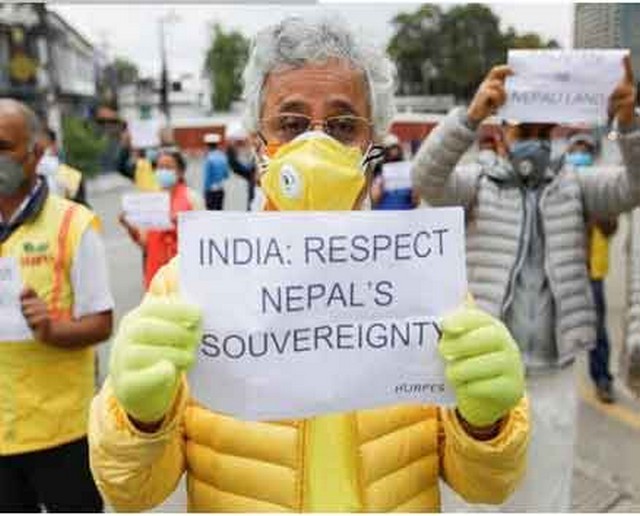
Activists affiliated with ‘Human Rights and Peace Society Nepal’ holding placards protest against the alleged encroachment of Nepal border by India in far west of Nepal, near the Indian Embassy in Kathmandu, Nepal May 12, 2020. | Photo Credit: REUTERS

kathmandupost.com reported , May 21, 2020

“We are now in a cartographic war because both countries have claimed the same territory,” Toyanath Baral, former director general of the Survey Department, told the Post. “This will put pressure on both sides to break the status quo and sit for negotiations.”

“India has been occupying the land but it is reluctant to sit for talks. The situation will likely become more complicated in the days to come but with the release of the new map, there will be pressure on both sides to sit for talks and resolve the issue,” said Baral.

With this map, “ the entire gamut of Nepal-India relations could change. The time has come to revisit the status quo prevailing since the 1960s in our ties since the Sugauli Treaty,” said Kamal Thapa, a former foreign minister who has a long history of negotiating with India on various issues.

“India has placed its troops in Kalapani due to strategic reasons, so negotiations will be difficult but Nepal should not let the issue go.”

“We could revisit the relevancy of the 1950 peace and friendship treaty and the open border, which will ultimately pave the way for more robust Nepal-India relations,” he said.

“We expect that the Ministry of Foreign Affairs will circulate a notice to the United Nations, foreign countries and other multilateral organisations about Nepal’s adoption of the new map,” he said, apart from use in text books.

*** ***

Modi-led India too antagonized Nepal quite soon

From 1997 to 2014, no Indian prime minister visited Nepal, but almost all Nepali PMs began foreign state visits with India. In 2014 alone, Modi broke that, visited Nepal four times in his five-year tenure. After a gap of 22 years, the Nepal-India Joint Commission (NIJC), a mechanism responsible for overseeing bilateral issues, had a meeting. All these had raised hopes in Nepal.

PM AB Vajpayee had talks with Nepal’s PM Grija Prasad Koirala in July 2000. Both sides had agreed to conduct a field survey to demarcate Kalapani, now in limelight. A Joint Boundary Committee (JBC) was given the task of providing reports using new strip maps, but Delhi refused to withdraw troops from Kalapani. So with Modi-led BJP in power, there were some hopes of good days.

The Joint Statement of August 04, 2014, issued after PM Modi paid an official visit to Nepal from August 3-4, 2014, revived those hopes :

The two Prime Ministers also underlined the need to resolve pending Nepal-India boundary issues once and for all. They welcomed the formation of the Boundary Working Group (BWG) to undertake the construction, restoration and repair of boundary pillars including clearance of ‘Noman’s land’ and other technical tasks. They also welcomed the Joint Commission’s decision to direct the Foreign Secretaries to work on the outstanding boundary issues, including Kalapani and Susta receiving required technical inputs from the BWG as necessary. The Indian side stressed on early signing of the agreed and initialed strip maps of about 98% of the boundary. The Nepalese side expressed its desire to resolve all outstanding boundary issues. (Point No. 12 of the Joint Statement)

While that agreement was not pursued, the relations were soured once again when Modi-led India tried to impose its views while framing a new Constitution for Nepal, leading to endless delays. Secularism and ethnic federalism were sought to be interpreted the way India wanted them, and unacceptable to Nepali polity.

On this new constitution, India interfered, imposed a border blockade to press Nepali leaders to address the demands of pro-India Madhesi-based parties (active in the southern belt bordering India). These tensions continued for four months, and the hopes of a new Nepal policy were belied.

K.P. Sharma Oli-led government had stood up, survived the blockade, adopted an independent foreign policy friendly towards China, and the big brother India was angry. His regime was toppled in 2016 July, CPN-UML leader Oli charged openly, with India playing a “primary role” in orchestrating the Opposition Nepali Congress(NC) and Prachanda-led CPN- Maoist against his regime.

Modi-led India continued the earlier policy to arm twist Nepal to give up its equi-distance policy so as to adopt a policy of subservience to India, as per the unequal Trade and Transit Treaty as also the Treaty of Peace and Friendship, 1950 that perpetuates the British colonial policy of according a protectorate status to Nepal whereby its foreign and defence policies were controlled by India. Nepal has been, for decades, pressing for its revision, preferably annulment.

Despite all this, Nepal, was forced to live amicably with its Southern neighbor, India. The land-locked country could get some freedom with help from China in trade and transit, and it became a land-linked country as Xi Jinping described.

Unequal trade, trade bottlenecks, trade deficit, inundation of Nepali land due to Indian construction along the border, apart from the border dispute that is plaguing India-Nepal relations.

Apart from NIJC, an Eminent Persons’ Group (EPG) was formed to sort out bilateral issues and unequal relations. There was little progress, however.

And now came this latest dispute, with a potential to become yet another hot spot along the border, which must be resolved.

“India is treating Nepal as though it is Pakistan with regards to the border issue”, said NC leader Sher Bahadur Deuba, ex-PM with several stints, who was close to India. That sums up the latest round of bitterness.

*** ***

Original copies of both Sugauli Treaty and Nepal-India Friendship Treaty are missing
That was the title of intriguing report by Anil Giri, in kathmandupost.com on August 13, 2019 . Anil Giri is its reporter covering diplomacy, international relations and national politics. Giri also contributed to numerous national and international media outlets. His report :

In 2016, as the Eminent Persons’ Group on Nepal-India Relations sat for talks to review or replace the 1950 Treaty of Peace and Friendship, the Nepal team had attempted to locate the original document, signed by then prime minister Mohan Shumsher and Indian ambassador to Nepal Chandeshwar Prasad Narayan Singh. It failed to do so.

The issue was then raised in Parliament,by Nepali Congress MP and shadow Foreign Minister Narayan Khadka. A parliamentary inquiry had been launched into the location of these documents. On July 22, the Delegated Legislation and Governance Committee of the National Assembly concluded that the original copies of the Sugauli Treaty and Nepal-India Peace and Friendship Treaty were not to be found within the country.

The committee had conducted a thorough search, in vain, in all possible locations including Law and Foreign Ministry, libraries, archives, Department of Archaeology, the Narayanhiti Museum.

“We have both treaties but we have to forensically verify whether these copies are originals or not,” said Foreign Minister Pradeep Gyawali “We are also trying to find historical documents and maps in India and the United Kingdom.”

Some historians and parliamentarians believe that Nepal’s copies of these originals have made their way abroad.

Pavitra Niraula, the chairperson of the International Committee of the Legislative Parliament, told the Post that the original copy of 1950 Peace and Friendship Treaty is in India while the Treaty of Sugauli is archived in London. Historian and boundary expert Buddhi Narayan Shrestha also echoed Niraula.

But Thapa, who is a former Nepali ambassador to India, recalls being handed a dossier of documents on Nepal-India relations that contained originals.

https://kathmandupost.com/national/2019/08/13/original-copies-of-sugauli-treaty-and-nepal-india-friendship-treaty-are-both-missing.

“I am certain that the palace had all these original copies,” said Thapa, who had close relations with Nepal’s former monarchs. “After the royal massacre, when the Foreign Ministry moved from Sheetal Niwas to Narayanhiti to Singha Durbar, several historical documents either went missing or were misplaced.”

Soon after the maps issue was raised before the Supreme Court of Nepal in a PIL.

Nepal SC asked the govt to furnish country’s historical map relating to Kalapani border issue, reported PTI Kathmandu, January 02, 2020.

Nepal’s Supreme Court has sought within 15 days the country’s original map exchanged with India during the signing of the Sugauli Treaty in 1816 after a petition sought the apex court’s intervention to secure the Nepali territory.

The PIL appealed the Supreme Court to order the government to start political and diplomatic efforts to protect Nepali territories.

Nepal claimed that Limpiyadhura, Lipulek and Kalapani areas were shown under India’s territory even though they lie within the Nepalese territory.

Nepalese territories including Darjeeling were handed to the British East India Company as concessions under the Sugauli treaty which was signed in 1816 on the conclusion of the Anglo-Nepalese War.

Under the treaty, the Nepalese-controlled territory that was ceded included all areas that the king of Nepal had won in earlier wars such as the kingdom of Sikkim in the east and Kumaon and Garhwal in the west.

103 border pillars missing in Banke and Bardiya districts, said a Report datelined Banke, November 20, 2019 in a Nepali magazine.

Among them are the main, subsidiary and small ones. However, the situation is that these border markers are not at their proper location. It is said 94 such border pillars are missing in Bardiya. Noone really knows where these border pillars have gone.

Among the 103 missing pillars on this stretch of the Nepal-India border, seven are said to be main pillars, five subsidiary ones and 78 are smaller pillars. Similarly, nine border pillars, including four main and five subsidiary ones are missing in Banke district. India’s Baharaich district borders the Banke and Bardiya districts of Nepal.

Banke shares about 65 kilometres and Bardiya about 80 kilometres border with India. The local Mankhola stream separates Banke and Bardiya districts. There are 307 border pillars in Banke sector of the Nepal-India border. These include 32 main pillars and 275 subsidiary ones.

It may be recalled that maps were missing and manipulated by India, before India-China border dispute led to India’s China war, as renowned AG Noorani authoritatively established several times.

The Armed Police Force (APF) squad has been deputed to guard the border towards Nepali territory. The APF border outposts have been set up in a gap of 13 to 20 kilometers. However, the Indian side has deputed the Seema Suraksha Bal (SSB) force in a distance of around five kilometers to guard the border.

“There is a way towards Indian side which is being used for the border encroachment by the Indian side,” locals complained. There is a massive presence of SSB force along the border area. The SSB force is seen conducting a patrol in a distance of each one to two kilometers along the no man’s land.

Nepal’s media had reported in November, 2019 some efforts in resolving the dispute, but they did not move ahead.

During the third meeting of Nepal-India Joint Commission (NIJC) in Kathmandu in 2014, both sides had agreed to assign the task of resolving the boundary dispute in Kalapani and Susta to the Foreign Secretaries of Nepal and India, but there has been no major development so far.

However, Nepal and India have prepared 182 sheets of boundary maps, besides Kalapani and Susta, and as per the agreed boundary maps, Nepal and India have begun the demarcation of the border, which is likely to be completed in 2022.

During the Fifth Meeting of the Nepal-India Joint Commission in Kathmandu on August 21 and 22, the foreign ministers of both countries had directed a foreign secretary-level mechanism to prioritise work on the outstanding boundary issues with technical input from the Boundary Working Group. Nepal and India had formed the working group at the Surveyor General level to settle all boundary issues.

Instead of culminating those efforts, India opened a Pandora’s Box, with the inauguration of the border road, when both sides and the whole world was engaged in tackling Covid-19.

India and its media blame China and Pakistan for all its problems, but this fact needs to be reminded, again and again.

“ China has borders with14 nations, and except for india, it has resolved its disputes with all, including Russia. India has borders with six countries, and excluding Bhutan, it has disputes with all five.”

– Subramanian Swamy, Sinologist, Ex-Union Minister, and BJP MP (Frontline 2000 Sep 2: Sino-Indian Relations Through the Tibet Prism)

Doklam subsequently showed that even Bhutan has problems with India.

What why and who provoked this untimely incident, that led to a new hot spot, wondered observers. But that needs further and deeper analysis, in Part-3 of this article.

26 May 2020

Source: countercurrents.org

Why Does Israel Celebrate Its Terrorists: Ben Uliel and the Murder of the Dawabsheh Family

By Dr Ramzy Baroud

Israeli media and Zionist apologists everywhere are busy whitewashing Israel’s globally-tattered image using the rare indictment of an Israeli terrorist, Amiram Ben Uliel, who was recently convicted for murdering the Palestinian Dawabsheh family, including an 18-month-old toddler in the town of Duma, south of Nablus.

The conviction of Ben Uliel by an Israeli three-judge court on May 18, is expectedly celebrated by some as proof that the Israeli judicial system is fair and transparent, and that Israel does not need to be investigated by outside parties.

The timing of the Israeli court’s decision to convict Ben Uliel of three counts of murder and two counts of attempted murder was particularly important, as it followed a decision by the the International Criminal Court (ICC) Prosecutor, Fatou Bensouda, to move forward with its investigation of war crimes committed in Occupied Palestine.

Considering how Israel’s extremists, especially those living illegally in the Occupied West Bank, are governed through a separate, and far more lenient system than the military regime that governs Palestinians, the seemingly-clear indictment of the Israeli terrorist deserves further scrutiny.

Israel’s apologists were quick to celebrate the verdict by the court, to the extent that Israel’s own internal intelligence agency, the Shin Bet, known for its notorious torture methods of Palestinian prisoners, described the decision as “an important milestone in the battle against Jewish terror”.

Others labored to separate Ben Uliel’s grizzly attack from the rest of Israeli society, implying that the man was a lone wolf and not the direct outcome of Israel’s unhinged racism and violent discourse directed at innocent Palestinians.

Despite the clear indictment of Ben Uliel, the Israeli court was keen on accentuating the point that the Israeli terrorist acted alone and that he was not a member of a terrorist organization. Based on that logic, the court argued that the judges “could not rule out that the attack was motivated by a desire for revenge or racism without Ben-Uliel actually being a member of an organized group.”

The verdict was a best case scenario for Israel’s image under the circumstances, as it deliberately absolved the massive terrorist network that spawned the likes of Ben Uliel and the Israeli army that protects those very extremists on a daily basis, while whitewashing Israel’s deservingly bad reputation as a violent society with an unjust judicial system.

But Ben Uliel is, by no measure, a lone wolf.

When the Israeli terrorist, along with other masked assailants, broke into the house of Sa’ad and Reham Dawabsheh at 4 am on July 31, 2015, he was clearly on a mission to elevate his name within the ardently racist, extremist society which has made the murder and ethnic cleansing of Palestinians a sort of a divine mission.

Ben Uliel achieved his objectives completely. Not only did he kill Sa’ad and Reham, but their 18-month-old son, Ali, as well. The only surviving member of the family was 4-year-old Ahmed, who was severely burnt.

The murder of the Palestinian family, little Ali in particular, quickly became the source of joy and celebration among Jewish extremists. In December 2015, six months after the murder of the Dawabsheh family, a 25-second video clip that went viral on social media showed a crowd of Israelis celebrating the death of Ali.

The video showed a “room of jumping, dancing men wearing white skullcaps, many with the long sidelocks of Orthodox Jews. Some of them are brandishing guns and knives,” The New York Times reported.

“Two (of the celebrating Israelis) appear to be stabbing pieces of paper they hold in their hands, which the television station identified as pictures of an 18-month-old child, Ali Dawabsheh.”

Despite Israeli police claims that they were ‘investigating’ the hate fest, there is little evidence to suggest that anyone was held accountable for the unmitigated celebration of violence against an innocent family and a toddler. In fact, Israeli State prosecutors later claimed that they had lost the original video of the dancing extremists.

The celebration of Israeli terrorism carried on unabated for years, to the extent that on June 19, 2018, Israeli extremists chanted openly, taunting Ali’s grandfather as he was leaving an Israeli court, with such obscene slogans, as “Where is Ali? Ali’s dead,” “Ali’s on the grill”.

The heinous murder of Ali and his family, and the subsequent trial were added to an array of other events that starkly challenged Israel’s carefully concocted image of being a liberal democracy.

On March 24, 2016, Elor Azaria killed a Palestinian man, Fattah al-Sharif, in cold blood. Al-Sharif was left bleeding on the ground while unconscious after, per Israeli army claim, trying to stab an Israeli soldier.

Azaria received a light sentence of eighteen months, soon to be freed in a massive celebration, like a conquering hero. Israel’s top government officials, including Israeli Prime Minister, Benjamin Netanyahu, supported the cold-blooded murderer throughout the trial. It will not come as a complete surprise if Azaria claims a top position in the Israeli government at some point in the future.

The celebration of murderers and terrorists like Ben Uliel and Azaria, is not a new phenomenon in Israeli society. Baruch Goldstein, the Israeli terrorist who killed scores of Palestinian worshippers while kneeling for prayer at Al-Ibrahimi Mosque in Al-Khalil (Hebron) in 1994, is now perceived as a modern martyr, a saint of biblical proportions.

In such cases, when the nature of the crime is so overwhelmingly violent, the extent of which forces itself on global news media, Israel is left with only one option – to use the indictment of ‘Jewish terrorism’ as an opportunity to reinvent itself, its ‘democratic’ system, its ‘transparent’ judicial proceedings, and so on. Meanwhile, Israeli media and its affiliates worldwide labor to describe the collective ‘shock’ and ‘outrage’ felt by ‘law-abiding’, ‘peace-loving’ Israelis.

The murder of the Dawabsheh family, although one of the numerous acts of violence perpetrated by Jewish extremists and the Israeli military against innocent Palestinians, is the perfect case in point.

Indeed, a quick look at the numbers and reports produced by the United Nations indicates that the Jewish settlers’ murder of the Palestinian family was not the exception but the norm.

In a report by the UN Office for the Coordination of Humanitarian Affairs (OCHA) in June 2018, UN investigators spoke of an exponential rise of Israeli settler violence against Palestinians.

“Between January and April 2018, OCHA documented 84 incidents attributed to Israeli settlers resulting in Palestinian casualties (27 incidents) or in damage to Palestinian property (57 incidents),” the report read. That trend continued, at times markedly increasing, with very little accountability.

The Israeli rights group, Yesh Din, has been following up on the small percentage of settler violence cases that were opened by the Israeli military and police. The group concluded that, “of 185 investigations opened between 2014 and 2017 that reached a final stage, only 21, or 11.4%, led to the prosecution of offenders, while the other 164 files were closed without indictment.”

The reason for this is simple: the hundreds of thousands of Jewish extremists who have been transferred to permanently settle in the occupied territories, an act that starkly violates international law, do not operate outside the colonial paradigm designed by the Israeli government. In some way, they too, are ‘soldiers’, not only because they are armed and coordinate their movement with the Israeli army, but because their ever-expanding settlements lie at the heart of the Israeli occupation and its continued project of ethnic cleansing.

Therefore, Jewish settler violence, like that committed by Ben Uliel, should not be analyzed separately from the violence meted out by the Israeli army, but seen within the larger context of the violent Zionist ideology that governs Israeli society as a whole. It follows that settler violence can only end with the end of the military occupation in the West Bank, East Jerusalem and Gaza, and with the demise of the racist Zionist ideology that spews hatred, embraces racism and rationalizes murder.

Ramzy Baroud is a journalist and the Editor of The Palestine Chronicle.

25 May 2020

Source: countercurrents.org

How memory became the Palestinians’ greatest weapon

By Ramzy Baroud

72 years after the destruction of historic Palestine at the hands of Zionist militias lies an opportunity to reassert the centrality of the right of return for 5 million Palestinian refugees.

Just 48 hours before thousands of Palestinians rallied on the streets, US Secretary of State Mike Pompeo paid an eight-hour visit to Israel to discuss the seemingly imminent Israeli annexation (theft) of nearly 30 percent of the West Bank. “The Israeli government will decide on the matter, on exactly when and how to do it,” Pompeo said. Clearly, the government of Benjamin Netanyahu has America’s blessing to further its colonization of occupied Palestine, to entrench its apartheid regime, and to act as if the Palestinians simply do not exist.

Considering the US’ massive political sway, why do Palestinians insist on making demands which, according to the pervading realpolitik of the so-called Palestinian-Israeli conflict, seem unattainable? Since the start of the peace process in Oslo in the early 1990s, the Palestinian leadership has engaged Israel and its Western benefactors in a useless political exercise that has, ultimately, worsened an already terrible situation. After more than 25 years of haggling over bits and pieces of what remains of historic Palestine, Israel and the US are now plotting the endgame, while demonizing the very Palestinian leaders that participated in their futile political charade.

Strangely, the rise and demise of the so-called peace process did not seem to affect the collective narrative of the Palestinian people, who still see the Nakba — not the Israeli occupation of 1967 and certainly not the Oslo Accords — as the core point in their struggle against Israeli colonialism. This is because the collective Palestinian memory remains completely independent from Oslo. For Palestinians, memory is an active process; it is not a docile, passive mechanism of grief and self-pity that can easily be manipulated, but a generator of new meanings. Despite the numerous unilateral measures taken by Israel to determine the fate of the Palestinian people, the blind and unconditional US support of Israel, and the unmitigated failure of the Palestinian Authority to mount any meaningful resistance, Palestinians continue to remember their history and understand their reality based on their own priorities.

Palestinians have been accused of being unrealistic, of “never missing an opportunity to miss an opportunity,” and even of extremism for simply insisting on their historical rights in Palestine, as enshrined in international law. These critical voices are either supporters of Israel or are simply unable to understand how Palestinian memory factors in shaping the politics of ordinary people, independent of the quisling Palestinian leadership or the seemingly impossible-to-overturn status quo. True, the two trajectories — the stifling political reality and the people’s priorities — seem to be in a constant state of divergence. The more belligerent Israel becomes, the more stubbornly Palestinians hold on to their past. There is a reason for this.

Occupied, oppressed and confined to refugee camps, Palestinians have little control over many of the realities that directly impact their lives. There is little that a refugee from Gaza can do to dissuade Pompeo from assigning the West Bank to Israel, or that a Palestinian refugee from Ain Al-Hilweh in Lebanon can do to compel the international community to enforce the long-delayed right of return. But there is a single element that Palestinians, regardless of where they are, can control: Their collective memory, which remains the main motivator of their legendary steadfastness.

Israel is afraid of Palestinian memory, since it is the only facet of its war against the Palestinian people that it cannot fully control. The more Israel labors to erase the collective memory of the Palestinian people, the more Palestinians hold on tighter to the keys of their homes and to the title deeds of their land in their lost homeland. There can never be a just peace in Palestine until the priorities of the Palestinian people — their memories and their aspirations — become the foundation of any political process with the Israelis.

Ramzy Baroud is an internationally-syndicated columnist and the editor of PalestineChronicle.com.

20 May 2020

Source: palestineupdates.com

Refugee or citizen – that is the question (a chronicle)

By Rana Shubair

WHEN I chose to participate in the Great Return March protests two years ago, people thought I was a refugee from occupied Palestine. I never shied to clearly state that I was originally from Gaza, but that I belonged to all of Palestine. Growing up, people in our society would boggle me with the question of: Are you a citizen or a refugee? In my childhood years, I didn’t even know how to answer that because my parents didn’t tell me that our community was divided into two categories: refugees and citizens.

When my family and I came back from our five-year stay in the US, I was in the 10th grade. I was disappointed to find that my Palestinian classmates asked me that same question I was asked in elementary school. Deep down it felt insulting to be asked this question wherever I went because I never believed that there was any difference between the two. At this time and age, I found that the refugee/citizen gap has more or less closed. All residents of the Gaza Strip are living under the same circumstances when it comes to occupation and blockade. During the three major aggressions launched against Gaza in 2008-2009, 2012 and 2014 refugees and citizens were targeted and killed by the Israeli war machine. This refugee/citizen conundrum opened my eyes to the plight of our people at an early age.

I was surprised to find that many of the refugees viewed the Gazans with envy because they were the ones who owned land and houses back then, whereas the refugees lived in camps built by the UN agency for Palestinians (UNRWA) in destitute conditions. I recall to this day visiting a friend at Khan Younis refugee camp when I was six or seven and, as I went to wash my hands, the whole ceramic sink suddenly fell, shattering into pieces on the floor. The homes at refugee camps were built in a way that gave an impression of their temporary existence. Roofs were of corrugated metal and the houses were built literally glued next to one another with very narrow and filthy alleys. Neighbours could hear each other talking, arguing and even flushing the toilets. Growing up in the mid ’90s, I would occasionally hear my refugee friends and acquaintances living in those camps talk of how temporary their houses were and that going back to their homes in their original lands was only a matter of time. Every generation would pass this legacy to the next: we will return one day. The first generation of refugees (the surviving ones) who were displaced in 1948 still hold the keys to their homes and the land deeds. On March 30 2018, the people of Gaza decided that it was time for the day of return. The 1948 Nakba was already 70 years ago and nothing seemed to be changing on the ground.

The Israeli occupation was annexing more land, demolishing more homes, killing more Palestinians, and imprisoning thousands. The blockade on Gaza was entering its 12th year Gaza and had become a concentration camp with two million people locked inside in deplorable conditions. The UN had predicted that Gaza would be unlivable by 2020. But it was already unfit for human habitation long before that. When I participated in the protests, my children were astonished and appalled at the same time to see a glimpse of our occupied land.

On the first day of protest, I pointed from afar to the separation fence and what lay behind it. We could see large expanses of green areas behind the snipers stationed on small hills. “This is our country,” I said suppressing my sobs. My children, like all other children here, have only visited cities of Palestine in their school textbooks. It was baffling to them when I tried to explain why we Palestinians couldn’t go to Jerusalem or Hebron. Now that they’ve grown up, they’ve stopped asking questions. It has become one of the many hard realities they cope with as Palestinians. With the outbreak of the global Covid-19 pandemic, countries around the world may have started to get a grasp of what a lockdown really means. To us Gazans, we’ve been like this for 14 years now.

People in other countries would be planning for their summer vacation destination. However, for us, travel by and large takes place only out of necessity. On the 72nd commemoration of the Nakba, I can adamantly say that we are all unified in our call for the right to return, the right to visit our own country and the right to live in dignity and freedom. No generation of my people ever wavered those rights and no generation ever will. Our existence on this land is as entrenched into the soil as the timeless olive trees.

Rana Shubair is an author of In Gaza I Dare to Dream and My Lover is a Freedom Fighter.

20 May 2020

Source: palestineupdates.com

First Iranian Fuel Tanker Reaches Venezuelan Waters without US Interference

By Reuters | The Guardian

Iran’s president had earlier warned the US not to try to stop the flotilla of five tankers sent to ease Venezuela’s fuel shortage.

24 May 2020 – The first of five tankers loaded with gasoline sent from Iran has reached Venezuelan waters, expected to temporarily ease the South American nation’s fuel crunch while defying Trump administration sanctions targeting the two US foes.

The oil tanker Fortune encountered no signs of US interference as it eased through Caribbean waters toward the Venezuelan coast late on Saturday. Venezuelan officials celebrated the arrival.

“Iran and Venezuela have always supported each other in times of difficulty,” Venezuelan foreign minister Jorge Arreaza tweeted. “Today, the first ship with gasoline arrives for our people.”

The tanker and four behind it were finishing a high seas journey amid a burgeoning relationship between Iran and Venezuela, both of which Washington says are ruled by repressive regimes.

The Iranian president, Hassan Rouhani, had earlier warned of retaliatory measures against the US if Washington causes problems for tankers carrying Iranian fuel to Venezuela.

“If our tankers in the Caribbean or anywhere in the world face trouble caused by the Americans, they [the US] will also be in trouble,” Rouhani said in a telephone conversation with the emir of Qatar, the semi-official news agency Mehr reported.

A flotilla of five tankers carrying Iranian fuel for gasoline-starved Venezuela is approaching the Caribbean.

“Iran will never initiate a conflict,” Rouhani said. “We have always the legitimate right to defend our sovereignty and territorial integrity and to serve our national interests, and we hope that the Americans will not commit an error.“

Iran is supplying about 1.53m barrels of gasoline and alkylate to Venezuela, according to both governments, sources and calculations made by TankerTrackers.com based on the vessels’ draft levels.

Venezuela sits atop the world’s largest oil reserves, but it must import gasoline because production has crashed in the last two decades. Critics blame corruption and mismanagement by the socialist administration amid an economic crisis that has led to huge migration by Venezuelans seeking to escape poverty, shortages of basic goods and crime.

The Iranian tankers hold what analysts estimate to be enough gasoline to supply Venezuela for two to three weeks.

The shipments have caused a diplomatic standoff between Iran and Venezuela and the US, as both nations are under US sanctions. Washington is considering measures in response, according to a senior US official who did not elaborate on any options being weighed.

The US recently beefed up its naval presence in the Caribbean for what it said was an expanded anti-drug operation. A Pentagon spokesman, Jonathan Hoffman, said on Thursday he was not aware of any operations related to the Iranian cargoes.

Venezuela’s defence minister has said its military will escort the Iranian tankers once they reach the nation’s exclusive economic zone.

Iran seized a British-flagged tanker in the Gulf last year after British forces detained an Iranian tanker off the territory of Gibraltar. Both vessels were released after a months-long standoff.

Venezuela recently arrested mercenaries, including US citizens, who botched an operation to kidnap the president, Nicolás Maduro.

The failed raid provided a propaganda boon for Maduro, who has long claimed to be the subject of a US-sponsored assassination plot.

25 May 2020

Source: www.transcend.org

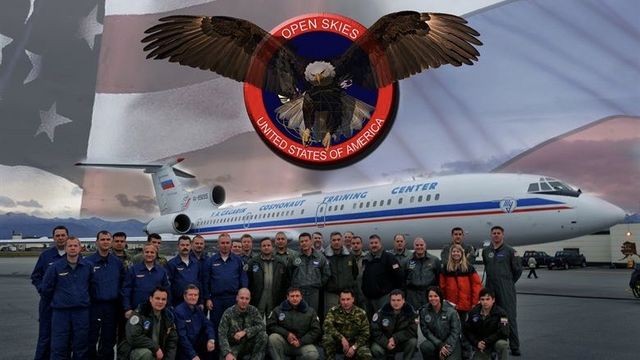
US Withdraws from Open Skies Treaty, Heightening Danger of War with Russia

By Clara Weiss

22 May 2020 – Yesterday the Trump White House announced it will unilaterally withdraw from the Open Skies Treaty, which permits participating states to conduct limited, unarmed reconnaissance flights over the territories of other member states in order to collect data on military forces and activities. The scrapping of Open Skies heightens the likelihood of a major conflict between the United States, Russia and the major European powers.

The treaty, signed in 1992 after the dissolution of the USSR, has been in full force since 2002. It has been ratified by 34 states, including almost all NATO and EU members, Russia and most countries of the former Soviet Union. The US withdrawal from Open Skies, which will take effect within six months, comes amidst growing tensions with Russia. In June, Washington and its NATO allies will stage major war games just 35 miles from Kaliningrad, a Russian enclave in Europe.

Russian media report that NATO is convening an extraordinary session on Friday, May 22, to discuss the situation.

Trump’s move is universally seen as a sign that the US will also soon end the 2010 New START treaty with Russia, which limits the number of deployable nuclear missiles to 1,550 for each country. It is the last remaining treaty constraining the arsenal of the world’s two largest nuclear powers.

The American withdrawal from the Open Skies Treaty means that Russia and other member states can no longer conduct observational flights over the US that provide information, among other things, about the growing nuclear capabilities of the US. Washington will no longer provide advance notice to other states before it conducts surveillance flights or limit its activities to dictates established by the treaty.

The White House argues that the US withdrawal is justified by Russia’s alleged “violation” of the treaty. “Russia didn’t adhere to the treaty. So until they adhere, we will pull out, but there’s a very good chance we’ll make a new agreement or do something to put that agreement back together,” Trump said at a press briefing on Thursday.

The alleged violations refer to the fact that Russia has excluded Kaliningrad, a small piece of Russian territory that abuts Poland and Lithuania, and the Georgian breakaway republics of Ossetia and South Abkhazia in the south Caucasus, from the treaty. Moscow does not allow Open Skies surveillance of these areas. In 2008, Georgia provoked a war with Russia over Ossetia and South Abkhazia with the full backing of the US, bringing NATO and Russia to the brink of all-out war.

Russian deputy foreign minister Alexander Grushko sharply criticized Washington’s withdrawal from Open Skies. “Our position is absolutely clear and is invariable: The withdrawal of the US from this treaty will come as yet another blow to the system of military security in Europe, which is already weakened by the previous moves by the administration.”

Indicating that Russia might now also withdraw from the treaty, the spokesperson for the Russian foreign ministry, Maria Zakharova, declared on Thursday that the US itself violated the treaty.

Since 2002, the US has undertaken three times as many reconnaissance flights over Russia than Russia has over the US. In 2019, Washington conducted 18 flights out of a maximum allowed of 21, whereas Moscow carried out 7. In 2020, the US is expected to reach the upper limit of 21.

Europe has been the primary target of Russian surveillance under Open Skies, with Moscow using the treaty provisions to observe the movement of NATO troops and the build-up of American military capabilities on the continent. Particularly since the 2014 crisis in Ukraine, when Washington and Brussels supported a far-right, anti-Russian coup in Kiev, the Western allies have staged ever larger and more provocative military exercises in the region.

If Russia withdraws from the treaty, it will no longer be able to continue its overflights in Europe. European signatories would also be legally prohibited from carrying out such missions over Russia.

The Trump administration first signaled its intention to withdraw from the treaty in November 2019. At that time, Konstantin Bogdanov of the Russian Academy of Sciences’ Center for International Security warned, “There is nothing to replace it with. ‘Open Skies’ is an important, symbolic treaty which has enormous political significance.”

Europe’s imperialist powers and NATO members have long opposed an American withdrawal from the treaty. Ukraine, whose eastern Donbass region is engulfed in a conflict between pro-Ukrainian and pro-Russian separatists, has also opposed the scrapping of Open Skies.

On May 12, the European Leadership Network think tank published an open letter signed by several high-ranking NATO ex-generals that called upon the Trump administration to continue complying with Open Skies. It further appealed to the European powers to “make every effort to remain in the treaty, even if the United States withdraws.” The letter, whose signatories included former military chiefs from Germany, Ukraine, the UK, France and Italy, declared that “while the intelligence and confidence building advantages are limited for the US itself, they are very real for America’s NATO allies.”

German Foreign Minister Heiko Maas criticized the American withdrawal of the treaty and urged the US government to “reconsider.” He said, “We are calling upon Russia to resume full obligations under the treaty. For us it is clear that we will continue to implement the treaty and that we will do everything to maintain it.”

The European powers, which have played a central role in staging major NATO exercises on Russia’s borders in recent years, are interested in keeping the treaty because it enables them to gather military intelligence using air surveillance. The US, by contrast, has more advanced satellite capabilities than the European powers.

While utterly reckless, the unilateral withdrawal from the treaty is part of systematic preparations by US imperialism for world war. Since 2018, Washington has officially based its military policy on the prospect of a “great power conflict,” above all with Russia and China.

In 2017, the US pulled out of the Iran nuclear deal, exacerbating tensions with Germany and France and setting the stage for an open military conflict with Tehran. Last summer, the US scrapped the Intermediate-range Nuclear Forces (INF) deal, a clear signal that it was preparing for nuclear war. And in 2019, Democrats and Republicans voted for a $750 billion military budget—the largest in history—which explicitly rejected any kind of limitations on the development of “low-yield” nuclear weapons. Other imperialist powers, most notably Germany, have stepped up their military rearmament.

25 May 2020

Source: www.transcend.org

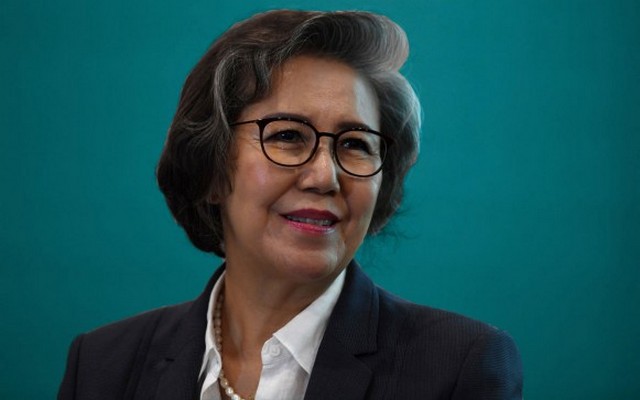
Yanghee Lee: Champion of justice for Rohingyas

By C R Abrar

“We all knew that [Aung San Suu Kyi] was put on a pedestal or portrayed as the icon of democracy and human rights, but ever since [her party] has taken office [after the 2015 election] and ever since she took the office of the State Councillor, all of her actions and her words, statements point otherwise”, noted Professor Yanghee Lee, in one of her last conversations with Al Jazeera as the Special Rapporteur on the Human Rights Situation in Burma. “Perhaps the world didn’t really know who she was”, she said.

At a time when the world, including neighbouring Malaysia and Thailand, have shunned the Rohingya (acknowledged as the most persecuted minority in the world), at a time when the Burmese state audaciously tramples the whole corpus of international human rights instruments being aided and abetted by major powers; at a time when those who stand for reason, rule of law and justice feel betrayed by the high and mighty of the world, Yanghee Lee stood firm as a beacon of hope.

A developmental psychologist and professor with decades of involvement in the UN’s rights bodies, Lee held the mandate of the Special Rapporteur from 2014 until end of April this year. Over the years, she made extensive visits to the region, including Burma. Her objective reporting on the human rights situation in Rakhine and the rest of Burma did not augur well and during their last one-to-one meeting, the de facto head of Burmese government Suu Kyi threatened visa denial if the UN Special Rapporteur kept pushing the “UN line”. Lee refused to be cowed by the former human rights icon’s interference and Suu Kyi delivered on her threat—she has been denied entry to the country since 2017. Lee viewed the Burmese decision “as a strong indication that there must be something terribly awful happening in Rakhine, as well as in the rest of the country”. While holding office, she was one of the very few global public figures who unwaveringly championed the Rohingyas’ quest for dignity, justice and protected return to their homeland.

Yanghee Lee’s tenure came to be largely dominated by the Burmese state’s attempt to complete the “unfinished business” of Rohingyas’ physical and historical existence, the Burmese equivalent of the Final Solution, in the early fall of 2017. The genocidal terror that was unleashed resulted in the exodus of at least 750,000 people into neighbouring Bangladesh. It was presented as a clearance operation of “ARSA terrorists”, a pretext enthusiastically accepted by Islamophobic western governments, world media and “security experts”. Choosing to ignore the genocidal nature of these “security clearance operations”, the emerging chorus of policy and media discourses faulted the Burmese military for “disproportionate and excessive use of force”, despite Lee calling out the “the hallmarks of a genocide” by Burma. As a matter of fact, on August 10, 2017, at least two weeks prior to the alleged ARSA attack on Burmese police outposts, Lee warned of the buildup and ominous movement of security forces in northern Arakan and appealed for restraint and respecting human rights.

In her parting statement to the Human Rights Council, Lee noted, “(w)hen I took up my mandate in 2014, I had thought that by 2020 a rights-respecting democracy would have been firmly established in Myanmar… Rather than a nation that protects human rights, I observe rights violations that continue to routinely occur and a country that stands accused of the most serious crimes under international law.”

Lee proposed ways to move towards an equal, tolerant and pluralistic society, including through victim-centered transitional justice mechanisms. Among other things, the UN expert underscored the need to bring the entire government and security forces under civilian control and initiate extensive legal reforms—including of the Constitution, land laws, the Citizenship Law and laws that violate fundamental rights such as freedom of expression, assembly and religion. “An end to impunity is the lynchpin for Myanmar to succeed in its transition to democracy. Perpetrators of human rights violations and international crimes must be held accountable,” she argued.

Yanghee Lee was appalled at the world’s reaction to the Rohingya plight—particularly that of the Security Council, which could not manage to agree on a single unified stance on an unfolding genocide in real time. She made her feelings loud and clear. Lee felt it was “shameful” that China and Russia, being UN security council members, have not taken any action against Burma. “China cannot be a global leader if it ignores such atrocities,” she noted. The Special Rapporteur also said the US decision to impose sanctions against senior military leaders in Burma did not go “far enough” and recommended these be tougher and applied to more generals.

She was disappointed at the response of the Association of Southeast Asian Nations (ASEAN) to the developments in northern Arakan. The situation posed an increasing risk to the peace and security of countries of the region, she warned, urging them to prioritise human rights in its dealings with Burma. She expressed regret at the lack of response from the Government of India on her request to visit the country to meet refugees there. She reminded them that it is incumbent on member states to respect mandates established by the Human Rights Council and provide timely and reasonable answers to such requests.

The UN’s role in addressing the Rohingya plight has been palpable. Lee personally appealed to Secretary General Antonio Guterres for an international investigation, to no avail. In October 2017, when The Guardian reported the scandalous news of Renata Lok-Dessalien, UN Resident Coordinator in Burma, compromising UN Human Rights Up Front policy by prioritising a cozy relationship with Burma’s rulers, Guterres relented and commissioned former Guatemalan foreign minister Gert Rosenthal to do an internal assessment of the UN’s performance in Burma. The Rosenthal Report condemned the organisation’s “obviously dysfunctional performance” over the past decade and noted “the overall responsibility was of a collective nature; in other words it can truly be characterised as a systemic failure of the United Nations.” Accordingly, no UN official was held accountable, and Lok-Dessallien was even rewarded with a larger portfolio when she was appointed head of the UN in India!

Yanghee Lee was unequivocal in expressing her disappointment of the UN system in dealing with the Rohingya issue, particularly the UN’s technical agencies in the New York headquarters and in Burma. She was brutally honest about how she felt about the Memorandum of Understanding that was signed by the Burmese government, UNHCR and UNDP in early June 2018 purportedly “to assist the process of repatriation from Bangladesh”. The document was not made publicly available, nor was there any transparency about its terms. UN’s failure to defend the self-identity of the Rohingya and their refugee status appalled her. “I am dismayed about the fact that the parties to the MoU, including the United Nations agencies involved in this process, have apparently failed to recognise Rohingya living in Bangladesh as refugees and as Rohingya”.

The tendency of concerned states, including Burma and Bangladesh, to deny any role to Rohingya refugees was of grave concern for her. “Most frightful … is the fact that the Rohingya refugees have not been included in any of the discussions … around this MoU nor consulted in relation to the repatriation process as a whole”, she noted, posing the uncomfortable but pointed question to the Council—”how can the process of repatriation be voluntary with the people who the process is for excluded from it? How can you be sure that any return is based on individual informed consent?”

Conveying the common view among Rohingya refugees to the Council, Lee said “it is futile to speak about their safe, voluntary, dignified and sustainable return unless the root causes of their exodus are properly addressed”. She argued that to ensure such repatriation, the international community must ensure that Burma dismantles the system of discrimination against the Rohingya by law, policy and practices that continue to exist, and guarantee fundamental human rights to them, including by restoring their citizenship rights and property.

Helping lay the foundation for global justice for both Rohingyas and other victims within the UN’s system of accountability has been the single most important contribution of Professor Lee to Burma’s oppressed communities (not just the Rohingya), especially given that the country does not have national or domestic justice and accountability mechanisms that recognise and are capable of processing the gravest crimes in international law, such as crimes against humanity and genocide. Her persistent demand for an independent investigation into Burma’s state crimes against the Rohingya led to setting up of the Independent International Fact-Finding Mission on Myanmar (FFMM) by the UN that was succeeded by the creation of the Independent Investigative Mechanism for Myanmar (IIMM) by the Human Rights Council in September 2018. The IIMM became operational on August 30, 2019—it is mandated to collect evidence of the most serious international crimes and violations of international law and prepare files for criminal prosecution.

Despite widespread skepticism, it was the relentless effort of Lee that led to the huge success in setting up of an accountability mechanism. She even wrote the TOR of the personnel of IIMM and prepared its budget. All these were achieved with the meagre support of a desk officer and a research assistant. Acknowledging her significant role, Rohingya genocide scholar Maung Zarni succinctly noted “No Yanghee Lee, no Fact Finding Mission and The Gambia-vs-Myanmar case at the International Court of Justice”.

In our meeting during her last visit to Bangladesh, she underscored the need for sustained engagement of civil society against all odds. Brushing aside my shyness, I told her that we celebrate her good fight against a system that stands for the status quo and the powerful, and has repeatedly failed to deliver justice. I added, she was the role model for those who stand for justice for the wretched of the earth. Maintaining her graceful composure, she smiled. Gracias, Professor Yanghee Lee.

C R Abrar is an academic. He is the Coordinator of Refugee and Migratory Movements Research Unit.

19 May 2020

Source: www.thedailystar.net

Jews to Palestinian Whose Home They Occupy: What do you want?

By Rima Najjar

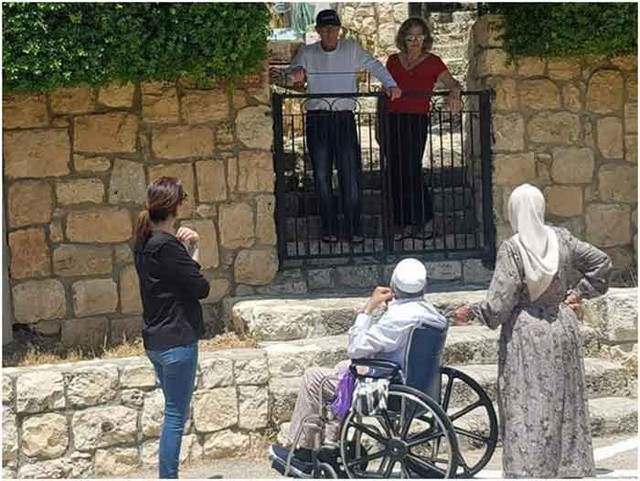
An encounter between a Jewish couple in Ijzim, Israel (south of Haifa) the the displaced Palestinians in whose house that couple resides, who are denied return to their village and property.

“On the anniversary of the Nakba … a tour through depopulated Palestinian villages within Israel … and rare meetings between the owners of the original Palestinian homes and their current Jewish residents” — Najwan Simri, reporting for Al Jazeera

Displaced Palestinians encounter Jews occupying their home in Ijzim, Israel

TRANSLATION OF THE VIDEO-CLIP NARRATION:

Information on the Palestinian village of Ijzim shown as three consecutive red text blocks throughout the video clip:
— The village of Ijzim south of Haifa is one of three villages known as the Carmel triangle of villages that fell at the hands of Zionist gangs after the establishment of Israel.
— A number of the people of the village of Ijzim took refuge in nearby cities and villages. Others took refuge in Arab countries after Ijzim’s occupation by Zionist gangs.
— Many of the landmarks of the village of Ijzim, south of Haifa, are still there as witness of the events of the Nakba 72 years ago.

NARRATION:

… Here lives a family uprooted from a nearby village. We had an appointment with Hajjeh Im Samir to accompany her there. Her [ailing] husband insisted on coming with us because he said the air of Ijzim is the best cure.

Despite its beauty, the road there seems desolate as if it gets you to the place but doesn’t take you there. Eagerly, Im Samir organizes our tour for us and tells us the names of the [Palestinian] owners of the houses.

Our first stop is God’s house. Its stones have been preserved as they were. Alone, the colors of its locked doors change each time the dryness of the seasons intensifies.

Here, Abu Samir does not stay in the car because this stop [station] is the location for which he has most longed in order to banish the other stations of his life. “This was our house, my father’s house. After the ’48 wars, the Jews occupied it.”

After a few minutes, the residents of the house come out to [the gate]. They ask us what we want. We say, this is the owner of the house; how do you feel living in a house built on the wreckage of his house? [The answer] Frankly, I don’t feel anything. I am very happy. Living here is very enjoyable.

How strange is the distance between the owner of the house and he who is occupying it. How strange is the irony between he who has to stand inside the gate and he who must stand outside the gate. How strong Abu Samir is! For other uprooted people have refused to accompany us [on our tour]. One of them told us that he cannot bear to glimpse through the window of his father’s house a foreigner living there.

And that [glimpse] could possibly be of a strange symbol, like [what is glimpsed through the window] of a stolen [Palestinian] school converted into a temple with an emblem [the flag of Israel] that is not as old as the memory of the stones of the school.

Flag of Israel glimpsed through the window of the converted school of the Palestinian village of Ijzim, which is now a Temple

And so, an extreme picture! It is said that the passage of time helps in forgetting, but, in the Palestinian case, it seems that the equation of time is different and that the years are merely a number. Rather, the longer the banishment of the Palestinians is, the more they remember.

– This is Najwan Simri, reporting from the depopulated village of Ijzim for Al Jazeera.

___________________

Rima Najjar is a Palestinian whose father’s side of the family comes from the forcibly depopulated village of Lifta on the western outskirts of Jerusalem and whose mother’s side of the family is from Ijzim, south of Haifa.

17 May 2020

Source: countercurrents.org
Global Capitalism, “World Government” and the Corona Crisis

By Prof Michel Chossudovsky

In the councils of government, we must guard against the acquisition of unwarranted influence, whether sought or unsought, by the military-industrial complex.

The potential for the disastrous rise of misplaced power exists, and will persist. (President Dwight D. Eisenhower, January 17, 1961)

***

The World is being misled concerning the causes and consequences of the corona crisis.

The COVID-19 crisis is marked by a public health “emergency” under WHO auspices which is being used as a pretext and a justification to triggering a Worldwide process of economic, social and political restructuring.

Social engineering is being applied. Governments are pressured into extending the lockdown, despite its devastating economic and social consequences.

What is happening is unprecedented in World history.

Prominent scientists support the lockdown without batting an eyelid, as a “solution” to a global health emergency.

Amply documented, the estimates of the COVID-19 disease including mortality are grossly manipulated.

In turn, people are obeying their governments. Why? Because they are afraid?

Causes versus solutions?

The closing down of national economies applied Worldwide will inevitably result in poverty, mass unemployment and an increase in mortality. It’s an act of economic warfare.

Stage One: Trade War against China

On January 30, 2020 the WHO Director General determined that the coronavirus outbreak constitutes a Public Health Emergency of International Concern (PHEIC). The decision was taken on the basis of 150 confirmed cases outside China, First cases of person to person transmission: 6 cases in the US, 3 cases in Canada, 2 in the UK.

The WHO Director General had the backing of the Bill and Melinda Gates Foundation, Big Pharma and the World Economic Forum (WEF). The decision for the WHO to declare a Global Emergency was taken on the sidelines of the World Economic Forum (WEF) in Davos, Switzerland (January 21-24).

One day later (January 31) following the launch of the WHO Global Emergency, The Trump administration announced that it will deny entry to foreign nationals “who have traveled in China in the last 14 days”. This immediately triggered a crisis in air transportation, China-US trade as well as the tourism industry. Italy followed suit, cancelling all flights to China on January 31.

The first stage was accompanied by the disruption of trade relations with China as well as a partial closedown of export manufacturing sector.

A campaign was immediately launched against China as well ethnic Chinese. The Economist reportedthat

“The coronavirus spreads racism against and among ethnic Chinese”

“Britain’s Chinese community faces racism over coronavirus outbreak”

According to the SCMP:

“Chinese communities overseas are increasingly facing racist abuse and discrimination amid the coronavirus outbreak. Some ethnic Chinese people living in the UK say they experienced growing hostility because of the deadly virus that originated in China.”

And this phenomenon is happening all over the U.S.

Stage Two: The Financial Crash Spearheaded by Fear and Stock Market Manipulation

A global financial crisis unfolded in the course of the month of February culminating in a dramatic collapse of stock market values as well as a major decline in the value of crude oil.

This collapse was manipulated. It was the object of insider trading and foreknowledge. The fear campaign played a key role in the implementation of the stock market crash. In February, roughly $6 trillion have been wiped off the value of stock markets Worldwide. Massive losses of personal savings (e.g. of average Americans) have occurred not to mention corporate failures and bankruptcies. It was a bonanza for institutional speculators including corporate hedge funds. The financial meltdown has led to sizeable transfers of money wealth into the pockets of a handful of financial institutions.

Stage Three: Lockdown, Confinement, Closing Down of the Global Economy

The financial crash in February was immediately followed by the lockdown in early March. The lockdown and confinement supported by social engineering was instrumental in the restructuring of the global economy. Applied almost simultaneously in a large number countries, the lockdown has triggered the closing down of the national economy, coupled with the destabilization of trade, transport and investment activities.

The pandemic constitutes an act of economic warfare against humanity which has resulted in global poverty and mass unemployment.

Politicians are lying. Neither the lockdown nor the closing down of national economies constitute a solution to the public health crisis.

Who Controls the Politicians?

Why are politicians lying?

They are the political instruments of the financial establishment including the “Ultra-rich philanthropists”. Their task is to carry out the global economic restructuring project which consists in freezing economic activity Worldwide.

In the case of the Democrats in the US, they are largely concerned in opposing the reopening of the US economy as part of the 2020 election campaign. This opposition to reopening the national and global economies is supported by “Big Money”.

Is it opportunism or stupidity. In all major regions of the World, politicians have been instructed by powerful financial interests to retain the lockdown and prevent the re-opening of the national economy.

The fear campaign prevails. Social distancing is enforced. The economy is closed down. Totalitarian measures are being imposed. According to Dr. Pascal Sacré

… in some countries, patients can leave hospital by agreeing to wear an electronic bracelet. This is only a sample of all the totalitarian measures planned or even already decided by our governments in favor of the coronavirus crisis. It goes much further, it’s limitless and it affects a good part of the world, if not the whole world.
.

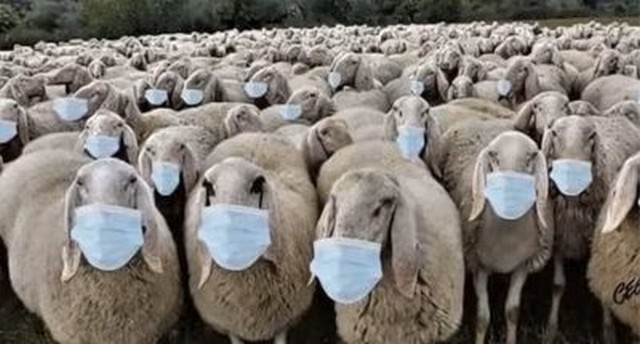
The “Herding Instincts” of Politicians

Are corrupt governments acting like “police dogs” with “herding instincts” going after their sheep.

Is “the herd” too scared to go after their “government”?

The analogy may be simplistic but nonetheless considered relevant by psychologists.

“Some breeds of dogs [corrupt politicians] have herding instincts that can be brought out with the right training and encouragement [bribes]. …. teach your dog [political proxy] basic obedience and see if it [he, she] displays herding tendencies. … Always look for a trainer who uses reward-based training methods [bribes, personal gain, political support, accession to high office]” (How to Teach Your Dog to Herd)

But there is another dimension. Politicians in high office responsible for “convincing their herd” actually believe the lies which are being imposed upon them by higher authority.

The lie becomes the truth. Politicians endorse the consensus, they enforce “social engineering”, they believe in their own lies.

It’s Not an Epidemic, It’s An Operation

US Secretary of State Mike Pompeo (slip of the tongue) tacitly admits in a somewhat contradictory statement that the COVID-19 is a “Live Exercise”, an “Operation”:

“This is not about retribution,… This matter is going forward — we are in a live exercise here to get this right.”

To which president Trump retorted “you should have told us”.

Those words will go down in history.

Geopolitics

Let us be under no illusions, this is a carefully planned operation. There is nothing spontaneous or accidental. Economic recession is engineered at national and global levels. In turn, this crisis is also integrated into US-NATO military and intelligence planning. It is intent not only upon weakening China, Russia and Iran, it also consists in destabilizing the economic fabric of the European Union (EU).

“Global Governance”

A new stage in the evolution of global capitalism is unfolding. A system of “Global Governance” controlled by powerful financial interests including corporate foundations and Washington think tanks oversees decision-making at both the national and global levels. National governments become subordinate to “Global Governance”. The concept of World Government was raised by the late David Rockefeller at the Bilderberger Meeting, Baden Germany, June 1991:
.
“Some even believe we are part of a secret cabal working against the best interests of the United States, characterizing my family and me as ‘internationalists’ and of conspiring with others around the world to build a more integrated global political and economic structure, one world if you will. If that is the charge, I stand guilty, and I am proud of it.” (Ibid)

People do not question the consensus, a consensus which borders on the absurd.

Global Capitalism and “The Economic Landscape”

The crisis redefines the structure of the global economic landscape. It destabilizes small and medium sized enterprises Worldwide, it precipitates entire sectors of the global economy including air travel, tourism, retail trade, manufacturing, etc. into bankruptcy. The lockdown creates famine in developing countries. It has geopolitical implications.

The Pentagon and US intelligence are involved. The corona crisis affects to conduct of US-NATO led wars in the Middle East including Syria, Iraq and Afghanistan and Yemen. It is also used to target specific countries including Iran and Venezuela.

This engineered crisis is unprecedented in world history. It is an act of war.

The lockdown triggers a process of disengagement of human and material resources from the productive process. The real economy is brought to a standstill. Curtailing economic activity undermines the “reproduction of real life”. This not only pertains to the actual production of the “necessities of life” (food, health, education, housing) it also pertains to the “reproduction” of social relations, political institutions, culture, national identity. At the time of writing, the lockdown is not only triggering an economic crisis, it is also undermining and destroying the very fabric of civil society not to mention the nature of government and the institutions of the state (crippled by mounting debts), which will eventually be privatized under the supervision of Big Money creditors.

There are conflicts within the capitalist system which are rarely addressed by the mainstream media. Billionaires, powerful banking and financial institutions (which are creditors of both governments and corporations) are waging an undeclared war against the real economy. Whereas the Big Money financial and banking establishment are “creditors”, the corporate entities of the real economy which are being destabilized and driven into bankruptcy are “debtors”.

Bankruptcies

This diabolical process is not limited to wiping out small and medium sized enterprises. Big Money is also the creditor of large corporations (including airlines, hotel chains, hi tech labs, retailers, import-export firms, etc.) which are now on the verge of bankruptcy.

The global financial establishment is not monolithic. It is marked by divisions and rivalry. The dominant Big Money faction seeks to destabilize its competitors from within. The results of which would be a string of bankruptcies of regional and national banking institutions as well as a process of global financial consolidation.

In the US, numerous retailers, airlines, restaurant and hotel chains filed for Chapter 11 bankruptcy in February. But this is just the beginning. The big gush of bankruptcies will occur in the wake of the lockdown (“The New Normal”). And at the time of writing, the financial establishment is relentlessly pressuring (corrupt) national governments to postpone the lifting of the lockdown. And the governments are telling us that this is to “protect people against the virus”.

Canada’s province of Alberta which is largely dependent on oil revenues is bankrupt.

“Countries that represent over 50 per cent of the world’s global GDP are closed for business. Economists looking for historical comparisons mention the 1929 stock crash, the 1974 economic crisis or the 2008 recession. But they admit that these all fall short of the toll that this pandemic could have.” (Wired News UK, April 29, 2020

In Britain, recent reports state (It’s very British”) “we do not know how many have gone bankrupt”.

A chunk of Britain’s business landscape may have already been permanently erased, as some 21,000 more UK businesses collapsed in March alone than the same month a year ago, according to data gathered by the Enterprise Research Centre, a group of university researchers.

What these reports fail to mention are the unspoken causes: a fear campaign on behalf of the creditors, instructions by corrupt governments to close down the economy, allegedly to “save lives”, which is a big lie. Lives are not being saved, and they know it.

The coronavirus crisis “has ground U.S. business to a halt”. National economies are destabilized. The objective of Big Money is to weaken their competitors, “pick up the pieces” and eventually buy out or eliminate bankrupt corporations. And there are many to choose from.

Global Finance Capitalism

The interests of Big Money (global financial interests) overlap with those of Big Pharma, Big Oil, the Defense contractors, etc. Major banking institutions in the US including JP Morgan Chase, Bank of America, Citigroup, Wells Fargo, State Street Co. and Goldman Sachs, are investing in the war economy including the development of nuclear weapons under Trump’s 1.2 trillion dollar nuclear weapons program (first established under Obama).

The ultimate objective of “Big Money” is to transform nation states (with their own institutions and a national economy) into “open economic territories”. That was the fate of Iraq and Afghanistan. But now you can do it without sending in troops, by simply ordering subservient proxy governments integrated by corrupt politicians to close down their economy on humanitarian grounds, the so-called “Responsibility to Protect” (R2P) without the need for military intervention.

Impossible to estimate or evaluate. More than half the global economy is disrupted or at a standstill.

Let’s be clear. This is an imperial agenda. What do the global financial elites want? To privatize the State? To own and privatize the entire planet?

The tendency is towards the centralization and concentration of economic power. Heavily indebted national governments are instruments of Big Money. They are proxies. Key political appointments are controlled by lobby groups representing Wall Street, The Military Industrial Complex, Big Pharma, Big Oil, the Corporate Media and the Digital Communications Giants, etc.

Big Money in Europe and America (through Washington Lobby groups) seek to control national governments.

In what direction are we going? What is the future of humanity? The current corona crisis is a sophisticated imperial project, which consists in Worldwide domination by a handful of multibillion dollar conglomerates. Is this World War III? Global capitalism is destroying national capitalism.

The unspoken intent of global capitalism is the destruction of the nation state and its institutions leading to global poverty on an unprecedented scale.

The following citation by Lenin dated December 1915 at the height of the First World War pointed with foresight to some of the contradictions which we are presently facing. On the other hand, we should understand that there are no easy solutions and that this crisis is intended to reinforce imperialism and the clutch of global capitalism:

“There is no doubt that the development is going in the direction of a single World trust which will swallow up all enterprises and all states without exception. But the development in this direction is proceeding under such stress, with such a tempo, with such contradictions, conflicts and convulsions not only economical, but political national, etc. etc — that before a single world trust will be reached, before the respective financial national capitals will have formed a “World Union” of ultra imperialism, imperialism will explode and capitalism will turn into its opposite.

(V. I. Lenin, Introduction to Imperialism and World Economy by N, Bukharin, Martin Lawrence, London, printed in the US, Russian Edition, November 1917)

How to reverse the tide. The first priority is to repeal the lie.

In this regard, it is unfortunate that many people who are “progressive” (including prominent Left intellectuals) are –despite the lies– supportive of the lockdown and closing down of the economy as a solution to the public health emergency. That’s the stance of the Democratic Party in the US, which goes against common sense.

Truth is a powerful weapon for repealing the lies of the corporate media and the governments.

When the Lie Becomes the Truth There is No Moving Backwards

Without the fear campaign and media propaganda, the actions taken by our governments would not have a leg to stand on.

“Social Distancing” does not prevent the financial elites from providing instructions to corrupt politicians.

On the other hand, “social distancing” combined with confinement is being used as a means of social subordination. It prevents people from meeting as well as protesting this so-called New World Order.

Organization, Truth and Solidarity are essential to reversing the tide. The first step of a worldwide movement is “counter-propaganda”.

Michel Chossudovsky is an award-winning author, Professor of Economics (emeritus) at the University of Ottawa, Founder and Director of the Centre for Research on Globalization (CRG), Montreal, Editor of Global Research.

16 May 2020

Source: www.globalresearch.ca

Nakba: A Call For Justice In Palestine

By Jafar M Ramini

Today, May 15th, is the 72nd anniversary of the Palestinian Nakba (Catastrophe) and counting. I say ‘and counting’ because the theft of our land, the occupation, the siege on Gaza, the disposition of our people, the ethnic cleansing of Palestine and replacement of the Palestinian nation with Jews with dual nationality from around the world continues more aggressively than ever. So does the building of illegal settlements to house those interlopers. They too are still going apace with no end in sight.

And I haven’t even got around to mentioning the Israeli prisons which are full of Palestinian men, women and children, tortured and held in disgusting conditions without charge or legal recourse.

In the last 72 years there were many attempts to settle the so-called Israeli/Palestinian conflict. Yet, to put it in those terms is misleading. A conflict is between two opposing powers and their armies. Israel has the power, has the army, has the airforce, has the navy. Not to mention three hundred nuclear heads. The Palestinians have none of these. So how can we call it a conflict?

It is genocide. It was designed to ethnically cleanse all of Palestine and turn it into a state for Jews only, as per the nation state bill that was passed two years ago, which emphatically states that the right of self-determination in Israel is exclusively a Jewish prerogative.

There you have it. Black and white. This ethnic cleansing and theft of land and expansion are all official Israeli policy. This is not new. This is how the Zionist terrorist organisations operated in Palestine during the British mandate of 1922 -1948. They embarked on a policy of murder of innocent Palestinian men, women and children while the British forces looked the other way in some instances and actively encouraged it in others. Yet all of this was just a starter for a much more ambitious, well-planned and financed project of the Greater Israel.

First: Conquer Palestine. Get rid of the Palestinians, or corral them in bins euphemistically referred to as ‘cantons’ and keep them on a strictly limited diet and under tight military rule.

Second: Present to the world that Jews are the only victims and Israelis are the biggest victims of all.

Third: Blackmail friends and allies to support Israeli ambitions come what may. Steal their technology. Kill their sailors. Blame it on others. Those who do not submit, smear them as ‘anti-semitic’.

This is how Mr Benjamin Netnayahu, has kept his grip on power since the 1990s. He has lied, he has waged wars, he has inflicted more death and suffering on the Palestinians and he has pretended to make peace. What he was actually trying to do, and is still trying to do is establish a legacy as the man who put the Greater Israel project on a higher level than any other leader before him.

The opposition to his rule in Israel is minimal. His popularity with the Israeli people is higher than any other leader ever and when it comes to the Trump family, at present ruling the USA ,he is just one of the family. Mr Trump will grant his every wish. First, he rewarded Netanyahu and the Jewish lobby in America with his declaration that Jerusalem was the eternal capital of the Jewish people. He also declared that Israel could enforce its sovereignty on the occupied Syrian Golan Heights. All against the rule of international law and past UN resolutions.

He then kicked out the PLO representative in Washington. But that wasn’t enough for Mr Netanyahu. So Trump went one step further by depriving the Palestinian Authority of much needed funds and demonising the UN Refugees and Works Agency, UNRWA by insisting that there were no such thing as Palestinian refugees. Consequently a lifeline of vital food, health and education for 5 million Palestinian refugees was put in jeopardy.

You’d think that would be enough. Israel has got its wish. Palestine no longer exists, other than in name, although even that is denied by many Israelis. But no, Mr Netanyahu, the arch manipulator who was indicted on charges of bribery, fraud and breach of trust, found another escape route. He went to his benefactors, the Trump Administration, and started yet another assault on the Palestinian people. The so-called ‘Deal Of The Century’.

This was a deal that totally ignored the Palestinians and catered, as usual, to the demands of Mr Netanyahu and his cronies in Washington.

The Palestinian leadership could only reject it. What else could they do? They have no power to speak of on the ground. They have no influence and no cards to play in the corridors of power in Washington, London, Paris or any other western capital and they are, most importantly, divided amongst themselves and have been publicly abandoned by their supposed brethren in the Arab world.

Despite 25 years of unproductive ‘peace’ negotiations and despite the relentless expansionist policies of the Israeli government the Palestinian leaders, the world leaders and the UN still do believe that a two-state solution is the only way forward.

Enter Mr Netanyahu and his new partner in crime, General Gantz with a new idea and a new government based solely on the total annexation of the illegal Israeli settlements in the West Bank and the entire Jordan Valley. In a normal world with ordinary, fair-minded people in charge this would be seen for what it is. Blatant theft. Blatant misuse of power and flagrant disregard for the rule of law. Nothing of the sort. Europe, as per usual, offered lukewarm rejection, but the people who matter, i.e.the United States of America gave it their tacit approval. In the words of Secretary of State, Mike Pompeo, “As for the annexation of the West Bank, the Israelis will ultimately make those decisions,” he told reporters. “That’s an Israeli decision.”

To reaffirm the Trump Administration’s total devotion to the survival and continuation of Mr Netanyahu’s career Mr Pompeo, ignoring any health risk in quarantined Israel against the Corona virus, was in Tel Aviv two days ago. He was there to make it clear that in this year of the American elections, to the Trump Administration only Israel matters.

The chosen one to facilitate this latest annexation process is none other than American Ambassador to Israel, David Friedman, an ultra-nationalist, settlement supporter and religious zealot and rejectionist of the two-state solution. Yet this is the person who is deciding where the future border will be between Greater Israel and the remaining, already lacerated West Bank.

Thankfully, not all American presidents are Trump clones. Jimmy Carter, former president of the USA and author of ‘Palestine: Peace Not Apartheid’ has spoken firmly against this blatant flouting of international law.

“If the joint mapping of Palestinian lands to be seized by the Israeli government continues, the standing of the United States in the international community will be further damaged. The West Bank belongs to Palestine, and any changes should be mutually agreed upon.”

In the name of fairness there was one dissenting Jewish, Zionist, right-wing voice who was against this idea of annexation. Not because it is illegal. Not because he has sympathies with the plight of the Palestinians. Not because he is anti Israel. On the contrary, his dissent was based on racist condescension. The man I am referring to is Daniel Pipes, president of something called ‘The Middle East Forum’ and a well-known supporter of Israel. Mr Pipes gave six reasons why he would be against such a move. But the one I have chosen for you, my readers, is the last and I believe the only true one.

“Annexation would be likely to make more Palestinians eligible to become citizens of Israel.”

Dear God. Palestinian citizens of anywhere?
Heaven forbid!

Jafar M Ramini is a Palestinian writer and political analyst.

15 May 2020

Source: countercurrents.org