Just International

How Corporate Tyranny Works

By Chris Hedges

Those, like environmental lawyer Steven Donziger, who fight the corporate control of our society on behalf of the vulnerable, find that the institutions of power unite to crucify them.

25 Aug 2020 – The persecution of the attorney Steven Donziger is a grim illustration of what happens when we confront the real centers of power, masked and unacknowledged by the divisive cant from the Trump White House or the sentimental drivel of the Democratic Party. Those, like Donziger, who name and fight the corporate control of our society on behalf of the vulnerable see the judiciary, the press and the institutions of government unite to crucify them.“It’s been a long battle, 27 years,” Donziger said when I reached him by phone in his apartment in Manhattan.

Donziger, who has been fighting polluting American oil companies for nearly three decades on behalf of indigenous communities and peasant farmers in Ecuador, has been under house arrest in Manhattan for a year. He will go to trial in federal court in New York on September 9 on contempt of court charges, which could see him jailed for six months. Ever since he won a multibillion-dollar judgment in 2011 against the oil giant Chevron, the multinational has come after him personally through litigation that threatens to destroy him economically, professionally and personally.

“Our L-T [long-term] strategy is to demonize Donziger,” Chevron wrote in an internal memo in 2009, as reviewed by Courthouse News.

“It started when Texaco went into Ecuador in the Amazon in the 1960s and cut a sweetheart deal with the military government then ruling Ecuador,” Donziger told me. “Over the next 25 years, Texaco was the exclusive operator of a very large area of the Amazon that had several oil fields within this area, 1500 square miles. They drilled hundreds of wells. They created thousands of open-air, unlined toxic waste pits where they dumped the heavy metals and toxins that came up from the ground when they drilled. They ran pipes from the pits into rivers and streams that local people relied on for their drinking water, their fishing and their sustenance. They poisoned this pristine ecosystem, in which lived five indigenous peoples, as well as a lot of other nonindigenous rural communities. There was a mass industrial poisoning.”

“By the time I went down there in the early 1990s, many people had died, cancer rates were skyrocketing according to several independent health evaluations, people were really hurting. There was zero regard for the lives of the local people by Texaco. I was a very young lawyer back in 1993 when I first went to Ecuador. It was like looking at an apocalyptic scene. There was oil on the roads. People were living in abject poverty. They had no shoes. They would get oil on their feet when they walked along the roads. The oil pollution had permeated every aspect of daily life. It was in the food supply. It was in the water supply. It was in the air. The average person there would get exposed multiple times a day to very harmful, cancer-causing toxins, with foreseeable results.”

“I, with other lawyers, filed a lawsuit in New York against Texaco. The reason we filed in New York was because Texaco’s headquarters were in New York in 1993. The decisions to pollute in Ecuador, to play God to the people of Ecuador, were made in New York. We sued in New York. Texaco tried to get the case back to Ecuador where they had never been held accountable, where they knew the indigenous peoples had no money or resources to find lawyers.”

“They thought it would just go away,” said Donziger. “Over a 10-year period, we battled to get a jury trial in the United States. Ultimately, they won that part of the battle. It went down to Ecuador.”

“We started working with a team of Ecuadoran lawyers in the early 2000s. We went forward with the lawsuit. We produced voluminous scientific and testimonial evidence, showing that they caused probably the world’s worst oil pollution. It was called the ‘Amazon Chernobyl’ by locals and experts. They dumped 16 billion gallons of toxic waste. They did it deliberately to save money. This was unlike the BP spill in the Gulf of Mexico, which was a terrible accident, even though it was a product of horrendous negligence by BP. This was done by design to pollute, knowing that people would die, and that indigenous groups would be decimated, and that this beautiful part of the Amazon would be destroyed.”

The refusal to abide by even minimal environmental regulations saved Texaco an estimated $3 on every barrel of oil produced over 26 years (1964-1992), according to Amazon Watch, or an estimated extra $5 billion in revenue. The hundreds of waste pits the company eventually abandoned in Ecuador, on average, contain 200 times the contamination allowed by typical global standards.

“They tried to grind us down using classic corporate defense tactics,” Donziger said of the legal war. “They filed thousands of motions. We stood strong. We had a great legal team of Ecuadorian lawyers.”

In the end, they won a stunning victory, a rare moment of accountability for first-world conglomerates who rape the environment of developing nations by exploiting weak, corrupt governments.

“The verdict came down, about $18 billion in favor of the affected communities, which is what it would take at a minimum to clean up the actual damage and compensate the people for some of their injuries. That eventually got reduced on appeal in Ecuador to $9.5 billion, but it was affirmed by three appellate courts, including the highest court of Ecuador. It was affirmed by the Canadian Supreme Court, where the Ecuadorians went to enforce their judgment in a unanimous opinion in 2015.”

Chevron, as the evidence mounted against it, sold their assets in Ecuador and left the country. The corporation threatened the plaintiffs with a “lifetime of litigation” if they attempted to collect, and, according to internal Chevron memos, launched a legal and media campaign that has cost an estimated $2 billion to prevent payment of the settlement and to demonize and destroy Donziger.

Donziger came to his epic battle against Chevron through journalism. “I was a journalist on my college newspaper,” he said of his time as a history major at American University. “My first job out of college was as a journalist with [United Press International]. I worked for UPI in Washington. They were strong in Latin America. I traveled to Managua in 1983 or 1984, I don’t remember exactly, and found work in the UPI bureau. I was 23 years old. I worked in the UPI bureau in Managua during the Sandinista era.”

He left UPI after a year in Managua but stayed on in Nicaragua to work as a freelance journalist for newspapers such as The Fort Lauderdale News, The Toronto Star and The Atlanta Constitution. He spent about three years as a reporter before going to Harvard Law School. When he graduated from Harvard Law School in 1991, he worked as a public defender in Washington, D.C. He documented Iraqi civilian casualties in Iraq following the first Gulf War that became a report adopted by the United Nations.

A classmate at law school was from Ecuador. His classmate’s father organized a trip in April 1993 for lawyers and medical professionals to look at the contamination caused by the oil extraction in the Amazon. That trip, which Donziger joined, spawned the suit against Texaco. He would make more than 250 trips to Ecuador over the next two decades.

“Journalism significantly shaped my views and skill set,” he said. “It was vital to allowing my work to be successful. From the beginning this was a unique litigation, for many reasons, but one of the reasons was we, as a team, decided to work across multiple platforms. If we only saw this case as a lawsuit we would never win.”

“Chevron controlled the legal system in Ecuador with their influence. We needed to operate across different platforms, including engaging with the media and carrying out significant public education. Most Ecuadoreans, other than those who lived in the region, knew nothing about the pollution that had been happening in their country. We carried out zealous advocacy in the public arena. We realized that the indigenous people would never get a fair trial in Ecuador if they did not illuminate what had happened to them and get public support.”

“The fact that I am detained shows how far we’ve come and how much risk Chevron feels. It’s not a sign we lost. It’s the opposite.”
— Steven Donziger

Both the judge who oversaw its lawsuit against Donziger for “racketeering” and Chevron itself “claim that this type of activity is wrong,” he said. “The irony is that what we were doing is what the big oil companies have always done. They always operate in the public relations domain, lobbying Congress to pass legislation to extinguish various legal claims, meeting political leaders behind the scenes. They operate across every platform they can find to exercise their power. We were smart enough to meet them toe-to-toe wherever they were operating and neutralize their ability to undermine the fairness of the trial. That’s how they operate. They try to control court systems.”

“My journalism [experience] sensitized me to injustice. It allowed me to understand the media. I knew how to write press releases, which matters when you do a public case like this. I knew how to work across different platforms to mobilize positive energy around the case. Human rights work involves, first and foremost, justice for victims. But equally important is accountability for the perpetrators. The fact that I am detained shows how far we’ve come and how much risk Chevron feels. It’s not a sign we lost. It’s the opposite.”

Chevron, which had left Ecuador, went back to the New York court, where Donziger had originally filed the lawsuit before Chevron got a change of venue to Ecuador, and sued him, using a civil courts portion of the federal law famous for breaking the New York Mafia in the 1970s, the Racketeer Influenced and Corrupt Organizations Act.

In effect, “They sued me as a civil racketeer, under a civil RICO statute for $60 billion,” he said. “That was the largest amount of money an American individual ever had been sued for. This began a ten-year campaign to demonize me by Chevron and by its judicial allies.”

Chevron, which has more than $260 billion in assets, has hired an estimated 2,000 lawyers from 60 law firms to carry out its campaign, according to court documents. The oil giant dropped its demand for financial damages weeks before the RICO trial, which would have necessitated a jury trial. Judge Lewis A. Kaplan, a former lawyer for the tobacco industry who had undisclosed investments in funds with Chevron holdings, according to his public financial disclosure statement, decided the RICO case alone. He found credible a witness named Alberto Guerra, relocated to the US by Chevron at a cost of some $2 million, who claimed the verdict in Ecuador was the product of a bribe. Kaplan used Guerra’s testimony as primary evidence for the racketeering charge, although Guerra, a former judge, later admitted to an international tribunal that he had falsified his testimony.

“[Kaplan] wouldn’t allow me to bring in any environmental evidence that the Ecuadorian courts had used to find Chevron liable,” Donziger said. “He wouldn’t let me testify on my own behalf on direct. He allowed Chevron to use secret witnesses whose identities he wouldn’t reveal to me. He tried to treat it like a national-security kind of case to try to demonize me. Because Chevron’s whole strategy is to demonize [me] as a way to distract attention from its environmental crimes in Ecuador. And Judge Kaplan, who knows all the tricks in the books because he used to work for [tobacco company] Brown & Williamson, when he was [an attorney with the law firm of] Paul, Weiss. He knows the tobacco industry playbook that they used for years and years and continue to use. And he worked with the Chevron lawyers at Gibson, Dunn & Crutcher to implement them against me without a jury. And there was nothing I could do about it.”

(Paul, Weiss is a large law firm that currently advises Chevron on its $13 billion purchase of another energy company.)

John Keker, one of Donziger’s lawyers on that case, said he was up against 160 lawyers for Chevron and during the trial he felt “like a goat tethered to a stake.” He called the court proceedings under Kaplan “a Dickensian farce” and a “show trial.” In the end, Kaplan ruled that the judgment in the Ecuadorean court against Chevron was the result of fraud.

He also ordered Donziger to turn over decades of all client communication to Chevron, in effect eradicating attorney-client privilege, a backbone of the Anglo-American legal system with roots dating to ancient Rome. Donziger appealed what was, according to legal experts following the case, an unprecedented and illegal order. While Donziger’s appeal was pending, Kaplan charged him with criminal contempt for this principled stance, as well as his refusal to turn over his passport, his personal electronics and to refrain from seeking the collection of the original award against Chevron.

When his criminal contempt charges against the environmental lawyer were ignored by the U.S. attorney’s office for over five years, Judge Kaplan, using an exceedingly rare judicial maneuver, appointed the private law firm of Seward & Kissel, to act in the name of the government to prosecute Donziger. Neither the judge nor the law firm disclosed that Chevron has been a client of Seward & Kissel.

Kaplan also violated the established random case assignment protocol to personally assign Loretta Preska, a member of the right-wing Federalist Society, to hear the case. Chevron is a major donor to the Federalist Society. Preska, in a show of bias, already has said the charges against Donziger appear to be “very strong,” according to Courthouse News. In May, she disallowed him from having his charges heard by a jury.

“The last thing any of them wants is for a group of ordinary citizens to see what has happened to Steven Donziger,” Rick Friedman, one of Donziger’s attorneys, said of Chevron.

“The last thing any of them wants is for a group of ordinary citizens to see what has happened to Steven Donziger.”
–Rick Friedman, attorney

Preska’s fealty to corporate power was previously on public display in 2013 when she imposed a 10-year sentence, the maximum allowed under a plea deal, on Jeremy Hammond, the activist who hacked into Stratfor, a private security firm. Hammond made public a barrage of damning internal emails and exposed the email address and password of an account used for business by Preska’s husband, Thomas Kavaler, a partner at the law firm Cahill Gordon & Reindel. Preska, despite the conflict of interest, refused to recuse herself. The 10-year sentence was one of the longest in U.S. history for hacking.

Kaplan had Preska demand Donziger post an $800,000 bond on a misdemeanor charge. Preska placed him under house arrest and confiscated his passport which he has used to meet with attorneys around the world attempting to enforce the judgment against Chevron. Kaplan managed to have Donziger disbarred. He allowed Chevron to freeze Donziger’s bank accounts, slapped Donziger with millions in fines without allowing him a jury, forced him to wear an ankle monitor 24 hours a day and effectively shut down his ability to earn a living. Kaplan allowed Chevron to impose a lien on Donziger’s apartment in Manhattan where he lives with his wife and teenage son.

Donziger is scheduled to go to trial without a jury on September 9 in New York City for contempt. Preska will preside over the trial. There has not been a criminal trial in Manhattan federal court since March because of the pandemic. Donziger’s trial would be the first, although hundreds of other defendants facing far more serious felony charges are waiting in jails, infested with COVID-19, for a trial date. Donziger’s four pro bono lawyers said they do not want to risk their lives by traveling to New York during the pandemic for what is a misdemeanor offense.

“The judgment against Chevron Corporation in Ecuador was the product of fraud, bribery and corruption,” Sean Comey, Senior Advisor – External Affairs Chevron Corporation said when I asked the corporation to comment on the case. “Steven Donziger is a proven liar and an adjudicated racketeer. He committed criminal acts in the U.S. and abroad in pursuit of his extortion scheme in the Ecuadorian courts. Donziger’s continuing lawlessness is now a matter for prosecutors and the U.S. courts to decide. Chevron is not involved in Donziger’s criminal prosecution.”

The flagrant corruption and misuse of the legal system to abjectly serve corporate interests in the Donziger case illustrates the deep decay within our judiciary and democratic institutions, one that was abetted by Democratic administrations that stacked the courts with corporate lawyers – Kaplan was appointed by Bill Clinton – and Donald Trump, who has elevated ideologues selected by the Federalist Society to the federal bench. Ruling after ruling in Donziger’s case has ignored or grossly distorted the law on behalf of Chevron to ensure that Donziger will be prosecuted, sent to prison and remain in debt for life – all while the $9.5 billion settlement is never paid to aid the people harmed in Ecuador.

The International Association of Democratic Lawyers and the international committee of the National Lawyers Guild issued a letter signed by more than 70 organizations calling the persecution of Donziger an “attack on the rule of law.” The letter said his house arrest was “unprecedented” and charged that he was being targeted for what it called “one of the most important corporate accountability and human rights cases of our time.” The letter accused Kaplan of “violating basic notions of fairness in the judicial process that lie at the core of the rule of law.”

“We cannot allow the rule of law to be upended by corporate interests and a highly biased federal judge seeking to destroy the willpower of one lawyer who has already withstood decades of brutal litigation and scathing personal and professional attacks,” the letter read.

Chevron has also used its clout and advertising dollars to keep the story from being reported in numerous media outlets.

“Based on where this story is trending, we have launched a full offensive to kill it or redirect it,” an August 10, 2010 internal memo from Chevron reads concerning a potential report on the case being done by the Fox News bureau in Miami.

“In addition to working through the Miami bureau, we have reached out to more senior news folks at Fox News, both in NY (through Dana) and in WDC (through Greg Mueller). So, we are trying to attack this story on multiple fronts. To this end, Kent is set to talk to John Stack and Sean Smith who both reside at Fox News in NY at 1:30 today. Finally, if need be, I think we may need to pull the JSW card with Roger Ailes. We have checked John’s availability to place a call to Roger, but his first availability is tomorrow afternoon.”

From 2010 to 2018, John S. Watson was the CEO and chairman of the Chevron Corporation.

The story was killed.

Another internal memo lays out the steps, also ultimately successful, to prevent a similar story from appearing in GQ magazine. The memo suggests that Chevron work “with the Columbia Journalism Review (that ran the rebuke of 60 minutes) and the Media Research Center to expose any degree of bias by GQ and raise alerts about the reporting techniques prior to the story’s publication.”

The memo recommends letting the magazine know that it will face legal action if the story runs and calls on Chevron investigators to “conduct further due diligence on reporter.” Chevron has also hired reporters to produce fake pieces of journalism that peddle the corporation’s propaganda on fake news sites it runs.

The New York Times magazine earlier this year considered a story about Donziger and then dropped it. The newspaper runs its own ad agency called T Brand Studio. Chevron is a major client, meaning The New York Times, through T Brand Studio, produces ads for Chevron.

Jake Silverstein, editor of the magazine, when asked to comment said by email: “It was one of several stories William [Langewiesche] considered writing for us in the past year, one that ultimately we decided not to assign. Many factors go into our decisions about what to assign, and none of them ever include who is or is not a client of T Brand Studio or any other part of the paper’s advertising business.”

Dean Baquet, the newspaper’s executive editor, said, when I reached him by email, that the idea that the magazine piece on Donziger was killed because Chevron is a major advertiser is “a ridiculous claim.” He added, “I didn’t even know Chevron worked with T Brand [Studio].”

But that Chevron has invested tremendous resources to kill stories about this case is indisputable given the detailed campaigns to block coverage outlined in its own internal memos.

“I’ve experienced this multiple times with media over the past 10 to 15 years,” Donziger said. “An entity will start writing the story, spend a lot of time on it, then the reporter disappears. The story doesn’t run.”

While The Nation, The Intercept and Courthouse News Service have reported on Donziger’s current legal battle, no major mainstream publication has touched it.

“Corporate influence over our federal judiciary has increased dramatically in recent years,” Donziger said. “This firm [Chevron] has captured an element of power from the government and deployed it against a human rights activist.”

Front Line Defenders issued a report in 2019 that found that 300 human rights activists had been murdered in 31 countries, more than two-thirds in Latin America. Of those killed, 40 percent fought for land rights, indigenous peoples and environmental justice.

“What’s shocking to a lot of people is that this is now happening in the United States,” Donziger said. “I don’t mean murder, but death by a thousand cuts. Chevron does not want me to be a lawyer anymore, at a minimum. They don’t want me advocating even as a nonlawyer. They want to silence me. They want to kill every story they can. They’d rather have no story about this case than even a positive story about their side. They don’t want people to know about it. They want to erase it from people’s thought process.

“I cannot get a fair trial with a judge appointed by Judge Kaplan rather than though the random assignment process,” he lamented. “I cannot get a fair trial with a prosecutor whose law firm [has worked] for Chevron. These are egregious conflicts of interest. It’s misconduct on a grand scale. I’ve been locked up four times as long as the longest sentence ever imposed on a lawyer for criminal contempt in New York. Anyone who cares about the rule of law should be appalled.”

Chris Hedges is a Pulitzer Prize–winning journalist who was a foreign correspondent for fifteen years for The New York Times, where he served as the Middle East Bureau Chief and Balkan Bureau Chief for the paper.

31 August 2020

Source: www.transcend.org

Judaism, the Israeli-Palestinian Conflict and Me

By Gershon Baskin

26 Aug 2020 – I am very ambivalent toward religion in general and toward Judaism in particular. There is a direct connection between my attitude toward Judaism and religious Jews and their treatment (in general) of the Israeli-Palestinian conflict, Arabs, the Land of Israel, democracy, human rights including freedom of religion and freedom from religion, and their attitude toward me as a non-believing Jew.

As we move away from the possibility of a peace agreement between us and the Palestinians, as Israeli control of the West Bank deepens, I have moved further away from the feeling that we all belong to the same people. This makes me very sad.

I immigrated to Israel from the United States at the age of 22 out of a strong Zionist feeling and a belief in belonging to the Jewish people and the Land of Israel.

Since I was very young, I have heard stories about my great grandfather, Rabbi Yehuda Rosenblatt, who immigrated to Israel in the 1920s in order to die in the Holy Land. He was a haredi (ultra-Orthodox) rabbi who left family and home to live the end of his life in the Land of Israel. He is buried in Nahalat Yitzhak in Tel Aviv.

Since I came here 42 years ago, I have been working for peace between us and our Palestinian neighbors. In 1981, I created a position for myself in the Education Ministry with the support of education minister Zevulun Hammer and with the full consent of prime minister Menachem Begin. My job was to coordinate educational activities between the Jewish and Arab sectors in Israel.

My first achievement in the position was the publication in the director general’s circular of the ministry in which the he introduced me to the entire educational system, and a call I authored encouraging schools in Israel to participate in educational meetings between schools in both sectors. As soon as it was published, the director of the Department of Religious Schools, Rabbi Yaakov Hadani, issued an official statement that the Jewish religious schools were exempt from participating in meetings with “gentiles.”

I spoke with the director general, Eliezer Shmueli, he arranged a meeting between me and Rabbi Hadani who asserted that meetings between Jewish high school students and Arab high school students would threaten the students’ Jewish identity and lead to intermarriage.

I was amazed at the lack of confidence of the head of religious schools in his students and in the education they receive under his supervision.

I also checked with the Central Bureau of Statistics to see what was the degree of “danger” of intermarriage between Jews and Arabs in Israel. In that year (1982), 0.04% of all couples marrying in Israel were between Jews and Arabs.

MANY YEARS LATER, at the Israel Palestine Center for Research and Information (IPCRI), which I co-directed with a Palestinian colleague for 24 years, I conducted training on peace education for headmasters of yeshiva high schools. In the opening discussion I tried to answer the question: What is peace education?

I said that peace education begins with critical thinking, the importance of putting a question mark at the end of a sentence and not an exclamation mark. Immediately there was a commotion in the room. A number of rabbis revolted and said very loudly, “In our education we teach our students to put an exclamation mark and not a question mark. We don’t allow to question matters of faith and halacha [Jewish law].”

I understand their position, but I come from another world. I am a stranger in their world and they are strangers in mine. The connection between us seems to belong solely to our past and not to the present.

I have demonstrated for peace and against the occupation for over 40 years. One of the very noticeable things is the lack of kippah-wearers in these demonstrations. This is something that still amazes me even though there is no reason that I should be surprised. Demonstrations by occupation supporters and settlers have almost no heads without kippot.

For years I have witnessed very violent behavior by settlers and soldiers toward Palestinians in the West Bank. The most violent of these acts were committed by religious settlers. They wear kippot and their hatred is burning in their eyes toward Palestinians, and even more toward Jews who come to show solidarity or protect Palestinians. These behaviors push me to move even further away from Judaism.

The Judaism I know is “You were a stranger in the land of Egypt,” “Love your neighbor as yourself,” “We were all created b’Tselem – in God’s image,” and so on. The religious settlers and the violent soldiers full of hatred call me a traitor.

I feel much more loyal to Judaism when I defend the human rights and the lives of others. I feel disdain toward those who, in the name of Judaism, believe that it is kosher to cut down Palestinian olive trees or to expel a shepherd and his flocks from pasture land. Is this Judaism?

In the early 1990’s, Rabbi Ovadia Yosef issued a ruling that the sanctity of the people and the sanctity of life precede the sanctity of the land, and if the evacuation of territories preserves human life (Jews of course) then it is pikuach nefesh (saving lives). This ruling allowed Shas Knesset members to vote in favor of the Oslo Accords. Many religious Jews refer to God’s promise to give the Land of Israel to the Jewish people as a real estate deed. Perhaps in the Court of ma’aleh (in heaven) it has value, but in the reality of life itself, it has no legal validity and it is highly doubtful whether it has moral validity.

ONE OF THE surprises of my life was the big hug I received from the ultra-Orthodox world after many became aware of my part in the release of Gilad Schalit through the direct connection I developed with the leaders of Hamas. The ultra-Orthodox press conducted in-depth interviews with me that appeared in the weekend newspapers and I received many expressions of support from them. To this day, nine years later, people still approach me, mostly ultra-Orthodox who remember me.

On the other hand, Rabbi Moshe Gafni, several years ago at the Haaretz conference, said that he was willing to sit with the leaders of Hamas, with our greatest enemies, but was not willing to sit with a Reform Jew. I am not a Reform Jew but I helped establish a synagogue belonging to the Reform movement in Jerusalem: Kol Haneshema.

I helped establish it because I believe there must be places in Israel where every Jew can pray and feel comfortable; an egalitarian, spiritual and creative place where non-Orthodox Jews can feel at home.

How am I supposed to feel toward a representative of official ultra-Orthodox Judaism in Israel when he says such a sentence? His words ring in my ears to this day.

In the reality of our lives that the more religious you are, the more you link your Israeliness to your Judaism, the less likely you are to support compromise with the Palestinians. Of course, this is not true for everyone and there are exceptions.

Today the ultra-Orthodox public is right wing, and its positions on the Palestinian issue are much more similar to the settlement supporters of the religious-Zionist public than ever before. My tolerance and my connection to Judaism and religious Jews are closely linked to political positions and from my point of view, these positions represent a whole set of values that prove how foreign we are to each other.

This discovery should not shock anyone, but it does require us to be honest with each other and requires us to seek mutual understanding. That does not mean that I have to compromise on my values, because that will not happen. I admit that I feel anti-religious. Despite this I am ready to fight for everyone’s right to live with dignity, to have full equality, and to be a desirable part of this country. Our life together in Israel requires us to know each other, to respect each other, and to live and let live without coercion and without violence.

The writer is a political and social entrepreneur who has dedicated his life to the State of Israel and to peace between Israel and her neighbors.

31 August 2020

Source: www.transcend.org

Independence of Journalism

By Noam Chomsky

Mark Twain famously said that “it is by the goodness of God that in our country we have those three unspeakably precious things: freedom of speech, freedom of conscience, and the prudence never to practice either of them.”

In his unpublished introduction to Animal Farm, devoted to “literary censorship” in free England, George Orwell added a reason for this prudence: there is, he wrote, a “general tacit agreement that ‘it wouldn’t do’ to mention that particular fact.” The tacit agreement imposes a “veiled censorship” based on “an orthodoxy, a body of ideas which it is assumed that all right-thinking people will accept without question,” and “anyone who challenges the prevailing orthodoxy finds himself silenced with surprising effectiveness” even without “any official ban.”

We witness the exercise of this prudence constantly in free societies. Take the US-UK invasion of Iraq, a textbook case of aggression without credible pretext, the “supreme international crime” defined in the Nuremberg judgment. It is legitimate to say that it was a “dumb war,” a “strategic blunder,” even “the greatest strategic blunder in the recent history of American foreign policy” in President Obama’s words, highly praised by liberal opinion. But “it wouldn’t do” to say what it was, the crime of the century, though there would be no such hesitancy if some official enemy had carried out even a much lesser crime.

The prevailing orthodoxy does not easily accommodate such a figure as General/President Ulysses S. Grant, who thought there never was “a more wicked war than that waged by the United States on Mexico,” taking over what is now the US Southwest and California, and who expressed his shame for lacking “the moral courage to resign” instead of taking part in the crime.

Subordination to the prevailing orthodoxy has consequences. The not-so-tacit message is that we should only fight smart wars that are not blunders, wars that succeed in their objectives – by definition just and right according to prevailing orthodoxy even if they are in reality “wicked wars,” major crimes. Illustrations are too numerous to mention. In some cases, like the crime of the century, the practice is virtually without exception in respectable circles.

Another familiar aspect of subordination to prevailing orthodoxy is the casual appropriation of orthodox demonization of official enemies. To take an almost random example, from the issue of the New York Times that happens to be in front of me right now, a highly competent economic journalist warns of the populism of the official demon Hugo Chavez, who, once elected in the late ‘90s, “proceeded to battle any democratic institution that stood in his way.”

Turning to the real world, it was the US government, with the enthusiastic support of the New York Times, that (at the very least) fully supported the military coup that overthrew the Chavez government – briefly, before it was reversed by a popular uprising. As for Chavez, whatever one thinks of him, he won repeated elections certified as free and fair by international observers, including the Carter Foundation, whose founder, ex-President Jimmy Carter, said that “of the 92 elections that we’ve monitored, I would say the election process in Venezuela is the best in the world.” And Venezuela under Chavez regularly ranked very high in international polls on public support for the government, and for democracy (Chile-based Latinobarómetro).

There were doubtless democratic deficits during the Chavez years, such as the repression of the RCTV channel, which elicited enormous condemnation. I joined, also agreeing that it couldn’t happen in our free society. If a prominent TV channel in the US had supported a military coup as RCTV did, then it wouldn’t be repressed a few years later, because it would not exist: the executives would be in jail, if they were still alive.

But orthodoxy easily overcomes mere fact.

Failure to provide pertinent information also has consequences. Perhaps Americans should know that polls run by the leading US polling agency found that a decade after the crime of the century, world opinion regarded the United States as the greatest threat to world peace, no competitor even close; surely not Iran, which wins that prize in US commentary. Perhaps instead of concealing the fact, the press might have performed its duty of bringing it to public attention, along with some consideration of what it means, what lessons it yields for policy. Again, dereliction of duty has consequences.

Examples such as these, which abound, are serious enough, but there are others that are far more momentous. Take the electoral campaign of 2016 in the most powerful country in world history. Coverage was massive, and instructive. Issues were almost entirely avoided by the candidates, and virtually ignored in commentary, in accord with the journalistic principle that “objectivity” means reporting accurately what the powerful do and say, not what they ignore. The principle holds even if the fate of the species is at stake – as it is: both the rising danger of nuclear war and the dire threat of environmental catastrophe.

The neglect reached a dramatic peak on November 8, a truly historic day. On that day Donald Trump won two victories. The less important one received extraordinary media coverage: his electoral victory, with almost 3 million fewer votes than his opponent, thanks to regressive features of the US electoral system. The far important victory passed in virtual silence: Trump’s victory in Marrakech, Morocco, where some 200 nations were meeting to put some serious content into the Paris agreement on climate change a year earlier. On November 8, the proceedings halted. The remainder of the conference was largely devoted to trying to salvage some hope with the US not only withdrawing from the enterprise but dedicated to sabotaging it by sharply increasing the use of fossil fuels, dismantling regulations, and rejecting the pledge to assist developing countries shift to renewables.

All that was at stake in Trump’s most important victory was the prospects for organized human life in any form that we know. Accordingly, coverage was virtually zero, keeping to the same concept of “objectivity” as determined by the practices and doctrines of power.

A truly independent press rejects the role of subordination to power and authority. It casts the orthodoxy to the winds, questions what “right-thinking people will accept without question,” tears aside the veil of tacit censorship, makes available to the general public the information and range of opinions and ideas that are a prerequisite for meaningful participation in social and political life, and beyond that, offers a platform for people to enter into debate and discussion about the issues that concern them. By doing so it serves its function as a foundation for a truly free and democratic society.

Avram Noam Chomsky is an American linguist, philosopher, cognitive scientist, historian, logician, social critic, and political activist.

31 August 2020

Source: www.transcend.org

The Israel-UAE Deal Isn’t About Peace at All

By Phyllis Bennis

In some ways, the U.S.-brokered plan for mutual recognition between Israel and the United Arab Emirates is big news. For more than a quarter of a century, only two Middle Eastern countries—Egypt and Jordan—had officially recognized Israel. None of the Gulf monarchies did.

So, it was a pretty big deal when the announcement was made. Except, actually, not so much.

Despite the UAE’s claimed adherence to a decades-long position that no Arab country should normalize relations with Israel until it ended its occupation of Palestinian land, ties between the UAE and Israel had been quietly underway for years. The same is true of many other Arab states.

Quiet but not-quite-covert trade, technology transfers, and security partnerships are an old story. Intelligence ties began in the 1970s, and commercial links took off after the 1994 Oslo accords. After 9/11, the Bush administration encouraged technology as well as security connections. These expanded continuously, pausing only when Israel assassinated a Hamas leader in the UAE in 2010 and the UAE briefly severed relations.

But by 2011, when Arab popular uprisings across the region were terrifying the autocratic Gulf monarchies, the ties were quickly reestablished. All it took was an Israeli decision to allow a weapons technology sale to the UAE to go through, and a promise they wouldn’t carry out future assassinations in UAE territory.

Over the next decade, Iran emerged as the major enemy du jour for both Israel and the UAE, not to mention several other U.S.-backed Arab monarchies and dictatorships. By the time Trump came into office, his Middle East policy was shaped almost entirely around the creation of a regional anti-Iran coalition with Israel, Saudi Arabia, and the UAE at its core.

No Pretense of Peace for Palestinians

What wasn’t involved in any of this recent trajectory? Palestine.

Almost 30 years ago, Washington orchestrated a supposed Middle East peace conference in Madrid, based on what became known as the “outside/in” strategy. The idea was that under U.S. and—sort of—international auspices, Israel would normalize relations with Arab states while continuing its occupation, settlement expansion, land theft, and discrimination against Palestinians. And once the Arab governments were on board the U.S.-Israeli train, the Palestinians would have no choice but to get on board, too.

That plan failed, of course. And the next iteration, the so-called “inside/out” strategy of creating an Israeli-Palestinian agreement first, which shaped the Oslo accords of the mid-1990s, failed as well. Neither held any potential for actual peace, because neither aimed to provide justice for Palestinians living under Israeli control and facing Israel’s wildly disproportionate power.

So why would anyone think that a return to the earlier failed “outside/in” approach would work any better this time? Because this time around, there was no pretense that Israeli-Palestinian peace—let alone justice—was the goal.

Who Gets What?

Both Israel and the UAE have wanted normalization for a long time. And now they’ve got it. No serious Israeli opposition exists. Public opposition in the UAE, if it exists, is sufficiently suppressed as to appear non-existent. And Palestinian opposition is irrelevant.

Israel gets its first acknowledged normalization with a Gulf monarchy, and gives up nothing.

Formally, Israel says it will suspend its formal annexation of the West Bank as part of the deal. But its de facto annexation of huge swathes of Palestinian land in the West Bank has been in place for decades, and Prime Minister Benjamin Netanyahu’s government had already put off a declaration of formal annexation because right-wing pressure had shifted from demands for annexation to concerns about the pandemic. And Israel’s United Nations Ambassador Gilad Erdan maintains even now that annexation “isn’t off the table and will be back on the agenda.”

Meanwhile, going public with UAE ties strengthens Israel’s role at the center of the regional anti-Iran coalition. All good for Tel Aviv.

For its part, the UAE gets brownie points with the United States, especially with the Trump administration (and most especially with Trump son-in-law and Middle East adviser Jared Kushner, who has become a BFF of UAE crown prince Mohammed bin Zayed as well as his Saudi counterpart Mohammed bin Salman).

Normalizing public ties with Israel strengthens the Emiratis’ regional position within Washington’s Middle East orbit. And the new connection gives much-needed credibility to the more aggressive regional role the UAE has been playing in recent years in the region, where it’s been punching far above its weight.

With a population of less than 10 million—of which only about 12 percent are UAE citizens— the breathtakingly wealthy statelet is playing major military roles in war-devastated Yemen and in chaos-riven Libya. The result has been a much more visible role within Washington’s anti-Iran coalition.

The UAE’s Israel embrace also gives the Saudis a bit of a poke in the eye, as it represents a direct repudiation of the 2002 Saudi-launched Arab Peace Initiative. That plan was never implemented, but it was predicated on a clear rejection of normalization with Israel absent an end to Israel’s occupation of the 1967 territories, a just solution for Palestinian refugees, and the creation of a Palestinian state with Jerusalem as its capital.

The U.S. gains strength in the region by getting two key economically and militarily powerful allies to hook up ever more closely against Iran. Trump can claim re-election credit from his extremist pro-Israel base (primarily Christian fundamentalists) for helping Israel gain more Arab recognition.

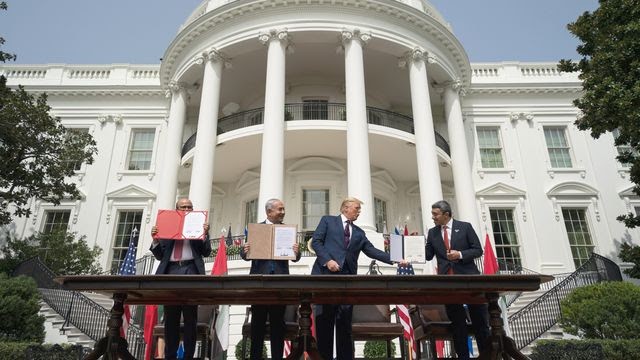
And of course what better way to follow the Trump family performance disguised as the Republican convention than a high-visibility, high-pomp signing ceremony between two of the president’s favorite allies?

It Could Get Worse

And the Palestinians. The Palestinians get what the Palestinians always get. Bupkes, as my grandma used to say. Yiddish for “nothing.”

Not a big shift, since Arab governments in general and the UAE monarchy in particular have done little to nothing to actually support Palestinian rights in recent years. The deal does nothing to end the threat of annexation, since de facto annexation is already in place and de jure annexation is just being delayed for a while.

Could it get worse? Absolutely. The UAE move provides political cover for other Arab states to make their covert ties with Israel public—despite on-again/off-again denials, Sudan and Oman are rumored to be moving towards recognition, and possibly Bahrain as well.

Those moves could complicate Palestinian diplomatic efforts at the United Nations or elsewhere.

Even without substance, rhetorical validation from Arab governments has sometimes been useful for Palestinian efforts to show the global breadth of their support. At the non-governmental level, some boycott campaigns against businesses profiting from occupation might face challenges because of Arab governments protecting those companies. But the agreement will not seriously affect BDS, a global grassroots movement led by Palestinian civil society that does not rely on any government support.

Like so many U.S. “peace plans” before it, the Israel-UAE normalization deal will fail to bring peace. De facto annexation of illegally occupied Palestinian land continues, and refugees are still denied their right of return. While those things continue, no new Israel-Arab normalization effort has any chance of bringing peace.

We need to remember, once again, Dr. Martin Luther King Jr.’s warning that “Peace is not just the absence of war, but the presence of justice.”

Phyllis Bennis is a fellow of the Institute for Policy Studies.

30 August 2020

Source: countercurrents.org

Israel’s dirty tricks department and Palestinian ingenuity

By Ranjan Solomon

Israel’s government obviously has a well-staffed department in one of its cells where they arrive each morning to invent political muck. Among the many things they plan there, one can be certain they design irrational methods for ethnic cleansing. They go further. They make their plans look like actions that guarantee security to their own citizens. On the contrary however their plans are evil blueprints to subjugate the Palestinians.

Our first article in this edition: “Israel’s deals to ‘transfer’ Palestinians are thinly-disguised ethnic cleansing” exposes this wicked design”. For as long as Israel practices racism, colonialism and apartheid, and employs occupation as a political tool, they must also learn to expect reactions from Palestinians and their supporters around the world that may not be quite-so-politically appetizing.

Palestinians from Gaza have resorted to send incendiary balloons in the same way as as they used to fire rockets into areas across the border. An Electronic Intifada report underlines how the incendiary balloons are no match to Israel’s sophisticated and modern weapons. They are simply burning wicks attached to balloons and releasing them in the direction of Israel. The balloons are carried into Israel by the wind. Reports say they cause fires on farm land and, as a result, incur a small amount of damage to Israel’s economy. Yet nobody has been killed or injured by them. Israel despises these relatively harmless acts of resistance. In revenge, it unashamedly employs highly destructive missiles from F-16s in heavily populated Gaza.

Even those who once aspired for a peaceful, dialogue-centered solution which would be just for both Palestinians and Israelis have lost patience with Israel. A criminal rogue state which kills at will and shoots at any target that moves which they don’t like may have won them a space in the deep blue sea. It may sound anti-Semitic to say this. But a rogue regime, which has no license to persist with crude laws, policies, and practices does not deserve a place in civilization.

Israel may want to remember that even the Nazi era came to an end. Their own Nazi-type behavior will also have to face and abrupt halt. Injustice to the Palestinians cannot be eternal. The political rogues who run Israel will do better for themselves by learning this lesson.

As an integral part of its ongoing propaganda, Israel, along with its ardent supporters and mass of mysterious instruments, fervently reiterate in the media, on university campuses, in blogs and comment sections, the same old, tired Zionist myths. Israel treats international laws and conventions with contempt, and contravenes them with escalating promptness and maintains a brutal military occupation. Israel is easily the foremost rogue State. Its overt and covert allies and supporters are part of this ‘rougeness’ .

28 August 2020

Source: palestineupdates.com

Israel’s deals to ‘transfer’ Palestinians are simply thinly-disguised ethnic cleansing

By Eman Abusidu

It seems that Israel is not satisfied with driving 750,000 Palestinians from their homes and land in 1948, and another 400,000 in 1967; nor with its many massacres of Palestinian civilians. It is, in fact, working to expel even more Palestinians with a view to emptying the land of its indigenous inhabitants having known long ago that Palestine was never “a land without a people for a people without a land” as Zionist propaganda would have us believe.

It is no surprise, therefore, to learn that the government of Golda Meir (1898-1978) sought to “encourage” 60,000 Palestinians from the Gaza Strip to migrate to Paraguay in South American with payments that would have cost the occupation state millions of dollars. According to Israeli public broadcaster KAN, recently-released secret papers from 1969 give details of the scheme.

Is it a coincidence that these documents have been released now, in the wake of the “deal of the century” and the increasing Arab normalisation with the occupation state? Moreover, why Paraguay?

With 53 years’ of hindsight, we can say that the fact that the scheme did not go ahead does not mean that it is off the table for ever. Israel has always looked for “alternative homelands” for the Palestinians so that the occupation can be completed with as much of Palestine and as few Palestinians living there as possible.

The possibility of “transferring” Palestinians to Latin America is a bit of a recurring theme. Aside from Paraguay, Israel has made several attempts to encourage Palestinians to migrate to Brazil and other Latin American countries. In 2017, Israel revealed proposals discussed by ministers after the 1967 Six Day War which included the minutes of meetings of the security cabinet between August and December 1967. Prime Minister Levi Eshkol speculated about how to deal with the hundreds of thousands of Palestinians newly under Israeli control. “If it were up to us,” said Eshkol, “we’d send all the Arabs out to Brazil.”

At that time Israel was working hard to make Palestinian emigration easy, not least through organised work missions. A Palestinian refugee who has been in Brazil for more than 53 years confirmed to me that his father went there as part of an agricultural work mission with help from the Jordanian government.

Why Latin America? According to specialist in Israeli affairs Adnan Abu Amer, the region has political and geographical dimensions that made it attractive to the Israelis. “Latin American countries are a long way from the physical conflict, making it harder for Palestinians to return to their land,” he explained. “This will help to turn the page on the whole issue of Palestinian refugees and the right of return.” Furthermore, Palestinian refugees automatically became local citizens, despite the differences in languages and traditions between Palestine and Latin American countries.

In May 1969, therefore, Israeli Ministers discussed the secret plan agreed between the head of the Mossad spy agency, Zvi Zamir, and President Alfredo Stroessner in Paraguay. The Paraguayan authorities agreed to take up to 60,000 Palestinians, which was about 10 per cent of the population of the Gaza Strip at that time.

“The Paraguayan government was a dictatorship then and it was promoting immigration,” Susan Mangana from the Catholic University of Uruguay pointed out. “Paraguay is a neighbour to two regional giants — Argentina and Brazil — and Paraguayan society has a large percentage of indigenous people, the Guarani, as well as the descendants of European settlers. Thus, it is accustomed to immigrants.” What’s more, the Researcher in International Studies noted, Paraguay is well known even today for its corruption and porous borders.

Under the 1969 Israeli plan, the travel costs incurred by Palestinians moving to Paraguay would have been covered, and each person would have got $100. The government in Asunción would have received $33 for each immigrant as well as an initial lump sum of $350,000. The total that Israel was ready to pay was thus $20-30 million.

“Presumably Israel knew about the eagerness of the Paraguayans to make big money by signing this type of agreement and hence it exploited this situation to its advantage,” said Mangana. The plan was a failure, though; only 30 Palestinians made the move to Paraguay. In 1970, two of them shot and killed Edna Peer, who was a secretary at the Israeli Embassy in the country. The attack put an abrupt end to the Israeli plan.

Abu Amer believes that there could be a desire on the part of the Israelis to resurrect such proposals, if not by moving Palestinians to neighbouring Arab countries, then to elsewhere. “Suitable changes would be made to the plan to suit the current circumstances, such as Arab normalisation,” he said, “but the end result, from Israel’s point of view, would be the same: the ‘transfer’ of tens of thousands of Palestinians.”

Susana Mangana thinks that it would be impossible to consider Latin American countries today. “I don’t believe that it would be possible to carry out such a plan today since news travels fast and even though Paraguayans may not be active when it comes to arguing in favour of the Palestinian cause, as more people have access to the reality of the situation they are better prepared to react in case their government tries to sign such an agreement with Israel.”

As happened 53 years ago, when only 30 out of a proposed 60,000 Palestinians took the bait and made the move to Paraguay, the people of Palestine today remain determined to stay on their land, and the refugees remain determined to exercise their legitimate right of return. Israel’s deals to “transfer” the Palestinians are simply thinly-disguised ethnic cleansing of the indigenous population from their homeland. If justice is to mean anything in the modern world, then global opinion will simply not allow the 1948 Nakba (Catastrophe) and 1967 Naksa (Setback) to happen again.

The views expressed in this article belong to the author and do not necessarily reflect the editorial policy of Middle East Monitor.

25 August 2020

Source: www.middleeastmonitor.com

Better to launch balloons than die in silence

By Ahmed Abu Artema

In recent weeks, the tension between Palestinians in Gaza and Israel’s forces of occupation has increased. Israel has used the launching of incendiary balloons by Palestinian youths as a pretext to bomb Gaza once again.

The release of the balloons is a gesture of protest against how the Israeli occupation has procrastinated in abiding by its previous agreements with the Palestinian resistance. Under those agreements, Israel had committed to easing the siege on Gaza.

This procrastination has caused the continued deterioration of Gaza’s health and public services and its economy. Meanwhile, the Israeli government continues to control the movement of goods and people in and out of Gaza.

The Israeli military has responded to the incendiary balloons by carrying out dozens of raids on sites used by Palestinian resistance fighters with US-made F-16 jets. The Israeli naval forces, which besiege Gaza from the sea, have prevented fishers from doing their work and fired at their boats.

The Israeli government has also closed the only crossing through which commercial goods enter Gaza. This closure led to the shutting down of the only power plant in the territory, which, in turn, means households in Gaza receive only four hours of electricity per day.

Israeli Prime Minister Benjamin Netanyahu has stated frankly that Israel would respond to the incendiary balloons in the same way as it responds to rockets fired from Gaza. Israel, it seems, wishes to keep on responding with deadly force to largely symbolic acts of resistance that make use of very basic materials.

Israel has put this statement into practice by dropping highly destructive missiles from F-16s onto densely populated Gaza for 13 consecutive nights.

The incendiary balloons bear no resemblance to Israel’s sophisticated and modern weapons. Youths have simply attached burning wicks to balloons and released them toward Israel.

The balloons have been carried into Israel by the wind. They have caused some fires on farm land and, as a result, incurred a small amount of damage to Israel’s economy.

Yet nobody has been killed or injured by them.

Compelled to act

Israel and pro-Israeli media exaggerate the effects of this form of resistance while completely ignoring the reasons motivating it.

If one wishes to understand why incendiary balloons have been launched from Gaza, it is crucial to go back to the circumstances under which Palestinian youths feel compelled to act.

I have been asked repeatedly by many Western journalists if the youth who launch incendiary balloons are contradicting the principles of the Great March of Return, unarmed protests which began in 2018.

I have replied by asking the journalists to imagine a person locked in a room without access to food or medicine while they are dying slowly and silently. The person decides to bang on the door of the room with all their strength and anger and shouts for their freedom and their need to escape from death.

Then their jailer comes from outside to give a moral sermon and tell people: Look at this prisoner’s barbarism. They are not behaving properly because they are not knocking on the door calmly and not presenting their demands to us in a respectful way.

It is unfair to blame the victim, to be preoccupied with assessing their behavior. By neglecting to address the root of the problem, we are distracted from the real criminal, the one who placed a prisoner in those life-threatening and inhuman conditions.

Whatever a prisoner who feels death approaching them does, their behavior will be in harmony with the principles of freedom and justice, even if they break the door of the prison cell.

This analogy captures Israel’s behavior toward Palestinians in Gaza. Israel has exaggerated the significance of the simple incendiary balloons launched by groups of Palestinian youths.

Israel has tried to portray these balloons as akin to a military threat. By doing so, it has tried to devise new “rules.”

Under those “rules,” Israel thinks it may respond to crude balloons with missiles launched from F-16 warplanes.

Banging on the tank’s walls

Israel says nothing about the political and economic environment in which the young people who release those balloons are growing up.

These young people are victims of Israeli aggression many times over.

Their problems began before they were born. In 1948, their families were expelled from their villages by Zionist forces.

Two-thirds of Gaza’s population are refugees hailing from towns and villages in what is now called Israel.

Many young Palestinians can see their families’ original villages beyond the fence separating Gaza and Israel. But they cannot reach them.

That offers some explanation as to the motives of people releasing balloons. The balloons are crossing the boundary and reaching towns and villages that have been stolen from Palestinians.

They are being flown as a protest against the theft of our homeland.

After the expulsions of 1948, Israel committed countless other crimes. Those include occupation, massacres, the mass detention and torture of Palestinians.

They have included, too, a siege that has deprived Palestinians in Gaza of basic rights and necessities. The siege has undermined our economy, destroyed the labor market and shattered the dreams of Palestinian youth for a decent life.

Gaza’s youth banged against the prison walls during the Great March of Return. Israel responded by firing live bullets against them, causing death and permanent disabilities.

These youths, crushed by the Israeli occupation and deprived of their fundamental rights, still feel the urge to scream at their jailers. They want to make noise so that they do not die in silence.

In his novel Men in the Sun, Ghassan Kanafani tells a story of three Palestinians undertaking a perilous journey hidden in a water tank. After the men are found dead by their driver, Kanafani asks why they didn’t bang on the water tank wall.

Banging on the walls of a tank is better than suffocating.

Launching handmade incendiary balloons from the besieged Gaza Strip is like banging on the walls of a water tank and refusing to die in silence.

Ahmed Abu Artema is a writer who lives in Gaza and a researcher at the Center for Political and Development Studies.

25 August 2020

Source: electronicintifada.net

Fatah criticises Arab League’s neglect of its request to hold emergency meeting

A prominent Fatah leader spoke of the Arab League’s neglect of the Palestinian leadership’s request to hold an emergency meeting to discuss the UAE’s decision to normalise relations with Israel.

Ahmed Aboul Gheit, Secretary–General of the League of Arab States, said on Saturday that the League will hold a regular meeting on 9 September at the ministerial level, ignoring the Palestinian leadership’s request for an emergency meeting.

On 13 August, US President Donald Trump announced a peace deal between the UAE and Israel brokered by Washington.

Abu Dhabi said the deal was an effort to stave off Tel Aviv’s planned annexation of the occupied West Bank, however, opponents believe normalisation efforts have been in the offing for many years as Israeli officials have made official visits to the UAE and attended conferences in the country which had no diplomatic or other ties with the occupation state.

Netanyahu repeated last week that annexation is not off the table, but has simply been delayed.

The Palestinian government has recalled its ambassador to the United Arab Emirates (UAE) in protest over the country’s agreement to normalise ties with Israel.

The PA president’s official spokesman Nabil Abu Rudeineh said the deal was a “betrayal of Jerusalem, Al-Aqsa and the Palestinian cause.”

24 August 2020

Source: www.middleeastmonitor.com

UNRWA calls for unimpeded passage into Gaza for vital goods

The UN Relief and Works Agency for Palestine Refugees in the Near East (UNRWA) called on Tuesday for all vital goods to be granted unimpeded passage into the besieged Gaza Strip, including fuel for electricity. UNRWA made the appeal against the background of 14 years of an illegal blockade and the socio-economic impact of the COVID-19 pandemic.

“The agency in Gaza is extremely concerned about the closure of the lone power plant since last Tuesday, 18 August,” UNRWA said. “The closure of the plant has caused the power feed to decline to two or three hours per day, followed by 20 hours of interruption.”

This, explained UNRWA, will have a negative impact on the wellbeing and safety of the people of Gaza and devastating effects on the Strip’s vital services, including hospitals. “Thus, this puts at risk the lives and health of nearly two million people, including 1.4 million registered Palestine refugees.”

The official statement from the UN agency pointed out that, “Under international humanitarian law, the passage of all relief consignments, in this case fuel for electricity, should not be prevented.”

Commenting on the situation in the Gaza Strip, the Director of UNRWA Affairs in the Palestinian territory, Matthias Schmale, said that the call is being made to all concerned parties to maintain a supply of electricity that is sufficient to meet the basic needs of the civilian population. “UNRWA is, furthermore, concerned about other measures perceived as punitive to the civilian population, such as closing down the fishing zone, as well as the escalating tensions and military activities.”

Gaza, Schmale pointed out, has now been hit by air raids for more than ten nights in a row. “All parties must show utmost restraint and protect the civilian population with full respect for their dignity and human rights.”

25 August 2020

Source: www.middleeastmonitor.com

The PA Rises up to Fail the Palestinians at Every Occasion

By Ramona Wadi

It is a pity that Palestinian Authority leader Mahmoud Abbas wasted so much time in declaring that no one has the right “to speak on behalf of the Palestinian people.” The statement was made within the context of the US-brokered deal normalizing relations between the United Arab Emirates and Israel, which has allegedly stalled annexation of land from the occupied West Bank for an indefinite period.

The deal exacerbates Palestine’s isolation in the region; in particular, it signifies the start of a tacit consensus for when Israel decides it is time to take up annexation once again. For the Palestinian people, another round of “waiting” has been initiated – a tactic much favored by the international community when it comes to brushing aside Palestinian political demands.

Israeli Prime Minister Benjamin Netanyahu has not ruled out annexation; the only change is that now there is a context to the earlier, vague statements. Normalization of relations is the easiest option and the one that is likely to ward off unwanted scrutiny for Israel.

Normalization should not have come as a surprise, after all, Netanyahu had repeatedly stated that Israel would be able to build ties with Arab countries and Gulf states since the Palestinian cause was no longer a top priority in the region. Is it a surprise, seeing that the Arab Peace Initiative of 2002 promoted the concept of normalization, albeit tied to the two-state compromise?

Yet prior to the announcement, the PA had no qualms about promoting the Arab Peace Initiative. Until last month, this paradigm was endorsed by PLO Secretary-General Saeb Erekat, as part of the PLO’s “national program”.

If “national program” was replaced by “international impositions”, a clearer truth would emerge. The PA’s reaction to the UAE-Israeli deal is to be expected, yet it is also making an exception that excludes all the impositions upon the Palestinian people that have altered the Palestinian cause beyond recognition. The PA never turned inwards to consult with the Palestinian people.

It blindly worked its way through international frameworks and resolutions, following an illusion of statehood that never happened, because it was created to promote the international narrative on Palestine.

Not only has the PA failed to promote the Palestinian narrative and political demands. It allowed the international community to determine what Palestine should be, particularly through its endorsement of the two-state compromise and concessions regarding the Palestinian right of return. With each loss, the PA motivated itself to work towards further losses, alongside leaders and countries that pay duplicitous lip service to Palestinians.

France, once deemed an ally due to aiding Palestinians in drafting UN resolutions, has welcomed the normalization of relations between the UAE and Israel. What has the PA achieved for Palestinians other than accentuating and promoting further loss of territory and a steady erosion of political rights?

How will the PA respond to this turn of events? Another wasteful international conference? Lobbying for the defunct two-state compromise? The Palestinian people are being forgotten even within the context of this normalization deal.

Erekat has already opined that the UAE-Israeli agreement will “kill” the two-state compromise. That the PA can regularly rise up to the occasion to fail Palestinians is a macabre spectacle, beyond any political embarrassment.

Ramona Wadi is a staff writer for Middle East Monitor, where this article was originally published. She contributed this article to the Palestine Chronicle.

25 August 2020

Source: www.palestinechronicle.com