Just International

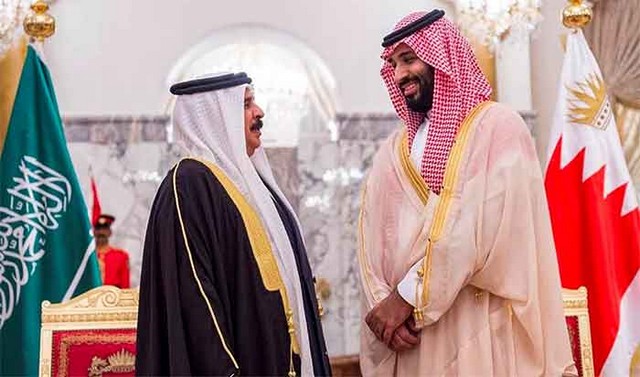
As Bahrain, UAE sign peace deals with Israel, Trump says 5-6 more countries ready to follow soon

By Abdus Sattar Ghazali

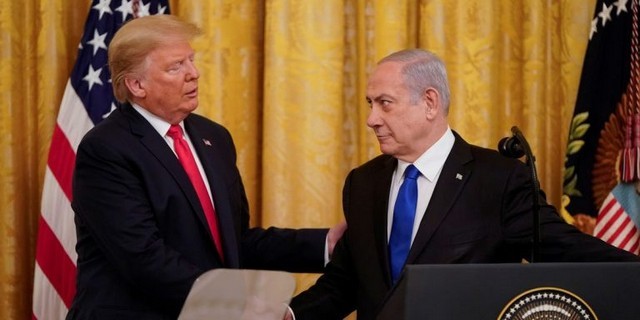
President Donald Trump on Tuesday said five or six more countries are ready to make peace with Israel, Times of Israel reported. However, he did not name those countries.

Shortly before the signing of the Abraham Accords between Israel, the United Arab Emirates and Bahrain, Trump said, “We’re very far down the road with about five additional countries… Frankly, I think we could have had them here today.”

“We’ll have at least five or six countries coming along very quickly… They want to see peace. They’ve been fighting for a long time…. They’re warring countries but they’re tired of fighting.. You’re going to see a lot of very great activity. It’s going to be peace in the Middle East.”

Answering questions about what Israel gets from the new deals, Trump said, “We’ll be signing up [other] nations… These are very strong agreements. This is serious peace… What Israel gets, the most important thing Israel gets, is peace.”

Trump also quoted as saying: “I really believe Iran wants to make a deal.” He advised Tehran to wait until after the elections, however. If “sleepy Joe Biden” were to win the elections, he said Iran and especially China “would own the United States.”

He said he’d spoken with the king of Saudi Arabia, and “positive things will happen… This is peace in the Middle East without blood all over the sand.”

Israeli Prime Minister Netanyahu was quoted as saying: “Israel doesn’t feel isolated at all. It’s enjoying the greatest diplomatic triumph of its history.” Those who are feeling isolated, says Netanyahu, “are the tyrants of Tehran.”

Israel Hayom

Meanwhile, the Israeli newspaper Israel Hayom Tuesday quoted British-Pakistani analyst Noor Dahri as saying that Oman, Sudan, Morocco, and Saudi Arabia are likely to follow UAE and Bahrain and seek rapprochement with Israel sooner than believed.

Analyst Noor Dahri, founder and executive director of Islamic Theology of Counter Terrorism, a UK-based think tank, told Israel Hayom Monday that many other Arab countries have taken notice of the regional winds of change, and may follow in Abu Dhabi and Manama’s footsteps sooner that one may believe.

“The peace agreements of the UAE and Bahrain with Israel are just a door [for them] for opening further diplomatic, trade and strategic relations with the Israel. There are many countries that are awaiting their term to join the agreement, such as Oman, Sudan, Morocco and Saudi Arabia,” he said.

However, a diplomat in the Gulf was quoted Tuesday by Reuters as saying that for Saudi Arabia, the issue is more related to what he called its religious position as the leader of the Muslim world, and that a formal deal with Israel would take time and is unlikely to happen while King Salman is still in power.

“Any normalization by Saudi will open doors for Iran, Qatar and Turkey to call for internationalizing the two holy mosques,” he said, referring to periodic calls by critics of Riyadh to have Mecca and Medina placed under international supervision.

A big deal but not a peace deal

Fred Kaplan of the Slate Tuesday said It is a big deal not a peace deal because Israel has not been at war with either of the two Gulf Arab states. In fact, for years now, it has quietly been conducting trade and backroom diplomacy with both.”

However, “normalized relations”—which the accord establishes— marks a huge step forward: the creation of embassies, commercial air routes, tourism, security and intelligence ties, and access to Israel’s high-technology products and marketplace.

Bahrain and the UAE, tiny but oil-rich monarchies, bring to four the number of Arab states that have formal ties with Israel. (The others are Egypt and Jordan, since 1979 and 1994, respectively.) But the accord also holds the promise of more to come, especially since Bahrain would not have signed the deal without the explicit consent of the Saudi royal family, Kaplan said adding:

“As Malcolm Kerr observed more than a half century ago in his classic book, The Arab Cold War, the Israeli-Palestinian conflict has never been as central to Arab leaders’ concerns as they have claimed. The bogeyman of Israel has served mainly as a distraction from their own internal problems—and as a common enemy to paper over sectarian tensions.

“The losers in this deal are the Palestinians. For decades, most Arab leaders refused to recognize Israel until Israel allowed the creation of—and made peace with—an independent Palestinian state. The UAE and Bahrain are now saying they don’t really care about the Palestinians.”

Palestinians groups unify

Palestinians unify as Bahrain and UAE ‘normalize’ Israel relations. Last Saturday, Palestinian groups led by Hamas and Fatah agreed on a “unified field leadership” comprising all factions that will lead “comprehensive popular resistance” against the Israeli occupation.

The formation of the joint leadership group and progress in the intra-Palestinian unity talks came after a long-awaited September 3 meeting among Palestinian Authority President Mahmoud Abbas, Hamas’s Ismail Haniya, Islamic Jihad’s chief Ziyad al-Nakhala, and the leaders of various Palestinian entities. Gatherings were held in Ramallah in the occupied West Bank and Beirut, Lebanon.

Hamas and other Palestinian parties have for years demanded that such a meeting take place, but Abbas always rejected the move, calling on Hamas to honour previous unity pacts first.

But with the Palestinian cause lately facing so many challenges – the most important being the normalization between Arab countries and Israel – Abbas agreed to hold discussions.

Meanwhile, protests erupted in Palestine, Bahrain and UAE over signing of the deal. Thousands of protesters took to streets shouting anti-US and Anti-Israel slogans. The peace pact has been widely criticized mostly by heads of Muslim states who see it as a conspiracy to create rifts and harm unity among the Muslim world.

Abdus Sattar Ghazali is the Chief Editor of the Journal of America (www.journalofamerica.net)

16 September 2020

Source: countercurrents.org

Will They or Won’t They? Saudi Recognition of Israel is the $64,000 Question

By Dr James M Dorsey

Will the Saudis formalize relations with Israel or will they not? That is the 64,000-dollar question.

The odds are that Saudi Arabia is not about to formalize relations with Israel. But the kingdom, its image tarnished by multiple missteps, is seeking to ensure that it is not perceived as the odd man out as smaller Gulf states establish diplomatic relations with the Jewish state.

Bahrain’s announcement that it would follow in the footsteps of the United Arab Emirates was as much a Bahraini move as it was a Saudi signal that it is not opposed to normalization with Israel.

Largely dependent on the kingdom since Saudi troops helped squash mass anti-government protests in 2011, Bahrain, a majority Shia Muslim nation, would not have agreed to establish diplomatic relations with Israel without Saudi consent.

The Bahraini move followed several other Saudi gestures intended to signal the kingdom’s endorsement of Arab normalization of Israel even if it was not going to lead the pack.

The gestures included the opening of Saudi air space to Israeli commercial flights, and publication of a Saudi think tank report praising Crown Prince Mohammed bin Salman’s stewardship in modernizing the kingdom’s religious education system and encouraging the religious establishment to replace“extremist narratives” in school textbooks with “a moderate interpretation of Islamic rhetoric.”

They also involved a sermon by Abdulrahman al-Sudais, the imam of the Grand Mosque in Mecca – the world’s largest mosque that surrounds the Kaaba, Islam’s holiest site, that highlighted Prophet Mohammed’s friendly relations with Jews.

Mr. al-Sudais noted that the prophet had “performed ablution from a polytheistic water bottle and died while his shield was mortgaged to a Jew,” forged a peace agreement with Jewish inhabitants of the Khaybar region, and dealt so well with a Jewish neighbor that he eventually converted to Islam.

The imam’s comments, a day before US President Donald J. Trump was believed to have failed to persuade King Salman to follow the UAE’s example, were widely seen as part of an effort to prepare Saudi public opinion for eventual recognition of Israel.

Criticism on social media of the comments constituted one indication that public opinion in Gulf states is divided.

Expression of Emirati dissent was restricted to Emirati exiles given that the UAE does not tolerate expression of dissenting views.

However, small scale protests erupted in Bahrain, another country that curtails freedom of expression and assembly. Bahraini political and civil society associations, including the Bahrain Bar Association, issued a statement rejecting the establishment of diplomatic relations with Israel.

“What results from normalization will not enjoy popular backing, in line with what generations of Bahrainis have been brought up on in terms of adherence to the Palestinian cause,” the statement said.

Bahrain has long been home to a Jewish community and was the first and, so far, only Arab state to appoint a Jew as its ambassador to the United States.

The criticism echoes recent polls in various Gulf states that suggest that Palestine remains a major public foreign policy concern.

Polling by David Pollock of The Washington Institute for Near East Policy found that Palestine ranked second to Iran.

Earlier polls by James Zogby, a Washington-based pollster with a track record that goes back more than a decade, showed Palestine ranking in 2018 as the foremost foreign policy issue followed by Iran in Emirati and Saudi public opinion.

The same year’s Arab Opinion Index suggested that 80 percent of Saudis see Palestine as an Arab rather than a purely Palestinian issue.

Mr. Pollock said in an interview that with regard to Palestine, Saudi officials “believe that they have to be a little cautious. They want to move bit by bit in the direction of normalizing at least the existence of Israel or the discussion of Israel, the possibility of peace, but they don’t think that the public is ready for the full embrace or anything like that.”

Gulf scholar Giorgio Cafiero noted in a tweet that “Israel formalizing relations (with) unelected Arab (governments) is not the same as Israel making ‘peace’ (with) Arab people. Look at, for example, what Egypt’s citizenry thinks of Israel. Iran and Turkey will capitalize on this reality as more US-friendly Arab [governments] sign accords [with] Israel.”

This year’s Arab Opinion Index suggest that in Kuwait, the one country that has not engaged with Israel publicly, Turkey—the Muslim country that has taken a lead in supporting the Palestinians—ranked highest in public esteem compared to China, Russia, and Iran.

A rift in a UAE-backed Muslim group created to counter Qatari support of political Islam and promote a state-controlled version of Islam that preaches absolute obedience to the ruler serves as a further indication that Palestine remains an emotive public issue.

In Mr. Al-Sudais’ case, analysts suggest that the criticism is as much about Palestine as it is a signal that religious leaders who become subservient to the whims of government may be losing credibility.

Mr. Al-Sudais’ sermon contrasted starkly with past talks in which he described Jews as “killers of prophets and the scum of the earth” as well as “monkeys and pigs” and defended Saudi Arabia’s conflict with Iran as a war between Sunni and Shiite Muslims.

The criticism coupled with indications earlier this year that Saudi Arabia’s religious establishment was not happy with Prince Mohammed’s handling of the coronavirus pandemic may be one reason why Saudi Arabia is gesturing rather than formalizing already existing relations with Israel.

Authorities reportedly arrested in March Sheikh Abdullah al-Saad, an Islamic scholar, after he posted online an audio clip criticizing the government for banning Friday prayers. Mr. al-Saad argued that worshippers should be able to ask God for mercy.

An imam in Mecca was fired shortly after he expressed concern about the spread of the coronavirus in Saudi prisons.

Scholars Genevieve Abdo and Nourhan Elnahla reported that the kingdom’s Council of Senior Clerics had initially drafted a fatwa, or religious opinion, describing the closing of mosques as a violation of Islamic principles. They said that government pressure had persuaded the council not to issue the opinion.

Concern among the kingdom’s ultra-conservative religious scholars that the ruling Al-Saud family may break the power-sharing agreement with the clergy, concluded at the birth of the kingdom, predates the rise of King Salman and Prince Mohammed.

Indeed, the clerics’ concern stretches back to the reign of King Abdullah and has focused on attitudes expressed both by senior members of the ruling family who have since been sidelined or detained by Prince Mohammed and princes that continue to wield influence.

The scholars feared that the ruling family contemplated separating state and religion. This is a concern that has likely been reinforced since Prince Mohammed whipped the kingdom’s religious establishment into submission and downplayed religion by emphasizing nationalism.

Ultra-conservative Saudi religious scholars are also certain to have taken note of post-revolt Sudan’s recent decision to legally remove religion from the realm of the state.

Ultra-conservative sentiment does not pose an imminent threat to Prince Mohammed’s iron grip rule of a country in which many welcomed social reforms that have lifted some of the debilitating restrictions on women, liberalized gender segregation, and the as yet unfulfilled promise of greater opportunity for a majority youthful population.

It does however suggest one reason why Prince Mohammed, who is believed to favor formal relations with Israel, may want to tread carefully on an issue that potentially continues to evoke passions.

An initial version of this story was first published by Inside Arabia

A podcast version of this story is available on Soundcloud, Itunes, Spotify, Stitcher, TuneIn, Spreaker, Pocket Casts, Tumblr, Podbean, Audecibel, Patreon and Castbox.

Dr. James M. Dorsey is an award-winning journalist and a senior fellow at Nanyang Technological University’s S. Rajaratnam School of International Studies in Singapore.

16 September 2020

Source: countercurrents.org

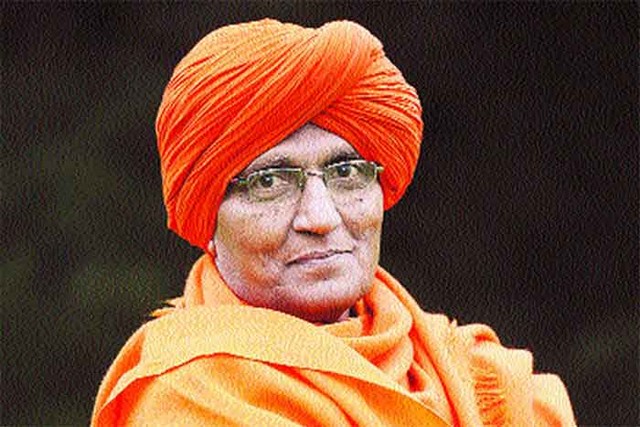
Reforming the Society: Life and Mission of Swami Agnivesh

By Dr Ram Puniyani

Before taking up the engagement with issues related to communal harmony and national integration, I was trying to associate with issues of labor movement. During that time I used to hear from friends the name of Swami Agnivesh in the context of movement against bonded labor. Later after the demolition of Babri Mosque, I decided to understand the issues of communalism in depth. This is what brought me closer to my late friend Dr. Asghar Ali Engineer. Dr. Enginner during the course of our discussions regularly used to bring up the name of Swamiji and his various initiatives. It’s from here that I came to know Swamiji from close quarters. I was invited by him in a talk show and also enjoyed the hospitality at his home. There was also an occasion when another dear friend Harsh Mander, organized a lecture for street children. The lecture on communal harmony was organized in Swamiji’s Ashram.

From the decade of 1990; I did have the privilege of interacting with Swamiji off and on and was deeply touched by his modesty, affectionate and loving nature. Also saw his deep commitment to oppose the communal forces. He was upright and never compromised on his principles even in the face of adverse circumstances. This is what led to attacks on him by the followers of Hindu nationalist politics. They were very much disturbed by Swamiji’s various bold stands regarding idol worship, and his opposition to using of Hindu identity for political goals. Here I do recount several of my observations and experiences which touched me and made me respect his commitment to abolition of Sati in particular. Globally he did make a mark for his dogged fight against bonded labor.

As far as Hindu nationalist politics is concerned, he had to face their wrath in a large measure. I do deal with some of those in this article.

On 17th August (2018), during the funeral procession of the former Prime Minster of India, Mr. Atal Bihari Vajpayee, Swamiji was assaulted outside the BJP head office, when he was trying to participate in the funeral procession. The assaulters, some members of the crowd, began to heckle him and then they physically attacked him. They were raising the slogans, Bharat Mata ki jai and ‘Deshdrohi Wapas jao’. (Go back anti-National). This reference of anti National was in tune with BJP followers abusing those who differed from their own values. This was mostly due to his criticizing Prime Minister Narendra Modi’s statement related to imagined glories of ancient India.

A month before this, in Pokur Jahrkhand, Agnivesh was brutally assaulted, allegedly by student wing of BJP. The attack was severe and as a matter of great relief he survived while his turban was taken away and his clothes were torn asunder. In the wake of this attack many a BJP supporters, justifying the attack circulated the video of Swamiji’s speech. In this video he is criticizing the Prime minister Modi for his statement that there was plastic surgery in Ancient India as seen in planting of elephant’s head on a boy’s neck or Kauravas’s being born though stem cell technology. He went on to criticize Modi for his public pujas in Nepal and Dhaka.

Attacking Amarnath yatra and idol worship, Agnivesh pointed out that the Barfani baba, the ice shivling is a natural phenomenon which gets formed due to natural processes of deposits of stalactite and stalagmite. In the same video he points out that one of the years, when the deposits were inadequate to form the ling (the Shiva idol), ice had to be put to give it the shape of linga (idol). Similarly criticizing the Kumbh mela, people congregating to wash their sins, he points out that bathing in such polluted water on contrary can lead to new diseases.

Overall, Swami has been part of various social movement like as mentioned earlier Bandhua Majdoor Mukti Morcha, (against bonded labor) for which he also participated in global eradication of modern form of bonded labor, under the aegis of UN. He has been associated with movements opposing female feticide and against sati. He has been part of Arya Samaj organization for long time.

In recognition of his work he has received various awards like Right Livelihood (Alternate Nobel) in 2004. This I remember with more fondness as he had shared the award with my dear friend Asghar Ali Engineer. Apart from this he received Rajiv Gandhi Sadbhavna Award again in same year. There are various issues on which one can disagree with him, like his interpretation of Hinduism exclusively to Vedic period etc., still what is important is his constant engagement with issues related to downtrodden of the society, to those related to modern forms of bonded labor, to sati, female feticide to name the few.

This saffron clad swami was regularly targeted by the followers of Hindu nationalist brigade. These attacks on him are akin to the series which began with murder of Dr. Dabholkar, and later took the lives of Com. Govind Pansare, Dr. Kalburgi and Gauri Lankesh. As intolerance is growing in the society, those having opinions contrary to ruling dispensation are being targeted. As the culprits are enjoying impunity, appreciation from the leaders of ruling party, they know they can get away with hate crimes of this dastardly nature. Lets imagine, a saffron clad Swami is coming to pay last respects to the ex Prime Minster of India and he is heckled and insulted! These hooligans, drunk on fake nationalism and false pride in things in the name of religion, get encouragement from the powers that be, the real culprits are those who support them, appreciate them, those who in the first place disseminate this ideology which is sectarian and looks down their opponents or their ideas as anti national or anti religion.

What is more surprising is that all this is being done in the name of Hindu religion, which celebrates diversity to its core. We know that most of the religions have a single founder and single holy book, still they develop sects within. Christianity has Catholics, Protestants, born again, Pentecostals among others. Muslims have Shia and Sunnis in the main while Sufis and Ahmadiya are also very much there. Buddhism Jainism Sikhism also have sects within them. In contrast Hinduism has no single founder, no single Holy book, and no single pattern of clergy or rituals. It is a collation of diverse traditions like Brahmanism, Tantra, Nath, Siddhanta, Shaiva, Vashanav and Bhakti among others. Diversity is the very core of Hindu religion. Right within Hindu fold Swami Dayanand Sarswati could form Arya Samaj and propound his ideology that Hinduism is primarily founded and based on Vedas.

While Idol worship is part of some sects of Hinduism, as such Hinduism also encompasses animist nature worship, to tri-theism, to polytheism to Nastik (atheist) tradition of Charvak as well. The concept of God also varies from the idol worshipers to those who believe in formless God. Swami Agnivesh propounds that Vedas are the base of Hindu religion.

The central focus of Agnivesh has been social reform, and that’s probably his most important of his engagement with the society. Irrespective of his views and his contribution to the cause of social issues, he has his own version of Hinduism. No one can usurp one’s right of following and propagating one’s own version of Hinduism/religion. The attacks on him by the followers of Hindu nationalists are not grounded in the values of tolerance of Hinduism, they are rooted in the politics, they are part of the sectarian interpretation of Hinduism and selective use of Hindu identity for mobilizing Hindus for political goals, there is nothing religious about it.

The nation did heave a sigh of relief that attack on Swamiji failed. With his consistent efforts for social reform with full strength and gusto; his contribution to social change is immense. Social change for a more just society is a long journey and Swamiji has contributed to it with all his might.

12 September 2020

Source: countercurrents.org

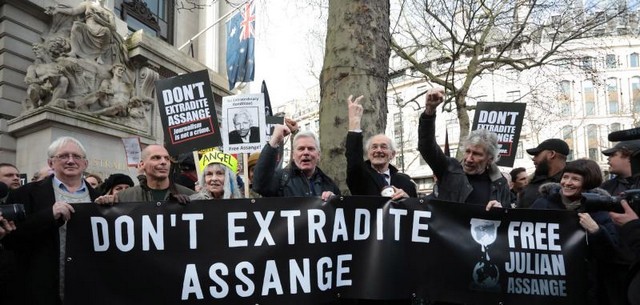
Assange’s Third Day at the Old Bailey: Bias, Politics and Wars on Journalism

By Dr Binoy Kampmark

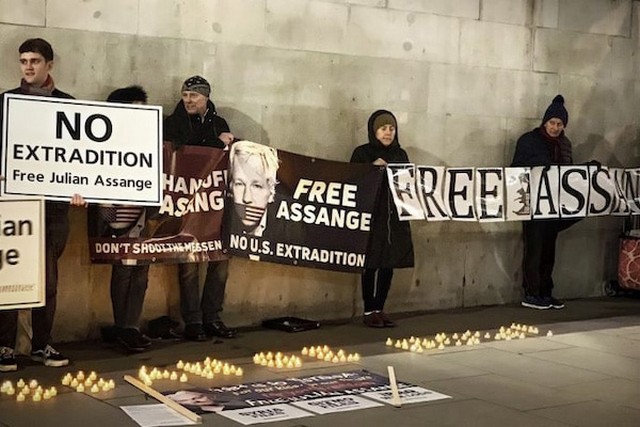
The third day of extradition proceedings against Julian Assange at the Old Bailey resumed on the point of politics. Assange as a figure of political beliefs; Assange as a target of the Trump administration precisely for having them. The man sketching the portrait was Paul Rogers, Emeritus Professor of Peace Studies at Bradford University.

It is no mean feat trying to pin down Assange’s political system. Leftward, rightward, with resistance to the centre? Lashings of libertarianism; heavy doses of anti-war and holding the powerful to account? Such figures tend to be sui generis. In his submitted statement to the court, Rogers suggests a uniform theme. “The political objective of seeking to achieve greater transparency in the workings of governments is clearly both the motivation and the modus operandi of Mr Assange and the organisation WikiLeaks.”

On the stand, Rogers described the Assange method of influence and disruption: the release of the war logs, their influence on public opinion regarding the US imperium’s engagements in Iraq and Afghanistan, the revelations of 15,000 unaccounted civilian casualties. The butcher’s bill of the imperium, in other words, was laid bare by the WikiLeaks’ releases.

For Rogers, this approach jarred with various US administrations, but none more so than that of Trump’s. Assange’s entire approach and “what he stands for represents a threat to normal political endeavour.”

James Lewis QC for the prosecution made his effort to narrow, clip and sharpen the focus on Assange, questioning the expanse of political belief being attributed by Rogers. At times, the prosecution seemed suspended in a time capsule, suggesting, for instance, that political opinions were only applicable to governments and leaders. Rogers preferred a more complex picture: the evolving nature of what political opinion might constitute (for instance, it could include “transnational elites” and attitudes towards corporations). The issue of publishing an item or not could also constitute a form of political opinion.

Lewis then went on the attack, grumpy at the length of Rogers’ responses and suggesting that his testimony was biased towards the defence. Why had he omitted the views of such individuals as US assistant attorney Gordon Kromberg, who argued that prosecuting Assange had been a criminal rather than political matter? Again, Rogers took preferred the broad approach. Prosecutors of a certain rank tend to mimic the views of their superiors – that is their due. What mattered were those higher-ups who had initiated a change in policy regarding WikiLeaks to instigate a “politically motivated prosecution”. This could be demonstrated with some plausibility by considering the wider political context of different administrations. The Obama administration had set its heart on not prosecuting Assange; those in the Trump administration had warmed to the idea.

Not quite getting his pound of flesh, Lewis moved on to targeting the reasons why the Obama administration had gone cold on prosecuting Assange. Like many black letter lawyers on this point, the issue of Assange being confined in the Ecuadorean embassy has them in knots. “What would be the point [of arresting Assange] if he’s hiding in the embassy?” posed Lewis. Rogers, rather sensibly, suggested that this would constitute a pressuring move. “It would have made very good sense to bring it at that time, to show a standing attempt to bring Mr Assange to justice.” Lewis had also made a specious point. As investigative journalist Stefania Maurizi points out, individuals such as Edward Snowden have been duly charged despite fleeing the jurisdiction. Practical custody was hardly a necessary precondition to getting that paperwork ready.

Lewis proceeded to till the same ground as that covered in the testimony of Mark Feldstein, attempting to push the suggestion that the case against Assange might yield future charges, at least as believed by himself and his defence team. Rogers offered similar parrying: the Trump administration’s approach to Assange was distinct, its attitudes conveyed through the hostile remarks of former CIA director Mike Pompeo and the then hungry Attorney General Jeff Sessions. A difference in approach might be gathered from President Barack Obama’s commutation of Chelsea Manning’s sentence. This was Trump’s possible counter.

Post-lunch interest then turned to Trevor Timm, Director of Freedom of the Press Foundation. As he points out in the submitted statement, “The decision to indict Julian Assange on allegations of a ‘conspiracy’ between a publisher and his source or potential sources, and for the publication of truthful information, encroaches on fundamental freedoms.” WikiLeaks was a pioneer in secure submission systems such as SecureDrop, one that had been emulated by media outlets such as the Wall Street Journal and Al Jazeera.

It was incumbent upon journalists that they “develop relationships with their sources” and attempts to punish publishing activity arising from the use of “leaked documents of public importance” would face First Amendment difficulties.

The Trump administration, however, had proved bolder than its predecessors. The Espionage Act had been previously floated at such journalists as James Bamford, Ben Bradlee, Seymour Hersh and Neil Sheehan. It took Assange’s arrest and charging in 2019 to break with tradition.

The indictment, particularly in alleging that Assange had engaged in a conspiracy with Chelsea Manning to crack a military computer passport for reasons of remaining anonymous, would criminalise a common news practice and the whole pursuit of national security journalism. Were the prosecution permitted “to go forward, dozens of reporters at the New York Times, Washington Post and elsewhere would also be in danger.”

Lewis took umbrage at Timm’s claim, outlined in his statement, that Trump had engaged in an enthusiastic “war on journalism”. The FPF director was unsparing, suggesting that the indictment of the WikiLeaks publisher was part of this war, “and it is no exaggeration to say the First Amendment itself is at risk.” To Lewis, Timm replied with a salient reminder that Trump had tweeted 2,200 times about the press, describing them at stages as the “enemy of the people”. It was “very telling that Trump’s is the first one to try to bring a case like this since the Nixon administration.”

The prosecution preferred returning to that exhausted nag of an idea: that Assange could not be seen as a journalist. A form of fallacious logic came into play: the US Department of Justice had no interest in prosecuting journalists and would be breaching their own prosecutorial guidelines in doing so; Assange was not a journalist, therefore showing appropriate discrimination.

Timm had an appropriate response to this nonsensical approach. “In the US, the First Amendment protects everyone. Whether you consider Assange a journalist doesn’t matter; he was engaging in journalistic activity.” And if the DOJ was in breach of federal rules, it should follow that they be held accountable.

Timm also refused to ingest the prosecution line that the indictment was sufficiently narrow to only cover the publication of documents that had revealed the names of informants working for the US. Other charges in the indictment focused on criminalising the act of possessing the documents. That every claim would implicate journalists across the spectrum, as would “the mere thought of obtaining these documents”. A sinister, dangerous implication.

The prosecution was also caught up in what a “responsible journalist” might do. While the issue of unnecessarily publishing the name of a third party thereby endangering that person might raise matters of ethical responsibility, that, suggested Timm, was a separate question “from what is illegal or legal conduct.” A previous attempt to criminalise publishing the name of a US intelligence source had been made, by Senator Joseph Lieberman among others, in 2010 as a direct response to the WikiLeaks disclosures. But the Securing Human Intelligence and Enforcing Lawful Dissemination (SHIELD) Act never became law.

As for whether WikiLeaks had behaved appropriately or not in publishing the entire tranche of uncensored US diplomatic cables, despite it not being responsible for leaking the password to the relevant encrypted file containing the documents, Timm was firm. Governments should not have a hand in making such editorial judgments; the question centred on illegality, something which WikiLeaks could not be accused of.

Dr. Binoy Kampmark was a Commonwealth Scholar at Selwyn College, Cambridge.

10 September 2020

Source: countercurrents.org

As Washington Retreats, Eastern Mediterranean Conflict Further Marginalizes NATO

By Dr Ramzy Baroud

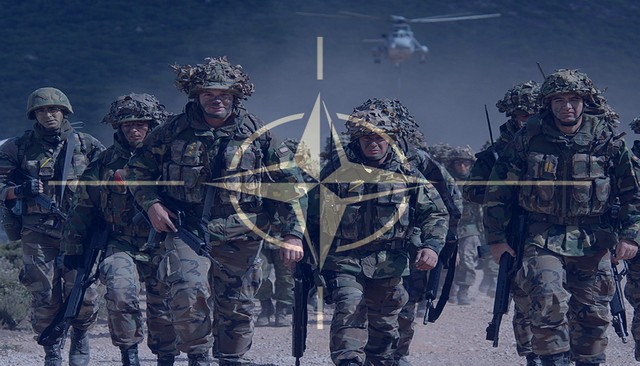
The North Atlantic Treaty Organization (NATO) is an alliance in name alone. Recent events notwithstanding, the brewing conflict over territorial waters in the Eastern Mediterranean indicates that the military union between mostly Western countries is faltering.

The current Turkish-Greek tension is only one facet of a much larger conflict involving, aside from the two Mediterranean countries, Israel, Egypt, Cyprus, France, Libya and other Mediterranean and European countries. Notably absent from the list are the United States and Russia; the latter, in particular, stands to gain or lose much economic leverage, depending on the outcome of the conflict.

Conflicts of this nature tend to have historic roots – Turkey and Greece fought a brief but consequential war in 1974. Of relevance to the current conflagration is an agreement signed by Israeli Prime Minister, Benjamin Netanyahu and his Greek and Cypriot counterparts, Kyriakos Mitsotakis and Nicos Anastasiades, respectively, on January 2. The agreement envisages the establishment of the EastMed pipeline which, once finalized, is projected to flood Europe with Israeli natural gas, pumped mostly from the Leviathan Basin.

Several European countries are keen on being part of, and profiting from, the project. But Europe’s gain is not just economic but also geostrategic. Cheap Israeli gas will lessen Europe’s reliance on Russia’s natural gas which arrives in Europe through two pipelines, Nord Stream and Gazprom, the latter extending through Turkey.

Gazprom alone supplies Europe with an estimated 40% of its natural gas needs, thus giving Russia significant economic and political leverage. Some European countries, especially France, have labored to liberate themselves from what they see as a Russian economic chokehold on their economies.

Indeed, the French and Italian rivalry currently under way in Libya is tantamount to colonial expeditions aimed at balancing out the over-reliance on Russian and Turkish supplies of gas and other sources of energy.

Fully aware of France’s and Italy’s intentions in Libya, the Russians and Turks are wholly involved in Libya’s military showdown between the Government of National Accord (GNA) and forces in the East, loyal to General Khalifa Haftar.

While the conflict in Libya has been under way for years, the Israel-et al EastMed pipeline has added fuel to the fire: infuriating Turkey, which is excluded from the agreement; worrying Russia, whose gas arrives in Europe partially via Turkey, and empowering Israel, which may now cement its economic integration with the European continent.

Anticipating the Israel-led alliance, on November 28, 2019, Turkey and Libya signed a Maritime Boundary Treaty, an agreement that gave Ankara access to Libya’s territorial waters. The bold maneuver allows Turkey to claim territorial rights for gas exploration in a massive region that extends from the Turkish southern coast to Libya’s north-east coast.

The ‘Exclusive Economic Zone’ (EEZ) is unacceptable in Europe because, if it remains in effect, it will cancel out the ambitious EastMed project and fundamentally alter the geopolitics – largely dictated by Europe and guaranteed by NATO – of this region.

However, NATO is no longer the once formidable and unified power. Since its inception in 1949, NATO has been on the rise. NATO members have fought major wars in the name of defending one another and also to protect ‘the West’ from the ‘Soviet menace’.

NATO remained strong and relatively unified even after the dismantlement of the Soviet Union and the abrupt collapse, in 1991, of its Warsaw Pact. NATO managed to sustain a degree of unity, despite its raison d’être – defeating the Soviets – being no longer a factor, because Washington wished to maintain its military hegemony, especially in the Middle East.

While the Iraq war of 1991 was the first powerful expression of NATO’s new mission, the Iraq war of 2003 was NATO’s undoing. After failing to achieve any of its goals in Iraq, the US adopted an ‘exit strategy’ that foresaw a gradual American retreat from Iraq while, simultaneously, ‘pivoting to Asia’ in the desperate hope of slowing down China’s military encroachment in the Pacific.

The best expression of the American decision to divest militarily from the Middle East was NATO’s war on Libya in March 2011. Military strategists had to devise a bewildering term, ‘leading from behind’, to describe the role of the US in the Libya conflict. For the first time since the establishment of NATO, the US was part of a conflict that was largely controlled by comparatively smaller and weaker NATO members – Italy, France, Britain and others.

While former US President, Barack Obama, insisted on the centrality of NATO in US military strategies, it was evident that the once-powerful alliance had outweighed its usefulness for Washington.

France, in particular, continues to fight for NATO with the same ferocity it fought to keep the European Union intact. It is this French faith in European and Western ideals that has compelled Paris to fill the gap left by the gradual American withdrawal. France is currently playing the role of the military hegemon and political leader in many of the Middle East’s ongoing crises, including the flaring East Mediterranean conflict.

On December 3, 2019, France’s Emmanuel Macron stood up to US President Donald Trump, at the NATO summit in London. Here, Trump chastised NATO for its reliance on American defense and threatened to pull out of the alliance altogether if NATO members did not compensate Washington for its protection.

It’s a strange and unprecedented spectacle when countries like Israel, Greece, Egypt, Libya, Turkey and others lay claims over the Mediterranean, while NATO scrambles to stave off an outright war, among its own members. Even stranger, to see France and Germany taking over the leadership of NATO while the US remains, thus far, almost completely absent.

It is hard to imagine the reinvention of NATO, at least a NATO that caters to Washington’s interests and diktats. Judging by France’s recent behavior, the future may hold irreversible paradigm shifts. In November 2018, Macron made what then seemed as a baffling suggestion, a ‘true, European army’. Considering the rapid regional developments and the incremental collapse of NATO, Macron may one day get his army, after all.

Ramzy Baroud is a journalist and the Editor of The Palestine Chronicle. He is the author of five books.

10 September 2020

Source: countercurrents.org

An Open Letter to The Most Reverend David Malloy, Bishop of Rockford, Illinois, Chair United States Conference of Catholic Bishops Committee on International Justice and Peace

They have treated the wound of my people carelessly,
saying, “Peace, peace,” when there is no peace.

Jeremiah 8:11

Jerusalem September 8th, 2020

Your Excellency,

We read your statement (August 13) that shows your satisfaction with the peace agreement between Israel and the UAE. We would like, as Christian Palestinian movements for justice and peace, to send you some of our observations on this issue.

People who think that any mutual recognition between an Arab country and the state of Israel is a step forward towards peace are mistaken. It would be a step towards peace if this accord were accompanied by the resolution of the core of the conflict: the Israeli military occupation of the Palestinian land.

Establishing peace relations between Israel and Arab states starts by ending the Israeli occupation and granting the Palestinians their rights, including the right to self-determination. Any other path is a false way to peace. Isolating then cornering the “poor” to kneel before the powerful is surrender, not peace. Moreover, if the Arab regimes will recognize Israel, their peoples will refuse to normalize with the Israelis, as long as the Palestinians remain under oppression. True peace doesn’t start with forging peace agreements with Arab countries but rather with the Palestinians. True peace should start in the hearts of the Palestinians, and this is in the hands of Israel to recognize a Palestinian state on the 22% left from historic Palestinian land. It is a question of the equality between peoples, all of whom have been created equal by God.

You condone the agreement because it delayed the annexation of more than 30% of what is left of Palestinian land. But this delay is in words only. In fact, on the ground de facto annexation is an ongoing process, day after day, through daily cruel and destructive actions of the army and the settlers against Palestinian farmers, including the constant stealing of Palestinian land and building of settlements. Netanyahu himself declared that the annexation was not cancelled but postponed.

Some people call this accord the Abraham agreement. Here we say, enough exploiting of God and God’s prophets to side with the powerful. If we call on God and the prophets in this matter, we must then observe God’s commandments and the equality God has given to all peoples—including Israelis and Palestinians. Justice to all. Now on the ground, as the “powerful” take what is theirs and what is others, they are even supported by many churches. The weak are deprived of their rights while the powerful and the churches respond with words, but no action.

You speak about direct negotiations. They took place for 30 years and Israel kept saying “no” to the minimum requirements of the Palestinians. Going back to negotiations with the same disposition of the powerful is insane. But if the powerful show more equity towards the other party (regarding Jerusalem and acknowledging the equality of all), negotiations will make sense.

Finally, Palestinians rejected Trump’s deal of the century because it did not answer to the minimal requirements of the Palestinians described in UN resolutions and international laws. Trump’s plan has declared Jerusalem only as Israel’s capital. His plan has taken away what belongs to the Palestinians and given it to Israel. It is a perpetuation of the long injustice imposed by the Israelis upon the Palestinian people.

Real peace is to support the “poor” and to say “no” to the injustice inflicted by the “powerful” on the weak. In this way, churches should lobby their governments to put an end to this prolonged tragedy of the peoples of the Holy Land.

With our best fraternal wishes and regards.

  • H.B. Michel Sabbah, Patriarch Emeritus
  • Mr. Rifat Kassis, Coordinator of Kairos Palestine
  • Mr. Fuad Giacaman, Coordinator of NCCOP & Director of Arab Educational Institute
  • Rev. Dr. Mitri Raheb, President, DIYAR
  • Mr. Omar Harami, Sabeel Ecumenical Liberation Theology Center
  • Mr. Nader Abu Amsha, The East Jerusalem Rehab. Program & Beit Sahour YMCA
  • Professor Mazin Qumsiyeh, Director, Palestine Institute for Biodiversity and Sustainability,  Bethlehem University
  • Rev. Dr. Munther Isaac, Director of Christ at the Checkpoint conference
  • Mr. Nidal Abu Zuluf, Joint Advocacy Initiative (JAI)

Source: palestineupdates.com


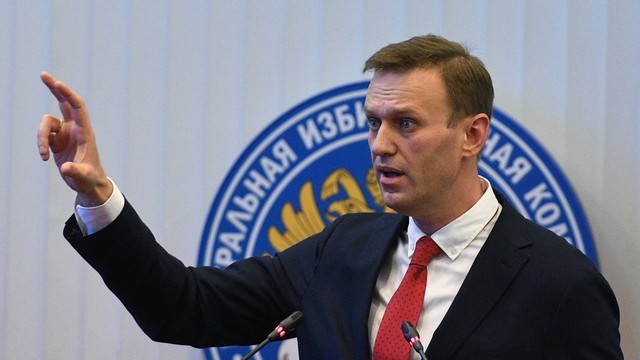
Craig Murray: Opposition figure Navalny may possibly have been targeted by Russian state, but Western narrative doesn’t add up

Craig Murray is an author, broadcaster and human rights activist. He was British Ambassador to Uzbekistan from August 2002 to October 2004 and Rector of the University of Dundee from 2007 to 2010.

Once Russian anti-corruption campaigner Alexey Navalny was in Berlin it was only a matter of time before it was declared that he was poisoned with Novichok. The Russophobes are delighted.

This of course eliminates all vestiges of doubt about what happened to the Skripals, and proves that Russia must be isolated and sanctioned to death and we, in the West, must spend untold billions on weapons and security services. We must also increase domestic surveillance and crack down on dissenting online opinion. It also proves that Donald Trump is a Russian puppet and Brexit is a Russian plot.

I am going to prove beyond all doubt that I am a Russian troll by asking the question Cui Bono?, brilliantly identified by the Integrity Initiative’s Ben Nimmo as a sure sign of Russian influence.

I should state that I have no difficulty at all with the notion that a powerful oligarch or an organ of the Russian state may have tried to assassinate Navalny. He is a minor irritant, not remotely as politically important in Russia as he is portrayed by the Western press, but not being a major threat does not protect you against political assassination in Russia.

What I do have difficulty with is the notion that if Putin, or other very powerful Russian actors, wanted Navalny dead, and had attacked him while he was in Siberia, he would not be alive in Germany today. If Putin wanted him dead, he would be dead.

Let us first take the weapon of attack. One thing we know about a “Novichok” for sure is that it appears not to be very good at assassination. Poor Dawn Sturgess is the only person ever to have allegedly died from “Novichok,” accidentally, according to the official narrative. “Novichok” did not kill the Skripals, the actual target. If Putin wanted Navalny dead, he would try something that works. Like a bullet to the head, or an actually deadly poison.

“Novichok” is not a specific chemical. It is a class of chemical weapon designed to be improvised in the field from common domestic or industrial precursors. It makes some sense to use on foreign soil as you are not carrying around the actual nerve agent, and may be able to buy the ingredients locally. But it makes no sense at all in your own country, where the FSB or GRU can swan around with any deadly weapon they wish, to be making homemade nerve agents in the sink. Why would you do that?

Further we are expected to believe that, having poisoned Navalny, the Russian state then allowed the airplane he was traveling in, on a domestic flight, to divert to another airport, and make an emergency landing, so he could be rushed to hospital. If the Russian secret services had poisoned Navalny at the airport before takeoff as alleged, why would they not insist the plane stick to its original flight plan and let him die on the plane? They would have foreseen what would happen to the victim during the flight.

Next, we are supposed to believe that the Russian state, having poisoned Navalny, was not able to contrive his death in the intensive care unit of a Russian state hospital. We are supposed to believe that the evil Russian state was able to falsify all his toxicology tests and prevent doctors telling the truth about his poisoning, but the evil Russian state lacked the power to switch off the ventilator for a few minutes or slip something into his drip. In a Russian state hospital.

Next we are supposed to believe that Putin, having poisoned Navalny with novichok, allowed him to be flown to Germany to be saved, making it certain the novichok would be discovered. And that Putin did this because he was worried Merkel was angry, not realising she might be still more angry when she discovered Putin had poisoned him with novichok.

There are a whole stream of utterly unbelievable points there, every single one of which you have to believe to go along with the western narrative. Personally I do not buy a single one of them, but then I am a notorious Russophile traitor.

The United States is very keen indeed to stop Germany completing the Nord Stream 2 pipeline, which will supply Russian gas to Germany on a massive scale, sufficient for about 40 percent of its electricity generation. Personally I am opposed to Nord Stream 2 myself, on both environmental and strategic grounds. I would much rather Germany put its formidable industrial might into renewables and self-sufficiency. But my reasons are very different from those of the USA, which is concerned about the market for liquefied gas to Europe for US producers and for the Gulf allies of the US. Key decisions on the completion of Nord Stream 2 are now in train in Germany.

The US and Saudi Arabia have every reason to instigate a split between Germany and Russia at this time. Navalny is certainly a victim of international politics. That he is a victim of Putin I tend to doubt.

Republished with permission of the author. This article originally appeared here.

6 September 2020

Source: www.rt.com

Peace Is Endangered Not by Chinese Military Expansion but by a Declining US Viewing It as an Existential Threat

By Scott Ritter

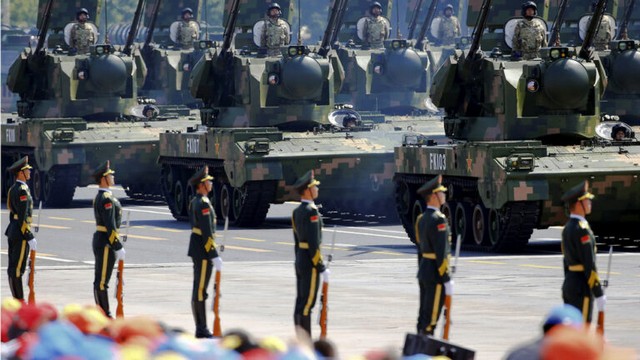
2 Sep 2020 – A report from the US Department of Defense paints China as a rising military power capable of challenging America for global superiority. The reality is that the report is a product of Washington’s nervous psychological state.

The US Department of Defense has released a sobering assessment of Chinese military capability which throws into question the viability of any ‘Pacific pivot’ as the US undergoes its own military restructuring, designed in part to meet the challenges posed by a Beijing increasingly comfortable with its expanded role in global affairs.

The 173-page report, titled ‘Military and Security Developments Involving the People’s Republic of China’, attaches relevance to nearly every aspect of the country’s military expansion, from nuclear weapons to naval ships, and couches them exclusively as examples of a projection of military that might be designed to challenge the US as a leader on the global stage.

Missing from this assessment is any reflection on the role played by the US in triggering this Chinese military buildup. For example, there is no mention of the cause and effect relationship between America’s abandonment of the Intermediate Nuclear Forces (INF) treaty, or its insistence on trilateral negotiations involving China when it comes to the extension of the bilateral US-Russian New START treaty, and China’s decision to modernize and expand its own arsenal of nuclear weapons (from 200 to 400, inclusive of strategic and intermediate weapons – a paltry sum when compared to the 1,550 strategic nuclear weapons the US maintains).

Likewise, at a time when China is aggressively pursuing its disputed territorial claims in the South China Sea, the decisions by the US to project its own naval power in response, in the form of aircraft carrier battlegroups, could logically explain China’s expansion of its own naval capabilities.

This does not mean that China is not a rising global force possessing international interests deemed vital to its own national security, which it requires the projection of its military power to secure.

It has also been engaged in a massive expansion of its global economic reach, known as the Belt and Road Initiative. Since its unveiling in 2013, this has morphed into two separate but complementary programs: the land-based Silk Road Economic Belt, comprising six ‘development corridors’, and the ‘21st Century Maritime Silk Road’, which links China with South Asia, Africa, the Middle East and Europe.

While the initiative is exclusively economic, the new reality created by China’s expansive global economic presence has prompted China to establish military bases in Africa and elsewhere, designed to secure the vital lines of communication necessary for the success and survival of the plan.

For 75 years, the United States has pursued policies linked to a post-World War Two “rules-based order” promoting a framework of liberal political and economic rules sustained by a network of international organizations and regulations, all tied to the notion of unchallenged US leadership. This “rules-based order” has underpinned US relations with Europe, through the trans-Atlantic partnership embodied by NATO, and in the Pacific, in terms of the post-war relationships the US maintains with Japan, South Korea and Australia.

The idea of a liberal “rules-based order” could be defended during the period of the Cold War, where the US and its allies faced off against the Soviet Union and Communist China in a bi-polar ideological battle for global influence. This model, though, built as it was on the principle of American exceptionalism, has proven more difficult to justify and sustain in the years following the collapse of the Soviet Union.

The notion of all-powerful American unilateralism floundered in the face of a multi-polar global reality and the disastrous post-9/11 military interventions in Afghanistan and Iraq. In short, US leadership has been wanting for some time, and where vacuums were created, nations like China were all too willing to fill them – not out of any desire to confront Washington, but rather as the natural development of a global community not longer tied to the singularity of American economic and military dominance.

The US today is a nation in decline. This does not mean that it is going the way of the dinosaur – far from it. The US is, and will continue to be for the foreseeable future, a major power with unmatched global reach. But the day of guaranteed American supremacy has gone.

Indeed, this decline has been hastened by the impact of the global Covid-19 pandemic, which has found America wanting in terms of both a domestic and international response. Serious social inequities in terms of race relations, health care failures, and economic fundamentals have manifested themselves in a divisive domestic political reality that further encumbers the US in terms of projecting leadership abroad.

The gloomy assessment contained in the ‘Military and Security Developments Involving the People’s Republic of China’ report is causally linked to this decline. There is a psychological disorder known as ‘projection’, which refers to the unconscious act of taking emotions or traits one finds disagreeable about themselves, and attributing them to someone else. The Department of Defense is guilty of this psychological projection when it comes to its assessment of China.

As a nation in decline, the US is unable and/or unwilling to accept this new reality, and as such is incapable of carrying out the kind of self-diagnosis necessary to slow or halt this decline. As other nations, such as China, step into the breach created by a US power in retrograde, American policy makers – rather than attribute the Chinese actions as a logical cause-effect manifestation of reality – instead project onto China the very behavioral traits about the US that have helped bring about its shrinking global reach and influence.

The truism that one cannot solve a problem that is not properly defined applies in full here. By projecting its own failed global ambitions onto China, the Department of Defense is failing to address the real reasons behind China’s military expansion.

While in a purely academic environment such a disconnect would provide fodder for further study, in the real world it can lead to the kind of miscalculations that lead to confrontations that might otherwise be avoided. Seen in this light, this new report exposes the fact that the real threat to global peace and security is not Chinese military expansion, but US psychological projection which defines Beijing’s actions as an existential threat that must be confronted.

Scott Ritter was a US Marine Corps intelligence officer for 12 years.

7 September 2020

Source: www.transcend.org

The U.S. Is Determined to Make Julian Assange Pay for Exposing the Cruelty of Its War on Iraq

By Vijay Prashad

2 Sep 2020 – On September 7, 2020, Julian Assange will leave his cell in Belmarsh Prison in London and attend a hearing that will determine his fate. After a long period of isolation, he was finally able to meet his partner—Stella Moris—and see their two sons—Gabriel (age three) and Max (age one)—on August 25. After the visit, Moris said that he looked to be in “a lot of pain.”

The hearing that Assange will face has nothing to do with the reasons for his arrest from the embassy of Ecuador in London on April 11, 2019. He was arrested that day for his failure to surrender in 2012 to the British authorities, who would have extradited him to Sweden; in Sweden, at that time, there were accusations of sexual offenses against Assange that were dropped in November 2019. Indeed, after the Swedish authorities decided not to pursue Assange, he should have been released by the UK government. But he was not.

The true reason for the arrest was never the charge in Sweden; it was the desire of the U.S. government to have him brought to the United States on a range of charges. On April 11, 2019, the UK Home Office spokesperson said,

“We can confirm that Julian Assange was arrested in relation to a provisional extradition request from the United States of America. He is accused in the United States of America of computer-related offenses.”

Manning

The day after Assange’s arrest, the campaign group Article 19 published a statement that said that while the UK authorities had “originally” said they wanted to arrest Assange for fleeing bail in 2012 toward the Swedish extradition request, it had now become clear that the arrest was due to a U.S. Justice Department claim on him. The U.S. wanted Assange on a “federal charge of conspiracy to commit computer intrusion for agreeing to break a password to a classified U.S. government computer.” Assange was accused of helping whistleblower Chelsea Manning in 2010 when Manning passed WikiLeaks—led by Assange—an explosive trove of classified information from the U.S. government that contained clear evidence of war crimes. Manning spent seven years in prison before her sentence was commuted by former U.S. President Barack Obama.

While Assange was in the Ecuadorian embassy and now as he languishes in Belmarsh Prison, the U.S. government has attempted to create an air-tight case against him. The U.S. Justice Department indicted Assange on at least 18 charges, including the publication of classified documents and a charge that he helped Manning crack a password and hack into a computer at the Pentagon. One of the indictments—from 2018—makes the case against Assange clearly.

The charge that Assange published the documents is not the central one, since the documents were also published by a range of media outlets such as the New York Times and the Guardian. The key charge is that Assange “actively encouraged Manning to provide more information and agreed to crack a password hash stored on U.S. Department of Defense computers connected to the Secret Internet Protocol Network (SIPRNet), a United States government network used for classified documents and communications. Assange is also charged with conspiracy to commit computer intrusion for agreeing to crack that password hash.” The problem here is that it appears that the U.S. government has no evidence that Assange colluded with Manning to break into the U.S. system.

Manning does not deny that she broke into the system, downloaded the materials, and sent them to WikiLeaks. Once she had done this, WikiLeaks, like the other media outlets, published the materials. Manning had a very trying seven years in prison for her role in the transmission of the materials. Because of the lack of evidence against Assange, Manning was asked to testify against him before a grand jury. She refused and now is once more in prison; the U.S. authorities are using her imprisonment as a way to compel her to testify against Assange.

What Manning Sent to Assange

On January 8, 2010, WikiLeaks announced that it had “encrypted videos of U.S. bomb strikes on civilians.” The video, later released as “Collateral Murder,” showed in cold-blooded detail how on July 12, 2007, U.S. AH-64 Apache helicopters fired 30-millimeter guns at a group of Iraqis in New Baghdad; among those killed were Reuters photographer Namir Noor-Eldeen and his driver Saeed Chmagh. Reuters immediately asked for information about the killing; they were fed the official story and told that there was no video, but Reuters futilely persisted.

In 2009, Washington Post reporter David Finkel published The Good Soldiers, based on his time embedded with the 2-16 battalion of the U.S. military. Finkel was with the U.S. soldiers in the Al-Amin neighborhood when they heard the Apache helicopters firing. For his book, Finkel had watched the tape (this is evident from pages 96 to 104); he defends the U.S. military, saying that “the Apache crew had followed the rules of engagement” and that “everyone had acted appropriately.” The soldiers, he wrote, were “good soldiers, and the time had come for dinner.” Finkel had made it clear that a video existed, even though the U.S. government denied its existence to Reuters.

The video is horrifying. It shows the callousness of the pilots. The people on the ground were not shooting at anyone. The pilots fire indiscriminately. “Look at those dead bastards,” one of them says, while another says, “Nice,” after they fire at the civilians. A van pulls up at the carnage, and a person gets out to help the injured—including Saeed Chmagh. The pilots request permission to fire at the van, get permission rapidly, and shoot at the van. Army Specialist Ethan McCord—part of the 2-16 battalion that had Finkel embedded with them—surveyed the scene from the ground minutes later. In 2010, McCord told Wired’s Kim Zetter what he saw:

“I have never seen anybody being shot by a 30-millimeter round before. It didn’t seem real, in the sense that it didn’t look like human beings. They were destroyed.”

In the van, McCord and other soldiers found badly injured Sajad Mutashar (age 10) and Doaha Mutashar (age five); their father, Saleh—who had tried to rescue Saeed Chmagh—was dead on the ground. In the video, the pilot saw that there were children in the van; “Well, it’s their fault for bringing their kids into a battle,” he says callously.

Robert Gibbs, the press secretary for President Barack Obama, said in April 2010 that the events on the video were “extremely tragic.” But the cat was out of the bag. This video showed the world the actual character of the U.S. war on Iraq, which the United Nations Secretary-General Kofi Annan had called “illegal.” The release of the video by Assange and WikiLeaks embarrassed the United States government. All its claims of humanitarian warfare had no credibility.

The campaign to destroy Assange begins at that point. The United States government has made it clear that it wants to try Assange for everything up to treason. People who reveal the dark side of U.S. power, such as Assange and Edward Snowden, are given no quarter. There is a long list of people—such as Manning, Jeffrey Sterling, James Hitselberger, John Kiriakou, and Reality Winner—who, if they lived in countries being targeted by the United States, would be called dissidents. Manning is a hero for exposing war crimes; Assange, who merely assisted her, is being persecuted in plain daylight.

On January 28, 2007, a few months before he was killed by the U.S. military, Namir Noor-Eldeen took a photograph in Baghdad of a young boy with a soccer ball under his arm steps around a pool of blood. Beside the bright red blood lie a few rumpled schoolbooks. It was Noor-Eldeen’s humane eye that went for that photograph, with the boy walking around the danger as if it were nothing more than garbage on the sidewalk. This is what the U.S. “illegal” war had done to his country.

All these years later, that war remains alive and well in a courtroom in London; there Julian Assange—who revealed the truth of the killing—will struggle against being one more casualty of the U.S. war on Iraq.

Vijay Prashad is an Indian historian, editor and journalist.

7 September 2020

Source: www.transcend.org
The OAS Accusation of Electoral Fraud against Evo Morales Is Bullshit — and Now We Have the Data to Prove It

By David Rosnick

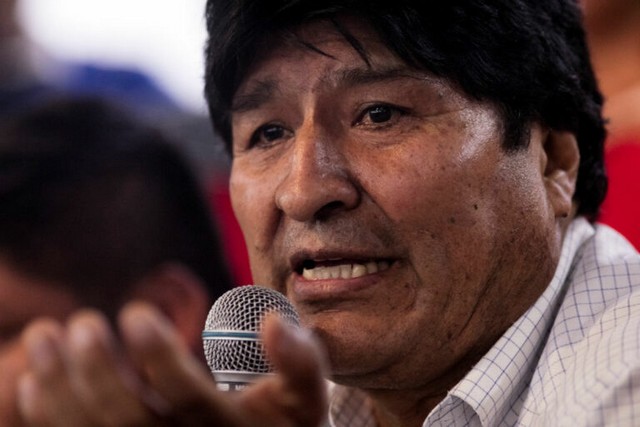
The day after the Bolivian election, the Organization of American States suggested the result was fraudulent — then took months to provide any proof. Last month, it finally released its data — and researchers at the Center for Economic and Policy Research found a basic coding error that destroys the OAS’s case against Morales.

5 Sep 2020 – August 20 was a day that shook a small world of scientists that had all but given up — short of legal threats — on getting a glimpse into the data and methods behind the analyses that took down the Bolivian government. Slowed by stonewalling and gaslighting, researchers had managed to re-create some — but not all — of the results presented by the Organization of American States (OAS) in its case against the legitimacy of Evo Morales’s reelection last October 20.
The OAS had alleged, the day after the vote, that the preliminary count contained an “inexplicable change in trend” of the preliminary results — drastically skewing in Morales’s favor. But its claim was dubious to begin with. As early as October 22, we began raising serious questions suggesting the “inexplicable change” was quite predictable.The OAS would later support its allegation by claiming that the official count also contained a late break for Morales that “cannot be easily explained away” by Morales’s generally rural support specifically because the official count “data do not reflect the time the results were reported to the TSE [Tribunal Supremo Electoral].” This premise is entirely wrong; votes from the main cities were much more likely to be counted early, because the official count required hand delivery (rather than electronic transmission) of electoral materials to TSE offices.Faulty reasoning aside, the OAS results were irreproducible.

Ten months later came the revelation that some of the OAS’s previously baffling conclusions are explained by a coding error. It had ordered the time stamps on the tally sheets alphabetically rather than chronologically — thus destroying its narrative of a sudden change in the official count.

Unjustly Forced Out

The damage, of course, had already been done. On November 11, 2019, Bolivia’s president, Evo Morales — his term not yet complete — stepped down from the presidency amid allegations of fraud. Decisive was the report from the OAS, which had just presented its preliminary findings in a binding audit of the October 20 election. These findings were not favorable to Morales, questioning his official first-round victory.

Members of the opposition, some of whom had been saying all along that Morales and his Movement Toward Socialism (MAS-IPSP) party would attempt fraud to stay in power, took to the streets in violent protest. Though Morales agreed to annul the election, the head of the military told him he should step down. He resigned and embarked on a dramatic flight from Bolivia to Mexico — barely making it out alive, according to the Mexican foreign minister.

This isn’t the first time the OAS has deployed poor statistics to overturn election results. In 2010, the OAS intervened in Haiti, demanding that the third-place candidate be permitted to participate in a runoff election with the first-place candidate — leaving the runner-up, who just happened to be the only non-right-wing candidate, out in the cold.

To be sure, security surrounding Bolivia’s election was insufficient. At the risk of whataboutism, the same could be said of most any election in the United States. However, the OAS’s findings presented in November were otherwise full of insinuation and short on detail. The OAS presented no actual evidence that even a single vote was altered. Instead, it offered a statistical analysis that statistician Andrew Gelman characterizes as “a joke.”

Convenient Conclusions, Dodgy Assumptions

Even if the approach was dubious and the results were irreproducible, at least it presented something. The OAS press release the day after the vote had presented no such analysis — though it certainly did raise the volume of opposition protests. Amid cries of “fraud,” prominent members of Morales’s party and their families were assaulted or threatened with murder. Jeanine Áñez’s “interim” government — still in power today, having three times delayed new elections— would later cite the OAS reports as its near-exclusive evidence in its campaign to dismantle MAS.

Despite repeated requests, the OAS offered no justification for their claims. This, even though the results seemed in line with pre-election polls. With the preliminary count 84 percent complete, Morales had received more than 45 percent of the valid votes in a nine-way race. Yet under Bolivian electoral law, this would not be enough to win the race outright: only if he had an absolute majority, or a 10-point lead over runner-up Carlos Mesa, would Morales avoid a second-round runoff.

Morales’s lead increased steadily as the preliminary count had progressed. This offered no particular reason to think anything was odd. Rather, tally sheets from areas supportive of Morales have tended to be counted later than tally sheets from areas favorable to the opposition, and that was the case in this election. Imagine first counting votes from Los Angeles, New York City, Chicago, and Washington, DC, before considering rural Texas, Tennessee, or Alabama. Nobody would be surprised that the inclusion of Republican areas in the count would steadily chip away at the early Democratic lead.

Shortly before the announcement of partial, unofficial, preliminary results on the evening of October 20, there was a surge of votes counted from Santa Cruz — a hotbed of anti-Morales sentiment that dented the nearly constant good news for the incumbent president. In any case, the tally sheets that remained to be counted were coming from areas that had already shown, on balance, a strong preference for Morales. When the rapid count paused with 84 percent of votes counted, Morales’s lead over Mesa was only about 8 percentage points. Yet when the preliminary results were next reported, a day later, with another 9 percent of the vote, Morales had (tentatively) a 10-point lead — and his first-round victory.

Was this victory inexplicable — constructed in the darkness — as the OAS suggested? Was it a change of fate, or inevitable? My colleague Jake Johnston quickly put together an analysis of the results in the capital city of Cochabamba, where the swing was particularly visible. Breaking down the results by precinct, Jake showed that there was very little change in Morales’s support before and after the interruption of the count; in large part, Morales performed better, late, in Cochabamba, because precincts more favorable to the incumbent were — for whatever reason — counted later. A more rigorous approach over the entire election suggested by John Newman would show likewise: in the locality of Cochabamba, Morales actually underperformed late when the mix of precincts is taken into account.

So it went for the whole election. Consistently, studies have shown that once the different composition of precincts before and after the interruption is accounted for, Morales’s victory was predictable.

The OAS Final Audit

The OAS analyses have been notable for a steadfast refusal to consider such intra-geographic differences, presuming — contrary to all evidence — that a candidate’s support should be more or less uniform throughout the count.

The OAS final audit report on December 4 was explicitly biased in casting doubt on Morales’s first-round victory. The audit team expressly looked for irregularities on tally sheets that heavily favored Morales — justifying this selective search based on alleged statistical evidence that Morales’s victory was “inexplicable.” However, the statistical evidence presented in the OAS audit was not merely unconvincing; the analysis was completely wrong. The analysis boiled down to two points.

First, the OAS argued that the last 5 percent of the vote in the unofficial, preliminary count showed “a striking upward trend . . . that is quite different.” However, it is not unusual for late swings in a count to prove decisive. As noted in an open letter by economists and statisticians:

It is not uncommon for election results to be skewed by location, which means that results can change depending on when different areas’ votes get counted. No one argued that there was fraud in Louisiana’s 16 November gubernatorial election, when the Democratic candidate John Bel Edwards, pulled out a 2.6% point victory, after being behind all night, because he won 90% of the vote in Orleans county, which came in at the end of the count.

The order in which preliminary results were reported publicly was slightly different than the order in which Irfan Nooruddin (the author of the OAS statistical analyses) considers them. Many tally sheets throughout the count were transcribed but set aside for later approval. Those approved at the end tended to be much more representative of the entire election— even unfavorable to Morales. Regardless, the upward trend in Nooruddin’s data was predictable based on the earlier data, because his late tally sheets came from areas that had overwhelmingly shown strong support for Morales.

Second, Nooruddin argued that this finding is bolstered by the fact that the last 5 percent of the vote in the official count was also inconsistent with the previous 95 percent and again the penultimate 5 percent. Specifically, the OAS presented graphs showing that Morales’s vote share increased sharply after the 95 percent mark, while Mesa’s plummeted.

But these results were completely irreproducible. Until August 19.

Breakthrough

For weeks following the release of the OAS report, researchers had tried unsuccessfully to replicate these findings using publicly available data. The OAS ignored requests for its data and explanation of its methods, but there were two red flags suggesting that its analysis suffered from serious errors. First, the OAS concluded its audit with the results of an “internal analysis” that directly contradicted the graphs. That table implied that Morales performed better — not worse — over the penultimate 5 percent than the last 5. Second, the table above it broke down results by select departments (equivalent to states in the United States). None of these numbers seemed to make sense.

This was not a simple difference between public and official, internal data. On May 25, I finally received data direct from the TSE; again, Cochabamba was counted entirely before the 95 percent mark.

The breakthrough came only on August 19. That was when Nooruddin posted his data set to a Harvard repository. Sorting tally sheets by this progress variable, everything looks fine to start with. But the transition from the October 20 to October 21 stands out.

Shortly before Nooruddin claims the count reaches 11 percent, the time stamps jump from 11:59 p.m. to 01:00 a.m. Was it possible there was an hour break? No. There were tally sheets time-stamped at 12:00 a.m. on the 21st, but they were far down the list — just past the 61 percent mark, immediately between those time-stamped 11:59 p.m. and the tally sheets time-stamped 12:00 p.m.

It was clear what Nooruddin had done. His time stamps were formatted as strings — letters and numbers; when he sorted his tally sheets, he did so alphabetically and not chronologically. Nooruddin had each day starting at 01:00 a.m., proceeding to 01:00 p.m., 01:01 a.m., and so forth until 12:59 a.m. and finally concluding at 12:59 p.m.

The OAS’s claims against the legitimacy of the election results originally centered on what it considered to be an inexplicable change in the trend of the votes over time. But Nooruddin’s analyses reflect no real-world understanding of the order in which tally sheets were counted. His “first 95 percent” included tally sheets as late as 10:55 p.m. on October 22, but his “last 5 percent” included tally sheets as early as 12:19 a.m. — hours earlier. Sorting tally sheets chronologically, Nooruddin’s progress variable is all over the place.

Resisting Scrutiny

The fact is, the OAS still is not used to this kind of scrutiny, since it usually breezes through it with an air of authority. Like others empowered by this false sense of security, the OAS again doubled down on its defense of the study. On Twitter, Gerardo de Icaza — director of OAS election observations — praised Nooruddin as “one of the best electoral statisticians in the world” and insisted falsely that his results held.

Such has been the consistent pattern of the OAS in response to any criticism of their report: when data fails them, they simply ignore the evidence and lash out. When the New York Times arranged for several academics to evaluate the statistical evidence and published their finding that Nooruddin’s presentation was erroneous, secretary general of the OAS Luis Almagro dispatched a wild attack on the NYT. Others with influence inside the Washington, DC, beltway, such as the International Crisis Group and Human Rights Watch’s Americas director, José Miguel Vivanco, have taken notice of Almagro’s increasingly erratic behavior.

The OAS secretary general has caught even the attention of the Washington Office on Latin America, which has long been critical of many of Latin America’s left-leaning governments. Almagro recently undermined the independence of the Inter-American Commission on Human Rights — the OAS’s autonomous human rights arm — by unilaterally standing in the way of the continuation of Paulo Abrão’s term as executive secretary. The Commission has been critical of the de facto regime in Bolivia for its abuses — a regime which likely would not hold power but for the OAS’s intervention in the election.

It is clear the rot is thorough. This was not just a data slip. Not just an indefensible statistical analysis, officially delegitimizing an election. Not just an audit. This was not an objective, scientific investigation into the election, but a way of defending an indefensible analysis cooked up in advance. The OAS under Almagro is now visibly out of control. Its ostensible mission is to support the international order. It could start by dropping the United States’ two-century-old business of meddling in the Western Hemisphere.

David Rosnick is an economist at the Center for Economic and Policy Research (cepr.net).

7 September 2020

Source: www.transcend.org