Just International

Turkey Now Claims Syria’s Idlib Province as Turkish Territory

By Eric Zuesse

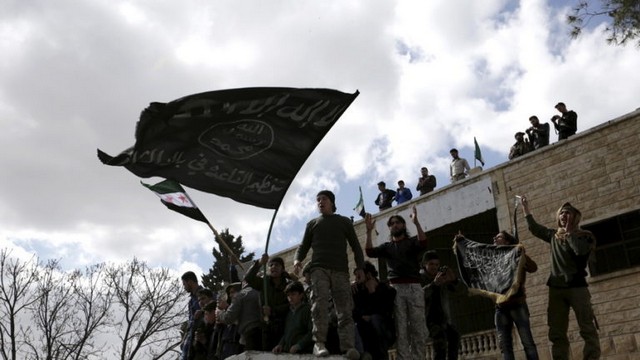
28 Feb 2020 – On February 26th, Tayyip Erdogan, Turkey’s President, told his Islamist political party that Idlib, which is the most heavily jihadist of all of Syria’s provinces and the province where Syria had been sending jihadists who had been defeated but not killed by the Syrian army elsewhere in the Syrian war, is now permanently under Turkey’s protection, and belongs to Turkey — Turkish territory. Russia’s RT news headlined on the 26th, “‘We’re the hosts there’: Erdogan says Turkey won’t pull back from Syria’s sovereign territory, gives Assad ultimatum to retreat”, and reported that,

The Turkish leader has ruled out withdrawal from Idlib, where his forces are backing militants fighting the Syrian Army. He also gave Damascus an ultimatum to retreat beyond Turkey’s observation posts placed on Syrian soil.

“We will not step back in Idlib. We are not the guests in this realm, we are the hosts,” Recep Tayyip Erdogan told a meeting of his AK party on Wednesday. Vowing to bring “the regime’s attacks” to an end, Erdogan said Ankara is giving Damascus time to pull forces back from Turkish observation posts.

The very next day, on the 27th, the Turkish English-language newspaper Yeni Safak bannered “Situation in Syria’s Idlib ‘in favor of Turkey’: Turkish president says Turkey has also reversed situation in Libya, which was previously in favor of Libyan warlord Haftar” and they reported that Erdogan saw signs that Turkey was introducing new international realities in both Syria and Libya.

This extraordinarily assertive position by Erdogan results from the sequence of events that will be described here:

U.S. President Donald Trump and U.S. allies made unequivocally clear in late August and early September of 2018 that if Syria and Russia would try to restore Syrian Government control over Syria’s Idlib Province, then the U.S. and its allies would greatly escalate their war against Syria’s Government. For example, on 3 September 2018, Trump tweeted, “President Bashar al-Assad of Syria must not recklessly attack Idlib Province. The Russians and Iranians would be making a grave humanitarian mistake to take part in this potential human tragedy. Hundreds of thousands of people could be killed.” South Front reported, the following day, that,

Trump’s tweet comes as Iran’s foreign minister Mohammad Javad Zarif at the start of his visit to Damascus said that “terrorists must be purged” from the province and Idlib in its entirety must be returned under government control.

“Syria’s territorial integrity should be safeguarded and all tribes and groups, as one society, should start the reconstruction process, and the refugees should return to their homes,” Mr Zarif said.

Zarif met with President Assad and the Syrian Foreign Minister Walid al-Moallem. They mostly discussed the expected September 7th summit, which will happen in Tehran. Russian, Turkish, Syrian and Iranian leaders are supposed to meet and discuss the situation in Idlib.

A statement from Assad’s office said that Iran and Syria “had similar views on the different issues” that are to be discussed.

On 10 September 2018, I wrote that “Unless Syria will simply hand its most heavily pro-jihadist province, Idlib, to adjoining Turkey, which claims to have 30,000 troops there and is planning to add 20,000 more,” there would be a war between NATO member Turkey, which has invaded there, versus Russia, which — at Syria’s request — has been assisting Syria’s Government to conquer all of Syria’s jihadists. Syria’s Army has gradually liberated and retaken most of Syria’s territory from jihadists, but had been using Idlib Province as a collection-area for the ones who were holding Syrian civilians as human shields. Syria was bussing into Idlib the tens of thousands of jihadists that surrendered. This was being done so as to minimize the numbers of civilians who would be killed when Syria’s army would retake an area, under Russian air-cover. This would allow the civilians there to escape to Syrian-Government-held territory, and the armed forces of Syria and Russia then to move in and slaughter the jihadists who remained there, so that Syria would retake that area from the U.S.-backed jihadists.

Then, seven days later, I headlined “Putin and Erdogan Plan Syria-Idlib DMZ as I Recommended”, and reported that,

Russia’s President Vladimir Putin and Turkey’s President Tayyip Erdogan jointly announced on September 17th in Tehran, “We’ve agreed to create a demilitarized zone between the government troops and militants before October 15. The zone will be 15-20km wide,” which compares to the Korean DMZ’s 4-km width.

Though the understanding that Erdogan had reached with Iran’s President Rouhani and with Russia’s President Putin was that this would be only a temporary measure in order to get the U.S. and its allies to cease threatening World War III if Syria and Russia promptly let loose and slaughtered the ‘rebels’ in Idlib (Americas’s previous main fighters to defeat and replace Syria’s Government), Erdogan soon presented clear indications that he actually wanted to seize Syrian territory and to get as much of it as he could — that his goal in Syria included expanding Turkey into Syria. His temporary policing function, as agreed-to by Russia, to isolate and not allow to escape the defeated jihadists who had become trapped there, turned out to be far more than that: it turned out to be Erdogan’s protection of those jihadists.

This extraordinarily assertive position by Erdogan results from the sequence of events that will be described here:

U.S. President Donald Trump and U.S. allies made unequivocally clear in late August and early September of 2018 that if Syria and Russia would try to restore Syrian Government control over Syria’s Idlib Province, then the U.S. and its allies would greatly escalate their war against Syria’s Government. For example, on 3 September 2018, Trump tweeted, “President Bashar al-Assad of Syria must not recklessly attack Idlib Province. The Russians and Iranians would be making a grave humanitarian mistake to take part in this potential human tragedy. Hundreds of thousands of people could be killed.” South Front reported, the following day, that,

Trump’s tweet comes as Iran’s foreign minister Mohammad Javad Zarif at the start of his visit to Damascus said that “terrorists must be purged” from the province and Idlib in its entirety must be returned under government control.

“Syria’s territorial integrity should be safeguarded and all tribes and groups, as one society, should start the reconstruction process, and the refugees should return to their homes,” Mr Zarif said.

Zarif met with President Assad and the Syrian Foreign Minister Walid al-Moallem. They mostly discussed the expected September 7th summit, which will happen in Tehran. Russian, Turkish, Syrian and Iranian leaders are supposed to meet and discuss the situation in Idlib.

A statement from Assad’s office said that Iran and Syria “had similar views on the different issues” that are to be discussed.

On 10 September 2018, I wrote that “Unless Syria will simply hand its most heavily pro-jihadist province, Idlib, to adjoining Turkey, which claims to have 30,000 troops there and is planning to add 20,000 more,” there would be a war between NATO member Turkey, which has invaded there, versus Russia, which — at Syria’s request — has been assisting Syria’s Government to conquer all of Syria’s jihadists. Syria’s Army has gradually liberated and retaken most of Syria’s territory from jihadists, but had been using Idlib Province as a collection-area for the ones who were holding Syrian civilians as human shields. Syria was bussing into Idlib the tens of thousands of jihadists that surrendered. This was being done so as to minimize the numbers of civilians who would be killed when Syria’s army would retake an area, under Russian air-cover. This would allow the civilians there to escape to Syrian-Government-held territory, and the armed forces of Syria and Russia then to move in and slaughter the jihadists who remained there, so that Syria would retake that area from the U.S.-backed jihadists.

Then, seven days later, I headlined “Putin and Erdogan Plan Syria-Idlib DMZ as I Recommended”, and reported that,

Russia’s President Vladimir Putin and Turkey’s President Tayyip Erdogan jointly announced on September 17th in Tehran, “We’ve agreed to create a demilitarized zone between the government troops and militants before October 15. The zone will be 15-20km wide,” which compares to the Korean DMZ’s 4-km width.

Though the understanding that Erdogan had reached with Iran’s President Rouhani and with Russia’s President Putin was that this would be only a temporary measure in order to get the U.S. and its allies to cease threatening World War III if Syria and Russia promptly let loose and slaughtered the ‘rebels’ in Idlib (Americas’s previous main fighters to defeat and replace Syria’s Government), Erdogan soon presented clear indications that he actually wanted to seize Syrian territory and to get as much of it as he could — that his goal in Syria included expanding Turkey into Syria. His temporary policing function, as agreed-to by Russia, to isolate and not allow to escape the defeated jihadists who had become trapped there, turned out to be far more than that: it turned out to be Erdogan’s protection of those jihadists.

On September 25th of 2018, I bannered “Turkey Now Controls Syria’s Jihadists”, and presented the historical background behind this. Then, on 14 July 2019, I headlined “Turkey Will Get a Chunk of Syria: An Advantage of Being in NATO”, and explained that because of NATO’s backing of Turkey’s seizure of Syrian territory, Turkey was already committed to the construction of Syrian branches of Turkey’s Gaziantep University and of Turkey’s Harran University, as well as of building supportive infrastructure for those facilities — absorbing portions of northern Syria into Turkey.

So, this has been a gradual process, and now Erdogan, backed by U.S.President Trump and by NATO, will be saving the lives of the tens of thousands of jihadists (plus their families) who had been defeated elsewhere in Syria, and who thus will avoid what the U.S. and its allies had warned would be a ‘humanitarian crisis’ of mass-slaughtering those defeated jihadists (which the U.S. and its allies still call ‘Syrian rebels’ — even though most of them aren’t even Syrian).

As I noted in the 14 July 2019 article:

At that time, just prior to the Tehran conference — and this was actually the reason why the conference was held — the U.S. and its allies, and the U.N., were demanding that an all-out invasion of Idlib, which had been planned by the Governments of Syria and of Russia, must not take place, for ‘humanitarian’ reasons. There was all that ‘humanitarian’ concern (led by the United States) for the world’s biggest concentration of Nusra and Nusra-led jihadists — and for Syria’s most jihadist-supporting civilian population. So much ‘kindness’, such ‘admirable’ ‘humanitarianism’.

Furthermore the U.S. Government was threatening to greatly increase its forces against Syria if that invasion by Syria and by Russia into Idlib (which is, after all, part of Syria — so, what business is it, even of the U.N., at all?) were to be carried out. The Tehran conference was meeting in order to resolve that emergency situation (mainly America’s threats of a possible war against Russia), so as to forestall this attack.

And now Erdogan again is threatening Russia with WW III if Russia continues to defend Syria’s sovereignty over Idlib — Syria’s most-jihadist province.

On February 26th, Yeni Safak bannered “Turkey will never compromise on Sochi deal for Syria, says Erdoğan”; so, Erdogan is openly threatening WW III if Russia and Syria resist Turkey’s seizure of Idlib and protection of its many thousands of jihadists.

Although the U.S. has led this apparent victory for jihadists and for international aggression, Turkey’s Erdogan has been its spearhead. Russia and Iran had not agreed to this. Certainly, Syria’s leader, Bashar al-Assad, hadn’t agreed to anything like this outcome. Turkey, in its 10 September 2018 agreement with Russia and with Iran, had committed itself to separating-out and killing the jihadists; but, instead, Turkey has been protecting them, and now will be absorbing them, and taking Idlib Province from adjoining Syria. As recently as 22 October 2019, Erdogan had promised Putin in Sochi that “The two sides reiterate their commitment to the preservation of the political unity and territorial integrity of Syria,” and that, “They emphasize their determination to combat terrorism in all forms and manifestations and to disrupt separatist agendas in the Syrian territory.” Yeni Safak’s February 26th article opened “Turkey will never compromise on the Sochi deal on embattled Idlib, Syria and it expects the deal to be implemented, said the country’s president on Wednesday.” Turkey “expects the deal to be implemented” while blatantly violating it.

Brett McGurk, a leading neoconservative in the Administrations of George W. Bush, Barack Obama, and Donald Trump, admitted, on 27 July 2017, that “Idlib Province is the largest Al Qaeda safe-haven since 9/11, tied directly to Ayman al-Zawahiri,” and that “to send in tens of thousands of tons of weapons and looking the other way as these foreign fighters come into Syria, may not have been the best approach,” but yet the U.S. regime continues that approach, and backs Turkey’s grab of Idlib and protection of those jihadists. Previously, McGurk had been U.S. President Barack Obama’s special envoy for the anti-Islamic State in Iraq and the Levant (ISIL) coalition. He had supported jihadists led by al-Nusra (Syrian branch of Al Qaeda) and supported separatist Kurds in Syria, to overthrow Syria’s Government.

Even the liberal (or Democratic Party, pro-Obama) neoconservative Washington Post had not hidden the fact that “The U.S. team, headed by senior White House adviser Robert Malley and State Department envoy Brett McGurk” had informed the newspaper that “Russia was said to have rejected a U.S. proposal to leave Jabhat al-Nusra off-limits to bombing as part of a cease-fire” — the fact that Obama was actually protecting those jihadists (though not protecting ISIS or ‘ISIL’). Obama backed al-Qaeda there, and so does Trump. However, when Trump ran for the Presidency in 2016, he promised to reverse Obama’s obsession to overthrow Syria’s President Bashar al-Assad. That, and similar promises he made, were antithetical to the most-basic commitments of the U.S. Establishment. They became his implacable enemies.

Finally, on 10 November 2016, right after Trump’s election, that same newspaper, the WP, bannered “Obama directs Pentagon to target al-Qaeda affiliate in Syria, one of the most formidable forces fighting Assad” and, without noting that Obama had supported that “al-Qaeda affiliate” until then, but instead falsely reporting that “the administration had largely ignored until now” it, said: “While Obama, White House national security adviser Susan E. Rice, Secretary of State John F. Kerry and special presidential envoy Brett McGurk agreed with [the super-neoconservative Obama Secretary of Defense Ashton] Carter on the need to keep the focus on the Islamic State, they favored shifting resources to try to prevent al-Nusra from becoming a bigger threat down the road.”

That was extreme euphemism, coming from this extremely neoconservative liberal newspaper. Actually, Obama had built his overthrow-Assad operation mainly upon al-Nusra, to train and lead the tens of thousands of foreign jihadists who had been pouring into Syria. The Washington Post was one of the most lying, deceptive, newspapers reporting anywhere in the world about international relations, very heavily slanted neoconservative — in favor of expanding the U.S. mega-corporate empire. Whereas the separatist Kurds were America’s main proxy-army fighting in Syria’s northeast, al-Nusra led America’s proxy-armies everywhere else in Syria. That 10 November 2016 WP article also asserted “But aides say Obama grew frustrated that more wasn’t being done by the Pentagon and the intelligence community to kill al-Nusra leaders given the warnings he had received from top counter­terrorism officials about the gathering threat they posed.”

That’s another lie, because Secretary of State John Kerry had actually fought inside the Administration against Obama’s policy on that, and the policy came from Obama himself — and NOT from his subordinates (such as Ashton Carter), as that lying newspaper alleged. The article referred to “the expanded push against al-Nusra” — but here is the reality: by no later than December 2012 Obama had settled upon al-Nusra to lead America’s overthrow-Assad campaign inside Syria. And the reason for that has very deep historical roots — all hidden from the American public. Instead of such realism, that propaganda-organ, in its article on 10 November 2016, wrote:

A bitterly divided Obama administration had tried over the summer to cut a deal with Moscow on a joint U.S.-Russian air campaign against al-Nusra, in exchange for a Russian commitment to ground Syrian government warplanes and to allow more humanitarian supplies into besieged areas. But the negotiations broke down in acrimony, with Moscow accusing the United States of failing to separate al-Nusra from more moderate rebel groups and Washington accusing the Russians of war crimes in Aleppo.

‘Humanitarian’. How stupid does the owner of the Washington Post think that the American public is in order for it still to believe that its Government really cares about being “humanitarian” around the world — especially in countries it’s trying to conquer, such as Iraq, Iran, Syria, Venezuela, Bolivia …? Really? He thinks it’s that stupid? Or, does he think his newspaper can help to make them so misinformed?

That rabidly anti-Russian newspaper continued there:

Russia had accused the United States of sheltering al-Nusra, a charge repeated Thursday in Moscow by Russian Foreign Minister Sergei Lavrov.

“The president doesn’t want this group to be what inherits the country if Assad ever does fall,” a senior U.S. official said. “This cannot be the viable Syrian opposition. It’s al-Qaeda.”

Officials said the administration’s hope is that more-moderate rebel factions will be able to gain ground as both the Islamic State and al-Nusra come under increased military pressure.

The article also featured a headline and link to their 9 November 2016 news-story, “Intelligence community is already feeling a sense of dread about Trump”. Even back then, the Democratic Party’s billionaires were pumping their agents’ allegations which would lead to Russiagate, the Mueller Report, and ultimately to Ukrainegate and Trump’s impeachment for being insufficiently supportive of President Obama’s 2014 coup and conquest of Ukraine, which Obama had started planning by no later than 2011.

All of that was a warning to any current or future U.S. President, that to buck the collective will of America’s billionaires is to commit political suicide. It doesn’t make any difference what the President’s Party is — the dictate, from the billionaires, applies to any U.S. President. This ‘restored Cold War’ is nothing of the sort — on the U.S. side, the war secretly continued uninterrupted, even after the Soviet Union ended its communism, and its Warsaw-Pact mirror of America’s NATO military alliance.

Investigative historian Eric Zuesse is the author, most recently, of They’re Not Even Close: The Democratic vs. Republican Economic Records, 1910-2010, of Christ’s Ventriloquists: The Event that Created Christianity, and of Feudalism, Fascism, Libertarianism and Economics.

2 March 2020

Source: transcend.org

What about Kashmiri Pundits? Three Decades of Exodus

By Ram Puniyani

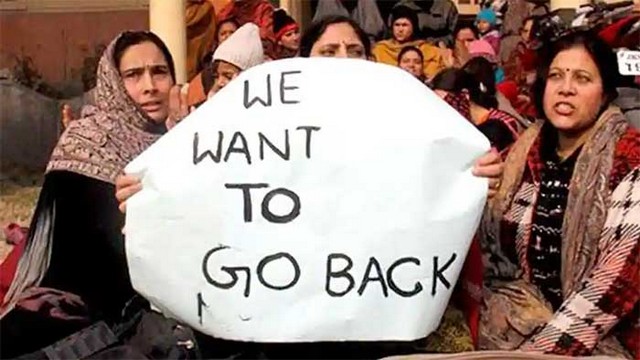
This January 2020, it is thirty years since the Kashmiri Pundits’ exodus from the Kashmir valley took place. They had suffered grave injustices, violence and humiliation prior to the migration away from the place of their social and cultural roots in Kashmir Valley. The phenomenon of this exodus had been due to the communalization of militancy in Kashmir in the decade of 1980s. While no ruling Government has applied itself enough to ‘solve’ this uprooting of pundits from their roots, there are communal elements who have been aggressively using ‘what about Kashmiri Pundits?’, every time liberal, human rights defenders talk about the plight of Muslim minority in India. This minority is now facing an overall erosion of their citizenship rights.

Time and over again in the aftermath of communal violence in particular, the human rights groups have been trying to put forward the demands for justice and rehabilitation of the victim minority. Instead of being listened to those particularly from Hindu nationalist combine, as a matter of routine shout back, where were you when Kashmiri Pundits were driven away from the Valley? In a way the tragedy being heaped on one minority is being justified in the name of suffering of Pundits and in the process violence is being normalized. This sounds as if two wrongs make a right, as if the suffering Muslim minority or those who are trying to talk in defense of minority rights have been responsible for the pain of Kashmiri Pundits.

During these three, many political formations have come to power, including BJP, Congress, third front and what have you. To begin with when the exodus took place Kashmir was under President’s rule and V. P. Singh Government was in power at the center. This Government had the external support of BJP at that time. Later BJP led NDA came to power for close to six years from 1998, under the leadership of Atal Bihari Vajpayee. Then from 2014 it is BJP, with Narerda Modi as PM, with BJP brute majority is in power. Other components of NDA are there to enjoy some spoils of power without any say in the policies being pursued by the Government. Modi is having absolute power with Amit Shah occasionally presenting Modi’s viewpoints.

Those blurting, ‘what about Kashmiri Pundits?’ are using it as a mere rhetoric to hide their communal color. The matters of Kashmir are very disturbing and cannot be attributed to be the making of Indian Muslims as it is being projected in an overt and subtle manner. Today, of course the steps taken by the Modi Government, that of abrogation of Article 370, abolition of clause 35 A, downgrading the status of Kashmir from a state to union territory have created a situation where the return of Kashmiri Pundits may have become more difficult, as the local atmosphere is more stifling and the leaders with democratic potential have been slapped with Public Safety Act, where they can be interned for long time without any answerability to the Courts. The internet had been suspended, communication being stifled in an atmosphere where democratic freedoms are curtailed which makes solution of any problem more difficult.

Kashmir has been a vexed issue where the suppression of the clause of autonomy, leading to alienation led to rise of militancy. This was duly supported by Pakistan. The entry of Al Qaeda elements, who having played their role against Russian army in 1980s entered into Kashmir and communalized the situation in Kashmir. The initial Kashmir militancy was on the grounds of Kashmiriyat. Kashmiriyat is not Islam, it is synthesis of teachings of Buddha, values of Vedant and preaching’s of Sufi Islam. The tormenting of Kashmiri Pundits begins with these elements entering Kashmir.

Also the pundits, who have been the integral part of Kashmir Valley, were urged upon by Goodwill mission to stay on, with local Muslims promising to counter the anti Pundit atmosphere. Jagmohan, the Governor, who later became a minister in NDA Government, instead of providing security to the Pundits thought, is fit to provide facilities for their mass migration. He could have intensified counter militancy and protected the vulnerable Pundit community. Why this was not done?

Today, ‘What about Kashmiri Pundits?’ needs to be given a serious thought away from the blame game or using it as a hammer to beat the ‘Muslims of India’ or human rights defenders? The previous NDA regime (2014) had thought of setting up enclosures of Pundits in the Valley. Is that a solution? Solution lies in giving justice to them. There is a need for judicial commission to identify the culprits and legal measures to reassure the Pundit community. Will they like to return if the high handed stifling atmosphere, with large number of military being present in the area? The cultural and religious spaces of Pundits need to be revived and Kashmiryat has to be made the base of any reconciliation process.

Surely, the Al Qaeda type elements do not represent the alienation of local Kashmiris, who need to be drawn into the process of dialogue for a peaceful Kashmir, which is the best guarantee for progress in this ex-state, now a Union territory. Communal amity, the hallmark of Kashmir cannot be brought in by changing the demographic composition by settling outsiders in the Valley. A true introspection is needed for this troubled area. Democracy is the only path for solving the emigration of Pundits and also of large numbers of Muslims, who also had to leave the valley due to the intimidating militancy and presence of armed forces in large numbers. One recalls Times of India report of 5th February 1992 which states that militants killed 1585 people from January 1990 to October 1992 out of which 982 were Muslims and 218 Hindus.

We have been taking a path where democratic norms are being stifled, and the promises of autonomy which were part of treaty of accession being ignored. Can it solve the problem of Pundits?

Ram Puniyani was a professor in biomedical engineering at the Indian Institute of Technology Bombay, and took voluntary retirement in December 2004 to work full time for communal harmony in India.

21 February 2020

Source: countercurrents.org

The Graveyard Talks Back

By Arundhati Roy

This is the text of the 2020 Clark Lecture in English Literature, instituted by Trinity College, Cambridge. Arundhati Roy is the first Indian writer invited to deliver it.

Thank you for inviting me to deliver this, the Clark Lecture, now in its one hundred and thirty-second year. When I received the invitation, I scrolled down the list of previous speakers, the many “Sirs” and Sir-sounding names who have spoken on topics as varied as “Literary criticism of the age of Queen Anne,” “Shakespeare as criticised in France from the time of Voltaire,” “The crowning privilege: professional standards in English poetry” and “Makers and materials: The poetry of Spenser, Shakespeare, Milton, Yeats, and Eliot.” In the cartoon version of this story, at this point the character playing me would furrow her brow, and her speech balloon would say, “Huh?” I was reassured when my eye fell on “Studies in American Africanism” by Toni Morrison, but only momentarily. I asked John Marenbon, who invited me, if I could look at the texts of some previous lectures, since I couldn’t find them on the internet. He most helpfully replied that speakers were never asked to deposit their lectures with Trinity, but that TS Eliot’s The Varieties of Metaphysical Poetry had evolved from his Clark lecture, as had EM Forster’s Aspects of the Novel.

In other words—No pressure.

This lecture has evolved from a series of recent talks I have given about the place for literature in the times in which we live and about the politics of language, both public and private. This makes my task a little slippery. It might occasionally involve the presumption that many of you are familiar with my work, which may not be the case and for which I apologise.

Graveyards in India are, for the most part, Muslim graveyards, because Christians make up a minuscule part of the population, and, as you know, Hindus and most other communities cremate their dead. The Muslim graveyard, the kabristan, has always loomed large in the imagination and rhetoric of Hindu nationalists. “Mussalman ka ek hi sthan, kabristan ya Pakistan!”—Only one place for the Mussalman, the graveyard or Pakistan—is among the more frequent war cries of the murderous, sword-wielding militias and vigilante mobs that have overrun India’s streets.

As the Hindu Right has taken almost complete control of the state, as well as non-state apparatuses, the increasingly blatant social and economic boycott of Muslims has pushed them further down the societal ladder and made them even more unwelcome in “secular” public spaces and housing colonies. For reasons of safety as well as necessity, in urban areas many Muslims, including the elite, are retreating into enclaves that are often hatefully referred to as “mini-Pakistans.” Now in life, as in death, segregation is becoming the rule. In cities such as Delhi, meanwhile, the homeless and destitute congregate in shrines and around graveyards, which have become resting places not just for the dead, but for the living, too. I will speak today about the Muslim graveyard, the kabristan, as the new ghetto—literally as well as metaphorically—of the new Hindu India. And about writing fiction in these times.

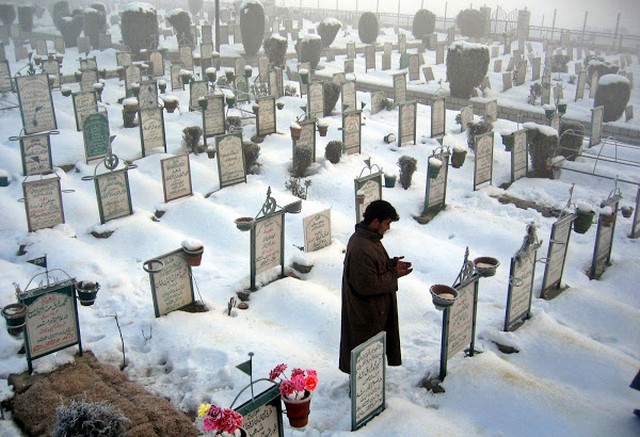
In some sense, The Ministry of Utmost Happiness, my novel published in 2017, can be read as a conversation between two graveyards. One, a graveyard where Anjum—born as a boy to a Muslim family in the walled city of Delhi—makes her home and gradually builds a guest house, the Jannat Guest House—the “Paradise” Guest House—and where a range of people come seeking shelter. The other, the ethereally beautiful valley of Kashmir, which is now, after thirty years of war, covered with graveyards, and in this way has become, metaphorically, almost a graveyard itself. So, a graveyard covered by the Jannat Guest House, and a Jannat covered with graveyards.

This conversation, this chatter between two graveyards, is and always has been strictly prohibited in India. In the real world, it is considered a high crime, treasonous even. Fortunately, in fiction, different rules apply.

Before we get to the forbidden conversation, let me describe for you the view from my writing desk. Some writers may wish to shut the window or move to another room. But I cannot. So you will have to bear with me, because it is in this landscape that I heat my stove and store my pots and pans. It is here that I make my literature.

Today marks the one hundred and ninety-third day of the Indian government’s shutdown of the internet in Kashmir. After months of having no access to mobile data or broadband, seven million Kashmiris, who live under the densest military occupation in the world, have been allowed to view what is known as a white list—a handful of government-approved websites. These include a few selected news portals, but not the social media that Kashmiris so depend on, given the hostility towards them of the mainstream Indian media, to put out their versions of their lives. In other words, Kashmir now has a formally firewalled internet, which could well be the future for many of us in the world. It’s the equivalent of giving a thirsty person water from an eyedropper.

The internet shutdown has crippled almost every aspect of daily life in Kashmir. The full extent of the hardship it has caused has not even been studied yet. It’s a pioneering experiment in the mass violation of human rights. The information siege aside, thousands of Kashmiris, including children, civil-society activists and political figures, are imprisoned—some under the draconian Public Safety Act. These are just the bare bones of an epic and continuously unfolding tragedy. While the world looks away, business has ground to a halt, tourism has slowed to a trickle, Kashmir has been silenced and is slowly falling off the map. None of us needs to be reminded of what happens when places fall off the map. When the blowback comes, I, for one, will not be among those feigning surprise.

Meanwhile, the Indian government has passed a new citizenship law that, even if intricately constructed, is blatantly discriminatory against Muslims. I have written about this at length in a lecture I delivered last November, so I will not elaborate on the law now—except to say that it could create a crisis of statelessness on a scale previously unknown. It is for the Rashtriya Swayamsevak Sangh—the wellspring of Hindu nationalism, and the parent of Narendra Modi’s Bharatiya Janata Party—what Germany’s 1935 Nuremberg Laws were for the Third Reich, conferring upon it the power to decide who was a rightful citizen and who wasn’t, based on specific documents that people were expected to produce to prove their heredity. That lecture, “Intimations of an Ending,” is one of the bleakest texts I have written.

Three months on, the bleakness has turned into cautious hope. The Citizenship (Amendment) Act was passed in parliament on 11 December 2019. Within days, students rose. The first to react were the students of Aligarh Muslim University and Delhi’s Jamia Millia Islamia. In response, riot police attacked the campuses with teargas and stun guns. Students were ruthlessly beaten, some were maimed, and one was blinded in one eye. Anger has now spread to campuses across the country and spilled over into the streets. Outraged citizens, led from the front by students and Muslim women, have occupied public squares and blocked roads for weeks together. The Hindu Right—which lavishes enormous energy on stigmatising the Muslim man as a woman-hating, terrorist jihadi, and even offers itself up as the saviour of Muslim women—is a little confounded by this brilliant, articulate and very female anger. In Delhi’s now iconic Shaheen Bagh protest, thousands, tens of thousands, and sometimes a hundred thousand people, have blocked a major road for almost two months. This has spawned mini Shaheen Baghs across the country. Millions are on the street, taking back their country, waving the Indian flag, pledging to uphold the Indian Constitution and reading out its preamble, which says India is a secular, socialist republic.

The anthem of this new uprising, the slogan that is reverberating through towns and college campuses and crossroads across the country, is a variation of the iconic chant of the Kashmiri freedom struggle, “Hum kya chahtey? Azadi!”—What do we want? Freedom! That slogan is the refrain within a set of lyrics that describes peoples’ anger, their dream, and the battle ahead. This is not to suggest that any one group can claim ownership of the Azadi slogan—it has a long and varied history. It was the slogan of the Iranian revolution, which recently celebrated its fortieth anniversary, and of a section of the feminist movement in our subcontinent in the 1970s and 1980s. But over the last three decades, it has, more than anything else, become known as the anthem of the Kashmiri street. And now, while Kashmir’s streets have been silenced, the irony is that its people’s refrain, with similar lyrics, rhythm and cadence, echoes on the streets of the country that most Kashmiris view as their coloniser. What lies between the silence of one street and the sound of the other? Is it a chasm, or could it become a bridge?

Let me read you a short elucidation of the Azadi chant from The Ministry of Utmost Happiness. The “I” in the text is Biplab Dasgupta, known to his friends—for reasons we need not go into here—as Garson Hobart. He is a suave, even brilliant, Indian intelligence officer serving in Kashmir. Hobart is no friend of the Kashmiri struggle. It’s 1996—one of the darkest periods of the armed uprising that raged in the valley through the 1990s. Hobart is trapped with the governor’s entourage in a national park on the outskirts of Srinagar. They are unable to return home because the city has been taken over by hundreds of thousands of mourners carrying their most recent batch of martyrs to the graveyard. Hobart’s secretary is on the phone, advising him not to return until the streets are taken back:

Sitting on the verandah of the Dachigam Forest Guest House, over birdsong and the sounds of crickets, I heard the reverberating boom of a hundred thousand or more voices raised together calling for freedom: Azadi! Azadi! Azadi! On and on and on. Even on the phone it was unnerving. … It was as though the city was breathing through a single pair of lungs, swelling like a throat with that urgent, keening cry. I had seen my share of demonstrations by then, and heard more than my share of slogan-shouting in other parts of the country. This was different, this Kashmiri chant. It was more than a political demand. It was an anthem, a hymn, a prayer. …

During those (fortunately short-lived) occasions when it was in full cry, it had the power to cut through the edifice of history and geography, of reason and politics. It had the power to make even the most hardened of us wonder, even if momentarily, what the hell we were doing in Kashmir, governing a people who hated us so viscerally.

To be sure, protesters in India are calling for an entirely different kind of Azadi—from poverty, from hunger, from caste, from patriarchy and from repression. “It is not azadi from India, it is azadi in India,” Kanhaiya Kumar, the charismatic young politician credited with popularising and re-tooling the chant for its use across India today, said after being arrested for sedition in 2016. On the streets, every one of us is painfully aware that even an atom of sympathy for the Kashmiri cause expressed even by a single person, even accidentally, will be met by nationalist hellfire that will incinerate not just the protests, but every last person standing. And if that person happens to be Muslim, it would be something exponentially worse than even hellfire. Because when it comes to Muslims, for everything—even parking tickets and petty crime—different rules apply. Not on paper, but effectively. That is how deeply unwell India has become.

At the heart of these massive, democratic protests over the anti-Muslim citizenship laws, therefore, inside this borrowed song from Kashmir, is an enforced, pin-drop silence over crimes committed in the Kashmir Valley. That silence is decades old, and the shame of it is corrosive. The shame must be shared not just by Hindu nationalists, not just by India’s entire political spectrum, but also by the majority of the Indian people, including many who are bravely out on the streets today. It’s a hard thing to have to hold in one’s heart.

But perhaps it’s only a matter of time before the cry for justice by the young on India’s streets will come to include a demand for justice for Kashmiris too. Perhaps this is why in the BJP-ruled state of Uttar Pradesh, the chief minister, Adityanath, seen by many as a Modi in the making, has declared the Azadi slogan to be treasonous.

The government’s response to the protests has been ferocious. Modi fired the starting gun with his trademark toxic innuendo. At an election rally, he said the protesters could easily be “identified by their clothes”—implying that they were all Muslim. This is untrue. But it serves to clearly mark off the population that must be punished. In Uttar Pradesh, Adityanath has, like some kind of gangster, openly vowed “revenge.” More than twenty people have been killed so far. At a public tribunal a few weeks ago, I heard testimonies of how police in the state are entering people’s homes in the dead of night, terrorising and looting them. People spoke of being kept naked and beaten for days in police custody. They described how hospitals had turned away critically injured people, how Hindu doctors had refused to treat them. In videos of the police attacking protesters, the slurs they use against Muslims are unspeakable, their muttered prejudice is almost more frightening than the injuries they inflict. When a government openly turns on a section of its own population with all the power at its disposal, the terror it generates is not easy for those outside that community to comprehend, or even believe.

Needless to say, political support for Adityanath has been forthright and unflinching. The president of the BJP in the state of West Bengal, who seems to be simultaneously envious and proud of the Uttar Pradesh model, boasted that “our government shot them like dogs.” A union minister in Modi’s cabinet addressed a rally in Delhi with shouts of “Desh ke gaddaron ko,” and the crowd screamed back, “Goli maaro saalon ko”—What’s to be done with the traitors to the nation? Shoot the bastards! A member of parliament said that unless the protesters of Shaheen Bagh were dealt with, they would enter homes and “rape your sisters and daughters”—which is an interesting idea, considering that the protesters of Shaheen Bagh are predominantly women. The home minister, Amit Shah, has asked people to choose between Modi, “who conducted airstrikes and surgical strikes on Pakistan,” and the “people who back Shaheen Bagh.”

Modi, for his part, has declared that it would take India only ten days to defeat Pakistan in military confrontation. It might sound like a non sequitur at a time like this, but it’s not. It’s his sly way of conflating the protesters with Pakistan. The whole country is holding its breath, waiting for more bloodshed, and perhaps even war.

As India embraces majoritarian Hindu nationalism, which is a polite term for fascism, many liberals and even communists continue to be squeamish about using that term. This notwithstanding the fact that RSS ideologues are openly worshipful of Hitler and Mussolini, and that Hitler has found his way onto the cover of an Indian school textbook about great world leaders, alongside Gandhi and Modi. The division in opinions on the use of the term comes down to whether you believe that fascism became fascism only after a continent was destroyed and millions of people were exterminated in gas chambers. Or whether you believe that fascism is an ideology that led to those high crimes—that can lead to those crimes—and that those who subscribe to it are fascists.

Let me spend a moment on the subtitle of my talk: “Fiction in the time of fake news.” Fake news is at least as old as fiction is—and, of course, both can often be the same thing. Fake news is the skeletal structure, the scaffolding over which the specious wrath that fuels fascism drapes itself. The foundation on which that scaffolding rests is fake history—possibly the oldest form of fake news. The history being peddled by Hindu nationalists, that hackneyed tale of spurious valour and exaggerated victimhood in which history is turned into mythology and mythology into history, has been very ably perforated and demolished by serious scholars. But the tale was never meant for serious scholars. It is meant for an audience that few serious scholars can hope to reach. While we laugh in derision, it is spreading like an epidemic and blossoming in the popular imagination like a brain-deadening malignancy. There is also something deeper, more disturbing, at work here, which I cannot dwell on, though I will gesture toward it. If any of my assertions startle you, please know that I have elaborated on them at length in a book called The Doctor and The Saint.

At the heart of Hindu nationalism and the cult of Hindu supremacy is the principle of varnashram dharm, the caste system, or what the anti-caste tradition calls Brahmanvad—Brahminism. Brahminism organises society in a vertical hierarchy based on a supposedly celestially ordained, graded scale of purity and pollution, entitlements and duties, and hereditary occupations. Right on top of the ladder are Brahmins, the embodiment of purity, the resting place of all entitlement. At the bottom are the “outcastes”—Dalits, once known as untouchables, who have been dehumanised, ghettoised and violated in unimaginable ways for centuries. None of these categories is homogenous—each is divided into its own elaborate universe of hierarchies. The principles of equality, fraternity or sorority are anathema to the caste system. It’s not hard to see how the idea that some human beings are inherently superior or inferior to others by divine mandate slides easily into the fascist idea of a master race. To escape the tyranny of Brahminism over the centuries, millions of Dalits and people from other subjugated castes converted to Islam, Sikhism and Christianity. So, the politics of Hindu majoritarianism and its persecution of minorities is also intricately intertwined with the question of caste. Even today, caste is the engine and the organising principle that runs almost every aspect of modern Indian society. And yet, so many celebrated writers, historians, philosophers, sociologists and filmmakers have collectively managed to produce a formidable body of work on India—work that is domestically as well as internationally applauded and handsomely rewarded—that either turns caste into a footnote or completely elides the issue. I would call that fake history, too. The great Project of Unseeing.

A fine example of this is Richard Attenborough’s Oscar-winning film, Gandhi, which was co-funded by the Indian government. The film is inaccurate to the point of being false about Gandhi’s time in South Africa and his attitude toward black Africans. Almost more disturbing is the complete absence of Bhimrao Ambedkar, who is easily as much or more of an icon in India as Gandhi is. Ambedkar, a Dalit from Maharashtra, was the man who challenged Gandhi morally, politically and intellectually. He denounced Hinduism and the caste discrimination it entailed, and showed Dalits a path out by renouncing the Hindu religion in favour of Buddhism. Both were extraordinary men, and the conflict between them has contributed greatly to our thinking today. While Gandhi’s views on caste were not inimical to those of the Hindu Right, his views on the place of Muslims in India were. That is what eventually led to his assassination by a member of the RSS. Still, what does it mean, this exalted, seriously falsified mythification of Gandhi and the erasure of Ambedkar in a government-sponsored—a Congress-government-sponsored—multimillion-dollar movie extravaganza that still forms the basis of most of the world’s idea of Gandhi and India’s freedom struggle? Yes, the film was made a long time ago, but where is the corrective—the other extravaganza that at least tries to tell the truth? Where are the big films about Kabir, Ravidas, Ambedkar, Periyar, Ayyankali, Pandita Ramabai, Jotiba and Savitribai Phule, and all those who fought against caste through the ages? There are Indian liberals who sternly castigate the British for leaving British colonialism out of their history books, but are guilty of exactly the same wrongdoing when it comes to the practice of caste.

In South Africa, Gandhi tried to distance dominant-caste, passenger Indians from oppressed-caste indentured labourers and black Africans, whom he often called “kaffirs” and “savages”—a campaign that he sustained for years. In 1894, he wrote in an open letter to the Natal legislature that Indians and the English both “spring from a common stock, called the Indo-Aryan.” This is the conceit of many dominant-caste Hindus even today. They like to think of themselves as a conquering race of Aryan descent. (This goes some way towards explaining their obsession with white skin and horror of dark skin.) And yet, when it comes to the Muslim question, they suddenly transform themselves into the aboriginal sons of the soil of the Hindu homeland, and mark Muslims and Christians off as “foreigners.”

To our paid-up Hindu fascists, known affectionately as the Sangh Parivar—the Family Collective—Muslims are the “internal enemy” whose real loyalties lie outside India. For many goodhearted liberals, Muslims are welcome guests, but guests nevertheless—burdened with the expectation of good behaviour, which is a terrible thing to thrust onto fellow citizens. It’s like giving women rights as long as they promise to be good—good mothers, sisters, wives and daughters. Even the most well-intentioned, progressive people often counter anti-Muslim slander by talking up Muslim patriotism. Many liberals, including some Muslims themselves, have described Muslims as Indians “by choice” and not by chance—suggesting that they chose to stay in India and not to move to Pakistan after Partition in 1947. Many did, many didn’t, and for many the choice simply did not exist. But to frame Indian Muslims as a people who are in India “by choice” draws a dangerous ring, a false bloodline, around a whole population, suggesting it has a less elemental relationship with the land—and could just as well live elsewhere. This plays straight into the binary of the Good Muslim–Bad Muslim, or the Muslim Patriot–Muslim Jihadi, and could inadvertently trap a whole population into having to redeem itself with a lifetime of regular flag-waving and Constitution-reading. It also inadvertently shores up the appalling logic of Hindu nationalists: Muslims have so many homelands, but Hindus only have India. The corollary to this, of course, is the well-known taunt thrown at Muslims as well as anyone else who challenges the Hindu nationalist view: “Go to Pakistan.”

Pakistan, Bangladesh and India are organically connected, socially, culturally and geographically. Reverse the Hindu nationalists’ logic, and imagine how it plays out for the tens of millions of Hindus living in Bangladesh and Pakistan. Hindu nationalism and Muslim alienation in India make these minorities extremely vulnerable. The new Citizenship (Amendment) Act, which pretends to welcome persecuted non-Muslim minorities from Pakistan, Afghanistan and Bangladesh—which suggests, ridiculously, that no Muslims are persecuted in those countries—will most likely endanger those minorities further. Across the border, “Go to India!” is likely to be the reaction to “Go to Pakistan!” The consequence of destabilising whole populations in this way can be genocide. We know this. We’ve been here before. We’ve gone through the bloodshed of 1947. It is a great misconception to believe that this current regime in India, with its bottomless ability to be ruthless, is remotely concerned about the persecution of anybody by anybody, Hindus included. In fact, persecution appears to animate it.

All of this is to say that the foundation of today’s fascism, the unacceptable fake history of Hindu nationalism, rests on a deeper foundation of another, apparently more acceptable, more sophisticated set of fake histories that elide the stories of caste, of women and a range of other genders—and of how those stories intersect below the surface of the grand narrative of class and capital. To challenge fascism means to challenge all of this.

Sometimes I feel—self-servingly perhaps, the way a surgeon has faith in surgery—that fiction is uniquely positioned to do this, because fiction has the capaciousness, the freedom and latitude, to hold out a universe of infinite complexity. Because every human is really a walking sheaf of identities—a Russian doll that contains identities within identities, each of which can be shuffled around, each of which may defy some and simultaneously comply with other “normal” conventions by which people are crudely and often cruelly defined, identified and organised. Particularly so in this feudal, medieval society of ours, one that is pretending to be modern yet continues to practise one of the most brutal forms of social hierarchy in the world.

I’m not talking here of fiction as exposé, or as the righter of social wrongs (pardon the pun). Nor do I mean fiction that is a disguised manifesto or is written to address a particular issue or subject. I mean fiction that attempts to recreate the universe of the familiar, but then makes visible what the Project of Unseeing seeks to conceal.

The Project of Unseeing works in mysterious ways. It can even appear in the seductive avatar of high praise. For example, in my first novel, The God of Small Things, published more than twenty years ago, sexual and emotional transgression across caste lines and the complicated relationship between caste and communism are central themes. Much has been said about the novel’s lyricism, its metaphors, its structure, its understanding of children’s minds. But except in Kerala, where the novel was very well understood and therefore ran into some hostility, the caste question tends to be glossed over, or treated as a class issue. As though Ammu and Velutha were Lady Chatterley and Oliver Mellors. This is to understand absolutely nothing about Indian society. Certainly, caste and class overlap, but they aren’t identical—as India’s many communist parties are discovering to their peril.

By the time I began to write The Ministry of Utmost Happiness, the direction things were heading in the subcontinent had become truly alarming. India and Pakistan had become nuclear powers, turning Kashmir into a possible nuclear flashpoint. (I fear that just as fascism will not be called fascism unless millions have been gassed in concentration camps, the nuclear threat will not be taken seriously until it is too late.) In India, the previously protected market had been opened to international capital. Neoliberal economic evangelists and Hindu nationalists had ridden into town on the same horse—a flaming saffron steed whose dapples were really dollar signs. The upshot of this is that while all our energies are spent trying to douse the bushfire of hatred, of human pitted against human, our forests and rivers are dying, our mountains are eroding, our ice caps are melting, and, even as the Indian economy is entering freefall, the combined wealth of the country’s 63 richest people outstrips the annual budget outlay for a nation of 1.3 billion people. By far.

Under these circumstances, how does one write? What does one write?

More often than not, the folks in my novels teach me how to think and what to write. I leave it to them.

Here is a section from the second chapter of The Ministry of Utmost Happiness. Anjum and Saddam Hussain, her friend and business partner, are on the roof of the Jannat Guest House. They’re having a lazy day, drinking tea and gazing at kites circling in the sky. Anjum, who is in her fifties and has lived in the graveyard for years, has just confronted young Saddam with the fact that she has always known he isn’t really Muslim. Saddam begins to tell her his story. He was born into a family of Dalit Chamars—skinners—in a village in Haryana. His parents named him Dayachand. A terrible experience—which I based on an actual incident in which five Dalits were lynched by a Hindu mob—caused him to run away from home. Rage and humiliation made him renounce Hinduism and convert to Islam. Enthralled by a video of Saddam Hussein of Iraq facing his executioners with complete equanimity—which he watches for inspiration on his cell phone from time to time—Dayachand changed his name to Saddam Hussain.

Saddam’s conversion to Islam is uncommon for our times. But only late last year, three thousand Dalits in a village in Tamil Nadu announced their intention to embrace Islam. In June, the village was rocked by the honour killing of a young couple, a Dalit girl and non-Dalit boy, by the boy’s brother. One night in December, a wall that the dominant castes had earlier built into the hillside—a caste wall, separating the Dalit settlement at the bottom of the hill from the rest of the village—collapsed onto the huts below and killed 17 people. It was unstable and structurally unsound, and people had protested against it, but to no avail. Ravichandran, the founder of a Dalit blog and YouTube channel—Dalit Camera: Through Un-Touchable Eyes—reported this story, and has also converted to Islam. He is now Abdul Raees.

For three thousand Dalits to convert to Islam now, when the political commentariat is abuzz with somewhat gleeful talk of the “Hinduisation” of Dalits, and right when the Modi government is moving to disempower and disenfranchise Muslims, is pure political dynamite. Even on the evidence of just this one example, how can we argue with Ambedkar’s call to his people to renounce Hinduism?

But here is young Saddam Hussain from The Ministry of Utmost Happiness, who, for reasons of his own, had made that move several years before. He is just beginning to tell Anjum his story. The saffron parakeets in the text are a euphemism for Hindu vigilantes, who often wear saffron headbands when they swarm:

“So we would go and collect the carcasses, skin them, and turn the hides into leather … I’m talking about the year 2002. I was still in school. You know better than me what was going on then … what it was like … Yours happened in February, mine in November. It was the day of Dussehra. On our way to pick up the cow we passed a Ramlila maidan where they had built huge effigies of the demons … Ravan, Meghnad and Kumbhakaran, as high as three-storeyed buildings—all ready to be blown up in the evening.”

No Old Delhi Muslim needed a lesson about the Hindu festival of Dussehra. It was celebrated every year in the Ramlila grounds, just outside Turkman Gate. Every year the effigies of Ravan, the ten-headed “demon” King of Lanka, his brother Kumbhakaran and his son Meghnad grew taller and were packed with more and more explosives. Every year the Ramlila, the story of how Lord Ram, King of Ayodhya, vanquished Ravan in the battle of Lanka, which Hindus believed was the story of the triumph of Good over Evil, was enacted with greater aggression and ever-more generous sponsorship. A few audacious scholars had begun to suggest that the Ramlila was really history turned into mythology, and that the evil demons were really dark-skinned Dravidians—indigenous rulers—and the Hindu gods who vanquished them (and turned them into Untouchables and other oppressed castes who would spend their lives in service of the new rulers) were the Aryan invaders. They pointed to village rituals in which people worshiped deities, including Ravan, that in Hinduism were considered to be demons. In the new dispensation however, ordinary people did not need to be scholars to know, even if they could not openly say so, that in the rise and rise of the Parakeet Reich, regardless of what may or may not have been meant in the scriptures, in saffron parakeet-speak, the evil demons had come to mean not just indigenous people, but everybody who was not Hindu. Which included of course the citizenry of Shahjahanabad.

When the giant effigies were blown up, the sound of the explosions would boom through the narrow lanes of the old city. And few were in doubt about what that was meant to mean.

One of the most prominent faces in the protests against the Citizenship (Amendment) Act is a young Dalit politician who heads the Bhim Army—named after Bhimrao Ambedkar. He calls himself Chandra Shekhar Aazad “Ravan.” He has chosen to not just honour but personify Ravan, Ram’s vanquished “demon” foe. What does that signify? It is an audacious declaration that at least some people view Hinduism—not just Hindutva, the Hindu-nationalist political ideology, but Hinduism, the religion—as a form of colonialism and cruel subjugation. Ravan is on the front pages of the papers, infuriating the government by making common cause with the Muslim community. He appeared late one night on the crowded steps of Delhi’s Jama Masjid, a night filled with shouts of “Jai Bhim!” and “Inquilab Zindabad!”—Long live Bhimrao Ambedkar, and Long live the revolution.

A precarious solidarity is evolving between Muslims and Ambedkarites and followers of other anti-caste leaders such as Jotirao and Savitri Phule, Ravidas and Birsa Munda, as well as a new generation of young Leftists who, unlike the older generation, place caste alongside class at the centre of their world view. It’s still brittle, still full of material and ideological contradictions, still full of suspicion and resentment, but it’s the only hope we have.

The trouble is that this fragile coalition is being slaughtered even as it is being born. The fake-news project—its history department, as well as its current-affairs desk—has been corporatised, Bollywoodised, televised, Twitterised, atomised, weaponised, WhatsAppised, and is disseminating its product at the speed of light. It’s all around us. It’s the weather we endure and the air we breathe. It’s the smell of spring and the winter chill. It’s what we see and hear and swim in. It’s the threat. It’s the promise. It’s the grey pillar that presses down on our hearts in our dreams and our waking hours. It’s what we react to and what we write against. And it’s what makes writing that most perilous of activities, whose consequences are not literary prizes or good or bad reviews. For some of us, every sentence, spoken or written, real or fake, every word, every punctuation mark can be torn from the body of a text, mangled and turned into a court notice, a police case, a mob attack, a television lynching by crazed news anchors—or, as in the case of the journalist Gauri Lankesh and so many less-well-known others, an assassination. Gauri was shot dead outside her home in Bangalore in September 2017. The last message she sent me was a photograph of her holding The Ministry of Utmost Happiness.

Assassination is the extreme end of the spectrum. Elsewhere on it are threats, arrests, beatings and, if you are a woman, fake videos and character assassination—She’s a whore, she’s a drunk! (Neither of which do I, personally, consider an insult.) And not to forget, the all-time favourite—She should be gang raped! Attacks on people with a profile, such as myself—whether they are wildly defamatory (or absolutely true: “She’s not a Hindu”), or physical assaults on meetings and stages, or legal harassment with false cases—are usually appeals for the attention of the BJP high command by political workers aspiring for a promotion. A kind of job application. Because it is well known that those who show this kind of initiative are often rewarded—lynchers are feted, those accused of murder become cabinet ministers. In keeping with this spirit, days before The Ministry of Utmost Happiness was published, a reasonably well-known Bollywood actor who is also a BJP member of parliament suggested that the Indian army tie me to a jeep and use me as a human shield in Kashmir, as it had recently done with a Kashmiri civilian. Mainstream television channels spent hours debating the pros and cons of his proposal. You can imagine how this kind of thing plays out in the minds of aspiring job-seekers. But we must remember to be kind, because the Indian economy being what it is, these are increasingly becoming the only jobs available.

All this is nothing compared to what millions of people in India are having to live through. I mention it only in order to think aloud about how this continuous, unceasing threat affects writers and their writing. Each one of us reacts differently, of course. Speaking for myself, as the pressure mounts and the windows are shut one by one, every cell of my writing brain seems to want to force them open again. Does that shrink or expand writers? Sharpen or blunt them? Most people, I imagine, believe it would restrict a writer’s range and imagination, steal away those moments of intimacy and contemplation without which a literary text does not amount to very much. I have often caught myself wondering—if I were to be incarcerated or driven underground, would it liberate my writing? Would what I write become simpler, more lyrical perhaps, and less negotiated? It’s possible. But right now, as we struggle to keep the windows open, I believe our liberation lies in the negotiation. Hope lies in texts that can accommodate and keep alive our intricacy, our complexity and our density against the onslaught of the terrifying, sweeping simplifications of fascism. As they barrel toward us, speeding down their straight, smooth highway, we greet them with our beehive, our maze. We keep our complicated world, with all its seams exposed, alive in our writing.

After twenty years of writing fiction and nonfiction that tracks the rise of Hindu nationalism, after years of reading about the rise and fall of European fascism, I have begun to wonder why fascism—although it is by no means the same everywhere—is so recognisable across histories and cultures. It’s not just the fascists that are recognisable—the strong man, the ideological army, the squalid dreams of Aryan superiority, the dehumanisation and ghettoisation of the “internal enemy,” the massive and utterly ruthless propaganda machine, the false-flag attacks and assassinations, the fawning businessmen and film stars, the attacks on universities, the fear of intellectuals, the spectre of detention camps and the hate-fuelled zombie population that chants the eastern equivalent of “Heil! Heil! Heil!” It’s also the rest of us—the exhausted, quarrelling opposition, the vain, nit-picking Left, the equivocating liberals who spent years building the road that has led to the situation we find ourselves in and are now behaving like shocked, righteous rabbits who never imagined that rabbits were an important ingredient of the rabbit stew that was always on the menu. And, of course, the wolves who ignored the decent folks’ counsel of moderation and sloped off into the wilderness to howl unceasingly, futilely—and, if they were female, then “shrilly” and “hysterically”—at the terrifying, misshapen moon. All of us are recognisable.

So, at the end of it all, is fascism a kind of feeling, in the way anger, fear or love are feelings, that manifests itself in recognisable ways across cultures? Does a country fall into fascism the way a person falls in love? Or, more accurately, in hate? Has India fallen in hate? Because truly, the most palpable feeling in the air is the barbaric hatred the current regime and its supporters show toward a section of the population. Equally palpable now is the love that has risen to oppose this. You can see it in people’s eyes, hear it in protesters’ song and speech. It’s a battle of those who know how to think against those who know how to hate. A battle of lovers against haters. It’s an unequal battle, because the love is on the street and vulnerable. The hate is on the street, too, but it is armed to the teeth and protected by all the machinery of the state.

The violence in Uttar Pradesh under Adityanath has not yet approached anything like the violence of the anti-Muslim pogroms in Gujarat in 2002 under its chief minister at the time, Narendra Modi. Uttar Pradesh is still a work in progress. Adityanath, unlike Modi, is still a prime minister-in-waiting. The 2017 election campaign that delivered him to power in Uttar Pradesh came to be known as the Kabristan-versus-Shamshan campaign. The BJP’s rabble-rousing, spearheaded by Modi himself, involved pitting Muslim graveyards against Hindu cremation grounds, and accusing the opposition of “appeasing” Muslims by developing one but not the other. This obsession with burial versus cremation runs deep. Babu Bajrangi, one of the lynchpins of the 2002 pogroms in Gujarat, was caught on camera in a sting operation by a journalist for Tehelka magazine boasting of his deeds and of his proximity to Modi: “We didn’t spare a single Muslim shop, we set everything on fire, we set them on fire and killed them … hacked, burnt, set on fire … because these bastards say they don’t want to be cremated, they’re afraid of it.” The tapes are still online.

Years after the massacre, Babu Bajrangi was convicted for the murder of 97 Muslims in the Naroda Patiya neighbourhood. He spent some years in jail but is out on bail now, on grounds of ill health, along with some fellow mass murderers. In all, the pogroms saw more than two thousand people murdered, dismembered, raped and burnt alive, and more than one hundred and fifty thousand driven from their homes. Just days ago, on 28 January 2020, the Supreme Court granted interim bail to 14 people convicted of burning 23 Muslims to death during the Gujarat pogroms. The chief justice has asked the government to find them useful “social and spiritual service.” The difficulty here is that, for many Hindu fascists, killing Muslims is considered social and spiritual service.

After the 2002 pogroms, Modi’s popularity soared. When, in 2014, he was sworn in as prime minister, many liberals—writers, journalists and public intellectuals—greeted him ecstatically as an embodiment of hope for a new India. Many are deeply disillusioned now, but their disillusionment only begins after 2014. Because questioning Modi’s deeds before that would involve questioning themselves. So Gujarat in 2002 is rapidly being erased from public memory. That ought not happen. It deserves a place in history, as well as in literature. Anjum ensures that.

In The Ministry of Utmost Happiness, Anjum gets caught by the mob in Gujarat. She is there with her father’s old friend Zakir Mian, who earns his living in a street-side stall in Old Delhi, making wedding garlands out of small currency notes folded into little birds. The two of them have gone on a little pilgrimage to the shrine of the poet Wali Dakhani. When they don’t return, even weeks after the murdering has tailed off, Zakir Mian’s son goes looking for his father. He finds Anjum in a refugee camp—doubly traumatised by having to live in the men’s section. She returns home with him but finds herself unable to cope with life as usual. She is unable to continue living in the Khwabgah, the House of Dreams in Old Delhi where she has lived for years with an adopted family of souls like herself, all having seceded from the “Duniya”—the real world. She is unable to get on with Ustad Kulsoom Bi, stern head of the Khwabgah. Unable to be a good mother to her foundling daughter, Zainab. So, Anjum packs her things and moves into the nearby graveyard, where her family is buried:

The smack addicts at the northern end of the graveyard—shadows just a deeper shade of night—huddled on knolls of hospital waste in a sea of old bandages and used syringes, didn’t seem to notice her at all. On the southern side, clots of homeless people sat around fires cooking their meagre, smoky meals. Stray dogs, in better health than the humans, sat at a polite distance, waiting politely for scraps.

In that setting, Anjum would ordinarily have been in some danger. But her desolation protected her. Unleashed at last from social protocol, it rose up around her in all its majesty—a fort, with ramparts, turrets, hidden dungeons and walls that hummed like an approaching mob. She rattled through its gilded chambers like a fugitive absconding from herself. She tried to dismiss the cortège of saffron men with saffron smiles who pursued her with infants impaled on their saffron tridents, but they would not be dismissed. She tried to shut the door on Zakir Mian, lying neatly folded in the middle of the street, like one of his crisp cash-birds. But he followed her, folded, through closed doors on his flying carpet. She tried to forget the way he had looked at her just before the light went out of his eyes. But he wouldn’t let her.

She tried to tell him that she had fought back bravely as they hauled her off his lifeless body.

But she knew very well that she hadn’t.

She tried to un-know what they had done to all the others—how they had folded the men and unfolded the women. And how eventually they had pulled them apart limb from limb and set them on fire.

But she knew very well that she knew.

They.

They, who?

Newton’s Army, deployed to deliver an Equal and Opposite Reaction. Thirty thousand saffron parakeets with steel talons and bloodied beaks, all squawking together:

Mussalman ka ek hi sthan! Qabristan ya Pakistan!

Only one place for the Mussalman! The Graveyard or Pakistan!

Anjum, feigning death, had lain sprawled over Zakir Mian. Counterfeit corpse of a counterfeit woman. But the parakeets, even though they were—or pretended to be—pure vegetarian (this was the minimum qualification for conscription), tested the breeze with the fastidiousness and proficiency of bloodhounds. And of course they found her. Thirty thousand voices chimed together, mimicking Ustad Kulsoom Bi’s [foul-mouthed pet parakeet] Birbal:

Ai Hai! Saali randi Hijra! Sister-fucking Whore Hijra. Sister-fucking Muslim Whore Hijra.

Another voice rose, high and anxious, another bird:

Nahi yaar, mat maro, hijron ka maarna apshagun hota hai.

Don’t kill her, brother, killing Hijras brings bad luck.

Bad luck!

Nothing scared those murderers more than the prospect of bad luck. After all, it was to ward off bad luck that the fingers that gripped the slashing swords and flashing daggers were studded with lucky stones embedded in thick gold rings. It was to ward off bad luck that the wrists wielding iron rods that bludgeoned people to death were festooned with red puja threads lovingly tied by adoring mothers. Having taken all these precautions, what would be the point of wilfully courting bad luck?

So they stood over her and made her chant their slogans.

Bharat Mata Ki Jai! Vande Mataram!

She did. Weeping, shaking, humiliated beyond her worst nightmare.

Victory to Mother India! Salute the Mother!

They left her alive. Un-killed. Un-hurt. Neither folded nor unfolded. She alone. So that they might be blessed with good fortune.

Butchers’ Luck.

That’s all she was. And the longer she lived, the more good luck she brought them.

She tried to un-know that little detail as she rattled through her private fort. But she failed. She knew very well that she knew very well that she knew very well.

The Chief Minister with cold eyes and a vermillion forehead would go on to win the next elections. Even after the Poet-Prime Minister’s government fell at the Centre, he won election after election in Gujarat. Some people believed he ought to be held responsible for mass murder, but his voters called him Gujarat ka Lalla. Gujarat’s Beloved.

Anjum lives in the graveyard for years, at first as “a ravaged, feral spectre, out-haunting every resident djinn and spirit, ambushing bereaved families who came to bury their dead with a grief so wild, so untethered, that it clean outstripped theirs.” Gradually, she recovers and begins to build a house for herself, each room enclosing a grave. This eventually turns into the Jannat Guest House. When municipal authorities say that it is illegal for squatters to live in the graveyard and threaten to demolish it, she tells them that she isn’t living in the graveyard—she is dying in it. The Jannat Guest House blossoms when Saddam Hussain—former mortuary worker, watchman and now small-time entrepreneur—arrives to live there with his horse, Payal. And when Anjum’s old friend, the blind Imam Ziauddin, moves in, the enterprise expands into the Jannat Guest House and Funeral Services. Guest rooms and funeral services are offered entirely on the whims of the CEO. Those whims are unashamedly partial to people and animals, living as well as deceased, for whom the real world—the Duniya—has no place.

Sometimes I feel that my world, too, is divided very simply into two kinds of people—those whom Anjum will agree to accommodate in her guest house or inter in her graveyard, and those she will not.

Anjum knows that the place she has created is not merely a physical shelter. It’s not your run-of-the-mill poorhouse. Because it is not only the poor and hard-done-by who gather around her. Here she is, explaining to Saddam Hussain the meaning of the place they call their home. The Biroo she refers to is her dog, whom she rescued off the streets:

“Once you have fallen off the edge like all of us have, including our Biroo,” Anjum said, “you will never stop falling. And as you fall you will hold on to other falling people. The sooner you understand that the better. This place where we live, where we have made our home, is the place of falling people. Here there is no haqeeqat. Arre, even we aren’t real. We don’t really exist.”

People come and go, live and die in the Place of Falling People. Life germinates between the graves. Anjum’s graveyard boasts a vegetable garden and even a small swimming pool for poor people. Even though it has no water, local people are proud of it and bring their children to see it. At funerals and weddings, all manner of prayers are murmured and sung, all manner of vows exchanged. They include a reading of the Islamic Fatiha, a recitation of Shakespeare’s Henry V and the singing of the Hindi translation of the “Internationale.”

One day, Dr Azad Bhartiya—Free Indian—tireless pamphleteer and hunger striker and steadfast friend to Falling People, reads Anjum a long letter, translating it into Urdu for her. The letter is from a Comrade Maase Revathy, the biological mother of a baby whom Anjum found abandoned in a place called Jantar Mantar—Delhi’s gathering place for protesters and hunger strikers, and home to Dr Azad Bhartiya, who has lived there on the pavement for seventeen years. Anjum adopts the baby and brings her to the graveyard. The letter Dr Bharatiya reads is a long account of the mother’s life as a guerrilla fighter in the forests of central India, the circumstances that led to the birth of her baby and the reasons that have compelled her to abandon it. At first, Anjum—who longs to be a mother—is hostile, because she cannot countenance the idea of a woman who has abandoned her child. But gradually she begins to listen to the story of this faraway woman, whose concerns are so different from her own but whose grief is just as wild and just as complicated. The letter ends with a Lal Salaam, a red salute:

“Lal Salaam Aleikum,” was Anjum’s inadvertent, instinctive response to the end of the letter. That could have been the beginning of a whole political movement, but she had only meant it in the way of an “Ameen” after listening to a moving sermon.

There it is then—between Anjum, Saddam and their companions, the political compact of today’s uprising, assembled in Anjum’s graveyard. Jai Bhim. Inquilab Zindabad. Lal Salaam Aleikum. But these are only the soul of the revolution. Not the revolution itself. Because there is none of the stuff of which revolutions are made in Anjum’s graveyard—not even the good ones. There are no flags. There is no flag-waving, no pledge-taking. No slogans. No hard borders between male and female, human and animal, nation and nation, or even life and death.

The presiding deity in the Jannat Guest House is Hazrat Sarmad, who blessed Anjum when she was a newborn. Hazrat Sarmad is a Jewish Armenian who travelled from Persia to Delhi three hundred years ago. He renounced Judaism for Islam and then renounced orthodox Islam for Love. He lived naked on the streets of Old Delhi, reciting poems of love until he was beheaded on the steps of Delhi’s Jama Masjid by the Mughal emperor Aurangzeb. Sarmad’s shrine is clamped like a limpet to the sheer face of the Jama Masjid. To Anjum and those who seek her shelter, Sarmad is the Saint of the Unconsoled, Solace of the Indeterminate, Blasphemer among Believers, Believer among Blasphemers. He is the battered angel who keeps watch over his battered charges, who holds the doors between worlds open—illegally—and who never allows the circle to close. And so it is that through that illegal crack, that unclosed circle, Kashmir comes drifting into Anjum’s graveyard. And the forbidden conversation begins.

Kashmir, the land of the living dead and the talking graves—city graveyards, village graveyards, mass graves, unmarked graves, double-decker graves. Kashmir, whose truth can only be told in fiction—because only fiction can tell about air that is so thick with fear and loss, with pride and mad courage, and with unimaginable cruelty. Only fiction can try and describe the transactions that take place in such a climate. Because the story of Kashmir is not only a story about war and torture and rigged elections and human-rights violations. It’s a story about love and poetry, too. It cannot be flattened into news.

Here is Musa Yeswi, architect and obsessive sketcher of horses. Musa, who wanders in and out of Anjum’s graveyard through the battered angel’s illegal portal. Musa, who struggles to hold on to some semblance of sanity as he is drawn inexorably into the vortex of Kashmir’s filthy war, and eventually disappears into its dark heart. Like many young men of his generation, circumstance drives him underground, where he morphs into many people, takes on many identities, attends his own funeral and barely knows who he really is any more. In a letter to Miss Jebeen, his five-year-old daughter who is killed when the security forces open fire on an unarmed procession, Musa describes her own funeral to her. He tells her about the sloth bear that came down the mountain, the hangul that watched from the woods, the kites that circled in the sky supervising everything and the one hundred thousand mourners who covered the ground like snow. “What I know for sure is only this,” he writes, “in our Kashmir the dead will live for ever; and the living are only dead people, pretending.” This is a description of Miss Jebeen’s funeral:

Miss Jebeen and her mother were buried along with fifteen others, taking the toll of their massacre to seventeen.

At the time of their funeral the Mazar-e-Shohadda was still fairly new, but was already getting crowded. However, the Intizamiya Committee, the Organizing Committee, had its ear to the ground from the very beginning of the insurrection and had a realistic idea of things to come. It planned the layout of the graves carefully, making ordered, efficient use of the available space. Everyone understood how important it was to bury martyrs’ bodies in collective burial grounds and not leave them scattered (in their thousands), like birdfeed, up in the mountains, or in the forests around the army camps and torture centres that had mushroomed across the Valley. When the fighting began and the Occupation tightened its grip, for ordinary people the consolidation of their dead became, in itself, an act of defiance. …

As the bodies were lowered into their graves the crowd began to murmur its prayer.

Rabbish rahlee sadree; Wa yassir lee amri

Wahlul uqdatan min lisaanee; Yafqahoo qawlee

My Lord! Relieve my mind. And ease my task for me

And loose a knot from my tongue. That they may understand my saying

The smaller, hip-high children in the separate, segregated section for women, suffocated by the rough wool of their mothers’ garments, unable to see very much, barely able to breathe, conducted their own hip-level transactions: I’ll give you six bullet casings if you give me your dud grenade.

A lone woman’s voice climbed into the sky, eerily high, raw pain driven through it like a pike.

Ro rahi hai yeh zameen! Ro raha hai asmaan …

Another joined in and then another:

This earth, she weeps! The heavens too …

The birds stopped their twittering for a while and listened, beady-eyed, to humansong. Street dogs slouched past checkposts unchecked, their heartbeats rock steady. Kites and griffons circled the thermals, drifting lazily back and forth across the Line of Control, just to mock the tiny clot of humans gathered down below.

This conversation between Anjum’s graveyard and Miss Jebeen’s, disallowed in the Duniya, the real world, cannot be prevented from taking place in our collective Khwabgah, our House of Dreams.

Just as I wrote that last line, a quiet little seven-year-old fellow called Esthappen, an interloper from another novel called The God of Small Things, came up to me and whispered in my ear, “If you eat fish in a dream, does it count? Does it mean you’ve eaten fish?”

But if that conversation between graveyards does not, cannot, or will not be allowed to take place in the Duniya—then perhaps this one, below, ought to be taken seriously.

Musa and Garson Hobart, the intelligence officer, now retired, meet after decades. As Musa leaves, Hobart walks down to the street with him to see him off. He wants to ask him one last question that has tormented him, and he knows that once Musa disappears he will never know the answer. It’s about Major Amrik Singh—a notorious army officer involved in a series of killings in Kashmir during the 1990s, one of which was thought to have been the custodial killing of Musa himself. When huge protests broke out against him, Amrik Singh vanished from Kashmir without a trace. Hobart knows that he was secretly spirited away by the Indian government, sent first to Canada from where he disappeared into the United States. He surfaced after some years when the fact that he had been arrested in California for domestic violence made the news. Months later, Singh and his family were found dead. He appeared to have shot himself, his wife and his children in their little suburban home. Hobart, whose own past and the story of the woman he loves are intricately connected with Amrik Singh, is not convinced of the official story. Based on wisps of evidence and some papers he has come across, he believes that Kashmir, and Musa in particular, had something to do with Amrik Singh’s tragic and gruesome end:

“Did you kill Amrik Singh?”

“No.” He looked at me with his green-tea-coloured eyes. “I didn’t.”

He said nothing for a moment, but I could tell from his gaze that he was assessing me, wondering if he should say more or not. I told him I’d seen the asylum applications and the boarding passes of flights to the US with a name that matched one of his fake passports. I had come across a receipt from a car-hire company in Clovis. The dates matched too, so I knew that he had something to do with that whole episode, but I didn’t know what.

“I’m just curious,” I said. “It doesn’t matter if you did. He deserved to die.”

“I didn’t kill him. He killed himself. But we made him kill himself.”

I had no idea what the hell that was supposed to mean.

“I didn’t go to the US looking for him. I was already there on some other work when I saw the news in the papers that he had been arrested for assaulting his wife. His residential address became public. I had been looking for him for years. I had some unfinished business with him. Many of us did. So I went to Clovis, made some inquiries and finally found him at a truck-washing garage and workshop where he would go to have his truck serviced. He was a completely different person from the murderer we knew, the killer of Jalib Qadri and many others. He did not have that infrastructure of impunity within which he operated in Kashmir. He was scared and broke. I almost felt sorry for him. I assured him that I was not going to harm him, and that I was only there to tell him that we would not allow him to forget the things that he had done.”

Musa and I were having this conversation out on the street. I had come down to see him off.

“Other Kashmiris had also read the news. So they began to arrive in Clovis to see how the Butcher of Kashmir lived now. Some were journalists, some were writers, photographers, lawyers … some were just ordinary people. They turned up at his workplace, at his home, at the supermarket, across the street, at his children’s school. Every day. He was forced to look at us. Forced to remember. It must have driven him crazy. Eventually it made him self-destruct. So… to answer your question… no, I did not kill him.”

What Musa said next, standing against the backdrop of the school gates with the painting of the ogre nurse giving a baby a polio vaccine, was like … like an ice-injection. More so because it was said in that casual, genial way he had, with a friendly, almost-happy smile, as though he was only joking.

“One day Kashmir will make India self-destruct in the same way. You may have blinded all of us, every one of us, with your pellet guns by then. But you will still have eyes to see what you have done to us. You’re not destroying us. You are constructing us. It’s yourselves that you are destroying. Khuda Hafiz, Garson bhai.”

The destruction—it has begun.

And, yes, if in a dream you’ve eaten fish, it means you’ve eaten fish.

— Arundhati Roy is the author of the novel The Ministry of Utmost Happiness. Her most recent book is a collection of essays, My Seditious Heart.

Note: Due to an ongoing dispute between the Trinity College Board of Trustees and the University of Cambridge’s University and College Union, and in deference to a request by the Union, this lecture was not delivered in person.

13 February 2020

Source: caravanmagazine.in

Egypt furious with Hamas over Haniyeh’s Iran visit

By Afro-Middle East Centre (AMEC)

Egypt is reportedly furious at Hamas’ leader Ismail Haniyeh after he and a delegation from Gaza attended the funeral of slain Iranian Quds Force commander, Qassem Soleimani. Haniyeh headed a Hamas delegation out of the besieged Gaza Strip on 2 December 2019, the first time that Egypt allowed him to leave the enclave since his election as leader of Hamas in 2017. He was meant to visit a number of countries as part of an international relations tour. Egypt approved the countries he would visit; Iran was not on the list. Haniyeh, however, attended Soleimani’s funeral and was the only non-Iranian to speak at the event, where he referred to the Iranian general as ‘the martyr of Jerusalem’. The Egyptians have allowed other members of the delegation to return to Gaza, but it is unclear whether Egypt will allow Haniyeh to leave again, when he returns. Hamas is also cagey about when its leader will make his way back or whether he will visit other countries not approved of by the Egyptians.

Egypt and Hamas relations become stronger after the fall of Hosni Mubarak’s regime during the 2011 uprisings. The one-year presidency of the Muslim Brotherhood’s Mohammed Morsi, from June 2012 to July 2013, saw flourishing relations between the Egyptian government and the authority in Gaza. Morsi had ordered the permanent opening of the Rafah crossing between Egypt and Gaza. Palestinians from Gaza were thus able to travel in and out of the territory without hindrance, and there was also an increase in trade, after years of prohibition. In a July 2013 coup, General Abdel Fattah El Sisi overthrew Morsi and accused Hamas of being a co-conspirator against the security and the stability of the Egyptian people. Reversing Morsi’s decision, he tightened the blockade on Gaza.

Relations improved in 2017 when Hamas elected a new leadership mostly based in Gaza, unlike the previous leadership that was based mostly in Qatar and headed by Khaled Mesha’al. Haniyeh quickly started talks with Egypt after he election. Hamas delegations frequently visited Cairo for reconciliation talks with other Palestinian factions, notably Fatah, facilitated by Egypt. Egyptian officials have also frequented Gaza for negotiations with Hamas over ceasefires with Israel and to discuss blockade restrictions imposed by Israel and Egypt. Relations further strengthened when Egypt agreed to a buffer zone between Gaza and the Sinai to prevent Islamic State (IS) group militants retreating into Gaza.

A critical aspect of Egypt’s relations with Hamas is the former’s strong ties to Israel and to the USA. In 2018, US President Donald Trump’s son-in-law and adviser, Jared Kushner, discussed with Egypt the creation of a trade zone and industrial projects in the northern Sinai and in Gaza as part of Trump’s touted ‘deal of the century’. To realise this plan, Egypt agreed that it would coordinate economic projects with Hamas. In 2019, Qatar announced that it would begin distributing funds to families in Gaza and pay for fuel for electricity generation as part of its National Committee for the Reconstruction of Gaza project. This followed indirect negotiations between Hamas and Israel, mediated by Egypt, which brought relief to 2 million besieged Gazans. This agreement had been concluded during a twenty-four day trip to Cairo by a Hamas delegation headed by Haniyeh in February 2019. It became clear that Egypt was willing to allow Haniyeh to travel out of Gaza but only for meetings in Cairo; he swiftly returned to the strip after every trip.

For his current trip, Haniyeh left Gaza on 2 December 2019 for Cairo, where he attended a number of meetings with Egyptian officials to negotiate a longterm ceasefire with Israel. This followed an exchange of fire between groups in Gaza and Israel, after Israel assassinated one Islamic Jihad (Bahaa Abu Al-Ata) leader in Gaza. After these meetings, Haniyeh’s delegation departed for his first international trip as Hamas leader. The trip’s schedule was agreed upon with Egypt, and included Qatar, where many former and current Hamas leaders are based, as well as Turkey and Malaysia.

The Egyptians told Haniyeh not to attend the Kuala Lumpur Summit in Malaysia on 18 December, following Saudi Arabia’s insistence. The Saudis viewed the Summit as Malaysia’s attempt to set up an alternative to the Organisation for Islamic Cooperation (OIC), which Saudi Arabia currently heads. Haniyeh obliged and sent a high-level delegation instead. Unimpressed, Egypt nonetheless conceded that Haniyeh had not violated the agreement. Egypt’s conditions included Haniyeh’s not visiting Iran.

When the head of the Quds Force unit of Iran’s Islamic Revolutionary Guard Corps, Qassem Soleimani, was killed by an American airstrike on 3 January, Egypt further warned Haniyeh not to attend his funeral. Haniyeh, however, defied the order. He also met with the newly-appointed Quds Force commander Esmail Ghaani, and, together with Islamic Jihad leader for an international relations trip, visited Soleimani’s home to express condolences.

Haniyeh’s trip to Iran angered the Egyptians to such an extent that they may not let him back into Gaza after he completes his trip, or prevent him leaving the territory again. Egypt also, in retaliation for Haniyeh’s insubordination, temporarily blocked the transfer of gas into Gaza. This resumed only after talks on 9 February. After these talks, little was mentioned about what the Egyptians had said about Haniyeh, who is still in Doha.

Although Hamas has denied that Egypt had been furious over the Iran visit, it is clear that relations between the two parties have been shaken. Egypt believes that since 2013 it has largely managed to exercise control over Hamas, in line with the wishes of Israel and Egyptian allies Saudi Arabia and the United Arab Emirates (UAE). Haniyeh’s Iran visit was, thus, an embarrassment for Egypt. Although Haniyeh’s trip to Iran might have been strategic from a Hamas point of view, it, however, throws the existing relationship with Egypt into murky waters. Egypt might further restrict the movement of goods and people through the Rafah crossing, in a form of collective punishments against Gaza’s residents.

Afro-Middle East Centre (AMEC)

20 February 2020

Source: www.amec.org.za

Open letter to Ms. Nicole Belloubet, Minister of Justice

I have just been interrogated on Thursday 13 February by the investigating judges, Ms. Camille Guillermet and Camille Palluel (Mr. Cyril Paquaux was absent). It’s the first time I had a hearing in fifteen months. I was able to tell the judges how shocked I was by the way in which the investigation is conducted: the sole purpose is to incriminate me; the exculpatory elements are ignored as well as the numerous requests submitted by my lawyer, Mr Marsigny. Some information have not been added to the file on time. Moreover, the judges do not take into account the Criminal Division’s conclusions, which are often damning for the plaintiffs.

I do respect the principle of separation of powers and I am not asking you here to intervene in the case. It is urgent, however, as Minister of Justice, that you enforce the rules of due process as well as the Judiciary’s code of ethics which require that the judges be independent, impartial and respectful of the defendant’s rights.

Following the #MeToo movements, I was the only accused person to be imprisoned for almost ten months, whose presumption of innocence was not respected though I gave myself in voluntarily on January 31, 2018, refusing to speak to the media and insisting that I will only speak to the police and the judges.

Today, the political class and the mainstream media condemn unanimously and rightfully so, the fact that sexual videos and messages of Mr. Benjamin Griveaux (former Minister and French government’s spokesperson) were made public on the Net. They are worried about the disastrous impact these publications could have on his family. What do you think, Minister, about the fact that the secrecy of the investigation was never respected in my case and that the media had direct access to the file. They published the crudest messages immediately after the interrogations without any consideration to my family. They also never bothered to verify the veracity of these messages since two of the plaintiffs admitted, before the Criminal Division, to have created accounts and falsified messages. Are these two treatments equal and fair?

It took less than 48 hours, in the case of Mr. Griveaux, for the alleged culprit of these publications on the Internet, Piotr Pavlenski, to be arrested by the police and taken into custody with his girlfriend. How can it be explained that, after more than 28 months of investigation, those named in my file and identified by the Criminal Division still have not been interrogated by the judges, despite repeated requests from my lawyer. The Israeli French paparazzi Jean-Claude Elfassi has been in contact with the five complainants, still according to the Criminal Division, for years. Three of the complainants publicly accuse him of lies, manipulation, and even fraud in my case. How can the investigating judges ignore such accusations and not interrogate this paparazzi who plays a central and troubled role in my case?

Caroline Fourest’s name appeared very early on in the file. According to the Criminal Division, she had exchanged more than 400 messages with the first two complainants between May 2017 (six months before the first complaint was lodged) and August 2018. The judges ignored my lawyer’s request to have access to the phone details in order to know the exact dates of these exchanges, and yet Ms. Fourest has still not been interrogated. Additionally, the prosecutor Michel Debacq confirmed in the French newspaper “Le Journal Du Dimanche”, February 6, 2018, that he had met “Christelle”, in 2009, in the company of Ms. Fourest. According to him “the facts were clear” and he had “Advised to file a complaint.” A judge on duty is obliged to report a crime, but Mr. Debacq remained silent. In fact, either the prosecutor has failed to carry out his duty and then must give some explanation, or he had not considered it to be an act of rape, and therefore he must make it public. To date, he has not been heard and we have not received any response to the letter sent to you to this effect by my previous lawyer, Mr Bouzrou.

I was indicted twice on Thursday, February 13, following an astounding interrogation of which the media has widely reported. “Elvira” filed a complaint in May 2019. The Prosecutor’s Office immediately, and without caution, added new prosecution’s charges on the basis of her statements alone, without conducting the slightest investigation. Upon investigation, the Criminal Division revealed that this woman had lied, that she had been repeatedly convicted and imprisoned for two years for slanderous accusation. It was Mr. Elfassi, the investigation found out, who forwarded the complaint to the police. However, the investigating judges, without drawing any lessons from the serious mishandling of the “Elvira” case, decided to indict me on the basis of two testimonies and, once again, before conducting any investigation.

None of these two women had yet filed a complaint. One of them disappeared while the second one lodged a complaint only two days before my court hearing. First, she told the police clearly that it was a “consensual relationship” and then gave a new version that is, word for word, carbon copy version of the first two complainants.

Confronted by an empty case, the judges introduced the concept of “psychological grip” which seems to be a last resort to save this investigation from the wreck. It is a question of giving a new definition of rape which will therefore apply only to me. It also represents another understanding of the law which justified the dismissal of the cases of MM. Darmanin, Hulot, Besson, Depardieu, etc. Does it seem plausible to you, Minister, that women who changed versions three times, parroted each other’s narrative, lied, know each other, are in contact with my enemies, plan to trap me (as revealed by the Criminal Division’s reports); does it sound plausible to you, that these women could be under a “psychological grip”? It is insane, and yet the judges have mandated Dr. Daniel Zagury to study the relevance of this concept in my case. Not only is the mission perplexing, but the choice of Dr. Daniel Zagury is troubling. The latter is a member of the scientific committee of the “Schibboleth” association which organizes its activities between France and Israel. The organisation’s ideological leanings and at least 16 of its members have publicly taken a stand against me, associating me with the “Muslim Brotherhood” which they consider as a sect, fascist and terrorist. As a member of the scientific committee, Dr. Zagury endorses the intellectual production that results from the conferences organized by Schibboleth who invariably considers me as an enemy. How could Dr. Zagury accept this mission? How could the judges have chosen him from hundreds of psychiatrists or psychologists who are just as competent and surely more ideologically neutral? As I reiterated to the judges, it would never occur to any impartial judge to request an expert opinion concerning a Tibetan pacifist resistant from a psychiatrist who is a member of an association affiliated with the Chinese government which considers this pacifist resistant as a de facto terrorist.

French justice is often criticized, on a European level, for the too frequent intrusion of politics in the judiciary. To this reality is added the danger of deviation due to the quasi-discretionary power exercised by the judges and which French lawyers justifiably complain about. For these two reasons, and in light of all the facts laid out, I ask you to take action to ensure that my rights are respected. I’m not asking for any favours, but I believe I am entitled to impartial, fair and equal treatment. The investigation must take into account all the exculpatory elements and all those named and involved in the case must be interrogated as soon as possible.

President Emmanuel Macron recently defended the right to blasphemy, regarding the Milla affair, by stating that “the republican order is not the moral order”. It would be grave and unacceptable that, in my case, the instrumentalization of the “moral order” with regards to my person, my thoughts and my actions, justifies the non-respect of the republican order which demands the equal treatment of all citizens regardless of their origin, colour, religion or social status.

Tariq Ramadan

19 February 2020

UN list of firms aiding Israel’s settlements was dead on arrival

By Jonathan Cook

Nazareth: After lengthy delays, the United Nations finally published a database last week of businesses that have been profiting from Israel’s illegal settlement activity in the West Bank.

The UN High Commissioner for Human Rights, Michelle Bachelet, announced that 112 major companies had been identified as operating in Israeli settlements in ways that violate human rights.

Aside from major Israeli banks, transport services, cafes, supermarkets, and energy, building and telecoms firms, prominent international businesses include Airbnb, booking.com, Motorola, Trip Advisor, JCB, Expedia and General Mills.

Human Rights Watch, a global watchdog, noted in response to the list’s publication that the settlements violate the Fourth Geneva Convention. It argued that the firms’ activities mean they have aided “in the commission of war crimes”.

The companies’ presence in the settlements has helped to blur the distinction between Israel and the occupied Palestinian territories. That in turn has normalised the erosion of international law and subverted a long-held international consensus on establishing a viable Palestinian state alongside Israel.

Work on compiling the database began four years ago. But both Israel and the United States put strong pressure on the UN in the hope of preventing the list from ever seeing the light of day.

The UN body’s belated assertiveness looks suspiciously like a rebuke to the Trump administration for releasing this month its Middle East “peace” plan. It green-lights Israel’s annexation of the settlements and the most fertile and water-rich areas of the West Bank.

In response to the database, Israeli Prime Minister Benjamin Netanyahu threatened to intensify his country’s interference in US politics. He noted that his officials had already “promoted laws in most US states, which determine that strong action is to be taken against whoever tries to boycott Israel.”

He was backed by all Israel’s main Jewish parties. Amir Peretz, leader of the centre-left Labour party, vowed to “work in every forum to repeal this decision”. And Yair Lapid, a leader of Blue and White, the main rival to Netanyahu, called Bachelet the “commissioner for terrorists’ rights”.

Meanwhile, Mike Pompeo, the US secretary of state, accused the UN of “unrelenting anti-Israel bias” and of aiding the international boycott, divestment and sanctions (BDS) movement.

In fact, the UN is not taking any meaningful action against the 112 companies, nor is it encouraging others to do so. The list is intended as a shaming tool – highlighting that these firms have condoned, through their commercial activities, Israel’s land and resource theft from Palestinians.

The UN has even taken an extremely narrow view of what constitutes involvement with the settlements. For example, it excluded organisations like FIFA, the international football association, whose Israeli subsidiary includes six settlement teams.

This week it also emerged that Amazon was aiding the settlements, though it is not named on the list. The online retail giant delivers for free to addresses in West Bank settlements, while imposing large shipping charges on Palestinians living nearby.

One of the identified companies, Airbnb, announced in late 2018 that it would remove from its accommodation bookings website all settlement properties – presumably to avoid being publicly embarrassed.

But a short time later Airbnb backed down. It is hard to imagine the decision was taken on strictly commercial grounds: the firm has only 200 settlement properties on its site.

A more realistic conclusion is that Airbnb feared the backlash from Washington and was intimated by a barrage of accusations from pro-Israel groups that its new policy was anti-semitic.

In fact, the UN’s timing could not be more tragic. The list looks more like the last gasp of those who – through their negligence over nearly three decades – have enabled the two-state solution to wither to nothing.

Trump’s so-called peace plan could afford to be so one-sided only because western powers had already allowed Israel to void any hope of Palestinian statehood through decades of unremitting settlement expansion. Today, nearly 700,000 Israeli Jews are housed on occupied Palestinian territory.

On Monday European Union foreign ministers met to respond to the plan, but predictably they agreed to postpone a decision until after Israel’s election on March 2. Tepid opposition is probably the best that can ultimately be expected.

The actions of several European states continue to speak much louder than any words.

Last Friday, Germany followed the Czech Republic in filing a petition to the International Criminal Court at The Hague siding with Israel as the court deliberates whether to prosecute Israeli officials for war crimes, including over the establishment of settlements.

Germany does not appear to deny that the settlements are war crimes. Instead, it hopes to block the case on dubious technical grounds: that despite Palestine signing up to the Rome Statute, which established the Hague court, it is not yet a fully fledged state.

So far Austria, Hungary, Australia and Brazil appear to be following suit.

But if Palestine lacks the proper attributes of statehood, it is because the US and Europe, including Germany, have consistently broken promises to the Palestinians.

They not only refused to intervene to save the two-state solution, but rewarded Israel with trade deals and diplomatic and financial incentives, even as Israel eroded the institutional and territorial integrity necessary for Palestinian self-rule.

Germany’s stance, like that of the rest of Europe, is hypocritical. They have claimed opposition to Israel’s endless settlement expansion, and now to Trump’s plan, but their actions have paved the way to the annexation of the West Bank the plan condones.

Back in November the European Court of Justice finally ruled that products made in West Bank settlements – using illegally seized Palestinian resources on illegally seized Palestinian land – should not be labelled deceptively as “Made in Israel”.

And yet European countries are still postponing implementation of the decision. Instead, some of them are legislating against their citizens’ right to express support for a settlement boycott.

Similarly, Europe and North America continue to afford the Jewish National Fund, an entity that finances settlement-building, “charitable status”, giving it tax breaks as it raises funds inside their jurisdictions.

The Israeli media is full of stories of how the JNF actively assists extremist settler groups in evicting Palestinians from homes in East Jerusalem. But Britain and other states are blocking legal efforts to challenge the JNF’s special status.

Soon, it seems, Europe will no longer have to worry about its hypocrisy being so visible. Once the settlements have been annexed, as the Trump administration intends, the EU can set aside its ineffectual agonising and treat the settlements as irrevocably Israeli – just as it has done in practice with the Israeli “neighbourhoods” of occupied East Jerusalem.

Then, the UN’s list of shame can join decades’ worth of condemnatory resolutions that have been quietly gathering dust.

A version of this article first appeared in the National, Abu Dhabi.

Jonathan Cook won the Martha Gellhorn Special Prize for Journalism.

19 February 2020

Source: countercurrents.org

Could The Latest Outburst Of Ankara’s Temper Lead To Escalation In Syria?

By Andre Vltchek

So far Turkey, militarily the second mightiest NATO country, has been able to get away with virtually anything it has chosen to brew in the Middle East.

The reason why, is simple: to confront Turkey’s bullying and expansionism militarily would be like confronting the United States or Israel; thousands of innocent people would die as a result, or perhaps even millions.

Moscow is well aware of the situation. Its diplomacy is superb. And its desire to keep Syria as one entity has gained admiration and support in many parts of the world. But not in the West, not in Israel and not in Ankara.

Periodically, Russia and Turkey are able to find common ground, on many issues. The people of both countries like each other a lot; there are great cultural, economic and strategic ties. And to give credit where it is due, both governments are ready to compromise, on various essential issues.

But periodically, there comes a time when the Turkish administration begins to acts irrationally and unpredictably. During such moments, agreements begin to collapse, and people die. Russia gets caught between a rock and the deep blue sea. Russia wants to resolve things peacefully, but it is also determined to protect its most important ally in the Middle East – Syria.

The problem is that while the Russian government is extremely rational, the Turkish government is often not. And when logic and hysteria meet, the consequences can be very dangerous.

*

In Damascus, most of the people analyze the situation with a clear mind. My government contacts in Syria wrote for this essay:

“Russia was invited to fight terrorism, by both Syrian government and by the Syrian people. Turkish forces are occupation forces. They were not invited by anybody. They cross into our territory, whenever they choose, and it is both immoral and illegal. Turkey supports terrorists here.”

My colleague, a leading Turkish intellectual,Erkin Oncan, and an expert on the Turkish-Russian relationship, commented for this essay from Istanbul:

“Erdogan has been playing a ‘balance game’ between the U.S. and Russia, since the coup attempt in 2016. Erdogan’s government has developed good relations with Russia. On the other hand, Turkey never ceased sending messages to the U.S.: We are your real allies in the Middle East; we, not the Kurds.”

For years, Turkish, Russian and Syrian analysts knew: Erdogan has been playing it both ways. Too much depended on Turkey’s involvement, both negative and positive things; but mostly negative. Even the United States handles Ankara with ‘silk gloves’, compared to how it deals with other rebellious allies.

Mr. Oncan continues:

“Turkey never raised level of tensions so high as now.”

“Despite everything, Russia was the best alternative for AKP’s ‘anti-American’ stand. Turkey developed serious economic and political relations with Moscow, and this ‘balance game’ was in favor of the alliance with Russia, at least for some time.”

“But, policy towards Syria has annulled Erdogan’s balance game. Because Erdogan’s ties with ‘the Syrian opposition’ became the essence of the AKP’s Syria strategy.”

“With the Sochi Agreement, it seemed that Erdogan was changing his approach towards Damascus. But since the accord was signed, it was obvious that AKP will be antagonistic to Sochi. Being against Assad, supporting the ‘Muslim opposition’, became domestic political issues, not just the foreign policy one.”

“Erdogan got suddenly stuck between his U.S.-Russia balance game and appetite for Syria.Then, an enormous problem re-emerged – jihadism.”

“It is a known fact that the AKP government has supported the jihadi terrorists for many years. And in the recent years, Turkey openly started to operate with the FSA. And the government kept forging closer and closer relations with increasingly radical cadres.”

“If Turkey complies with the Sochi agreement, it will have to leave theSyrian forces alone. And if it does that, it could befacing a big retaliation in both Syria (terrorist groups there) and Turkey itself. It is because Turkey has never hesitated to let the jihadists into the country.”

“If Turkey starts to formally negotiate with Syria, it will be viewed by many that itsmain pillar of the Middle East policy has collapsed.”

“In case that Turkey makes peace wit hits big brother – the U.S. – it would have to start negotiating with the YPG, the biggest enemy of Turkey and the biggest ally of the U.S. in Syria.”

“In this paradoxical and ambiguous situation, when both ‘Ottoman dreams’ and the ‘balance play’ are high on Erdogan’s agenda, Turkey seems to be levitating once again towards the U.S.A. If a compromise is reached with the U.S., Erdogan seems to consider speeding up his plans to invade Syria. Because Russia advocates the territorial integrity of Syria, the U.S.A. advocates the occupation.”

*

The chain of events is progressing with dizzying speed. On 16 February 2020, Aleppo, the largest Syrian city, was finally liberated by the Syrian government forces. Or more precisely: Aleppo is now out of the firing range of the terrorist and so-called opposition groups, for the first time in years.

A friend of mine, a Syrian educator, Ms. Fida Bashour, explained for this essay:

“The latest situation surrounding the Turkish occupation in our country is very serious. They have no right to occupy us, whatsoever. The mood in the country is one of victory and worry at the same time. It has been a very long, tough ten years since the war broke out. Nevertheless, we are winning. As our army has just secured the City of Aleppo fully today (on 16th February), we have faith in our capacity to prevail and recover fully.”

*

I met President Erdogan a long time ago, when he was still the mayor of Istanbul, and I was covering the Yugoslav War, visiting Turkey regularly, in order to understand the past of the Balkans. He was confusing then, as he is confusing now. As the mayor of one of the greatest cities on Earth, he had some good intentions and extremely impressive results.

His political goals have been, however, thoroughly confusing, overly ambitious, and often regressive.

Later, for years, I have worked in both Syria and Turkey, visiting the border region around Attakya and Gyazentep, on many occasions.

The Turkish involvement in Syria, its countless invasions and cross border operations, have destroyed entire villages and towns in both Syria and Turkey. In Syria, the destruction is both physical and economic. In Turkey, entire villages and towns have been de-populated, as they used to be fully dependent on trans-border trade, friendship and family ties.

Erdogan does not seem to care. It matters little to him that this area of conflict which he helped to ignite, is one of the cradles of human civilization.

Turkey, together with its Western allies both armed and trained, then injected some of the most brutal jihadi cadres into Syria. The most brutal of them are Uyghurs from the Northwest China, which the West trains in various battlegrounds, hoping that they will, one day, return to China and help to ruin the PRC.

The training has often been conducted, cynically, in so-called refugee camps. I covered this barbarity, both in my reports and in my film for the Latin American network TeleSur.

*

Patrick Henningsen is a leading global affairs analyst, co-founder and executive editor of 21 Century Wire, with an in-depth knowledge of Syria. He agreed to share his thoughts with me – about the recent developments in Syria, particularly the Turkish operations there:

“Turkey’s apparent schizophrenic behavior in the region is a byproduct of the country’s legacy national security issues combined with the current ruling party’s sweeping domestic reformist agenda which also has a strong revanchist component to it. Turkey’s primary security objective of crushing any and all Kurdish PKK/YPG enclaves in Syria cannot be divorced from the historic transition which is taking place domestically. The rightwing nationalist coalition of Erdogan’s AKP Party and the Party of Nationalist Movements (the Grey Wolves) are in the process of rolling back the secular Kemalist Republic – into a ‘New Turkey’ which is effectively an Islamist state. This Neo-Ottoman revival would like to see Turkey regain its former position at the center of the Islamic world, which means it has to project influence and power regionally, and also globally. This includes both talking and acting tough in Syria. It is also intervening in Libya too. Erdogan’s dedicated support of the Muslim Brotherhood and co-opting of fundamentalist Islamist militants like Jabat al-Nusra and the Free Syrian Army should be viewed as a tool to project power by proxy without having to sacrifice actual Turkish soldiers. The President’s pious nationalist base at home will support his calls conquest and regime change in Syria because they see Erdogan as a transformational populist leader who is returning Turkey to its rightful place in the world. Currently, Turkey is attempting a complicated dance routine between Russia, the US and NATO, pandering to all parties as is necessary, but always with Turkish interests in mind. While he may often be bluffing with periodic threats made to Syria, Russia and America, know that he is always doing so with his base in mind. It’s about ‘Turkey First’ and “Make Turkey Great Again.’ All of this makes for a very complicated state of affairs for Turkey. Dare we say, Byzantine.”

Nobody could have defined the situation better!

*

In 2019, at one point, when I was working with two Syrian commanders in Idlib province, we faced both the ISIS positions and Turkish observation posts.

I stood at one of the Syrian artillery locations. Russian soldiers were nearby, clearly visible. And so were the rural houses used as local ISIS headquarters.

It all felt grotesque.

The Russian forces could have wiped out these intruding Turkish installations in just a few seconds. The Syrian armed forces could have done the same. But they did not consider doing it. Why didn’t they?

“Why?” I asked.

A Syrian commander replied:

“If we do that, Turkey would attack Aleppo or Damascus, or at least Homs. They have one thing in common with the Americans and Israelis: they only care about their own lives, and their own losses. They believe that they are untouchable. They come here, occupy our land, and if we retaliate, they kill dozens of our people, or even hundreds.”

Tellingly, the Turkish positions in Idlib co-existed peacefully with ISIS.

The Turkish role in Syria, Iraq (Erbil area) and China (support for the Uyghur terrorists) is extremely destructive, and well documented.

Syria has to be fully liberated from the terrorist groups. It will happen, soon. In fact, it is happening right now. Turkey has zero legitimacy on the foreign, Syrian soil. It is strong, militarily. But it will not be allowed to brutalize the great Syrian nation for much longer, just because of its ruthless military might.

*

Andre Vltchek is a philosopher, novelist, filmmaker and investigative journalist.

19 February 2020

Source: countercurrents.org

Hiding money: US is a major hub of financial secrecy, says report

By Radmilla Suleymanova

The United States is the world’s most complicit country in helping individuals hide money from the rule of law, according to a new report from the Tax Justice Network (TJN). The network’s findings come as Angola accuses Africa’s wealthiest woman of siphoning public funds and moving the money offshore with the help of western consulting firms. The scandal has become known as the “Luanda Leaks”.

Isabel dos Santos, the daughter of Angola’s former president, is worth an estimated $2bn, according to Forbes magazine. The International Consortium of Investigative Journalists (ICIJ) claims dos Santos used an “army” of Western advisors to “hide assets from tax authorities”.

“Isabel dos Santos, too, took advantage of a US secrecy jurisdiction. The Luanda Leaks documents show that dos Santos used a Delaware company to buy property in Portugal. Delaware is one of the easiest places to create a low-taxed, secretive company,” said Fergus Shiel, Luanda Leaks project manager at the ICIJ.

Africa’s first female billionaire is accused of using international tax havens to move and store her assets. In a televised interview, dos Santos told Al Jazeera the allegations levied against her are untrue.

Calculating financial secrecy

In the “The Financial Secrecy Index”, TJN ranks nations by how much their financial systems allow people to hide and launder money extracted from other countries. The 2020 index found that the US increased its financial secrecy by 15 percent, and overtook Switzerland as one of the top destinations for people looking to hide money.

Now holding the top spot is the Cayman Islands, where financial secrecy jumped 24 percent.

The index ranks countries on a scale from 1 to 100. Zero means full transparency, while 100 means cloaked in full secrecy. The score is combined with the volume of financial activity conducted in the country by non-residents.

Also on the top 10 list are Hong Kong, Singapore, Luxembourg, Japan, the Netherlands, the British Virgin Islands and the United Arab Emirates. And while lower-income countries supply only one percent of financial secrecy measured, they are the most vulnerable to “feel the sting” of its consequences.

“Financial secrecy keeps drug cartels bankable, human trafficking profitable and tax abuse feasible,” TJN’s Mark Bou Mansour told Al Jazeera. “Secrecy causes communities in developing countries to lose vital funds while other communities get pumped with dirty money.”

There is some good news, however. The global total of all financial secrecy shrunk by seven percent since 2018, “meaning less room for money laundering, tax evasion and huge offshore concentrations of illicit and untaxed wealth”, according to the TJN report.

Hiding money in the UK and US

Increasing levels of financial secrecy in the US are largely due to the passing of a new law permitting the establishment of non-charitable private foundations without the need for disclosure, the report said. The US has also yet to sign onto the Common Reporting Standard, which is maintained by the Organisation for Economic Co-operation and Development (OECD) and which currently has 105 signatories.

Meanwhile, the United Kingdom increased its secrecy score by four points, more than any other country, with the trend extending to its network of satellite jurisdictions made up of Overseas Territories and Crown Dependencies. This includes the top-ranked Cayman Islands, as well as the British Virgin Islands, which ranked ninth, and Guernsey, which ranked 11th.

The report also claims OECD members are responsible for nearly half of the world’s financial secrecy.

Isabel dos Santos

The 2020 report ranks Angola as the second-most internally secretive country in the world. Angola is currently investigating former first daughter Isabel dos Santos as part of a campaign launched by President Joao Lourenco to root out corruption.

For the first time in the history of its financial secrecy rankings, TJN has placed Angola on its list.

Earlier this year, the ICIJ’s team of 120 reporters in 20 countries was able to trace “how an army of Western financial firms, lawyers, accountants, government officials and management companies helped [dos Santos and her husband] hide assets from tax authorities”.

“Based on a trove of more than 715,000 files, our investigation highlights a broken international regulatory system that allows professional services firms to serve the powerful with almost no questions asked,” said the ICIJ.

“What the Luanda Leaks shows is that secrecy aids the flow of money from poor countries to rich ones,” Sheil told Al Jazeera. The Luanda Leaks also highlights how that such secrecy can provide cover for unscrupulous deals.

“If the richest nations in the world, ones like the US, wanted to end the abuses afforded by secrecy, they could do so,” Shiel added.

Meanwhile, dos Santos has denied all accusations made against her.

“This is a very concentrated attack. It is an attack that has been very well coordinated. It’s an attack coordinated with foreign media that is working with the Angolan authorities to create a false perception of my business,” dos Santos told Al Jazeera.

Radmilla Suleymanova is a senior producer at Al Jazeera Digital.

19 February 2020

Source: www.aljazeera.com

Julian Assange Must Be Freed, Not Betrayed

By John Pilger

On Saturday, there will be a march from Australia House in London to Parliament Square, the centre of British democracy. People will carry pictures of the Australian publisher and journalist Julian Assange who, on 24 February, faces a court that will decide whether or not he is to be extradited to the United States and a living death.

I know Australia House well. As an Australian myself, I used to go there in my early days in London to read the newspapers from home. Opened by King George V over a century ago, its vastness of marble and stone, chandeliers and solemn portraits, imported from Australia when Australian soldiers were dying in the slaughter of the First World War, have ensured its landmark as an imperial pile of monumental servility.

As one of the oldest “diplomatic missions” in the United Kingdom, this relic of empire provides a pleasurable sinecure for Antipodean politicians: a “mate” rewarded or a troublemaker exiled.

Known as High Commissioner, the equivalent of an ambassador, the current beneficiary is George Brandis, who as Attorney General tried to water down Australia’s Race Discrimination Act and approved raids on whistleblowers who had revealed the truth about Australia’s illegal spying on East Timor during negotiations for the carve-up of that impoverished country’s oil and gas.

This led to the prosecution of whistleblowers Bernard Collaery and “Witness K”, on bogus charges. Like Julian Assange, they are to be silenced in a Kafkaesque trial and put away.

Australia House is the ideal starting point for Saturday’s march.

“I confess,” wrote Lord Curzon, Viceroy of India, in 1898, “that countries are pieces on a chessboard upon which is being played out a great game for the domination of the world.””

We Australians have been in the service of the Great Game for a very long time. Having devastated our Indigenous people in an invasion and a war of attrition that continues to this day, we have spilt blood for our imperial masters in China, Africa, Russia, the Middle East, Europe and Asia. No imperial adventure against those with whom we have no quarrel has escaped our dedication.

Deception has been a feature. When Prime Minister Robert Menzies sent Australian soldiers to Vietnam in the 1960s, he described them as a training team, requested by a beleaguered government in Saigon. It was a lie. A senior official of the Department of External Affairs wrote secretly that “although we have stressed the fact publicly that our assistance was given in response to an invitation by the government of South Vietnam”, the order came from Washington.

Two versions. The lie for us, the truth for them. As many as four million people died in the Vietnam war.

When Indonesia invaded East Timor in 1975, the Australian Ambassador, Richard Woolcott, secretly urged the government in Canberra to “act in a way which would be designed to minimise the public impact in Australia and show private understanding to Indonesia.” In other words, to lie. He alluded to the beckoning spoils of oil and gas in the Timor Sea which, boasted Foreign Minister Gareth Evans, were worth “zillions”.

In the genocide that followed, at least 200,000 East Timorese died. Australia recognised, almost alone, the legitimacy of the occupation.

When Prime Minister John Howard sent Australian special forces to invade Iraq with America and Britain in 2003, he – like George W. Bush and Tony Blair – lied that Saddam Hussein had weapons of mass destruction. More than a million people died in Iraq.

WikiLeaks was not the first to call out the pattern of criminal lying in democracies that remain every bit as rapacious as in Lord Curzon’s day. The achievement of the remarkable publishing organisation founded by Julian Assange has been to provide the proof.

WikiLeaks has informed us how illegal wars are fabricated, how governments are overthrown and violence is used in our name, how we are spied upon through our phones and screens. The true lies of presidents, ambassadors, political candidates, generals, proxies, political fraudsters have been exposed. One by one, these would-be emperors have realised they have no clothes.

It has been an unprecedented public service; above all, it is authentic journalism, whose value can be judged by the degree of apoplexy of the corrupt and their apologists.

For example, in 2016, WikiLeaks published the leaked emails of Hillary Clinton’s campaign manager John Podesta, which revealed a direct connection between Clinton, the foundation she shares with her husband and the funding of organised jihadism in the Middle East – terrorism.

One email disclosed that Islamic State (ISIS) was bankrolled by the governments of Saudi Arabia and Qatar, from which Clinton accepted huge “donations”. Moreover, as US Secretary of State, she approved the world’s biggest ever arms sale to her Saudi benefactors, worth more than $80 billion. Thanks to her, US arms sales to the world – for use in stricken countries like Yemen – doubled.

Revealed by WikiLeaks and published in The New York Times, the Podesta emails triggered a vituperative campaign against editor-in-chief Julian Assange, bereft of evidence. He was an “agent of Russia working to elect Trump”; the nonsensical “Russiagate” followed. That WikiLeaks had also published more than 800,000 frequently damning documents from Russia was ignored.

On an Australian Broadcasting Corporation programme, Four Corners, in 2017, Clinton was interviewed by Sarah Ferguson, who began: “No one could fail to be moved by the pain on your face at [the moment of Donald Trump’s inauguration] … Do you remember how visceral it was for you?”

Having established Clinton’s visceral suffering, the fawning Ferguson described “Russia’s role” and the “damage done personally to you” by Julian Assange.

Clinton replied, “He [Assange] is very clearly a tool of Russian intelligence. And he has done their bidding.”

Ferguson said to Clinton, “Lots of people, including in Australia, think that Assange is a martyr of free speech and freedom of information. How would you describe him?”

Again, Clinton was allowed to defame Assange – a “nihilist” in the service of “dictators” – while Ferguson assured her interviewee she was “the icon of your generation”.

There was no mention of a leaked document, revealed by WikiLeaks, called Libya Tick Tock, prepared for Hillary Clinton, which described her as the central figure driving the destruction of the Libyan state in 2011. This resulted in 40,000 deaths, the arrival of ISIS in North Africa and the European refugee and migrant crisis.

For me, this episode of Clinton’s interview – and there are many others – vividly illustrates the division between false and true journalism. On 24 February, when Julian Assange steps into Woolwich Crown Court, true journalism will be the only crime on trial.

I am sometimes asked why I have championed Assange. For one thing, I like and I admire him. He is a friend with astonishing courage; and he has a finely honed, wicked sense of humour. He is the diametric opposite of the character invented then assassinated by his enemies.

As a reporter in places of upheaval all over the world, I have learned to compare the evidence I have witnessed with the words and actions of those with power. In this way, it is possible to get a sense of how our world is controlled and divided and manipulated, how language and debate are distorted to produce the propaganda of false consciousness.

When we speak about dictatorships, we call this brainwashing: the conquest of minds. It is a truth we rarely apply to our own societies, regardless of the trail of blood that leads back to us and which never dries.

WikiLeaks has exposed this. That is why Assange is in a maximum security prison in London facing concocted political charges in America, and why he has shamed so many of those paid to keep the record straight. Watch these journalists now look for cover as it dawns on them that the American fascists who have come for Assange may come for them, not least those on the Guardian who collaborated with WikiLeaks and won prizes and secured lucrative book and Hollywood deals based on his work, before turning on him.

In 2011, David Leigh, the Guardian’s “investigations editor”, told journalism students at City University in London that Assange was “quite deranged”. When a puzzled student asked why, Leigh replied, “Because he doesn’t understand the parameters of conventional journalism”.

But it’s precisely because he did understand that the “parameters” of the media often shielded vested and political interests and had nothing to do with transparency that the idea of WikiLeaks was so appealing to many people, especially the young, rightly cynical about the so-called “mainstream”.

Leigh mocked the very idea that, once extradited, Assange would end up “wearing an orange jumpsuit”. These were things, he said, “that he and his lawyer are saying in order to feed his paranoia”.

The current US charges against Assange centre on the Afghan Logs and Iraq Logs, which the Guardian published and Leigh worked on, and on the Collateral Murder video showing an American helicopter crew gunning down civilians and celebrating the crime. For this journalism, Assange faces 17 charges of “espionage” which carry prison sentences totalling 175 years.

Whether or not his prison uniform will be an “orange jumpsuit”, US court files seen by Assange’s lawyers reveal that, once extradited, Assange will be subject to Special Administrative Measures, known as SAMS. A 2017 report by Yale University Law School and the Center for Constitutional Rights described SAMS as “the darkest corner of the US federal prison system” combining “the brutality and isolation of maximum security units with additional restrictions that deny individuals almost any connection to the human world … The net effect is to shield this form of torture from any real public scrutiny.”

That Assange has been right all along, and getting him to Sweden was a fraud to cover an American plan to “render” him, is finally becoming clear to many who swallowed the incessant scuttlebutt of character assassination. “I speak fluent Swedish and was able to read all the original documents,” Nils Melzer, the United Nations Rapporteur on Torture, said recently, “I could hardly believe my eyes. According to the testimony of the woman in question, a rape had never taken place at all. And not only that: the woman’s testimony was later changed by the Stockholm Police without her involvement in order to somehow make it sound like a possible rape. I have all the documents in my possession, the emails, the text messages.”

Keir Starmer is currently running for election as leader of the Labour Party in Britain. Between 2008 and 2013, he was Director of Public Prosecutions and responsible for the Crown Prosecution Service. According to Freedom of Information searches by the Italian journalist Stefania Maurizi, Sweden tried to drop the Assange case in 2011, but a CPS official in London told the Swedish prosecutor not to treat it as “just another extradition”.

In 2012, she received an email from the CPS: “Don’t you dare get cold feet!!!” Other CPS emails were either deleted or redacted. Why? Keir Starmer needs to say why.

At the forefront of Saturday’s march will be John Shipton, Julian’s father, whose indefatigable support for his son is the antithesis of the collusion and cruelty of the governments of Australia, our homeland.

The roll call of shame begins with Julia Gillard, the Australian Labor prime minister who, in 2010, wanted to criminalise WikiLeaks, arrest Assange and cancel his passport – until the Australian Federal Police pointed out that no law allowed this and that Assange had committed no crime.

While falsely claiming to give him consular assistance in London, it was the Gillard government’s shocking abandonment of its citizen that led to Ecuador granting political asylum to Assange in its London embassy.

In a subsequent speech before the US Congress, Gillard, a favourite of the US embassy in Canberra, broke records for sycophancy (according to the website Honest History) as she declared, over and again, the fidelity of America’s “mates Down Under”.

Today, while Assange waits in his cell, Gillard travels the world, promoting herself as a feminist concerned about “human rights”, often in tandem with that other right-on feminist Hillary Clinton.

The truth is that Australia could have rescued Julian Assange and can still rescue him.

In 2010, I arranged to meet a prominent Liberal (Conservative) Member of Parliament, Malcolm Turnbull. As a young barrister in the 1980s, Turnbull had successfully fought the British Government’s attempts to prevent the publication of the book, Spycatcher, whose author Peter Wright, a spy, had exposed Britain’s “deep state”.

We talked about his famous victory for free speech and publishing and I described the miscarriage of justice awaiting Assange – the fraud of his arrest in Sweden and its connection with an American indictment that tore up the US Constitution and the rule of international law.

Turnbull appeared to show genuine interest and an aide took extensive notes. I asked him to deliver a letter to the Australian government from Gareth Peirce, the renowned British human rights lawyer who represents Assange.

In the letter, Peirce wrote, “Given the extent of the public discussion, frequently on the basis of entirely false assumptions… it is very hard to attempt to preserve for [Julian Assange] any presumption of innocence. Mr. Assange has now hanging over him not one but two Damocles swords, of potential extradition to two different jurisdictions in turn for two different alleged crimes, neither of which are crimes in his own country, and that his personal safety has become at risk in circumstances that are highly politically charged.”

Turnbull promised to deliver the letter, follow it through and let me know. I subsequently wrote to him several times, waited and heard nothing.

In 2018, John Shipton wrote a deeply moving letter to the then prime minister of Australia asking him to exercise the diplomatic power at his government’s disposal and bring Julian home. He wrote that he feared that if Julian was not rescued, there would be a tragedy and his son would die in prison. He received no reply. The prime minister was Malcolm Turnbull.

Last year, when the current prime minister, Scott Morrison, a former public relations man, was asked about Assange, he replied in his customary way, “He should face the music!”

When Saturday’s march reaches the Houses of Parliament, said to be “the Mother of Parliaments”, Morrison and Gillard and Turnbull and all those who have betrayed Julian Assange should be called out; history and decency will not forget them or those who remain silent now.

And if there is any sense of justice left in the land of Magna Carta, the travesty that is the case against this heroic Australian must be thrown out. Or beware, all of us.

The march on Saturday, 22 February begins at Australia House in Aldwych, London WC2B 4LA, at 12.30pm: assemble at 11.30pm

John Pilger is an Australian journalist and documentary maker, based in London.

18 February 2020

Source: countercurrents.org

U.S. troops clash with villagers in Syria, teenager killed

By Countercurrents Collective

Media reports said: A Syrian was killed and another was wounded when villagers attacked U.S. troops and tried to block their way as their convoy drove through an army checkpoint in northeastern Syria. The incident prompted a rare clash.

Another report said: A Syrian teenager was killed while another man was injured during the altercation between U.S. troops and locals.

The altercation between Syrian villagers and U.S. troops drew in a large group of local residents and at one point, the U.S. troops opened fire on them, killing a 14-year–old boy and injuring another person.

Russian military police arrived at the scene and were able to quell the tensions before they could have spiraled into a major confrontation.

“Only thanks to the efforts of the Russian servicemen who arrived at the scene of the incident, it was possible to prevent a further escalation of the conflict with local residents,” the Russian military said.

Footage has emerged of U.S. troops getting involved in a heated exchange and a shootout with angry locals. A Russian military convoy then moved to de-escalate the situation.

Earlier, Syrian and Turkish media said U.S. warplanes had carried out at least one air strike subsequently. The coalition statement made no reference to any air strike.

Syrian state news agency SANA said the shooting was followed by an air strike on the village in rural Qamishli, near the border with Turkey.

Turkey’s state-owned Anadolu agency said there were two air strikes.

A large group of civilians tried to block the convoy from advancing any further.

The U.S. military said its force came under fire, and that troops responded in self-defense. It said an investigation of the incident was underway.

SANA said: Residents of a village had gathered at the checkpoint and pelted the U.S. convoy with stones.

A video posted on SANA’s website showed angry men firing small arms at a convoy of several armored U.S. vehicles flying the U.S. flag. Some residents pelted the convoy with stones, while another dumped a bucket full of dirt on the back of one vehicle.

In one of the worst incidents of violence against U.S. troops deployed in northeastern Syria, a small fire appears to ignite on an armored vehicle, apparently from fire bombs lobbed at the convoy. U.S. soldiers were seen standing in the middle of the melee, trying to disperse the crowd.

Other videos showed another vehicle stuck in the dirt, apparently having veered into a ditch, while another had a flat tire.

In one video, a resident walked up to U.S. soldiers at one of the vehicles, holding a U.S. flag, screaming: “What do you want from our country? What is your business here?” A soldier tells the shouting man to “back off.”

At that point, American troops fired live ammunition and smoke bombs at the residents, the reports said.

Video footage show people in civilian clothing – as well as in military uniforms – fire their Kalashnikovs in the direction of the U.S. armored vehicles. It remains unclear who opened fire first, as each side blamed the other for the shooting.

“What are nine armored vehicles doing in a peaceful village? They were confronted by the locals,” said Abdul Salah Bakri, a resident of the village, in a voice recording sent on an internet messaging application.

Residents said a Russian patrol from a contingent in Qamishli airport was sent to the village, which lies in an area in northeast Syria where Russian, U.S.-backed Syrian Kurdish forces and the Syrian army all have a presence.

The clash marked a rare confrontation involving U.S. and Syrian troops in the crowded region where Russian forces are also deployed and was certain to escalate tensions.

At one point during the incident, U.S., Russian and Syrian flags could be seen next to each other, reflecting the complicated terrain in northeastern Syria. Some reports said a Russian convoy arrived on the scene to defuse the tension.

Hundreds of U.S. troops are stationed in northeastern Syria. The U.S. carries out patrols in the area, but it was not immediately clear why the convoy drove into a government-controlled area Wednesday.

A U.S. military spokesperson said coalition forces conducting a patrol near Qamishli encountered a checkpoint occupied by Syrian government forces who ignored a series of warnings by coalition troops to de-escalate the situation. The patrol came under small-arms fire from unknown individuals, coalition spokesperson Myles Caggins said, adding that coalition troops returned fire in self-defense.

He said one U.S. soldier had “a minor superficial scratch while operating their equipment” and was back at work.

“The situation was de-escalated and is under investigation,” he said in a statement. Air Force Lt. Col. Carla Gleason, traveling with the U.S. defense secretary in Brussels, said no Americans were killed in the incident.

Asked about the incident, U.S. Secretary of Defense Mark Esper said in Brussels he was told there was an “altercation,” without providing details.

“As far as I know today’s incident did not involve the Russians,” he said.

The Syrian war, now in its ninth year, has pulled in international players including the U.S., Russia and Turkey. Russia supports Syria government, while Turkey is the rebels’ main backer.

13 February 2020

Source: countercurrents.org