Just International

In India What We Are Seeing Is The Symptoms Of Fascism: Noam Chomsky

By Karthik Ramanathan / Noam Chomsky

An interview I did with Noam Chomsky, Professor of Linguistics, University of Arizona at his office in Tucson. Noam Chomsky taught at MIT for over 50 years and is a leading critic of US foreign policy and an inspiration for many generations of human beings.

Audio can be a bit difficult, so best heard with a headset. Written transcript of the informal conversationfollows the video link:

A conversation with Noam Chomsky: Hindu Fascism, Kashmir and Changing the world

Karthik: One thing I wanted to talk about is, how much is what’s going on in the world, in terms of the right wing, right wing and neo-fascist groups in different countries.. how much of this thing..people seeing themselves as part of a particular nation or a tribe in a narrow way, how much do you think these fractures are the result of the fissures of the past ?

Noam Chomsky: Well, there is many factors. Each area has its own special history. India is not the same as Hungary, not the same as the United States.

(Someone knocking on door, disturbance).

One crucial factor over much of the world, certainly Europe and the United staes is the socio-economic policies that have been introduced since, basically since Reagan and Tatcher – marketization, public services, undermining the role of the state, transferring wealth and control to private hands. You take that and the effects are pretty obvious. There has been concentration of wealth and stagnation for the rest of the population. By now in the United States, 0.1 percent of the population have over 20 percent of the wealth and half the population have negative net worth, that means people just live week to week, that’s half the population.

Real wages in the United States have about the same purchasing power that they had in the 1970s. The sharp concentration of wealth automatically leads to a decline of functioning democracy because of the tendency of the wealthy to dominate the political process. I mean in Europe, its been exacerbated even further by the structure of the EU, which essentially takes decision making over major issues away friom the national states to the unelected bureaucracy in Brussels. On top of that they have the northern German banks looking over their shoulders. They have been following the austerity policies which make the neoliberal policies even worse.

The effects of all this are pretty detectable, lot of anger and resentment, bitterness, condemnation of the centrist political institutions that have been running things. Happens here too. It’s the kind of situation where some guy can come along, Trump, (inaudible) in Hungary, or Bolsonaro in Brazil, and try to turn this anger into real pathology.

Karthik: I certainly see your point, about the decimation of peoples aspiration in lives.I see that and recently, in recent years, I got involved with playing guitar. And I see a lot of people who are a lot more gifted musicians than me, but, but I can see that there is an underlying struggle that they are going through. But they still are very good at heart and they maintain their humanity. The reason I bring that up is because you are seeing decimation of the middle class here but I see an attempt to hold on to their humanity. To me, being somebody who comes from a lower middle class background in India – my dad is a teacher – sure India is a very poor country, but the Indian middle class, as an exception from the neo-liberal times, have gained in power and wealth in the last 20 years. But you are seeing, what is the reason that they are supporting these aweful Hindu fascist regimes ? Do you have any thoughts on that ?

NC: I don’t think its true that the middle-class has gained, its basically stagnating, the figures are pretty clear on that. As I say, in the United States, which is one of the most effective economies, its basically been no gains in 40 years for working people and petty bourgeouise. They are angry. And the anger can be exploited by somebody like Trump, who says its not your fault, it’s the fault of poor people, it’s the blacks, or Hispanics, or muslims. And Modi does the same thing. Turn the attention to extreme Hindu nationalism. They are taking our country away from us, get rid of these muslims.

Karthik: But that is the point I wanted to touch base on. I see the general dynamics of what is happening. I think its true in the United States. But I think in India it’s a more complicated picture. In India, the poor have become poorer, but the middle-class, the middle-class..

NC: Depends on what you mean by middle-class..

Karthik: Yes

NC: I mean teachers are middle-class, they are not better off..

Karthik: Yeah..hmm..

(interruption)

NC: The high-tech sector has gained. So, people who are involved with Engineering lets say, they have gained. But farmers, where there have been hundreds of thousands of suicides. They are not doing well.

Karthik: I totally agree with you that the rural sector is not doing well. But where there is.. I think… But between the Engineers and between the farmers, there is another sector. For example, you brought up teachers. The teachers inthe cities and in the wealthier states, they have also benefitted from the neoliberal policies..beacuse I believe it’s a fact that they have benefited because the state, the government has become more wealthier and more powerful. The sector [like] school teachers an in terms of the wealth they have…

NC: Have salaries increased, in terms of real wages, over the last 30 years?

Karthik: I do not have quantitative data, but I can state from, I can state from my personal observations, give that my dad is a teacher, that certainly, certainly, teachers today, in a place like Chennai, for example. They can make 900 to 1000 dollars a month, you know 40, 50, 60 thousand rupees a month. Which you could not aspire to, anywhere close, 30 years ago.

NC: Well, the country has become much richer.

Karthik: Yeah.

NC: But I I think the, I mean I haven’t looked into the details. But the inequality in India is huge.

Karthik: Absolutely. Absolutely. I agree with you on the increase in inequality. There is no question about that.

NC: That means that hundreds of millions of people are left out. That means, in India, you have 300 million people who are don’t even have access to potable water. That’s not a small number of people.

Karthik: That the economic conditions you point out certainly have validity. One aspect I wanted to talk about, you brought up the aspect of people being convinced by demagogues that its Pakistan or the Mexicans or some other enemy who is taking things from us. It also has a certain history of ignorance, in the sense that even during the 60s and 70s, even during the Congress times, when Congress was at the height of its power, Pakistan was always presented as an enemy.. And Kashmir was always presented as something that just belonged to India.

NC: As an enemy ?

Karthik: Pakistan was always presented as an enemy and Kashmir was always presented as something that just belongs to India. So, I think there is more than just the economics at play.

NC: I was giving talks in India about 16 years I guess.. And I happened to mention in one talk, the Indian repression in Kashmir after the fraudulent 1987 elections. The next day, I was giving a talk somewhere else, there was a big BJP demonstration and the rest of the time I was there, the people who were organizing my talk insisted I have police protection.

Karthik: I believe that was the first talk of yours I attended your talk and I believe it was in October of 2001 or somewhere in late 2001.

NC: Yea.. sounds about right.

Karthik: Because I remember having an email conversation with you subsequently.

NC: I see.

NC: Yea, the support for what Modi did in Kashmir is overwhelming among the Hindu population.

Karthik: Right. Yea, I think there is more than economics. I think the fissures, the minds of people have already been fissured by ignorance and propaganda.

NC: One thing that’s happened is the press has been pretty much muzzled. They are very uncritical.

Karthik: I’m going to check the camera to make sure that its recording, as I have very poor habits in terms of handling that machine.

NC: Unfortunately, we don’t have too much time.

Karthik: Yea, its recording. So, how much time… 10 minutes? 15 minutes ?

NC: 10 minutes. Keep going.

Karthik: You indicated in recent interviews, that whats we are seeing in the world is not Nazism. Eventhough there are parallels, its not exactly whats happening in Germany. Would you say that’s true in the case of India? Because India is building detention centers to house millions of Muslim citizens after them labeling them illegal immigrants.

NC: What we are seeing is the symptoms of fascism without the fascist ideology. Fascism meant something. It meant a powerful state, under the control of the Nazi or fascist party, which controlled everything. It even controlled business. We are not seeing that in India. The state does not control big business. And the same here. We have many of the aspects of fascism. Concentration camps at the border. You have many of the aspects of fascism. Concentration camps at the border, you know racism, and so on.. But business is not under control. [inaudible] they called it in Germany. The state is so powerful, it controlled not just labor of course, but business. Infact, every organization. There are signs of that. For example, when Trump orders every company to get out of China, there is a touch of that. But notice that they didn’t do it.

Karthik: Right. Right. They don’t have that kind of power yet.

NC: They don’t have that kind of power.

Karthik: So, do you think, you know, two questions. The first one: Did you notice that in Kashmir, you know P. Chidambaram, Mr. P. Chidambaram, who is the former home minister of India, a congress politician. As a home minister, he was administering the occupation of Kashmir. It was brutal but not as brutal as it is today.

NC: Congress has a rotten record on Kashmir.

Karthik: Right.

NC: Under Congress, there were massive atrocities in Kashmir.

Karthik: Right. Maybe you can give some other examples in the world. But he was celebrated when he was administering the occupation of Kashmir. But the moment he criticized the BJPs occupation of Kashmir, the moment he criticized it as reducing Kashmir to a “vassal state”, he’s been in prison.

NC: In prison?

Karthik: Yes, in prison, without charges.

NC: Well, I mean, the whole institutional structure of India, plus the great mass of the Hindu population, is evidently very supportive of the undermining of Kashmiri autonomy and opening up to Indian settlement. Kashmir is a prison right now, but its supported in India. I don’t think people know what is happening.

Karthik: How crucial do you think it is to restore a decent, some type of a decent government in this country..

NC: In this country ?

Karthik: .. in order to support struggles of the people, like the people of Kashmir ?

NC: In this country.

Karthik: How important do you think it is to have a government that more centrist, or center-left, or doesn’t have fascist undertones. How important do you think it is to have a government like that to support struggles abroad?

NC: If you look at the record, the more liberal governments have by no means supported movements for freedom and justice almost anywhere. They support freedom movements in enemy states, but not in countries that we support. They can be as repressive and brutal as they like. Rightwing can sometimes be a little worse, but it’s not that different.

Karthik: Yeah.

NC: Take say Obama. You look at the refugees fleeing from Central America. The plurality are from Honduras. Why? Because in 2009 there was a military coup that threw out a mildly reformist President. It was denounced throughout the continent, Obama and Clinton refused to denounce. And it turned into a horror story, people starting to flee.

Karthik: What will it take for people in the United States, for helping struggles, like the struggle for freedom in Kashmir and Palestine ?

NC: It will take major popular movements and they are hard to construct. I mean the worst crime since second world war was the invasion of Vietnam. It took years before you could get any popular protest. I mean in Boston, a pretty liberal city, we literally couldn’t have public demonstrations against the war, because it will be broken up by counter-demonstators. Until about 1967 and by that time, Vietnam had practically been destroyed. I mean I worked for many years, trying to get some opposition to the Indonesian invasion of East Timor, the worst genocide since second world war. And the US was backing it the whole time. Take say Turkey. In the 1990s, Turkey was carrying out massive repression and slaughter of Kurds. Almost all the arms were coming from Clinton. You couldn’t get any reporting and you couldn’t get any protests. To this day, nobody knows about it. There were a couple of people, I was one at the time. Its not easy.

Karthik: You mentioned about the Kurds. You know, you know, with this, I know you were against impeachment with regards the Russia investigation. In terms of the new situation that’s developed in regards to Ukraine, and that, do you think, there is a lof of excitement in democratic circles about impeachment. Do you think that it’s a good idea to focus big time on impeachment?

NC: No I don’t. Take a look at the issues that’s being focused in the impeachment. What are the crimes that’s being charged in the impeachment hearings? That he was looking for dirt on democrats. He was attacking the power system in the country. The same with Watergate. The major crimes of Clinton [Nixon], nobody cared about. He had a bunch of thugs break into the democratics party headquarters. You don’t attack powerful people. Because they fight back. But the major crimes, they don’t care.

Karthik: Right. In a way, you are seeing that about whats happening with the Kurds. That’s not going to be a reason for impeachment.

NC: No. That’s not a reason. In fact, when Lindsey Graham and others, condemn Trump for leaving the Kurds to the mercy of the Turks, what they are saying is this is going to harm the fight against ISIS. What about the Kurds? They don’t care about that.

Karthik: Does it also strike you that Lindsey Graham, the senator that you just mentioned, also compared the withdrawal from Kurdish areas to withdrawal from Iraq. Do the two comparisons make sense ?

NC: Look, when Saddam Hussein was carrying out chemical warfare attacks the Kurds in Iraq, the Regan administration supported it. They tried to blame it on Iran. When Congress tried to pass some resolution criticizing it, it was fought by the Regan administration. The kurds have been smashed and betraying them over and over again. Kissinger, Regan and this is nothing new I’m afraid.

Karthik: Right.

NC: I’m afraid I have to go. There is guy waiting out there.

Karthik: Thank you for your time Noam.

NC: Good to see you.

Karthik: Good to see you.

Karthik Ramanathan works in hi-tech for a living, based out of California.

21 January 2020

Source: countercurrents.org

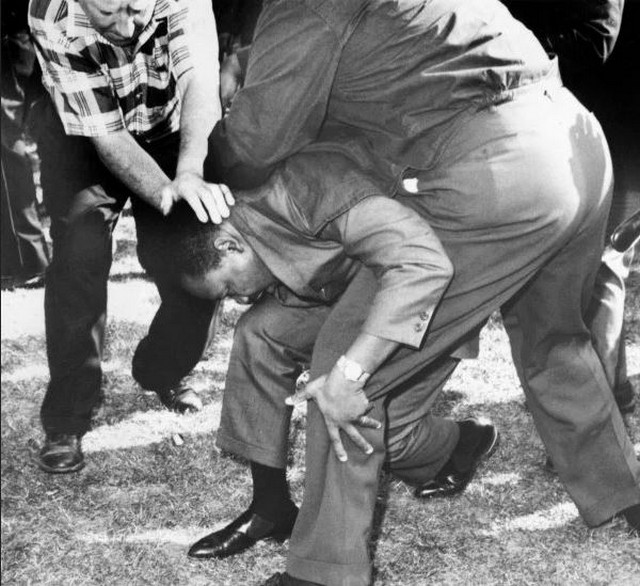
The Surprising Story Behind This Shocking Photo of Martin Luther King Jr. Under Attack

By Olivia B. Waxman

Though such was not the case during his lifetime, it’s uncontroversial today to note that Dr. Martin Luther King Jr. was an American hero of the civil rights movement, a hero whose birth is celebrated by Americans each year with the national Martin Luther King Jr. Day holiday. More than perhaps any other American, King has come to represent peace — which is just one reason why this image of him brought to his knees in Chicago is so shocking. The story behind the image makes it all the more so.

Though King’s early, more famous efforts for the civil rights movement were concentrated in the American South, from the Montgomery bus boycotts in the late 1950s to his work in Mississippi with the Freedom Riders, this photograph was not taken there. Instead, it dates to a period during which he experienced discrimination that was, in some ways, worse — after his shift to focus on Northern cities after the Voting Rights Act was signed on Aug. 6, 1965.

The tipping point for the shift? “The explosion in Watts really captured the attention of Dr. King,” says James R. Ralph Jr., professor of history at Middlebury College and an author of The Chicago Freedom Movement: Martin Luther King Jr. and Civil Rights Activism in the North.

Yet Chicago seemed like a logical starting point for his efforts in the North, as King later wrote, because, “It is reasonable to believe that if the problems of Chicago, the nation’s second largest city, can be solved, they can be solved everywhere.” To raise awareness of poor living conditions for the city’s African Americans, he himself moved into an apartment in Chicago’s West Side neighborhood of Lawndale. “We don’t have wall-to-wall carpeting to worry about, but we have wall-to-wall rats and roaches,” the Chicago Tribune reported King saying shortly after he moved in on Jan. 26, 1966. King called for “the unconditional surrender of forces dedicated to the creation and maintenance of slums.”

The Chicago campaign — the slogan for which was, at one point, simply “End Slums” — became known as the Chicago Freedom Movement, a collaboration between King’s Southern Christian Leadership Conference and Chicago’s Coordinating Council of Community Organizations. One of its leaders was James Bevel, who had been an architect of the Children’s Crusade that was part of the May 1963 March on Birmingham. That summer in Chicago, two marches helped get the word out about what local civil rights activists were fighting for.

On July 10, 1966, more than 30,000 braved the 98-degree heat wave to hear King speak at a rally at Soldier Field. “We are here because we’re tired of living in rat-infested slums,” he said. “We are tired of having to pay a median rent of $97 a month in Lawndale for four rooms while whites in South Deering pay $73 a month for five rooms… We are tired of being lynched physically in Mississippi, and we are tired of being lynched spiritually and economically in the North.”

Then the crowd followed King to City Hall, where he taped a list of demands to an entrance way. They included increasing the supply of housing options for low and middle-income families, rehabbing public housing amenities, and “Federal supervision of the nondiscriminatory granting of loans by banks and savings institutions.”

A few weeks later came a second march — the occasion for one of his most famous quotes from that campaign, as well as the shocking image seen above.

On Aug. 5, 1966, in Marquette Park, where King was planning to lead a march to a realtor’s office to demand properties be sold to everyone regardless of their race, he got swarmed by about 700 white protesters hurling bricks, bottles and rocks. One of those rocks hit King, and his aides rushed to shield him, as the photo shows.

“The blow knocked King to one knee and he thrust out an arm to break the fall,” the Chicago Tribune reported at the time. “He remained in this kneeling position, head bent, for a few seconds until his head cleared.”

Afterward, King told reporters, “I’ve been in many demonstrations all across the South, but I can say that I have never seen, even in Mississippi and Alabama, mobs as hostile and as hate-filled as I’m seeing in Chicago.”

The virulence of that hatred can be surprising in light of the fact that many African Americans had migrated North, to cities like Chicago, to flee the South. From the perspective of civil rights activists, Ralph argues, “You can argue it was easier to identify the visible problems and laws that were disenfranchising people in the South. In the North, it was more muddied, more difficult to find a single thread you can pull out.”

King expressed that idea when he looked at the hostility from the perspective of whites. “As long as the struggle was down in Alabama and Mississippi, they could look afar and think about it and say how terrible people are,” he wrote later in his autobiography. “When they discovered brotherhood had to be a reality in Chicago and that brotherhood extended to next door, then those latent hostilities came out.”

These fair housing demonstrations gradually started to take place in other nearby cities, such as Louisville and Milwaukee. The Chicago activists even got street gang members to serve as marshals at the 1966 open housing marches in an effort to redirect their energies. Among the campaign’s other accomplishments were efforts to organize tenant unions, so residents could stand up to landlords about things like peeling lead-based paint on their walls, and the launch of Jesse Jackson’s career, as he helped run the Windy City’s chapter of a campaign to combat discriminatory hiring practices.

President Lyndon B. Johnson signed the Fair Housing Act into law on April 11, 1968, one week after King’s death. Yet some experts see the Chicago campaign’s effectiveness as mixed, because the problems that the activists tried to combat there have not gone away.

“Did that legislation equalize opportunities? No, but it was an important step, and fair housing groups that had been working before then now had congressional backing,” as Ralph puts it. “Did it end the slums? No, so [the movement] was not successful that regard. But there were substantial strides taken forward.” Peter Ling, a Martin Luther King biographer, has called the Chicago campaign the civil rights leader’s “most relevant campaign” for today’s world.

As Claybourne Carson, editor of the King Papers, put it in his foreword to The Chicago Freedom Movement, the fact that these problems still exist are not King’s fault. “It is also,” he wrote, “the failure of those of us who have outlived him.”

16 January 2020

Write to Olivia B. Waxman at olivia.waxman@time.com.

Source: time.com

10 Years Ago, We Pledged to Help Haiti Rebuild. Then What Happened?

By Isabel Macdonald

12 Jan 2020 – Hundreds of millions in aid went to U.S. corporations and the U.S. military. A fraction went to Haitian institutions.

The earthquake that struck Haiti on Jan. 12, 2010, unleashed one of the worst humanitarian crises in decades. In hard-hit places like Port-au-Prince, Haiti’s capital and most densely populated city, schools and medical centers collapsed. More than 300,000 homes were damaged or destroyed. The disaster is estimated to have killed at least 220,000 Haitians and displaced 2.3 million—about a quarter of the population.

The crisis also unleashed an unprecedented humanitarian response. Charity groups, private individuals and governments around the world offered support. At a United Nations conference in New York on March 31, 2010, 58 donors pledged more than $8.3 billion to help Haiti “build back better,” reducing the nation’s vulnerability to future disasters. The United States made the biggest pledge of any nation, promising $1.15 billion. Then-U.S. Secretary of State Hillary Rodham Clinton emphasized Haiti’s urgent needs: safe homes, food security and basic services that were not broadly accessible even before the earthquake—including healthcare, potable water and a national system of sanitation.

A decade later, for many, conditions are still worse than before.

The U.S. Congress ultimately approved more than $1.6 billion for emergency humanitarian relief and more than $1.14 billion for recovery. The United States went on to finance other Haitian development projects, bringing the total in post-earthquake commitments to almost $4.16 billion.

But relatively little of the housing that was destroyed in hard-hit areas like Port-au-Prince has been rebuilt. More than 34,000 Haitians who lost their homes still live in displacement camps, and more than 300,000 Haitians have migrated to new slums just north of the capital that lack healthcare services and potable water. Many Haitian families have even less access to food. And there is still no functioning national sanitation system; more than 10,000 have died of cholera since the earthquake.

So where did all that aid money go?

To find out, In These Times reviewed U.S. government spending records and spent three weeks on the ground in Haiti in July 2019. Of the $1.6 billion committed to humanitarian relief, we found all of it bypassed Haitian institutions—and more than a third went directly to the U.S. military.

Of the $1.14 billion for recovery, more than a fifth was earmarked for the partial cancelation of debt to multilateral organizations such as the Inter-American Development Bank (IDB) and the World Bank. Another $10 million went to overhead for the U.S. Agency for International Development (USAID), the agency that channeled much of the recovery money.

Nearly a quarter of what remained—$202 million—was allocated to infrastructure projects, but not to rebuild Port-au-Prince or other hard-hit areas; they were to provide electricity, transportation and housing for a new industrial park in Caracol, a community in northern Haiti untouched by the earthquake. To date, the United States has committed $160 million of these funds and given an additional $15 million to the State Department to help build the park itself.

In These Times visited Caracol, where Haitian workers are paid $5.25 a day to sew clothing for American brands like Gap, Walmart and Target. We found it has introduced a host of new problems, including increased food insecurity, exposure to pollution, unlivable wages and workplace sexual harassment.

Rather than addressing Haiti’s needs, much of the recovery aid has instead made Haiti even more vulnerable to environmental disasters, including severe droughts intensified by climate change. As climate change exacerbates disasters around the world, this raises questions about the potential consequences of U.S. disaster aid for many other countries.

As the Haitian government acknowledged at the 2010 UN donors’ conference, the deadly toll of the earthquake was not caused by tremors alone. The dangerous conditions that followed are, in many ways, inseparable from the ongoing dynamics of Haiti’s colonial past.

Modern Haiti was founded in 1804 after the world’s only successful slave revolution, winning its independence from France after a century of brutal slavery. But France refused to recognize Haiti’s sovereignty until the nation paid its former colonizer an indemnity of 150 million gold francs, compensation for French “property” lost—including the enslaved people who won their freedom. Haiti paid the debt with high-interest loans—sometimes devoting 80% of its national budget to repayment—until 1947, which hamstrung the development of basic infrastructure and services.

The United States, for its part, failed to recognize Haiti’s sovereignty until after the Confederacy seceded. Since the U.S. first occupied Haiti—from 1915 to 1934, as part of a broader strategy to secure exclusive influence in the area surrounding the nearby Panama Canal—the United States has worked to reorient the country’s economic and political system to better serve U.S. and transnational corporations.

To this end, the United States supported the Duvalier dictatorships from 1957 to 1986. Then, in 1991, when the Haitian military ousted Haiti’s first democratically elected president, Jean-Bertrand Aristide, the United States covertly supported death squads targeting his supporters. The United States eventually agreed to Aristide’s return, on condition he implement neoliberal reform recommendations from the World Bank—a reversal of the platform Aristide campaigned on. Such policies, pushed on Haiti since the 1980s by aid donors and multilateral financial institutions, have undermined Haitian public services by slashing social spending and privatizing state enterprises. These reforms have also undermined the livelihoods of Haitian farmers by removing tariffs on food imports that previously protected them from unfair competition from U.S. agribusiness. These reforms, commonly referred to in Haiti as Plan Lanmò—“the death plan” in Creole—had catastrophic effects on Haitian agriculture, and precipitated a mass migration of Haiti’s rural population to cities like Port-au-Prince, thus contributing to the urban population density that has been cited as a factor in the earthquake’s deadly toll.

When Aristide was reelected in 2000, the United States successfully pressured the IDB to block a series of loans it had promised for Haiti, earmarked for healthcare and basic services, including potable water and education.

In 2004, the United States supported a second coup to remove Aristide and sent troops for another occupation, later supported by a UN stabilization effort known as the Mission des Nations Unies pour la stabilisation en Haïti, or Minustah.

Living in dangerously constructed homes in the overcrowded capital, without reliable healthcare or potable water, Haitians were, thanks in large part to years of neoliberal policy and ongoing U.S. interference, particularly vulnerable during both the earthquake and the cholera epidemic that followed.

At the 2010 UN donors’ conference, Clinton emphasized the need for donors to avoid bypassing Haitian public institutions. “It will be tempting to fall back on old habits—to work around the government rather than to work with them as partners,” she cautioned.

Despite Clinton’s warning, much aid exemplifies the same pattern. Of the $1.6 billion relief budget, none was allocated directly to any public Haitian institutions, according to the Congressional Research Office. By far the largest portion of this aid, $655 million (about 40%), was earmarked directly for the U.S. military, which received an additional $40.5 million from USAID.

The overwhelming majority of international donors followed suit. According to the UN Office of Paul Farmer, UN deputy special envoy for Haiti from 2009 to 2012, less than 1% of relief aid disbursed by donor nations and multilateral organizations by 2012 went to Haiti’s public institutions.

Farmer cautioned in 2011, “With … relief funding circumventing Haitian public institutions, the already challenging task of moving from relief to recovery—which requires government leadership, above all—becomes almost impossible.”

The earthquake destroyed many public buildings, undermining Haiti’s already weak public sector. Some Haitian institutions, however, did survive, and were arguably better positioned than the U.S. military to provide relief. For example, Haiti’s most important medical facility, General Hospital, remained standing. Haitian NGOs could likely have distributed food and water more quickly and to greater numbers than the U.S. military, whose operations were limited by language barriers and its self-imposed restriction to operate only in zones it deemed “secured.”

The U.S. Department of Defense (DOD) deployed 22,000 personnel, more than 300 aircraft and 33 ships to Haiti, instructed to “save lives” and “mitigate human suffering”—but the goals of military security and control seemed to take precedence. One of the military’s first actions was to seize control of air traffic at the main Port-au-Prince airport, a move the military claimed was necessary to ensure order—but also, as Haïti Liberté reported, blocked life-saving humanitarian relief supplies and emergency search and rescue personnel. As the New York Times reported, U.S. commanders turned away World Food Program flights “so that the United States could land troops and equipment, and lift Americans and other foreigners to safety.” One search and rescue team from the U.K. was blocked from landing, as were five planeloads of supplies for Doctors Without Borders, whose staff resorted to buying a saw from the local market for amputations.

More than a week after the earthquake, General Hospital still hadn’t received supplies and medicines needed to treat hundreds of dying patients. One doctor identified the disproportionate emphasis on security as “our major block to getting aid in.” While the U.S. military and the international response saved Americans and Western expats, journalists and researchers reported much of the work of digging out Haitian survivors from collapsed buildings was done, in fact, by other Haitians, often with bare hands.

About 6% of the U.S. relief money, $96.5 million, went to the U.S. State Department, which funded more soldiers and police for Minustah. Minustah’s infamous contribution to the relief effort is a deadly cholera epidemic, cholera being unknown in Haiti before October 2010. Despite the well-documented fact that Haiti lacked a basic sanitation system, cholera-infected Minustah soldiers from Nepal were housed at a military base whose sewage UN contractors dumped near important water sources, triggering the outbreak. After denying its role for years, the UN apologized in 2016.

The U.S. Coast Guard, which received $50 million for its role in the disaster response, deployed 16 cutters to patrol Haitian and international waters—to ensure, as Lt. Cmdr. Chris O’Neil, a Coast Guard spokesperson, told the Washington Times, that no one “try to enter the United States illegally by sea.” Meanwhile, the DOD flew one of its cargo planes over Haiti five days after the quake, broadcasting a loud, pre-recorded announcement in Creole: “If you think you will reach the U.S. and all the doors will be wide open to you, that’s not at all the case. They will intercept you right on the water and send you back home where you came from.”

The United States also awarded the private prison corporation GEO Group more than $540,000 to prepare for a “Haiti surge” through operations in Cuba, where the U.S. had recently prepared a migrant detention camp on its naval base in Guantanamo Bay. But Haitians did not flee their country in droves and, in fact, the number of Haitian migrants intercepted by the Coast Guard decreased the year after the disaster. More than 1.5 million homeless earthquake survivors, however, formed camps throughout Port-au-Prince during that same time. Many reported they received no humanitarian assistance whatsoever.

Ilna Saint Jean remembers all the crops her family used to grow where the Caracol Industrial Park now sits. On her half-hectare plot, the 60-year-old peasant farmer recalls, “We had yucca, corn, black beans, pigeon peas, okra, peanuts, all kinds of stuff.” This plot, in the farmland area referred to by locals as Tè Chabè, allowed Saint Jean to support her nine children. The community was untouched by the 2010 earthquake.

One year later, however, in January 2011, “everything was lost,” Saint Jean says. A Haitian government agent arrived without warning and removed her fence. The yucca, beans and other plants were soon entirely destroyed by roaming animals.

“They told us the land doesn’t belong to us, it’s the state’s land, it’s the foreigners’ land,” Saint Jean says. “They came and took the land, they cemented it, and they made that industrial park on it.”

Saint Jean is one of 442 peasant farmers who lost their crops and their farmland in the evictions for the industrial park.

While supporters describe the industrial park as a flagship project of post-earthquake recovery, the plans for it had actually been discussed months before the disaster, at a trade conference convened by the IDB and the William J. Clinton Foundation, a nonprofit founded and directed by former President Bill Clinton. Such industrial parks are central to the neoliberal economic model the U.S. government has pushed for decades. This model has long held that low-wage sectors like garment manufacturing are a necessary stepping stone to prosperity for countries like Haiti, and that governments should offer tax breaks and incentives for private corporations to set up shop. Unfortunately, because these factories pay workers so little, they can also exacerbate pre-existing economic and social inequalities. Moreover, garment manufacturing is often detrimental to local communities and environments, given its high water requirements and polluting waste.

The U.S. government has championed garment manufacturing as a viable economic development strategy for Haiti since the 1970s, proclaiming Haiti could become “the Taiwan of the Caribbean.” With U.S. support, employment in the garment industry—which, at the time, had largely been concentrated in Port-au-Prince—peaked in the 1980s. Partly because of the extremely low wages, however, these factories never kickstarted the promised economic boom. They also spurred the rise of slums, attracting tens of thousands of job-seekers to Port-au-Prince who could not afford standard housing.

Despite these problems, the U.S. continued to create incentives for the Haitian garment industry. HOPE II, a 2008 trade deal between the United States and Haiti, allows Haitian-made textiles to enter the U.S. without tariffs, an attractive lure for companies from around the world.

The Haitian government’s Action Plan for National Recovery and Development, unveiled at the March 2010 UN donors’ conference, articulated a vision of reconstruction based on a more just society, capable of meeting Haitians’ basic needs, with an emphasis on housing and environmentally sustainable projects. But it also included more industrial parks for such sectors as textile production.

The Interim Haiti Recovery Commission, an international body mandated to ensure accountability in the post-earthquake rebuilding and co-chaired by Bill Clinton, approved the construction of the Caracol park. Hillary Clinton’s State Department recruited Sae-A, a major Korean garment manufacturer, as its anchor tenant.

The Haitian government agreed to provide the land, the IDB offered $100 million for construction, and the United States pledged $124 million for a power plant, a new port (later cancelled), and a housing project. Sae-A committed $78 million to the project and predicted 20,000 new jobs, scoring free facilities and tax breaks in exchange.

Before the deal was signed, the AFL-CIO warned the U.S. government about Sae-A’s record of “acts of violence and intimidation” in Guatemala, where it closed its flagship factory in 2011, after threatening to leave the country following a dispute with a local union.

Environmentalists also raised concerns about water and waste, given the site was on some of Haiti’s most fertile farmland and close to Caracol Bay, a fragile marine ecosystem home to critically endangered species and an important source of food and income for many in Caracol. The mayor of Caracol was not informed of the project until after the site had been decided. The U.S. consulting firm that proposed the site, Koios Associates, later admitted it had not carried out an environmental assessment; upon review, the consultants rated the project “high risk” and recommended either a change of location or to just end the project altogether.

The project’s backers charged forward.

The industrial park opened its doors in 2012. Seven years later, In These Times visited Caracol to find the labor and environmental concerns were well founded. Through interviews with factory workers and evicted peasant farmers, union reps and a local environmental group, it emerged that this U.S.-backed project created a host of new problems for thousands of Haitians.

Land rights have been a focal point of Haiti’s long struggle to maintain its independence since 1804. In the first U.S. military occupation (1915–34), authorities rewrote Haiti’s constitution to remove a popular provision that limited land ownership to Haitian nationals. Thousands of peasant farmers were subsequently displaced in areas such as Tè Chabè, where the Caracol Industrial Park now sits, so that large swaths of land could be deforested for U.S. agribusiness plantation crops like sugar and sisal. Haitian farmers finally reclaimed the land after the 1986 uprising that led to the fall of the brutal U.S.-backed Duvalier dictatorships.

Many of the farmers evicted for the Caracol Industrial Park had been farming there since the late 1980s. The site’s 608 acres had provided a living for 442 families, supporting an estimated 4,000 people in the area.

While a few farmers owned their plots, most simply had customary rights to the land—which should have been respected under Haitian and international law, according to ActionAid, an international nonprofit that has been working to support the displaced farmers. For most of these farmers, the land seized for the park was one of the only forms of financial security available, according to Wilson Menard, a 53-year-old peasant farmer and representative of a community organization the farmers founded, Kolektif Peyizan Viktim Tè Chabè. One’s access to a piece of land could always be traded for money, Menard explains, acting like an insurance policy or emergency savings. For this reason, Menard, who was himself evicted from the land, says, “Losing a piece of land, it has a huge consequence.”

The seized land was some of Haiti’s most fertile. Dense green foliage of mango and plantain trees peeks over the top of the concrete perimeter wall surrounding the park. Many farmers used this land not only to grow a rich array of crops, but to keep livestock—another crucial source of financial security, Menard explains, as a cow can always be sold.

Since the park opened, the price of the remaining land in the area has skyrocketed, making it impossible for most of the displaced farmers to rent or buy a piece. Moreover, the remaining land is much less fertile than what was paved over. While Menard has been able to sublet a small plot outside the park, two of his three cows died in the drought of 2018–19; he is adamant the animals would have survived on the Tè Chabè land, where there was enough foliage to sustain grazing animals even during drought. Before the evictions, he says, “Animals didn’t die like that.”

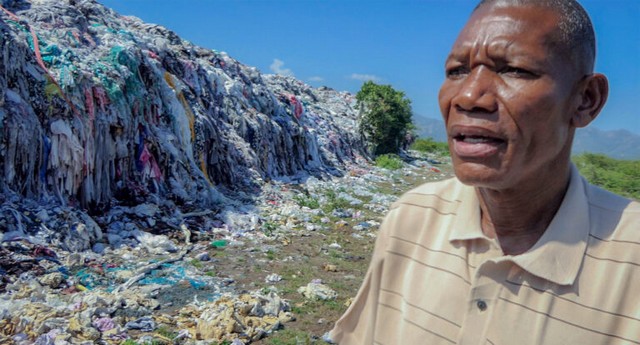
Residents told In These Times that the remaining land has also suffered environmental degradation from the manufacturing itself—air pollution, aquatic pollution and waste dumps. As Milostène Castin, of the local environmental group AREDE, gazes at an enormous pile of trash from the park, just a few miles away in the community of Madras, he says, “It’s a wrong they’re doing to the community, which will have a big impact on generations [to] come.”

Local fishermen report that catching fish is more difficult since the industrial park opened, and that some species seem to have disappeared altogether. Saint Jean, whose family lives less than five miles from the industrial park, as well as from the mountains of factory garbage, reports that air quality has deteriorated. As some of the garbage from the factories is burned, a “huge smoke rises in the air and then comes down,” she says. Several others also confirmed this.

The Haitian government promised to “look for land” for the farmers it evicted, llna recalls. Instead, more than 10 months after the eviction, the farmers were issued cash payments as compensation for lost crops.

This money has long since run out, according to the Kolektif, and families are growing increasingly desperate. “It’s become worse,” Saint Jean says. “We wake up hungry, we go to bed hungry.”

In 2017, the Kolektif filed a complaint with the accountability office of the IDB. After more than a year of negotiations, they arrived at a settlement, which was originally supposed to take effect in March 2019. Most of the compensation promised to the displaced farmers, however, had not been delivered as of December 2019, according to ActionAid.

Under the terms of this agreement, one member of each family is “eligible” for employment in the industrial park. The rest must choose between other forms of compensation, which could include specialized technical support, microcredit programs, vocational training or land. Of the 442 farmers who lost their land, no more than 100 may receive new land.

According to ActionAid, just 12% of these families have managed to secure employment in the industrial park. And the value of that employment is unclear.

The backers of the Caracol Industrial Park have claimed it will create up to 60,000 local jobs. At the ceremony that established the Caracol Industrial Park in September 2010, Hillary Clinton assured the public that the jobs at Sae-A’s new factories would be “not just any jobs; these are good jobs with fair pay that adhere to international labor standards.”

So far, just 13,000 of the 60,000 projected jobs have been created, and most pay unlivable wages. Haitians who do the physically demanding and repetitive work of sewing and assembling clothing in the new industrial park earn the Haitian minimum wage of just 500 gourdes (about $5.25 U.S.) a day—three times less than the estimated cost of living in Haiti, according to the Solidarity Center.

The park’s largest employer is S&H Global, Sae-A’s wholly owned Haitian subsidiary, whose biggest customer is Walmart. Other Caracol factories include Taiwanese firm Everest Apparel and Sri-Lankan-owned Mas Akansyel, both of which manufacture clothing for Nike and Puma. According to the International Labor Organization’s Better Work Program, these three companies have all repeatedly been found to violate Haitian and international labor laws, with numerous breaches of health and safety regulations, wage theft, temperatures that exceed safe levels, verbally abusive bosses and sexual harassment.

When Philogène Nelange, now 35, heard about the opening of the new industrial park in Caracol, he had high hopes. He had grown up in the nearby commune of St. Suzanne, where there were few viable prospects for young people. “I thought that, with the arrival of the factory, things would be better,” Nelange says.

He landed a job at S&H Global. Three years later, the salary he makes is barely enough to cover a single worker’s expenses. Sitting on the porch of the tiny two-room home he rents in Trou-du-Nord with his wife and three kids, he says he often can’t sleep at night because he’s so worried. “It’s not even enough for food,” he says bluntly. Yet he also has to cover the costs of rent and utility bills, drinking water and school tuition (water and education being largely unsubsidized by the government). While S&H Global built a school in Caracol that provides free schooling to 500 local children, Nelange says this is insufficient to serve its more than 10,000 employees, many of whom have young children.

One young seamstress at S&H Global spoke with In These Times on the condition of anonymity, fearing retribution. She says she was suspended without pay for refusing her boss’s unwanted sexual advances. “He asked me to sleep with him,” she explains. “I didn’t agree.”

Another young woman, who applied for a job at S&H Global in the summer of 2019, tells In These Times that a manager offered to push her application forward in exchange for sex.

Unité Technique d’Exécution, the Haitian government office responsible for managing the industrial park, says it has a zero tolerance policy on sexual harassment and requires companies to have procedures in place for workers to report such violations.

Karen Seo, senior public relations manager at Sae-A, tells In These Times via email that Sae-A takes a proactive stance to detect and address workplace problems, including sexual harassment, through trainings and disciplinary actions.

A Haitian government spokesperson added that a 2018 report of sexual harassment at the park resulted in disciplinary action against a perpetrator.

Yet sexual harassment remains endemic across the factories, according to a representative from one of the unions working at the industrial park, who feared retaliation if their name was used. “Each week, you hear a different complaint,” they say, adding that discipline and even firings are common if a worker refuses a superior. They estimated more than 60 workers have been fired in the past four years at their factory for this very reason.

Factory workers have also filed complaints with Haitian authorities, saying that company grievance procedures had failed to address their reports of physical violence at the factory and of bribes being demanded in exchange for employment, according to the government spokesperson.

Even IDB’s Haiti department manager, José Agustín Aguerre, admitted in an interview with the New York Times before the park opened its doors, “Creating an exclusively garment maquiladora zone is something everyone—I wouldn’t say tries to avoid, but considers last resort.” He also defended the decision, calling this “last resort” strategy “a good opportunity” because of Haiti’s very high unemployment.

But with such low wages, the garment factories have little capacity to stimulate the economy. As Haitian economist Camille Chalmers put it in an interview with Haiti Grassroots Watch: “It’s a big error to bet on slave-wage labor, on breaking the backs of workers who are paid nothing while [foreign] companies get rich. It’s not only an error, it’s a crime.”

Of the total of $4.16 billion the U.S. government awarded for projects in post-earthquake Haiti, for-profit U.S. corporations received a greater share than any other single group: $1.86 billion, about 45%.

Anti-corruption protests have swept Haiti for the past two years, precipitated by evidence that the U.S.-backed governments of Haitian President Jovenel Moïse and his predecessor misappropriated hundreds of millions of dollars from a Venezuelan aid program for subsidized oil.

But for Castin, of the environmental group AREDE, who has played an active role in these protests, the fundamental issues at stake—in the anti-government demonstrations and the ongoing struggle around the Caracol Industrial Park—are, in many ways, the same. In both cases, Haitians are fighting for greater accountability in how aid money is spent, and for a future that serves the needs of Haitian communities.

At the 2010 UN donors’ conference, which was called “Towards a New Future for Haiti,” similar aspirations were voiced. Hillary Clinton acknowledged that years of prior aid to Haiti had failed to address basic needs, and emphasized the need for donors to “hold ourselves accountable.” Clinton warned, “We cannot retreat to failed strategies.” Yet U.S. aid in post-earthquake Haiti has been premised on longstanding imperialist assumptions, including the belief that Haiti’s most viable path of development is through foreign corporations taking advantage of devalued Haitian labor—even as Haitian export manufacturing workers continue to be paid less than any other workers in the hemisphere—and the related belief that military control of Haiti’s population is required to ensure stability for foreign investment.

Of the nearly $918 million Congress approved for recovery projects, more than $302 million (almost a third of the budget) was earmarked for “governance and rule of law.” In addition to funding the expansion of Minustah and prison construction, this U.S. recovery aid was used to strengthen the Haitian National Police (HNP), including support for its SWAT and civil order units. Since 1995, the United States has provided extensive support for this domestic police force in Haiti, which the Haitian government uses to “keep the peace”—most recently, to put down the anti-corruption protests. More than 40 Haitian protesters have been killed in clashes with the HNP since August 2019.

The failures of the neoliberal policies that have long guided U.S. aid have never been more apparent than they are today in Haiti, a country that once produced enough food to feed its population in the 1980s and is now almost entirely dependent on U.S. food imports.

Nelange places much of the blame on Haiti’s low minimum wages. Caracol factory workers like Nelange face U.S. prices for many food staples while earning a minimum day wage—which was 420 gourdes, just under $5, until November 2019.

Garment manufacturing companies in Haiti and their allies in the U.S. government have long fought wage increases. When Haiti’s lower parliament voted in March 2019 to raise the daily wage to about $8.25 for export manufacturing workers, S&H Global canceled an expansion at Caracol that would have created 10,000 jobs, choosing instead to send those jobs to the Dominican Republic.

In the end, garment workers won only a modest increase, effective November 2019, to 500 gourdes (about $5.25 today). A spokesperson for Sae-A confirmed to In These Times that the company is nonetheless “building a factory in D.R. as a backup now.”

Meanwhile, soaring inflation, combined with rapid devaluation of the gourde, has made basic necessities even more unaffordable. Reached by telephone in December 2019, Nelange said his family can now barely even afford potable water.

“You can’t live,” he says.

Castin has some advice for future aid donors “so as not to repeat the same mistakes as the Caracol Industrial Park.” He emphasizes the need for a more participatory and transparent approach; advance assessments of the economic, social and environmental risks of aid projects; and mechanisms of accountability, including grievance offices in affected communities.

At minimum, Castin says, the United States should not “use American people’s tax money to finance projects that forcibly displace Haitian peasants from fertile land that is their principal source of revenue.”

______________________________________________

The print version of this article incorrectly stated that the $202 million allocated by the United States for projects to support the Caracol Industrial Park represented a third of the U.S. Congressional funds for Haiti’s recovery that were not earmarked for debt relief or USAID operating expenses. The correct figure, indicated in the online version of the article, is nearly a quarter. The print article also incorrectly stated that Milostène Castin had been arrested and jailed in anti-corruption protests. In These Times regrets these errors.

This story was supported by a grant from the Leonard C. Goodman Institute for Investigative Reporting. Sophonie M. Joseph provided translation assistance. Ria Bhagwat, Isabel Carter and Juan Caicedo provided fact-checking.

Photos by Jeremy Dupin

Isabel MacDonald is an investigative journalist based in Montreal who has traveled to Haiti frequently since 2005.

20 January 2020

Source: www.transcend.org

Russian Political Earthquake: Putin Sets out Plan for Kremlin Departure & Medvedev Resigns

By Bryan MacDonald

15 Jan, 2020 – They say life comes at you fast. A seemingly routine ‘state-of-the-nation’ address by Vladimir Putin unexpectedly turned into one of the most memorable afternoons in recent Russian political history.

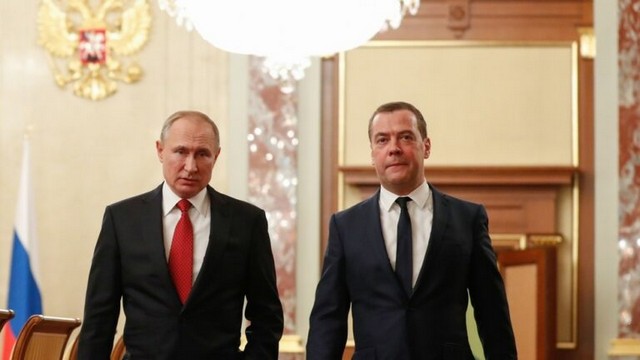
Today, Russia’s government resigned. Dmitry Medvedev departed the political frontline, Vladimir Putin effectively confirmed he will leave the presidency at the end of his present term, and Mikhail Mishustin became the new Russian prime minister. As Van Morrison once crooned, there will be days like this.

And it’s only the 15th of January. A week after Russians observed Orthodox Christmas, and a fortnight since they celebrated New Year, it didn’t take long for real business to resume.

In the morning, Mishustin was so unknown outside of Russia that he didn’t even have an English language Wikipedia page. And his profile inside the country was minor, beyond the world of political and administrative wonks.

But there’s no doubt he’s an effective manager. As the head of the Russian tax service he’s been a tremendous success. Revenues have risen by around 20 percent under his watch despite only a 2 percent rise in the tax burden itself. Indeed, only last year the Financial Times dubbed him the “taxman of the future” for his role in rebuilding Russia’s tariff collection system into one of the most advanced and efficient in the world.

No mean feat in a country where tax avoidance was once, pretty much, a sort of national sport.

A native Muscovite, Mishustin, like Putin himself an avid hockey player, has been described as a “little known political figure in Russia… a bureaucrat, someone to get the job done.”

But the same sort of description could have been applied to Putin himself in 1999, and here were are, 21 years later.

Long goodbye

Today, the president set out the roadmap for his exit from the Kremlin, more-or-less kicking off the build-up to the transition of power. He will step down in 2024, or perhaps even earlier, and he intends to dismantle the “hyper-Presidential” system which allowed him to wield so much control in office. This was introduced by Boris Yeltsin in 1993 with American support, after he had used tanks to fire on the Parliament.

Putin plans to give more powers to the latter body, with the prime minister, in particular, enjoying more authority. He also wants to bulk up the role of the State Council. Indeed, he will probably end up there himself after leaving office, in some sort of “elder statesman” role. The body will consist of heads of Russian regions and members of the Presidential Administration. It seems it will fulfill an advisory function.

To achieve these goals, Putin wants to reduce presidential powers and introduce a two-term limit. This would mean a maximum of 12 years in the Kremlin; he has already been there for 16. The broad vision is to have more checks and balances, with a weaker presidency and other branches of government strengthened.

Make no mistake, Putin’s goal is to preserve the system which he inherited from Yeltsin, and then tweaked. For all its faults, after a difficult birth it has given Russians the greatest freedom and prosperity they have ever known. Even if much work remains to be done on distributing economic gains more fairly.

Past precedent

Putin’s place in history would then be much the same as Franklin Delano Roosevelt’s in America, a unique four-term president who repaired the country after a financial & social catastrophe (in Russia’s case the Soviet collapse and the disastrous 1990s). This also fits with what insiders in Moscow frequently point out: Putin wants to be remembered well by history. A status enjoyed by relatively few Russian leaders.

One notable suggestion is that future presidents must have lived in Russia for 25 continuous years before taking office, and have never held a foreign passport or residency permit. This would bar a lot of the Western-leaning Moscow opposition from running. Not to mention a large swathe of Russian liberals, a great many of whom have lived abroad at some point. Interestingly, if this rule had existed in 2000 Vladimir Putin himself wouldn’t have been able to become Russia’s president. He lived in Germany from 1985-1990 (albeit on state duty).

The proposed changes will likely be made after public votes on them, to ensure broad consent. Even though they could be passed by the Duma. Rumors suggest it may be held in September.

Putin also addressed many domestic concerns in his speech today. He promised the increase of salaries for teachers and more childcare facilities, introduced free hot lunches for children in the initial four school years and extended child benefit by 48 months.

As for Medvedev, he hasn’t been cast aside. Instead, the former president has been moved to a semi-ceremonial, but still prestigious, role ending a twelve-year “tandem” where he governed Russia with Putin. It would be a mistake to write him off politically, but it would be surprising if he wields the same clout again.

As they shook hands, and Medvedev left the Kremlin for the final time as prime minister, Putin told him “not everything worked out, but it’s never the case that everything works out.”

Nevertheless, Putin will hope “everything works out” for the eventual power transition in Russia. A process that has now begun.

Bryan MacDonald is an Irish journalist based in Russia.

20 January 2020

Source: www.transcend.org

Iran Jet Disaster Setup

By Soraya Sepahpour-Ulrich and Finian Cunningham

14 Jan 2020 – The 19-second video published by the New York Times last week showing the moment an Iranian missile hit a passenger jet has prompted much social media skepticism.

Questions arise about the improbable timing and circumstances of recording the precise moment when the plane was hit.

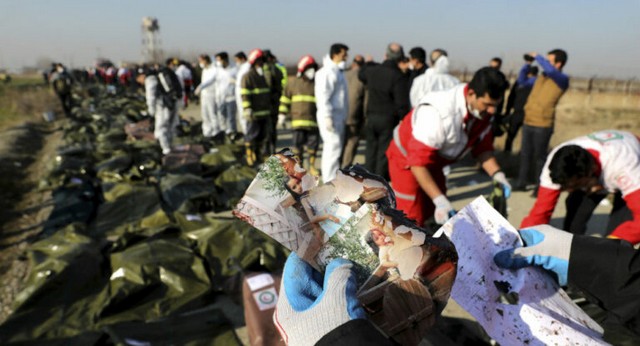
The newspaper ran the splash story on January 9, the day after a Ukrainian airliner was brought down near Tehran. It was headlined: ‘Video Shows Ukrainian Plane Being Hit Over Iran’. All 176 people onboard were killed. Two days later, the Iranian military admitted that one of its air defense units had fired at the plane in the mistaken belief that it was an incoming enemy cruise missile.

“A smoking gun” was how NY Times’ journalist Christiaan Triebert described the video in a tweet. Triebert works in the visual investigations team at the paper. In the same tweet, he thanked – “a very big shout out” – to an Iranian national by the name of Nariman Gharib “who provided it [the video] to the NY Times, and the videographer, who would like to remain anonymous”.

The anonymous videographer is the person who caught the 19-second clip which shows a missile striking Flight PS752 shortly after take-off from Tehran’s Imam Khomenei airport at around 6.15 am. This person, who remains silent during the filming while smoking a cigarette (the smoke briefly wafts over the screen), is standing in the suburb of Parand looking northwest. His location was verified by the NY Times using satellite data. The rapid way the newspaper’s technical resources were marshaled raises a curious question about how a seemingly random video submission was afforded such punctilious attention.

But the big question which many people on social media are asking is: why was this “videographer” standing in a derelict industrial area outside Tehran at around six o’clock in the morning with a mobile phone camera training on a fixed angle to the darkened sky? The airliner is barely visible, yet the sky-watching person has the camera pointed and ready to film a most dramatic event, seconds before it happened. That strongly suggests, foreknowledge.

Given that something awful has just been witnessed it is all the more strange that the person holding the camera remains calm and unshaken. There is no audible expression of shock or even the slightest disquiet.

Turns out that Nariman Gharib, the guy who received the video and credited by the NY Times for submitting it, is a vociferous anti-Iranian government dissident who does not live in Iran. He ardently promotes regime change in his social media posts.

Christiaan Triebert, the NY Times’ video expert, who collaborated closely with Gharib to get the story out within hours of the incident, previously worked as a senior investigator at Bellingcat. Bellingcat calls itself an independent online investigative journalism project, but numerous critics accuse it of being a media adjunct to Western military intelligence. Bellingcat has been a big proponent of media narratives smearing the Russian and Syrian governments over the MH17 shoot-down in Ukraine in 2014 and chemical weapons attacks.

In the latest shoot-down of the airliner above Tehran, the tight liaison between a suspiciously placed anonymous videographer on the ground and an expatriate Iranian dissident who then gets the prompt and generous technical attention of the NY Times suggests a level of orchestration, not, as we are led to believe, a random happenstance submission. More sinisterly, the fateful incident was a setup.

It seems reasonable to speculate that in the early hours of January 8 a calamitous incident was contrived to happen. The shoot-down occurred only four hours after Iran attacked two US military bases in Iraq. Those attacks were in revenge for the American drone assassination on January 3 of Iran’s top military commander, Maj. General Qassem Soleimani.

Subsequently, Iranian air-defense systems were on high alert for a possible counter-strike by US forces. Several reports indicate that the Iranian defense radars were detecting warnings of incoming enemy warplanes and cruise missiles on the morning of 8 January. It does seem odd why the Iranian authorities did not cancel all commercial flights out of Tehran during that period. Perhaps because civilian airliners can normally be differentiated by radar and other signals from military objects.

However, with the electronic warfare (EW) technology that the United States has developed in recent years it is entirely feasible for enemy military radars to be “spoofed” by phantom objects. One such EW developed by the Pentagon is Miniature Air-Launched Decoy (MALD) which can create deceptive signals on enemy radar systems of incoming warheads.

What we contend therefore is this: the Americans exploited a brink-of-war scenario in which they anticipated Iranian air-defense systems to be on a hair-trigger. Add to this tension an assault by electronic warfare on Iranian military radars in which it would be technically feasible to distort a civilian airliner’s data as an offensive target. The Iranian military has claimed this was the nature of the shoot-down error. It seems plausible given the existing electronic warfare used by the Pentagon.

It’s a fair, albeit nefarious, bet that the flight paths out of Tehran were deliberately put in an extremely dangerous position by the malicious assault from American electronic warfare. A guy placed on the ground scoping the outward flight paths – times known by publicly available schedules – would be thus on hand to catch the provoked errant missile shot.

The shoot-down setup would explain why Western intelligence were so quick to confidently assert what happened, contradicting Iran’s initial claims of a technical onboard plane failure.

The disaster has gravely undermined the Iranian government, both at home and around the world. Protests have erupted in Iran denouncing the authorities and the Islamic Revolutionary Guards Corp for “lying” about the crash. Most of the 176 victims were Iranian nationals. The anger on the streets is being fueled by the public comments of Western leaders like Donald Trump, who no doubt see the clamor and recriminations as an opportunity to push harder for regime change in Iran.

Soraya Sepahpour-Ulrich is an independent researcher and writer with a focus on U.S. foreign policy.

Finian Cunningham, originally from Belfast, Ireland is a prominent expert in international affairs.

20 January 2020

Source: www.transcend.org

Growing Gardens of Diversity Weaving Gardens of Love

By Prof. Vandana Shiva

15 Jan 2020 – Diversity is the Hindustan Way.

India’s civilisation is based on diversity and interconnectedness in nature and culture.

We grow gardens of diversity. We weave garlands of love.

Our National Anthem is an ode to the diversity of the land from the mountains of the Himalaya to the Vindhayachal range, from the mighty Yamuna and Ganga to the oceans.

We sing how diversity of cultures and religions came to India from the East and West “Weaving Garlands of Love”.

Indian National Anthem | Jana Gana Mana | Full Song | With Lyrics

English Translation

You rule the minds of all people
and control India’s future.
Your name brings joy to Punjab, Sind, Gujarat and Maratha;
and Dravida and Orissa and Bengal. (regions in India)
It echoes in the Vindhya and Himalayan hills,
and mixes with the music of the Yamuna and Ganga rivers.
It is also sung by waves of the sea.
We pray for your blessings
and sing your praise.
We look forward to your best wishes.
And we wish Victory, victory, victory for you.

We are of the Earth, in our diversity. The Earth gives us citizenship.

Our first identity is as Earth Citizens, an Earth Family (Vasudhaiva Kutumbakam), sharing the planet with other species. We did not impose on ourselves the burden of Anthropocentrism, of separation from and superiority over other species. The Empire was based on the illusion of the superiority of one species, one race, one religion, one gender. It was also an Empire over what were declared to be “lesser creatures”, to be exploited and exterminated. The Monoculture of the Mind is the basis of Empire.

Separation is the basis of Empire.Fragmenting and fracturing interconnected, autopoietic, self organised systems is the basis if Empire. Denial of completeness is rupture of relationships that sustain individuals in community, farmers and their land, humans and the earth. Division is the ground for extractivism. Extractivism is the foundation of Empire.

There has been a continuous war against our biodiversity in nature and culture diversity by past and present empires. The extractive economy of the 1% is based on the Monoculture of the Mind and it creates monocultures.

The biodiversity of our forests and farms has been replaced by monocultures of commercial timber and commodity crops. The forest is reduced to a mine for timber and pulp. The biodiversity of our farms has been reduced to monocultures of commodities which are desertifying the soil, impoverishing our farmers, and spreading hunger and malnutrition. Tribals rise. Peasants rise. The 1% then uses the tried and tested policies of Divide and Rule to rupture and tear apart the rich weave of our cultural diversity to defend the Empire.

The British Empire was established by the East India Company, chartered in 1600, to conquer and colonise India through military force, and take over of our resources, economy and trade. From accounting for 25 % of the global economy, we were reduced to 2 % by the time the British left. Our generous land was ridden by famines and impoverishment of the people. The atrocities and exploitation of the Company Raj (Company Rule ) led to the uprising of 1857, India’s first Independence movement, which ended the rule of the first corporation, the East India Company. We could drive out the East India company because we were united for freedom and justice in our diversity.

The memorial of martyrs of the 1857 war of independence at Meerut which I visited during our “Freedom Pilgrimage” to commemorate 100 years of the Champaran Satyagraha, shows how Muslims and Hindus gave their lives for India’s freedom.

As, Shashi Tharoor writes in the Era of Darkness “the sight of Hindu and Muslim soldiers rebelling together in 1857 and fighting side by side, willing to rally under the command of each other and pledge joint allegiance to the enfeebled Moghul monarch had alarmed the British who did not take long to conclude that dividing two groups and pitting them against one another was the most effective way to ensure the unchallenged continuance of Empire. Lord Elphistone, the Governor of Bombay advised London that “Divide et Impera” was the old Roman maxim and it should be ours” (pg 120 Tharoor )

The cultural technologies of Divide and Rule are part of the violence that Empires use to maintain their rule in times of dissent and resistance. Partitions, compulsory registration on the basis of religion and race, and using the Census to construct artificial, fragmented, negative identities are at the core of the arsenal to hold on to power.

India’s movements against imperialism continued after 1857, and were strongest in Bengal. In 1905 the British viceroy in India, Lord Curzon, divided Bengal on the basis of religion to strangle the intensifying nationalist movement ,and implement the Empire’s Divide and Rule policies, The nationalist movement protested against the partition of Bengal through Swadeshi (self making and autonomous) and boycott of the import of British goods. This is how Swadeshi was born as the nationalist movement against economic imperialism and its divisive policies.

India’s very tragic partition into Pakistan and India built on the earlier division of Bengal and a result of the divide and rule policy of the Empire.

Around the same time as the partition of Bengal, the Empire was dividing South Africa on the basis of race.

After the Boer war, when Transvaal became part of the Empire, the Government passed an Asiatic Ordinance on Aug 22, 1906.

As Gandhi writes in his book ‘Satyagraha in South Africa’ “I saw nothing in it but hatred of Indians. It seemed to me that if the ordinance was accepted, it would spell absolute ruin for the Indians of South Africa…better die than submit to such a law”

The ordinance required that every man, woman or child of eight years or upwards, entitled to reside in the Transvaal, must register his or her name with the Registrar of Asiatics and take out a certificate of registration. Indians who failed to apply for registration, forfeited their right to residence and could be sent to prison or deported. Indians were required to produce the certificate of registration for police officers whenever and wherever required. Failure to show the certificate could send you to prison.Police officers could enter private houses in order to inspect certificates.

Hindus and Muslims in South Africa joined hands to fight the laws for compulsory registration which were called the Black Act. They refused to register. After 8 years of non cooperation, the Empire had to withdraw the restrictions.

The South African Satyagraha against the race based compulsory registration of Indians was Gandhi’s first Satyagraha.

Gandhi’s ideas of freedom through Swaraj and Satyagraha were shaped by the struggles in South Africa.

But the urge of the Empire to Divide and Rule continued . It was institutionalised as the Apartheid regime in 1948 The Africaans word, apartheid, meaning “Separateness” or the state of being apart It was first articulated in 1929. Mandela and others who fought against Apartheid were imprisoned for decades. Thousands died. The apartheid system was abolished in 1994.

The world celebrated the end of apartheid as the beginning of a new age of our consciousness as one humanity, with no place for race based and religion based separation and division.

However, the empires tools of apartheid and separation keep coming back in new forms. And anti apartheid struggles which celebrate diversity also emerge in each age and every place where diversity is threatened.

The spirit of human freedom, in and through diversity, cannot be extinguished inspite of repeated, brutal attempts to destroy freedom and diversity.

Divide and rule policies of the British Empire included the attempts to change the census from one based an occupation and place , which creates positive and real identities, to one based on artificial constructions of fixed and mutually exclusive caste and religious identities, and then dividing people on the basis of these constructions, violently removing the shared identity of culture, community, place.

It is not that India had not undertaken enumerations of the population before the British. But these enumerations, like Ain-i Akbari, took relationships and diversity into account. The Empire used the census to construct essentialised, polarised, artificial religious identities. As a Government resolution stated; “the basis of the classification should be religion” (Gottschalk, Religion, Science and Empire, Pg 203). The mutually exclusive antagonistic categories of Hindu (referred to as “Gentoo”) and Muslim (referred to as “mussalman”) are constructs of Empire. People had multiple identities, and religion was not the most dominant at the social level. Identities of occupation were dominant. They would put ‘mali’ (gardner), not muslim. People often saw themselves as Hindu Muslim, because Hindu merely referred to a geographical indicator – the people of the land beyond the Indus. Hindus and Muslims prayed at the same shrines. “The Satya Narain of the Hindu is the Satya Pir of the Bengali Musalman”. Bengali muslims used the same language, dressed the same way (pg 204 Gottschalk). And diversity is India’s being. A diversity so rich that no box, no standardised category, no monoculture, can contain it. Every attempt at forcing it into a box has involved violence, and failure.

Government officials argued that census operations directly aggravated communalism (Religion , Science and Empire , Peter Gottschalk , Oxford University Press ,,2013 , pg 195)

The consequences of this reduction of diverse, multiple, shared, positive identities, into negatively constructed, reductionist, religious identities are at the root of much violence in our times. It is part of the Divide and Rule strategy of today’s Empire.

Oneness is based on the consciousness that we are interconnected, we are interbeings, ecologically and culturally. When we do pranayama we say So Hum – you are, therefore I am. There is no “other”.

Instead of identity flowing positively from who we are, the work we do , the place we live in and spaces we occupy, the relationships we nurture and which nurture us, Empire destroys our work, uproots us from our homes making us all refugees, tears apart our relationships and actual identities, and fills the vacuum by negative, fragmented, cultural identities constructed and externally imposed by Empire. The externally defined and imposed identities of Empire are negative, defined not by who we are but who we are not.

The Empire of the 1% destroys identity and meaning that flow from work and place, dividing societies and manufacturing enemies, to Divide and Rule everything, everywhere.As Samuel Huntington wrote “I cannot know who I am till I know who I hate”. The Empire is defined by who our enemy is. We witness this today with the threat of a war against Iran, and the continued wars in Iraq and Syria. We see it with Facebook and Cambridge Analytica becoming the machinery of the manufacture and unaccountable dissemination of hate to hijack democracy in a digital world. The currency and commodity of the Empire is hate.

In these times of limitless greed and manufactured division and hate, we resist by living and thinking through, and with, our diversities as one humanity on one planet.

We grow gardens of Diversity. We weave garlands of love.

Prof. Vandana Shiva is a physicist, ecofeminist, philosopher, activist, and author of more than 20 books and 500 papers.

20 January 2020

Source: www.transcend.org

Richest 1% own more than twice as much wealth as 6.9 billion people, says report

By Countercurrents Collective

A super-rich one percent of the world’s population has accumulated twice as much wealth as the remaining 90 percent, said a new report by Oxfam, a global charity. The report has been released on January 20, 2020 on the eve of the World Economic Forum in Davos, Switzerland.

The gap between the filthy rich and the rest of humanity has reached grotesque proportions, according to the report.

The report, Time to Care, focuses on the largely unpaid care work many women and girls take upon themselves.

The report said: The world’s top 22 richest men have now more wealth than all the women in Africa.

It added: At the bottom of the economy, women and girls, especially women and girls living in poverty and from marginalized groups, are putting in 12.5 billion hours every day of care work for free, and countless more for poverty wages. Their work is essential to our communities. It underpins thriving families and a healthy and productive workforce.

The report said: This great divide is based on a flawed and sexist economic system that values the wealth of the privileged few, mostly men, more than the billions of hours of the most essential work – the unpaid and underpaid care work done primarily by women and girls around the world. Tending to others, cooking, cleaning and fetching water and firewood are essential daily tasks for the wellbeing of societies, communities and the functioning of the economy. The heavy and unequal responsibility of care work perpetuates gender and economic inequalities.

It said: This broken economic model has accumulated vast wealth and power into the hands of a rich few, in part by exploiting the labor of women and girls, and systematically violating their rights.

Only 2,153

There are only 2,153 billionaires in the world, according to the report, but their wealth matches that of more than 4.6 billion people, or about 62 percent of the world’s population, estimated to stand at 7.7 billion.

The gap between the wealthy and all those who fare less well looks even more prominent if to compare the combined income of the richest of the rich – the top one percent – to that of some 6.9 billion people.

According to the report, the one-percenters boast more twice as much wealth as nearly 90 percent of the global population.

It said: At the top of the global economy a small elite are unimaginably rich. Their wealth grows exponentially over time, with little effort, and regardless of whether they add value to society.

Tax the rich

Oxfam said: The only way to tackle inequality is to raise taxes. Taxing additional 0.5 percent of wealth of the top 1 percent over the next decade will provide governments with enough funds to create 117 million of jobs in health, education, elderly care and other sectors.

It said: Governments must act now to build a human economy that is feminist and values what truly matters to society, rather than fuelling an endless pursuit of profit and wealth. Investing in national care systems to address the disproportionate responsibility for care work done by women and girls and introducing progressive taxation, including taxing wealth and legislating in favor of carers, are possible and crucial first steps

It added: One reason for these outsized returns is a collapse in taxation of the super-rich and the biggest corporations because of falling tax rates and deliberate tax dodging. At the same time, only 4% of global tax comes from taxation of wealth, and studies show that the super-rich avoid as much as 30% of their tax liability. Extremely low corporate taxation helps them cream the profits from companies where they are the main shareholders; between 2011 and 2017 average wages in G7 countries increased by 3%, while dividends to wealthy shareholders grew by 31%.

While Oxfam did not call any names in its report, it appeared to have taken a thinly-veiled jab at Amazon CEO and founder of Blue Origin space company Jeff Bezos, the on-and-off planet’s richest man, who, however, slipped to the second place this week, behind the chairman and CEO of French luxury giant LVMH Bernard Arnault.

Less than $5.50 a day

The report cited World Bank estimates: Almost half of the world’s population lives on less than $5.50 a day, and the rate of poverty reduction has halved since 2013.

The Oxfam report said: Many people are just one hospital bill or failed harvest away from destitution. Inequality is one of the major reasons for this; a huge share of global income growth consistently accrues to those at the top, leaving those at the bottom further and further behind.

The report cites Thomas Piketty and his team: Between 1980 and 2016, the richest 1% received 27 cents of each dollar of global income growth. This was more than twice the share of the bottom 50%, who secured only 12 cents of every dollar.

The report said:

  • If you saved $10,000 a day since the building of the pyramids in Egypt, you would have one-fifth the average fortune of the 5 richest billionaires.
  • If everyone were to sit on their wealth piled up in $100 bills, most of humanity would be sitting on the floor. A middle-class person in a rich country would be sitting at the height of a chair. The world’s two richest men would be sitting in outer space.
  • The monetary value of women’s unpaid care work globally for women aged 15 and over is at least $10.8 trillion annually – three times the size of the world’s tech industry.
  • The very top of the economic pyramid sees trillions of dollars of wealth in the hands of a very small group of people, predominantly men. Their wealth is already extreme, and our broken economy concentrates more and more wealth into these few hands.
  • Recently some commentators have asked whether it would be better for the world to ‘abolish billionaires’, suggesting that they are a sign of economic sickness rather than economic health.
  • It has been estimated that one-third of billionaire wealth exists because of inheritance. Such levels of inheritance have created a new aristocracy that undermines democracy. Once secured, the fortunes of the super-rich take on a momentum of their own; the wealthiest people can simply sit back and watch their wealth grow, with the help of highly paid accountants who have delivered them an average annual return of 7.4% on their wealth over the last ten years. Despite admirably committing to give his money away, Bill Gates is still worth nearly $100bn, which is twice what he had when he stood down as head of Microsoft.
  • As well as doing care work for free at home, many poor women also work providing care for others, for example as domestic workers, who are among the most exploited workers in the world. Just 10% of domestic workers are covered by general labor laws to the same extent as other workers, and only around half enjoy equal minimum wage protection. More than half of all domestic workers have no limits on work hours under national law. In the most extreme cases of forced labor and trafficking, domestic workers find themselves trapped in people’s homes with every aspect of their lives controlled, rendering them invisible and unprotected. It is estimated that globally, the 3.4 million domestic workers in forced labor are being robbed of $8bn every year, equating to 60% of their due wages.
  • Recognize unpaid and poorly paid care work, which is done primarily by women and girls, as a type of work or production that has real value.
  • Reduce the total number of hours spent on unpaid care tasks through better access to affordable and quality timesaving devices and care-supporting infrastructure.
  • Redistribute unpaid care work more fairly within the household and simultaneously shift the responsibility of unpaid care work to the state and the private sector.
  • Represent the most marginalized caregivers and ensure that they have a voice in the design and delivery of policies, services and systems that affect their lives. Change is possible. From Engna Legna Besdet bringing together Ethiopian domestic workers in Lebanon, to the Domestic Workers Rising campaign in South Africa, women are demanding change and claiming their rights. And governments are starting to listen. Uruguay’s groundbreaking national integrated care enshrines the right to care and be cared for, as well as care workers’ rights, and New Zealand introduced a celebrated wellbeing budget in 2019. But more action is needed.
  • Over the past decade leading academics, and even mainstream economic institutions such as the IMF, have produced robust evidence of the corrosive effects of inequality. Affected communities, activists, women’s rights organizations and faith leaders have spoken out and have campaigned for change around the world. Recent protests, for example against inequality and climate chaos, from Chile to Germany, are huge.
  • Mainstream economic meetings, such as those of the IMF and the World Economic Forum, have placed economic inequality on their agendas time and again. However, the inequality crisis remains fundamentally unaddressed. The reality is that most world leaders are still pursuing policy agendas that drive greater gaps between the haves and the havenots. Leaders like President Trump in the USA and President Bolsonaro in Brazil are exemplars of this trend, offering regressive policy menus like tax cuts for billionaires, obstructing measures to tackle the climate emergency or turbo charging racism, sexism and hatred of minorities. Crucially, today’s economic system is built on sexism.

Recommendations

Oxfam has proposed the following six actions to help realize the rights of carers and to start closing the gap between unpaid and underpaid care workers and the wealthy elite who have profited most from their labor.

The report’s recommendations are:

1)Invest in national care systems to address the disproportionate responsibility for care work done by women and girls:

Governments must invest in cross-governmental national care systems, in addition to investing in and transforming existing public services and infrastructure. National care systems must include the provision of universal access to safe water, sanitation and domestic energy systems, and investments to deliver universal childcare, eldercare and care for people with disabilities. These should also include access to quality healthcare and education, as well as the provision of universal social protection, such as pensions and child benefits. As part of national care systems governments must ensure a minimum of 14 weeks of paid maternity leave and the progressive realization of one year of paid parental leave, including a phase of use-it-or-lose-it paternity leave.

2)End extreme wealth to end extreme poverty: Extreme wealth is a sign of a failing economic system. Governments must take steps to radically reduce the gap between the rich and the rest of society and prioritize the wellbeing of all citizens over unsustainable growth and profit, to avoid a world that caters only to a privileged few and consigns millions of people to poverty. Governments must take bold and decisive steps by taxing wealth and high incomes and cracking down on loopholes and the inadequate global tax rules that allow rich corporations and individuals to escape their tax responsibilities.

3)Legislate to protect the rights of all carers and secure living wages for paid care workers:

As part of their national care systems, governments must ensure legal, economic and labor market policies are in place to protect the rights of all carers and paid care workers, in both formal and informal sectors and monitor their implementation. This must include ratifying ILO Convention 189 on the protection of domestic workers and policy to ensure that all care workers are paid a living wage and working towards the elimination of gender wage gaps.

4) Ensure that carers have influence on decision-making processes:

Governments must facilitate the participation of unpaid carers and care workers in policy-making fora and processes at all levels, and invest resources into collecting comprehensive data that can better inform policymaking and evaluate the impact of policies on carers. This should be alongside consulting women’s rights actors, feminist economists and civil society experts on care issues, and increased funding for women’s organizations and movements working to enable their participation in decision-making processes. These measures are important building blocks of national care systems.

5) Challenge harmful norms and sexist beliefs:

Harmful norms and sexist beliefs that see care work as the responsibility of women and girls lead to an unequal gendered distribution of care work, and perpetuate economic and gender inequality. As part of their national care systems governments need to invest resources to challenge these harmful norms and sexist beliefs, including through advertising, public communication and legislation. Further, men need to step up to equally fulfill their responsibilities on care work to address the disproportionate amount of care done by women within households and communities.

6) Value care in business policies and practices: Businesses must recognize the value of care work and sustain the wellbeing of workers. Further, they should support the redistribution of care through the provision of benefits and services such as crèches and childcare vouchers and ensure living wages for care providers. Companies and business should assume their responsibility for contributing to achieving the Sustainable Development Goals by paying their fair share of taxes, implementing family-friendly employment practices such as flexible working hours and paid leave, and using progressive advertising and public communication to challenge the gendered distribution of care work.

A broken economy

The report said:

“If the economic system is left to distribute the fruits of growth so unevenly, we will never eliminate poverty.”

“Unequal and unbridled growth is also unsustainable and makes it impossible to live within the environmental boundaries of our planet.”

“Economic inequality is also built on gender inequality, and the majority of those at the bottom of the economic pyramid are women. Women and girls are more likely to be found in poorly paid and precarious employment, and they do the bulk of unpaid and underpaid care work.”

“The dominant model of capitalism actively exploits and drives traditional sexist beliefs that disempower women and girls, counting on them to do this work, but refusing to value them for it.”

Commenting on the findings, Oxfam India CEO Amitabh Behar said that while unpaid or poorly paid care work mostly done by women serves as the “hidden engine” that fuels the global economy, “broken economies are lining the pockets of billionaires and big business at the expense of ordinary men and women.”

20 January 2020

Source: countercurrents.org

US, UK, Australia, Canada & Germany Reject Iraqi Parliament’s Quit Iraq Demand

By Dr Gideon Polya

Following the US assassination of Iranian General Qassem Soleimani and Shiite Iraqi militia commander Abu Mahdi al-Muhandis at Baghdad International Airport, the Iraqi PM, the Iraqi Parliament Speaker and the Iraqi Parliament have demanded that the US Alliance forces leave Iraq. The US, UK, Australia, Canada and Germany have rejected the Iraqi Parliament’s Quit Iraq demand, with the US threatening to instantly collapse the Iraqi economy by a banking freeze if Iraq insists on US Alliance withdrawal from its territory.

(1). US Alliance violates Iraqi sovereignty and rejects the Iraqi Parliament’s Quit Iraq demand.

Iraqis were outraged by the criminal murder by drone missile attack of Iranian General Qassem Soleimani (Iranian hero, commander of the Quds Force of the Islamic Revolutionary Guards Corps), Shiite Iraqi militia commander Abu Mahdi al-Muhandis (deputy commander of the Shiite Popular Mobilisation Forces, PMF, or Hashd al-Shaabi), and 8 other people by the Americans at Iraq’s Baghdad International Airport on 3 January 2020. These blatantly criminal assassinations were followed by international outrage and massive demonstrations by Iraqis and Iranians. The Iranians launched missile attacks on 2 American air bases in Iraq that were carefully designed as a retaliatory “slap on the face” without any American casualties that would have brought massively deadly and disproportionate retribution from nuclear terrorist America – and indeed fortunately nobody was killed.

Leading Iraqi Shiite politician and Iraqi PM Abdul Mahdi stated (3 January 2020): “The assassination of an Iraqi military commander is an aggression on Iraq as a state, government and people” [1]. Iraq’s Speaker of Parliament, Mohammed al-Halbousi (Iraq’s leading Sunni Arab politician) condemned the US assassinations as a violation of Iraqi sovereignty (4 January 2020): “Put an end to U.S. presence [in Iraq]… Yesterday’s targeting of a military commander in Iraq’s armed forces near Baghdad international airport is a flagrant breach of sovereignty and violation of international agreements. Iraq must avoid becoming a battlefield or a side in any regional or international conflict”[2]. The Iraqi Parliament passed the following resolution (5 January 2020): “The government commits to revoke its request for assistance from the international coalition fighting Islamic State due to the end of military operations in Iraq and the achievement of victory. The Iraqi government must work to end the presence of any foreign troops on Iraqi soil and prohibit them from using its land, airspace or water for any reason” [3]. The Iraqi Prime Minister Adel Abdul-Mahdi protested continuing violations of Iraqi sovereignty by the Americans in a phone call to US Secretary of State, Mike Pompeo, the Iraq PM’s office stating (9 January 2020): “The prime minister said American forces had entered Iraq and drones are flying in its airspace without permission from Iraqi authorities, and this was a violation of the bilateral agreements” [4].

The racist, anti-Arab anti-Semitic and exceptionalist Americans rejected the foreign withdrawal demands by the Iraqi PM, the Iraqi Parliament Speaker, and the Iraqi Parliament. Thus Mafia-style thug and serial war criminal, US Secretary of State Mike Pompeo, bluntly rejected the Iraqi demands, indicating that US troops would remain (9 January 2020): “We are happy to continue the conversation with the Iraqis about what the right structure is. Our mission set there is very clear. We’ve been there to perform a training mission to help the Iraqi security forces be successful and to continue the campaign against ISIS, to continue the counter-Daesh campaign. We’re going to continue that mission but, as times change and we get to a place where we can deliver upon what I believe and what the president believes is our right structure with fewer resources dedicated to that mission, we will do so” [4].

Gangster Trump has justified the assassinations on the basis of non-specific and non-disclosed security threats against Americans, this being reminiscent of George W. Bush’s (false) assertions (backed by UK PM Tony Blair and Australia’s PM John Howard) in 2003 about Iraqi possession of (actually non-existent) “Weapons of Mass Destruction” (WMD). According to the New York Times (11 January 2020): “Mr. Trump issued bellicose threats to destroy Iran if it retaliated, including cultural treasures in violation of international law, touching off international outrage and forcing his own defense secretary to publicly disavow the threat, saying it would be a war crime. Mr. Trump was largely alone on the world stage. No major European power, not even Britain, voiced support for the drone strike, even as leaders agreed that General Suleimani had blood on his hands. As Le Monde, the French newspaper, put it, the rift signaled “a new stage in the trans-Atlantic divorce over the Middle East”” [5]. Predictably serial invader, serial occupier, serial war criminal, anti-Arab anti-Semitic and Islamophobic Apartheid Israel supported the war criminal US attack on Iraq [5].

Trump was outraged by the Iraqi Parliament’s demand for US Alliance withdrawals and declared: “[If US forces asked to leave] we will charge them sanctions like they’ve never seen before”[6]. The Americans have always used sanctions, theft and economic blackmail as adjuncts to the routine recipe of subversion, assassinations, coups, bombing, invasion and genocide. The US warned Iraq that it could block Iraqi access to an account that Iraq’s central bank holds with the Federal Reserve Bank of New York and which is economically vital for Iraq [6-8]. The Central Bank of Iraq’s account at the Federal Reserve Bank was set up in 2003 following the war criminal, US-led invasion and all Iraqi oil revenues go to that account that presently sits at $35 billion. $1-2 billion is withdrawn from this Federal Reserve Bank account each month for Iraqi government and commercial transactions, and accordingly blocked access would collapse the Iraqi economy [6-8].

While the war criminal US refuses to withdraw its forces from Iraq and serial war criminal and US lackey Australia likewise refuses to withdraw its circa 300 troops (mainly in the Taji base near Baghdad, as well as some guarding diplomats in the Baghdad Green Zone), Germany has cut down its forces, the UK has relocated some 50 personnel out of the Baghdad Green Zone but still has about 400 troops in Iraq, and Canada has withdrawn “some” of its 500 soldiers in Iraq to Kuwait [9].

The deadly consequences of Donald Trump’s decision to launch (likely Australian-targeted ) missiles from drones at Baghdad International Airport can be summarized thus: 12 killed in the assassination of General Qassem Soleimani, at least 56 killed in a stampede at the funeral of General Qassem Soleimani in the southeastern Iranian city of Kerman, and 176 passengers and crew killed (one third Canadians) in the Ukrainian passenger jet shot down in a terrible mistake by an Iranian-fired missile from a very nervous Iranian defence Surface to Air Missile (SAM) battery defending Teheran in the context of acute and deadly US threats to Iran [10, 11]. Canadian PM Justin Trudeau has quite rightly expressed indignation and demands for transparency and justice over the plane tragedy [12]. However Zionist-subverted and US lackey Canada does not have diplomatic relations with Iran, has a long record of US- and Zionist-backed antipathy towards Iran, has emplaced sanctions against Iran and is likely to use the passenger jet tragedy and its forces in Iraq to support the US in a continuing, variously hot and cold and 4 decade US War on Iran [13]. Under criminal and deadly US Sanctions, presently an estimated 71,000 Iranians die avoidably from deprivation each year or 195 such deaths per day [14, 15].

Decent people around the world legitimately fear the horrendous consequences of a full-blown US and US Alliance military attack on Iran. However 4 million Iranians have already died from violence, 1 million, or from sanctions-imposed deprivation, 3 million, in a 4-decade US War on Iran. Further, while Iran leads the world in interdiction of opiate drugs from US-occupied Afghanistan, this flood of US-protected opiates has killed 33,000 Iranians and the 5.2 million people who have died worldwide in a US-imposed Opiate Holocaust inescapably linked to US restoration of the Taliban-destroyed Afghan opium industry from 6% of world market share in 2001 to 90% in 2007 [16]. One notes that the WW2 Jewish Holocaust was associated with 5-6 million Jews killed by the German Nazis through violence or imposed deprivation.

(2). Serial war criminal and US lackey Australia refuses to Quit Iraq as demanded by the Iraqi Parliament – Australia’s 7th Iraq War in a century?

As UK lackeys and thence US lackeys, gung-ho and racist White Australians have invaded 85 countries over the last 2 centuries [17]. By way of comparison, over the last 1,000 years the British have invaded 193 countries, France 82, the US 72 (52 after WW2), Germany 39, Japan 30, Russia 25, Canada 25, Apartheid Israel 12, Iraq 2 (both greenlighted by the US), China 2, North Korea arguably zero (0) , and Iran zero (0) since the time of the Sasanian Empire 1,300 years ago [14, 17-22]. Australia has been involved in 6 Iraq wars, specifically (1) UK invasion of Iraq in WW1 (1914-1918), (2) UK operations in Iraq in WW2 (1939-1945), (3) the deadly Sanctions War against Iraq (1990-2003), (4) the Gulf War (1990-1991), (5) invasion and occupation of Iraq (2003-2011), and (6) the war on ISIS in Syria and Iraq (2014-). War is the penultimate in racism and genocide is the ultimate in racism. Australia’s refusal to accede to the Iraqi Parliament’s demand that the US Alliance forces, including Australian forces, leave Iraq may mark the commencement of Australia’s 7th Iraq War since the genocidal British Empire’s invasion of Iraq in 1914.

British interest in Iraq came from discovery of oil in adjacent Iran in the 1900s. Western violation of Iraq commenced with the British invasion in 1914 during WW1. Assuming excess mortality of Iraqis under British rule or hegemony (1914- 1948) was the same as for Indians under the British (interpolation from available data indicate Indian avoidable death rates in “deaths per 1,000 of population per year” of 37 (1757-1920), 35 (1920-1930), 30 (1930-1940) and 24 (1940-1950) [23]), one can estimate from Iraqi population data [24] that Iraqi avoidable deaths from deprivation under British occupation and hegemony from 1914-1950 totalled about 4 million. UK lackey Australia was variously involved via its air force and navy in enforcement of British rule over Iraq in this period.

On the occasion of US withdrawal from Iraq in 2011 the Australian ABC (the Australian Broadcasting Corporation, Australia’s equivalent of the mendacious UK BBC) reported that “The withdrawal ends a war that left tens of thousands of Iraqis and nearly 4,500 American soldiers dead” [25]. In contrast, the expert and eminent US Just Foreign Policy organization estimates, based on the data of expert UK analysts and top US medical epidemiologists, 1.5 million violent deaths in the Iraq War (2003-2011) [26-29] and UN data indicate a further 1.2 million Iraqi avoidable deaths from war-imposed deprivation in this period [14, 15]. Violent deaths and avoidable deaths from violently -imposed deprivation in the Gulf War (1990-1991) and Sanctions period (1990-2003) totalled 0.2 million and 1.2 million, respectively [30]. Accordingly, Iraqi deaths from violence (1.7 million) or war-imposed deprivation (2.9 million) in the period 1990-2011 totalled 4.6 million [31].

The US ostensibly withdrew from devastated Iraq in 2011 but returned with a vengeance in 2012 to help Syria, Iraq and Iran deal with ISIS in Syria and Iraq that has been associated with about 0.1 million violent Iraqi deaths, most notably in devastated Mosul [32] and twice US-demolished Fallujah, the City of Mosques [33]. One notes that the ruthless and barbarous ISIS subverted and took over the Sunni insurgency in Iraq against the corrupt, violent, US-installed Al Maliki Government, and similarly ISIS came to dominate the US Alliance-backed Sunni insurgency against the Assad Government in Syria [32, 33]. UN data indicate about 0.3 million avoidable Iraqi deaths from deprivation in the period 2011-2020.

Thus ignoring Iraqi deaths associated with the US-backed Iraq-Iran War, one can estimate about 9 million Iraqi deaths from UK or US violence or imposed deprivation in the century after the 1914 invasion of Iraq by Britain, this constituting an Iraqi Holocaust and an Iraqi Genocide [31]. These terms are not used lightly. “Holocaust” means the death of a huge number of people. According to Article 2 of the UN Genocide Convention: “In the present Convention, genocide means any of the following acts committed with intent to destroy, in whole or in part, a national, ethnic, racial or religious group, as such: a) Killing members of the group; b) Causing serious bodily or mental harm to members of the group; c) Deliberately inflicting on the group conditions of life calculated to bring about its physical destruction in whole or in part; d) Imposing measures intended to prevent births within the group; e) Forcibly transferring children of the group to another group” [30, 34-38]. The ruler is responsible for the ruled. The huge avoidable deaths of Iraqis under the British, Americans and the US Coalition is evidence of gross violation of Articles 55 and 56 of the Geneva Convention relative to the Protection of Civilian Persons in Time of War that state unequivocally that an Occupier must provide its conquered subjects with life-preserving food and medical requisites “to the fullest extent of the means available to it” [39].

(3). Australia’s war criminal refusal to leave Iraq as unequivocally demanded by the Iraqi PM, Parliamentary Speaker and Parliament.

As set out above, the Iraqi PM, Speaker and Parliament have unequivocally demanded that foreign troops leave their devastated land. However the serial war criminal Americans and their serial war criminal lackeys, the UK, Canada, Germany and Australia, refuse to leave. Australian PM Scott Morrison (8 January 2020): “The situation overnight has stabilised… The cessation of those immediate hostilities that we saw yesterday and the nature of the statement also issued [by US President Donald Trump] today, as well as the [US-supplied] intelligence that we have, means that we are in a position to continue to undertake the mission that we have set for ourselves in the Middle East” [40].

The Labor Leader of the Opposition, Anthony Albanese, would not comment on any withdrawal of Australian forces from Iraq before getting a [US-provided] security briefing (8 January 2020): “These things should not be done on the run. This is potentially a very serious matter. Indeed, I have said though, that there shouldn’t be a further escalation by any party” [40]. Since the US CIA-backed Coup that removed reformist Labor PM Gough Whitlam from power in 1975 [41], the craven, US lackey Labor position has been “all the way with the USA” lest it anger the Americans or the king-making, US-owned Murdoch media empire that has captured 70% of Australian daily city newspaper readers.

The Labor Shadow Minister for Foreign Affairs, Penny Wong (8 January 2020): “Labor notes the worrying reports of events currently unfolding in Iraq. These attacks are deeply concerning and we continue to call on all sides to exercise restraint. Labor will be seeking briefings, including on the safety of our ADF members and diplomatic staff who are operating in the Middle East. Tomorrow, Labor’s Shadow National Security Committee will meet to discuss the situation in the region. Whilst these tensions are ongoing it is essential that the Government takes all steps necessary to maximise the safety and security of all deployed Australian personnel” [42].

Interestingly the Australian Foreign Minister, Marise Payne, evidently understands basic International Law about war crimes and has begged the Iraqi Government to permit Australian forces to stay (7 January 2020): “We urge the Iraqi government to ensure the coalition is able to continue its vital work with Iraq’s security forces in countering the shared threat of Daesh [ISIS]. We understand the resolution passed by Iraq’s Parliament is non-binding, absent formal approval by the government in Baghdad” [43].

The UN Charter is very clear about foreign forces being in another country – it can only happen (1) through invitation by the country, (2) in response to invasion of another country by that country, or (3) with the permission of the UN Security Council. In this instance the Iraqi PM, the Parliamentary Speaker and the Iraqi Parliament have unequivocally demanded that the foreign forces should leave.

In Australia’s 6 Iraq Wars involving Australian and US Alliance forces in Iraq only three (3) met the standard defined by the post-WW2 UN Charter, specifically (1) the disgracefully UN-approved and genocidal Sanctions war against Iraq (1990-2003; 1.7 million Iraqi deaths from imposed deprivation, half them children), (2) the UN-sanctioned Gulf War in response to the US greenlighted Iraqi invasion of Kuwait (1990-1991; 0.2 million violent Iraqi deaths), and (3) the War on ISIS in Iraq by invitation of the US-installed Al-Maliki Government (2014 onwards; the big cities of Mosul (population 2 million) and Fallujah (population 300,000) demolished by the US Alliance; about 0.1 million and 0.3 million Iraqi deaths from violence and deprivation, respectively [14, 30, 32, 34-38]. One notes that the estimates of 0.3 million Iraqi avoidable deaths from deprivation since 2011 is probably an underestimate since the US-installed Al Maliki Government has an appalling record of understating horrendous medical statistics e.g. absurdly claiming that Iraqi infant mortality declined as a consequence of sanctions, invasion and devastation [44] and claiming that rates of spontaneous abortion, still births and congenital birth defects in devastated and toxin contaminated areas of post-invasion Iraq were normal, contrary to the shocking findings of expert non-Iraqi Health Ministry researchers [45, 46].

However the Iraqis have withdrawn that invitation and have unequivocally demanded the withdrawal of foreign forces. Yankee go home! US Coalition go home! Aussies go home! If they stay they are violating the most fundamental International law: do not invade and occupy other counties. Indeed it was for such crimes that German leaders and generals were hung after the post-WW2 Nuremberg War Crimes Trials. One notes that the US lackey Germans and Canadians have responded to the situation by relocating “some” of their forces out of Iraq, notwithstanding the Iraqi Parliament’s demands. In 1945 the conquered Germans adopted what can be described as a CAAAA (C4A) protocol involving Acknowledgement of the crimes, Apology for the crimes, Amends for the crimes and Assertion “Never again” to anyone. Germany and Canada were not directly involved in the 2003 invasion and occupation of Iraq but have now evidently decided as US lackeys to join serial war criminal America, UK and Australia in illegally occupying Iraq. Evidently the post-WW2 de-Nazification of Germany was insufficient.

As a cowardly, degenerate, serial war criminal and genocidal US lackey, Australia has been involved in all post-1950 US Asian wars, atrocities that have been associated with 40 million Asian deaths from violence or war-imposed deprivation [14]. The Australian Liberal Party-National Party Coalition (that has egregiously mis-ruled Australia since 2013) supported Australian involvement in all of these atrocities while Labor supported all but the Vietnam War and the 2003-2011 Iraq War. This degenerate and war criminal collusion between serial war criminal America and serial war criminal Australia is continuing.

(4). Australian, US and UK respect for parliamentary democracy and law at home but contempt for democracy and International Law abroad.

Australia is one of the world’s oldest parliamentary democracies and has a splendid, world’s-best system of compulsory, one-person-one-vote, preferential voting that ensures that a winning candidate must either receive over 50% of the vote, or failing that, gain over 50% of the “2-party-preferred vote” based on counting the “second preferences” of all the unsuccessful candidates. In contrast, in first-past-the -post systems as in the UK and US, depending on how many people bothered to get out of bed and vote, a small proportion of the electorate, say 30%, could elect a government that was hated by most of the population. However, as with many things about Australia (and the US and UK), the surface of the rock appears very nice, but look underneath and one can be appalled [47, 48]. Thus Australia has an Upper House or Senate that can veto decisions of the popularly-elected Lower House, or House of Representatives. However all the 6 States of Australia have the same number of Senators (12) and Tasmania (population 0.5 million) has the same number of Senators (12) as New South Wales (population 7.5 million) or Victoria (population 6.4 million), this prompting outspoken former Labor PM, Paul Keating, to describe the Senate as “unrepresentative swill”.

Nevertheless there is great respect for parliamentary decencies and conventions. Thus the Australian Speaker is appointed (usually from the dominant party) to keep order in the House of Representatives and is prepared to throw Government or Opposition MPs out of the House if they misbehave by being abusive, disruptive or noisy. (I remember attending a big party with my dear late wife Zareena (née Zareena Lateef) in a neighbouring country that was attended by the eminent and charming then Speaker of that country’s parliament – he had to phone for a taxi so we accompanied him to the roadside to keep him company, and were surprised and amused when he phoned for a taxi and simply stated “This is the Speaker”).

However when the Speaker of the Iraqi Parliament , the Iraqi Prime Minister (PM) and indeed the Iraqi Parliament as a whole demanded that foreign troops get out of Iraq there was no such respect from Australia and the other Anglosphere or European members of the US Coalition (US, UK, Australia, Canada and Germany) who all simply refused (Canada and Germany only moving “some” forces from Iraq for security reasons).

The Australian Liberal Party-National Party Coalition and now to a significantly lesser extent Labor (collectively known as the Lib-Labs) fervently support nuclear terrorist, racist Zionist-run, genocidally racist, democracy-by-genocide Apartheid Israel. Indeed Australia is second only to Trump America and is just above Zionist-subverted Canada as a supporter of the Apartheid Israeli rogue state. Democracy-by-genocide Apartheid Israel determines that of its circa 7 million Indigenous Palestinian subjects (who despite over 70 years of continuous ethnic cleansing and genocide by the Zionists now represent about 50% of Apartheid Israel’s subjects) 74% are prevented from voting for the government ruling them i.e. egregious, criminal and intolerable Apartheid ) [47-58]. Australia respects one-person-one-vote democracy at home (or at least has done so since 1967 when Indigenous Australians were finally “counted” as citizens and thence able to vote). MPs and political candidates who support Apartheid Israel and hence the obscenity of Apartheid are simply unfit for public life in a one-person-one-vote democracy. This shows US lackey Australia’s utter contempt for democracy abroad as in a similarly fundamental way does Australia’s military involvement in all post-1950 US Asian wars (racist atrocities that have been associated with 40 million Asian deaths from war-imposed deprivation) [14]. Indeed Australian Intelligence agents helped the US overthrow the democratically elected Chilean Government on 9-11 in 1973 (page 163 [59]).

(5). War is the penultimate in racism and genocide is the ultimate in racism. Why the ongoing US devastation of Iraq?

War is the penultimate in racism and genocide is the ultimate in racism as illustrated by the ongoing Iraqi Holocaust and Iraqi Genocide (9 million Iraqi deaths from violence or imposed deprivation since the British invasion in 1914) [30]. Indeed the 21st century Muslim Holocaust and Muslim Genocide [60] has involved 32 million Muslims killed by violence, 5 million, or through imposed deprivation, 27 million, in 20 countries invaded by the US Alliance since the US Government’s 9-11 false flag atrocity that killed 3,000 people [44, 61]. Decent people may well ask why is it that America and its rich Anglosphere and Western European allies are still making war on Iraq and indeed on a swathe of other countries from West Africa to Pakistan? Why not, for example, have Iraq invaded and occupied by Switzerland that is closer to this war-torn region than the US and has a major interest in these countries as banker to its rulers and establishments? Why not nearly 200 other countries for any number of possible inventive reasons? The US and its allies dress up exceptionalist American war making in terms of the “war on terror”, “global security”, “bringing freedom and democracy”, and America’s “onerous burden” as a “global policeman” etc. The US always needs an excuse for war but the “terror” excuse is wearing thin because the US and the countries of the US Alliance have variously backed jihadi and other non-state terrorists around the world (e.g. death squads throughout Latin America, church-bombing gangs in Ecuador, Gladio in Europe and jihadis in Libya, Yemen, Kosovo, Syria, and Afghanistan. Indeed jihadi non-state terrorists are a great asset for US imperialism because every jihadi atrocity provides an excuse for disproportionately vastly more destructive US violence against defenceless Muslim populations [62]. Indeed fundamentalist America has trashed secular governance, modernity, democracy, women’s rights and children’s rights in the Muslim World [63].

Why the ongoing US devastation of Iraq? The most succinct answer to the question is simply: oil. Thus from the Right, Alan Greenspan (leading Republican economist, chairman of the US Federal Reserve for almost two decades, and servant of four US presidents): “I am saddened that it is politically inconvenient to acknowledge what everyone knows: the Iraq war is largely about oil” [64]. And on the Left, Professor Noam Chomsky (eminent linguistics expert and anti-racist Jewish American human rights activist at 101-Nobel-Laureate Massachusetts Institute of Technology (MIT) (2009): “There is basically no significant change in the fundamental traditional conception that if we can control Middle East energy resources, then we can control the world” [65].

US lackey Australia is helping the US occupy 2 devastated countries (Iraq and Afghanistan ), blockade Somalia and bomb 7 countries (Libya, Somalia, Yemen, Syria, Iraq, Afghanistan and Pakistan) by targeting illegal US drone strikes via the joint Australia-US electronic spying base at Pine Gap in Central Australia [66]. Indeed it is quite possible that via Pine Gap US lackey Australia was involved in the deadly targeting of Iranian General Qassem Soleimani and Shiite Iraqi militia commander Abu Mahdi al-Muhandis and their 8 associates at Baghdad International Airport that has brought the Middle East the brink of another genocidal war and has already cost the lives of the 176 passengers and crew of Ukrainian Airways Flight 752.

The serial war criminal US subverts and perverts all countries and to that end has about 700 bases in over 70 countries, including my own country, Australia [67]. President Donald Trump has been impeached and now faces trial in the Senate over allegedly withholding a huge US arms supply to Ukraine in order to get a Ukrainian investigation into the conduct of his likely opponent for the presidency, Democrat Joe Biden, and Joe Biden’s son. This alleged “quid pro quo” – allegedly rewarding a foreign power for investigating possible “dirt” on a domestic American political opponent – is utterly trivial compared to the routine deadly bullying by the US of all countries around the world. It is utterly trivial in comparison with the war criminal refusal of the US and its war criminal Anglosphere and European allies to leave devastated Iraq when asked to do so by the Iraqi PM, the Iraqi Parliament Speaker and the Iraqi Parliament , this refusal being accompanied by the US threat to instantly collapse the Iraqi economy by blocking access to its Federal Reserve banking account if the Iraqi Government keeps on insisting on this withdrawal. What is utterly galling about the Impeachment is how the Americans (the serial war criminal Democrats in this instance) hypocritically cloak themselves with a veneer of “upholding the law”. America carries a big stick. Reformist Australian Labor PM Gough Whitlam excited hatred from the US and its traitorous Australian allies over the Pine Gap spying base in Central Australia and was rapidly removed in a CIA-backed Coup in 1975 [41, 59, 69].

Just as the world has responded massively to the “How dare you!” expostulation over the worsening Climate Emergency of 16-year old climate activist Greta Thunberg at the UN, so one hopes the world will likewise respond to the words of 13-year old Iraqi girl, Sarah, whose family were refugees to a Baghdad refugee camp from the first US demolition of Fallujah (2004): “What does America want from us? Why did they destroy our homes? This is not their home, this is our home. Why did they come here and force us to live like this? The bombing went all day and all night. They made us homeless, they made us wander from house to house to ask if anyone can help us. Why did they come here? I want them to go” (page 118 [33]).

Final comments.

The US and its cowardly and war criminal allies have never been taken to the International Criminal Court (ICC) for the invasion, occupation and genocidal devastation of Iraq that killed 2.7 million Iraqis through violence, 1.5 million, or war-imposed deprivation, 1.2 million [30]. My complaints to the ICC were of course ignored by that racist, holocaust-complicit and genocide-complicit organization (see [30]). However by refusing to leave Iraq the US and its war criminal allies are simply adding to the immense crime of the Iraqi Holocaust and Iraqi Genocide . My own country, Australia, was intimately involved in the war criminal invasion of Iraq in 2003. Indeed John Valder, former National President of the conservative Australian Liberal Party (the party of Australia’s present PM Scott “Scomo” Morrison aka Scam-o, Scheme-o, Skim-o or Scum-o) declared (2004): “Bush, Blair, and Howard, as leaders of the three members of the coalition of the willing, inflicted enormous suffering on the people of Iraq. And, as such, they are criminals. I believe the only deterrent to a repetition of the Iraq situation is punishment in some form as war criminals” [70].

Anti-racist Jewish British writer Harold Pinter in his 2005 Literature Nobel Prize Acceptance Speech stated (2005): “The invasion of Iraq was a bandit act, an act of blatant state terrorism, demonstrating absolute contempt for the concept of international law. The invasion was an arbitrary military action inspired by a series of lies upon lies and gross manipulation of the media and therefore of the public; an act intended to consolidate American military and economic control of the Middle East masquerading as a last resort all other justifications having failed to justify themselves as liberation. A formidable assertion of military force responsible for the death and mutilation of thousands and thousands of innocent people. We have brought torture, cluster bombs, depleted uranium, innumerable acts of random murder, misery, degradation and death to the Iraqi people and call it ‘bringing freedom and democracy to the Middle East’. How many people do you have to kill before you qualify to be described as a mass murderer and a war criminal? One hundred thousand? More than enough, I would have thought. Therefore it is just that Bush and Blair be arraigned before the International Criminal Court of Justice” [71]. 2.9 million? More than enough, I would have thought.

Decent people around the world are fed up with the war criminal exceptionalism of the US and its degenerate, serial war criminal Allies (Australia, UK, Canada, France, Germany and nuclear terrorist, democracy-by-genocide Apartheid Israel). Decent people throughout the world and in Australia will act by (a) informing everyone they can, (b) by urging and applying Boycotts, Divestment and Sanctions (BDS) against a war criminal US and its war criminal allies, and (c) by declaring :”Yankee go home ” and an end to the presence of US Alliance forces in other nations. Decent Australians will demand removal of mother- and child-violating US forces from Australia, utterly reject the serial war criminal, US lackey Coalition, vote 1 Green and put the Coalition last.

References.

[1].  Spencer Neale, “Iraqi Parliament vows to “put an end to US presence” in country”, Washington Examiner, 3 January 2020: https://www.washingtonexaminer.com/news/iraqi-parliament-vows-to-put-an-end-to-us-presence-in-country .

[2]. “Iraqi Parliament Speaker condemns U.S. air strike: statement”, Reuters, 4 January 2020: https://www.reuters.com/article/us-iraq-security-blast-speaker/iraqi-parliament-speaker-condemns-us-air-strike-statement-idUSKBN1Z21BD .

[3]. Arwha Ibrahim, “Iraqi Parliament calls for expulsion of foreign troops. Vote comes after PM Abdul Mahdi recommended Parliament take urgent measures to expel foreign troops from Iraq”, Al Jazeera,  6 January 2020: https://www.aljazeera.com/news/2020/01/iraqi-parliament-calls-expulsion-foreign-troops-200105150709628.html .

[4]. “US dismisses Iraq request to work on a troop withdrawal plan”, Hurriyet Daily News, 11 January 2020: http://www.hurriyetdailynews.com/us-dismisses-iraq-request-to-work-on-a-troop-withdrawal-plan-150825 .

[5]. Peter Baker et al, “Seven days in January: How Trump pushed U.S. and Iran to the brink of war”, New York Times, 11 January 2020: https://www.nytimes.com/2020/01/11/us/politics/iran-trump.html .

[6]. “Iraq warns of collapse if Trump blocks oil cash”, Bangkok Post, 13 January 2020:  https://www.bangkokpost.com/world/1834699/iraq-warns-of-collapse-if-trump-blocks-oil-cash .

[7]. “Iraq warned to keep US troops o risk financial blow –WSJ”, Al Jazeera, 12 January 2020: https://www.aljazeera.com/ajimpact/iraq-warned-troops-risk-financial-blow-wsj-200111164246245.html .

[8]. Ian Talley and Isabel Coles, “U.S. warns Iraq it risks losing access to key bank account if troops told to leave. Loss of access to New York Fed account, where international oil sale revenue is kept, risks creating cash crunch in Iraq’s financial system”, Wall Street Journal, 11 January 2011:  https://www.wsj.com/articles/u-s-warns-iraq-it-risks-losing-access-to-key-bank-account-if-troops-told-to-leave-11578759629 .

[9]. Patrick Wintour and Dan Sabbagh, “Germany cuts troop numbers in Iraq after Suleimani killing. Decision follows call by Iraqi parliament for withdrawal of US forces”, Guardian, 8 January 2020: https://www.theguardian.com/world/2020/jan/07/germany-cuts-troop-numbers-in-iraq-after-suleimani-killing .

[10]. “Dozens killed in stampede at Qassem Soleimani’s funeral in Iran”, Al Jazeera, 8 January 2020: https://www.aljazeera.com/news/2020/01/dozens-killed-stampede-soleimani-funeral-iran-state-tv-200107093406578.html .

[11].Martin Rivers, “The downing of flight 752 in Iran is a tragedy of complacency. Lessons from the 2014 Malaysian Airlines disaster were not heeded. Now 176 more people are dead”, Guardian, 14 January 2020: https://www.theguardian.com/commentisfree/2020/jan/13/downing-flight-752-tragedy-complacency-airlines .

[12]. “Canada-Iran relations”, Wikipedia: https://en.wikipedia.org/wiki/Canada%E2%80%93Iran_relations .

[13]. Gideon Polya, “Apartheid Israel bombing Syria & Iraq – hotting up deadly  4-decade US war on Iran”, Countercurrents, 14 August 2019: https://countercurrents.org/2019/08/apartheid-israel-bombing-syria-iraq-hotting-up-deadly-4-decade-us-war-on-iran .

[14]. Gideon Polya, “Body Count. Global avoidable mortality since 1950”, that includes a succinct history  of every country and is now available for free perusal on the web: http://globalbodycount.blogspot.com/ .

[15]. “UN Population Division. World Population Prospects 2019”: https://population.un.org/wpp/DataQuery/ .

[16]. Gideon Polya, “US-imposed Opiate Holocaust – US protection of Afghan opiates has killed 5.2 million people since 9-11”, Countercurrents, 10 August 2019: https://countercurrents.org/2019/08/us-imposed-opiate-holocaust-us-protection-of-afghan-opiates-has-killed-5-2-million-people-since-9-11  .

[17]. Gideon Polya, “As UK Lackeys Or US Lackeys Australians Have Invaded 85 Countries (British 193, French 80, US 70)”, Countercurrents, 9 February, 2015: http://www.countercurrents.org/polya090215.htm .

[18]. Gideon Polya, “The US Has Invaded 70 Nations Since 1776 – Make 4 July Independence From America Day”, Countercurrents, 5 July, 2013: http://www.countercurrents.org/polya050713.htm .

[19]. Gideon Polya, “British Have Invaded 193 Countries:  Make  26 January ( Australia Day, Invasion Day) British Invasion Day”, Countercurrents, 23 January, 2015: http://www.countercurrents.org/polya230115.htm .

[20].Gideon Polya, “President Hollande And French Invasion Of Privacy Versus French Invasion Of 80 Countries Since 800 AD”, Countercurrents, 15 January, 2014: http://www.countercurrents.org/polya150114.htm  .

[21]. “Stop state terrorism”: https://sites.google.com/site/stopstateterrorism/ .

[22]. “State crime and non-state terrorism”: https://sites.google.com/site/statecrimeandnonstateterrorism/  .

[23]. Gideon Polya, “Economist Mahima Khanna wins Cambridge Prize”, MWC News, 20 November 2011: http://mwcnews.net/focus/analysis/14978-economist-mahima-khanna.html .

[24]. “Iraq Population”: http://www.populstat.info/Asia/iraqc.htm  .

[25].  “US military marks end of its Iraq war”, ABC News,  16 December 2011: http://www.abc.net.au/news/2011-12-15/us-military-marks-end-of-its-war-in-iraq/3733982  .

[26]. “Just Foreign Policy”: http://www.justforeignpolicy.org/iraq .

[27]. ORB (Opinion Research Business), “January 2008 – Update on Iraqi Casualty Data”, January 2008: http://www.opinion.co.uk/Newsroom_details.aspx?NewsId=88 .

[28]. Les Roberts, “Les Roberts: Iraq’s death toll far worse than our leaders admit”, Uruqnet: 14 February 2007: http://www.uruknet.de/?s1=1&p=30670&s2=16 .

[29]. G. Burnham, R. Lafta, S. Doocy and L. Roberts, “Mortality after the 2003 invasion of Iraq: a cross-sectional cluster sample survey”, The  Lancet 2006 Oct 21;368(9545):1421-8: http://www.ncbi.nlm.nih.gov/pubmed/17055943 .

[30]. “Iraqi Holocaust Iraqi Genocide”: https://sites.google.com/site/iraqiholocaustiraqigenocide/ .

[31]. Gideon Polya, “12th Anniversary Of Illegal Iraq Invasion – 2.7 Million Iraqi Dead From Violence Or War-imposed Deprivation”, Countercurrents,  23 March, 2015: https://www.countercurrents.org/polya230315.htm

[32]. Gideon Polya, “Mosul Massacre latest in Iraqi Genocide”, Countercurrents, 24 July 2017: https://countercurrents.org/2017/07/mosul-massacre-latest-in-iraqi-genocide-us-alliance-war-crimes-demand-icc-bds

[33]. Ross Caputi, Richard Hil and Donna Mulhearn, “The Sacking of Fallujah. A people’s history”, University of Massachusetts Press, 2019.

[34]. UN Genocide Convention: http://www.edwebproject.org/sideshow/genocide/convention.html .

[35]. “Genocide in Iraq Volume I . The case against the UN Security Council and member states” by Dr Abdul-Haq Al-Ani and  Tarik Al-Ani (foreword by Professor Joshua Castellino; Clarity Press, Atlanta).

[36]. Gideon Polya ““Genocide in Iraq, The Case Against UN Security Council And Member States”. Book review”,  Countercurrents, 8 February, 2013: http://www.countercurrents.org/polya080213.htm .

[37]. Abdul-Haq Al-Ani and Tariq Al-Ani, “Genocide in Iraq Volume II. The Obliteration of a Modern State” (Clarity Press, 2015).

[38]. Gideon Polya, “Review: “Genocide in Iraq Volume II. The obliteration of a modern state” By Abdul-Haq Al-Ani & Tariq Al-Ani”, Countercurrents, 15 March 2015: http://www.countercurrents.org/polya150315.htm .

[39]. Geneva Convention Relative to the Protection of Civilian Persons in Time of War: https://www.icrc.org/ihl/INTRO/380 .

[40]. Jack Snape, “Scott Morrison confirms Australian troops will remain in Iraq after Iran’s missile attack on US bases”, ABC News, 9 January 2020: https://www.abc.net.au/news/2020-01-09/scott-morrison-australia-military-mission-iraq-iran/11855490 .

[41]. John Pilger, “The British-American Coup that ended Australian independence”, Guardian, 23 October 2014: https://www.theguardian.com/commentisfree/2014/oct/23/gough-whitlam-1975-coup-ended-australian-independence .

[42]. Penny Wong, 8 January 2020: https://www.pennywong.com.au/media-releases/safety-of-our-adf-and-diplomatic-personnel-in-iraq/ .

[43]. Bevan Shields, “”Don’t throw us out”: Australia plans to stay in Iraq but plans for the worst”,  Sydney Morning Herald, 7 January 2010: https://www.smh.com.au/politics/federal/don-t-throw-us-out-australia-pleads-to-stay-in-iraq-but-plans-for-the-worst-20200106-p53pcy.html .

[44]. Gideon Polya, “Paris atrocity context: 27 Million Muslim Avoidable  Deaths From Imposed Deprivation In 20 Countries Violated By US Alliance Since 9-11”, Countercurrents, 22 November, 2015: https://countercurrents.org/polya221115.htm .

[45]. Chapter 6, Aftermath” in  Ross Caputi, Richard Hil and Donna Mulhearn, “The Sacking of Fallujah. A people’s history”, University of Massachusetts Press, 2019.

[46]. Neel Mani (Director of the World Health Organisation’s Iraq programme between 2001-2003 ,  “Iraq: politics and science  in post-conflict health research”, Huffington Post, 15 October 2014: https://www.huffingtonpost.co.uk/neel-mani/iraq-politics-and-science_b_4098231.html.

[47]. John Dugard, “International Convention on the Suppression and Punishment of the crime of Apartheid”, Audiovisual Library of International Law: http://untreaty.un.org/cod/avl/ha/cspca/cspca.html .

[48]. “Boycott Apartheid  Israel”: https://sites.google.com/site/boycottapartheidisrael/.

[49]. Gideon Polya, “70th anniversary of Apartheid Israel & commencement of large-scale Palestinian Genocide”, Countercurrents, 11 May 2018: https://countercurrents.org/2018/05/11/70th-anniversary-of-apartheid-israel-commencement-of-large-scale-palestinian-genocide/ .

[50]. Gideon Polya, “Democratic One-State Solution (Unitary State, Bi-National State) for post-Apartheid Palestine”, Countercurrents, 22 December 2018: https://countercurrents.org/2018/12/22/democratic-one-state-solution-unitary-state-bi-national-state-for-post-apartheid-palestine/ .

[51] “Palestinian Genocide”: https://sites.google.com/site/palestiniangenocide/ .

[52]. Gideon Polya, “Apartheid Israel’s Palestinian Genocide & Australia’s Aboriginal  Genocide compared”, Countercurrents, 20 February 2018: https://countercurrents.org/2018/02/20/apartheid-israels-palestinian-genocide-australias-aboriginal-genocide-compared/  .

[53]. Gideon Polya, “Israeli-Palestinian & Middle East conflict – from oil to climate genocide”, Countercurrents, 21 August 2017: https://countercurrents.org/2017/08/21/israeli-palestinian-middle-east-conflict-from-oil-to-climate-genocide/ .

[54]. Gideon Polya, “End 50 Years Of Genocidal Occupation & Human Rights Abuse By US-Backed Apartheid Israel”, Countercurrents,  9 June  2017: https://countercurrents.org/2017/06/09/end-50-years-of-genocidal-occupation-human-rights-abuse-by-us-backed-apartheid-israel/ .

[55]. Gideon Polya, “Universal Declaration of Human Rights & Palestinians. Apartheid Israel violates ALL Palestinian Human Rights”, Palestine Genocide Essays, 24 January 2009: https://sites.google.com/site/palestinegenocideessays/universal-declaration-of-human-rights-palestinians .

[56]. United Nations, “Israel’s settlements have no legal validity, constitute flagrant violations of international law, Security Council reaffirms.   14 delegations in favour of Resolution 2334 as United States abstains”, 23 December 2016: https://www.un.org/press/en/2016/sc12657.doc.htm .

[57]. Gideon Polya, “Is UN Security Council Resolution 2334 the beginning of the end for Apartheid Israel?””, Countercurrents, 28 December 2016: http://www.countercurrents.org/2016/12/28/is-un-security-council-resolution-2334-the-beginning-of-the-end-for-apartheid-israel/ .

[58]. Gideon Polya, “Anti-racist Jewish humanitarians oppose Apartheid Israel & support UN Security Council resolution 2334”, Countercurrents, 13 January 2017: http://www.countercurrents.org/2017/01/13/anti-racist-jewish-humanitarians-oppose-apartheid-israel-support-un-security-council-resolution-2334/ .

[59]. Brian Toohey, “Secret. The making of Australia’s security state”, Melbourne University Press, 2019.

[60]. “Muslim Holocaust Muslim Genocide”: https://sites.google.com/site/muslimholocaustmuslimgenocide/ .

[61]. “Experts: US did 9-11”: https://sites.google.com/site/expertsusdid911/ .

[62]. Gideon Polya, “US Profits From Jihadist Terrorism”, Countercurrents, 19 November, 2004: http://www.countercurrents.org/us-polya191104.htm .

[63]. Gideon Polya, “Fundamentalist America Has Trashed Secular Governance, Modernity, Democracy, Women’s Rights And Children’s Rights In The Muslim World”, Countercurrents,  21 May, 2015: http://www.countercurrents.org/polya210515.htm .

[64]. Peter Beaumont and Joanna Walters, “Greenspan admits Iraq was about oil, as deaths put at 1.2m”, The Observer, 16 September 2007: http://www.theguardian.com/world/2007/sep/16/iraq.iraqtimeline .

[65]. Noam Chomsky quoted in Sherwood Ross, “Chomsky: Iraq invasion “major crime” designed to control Middle East oil”, The Public Record, 3 November 2009:  http://pubrecord.org/nation/5953/chomsky-invasion-major-crime/ .

[66]. Philip Dorling, “Australian intelligence “feeding data” for deadly US drone strikes”, Sydney Morning Herald, 26 May 2014:http://www.smh.com.au/federal-politics/political-news/australian-intelligence-feeding-data-used-for-deadly-us-drone-strikes-20140526-38ywk.html .

[67]. David Vine, “Where in the world is the US military”, Politico, July/August 2015: https://www.politico.com/magazine/story/2015/06/us-military-bases-around-the-world-119321 .

[68]. Jules Dufour, “The worldwide network of US military bases”, Global Research, 1 July 2007: https://www.globalresearch.ca/the-worldwide-network-of-us-military-bases-2/5564 .

[69]. William Blum, “Rogue State”.

[70]. “Howard is a war criminal,, says former colleague”, Sydney Morning Herald, 19 July 2004: http://www.smh.com.au/articles/2004/07/18/1090089035899.html .

[71]. Harold Pinter, “Art, Truth and Politics”, Countercurrents, 8 December 2005: http://www.countercurrents.org/arts-pinter081205.htm .

Dr Gideon Polya taught science students at a major Australian university for 4 decades.

16 January 2020

Source: countercurrents.org

Sealed Off and Forgotten: What You Should Know about Israel’s ‘Firing Zones’ in the West Bank

By Dr Ramzy Baroud

A seemingly ordinary news story, published in the Israeli newspaper, Haaretz, on January 7, shed light on a long-forgotten, yet crucial, subject: Israel’s so-called “firing zones” in the West Bank.

“Israel has impounded the only vehicle available to a medical team that provides assistance to 1,500 Palestinians living inside an Israeli military firing zone in the West Bank,” according to Haaretz.

The Palestinian community that was denied its only access to medical services is Masafer Yatta, a tiny Palestinian village located in the South Hebron hills.

Masafer Yatta, which exists in complete and utter isolation from the rest of the occupied West Bank, is located in ‘Area C’, which constitutes the larger territorial chunk, about 60%, of the West Bank. This means that the village, along with many Palestinian towns, villages and small, isolated communities, is under total Israeli military control.

Do not let the confusing logic of the Oslo Accords fool you; all Palestinians, in all parts of the occupied West Bank, East Jerusalem and the besieged Gaza Strip, are under Israeli military control as well.

Unfortunately for Masafer Yatta, and those living in ‘Area C’, however, the degree of control is so suffocating that every aspect of Palestinian life – freedom of movement, education, access to clean water, and so on – is controlled by a complex system of Israeli military ordinances that have no regard whatsoever for the well-being of the beleaguered communities.

It is no surprise, then, that Masafer Yatta’s only vehicle, a desperate attempt at fashioning a mobile clinic, was confiscated in the past as well, and was only retrieved after the impoverished residents were forced to pay a fine to Israeli soldiers.

There is no military logic in the world that could rationally justify the barring of medical access to an isolated community, especially when an Occupying Power like Israel is legally obligated under the Fourth Geneva Convention to ensure medical access to civilians living in an Occupied Territory.

It is only natural that Masafer Yatta, like all Palestinians in ‘Area C’ and the larger West Bank, feel neglected – and outright betrayed – by the international community as well as their own quisling leadership.

But there is more that makes Masafer Yatta even more unique, qualifying it for the unfortunate designation of being a Bantustan within a Bantustan, as it subsists in a far more complex system of control, compared to the one imposed on black South Africa during the Apartheid regime era.

Soon after Israel occupied the West Bank, East Jerusalem and Gaza, it devised a long-term stratagem aimed at the permanent control of the newly-occupied territories. While it designated some areas for the future relocation of its own citizens – who now make up the extremist illegal Jewish settler population in the West Bank – it also set aside large swathes of the Occupied Territories as security and buffer zones.

What is far less known is that, throughout the 1970s, the Israeli military declared roughly 18% of the West Bank as “firing zones”.

These “firing zones” were supposedly meant as training grounds for the Israeli occupation army soldiers – although Palestinians trapped in these regions often report that little or no military training takes place within “firing zones”.

According to the Office for the UN Coordination of Humanitarian Affairs (OCHA) in Palestine, there are around 5,000 Palestinians, divided among 38 communities that still live, under most dire circumstances, within the so-called “firing zones”.

The 1967 occupation led to a massive wave of ethnic cleansing that saw the forced removal of approximately 300,000 Palestinians from the newly-conquered territory. Many of the vulnerable communities that were ethnically cleansed included Palestinian Bedouins, who continue to pay the price for Israel’s colonial designs in the Jordan Valley, the South Hebron Hills and other parts of occupied Palestine.

This vulnerability is compounded by the fact that the Palestinian Authority (PA) acts with little regards to Palestinians living in ‘Area C’, who are left to withstand and resist Israeli pressures alone, often resorting to Israel’s own unfair judicial system, to win back some of their basic rights.

The Oslo Accords, signed in 1993 between the Palestinian leadership and the Israeli government, divided the West Bank into three regions: ‘Area A’, theoretically under autonomous Palestinian control and consisting of 17.7% of the overall size of the West Bank; ‘Area B’, 21%, and under shared Israeli-PA control and ‘Area C’, the remainder of the West Bank, and under total Israeli control.

This arrangement was meant to be temporary, set to conclude in 1999 once the “final status negotiations” were concluded and a comprehensive peace accord was signed. Instead, it became the status quo ante.

As unfortunate as the Palestinians living in ‘Area C’ are, those living in the “firing zone” within ‘Area C’ are enduring the most hardship. According to the United Nations, their hardship includes “the confiscation of property, settler violence, harassment by soldiers, access and movement restrictions and/or water scarcity.”

Expectedly, many illegal Jewish settlements sprang up in these “firing zones” over the years, a clear indication that these areas have no military purpose whatsoever, but were meant to provide an Israeli legal justification to confiscate nearly a fifth of the West Bank for future colonial expansion.

Throughout the years, Israel ethnically cleansed all remaining Palestinians in these “firing zones”, leaving behind merely 5,000, who are likely to suffer the same fate should the Israeli occupation continue on the same violent trajectory.

This makes the story of Masafer Yatta a microcosm of the tragic and larger story of all Palestinians. It is also a reflection of the sinister nature of Israeli colonialism and military occupation, where occupied Palestinians lose their land, their water, their freedom of movement and eventually, even the most basic medical care.

These harsh “conditions contribute to a coercive environment that creates pressure on Palestinian communities to leave these areas,” according to the United Nations. In other words, ethnic cleansing, which has been Israel’s strategic goal all along.

Ramzy Baroud is a journalist and the Editor of The Palestine Chronicle.

16 January 2020

Source: countercurrents.org
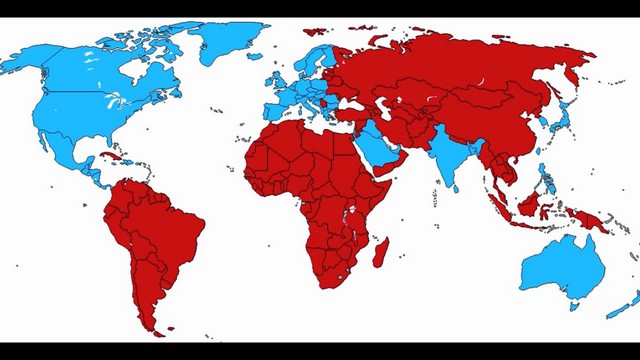
MH17 Malaysian Airlines Documentary by Ukraine SBU Whistleblower: Review

By Andrew Korybko

The latest MH17 documentary, “MH-17: In Search Of Truth” by Ukrainian SBU whistleblower Vasily Prozorov, shares some shocking truths about that tragedy which strongly make the case that the UK conspired with Kiev to take down that civilian aircraft as part of a preplanned Hybrid War plot against the Donbas rebels that was also intended to frame Russia as the West’s main geopolitical competitor.

Ukrainian SBU whistleblower Lieutenant Colonel Vasily Prozorov released a documentary about the MH17 tragedy late last month titled “MH-17: In Search Of Truth“, which true to its name shares some shocking truths about what transpired on that fateful summer day back on 17 July, 2014. His investigative work relies on his personal knowledge of the events surrounding that affair (including through his contacts at the time), classified documents, eyewitness reports, and logic to strongly make the case that the UK conspired with Kiev to take down that civilian aircraft as part of a preplanned Hybrid War plot against the Donbas rebels. The nearly 40-minute-long documentary is worth watching in full, but for those who aren’t able to at the moment yet are still interested in learning more about this cover-up, what follows is a brief summary of some of the most important points raised in his documentary.

MH-17: In Search of Truth

Prozorov draws attention to how suspicious it was that supposedly leaked recordings from rebel leaders allegedly implicating them in the tragedy were shared on social media within hours of MH17 being shot down. Ukrainian law has very strict bureaucratic guidelines for declassifying wiretapped evidence which couldn’t have been followed in less than a few days’ time at the absolute earliest, strongly suggesting that the recordings were faked in advance by the country’s SBU security service after intercepting voice samples of the alleged suspects ahead of time. The purpose in doing so was to immediately take control of the narrative per the preplanned Hybrid War plot of delegitimizing the Donbas rebels’ cause by framing them as “terrorists” and thus preventing a possible Russian military intervention in their support like was widely speculated to be in the planning stages around that time, but that last-mentioned point will be returned to in a moment.

The next one that Prozorov talks about is how Kiev’s claims that its armed forces weren’t in the combat area during that time are unconvincing since he proves that the battle lines were actually very fluid. Not only are there eyewitness reports to this effect, but also evidence of their tire tracks going back and forth all throughout the area, as well as countless ration wrappers proving that presence of the armed forces and their allies there. This is very important since part of Kiev’s defense rests in its insistence that even if the BUKs under its control were deployed somewhere near the front lines (which will also be returned to later on in this analysis), they allegedly weren’t close enough to shoot down MH17. Prozorov, however, proved that this isn’t true since the Ukrainian Armed Forces freely moved all around the area and could easily have been within striking distance of the aircraft at the time of the tragedy.

One of the more interesting tidbits that Prozorov revealed in his documentary was his participation in a conference at the National Security and Defense Council of Ukraine on 8 July, 2014, focusing on making amendments to the country’s so-called “anti-terrorist” legislation. He vividly recalls overhearing an exchange between Deputy Secretary of the National Security and Defense Council Col. Gen. Mikhail Koval and an unknown Defense Ministry representative right after the event ended. Prozorov remembers how the representative expressed his fear (which was widespread at the time) that Russia was preparing a military intervention in support of the Donbas rebels which he was worried would crush Kiev’s forces in the region. Koval, however, reassured his interlocutor by telling him that he heard hints that something will soon happen which will pose a serious challenge to Russia’s alleged plans. Nine days later, MH17 was shot down.

In response to the obvious question about how that happened, Prozorov begins by explaining that Donbas’ airspace wasn’t forcibly closed by Kiev unlike what one would ordinarily expect a responsible state to do. This created ample opportunities for the organizers to prepare their provocation since international aircraft continued to transit over the conflict region for convenience’s sake. Facilitating their preplanned plot, Prozorov points out how a radiolocation station in Donbas’ Artemovsk was mysteriously disabled a month before MH17 was shot down. He notes that it could have pinpointed where the BUK missile came from had it been active at the time of the tragedy and wonders aloud why the Ukrainian media didn’t make a fuss out of blaming the rebels back then. His answer is that the third regiment of the Special Operation Forces of Ukraine were responsible, suggesting that these sabotage experts carried out their operation to cover Kiev’s future tracks.

Another relevant fact that Prozorov discusses in his documentary is that the US didn’t immediately release the satellite evidence that they claimed to have from the day of the tragedy. He believes that this was done in order to give the perpetrators enough time to finalize their “alternative facts” in the immediate aftermath of what happened and not accidentally screw everything up for them. In addition, he questions why the Joint Investigative Team (JIT) didn’t accept the evidence that was promptly provided by the Donetsk People’s Republic (DPR) from the crash site, as well as why it took the Dutch investigators months to show any real interest in the wreckage. These curious observations give credence to the claim that many of those tasked with investigating the incident weren’t impartial and instead wanted to push a very specific preplanned narrative. It’s also strange that the Malaysian authorities were initially marginalized by the intelligence-led investigative team.

Prozorov shared some very important information about the role that the 156th anti-aircraft regiment of the Ukrainian Armed Forces played in MH17’s downing, too. He spoke to two former conscripts who served with the unit during that time but have since defected to the rebels. They explained how their forces counted a BUK among their armaments and were deployed to the Donbas front lines prior to being mysteriously withdrawn from combat service despite the widespread fear that summer that Russia was about to militarily intervene in the conflict. Officers and contract soldiers then accompanied the BUK to a so-called “training range” while the conscripts were ordered to remain at base. It was only later that they learned from their colleagues who were physically there that the BUK was actually deployed to the combat area and had fired at least one missile right at the time that MH17 was shot down.

There’s some pretty intriguing evidence that Prozorov shared in his documentary about suspected British involvement in all of this as well. He relied on a document to prove that that chief of the counterintelligence department Major General Valery Kondratyuk accompanied two British secret service agents and others to the Donbas operational area on 22 June, 2014 for a one-day visit, after which all of the SBU representatives left except for Lieutenant Colonel Vasily Burba, who remained with Kiev’s British “guests”. Prozorov happens to know Burba since the latter replaced him and his colleagues there earlier that month, and he says that Burba participated in the MH17 plot together with the foreign agents. Afterwards, Kondratyuk and Burba’s careers “coincidentally” experienced meteoric success, with the former becoming the chief of the Main Intelligence Directorate before being replaced by the latter and then becoming the presidential deputy chief of staff.

Two other pieces of evidence also point to British involvement. The first is that Peter Kalver, the Australian intelligence agent tasked with leading his country’s investigative expert group in Donbas, used a British phone number. That would be strange in and of itself since he’s an Australian working in Ukraine, but when combined with what was previously revealed, it suggests that British secret involvement was even more far-reaching than initially suspected and raises questions about how many other less-important “investigative” figures might also have been connected to the UK. As for the second piece of evidence, Prozorov mentions that the UK-based “investigative journalism website” Bellingcat (funded in part by the Open Society Foundation and National Endowment For Democracy) was founded just days before the incident and then suddenly became the primary source of accusations against Moscow, making one wonder whether it’s actually an intelligence infowar front.

Wrapping everything up, Prozorov concludes his documentary by reviewing his main points, namely that MH17’s downing was a meticulously preplanned plot by the Ukrainian and British security agencies to pin the blame for this false flag attack on the Donbas rebels, all with the intent of portraying them as “terrorists” and thus also make it politically impossible for Russia to militarily intervene in their support like was widely suspected to be in the planning stages during that summer. There was also the grander intention of framing Russia as the West’s main geopolitical competitor. All of this is relevant to still keep in mind since the JIT’s judicial proceedings will begin in March 2020, thus returning the issue back to the international spotlight as the perpetrators attempt to absolve themselves by convincing the world that the innocent suspects are guilty. Altogether, Prozorov’s documentary is extremely insightful and worth watching in full if one finds the time.

*

Note to readers: please click the share buttons above or below. Forward this article to your email lists. Crosspost on your blog site, internet forums. etc.

This article was originally published on OneWorld.

Andrew Korybko is an American Moscow-based political analyst specializing in the relationship between the US strategy in Afro-Eurasia, China’s One Belt One Road global vision of New Silk Road connectivity, and Hybrid Warfare. He is a frequent contributor to Global Research.

5 January 2020

Source: www.globalresearch.ca