Just International

Amazon Guardian Shot Dead By Loggers

By Countercurrents Collective

An indigenous Amazon Guardian has been shot dead by loggers and another wounded after they were ambushed by loggers. Paulo Paulino Guajajara, known also as Kwahu Tenetehar, was shot in the neck and died in the forest. His colleague, Tainaky Tenetehar, was shot in the back and arm but escaped.

The Amazon Guardians have been patrolling their territory in the eastern Amazon, which has been heavily invaded by loggers, for several years. Uncontacted members of the Awa tribe also live in the territory.

At least three Guardians have previously been killed, and many of their relatives have also been killed as loggers and land grabbers have targeted their territory, known as Arariboia, which is now the last area of forest left in the region.

Earlier this year Paulo Paulino told Survival: “It makes me so mad to see this [forest destruction]! These people think they can come here, into our home, and help themselves to our forest? No. We won’t allow it. We don’t break into their houses and rob them, do we? My blood is boiling. I’m so angry.”

Sonia Guajajara, head of APIB, the Association of Indigenous Peoples of Brazil, said today: “It’s time to stop this institutionalized genocide! Stop authorizing the bloodshed of our people!” APIB is touring Europe to highlight the racism and genocidal assaults unleashed by President Bolsonaro.

Survival International Brazil researcher Sarah Shenker, who accompanied the Guardians on one of their operations earlier this year, said today: “Kwahu was completely dedicated to defending his forest and his uncontacted relatives, despite the risks. He was also one of the most humble people I’ve ever met.

“He knew that he might pay with his life, but he saw no alternative, as the authorities did nothing to protect the forest and uphold the rule of law.

“This is the reality of life for many of Brazil’s indigenous people and it has got much worse under President Bolsonaro. He encourages the loggers and land grabbers, and strips the forest’s defenders of protection, leaving them at the mercy of heavily armed and utterly ruthless logging mafias.

“But the Guardians won’t give up, and nor will their allies. If President Bolsonaro thinks this kind of brutality will win, he’s very much mistaken.”

4 November 2019

Source: countercurrents.org

MH17: THE QUEST FOR JUSTICE

CONFERENCE REPORT
Date: 17 August 2019
Venue: Main Auditorium, International Islamic University Malaysia, Gombak

INTRODUCTION
On Saturday, 17th August 2019, an international conference, “MH17: The Quest for Justice” was held at the International Islamic University Malaysia (UIIM) in its Main Auditorium in response to the Joint Investigation Team (JIT) Report made public in June. The Conference was jointly organised by the International Movement for a Just World (JUST), the Perdana Global Peace Foundation (PGPF) and the Montreal based Centre of Research on Globalisation (CRG) in collaboration with UIIM. The JIT Report had accused three Russian nationals and a Ukrainian of having shot down the MAS flight MH17 overflying the war zone of East Ukraine on July 17th, 2014..

The aim of the Conference, as the name suggests, was to try and see that justice is done. It determined the flow, structure and sub-titles of the six sessions. It was a whole day conference, starting at 8.45 am and winding up around 7.00 pm. The pre-lunch sessions of the screening of the documentary, “ MH17: Call for Justice”; “Review of Evidence and Background’’ and “The Legal Dimension” were followed after lunch with sessions giving the whole tragedy a human dimension: “Ground Zero: The Unsung Heroes” and “In Memory”, talks by Malaysians on the ground, firstly, in Donetsk, East Ukraine, where the aircraft fell and, secondly, in The Hague where the then Malaysian ambassador to the Netherlands was tasked with identifying and the logistics of arranging for the return of the remains of the Malaysian victims, home. The final session was an attempt at drawing a framework for further action to meet the main objective of the conference.

Experts, who have been following the progress of the JIT and the Dutch Safety Board (DSB) Reports were flown in, all speaking before lunch making their cases together and drawing a picture of flawed investigations led by the Dutch. The decision to let the Dutch to lead the investigations was agreed upon because a majority of the victims were Dutch.

THE OPENING
The conference opened with introductory remarks by Dr Chandra Muzaffar, President of the International Movement for a Just World (JUST). He spoke of the objective of the Conference given the state of global geopolitics where the hegemon has no qualms about lying and staging false flag events to engineer a public consensus for war as in the Gulf of Tonkin incident and the Iraq invasion where lies were blatantly orchestrated to justify the Vietnam war and the invasion of Iraq, respectively.

Officiating the event was Tan Sri Dzulkifli bin Abdul Razak, the UIIM Rector, who made available to the organisers the auditorium for free.

SESSION 1: Documentary — Call for Justice
The body of the Conference began with the screening of a documentary followed by questions and answers from the floor. The director of the Film Ms Yana Yerlashova and the Malaysian sound expert interviewed in the documentary, Mr Akash Rosen, who declared the sound bites used by Joint Investigative Team(JIT) as evidence to charge the four accused had been tampered with. During the Q and A session which ensued, it emerged from the floor that Malaysia refused to lead the investigation because the authorities were busy with the disappearance of MH370 which happened in March 2014. Significantly, too, an answer elicited by a question to Ms Yerlashova drew the distinction between the Dutch Safety Board (DSB) and the JIT investigations. The JIT investigation only appointed and included Malaysia much later. The former investigated the technical aspects of the shooting while JIT conducted a criminal investigation. Another important information that emerged during the session was that of the black-boxes of MH17 which were retrieved by the East Ukraine separatist rebels and handed over to Malaysia who then brought them to Farnborough , England, to be deciphered. A preliminary report was given to the Malaysian government. Yana asked whether the black boxes were returned to Malaysia, the answer to which was “NO” because all evidence was kept by the Dutch as lead investigator.

Ms Yarleshova concluded that there is a need for a neutral investigation done by a neutral country.

SESSION TWO: Review of Evidence and Background
Speaker 1
Professor Michel Chossudovsky of the CRG then kicked off Session 2, which was moderated by Tan Sri Ahmad Fuzi Haji Abdul Razak, former Secretary-General of the Ministry of Foreign Affairs Malaysia. Chossudovsky lamented the state of the contemporary world where “Lies have become the consensus” thus indicating his position quite unequivocally. He contended that the US Administration fronted by Obama’s Secretary of State, John Kerry, carried a narrative that was to suit their lies. Even without hard evidence their immediate action was to pin the blame on Russia. Meanwhile, both the DSB and JIT investigations had relied on information from the SBU, the corrupt Ukraine Intelligence outfit. All other evidence from other sources than SBU were discarded.
Professor Chossudovsky then pointed out that there was a second aircraft flying overhead at the same time. This is according to a BBC report which carried eyewitness accounts. The report has since been removed. He pointed out that there were bullet holes in the fuselage of MH17, which was later corroborated by the next speaker, Peter Haisenko. A BUK missile — identified by the JIT report was that the weapon used — cannot make these holes. The third point raised to support as evidence that the JIT report is flawed is the fact that there was no BUK missile fired in the vicinity at the pertinent time. If there was, it would have left a visible vapour trail that would remain in the air for at least 10 minutes before evaporating. There is no satellite evidence of such a trail. Professor Chossudovsky concluded from this that a BUK was never fired and that, therefore, MH17 was not downed by a BUK missile. There was also no evidence to indicate that the separatist rebels had deployed BUK neither before nor after the event.
Another absurdity pointed out by Professor Chossudovsky was the position adopted by the JIT before Malaysia was allowed to join the body. It was that all JIT decisions should be by consensus. This gave all four members of the JIT at that time – Netherlands, Belgium, Australia and Ukraine — a veto each. Since there were grave doubts from the outset about the role of the Ukrainian authorities in the July 17th incident, this would necessarily imply that Ukraine could disallow all evidence except those from its SBU.
He ended his presentation with the question, “Is the shooting of MH17 deliberate?” to which he answered that one can only speculate since there is no proof.

Speaker 2
The next speaker was Mr Peter Haisenko a German pilot formerly of Lufthansa Airlines with considerable flying hours under his belt flying wide bodied jets. He went for the jugular by asserting that it was not a BUK that brought down flight MH17. BUK was not intended to bring down commercial aeroplanes but rather small fighter planes. He observed that it was not a BUK for three reasons. Firstly, there was no loud boom heard nor a vapour trail sighted. Secondly, there were no exit markings of BUK shrapnel. The circular holes present in the wreckage of the MH17’s body could not have been made by the BUK system. Thirdly, there is some evidence suggesting that another aircraft, a SU-25, was present. He asked why the JIT Report carried blurry pictures when there are available sharp, focused pictures?
Mr Haisenko concluded that there must be a new, neutral investigation because the JIT Report is technically flawed.

Speaker 3
The third speaker in Session 2, Professor Kees van der Pijl from Amsterdam dealt with the geopolitical and economic contexts of the tragedy. He began his presentation by praising the Malaysian Prime Minister’s courage when declaring that he was not convinced given the evidence presented and the powers behind the JIT Report. The JIT Report says there was murder. If there is murder what is the motive, the Professor asked. The geopolitics and economic context would provide some answers.
Before addressing the geopolitical context to establish motive Professor Kees Van der Pijl touched on the DSB investigations which, he remarked did not identify who brought down MH17. He argued that the DSB itself is compromised. Established in 2010 it cannot report on anything that is against the interest of the Netherlands and anything that might mar the relations between the Netherlands and NATO and the EU. The choice of people sitting on the DSB suggests that there was intention to curb its independence.

Professor van der Pijl touched briefly on the missiles and then went on to suggest that the 1.3 tons of lithium-ion battery that was carried by MH17, a commercial flight was a threat to air safety. Who allowed this to happen? A question not investigated by the DSB. He charged, too, that other than the SBU the information taken into consideration was from Bellingcat, a proven unreliable source of information. The question asked was why were more reliable sources of information not used? Why were national intelligence outfits, other than the SBU, not tapped for information?

Professor van der Pijl also asked why the JIT rejected the information offered by a German investigator, Mr Joseph Resch. His extensive documents amounting to 10 packages were rejected. He argued that the investigator is now a man afraid for his life hence his demand that the handing over of the documents must be in the presence of the media. According to Professor van der Pijl, Resch has now offered the information to Malaysia and Russia but to date there has been no response.

He then arrived at the geopolitical context citing the “race between the US and post-USSR Russia where the prize was Ukraine. Crimea which hosts Ukraine’s most strategic port voted to be reintegrated into Russia. On 16 July 2014 US declared this was unacceptable and imposed sanctions on Russia but the Europeans were reluctant to follow suit given their reliance on Russian gas.
Then the Middle East happened and the jostling for oil and gas pipelines to supply Europe. Whose territory would the pipelines pass through?
The Question and Answer Session that followed the presentations raised the need to make mandatory the closing of airspace over war zones to commercial flights. According to Professor van der Pijl, this issue was addressed in the 2nd part of the DSB Report. As to the restrictions on carrying lithium-ion batteries on commercial flights the Professor pointed out that within two weeks after the MH17’s downing the US banned lithium batteries on commercial flights. There was mention of the fabric of power that can make white black at which point Professor Chossudovsky intervened, remarking that the statements by Obama and Kelly on the very day of the tragedy suggest conspiracy.

SESSION 3: The Legal Dimension

The last session of the morning, Session 3 dealt with the legal dimensions of the shooting down of MH17. Moderated by Professor Datin Dr Mary George of University Malaya’s Law Faculty, the first speaker, Mr John Philpot of Canada began by stating that warfare is transitioning into law fare, the continuation of war into law. Mr Philpot felt that the JIT Report was unfair and biased with no respect for the Rule of Law. He pointed out the use of “could” to establish guilt cannot be the basis for making a charge in law because the word “could” suggests a measure of doubt.

His assertion was that the JIT Report is primarily flawed. Firstly, the initial non-inclusion of Malaysia in the Investigation Team, despite the fact that as operator of MH17, Malaysia was entitled to lead the investigation. Secondly, the suspect country, Ukraine, however, was part of JIT from the beginning. Finally, with the March coup, US influence over Ukraine is overwhelming. Mr Philpot said that Holland was not in a position to run the prosecution because the case is based on a flawed investigation.

Furthermore there is no extradition treaty with Russia nor Ukraine. So a trial would be in absentia. This would mean that the evidence based on a flawed report cannot be countered.

He also contended that the Dutch legal system allows the victim a voice. As a result, in order to control the narrative, the Dutch is said to be trying to shape that voice. He did not see the International Criminal Court (ICC) as a solution either, given its track record.

Mr Philpot ended his presentation with possible solutions. He proposes a Commission of Enquiry more or less formal be established given the volume of evidence that has not been looked into by the JIT investigation. It could be led by Malaysia and could take place in Holland. The other solution is to establish diplomatic contact to persuade Holland to change its direction. He pointed out, too, that in international law the forthcoming trial is dangerous because it can end in a declaration of guilt that cannot be expunged if the decision is found to be unfounded later.

Finally, to a question whether international law can be a recourse for the pursuit of justice, Philpot’s reply was that it cannot. International law is being manipulated to serve geopolitical goals. The trial is set to go on in Holland in March next year but the Dutch prosecutor does not view the evidence as flawed.

Speaker 2
The second speaker of the Session was Dato’ Dr Gurdial Singh Nijar, a Malaysian advocate and solicitor who started by pronouncing that the MH17 air tragedy was a complicated legal issue. Here was a civilian aircraft, a shared coach between KLM and MAS flying from Holland to Kuala Lumpur overflying a war zone that the country does not control. Dato’ Gurdial Singh plunged directly into the challenges and what can be done in the face of a pending prosecution, to demonstrate the inequities etc. To start with, there is an abundance of evidence that has been ignored during invstigation. How to introduce them during trial? Family witnesses, who to determine who to be heard?

Malaysia as operator of the airlines can take the initiative. Should this become futile then and only then can there be a commission after demonstrating that there has been perpetration of injustice

He said that trial in absentia is inevitable and does not provide opportunities. If it is not possible then it is clear that parties involved are not allowing for justice to be done??. Then there can be civil recourse to establish wrongdoing. Where? In Ukraine to establish the negligence of the State.

After Session Three the Conference broke for lunch and resumed with Session Four.

SESSION 4: Ground Zero: The Unsung Heroes
The session, was moderated by Ms Amy Chew, a freelance journalist. The speaker was Colonel Haji Mohd Sakri Hussin who headed a team of 12 to go into the war zone and retrieve MH17’s black boxes. Colonel Sakri recounted his mission from the moment he left Kuala Lumpur for Kiev with some 150 personnel of the Royal Malaysian Police and the Armed Forces. In Kiev he received orders from the then Malaysian Prime Minister to retrieve the flight and data recorders, the black boxes from the leader of the separatists. This he succeeded in doing, going through a war zone, through ten check points of the Kiev government despite the Malaysian ambassador’s warning that Kiev was aware of his mission and that they did not approve. Orders being orders Colonel Sakri ignored the advice which made the journey even more dangerous.

He recounted, too, how after retrieving the black boxes, the Kiev government and the FBI had tried to persuade him to hand them over the black-boxes but he refused and instead surrendered them to the Dutch after which the boxes were brought to Farnborough in England to be deciphered. So ended his mission. He was not party to what happened afterwards to the black boxes.

SESSION 5: In Memory
The programme of the following session had to be altered at the final hour because of the last minute withdrawal of the speakers, next of kin to two victims both part of the crew of the ill-fated flight. Instead those attending the conference were given a picture of what happened in Holland where the remains were being handled and made ready for their return to Malaysia by the then Malaysian ambassador to Holland, Datuk Dr Fauziah Mohd Taib. During a brief session she spoke of how her embassy was turned into an Operations Room, of her staff and herself staying back and manning it overnight to handle all administrative work involved for the Malaysian government. What took her aback was the ‘quick-to-blame the Russians’ attitude which they criticised her for not supporting. The Dutch took immediate action to block exports to Russia of fresh produce and flowers. She was disappointed by their attitude towards the Russian ambassador to the Netherlands who was suddenly shunned. At the end of her talk she briefly mentioned that one of the speakers who had withdrawn from the Conference appeared supportive of the JIT Report and wanted nothing to do with the Conference. They viewed the conference as against the JIT Report. She had little knowledge of what happened outside of her purview of handling grieving family members and arranging for the return of the remains of 43 Malaysians who lost their lives needlessly.
The ensuing question and answer session was brief and did not give rise to any new information.
SESSION 6: Formulation of an Action Plan
The Final Session, Session Six was made up of a panel of four moderated by Tan Sri Jawhar Hassan, a member of the JUST Executive Committee. The panel was made up of Professor Chossudovsky of CRG, Datuk Dr Zulaiha Ismail of PGPF, Ms Askiah Adam, the JUST Executive Director and Dr. Chandra Muzaffar, the JUST President. The objective was to draw up a Plan of Action to map the way forward.

Professor Chossudovsky started the session by saying that the direction of this endeavour has been set by the legal dimensions, the finding that this Conference cannot participate nor accept the flawed JIT findings and process. Where the interests of the families are not served then the way to go would be a civil legal suit. For the Malaysians it should be in Malaysia. With regard to MH17 there is a fragile consensus because it is based on lies. The consensus must be reversed. This consensus built on lies is a consequence of the media’s uncritical reporting. There must be a relationship with the media towards the reversal of the consensus. The organisers of the Conference are considering the setting up of a study group to achieve justice including for the families. Datuk Dr Zulaiha was in full agreement with Professor Chossudovsky. She was concerned that the ICAO a UN agency, up to this day, has not taken Ukraine to task for having kept its airspace over a war zone open. She is not sure whether a tribunal of conscience or a formal legal suit against Ukraine should be the way forward. Ms Askiah Adam as the day’s rapporteur gathered the proposals and opinions voiced throughout the day that might fill the Plan of Action. As such what was contained in her presentation is already found in the earlier parts of the proceedings of the Conference.
The final speaker, Dr Chandra Muzaffar outlined four points that have emerged from the proceedings. Firstly, it was to suspend the JIT process since the investigation is flawed. Any conviction in a court of law arising from such an investigation would be a gross travesty of justice. To alert the Malaysian Prime Minister about this so that he can get in touch with his Dutch counterpart. This would be the most important recommendation from our Conference. Secondly, if the first point succeeds there is a need for an alternative process to bring closure. We could set up a committee of legal minds to suggest alternative routes to justice for the families of the victims. Thirdly, civil society organisations should come together to support this alternative process. This would be part of the mobilisation of public opinion. Fourthly, to develop an alternative narrative about the entire episode with the help of the media. The most critical dimension of this narrative would be to show how MH17 is part of the unfolding geopolitical scenario related to the attempt by the dominant hegemonic forces to perpetuate their power and control in the midst of the most serious challenge ever to Western dominance in the last 200 years.
The most striking feature of the Question and Answer session that followed the presentations was the inability of media practitioners to see as hard evidence the points raised to show the flawed nature of the JIT investigations which were at best opaque and at worst fraudulent. The media practitioners have no appreciation of this. It shows that there is much work to be done ahead.

The Conference ended at about 7pm.

The above report was prepared by the Conference Rapporteur, Ms. Askiah Adam.

How the U.S. Regime ‘Justifies’ the Theft of Syria’s Oil

By Eric Zuesse

Only starting on 28 October 2019 — after seven years of the U.S. and its allies stealing Syria’s oil — did U.S. ‘news’-media start to apply the word “theft” or “steal” (or any equivalent term) to what was happening to Syria’s oil; and, even then, the blame for stealing it was focused only against U.S. President Donald Trump, who was bold about doing it, and never focused against his predecessor Barack Obama, who (along with America’s allies) had started doing it as early as 2012. The breakthrough news-report, which finally ended the U.S. propaganda-media’s embargo against calling it by such terms as “theft” or “stealing,” occurred when ABC News headlined on October 28th, ‘“‘We’re keeping the oil’ in Syria, Trump says, but it’s considered a war crime”, and finally reported that “seizing it would be pillaging, a technical term for theft during wartime that is illegal under U.S. and international law.” Among the hundreds of reader-comments to that news (after the seven-year-long embargo was, at last, lifted) the top-liked or “Best” was “So America has been reduced to thieves and pillagers? Truly a sad moment in American history.” Many of the reader-comments there were focused specifically against Trump, such as, “Gee Mr. Trump, maybe there’s some works of art we can confiscate too?” but not only did this news-report not mention anything about how long the theft had been going on, but it propagandistically and falsely alleged “Most of that oil is sold to the regime of Bashar al-Assad, the strongman who has waged a war against his own people and is opposed by the U.S.” That was thrown in so as to focus the blame against Syria’s Government (for these massive thefts FROM Syria’s Government), instead of against America and its allies, who had recruited and armed and brought into Syria tens of thousands of jihadists to serve as America’s proxy-forces there, in order to overthrow and replace that Government. The presumption in those propaganda-media has always been that Syria’s Government should simply have quit and let the royal Saud family, the owners of Saudi Arabia, appoint the ruler of Syria. This wasn’t news-reporting; it was instead propaganda-spreading.

For seven years, there has been not only a disinterest, by all of the U.S. mainstream news-media, in the ongoing systematic theft of Syria’s oil by the U.S. Government (and by its allies there, including especially ISIS, who were funded mainly by sales of this oil); but also a consistent refusal by the media to call it “theft” or “stealing” by the U.S. and by its allies. All of this theft has had the purpose of depriving Syria’s Government — the legal owner of that oil — of the income from Syria’s oil. The ultimate purpose of these thefts is the collapse of Syria’s Government, and its surrender to the U.S.-and-allied forces, so that the royal family of Saudi Arabia can select for Syrians a new leadership team, consisting of fundamentalist Sunnis. The Israeli regime has supported these efforts. America’s CIA has been trying for this objective, on and off, ever since 1949, but only after the CIA-encouraged “Arab Spring” in 2011, did the U.S. regime commit itself intensively to this invasion/occupation of Syria, and to the now long-ongoing theft of oil from Syria. It didn’t start with Donald Trump; it started with Barack Obama. And the U.S. news-media treat the entire matter far more as constituting, for them, a U.S. propaganda-operation, to justify the whole thing, than as constituting an authentic journalistic matter, to inform the American public honestly. The purpose of the following will be to make clear how this international war-crime has been ‘justified’ by the U.S. Government, and by its press.

Here’s the actual history about it, starting from now, and working backward to the beginnings:

On October 26th, the New York Times headlined “Keep the Oil’: Trump Revives Charged Slogan for New Syria Troop Mission” and opened by saying that “in recent days, Mr. Trump has settled on Syria’s oil reserves as a new rationale for appearing to reverse course and deploy hundreds of additional troops to the war-ravaged country.” They closed with a statement from Bruce Riedel, retired from the CIA: “‘Let’s say he does do it,’ Mr. Riedel said. ‘Let’s say we establish the precedent that we are in the Middle East to take the oil. The symbolism is really bad.’” The propaganda-value of a ‘news’-report is concentrated in its opening, and especially in what the ‘reporter’ (fulfilling the intentions of his editors) selected to be at the very end (such as Riedel’s statement). However, is what’s wrong with taking Syria’s oil actually the “symbolism,” as Riedel said, or is it instead the theft — the reality (and why did the NYT pretend that it’s the former)? Nowhere did that NYT article use the word “theft,” or anything like it, but that is the actual issue here — not mere ‘symbolism’.

Trump had been so lambasted by the Democratic Party’s ‘news’-media (such as the NYT) and by all the rest of the neoconservative (or pro-U.S.-imperialist) ‘news’-media (the Republican ones), for his trying to withdraw forces from Obama’s regime-change war against Syria, that he’s now switched to trying to ‘justify’ continuation of America’s invasion-occupation of Syria, by his promising to steal the oil there — but the ‘news’-media had never used that term (“theft”), or anything like it, to describe what the the U.S. regime now, for the first time publicly, says it is aiming to do there. They themselves have been propagandizing the American people to oppose American withdrawal from Syria, which would mean ending Obama’s invasion-occupation of Syria — something they’ve all supported. Publicly acknowledging that theft is the reason why we’re there is too shocking for them to report; and, so, Trump’s now saying this has caught them off guard. Both the Republican and the Democratic Parties, and their ‘news’-media, have been full-bore “Assad must step-down.” None of America’s ‘news’-media had stated, either, that America’s invasions-occupations of Afghanistan, Iraq, Libya, and Syria, have all been disasters (though they all were), and that all of them have been and are defeats for America (though they all were that, on all of America’s leaders’ lies about ‘protecting human rights’, and about ‘bringing democracy’, and about what would have been producing improved lives — instead of producing continued bloodshed and misery — for the residents in the countries that we had invaded and occupied). It’s all lies, nothing but that; and any ‘news’-media which operate this way will find themselves increasingly trapped in their lies, like the politicians themselves are. The only way ‘out’, for any of them (including for Trump, and for both the Republican and the Democratic press) is yet more lies — and all of these lies are cover-ups, by the press and by the politicians. (This is why they’re torturing Julian Assange to death: he has seriously challenged that ongoing deceit, in which they all participate.) Unless the public stop the media from doing it — by cancelling their subscriptions, and otherwise demonetizing the ones who have been doing it — the lies, and deceits, and invasions, and destructive U.S. national expenditures of tens of trillions of dollars (being paid to corporations such as Lockheed Martin, and not only to our soldiers) will continue. This enormous counterproductive expenditure will drain America’s abilities to fund health care, education, etc. It is bringing the U.S. economy down, and not merely bringing America to an ethically lower and lower point. The more that America’s leaders try to continue expanding the American empire, the more that they will both embarrass, and weaken, America. This is real. It is no propaganda, at all. It’s “the truth, the whole truth, and nothing but the truth.” It’s too true to report. It contradicts the propaganda. So: they didn’t report it.

On October 24th, USA Today headlined “Pentagon planning to send tanks, armored vehicles to Syrian oil fields”, and stated that “The Pentagon is preparing to send tanks and armored vehicles to Syrian oil fields, according to a U.S. official – a stunning reversal of President Trump’s decision to withdraw U.S. forces from the war-torn country after he declared victory over ISIS.” Those oil fields don’t belong to the U.S., but to Syria’s Government, and their operation is vital to funding Syria’s reconstruction, which the U.S. regime is determined to prevent; but USA Today’s ‘news’-report says nothing about any of that. The U.S. Government is trying to steal Syria’s oil fields — but this USA Today article says nothing about that, either. American troops are invaders of Syria, unlike Russian troops, who are defenders of Syria, and who had been invited into Syria by Syria’s Government (the only government Syria has) in order to help defend Syria’s sovereignty, over Syria’s own land, including its oil wells, against the U.S.-and-allied invasion. All of that vital context is missing from this deceptive report.

That report said “Now, Russian troops, which are in Syria to bolster the regime of Bashar al-Assad, and Turkish forces, are operating in the region previously patrolled by U.S. and Kurdish forces.” It’s saying that, whereas the region had been “patrolled” — instead of invaded and now occupied — by U.S. and Kurdish forces, “Russian troops … and Turkish forces … are in Syria to bolster the regime of Bashar al-Assad,” though his ‘regime’ is actually the only legitimate Government of Syria. But the U.S. regime claims the right to force Assad to be overthrown.

This report stated that “The deployment of armor is aimed at Russia and Syria, not ISIS, said Nicholas Heras, an expert on Syria with the Center for a New American Security. … ‘Pure and simple,’ he said, ‘the Pentagon is making contingencies for a big fight with Russia for Syria’s oil.’” But Russia isn’t trying to seize Syria’s oil — the U.S. regime is doing that, actually. Russian forces are in Syria only in order to assist Syria to defend its oil, and its land. If the U.S. regime will go into World War III so as to steal Syria’s oil, then the likelihood of Russia’s letting this theft happen is slight: that would be Russia’s capitulation without a fight, and Russia has never given any indication it would do such a thing. (And Russian media DO refer to this as being “theft”; they’re not trying to hide the fact. Russia already is fighting the U.S. regime in Syria. For example, on October 26th, Russia’s Sputnik News headlined “The Russian military described the US scheme as nothing less than ‘international state banditism’,” and reported that, “According to Russian intelligence, the illegal US-supervised extraction of Syrian oil was being carried out by ‘leading American corporations’ and private military contractors, with US special forces and air power used for protection. Konashenkov said the estimated monthly revenue of this ‘private enterprise’ was over $30 million.”) This is the territory of Syria, which is a Russian ally. The thief here is clearly the U.S. regime, not Syria, and not Russia. It is no one else than the U.S. regime that is aiming to steal Syria’s oil by sending in tanks. Nowhere does the USA Today article even so much as hint that this is the case.

An October 21st Wall Street Journal article reported the U.S. Government’s theft of Syria’s oil, but it was instead headlined with the misleading, more innocuous, and less attention-grabbing “Trump Calls for Defense, Use of Syrian Oil Fields” — nothing about any “theft” — and it opened with the seemingly U.S.-or-Syria defense-related statement (as if U.S. troops were in Syria as defenders, instead of as attackers and thieves) that “President Trump said he is planning to keep a small number of troops in northeast Syria to protect the oil fields there and suggested that an American company might help the Syrian Kurds develop the oil for export.”

However, since when does a thief break into your residence in order to “protect” anything? And since when does such a thief have a right to sell your property, or to determine what people (such as “the Syrian Kurds”) will sell it?

Was that article news, or was it instead propaganda? It certainly misrepresents. What it reports, is reported as if this thieving operation were only being contemplated, and would be new, but the thieving is actually nothing new — it’s an already-existing, and longstanding, coordinated and international operation, by the U.S. regime and its allies, as will here be documented.

America’s mainstream media now (such as in USA Today, WSJ, and NYT) are normalizing this theft. This normalization is being done by their propaganda, which now is for a Republican Government, but formerly was for a Democratic Government. Previously, Democrats had done the same hiding of the regime’s evil, when their Democratic President Barack Obama was the person who was perpetrating it.

This theft — and the normalization of it — are actually bipartisan, and longstanding. When the ‘news’ presents false historical context, it lies; it is propaganda, and that’s what the American nation’s mainstream ‘news’-media now are. They are deceptive garbage, regime-propaganda.

On October 20th, Republican U.S. Senator Lindsey Graham, and Republican Maria Bartiromo of Fox News “Sunday Morning Futures,” discussed the Republican Trump’s plan to steal Syria’s oil, and they both agreed that it might turn out to be an excellent policy. This show was headlined “Sen. Lindsey Graham: I am increasingly optimistic we can have historic solutions in Syria.” It was a remarkably bold defense of the U.S. Government’s — and of its allies’ — thefts from Syria. Already, the U.S. Government had said that it won’t pay even a cent in order to provide restitution for the estimated $388 billion in damages to Syria from the invasion of Syria by the U.S. and by its allies such as Al Qaeda and the Sauds, but this show presented an endorsement by those two Republicans, backing the Republican U.S. President’s plan to steal Syria’s oil, which goes beyond merely supporting zero restitution to the invaded country. No mention was being made, by them, on this ‘news’-medium, that (as will be documented here) those thefts by the U.S. Government, and by its allies, have, in fact, been going on ever since the invasions of Syria by them and their proxies (or “agents” — such as Al Qaeda) had started in 2012. No mention was made by them that this was the policy of Democratic President Barack Obama and that it’s merely being continued further by Trump. To the exact contrary: Trump was being praised by these propagandists for starting this program, and, so, their praise was not just evil; it was actually entirely false.

Right before the interview, Bartiromo had been pretending to be a critical non-partisan journalist instead of the propagandist that she is, and so she stated that “my biggest issue here is the strength of Iran [as if Iran had ever invaded or even threatened to invade the United States, and as if Trump’s anti-Iran policies aren’t sufficiently stringent, or maybe even are vastly too stringent, or maybe even are altogether unjustified]. And I feel like the administration had the Iranians on their heels and ruining the economy through sanctions, through this pressure campaign. And now we give up and leave Syria.” The Senator disagreed with her make-pretend criticism of the Republican President, and he said that, instead,

The big thing for me is the oil fields. President Trump is thinking outside the box. I was so impressed with his thinking about the oil. Not only are we going to deny the oil fields falling into Iranian hands. I believe we’re on the verge of a joint venture between us and the Syrian Democratic Forces, who helped destroy ISIS and keep them destroyed, to modernize the oil fields and make sure they get the revenue, not the Iranians, not Assad. … That’s why what President Trump is proposing in Syria, a joint venture dealing with the southern oil fields in Syria, between our allies, the Kurds and the Arabs who helped us destroy ISIS, is a historic change that could pay dividends for the region. And, quite frankly, we could generate revenue to pay for our commitment in Syria. … I am increasingly optimistic that we can have some historic solutions in Syria that have eluded us for years, if we play our cards right.

Bartiromo replied “Wow. … You actually do see a way forward after you have spoken with the president on his plan to secure those oil fields.”

This theft is pushed by all of the U.S. mainstream media, and Trump knows that he will need at least some degree of support from them if he is to be able to win re-election. This is the reason why he keeps contradicting himself — trying to appeal to the “No More War” crowd, while still drawing donations from the “military-industrial complex” or owners of America’s ‘defense’ contractors. (There’s a lot of crossover between the controlling owners of those firms and the controlling owners of the ‘news’-media — and of the ‘non-profit’ foundations.) America’s major ‘news’ media have always buried the truth about this long-ongoing theft.

And not only was the theft of Syria’s oil the policy of Democratic U.S. President Barack Obama, but it was participated in by his coalition, which included both EU heads-of-state and Arab heads-of-state, and this policy began in 2011. Here’s how it, in fact, developed:

On 28 November 2012, Syria News headlined “Emir of Qatar & Prime Minister of Turkey Steal Syrian Oil Machinery in Broad Daylight” and accompanied it by video of the alleged event. (At that time, Qatar and Turkey were allies of the U.S. arming the ‘rebels’ in Syria to overthrow Syria’s Government; so, they were part of America’s broader operation, and were also profiting from it.) But that video is no longer active. A subsequent description of that video was posted under the headline “Emir of Qatar & Prime Minister of Turkey Steal Syrian Oil Excavators – No Translation”. Another posting of the video online has lasted from 6 October 2013 to the present time, under the headline “Emir of Qatar & Prime Minister of Turkey Steal Syrian Oil Excavators – BiffiSyrien”, where it still can be viewed.

By no later than 12 December 2012, U.S. President Barack Obama made the decision to hire Al Qaeda in Syria (called “Al Nusra”) to train and lead almost all of America’s proxy-forces on the ground in Syria to overthrow Syria’s Government. (Kurds were assigned to be America’s lead proxy-forces in far northeastern Syria.) (Obama was so determined to protect Al Qaeda in Syria as to sabotage on 17 September 2016 his own Secretary of State, John Kerry’s, just-signed Syrian ceasefire agreement with Russia, because that agreement allowed not only ISIS, but also Al Qaeda forces, to continue to be bombed in Syria by Russia. Obama was protecting Al Qaeda in Syria.)

On 22 April 2013, the AP headlined “EU lifts Syria oil embargo to bolster rebels” and reported that

The European Union on Monday lifted its oil embargo on Syria to provide more economic support to the forces fighting to oust President Bashar Assad’s regime. The decision will allow for crude exports from rebel-held territory. … The oil exports could open an important revenue stream for Syria’s opposition. …

While Syria was never one of the world’s major oil exporters, the sector was a pillar of Syria’s economy until the uprising, with the country producing about 380,000 barrels a day and exports — almost exclusively to Europe — bringing in more than $3 billion in 2010. Oil revenues provided around a quarter of the funds for the national budget. Being able to take advantage of the country’s oil resources will help the Syrian uprising “big time,” said Osama Kadi, a senior member of the Syrian opposition.

On 27 April 2013, the New York Times headlined “Islamist Rebels Create Dilemma on Syria Policy” and reported that

Nowhere in rebel-controlled Syria is there a secular fighting force to speak of. … The religious agenda of the combatants sets them apart from many civilian activists, protesters and aid workers who had hoped the uprising would create a civil, democratic Syria. … Of most concern to the United States is the Nusra Front, whose leader recently confirmed that the group cooperated with Al Qaeda in Iraq and pledged fealty to Al Qaeda’s top leader, Ayman al-Zawahri, Osama bin Laden’s longtime deputy. Nusra has claimed responsibility for a number of suicide bombings and is the group of choice for the foreign jihadis pouring into Syria.

Another prominent group, Ahrar al-Sham, shares much of Nusra’s extremist ideology but is made up mostly of Syrians. …

In the oil-rich provinces of Deir al-Zour and Hasaka, Nusra fighters have seized government oil fields, putting some under the control of tribal militias and running others themselves.

“They are the strongest military force in the area,” said the commander of a rebel brigade in Hasaka reached via Skype. “We can’t deny it.” …

“We all want an Islamic state and we want Shariah to be applied,” said Maawiya Hassan Agha, a rebel activist reached by Skype in the northern village of Sarmeen. He said a country’s laws should flow from its people’s beliefs and compared Syrians calling for Islamic law with the French banning Muslim women from wearing face veils.

On 1 May 2013, TIME bannered “Syria’s Opposition Hopes to Win the War by Selling Oil” and reported that

Without an embargo, European companies can now legally begin importing barrels of oil directly from rebel groups, which have seized several oil fields in recent months, mostly around the eastern area of Deir Ezzor. That would provide the opposition with its first reliable source of income since the revolt erupted in Feb. 2011, and in theory hasten the downfall of Bashar Assad’s regime, by giving rebels the means to run skeletal local governments and consolidate their control.

On 15 June 2013, Global Research headlined “Former French Foreign Minister: The War against Syria was Planned Two years before ‘The Arab Spring’” and Gearóid Ó Colmáin reported that

In an interview with the French TV station LCP, former French minister for Foreign Affairs Roland Dumas said:

“I’m going to tell you something. I was in England two years before the violence in Syria [in other words, in 2009] on other business. I met with top British officials, who confessed to me that they were preparing something in Syria.

This was in Britain not in America. Britain was organizing an invasion of rebels into Syria. They even asked me, although I was no longer minister for foreign affairs, if I would like to participate.

Naturally, I refused, I said I’m French, that doesn’t interest me.”

Dumas attributed it to Israel, not to the U.S., nor to the Sauds (who actually had always been the CIA’s choice to appoint the leaders of Syria), and he didn’t even so much as mention either of those, except to say that “this will enable it [Israel] to replace the United States as a global hegemon” (which is a crackpot idea). Though his interpretation was ridiculous, his allegation that in 2009 “top British officials … confessed to me that they were preparing something in Syria” is a factual matter, which is either true or false. (Back in 2009, there is actual evidence that American’s President Barack Obama was aiming to overthrow Assad. Furthermore, Obama’s team started by no later than 23 June 2011 to plan both the coup in Ukraine which succeeded and the coup in Syria, which failed. And as the great investigative journalist Gareth Porter reported on 5 January 2017, “In August 2011, national security officials began urging Obama to call on Assad to step down,” but at that time “He wasn’t willing to go along with anything except small arms,” until CIA Director David Petraeus — who soon thereafter became a member of the Bilderberg group — persuaded him to go all-out in arming the ‘rebels’. Furthermore, “when Obama was making crucial Syria policy decisions in September 2011,” his advisors assumed that both Russia and Iran would stay out of the matter and just let the U.S. and the Sauds take-over Syria. Obama respected his advisors. And, then, Porter headlined on 22 June 2017, “How America Armed Terrorists in Syria”. So: this theft-operation was extensively armed by the U.S. regime, and funded by the Sauds.)

In any case, the EU was certainly helping ISIS and other such groups to steal Syria’s oil, so as to help fund their overthrow-Assad operation. So, the participation also of UK was likely, even if not, at that time, proven.

On 14 October 2015, the Financial Times headlined ”Isis Inc: how oil fuels the jihadi terrorists” and reported that “Selling crude is Isis’ biggest single source of revenue. … While al-Qaeda, the global terrorist network, depended on donations from wealthy foreign sponsors, Isis has derived its financial strength from its status as monopoly producer of an essential commodity consumed in vast quantities throughout the area it controls.” (In other words, when TIME, on 1 May 2013, bannered “Syria’s Opposition Hopes to Win the War by Selling Oil” and said “That would provide the opposition with its first reliable source of income since the revolt erupted in Feb. 2011,” the “opposition” being referred to there was actually ISIS, not Al Qaeda. The EU was buying its black-market oil from ISIS.)

On 1 December 2015, another great investigative journalist, Nafeez Ahmed, bannered “Western firms primed to cash in on Syria’s oil and gas ‘frontier’” and he reported:

US, British, French, Israeli and other energy interests could be prime beneficiaries of military operations in Iraq and Syria designed to rollback the power of the ‘Islamic State’ (ISIS) and, potentially, the Bashar al-Assad regime.

A study for a global oil services company backed by the French government and linked to Britain’s Tory-led administration, published during the height of the Arab Spring, hailed the significant “hydrocarbon potential” of Syria’s offshore resources.

The 2011 study was printed in GeoArabia, a petroleum industry journal published by a Bahrain-based consultancy, GulfPetroLink, which is sponsored by some of the world’s biggest oil companies, including Chevron, ExxonMobil, Saudi Aramco, Shell, Total, and BP. GeoArabia’s content has no open subscription system and is exclusively distributed to transnational energy corporations, corporate sponsors and related organisations, as well as some universities.

On 28 August 2018, Abdel Bari Atwan, one of the Middle East’s most respected journalists, headlined “Carrots and Sticks” and reported that

Damascus has been inundated with secret offers in recent weeks as part of a carrot-and-stick policy, two of which are particularly significant.

The first, reported on Tuesday by the pro-Hezbollah Lebanese daily al-Akhbar and the semi-official Iranian Fars news agency, was conveyed by a senior US military officer accompanied by representatives of various intelligence agencies. They flew to Damascus on a private UAE jet, and were met by the head of the National Security Bureau Gen. Ali Mamlouk, intelligence chief Gen. Deeb Zaitoun, and deputy army chief-of-staff Gen. Muwaffaq Masoud. Their meeting lasted four hours. The Americans reportedly offered to withdraw all US forces from Syria in exchange for Damascus complying with three demands: to pull Iranian forces out of areas of southern Syria adjoining Israel; to guarantee US oil companies a share of Syria’s oil east of the Euphrates; and to hand over all information about terrorist groups and their members in Syria.

The second offer was revealed by Lebanese Hezbollah MP Nawwaf al-Mousawi in a discussion programme on the Lebanese TV channel al-Mayadeen, at which I was also a panellist. He said that Saudi Crown Prince Muhammad Bin-Salman sent an envoy to Asad offering to support him remaining president for life and provide generous Saudi support for Syria’s reconstruction in exchange for him severing ties with Iran and Hezbollah.

Both offers were categorically turned down by the Syrian leadership.

The American delegation was told that its troops in Syria were occupying forces which would be treated as such, that Syria could not abandon its strategic allies, and that issues such as US participation in the oil industry and exchanging intelligence could be discussed once political relations were re-established.

On 2 September 2018, the German intelligence analyst who blogs anonymously as “Moon of Alabama” headlined “Syria Sitrep – U.S. To Stay To ‘Create Quagmires’” and he reported:

The claim that the U.S. is there to fight ISIS is a lie. ISIS is still active in two places in Syria. Both are under U.S. control. …

The U.S. is not fighting ISIS in Syria. It is building semi-permanent bases, trains a large proxy force, and controls Syria’s oilfields. Its aim is still regime change, the same aim it had when it launched the war on Syria seven and a half years ago. To achieve that it will continue to sow as much chaos as possible.

As CIA and Pentagon mouthpiece David Ignatius wrote this week:

“[T]he administration has stopped the dithering and indecision of the past 18 months and signaled that the United States has enduring interests in Syria, beyond killing Islamic State terrorists — and that it isn’t planning to withdraw its Special Operations forces from northeastern Syria anytime soon.

‘Right now, our job is to help create quagmires [for Russia and the Syrian regime] until we get what we want,’ says one administration official, explaining the effort to resist an Idlib onslaught. This approach involves reassuring the three key U.S. allies on Syria’s border — Israel, Turkey and Jordan — of continued American involvement.”

But what seems ultimately to endure is: Steal the oil.

On 26 February 2019 the Syrian National News Agency reported that Syria’s Government accused the U.S. Government of having stolen from ISIS so much gold that ISIS had received as payment for oil that ISIS had stolen from Syria, so that the U.S. Federal Reserve was enriched by at least 40 tons of gold. The accusation is that this black-marketed oil produced that gold for the U.S. Government, and purchased “safe passage for the terrorists.”

So: Trump, and Fox News, and U.S. Senators, etc., are planning to continue the operation that Democratic U.S. President Barack Obama, and his Secretary of State Hillary Clinton, and the U.S. CIA, and Britain’s MI6, and the rest of the U.S. regime and its allies, were trying to do even before the “Arab Spring” began. As I have previously reported, Obama, even when he came into office in 2009, was aiming to take control of Syria, for it to become ruled by agents of the Saud family, and he started planning the ‘revolution’ in Syria by no later than 23 June 2011.

So: the faker Donald Trump is really just old hat, nothing at all new. He’s merely trying to do what Obama was trying to do, but using different tactics to do it.

And, so, what is the ‘justification’ for this theft? It is America’s alliances:

BARTIROMO: Why are we sending troops to Saudi Arabia then?

GRAHAM: Well, because Saudi Arabia is an ally and Iran is an enemy.

And Iran is the biggest state sponsor of terrorism on the planet. …

The official position of the U.S. Government is that Iran is the top state sponsor of terrorism and that the Sauds (whom in diplomatic cables and other internal communications the U.S. regime acknowledge to be the biggest financial backer of Al Qaeda) isn’t even a state sponsor of terrorism, at all, but is instead a U.S. ‘ally’.

So: that’s how they ‘justify’ it. They ‘justify’ it by the rest of the gang — the very same gang that the U.S. regime itself leads. Their ‘justification’, of themselves, is empty. It is only propaganda, for fools to believe. Nothing more, than that. On Friday, October 26th, the Washington Post headlined “Trump decided to leave troops in Syria after conversations about oil, officials say”, and — like all of the regime’s stenographic reporting of the regime’s ‘news’ — reported the regime’s more official ‘explanation’, which was: “Defense Secretary Mark T. Esper confirmed on Friday that troops would remain in eastern Syria to prevent the oil fields from being retaken by the Islamic State.” This is just more of the same: it’s just citing ‘ISIS’ as being the ‘enemy’, instead of citing “Syria” as being that. They are asserting that they can steal Syria’s oil so as to prevent ISIS from stealing it. First, ISIS and other U.S. allies stole it; and, then, the U.S. seized ISIS’s gold from those sales; and, now, the U.S. will be stealing Syria’s oil directly.

Similarly, in 2002 and 2003, the U.S. regime, and its stenographic press, kept shifting their ‘explanation’ as to why Iraq had to be immediately invaded. Americans believed it then, and they believe it now. The American public never learn. This is now 17 years later. There has been no change, except in whom the occupant of the White House is. But fortunately, this time, there is Russia that perhaps can say no to this plan. Only time will tell if it will. And, if it does, then will Trump pull his nuclear trigger — an invasion of Russia, WW III, an aggression against the other superpower? I doubt it, but it could happen. To overestimate the greed and the stupidity of the international Deep State is hard to do. These billionaires didn’t get to be billionaires by being intelligent or being good — cunning and ruthless, yes, but that’s very different. After all, the announced highest aspiration of Jeff Bezos, who owns the Washington Post, is to send a trillion people out into space, “getting humanity established in the solar system”. Even conquering the world wouldn’t be enough to satisfy some of these individuals.

On 20 August 2018, Russia’s RT News headlined “‘Secret directive’ bans UN agencies from helping rebuild Syria until ‘political transition’ – Lavrov” and reported that Russia’s Foreign Minister, Sergei Lavrov, said that the Executive branch of the U.N., the U.N. Secretariat, had issued in October 2017 a “secret directive” (violating two resolutions of the U.N. General Assembly — the U.N.’s Legislature), and that this secret directive ordered U.N. agencies to do nothing to help rebuild Syria unless the U.S. first had approved of a new person to replace Syria’s existing President, and unless that person had already become installed to lead Syria.

According to the anti-Russian Haaretz newspaper in anti-Russian Israel, on 31 August 2018,

One country that is likely going to stay out of the infighting over the reconstruction process is the United States. The Trump administration has no clear policy on the “day after” in Syria, except for one principle: No American money will be spent on it.

The American ambassador to the United Nations, Nikki Haley, made that point clear at a speech she gave on Tuesday in Washington, explaining that Russia and the Assad regime “own” Syria now. “You broke it, you own it,” Haley said at a summit organized by the Foundation for Defense of Democracies [an organization that zionist Jews had set up in the U.S.]. …

Ken Roth, executive director of Human Rights Watch, expressed a similar view, writing in the British newspaper The Independent: “Long before any talk of providing reconstruction assistance for Syria, which in any event would require lifting separate targeted sanctions, European governments should call out Russia’s complicity in Syria’s war crimes and vigorously press the Kremlin to end these atrocities and stop underwriting Syria’s repression.”

It was the deployment of the Russian air force three years ago that tilted the scales of the war in favor of Assad, who at that time controlled only a quarter of the country’s territory. Even today, Russia maintains its military presence in Syria to ensure the regime’s upper hand.

This is similar to the policy of imperial Rome toward Carthage — a resisting city-state — in 146 BC, when the Emperor ordered the resisting city-state destroyed at the end of the final, the Third, Punic War, except that, in the present instance, the imperial ruler is (on and off, depending on his whim of the day) quitting his efforts to conquer that land, and is instead (but this being consistent) commanding his agencies never to assist to restore Syria, unless and until it finally will surrender to the empire. In that sense, Syria may be considered to be today’s Carthage. (Another difference is that Syria, unlike Carthage at that time, is no expansionist — or “imperialist” — power.) So: Donald Trump, Lindsey Graham, Maria Bartiromo, Barack Obama, the U.S. Congress, Human Rights Watch, the United Nations, and the other agents and agencies of the U.S. empire, are in an imperial tradition that goes back thousands of years, if not longer.

However, though Syria is an ally of Iran, and of Russia; and so the U.S. regime want regime-change there, Donald Trump might have reached the limit of his regime-change aspirations when on 10 September 2019 he finally fired John Bolton, who (along with his predecessors) had failed against Iran, failed against Venezuela, failed against Russia, and failed against China. Trump’s most intensive regime-change effort has been against Iran (though Fox’s Maria Bartiromo thinks it’s not enough). On 5 July 2018, the excellent investigative journalist Sibel Edmonds headlined at her Newsbud site her 33-minute video “Breaking: Insiders Reveal Secret Deal to Topple Iran Government!” revealing (starting at 19:00) that ever since Trump entered office in 2017, his Administration was planning to execute an operation not only to terminate the Iran deal and re-institute sanctions but to enforce sactions so stringently against any country that would continue trading with Iran, so as to strangle Iran’s economy and thus impose such misery upon the Iranian population so that they would welcome a military coup in order to end their (U.S.-imposed) misery. This operation had a Plan A and a Plan B. In Plan A, Iran’s generals who would participate in the coup would institute an ‘anti-American’ ‘independent’ government which would buy U.S.-made weapons from EU countries and thus not be viewed by Iranians as a U.S.-stooge regime (though becoming a U.S. stooge regime); the sanctions would be lifted, and Iran’s economy would be restored. In Plan B, 3-3.5M Iranians would be killed by the bombing, and all of Iran’s generals would be among them. Plan A would be Iran’s generals ‘standing up for the Iranian people’, a ‘nationalistic’ (instead of capitulationist) coup, to remove the ‘dictatorship’. Plan B would be a much bigger slaughter of Iranians. Edmonds said (27:30) the coup “would take place, I would say, in less than six months.” (29:00) “There is a large, powerful military faction that have said Yes [to Plan A]. … How sure of this am I? 100%.” But she was wrong in this prediction; she hadn’t considered the bigger picture. What’s that? Trump was getting too close to his own re-election campaign. And not enough Iranian generals could be corrupted to become traitors; the coup didn’t occur. Bolton, etc., had been too rosy in their predictions that the threats would be enough and that the patriotism of enough of Iran’s generals could just be bought off. (Perhaps the corrupt Americans had expected Iranians to be as corrupt as they themselves were.) Plan B was thus supposed to become imposed — an outright U.S. invasion of Iran. But what would this invasion have done to Trump’s re-election chances? The Deep State had actually suckered him. That’s why Bolton (part of the Deep State) was fired. And, so, now, Congress and the U.S. media are finally out for Trump’s scalp, because he wouldn’t follow through with the Deep State’s plan. Maybe he’ll do it if he becomes re-elected, but they can’t trust him; they want President Mike Pence. That’s become their new Plan B: impeachment in the House, and forced removal in the Senate. His intensified effort, now, to steal Syria’s oil, isn’t enough to stop that.

The reason why Julian Assange, ever since 12 June 2012, has been under various forms of imprisonment — and now torture — without there having been any conviction for anything, and not even any trial being held in his case, is that the U.S. and its allied regimes need to keep their secrets, and therefore need to eliminate him. To publishers, and to journalists, throughout the U.S.-and-allied world, his case is the ultimate warning of what each one of them could face. This is how the real law actually operates, throughout the empire. Assange is simply the personification of it, for everyone. However, as might logically follow from this situation, the only country in the world where Assange — who is globally viewed more favorably than unfavorably — is widely despised, is the United States, where the handwriting against him is “on the wall,” almost everywhere. America’s ‘news’-media have been uniquely devoted to doing their job. But, of course, authentic news-media perform a different job. And Assange’s case is the most effective possible warning to whatever authentic news-media might still exist within the U.S. empire. To call this empire a ‘democracy’ anywhere, insults that noble term.

NOTE: This article was rejected (no explanation provided) by Columbia Journalism Review, which bills itself as “a media watchdog” in America. This is the type of ‘media watchdog’ that exists in this ‘democracy’.

PS (after all of the preceding was written and finalized): Five hours ago (as this is being written), Fox News headlined “Jeffrey Epstein’s autopsy more consistent with homicidal strangulation than suicide, Dr. Michael Baden reveals” and reported about a person who had known too much dirt on too many billionaires and top political leaders. Epstein had hidden blackmail cameras in every room; he was in the ideal position for a terrific plea-deal landing him a cushy sentence for testifying against those elite; but now the entire case against him is closed because the suspect is dead, so can’t even be tried, at all. What’s on those videos won’t become public. Who had a bigger motive to kill him: Epstein — or the individuals who were shown on those videos? And now there seems to be also physical evidence that it wasn’t Epstein. How reasonable, then, is it for the U.S. regime to pontificate against ‘America’s enemies’, about the need to impose there ‘democracy’ and ‘human rights’, and to assert this barbaric regime’s ‘responsibility to protect’ the people in those other countries, when it’s actually coming from such a dictatorship as this? Does any limit exist, at all, to the U.S. regime’s hypocrisies? And how much longer will it continue to be able to fool its public? The U.S. ‘news’-media have succeeded, thus far.

—————

Investigative historian Eric Zuesse is the author, most recently, of They’re Not Even Close: The Democratic vs. Republican Economic Records, 1910-2010, and of CHRIST’S VENTRILOQUISTS: The Event that Created Christianity.

31 October 2019

Source: countercurrents.org

Chile and Her History of Western Interference

By Peter Koenig

Chile is experiencing the largest and most serious political crisis and public unrest throughout Santiago and the country’s major cities, since the return to ‘democracy’ in 1990. A weeklong of fire, teargas and police brutality, left at least 20 people dead, thousands arrested and injured. More than 1.2 million people protested on Friday 25 October in the Streets of Chile’s capital, Santiago, not just against the 4% hike in metro-fares. That was the drop that brought the glass to overflow. Years, decades of neoliberal policies, brought hardship and poverty – and inequality to Chileans. Chile is the country with the world’s third largest inequality in wealth, with a Gini coefficient of close to 0.50 (zero = everybody has the same, 1.0 = one person possesses everything).

Important for Chileans to understand is not to believe President Sebastian Piñera’s smooth talk and compromising words. Whatever he says and apparently does in term of backtracking from his neoliberal policies is sheer deviation propaganda. Many of these policies he already initiated during his first term (2010 – 2014). They were kept alive by Madame Michelle Bachelet (2014 – 2018) under pressure from the Chilean financial system which remains closely linked (and funded) by Wall Street – and, of course, by her IMF advisers. Continuing Piñera’s job, she helped further dollarizing Chile to the tune of 70%, meaning that Chilean’s banks finance themselves on the US dollar markets, mostly in New York and London, rather than on the local peso market.

A healthy economy finances itself largely from nationally earned and accumulated capital. But more often than not, national oligarchs who possess this capital earned locally invest it outside their countries, as they trust more in foreign markets than in their own country. This is classic in many developing countries and particularly in Latin America, where the elite still – or again, after a brief democratic center-left respite in the 1990s and early 2000 – looks for success and capital gains to the northern masters in Washington.

Madame Bachelet was effectively bought by the system – a former socialist, having seen her father suffer under the Pinochet regime – she has become a sad turncoat. She demonstrated her ‘conversion’ by her recent report on Venezuela’s Human Rights – which was a travesty of the truth – a sham, full of lies and omissions. Another one who sold out – and became chief of a UN Office – the High Commissioner of the UN Human Rights Commission. How did that happen? – Who pulls the strings behind the scenes for such appointments?

Since 2018, it’s again President Piñera, who is hellbent to complete his neoliberal project. Sebastian Piñera is one of the richest people in Latin America with a net worth of close to 3 billion dollars. How could he even remotely imagine what it is, having to take the subway every day to go to work, depending on pensions which are gradually reduced under his austerity programs, having to pay school tuition for a public service which is free in most countries and being subject to privatized health services – let alone, steadily depressed salaries and rising unemployment. Mr. Piñera has no clue.

Only 24 hours before the mass-protests started about a week ago throughout Chile, Piñera prided himself in public of leading the politically and economically most stable and secure country, the world’s largest copper producer, where foreign investors were keen to place their money, a “paradise island”, he called Chile, adding the country was a model for all of Latin America.

Did he really not sense what was happening? How his austerity measures – plus privatizing everything – was hurting and infuriating his compatriots to the point of no return? Or did he simply ignore it, thinking it may go away, people will continue swallowing economic tightening as they have done before? – Whatever – it is amazing!

As Piñera’s popularity has slumped to an all-time low of 14%, and protests erupted every day to a higher level, he started using people-friendly language and tone, promising increasing minimum wages, pensions and unemployment benefits. In a move to court the working class, on Monday 28 October he reshuffled his cabinet, replacing 8 of his Ministers with more “people-friendly” officials – but from all appearance it’s too little too late.

He addressed the people in a televised speech from the Presidential Palace, La Moneda, saying, “Chile has changed, and the government must change with it to confront these new challenges”. Nobody seemed to take these empty words seriously, as the masses assembled in front of La Moneda asking for Piñera’s resignation. The UN is sending a team to investigate Human Rights abuses by police and military. While Argentinians waited for regular general elections (27 October 2019) to oust their western-imposed neoliberal lynchpin president Macri, it is not likely that Chileans will have the patience to wait until 2022.
Ever increasing inequality and skyrocketing cost of living reached a point of anger that can hardly be appeased with Piñera’s apparent promises for change. For at least 80% of the people these conciliatory words are not enough – they don’t believe in a system led by a neoliberal multi-billionaire who has no idea on how common people have to make a living. They don’t believe in change from this government. It is highly possible, they won’t let go until Piñera is gone. They see what was happening in neighboring Argentina and don’t want to face the same fate.

Let’s just look at a bit of history. Going way back to the War of the Pacific, also known as the Saltpeter War confronting Chile with the Bolivian-Peruvian alliance, Chile counted with strong support from the UK – supplying war ships, weaponry and military advice. The war lasted from 1879 to 1884 and centered on Chilean claims of Bolivian’s coastal territories, part of the Atacama Desert, rich in saltpeter, coveted by the Brits. Thanks to the British military and logistics support, Chile won the war and Bolivia lost her access to the Pacific, making her a landlocked country. The Government of Evo Morales today is still fighting for Pacific Sea access in The Hague. Peru lost also part of her resources-rich coast line, Arica and Tarapacá.

Fast forward to 11 September 1973 – The Chilean 9/11 – instigated by the West, again. To be precise by Washington. In the driver’s seat of this fatal coup that changed Chile as of this day – and counting – if Piñera is not stopped – was Henry Kissinger. At the time leading up to the CIA instigated coup, and during the coup, Kissinger was US National Security Advisor (the role John Bolton occupied under Trump, until recently). Kissinger was sworn in a Secretary of State 11 days after the coup – 22 September 1973; a decent reward for whom is today the biggest war criminal still alive.

The murderous coup, followed by almost 20 years of brutal military rule by Augusto Pinochet (1973 to 1990), with torture, killings, human rights abuses left and right – was accompanied by an atrocious economic regime imposed by Washington hired, so-called “Chicago Boys” – ruining the country, privatizing social services, national infrastructures and natural resources – except for Chile’s and the world’s largest copper mine, CODELCO which was not privatized during the Pinochet years. The military would not allow it – for reasons of “national security”.

The large majority of the population was put under constant surveillance and threat of punishment / abuse if they would protest and not “behave” as Pinochet ordered. Pinochet, along with the western directed financial sector turned Chile into a largely impoverished, complacent population.

The British empire, at the time from London, later from Washington acting as the American empire, was always influential in Chile, expanding its influence and exploitation mechanism to Colombia, Ecuador, Peru, Argentina, Brazil and Venezuela. But then, in the late 1990s and early 2000, Latin America stood up, democratically electing her own leaders, most of them left / center-left, a thorn in the eye of Washington.

How could American’s “Backyard” become independent? – Impossible. Hence the renewal of the Monroe Doctrine – which emanated from President James Monroe (1817 -1825), forbidding Europeans to interfere in any American territory. The Monroe principle has now been expanded to not allowing any foreign nation to even do business with Latin America, let alone forming political alliances.

While within a few years in the early 2000s, most of Latin America has been converted into puppets of the United States, Venezuela and Cuba stand tall. They are the corner stones, not to fall. They will be the pillars from where a new sovereign Latin America will rise. The Monroe Doctrine will not hold for a falling US empire – while peace seeking Russia and China are closely associating, commercially as well as militarily, with South America – in rebuilding and defending of their sovereignty.

In addition, people living under neoliberal regimes, under western financial and IMF-imposed killer austerity programs, are waking up, demonstrating and protesting in Ecuador and Argentina – where they just in democratic elections disposed of the US-imposed neoliberal despot, President Mauricio Macri. Now, Chile’s population is angry. Their patience is collapsing, their fear is gone. They want justice. They want to choose freely their leader – and it is not Sebastian Piñera.

Chileans’ fury is not just directed at Piñera’s latest distasteful economic and financial austerity measures. They – the Chileans, still suffer from measures dating back to the Pinochet area – the area of the western Chicago Boys, measures that have never been changed not even under the so-called socialist Madame Bachelet.

The Pinochet Constitution of 1980,under pressure from Chicago-educated advisors, the IMF and the dollar-based banking system, imposed a culture of economic neoliberalism and ideological conservatism. These key parameters, remnants from that epoch, are still valid as of this day:

Education – Chile has the most privatized and segregated education system of the 65 countries that use the OECD student evaluation standard, PISA (Program for International Student Assessment). In Chile higher education (university level) is not a right. In 1981 Pinochet has privatized most of the higher education institutions – giving access mainly to students from privileged families.

Health – in 1979 Pinochet created the Preventive Health Institutions, administered by private financial institutions, providing services that most Chileans cannot afford, i.e. the Fondo Nacional de Salud (FONASE), replacing the former publicly financed health system.

Public Transportation – Chile has one of the most expensive public transport systems in all of Latin America. It’s run by private for-profit concessionaries. In Chile a metro ride costs the equivalent of US$ 1.13, in Brazil US$ 0.99, in Colombia US$ 0.67, in Argentina US$ 0.43. Mr. Piñera’s recent 4% tariff increase was just the trigger for a much larger discontent.

Abortion – since 1939 voluntary and secure abortion was possible in Chile. In 1989 Pinochet made abortion under whatever circumstances a criminal delict.

Pensions – In 1980 Pinochet abandoned the old public system based on solidarity among pensioned adults and handed the accumulated funds to newly created and privately run AFPs (Administrations of Pension Funds), groups of private administrators of funds accumulated entirely by workers (no contributions by employers).

“Carabineros” – Chilean Police Officers – under Pinochet, Carabineros have been given powers with military characteristics. They have constantly and with impunity violated human rights. For years civil society groups have requested successive governments – and ultimately again the Piñera Government to change their regime to police officers, respecting human dignity and human rights. So far to no avail, as demonstrated by police interference in the most recent protests.

These Pinochet leftovers will no longer be accepted and tolerated by Chileans. Chile’s population, and in particular, the more than 1.2 million protesting in Santiago last Friday, are requesting nothing less than Piñera’s resignation and a people’s elected Constitutional Assembly to build a new country with less, much less inequality, more social justice – and, especially – without any remaining“Pinochetismo” – which today is still very present under Sebastian Piñera, who sent the military to control the mass demonstrations in Santiago and other large cities. Chileans are clearly saying, these days are over – we want our country back – we reclaim our national political and economic sovereignty – no more western interference.

Peter Koenig is an economist and geopolitical analyst. He is also a water resources and environmental specialist.

31 October 2019

Source: countercurrents.org
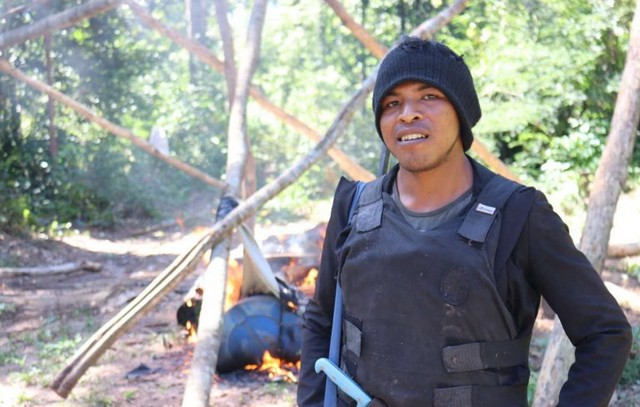
The Ethnic Cleansing of Palestinian Christians that nobody is talking about

By Dr Ramzy Baroud

Palestine’s Christian population is dwindling at an alarming rate. The world’s most ancient Christian community is moving elsewhere. And the reason for this is Israel.

Christian leaders from Palestine and South Africa sounded the alarm at a conference in Johannesburg on October 15. Their gathering was titled: “The Holy Land: A Palestinian Christian Perspective”.

One major issue that highlighted itself at the meetings is the rapidly declining number of Palestinian Christians in Palestine.

There are varied estimates on how many Palestinian Christians are still living in Palestine today, compared with the period before 1948 when the state of Israel was established atop Palestinian towns and villages. Regardless of the source of the various studies, there is near consensus that the number of Christian inhabitants of Palestine has dropped by nearly ten-fold in the last 70 years.

A population census carried out by the Palestinian Central Bureau of Statistics in 2017 concluded that there are 47,000 Palestinian Christians living in Palestine – with reference to the Occupied West Bank, East Jerusalem and the Gaza Strip. 98 percent of Palestine’s Christians live in the West Bank – concentrated mostly in the cities of Ramallah, Bethlehem and Jerusalem – while the remainder, a tiny Christian community of merely 1,100 people, lives in the besieged Gaza Strip.

The demographic crisis that had afflicted the Christian community decades ago is now brewing.

For example, 70 years ago, Bethlehem, the birthplace of Jesus Christ, was 86 percent Christian. The demographics of the city, however, have fundamentally shifted, especially after the Israeli occupation of the West Bank in June 1967, and the construction of the illegal Israeli apartheid wall, starting in 2002. Parts of the wall were meant to cut off Bethlehem from Jerusalem and to isolate the former from the rest of the West Bank.

“The Wall encircles Bethlehem by continuing south of East Jerusalem in both the east and west,” the ‘Open Bethlehem’ organization said, describing the devastating impact of the wall on the Palestinian city. “With the land isolated by the Wall, annexed for settlements, and closed under various pretexts, only 13% of the Bethlehem district is available for Palestinian use.”

Increasingly beleaguered, Palestinian Christians in Bethlehem have been driven out from their historic city in large numbers. According to the city’s mayor, Vera Baboun, as of 2016, the Christian population of Bethlehem has dropped to 12 percent, merely 11,000 people.

The most optimistic estimates place the overall number of Palestinian Christians in the whole of Occupied Palestine at less than two percent.

The correlation between the shrinking Christian population in Palestine, and the Israeli occupation and apartheid should be unmistakable, as it is obvious to Palestine’s Christian and Muslim population alike.

A study conducted by Dar al-Kalima University in the West Bank town of Beit Jala and published in December 2017, interviewed nearly 1,000 Palestinians, half of them Christian and the other half Muslim. One of the main goals of the research was to understand the reason behind the depleting Christian population in Palestine.

The study concluded that “the pressure of Israeli occupation, ongoing constraints, discriminatory policies, arbitrary arrests, confiscation of lands added to the general sense of hopelessness among Palestinian Christians,” who are finding themselves in “a despairing situation where they can no longer perceive a future for their offspring or for themselves”.

Unfounded claims that Palestinian Christians are leaving because of religious tensions between them and their Muslim brethren are, therefore, irrelevant.

Gaza is another case in point. Only 2 percent of Palestine’s Christians live in the impoverished and besieged Gaza Strip. When Israel occupied Gaza along with the rest of historic Palestine in 1967, an estimated 2,300 Christians lived in the Strip. However, merely 1,100 Christians still live in Gaza today. Years of occupation, horrific wars and an unforgiving siege can do that to a community, whose historic roots date back to two millennia.

Like Gaza’s Muslims, these Christians are cut off from the rest of the world, including the holy sites in the West Bank. Every year, Gaza’s Christians apply for permits from the Israeli military to join Easter services in Jerusalem and Bethlehem. Last April, only 200 Christians were granted permits, but on the condition that they must be 55 years of age or older and that they are not allowed to visit Jerusalem.

The Israeli rights group, Gisha, described the Israeli army decision as “a further violation of Palestinians’ fundamental rights to freedom of movement, religious freedom and family life”, and, rightly, accused Israel of attempting to “deepen the separation” between Gaza and the West Bank.

In fact, Israel aims at doing more than that. Separating Palestinian Christians from one another, and from their holy sites (as is the case for Muslims, as well), the Israeli government hopes to weaken the socio-cultural and spiritual connections that give Palestinians their collective identity.

Israel’s strategy is predicated on the idea that a combination of factors – immense economic hardships, permanent siege and apartheid, the severing of communal and spiritual bonds – will eventually drive all Christians out of their Palestinian homeland.

Israel is keen to present the ‘conflict’ in Palestine as a religious one so that it could, in turn, brand itself as a beleaguered Jewish state in the midst of a massive Muslim population in the Middle East. The continued existence of Palestinian Christians does not factor nicely into this Israeli agenda.

Sadly, however, Israel has succeeded in misrepresenting the struggle in Palestine – from that of political and human rights struggle against settler colonialism – into a religious one. Equally disturbing, Israel’s most ardent supporters in the United States and elsewhere are religious Christians.

It must be understood that Palestinian Christians are neither aliens nor bystanders in Palestine. They have been victimized equally as their Muslim brethren, and have also played a major role in defining the modern Palestinian identity, through their resistance, spirituality, deep connection to the land, artistic contributions and burgeoning scholarship.

Israel must not be allowed to ostracize the world’s most ancient Christian community from their ancestral land so that it may score a few points in its deeply disturbing drive for racial supremacy.

Equally important, our understanding of the legendary Palestinian ‘soumoud’ – steadfastness – and of solidarity cannot be complete without fully appreciating the centrality of Palestinian Christians to the modern Palestinian narrative and identity.

Ramzy Baroud is a journalist, author and editor of The Palestine Chronicle.

30 October 2019

Source: countercurrents.org
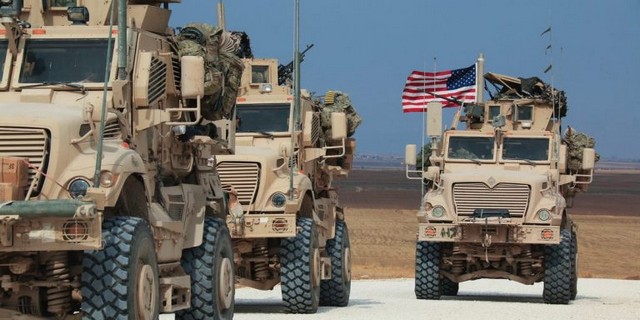
Syria – The Launch of a Constitutional Committee – a Sign of Hope for Syrian People

By Peter Koenig

Transcript of a PressTV Interview – Following a live press Conference by the Foreign Ministers of Russia, Iran and Turkey at the UN Geneva, Switzerland

Background

GENEVA, Oct. 28 (Xinhua) — The UN Special Envoy for Syria, Geir Pedersen, said here on Monday that the Constitutional Committee’s launch should be a sign of hope for the long-suffering Syrian people.

Speaking at a press conference on Monday, Pedersen said that the creation of the Constitutional Committee is a shared promise to the Syrian people to try in earnest to agree on new constitutional arrangements for Syria’s future.

Russia, Iran and Turkey have stressed that Syrian constitutional committee must work independently from any foreign intervention to gain maximum support from the people in the Arab country.
Sergey Lavrov was reading a joint statement made by Moscow, Tehran and Ankara ahead of a meeting of Syria’s constitutional committee in Geneva. Lavrov also highlighted the importance of Syria’s unity and territorial integrity. He expressed the readiness of Russia, Iran and Turkey to cooperate with the United Nation’s special envoy for Syria to facilitate the work of the constitutional committee. Lavrov urged the volunteer and safe return of Syrian refugees to their homeland. The Russian foreign minister also described the presence of the U-S troops in Syrian oil fields as illegal.

PressTV – Question
How would you assess the Launch of the Syrian Constitutional Committee – and the Conclusion of the Press Conference?

PK Answer
The Constitutional Committee —- is a good initiative, of course.

And as Mr. Pederson says,“Syrians, not outsiders, will draft the constitution. And the Syrian people must popularly approve it.” – This is an absolute must.

But we should not forget -and I do not think this is a coincidence, that President Trump just decided to leave troops in Syria – under whatever pretext is unimportant.

And I do not think that he wants to either protect nor steel Syrian oil.
What he wants is remaining with a sizable – and flexible – military presence in Syria.

Let’s backtrack to 2008 and then 2011 – when the CIA first recruited, trained, funded and armed the terror groups in 2008 up to 2011 – when they launched the so-called “civil war” – as part of the Arab Spring – which as we all know, has nothing to do with a civil war, but it’s a US mercenary war against the legitimate Syrian Government.

Why is it important to remember this?

Because, Washington has made it its goal to ultimately control Syria – Syria is part of the list countries mentioning in the PNAC (Plan for a New American Century) that must fall – in order for the US to reach full global hegemony. To reach that goal, the Middle East is a key square on the geopolitical Chess Board.

This should always remain in the back of the heads of those who negotiate and draft the new Constitution – the idea of new Constitution is good, but even if all parties agree, it will only be possible to apply it when the US leaves Syria. That is a must.

So, while the negotiations and drafting of the Constitution goes on, observed by Russia,Iran, and Turkey and of course the UN – it is extremely important that the US leaves Syria – letting Syria take full and sovereign control of her territory.

PressTV:
It is an important part of the validity of the new Constitution that Syria gains full sovereignty over her territories. What if the US won’t leave?

PK
That is precisely the point. The US is not likely to leave voluntarily – as we just have vivid proof. They stay under any pretext – as it is and remains their goal to achieve regime change in Syria and dominate this crucial pivotal Middle East country, called Syria.

And more so, as the US does not even have an observer role in the drafting of the new Constitution, unlike, Russia, Iran and Turkey – and of course the UN.

Washington could easily disrupt the process by launching again a false flag attack, by re-mobilizing the ISIS / Al Qaeda terror, or by calling NATO to “secure and protect”the Syrian oil fields. There is no shortage of potential interference by the US.

This is not to put a negative spell on the process of the Constitutional Committee. But let’s be conscious of the dangers, while this worthwhile initiative is moving forward.

The designated observers’ awareness and constant presence in Geneva and in Syria, is, therefore, of utmost importance. Let’s it also be reminded, Russia and Iran are invited in Syria by President Assad, the presence of the US is illegitimate. Peace can be secured only once the US leaves Syria, be that by diplomatic or economic pressure. For the America, leaving Syria is like stepping back from their objective of Middle East and world hegemony. And that does not come voluntarily.

Peter Koenig is an economist and geopolitical analyst. He is also a water resources and environmental specialist.

30 October 2019

Source: countercurrents.org
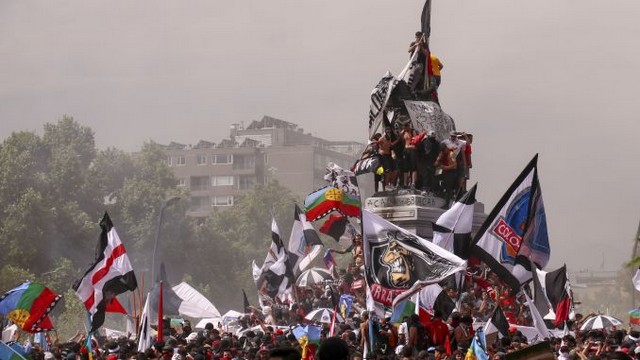
Beirut Is Burning: Rebellion Against The Elites Has Commenced

By Andre Vltchek

Tires are burning, smoke is rising towards the sky. It is October, the 18th day of the month, the capital city of Lebanon, in the past known as the “Paris of the East”, is covered in smoke.

For years I was warning that the country governed by corrupt, indifferent elites, could not hold together, indefinitely.

For all those five years when I was calling Beirut home, things were going down the drain. Nothing was improving: almost no public transportation, electricity shortages, contaminated and erratic water supply. Periodically, garbage has been piling up along the streets and suburban roads. Once an airplane lands and the doors open, the terrible stench of garbage welcomes us, residents of Beirut, back home.

Almost everyone knew that all this could not continue like this, forever.

The city was suffering from 4th World diseases, while simultaneously being flooded with Land Rover SUVs, Maserati and Porsche sports cars, and Armani suits.

Beiruthas almost collapsed to Jakarta levels, although, one has to admit,with extremely smart, highly educated and sophisticated elites, capable of conversing simultaneously in three world languages: French, Arabic and English. Also, with first rate art galleries, art cinemas, posh bars and nightclubs. With lavish marinas and the best bookstores in the entire Middle East.

Some say that Beirut has always been in possession of brain and guts, but something happened to its heart.

Now nothing really works here. But if you have millions of dollars, it does not really matter; you can buy anything here. If you are poor, destitute – abandon all hope. And the majority of the people here are now miserably poor. And no one even knows precisely how many are destitute, as a census is forbidden, in order ‘not to disturb religious balance’ (it was, for years, somehow agreed on, that it is better not to know how many Christians or Muslims are residing in the country).

It is certain that most of people are not rich. And now, outraged by their rulers, corrupt politicians and so-called elites, they are shouting, loudly and clearly: “Enough!”, Halas, down with the regime!”

*

The government decided to impose a tax on WhatsApp calls. Not a big deal, some would say. But it was; it is, it suddenly became a big deal. “The last drop”, perhaps.

The city exploded. Barricades were erected. Tires were set on fire. Everywhere: in the poorest as well as in the richest neighborhoods.

“Revolution!” people began shouting.

Lebanon has a history of left-wing, even Communist insurgencies. It also has its fair share of religious, right-wing fanaticism. Which one will win? Which one will be decisive, during this national rebellion?

The Communist Party is now behind several marches. But Hezbollah, until now the most solid social force in the country, is not yet convinced that the government of Saad al Hariri, should simply resign.

According to Reuters:

“Lebanon’s Hezbollah leader Sayyed Hassan Nasrallah said… that the group was not demanding the government’s resignation amid widespread national protests.

Nasrallah said in a televised speech that he supported the government, but called for a new agenda and “new spirit,” adding that ongoing protests showed the way forward was not new taxes.”

Any tax imposed on the poor would push him to call supporters to go take to the streets, Nasrallah added.”

So far, the rebellion has left countless people injured, while two Syrian immigrants lost their lives. Some local analysts say that this is the most serious uprising since the one in 2015 (which included the “You Stink!” campaign, reactingto the appalling garbage crises in Beirut and to the worsening social disaster), but others, including this author, are convinced that this is actually the most serious political catastrophe Lebanon has been facing since the 1980’s.

One hears anger, on every corner of the capital, in cafes and local stores:

“Trust is broken!”

Even those who used to be far from any political activities, are now supporting protesters.

Ms. Jehan, a local staff member at a UN office in Beirut, is one of those who found herself on the side of the rebellion:

“What is happening to Beirut and all over in Lebanon is good. It is about time we stood up. I will go too. This has nothing to do with religions. It is about our shattered lives.”

*

Reading Western mainstream media, one could begin to believe that Lebanon’s main problems are issues like foreign debt (Lebanon is, on a per capita basis, the third most indebted country on earth. The debt stands at 150% of its GDP), miniscule real reserves (US$ 10 billion), and the way the country interacts with the donors and lenders. IMF and its “advice” are constantly mentioned.

But even news agencies like Reuters have to admit that the entire mess is far from just about structural problems:

“As dollars have dried up, banks have effectively stopped lending and can no longer make basic foreign-exchange transactions for clients, one banker said.”

““The whole role of banks is to pour money into the central bank to finance the government and protect the currency,” he said. “Nothing is being done on the fiscal deficit because doing something will disrupt the systems of corruption.””

And here is the key word: “Corruption!”

Lebanon’s elites are shamelessly corrupt. Only such countries like Indonesia are able to compete with the Lebanese troglodyte clans, when it comes to stripping the entire nation of its riches.

Almost nothing is clean, or pure in Lebanon, and that is also why there aren’t any statistics available.

Money comes from the monstrous and ruthless exploitation of natural resources in West Africa. Everybody knows it, but it is never addressed, publicly. I worked in West Africa, and I know what the racist Lebanese ‘business people’ are doing there. But money stolen from the Africans does not enrich Lebanon and its people. It ends up in the Lebanese banks, and spent on lavish yachts, tacky and overpriced European sports cars, and inside bizarre private clubs in and around the capital. While many Lebanese people are near starvation, airplanes flying to Nice, Venice or Greek Islands are constantly packed with la dolce vita seekers.

Lebanon makes billions of dollars from narcotics, particularly those cultivated and refined in the Beqaa Valley. They get exported mainly to Saudi Arabia, for the consumption of the rich, or injected into the battlefields in Yemen and Syria, so-called combat drugs. Again, everyone knows it, but nothing is done to stop it. Hundreds of families, from farmers to politicians, got filthy rich on that trade. This adds a few more super-yachts at the proverbial Beirut marinas.

Then, there is ‘foreign aid’, ‘European investment into infrastructure’, Saudi and Qatari money. Most of it goes, directly, into the pockets of corrupt officials, to the so-called ‘government’, and to its buddies, contractors. Almost nothing is built, but the money is gone.Lebanon has railroad employees who are getting their monthly paychecks, but no railways, anymore. Train station had been converted into vodka bar. Lebanon begs for money so it can host refugees from all over the region, but much of the money ends up in a few deep pockets. Very little goes to the refugees themselves, or to the poor Lebanese people who have to compete for low-paying jobs with the desperate Syrians or Palestinians.

The poor are getting poorer. Yet, Ethiopian, Philippine and Kenyan maids are dragging the groceries of the rich, wiping spit off the faces of babies born into elite families, and cleaning toilets. Some get tortured by their masters, many commit suicide. Lebanon is a tough place, for those who do not look Phoenician or European.

And the slums in the south of Beirut are growing. And some Lebanese cities, like Tripoli in the north, look like tremendous slums, altogether.

Ali, a receptionist at a hotel in downtown Beirut laments:

“I work here as a receptionist for 14 hours and earn only 540 USD every month. I need a minimum of 700 USD to survive. I have a sister in US and want to visit her only for a week, but there is no way I can get visa. I am only 24 years old. I see no future in this country, like so many thousand others protesting in the streets of Beirut.”

According to various estimates, Lebanon may collapse as early as in February 2020. No more money can be looted. The end game is approaching.

If it does collapse, the rich will have their golden parachutes. They have their families abroad: in Australia, Brazil, France. Some have two passports, others have houses in the most desirable parts of the world.

The poor will be left with absolutely nothing: with a carcass of a country, previously looted by its own elites. There will be rotting, ageing Ferraris, all over, but one cannot eat carcasses of cars. There will be lavish but abandoned swimming pools, right next to polluted and destroyed beaches.

People know it, and they have had enough.

Mohamed, a worker at a Starbucks cafe in Beirut is determined:

“This is terrible but it is about time. We can take no more. We need to change the country, drastically. This time things are different. Not about who we worship but about our daily lives.”

Lebanon, in comparison to other shamelessly-capitalist countries, is well-educated. People here cannot be fooled.

The rebellion against the elites has just begun. People want to take back their country.

*

[First published by NEO – New Eastern Outlook – a journal of the Russian Academy of Sciences]

Andre Vltchek is a philosopher, novelist, filmmaker and investigative journalist. He has covered wars and conflicts in dozens of countries.

30 October 2019

Source: countercurrents.org
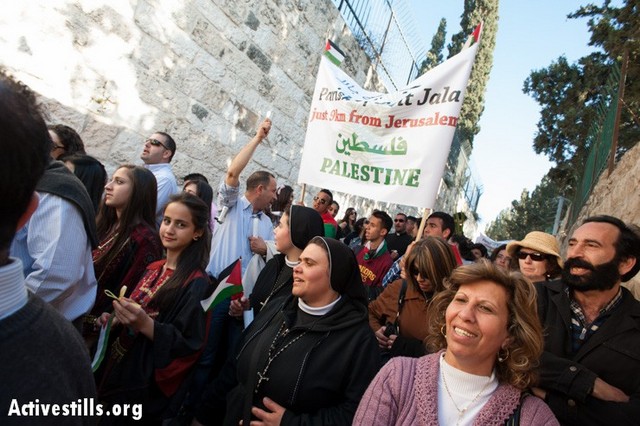
Hariri resigns, protesters celebrate, and uncertainty persists in Lebanon

By Countercurrents Collective

Following an unprecedented popular revolt for 13 days over decades of political corruption and economic turmoil in Lebanon, Prime Minister Saad Hariri has resigned on Tuesday.

After the announcement, the main protest square in central Beirut erupted into applause, less than an hour after counter-demonstrators ravaged the site and attacked protesters.

Cries of celebration and joy went up across Lebanon, one of the world’s most highly indebted nations with public debt at more than 150 percent of GDP, on Tuesday although most of the protesters said this was merely an initial victory in a long-term battle.

Hariri’s televised address came soon after violence broke out on the streets in Beirut, when a few hundred supporters of two Shia groups – Hezbollah and the Amal Movement – beat protesters and destroyed protest encampments in central Beirut before Hariri’s televised address, eventually retreating after security forces fired tear gas and rubber bullets.

The Shia groups set tents on fire and beat anti-government demonstrators. Some chanted in support of Hezbollah – a powerful force in the coalition government – and the Shia political party Amal.

Riot police and troops responded with tear gas, and by the end of the day, anti-government protesters were back on the streets celebrating Hariri’s announcement.

Resignation

Hariri on Tuesday submitted his government’s resignation to President Michel Aoun.

“I will head to the Baabda Palace to submit the government’s resignation in response to the demands of a lot of Lebanese who took to the streets,” Hariri said in an address to the nation.

He later submitted a written resignation to the president at the Baabda Palace.

After the announcement by Hariri, one protester shown on local television said: “Saad Hariri is only the beginning. We will continue” until others resign.

The nationwide cross-sectarian protest movement is calling for an overhaul of a political class viewed as incompetent and corrupt.

The protesters have accused the political elite of desperately attempting to save their jobs and have stuck to their demands for deep, systemic change – a complete overhaul of country’s sectarian-based system of government.

The main demand of the protesters has been the formation of a government of independent experts to guide the country through a worsening economic and financial crisis and secure basic services such as electricity and water.

Chance should not be wasted

Addressing “all political life partners,” Hariri said: “Today our responsibility is to seek ways to protect Lebanon and revive the economy.”

“There is a serious chance that should not be wasted and I put my resignation at the disposal of the president and all Lebanese,” he said.

“Posts come and go and what’s important is the country’s dignity and safety,” Hariri went on to say, stressing, “no one is bigger than their country,” which is a famous saying by his father, slain ex-PM Rafik Hariri.

It is unusual for a prime minister to announce his cabinet’s resignation before holding talks at the presidential palace in Baabda.

Media reports quoted Baabda sources as saying that President Aoun was “still studying Hariri’s resignation letter” and that he would not ask him to act in caretaker capacity on Tuesday.

Raised fists and street wins

With raised fists, traditional “dabkeh” dances and broad smiles, thousands of Lebanese celebrated Hariri’s offer to resign.

Across Lebanon, demonstrators filled main squares in their droves, waving Lebanese flags and celebrating their first major win.

The northern city of Tripoli, a stronghold of Hariri’s al-Mustaqbal Movement, saw one of the largest turnouts, with hundreds releasing red, white and green balloons – the colors of the Lebanese flag.

The southern city of Sidon, from where the Hariri family hails, was filled with a festival atmosphere after the premier’s speech.

Young men lifted each other on their shoulders, as demonstrators danced dabkeh and pounded on drums.

“As of this moment, we can say the street has won,” said Atef al-Abreeq. “The street has forced the government to resign.”

Revolution is not over

“Our revolution is not over,” shouted the protesters.

“What happened today is a big achievement for the revolution,” said Mohammed, 32.

Some protesters even called on members of Hariri’s al-Mustaqbal Movement to join in the festivities.

Demonstrators distributed traditional Arabic sweets, coffee and corn on the cob.

But many said their work was unfinished.

“This resignation is welcome but it’s not enough, it’s only one part of a larger list of demands,” said Tima Samir, a 35-year-old mother of two.

“We want the entire system to change and we’ll stay on the streets until all our demands are met.”

In Sidon, Ahed Madi said he had never witnessed such scenes in his hometown.

“Sidon usually celebrates when a government is formed. This is the first time Sidon celebrates the government’s resignation,” he told AFP.

In the Beirut streets, the protesters exchanged hugs and kisses, the ground around them littered with the charred remains of burnt tents.

“The next step is the formation of a transitional government comprising of independents,” said Gil Samaha as jubilant protesters started to stream back in.

“Hariri isn’t the one who’s sending his people to beat us up and destroy what we have. Those people are still in Parliament and we need to finish what we’ve started there,” Mouzannar said, sitting next to a tent being reconstructed by protesters.

On a nearby road leading to Riad al-Solh square, Saba, a 21-year old event planner, was painting Lebanese flags on the faces of passersby. “He should have resigned earlier, but better late than never – and we got what we wanted,” she said.

But she, too, said Hariri’s resignation by no means satisfied her hopes for the unprecedented movement she was part of. “Step two is to get back the money politicians have stolen from us. Then we will hold everyone accountable, and God is on our side,” she said.

As evening fell, hundreds of Lebanese in Riad al-Solh stood together for the national anthem. Many hugged. One woman stood still, tears rolling from her eyes.

“This may be the biggest achievement for my generation, winning in a clash of this level with our politicians,” Nabil, a 30-year old engineer, said.

Hundreds of others were out in towns and villages across the country, including in Jal al-Dib, Zouk Mosbeh and Jbeil north of Beirut, and Nabatieh and Tyre south of the capital.

“We don’t want any part of the ruling class to be part of this government. The most important thing is to get rid of them all, and form a new electoral law that abolishes sectarianism and has Lebanon as one district,” Rafeef, a 21-year old law student, said.

Back in Riad al-Solh, Rafeed, the law student, said she had woken up the day before feeling as if the protest movement was coming to an end. It was raining, turnout was low across the country, and the government did not seem like it was budging.

“But after what happened today, I’m certain we won’t be leaving the squares,” she said.

“We have nothing to lose at this point. If they want to kill us in the squares, let them do it – but we won’t budge until our demands are met.”

Complicated task

The sudden resignation – the third by Hariri in his career – will restart the complicated task of parliament forming a new government.

It would also mark the most significant win by the protesting people.

Sami Nader, director of Levant Institute for Strategic Affairs, said, “Hariri is opening the door to a solution because the resignation is the only way for a decent exit from the current crisis.”

He said the most likely outcome would be the formation of a government “ala Libanainse, which means you put some independent figures in order to satisfy the street, but the old modus operandi will remain.”

“At least Hariri opened the door for a possible solution, because we were in total deadlock and behaving as if nothing happened and doing business as usual was not a solution.”

Lebanon’s current electoral law has the country gerrymandered into 15 districts, with seats allocated by sect.

Political leaders have appeared shell-shocked, trying simultaneously to express sympathy for the largely peaceful protests while warning of chaos in case of a power vacuum.

Unclear situation

As of Tuesday night, the chart for forthcoming government formation deliberations, which take place via binding consultations between Parliament and the president, were unclear – though Hariri is widely seen as a likely candidate to again head the new government.

Most political players simply called for calm although Hezbollah and its ally the Free Patriotic Movement, the biggest party in the now-resigned government, did not make official statements.

“What is happening requires immediate calm and dialogue between all Lebanese sides,” Parliament Speaker Nabih Berri, an ally of Hezbollah, told local media, adding, “What is happening is not sectarian at all.”

Lebanese Forces chief Samir Geagea, whose four ministers quit from government on October 19, welcomed Hariri’s resignation. He said a new “government of specialists” should be formed and include people known for their “cleanliness, integrity and success.”

Progressive Socialist Party chief Walid Joumblatt, an ally of Hariri, who had previously called on Hariri to resign, before reversing this call, also said dialogue and calm were paramount in the current situation.

As soon as Hariri announced his resignation, popular delegations, dignitaries, clerics, former prime ministers, incumbent ministers and al-Mustaqbal Movement MPs flocked to the Center House to express their support for his decision to resign.

The visitors included former PMs Tamam Salam and Fouad Saniora, Grand Mufti Sheikh Abdul Latif Daryan and the ministers Raya al-Hassan, Mohammed Choucair, Adel Afiouni and Jamal Jarrah.

Hariri told his visitors: “I just want to say: May God protect Lebanon and we hope to get out of this impasse and we hope that the country will be fine.”

He said he was relieved because the resignation was in response to what the people wants, and said: “We will all stay together.”

To avoid financial collapse

Lebanon’s Central Bank Governor Riad Salameh on Monday said the country needed a solution to the crisis within days to avoid a financial collapse.

“The only real way forward for Lebanon is to appoint a government that can move on from the disruption of this revolution and restore the confidence with the people and the international community,” Nader said.

What’s Next

The resignation of Hariri will plunge the country into even greater uncertainty, with no clear path to resolving its growing economic and political crisis.

The political settlement that ended Lebanon’s 1975-1990 civil war distribution of power and top offices among the country’s Shiites, Sunnis and Christians. The complex sectarian system has mostly kept the peace, but it has made major decisions extremely difficult and contributed to long periods of political gridlock.

The Western-backed Hariri had served in a national unity government dominated by rival factions allied with the militant Hizbullah group. He had proposed the creation of an emergency cabinet made up of a small group of technocrats to steer the country toward necessary reforms, but his governing partners refused.

A point of dispute emerged over Foreign Minister Jebran Bassil, the son-in-law of President Michel Aoun.

The protesters have trained much of their vitriol on the two men, who are allied with Hizbullah, but Aoun has reportedly insisted on remaining in office and keeping Bassil in his post. Hizbullah, which has three ministers in the government, has stuck by its allies and was opposed to Hariri’s decision to resign.

Aoun will task the now-resigned government to continue in a caretaker capacity. Under the constitution, he then has to hold binding consultations with the heads of parliamentary blocs to ask them for their choice of a new prime minister. He could then appoint Hariri or another individual from the Sunni community to form a government. In Lebanon’s system, the presidency is reserved for a Christian, the prime minister is Sunni and the parliament speaker is Shiite.

Aoun has the right in principle to reject Hariri’s resignation, but he could then refuse to call for cabinet meetings.

The process of forming a new Lebanese government typically takes several months. It took Lebanon’s factions 2 ½ years to agree on the current president, and it took nine months to form Hariri’s now-embattled government.

This time, however, the country is in the grip of a severe economic crisis that has only worsened since the protests began, with banks, schools and businesses are closed for two weeks.

“In this context, it is incredibly difficult to see them agreeing on any one new name,” said Maha Yahya, director of the Carnegie Middle East Center.

That would leave Hariri in place as head of a caretaker government.

“His capacity to address the economic crisis and possible economic and financial collapse will be curtailed even more,” Yahya said. “A devaluation of the Lebanese pound will likely lead to even more social unrest and turbulence on the street.”

Hariri’s resignation makes crisis “even more serious” says France

The resignation of Lebanon’s government has made the crisis there “even more serious,” France’s foreign minister said Tuesday.

“Prime Minister Hariri has just resigned, which makes the crisis even more serious,” Jean-Yves Le Drian told parliament in Paris, and urged the authorities in Lebanon “to do everything they can to guarantee the stability of the institutions and the unity of Lebanon.”

Le Drian said a condition for stability in any country “is a willingness to listen to the voice and demands of the population.”

“Lebanon needs a commitment from all political leaders to look within themselves and make sure there is a strong response to the population,” said the minister, offering France’s help.

30 October 2019

Source: countercurrents.org
The Olive Tree–Not Just an Ordinary Tree

By Mazin Qumsiyeh

21 Oct 2019 – My mother says I should have worn long sleeves for the Palestinian olive trees sometimes do not want to part with their fruits without a bit of resistance. But somehow I feel the few minor scratches are a badge of honor and the least I owe our beloved trees. The whole year, we look forward to these days. My sister, wife, mother, and I harvested the olive trees sometimes silently, sometimes talking about mundane things, and rarely speaking of things of consequence. But thoughts are another story.

My thoughts wonder to the Palestinians who lost their olive groves to the colonial settlement activity (over 1 million trees have been uprooted). The picture of the old women hugging her tree that was being cut by the Israeli occupiers flashes through my mind (see photo below*). I am reminded of my deceased father during such time. I feel at peace with the sorrow and anger overwhelmed by emotions of gratitude and serenity under the old olive trees. The olive harvest is after all a ritual that borders on an act of worship (and maybe it is). The stimulation of our senses during the harvest is hard to describe. It is not just the invigorating smells of the olive leaves and whiffs of olive oil but the shape and feel of each olive as our hands comb the tree like a mother combing her daughter’s hair, the sight of beloved ones tending the same tree before moving to the next.

We smile and greet neighbors who stop by to say hello or comment on the production this year (it is actually a poor year since last year was really good and these things alternate). The mechanics of the harvest and the post-harvest work become routine for anyone who has done it once. Old carpets or sheets are spread under the tree. Olives are dropped onto those (never by hitting the tree!). The gathered olives are separated from leaves and any remaining stems removed (on a “sidr”/tray that is inclined). They are kept aired out on mats in a dry place while big healthy olives are picked for pickling.

The pickling involves cracking the olives and submerging them in water containing salt, lemon juice, pieces f lemons, and some lemon leaves. The remaining olives are taken to the press where olive oil is produced. In the old days, we had a stone press with an animal (donkey or mule) rotating two large circular stones placed in a hollowed stone shaped like a cake pan. Now the modern presses (made in Turkey) do the operation in no time at all.

It is hard to describe to non-Palestinians what the olive tree means to us. We could tell of the practical things but that would be like saying our spouses mean a lot to us because of … (and then list all the things they do). Of course these things are important but not the whole picture and we could never do justice that way to people or other living things we love. But just like listing what people do help others visualize their character, so it is with the beloved olive tree. Palestinians over the past 5000 years have cultivated olive trees and derived great benefit from these wonderful hardy trees:

  • The olive (Zeitoon) was pickled (rsees) and eaten and perhaps it is the only food that is found in all three meals: breakfast, lunch, and dinner. Its nutritional value is credited with significant health benefits.
  • The olive oil (Zeit) is THE oil in Palestine. It is highly nutritious and used in dozens of recipes. The main and most common folkloric recipe going back over 3000 years is Zeit u Zaatar (also sometimes called Zeit u Dukka); the bread is dipped in olive oil then in a thyme based powder (that includes sesame seeds and spices). Thyme and Sesame and many other plans were of course first domesticated and used right here in Palestine (the left wing of the Fertile Crescent). Olive oil was used in Palestine more extensively in the past in oil lamps, in protection of hair and skin, as a lubricant, as an insecticide, and much more.
  • The olive pits (and less so olive wood pieces) are used to make “prayer beads” that were used by both Palestinian Christians and Muslims for hundreds of years. The simple act of running fingers through these beads sometimes meditating in the process while concentrating on that feeling gives us a sense of tranquility and peace (much needed considering the circumstances of Palestine over the ages).
  • The olive wood is used to make artifacts that locals sell to pilgrims as souvenirs from the Holy Land or keep at their homes. This is true for all monotheistic traditions. Here in Bethlehem, our ancestors made a living of this as artisans for generations (my own family relied on this and agriculture as far back as we can trace to the 16th century).
  • The herds of sheep and goats rely on olive leaves and branches trimmed during this season for a significant part of their annual diet.
  • The wood was used (less so recently) as firewood. It is a hardy wood that generates much heat per unit kilogram than any other wood I know. The glass smelters in Hebron (famous for its stained glass artistry) used olive wood derived coals as a main energy source.
  • The olive trees gave our people shelter from the strong sun and inspired poets, lovers, painters, and prophets across the ages.
  • Even the left over material after the production of oil is recycled for energy source.

Here are a few pictures taken by my wife of our harvest, pickling and squeezing of olives to get our yearly supply of these trees:

http://picasaweb.google.com/jchangcpa/2009OliveHarvest?authkey=Gv1sRgCLvr8Mf57Ya5Zg&feat=directlink#

Olive production is always high in one year low in the next**. Last year was high, this year was low and next year (Inshallah) it will be higher barring further destruction by Israel as happened in Gaza recently. In the meantime, we still enjoy our olives and hope that you will come visit us in Palestine so that we can serve you some of the fantastic dishes that include olives or their products and we can do it under the olive trees. I also noted this interesting story of a Palestinian in China proving again that you can take Palestinians outside of Palestine but you cannot take Palestine outside of Palestinians:

China’s first olive harvest strikes oil

(http://www.olives101.com/2006/05/24/chinas-first-olive-harvest-strikes-oil/)

The Olive tree: a folkloric briefing from Bethlehem University

(http://library.bethlehem.edu/e-turathuna/OliveTree/)

** Olive Oil production in West Bank and Gaza in tons showing yearly cyclical change with higher production in even years:

1988 31100
1989 1690
1990 27500
1991 570
1992 33700
1993 525
1994 18000
1995 8628
1996 24953
1997 5500
1998 22000
1999 3800
2000 30000
2001 6686
2002 31784
2003 11300
2004 30232

____________________________________________

Mazin Qumsiyeh, associate professor of genetics and director of cytogenetic services at Yale University School of Medicine, is founder and president of the Holy Land Conservation Foundation and ex-president of the Middle East Genetics Association.

28 October 2019

Source: www.transcend.org

Iraq is taking legal action to kick unauthorized U.S. forces out of country

By Countercurrents Collective

The Iraqi government is now taking legal action against the uninvited presence of the U.S. forces in Iraq.

The U.S. forces entered western Iraq without authorization as it withdrew from Syria.

The Iraqi government is also seeking international help after U.S. troops entered western Iraq without any authorization from the Iraq government.

Baghdad did not give permission for U.S. forces to stay in Iraq, Prime Minister Adil Abdul-Mahdi reaffirmed on Wednesday. The Iraqi PM said: “We ask the international community and the United Nations to perform their roles in this matter.”

Iraqi PM said the U.S. troops withdrawing from northeast Syria do not have permission to stay in Iraq, adding that his government is taking “all international legal measures” in response to their unauthorized entry into the country.

“We have [already] issued an official statement saying that and are taking all international legal measures. We ask the international community and the United Nations to perform their roles in this matter,” the premier said.

The statement comes as U.S. Defense Secretary Mark Esper arrived in the country on Wednesday in an unannounced visit while reaffirming Tuesday’s statement from the Iraqi military which only allowed transit through Iraq for the U.S. troops.

“All U.S. forces that withdrew from Syria have received approval to enter the Kurdistan region to be transported out of Iraq, however, there is no permission for these forces to stay,” the statement read.

The Iraqi military statement contradicted the Pentagon’s announcement that all of the nearly 1,000 troops withdrawing from northern Syria are expected to move to western Iraq to continue the campaign against the Islamic State group (IS) and to help “defend” Iraq.

Esper said Tuesday that U.S. troops transiting from Syria would use Iraq to make preparations to go home and assured that the aim is not to “stay in Iraq interminably.”

Esper did not specify how long the U.S. troops would be staying.

In addition, Esper said Tuesday during his visit to Saudi Arabia that the troops will be prepared in Iraq to return to their homeland, without specifying the deadline for their return.

“The goal is not to stay in Iraq endlessly but to withdraw our soldiers and eventually bring them back home,” Esper said at Prince Sultan Air Force Base near Riyadh.

U.S. removed its troops from northern Syria on foot of a Turkish offensive against Kurdish militias in the region.

The U.S. already has 5,000 troops in Iraq under an arrangement with the Iraqi government, but the agreement is a controversial one, with many Iraqis regarding it as continued occupation after the disastrous 2003 U.S. invasion.

Hundreds of vehicles carrying U.S. troops crossed the Syrian-Iraqi border through the Kurdish region of northern Iraq on Monday, and it is estimated that more than 5,000 troops are currently stationed in that Arab country under a bilateral agreement.

After the end of the war in 2011, the U.S. military presence in Iraq had diminished considerably, a fact that changed in 2014 with the threat of IS.

The U.S. military presence continues to be a sensitive and politicized issue as part of Iraqi society considers it an occupation.

Transit only, says Iraqi military

The U.S. forces that crossed into Iraq after pulling out from Syria can only use its territory for transit and do not have permission to stay, the Iraqi military said on Tuesday.

The Iraqi statement adds more uncertainty to a vision of what will actually happen to the troops after their withdrawal from Syria.

In the last few days, the U.S. military were simultaneously reported to be “going home” – that’s according to President Trump – and continuing their mission in Iraq to conduct operations against Islamic State (IS, formerly ISIS) in a plan outlined by U.S. Defense Secretary Mark Esper. He also mentioned some soldiers may remain in Syria to protect oil fields from IS takeover.

The U.S. pulled its forces out of Iraq in 2011 ending nine years of war that started with missile strikes on Baghdad to oust President Saddam Hussein, but they went back after IS began to gain ground in 2014. The number of US forces in the country remains a sensitive and politicized issue after the war that some Iraqis considered to be a US occupation.

U.S. forces leaving Syria for Iraq, not returning home: Pentagon

But an earlier report said:

Esper told reporters traveling with him as he left Washington Saturday heading for Afghanistan, that all U.S. troops currently leaving Syria would be sent to Iraq in order to pursue operations against the IS.

The Pentagon chief’s statements came as U.S. President Donald Trump claimed he was bringing U.S. soldiers home from “endless wars” in the Middle East.

Before he arrived ​​​​​in Afghanistan on Sunday, Esper made clear that, according to current plans, the militaries are not going back to their country and the U.S. is not departing from the region, suggesting that counterterrorism missions could be conducted from Iraq into Syria.

The official’s remarks were the first to layout where U.S. troops will go as they walk out from Syria. He also said he has spoken to his Iraqi counterpart about the plan to shift around 1,000 troops from Syria into western Iraq.

Yet, Trump tweeted “USA soldiers are not in combat or ceasefire zones. We have secured the Oil. Bringing soldiers home!”

The president declared the past week that Washington had no stake in defending the Kurdish fighters as Turkey conducted a launched an offensive into northeastern Syria against them before a military truce.

“It’s time for us to come home,” Trump said, defending his removal of U.S. troops from that part of Syria and praising his decision to send more troops and military equipment to Saudi Arabia to help the kingdom defend against Iran.

When asked about the fact that his comments were contradicting those of the president and the troops were not coming home, Esper said “Well, they will eventually,” adding that the troops going into Iraq will have two missions.

“One is to help defend Iraq and two is to perform a counter-ISIS mission as we sort through the next steps,” he said. “Things could change between now and whenever we complete the withdrawal, but that’s the game plan right now.”

24 October 2019

Source: countercurrents.org