Just International

Misrepresentations of American & Soviet Roles in WW II and the Cold War

By Eric Zuesse

INTRODUCTION

The Soviet Union contributed more than did any other nation to the defeats of Germany and Japan in World War II

, but America and Britain together defeated Italy. Many prominent Western ‘historians’ white-out the Soviet roles in defeating Hitler and especially Hirohito, and they overstate the importance of America’s victories to the ultimate outcome, and ignore or underplay Franklin Delano Roosevelt’s strong rejection and repudiation of Winston Churchill’s imperialistic agenda, not only for a continuation of empires, but for a continued postwar exploitation of colonies, as being acceptable goals for the future. Those ‘historians’ are actually propagandists — no real historians, at all — because they fundamentally misrepresent; yet they dominate in the ‘historical’ profession, and they have produced in the U.S. and in its allies a widespread and profoundly warped ‘history’ of the war and of its aftermath, and of Twentieth-Century history, and of our own time. This ‘historical’ distortion has continued even after 1991 (it even accelerated) when the Cold War between the U.S. and Russia ended only on the Russian side, but not actually on the U.S. side. These ‘historical’ lies accelerated because ‘historians’ continue, even today, to hide this crucial fact, that the U.S. side of the Cold War secretly continued — and still does continue — to try to conquer Russia. Ever since the time of America’s vile, bloody and illegal actual coup against Ukraine in February 2014 onward, Russia has been responding increasingly. This is especially so because of yet another American-and-allied aggression against a nation that has cooperative arrangements with Russia, Syria, 2012-. The purveyors of fake ‘news’ and fake ‘history’ display the gall to cry foul and to lie and allege that Russia’s necessary defensive actions against America’s aggressions are, instead, themselves, aggressions, to which America and its vassal-nations have the right to respond, and should respond, by what then would actually be yet more aggressions (violations of international law) — instead of to quit its string of aggressions, and to apologize, not only for the aggressions, but also for the lies, that the U.S. regime and its propagandists have been perpetrating, against Russia, and against nations that cooperate with Russia. The reality has been that U.S. foreign policy is, and has been, driven by one overriding and obsessive goal for a hundred years: first, to conquer any nation that’s friendly with Russia, and thereby to isolate Russia internationally; and, then, finally, to grab Russia itself. This entire U.S. geostrategy is based upon lies.

THE ‘HISTORICAL’ LIES, v. THE HISTORICAL TRUTHS

According to the standard accounts, the Cold War ended on both sides in 1991, when the Soviet Union dissolved, and its communism ended, and its Warsaw Pact (the military alliance that the U.S.S.R. had created in response to America’s having created the NATO military alliance against the Soviet Union) all ended. But, secretly, the Cold War continued on the U.S. side, and with the same (and now blatantly) imperialist goal of ultimately conquering Russia and China, so as to establish the first-ever all-encompassing global empire. Whereas Franklin Delano Roosevelt had set up the U.N. so as to evolve into a global democracy of nations — a democratic federal republic encompassing all nations — his successor, Harry S. Truman quickly became deceived by Winston S. Churchill and Dwight David Eisenhower to believe that the Soviet Union was trying to take over the entire world, and so Truman promptly abandoned FDR’s vision and initiated instead the permanent-warfare U.S., the military-industrial-complex-ruled U.S., which relegated the U.N. to a secondary role, as a mere mediator for global diplomacy, not as the international lawmaker that FDR had hoped it would ultimately evolve into. FDR’s dream and intention, of establishing a system of international laws functioning as the all-encompassing global democratic federal democracy in which all nations are represented, became thwarted, almost as soon as he died, when the Deep-State U.S. military-industrial complex that’s run behind the scenes by the controlling owners of America’s top weapons-manufacturing firms took hold.

After WW II, the U.S. Government secretly aspired — and still does aspire — to rule over the entire world, including especially over Russia and China. George Herbert Walker Bush told Robert Sheer in the 24 January 1980 Los Angeles Times and in Scheer’s 1982 book With Enough Shovels, page 29, that in a nuclear war between the Soviet Union and the U.S., the “winner in a nuclear exchange” would be whichever side is stronger than the other at the war’s end; and, so, for Bush, nuclear weapons didn’t exist in order to avoid a nuclear conflict, but instead in order to “win” it. This also is the reason why, on the night of 24 February 1990, Bush secretly told West German Chancellor Helmut Kohl to ignore the promises that Bush’s team were making to Gorbachev, that NATO would not be expanded “one inch to the east” (i.e., not extended right up to Russia’s border) if Gorbachev ends the Cold War. Bush, in confidence, told Kohl “To hell with that! We prevailed, they didn’t.” And he also secretly told French President Francois Mitterrand to pursue no “kind of pan-European alliance” (i.e., alliance that includes Russia) because, actually, total conquest of Russia remains the U.S.-and-allied goal. This view — that the goal is control over Russia — became firmly established in U.S. Government policy by no later than 2006 when Bush’s son was the President and the phrase “Nuclear Primacy” (the ability to “win” a nuclear war against Russia) became used in order to refer to America’s geostrategic goal.

Part of that scam by ’The West’ (the emergent American empire) has been the ongoing ‘historical’ lie that the Allied victory in WW II was mainly an American and British affair, and not mainly a Soviet one. Another part of it is that the Soviet Union had started the Cold War; and yet a third part is that the Cold War was about ideology (communism versus capitalism) instead of about the U.S. regime’s goal of ultimately conquering Russia and China so as to achieve the world’s first and only full global and unchallengeable empire.

The excuse for all of this was always the allegation that global empire is Russia’s goal and that the U.S. therefore needs to win the nuclear war when it ultimately happens. But Russia, and its prior USSR, always did maintain, and still does maintain, as actual Government policy (not just mere verbiage, such as in America after 1980) the belief in “MAD” or Mutually Assured Destruction — the idea that any nuclear war between the two superpowers will destroy the entire planet and therefore produce no winners whatsoever — no winner but only nuclear winter — regardless of which side might temporarily emerge the stronger while nuclear winter and resulting global famine soon destroy all life on Earth after that nuclear exchange. Russia is not (like America is) aiming to take over the planet. The fact that the U.S. regime is trying to take over the planet has shocked even America’s top geostrategic scientists. The ‘historians’ hide all of this, so as to continue the myth that in the U.S.-Russia relationship, Russia is and has been the aggressor, and America the defender — instead of vice-versa, which is, and has been, the historical reality.

A rare, early, excellent, and honest, Western history of the immediate post-WW-II world, was the libertarian William Henry Chamberlin’s 1950 book America’s Second Crusade. Its earnest author — a disenchanted former socialist who once had trusted Stalin’s goodwill but was dismayed now to find Stalin to be America’s enemy as well as an unforgivable tyrant to the nation he led — opened by saying “My book is an attempt to examine without prejudice or favor the question why the peace was lost while the war was being won.” He was struggling to understand how and why and when the Cold War started, but unfortunately, some key documents, in order to become enabled to understand that, had not yet become public. A crucial passage in his book that reflected state-of-the-art historical writing in 1950 but certainly not today, asserted:

Stalin’s diplomatic masterpiece was his promotion, through his pact with Hitler, of a war from which he hoped to remain aloof. [FALSE: Stalin knew that the Soviet Union was Hitler’s main target to attack, and he was terrified of that]

This attractive dream of watching the capitalist world tear itself to pieces and then stepping in to collect the fragments was shattered by Hitler’s attack in June 1941. [FALSE: that war between U.S.S.R and Germany was already baked-in in 1939; and it was Stalin’s nightmare — not his “dream.”]

Chamberlin thought that Stalin had made with Hitler the 1939 Ribbentrop-Molotov Pact because Stalin had wanted to join with Hitler in taking over the entire world — i.e., for aggression, instead of for defense; i.e., instead of so as to protect the U.S.S.R. from becoming invaded by Hitler (which defensive motivation actually is what obsessed Stalin). Chamberlin thus wrote approvingly of “Churchill’s scheme which would have limited the extent of Soviet conquest.” Chamberlin thought that the ideological conflict (to the extent that there actually was one in the Cold War) was between communism versus capitalism, not between fascism versus non-fascism (which it was, and still is).

Here are the facts, which have been revealed by the making-public of archives as of 2008 and subsequently:

On 18 October 2008, Britain’s Telegraph bannered “Stalin ‘planned to send a million troops to stop Hitler if Britain and France agreed pact’” and buried the core revelation, that Stalin prior to the Ribbentrop-Molotov Pact recognized Hitler’s determination to conquer the Soviet Union and he had, on 15 August 1939, urged British Prime Minister Neville Chamberlain to accept the U.S.S.R. as an ally in their mutual war to defeat Hitler; but Chamberlain refused, and so Stalin reached out to Hitler for an agreement with him to a dividing-line between those two countries’ (Germany’s and U.S.S.R.’s) essential areas of control for each one’s national security. Poland especially was a worry to both of them, because Poland had had territorial conflicts with both Germany and the Soviet Union. Thus was signed on 23 August 1939 the Ribbentrop-Molotov Pact, which split Poland between both countries.

The Versalles Treaty at the end of WW I had handed to Poland what had been German territory that through most of prior history had been Polish territory. Hitler was elected into power in 1933 vowing to abandon that Treaty and to restore, to German rule, that part of Poland.

As regards Poland’s conflicts with Russia: Poland had invaded Moscow during 1605-18, before Russia responded by both military and diplomatic means to virtually conquer Poland into becoming a colony of Russia, which it remained almost uninterruptedly until 1939, when the Hitler-Stalin agreement — the Ribbentrop-Molotov Pact — restored part of Poland to the Soviet Union, but handed the other part of Poland to Germany.

Stalin, having been spurned by Chamberlain (who held his own imperialistic intentions — he was as imperialistic as were the fascists: Hitler, Hirohito, and Mussolini), had actually no other option in 1939 than to reach a peace-agreement with Hitler, so as to avoid having the Soviet Union become swallowed up by the capitalist countries — first by Germany, and then by whatever countries would finally win the coming World War (presumably, likewise Germany).

This is why the historian Chamberlin’s claim that Stalin’s “dream” of imperialist expansion “was shattered by Hitler’s attack in June 1941” is false: Stalin’s necessity for the U.S.S.R. to be granted enough time, to prepare for Hitler’s Operation Barbarossa invasion against it (which ended up starting on 22 June 1941), caused the Ribbentrop-Molotov Pact to become signed on 23 August 1939, which signing sparked both of its signatories to promptly invade Poland and start the active phase of WW II on 1 September 1939, both countries invading Poland. FDR didn’t hold that agreement against Stalin, but instead against Chamberlain, who really hated Russia and virtually forced Stalin into that Pact. Chamberlain’s goal wasn’t to get the Soviet Union onto Britain’s side but instead for a war between the Soviet Union and Germany to weaken both of them enough for a UK-U.S. alliance to take over both of them, and, ultimately, the world. FDR got Chamberlain’s successor Churchill to agree to a “United Nations” in which there would be an international democracy of nations and all military weapons and enforcement of General Assembly laws would be possessed and enforced only by “the Big Four” of U.S., UK, U.S.S.R., and China, but Churchill balked at including China because he wanted to retain control of his eastern vassal-nations. FDR agreed instead to each of the Big Four enforcing U.N. laws only within its own neighborhood, so as to prohibit friction between the Big Four — and China would enforce in East Asia and Western Pacific, which meant Britain’s freeing India, Burma, Malaya, and some other of its vassal-nations. U.S. was to enforce U.N. laws throughout the Western Hemisphere. U.S.S.R. was to do the same in eastern Europe and central Asia. UK was to do it in Western Europe. Initially, Roosevelt’s plan had been only for a U.N. consisting of this Big Four as “trustees” over other nations that are within their neighborhood, but he soon recognized the need for, as the Dumbarton Oaks founding document for the U.N. put it, on 7 October 1944, “Membership of the Organization should be open to all peace-loving states.” Also: “There should be an international court of justice which should constitute the principal judicial organ of the Organization.” And: “Each member of the Organization should have one vote in the General Assembly.” No international bill of rights was included, because the U.N. wasn’t to get involved in any nation’s internal affairs. But, then, FDR died and along came President Truman, and the U.N.’s Constitution became established on 26 June 1945, as the “Charter of the United Nations”, and it dispensed altogether with that crucial distinction; and, furthermore, the Big Four became the Five permanent Members of the Security Council, France (yet another imperialist regime) being added to the Big Four. Already, FDR’s vision was starting to become replaced by that of agents of owners of America’s ‘defense’ contractors. They needed the distinction to be abandoned so that the U.N. would become distracted away from its peace-keeping function and toward “human rights” issues that could ‘justify’ international invasions (and thus growing demand for their products). And thus we have today a toothless U.N., far from what FDR had intended. This is very profitable for the military-industrial complex and enables the U.S. regime to aspire to being, as Barack Obama claimed it already to be, “the one indispensable nation”, and every other nation therefore to be ‘dispensable’ (and consequently usable for “target-practice”).

After the 18 October 2008 article in Britain’s Telegraph, another article that is a breakthrough for historians is Randy Dotinga’s superb review (and the best summary), appearing in the 5 March 2015 Christian Science Monitor, of Susan Butler’s 2015 masterpiece, Roosevelt and Stalin: Portrait of a Partnership. (Butler’s book is based on her own prior publication, by Yale, of My Dear Mr. Stalin: The Complete Correspondence of Franklin D. Roosevelt and Joseph V. Stalin.) Dotinga’s review is titled “‘Roosevelt and Stalin’ details the surprisingly warm relationship of an unlikely duo: How FDR and Stalin forged a bond that helped to shape history.” Basically, what Butler has documented (in those two books) and Dotinga accurately summarizes, is that FDR and Stalin were in agreement and FDR and Churchill were not, and that FDR was consistently a supporter of the position that no nation has a right to interfere in the internal affairs of any other nation, except when those internal affairs present a realistic threat against the national security of one’s own nation. FDR was consistently an opponent of empires, which exist not for national security but for the further enrichment of one’s own nation’s aristocracy, the owners of its international corporations — especially of its weapons-makers. (An imperial nation’s weapons-manufacturers rely upon sales to that government and to its vassals or ‘allies’, and therefore fund politicians who endorse its imperialism. Consequently: the U.N. now gets involved in the internal affairs of nations — their ‘democracy’ and ‘human rights’ — as constituting ‘justifications’ to authorize invasions, or “R2P,” responsibility to protect. That’s exactly opposite to FDR’s plan for the U.N., which concerned no intranational affairs, but only intranational affairs.) The negative reviews of Butler’s Roosevelt and Stalin at Amazon object to Stalin’s domestic policies but ignore what FDR was concerned with, regarding Stalin, which was international policies. It would have been foolish for FDR to have gotten into disputes with his most important ally over internal Soviet matters (but American imperialists wish that he had done so). Similarly, FDR did not think that he possessed a right to interfere in Hitler’s domestic policies (including even the extermination programs), but recognized that he had an obligation to protect the United States from Hitler’s intended conquest of the entire world. For example, FDR’s chosen mastermind for, and Truman’s designated prosecutor at, the Nuremberg Tribunals, Robert Jackson, focused mainly against the German regime’s imperialist policies, its international aggressions that really were not motivated by Germany’s national security but instead by international conquest — aggression. The Holocaust was also an important, but secondary, concern, at those tribunals. In international affairs, FDR recognized that the primary focus must be on international policies, not on intranational policies — that it must be on policies between nations, not policies within nations. He stuck to that; America’s imperialists didn’t like that. (For them, Churchill was the hero.)

As Dotinga’s review also pointedly notes:

But FDR has a huge blind spot. Up until the very end, “Roosevelt and Stalin” virtually never mentions a man who forever annoyed the Russians by declaring in 1941 that “if we see that Germany is winning, we ought to help Russia, and if Russia is winning, we ought to help Germany, and that way let them kill as many as possible.”

This man’s name is Harry Truman. When Roosevelt dies in 1945, just weeks after the Yalta conference, the vice president knows virtually nothing about the wartime talks and has never even spent a second inside the White House’s Map Room brain center.

Truman would learn about the nuclear bomb, which spawned an intense debate in the Roosevelt Administration about whether to mention it to the Soviets, America’s supposed allies. In fact, they’d already figured out something was up.

Despite this fault line over trust with FDR, the Soviets would later mourn a safer world they believed Roosevelt would have created if he’d lived. To them, he was a dear friend who passed away too soon.

FDR knew and respected that Stalin led the main component of the anti-Nazi team. FDR had no illusions about what immense and unnecessary suffering Stalin’s domestic policies produced, but this wasn’t FDR’s business. U.S. national security was. And FDR knew that if Hitler were to win, then America would ultimately be ruled from Berlin, and Hitler’s domestic policies, which were even worse than Stalin’s, would become also America’s domestic policies. That’s what FDR was protecting America against, and his chief international ally was Stalin — not actually Churchill (such as the fake ‘history’ — from pro-imperialists — claims).

The Democratic Party’s biggest donors chose Harry S. Truman to become FDR’s successor because they figured that he’d be able to be controlled by them, and this belief turned out to have been correct. Truman wasn’t corrupt but he was able to be fooled (self-righteously to believe what his billionaire-approved advisors told him), and this is how the Cold War began. Truman thought he had no choice — that Stalin’s regime would take over the world if America did not. He was fooled. And that’s why the OSS and its successor, the U.S. CIA and other agencies, protected and even imported or hired many ‘former’ committed Nazis, as soon as FDR died. America is now basically ruled posthumously by Hitler’s ideological heirs. Whereas some of America’s leaders, such as Barack Obama, probably do it intelligently, understanding where the supremacist and imperialist agenda comes from (the “military-industrial complex” or the nation’s most politically active billionaires), others of them, such as perhaps Donald Trump, might, like Truman was, be true-believers who have been simply fooled by them. Certainly Trump has loads of prejudices, which make him vulnerable to being manipulated without his even being aware of that. He believes what he wants to believe, and such a person is especially vulnerable to being manipulated. Obama, on the other hand, might be more of a realist than a fool. In either case, it’s the billionaires who now control the U.S. Government (and see this, with more on that).

Furthermore, there were two powerful reasons why Stalin would have been getting himself into ideological trouble amongst his own communists if he had aspired to expanding Soviet control beyond the local neighborhood of adjoining (“buffer”) nations all of which were collectively surrounded by the broader capitalist world: (1) Marx himself strongly condemned imperialism; and, (2) Stalin’s main ideological competitor within the Soviet Union was Leon Trotsky, who advocated for a rapid worldwide spread of communism, versus Stalin’s position against that, which was called “communism in one nation,” and which advocated to postpone pushing for such a spread until after communism has first become an economic success within the U.S.S.R. so that workers throughout the world would rise up to overthrow their oppressors. America’s Deep State knew all about the idiocy of casting Stalin as being an imperialist, but simply lied, in order to increase America’s own empire. They were, and are, brazen.

And this Deep State is coextensive with the EU’s, at least ever since the founding of the secret private Bilderberg network in 1954. America’s aristocracy, and the ‘ex’-Nazi Prince Bernhard and his friends, pushed for and set up the EU, in order, ultimately, to conquer Russia, not actually just to conquer the Soviet Union. On 19 September 2019, the European Parliament officially, by a vote of 535 in favor and only 66 against, blamed Stalin (along with Hitler) for World War II, and stated that today’s Russia is an extension of the U.S.S.R.’s “totalitarianism,” and they basically declared Russia to be Europe’s enemy. On October 1st, Russia officially described that action by them as “nothing but a product of the cynical, immoral and even sleazy political put-up job.”

A masterpiece of historical writing, and of historical documentaries based on it, showing in a broader perspective the history of U.S. international relations during the 20th Century, is Oliver Stone’s and Peter Kuznick’s Untold History of the United States, especially Chapter One here, and Chapter Two here. Massive though it is, it’s only truths, no lies. That’s extraordinarily rare. A masterpiece of behind-the-scenes history regarding U.S. international relations, containing stunning first-person details of the period 1943-1990 (that’s up to but not including the end of the Cold War on Russia’s side), is L. Fletcher Prouty’s JFK: The CIA, Vietnam, and the Plot to Assassinate John F. Kennedy. Another related historical masterpiece is David Talbot’s The Devil’s Chessboard: Allen Dulles, the CIA, and the Rise of America’s Secret Government. All of this is history that was being hidden and lied-about at the time when it was being mentioned, at all, in the ‘news’ — and which still remains being lied-about in the ‘news’ and ‘history’ that dominates today, within the U.S. and its empire. The only professional historian amongst those writers was Peter Kuznick. All of the others were journalists, except for Prouty, who was a participant. One can’t reasonably trust the historical profession (nor most of the journalistic profession) in the U.S. and its empire. That’s a fact — a proven-true empirical observation — no mere speculation.

—————

Investigative historian Eric Zuesse is the author, most recently, of They’re Not Even Close: The Democratic vs. Republican Economic Records, 1910-2010, and of CHRIST’S VENTRILOQUISTS: The Event that Created Christianity.

3 October 2019

Source: countercurrents.org
Why Israel is struggling to find a way out of its political deadlock

By Jonathan Cook

Nazareth: It would be a grave mistake to assume that the continuing political deadlock in Israel – with neither incumbent prime minister Benjamin Netanyahu nor his main rival Benny Gantz seemingly able to cobble together a coalition government – is evidence of a deep ideological divide.

In political terms, there is nothing divided about Israel. In this month’s general election, 90 per cent of Israeli Jews voted for parties that identify as being either on the militaristic, anti-Arab right or on the religious, anti-Arab far-right.

The two parties claiming to represent the centre-left – the rebranded versions of Labour and Meretz – won only 11 seats in the 120-member parliament.

Stranger still, the three parties that say they want to form a “broad unity government” won about 60 per cent of the vote.

Netanyahu’s Likud, Gantz’s Blue and White party led by former generals, and ex-defence minister Avigdor Lieberman’s Yisrael Beiteinu secured between them 73 seats – well over the 61 seats needed for a majority.

All three support the entrenchment of the occupation and annexation of parts of the West Bank; all three think the settlements are justified and necessary; all demand that the siege of Gaza continue; all view the Palestinian leadership as untrustworthy; and all want neighbouring Arab states cowering in fear.

Moshe Yaalon, Gantz’s fellow general in the Blue and White party, was formerly a pivotal figure in Likud alongside Netanyahu. And Lieberman, before he created his own party, was the director of Netanyahu’s office. These are not political enemies; they are ideological bedfellows.

There is one significant but hardly insumountable difference. Gantz thinks it is important to maintain bipartisan US support for Israel’s belligerent occupation while Netanyahu has preferred to throw Israel’s hand in with Donald Trump and the Christian religious right.

Reuven Rivlin, Israel’s president, has pressed the three parties to work together. He has suggested that Netanyahu and Gantz rotate the role of prime minister between them, a mechanism used in Israel’s past.

But after Gantz refused last week, the president assigned Netanyahu the task of trying to form a government, although most observers think the effort will prove futile. After indecisive elections in April and September, Israel therefore looks to be heading for a third round of elections.

But if the deadlock is not ideological, what is causing it?

In truth, the paralysis has been caused by two fears – one in Likud, the other in Blue and White.

Gantz is happy to sit in a unity government with the Likud party. His objection is to allying with Netanyahu, whose lawyers this week began hearings with the attorney general on multiple counts of fraud and breach of trust. Netanyahu wants to be in power to force through a law guaranteeing himself immunity from prosecution.

Blue and White was created to oust Netayahu on the basis that he is corrupt and actively destroying what is left of Israel’s democratic institutions, including by trying to vilify state prosecutors investigating him.

For Blue and White to now prop Netanyahu up in a unity government would be a betrayal of its voters.

The solution for Likud, then, should be obvious: remove Netanyahu and share power with Blue and White.

But the problem is that Likud’s members are in absolute thrall to their leader. The thought of losing him terrifies them. Likud now looks more like a one-man cult than a political party.

Gantz, meanwhile, is gripped by fear of a different kind.

Without Likud, the only solution for Gantz is to turn elsewhere for support. But that would make him reliant on the 13 seats of the Joint List, a coalition of parties representing Israel’s large minority of Palestinian citizens.

And there’s the rub. Blue and White is a deeply Arab-phobic party, just like Likud and Yisrael Beiteinu. Its only civilian leader, Yair Lapid, notoriously refused to work with Palestinian parties after the 2013 election – before Netanyahu had made racist incitement his campaign trademark.

Lapid said: “I’ll never sit with the Zoabis” – a reference to the most prominent of the Palestinian legislators at the time, Haneen Zoabi.

Similarly, Gantz has repeatedly stressed his opposition to sitting with the Joint List.

Nonetheless, the Joint List’s leader Ayman Odeh made an unprecedented gesture last week, throwing the weight of most of his faction behind Gantz.

That was no easy concession, given Gantz’s positions and his role as army chief in 2014 overseeing the destruction of Gaza. The move angered many Palestinians in the occupied territories.

But Odeh saw the Palestinian minority’s turn-out in September leap by 10 percentage points compared to April’s election, so desperate were his voters to see the back of Netanyahu.

Surveys also indicate a growing frustration among Palestinian citizens at their lack of political influence. Although peace talks are off Israel’s agenda, some in the minority hope it might be possible to win a little relief for their communities after decades of harsh, institutional discrimination.

In a New York Times op-ed last week, Odeh justified his support for Gantz. It was intended to send “a clear message that the only future for this country is a shared future, and there is no shared future without the full and equal participation of Arab Palestinian citizens”.

Gantz seems unimpressed. According to an investigation by the Israeli media, Netahyahu only got first crack at forming a government because Gantz blanched at the prospect.

He was worried Netanyahu would again smear him – and damage him in the eyes of voters – if he was seen to be negotiating with the Joint List.

Netanyahu has already painted the alternatives in stark terms: either a unity government with him at its heart, or a Blue and White government backed by those who “praise terrorists”.

The Likud leader might yet pull a rabbit out of his battered hat. Gantz or Lieberman could cave, faced with taunts that otherwise “the Arabs” will get a foot in the door. Or Netanyahu could trigger a national emergency, even a war, to bully his rivals into backing him.

But should it come to a third election, Netanyahu will have a pressing reason to ensure he succeeds this time. And that will doubtless require stepping up incitement another dangerous gear against the Palestinian minority.

The reality is that there is strong unity in Israel – over shared, deeply ugly attitudes towards Palestinians, whether citizens or those under occupation. Paradoxically, the only obstacle to realising that unity is Netanyahu’s efforts to cling to power.

A version of this article first appeared in the National, Abu Dhabi.

Jonathan Cook won the Martha Gellhorn Special Prize for Journalism.

3 October 2019

Source: countercurrents.org
Lynching of Two Dalit Children: Why Does This Happen Again and Again in India?

By Vidya Bhushan Rawat

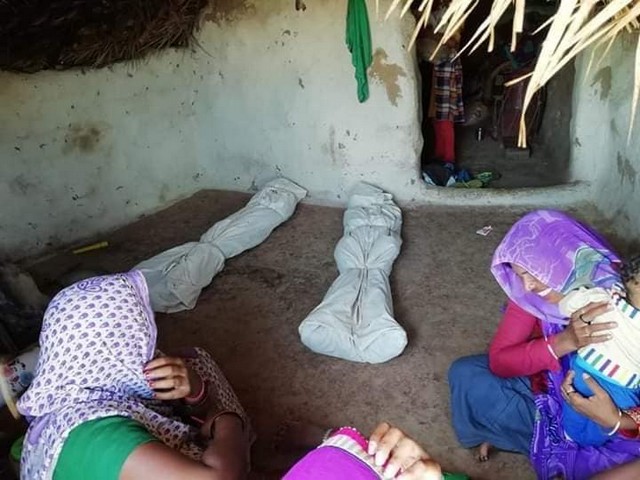
Two kids who happened to born in the Valmiki community became the victim of deep rooted caste hatred which the caste Hindus have been nurturing since centuries. What was the fault of these kids. The fault is their being Dalits and that too of the community which is ‘supposed’ to keep the street, houses, ‘clean’. A community which has kept India clean, and carried the dirt of the caste Hindus for centuries is not allowed to live a life with dignity. Most of the Valmiki Bastis are out of sight for India’s politicians and officials. Not even the activists go to their place.

About two decade an English journalist wanted to do a reporting on the conditions of the manual scavengers in India and she asked me that she would like to visit a family. I took her to a friends house in Trilokpuri. She was in her car and it was summer season. She was not willing to come out of the car when she saw the condition of that locality yet I insisted. She came to the home but could not sit there for more than a minute. While I remained there she decided to be in her car. This was the story of Delhi but elsewhere, India has criminally kept the community outside the developmental work.

That is why, I said the motives of Swachch Bharat Abhiyan must be questioned and are questionable if it does not have meaning for millions of those who have been kept untouchables and isolated just for keeping India and our families clean. Why did Narendra Modi or his party not speak of the rampant discrimination that Valmikis and other manual scavenging communities face. where are the homes, the schools, the rehabilitation for the community who suffer untouchability and discrimination not only from the Savarnas but at many places from OBCs as well as some other Dalit communities who feel that they higher in the caste ladder.

Look at the situation of this village in Shivpuri district in Madhya Pradesh where Avinash,10 and Roshini 12 years belonging to Manoj Valmiki’s family were killed brutally by Hakam Yadav and Rameshwar Yadav. Why was the killing ? The two were defecating in open. Nobody asked why ? According a report in the Indian Express paper today, there are 300 families of Yadavs in the village, followed by Jatavs but the Valmikis who lives on the absolute outskirts are merely two families. Both of them live in the semi constructed house and do not have any toilet. As the village is dominated by the Yadavs, it is for sure that these Valmikis must be used for cleaning their dirt and since they might now have the toilets at home, they would definitely get upset with the community as what is their work. The children clearly inform that there is deep rooted caste prejudices and untouchability against them in the schools.

The villages in India are the copy of Manu’s model and every basti is based on the caste. The caste system is followed fully and in great adherence. The other communities have no sympathy with your issue. Look at this village. Two children are murdered brutally and there is not a pain, not a shame or remorse to this 300 families of Yadavs. In fact some of them are defending the act, some are suggesting that Hakam Singh was ‘mentally unstable’ and he would have killed any one. So these are pretext to save them. Where were others when this happen. In village, nothing happen in isolation, people gather in large number when things happen but when they realise that it may be problmatic, they keep quiet.

Can you imagine that two kids were murdered by two caste Hindus who consider themselves caste superior, and none of the villagers ever bother to visit the families of these two. The community is defending the criminals and has no time to assure the families of these children that they are with them and they will get justice. This is caste hatred. That even after the crime, you shameless morons dont even think it to go and meet the families, apologise them, assure them. No, the cowards and criminals will get polluted if they visit the families of these untouchables. Where will you get such a barbaric society where after murdering the kids the castes dont even bother to attend their funeral just because they fear of getting ‘touched’. This is the power of caste that it blinds you. Right and wrongs become caste based. The criminals get strengthen from it because caste stand with them. This is pure caste preveledge and I can say even the police will fail the case. After some days, the case would be forgotten and things will come back to normal. If this Valmiki family make noise, they will try to shut the mouth with money or threaten them to leave the village.

The big question is why dont we speak against it ? When did our schools taught our children that untouchability and caste discrimination is a crime ? Did Swachcha Bharat and its proponents ever speak about it ? Why is the entire campaign to clean India not reach the Valmiki Basties or dom bastis ? Do the officers or civil servants who have Janeu and red tikka over their forehead, or wearing rings given by different Babas in their fingers or big rudraksh thread, ever visit these Bastis ? Can they do justice with the poor and marginalised if they continue to live in their caste glory. Why no severe action is taken against students, teachers, staff, parents, gram panchayats if cases of caste discrimination come to light.

India’s constitutional provisions have not worked hundred percent on removing untouchability. Constitution actually did not eliminate caste. Baba Saheb Ambedkar always talked about social democracy and felt in the absence of it, our political democracy will fail. Our politicians have ensured that we remain Manu-ised socially to ensure that this constitution fail because if it succeed then we will have an egalitarian society based on equality, liberty and fraternity but such a society would annihilate the caste privileges being enjoyed by various communities and their leaders. It is because of these privileges that the Manuwadis dont want the caste to go.

Coming back to this case, what is Kamalnath’s solution to this issue ? What is the compensation on the issue ? If Congress is sincere, it must take the task of honorably rehabilitating the Valmikis and other communities engaged in manual scavenging. Give them land for farming, provide their education hostel facilities and take full care of their education, give them employment in non sanitation work and declare untouchability as crime against humanity and punish all those who do it irrespective of castes. Will our leaders ready to take this ? Will our progressive find time to discuss the damages that manu-streamed polity has done to this country ?

Murder of Avinash and Roshini is a hatre crime, a crime against humanity and India need to give this issue top priority and not to side track the issue under certain pretext. All claims of progress, great power, great civilisation are bogus and Hippocratic as long as we have untouchability and caste discrimination in our society.

Vidya Bhushan Rawat is a social activist. Twitter @freetohumanity

27 September 2019

Source: countercurrents.org
10 Ways that the Climate Crisis and Militarism are Intertwined

By Medea Benjamin

The environmental justice movement that is surging globally is intentionally intersectional, showing how global warming is connected to issues such as race, poverty, migration and public health. One area intimately linked to the climate crisis that gets little attention, however, is militarism. Here are some of the ways these issues–and their solutions–are intertwined.

1. The US military protects Big Oil and other extractive industries. The US military has often been used to ensure that US companies have access to extractive industry materials, particularly oil, around the world. The 1991 Gulf War against Iraq was a blatant example of war for oil; today the US military support for Saudi Arabia is connected to the US fossil fuel industry’s determination to control access to the world’s oil. Hundreds of the US military bases spread around the world are in resource-rich regions and near strategic shipping lanes. We can’t get off the fossil fuel treadmill until we stop our military from acting as the world’s protector of Big Oil.

2. The Pentagon is the single largest institutional consumer of fossil fuels in the world. If the Pentagon were a country, its fuel use alone would make it the 47th largest greenhouse gas emitter in the world, greater than entire nations such as Sweden, Norway or Finland. US military emissions come mainly from fueling weapons and equipment, as well as lighting, heating and cooling more than 560,000 buildings around the world.

3. The Pentagon monopolizes the funding we need to seriously address the climate crisis. We are now spending over half of the federal government’s annual discretionary budget on the military when the biggest threat to US national security is not Iran or China, but the climate crisis. We could cut the Pentagon’s current budget in half and still be left with a bigger military budget than China, Russia, Iran and North Korea combined. The $350 billion savings could then be funnelled into the Green New Deal. Just one percent of the 2019 military budget of $716 billion would be enough to fund 128,879 green infrastructure jobs instead.

4. Military operations leave a toxic legacy in their wake. US military bases despoil the landscape, pollute the soil, and contaminate the drinking water. At the Kadena Base in Okinawa, the US Air Force has polluted local land and water with hazardous chemicals, including arsenic, lead, polychlorinated biphenyls (PCBs), asbestos and dioxin. Here at home, the EPA has identified over 149 current or former military bases as SuperFund sites because Pentagon pollution has left local soil and groundwater highly dangerous to human, animal, and plant life. According to a 2017 government report, the Pentagon has already spent $11.5 billion on environmental cleanup of closed bases and estimates $3.4 billion more will be needed.

5. Wars ravage fragile ecosystems that are crucial to sustaining human health and climate resiliency. Direct warfare inherently involves the destruction of the environment, through bombings and boots-on-the-ground invasions that destroy the land and infrastructure. In the Gaza Strip, an area that suffered three major Israeli military assaults between 2008 and 2014. Israel’s bombing campaigns targeted sewage treatment and power facilities, leaving 97% of Gaza’s freshwater contaminated by saline and sewage, and therefore unfit for human consumption. In Yemen, the Saudi-led bombing campaign has created a humanitarian and environmental catastrophe, with more than 2,000 cases of cholera now being reported each day. In Iraq, environmental toxins left behind by the Pentagon’s devastating 2003 invasion include depleted uranium, which has left children living near US bases with an increased risk of congenital heart disease, spinal deformities, cancer, leukemia, cleft lip and missing or malformed and paralyzed limbs.

6. Climate change is a “threat multiplier” that makes already dangerous social and political situations even worse. In Syria, the worst drought in 500 years led to crop failures that pushed farmers into cities, exacerbating the unemployment and political unrest that contributed to the uprising in 2011. Similar climate crises have triggered conflicts in other countries across the Middle East, from Yemen to Libya. As global temperatures continue to rise, there will be more ecological disasters, more mass migrations and more wars. There will also be more domestic armed clashes—including civil wars—that can spill beyond borders and destabilize entire regions. The areas most at risk are sub-Saharan Africa, the Middle East, and South, Central and Southeast Asia.

7. US sabotages international agreements addressing climate change and war. The US has deliberately and consistently undermined the world’s collective efforts to address the climate crisis by cutting greenhouse gas emissions and speeding the transition to renewable energy. The US refused to join the 1997 Kyoto Protocol and the Donald Trump’s withdrawal from the 2015 Paris Climate Accord was the latest example of this flagrant disregard for nature, science, and the future. Similarly, the US refuses to join the International Criminal Court that investigates war crimes, violates international law with unilateral invasions and sanctions, and is withdrawing from nuclear agreements with Russia. By choosing to prioritize our military over diplomacy, the US sends the message that “might makes right” and makes it harder to find solutions to the climate crisis and military conflicts.

8. Mass migration is fueled by both climate change and conflict, with migrants often facing militarized repression. A 2018 World Bank Group report estimates that the impacts of climate change in three of the world’s most densely populated developing regions—sub-Saharan Africa, South Asia, and Latin America—could result in the displacement and internal migration of more than 140 million people before 2050. Already, millions of migrants from Central America to Africa to the Middle East are fleeing environmental disasters and conflict. At the US border, migrants are locked in cages and stranded in camps. In the Mediterranean, thousands of refugees have died while attempting dangerous sea voyages. Meanwhile, the arms dealers fuelling the conflicts in these regions are profiting handsomely from selling arms and building detention facilities to secure the borders against the refugees.

9. Militarized state violence is leveled against communities resisting corporate-led environmental destruction. Communities that fight to protect their lands and villages from oil drills, mining companies, ranchers, agribusiness, etc. are often met with state and paramilitary violence. We see this in the Amazon today, where indigenous people are murdered for trying to stop clear-cutting and incineration of their forests. We see it in Honduras, where activists like Berta Caceres have been gunned down for trying to preserve their rivers. In 2018, there were 164 documented cases of environmentalists murdered around the world. In the US, the indigenous communities protesting plans to build the Keystone oil pipeline in South Dakota were met by police who targeted the unarmed demonstrators with tear gas, bean-bag rounds, and water cannons—intentionally deployed in below-freezing temperatures. Governments around the world are expanding their state-of-emergency laws to encompass climate-related upheavals, perversely facilitating the repression of environmental activists who have been branded as “eco-terrorists” and who are subjected to counterinsurgency operations.

10. Climate change and nuclear war are both existential threats to the planet. Catastrophic climate change and nuclear war are unique in the existential threat they pose to the very survival of human civilization. The creation of nuclear weapons—and their proliferation–was spurred by global militarism, yet nuclear weapons are rarely recognized as a threat to the future of life on this planet. Even a very “limited” nuclear war, involving less than 0.5% of the world’s nuclear weapons, would be enough to cause catastrophic global climate disruption and a worldwide famine, putting up to 2 billion people at risk. The Bulletin of the Atomic Scientists has set its iconic Doomsday Clock to 2 minutes to midnight, showing the grave need for the ratification of the Treaty on the Prohibition of Nuclear Weapons. The environmental movement and the anti-nuke movement need to work hand-in-hand to stop these threats to planetary survival.

To free up billions of Pentagon dollars for investing in critical environmental projects and to eliminate the environmental havoc of war, movements for a livable, peaceful planet need to put “ending war” at the top of the “must do” list.

Medea Benjamin is cofounder of CODEPINK for Peace, and author of several books, including Inside Iran: The Real History and Politics of the Islamic Republic of Iran.

26 September 2019

Source: countercurrents.org
Hong Kong Is Scared – Of The Rioters

By Andre Vltchek

It was once a British police station, as well as the Victoria Prison Compound. Hong Kong inhabitants used to tremble just from hearing its name mentioned. This is where people were detained, interrogated, humiliated, tortured and disappeared.

Now, after Hong Kong ‘returned to China’, it was converted into the Tai Kwun Center – one of the biggest and the most vibrant art institutions in Asia.

This transformation was symbolic, the same as the conversion of the former British-era slums into public parks has been symbolic.

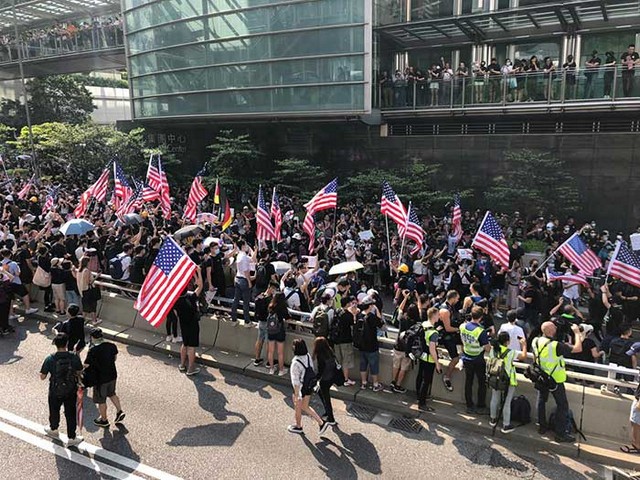
But now, as the pro-Western and anti-Chinese treasonous hooligans are dividing and ruining this former U.K. colony, the old-colonialist flags of “British Hong Kong” are being waved alongside the flags of the United States, while Chinese flags are being humiliated, and thrown into the bay.

Rioters seem to remember nothing about those ‘good old times’ (according to them), when signs shamelessly declared: “No Dogs and Chinese”. As they seem to close both eyes and ignore the neo-colonialism and massacres, that both North America and Europe are constantly committing in all corners of the world.

Now, the citizens of Hong Kong are scared. Not of the “government”, not of the police, or Beijing: they are frightened of the so-called protesters, of ninja-like looking young people with covered faces and metal bars in their hands.

Mr. Edmond, who works for the Tai Kwun Center, speaks bitterly about the events in his city:

“What is truly scary now, is that families here in HK are deeply divided. Father does not talk to his son. Silence reigns inside the families. Colleagues do not touch the subject of riots. The situation is thoroughly ruining our city, our society, our families.”

“If someone publicly disagrees with the protesters, they get beaten. They managed to silence people.”

“People come here, to this wonderful art center, and if they are from Beijing, they are now hiding their identity. It is because they are scared.”

Mr. Edmond keeps repeating that “disagreements should be like disputes inside the family”. He means, disagreements between the Hong Kong inhabitants, and Beijing. According to him, the outsiders should not be involved.

This is what the majority of the people feels in Hong Kong now. This is what they felt in 2014, when I wrote about another prolonged and destructive event which was sponsored by the West – the so-called “Umbrella” uprising.

They feel this, but most of them would not dare to express it. The rioters are young, in good physical shape, and armed with sticks and bars. They have no identity, as their faces are covered by scarves. They are drunk on fanatical self-righteousness; stoned on a primitive sense of purpose. Their behavior is not rational – it is religious.

I have been talking to them. In 2014, and now. Most of them know nothing about the foreign policy of the West. They have no clue about the brutality of the British Empire. They do not want to hear about the humiliation and pain of the Chinese people, when their country was invaded, broken into pieces and occupied.

They are selfish; grandstanders, and extremely arrogant.

They wave flags; foreign flags. They spit on their own banners. They do what they are told to do: by the hostile, foreign powers. And they do, what they are paid to do. It is as depressing, as it is embarrassing, to watch.

“President Trump, please liberate us!” “Please Save us, President Trump!” That is what they shout. That is what their posters say.

It is very hard to talk to them. I tried. Most of them do not want to uncover their faces, and to speak. They seem to feel secure only when in packs, in multitudes. When challenged, they reveal that they know very little, even about China; or even about Hong Kong itself.

But they are ready to preach; to lecture.

When faced with logical arguments, which they cannot refute, they become brutal.

Just a few days ago, they attacked a local teacher who was singing the national anthem of China. They beat him up. A child witnessing the event was horrified. He cried. The teacher kept singing.

They are beating those who try to make them stop destroying the city. They are beating those who are shaming them.

Whenever I manage to have longer exchanges with them, it somehow feels the same as when I am confronting religious fanatics in the Middle East. Perhaps, it should not even be surprising, as both are products of the Western propagandists and their allies.

People refusing to accept their leaflets at the airport –get beaten. If visitors to shopping centers challenge the rioters – a public beating takes place.

This covering of faces with black scarves would be illegal in many parts of the West, were the black scarves to be worn by, let’s say, Muslim women, or local rioters. But the Western media, outrageously selective in its coverage, is glorifying it here, simply because it is against the interests of the People’s Republic of China.

Chinese people, with thousands of years of culture, mostly tolerant, are not used to all this. These events of the last three months are something extremely foreign to them. Therefore, many are scared. Very scared. Desperate.

Ninjas of this nature are usually jumping and hitting in all directions, but from the screens of television sets, not right in the middle of the streets.

*

As I am filming in Hong Kong, as I am reporting for television stations, the picture is becoming clearer and clearer.

There are U.S. flags being carried, the U.S. anthem is sung, then immediately, hundreds of Western media crews start filming.

But when public property is being damaged, subway stations vandalized, pedestrians and motorists attacked, Western cameras are nowhere in sight.

If rioters were to trash Heathrow Airport in London, the army would be called, immediately. Here, the rioters are cheered on by foreigners.

It is obvious that Western mass media outlets and the rioters are working hand-in-hand. They have the same goals.

*

Fear is mixed with shame. No one in Hong Kong is speaking openly, on the record. Even on such seemingly ‘innocent’ topics like the collapse of tourism.

Those who are destroying the city, are obviously not willing to take responsibility for the hardship they are causing to its citizens.

Those who are with Beijing, those who believe in “one China”, which is the silent majority of the citizens, feel shame, because there are so many traitors living among them, in one overcrowded urban area.

Therefore, silence!

Everyone here in Hong Kong and in Mainland China, understands how dangerous the situation really is. Leaders of the riots, like Joshua Wong, are groomed by Washington, London and Berlin. They are morally and financially supported, not unlike people like Guaido in Venezuela. Mr. Wong is known to associate himself with organizations such as the “White Helmets”, which is working on behalf of the West for “regime change” in Syria.

To damage, to break China into pieces, is now the main goal of Western foreign policy. Beijing is being attacked on all fronts: Uyghurs, the Belt and Road Initiative, Taiwan, Tibet, South China Sea, trade. The more successful China gets;the more attacks it has to face.

Hong Kong used to be a city where “streets were paved with gold”, according to the legend. Mainland Chinese used to see it as a semi-paradise. All this has changed, reversed now. Neighboring cities like Shenzhen and Guangzhou, count with much better infrastructure, a greater cultural life, and lesser levels of poverty.

In one of the international hotels of Hong Kong, I was told by a manager:

“Mainland Chinese people do not see Hong Kong as something attractive, anymore. They do not travel here often, anymore. They are not treated well here. They go to Thailand or to Europe instead.”

The citizens of Hong Kong feel frustrated and angry. Their “uniqueness” is evaporating. They are being left behind. Poverty rates are high. English language proficiency is declining, and businesses are moving to Singapore. Hong Kong is the most expensive city on earth, and it is unaffordable for most of its citizens.

Extreme capitalism here has brought nothing spectacular to the people. It is increasingly obvious that the Communist (or call it “socialism with the Chinese characteristics”) system has become much more successful than the old British-style neo-liberalism; in terms of social policies, infrastructure, the arts and general quality of life.

The spoiled, egotistical young people of Hong Kong are outraged. What? They are suddenly not on top of the world? The Commies across the line are better at almost everything they touch?

Instead of working harder, they turn against China; against the Mainland.

They want to convince the entire Hong Kong and even the Mainland, that the ‘Hong Kong way’ is the only correct way. And of course, there is plenty of funding available to support their insane claims. The funding comes from the fellow-collapsing societies – those in the West.

*

Most of the citizens of Hong Kong are scared that the rioters may succeed.

They have already forced the withdrawal of the Extradition Bill, which could help Hong Kong to fight the endemic corruption and invulnerability of its business elites.

They have already managed to scare the Hong Kong government into compromises.

The rioters are acting like huge, violent gangs, and they are enjoying full propaganda support from the West.

But whether they like it or not, Hong Kong is China. Ask a grocery vendor at North Point, ask coolies, old ladies on a park bench, or an elementary school teacher, and you will understand. These people do not care whether Hong Kong is exceptional or not. They do not need to show-off. They just want to live, to survive, to look forward to a better future.

And a better future is definitely with Beijing, not with Washington or London.

They already had London. They had enough of it.

“More Beijing, not less”, you would hear if people were not scared to talk. In 2014, when things were not as extreme as now, they used to tell me.

Now, it is not easy to fight the hundreds of thousands of face-covering and metal-bar-waving zealots and fanatics. Their religion is simply “The West”. It is abstract. As are their demands. As are their violent outbursts of inferiority complexes.

Both, the local majority, and Beijing, have to think hard as to what strategy to apply, in order to protect, and to defend Hong Kong and China against those brutal, frustrated, morally corrupt hooligans and treasonous cadres.

*

[First published by NEO – New Eastern Outlook]

Andre Vltchek is a philosopher, novelist, filmmaker and investigative journalist.

25 September 2019

Source: countercurrents.org
All-Woman Team Releases Fact-finding Report on Kashmir

By Fact-Finding Report

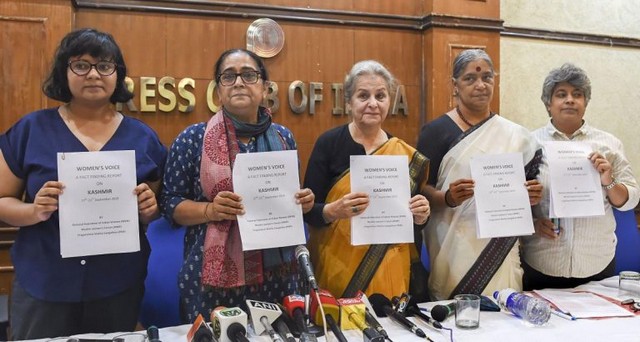
A five member team of eminent activists, journalists and civil society members recently returned from Kashmir. The all-woman team has now shared its findings on the situation on the ground in the region that still remains by-and-large cut off from the rest of the country, the communication blackout enabling unspeakable excesses against the local population by the military.

The team comprising Annie Raja, Kawaljit Kaur, Pankhuri Zaheer from National Federation Indian Women, Poonam Kaushik from Pragatisheel Mahila Sangathan and Syeda Hameed from Muslim Women’s Forum visited Kashmir between September 17 and 21. Apart from Srinagar, the women visited several villages in Shipian, Pulwama and Bandipora to take stock of ground realities. They have now released their report based on eye witness accounts and case studies of those who have actually suffered.

These are lines by Comrade Abdul Sattar Ranjoor. We held these as a beacon during our four-day sojourn in a locked and shuttered land called Kashmir.

Spring buds will flower
Nightingales’ pain will abate
Lovers wounds will start healing
Sickness will leave the ailing
Heart’s longing of Ranjoor will be fulfilled
When the poorest will rule
Wearing the crown of glory

(Ranjoor was killed in 1990)

A team of 5 women visited Kashmir from September 17th-21st 2019. We wanted to see with our own eyes how this 43 day lockdown had affected the people, particularly women and children.

The team consisted of Annie Raja, Kawaljit Kaur, Pankhuri Zaheer from National Federation Indian Women, Poonam Kaushik from Pragatisheel Mahila Sangathan and Syeda Hameed from Muslim Women’s Forum.

Besides spending time in Srinagar, we visited several villages in the districts of Shopian, Pulwama and Bandipora. We went to hospitals, schools, homes, market places, spoke to people in the rural as well as urban areas, to men, women, youth and children. This Report is our chashmdeed gawahi (eye witness account) of ordinary people who have lived for 43 days under an iron siege.

Shops closed, hotels closed, schools, colleges, institutes and universities closed, streets deserted was the first visual impact as we drove out from the airport. To us it seemed a punitive mahaul that blocked breathing freely.

The picture of Kashmir that rises before our eyes is not the populist image; shikara, houseboat, lotus, Dal Lake. It is that of women, a Zubeida, a Shamima, a Khurshida standing at the door of their homes, waiting. Waiting and waiting for their 14, 15, 17, 19 year old sons. Their last glimpse is embedded in each heart, they dare not give up hope but they know it will be a long wait before they see their tortured bodies or their corpses… if they do. ‘We have been caged’ these words we heard everywhere. Doctors, teachers, students, workers asked us, “What would you do in Delhi if internet services were cut off for 5 minutes?” We had no answer.

Across all villages of the four districts, peoples’ experiences were the same. They all spoke of lights, which had to be turned off around 8PM after Maghreb prayers. In Bandipora, we saw a young girl who made the mistake of keeping a lamp lit to read for her exam on the chance that her school may open soon. Army men angered by this breach of ‘curfew’, jumped the wall to barge in. Father and son, the only males in the house were taken away for questioning. ‘What questions?’, no one dared ask. The two have been detained since then. ‘We insist that men should go indoors after 6 PM. Man or boy seen after dusk is a huge risk. If absolutely necessary, we women go outside’. These words were spoken by Zarina from a village near Bandipora district headquarters. ‘In a reflex action, my four year old places a finger on her lips when she hears a dog bark after dusk. Barking dogs mean an imminent visit by army. I can’t switch on the phone for light so I can take my little girl to the toilet. Light shows from far and if that happens our men pay with their lives’.

The living are inadvertently tortured by the dead. ‘People die without warning or mourning. How will I inform my sisters about their mother’s death?’ Ghulam Ahmed’s voice was choked. ‘They are in Traal, in Pattan. I had to perform her soyem without her children’. The story was the same wherever we went. People had no means of reaching out to loved ones. 43 days were like the silence of death.

Public transportation was zero. People who had private cars took them out only for essential chores. Women stood on roadsides, flagging cars and bikes for rides. People stopped and helped out; helplessness of both sides was their unspoken bond. ‘I was on my bike going towards Awantipora. A woman flagged me. My bike lurched on a speed breaker. She was thrown off. I took her to the nearby hospital. She went in a coma. I am a poor man how could I pay for her treatment? How and who could I inform?’ These daily events were recounted wherever we went. At a Lalla Ded Women’s Hospital in Srinagar several young women doctors expressed their absolute frustration at the hurdles that had been placed in their way since the abrogation of Article 370. ‘There are cases where women cannot come in time for deliveries. There are very few ambulances, the few that are running are stopped at pickets on the way. The result? There are several cases of overdue deliveries that produce babies with birth deformities. It is a life long affliction, living death for parents”. Conversely, we were told that several women are delivering babies prematurely due to the stress and khauf (fear) in the present condition. “It feels like the government is strangling us and then sadistically asking us to speak at the same time,’ a young woman doctor said as she clutched her throat to show how she felt.

A senior doctor from Bandipora Hospital told us that people come from Kulgam, Kupwara, and other districts. Mental disorders, heart attacks, today there are more cases than he could ever recall. For emergencies junior doctors desperately look for seniors; there is no way of reaching them on phone. If they are out of the premises, they run on the streets shouting, asking, searching in sheer desperation. One orthopaedic doctor from SKIMS was stopped at the army imposed blockade while he was going for duty. He was held for 7 days. Safia in Shopian had cancer surgery. ‘I desperately need a check up in case it has recurred. Baji, I can’t reach my doctor. The only way is to go to the city, but how do I get there? And if I do, will he be there?’ Ayushman Bharat, an internet based scheme, cannot be availed by doctors and patients.

Women in villages stood before us with vacant eyes. ‘How do we know where they are? Our boys who were taken away, snatched away from our homes. Our men go to the police station, they are asked to go to the headquarters. They beg rides from travellers and some manage to get there. On the board are names of ‘stone pelters’ who have been lodged in different jails, Agra, Jodhpur, Ambedkar, Jhajjar.’ A man standing by adds, ‘Baji we are crushed. Only a few of us who can beg and borrow, go hundreds of miles only to be pushed around by hostile jail guards in completely unfamiliar cities.’

At Gurdwaras we met women who said they have always felt secure in Kashmir. ‘Molestation of women in rest of India about which we read is unheard of in Kashmir’. Young women complained they were harassed by army, including removal of their niqab

‘Army pounces on young boys; it seems they hate their very sight. When fathers go to rescue their children they are made to deposit money, anywhere between 20000 to 60000’. So palpable is their hatred for Kashmiri youth that when there is the dreaded knock on the door of a home, an old man is sent to open it. ‘We hope and pray they will spare a buzurg. But their slaps land on all faces, regardless whether they are old or young, or even the very young. In any case, Baji, we keep our doors lightly latched so they open easily with one kick’. The irony of these simply spoken words!

Boys as young as 14 or 15 are taken away, tortured, some for as long as 45 days. Their papers are taken away, families not informed. Old FIR’s are not closed. Phones are snatched; collect it from the army camp they are told. No one in his senses ever went back, even for a slightly expensive phone. A woman recounted how they came for her 22 year old son. But since his hand was in plaster they took away her 14 year old instead. In another village we heard that two men were brutally beaten. No reason. One returned, after 20 days, broken in body and spirit. The other is still in custody. One estimate given to us was 13000 boys lifted during this lockdown. They don’t even spare our rations. During random checking of houses which occurs at all odd hours of the night, the army persons come in and throw out the family. A young man working as SPO told us. ‘We keep a sizeable amount of rice, pulses, edible oil in reserve. Kerosene is mixed in the ration bins, sometimes that, sometimes koyla’.

Tehmina from Anantnag recently urged her husband, ‘Let us have another child. If our Faiz gets killed at least we will have one more to call our own. Abdul Haleem was silent. He could see the dead body of his little boy lying on his hands even as she spoke these words. ‘Yeh sun kar, meri ruh kaanp gayi,” he tells us.

A thirty year old lawyer from Karna was found dead in his rented accommodation. He was intensely depressed. Condolence notice was issued by Secy Bar Association. Immediately after that he was taken into custody. Why? We spoke to a JK policeman. All of them have been divested of their guns and handed dandas. ‘How do you feel, losing your guns?’ ‘Both good and bad’ came the reply. ‘Why?’ Good because we were always afraid of them being snatched away. Bad because we have no means now to defend ourselves in a shootout. One woman security guard said ‘Indian govt wants to make this a Palestine. This will be fought by the us, Kashmiris’. One young professional told us, ‘We want freedom. We don’t want India, we don’t want Pakistan. We will pay any price for this. Ye Kashmiri khoon hai. Koi bhi qurbani denge’.

Everywhere we went there were two inexorable sentiments. First, desire for Azadi; they want nothing of either India or Pakistan. The humiliation and torture they have suffered for 70 years has reached a point of no return. Abrogation of 370 some say has snapped the last tie they had with India. Even those people who always stood with the Indian State have been rejected by the Govt. ‘So, what is the worth in their eyes, of us, ordinary Kashmiris?’ Since all their leaders have been placed under PSA or under house arrest, the common people have become their own leaders. Their suffering is untold, so is their patience. The second, was the mothers anguished cries (who had seen many children’s corpses with wounds from torture) asking for immediate stop to this brutalisation of innocents. Their children’s lives should not be snuffed out by gun and jackboots.

As we report our experiences and observations of our stay in Kashmir, we end with two conclusions. That the Kashmiri people have in the last 50 days shown an amazing amount of resilience in the face of brutality and blackout by the Indian government and the army. The incidents that were recounted to us sent shivers down our spines and this report only summarises some of them. We salute the courage and resoluteness of the Kashmiri people. Secondly, we reiterate that nothing about the situation is normal. All those claiming that the situation is slowly returning to normalcy are making false claims based on distorted facts.

Poets speak for humankind. We began our report with lines from the Kashmiri poet Ranjoor, we end with lines from Hindi poet Dushyant. Both indicate the way forward for Kashmir:

Ho gayi hai peerh parbat si pighalni chahiye
Iss Himalaya se koi Ganga nikalni chahiye

We Demand:

1. FOR NORMALCY Withdraw the Army and Paramilitary forces with immediate effect
2. FOR CONFIDENCE BUILDING Immediately Cancel all cases/ FIRs and Release all those, especially the youth who are under custody and in jail since the Abrogation of Article 370
3. FOR ENSURING JUSTICE Conduct inquiry on the widespread violence and tortures unleashed by the Army and other security personnel.
4. COMPENSATION to all those families whose loved ones lost lives because of non availability of transportation and absence of communication.

In Addition:

• Immediately restore all communication lines in Kashmir including internet and mobile networks.
• Restore Article 370 and 35 A.
• All future decisions about the political future of Jammu and Kashmir must be taken through a process of dialogue with the people of Jammu and Kashmir.
• All army personnel must be removed from the civilian areas of Jammu and Kashmir.
• An time bound inquiry committee must be constituted to look into the excesses committed by the army.

[Kindly note. To protect the identity of the people we met, all names in the Report have been changed. We have not named the villages we visited for the very same reason]

24 September 2019

Source: countercurrents.org
Netanyahu on Steroids: What a Gantz-led Government Means for Palestine

By Dr Ramzy Baroud

Experience has taught Palestinians not to pay heed to Israeli elections. But to every rule there is an exception.

Although it is still true that no Israeli Zionist leader has ever been kind to the Palestinian people, the dynamics of the latest Israeli elections on September 17 are likely to affect the Occupied Palestinian Territories in a profound way.

Indeed, the outcome of the elections seems to have ushered in a new age in Israel, ideologically and politically. But the same claim can also be made regarding its potential influence on Palestinians, who should now brace themselves for war in Gaza and annexation in the West Bank.

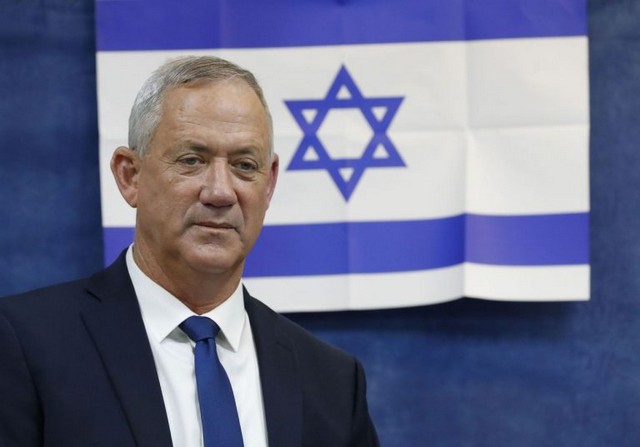
Former chief of general staff of the Israeli army, Benny Gantz, who had orchestrated the destructive war on the besieged Gaza Strip in 2014, is likely to be tasked with the job of forming Israel’s new government. Gantz had recently boasted about sending “parts of Gaza back to the Stone Age”.

There is little discussion in Israeli, and, by extension, western media of Gantz’s numerous war crimes during the Gaza war. The focus is mainly placed on the fact that he seems to have finally dislodged Israeli Prime Minister Benjamin Netanyahu from a position he had held for nearly 13 years, a scenario that was, until recently, deemed inconceivable.

The leader of the Kahol Lavan (Blue and White) party had plotted the ouster of Netanyahu back in January 2018, when he formed the Israeli Resilience Party. Following several political mergers and a strong showing in the previous elections in April, the centrist politician has finally edged past Netanyahu’s right-wing Likud party in the most recent elections.

With 33 seats in the Israeli Knesset – compared to Likud’s 31 seats – Gantz now needs a broad coalition to rule Israel. The vehemently anti-Palestinian politician has made it clear that he will not enter into a coalition with the Joint List, the alliance of various Palestinian Arab political parties. The latter has managed to achieve an outstanding 13 seats, making it the third largest political force in Israel.

But, according to Gantz’s previous statements, the inclusion of Arab parties in the coalition is out of the question, despite the fact that Ayman Odeh, the leader of the Joint List, had indicated his willingness to join a Gantz-led government.

It is now likely that Gantz will seek a coalition government that includes the Likud, along with Avigdor Lieberman’s Yisrael Beiteinu. The country’s former ultra-nationalist defense minister, Lieberman, with 8 seats, has restored his previous “kingmaker” status. He, too, is keen on such a coalition. Gantz is open to such a scenario, with one condition: Netanyahu should stay out.

While the “king of Israel” has finally been dethroned, however, Palestinians have little to rejoice over. True, Netanyahu has destroyed any chance of a just peace in Palestine through the entrenching of the illegal military occupation and inhumane siege of the West Bank and Gaza. However, future possibilities are equally, if not even more, grim.

Once upon a time, outright discussion of annexing large parts of the Occupied Palestinian Territories were relegated to the margins of Israel’s political discourse. This is no longer the case. The call for annexing major illegal settlement blocs, along with the Jordan Valley, is now a common demand made by all of Israel’s main political parties, including Gantz’s own.

Gantz, possibly Israel’s next prime minister, has repeatedly made it clear that he would be strengthening, rather than dismantling, the illegal settlements in the West Bank, and has even attempted to take ownership of Netanyahu’s pledge to annex the Jordan Valley.

“We are happy that the Prime Minister has come around to adopt the Blue and White plan to recognize the Jordan valley,” Gantz’s party said in a statement shortly before election day.

The annexation of these areas would amount to illegally seizing more than 60 percent of the West Bank.

Given that Israel has successively normalized the concept of annexation in its own, political discourse, and that it has already received an American nod on the matter, it is then a matter of time before such a step takes place.

The likelihood of it taking place sooner than later is that a broad, center-right-ultranationalist coalition would serve as an insurance to Israel’s leadership, in case of a political or security fallout once the decision is taken and enforced.

That political insurance simply means that no single party or official would bear the blame or shoulder the consequences alone, should Palestinians rebel or the international community push back against the flagrant Israeli violation of international law.

The same logic is applicable to the case of a future war on Gaza.

Israel has been itching for a major military campaign in Gaza since its last onslaught of 2014. Since then, Gaza has been bombed numerous times, and hundreds of innocent lives have been lost. But Netanyahu steered clear of an all-out war, fearing a high death toll among his soldiers and the blame game that often follows such military misadventures.

Mandated by a large coalition, bringing together Israeli army generals, right-wing politicians and ideologues, Gantz would feel far more empowered to go to war, especially since the former military chief has repeatedly accused Netanyahu of being “weak” on Gaza, “terrorism” and security.

If a future war goes as planned, Gantz would be happy to claim the accolades of victory; if it does not, due to Gaza’s stiff resistance, the political damage is likely to remain minimal.

When it comes to war, Gantz is Netanyahu on steroids. He has participated, orchestrated or led many military campaigns, including ones aimed at suppressing any resistance in Gaza, in Lebanon and during the previous popular uprisings.

For Gantz, war is the answer, as indicated by one of his campaign slogans, “Only the strong survive.”

While it is typical, and understandable, to dismiss all Israeli governments as one and the same, a Gantz-led government will possess the needed political legitimacy, popular mandate and strategic tools to achieve a job that Netanyahu himself couldn’t finish: a war on Gaza, and annexation of the West Bank.

Ramzy Baroud is a journalist, author and editor of The Palestine Chronicle.

24 September 2019

Source: countercurrents.org
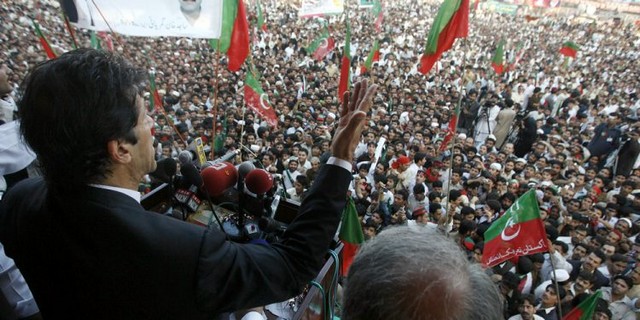
‘How dare you’: Greta Thunberg’s powerful speech to the UN

By Countercurrents Collective

Greta Thunberg, the young climate crisis activist on Monday opened the United Nations Climate Action Summit with an angry condemnation of world leaders for failing to take strong measures to combat climate crisis – “How dare you,” she said.

“This is all wrong,” said Thunberg, the 16-year-old who launched a massive climate strike movement that drew millions to the streets last Friday. “I shouldn’t be up here. I should be back in school on the other side of the ocean. Yet you all come to us young people for hope? How dare you!”

Greta does not mince words. Not even when addressing the world’s most powerful people.

“We are in the beginning of a mass extinction and all you can talk about is money and fairy tales of eternal economic growth,” the Swedish climate activist told the UN General Assembly (UNGA) on Monday. “How dare you?”

Speaking during the UN Climate Action Summit in New York, the activist was visibly frustrated with her audience and at times appeared to be holding back tears of anger.

Days after millions of young people took to the streets worldwide to demand emergency action on climate change, leaders gathered for the annual UNGA aiming to inject fresh momentum into stalling efforts to curb carbon emissions.

She started with weekly sit-ins outside the Swedish Parliament, holding a handmade “School Climate Strike” sign. In just a few months, the one-girl protest grew into a worldwide movement, with students walking out of schools in well over 100 countries.

A visibly emotional Greta Thunberg said in stern remarks at the opening of the summit that the generations that have polluted the most have burdened her and her generation with the extreme impacts of climate change.

“You have stolen my dreams and my childhood with your empty words. And yet I’m one of the lucky ones. People are suffering. People are dying. Entire ecosystems are collapsing. We are in the beginning of a mass extinction. And all you can talk about is money and fairy tales of eternal economic growth. How dare you.”

“You have stolen my dreams and my childhood with your empty words,” Greta said, adding that the plans that leaders will unveil will not be enough to respond to the rate of the planet’s warming.

“Adults keep saying we owe it to the young people to give them hope. But I don’t want your hope. I want you to panic,” she told the rich and powerful gathered in the Swiss mountain resort.

Like in New York on Monday, her speech was met with a stunned silence, then an overwhelming applause.

She said her message to the global leaders gathered in New York is simple: “We are watching you.”

“If you chose to fail us, I say we will never forgive you,” she added.

“How dare you continue to look away and come here saying that you are doing enough when the politics and solutions needed are still nowhere in sight,” she said.

“You say you ‘hear’ us and that you understand the urgency. But no matter how sad and angry I am, I don’t want to believe that. Because if you fully understood the situation and still kept on failing to act, then you would be evil. And I refuse to believe that.”

Greta has galvanized a new wave of climate crisis activism through her weekly Fridays for Future school strikes, which she began with her weekly, solitary protests outside of the Swedish parliament.

The 5 violators of human rights

Following her speech, separately on Monday, Greta and 15 other children filed a complaint with the UN alleging that five of the world’s leading economies have violated their human rights by not taking adequate action to stop the unfolding climate crisis.

The petition names five countries — Germany, France, Brazil, Argentina and Turkey — that they say have failed to uphold their obligations under the Convention on the Rights of the Child, a 30-year-old human rights treaty that is the most widely ratified in history.

The filing of the petition to the UN’s Committee on the Rights of the Child is the first-of-its-kind.

Specifically, they are asking the committee’s 18 experts to accept the petition and agree to investigate, and, ultimately, to find that climate change is a crisis for children’s rights and issue recommendations for the named countries on how they can better respond to climate change. The recommendations laid out in the complaint would be legally binding if approved by the committee, but there is no real method in place to ensure the countries follow through. And given how vague some of the requests are, it would be hard to measure progress.

“The goal of the petition is to get these nations, as well as others, to act swiftly to combat climate change in the fullest and faster way possible,” said Jill Tauber, vice president of litigation for climate and energy for Earthjustice.

The environmental law nonprofit is co-counsel on the petition and details the specifics of the complaint — including why it targets five specific countries — on its website.

Except the U.S.

Per an Earthjustice press release posted Monday, every country except the U.S. has ratified the UN Convention on the Rights of the Child.

“Of those countries, 45 agreed to an additional protocol that allows children to petition the UN directly about treaty violations. Within that group of 45 nations, Argentina, Brazil, France, Germany, and Turkey are pumping out some of the most pollution that causes climate change,” the NGO added. “None of the five is on a path needed to keep the planet from heating to 1.5 or 2 degrees Celsius.”

Underwhelming climate pledge

More than 60 countries pledged to get to net-zero emissions by 2050.

But to some observers in the climate world, the sum of climate pledges announced was underwhelming.

“In her blunt and powerful speech at the Climate Action Summit this morning, Greta Thunberg laid down a clear line in the sand, separating those countries and leaders who are united behind the science from those who continue to place the profits of fossil fuel polluters above the safety of their citizens,” Alden Meyer, director of strategy and policy for the Union of Concerned Scientists, said in a statement. “Sadly, most leaders from the world’s largest emitting countries failed this litmus test, dodging their responsibility to step up action as is essential to address the climate emergency we now face.”

Nature is angry

UN Secretary-General Antonio Guterres had warned governments ahead of the event that they would have to offer action plans to qualify to speak at the summit, which is aimed at boosting the 2015 Paris Agreement to combat global warming.

In his opening remarks, he tried to capture the urgency of climate change and called out the fossil fuel industry.

“Nature is angry. And we fool ourselves if we think we can fool nature, because nature always strikes back, and around the world nature is striking back with fury,” Guterres said.

“There is a cost to everything. But the biggest cost is doing nothing. The biggest cost is subsidizing a dying fossil fuel industry, building more and more coal plants, and denying what is plain as day: that we are in a deep climate hole, and to get out we must first stop digging,” he said.

Thunberg and Trump

After her speech, Greta Thunberg happened to be in the lobby of the UN as President Donald Trump arrived — and news cameras from around the world captured the instantly memeworthy expression on her face as he walked by.

Trump was only at the climate summit for about 14 minutes, according to the White House pool report, and did not make any formal statement.

Trump has questioned his own government’s climate scientists, vowed to withdraw the U.S. from the main global climate agreement, the Paris climate accord, and his administration has rolled back dozens of climate rules and initiatives.

Trump, a climate change denier who has undone every major U.S. regulation aimed at combating climate change, made a brief appearance in the audience of the summit along with Vice President Mike Pence and Secretary of State Mike Pompeo. He did not give remarks but he listened to remarks by German Chancellor Angela Merkel and Indian Prime Minister Narendra Modi.

Laughter

Former New York Mayor Michael Bloomberg, who serves as the U.N. special envoy on climate action, called out Trump’s stealth appearance before he spoke on Monday: “Hopefully our deliberations will be helpful to you as you formulate climate policy,” he said to audience laughter.

Russia ratifying Paris agreement

A Russian official announced it was finally ratifying the Paris climate agreement, making it one of the last countries to take this step.

Slovakia to end coal subsidy

Slovakian President Zuzana Čaputová said her country would end subsidies to coal mines in 2023.

Germany to phase out of coal

German Chancellor Angela Merkel said her nation would phase out coal power by 2038, among a series of climate targets.

Merkel announced Germany would double Germany’s contribution to a UN fund to support less developed countries to combat climate change to 4 billion euros from 2 billion euros.

Greta Thunberg’s full speech at the UN Climate Action Summit:

This is all wrong. I shouldn’t be up here. I should be back in school on the other side of the ocean. Yet you all come to us young people for hope? How dare you! You have stolen my dreams and my childhood with your empty words. And yet I’m one of the lucky ones. People are suffering. People are dying. Entire ecosystems are collapsing. We are in the beginning of a mass extinction. And all you can talk about is money and fairytales of eternal economic growth. How dare you!

For more than 30 years the science has been crystal clear. How dare you continue to look away, and come here saying that you are doing enough, when the politics and solutions needed are still nowhere in sight.
You say you “hear” us and that you understand the urgency. But no matter how sad and angry I am, I don’t want to believe that. Because if you fully understood the situation and still kept on failing to act, then you would be evil. And I refuse to believe that.
The popular idea of cutting our emissions in half in 10 years only gives us a 50% chance of staying below 1.5C degrees, and the risk of setting off irreversible chain reactions beyond human control.

Maybe 50% is acceptable to you. But those numbers don’t include tipping points, most feedback loops, additional warming hidden by toxic air pollution or the aspects of justice and equity. They also rely on my and my children’s generation sucking hundreds of billions of tonnes of your CO2 out of the air with technologies that barely exist. So a 50% risk is simply not acceptable to us — we who have to live with the consequences.

To have a 67% chance of staying below a 1.5C global temperature rise – the best odds given by the Intergovernmental Panel on Climate Change — the world had 420 gigatons of carbon dioxide left to emit back on 1 January 2018. Today that figure is already down to less than 350 gigatons. How dare you pretend that this can be solved with business-as-usual and some technical solutions. With today’s emissions levels, that remaining CO2 budget will be entirely gone in less than eight and a half years.

There will not be any solutions or plans presented in line with these figures today. Because these numbers are too uncomfortable. And you are still not mature enough to tell it like it is.

You are failing us. But the young people are starting to understand your betrayal. The eyes of all future generations are upon you. And if you choose to fail us I say we will never forgive you. We will not let you get away with this. Right here, right now is where we draw the line. The world is waking up. And change is coming, whether you like it or not.

Greta’s journey

Greta Thunberg is taking a sabbatical year from school to attend conferences and meetings with policymakers and those impacted by climate change.

But persuading her to come to New York was not easy. Greta refuses to fly because of the high levels of emissions from air travel. When she traveled to the World Economic Forum in Davos, Switzerland, in January, she traveled by train. It took her 32 hours.

To get her to come to New York to address the UN, she was offered the option of sailing across the Atlantic Ocean on a 60-foot zero-emissions yacht.

24 September 2019

Source: countercurrents.org

The Aspirations and Ambiguities of De-Colonial Politics

By SherAli Tareen

The Background Noise

Imran Khan’s ascension as Prime Minister of Pakistan in August 2018 preceded and instigated an avalanche of alarming prognoses issued by a range of motley characters. Their convergence made for an interesting union of otherwise incompatible bedfellows. Self-anointed Pakistan experts at neo-conservative U.S. think-tanks, editorials of mainstream Western media, South Asian liberal secular commentators in the region and among the diaspora, hyper nationalist Indian media outlets and their ever-eager Pakistani enablers in exile, and even the Daily Show’s Trevor Noah: all found one voice in delivering prophecies, invariably coated with strident exaggeration, of the calamity that awaits Pakistan and the rest of the world with Imran Khan’s rise to power. The apocalyptic doomsday narratives that accompanied the formation of Imran’s government took multiple trajectories casting him variedly as a fundamentalist, women hating misogynist, petulant neophyte, self-obsessed Trump clone, a licentious pervert, or heartless authoritarian.

For instance, in an opinion piece published a few days after the July elections, the otherwise thoughtful Indian author Pankaj Mishra bizarrely argued that Imran’s triumphs on the cricket field and in the arena of sexual encounters had cemented the latter’s conviction that he was divinely anointed as Pakistan’s savior! Moreover, in a dash of unfazed generalization, Mishra proceeded to entangle Imran’s allegedly hyper masculine sanctimony to his newfound intimacy with religious extremists. There is no question that Imran could and should be criticized, indeed unabashedly so, for his unsavory views on such matters as the blasphemy law. But the problem with Mishra’s essay was its complete lack of interest in complicating the figure of the “religious extremist” by even gesturing at the nuances, complexities, and power dynamics informing the contributions and influence of “religiously” marked actors in the country’s electoral politics. He will be well served by investing in a more intellectually and politically diverse pool of diaspora Pakistani informants. Also, his smug befuddlement at the sight of a Muslim politician’s heteronomous invocation of divine sovereignty as a source of strength and conviction reveals a subtle yet pungent example of liberal Islamo-discomfort (Islamophobia would be too strong and unfair of a term here). For all his critiques of the enlightenment, Mishra found himself unable to overcome the pressing liberal desire to tame and moderate Islam and Muslims so as to render them amenable to the protocols of secular modernity. There is a world of a difference between critique and the liberal secular operation of critique aimed at moderating and domesticating religious (most often Muslim) lives that commit the sin of polluting the domain of “secular” politics with the contagion of theological discourse. Mishra has clearly not thought through the secular theology that undergirds his discomfort with “religious excess.”

To cite another prominent example of such liberal secular discomfort, in a widely circulated Op-ed in the Guardian immediately before the election, author Fatima Bhutto, in a display of harrowing hyperbole, painted Imran as a diabolical pawn of the military, who drew his support from an army of rabidly fascist youth. While some of her points were eminently valid (even if yawningly predictable), they were buried under a bed of selective decontextualized polemical scoring points. A few months later, she also emerged as the latest entrant in New Delhi TV’s esteemed line-up of elite diaspora Pakistanis willing to deliver anti-Imran polemical arrows in the service of smug Indian nationalism, joining the ranks of such shallow neo-imperial sell-outs like the Islamist turned secularist Hussain Haqqani. Critiquing the deep-state is a most worthy and indeed necessary task. But one should have at least some attentiveness to the context and venue of such critique when it is being packaged for other equally problematic imperial and nationalist political projects. But arguably the top prize in amplified sensationalism goes to the Pakistani journalist Mehreen Zahra Malik and to her August (2018) opinion piece in the Washington Post, written even before Imran had taken the oath of office, with the ever-subtle title of “Who’s Afraid of Imran Khan’s Pakistan? Almost Everyone.” In this essay, Malik blamed the purported climate of fear that in her view had gripped the country in the days following Imran’s election as Prime Minister for misplacing keys to her apartment and hence getting locked out! Read her essay for yourself lest you think I were exaggerating. Such puerile commentaries would make for good humor were they not showcased on powerful media platforms like the Washington Post and the New York Times where Malik had earlier also penned an essay on the crucial issue of sexual harassment in Pakistan but in a neo-Orientalist fashion that only fulfilled everyWestern stereotype of the “Muslim woman” in need of urgent saving.

The Promise and Execution of De-Colonial Politics

A year later, while there is plenty about Imran’s PTI government to be concerned about, there is also much that is unprecedented as well as commendable. Conceptually, perhaps the underlying theme that has glued much of Imran’s stint in power (as indeed his political career more broadly) is represented by an abiding commitment to enacting a mode of de-colonial politics that seeks to avidly resist and subvert the violent legacies and afterlives of colonial power in a fractured postcolonial setting like Pakistan. But while the aspiration for de-colonial politics is what makes Imran so radically different from almost all other rulers the country has seen, it is also where some of the most problematic ambiguities surrounding his first year in power are most cuttingly visible. This is the main argument of this essay. Imran articulated the foundational lineaments of his de-colonial aspirations in his very first address to the nation immediately after taking the oath of office. Praised by even his avid detractors for its engaging and refreshingly accessible style of delivery, even more impressive was the content of the speech. A rarity in Pakistan’s history, a Prime Minister’s inaugural address, rather than rehearsing nauseatingly predictable nationalist salvos, focused instead on raising critical social problems ranging from the environment, malnutrition and stunted growth in children, to the unjust treatment of the poor in police stations and other everyday theaters of the state apparatus. In this speech, Imran also introduced what was to become the signature theme dominating his political outlook as Prime Minister: the promise of cultivating a polity inspired by the principles of justice, equality, and the rule of law that governed the Prophet’s seventh-century community of Medina and that brought together Christians, Jews, and Muslims in a common political venture. Animated by the principles and standards of Medina, Pakistanis, especially the governing elite, must privilege the underprivileged in all its actions and dealings, Imran emphatically argued. Died-in-the-wool secularists in Pakistan and beyond misread this move as the reflection of a fundamentalist desire to return to “pure” origins. But Imran’s invocation of Medina was a lot more nuanced. Through tracing a genealogy of justice and hospitality for the dispossessed (especially religious minorities and the economically downtrodden) that did not pass through Europe, he sought to find middle ground between the extremes of slavishly imitating the self-proclaimed achievements of Western modernity and rejecting the event of modernity altogether by way of pathological and violent inheritances of the Muslim tradition. Thus, Imran’s political theology, a rather fascinating and more explicitly de-colonial variant of the Muslim modernist tradition, is at its core anti-fundamentalist.

Healing Social Wounds

His mobilization of the trope of Medina was not just the hollow expenditure of words; during its first year, the PTI government has taken a number of measures that have sought to ameliorate long-running injustices nourished by colonial inspired hierarchies of power. For instance, a few weeks into his government, during a speech in Karachi, Imran unexpectedly announced that he plans to offer citizenship to millions of Afghan and Bengali refugees in Pakistan, who for decades have lived undocumented in different parts of the country, often in squalor conditions and under the constant threat of labor exploitation and deportation. This somewhat sudden yet in no way unexpected gesture of hospitality highlighted the magnitude of the ridiculousness of those who compare Imran with Trump. While fierce resistance from opposition parties has delayed legislation on this measure, Imran nonetheless took the unprecedented step of enabling these refugees to open bank accounts, thus affording them some space to participate in the civic life of the country without fear of recrimination. Imran’s citizenship announcement was met by a deluge of racist stereotyping of the Afghan as a potential “security threat/militant” by political parties opposed to the move, chief among them the self-described “liberal” yet ever-hypocritical PPP of the Bhutto clan that hastened to guard its fast dwindling vote-bank in the metropolis of Karachi housing a large Afghan refugee population. Though curiously, the political party that most vigorously opposed Imran’s refugee citizenship measure and also avidly participated in anti-Afghan racism was the government allied Baloch National Party (BNP) led by Akhtar Mengal that represents the historically oppressed Baloch ethnic minority. Giving citizenship to Pashtun refugees (the dominant ethnicity among Afghan refugees) would render the Baloch a minority in their own province of Balochistan (where the Pashtuns represent the second most populous ethnicity), Mengal’s party feared. Thus, the leader of one oppressed minority fought tooth and nail to deny justice to another; such is the vile tragedy of liberal democracy and its reduction of humanity into enumerated identities.

On Imran’s initiative, the PTI has also established a number of shelter homes ( panah gah ) in cities across the country that provide temporary housing and food to impoverished mendicants, village migrant workers, and others who for decades have been otherwise consigned to abject homelessness on the streets. The government’s flagship poverty alleviation program Ehsas (Empathy) has taken major strides towards its mandate of delivering health, educational, housing, and technological facilities to historically neglected populations of the country: especially women, children, orphans, and the differently abled. A particularly noteworthy aspect of this program is its signature health insurance initiative that offers more than ten million households the opportunity for medical treatment worth 720,000 Rupees per individual at private and public hospitals; this initiative has especially emphasized provision of health-care access to acutely marginalized audiences such as the differently abled, people of the former tribal areas, and overseas Pakistani migrant laborers, largely concentrated in the Gulf region. Coupled with these efforts to nurse the social wounds of the most disaffected and vulnerable segments of society, Imran also put into motion the drive to reduce the perennial chasm between them and the elite occupants of the state. Other than strict austerity measures that minimized expenditures across state offices, and saw the Prime Minister relinquish the palatial PM House that had serviced previous rulers with over five hundred servants, scores of luxury cars and even a steady supply of buffaloes for fresh milk (the cars and buffaloes were auctioned), Imran also opened the doors of majestic and previously inaccessible state properties from the colonial era such as the Punjab Governor’s House in Lahore for weekend public viewings and family picnics. These negligibly priced viewing/picnic opportunities soon became a sensation among middle and lower middle-class families who for the first time in their lives were afforded the chance to transgress otherwise insurmountable walls erected by colonial geographies of elite power. Cynical critics dismissively parodied such steps as useless populist gimmicks. But they failed to consider the profound symbolism wedded to disrupting the materiality of a political order cemented on the indifferent vulturism of a tiny yet insatiably rapacious elite; an elite of postcolonial colonizers. These critics have never quite been able to grasp the visceral affective attachment of the middle and lower classes to Imran for precisely the break he offers from the vicious and what before his rise to power had seemed like an unceasing cycle of seismic moral and financial corruption. Consider this for instance: Imran Khan’s July visit to the U.S. cost the national exchequer $67, 180, which is a whopping 8 times less than the $549,854 that cost Nawaz Sharif’s 2013 U.S. visit and even lesser than the obscene amount of $752,682 incurred by former President Asif Zardari during his 2009 visit. These are not mere gimmicks; this is hard cash saved in a country sinking in poverty by a leader radically more humane and sensible than his criminally venal predecessors. Not to mention the difference that these predecessors are actual criminals, who during their decades long stints in power looted wealth so enormous that renders difficult its representation in a contained set of numerical digits.

Pacifism and Inter-Religious Hospitality

A de-colonial spirit has also shot through Imran’s handling of foreign affairs. Consistent with a long-running commitment to pacifism that has anchored his faith in resolving disputes through dialogue rather than military operations and violence, Imran has dealt with the chauvinist warmongering emanating from Modi’s Hindu nationalist India with remarkable rectitude and thoughtfulness. His speeches at critical moments during the Pulwama episode in February and the more recent crisis precipitated by India’s nefarious annexation of Kashmir not only emphasized the catastrophic consequences of war but also warned his own citizens against the pitfalls of majoritarian intolerance by urging them to treat the country’s religious minorities with justice and hospitality in accordance with the prophetic spirit of Medina. This exhortation for inter-religious hospitality is backed by the PTI government’s laudable multi-year project of restoring, reopening, and handing over to the concerned minority community where applicable a number of Hindu temples, Sikh Gurdwaras, and Buddhist pilgrimage sites across the country. In this regard, the opening of the iconic Kartarpur corridor to Sikh pilgrims worldwide for Baba Guru Nanak’s 550th birthday celebration this November and the restoration of 400 Hindu temples including the 1000-year-old Shawala Teja Singh temple in Sialkot that had remained sealed for 72 years since partition deserve special mention.

In a refreshing departure from past rulers, who competed eagerly for being seen as servile brown liberals in Western eyes, Imran has engaged the U.S. with confidence, self-respect, and dignity. He has also not shied from speaking his mind when so demanded such as in his firm rebuke to Donald Trump’s white mansplaining on twitter in November. Imran responded to Trump’s diatribe against Pakistan for “not doing enough” in the “War on Terror” with an emphatic rejoinder, tweeting back: “Instead of making Pakistan a scapegoat for their failures, the US should do a serious assessment of why, despite 140000 NATO troops plus 250,000 Afghan troops & reportedly $1 trillion spent on war in Afghanistan, the Taliban today are stronger than before.” Could one imagine Benazir Bhutto or Nawaz Sharif speaking truth to empire with such clarity? Finally, Imran Khan is arguably the first Prime Minister in recent memory, who without mincing words has acknowledged the country’s past sins in the international arena such as its criminal interference in Afghanistan in the 1980’s and 1990’s during and after the war against the Soviets and its uncritical embrace of the U.S. “War on Terror”: both fatal miscalculations that have unleashed miasmic devastation for Afghanistan, Pakistan, and the wider region. And Imran is almost certainly the first Pakistani premiere who has so explicitly and forcefully privileged Kashmiri aspirations over Pakistani sentiments, while talking about a resolution to the Kashmir dispute. As he pointedly summed up recently: “it does not matter what Pakistanis think; what matters is what the people of [Indian occupied] Kashmir want.” These words, that oppose popular opinion in his own country, are not those of a person fueled by masculine, nationalist fury but of someone who harbors profound empathy and unconditional solidarity for a dispossessed subaltern.

The Ambiguities of De-Colonial Politics

Unfortunately, though, Imran’s aspirations for de-colonial politics have also been riddled by a fair number of ambiguities and moments of gaping failure. Perhaps the darkest episode of his first year in power was the removal of renowned Pakistani-American economist Atif Mian from the country’s Economic Advisory Council last September because of the backlash generated by the latter’s association with the publicly controversial and intensely persecuted Ahmadiyya community in Pakistan. While one understands Imran’s later explanation that his nascent government was not in a position to launch combat on multiple fronts at such an early stage of its tenure, he surely squandered an incredibly critical teaching moment that could have ameliorated if not overcome an entrenched majoritarian stain on the country’s past and present. This tragedy also brought into view Imran’s own problematic endorsement of the blasphemy law, the colonial legacy of which he has been unable to recognize. Few things are more infested with colonial logics of religion than the pathological regulation of prophetic love and honor through the sledgehammer of modern law. Imran does not tire of extolling China’s model of economic development and poverty alleviation but he has shown no interest in registering even a hint of displeasure at China’s horrific ongoing torture of Muslim Uighurs, as part of a wicked state-sponsored project of religious moderation and erasure. The few times he has been asked the question, he has responded with the ridiculous answer that he does not know anything about this issue as he has not had the time to read up on it! One can sympathize with the limits that come with leading a country on the brink of financial bankruptcy, but he could at least invest a few minutes of his time devising a less embarrassing answer. And how one misses the Imran, distant from the corridors of power, who was once the most articulate and courageous critic of the injustices of the Pakistani military, especially of its conduct and alliance in the U.S. “war on terror” in the erstwhile tribal areas bordering Afghanistan. Not all too long ago, it was Imran who perceptively connected the imprints of U.S. imperial power in Pakistan with the putrid militarization of the country, an analysis for which he was rabidly caricatured as “Taliban Khan” by an anti-military yet pro-war Pakistani secular elite that Imran has quite aptly described as “blood-thirsty liberals” (khooni liberals) or even more aptly as “the scum of the earth.” The hackneyed polemical talking point that presents Imran as a “puppet of the military” is essentially misleading hyperbole, expended in frustration by antagonists who cannot digest his genuine and massive popularity among the people that attracted record public gatherings during the election campaign and that catapulted him to victory in five different constituencies of the National Assembly dotting all corners of the country. But sadly, it is true that his calculated recent alliance with the military as a strategic safety net of power and political effectivity has badly damaged the coherence of the double-critique that had historically anchored his campaign for justice; while highly effective at confronting corrupt monsters from the civilian elite, he seems unable to mobilize any trace of outrage at the monstrosities of the military elite. So, for instance, when 10 activists of the popular Pashtun rights movement PTM Pashtun Tahaffuz (Protection) Movement were killed in late May for allegedly transgressing a military checkpoint in North Waziristan (in erstwhile tribal areas), Imran said or did nothing to console the souls of these bare lives literally buried under the rubble of state power. Ironically, the PTM’s foundational message that the U.S. “war on terror,” especially drone-warfare, and as a consequence, the intimately entangled encroachment of the Pakistani military and non-state militancy in Waziristan has wreaked havoc on the region and its people almost exactly mirrors Imran’s long-running position.

There are certainly many aspects of Imran Khan’s first year in power that undermine and oppose his program for justice through the practice and execution of de-colonial politics. But the view that his political approach and imaginary mark no transformative break from the past or that his promise of a “new Pakistan” (naya Pakistan) is simply a continuity of the old participates in fulsome (in both senses of the word) bias coupled with capacious imbecility. The now fashionable Pakistani woke argument that any change short of neutralizing the military counts for nothing paradoxically ends up valorizing the military itself as an absolute colonizer of political horizons. There is much about Imran Khan’s first year in power and about his politics more generally that one could and should be critical of. But as I have tried to show in this essay, he has also inaugurated and channeled a potentially productive mode of de-colonial politics that deserves recognition, appreciation, and more nuanced consideration.

SherAli Tareen is Associate Professor of Religious Studies at Franklin and Marshall College, and author of Defending Muhammad in Modernity (University of Notre Dame Press, 2019).

10 September 2019

Source: www.publicseminar.org

Chelsea Manning Imprisoned without Charge for Six Months for Refusing to Testify against Julian Assange

By Kevin Reed and James Cogan

21 Sep 2019 – The courageous whistleblower Chelsea Manning has now been held in a federal detention center in Alexandria, Virginia for more than six months. Manning has not been charged with or committed any crime. She was sent to jail on March 8, 2019 for refusing to testify before a secret grand jury that has indicted persecuted WikiLeaks founder and publisher Julian Assange, who published the information she leaked exposing rampant US imperialist criminality.

As President Donald Trump threatened Friday to launch a catastrophic war against Iran, including an implicit threat to use nuclear weapons, the historic significance of what Manning and Assange did is clear. And it is also clear why every genuine defender of democratic rights and opponent of imperialism will be energetically fighting for the freedom of Manning and Assange.

Among the information that Manning provided to WikiLeaks in 2009-2010 was the infamous “Collateral Murder” video—which documented the indiscriminate killing of civilians and Reuters journalists in the Iraqi suburb of New Baghdad. She leaked a trove of 400,000 documents that became known as the “Iraq War Logs” and another 91,000 documents that became part of the “Afghan War Logs.” Over 250,000 US diplomatic cables were also published, revealing the daily intrigue and conspiracies engaged in by American embassies and consulates around the world. The revelations played a role in inspiring ordinary people in Tunisia, Egypt and elsewhere to rise up in revolution against dictatorship and oppression.

The world’s population was provided all the evidence necessary to demonstrate that the actions of the White House and Pentagon are not motivated by concern over “democracy,” “rule of law” or “human rights.” Rather, American imperialism operates as a predatory force of violence and intrigue to maintain US strategic hegemony and in the interests of the corporate profit of billionaire oligarchs.

Everything that Manning provided to WikiLeaks served to alert the public to the criminal operations of the US state. When she prepared to share the documents with the media, Manning wrote a readme.txt file that said, in part: “This is one of the most significant documents of our time removing the fog of war and revealing the true nature of 21st century asymmetric warfare.”

It is well known—going back to her arrest in 2010 and conviction and sentencing in 2013 to 35 years in prison on 21 charges of violating the Uniform Military Code of Justice—that Manning has always maintained that she acted alone in leaking information. The record is clear. She first went to the Washington Post and the New York Times with her classified downloads and, after these establishment publications expressed no interest, she turned to WikiLeaks.

Manning served nearly seven years in prison for her courageous actions, including detention at the Marine Corps Base at Quantico in a 6 x 12-foot cell with no window, as well as imprisonment at the US federal prison at Fort Leavenworth, Kansas. Her 35-year sentence was commuted—but not pardoned—by President Obama in January 2017 just days before the inauguration of Donald Trump.

Regardless, the state apparatus is attempting to force Manning to recant her previous testimony in order to assemble new “facts” that can be used against Julian Assange.

In April, Assange was indicted by the Trump administration on 18 charges, including 17 for violation of the draconian Espionage Act, which carry a sentence of up to 175 years’ imprisonment. He is being detained under harsh conditions as a “flight risk” in London’s Belmarsh Prison until hearings begin on February 25 on whether the United Kingdom will extradite him to the US to face a show trial.

On May 9, Manning was released from her first detention—after the term of the grand jury had expired—only to be immediately rearrested on May 16 and served a subpoena to appear before a new grand jury. For a second time, Manning refused to answer any questions. She stated: “This grand jury seeks to undermine the integrity of public discourse with the aim of punishing those who expose any serious, ongoing, and systemic abuses of power by this government.”

The vindictive treatment of Chelsea Manning has included “administrative segregation”—a prison euphemism for solitary confinement—and being fined an unprecedented $1,000 per day for refusing to answer grand jury questions. By the time she might be released in October 2020, she will be left owing the US government as much as $440,000. Convicted antiwar activist Jeremy Hammond, who provided intelligence documents to WikiLeaks, has been also brought to the same jail as Manning in order to coerce him into giving false testimony.

The persecution of Assange, Manning and Hammond is intended to intimidate anyone who seeks to serve the working class majority by bringing into the light of day the criminality and abuses of the ruling capitalist class and its state apparatus. They are victims and prisoners of class war, which is why the fight to win their freedom cannot be achieved by appeals to the very organizations persecuting them, but only by mobilizing the immense strength of the American and international working class.

Manning herself has passed through immense political experiences. In January 2018, she decided to run in the Democratic Party primaries for a US Senate seat in Maryland, finishing second out of eight candidates who competed for the nomination. By the end of her campaign, she had drawn important conclusions about the prospects for changing society through the existing parties and institutions.

Manning said in a video address to an audience at the Sydney Opera House on September 2018: “After spending hours and hours knocking on doors and making phone calls, I’m convinced that the change people truly need goes beyond what our corrupt two-party system is willing to offer.”

She made the following appeal: “There is no reform. The time for reforms was 40 years ago. There are large numbers of people who have no say or power. We have to start doing things ourselves. Everything we do is a political decision. Not doing something is also a political decision. We have to become involved.”

Manning’s attitude toward the entire political establishment is the reason why the corporatist and militarist Democratic Party, trade union apparatus and “liberal” media have refused to give her any support since she was re-imprisoned. Her refusal to support the Democratic Party and her principled refusal to testify against Julian Assange are also why she has been largely abandoned by the middle-class pseudo-left in the US, which is preoccupied with promoting illusions in the campaign of establishment figures like Bernie Sanders.

The immediate danger that US imperialism will launch a murderous assault on Iran, along with the descent toward war against nuclear-armed China and Russia, poses starkly the necessity for the development of a worldwide antiwar movement fighting to end the cause of war—the capitalist profit system and its division of the world into rival nation-states.

An international antiwar movement can and must fight for the freedom of Assange, Manning and all others who have put their lives on the line to let the population know the truth. A political and industrial campaign must be developed in every workplace, neighborhood, university and school demanding their immediate release.

The fight against war and in defense of Assange and Manning is inseparable from all the struggles of the working class for its fundamental democratic and social rights. Around the world, millions of workers have entered into the first stages of monumental battles.

In the US, the first major national strike by General Motors autoworkers in 30 years is only the harbinger of a historic eruption of class struggle against decades of ever worsening social inequality, poverty and oppression under capitalism.

This upsurge of the working class will provide the social basis for the fight to free Assange, Manning and all other class war prisoners. As they enter into discussions with workers in struggle all over the world, the World Socialist Web Site and the Socialist Equality Parties will seek to raise the broadest possible awareness of the fight to free Chelsea Manning and Julian Assange.

23 Sptember 2019

Source: www.transcend.org