By Arundhati Roy
This is the text of the 2020 Clark Lecture in English Literature, instituted by Trinity College, Cambridge. Arundhati Roy is the first Indian writer invited to deliver it.
Thank you for inviting me to deliver this, the Clark Lecture, now in its one hundred and thirty-second year. When I received the invitation, I scrolled down the list of previous speakers, the many “Sirs” and Sir-sounding names who have spoken on topics as varied as “Literary criticism of the age of Queen Anne,” “Shakespeare as criticised in France from the time of Voltaire,” “The crowning privilege: professional standards in English poetry” and “Makers and materials: The poetry of Spenser, Shakespeare, Milton, Yeats, and Eliot.” In the cartoon version of this story, at this point the character playing me would furrow her brow, and her speech balloon would say, “Huh?” I was reassured when my eye fell on “Studies in American Africanism” by Toni Morrison, but only momentarily. I asked John Marenbon, who invited me, if I could look at the texts of some previous lectures, since I couldn’t find them on the internet. He most helpfully replied that speakers were never asked to deposit their lectures with Trinity, but that TS Eliot’s The Varieties of Metaphysical Poetry had evolved from his Clark lecture, as had EM Forster’s Aspects of the Novel.
In other words—No pressure.
This lecture has evolved from a series of recent talks I have given about the place for literature in the times in which we live and about the politics of language, both public and private. This makes my task a little slippery. It might occasionally involve the presumption that many of you are familiar with my work, which may not be the case and for which I apologise.
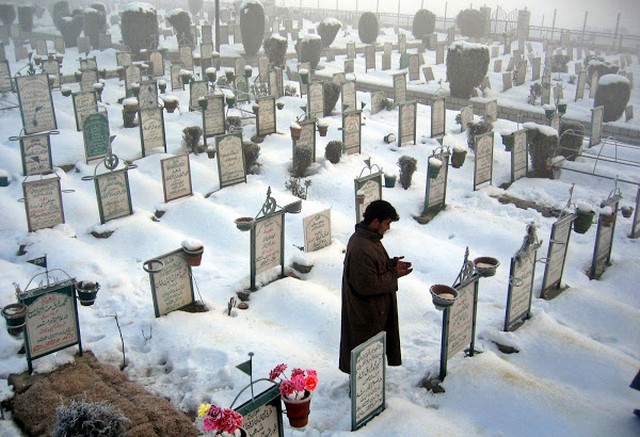
Graveyards in India are, for the most part, Muslim graveyards, because Christians make up a minuscule part of the population, and, as you know, Hindus and most other communities cremate their dead. The Muslim graveyard, the kabristan, has always loomed large in the imagination and rhetoric of Hindu nationalists. “Mussalman ka ek hi sthan, kabristan ya Pakistan!”—Only one place for the Mussalman, the graveyard or Pakistan—is among the more frequent war cries of the murderous, sword-wielding militias and vigilante mobs that have overrun India’s streets.
As the Hindu Right has taken almost complete control of the state, as well as non-state apparatuses, the increasingly blatant social and economic boycott of Muslims has pushed them further down the societal ladder and made them even more unwelcome in “secular” public spaces and housing colonies. For reasons of safety as well as necessity, in urban areas many Muslims, including the elite, are retreating into enclaves that are often hatefully referred to as “mini-Pakistans.” Now in life, as in death, segregation is becoming the rule. In cities such as Delhi, meanwhile, the homeless and destitute congregate in shrines and around graveyards, which have become resting places not just for the dead, but for the living, too. I will speak today about the Muslim graveyard, the kabristan, as the new ghetto—literally as well as metaphorically—of the new Hindu India. And about writing fiction in these times.
In some sense, The Ministry of Utmost Happiness, my novel published in 2017, can be read as a conversation between two graveyards. One, a graveyard where Anjum—born as a boy to a Muslim family in the walled city of Delhi—makes her home and gradually builds a guest house, the Jannat Guest House—the “Paradise” Guest House—and where a range of people come seeking shelter. The other, the ethereally beautiful valley of Kashmir, which is now, after thirty years of war, covered with graveyards, and in this way has become, metaphorically, almost a graveyard itself. So, a graveyard covered by the Jannat Guest House, and a Jannat covered with graveyards.
This conversation, this chatter between two graveyards, is and always has been strictly prohibited in India. In the real world, it is considered a high crime, treasonous even. Fortunately, in fiction, different rules apply.
Before we get to the forbidden conversation, let me describe for you the view from my writing desk. Some writers may wish to shut the window or move to another room. But I cannot. So you will have to bear with me, because it is in this landscape that I heat my stove and store my pots and pans. It is here that I make my literature.
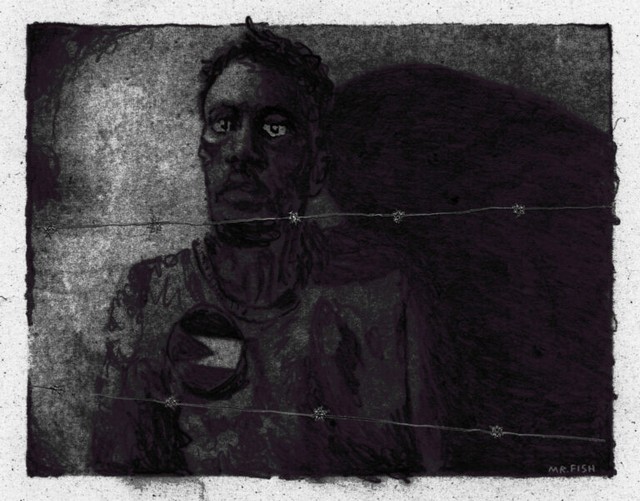
Today marks the one hundred and ninety-third day of the Indian government’s shutdown of the internet in Kashmir. After months of having no access to mobile data or broadband, seven million Kashmiris, who live under the densest military occupation in the world, have been allowed to view what is known as a white list—a handful of government-approved websites. These include a few selected news portals, but not the social media that Kashmiris so depend on, given the hostility towards them of the mainstream Indian media, to put out their versions of their lives. In other words, Kashmir now has a formally firewalled internet, which could well be the future for many of us in the world. It’s the equivalent of giving a thirsty person water from an eyedropper.
The internet shutdown has crippled almost every aspect of daily life in Kashmir. The full extent of the hardship it has caused has not even been studied yet. It’s a pioneering experiment in the mass violation of human rights. The information siege aside, thousands of Kashmiris, including children, civil-society activists and political figures, are imprisoned—some under the draconian Public Safety Act. These are just the bare bones of an epic and continuously unfolding tragedy. While the world looks away, business has ground to a halt, tourism has slowed to a trickle, Kashmir has been silenced and is slowly falling off the map. None of us needs to be reminded of what happens when places fall off the map. When the blowback comes, I, for one, will not be among those feigning surprise.
Meanwhile, the Indian government has passed a new citizenship law that, even if intricately constructed, is blatantly discriminatory against Muslims. I have written about this at length in a lecture I delivered last November, so I will not elaborate on the law now—except to say that it could create a crisis of statelessness on a scale previously unknown. It is for the Rashtriya Swayamsevak Sangh—the wellspring of Hindu nationalism, and the parent of Narendra Modi’s Bharatiya Janata Party—what Germany’s 1935 Nuremberg Laws were for the Third Reich, conferring upon it the power to decide who was a rightful citizen and who wasn’t, based on specific documents that people were expected to produce to prove their heredity. That lecture, “Intimations of an Ending,” is one of the bleakest texts I have written.
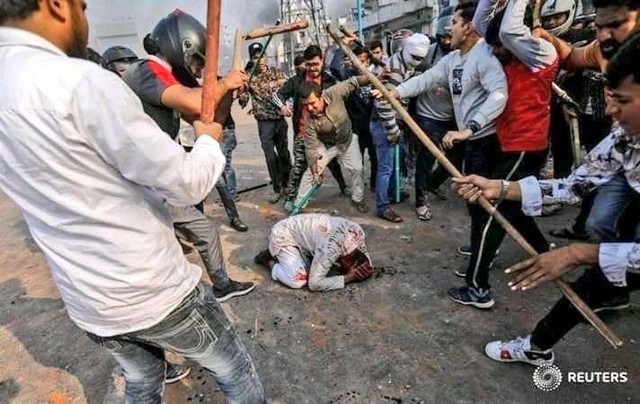
Three months on, the bleakness has turned into cautious hope. The Citizenship (Amendment) Act was passed in parliament on 11 December 2019. Within days, students rose. The first to react were the students of Aligarh Muslim University and Delhi’s Jamia Millia Islamia. In response, riot police attacked the campuses with teargas and stun guns. Students were ruthlessly beaten, some were maimed, and one was blinded in one eye. Anger has now spread to campuses across the country and spilled over into the streets. Outraged citizens, led from the front by students and Muslim women, have occupied public squares and blocked roads for weeks together. The Hindu Right—which lavishes enormous energy on stigmatising the Muslim man as a woman-hating, terrorist jihadi, and even offers itself up as the saviour of Muslim women—is a little confounded by this brilliant, articulate and very female anger. In Delhi’s now iconic Shaheen Bagh protest, thousands, tens of thousands, and sometimes a hundred thousand people, have blocked a major road for almost two months. This has spawned mini Shaheen Baghs across the country. Millions are on the street, taking back their country, waving the Indian flag, pledging to uphold the Indian Constitution and reading out its preamble, which says India is a secular, socialist republic.
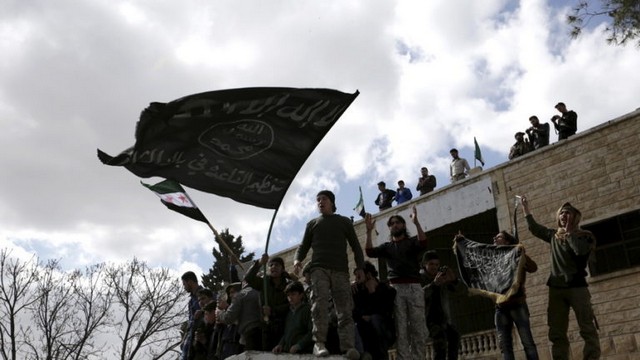
The anthem of this new uprising, the slogan that is reverberating through towns and college campuses and crossroads across the country, is a variation of the iconic chant of the Kashmiri freedom struggle, “Hum kya chahtey? Azadi!”—What do we want? Freedom! That slogan is the refrain within a set of lyrics that describes peoples’ anger, their dream, and the battle ahead. This is not to suggest that any one group can claim ownership of the Azadi slogan—it has a long and varied history. It was the slogan of the Iranian revolution, which recently celebrated its fortieth anniversary, and of a section of the feminist movement in our subcontinent in the 1970s and 1980s. But over the last three decades, it has, more than anything else, become known as the anthem of the Kashmiri street. And now, while Kashmir’s streets have been silenced, the irony is that its people’s refrain, with similar lyrics, rhythm and cadence, echoes on the streets of the country that most Kashmiris view as their coloniser. What lies between the silence of one street and the sound of the other? Is it a chasm, or could it become a bridge?
Let me read you a short elucidation of the Azadi chant from The Ministry of Utmost Happiness. The “I” in the text is Biplab Dasgupta, known to his friends—for reasons we need not go into here—as Garson Hobart. He is a suave, even brilliant, Indian intelligence officer serving in Kashmir. Hobart is no friend of the Kashmiri struggle. It’s 1996—one of the darkest periods of the armed uprising that raged in the valley through the 1990s. Hobart is trapped with the governor’s entourage in a national park on the outskirts of Srinagar. They are unable to return home because the city has been taken over by hundreds of thousands of mourners carrying their most recent batch of martyrs to the graveyard. Hobart’s secretary is on the phone, advising him not to return until the streets are taken back:
Sitting on the verandah of the Dachigam Forest Guest House, over birdsong and the sounds of crickets, I heard the reverberating boom of a hundred thousand or more voices raised together calling for freedom: Azadi! Azadi! Azadi! On and on and on. Even on the phone it was unnerving. … It was as though the city was breathing through a single pair of lungs, swelling like a throat with that urgent, keening cry. I had seen my share of demonstrations by then, and heard more than my share of slogan-shouting in other parts of the country. This was different, this Kashmiri chant. It was more than a political demand. It was an anthem, a hymn, a prayer. …
During those (fortunately short-lived) occasions when it was in full cry, it had the power to cut through the edifice of history and geography, of reason and politics. It had the power to make even the most hardened of us wonder, even if momentarily, what the hell we were doing in Kashmir, governing a people who hated us so viscerally.
To be sure, protesters in India are calling for an entirely different kind of Azadi—from poverty, from hunger, from caste, from patriarchy and from repression. “It is not azadi from India, it is azadi in India,” Kanhaiya Kumar, the charismatic young politician credited with popularising and re-tooling the chant for its use across India today, said after being arrested for sedition in 2016. On the streets, every one of us is painfully aware that even an atom of sympathy for the Kashmiri cause expressed even by a single person, even accidentally, will be met by nationalist hellfire that will incinerate not just the protests, but every last person standing. And if that person happens to be Muslim, it would be something exponentially worse than even hellfire. Because when it comes to Muslims, for everything—even parking tickets and petty crime—different rules apply. Not on paper, but effectively. That is how deeply unwell India has become.
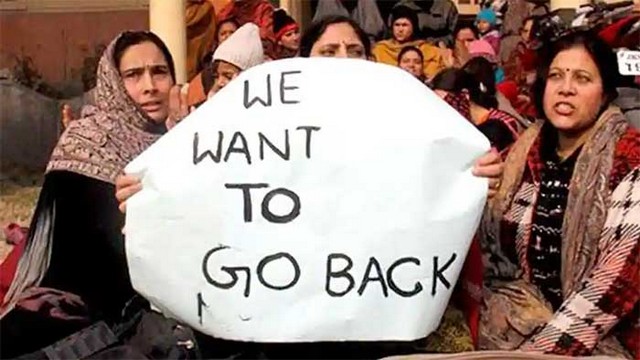
At the heart of these massive, democratic protests over the anti-Muslim citizenship laws, therefore, inside this borrowed song from Kashmir, is an enforced, pin-drop silence over crimes committed in the Kashmir Valley. That silence is decades old, and the shame of it is corrosive. The shame must be shared not just by Hindu nationalists, not just by India’s entire political spectrum, but also by the majority of the Indian people, including many who are bravely out on the streets today. It’s a hard thing to have to hold in one’s heart.
But perhaps it’s only a matter of time before the cry for justice by the young on India’s streets will come to include a demand for justice for Kashmiris too. Perhaps this is why in the BJP-ruled state of Uttar Pradesh, the chief minister, Adityanath, seen by many as a Modi in the making, has declared the Azadi slogan to be treasonous.
The government’s response to the protests has been ferocious. Modi fired the starting gun with his trademark toxic innuendo. At an election rally, he said the protesters could easily be “identified by their clothes”—implying that they were all Muslim. This is untrue. But it serves to clearly mark off the population that must be punished. In Uttar Pradesh, Adityanath has, like some kind of gangster, openly vowed “revenge.” More than twenty people have been killed so far. At a public tribunal a few weeks ago, I heard testimonies of how police in the state are entering people’s homes in the dead of night, terrorising and looting them. People spoke of being kept naked and beaten for days in police custody. They described how hospitals had turned away critically injured people, how Hindu doctors had refused to treat them. In videos of the police attacking protesters, the slurs they use against Muslims are unspeakable, their muttered prejudice is almost more frightening than the injuries they inflict. When a government openly turns on a section of its own population with all the power at its disposal, the terror it generates is not easy for those outside that community to comprehend, or even believe.
Needless to say, political support for Adityanath has been forthright and unflinching. The president of the BJP in the state of West Bengal, who seems to be simultaneously envious and proud of the Uttar Pradesh model, boasted that “our government shot them like dogs.” A union minister in Modi’s cabinet addressed a rally in Delhi with shouts of “Desh ke gaddaron ko,” and the crowd screamed back, “Goli maaro saalon ko”—What’s to be done with the traitors to the nation? Shoot the bastards! A member of parliament said that unless the protesters of Shaheen Bagh were dealt with, they would enter homes and “rape your sisters and daughters”—which is an interesting idea, considering that the protesters of Shaheen Bagh are predominantly women. The home minister, Amit Shah, has asked people to choose between Modi, “who conducted airstrikes and surgical strikes on Pakistan,” and the “people who back Shaheen Bagh.”
Modi, for his part, has declared that it would take India only ten days to defeat Pakistan in military confrontation. It might sound like a non sequitur at a time like this, but it’s not. It’s his sly way of conflating the protesters with Pakistan. The whole country is holding its breath, waiting for more bloodshed, and perhaps even war.
As India embraces majoritarian Hindu nationalism, which is a polite term for fascism, many liberals and even communists continue to be squeamish about using that term. This notwithstanding the fact that RSS ideologues are openly worshipful of Hitler and Mussolini, and that Hitler has found his way onto the cover of an Indian school textbook about great world leaders, alongside Gandhi and Modi. The division in opinions on the use of the term comes down to whether you believe that fascism became fascism only after a continent was destroyed and millions of people were exterminated in gas chambers. Or whether you believe that fascism is an ideology that led to those high crimes—that can lead to those crimes—and that those who subscribe to it are fascists.
Let me spend a moment on the subtitle of my talk: “Fiction in the time of fake news.” Fake news is at least as old as fiction is—and, of course, both can often be the same thing. Fake news is the skeletal structure, the scaffolding over which the specious wrath that fuels fascism drapes itself. The foundation on which that scaffolding rests is fake history—possibly the oldest form of fake news. The history being peddled by Hindu nationalists, that hackneyed tale of spurious valour and exaggerated victimhood in which history is turned into mythology and mythology into history, has been very ably perforated and demolished by serious scholars. But the tale was never meant for serious scholars. It is meant for an audience that few serious scholars can hope to reach. While we laugh in derision, it is spreading like an epidemic and blossoming in the popular imagination like a brain-deadening malignancy. There is also something deeper, more disturbing, at work here, which I cannot dwell on, though I will gesture toward it. If any of my assertions startle you, please know that I have elaborated on them at length in a book called The Doctor and The Saint.
At the heart of Hindu nationalism and the cult of Hindu supremacy is the principle of varnashram dharm, the caste system, or what the anti-caste tradition calls Brahmanvad—Brahminism. Brahminism organises society in a vertical hierarchy based on a supposedly celestially ordained, graded scale of purity and pollution, entitlements and duties, and hereditary occupations. Right on top of the ladder are Brahmins, the embodiment of purity, the resting place of all entitlement. At the bottom are the “outcastes”—Dalits, once known as untouchables, who have been dehumanised, ghettoised and violated in unimaginable ways for centuries. None of these categories is homogenous—each is divided into its own elaborate universe of hierarchies. The principles of equality, fraternity or sorority are anathema to the caste system. It’s not hard to see how the idea that some human beings are inherently superior or inferior to others by divine mandate slides easily into the fascist idea of a master race. To escape the tyranny of Brahminism over the centuries, millions of Dalits and people from other subjugated castes converted to Islam, Sikhism and Christianity. So, the politics of Hindu majoritarianism and its persecution of minorities is also intricately intertwined with the question of caste. Even today, caste is the engine and the organising principle that runs almost every aspect of modern Indian society. And yet, so many celebrated writers, historians, philosophers, sociologists and filmmakers have collectively managed to produce a formidable body of work on India—work that is domestically as well as internationally applauded and handsomely rewarded—that either turns caste into a footnote or completely elides the issue. I would call that fake history, too. The great Project of Unseeing.
A fine example of this is Richard Attenborough’s Oscar-winning film, Gandhi, which was co-funded by the Indian government. The film is inaccurate to the point of being false about Gandhi’s time in South Africa and his attitude toward black Africans. Almost more disturbing is the complete absence of Bhimrao Ambedkar, who is easily as much or more of an icon in India as Gandhi is. Ambedkar, a Dalit from Maharashtra, was the man who challenged Gandhi morally, politically and intellectually. He denounced Hinduism and the caste discrimination it entailed, and showed Dalits a path out by renouncing the Hindu religion in favour of Buddhism. Both were extraordinary men, and the conflict between them has contributed greatly to our thinking today. While Gandhi’s views on caste were not inimical to those of the Hindu Right, his views on the place of Muslims in India were. That is what eventually led to his assassination by a member of the RSS. Still, what does it mean, this exalted, seriously falsified mythification of Gandhi and the erasure of Ambedkar in a government-sponsored—a Congress-government-sponsored—multimillion-dollar movie extravaganza that still forms the basis of most of the world’s idea of Gandhi and India’s freedom struggle? Yes, the film was made a long time ago, but where is the corrective—the other extravaganza that at least tries to tell the truth? Where are the big films about Kabir, Ravidas, Ambedkar, Periyar, Ayyankali, Pandita Ramabai, Jotiba and Savitribai Phule, and all those who fought against caste through the ages? There are Indian liberals who sternly castigate the British for leaving British colonialism out of their history books, but are guilty of exactly the same wrongdoing when it comes to the practice of caste.
In South Africa, Gandhi tried to distance dominant-caste, passenger Indians from oppressed-caste indentured labourers and black Africans, whom he often called “kaffirs” and “savages”—a campaign that he sustained for years. In 1894, he wrote in an open letter to the Natal legislature that Indians and the English both “spring from a common stock, called the Indo-Aryan.” This is the conceit of many dominant-caste Hindus even today. They like to think of themselves as a conquering race of Aryan descent. (This goes some way towards explaining their obsession with white skin and horror of dark skin.) And yet, when it comes to the Muslim question, they suddenly transform themselves into the aboriginal sons of the soil of the Hindu homeland, and mark Muslims and Christians off as “foreigners.”
To our paid-up Hindu fascists, known affectionately as the Sangh Parivar—the Family Collective—Muslims are the “internal enemy” whose real loyalties lie outside India. For many goodhearted liberals, Muslims are welcome guests, but guests nevertheless—burdened with the expectation of good behaviour, which is a terrible thing to thrust onto fellow citizens. It’s like giving women rights as long as they promise to be good—good mothers, sisters, wives and daughters. Even the most well-intentioned, progressive people often counter anti-Muslim slander by talking up Muslim patriotism. Many liberals, including some Muslims themselves, have described Muslims as Indians “by choice” and not by chance—suggesting that they chose to stay in India and not to move to Pakistan after Partition in 1947. Many did, many didn’t, and for many the choice simply did not exist. But to frame Indian Muslims as a people who are in India “by choice” draws a dangerous ring, a false bloodline, around a whole population, suggesting it has a less elemental relationship with the land—and could just as well live elsewhere. This plays straight into the binary of the Good Muslim–Bad Muslim, or the Muslim Patriot–Muslim Jihadi, and could inadvertently trap a whole population into having to redeem itself with a lifetime of regular flag-waving and Constitution-reading. It also inadvertently shores up the appalling logic of Hindu nationalists: Muslims have so many homelands, but Hindus only have India. The corollary to this, of course, is the well-known taunt thrown at Muslims as well as anyone else who challenges the Hindu nationalist view: “Go to Pakistan.”
Pakistan, Bangladesh and India are organically connected, socially, culturally and geographically. Reverse the Hindu nationalists’ logic, and imagine how it plays out for the tens of millions of Hindus living in Bangladesh and Pakistan. Hindu nationalism and Muslim alienation in India make these minorities extremely vulnerable. The new Citizenship (Amendment) Act, which pretends to welcome persecuted non-Muslim minorities from Pakistan, Afghanistan and Bangladesh—which suggests, ridiculously, that no Muslims are persecuted in those countries—will most likely endanger those minorities further. Across the border, “Go to India!” is likely to be the reaction to “Go to Pakistan!” The consequence of destabilising whole populations in this way can be genocide. We know this. We’ve been here before. We’ve gone through the bloodshed of 1947. It is a great misconception to believe that this current regime in India, with its bottomless ability to be ruthless, is remotely concerned about the persecution of anybody by anybody, Hindus included. In fact, persecution appears to animate it.
All of this is to say that the foundation of today’s fascism, the unacceptable fake history of Hindu nationalism, rests on a deeper foundation of another, apparently more acceptable, more sophisticated set of fake histories that elide the stories of caste, of women and a range of other genders—and of how those stories intersect below the surface of the grand narrative of class and capital. To challenge fascism means to challenge all of this.
Sometimes I feel—self-servingly perhaps, the way a surgeon has faith in surgery—that fiction is uniquely positioned to do this, because fiction has the capaciousness, the freedom and latitude, to hold out a universe of infinite complexity. Because every human is really a walking sheaf of identities—a Russian doll that contains identities within identities, each of which can be shuffled around, each of which may defy some and simultaneously comply with other “normal” conventions by which people are crudely and often cruelly defined, identified and organised. Particularly so in this feudal, medieval society of ours, one that is pretending to be modern yet continues to practise one of the most brutal forms of social hierarchy in the world.
I’m not talking here of fiction as exposé, or as the righter of social wrongs (pardon the pun). Nor do I mean fiction that is a disguised manifesto or is written to address a particular issue or subject. I mean fiction that attempts to recreate the universe of the familiar, but then makes visible what the Project of Unseeing seeks to conceal.
The Project of Unseeing works in mysterious ways. It can even appear in the seductive avatar of high praise. For example, in my first novel, The God of Small Things, published more than twenty years ago, sexual and emotional transgression across caste lines and the complicated relationship between caste and communism are central themes. Much has been said about the novel’s lyricism, its metaphors, its structure, its understanding of children’s minds. But except in Kerala, where the novel was very well understood and therefore ran into some hostility, the caste question tends to be glossed over, or treated as a class issue. As though Ammu and Velutha were Lady Chatterley and Oliver Mellors. This is to understand absolutely nothing about Indian society. Certainly, caste and class overlap, but they aren’t identical—as India’s many communist parties are discovering to their peril.
By the time I began to write The Ministry of Utmost Happiness, the direction things were heading in the subcontinent had become truly alarming. India and Pakistan had become nuclear powers, turning Kashmir into a possible nuclear flashpoint. (I fear that just as fascism will not be called fascism unless millions have been gassed in concentration camps, the nuclear threat will not be taken seriously until it is too late.) In India, the previously protected market had been opened to international capital. Neoliberal economic evangelists and Hindu nationalists had ridden into town on the same horse—a flaming saffron steed whose dapples were really dollar signs. The upshot of this is that while all our energies are spent trying to douse the bushfire of hatred, of human pitted against human, our forests and rivers are dying, our mountains are eroding, our ice caps are melting, and, even as the Indian economy is entering freefall, the combined wealth of the country’s 63 richest people outstrips the annual budget outlay for a nation of 1.3 billion people. By far.
Under these circumstances, how does one write? What does one write?
More often than not, the folks in my novels teach me how to think and what to write. I leave it to them.
Here is a section from the second chapter of The Ministry of Utmost Happiness. Anjum and Saddam Hussain, her friend and business partner, are on the roof of the Jannat Guest House. They’re having a lazy day, drinking tea and gazing at kites circling in the sky. Anjum, who is in her fifties and has lived in the graveyard for years, has just confronted young Saddam with the fact that she has always known he isn’t really Muslim. Saddam begins to tell her his story. He was born into a family of Dalit Chamars—skinners—in a village in Haryana. His parents named him Dayachand. A terrible experience—which I based on an actual incident in which five Dalits were lynched by a Hindu mob—caused him to run away from home. Rage and humiliation made him renounce Hinduism and convert to Islam. Enthralled by a video of Saddam Hussein of Iraq facing his executioners with complete equanimity—which he watches for inspiration on his cell phone from time to time—Dayachand changed his name to Saddam Hussain.
Saddam’s conversion to Islam is uncommon for our times. But only late last year, three thousand Dalits in a village in Tamil Nadu announced their intention to embrace Islam. In June, the village was rocked by the honour killing of a young couple, a Dalit girl and non-Dalit boy, by the boy’s brother. One night in December, a wall that the dominant castes had earlier built into the hillside—a caste wall, separating the Dalit settlement at the bottom of the hill from the rest of the village—collapsed onto the huts below and killed 17 people. It was unstable and structurally unsound, and people had protested against it, but to no avail. Ravichandran, the founder of a Dalit blog and YouTube channel—Dalit Camera: Through Un-Touchable Eyes—reported this story, and has also converted to Islam. He is now Abdul Raees.
For three thousand Dalits to convert to Islam now, when the political commentariat is abuzz with somewhat gleeful talk of the “Hinduisation” of Dalits, and right when the Modi government is moving to disempower and disenfranchise Muslims, is pure political dynamite. Even on the evidence of just this one example, how can we argue with Ambedkar’s call to his people to renounce Hinduism?
But here is young Saddam Hussain from The Ministry of Utmost Happiness, who, for reasons of his own, had made that move several years before. He is just beginning to tell Anjum his story. The saffron parakeets in the text are a euphemism for Hindu vigilantes, who often wear saffron headbands when they swarm:
“So we would go and collect the carcasses, skin them, and turn the hides into leather … I’m talking about the year 2002. I was still in school. You know better than me what was going on then … what it was like … Yours happened in February, mine in November. It was the day of Dussehra. On our way to pick up the cow we passed a Ramlila maidan where they had built huge effigies of the demons … Ravan, Meghnad and Kumbhakaran, as high as three-storeyed buildings—all ready to be blown up in the evening.”
No Old Delhi Muslim needed a lesson about the Hindu festival of Dussehra. It was celebrated every year in the Ramlila grounds, just outside Turkman Gate. Every year the effigies of Ravan, the ten-headed “demon” King of Lanka, his brother Kumbhakaran and his son Meghnad grew taller and were packed with more and more explosives. Every year the Ramlila, the story of how Lord Ram, King of Ayodhya, vanquished Ravan in the battle of Lanka, which Hindus believed was the story of the triumph of Good over Evil, was enacted with greater aggression and ever-more generous sponsorship. A few audacious scholars had begun to suggest that the Ramlila was really history turned into mythology, and that the evil demons were really dark-skinned Dravidians—indigenous rulers—and the Hindu gods who vanquished them (and turned them into Untouchables and other oppressed castes who would spend their lives in service of the new rulers) were the Aryan invaders. They pointed to village rituals in which people worshiped deities, including Ravan, that in Hinduism were considered to be demons. In the new dispensation however, ordinary people did not need to be scholars to know, even if they could not openly say so, that in the rise and rise of the Parakeet Reich, regardless of what may or may not have been meant in the scriptures, in saffron parakeet-speak, the evil demons had come to mean not just indigenous people, but everybody who was not Hindu. Which included of course the citizenry of Shahjahanabad.
When the giant effigies were blown up, the sound of the explosions would boom through the narrow lanes of the old city. And few were in doubt about what that was meant to mean.
One of the most prominent faces in the protests against the Citizenship (Amendment) Act is a young Dalit politician who heads the Bhim Army—named after Bhimrao Ambedkar. He calls himself Chandra Shekhar Aazad “Ravan.” He has chosen to not just honour but personify Ravan, Ram’s vanquished “demon” foe. What does that signify? It is an audacious declaration that at least some people view Hinduism—not just Hindutva, the Hindu-nationalist political ideology, but Hinduism, the religion—as a form of colonialism and cruel subjugation. Ravan is on the front pages of the papers, infuriating the government by making common cause with the Muslim community. He appeared late one night on the crowded steps of Delhi’s Jama Masjid, a night filled with shouts of “Jai Bhim!” and “Inquilab Zindabad!”—Long live Bhimrao Ambedkar, and Long live the revolution.
A precarious solidarity is evolving between Muslims and Ambedkarites and followers of other anti-caste leaders such as Jotirao and Savitri Phule, Ravidas and Birsa Munda, as well as a new generation of young Leftists who, unlike the older generation, place caste alongside class at the centre of their world view. It’s still brittle, still full of material and ideological contradictions, still full of suspicion and resentment, but it’s the only hope we have.
The trouble is that this fragile coalition is being slaughtered even as it is being born. The fake-news project—its history department, as well as its current-affairs desk—has been corporatised, Bollywoodised, televised, Twitterised, atomised, weaponised, WhatsAppised, and is disseminating its product at the speed of light. It’s all around us. It’s the weather we endure and the air we breathe. It’s the smell of spring and the winter chill. It’s what we see and hear and swim in. It’s the threat. It’s the promise. It’s the grey pillar that presses down on our hearts in our dreams and our waking hours. It’s what we react to and what we write against. And it’s what makes writing that most perilous of activities, whose consequences are not literary prizes or good or bad reviews. For some of us, every sentence, spoken or written, real or fake, every word, every punctuation mark can be torn from the body of a text, mangled and turned into a court notice, a police case, a mob attack, a television lynching by crazed news anchors—or, as in the case of the journalist Gauri Lankesh and so many less-well-known others, an assassination. Gauri was shot dead outside her home in Bangalore in September 2017. The last message she sent me was a photograph of her holding The Ministry of Utmost Happiness.
Assassination is the extreme end of the spectrum. Elsewhere on it are threats, arrests, beatings and, if you are a woman, fake videos and character assassination—She’s a whore, she’s a drunk! (Neither of which do I, personally, consider an insult.) And not to forget, the all-time favourite—She should be gang raped! Attacks on people with a profile, such as myself—whether they are wildly defamatory (or absolutely true: “She’s not a Hindu”), or physical assaults on meetings and stages, or legal harassment with false cases—are usually appeals for the attention of the BJP high command by political workers aspiring for a promotion. A kind of job application. Because it is well known that those who show this kind of initiative are often rewarded—lynchers are feted, those accused of murder become cabinet ministers. In keeping with this spirit, days before The Ministry of Utmost Happiness was published, a reasonably well-known Bollywood actor who is also a BJP member of parliament suggested that the Indian army tie me to a jeep and use me as a human shield in Kashmir, as it had recently done with a Kashmiri civilian. Mainstream television channels spent hours debating the pros and cons of his proposal. You can imagine how this kind of thing plays out in the minds of aspiring job-seekers. But we must remember to be kind, because the Indian economy being what it is, these are increasingly becoming the only jobs available.
All this is nothing compared to what millions of people in India are having to live through. I mention it only in order to think aloud about how this continuous, unceasing threat affects writers and their writing. Each one of us reacts differently, of course. Speaking for myself, as the pressure mounts and the windows are shut one by one, every cell of my writing brain seems to want to force them open again. Does that shrink or expand writers? Sharpen or blunt them? Most people, I imagine, believe it would restrict a writer’s range and imagination, steal away those moments of intimacy and contemplation without which a literary text does not amount to very much. I have often caught myself wondering—if I were to be incarcerated or driven underground, would it liberate my writing? Would what I write become simpler, more lyrical perhaps, and less negotiated? It’s possible. But right now, as we struggle to keep the windows open, I believe our liberation lies in the negotiation. Hope lies in texts that can accommodate and keep alive our intricacy, our complexity and our density against the onslaught of the terrifying, sweeping simplifications of fascism. As they barrel toward us, speeding down their straight, smooth highway, we greet them with our beehive, our maze. We keep our complicated world, with all its seams exposed, alive in our writing.
After twenty years of writing fiction and nonfiction that tracks the rise of Hindu nationalism, after years of reading about the rise and fall of European fascism, I have begun to wonder why fascism—although it is by no means the same everywhere—is so recognisable across histories and cultures. It’s not just the fascists that are recognisable—the strong man, the ideological army, the squalid dreams of Aryan superiority, the dehumanisation and ghettoisation of the “internal enemy,” the massive and utterly ruthless propaganda machine, the false-flag attacks and assassinations, the fawning businessmen and film stars, the attacks on universities, the fear of intellectuals, the spectre of detention camps and the hate-fuelled zombie population that chants the eastern equivalent of “Heil! Heil! Heil!” It’s also the rest of us—the exhausted, quarrelling opposition, the vain, nit-picking Left, the equivocating liberals who spent years building the road that has led to the situation we find ourselves in and are now behaving like shocked, righteous rabbits who never imagined that rabbits were an important ingredient of the rabbit stew that was always on the menu. And, of course, the wolves who ignored the decent folks’ counsel of moderation and sloped off into the wilderness to howl unceasingly, futilely—and, if they were female, then “shrilly” and “hysterically”—at the terrifying, misshapen moon. All of us are recognisable.
So, at the end of it all, is fascism a kind of feeling, in the way anger, fear or love are feelings, that manifests itself in recognisable ways across cultures? Does a country fall into fascism the way a person falls in love? Or, more accurately, in hate? Has India fallen in hate? Because truly, the most palpable feeling in the air is the barbaric hatred the current regime and its supporters show toward a section of the population. Equally palpable now is the love that has risen to oppose this. You can see it in people’s eyes, hear it in protesters’ song and speech. It’s a battle of those who know how to think against those who know how to hate. A battle of lovers against haters. It’s an unequal battle, because the love is on the street and vulnerable. The hate is on the street, too, but it is armed to the teeth and protected by all the machinery of the state.
The violence in Uttar Pradesh under Adityanath has not yet approached anything like the violence of the anti-Muslim pogroms in Gujarat in 2002 under its chief minister at the time, Narendra Modi. Uttar Pradesh is still a work in progress. Adityanath, unlike Modi, is still a prime minister-in-waiting. The 2017 election campaign that delivered him to power in Uttar Pradesh came to be known as the Kabristan-versus-Shamshan campaign. The BJP’s rabble-rousing, spearheaded by Modi himself, involved pitting Muslim graveyards against Hindu cremation grounds, and accusing the opposition of “appeasing” Muslims by developing one but not the other. This obsession with burial versus cremation runs deep. Babu Bajrangi, one of the lynchpins of the 2002 pogroms in Gujarat, was caught on camera in a sting operation by a journalist for Tehelka magazine boasting of his deeds and of his proximity to Modi: “We didn’t spare a single Muslim shop, we set everything on fire, we set them on fire and killed them … hacked, burnt, set on fire … because these bastards say they don’t want to be cremated, they’re afraid of it.” The tapes are still online.
Years after the massacre, Babu Bajrangi was convicted for the murder of 97 Muslims in the Naroda Patiya neighbourhood. He spent some years in jail but is out on bail now, on grounds of ill health, along with some fellow mass murderers. In all, the pogroms saw more than two thousand people murdered, dismembered, raped and burnt alive, and more than one hundred and fifty thousand driven from their homes. Just days ago, on 28 January 2020, the Supreme Court granted interim bail to 14 people convicted of burning 23 Muslims to death during the Gujarat pogroms. The chief justice has asked the government to find them useful “social and spiritual service.” The difficulty here is that, for many Hindu fascists, killing Muslims is considered social and spiritual service.
After the 2002 pogroms, Modi’s popularity soared. When, in 2014, he was sworn in as prime minister, many liberals—writers, journalists and public intellectuals—greeted him ecstatically as an embodiment of hope for a new India. Many are deeply disillusioned now, but their disillusionment only begins after 2014. Because questioning Modi’s deeds before that would involve questioning themselves. So Gujarat in 2002 is rapidly being erased from public memory. That ought not happen. It deserves a place in history, as well as in literature. Anjum ensures that.
In The Ministry of Utmost Happiness, Anjum gets caught by the mob in Gujarat. She is there with her father’s old friend Zakir Mian, who earns his living in a street-side stall in Old Delhi, making wedding garlands out of small currency notes folded into little birds. The two of them have gone on a little pilgrimage to the shrine of the poet Wali Dakhani. When they don’t return, even weeks after the murdering has tailed off, Zakir Mian’s son goes looking for his father. He finds Anjum in a refugee camp—doubly traumatised by having to live in the men’s section. She returns home with him but finds herself unable to cope with life as usual. She is unable to continue living in the Khwabgah, the House of Dreams in Old Delhi where she has lived for years with an adopted family of souls like herself, all having seceded from the “Duniya”—the real world. She is unable to get on with Ustad Kulsoom Bi, stern head of the Khwabgah. Unable to be a good mother to her foundling daughter, Zainab. So, Anjum packs her things and moves into the nearby graveyard, where her family is buried:
The smack addicts at the northern end of the graveyard—shadows just a deeper shade of night—huddled on knolls of hospital waste in a sea of old bandages and used syringes, didn’t seem to notice her at all. On the southern side, clots of homeless people sat around fires cooking their meagre, smoky meals. Stray dogs, in better health than the humans, sat at a polite distance, waiting politely for scraps.
In that setting, Anjum would ordinarily have been in some danger. But her desolation protected her. Unleashed at last from social protocol, it rose up around her in all its majesty—a fort, with ramparts, turrets, hidden dungeons and walls that hummed like an approaching mob. She rattled through its gilded chambers like a fugitive absconding from herself. She tried to dismiss the cortège of saffron men with saffron smiles who pursued her with infants impaled on their saffron tridents, but they would not be dismissed. She tried to shut the door on Zakir Mian, lying neatly folded in the middle of the street, like one of his crisp cash-birds. But he followed her, folded, through closed doors on his flying carpet. She tried to forget the way he had looked at her just before the light went out of his eyes. But he wouldn’t let her.
She tried to tell him that she had fought back bravely as they hauled her off his lifeless body.
But she knew very well that she hadn’t.
She tried to un-know what they had done to all the others—how they had folded the men and unfolded the women. And how eventually they had pulled them apart limb from limb and set them on fire.
But she knew very well that she knew.
They.
They, who?
Newton’s Army, deployed to deliver an Equal and Opposite Reaction. Thirty thousand saffron parakeets with steel talons and bloodied beaks, all squawking together:
Mussalman ka ek hi sthan! Qabristan ya Pakistan!
Only one place for the Mussalman! The Graveyard or Pakistan!
Anjum, feigning death, had lain sprawled over Zakir Mian. Counterfeit corpse of a counterfeit woman. But the parakeets, even though they were—or pretended to be—pure vegetarian (this was the minimum qualification for conscription), tested the breeze with the fastidiousness and proficiency of bloodhounds. And of course they found her. Thirty thousand voices chimed together, mimicking Ustad Kulsoom Bi’s [foul-mouthed pet parakeet] Birbal:
Ai Hai! Saali randi Hijra! Sister-fucking Whore Hijra. Sister-fucking Muslim Whore Hijra.
Another voice rose, high and anxious, another bird:
Nahi yaar, mat maro, hijron ka maarna apshagun hota hai.
Don’t kill her, brother, killing Hijras brings bad luck.
Bad luck!
Nothing scared those murderers more than the prospect of bad luck. After all, it was to ward off bad luck that the fingers that gripped the slashing swords and flashing daggers were studded with lucky stones embedded in thick gold rings. It was to ward off bad luck that the wrists wielding iron rods that bludgeoned people to death were festooned with red puja threads lovingly tied by adoring mothers. Having taken all these precautions, what would be the point of wilfully courting bad luck?
So they stood over her and made her chant their slogans.
Bharat Mata Ki Jai! Vande Mataram!
She did. Weeping, shaking, humiliated beyond her worst nightmare.
Victory to Mother India! Salute the Mother!
They left her alive. Un-killed. Un-hurt. Neither folded nor unfolded. She alone. So that they might be blessed with good fortune.
Butchers’ Luck.
That’s all she was. And the longer she lived, the more good luck she brought them.
She tried to un-know that little detail as she rattled through her private fort. But she failed. She knew very well that she knew very well that she knew very well.
The Chief Minister with cold eyes and a vermillion forehead would go on to win the next elections. Even after the Poet-Prime Minister’s government fell at the Centre, he won election after election in Gujarat. Some people believed he ought to be held responsible for mass murder, but his voters called him Gujarat ka Lalla. Gujarat’s Beloved.
Anjum lives in the graveyard for years, at first as “a ravaged, feral spectre, out-haunting every resident djinn and spirit, ambushing bereaved families who came to bury their dead with a grief so wild, so untethered, that it clean outstripped theirs.” Gradually, she recovers and begins to build a house for herself, each room enclosing a grave. This eventually turns into the Jannat Guest House. When municipal authorities say that it is illegal for squatters to live in the graveyard and threaten to demolish it, she tells them that she isn’t living in the graveyard—she is dying in it. The Jannat Guest House blossoms when Saddam Hussain—former mortuary worker, watchman and now small-time entrepreneur—arrives to live there with his horse, Payal. And when Anjum’s old friend, the blind Imam Ziauddin, moves in, the enterprise expands into the Jannat Guest House and Funeral Services. Guest rooms and funeral services are offered entirely on the whims of the CEO. Those whims are unashamedly partial to people and animals, living as well as deceased, for whom the real world—the Duniya—has no place.
Sometimes I feel that my world, too, is divided very simply into two kinds of people—those whom Anjum will agree to accommodate in her guest house or inter in her graveyard, and those she will not.
Anjum knows that the place she has created is not merely a physical shelter. It’s not your run-of-the-mill poorhouse. Because it is not only the poor and hard-done-by who gather around her. Here she is, explaining to Saddam Hussain the meaning of the place they call their home. The Biroo she refers to is her dog, whom she rescued off the streets:
“Once you have fallen off the edge like all of us have, including our Biroo,” Anjum said, “you will never stop falling. And as you fall you will hold on to other falling people. The sooner you understand that the better. This place where we live, where we have made our home, is the place of falling people. Here there is no haqeeqat. Arre, even we aren’t real. We don’t really exist.”
People come and go, live and die in the Place of Falling People. Life germinates between the graves. Anjum’s graveyard boasts a vegetable garden and even a small swimming pool for poor people. Even though it has no water, local people are proud of it and bring their children to see it. At funerals and weddings, all manner of prayers are murmured and sung, all manner of vows exchanged. They include a reading of the Islamic Fatiha, a recitation of Shakespeare’s Henry V and the singing of the Hindi translation of the “Internationale.”
One day, Dr Azad Bhartiya—Free Indian—tireless pamphleteer and hunger striker and steadfast friend to Falling People, reads Anjum a long letter, translating it into Urdu for her. The letter is from a Comrade Maase Revathy, the biological mother of a baby whom Anjum found abandoned in a place called Jantar Mantar—Delhi’s gathering place for protesters and hunger strikers, and home to Dr Azad Bhartiya, who has lived there on the pavement for seventeen years. Anjum adopts the baby and brings her to the graveyard. The letter Dr Bharatiya reads is a long account of the mother’s life as a guerrilla fighter in the forests of central India, the circumstances that led to the birth of her baby and the reasons that have compelled her to abandon it. At first, Anjum—who longs to be a mother—is hostile, because she cannot countenance the idea of a woman who has abandoned her child. But gradually she begins to listen to the story of this faraway woman, whose concerns are so different from her own but whose grief is just as wild and just as complicated. The letter ends with a Lal Salaam, a red salute:
“Lal Salaam Aleikum,” was Anjum’s inadvertent, instinctive response to the end of the letter. That could have been the beginning of a whole political movement, but she had only meant it in the way of an “Ameen” after listening to a moving sermon.
There it is then—between Anjum, Saddam and their companions, the political compact of today’s uprising, assembled in Anjum’s graveyard. Jai Bhim. Inquilab Zindabad. Lal Salaam Aleikum. But these are only the soul of the revolution. Not the revolution itself. Because there is none of the stuff of which revolutions are made in Anjum’s graveyard—not even the good ones. There are no flags. There is no flag-waving, no pledge-taking. No slogans. No hard borders between male and female, human and animal, nation and nation, or even life and death.
The presiding deity in the Jannat Guest House is Hazrat Sarmad, who blessed Anjum when she was a newborn. Hazrat Sarmad is a Jewish Armenian who travelled from Persia to Delhi three hundred years ago. He renounced Judaism for Islam and then renounced orthodox Islam for Love. He lived naked on the streets of Old Delhi, reciting poems of love until he was beheaded on the steps of Delhi’s Jama Masjid by the Mughal emperor Aurangzeb. Sarmad’s shrine is clamped like a limpet to the sheer face of the Jama Masjid. To Anjum and those who seek her shelter, Sarmad is the Saint of the Unconsoled, Solace of the Indeterminate, Blasphemer among Believers, Believer among Blasphemers. He is the battered angel who keeps watch over his battered charges, who holds the doors between worlds open—illegally—and who never allows the circle to close. And so it is that through that illegal crack, that unclosed circle, Kashmir comes drifting into Anjum’s graveyard. And the forbidden conversation begins.
Kashmir, the land of the living dead and the talking graves—city graveyards, village graveyards, mass graves, unmarked graves, double-decker graves. Kashmir, whose truth can only be told in fiction—because only fiction can tell about air that is so thick with fear and loss, with pride and mad courage, and with unimaginable cruelty. Only fiction can try and describe the transactions that take place in such a climate. Because the story of Kashmir is not only a story about war and torture and rigged elections and human-rights violations. It’s a story about love and poetry, too. It cannot be flattened into news.
Here is Musa Yeswi, architect and obsessive sketcher of horses. Musa, who wanders in and out of Anjum’s graveyard through the battered angel’s illegal portal. Musa, who struggles to hold on to some semblance of sanity as he is drawn inexorably into the vortex of Kashmir’s filthy war, and eventually disappears into its dark heart. Like many young men of his generation, circumstance drives him underground, where he morphs into many people, takes on many identities, attends his own funeral and barely knows who he really is any more. In a letter to Miss Jebeen, his five-year-old daughter who is killed when the security forces open fire on an unarmed procession, Musa describes her own funeral to her. He tells her about the sloth bear that came down the mountain, the hangul that watched from the woods, the kites that circled in the sky supervising everything and the one hundred thousand mourners who covered the ground like snow. “What I know for sure is only this,” he writes, “in our Kashmir the dead will live for ever; and the living are only dead people, pretending.” This is a description of Miss Jebeen’s funeral:
Miss Jebeen and her mother were buried along with fifteen others, taking the toll of their massacre to seventeen.
At the time of their funeral the Mazar-e-Shohadda was still fairly new, but was already getting crowded. However, the Intizamiya Committee, the Organizing Committee, had its ear to the ground from the very beginning of the insurrection and had a realistic idea of things to come. It planned the layout of the graves carefully, making ordered, efficient use of the available space. Everyone understood how important it was to bury martyrs’ bodies in collective burial grounds and not leave them scattered (in their thousands), like birdfeed, up in the mountains, or in the forests around the army camps and torture centres that had mushroomed across the Valley. When the fighting began and the Occupation tightened its grip, for ordinary people the consolidation of their dead became, in itself, an act of defiance. …
As the bodies were lowered into their graves the crowd began to murmur its prayer.
Rabbish rahlee sadree; Wa yassir lee amri
Wahlul uqdatan min lisaanee; Yafqahoo qawlee
My Lord! Relieve my mind. And ease my task for me
And loose a knot from my tongue. That they may understand my saying
The smaller, hip-high children in the separate, segregated section for women, suffocated by the rough wool of their mothers’ garments, unable to see very much, barely able to breathe, conducted their own hip-level transactions: I’ll give you six bullet casings if you give me your dud grenade.
A lone woman’s voice climbed into the sky, eerily high, raw pain driven through it like a pike.
Ro rahi hai yeh zameen! Ro raha hai asmaan …
Another joined in and then another:
This earth, she weeps! The heavens too …
The birds stopped their twittering for a while and listened, beady-eyed, to humansong. Street dogs slouched past checkposts unchecked, their heartbeats rock steady. Kites and griffons circled the thermals, drifting lazily back and forth across the Line of Control, just to mock the tiny clot of humans gathered down below.
This conversation between Anjum’s graveyard and Miss Jebeen’s, disallowed in the Duniya, the real world, cannot be prevented from taking place in our collective Khwabgah, our House of Dreams.
Just as I wrote that last line, a quiet little seven-year-old fellow called Esthappen, an interloper from another novel called The God of Small Things, came up to me and whispered in my ear, “If you eat fish in a dream, does it count? Does it mean you’ve eaten fish?”
But if that conversation between graveyards does not, cannot, or will not be allowed to take place in the Duniya—then perhaps this one, below, ought to be taken seriously.
Musa and Garson Hobart, the intelligence officer, now retired, meet after decades. As Musa leaves, Hobart walks down to the street with him to see him off. He wants to ask him one last question that has tormented him, and he knows that once Musa disappears he will never know the answer. It’s about Major Amrik Singh—a notorious army officer involved in a series of killings in Kashmir during the 1990s, one of which was thought to have been the custodial killing of Musa himself. When huge protests broke out against him, Amrik Singh vanished from Kashmir without a trace. Hobart knows that he was secretly spirited away by the Indian government, sent first to Canada from where he disappeared into the United States. He surfaced after some years when the fact that he had been arrested in California for domestic violence made the news. Months later, Singh and his family were found dead. He appeared to have shot himself, his wife and his children in their little suburban home. Hobart, whose own past and the story of the woman he loves are intricately connected with Amrik Singh, is not convinced of the official story. Based on wisps of evidence and some papers he has come across, he believes that Kashmir, and Musa in particular, had something to do with Amrik Singh’s tragic and gruesome end:
“Did you kill Amrik Singh?”
“No.” He looked at me with his green-tea-coloured eyes. “I didn’t.”
He said nothing for a moment, but I could tell from his gaze that he was assessing me, wondering if he should say more or not. I told him I’d seen the asylum applications and the boarding passes of flights to the US with a name that matched one of his fake passports. I had come across a receipt from a car-hire company in Clovis. The dates matched too, so I knew that he had something to do with that whole episode, but I didn’t know what.
“I’m just curious,” I said. “It doesn’t matter if you did. He deserved to die.”
“I didn’t kill him. He killed himself. But we made him kill himself.”
I had no idea what the hell that was supposed to mean.
“I didn’t go to the US looking for him. I was already there on some other work when I saw the news in the papers that he had been arrested for assaulting his wife. His residential address became public. I had been looking for him for years. I had some unfinished business with him. Many of us did. So I went to Clovis, made some inquiries and finally found him at a truck-washing garage and workshop where he would go to have his truck serviced. He was a completely different person from the murderer we knew, the killer of Jalib Qadri and many others. He did not have that infrastructure of impunity within which he operated in Kashmir. He was scared and broke. I almost felt sorry for him. I assured him that I was not going to harm him, and that I was only there to tell him that we would not allow him to forget the things that he had done.”
Musa and I were having this conversation out on the street. I had come down to see him off.
“Other Kashmiris had also read the news. So they began to arrive in Clovis to see how the Butcher of Kashmir lived now. Some were journalists, some were writers, photographers, lawyers … some were just ordinary people. They turned up at his workplace, at his home, at the supermarket, across the street, at his children’s school. Every day. He was forced to look at us. Forced to remember. It must have driven him crazy. Eventually it made him self-destruct. So… to answer your question… no, I did not kill him.”
What Musa said next, standing against the backdrop of the school gates with the painting of the ogre nurse giving a baby a polio vaccine, was like … like an ice-injection. More so because it was said in that casual, genial way he had, with a friendly, almost-happy smile, as though he was only joking.
“One day Kashmir will make India self-destruct in the same way. You may have blinded all of us, every one of us, with your pellet guns by then. But you will still have eyes to see what you have done to us. You’re not destroying us. You are constructing us. It’s yourselves that you are destroying. Khuda Hafiz, Garson bhai.”
The destruction—it has begun.
And, yes, if in a dream you’ve eaten fish, it means you’ve eaten fish.
— Arundhati Roy is the author of the novel The Ministry of Utmost Happiness. Her most recent book is a collection of essays, My Seditious Heart.
Note: Due to an ongoing dispute between the Trinity College Board of Trustees and the University of Cambridge’s University and College Union, and in deference to a request by the Union, this lecture was not delivered in person.
13 February 2020
Source: caravanmagazine.in