Just International

Amazon: The Common Wealth of the Earth and Humanity

By Leonardo Boff

The current fires in the Brazilian and Bolivian Amazon demonstrate the importance of the Amazonian biome to the equilibrium and future of life. The gravity of the situation is seen in the carelessness with which the President of Brazil treats environmental issues, denying the most serious scientific data and the threat to the Indigenous reserves, aggravated by the way the Minister for the Environment has dismantled the principal organs for protecting the jungle and the Indigenous lands, and the uncontrolled advance of agribusiness into the virgin jungle.

According to some international specialists, the Amazon is the second most vulnerable area on the planet with respect to climate change as caused by human beings. Pope Francis himself warned «that the future of humanity and of the Earth is bound to the future of the Amazon; is manifested for the first time with such clarity that the challenges, conflicts and emergent opportunities in a territory dramatize the dangers to the survival of planet Earth and the coexistence of all of humanity». Those are grave words, underrated by the big predatory corporations, because they know that they should change their modes of production, consumption and waste management. But they prefer profits over caring for human and earthy life.

With good reason, Pope Francis has called for a Pan Amazon Synod in October, this year, whose theme will be: “The Amazon: new paths for the Church and for an integral ecology”. It will be about applying his encyclical letter, “About the caring of the Common Home”, to avoid a world-wide socio-ecological catastrophe. It will not be about an environmental and green ecology, but about an integral ecology, that includes the environment, society, politics, economy, daily life and the spiritual dimension.

Some general data about the Amazonian biome: It covers an area of 8,129,057 square kilometers in nine countries: Brazil (67%), Peru (13%), Bolivia (11%), Colombia (6%), Ecuador (2%), Venezuela (1%), Suriname, Guyana and French Guiana (0.15). It has over 37,700,000 inhabitants, of which 2.8 million are Indigenous, from 390 different nations, who speak 240 languages, of the rich matrix of 49 linguistic branches, a unique phenomenon in the history of world linguistics.

Three Amazon rivers exist: the one visible on the surface; the aerial, so called, “flying rivers” (each 20 meter-wide tree canopy top produces 1000 liters of water that bring the rains to the [so called] «closed biome», from the South up to the North of Argentina); the third river, invisible, is the river “Rés do Chão” (do not confuse this with the tourist place, Rés do Chão), a subterranean river that flows underneath the actual Amazon.

The entire Amazon biome is a Common Wealth of the Earth and of Humanity. That is evident in what the astronauts have seen: from the Moon or from spacecraft, Earth and Humanity form a single entity. The human being is the portion of the Earth that began to feel, to think, to love and to care. We are Earth, as Pope Francis and the Bible itself emphasizes.

Now in a planetary phase, we find ourselves together in the same and unique Common Home. The time of nations is passing. Now is the time of the Earth, and we must organize ourselves to guarantee the means that will sustain our existence and that of Nature. No one owns the Earth. She is our Common Good. Everyone has the right to be on the Earth. Since the Amazon is part of the Earth, no one should consider that they own that which is a Good of all and for all. Brazil, at most, has the responsibility of administering the Brazilian portion, (67%) which Brazil is doing irresponsibly. Hence, such widespread concern.

The Amazon biome is presently the object of the world’s greed, given its wealth. There is too much violence. Since the mid 1980s the Brazilian Amazon has produced more than 12 martyrs, Indigenous, lay and religious; 6 in Ecuador; 2 in Peru and countless more in Colombia.

At the August G-7 gathering in Biarritz, France, the importance of the Amazon biome to the equilibrium of the climate and the Earth herself was evident. I suspect that they still see it conventionally, as a trunk full of resources for their economic projects. I suspect that they have not internalized the vision of the new ecology that sees the Earth as a living super organism and us as part of that super organism and not as her masters. If the Amazon were totally destroyed, everything from the South of Brazil up to the North of Argentina and Uruguay would be transformed in a desert. Hence the vital importance of that multinational biome.

The irresponsibility of President Jair Bolsonaro is so great that world jurists plan to accuse him of ecocide, a crime recognized by the UN in 2006, and take him before the tribunal of the «crimes against Humanity».

I finish with the words of Miguel Xapuri Ianomâmi, an Indigenous Yanomami:

“You have God, we have Omama. She created life, and the Yanomamis, She permits all that happens. We are in constant communication with Her”.

Who in the secular world could speak from the heart in this form?

Leonardo Boff is a Brazilian theologian, ecologist, writer and university professor exponent of the Liberation Theology.

23 September 2019

Source: www.transcend.org

The Struggle for Peace in Afghanistan: Is Community Engagement the Key?

By Robert J. Burrowes

19 Sep 2019 – I have just read a superb book by Mark Isaacs, an Australian who has documented several years of effort by a group of incredibly committed young people in Afghanistan to build peace in that war-torn country the only way it can be built: by learning, living and sharing peace.

The book, titled The Kabul Peace House: How a Group of Young Afghans are Daring to Dream in a Land of War, records in considerable detail the struggle, both internal and external, to generate a peaceful future in Afghanistan. Some might consider this vision naive, others courageous, but few would doubt the simple reality: it is slow, daunting, incredibly difficult, often saddening, frightening, infuriating or painful, sometimes uplifting or hilarious and, just occasionally, utterly rewarding.

This is a human story written by a person who knows how to listen and to observe. And because the subject is about a group of ordinary Afghans and their mentor doing their best in the struggle to end one of the longest wars in human history, it is a story that is well worth reading.

This story is embedded in a combination of (brief) historical background on Afghanistan’s longstanding and central role in imperial geopolitics (including during ‘The Great Game’ of the 19th century) and more recent history on the progressive modernity of Afghanistan prior to the Soviet invasion in 1979 which was followed by an ongoing and multifaceted war in which the United States has played the most damaging role since its invasion of the country in 2001. But the background also includes a description of the ethnic diversity throughout the country, the role of religion and gender relations (and the challenges these social parameters present), as well as commentary on the social, economic and political regression as a result of the war’s many adverse impacts. So the book weaves a lot of strands into a compelling story of nonviolent resistance and regeneration against almost overwhelming odds.

However, that is not all. Given that all of the Afghans in this visionary community have each been traumatized by their unique experience of war, the book doesn’t shy away from describing the challenges this presents both to them personally and to the community, including its mentor and even some of the community’s many international visitors.

Most of the community members – whether Pashtun, Hazara, Uzbek, Turkmen, Tajik, Sayyid, Pashai… – have suffered serious loss during the war, especially those members who have had family and other relatives killed, or worse. Worse? you might ask. What is worse than death? Well, after reading this book, you will better understand that the context and the manner of death mean a great deal psychologically. None of the victims of this war died peacefully in their sleep after long and meaningful lives and this is just one part of the psychological trauma suffered by so many in this particular community but also in wider Afghan society.

So what does this community in Kabul do? Well, throughout its evolution and many manifestations, the community has done many things including run a variety of projects intended to foster understanding, cooperation and learning: foster mutual respect among the diversity of people that constitute its membership, teach some of its members to read and write and facilitate learning opportunities in other contexts, teach the meaning and practice of nonviolence, give street kids the chance to learn skills that will make them employable, make duvets to give to people who go cold in Afghanistan’s freezing winters, teach and practice permaculture, organize protests against the war (including by flying kites instead of drones), and generally working to create a world that is green, equal and nonviolent.

If you think this sounds all good and straightforward, given slowly spreading acceptance of such ideas elsewhere (in some circles at least), then you might have underestimated their radical nature in a society in which ideas about nonviolence, equality and sustainability have, for the most part, not been previously encountered and have certainly not taken root. Isaacs records the observations of the group’s mentor on these subjects: ‘Over the years I have seen how the volunteers have changed within their personal lives, even if it means distancing themselves from the traditions of their own family…. But on a public level it’s much slower.’

This is understandable. As Isaacs notes, even in ordinary conversation and group discussions, ‘the weight of resistance, the taboos and the self-censorship’ made an impact on him. In a culture in which, in 2015, a woman in her twenties was stoned, her body run over by a car and then dumped in a river and set on fire because a mullah falsely accused her of burning the Quran, there is a long way to go.

One of the things that I found most compelling about the book is the occasional ‘biography’ of one of the community’s main characters. Given pseudonyms to avoid possible adverse repercussions, these stories provide real insight into the lives of certain community members and their struggle to leave home (in some cases), to join the community, to find their place within it and gain acceptance by the other members.

Some, like Hojar, are more outspoken and this, for a woman, is unusual in itself. Hojar is deeply aware of the gender inequality and violence against women in Afghanistan and will talk about it. This inspires other women, like Tara, who have not experienced this outspokenness before.

But Hojar’s life had started differently, in the mountains where, as a teenager, she was getting up at 3am to start baking bread for her four snoring brothers before milking the goats and sheep. ‘I am not a woman’, she thought, ‘I am a slave’. Fortunately and unusually, Hojar’s parents supported her desire to not marry at 13 or 15, but to continue her education and follow her dreams. It’s a long, painful, terrifying and fascinating journey but Hojar ended up in this novel community experiment in Kabul where her now college-educated talent was highly valued and put to wonderful use. She has my utmost admiration.

Unlike Hojar, other community members, like Horse, originally a shepherd in the mountains, are more circumspect on gender equality and other issues. But this doesn’t mean that Horse is not active, at times playing roles in the networking team, the accounts team and, particularly, as coordinator of the food cooperative which provided monthly gifts of food to the impoverished families of one hundred children who studied at the community’s street kids school. If you think raising donations to pay for this food was easy, particularly given the community decision to avoid the international aid sector to try to encourage Afghans to help their fellow Afghans, when more than half of the population lived below the poverty line and unemployment was at 40%, you will find it compelling to read how the teenaged Horse struggled with the monumental range of challenges he faced in that particular role. He has my admiration too.

Insaan, a doctor who mentors the community, provides a compelling story as well. Originally from another country, in 2002 a consultation with a patient at his successful medical practice inspired him to depart some time later. After spending more than two years in Pakistan, working with refugees from Afghanistan, he went to Afghanistan in 2004 to work for an international NGO in public health education in its central mountainous region.

His ongoing experience in this role, however, taught him that every problem the villagers faced had its origins in the war. And this underpinned his gradual transformation from health professional to peace activist. He discovered Thoreau, Gandhi and King, among others, and ‘became convinced of the power of love’. By 2008, Insaan had initiated his first multi-ethnic live-in community (although he did not live in it himself) in the mountains but in 2011, when his house was deliberately burned down, he departed for Kabul determined to restart the peace work he had begun in the mountains.

Starting with three young people who accompanied him from the mountains, the first manifestation of a live-in peace community in Kabul was soon underway. Endlessly paying attention, trying to provide guidance, reconcile those in conflict, and even withstanding threats of violence, Insaan’s love has undoubtedly been the glue that has held the growing and evolving community together. But not without cost. At times, Insaan has struggled, emotionally and otherwise, to survive in this perpetual war zone as the key figure holding this loving experiment together. He is a truly remarkable human being.

And it is because of the trauma that he and each of the other community members has suffered, that I hope that, in future, they can somehow dedicate time to their own personal, emotional healing. See ‘Putting Feelings First’ and ‘Nisteling: The Art of Deep Listening’. There is no better investment for any human being than to spend time consciously focusing on feeling the fear, pain, anger and sadness that we are taught and terrorized into suppressing during childhood (so that we become the obedient slaves that our society wants). Given the extraordinary violence that the people of Afghanistan have suffered and are still suffering, the value of making this investment would be even greater.

Anyway, if you want to read an account of the deeply personal human costs of war, and what one community is doing about it, read this book. It isn’t all pretty but, somehow, this remarkable community, through all of its manifestations over many years, its successes and failures, manages to inspire one with the sense that while those insane humans who spend their time planning, justifying, fighting and profiting from wars against people in other countries, those people on the receiving end of their violence are capable of visioning a better tomorrow and working to achieve it. No matter how difficult or how long it takes. Moreover, we can help too. See Nonviolent Campaign Strategy.

So allow yourself to be inspired by a group of young people, each of whom has lived their entire life in a country at war both with itself and with foreign countries, but has refused to submit to the predominant delusion that violence is the way out.

Robert Burrowes, Ph.D. is a member of the TRANSCEND Network for Peace Development Environment and has a lifetime commitment to understanding and ending human violence.

23 September 2019

Source: www.transcend.org

On the Road to Damascus: International Conference in Syria on Sanctions and Its Blowback

By Roger D. Harris

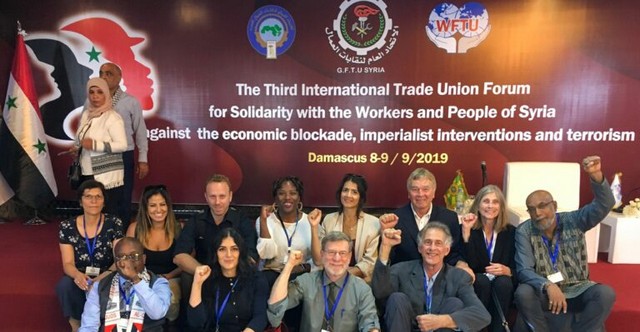
20 Sep 2019 – “Welcome to your second country” was the greeting our Syrian hosts gave us when we arrived for the International Trade Union Forum for “solidarity with the workers and people of Syria against the economic blockade, imperialist interventions, and terrorism.”

Throughout my short one-week stay, Syrians, on seeing I was a foreigner, would muster their best English to ask where I was from. Invariably upon hearing that I was from the US, the questioner would shake my hand, touch hand to heart, and say “welcome.” Ironically, these victims of the US-backed war of regime change and economic sanctions went out of their way to extend their hospitality to us, while the jihadists, whom the US has been arming, training, and implicitly backing, are the ones who, at least according to George W. Bush, “hate us.”

After their expansive hospitality, the most striking aspect of the Syrians I encountered was their pride in their country’s culture of diversity and tradition of a secular state. Mosques of various denominations were cheek to jowl with a variety of Christian churches.

Although I was not permitted to photograph military personnel, no restrictions limited our activities or where we could go, though we stayed mainly in the vicinity of Damascus. I was free to either travel on my own or to accept the offers of our hosts to show us the sights.

For all the reality of over eight years of vicious war, life appeared normal. Damascus had the appearance of a bustling world capital; in fact, it is the oldest continuously occupied capital in the world. I didn’t encounter US fast food restaurants or see any skyscrapers. Thriving commerce and a remarkable diversity of dress and ethnicities were everywhere. The antiquities of this ancient city were not antiseptically preserved behind museum glass, but part of the living landscape. Houses built into the old city wall were still inhabited.

As a Syrian university student proudly explicated about her homeland: “We are a country where people resist any colonialism; we have 9,000 years of culture.”

Conference Addresses Illegal Sanctions

The two-day conference addressed the illegality under international law of economic sanctions and other coercive measures, as well as the effects of the blockade on the people of Syria. The importance of solidarity was emphasized in confronting imperialist interventions that aim at undermining the security of peoples and the sovereignty of states. The role of trade unions, civil society, and media was recognized in exposing the political hypocrisy of states that claim to fight terrorism while supporting it in reality.

The conference opened with a welcoming address by Syrian Prime Minister Imad Khamis and was attended by other government officials and members of the governing party. If there were any security precautions for these high-level dignitaries, they were invisible to me.

Some 232 delegates representing 52 countries attended. Leading members of the World Federation of Trade Unions, Organization of African Trade Union Unity, (Syrian) General Federation of Trade Unions, International Confederation of Arab Trade Unions, Arab Labor Organization, and the 15-million-member Indian confederation (the world’s largest trade union) spoke at the conference.

The North American delegation included trade unionists, peace activists, and journalists. Ajamu Baraka of the US Peace Council, Black Alliance for Peace, and Black Agenda Report declared:

“There can be no working-class justice, no working-class rights in a world where powerful elite social forces are prepared and are using extreme violence.”

Noting that the “US spends more on national defense than China, Russia, the United Kingdom, France, Japan, Saudi Arabia and India combined,” Baraka explained that the “theft of public resources for the military and militarism domestically and abroad represent a one-sided class war waged on the working class in the US. The six trillion dollars spent on US wars since 2003 are resources that could have been directed to address the increasing desperate plight of workers and poor people in the US.”

The final declaration of the conference called for the closure of US and Turkish bases in Syrian territory, withdrawal of uninvited foreign forces from Syria, the cessation of aggressive US-alliance air raids, and solidarity with similarly US-sanctioned Venezuela, Nicaragua, and Cuba.

Blowback

The Jerusalem Post on September 9, the second day of the conference, had already trolled social media to discover that reporter Max Blumenthal “claimed (emphasis added) that he was in Damascus at the General Federation of Trade Union conference.” The Israeli newspaper criticized Blumenthal for investigating “regime-held areas” by actually visiting them. Similarly criticized were Lebanese-American journalist Rania Khalek (also at the conference) for a visit to Syria in 2016 and US Representative and Democratic presidential primary candidate Tulsi Gabbard for a visit the following year. Presumably, the Syrian Observatory for Human Rights, funded by the British Foreign Office and run by a clothing dealer out of his home in Coventry, England, is where they should have gone for information on the Middle East.

The blowback experienced by Donald Lafleur has been far more vehement. He has been threatened with losing his position as executive vice president of the 3.3 million-member Canadian Labour Congress. The Canadian National Post newspaper, whose journalism on the Middle East is not simply a fallback to the Cold War but to the Crusades, attacked Lafleur for attending the conference with “neo-Stalinist ‘anti-war’ zombies.” The veteran postal worker, traveling to Syria on his own dime and time, had the temerity to express solidarity with fellow workers instead of with the bourgeoisie the National Post so loyally champions.

Hassan Yussuff, President of the Canadian Labour Congress, attacked Lafleur for calling for an end of punishing and illegal sanctions on his fellow workers in Syria. Ken Stone of the Congress of Union Retirees of Canada responded:

“If we believe in democracy, trade unionists can visit another country without accepting our government’s positions on international affairs. In fact, a healthy trade-union movement would offer a different analysis of world issues than Canada’s government, which is subservient to corporations. The solidarity actions of a leading trade unionist serve as an example to us all in removing barriers of distrust and misunderstanding, permitting us to learn from the struggles of the Global South.”

Also attacked by the National Post for attending the conference were “Kremlin-friendly” journalists Max Blumenthal and Anya Parampil with The Grayzone, anti-war activist Fra Hughes from Belfast, and “Lebanese-Californian” Paul Larudee with the Syria Solidarity Movement. (Larudee was actually born in Iran, but the distinction between Arabic-speaking Lebanon and Farsi-speaking Iran is too subtle for the National Post.)

Meeting with Assad

Security-wise, it was a lot easier to get into the presidential palace to meet with Syrian President Bashar al-Assad than it is to take a commuter plane from San Francisco to Los Angeles. The president individually greeted each one of us as we entered. He thanked a German delegate for his country’s acceptance of Syrian refugees. The German, in turn, mock-implored Assad to “take me in.”

After apologizing for keeping us waiting while he shook hands with each one of us, Assad explained that 90% of Syria had been “liberated” and the intention was to regain the entirety of the national territory. Final victory, however, would not come until all Syrians are won over to national unity.

Syria, according to Assad, is socialist where workers are in “partnership with the state” and are the “leading section” of the society. Minimal medical care and education are free in Syria, even during the height of the war.

Assad explained that the gap between capitalists and those who produce the wealth – the working class – has widened internationally since the 1970s and particularly after the collapse of the Soviet Union. Workers paid the price for the world capitalist financial crisis of 2008.

“Conflicts,” Assad noted, “won’t end in the near future” but “Syria is not isolated.” The US, he explained, does not enjoy the monopoly of technology that it held 20 years ago. Today a new network of relationships is developing among Brazil, China, Russia, India, and the small states of the world. The US, he warned, may end up blockading itself.

The 2-hour meeting, including a robust Q&A, concluded with Assad’s recommendation to “teach reality.”

One View of a Complex Picture

“In the west, are people stupid or are they just thinking stupidly?” asked a young Syrian woman. We were at Damascus University after the conference. An Australian conference attendee, Tim Anderson, had just spoken to a standing-room-only crowd on his book Axis of Resistance: Towards an Independent Middle East. In response to her question, Anderson explained how the western mass media paints a particular view of the complexity of Syrian reality. “Imperial cultures have tried to normalize war in the 21st century,” adding “regime change is a soft term for a war of aggression.”

For the Syrians I met, their president, Bashar Al-Assad, was seen as the guarantor of national unity in the face of aggression from abroad. Many were the stories of friendly encounters with the president and his family. It may well be that those who held contrary views did not express them to foreigners, but those who did seemed genuine in their personal affection for the person they regarded as their leader in these times of peril.

My experience on the road to Damascus was also one view of a complex picture, a view not often seen in the West. But whatever view one takes in the Syrian conflict, the US policy of economic sanctions, restricting access to food and medicines, is an illegal and unconscionable collective punishment of the Syrian people.

Roger Harris is a member of the TRANSCEND Network and the immediate past president of the Task Force on the Americas, a 33-year-old human rights organization in solidarity with the social justice movements of Latin America and the Caribbean.

23 September 2019

Source: www.transcend.org

Protests continue in Egypt demanding ouster of US-client el-Sissi

By Abdus Sattar Ghazali

Security forces in Egypt have clashed with hundreds of protesters in the port city of Suez, according to media reports, firing tear gas and live rounds to disperse crowds calling for President Abdel Fattah el-Sisi to quit, Al Jazeera reported Sunday (Sept 22).

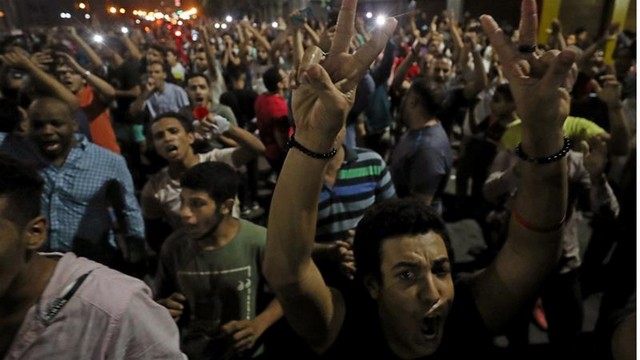
The unrest on Saturday came a day after thousands of people took to the streets in several Egyptian cities in a rare show of dissent against el-Sisi, who has overseen a broad crackdown on dissent including the jailing of thousands of dissidents and the effective banning of protests.

A protester in Suez told the AFP news agency about 200 people headed to the city’s central area for a second night in a row, where they were met by security forces and armored vehicles.

“They [security force] fired tear gas, rubber and live bullets and there were injuries”, the man who declined to be named told the AFP.

Protests were also reported in Giza, the capital Cairo’s twin city, and in the northern town of Mahalla. Al Jazeera is banned from reporting inside Egypt.

Meanwhile, a heavy security presence was maintained in Cairo’s Tahrir Square, the epicentre of Egypt’s 2011 revolution that toppled longtime leader Hosni Mubarak.

The AFP, citing an unnamed security source, said at least 74 people had been arrested on Friday in the capital after clashes between police and protesters, who had marched through the streets of Cairo, chanting slogans including “Leave, Sisi!” and demanding the “fall of the regime”.

Anti-El Sisi protests in New York & Washington

Videos on social media showed dozens of Egyptians demonstrating in front of el-Sisi’s residence in New York, where he is scheduled to speak at the United Nations General Assembly this week.

The anti-Sisi demonstrations were met with tens of his supporters also staging a demonstration to chant slogans praising his achievements.

The Egyptian diaspora in Washington, DC also staged a vigil in front of the White House to denounce el-Sisi, Al Jazeera reported. The protesters called on US President Donald Trump to end his support for el-Sisi and demanded that el-Sisi leave the US.

Mohamed Ali

The demonstrations were in response to an online call by an exiled Egyptian businessman, Mohamed Ali, who has accused el-Sisi and his aides of squandering public funds on vanity projects.

Ali, a construction contractor, upped the pressure on Saturday in an expletive-filled video, imploring Egyptians to join a “million-man march” next Friday and to fill all “major squares” of the country.

“This is a people’s revolution … We have to link up together as one … and organise going down to the major squares,” he said in a Facebook appeal to his followers.

Mohamad Elmasry

Mohamad Elmasry, chair of the media and journalism program at the Doha Institute for Graduate Studies, told Al Jazeera that the popularity of Ali’s videos and the protests they sparked posed a “legitimate threat” to el-Sisi.

“Millions of people have watched his videos, while his anti-Sisi hashtags have gone viral,” Elmasry told Al Jazeera. “This is something that is a legitimate threat to the el-Sisi government – if it wasn’t a legitimate threat, then el-Sisi wouldn’t have come out and responded directly to Mohamed Ali at last week’s youth conference,” said Elmasry, adding it was “unprecedented” for el-Sisi “to be put on the defensive like that inside Egypt by an Egyptian”.

“No one shouted bread, freedom, social justice like in 2011, they escalated straight to ‘Leave’ from the first minute,” Nael Shama, a Cairo-based political analyst told AFP news agency, adding: “This is the first time people take to the streets in many years but I am not sure it will be the last.”

President Mohammed Morsi dies in court

Anti-El Sissi demonstrations came three months after the overthrown President Mohammed Morsi has died on June 17 during a Kangaroo court hearing in Cairo.

Mohammed Morsi died after collapsing during a session in court.

He was buried quickly in Cairo on June 18. “He was buried in Medinat Nasr, in eastern Cairo, with his family present,” said Abdel Moneim Abdel Maksoud, one of his lawyers.

Tellingly, the UN has called for an independent investigation into whether Morsi’s detention in solitary confinement contributed to his death.

The UN human rights office called for a “prompt, impartial, thorough and transparent investigation” into death of Morsi, who had been in prolonged solitary confinement. The probe should “examine whether the conditions of his detention had an impact on his death,” UN Human Rights Office spokesperson Rupert Colville said.

Correspondent Ruth Michaelson in Cairo told DW that authorities were “increasing security” across Egypt amid fears that “violent offshoots of the Muslim Brotherhood may take action following the incident.”

Divisive rule

The Morsi was democratically elected in 2012, one year after the popular uprising that ended the rule of longtime US-client dictator Hosni Mubarak. He spent just one year in office. He was toppled in July 2013 by General Abdel Fattah el-Sissi who later assumed the title of Field Marshal.

Morsi and thousands of other members of the Brotherhood were jailed in the crackdown that followed.

The former president has faced court several times since then on charges that include plotting terror attacks and spying for Iran. June 17’s session was part of a retrial over allegations of espionage connected to Palestinian militant group Hamas. He was also serving a 20-year sentence related to the killing of protesters during 2012 demonstrations, as well as a life sentence for espionage for Qatar. He had denied all charges.

Erdogan honors a ‘martyr’

Turkish President Recep Tayyip Erdogan paid rick tribute to the former leader: “May Allah rest our Morsi brother, our martyr’s soul in peace,” he said. “I offer my condolences to all of my brothers who walked the path with him. I offer my condolences to the Egyptian people.”

Qatar’s ruler, Sheikh Tamim bin Hamad Al-Thani, expressed his “deep sorrow” via Twitter. “I extend to his family and to the Egyptian people brotherly condolences,” Al-Thani wrote.

Mohammed Sudan, a leading Brotherhood member in London, called Morsi’s death a “premeditated murder,” saying the ex-president had been deprived of medical treatment.

“He has been placed behind a glass cage (during trials). No one can hear him or know what is happening to him,” Sudan said. “He hasn’t received any visits for months … He complained before that he doesn’t get his medicine. This is premeditated murder. This is slow death.”

Sarah Leah Whitson, Middle East director with the Human Rights Watch, tweeted that Morsi’s death was “terrible but entirely predictable” given the government “failure to allow him adequate medical care, much less family visits.”

Abdus Sattar Ghazali is the Chief Editor of the Journal of America (www.journalofamerica.net) email: asghazali2011 (@) gmail.com

23 September 2019

Source: countercurrents.org

Thank You Greta: The Young Lead In The Climate Crisis

By Dr Arshad M Khan

To say Greta Thunberg is a remarkable young girl is to understate her accomplishments. She is phenomenal. She has successfully exploited social media and through dogged persistence — including a trip across the Atlantic on a sailing yacht to make a point about the very high pollution per passenger on a commercial jet. Given the 20,000 planes in service serving three billion passengers the sum total is a serious problem.

According to the Center for Biological Diversity, jets emit “staggering amounts of CO2”, representing 11 percent of all US transportation emission and 3 percent of total US CO2 emissions. Like cars, they also emit nitrogen oxides which being discharged at high altitudes are deadlier and more effective than ground level emissions.

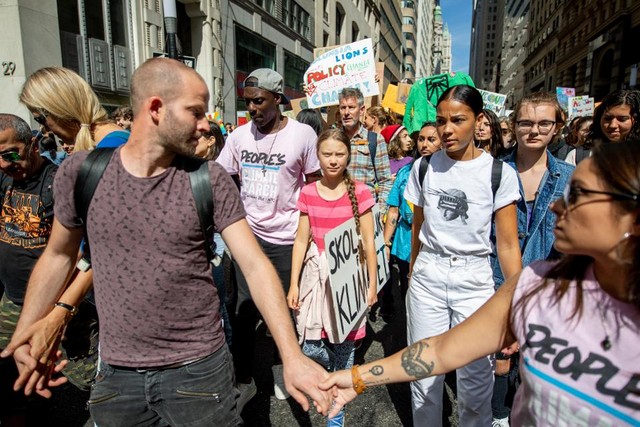
Ahead of the UN Climate Summit that runs September 21-23 in New York, Greta mobilized record numbers of youth climate activists who persuaded their parents, friends and relations to join them on Friday, September 20 in a climate protest numbering more than 2500 strikes in 117 countries. Organizations, businesses, workers and their unions (including the International Trade Union Confederation (ITUC) the world’s largest with 207 million members) were all involved in this global effort.

UN Secretary General Antonio Guterres is clearly on the same page for the UN effort was planned to commence with a youth climate summit last Saturday, September 21 to bring together young activists with change makers. This was before the strike was set for the day before.

The climax of the UN climate summit is on the following Monday when world leaders convene to “put climate action into a higher gear” as Mr. Guterres phrases it. The current Paris agreement limiting warming to 2C above preindustrial levels needs to be updated to its more ambitious goal of a 1.5C rise, he says, as climate related risks for natural and human systems is lower and likely to be intolerable at 2C.

The young climate activists have not forgotten the Trump administration’s blindness to scientific reasoning and its obstinate refusal to act on climate change. On Monday, they descend on Washington and their protest is expected to bring the city to a halt.

Once can admire the young who are putting their hearts and souls into their campaign. But what next when they return to school? Greta wants a “Fridays for Future” campaign. More importantly we have to change our own lives and lobby our legislators ourselves.

For our habits and the world to change, new jobs must replace the old, and government must allocate resources for retraining and re-employment to help the new industries that spring up as manufacturing restructures in a waning fossil fuel economy. It will take time. And there is time, despite the frenetic urgency of the young climatists.

The year 2040 is not doomsday. Nothing will happen and the world will go on as usual. It happens to be a date in the IPCC report that is cited at which the earth can be in trouble and possibly fall into an irreversible heat loop. But the work is loaded with qualifications and probabilities and levels of confidence in the statements made. It also assumes no carbon removal from the atmosphere.

Prognostication is peril laden for in fact carbon removal and sequestration technologies are fast improving with pilot projects and others in several countries. These, plus changes in our habits, and a shift away from fossil fuels should keep our earth safe in the future … at least until the next asteroid comes our way. Life as they say is precarious.

Dr Arshad M Khan (http://ofthisandthat.org/index.html) is a former Professor based in the U.S. whose comments over several decades have appeared in a wide-ranging array of print and internet media.

23 September 2019

Source: countercurrents.org

How to Help the West to Better Understand the Belt & Road Initiative

By Helga Zepp-LaRouche

For most Chinese, it is very difficult to understand why so many institutions in the West are reacting so negatively to the Belt and Road Initiative (BRI, or New Silk Road), and why an anti-Chinese mood has been stirred up recently; why in the USA, for example, Chinese scientists and 450,000 students are suspected of being spies, which is reminiscent of the worst days of the McCarthy period, while in Europe, some security authorities are making similar allegations. It is difficult to understand, because the Chinese people experience the reality of the BRI from a completely different perspective.

For the people of China, the experience of the last 40 years of reform and opening-up policy since Deng Xiaoping is an incredible success story. From a relatively poor developing country—as I myself experienced it in 1971, when I was in China for the first time—China has developed into the second, and in some categories even the first national economy in the world. Eight hundred million people have been freed from poverty; a wealthy middle class of 300 million and soon 600 million people with a good standard of living has developed. The pace of modernization is unparalleled in the world, as is demonstrated, for example, by the expansion of a 30,000-kilometer high-speed railway system that will soon connect all the major cities.

Since President Xi Jinping put the New Silk Road on the agenda in Kazakhstan, in September 2013, China has also made cooperation with the Chinese model of success available to all other states for “win-win” cooperation. In the mere six years that have passed since then, there has been an incredible response to the BRI, which now has 130 nations and more than 30 large international organizations cooperating with it. This, the largest infrastructure project in human history, has launched six major corridors, built railway lines, expanded ports, built industrial parks and science cities, and for the first time offers developing countries the opportunity to overcome poverty and underdevelopment.

From the very beginning, the BRI has been open to all the countries of the world. President Xi Jinping has not only explicitly offered cooperation to the USA and Europe, but has also said in countless speeches, that he is proposing a completely new model of international cooperation among nations, a “community for the shared future of mankind.” In doing so, he has proposed a higher conception of cooperation, unprecedented in history, which overcomes geopolitics and replaces it with a harmonious system of development for the benefit of all. In this sense, the BRI is the absolutely necessary economic basis for a peace order for the 21st century!

While in many countries of Asia, Africa and Latin America, and even some in Europe, the New Silk Road is welcomed as the greatest vision, as a concept of “peace through development,” as Pope Paul VI had formulated it in his encyclical of 1967, Populorum Progressio (On the Development of Peoples)—yet its adversaries call the same policy a “competition of systems.”

Many Chinese do not understand why this violent reaction, fuelled by geopolitical motives, is taking place. Meanwhile, the West has begun to habituate itself to the changes that have fundamentally altered its political orientation and its scale of values over almost the last 50 years.

The crucial point is that a paradigm shift has taken place in the West since 1971, leading in the opposite direction from the path that China has taken.

Toward a New Fascism

When President Nixon triggered the dissolution of the Bretton Woods System on August 15, 1971, with its fixed exchange rates and gold reserve standard of the dollar, he set the course towards an increasing renunciation of a policy oriented toward the real physical economy, in favor of a policy aimed at the monetary profits of the financial economy, which was increasingly oriented toward maximizing those profits.

This tendency was reinforced by the abolition, in 1999, of the Glass-Steagall banking separation system, and the accompanying complete deregulation of the financial markets, which led to repeated financial bubbles, and finally to the crash of 2008. Yet the central banks have done absolutely nothing to remove the causes of that crash, but on the contrary, have promoted speculation in the casino economy at the expense of the real economy, through continued quantitative easing, zero interest rates and now even negative interest rates. As a result, the trans-Atlantic financial system, today, faces the danger of an even more dramatic crash than that of 11 years ago.

The American economist Lyndon LaRouche, my recently deceased husband, farsightedly warned in August 1971, that a continuation of Nixon’s monetarist policy would lead to the danger of a new depression and a new fascism—if it were not replaced by a new world economic order.

In 1972, LaRouche also opposed the Malthusian-inspired thesis of the Club of Rome, that the “limits to growth” had supposedly been reached; a false doctrine on which the entire environmentalist movement is still based today, and which has led to a “greening” of a large part of the political party spectrum of the West.

LaRouche replied with his book, There Are No Limits to Growth, which emphasizes the role of human creativity as the engine of scientific and technological progress, which is the factor that defines what a “resource” is. At the same time, he also warned that the shift in values towards a rock-drug-sex counterculture associated with this neo-liberal economic policy, would, in the ,medium term, destroy the cognitive faculties of the population, and thus not only cause a cultural crisis, but also ruin the productivity of the economy.

Unfortunately, this is exactly where we are today.

China took the opposite path in 1978. It replaced the anti-technology policy of the Gang of Four, with a dirigist real economy, based on innovation and financed by a state credit policy.

What is not understood in the West, is that the Chinese economic model is identical, in its basic principles, to the American System, as developed by the first Secretary of the Treasury of the young American Republic, Alexander Hamilton, and his concept of the National Bank and sovereign credit creation. This concept was elaborated by the German economist Friedrich List, who is very famous in China; it was the framework of Lincoln’s economic advisor Henry C. Carey, and it influenced the economic policies of Roosevelt’s Reconstruction Finance Corporation, with which he led the U.S. out of the depression of the 1930s. The Reconstruction Finance Corporation was later the model for the Kreditanstalt für Wiederaufbau, with which Germany organized its post-war reconstruction and the German economic miracle.

So today, China is doing the same thing that was the basis of the economic success of the USA and Germany, before they turned away from this policy and replaced it with the neo-liberal model, whose “success” can be seen today in the example of the world’s largest derivatives trader, the bankrupt Deutsche Bank.

Cai Yuanpei and Aesthetic Education

An extremely important aspect of the success of the BRI, which is insufficiently understood in the West, and, in my view, not sufficiently emphasized by China, is the basic cultural orientation of the 2,500-year-old Confucian tradition of Chinese society, which was only interrupted during the ten years of the Cultural Revolution. In China, thanks to this tradition, the common good plays a greater role than individualism, which has acquired a greater significance in the West since the Renaissance, but which, to some extent, has taken on a life of its own with today’s liberal change in values, and has degenerated into “everything is permitted.”

The Confucian tradition also implies that the development of the moral character is the highest goal of education, which is expressed in the term junzi, which roughly corresponds to Friedrich Schiller’s concept of the “beautiful soul.” It has therefore been taken for granted in China, for more than two thousand years, that respect for public morality and the fight against bad qualities in the population are the prerequisites for a highly developed society.

In the West today, with the abolition of the Humboldt educational ideal—the core of which had also been the development of the “beautiful character”—the idea of the necessity for moral improvement goes completely against the Zeitgeist, the spirit of the times. It is therefore only from the point of view of the liberal system, that someone could call China’s an “authoritarian system,” but by no means from the point of view of China’s own cultural history.

Anyone who wants to understand Xi Jinping’s intentions must consider his letter in reply to the request of eight professors of the Central Academy of Fine Arts (CAFA), about a year ago, in which he emphasized the extraordinary importance of aesthetic education for the spiritual development of China’s youth. Aesthetic education plays a decisive role in the development of a beautiful spirit; it fills the students with love, and promotes the creation of great works of art.

Confucius had already understood that the study of poetry and good music should have a decisive role in the aesthetic education of man, but a master key to the understanding of Xi Jinping’s vision, not only of the “Chinese Dream,” but of the harmonious development of the entire human community, is the scholar who created the modern Chinese educational system—the first Minister of Education of the Provisional Republic of China, Cai Yuanpei. During his travels in search of the best educational systems of his time, Cai finally, in Leipzig, came across the aesthetic writings of Baumgarten and Schiller, and, through the writings of the philosophical historian Wilhelm Windelband, became aware of Wilhelm von Humboldt’s educational concept. He was totally enthusiastic about the affinity of Schiller’s aesthetic education to Confucian morality, and recognized that Schiller influenced the spirit of German Classicism with “great clarity.”

Cai used these ideas to modernize the Chinese educational system, and created the new term meiju, for aesthetic education. This strengthened the idea, already found in Confucius, that the refinement of character can be achieved by immersion in great classical art, so that in this way, a bridge can be built between the sensual world and reason. In an essay of May 10, 1919, Cai formulated thoughts that could also build a bridge for today’s problems in the West:

“I believe that the root of our country’s problems lies in the short-sightedness of so many people who want quick success or quick money without any higher moral thinking. The only medicine is aesthetic education.”

Is the Good No Longer Conceivable?

Many people in the West today, find it hard to believe that China could be serious about its idea of win-win cooperation, because they have become too accustomed to the paradigm shift already described, with its axiom that all human interactions must be a zero-sum game. But we in the West should remember that the Peace of Westphalia of 1648, which ended 150 years of religious war, established the principle that a lasting order of peace must take into account the interests of others. It was the Peace of Westphalia which established international law and laid the foundations for the UN Charter.

It is the West, and not China, which has moved away from the principles laid down therein, such as absolute respect for the sovereignty of all states—adopting instead concepts such as the alleged R2P (right to protect), so-called “humanitarian” wars of intervention, and regime change through color revolutions, as we are currently witnessing in Hong Kong.

Xi Jinping’s vision of a “community of a shared future of humanity” corresponds to the Confucian notion of a harmonious development of all, a tradition to which Cai Yuanpei also contributed essential thoughts. He designed the dream of a “great community of the whole world” (datong shijie), which would be harmonious and without armies and wars, and which could be achieved through the dialogue of cultures, comparing the partaking of a culture by the culture of other peoples, with the breathing, eating and drinking of the human body, without which it can not live. Indeed, a look at history shows that any higher development of mankind has always taken place through involvement with other cultures.

It is significant that hardly any real analysts or politicians in the West have responded to Xi Jinping’s idea of a “community of destiny for the future of mankind” in any significant way. If it is mentioned at all, it is only in passing, as if it were not worth regard as anything other than communist propaganda, and as an announcement of China’s intention to play a leading role on the world stage in the future. But what Xi said at the 19th National Congress of the Communist Party of China (CPC) in 2017, was that by 2050, at about the 100th anniversary of the founding of the PRC, the people of China should have democracy, human rights, a developed culture and a happy life. And, not only the Chinese, but all peoples on this planet.

This implicitly poses the question—and answers it positively—that should occupy all philosophers, scientists and statesmen and stateswomen, in view of the many chaotic developments on our planet: Can the human species give itself an order that guarantees its long-term survival, and is appropriate to the specific dignity of humanity as a creative species? Xi’s concept of the one community of a shared future, very clearly presents the thought that the idea of the one mankind be put first, and only then can national interests be defined in agreement with it.

West Must Return to Cusa, Leibniz, Schiller

In order to be able to keep up with the discussion on this level, of how to shape this new order of “reformed international governance,” we in the West must return to the very humanist traditions that we have pushed aside with the liberal system. Corresponding ideas can be found in Nicholas of Cusa, who considered a concordance of macrocosms possible only through a harmonious development of all microcosms. Or in Gottfried Leibniz’ idea of a pre-stabilized harmony of the universe, in which a higher order is possible, because with higher development, the degrees of freedom increase and therefore we live in the best of all possible worlds. Or in Friedrich Schiller’s idea that there need be no contradiction between the citizen of the world and the patriot, because both are oriented towards the common good of the future of mankind.

In conclusion: China must help the West to understand the concept of the New Silk Road. China must not react defensively to the anti-Chinese attacks, but should instead emphasize the brilliant periods of its own history all the more proudly and self-confidently: the depth of Confucian moral theory, which inspired Benjamin Franklin to his own moral philosophy; the profundity of Chinese poetry; the beauty of Literati Painting. And China should challenge the West to revive its own humanistic traditions, of the Renaissance, of Dante, Petrarca and Brunelleschi; of classical music in the culture of Bach, Beethoven and Schiller; and of republican traditions in politics. Only when the West experiences a great “rejuvenation,” reviving the ideas of Alexander Hamilton, Friedrich List and Henry C. Carey, can the problem be solved.

Leibniz was very enthusiastic about China, and he tried to learn as much as possible about it from the Jesuit missionaries. He was fascinated that the Kangxi Emperor had come to the same mathematical conclusions as he had, and concluded that there are universal principles accessible to all people and cultures. He even thought the Chinese were morally superior. He wrote:

“In light of the growing moral decay, it seems to be almost necessary that Chinese missionaries be sent to us, who could teach us the application and practice of a natural theology. I therefore believe: that if a wise man were chosen, to judge not the beauty of goddesses, but the excellence of peoples, he would give the golden apple to the Chinese”.

The German middle class and the German small and medium-sized enterprises (SMEs), and cities such as Genoa, Vienna, Zürich, Lyon, Duisburg and Hamburg, and many more, have long since come to realize the potential that lies not only in the expansion of bilateral relations, but above all in the expansion of cooperation in third countries, such as the industrialization of Africa and Southwest Asia.

The enthusiasm that is evident in international cooperation in space travel—the ESA cooperation in the projects of the Chinese Space Agency, the idea of international cooperation on the future Chinese space station, the construction of an international moon village and the terraforming on Mars—underlines that Xi Jinping’s vision of the community of a shared destiny for the future of mankind is within reach.

Helga Zepp-LaRouche is a German political activist, widow of the late American political activist Lyndon LaRouche, and founder of the LaRouche movement’s Schiller Institute and the German Bürgerrechtsbewegung Solidarität party.

20 September 2019

Why white supremacists and Hindu nationalists are so alike

By Aadita Chaudhury

White supremacy and Hindu nationalism have common roots going back to the 19th-century idea of the ‘Aryan race’.

Over the last few years, especially after Donald Trump’s victory in the 2016 US presidential election, we have been witnessing the normalisation, and rise, of a white-supremacist, ultranationalist brand of right-wing politics across Europe and the United States. While the shift towards extreme right alarmed many across the world, far-right ideologues of the Trumpian era swiftly found support in a seemingly unlikely place: India.

Many members of the so-called “alt-right” – a loosely knit coalition of populists, white supremacists, white nationalists and neo-Nazis – turned to India to find historic and current justifications for their racist, xenophobic and divisive views. Using a specific, “white nationalist” brand of Orientalism, they projected their fantasies about a racially pure society onto the Indian culture and in response received a warm welcome from Hindu fundamentalists in India.

While an alliance between the Hindu far right and the Western alt-right may appear confounding on the surface, it actually has a long history, going all the way back to the construction of the Aryan race identity, one of the ideological roots of Nazism, in the early 20th century.

In the 1930s, German nationalists embraced the 19th-century theory that Europeans and the original Sanskrit speakers of India who had built the highly developed Sanskrit civilisation – which white supremacists wanted to claim as their own – come from a common Indo-European, or Aryan, ancestor. They subsequently built their racist ideology on the assumed superiority of this “pure” race.

Savitri Devi (born Maximiani Portas), a French-Greek thinker and mysticist who later became a spiritual icon of Nazism, helped popularise the idea that all civilisation had its roots in this Aryan “master race” in India. She travelled to India in the early 1930s to “discover the source of the Aryan culture” and converted to Hinduism while there.

She quickly integrated herself into India’s burgeoning Hindu nationalist movement by promoting theories that support privileged caste Hindus’ superiority over Christians, Muslims and unprivileged caste Hindus in the country. In 1940, she married Asit Krishna Mukherji, a Hindu nationalist and Indian supporter of Nazism who had praised the Third Reich’s commitment to ethnonationalism, seeing commonalities between the goals of the Hitler Youth and the youth movement of Hindu nationalism, Rashtriya Sevak Sangh (RSS).

Devi worked as a spy for the Axis forces in India throughout World War II and left the country after the defeat of Nazi Germany using a British-Indian passport. In the post-war period, she became an ardent Holocaust denier and was one of the founding members of the World Union of National Socialists, a conglomeration of neo-Nazi and far-right organisations from around the world.

Devi still has a strong influence over the Hindu nationalist movement in India. Her 1939 booklet titled A Warning to the Hindus, in which she cautions Indian nationalists to embrace their Hindu identity and guard the country against “non-Aryan” influences, such as Islam and Christianity, is still widely read and highly regarded among Hindu nationalists. Perhaps not surprisingly, recently Devi and her theories have also been rediscovered by right-wing ideologues in the West and she is now considered an alt-right icon.

However, the current connection between far-right groups in the West and Hindu nationalists is limited neither to Devi’s teachings nor the old myth of the Aryan race.

Today, the two groups share a common goal in eroding the secular character of their respective states and a common “enemy” in Muslim minorities. This is why they often act in coordination and openly support each other.

In the US, the Republican Hindu Coalition, a group with strong links to the Hindu nationalist movement in India, has been rallying behind President Donald Trump’s controversial immigration policies, like the Muslim ban and the border wall. Trump’s campaign strategist and prominent alt-right figurehead Steve Bannon once called India’s Hindu-nationalist Prime Minister Narendra Modi “the Reagan of India”.

Meanwhile, in India, a far-right Hindu nationalist group named Hindu Sena (Army of Hindus), which has been linked to a series of inter-communal incidents in India, has been throwing parties to mark Trump’s birthday. The group’s founder even claimed that “Trump is the only person who can save mankind.”

In Canada, far-right Islamophobic organisations such as Rise Canada, which claims to “defend Canadian values” and combat “radical Islam”, are popular among Hindu-nationalists. The group’s logo even features a red maple leaf rising out of a lotus flower, which is often associated with Hinduism.

In Britain, the National Hindu Council of Temples (NHCTUK), a Hindu charity, recently caused controversy by inviting far-right Hindu nationalist Tapan Ghosh to speak at the parliament. Ghosh has previously suggested the UN should “control the birth rate of Muslims” and said all Muslims are “Jihadis”. During his visit to the UK, Ghosh also attended celebrations of Diwali, the Hindu festival of lights, with cabinet ministers Amber Rudd and Priti Patel, and met the former neo-Nazi leader Tommy Robinson.

On top of their shared Islamophobia and disdain for secular state structures, the destructive actions, protests and aggravations of Hindu nationalists and the Western far right are also very much alike.

In November, the government of the state of Uttar Pradesh, which is led by the nationalist Bharatiya Janata Party (BJP), proposed to build a statue of the Hindu god Ram in Ayodhya, where the historic Babri Masjid was illegally demolished by Hindu nationalists in 1992. Only a month earlier, the same government pulled off a massive spectacle, having a helicopter drop off individuals dressed as Ram and Sita at the Babri Masjid site to mark the start of Diwali celebrations.

The sentiment behind these apparent attempts to intimidate Muslims and increase tensions between communities was in many ways similar to the far-right, white supremacist rally that shook Charlottesville in 2017. The neo-Nazis chanted “You will not replace us” as they marched through the streets of Charlottesville.

The far right in the US, Europe and Canada – emboldened by the electoral success of ultra-nationalist parties and individuals across the globe – aspire for a future in which secular protections are abandoned in favour of a system that favours the majority and protects the “white Christian identity” that they believe their nations were founded upon.

Likewise, Hindu nationalists in India, empowered by the BJP’s landslide election victory in 2014, and inspired by European ethnonationalism and fascism, reject the constitutional secularism of the Indian state, propose that India is fundamentally a Hindu nation, and insist that minorities, especially Muslims and Christians, do not belong in a “Hindu country”.

Ever since the start of the normalisation of far-right ideas in the West, a surge in racist, anti-Semitic and Islamophobic attacks was witnessed across the US and Europe.

The same happened in India after Hindutva officially became the governing ideology in the country. Over the past few years, countless Muslims, Christians and low-caste Hindus have been persecuted, assaulted and even killed for allegedly killing cows and many Muslims were targeted for allegedly participating in so-called “love jihad”.

But despite all these similarities, there is major a difference between Hindu fundamentalism in India and far-right movements in the West: the liberal reaction to it.

While liberals and leftists quickly united against the rise of the far-right, they chose to largely ignore the rise of Hindu nationalism in the world’s largest secular democracy. Especially after the Pittsburgh synagogue shooting, the necessity of expanding the anti-fascist praxis to include all forms of racism, from anti-Semitism to Islamophobia, was emphasised by many. However, the opposition to Hindu nationalism has not yet been made part of the broader movement, despite the well-documented suffering of India’s minorities under BJP’s rule.

Instead, the idea that India is a “Hindu nation” is being accepted as a given by the majority of liberals. The fact that India’s constitution defines the state as “secular” is being ignored, and Hindu nationalism is being presented as a benevolent movement despite ample evidence to the contrary.

White vegans in the West, for example, rejoiced over the decision by several Indian states to ban the consumption of beef, without bothering to understand what these laws would mean for Muslims and Dalits who had already been suffering at the hands of so-called “cow vigilantes”. Animal rights and veganism advocate PETA has in fact gone further and berated vegetarians who consume milk in India for “supporting the beef industry”, thus playing into the communal politics of food in India.

Hindu nationalism and white supremacy are the two sides of the same coin. For the global movement against racism, white-supremacy and fascism to succeed, anti-fascists across the world need to acknowledge and stand up to the Hind nationalism threat.

Hindus themselves, both in India and abroad, also need to take action and raise their voices against the abuses that are being committed in their names. One such organisation already exists for diaspora Hindus in North America: Sadhana. It is a coalition of progressive Hindus based in New York City, seeks to stop the use of Hindu thought for the purposes of misogyny, queerphobia, Islamophobia and white supremacy.

However, Hindu nationalism cannot be defeated by Hindus alone. People around the world who engage with and comment on the Indian culture on a regular basis, including sub-urban Yoga mums in the US and vegan activists in Europe, should educate themselves on the secular nature and diverse identities of India. They need to join the resistance against the oppression and abuse of the country’s minorities and stop perpetuating the Hindu-nationalist myth that India is a “Hindu nation”.

Aadita Chaudhury is a PhD Candidate in Science & Technology Studies at York University, in Toronto, Canada.

The views expressed in this article are the author’s own and do not necessarily reflect Al Jazeera’s editorial stance.

13 December 2018

Source: www.aljazeera.com

The Attack on Saudi Arabia’s Oil Facility. The Patriot Air Defence System Failed. Why?

By Prof Michel Chossudovsky

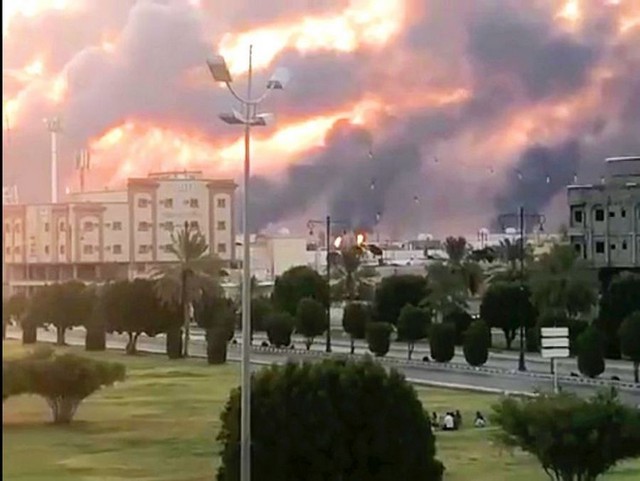
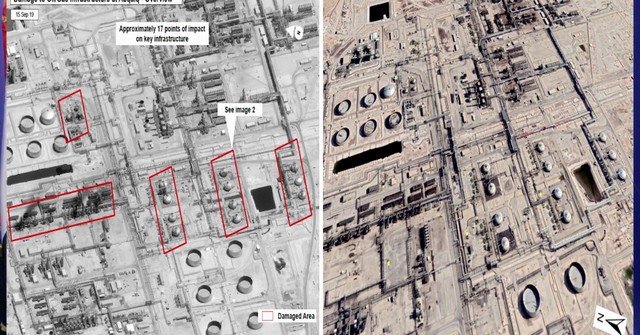
On Saturday September 14, 2019, a missile and drone attack was waged against the world’s largest oil processing facility in Saudi Arabia.

Yemen’s Houthi forces from the Ansar Allah movement claimed responsibility for the attack.

Washington blamed Iran. In chorus, the media pointed to the Houthis supported by Iran or attacks waged directly by Iran.

The media consensus: the attacks were ‘unquestionably sponsored by Iran’.

There are many unanswered questions, the most important of which is:

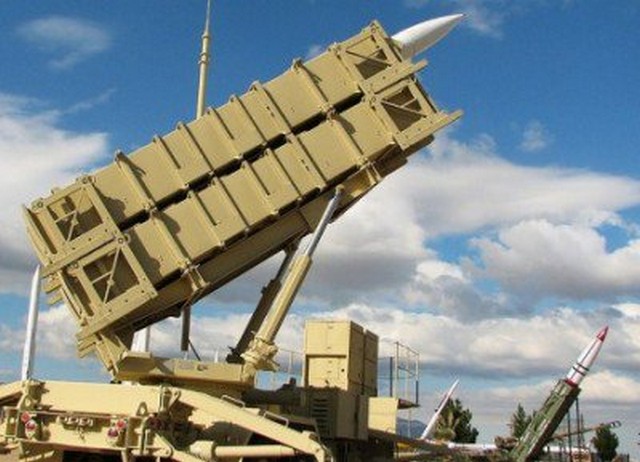
Why did Saudi Arabia’s advanced Patriot Air defense system fail to detect the drones and missiles?

According to the Wall Street Journal:

U.S. and Saudi officials didn’t anticipate a strike from inside Iran, officials said, rather than through one of its proxy forces or elite military units.

Saudi and U.S. focus had been largely on the kingdom’s southern border with Yemen, where Riyadh has been fighting Iranian-backed Houthi rebels in Yemen’s civil war, the officials said. The attacks, however, originated from Iranian territory in the northern Persian Gulf, …

…The absence of air-defense coverage left Saudi’s eastern flank largely undefended by any U.S. or Saudi air-defense systems, … The glaring blind spot also left Saudi Arabia exposed to a threat despite spending billions annually on its defense budget.

“You know, we don’t have an unblinking eye over the entire Middle East at all times,” Marine Gen. Joe Dunford, chairman of the Joint Chiefs of Staff, told reporters near London on Tuesday. (emphasis added)

These are nonsensical statements.

The whole Persian Gulf defense apparatus –which includes strategic US and allied military facilities– is based on “anticipating” strikes from Iran. Saudi Arabia’s Air defense is coordinated by the Royal Saudi Air Defense Forces (RSADF) which constitutes a separate branch of the Armed Forces.

The Eastern flank of Saudi Arabia is not “undefended”. Quite the opposite: it is protected by the US multibillion dollar Patriot Air Defense system. Western defense analysts know this inside out.

Moreover, that Eastern flank of Saudi Arabia bordering on the Persian Gulf is heavily militarized. It includes several important US and allied military facilities in Saudi Arabia (as well as in the UAE, Bahrain, Kuwait, Qatar and Oman). The Persian Gulf is among the most militarized regions on the Planet.

According to reports, US and Saudi officials were taken by surprise. Again a nonsensical statement.

They did not expect that the attack would come from the North. According to the Saudi Defence ministry spokesman Colonel Turki Al-Maliki,

“The attack was launched from the north and unquestionably sponsored by Iran, … We are working to know the exact launch point. … This is the kind of weapon the Iranian regime and the Iranian IRGC are using against the civilian … facilities”

Why did the air defense system fail? The underlying statements intimate that the air defense umbrella so to speak was geared towards defending Saudi Arabia solely from attacks coming from the South. A totally absurd proposition. The North-South issue is irrelevant. We are dealing with an advanced computerized military structure including a sophisticated and integrated air defense network.

At the same time Coronel Al Maliki at the press conference contradicts his own statements, stating that the Houthis did not have the capabilities of attacking them from the South beyond 700 km.
Listen carefully to the Aramco press conference: Colonel Turki al-Maliki. (17’00) (Al Arabya, published September 18, 2019) click here

When questioned on why the air defense system failed, Colonel Al Maliki stumbled. (17′.30″),

“Mark Stone from Sky News. With respect, this is quite an embarrassing display for the Saudi military because it’s quite clear that your air defenses failed incredibly badly that so many missiles and drones were able to penetrate deep into Saudi Arabia”

He did not answer the question. He pointed to the very large number of ballistic missiles and UAVs which had previously been intercepted (since 2015). But no mention on the number of missiles and UAVs intercepted on September 14:

“We are pretty proud about our air defense. Our air defense has intercepted until now almost 232 ballistic missiles [no details provided]. There is no country in the world [which has] been attacked with such [a large] amount of ballistic missiles and no attack to any country with 258 UAV. Our air defenses with the ability we have and our officers, NCOs and the community we have as air defense to locate as a tactical disposition on the ground. We save our nation. We save our country. If you think they are (INAUDIBLE), we are very proud of our defense. I’m sure the Saudi nation, they are pretty proud about our air defense.” (emphasis added)

Failure of the Air Defense System? Or Was the Patriot System “Disabled” on September 14?

Why did it fail?

There is of course the fashionable thesis that the US Patriot System is flawed in comparison to Russia’s state of the art S-400 air defence system. This assessment is correct but is it relevant?

Other reports point to the fact that the cruise missiles and UAVs were flying at low altitude (and could not be detected by the radar system).

“These were low-flying cruise missiles. They were coming in far below the engagement zone for Patriot. So you wouldn’t have tried to hit them with Patriot.” (CNBC)

But this does not explain the total failure of Saudi Arabia’s air defence system on that particular day. The Patriot system (PAC) is extremely versatile and advanced. The apologetic reports on the failure of the Patriot Missile system in intercepting low-flying missiles are contradictory (focusing allegedly on weak radar capabilities at low altitude).

The US-made Patriot mobile air defense system produced by Raytheon is specifically “designed to intercept tactical ballistic missiles, low-flying cruise missiles and aircraft.” (I24news.tv, May 10, 2019). It uses an advanced aerial interceptor missile and high-performance radar systems.

The attack on Saturday September 14, was made up of a total of 18 drones (UAVs) and seven missiles.

Strategic targets had been carefully selected. An early report on the 14th of September suggested that the Patriot air defense system could possibly have been “disabled by the rebels” (as occurred in previous attacks):

“the rebels have flown drones into the radar arrays of Saudi Arabia’s Patriot missile batteries, according to Conflict Armament Research, disabling them and allowing the Houthis to fire ballistic missiles into the kingdom unchallenged.” (CNBC, September 14, 2019, emphasis added)

This report intimates that the Patriot Air System might have been inoperative on September 14, which suggests that drones or missiles were not detected or intercepted.

The data on the interception of missiles and UAVs in previous attacks against Saudi Arabia is routinely reported. No “official” data, however, was released with regards to the September 14 attacks. Nor was the issue mentioned in the press conference.

Whereas the Wall Street Journal acknowledges the failures of the Patriot System while blatantly “inflating” the number of missiles and UAVs launched, the data on how many were intercepted is simply not mentioned:

U.S. and Saudi military forces and their elaborate air-defense systems failed to detect the launch of airstrikes aimed at Saudi Arabian oil facilities, allowing dozens of drones and missiles to hit their targets, U.S. officials said.

How many were intercepted? Defense specialists are mum on the subject and official statements have carefully avoided discussing it. Visibly that information is being withheld.

That leads us to the smoking gun question.

Was the Patriot Air Defense functional on September 14? This matter has to be investigated.

Was it the rebels (operating inside Saudi Arabia) who disabled the Patriot system (as mentioned in the CNBC report) or was it something else? Was there an explicit order emanating from US and/or Saudi officials not to activate the air defense system on that day?

18 drones and 7 missiles were launched. Major strategic targets –which had been carefully selected– were reached without impediment.

In other words, while it may be premature at this stage, we should not exclude the possibility that this was a False Flag with major repercussions on energy and financial markets.

The financial reaction was immediate. Saudi stocks fell, the oil prices rose, then settled and later fell again. It was an immediate reaction of major banks’ algorithmic speculation with about 10,000 operational hits a second. A trial for larger things to come? (Peter Koenig, Global Research, September 21, 2019)

___________________________________________________________________________________________________

Colonel Turki Al Maliki’s Press Conference

Aired September 18, 2019 – 11:00 ET

RUSH TRANSCRIPT (source CNN)

[11:00:00]

UNIDENTIFIED MALE: So is it Iran?

COL. TURKI AL-MALIKI, SAUDI DEFENSE MINISTRY SPOKESPERSON: Thank you.

UNIDENTIFIED MALE: So is it Iran?

AL-MALIKI: Thank you.

UNIDENTIFIED MALE: Is it Iran?

AL-MALIKI: Thank you. Will you please. I am controlling the press conference. Have a seat please.

MARK STONE, SKY NEWS: Thank you very much, Mark Stone from Sky News. With respect, this is quite an embarrassing display for the Saudi military because it’s quite clear that your air defenses failed incredibly badly that so many missiles and drones were able to penetrate deep into Saudi Arabia. First of all, why did your air defenses fail? And secondly, what will the response of Saudi Arabia by to quite such a substantial attack?

AL-MALIKI: Thank you. We are pretty proud about our air defense. Our air defense has intercepted until now almost 232 ballistic missiles. There is no country in the world been attacked with such amount of ballistic missile and no attack to any country with 258 UAV. Our air defenses with the ability we have and our officers, NCOs and the community we have as air defense to locate as a tactical disposition on the ground. We save our nation. We save our country. If you think they are (INAUDIBLE), we are very proud of our defense. I’m sure the Saudi nation, they are pretty proud about our air defense.

The other question. Right now, we are working as I mentioned to determine the exact position of the launch point. Either that it launched from Yemen, launched from somewhere else. Those people, they will be accountable and this is the decision of the political level in our country and we are just a military tool. That’s for the — I cannot say exactly what’s the decision would be taken and that level for a spokesman for the ministry of defense.

STONE: But just to clarify, you did say that they definitely were not launched from Yemen, correct?

AL-MALIKI: Yes, thank you.

UNIDENTIFIED MALE: (INAUDIBLE) from NRV TV. Colonel al-Maliki, I mean, it’s obviously that the world is suffering from terrorism all around, whether it’s from wish of countries and governments. And you’ve asked for the international community to acknowledge and take action towards these militias and the government which are attacking and provoking the area and all the world. What actions are you looking for? What actions are you hoping for?

AL-MALIKI: Thank you so much. I do agree with you. We know the terrorist act, as your friend here, he asked before, the terror act just needed tools. When terrorist act or terrorist group, they have conducted an attack in Europe, U.K., Spain, South Asia, United States, Saudi Arabia, it doesn’t mean there is a system had been failed. But those mind of ideology, they’re trying to go from the system and to do such terrorist attack to the civilians and they don’t believe in (INAUDIBLE).

The threat that we are facing, all of us, as I mentioned in the beginning, not just for the kingdom of Saudi Arabia. The Iranian regime, the lion activity has been around in (INAUDIBLE) and also the Africa and they are working to support the terrorist group around the world. One of the things that we’re working — will not allow such capability and we have seen the Iranian regime or the IRGC, have given such capability to the Houthi and they are using it against the civilian people and the Saudi or the GCC.

I think it’s their responsibility for the whole international community to stop Iran from the blind activity to put accountability on them from the United Nations, the Security Council and that threat that’s not just for Saudi but are attacking Saudi Arabia today. They are supporting other terrorists’ groups in Lebanon, in Syria, in Yemen and around the world. So it’s their responsibility for the whole international community. Thank you.

The last two questions, please.

UNIDENTIFIED FEMALE: Sir (INAUDIBLE).

AL-MALIKI: Would you please move close to the mic.

UNIDENTIFIED FEMALE: Sir, could I ask. You say you’re trying to pinpoint exactly where these missiles were fired from. Do you believe in the end you will find that they came from Iran itself and from Iranian soil?

AL-MALIKI: I believe that we will spot the launch point of this terrorist attack.

UNIDENTIFIED FEMALE: Do you think that’s most likely going to be Iran?

AL-MALIKI: I am sure we’ll spot it.

[11:05:00]

And we are working and whoever is responsible about it, they will take that accountability.

Michel Chossudovsky is an award-winning author, Professor of Economics (emeritus) at the University of Ottawa, Founder and Director of the Centre for Research on Globalization (CRG), Montreal, Editor of Global Research.

22 September 2019

Source: www.globalresearch.ca

Growing Tension in the Persian Gulf: Civil Society Must Step Up

By Rene Wadlow

Mehran Kamrava. Troubled Waters. Insecurity in the Persian Gulf.

(Ithaca, NY: Cornell University Press, 2018)

The 14 September 2019 drone attacks on oil installations in eastern Saudi Arabia have dimmed hope for U.S. – Iranian discussions aimed to reduce tensions and potentially end the armed conflict in Yemen. Tensions have increased, and oil prices have risen. Certain hopes created by the initiatives of the French President during the G7 meeting in Biarritz, France and the forced departure of John Bolton as U.S. National Security Advisor have lessened. In fact, the aim of the attacks may have been to lessen the possibility of Iran – U.S. discussions which might have taken place during the start of the U.N. General Assembly in New York later in September.Today, the Persian Gulf remains one of the most heavily militarized and insecure regions of the world.

There is a good deal of speculation as to who fired the drones and from where. The Ansar Allah Movement (often called the Houthis) has taken credit, but some specialists doubt that they have the technical knowhow to send drones from Yemen to the targets in Saudi Arabia. Some speculate that the drones were sent from southern Iraq, possibly by Iranian-backed militias such as the Popular Mobilization Forces or by units of the Iranian Revolutionary Guards stationed in Iraq. The Revolutionary Guards are nearly “a state within the state” and could take initiatives without orders from the Iranian President or the Foreign Minister. The Revolutionary Guards could have motivations to prevent fruitful U.S. – Iranian talks at the U.N. There is also speculation that the drone attacks could be linked to increased tensions between Saudi Arabia and the United Arab Emirates concerning the future of south Yemen where the two countries support different factions.

Whatever the locations from which the drones were launched and whomever pulled the switch, the consequences are clear. At a time when governments were speaking of a possible path to reduce tensions a “No Exit” sign has been put up near the start of the road. The road leads to ever-greater tensions which may slip out of the control of governments.

As Kamrava points out beyond the armed conflict aspects of security “a broadened conception of security needs to take into account feelings of socil and economic unease produced by demographic imbalances and the dizzying pace of socioeconomic transition…This is an insecurity with multiple causes and dimensions, unlikely to be remedied by quick fixes or more militarization. It requires sustained attentio n… and perhaps more than anything else, diplomacy and dialogue. These two necessary ingredients, diplomacy and dialogue are what the Persian Gulf is currently missing the most.” However, in addition to the French proposal at the G7, there was an earlier Russian Government proposal.

On 23 July 2019, the Russian Government’s “Collective Security for the Persian Gulf Region” was presented in Moscow by the Deputy Foreign Minister, Mikhail Bogdanov. The Russian proposal for Collective Security for the Persian Gulf follows closely the procedures which led to the 1975 Helsinki Final Act and the creation of the Conference on Security and Cooperation in Europe. Bogdanov stressed multilateral ism as a mechanism for all involved in the assessment of situations, the decision-making process, and the implementation of decisions.

It is not clear how the Russian proposal for a Helsinki-type conference will progress. Russia does not play a leading role in the Middle East today as the USSR did in Europe in the 1970s. In the lead up to the Helsinki Accords of 1975, non-governmental organizations had played an active role in informal East-West discussions to see what issues were open to negotiations and on what issues progress might be made. There is a need for such non-governmental efforts today as the Persian Gulf and the wider Middle East are growing ever-more tense. Mehran Kamrava has written a good overview of the issues and the actors involved. Now action is needed

Rene Wadlow, President, Association of World Citizens

19 September 2019

Source: countercurrents.org

Will Americans Let Trump Start World War III for Saudi Arabia and Israel?

Co-Written by Medea Benjamin and Nicolas J S Davies

On Saturday, September 14th, two oil refineries and other oil infrastructure in Saudi Arabia were hit and set ablaze by 18 drones and 7 cruise missiles, dramatically slashing Saudi Arabia’s oil production by half, from about ten million to five million barrels per day. On September 18, the Trump administration, blaming Iran, announced it was imposing more sanctions on Iran and voices close to Donald Trump are calling for military action. But this attack should lead to just the opposite response: urgent calls for an immediate end to the war in Yemen and an end to US economic warfare against Iran.

The question of the origin of the attack is still under dispute. The Houthi government in Yemen immediately took responsibility. This is not the first time the Houthis have brought the conflict directly onto Saudi soil as they resist the constant Saudi bombardment of Yemen. Last year, Saudi officials said they had intercepted more than 100 missiles fired from Yemen.

This is, however, the most spectacular and sophisticated attack to date. The Houthis claim they got help from within Saudi Arabia itself, stating that this operation “came after an accurate intelligence operation and advance monitoring and cooperation of honorable and free men within the Kingdom.”

This most likely refers to Shia Saudis in the Eastern Province, where the bulk of Saudi oil facilities are located. Shia Muslims, who make up an estimated 15-20 percent of the population in this Sunni-dominated country, have faced discrimination for decades and have a history of uprisings against the regime. So it is plausible that some members of the Shia community inside the kingdom may have provided intelligence or logistical support for the Houthi attack, or even helped Houthi forces to launch missiles or drones from inside Saudi Arabia.

Secretary of State Mike Pompeo, however, immediately blamed Iran, noting that that the air strikes hit the west and north-west sides of the oil facilities, not the the south side that faces toward Yemen. But Iran is not to the west or northwest either – it is to the northeast. In any case, which part of the facilities were hit does not necessarily have any bearing on which direction the missiles or drones were launched from. Iran strongly denies conducting the attack.

CNN reported that Saudi and US investigators claim “with very high probability” that the attack was launched from an Iranian base in Iran close to the border with Iraq, but that neither the U.S. nor Saudi Arabia has produced any evidence to support these claims.

But in the same report, CNN reported that missile fragments found at the scene appeared to be from Quds-1 missiles, an Iranian model that the Houthis unveiled in July under the slogan, “The Coming Period of Surprises,” and which they may have used in a strike on Abha Airport in southern Saudi Arabia in June.

A Saudi Defence Ministry press briefing on Wednesday, September 18th, told the world’s press that the wreckage of missiles based on Iranian designs proves Iranian involvement in the attack, and that the cruise missiles flew from the north, but the Saudis could not yet give details of where they were launched from.

Also on Wednesday, President Trump announced that he has ordered the U.S. Treasury Department to “substantially” increase its sanctions against Iran. But existing U.S. sanctions already place such huge obstacles in the way of Iranian oil exports and imports of food, medicine and other consumer products that it is hard to imagine what further pain these new sanctions can possibly inflict on the besieged people of Iran.

U.S. allies have been slow to accept the U.S. claims that Iran launched the attack. Japan’s Defense Minister told reporters “we believe the Houthis carried out the attack based on the statement claiming responsibility.” The United Arab Emirates (UAE) expressed frustration that the U.S. was so quick to point its finger at Iran.

Tragically, this is how U.S. administrations of both parties have responded to such incidents in recent years, seizing any pretext to demonize and threaten their enemies and keep the American public psychologically prepared for war.

If Iran provided the Houthis with weapons or logistical support for this attack, this would represent but a tiny fraction of the bottomless supply of weapons and logistical support that the U.S. and its European allies have provided to Saudi Arabia. In 2018 alone, the Saudi military budget was $67.6 billion, making it the world’s third-highest spender on weapons and military forces after the U.S. and China.

Under the laws of war, the Yemenis are perfectly entitled to defend themselves. That would include striking back at the oil facilities that produce the fuel for Saudi warplanes that have conducted over 17,000 air raids, dropping at least 50,000 mostly U.S.-made bombs and missiles, throughout more than four long years of war on Yemen. The resulting humanitarian crisis also kills a Yemeni child every 10 minutes from preventable diseases, starvation and malnutrition.

The Yemen Data Project has classified nearly a third of the Saudi air strikes as attacks on non-military sites, which ensure that a large proportion of at least 90,000 Yemenis reported killed in the war have been civilians. This makes the Saudi-led air campaign a flagrant and systematic war crime for which Saudi leaders and senior officials of every country in their “coalition” should be held criminally accountable.

That would include President Obama, who led the U.S. into the war in 2015, and President Trump, who has kept the U.S. in this coalition even as its systematic atrocities have been exposed and shocked the whole world.

The Houthis’ newfound ability to strike back at the heart of Saudi Arabia could be a catalyst for peace, if the world can seize this opportunity to convince the Saudis and the Trump administration that their horrific, failed war is not worth the price they will have to pay to keep fighting it. But if we fail to seize this moment, it could instead be the prelude to a much wider war.

So, for the sake of the starving and dying people of Yemen and the people of Iran suffering under the “maximum pressure” of U.S. economic sanctions, as well as the future of our own country and the world, this is a pivotal moment.

If the U.S. military, or Israel or Saudi Arabia, had a viable plan to attack Iran without triggering a wider war, they would have done so long ago. We must tell Trump, Congressional leaders and all our elected representatives that we reject another war and that we understand how easily any U.S. attack on Iran could quickly spiral into an uncontainable and catastrophic regional or world war.

President Trump has said he is waiting for the Saudis to tell him who they hold responsible for these strikes, effectively placing the U.S. armed forces at the command of Saudi Crown Prince Mohammed Bin Salman.

Throughout his presidency, Trump has conducted U.S. foreign policy as a puppet of both Saudi Crown Prince Mohammed Bin Salman and Israeli Prime Minister Netanyahu, making a mockery of his “America First” political rhetoric. As Rep. Tulsi Gabbard quipped, “Having our country act as Saudi Arabia’s bitch is not ‘America First.’”

Senator Bernie Sanders has issued a statement that Trump has no authorization from Congress for an attack on Iran and at least 14 other Members of Congress have made similar statements, including his fellow presidential candidates Senator Warren and Congresswoman Gabbard.

Congress already passed a War Powers Resolution to end U.S. complicity in the Saudi-led war on Yemen, but Trump vetoed it. The House has revived the resolution and attached it as an amendment to the FY2020 NDAA military budget bill. If the Senate agrees to keep that provision in the final bill, it will present Trump with a choice between ending the U.S. role in the war in Yemen or vetoing the entire 2020 U.S. military budget.

If Congress successfully reclaims its constitutional authority over the US role in this conflict, it could be a critical turning point in ending the state of permanent war that the U.S. has inflicted on itself and the world since 2001.

If Americans fail to speak out now, we may discover too late that our failure to rein in our venal, warmongering ruling class has led us to the brink of World War III. We hope this crisis will instead awaken the sleeping giant, the too silent majority of peace-loving Americans, to speak up decisively for peace and force Trump to put the interests and the will of the American people above those of his unscrupulous allies.

Medea Benjamin is cofounder of CODEPINK for Peace, and author of several books, including Inside Iran: The Real History and Politics of the Islamic Republic of Iran.

Nicolas J. S. Davies is an independent journalist, a researcher with CODEPINK and the author of Blood On Our Hands: the American Invasion and Destruction of Iraq.

19 september 2019

Source: countercurrents.org