Just International

SHARED PROSPERITY VISION 2030

By Chandra Muzaffar

While presenting the Shared Prosperity Vision (SPV) 2030 to the people, Prime Minister Tun Dr Mahathir Mohamad highlighted two major challenges facing the nation —- corruption and socio-economic disparities. He argued that corruption and abuse of power had stunted Malaysia’s development and the equitable distribution of its economic pie. Rural-Urban disparities; regional disparities; disparities between classes; and disparities among ethnic communities have also hampered and hindered our progress. If the government and the people can concentrate upon these two challenges in the next decade, SPV 2030 would be attainable.

It is significant that even before the launching of SPV 2030 on 5th October 2019, the Pakatan Harapan(PH) government had already initiated a number of measures to combat corruption. Enhancing the independence of the Anti-Corruption Commission would be one of them. Requiring all PH legislators to declare their assets and liabilities to the people would be another positive move. A law that would underscore transparency and accountability in political and electoral financing is in the offing. This would undoubtedly curb the scourge of money politics. It is money politics which began in Sabah in the seventies and worsened in the Peninsula in the eighties and nineties that is partly responsible for the rapid decline of ethics in public life.

There is much more to be done in the battle against graft. Very few concrete measures have been taken to curb the pervasive agent/proxy culture in procurement exercises. Close kith and kin of those who wield executive power have yet to be barred from bidding for state contracts.

Firm, uncompromising action against those who may have strayed from the straight and narrow, though better than before, has still to become the norm. The tendency to avoid harsh, punitive action against the wrongdoer persists. This sometimes deteriorates into attempts to cover up obvious flaws and foibles of personnel in public institutions. Cover-ups are also known to occur when public officials are bribed by individuals pursuing their own private agendas.

It is partly because these negative attitudes continue to express themselves that rooting out corruption in Malaysia is a herculean task. If it can be reduced significantly by 2030, it would be a magnificent achievement. Individuals at all levels of society and all institutions in the public and private sectors should make this their mission. The national leadership in particular should set the right example for the rest of the citizenry by adhering to the highest standards of moral rectitude.

In addressing the challenge of socio-economic disparities, the first task of the government is to re-define the National Poverty Line ( NPL). The current official poverty rate does not reflect realities on the ground. It appears that poverty is more widespread than what government statistics suggest which is why it makes sense to adopt a Multi-Dimensional Poverty Index (MPI) that takes into account factors such as health, education, consumption patterns and household demographics. The SPV 2030 also emphasises the importance of enhancing vocational and technical skills. Our failure to do so should be understood in the larger context of our inability to develop a strong base in mathematics and science in our education system — a vital prerequisite for any society that seeks to industrialise.

While the spread of science and skills will help to reduce disparities, there should be a more determined drive to generate new high income economic activities, harness new sources of wealth and institute new forms of economic and social organisation that will raise the standard of living of the majority. Research and Development (R&D) will undoubtedly play a major role in all this and should focus upon our own rich biodiversity. Shouldn’t we also re-visit the role of cooperatives as a mechanism in the production, distribution and consumption of goods and services especially since we are grappling with the challenge of containing escalating cost of living? At the same time, we should ask whether it would ever be possible to narrow socio-economic disparities in Malaysia or any other society for that matter if we do not also curb the excessive accumulation of wealth by a tiny minority? In other words, shouldn’t we contemplate the introduction of a wealth tax of sorts that targets the super-rich?

There should be constant monitoring of the implementation of SPV 2030. The rakyat should be informed from time to time of the progress made in combating corruption and reducing disparities. Vision 2020 was not subjected to constant public evaluation and analysis. True, there was a major review in 1996 five years after the Vision was announced but in the last 23 years there has been no attempt to examine the implementation of the Vision’s 9 strategic challenges. One hopes that SPV 2030 will not meet the same fate.

Even more important, we should appraise SPV 2030 within the framework of our national philosophy, the Rukunegara. Whether visions and programmes with specific timelines help to further the aspirations of the Rukunegara and strengthen its principles should be on the radar of the government and the people all the while. For instance if the goal of ‘shared prosperity’ is accomplished it would make the Rukunegara’s aspiration of a ‘just society’ much more meaningful just as success in fighting corruption and narrowing disparities will embellish the Rukunegara’s fourth principle, the rule of law.

In this regard, it is significant that His Majesty the Yang di-Pertuan Agong, Al-Sultan Abdullah Ri’ayatuddin Al-Mustafa Billah Shah, has on a number of occasions recently called upon the leaders and the people to make the Rukunegara their guide. It is time that we heed his advice. The federal Parliament for instance can adopt a simple resolution to that effect in its next session.

Kuala Lumpur.

11 October 2019.

Kashmir is no longer an `internal affair’

By Sumanta Banerjee

Despite all the cringing efforts made by our newly appointed foreign minister S. Jaishankar to cajole the UN and the European Community to fall in line with the Modi government’s claim that developments in Kashmir are India’s `internal affair’, the exposure of the horrid happenings in Srinagar and other parts of the Valley through the international media is making Modi stink in world public opinion.

While he keeps on hugging Trump – the latter giving him the certificate that he speaks `good English’ (which has elevated his stature among the English-speaking Indian elite) – Modi had always been regarded as a pariah of sorts by global human rights organizations like Amnesty International and Human Rights Watch, which had come out with reports exposing the atrocities by his government. But with his latest step of misadventure in Kashmir, he is attracting the attention of a wider segment of international institutions – an attraction which may not be to his liking. For instance, he has been put under the scanner of the Office of the High Commissioner of Human Rights (OHCHR). Following the crackdown in Kashmir after the abrogation of Article 370 , the OHCHR issued a statement from Geneva on August 22, 2019, saying: “ The shutdown of the internet and telecommunication networks without justification from the government, are inconsistent with the fundamental norms of necessity and proportionality …the blackout is a form of collective punishment of the people of Jammu and Kashmir, without even a pretext of a precipitating offence.”

The EEC which Modi is trying to woo, is not willing to back his Kashmir policy, as evident from the statement issued by the European Parliament’s Committee on Foreign Affairs (AFET) from Brussels on September 2, which demanded that the Indian government should immediately lift the curfew in Kashmir, which in its opinion, had created humanitarian crisis.

In spite of Modi’s efforts, with the help of a subservient media, to bolster up his image as a saviour of Kashmir (by abrogating Article 370) and tall claims of opening it up to investments from business houses, the ground reality in the Valley mocks at his image. However much the Adanis and Ambani type patron-cum-toadies among the business houses promise to set up industries in the Valley, they will have to face a hostile populace. They cannot be bought off by jobs, as long as they retain their traditional sense of self-respect as Kashmiris and unwilling to submit to a plan of industrialization that will destroy their environment and their identity. These crony capitalists will thus have to set up their industrial plants within walled barriers protected by security forces, and employ migrants from outside to man them.

There are two narratives. One flags pictures of Modi receiving thunderous applause from expatriate Indians at a meeting in Houston in September, and of Kashmiri youth joining the Indian army, on TV channels that are subservient appendage to the official media. The other narrative is of a counter demonstration held at the same Houston site by other sections of the Indian expatriate against Modi’s communal policies. Pictures of this demonstration never appeared on our TV channels. Nor did these channels show pictures of Indian security forces firing pellets to blind Kashmiri youth who pelt stones at them – visuals which are available to us through the BBC and other foreign news agencies. This latter narrative which has been confirmed by reports by the UN is dismissed by the Modi government as `fallacious’, alleging that the reports were not based on direct ground level evidence. But ironically, it is the Indian government itself which had been denying the UN High Commissioner for Human Rights – despite its repeated requests all these years – unrestricted access to Kashmir to investigate into allegations of human rights violation. Given this restriction, the OHCHR naturally had to depend on reports of local Kashmiri human rights activists and reporters, and Indian civil liberties organizations (which enjoy international reputation) for the preparation of its reports.

The Modi government’s policy of gerrymandering

By announcing its decision to scrap Articles 370 and 35-A, the Modi government has gerrymandered the UNO-guaranteed constitutional geography of the state of Jammu and Kashmir, and robbing it of its autonomous rights. Following this announcement, the Indian government is not only barring foreign observers (from the UN), but even Indian Opposition politicians from visiting the Valley. It prevented a team led by the Congress leader Rahul Gandhi, CPI(M) leader Sitaram Yechury, CPI leader Mr. Raja and others from stepping out from the Srinagar airport in August. Later that month, it made an exception in the case of Yechury, who was allowed to meet his sick party colleague, M.Y. Tarigami (in house-arrest), but on the condition that he would not open his mouth to the media, or the public, during his stay in Kashmir ! Sometime later, it allowed the National Conference representatives to meet their leaders Faruq Abdullah and Omar Abdullah in their houses, which have been turned into prisons. By such a gesture, the Modi government may want to impress the world public with an image of normalcy in Kashmir. But it cannot hide the fact that the National Conference leaders , as well as those from the People’s Democratic Party still remain in police custody, under house-arrest, confined to their homes.

In these circumstances, the government’s decision to hold Block Development Council elections in Jammu and Kashmir on October 24, appears like a hypocritical façade. With all the political parties there, refusing to take part in the polls because of the absence of a free environment, the elections will naturally lead to the victory of the candidates of the BJP – the only party to contest the polls.

Similarly, when the Jammu and Kashmir governor announced that schools and colleges have been reopened – to give a semblance of normalcy – the Kashmiri people rejected his appeal by refusing to send their children to the education institutions in protest against the presence of the Indian armed forces there, and in the midst of an environment of military occupation.

These are signs of a simmering popular civil disobedience of, and non-cooperation with, the current dispensation that rules Kashmir. The Kashmiri people are kept incommunicado from the rest of India and the world, although protests keep erupting and heard by social activists who circulate them through alternative media. Reacting to such exposures of human rights violation by the Indian armed forces, the Indian government spokespersons, in a knee-jerk reaction of sorts, denounce them as intervention in our internal affairs.’ Domestic critics of these measures inside India are branded as anti-nationalists,’ secessionists,’ and Pakistani agents.’ These terms are used by the ruling party at the Centre to stifle all criticism against its plan to impose a centralized unitary system of governance to replace the federal system. As it is, it is alienated from the local people in Kashmir in the north-west, and Nagaland and Manipur in the north-east. It also faces opposition from the regional parties in the south, which protest against increasing central encroachment on their autonomy. The Modi government has not only failed to sort out these `internal affairs,’ but has further created a mess by the abrogation of Section 370, as a result of which there is sure to be exacerbation of violence in the volatile Valley, where street protests are already breaking out.

Modi offers Imran Khan a platter

But apart from further antagonizing the people of the Valley, by taking this rash step, Modi has virtually handed the tangled up issue of Kashmir to his counterpart in Pakistan on a platter. Imran Khan has jumped on this as an opportunity to fish again in the troubled waters of Kashmir. While shedding crocodile tears over the plight of the Kashmiris, pledging support to their `freedom fight’, and appealing to the conscience of the UN and the international public opinion about the human rights violation by the Indian security forces, Imran Khan is canny enough (as he is advised by his bosses in the Pakistan army headquarters and the ISIS) to use this opportunity to his best advantage. There is wide-spread disgruntlement among the public in the Valley against the continuing curfew and occupation by security forces, who are raiding homes and indiscriminately picking up young Kashmiri Muslims and torturing them in their custody. Although suppressed by the Indian media, their voices are being heard all over the world through the international media like the BBC, Washington Post, New York Times, and other means. (Re: Washington Post video of a Kashmiri father breaking down after his minor son was taken away by the security forces – https:www.telegraph.ndid.com>shock-torture-to-kashmiris>cid).

It is this mood of public anger that is providing the Pakistani military establishment with an excellent chance to send its terrorist infiltrators into the Valley to recruit the disgruntled youth there, and expand its base in a movement which originally began as demand for `azadi’ (an independent Kashmir – free from both Indian and Pakistan administration), but getting disoriented towards a pro-Pak direction. Ominous signs are already being seen in pictures of some protestors waving Pakistan flags in street demonstrations.

Modi’s image abroad versus the ground reality in India

Narendra Modi has managed to shake hands with Trump, his political twin , at the G 7 summit – a scene celebrated as some sort of a historical event by the Indian media, trumping it as US approval of the Indian government’s latest policy on Kashmir. But given Trump’s opportunist mercurial temperament, he greets Imran Khan and shakes hands with him (in a replica of the Modi-Trump handshake) promising to mediate in the Kashmir dispute ! After all, Trump needs Imran Khan and his army to extricate the US from the mess that both had created in Afghanistan.

Frankly speaking, Narendra Modi has made the Indian state stink in world public opinion. He has managed to reduce India’s position to that of a skunk that is abhorred by the UN Human Rights Commission, which has repeatedly come out with reports exposing the violation of human rights by his soldiers in Kashmir, as well as other parts of India. Under his stewardship, the Indian media owners have been turned into his stooges – threatened by the rats of CBI, ED and other agencies. The international body of journalists, Committee to Protect Journalists (CPJ), in its latest statement issued on August 23, 2019 expressed concerns over the situation (in Kashmir) and demanded immediate steps to restore communications.

The ugly smell emanating from the Valley – from pellet-blinded youngsters, curfew-bound citizens deprived of medical needs, enforced silence on house-arrest bound politicians – is spreading a foul miasma in other parts of India. The Centre’s policy of clamping down on Kashmir (spreading even to extent of preventing Indian national Opposition party leaders to enter Srinagar) is a premonition of what is awaiting the rest of India, and the fate of regional and national political parties. Under Modi’s governance, with the dissemination of the Opposition (whose leaders and members are joining the ruling party in droves – indicating the totally a-political and opportunist instincts of the MLAs and MPs who were nominated by the Congress, CPI, CPI(M) and other secular parties during all these years), we may soon have a Latin-America type `banana republic,’ under the rule of a single party and its mafia, consisting of mercenary politicians.

Role of the security forces

A very important prop for the present Indian republic is made up of security forces operating under various nomenclatures like the CRPF, BSF, Assam Rifles and other para-military organizations. They have gained notoriety for their misdeeds – the most infamous being the Kunan-Poshpora incident of gang-rape of Kashmiri women by the Rajputana Rifles security forces during search operations in the twin villages on February 23 and 24, 1991. A few years later, in Manipur in 2004, a young woman Thangjam Manorama was abducted, raped and killed by the 17th Assam Rifles personnel. In a demonstration of protest, Manipuri mothers stood in the nude in front of the camp of the para-military soldiers, shouting the sslogan: “Indian army, rape us “ !

Both these events, which caught international attention, took place during the Congress regime at the Centre. After having coming to power, since 2014 the BJP regime has further nourished these rapist and murderous instincts among the security forces, through the anti-Muslim vitriolic speeches that its MLAs and MPs spew out in public, and by allowing the Sangh Parivar –sponsored cow-protection vigilantes to lynch Muslims. The BJP leaders have come out openly in support of the accused security force personnel involved in the rape of a woman in Jammu’s Kathua in January, 2018.

It is this encouragement from the ruling power that nourishes the anti-Muslim sentiments among the members of the para-military forces, who would go to any extreme to appease their twin employers – the Amit Shah led Home Ministry, and the Rajnath Singh led Defence Ministry. A typical example of this aggressive mood is provided by the speech of a CRPF constable during a debate organized by the National Human Rights Commission on September 27, 2019. The debate was on how terrorism and militancy can be tackled effectively while observing human rights. The female constable, Khushboo Chauhan won a consolation prize for supporting the hanging of Afzal Guru, the suspect in the Parliament attack case, in the following terms: “ Us ghar mein ghus key maaraingey, jis ghar se Afzal niklegey; woh koch nahin palnaye dengey, jis koch se Afzal niklega” (will enter and hit the home from which Afzal would come; will not let the foetus survive in the womb from which Afzal will be born). She went further, urging the Indian jawans: “Get up brave soldiers of the country….Give a roar, and pierce a tricolour into the chest of that Kanhaiya (the former Jawaharlal Nehru University students union president)… (Re: The Wire website, October 7, 2019).

The assonance between the hate speeches of the Sangh Parivar leaders and the CRPF constable – using the same rhetoric – belies the claim of impartiality of our security forces when it comes to domestic protests by dissenters, and also underlines their attitude towards human rights.

Responsibility of the UN and international agencies

In such a situation, it is necessary for the UN to step in – as it had done on similar occasions of civil strife in other parts of security the world. It has to persuade the Indian state to desist from further exacerbating the civil strife in Kashmir (which had been going on for the last several decades – and is likely to increase due to the further alienation of the people in the Valley because of the Modi government’s recent decision to revoke Article 370 ). It has also to persuade the neighbouring state of Pakistan state to desist from provocative statements and actions (like infiltration of terrorists), that inflame such strife in the Valley.

As far as the Indian government is concerned, it cannot kick off the Kashmir problem under the carpet of internal affairs.’ It had always been internationally described as a controversial issue of unresolved aspirations and rights of a people inhabiting a divided territory. Even the UN recognizes it as a disputed territory’ by officially describing the Indian part as Indian-administered Kashmir,’ and the other part as Pakistan-administered Kashmir’ – since it involves two hostile states with a history of wars. Both India and Pakistan are bound by the agreements that the UN had formalized to settle disputes between the two. Any disruption of the status quo – agreed upon by the two states under UN supervision at different stages of the conflicts – threatens to jeopardize regional stability in the sub-continent. Under its Charter, the UN is responsible for both preventing such a catastrophe, and protecting the people of Kashmir from the violation of human rights.

The UN Charter gives the Security Council primary responsibility for the maintenance of international peace and security. In fulfilling the responsibility, the Council can introduce operations for establishing peace. Chapter VII of the Charter authorizes the UN to deploy peace operations in `volatile post-conflict’ situations where the “ state is unable to maintain security and public order”. Explaining the mandate of such missions, the UN Security Council in its resolution 1674, in 2006, said that it included “(i) the protection of civilians… (ii) facilitation of the provision of humanitarian assistance…(iii) protection of citizens is given priority in decisions about the use of available capacity and resources, including information and intelligence resources…”

On each of the above counts, Kashmir today needs the deployment of UN peace operations in a situation where the Indian state has been “ unable to maintain security and public order.”

UN presence in Kashmir

It is not that UN had never intervened in what India calls its internal affairs’ today. The United Nations Military Observer Group (UNMOG) was set up for both India and Pakistan in January, 1949, its members deployed in its respective headquarters in the Indian-administered Kashmir’, and the `Pakistan- administered Kashmir’. Its mandate was to conduct field trips and area recce along the Line of Official Control (that divides the two parts of Kashmir) to investigate into allegations of ceasefire violations by either of the two states, and then to submit its findings to the UN Secretary General.

In complete violation of this UN mandate, the Modi-led BJP government in 2014 asked the UNMOG, based in Srinagar to wind up its work, and in 2017 its External Affairs Ministry reiterated that it had no mandate to monitor the situation in Kashmir. Curiously enough, the Pakistan government continues to host the UNMOG on its territory without curbing its activities. According to the then UN Secretary General’s 1949 decision to deploy the UNMOG in Kashmir, its mandate could only be terminated by the UN Security Council.

For taking a unilateral decision to curb the role of the UNMOG, the Indian government should have been summoned and reprimanded by the UN much earlier. But the UN can still make amends for its past acts of negligence by being pro-active in Kashmir today by deploying its Peace-Keeping forces.

Need for UN Peace-keeping Operations in Kashmir

As explained earlier, the Indian government has not been able to meet the standards required according to the mandate of UN peace-keeping to protect the rights of citizens of the part of Kashmir that it administers – as evident from the successive damning reports by both Indian and international human rights groups, and more importantly by UN investigative reports that highlighted acts of violation of human rights.

In such a situation, the UN is entitled to intervene in a territory of its member state where its people are devastated by civil conflicts. In such circumstances, the UN had in the past, deployed its peace-keeping forces in strife-ridden states like Cyprus, Afghanistan, Golan Heights, Congo and many other states.

Under the UN mandate of peace-keeping, “Peace-enforcement involves the application, with the authorization of the Security Council, of a range of coercive measures, including the use of military force….Such actions are authorized to restore international peace and security in situations where the Security Council has determined the existence of a threat to peace, or act of aggression..” (Re: United Nations Peace Keeping Operations: Principles and Guidelines. 2008)

We are still awaiting the final decision of the UN Security Council on the dispute over Kashmir. But it is highly recommended that the territory is put under the UN peace-keeping forces, which are authorized to use “coercive measures,” that will thankfully oust the much maligned Indian security forces from the Valley, and replace them with a UN-monitored international peace-keeping forces.

Sumanta Banerjee is a political and civil rights activist and social scientist. Email: banerjee.sumban@gmail.com

11 October 2019

Source: countercurrents.org
Some In Hong Kong Feel Frustrated, As Their City Is Losing To Mainland China

By Andre Vltchek

Text and Photos: Andre Vltchek

Hong Kong is losing to Mainland China. Its poverty rates are high, it suffers from corruption and savage capitalism.It is now the most expensive city on earth. People are frustrated, but paradoxically, they are blaming socialist Beijing for their problems, instead of the legacy of British colonialism. ‘Across the line’, Shenzhen, Shanghai, Beijing, Xiang and other cities are leaving Hong Kong behind in almost all fields.

*

When my dear friend and a great concert pianist from Beijing, Yuan Sheng, used to live in New York, recording, giving concert and teaching at prestigious Manhattan School of Music, he told me that he used to cry at night: “In the United States, they smear China. I felt hurt, defenseless”.

He returned to Beijing, gave back his Green Card and began teaching at Beijing Conservatory.He never regretted his decision. “Beijing is much more exciting than New York, these days”, he told me.

It is obvious that Beijing is booming: intellectually, artistically; in fact, in all fields of life.

Yuan’s friend, who returned from London and became a curator at the iconic “Big Egg” (the biggest opera house on earth), shared her thoughts with me:

“I used to sit in London, frustrated, dreaming about all those great musicians, all over the world. Now, they come to me. All of them want to perform in Beijing. This city can make you or break you. Without being hyperbolic, this is now one of the most important places on earth. Just under one roof, in one single night, we can have a Russian opera company performing in our big halls, in another one there is a Chinese opera, and a Bolivian folklore ensemble in a recital hall. And this is only one of Beijing’s theatres.”

When the Chinese artists and thinkers are fighting for the prime with their Western counterparts, it is usually Beijing, Shanghai and Shenzhen, ‘against’ London, Paris and New York. Hong Kong is ‘somewhere there’, behind, suddenly a backwater.

While Hong Kong University and the City University of Hong Kong used to be the best in China, many Mainland institutions of higher learning, including Peking University and Tsinghua, are now producing many more cutting-edge creative thinkers. I spoke at all of these schools, and can confirm that the young people in Beijing and Shanghai are extremely hardworking, endlessly curious, while in Hong Kong, there is always that mildly arrogant air of exceptionalism, and lack of discipline.

It used to be that the so-called “Sea Turtles” (students who went abroad and to Hong Kong, and then returned to Mainland China), were treated like celebrities, but now, it is much easier to get a job with the Mainland China’s diplomas.

Recently, while filming the riots in Hong Kong, I was told by a receptionist at one of the major shopping plazas:

“We do not treat visitors from Mainland China well. And, they lost interest in Hong Kong. Before, they used to come here, to admire out wealth. Now, most of them are avoiding this place. What we have, they have, too, and often better. If they travel, they rather go to Bangkok or Paris.”

These days, the contrast between Xiang, Shanghai, Beijing and Hong Kong is shocking. Mainland infrastructure is incomparably better. Public areas are vast, and cultural life much more advanced than that in a former British colony.

While the Mainland Chinese cities have almost no extreme poverty, (and by the end of 2020 will have zero), in Hong Kong, at least 20% are poor, and many simply cannot afford to live in their own city. Hong Kong is the most expensive place on earth. Just to park a car in could easily cost over US$700 per month, for just working hours. Tiny apartments cost over a million US dollars. Salaries in Hong Kong, however, are not higher than those in London, Paris or Tokyo.

The city is run by an extreme capitalist system, ‘planned’ by corrupt tycoons/developers.The obsolete British legal system here is clearly geared to protect the rich, not the majority. That was essentially why the “Extradition Bill” was proposed: to protect Hong Kong inhabitants from the unbridled, untouchable, as well as unelected de facto rulers.

But there is this ‘deal’, negotiated before Hong Kong was returned where it belongs, which is – to China. “One country, two systems”. It is an excellent contract for the turbo-capitalist magnates, and for the pro-Western “activists”. And it is extremely bad one for the average people of Hong Kong. Therefore, after months of riots sponsored by the West, the Hong Kong administration scrambled the bill.

*

Young hooligans know very little about their city. I talked to them, extensively, during their first anti-Beijing riots in 2014 (so-called “Umbrella Revolution”).

Correctly, then and now they have been frustrated about the declining standards of living, about the difficulties to get well-paid jobs and find affordable housing. They told me that ‘there is no future for them’, and that ‘their lives are going nowhere’.

But quickly, their logic would collapse. While realizing what tremendous progress, optimism and zeal could be observed in the People’s Republic of China, under the leadership of the Communist Party, they would still be demanding more capitalism, which is actually ruining their territory. In 2014, and now, they are readily smearing the Communist Party.

Being raised on the shallow values of selfishness and egotism, they are now betrayed their own country, and began treasonous campaigns, urging foreign powers, including US and UK, to “liberate them”. All for just fleeting moment of fame, for a “selfie uprising”.

To liberate from whom? China does not, (unfortunately for Hong Kong), interfere in Hong Kong’s economic and social affairs. If anything, it builds new infrastructure, like an enormous bridge now connecting Hong Kong with Macau (a former Portuguese colony) and a high-speed train system, linking Hong Kong with several cities in Mainland China.

More restrain Beijing shows, more it gets condemned by the rioters and Western media, for ‘brutality’. More subway stations and public property get destroyed by rioters, more sympathy flows for them from the German, US and British right-wing politicians.

*

For decades, the British colonialists were humiliating people of Hong Kong, while simultaneously turning their city into a brutal, and by the Asian standards, ruthless and fully business oriented megapolis.Now people are confused and frustrated. Many are asking, who they really are?

For Hong Kong, this is a difficult moment of soul-searching.

Even those who want to “go back to UK”, can hardly speak English. When asked “why do they riot”, they mumble something about ‘democracy’ and ‘freedom’ in the West, plus ‘evilness of Beijing’. Brochures of some obscure, extremist Japanese religious cults get distributed. It is one big intellectual chaos. Rioters know nothing about Syria, Afghanistan, Venezuela, countries which are being ruined by the West.

Leaders like Joshua Wong are proudly colluding with the Western embassies.To praise Chinese socialism publicly is now dangerous – people get beaten by the “pro-democracy” rioters, for such “crimes”.

Highly educated and overly-polite Singapore is literally sucking out hundreds of foreign companies from Hong Kong. Its people speak both English and Mandarin. In Hong Kong, great majority speaks only Cantonese. Many foreigners are also relocating to Shanghai.Not only big businesses: Shanghai is now full of European waiters.

Even tourism is down in Hong Kong, by 40%, according to the recent data.

Absurdly: the rioters want precisely what the Communist Party of China is providing: they want real struggle against corruption, as well as determined attempt to solve housing crises, create new jobs, and provide more public services. They want better education, and generally better life. They want “Shanghai or Beijing”, but they say that they want to be a colony of the UK, or a dependency of the USA.

They loosely define communist goals, and then they shout that they are against Communism.

*

China is now ready to celebrate its 70th Anniversary of the Founding of The People’s Republic of China.

Clearly, the West is using Hong Kong to spoil this great moment.

After leaving Hong Kong, in Shanghai, I visited a brilliant, socialist realism exhibition at the iconic, monumental China Art Museum. Country under the leadership of President Xi is once again confident, revolutionary and increasingly socialist; to horror of declining West. It is a proud nation with great, elegant cities constructed by the people, for the people, and with progressively ecological countryside. Its scientific, intellectual and social achievements speak louder than words.

Contrast between Hong Kong and Shanghai is tremendous, and growing.

But do not get me wrong: I like Hong Kong. I have more than 20 years of history with that old, neurotic and spoiled lady. I can feel her pulse. I love old trams and ferries, and out-of-the-way islands.

But Hong Kong’s charm lies in its decay.

Mainland China’s beauty is fresh. China is one of the oldest cultures on earth, one of the deepest. But it feels crisp, full of hope and positive energy. Together with its closest ally, Russia, it is now working and fighting for the entire world; it is not selfish.

Hong Kong is fighting only for its vaguely defined uniqueness. Actually, it is not Hong Kong that is fighting, as most of people there want to be where they truly belong – in their beloved nation – China. It isa gang of kids with their face-masks that is fighting. In brief: a relatively big group of pro-Western extremists, whose leaders are putting their fame above the interests of the people.

*

Hong Kong has no “Big Egg”; no famous theatre where the greatest musicians are stunning the world. Its only art museum is closed for reconstruction, for years, and will re-open only at the end of 2019. Its cultural life is shallow, even laughable, for the place which is branding itself as the “Asia’s World City”. There are no great discoveries made here. It is all business. Big, big business. And creeping decay.

Beijing could ‘liberate’ Hong Kong, easily; to give it purpose, pride and future.

But young hooligans want to be liberated by Washington, instead. They want to be re-colonized by London. And they do not consult their fellow citizens. That clearly reflects their idea about ‘democracy’. Not the “rule of the people”, but the “rule of the West”.

Not only they feel spite for their country, but they also scorn and intimidate their fellow citizens who just want to have their meaningful life, based onthe Chinese values.

*

[First published by NEO – New Eastern Outlook – A journal of Russian Academy of Sciences]

Andre Vltchek is a philosopher, novelist, filmmaker and investigative journalist.

10 October 2019

Source: countercurrents.org
Pakistan establishes China Pakistan Economic Corridor (CPEC) Authority for expediting delayed projects

By Abdus Sattar Ghazali

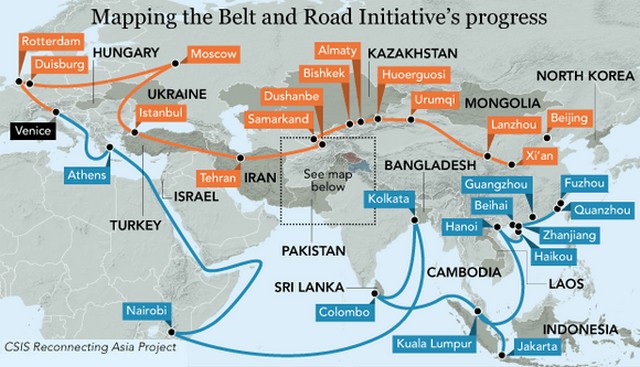
Pakistan on Monday (Oct 7) established the China Pakistan Economic Corridor (CPEC) Authority to speed up the delayed projects as Prime Minister Imran Khan arrived in Beijing

The establishment of CPEC Authority was aimed at accelerating the pace of CPEC related activities.

Multi-billion dollar CPEC was launched in 2015 and several projects under the first phase are close to completion. But the progress on CPEC next phase projects have reportedly slowed since Prime Minister Imran Khan came to power last year.

The Pakistani media has reported that most of the CPEC-related projects have stalled due to certain reasons, including prevailing financial crunch confronting the government and non-cooperation’ of the bureaucracy due to fear of the National Accountability Bureau, the anti-corruption watchdog.

The CPEC is the flagship project of President Xi Jinping’s multi-billion Belt and Road Initiative (BRI).

The CPEC has also become a major irritant in India-China relations with New Delhi voicing its opposition to the infrastructure project as it traverses through Pakistan-administered Kashmir. India is wary of not only Pakistan becoming the recipient of all of this development but also of the increasing role of China in the region.

The CPEC was one of the major topics of discussion during Imran Khan’s two-day (Monday, Tuesday) talks with Chinese President Xi Jinping and Premier Li Keqiang.

The CPEC Authority shall be primarily responsible for coordination, monitoring and evaluation to ensure implementation of CPEC activities. It shall exercise its powers and perform its functions in line with the framework and memorandum of understanding signed between Pakistan and China.

Pakistan has also amended tax laws to give income, sales tax and custom duty exemptions to Gwadar Port and Gwadar Free Zone to enabled them to deal with transit trade.

Meanwhile media reports said Prime Minister Imran Khan has decided to hand over cash-bleeding Pakistan Steel Mills (PSM) to China for its revival.

The federal Minister for Planning, Development and Reforms Makhdum Khusro Bakhtyar said Sunday that the government would offer the steel sector to China for bilateral cooperation in an effort to reduce about $2bn current imports on account of scrap and steel products.

The cooperation in this field would help the country enhance Pakistan Steel Mills capacity to three million tonnes, he said, explaining that Pakistan’s steel requirement was currently nine million tonnes and was estimated to increase to 12m tonnes within a few years as economy starts to grow. At present, the country’s total steel production stood at 4.5m tonnes.

“All the existing projects under the CPEC portfolio have been streamlined and there is no slowdown anywhere,” the minister said.

The CPEC is an economic ‘corridor’ or zone between China and Pakistan started in 2015 and eventually, on completion, will be connecting a number of countries in South and Central Asia for trade and industrial purposes.

Originally valued at $46 billion, the value of CPEC projects is worth $62 billion as of 2017.

A vast network of highways and railways are to be built under the aegis of CPEC that will span the length and breadth of Pakistan.

Modern transportation networks built under CPEC will link seaports in Gwadar and Karachi with northern Pakistan, as well as points further north in western China and Central Asia.

A 1,100 kilometer long motorway will be built between the cities of Karachi and Lahore as part of CPEC, while the Karakoram Highway from Hasan Abdal to the Chinese border will be completely reconstructed and overhauled.

Pakistan’s railway network will also be extended to eventually connect to China’s Southern Xinjiang Railway in Kashgar. The estimated $11 billion required to modernize transportation networks will be financed by subsidized concessionary loans.

The corridor will include 2,000 kilometres transport link between Kashgar in North-Western China to Pakistan’s Gwadar Port on the Arabian Sea via roads, railways and pipelines.

The CPEC’s potential impact on Pakistan has been compared to that of the Marshall Plan undertaken by the United States in post-war Europe. Pakistani officials predict that CPEC will result in the creation of upwards of 2.3 million jobs between 2015–2030, and add 2 to 2.5 percentage points to the country’s annual economic growth.

The real pivot in this game is port of Gwadar. Located near the Strait of Hormuz, Gwadar will save 12,900 KMs of sea route which Middle Eastern energy supplies take to reach China’s eastern board through Strait of Malacca. This new route from Gwadar will serve a dual purpose for China — shorter land route and a strategic advantage in the form of reduced dependence upon India and US. It will also help China in the development of some of its least developed regions in the west.

Pakistan gives 23-year tax exemption to Chinese firm operating in Gwadar

Pakistan has decided to grant a tax exemption to a Chinese firm for 23 years to facilitate the establishment of its industrial units at Gwadar Port in Balochistan.

China Overseas Ports Holding Company Gwadar (COPHC) Chairman Zhang Baozhong told a press conference in Islamabad on Tuesday the tax exemption will be a turning point for Pakistan’s economy and now billions of dollars will be invested in Gwadar.

The COPHC and its four subsidiaries are responsible for operating the seaport and its economic zones for a period of 23 years.

The concessions had been guaranteed in the Gwadar Port Concession Agreement but the successive governments were not notifying them. However, President Dr Arif Alvi on Monday promulgated two ordinances to set up China-Pakistan Economic Corridor Authority and Tax Laws Amendment Ordinance 2019.

“I believe Gwadar will be the largest contributor to the gross domestic product (GDP) growth in seven years,” said the chairman, adding that 95% of the production in the Gwadar Free Zone would be exported.

Currently, Karachi remained the single largest contributor to the national economic output.

“We have completed the master plan of the Gwadar Free Zone that will be built in four phases over a period of seven years,” said Baozhong. “Once the zone is fully developed in seven years, 47,000 jobs will be created for the locals, and its annual sales will be $1 billion.”

On the troubles faced in reaching this point, the COPHC chairman said, “Today is a big day and I had to struggle for seven years to secure these tax concessions, which had been promised in the Gwadar Port Concession Agreement. I had been running up and down for seven years and everybody made promises with me but nobody helped.”

“So far, 41 investors have come forward to invest about $500 million in Gwadar Free Zone in the first phase,” said the port operator. “These industries are being set up in sectors of logistics, edible oil, piping, and halal food.”

He said the $500 million investment would create 5,000 jobs for the locals in phase one alone, adding that the free zone developer had made it binding for the investors to complete the physical infrastructure in six months and start production within one year.

Abdus Sattar Ghazali is the Chief Editor of the Journal of America (www.journalofamerica.net) email: asghazali2011 (@) gmail.com

11 October 2019

Source: countercurrents.org
Time to Rebel

By Chris Hedges

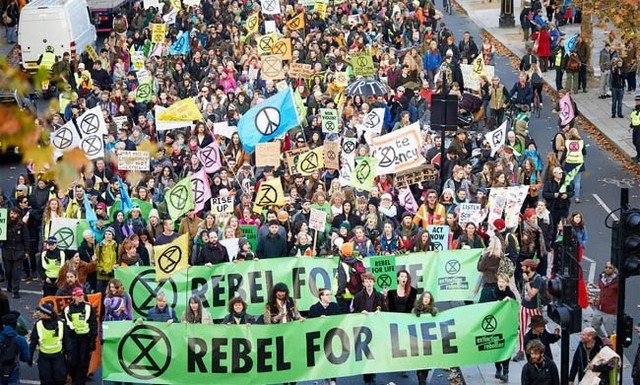
Monday, Oct. 7. marks the start of what the British-based group Extinction Rebellion is calling the International Rebellion. Thousands of people will occupy the centers of some 60 cities around the globe, including Madrid, Amsterdam, Paris and New York, to stage nonviolent occupations of bridges and roads for at least a week. The goal is to paralyze commerce to force the ruling elites to respond to the climate emergency. I will be at Battery Park in New York to join them Monday morning.

The protests, which organizers say will likely lead to hundreds of arrests, will employ a variety of tactics, including activists who will superglue themselves to trains, subways and buildings as well as build temporary encampments to disrupt traffic. The New York event will open at 9:30 a.m. Monday with a “funeral march” from Battery Park. At 2 p.m. Monday, organizers will set up base in Washington Square Park and use it as a staging area. Activists will congregate at the park and fan out in groups across the city to carry out protests. The disruptions during the week in New York will occur in a variety of locations, including in the Financial District and at the New York Stock Exchange, Columbia University and major cultural institutions. In Chicago, there will be an attempt to occupy City Hall and Daley Plaza. London activists, who shut much of the city down in April for 10 days and saw 1,000 arrests, are planning to hold out for three weeks.

“It is our sacred duty to rebel in order to protect our homes, our future, and the future of all life on Earth,” Extinction Rebellion writes. This is not hyperbolic. We have, as every major climate report states, very little time left. Indeed, it may already be too late.

“People have to go to the capital city,” said Roger Hallam, the co-founder of Extinction Rebellion and a researcher at King’s College London, when we spoke earlier this year. “That’s where the elite is, the business class. That’s where the pillars of the state exist. That’s the first element. Then you have to have a lot of people involved. They have to break the law. There’s no point in just doing a march. They have to literally close down the streets. They have to remain nonviolent. That’s absolutely crucial. Once you get violent, police and the state have an excuse to remove you. It’s got to be cultural. You make it into a sort of Woodstock affair. Then thousands more people come onto the streets.
“There’s a fundamental difference between breaking the law and not breaking the law. It’s a binary difference. When you break the law, then you’re massively more effective in terms of material and psychological influence as well as media interest. The more dramatic the civil disobedience, the better. It’s a numbers game. You want people blocking the streets, but you need 10, 20, 30 thousand. You don’t need 3 million. You need enough for the state to have to decide whether to use repression on a mass scale or invite you into the room. The gambit, of course, particularly in the U.K., is that the state is weak. It’s been hollowed out by neoliberalism. They’re going to find themselves overwhelmed. We will get in the room.”

The group stresses what it calls a “pre-social-media age” strategy for organizing. It has created decentralized structures to make decisions and issue demands. It sends out teams to give talks in communities. It insists that people who participate in the actions of Rebellion Extinction undergo “nonviolent direct-action” training so they will not be provoked by the police or opposition groups.

“Most of the recent mass mobilizations have been social-media-fueled,” Hallam said. “Consequently, they have been chaotic. They are extremely fast mobilizations. Social media’s a bit like heroin. It’s a high, but then it collapses, like we’ve seen. It becomes chaotic or violent. A lot of modern social movements put stuff on social media. It gets clogged up with trolls. There are lots of radical-left organizations arguing about different privileges. We’ve circumvented that and gone straight to the ‘common people,’ as you might say. We’ve held meetings in village town halls and city halls. We go around the country in a 19th-century sort of way, saying, ‘Hey guys. We’re all fucked. People are going to die if this isn’t sorted out.’ The second half of the talk is: There’s a way of dealing with this called mass civil disobedience.

“Nonviolent discipline, as the research shows, is the No. 1 criterion for maximizing the potential for success. This is not a moral observation. Violence destroys movements. The Global South has been at it for a few decades. Violence just ends up with people getting shot. It doesn’t lead anywhere. You might as well take your chances and maintain nonviolent discipline. There’s a big debate within the radical left over the attitude toward the police. This debate is a proxy for the justification of violence. As soon as you don’t talk to police, you’re more likely to provoke police violence. We try to charm the police so they’ll arrest people in a civilized way. The metropolitan police [in London] are probably one of the most civilized police forces in the world. They have a professional team of guys who go to social protests. We’ve been in regular communication with them. We say to the police, ‘Look, we’re going to be blocking the streets. We’re not going to not do that because you ask us not to.’ That’s the first thing to make clear. This is not an item for discussion. They know it’s serious. They don’t try to dissuade us. That would be silly. What they are concerned about is violence and public disorder. It’s in our interest as civil disobedience designers not to have public disorder, because it becomes chaotic.”

“You’re basically holding the economy of a city to ransom,” he said of the shutdowns. “It’s the same dynamic as a labor strike. You want to get into the room and have a negotiation. Extinction Rebellion hasn’t quite decided what that negotiation is going to be. We’ve got three demands—the government tells the truth, the carbon emissions go to zero by 2025, which is a proxy for transformation of the economy and the society, and we have a national assembly which will sort out what the British people want to do about it. The third demand [calling for a national assembly] is a proxy for transforming the political structure of the economy. It proposes a different, concrete form of democratic governance, based around sortition rather than representation. This has had a big influence in Ireland and Iceland. The optimal transition is going to be from the corrupted ‘representational’ model to a sortition model in the same way aristocratic law shifted to representational law at the end of the 17th and beginning of the 19th century.

“The intelligent people on the political left have woken up to the fact that we’ve got an existential emergency that could destroy human society in the next 10 years. It’s in the cards. A lot of us have already gone through the grief process. But these [newly awakened] people just had that enlightenment. They’re in shock. They’re maintaining a veneer of ‘It’s sort of OK.’ This is what the Green Deal [a United Kingdom government policy initiative] is about. It is an attempt to pretend that industrialization can stay the same. We can all still be wealthy. We can all still have great jobs. It is like Roosevelt’s New Deal. But the New Deal was based on the idea that we can carry on plundering nature and nothing’s going to happen. Maybe that was right in the 1930s, but it’s not right anymore. It’s a matter of physics and biology. We simply cannot maintain these levels of consumption. They haven’t reckoned with that. One of the main reasons the climate debate has not gotten into a serious mode over the last 30 years is because people who are in charge of informing the public are terrified of telling the public that they can’t have the high consumer lifestyle anymore. It’s a taboo. But like any addiction, there comes a moment of truth. We’re there now.”

“For 30 years we’ve had one political metaphysic, reform,” he said. “You either reform or you are irrelevant. But now, we have two massive, exponentially increasing structural faults—the inequality problem and the climate problem. A lot of people—because of path dependency dynamics—have worked for 30 years in this lost-cause sort of space. They’re desperate for change. For 30 years, they’ve been putting their money on reform. The tragedy—and you can see this in the history of political struggle going back hundreds of years—is there’s a flip where the reformists lose control. They’re still living in the past world. The revolutionaries, who everyone thinks are ridiculously naive, suddenly come to the fore. It’s usually a quake. It’s not a gradualist thing. It’s a double tragedy because it’s a quake and the revolutionaries usually aren’t organized. I think that’s what’s happening now. It has very big implications for [resistance against] fascism. Unless you have a clearheaded mass mobilization on the left, which is connected with the working class, you’re not going to be able to stop the fascism.”

These protests are a welcome antidote to the choreographed and ineffectual climate marches of the past in which protesters dutifully stayed in police-designated areas and dispersed after a few hours. The goal is not simply to protest but to throw a wrench into the machine. The group has 10 working principles that center on nonviolent resistance. These principles are:

We have a shared vision of change: to create a world that is fit for generations to come.

We set our mission on what is necessary, mobilizing 3.5% of the population to achieve system change – using ideas such as “momentum-driven organizing” to achieve this.

We need a regenerative culture, creating one that is healthy, resilient and adaptable.

We openly challenge ourselves and this toxic system, leaving our comfort zones to take action for change.

We value reflecting and learning; as we follow a cycle of action, reflection, learning and planning for more action, we learn from other movements and contexts as well as our own experiences.

We welcome everyone and every part of everyone, and work actively to create safer and more accessible spaces.

We actively mitigate for power, breaking down hierarchies of power for more equitable participation.

We avoid blaming and shaming; we live in a toxic system, but no one individual is to blame.

We are a nonviolent network; using nonviolent strategies and tactics is the most effective way to bring about change.

We are based on autonomy and decentralization, collectively creating the structures we need to challenge power.

Anyone who follows these core principles and values can take action in the name of Extinction Rebellion.

You can see interviews I did with Hallam, who was jailed two weeks ago by British police in preemptive effort to curtail the rebellion here, here and here.

The longer we live in denial, the worse it will get. There is no way out. Floods, droughts, monster hurricanes, cyclones, extreme heatwaves, crop failure, mass displacement and the breakdown of society are now inevitable. This is our future. The democratic methods for change—voting, lobbying, petitions, education and protests—have proved to be spectacular failures. The corporate forces that have seized control of our political and economic systems will, unchecked, drive us into extinction for profit. All we have left is nonviolent, disruptive civil disobedience. A rebellion. And if we fail, we will at least obliterate our despair, find solace in a community of resisters and restore our emotional health and our dignity by fighting back against those who are engineering the ecocide.

Chris Hedges writes a regular column for Truthdig.com.

7 October 2019

Source: countercurrents.org
Will Confronting Iran Lead to War or Peace?

By Richard Falk

1 Oct 2019 – This is a slightly modified version of an interview published in The Nation on 25 Sep following the 14 Sep attack on Saudi oil facilities. It follows a pattern, with respect to Iran, of accusations, denials, and public uncertainties. This combination of elements, given the leadership in Washington and Tehran, one blustering, the other inflexible, can easily produce an unintended stumble into war.

A second shorter interview is appended, conducted prior to the attacks, by Iranian journalist M.J. Hassani of Tasnim News Agency. It illustrates the seeming rigidity of Iran’s Supreme Guide, considered as having the final word on government policy, exceeding that of the elected leadership.

*******************************

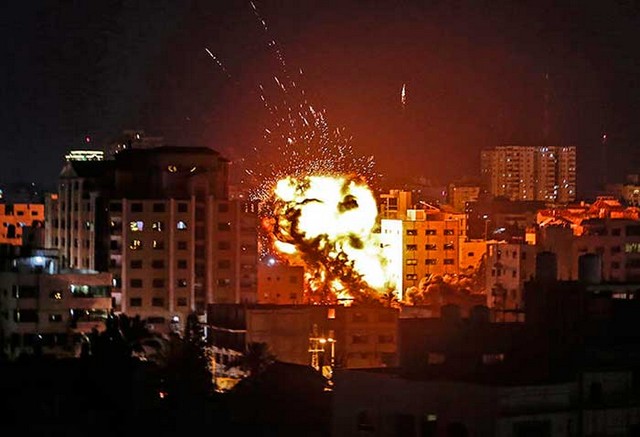
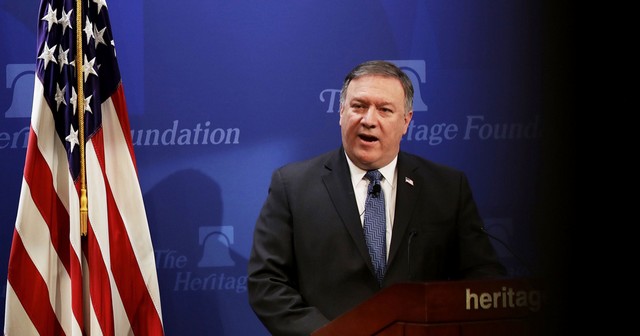
Daniel Falcone’s Introduction to the Interview: After accusations of Iranian drone attacks on Saudi oil facilities, Iranian officials and authorities indicated that “full-fledged war” with the United States could be imminent, prompting Aramco, Saudi Arabia’s state oil company, to suspend oil production by nearly 6 million barrels per day. US Secretary of State Mike Pompeo referred to the purported aggression as an “unprecedented attack on the world’s energy supply.” The allegations caused other countries to ostracize Iran at the United Nations General Assembly and significantly complicated the prospects of a multilateral nuclear deal.

Falcone: Can you provide some context for this latest series of headlines regarding the “Iranian threat.” Is this just “old wine new bottles?”

Falk: The magnitude of this attack on Saudi oil facilities makes the situation more dangerous even if it is considered as nothing more than a quantitative escalation of Iran’s response to US sanctions and other provocations, an Iranian version of Trump’s proclaimed policy of applying ‘maximum pressure’ to bring Iran to its knees. Yet it could be a qualitative escalation if the attack is treated as the biggest test of the US commitment to dominance in the region since 1956 when the US sided with the UN in calling for France, the UK, and Israel to withdraw from the Sinai after the Suez Operation. As Falcone suggests, the American Secretary of State, Mike Pompeo, made war-mongering remarks, including calling the attacks ‘an act of war.’ It is hard to deny that such an attack is an act of war, but against whom, by whom, has not been firmly established.

And yet, the hawks in the room clamor for blood, and do not seem to mind if the result is an all out regional war. Stephen A. Cook, the respected Council on Foreign Relations Middle East expert, endorsed this qualitative line of interpretation when he ended his analysis of the attack with some inflammatory words: “If Trump does not respond militarily, the United States should just pack up and go home.” [see Cook, “This is the Moment that Decides the Future of the Middle East,” Flash Points, Sept. 18, 2019]

At the same time, Trump seems to be inclined, at least for the present, to regard the attacks on the Abqaiq oil processing facility and the Khurais oil field as a big serving of the old wine. Trump in typical fashion has displayed both bluster and restraint. At least verbally Trump has spoken in a muscular vein, insisting that if Iranian responsibility for the attack can be demonstrated, then he will retaliate in some proportionate manner. Even under these circumstances, possibly with his eye on November 2020, Trump seems determined to avoid acts that would start an unwanted war. Although ambiguously, Trump still somewhat surprisingly appears to be keeping the diplomatic door ajar. He has been quoted as saying, probably much to Israel’s chagrin, “I know they [the Iranians] want to make a deal..at some point it will work out.” It will not work out if Trump uses this transactional language when approaching the religious leadership of Iran, even if directed at President Rouhani who leads the moderate forces in Tehran. To talk of ‘a deal’ is to demean the process, and helps explain the deep distrust of any American move toward negotiation that was unreservedly expressed recently by Iran’s supreme guide, Ayatollah Khamenei. U.S. leaders and diplomats should by now have learned that the language of the bazaar does not work if the objective is to find an agreement that serves the interests of both sides.

Falcone: With Iran, Trump seems to be caught in a pickle. On the one hand, he needs to undo the Obama legacy in the region with the Joint Comprehensive Plan of Action (JCPOA). On the other hand, he runs the risk of looking like a neoconservative. What’s going on in your estimation?

Falk: I think you are correct in sensing the conflicting pressures on Trump. He cannot go back on his repudiation of the JCPOA agreed upon in 2015 and its Obama approach without seeming to be giving in to Iran’s pressure. At the same time, he evidently does not want to follow the Bolton/neocon/Pompeo path that leads to open military action, and most likely followed by a devastating war. In this sense, Trump’s ideal outcome would be some sort of diplomatic accommodation that he could ‘sell’ as a demonstration that ‘maximum pressure’ has yielded results. Whether he could spin such an outcome as a victory outside of his base seems doubtful as there would be many critics who would insist that any such result, even if it disguised the revival of JCPOA with another round of negotiations and a new name, would be viewed as at best a repetition of what had been achieved by the P5 + 1 Obama diplomacy of 2015. In fact, it now seems that to get any agreement with Iran there would have to be a much more solid commitment by the US and its allies that sanctions could not be again re-imposed on Iran in the future without a collective decision by the parties to the agreement. Such a condtion might possibly also be reinforced requiring a confirming decision on sanctions by the UN Security Council. If I were negotiating on Iran’s behalf, I would certainly insist on ironclad assurances that sanctions could not be renewed by a unilateral decree issued in Washington. Perhaps, Iran could be persuaded to accept some joint arrangements on regional peacekeeping and nonintervention that could be sold in Washington, and maybe even in Jerusalem and Riyadh as curtailing Tehran’s projection of regional power.

Falcone: John Bolton was recently fired. Can you talk about his role in the administration to get us to this point. I’m wondering if his dismissal is mere optics and the Bolton-Pompeo foreign policy is firmly in Trump’s hand.

Falk: We should realize by now that Trump’s highly quixotic style is resistant to all attempts at rational analysis. We do not really know whether Trump was reacting to Bolton’s belligerence with respect to foreign policy or to his aggressive, pushy personality that has long offended many prominent persons without achieving promised foreign policy victories. For instance, his advocacy of maximum pressure did not produce the desired regime change in Iran, or even a pullback on its regional involvements as in Gaza, Lebanon, and Yemen. All it did was to raise regional tensions to dangerous heights.

It does not appear that there is any sign of an ideological shift in the White House, although there does seem to be a more complex approach preferred by Trump, which fuses bluster and threats with this resolve to avoid outright combat, war, and any course of action that might lead to American casualties. This zigzag pattern of diplomatic maneuvering has so far seemed capable of absorbing Trump’s drastic mood swings and off the chart impulsiveness. The fact that it drives crazy the rational think tank gurus who dominate the Beltway can be regarded as a plus for Trump. Perhaps, the best explanation of Bolton’s dismissal was his fiery independence, which must have been fundamentally at odds with Trump’s insistence on low-profile deference from his top advisors and the shaping and reshaping of foreign policy on the basis of a constant search for transactional gains (even at the cost of diplomatic setbacks), which treats global policymaking as if it is just a replica of how to succeed in the urban real estate market without trying too hard.

It is lamentable that Bolton’s successor as National Security Advisor, Robert O’Brien, seems to be a milder version of the same hawkish pedigree, although seemingly more bureaucratic, less ascerbic, in style. A few years ago, O’Brien published a book of essays [While America Slept: Restoring American Leadership to a World in Crisis] that was highly critical of the supposed passivity of Obama’s foreign policy. In recent years, as State Department coordinator of hostage releases O’Brien has proven his value by being a Trump enthusiast, which in the present climate is the best credential a person can have who seeks a promotion to a high-status position in the federal government.

Falcone: How does oil, sanctions, and our relations with the Saudis contribute to the rising tensions in the region and the dangerous possibility of escalations?

Falk: There is no doubt that the sanctions imposed on Iran, coupled with the repudiation of the JCPOA, has escalated the conflict, and resulted partly from Washington seeking to please the Saudis and Israelis by adopting a more confrontational approach to Iran. As well, in the background is the dream scenario of toppling the regime, or at least forcing it to plead for mercy. There is no doubt that sanctions have caused great harm as measured by social and economic conditions in Iran, a collective and indiscriminate punishment mainly inflicted on the Iranian civilian population. Such coercion violates the UN Charter and international law. This punitive behavior against Iran resembles what was done to the Iraqi population in the twelve years after the First Gulf War. The frustrations with this reliance on sanctions eventuated in a devastating attack and occupation of Iraq initiated by George W. Bush in 2003. The Iraq War ended in a costly strategic failure given its supposed goals, including a boost to extremism concretely exhibited by the rise of ISIS almost in direct response to the heavy-handed American occupation policies in Iraq.

The prolonged strife in Yemen is part of this mindless militarism. It has included strong American backing for a brutal Saudi intervention from the aiir that has caused widespread suffering on the part of a largely helpless society, posing serious threats of massive famine and disease epidemics

Falcone: I’ve noticed whenever Trump wants to avoid delivering a foreign policy message and tone that sounds like Bush or Clinton he trots Pence out there to do the dirty work. Is this, in your view, to promote war with Iran yet try to create an intentional distance from neoliberals and neoconservatives?

Falk: As always, it is hard to interpret the logic behind Trump’s moves, or even to believe that a discoverable logic exists. He seems to act without calculating gains and losses unless money is involved, but is focused on trying to achieve immediate results that bring him notoriety if not glory. If there is a policy failure, then Trump does his best to shift the blame to others. Perhaps, because confronting Iran is a risky kind of diplomatic venture, it is best to put Pence out in front as often as possible, and thus seek to distance himself from responsibility if and when policy breakdowns occur. Trump consistently personalizes foreign policy and his leadership role demands above all that media attention is focused on himself. Trump stretches the reality of almost any situation to implausible extremes making it necessary to exonerate himself from distasteful and dysfunctional behavior by inverting and inventing facts, lying when it seems helpful, and disseminating fake news without blushing.

Falcone: Of course Israel will always be pertinent in figuring out the US method to the madness concerning Iran. How can following the US-Israeli alliance help us to get a sense of potential war with Iran. Or has this war already been underway?

Falk: The connections with Israel are vital to an understanding of the US role in the Middle East, and especially in the context of Washington’s ‘special relationships’ with Israel and Saudi Arabia. The Israeli relationship is more deeply rooted in American politics than is the Saudi connection, which seems interest-based, relating not only to oil but also to its status as the world’s primary arms purchaser. With respect to both countries, it is arguable that these special relationships are contrary to American national interests in the Middle East, and also lead to behavior contrary to America’s professed values. With regard to the Saudis, their huge investment in the dissemination worldwide of a fundamentalist Wahhabite doctrine of Islam would seem radically at odds with the US counterterrorist strategy, especially since 9/11. If Iran’s indirect involvement in the attacks on the Saudi oil facilities is established, then it would allow us to make a challenging comparison with the Saudi direct and indirect involvement in the 9/11 attacks, which according to the official version of the events implicated 15 Saudis of the 19 hijackers.

Most damaging is the FBI evidence of Saudi support for the attacks that killed almost 3,000 Americans that has been withheld all these years until families of victims finally obtained their release. The efforts of the presidency of George W. Bush with inappropriate help from the FBI director at the time who happened to be Robert Mueller, to shield Saudi embassy officials and others close to the royal family from any accountability, or even scrutiny. Only the pressure of survivors and survivor families seems finally to be prying some of this information loose in the course of a law suit charging Saudi complicity in 9/11. Shockingly, yet to be expected, hardly a word appears in the mainstream media, and even now Trump’s Attorney General, William Barr, is invoking the state secrets act to justify on national security grounds withholding evidence that evidently would further incriminate Saudi Arabia. These developments coming to light 17 years after 9/11 should give pause to those who still question the primacy of geopolitics and the unacceptable behavor of the deep state when it comes to the conduct of American foreign policy or even the protection of national interests and the wellbeing of American citizens. It also raises haunting questions about the effects of these two special relationships, and reminds us of the ugly connivance and coverup of the Israeli assault on the USS Liberty back in 1967 that killed 44 American naval personnel. For those who seek the full exposure of this incident, I urge a reading of Joan Mellen’s Blood in the Water, written with the cooperation of leading officers of the Liberty who survived the attack. In effect, bad as Trump is on these issues, he cannot be blamed for everything. These pernicious special relationships long preceded his presidency, and were bipartisan.

As for Israel, the relationship has definitely turned Arab public opinion and popular sentiments strongly against the US, and made the US continued dominance in the region depend on propping up anti-democratic autocratic leaders. The whole policy of confronting Iran has for many years been driven by the Netanyahu leadership, gravely weakening America’s role as a responsible global leader, and risking a war that would be a humanitarian and geopolitical disaster.

How far Israel, as a state, and Netanyahu, personally, are to blame for the escalated confrontation with Iran is difficult to assess, but it would seem to be substantial. What stands out for me is how supposed American ‘patriots’ can continue to swallow the toxic kool aid of these two special relationships. It may be time to reconsider what constitutes patriotism and what constitutes treason. In a world where Edward Snowden, Chelsea Manning, and Julian Assange are viewed as criminals but John Bolton, Mike Pompeo, and Donald Trump are viewed as national patriots there is something terribly wrong with our political language.

********************************

Tasnim News Agency Interview Questions by M. J. Hassani

17 Sept 2019

Hassani: On Tuesday, Leader of the Islamic Revolution Ayatollah Seyed Ali Khamenei deplored the US’ calls for talks with Iran as a trick and said that Tehran will not negotiate bilaterally or multilaterally with Washington at any level. What do you think about Ayatollah Khamenei’s remarks?

Falk: With all due respect, I think that Ayatollah Khamenei’s remarks are phrased in too unconditional language. I believe that it is not desirable to shut the door to what I call ‘restorative diplomacy,’ and thereby avoid any further devastation caused by the current reliance on ‘coercive diplomacy’ by the adversaries of Iran and by Iran’s ‘active resistance.’ Trump is unpredictable and impulsive, and should not be challenged so directly as he might act irrationally in ways that could be mutually catastrophic. At the same time, the Iranian religious leader is correct to express the view that Iran will not engage in normalization talks so long as the United States and Israel seek to impose unacceptable restraints on Iran as a sovereign nation, while they engage in unrestrained and unaccountable military action throughout the entire Middle East.

Hassani: The reason behind this approach is that Iran sees the US calls for negotiation as a trick aimed at imposing its demands on the Islamic Republic and pretending that the “maximum pressure” policy has worked. This is while Iran has not given in to the US pressures so far. Is the reason justified? How do you assess Iran’s policy of “active resistance” against the US?

Falk: I agree with the view that Iran should not be lured into a negotiation that gives the US a public relations victory by claiming the success of its ‘maximum pressure’ approach, but this should be done by Tehran in ways that also expresses Iran’s search for an improved regional and global political atmosphere that is geared toward peace and co-existence rather than war and hostility. I believe Iran has effectively made its point that it will not back down in the face of harsh sanctions and other hostile acts that are contrary to international law. Now it can seize the initiative by proposing a constructive approach that shows that it seeks normalization on the basis of sovereign equality, and is not seeking confrontation for the sake of confrontation.

Hassani: Iran has described the US return to the 2015 nuclear deal, known as the Joint Comprehensive Plan of Action (JCPOA), and the removal of sanctions against the Islamic Republic as the only way that Washington can hold talks with Iran. How do you see the prospect of open diplomacy between Iran and the US as well as the other parties to the JCPOA?

Falk: Trump has wrongly, and for regressive political reasons, condemned the JCPOA, but would have incredible political difficulty and embarrassment if he now were to affirm it. The motivation for condemning JCPOA had to do with his efforts to repudiate Obama’s diplomacy and to show total solidarity with Israel, and is not really about the 2015 agreement, except incidentally. I think Iran should propose to reconvene the countries that negotiated in 2015, and produce a new agreement based on intervening developments, but making it clear that this would not be an acceptance of any preconditions put forward by Washington, and would not relate to non-nuclear issues.

Hassani: Can we regard the Islamic Republic’s strategy of “active resistance” against the US pressures as successful given Ayatollah Khamenei’s assertions?

Falk: I think ‘active resistance,’ depending somewhat on how it is defined has been successful so far, but in some ways a dangerous and high risk policy if adhered to much longer. Iran, having made its point effectively, should move to higher ground by proposing constructive deescalating steps such as reconvening the P5 +1 group to come up with a new framework agreement covering Iran’s nuclear program and the ending of US sanctions. The way forward should not be a continuation of the present, but an effort to occupy this high ground of law, morality, and peaceful conflict resolution. It may also be appropriate at this time to propose an emergency meeting of the UN Security Council, which likely would be rejected by Trump, but would put Iran in a favorable light internationally as creatively engaging in restorative diplomacy. Taking a longer view, Iran should consider reviving discussion of a nuclear free zone for the entire Middle East, including Israel, a country that acquired nuclear weapons by stealth and covert assistance from those states now most objecting to Iran’s nuclear program.

__________________________________________

Richard Falk is a member of the TRANSCEND Network, an international relations scholar, professor emeritus of international law at Princeton University, Distinguished Research Fellow, Orfalea Center of Global Studies, UCSB, author, co-author or editor of 40 books, and a speaker and activist on world affairs.

7 October 2019

Source: www.transcend.org

At $716 Billion, the US Military Budget Is Bigger Than Those of 144 Countries Combined and Largest Contributor to Climate Change

By Antonio C. S. Rosa

“State sovereignty is a goner. Bankism and Military Capitalism rule the world in all respects now.
“Militaries are the ultimate manifestation of direct, structural and cultural violence—a cancer that must be extirpated from humanity.”

********************

  • Imperialism: A policy or ideology of extending a country’s power and influence through colonization, use of military force, or any other means.
  • Neocolonialism: The use of economic, political, cultural, military or other pressures to control or influence other countries, especially former dependencies and economically-dependent, less powerful countries.
  • Neoliberalism: The 20th-century resurgence of 19th-century ideas associated with laissez-faire economic liberalism and free-market capitalism. It shares many attributes with other concepts that have contested meanings, including democracy.
  • Fascism: A form of far-right, authoritarian ultranationalism characterized by dictatorial power, forcible suppression of domestic or external opposition backed by an overwhelming military, and strong regimentation of society and of the economy.

*******

It’s no coincidence that US military emissions tend to be overlooked in climate change studies:

*The US Military Is a Bigger Polluter than More than 100 Countries Combined – Quartz – June 28, 2019

*Meet the Money behind the Climate Denial Movement – Smithsonian Magazine – Nearly a billion dollars a year is flowing into the organized climate change counter-movement.

*The U.S. Now Solves Problems with Troops, Not Diplomats – The Conversation – Is the USA a bully? 3 Oct 2019

*The U.S. Spends More on Its Military Than 144 Countries Combined – Institute for Policy Studies – The numbers are stark increases from last year’s differences. July 25, 2019

________________________________________________

Antonio Carlos da Silva Rosa, born 1946, is founder-editor of the pioneering Peace Journalism website, TRANSCEND Media Service-TMS (from 2008), an assistant to Prof. Johan Galtung, Secretary of the International Board of the TRANSCEND Network for Peace Development Environment, and recipient of the Psychologists for Social Responsibility’s 2017 Anthony J. Marsella Prize for the Psychology of Peace and Social Justice.

7 October 2019

Source: www.transcend.org

The Africa-Palestine Conference: South Africa must lead the way

By Ramzy Baroud

On 16 September, I visited South Africa, a country where many Palestinians have always felt welcomed, if not overwhelmed by the degree of genuine and meaningful solidarity. While having the honour to address many audiences in six major cities, I have also learned a great deal. An important and sobering lesson is that while apartheid laws can be dismissed in a day, economic apartheid and massive inequality can linger on for many years. Thanks to my interactions with many South African intellectuals, activists and ordinary folk, I learned not to romanticise the South African struggle, a crucial lesson for those of us fighting to end Israeli apartheid in Palestine.

My hosts at the Afro-Middle East Centre ensured that I met with diverse audiences, including top members of the African National Congress, the leadership of the country’s two major trade union federations, anti-apartheid scholars and activists, and a large number of students and other people throughout the country.

The main, obvious, conclusion from all these meetings and interactions is that South Africans are serious about their solidarity with Palestine, and that they see themselves as partners in the Palestinian struggle for justice and peace. While South Africans are always ready to take their solidarity with Palestine to a whole new level, however, there is a general feeling that decisive political moves can prove costly for South Africa.

True, the South African government has taken several steps in the right direction. On 14 May 2018, Pretoria recalled its ambassador to Israel, Sisa Ngombane, to protest the killing of hundreds of unarmed protesters taking part in the Great March of Return in besieged Gaza. On 5 April 2019, it began to actively downgrade its ties with Israel, in response to a call made by the ANC conference in December 2017.

While these steps are significant, South Africa is yet to take the kind of action that, when combined with others measures of international solidarity, could finally force Israel to dismantle its system of Apartheid in Palestine. The problem is not the lack of willingness nor that of diplomatic doublespeak. There is a growing, and justifiable, sense that Arab governments no longer see the liberation of Palestine as a common objective. While the Arab peoples remain committed in their support of Palestinians, Arab governments have fallen into warring camps and political divisions.

Yet, a top ANC leader told me that South Africa’s policy regarding Palestine is guided by the agendas of the Arab League and the Palestine Liberation Organization (PLO). Sadly, neither the Arab League nor the PLO are serving the roles they were entrusted with decades ago. The former is mired in divisions, and the latter has been effectively replaced by the provisional, factional Palestinian Authority in Ramallah. Using ineffectual organizations as a legal and moral frame of reference is hurting South Africa’s chances of converting its solidarity with Palestine into tangible political assets.

The other dilemma is that the African continent itself is no longer united regarding Palestine. Israel has successively driven a wedge between African countries, which, at one point, were united in their unconditional support of the Palestinian struggle against Israeli military occupation and Apartheid.

Israel’s successes in Africa, especially through the penetration of the Economic Community of West African States (ECOWAS), have made Tel Aviv a political player on the African continent. Boosted by the welcome he received from various African leaders, Israeli prime minister Benjamin Netanyahu had hoped to hold the ‘Israel-Africa Summit’ in October 2017. Thanks to the efforts of African countries like South Africa and Algeria, the conference was postponed indefinitely.

If Israel continues to score political victories while facing little resistance, however, it will eventually dominate the African continent. The absurdity of this goes beyond the struggle in Palestine. A continent that was ravaged by colonialism, racism and apartheid should not embrace the likes of Israel, the exemplification of the very ills that have cost Africa so dearly for hundreds of years.

In fact, the issue of solidarity with Palestine and the pressing need to block Israel’s scourges in Africa are intrinsically linked. In this very link, South Africa can find a way to reclaim its natural role as a vanguard against racism and apartheid everywhere.
My suggestion to the ANC was that South Africa should update its frame of reference, moving away from tired clichés of a defunct, two-state solution and such, to a whole new way of thinking. And it should not go about doing it alone; all of Africa and all Palestinians should be part of this effort.

I strongly believe that South Africa is ready to counter Israel’s efforts on the continent by initiating an Africa-Palestine Conference, a major gathering that aims to harness all the solidarity for the Palestinian people throughout all African countries. Whether such a conference is held under the auspices of the African Union (AU) or independently by a single member state (or even a political party), the gathering of like-minded African and Palestinian leaders, parliamentarians, scholars and civil society leaders can develop a new frame of reference, which South Africa, the African continent, and, in fact, the rest of the world can use as a guiding principle of new thinking on Palestine. Based on the call made by Palestinian civil society in 2005 to boycott, divest from and sanction Israel, the Palestinian people have been demanding and expecting this new thinking for at least fifteen years.

Those who might find the idea that Africa can lead the way on forming a new, global understanding on Palestine far-fetched need to remember that it was the Organization of African Unity’s resolution 77 (XII) of August 1975 that recognised and condemned the ‘organic link’ between ‘the racist regime in occupied Palestine and the racist regime in Zimbabwe and South Africa’. That very resolution served as a major frame of reference used in UN Resolution 3379 of November 1975, which determined that ‘Zionism is a form of racism and racial discrimination’.

Africa must reclaim its position as a global leader in the fight against racism and apartheid, and South Africa is very qualified to spearhead these efforts, because, after all, as iconic South African leader Nelson Mandela once said, ‘We all know too well that our freedom is incomplete without the freedom of the Palestinians.’

Ramzy Baroud is a journalist, author and editor of The Palestine Chronicle.

4 October 2019

Source: www.amec.org.za

Misrepresentations of American & Soviet Roles in WW II and the Cold War

By Eric Zuesse

INTRODUCTION

The Soviet Union contributed more than did any other nation to the defeats of Germany and Japan in World War II

, but America and Britain together defeated Italy. Many prominent Western ‘historians’ white-out the Soviet roles in defeating Hitler and especially Hirohito, and they overstate the importance of America’s victories to the ultimate outcome, and ignore or underplay Franklin Delano Roosevelt’s strong rejection and repudiation of Winston Churchill’s imperialistic agenda, not only for a continuation of empires, but for a continued postwar exploitation of colonies, as being acceptable goals for the future. Those ‘historians’ are actually propagandists — no real historians, at all — because they fundamentally misrepresent; yet they dominate in the ‘historical’ profession, and they have produced in the U.S. and in its allies a widespread and profoundly warped ‘history’ of the war and of its aftermath, and of Twentieth-Century history, and of our own time. This ‘historical’ distortion has continued even after 1991 (it even accelerated) when the Cold War between the U.S. and Russia ended only on the Russian side, but not actually on the U.S. side. These ‘historical’ lies accelerated because ‘historians’ continue, even today, to hide this crucial fact, that the U.S. side of the Cold War secretly continued — and still does continue — to try to conquer Russia. Ever since the time of America’s vile, bloody and illegal actual coup against Ukraine in February 2014 onward, Russia has been responding increasingly. This is especially so because of yet another American-and-allied aggression against a nation that has cooperative arrangements with Russia, Syria, 2012-. The purveyors of fake ‘news’ and fake ‘history’ display the gall to cry foul and to lie and allege that Russia’s necessary defensive actions against America’s aggressions are, instead, themselves, aggressions, to which America and its vassal-nations have the right to respond, and should respond, by what then would actually be yet more aggressions (violations of international law) — instead of to quit its string of aggressions, and to apologize, not only for the aggressions, but also for the lies, that the U.S. regime and its propagandists have been perpetrating, against Russia, and against nations that cooperate with Russia. The reality has been that U.S. foreign policy is, and has been, driven by one overriding and obsessive goal for a hundred years: first, to conquer any nation that’s friendly with Russia, and thereby to isolate Russia internationally; and, then, finally, to grab Russia itself. This entire U.S. geostrategy is based upon lies.

THE ‘HISTORICAL’ LIES, v. THE HISTORICAL TRUTHS

According to the standard accounts, the Cold War ended on both sides in 1991, when the Soviet Union dissolved, and its communism ended, and its Warsaw Pact (the military alliance that the U.S.S.R. had created in response to America’s having created the NATO military alliance against the Soviet Union) all ended. But, secretly, the Cold War continued on the U.S. side, and with the same (and now blatantly) imperialist goal of ultimately conquering Russia and China, so as to establish the first-ever all-encompassing global empire. Whereas Franklin Delano Roosevelt had set up the U.N. so as to evolve into a global democracy of nations — a democratic federal republic encompassing all nations — his successor, Harry S. Truman quickly became deceived by Winston S. Churchill and Dwight David Eisenhower to believe that the Soviet Union was trying to take over the entire world, and so Truman promptly abandoned FDR’s vision and initiated instead the permanent-warfare U.S., the military-industrial-complex-ruled U.S., which relegated the U.N. to a secondary role, as a mere mediator for global diplomacy, not as the international lawmaker that FDR had hoped it would ultimately evolve into. FDR’s dream and intention, of establishing a system of international laws functioning as the all-encompassing global democratic federal democracy in which all nations are represented, became thwarted, almost as soon as he died, when the Deep-State U.S. military-industrial complex that’s run behind the scenes by the controlling owners of America’s top weapons-manufacturing firms took hold.

After WW II, the U.S. Government secretly aspired — and still does aspire — to rule over the entire world, including especially over Russia and China. George Herbert Walker Bush told Robert Sheer in the 24 January 1980 Los Angeles Times and in Scheer’s 1982 book With Enough Shovels, page 29, that in a nuclear war between the Soviet Union and the U.S., the “winner in a nuclear exchange” would be whichever side is stronger than the other at the war’s end; and, so, for Bush, nuclear weapons didn’t exist in order to avoid a nuclear conflict, but instead in order to “win” it. This also is the reason why, on the night of 24 February 1990, Bush secretly told West German Chancellor Helmut Kohl to ignore the promises that Bush’s team were making to Gorbachev, that NATO would not be expanded “one inch to the east” (i.e., not extended right up to Russia’s border) if Gorbachev ends the Cold War. Bush, in confidence, told Kohl “To hell with that! We prevailed, they didn’t.” And he also secretly told French President Francois Mitterrand to pursue no “kind of pan-European alliance” (i.e., alliance that includes Russia) because, actually, total conquest of Russia remains the U.S.-and-allied goal. This view — that the goal is control over Russia — became firmly established in U.S. Government policy by no later than 2006 when Bush’s son was the President and the phrase “Nuclear Primacy” (the ability to “win” a nuclear war against Russia) became used in order to refer to America’s geostrategic goal.

Part of that scam by ’The West’ (the emergent American empire) has been the ongoing ‘historical’ lie that the Allied victory in WW II was mainly an American and British affair, and not mainly a Soviet one. Another part of it is that the Soviet Union had started the Cold War; and yet a third part is that the Cold War was about ideology (communism versus capitalism) instead of about the U.S. regime’s goal of ultimately conquering Russia and China so as to achieve the world’s first and only full global and unchallengeable empire.

The excuse for all of this was always the allegation that global empire is Russia’s goal and that the U.S. therefore needs to win the nuclear war when it ultimately happens. But Russia, and its prior USSR, always did maintain, and still does maintain, as actual Government policy (not just mere verbiage, such as in America after 1980) the belief in “MAD” or Mutually Assured Destruction — the idea that any nuclear war between the two superpowers will destroy the entire planet and therefore produce no winners whatsoever — no winner but only nuclear winter — regardless of which side might temporarily emerge the stronger while nuclear winter and resulting global famine soon destroy all life on Earth after that nuclear exchange. Russia is not (like America is) aiming to take over the planet. The fact that the U.S. regime is trying to take over the planet has shocked even America’s top geostrategic scientists. The ‘historians’ hide all of this, so as to continue the myth that in the U.S.-Russia relationship, Russia is and has been the aggressor, and America the defender — instead of vice-versa, which is, and has been, the historical reality.

A rare, early, excellent, and honest, Western history of the immediate post-WW-II world, was the libertarian William Henry Chamberlin’s 1950 book America’s Second Crusade. Its earnest author — a disenchanted former socialist who once had trusted Stalin’s goodwill but was dismayed now to find Stalin to be America’s enemy as well as an unforgivable tyrant to the nation he led — opened by saying “My book is an attempt to examine without prejudice or favor the question why the peace was lost while the war was being won.” He was struggling to understand how and why and when the Cold War started, but unfortunately, some key documents, in order to become enabled to understand that, had not yet become public. A crucial passage in his book that reflected state-of-the-art historical writing in 1950 but certainly not today, asserted:

Stalin’s diplomatic masterpiece was his promotion, through his pact with Hitler, of a war from which he hoped to remain aloof. [FALSE: Stalin knew that the Soviet Union was Hitler’s main target to attack, and he was terrified of that]

This attractive dream of watching the capitalist world tear itself to pieces and then stepping in to collect the fragments was shattered by Hitler’s attack in June 1941. [FALSE: that war between U.S.S.R and Germany was already baked-in in 1939; and it was Stalin’s nightmare — not his “dream.”]

Chamberlin thought that Stalin had made with Hitler the 1939 Ribbentrop-Molotov Pact because Stalin had wanted to join with Hitler in taking over the entire world — i.e., for aggression, instead of for defense; i.e., instead of so as to protect the U.S.S.R. from becoming invaded by Hitler (which defensive motivation actually is what obsessed Stalin). Chamberlin thus wrote approvingly of “Churchill’s scheme which would have limited the extent of Soviet conquest.” Chamberlin thought that the ideological conflict (to the extent that there actually was one in the Cold War) was between communism versus capitalism, not between fascism versus non-fascism (which it was, and still is).

Here are the facts, which have been revealed by the making-public of archives as of 2008 and subsequently:

On 18 October 2008, Britain’s Telegraph bannered “Stalin ‘planned to send a million troops to stop Hitler if Britain and France agreed pact’” and buried the core revelation, that Stalin prior to the Ribbentrop-Molotov Pact recognized Hitler’s determination to conquer the Soviet Union and he had, on 15 August 1939, urged British Prime Minister Neville Chamberlain to accept the U.S.S.R. as an ally in their mutual war to defeat Hitler; but Chamberlain refused, and so Stalin reached out to Hitler for an agreement with him to a dividing-line between those two countries’ (Germany’s and U.S.S.R.’s) essential areas of control for each one’s national security. Poland especially was a worry to both of them, because Poland had had territorial conflicts with both Germany and the Soviet Union. Thus was signed on 23 August 1939 the Ribbentrop-Molotov Pact, which split Poland between both countries.

The Versalles Treaty at the end of WW I had handed to Poland what had been German territory that through most of prior history had been Polish territory. Hitler was elected into power in 1933 vowing to abandon that Treaty and to restore, to German rule, that part of Poland.

As regards Poland’s conflicts with Russia: Poland had invaded Moscow during 1605-18, before Russia responded by both military and diplomatic means to virtually conquer Poland into becoming a colony of Russia, which it remained almost uninterruptedly until 1939, when the Hitler-Stalin agreement — the Ribbentrop-Molotov Pact — restored part of Poland to the Soviet Union, but handed the other part of Poland to Germany.

Stalin, having been spurned by Chamberlain (who held his own imperialistic intentions — he was as imperialistic as were the fascists: Hitler, Hirohito, and Mussolini), had actually no other option in 1939 than to reach a peace-agreement with Hitler, so as to avoid having the Soviet Union become swallowed up by the capitalist countries — first by Germany, and then by whatever countries would finally win the coming World War (presumably, likewise Germany).

This is why the historian Chamberlin’s claim that Stalin’s “dream” of imperialist expansion “was shattered by Hitler’s attack in June 1941” is false: Stalin’s necessity for the U.S.S.R. to be granted enough time, to prepare for Hitler’s Operation Barbarossa invasion against it (which ended up starting on 22 June 1941), caused the Ribbentrop-Molotov Pact to become signed on 23 August 1939, which signing sparked both of its signatories to promptly invade Poland and start the active phase of WW II on 1 September 1939, both countries invading Poland. FDR didn’t hold that agreement against Stalin, but instead against Chamberlain, who really hated Russia and virtually forced Stalin into that Pact. Chamberlain’s goal wasn’t to get the Soviet Union onto Britain’s side but instead for a war between the Soviet Union and Germany to weaken both of them enough for a UK-U.S. alliance to take over both of them, and, ultimately, the world. FDR got Chamberlain’s successor Churchill to agree to a “United Nations” in which there would be an international democracy of nations and all military weapons and enforcement of General Assembly laws would be possessed and enforced only by “the Big Four” of U.S., UK, U.S.S.R., and China, but Churchill balked at including China because he wanted to retain control of his eastern vassal-nations. FDR agreed instead to each of the Big Four enforcing U.N. laws only within its own neighborhood, so as to prohibit friction between the Big Four — and China would enforce in East Asia and Western Pacific, which meant Britain’s freeing India, Burma, Malaya, and some other of its vassal-nations. U.S. was to enforce U.N. laws throughout the Western Hemisphere. U.S.S.R. was to do the same in eastern Europe and central Asia. UK was to do it in Western Europe. Initially, Roosevelt’s plan had been only for a U.N. consisting of this Big Four as “trustees” over other nations that are within their neighborhood, but he soon recognized the need for, as the Dumbarton Oaks founding document for the U.N. put it, on 7 October 1944, “Membership of the Organization should be open to all peace-loving states.” Also: “There should be an international court of justice which should constitute the principal judicial organ of the Organization.” And: “Each member of the Organization should have one vote in the General Assembly.” No international bill of rights was included, because the U.N. wasn’t to get involved in any nation’s internal affairs. But, then, FDR died and along came President Truman, and the U.N.’s Constitution became established on 26 June 1945, as the “Charter of the United Nations”, and it dispensed altogether with that crucial distinction; and, furthermore, the Big Four became the Five permanent Members of the Security Council, France (yet another imperialist regime) being added to the Big Four. Already, FDR’s vision was starting to become replaced by that of agents of owners of America’s ‘defense’ contractors. They needed the distinction to be abandoned so that the U.N. would become distracted away from its peace-keeping function and toward “human rights” issues that could ‘justify’ international invasions (and thus growing demand for their products). And thus we have today a toothless U.N., far from what FDR had intended. This is very profitable for the military-industrial complex and enables the U.S. regime to aspire to being, as Barack Obama claimed it already to be, “the one indispensable nation”, and every other nation therefore to be ‘dispensable’ (and consequently usable for “target-practice”).

After the 18 October 2008 article in Britain’s Telegraph, another article that is a breakthrough for historians is Randy Dotinga’s superb review (and the best summary), appearing in the 5 March 2015 Christian Science Monitor, of Susan Butler’s 2015 masterpiece, Roosevelt and Stalin: Portrait of a Partnership. (Butler’s book is based on her own prior publication, by Yale, of My Dear Mr. Stalin: The Complete Correspondence of Franklin D. Roosevelt and Joseph V. Stalin.) Dotinga’s review is titled “‘Roosevelt and Stalin’ details the surprisingly warm relationship of an unlikely duo: How FDR and Stalin forged a bond that helped to shape history.” Basically, what Butler has documented (in those two books) and Dotinga accurately summarizes, is that FDR and Stalin were in agreement and FDR and Churchill were not, and that FDR was consistently a supporter of the position that no nation has a right to interfere in the internal affairs of any other nation, except when those internal affairs present a realistic threat against the national security of one’s own nation. FDR was consistently an opponent of empires, which exist not for national security but for the further enrichment of one’s own nation’s aristocracy, the owners of its international corporations — especially of its weapons-makers. (An imperial nation’s weapons-manufacturers rely upon sales to that government and to its vassals or ‘allies’, and therefore fund politicians who endorse its imperialism. Consequently: the U.N. now gets involved in the internal affairs of nations — their ‘democracy’ and ‘human rights’ — as constituting ‘justifications’ to authorize invasions, or “R2P,” responsibility to protect. That’s exactly opposite to FDR’s plan for the U.N., which concerned no intranational affairs, but only intranational affairs.) The negative reviews of Butler’s Roosevelt and Stalin at Amazon object to Stalin’s domestic policies but ignore what FDR was concerned with, regarding Stalin, which was international policies. It would have been foolish for FDR to have gotten into disputes with his most important ally over internal Soviet matters (but American imperialists wish that he had done so). Similarly, FDR did not think that he possessed a right to interfere in Hitler’s domestic policies (including even the extermination programs), but recognized that he had an obligation to protect the United States from Hitler’s intended conquest of the entire world. For example, FDR’s chosen mastermind for, and Truman’s designated prosecutor at, the Nuremberg Tribunals, Robert Jackson, focused mainly against the German regime’s imperialist policies, its international aggressions that really were not motivated by Germany’s national security but instead by international conquest — aggression. The Holocaust was also an important, but secondary, concern, at those tribunals. In international affairs, FDR recognized that the primary focus must be on international policies, not on intranational policies — that it must be on policies between nations, not policies within nations. He stuck to that; America’s imperialists didn’t like that. (For them, Churchill was the hero.)

As Dotinga’s review also pointedly notes:

But FDR has a huge blind spot. Up until the very end, “Roosevelt and Stalin” virtually never mentions a man who forever annoyed the Russians by declaring in 1941 that “if we see that Germany is winning, we ought to help Russia, and if Russia is winning, we ought to help Germany, and that way let them kill as many as possible.”

This man’s name is Harry Truman. When Roosevelt dies in 1945, just weeks after the Yalta conference, the vice president knows virtually nothing about the wartime talks and has never even spent a second inside the White House’s Map Room brain center.

Truman would learn about the nuclear bomb, which spawned an intense debate in the Roosevelt Administration about whether to mention it to the Soviets, America’s supposed allies. In fact, they’d already figured out something was up.

Despite this fault line over trust with FDR, the Soviets would later mourn a safer world they believed Roosevelt would have created if he’d lived. To them, he was a dear friend who passed away too soon.

FDR knew and respected that Stalin led the main component of the anti-Nazi team. FDR had no illusions about what immense and unnecessary suffering Stalin’s domestic policies produced, but this wasn’t FDR’s business. U.S. national security was. And FDR knew that if Hitler were to win, then America would ultimately be ruled from Berlin, and Hitler’s domestic policies, which were even worse than Stalin’s, would become also America’s domestic policies. That’s what FDR was protecting America against, and his chief international ally was Stalin — not actually Churchill (such as the fake ‘history’ — from pro-imperialists — claims).

The Democratic Party’s biggest donors chose Harry S. Truman to become FDR’s successor because they figured that he’d be able to be controlled by them, and this belief turned out to have been correct. Truman wasn’t corrupt but he was able to be fooled (self-righteously to believe what his billionaire-approved advisors told him), and this is how the Cold War began. Truman thought he had no choice — that Stalin’s regime would take over the world if America did not. He was fooled. And that’s why the OSS and its successor, the U.S. CIA and other agencies, protected and even imported or hired many ‘former’ committed Nazis, as soon as FDR died. America is now basically ruled posthumously by Hitler’s ideological heirs. Whereas some of America’s leaders, such as Barack Obama, probably do it intelligently, understanding where the supremacist and imperialist agenda comes from (the “military-industrial complex” or the nation’s most politically active billionaires), others of them, such as perhaps Donald Trump, might, like Truman was, be true-believers who have been simply fooled by them. Certainly Trump has loads of prejudices, which make him vulnerable to being manipulated without his even being aware of that. He believes what he wants to believe, and such a person is especially vulnerable to being manipulated. Obama, on the other hand, might be more of a realist than a fool. In either case, it’s the billionaires who now control the U.S. Government (and see this, with more on that).

Furthermore, there were two powerful reasons why Stalin would have been getting himself into ideological trouble amongst his own communists if he had aspired to expanding Soviet control beyond the local neighborhood of adjoining (“buffer”) nations all of which were collectively surrounded by the broader capitalist world: (1) Marx himself strongly condemned imperialism; and, (2) Stalin’s main ideological competitor within the Soviet Union was Leon Trotsky, who advocated for a rapid worldwide spread of communism, versus Stalin’s position against that, which was called “communism in one nation,” and which advocated to postpone pushing for such a spread until after communism has first become an economic success within the U.S.S.R. so that workers throughout the world would rise up to overthrow their oppressors. America’s Deep State knew all about the idiocy of casting Stalin as being an imperialist, but simply lied, in order to increase America’s own empire. They were, and are, brazen.

And this Deep State is coextensive with the EU’s, at least ever since the founding of the secret private Bilderberg network in 1954. America’s aristocracy, and the ‘ex’-Nazi Prince Bernhard and his friends, pushed for and set up the EU, in order, ultimately, to conquer Russia, not actually just to conquer the Soviet Union. On 19 September 2019, the European Parliament officially, by a vote of 535 in favor and only 66 against, blamed Stalin (along with Hitler) for World War II, and stated that today’s Russia is an extension of the U.S.S.R.’s “totalitarianism,” and they basically declared Russia to be Europe’s enemy. On October 1st, Russia officially described that action by them as “nothing but a product of the cynical, immoral and even sleazy political put-up job.”

A masterpiece of historical writing, and of historical documentaries based on it, showing in a broader perspective the history of U.S. international relations during the 20th Century, is Oliver Stone’s and Peter Kuznick’s Untold History of the United States, especially Chapter One here, and Chapter Two here. Massive though it is, it’s only truths, no lies. That’s extraordinarily rare. A masterpiece of behind-the-scenes history regarding U.S. international relations, containing stunning first-person details of the period 1943-1990 (that’s up to but not including the end of the Cold War on Russia’s side), is L. Fletcher Prouty’s JFK: The CIA, Vietnam, and the Plot to Assassinate John F. Kennedy. Another related historical masterpiece is David Talbot’s The Devil’s Chessboard: Allen Dulles, the CIA, and the Rise of America’s Secret Government. All of this is history that was being hidden and lied-about at the time when it was being mentioned, at all, in the ‘news’ — and which still remains being lied-about in the ‘news’ and ‘history’ that dominates today, within the U.S. and its empire. The only professional historian amongst those writers was Peter Kuznick. All of the others were journalists, except for Prouty, who was a participant. One can’t reasonably trust the historical profession (nor most of the journalistic profession) in the U.S. and its empire. That’s a fact — a proven-true empirical observation — no mere speculation.

—————

Investigative historian Eric Zuesse is the author, most recently, of They’re Not Even Close: The Democratic vs. Republican Economic Records, 1910-2010, and of CHRIST’S VENTRILOQUISTS: The Event that Created Christianity.

3 October 2019

Source: countercurrents.org
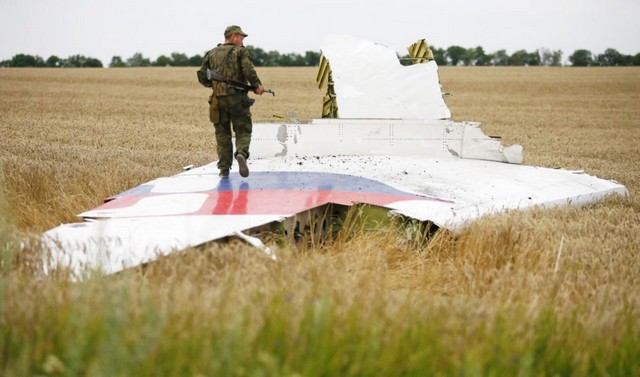
Why Israel is struggling to find a way out of its political deadlock

By Jonathan Cook

Nazareth: It would be a grave mistake to assume that the continuing political deadlock in Israel – with neither incumbent prime minister Benjamin Netanyahu nor his main rival Benny Gantz seemingly able to cobble together a coalition government – is evidence of a deep ideological divide.

In political terms, there is nothing divided about Israel. In this month’s general election, 90 per cent of Israeli Jews voted for parties that identify as being either on the militaristic, anti-Arab right or on the religious, anti-Arab far-right.

The two parties claiming to represent the centre-left – the rebranded versions of Labour and Meretz – won only 11 seats in the 120-member parliament.

Stranger still, the three parties that say they want to form a “broad unity government” won about 60 per cent of the vote.

Netanyahu’s Likud, Gantz’s Blue and White party led by former generals, and ex-defence minister Avigdor Lieberman’s Yisrael Beiteinu secured between them 73 seats – well over the 61 seats needed for a majority.

All three support the entrenchment of the occupation and annexation of parts of the West Bank; all three think the settlements are justified and necessary; all demand that the siege of Gaza continue; all view the Palestinian leadership as untrustworthy; and all want neighbouring Arab states cowering in fear.

Moshe Yaalon, Gantz’s fellow general in the Blue and White party, was formerly a pivotal figure in Likud alongside Netanyahu. And Lieberman, before he created his own party, was the director of Netanyahu’s office. These are not political enemies; they are ideological bedfellows.

There is one significant but hardly insumountable difference. Gantz thinks it is important to maintain bipartisan US support for Israel’s belligerent occupation while Netanyahu has preferred to throw Israel’s hand in with Donald Trump and the Christian religious right.

Reuven Rivlin, Israel’s president, has pressed the three parties to work together. He has suggested that Netanyahu and Gantz rotate the role of prime minister between them, a mechanism used in Israel’s past.

But after Gantz refused last week, the president assigned Netanyahu the task of trying to form a government, although most observers think the effort will prove futile. After indecisive elections in April and September, Israel therefore looks to be heading for a third round of elections.

But if the deadlock is not ideological, what is causing it?

In truth, the paralysis has been caused by two fears – one in Likud, the other in Blue and White.

Gantz is happy to sit in a unity government with the Likud party. His objection is to allying with Netanyahu, whose lawyers this week began hearings with the attorney general on multiple counts of fraud and breach of trust. Netanyahu wants to be in power to force through a law guaranteeing himself immunity from prosecution.

Blue and White was created to oust Netayahu on the basis that he is corrupt and actively destroying what is left of Israel’s democratic institutions, including by trying to vilify state prosecutors investigating him.

For Blue and White to now prop Netanyahu up in a unity government would be a betrayal of its voters.

The solution for Likud, then, should be obvious: remove Netanyahu and share power with Blue and White.

But the problem is that Likud’s members are in absolute thrall to their leader. The thought of losing him terrifies them. Likud now looks more like a one-man cult than a political party.

Gantz, meanwhile, is gripped by fear of a different kind.

Without Likud, the only solution for Gantz is to turn elsewhere for support. But that would make him reliant on the 13 seats of the Joint List, a coalition of parties representing Israel’s large minority of Palestinian citizens.

And there’s the rub. Blue and White is a deeply Arab-phobic party, just like Likud and Yisrael Beiteinu. Its only civilian leader, Yair Lapid, notoriously refused to work with Palestinian parties after the 2013 election – before Netanyahu had made racist incitement his campaign trademark.

Lapid said: “I’ll never sit with the Zoabis” – a reference to the most prominent of the Palestinian legislators at the time, Haneen Zoabi.

Similarly, Gantz has repeatedly stressed his opposition to sitting with the Joint List.

Nonetheless, the Joint List’s leader Ayman Odeh made an unprecedented gesture last week, throwing the weight of most of his faction behind Gantz.

That was no easy concession, given Gantz’s positions and his role as army chief in 2014 overseeing the destruction of Gaza. The move angered many Palestinians in the occupied territories.

But Odeh saw the Palestinian minority’s turn-out in September leap by 10 percentage points compared to April’s election, so desperate were his voters to see the back of Netanyahu.

Surveys also indicate a growing frustration among Palestinian citizens at their lack of political influence. Although peace talks are off Israel’s agenda, some in the minority hope it might be possible to win a little relief for their communities after decades of harsh, institutional discrimination.

In a New York Times op-ed last week, Odeh justified his support for Gantz. It was intended to send “a clear message that the only future for this country is a shared future, and there is no shared future without the full and equal participation of Arab Palestinian citizens”.

Gantz seems unimpressed. According to an investigation by the Israeli media, Netahyahu only got first crack at forming a government because Gantz blanched at the prospect.

He was worried Netanyahu would again smear him – and damage him in the eyes of voters – if he was seen to be negotiating with the Joint List.

Netanyahu has already painted the alternatives in stark terms: either a unity government with him at its heart, or a Blue and White government backed by those who “praise terrorists”.

The Likud leader might yet pull a rabbit out of his battered hat. Gantz or Lieberman could cave, faced with taunts that otherwise “the Arabs” will get a foot in the door. Or Netanyahu could trigger a national emergency, even a war, to bully his rivals into backing him.

But should it come to a third election, Netanyahu will have a pressing reason to ensure he succeeds this time. And that will doubtless require stepping up incitement another dangerous gear against the Palestinian minority.

The reality is that there is strong unity in Israel – over shared, deeply ugly attitudes towards Palestinians, whether citizens or those under occupation. Paradoxically, the only obstacle to realising that unity is Netanyahu’s efforts to cling to power.

A version of this article first appeared in the National, Abu Dhabi.

Jonathan Cook won the Martha Gellhorn Special Prize for Journalism.

3 October 2019

Source: countercurrents.org