Just International

Madonna’s Fake Revolution: Eurovision, Cultural Hegemony and Resistance

By Dr Ramzy Baroud

Rim Banna, a famous Palestinian singer who translated Palestine’s most moving poetry to song passed away on March 24, 2018, at the age of 51. Rim captured the struggle for Palestinian freedom in the most dignified and melodious ways. If we could imagine angels singing, they would sound like Rim.

When Rim died, all Palestinians mourned her death. Although a few international outlets carried the news of her passing at a relatively young age, her succumbing to cancer did not receive much coverage or discussion. Sadly, a Palestinian icon of cultural resistance who had inspired a whole generation, starting with the First Palestinian Intifada in 1987, hardly registered as an event worthy of remembrance and reflection, even among those who purport to champion the Palestinian cause.

Compare Rim to Madonna, an ‘artiste’ who has stood for self-aggrandizing personal fame and money-making. She has championed the most debased moral values, utilizing cheap entertainment while catering to the lowest common denominator to remain relevant in the music world for as long as possible.

While Rim had a cause, Madonna has none. And while Rim symbolized cultural resistance, Madonna symbolizes globalized cultural hegemony – in this case, the imposition of consumerist western cultures on the rest of the world.

Cultural hegemony defines the US and other Western cultures’ relationship to the rest of the world. It is not culture as in the collective intellectual and artistic achievements of these societies, but as a set of ideological and cultural tools used by ruling classes to maintain domination over the disadvantaged, colonized and oppressed.

Madonna, along with Michael Jordan, the Beatles and Coca Cola represent far more than mere performers and fizzy drinks, but also serve as tools used to secure cultural, thus economic and political dominance, as well. The fact that in some cities around the world, especially in the Southern hemisphere, Coca Cola “flows more freely than water” speaks volumes about the economic toll and political dimension of cultural hegemony.

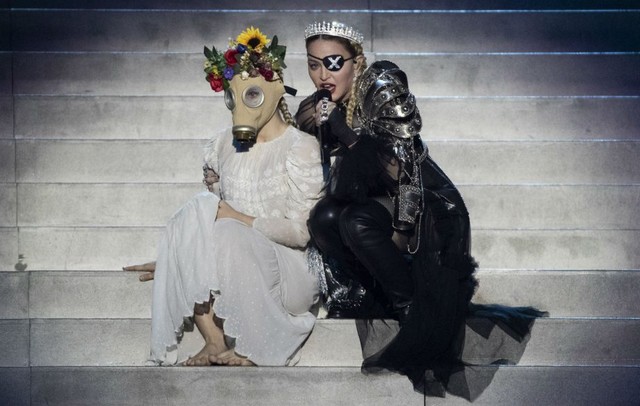
This issue becomes critical when a pro-Israel Madonna decides to perform in Israel, as she has done repeatedly in the past, as part of the Eurovision contest. Knowing who she is and what she stands for, her decision should not come as a surprise; after all, in her September 2009 Tel Aviv concert, she sang while wrapped in an Israeli flag.

Of course, it is essential that artistes of her caliber and the contestants representing 41 different countries, are reminded of their moral responsibilities towards occupied and oppressed Palestinians. It is also important that Israel is confronted regarding its unrelenting efforts to mask its apartheid and war crimes in Palestine.

Indeed, the whitewashing of Israeli human rights violations using art – also known as “art washing” – should not be allowed to continue when Gaza is under siege, where Palestinian children are shot and killed daily without remorse and without the least legal accountability.

This is why such artistic events are important for the Israeli government and society. Israel has used Eurovision as a distraction from the blood and gore that has been taking place not far from that venue. Those who labored to ensure the success of the event, knowing fully how Israel is using the brand as an opportunity to normalize its war against Palestinians, should be thoroughly ashamed of themselves.

But, on the other hand, should we be the least surprised? Aren’t such global music events, as Eurovision, at the heart of the western-centric globalization scheme of cultural hegemony, which sole purpose is to enforce a capitalist view of the world, where western culture is consumed as a commodity, no different from a McDonald’s sandwich or a pair of Levi jeans?

Calling on 60-year-old Madonna to refrain from entertaining apartheid Israel can be considered beneficial as a media strategy, for it helped highlight, although momentarily, an issue that would have been otherwise absent from news headlines. However, by placing so much focus on Madonna, and whatever human rights’ values she supposedly stands for, we also take the risk of inadvertently validating her and the consumerist values she represents. More, in this Madonna-driven trajectory, we are also neglecting Palestine’s cultural resistance, the core drive behind Palestinian ‘somoud’ – steadfastness – over the course of a century.

In response to her critics, Madonna answered, “I’ll never stop playing music to suit someone’s political agenda nor will I stop speaking out against violations of human rights wherever in the world they may be.” In the eyes of many who are ignorant of the facts, such an answer may appear as if an ‘empowered’ response to those who are trying to sway a genuine, pure artiste from following her calling.

In fact, Madonna is an expert in appearing as if morally-guided, yet never translating such morality to anything meaningful in reality. In a speech described as “powerful” by the Rolling Stone Magazine, Madonna declared during a Women’s March in Washington D.C. in 2017 “to the rebellion, to our refusal as women to accept this new age of tyranny. Where not just women are in danger, but all marginalized people.”

Of course, Palestinian, Lebanese and Syrian women – who have paid a heavy price for Israeli Occupation, war and marginalization – are not to be included in Madonna’s false revolution. And the chances are, shortly after she sings and dances in a jubilant, apartheid Israel, she will once more take on many platforms as if the Rosa Parks of revolutionary art.

While it is important that we keep the pressure on those who engage and validate Israel politically, economically and culturally, these efforts should come secondary to embracing Palestine’s culture of resistance. Behaving as if Madonna’s stage shenanigans represent true culture, while ignoring Palestinian culture altogether, is similar to academics addressing decolonization from the point of view of the colonizer, not the colonized. The truth is, nations cannot truly rid themselves from the colonial mindset without having their narratives take the center-stage of politics, culture and every other aspect of knowledge.

“The intellectual’s error consists in believing that one can know without understanding and, even more, without feeling and being impassioned,” wrote Italian anti-fascist intellectual, Antonio Gramsci. This entails the intellectual and the artist to feel “the elementary passions of the people, understanding them and, therefore, explaining and justifying them.”

The truth is that appealing to Madonna’s moral sense without immersing ourselves passionately in the art of Rim Banna will, in the long run, do Palestinians no good. Only embracing Palestine’s culture of resistance will, ultimately, keep the self-serving, hegemonic and cheap cultural messages of the Madonnas of this world at bay.

– Ramzy Baroud is a journalist, author and editor of Palestine Chronicle.

22 May 2019

Source: countercurrents.org

Strait of Hormuz, Sabotage Attack and the Sabre-Rattling

By Lirar Pulikkalakath

“The people of Iran should stand united in the face of this, and they will deliver a strong punch to the mouth of the American secretary of state and anyone who backs them” (Dehghanpisheh and Andrew 2018)). Almost one year back, Ismail Kowsari, the deputy commander of the Islamic Revolutionary Guards Corps (IRGC), Iran’s elite military force, responded strongly at Mike Pompeo, United States (US) secretary of state for threatening ‘the strongest sanctions in history’ on Iran. Mr. Kowsri’s harsh response was against the statement of the latter that the US would impose new penalties on Iran if the country did not make any changes in its position towards various regional and international issues, including dropping its nuclear program and pulling out of the Syrian civil war. Now the region is in an alarming situation after the sabotage attack on four oil tanks in the Strait of Hormuz on 14th May of this year. There were reports of four commercial vessels sabotaged near Fujairah emirate of the United Arab Emirates (UAE). This location is one of the world’s largest bunkering hubs lying just outside the Strait of Hormuz. Media reported that the attacks were conducted by Yemen’s Houthi rebels, supported by Iran. As West Asia is known for its political instability, regional Wars and international interventions, this attack is a warning of deepening tensions between the US, its GCC allies, and Iran could be coming to a head.

Strategic Importance of the Strait of Hormuz

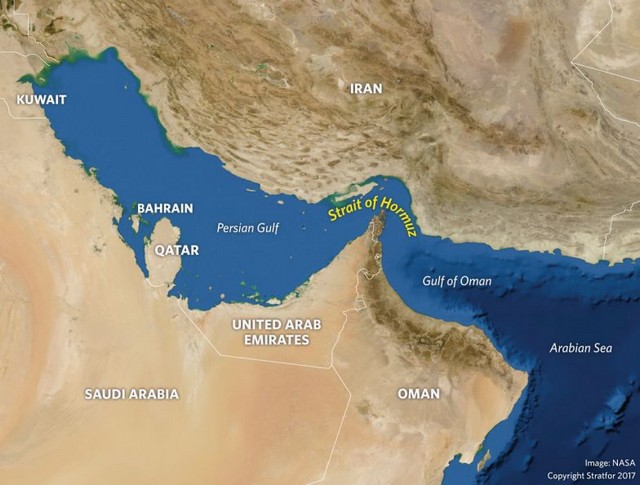
Strait of Hormuz is a narrow seaway that connects the Indian Ocean with the Persian/ Arabian Gulf. Historically, the waterway has connected Persian and Arab civilisations with Pacific Asia, Indian subcontinent, and the Americas (Weitz 2018). This strategic seaway also links major crude oil producers of the West Asian countries to markets in the Asia Pacific region, West and beyond. The area also has much significance since one-third of the world’s sea-borne oil passes through it every day.

The strait is only 33 to 95 km wide throughout its length. Oman and Iran are the countries nearest to the Strait, and they share territorial rights over the strategic water body (Briney 2019). “The international shipping lane at the entrance to the Gulf is in Oman’s territorial waters, but farther up the tankers enter an area that Iran claims as within its sovereignty. Accordingly, it would be relatively easy to interrupt marine transportation to and from the Gulf” (Guzansky 2010). The widths of the chokepoint, however, is much narrower (about three km wide in each direction). “Because the waters are not deep enough for oil tankers throughout the strait’s width” (Briney 2019). Thus, the sea route makes one of the most challenging busy commercial shipping lane in the world.

In the year 2016, the waterway accounted for 30% of all sea-borne trade of crude oil and natural gas. The bulk of these natural resources comes from countries like UAE, Saudi Arabia, Iran, Iraq and Kuwait and Qatar. The U.S. Navy’s Bahrain-based Fifth Fleet, tasked to protect commercial ships is in this area (Moussa 2018). All the facts have given the Strait of Hormuz a strategically significant water body.

Context of the Sabotage Attack

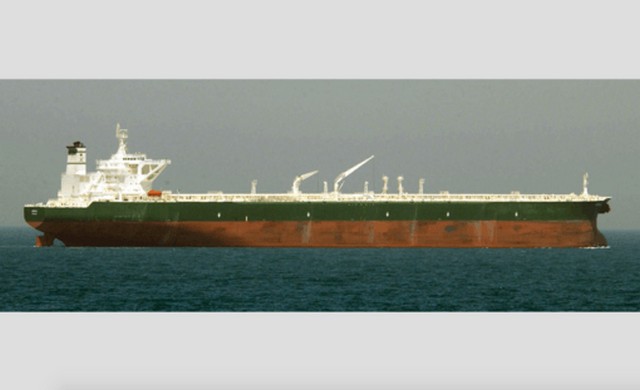
According to media reports and statements made by officials of the UAE and Saudi governments, there were four oil tankers targeted in and around the Strait of Hormuz. When two of the sabotaged oil tankers belong to Saudi, another one belonged to the UAE. The fourth one belongs to the Thome Group, a Norwegian company. Importantly the first three ships belonging to the arch-rival of Iran and the most reliable allies of the US in West Asia. It is also important to note that tensions between the US and Iran had risen since last year when Donald Trump withdrew from the Iran nuclear deal or the Joint Comprehensive Plan of Action (JCPOA) signed in 2015.

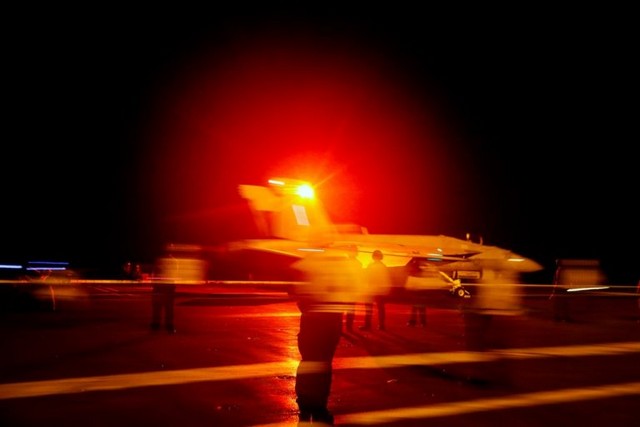
The Iranian government had warned about the closing of the Strait many times since then, especially in the context of potential sanctions that could be levied upon Iranian oil exports. President Donald Trump has given countries until November 4, 2018, to stop importing petroleum from Iran. These attempts were part of a new campaign of pressure and confrontation against Iran, a staunch enemy of the US and its close allies (Chang 2019). Of course, verbal confrontation tension between the two was already heightened after the designation of the IRGC as a terrorist organisation, by the US government, withdrawal from the JCPOA, and the imposition of new sanctions on the Islamic Republic. Adding fuel to this, at the beginning of May 2019, the US sent the USS Abraham Lincoln, the aircraft carrier, and B-52 bombers to the Gulf (Freer 2019).

As an impact of these series of confrontation and pressure from each part, Iran’s oil exports have fallen significantly. Additionally, the US also warned at five of Iran’s biggest remaining customers, especially India and China, to stop purchasing Iranian oil. The move to deploy aircraft carriers strike group is an attempt to cut Iranian oil exports to zero in response to an ‘unspecified’ threat.

Responses of Major Actors

Neither the UAE nor the Saudi government assigned blamed any country publicly. But there were reports that the US officials suspect that Iran and its proxies are behind the attack. “worrisome and dreadful” is the statement made by Iran’s foreign ministry after the incidents and asking for an investigation. Al Jazeera reported that the Qatar government is attempting to defuse the tensions between the regional powers by holding talks in Tehran (Freer 2019).

Conclusion

The Strait of Hormuz is one of the busiest commercial sea routes especially for oil trade in the world. This route is vital in linking oil producing countries in the Arabian/ Persian Gulf region to markets in Europe, Asia, North America and other regions. Iran has been threatening to close the Strait at different occasions whenever the country was in trouble and international pressure. Since the Iran- Iraq War in the 1980s, it has attempted to interrupt the strategically vital waterway. But the sabotage attack in the second week of May 2019 on four oil vessels and two oil pipelines at the strategic shipping lane has further escalated the existing tension in the region. The attack can have dire consequences on the international political economy. It can lead to the decline in the shipping of oil from the Arab/ Persian Gulf region that will be resulted in the price hike. Energy security and the economy of major Asian economies like India, Japan, China, and South Korea will be most affected. Any interruption in this waterway can affect the oil producers in the Gulf region, including Iran. Because, they rely on this passage for commerce; to export oil and natural gas and import food products. Anyhow, the regional cold war and the threat from Iranian authority to close the waterway has created an alarming situation in the region. There is possibility for a close encounters between Iran and its regional enemies like Saudi Arabia and UAE. In this potential War, the former may get the support of Houthis from Yemen and Hezbollah from Lebanon, and the latter will get help from the U.S. Anyhow another war will be a catastrophe to the entire region of West Asia and international economy.

References

Briney, Amanda (2019), “Strait of Hormuz”, ThoughtCo, April 10, [Online: web] Accessed 17 May 2019, URL: https://www.thoughtco.com/strait-of-hormuz-1435398

Chang, Edward (2019), “The Real Iran Military Threat: Close the Strait of Hormuz (Watch Oil Prices Jump): Could this happen?”, The National Interest, May 16.

Dehghanpisheh, Babak, Andrew Heavens (2018), “Commander says Iran’s people will punch U.S. Secretary of State in the mouth”, Huffpost, May 22.

Freer, Courtney (2019), “Gulf Uncertainty Reigns amid Iran-US showdown”, Aljazeera, 16 May.

Guzansky, Yoel (2010), “The Straits of Hormuz: Strategic Importance in Volatile Times”, The Institute for National Security Studies (INSS) Insight No. 204, September 3, [Online: web] Accessed 18 May 2019, URL: https://www.inss.org.il/publication/the-straits-of-hormuz-strategic-importance-in-volatile-times/

Moussa, Ziad (2018), “Strait of Hormuz: Its strategic importance for sea-borne oil (Lebanon) -, By The East, July 6, [Online: web] Accessed 18 May 2019, URL: https://www.bytheeast.com/2018/07/06/strait-of-hormuz-its-strategic-importance-for-sea-borne-oil/

Weitz, Rockford (2018), “Why is the Strait of Hormuz important?”, The Conversation, July 9, [Online: web] Accessed 18 May 2019, URL: https://theconversation.com/why-is-the-strait-of-hormuz-important-99496

Dr. Lirar Pulikkalakath is Assistant Professor at the School of International Relations and Politics, Mahatma Gandhi University, Kerala, India.

20 May 2019

Source: countercurrents.org

The New Politics of Starvation

By Dan Lieberman

President Donald Trump’s use of the most vicious aspects of economic warfare prompt another examination of the politics of starvation.

After George W. Bush’s administration, Presidents Barack Obama and Donald Trump lessened Bush’s aggressive war policies and leaned to economic warfare. Sounds harmless when compared to exploding bombs, but it is not — economic warfare can crush an adversary without firing a shot. Gone to its extreme, economic warfare has the force of a neutron bomb; it disables the nation’s infrastructure and debilitates its population. Isolation from the international financial system, material embargos, and other sanctions reduce living standards and bring populations close to starvation The most serious aspects of economic warfare are major crimes and a form of terrorism.

Iran, Cuba, North Korea, and Iraq endured the most punishing sanctions from the United States. Results of sanctions against these countries, models for the effects of sanctions, show that sanctions have rarely accomplished their stated purposes and their intentions may be for other reasons — stalling economic progress, weakening challenges to antagonistic actions, advancing dominance, and promoting regime change.

Iran
Disturbed with the rule of Ayatollah Ruhollah Khomeini, and infuriated by the hostage taking of 52 of U.S. embassy personnel by extreme Islamic students and militants, President Jimmy Carter froze several billions of dollars in Iranian bank deposits, gold and other properties, and followed with a 1980 embargo on trade with and travel to Iran. These punitive actions accomplished nothing for the United States, strengthened the Ayatollah’s Authority and hardened the student demands for releasing the captured embassy officials.

President Reagan, who partially owed his climb into the executive office to the hostage crisis, showed contempt for Iran’s resolution of the problem. Driven by the unproven assertion that Iran was involved in the 1983 bombing of a marine barracks in Beirut, and favoring Saddam Hussein’s Iraq in the Iraq-Iran war, the U.S. president imposed additional sanctions on the Islamic Republic. and, in 1987, banned all imports from Iran.

Duriing the Clinton administration, the Iran-Libya Sanctions Act (ILSA) penalized all foreign companies that provided investments over $20 million for the development of petroleum resources.

Iran’s entrance into the atomic age provoked a series of new sanctions. Economic warfare soon reached full scale by subduing Iran’s earnings from its most precious resource and export – oil. The U.S. Congress passed unilateral sanctions that targeted Iran’s energy and banking sectors. Sanctions did not halt Iran’s nuclear activities, or prevent it from signing contracts with foreign firms to develop its energy resources. Exports slowly grew to an estimated $82 billion in 2012, with liberated Iraq and independent China filling the gap as trading partners.

Nevertheless, economic warfare affected Iran’s industries and welfare. In October 2012, Iran’s currency, the rial, fell to a record low against the US dollar, losing about 80 per cent of its value in one year. Lack of spare parts and inability to replace planes affected aviation safety. Real growth rate in GDP, at a steady six per cent a year during the first decade of the twenty first century, fell to two per cent in 2011-2012. One report, citing officials from the U.S. Departments of State and Energy, concluded that gasoline imports in the Shah’s former kingdom declined from 130,000 barrels a day in 2009 to 50,000 barrels a day in 2011. Machinery wears, and the costs and time for repairs rapidly increased. A nation of educated professionals, who depended upon access to foreign technology and scientific cooperation, had their access to knowledge severely curtailed.

In a October 5, 2012 report to the UN General Assembly, UN Secretary General Ban Ki-moon summarized effects of sanctions on Iran’s population.

The sanctions imposed on the Islamic Republic of Iran have had significant effects on the general population, including an escalation in inflation, a rise in commodities and energy costs, an increase in the rate of unemployment and a shortage of necessary items, including medicine,.

The embargoes have also hampered humanitarian operations, as the imposed restrictions on Iran’s banking system have halted the imports of medicines needed for treating diseases like cancer and heart and respiratory conditions.

The Obama administration eventually eased restrictions on the sale of medicines to Iran, and, after the Joint Comprehensive Plan of Action, in which Iran halted and downsized its uranium enrichment, the UN lifted sanctions. In a following year, Iran GDP increased 15 percent.

On May 8, 2018, U.S. President Donald Trump announced that the United States would withdraw from the Iran nuclear deal. and U.S. sanctions came into effect again in November 2018. President Trump articulated his plan for renewed sanctions as, “to bring Iran’s oil exports to ‘zero’ and remove a main source of revenue for the regime.” Trump imposed the ultimate harm afforded by economic warfare — starve the people and have them revolt against the regime.

That has not happened nor is predicted to occur. World Bank statistics from:
https://www.worldbank.org/en/country/iran/publication/economic-update-april-2019 indicate a severe slowing of the economy and steady rise of inflation.

As shown in the charts, oil production, and GDP growth dropped monotonicallyandseverely. Currency value suffered an initial shock and had some recovery. Inflation was up 40%, especially in food (up 60%) — — a suffering economy, a suffering people, and no political gain for the U.S.

Cuba
Immediately after the 1960 Cuban revolution, the United States imposed an embargo against Cuba. Fifty plus years of sanctions have not succeeded in accomplishing the purposes for which the United States proposed the sanctions — compensation to U.S. firms nationalized by Cuba and the overthrow of the Castro regime. The only result of the embargo has been deprivation of the Cuban people.

Although the United Nations General Assembly on November 2, 1995, voted 117 to 3 to recommend an end to the U.S. embargo against Cuba, President Clinton, on March 12, 1996, signed into law the misnamed Cuban Liberty and Democratic Solidarity Act. This Act imposed penalties on foreign companies doing business in Cuba, permitted U.S. citizens to sue foreign investors who make use of American-owned property seized by the Cuban government, and denied foreign investors in Cuba’s industry to enter the U.S.

The World Health Organization (WHO) complimented pre-90’s Cuba for its public health system, which had been credited with eliminating hunger and malnutrition and wiping out infectious diseases. A tightened embargo reinforced Cuba’s suffering after Russia withdrew subsidies. and, soon, Cuba of the mid-90’s portrayed another image. The American Association for World Health and the American Public Health Association ascertained that the embargo caused significant deterioration in Cuba’s food production and health care:

  • Cuba was banned from purchasing nearly 1/2 of new drugs on the market.
  • Physicians had access to only 890 medications, down from 1,300 in 1989.
  • Deterioration of water supply increased water borne diseases.
  • Daily caloric intake dropped by 33% between 1989 and 1993.

In 2000, the Clinton administration finally allowed Cuba to have some relief from an aggressive economic warfare. The administration allowed the sale of agriculture and medicine to Cuba for humanitarian purposes. According to the USDA’s Foreign Agricultural Service, U.S. agricultural exports to Cuba reached $380 million in 2004. However, after hitting a peak of $710 million in 2008, U.S. food sales to Cuba declined over 50 percent by the year 2011. Reasons for the decline were largely economic – lack of foreign currency and better financial terms being offered by other countries.

Dollars and Sense, 2009, The Costs of the Embargo, by Margot Pepper

Representatives of a dozen leading U.S. business organizations, including the U.S. Chamber of Commerce, signed a letter in December urging Barack Obama to scrap the embargo. The letter pegs the cost to the U.S. economy at $1.2 billion per year. The CPF’s estimates are much higher: up to $4.84 billion annually in lost sales and exports. The Cuban government estimates the loss to Cuba at about $685 million annually. Thus the blockade costs the United States up to $4.155 billion more a year than it costs Cuba.

After a period of harsh policy toward Cuba under President George W. Bush, President Obama announced in late 2014 that Washington and Havana would begin normalizing relations. To that end, the Obama administration achieved three pillars of normalization: 1) the removal of Cuba’s designation as a state sponsor of terrorism, which allowed Cuba to access international finance; 2) the reestablishment of diplomatic relations; and 3) relaxed restrictions on travel and trade through executive action. The embargo remained in place.

In 2017, the Trump administration reversed some of the changes made under President Obama, but the vast majority remained U.S. policy. Despite some tighter trade sanctions and limitations on authorized travel, there are still legal pathways for Americans to export and travel to Cuba. On the list of new sanctions is allowing Americans to sue foreign companies in Cuba that are profiting from or using properties that were seized during the Cuban revolution.

From CBS News, May 11, 2019.

Havana — The Cuban government announced Friday it is launching widespread rationing of chicken, eggs, rice, beans, soap and other basic products in the face of a grave economic crisis. Commerce Minister Betsy Díaz Velazquez told the state-run Cuban News Agency that various forms of rationing would be employed in order to deal with shortages of staple foods.

Díaz blamed the hardening of the U.S. trade embargo by the Trump administration. Economists give equal or greater blame to a plunge in aid from Venezuela, where the collapse of the state-run oil company has led to a nearly two-thirds cut in shipments of subsidized fuel that Cuba used for power and to earn hard currency on the open market.

Another suffering economy, suffering people, and no political gain for the U.S.

North Korea
The proud and impoverished nation of North Korea has been continually subjected to sanctions, threats of economic sanctions, and hastily withdrawn sanctions. The media is peppered with the words: “U.S. Lifts sanctions,” “U.S. recommends sanctions,” “South Korea wary of sanctions.” It’s difficult to know if North Korea is being sanctioned or being forced into being sanctioned. After its 2006 claim of conducting a nuclear test, the DPRK (Democratic People’s Republic Korea) leaders responded to intended sanctions by labeling them as “a declaration of war.”

The DPRK has,suffered from economic warfare, which includes restrictions on trade and financial transactions. Export of sensitive dual-use items (items that have both military and non-military uses) have, at times, been prohibited. During March 2012, the politics of starvation entered the situation; angered by an intended North Korea missile test, the U.S. suspended food aid to the “hermit kingdom.”

WASHINGTON (Reuters) – The United States has suspended planned food aid to North Korea as Pyongyang vows to push ahead with a plan to launch a long-range missile in defiance of international warnings, U.S. military officials said on Wednesday.

Under President Obama, sanctions increased as a policy of “strategic patience;” the US waited for North Korea to change its bad behavior before engaging with the state. As a result, trade between North Korea and China increased and sanctions did not encourage Kim Jong-An to discuss de-nuclearization.

On September 21, 2017, President Donald Trump, as part of his administration’s “maximum pressure” campaign, allowed severing from its financial system and/or freezing assets of companies, businesses, organizations, and individuals who traded in goods, services, or technology with North Korea.

U.S. negotiations with North Korea have a built-in error; they request de-nuclearization in exchange for improved relations and reduction in sanctions. Not considered is that North Korea’s development of a nuclear arsenal was a response to its regard of U.S. actions in the Korean peninsula as a direct threat to its regime and the developments had no relation to sanctions. Therefore, the DPRK will not trade de-nuclearization for relief of sanctions, and that approach is a non-starter.

Sanctions, intended to collapse the North Korea regime, have not halted its development of nuclear weapons and guided missile delivery systems. They have collapsed the economy and harmed the North Korean people; starvation during droughts have occurred. Although some international assistance has been provided to North Korea, the intensive economic warfare waged against the “hermit kingdom” has exacerbated its problems, without any apparent benefit to its principal antagonist, the United States.

Iraq
If Iraq were Pompeii, then the US would be Mt. Vesuvius.
The sanctions against Iraq began August 6, 1990, four days after Hussein invaded Kuwait, and featured a near-total financial and trade embargo. Resultant suffering has been outlined in a UN Report on the Current Humanitarian Situation in Iraq, submitted to the Security Council, March 1999. Due to the length of the report, only significant features are mentioned.

Before the Gulf War

  • before 1991 Iraq’s social and economic indicators were generally above the regional and developing country averages.
  • Up to 1990, the Food and Agricultural Organization (FAO) cited Iraq as having one of the highest per capita food availability indicators in the region.
  • According to the World Health Organization (WHO), prior to 1991, health care reached approximately 97% of the urban population and 78% of rural residents. A major reduction of young child mortality took place from 1960 to 1990; with the infant mortality rate at 65 per 1,000 live births in 1989 (1991 Human Development Report average for developing countries was 76 per 1,000 live births). UNICEF indicates that a national welfare system assisted orphans and children with disabilities and supported the poorest families.
  • Before 1991, southern and central Iraq had well developed water and sanitation systems, composed with two hundred water treatment plants (“wtp’s”) for urban areas and 1200 compact wtp’s to serve rural areas, as well as an extensive distribution network. WHO estimates that 90% of the population had access to an abundant quantity of safe drinking water.

From Sanctions After the Gulf War

  • Economist Intelligence Unit estimates that Iraqi GDP may have fallen by nearly 67% in 1991, and the nation had “experienced a shift from relative affluence to massive poverty” and had infant mortality rates that were “among the highest in the world.”
  • The United Nations Population Fund (UNFPA) estimated the maternal mortality rate increased from 50/100,000 live births in 1989 to 117/100,000 in 1997. The under-five child mortality rate increased from 30.2/1000 live births to 97.2/1000 during the same period. The United Nations Department of Economic and Social Affairs (DESA) calculates that the infant mortality rate rose from 64/1000 births in 1990 to 129/1000 in 1995 (the Human Development Report set the average infant mortality rate for Least Developed Countries at 109/1000). Low birth weight babies (less than 2.5 kg) rose from 4% in 1990 to around a quarter of registered births in 1997, due mainly to maternal malnutrition.
  • Calorie intake fell from a pre-war 3120 to 1093 calories per capita/per day in 1994-95. The prevalence of malnutrition in Iraqi children under five almost doubled from 1991 to 1996 (from 12% to 23%). Acute malnutrition in Center/South rose from 3% to 11% for the same age bracket.
  • The World Food Program (WFP) estimated that access to potable water decreased to 50% of the 1990 level in urban areas and 33% in rural areas.
  • School enrollment for all ages (6-23) declined to 53%. According to a field survey conducted in 1993, as quoted by UNESCO, in Central and Southern governorates, 83% of school buildings needed rehabilitation, with 8613 out of 10,334 schools having suffered serious damages. The same source indicated that some schools with a planned capacity of 700 pupils actually have 4500 enrolled in them. Substantive progress in reducing adult and female illiteracy ceased and regressed to mid-1980 levels. More families are forced to rely on children to secure household incomes. Figures provided by UNESCO indicate that drop-outs in elementary schools increased from 95,692 in 1990 to 131,658 in 1999.

Sanctions, and its toll on the Iraqi people, continued until the U.S. invasion of Iraq in 2003.

Excerpts from Invisible War: The United States and the Iraq Sanctions, Joy Gordon. Harvard University Press, 2010, describe the extent of irrational economic warfare conducted by the United states against a defenseless Iraq.

While the United States consistently justified its policies in terms of preventing Iraq from developing weapons or threatening its neighbors, the U.S. policy went well beyond any rational concern with security. There was an elaborate architecture of policies that found a dozen other ways to simply do gratuitous harm that had not the least relation to the threat Iraq might have posed to its neighbors or to anyone else.

For thirteen years the United States unilaterally prevented Iraq from importing nearly everything related to electricity, telecommunications, and transportation, blocked much of what was needed for agriculture and housing construction, and even prohibited some equipment and materials necessary for health care and food preparation.

As the criticism grew, there is no sign that anyone in the U.S. administration, and only a tiny handful within Congress, actually took it to heart– actually questioned the sanity and legality of reducing an entire civilization to a preindustrial state, of bankrupting an entire nation for the purpose of containing one tyrannical man.

On May 12, 1996, Madeleine Albright, then U.S. Ambassador to the United Nations, appeared on the CBS program 60 Minutes. Commentator Lesley Stahl asked, “We have heard that half a million children have died. I mean, that’s more children than died in Hiroshima. Is the price worth it?” Madeleine Albright replied, “we think the price is worth it.” Is that an expected response from a normal human being?

The U.S. 2003 invasion of Iraq accomplished what sanctions failed to accomplish — push Iraq to total ruin. A question, “Why war, if had sanctions, or why sanctions if need to go to war?”

CONCLUSION
As shown, sanctions never accomplished their stated purposes and gravely harmed populations. The economic warfare had equivalents to military war. The country that took the offensive became the aggressor, as in any war, and the destruction to the defending state was equally brutal. In the one-sided engagement, the civilian population of the defending nation suffered greatly and the aggressor country suffered few losses. The economic wars never achieved the results that the offended party desired, and no peace treaties were signed. The struggles remained an open issue.

A limited form of economic warfare may, at times, have a legitimate purpose. A complete economic war, that invades all aspects of a country’s life and continues until it debilitates the population, cannot be accepted. In a military campaign, atrocities and human rights violations are often committed. Although no shots are fired and battlefields are not identifiable, economic warfare cannot camouflage its atrocities and disguise its human rights violations.

Dan Lieberman is the editor of Alternative Insight, a web based newsletter.

20 May 2019

Source: countercurrents.org

At least 100,000 infants die every year in ten conflict-zones, says report

By Countercurrents Team

Every year in just ten conflict-affected countries at least 100,000 infants die who in the absence of conflict would survive, says a new report British charity Save the Children.

The study applied the findings in The Lancet’s study to the ten worst conflict-affected countries, which estimates that in the last five years alone more than 550,000 infants have died due to the reverberating impact of conflict. The total for children under five is 870,000.

The Save the Children study says these estimates by The Lancet are imperfect; but these are indicative and may be highly conservative. However, the estimates suggest that every year in just ten conflict-affected countries at least 100,000 infants die who in the absence of conflict would survive.

The new report said: 420 million children are living in conflict zones.

A “conflict zones” or “conflict-affected areas”, according to the Peace Research Institute in Oslo (PRIO), is within 50km of where one or more conflict events took place in a given year, within the borders of a country. The Uppsala Conflict Data Programme (UCDP), the world’s foremost provider of metrics on organized violence, defines armed conflict as a situation when armed force is used by an organized actor against another organized actor, or against civilians, resulting in at least 25 battle-related deaths in one calendar year.

The report – Stop the War on Children, Protecting children in 21st century conflict – estimated the number of children (420 million) living in conflict zones – nearly one in five of the global population – is a rise of nearly 30 million children from 2016.

The report written by George Graham, Mariam Kirollos, Gunvor Knag Fylkesnes, Keyan Salarkia and Nikki Wong from Save the Children was assisted by the research team from the PRIO.

The research found the number of children living in conflict zones is now double the number at the end of the Cold War.

10 hardest-hit countries

The ten countries hit the hardest are Afghanistan, Yemen, South Sudan, the Central African Republic, the Democratic Republic of Congo (DRC), Syria, Iraq, Mali, Nigeria and Somalia. These countries have been identified on the basis of nine indicators that include:

  • The prevalence of reports of each of the six grave violations.
  • Conflict intensity (measured by the number of recorded casualties).
  • Total child population living in conflict-affected areas.
  • The proportion of children living in conflict zones relative to the population of the country as a whole.

The study found children are increasingly directly targeted in some areas to become child soldiers or suicide bombers.

In other cases, children die due to the indirect consequences of war such as starvation, lack of sanitation and lack of access to safe shelter.

Children may also be caught in the crossfire of battles, which are increasingly being fought in urban areas, or they become the victim of landmines and bombings.

Key findings of the report include:

  • 420 million children – nearly one-fifth of children worldwide – are living in a conflict zone; a rise of nearly 30 million children from 2016.
  • The number of children living in conflict zones has doubled since the end of the cold war.
  • 142 million children are living in high-intensity conflict-zones; that is, in conflict zones with more than 1,000 battle-related deaths in a year.
  • New analysis from Save the Children shows that the numbers of ‘grave violations’ of children’s rights in conflict reported and verified by the UN have almost tripled since 2010.
  • Hundreds of thousands of children are dying every year as a result of indirect effects of conflict – including malnutrition, disease and the breakdown of healthcare, water and sanitation.

The report said:

“The nature of conflict – and its impact on children – is evolving. Intra-state conflict is increasing, as are the numbers of armed actors involved. The world is witnessing deliberate campaigns of violence against civilians, including the targeting of schools, the abduction and enslavement of girls, and deliberate starvation.”

Conflict-length

Conflicts are long, in terms of time, in the present day-world. The reports said:

“Armed conflicts are more protracted; for instance, the most prominent conflict in recent times – the war in Syria – has lasted longer than the Second World War. The longer a conflict lasts the greater the indirect harm caused as essential services cease to function. And in many protracted situations the lines between ‘conflict’ and ‘peace’ have become blurred.”

The study found increase in new type of conflict zone – urban areas. The study said:

“Conflict is also increasingly urban; in Mosul and Mogadishu, for example, children, their homes and their schools are on the front line, vulnerable to indiscriminate attack. In today’s armed conflicts, there is often no longer a clearly demarcated battlefield: children’s homes and schools are the battlefield.”

The Save the Children report bared a few hard facts:

“Increasingly, the brunt of armed violence and warfare is being borne by children. Children suffer in conflict in different ways to adults, partly because they are physically weaker and also because they have so much at stake – their physical, mental and psychosocial development are heavily dependent on the conditions they experience as children.

“Conflict affects children differently depending on a number of personal characteristics – significantly gender and age, but also disability status, ethnicity, religion and whether they live in rural or urban locations. The harm that is done to children in armed conflict is not only often more severe than that done to adults, it has longer lasting implications – for children themselves and for their societies. Children suffer in conflict in three broad ways:

Children may be deliberately targeted.

The commission of atrocities against children is an exceptionally powerful way of terrorizing a population – and, hence, a preferred military tactic for armed forces and groups in many of today’s conflicts. Children are also often targeted because they may be easily manipulated and exploited, for instance, as soldiers or suicide bombers. Schools become targets for tactical reasons – for example, as a recruiting ground or because they are being used for military purposes.

Children suffer due to indiscriminate or disproportionate military action.

For example, they may be killed or injured by landmines or the use of explosive weapons with wide-area effect in populated areas.

Children suffer on a huge scale from the indirect consequences of conflict.

These include displacement; the breakdown of markets and essential public services, such as healthcare, water and sanitation; and pervasive insecurity. While indirect effects and direct violations are both part of the same continuum of harm inflicted on children by modern conflict, these indirect consequences of conflict affect and kill many more children. More still miss out on school and the chance of a better future.

Key dimension of the crisis

The report identified three key dimensions of the crisis facing children in conflict today:

“• States and armed non-state actors are failing to uphold standards in their own conduct or to insist on this from their allies and from others over whom they have influence.

“• Governments are taking too little action to hold perpetrators of violations to account for their crimes.

“• Not enough is being invested in practical action on the ground to protect children in conflict and to support their recovery.”

This report argues, “children suffering in conflict today are not primarily suffering from a deficit of identified rights. Rather, they are suffering from a crisis of compliance with those rights. Armed actors, often including government forces, are committing violations against children. And they are often being met by, at best, international indifference and, at worst, complicity.”

The study used data collated by the Uppsala Conflict Data Programme (UCDP), the world’s foremost provider of metrics on organized violence. This dataset provides the geographical location, timing and intensity of recorded conflict events globally, covering the years 1990–2017.

It should be mentioned that the UN Security Council has identified six grave violations against children in situations of armed conflict:

  • killing and maiming of children
  • recruitment and use of children as soldiers
  • sexual violence against children
  • abduction of children
  • attacks on schools and hospitals
  • denial of humanitarian access.

Schools and hospitals

The report said:

“There were 1,432 verified attacks on schools in 2017, making it one of the worst years in recorded history for attacks on education. Much of Syria and Yemen’s education infrastructure has been reduced to rubble by missiles and bombs. According to UNICEF, one third of Syria’s schools have been destroyed or damaged or are occupied.40 One in ten schools in Yemen have been destroyed or damaged. As a result, an estimated 2 million children in Yemen and 2 million children in Syria are out of school. In Ukraine, at least 750 education facilities have been damaged or destroyed since the start of the conflict. In Nigeria, Boko Haram has killed an estimated 2,295 teachers and UNICEF estimates that more than 1,400 schools have been destroyed, damaged or looted, primarily in the North East zone, and more than 600,000 children have lost access to education.

“The military use of schools continues in Syria, Yemen, Sudan, the Philippines and Afghanistan. In some contexts, schoolgirls have been specifically targeted for sexual violence and by armed groups who oppose female education. For instance, in the DRC, militiamen abducted 17 girls from primary schools in 2017 and raped them over the course of several months. In Balochistan Province, Pakistan, a girls’ school was specifically targeted using improvised explosive devices.

“Hospitals, clinics and other health facilities are also a frequent target for military use and/or attacks, and medical personnel are also targeted. To take just two examples: in Syria the UN verified 108 attacks on hospitals and medical personnel in 2017, resulting in the killing of six and injury to at least 29; in South Sudan, at least 20% of the country’s 1,900 medical facilities had closed as of December 2017 due to the conflict, with 50% functioning at extremely limited capacity. Violence disrupts healthcare systems precisely when children need them more than ever.”

20 May 2019

Source: countercurrents.org
Four Simple Steps the U.S. Media Could Take to Prevent a Trump War with Iran

By Mehdi Hasan

Here we go again. Sixteen years after the U.S. media helped the Bush administration spread myths and lies about the threat posed by Iraq to the United States and its allies, the Trump administration is spreading similar myths and lies about the threat posed by Iran.

The 64,000-rial question, therefore, is whether or not journalists have learned any lessons whatsoever from the Iraqi WMD debacle of 2003.

Well, consider these recent headlines:

“US deploying more Patriot missiles to Middle East, amid Iranian threats” (CNN)

“Pentagon Builds Deterrent Force Against Possible Iranian Attack” (New York Times)

“U.S. Says Iran Likely Behind Ship Attacks” (Wall Street Journal)

“Iranian threats led to White House’s deployment announcement, U.S. officials say” (Washington Post)

The evidence for these hawkish headlines? For this stream of alarmist media reports about “threats” and “attacks” from Iran? Yes, you guessed it: statements provided to reporters by U.S. officials hiding behind a cloak of anonymity. In some cases, just one official. Take the Wall Street Journal’s scoop:

An initial U.S. assessment indicated Iran likely was behind the attack on two Saudi Arabian oil tankers and two other vessels damaged over the weekend near the Strait of Hormuz, a U.S. official said, a finding that, if confirmed, would further inflame military tensions in the Persian Gulf.

Why would you trust the word of a single official on such a sensitive and contentious issue? And why, oh why, would you rely on the testimony of a member of the Trump administration, known globally, of course, for its stringent and unbending adherence to the truth?

Also: If you’re going to trust a single anonymous official, in this administration of fanatical hawks and shameless dissemblers, why not trust this particular official who was quoted in the New York Times?

One American official, speaking on the condition of anonymity to discuss confidential internal planning, said the new intelligence of an increased Iranian threat was “small stuff” and did not merit the military planning being driven by Mr. Bolton. The official also said the ultimate goal of the yearlong economic sanctions campaign by the Trump administration was to draw Iran into an armed conflict with the United States.

Plenty of journalists say they want to learn the lessons of Iraq. But the sad reality is that many of my colleagues in the media are, wittingly or unwittingly, becoming complicit in this administration’s cynical and dangerous attempt “to draw Iran into an armed conflict with the United States.”

So what to do? Here are four suggestions.

1. Stop the Stenography

Simply passing along the claims of U.S. officials to readers or viewers, without checking whether they are true or not, is not even close to the definition of journalism. Reporters are not supposed to be stenographers to the people in power; they’re supposed to hold power to account.

Showing blind faith in U.S. officials on national security issues, in particular, makes no sense whatsoever. The United States has a long history of starting, or escalating, conflicts on the basis of fraudulent threats and provocations. Remember Vietnam and the Gulf of Tonkin lies? Remember the first Gulf War and the false congressional testimony about Kuwaiti babies being thrown out of incubators by Iraqi troops? Remember how George W. Bush not only fabricated a threat from non-existent WMDs but also plotted to provoke Saddam Hussein into shooting down a U.S. plane “painted in U.N. colors”?

Then there is Iran. Last week, in a radio interview, Chuck Hagel, the former Republican senator and defense secretary under Barack Obama, accused the Trump administration of “baiting Iran in a very dangerous way.”

We all know, of course, that John Bolton wants to bomb Iran. He has said so himself, on the op-ed pages of the New York Times.

So why aren’t reporters more skeptical of the administration’s claims on Iran? Why are they so keen to slavishly and uncritically repeat them to the public, as if they came down on stone tablets from on high?

Take Barbara Starr, CNN’s veteran Pentagon correspondent. Last week, she tweeted:

Just In: US officials tell me the threats from Iran included “specific and credible” intelligence that Iranian forces and proxies were targeting US forces in Syria, Iraq and at sea. There were multiple threads of intelligence about multiple locations, the officials said. #Iran

— Barbara Starr (@barbarastarrcnn) May 6, 2019

This week, however, the most senior British general in the U.S.-led coalition against ISIS told reporters that “there’s been no increased threat from Iranian-backed forces in Iraq and Syria.”

Oops.

“Fool me once,” as President George W. Bush so famously was unable to say, “shame on you. Fool me twice, shame on me.”

2. Get Your Facts Straight

Iran does not have nuclear weapons. Iran does not have a nuclear weapons program. Iran has complied with the terms of the nuclear deal.

These three statements represent the consensus view of, among others, the U.S. intelligence community, Israeli security chiefs, top U.S. generals, and, perhaps most importantly, the International Atomic Energy Agency (IAEA). If, as a journalist, you report differently, then you have a blockbuster scoop. But there’d better be something behind it beyond the musings of anonymous White House officials.

Yet the New York Times reported earlier this week that the Pentagon’s plan to send 120,000 U.S. troops to the Middle East partly depends on whether Iran decides to “accelerate work on nuclear weapons.”

How can the Iranians “accelerate work” on weapons that do not exist?

3. Context, Context, Context

We are constantly shown images on our TV screens of Iranians burning U.S. flags or chanting “Death to America.” But wouldn’t it be useful if journalists also provided much-needed context to this long-running conflict between the United States and Islamic Republic? Could they try to explain to their readers or viewers how there are legitimate and long-standing grievances on both sides?

After all, how many Americans are aware of the fact that the Eisenhower administration toppled the democratically elected government of Iranian Prime Minister Mohammad Mossadegh in a CIA coup in 1953? Or that the Carter administration offered safe haven to the repressive dictator, the Shah of Iran, after he fled from the Iranian Revolution in 1979? Or that the Reagan administration helped Saddam Hussein’s Iraq use poison gas against Iranian forces in the Iran-Iraq war? Or that George H.W. Bush’s administration refused to apologize to Iran after a U.S. navy warship shot down an Iranian civilian airliner, killing all 290 passengers onboard?

It isn’t that hard for journalists to provide historical context in their reporting. Here’s Bernie Sanders laying it out briefly and bluntly, in February 2016, during a Democratic presidential debate with Hillary Clinton:

Nobody knows who Mossadegh was, democratically elected prime minister of Iran. He was overthrown by British and American interests because he threatened oil interests of the British. And as a result of that, the Shah of Iran came in, terrible dictator. The result of that, you had the Iranian Revolution coming in, and that is where we are today.

4. Get Better Sources

Why only quote, or rely on, administration officials? Or men and women in uniform? Or folks from hawkish D.C. think tanks?

Why can’t we hear from skeptical and anti-war voices, too? From Iranian Americans perhaps?

A month before the Iraq invasion, in February 2003, Fairness & Accuracy in Reporting, or FAIR, produced a study of 393 on-camera sources who had appeared in stories about Iraq on network news. According to FAIR, a whopping three out of four (76 percent) sources were current or former government and military officials, compared to a minuscule 6 percent of sources who were skeptics about the need for a conflict with Iraq. Meanwhile, less than 1 percent — or three out 393 sources! — were “identified with organized protests or anti-war groups.”

I have a suggestion for reporters and anchors looking for guests and sources on the current crisis: If they got Iraq wrong, don’t ask them about Iran.

With a know-nothing yet belligerent president in the Oval Office, a national security adviser who has dreamt of war for decades, and the Saudis baying for blood, the importance of fair and accurate reporting on Iran, and the threat that it may or may not pose, cannot be overstated. Think about this: Hundreds of thousands of Iraqi civilians, as well as more than 4,400 American troops, might be alive today had U.S. media organizations — with a few honorable exceptions — done their job in 2003.

In fact, a year after the invasion, in May 2004, the editors of the New York Times issued a stark mea culpa, under the headline “The Times and Iraq.” “Controversial” information about Iraq and weapons of mass destruction, they admitted, was “insufficiently qualified or allowed to stand unchallenged. Looking back, we wish we had been more aggressive in re-examining the claims as new evidence emerged — or failed to emerge.”

“Editors at several levels who should have been challenging reporters and pressing for more skepticism,” they continued, “were perhaps too intent on rushing scoops into the paper. … Articles based on dire claims about Iraq tended to get prominent display, while follow-up articles that called the original ones into question were sometimes buried. In some cases, there was no follow-up at all.”

Is the New York Times planning on issuing another mea culpa entitled “The Times and Iran” a year or two from now? Do U.S. reporters, anchors, and editors really want more Middle Eastern blood on their hands? If not, they need to fix their rather credulous and increasingly hawkish coverage of Iran and the Trump administration — and fix it fast.

_______________________________________________________

Mehdi Hasan – mehdi.hasan@​theintercept.com

20 May 2019

Source: www.transcend.org

Attacking Iran Would Mean Global Disaster

By John Scales Avery

On Monday, 13 May 2019, the New York Times posted an article with the title “White House Reviews Military Plans against Iran in Echoes of Iraq War”. Besides the aircraft carrier and other naval forces already sent to the Persian Gulf, plans include sending as many as 120,000 US troops to the region. There is a great danger that an attack on Iran might be sparked by a Gulf-of-Tonkin-like false flag incident involving Saudi oil ships.

Why is this threat especially worrying? Such a war would completely destabilize the already-unstable Middle East. In Pakistan, the unpopularity of the US-Israel alliance, as well as the memory of numerous atrocities, might lead to the overthrow of Pakistan’s less-than-stable government. Israel’s response might be a preemptive attack on Pakistan’s nuclear installations. Russia and China might also be drawn into the conflict. There would be a grave danger of escalation into a full-scale nuclear war.

Iran Is a Peaceful Nation but Has Often Been Attacked

Iran has an ancient and beautiful civilization, which dates back to 7,000 BC, when the city of Susa was founded. Some of the earliest writing that we know of, dating from from approximately 3,000 BC, was used by the Elamite civilization near to Susa. Today’s Iranians are highly intelligent and cultured, and famous for their hospitality, generosity and kindness to strangers. Over the centuries, Iranians have made many contributions to science, art and literature, and for hundreds of years they have not attacked any of their neighbors. Nevertheless, for the last 90 years, they have been the victims of foreign attacks and interventions, most of which have been closely related to Iran’s oil and gas resources. The first of these took place in the period 1921-1925, when a British-sponsored coup overthrew the Qajar dynasty and replaced it by Reza Shah.

Reza Shah (1878-1944) started his career as Reza Khan, an army officer. Because of his high intelligence he quickly rose to become commander of the Tabriz Brigade of the Persian Cossacks. In 1921, General Edmond Ironside, who commanded a British force of 6,000 men fighting against the Bolsheviks in northern Persia, masterminded a coup (financed by Britain) in which Reza Khan lead 15,000 Cossacks towards the capital. He overthrew the government, and became minister of war. The British government backed this coup because it believed that a strong leader was needed in Iran to resist the Bolsheviks. In 1923, Reza Khan overthrew the Qajar Dynasty, and in 1925 he was crowned as Reza Shah, adopting the name Pahlavi.

Reza Shah believed that he had a mission to modernize Iran, in much the same way that Kamil Ata Turk had modernized Turkey. During his 16 years of rule in Iran, many roads were built, the Trans-Iranian Railway was constructed, many Iranians were sent to study in the West, the University of Tehran was opened, and the first steps towards industrialization were taken. However, Reza Shah’s methods were sometimes very harsh.

In 1941, while Germany invaded Russia, Iran remained neutral, perhaps leaning a little towards the side of Germany. However, Reza Shah was sufficiently critical of Hitler to offer safety in Iran to refugees from the Nazis. Fearing that the Germans would gain control of the Abadan oil fields, and wishing to use the Trans-Iranian Railway to bring supplies to Russia, Britain invaded Iran from the south on August 25, 1941. Simultaneously, a Russian force invaded the country from the north. Reza Shah appealed to Roosevelt for help, citing Iran’s neutrality, but to no avail. On September 17, 1941, he was forced into exile, and replaced by his son, Crown Prince Mohammed Reza Pahlavi. Both Britain and Russia promised to withdraw from Iran as soon as the war was over. During the remainder of World War II, although the new Shah was nominally the ruler of Iran, the country was governed by the allied occupation forces.

Reza Shah, had a strong sense of mission, and felt that it was his duty to modernize Iran. He passed on this sense of mission to his son, the young Shah Mohammed Reza Pahlavi. The painful problem of poverty was everywhere apparent, and both Reza Shah and his son saw modernization of Iran
as the only way to end poverty.

In 1951, Mohammad Mosaddegh became Prime Minister of Iran through democratic elections. He was from a highly-placed family and could trace his ancestry back to the shahs of the Qajar dynasty. Among the many reforms made by Mosaddegh was the nationalization of the Anglo-Iranian Oil Company’s possessions in Iran. Because of this, the AIOC (which later became British Petroleum), persuaded the British government to sponsor a secret coup that would overthrow Mosaddegh. The British asked US President Eisenhower and the CIA to join M16 in carrying out the coup, claiming that Mosaddegh represented a communist threat (a ludicrous argument, considering Mosaddegh’s aristocratic background). Eisenhower agreed to help Britain in carrying out the coup, and it took place in 1953. The Shah thus obtained complete power over Iran.

The goal of modernizing Iran and ending poverty was adopted as an almost-sacred mission by the young Shah, Mohammed Reza Pahlavi, and it was the motive behind his White Revolution in 1963, when much of the land belonging to the feudal landowners and the crown was distributed to landless villagers. However, the White Revolution angered both the traditional landowning class and the clergy, and it created fierce opposition. In dealing with this opposition, the Shahs methods were very harsh, just as his fathers had been. Because of alienation produced by his harsh methods, and because of the growing power of his opponents, Shah Mohammed Reza Pahlavi was overthrown in the Iranian Revolution of 1979. The revolution of 1979 was to some extent caused by the British-American coup of 1953.

One can also say that the westernization, at which both Shah Reza and his son aimed, produced an anti-western reaction among the conservative elements of Iranian society. Iran was “falling between two stools”, on the one hand western culture and on the other hand the country’s traditional culture. It seemed to be halfway between, belonging to neither. Finally in 1979 the Islamic clergy triumphed and Iran chose tradition.

Meanwhile, in 1963 the US had secretly backed a military coup in Iraq that brought Saddam Hussein’s Ba’ath Party to power. In 1979, when the western-backed Shah of Iran was overthrown, the United States regarded the fundamentalist Shi’ite regime that replaced him as a threat to supplies of oil from Saudi Arabia. Washington saw Saddam’s Iraq as a bulwark against the Shi’ite government of Iran that was thought to be threatening oil supplies from pro-American states such as Kuwait and Saudi Arabia.

In 1980, encouraged to do so by the fact that Iran had lost its US backing, Saddam Hussein’s government attacked Iran. This was the start of a extremely bloody and destructive war that lasted for eight years, inflicting almost a million casualties on the two nations. Iraq used both mustard gas and the nerve gases Tabun and Sarin against Iran, in violation of the Geneva Protocol.

The present attacks on Iran by Israel and the United States, both actual and threatened, have some similarity to the war against Iraq which was launched by the United States in 2003. In 2003, the attack was nominally motivated by the threat that nuclear weapons would be developed, but the real motive had more to do with a desire to control and exploit the petroleum resources of Iraq, and with Israel’s extreme nervousness at having a powerful and somewhat hostile neighbor. Similarly, hegemony over the huge oil and gas reserves of Iran can be seen as one the main reasons why the United States is presently demonizing Iran, and this is combined with Israel’s almost paranoid fear of a large and powerful Iran. Looking back on the “successful” 1953 coup against Mosaddegh, Israel and the United States perhaps feel that sanctions, threats, murders and other pressures can cause a regime change that will bring a more compliant government to power in Iran – a government that will accept US hegemony. But aggressive rhetoric, threats and provocations can escalate into full-scale war.

I do not wish to say that Iran’s present government is without serious faults. However, any use of violence against Iran would be both insane and criminal. Why insane? Because the present economy of the US and the world cannot support another large-scale conflict; because the Middle East is already a deeply troubled region; and because it is impossible to predict the extent of a war which, if once started, might develop into World War III, given the fact that Iran is closely allied with both Russia and China. Why criminal? Because such violence would violate both the UN Charter and the Nuremberg Principles. There is no hope at all for the future unless we work for a peaceful world, governed by international law, rather than a fearful world where brutal power holds sway.

References:

1. Sir Percy Sykes, A History of Persia – 2nd edition, MacMillan, (1921).

2. Paula K. Byers, Reza Shah Pahlavi, Encyclopedia of World Biography
(1998).

3. Roger Hoffman, The Origins of the Iranian Revolution, International
A airs 56/4, 673-7, (Autumn 1980).

4. Daniel Yergin, The Prize: The Epic Quest for Oil, Money and Power,
Simon and Schuster, (1991).

5. Sampson, The Seven Sisters: The Great Oil Companies of the World
and How They Were Made, Hodder and Staughton, London, (1988).

6. James Risen, Secrets of History: The C.I.A. in Iran, The New York
Times, April 16, (2000).

7. Mark Gasiorowski and Malcolm Byrne, Mohammad Mosaddegh and the
1953 Coup in Iran, National Security Archive, June 22, (2004).

8. Roosevelt, Countercoup: The Struggle for the Control of Iran, McGraw-
Hill, New York, (1979).

9. Abrahamian, Iran Between Two Revolutions, Princeton University
Press, Princeton, (1982).

10. T. Klare, Resource Wars: The New Landscape of Global Conflict, Owl Books reprint edition, New York, (2002).

11. M. Blair, The Control of Oil, Random House, New York, (1976).

__________________________________________

John Scales Avery, Ph.D., who was part of a group that shared the 1995 Nobel Peace Prize for their work in organizing the Pugwash Conferences on Science and World Affairs, is a member of the TRANSCEND Network and Associate Professor Emeritus at the H.C. Ørsted Institute, University of Copenhagen, Denmark.

20 May 2019

Source: www.transcend.org

The Mysterious “Sabotage” of Saudi Oil Tankers: a Dangerous Moment in Trump’s Escalating Conflict With Iran

By Patrick Cockburn

Saudi Arabia’s claim that two of its oil tankers have been sabotaged off the coast of the UAE is vague in detail – but could create a crisis that spins out of control and into military action.

Any attack on shipping in or close to the Strait of Hormuz, the 30-mile wide channel at the entrance to the Gulf, is always serious because it is the most important choke point for the international oil trade.

A significant armed action by the US or its allies against Iran would likely provoke Iranian retaliation in the Gulf and elsewhere in the region. Although the US is militarily superior to Iran by a wide margin, the Iranians as a last resort could fire rockets or otherwise attack Saudi and UAE oil facilities. Such apocalyptic events are unlikely – but powerful figures in Washington, such as the national security adviser John Bolton and secretary of state Mike Pompeo, appear prepared to take the risk of a war breaking out.

Bolton has long publicly demanded the overthrow of the Iranian government. “The declared policy of the United States should be the overthrow of the mullahs’ regime in Tehran,” he said last year before taking office.

“The behaviour and the objectives of the regime are not going to change and, therefore, the only solution is to change the regime itself.”

Bolton and Pompeo are reported to have used some mortar rounds landing near the US embassy in Baghdad in February as an excuse to get a reluctant Pentagon to prepare a list of military options against Iran. These would include missile and airstrikes, but it is unclear what these would achieve from the US point of view.

Paradoxically, the US and Saudi Arabia have been talking up war against Iran just as economic sanctions are seriously biting. Iranian oil exports have dropped from 2.8 to 1.3 million barrels a day over the last year and are likely to fall further. Inflation in Iran is at 40 per cent and promises by the EU, UK, France and Germany to enable the Islamic republic to avoid sanctions on its oil trade and banking have not been fulfilled. Commercial enterprises are too frightened of being targeted by the US treasury to risk breaching sanctions.

Iran is becoming economically – though not politically – isolated. This is in contrast to previous rounds of sanctions on Iran under President Obama prior to the nuclear deal when the reverse was true. One reason why it is unlikely that Iran would carry out sabotage attacks on Saudi oil tankers is that its strategy has been to play a long game and out-wait the Trump administration. Though the Iranian economy may be badly battered, it will probably be able to sustain the pressure. Much tighter sanctions against Saddam Hussein after his invasion of Kuwait in 1990 did not lead to the fall of his regime.

The circumstance of the alleged sabotage at 6am on Sunday remain mysterious. Saudi Arabia’s energy minister Khalid al-Falih says the attack “didn’t lead to any casualties or oil-spill” but did cause damage to the structure of the vessels.

The incident has the potential to lead to conflict in the context of an escalating confrontation between the US and Iran. The rise in temperature reached particularly menacing levels this month as the US sent an aircraft carrier to the Gulf and Iran suspended in part its compliance with the 2015 nuclear deal after President Trump withdrew last year.

However, Iran has made serious efforts to show moderation and cultivate support from the EU, Russia and China. For this reason, it appears unlikely that it has had a hand in attacking the Saudi oil tankers. Iranian foreign ministry spokesperson Abbas Mousavi asked for more information about what had really happened to the tankers. He warned against any “conspiracy orchestrated by ill-wishers” and “adventurism” by foreigners.

It is the unpredictability of US and Saudi foreign policy that has exacerbated the danger of military action – particularly when it comes to Iran. President Trump has accused the country of supporting “terrorism” and aggression in the Middle East.

Saudi Arabia policy is even more mercurial ever since Crown Prince Mohammed bin Salman took charge in 2015, initiating a war in Yemen, detaining the prime minister of Lebanon, locking up Saudi businessmen, and being accused by the US congress of being behind the assassination of the Saudi journalist Jamal Khashoggi in Istanbul last year.

The crown prince has displayed extreme hostility towards Iran since he took power. Saudi Arabia executed 33 members of its Shia minority on 23 April, accusing 11 of them of being spies for Iran, an overwhelmingly Shia country. The defendants said they had been tortured into making false confessions and Human Rights Watch said that none of them had received a fair trial.

In this febrile atmosphere, almost any incident, true or false – such as the unconfirmed sabotage of tankers or a few mortar rounds fired towards the US embassy in Baghdad – might provide the spark to ignite a wider conflict.

Patrick Cockburn is the author of The Rise of Islamic State: ISIS and the New Sunni Revolution.

14 May 2019

Source: www.counterpunch.org

It’s Time for the Leaders of Saudi Arabia and Iran to Talk

By Hossein Mousavian and Abdulaziz Sager

We write as citizens and foreign policy veterans of two countries that most Americans presume are locked in mortal combat: Iran and Saudi Arabia. In fact, after decades of proxy conflict and frozen ties between our countries, we believe now is the time to explore a new foundation for a lasting peace in our region.

Neither of us is a starry-eyed idealist. We are both hardened realists with distrust for one another, and that mistrust is shared at the top levels of our respective governments. At the same time, we have seen the destructive consequences of crises in which our countries side with one or another government or movement involved in a competition for power — for example in Yemen, Syria, Lebanon, Bahrain or Iraq. While we each blame the other side for this pattern, we agree that the net result has been costly, has eroded the confidence of the people our governments serve, and has wasted incalculable resources and countless lives that should have been used to build a new Middle East, rather than tear it down.

The time for dialogue is now, because the situations in the historic conflict zones are ripe for diplomacy.

First, in Iraq, both Iran and Saudi Arabia have embraced a new government in Baghdad led by a prime minister and a president who are pragmatic and have good ties to both of our countries. This is an important opening we must seize.

Second, the war in Syria has reached a point near an ending, with less violence and the defeat of the Islamic State there. Both of our countries believe Syria’s territorial integrity must be maintained. We call for respect of the principle of noninterference in Syria’s internal affairs, and respect for the Syrian people’s right to determine their own fate.

In Yemen, we disagree about the root causes of the conflict, but we agree that it has ushered in a humanitarian disaster. Both of our countries should support the process being led by the United Nations to end the conflict in the coming months.

Lebanon is now led by a new government and we agree that it is up to the people of Lebanon to sort out their affairs on their own.

Finally, in Bahrain, we both support the country’s sovereignty, integrity, democratic aspirations, and stability based on the will of its people.

The bottom line is that these five conflict zones, long sources of contests and misery, appear to be settling into a relatively stable status quo from which we can begin to restore a lasting peace in our region. Although we each accuse the other side of being the source of instability in the region, we know through our own difficult dialogue over many months that the conditions exist for direct and continuous discussions with open channels between our capitals and our citizens. We do not need to agree on everything before agreeing on some things and taking the first, most difficult, steps of dialogue.
Editors’ Picks
‘Although I Tried to Look Away, I Saw Him Gesture Toward Me’
The Aperol Spritz Is Not a Good Drink
From ‘Smallville’ to a Sex Cult: The Fall of the Actress Allison Mack

Our citizens should be first and foremost in our minds, and the world’s. Iran and Saudi Arabia have a combined population of 115 million, nearly a third of whom are under the age of 25. The future is upon us, and our youth will be interconnected whether we like it or not.

Sustainable peace and security require good bilateral relations and regional cooperation between Tehran and Riyadh. Iran and Saudi Arabia have significant differences, but they share common interests in many critical issues, such as energy security, nuclear nonproliferation, and Middle East stability. We hope that instead of widening the gulf between our two countries, our leaders will build on the common ground between our nations, which represent the two main pillars of the Muslim world.

Abdulaziz Sager is the chairman and founder of the Gulf Research Center, based in Jeddah, Saudi Arabia. Hossein Mousavian is a specialist in Middle East security and nuclear policy at Princeton University and a former spokesman for Iran’s nuclear negotiating team.

Mr. Mousavian was a spokesman for the Iranian nuclear negotiation team between 2003 and 2005. Mr. Sager leads the Gulf Research Center, based in Saudi Arabia.

14 May 2019

Source: www.nytimes.com

Maximum Pressure in the Strait of Hormuz: The US-Iran Standoff

By Dr Binoy Kampmark

Hegemons are never going to sound too sensible when they lock horns or joust in spats of childish anger. Power corrupts, not merely in terms of perspective but language, and making sense about the next move, the next statement, is bound to be challenging. Otherwise justified behaviour can be read as provocative; retaliatory moves duly rattle and disturb.

The Iran-US standoff is finding a surge of increments, provocations and howlers. Since the Trump administration withdrew from the 2015 Iran Nuclear deal (the Joint Comprehensive Plan of Action) last year, Tehran has gnawed and scratched at the arrangements. Threats to close the Strait of Hormuz as a retaliation for frustrating Iranian oil sales have been made. President Hassan Rouhani last week made it clear that the Islamic republic would scale back on certain JCPOA commitments. Limits on building up stockpiles of low-enriched uranium and heavy water would be abandoned. A 60-day period has been stipulated in the hope that the E3 (Britain, France and Germany), China and Russia provide relief for the Iranian oil and banking sector. More suspensions of compliance orders threaten to follow if the powers do not muck in.

Despite not being part of the JCPOA anymore, the Trump administration persists in sticking its oar in the matter. In May 3, the State Department explicitly warned it would sanction individuals and entities involved in swapping permitted uranium (enriched or natural) with Iran. Nor would excess heavy water limits be permitted.

With such moves to strangle Iran’s economic feelers, it is little wonder that Rouhani has called on “surgery” to be performed on the JCPOA, one far more effectual than “the painkiller pills of the last year”. Such a process, he promised, was “for saving the deal, not destroying it.”

News this week that Saudi Arabian oil tankers had been sabotaged near the Strait of Hormuz had its effect, even if the Trump administration has yet to pin its colours to the claim that Iran is responsible. Give it time, and not much at that. As the Wall Street Journal put it, “The assessment, while not conclusive, was the first suggestion by any nation that Iran was responsible for the attack”.

To reporters in the Oval Office, Trump was keen to make his usual remarks about happiness, or its absence, if things turned out to be darker than he thought. “It’s going to be a bad problem for Iran if something happens, I can tell you that.” What, pressed reporters, did the president mean by a “bad problem”? “You can figure it out for yourself. They know what I mean by it.”

Brian Hook, the US State Department’s special envoy on Iran, has been doing the circuit in Europe with Washington’s allies, hoping to stir some action against the meddling mullahs in a campaign of “maximum pressure”. “Everything we are doing,” Hook tried to reason with the Sunday Times, “is defensive.” Secretary of State Mark Pompeo also journeyed to Brussels to stir the matter. According to Hook, “The secretary shared information and intelligence with allies and discussed the multiple plot vectors emerging from Iran.” What a boon Iran is proving to be for the parched hawks, an endless well of threat, much of it imaginary, to draw upon in the hope of actual military engagement.

National Security Advisor John Bolton is making do with the situation, creating much mischief, turning the furniture and belongings of the entire diplomatic stable inside out like a brat in search of attention. He blames Iran, naturally, for “a number of troubling and escalatory indications and warnings”. As is the manner with all chicken hawks, he craves the blood of others and is not shy pushing it. The problem with this attitude is that having a playmate such as Iran is bound to get you, and your fellow playmates, hurt on the way. The school mistress should intervene, but her sense, and sensibility, is yet to be found.

Washington is certainly keen to make it a bad problem, a habit it has fallen into during stretches of its violent and imperial history. At Bolton’s instigation, an aircraft carrier and B-52 bombers are being deployed to the Persian Gulf on the supposedly clear grounds that Iran and its proxies are readying themselves for a strike on US forces in the region, bringing to mind similar provocations sought to stoke a potential conflict.

The planning of Operation Prairie Fire was one such ignominious example, designed to provoke Muammar Qaddafi’s Libya into a military incident in 1986. In what seemed to be a true overegging of the pudding, US Navy Task Force 60 involved three aircraft carriers operating in the Mediterranean off the Libyan coast. They were involved in exercises falling within that most stretched of terms: freedom-of-navigation. Prairie Fire turned out to be a bellicose affair, with Task Force 60 put on essentially a wartime footing. Military exercises were duly conducted to stir the beast; patrols along the coast were conducted. The beast responded with some six surface-to-air missiles. A Libyan patrol boat was duly obliterated with some satisfaction, along with two more naval vessels and a missile site in Sirte. “We now consider all approaching Libyan forces,” claimed the White House note with some smugness, “to have hostile intent.”

US-Iran encounters in the Strait of Hormuz are also not new: the Iran-Iraq War, one which saw the US throw in its lot with Saddam Hussein’s invading armies against the Iranian Republic, featured a fair share of attacks on merchant shipping. The importance of the Strait to shipping and international traffic is again coming into play.

Trump has remained inflexible and obstinate regarding Iran. (In his wheeler-dealer world, every crook with a silver lining must be matched by a Lucifer who will be given no quarter.) In these calculations, the silver lining of North Korea’s Kim Jong-un shines far brighter than any the Islamic Republic of Iran might have. But by any referee’s estimate of recent conduct by Trump and company, Washington must be seen as responsible for the most aggravating fouls.

Dr. Binoy Kampmark was a Commonwealth Scholar at Selwyn College, Cambridge.

14 May 2019

Source: countercurrents.org
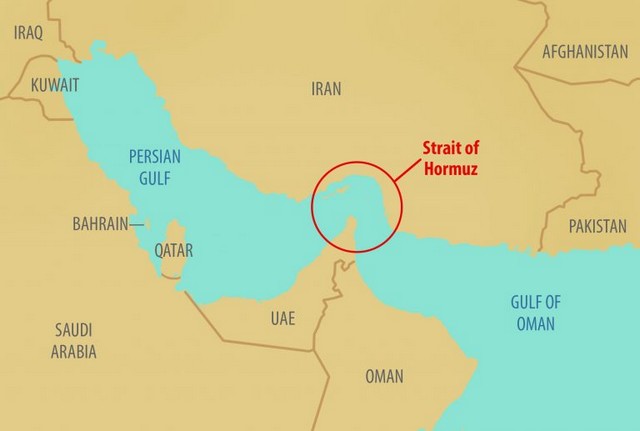
Washington pushes to brink of war against Iran

By Bill Van Auken

The abrupt trip staged by US Secretary of State Mike Pompeo to Brussels to push Washington’s hard line against Iran, combined with the deployment of still more US military assets to the Persian Gulf, point to Washington’s calculated escalation of a war crisis in the region.

Late Monday, the New York Times posted an article under the headline “White House Reviews Military Plans Against Iran, in Echoes of Iraq War.” The article cited as sources “more than half a dozen national security officials” and reported that a meeting of President Trump’s top national security aides last week discussed a plan to send as many as 120,000 troops to the Middle East.

The spark for an all-out conflict can come from any one of a number of staged provocations, including the alleged sabotage of two Saudi oil tankers and two other vessels off the coast of the United Arab Emirates (UAE) reported on Sunday.

Saudi Energy Minister Khalid al-Falih stressed that one of the Saudi tankers that was allegedly damaged was en route to pick up Saudi oil to take to the United States, a detail apparently highlighted to make the case that “US interests” were at stake in the incident.

Pompeo, national security adviser John Bolton and other US officials have repeatedly vowed to take “swift and decisive” military action in defense of US interests in the oil-rich region. They have threatened to unleash “unrelenting” force against Iran in retaliation for any action alleged to be carried out by a wide array of forces dubbed by Washington as Iranian “proxies,” ranging from Hezbollah in Lebanon to Hamas in the Palestinian Gaza Strip, the Houthi rebels in Yemen and various Shia militias in Iraq and Syria.

The alleged sabotage of the four vessels took place in the Gulf of Oman, east of Fujairah, a major oil port that lies approximately 85 miles south of the strategic Strait of Hormuz, through which passes roughly one-third of the world’s oil transported by sea.

Saudi and UAE officials indicated that there were no casualties and no oil spills resulting from the alleged sabotage. A video posted online showed a hole torn into the hull of a Norwegian-owned ship at its waterline.

The timing of the incident dovetailed neatly with the US escalation of tensions in the region. It came just days after the May 9 warning issued by the US Maritime Administration (MARAD) that commercial ships, including oil tankers, could be targeted in the growing buildup to war.

“Iran or its proxies could respond by targeting commercial vessels, including oil tankers, or US military vessels in the Red Sea, Bab-el-Mandeb Strait, or the Persian Gulf,” the MARAD statement said.

Iranian officials expressed concern over the incident. Foreign Ministry spokesman Abbas Moussavi described the incident as “lamentable” and “worrying” and called for a thorough investigation. Moussavi also warned countries of the Persian Gulf to stay vigilant in the face of potential “adventurism by foreign players” or any “conspiracy orchestrated by ill-wishers” to undermine maritime security.

There has been no clear explanation from either the UAE or the Saudi monarchy of what exactly took place in the Gulf of Oman. The involvement of covert operations aimed at creating the pretext for war, either on the part of Washington or its two principal regional allies, Israel and Saudi Arabia itself, both of which have long sought to bring the US into a war with Iran, is a very real possibility.

One thing is certain. Nothing coming from the US government or its propaganda servants in the corporate media regarding the crisis in the Persian Gulf can be believed. The pretexts for war this time around will prove as fabricated as Iraq’s “weapons of mass destruction” or the lies about a US warship being attacked in the Gulf of Tonkin that were used to justify the War in Vietnam.

The Trump administration has continued to escalate its military intervention in the region, dispatching a Patriot missile battery to the Persian Gulf along with a Navy amphibious assault ship. This follows last week’s arrival in the Red Sea of the USS Abraham Lincoln aircraft carrier battle group, as well as the landing of a bomber strike wing consisting of four B-52s at the US Al Udeid airbase in Qatar.

The Pentagon announced on Monday that the B-52s had carried out their “first mission… to defend American forces and interests in the region,” consisting of operations near Iranian airspace.

Such is the war threat that even a White House reporter questioned Trump during his Monday appearance with the far-right prime minister of Hungary, Viktor Orbán: “Are you at war with Iran? Are you seeking regime change there?”

Trump did not deny the looming war threat, declaring: “If they do anything, they will suffer greatly. We’ll see what happens with Iran.”

Underscoring the brazen recklessness of the US drive to war, Secretary Pompeo abruptly shifted his travel plans for the second time in a week, canceling a trip to Moscow to fly to Brussels and effectively crash a scheduled meeting of European foreign ministers called to discuss their response to the Persian Gulf crisis.

The US military buildup as well as the tightening of US sanctions described by the Trump administration as “maximum pressure” against Iran, designed to suffocate the country’s economy and drive its oil exports down to zero, have sharpened tensions between Washington and its erstwhile European allies.

Since the beginning of the month, Washington has withdrawn waivers that had allowed China, South Korea, Japan, India and Turkey to continue purchasing oil from Iran, and has imposed a new round of sanctions aimed at halting all exports of Iranian iron, steel, aluminum and copper.

The US and the major European powers have been divided since Trump unilaterally abrogated the so-called Joint Comprehensive Plan of Action (JCPOA) nuclear agreement reached between Iran and the US, Russia, China, Germany, the UK and France. Washington reimposed sanctions that are tantamount to a state of war. The European governments, as well as the UN nuclear inspection agency, the International Atomic Energy Agency, have insisted that Iran has remained in compliance with the agreement, which was supposed to combine strict limits on the Iranian nuclear program with the lifting of economic sanctions.

The issue for the Trump administration, however, has never been the nuclear deal, but rather the drive for regime-change, i.e., the restoration of a US-backed puppet dictatorship in the oil-rich country like that of the Shah.

As Bolton, one of the architects of the current military buildup, put it a year before becoming national security adviser: “The declared policy of the United States should be the overthrow of the mullahs’ regime in Tehran… The behavior and the objectives of the regime are not going to change and, therefore, the only solution is to change the regime itself.”

Pompeo’s meetings in Brussels with the EU foreign policy chief Federica Mogherini and the foreign ministers of Germany, France and the UK only underscored the transatlantic tensions over Iran. Mogherini said the European representatives had stressed that the crisis in the Persian Gulf had produced a “crucial delicate moment” in which “maximum restraint and avoiding any escalation on the military side” was necessary.

She said the European ministers “continue to fully support the nuclear deal with Iran,” meaning the normalization of trade and investment. She added that this included the “operationalization” of the so-called Instrument in Support of Trade Exchange (INSTEX), which is supposed to create a non-dollar direct payment channel with Iran to circumvent US sanctions. Transactions through this exchange, she claimed, would begin within the next few weeks.

Tehran last week put the European signatories to the accord on notice that it would resume uranium enrichment at a higher grade within 60 days unless they took measures to allow Iran to export its oil and access financial markets. European companies and banks, which had previously seen an opportunity for exploiting the country’s oil wealth, have withdrawn in the face of threats to be frozen out of the US market.

The European powers’ opposition to the US drive toward war against Iran is based not on any concern for the fate of 80 million Iranians, but rather on the pursuit of their own imperialist interests in the region. The conflict exposes fault lines that point to the danger of a new military conflict in the Persian Gulf becoming the antechamber of a third, nuclear, world war.

Bill Van Auken is a full-time reporter for the World Socialist Web Site, and resides in New York City.

14 May 2019

Source: countercurrents.org