Just International

Trump’s Foreign Policy: Do Whatever Netanyahu & Prince Salman Want

By Eric Zuesse

Now that Donald Trump, like Barack Obama before him, has failed to remove Syria’s Bashar al-Assad by means of American training of, and supply of weapons to, ‘rebels’ (almost all of whom were actually jihadists) in Syria, Trump, on March 21st, has set into motion a process that is designed to provide a ‘justification’ for an all-out U.S. military invasion of Syria, as a means to ‘defend Israel’.

This strategy pertains to Syria’s Golan Heights region, which is occupied by Israelis. That area of tension would be the trigger-point for the next shot in the anti-Syrian war, which would be the final shot, if it becomes fired. But perhaps Trump thinks that the threat alone will be enough to get Syria’s Government to capitulate. Anyway, the threat was issued by Trump on March 21st. So, here is the history, and documentation (via links), behind this sequence of events — the history that makes sense of Trump’s new American strategy, to conquer Syria (replacing the use of such proxy-forces as were previously used):

On 5-10 June 1967, Israel invaded Syria and Egypt and grabbed from Syria the 690-square-mile Golan Heights area of Syria. Israel has occupied it ever since. The Golan Heights is internationally recognized as being Syrian territory. But Trump now wants to change that and make it Israel’s, just as he had earlier helped Israel to change its capital from Tel Aviv to Jerusalem. Trump is the first head-of-state (other than Israel’s) to assert publicly that the Golan Heights is part of Israel, not part of Syria. Trump represents (takes his orders from) Israel’s invasion-craving fundamentalist-Jewish Benjamin Netanyahu, who wants to make official, finally, the ‘ownership’, by Israel, of Syria’s Golan Heights. Netanyahu had been expecting America’s war by use of proxies against Syria’s Government to succeed, but it has instead failed, and so an outright American invasion of Syria, by U.S. troops and missiles and bombs, will be needed, like was done to Iraq in 2003, and to Libya in 2011.

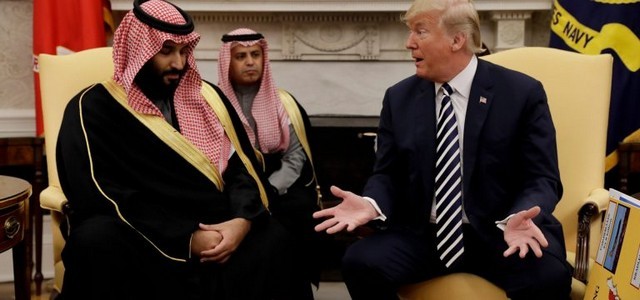
Trump also represents Israel’s ally, the equally invasion-craving and equally anti-Syrian, fundamentalist-Sunni Saudi King Salman al-Saud, and his son and heir Crown Prince Salman al-Saud. Both Netanyahu and King Salman want the fundamentalist-Sunni Saud family to control Syria. (Both Netanyahu and Salman want Syria’s land, not necessarily the people who live on it, millions of whom have fled the war in Syria, which pits Syria against the U.S.-allied invading and occupying fundamentalist-Sunni forces, which have been brought in from all over the world.) Apparently, Trump’s instructions from both Netanyahu and Salman are that this part of Syria — the Golan Heights — is to go immediately to Israel, while a means continues to be sought for the rest of Syria to become ruled ultimately by a satrap selected by the Saud family. Trump’s predecessor, Obama, had done everything he could to place Salman in control of Syria this way (by means of proxy-fighters), but failed. Trump is extremely competitive. He’s determined to out-do Obama, in service to America’s masters, whom the U.S. has long been serving: Israel and Saudi Arabia — and, of course (above all), America’s own billionaires, who likewise are united in alliance with both of those two countries’ respective aristocracies, against Syria, and against any other nation that’s (like Syria is) allied with Russia (or even friendly toward Russia, such as Ukraine was, which was successfully flipped to the U.S. in 2014, by a U.S. coup that destroyed Ukraine). The chief U.S. aim, ever since 24 February 1990, has been for Russia ultimately to be conquered and absorbed into The West — brought into America’s empire. Both the Sauds and the regime in Israel are supportive of that U.S. goal, but not primarily focused on it, like America’s billionaires are (they are obsessive against Russia). Israel and the Sauds have their own reasons to want Syria; but, as regards the U.S. regime, Syria’s alliance with Russia is the main reason that Syria must be conquered. That’s the geostrategic reason: isolating Russia, in preparation for ultimately conquering Russia.

And, so, Trump has decided to be not only the first American President but the first international head-of-state outside Israel who has publicly committed the United States to formally recognize the Golan Heights — that land which was stolen from Syria — as being legally Israeli land. It’s to be done right now, regardless of when (or whether) the U.S. ever succeeds in ousting Syria’s existing non-sectarian Government. In fact, it will provide the U.S. a pretext to invade Syria directly (by a U.S. invasion), instead of (as until now) via mere proxy-forces such as Al Qaeda-led “boots on the ground” fighting to overthrow Syria’s Government. (In 2013, the BBC’s “Guide to the Syrian rebels” said “There are believed to be as many as 1,000 armed opposition groups in Syria, commanding an estimated 100,000 fighters.” In 2015, “The Soufan Group has calculated that between 27,000 and 31,000 people have traveled to Syria and Iraq to join the Islamic State and other violent extremist groups from at least 86 countries.” These are large proxy-forces. In Syria, they were led by the U.S.-backed Syrian branch of Al Qaeda. The U.S. under Obama insisted that Russia not bomb Syria’s Al Qaeda, and this demand scuttled the cease-fire negotiations. Obama’s protection of Al Qaeda in Syria continued under Trump.)

This U.S.-backed Israeli theft of the Golan Heights will enable America to invade Syria directly and heavily, when and if Syria reacts militarily against Israel’s seizure of its land. Trump appears now to want to do this, and maybe is even hoping for Syria to respond militarily, so as to provide an excuse (based on America’s alliance with Israel) for an all-out U.S. invasion against Syria: ‘defense of an ally’. America has failed to conquer Syria with mere proxy forces (such as Al Qaeda); this would be the next step — U.S. troops, bombers, and missiles, en-masse. The presumption is that Russia would not defend Syria. That’s a very risky assumption, but Trump is a very bold man.

Trump announced, on March 21st, that “After 52 years it is time for the United States to fully recognize Israel’s Sovereignty over the Golan Heights, which is of critical strategic and security importance to the State of Israel and Regional Stability.” He thereby made clear that America is a slave to the racist-apartheid Israeli regime and will violate the intentions of all the rest of the world’s leaders except Israel’s, in demanding international recognition of this land as being a part of Israel.

This threat against Syria was not made just casually.

On March 13th, Politico headlined “New Trump administration report softens language on Israeli-occupied Golan Heights”, and Nahal Toosi reported:

The State Department’s newest Human Rights Report describes the Golan Heights as “Israeli-controlled” instead of “Israeli-occupied,” a linguistic change sure to fuel criticism that the Trump administration is bucking global consensus on Israel’s reach.

The change comes as conservative U.S. lawmakers are pushing to have the Golan Heights recognized as part of Israel. If President Donald Trump goes along with that, it would be the latest of several pro-Israel moves on his part, including moving the U.S. Embassy to Jerusalem from Tel Aviv….

U.S. Sen. Lindsey Graham (R-S.C.) recently said he would push Congress to recognize Israeli sovereignty over the Golan Heights. “To give this up would be a strategic nightmare for the State of Israel. And who would you give it to?” Graham said.

The shifts in the U.S. approach to the region, which activists say has largely been to the detriment of Palestinians, come as the Trump administration prepares to release its proposal to resolve the decades-old Israeli-Palestinian conflict.

The proposal, spearheaded by Trump son-in-law and adviser Jared Kushner, is expected to be unveiled after Israel’s elections in April, though no firm date has been set.

Finian Cunningham has brought public attention to a self-interested reason why Trump might be determined to assist Netanyahu to make Golan Heights legally israeli territory. Headlining at Strategic Culture, on March 19th “US Duplicity over Golan Demolishes Posturing on Crimea”, he wrote:

There has been previous speculation that Trump is doing the bidding for a US-based oil company, Genie Oil, which is linked to his administration through his son-in-law Jared Kushner’s family investments. The New Jersey company has a subsidiary in Israel, is tied to the Netanyahu government, and has long been aiming to drill the Golan for its abundant oil resources.

However, there also is another possible reason, and Cunningham touched upon it, too: an intention for Trump to offer to Russian Prime Minister Vladimir Putin a trade-off offer, that in return for Putin’s rejecting the repeatedly-shown-by-polling strong desire of the residents of Crimea for Crimea to be part of Russia instead of part of Ukraine, and for Putin to force Crimeans to become again ruled by Ukraine (as they had been between 1954 and 2014), the U.S. will now stop demanding that the residents of Golan Heights be part of and legally ruled by Israel, instead of for them to be ruled again by Syria as they always were.

But what is clear is that Trump definitely does now intend to legalize Israel’s control over Golan Heights, and that this has been a hope of every Israeli Administration since 1967.

Earlier, Trump had made clear that he wouldn’t do anything about Saudi Crown Prince Salman al-Saud’s barbaric torture-murder (and lies about that revenge-murder) of a Saudi journalist Jamal Khashoggi. Trump also makes clear that the U.S. will do nothing against the Salmans’ effort to starve to death the Shiite Houthis in Yemen by bombing their food-supply lines. All of that is fine with Donald Trump. This is how competitive he is. He is all-out competitive, and especially wants to out-do Obama on what he can, and to un-do Obama on what he can (such as he does by trying to destroy Obama’s gift to drug companies, Obamacare).

America supplies the training and weapons for both the Saudi and Israeli militaries. Trump’s secret National Security Policy (as introduced to the press on 19 January 2018) said that, “Though we will continue to prosecute the campaign against terrorists that we are engaged in today, … Great Power competition, not terrorism, is now the primary focus of U.S. national security.” By “Great Power competition,” it refers to, as being the chief enemies, “revisionist powers as different as China and Russia are from each other, nations that do seek to create a world consistent with their authoritarian models, pursuing veto authority over other nations’ economic, diplomatic and security decisions.” Isn’t that an excellent description of the U.S. Government, regardless of whether it’s also accurately describing either Russia, China, or any other? It certainly sounds like Big Brother’s propaganda in today’s world. But does America really need more wars? Should America’s Government really be policeman of the entire world? Indeed: of any part of the world except itself? The lying Trump had won his office by promising never to advocate any such “policeman of the world” role; but here he’s doing exactly that — for the clear benefit of America’s masters: Netanyahu and Salman and America’s oil and gas companies and all other U.S. billionaires. He represents them — not the people who had voted for him. (And, certainly, also, not the people who had voted against him. The U.S. electorate certainly are not represented by America’s Government. That’s just an established and confirmed fact.)

If the reason why Trump is now backing Israel’s aim to legalize its seizure of Golan Heights is to serve Israel’s desire for more territory, and to serve the desire of both Netanyahu and Salman for the Sauds to take ultimate control over Syria, then that would be a geostrategic aim, instead of an aim to enrich Trump’s daughter and her husband Jared Kushner by oil-wealth from Golan Heights. This geostrategic aim would be that there will be a trade-off of Golan Heights for Crimea: Israel will win legal control over Golan Heights, and Ukraine will win legal control over Crimea. However, what if Putin says no to that? There could then be an invasion by Syria against the Israelis who are occupying Golan Heights, followed by an invasion of Syria by both Israel and the United States, and a responding invasion by Russia against both Israel and the United States, ending perhaps in World War III, an annihilating global nuclear war. What would therefore be likelier would be that when Putin says no, Trump will propose — and Putin will accept — that the U.N. will oversee free and fair and U.N.-supervised elections, both in Golan Heights and in Crimea, and that the will of the majority of the residents in each of these two areas will determine what country they are part of. That would avoid WW III, and it also would be face-saving for the leaderships both in U.S. and in Russia. Of course, if the personal enrichment of Trump’s family is instead the motive, then the U.S. Congress will be far less supportive of Israel’s side in this matter than they have been up till now.

Democrats in Congress, and professional neoconservatives generally, not only are blindly suportive of Israel’s Government, but they allege that ‘Putin made Trump President’. They do this despite the fact that the Republican Trump Administration wants to escalate its Democratic Party predecessor Obama’s war (which started in 2012) against Russia; so, this accusation against Trump doesn’t really make much sense. Like the neoconservative advisor to international corporations Ian Bremmer said on 22 March 2018, in the neoconservative TIME magazine, “Putin Won. But Russia Is Losing.” That’s how Bremmer’s international clients want to view things — as if Russia, not the U.S., is the perpetrator of invasions and coups constantly, ‘perpetual war for perpetual peace’ — that it comes from Russia, instead of from America. But it’s obviously a lie.

On 23 February 2018, James George Jatras, at Strategic Culture, bannered “What Would an ‘America First!’ Security Policy Look Like?” and he provided his answer: it would look very different from Trump’s actual foreign policies. But I would put it another way: it would look like a country that isn’t trying to take over the world, and like a country that would eliminate most if not all of its hundreds of foreign military bases. U.S. President Eisenhower warned, near his last day in office, against growth in the “military-industrial complex,” but subsequently it has swallowed this country whole. Most Americans love that: the military is, by far, the highest-respected of all institutions in America. Is this the new Sparta? Maybe the new Rome? Or even the new Nazi Germany. With nuclear weapons. And both Republicans and Democrats support it, as if to do otherwise is ‘unpatriotic’.

NOTE: Israel is actually an enemy of America:

On 8 June 1967, Israel intentionally attacked and sank the USS Liberty, slaughtering 34 of our sailors, and injuring another 172. The official U.S. government inquiry by an independent study Commission headed by Admiral Thomas H. Moorer, found that, “after eight hours of aerial surveillance, Israel launched a two-hour air and naval attack against the USS Liberty, the world’s most sophisticated intelligence ship.” “Unmarked Israeli aircraft dropped napalm canisters on the Liberty’s bridge, and fired 30mm cannons and rockets into our ship.” “Israeli torpedo boats later returned to machine-gun at close range three of the Liberty’s life rafts that had been lowered into the water by survivors to rescue the most seriously wounded.” “There is compelling evidence that Israel’s attack was a deliberate attempt to destroy an American ship and kill her entire crew.” “Israel committed acts of murder against American servicemen and an act of war against the United States.” “The White House deliberately prevented the U.S. Navy from coming to the defense of the Liberty.” “Surviving crewmembers were later threatened with ‘court-martial, imprisonment or worse’ if they exposed the truth; and were abandoned by their own government.” “The White House deliberately covered up the facts of this attack from the American people.”

So is Saudi Arabia.

But those (plus America’s own billionaires) are the two countries that America’s President actually represents (in addition to America’s own billionaires, who are more concerned to conquer Russia and to control China).

America’s alliances reflect the interests of America’s billionaires, and that’s all. America’s military represents them, and that’s all. Today’s America is fundamentally different from FDR’s America. It is no democracy.

—————

Investigative historian Eric Zuesse is the author, most recently, of They’re Not Even Close: The Democratic vs. Republican Economic Records, 1910-2010.

28 March 2019

Source: countercurrents.org
John Bolton and Mike Pompeo Defy the International Criminal Court

By Rebecca Gordon

Events just fly by in the ever-accelerating rush of Trump Time, so it’s easy enough to miss important ones in the chaos. Paul Manafort is sentenced twice and indicted a third time! Whoosh! Gone! The Senate agrees with the House that the United States should stop supporting Saudi Arabia in Yemen (and Mitch McConnell calls this attempt to extricate the country from cooperation in further war crimes “inappropriate and counterproductive”)! Whoosh! Gone! Twelve Republican senators cross party lines to overturn Trump’s declaration of a national emergency on the U.S.-Mexico border, followed by the president’s veto! Whoosh! Gone! Delegates to the March 2019 U.N. Environment Assembly meeting agree to a non-binding but important resolution drastically reducing the production of single-use plastic. The United States delegation, however, succeeds in watering down the final language lest it “endorse the approach being taken in other countries, which is different than our own”! Once again, the rest of the world is briefly reminded of the curse of American exceptionalism and then, whoosh! Gone!

Under the circumstances, it wouldn’t be surprising if you had missed the Associated Press report about Secretary of State Mike Pompeo announcing that the United States “will revoke or deny visas to International Criminal Court personnel seeking to investigate alleged war crimes and other abuses committed by U.S. forces in Afghanistan or elsewhere.” In fact, said Pompeo, some visas may already have been denied or revoked, but he refused to “provide details as to who has been affected and who will be affected” (supposedly to protect the confidentiality of visa applicants).

National Security Advisor John Bolton had already signaled such a move last September in a speech to the Federalist Society. In what the Guardian calledan “excoriating attack” on the International Criminal Court, or ICC, Bolton said, “The United States will use any means necessary to protect our citizens and those of our allies from unjust prosecution by this illegitimate court.”

By “unjust prosecution,” he clearly meant any attempt to hold Americans accountable for possible war crimes. An exception even among exceptional nations, the United States simply cannot commit such crimes. Hence, by the logic of Bolton or Pompeo, any prosecution for such a crime must, by definition, be unjust.

In calling it “this illegitimate court,” Bolton was referring to the only international venue now in existence for trying alleged war criminals whose countries cannot or will not prosecute them. By “our allies,” Bolton appeared to mean Israel, a supposition Pompeo confirmed last week when he toldreporters, “These visa restrictions may also be used to deter ICC efforts to pursue allied personnel, including Israelis.”

And when it came to threats, Bolton didn’t stop there. He also suggested that the U.S. might even arrest ICC officials:

“We will ban its judges and prosecutors from entering the United States. We will sanction their funds in the U.S. financial system, and we will prosecute them in the U.S. criminal system. We will do the same for any company or state that assists an ICC investigation of Americans.”

This is a dangerous precedent indeed, as the director of the American Civil Liberty Union’s Human Rights Project, Jamil Dakwar, told Democracy Now.It’s outrageous, he pointed out, that the U.S. would prosecute “judges and the prosecutors of the ICC for doing their job and for doing the job that the United States should have done — that is, to investigate, credibly and thoroughly, war crimes and crimes against humanity that were committed in the course of the war in Afghanistan.”

What’s all this about?

The story goes back to December 2017, when Fatou Bensouda, the ICC’s chief prosecutor, announced an investigation into the possibility that U.S. military and CIA personnel had committed war crimes during America’s Afghan War or in other countries “that have a nexus to the armed conflict in Afghanistan.” These included some of the countries that hosted the CIA’s so-called black sites, where, in the earlier years of the war on terror, detainees were held incommunicado and tortured. Specifically, the ICC opened an investigation into the possible commission of “war crimes, including torture, cruel treatment, outrages upon personal dignity, rape, and other forms of sexual violence by U.S. armed forces and members of the CIA on the territories of Afghanistan, Poland, Romania, and Lithuania.”

When Bensouda made her announcement, it looked as if at least some Americans might finally be held accountable for crimes committed in the post-9/11 “war on terror” launched to avenge the criminal deaths of 3,000 souls in New York City and Washington, D.C. That never-ending war has seen the United States illegally invade and occupy Iraq; directly kill at least 210,000 civilians (not to mention actual combatants) in Iraq and Afghanistan; torture an unknown number of prisoners; and continue to detain without trial or conviction 39 men at the Guantánamo Bay prison in Cuba.

But wait. Aren’t U.S. personnel immune from ICC prosecution, because Washington never ratified the treaty that created the court?

That’s true, but the alleged crimes didn’t take place in the United States. They were committed in Afghanistan, Poland, Romania, and Lithuania, all of which have ratified the treaty. Note that Thailand, site of egregious CIA abuses, doesn’t appear on the ICC’s list, nor does Iraq (the site of the now infamous Abu Ghraib prison, among other things), presumably because neither is a signatory to the treaty.

However, before it could prosecute such crimes, the ICC would have to investigate any potential charges, interview possible witnesses, and gather the evidence necessary to prepare an indictment. That would undoubtedly require its investigators to visit the United States. This, say Bolton and Pompeo, will never be permitted.

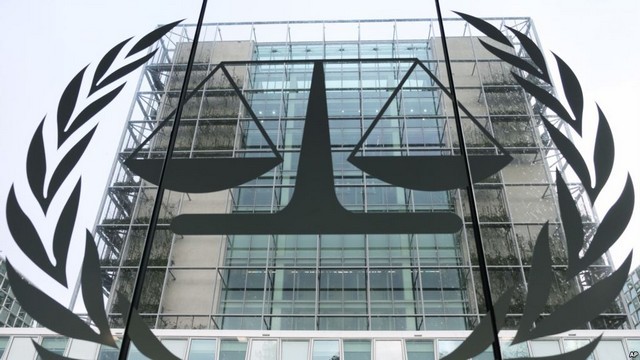
What Is the International Criminal Court and Why Does It Matter?

The ICC’s origins go back to the Nuremberg trials at the end of World War II. In 1943, the leaders of the Allied powers — England, France, the United States, and the Soviet Union — met in Tehran, Iran. One subject on the table: how, once the war was won, the Allies would deal with Nazi war criminals. Soviet dictator Joseph Stalin is said to have proposed simply lining up and executing 50,000 Nazis. American President Franklin Delano Roosevelt reportedly tried to break the resulting tension by jokingly suggesting that 49,000 might be sufficient.

Two years later, at war’s end, confronting evidence of barbarism on a scale previously unseen in history, the war’s victors found themselves responsible for bringing accountability to the perpetrators of genocide and some modicum of justice to its victims. It was decided then to establish a tribunal, a court, where such criminals could be tried. The problem the Great Powers now faced was how to create a process that the world would consider something more than vengeance masquerading as righteousness, something more than “victors’ justice.”

The solution was to demonstrate that their prosecutions had a basis in the Geneva Conventions and other international treaties — in, that is, the already existing laws of war. In the process of designing those prosecutions, they consolidated and advanced the meaning and power of international law itself, a concept particularly needed in a postwar world of atomic weapons and a looming U.S.-Soviet conflict. Three-quarters of a century and many wars and weapon systems later, enforceable international law still remains humanity’s best hope for adjudicating past war crimes and preventing future ones — but only if great nations like the United States do not declare themselves exceptions to the rule of law.

In addition to the verdicts rendered, the Nuremberg tribunal produced other enduring results, including the 1950 Nuremberg Principles, commissioned and adopted by the new United Nations. Those principles established that actions violating international law were punishable crimes, whether they violated any specific country’s domestic laws or not. Even heads of state or other high government officials were not considered immune from prosecution for such war crimes or crimes against humanity. And no one could be exonerated for them on the sole grounds of following the orders of a superior.

In the end, however, was Nuremberg really anything more than victors’ justice? There were those who said that was all it was, invoking what was called the “tu quoque” (Latin for “you did it, too”) argument. After all, hadn’t the allies also committed war crimes? Hadn’t the British and Americans, for example, firebombed the German city of Dresden, killing 25,000 civilians in one night and destroying 75,000 homes? Indeed, it’s been argued that, because the Allies didn’t want to answer for Dresden, they excluded the earlier German air war against England from the charges brought at Nuremberg.

Nevertheless, many observers there believed that, after rendering verdicts for Nazi crimes, a more permanent tribunal would turn its attention to the crimes of the Allies. It might even, for example, have taken up the legality of the U.S. use of the world’s first atomic weapons to obliterate the Japanese cities of Hiroshima and Nagasaki. This, of course, never happened.

Nor has any court ever prosecuted those responsible for the U.S. firebombing of 67 Japanese cities. Those lesser-known attacks killed hundreds of thousands of civilians and reduced many of that country’s largely wooden urban areas to ashes. Robert McNamara, secretary of defense under Presidents John F. Kennedy and Lyndon Johnson (and an architect of American policy in Vietnam), described those attacks in Errol Morris’s brilliant documentary The Fog of War. Reflecting on his own actions in World War II when, as an Air Force captain, he served in the Office of Statistical Control (where he analyzed the efficiency of bomber aircraft), he told Morris: “What one can criticize is that the human race, prior to that time — and today! — has not really grappled with what are called the rules of war. Was there a rule that said you shouldn’t bomb, shouldn’t kill, shouldn’t burn to death a hundred thousand civilians in one night? [General Curtis LeMay, who oversaw the firebombing campaign in Japan] said if we’d lost the war, we’d all have been prosecuted as war criminals.”

What does any of this have to do with today’s International Criminal Court? The ICC is itself an outgrowth of the Nuremberg process. Even during the original Nuremberg trial, observers expected that the newly established United Nations would create a permanent war crimes court as one of its earliest actions.

In the end, it took more than half a century, but in 1998, at a United Nations General Assembly convention in Rome, 120 countries adopted the “Rome Statute,” which established the court at The Hague in the Netherlands and described its jurisdiction and rules of operation. (Among the 148 votes, there were 21 abstentions and seven “no” votes, including the United States.) The ICC officially opened in 2002, when 60 nations ratified the Rome Statute. It took up its first prosecution in 2005. Today, about 120 member states back its role on this planet.

(A side note: The ICC is often confused with the International Court of Justice, commonly called the World Court. The ICC deals with the criminal prosecution of individuals. The World Court deals with civil disputes between nations. Unlike the ICC, the United States is a member of the World Court, although its record of abiding by that court’s decisions is spotty at best.)

The United States and the ICC — a Strange Dance

Despite having participated in the work of formulating the Rome Statute, the United States never ratified it or joined the court. The first administration to deal with it would take a confusing and contradictory stance. In 1999, President Bill Clinton signed a Foreign Relations Authorization Act that included language prohibiting federal funding for the ICC and the extradition of any U.S. citizen to a country that might surrender him or her to that court for prosecution.

The following year, however, Clinton actually signed the Rome Statute, the treaty creating the ICC. In fact, the United States had been instrumental in drafting the court’s procedures, rules of evidence, and definitions of various crimes. In spite of that Foreign Relations Authorization Act, it looked as if the U.S. was on the way to future full participation in the ICC. The year 2000, however, saw the election of George W. Bush. In 2002, the Bush administration rescinded Clinton’s signature and notified the United Nations that the United States would not ratify the treaty. It was hardly a surprising move given that the Bush-Cheney administration had already begun torturing detainees in its newly born war on terror. (Torture techniques would even reportedly be demonstrated to some of those officials, including Vice President Dick Cheney and National Security Advisor Condoleeza Rice, in the White House.)

It was John Bolton, then Bush’s undersecretary of state for arms control and international security, who sent the notification letter to U.N. Secretary General Kofi Annan and personally trekked to U.N. headquarters in New York City to “unsign” the Rome Statute. That, of course, is the very John Bolton who now is Donald Trump’s national security advisor and who attacked the ICC at the Federalist Society last September. This was hardly surprising, since his record of opposing any international constraints on Washington has been long and consistent. In fact, when George W. Bush tapped him as ambassador to the United Nations in 2005, the Senate refusedto confirm him. It took a recess appointment to get him the job. The Senate’s reluctance was reasonble, given Bolton’s contempt for the institution. (He’d once said that if its headquarters building “lost ten stories, it wouldn’t make a bit of difference.”)

In 2002, Bush signed the American Servicemembers Protection Act (ASPA), which, as the American Bar Association explains, contained “several provisions meant to prohibit or otherwise complicate U.S. cooperation with the ICC.” These included “restricting U.S. participation in U.N. peacekeeping operations, and prohibiting use of any appropriated funds to support or cooperate with the Court.” They also included a provision authorizing the use of military force “to liberate any American citizens held by the Court,” leading it to be dubbed by critics “the Invade The Hague Act.”

And yet even the ASPA demonstrated an American ambivalence towards the ICC. It had an amendment allowing the U.S. to cooperate with the court in order to bring “other foreign nationals accused of genocide, war crimes, or crimes against humanity” to justice. In other words, the ICC was considered good enough to try other countries’ accused war criminals, just not ours.

Under President Barack Obama, the United States began a rapprochement with the court, opening diplomatic relations and starting to attend meetings of its Assembly of States Parties as an observer, which it continues to do today. In 2011, the U.S. sent a delegation to an ICC meeting in Kampala, Uganda, where important language was adopted defining the crime of aggression.

Making an aggressive war was the first of the three categories of crimes under which Nazi leaders were charged at Nuremberg. At the time, Washington officials strongly advocated for the position that all other Nazi atrocities sprang from that initial crime. The same could well be said of the Bush-Cheney administration’s decision to invade first Afghanistan and then Iraq. Cooperation with the ICC continued under Obama, who also signed a law providing rewards of up to $5 million for the capture of individuals indicted by the court.

It should be noted that the ICC is not without its critics. African nations in particular have rightly complained that the only people who have stood trial so far are from that continent, leading some to threaten to withdraw. In 2017, Burundi did leave, but so far no other African members have followed suit. Nonetheless, the ICC remains a court of last resort when it comes to bringing war criminals to justice.

Reversing Course Under Trump

Given Trump’s “America First” rhetoric, it should hardly be surprising that the ICC is among the international organizations he and his top foreign-policy officials particularly despise. As a result, his administration has already rolled back Obama’s rapprochement and then some. In view of the president’s lack of attention to detail (not to mention his short attention span), it seems likely that John Bolton is the true architect of this latest move. It’s the State Department that grants (or doesn’t grant) visas, so Mike Pompeo made the official announcement, but this approach fits Bolton’s M.O.

The poison now seeping out of Washington continues to spread. On March 18th, Rodrigo Duterte’s Philippines became the second country to leave the ICC, where it, like the U.S., is being investigated for possible crimes — in its case, against its own people. As the Washington Post reports, the country is “under preliminary examination [by the ICC] for thousands of [domestic drug war] killings since Duterte rose to the presidency in 2016.”

In its menacing rejection of the court, the Trump administration is turning its back on the system of international law and justice the United States helped establish at Nuremberg. The rule of law must not hold only, as hotelier Leona Helmsley once said about taxes, for “the little people.” If Donald Trump had truly wanted to “make America great again,” he would have recognized that international law is not just for the little countries. The greater a world power, the more consequential is its submission to the rule of law. The attacks of John Bolton and Mike Pompeo on the ICC, however, simply represent a new spate of lawless actions from a lawless administration in an increasingly lawless era in Washington.

Rebecca Gordon, a TomDispatch regular, teaches at the University of San Francisco.

26 March 2019

Source: countercurrents.org
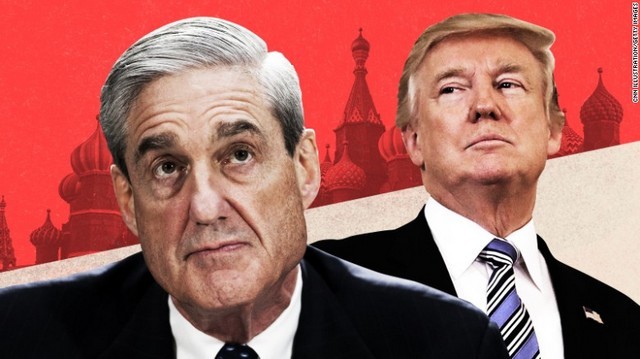
Three lessons for the left from the Mueller inquiry

By Jonathan Cook

Here are three important lessons for the progressive left to consider now that it is clear the inquiry by special counsel Robert Mueller into Russiagate is never going to uncover collusion between Donald Trump’s camp and the Kremlin in the 2016 presidential election.

Painting the pig’s face

1. The left never had a dog in this race. This was always an in-house squabble between different wings of the establishment. Late-stage capitalism is in terminal crisis, and the biggest problem facing our corporate elites is how to emerge from this crisis with their power intact. One wing wants to make sure the pig’s face remains painted, the other is happy simply getting its snout deeper into the trough while the food lasts.

Russiagate was never about substance, it was about who gets to image-manage the decline of a turbo-charged, self-harming neoliberal capitalism.

The leaders of the Democratic party are less terrified of Trump and what he represents than they are of us and what we might do if we understood how they have rigged the political and economic system to their permanent advantage.

It may look like Russiagate was a failure, but it was actually a success. It deflected the left’s attention from endemic corruption within the leadership of the Democratic party, which supposedly represents the left. It rechannelled the left’s political energies instead towards the convenient bogeymen targets of Trump and Russian president Vladimir Putin.

Mired in corruption

What Mueller found – all he was ever going to find – was marginal corruption in the Trump camp. And that was inevitable because Washington is mired in corruption. In fact, what Mueller revealed was the most exceptional forms of corruption among Trump’s team while obscuring the run-of-the-mill stuff that would have served as a reminder of the endemic corruption infecting the Democratic leadership too.

An anti-corruption investigation would have run much deeper and exposed far more. It would have highlighted the Clinton Foundation, and the role of mega-donors like James Simons, George Soros and Haim Saban who funded Hillary’s campaign with one aim in mind: to get their issues into a paid-for national “consensus”.

Further, in focusing on the Trump camp – and relative minnows like Paul Manafort and Roger Stone – the Russiagate inquiry actually served to shield the Democratic leadership from an investigation into the much worse corruption revealed in the content of the DNC emails. It was the leaking / hacking of those emails that provided the rationale for Mueller’s investigations. What should have been at the front and centre of any inquiry was how the Democratic party sought to rig its primaries to prevent party members selecting anyone but Hillary as their presidential candidate.

So, in short, Russiagate has been two years of wasted energy by the left, energy that could have been spent both targeting Trump for what he is really doing rather than what it is imagined he has done, and targeting the Democratic leadership for its own, equally corrupt practices.

Trump empowered

1. But it’s far worse than that. It is not just that the left wasted two years of political energy on Russiagate. At the same time, they empowered Trump, breathing life into his phoney arguments that he is the anti-establishment president, a people’s president the elites are determined to destroy.

Trump faces opposition from within the establishment not because he is “anti-establishment” but because he refuses to decorate the pig’s snout with lipstick. He is tearing the mask off late-stage capitalism’s greed and self-destructiveness. And he is doing so not because he wants to reform or overthrow turbo-charged capitalism but because he wants to remove the last, largely cosmetic constraints on the system so that he and his friends can plunder with greater abandon – and destroy the planet more quickly.

The other wing of the neoliberal establishment, the one represented by the Democratic party leadership, fears that exposing capitalism in this way – making explicit its inherently brutal, wrist-slitting tendencies – will awaken the masses, that over time it will risk turning them into revolutionaries. Democratic party leaders fear Trump chiefly because of the threat he poses to the image of the political and economic system they have so lovingly crafted so that they can continue enriching themselves and their children.

Trump’s genius – his only genius – is to have appropriated, and misappropriated, some of the language of the left to advance the interests of the 1 per cent. When he attacks the corporate “liberal” media for having a harmful agenda, for serving as propagandists, he is not wrong. When he rails against the identity politics cultivated by “liberal” elites over the past two decades – suggesting that it has weakened the US – he is not wrong. But he is right for the wrong reasons.

TV’s version of clickbait

The corporate media, and the journalists they employ, are propagandists – for a system that keeps them wealthy. When Trump was a Republican primary candidate, the entire corporate media loved him because he was TV’s equivalent of clickbait, just as he had been since reality TV began to usurp the place of current affairs programmes and meaningful political debate.

The handful of corporations that own the US media – and much of corporate America besides – are there both to make ever-more money by expanding profits and to maintain the credibility of a political and economic system that lets them make ever more money.

The “liberal” corporate media shares the values of the Democratic party leadership. In other words, it is heavily invested in making sure the pig doesn’t lose its lipstick. By contrast, Fox News and the shock-jocks, like Trump, prioritise making money in the short term over the long-term credibility of a system that gives them licence to make money. They care much less whether the pig’s face remains painted.

So Trump is right that the “liberal” media is undemocratic and that it is now propagandising against him. But he is wrong about why. In fact, all corporate media – whether “liberal” or not, whether against Trump or for him – is undemocratic. All of the media propagandises for a rotten system that keeps the vast majority of Americans impoverished. All of the media cares more for Trump and the elites he belongs to than it cares for the 99 per cent.

Gorging on the main course

Similarly, with identity politics. Trump says he wants to make (a white) America great again, and uses the left’s obsession with identity as a way to energise a backlash from his own supporters.

Just as too many on the left sleep-walked through the past two years waiting for Mueller – a former head of the FBI, the US secret police, for chrissakes! – to save them from Trump, they have been manipulated by liberal elites into the political cul-de-sac of identity politics.

Just as Mueller put the left on standby, into waiting-for-the-Messiah mode, so simple-minded, pussy-hat-wearing identity politics has been cultivated in the supposedly liberal bastions of the corporate media and Ivy League universities – the same universities that have turned out generations of Muellers and Clintons – to deplete the left’s political energies. While we argue over who is most entitled and most victimised, the establishment has carried on raping and pillaging Third World countries, destroying the planet and siphoning off the wealth produced by the rest of us.

These liberal elites long ago worked out that if we could be made to squabble among ourselves about who was most entitled to scraps from the table, they could keep gorging on the main course.

The “liberal” elites exploited identity politics to keep us divided by pacifying the most maginalised with the offer of a few additional crumbs. Trump has exploited identity politics to keep us divided by inflaming tensions as he reorders the hierarchy of “privilege” in which those crumbs are offered. In the process, both wings of the elite have averted the danger that class consciousness and real solidarity might develop and start to challenge their privileges.

The Corbyn experience

1. But the most important lesson of all for the left is that support among its ranks for the Mueller inquiry against Trump was foolhardy in the extreme.

Not only was the inquiry doomed to failure – in fact, not only was it designed to fail – but it has set a precedent for future politicised investigations that will be used against the progressive left should it make any significant political gains. And an inquiry against the real left will be far more aggressive and far more “productive” than Mueller was.

If there is any doubt about that look to the UK. Britain now has within reach of power the first truly progressive politician in living memory, someone seeking to represent the 99 per cent, not the 1 per cent. But Jeremy Corbyn’s experience as the leader of the Labour party – massively swelling the membership’s ranks to make it the largest political party in Europe – has been eye-popping.

I have documented Corbyn’s travails regularly in this blog over the past four years at the hands of the British political and media establishment. You can find many examples here.

Corbyn, even more so than the small, new wave of insurgency politicians in the US Congress, has faced a relentless barrage of criticism from across the UK’s similarly narrow political spectrum. He has been attacked by both the rightwing media and the supposedly “liberal” media. He has been savaged by the ruling Conservative party, as was to be expected, and by his own parliamentary Labour party. The UK’s two-party system has been exposed as just as hollow as the US one.

The ferocity of the attacks has been necessary because, unlike the Democratic party’s success in keeping a progressive leftwinger away from the presidential campaign, the UK system accidentally allowed a socialist to slip past the gatekeepers. All hell has broken out ever since.

Simple-minded identity politics

What is so noticeable is that Corbyn is rarely attacked over his policies – mainly because they have wide popular appeal. Instead he has been hounded over fanciful claims that, despite being a life-long and very visible anti-racism campaigner, he suddenly morphed into an outright anti-semite the moment party members elected him leader.

I will not rehearse again how implausible these claims are. Simply look through these previous blog posts should you be in any doubt.

But what is amazing is that, just as with the Mueller inquiry, much of the British left – including prominent figures like Owen Jones and the supposedly countercultural Novara Media – have sapped their political energies in trying to placate or support those leading the preposterous claims that Labour under Corbyn has become “institutionally anti-semitic”. Again, the promotion of a simple-minded identity politics – which pits the rights of Palestinians against the sensitivities of Zionist Jews about Israel – was exploited to divide the left.

The more the left has conceded to this campaign, the angrier, the more implacable, the more self-righteous Corbyn’s opponents have become – to the point that the Labour party is now in serious danger of imploding.

A clarifying moment

Were the US to get its own Corbyn as president, he or she would undoubtedly face a Mueller-style inquiry, and one far more effective at securing the president’s impeachment than this one was ever going to be.

That is not because a leftwing US president would be more corrupt or more likely to have colluded with a foreign power. As the UK example shows, it would be because the entire media system – from the New York Times to Fox News – would be against such a president. And as the UK example also shows, it would be because the leaderships of both the Republican and Democratic parties would work as one to finish off such a president.

In the combined success-failure of the Mueller inquiry, the left has an opportunity to understand in a much more sophisticated way how real power works and in whose favour it is exercised. It is moment that should be clarifying – if we are willing to open our eyes to Mueller’s real lessons.

Jonathan Cook won the Martha Gellhorn Special Prize for Journalism.

26 March 2019

Source: countercurrents.org
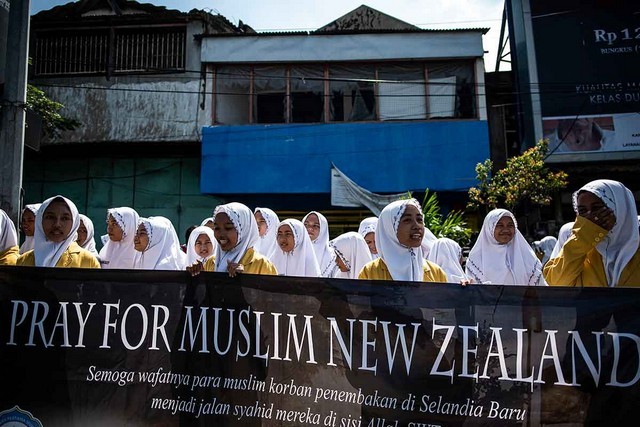
Islamophobia in Southeast Asia

By Ahmad Farhan

The term Islamophobia has its roots in the Greek word Phobos which refers to the God of fear and is used to denote terror. As such, the literal meaning of Islamophobia would be the ‘fear of Islam’. However, the term has evolved over the years to represent the many prejudices faced by Muslims by virtue of their faith. The modern interpretation is no more obvious than the recent Christchurch shootings. The shooter had no agenda other than prejudice and hatred towards Muslims. His misplaced determination and hatred gave him the strength to cross international borders to commit heinous crimes against innocent people.

Islamophobia is growing and the reasons for it may be closer to home than we think.

A probable source could be the media. Technology and the internet have allowed many unverified or fake news to reach hundreds of millions of people around the world. This was the case in Myanmar where many of the locals were led to believe that the Rohingya Muslims were indeed terrorists; fuelling a ‘slow-burning genocide’ as observed by Maung Zarni, a human rights activist.

Documented proof

There is documented proof that the media in general is highly skewed towards Islamophobic content. Dr Sadia Mahmood, an Assistant Professor from the Department of Mass Communication at the University of Karachi in her paper ‘Portrayal of Islam and Muslims on Facebook by US Conventional Media’ found that United States (US) media outlets are still negatively portraying Islam, not telling the full story and sometimes outright lying to their readers to instil a fear of Islam.

Nationalism or patriotism, whilst seen as a positive value, can sometimes be harmful to society. The violence perpetrated against the Rohingya Muslims is still seen as a righteous crusade against the ‘other’ by many in Myanmar. This form of nationalism is widely practiced in Myanmar today, reinforcing the belief that ‘Myanmar is for Buddhists’; the mantra of Ashin Wirathu, a Buddhist monk and leader of the anti-Muslim movement in the country.

Imtiyaz Yusuf, Associate Professor at the International Islamic University Malaysia, summarises the situation there nicely by writing that “it is a clash between two views (Buddhist and Muslim) of nationalism over the claim to Myanmar citizenship.”

“The conflict invokes Buddhist and Muslim nationalist in order to protect and preserve national ethnicities as religious identities in turn causing the rise of the new phenomena of Asian Islamophobia”, he explained.

Nationalistic sentiment

But sometimes, nationalistic sentiment can be traced back to society’s insecurities. US President Donald Trump used that very same tactic to win votes by proposing a “ban on all Muslims from entering the country” and making statements such as “Muslims were cheering when 9-11 happened” to appeal to Islamophobic parts of the population and white extremists. It is also happening within the borders of ASEAN member states. In Thailand’s recently concluded general election, Pandin Dharma, a political party obtained the support of Buddhist nationalist by claiming that the secular movement within the country was biased towards the Muslim minority.

Salman Sayyid, Professor of Rhetoric and Decolonial Thought at the University of Leeds, describes Thailand as one of the countries that is “feeling under threat from the demands of the Islamic people”.

The Rohingya crisis is an ongoing humanitarian disaster that has seen many Muslims living in Rakhine state having atrocities done to them by Myanmar’s security forces. The intolerable violence has forced them to flee to neighbouring Bangladesh.

ASEAN’s response to issues like the Rohingya crisis has not been the swiftest nor the most effective. The crisis started in 2012, but due to ASEAN’s non-interference policy, was only addressed in 2018 at the United Nations (UN) General Assembly, when member countries condemned the atrocities and called for the prosecution of those responsible. This came about after a year-long investigation by the UN that found six Myanmar generals guilty of crimes against humanity.

Social media company Facebook Inc. also took action by removing accounts of those linked to Myanmar’s military in order to curb the further proliferation of Islamophobic sentiments around the country. Alex Warofka, Product Policy Manager at Facebook admitted at the time that Facebook “needed to do more” in order to become “a force for good” in Myanmar.

Much more needs to be done to stop the spread of Islamophobia and ASEAN member states could learn from Canada where in 2017, members of the House of Commons tabled Motion 103 calling on the Government to condemn Islamophobia. The motion was passed under heavy criticism that it was “killing free speech”, but Islamophobic-related incidents have all but stopped in Canada since.

The question that remains is what can be done to curb Islamophobia in the region?

Whilst it could be seen as inhibiting free speech, cracking down on hate speech either through the internet or restricting the distribution of Islamophobic material would be a good jumping-off point as many attain the sentiment and foster contempt towards those of the Islamic faith by consuming these hate-filled materials.

Islamophobia is a growing problem that needs to be addressed. The people of Southeast Asia should reject it in order to foster a harmonious future for ASEAN’s citizens. 14 days after the Christchurch shooting, Jacinda Ardern, New Zealand’s prime minister, gave a speech saying that “an assault on the freedom of those who want to practice their faith or religion is not welcome here”.

29 March 2019

Source: theaseanpost.com

French army receives authorization to shoot “yellow vest” protesters

By Alex Lantier

Yesterday, the governor of the Paris military district told France Info that soldiers of the Operation Sentinel counter-terror mission had been authorized to fire today on the “yellow vests.” Asked about whether soldiers were capable of carrying out law enforcement duties, General Bruno Le Ray replied: “Our orders are sufficiently clear that we do not need to be worried at all. The soldiers’ rules of engagement will be fixed very rigorously.”

“They will have different means for action faced with all types of threats,” he continued. “That can go as far as opening fire.”

Le Ray added that soldiers will have the same rules of engagement for shooting protesters as those for gunning down terrorism suspects inside France: “They will deliver warnings. This has happened in the past, as in (attacks at) the Louvre or at Orly. They are perfectly able to assess the nature of the threat and to respond proportionally.”

These threats against a protest movement against social inequality that is largely peaceful must be taken as a warning by workers and youth not only in France but internationally. As mass protests and strikes erupting outside the control of the union bureaucracies spread across the world, the military and security agencies of the financial aristocracy are preparing to carry out ruthless repression. Even in countries like France with long bourgeois-democratic traditions, they are rapidly moving towards military-police dictatorship.

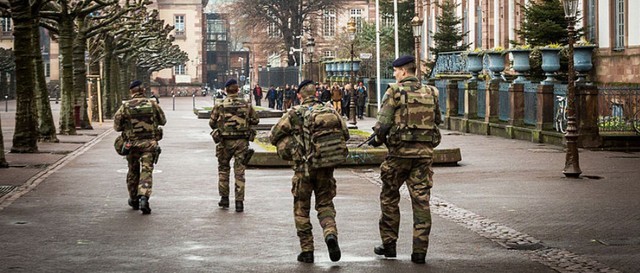
Since the imposition of a state of emergency suspending basic democratic rights after the 2015 Paris attacks, the army’s Operation Sentinel has sent squads of soldiers marching in France’s streets, wearing bulletproof vests and carrying assault rifles. The current crisis vindicates the WSWS’s longstanding warnings. In every country, the ruling class has used the “war on terror” as a pretext to reinforce state repression that is aimed above all at opposition in the working class.

Amid yesterday’s European Union summit in Brussels, French President Emmanuel Macron spoke to downplay the significance of sending the army against the “yellow vests.” The army is “in no way responsible for maintaining order and public order,” he claimed, mocking criticisms of his resort to the army as a “false debate” fueled by “those who play at scaring themselves and others.”

French Defense Minister Florence Parly followed Le Ray onto France Info and also trivialized the decision to send troops to police the protests. Without explicitly contradicting Le Ray’s report on the orders given to Operation Sentinel forces, she said: “The soldiers of the French army never fire on protesters. … All those who play around with fantasies, who speak about opening fire, are only sowing confusion.”

It is impossible to know in advance whether or how many lives will be lost during army operations against the “yellow vests” today. But the soporific and historically inaccurate statements of Macron and Parly are being openly contradicted by certain soldiers, who are violating military discipline to tell the media about their anger and concern at the orders they are receiving.

“We have no business interfering in this ‘yellow vest’ business,” one soldier anonymously told France Info. “We do not have the necessary equipment, we just have truncheons and little pepper spray bottles like what girls have in their purses. After that, the next thing we have is our assault rifles. … So, if we go up against too many protesters, unfortunately we will probably see fatalities.”

Another soldier stressed his anger at receiving orders from Macron to target the French people: “It is absurd, it’s arbitrary. We are not prepared for this. In technical terms, we fight military enemies. And the enemy cannot be the entire population, that is not possible. That is the situation they are trying to put soldiers in today.”

General Vincent Desportes, the former head of the War Academy, made clear his skepticism about claims from within the Macron government that riot police will always manage to get between protesters and the soldiers, to ensure that the latter do not fire on the former.

He said, “Until now the security forces have not shown themselves entirely capable of controlling large crowds of protesters. If violent protesters come into contact with the soldiers, there is a serious risk that blood will be spilt. … The last time soldiers were used for law enforcement was in Algeria, more than 50 years ago. As you well know, at that point blood was spent, a lot of blood was spent.”

The result of the last intervention of the army against workers on what is currently French soil, in the insurrectionary strikes of 1947-8 against the bourgeois Republic established by the Gaullists and Stalinists after World War II and the fall of European fascism, was a massacre. As 350,000 miners went on strike, the army occupied the mines with an authorization to fire on the strikers. The resulting clashes led to six dead, thousands of wounded, and the firing of 3,000 miners, a decision legally recognized as discriminatory in 2011.

In Algeria, the use of the army to torture and kill Algerians rising up against French colonialism, barely more than a decade after these same methods were used in France itself by the Nazis and the Nazi-collaborationist Vichy regime, left over 300,000 dead in the 1954-1962 war.

These historical events are a warning as to the implications of mobilizing the army against the working class. They vindicate the strategy proposed by the Parti de l’égalité socialiste (PES) amid the “yellow vest” movement. Amid widespread hostility of workers internationally against the union bureaucracies and established political parties, the PES called for building independent committees of action and stressed the necessity of transferring state power in France and across Europe to such organizations of the working class.

This also requires building the PES as the political alternative to the petty bourgeois political parties, rejected by a broad majority of “yellow vests.” These parties try to tie the workers to Macron by proposing to negotiate a democratization of society with him and the trade unions.

Many of these parties—including the French Communist Party, the New Anticapitalist Party, the Greens, Jean-Luc Mélenchon’s Unsubmissive France, and the Independent Democratic Workers Party—came together yesterday to issue a pathetic “united” appeal to Macron.

Criticizing “the government’s authoritarian excesses,” they begged Macron to cease ignoring them and negotiate more with them to try to calm the situation: “The sidelining of the social, ecological and trade union movements, contempt for those who speak truth to power, is a way of preventing all dialog, all positive outcomes to the crises of our time. … The calming of tensions we desire also requires the state power to respond concretely to the aspirations for social justice that are widely expressed in our country.”

But there is nothing to negotiate with Macron. By sending the army against the “yellow vests,” he is sending a clear signal that the financial aristocracy and the state authorities have no intention of realizing the social aspirations of the working class. They want to crush these aspirations, and if necessary to drown them in blood.

The current crisis exposes the utter bankruptcy of their strategy of tying the workers to capitalist politicians and the capitalist state. During the 2017 election, all these parties adapted themselves to the official propaganda presenting Macron as a lesser evil than neo-fascist candidate Marine Le Pen. Now that Macron has declared his admiration for fascist dictator Philippe Pétain and sent the army against the “yellow vests,” this propaganda is exposed as an utter fraud.

Faced with Macron’s historic threat against the workers, the turn is to the construction of independent organizations of the working class and of sections of the International Committee of the Fourth International as their revolutionary vanguard.

Originally published in WSWS.org

23 March 2019

Source: countercurrents.org
Christchurch Shooting vs. Ibrahimi Mosque Massacre — Fascism in our time

By Rima Najjar

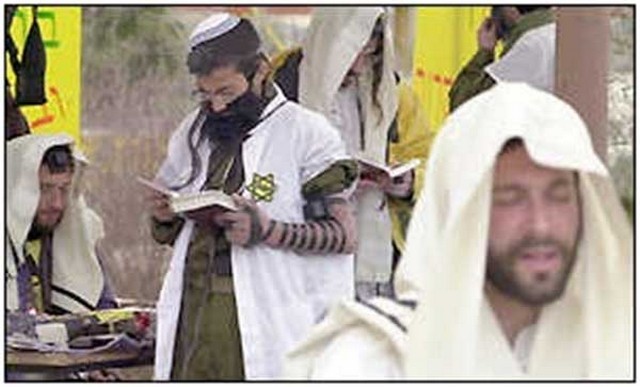
Jewish supremacists in 2000 celebrating Baruch Goldberg’s massacre of 29 Palestinian Muslims in the Ibrahimi mosque in Hebron

The Christchurch shooting and ensuing furor over white supremacy brought to mind a similar massacre of Muslims in a mosque in Palestine perpetrated by a Jewish supremacist several decades ago. Two recent headlines about fascism have coalesced in my mind into mirror images. The more I dwelled on them and on the two terror attacks, the more these mirror images twisted and turned.

The headlines:

  • Israel’s right-wing justice minister samples ‘fascism’ perfume in bizarre campaign ad
  • Poland insists far-right marchers calling for ‘Islamic holocaust’ just sideshow to ‘great celebration of Poles’

How seriously are we to take these headlines? Jaroslaw Kaczynski, the leader of Poland’s ruling party, says racism and xenophobia are a ‘marginal problem’ in Poland, but it’s clear to most of us that white entitlement is part of the structure of many European societies. European thinkers, in fact, are behind the white-nationalist rallying cry “You Will Not Replace Us”.

Israel’s minister Ayelet Shaked claims the fascism perfume ad is just a sophisticated joke (she is trying to say that her fascist positions really “smell like democracy”), but it’s clear to more and more of us that Israel’s whole raison d’être is racism, xenophobia and Jewish separatism disguised as “Jewish nationalism”. In the words of another Israeli politician — Tzipi Livni: “It’s about the Jewish tradition, it’s about Jewish history. — But we need to keep the nature, the character of the state of Israel as a Jewish state because this is — excuse me for using French — the raison d’etre of the state of Israel.”

And yet, as Lana Tatour says in her excellent review of Ronit Lentin’s book, Traces of racial exception: racializing Israeli settler colonialism, “propositions that Israel is a racial state and that Zionism is a racial movement have always sparked— and continue to spark— outrage in Israel and the West.”

Ever since the violent establishment of Israel as an apartheid Jewish state in Palestine in 1948, the Zionist rallying cry “We [Jews]will replace them [Palestinian Arabs]” has been a central tenet of each and every Israeli ruling government and the only way Jewish nationalism can survive.

During the EU-backed Oslo era, in a frenetic attempt to subvert a Jewish settlement freeze, the World Zionist Organization, through the Jewish Agency and the Jewish National Fund, funneled into Israel not only Anglo-Saxon Jews from the US and UK but also Jews from “lost tribes” such as the Bnei Menashe in India, and even imported Peruvian Indians in 2003 to swell a settlement or two despite the difficulties of converting these people to Judaism.

Israel bestows the automatic right to Israeli citizenship on Jews throughout the world while simultaneously continuing to deny Palestinian Arabs, both Muslim and Christian, their internationally recognized right of return to their towns, villages and property in Israel and the rest of historic Palestine that Israel now occupies/colonizes.

White supremacists in Europe, as well as in Western settler-colonial States such as the U.S., Canada and Australia, are anti-immigrant, with a large percentage of the immigrants being people from the Southern Hemisphere. Europe’s immigrants include Syrians among many others. Same goes for Australia.

White supremacist ideology is meant to protect them from a perceived “threat” to “white culture” or “white civilization”, which they see as superior, as well as from the economic threat caused by the disruptions of globalization. They resent that brown and black people they colonized in the past, and still consider inferior, are now turning the tables around on them through migration to the north.

Jewish supremacists, on the other hand, are pro-immigrant, with the immigrants being Jews of any nationality or culture from around the world. Their ideology is meant to maintain the Zionist invention of a Zionist Jewish national identity. The “Jewishness” of Zionism is not only Judaism (despite its full-blown religious component), and not only a colonial-settler project in Palestine. It revolves around the construct of “the Jewish people”.

This identity, like white supremacy, is rooted in a sense that Jewish culture deserves to be the dominant culture and must remain separate and pure. It is superior to the culture/religion of the Palestinian Arabs. To create itself, Jewish nationalism not only stole Palestinian Arab heritage as its own, it actively erased Palestinian Arab history and culture, in addition to the crimes of ethnic cleansing and land theft.

Besides the task of ingathering Jews from around the world into historic Palestine, Jewish supremacy has the added burden of keeping out the rightful owners of the land they have colonized/occupied — Palestinian Arabs, the natural (indigenous) majority in the geopolitical territory of Palestine.

Many Jews in the United States, secular as well as religious, have no intention of making “aliyah”, but they are wedded to the notion of “the Jewish people” in the same sense that white supremacists are committed to the idea of “white people” — a complete bluff, in both cases, since “they have been mixing races and ethnicities since day one. It is pathetic, how these ‘whites’ are whining about ‘invasion’, themselves being descendants of Turks, Tatars, Persians, Greeks, Arab ancestors, Suomi people, Scythians, Slavs, etc.”

The following tale of two massacres, or “terror attacks”, if you prefer, further illustrates the similarities and differences between white supremacy and Jewish supremacy.

The March 2019 Christchurch massacre at the hands of a white supremacist resulting in the slaying of 50 Muslims as they prayed in a mosque in New Zealand has a direct parallel in the February 1994 massacre at the hands of a Brooklyn-born Jewish supremacist, which resulted in 29 Palestinians killed and some 150 wounded as they prayed in the Ibrahimi Mosque in al-Khalil (Hebron).

The twist in the comparison is that the Brooklyn-born Jewish supremacist (Baruch Goldstein) had immigrated to Israel to join the Israeli army. He was, in essence, helping the Israeli government with a task it has undertaken since before the establishment of the State of Israel (see ‘State of Terror,’ by Thomas Suárez), although today it continues to do so through the falsely legitimatized means of a settler-colonial state. A summary document produced by a UN panel last month reported the deaths of 189 unarmed Palestinians, of whom 183, including 32 children, were killed by Israeli live ammunition at the Gaza “fence”, possibly constituting a war crime.

Prior to mass murdering the “Arabs” in the mosque, the perpetrator of the massacre in Hebron wrote a letter to the editor published by The New York Times in which he stated: “The harsh reality is if Israel is to avert the kinds of problems found in Northern Ireland today, it must act decisively to remove the Arab minority from its borders.” Note: Israel’s borders are unusual, for lack of a better word, in that they have changed several times in living memory.

As far as I know, the perpetrator of the Christchurch massacre (I am avoiding mentioning his name, because he reportedly craves fame in the manner of other sociopaths) did not have such a specific agenda — and, if he did, it surely isn’t explicitly espoused by the Australian or New Zealand governments as state policies.

Israel, on the other hand, continues to find numerous “legitimate” means to effect the goal of Jewish supremacists and the terrorists among them, in violation of international law and with the support of the United States and the European Union.

After the Christchurch massacre, commentary on TV and social media ran through the gamut of blame for the bigotry evident in the Christchurch “terror attack”. Among these, the most baffling to me is this conjecture: “Whether or not history really is dialectical, it can be tempting to think that decades of liberal supremacy in Europe have helped give rise to the antithesis of liberalism.” It was the “antithesis of liberalism” from the beginning, as it is today.

If by “liberal supremacy” the writer means the values of the Enlightenment, we can’t possibly blame Jewish supremacy, as spawned by Israel, on European liberalism as we blame Israel for the European values and fact of Jewish colonialism in Palestine. Zionism’s answer to European modern liberalism was to anchor the sensibility of the neo-medieval Jewish ghetto, including its anti-gentilism, in the State of Israel. In other words, Zionism is anti-liberalism — except when it comes to “the Jewish people” as Zionism defines their identity.

In massacring Palestinians in the mosque, the Jewish supremacist Baruch Goldstein was simply on task, a task expressed by “Chaim Weizmann, Israel’s first president, for whom the ethnic cleansing of Palestinians was ‘a miraculous clearing of the land: the miraculous simplification of Israel’s task.’” It’s a task, many “Militant Jews”, to use the term the BBC used in 2000 to describe them, celebrated. What they are is better described as supremacist Jews.

In the topsy-turvy way characteristic of Israel’s hasbara, the Western world has turned Israel’s acts of violence and Jewish supremacy against Palestinians into a false defensive act, when in fact the Palestinian cry “You will not replace us” is a cry, not of bigotry but of righteousness rooted in the misery resulting from Jewish supremacist ideology and Palestinian dispossession.

Rima Najjar is a Palestinian whose father’s side of the family comes from the forcibly depopulated village of Lifta on the western outskirts of Jerusalem.

21 March 2019

Source: countercurrents.org
ACLU: The U.S. Is Acting Like an Authoritarian Regime by Barring ICC Officials Probing War Crimes

The Trump administration has barred International Criminal Court investigators from entering the United States. Secretary of State Mike Pompeo announced Friday that the U.S. will start denying visas to members of the ICC who may be investigating alleged war crimes by the U.S. military in Afghanistan. In September, national security adviser John Bolton threatened U.S. sanctions against ICC judges if they continued to investigate alleged war crimes committed by U.S. troops in Afghanistan. A 2016 ICC report accused the U.S. military of torturing at least 61 prisoners in Afghanistan during the ongoing war. The report also accused the CIA of subjecting at least 27 prisoners to torture, including rape, at CIA prison sites in Afghanistan, Poland, Romania and Lithuania. We speak with Jamil Dakwar, director of the Human Rights Program at the American Civil Liberties Union.

Transcript
This is a rush transcript. Copy may not be in its final form.

AMY GOODMAN: This is Democracy Now! I’m Amy Goodman, with Juan González.

JUAN GONZÁLEZ: We turn now to the Trump administration’s decision to bar International Criminal Court investigators from entering the U.S. In September, national security adviser John Bolton threatened U.S. sanctions against ICC judges if they continued to investigate alleged war crimes committed by U.S. troops in Afghanistan. A 2016 report by the International Criminal Court accused the U.S. military of torturing at least 61 prisoners in Afghanistan during the ongoing war. The report also accused the CIA of subjecting at least 27 prisoners to torture, including rape, at CIA prison sites in Afghanistan, Poland, Romania and Lithuania. Secretary of State Mike Pompeo announced Friday that the U.S. will start denying visas to members of the ICC who may be investigating alleged war crimes by the U.S. military in Afghanistan.

SECRETARY OF STATE MIKE POMPEO: Since 1998, the United States has declined to join the ICC because of its broad, unaccountable prosecutorial powers and the threat it poses to American national sovereignty. We are determined to protect the American and allied military and civilian personnel from living in fear of unjust prosecution for actions taken to defend our great nation. We feared that the court could eventually pursue politically motivated prosecutions of Americans, and our fears were warranted.

In November of 2017, the ICC prosecutor requested approval to initiate an investigation into, quote, “the situation in Afghanistan,” end of quote, that could illegitimately target American personnel for prosecutions and sentencing. In September of 2018, the Trump administration warned the ICC that if it tried to pursue an investigation of Americans, there would be consequences. I understand that the prosecutors’ request for an investigation remains pending.

Thus, today, persistent to existing legal authority to post visa restrictions on any alien, quote, “whose entry or proposed activities in the United States would have potentially serious adverse foreign policy consequences,” end of quote, I’m announcing a policy of U.S. visa restrictions on those individuals directly responsible for any ICC investigation of U.S. personnel. This includes persons who take or have taken action to request or further such an investigation. These visa restrictions may also be used to deter ICC efforts to pursue allied personnel, including Israelis, without allies’ consent.

AMY GOODMAN: Secretary of State Mike Pompeo.

To talk more about the U.S. decision to deny visas to those involved in the International Criminal Court investigation, we’re joined now by Jamil Dakwar, the director of the Human Rights Program at the American Civil Liberties Union.

Welcome back to Democracy Now! It’s great to have you with us. Your response to this announcement?

JAMIL DAKWAR: OK. I think this is unprecedented. This is the first time that the U.S. government is targeting foreign judges and prosecutors, personnel of an international—one of the most respected international judicial bodies in the world, with a travel ban. As far as we look back, there hasn’t been any kind of precedent for such a thing. They’re not only doing that. They’re also saying anyone who assisted the ICC, who worked or will work to push for accountability for investigation before the ICC with regard to the situation of Afghanistan, particularly looking at U.S. involvement in war crimes, will be subject to the same visa restrictions. So this is an act of a country that—similar to authoritarian regime. When you have—when you’re crushing dissent, when you’re going after those who are disagreeing with you, when you’re trying to punish and retaliate and intimidate those who are trying to hold you accountable, you use your powers in order to limit the way that they can do that. And that’s really very outrageous and very concerning to us, that this is reaching to this level.

But it also speaks to what this administration has been doing. I mean, this administration threatened with prosecuting judges and the prosecutors of the ICC for doing their job, and for doing the job that the United States should have done—that is, to investigate, credibly and thoroughly, war crimes and crimes against humanity that were committed in the course of the war in Afghanistan, including the use of black sites, not only in Afghanistan. This is another important aspect of this investigation, or in pending investigation, because it hasn’t been really fully authorized by the pretrial chamber, is that it would cover not just what happened in Afghanistan, but it would cover in three countries that are linked to the conflict in Afghanistan—that is, Poland, Romania and Lithuania—because they are state parties. They joined the ICC in the—since 2002, when the court started to function.

So, we will see—we will see how this will play out. We’re very happy that the responses so far, in just the last few days, from members of the court, particularly European countries, have been very strong in condemning the Trump administration and upholding the independence and legitimacy of the court, and that any actions to deter prosecutors and the judges, that would be not acceptable and will be rejected by U.S. allies, particularly in Europe.

JUAN GONZÁLEZ: Well, let me ask you. This is reflective of an overall tendency in the Trump administration. Last year, the U.S. withdrew from the United Nations Human Rights Council, as well, and it’s resisted over 20 requests by special rapporteurs of the United Nations looking into particular issues of human rights violations here. But this is a step further. This is not just refusing to cooperate. This is actually punishing people who are trying to get to the facts of what’s happened. In terms of what can be done in response by the international community to what, in essence, is the United States saying, “No one has a right to judge what we do abroad”?

JAMIL DAKWAR: Well, first of all, let’s start with what Secretary Pompeo said. He said it’s an attack on our sovereignty. I don’t think that anyone attacked U.S. sovereignty. It was the Afghanistan sovereignty that has been subject to the jurisdiction, because Afghanistan joined the ICC in May of 2003 and agreed that if there would be war crimes, crimes against humanity or genocide—these are the worst crimes that are defined under the ICC statute or their treaty—that they would be jurisdiction for the court. So, it’s not an issue of U.S. sovereignty. It’s not also an issue of protecting the constitutional right of American citizens who could be tried abroad. That’s not something that we see again and again. If you committed a crime abroad—you could be committing it anywhere in the world—you could be held accountable by those countries where you violated their criminal laws. And therefore, there is no such a thing of attacking or undermining American sovereignty.

The second thing is, is that Secretary Pompeo is saying there was no consent of the governments, that being—their nationals being prosecuted or investigated by the ICC in the future. Since when war criminals have to get their consent to a criminal investigation? That’s unheard of. So, the nature of the attacks, as you said, they are punitive, they’re retaliatory. They are trying to go and to send a message, not just to the ICC personnel, in particular. This actually has consequences beyond the United States’ situation, of U.S. government officials who commissioned, ordered or implemented acts of torture in Afghanistan and elsewhere. So it is really a serious threat to the system that we created. The United States was responsible for creating systems after World War II, after the horror of the Holocaust, that would fight impunity, that would combat the worst crimes. And now the U.S. is leading the charge in attacking the judges. And being cheered by what countries? Cheered by Sudan, Burundi, the Philippines.

JUAN GONZÁLEZ: Philippines, which also just pulled out of the International Criminal Court in the last few days. Could I ask you also, though? This must indicate that there is a real fear here on the part of the U.S. government about this investigation, to take this kind of drastic action. Could you talk about what some of what the preliminary findings of the court are in terms of the war crimes committed here?

JAMIL DAKWAR: So, first, it’s important to highlight that the court, the ICC, is a court of last resort, meaning it doesn’t jump in to investigate a crime just because it violates the crimes defined by the Rome Statute, by the ICC. It actually waits and sees what the countries that joined the court are doing, what have they done, in order to investigate violations of the ICC. And that is an important point, because the ICC people think that the ICC, you know, was—immediately acted, automatically opened investigations. That’s not true.

In the case of the United States, the situation of Afghanistan lasted for over a decade, where it was under a so-called preliminary examination. So, it was based on publicly available information. The ICC prosecutor would not use its investigative powers, but rely on media reports, on U.N. reports, other NGOs’ reports, etc. And, yes, once it comes to the conclusion that there is a reasonable belief that there were crimes that are committed in violation of the ICC, and it has a jurisdiction—and it has to also satisfy other requirements—admissibility and the interest of justice—it will then—because this one was initiated by the prosecutor’s office, it will have to get an authorization from the pretrial chamber, a chamber of three judges of the ICC, that then examine the whole evidence.

The evidence that she has is really relying heavily—well, we don’t have access to that information, but we believe that her evidence is based on the Senate torture report, the well-documented investigation of the CIA involvement in the most brutal and gruesome acts of humiliation and torture against prisoners. And that torture report, what was released in December of 2014, basically made the—it put the United States on notice, that if the United States is not acting in light of the declassified parts of the report—because the report itself, the whole thing, was still classified, so we don’t even have a clue what’s in the details of that report, because the U.S. government, both under the Obama administration and under the Trump administration, resisting declassification. But what is publicly available, there is enough to justify opening an investigation.

So, the prosecutor looked into that information. It looked at what the United States has done in order to hold officials accountable, both at the level of the U.S. military and the level of the CIA officials, the level of all chain of—the chain of command, meaning looking not just at the lower-rank officers and military personnel, but also at the leaders who sanctioned this policy. You have the highest level of the White House, in the Bush administration, that ordered the torture program. So they looked at what the Bush administration, the Obama administration have done in order to investigate, and they reached a conclusion that they were not credible investigations. And that’s why they’re stepping in.

And they’re stepping in because this is an important for the rule of law. It’s important for upholding international principles against impunity. And it’s also providing victims of torture their day in court. And that is where, I think, more than anything, is important and being sidelined by the whole response to Pompeo.

AMY GOODMAN: Can you talk about how psychologists James Mitchell and Bruce Jessen could be implicated in the investigation, who reaped tens of millions of dollars for designing torture techniques for the CIA?

JAMIL DAKWAR: So, these two individuals, who are psychologists in their private practice, were hired by the CIA after the terrorist attacks on 9/11 in order to help implement—design and implement a torture program. They have come up with, really, based on pseudoscience—it was really junk science—a theory of how to break down detainees and how to break down those suspected in involvement in the 9/11 attacks. There has been clear evidence, that we have exposed in our lawsuit, the ACLU lawsuit against the two individuals, that was settled a couple of years ago, that showed that this—that the information that they relied on, the science there was really out of—in line with any scientific—and that its purpose was really to coerce and to lead detainees to say things they may have not done. And, in fact, I think the—again, the Senate torture report has confirmed that the program, the whole program, not only was costly, was not effective, but it was also—was misleading in the way that it presented as if those two individuals—so, these two individuals made over $80 million off this program.

And they, as individuals, who acted on behalf of the U.S. government, may also be subject to the ICC investigation, if it’s authorized. We don’t know who are the individuals who will be authorized, but I think that they should be worried. Other people who were involved in the—particularly in the worst part of the CIA torture program should be worried, I think, in the future. That doesn’t mean that the ICC will, again, rush into prioritizing the investigation and prosecuting of U.S. officials. I think that there are other crimes that are being investigated in the Afghanistan situation, especially the crimes against Afghan nationals and the civilian population by the Taliban, by the Afghan forces there.

Now, the real serious challenge for the ICC is, none of those parties—Afghan government, the Taliban and the United States government—is willing to cooperate with the ICC. So the real challenge is how—if this investigation moves forward, how the ICC will really be able to build cases, based on lack—without any cooperation with—of these, of the countries.

AMY GOODMAN: And, very quickly, Pompeo also named Israel, if the ICC says it’s going to investigate Israel.

JAMIL DAKWAR: Yes. So, the secretary’s announcement didn’t only say that it’s about U.S. officials that will be targeted by a potential investigation by ICC. He also alluded to U.S. allies, and particularly Israeli officials. There is a separate investigation—it’s called the Palestine situation—that was actually not the initiation of the prosecutor. It was a request, a referral, by the Palestine to investigate war crimes and crimes against humanity in the context of the Gaza situation in the war in 2014, also the recent attacks on protesters in the Gaza border, as well as the legality of settlements in the West Bank, to what extent they violate the ICC statute. So there’s also that situation, where it could impact, in our view, human rights defenders, human rights lawyers, who are acting to hold officials—in this case, Israeli officials—accountable before the ICC. They could be subject to visa restrictions.

And so, this is really a serious issue that has to be addressed by the U.S. Congress, particularly the House Foreign Relations Committee. We filed a Freedom of Information Act to ask for the legal basis for this policy. The U.S. government is resisting. And we’re likely to file a lawsuit soon to force this information to be disclosed. Because it’s not really about going after every U.S. citizen who served in the U.S. military. That is not what is going—what we’re talking about here. This is here talking about really shutting down a legitimate investigation into war crimes. It is about deflecting from scrutiny, deflecting from upholding international law, and giving not only U.S. officials the immunity and impunity that they have enjoyed for years, but also giving other countries the same. And that’s what’s emboldening other regimes that we’ve seen over the past several months been happy to withdraw from the ICC, like the Philippines did just a year ago, and it came into effect a couple days ago.

AMY GOODMAN: And, Jamil Dakwar, we want to thank you for being with us, director of the Human Rights Program at the American Civil Liberties Union.

JAMIL DAKWAR: Thank you.

AMY GOODMAN: When we come back, we look at the close relationship between the Trump administration and Boeing, in 30 seconds.

[break]

AMY GOODMAN: The legendary Lebanese-American musician Dick Dale, who was known as the “King of the Surf Guitar,” has died at the age of 81. His hit song “Misirlou” was an adaptation of a traditional Arabic folk tune. Dale continued performing live into this year, in part to pay his medical bills from bouts with cancer, renal failure and diabetes. He once said, “I have to perform to save my life.”

Amy Goodman and Juan Gonzalez / Democracy Now! / Multimedia – March 19, 2019

Source: www.democracynow.org

Chelsea Manning and the New Inquisition

By Chris Hedges

The U.S. government, determined to extradite and try Julian Assange for espionage, must find a way to separate what Assange and WikiLeaks did in publishing classified material leaked to them by Chelsea Manning from what The New York Times and The Washington Post did in publishing the same material. There is no federal law that prohibits the press from publishing government secrets. It is a crime, however, to steal them. The long persecution of Manning, who on March 8 was sent back to jail for refusing to testify before a grand jury, is about this issue.

If Manning, a former Army private, admits she was instructed by WikiLeaks and Assange in how to obtain and pass on the leaked material, which exposed U.S. war crimes in Afghanistan and Iraq, the publisher could be tried for the theft of classified documents. The prosecution of government whistleblowers was accelerated during the Obama administration, which under the Espionage Act charged eight people with leaking to the media—Thomas Drake, Shamai Leibowitz, Stephen Kim, Manning, Donald Sachtleben, Jeffrey Sterling, John Kiriakou and Edward Snowden. By the time Donald Trump took office, the vital connection between investigative reporters and sources inside the government had been severed.

Manning, who worked as an Army intelligence analyst in Iraq in 2009, provided WikiLeaks with over 500,000 documents copied from military and government archives, including the “Collateral Murder” video footage of an Army helicopter gunning down a group of unarmed civilians that included two Reuters journalists. She was arrested in 2010 and found guilty in 2013.

The campaign to criminalize whistleblowing has, by default, left the exposure of government lies, fraud and crimes to those who have the skills or access, as Manning and Edward Snowden did, needed to hack into or otherwise obtain government electronic documents. This is why hackers, and those who publish their material such as Assange and WikiLeaks, are being relentlessly persecuted. The goal of the corporate state is to shroud in total secrecy the inner workings of power, especially those activities that violate the law. Movement toward this goal is very far advanced. The failure of news organizations such as The New York Times and The Washington Post to vigorously defend Manning and Assange will soon come back to haunt them. The corporate state hardly intends to stop with Manning and Assange. The target is the press itself.

“If we actually had a functioning judicial system and an independent press, Manning would have been a witness for the prosecution against the war criminals he helped expose,” I wrote after I and Cornel West attended Manning’s sentencing in 2013 at Fort Meade, Md. “He would not have been headed, bound and shackled, to the military prison at Fort Leavenworth, Kan. His testimony would have ensured that those who waged illegal war, tortured, lied to the public, monitored our electronic communications and ordered the gunning down of unarmed civilians in Iraq, Afghanistan, Pakistan and Yemen were sent to Fort Leavenworth’s cells. If we had a functioning judiciary the hundreds of rapes and murders Manning made public would be investigated. The officials and generals who lied to us when they said they did not keep a record of civilian dead would be held to account for the 109,032 ‘violent deaths’ in Iraq, including those of 66,081 civilians. The pilots in the ‘Collateral Murder’ video, which showed the helicopter attack on unarmed civilians in Baghdad that left nine dead, including two Reuters journalists, would be court-martialed.”

Manning has always insisted her leak of the classified documents and videos was prompted solely by her own conscience. She has refused to implicate Assange and WikiLeaks. Earlier this month, although President Barack Obama in 2010 commuted her 35-year sentence after she served seven years, she was jailed again for refusing to answer questions before a secret grand jury investigating Assange and WikiLeaks. While incarcerated previously, Manning endured long periods in solitary confinement and torture. She twice attempted to commit suicide in prison. She knows from painful experience the myriad ways the system can break you psychologically and physically. And yet she has steadfastly refused to give false testimony in court on behalf of the government. Her moral probity and courage are perhaps the last thin line of defense for WikiLeaks and its publisher, whose health is deteriorating in the Ecuadorian Embassy in London, where he has been holed up since 2012.

Manning—who was known as Bradley Manning in the Army—has undergone gender reassignment surgery and needs frequent medical monitoring. Judge Claude M. Hilton, however, dismissed a request by her lawyers for house arrest. Manning was granted immunity by prosecutors of the Eastern District of Virginia, and because she had immunity she was unable to invoke the Fifth Amendment protection against self-incrimination or to have her attorney present. The judge found her in contempt of court and sent her to a federal facility in Alexandria, Va. Hilton, who has long been a handmaiden of the military and intelligence organs, has vowed to hold her there until she agrees to testify or until the grand jury is disbanded, which could mean 18 months or longer behind bars. Manning said any questioning of her by the grand jury is a violation of First, Fourth and Sixth Amendment rights. She said she will not cooperate with the grand jury.

“All of the substantive questions pertained to my disclosures of information to the public in 2010—answers I provided in extensive testimony, during my court-martial in 2013,” she said on March 7, the day before she was jailed.

“I will not comply with this, or any other grand jury,” she said later in a statement issued from jail. “Imprisoning me for my refusal to answer questions only subjects me to additional punishment for my repeatedly-stated ethical objections to the grand jury system.”

“The grand jury’s questions pertained to disclosures from nine years ago and took place six years after an in-depth computer forensics case, in which I testified for almost a full day about these events,” she went on. “I stand by my previous public testimony.”

Manning reiterated that she “will not participate in a secret process that I morally object to, particularly one that has been historically used to entrap and persecute activists for protected political speech.”

The New York Times, Britain’s The Guardian, Spain’s El País, France’s Le Monde and Germany’s Der Spiegel all published the WikiLeaks files provided by Manning. How could they not? WikiLeaks had shamed them into doing their jobs. But once they took the incendiary material from Manning and Assange, these organizations callously abandoned them. No doubt they assume that by joining the lynch mob organized against the two they will be spared. They must not read history. What is taking place is a series of incremental steps designed to strangle the press and cement into place an American version of China’s totalitarian capitalism. President Trump has often proclaimed his deep animus for news outlets such as The New York Times and The Washington Post, referring to them as the “enemy of the people.” Any legal tools given to the administration to shut down these news outlets, or at least hollow them of content, will be used eagerly by the president.

The prosecutions of government whistleblowers under the Espionage Act, warrantless wiretapping, monitoring of the communications of Americans and the persecution of Manning and Assange are parts of an interconnected process of preventing any of us from peering at the machinery of state. The resulting secrecy is vital for totalitarian systems. The global elites, their ruling ideology of neoliberalism exposed as a con, have had enough of us examining and questioning their abuses, pillage and crimes.

“The national security state can try to reduce our activity,” Assange told me during one of our meetings at the embassy in London. “It can close the neck a little tighter. But there are three forces working against it. The first is the massive surveillance required to protect its communication, including the nature of its cryptology. In the military everyone now has an ID card with a little chip on it, so you know who is logged into what. A system this vast is prone to deterioration and breakdown. Secondly, there is widespread knowledge not only of how to leak, but how to leak and not be caught, how to even avoid suspicion that you are leaking. The military and intelligence systems collect a vast amount of information and move it around quickly. This means you can also get it out quickly. There will always be people within the system that have an agenda to defy authority. Yes, there are general deterrents, such as when the DOJ [Department of Justice] prosecutes and indicts someone. They can discourage people from engaging in this behavior. But the opposite is also true. When that behavior is successful it is an example. It encourages others. This is why they want to eliminate all who provide this encouragement.”

“The medium-term perspective is very good,” he said. “The education of young people takes place on the internet. You cannot hire anyone who is skilled in any field without them having been educated on the internet. The military, the CIA, the FBI, all have no choice but to hire from a pool of people that have been educated on the internet. This means they are hiring our moles in vast numbers. And this means that these organizations will see their capacity to control information diminish as more and more people with our values are hired.”

The long term is not so sanguine. Assange, along with three co-authors—Jacob Appelbaum, Andy Müller-Maguhn and Jérémie Zimmermann—wrote a book titled “Cypherpunks: Freedom and the Future of the Internet.” It warns that we are “galloping into a new transnational dystopia.” The internet has become not only a tool to educate, they write, but the mechanism to create a “Postmodern Surveillance Dystopia” that is supranational and dominated by global corporate power. This new system of global control will “merge global humanity into one giant grid of mass surveillance and mass control.”

“All communications will be surveilled, permanently recorded, permanently tracked, each individual in all their interactions permanently identified as that individual to this new Establishment, from birth to death,” Assange says in the book. “I think that can only produce a very controlling atmosphere.”

“How can a normal person be free within that system?” he asks. “[He or she] simply cannot, it’s impossible.”

It is only through encryption that we can protect ourselves, the authors argue, and only by breaking through the digital walls of secrecy erected by the power elite can we expose the abuses of power. But ultimately, they say, as the tools of the state become more sophisticated, even these mechanisms of opposition will be difficult and perhaps impossible to use.

“The internet, our greatest tool of emancipation,” Assange writes, “has been transformed into the most dangerous facilitator of totalitarianism we have ever seen.”

That is where we are headed. A few resist. Assange and Manning are two. Those who stand by passively as they are persecuted will be next.

Chris Hedges writes a regular column for Truthdig.com.

19 March 2019

Source: countercurrents.org
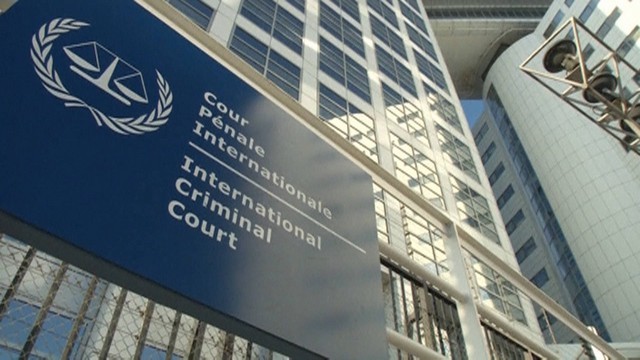
Worldwide school strike, 15 March, 2019: Largest Climate Action In History Neglected By The Media

By John Scales Avery

Over 1.5 million young students across all continents took to the streets on Friday March 15th for the first ever global climate strike. Messages in more than 40 languages were loud and clear: world leaders must act now to address the climate crisis and save our future. The school strike was the largest climate action in history. Nevertheless it went almost unmentioned in the media.

Here are some of the statements by the students explaining why they took part in the strikes:

“In India, no one talks about climate change. You don’t see it on the news or in the papers or hear about it from government. We want global leaders to declare a climate emergency. If we don’t act today, then we will have no tomorrow. ” – Vidit Baya, 17, Udaipur, India.

“We face heartbreaking loss due to increasingly extreme weather events. We urge the Taiwanese government to implement mitigation measures and face up to the vulnerability of indigenous people, halt construction projects in the indigenous traditional realm, and recognise the legal status of Plains

Indigenous People, in order to implement environmental protection as a bottom-up approach” – Kaisanan Ahuan, Puli City, Taiwan.

“We have reached a point in history when we have the technical capacities to solve poverty, malnutrition, inequality and of course global warming. The deciding factors for whether we take advantage of our potential will be our activism, our international unity and our ability to develop the art of making the impossible possible. Whether we succeed or not depends on our political will” – Eyal Weintraub, 18, and Bruno Rodriguez, 18, Argentina.

“I want to be certain that our government is committed to investing in a just transition to a more sustainable country, that we will lower carbon emissions and curb climate change. I am joining this strike to demand that decisions are more future-focused and that policy will reflect our environmental rights as written in our constitution” – Dona Van Eeden, 21, Cape Town, South Africa.

“The damage done by multinationals is enormous: the lack of transparency, dubious contracts, the weakening of the soil, the destruction of flora and fauna, the lack of respect for mining codes, the contamination of groundwater. In Mali, the state exercises insufficient control over the practices of the multinationals, and it is us, the citizens, who suffer the consequences. The climate alarm has sounded, and the time has come for us all to realise that there is still time to act locally, in our homes, our villages, our cities” – Mone Fousseny, 22, Mali.

“The governments failed to respond properly to the dramatic challenge of our climate crisis. Our generation, the least responsible for the acts of the polluters, will be the ones to see the most devastating impacts of climate change. World leaders are losing the window to act, but we are not going to stand still watching their inertia.” Greta Thunberg, Sweden

Greta Thunberg has been nominated for the Nobel Peace Prize

16-year-old Swedish climate activist Greta Thunberg, who started a worldwide children’s climate movement last summer with her lone school strike in front of the Swedish Parliament, is now a leader of the global movement for climate change. Her eloquent and crystal-clear speeches at COP24 in Poland in 2018, at the Davos Economic Forum in Switzerland in 2019, and at the recent European Union’s climate meeting in Belgium, have produced real change. For example, influenced by Greta’s speech, European Commission President Jean-Claude Juncker stated that “In the next financial period, 2021-2027, every fourth euro spent in the EU budget will go towards climate mitigation actions”. The EU budget is usually 1 percent of its economic output, or 1 trillion euros across seven years.

The three Norwegian parliamentarians who nominated Greta Thunberg for the Nobel Peace Prize cited the connection between climate change, the refugee crisis and threatened wars. Like the global school strikes of March 15, Greta’s nomination receives little mention, not only in mainstream media, but also in alternative media.

Attention has been distracted by the attrocious murders in New Zealand

The almost simultaneous neofacist and racist murders in New Zealand have distracted media attention from the children’s global school strike for climate action. But while combatting racism and neofacism is important, it is much less important than the urgent need for rapid action on the issue of climate change, without which the entire future of human civilization and the biosphere will be lost. We give our children loving care, but it makes no sense to do so and not do everything within our power to give them a future in which they can survive. The media have a duty to help in mobilizing public opinion for the great task that history has given to us – the task of saving the future.

Some discussion of these issues can be found in my new book, entitled “Saving the Future”, which may be downloaded from the following link:

http://eacpe.org/app/wp-content/uploads/2019/02/Saving-the-Future-John-Scales-Avery.pdf

John Scales Avery is a theoretical chemist at the University of Copenhagen.

19 March 2019

Source: countercurrents.org
When Simply Being a Muslim Is Your Biggest Crime

By Christian Christensen

The sediment of hatred and discrimination directed at Muslims slowly builds up over time and it is not only the most hateful and dark places online or in the world that lay the groundwork for explosions of hatred and violence such as this

The Christchurch terrorists, who earlier today took the lives of nearly 50 people at two mosques, were clearly consumed by both racism and hatred of Muslims. One posted a lengthy “manifesto” on white nationalism before he committed the crime. They spent significant time online, and were perhaps “radicalized” in chat-rooms and via social media.

In other words: we may make ourselves feel better if we think of their lifeworld as being made up of ideologies and spaces far outside of the norm. That their thoughts and ideas were of the type most citizens would never entertain, expressed in places most would never visit. That these thoughts and ideas would eventually be put into action in ways that violate the most basic notions of humanity and decency. Thoughts and acts of barbarity, divorced from civilized society.

Yet, as horrific and inhumane as these violent spaces may be, we see the shadows and ripples of the bigotry and discrimination they contain in far more everyday practices and places. On our regular television channels. In our mainstream newspapers. In our films. In our schools. In our politics.

Muslim refugees seeking to flee war are described in terms reserved for animals (“swarms”) or natural disasters (“floods”). When an act of violence is committed by a member of the Muslim community, the entire community is held to be collectively responsible and asked to condemn that violence…or else be judged complicit. Muslim pieces of clothing become items to ban. Muslim bodies become items to ban, with legislation stopping Muslims from even entering countries. Their ability to “integrate” is questioned, even when most Muslims are hard-working and valuable members of the community. When Muslims are elected to serve the public in political office, even then their allegiance is a topic for “debate.”

It is outlets such as the Daily Mail in the UK and Fox News in the US, together with a band of anti-immigrant and xenophobic websites, that have spearheaded these popular attacks on Muslims, portraying them as less than trustworthy, less than citizens and less than human. They are portrayed as people whose wearing of the hijab is sufficient proof that they are against, for example, the US Constitution.

Then, when acts of extreme violence such as Christchurch are committed against Muslims, these same outlets, their spokespeople, and the politicians whose anti-immigrant rhetoric they so willingly record and relay, throw up their hands in faux confused anguish, wondering with Thoughts-And-Prayers where all of the hate comes from. Of course, once the pain and attention has subsided, the cycle will begin again.

Even here, however, it is all too easy to allow the anti-immigration press, in conjunction with online forums and social media, to become alibis for a much broader process of vilification across all media, including those outlets now self-identifying as part of an anti-Trump resistance.

People may roll their eyes at the mention of the US/UK occupation of Iraq, thinking it was all such a long time ago, but consider the long-term effects of that occupation. How the destruction of the country, and the killing of thousands of innocent civilians, was made possible largely by the fact that those citizens were predominantly Muslim. Would the US so willingly and easily have killed that many Christians? How these thousands of deaths became footnotes for even the “progressive” press, forgotten once the sexiness of the televisual bombing of Baghdad had ended. How, ironically, we failed to ask ourselves as nations about our collective responsibility for these killings, committed in our names and with our tax dollars. And, how Muslim deaths remained footnotes under Obama and now Trump, with regular drone attacks killing scores in Yemen and Pakistan generating little or no coverage. The dead, because of their religion and poverty, just not worth our valuable time. And, if they were not worth it “There,” why would they now be worth it “Here”?

Or, when politics are covered in Europe by the supposedly “quality” press, think about how so-called “integration” is always framed as a one-way street, where the onus is entirely on the new arrivals, and where domestic racism and discrimination apparently play little or no role in how immigrants adapt to their new homes. These are issues often couched in the language of quasi-civility, but it is a quasi-civility that is stifling in its soft violence.

These are all factors that add to the sediment of hatred and discrimination that slowly builds up over time, laying the groundwork for explosions of hatred and violence. One tweet, one TV show, one newspaper article does not lead most people to kill.

As I wrote online earlier today after hearing what had happened: “It is a steady, daily flow of stereotypes, vilification and dehumanization that create an environment where violence is easier. Where a sense that those killed were ‘asking for it’ by their very existence.”

Christian Christensen, American in Sweden, is Professor of Journalism at Stockholm University.

16 March 2019

Source: countercurrents.org