Just International

Chinese pressure tactics put countries between a rock and a hard place

By Dr James M Dorsey

Recent Chinese pressure on Myanmar to approve a controversial dam project and the arrest in recent days in Kazakhstan of a human rights activist suggest that China in a seemingly tone-deaf pursuit of its interests is forcing governments to choose between heeding increasingly anti-Chinese public sentiment and pleasing Beijing to ensure continued political and economic support.

Apparent Chinese disregard of public opinion, whether as a matter of policy or because of haphazard insensitivity, is compounded by the powering of anti-Chinese sentiment in several countries as a result of commercial terms of China-funded Belt and Road projects that favour the use of Chinese rather than local labour and materials.

The Chinese approach risks anti-Chinese sentiment meshed with social and economic discontent exploding into popular protests that could prove destabilizing. It potentially could complicate Chinese efforts to ensure that the Muslim world continues to refrain from criticizing China’s crackdown on Turkic Muslims in the strategic but troubled north-western province of Xinjiang.

Chinese pressure on various countries aimed at imposing its will strokes with China’s adoption of a more aggressive diplomatic posture that has seen its diplomats employ blunt, undiplomatic language and repeatedly break with diplomatic protocol.

As a result, increasing Chinese pressure on Myanmar to revive the suspended Myitsone dam project in ethnic Kachin state is putting the government between a rock and a hard place.

The government is being forced to choose between ignoring popular concerns that the dam would disrupt the traditional economy of the Kachin in a region wracked by ethnic insurgency and cost Myanmar control of the Irrawaddy River, its most important waterway, or risk the ire of China on which it depends politically and economically.

China has reportedly offered in return for the dam to support Myanmar that has been condemned by the United Nations, Western countries and some Muslim nations for its repressive campaign against the Rohingya, some 700,000 of which fled to Bangladesh in 2017.

China has invested some US$15 billion in scores of projects in Myanmar

China’s state-controlled Global Times newspaper recently quoted Xiamen University Myanmar expert Fan Hongwei as saying that “the abrupt suspension of such a significant project has blurred political trust between China and Myanmar.”

Former Myanmar President Thein Sein in 2011 suspended the US$3.6 billion dam project in response to a campaign that brought together conservationists, scholars, and political activists including Nobel Prize laureate Aung San Suu Kyi.

Activists assert the dam, if built as previously designed, would flood 600 square kilometres of forestland in northern Kachin state and export 90 % of the power produced to China.

Myanmar is not the only country that has recently experienced Chinese attempts to force it to act in ways that could have unintended consequences.

Kazakh police, despite widespread public criticism of the crackdown in Xinjiang, last weekend raided the office of Atajurt Eriktileri, a group that has reportedly documented more than 10,000 cases of ethnic Kazakhs interned in China and arrested activist Serikzhan Bilash.

Activists suspect that the raid was the result of Chinese pressure aimed at squashing criticism of the crackdown in Xinjiang.

Similarly, Russian leaders are facing mounting public anger in the Lake Baikal region and the country’s Far East at their alleged connivance in perceived Chinese encroachment on the region’s natural resources including water.

A petition by prominent Russian show business personalities opposing Chinese plans to build a water bottling plant on the shores of Lake Baikal attracted more than 800,000 signatures, signalling the depth of popular resentment and pitfalls of the Russian alliance with China.

Pakistani Foreign Minister Shah Mehmood Qureshi sought to put a good face on differences with China over his country’s demand that the focus of the China Pakistan Economic Project (CPEC), a US$45 billion plus crown jewel of the Belt and Road, be shifted from infrastructure and energy, to poverty alleviation, job creation and agriculture.

China has acknowledged Pakistan’s demand but suggested that the refocussing would happen in good time.

Mr. Qureishi asserted this week had CPEC had entered its second phase but provided few details. The minister said agreements on the second phase that would involve the creation of four economic zones would be concluded at some unspecified date in the future.

China notably refrained in recent months from contributing to a financial bailout of Pakistan that was achieved instead with the help of Saudi Arabia and the United Arab Emirates who have committed some US$30 billion in funding and investments.

Pakistani and Chinese officials have gone out of their way in recent months to deny any dent in what they have described as an all-weather friendship.

“There is no threat to CPEC. Our government considers it a game changer,” M. Qureishi insisted this week.

China’s deputy chief of mission in Islamabad, Lijian Zhao, insisted in an interview last year and in a series of tweets that China “always supported & stood behind @Pakistan, helping #develop it’s #infrastructure & raise #living standards while creating #job.”

Ultimately, the proof will be in the pudding. Indications so far are that China is digging in its heels on the assumption that its political and economic clout will allow it to get its way. Its an approach that ignores potential black swans and does little to garner soft power.

Dr. James M. Dorsey is a senior fellow at the S. Rajaratnam School of International Studies, co-director of the University of Würzburg’s Institute for Fan Culture, and co-host of the New Books in Middle Eastern Studies podcast.

14 March 2019

Source: countercurrents.org

Chasing Mirages: What Are Palestinians Doing to Combat the ‘Deal of the Century’?

By Dr Ramzy Baroud

More US measures have been taken in recent weeks to further cement the Israeli position and isolate the Palestinian Authority (PA), before the official unveiling of President Donald Trump’s so-called ‘deal of the century’. But while attention is focused on spiteful US actions, little time has been spent discussing the PA’s own responses, options and strategies.

The last of Washington’s punitive measures came on March 3, when the US shut down its Consulate in Jerusalem, thus downgrading the status of its diplomatic mission in Palestine. The Consulate has long served as a de-facto American embassy to the Palestinians. Now, the Consulate’s staff will merge into the US embassy in Israel, which was officially moved to Jerusalem last May – in violation of international consensus regarding the status of the occupied city.

Robert Palladino, US State Department spokesperson, explained the move in a statement, saying that “this decision was driven by our global efforts to increase the efficiency and effectiveness of our diplomatic engagements and operations.”

Diplomatic hogwash aside, ‘efficiency and effectiveness’ have nothing to do with the shutting of the Consulate. The decision is but a continuation of successive US measures aimed at “taking Jerusalem off the table” – as per Trump’s own words – of any future negotiations.

International law, which recognizes East Jerusalem as an occupied Palestinian city, is of no relevance to the Trump administration, which has fully shed any semblance of balance as it is now wholly embracing the Israeli position on Jerusalem.

To bring Palestinians into line, and to force their leadership to accept whatever bizarre version of ‘peace’ Trump’s son-in-law, Jared Kushner, has in mind, the US has already taken several steps aimed at intimidating the PA. These steps include the cutting of $200 million in direct aid to Gaza and the West Bank, and the freezing of another $300 million dollars that were provided annually to the UN agency for Palestinian refugees (UNRWA).

That, and the shutting down of the Palestine Liberation Organization (PLO) office in Washington DC, on September 10, were all the signs needed to fully fathom the nature of the US ultimatum to the Palestinian leadership: accept our terms or face the consequences.

It is no secret that various US governments have served as the financial and even political backers of the PA in Ramallah. While the PA has not always seen eye-to-eye with US foreign policy, its survival remained, till recently, a top American priority.

The PA has helped Washington sustain its claim to being an ‘honest peace broker’, thus enjoying a position of political leadership throughout the Middle East region.

Moreover, by agreeing to take part in assisting the Israeli military in policing the Occupied Territories through joint US-funded ‘security coordination’, the PA has proved its trustworthiness to its US benefactors.

While the PA remained committed to that arrangement, Washington reneged.

According to the far-right Israeli government coalition of Benjamin Netanyahu, PA leader, Mahmoud Abbas, is simply not doing enough.

‘Doing enough’, from an Israeli political perspective, is for Palestinians to drop any claims to occupied East Jerusalem as the future capital of Palestine, accept that illegal Jewish settlements in the West Bank would have to remain in place regardless of the nature of the future ‘peace agreement’, and to also drop any legal or moral claims pertaining to Palestinian refugees right of return.

While the PA has demonstrated its political and moral flexibility in the past, there are certain red lines that even Abbas himself cannot cross.

It remains to be seen how the PA position will evolve in the future as far as the soon-to-be announced ‘deal of the century’ is concerned.

Yet, considering that Trump’s blind support for Israel has been made quite clear over the course of the last two years, one is bewildered by the fact that Abbas and his government have done little by way of counteracting Washington’s new aggressive strategy targeting the Palestinians.

Save for a few symbolic ‘victories’ at the United Nations and UN-related bodies, Abbas has done little by way of a concrete and unified Palestinian action.

Frankly, recognizing a Palestinian state on paper is not a strategy, per se. The push for greater recognition has been in the making since the PLO Algiers conference in 1988, when the Palestine National Council declared a Palestinian state to the jubilation of millions around the world. Many countries, especially in the global south, quickly recognized the State of Palestine.

Yet, instead of using such a symbolic declaration as a component of a larger strategy aimed at realizing this independence on the ground, the PA simply saw the act of recognizing Palestine as an end in itself. Now, there are 137 countries that recognize the State of Palestine. Sadly, however, much more Palestinian land has been stolen by Israel to expand on or build new Jewish-only colonies on the land designated to be part of that future state.

It should have been clear, by now, that placing a Palestinian flag on a table at some international conference, or even having a Palestine chair at the G77 UN coalition of developing countries, is not a substitute for a real strategy of national liberation.

The two main Palestinian factions, Abbas’ own Fatah party and Hamas, are still as diverged as ever. In fact, Abbas seems to focus more energy on weakening his political rivals in Palestine than on combating the Israeli Occupation. In recent weeks, Abbas has taken yet more punitive financial measures targeting various sectors of Gaza society. The collective punishment is even reaching families of prisoners and those killed by the Israeli army.

Without a united front, a true strategy or any form of tangible resistance, Abbas is now vulnerable to more US pressure and manipulation. Yet, instead of moving quickly to solidify the Palestinian front, and to reach out to genuine allies in the Middle East and worldwide to counter the bitter US campaign, Abbas has done little.

Instead, the Palestinian leader continues to chase political mirages, taking every opportunity to declare more symbolic victories that he needs to sustain his legitimacy among Palestinians for a while longer.

The painful truth, however, is this: it is not just US bullying that has pushed the PA into this unenviable position, but, sadly, the self-serving nature and political bankruptcy of the Palestinian leadership itself.

Ramzy Baroud is a journalist, author and editor of Palestine Chronicle.

13 March 2019

Source: countercurrents.org

Peace Prospects for Pakistan: It’s time to set Boundaries with Demands

By Alia Sarfraz and Junaid S. Ahmad

If you do not ask, you do not get a seat at the table. As with any abusive relationship, Pakistan needs to be firm in where its stance will be and be the one setting the direction for the future. With Pakistan’s leadership being virtually conferred with a Nobel Peace Prize status, we can only see this as a wake-up call to the world about the reality – versus the mythology – of South Asia. It is important to take stock of what emancipatory lessons we can build upon from the various developments: tracing the past and looking into the future. Where are we headed? How can Pakistan strengthen its moral leadership? What must it ask for?

The Myth vs. Reality

We are, obviously, referring to the situation in which India’s right wing BJP government deemed it legitimate to send its fighter jets well into Pakistani territory, all the way to the northwestern province of KPK, as an ostensible act of retaliation against a bomb attack on Indian occupation soldiers last month. Without any evidence whatsoever, New Delhi regurgitated the tired mantra of ‘cross-border terrorism’ sponsored by Islamabad.

Pakistan asked for evidence, and even in the absence of it, was willing to cooperate with India to jointly investigate the bombing. Instead, what then transpired was a spectacular sequence of self-destructive and foolish actions by the Indian political and military elite. After illegally and dangerously sending its fighter jets to bomb ‘militant strongholds’ in Pakistan, the more accurate term for the mission is now being called the Indian surgical ‘tree strike’ – since no evidence of any militants being killed has been provided (even though India claims around 200-300 were killed!) – and on the other hand, Pakistan has clearly shown the evidence of a beautiful forest receiving the brunt of the Indian attack with several trees destroyed.

It was clear that Pakistani fighter jets chased the Indian planes back to their side of the territory fairly quickly. And if the main message that India’s hawks wanted to send was that India will not restrain itself in waging all-out war against Pakistan despite the latter’s nuclear deterrence, the Pakistanis gave little time for the Indians to celebrate their moment of joy: Islamabad immediately sent its fighter jets to repeat the same across the border in Indian territory, but was far more eco-friendly – they didn’t lay to waste any trees!

The Goal of Setting Peace is not so Filmy and Bollywood needs to stay out of it

The rest of the story is to be seen in the renewed mythology that is now said to be coming out soon in a Bollywood blockbuster hit. The film is supposed to salvage even a miniscule of Indian military ‘pride,’ even if they have to concoct a fictional account to restore ‘lost honor’ of the nation that’s seven times the size of its neighbor that it loves to bully. Having regional hegemon’s actors and actresses be involved in such blatant cinematic political posturing does not have good optics at all, and will certainly cost Bollywood with boycotts and scorn.

However, for those that didn’t not follow the ensuing developments the high-risk saga unleashed by New Dehli warmongerers, what then transpired were a series of Indian ‘missteps’ (to put it mildly) and dignified Pakistani political behavior that effectively produced the most dramatic and sudden loss of Indian ‘soft power’ since at least the end of the Cold War.

Winning in a dog fight against Indian fighter jets, the Pakistani military were able to protect and care for a downed, captured Indian pilot in their territory – treated so well to his own astonishment. And throughout this affair, the singular, dignified role of the prime minister of Pakistan, Imran Khan, proved to be the cornerstone of Pakistan’s honorable fortitude and stellar performance. Prime Minister Imran Khan’s sober and impressive appeal to sanity on both sides, to halt the militaristic madness and to resume the diplomacy he’s advocated for since he stepped into office – all stood in such stark contrast to both the politicians and the armed forces in India, who seemed pathologically bloodthirsty.

Where is Gandhi now that Pakistan has its Jinnah on the way?

Now, isn’t that a role reversal of how we’ve been told to see the two countries? Weren’t we told that India is the largest and greatest democracy on earth, where generals know their place, with good, peaceful, ‘Gandhian’ religion and ‘shining’ with prosperity, whereas Pakistan is the evil ‘illegitimate child’ from partition, or the mischievous step-brother, which has ‘bad’ (violent) religion, and nefarious generals and their dreaded intelligence services mouthing and undertaking venality left, right, and center?

That picture certainly didn’t stand up to scrutiny over the past two weeks, that’s for sure.

Within two days of the Indian pilot’s capture, Prime Minister Imran Khan, as an unprecedented gesture of goodwill, handed the pilot back over to India. His behavior compared to his counterpart in India, Narendra Modi, is not even a comparison to speak of: the latter has exposed himself and his coterie of politicians and military men to be state criminals eyeing for war and militarism.

All of this has not gone unnoticed. It is a remarkable change for media organs, intellectuals, policymakers, and politicians in the West to speak very candidly about India’s culpability and unjustified belligerence in the scenario of the past few weeks. Most importantly, we are witnessing a sea change in commentary that speaks bluntly of Indian criminality and atrocities in Kashmir, where its occupation soldiers rule and brutalize with impunity. And finally, there is an undeniable recognition from these circles that Pakistan, and specifically Imran Khan, has played an extraordinary role in defusing a potentially catastrophic situation.

In addition, what was equally surprising and remarkable was that the Organization of Islamic Conference (OIC) had for the first time ever invited India to its meeting, only to finish the convention with a strong denunciation of New Delhi for its overall senseless bellicosity and its specific crimes in Kashmir. This was astounding considering that many of the Gulf countries and Iran have very close economic relations with India. But those were put aside, and the message was clear: we are on the side of Pakistan and Kashmiris on this one, and there should be no doubt about that.

This is why, to once again repeat what we mentioned above, the past few weeks have represented the most dramatic loss of Indian soft power since the end of the Cold War.

And since India’s arrogance as the ‘big power’ in South Asia has effectively made it play the role of a ‘sub-imperialist’ regional hegemon, or just candidly, the bully in town, this type of matter is always a ‘zero-sum’ game for New Delhi. That is, India is not interested in genuine ‘win-win’ cooperation with its neighbors; rather, it wants total victory for its elites, and everyone else be damned. Hence, according to this Manichean logic by India’s rulers, this loss for New Dehli has benefitted Pakistan only in the sense that the insane and wild stereotypes of the latter being this ‘pariah,’ ‘rogue,’ and ‘failed’ state can no longer be sustained – as much as of course some Pakistan-o-phobes still try.

It is in this light that we believe that moral leadership in Pakistan, in civil society and in government, use this rare opportunity in which long overdue respect has been accorded to the positive role Pakistan can play as a nation advancing peace, prosperity, and justice throughout the region and beyond, to raise some very specific issues that can be immediately addressed.

The Demands Pakistan Needs to Make

Pakistan’s position is sufficiently strong and morally unassailable at this moment to assert for the rights it deserves, and to position it to effectively argue for the cogency of its views internationally. Urgent agenda items that Pakistan has to advocate for in order to set the standards higher for a well-deserved moral high ground include: a) insistence on the UN Resolution affirming the right of self-determination of Kashmiris in the brutal Indian occupation of Kashmir, b) the freeing of Dr. Aafia Siddiqui from the barbaric, inhumane American capture and imprisonment, c) compellingly conveying to Pakistan’s all-weather ally, China, that the worsening situation of the Uighur Muslim population must be urgently addressed; and d) informing the generals in Myanmar that the atrocities and ethnic cleansing against the Rohingya Muslims should halt immediately.

These would be a great start to Pakistan finally playing an exemplary ‘ummahtic’ role, but giving moral leadership and support to all initiatives that de-center Western hegemony and re-center the lives, experiences, cultures, histories, and faith traditions of the rest of eighty percent of the world’s planet.

Much of Pakistan’s history has been beset by internal and external problems of corruption and authoritarianism combined with slavish subordination to Washington, London, or the Gulf petro-monarchies. But it’s important to remember: we are the first nation-state defined explicitly by its Muslim-ness in the modern world, and are capable of setting the example as leaders of where the world needs to drastically level up in its treatment of the planet’s social majorities.

After assuming office, PM Imran Khan made the poignant observation that a nation should be judged not by the state of its rich, but by the condition of its impoverished and marginalized. On those grounds, the world fares very poorly. Pakistan, set that bar high. We can do this.

12 March 2019

Alia Sarfraz is an attorney from Australia who has worked for the Australian government and blogged for the Center for African Affairs and Global Peace (CAAGLOP) as a UN Volunteer. She serves as Legal Advisor at Kashmir Council of Australia and is part of the Free Aafia Siddiqui Movement. She currently lives in Chicago and is a Blogger and Community Affairs Activist with the Dorothy Brown Coalition and Women’s Committee at Rainbow PUSH.

Junaid S. Ahmad is a PhD candidate in Islam and Decolonial thought at the School of Sociology and Social Policy, University of Leeds; a Research Fellow at the Center for Islam and Global Affairs (CIGA-Istanbul); and the Director of the Center for Global Studies at the School of Advanced Studies, University of Management and Technology (UMT), Lahore, Pakistan.

OPCW Syria Report Cripples Western “Chemical Weapons” Narrative

By Tony Cartalucci

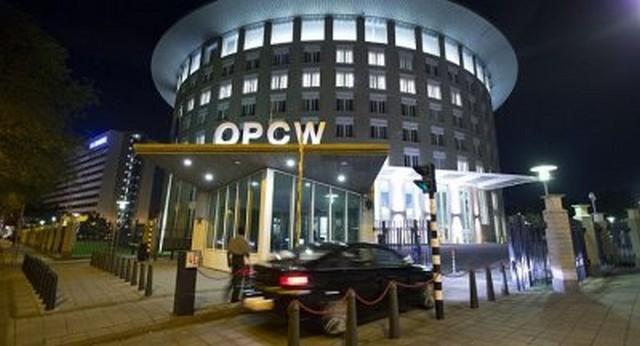
4 Mar 2019 – The OPCW (Organisation for the Prohibition of Chemical Weapons) has presented its final report regarding an alleged chemical weapons attack on Douma, Syria on April 7, 2018. Despite attempts by the Western media to hail it as “proof” that the Syrian government used chemical weapons in Douma – the report says nothing of the sort.

In fact, the report fails to link any of the alleged 43 deaths to apparent chlorine found at the scene of the alleged attack.

Claims of the attack were made by US-backed militants on the eve of their defeat – with the Syrian military retaking Douma the following day. Initial reports claimed sarin or chlorine chemical weapons were deployed through the use of two yellow gas canisters modified as bombs.

No sarin of any kind was found by OPCW inspectors.

While the report suggests two modified yellow gas canisters were used in the attack and that they appeared to have been dropped onto two buildings (locations 2 and 4), the report also mentions that OPCW inspectors found a nearly identical canister in a workshop used by militants to construct weapons.

The alleged “chemical weapons” attack prompted the United States, UK, and France to launch missiles strikes against Syrian military targets on April 14, 2018, long before the first OPCW inspectors even arrived at the sites of the alleged attack on April 21.

No Link between Chlorine and Casualties

The OPCW report would note video and photographic evidence of alleged victims of chemical exposure could not be linked to any specific chemical including traces of chlorine OPCW inspectors found. The report would specifically claim (emphasis added):

Many of the signs and symptoms reported by the medical personnel, witnesses and casualties (as well as those seen in multiple videos provided by witnesses), their rapid onset, and the large number of those reportedly affected, indicate exposure to an inhalational irritant or toxic substance. However, based on the information reviewed and with the absence of biomedical samples from the dead bodies or any autopsy records, it is not currently possible to precisely link the cause of the signs and symptoms to a specific chemical.

In other instances, the OPCW report would cite witnesses – including medical staff who allegedly treated victims of the supposed attack – who expressed doubts of the presence of any chemicals at all.

The report would state (emphasis added):

A number of the interviewed medical staff who were purportedly present in the emergency department on 7 April emphasised that the presentation of the casualties was not consistent with that expected from a chemical attack. They also reported not having experience in the treatment of casualties of chemical weapons. Some interviewees stated that no odour emanated from the patients, while other witnesses declared that they perceived a smell of smoke on the patients’ clothes.

Other accounts reviewed by the OPCW suggest a large number of casualties were owed to smoke and dust inhalation from conventional bombardment.

The report would specifically state (emphasis added):

Some witnesses stated that many people died in the hospital on 7 April as result of the heavy shelling and/or suffocation due to inhalation of smoke and dust. As many as 50 bodies were lying on the floor of the emergency department awaiting burial. Others stated that there were no fatalities in Douma Hospital on 7 April and that no bodies were brought to the hospital that day.

The conflicting witness reports, the lack of any evidence linking chlorine to even a single death on April 7, and other inconsistencies and contradictions make it impossible to use the report’s conclusions as “proof” that the Syrian government carried out a deadly chemical attack on the eve of its victory in Douma.

Similar Canisters Found in Militant Workshop

While the Western media has focused on the report’s conclusion that chlorine was present and possibly emanated from the two canisters that appear to have been dropped onto two buildings in the area, another crucial finding has been predictably glossed over.

A militant-run weapons workshop investigated by OPCW inspectors revealed a large number of resources for working with chemicals to make explosives. Among an array of chemicals and equipment associated with making explosives, a yellow gas canister was found.

The report would admit:

Although the team confirmed the presence of a yellow cylinder in the warehouse, reported in Note Verbale of the Syrian Arab Republic (Annex 10, point 2) as a chlorine cylinder, due to safety reasons (risk involved in manipulating the valve of the cylinder, see Figure A.8.2) it was not feasible to verify or sample the contents. There were differences in this cylinder compared to those witnessed at Locations 2 and 4. It should be noted that the cylinder was present in its original state and had not been altered.

The lack of interest by the OPCW in the canister despite the obvious implications of its presence in a weapons workshop controlled by militants calls into question the inspectors’ diligence and agenda.

The canister’s “differences” are owed to the fact that those at locations 2 and 4 were modified to appear as bombs, while – admittedly – the canister in the militant workshop remained unaltered.

The obvious implications of a nearly identical canister turning up in a militant workshop making weapons is that the militants may likely have also made the two converted canisters found at locations 2 and 4. OPCW inspectors found other improvised ordnance in the workshop including, “a number of 20-litre metallic drums, some fitted with crude cord-type fuses, which appeared to have been filled with plastic explosives to serve as improvised explosive devices.”

Western media organizations have tried to dismiss the presence of the canister at the workshop by suggesting it was a “setup” orchestrated by the Syrian Arab Army. Huffington Post UK senior editor Chris York would go as far as referring to the workshop as:

…the rebel explosives lab that had been captured by the SAA days before and which they were desperately trying to make look like a chemical weapons lab.

In reality, the OPCW itself would suggest nothing of the sort, and noted that all of the equipment present was consistent with a weapons workshop. Nowhere does the OPCW suggest anything was altered – including the canister – which the OPCW specifically noted “had not been altered.”

The presence of a canister nearly identical to those found at locations 2 and 4 in a militant weapons workshop provides at least as much evidence that militants staged the supposed chemical attack as the Western media claims the canisters at locations 2 and 4 suggest it was the Syrian government.

In the absence of definitive evidence regarding who created and deployed the canisters found at locations 2 and 4, or how they truly ended up there, a better question to ask is “why” they would have ended up there.

Chemical Weapon Attack in Douma… Cui Bono?

Why would the Syrian government – in the middle of a major military offensive it was on the literal eve of concluding in complete victory, drop only 2 canisters filled with a limited amount chemicals to kill – at most – 43 people? A simple artillery barrage could kill just as many people – or very likely – many more.

The use of chemical weapons even on a large scale have historically proven less effective than conventional military weapons – and the use of chlorine on such a small scale as claimed in Douma serves no conceivable purpose at all – at least not for the Syrian military.

Despite claims otherwise, the Syrian government has derived no benefit whatsoever had it been behind any of the chemical attacks it has been accused of by militants and their Western sponsors over the course of the Syrian conflict.

The Douma attack – were it the Syrian military – would have served no tactical, strategic, or political purpose.
Conversely, it would serve as one of the very few actions the Syrian government could take to jeopardize its victory by justifying a large scale Western-led military attack on Syrian forces.

In fact, just one week after the alleged attack, the US, UK, and France would indeed launch as many as 100 missiles into Syria in retaliation, the Guardian would report.

On the other hand, militants who had been occupying Douma had every reason to stage the attack.

By staging the attack on the eve of their defeat and producing graphic scenes of human suffering – particularly among children – the militants would have a propaganda tool readily able to invoke global public concern, sympathy, and outcry in defense of their cause – a propaganda tool their Western sponsors eagerly amplified through their global-spanning media platforms.

With the United States having previously launched entire wars based on false accusations of merely possessing chemical weapons, the militants correctly assumed the US would use the staged attack as a pretext for further direct military aggression against the Syrian state – possibly saving them.

The US still to this day cites “chemical weapons” and the Douma incident on April 7, 2018 specifically – as part of its pretext to maintain its illegal occupation of Syrian territory and its continued support of militants attempting to overthrow the Syrian government.

The alleged us of “chemical weapons” by the Syrian government also regularly serves as a primary talking point used by the Western media when attacking anti-war politicians, pundits, and commentators.

The OPCW report’s conclusions are too ambiguous to draw a conclusion one way or the other. The presence of a nearly identical canister in a militant workshop raises serious questions and associated implications suggesting the attack was staged – questions that must be adequately investigated and answered.

That the Syrian government gained nothing from the attack and was only further jeopardized politically and strategically by it – raises questions about motivations that likewise need to be answered before drawing conclusions.

But as the Western media has proven many times before – it is fully capable of producing entirely irrational lies based on tenuous evidence or no evidence at all – and even repeating those lies after being blatantly caught telling them previously.

That the Western media is still attempting to sell WMD lies regarding Syria after being caught fabricating them to justify war in neighboring Iraq should be at the forefront of the global public’s mind when considering their “interpretations” of this latest OPCW report regarding Douma, Syria.

_____________________________________________________

The Land Destroyer Report is maintained by Tony Cartalucci, an American geopolitical analyst based in Bangkok, Thailand.

11 March 2019

Source: www.transcend.org

A Peek into the Horrific Findings of the UN Report on Israel’s Massacre of Gaza Protesters

By Robert Inlakesh

The commission found serious human rights violations that may constitute crimes against humanity and called on Israel to “Lift the blockade on Gaza with immediate effect.”

8 Mar 2019 – The United Nations (UN) Human Rights Council have released a powerful report, on the Gaza ‘Great Return March’ demonstrations, stating that they have grounds to believe Israel committed International War Crimes against demonstrators during “large-scale civilian protests”.

The 22-page document has been condemned by the Israeli government, as there is talk of Israel being brought to the International Court of Justice and tried for war crimes and violations of International Law against demonstrations that “were civilian in nature”.

“The commission conducted 325 interviews and meetings with victims, witnesses, government officials and members of civil society, from all sides, and gathered more than 8,000 documents, including affidavits, medical reports, open source reports, social media content, written submissions and expert legal opinions, video and drone footage, and photographs.”

Here are the most important points concluded in the report:

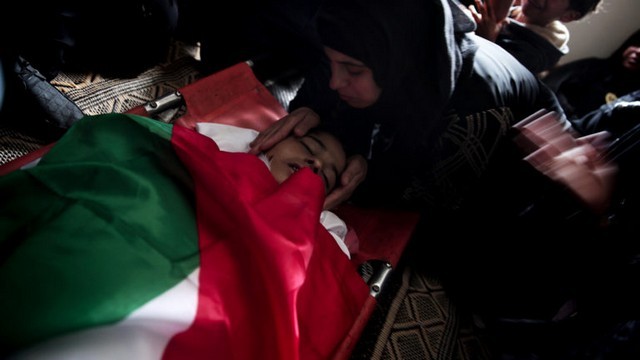
  • The commission found in the killings of 189 demonstrators between 30 March and 31 December 2018, 183 were killed with live ammunition, including 35 children, 3 health workers and 2 members of the Press. Only 29 of those killed were members of Palestinian armed groups.
  • Only 4 Israeli snipers were lightly injured, none were killed by demonstrators.
  • 23,313 Palestinian demonstrators were injured during the 2018 demonstrations, 6106 with live ammunition, “contributing to the highest toll of injuries recorded in the Occupied Palestinian Territory since 2005.
  • On the killing of child demonstrators, the commission found “reasonable grounds to believe that Israeli snipers shot them intentionally, knowing that they were children”.
  • On the killing of health workers, “the commission found reasonable grounds to believe that Israeli snipers intentionally shot health workers, despite seeing that they were clearly marked as such”.
  • On the killings of journalists, “the commission found reasonable grounds to believe that Israeli snipers shot journalists intentionally, despite seeing that they were clearly marked as such”.
  • The commission found that both male and female protestors were shot in the groin. The female victims told the commission they are now “unlikely to be able to have children”.
  • The policy of the Israeli Minister of Defense, was to deny passage to any person injured during demonstrations, causing unnecessary deaths and life changing injuries.
  • According to the commission, except in two possible cases, “the use of live ammunition by Israeli security forces against demonstrators was unlawful”.
  • Israel used a “disproportionate use of force”.
  • The “demonstrators were shot in violation of their right to life or of the principle of distinction under international humanitarian law”.
  • The commission found “reasonable grounds to believe that the excessive use of force by Israeli security forces violated the rights” of thousands of demonstrators who were peaceful.
  • The commission found “reasonable grounds” to believe that Israel violated “The Convention on the Rights of the Child”.
  • “Violations of international law, such as those committed by Israeli security forces and set out in this report, give rise to State responsibility…”.

The commission found serious human rights violations that may constitute crimes against humanity and called on Israel to “Lift the blockade on Gaza with immediate effect.

The often repeated Israeli claims of the protests being inspired and organized by “Hamas terrorists”, were also addressed in the report, which stated that the demonstrations were inspired by the internet posts of 34-year-old Palestinian poet and journalist, Ahmed Abu Artema, with the demonstrations being organized by “A higher national committee and 12 subcommittees.”

The report went on to say, that “while the members of the committee held diverse political views, they stated that their unifying element was the principle that the march was to be “fully peaceful from beginning to end” and demonstrators would be unarmed”.

Activities such as the use of incendiary kites, cutting barbed wire or tire burning were organized by “self-declared” units. The report further states “the commission found no evidence to suggest that they were directed or coordinated by armed groups”.

The commission interviewed what it called an international journalist who said, “I have covered wars in Syria, Yemen, Libya. I have never seen anything like this. The slow methodical shooting. It was just shocking…”

The commission also noted that Israel refused to assist with the UN investigation and did not “cooperate or provide information.”

The following is a sample of the cases investigated by the commission.

March 30 demonstrations

Injury of 17 Mohammed Ajouri (17 years old)

“Israeli forces shot Mohammad, a student-athlete, in the back of his right leg as he gave onions to demonstrators to relieve tear-gas symptoms, approximately 300 m from the fence. His leg had to be amputated.”

The murder of Abdel Fatah Nabi (18 years old)

“Israeli forces killed Abed, from Beit Lahia, when they shot him in the back of the head as he ran, carrying a tyre, away from and about 400 m from the separation fence.”

The murder of Bader Sabagh (19 years old)

“Bader, from Jabaliya, was killed by Israeli forces when they shot him in the head as he stood smoking a cigarette 300 m from the separation fence.”

Injury and murder of schoolgirl (13 years old) and Marwan Qudieh (45 years old)

“Israeli forces injured a schoolgirl with bullet fragmentation. As she lay on the ground, four men attempted to evacuate her. The forces shot three of them, killing Marwan Qudieh (45) from Khuzaa village and injuring a potato seller and another man in the legs. One of the rescuers had to have a leg amputated.”

Injury of Alaa Dali (21 years old)

“Alaa, a member of the Palestinian cycling team, was shot by Israeli forces in the leg as he stood holding his bicycle, wearing his cycling kit, watching the demonstrations, approximately 300 m from the separation fence. His right leg had to be amputated, ending his cycling career.”

May 14 demonstration, seven children killed

“On 14 May, Israeli security forces shot and killed seven children: a girl, Wisal Khalil (14), and six boys: Izzedine al-Samak (13); Said al-Kheir (15); Ahmad al-Sha’ar (15); Talal Matar (15); Saadi Abu Salah (16); and Ibrahim al-Zarqa (17).”

The murder of Mohammad Najar (33 years old)

“Israeli forces shot Mohammad, a naval police officer, in the chest, killing him, as he sat on a hill with a friend, around 500 m from the separation fence.”

The murder of Yasser Abu Naja (11 years old)

“On 29 June, Israeli forces killed Yasser from Khan Younis with a shot to the head as he was hiding with two friends behind a bin, approximately 200 m from the separation fence. The children had been chanting national slogans at Israeli forces.”

The murder of Nasser Mosabeh (11 years old)

“Nasser was from Khan Younis. On 28 September, Israeli forces shot him in the back of the head as he stood 250 m from the separation fence. He died the same day.”

The murder of Razan Al-Najar (20 years old)

“On 1 June, an Israeli sniper bullet hit Razan, of the Palestinian Medical Relief Society and who at the time was wearing a white paramedic vest and standing with other volunteer paramedics approximately 110 m from the separation fence, in the chest at the Khuzaa site, east of Khan Younis. She died in hospital.”

The murder of Yasser Murtaja (30 years old)

“On 6 April, Yasser, a journalist from Gaza City, was shot in the lower abdomen by Israeli forces at the Khan Younis site while he was filming the demonstrations for a documentary. He was wearing a blue helmet and a dark blue bulletproof vest clearly marked “Press”. He died the following day.”

Amputation of Abed Nofal (11 years old)

“On 17 April, Abed, a schoolboy from the Bureij refugee camp, was shot by Israeli forces while he was playing football near the separation fence. His leg had to be amputated.”

The extended version of the report is set to be released on March 18, 2019. The commission recommended that UN members consider imposing individual sanctions, such as travel bans or an asset freezes on those responsible.

________________________________________________

Robert Inlakesh is a journalist, political analyst and human rights activist who specializes in delivering insight into the geopolitical scene of the Middle East, specializing in the political and humanitarian situation in Palestine.

11 March 2019

Source: www.transcend.org

15 Years Ago: US Sponsored Coup d’état. The Destabilization of Haiti

By Prof Michel Chossudovsky

29 Feb 2019 – Author’s Note

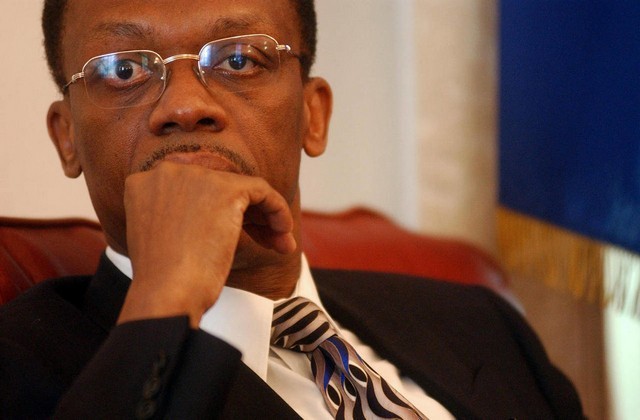
This article was written 15 years ago, in the last days of February 2004 in response to the barrage of disinformation in the mainstream media. It was completed on February 29th, the day of President Jean Bertrand Aristide’s kidnapping and deportation by US Forces.

The armed insurrection which contributed to unseating President Aristide on February 29th 2004 was the result of a carefully staged military-intelligence operation, involving the US, France and Canada.

The 2004 coup had set the stage for the installation of a US puppet government in Port au Prince, which takes orders directly from Washington.

And today, a US Coup is on the drawing board of the White House. Canada as well as France are once again complicit in supporting the over-through of the duly elected president of Venezuela.

It’s all for a good cause: install “American Democracy”, “Alleviate poverty”. And the self-proclaimed “international community” applauds.

*********************

The below article was subsequently published as a Chapter in Michel Chossudovsky’s book entitled The Globalization of War.

Minor editorial corrections were made to the original draft since its publication on February 29th 2004; the title of the article predates the actual Coup d’état which was in the making at the time of writing.

Original article published at http://globalresearch.ca/articles/CHO402D.html

US Sponsored Coup d’état: The Destabilization of Haiti

By Michel Chossudovsky

29 Feb 2004 – The Rebel paramilitary army crossed the border from the Dominican Republic in early February. It constitutes a well armed, trained and equipped paramilitary unit integrated by former members of Le Front pour l’avancement et le progrès d’Haiti (FRAPH), the “plain clothes” death squadrons, involved in mass killings of civilians and political assassinations during the CIA sponsored 1991 military coup, which led to the overthrow of the democratically elected government of President Jean Bertrand Aristide

The self-proclaimed Front pour la Libération et la reconstruction nationale (FLRN) (National Liberation and Reconstruction Front) is led by Guy Philippe, a former member of the Haitian Armed Forces and Police Chief. Philippe had been trained during the 1991 coup years by US Special Forces in Ecuador, together with a dozen other Haitian Army officers. (See Juan Gonzalez, New York Daily News, 24 February 2004).

The two other rebel commanders and associates of Guy Philippe, who led the attacks on Gonaives and Cap Haitien are Emmanuel Constant, nicknamed “Toto” and Jodel Chamblain, both of whom are former Tonton Macoute and leaders of FRAPH.

In 1994, Emmanuel Constant led the FRAPH assassination squadron into the village of Raboteau, in what was later identified as “The Raboteau massacre”:

“One of the last of the infamous massacres happened in April 1994 in Raboteau, a seaside slum about 100 miles north of the capital. Raboteau has about 6,000 residents, most fishermen and salt rakers, but it has a reputation as an opposition stronghold where political dissidents often went to hide… On April 18 [1994], 100 soldiers and about 30 paramilitaries arrived in Raboteau for what investigators would later call a “dress rehearsal.” They rousted people from their homes, demanding to know where Amiot “Cubain” Metayer, a well-known Aristide supporter, was hiding. They beat people, inducing a pregnant woman to miscarry, and forced others to drink from open sewers. Soldiers tortured a 65-year-old blind man until he vomited blood. He died the next day.

The soldiers returned before dawn on April 22. They ransacked homes and shot people in the streets, and when the residents fled for the water, other soldiers fired at them from boats they had commandeered. Bodies washed ashore for days; some were never found. The number of victims ranges from two dozen to 30. Hundreds more fled the town, fearing further reprisals.” (St Petersburg Times, Florida, 1 September 2002)

During the military government (1991-1994), FRAPH was (unofficially) under the jurisdiction of the Armed Forces, taking orders from Commander in Chief General Raoul Cedras. According to a 1996 UN Human Rights Commission report, FRAPH had been supported by the CIA.

Under the military dictatorship, the narcotics trade, was protected by the military Junta, which in turn was supported by the CIA. The 1991 coup leaders including the FRAPH paramilitary commanders were on the CIA payroll.

(See Paul DeRienzo, http://globalresearch.ca/articles/RIE402A.html , See also see Jim Lobe, IPS, 11 Oct 1996). Emmanuel Constant alias “Toto” confirmed, in this regard, in a CBS “60 Minutes” in 1995, that the CIA paid him about $700 a month and that he created FRAPH, while on the CIA payroll. (See Miami Herald, 1 August 2001). According to Constant, the FRAPH had been formed “with encouragement and financial backing from the U.S. Defense Intelligence Agency and the CIA.” (Miami New Times, 26 February 2004)

The Civilian “Opposition”

The so-called “Democratic Convergence” (DC) is a group of some 200 political organizations, led by former Port-au-Prince mayor Evans Paul. The “Democratic Convergence” (DC) together with “The Group of 184 Civil Society Organizations” (G-184) has formed a so-called “Democratic Platform of Civil Society Organizations and Opposition Political Parties”.

The Group of 184 (G-184), is headed by Andre (Andy) Apaid, a US citizen of Haitian parents, born in the US. (Haiti Progres, http://www.haiti-progres.com/eng11-12.html ) Andy Apaid owns Alpha Industries, one of Haiti’s largest cheap labor export assembly lines established during the Duvalier era. His sweatshop factories produce textile products and assemble electronic products for a number of US firms including Sperry/Unisys, IBM, Remington and Honeywell. Apaid is the largest industrial employer in Haiti with a workforce of some 4000 workers. Wages paid in Andy Apaid’s factories are as low as 68 cents a day. (Miami Times, 26 Feb 2004). The current minimum wage is of the order of $1.50 a day:

“The U.S.-based National Labor Committee, which first revealed the Kathie Lee Gifford sweat shop scandal, reported several years ago that Apaid’s factories in Haiti’s free trade zone often pay below the minimum wage and that his employees are forced to work 78-hour weeks.” (Daily News, New York, 24 Feb 2004)

Apaid was a firm supporter of the 1991 military coup. Both the Convergence démocratique and the G-184 have links to the FLRN (former FRAPH death squadrons) headed by Guy Philippe. The FLRN is also known to receive funding from the Haitian business community.

In other words, there is no watertight division between the civilian opposition, which claims to be non-violent and the FLRN paramilitary. The FLRN is collaborating with the so-called “Democratic Platform.”

The Role of the National Endowment for Democracy (NED)

In Haiti, this “civil society opposition” is bankrolled by the National Endowment for Democracy which works hand in glove with the CIA. The Democratic Platform is supported by the International Republican Institute (IRI) , which is an arm of the National Endowment for Democracy (NED). Senator John McCain is Chairman of IRI’s Board of Directors.

(See Laura Flynn, Pierre Labossière and Robert Roth, Hidden from the Headlines: The U.S. War Against Haiti, California-based Haiti Action Committee (HAC), http://www.haitiprogres.com/eng11-12.html ).

G-184 leader Andy Apaid was in liaison with Secretary of State Colin Powell in the days prior to the kidnapping and deportation of President Aristide by US forces on February 29. His umbrella organization of elite business organizations and religious NGOs, which is also supported by the International Republican Institute (IRI), receives sizeable amounts of money from the European Union.(http://haitisupport.gn.apc.org/184%20EC.htm ).

It is worth recalling that the NED, (which overseas the IRI) although not formally part of the CIA, performs an important intelligence function within the arena of civilian political parties and NGOs. It was created in 1983, when the CIA was being accused of covertly bribing politicians and setting up phony civil society front organizations. According to Allen Weinstein, who was responsible for setting up the NED during the Reagan Administration: “A lot of what we do today was done covertly 25 years ago by the CIA.” (‘Washington Post’, Sept. 21, 1991).

The NED channels congressional funds to the four institutes: The International Republican Institute (IRI), the National Democratic Institute for International Affairs (NDI), the Center for International Private Enterprise (CIPE), and the American Center for International Labor Solidarity (ACILS). These organizations are said to be “uniquely qualified to provide technical assistance to aspiring democrats worldwide.” See IRI, http://www.iri.org/history.asp )

In other words, there is a division of tasks between the CIA and the NED. While the CIA provides covert support to armed paramilitary rebel groups and death squadrons, the NED and its four constituent organizations finance “civilian” political parties and non governmental organizations with a view to instating American “democracy” around the World.

The NED constitutes, so to speak, the CIA’s “civilian arm”. CIA-NED interventions in different part of the World are characterized by a consistent pattern, which is applied in numerous countries.

The NED provided funds to the “civil society” organizations in Venezuela, which initiated an attempted coup against President Hugo Chavez. In Venezuela it was the “Democratic Coordination”, which was the recipient of NED support; in Haiti it is the “Democratic Convergence” and G-184.

Similarly, in former Yugoslavia, the CIA channeled support to the Kosovo Liberation Army (KLA) (since 1995), a paramilitary group involved in terrorist attacks on the Yugoslav police and military. Meanwhile, the NED through the “Center for International Private Enterprise” (CIPE) was backing the DOS opposition coalition in Serbia and Montenegro. More specifically, NED was financing the G-17, an opposition group of economists responsible for formulating (in liaison with the IMF) the DOS coalition’s “free market” reform platform in the 2000 presidential election, which led to the downfall of Slobodan Milosevic.

The IMF’s Bitter “Economic Medicine”

The IMF and the World Bank are key players in the process of economic and political destabilization. While carried out under the auspices of an intergovernmental body, the IMF reforms tend to support US strategic and foreign policy objectives.

Based on the so-called “Washington consensus”, IMF austerity and restructuring measures through their devastating impacts, often contribute to triggering social and ethnic strife. IMF reforms have often precipitated the downfall of elected governments. In extreme cases of economic and social dislocation, the IMF’s bitter economic medicine has contributed to the destabilization of entire countries, as occurred in Somalia, Rwanda and Yugoslavia.

(See Michel Chossudovsky, The Globalization of Poverty and the New World Order, Second Edition, 2003, http://globalresearch.ca/globaloutlook/GofP.html )

The IMF program is a consistent instrument of economic dislocation. The IMF’s reforms contribute to reshaping and downsizing State institutions through drastic austerity measures. The latter are implemented alongside other forms of intervention and political interference, including CIA covert activities in support of rebel paramilitary groups and opposition political parties.

Moreover, so-called “Emergency Recovery” and “Post-conflict” reforms are often introduced under IMF guidance, in the wake of a civil war, a regime change or “a national emergency”.

In Haiti, the IMF sponsored “free market” reforms have been carried out consistently since the Duvalier era. They have been applied in several stages since the first election of president Aristide in 1990.

The 1991 military coup, which took place 8 months following Jean Bertrand Aristide’s accession to the presidency, was in part intended to reverse the Aristide government’s progressive reforms and reinstate the neoliberal policy agenda of the Duvalier era.

A former World Bank official Mr. Marc Bazin was appointed Prime minister by the Military Junta in June 1992. In fact, it was the US State Department which sought his appointment.

Bazin had a track record of working for the “Washington consensus.” In 1983, he had been appointed Finance Minister under the Duvalier regime, In fact he had been recommended to the Finance portfolio by the IMF: “President-for-Life Jean-Claude Duvalier had agreed to the appointment of an IMF nominee, former World Bank official Marc Bazin, as Minister of Finance”. (Mining Annual Review, June, 1983). Bazin, who was considered Washington’s “favorite”, later ran against Aristide in the 1990 presidential elections.

Bazin, was called in by the Military Junta in 1992 to form a so-called “consensus government”. It is worth noting that it was precisely during Bazin’s term in office as Prime Minister that the political massacres and extra judicial killings by the CIA supported FRAPH death squadrons were unleashed, leading to the killing of more than 4000 civilians. Some 300,000 people became internal refugees, “thousands more fled across the border to the Dominican Republic, and more than 60,000 took to the high seas” (Statement of Dina Paul Parks, Executive Director, National Coalition for Haitian Rights, Committee on Senate Judiciary, US Senate, Washington DC, 1 October 2002). Meanwhile, the CIA had launched a smear campaign representing Aristide as “mentally unstable” (Boston Globe, 21 Sept 1994).

The 1994 US Military Intervention

Following three years of military rule, the US intervened in 1994, sending in 20,000 occupation troops and “peace-keepers” to Haiti. The US military intervention was not intended to restore democracy. Quite the contrary: it was carried out to prevent a popular insurrection against the military Junta and its neoliberal cohorts.

In other words, the US military occupation was implemented to ensure political continuity.

While the members of the military Junta were sent into exile, the return to constitutional government required compliance to IMF diktats, thereby foreclosing the possibility of a progressive “alternative” to the neoliberal agenda. Moreover, US troops remained in the country until 1999. The Haitian armed forces were disbanded and the US State Department hired a mercenary company DynCorp to provide “technical advice” in restructuring the Haitian National Police (HNP).

“DynCorp has always functioned as a cut-out for Pentagon and CIA covert operations.”

(See Jeffrey St. Clair and Alexander Cockburn, Counterpunch, February 27, 2002, http://www.corpwatch.org/issues/PID.jsp?articleid=1988 )

Under DynCorp advice in Haiti, former Tonton Macoute and Haitian military officers involved in the 1991 Coup d’Etat were brought into the HNP.

(See Ken Silverstein, Privatizing War, The Nation, July 28, 1997, http://www.mtholyoke.edu/acad/intrel/silver.htm )

In October 1994, Aristide returned from exile and reintegrated the presidency until the end of his mandate in 1996. “Free market” reformers were brought into his Cabinet. A new wave of deadly macro-economic policies was adopted under a so-called Emergency Economic Recovery Plan (EERP) “that sought to achieve rapid macroeconomic stabilization, restore public administration, and attend to the most pressing needs.”

(See IMF Approves Three-Year ESAF Loan for Haiti, Washington, 1996, http://www.imf.org/external/np/sec/pr/1996/pr9653.htm ).

The restoration of Constitutional government had been negotiated behind closed doors with Haiti’s external creditors. Prior to Aristide’s reinstatement as the country’s president, the new government was obliged to clear the country’s debt arrears with its external creditors. In fact the new loans provided by the World Bank, the Inter-American Development Bank (IDB), and the IMF were used to meet Haiti’s obligations with international creditors. Fresh money was used to pay back old debt leading to a spiraling external debt.

Broadly coinciding with the military government, Gross Domestic Product (GDP) declined by 30 percent (1992-1994). With a per capita income of $250 per annum, Haiti is the poorest country in the Western hemisphere and among the poorest in the world.

(see World Bank, Haiti: The Challenges of Poverty Reduction, Washington, August 1998, http://lnweb18.worldbank.org/External/lac/lac.nsf/0/8479e9126e3537f0852567ea000fa239/$FILE/Haiti1.doc ).

The World Bank estimates unemployment to be of the order of 60 percent. (A 2000 US Congressional Report estimates it to be as high as 80 percent. See US House of Representatives, Criminal Justice, Drug Policy and Human Resources Subcommittee, FDHC Transcripts, 12 April 2000).

In the wake of three years of military rule and economic decline, there was no “Economic Emergency Recovery” as envisaged under the IMF loan agreement. In fact quite the opposite: The IMF imposed “stabilization” under the “Recovery” program required further budget cuts in almost non-existent social sector programs. A civil service reform program was launched, which consisted in reducing the size of the civil service and the firing of “surplus” State employees. The IMF-World Bank package was in part instrumental in the paralysis of public services, leading to the eventual demise of the entire State system. In a country where health and educational services were virtually nonexistent, the IMF had demanded the lay off of “surplus” teachers and health workers with a view to meeting its target for the budget deficit.

Washington’s foreign policy initiatives were coordinated with the application of the IMF’s deadly economic medicine. The country had been literally pushed to the brink of economic and social disaster.

The Fate of Haitian Agriculture

More than 75 percent of the Haitian population is engaged in agriculture, producing both food crops for the domestic market as well a number of cash crops for export. Already during the Duvalier era, the peasant economy had been undermined. With the adoption of the IMF-World Bank sponsored trade reforms, the agricultural system, which previously produced food for the local market, had been destabilized. With the lifting of trade barriers, the local market was opened up to the dumping of US agricultural surpluses including rice, sugar and corn, leading to the destruction of the entire peasant economy. Gonaives, which used to be Haiti’s rice basket region, with extensive paddy fields had been precipitated into bankruptcy:

“By the end of the 1990s Haiti’s local rice production had been reduced by half and rice imports from the US accounted for over half of local rice sales. The local farming population was devastated, and the price of rice rose drastically “ ( See Rob Lyon, Haiti-There is no solution under Capitalism! Socialist Appeal, 24 Feb. 2004.

http://cleveland.indymedia.org/news/2004/02/9095.php ).

In matter of a few years, Haiti, a small impoverished country in the Caribbean, had become the World’s fourth largest importer of American rice after Japan, Mexico and Canada.

The Second Wave of IMF Reforms

The presidential elections were scheduled for November 23, 2000. The Clinton Administration had put an embargo on development aid to Haiti in 2000. Barely two weeks prior to the elections, the outgoing administration signed a Letter of Intent with the IMF. Perfect timing: the agreement with the IMF virtually foreclosed from the outset any departure from the neoliberal agenda.

The Minister of Finance had sent the amended budget to the Parliament on December 14th. Donor support was conditional upon its rubber stamp approval by the Legislature. While Aristide had promised to increase the minimum wage, embark on school construction and literacy programs, the hands of the new government were tied. All major decisions regarding the State budget, the management of the public sector, public investment, privatization, trade and monetary policy had already been taken. They were part of the agreement reached with the IMF on November 6, 2000.

In 2003, the IMF imposed the application of a so-called “flexible price system in fuel”, which immediately triggered an inflationary spiral. The currency was devalued. Petroleum prices increased by about 130 percent in January-February 2003, which served to increase popular resentment against the Aristide government, which had supported the implementation of the IMF economic reforms.

The hike in fuel prices contributed to a 40 percent increase in consumer prices (CPI) in 2002-2003

(See Haiti—Letter of Intent, Memorandum of Economic and Financial Policies, and Technical Memorandum of Understanding, Port-au-Prince, Haiti June 10, 2003, http://www.imf.org/external/np/loi/2003/hti/01/index.htm ).

In turn, the IMF had demanded, despite the dramatic increase in the cost of living, a freeze on wages as a means to “controlling inflationary pressures.” The IMF had in fact pressured the government to lower public sector salaries (including those paid to teachers and health workers). The IMF had also demanded the phasing out of the statutory minimum wage of approximately 25 cents an hour. “Labour market flexibility”, meaning wages paid below the statutory minimum wage would, according to the IMF, contribute to attracting foreign investors. The daily minimum wage was $3.00 in 1994, declining to about $1.50- 1.75 (depending on the gourde-dollar exchange rate) in 2004.

In an utterly twisted logic, Haiti’s abysmally low wages, which have been part of the IMF-World Bank “cheap labor” policy framework since the 1980s, are viewed as a means to improving the standard of living. In other words, sweatshop conditions in the assembly industries (in a totally unregulated labor market) and forced labor conditions in Haiti’s agricultural plantations are considered by the IMF as a key to achieving economic prosperity, because they “attract foreign investment.”

The country was in the straightjacket of a spiraling external debt. In a bitter irony, the IMF-World Bank sponsored austerity measures in the social sectors were imposed in a country which has 1,2 medical doctors for 10,000 inhabitants and where the large majority of the population is illiterate. State social services, which were virtually nonexistent during the Duvalier period, have collapsed.

The result of IMF ministrations was a further collapse in purchasing power, which had also affected middle income groups. Meanwhile, interest rates had skyrocketed. In the Northern and Eastern parts of the country, the hikes in fuel prices had led to a virtual paralysis of transportation and public services including water and electricity.

While a humanitarian catastrophe is looming, the collapse of the economy spearheaded by the IMF, had served to boost the popularity of the Democratic Platform, which had accused Aristide of “economic mismanagement.” Needless to say, the leaders of the Democratic Platform including Andy Apaid –who actually owns the sweatshops– are the main protagonists of the low wage economy.

Applying the Kosovo Model

In February 2003, Washington announced the appointment of James Foley as Ambassador to Haiti . Foley had been a State Department spokesman under the Clinton administration during the war on Kosovo. He previously held a position at NATO headquarters in Brussels. Foley had been sent to Port au Prince in advance of the CIA sponsored operation. He was transferred to Port au Prince in September 2003, from a prestige diplomatic position in Geneva, where he was Deputy Head of Mission to the UN European office.

It is worth recalling Ambassador Foley’s involvement in support of the Kosovo Liberation Army (KLA) in 1999.

Amply documented, the Kosovo Liberation Army (KLA) was financed by drug money and supported by the CIA.

( See Michel Chossudovsky, Kosovo Freedom Fighters Financed by Organized Crime, Covert Action Quarterly, 1999, http://www.heise.de/tp/english/inhalt/co/2743/1.html )

The KLA had been involved in similar targeted political assassinations and killings of civilians, in the months leading up to the 1999 NATO invasion as well as in its aftermath. Following the NATO led invasion and occupation of Kosovo, the KLA was transformed into the Kosovo Protection Force (KPF) under UN auspices. Rather than being disarmed to prevent the massacres of civilians, a terrorist organization with links to organized crime and the Balkans drug trade, was granted a legitimate political status.

At the time of the Kosovo war, the current ambassador to Haiti James Foley was in charge of State Department briefings, working closely with his NATO counterpart in Brussels, Jamie Shea. Barely two months before the onslaught of the NATO led war on 24 March 1999, James Foley had called for the “transformation” of the KLA into a respectable political organization:

“We want to develop a good relationship with them [the KLA] as they transform themselves into a politically-oriented organization,’ ..`[W]e believe that we have a lot of advice and a lot of help that we can provide to them if they become precisely the kind of political actor we would like to see them become… “If we can help them and they want us to help them in that effort of transformation, I think it’s nothing that anybody can argue with..’ (quoted in the New York Times, 2 February 1999)

In the wake of the invasion “a self-proclaimed Kosovar administration was set up composed of the KLA and the Democratic Union Movement (LBD), a coalition of five opposition parties opposed to Rugova’s Democratic League (LDK). In addition to the position of prime minister, the KLA controlled the ministries of finance, public order and defense.”

(Michel Chossudovsky, NATO’s War of Aggression against Yugoslavia, 1999, http://www.globalresearch.ca/articles/CHO309C.html )

The US State Department’s position as conveyed in Foley’s statement was that the KLA would “not be allowed to continue as a military force but would have the chance to move forward in their quest for self government under a ‘different context’” meaning the inauguration of a de facto “narco-democracy” under NATO protection. (Ibid).

With regard to the drug trade, Kosovo and Albania occupy a similar position to that of Haiti: they constitute “a hub” in the transit (transshipment) of narcotics from the Golden Crescent, through Iran and Turkey into Western Europe. While supported by the CIA, Germany’s Bundes Nachrichten Dienst (BND) and NATO, the KLA has links to the Albanian Mafia and criminal syndicates involved in the narcotics trade.

( See Michel Chossudovsky, Kosovo Freedom Fighters Financed by Organized Crime, Covert Action Quarterly, 1999, http://www.heise.de/tp/english/inhalt/co/2743/1.html )

Is this the model for Haiti, as formulated in 1999 by the current US Ambassador to Haiti James Foley?

For the CIA and the State Department the FLRN and Guy Philippe are to Haiti what the KLA and Hashim Thaci are to Kosovo.

In other words, Washington’s design is “regime change”: topple the Lavalas administration and install a compliant US puppet regime, integrated by the Democratic Platform and the self-proclaimed Front pour la libération et la reconstruction nationale (FLRN), whose leaders are former FRAPH and Tonton Macoute terrorists. The latter are slated to integrate a “national unity government” alongside the leaders of the Democratic Convergence and The Group of 184 Civil Society Organizations led by Andy Apaid. More specifically, the FLRN led by Guy Philippe is slated to rebuild the Haitian Armed forces, which were disbanded in 1995.

What is at stake is an eventual power sharing arrangement between the various Opposition groups and the CIA supported Rebels, which have links to the cocaine transit trade from Colombia via Haiti to Florida. The protection of this trade has a bearing on the formation of a new “narco-government”, which will serve US interests.

A bogus (symbolic) disarmament of the Rebels may be contemplated under international supervision, as occurred with the KLA in Kosovo in 2000. The “former terrorists” could then be integrated into the civilian police as well as into the task of “rebuilding” the Haitian Armed forces under US supervision.

What this scenario suggests, is that the Duvalier-era terrorist structures have been restored. A program of civilian killings and political assassinations directed against Lavalas supporter is in fact already underway.

In other words, if Washington were really motivated by humanitarian considerations, why then is it supporting and financing the FRAPH death squadrons? Its objective is not to prevent the massacre of civilians. Modeled on previous CIA led operations (e.g. Guatemala, Indonesia, El Salvador), the FLRN death squadrons have been set loose and are involved in targeted political assassinations of Aristide supporters.

The Narcotics Transshipment Trade

While the real economy had been driven into bankruptcy under the brunt of the IMF reforms, the narcotics transshipment trade continues to flourish. According to the US Drug Enforcement Administration (DEA), Haiti remains “the major drug trans-shipment country for the entire Caribbean region, funneling huge shipments of cocaine from Colombia to the United States.” (See US House of Representatives, Criminal Justice, Drug Policy and Human Resources Subcommittee, FDHC Transcripts, 12 April 2000).

It is estimated that Haiti is now responsible for 14 percent of all the cocaine entering the United States, representing billions of dollars of revenue for organized crime and US financial institutions, which launder vast amounts of dirty money. The global trade in narcotics is estimated to be of the order of 500 billion dollars.

Much of this transshipment trade goes directly to Miami, which also constitutes a haven for the recycling of dirty money into bona fide investments, e.g. in real estate and other related activities.

The evidence confirms that the CIA was protecting this trade during the Duvalier era as well as during the military dictatorship (1991-1994). In 1987, Senator John Kerry as Chairman of the Subcommittee on Narcotics, Terrorism and International Operations of the Senate Foreign Affairs Committee was entrusted with a major investigation, which focused on the links between the CIA and the drug trade, including the laundering of drug money to finance armed insurgencies. “The Kerry Report” published in 1989, while centering its attention on the financing of the Nicaraguan Contra, also included a section on Haiti:

“Kerry had developed detailed information on drug trafficking by Haiti’s military rulers that led to the indictment in Miami in 1988, of Lt. Col. Jean Paul. The indictment was a major embarrassment to the Haitian military, especially since Paul defiantly refused to surrender to U.S. authorities.. In November 1989, Col. Paul was found dead after he consumed a traditional Haitian good will gift—a bowel of pumpkin soup…

The U.S. senate also heard testimony in 1988 that then interior minister, Gen. Williams Regala, and his DEA liaison officer, protected and supervised cocaine shipments. The testimony also charged the then Haitian military commander Gen. Henry Namphy with accepting bribes from Colombian traffickers in return for landing rights in the mid 1980’s.

It was in 1989 that yet another military coup brought Lt. Gen. Prosper Avril to power… According to a witness before Senator John Kerry’s subcommittee, Avril is in fact a major player in Haiti’s role as a transit point in the cocaine trade.”

( Paul DeRienzo, Haiti’s Nightmare: The Cocaine Coup & The CIA Connection, Spring 1994, http://globalresearch.ca/articles/RIE402A.html )

Jack Blum, who was Kerry’s Special Counsel, points to the complicity of US officials in a 1996 statement to the US Senate Select Committee on Intelligence on Drug Trafficking and the Contra War:

“…In Haiti … intelligence “sources” of ours in the Haitian military had turned their facilities over to the drug cartels. Instead of putting pressure on the rotten leadership of the military, we defended them. We held our noses and looked the other way as they and their criminal friends in the United States distributed cocaine in Miami, Philadelphia and New, York.“

(http://www.totse.com/en/politics/central_intelligence_agency/ciacont2.html )

Haiti not only remains at the hub of the transshipment cocaine trade, the latter has grown markedly since the 1980s. The current crisis bears a relationship to Haiti’s role in the drug trade. Washington wants a compliant Haitian government which will protect the drug transshipment routes, out of Colombia through Haiti and into Florida.

The inflow of narco-dollars –which remains the major source of the country’s foreign exchange earnings– are used to service Haiti’s spiraling external debt, thereby also serving the interests of the external creditors.

In this regard, the liberalization of the foreign-exchange market imposed by the IMF has provided (despite the authorities pro forma commitment to combating the drug trade) a convenient avenue for the laundering of narco-dollars in the domestic banking system. The inflow of narco-dollars alongside bona fide “remittances” from Haitians living abroad, are deposited in the commercial banking system and exchanged into local currency. The foreign exchange proceeds of these inflows can then be recycled towards the Treasury where they are used to meet debt servicing obligations.

Haiti, however, reaps a very small percentage of the total foreign exchange proceeds of this lucrative contraband. Most of the revenue resulting from the cocaine transshipment trade accrues to criminal intermediaries in the wholesale and retail narcotics trade, to the intelligence agencies which protect the drug trade as well as to the financial and banking institutions where the proceeds of this criminal activity are laundered.

The narco-dollars are also channeled into “private banking” accounts in numerous offshore banking havens. (These havens are controlled by the large Western banks and financial institutions). Drug money is also invested in a number of financial instruments including hedge funds and stock market transactions. The major Wall Street and European banks and stock brokerage firms launder billions of dollars resulting from the trade in narcotics.

Moreover, the expansion of the dollar denominated money supply by the Federal Reserve System , including the printing of billions of dollars of US dollar notes for the purposes of narco-transactions constitutes profit for the Federal Reserve and its constituent private banking institutions of which the most important is the New York Federal Reserve Bank.

See (Jeffrey Steinberg, Dope, Inc. Is $600 Billion and Growing, Executive Intelligence Review, 14 Dec 2001, http://www.larouchepub.com/other/2001/2848dope_money.html )

In other words, the Wall Street financial establishment, which plays a behind the scenes role in the formulation of US foreign policy, has a vested interest in retaining the Haiti transshipment trade, while installing a reliable “narco-democracy” in Port-au-Prince, which will effectively protect the transshipment routes.

It should be noted that since the advent of the Euro as a global currency, a significant share of the narcotics trade is now conducted in Euro rather than US dollars. In other words, the Euro and the dollar are competing narco-currencies.

The Latin American cocaine trade –including the transshipment trade through Haiti– is largely conducted in US dollars. This shift out of dollar denominated narco-transactions, which undermines the hegemony of the US dollar as a global currency, largely pertains to the Middle East, Central Asian and the Southern European drug routes.

Media Manipulation

In the weeks leading up to the Coup d’Etat, the media has largely focused its attention on the pro-Aristide “armed gangs” and “thugs”, without providing an understanding of the role of the FLRN Rebels.

Deafening silence: not a word was mentioned in official statements and UN resolutions regarding the nature of the FLRN. This should come as no surprise: the US Ambassador to the UN (the man who sits on the UN Security Council) John Negroponte. played a key role in the CIA supported Honduran death squadrons in the 1980s when he was US ambassador to Honduras. (See San Francisco Examiner, 20 Oct 2001 http://www.flora.org/mai/forum/31397 )

The FLRN rebels are extremely well equipped and trained forces. The Haitian people know who they are. They are Tonton Macoute of the Duvalier era and former FRAPH assassins.

The Western media is mute on the issue, blaming the violence on President Aristide. When it acknowledges that the Liberation Army is composed of death squadrons, it fails to examine the broader implications of its statements and that these death squadrons are a creation of the CIA and the Defense Intelligence Agency.

The New York Times has acknowledged that the “non violent” civil society opposition is in fact collaborating with the death squadrons, “accused of killing thousands”, but all this is described as “accidental”. No historical understanding is provided. Who are these death squadron leaders? All we are told is that they have established an “alliance” with the “non-violent” good guys who belong to the “political opposition”. And it is all for a good and worthy cause, which is to remove the elected president and “restore democracy”:

“As Haiti’s crisis lurches toward civil war, a tangled web of alliances, some of them accidental, has emerged. It has linked the interests of a political opposition movement that has embraced nonviolence to a group of insurgents that includes a former leader of death squads accused of killing thousands, a former police chief accused of plotting a coup and a ruthless gang once aligned with Mr. Aristide that has now turned against him. Given their varied origins, those arrayed against Mr. Aristide are hardly unified, though they all share an ardent wish to see him removed from power.” (New York Times, 26 Feb 2004)

There is nothing spontaneous or “accidental” in the rebel attacks or in the “alliance” between the leader of the death squadrons Guy Philippe and Andy Apaid, owner of the largest industrial sweatshop in Haiti and leader of the G-184.

The armed rebellion was part of a carefully planned military-intelligence operation. The Armed Forces of the Dominican Republic had detected guerilla training camps inside the Dominican Republic on the Northeast Haitian-Dominican border. ( El ejército dominicano informó a Aristide sobre los entrenamientos rebeldes en la frontera, El Caribe, 27 Feb. 2004,

http://www.elcaribe.com.do/articulo_multimedios.aspx?id=2645&guid=AB38144D39B24C6FBA4213AC40DD3A01&Seccion=64 )

Both the armed rebels and their civilian “non-violent” counterparts were involved in the plot to unseat the president. G-184 leader Andre Apaid was in touch with Colin Powell in the weeks leading up to the overthrow of Aristide; Guy Philippe and “Toto” Emmanuel Constant have links to the CIA; there are indications that Rebel Commander Guy Philippe and the political leader of the Revolutionary Artibonite Resistance Front Winter Etienne were in liaison with US officials.

(See BBC, 27 Feb 2004, http://news.bbc.co.uk/2/hi/americas/3496690.stm ).

While the US had repeatedly stated that it will uphold Constitutional government, the replacement of Aristide by a more compliant individual had always been part of the Bush Administration’s agenda.

On Feb 20, US Ambassador James Foley called in a team of four military experts from the U.S. Southern Command, based in Miami. Officially their mandate was “to assess threats to the embassy and its personnel.” (Seattle Times, 20 Feb 2004). US Special Forces are already in the country. Washington had announced that three US naval vessels “have been put on standby to go to Haiti as a precautionary measure”. The Saipan is equipped with Vertical takeoff Harrier fighters and attack helicopters. The other two vessels are the Oak Hill and Trenton. Some 2,200 U.S. Marines from the 24th Marine Expeditionary Unit, at Camp Lejeune, N.C. could be deployed to Haiti at short notice, according to Washington.

With the departure of President Aristide, Washington, however, has no intention of disarming its proxy rebel paramilitary army, which is now slated to play a role in the “transition”. In other words, the Bush administration will not act to prevent the occurrence of killings and political assassinations of Lavalas and Aristide supporters in the wake of the president’s kidnapping and deportation.

Needless to say, the Western media has not in the least analyzed the historical background of the Haitian crisis. The role played by the CIA has not been mentioned. The so-called “international community”, which claims to be committed to governance and democracy, has turned a blind eye to the killings of civilians by a US sponsored paramilitary army. The “rebel leaders”, who were commanders in the FRAPH death squadrons in the 1990s, are now being upheld by the US media as bona fide opposition spokesmen. Meanwhile, the legitimacy of the former elected president is questioned because he is said to be responsible for “a worsening economic and social situation.”

The worsening economic and social situation is largely attributable to the devastating economic reforms imposed by the IMF since the 1980s. The restoration of Constitutional government in 1994 was conditional upon the acceptance of the IMF’s deadly economic therapy, which in turn foreclosed the possibility of a meaningful democracy. High ranking government officials respectively within the Andre Preval and Jean Bertrand Aristide governments were indeed compliant with IMF diktats. Despite this compliance, Aristide had been “blacklisted” and demonized by Washington.

The Militarization of the Caribbean Basin

Washington seeks to reinstate Haiti as a full-fledged US colony, with all the appearances of a functioning democracy. The objective is to impose a puppet regime in Port-au-Prince and establish a permanent US military presence in Haiti.

The US Administration ultimately seeks to militarize the Caribbean basin.

The island of Hispaniola is a gateway to the Caribbean basin, strategically located between Cuba to the North West and Venezuela to the South. The militarization of the island, with the establishment of US military bases, is not only intended to put political pressure on Cuba and Venezuela, it is also geared towards the protection of the multibillion dollar narcotics transshipment trade through Haiti, from production sites in Colombia, Peru and Bolivia.

The militarisation of the Caribbean basin is, in some regards, similar to that imposed by Washington on the Andean Region of South America under “Plan Colombia’, renamed “The Andean Initiative”. The latter constitutes the basis for the militarisation of oil and gas wells, as well as pipeline routes and transportation corridors. It also protects the narcotics trade.

______________________________________________________

Michel Chossudovsky is an award-winning author, Professor of Economics (emeritus) at the University of Ottawa, Founder and Director of the Centre for Research on Globalization (CRG), Montreal and Editor of the globalresearch.ca website.

11 March 2019

Source: www.transcend.org

Solidarity To Venezuela From Indonesia

By Press Release

We, the undersigned, Indonesian people and organizations who are profoundly concerned with various diabolical measures inflicted by the government of the United States of America and its allies upon Venezuela and its people, hereby express the following assertions :

1. We denounce and condemn the hostile interventions of the USA against Maduro’s administration and the people of Venezuela, and strongly insist that the USA immediately cease any intervention attempts on the Venezuelan people ;

2. We denounce the manipulations made by the national and international media about the real situation in Venezuela ;

3. We support every measures taken by the Maduro’s government and the Venezuelan people to defend the sovereignty of Venezuela ;

4. We do not acknowledge Juan Guaido as president, and we condemn any coup attempted by the opposition ;

5. We appeal to all common people of the world, especially the peoples of Latin America and the United States, to work together to fight against any intervention attempts by the USA and its allies ;

6. We appeal to all the Indonesian common people to strengthen the international solidarity for all countries that are colonized, or are about to be colonized, and those that are fighting against imperialism-capitalism.

Jakarta, Indonesia, March 4, 2019

the undersigned :

1. Abdul Rosid (Federasi Buruh Transportasi dan Pelabuhan Indonesia – KPBI)
2. Ade Kenzo (Jamkes Watch)
3. Aditya Pratama (Komunitas Pencinta Alam Kerakyatan)
4. Akira Rostandi (Komunitas Ruang Bebas)
5. Aldi Winata (Capitalism Kills)
6. Ali Akbar Muhammad (Cakrawala Mahasiswa Yogyakarta)
7. Allan Aprianus Depari
8. Alviansyah Akbar
9. Ama Riantoby (Cakrawala Mahasiswa Yogyakarta)
10. Anastasia Regina
11. Andi Ibrahim Amiruddin (Forum Penggiat Alam Farmasi Sul-Sel)
12. Andreas Iswinarto
13. Anhar (DPD Pergerakan Pelaut Indonesia Sulsel)
14. Anindita Atmaja
15. Annisa Nurul Jannah
16. Anshar (Liga Mahasiswa Nasional untuk Demokrasi)
17. Anzhal (Pergerakan Mahasiswa Islam Indonesia)
18. Aris Panji Irianto
19. Arlandy Ghiffari (Studen Sarekat Demokratik)
20. Arthur Robert J. Simbolon (Pengajar)
21. Asbar
22. Aulia Rizal (Pengacara Publik LBH Padang)
23. Ayu Nuzul
24. Bambang Utomo (Advokasi SP Danamon)
25. Bima Andra S. (Aksi Kaum Muda Indonesia)
26. Boni Ambarita (Aksi Kaum Muda Indonesia)
27. Budi Wardoyo
28. Clamber Bandung
29. Darmawansyah (Jaringan Kerja Mahasiswa Kerakyatan)
30. Dimas Prayoga (Akademi Kerakyatan)
31. Dina Saputri (Sejarah Bergerak UNJ)
32. Domin Dhamayanti
33. Eddy Susilo
34. Edo Hia
35. Enggar Giovani
36. Erza Kurnia Dwi Putranto (Mahasiswa Ilmu Administrasi Negara UNY)
37. Fahrisal (Cakrawala Mahasiswa Yogyakarta)
38. Fajar Islami (Gerakan Mahasiswa Nasional Indonesia Kom. UNINDRA)
39. Fajrin Rusli (Pangkalan Joger)
40. Fatma Susanti
41. Fauzi Fadhlurrahman (Gerakan Mahasiswa Nasional Indonesia UNAND)
42. Federasi Mahasiswa Kerakyatan
43. Firnalisa Husen Habibi (Norma Rae)
44. Front Mahasiswa Demokratik – Sentra Gerakan Mahasiswa Kerakyatan
45. Garda Sembiring (Keluarga Besar Rakyat Demokratik)
46. Ginda Sari Dg Lu’ (Pangkalan Joger)
47. Gun Gun Gunawan
48. Haji Limbong (Cakrawala Mahasiswa Yogyakarta)
49. Harfani (Aksi Kamisan Bukittinggi)
50. Haryadinur
51. Hasyim Ilyas
52. Herdiansyah Hamzah
53. Heri Sugiri (Serikat Pekerja – Awak Mobil Tangki Pertamina)
54. Ibnu Rangga Hermawan (Ikatan Petani Holtikultura Indonesia DPW Banten – Jabar)
56. Ida Ayu Wulan Purnama Sari (Norma Rae)
57. Ikahlasy Anugrah Marhami
58. Ilham Desri
59. Imtitsal Nabibah (Sejarah Bergerak UNJ)
60. Indri Galus (Perempuan Kritis)
61. Inggrid Silitonga (Indonesia untuk Kemanusiaan)
62. Irfan (Solidaritas Perjuangan Mahasiswa untuk Demokrasi)
63. Isra Nurpadillah
64. Jaenul Anwar
65. Jaringan Muda Setara
66. Jostianto
67. Junaidi Jauhar (Cakrawala Mahasiswa Yogyakarta)
68. Kiri Sosial
69. Luthfi Andriawan
70. M. Afif (Sekjend SP Danamon)
71. M. Yusuf Ramadhan (Studen Sarekat Demokratik)
72. Malik Fery Kusuma (Aktivis HAM)
73. Mardi Balamo (Front Mahasiswa Kerakyatan Makassar)
74. Maria Yuno
75. Masinah Dhede (Cakrawala Mahasiswa Yogyakarta)
76. Melkias Kia (Liga Mahasiswa Nasional untuk Demokrasi)
77. Merah Johansyah (Aktivis Lingkungan Hidup)
78. Michael Jarda
79. Moh Taqi Syariati
80. Muh. Imam Hidayat (HMI Komisariat Syariah & Hukum UIN Alauddin Makassar)
81. Muhammad Al-Fayyadl (Islam Bergerak)
82. Muhammad Fajar Ar (Front Mahasiswa Kerakyatan)
83. Muhammad Farhan (Sejarah Bergerak UNJ)
84. Muhammad Ihsan Kamil (Sekolah Mahasiswa Progresif)
85. Muhammad Ramadhan (Aksi Kaum Muda Indonesia)
86. Muhammad Syahfizwan (Front Mahasiswa Kerakyatan Makassar)
87. Muhammad Yusuf Fajar
88. Muhammah Rizky Suryana (LPM Didaktika UNJ)
89. Nico D. Alfian (Aksi Kaum Muda Indonesia)
90. Nurul Annisa Nabila Nur (Ikatan Pelajar Mahasiswa Indonesia Luwu UNIMERS)
91. Petrus Putut Pradhopo Wening
92. Purnama Sandy (Capitalism Kills)
93. Qory Dellasera
94. Rachmat Rizqa
95. Rassela Melinda
96. Reza Muharam (Aktivis HAM/Perhimpunan IPT ’65)
97. Rhyno Reyhan Djawas (Serikat Pekerja PT Makassar Terminal Service)
98. Ridwan Akmal (Jager UNJ)
99. Rifdi Clara (Akademi Kerakyatan)
100 Rumah Pengetahuan Daulat Hijau
100. Santi The (Front Mahasiswa Nasional)
101. Saut Situmorang (Penyair tinggal di Yogyakarta)
102. Sekolah Rakyat Bukittinggi
104. Serikat Pekerja – Awak Mobil Tangki Pertamina
103. Soni Muhammad Ridwan
106. Sri Maryanti
104. Sri Palupi (The Institute for Ecosoc Rights)
105. Stefanus Willa (Aktivis Buruh Bogor)
109. Sulez Escariot (Jaringan Kerja Mahasiswa Kerakyatan)
110. Sumatera Senja Padangpanjang
111. Sunarno (Konfederasi Kongres Aliansi Serikat Buruh Indonesia)
106. Suryani (Aksi Kaum Muda Indonesia)
113. Taufik Tan Panghulu
114. Tri Muhammad Husdi (Cakrawala Mahasiswa Yogyakarta)
115. Tri Puspital (Koalisi Korban PHK PT. Freeport Indonesia)
116. Tubagus Fikram Al-Bantani (Koor, Perpus Jalanan Rangkasbitung)
117. Tuty Kastury (Serikat Perempuan Indonesia)
118. Vera Anggraeni Dewi (Komunitas Pecinta Sastra dan Literasi)
107. Veronica Koman
108. Villarian Burhan (Aktivis Mahasiswa Ciputat)
109. Virtuous Setyaka
122. Wanda Pratama
110. Wanggi Hoed
111. Wilson (Ikatan Orang Hilang Indonesia)
125. Yoga Alfiansyah (Capitalism Kills)
126. Yudi N. (Aktivis Buruh Pulo Gadung)
112. Yulia Arsa (Ikatan Perempuan Keluarga Buruh Migran Indonesia

_______________________________________

10 March 2019

Source: countercurrents.org

Syria Accuses U.S. Stole 40+ Tons of Its Gold

By Eric Zuesse

The Syrian National News Agency headlined on February 26th, “Gold deal between United States and Daesh” (Daesh is ISIS) and reported that,

Information from local sources said that US army helicopters have already transported the gold bullions under cover of darkness on Sunday [February 24th], before transporting them to the United States.

The sources said that tens of tons that Daesh had been keeping in their last hotbed in al-Baghouz area in Deir Ezzor countryside have been handed to the Americans, adding up to other tons of gold that Americans have found in other hideouts for Daesh, making the total amount of gold taken by the Americans to the US around 50 tons, leaving only scraps for the SDF [Kurdish] militias that serve them [the U.S. operation].

Recently, sources said that the area where Daesh leaders and members have barricaded themselves in, contains around 40 tons of gold and tens of millions of dollars.

Allegedly, “US occupation forces in the Syrian al-Jazeera area made a deal with Daesh terrorists, by which Washington gets tens of tons of gold that the terror organization had stolen, in exchange for providing safe passage for the terrorists and their leaders from the areas in Deir Ezzor where they are located.”

ISIS was financing its operations largely by the theft of oil from the oil wells in the Deir Ezzor area, Syria’s oil-producing region, and they transported and sold this stolen oil via their allied forces, through Turkey, which was one of those U.S. allies trying to overthrow Syria’s secular Government and install a Sunni fundamentalist regime that would be ruled from Riyadh (i.e., controlled by the Saud family). This gold is the property of the Syrian Government, which owns all that oil and the oil wells, which ISIS had captured (stolen), and then sold. Thus, this gold is from sale of that stolen black-market oil, which was Syria’s property.

The U.S. Government claims to be anti-ISIS, but actually didn’t even once bomb ISIS in Syria until Russia started bombing ISIS in Syria on 30 September 2015, and the U.S. had actually been secretly arming ISIS there so as to help ISIS and especially Al Qaeda (and the U.S. was strongly protecting Al Qaeda in Syria) to overthrow Syria’s secular and non-sectarian Government. Thus, whereas Russia started bombing ISIS in Syria on 30 September 2015, America (having become embarrassed) started bombing ISIS in Syria on 16 November 2015. The U.S. Government’s excuse was “This is our first strike against tanker trucks, and to minimize risks to civilians, we conducted a leaflet drop prior to the strike.” They pretended it was out of compassion — not in order to extend for as long as possible ISIS’s success in taking over territory in Syria. (And, under Trump, on the night of 2 March 2019, the U.S. rained down upon ISIS in northeast Syria the excruciating and internationally banned white phosphorous to burn ISIS and its hostages alive, which Trump’s predecessor Barack Obama had routinely done to burn alive the residents in Donetsk and other parts of eastern former Ukraine where voters had voted more than 90% for the democratically elected Ukrainian President whom Obama’s coup in Ukraine had replaced. It was a way to eliminate some of the most-undesired voters — people who must never again be voting in a Ukrainian national election, not even if that region subsequently does become conquered by the post-coup, U.S.-imposed, regime. The land there is wanted; its residents certainly are not wanted by the Obama-imposed regime.) America’s line was: Russia just isn’t as ‘compassionate’ as America. Zero Hedge aptly headlined “’Get Out Of Your Trucks And Run Away’: US Gives ISIS 45 Minute Warning On Oil Tanker Strikes”. Nobody exceeds the United States Government in sheer hypocrisy.

The U.S. Government evidently thinks that the public are fools, idiots. America’s allies seem to be constantly amazed at how successful that approach turns out to be.

Indeed, on 28 November 2012, Syria News headlined “Emir of Qatar & Prime Minister of Turkey Steal Syrian Oil Machinery in Broad Daylight” and presented video allegedly showing it (but unfortunately providing no authentication of the date and locale of that video).

Jihadists were recruited from throughout the world to fight against Syria’s secular Government. Whereas ISIS was funded mainly by black-market sales of oil from conquered areas, the Al-Qaeda-led groups were mainly funded by the Sauds and other Arab royal families and their retinues, the rest of their aristocracy. On 13 December 2013, BBC headlined “Guide to the Syrian rebels” and opened “There are believed to be as many as 1,000 armed opposition groups in Syria, commanding an estimated 100,000 fighters.” Except in the Kurdish areas in Syria’s northeast, almost all of those fighters were being led by Al Qaeda’s Syrian Branch, al-Nusra. Britain’s Center on Religion & Politics headlined on 21 December 2015, “Ideology and Objectives of the Syrian Rebellion” and reported: “If ISIS is defeated, there are at least 65,000 fighters belonging to other Salafi-jihadi groups ready to take its place.” Almost all of those 65,000 were trained and are led by Syria’s Al Qaeda (Nusra), which was protected by the U.S.

In September 2016 a UK official “FINAL REPORT OF THE TASK FORCE ON COMBATING TERRORIST AND FOREIGN FIGHTER TRAVEL” asserted that, “Over 25,000 foreign fighters have traveled to the battlefield to enlist with Islamist terrorist groups, including at least 4,500 Westerners. More than 250 individuals from the United States have also joined.” Even just 25,000 (that official lowest estimate) was a sizable U.S. proxy-army of religious fanatics to overthrow Syria’s Government.

On 26 November 2015, the first of Russia’s videos of Russia’s bombing ISIS oil trucks headed into Turkey was bannered at a U.S. military website “Russia Airstrike on ISIS Oil Tankers”, and exactly a month later, on 26 December 2015, Britain’s Daily Express headlined “WATCH: Russian fighter jets smash ISIS oil tankers after spotting 12,000 at Turkish border”. This article, reporting around twelve thousand ISIS oil-tanker trucks heading into Turkey, opened: “The latest video, released by the Russian defence ministry, shows the tankers bunched together as they make their way along the road. They are then blasted by the fighter jet.” The U.S. military had nothing comparable to offer to its ‘news’-media. Britain’s Financial Times headlined on 14 October 2015, ”Isis Inc: how oil fuels the jihadi terrorists”. Only America’s allies were involved in this commerce with ISIS — no nation that supported Syria’s Government was participating in this black market of stolen Syrian goods. So, it’s now clear that a lot of that stolen oil was sold for gold as Syria’s enemy-nations’ means of buying that oil from ISIS. They’d purchase it from ISIS, but not from Syria’s Government, the actual owner.

On 30 November 2015 Israel’s business-news daily Globes News Service bannered “Israel has become the main buyer for oil from ISIS controlled territory, report”, and reported:

An estimated 20,000-40,000 barrels of oil are produced daily in ISIS controlled territory generating $1-1.5 million daily profit for the terrorist organization. The oil is extracted from Dir A-Zur in Syria and two fields in Iraq and transported to the Kurdish city of Zakhu in a triangle of land near the borders of Syria, Iraq and Turkey. Israeli and Turkish mediators come to the city and when prices are agreed, the oil is smuggled to the Turkish city of Silop marked as originating from Kurdish regions of Iraq and sold for $15-18 per barrel (WTI and Brent Crude currently sell for $41 and $45 per barrel) to the Israeli mediator, a man in his 50s with dual Greek-Israeli citizenship known as Dr. Farid. He transports the oil via several Turkish ports and then onto other ports, with Israel among the main destinations.

After all, Israel too wants to overthrow Syria’s secular, non-sectarian Government, which would be replaced by rulers selected by the Saud family, who are the U.S. Government’s main international ally.

On 9 November 2014, when Turkey was still a crucial U.S. ally trying to overthrow Syria’s secular Government (and this was before the failed 15 July 2016 U.S.-backed coup-attempt to overthrow and replace Turkey’s Government so as to impose an outright U.S. stooge), Turkey was perhaps ISIS’s most crucial international backer. Tayyip Erdogan, Turkey’s leader, had received no diploma beyond k-12, and all of that schooling was in Sunni schools and based on the Quran. (He pretended, however, to have a university diploma.) On 15 July 2015, AWD News headlined “Turkish President’s daughter heads a covert medical corps to help ISIS injured members”. On 2 December 2015, a Russian news-site headlined “Defense Ministry: Erdogan and his family are involved in the illegal supply of oil”; so, the Erdogan family itself was religiously committed to ISIS’s fighters against Syria, and they were key to the success of the U.S. operation against Syrians — theft from Syrians. The great investigative journalist Christof Lehmann, who was personally acquainted with many of the leading political figures in Africa and the Middle East, headlined on 22 June 2014, “U.S. Embassy in Ankara Headquarter for ISIS War on Iraq – Hariri Insider”, and he reported that the NATO-front the Atlantic Council had held a meeting in Turkey during 22-23 of November 2013 at which high officials of the U.S. and allied governments agreed that they were going to take over Syria’s oil, and that they even were threatening Iraq’s Government for its not complying with their demands to cooperate on overthrowing Syria’s Government. So, behind the scenes, this conquest of Syria was the clear aim by the U.S. and all of its allies.

The U.S. had done the same thing when it took over Ukraine by a brutal coup in February 2014: It grabbed the gold. Iskra News in Russian reported, on 7 March 2014, that “At 2 a.m. this morning … an unmarked transport plane was on the runway at Borosipol Airport” near Kiev in the west, and that, “According to airport staff, before the plane came to the airport, four trucks and two Volkswagen minibuses arrived, all the truck license plates missing.” This was as translated by Michel Chossudovsky at Global Research headlining on 14 March, “Ukraine’s Gold Reserves Secretly Flown Out and Confiscated by the New York Federal Reserve?” in which he noted that, when asked, “A spokesman for the New York Fed said simply, ‘Any inquiry regarding gold accounts should be directed to the account holder.’” The load was said to be “more than 40 heavy boxes.” Chossudovsky noted that, “The National Bank of Ukraine (Central Bank) estimated Ukraine’s gold reserves in February to be worth $1.8 billion dollars.” It was allegedly 36 tons. The U.S., according to Victoria Nuland (Obama’s detail-person overseeing the coup) had invested around $5 billion in the coup. Was her installed Ukrainian Prime Minister Arseniy Yatsenyuk cleaning out the nation’s gold reserves in order to strip the nation so that the nation’s steep indebtedness for Russian gas would never be repaid to Russia’s oligarchs? Or was he doing it as a payoff for Nuland’s having installed him? Or both? In any case: Russia was being squeezed by this fascist Ukrainian-American ploy.

On 14 November 2014, a Russian youtube headlined “In Ukraine, there is no more gold and currency reserves” and reported that there is “virtually no gold. There is a small amount of gold bars, but it’s just 1%” of before the coup. Four days later, Zero Hedge bannered “Ukraine Admits Its Gold Is Gone: ‘There Is Almost No Gold Left In The Central Bank Vault’”. From actually 42.3 tons just before the coup, it was now far less than one ton.

The Syria operation was about oil, gold, and guns. However, most of America’s support was to Al-Qaeda-led jihadists, not to ISIS-jihadists. As the great independent investigative journalist Dilyana Gaytandzhieva reported on 2 July 2017:

“In December of last year while reporting on the battle of Aleppo as a correspondent for Bulgarian media I found and filmed 9 underground warehouses full of heavy weapons with Bulgaria as their country of origin. They were used by Al Nusra Front (Al Qaeda affiliate in Syria designated as a terrorist organization by the UN).”

The U.S. had acquired weapons from around the world, and shipped them (and Gaytandzhieva’s report even displayed the transit-documents) through a network of its embassies, into Syria, for Nusra-led forces inside Syria. Almost certainly, the U.S. Government’s central command center for the entire arms-smuggling operation was the world’s largest embassy, which is America’s embassy in Baghdad.

Furthermore, On 8 March 2013, Richard Spenser of Britain’s Telegraph reported that Croatia’s Jutarnji List newspaper had reported that “3,000 tons of weapons dating back to the former Yugoslavia have been sent in 75 planeloads from Zagreb airport to the rebels, largely via Jordan since November. … The airlift of dated but effective Yugoslav-made weapons meets key concerns of the West, and especially Turkey and the United States, who want the rebels to be better armed to drive out the Assad regime.”

Also, a September 2014 study by Conflict Armaments Research (CAR), titled “Islamic State Weapons in Iraq and Syria”, reported that not only east-European, but even U.S.-made, weapons were being “captured from Islamic State forces” by Kurds who were working for the Americans, and that this was very puzzling and disturbing to those Kurds, who were risking their lives to fight against those jihadists.

In December 2017, CAR headlined “Weapons of the Islamic State” and reported that “this materiel was rapidly captured by IS forces, only to be deployed by the group against international coalition forces.” The assumption made there was that the transfer of weapons to ISIS was all unintentional.

That report ignored contrary evidence, which I summed up on 2 September 2017 headlining “Russian TV Reports U.S. Secretly Backing ISIS in Syria”, and reporting there also from the Turkish Government an admission that the U.S. was working with Turkey to funnel surviving members of Iraq’s ISIS into the Deir Ezzor part of Syria to help defeat Syria’s Government in that crucial oil-producing region. Moreover, at least one member of the ‘rebels’ that the U.S. was training at Al Tanf on Syria’s Jordanian border had quit because his American trainers were secretly diverting some of their weapons to ISIS. Furthermore: why hadn’t the U.S. bombed Syrian ISIS before Russia entered the Syrian war on 30 September 2015? America talked lots about its supposed effort against ISIS, but why did U.S. wait till 16 November 2015 before taking action, “’Get Out Of Your Trucks And Run Away’: US Gives ISIS 45 Minute Warning On Oil Tanker Strikes”?

So, regardless of whether the U.S. Government uses jihadists as its proxy-forces, or uses fascists as its proxy-forces, it grabs the gold — and grabs the oil, and takes whatever else it can.

This is today’s form of imperialism. Grab what you can, and run. And call it ‘fighting for freedom and democracy and human rights and against corruption’. And the imperial regime’s allies watch in amazement, as they take their respective cuts of the loot. That’s the deal, and they call it ‘fighting for freedom and democracy and human rights and against corruption around the world’. That’s the way it works. International gangland. That’s the reality, while most of the public think it’s instead really “fighting for freedom and democracy and human rights and against corruption around the world.” For example, as RT reported on Sunday, March 3rd, about John Bolton’s effort at regime-change in Venezuela, Bolton said: “I’d like to see as broad a coalition as we can put together to replace Maduro, to replace the whole corrupt regime,’ Bolton told CNN’s Jake Tapper.” Trump’s regime wants to bring clean and democratic government to the poor Venezuelans, just like Bush’s did to the Iraqis, and Obama’s did to the Libyans and to the Syrians and to the Ukrainians. And Trump, who pretends to oppose Obama’s regime-change policies, alternately expands them and shrinks them. Though he’s slightly different from Obama on domestic policies, he never, as the U.S. President, condemn’s any of his predecessors’ many coups and invasions, all of which were disasters for everybody except America’s and allies’ billionaires. They’re all in on the take.

The American public were suckered into destroying Iraq in 2003, Libya in 2011, Syria in 2011-now, and so many other countries, and still haven’t learned anything, other than to keep trusting the allegations of this lying and psychopathically vicious and super-aggressive Government and of its stenographic ‘news’-media. When is enough finally enough? Never? If not never, then when? Or do most people never learn? Or maybe they don’t really care. Perhaps that’s the problem.

On March 4th, the Jerusalem Post bannered “IRAN AND TURKEY MEDIA PUSH CONSPIRACY THEORIES ABOUT US, ISIS: Claims pushed by Syrian regime media assert that US gave ISIS safe passage out of Baghuz in return for gold, a conspiracy picked up in Tehran and Ankara”, and simply assumed that it’s false — but provided no evidence to back their speculation up — and they closed by asserting “The conspiracies, which are manufactured in Damascus, are disseminated to Iraq and Turkey, both of whom oppose US policy in eastern Syria.” Why do people even subscribe to such ‘news’-sources as that? The key facts are hidden, the speculation that’s based on their own prejudices replaces whatever facts exist. Do the subscribers, to that, simply want to be deceived? Are most people that stupid?

Back on 21 December 2018, one of the U.S. regime’s top ‘news’-media, the Washington Post, had headlined “Retreating ISIS army smuggled a fortune in cash and gold out of Iraq and Syria” and reported that “the Islamic State is sitting on a mountain of stolen cash and gold that its leaders stashed away to finance terrorist operations.” So, it’s not as if there hadn’t been prior reason to believe that some day some of the gold would be found after America’s defeat in Syria. Maybe they just hadn’t expected this to happen quite so soon. But the regime will find ways to hoodwink its public, in the future, just as it has in the past. Unless the public wises-up (if that’s even possible).

—————

Investigative historian Eric Zuesse is the author, most recently, of They’re Not Even Close: The Democratic vs. Republican Economic Records, 1910-2010, and of CHRIST’S VENTRILOQUISTS: The Event that Created Christianity.

9 March 2019

Source: countercurrents.org

Iran and North Korea highlight pitfalls of Trump’s ‘maximum pressure’ strategy

By Dr James M Dorsey

Donald J. Trump’s hitherto failed ‘maximum pressure’ approach to Iran, as well as for that matter North Korea, begs the question what the US president’s true objectives are and what options he is left with should the policy ultimately fail.

In the case of North Korea, it remains to be seen whether the country’s reported rebuilding of a rocket launch site after the US president last month walked away from his summit in Hanoi with Kim-Jong-un constitutes a negotiating tactic or a breakdown. The site was partially dismantled as a goodwill gesture after the two men first met in Singapore last year.

A breakdown coupled with even harsher sanctions that similarly may not do the job risks leaving Mr. Trump with few good options beyond some kind of military operation.

Mr. Trump has so far credibly conveyed his intent of wanting to fully denuclearize North Korea rather than ultimately change its regime, a further indication of the apparent comfort he finds in dealing with at least some autocratic and authoritarian leaders.

The picture with regard to North Korea and Iran is both similar and different.

Iranian resilience backed by key players in the international community determined to salvage the 2015 international agreement that curbed Iran’s nuclear program could blunt the impact of harsh US sanctions, again leaving the United States with few good options beyond either backing away from its maximalist approach or weighing overt or covert military action.

Mr. Trump’s intentions regarding Iran, in contrast to North Korea, are far less clear. Increasingly strident language by the president’s hard-line national security advisor, John Bolton, as well as his Secretary of State, Mike Pompeo, coupled with the specific changes of Iranian policies that the US is demanding, suggest that regime change rather than reform may be the president’s true objective. It is hard to see how Iran could comply with the US demands without a change of regime.

For now, Iran’s strategy appears to be circumventing sanctions in every way it can, ensuring continued support by Europe, China and Russia, and waiting it out to see whether Mr. Trump gets a second term in the 2020 US elections in the hope that a Democratic president comes to office who would negotiate a return of the United States to the nuclear accord.

“A pressure campaign will only be effective if enough time is dedicated to it. In other words, there are no quick and easy victories, as the North Korean case demonstrates. And attempts to get them will only push the goalposts further away,” said political scientist Ariane M. Tabatabai.

In a twist of irony, carrot-and-stick-backed efforts by international regulators to get Pakistan and Iran to significantly upgrade their legal abilities to counter political violence potentially are proving to be more effective than maximum pressure.

Concern that Pakistan could be blacklisted by the Financial Action Task Force (FATF), the international anti-money laundering and terrorism finance watchdog, compounded by mounting tension with India, prompted Pakistan in recent days to crackdown on long tolerated militant groups.

Blacklisting potentially would have a debilitating impact on Pakistan’s crisis-ridden economy. It would restrict the ability of multilateral organizations like the International Monetary Fund (IMF), the World Bank and the Asian Development Bank (ADB) to aid or lend to Pakistan.

The fact that Iran faces a similar dilemma has sparked intense debate in the Islamic republic about how to deal with FATF demands that it join the watchdog and significantly upgrade its legal anti-money laundering and terrorism finance infrastructure to evade being blacklisted.

Iran’s parliament has so far passed two of four bills required for membership and together with the Expediency and Discernment Council is debating Iranian accession to the Combating the Financing of Terrorism Convention (CFT) and the United Nations Convention against Transnational Organized Crime or Palermo Convention.

The FATF demands have put Iran between a rock and a hard place.

Iranian ratification of those conventions coupled with FATF membership holds out the promise of more effectively and more quickly than US maximum pressure curtailing Iran’s ability to fund regional proxies.

Failure to comply could significantly increase the pain of US sanctions by prompting those banks and financial institutions still willing to do business with Iran to rethink their positions.

It would also likely restrict the ability of supporters of the nuclear agreement to help Iran soften the impact of the sanctions.

“If you want us to succeed in the talks with Europe, at least the four proposed bills must be ratified,” said member of the Iranian parliament, Abulfazle Mousavi.

“By joining, Iranian banks will be under what will be unprecedented international scrutiny. This will make it more difficult, although not impossible, for Iran to transfer money to terror organizations… such as Hezbollah, Hamas and the Islamic Jihad. Additionally, Iranian membership in the FATF would weaken the financial strength of the Iranian hard-liners, who have always called for a more aggressive foreign policy in the region,” said Iran scholar Meir Javedanfar.

That is what has fuelled opposition in Iran to acceptance of FATF’s requirements. Hardliners have warned that FATF would effectively impair Iran’s ability to pursue a defense strategy focused on fighting the country’s foreign policy and military battles far beyond its borders and would give US sanctions more bite.

“Joining these conventions will lead to interference with Iran’s internal affairs, including financial and economic issues,” said Abolfazl Hasanbeygi, a member of the Iranian parliament’s National Security and Foreign Policy Commission.

Mr. Hasanbeygi warned that FATF would be the vehicle that the country’s detractors would use to gain access to the workings of Iran’s banking and economic system and its flows of funds.

As a result, Iran is at a crossroads more because of the application of a rules-based international and multilateral system than the coercion of punitive sanctions imposed by a world power. In reality, Iran is emerging as a litmus test of the effectiveness of varying forms of global governance.

If Iran “does not comply with the FATF regulations, the whole Iranian banking system could become thoroughly isolated from the global financial system. This means that it would be almost impossible to transfer the country’s oil revenue internationally and even into its national economy,” said political analyst Shahir Shahidsaless.

“And if it does comply, it will face complications such as the creation of an FIU, becoming exposed to sanctions as a result of its chaotic banking system, greater difficulty bypassing US sanctions and, finally, risk getting trapped in allegations of financing terrorism,” he added referring to FATF’s insistence that members create a financial intelligence unit that monitors and reports on the funding of political violence.

Dr. James M. Dorsey is a senior fellow at the S. Rajaratnam School of International Studies, co-director of the University of Würzburg’s Institute for Fan Culture.

9 March 2019

Source: countercurrents.org

Brave Heart: The Unrelenting Courage of Chelsea Manning

By Mary Metzger

It takes a lot of courage to be who and what you are when who or what you are contradicts the values of your society. Thus, even under the best of circumstances it takes a lot of courage to be out and gay. No matter what laws may exist on the books to protect your rights, there are narrow minded, hateful, fearful and religious people in every corner of every nation, including America, who would do you harm, even go so far as to kill you, and get some deep sense of worth and satisfaction out of doing it. This is particularly true when the individual involved in transsexual. One in two transgender individuals are sexually abused or assaulted at some point in their lives. . This indicates that the majority of transgender individuals are living with the aftermath of trauma and the fear of possible repeat victimization. (https://www.ovc.gov/pubs/forge/sexual_numbers.html. A new report highlights just how perilous it is to be a transgender person in the United States. The Human Rights Campaign (HRC) in conjunction with the Trans People of Color Coalition (TPOCC) analyzed the known data surrounding the untimely deaths of transgender people and released the findings. At least 25 transgender people were killed in the United States in 2017 https://www.fastcompany.com/40498772/2017-was-the-deadliest-year-for-transgender-people

While 2018 was not as deadly, it did see some horrific murders of transgender people such as Blaze Bernstein who was stabbed more than 20 times by an avowed neo-Nazi and member of the Nazi group Atomwaffen Division. In another horrific case Amia Tyrae, a black transgender woman, was found dead in a motel room in Baton Rouge, Louisiana with multiple gunshot wounds. Nevaa White, a friend of Tyrae’s, said that Tyrae had lived her life as an openly trans woman since 2009. White also said Tyrae was bullied and “didn’t have an easy life. https://en.wikipedia.org/wiki/History_of_violence_against_LGBT_people_in_the_United_State

All things considered, how much courage did it take then for Bradley Manning to announce before the world that she was Chelsea Manning? A whole lot.

Then there is the issue of how much courage it takes to expose the crimes of one’s nation? How much courage did it take for Bradley Manning to become a whistle blower? How much courage did it take to turn over secret government files to Wikileaks knowing that he then would be charged with serious crimes and face the death penalty for?

Manning, 24, was arrested on May 29, 2010 at the Forward Operating Base Hammer where he was working as an intelligence analyst, and initially held for almost three months at Camp Arifjan in Kuwait, and then transferred in July 2010 to the Marine corps base at Quantico in Virginia. He was held there for another eight months in conditions that aroused widespread condemnation, including being held in solitary confinement for 23 hours a day and being made to strip naked at night. For a period of time he was held under Prevention of Injury rules meaning he is ‘deprived of sheets and a separate pillow’. In response to the harsh treatment of Manning Judge Juan Mendez, special rapporteur for the UN, completed a 14 – month .investigation and concluded “The special rapporteur concludes that imposing seriously punitive conditions of detention on someone who has not been found guilty of any crime is a violation of his right to physical and psychological integrity as well as of his presumption of innocence,”

In his opening letter to the US government on December 30 2010, Mendez said that the prolonged period of isolated confinement was believed to have been imposed “in an effort to coerce him into ‘cooperation’ with the authorities, allegedly for the purpose of persuading him to implicate others.” Mendez said that he could not reach a definitive conclusion as to whether Manning had actually been tortured because he had consistently been denied permission by the US military to interview the prisoner under acceptable circumstances, The Pentagon has refused to allow Mendez to see Manning in private, insisting that all conversations must be monitored. “You should have no expectation of privacy in your communications with Private Manning,” the Pentagon wrote. Mendez countered that “the lack of privacy is a violation of human rights procedures”, and so unacceptable to him.

The conditions under which Manning found himself while in prison, particularly the humiliation of being stripped naked each night and kept on 23-hour lockdown, led him to attempt suicide twice. After his attempts he was forced to wear a suicide-proof suit. https://www.dailymail.co.uk/news/article-1365493/Pentagon-tells-Obama-Bradley-Mannings-prison-treatment-appropriate–gets-just-hour-outside-cell.html

So, Chelsea Manning does know what it is like to be in prison; she knows that it can be bad enough to make you want to kill yourself. And knowing what it was like Manning once again stood up to the powers that be and refused to answer questions from a federal grand jury in Virginia knowing she would be put in jail for her defiance. She knew beforehand what would be asked of her, how she would respond, and what the cost would be, and accepted it all. She told reporters before she entered the courtroom that she was prepared to go to jail following the closed contempt hearing for her resistance to provide testimony. On Wednesday, Manning did appear before a grand jury in the U.S. District Court for the Eastern District of Virginia in an undisclosed case but refused to answer any questions.

She responded to each question with the following statement: ‘I object to the question and refuse to answer on the grounds that the question is in violation of my First, Fourth, and Sixth Amendment, and other statutory rights.”. US district judge Claude Hilton held Manning in contempt of court and ordered her jailed-on Friday after a brief hearing where Manning confirmed she has no intention of testifying. She told the judge she “will accept whatever you bring upon me”.

The judge said Chelsea will remain jailed until she testifies or until the grand jury concludes its work, which could be 18 months or more.

The justice department has been investigating WikiLeaks for some time. Last year, prosecutors in Alexandria inadvertently disclosed that WikiLeaks founder Julian Assange is facing unspecified, sealed criminal charges in the district. Assange has been living in the Ecuadorian embassy in London to avoid arrest.

“In solidarity with many activists facing the odds, I will stand by my principles. I will exhaust every legal remedy available,” she said. “My legal team continues to challenge the secrecy of these proceedings, and I am prepared to face the consequences of my refusal.”

That Chelsea Manning has a brave heart.

Mary Metzger is a 72 year old retired teacher who has lived in Moscow for the past ten years.

9 March 2019

Source: countercurrents.org