Just International

Chelsea Manning jailed for refusal to testify against WikiLeaks

By Patrick Martin

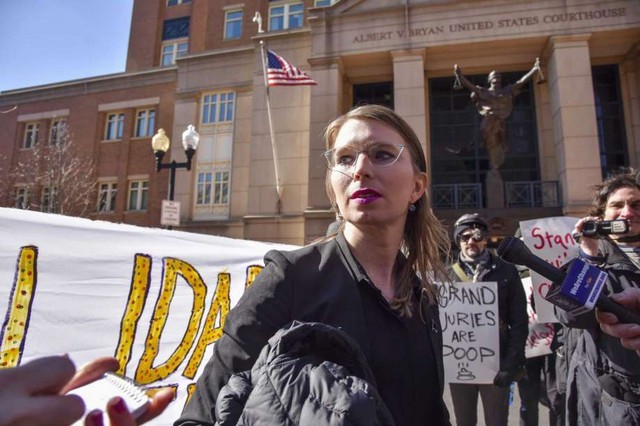
A federal judge ordered Chelsea Manning to prison Friday morning for an indefinite period of time, after the former Army private, jailed for seven years for providing information to WikiLeaks exposing US war crimes in Iraq and Afghanistan, refused on principle to answer any questions before a secret grand jury investigating the media organization and its founder Julian Assange.

“The Socialist Equality Party unequivocally condemns the US government’s vindictive and criminal persecution of Chelsea Manning,” said Joseph Kishore, the national secretary of the Socialist Equality Party (SEP) in the US.

“Chelsea suffered solitary confinement, abuse and torture, and over six years of imprisonment for letting the American and world population know the truth. Yesterday, she once again stood firm to fundamental democratic principle and refused to assist the Trump administration in its vendetta to falsely incriminate WikiLeaks and Julian Assange. She is a heroic figure and she must be defended.

“Working people all over the world will never forget Chelsea’s courageous exposure, at vast personal cost, of the crimes of American imperialism. Amid a growing global strike wave, the Socialist Equality Party will do everything in its power to mobilize the working class to defend Chelsea, and free Julian Assange and all other class war prisoners.”

The Socialist Equality Parties in the UK and Australia are participating in rallies on Sunday, March 10 outside Ecuador’s London embassy and at the State Library in Melbourne, called last month to oppose the continued confinement of Julian Assange at the London embassy, and demanding that the Australian government intervene on his behalf and obtain his release from Britain with the right to return home to Australia. The demonstrations will demand the immediate release of Manning as inseparable from the struggle to free Assange.

James Cogan, national secretary of the SEP in Australia, issued the following statement Friday:

“The Trump administration’s imprisonment of Chelsea Manning for refusing to give false testimony against WikiLeaks and Julian Assange is an outrage. She has suffered more than enough for her courage and service to the truth. American democracy rolls in the gutter and is rapidly descending into the sewer of dictatorship.

“The working class everywhere must come to Chelsea’s defence and take up the demand for the immediate release of Assange and all persecuted class war prisoners. The SEP in Australia will be redoubling our effort to secure Julian’s immediate return to this country with full protection. And we will be joining all international action to fight for the immediate restoration of Chelsea Manning’s freedom.”

The brief hearing before Judge Claude M. Hilton was the only part of the court proceedings involving Manning that was open to the public. Hilton rejected the argument by Manning’s lawyers that confining her to house arrest would better serve her medical needs. She has received gender reassignment surgery and requires complex medical attention. Hilton said the US Marshals Service would provide adequate care.

“I’ve found you in contempt,” Hilton declared, ordering Manning to jail immediately. The imprisonment in a federal facility in Alexandria, Virginia would continue indefinitely, he said, “either until you purge yourself [agree to testify] or the end of the life of the grand jury.”

The grand jury has been empaneled to bring espionage and conspiracy charges against Julian Assange and WikiLeaks. Manning revealed that the questions she had refused to answer on Thursday all concerned her interaction with the organization, which receives documents delivered to it anonymously and avoids learning the identity of contributors in order not to undermine their security.

Manning provided WikiLeaks more than 500,000 documents which she copied from military and government archives while serving as an intelligence analyst in Iraq during the US military occupation, in 2009. The material showed extensive war crimes in both Iraq and Afghanistan, including the notorious gun-camera video of a US helicopter gunship mowing down unarmed Iraqi civilians, including two Reuters reporters, later published by WikiLeaks under the title “Collateral Murder.”

Manning was arrested in 2010, convicted in a 2013 trial and sentenced to 35 years in prison, serving a total of seven years before her sentence was commuted by President Barack Obama three days before he left office.

Federal prosecutors subpoenaed Manning to testify before the grand jury and gave her immunity for her testimony, in the hopes of using it against Assange and WikiLeaks. But Manning has refused on principle to collaborate with the secret grand jury. She answered each question posed to her by invoking her rights under the First, Fourth and Sixth amendments to the US Constitution.

“All of the substantive questions pertained to my disclosures of information to the public in 2010—answers I provided in extensive testimony, during my court-martial in 2013,” she said.

A statement issued by Manning after being sent to prison reads:

“I will not comply with this, or any other grand jury. Imprisoning me for my refusal to answer questions only subjects me to additional punishment for my repeatedly-stated ethical objections to the grand jury system.

“The grand jury’s questions pertained to disclosures from nine years ago, and took place six years after an in-depth computer forensics case, in which I testified for almost a full day about these events. I stand by my previous public testimony.”

The statement concludes with Manning’s courageous declaration that she “will not participate in a secret process that I morally object to, particularly one that has been historically used to entrap and persecute activists for protected political speech.”

Manning’s lawyer, Moira Meltzer-Cohen, told the World Socialist Web Site after the decision, “Chelsea’s actions speak for themselves. She is a person of tremendous honor and courage, and this latest struggle is just the most recent in a long serious of principled stands she has taken.”

Asked if she is concerned about the conditions Chelsea will face in jail, Meltzer-Cohen said that the government has made assurances that her health needs will be taken care of, but that “we all need to be vigilant that those assurances are made good on.”

Manning’s lawyers said they expected to file an appeal of Hilton’s order jailing Chelsea, citing in particular the fact that jailing for refusal to testify can only be coercive, not punitive. In other words, if they can demonstrate that Manning will never agree to testify, no matter how long she is jailed, the court cannot simply keep her in prison to punish her for her silence.

The jailing of Chelsea Manning is a particularly outrageous attack on democratic rights, carried out by a federal judge who is a byword for reactionary pro-government, pro-police and pro-employer bias, and a longtime collaborator with the national security state.

Hilton was one of a relative handful of federal judges selected by Chief Justice William Rehnquist to serve on the Foreign Intelligence Surveillance Act (FISA) court, the special judicial panel set up to secretly rubber-stamp requests for spying authorizations for the FBI, CIA, NSA and other intelligence agencies. The court is notorious for approving 99.9 percent of such requests. Hilton was on the panel from 2000 to 2007, during the period when the Bush administration set up secret CIA torture camps and enormously escalated the NSA spying on telecommunications and the internet.

Appointed to the bench by Ronald Reagan in 1985, Hilton proved his value to the military-intelligence apparatus early in his career, with a 1989 decision that cleared CIA operative Joseph Fernandez, charged with four criminal counts in the Iran-Contra affair, after the CIA refused to release documents required for the prosecution of the case. In effect, the intelligence apparatus ensured impunity for its own criminal operations by refusing to cooperate with the investigation by Special Counsel Lawrence Walsh, a legal dodge approved by Judge Hilton.

According to the website “The Robing Room,” which allows lawyers and litigants appearing before federal judges to rate their demeanor, legal knowledge, and bias, Hilton routinely incorporates prosecution and government briefs into his legal “opinions,” almost never rules in favor of individuals suing their employers, the police or the government, and frequently sleeps through oral arguments by defense attorneys.

One attorney, posting on the site, called Hilton, “The most prejudiced judge with regard to average and below average income United States citizens that I have ever observed. This judge has no sense whatsoever of the search for Truth and Justice and he clearly avoids any reasonable search for Truth and Justice, especially if a large corporation or the federal government is the defendant!”

The SEP in the United States and its youth movement, the International Youth and Students for Social Equality (IYSSE), will announce a series of meetings and demonstrations to demand the immediate release of Chelsea Manning. The World Socialist Web Site urges all of its readers and supporters to join our mailing list to get meeting announcements and updates on the campaign to free Chelsea.

Originally published by WSWS.org

9 March 2019

Source: countercurrents.org

How Trump can forge a new path towards diplomacy with Iran

By Seyed Hossein Mousavian

A termination of hostilities will be impossible as long as Washington thinks it can coerce Tehran into submission

In a statement issued on 20 February, more than 50 pro-diplomacy organisations representing millions of American voters urged US policymakers to respect the Iran nuclear deal, which verifiably blocks Iran’s pathway to a nuclear weapon, supports good-faith diplomacy and opposes war with Iran.

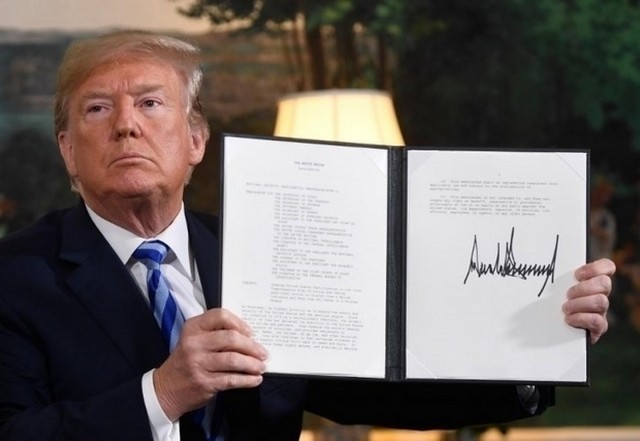
Earlier last month, as millions of Iranians rallied to mark the 40th anniversary of the 1979 revolution that ended 2,500 years of monarchy in Iran, US President Donald Trump tweeted in Persian and English: “40 years of corruption. 40 years of repression. 40 years of terror. The regime in Iran has produced only #40YearsofFailure. The long-suffering Iranian people deserve a much brighter future.”

In response, Iranian Foreign Minister Mohammad Javad Zarif tweeted: “#40YearsofFailure to accept that Iranians will never return to submission. #40YearsofFailure to adjust US policy to reality. #40YearsofFailure to destabilize Iran through blood & treasure.”

Nuclear fallout

Both Iranian and US leaders concur that Washington has imposed the most biting sanctions ever on Tehran. It bears noting, however, that with the exception of the brief period from 2013 to 2016, when Tehran and Washington negotiated at the highest levels to resolve one of their most complicated disagreements – the nuclear issue – US policy towards Iran has been constantly focused on economic sanctions, pressure and regime change.

The question remains whether Trump wants to continue on this ineffective and costly path, or pursue a new approach with Iran to break decades of deadlock in their bilateral relations. “Change and our attitude will change,” Iranian Supreme Leader Ayatollah Ali Khamenei has said. Trump could, in fact, end decades of US-Iran animosity by adopting a five-pronged strategy.

First is intention. Washington must convey to Tehran its intention to abandon its regime-change policy, something that is only attainable if Washington shows its sincerity through both words and actions. Empty words followed up by hostile actions would only demonstrate Washington’s disingenuousness and lack of seriousness, likely leading to the opposite of the intended results.
Second is language. The US has always talked down to Iran, employing disrespectful and offensive language towards the country, calling it a “pariah state” and adding it to the “axis of evil”. To be fair, Iran has used the same derogatory language in reference to the US, which it brands as the “Great Satan”.

Even if Washington and Tehran want to remain eternal enemies, at least they could refrain from insulting each other’s people, history and culture. Khamenei recently clarified that Iranians would chant “Death to America” as long as Washington’s hostile policies continued, but noted that the slogan is directed at US leaders, not the American nation.

Diplomatic approach

Third is approach. A termination of hostilities will be impossible as long as Washington thinks it can coerce Iran into submission. A diplomatic approach must replace the threat of war and coercive policies – but diplomacy is not about issuing maximalist demands to a sovereign state and expecting total capitulation.

Fourth is having a pragmatic plan of action. A number of reports by US think tanks have recommended a “grand bargain, big for big” approach, but this is not realistic. A more practical approach is to begin with “small for small” measures.

The existing mistrust between Iran and the US runs deep, and Trump’s unilateral withdrawal from the nuclear deal has only exacerbated the situation. Therefore, the more realistic path forward involves smaller confidence-building steps, such as Iran-US cooperation on counter-narcotic and anti-piracy operations.

Fifth is the end state. Washington and Tehran will only enter such a roadmap if they can see the end state. During nuclear negotiations, the end state for the US was to prevent Iran from acquiring a nuclear weapon; for Iran, it was “nuclear rights” under the non-proliferation treaty and the lifting of sanctions. Negotiating for the mere purpose of negotiating is not in the interests of either country.

Resolving the current animosities between Iran and the US can be based on non-intervention and a joint respect for sovereignty. There can also be win-win solutions for some of the ongoing practical issues, such as a fair regional arrangement for conventional and unconventional weapons in the Middle East.

Sustainable peace

While Iran has voluntarily limited the range of its ballistic missiles to 2,000 kilometres, Israel and Saudi Arabia both possess missiles with more than double that range. And while Israel is the only country in the Middle East with a nuclear weapons arsenal, Iran – which does not have any nuclear weapons – is under pressure and biting sanctions.

Repeated UN resolutions have called for establishing nuclear-weapon-free zones in the Middle East. The implementation of UN resolutions, without double standards, will open the path towards sustainable peace, potentially resolving many of the disputes between Tehran and Washington.

A day after Trump’s hostile remarks about Iran during his State of the Union address, Iranian President Hassan Rouhani said Iran was ready to establish “friendly relations” with the US if it apologised for past wrongs.

A change in relations is possible, but it requires patience and the right approach. A real change – a big change – would take many years, requiring both sides to embrace the obligations and opportunities that come under the banner of peace.

The views expressed in this article belong to the author and do not necessarily reflect the editorial policy of Middle East Eye.

Seyed Hossein Mousavian is Middle East security and nuclear policy specialist at Princeton University and a former spokesman for Iran’s nuclear negotiators.

4 March 2019

Source: www.middleeasteye.net

Idlib- Reportage From The Last Front In Syria

By Andre Vltchek

For a while, all the guns have fallen silent.

I am near Idlib, the last stronghold of the terrorists in Syria. The area where the deadliest anti-government fighters, most of them injected into Syria from Turkey, with Saudi, Qatari and Western ‘help’, are literally holed up, ready for the final showdown.

Just yesterday, mortars were falling on villages near the invisible frontline, separating government troops and the terrorist forces of Al Nusra Front. The day before yesterday, two explosions rocked the earth, only a couple of meters from where we are now standing.

They call it a ceasefire. But it’s not. It is one-sided. To be more precise: the Syrian army is waiting, patiently. Its cannons are pointing towards the positions of the enemy, but the orders from Damascus are clear: do not fire.

The enemy has no scruples. It provokes, endlessly. It fires and bombs, indiscriminately. It kills. Along the frontline, thousands of houses are already ruined. Nothing gets spared: residential districts, sport gymnasiums, even bakeries.There is an established routine: assaults by the terrorists, rescue operations organized by Syrian armed forces (SAA – Syrian Arab Army) and Syrian National Defense Forces, then immediate rebuilding of the damage.

Hundreds of thousands of Syrian people have lost their lives in this war. Millions had to leave their homeland. Millions have been internally displaced. For many, the conflict became a routine. Rescue operations became routine. Rebuilding tasks became routine, too.

Now, it is clear that the final victory is near. Syria survived the worse. It is still bleeding, but most of its territories are beginning to heal. People are slowly returning home, from Lebanon and Turkey, from Germany and elsewhere. They go through rubble – their former homes. They sit down and cry. Then, they get up and start rebuilding. That’s in other parts of the country: Duma, Homs, Aleppo, Deir ez-Zur.

But in the villages and towns north of Hama and towards Idlib, the war is far from being over.

In the town of Squalbiah, Commander Nabel Al-Abdallah of the National Defense Forces (NDF) explained to me:

“SAA could easily use force and win militarily; it could take Idlib. But the SAA operates under command of President Assad, who believes in negotiations. If we take the city now, there would be huge casualties.”

The situation is not as simple, as we would like it to be. Victory may be near, but the West is not giving up, nor is Turkey. There are still pockets that are held by the US and French troops, and around Idlib (including Manbij), a large area is still controlled by the terrorists, who were transported here from all corners of Syria, under the Russian-sponsored agreement.

And there is more to it: My sources in Syria shared the latest:

“Some 4 months ago, the ’new ISIS’ appeared in the south of Idlib, not far from where we are right now. They were injected into Syria by the Turks. They were wearing brand new uniforms, white long dresses. Before, they were recognizable by black or gray outfits – ‘Afghan-style’. They now call themselves ‘HurrasAldeen’, or ‘The Guardians of Religion’. Why? In order for the United States, and the West in general, to continue to support them. The ISIS are officially on the list of the terrorist organizations’, but this new ‘brand’ is not.”

I ask Commander Nabel Al-Abdallah, what the West really wants? He replies, immediately:

“The West wants terrorism to spread to Russia and China. Many terrorists work and fight directly for the interests of the United States.

We need to take care of the innocent civilians. But we also have to find the solution, very quickly. If we fail, terrorism will spread all around the world.”

We sit in the Commander’s provisory headquarters, having a quick cup of tea, before moving to the frontline.

He wants to say something. He thinks, how. It is not easy. Nothing is easy under the circumstances, but he tries, and what he utters makes sense:

“If we don’t have solution, soon, terrorists will damage the world. Our problems are not just the ISIS, but above all, the ideology that they represent. They use Islam, they say that they fight in the name of Islam, but they are backed by the United States. And here, the SAA, our military and our defense forces, are fighting for the world, not just for Syria.”

We embrace and I go. His men drive me in a military vehicle to the outskirts of As Suqaylabiyah (also known as Squalbiah). From there, I photograph a hospital and the positions of Al Nusra Front. They are there, right in front of me, just a couple of hundreds of meters.

I am told that I am like a sitting duck, exposed. I work fast. Luckily, today the terrorists are not in the mood for shooting.

Before returning to the vehicle, I try to imagine how life must bethere, under Al Nusra Front or the ISIS occupation.

From the hill where I stand, the entire area looks green, fertile and immensely beautiful. But I know, I clearly understand that it is hell on earth for those who live in those houses down below; in the villages and towns controlled by some of the most brutal terrorists on earth.

I also know that, these terrorist monsters are here on foreign orders, trying to destroy Syria, simply because its government and people have been refusing to succumb to the Western imperialist dictates.

Here, it is not only about theory. The lives of millions have been already destroyed. Here it isall concrete and practical – it is reality.

We can hear explosions, in a distance. The war may be over in Damascus, but not here. Not here, yet.

My friend Yamen is from the city of Salamiyah, some 50 kilometers from Hama. Only recently the area around his hometown was liberated from the extremist groups.

Twenty kilometers west from Salamiyah lies the predominantly Ismaili village of Al Kafat,which used to be surrounded by both Al-Nusra Front and the ISIS.

Mr. Abdullah, President of local Ismaili Council, recalls the horrors which his fellow citizens had to endure:

“In the past, we had two car bomb explosions here. In January 2014, 19 people were killed, 40 houses totally destroyed and 300 damaged. Fighting was only 200 meters away from here. Both Al-Nusra Front and ISIS surrounded the village, and were cooperating. We are very close to one of the main roads, so for the terrorists, it was an extremely important strategic position. This entire area was finally liberated only in January 2018.”

Whom do they blame?

Mr. Abdullah does not hesitate:

“Saudis, Turks, the USA, Europe, Qatar…”

We walk through the village. Some homes are still lying in ruins, but most of them have at least been partially restored. On the walls and above several shops, I can see the portrait of a beautiful young woman, who was killed during one of the terrorist assaults. 65 villagers were slaughtered, in total. Before the war, the population of the village was 3,500, but traumatized and impoverished by war, many decided to leave and now only 2,500 inhabitants live here, cultivating olive trees, herding sheep and cows.

Before my visit here, I was told that education played an extremely important role in defending this place, and in keeping morale high during the darkest days of combat and crises. Mr. Abdullah readily confirmed it:

“The human brain has the capacity to solve problems, and to defuse crises. During a war like this, education is extremely important. Or more precisely, it is mainly about learning, not only about education. Al-Nusra and ISIS – they are synonymous with ignorance. If your brain is strong, it easily defeats ignorance. I think we succeeded here. And look now: this poor village has at this moment 103 students attending universities, allover Syria.”

As we drive on, east, large portraits of a brother of my friend Yamen decorate many military posts. He was one of the legendary commanders here, but was killed in 2017.

Then I see a castle: monstrous, more than two millennia old, overlooking the city of Salamiyah. There are green fields all around,so much beauty, in all the corners of Syria.

“Come back and visit all these marvels when the war is over,” someone around me jokes.

I don’t see it as a joke.

“I will,” I think. “I definitely will”. But we have to win, and win very soon,as soon as possible! To make sure that nothing else goes up in flames.

I drop my bag in at a local inn in Salamiyah, and ask my comrades to drive me on, further east. I want to see, to feel how life was under ISIS, and how it is now.

There are ruins, all around us. I saw plenty of terrible urban ruins during my previous visit: all around Homs and the outskirts of Damascus.

Here I see rural ruins, in their own way as horrifying as those scarring all the major cities of Syria.

This entire area had recently been a frontline. Or it was screaming in the hands of the terrorist groups, mainly ISIS.

Now it is a minefield.The road is cleared, but not the fields; not the remains of the villages.

I photograph a tank that used to belong to the ISIS; burned and badly damaged. It is an old Soviet tank, which used to belong to the Syrian army. It was captured by the ISIS, and then destroyed by either the SAA or a Russian airplane. Next to the tank – a chicken farm burned to the ground.

The Lieutenant, who is accompanying me, goes on, monotonously, with his grizzly account:

“Today, outside Salamiyeh, 8 people were killed by the landmines.”

We leave the vehicle, and walk slowly down the road, which is full of craters.

Suddenly, the Lieutenant stops without any warning:

“And here, my cousin was killed by another mine.”

We reach Hardaneh Village, but almost no one is left here. There are ruins everywhere. Before – 500 people lived here, now only 30. This is where heavy fighting against the ISIS took place. 13 local people were killed, 21 soldiers ‘martyred’. Other civilians were forced to leave.

Mr. Mohammad Ahmad Jobur is the local administrator (el muchtar), 80 years old:

“First, we fought ISIS, but they overwhelmed us. Most of us had to leave. Now some of us returned, but only few…Yes, now we have electricity; at least 3 hours a day, and our children can go to school. The old school was destroyed by the ISIS, so kids are now collected and taken to a bigger town for education. Every villager wants to come back, but most of the families have no money to rebuild their houses and farms. The government made a list of the people whose dwellings were destroyed. They will get help, but help will be distributed gradually, stage by stage.”

Naturally: almost the entire country lies in ruins.

Are villagers optimistic about the future?

“Yes, very optimistic,” declares the village chief. “If we get help, if we can rebuild, we will all come back.”

But then, they show me the water wells, destroyed by the ISIS.

It is all smiles through tears. So far only 30 have come back. How many will come home this year?

I asked the chief what the main aim of the ISISwas?

“No aim, no logic. ISIS was created by the West. They tried to destroy everything, this village, this area, this entire country. They made no sense… they do not think like us… they only brought destruction.”

*

Soha, a village even further east,a place where men, women and children were forced to live under the ISIS.

I am invited into a traditional house. People sit in a circle. Several younger women are hiding their faces, not wanting to be photographed. I can only guess why. Others don’t care. What happened here; what horrors took place? Nobody will pronounce it all.

This is a traditional village inhabited by a local tribe; very conservative.

Testimonies begin to flow:

“First, they banned us from smoking, and shaving. Women had to cover their faces and feet; they had to wear black… Strict rules were imposed… education was banned. The ISIS created terrible prisons… They were often beating us with rubber hoses, in public. Some people were beheaded. Severed heads were exhibited above the main square.”

“When ISIS arrived, they brought with them their slaves – kidnapped people from Raqqah. Some women got stoned in public, alive. Other women were thrown to their death from the roofs and from other high places. They were amputating hands… Various women were forced to marry ISIS fighters…”

An uncomfortable silence followed, before the topic got changed.

“They killed 2 men from this village…”

Some say more, many more.

Several youngsters joined the ISIS. 3 or 4… ISIS would pay $200 to each new combatant who subscribed. And of course, they were promising heaven…

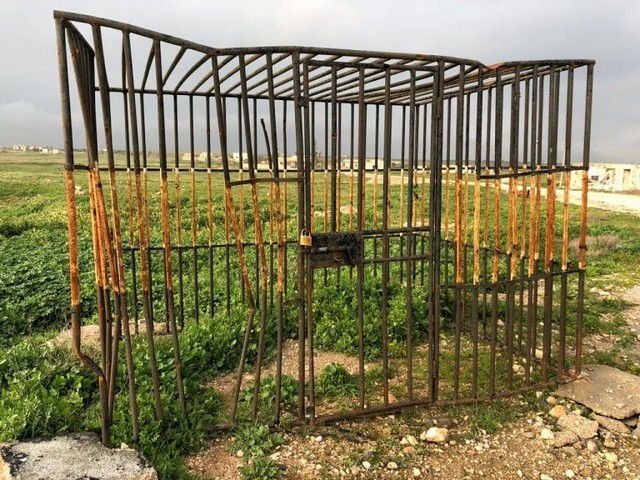
In one of the villages, I am shown a big rusty cage for ‘infidels’ and “sinners”. People were locked in there like wild animals, and kept exposed, in the open.

I see the destroyed ‘police’ building of the ISIS. At one point I am offered some papers – documents – which are just scattered all over the floor. I don’t want to take any with me, not even as a ‘souvenir’.

Testimonies continue to flow:

“They were beheading people for being in possession of mobile phones… Local villagers were disappearing… they were kidnapped…”

At some point, I have to halt this flow of testimonies. I can hardly process all that is being said. People are shouting over each other. One day, someone should take it all down, to record it, to file it. I do what I can, but I realize that it is not enough. It is never enough. The scale of the tragedy is too great.

By now it is getting dark… and then it is dark. I have to return to Salamiyeh, to rest a bit; to sleep fora few hours, and then to return to the frontline, where both the Syrian and Russian soldiers are bravely facing the enemy. Where they are doing all that is humanly possible to prevent those gangsters sponsored by the West and their allies, from returning to the already liberated areas of the country.

But before I fall asleep, I recall; I am haunted bythe image of a little girl who survived the occupation of her village by the ISIS. She stood resting her back against the wall. She looked at me for a while, then lifted her hands and moved her fingers quickly across her throat.

The next day, the Commander of the National Defense Forces in Muhradah, Simon Al Wakel, drives me all around the city and the outskirts, Kalashnikovresting next to his seat. It is a quick and matter-of-fact ‘tour’:

“This is where the mortars landed two days ago, there is a power plant which was liberated from the terrorists, and this is a huge gymnasium attacked by the terrorists simply because they hate that our girls excel in volleyball and basketball.”

We talk to locals. Commander Simon gets stopped in the middle of the streets, embraced by total strangers, kissed on both cheeks.

“I have been targeted more than 60 times,” he tells me. One of his former cars is rotting at a remote parking lot, after it was hit and burned by the terrorists.

He shrugs his shoulders:

“Russians and Turks negotiated the ceasefire, but obviously, terrorists do not respect any agreements.”

We return to the frontline. I am shown the Syrian cannons pointing towards the positions of Al Nusra Front. The local headquarters of the terrorists is clearly visible, not too far from the magnificent ruins of theSheizar Citadel.

First, I see the Syrian soldiers, operating slightly outdated Soviet as well as newer Russian equipment: armed vehicles, tanks, “Katyushas”. Then I spot several Russian boys settling down in two houses with a commanding view of the valley and the enemy territory.

Both the Syrian and Russian armies, shoulder to shoulder, are now facing the last enclave of the terrorists.

I wave at the Russians, and they wave back at me.

Everyone seems to be in a good mood. We are winning. We are ‘almost there’.

We all also know that it is still too early to celebrate. Terrorists from all over the world are hoarded in the area in and around the city of Idlib. The US, UK and French “Special Forces” are operating in several parts of the country. The Turkish military keeps holding big chunk of the Syrian land.

The weather is clear. The green fields are fertile and beautiful. The nearby citadel is imposing. Just a little bit more of determination and endurance, and this wonderful country will be fully liberated.

We all realize it, but no one is celebrating, yet. Nobody is smiling. The facial expressions of the Syrian and Russian comrades are serious. Men are looking down towards the valley, weapons ready. They are fully concentrated. Anything may happen; anytime.

I know why there are no smiles; we all know: Soon, we may defeat the enemy.Soon, the war may end. But hundreds of thousands of Syrian people have already died.

Reportage first published by NEO – New Eastern Outlook

Andre Vltchek is a philosopher, novelist, filmmaker and investigative journalist.

8 March 2019

Source: www.informationclearinghouse.info

The Recolonization of Latin America and the War on Venezuela

By Prof. James Petras

“The Western Hemisphere is our Region” Michael Pompeo, US Secretary of State

Introduction

Not since the US pronounced the Monroe Doctrine proclaiming its imperial supremacy over Latin America, nearly 200 years ago, has a White House regime so openly affirmed its mission to recolonize Latin America.

The second decade of the 21st century has witnessed, in word and deed, the most thorough and successful US recolonization of Latin America, and its active and overt role as colonial sepoys of an imperial power.

In this paper we will examine the process of recolonization and the strategy tactics and goals which are the driving forces of colony- building. We will conclude by discussing the durability, stability and Washington’s capacity to retain ownership of the Hemisphere.

A Brief History of 20th Century Colonization and Decolonization

US colonization of Latin America was based on direct US military, economic, cultural and political interventions with special emphasis on Central America, North America (Mexico) and the Caribbean. Washington resorted to military invasions, to impose favorite trade and investment advantages and appointed and trained local military forces to uphold colonial rule and to ensure submission to US regional and global supremacy.

The US challenged rival European colonial powers – in particular England and Germany, and eventually reduced them to marginal status, through military and economic pressure and threats.

The recolonization process suffered severe setbacks in some regions and nations with the onset of the Great Depression which undermined the US military and economic presence and facilitated the rise of powerful nationalist regimes and movements in particular in Argentina, Brazil, Chile Nicaragua and Cuba.

The process of ‘decolonization’ led to, and included, the nationalization of US oil fields, sugar and mining sectors; a shift in foreign policy toward relatively greater independence; and labor laws which increased workers’ rights and leftwing unionization.

The US victory in World War II and its economic supremacy led Washington to re-assert its colonial rule in the Western Hemisphere. The Latin American regimes lined up with Washington in the Cold and Hot wars, backing the US wars against China, Korea, Vietnam and the confrontation against the USSR and Eastern Europe.

For Washington, working through its colonized dictatorial regimes, invaded every sector of the economy, especially agro-minerals; it proceeded to dominate markets and sought to impose colonized trade unions run by the imperial-centered AFL-CIO.

By the early 1960’s a wave of popular nationalist and socialist social movements challenged the colonial order, led by the Cuban revolution and accompanied by nationalist governments throughout the continent including Argentina, Bolivia, Venezuela, Peru, Ecuador and the Dominican Republic. US multi-national manufacturing firms were forced to engage in joint ventures or were nationalized, as were oil, mineral and energy sectors.

Nationalists proceeded to substitute local products for imports, as a development strategy. A process of decolonization was underway!

The US reacted by launching a war to recolonize Latin America by through military coups, invasions and rigged elections. Latin America once more lined up with the US in support of its economic boycott of Cuba,and the repression of nationalist governments. The US reversed nationalist policies and denationalized their economies under the direction of US controlled so-called international financial organizations – like the International Monetary Fund (IMF), World Bank (WB) Inter-American Development Bank.

The recolonization process advanced, throughout the 1970’s and 1980’s, under the auspices of newly imposed military regimes and the new ‘neo-liberal’ free-market doctrine.

Once again recolonization led to highly polarized societies in which the domestic colonized elites were a distinct minority. Moreover, the colonial economic doctrine allowed the US banks and investors to plunder the Latin countries, impose out- of -control debt burdens, de-industrialization of the economies, severe increases in unemployment and a precipitous decline in living standards.

By the early years of the 21st century, deepening colonization led to an economic crisis and the resurgence of mass movements and new waves of nationalist-popular movements which sought to reverse – at least in part – the colonial relationship and structures.

Colonial debts were renegotiated or written off; a few foreign firms were nationalized; taxes were increased on agro-exporters; increases in public welfare spending reduced poverty ; public investment increased salaries and wages. A process of de-colonization advanced, aided by a boom in commodity pieces.

Twenty-first century decolonization was partial and affected only a limited sector of the economy; it mainly increased popular consumption rather than structural changes in property and financial power.

De-colonization co-existed with colonial power elites. The major significant changes took place with regard to regional policies. Decolonizing elites established regional alliance which excluded or minimized the US presence.

Regional power shifted to Argentina and Brazil in Mercosur; Venezuela in Central America and the Caribbean; Ecuador and Bolivia in the Andean region.

But as history has demonstrated, imperial power can suffer reverses and lose collaborators but while the US retains its military and economic levers of power it can and will use all the instruments of power to recolonize the region, in a step by step approach, incorporating regions in its quest for hemisphere supremacy.

The Recolonization of Latin America: Brazil, Argentina, and the Lima Pact Against Venezuela

As the first decade of the 21st century unfolded numerous Latin American governments and movements began the process of decolonization, displacing US client regimes, taking the lead in regional organizations, diversifying their markets and trading partners.

Nevertheless, the leaders and parties were incapable and unwilling to break with local elites tied to the US colonization project.

Vulnerable to downward movements in commodity prices, composed of heterogeneous political alliances and unable to create or deepen anti-colonial culture, the US moved to reconstruct its colonial project.

The US struck first at the ‘weakest link’ of the decolonization process. The US backed coups in Honduras and Paraguay. Then Washington turned to converting the judiciary and congress as stepping stones for launching a political attack on the strategic regimes in Argentina and Brazil and turning secondary regimes in Ecuador, Chile, Peru and El Salvador into the US orbit.

As the recolonization process advanced, the US regained its dominance in regional and international organizations. The colonized regimes privatized their economies and Washington secured regimes willing to assume onerous debts, previously repudiated.

The US advances in recolonization looked toward targeting the oil rich, dynamic and formidable anti-colonial government in Venezuela.

Venezuela was targeted for several strategic reasons.

First, Venezuela under President Chavez opposed US regional and global colonial ambitions.

Secondly, Caracas provided financial resources to bolster and promote anti-colonial regimes throughout Latin America especially in the Caribbean and Central America.

Thirdly, Venezuela invested in, and implemented, a profound and comprehensive state social agenda, building schools and hospitals with free education and health care, subsidized food and housing. Socialist democratic Venezuela contrasted with the US abysmal dismantling of the welfare state among the reconstructed colonial states.

Fourthly, Venezuela’s national control over natural resources, especially oil, was a strategic target in Washington imperial agenda.

While the US successfully reduced or eliminated Venezuela’s allies in the rest of Latin America, its repeated efforts to subdue Venezuela failed.

An abortive coup was defeated; as was a referendum to impeach President Chavez.

US boycotts and the bankrolling of elections failed to oust the Venezuelan government

Washington was unable to pressure and secure the backing of the mass of the population or the military.

Coup techniques, successful in imposing colonial regimes elsewhere, failed.

The US turned to a multi-prong, continent-wide, covert and overt military, political, economic and cultural war.

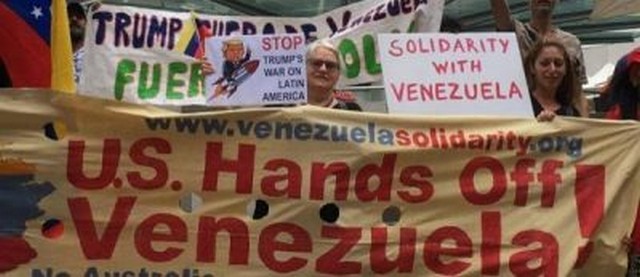
The White House appointed Juan Guaido, a virtual unknown, as ‘interim President’. Guaido was elected to Congress with 25% of the vote in his home district. Washington spent millions of dollars in promoting Guaido and funding NGOs and self-styled human rights organization to slander the Venezuelan government and launch violent attacks on the security forces.

The White House rounded up its recolonized regimes in the region to recognize Guaido as the ‘legitimate President’.

Washington recruited several leading European Union countries, especially the UK, France and Germany to isolate Venezuela.

The US sought to penetrate and subvert the Venezuelan populace via so-called humanitarian aid, refusing to work through the Red Cross and other independent organizations.

The White House fixed the weekend of Feb. 23 – 24 as the moment to oust President Maduro. It was a total, unmitigated failure, putting the lie to all of Washington’s fabrications.

The US claimed the Armed Forces would defect and join with the US funded opposition – only a hundred or so , out of 260,000 did so. The military remained loyal to the Venezuelan people, the government and the constitution despite bribes and promises.

Washington claimed ‘the people’ in Venezuela would launch an insurrection and hundreds of thousands would cross the border. Apart from a few dozen street thugs, tossing Molotov cocktails there was no uprising and less than a few hundred tried to cross the border.

Tons of US ‘aid’ remained in the Colombian warehouses. The Brazilian border patrol sent the US funded ‘protestors’ packing for blocking free passage across the frontier

Even US provocateurs who incinerated two trucks carrying ‘aid’ were exposed, the vehicles in flames remained on the Colombian side of the border. US sponsored boycotts of Venezuelan oil exports partially succeed because Washington illegaly seized Venezuela export revenues.

The recolonized Lima Group passed hostile resolutions and re-anointed Trump’s President Guaido, but few voters in the region took their pronouncements serious.

Conclusion

What are the colonized states expected to serve? Why has the White House failed to recolonize Venezuela as it did in the rest of Latin America?

The recolonized states in Latin America serve to open their markets to US investors on easy terms, with low taxes and social and labor costs, and political and economic stability based on repression of popular class and national struggles.

Colonized regimes are expected to support US boycotts, coups and invasions and to supply military troops as ordered.

Colonized regimes take the US side in international conflicts and negotiations; in regional organizations they vote with the US and meet debt payments on time and in full.

The recolonized nations ensure favorable results for Washington by manipulating elections and judicial decisions and by excluding anti-colonial candidates and officials and arresting political activists.

The colonized regimes anticipate the needs and demands of Washington and introduce resolutions on their behalf in regional organizations.

In the case of Venezuela, they promote and organize regional bloc like the Lima Group to promote US led intervention.

As Washington proceeds to destabilize Venezuela the colonized allies recycle US mass media propaganda and offer sanctuaries for opposition defectors and refugees.

In sum the recolonized elites facilitate domestic plunder and overseas conquests.

Venezuela success in resisting and defeating the US drive for reconquest is the result of nationalist and socialist leaders who re-allocate private wealth and re-distribute public expenditures to the workers, peasants and the unemployed.

Under President Chavez, Venezuela recruited and promoted military and security forces loyal to the constitutional order and in line with a popular socio-economic and anti-colonial agenda. Venezuela ensured that elections and judicial appointments were free and in-line with the politics of the majority.

The Venezuelans ensured that military advisers were independent of US military missions and aid agencies which plot coups and are disloyal to the nationalist state.

Venezuelan social democracy, its social advances and the massive reduction of poverty and inequality, contributed to reinforcing commitments to endogenous cultural values and national sovereignty.

Despite the US accumulation of colonial vassals throughout Latin America and Europe, Venezuela has consolidated mass support. Despite Washington’s capture of the global mass media it has not influenced popular opinion on a world scale. Despite US threats of a ‘military option’it lacks global support. In the face of prolonged and large scale resistance ,Washington hesitates. In addition the Latin Americans colonized states face domestic social and economic crises and political resistance. Europe confronts a regional break-up. Washington is riven by partisan divisions and a constitutional crisis.

The failure of the imperialist ultra’s in Washington to defeat Venezuela can set in motion a new wave of decolonization struggles which can force the US to look inward and downward – in order to decolonize its own electorate.

*

Note to readers: please click the share buttons above. Forward this article to your email lists. Crosspost on your blog site, internet forums. etc.

Award winning author Prof. James Petras is a Research Associate of the Centre for Research on Globalization.

6 March 2019

Source: www.globalresearch.ca

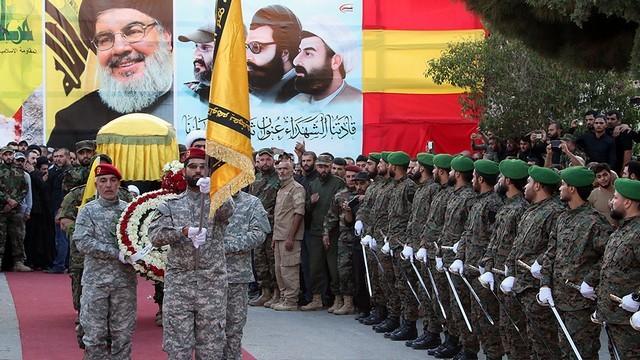
Hezbollah’s ban in the UK is a badge of honour

By John Wight

Hezbollah has earned a formidable reputation for military prowess on the battlefield and political nous off it. It’s no wonder ‘they’ want to ban it.

Attaining to the status of rule of thumb is that whenever a military and/or political organization is proscribed in the West, prudence demands a closer look; this on the basis that in most cases (though not all) what ‘they’ deem worthy of being proscribed and banned is in truth worthy of support.

Take Hezbollah, for example, and the British government’s decision to criminalise the Shiite group’s political wing. Previously only the group’s military wing had been banned in the UK. Is there anyone left in the room that seriously believes this constitutes anything other than another feeble manifestation of the UK’s servile toadying to Washington?

In what stands as a monument to opportunism, the Trump administration has consistently placed Hezbollah in same terrorism box as Islamic State (IS, formerly ISIS) and Al-Qaeda, conveniently eliding the small detail that the Lebanese resistance and national liberation movement has done as much as, if not more than, any single military force in fighting and defeating IS and Al-Qaeda in Syria.

Author of ‘The Battle For Syria’, Christopher Phillips, writes, “Given Hezbollah’s reputation as the most impressive military force in the Arab world, [the group’s involvement in the conflict] sapped rebel morale and boosted the regime. By offering expertise that Assad lacked, such as light infantry and urban warfare expertise, training, or directing military tactics, from 2013 [Hezbollah] became a vital component of Assad’s forces and greatly shaped the conflict.”

The move to ban Hezbollah’s political wing in the UK combines with the organization’s consistent demonization in Washington as part of the ongoing neocon crusade against Iran. It is a crusade that attests to the Shia behemoth’s resolute stance in resistance to and defiance of US hegemony and its regional proxies, Israel and Saudi Arabia.

Joining Iran in what has come to be known as an axis of resistance in the region is Hezbollah in southern Lebanon, where it enjoys overwhelming support and allegiance, and Syria.

Hezbollah, it is worth remembering, is also an electoral force of note in Lebanon, playing a full and transparent part in the country’s politics. In fact the group’s legitimacy in Lebanon is not in doubt, reflected in its endorsement by the country’s Christian president, Michel Aoun, no less.

A proper accounting of Hezbollah requires a grasp of the organization’s roots as a child of Israeli militarism and aggression over the course of repeated military incursions and invasions into Lebanon by the Israel Defense Forces (IDF), stretching back to the late 1970s.

Veteran Middle East correspondent David Hirst, in his work ‘Beware Of Small States,’ delineates the factors responsible for the group’s birth in the mid-1980s, revealing that “Israel, with its invasion” [of southern Lebanon] supplied “the provocation, the anger, the turmoil, or, as Israel’s like-minded American friends, the neoconservatives, might have put it, the ‘constructive chaos’ out of which new orders grow.”

Confirming Hirst’s analysis are the words of Hezbollah leader Hassan Nasrallah himself, whom Hirst quotes, “Had the enemy [Israel] not taken this step, I don’t know whether something called Hizbullah (sic) would have been born.”

Hezbollah’s establishment in resistance to an apartheid state bears an historical comparison with the African National Congress (ANC) in South Africa. British Prime Minister Margaret Thatcher’s branding of the ANC as a terrorist organization in the 1980s is no surprise either, considering the British establishment’s long tradition of standing on the side of the oppressor against the oppressed.

Hezbollah is, then, the Middle East’s answer to the ANC; like its African counterpart born of apartheid, along with the militarism and aggression it spawns.

The group’s formidable military reputation was elevated to near legendary status during its short conflict against Israeli forces in 2006. Hezbollah is widely perceived to have out-thought and outfought its IDF adversary.

Former MI6 officer Alastair Crooke, in a comprehensive analysis of the conflict, revealed, “Hezbollah’s fighters proved to be dedicated and disciplined. Using intelligence assets to pinpoint Israeli infantry penetrations, they proved the equal of Israel’s best fighting units. In some cases, Israeli units were defeated on the field of battle, forced into sudden retreats or forced to rely on air cover to save elements from being overrun.”

Hezbollah’s victory over the IDF in 2006 mirrors the victory of Cuban forces against the forces of white apartheid South Africa at the Battle of Cuito Cuanavale in Angola between 1987-88.

Nelson Mandela, a totemic and towering symbol of the struggle against apartheid in South Africa, described the outcome of Cuito Cuanavale as “a historic turning point in the struggle for the total liberation of the region from racist rule and aggression.”

Though too soon to assert that Hezbollah’s victory over the apartheid forces of Israel in 2006 marked a similar historic turning point, it is impossible to argue that it went some way to demoralizing the Israeli military and political establishment, which hitherto operated on the basis of the invincibility of Israeli military power in the region, bolstered by its close alliance with Washington and other Western states, the UK among them.

Crooke says “Hezbollah’s military defeat of Israel [in 2006] was decisive, but its political defeat of the United States – which unquestioningly sided with Israel during the conflict and refused to bring it to an end – was catastrophic and has had a lasting impact on US prestige in the region.”

One man’s terrorist is another man’s freedom fighter, goes the well-worn truism, and is ineffably appropriate when it comes to the standing of Hezbollah.

Organized on the basis of non-sectarianism, the organization has been at the forefront of resistance to Islamic State and other Salafi-jihadi groups in the region, while enjoying a vaunted reputation as a positive force in Lebanon itself for its dedication to upholding the country’s sovereignty and dignity, defending it from Israeli aggression and militarism.

Taking all these factors into account, and seasoning them with Britain’s own regressive role in the region, Hezbollah’s UK ban has to count as a badge of honor.

John Wight has written for a variety of newspapers and websites, including the Independent, Morning Star, Huffington Post, Counterpunch, London Progressive Journal, and Foreign Policy Journal.

7 March 2019

Source: www.rt.com

When it comes to Palestine and Kashmir, India and Israel are oppressors-in-arms

By Azad Essa

The hue of ‘democracy’ has given India and Israel special gravitas and legitimacy, while human rights violations continue unchecked

Hundreds march in Kashmir in May 2018 to support the Palestinian struggle (MEE/Fahad Shah)

In a back alley in downtown Srinagar, the capital of India-controlled Kashmir, a string of words splashed on a wall reads: “Long Live Palestine”. Nearby, “Free Gaza” screams from a shutter on a store. Across a tiny gulley, graffiti on a sidewall has been scratched off. If you stare hard enough, the words “Free Kashmir” rise like an apparition.

For many Muslims around the world, Palestine holds a special place in their political consciousness. Al-Aqsa Mosque, after all, is one of the most important sites in Islam. Those on the left – whether millennial radicals or grey-bearded Marxists – have also supported the Palestinian cause over the zealous imperialism of Zionist settler-colonialism, ethnic cleansing, displacement and war-mongering.

A personal matter
Israel’s invasions of Gaza over the past decade have repeatedly fuelled protests in countries as diverse as South Africa, the UK and Malaysia. But in Muslim-majority, India-controlled Kashmir, the subjugation of Palestinians is a personal matter – a reminder of their own condition. Kashmiris emerge on the streets with banners, and seeing no difference between their overlords and Israeli soldiers, they throw stones at Indian troops. While the Indian state tries to remove all graffiti that references Kashmiri liberation from the walls and steel shutters, there is little attempt to remove the spray paint that spells “Free Gaza”. The state apparently thinks that pro-Palestinian slogans are inconsequential and uninspiring.

Kashmiris have been among the first to organize and demonstrate. They emerge on the streets with banners, and seeing no difference between their overlords and Israeli soldiers, they throw stones at Indian troops. When the last Gaza offensive began in July 2014, Kashmiris took to the streets daily to protest against the Israeli bombardment. In one incident, Indian armed forces fired live ammunition at protesters in a district 60km from Srinagar, killing ninth-grader Suhail Ahmed.

Historical meditation
For decades, Kashmiris in Indian-controlled Kashmir have been demanding freedom, or at least the right to self-determination as promised by the 1948 UN Security Council Resolution 47. Kashmir has been claimed in full by both India and Pakistan since 1947. A de facto border separates the Indian-controlled from the Pakistani-controlled parts of Kashmir. Three out of the four wars fought between the two countries have been over the dispute.

Since the armed resistance began in 1988, more than 70,000 people have been killed, and thousands more are unaccounted for through enforced disappearances. Today, with around 700,000 troops amid a population of 14 million, Kashmir is the most militarized place on earth.

This is a society harassed by checkpoints and army convoys, terrorized by troops able to operate with impunity under the Armed Forces Special Powers Act, and mired in a legal malaise called the Public Safety Act that allows young boys to be picked up and held indefinitely without charge. This is not dissimilar to the Israeli policy of “administrative detention” that has seen thousands of Palestinians held indefinitely. For years, Indian forces have used lead-plated pellets as a method of “crowd control”. These have blinded 1,000 people and wounded 10,000 others, with injuries ranging from torn tissue to internal organ damage. As if violence was not enough, the Indian state regularly disconnects the internet and telephone services to discourage grassroots organizing and the dissemination of information, and to cut off Kashmiri people from the rest of the world.

Oppressors-in-arms
Though the strengthening of ties between India and Israel is a fairly recent phenomenon, they have rapidly developed an effective partnership based on strategic interests. India has repeatedly sent its police and Special Forces to Israel for training. Between 2013 and 2017, India was the largest importer of Israeli arms. Israeli Rafael’s Spice 2000 missiles as well as Heron drones reportedly played a significant role in India’s recent “surgical strike” in Pakistan on 26 February. Just days before the strike, India ordered 50 more drones in a deal worth $500m.

Crucially, Israel continues to collaborate with India to ensure that Kashmiris remain a subjugated people. And while the occupations of Palestine and Kashmir are not identical – there are certainly differences – Israeli and Indian ambitions are not dissimilar. In some ways, they feed off each other.

Israel has systematically ethnically cleansed Palestinians, taking over their homes, buying off resistance, quelling dissent, and appropriating elements of their culture – even cuisine – as part of a larger bid to remove the Palestinian footprint from these lands. As a result, Palestinians are essentially second-class non-citizens. In comparison, India, through a policy of “domestication” – or to use BJP leader Ram Madhav’s words, “instilling India” into Kashmiri Muslims – seeks to make Kashmiri Muslims relinquish their political identities and submit to the larger Indian project. They would then become “Indian Muslims”, who, by all measures of success and equity in Indian society, are second-class citizens. The endgame is to facilitate a demographic shift in Kashmir itself, bringing in more Hindus from India to settle into Kashmir.

Manufacturing consent
Then, there is the matter of language and manufacturing consent. Both Israel and India employ a sophisticated, securitized, statist language – parroted by their jingoistic media – that helps to legitimize the occupation, along with related human rights violations and crackdowns.

The quick resort to Islamophobia is an easy sell to justify their actions. Just as Israel describes its invasions of Gaza as a “defence” against “radical Islamist” Hamas members, Indians are still able to invoke their international brands of “Gandhi” and “yoga” while unleashing ammunition into protests by Kashmiri youth, saying that they are Pakistan-sponsored terrorists or radical jihadists. Israelis famously picnicked on hilltops to watch as the bombs rained down on Gaza in 2014. This week, as Indian jets flew over Pakistani territory to kickstart war, Indian celebrities cheered them on Twitter. It is a willful use of language, the blind loyalty of an elite, and the disconnection of local and international media that allows both Palestinians and Kashmiris to be vilified at any given opportunity.

Just as Israelis or Zionists intimidate academics, journalists and intellectuals who question Israeli policies, so too do the strong, often nationalistic Indian diaspora in media houses and schools around the planet attempt to suppress any discussion of Kashmir. Like Palestinians, many young Kashmiris, powerless in the face of state machinery, have resorted to stone-pelting. The fact that Indian authorities use disproportionate force – including burning down villages, homes and crops of those loosely acquainted with rebel fighters – is also conveniently ignored.

Public sentiment
Both Palestine and Kashmir have neighbours operating primarily on self-interest. If Palestine has Jordan and Egypt undermining its cause, Kashmir has Pakistan, which seeks little more than allegiance and a worthy alibi in India to deflect from the real and legitimate concerns of Kashmiris.

Finally, it’s a matter of public sentiment. When it comes to the larger Israeli and Indian publics, the vulgarity of the occupation has stripped them of their humanity to the point that they cheer for death and war. Israelis famously picnicked on hilltops to watch as the bombs rain down on Gaza in 2014. This week, as Indian jets flew over Pakistani territory to kick start war, Indian celebrities – including writers, actors, cricket stars, a former undersecretary at the UN, and a current UNICEF ambassador – cheered them on Twitter.

*Azad Essa is a reporter for the Middle East Eye based in New York City.

4 March 2019

Source: palestineupdates.com

“Julian Assange will never obey Big Brother”

By John Pilger

Whenever I visit Julian Assange, we meet in a room he knows too well.

There is a bare table and pictures of Ecuador on the walls. There is a bookcase where the books never change. The curtains are always drawn and there is no natural light. The air is still and foetid.

This is Room 101.

Before I enter Room 101, I must surrender my passport and phone. My pockets and possessions are examined. The food I bring is inspected.

The man who guards Room 101 sits in what looks like an old-fashioned telephone box. He watches a screen, watching Julian. There are others unseen, agents of the state, watching and listening.

Cameras are everywhere in Room 101. To avoid them, Julian manoeuvres us both into a corner, side by side, flat up against the wall. This is how we catch up: whispering and writing to each other on a notepad, which he shields from the cameras. Sometimes we laugh.

I have my designated time slot. When that expires, the door in Room 101 bursts open and the guard says, “Time is up!” On New Year’s Eve, I was allowed an extra 30 minutes and the man in the phone box wished me a happy new year, but not Julian.

Of course, Room 101 is the room in George Orwell’s prophetic novel, 1984, where the thought police watched and tormented their prisoners, and worse, until people surrendered their humanity and principles and obeyed Big Brother.

Julian Assange will never obey Big Brother. His resilience and courage are astonishing, even though his physical health struggles to keep up.

Julian is a distinguished Australian who has changed the way many people think about duplicitous governments. For this, he is a political refugee subjected to what the United Nations calls “arbitrary detention.”

The UN says he has the right of free passage to freedom, but this is denied. He has the right to medical treatment without fear of arrest, but this is denied. He has the right to compensation, but this is denied.

As founder and editor of WikiLeaks, his crime has been to make sense of dark times. WikiLeaks has an impeccable record of accuracy and authenticity which no newspaper, no TV channel, no radio station, no BBC, no New York Times, no Washington Post, no Guardian can equal. Indeed, it shames them.

That explains why he is being punished.

For example: Last week, the International Court of Justice ruled that the British Government had no legal powers over the Chagos Islanders, who, in the 1960s and 70s, were expelled in secret from their homeland on Diego Garcia in the Indian Ocean and sent into exile and poverty. Countless children died, many of them from sadness. It was an epic crime few knew about.

For almost 50 years, the British have denied the islanders’ the right to return to their homeland, which they had given to the Americans for a major military base.

In 2009, the British Foreign Office concocted a “marine reserve” around the Chagos archipelago.

This touching concern for the environment was exposed as a fraud when WikiLeaks published a secret cable from the British Government reassuring the Americans that “the former inhabitants would find it difficult, if not impossible, to pursue their claim for resettlement on the islands if the entire Chagos Archipelago were a marine reserve.”

The truth of the conspiracy clearly influenced the momentous decision of the International Court of Justice.

WikiLeaks has also revealed how the United States spies on its allies; how the CIA can watch you through your i-phone; how presidential candidate Hillary Clinton took vast sums of money from Wall Street for secret speeches that reassured the bankers that if she was elected, she would be their friend.

In 2016, WikiLeaks revealed a direct connection between Clinton and organised jihadism in the Middle East: terrorists, in other words. One email disclosed that when Clinton was US Secretary of State, she knew that Saudi Arabia and Qatar were funding Islamic State, yet she accepted huge donations for her foundation from both governments.

She then approved the world’s biggest ever arms sale to her Saudi benefactors: arms that are currently being used against the stricken people of Yemen.

That explains why he is being punished.

WikiLeaks has also published more than 800,000 secret files from Russia, including the Kremlin, telling us more about the machinations of power in that country than the specious hysterics of the “Russia-gate” pantomime in Washington.

This is real journalism—journalism of a kind now considered exotic: the antithesis of Vichy journalism, which speaks for the enemy of the people and takes its sobriquet from the Vichy government that occupied France on behalf of the Nazis.

Vichy journalism is censorship by omission, such as the untold scandal of the collusion between Australian governments and the United States to deny Julian Assange his rights as an Australian citizen and to silence him.

In 2010, Prime Minister Julia Gillard went as far as ordering the Australian Federal Police to investigate and hopefully prosecute Assange and WikiLeaks—until she was informed by the Australian Federal Police that no crime had been committed.

Last weekend, the Sydney Morning Herald published a lavish supplement promoting a celebration of “Me Too” at the Sydney Opera House on 10 March. Among the leading participants is the recently retired Minister of Foreign Affairs, Julie Bishop.

Bishop has been on show in the local media lately, lauded as a loss to politics: an “icon,” someone called her, to be admired.

The elevation to celebrity feminism of one so politically primitive as Bishop tells us how much so-called identity politics have subverted an essential, objective truth: that what matters, above all, is not your gender but the class you serve.

Before she entered politics, Julie Bishop was a lawyer who served the notorious asbestos miner James Hardie, which fought claims by men and their families dying horribly with asbestosis.

Lawyer Peter Gordon recalls Bishop “rhetorically asking the court why workers should be entitled to jump court queues just because they were dying.”

Bishop says she “acted on instructions … professionally and ethically.”

Perhaps she was merely “acting on instructions” when she flew to London and Washington last year with her ministerial chief of staff, who had indicated that the Australian Foreign Minister would raise Julian’s case and hopefully begin the diplomatic process of bringing him home.

Julian’s father had written a moving letter to the then Prime Minister Malcolm Turnbull, asking the government to intervene diplomatically to free his son. He told Turnbull that he was worried Julian might not leave the embassy alive.

Julie Bishop had every opportunity in the UK and the US to present a diplomatic solution that would bring Julian home. But this required the courage of one proud to represent a sovereign, independent state, not a vassal.

Instead, she made no attempt to contradict the British Foreign Secretary, Jeremy Hunt, when he said outrageously that Julian “faced serious charges.” What charges? There were no charges.

Australia’s Foreign Minister abandoned her duty to speak up for an Australian citizen, prosecuted with nothing, charged with nothing, guilty of nothing.

Will those feminists who fawn over this false icon at the Opera House next Sunday be reminded of her role in colluding with foreign forces to punish an Australian journalist, one whose work has revealed that rapacious militarism has smashed the lives of millions of ordinary women in many countries: in Iraq alone, the US-led invasion of that country, in which Australia participated, left 700,000 widows.

So what can be done? An Australian government that was prepared to act in response to a public campaign to rescue the refugee football player, Hakeem al-Araibi, from torture and persecution in Bahrain, is capable of bringing Julian Assange home.

The refusal by the Department of Foreign Affairs in Canberra to honour the United Nations’ declaration that Julian is the victim of “arbitrary detention” and has a fundamental right to his freedom, is a shameful breach of the letter and spirit of international law.

Why has the Australian government made no serious attempt to free Assange? Why did Julie Bishop bow to the wishes of two foreign powers?

Why is this democracy traduced by its servile relationships, and integrated with lawless foreign power?

The persecution of Julian Assange is the conquest of us all: of our independence, our self-respect, our intellect, our compassion, our politics, our culture.

So stop scrolling. Organise. Occupy. Insist. Persist. Make a noise. Take direct action. Be brave and stay brave. Defy the thought police.

War is not peace, freedom is not slavery, ignorance is not strength. If Julian can stand up to Big Brother, so can you: so can all of us.

John Pilger is an Australian journalist and documentary maker, based in London.

4 March 2019

Source: countercurrents.org
Why Has Kashmir Been Forgotten?

By Samreen Mushtaq & Mudasir Amin

Amid all the talks of India-Pakistan war, the issue at the very heart of present tensions has been completely ignored.

2 Mar 2019 – “What are they saying about jung [war] over there? Does it look like it will happen?” For days now our families in Kashmir have been asking us the same questions, hoping that here in New Delhi, we would have some answers.

Uncertainty and fear took over our home region on February 14, when a suicide attack in the Pulwama district of Indian-administered Kashmir killed more than 40 Indian soldiers. We were quickly and collectively denounced as national traitors, harassed and attacked across Indian cities. The Indian media and political elite called for “revenge” and started beating the drums of war.

The Indian government imposed a curfew, cut down the speed of the internet and deployed more troops in Kashmir. The police and security agencies carried out hundreds of overnight raids, arresting political leaders and activists. Jamaat–e-Islami, a political and religious organisation, was banned.

Meanwhile, the Indian military was put on high alert and raids were launched on targets in Pakistan, which prompted a Pakistani response. Heavy shelling across the Line of Control (LoC) which separates Indian- from Pakistan-administered Kashmir began.

Many Kashmiris were forced to flee, others started to stock up on food and other basic goods, fearing an escalation. Big red crosses were painted on rooftops of hospitals in the hope that the fighter jets constantly circling above would not hit them.

The Kashmiri people, who have already lived through decades of daily aggression against their bodies, homes, psyches, and memories, are now facing the real possibility of an all-out war.

It is in such circumstances that our families have been calling and messaging us from miles away, hoping to hear from us some soothing words. Every day, they have been recounting how their nights are spent counting the number of jets in the sky. Every day, we have been wondering if we should go home and face the war together with our loved ones.

Meanwhile, headlines about an India-Pakistan “confrontation”, “escalation” and an “impending war” have been dominating local and international media. News broadcasts have followed every detail of the Indian and Pakistani military actions, the attacks and the counter-attacks, the claims and the counter-claims. Reporters have documented every statement, every new development. Pundits have dissected every aspect of the conflict – from war capabilities to army structure, to weaponry and from military strategies to geopolitical realities.

Yet somewhere in all this noise about conflict and war, a simple fact has been left out: that Kashmir is the place where it is all being fought out. The Kashmir issue and the plight of Kashmiri people have been somehow rendered irrelevant, even though the current conflict between India and Pakistan has everything to do with the disputed region.

When international media talks of the history of India-Pakistan antagonism, it fails to recognise the fact that Kashmiris have borne the brunt of it. When Indian media talks about “terrorism”, it fails to mention the fact that Kashmir is one of the most heavily militarised zones in the world.

There was a certain irony in calls by Indian officials and public figures calling for Pakistan to uphold the Geneva Convention in its treatment of the captured Indian pilot. In Kashmir, India has failed to apply not just the Geneva Convention, but much of international law for that matter. Kashmiris are still being jailed on political charges and used as human shields, while the United Nations resolution which mandates a referendum on self-determination to be conducted in Kashmir is yet to be implemented.

The current anti-war activism in India is limited to small demonstrations and #NoToWar posts on social media. The elephant in the room is once again being ignored. No one is talking about what true peace would actually entail.

Dominant narratives propagated by the Indian state and the mainstream media are muffling Kashmiri voices. At this moment, it is important to hear them speak and tell their stories of war. The killings, torture, enforced disappearances, sexual violence, mass blinding through the use of pellet shotguns, and everyday harassment in Kashmir cannot be swept under the carpet and ignored. This violence needs to be made visible because continuing or escalating the current security policies of the Indian government will only result in disaster.

Indians have to realise that there will be no peace until the Kashmir issue is resolved. If they truly want “no war”, then they have to push first and foremost for the demilitarisation of Kashmir. And if they want international law respected, they should do so as well and hold the plebiscite mandated by the UN. Kashmiris should be allowed to decide their own fate.

Samreen Mushtaq is a researcher based in New Delhi.

Mudasir Amin is a researcher based in New Delhi.

4 March 2019

Source: transcend.org

Migrant Crisis in Europe? Look at Yemen

By Helen Lackner

Just to be clear, this means that more desperate people crossed the Red Sea into Yemen in 2018 than crossed the Mediterranean heading for Europe.

19 Feb 2019 – While Brexit is giving UK residents a break from media focus on desperate people attempting to reach wealthy Europe by crossing the Mediterranean by sea, a few figures should help to put things in perspective, as the issue will surely soon re-emerge in the headlines.

Xenophobia remains a fundamental rallying cry of the right throughout Europe, including the UK, and is all too frequently manifested through Islamophobic populism. This has already led to the implementation of anti-migrant policies by most regimes but particularly the far right ones in Eastern Europe.

This last year, they have been joined by the new Italian regime’s rhetoric and action in turning away humanitarian ships rescuing migrants in the Mediterranean. The hostile environment for migrants in Europe has led to a massive drop in arrivals: while many more than one million people arrived in 2015, only 144,000 did so in 2018. A few migrants who had managed to reach northern France and in particular the Calais of ‘jungle’ notoriety took to small boats to reach the UK: about 500 did so in 2018, including 200 in the last two months of last year. Some might wonder why this did not happen earlier, but this event gave the British government a temporary public relations respite from Brexit as Secretary of State Sajid Javid rushed to Dover to stem this terrifying influx!

A hidden migrant crisis in the Gulf of Aden

Meanwhile, more than 160,000 people arrived in Yemen in 2018 alone. Just to be clear this means that more desperate people crossed the Red Sea into Yemen than crossed the Mediterranean heading for Europe.

Yemen is in the midst of an internationalised civil war and suffering from the world’s worst humanitarian crisis according to the UN’s Secretary General. There has been no outcry about a ‘migrant invasion’ from the Yemeni Minister of the Interior, whether from the internationally recognised government or the Huthi movement that controls the capital Sana’a. Indeed Yemen has received and accepted close to a million Somali refugees since the 1990s, allowing them to work and live in the country, as Yemen is the only country in the Arabian Peninsula to recognise the 1951 UN Refugee Convention. Prior to the current war, the country’s authorities have been impressively hospitable to Somali refugees, though not to the thousands of Ethiopians and others who have crossed the Red Sea.

Migrants crossing into Yemen only make the headlines either when the Saudi-led Coalition planes bomb a boat crossing and kill its passengers (including people leaving on boats commissioned by UN agencies to repatriate them to the Horn of Africa) or when sufficiently large numbers of corpses wash up onto the Yemeni shores of the Arabian Sea. In both cases, they get little more than a few lines in obscure media.

The main route has also changed as a result of the war: while more than 70% of people crossed the Red Sea between 2010 and 2013, since then the figure has dropped to less than 20% with most heading for the Arabian Sea coast.

Who is heading for Yemen and why?

So why are more people still heading for Yemen than leaving? Who are they? And why do thousands head for a country in the midst of an internationalised civil war where millions are starving? Shouldn’t travel be in the other direction, with Yemenis trying to escape the disastrous conditions in their country?

Yemen is hardly ever the intended destination of these migrants. While travel to Saudi Arabia and the UAE via Oman used to be difficult in the past, travel conditions have become far more dangerous and expensive in recent years. At the beginning of the current decade, the Saudi regime built a fence along most of the border from the Red Sea coast eastwards to control immigration, and the situation has obviously worsened dramatically since the Saudi-led coalition has intervened in the civil war throughout the country since 2015. In 2018 the cost for getting from the southern Yemeni coast to Saudi Arabia was about USD 1200. But travelling to Saudi Arabia from east Africa via Yemen is significantly cheaper than reaching the southern coast of the Mediterranean, a trip costing at least USD 3000, a price which ignores possible ransoming and imprisonment by criminal gangs as well as the actual sea crossing.

Last year alone, 160,000 people in east Africa were sufficiently desperate to head for a country on the brink of famine and in the midst of a war. The overwhelming majority (92%) are Ethiopians and the rest are Somalis. Three quarters of them are adult men while women form 16% of the migrants and children, mostly boys, form 10%. They head for the southern Arabian Sea coast of Yemen, for two main reasons: the Red Sea coast is now a military zone with naval forces of the coalition firing at fishing boats and anything else that moves; on the African side much of the coast is in Eritrea. The southern Arabian Sea coast is more easily accessible from the different departure points in Somalia, both Berbera in ‘independent’ Somaliland and Bossasso in the ‘autonomous’ Puntland.

In the past 5 years, more than 700 corpses have been recovered on Yemen’s southern coast including 156 in 2018. Crossing into Yemen is the cheapest part of the trip, with fares ranging from USD 120 to USD 200. While many of those involved are aware of the war in Yemen, some are not. Amazingly thousands still cross in the belief that they will have an easy ongoing trip to their ultimate destination, Saudi Arabia. Once in Yemen, many seek additional income and try to find work, usually as unskilled labourers in agriculture and as car washers and other informal jobs in towns. This was difficult in the pre-war period and is almost impossible now the war is on. Some fall into the hands of criminals and are ill treated and ransomed, on a scale smaller than that found in Libya but sufficiently significant to be notable.

Most Somalis have left their homes because years of drought have made it impossible to cultivate the land and have killed their livestock, leading to worsening poverty, and destitution. Another reason is insecurity in their home areas. Although war has abated in Somalia, it is hardly a haven of peace and prosperity. In addition possible ill-treatment in Yemen has resulted in changed strategies for Somalis: while before 2011 many of them headed for Yemen as a final or temporary destination, since the beginning of this decade and, even more so, since the outbreak of war, their destination is Saudi Arabia, with no intention of remaining in Yemen.

Similarly Ethiopians, who now form the overwhelming majority of migrants, the thousands heading for Saudi Arabia, via Yemen, have clearly not noticed that their country is currently the great economic success story we read about occasionally in western media. Poverty, drought, lack of employment are key factors pushing them to face the risks of this very dangerous journey, regardless of the high risk of failure. Of 42,000 people expelled from Saudi Arabia in the 10 months starting mid-November 2017, 46% were Ethiopians, while 51% were Yemenis. The trend has accelerated with the changes in labour regulations in Saudi Arabia and in 2018 Saudi authorities have deported about 10,000 Ethiopians a month.

Although many have failed, very few have abandoned their ambitions and taken up the International Organisation of Migration’s offers of repatriation: between 2010 and 2018, only 24,000 returned home under these auspices, 77% of them Ethiopians and 16% Somalis. Of course, regardless of the risks, all migrants heading for Saudi Arabia, whether Ethiopian, Somali or Yemeni, dream of success and wealth after a few years of work in Saudi Arabia.

What about Yemenis?

Very few Yemenis try to escape the war. Most of those who head for Saudi Arabia do so to earn money and feed their families as they have done for the past half century. The new Saudi regime has introduced tough measures to ‘saudi-ise’ its labour force and reduce employment opportunities for foreigners as well as make their residence conditions expensive and unappealing. These measures have affected Yemenis as well as many other nationalities and probably reduced the number of Yemenis in Saudi Arabia to below one million. However arrivals since 2015 also include the leaders of the internationally recognised government, their attendants, and some of the war profiteers.

Other than the majority in Saudi Arabia and about 100,000 people of Yemeni origin in the United Arab Emirates, the war has led to the creation of new Yemeni communities in other neighbouring Arab states: Oman has received about 50,000 Yemenis since the war started. In Jordan 14.500 and in Egypt 8000 were registered with UNHCR by the end of 2018, representing a fraction of the Yemenis present in both these countries. Most Yemenis in these countries are professionals as well as political exiles who are maintaining more acceptable living standards and they also include people who have been unable to return to Yemen as a result of the coalition closure of Sana’a airport since mid-2016.

By contrast most of the few thousand Yemenis arriving in Djibouti are poverty stricken war-related refugees. A very few Yemenis have headed for Europe through the unofficial routes used by African migrants: the International Organisation for Migration recorded 326 Yemenis in the first 11 months of 2018, while a total of 353 had reached Greece in 2015, reflecting both Yemenis’ reluctance to leave their homes and the difficulties they encounter when travelling internationally.

Within Yemen itself, population movements have been massive: overall since the war started 3 million have been displaced, many of whom return home as soon as fighting abates in their areas, so about 1 million remain displaced. In the second half of 2018 alone, with the coalition military offensive against the city and other parts of the Hodeida governorate, more than one million people were displaced until the December 18 ceasefire, going to other parts of Yemen, often where they had relatives, but basically escaping from the air and ground attacks which led to heavy civilian casualties.

In conclusion, while this article has provided a few figures, readers should remember that each one of the individuals who make up the thousands and millions is experiencing the tragic, painful and frightening suffering associated with the tragedies described in the stories you can find on numerous websites and social media. So this represents a multiplicity of horror stories. Migrants heading into Yemen are facing extreme hardship conditions in addition to entering a country at war where most of the population are also suffering from famine conditions. What does all this say about living conditions and prospects in their own countries?

______________________________________________

Helen Lackner has worked in all parts of Yemen since the 1970s and lived there for close to 15 years.

4 March 2019

Source: transcend.org

How Climate Change Could End Washington’s Global Dominion

By Alfred W McCoy

Once upon a time in America, we could all argue about whether or not U.S. global power was declining. Now, most observers have little doubt that the end is just a matter of timing and circumstance. Ten years ago, I predictedthat, by 2025, it would be all over for American power, a then-controversial comment that’s commonplace today. Under President Donald Trump, the once “indispensable nation” that won World War II and built a new world order has become dispensable indeed.

The decline and fall of American global power is, of course, nothing special in the great sweep of history. After all, in the 4,000 years since humanity’s first empire formed in the Fertile Crescent, at least 200 empires have risen, collided with other imperial powers, and in time collapsed. In the past century alone, two dozen modern imperial states have fallen and the world has managed just fine in the wake of their demise.

The global order didn’t blink when the sprawling Soviet empire imploded in 1991, freeing its 15 “republics” and seven “satellites” to become 22 newly capitalist nations. Washington took that epochal event largely in stride. There were no triumphal demonstrations, in the tradition of ancient Rome, with manacled Russian captives and their plundered treasures paraded down Pennsylvania Avenue. Instead, a Manhattan real-estate developer bought a 20-foot chunk of the Berlin Wall for display near Madison Avenue, a sight barely noticed by busy shoppers.

For those trying to track global trends for the next decade or two, the real question is not the fate of American global hegemony, but the future of the world order it began building at the peak of its power, not in 1991, but right after World War II. For the past 75 years, Washington’s global dominion has rested on a “delicate duality.” The raw realpolitik of U.S. military bases, multinational corporations, CIA coups, and foreign military interventions has been balanced, even softened, by a surprisingly liberal world order — with sovereign states meeting as equals at the United Nations, an international rule of law that muted armed conflict, a World Health Organization that actually eradicated epidemic diseases which had plagued humanity for generations, and a developmental effort led by the World Bank that lifted 40% of humanity out of poverty.

Some observers remain supremely confident that Washington’s world order can survive the inexorable erosion of its global power. Princeton political scientist G. John Ikenberry, for example, has essentially staked his reputation on that debatable proposition. As U.S. decline first became apparent in 2011, he argued that Washington’s ability to shape world politics would diminish, but “the liberal international order will survive and thrive,” preserving its core elements of multilateral governance, free trade, and human rights. Seven years later, amid a rise of anti-global nationalists across significant parts of the planet, he remains optimistic that the American-made world order will endure because international issues such as climate change make its “protean vision of interdependence and cooperation… more important as the century unfolds.”

This sense of guarded optimism is widely shared among foreign-policy elites in the New York-Washington corridor of power. The president of the influential Council on Foreign Relations, Richard Haass, has typically arguedthat the “post-Cold War order cannot be restored, but the world is not yet on the edge of a systemic crisis.” Through deft diplomacy, Washington could still save the planet from “deeper disarray” or even “trends that spell catastrophe.”

But is it true that the decline of the planet’s “sole superpower” (as it was once known) will no more shake the present world order than the Soviet collapse once did? To explore what it takes to produce just such an implosion of a world order, it’s necessary to turn to history — to the history, in fact, of collapsing imperial orders and a changing planet.

Admittedly, such analogies are always imperfect, yet what other guide to the future do we have but the past? Among its many lessons: that world orders are far more fundamental than we might imagine and that their uprooting requires a perfect storm of history’s most powerful forces. Indeed, the question of the moment should be: Is climate change now gathering sufficient destructive force to cripple Washington’s liberal world order and create an opening for Beijing’s decidedly illiberal one or possibly even a new world in which such orders will be unrecognizable?

Empires and World Orders

Despite the aura of awe-inspiring power they give off, empires have often been the ephemeral creations of an individual conqueror like Alexander the Great or Napoleon that fade fast after his death or defeat. World orders are, by contrast, far more deeply rooted. They are resilient global systems created by a convergence of economic, technological, and ideological forces. On the surface, they entail a diplomatic entente among nations, while at a deeper level they entwine themselves within the cultures, commerce, and values of countless societies. World orders influence the languages people speak, the laws they live by, and the ways they work, worship, and even play. World orders are woven into the fabric of civilization itself. To uproot them takes an extraordinary event or set of events, even a global catastrophe.

Looking back over the last millennium, old orders die and new ones arise when a cataclysm, marked by mass death or a maelstrom of destruction, coincides with some slower yet sweeping social transformation. Since the age of European exploration started in the fifteenth century, some 90 empires, large and small, have come and gone. In those same centuries, however, there have been only three major world orders — the Iberian age (1494-1805), the British imperial era (1815-1914), and the Washington world system (1945-2025).

Such global orders are not the mere imaginings of historians trying, so many decades or centuries later, to impose some logic upon a chaotic past. Those three powers — Spain, Britain, and the United States — consciously tried to re-order their worlds for, they hoped, generations to come through formal agreements — the Treaty of Tordesillas in 1494, the Congress of Vienna in 1815, and the San Francisco conference that drafted the U.N. charter in 1945. Should Beijing succeed Washington as the world’s preeminent power, future historians will likely look back on its Belt and Road Forum, which brought 130 nations to Beijing in 2017, as the formal start of the Chinese era.

Each of these treaties shaped a world in the most fundamental ways, articulating universal principles that would define the nature of nations and the rights of all humans within them for decades to come. Over this span of 500 years, these three world orders conducted what could be seen, in retrospect, as a continuing debate over the nature of human rights and the limits of state sovereignty over vast stretches of the planet.

In their spread across disparate lands, world orders become coalitions of contending, even contradictory, social forces — diverse peoples, rival nations, competing classes. When deftly balanced, such a system can survive for decades, even centuries, by subsuming those contending forces within broadly shared interests. As tensions swell into contradictions, however, a cataclysm in the form of war or natural disaster can catalyze otherwise simmering conflicts — allowing challenges from rival powers, revolts by subordinate social orders, or both.

The Iberian Age

During the last thousand years, the first of these transformative cataclysms was certainly the Black Death of 1350, one of history’s greatest waves of mass mortality via disease, this one spread by rats carrying infected lice from Central Asia across Europe. In just six years, this pandemic killed up to 60% of Europe’s population, leaving some 50 million dead. As lesser yet still lethal epidemics recurred at least eight times over the next half-century, the world’s population fell sharply from an estimated 440 million to just 350 million people, a crash from which it would not fully recover for another two centuries.

Historians have long argued that the plague caused lasting labor shortages, slashing revenues on feudal estates and so forcing aristocrats to seek alternative income through warfare. The result: a century of incessant conflict across France, Italy, and Spain. But few historians have explored the broader geopolitical impact of this demographic disaster. After nearly a millennium, it seems to have ended the Middle Ages with its system of localized states and relatively stable regional empires, while unleashing the gathering forces of merchant capital, maritime trade, and military technology to, quite literally, set the world in motion.

As Tamerlane’s horsemen swept across Central Asia and the Ottoman Turks occupied southeast Europe (while also capturing Constantinople, the Byzantine empire’s capital, in 1453), Iberia’s kingdoms turned seaward for a century of exploration. Not only did they extend their growing imperial power to four continents (Africa, Asia, and both Americas), but they also created the first truly global order worthy of the name, commingling commerce, conquest, and religious conversion on a global scale.

Starting in 1420, thanks to advances in navigation and naval warfare, including the creation of the agile caravel gunship, Portuguese mariners pushed south, rounded Africa, and eventually built some 50 fortified ports from Southeast Asia to Brazil. This would allow them to dominate much of world trade for more than a century. Somewhat later, Spanish conquistadoresfollowed Columbus across the Atlantic to conquer the Aztec and Incan empires, occupying significant parts of the Americas.

Just weeks after Columbus completed his first voyage in 1493, Pope Alexander VI issued a decree awarding the Spanish crown perpetual sovereignty over all lands west of a mid-Atlantic line so “that barbarous nations be overthrown and brought to the [Catholic] faith.” He also affirmed an earlier Papal bull (Romanus Pontifex, 1455) that gave Portugal’s king rights to “subdue all Saracens and pagans” east of that line, “reduce their persons to perpetual slavery,” and “possess these islands, lands, harbors, and seas.”

To settle just where that line actually lay, Spanish and Portuguese diplomats met for months in 1494 in the tiny city of Tordesillas for high-stakes negotiations, producing a treaty that split the non-Christian world between them and officially launched the Iberian age. In its expansive definition of national sovereignty, this treaty allowed European states to acquire “barbarous nations” by conquest and make entire oceans into a mare clausum, or a closed sea, through exploration. This diplomacy would also impose a rigid religious-cum-racial segregation upon humanity that would persist for another five centuries.

Even as they rejected Iberia’s global land grab, other European states contributed to the formation of that distinctive world order. King Francis I of France typically demanded “to see the clause of Adam’s will by which I should be denied my share of the world.” Nonetheless, he accepted the principle of European conquest and later sent navigator Giovanni da Verrazzano to explore North America and claim what became Canada for France.

A century after, when Protestant Dutch mariners defied Catholic Portugal’s mare clausum by seizing one of its merchant ships off Singapore, their jurist Hugo Grotius argued persuasively, in his 1609 treatise Mare Liberum(“Freedom of the Seas”), that the sea like the air is “so limitless that it cannot become a possession of any one.” For the next 400 years, the twin diplomatic principles of open seas and conquered colonies would remain foundational for the international order.

Sustained by mercantile profits and inspired by missionary zeal, this diffuse global order proved surprisingly resilient, surviving for three full centuries. By the start of the eighteenth century, however, Europe’s absolutist states had descended into destructive internecine conflicts, notably the War of Spanish Succession (1701-1714) and a global Seven Years War (1756-1763). Moreover, the royal chartered companies — British, Dutch, and French — that by then ran those empires were proving ever less capable of effective colonial rule and increasingly inept at producing profits.

After two centuries of dominion, the French East India Company liquidated in 1794 and its venerable Dutch counterpart collapsed only five years later. Final fatal blows to these absolutist regimes were delivered by the American, French, and Haitian revolutions that erupted between 1776 and 1804.

The British Imperial Era

The British imperial age emerged from the cataclysmic Napoleonic Wars that unleashed the transformative power of England’s innovations in industry and global finance. For 12 years, 1803 to 1815, those wars proved to be a Black Death-style maelstrom that roiled Europe, leaving six million dead in their wake and reaching India, Southeast Asia, and the Americas.

By the time the Emperor Napoleon disappeared into exile, France, stripped of many of its overseas colonies, had been reduced to secondary status in Europe, while its erstwhile ally, Spain, was so weakened that it would soonlose its Latin American empire. Propelled by a tumultuous and historic economic transformation, Britain suddenly faced no serious European rival and found itself free to create and oversee a bifurcated world order in which sovereignty remained a right and reality only in Europe and parts of the Americas, while much of the rest of the planet was subject to imperial dominion.

Admittedly, the destruction caused by the Napoleonic wars may seem relatively modest compared to the devastation of the Black Death, but the long-term changes engendered by Britain’s industrial revolution and the finance capitalism that emerged from those wars proved far more compelling than the earlier era’s merchant companies and missionary endeavors. From 1815 to 1914, London presided over an expanding global system marked by industry, capital exports, and colonial conquests, all spurred by the integration of the planet via railroad, steamship, telegraph, and ultimately radio. In contrast to the weak royal companies of the earlier age, this version of imperialism combined modern corporations with direct colonial rule in a way that allowed for far more efficient exploitation of local resources. No surprise, then, that some scholars have called Britain’s century of dominion the “first age of globalization.”

While British industry and finance were quintessentially modern, its imperial age extended key international principles of centuries past, even if in grim secular guise. While the Dutch doctrine of “freedom of the seas” allowed the British navy to rule the waves, the earlier religious justification for domination was replaced by a racialist ideology that legitimized European efforts to conquer and colonize the half of humanity whom the imperialist poet Rudyard Kipling branded the “lesser breeds.”

Although the 1815 Congress of Vienna officially launched the British era by eliminating France as a rival, the 1885 Berlin Conference on Africa truly defined the age. Much as the Portuguese and Spanish had done at Tordesillas in 1494, the 14 imperial powers (including the United States) present at Berlin four centuries later justified carving up the entire continent of Africa by proclaiming a self-serving commitment “to watch over the preservation of the native tribes and to care for the improvement of the conditions of their moral and material well-being.” Just as that designation of Africans as “native tribes” instead of “nations” or “peoples” denied them both sovereignty and human rights, so the British century witnessed eight empires subjecting nearly half of humanity to colonial rule premised on racial inferiority.

Only a century after its founding, however, the contradictions that lurked within Great Britain’s global rule erupted, thanks to the way that two cataclysmic world wars coincided with the long-term rise of anti-colonial nationalism to create our current world order. The alliance system among rival empires proved volatile, exploding into murderous conflicts in 1914 and again in 1939. Worse yet, industrialization had spawned the battleship and the airship as engines for warfare of unprecedented range and destructive power, while modern science would also create nuclear weapons with the power to potentially destroy the planet itself. Meanwhile, the colonies that covered nearly half the globe refused to abide by the institutionalized denial of the very liberty, humanity, and sovereignty that Europe prized for itself.

While most of the 15 million combat deaths in World War I emerged from the destructive nature of trench warfare on the western front in France (compounded by 100 million fatalities worldwide from an influenza pandemic), World War II spread its devastation globally, killing more than 60 million people and ravaging cities across Europe and Asia. With Europe struggling to recover, its empires could no longer constrain colonial cries for independence. Just two decades after the war’s end, the six European overseas empires that had dominated much of Asia and Africa for five centuries gave way to 100 new nations.

Washington’s World Order

In the aftermath of history’s most destructive war, the United States used its unmatched power to form the Washington world system. American deaths in World War II numbered 418,000, but those losses paled before the 24 million dead in Russia, the 20 million more in China, and the 19 million in Europe. While industries across Europe, Russia, and Japan were damaged or destroyed and much of Eurasia was ravaged, the United States found itself left with a vibrant economy on a war footing and half the world’s industrial capacity. With much of Europe and Asia suffering from mass hunger, the swelling surpluses of American agriculture fed a famished humanity.

Washington’s visionary world order took form at Bretton Woods, New Hampshire, in 1944. There, 44 Allied nations created an international financial system exemplified by the World Bank and then, at San Francisco in 1945, by a U.N. charter to form a community of sovereign nations. In a striking blow for human progress, this new order resoundingly rejected the religious and racial divisions of the previous five centuries, proclaiming in the U.N.’s Universal Declaration of Human Rights the “equal and inalienable rights of all members of the human family,” which “should be protected by the rule of law.”

Within a decade after the end of World War II, Washington also had 500 overseas military bases ringing Eurasia and a chain of mutual defense pacts stretching from the North Atlantic Treaty Organization (NATO) to the Australia, New Zealand, United States Security Treaty (ANZUS), and a globe-girding armada of nuclear-armed warships and strategic bombers. To exercise its version of global dominion, Washington retained the seventeenth-century Dutch doctrine of “freedom of the seas,” later extending it even to space where, for more than half a century, its military satellites have orbited without restraint.

Just as the British imperial system was far more pervasive and powerful than its Iberian predecessor, so Washington’s world order went beyond both of them, becoming rigorously systematic and deeply embedded in every aspect of planetary life. While the 1815 Congress of Vienna was an ephemeral gathering of two dozen diplomats whose influence faded within a decade, the United Nations and its 193 member states have, for nearly 75 years, sustained 44,000 permanent staff to supervise global health, human rights, education, law, labor, gender relations, development, food, culture, peacekeeping, and refugees. In addition to such broad governance, the U.N. also hosts treaties that are meant to regulate sea, space, and the climate.

Not only did the Bretton Woods conference create a global financial system, but it also led to the formation of the World Trade Organization that regulates commerce among 124 member states. You might imagine, then, that such an extraordinarily comprehensive system, integrated into almost every aspect of international intercourse, would be able to survive even major upheavals.

Cataclysm and Collapse

Yet there is mounting evidence that climate change, as it accelerates, is creating the basis for the sort of cataclysm that will be capable of shaking even such a deeply rooted world order. The cascading effects of global warming will be ever more evident, not in the distant future of 2100 (as once thought), but within just 20 years, impacting the lives of most adults alive today.

Last October, scientists with the U.N.’s Intergovernmental Panel on Climate Change issued a “doomsday report,” warning that humanity had just 12 years left to cut carbon emissions by a striking 45% or the world’s temperature would rise by at least 1.5 degrees Celsius above preindustrial levels by about 2040. This, in turn, would bring significant coastal flooding, ever more intense storms, fierce drought, wildfires, and heat waves with damage that might add up to as much as $54 trillion — well over half the current size of the global economy. Within a few decades after that, global warming would, absent heroic measures, reach a dangerous 2 degrees Celsius, with even more devastation.

In January, scientists, using new data from sophisticated floating sensors,reported that the world’s oceans were heating 40% faster than estimated only five years earlier, unleashing powerful storms with frequent coastal flooding. Sooner or later, sea levels might rise by a full foot thanks to nothing but the thermal expansion of existing waters. Simultaneous reports showed that the rise in world air temperature has already made the last five years the hottest in recorded history, bringing ever more powerful hurricanes and raging wildfires to the United States with damages totaling $306 billion in 2017. And that hefty sum should be considered just the most modest of down payments on what’s to come.

Surprisingly fast-melting ice sheets in Greenland and the Antarctic will only intensify the impact of climate change. An anticipated rise in sea level of eight inches by 2050 could double coastal flooding in tropical latitudes — with devastating impacts on millions of people in low-lying Bangladesh and the mega-cities of southeastern Asia from Mumbai to Saigon and Guangzhou. Meltwater from Greenland is also disrupting the North Atlantic’s “overturning circulation” that regulates the region’s climate and is destined to produce yet more extreme weather events. Meanwhile, Antarctic meltwater will trap warm water under the surface, accelerating the break-up of the West Antarctic ice shelf and contributing to a rise in ocean levels that could hit 20 inches by 2100.

In sum, an ever-escalating tempo of climate change over the coming decades is likely to produce massive damage to the infrastructure that sustains human life. Seven hundred years later, humanity could be facing another catastrophe on the scale of the Black Death, one that might, once again, set the world in motion.

The geopolitical impact of climate change may be felt most immediately in the Mediterranean basin, home to 466 million people, where temperatures in 2016 had already reached 1.3 degrees Celsius above pre-industrial levels. (The current global average was still around 0.85 degrees.) This means that the threat of devastating drought is going to be brought to a historically dry region bordered by sprawling deserts in North Africa and the Middle East. In a telling example of how climate catastrophe can erase an entire world order, around 1200 BC the eastern Mediterranean suffered a protracted drought that “caused crop failures, dearth, and famine,” sweeping away Late Bronze Age civilizations like the Greek Mycenaean cities, the Hittite empire, and the New Kingdom in Egypt.

From 2007 to 2010, ongoing global warming caused the “worst three-year drought” in Syria’s recorded history — precipitating unrest marked by “massive agricultural failures” that drove 1.5 million people into city slums and, next, by a devastating civil war that, starting in 2011, forced five million refugees to flee that country. As more than a million migrants, led by 350,000 Syrians, poured into Europe in 2015, the European Union (EU) plunged into political crisis. Anti-immigrant parties soon gained in popularity and power across the continent while Britain voted for its own chaotic Brexit.

Projecting the Middle East’s history, ancient and modern, into the near future, the ingredients for a regional crisis with serious global ramifications are clearly present. Just last month, the U.S. National Intelligence Council warned that “climate hazards,” such as “heat waves [and] droughts,” were increasing “social unrest, migration, and interstate tension in countries such as Egypt, Ethiopia, Iraq, and Jordan.”

If we translate those sparse words into a future scenario, sometime before 2040 when average global warming is likely to reach that dangerous 1.5 degrees Celsius mark, the Middle East will likely experience a disastrous temperature rise of 2.3 degrees. Such intense heat will produce protracted droughts far worse than the one that destroyed those Bronze Age civilizations, potentially devastating agriculture and sparking water wars among the nations that share the Tigris and Euphrates rivers, while sending yet more millions of refugees fleeing toward Europe. Under such unprecedented pressure, far-right parties might take power across the continent and the EU could rupture as every nation seals its borders. NATO, suffering a “severe crisis” since the Trump years, might simply implode, creating a strategic vacuum that finally allows Russia to seize Ukraine and the Baltic states.

As tensions rise on both sides of the Atlantic, the U.N. could be paralyzed by a great-power deadlock in the Security Council as well as growing recriminations over the role of its High Commissioner for Refugees. Pummeled by these and similar crises from other climate-change hot spots, the international cooperation that lay at the heart of Washington’s world order for the past 90 years would simply wither, leaving a legacy even less visible than that block of the Berlin Wall in midtown Manhattan.

Beijing’s Emerging World System

As Washington’s global power fades and its world order weakens, Beijing is working to build a successor system in its own image that would be strikingly different from the present one.

Most fundamentally, China has subordinated human rights to an overarching vision of expanding state sovereignty, vehemently rejecting foreign criticism of its treatment of its Tibetan and Uighur minorities, just as it ignores equally egregious domestic transgressions by countries like North Korea and the Philippines. If climate change does, in fact, spark mass migrations, then China’s untrammeled nationalism, with its implicit hostility to the rights of refugees, might prove more acceptable to a future era than Washington’s dream of international cooperation that has already begun to sink from sight in the era of Donald Trump’s “great wall.”

In a distinctly ironic twist, a rising China has defied the long-standing doctrine of open seas, now sanctioned under a U.N. convention, instead effectively reviving the mare clausum version of imperial power by claiming adjacent oceans as its sovereign territory. When the Permanent Court of Arbitration, the original world court, unanimously rejected its claim to the South China Sea in 2016, Beijing insisted that the ruling was “naturally null and void” and would not affect its “territorial sovereignty” over an entire sea. Not only did Beijing in that way extend its sovereignty over the open seas, but it also signaled its disdain for the international rule of law, an essential ingredient in Washington’s world order.

More broadly, Beijing is building an alternative international system quite separate from established institutions. As a counterpoise to NATO on Eurasia’s western extremity, China founded the Shanghai Cooperation Organization in 2001, a security and economic bloc weighted toward the eastern end of Eurasia thanks to the membership of nations like Russia, India, and Pakistan. As a counterpoint to the World Bank, Beijing formed the Asian Infrastructure Development Bank in 2016 that quickly attracted 70 member nations and was capitalized to the tune of $100 billion, nearly half the size of the World Bank itself. Above all, China’s $1.3 trillion Belt and Road Initiative, 10 times the size of the U.S. Marshall Plan that rebuilt a ravaged Europe after World War II, is now attempting to mobilize up to $8 trillion more in matching funds for 1,700 projects that could, within a decade, knit 76 nations across Africa and Eurasia, a full half of all humanity, into an integrated commercial infrastructure.

By shedding current ideals of human rights and the rule of law, such a future world order would likely be governed by the raw realpolitik of commercial advantage and national self-interest. Just as Beijing effectively revived the 1455 doctrine of mare clausum, so its diplomacy will be infused with the self-aggrandizing spirit of the 1885 Berlin conference that once partitioned Africa. China’s communist ideals might promise human progress, but in one of history’s unsettling ironies, Beijing’s emerging world order seems more likely to bend that “arc of the moral universe” backward.

Of course, on a planet on which by 2100 that country’s agricultural heartland, the north China plain with its 400 million inhabitants, could become uninhabitable thanks to unendurable heat waves and its major coastal commercial city, Shanghai, could be under water (as could other key coastal cities), who knows what the next world order might truly be like. Climate change, if not brought under some kind of control, threatens to create a new and eternally cataclysmic planet on which the very word “order” may lose its traditional meaning.

Alfred W. McCoy, a TomDispatch regular, is the Harrington professor of history at the University of Wisconsin-Madison.

1 March 2019

Source: countercurrents.org