Just International

A Call on the World to Raise Awareness about Venezuela

The Venezuela Chapter of the Network of Intellectuals, Artists and Social Movements in Defense of Humanity urges you to subscribe to the following statement by sending your complete name, country, organization and occupation to the following email address: Redintelectualesvenezuela@gmail.com

We are appealing to you, people of all countries of the world, people concerned about freedom and social justice, who share with us the ideal that all human beings have the right to live and that we are all free and worthy of respect. We call on you knowing that you may feel that international institutions and the corporate press have told you the truth about the Bolivarian Republic of Venezuela and that they performed abiding by ideals of the U.N. Charter and Agreements to respect Human Rights.

We appeal to you because we know they have lied to you and they have not given you the opportunity to know what Venezuela actually is, what is going on there, its human accomplishment and why the image of our country has been grossly distorted.

They have not told you the truth in order to provoke the current situation, that worsens every day, they have taken coercive measures that are carried out by banks, big industries and financial and media corporations, as well as other actions undertaken directly by governments. In particular the Trump administration in the United States has chartered a course to sanction and isolate Venezuela until the function of governing is just not feasible. In the face of this situation, current events in Venezuela have been described as crimes against humanity by some experts, such as Alfred de Zayas. He has warned that as the scenarios unfold the general public is not receiving the real information about what is really going on in Venezuela.

We are coming to you, whom we feel are brothers and sisters of the people, with a view to tell you the truth and ask you to condemn, by way of what links humans as a single family, the events being carried out against Venezuela and to join us in our demand for justice on behalf of the honorable and free people here in resistance.

Venezuela is a country inhabited by 32 million people, placed over territories extraordinarily rich in oil, gas, gold and, fresh water. We are the nation where the process of South America’s independence began. We have undertaken an intense revolutionary process that since its beginnings has faced the hostility of each subsequent administration in Washington that has tried hard to over throw it. Venezuela has however proven its resilience by having a people’s, socialist and anti-imperialist government through more than 20 elections, during and after two coup attempts.

Venezuela was declared by the Obama administration as an “unusual and extraordinary threat” to the United States, an action condemned by over 10 million people who signed petitions against it. Venezuela has been financially persecuted because of this, which has resulted in the loss of more money than what is needed to grant free education for 26 years, at all levels and in optimal conditions. Our country is being persecuted internationally, in violation of principles consecrated by the Law of Geneva and the Law of the Hague, founding principles of international organizations, to such an extent that the country’s savings in gold were confiscated by the London Bank while the United States granted the administration of its assets to people who have not been appointed by legitimate authorities.

Furthermore, Venezuela is now a place where the concept of democracy is at stake, not just for the country but for the concept itself since it is being established that a person who has not run for the office of president in any election has declared himself the Interim President because of his total backing by Washington.

But above all, Venezuela is made up of 32 million people, a population that is being threatened day by day, through press releases and digital communication, by the United States spokespeople who say they will spare no effort to bend Caracas’ will, to maximize the pain on all Venezuelans, to achieve an America free of Bolivarianism, and where they say they will use all available force and technology, as if it was a foreign policy based on science fiction.

Before being sanctioned Venezuela had reached the region’s highest literacy rate, highest university enrolment rate, our best sports development; we had reached our lowest level of inequality and the highest level of human development ever; and we had opened up ourselves to give oil and opportunities to people in the poorest villages in the region, such as in Central America and the Caribbean.

But this has not been told; instead according to the international press, there is an alleged humanitarian crisis in effect in Venezuela since 2016, a groundless argument because the country has not reached levels of hunger and misery to justify the crisis. They have omitted that there is a daily battle in this country to prevent hunger while unilateral coercive measures are imposed against all efforts, aggression and terrorist acts are committed, such as the partial destruction of Venezuela’s power grid. The international media corporations omit that everyday women and men are sowing and distributing food stuff home by home, together with the National Government, and using their inventiveness to keep public services working.

Venezuela is also made up of mothers of young people who were burnt alive in 2017 because they looked like Chavistas, deaths that are not reported abroad because the responsibility for these horrendous crimes was committed by sectors opposed to the Government.

People like these mothers compel us to communicate to you that there are people in Venezuela insisting for the recognition that they have rights, for their rights not to be nullified through financial suffocation, and for justice to be brought in cases that should be known by the entire world.

This is why we are requesting your support to convene and act before the Russell Tribunal or other agencies which allow a space that could hear the voices of the Venezuelan people, to put on record the ongoing suffering in our country due to actions banned by International Public Law and which runs contrary to the idea that people can define their own system of government and their decisions should be respected by all other nations.

We call on you because we don’t want the world to forget the anguish we are living everyday with the threat of a military invasion always hovering nearby, for the increase in deaths and diseases that might be prevented if the country would be able to use its own resources and be part of the normal integration of international markets, understanding that the only way the world can improve is if people, despite being oppressed, refuse to be oppressed and act despite the permanent lies in large media corporations.

Venezuela Chapter of the Network of Intellectuals, Artists and Social Movements in Defense of Humanity

4 May 2019

Source: Network in Defense of Humanity – US

Waging War on Iran without Turkey? Is Turkey Sleeping with the Enemy? The Russia -Turkey -Iran “Triple Entente”

By Prof Michel Chossudovsky

Recent reports suggest that Trump’s National Security Advisor John Bolton, together with Secretary of State Mike Pompeo, are “doing everything possible to instigate a war with Iran”. Will they succeed?

Bolton-Pompeo are involved in deliberate acts of provocation. The Abraham Lincoln carrier strike group is currently en route to the Persian Gulf “to send a clear and unmistakable message to the Iranian regime…”

This is not the first time that threats of this nature have been formulated. War on Iran has been on the drawing board of the Pentagon for the past 16 years. Following the 2003 invasion of Iraq, U.S. military sources intimated at the time that an aerial attack on Iran could involve a large scale deployment comparable to the U.S. “shock and awe” bombing raids on Iraq in March 2003.

Without dispelling the dangers of the reckless Bolton-Pompeo initiative, a large scale US-NATO-Israel military operation directed against Iran from a strategic and geopolitical standpoint at this juncture is unlikely.

Why?

A shift in military alliances between “Great Powers” is unfolding, which is exceedingly more complex than that pertaining to World War I. (i.e the confrontation between “The Triple Entente” and “the Triple Alliance”).

Today, the structure of military alliances is in jeopardy much to the detriment of Washington.

You cannot successfully wage war on Iran when Turkey, your ally and NATO heavy weight is “sleeping with the enemy”.

While Turkey is officially a member of NATO as well as a firm ally of the US, president Recep Tayyip Erdoğan has been developing “friendly relations” with two of America’s arch-enemies, namely Iran and Russia.

Needless to say NATO is in crisis. Moreover, US and Turkey supported proxy forces are fighting one another in Northern Syria.

There is also a Turkey-Israel military-intelligence alliance which dates back to the Security and Secrecy Agreement (SSA) signed with the government Tansu Çiller in 1993-94. This alliance which had been designed by the Clinton administration is no longer functional.

The strategic bilateral US-Israel relationship as well as the US-Turkey alliance coupled with the Israel-Turkey military and intelligence cooperation agreement as well as the Israel-NATO agreement (2003), were the foundations of the US-Israel-Turkey “Triple alliance” or what the Brookings Institute called the US-Turkey- Israel Triangle.

This US sponsored triangular structure of alliances is dead and defunct, much to the detriment of Washington’s interests in the Middle East.

What is now unfolding is a new Triple Entente between Turkey, Iran and Russia

The Netanyahu-Putin “Love Relationship”

But there is another element which is absolutely crucial: Israel is also sleeping with the enemy. Netanyahu and Putin have developed over the years an informal and friendly relationship. They consult one another frequently on key political and strategic issues.

While the Netanyahu-Putin relationship is not a formal alliance, it nonetheless serves the interests of both Russia and Israel. “Putin has a friend in Bibi Netanyahu, and maybe even a soulmate”. According to Reuters, “Vladimir Putin is the closest thing to a friend Israel has ever had in Moscow”.

Turkey, NATO Exit

Contemporary developments point to a historical shift in the structure of military alliances which is contributing to weakening US hegemony in the Middle East as well as creating an unspoken crisis within the North Atlantic Treaty Organization (NATO).

Waging US-NATO-Israel war on Iran with or without Turkey?

Turkey is NATO’s heavy weight, it is the only NATO member state which is (largely) situated in the Middle East bordering onto Iran.

In early April, Secretary State Mike Pompeo met up with his counterpart Turkey’s Foreign Minister Mevlut Cavusoglu in Ankara. The Pompeo-Cavusoglu confrontation made the headlines, In turn, Vice President Pence openly threatened the Turkish government:

Vice President Mike Pence warned Turkey against going ahead with the purchase of the Russian-made [S-400] missile system, hours after the Turkish foreign minister said the acquisition was “a done deal” … Pence said the weapons purchase could “threaten the very cohesion of this alliance… We’ve also made it clear that we’ll not stand idly by while NATO allies purchase weapons from our adversaries,“ Pence said. (CNN, April 3, 2019)

Mike Pence is right: The cohesion of NATO is at stake. And Turkey cannot be trusted as an ally of the US.

Turkey’s NATO-Exit? It is almost a done deal.

And if Turkey exits NATO, other countries might follow suit.

In the course of the month of April (following Pompeo’s diplomatic blunder in Ankara) Turkey and Iran have strengthened their bilateral relations.

Pompeo’s counterpart Foreign Minister Mevlut Cavusoglu has retorted: “We do not accept unilateral sanctions and impositions on how we build our relationship with our neighbors.” (quoted in Al Monitor, April 29, 2019)

US, NATO, Israel Military logistics are integrated, and Turkey is still (officially) part of NATO.

The evolving structure of military alliances (and cross-cutting coalitions) including the crisis within NATO does not favour the launching of a large scale military operation against Iran. One assumes that Bolton-Pompeo are fully aware of this issue. Or are they?

Turkey is a NATO Member State which is sleeping with enemy. Given It’s relationship with Russia and Iran, from a logistical point of view the practice of coordinated US-NATO military planning is in jeopardy.

This does not exclude the conduct of other forms of warfare including economic sanctions, sabotage, Bolton-style spontaneous acts of provocation, covert support of terrorist organizations, etc.

Michel Chossudovsky, Global Research, May 09, 2019

Source: www.globalresearch.ca

China vows to take necessary countermeasures after US tariff hike

By Countercurrents Team

U.S.-China trade was is now a major world issue. The United States is taking measures against China while China vows to take counter-measures.

Media reports from Washington DC and Beijing said:

China plans to take “necessary countermeasures” in response to the US’ decision to increase tariffs to 25 percent on $200 billion in Chinese goods, a decision China’s Commerce Ministry said it “deeply regrets.”

The ministry did not elaborate on what those countermeasures might be, but added in a statement that it hoped the US could come to a mutually satisfactory agreement with China through “cooperation and consultation”.

China’s statement was made as the increase in tariffs took effect at the turn of midnight on Friday Eastern time, between two days of desperate talks aimed at rescuing a trade deal that has been in the making for months now.

US President Donald Trump announced the hike on Sunday, accusing China of backtracking on commitments it had made while fleshing out the deal – what he later called “they broke the deal.”

Chinese officials rushed to the US to continue the negotiations, a move they said proved that they were “serious” about reaching an agreement. None has been forthcoming so far, with the talks in Washington moving into the second day without visible progress.

The tariffs impact a wide range of imported consumer products including electronics, luggage, furniture, construction materials, seafood, and lighting. They do not affect products currently in transit, meaning the two countries have a small window of opportunity to reach an agreement while the next shipment of goods from China is en route.

A Chinese delegation is currently in Washington for the 11th round of China-U.S. high-level economic and trade consultations.

With this round of talks still ongoing, China hopes that the U.S. can meet China halfway, and that the two sides will make joint efforts to resolve existing problems through cooperation and consultation, the delegation said.

China better prepared than U.S. to withstand trade war

Chinese state media Thursday published and aired reports quoting U.S.-based organizations and individuals critical of Trump’s decision to raise tariffs, but played down the impact higher U.S. tariffs would have on the Chinese economy.

“China is well-prepared for an escalation in trade tensions. A variety of plans are in place, such as countermeasures for any tariff rise, and favorable policies to minimize losses for Chinese enterprises,” the Global Times, a tabloid published by the ruling Communist Party’s People’s Daily, said in an editorial.

It said: “Mentally and materially, China is much better prepared than its U.S. counterpart.”

This came in response to U.S. President Donald Trump tweeting Sunday that he will hike U.S. tariffs by 25 percent on US$200 billion worth of Chinese goods by Friday and target hundreds of billions more soon, prior to this week’s negotiations between the two countries.

According to a Reuters report, Trump’s team was upset that Beijing deleted commitments Chinese negotiators had made to change domestic laws in every one of the seven chapters of the nearly 150-page draft text of the agreement. The sources said the changes were not shown to the U.S. side until Friday night, via a diplomatic cable.

Chinese Commerce Ministry spokesperson Gao Feng responded by saying that “China’s attitude has been consistent and China will not succumb to any pressure. China has made preparations to respond to all kinds of possible outcomes.” He did not elaborate.

Neither side has raised tariffs since both leaders met in Argentina in November 2018 and agreed to a truce while their teams negotiated an end to the trade war. Tariffs on Chinese goods are paid to the U.S. by the companies importing the goods; most of those companies are U.S.-based

Back in February 2019, the U.S. president decided to delay the increment from 10 to 25 percent trade tariffs on imported Chinese goods, as negotiations and talks with his Chinese counterpart Xi Jinping were underway. Yet with the latest statement, the Chinese delegation could decide not to convene because of what is likely to be seen as an escalation by Trump.

US announces 25% tariffs on another $200 billion of Chinese imports

Earlier reports said:

US Customs and Border Protection announced Thursday a 25% hike on tariffs on 5,700 categories of Chinese imports, amounting to $200 billion that would take effect the following day – just as stock markets in the US closed.

A guidance notice on CBP’s website said the import categories were previously subjected to a 10% tariff.

Trump said on Thursday that the move was intended to apply pressure to Beijing, which requested substantial edits to a trade deal being negotiated between the two countries. If successful, the deal is anticipated to bring the lifting of tariffs on each others’ imported goods, as well as enhanced intellectual property protections for Chinese companies and expanded markets in China for US goods.

“We were getting very close to a deal then they started to renegotiate the deal. We can’t have that,” Trump said Thursday. “I think it will be a very strong day, frankly, but we’ll see. We’ll see. It was their idea to come back.”

Trump said he was more than happy to keep tariffs on Chinese goods if a deal could not be reached.

“They’ll see what they can do, but our alternative is, is an excellent one,” Trump said, referring to the tariff threat.

10 May 2019

Source: countercurrents.org
Venezuela – A Risk to Dollar Hegemony – Key Purpose Behind “Regime Change”

By Peter Koenig

After the new coup attempt – or propaganda coup – Venezuela lives in a state of foreign imposed insecurity. The failed coup was executed on 30 April by Juan Guaidó, the self-proclaimed and Washington-trained and endorsed “interim President”, and the opposition leader, Leopoldo López, who was hurriedly freed from house arrest by Guaidó with a couple of dozens of armed-to-the-teeth defecting military, who apparently didn’t quite know what they were up to. Because, when all was over after a few hours, most of them asked to be re-integrated into their military units – and, as far as I know, they were readmitted.

These are Washington’s puppets and “coup-makers”. When one sees that the so-called coup was defeated in a mere few hours, without any Venezuelan military interference, one wonders whether this was really planned as a coup, or merely as a “public relations” coup, for the media to ‘recharge’ their narrative of Maduro dictatorship, of a suffering people, of famine, of lack of medication and medical supply – all due to the Maduro government’s mismanagement of Venezuela’s natural riches, the lie-slander we have been used to for the last several years.

For sure, the Venezuelan people are suffering. According to a CEPR report (https://www.democracynow.org/2019/5/1/economist_jeffrey_sachs_us_sanctions_have) sanctions have killed some 40,000 Venezuelans. And this, not because of President Maduro’s squandering of Venezuelan resources, but because of a brutal, merciless outside interference, principally from the United States and to a lesser degree from Washington’s European vassals. If you listen to the ceaseless drumbeat for war against Venezuela and her democratically elected President Nicolas Maduro, by Pompeo, Bolton, Pence and Trump – you can only wonder and shake your head – what pathological and schizophrenic world we are living in? – And – are we all sick to the bone, that we tolerate it, that nobody of and in power – other than Russia and China – say ‘Halt’ to this deadly fiasco?

This article by Eric Zuesse, including leaked documents from Pentagon’s southern command, SOUTHCOM, will give the non-believers plenty of reasons to change their minds: (https://www.globalresearch.ca/u-s-government-plan-dated-23-february-2018-coup-venezuela/5676380)

Western humanity has reached an abject state of mental disease. We allow the slaughter of tens of millions of people by the United States and its NATO allies, in US-provoked wars and conflicts around the world, indiscriminate killing for resources and monetary dominion. But we follow the same killer nation in accusing a quiet, peace-loving, fully democratic country, like Venezuela, to be utterly trampled on and punished with the most horrific monetary and economic sanctions – all illegal, by any standards of law – and our western “leaders” know it all.

These western heads of state and their chosen minions do not have the guts or political courage to say ‘STOP’. — They could, if they had any conscience left. These so-called leaders (sic) of vassal states, they have it all in their sovereign power – they could together decide that enough is enough, separate themselves from the Washington horrors and form a real European Union, a union to say no to the tyrant, a union that is capable of calling its own sovereign shots – decide its own destiny, a destiny of alliance with peaceful countries like Venezuela, Cuba, Russia, China, Iran and more – basically all those that have decided not to bend to the dictate of Washington.

Why don’t they? Have they been bought, or received death threats if they dare to deviate? – All is possible – even likely, because it is unfathomable that the leaders, the political heads of all those 28 EU countries are hell-bent to believe the lies being propagated day-in and day-out, drip-by-miserable drip. It is not possible.

Back to Venezuela.

The western public at large must never be too long without devastating smear-news about a regime the empire wants to “change”. It is clear that the nefarious pair in Venezuela, Guaidó-López, followed strict Washington instructions. Guaidó would never dare doing anything without prior approval and directives from his masters in Washington.

Despite threats after pompous threats and false accusations and failed coup attempts, President Maduro holds on to a solid backing of six million voters who supported him, more than two thirds of those who went to the ballots, on 20 May 2018. He also has the solid support of the military, who have a revolutionary integrity and conscience unknown to the west. And not least, he has the support of Venezuela’s solid allies, Russia and China.

Nevertheless, the United States will not let go. Why do they risk everything – even a devastating war?

Well, there are several reasons. First you may think, “It’s the Oil, stupid!” – And second, the turbo-capitalist, neoliberal turning-to-neofascist US will not tolerate a socialist state in what they still consider their ‘backyard’. – Well, all of this is true. Venezuela has indeed the world’s largest hydrocarbon reserves – and it is conveniently close to The US’s Texas refineries.

However, the key reason for Washington forcing ‘regime change’ is that Venezuela has stopped selling her hydrocarbon in US dollars, and, may therefore become a risk for the US-dollar hegemony around the globe. That is a punishable violation for the empire. At least two heads of state were assassinated because they dared abandoning the unwritten and unlawful, but nevertheless US-imposed rule to sell their oil and gas in US-dollars, Saddam Hussein of Iraq and Muammar Gaddafi. Both had started trading their oil in other than US-dollar currencies – and were strong advocates for others to do likewise.

Some three years ago, Venezuela started selling her oil and gas in other currencies than the US-dollar, a cardinal sin.

Global dollar hegemony, meaning the full control of economies throughout the globe – a control that is rapidly fading – can only be maintained by a world flooded by dollars and with a monetary system that is entirely controlled by the FED and its associated American banks, by an international transfer system, SWIFT, that channels every dollar to be moved between countries, whether it is the US or any other country – through a US bank, in either New York or London. That still being the case, the US dollar remains the key reserve currency in the world, though rapidly fading. And second, through the obligatory trading of a commodities – like hydrocarbon energy – ONLY in US-dollars. The latter also allows the empire to print as many dollars as it needs to keep the world economy under control – and punish those that do not want to bend to Washington’s rule, with sanctions and confiscation of assets abroad, because — all transactions are controlled by the US banking system.

First, the dollar as a reserve currency, is fading rapidly, as ever fewer countries entrust their reserves to a largely recognized ‘fake’, fiat and debt-based currency, the US-dollar. They convert their dollar reserve holdings gradually into other assets, i.e. gold, or the Chinese Yuan which has become high in demand over the last few years. Logically, because China is already known as the undisputable strongest economy in the world, hence, the Chinese currency has a special reserve standing. However, the mainstream media do not report on this.

Second, with a growing number of countries that do no longer respect the Washington imposed US-dollar rule for hydrocarbon trading – the demand for dollars decreases rapidly – a direct confrontation to the United States’ dollar hegemony over the world. Russia and China have years ago stopped trading in US dollars, not only hydrocarbons, but everything. India and Iran have started doing the same. Other countries will follow – and Venezuela, one of the vanguards with the world’s largest oil reserves – should, therefore, not be allowed to become a model for other nations. The Trump Administration and its Wall Street masters will do what it takes to stop Venezuela from abandoning the dollar.

Hence, regime change and taking over the vast oil assets is of the order – with war, if necessary – “all options are on the table” – all under the blatantly fakest pretexts of “humanitarian intervention” and bringing back democracy – when the world knows that anywhere the US intervenes, democracy is abolished. In fact, what the US has managed – and wantonly so – is kill any democracy that ever existed.

Under these circumstances, Venezuela’s transgression in shedding the dollar for oil trading – and for trading in general – amounts to a serious threat to the dollar hegemony and must be suffocated. That’s what these coup attempts are all about. If they succeed, the dollar-currency collapse could be postponed for a bit, and taking possession of the oil reserves would be the icing on the cake.

What’s left after the dollar dominance over the world is gone, once the key tool, economic sanctions, for manipulating nations into doing the bidding of the emperor is no longer effective? – A broken US economy, one that already today depends heavily on the war and weapons industry – in fact, for over 50% of US GDP, when all associated manufacturing and services are counted. What’s left is the overwhelming firepower of that belligerent warmongering and war-dependent nation, with which the US and NATO could pull the rest of the world into oblivion.

That’s what’s at stake with any nation that wants to kick the petro-dollar. Also, Iran, of course. But both Iran and Venezuela have strong protection from Russia and China – two countries that freed themselves from the fangs of the dollar system years ago. And they are offering a bright future with viable Eastern monetary alternatives, mostly based on the Chinese Yuan and other currencies linked to SCO (Shanghai Cooperation Organization) members.
Venezuela – Venceremos!

Peter Koenig is an economist and geopolitical analyst.

9 May 2019

Source: countercurrents.org
One year on, Mahathir’s grip starts to slip

By Nile Bowie

One year ago today (May 9), Malaysians from all walks of life went to the ballot box seeking change. Victory for Pakatan Harapan, a reform-oriented multi-party alliance led by 93-year-old Mahathir Mohamad, stunned observers and brought six-decades of rule by the once-formidable Barisan Nasional (BN) coalition to a jubilant end.

At a time when many lamented democratic backsliding in the region and beyond, the unlikely election of a pluralistic ruling coalition bent on broad political reform imbued Malaysia with a newfound significance. Economic headwinds and widening sociopolitical polarization, however, have since complicated matters for the upstart leadership.

Though some argue campaign vows have been realized, perceptions of the government’s performance after a year in power are decidedly mixed. According to research by the Merdeka Center, an independent polling agency, recent approval ratings for both the ruling coalition and the prime minister have suffered a significant slide.

Mahathir, an iconic political personality who previously served as premier for over two decades before his re-election, polled at 83% shortly after taking office last May. His popularity, according to a survey published last month, has almost halved to just 46%. Harapan’s rating fared similarly with approval falling from 79% last May to 39% in March of this year.

Concerns over corruption, rising living costs and the preservation of Malay rights were among the top three concerns of survey respondents, anxieties that a resurgent right-wing opposition deftly leveraged as it clinched three back-to-back by-election victories since the beginning of the year.

Despite its falling popularity, a separate survey by polling firm Kajidata Research found that a 40% majority of Malaysian voters still preferred Harapan in comparison to other parties, though support for the government was lower among rural and low-income communities that are an essential vote bank for the coalition as it seeks to turn the tide and win support for its policies.

Rooting out entrenched corruption has been Harapan’s key deliverable, with scandal-ridden former prime minister Najib Razak first in the firing line. One of several graft trials that have Malaysians on tenterhooks, the ex-premier faces dozens of charges in connection with billions of dollars allegedly pilfered from the 1Malaysia Development Berhad (1MDB) state fund.

Najib’s wife, Rosmah Mansor, and former deputy, Ahmad Zahid Hamidi, among others, are also ensnared in the prosecutors’ dragnet over alleged graft. While efforts to get to the bottom of corruption remain popular with voters, some are uneasy over Harapan’s tendency to blame the former regime when questioned over the slow pace of change.

After taking power, Harapan said public debt levels exceeded 1 trillion ringgit (US$240.3 billion), a substantially higher figure than the Najib administration claimed. While the government has attempted an economic course correction, recent data points to declining investor confidence and bearish market sentiment.

To curb spending and curtail future debt, the Malaysian government chose to cancel or renegotiate several multibillion-dollar mega-projects inked by the previous government, including those backed by China and neighboring Singapore, moves that have generally been politically popular at home despite triggering initial market jitters.

Last month, Malaysia announced that it would move ahead with a multibillion-dollar Beijing-backed rail link on more equitable terms after reaching a deal with the project’s Chinese state-owned contractor to cut construction costs nearly one-third, an outcome that analysts and observers generally saw as a much-needed victory for Harapan.

Many in the region and beyond watched as Mahathir, the world’s oldest serving leader, went about recalibrating ties with China after calling out his predecessor’s unscrupulous borrowing and stance toward the Asian superpower, with some seeing his strategy and tactics as an example of how best to negotiate with Beijing.

On the domestic front, however, the government appears to be perpetually fighting fires while failing to speak with a single voice on issues dividing the electorate on racial and religious grounds. Perceptions that Harapan is not sufficiently committed to safeguarding the interests and privileges of the Malay Muslim majority are a key stumbling block.

Since being toppled last year, the United Malays National Organization (UMNO), the lynchpin party of the former ruling BN coalition, has sought to dispel impressions of it being a mainstay for corrupt elites and blood-blue patricians, fashioning itself instead as a disruptive populist vehicle championing the preservation of Islam and Malay rights.

It has formalized a loose alliance with Parti Islam SeMalaysia (PAS), a hardline Islamist party that seeks to turn Malaysia into an Islamic state with greater criminal powers for sharia courts, in hopes of nurturing a Malay Muslim wave capable of toppling Harapan, which they allege is beholden to a plot by ethnic Chinese politicians to deny Malays political power.

“The defeat of BN, with UMNO at its helm, was an epoch-making event. UMNO was an institution that was so deeply and historically intertwined with what was seen as the Malay position that its defeat came as a huge, monumental shock to a lot of people,” Chandra Muzaffar, a Malaysian political scientist and public intellectual, told Asia Times.

“I don’t think the UMNO leadership, and a very big segment of the Malay society, could accept it psychologically and so there’s been a lot of exaggeration about how Malay interests are threatened as a way of restoring their own position,” he said, noting that Harapan’s inability to counter opposition rhetoric has compounded its problems.

When Harapan pledged to ratify a United Nations statue against racial discrimination, known as the International Convention on the Elimination of All Forms of Racial Discrimination (ICERD), tens of thousands took to the streets to oppose the move, fearing it covertly sought to unwind long-standing affirmative action policies and special privileges accorded to Malays.

According to Article 153 of the country’s constitution, ethnic Malays are granted special status as “sons of the soil”, or bumiputera. The New Economic Policy (NEP), race-based measures granting Malays preference over affordable housing, university scholarships and government contracts, entered force following deadly Chinese-Malay race riots in 1969.

The memory of May 13 – the date when sectarian violence that claimed hundreds of lives unfolded 50 years ago – still looms large in the national consciousness as ethno-nationalist activism pushed by the right-wing opposition widens polarization across political and racial lines and keeps race relations in the multi-ethnic nation on edge.

“A lot of lies were churned out” that the anti-discrimination convention Harapan pledged to ratify would have been to the detriment of ethnic Malays, said Muzaffar. “The reaction [from Malays] was very strong but Mahathir, being the seasoned politician that he is, read the signs very quickly and decided not to go ahead.”

Harapan similarly reneged on plans to accede to the Rome Statute of the International Criminal Court (ICC) after critics alleged a government plot to undermine the country’s powerful constitutional monarchs, opening a fresh clash with Johor’s influential ruler, Sultan Ibrahim Ismail, and his acerbic-tongued crown prince.

“The government withdrew from the Rome Statute because it was easy to whip up sentiments along these lines, especially as one or two members of the royalty itself helped to manipulate these issues because they’re against the Harapan government and against Mahathir in particular,” Muzaffar told Asia Times.

Dennis Ignatius, a former ambassador and veteran Malaysian diplomat, believes Harapan’s leaders must first be “convinced of what they want to accomplish and then be prepared to fight tooth and nail to defend their policies. Crumbling in the face of opposition as they did on ICERD, the Rome statute sends the wrong signal and demoralizes their base,” he said.

Ignatius said that Harapan lacked “a clear vision and purpose of where they want to take the country. They need “a common plan of action on issues like national unity, education reform, the NEP and economic uplift. These are the critical issues that will define our nation going forward. I don’t see such a vision as yet.”

The veteran diplomat did, however, note that the government had made progress in some areas: “The fight against corruption, appointments that have increased the integrity of the judiciary, an election commission that we can finally have confidence in, are all very significant. They have also opened up the public space for discussion and dissent.”

“The most positive aspect of this multi-party coalition,” said Muzaffar, “is that they’ve stood together. If you look at the background of the parties involved and the constituencies that were important to each of them, the fact that they’ve remained together is an achievement, especially for Mahathir, who is the glue that holds the coalition together.”

Mahathir’s bumiputera-centric Parti Pribumi Bersatu Malaysia (Bersatu), the ethnic Chinese-dominated Democratic Action Party (DAP), the left-of-center multiracial Parti Keadilan Rakyat (PKR), progressive Islamist outfit Amanah, and Warisan, a Sabah-based political party, are among Harapan’s diverse component parties.

Given that many see the nonagenarian premier as integral to the coalition’s political cohesion, certain anxieties persist about what could happen after Mahathir steps aside. Veteran politician and reformasi icon Anwar Ibrahim, 71, is slated to take over as prime minister when Mahathir retires, though a date for that transition has not been set.

Putting a time limit on Mahathir’s rule would make him a “lame-duck leader” Anwar has claimed as he bides his time as a parliamentary backbencher. Though relations between the two men – who have been both political allies and bitter rivals at different intervals of Malaysia’s recent history – appear cordial, factional politicking continues to play out behind the scenes.

“Both Mahathir and Anwar should pay serious attention to the succession issue,” said Muzaffar, who was once the deputy president of the Anwar-led PKR, now the ruling coalition’s largest party. “While they make statements that are politically correct, if you look at their followers and manipulations that are taking place, it’s not healthy.

“One has to put a stop to it. The best way of doing that is for Anwar to join the cabinet and to become the deputy prime minister, the position which his wife, Wan Azizah Wan Ismail, holds at the moment, making clear what the line of succession is so there won’t be any sort of internal maneuvering or attempts by one side to undermine the other,” he said.

“There is widespread support for Mahathir to stay for as long as possible but the longer he stays the harder it will be for Anwar to unite the coalition under his leadership and successfully stave off the challenge from a resurgent UMNO,” said Ignatius. “Many also have doubts about whether Anwar is the right person to lead Harapan to victory at the polls.”

“It is not cast in stone or a foregone conclusion that Anwar will lead the country,” believes Mustafa Izzuddin, a political analyst at the National University of Singapore’s (NUS) Institute of South Asian Studies, who noted that PKR has “been careful not to rock the political boat” and has moved “in concert with Mahathir’s Bersatu on domestic exigencies and initiatives.”

Harapan, said the academic, “has gone into auto-pilot mode [and is] simply enacting incremental domestic reforms because the priority for the government is to win the next general election by preserving, if not increasing, the support of the Malays in the light of some semblance of solidarity between UMNO and PAS.”

“Racialized politics coupled with religious fervor within the larger context of Malay nationalism will remain the prevailing orthodoxy under Harapan, although perhaps not as intense or excessive under the previous BN regime,” Mustafa said, an appraisal that would not sit well with many who cast their ballots for change on May 9 last year.

Nile Bowie is a writer and journalist with the Asia Times covering current affairs in Singapore and Malaysia.

9 May 2019

Source: www.asiatimes.com

Protests continue in Sudan after military leaders demand Islamic law in constitution

By Countercurrents Team

Sudan is going through political turmoil as military rulers are trying to capitalize Islamic and Sharia law and lingering with transition to civilian rule while the public demanding democracy are opposing imposition of Islamic and Sharia law. At the same time, female activists are seeking half of transitional authority.

Media reports said:

Sudan’s military rulers said Tuesday that they generally agreed with proposals made by protest leaders on the structure of an interim government. But the military leaders demand Islamic Sharia and local norms as basis of new Constitution.

Protesters whose months of street demonstrations helped force longtime president Omar al-Bashir leave office last month have kept up their demands for change, calling on the military officers who took over to hand over power to civilians.

Responding to a draft constitutional document presented by a coalition of protest groups and political parties, the ruling Transitional Military Council (TMC) noted that the document omitted Sharia law.

“Our view is that Islamic Sharia and the local norms and traditions in the Republic of Sudan should be the sources of legislation,” TMC spokesperson Lieutenant General Shams El Din Kabbashi told reporters.

Sudanese protest leaders rejected the use of Islamic laws. Amged Farid, the spokesperson for the Sudanese Professionals Association, told Wednesday that the usage of Islamic law is aimed at blackmailing opposition activists.

“The insertion of Islamic and Sharia issues into this situation is an attempt to practice political blackmail,” Farid said. “We are discussing transitional arrangements, transitional institutions. This is the subject, not Sharia,” said Khaled Omar Youssef, a protest leader with the opposition Sudanese Congress Party.

“Issues like Sharia or the language of the state, those are ideological weapons the former regime kept using to divide the people on the issue of mobilization, between Muslims and non-Muslims, Arabs and non-Arabs. We are not willing to sit for this game,” he said.

Salah Aldoma, a political analyst from Sudan said that using Sharia is counter-revolutionary.

“The Sudanese revolution is against political Islam and anyone seeking the backing of Islamists in Sudan will lose popularity,” he said.

Using Sharia is “the old regime discourse” according to an activist and the whole movement is about disrupting the “old regime.”

The Declaration of Freedom and Change Forces, an alliance of activists and opposition groups, sent the military council the draft constitutional document Thursday outlining its vision for the transitional period.

Earlier Tuesday the main group spearheading protests in Sudan said that the TMC had responded to its plans for an interim government structure, and it would announce its position once it had studied the reply.

Opposition threatens wave of civil disobedience

The opposition Change and Freedom alliance is threatening to wage a campaign of “civil disobedience” if the ruling TMC refuses to swiftly hand over power to a civilian authority.

At a Wednesday news conference in the capital Khartoum, Khalid Omer Youssef, secretary-general of the Sudanese Congress Party (a component of the Change and Freedom alliance) accused the TMC of “maneuvering” to avoid relinquishing executive power.

“We have many options, including demonstrations and sit-ins, along with plans for a civil disobedience campaign,” Youssef said.

“But we would rather reach a negotiated settlement with the TMC if the latter can take the situation seriously,” he added.

On Tuesday, the TMC rejected a raft of proposals tabled by the opposition alliance.

Medani Abas Medani, a leading member of the Change and Freedom alliance, said the TMC’s continued rejection of the opposition’s proposals was “complicating the situation”.

He described the TMC’s recent statements on the role of Sharia Law as “an attempt to distract attention from the main issue — namely, the sought-for handover of power to a civilian authority”.

Medani accused the TMC of “resorting to the tactics of the former regime”.

He said that Sudan’s sprawling security apparatus was “still running the country”.

On April 11, the Sudanese army announced the “removal” of President Omar al-Bashir following months of popular protest against his 30-year rule. The TMC is now overseeing a two-year “transitional period” during which it has pledged to hold free presidential elections.

Female activists seek half of transitional authority

Sudanese women leaders affiliated with the Change and Freedom alliance have claimed women’s right to half the seats in every institution of the transitional authority.

Under the name of “Sudan Women for Change”, women leaders have recently launched a protest in front of the army headquarters in Khartoum to highlight women’s will to take part in the institutions of the transitional phase.

These female figures stressed women’s role in the success of the revolution against Al-Bashir and the way they were subjected to the repression of the security services and militias of the former regime during the last four months of protest.

“Since 1989, the women’s movement has actively participated in the opposition against Al-Bashir’s old regime, despite its repressive nature, has made great sacrifices, and does not consider its just demands as a grant to be offered by anyone,” said Nahed Jabrallah, a representative of the Alliance.

She continued: “The Sudanese women have participated in organizing demonstrations, protests, harboring revolutionaries, sit-ins, and social support. Their role has not only been limited in supporting men but also in leading the daily resistance movement.”

Jabrallah considered that “it is natural to launch a campaign aiming to achieve equal participation for women in the mechanisms of change to bring about real democratic transformations using civil mechanisms that can transform the slogans of the revolution into a real fact. We will not get involved in any compromises, and we will not tolerate any attempt of manipulation in this regard”.

She stressed that “this message, which is not only designated for the military council but all the forces engaged in the Declaration of Freedom and Change, aims to ensure a genuine democratic transition that guarantees fair participation for women.”

The parties, implicated in the Declaration on Freedom and Change, have already expressed their commitment to fair representation of women in the next phase.

Women participated in Al-Bashir’s regime with a minor symbolic representation, in limited ministries of service and social nature, such as education, care, and social security.

Sharia law must be legislation source, says army chief

The ruling military council is insisting that Sharia remain the basis of the country’s new laws.

The 10-member military council said it had “many reservations” about the suggestions made by alliance demanding democracy. The military council said the protesters demanding democracy are conspicuously silent on Islamic law.

Talks between the military and opposition remain deadlocked.

The protesters’ proposals were put to the military council the coalition of activists and opposition political groups.

On Wednesday, DFCF member Khalid Umar, a leading figure in the Sudanese Congress party, said they would continue with peaceful resistance through sit-ins and other legitimate means until their demands were met.

Lt-Gen Shamseddine Kabbashi, spokesperson for the TMC, told reporters “the declaration failed to mention the sources of legislation, and the Islamic Sharia law and tradition should be the source of legislation”.

Our view is that Islamic Sharia should be the sources of legislation,” he said.

Sudan’s constitution currently specifies that Sharia is the country’s guiding principle.

Under Bashir’s rule it was used to target women. Some women’s rights organizations say thousands of women were flogged for “indecent behavior”, according to news agency AFP.

A top military council official earlier told that they would not accept a civilian-majority transitional council – a statement that sparked widespread criticism.

Demonstrators are on the streets

Demonstrators, however, have remained on the streets to demand that the military council hand over power — at the earliest possible date — to a civilian government.

Protest groups remain camped out in front of the army headquarters in Khartoum, calling for civilian rule.

Army threatens protesters demanding democracy

“We will deal with it firmly in accordance with the law,” Sudanese army threatened the protesters demanding democracy and civilian government.

The ruling TMC said Tuesday the army would not accept unrest in the country amidst continuous sit-in outside army headquarters in demand of a civil government.

“We will not accept chaos. We will deal with it firmly in accordance with the law,” Mohamed Hamdan Dagalo, the TMCs vice president said Tuesday. “We do not want to escalate the situation. We are committed to negotiation. After today, there will be no chaotic scenes,” he added.

A curfew and three-month emergency period were announced, which thousands of protesters defied.

Since then thousands of protesters are camping outside the army headquarters in the capital city Khartoum demanding a quick transition to a civil government.

“The military council is a copy cat of the toppled regime. The army is trying to disperse the sit-in by removing the barricades,” said the Sudanese Professionals Association (SPA), one of the leading groups of the movement. “We are calling on our people to come immediately to the sit-in area. We are calling on the revolutionaries to protect the barricades and rebuild them.”

UN support civilian-led transition

The United Nations say they are supporting a civilian-led transitional government in Sudan.

African Union

The African Union recently granted the Sudanese military council a three-month deadline to hand over power to a civilian administration; however, this was rejected by the opposition alliance.

AU Commission Chairman Moussa Faki Mahamat told reporters after meeting Monday with U.N. Secretary-General Antonio Guterres there is no question of sustaining the military council that assumed power after al-Bashir’s ouster, saying, “it is not acceptable.”

Politicians brawled at meeting with TMC

Representatives of political forces for a meeting with the TMC Wednesday over the participation of supporters Sudan’s former ruling party.

The TMC called for a second meeting in capital Khartoum all the forces that had presented their views on the transition period to meet them for a briefing on Wednesday.

Most of these forces were partners to the former government and an ally of the National Congress Party (NCP) of ousted President Omer al-Bashir. They were part of the National Dialogue Initiative and were part of successive Bashir governments.

According to some politicians who attended the meeting, the atmosphere was characterized from the outset by intense tension after the objection of a number of participants to the presence of personalities known for their support to the National Congress Party. Some led campaigns to re-elect President Omer al-Bashir in the 2020 elections.

Some participants chanted slogans against the Council and called for civil authority, forcing the military council members to shorten their interventions and leave the place.

Presence of a large number of members of the National Congress Party and its allies contributed to the spread of more tension to transform the meeting room to an arena of fierce fighting.

Video footage that was widely circulated showed that some of the participants had been kicked out of the seats and clashed with their hands in a state of chaos and tension.

Video footage also showed some of the participants threw chairs against each other and clashed with their hands among chaos and tension.

During the first week, the TMC even refused to recognize the Freedom and Changes forces as the legitimate parent of the revolution.

The Freedom and Change forces say the TMC wants to form a government with these small forces as the opposition refuses to accept its perception of the transitional structures.

Currency crisis deepens

In recent days, the bank machines have only dispensed small sums of cash – about $40 for the lucky few – until the money in the ATMs runs out.

It is not that the people at the bank have no money. They do. The issue, as everyone complains, is that the central bank has not delivered money to the retail banks and so customers have not been able to access their funds.

The crisis is not new. Many cash machines began running out of banknotes in November as the government scrambled to prevent economic collapse with a sharp devaluation and emergency austerity measures, a month before the beginning of the political crisis and protests that brought down the former dictator Omar al-Bashir on April 11.

The currency crisis has been fuelled by longer term and more complex economic problems, not least, a loss of foreign currency since Sudan lost three-quarters of its oil output when the south of the country seceded in 2011.

Now after five long months the shortage of cash is biting hard, despite the promise from Saudi Arabia and the UAE of $3bn in financial aid to help stabilize Sudan’s toxic economic crisis.

It is being felt most acutely, however, on a personal level.

The cash shortage, say some, has created unexpected problems in an economy where people have been selling what they own to get by.

Big ticket items such as house and car sales now have two prices, a cheaper one for those who can pay with ready cash and a higher price for payment by cheque because confidence in the banking system has been seriously eroded.

While some believe the money has been stolen, most of the problems are due to the chronic mismanagement of the former regime.

When the bank did move to devalue the pound by about 40%, it triggered soaring inflation that would become a major factor in the protests that brought down Bashir after three decades in power. An economic crisis has still not played out and could have yet more dramatic consequences.

9 May 2019

Source: countercurrents.org

Will the U.S. Start a War Against Iran?

By Vijay Prashad

On Sunday, May 5, U.S. National Security Adviser John Bolton announced that the USS Abraham Lincoln Carrier Strike Group and a bomber task force had begun to make their way from the Mediterranean Sea toward the coastline of Iran. Iran, Bolton said, had made “a number of troubling and escalatory indications and warnings.” He was, characteristically, not specific. It was enough that Bolton—who has a history of making hazardous statements—had made these comments from the perch of the White House in Washington, D.C. “The United States is not seeking war with the Iranian regime,” he said rather incredulously. After all, what is the arrival of a massive war fleet on the coastline of a country but a declaration of war?

On his way to Europe, U.S. Secretary of State Mike Pompeo said that the “indications and warnings” included actions by the Lebanese political formation Hezbollah. Once more, Pompeo said he would give no evidence. “I don’t want to talk about what underlays it.”

The journey of the USS Abraham Lincoln through the Red Sea comes as the U.S. government tries to tighten its sanctions regime against Iran. Any country that buys Iranian oil, the United States now says, will be liable to have sanctions placed against it. The five countries most vulnerable to further U.S. sanctions are China, India, Japan, South Korea, and Turkey. India, Japan, and South Korea have said that they would try and abide by the new, and harsh, U.S. sanctions. China and Turkey have made it clear that they will not follow the U.S. lead.

Iran’s Economy

Iran’s deputy oil minister Amir Hossein Zamaninia told Iranian state media that his ministry will oversee the sale of Iran’s oil into the “gray market.” The U.S. sanctions, Zamaninia said, are “illegal,” and therefore Iran is entitled to use all kinds of methods to circumvent them. The “gray market” includes loading tankers with Iranian oil—often sold at deep discounts—and then allowing them to alter their signals as they go out into open water. Congestion of tankers on the world’s waters makes it difficult to monitor which tanker has actually come from which port. But even if Iran sells oil on the gray market, the volumes will drop significantly, and this will impact Iran’s external revenues.

In April, the International Monetary Fund projected that Iran’s economy would likely slide downhill by 6 percent in 2019. The main reason for this continued slide is of course the U.S.-led sanctions that have whittled away at Iran’s budget and at the confidence of its people. Iran’s macroeconomic situation is hurt by large-scale budget deficits—projected to reach over $14 billion this year—and the flooding of the market with Iranian rials—so that money supplied grew by over 20 percent. Serious problems of capital flight and of tax evasion dog Iran’s prospects. Kazem Delkhosh, the deputy head of the Iranian parliament’s economic commission, estimates that about 40 percent of the country’s income is hidden from the tax authorities.

It did not help that last month Iran faced devastating floods in the country’s northeast and southwest. The damage is estimated to cost $2.5 billion. Countries that want to send financial support toward the flood victims cannot do so as a result of the U.S. sanctions on financial systems, says the Iranian Red Crescent Society. This is why in-kind aid has been the only thing that has been permitted into the country, with China sending tents and Austria sending blankets. But even in-kind aid, including from Saudi Arabia and the UAE, was blocked due to the U.S. sanctions. Iran’s Foreign Minister Javad Zarif wrote on Twitter, “Iranian Red Crescent can’t receive any funds due to illegal US sanctions. US should own up to its ECONOMIC TERRORISM.”

Tensions

On Wednesday, May 8, Iran’s President Hassan Rouhani will go on television and the radio to announce his country’s response to the U.S. withdrawal from the 2015 nuclear deal and to the harsh new sanctions’ regime.

The United States had permitted Russian and European firms to do work on Iran’s nuclear energy sector. Five waivers had been given to help four Iranian facilities—at the Bushehr nuclear power plant, the Fordow enrichment facility, the Arak nuclear complex and the Tehran Research Reactor. Pompeo allowed three waivers to be extended for 90 days (half the length of the previous waivers) but disallowed two. The two that were not renewed include one to Russia, which had swapped Iranian enriched uranium for Russian raw yellowcake, and one to companies that operate in Oman to store heavy water from Iran. Both Russia and Europe are not happy with this situation. Iran has refused to stop enrichment, which is essential to its nuclear energy program—legal under the terms of the 2015 agreement. It is likely that Rouhani will affirm Iran’s right to continue to enrich uranium for its power reactors.

Last month, Iran’s senior leader Ayatollah Ali Khamenei urged his Iraqi counterparts to “make sure that the Americans withdraw their troops from Iraq as soon as possible because expelling them has become difficult whenever they have had a long military presence in a country.” Iran and Iraq have—since the U.S. war against Iraq in 2003—deepened their ties. Close economic links, including roadways and a potential train, have made both countries dependent on each other (Iraq, despite U.S. pressure, imports Iran’s oil). Khamenei referred to the 5,200 U.S. troops who remain in Iraq. Bolton has said that these troops are there to “watch Iran,” a phrase that has been widely mocked after Trump used it earlier this year.

The war of words has escalated into dangerous territory. In April, Trump’s government called Iranian military forces “terrorists.” In response, the Iranian parliament retaliated. Defense Minister General Amir Hatami put a bill forward that would allow Iran’s government to respond to the “terrorist actions” of U.S. forces. It was not clear how Iran would respond, although the bill suggested that the response could be political and diplomatic rather than military.

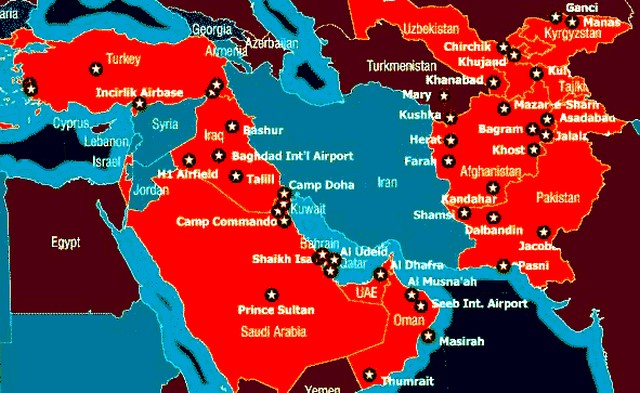
The U.S. government has said that Iran might target U.S. troops in Iraq or elsewhere in the region. These are likely the “indications and warnings” of Bolton. There are tens of thousands of U.S. troops in Afghanistan, Iraq and the Gulf. The U.S. military hardware that encircles Iran is lethal. Late last year, the Iranian government—feeling hemmed in by this military noose—proposed that it could strike U.S. forces at al-Udeid Air Base (Qatar), al-Dhafra base (United Arab Emirates) and Kandahar base (Afghanistan). “They are within our reach,” said Amirali Hajizadeh, who heads Iran’s Revolutionary Guards’ air brigade. As if to provoke Iran further, in March of this year, the United States signed a deal with Oman to use its ports at Salalah and Duqm for military purposes.

Endless Wars

In his state of the union address, Trump said, “Great nations do not fight endless wars.” The United States has tried to push a new deal in Afghanistan and has tried to withdraw from the conflict in Syria. Neither of these withdrawals will be easy.

But if the United States strikes Iran, there is no doubt that the wars from Lebanon to the border of India will become endless. There is no question that Iran—much weaker militarily than the United States—will use its advantages to strike the United States inside Afghanistan and to urge its allies to strike U.S. forces in the Gulf and across North Africa. Iran’s population is deeply patriotic and would see any U.S. strike as one against the Iranian people and not just against the Iranian government. It is unlikely that the United States will find any significant allies amongst the Iranians. A war against Iran at this time would be a war against a stretch of the world that has seen too many wars in recent times, that would like to open the door to peace. Trump—with Bolton and Pence—seek to provoke a war. These are dangerous men with a dangerous agenda.

This article was produced by Globetrotter, a project of the Independent Media Institute.

8 May 2019

Source: countercurrents.org

The Problem Is Capitalism

By George Monbiot

It is a weapon pointed at the living world. We urgently need to develop a new system.

For most of my adult life, I’ve railed against “corporate capitalism”, “consumer capitalism” and “crony capitalism”. It took me a long time to see that the problem is not the adjective, but the noun.

While some people have rejected capitalism gladly and swiftly, I’ve done so slowly and reluctantly. Part of the reason was that I could see no clear alternative: unlike some anti-capitalists, I have never been an enthusiast for state communism. I was also inhibited by its religious status. To say “capitalism is failing” in the 21st century is like saying “God is dead” in the 19th. It is secular blasphemy. It requires a degree of self-confidence I did not possess.

But as I’ve grown older, I’ve come to recognise two things. First, that it is the system, rather than any variant of the system, which drives us inexorably towards disaster. Second, that you do not have to produce a definitive alternative to say that capitalism is failing. The statement stands in its own right. But it also demands another, and different, effort to develop a new system.

Capitalism’s failures arise from two of its defining elements. The first is perpetual growth. Economic growth is the aggregate effect of the quest to accumulate capital and extract profit. Capitalism collapses without growth, yet perpetual growth on a finite planet leads inexorably to environmental calamity.

Those who defend capitalism argue that, as consumption switches from goods to services, economic growth can be decoupled from the use of material resources. Last week, a paper in the journal New Political Economy by Jason Hickel and Giorgos Kallis examined this premise. They found that while some relative decoupling took place in the 20th century (material resource consumption grew, but not as quickly as economic growth), in the 21st there has been a re-coupling: rising resource consumption has so far matched or exceeded the rate of economic growth. The absolute decoupling needed to avert environmental catastrophe (a reduction in material resource use) has never been achieved, and appears impossible while economic growth continues. Green growth is an illusion.

A system based on perpetual growth cannot function without peripheries and externalities. There must always be an extraction zone, from which materials are taken without full payment, and a disposal zone, where costs are dumped in the form of waste and pollution. As the scale of economic activity increases, until capitalism affects everything from the atmosphere to the deep ocean floor, the entire planet becomes a sacrifice zone: we all inhabit the periphery of the profit-making machine.

This drives us towards cataclysm on such a scale that most people have no means of imagining it. The threatened collapse of our life support systems is bigger by far than war, famine, pestilence or economic crisis, though it is likely to incorporate all four. Societies can recover from these apocalyptic events, but not from the loss of soil, an abundant biosphere and a habitable climate.

The second defining element is the bizarre assumption that a person is entitled to as great a share of the world’s natural wealth as their money can buy. This seizure of common goods causes three further dislocations. First, the scramble for exclusive control of non-reproducible assets, which implies either violence or legislative truncations of other people’s rights. Second, the immiseration of other people by an economy based on looting across both space and time. Third, the translation of economic power into political power, as control over essential resources leads to control over the social relations that surround them.

In the New York Times on Sunday, the Nobel economist Joseph Stiglitz sought to distinguish between good capitalism, that he called “wealth creation”, and bad capitalism, that he called “wealth grabbing” (extracting rent). I understand his distinction, but from the environmental point of view, wealth creation is wealth grabbing. Economic growth, intrinsically linked to the increasing use of material resources, means seizing natural wealth from both living systems and future generations.

To point to such problems is to invite a barrage of accusations, many of which are based on this premise: capitalism has rescued hundreds of millions of people from poverty – now you want to impoverish them again. It is true that capitalism, and the economic growth it drives, has radically improved the prosperity of vast numbers of people, while simultaneously destroying the prosperity of many others: those whose land, labour and resources were seized to fuel growth elsewhere. Much of the wealth of the rich nations was – and is – built on slavery and colonial expropriation.

Like coal, capitalism has brought many benefits. But, like coal, it now causes more harm than good. Just as we have found means of generating useful energy that are better and less damaging than coal, so we need to find means of generating human wellbeing that are better and less damaging than capitalism.

There is no going back: the alternative to capitalism is neither feudalism nor state communism. Soviet communism had more in common with capitalism than the advocates of either system would care to admit. Both systems are (or were) obsessed with generating economic growth. Both are willing to inflict astonishing levels of harm in pursuit of this and other ends. Both promised a future in which we would need to work for only a few hours a week, but instead demand endless, brutal labour. Both are dehumanising. Both are absolutist, insisting that theirs and theirs alone is the one true God.

So what does a better system look like? I don’t have a complete answer, and I don’t believe any one person does. But I think I see a rough framework emerging. Part of it is provided by the ecological civilisation proposed by Jeremy Lent, one of the greatest thinkers of our age. Other elements come from Kate Raworth’s doughnut economics and the environmental thinking of Naomi Klein, Amitav Ghosh, Angaangaq Angakkorsuaq, Raj Patel and Bill McKibben. Part of the answer lies in the notion of “private sufficiency, public luxury”. Another part arises from the creation of a new conception of justice, based on this simple principle: every generation, everywhere shall have an equal right to the enjoyment of natural wealth.

I believe our task is to identify the best proposals from many different thinkers and shape them into a coherent alternative. Because no economic system is only an economic system, but intrudes into every aspect of our lives, we need many minds from various disciplines – economic, environmental, political, cultural, social and logistical – working collaboratively to create a better way of organising ourselves, that meets our needs without destroying our home.

Our choice comes down to this. Do we stop life to allow capitalism to continue, or stop capitalism to allow life to continue?

_____________________________________________

About George Monbiot: Here are some of the things I try to fight: undemocratic power, corruption, deception of the public, environmental destruction, injustice, inequality and the misallocation of resources, waste, denial, the libertarianism which grants freedom to the powerful at the expense of the powerless, undisclosed interests, complacency.

6 May 2019

Source: www.transcend.org

‘Endless Trip to Hell’: Israel Jails Hundreds of Palestinian Boys a Year. These Are Their Testimonies

By Netta Ahituv

They’re seized in the dead of night, blindfolded and cuffed, abused and manipulated to confess to crimes they didn’t commit. Every year Israel arrests almost 1,000 Palestinian youngsters, some of them not yet 13.

It was a gloomy, typically chilly late-February afternoon in the West Bank village of Beit Ummar, between Bethlehem and Hebron. The weather didn’t deter the children of the Abu-Ayyash family from playing and frolicking outside. One of them, in a Spiderman costume, acted the part by jumping lithely from place to place. Suddenly they noticed a group of Israeli soldiers trudging along the dirt trail across the way. Instantly their expressions turned from joy to dread, and they rushed into the house. It’s not the first time they reacted like that, says their father. In fact, it’s become a pattern ever since 10-year-old Omar was arrested by troops this past December.

The 10-year-old is one of many hundreds of Palestinian children whom Israel arrests every year: The estimates range between 800 and 1,000. Some are under the age of 15; some are even preteens. A mapping of the locales where these detentions take place reveals a certain pattern: The closer a Palestinian village is to a settlement, the more likely it is that the minors residing there will find themselves in Israeli custody. For example, in the town of Azzun, west of the Karnei Shomron settlement, there’s hardly a household that hasn’t experienced an arrest. Residents say that in the past five years, more than 150 pupils from the town’s only high school have been arrested.

At any given moment, there are about 270 Palestinian teens in Israeli prisons. The most widespread reason for their arrest – throwing stones – does not tell the full story. Conversations with many of the youths, as well as with lawyers and human rights activists, including those from the B’Tselem human-rights organization, reveal a certain pattern, even as they leave many questions open: For example, why does the occupation require that arrests be violent and why is it necessary to threaten young people.

A number of Israelis, whose sensibilities are offended by the arrests of Palestinian children, have decided to mobilize and fight the phenomenon. Within the framework of an organization called Parents Against Child Detention, its approximately 100 members are active in the social networks and hold public events “in order to heighten awareness about the scale of the phenomenon and the violation of the rights of Palestinian minors, and in order to create a pressure group that will work for its cessation,” as they explain. Their target audience is other parents, whom they hope will respond with empathy to the stories of these children.

In general, there seems to be no lack of criticism of the phenomenon. In addition to B’Tselem, which monitors the subject on a regular basis, there’s been a protest from overseas, too. In 2013, UNICEF, the United Nations agency for children, assailed “the ill treatment of children who come in contact with the military detention system, [which] appears to be widespread, systematic and institutionalized.” A report a year earlier from British legal experts concluded that the conditions the Palestinian children are subjected to amount to torture, and just five months ago the Parliamentary Assembly of the Council of Europe deplored Israel’s policy of arresting underage children, declaring, “An end must be put to all forms of physical or psychological abuse of children during arrest, transit and waiting periods, and during interrogations.”

Arrest

About half of the arrests of Palestinian adolescents are made in their homes. According to the testimonies, Israel Defense Forces soldiers typically burst into the house in the middle of the night, seize the wanted youth and whisk him away (very few girls are detained), leaving the family with a document stating where he’s being taken and on what charge. The printed document is in Arabic and Hebrew, but the commander of the force typically fills out the details in Hebrew only, then hands it to parents who may not be able to read it and don’t know why their son was taken.

Attorney Farah Bayadsi asks why it’s necessary to arrest children in this manner, instead of summoning them for questioning in an orderly way. (The data show that only 12 percent of the youths receive a summons to be interrogated.)

“I know from experience that whenever someone is asked to come in for questioning, he goes,” Bayadsi notes. She is a lawyer working with Defense for Children International, a global NGO that deals with the detention of minors and promotion of their rights..

“The answer we generally get,” she says, “is that, ‘It’s done this way for security reasons.’ That means it’s a deliberate method, which isn’t intended to meet the underage youth halfway, but to cause him a lifelong trauma.”

Indeed, as the IDF Spokesman’s Unit stated to Haaretz, in response, “The majority of the arrests, of both adults and minors, are carried out at night for operational reasons and due to the desire to preserve an orderly fabric of life and execute point-specific actions wherever possible.”

About 40 percent of the minors are detained in the public sphere – usually in the area of incidents involving throwing stones at soldiers. That was the case with Adham Ahsoun, from Azzun. At the time, he was 15 and on his way home from a local grocery store. Not far away, a group of children had started throwing stones at soldiers, before running off. Ahsoun, who didn’t flee, was detained and taken to a military vehicle; once inside, he was hit by a soldier. A few children who saw what happened ran to his house to tell his mother. Grabbing her son’s birth certificate, she rushed to the entrance to the town to prove to the soldiers that he was only a child. But it was too late; the vehicle had already departed, headed to an army base nearby, where he would wait to be interrogated.

By law, soldiers are supposed to handcuff children with their hands in front, but in many cases it’s done with their hands behind them. Additionally, sometimes the minor’s hands are too small for handcuffing, as a soldier from the Nahal infantry brigade told the NGO Breaking the Silence. On one occasion, he related, his unit arrested a boy “of about 11,” but the handcuffs were too big to bind his small hands.

The next stage is the journey: The youths are taken to an army base or a police station in a nearby settlement, their eyes covered with flannelette. “When your eyes are covered, your imagination takes you to the most frightening places,” says a lawyer who represents young Palestinians. Many of those arrested don’t understand Hebrew, so that once pushed into the army vehicle they are completely cut off from what’s going on around them.

Sometimes the minor’s hands are too small for handcuffing

In most cases, the handcuffed, blindfolded youth will be moved from place to place before actually being interrogated. Sometimes he’s left outside, in the open, for a time. In addition to the discomfort and the bewilderment, the frequent moving around presents another problem: In the meantime many acts of violence, in which soldiers beat the detainees, take place and go undocumented.

Once at the army base or police station, the minor is placed, still handcuffed and blindfolded, on a chair or on the floor for a few hours, generally without being given anything to eat. The “endless trip to hell” is how Bayadsi describes this process. Memory of the incident, she adds, “is still there even years after the boy’s release. It implants in him an ongoing feeling of a lack of security, which will stay with him for his whole life.”

Testimony provided to Breaking the Silence by an IDF staff sergeant about one incident in the West Bank illustrates the situation from the other side: “It was the first night of Hanukkah. Two children were throwing stones on Highway 60, on the road. So we grabbed them and took them to the base. Their eyes were covered with flannelette, and they were handcuffed in front with plastic cuffs. They looked young, between 12 and 16 years old.”

When the soldiers gathered to light the first candle of the Hanukkah holiday, the detainees remained outside. “We’re shouting and making noise and using drums, which is a kind of company thing,” the soldier recalled, noting that he assumed the kids didn’t know Hebrew, although maybe they did understand the curses they heard. “Let’s say sharmuta [slut] and other words they might know from Arabic. How could they know we aren’t talking about them? They’ll probably thought that in another minute we were going to cook them.”

Interrogation

The nightmare can be of differing duration, the former detainees relate. Three to eight hours after the arrest, by which time the youth is tired and hungry – and sometimes in pain after being hit, frightened by threats and not even knowing why he’s there – he’s taken in for interrogation. This may be the first time the blindfold is removed and his hands freed. The process usually starts with a general question, such as, “Why do you throw stones at soldiers?” The rest is more intense – a barrage of questions and threats, aimed at getting the teen to sign a confession. In some cases, he’s promised that if he signs he’ll be given something to eat.

According to the testimonies, the interrogators’ threats are directed squarely at the boy (“You’ll spend your whole life in jail”), or at his family (“I’ll bring your mother here and kill her before your eyes”), or at the family’s livelihood (“If you don’t confess, we’ll take away your father’s permit to work in Israel – because of you, he’ll be out of work and the whole family will go hungry”).

In some cases, he’s promised that if he signs he’ll be given something to eat.

“The system shows that the intention here is more to demonstrate control than to engage in enforcement,” suggests Bayadsi. “If the boy confesses, there’s a file; if he doesn’t confess, he enters the criminal circle anyway and is seriously intimidated.”

Imprisonment

Whether the young detainee has signed a confession or not, the next stop is prison. Either Megiddo, in Lower Galilee, or Ofer, north of Jerusalem. Khaled Mahmoud Selvi was 15 when he was brought to prison in October 2017 and was told to disrobe for a body search (as in 55 percent of the cases). For 10 minutes he was made to stand naked, along with another boy, and in winter.

The months in detention, waiting for trial, and later, if they are sentenced, are spent in the youth wing of the facilities for security prisoners. “They don’t speak with their families for months and are allowed one visit a month, through glass,” Bayadsi relates.

Far fewer Palestinian girls are arrested than boys. But there is no facility specially for them, so they are held in the Sharon prison for women, together with the adults.

The trial

The courtroom is usually the place where parents have their first sight of their child, sometimes several weeks after the arrest. Tears are the most common reaction to the sight of the young detainee, who will be wearing a prison uniform and handcuffs, and with a cloud of uncertainty hovering over everything. Israel Prisons Service guards don’t allow the parents to approach the youth, and direct them to sit on the visitors’ bench. Defense counsel is paid for either by the family or by the Palestinian Authority.

At a recent remand hearing for several detainees, one boy didn’t stop smiling at the sight of his mother, while another lowered his eyes, perhaps to conceal tears. Another detainee whispered to his grandmother, who had come to visit him, “Don’t worry, tell everyone I’m fine.” The next boy remained silent and watched as his mother mouthed to him, “Omari, I love you.”

While the children and their family try to exchange a few words and looks, the proceedings move along. As though in a parallel universe.

The deal

The vast majority of trials for juveniles ends in a plea bargain – safka in Arabic, a word Palestinian children know well. Even if there is no hard evidence to implicate the boy in stone-throwing, a plea is often the preferred option. If the detainee doesn’t agree to it, the trial could last a long time and he will be held in custody until the proceedings end.

Conviction depends almost entirely on evidence from a confession, says lawyer Gerard Horton, from the British-Palestinian Military Court Watch, whose brief, according to its website, involves “monitoring the treatment of children in Israeli military detention.” According to Horton, who is based in Jerusalem, the minors will be more prone to confess if they don’t know their rights, are frightened and get no support or relief until they confess. Sometimes a detainee who does not confess will be told that he can expect to face a series of court appearances. At some stage, even the toughest youth will despair, the lawyer explains.

The IDF Spokesman’s Unit stated in response: “The minors are entitled to be represented by an attorney, like any other accused, and they have the right to conduct their defense in any way they choose. Sometimes they choose to admit to guilt within the framework of a plea bargain but if they plead not guilty, a procedure involving hearing evidence is conducted, like the proceedings conducted in [civilian courts in] Israel, at the conclusion of which a legal decision will be handed down on the basis of the evidence presented to the court. The deliberations are set within a short time and are conducted efficiently and with the rights of the accused upheld.”

Managing the community

According to data of collected by the British-Palestinian NGO, 97 percent of the youths arrested by the IDF live in relatively small locales that are no more than two kilometers away from a settlement. There are a number of reasons for this. One involves the constant friction – physical and geographical – between Palestinians, on the one hand, and soldiers and settlers. However, according to Horton, there is another, no less interesting way to interpret this figure: namely, from the perspective of an IDF commander, whose mission is to protect the settlers.

In the case of reported stone-throwing incidents, he says, the commander’s assumption is that the Palestinians involved are young, between the ages of 12 and 30, and that they come from the nearest village. Often the officer will turn to the resident collaborator in the village, who provides him with the names of a few boys.

The next move is “to enter the village at night and arrest them,” Horton continues. “And whether these youths are the ones who threw the stones or not, you have already put a scare into the whole village” – which he says is an “effective tool” for managing a community.

“When so many minors are being arrested like this, it’s clear that some of them will be innocent,” he observes. “The point is that this has to be happening all the time, because the boys grow up and new children appear on the scene. Each generation must feel the strong arm of the IDF.”

According to the IDF Spokesperson’s Unit: “In recent years, many minors, some of them very young, have been involved in violent incidents, incitement and even terrorism. In these cases, there is no alternative but to institute measures, including interrogation, detention and trial, within the limits of and according to what is stipulated by law. As part of these procedures, the IDF operates to uphold and preserve the rights of the minors. In enforcing the law against them, their age is taken into account.

“Thus, since 2014, among other measures, in certain instances, the minors are invited to the police station and are not arrested at home. In addition, proceedings relating to minors take place in the military court for juveniles, which examines the seriousness of the offense that’s attributed to the minor and the danger it poses, while taking into consideration his young age and his particular circumstances. Every allegation of violence on the part of IDF soldiers is examined, and cases in which the soldiers’ actions are found to be flawed are treated sternly.”

The Shin Bet security service stated in response: “The Shin Bet, together with the IDF and the Israel Police, operates against every element that threatens to harm Israel’s security and the country’s citizenry. The terrorist organizations make extensive use of minors and recruit them to carry out terrorist activity, and there is a general tendency to involve minors in terrorist activity as part of local initiatives.

“Interrogations of suspected terrorists are conducted by the Shin Bet under the law, and are subject to supervision and to internal and external review, including by all levels of the court system. The interrogations of minors are carried out with extra sensitivity and with consideration of their young age.”

Khaled Mahmoud Selvi, arrested at 14 (October 2017)

“I was arrested when I was 14, all the boys in the family were arrested that night. A year later, I was arrested again, with my cousin. They said I burned tires. It happened when I was sleeping. My mother woke me up. I thought it was time for school, but when I opened my eyes I saw soldiers above me. They told me to get dressed, handcuffed me and took me outside. I was wearing a short-sleeved shirt and it was cold that night. My mother begged them to let me put on a jacket, but they didn’t agree. Finally, she threw the jacket on me, but they didn’t let me put my arms in the sleeves.

“They took me to the Karmei Tzur settlement with my eyes covered, and I had the feeling that they were just driving in circles. When I walked, there was a pit in the road and they pushed me into it, and I fell. From there they took me to Etzion [police station]. There they put me in a room, and soldiers kept coming in all the time and kicking me. Someone passed by and said that if I didn’t confess, they would leave me in jail for the rest of my life.

“At 7 A.M., they told me the interrogation was starting. I asked to go to the toilet before. My eyes were covered and a soldier put a chair in front of me. I tripped. The interrogation went on for an hour. They told me that they saw me burning tires and that it interfered with air traffic. I told them it wasn’t me. I didn’t see a lawyer until the afternoon, and he asked the soldiers to bring us food. It was the first time I had eaten since being arrested the night before.

Someone passed by and said that if I didn’t confess, they would leave me in jail for the rest of my life.

“At 7 P.M., I was sent to Ofer Prison, and I remained there for six months. In that period, I was in court more than 10 times. And there was also another interrogation, because a friend of mine was told while being questioned that if he didn’t confess and inform on me, they would bring his mother and shoot her before his eyes. So he confessed and informed. I’m not angry at him. It was his first arrest, he was scared.”

Khaled Shtaiwi, arrested at 13 (November 2018)

Khaled’s story is told by his father, Murad Shatawi: “On the night he was arrested, a phone call from my nephew woke me up. He said the house was surrounded by soldiers. I got up and got dressed, because I expected them to arrest me, on account of the nonviolent demonstrations I organize on Fridays. I never imagined they’d take Khaled. They asked me for the names of my sons. I told them Mumen and Khaled. When I said Khaled, they said, ‘Yes, him. We’re here to take him.’ I was in shock, so many soldiers showed up to arrest a boy of 13.

“They handcuffed and blindfolded him and led him east on foot, toward the settlement of Kedumim, all the while cursing and hitting him a little. I saw it all from the window. They gave me a document showing that it was a legal arrest and I could come to the police station. When I got there, I saw him through a small hole in the door. He was handcuffed and blindfolded.

“He stayed like that from the moment they arrested him until 3 P.M. the next day. That’s a picture that doesn’t leave me; I don’t know how I’ll go on living with that picture in my head. He was accused of throwing stones, but after four days they released him, because he didn’t confess and there was no other evidence against him. During the trial, when the judge wanted to speak to Khaled, he had to lean forward in order to see him, because Khaled was so small.

“What was it like to see him like that? I am the father. That says it all. He hasn’t talked about it since getting out, three months ago. That’s a problem. I’m now organizing a ‘psychology day’ in the village, to help all the children here who have been arrested. Out of 4,500 people in the village, 11 children under the age of 18 have been arrested; five were under the age of 15.”

Omar Rabua Abu Ayyash, arrested at age 10 (December 2018)

Omar looks small for his age. He’s shy and quiet, and it’s hard to talk to him about the arrest, so members of his family recount the events in his place.

Omar’s mother: “It happened at 10 A.M. on Friday, when there is no school. Omar was playing in the area in front of the house, he threw pebbles at birds that were chirping in the tree. The soldiers, who were in the watchtower across the way here, picked up on what he was doing and ran toward him. He ran, but they caught him and knocked him down. He started to cry, and he wet his pants. They kicked him a few times.

“His grandmother, who lives here below, immediately went out and tried to take him from the soldiers, which caused a struggle and shouts. In the end, they left him alone and he went home and changed into dry pants. A quarter of an hour later, the soldiers came back, this time with their commander, who said he had to arrest the boy for throwing stones. When the other children in the family saw the soldiers in the house, they also wet their pants.”

Omar’s father takes up the story: “I told the commander that he was under 12 and that I had to accompany him, so I rode with him in the jeep to the Karmei Tzur settlement. There the soldiers told him not to throw stones anymore, and that if he saw other children doing it, he should tell them. From there they took him the offices of the Palestinian Authority in Hebron. The whole story took about 12 hours. They gave him a few bananas to eat during those hours. Now, whenever the children see a military jeep or soldiers, they go inside. They’ve stopped playing outside since then. Before the incident, soldiers used to come here to play soccer with the children. Now they’ve stopped coming, too.”

Tareq Shtaiwi, arrested at 14 (January 2019)

“It was around 2 P.M. I had a fever that day, so Dad sent me to my cousin next door, because that’s almost the only place in the village with a heating unit. Suddenly soldiers showed up. They saw me watching them from the window, so they fired shots at the door of the building, knocked it down and started to come upstairs. I got scared, so I ran from the second floor to the third, but they stopped me on the way and took me outside. The soldiers wouldn’t let me take my coat, even though it was cold and I was sick. They took me on foot to Kedumim, handcuffed and blindfolded. They sat me on a chair. I heard doors and windows being slammed hard, I think they were trying to scare me.

They didn’t have prisoners uniforms in my size. I was the youngest person in the prison.

“After a while, they took me from Kedumim to Ariel, and I was there for five-six hours. They accused me of throwing stones a few days earlier with my friend. I told them I hadn’t thrown any stones. In the evening they moved me to the Hawara detention building; one of the soldiers told me I would never leave there. In the morning I was moved to Megiddo Prison. They didn’t have prisoners uniforms in my size, so they gave me clothes of Palestinian children who had been there before and left them for the next in line. I was the youngest person in the prison.

“I had three court hearings, and after 12 days, at the last hearing, they told me that it was enough, that my father would pay a fine of 2,000 shekels [$525] and I was getting a three-year suspended sentence. The judge asked me what I intended to do after getting out, I told him I would go back to school and I wouldn’t go up to the third floor again. Since my arrest, my younger brother, who’s 7, has been afraid to sleep in the kids’ room and goes to sleep with our parents.”

Adham Ahsoun, arrested in October 2018, on his 15th birthday

“On my 15th birthday, I went to the store in the village center to buy a few things. Around 7:30 in the evening, soldiers entered the village and children started to throw stones at them. On the way home with my bag, they caught me. They took me to the entrance of the village and put me in a jeep. One of the soldiers started to hit me. Then they put plastic handcuffs on me and covered my eyes and took me like that to the military base in Karnei Shomron. I was there for about an hour. I couldn’t see a thing, but I had the feeling that a dog was sniffing me. I was afraid. From there they took me to another military base and left me there for the night. They didn’t give me anything to eat or drink.

“In the morning, they moved me to the interrogation facility in Ariel. The interrogator told me that the soldiers caught me throwing stones. I told him that I hadn’t thrown stones, that I was on my way home from the store. So he called the soldiers into the interrogation room. They said, ‘He’s lying, we saw him, he was throwing stones.’ I told him that I really hadn’t thrown stones, but he threatened to arrest my mother and father. I panicked. I asked him, ‘What do you want from me?’ He said he wanted me to sign that I threw stones at soldiers, so I signed. The whole time I didn’t see or talk to a lawyer.

“My plea bargain was that I would confess and get a five-month jail sentence. Afterward, they gave me one-third off for good behavior. I got out after three months and a fine of 2,000 shekels. In jail I tried to catch up with the material I missed in school. The teachers told me they would only take into account the grades of the second semester, so it wouldn’t hurt my chances of being accepted for engineering studies in university.”

Muhmen Teet, arrested at 13 (November 2017)

“At 3 A.M., I heard knocking on the door. Dad came into the room and said there were soldiers in the living room and wanted us to show ID cards. The commanding officer told my father that they were taking me to Etzion for questioning. Outside, they handcuffed and blindfolded me and put me in a military vehicle. We went to my cousin’s house; they also arrested him. From there we went to Karmei Tzur and waited, handcuffed and blindfolded, until the morning.

“In the morning, they only took my cousin for interrogation, not me. After his interrogation, they took us to Ofer Prison. After a day there, they took us back to Etzion and said they were going to interrogate me. Before the interrogation, they took me into a room, where there was a soldier who slapped me. After he hit me in one room, he took me to the interrogation room. The interrogator said I was responsible for burning tires, and because of that the grove near the house caught fire. I said it wasn’t me, and I signed a document that the interrogator gave me. The document was also printed in Arabic, but the interrogator filled it out in Hebrew. I was taken back to Ofer Prison.

“I had seven hearings in court, because at the first hearing I said I hadn’t intended to confess, I just didn’t understand what I signed and it wasn’t true. So they sent me back for another interrogation. Again I didn’t confess. Then they sent me to interrogation another time and again I didn’t confess. That’s what it was like in three interrogations. In the end, my lawyer did a deal with the prosecutor that if I confessed in court – which I did – and my family would pay 4,000 shekels, they would release me.

“I’m a good student, I like soccer, both playing and watching it. Since the arrest I hardly wander around outside.”

Khalil Zaakiq, arrested at age 13 (January 2019)

“Around 2 A.M. someone knocked on the door. I woke up and saw a lot of soldiers in the house. They said we should all sit in the living room sofa and not move. The commander called Uday, my big brother, told him to get dressed and informed him that he was under arrest. It was the third time they arrested him. My father was also once under arrest. Suddenly they told me to put my shoes on too and go with them.

“They took us out of the house and tied our hands and covered our eyes. We went like that on foot to the base in Karmei Tzur. There they sat me on the floor with hands tied and eyes covered for around three hours. At about 5 A.M., they moved us to Etzion. On the way there in the jeep they hit us, they slapped me. In Etzion, I was sent to be checked by a doctor. He asked if I had been beaten and I said yes. He didn’t do anything, only checked my blood pressure and said I could stand up to an interrogation.

“My interrogation started at 8 A.M.. They asked me to tell them which children throw stones. I said I didn’t know, so the interrogator gave me a slap. The interrogation went on for four hours. Afterward, they put me into a dark room for 10 minutes and then took me back to the interrogation room, but now they only fingerprinted me and put me into a detention cell for an hour. After an hour, Uday and I were moved to Ofer Prison. I didn’t sign a confession, neither about myself nor about others.

“I got out after nine days, because I wasn’t guilty of anything. My parents had to pay 1,000 shekels for bail. My little brother, who is 10, has been really afraid ever since. Whenever someone knocks at the door, he wets his pants.”

________________________________________________

Netta Ahituv – Haaretz Contributor

6 May 2019

Source: www.transcend.org

US-Backed Saudi Regime Beheads 37 Political Prisoners

By Bill Van Auken

The monarchical dictatorship of Saudi Arabia announced on Tuesday [23 Apr] that it had carried out another killing spree, publicly executing 37 people in the cities of Riyadh, Medina and Mecca, as well as in central Qassim Province and in the kingdom’s Eastern Province.

One of the headless corpses was then crucified and left hanging in public as a hideous warning to anyone who would even contemplate opposing the absolute power of the ruling royal family admired by Pres. Trump.

The regime announced that those who were brought into public squares to be decapitated with swords had been punished “for adopting terrorist and extremist thinking and for forming terrorist cells to corrupt and destabilize security.”

In Saudi Arabia, an antiterrorism law adopted in 2017 defines as a “terrorist” anyone “disturbing public order,” “shaking the security of the community and the stability of the State” or “exposing its national unity to danger.” The law essentially provides the death penalty for anyone daring to criticize the Saudi monarchy or its de facto ruler, Crown Prince Mohammed bin Salman.

Under bin Salman, the Trump administration’s closest ally in the Arab world, the number of executions has doubled. While last year, the regime beheaded 149 people, it has already chopped off the heads of 105 people in 2019.

It is known that at least 33 of the 37 put to death this week were Saudi Shias. In the case of 14 of them, their alleged “crimes” stemmed from the mass protests that swept Saudi Arabia’s predominantly Shiite Eastern Province in 2011, expressing popular demands for democratic reforms and an end to the discrimination and oppression of the Shiite population at the hands of a Sunni monarchy, whose rule is bound up with the official, state-sponsored religious doctrine of Wahhabism, an ultraconservative Sunni sect.

Another 11 were accused of spying for Iran.

None of these individuals were allowed to speak to lawyers during investigations that were carried out by means of torture. They were denied visits from their families and kept in solitary confinement during these ordeals, and were sentenced to death in sham mass trials that lacked even a modicum of due process.

The barbaric mass state murders carried out by the regime in Riyadh constituted a calculated political act driven by both domestic and international objectives. Its immediate aim is to intimidate the Shia minority, which constitutes approximately 15 percent of the population and is concentrated in the Eastern Province, a key oil-producing region.

At least three of those put to death were minors at the time of their alleged offenses, making their executions a flagrant violation of international law barring the death penalty for children.

Abdulkarim al-Hawaj, was 16 when he was arrested and charged with participating in demonstrations and using social media to incite opposition to the monarchy. He also was alleged to have helped make banners with slogans denouncing the regime. He was convicted based on a confession extracted through torture, including electric shocks and being held with his hands chained above his head.

Salman Qureish was arrested just after his 18th birthday for alleged crimes that took place when he was a juvenile. Denied his basic legal rights, he was sentenced to death in a mass trial.

Mujtaba al-Sweikat was 17 when he was arrested at King Fahd International Airport, grabbed as he prepared to board a plane to the United States to begin life as a student at Western Michigan University. He was severely tortured and beaten, including on the soles of his feet, until he provided his torturers with a confession.

The faculty at Western Michigan University issued a statement in 2017 in response to the news of al-Sweikat’s imprisonment:

“As academics and teachers, we take pride in defending the rights of all people, wherever they may be in the world, to speak freely and debate openly without hindrance or fear. We publicly declare our support for Mujtaba’a and the 13 others facing imminent execution. No one should face beheading for expressing beliefs in public protests.

“Mujtaba’a showed great promise as an applicant for English language and pre-finance studies. He was arrested at the airport gates as he readied to board a plane to visit our campus. We were unaware that at the moment we were ready to welcome him, he was locked away, beaten and tortured and made to ‘confess’ to acts for which he was condemned to death.”

The Saudi regime, headed by its de facto ruler Prince Mohammed bin Salman, ignored this protest along with others from United Nations and human rights organizations, convinced that it enjoys absolute impunity based upon the support it enjoys from Washington.

The bloodbath organized by the Saudi regime on Tuesday was the largest since 2016, when it beheaded 47 men in a single day, including the prominent Shia cleric Sheikh Nimr Baqral-Nimr, a leading spokesman for Saudi Arabia’s oppressed Shiite minority. The state killings touched off angry protests in the region, including in Tehran, where crowds stormed the Saudi embassy. The furor was seized upon by Riyadh as the pretext for breaking diplomatic relations with Tehran and escalating its anti-Iranian campaign throughout the Middle East.

Since then, relentless repression in the Eastern Province has been joined with the near-genocidal war that is being waged by Saudi-led forces against Yemen, claiming the lives of at least 80,000 Yemenis and leaving more than 24 million people—80 per cent of the population—in need of humanitarian assistance, many of them on the brink of starvation.

The Sunni monarchy views the rise of the Houthi rebels in Yemen as a potential threat to its own internal situation, fearing that it could inspire the oppressed Shia population to revolt.

The main responsibility for the crimes of the Saudi regime rests with its principal patron, US imperialism. The savage monarchy in Saudi Arabia, with its public beheadings, is not merely some remnant of feudal backwardness. It is rather the direct product of US imperialist intervention in the Middle East, from the concessions secured by Texaco and Standard Oil in the 1930s and 1940s to the current massive arms sales that make the Saudi monarchy today’s number one customer of the US military-industrial complex.

Washington has responded to the mass beheadings in Saudi Arabia with a deafening silence. While the day before the beheadings were announced, the State Department issued a statement in connection with its severe tightening of punishing sanctions against Iran, demanding that it “respect the rights of its people,” there was no such appeal to Riyadh, much less any condemnation of minors having their heads chopped off in public squares.

The Pentagon and the CIA are full partners in the Saudi monarchy’s repression at home, just as the US has provided the bombs and targeting information, along with the midair refueling of Saudi bombers, that have made possible the criminal war against Yemen.

While the savage state murder and dismemberment of the dissident Saudi journalist Jamal Khashoggi at the monarchy’s consulate in Istanbul last October touched off a brief flurry of recriminations against Saudi Arabia, this heinous crime has largely been forgotten.

While Riyadh is going through the motions of a trial of 15 state officials charged with carrying out the gruesome killing, no action is being taken against Crown Prince bin Salman, who ordered the killing, or his senior adviser, Saud al-Qahtani, who reportedly supervised the torture, murder and dismemberment of Khashoggi via a Skype connection from Riyadh.

Barely a year ago, Crown Prince bin Salman was feted as a “reformer” by the US government, Harvard and MIT, as well as a host of US billionaires, from Bill Gates to Jeff Bezos and Oprah Winfrey.

With the media’s attention to the Khashoggi murder grown cold, this myth is once again being revived, even in the face of the mass beheadings. The day after the executions, top Wall Street financiers took the stage with regime representatives at a financial conference sponsored by the monarchy in Riyadh.

BlackRock CEO Larry Fink, HSBC CEO John Flint and JPMorgan’s Chief Operating Officer Daniel Pinto were all present, along with Morgan Stanley’s Asia managing director, Chin Chou, all of them anxious to cash in on a proposed initial public offering (IPO) by its national oil giant Aramco.

BlackRock’s Fink brushed off a question about the mass executions, stating, “The fact that there are issues in the press does not tell me I must run away from a place. In many cases it tells me I should run to and invest because what we are most frightened of are things that we don’t talk about.”

The executions in Saudi Arabia provide an appropriate prism for viewing the entire US policy in the Middle East. The bloodbath is a manifestation of the predatory aims pursued by US imperialism in the region. Washington’s defense of and reliance upon this ultrareactionary regime exposes all of the pretexts given for successive US military interventions, from the so-called “war on terrorism” to the supposed promotion of “democracy” and “human rights.”

In the end, a US foreign policy that is founded upon a strategic alliance with the House of Saud will inevitably prove to be a house of cards that will come crashing down with the revival of the class struggle in the Middle East, the United States and internationally.

______________________________________

Bill Van Auken | WSWS – TRANSCEND Media Service

6 May 2019

Source: www.transcend.org