Just International

Why Is Israel Afraid of Khalida Jarrar?

By Dr Ramzy Baroud

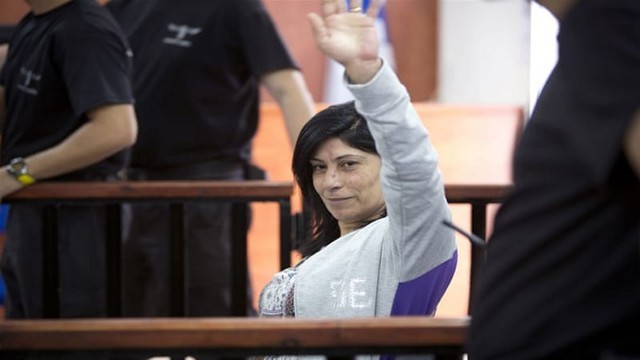
When Israeli troops stormed the house of Palestinian parliamentarian and lawyer, Khalida Jarrar, on April 2, 2015, she was engrossed in her research. For months, Jarrar had been leading a Palestinian effort to take Israel to the International Criminal Court (ICC).

Her research on that very evening was directly related to the kind of behavior that allows a group of soldiers to handcuff a respected Palestinian intellectual, throwing her in jail with no trial and with no accountability for their action.

Jarrar was released after spending over one year in jail in June 2016, only to be arrested once more, on July 2, 2017. She remains in an Israeli prison.

On October 28 of this year, her ‘administrative detention’ was renewed for the fourth time.

There are thousands of Palestinian prisoners in Israeli jails, most of them held outside the militarily Occupied Palestinian Territories, in violation of the Fourth Geneva Convention.

However, nearly 500 Palestinians fall into a different category, as they are held without trial, detained for six-month periods that are renewed, sometimes indefinitely, by Israeli military courts with no legal justification whatsoever. Jarrar is one of those detainees.

Jarrar is not beseeching her jailers for her freedom. Instead, she is keeping busy educating her fellow female prisoners on international law, offering classes and issuing statements to the outside world that reflect not only her refined intellect, but also her resolve and strength of character.

Jarrar is relentless. Despite her failing health – she suffers from multiple ischemic infarctions, hypercholesterolemia and was hospitalized due to severe bleeding resulting from epistaxis – her commitment to the cause of her people did not, in any way, weaken or falter.

The 55-year-old Palestinian lawyer has championed a political discourse that is largely missing amid the ongoing feud between the Palestinian Authority’s largest faction, Fatah, in the Occupied West Bank and Hamas in besieged Gaza.

As a member of the Palestine Legislative Council (PLC) and an active member within the Popular Front for the Liberation of Palestine (PFLP), Jarrar has advocated the kind of politics that is not disconnected from the people and, especially, from the women who she strongly and uncompromisingly represents.

According to Jarrar, no Palestinian official should engage in any form of dialogue with Israel, because such engagement helps legitimize a state that is founded on genocide and ethnic cleansing, and is currently carrying out various types of war crimes; the very crimes that Jarrar tried to expose before the ICC.

Expectedly, Jarrar rejects the so-called ‘peace process’, a futile exercise that has no intention or mechanism that is aimed at “implementing international resolutions related to the Palestinian cause and recognizing the fundamental rights of the Palestinians.”

It goes without saying that a woman with such an astute, strong position, vehemently rejects the ‘security coordination’ between the PA and Israel, seeing such action as a betrayal to the struggle and sacrifices of the Palestinian people.

While PA officials continue to enjoy the perks of ‘leadership’, desperately breathing life into a dead political discourse of a ‘peace process’ and a ‘two state solution’, Jarrar, a Palestinian female leader with a true vision, subsists in HaSharon Prison. There, along with dozens of Palestinian women, she experiences daily humiliation, denial of rights and various types of Israeli methods aimed at breaking her will.

But Jarrar is as experienced in resisting Israel as she is in her knowledge of law and human rights.

In August 2014, as Israel was carrying out one of its most heinous acts of genocide in Gaza – killing and wounding thousands in its so-called ‘Protective Edge’ war – Jarrar received an unwelcome visit by Israeli soldiers.

Fully aware of Jarrar’s work and credibility as a Palestinian lawyer with an international outreach – she is the Palestine representative in the Council of Europe – the Israeli government unleashed their campaign of harassment, which ended in her imprisonment. The soldiers delivered a military edict ordering her to leave her home in al-Bireh, near Ramallah, for Jericho.

Failing to silence her voice, she was arrested in April the following year, beginning an episode of suffering, but also resistance, which is yet to end.

When the Israeli army came for Jarrar, they surrounded her home with a massive number of soldiers, as if the well-spoken Palestinian activist was Israel’s greatest ‘security threat.’

The scene was quite surreal, and telling of Israel’s real fear – that of Palestinians, like Khalida Jarrar, who are able to communicate an articulate message that exposes Israel to the rest of the world.

It was reminiscent of the opening sentence of Franz Kafka’s novel, The Trial: “Somebody must have made a false accusation against Joseph K., for he was arrested one morning without having done anything wrong.”

Administrative detention in Israel is the re-creation of that Kafkaesque scene over and over again. Joseph K. is Khalida Jarrar and thousands of other Palestinians, paying a price for merely calling for the rights and freedom of their people.

Under international pressure, Israel was forced to put Jarrar on trial, levying against her twelve charges that included visiting a released prisoner and participating in a book fair.

Her other arrest, and the four renewals of her detention, is a testament not just to Israel’s lack of any real evidence against Jarrar, but for its moral bankruptcy as well.

But why is Israel afraid of Khalida Jarrar?

The truth is, Jarrar, like many other Palestinian women, represents the antidote of the fabricated Israeli narrative, relentlessly promoting Israel as an oasis of freedom, democracy and human rights, juxtaposed with a Palestinian society that purportedly represents the opposite of what Israel stands for.

Jarrar, a lawyer, human rights activist, prominent politician and advocate for women, demolishes, in her eloquence, courage and deep understanding of her rights and the rights of her people, this Israeli house of lies.

Jarrar is the quintessential feminist; her feminism, however, is not mere identity politics, a surface ideology, evoking empty rights meant to strike a chord with western audiences.

Instead, Khalida Jarrar fights for Palestinian women, their freedom and their rights to receive proper education, to seek work opportunity and to better their lives, while facing tremendous obstacles of military occupation, prison and social pressure.

Khalida in Arabic means “immortal”, a most fitting designation for a true fighter who represents the legacy of generations of strong Palestinian women, whose ‘sumoud’ – steadfastness – shall always inspire an entire nation.

Ramzy Baroud is a journalist, author and editor of Palestine Chronicle.

7 November 2018

Source: https://countercurrents.org/2018/11/07/why-is-israel-afraid-of-khalida-jarrar/
Saudi Arabia Has To Be Stopped And This Time It May Get Stopped

By Andre Vltchek

It appears that the KSA has crossed all lines of decency, if there were ever any.

In the eyes of many in the West, it crossed them not because it has been brutally killing tens of thousands of innocent people in Yemen, not even because it keeps sponsoring terrorists in Syria, (and in fact all over the world), often on behalf of the West. And not even because it is trying to turn its neighboring country, Qatar, from a peninsula into an island.

The crimes against humanity committed by Saudi Arabia are piling up, but the hermit kingdom (it is so hermit that it does not even issue tourist visas, in order to avoid scrutiny) is not facing any sanctions or embargos, with some exceptions like Germany. These are some of the most barbaric crimes committed in modern history, anywhere and by anyone. Executing and then quartering people, amputating their limbs, torturing, bombing civilians.

But for years and decades, all this mattered nothing. Saudi Arabia served faithfully both big business and the political interests of the United Kingdom first, and of the West in general later. That of course includes Israel, with which the House of Saud shares almost a grotesque hatred towards Shi’a Islam.

And so, no atrocities have been publicly discussed, at least not in the Western mass media or by the European and the US governments,while weapons, worth hundreds of billions of dollars, have been arriving into the KSA, and the oil, that dark sticky curse, kept flowing out.

Was Riyadh enjoying total impunity? Definitely!

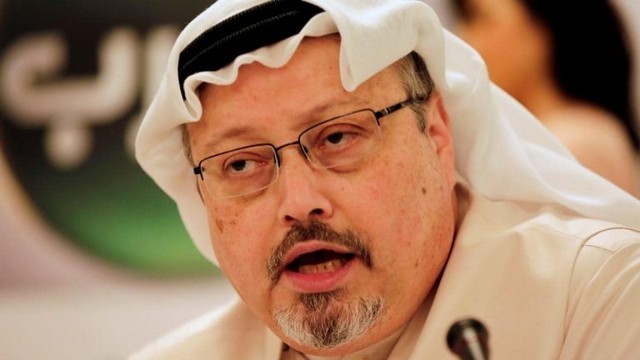
But all this may soon stop, because of a one single man, Mr. Jamal Khashoggi or more precisely, because of his alleged tragic, terrifying death behind the walls of the Saudi Consulate in the city of Istanbul.

According to the Turkish authorities, quoted by The New York Times on October 11, 2018:

“Fifteen Saudi agents arrived on two charter flights on Oct. 2, the day Mr. Khashoggi disappeared.”

Supposedly, they brutally murdered Mr. Khashoggi, a Saudi citizen, and then they used saw mills to severe his legs and arms from the body.

All this, while Mr. Khashoggi’s Turkish fiancé, Hatice Cengiz, was waiting for him on a bench, in front of the consulate. He went in,in order to take care of the paperwork required to marry her. But he never came back.

Now the Turkish nation is indignant.

Ten years ago, even one year ago, everything would have been, most likely, hushed up. As all mass murders committed by the Saudis all over the world were always hushed up. As was hushed up the information about the Saudi royal family smuggling drugs from Lebanon, using their private jets – narcotics that are clouding senses and are therefore used in combat zones and during terrorist attacks.

But now, this is the end of 2018. And Turkey is not ready to tolerate an atrocity by an increasingly hostile country; an atrocity committed in the middle of its largest city. For quite some time, Turkey and the KSA are not chums, anymore. Turkish military forces were already deployed to Qatar several months ago, in order to face the Saudi army and to protect the small (although also not benign) Gulf State from possible attack and imminent destruction. In the meantime, Turkey is getting closer and closer to Iran, an archenemy of Saudi Arabia, Israel and US.

It has to be pointed out that, Mr. Khashoggi is not just some common Saudi citizen – he is a prominent critic of the Saudi regime, but most importantly, in the eyes of the empire, a correspondent for The Washington Post. Critic but not an ‘outsider’. And some say, he was perhaps too close to some Western intelligence agencies.

Therefore, his death, if it is, after all, death, could not be ignored, no matter how much the West would like the story to disappear from the headlines.

President Trump remained silent for some time, then he became “concerned”, and finally Washington began indicating that it could even take some actions against its second closest ally in the Middle East. The Saudi Crown Prince Mohammed bin Salman has been ‘cultivated’ both by Washington and other Western powers, but now he may actually fall from grace. Is he going to end up as Shah Pahlavi of Iran? Not now, but soon, or at least ‘at some point’? Are the days of the House of Saud numbered? Perhaps not yet. But Washington has track record of getting rid of its ‘uncomfortable allies.

*

The Washington Post, in its editorial “Trump’s embrace emboldened Saudi Crown Prince’, snapped at both the ‘Saudi regime’ (finally that derogatory word, ‘regime’ has been used against the House of Saud) and the US administration:

“Two years ago it would have been inconceivable that the rulers of Saudi Arabia, a close US ally, would be suspected of abducting or killing a critic who lived in Washington and regularly wrote for the Post – or that they would dare to stage such operation in Turkey, another US ally and a NATO member. That the regime now stands accused by Turkish government sources of murdering Jamal Khashoggi, one of the foremost Saudi journalists, in the kingdom’s Istanbul consulate could be attributed in part to the rise of Crown Prince Mohammed bin Salman, the kingdom’s 33-year-old de facto ruler, who has proved as ruthless as he is ambitious. But it also may reflect the influence President Donald Trump, who has encouraged the Crown Prince to believe – wrongly, we trust – that even his most lawless ventures will have the support of the United States.”

“Wrongly, we trust?” But Saudi Arabia and its might are almost exclusively based on its collaboration with the global Western ‘regime’ imposed on the Middle East and on the entire world, first by Europe and the UK in particular, and lately by the United States.

All terror that the KSA has been spreading all over the region, but also Central Asia, Asia Pacific, and parts of Africa, has been encouraged, sponsored or at least approved in Washington, London, even Tel Aviv.

The Saudis helped to destroy the Soviet Union in Afghanistan, and then the socialist and progressive Afghanistan itself. They fought Communism and all left-wing governments in the Muslim world, on behalf of the West. They still do.

Now both the West and the KSA are inter-dependent. The Saudis are selling oil and buying weapons, signing ‘monumental’ defense contracts with the US companies, such as Lockheed Martin. They are also ‘investing’ into various political figures in Washington.

The current alleged murder of a journalist triggered an unusual wave of soul-searching in the Western media. It is half-hearted soul searching, but it is there, nevertheless. On October 2018, the Huffington Post wrote:

“By directing billions of dollars of Saudi money into the U.S. for decades, Riyadh’s ruling family has won the support of small but powerful circles of influential Americans and courted wider public acceptance through corporate ties and philanthropy. It’s been a solid investment for a regime that relies heavily on Washington for its security but can’t make the same claims to shared values or history as other American allies like Britain. For years, spending in ways beneficial to the U.S. ― both stateside and abroad, such as its funding Islamist fighters in Afghanistan to combat the Soviet Union ― has effectively been an insurance policy for Saudi Arabia.”

It means that the White House will most likely do its best not to sever relationships with Riyadh. There may be, and most likely will be, some heated exchange of words, but hardly some robust reaction, unless all this tense situation ‘provokes’ yet another ‘irrational’ move on the part of the Saudis.

The report by Huffington Post pointed out that:

“One of the few traditions in American diplomacy that Trump has embraced wholeheartedly is describing weapons sales as jobs programs. The president has repeatedly said Khashoggi’s fate should not disturb the $110 billion package of arms that Trump says he got the Saudis to buy to support American industry. (Many of the deals were actually struck under Obama, and a large part of the total he’s describing is still in the form of vague statements of intent.)

Keen to keep things on track with the Saudis, arms producers often work in concert with Saudi Arabia’s army of Washington lobbyists, congressional sources say.”

This is where the Western reporting stops short of telling the whole truth, and from putting things into perspective. Nobody from the mainstream media shouts: ‘There is basically no independent foreign policy of Riyadh!’

Yes, oil buys weapons that are ‘giving jobs to men and women working in the US and UK factories’, and then these weapons are used to murder men, women and children in Afghanistan, Yemen, Syria and elsewhere; they threaten Iran, Qatar and several other countries. Oil and Western support also help to recruit terrorists for the perpetual wars desired by the West, and they also help to build thousands of lavish mosques and to convert tens of millions of people in Southeast Asia, Africa and elsewhere to Wahhabism, which is an extreme, Saudi-UK religious dogma. (My book “Exposing Lies of the Empire”. contains important chapter on this topic – “The West Manufacturing Muslim Monsters: Who Should Be Blamed for Muslim Terrorism”).

*

Despite what many in the West think, there is hardly any love for Saudi Arabia in the Middle East. The KSA is sometimes supported, out of ignorance, commercial interests, or religious zeal, by such far-away Muslim countries like Indonesia and Malaysia, but as a rule, not bythose who live ‘in the region’.

Many if not most in the Arab countries have already had enough of Saudi arrogance and bullying, by such monstrous acts like the war against Yemen, or implanting/supporting terrorists in Syria, Afghanistan, Libya and elsewhere, or by recent the de facto kidnapping of the Lebanese Head of State, by moral hypocrisy and by turning holy Muslim sites into business ventures with vulgar commercialism all around them, and the clear segregation of the rich and poor.

Many Arabs hold Saudi Arabia responsible for turning an essentially socialist and egalitarian religion into what it has become now, of course with the determined support from the West, which desires to have an obedient and rituals-oriented population all over the Muslim world, in order to control it better, while plundering, without any opposition, its natural resources. Saudi Arabia is a country with some of the greatest disparities on earth: with some of the richest elites on one hand, and widespread misery all around the entire territory. It is an ‘unloved country’, but until now, it has been ‘respected’. Mainly out of fear.

Now, the entire world is watching. Those who were indignant in silence are beginning to speak out.

Few days ago, an Indonesian maid was mercilessly executed in the KSA. Years ago, she killed her tormentor, her old ‘a patron’ who was attempting to rape her, on many occasions. But that was not reported on the front pages. After all, she was ‘just a maid’; a poor woman from a poor country.

All of us, writers and journalists all over the world, are hoping that Mr. Khashoggi(no matter what his track record was so far) is alive, somewhere, and that one day soon he will be freed. However, with each new day, the chances that it will happen are slimmer and slimmer. Now even Saudi officials admit that he was murdered.

If he was killed by Saudi agents, Mr. Khashoggi’s death may soon fully change both his country and the rest of the Middle East. He always hoped for at least some changes in his country. But most likely, he never imagined that he would have to pay the ultimate piecefor them.

This time, the Saudi rulers hoped for a breeze, which would disperse the smell of blood. They may now inherit the tempest.

*

Andre Vltchek is a philosopher, novelist, filmmaker and investigative journalist.

7 November 2018

Source: https://countercurrents.org/2018/11/07/saudi-arabia-has-to-be-stopped-and-this-time-it-may-get-stopped/

Europe and America clash over Washington’s economic war on Iran

By Keith Jones

Washington’s imposition of sweeping new sanctions on Iran—aimed at strangling its economy and precipitating “regime change” in Tehran—is roiling world geopolitics.

As of today, the US is embargoing all Iranian energy exports and freezing Iran out of the US-dominated world financial system,so as to cripple the remainder of its trade and deny it access to machinery, spare parts and even basic foodstuffs and medicine.

In doing so, American imperialism is once again acting as a law unto itself. The sanctions are patently illegal and under international law tantamount to a declaration of war. They violate the UN Security Council-backed 2015 Iran nuclear accord or Joint Comprehensive Plan of Action (JCOPA)—an agreement that was negotiated at the behest of Washington and under its duress, including war threats.

All the other parties to the JCOPA (Russia, China, Britain, France, Germany and the EU) and the International Atomic Energy Agency, which is charged with verifying Iranian compliance, are adamant that Iran has fulfilled its obligations under the accord to the letter. This includes dismantling much of its civil nuclear program and curtailing the rest.

Yet, having reneged on its support for the JCOPA, Washington is now wielding the club of secondary sanctions to compel the rest of the world into joining its illegal embargo and abetting its regime-change offensive. Companies and countries that trade with Iran or even trade with those that do will be excluded from the US market and subject to massive fines and other penalties. Similarly, banks and shipping insurers that have any dealings with companies that trade with Iran or even with other financial institutions that facilitate trade with Iran will be subject to punishing US secondary sanctions.

Israeli Prime Minister Benjamin Netanyahu, who like US President Donald Trump has repeatedly threatened to attack Iran and ordered military strikes on Iranian Islamic Revolutionary Guard forces in Syria, has hailed the US sanctions as “historic.” Saudi Arabia and the United Arab Emirates, two other US client states, are pledging to ramp up oil production to make up for the shortfalls caused by Washington’s embargoing of Iranian oil exports.

But America’s economic war against Iran is not just exacerbating tensions in the Middle East. It is also roiling relations between the US and the other great powers, especially Europe.

On Friday, the foreign ministers of Britain, France, and Germany and European Union (EU) Foreign Policy Chief Frederica Mogherini issued a statement reaffirming their support for the JCOPA and vowing to circumvent and defy the US sanctions. “It is our aim,” they declared, “to protect European economic operators engaged in legitimate business with Iran, in accordance with EU law and with UN Security Council resolution 2231.”

They declared their commitment to preserving “financial channels with” Iran, enabling it to continue exporting oil and gas, and working with Russia, China and other countries “interested in supporting the JCPOA” to do so.

The statement emphasized the European powers’ “unwavering” “collective resolve” to assert their right to “pursue legitimate trade” and, toward that end, to proceed with the establishment of a Special Purpose Vehicle (SPV) that will enable European businesses and those of other countries, including potentially Russia and China, to conduct trade with Iran using the Euro or some other non-US dollar medium of exchange, outside the US-dominated world financial system.

Friday’s statement was in response to a series of menacing pronouncements from Trump, Secretary of State Mike Pompeo and other top administration officials earlier in the same day. These fleshed out the new US sanctions and reiterated Washington’s resolve to crash Iran’s economy and aggressively sanction any company or country that fails to fall into line with the US sanctions.

In reply to a question about the European SPV, US Treasury Secretary Steven Mnuchin, said he had “no expectation” it will prove to be a conduit for “significant” trade. “But if there are transactions that have the intent of evading our sanctions, we will aggressively pursue our remedies.”

Trump officials also served notice that they will sanction SWIFT, the Brussels-based network that facilitates secure inter-bank communications, and the European bankers who comprise the majority of its directors if they do not expeditiously expel all Iranian financial institutions from the network.

And in a step intended to demonstratively underscore Washington’s disdain for the Europeans, the Trump administration included no EU state among the eight countries that will be granted temporary “waivers” on the full application of the US embargo on oil imports.

Germany, Britain, France and the EU are no less rapacious than Washington. Europe’s great powers are frantically rearming, have helped spearhead NATO’s war build-up against Russia and over the past three decades have waged numerous wars and neocolonial interventions in the Middle East and North Africa, from Afghanistan and Libya to Mali.

But they resent and fear the consequences of the Trump administration’s reckless and provocative offensive against Iran. They resent it because Washington’s scuttling of the nuclear deal has pulled the rug out from European capital’s plans to capture a leading position in Iran’s domestic market and exploit Iranian offers of massive oil and natural gas concessions. They fear it, because the US confrontation with Iran threatens to ignite a war that would invariably set the entire Mideast ablaze, triggering a new refugee crisis, a massive spike in oil prices and, last but not least, a repartition of the region under conditions where the European powers as of yet lack the military means to independently determine the outcome.

To date, the Trump administration has taken a haughty, even cavalier, attitude to the European avowals of opposition to the US sanctions. Trump and the other Iran war-hawks like Pompeo and National Security Adviser John Bolton who lead the administration are buoyed by the fact that numerous European businesses have voted with their feet and cut off ties with Iran, for fear of running afoul of the US sanctions.

The Financial Times reported last week that because they fear US reprisals no European state has agreed to house the SPV, which, according to the latest EU statements will not even be operational until the new year.

The European difficulties and hesitations are real. But they also speak to the enormity and explosiveness of the geopolitical shifts that are now underway.

Whilst European corporate leaders, whose focus is on maximizing market share and investor profit in the next few business quarters, have bowed to the US sanctions threat; the political leaders, those charged with developing and implementing imperialist strategy, have concluded they must push back against Washington.

This is about Iran. But also about developing the means to prevent the US using unilateral sanctions to dictate Europe’s foreign policy, including potentially trying to thwart Nord Stream 2 (the pipeline project that will transport Russian natural gas to Germany under the Baltic Sea and which Trump has repeatedly denounced.)

As Washington’s ability to impose unilateral sanctions is bound up with the role of the US dollar as the world’s reserve currency and US domination of the world banking system, the European challenge to America’s sanctions weapon necessarily involves a challenge to these key elements of US global power.

The European imperialist powers are taking this road because they, like all the great powers, are locked in a frenzied struggle for market, profits and strategic advantage under conditions of a systemic breakdown of world capitalism. Finding themselves squeezed between the rise of new powers and an America that is ever more reliant on war to counter the erosion of its economic might and that is ruthlessly pursing its own interests at the expense of foe and ostensible friend alike, the Europeans, led by German imperialism, are seeking to develop the economic and military means to assert their own predatory interests independently of, and when necessary against, the United States.

Those developing the SPV are acutely conscious of this and have publicly declared that it is not Iran-specific.

Speaking last month, only a few weeks after European Commission President Jean-Claude Juncker had used his State of the EU address to called for measures to ensure that the Euro plays a greater global role, French Finance Minister Bruno Le Maire declared the “crisis with Iran” “a chance for Europe to have its own independent financial institutions, so we can trade with whomever we want.” The SPV, adds French Foreign Ministry spokesperson Agnes Von der Muhl, “aims to create an economic sovereignty tool for the European Union … that will protect European companies in the future from the effect of illegal extraterritorial sanctions.”

The strategists of US imperialism are also aware that the SPV is a challenge to more than the Trump administration’s Iran policy. Writing in Foreign Affairs last month, former Obama administration official Elizabeth Rosenberg expressed grave concern that the Trump administration’s unilateral sanctions are causing the EU to collaborate with Russia and China in defying Washington, and are inciting a European challenge to US financial dominance. Under conditions where Russia and China are already seeking to develop payments systems that bypass Western banks and the future promises further challenges to dollar-supremacy and the US-led global financial system, “it is worrying,” laments Rosenberg, “that the United States is accelerating this trend.”

With its drive to crash Iran’s economy and further impoverish its people, the Trump administration has let lose the dogs of war. Whatever the sanctions’ impact, Washington has committed its prestige and power to bringing Tehran to heel and to making the rest of the world complicit in its crimes. The danger of another catastrophic Mideast war thus looms ever larger, while the growing antagonism between Europe and America and descent of global inter-state relations into a madhouse of one against all is setting the stage—absent the revolutionary intervention of the international working class—for a global conflagration that would dwarf even the world wars of the last century.

Originally published by WSWS.org

5 November 2018

Source: https://countercurrents.org/2018/11/05/europe-and-america-clash-over-washingtons-economic-war-on-iran/

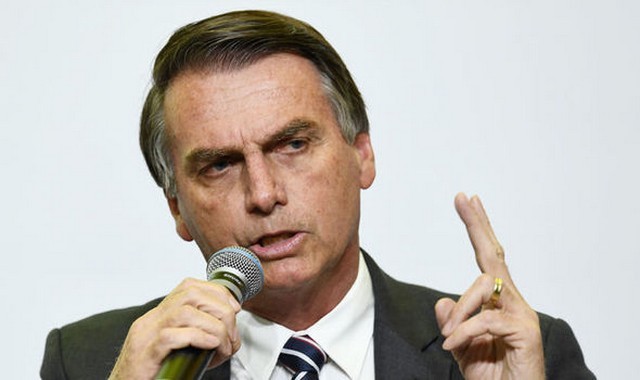
Bolsonaro: a monster engineered by our media

By Jonathan Cook

With Jair Bolsonaro’s victory in Brazil’s presidential election at the weekend, the doom-mongers among western elites are out in force once again. His success, like Donald Trump’s, has confirmed a long-held prejudice: that the people cannot be trusted; that, when empowered, they behave like a mob driven by primitive urges; that the unwashed masses now threaten to bring down the carefully constructed walls of civilisation.

The guardians of the status quo refused to learn the lesson of Trump’s election, and so it will be with Bolsonaro. Rather than engaging the intellectual faculties they claim as their exclusive preserve, western “analysts” and “experts” are again averting their gaze from anything that might help them understand what has driven our supposed democracies into the dark places inhabited by the new demagogues. Instead, as ever, the blame is being laid squarely at the door of social media.

Social media and fake news are apparently the reasons Bolsonaro won at the ballot box. Without the gatekeepers in place to limit access to the “free press” – itself the plaything of billionaires and global corporations, with brands and a bottom line to protect – the rabble has supposedly been freed to give expression to their innate bigotry.

Here is Simon Jenkins, a veteran British gatekeeper – a former editor of the Times of London who now writes a column in the Guardian – pontificating on Bolsonaro:

“The lesson for champions of open democracy is glaring. Its values cannot be taken for granted. When debate is no longer through regulated media, courts and institutions, politics will default to the mob. Social media – once hailed as an agent of global concord – has become the purveyor of falsity, anger and hatred. Its algorithms polarise opinion. Its pseudo-information drives argument to the extremes.”

This is now the default consensus of the corporate media, whether in its rightwing incarnations or of the variety posing on the liberal-left end of the spectrum like the Guardian. The people are stupid, and we need to be protected from their base instincts. Social media, it is claimed, has unleashed humanity’s id.

Selling plutocracy

There is a kind of truth in Jenkins’ argument, even if it is not the one he intended. Social media did indeed liberate ordinary people. For the first time in modern history, they were not simply the recipients of official, sanctioned information. They were not only spoken down to by their betters, they could answer back – and not always as deferentially as the media class expected.

Clinging to their old privileges, Jenkins and his ilk are rightly unnerved. They have much to lose.

But that also means they are far from dispassionate observers of the current political scene. They are deeply invested in the status quo, in the existing power structures that have kept them well-paid courtiers of the corporations that dominate the planet.

Bolsonaro, like Trump, is not a disruption of the current neoliberal order; he is an intensification or escalation of its worst impulses. He is its logical conclusion.

The plutocrats who run our societies need figureheads, behind whom they can conceal their unaccountable power. Until now they preferred the slickest salespeople, ones who could sell wars as humanitarian intervention rather than profit-driven exercises in death and destruction; the unsustainable plunder of natural resources as economic growth; the massive accumulation of wealth, stashed in offshore tax havens, as the fair outcome of a free market; the bailouts funded by ordinary taxpayers to stem economic crises they had engineered as necessary austerity; and so on.

A smooth-tongued Barack Obama or Hillary Clinton were the favoured salespeople, especially in an age when the elites had persuaded us of a self-serving argument: that ghetto-like identities based on colour or gender mattered far more than class. It was divide-and-rule dressed up as empowerment. The polarisation now bewailed by Jenkins was in truth stoked and rationalised by the very corporate media he so faithfully serves.

Fear of the domino effect

Despite their professed concern, the plutocrats and their media spokespeople much prefer a far-right populist like Trump or Bolsonaro to a populist leader of the genuine left. They prefer the social divisions fuelled by neo-fascists like Bolsonaro, divisions that protect their wealth and privilege, over the unifying message of a socialist who wants to curtail class privilege, the real basis of the elite’s power.

The true left – whether in Brazil, Venezuela, Britain or the US – does not control the police or military, the financial sector, the oil industries, the arms manufacturers, or the corporate media. It was these very industries and institutions that smoothed the path to power for Bolsonaro in Brazil, Viktor Orban in Hungary, and Trump in the US.

Former socialist leaders like Brazil’s Luiz Inácio Lula da Silva or Hugo Chavez in Venezuela were bound to fail not so much because of their flaws as individuals but because powerful interests rejected their right to rule. These socialists never had control over the key levers of power, the key resources. Their efforts were sabotaged – from within and without – from the moment of their election.

Local elites in Latin America are tied umbilically to US elites, who in turn are determined to make sure any socialist experiment in their backyard fails – as a way to prevent a much-feared domino effect, one that might seed socialism closer to home.

The media, the financial elites, the armed forces were never servants of the socialist governments that have been struggling to reform Latin America. The corporate world has no interest either in building proper housing in place of slums or in dragging the masses out of the kind of poverty that fuels the drug gangs that Bolsonaro claims he will crush through more violence.

Bolsonaro will not face any of the institutional obstacles Lula da Silva or Chavez needed to overcome. No one in power will stand in his way as he institutes his “reforms”. No one will stop him creaming off Brazil’s wealth for his corporate friends. As in Pinochet’s Chile, Bolsonaro can rest assured that his kind of neo-fascism will live in easy harmony with neoliberalism.

Immune system

If you want to understand the depth of the self-deception of Jenkins and other media gatekeepers, contrast Bolsonaro’s political ascent to that of Jeremy Corbyn, the modest social democratic leader of Britain’s Labour party. Those like Jenkins who lament the role of social media – they mean you, the public – in promoting leaders like Bolsonaro are also the media chorus who have been wounding Corbyn day after day, blow by blow, for three years – since he accidentally slipped past safeguards intended by party bureacrats to keep someone like him from power.

The supposedly liberal Guardian has been leading that assault. Like the rightwing media, it has shown its absolute determination to stop Corbyn at all costs, using any pretext.

Within days of Corbyn’s election to the Labour leadership, the Times newspaper – the voice of the British establishment – published an article quoting a general, whom it refused to name, warning that the British army’s commanders had agreed they would sabotage a Corbyn government. The general strongly hinted that there would be a military coup first.

We are not supposed to reach the point where such threats – tearing away the façade of western democracy – ever need to be implemented. Our pretend democracies were created with immune systems whose defences are marshalled to eliminate a threat like Corbyn much earlier.

Once he moved closer to power, however, the rightwing corporate media was forced to deploy the standard tropes used against a left leader: that he was incompetent, unpatriotic, even treasonous.

But just as the human body has different immune cells to increase its chances of success, the corporate media has faux-liberal-left agents like the Guardian to complement the right’s defences. The Guardian sought to wound Corbyn through identity politics, the modern left’s Achille’s heel. An endless stream of confected crises about anti-semitism were intended to erode the hard-earned credit Corbyn had accumulated over decades for his anti-racism work.

Slash-and-burn politics

Why is Corbyn so dangerous? Because he supports the right of workers to a dignified life, because he refuses to accept the might of the corporations, because he implies that a different way of organising our societies is possible. It is a modest, even timid programme he articulates, but even so it is far too radical either for the plutocratic class that rules over us or for the corporate media that serves as its propaganda arm.

The truth ignored by Jenkins and these corporate stenographers is that if you keep sabotaging the programmes of a Chavez, a Lula da Silva, a Corbyn or a Bernie Sanders, then you get a Bolsonaro, a Trump, an Orban.

It is not that the masses are a menace to democracy. It is rather that a growing proportion of voters understand that a global corporate elite has rigged the system to accrue for itself ever greater riches. It is not social media that is polarising our societies. It is rather that the determination of the elites to pillage the planet until it has no more assets to strip has fuelled resentment and destroyed hope. It is not fake news that is unleashing the baser instincts of the lower orders. Rather, it is the frustration of those who feel that change is impossible, that no one in power is listening or cares.

Social media has empowered ordinary people. It has shown them that they cannot trust their leaders, that power trumps justice, that the elite’s enrichment requires their poverty. They have concluded that, if the rich can engage in slash-and-burn politics against the planet, our only refuge, they can engage in slash-and-burn politics against the global elite.

Are they choosing wisely in electing a Trump or Bolsonaro? No. But the liberal guardians of the status quo are in no position to judge them. For decades, all parts of the corporate media have helped to undermine a genuine left that could have offered real solutions, that could have taken on and beaten the right, that could have offered a moral compass to a confused, desperate and disillusioned public.

Jenkins wants to lecture the masses about their depraved choices while he and his paper steer them away from any politician who cares about their welfare, who fights for a fairer society, who prioritises mending what is broken.

The western elites will decry Bolsonaro in the forlorn and cynical hope of shoring up their credentials as guardians of the existing, supposedly moral order. But they engineered him. Bolsonaro is their monster.

Jonathan Cook won the Martha Gellhorn Special Prize for Journalism.

1 November 2018

Source: https://countercurrents.org/2018/11/01/bolsonaro-a-monster-engineered-by-our-media/

FREE ROHINGYA COALITION CONDEMNS PREMATURE REPATRIATION OF ROHINGYAS

By Maung Zarni

The Free Rohingya Coalition is deeply troubled by yesterday’s announcement by Bangladesh and Myanmar that both countries will begin repatriating Rohingyas in mid-November.

We are Rohingya activists and international supporters who have been extremely appreciative of the political leadership of Bangladesh Prime Minister Sheikh Hasina and her compassionate embrace of Rohingyas, which has won worldwide praise and admirations.

So we are saddened and shocked by Bangladesh’s Foreign Secretary Md. Shahidul Haque telling the media that: “we are looking forward to start the repatriation in mid-November”. The Free Rohingya Coalition is, therefore, extremely disturbed that the Government of Bangladesh might be prepared to resort to the unconscionable and internationally illegal practices that characterized previous waves of repatriation.

The Rohingya have long been very much aware of the past waves of bilateral repatriations since 1978 —particularly the 1978 and 1992/93 large scale repatriations — wherein a total of nearly 500,000 Rohingyas were sent back to Myanmar under questionable circumstances, and with UNHCR’s awareness of the unfavourable and unsafe conditions for repatriation once the Rohingyas were back in their homeland of Myanmar. The two waves of exodus of the past 2 years — in 2016 and 2017 — which resulted in the cross-border deportation of nearly 1 million Rohingyas, have proved Bangladesh’s policy failure in forcibly repatriating thousands of Rohingyas back.

This time, not even the UN High Commission for the Refugees can stomach this repatriation, which will be tantamount to refoulment, an illegal act of expulsion of individuals who deserve protection and refugee.

Chris Melzer, the UNHCR’s senior external officer based in Cox’s Bazar, Bangladesh, openly opposed the latest development: “UNHCR was not a party to that agreement. We would advise against imposing any timetable or target figures for repatriation in respect of the voluntary nature and sustainability of return. It is unclear if refugees know their names are on this list that has been cleared by Myanmar. They need to be informed. They also need to be consulted if they are willing to return … It is critical that returns are not rushed or premature.”

Neither Bangladesh nor the Myanmar civilian government of Aung San Suu Kyi has been able to assuage Rohingyas’ widespread and well-founded fear that their lives, families and communities will once again face further attacks once they are back in their homeland of Western Myanmar.

Only a week ago on 24 October, the UN Fact Finding Mission Chief and former Indonesian Attorney General Marzuki Darusman officially told the Security Council that Myanmar’s genocide is “on-going” — pointing to the unchanging nature of the structures of genocidal repression and persecution, the same military leadership and the same public opinion which calls for the extermination of the Rohingyas.

It is widely acknowledged that neither Suu Kyi not her bureaucratic representatives led by permanent secretary Mr Myint Thu who came to negotiate the latest bilateral deal in Dhaka, have any control or influence over either armed Rakhine nationalists or Myanmar security forces.

Suu Kyi’s representative Myint Thu was heard promising the “esteemed people” of the Rohingyas in the camps 300 elementary schools, seed money for businesses, future jobs in an industrial park under construction, prefabricated homes, rows of toilets,mobile clinics, 10-days of exam coaching for Rohingya distance education students, and the official offer of a pathway to citizenship via NVC-cards – which Rohingyas have risked their lives rejecting.

Neither Myanmar nor Bangladesh nor international donors appear to grasp the fundamental driver behind periodic waves of the exodus of Rohingya from their homeland in Northern Rakhine: the hellish conditions which Myanmar’s genocidal policies have produced, and since August 2017, large scale mass slaughter, systematic mass rape, and the burning down of nearly 400 villages.

Dr Maung Zarni, a noted Burmese genocide scholar, and coordinator of the Free Rohingya Coalition, said: “sending Rohingyas back to Myanmar without their consent is sending them back to genocide with the hollow promise of new amenities and opportunities”.

As a grassroots international network of genocide scholars, rights activists and Rohingya exiles, with a broad base of supporters among Rohingya refugees in Bangladesh, we have been extremely supportive of the Government of Dhaka and sought to cooperate in whatever ways we could.

We therefore appeal to the Government of Bangladesh to ensure that no Rohingyas be sent back to Myanmar’s killing fields, without addressing Rohingyas’ need for a protection mechanism or “safe zone”, as Sheik Hasina has proposed to the United Nations in two consecutive General Assemblies.

Backgrounder:

Natalie Brinham “Genocide cards”: Rohingya refugees on why they risked their lives to refuse ID cards, Open Democracy, 21 October 2018

“‘Primitive people’: the untold story of UNHCR’s historical engagement with Rohingya refugees”.

Contact:

Nay San Lwin, Coordinator for Media Relations and Campaigns at nslwin@rohingyablogger.com; +49 176 62139138

Tun Khin, Coordinator for International Outreach at tunkhin80@gmail.com; +44 788 871 4866

Maung Zarni, Coordinator for Strategic Affairs at fanon2005@gmail.com; +44 771 047 3322

1 November 2018

Source: https://freerohingyacoalition.org/en/?p=1166

Commentary: Five reasons why Trump’s Iran sanctions will fail

By Seyed Hossein Mousavian

The next round of economic sanctions on Iran, which will start going into effect on Nov.4, will mainly target the country’s oil and gas industries. These sanctions were eased after the 2015 signing of the Joint Comprehensive Plan of Action (JCPOA), commonly known as the Iran nuclear deal, but are being phased back in following President Donald Trump’s decision to withdraw from the accord six months ago.

Trump’s goal in reinstituting the sanctions is to kill the nuclear deal, to bring Iran’s economy to the point of total collapse, to contain Iran’s regional involvement in Syria, Iraq and Yemen, and, in spite of Washington’s denials, presumably to celebrate the collapse of Iran’s ruling regime. The White House’s official position is that, by increasing economic and political pressure, it aims to bring Iran back to the negotiating table in order to replace the JCPOA with a new deal that bears Trump’s name.

There are at least five reasons why Trump’s strategy will fail.

First, while the United States seeks to cut Iran’s oil exports to zero, it has become clear that this is impractical; there is no viable replacement for Iran’s 2.5 million barrels per day in oil exports. While Saudi Arabia previously claimed it had made up for any shortages, experts believe that Riyadh and its allies do not have the capacity to fully offset the loss of Iranian oil. Now that Iran’s oil exports have dropped to an estimated 1.5 million bpd – down from more than 2.5 million before the U.S. withdrawal from the JCPOA in May – the price of the OPEC reference basket has gone up to around $76. If forecasts indicating that it could jump to $100 per barrel are correct, the price hike will make up for Iran’s loss of revenue even if Tehran’s exports are cut further to 1 million barrels.

Second, Trump’s trade war with China and the U.S. imposition of economic sanctions against Russia make Beijing and Moscow less likely to work with Washington on Iran. Moreover, the White House cannot count on cooperation from the European Union, which initiated nuclear negotiations with Iran in 2003 and which sees the JCPOA as one of its signature foreign policy achievements. Further, the EU increasingly views extraterritorial sanctions as a threat to its own identity and independence. French Finance Minister Bruno Le Maire said recently that the “outcome of that crisis with Iran will be the chance for Europe to have its own independent financial institutions, so we can trade with whoever we want.” In the past, cooperation with all major powers was critical to creating an effective Iran policy.

Third, U.S. sanctions have laid the groundwork for a historic change in the global financial system. For many decades, the U.S. dollar has dominated the international financial markets. However, American withdrawal from the JCPOA has encouraged countries such as Russia, China, India and Turkey to use their local currencies to trade with Iran. If Europe succeeds in creating a financial system that is separate from the U.S. dollar, other states can use euros in trade with Iran, diminishing U.S. domination of global markets.

Fourth, the remaining signatories to the JCPOA view the nuclear deal as a means to counter American unilateralism. This is due to the fact that the JCPOA is a multilateral agreement backed by UN Security Council resolution 2231, which the Trump administration exited unilaterally and is now trying to punish other nations for implementing. Any capitulation to Washington on this issue would further buttress the current U.S. approach. To avoid this, both Iran and the international community will see preserving the JCPOA as a strategic necessity.

Fifth, powerful U.S. allies such as the EU and Japan continue to support the JCPOA. Only a handful of regional allies – namely Saudi Arabia, the UAE and Israel – supported Trump’s decision to withdraw from the deal while other major regional players such as Turkey, Oman and Iraq continue to support the accord. At the same time, developments in other regional crises do not favor the United States and its allies: Bashar al-Assad, backed by Russia and Iran, is winning Syria’s civil war; the U.S. campaign in Afghanistan has failed; Saudi Arabia has been unable to defeat the Tehran-backed Houthis in Yemen and Qatar has prevailed against the Saudi-led blockade. These developments will make it easier for Tehran to find workarounds to sanctions imposed by Washington.

For the past six decades, the United States has been the region’s hegemonic power. However, Trump’s unilateralist approach and the future of JCPOA may change the calculation by creating a rift among the transatlantic allies, and bringing the eastern bloc powers, Europe and regional powers such as Iran, Turkey and Iraq, closer together. Moreover, the JCPOA has paved the way for other world powers – specifically Europe, China, Russia and India ­– to preserve international agreements without the United States. This, coupled with American withdrawal from the international scene, has the potential to transform international power politics, shifting from an American-led system to a multi-polar world, with regional actors playing a more substantial role.

Against this backdrop, the next round of U.S. sanctions against Iran is likely to increase Middle East tensions – and unlikely to bring Washington closer to achieving its goals on Iran.

Seyed Hossein Mousavian is Middle East Security and Nuclear Policy Specialist at Princeton University and a former spokesman for Iran’s nuclear negotiators. His most recent book, “Iran and the United States: An Insider’s view on the Failed Past and the Road to Peace” was published in 2014.

31 October 2018

Source: https://www.reuters.com/article/us-mousavian-iran-commentary/commentary-five-reasons-why-trumps-iran-sanctions-will-fail-idUSKCN1N42QY

Iran Nuclear Deal was Meant to Give US Face-saving in Syria

By Nauman Sadiq

Recently, the Trump administration has announced the most stringent set of sanctions against Iran to appease Benjamin Netanyahu. Donald Trump has repeatedly said during the last two years that the Iran nuclear deal signed by the Obama administration in 2015 was an “unfair deal” that gave concessions to Iran without giving anything in return to the US.

Unfortunately, there is a grain of truth in Trump’s statements because the Obama administration had signed the Joint Comprehensive Plan of Action (JCPOA) with Iran in July 2015 under pressure as Washington had bungled in its Middle East policy and it wanted Iran’s cooperation in Syria and Iraq to get a face-saving.

In order to understand how the Obama administration bungled in Syria and Iraq, we should bear the background of Washington’s Middle East policy during the recent years in mind. The seven-year-long conflict in Syria, that gave birth to scores of militant groups, including the Islamic State, and after the conflict spilled across the border into neighboring Iraq in early 2014, was directly responsible for the spate of Islamic State-inspired terror attacks in Europe from 2015 to 2017.

Since the beginning of the Syrian conflict in August 2011 to June 2014, when the Islamic State overran Mosul and Anbar in Iraq, an informal pact existed between the Western powers, their regional Sunni allies and jihadists of the Middle East against the Shi’a Iranian axis. In accordance with the pact, militants were trained and armed in the training camps located in the border regions of Turkey and Jordan to battle the Syrian government.

This arrangement of an informal pact between the Western powers and the jihadists of the Middle East against the Iranian axis worked well up to August 2014, when the Obama Administration made a volte-face on its previous regime change policy in Syria and began conducting air strikes against one group of Sunni militants battling the Syrian government, the Islamic State, after the latter overstepped its mandate in Syria and overran Mosul and Anbar in Iraq from where the US had withdrawn its troops only a couple of years ago in December 2011.

After this reversal of policy in Syria by the Western powers and the subsequent Russian military intervention on the side of the Syrian government in September 2015, the momentum of jihadists’ expansion in Syria and Iraq stalled, and they felt that their Western patrons had committed a treachery against the Sunni jihadists’ cause, that’s why they were infuriated and rose up in arms to exact revenge for this betrayal.

If we look at the chain of events, the timing of the spate of terror attacks against the West was critical: the Islamic State overran Mosul in June 2014, the Obama Administration began conducting air strikes against the Islamic State’s targets in Iraq and Syria in August 2014, and after a lull of almost a decade since the Madrid and London bombings in 2004 and 2005, respectively, the first such incident of terrorism occurred on the Western soil at the offices of Charlie Hebdo in January 2015, and then the Islamic State carried out the audacious November 2015 Paris attacks, the March 2016 Brussels bombings, the June 2016 truck-ramming incident in Nice, and three horrific terror attacks took place in the United Kingdom within a span of less than three months in 2017, and after that the Islamic State carried out the Barcelona attack in August 2017, and then another truck-ramming atrocity occurred in Lower Manhattan in October 2017 that was also claimed by the Islamic State.

More to the point, the dilemma that the jihadists and their regional backers faced in Syria was quite unique: in the wake of the Ghouta chemical weapons attacks in Damascus in August 2013, the stage was all set for yet another no-fly zone and “humanitarian intervention” a la Qaddafi’s Libya; the war hounds were waiting for a finishing blow and then-Turkish foreign minister, Ahmet Davutoglu, and then-Saudi intelligence chief, Bandar bin Sultan, were shuttling between the Western capitals to lobby for the military intervention. Francois Hollande had already announced his intentions and David Cameron was also onboard.

Here it should be remembered that even during the Libyan intervention, the Obama administration’s policy was a bit ambivalent and France under the leadership of Sarkozy had taken the lead role. In Syria’s case, however, the British parliament forced Cameron to seek a vote for military intervention in the House of Commons before committing the British troops and air force to Syria.

Taking cue from the British parliament, the US Congress also compelled Obama to seek approval before another ill-conceived military intervention; and since both the administrations lacked the requisite majority in their respective parliaments and the public opinion was also fiercely against another Middle Eastern war, therefore Obama and Cameron dropped their plans of enforcing a no-fly zone over Syria.

In the end, France was left alone as the only Western power still in favor of intervention; at that point, however, the seasoned Russian foreign minister, Sergei Lavrov, staged a diplomatic coup by announcing that the Syrian regime was willing to ship its chemical weapons stockpiles out of Syria and subsequently the issue was amicably resolved.

Turkey, Jordan and the Gulf Arab states, the main beneficiaries of the Sunni Jihad against the Shi’a-dominated government in Syria, however, had lost a golden opportunity to deal a fatal blow to their regional rivals.

To add insult to the injury, the Islamic State, one of the numerous Sunni Arab militant outfits fighting in Syria, overstepped its mandate in Syria and overran Mosul and Anbar in Iraq in 2014, from where the US troops had withdrawn only a couple of years ago in December 2011, as I have already described.

Additionally, when the graphic images and videos of Islamic State’s executions surfaced on the internet, the Obama administration was left with no other choice but to adopt some countermeasures to show that it was still sincere in pursuing its dubious “war on terror” policy; at the same time, however, it assured its Turkish, Jordanian and Gulf Arab allies that despite fighting a war against the maverick jihadist outfit, the Islamic State, the Western policy of training and arming the so-called “moderate” Syrian militants will continue apace and that Bashar al-Assad’s days were numbered, one way or the other.

Moreover, declaring the war against the Islamic State in August 2014 served another purpose too: in order to commit the US Air Force to Syria and Iraq, the Obama administration needed the approval of the US Congress which was not available, as I have already mentioned, but by declaring a war against the Islamic State, which is a designated terrorist organization, the Obama administration availed itself of the war on terror provisions in the US laws and thus circumvented the US Congress.

But then Russia threw a spanner in the works of NATO and its Gulf Arab allies in September 2015 by its surreptitious military buildup in Latakia that was executed with an element of surprise unheard of since General Rommel, the Desert Fox. And now Turkey, Jordan, the Gulf Arab states and their jihadist proxies in Syria find themselves at the receiving end in the Syrian conflict.

Keeping this background of the quagmire created by the Obama administration in Syria and Iraq to please Washington’s regional allies, Israel and the Gulf states, in mind, it becomes amply clear that the Obama administration desperately needed Iran’s cooperation in Syria and Iraq to salvage its failed policy of training and arming jihadists to topple the government in Syria that backfired and gave birth to the Islamic State that carried out some of the most audacious terror attacks in Europe from 2015 to 2017.

Thus, Washington signed JCPOA in July 2015 that gave some concessions to Iran, and in return the then hardliner Prime Minister of Iraq Nouri al-Maliki was forced out of power in September 2014 and the moderate Prime Minister Haider al-Abadi was appointed in his stead who gave permission to the US Air Force and ground troops to assist Iraq’s Armed Forces and allied militias to beat back the Islamic State from Mosul and Anbar.

The Trump administration, however, is not hampered by the legacy of Obama administration and since the objective of defeating the Islamic State has already been comprehensively achieved, therefore Washington felt safe to annul the Iran nuclear deal in May and the crippling “third-party sanctions” have once again been put in place on Iran at Benjamin Netanyahu’s behest. In realpolitik, one cannot negotiate from a position of weakness, one can simply capitulate; because justice prevails among equals.

Nauman Sadiq is an Islamabad-based attorney, columnist and geopolitical analyst focused on the politics of Af-Pak and Middle East regions, neocolonialism and petro-imperialism.

6 November 2018

Source: https://countercurrents.org/2018/11/06/iran-nuclear-deal-was-meant-to-give-us-face-saving-in-syria/

Religion and Politics in Pakistan

By Abdus Sattar Ghazali

In a replay of 1977 anti-government demonstration against the government of Prime Minister Zulfiqar Ali Bhutto, the government of Pakistan Prime Minister Imran Khan is facing violent protests by religious parties to destabilize the newly elected government.

In 1977, the so-called Pakistan National Alliance, comprising three main religious parties – Jamaat-e-Islami (JI), Jamiat Ulema-e-Islam (JUI), Jamiat Ulema-e-Pakistan (JUP), some other political parties and fringe groups – launched a violent campaign with a single point agenda to remove the elected government of Prime Minister Bhutto accusing him of rigging the March 1977 elections in which religious parties performed poor. Their election agenda was to establish Islamic rule in the country. The PNA was successful in its mission as the Army Chief General Ziaul Haq deposed Bhutto and imposed martial law.

Fast forward to 2018, Muttahida Majlis-e-Amal (MMA) an alliance of five religio-political parties that include Jamiat Ulema-e-Islam (JUI-F), Jamaat-e-Islami (JI), Markazi Jamiat Ahle Hadith (JA), Tehreek-e-Jafaria Pakistan (TJP) and Jamiat Ulema-e-Pakistan (JUP), plans to hold a ‘million march’ in Karachi on Thursday (Nov 8) against the Supreme Court’s recent acquittal of Asia Bibi — a Christian woman who was previously sentenced to death on blasphemy charges by lower courts.

Ironically, three of the five MMA parties include three religious parties which were members of the 1977 anti-Bhutto alliance.

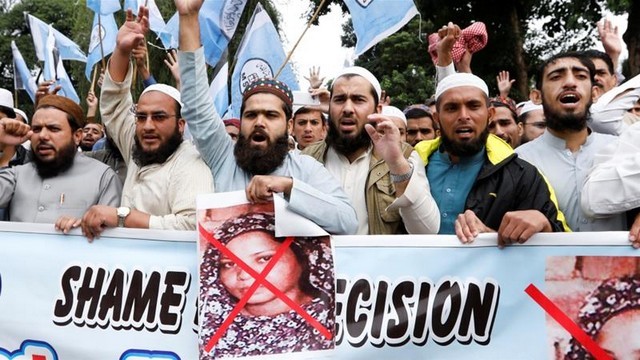
Pakistan witnessed violent demonstrations for three days as the Supreme Court announced the verdict on Wednesday Oct 31. The demonstrations were called by a new religious party, Tehreek-e-Labbaik Pakistan (TLP)

Shortly after the Supreme Court’s landmark ruling was pronounced, Tehreek-e-Labbaik Pakistan (TLP) leaders Khadim Rizvi, led a major protest outside government buildings in the eastern city of Lahore, with fellow TLP leaders declaring the three judges who acquitted Bibi to be “liable to be killed”.

The sit-in protest in Lahore remained the largest TLP demonstration on Thursday, with other major demonstrations being held in the southern city of Karachi, Pakistan’s largest. Protesters are also blockading a major highway into the capital, Islamabad.

Most schools and many businesses remained closed in all three cities through the day, with hospitals on high alert in case the protests turned violent. Highways were partially shut down and the federal cabinet held an emergency meeting to discuss the law and order situation.

On November 2, Tehreek-e-Labbaik Pakistan agreed with the government to end the violent demonstrations which had paralyzed the country and caused extensive material and economic damage.

According to agreement, a review appeal has been filed in the case of Asia Bibi which is the legal right of complainants and government will have no objection on it.

It was also agreed to initiate legal proceedings to prevent her from traveling abroad. She has been offered asylum by several countries.

The agreement adds that people who have been arrested against the acquittal of Asia Masih from October 30th onwards will be immediately released.

Tehreek-e-Labbaik says judges who acquitted Christian woman ‘deserve death’

Tehreek-e-Labbaik has called for the death of the country’s Supreme Court judges responsible for overturning the death sentence of a Christian woman accused of blasphemy.

“The patron in chief of TLP, Muhammad Afzal Qadri, has issued the edict that says the chief justice and all those who ordered the release of Asia deserve death,” party spokesman Ejaz Ashraf said, as cited by the news agency.

The party also demanded Prime Minister Imran Khan’s government be ousted following the court’s order.

Religious leaders had also demanded the ouster of the head of Pakistan’s military, Gen. Qamar Javed Bajwa, accusing him of acquiescing to Ms. Bibi’s release. Soon after the Supreme Court’s ruling, Pir Muhammad Afzal Qadri, another prominent protest leader, urged army generals to revolt against their top commander.

The military said Friday that it had nothing to do with Ms. Bibi’s release. “The armed forces hope that this matter is resolved without disruption of peace,” Maj. Gen. Asif Ghafoor, the army’s spokesman, was quoted by state-run media as saying.

Tehreek-e-Labbaik Pakistan

The TLP, founded in 2015, is known for widespread (often countrywide) street power and massive protests in opposition to any change to Pakistan’s blasphemy law.

The TLP party came into existence, and subsequently rose to fame, after the hanging of Mumtaz Qadri, the killer of Salmaan Taseer, an outspoken secular governor of Punjab Province who had campaigned for Asia Bibi’s release and for changes in the blasphemy laws

In October 2017, the government of Pakistan controversially changed the language in its 2017 elections bill. The Tehreek-i-Labbaik Pakistan and its leader Khadim Hussain Rizvi strongly opposed the new language, and demanded the resignation of Pakistan’s Minister for Law and Justice Zahid Hamid, who had changed the law.

The TLP held a large protest against the controversial amendment, stopping traffic at the Faizabad Interchange at first, which then led to further protests across the country. The party led a three-week sit-in protest that paralyzed the entire country including Pakistan’s capital, Islamabad. At least six protesters were killed and 200 were injured when police unsuccessfully tried to disperse the sit-in, the protest had already spread out nationwide.

That protest forced the resignation of the federal law minister Zahid Hamid and paved the way for the group to poll more than 2.23 million votes in the July 25, 2018 general election, in what analysts called a “surprisingly” rapid rise.

What did the Supreme Court say?

Asia Bibi, a Christian who spent eight years on death row under Pakistan’s divisive blasphemy law, had her conviction overturned on October 31 by the Supreme Court . She was convicted in 2010 under the blasphemy law after she was accused of insulting the Prophet.

The Supreme Court judges in their verdict said the prosecution had “categorically failed to prove its case beyond reasonable doubt”. The case was based on flimsy evidence, they said, and proper procedures had not been followed.

Blasphemy laws have often been used to get revenge after personal disputes, and that convictions are based on thin evidence.

The Supreme Court while acquitting Asia Bibi pointed out: “Sometimes, to fulfill nefarious designs the law is misused by individuals leveling false allegations of blasphemy. Stately, since 1990, 62 people have been murdered as a result of blasphemy allegations, even before their trial could be conducted in accordance with law. Even prominent figures, who stressed the fact that the blasphemy laws have been misused by some individuals, met with serious repercussions. A latest example of misuse of this law was the murder of Mashal Khan, a student of Abdul Wali Khan University, Mardan, who in April 2017 was killed by a mob in the premises of the university merely due to an allegation that he posted blasphemous content online.”

The Supreme Court also mentioned another instance of the misuse of the blasphemy law. The court said: “Reference may also be made to the case of one Ayub Masih, who was accused of blasphemy by his neighbour Muhammad Akram. The alleged occurrence took place on 14th October 1996, the accused was arrested, but despite the arrest, houses of Christians were set ablaze and the entire Christian population of the village (fourteen families) were forced to leave the village. Ayub was shot and injured in the Sessions Court and was also further attacked in jail. After the trial was concluded, Ayub was convicted and sentenced to death, which was upheld by the High Court. However, in an appeal before this Court, it was observed that the complainant wanted to grab the plot on which Ayub Masih and his father were residing and after implicating him in the said case, he managed to grab the seven-marla plot. The appeal was accepted by this Court and the conviction was set aside.”

At least 1,472 people were charged under the law between 1987 and 2016, according to the Center for Social Justice, an advocacy group. Of those, 730 were Muslims, 501 were Ahmedis — a sect that is declared as non-Muslim in Pakistan — while 205 were Christians and 26 were Hindus.

Pakistan’s blasphemy laws open to misuse

Those opposing the apex court’s verdict on Asia Bibi should go back to re-educating themselves on what Islam is truly all about , says Tariq A. Al Maeena, a Saudi journalist. Commenting on the violent reaction to the acquittal of Asia Bibi Al Maeena said:

“Alluding to the fact that the arguments involved insults on both sides, with Jesus Christ’s name thrown in, the court stated: “Blasphemy is a serious offence, but the insult of the appellant’s (Asia Bibi) religion and religious sensibilities by the complainant party and then mixing truth with falsehood in the name of the Holy Prophet [PBUH] was also not short of being blasphemous.”

“The verdict did not sit well with many fundamentalists who took to the streets to vent their anger. From burning rickshaws, cars and lorries to bringing traffic — including ambulances on their way to hospitals — to a standstill, the protesters vented their rage and not just at the court. Posters of Pakistan’s Prime Minister Imran Khan were burnt. Some even threw shoes at Imran’s pictures.

“These religious fanatics, as I see them, are the worst examples of what Islam truly is. Far from respecting the verdict, they have become a law unto themselves and have set about creating mayhem and anarchy, something that Islam specifically does not condone. With very little understanding of the true meaning of Islam, these hordes are no different from those ignorant non-Muslims who deride or insult Islam. The actions of these Pakistanis are just as despicable.

“It was during the military dictatorship of former Pakistan president General Zia-ul-Haq in the 1980s when blasphemy laws were radically introduced in the legislature, including punishment by death for those charged with defiling the sacred name of the Prophet (PBUH).

“Over the years, it became evident that the blasphemy law was used more and more for political gain, to settle land disputes or political rivalries than as an agent to maintain sanctity. The law became a way to challenge someone’s status and a powerful tool to intimidate anyone, Muslim or non-Muslim. Most of these cases reveal personal vendetta or are often used by extremists as a cover to persecute religious minorities.”

Abdus Sattar Ghazali is the Chief Editor of the Journal of America (www.journalofamerica.net) email: asghazali2011 (@) gmail.com

6 November 2018

Source: https://countercurrents.org/2018/11/06/religion-and-politics-in-pakistan/

MESA; Arab NATO-like Alliance

By Dr Elias Akleh

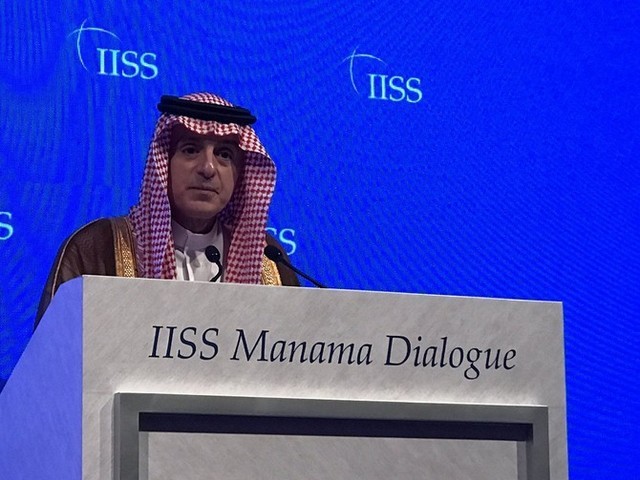
The major media outlets had totally ignored the important three days October 26-28 IISS Manama Dialogue 2018 conference that was organized by International Institute for Strategic Studies (IISS) in the city of Manama; the capital of the tiny island of Bahrain.

This Manama Dialogue was attended by very important international political representatives such as General James Mattis; US Secretary of Defense, Brett McGurk; Special Presidential Envoy for the Global Coalition to Defeat ISIS, Sheikh Khalid bin Ahmad Al Khlifa; Bahrain’s Minister of Foreign Affairs, Adel Al Jubeir; Saudi Minister of Foreign Affairs, Ayman Safadi; Jordanian Minister of Foreign Affairs, Yousef bin Alawi; Oman’s Minister of Foreign Affairs, Taro Kono; Japan’s Minister of Foreign Affairs, Ursula von der Leyen; German’s Minister of Defense, Elisabetta Trenta; Italy’s Minister of Defense, Raychelle Omamo; Kenya’s Secretary of Defense, Abdisaid Ali; Somalia’s National Security Adviser, and Jean-Christophe Belliard; Deputy Secretary General, Political Affairs, Political Director, European External Action service. Yet, surprisingly, the media had ignored the gathering of these important persons!!!???

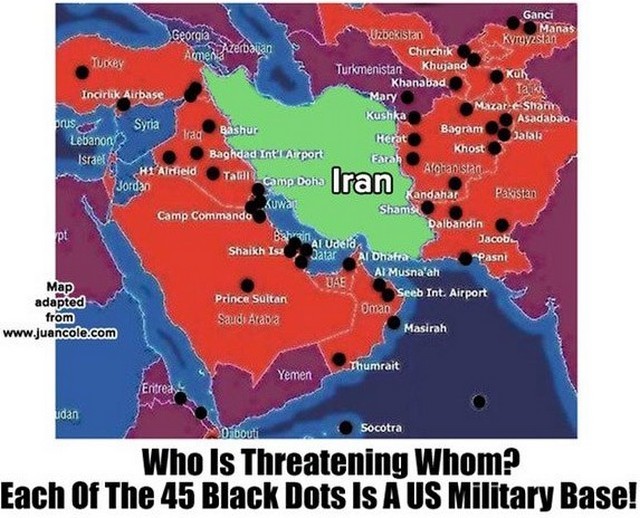
The speeches of these representatives were characterized mainly as Iran bashing and condemnations, particularly the speeches of the American representatives; Mattis and McGurk, and the Bahraini and Saudi ministers. While their governments are pursuing hegemonic policies within the region, they accuse Iran of pursuing a hegemonic Iranian Crescent, previously called Shi’ite Crescent, covering Lebanon, Syria and Yemen. Iran did not impose itself on these countries. Lebanese Hezbollah requested Iranian help to free Lebanon from the 1982 Israeli occupation. Syria requested Iranian help to defeat American/Israeli/Gulf States supported terrorist groups. Yemen cannot get any outside help due to the air and sea siege imposed by American/Saudi/UAE’s forces.

While the USA and the Gulf States have enlisted, trained and armed all the terrorist groups that have been destroying Syria and Yemen during the last decade, they accused Iran of a terrorist supporting state. The facts on the ground show clearly that Iran has been fighting and defeating terrorist groups and protecting Syrian cities first and eventually the whole region.

While the USA and the Gulf States are spreading sectarianism, encourage terrorism, seeking to dominate other countries, waging wars and seeking to destabilize the Middle Eastern region, they accuse Iran of such crimes. Iran has never started any war or sent its military forces out of its own borders for the last 400 years.

While the American administration is gradually turning into a police state, and the Bahraini and Saudi kingdoms are despotic beheading dictatorships they accuse democratic Iran of abusing and suppressing its own people. Since its 1979 revolution Iran had held several democratic elections, something that had never happened in neither Bahrain nor Saudi Arabia.

None of these representatives dared to point to the core issue driving all these wars and destructions in the region except the Omani Minister; Yousef bin Alawi, who stated the following:

“We consider that the Palestinian issue is the core of all the problems that we have seen during the second half of the last century and the 18 years of the 21st Century … the state of Palestine needs to be established, because it has become a strategic necessity”

This Manama Dialogue came as a preliminary foundation for the planned for summit in November of the six leaders of the GCC; Gulf Cooperation Council (Oman, UAE, Saudi Arabia, Qatar, Bahrain and Kuwait) plus Jordan and Egypt in Washington with President Trump to lay the foundation for what Trump had called Middle Eastern Strategic Alliance (MESA) also dubbed Arab NATO-like Alliance.

Forming military alliances between Arab states to protect the Middle Eastern region goes back to post WWI era. The Arab League, formally known as the League of Arab States, was formed in 1945 with six-member Arab states and later expanded to include 22 states. The League was rendered ineffective first by British and then by American interfering policies and banking systems especially after the League’s opposition to the establishment of the illegal Zionist state of Israel on occupied Palestinian land. Such policies had also foiled any inter-Arab military alliances such as those attempted by former Egyptian president Gamal Abdel Nasser.

Nasser’s pan-Arabism ideology was very popular in the 1950’s. It led to the formation of the 1957 Regional Defense Pact between Egypt, Saudi Arabia, Syria and Jordan. Nasser’s pan-Arabism was viewed by the US as a threat to Israel, and when Nasser nationalized all British and French assets in Egypt, President Eisenhower’s administration decided to do everything it can to isolate Nasser and his ideology by transforming King Saud as a counterweight. Nasser was portrayed as a threat first to Jordanian King Hussein, and later a threat to King Saud. Eventually the Regional Defense Pact was dissolved.

In mid-1957 when Turkish troops were amassed on the Syrian border threatening to topple the government, Nasser sent a contingent force to aid Syria. In February 1958 Egypt and Syria were united into United Arab Republic (UAR). Later Yemen joined the UAR, and a loose federation was formed under the name of United Arab States.

With tacit Eisenhower’s encouragement king Saud planned to assassinate Nasser while in Syria, but the assassination failed and was exposed by Nasser in a public speech. King Saud then was replaced by his brother; King Faisal, who advocated pan-Islamic unity with non-Arab Moslem countries to counter Nasser’s pan-Arabism.

In September 1961 a Syrian army unit launched a coup in Damascus declaring Syria’s withdrawal from the UAR. Avoiding inter-Arab fighting Nasser refused to send Egyptian forces to Syria to reinforce the allies, and accepted the separation.

Saudi Arabian money provoked civil war in Yemen in 1962. This war drew Egyptian forces in a war of attrition that ended in 1967 when Nasser withdrew his forces leaving Yemen divided into North and South.

With the death of Nasser in September 1970, the ideology of pan-Arabism and United Arab States faded gradually since none of the Arab leaders, except Syrian Hafez al-Assad, had called for it but found no positive response. It was left to the inefficient non-unitarian and divisive Arab League to deal with regional security issues.

It must be said that since WWI the western powers; US, British and France, had planned to divide the Arab World into weaker states that could be controlled and manipulated through pro-western despots in order to blunder its resources, particularly oil, and to control its geostrategic location. The Zionist Greater Israel Project had been adopted and implemented for this purpose. Any Arab attempt to unite militarily was opposed and spoiled.

Yet, at the present, Trump’s administration is in the process of forming a military Middle Eastern Strategic Alliance (MESA) allegedly to protect the region from any military threat. MESA is just a new form of the old western designed Middle Eastern Alliance projects; whose real goals were to wage American proxy inter-Arab wars to further divide and weaken Arab states to safeguard Israel and to rake great financial profits for the American military industrial complex.

We had witnessed these military alliances in the 1980-1988 Iraq/Iran war where the Gulf States supported Iraqi Saddam Hussein. Then the same Gulf States allied with Egypt, Jordan and Syria to join the western coalition in the two Gulf Wars; 1991 and 2003, against Iraq. In 2011 the Gulf States of Qatar, Saudi Arabia, UAE, Jordan and Turkey joined the so-called American Coalition to defeat ISIS in Syria when the facts on the ground showed that such coalition was a terrorist supporting coalition providing training, finance and weapons to ISIS to destroy Syria. In 2014 this same coalition supported terrorists who destroyed Libya. In 2015 we witnessed Saudi/UAE coalition, supported by Israel and US, waging war against Yemen.

So far, all these alliances had led to the destruction of Arab states. The proposed MESA is no different. Its major goal is to finish what the terrorist groups had started; destroying Syria, destroying Hezbollah and weakening or affecting a regime change in Iran. MESA, though, has one important distinction from its previous alliances, namely Israel.

As we have seen in the past, the American administrations will not allow the formation of an Arab military alliance that would threaten Israel. MESA will actually include Israel in the alliance as intelligent gathering partner. This would allow Israel to infiltrate its Arab partners’ military, security and intelligence systems. Israel is already involved in the terrorist war against Syria and in the Saudi/Emirati war against Yemen. MESA is perceived to include nine states; the six Gulf States (Kuwait, Bahrain, Qatar, Saudi Arabia, UAE and Oman), Jordan, Egypt and Israel.

The Arab’s enmity towards Zionist Israel, who occupied Palestine, attacked neighboring Arab states, and supported terrorist groups in Syria, would be turned into a friendly alliance, while Iran, who shares same religious faith with Arab states, supports the Palestinian cause, and considers Israel a main threat to the region is turned into an Arab enemy.

Vital issues remain to be tackled for this alliance to succeed. Arab states have their own separate policies and conflicts. Qatar was branded as a terrorist supporting state due to its conflicting agenda with those of the Saudi Arabia/UAE/Bahrain/Egypt alliance. Turkey, annoyed by Saudi decision to assist the Kurds in Syria, moved to become a shield for Qatar against the Saudi alliance by building a military base in the peninsula.

Kuwait took a neutral position towards the Qatar/Saudi conflict. Kuwaiti/Saudi tension increased during MBS’s short visit to Kuwait early October demanding that Kuwait re-open the Khafji and Wafra oil fields to compensate oil shortage and high prices anticipated by the expected American sanctions against Iran. Kuwaiti crown prince; Sheikh Nawaf Al-Ahmad was displeased by MBS’s snobby attitude and ordered him to leave Kuwait immediately.

To reconcile these inter-Arab conflicts the Secretary of State Mike Pompeo has been touring the Middle East offering incentives as well as inciting enmity against Iran at the same time.

There are other complicated issues to be solved before this alliance is formed. Issues such as finance, command, bases, cooperation between member states, and logistical arrangements. It is obvious that Saudi money will mainly finance the alliance. Saudi Arabia is the milking cow as described by President Trump. American military generals will assume command for sure, and will impose how member states would behave and contribute militarily.

Iran and the rest of the Arab states; Iraq, Syria, Lebanon and Palestine, perceive MESA as a pro-Zionist anti-Arab coalition, whose covert real goals are further division, destruction and weakening of the Arab World. This coalition is looked at as a political and financial Arab suicide succeeding only in milking billions of Saudi money to buy American weapons that will only rust in Saudi desert, and in accepting the Zionist occupation of Palestine, that will eventually expand to cover more Arab land.

If stronger and larger international “ … 79 members of coalition in 75 countries, plus NATO, the EU, Interpol and the Arab League” according to Brett McGurk, had failed to affect regime change in Syria for a period of seven years, and the armed to the teeth with the latest sophisticated weapons American/Israeli/Saudi/Emirati/ coalition had failed to defeat the impoverished state of Yemen during the last three years, how then, would conflict-ridden MESA can accomplish any real victory?

The Iranian Minister of Foreign Affairs; Mohammad Javad Zarif, suggested a more efficient mechanism for security in the Persian Gulf region rather than building military alliances that create more enmity. He proposed starting a modest confidence building measures leading to a non-aggression pact. He suggested creating “a regional dialogue forum” among all the littoral states of the Persian Gulf to build “a security networking, rather than security alliances” to create “a strong region as opposed to a strong man in the region, where small and large nations – even those with historical rivalries – contribute to stability”

“You cannot have security at the expense of the insecurity of your neighbor.” Zarif emphasized.

Dr. Elias Akleh is an Arab American from a Palestinian descent.

6 November 2018

Source: https://countercurrents.org/2018/11/06/mesa-arab-nato-like-alliance/

Trump Bullying Will Hurt Millions of Iranians

By Medea Benjamin

Iranian government officials want to know how the Trump administration can get away with punishing Iran and other countries for complying with the internationally recognized nuclear deal signed in 2015. “The US is, in effect, threatening states who seek to abide by Resolution 2231 with punitive measures,” said President Rouhani. “This constitutes a mockery of international decisions and the blackmailing of responsible parties who seek to uphold them.”

Treating the welfare of the Iranians people like a TV show, Donald Trump used a meme from The Game of Thrones—an arrogant, stylized photo of himself with the tagline: “Sanctions Are Coming November 5”—to announce the new round of crippling sanctions targeting Iran’s oil exports, banks and shipping.

This is the second round of sanctions since Trump pulled out of the Iran nuclear deal, a deal that was signed in 2015 not only by the US and Iran, but also by Germany, England, France, Russia and China—and approved unanimously by the UN Security Council. It’s also a deal that has been working. Iran has been complying with the most intrusive inspections regime ever devised, as the International Atomic Energy Agency has confirmed 13 times.

Trump, always ready to bulldoze international agreements, unilaterally withdrew from the deal and imposed a first round of sanctions in August and the second round now. These sanctions are designed to stop not just US companies from trading with Iran, but all companies—anywhere in the world. According to Treasury Secretary Steve Mnuchin, “Any financial institution, company, or individual who evades our sanctions risks losing access to the U.S. financial system and the ability to do business with the United States or U.S. companies.” In effect, the Trump administration, practicing imperial hubris on steroids, is determined to punish countries abiding by an internationally approved agreement.

Faced with US threats, big Western companies that had recently signed contracts with Iran, such as Total, Eni, Boeing, Airbus, and Peugeot, have cancelled multi-billion dollar deals.

Desperate to counter US sanctions, the European Union is creating a mechanism called the “special purpose vehicle.” It is essentially a barter system, similar to one used by the Soviet Union during the Cold War, to exchange Iranian oil for European goods without money changing hands.The US government has vowed to sabotage this effort. “I have no expectation that there will be any transactions that are significant that go through a special purpose vehicle based upon what I’ve seen,” Treasury Secretary Steve Mnuchin said. “But if there are transactions that have the intent of evading our sanctions, we will aggressively pursue our remedies.”

Secretary of State Mike Pompeo boasted that even before the November 5 sanctions went into effect, the US had already succeeded in reducing Iranian crude oil exports by more than 1 million barrels, and insists that the goal is to stop ALL Iranian oil exports. The administration is granting temporary waivers to eight countries, including India, South Korea and Japan, principally out of concern that withdrawing so much oil from the market at once would lead to a spike in global oil prices. Moreover, they are merely six-month waivers contingent on countries “winding down” their oil business with Iran. A major stipulation for the waivers is that Iran’s revenues must be kept in foreign accounts that can only be used for trade in “nonsanctioned goods and services.”

While this economic stranglehold is officially designed to “stop Iran’s destabilizing activities across the world,” Trump administration officials are known to be gunning for regime change, hoping that distraught Iranians take to the streets to overthrow their government.

Indeed, since last December there have been sporadic protests against the economic hardships. But will unorganized protesters really be capable of toppling a well-armed, tightly controlled regime? Some analysts speculate that what the Trump administration wants in Iran is not even regime change but chaos, with Iranians fighting each other so they won’t be projecting power beyond their borders.

Trump’s wishful thinking aside, the most likely effects of the sanctions will be to further inflame regional conflicts, empower conservative forces in Iran, make other governments resentful of US imperial overreach and worst of all, needlessly cause suffering to millions of Iranian citizens.

The sanctions are already taking a tragic toll. While there are humanitarian exemptions on food and medicines, restrictions on banks and shipping companies make even exempted items difficult to obtain. Asked about humanitarian exemptions, French Ambassador to Washington Gerard Araud said, “The banks are so terrified by the sanctions that they don’t want to do anything with Iran.”

Below is a sampling of the desperate messages we have been getting from people in Iran:

– We are suffering the sanctions with our bodies and souls. Businesses are closing, workers are losing their jobs, food prices are increasing by the hour. We may not be happy with our government, but this economic situation makes us more dependent on the government.

– When I sleep at night there is one set of food prices. When I get up in the morning, they have doubled. We are losing our ability to buy food for our children because of Mr. Trump.

– My grandmother in Iran has gone blind in one eye because she can no longer access her diabetes medicine. Thanks America.

– I am a teacher in Iran. Before President Trump violated the nuclear deal, my salary was $800 a month. Now I have to work 12 hours a day, six days a week, just to make $250. The harsher the sanctions, the more difficult our lives become.I don’t know why we should suffer the consequences of decisions made by stubborn officials, whether here or in the United States. We just want to live normal lives.

Donald Trump is only too happy to make a mockery of international decisions. It is up to the rest of the world to stop him.

Medea Benjamin, co-founder of Global Exchange and CODEPINK: Women for Peace, is the author of the new book, Inside Iran: The Real History and Politics of the Islamic Republic of Iran.

6 November 2018

Source: https://countercurrents.org/2018/11/06/trump-bullying-will-hurt-millions-of-iranians/